Source: The Conversation – UK – By Thankom Arun, Professor of Global Development and Accountability, University of Essex
Keir Starmer’s first visit to India was a chance to talk about trade, technology and a closer relationship. The UK prime minister said he was impressed by the country’s “sheer scale” and impressive economic growth.
He may be fairly envious of that growth which, at 7.8% for the first quarter of the year, is several times higher than the UK’s. The country is projected to become the world’s third-largest economy by 2030, with an estimated GDP of US$7.3 trillion (£5.5 trillion). Starmer may also have noticed that one of India’s biggest economic successes is in the burgeoning sector of financial technology, where it is in direct competition with the UK.
Commonly referred to as “fintech”, financial technology involves digital tools and software which make things like banking and investing more efficient and accessible. For years, London has been celebrated as a global hub.
But our research suggests that India’s very different approach to fintech may be a more resilient and forward-looking model – and one which offers important lessons for the UK and its government.
For in the UK, fintech is almost entirely a London-based affair. The capital attracts more than 80% of the country’s investment in the sector, and is home to most of its startups.
But the cost of this success is that other parts of the UK lag behind. Our study shows that this concentration limits innovation and employment outside of London. In effect, the city’s “superhub” status may now be holding back the next stage of national fintech development.
India’s story looks very different. Rather than revolving around a single big city, fintech has evolved across a broad range of regional hubs. Bangalore, Mumbai and New Delhi lead the way, but newer centres such as Telangana and Tamil Nadu are also rapidly emerging.
This spread of growth is not accidental. It reflects years of government investment in digital public infrastructure across the country, as well as a great deal of foreign investment.
We found that between 2000 and 2022, India pulled in US$144 billion compared to Britain’s US$82 billion, reflecting growing investor confidence in India’s fintech market.
That investment is also much more widely spread out in India, where we found a much more balanced and resilient innovation landscape compared to the UK. The outcome is not only faster growth, but more development throughout the country.
Overall we found that the trajectory of India’s fintech sector appears to be more sustainable and regionally dispersed than the UK’s – a clear validation of the country’s “digital-first” strategy, which was launched ten years ago.
We also noted the success of direct government involvement in platforms like the Unified Payments Interface (a game changing initiative which allows instant money transfers between any two bank accounts using a smartphone and now processes over 12 billion transactions a month).
Indian innovation
For the UK, our research concluded that although London’s dominance in fintech has served the country well, it now risks becoming a bottleneck. A fintech sector model built around a single global city limits regional opportunities and undermines national productivity.
If the government’s broader “national renewal” agenda is to succeed, fintech policy could become a test case for rebalancing the economy. That means encouraging investment in regional clusters and directly supporting innovation outside London.
But the two countries could also help each other out. Together, they could create one of the most dynamic fintech partnerships in the world.
As well as trade and investment, such a collaboration could provide a dynamic model for inclusive, technology-driven growth, linking Britain’s financial expertise with India’s digital ingenuity.
For the global fintech landscape is changing. The era of a dominant hubs, whether London, New York or Singapore, is giving way to a more decentralised model. And India’s rise shows that the future of finance lies not in concentration, but in connectivity.
Sustainable innovation depends not just on capital and talent, but on geography, inclusion, and the ability to share the digital dividends of growth. If Keir Starmer looks east for inspiration and partnership, he may find that India’s fintech journey offers precisely the blueprint the UK needs – one that proves there is greater strength to be found not in one hub, but in many.
Source: The Conversation – UK – By Deborah Fry, Professor of International Child Protection Research and Director of Data at the Childlight Global Child Safety Institute, University of Edinburgh
Around 5 million children across western Europe report having been raped or sexually assaulted by the age of 18, according to the latest data gathered by Childlight, the Global Child Safety Institute. That’s about 7% of the child population.
In south Asia, data for India, Nepal and Sri Lanka suggests the figure rises to 12% of children – more than 50 million young people in those three countries alone.
The online picture is equally alarming. In western Europe alone, one in five children (19.6%) say they have faced unwanted or pressured sexual interactions online before adulthood.
The data also reveals that over 60% of all child sexual abuse material in western Europe (and 30% globally) is hosted in the Netherlands.
These shocking figures come from Childlight’s latest Into the Light index. As Childlight’s director of data, and as a professor of international child protection research, I have spent nearly 20 years studying the patterns of child sexual exploitation and abuse worldwide. What our data shows is both deeply troubling and a call to urgent action.
How we measure the scale
In 2024, we launched the inaugural Into the Light index – the first comprehensive global report of child sexual exploitation and abuse. It introduced a new framework, the first regional prevalence estimates and indicators of child sexual abuse material.
The 2025 edition goes further. It covers both online and offline abuse and country-level data for 41 countries in western Europe and south Asia, incorporating the analysis of:
89 studies which used survey methods to identify victims of rape and sexual assault
crime statistics and child helpline data
global child sexual abuse material trends, including AI-generated imagery and hosting patterns.
For western Europe, we reviewed 48 studies from 19 countries, finding that between 3.7% and 9.6% of children reported being raped or sexually assaulted by the age of 18. For south Asia, representative data from India, Nepal and Sri Lanka shows around 12% of children were raped or sexually assaulted by 18 – 14.5% of girls and 11.5% of boys.
What the data reveals
Our research points to widespread abuse and some keys issues emerged.
AI-generated child sexual abuse material is rising: reports rose 1,325% between 2023 and 2024, amid growing concerns about deepfake images placing children’s faces onto sexual material. This rise was seen in reports to the National Center for Missing and Exploited Children, which rose to over 67,000 in 2024, from 4,700 reports logged in 2023.
Meanwhile, familial abuse is leading to the creation of new child sexual abuse material, with a large proportion of identified material depicting immediate family members.
Behind these numbers are real children, millions who stay silent out of fear, guilt or loyalty to family members. Yet the consequences are lifelong, affecting mental health, physical health and even life expectancy.
Childlight, hosted by the University of Edinburgh and the University of New South Wales, is the world’s first independent global data institute dedicated to protecting children from sexual exploitation and abuse.
As I have written before, the fight to keep young people safe from harm has been hampered by how data differs in quality and consistency around the world. Our aim is to work in partnership with many other organisations to help join up the system and close the data gaps.
What can be done
The good news is that solutions exist and momentum is building, with 30 governments globally pledging action to improve online safety for children since an intergovernmental summit in Colombia last November.
The legislation is showing promising signs. The EU Digital Services Act and the UK Online Safety Act now require platforms to assess child risk, report incidents and publish transparency data. Australia’s eSafety Commissioner has also compelled firms to publish reports revealing how they are failing to track the problem.
Enforcement is having an impact. In April 2025, Kidflix, one of the largest paedophile platforms in the world, was shut down through an international Europol-backed operation, with servers seized and perpetrators arrested.
Prevention is working too. The Barnahus model in Europe, for example, brings together police, health and social services to support children in a child-friendly environment. It has been linked to more perpetrators being charged and convicted.
In addition, “blocklist” technology which acts as a virtual shield is thwarting 3 million attempts to view illegal sexual images of children online every week. Lists of known online addresses which host child sexual abuse material are compiled and shared by organisations including Internet Watch Foundation, so they can be blocked by major internet service providers, shutting down access to harmful images.
Urgency matters
The law must require proactive detection and removal of child sexual abuse material. Education and open conversations that empower children and families must be supported and encouraged. And finally we must invest in prevention models that work.
In the UK, that could mean extending the law on criminalising paedophile manuals to include material generated by AI. It could mean a Barnahus expansion, and it certainly should mean reforming the Criminal Injuries Compensation Scheme so all victims of child sexual abuse (including those harmed “virtually” through technology) are recognised and supported.
Child sexual exploitation and abuse is not inevitable. Like other public health crises, it is preventable and can prevent a lifetime of trauma with benefits for children, families, communities and economies.
But prevention depends on first understanding the true scale and nature of the problem. Our data is a spotlight, exposing what too often remains hidden in the shadows.
Deborah Fry receives funding from Human Dignity Foundation.
Give me control of a nation’s money supply, and I care not who makes its laws. (Mayer Amschel Rothschild, founder of the Rothschild banking dynasty.)
Throughout history, control over money has been one of the most powerful levers of state authority. Rulers have long understood that whoever issues and manages the currency also commands the economy and, by extension, society itself.
In Tudor England, Henry VIII’s “Great Debasement” between 1542 and 1551 reduced the silver content of coins from more than 90% to barely one-third, while leaving the king’s portrait shining on the surface, of course. The policy financed wars and courtly extravagance, but also fuelled inflation and public distrust in coinage.
Centuries earlier, Roman emperors had resorted to similar tricks with the denarius, steadily reducing its silver content until by the 3rd century AD, it contained little more than trace amounts, undermining its credibility and contributing to economic instability.
Outside Europe, the same pattern held. In 11th-century China, the Song dynasty pioneered paper money, extending state control over taxation and trade. This was a groundbreaking innovation, but later dynasties such as the Ming over-issued notes, sparking inflation and loss of trust in the currency.
Such episodes underline a timeless truth: money is never neutral. It has always been an instrument of governance – whether to project authority, consolidate control or disguise fiscal weakness. The establishment of central banks, from the Bank of England in 1694 to the US Federal Reserve in 1913, formalised that authority.
The Insights section is committed to high-quality longform journalism. Our editors work with academics from many different backgrounds who are tackling a wide range of societal and scientific challenges.
Today, the same story is entering a new digital chapter. As Axel van Trotsenburg, senior managing director of the World Bank, wrote in 2024: “Embracing digitalisation is no longer a choice. It’s a necessity.” By this he meant not simply switching to online banking, but making the currencies we use, and the mechanisms for regulating it, entirely digital.
Just as rulers once clipped coins or over-printed notes, governments are now testing how far digital money can extend their reach – both within and beyond national boundaries. Of course, different governments and political systems have very different ideas about how the money of the future should be designed.
In March 2024, then-former President Trump, back on the hustings trail, declared: “As your president, I will never allow the creation of a central bank digital currency.” It was a campaign moment, but also a salvo in a much larger battle – not just over the future of money, but who controls it.
In the US, the issuance of currency – whether in the form of physical cash or digital bank deposits and electronic payments – has traditionally been monopolised by the Federal Reserve (more commonly known as “the Fed”), a technocratic institution designed to operate independently from the elected government and houses. But Trump’s hostility toward the Fed is well-documented, and noisy.
During his second term, Trump has publicly berated the Fed’s chair, Jerome Powell, calling him “a stubborn MORON” over his interest rate policies, and even floating the idea of replacing him. Trump’s discomfort with the Fed’s autonomy echoes earlier populist movements such as President Andrew Jackson’s 1830s crusade against the Second Bank of the United States, when federal financial elites were portrayed as obstacles to democratic control of money.
In March 2025, when Trump issued an executive order establishing a Strategic Bitcoin Reserve, he signalled the opening of a new front in this institutional battle. By incorporating bitcoin into an official US reserve, the world’s largest economy is, for the first time, sanctioning its use as part of state financial infrastructure.
For a leader like Trump, who has consistently sought to break, bypass or dominate independent institutions – from the judiciary to intelligence agencies – the idea of replacing the Fed’s influence with a state-aligned crypto ecosystem may represent the ultimate act of executive assertion.
Such a step reframes bitcoin as more than an investment fad or criminal fallback; it is being drawn into the formal monetary system – in the US, at least.
America’s crypto future?
Bitcoin is, by a distance, the world’s most valuable cryptocurrency (at the time of writing, one coin is worth just shy of US$120,000) having established a record high in August 2025. Like gold, its value is ensured in part by its finite supply, and its security by the blockchain technology that makes it unhackable.
For most who buy bitcoins, its key value is not as a currency but a speculative investment product – a kind of “digital gold” or high-risk stock that investors buy hoping for big returns. Many people have indeed made millions from their purchases.
But now, thanks in particular to Trump’s aggressively pro-crypto, anti-central bank approach, bitcoin’s potential role as part of a new form of state-controlled digital currency is in the spotlight like never before.
Trump’s framing of bitcoin as “freedom money” reflects its traditional sales pitch as being censorship-resistant, unreviewable, and free from state control. At the same time, his blurring of public authority and private financial interest, when it comes to cryptocurrencies, has raised some serious ethical and governance concerns.
But the crucial innovation here is that Trump is not proposing a truly libertarian system. It is a hybrid model: one where the issuance of money may become privatised while control of the US’s financial reserve strategy – and associated political and economic narratives – remains firmly in state hands.
This raises provocative questions about the future of the Federal Reserve. Could it be sidelined not through legal abolition, but by the growing relevance of parallel monetary systems blessed by the executive? The possibility is no longer far-fetched.
According to a 2023 paper published by the Bank for International Settlements, a powerful if little-known organisation that coordinates central bank policy globally: “The decentralisation of monetary functions across public and private actors introduces a new era of contestable monetary sovereignty.”
In plain English, this means money is no longer the sole domain of states. Tech firms, decentralised communities and even AI-powered platforms are now building alternative value systems that challenge the monopoly of national currencies.
Calls to diminish the role of central banks in shaping macroeconomic outcomes are closely tied to the rise of what the University of Cambridge’s Bennett School of Public Policy calls “crypto populism” – a movement that shifts legitimacy away from unelected technocrats towards “the people”, whether they are retail investors, cryptocurrency miners or politically aligned firms.
Supporters of this agenda argue that central banks have too much unchecked power, from manipulating interest rates to bailing out financial elites, while ordinary savers bear the costs through inflation or higher borrowing charges.
In the US, Trump and his advisers have become the most visible proponents, tying bitcoin and also so-called “stablecoins” (cryptocurrencies designed to maintain a stable value by being pegged to an external asset) to a broader populist narrative about wresting control from elites.
The emergence of this dual monetary system is causing deep unease in traditional financial institutions. Even the economist-activist Yanis Varoufakis – a long-time critic of central banks – has warned of the dangers of Trump’s approach, suggesting that US private stablecoin legislation could deliberately weaken the Fed’s grip on money, while “depriving it of the means to clean up the inevitable mess” that will follow.
Weaponisation of the dollar
Some rival US nations also feel deep unease about its approach to money – in part because of what analysts call the “weaponisation of the dollar”. This describes how US financial dominance, via Swift and correspondent banking systems, has long enabled sanctions that effectively exclude targeted governments, companies or individuals from global finance.
These tools have been used extensively against Iran, Russia, Venezuela and others – triggering efforts by countries including China, Russia and even some EU states to build alternative payment systems and digital currencies, aimed at reducing dependency on the dollar. As the Atlantic put it in 2023, the US appeared to be “pushing away allies and adversaries alike by turning its currency into a geopolitical bludgeon”.
Spurred on by these concerns and an increasing desire to delink from the dollar as the world’s anchor currency, many countries are now moving towards creating their own central bank digital currencies (CBDCs) – government-issued digital currencies backed and regulated by state institutions.
While fully live CBDCs are already in use in countries ranging from the Bahamas and Jamaica to Nigeria, many more are in active pilot phases – including China’s digital yuan (e-CNY). Having been trialled in multiple cities since 2019, the e-CNY now has millions of domestic users and, by mid-2024, had processed nearly US$1 trillion in retail transactions.
A key part of Beijing’s ambition is to use the digital yuan as a strategic hedge against dollar-based clearance systems, positioning it as part of a wider plan to reduce China’s reliance on the US dollar in international trade. Likewise, the European Central Bank has framed its digital euro – which entered its preparation phase in October 2023 – as essential to future European monetary sovereignty, stating that it would reduce reliance on non-European (often US-controlled) digital payment providers such as Visa, Mastercard and PayPal.
In this way, CBDCs are becoming a new front in global competition over who sets the rules of money, trade and financial sovereignty in the digital age. As governments rush to build and test these systems, technologists, civil libertarians and financial institutions are clashing over how best to do this – and whether the world should embrace or fear the rise of central bank digital currencies.
Trojan horses for surveillance?
The experience of using a CBDC will be much like today’s mobile banking apps: you’ll receive your salary directly into a digital wallet, make instant payments in shops or online, and transfer money to friends in seconds. The key difference is all of that money will be a direct claim on the central bank, guaranteed by the state, rather than a private bank.
In many countries, CBDCs are being pitched as more efficient tools for economic inclusion and societal benefit. A 2023 Bank of England consultation paper emphasised that its proposal for a digital pound would be “privacy-respecting by design” and “non-programmable by the state”. It would not replace cash but sit alongside it, the BoE suggested, with each citizen allowed to hold up to a capped limit digital pounds (suggested at £10,000-£20,000) to avoid destabilising commercial bank deposits.
However, some critics see CBDCs as Trojan horses for surveillance. In 2019, a report by the professional services network PWC suggested that CBDCs, if unchecked, could entrench executive power by removing intermediary financial institutions and enabling programmable, direct government control over citizen transactions. According to the report, this could mean stimulus payments that expire if not spent within 30 days, or taxes deducted at the moment of transaction. In other words, CBDCs could be tools of efficiency – but also of unprecedented oversight.
A 2024 CFA Institute paper warned that digital currencies could allow governments to trace, tax or block payments in real time – tools that authoritarian regimes might embrace. The Bank for International Settlements (BIS) has called the advent of this “programmable money” inevitable.
Imagine, for example, a parent transferring 20 digital pounds to their child’s CBDC wallet, but with a rule that this money can only be spent on food, not video games. When the child uses it at a supermarket, their payment is programmed so that the retailer’s suppliers and the tax authority are paid instantly (£15 to the shop, £3 to wholesalers, £2 straight to the tax office) with no extra steps. In theory, at least, everyone is happy: the parent sees the child spent the money responsibly, the suppliers are paid immediately, and the retailer’s tax bill is settled automatically.
In technical terms, programmable payments such as this are straightforward for CBDCs. But such a system raises big questions about privacy and personal freedom. Some critics fear that programmable CBDCs might be used to restrict spending on disapproved categories such as alcohol and fuel, create expiry dates for unemployment benefits, or enforce climate targets through money flow limits. The BIS has warned that CBDCs should be “designed with safeguards” to preserve user privacy, financial inclusion and interoperability across borders.
Even well-intentioned digital systems can create tools of surveillance. CBDC architecture choices, such as default privacy settings, tiered access or transaction expiry can all shape the extent of executive control embedded in the system. If designed without democratic oversight, these infrastructures risk institutional capture.
Some CBDC pilots – including China’s e-CNY, the Sand Dollar and the eNaira – have been criticised for omitting clear privacy guarantees, with their respective central banks deferring decisions on privacy protections to future legislation. According to Norbert Michel, director of the Cato Institute’s Center for Monetary and Financial Alternatives and one of the most prominent US voices warning about the risks of CBDCs:
A fully implemented CBDC gives the government complete control over the money going into, and coming out of, every person’s account. It’s not difficult to see that this level of government control is incompatible with both economic and political freedom.
Fears of mission creep
The concerns being raised about central bank digital currencies extend beyond personal payment controls. A recent analysis by Rand Corporation highlighted how law enforcement capabilities could dramatically increase with the introduction of CBDCs. While this could strengthen efforts to stop money laundering and the financing of terrorism, it also raises fears of “mission creep”, whereby the same tools could be used to police ordinary citizens’ spending or political activities.
Concerns about mission creep – the idea that a system introduced for limited goals (efficiency, anti-money laundering) gradually expands into broader tools of control – extend into other areas of digital authoritarianism. The Bennett School has cautioned that without legal and political safeguards, CBDCs risk empowering state surveillance and undermining democratic oversight, especially in an interconnected global system.
It is not anti-technology or overly conspiratorial to ask hard questions about the design, governance and safeguards built into our future money. The legitimacy of CBDCs will hinge on public trust, and that trust must be earned. As has been highlighted by the OECD, democratic values like privacy, civic trust and rights protection must all be integral to CBDC design.
The future of money
Predictably, the public view of what we want our money to look like in future is mixed. The tensions we see between centralised CBDCs and decentralised alternatives reflect fundamentally different philosophies.
In the US, populist rhetoric has found a strong base among cryptocurrency investors and libertarian movements. At the same time, surveys in Europe suggest many people remain sceptical of replacing a central bank’s authority, associating it with stability and trustworthiness.
For the US Federal Reserve, the debate over bitcoin, decentralised finance (“DeFi”) and stablecoins goes to the heart of American financial power. Behind closed doors, some US officials worry that both the unchecked use of stablecoins and a widespread adoption of foreign CBDCs like China’s e‑CNY will erode the dollar’s central role and weaken the US’s monetary policy apparatus.
In this context, Trump’s push to elevate crypto into a US Strategic Bitcoin Reserve carries serious implications. While US officials generally avoid direct comment on partisan moves, their policy documents make the stakes clear: if crypto expands outside regulatory boundaries, this could undermine financial stability and weaken the very tools – from monetary policy to sanctions – that sustain the dollar’s global dominance.
Meanwhile, the Bank of England’s governor, Andrew Bailey, writing in the Financial Times this week, sounded more accommodating of a financial future that includes stablecoins, suggesting: “It is possible, at least partially, to separate money from credit provision, with banks and stablecoins coexisting and non-banks carrying out more of the credit provision role.” He has previously stressed that stablecoins must “pass the test of singleness of money”, ensuring that one pound always equals one pound (something that cannot be guaranteed if a currency is backed by risky assets).
This isn’t just caution for caution’s sake – it’s grounded in both history and recent events.
During the US’s Free Banking Era in the middle of the 19th century, state-chartered banks could issue their own paper money (banknotes) with little oversight. These “wildcat banks” often issued more notes than they could redeem, especially when economic stress hit – meaning people holding those notes found they weren’t worth the paper they were printed on.
A much more recent example is the collapse of TerraUSD (UST) in May 2022. Terra was a so-called stablecoin that was supposed to keep its value pegged 1:1 with the US dollar. In practice, it relied on algorithms and reserves that turned out to be fragile. When confidence cracked, UST lost its peg, dropping from $1 to as low as 10 cents in a matter of days. The crash wiped out over US$40 billion (around £29 billion) in value and shook trust in the whole stablecoin sector.
But Bailey’s crypto caution extends to CBDCs too. In his most recent Mansion House speech, the Bank of England governor said he remains unconvinced of the need for a “Britcoin” CBDC, so long as improvements to bank payment systems (such as making bank transfers faster, cheaper and more user-friendly) prove effective.
Ultimately, the form our money takes in future is not a question of technology so much as trust. In its latest guidance, the IMF underscores the necessity of earning public trust, not assuming it, by involving citizens, watchdog groups and independent experts in CBDC design, rather than allowing central banks or big tech to shape it unilaterally.
If done right, digital money could be more inclusive, more transparent, and more efficient than today’s systems. But that future is not guaranteed. The code is already being written – the question is: by who, and with what values?
To hear about new Insights articles, join the hundreds of thousands of people who value The Conversation’s evidence-based news. Subscribe to our newsletter.
The authors do not work for, consult, own shares in or receive funding from any company or organisation that would benefit from this article, and have disclosed no relevant affiliations beyond their academic appointment.
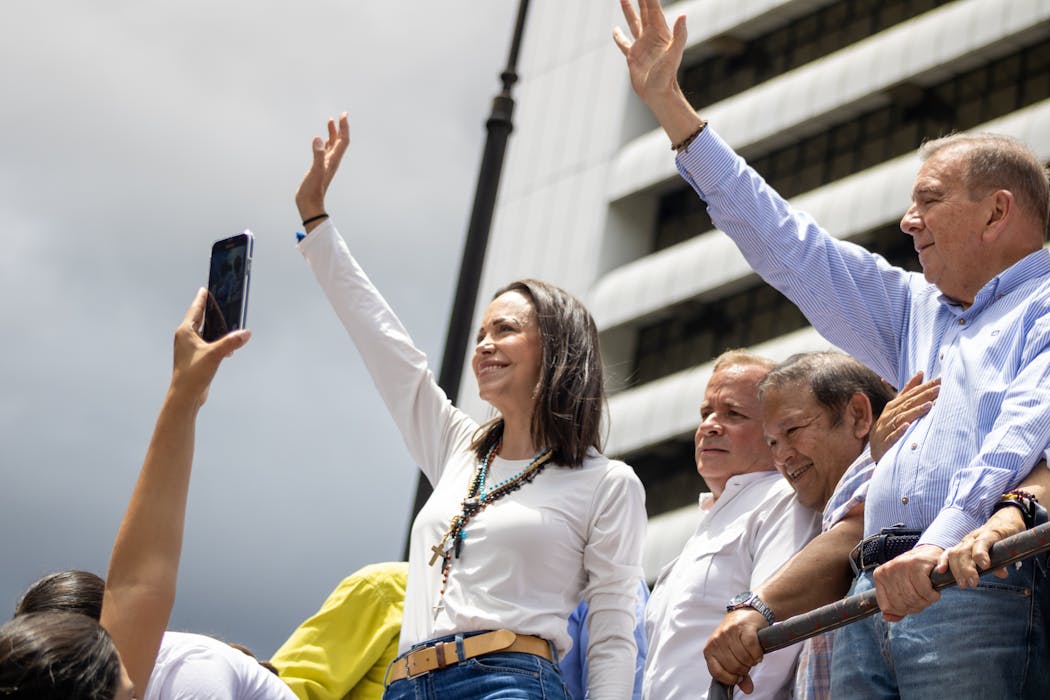
Los líderes de la oposición venezolana María Corina Machado y Edmundo Gonzales Urrutia saludan durante un acto en Caracas el 30 de julio de 2024.Jonathan Mishkin/Shutterstock
Ser galardonado con un Premio Nobel nunca es un suceso trivial. Los laureados, en ciencia o literatura, se inscriben automáticamente en la historia como referentes de su disciplina.
Sin embargo, cuando el galardón recae en la mención de la paz, adquiere una resonancia distinta: eleva al reconocido a la categoría de símbolo viviente y universal de las causas más nobles de la humanidad. Al recibirlo, personalidades internacionales como Theodore Roosevelt, la madre Teresa de Calcuta, Martin Luther King Jr., Lech Walesa, Desmond Tutu, y Mijaíl Gorbachov, o, más específicamente en el ámbito latinoamericano, Óscar Arias, Rigoberta Menchú y Juan Manuel Santos, a pesar de que sus acciones se circunscribieron a conflictos regionales, alcanzaron una dimensión moral global. Lo mismo ha ocurrido con organizaciones como el Comité Internacional de la Cruz Roja, la ONU o sus agencias ACNUR y UNICEF.
María Corina Machado, Premio Nobel de la Paz 2025
Conceder a María Corina Machado (1967), líder de la oposición venezolana, el Premio Nobel de la Paz 2025 se inserta precisamente en esta tradición. La acción reconocida por el Comité de Oslo se desplegó en el contexto de una lucha política interna, tal como, de manera similar, sucedió en 1991 con la birmana Aung San Suu Kyi, también laureada por su lucha no violenta por la democracia y los derechos humanos de su país.
Portavoz del Comité Noruego del Nobel anunciando la concesión del premio a María Corina Machado el 10 de octubre de 2025. Fuente: The Nobel Prize, YouTube.
La motivación explícita del Comité al premiar a Machado ha sido reconocer su labor de mantener “viva la llama de la democracia en medio de una creciente oscuridad”. Esta declaración validó de manera contundente la lucha pacífica y la resistencia civil de la líder opositora venezolana. El premio no solo es un espaldarazo incalculable a esta luchadora por la democracia, sino que funcionaría como un poderoso catalizador en el tablero geopolítico latinoamericano, redefiniendo la narrativa regional sobre la paz, la democracia y la soberanía.
Históricamente, en América Latina el concepto “paz” se ha asociado, sobre todo, a la firma de acuerdos de cese al fuego o al fin de conflictos armados (como en el caso de Colombia).
El Nobel a María Corina Machado, sin embargo, amplía esta concepción, alineándola con la visión esencial de Alfred Nobel: a saber, la paz como la ausencia de opresión y el triunfo de los derechos humanos y la democracia. El Comité de Oslo declara, sin ambages, que la lucha por la democracia es intrínseca a la búsqueda de la paz en regímenes autoritarios.
Este premio establece un nuevo paradigma de liderazgo opositor en la Latinoamérica. La lucha de Machado, basada en la resistencia persistente y no violenta, se convierte en un símbolo y referente ineludible para movimientos y líderes que emprenden luchas por la democracia en otros países de la región. El Nobel legitima a los movimientos cívicos como actores claves en la construcción de la paz en el hemisferio, demostrando que la firmeza democrática puede obtener el más alto reconocimiento mundial.
En el plano diplomático, el galardón obliga a replantear la política de neutralidad que han mantenido algunos gobiernos latinoamericanos. Los líderes que se autodenominan democráticos se enfrentan al trance de tomar una posición más clara: ignorar la lucha de una persona galardonada con el más alto premio por su labor en pro de la paz y la democracia resultaría impresentable. Si se materializa este cambio de actitud, la premiación podría generar una reagrupación de fuerzas diplomáticas en la región, sumando esfuerzos para aislar y presionar a gobiernos autoritarios.
Un Nobel que visibiliza la crisis política de Venezuela
Si bien el premio no ofrece una solución inmediata a la crisis política venezolana, sí la internacionaliza a un nivel sin precedentes. La relevancia que a nivel regional y mundial alcanza la figura de Machado hace extremadamente dificultoso excluirla de futuras negociaciones. El galardón la inviste como la figura más representativa de las fuerzas opositoras de Venezuela. Su liderazgo, respaldado por la autoridad moral del Nobel, se vuelve central para cualquier solución de transición, forzando a los actores regionales a asumir un papel más activo y menos complaciente en la búsqueda de una salida democrática y pacífica.
El Nobel de la Paz a María Corina Machado es, además de un reconocimiento personal, una categórica declaración política importante para la comunidad internacional. Se ha resaltado que la verdadera paz reside en que haya diversas voces en el ejercicio de la democracia y no un silencio impuesto a la fuerza.
Este premio resalta que la paz se liga ineludiblemente con la libertad, ofrece un símbolo de resistencia a los ciudadanos y desafía a los gobiernos de la región a honrar el compromiso con los valores democráticos que juraron defender.
Tulio Ramírez no recibe salario, ni ejerce labores de consultoría, ni posee acciones, ni recibe financiación de ninguna compañía u organización que pueda obtener beneficio de este artículo, y ha declarado carecer de vínculos relevantes más allá del cargo académico citado.
Source: The Conversation – (in Spanish) – By Carmen Beatriz Fernández, Profesora de Comunicación Política en la UNAV, el IESA y Pforzheim, Universidad de Navarra
Al conceder a María Corina Machado el Premio Nobel de la Paz 2025 no solo se reconoce su liderazgo y su coraje civil, también se rinde homenaje a la irreductible tozudez democrática del pueblo venezolano. En un país donde el autoritarismo ha intentado cerrar todas las puertas a la participación política, Machado ha demostrado que siempre existen ventanas por donde colar la democracia. Este reconocimiento –ha sido elegida entre 338 nominados al premio en 2025– celebra no solo su trayectoria, sino también la persistencia de millones de ciudadanos que se niegan a rendirse.
Kristian Berg Harpviken, director del Comité Noruego del Nobel, durante la llamada telefónica en la que anunció a Machado la concesión del premio. Fuente: The Nobel Prize, YouTube.
En 2002 fundó Súmate, una ONG dedicada a garantizar elecciones libres y transparentes. Desde entonces, Machado ha realizado una labor esencial en un contexto en el que los obstáculos ponen en duda la relevancia del voto. Pero justamente frente a ese desencanto, ha mantenido viva la idea de que el voto, cuando se defiende colectivamente, puede tener una fuerza transformadora.
Esa convicción se puso a prueba en las primarias opositoras de octubre de 2023, organizadas de forma independiente, sin apoyo del Consejo Nacional Electoral. Más de 2,25 millones de venezolanos participaron, dentro y fuera del país, y Machado obtuvo una victoria arrolladora: 93 % de los votos. Ese resultado consolidó su liderazgo y demostró que, pese a la represión, la sociedad civil aún podía organizar procesos transparentes y participativos. Fue una gesta cívica que marcó un punto de inflexión en la historia reciente de Venezuela.
Sin embargo, el régimen respondió con su habitual recurso: la inhabilitación política, esperando tal vez que la frustración derivara en violencia. Pero ocurrió lo contrario: Machado optó por la serenidad y la estrategia. Impedida de competir en las elecciones presidenciales de 2024, impulsó una salida estratégica: apoyar a Edmundo González Urrutia como candidato de unidad. Fue, de nuevo, la muestra de su inteligencia política y su compromiso con una transición democrática.
Durante la campaña, miles de voluntarios, de todos los partidos políticos, se desplegaron en unidad como observadores ciudadanos para documentar las actas electorales y proteger el voto. En esa elección del 28 de julio de 2024, Venezuela entera fue testigo de un acto de resistencia democrática sin precedentes. A pesar de la represión, el miedo y la censura, los ciudadanos acudieron a las urnas con una determinación que asombró al mundo.
Según los resultados reales, verificados por múltiples observadores independientes a partir de más del 83 % de las actas electorales, Edmundo González Urrutia ganó con cerca del 67 % de los votos. Una ventaja de más de 35 puntos porcentuales, y más de cuatro millones de votos, que el régimen desconoció al manipular el conteo oficial. El Consejo Nacional Electoral no fue capaz de presentar resultados itemizados, como sí lo hizo el comando de campaña de González Urrutia, pero el resultado electoral había sido escrupulosamente documentado.
Con la proclamación fraudulenta de Nicolás Maduro como ganador, el mensaje quedó claro: el camino electoral, tal como se conocía, quedaba cerrado y votar dejó de tener sentido en Venezuela. El régimen convirtió el sufragio en una coreografía del poder para simular normalidad democrática y la abstención del 85 % en el proceso parlamentario de 2025 simbolizó ese vacío político.
Machado encarna, además, una transformación de género y liderazgo en América Latina. La presencia de mujeres en la política regional ha desafiado estructuras de poder históricamente masculinas. En ese sentido, su liderazgo se suma a una nueva generación de mujeres latinoamericanas que, más que ocupar espacios, han creado nuevos modos de hacer política, basados en la empatía, la organización ciudadana y la defensa ética del voto.
Pero el reconocimiento del Nobel trasciende la figura de Machado y es un premio a la resiliencia colectiva de millones de personas que explica por qué se rebelan democráticamente los venezolanos y siguen creyendo que la democracia vale la pena.
La esperanza de un futuro diferente
Hoy, cuando en buena parte del mundo se erosionan las instituciones liberales, en Venezuela está en juego no solo la libertad del país, sino la credibilidad del sistema democrático frente al autoritarismo del siglo XXI.
Por eso, del bonito e inspirador discurso que explica las razones por las que María Corina Machado se hizo merecedora del Premio, este párrafo es clave:
“Ha demostrado que las herramientas de la democracia son también herramientas de la paz. Encarnan la esperanza de un futuro diferente, uno en el que se protejan los derechos fundamentales de los ciudadanos y se escuchen sus voces. En este futuro, las personas finalmente serán libres para vivir en paz”.
María Corina Machado representa la certeza de que la libertad no se negocia, que la democracia no se improvisa y que el futuro no pertenece a quienes imponen silencio, sino a quienes persisten en hablar cuando todos callan. Este Nobel es una reivindicación histórica: la de un país que, contra todo pronóstico, sigue creyendo que su destino está en las urnas, no en las armas.
Carmen Beatriz Fernández no recibe salario, ni ejerce labores de consultoría, ni posee acciones, ni recibe financiación de ninguna compañía u organización que pueda obtener beneficio de este artículo, y ha declarado carecer de vínculos relevantes más allá del cargo académico citado.
La France connaît sans doute sa plus grave crise institutionnelle depuis l’instauration, en 1958, de sa Constitution actuelle.
Suite à la dissolution surprise prononcée par le président de la République Emmanuel Macron en juin 2024, trois gouvernements se sont succédé avant d’être renversés. Le dernier en date, dirigé par le premier ministre Sébastien Lecornu, n’aura tenu qu’à peine 14 heures après la démission de celui qui était jusqu’alors ministre des Armées.
Ayant officiellement remis sa lettre de démission ce lundi, Sébastien Lecornu a toutefois été mandaté par le président de la République pour mener d’ultimes négociations avec les différents groupes politiques dont il a rendu compte mercredi lors d’une intervention télévisée. Le premier ministre a ainsi annoncé qu’un successeur sera désigné d’ici vendredi par le chef d’État.
Le moment est d’autant plus critique que ces ultimes tractations se déroulent à l’ombre de deux spectres qui, s’ils venaient à se réaliser, plongeraient davantage le pays dans la tourmente.
D’un côté, celui d’une nouvelle dissolution, essentiellement réclamée par le Rassemblement national, parti d’extrême droite. À l’autre extrémité de l’éventail, le parti de la France insoumise réclame quant à lui la destitution du Président.
Cet appel a trouvé écho dans les rangs mêmes des formations politiques apparentés au bloc présidentiel. C’est ainsi que ce mardi, Édouard Philippe, premier ministre d’Emmanuel Macron de 2017 à 2020 et président du groupe Horizons (centre droit), appelait le président à programmer une élection présidentielle anticipée. Ce désaveu s’ajoute à celui d’un autre soutien historique et ancien premier ministre macroniste, Gabriel Attal, lequel déclarait qu’il ne « comprenait plus » les décisions du chef d’État.
Des accusations de trahison qui se multiplient
Plusieurs causes profondes pourraient être avancées pour expliquer ce maelstrom institutionnel et politique : fragmentation et polarisation durables du paysage politique national, absence de majorité politique, primauté des logiques partisanes sur la responsabilité gouvernementale…
Pourtant, Emmanuel Macron semble figurer au premier rang des coupables de cette crise inédite. Parmi les arguments mobilisés par ses accusateurs, l’idée qu’il aurait « travesti » les institutions de la Ve République. C’est le sens des propos d’Édouard Philippe tenus mardi dernier :
En France, le garant des institutions est le Président de la République […] Quand on est chef de l’État, on ne les utilise pas pour déminer je ne sais quoi ou à sa convenance personnelle. On ne se sert pas des institutions, on les sert.
L’ancien premier ministre dénonce ainsi une forme de dévoiement institutionnel susceptible d’engendrer une « crise politique délétère pour le pays ».
Les pratiques institutionnelles, ou l’art de dépasser la Constitution
Ces critiques illustrent un phénomène particulièrement présent dans la vie politique française : les interactions entre, d’un côté, les institutions et, de l’autre, les pratiques qui en découlent.
Cette dialectique a donné lieu à une littérature particulièrement féconde dans le champ de la science politique. Les approches dites néo-institutionnalistes s’intéressent ainsi aux rôles des institutions, entendues comme un ensemble de règles, de normes et de principes formels socialement reconnus, qui organisent et contraignent le comportement des acteurs. Dans la continuité de cette perspective, le « tournant pratique » en relations internationales explore la manière dont les acteurs, par des pratiques informelles, s’aménagent des libertés d’action dans un contexte formel et contraignant.
Cela permet de comprendre comment les acteurs institutionnels, en premier lieu le président de la République, vont exploiter les interstices du texte de la Constitution de 1958 pour servir des objectifs politiques. Cette dialectique entre la lettre du texte et les interprétations qui en découlent était précisément pensée par le Général de Gaulle, l’architecte du texte constitutionnel, pour qui : « Une constitution, c’est un esprit, des institutions, une pratique ».
L’histoire de la Ve République regorge ainsi de pratiques qui, sans être expressément prévues dans le texte, se sont imposées durablement au point de produire des effets aussi contraignants que la règle écrite. La plus emblématique de ces pratiques est le concept de « domaine réservé », qui confère au chef d’État la compétence exclusive dans la conduite des affaires étrangères.
La nomination d’un premier ministre de droite à l’origine de la crise politique
C’est ainsi que certaines pratiques émergentes, si elles semblent admises sur le plan institutionnel, se heurtent dans le champ politique à une intense contestation.
Déjà des milliers d’abonnés à l’infolettre de La Conversation. Et vous ? Abonnez-vous gratuitement à notre infolettre pour mieux comprendre les grands enjeux contemporains.
Tel a été le cas au lendemain des élections législatives en juillet 2024. La coalition des forces de gauche réunies sous la bannière du Nouveau Front populaire est arrivée en tête du scrutin avec une majorité relative de sièges obtenus, tandis que le Rassemblement national a obtenu une majorité de suffrages. Le président Macron a choisi néanmoins de nommer comme premier ministre Michel Barnier, issu d’un parti, Les Républicains, qui ne figurait qu’en quatrième position.
Pourtant, la pratique institutionnelle qui prévalait jusque-là voulait que le président nomme un premier ministre issu des rangs de la force arrivée en tête des élections législatives. Cette pratique n’est toutefois pas inscrite dans le texte constitutionnel : l’article 8 indique en effet simplement que le « président de la République nomme le premier ministre ». Emmanuel Macron a dès lors saisi cette brèche pour échapper à une pratique dont l’application aurait desservi ses objectifs politiques.
Une partie de la crise institutionnelle que connait actuellement la France trouve probablement sa justification dans cette obstination du président de la République. La nomination vendredi d’un premier ministre issu des forces de gauche signifierait toutefois que cette pratique émergente et contestée aura fait long feu.
Wassim Tayssir a reçu des financements de l’Université de Montréal
Lisa Cook, a Federal Reserve governor, is also being investigated by the Department of Justice for allegedly making false statements when applying for a mortgage. Members of Donald Trump’s Cabinet are accused of similar wrongdoings. Could any of these people go to prison?
Mortgage fraud is not a new problem. Subprime mortgage fraud fueled the 2008 financial meltdown, when large numbers of very risky mortgages defaulted. Mortgage fraud was also a key feature of the savings and loan crisis in the 1980s.
Mortgage applications are very long, so there’s plenty of opportunity to make mistakes. Plus, they require borrowers to declare that everything is “true, accurate, and complete.” Misrepresentation can trigger potentially large civil and criminal penalties.
As a business school professor, I was curious how many people are convicted of mortgage fraud today. After all, relatively few people went to jail for fraudulent loans back in 2008. Since most mortgage fraud violates federal law, I looked at more than a decade of federal conviction data. What I found was clear: Almost no one has gone to federal prison recently for lying on a mortgage application.
What is mortgage fraud?
Mortgage fraud is when someone intentionally misrepresents facts in order to obtain a property loan. People can lie about many things on a mortgage application, such as their income, assets or employment status, or whether they will occupy the home being purchased or rent it out.
However, very few people are convicted of federal mortgage fraud. Just 38 people in the country were sentenced for such crimes in 2024, and among that small group, four of the convicted got no prison time. A year earlier, just 34 people were convicted and seven avoided prison.
Three thousand people are a tiny fraction of mortgages issued. The Consumer Financial Protection Bureau estimates that almost 100 million new mortgage loans were written to purchase or refinance a home over the past 12 years. For those who like precision, 3,000 is only 0.003%.
The Sentencing Commission’s files also offer insight into who gets convicted of mortgage fraud. Three-quarters were men. More than 90% were U.S. citizens. The typical person convicted of mortgage fraud is a man in his late 40s with an associate degree, the data suggests.
The real penalty
While the maximum penalty is 30 years, almost no one serves that long a sentence. In 2024, the maximum sentence handed out was just 10 years. Since 2013, 15% of those convicted got no jail time. The average sentence for people who did get jail time was 21 months, which is less than two years behind bars.
Fines are also much lighter in practice than the maximum $1 million penalty. In 2024, the maximum fine passed down was a quarter-million dollars. Since 2013, the average person convicted of mortgage fraud paid a fine of less than $6,000, with over half of all those convicted paying no fine at all.
Now not paying a fine or only paying a small one doesn’t mean there’s no financial penalty. The courts required most of those convicted to make restitution. In 2024, half of all people convicted had to pay at least a half-million dollars to reimburse their victims, such as lending companies. Over the dozen years I looked at, the average person convicted paid $2 million in restitution for their misdeeds.
More lightning strikes than convictions
It’s impossible to know how common mortgage fraud really is. Some mortgage applications are rechecked in a “post-closing audit.” However, these audits happen within 90 days after the mortgage money is disbursed. Beyond that window, if a loan is paid back on time and without problems, there’s little incentive for a bank or mortgage service provider to recheck an applicant’s information.
What is clear is that while millions of mortgages are written each year, only a tiny fraction of mortgage recipients go to jail for fraud. One way to put this tiny fraction into perspective is to compare it with the National Weather Service estimates of the approximately 270 people hit by lightning yearly. Last year, lightning hit over seven times more people than the federal government convicted of mortgage fraud.
Years ago, I filled in a mortgage application to buy a home. I was consumed with dread wondering if any application mistake would result in my being sent to jail. After looking at the mortgage fraud conviction data, I should have been more worried about being hit by lightning.
Jay L. Zagorsky does not work for, consult, own shares in or receive funding from any company or organization that would benefit from this article, and has disclosed no relevant affiliations beyond their academic appointment.
Source: The Conversation – USA (2) – By Julie Dobrow, Distinguished Senior Lecturer of Child Study and Human Development, Tufts University
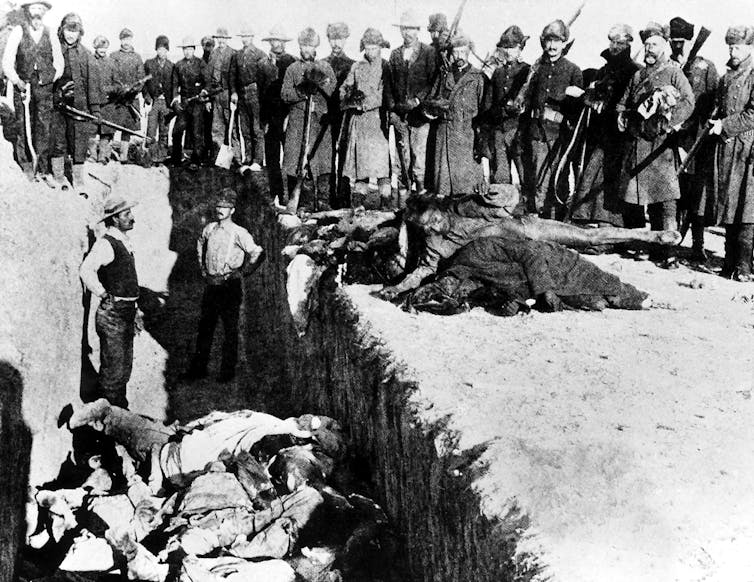
Native American children ride bikes near the cemetery at Wounded Knee, the site of the Dec. 29, 1890, massacre of Sioux tribal members.Richmatts/iStock via Getty Images
Goodale, born in 1863 to a family claiming Puritan roots, grew up on a farm in a remote part of western Massachusetts. In 1858, a baby first named Hakadah, later called Ohíye S’a, who then became widely known as Charles Alexander Eastman for most of his adult life, was born near Redwood Falls, Minnesota. A Wahpeton Santee Dakota, he fled to Manitoba, Canada, with tribal members during the 1862 Dakota War between the U.S. military and several bands of Dakota collectively known as the Santee Sioux.
In December 1890, the two unexpectedly met each other while working at the Pine Ridge Agency in the newly declared state of South Dakota. Even more improbably, they fell in love.
Just weeks later, booming Hotchkiss rifles 15 miles away signaled the start of the Wounded Knee Massacre. Federal troops ended up killing at least 250 Lakota Sioux men, women and children; the traumatic event, historian David Martínez writes, sparked “the abrupt transformation of Indian nations from geopolitical powers … to symbols of conquest.”
It also transformed Goodale and Eastman’s nascent relationship: They resolved to marry and to work together for Native American causes.
Wounded Knee, however, would also prove an unfortunate metaphor for their marriage.
I came to understand that their marriage failed not only because of interpersonal tensions and a clash of values, but also because of some of the ways in which ideas about gender, race and Indigenous identity were rapidly changing in the U.S.
From writer to teacher
At 13, Goodale started publishing poetry in St. Nicholas Magazine, a popular children’s periodical. Her poems generated attention from the press, in addition to fan mail from notable men of letters, including Henry Wadsworth Longfellow. By the time she was 20, she had published five books.
Elaine Goodale Eastman in 1890, when she worked as the Supervisor of Education for the Dakotas. South Dakota Historical Society
But because poets without family fortunes needed other means to support themselves – and because women in the late 1800s had few career options – Goodale turned to teaching. She accepted a job at Virginia’s Hampton Institute, a boarding school that was founded to teach newly emancipated Black students. It later became part of the government’s program to assimilate Native Americans.
Goodale became convinced that Indigenous children would benefit more from schools in their own communities, rather than at government- or church-run boarding schools. She traveled to the Dakota Territory and opened a day school. She also turned from poetry to prose, documenting her observations of “Indian life and education” in dozens of articles.
By the time she came to Pine Ridge Agency, the administrative offices at the Oglala Lakota Indian Reservation, she had been appointed the first supervisor of education for the Dakotas.
The ideal ‘assimilated Indian’
Ohíye S’a’s early years were marked by family trauma and U.S. government policies aimed at seizing land and displacing and assimilating Native people. His mother died shortly after he was born, and during the Dakota War it was widely believed that his father and brothers had perished. His grandmother and uncle raised him until his mid-teenage years.
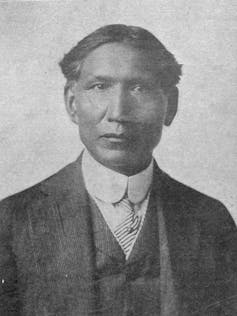
Charles Eastman was often praised in the press for his academic accomplishments – and his willingness to assimilate. Wikimedia Commons
In 1873, the 15-year-old was surprised to discover that his father was, in fact, alive. Jacob Eastman had taken a European-American name and converted to Christianity. He was convinced that only a formal English-language education could provide a path forward for Native people.
His white mentors saw Eastman – the only Native person in his class at either institution – as the ideal “assimilated Indian.” His achievements often appeared in newspapers with headlines like “He’s a Winner: Sioux Indian Who Got a Boston University Degree,” an allusion to the fact that “Ohíye S’a” translated to “winner.”
It isn’t clear whether Eastman ever thought of himself in that way. But throughout his life, he straddled the world in which he was raised and the one in which he was educated. His first job, as agency physician at Pine Ridge, placed him at the nexus of these two cultures.
An unlikely pair, a media sensation
After the shots rang out near Wounded Knee Creek, Eastman’s medical education was put to the test. Called into service as a nurse, Goodale also tended the wounded and dying in the makeshift hospital at a nearby church.
Six months later, Elaine and Charles were married in New York City in June 1891, much to the consternation of her family.
The couple’s nuptials appeared in hundreds of newspapers, partially due to the rarity of an interracial marriage in the 19th century. Much of the coverage was rife with racist stereotypes.
The Watertown Times in New York proclaimed, “Poetess Marries a Big Injun’”; the San Francisco Examiner ran a front-page story declaring “Fair Bride of An Indian: Elaine Goodale Weds the Red Man of Her Choice.”
Sometimes, articles focused on Charles’ educational background, often misrepresenting it by suggesting he had attended Cornell, Harvard or Yale. He was referred to as a “specimen,” with racialized language discussing his physical attributes: “He is of medium height … with all the peculiarities of his people in his features. His eyes are small and glittering, his face and nose are broad and his cheek bones very pronounced,” according to the San Francisco Examiner.
This type of media coverage – highlighting the differences between Elaine and Charles’ backgrounds, while pointedly describing Charles in stereotyped ways – would dog them throughout their marriage.
Professional travails, personal problems
Charles attempted to set up his own medical practice in St. Paul, Minnesota. But white patients proved reluctant to see “an Indian doctor,” while Native patients were hesitant to patronize a physician dispensing unfamiliar medicines. The practice failed.
Financial pressures increased over the next decade as Elaine and Charles became parents of six children. They moved frequently: Charles took on a series of jobs, including recruiting for the YMCA, lobbying on behalf of the Santee Sioux, and working as an “outing agent” at the Carlisle Indian Industrial School, which involved finding summer placements for Native students with white families in a further attempt to Americanize them.
Because Charles left behind few personal papers, it’s difficult to know if he believed in this program. But it’s easy to see how it could have created an identity crisis of sorts.
At other points in his life, Charles seemed to put his Dakota identity front and center. For example, he was one of the co-founders of the Society of American Indians, an organization that worked on behalf of self-determination for Native Americans. He even served as its president in 1918. Meanwhile, his wife remained a staunch believer in assimilation.
At Elaine’s urging – and likely, under her editorial stewardship – Charles began publishing stories and then books about his “Indian Boyhood.” While Elaine continued writing and was able to publish a few books, his literary career took off and hers stalled out.
A signature from a copy of one of Charles Eastman’s books, in which he uses both his Christian name and his Native American name, Ohíye S’a. Wikimedia Commons
Even their children weren’t spared from the headlines. An article in the St. Paul Globe wrote, of one of the Eastman children, “… the child had not inherited any of the attractiveness of the mother. It was a veritable old squaw miniature.”
In her personal writing, Elaine never acknowledged her children as biracial. The public stereotyping and private dismissal of the Eastman children’s identities were undoubtedly another stressor in an already-stressed marriage.
Pictures worth a thousand words
After many moves, the Eastmans landed in Amherst, Massachusetts. But Charles did not stay put, embarking upon a vigorous new career on the lecture circuit.
He became one of the best-known Native Americans of his era, as well as one of the most photographed.
Charles Eastman alternatively posed in Western dress and traditional Sioux regalia. Amherst College
Sometimes Charles chose to appear in a Victorian suit and cravat. Other times he posed in traditional Sioux regalia. Often the coverage of his talks focused more on what he was wearing than the content of his lecture. Historian Kiara Vigil suggests that Charles knew that his dress functioned as an advertisement for his work, arguing that his choice of attire was strategic: “Eastman’s ability to dress up as an Indian, or not, enabled him to address diverse audiences and their expectations.”
He was away from home more than he was present, further fueling Elaine’s resentment. In personal letters, she described her bitterness at Charles leaving the children and household to her sole care, and her belief that he was reinforcing the gender roles she’d railed against. While she certainly understood that his posing in buckskin and feathered headdress was good marketing, she probably never realized what reclaiming his Indigenous identity meant to Charles; she, too, thought of him as the product of successful assimilation.
It all falls apart
The personal and professional pressures on the Eastmans continued through the early years of the 20th century.
Elaine and Charles separated in 1921, though they never formally divorced.
I’ve been interested in the Eastmans and their unlikely marriage since I first learned of it years ago. As I pieced together parts of this complex relationship, I became convinced that while their compelling story reveals much about late 19th and early 20th century America, it’s also a story for today.
At a time of profoundly unsettling controversies around race, immigration and identity, the marriage of Elaine Goodale and Charles Eastman underscores why it can be so challenging for people from different backgrounds to truly understand each other.
But their story – how their mutual commitment to improve life for Native American people brought them together, how their quest to educate the nation about a marginalized people gave them purpose, and the ways in which they melded the personal and the political – also suggests the importance of trying.
Julie Dobrow does not work for, consult, own shares in or receive funding from any company or organization that would benefit from this article, and has disclosed no relevant affiliations beyond their academic appointment.
Source: The Conversation – (in Spanish) – By Felipe Soto-Pérez, Profesor en Psicopatología y Salud Mental del Departamento de Personalidad, Evaluación y Tratamiento Psicológicos, Universidad de Salamanca
No es nuevo: el desarrollo tecnológico siempre nos ha hecho sentir algo incómodos. Ya a comienzos del siglo XIX, en un pueblo de Inglaterra llamado Leicestershire, Ned Ludd destruyó algunas máquinas textiles. Entre otras razones, argumentaba que lo hacía porque se oponía a los cambios que traía la nueva maquinaria industrial. A partir de ahí nació el término ludita, que describe a personas que rechazan el desarrollo tecnológico.
En el campo de la salud también han existido “momentos luditas”. Por ejemplo, cuando aparecieron los contestadores automáticos o, más recientemente, cuando se comenzó a utilizar la videollamada para atender pacientes. Incluso los propios profesionales se resistían a las videollamadas hasta que la pandemia de la covid-19 les obligó a utilizarlas. ¡Y menos mal que contamos con esa opción!
¿Cómo utilizan las personas la IA para cuidar su salud mental?
Actualmente, el principal uso que se le da a la lA es con fines de acompañamiento, como un “compañero digital” que nos orienta, escucha nuestros pensamientos y angustias, nos aconseja y al que le contamos secretos. Nos lo pone fácil el hecho de que herramientas como ChatGPT estén disponibles en cualquier momento, parezcan empáticas y, por norma, no critiquen ni respondan negativamente.
Quienes utilizan este tipo de IA no suelen preocuparse por la privacidad o la profundidad emocional, pese a que plantea riesgos por el uso de datos personales y por los sesgos con los que se entrenan las herramientas de IA.
No obstante, debemos admitir también que la IA permite identificar señales de malestar antes de que se agraven. Esto se consigue mediante el análisis de los datos de móviles y weareables que informan de patrones de actividad, pasos, sueño, cantidad de mensajes o veces que se mira el móvil. Este tipo de proceso se llama fenotipado digital y ayuda a anticipar recaídas en depresión o episodios en trastornos graves mediante lo que se llama EMA (Ecological Momentary Assessment o Evaluación Ecológica Momentánea).
También se usan modelos de lenguaje para detectar cambios sutiles en el estado emocional de adolescentes y adultos. Por ejemplo, cuando en los mensajes se detecta un aumento de frases del tipo “estoy mal” o “culpa”, así como en la fluidez verbal o en incoherencias sintácticas. El objetivo es claro: actuar antes de que el problema se convierta en crisis, algo que la atención tradicional no siempre logra.
Asimismo se han publicado estudios iniciales donde chatbots de salud mental se muestran eficaces en reducir síntomas leves de ansiedad y depresión, además de fomentar la reflexión personal y el autocuidado. Su disponibilidad 24/7 los convierte en recursos accesibles y de bajo coste, especialmente útiles en contextos con escasez de servicios profesionales.
La IA se está usando para ampliar terapias como la cognitivo-conductual. Algoritmos inteligentes permiten adaptar ejercicios, monitorizar avances y reforzar aprendizajes. Al mismo tiempo, los modelos de lenguaje abren la puerta a diálogos más naturales y sensibles al contexto. Los resultados de estudios científicos muestran reducciones moderadas en síntomas depresivos, especialmente en jóvenes.
Los terapeutas son más empáticos y flexibles
A pesar de estos avances, los profesionales ofrecen una visión más matizada.Comparaciones entre humanos y chatbots revelan que los terapeutas superan claramente a la IA en dimensiones críticas como la empatía, la flexibilidad y la sintonía emocional. Esto refuerza una idea clave: la IA no sustituirá al profesional, sino que se perfila como una herramienta complementaria.
Por ejemplo, en ansiedad y depresión un bot parece ser efectivo al inicio, pero su efecto desaparece a los tres meses. En paralelo a esta extinción, las personas dejan de utilizarlo, de modo que la adherencia a los apoyos sustentados en IA se ha convertido en uno de los grandes desafíos actuales y futuros a la hora de usarla en salud mental.
Las investigaciones también advierten sobre carencias importantes. Un modelo propone imaginarlo como una pirámide con tres pasos. En la base están la seguridad y la privacidad; después, la fiabilidad y la transparencia; y, solo en la cúspide, la eficacia práctica. Sin embargo, la mayor parte de los estudios se concentran en los niveles superiores y dejan en segundo plano cuestiones básicas como la protección de datos o la gestión del sesgo algorítmico. De hecho, un análisis crítico advierte que la falta de supervisión ética y la escasa formación digital de pacientes y profesionales pueden convertir a estas herramientas más en un riesgo que en un apoyo.
La IA ya está diseñada y avanzando. Los profesionales necesitamos prepararnos para este cambio radical en la forma de abordar los problemas de salud mental.
¿Qué podemos esperar del futuro de la IA en salud mental?
La integración de la inteligencia artificial en nuestra vida cotidiana es ya un hecho. Hace apenas tres años, la mayoría de la gente utilizaba un buscador, mientras que hoy millones de usuarios formulan directamente sus preguntas a un asistente conversacional. La permeabilidad de nuestras actividades diarias a la IA es tan alta que cuesta imaginar un retroceso. Al igual que hace dos décadas los ordenadores ocupaban media mesa y hoy caben en el bolsillo, probablemente en pocos años miraremos atrás y nos parecerá rudimentario haber usado la IA solo a través de texto para hablar de nuestra salud mental.
En este campo, el proceso ya comenzó, pero las perspectivas son claras. Las revisiones recientes señalan que la IA no solo permitirá monitorizar síntomas en tiempo real a través de dispositivos cotidianos, sino que también contribuirá a diagnósticos más precisos y a una atención personalizada. Con sus limitaciones y riesgos, la IA ha llegado para quedarse y desarrollarse.
Source: The Conversation – USA (2) – By Joseph Morales, University Diversity Officer, Associate Professor of Ethnic Studies, California State University, Chico
The Trump administration is trying to eliminate diversity, equity and inclusion programs as part of a broader campaign to end what it calls “wokeness” in American education.
This is more than a legal technicality. It reflects the Justice Department’s position that HSI grants violate constitutional protections, putting millions of federal dollars for these schools at risk.
The Education Department argues that these programs amount to racial discrimination because they tie federal grants to students’ racial or ethnic backgrounds.
This echoes the Supreme Court’s decision in 2023, which narrowed how colleges can consider race and ethnicity in admissions.
I serve as the university diversity officer at California State University, Chico, an HSI. I am also an ethnic studies scholar who focuses on equity in higher education.
Elisa Castillo is the assistant vice president for Hispanic Serving Institution and Minority Serving Institution initiatives at Salem State University, a newly designated HSI in Salem, Mass. Pat Greenhouse/The Boston Globe via Getty Images
What are Hispanic-Serving Institutions?
Congress created the HSI designation in 1992, through an amendment to the 1965 Higher Education Act. This amendment authorizes federal grants to help strengthen colleges that enroll large numbers of Hispanic and low-income students, providing more opportunity for those students to succeed and graduate.
There are more than 600 federally designated HSIs across the U.S. and Puerto Rico. California is home to the most HSIs, with 167, followed by Texas, Puerto Rico, New York and Illinois.
In addition to showing that at least 25% of its student population is Hispanic or Latino, any college or university that wants to qualify as an HSI must also show that at least half of its students come from low-income backgrounds.
Becoming an HSI allows colleges and universities to apply for federal funding intended to support underrepresented and low-income students.
HSIs vary in size and mission
HSIs enroll over 1.5 million Hispanic students, which amounts to over 60% of all Hispanic undergraduates in the U.S.
This marks a big increase from the 340,000 Hispanic undergraduates who attended an HSI in 1995.
Some of these schools are large public research universities, such as University of California, Riverside; University of California, Santa Barbara; and University of California, Santa Cruz. Others are regional institutions, private colleges and local community colleges.
Over the past decade, another kind of Hispanic-Serving Institution has emerged – research-intensive HSIs. These are colleges and universities where at least 25% of the student body is Hispanic and where there is significant research funding and a range of doctoral programs offered. These schools include University of California, Irvine; Florida International University; and the University of Texas at El Paso, among others.
Some researchers have debated whether the HSI category has become too broad, grouping schools with vastly different resources, missions and student populations.
Despite their differences, many HSIs enroll large numbers of first-generation, low-income and working students, as well as immigrants and transfer students.
HSIs also generally operate with fewer financial and academic resources than comparable non-HSI institutions.
These competitive grants are intended to help HSIs expand educational opportunities and institutional capacity to support Hispanic and low-income students.
Rather than providing aid directly to students, Title V grants are used to offer faculty training, update classrooms and laboratories, create new degree programs and develop mentorship opportunities for first-generation students.
At campuses such as California State University, Chico and University of California, Irvine, Title V grants have given schools the money to create bilingual advising services and maintain data systems.
Title V grants form only one part of the broader funding picture for HSIs. Like many colleges, HSIs rely on state funding and tuition revenue. They also compete for other federal grants, including those from the National Science Foundation and the Department of Agriculture.
Some HSIs have received national recognition for using evidence-based practices to help Hispanic students perform better in the classroom. Hispanic students at these schools, which include Arizona State University and California State University, Fullerton, graduate at rates roughly 8 percentage points higher than Hispanic students nationally.
Hispanic students at HSIs graduate at rates more than 5 percentage points higher than those at comparable non-HSI colleges, according to similar 2017 findings from the nonprofit Education Trust.
Students at HSIs often report feeling a strong sense of belonging and see their own cultures reflected in the curriculum. Many HSI campuses also offer dedicated programs for first-generation students and train faculty to teach and advise with equity and inclusion in mind.
At University of California, Irvine, where I helped lead HSI initiatives, Hispanic undergraduate enrollment grew by nearly 150% between 2009 and 2019, from 3,000 students to more than 7,500.
During that time, more than 350 faculty and staff completed equity-focused training to strengthen advising and teaching practices that support Hispanic and other underrepresented students.
Hispanic Americans now make up nearly 20% of the U.S. population, and their college enrollment numbers are projected to grow from about 3.7 million in 2020 to 4.5 million by 2030, as overall college enrollment numbers are projected to decline during this time.
A national evaluation of Title V projects found that most colleges and universities used these grants to improve student services, develop new academic programs and build community partnerships that help first-generation and low-income students stay enrolled and complete their degrees.
As HSI researchers note, graduation rates tell only part of the story. True student success at HSIs depends not just on graduation numbers, but on culturally responsive teaching, inclusive campus climates and equity-minded institutional practices.
How policymakers define and fund HSIs will shape not only the future of these institutions but also whether this growing generation of Hispanic students can access, afford and complete college in the years ahead.
Joseph Morales, Ph.D., works at California State University, Chico, a federally designated Hispanic-Serving Institution (HSI). While not a principal investigator on any federal HSI grants, he has participated in professional development programs and national conferences hosted by organizations mentioned in the article, including the Hispanic Association of Colleges and Universities (HACU). These experiences inform his understanding of the field but did not influence the content of this piece. The views expressed are those of the author and do not necessarily reflect the views of California State University, Chico.



















.jpg)