We are researcherswho study whistleblowing, which is when employees disclose information in the public interest about wrongdoing they have witnessed at work. Our new book draws on firsthand accounts from whistleblowers in national security, intelligence and government in the U.S., Australia and the U.K., among other countries. Their experiences show the limits of legal protections, but also the power of networks, solidarity and collective resistance in the face of institutional secrecy.
In this moment of democratic backsliding, whistleblowers show that civil disobedience – breaking the law to uphold the public good – remains an essential principle of political and moral life. They also show how legal reform and support networks designed to protect whistleblowers are critical for protecting accountability and democracy itself.
The limits of legal protections
The whistleblowers featured in the book, including former CIA officer John Kiriakou and Craig Murray, the former U.K. ambassador to Uzbekistan, learned the hard way that legal protections can end precisely where power begins. Both revealed grave human rights abuses – torture, kidnapping, imprisonment and complicity in war crimes – and both were prosecuted rather than protected.
Their stories underline a paradox: Even as new whistleblower protection laws have proliferated in many countries, prosecutions of national security and intelligence whistleblowers are on the rise. In national security contexts, where no public interest defense is permitted, laws meant to protect whistleblowers have become another weapon of “lawfare” – used to silence, bankrupt and criminalize.
For example, Kiriakou blew the whistle on the U.S. torture program in 2007. The Bush administration initially declined to prosecute him, but this changed under the Obama administration, which imprisoned Kiriakou in 2013 for 30 months. Kiriakou’s refusal to participate in the CIA program of “enhanced interrogation” of terrorism suspects, which included waterboarding, and his later decision to publicly confirm the CIA’s use of torture were acts of conscience. Yet it was he, not the torturers, who went to prison as a result of his disclosures.
The pattern is familiar. From Chelsea Manning in 2010 to Edward Snowden in 2013 and Daniel Hale in 2016, prosecutions under the U.S. Espionage Act and equivalent statutes elsewhere signal a broader shift: Making the powerful transparent is redefined as treason. The prosecution of national security whistleblowers who reveal crimes of the state continues to be an ongoing problem, as highlighted by more recent cases, including Reality Winner and David McBride.
When the law is used to enforce secrecy and punish dissent, the moral terrain shifts. Civil disobedience becomes not only justified but necessary. Human rights lawyers have commented that whistleblowers and journalists who work with them are being subjected to increasingly harsh treatment by the state, including imprisonment and on occasion torture.
From traditional media to networked whistleblowing
Historically, whistleblowers relied on the press to act as an intermediary between them and the public, as well as a protector because of the publicity they offer. But as investigative journalism has been hollowed out – starved of resources and constrained by political and corporate pressure – this model has faltered.
As journalist Andrew Fowler, one of our book’s contributors, wrote, “It may not be long before it will be impossible for journalists to have confidential sources.” Across the globe, attacks by governments on journalists criticizing strongman leaders become more brazen.
In 2010, Manning blew the whistle on U.S war crimes in Iraq and Afghanistan. Many major outlets turned Manning away before WikiLeaks provided the infrastructure to publish what mainstream media would not. Her disclosures raised the public’s awareness of government complicity in war crimes in Iraq and elsewhere. Such stories also reveal how reluctant mainstream journalism can be when confronted with power.
More recently, in 2016 McBride blew the whistle on members of the Australian SAS who murdered civilians in Afghanistan. He was sentenced to prison in 2024 and is currently serving a sentence of five years and eight months for his disclosures of war crimes.
This decline in formal protections has given rise to an ecology of “networked whistleblowing”: decentralized alliances of whistleblowers, activists and independent journalists using encrypted tools to share information and protect sources. While these networks can offer safety in numbers, they also carry risks – of being co-opted or exploited by those in power, and of being framed collectively as enemies of the state for their attempts to hold the powerful to account.
Yet they also represent a profound reimagining of public accountability in a digital age where secrecy is structural and systemic, demonstrating the force of people working together.
As the traditional institutions of democracy falter, our research shows these alternative infrastructures embody a new form of democratic practice: horizontal, distributed and defiant.
New alliances supporting whistleblowers
The whistleblowers whose stories appear in our book did more than expose wrongdoing. They built communities of care and resistance – new institutions to protect truth-telling itself.
Each of them, after suffering retaliation and exclusion, turned outward: campaigning for reform, mentoring others and building cross-sector alliances. Their transformation from individual insiders to collective activists reveals a crucial insight: Legal reform alone isn’t enough. What sustains truth-telling isn’t the promise of protection from above but solidarity from below.
Strengthening and supporting these alliances would help preserve freedom of expression and the right to know. That means supporting cross-border networks of journalists, lawyers and human rights defenders who can collectively safeguard disclosure when national laws fail. It also means recognizing whistleblowing as a public good.
At a time when many democracies are retreating from openness, these whistleblowers remind us that law and justice are not the same thing. When laws entrench secrecy or punish dissent, we believe breaking them can be an act of civic virtue. Civil disobedience can renew democratic life by holding power to account.
Kiriakou’s conclusion in his chapter resonates beyond the intelligence world: “We all have to fight. It’s the only way we are going to change anything.” His words recall a longer lineage of civil disobedience – from suffragettes to anti-war protesters to environmental activists – each confronting systems that refused to hear them until they broke the rules.
The cases in our new book illustrate how quickly law can be used to enforce secrecy rather than accountability during periods of democratic backsliding. They also highlight the practical conditions that make truth-telling possible – including collective support that extends beyond any one country’s legal system.
The authors do not work for, consult, own shares in or receive funding from any company or organization that would benefit from this article, and have disclosed no relevant affiliations beyond their academic appointment.
Revisiting Peter Shaffer’s 1979 play Amadeus is no small feat. Joe Barton, the writer behind Netflix’s Black Doves, has taken on the challenge of reworking Shaffer’s dense account of Mozart’s life and legend into a five-episode series for Sky Atlantic. It’s a bold move: the original play – and the 1984 film adaptation – already felt exhaustive, sometimes overwhelmingly so.
Yet Barton manages something unexpected. Shaffer’s monologue-laden tale of Mozart’s rival Antonio Salieri’s guilt becomes a sharper, more fluid exchange between two men bound by genius and self-destruction. This Amadeus is less about one man sabotaging another and more about two talents quietly collapsing under the weight of their own obsessions.
Less emphasis too is placed on Salieri’s ravings as “mad”, although his anguish is still front and centre. And because of the greater expressive range of both Paul Bettany as Salieri and Will Sharpe as Mozart, these performances feel more nuanced than their familiar counterparts from the 1984 movie. Bettany resists telegraphing Salieri’s insincerity towards Mozart in the way that his predecessor F. Murray Abraham does too often, while Sharpe is much more convincing than Tom Hulce in playing Mozart’s brilliance while maintaining his exuberance and obnoxious self-absorption.
The results are an essential binge-watch for the Christmas period. Barton fleshes out the drama with scenes such as a keyboard competition between Mozart and his senior rival composer Clementi (Richard Colvin), contextual scenes involving the Emperor’s (Rory Kinnear) military responsibilities when war breaks out and the infidelities of both Mozart and his wife Constanze (Gabrielle Creevy).
The trailer for Amadeus.
Television writing allows the space for some longer, more intimate exchanges between the two composers. This time around, it’s clear that Mozart’s brilliance is genuinely misunderstood while Barton makes Salieri’s jealousy both artistic and psycho-sexual (a new conceit). The frank sexuality shown in Black Doves (2024) is present here too, this time showing Salieri engaging in kinky sex to help make his psychological torture physical. His mind is bleeding, so his body must too. Mozart also can’t resist screwing his way through life, his drinking and promiscuity leading to his dissolution and destitution.
Much of this is not true to life, however. Records show that Salieri was kind to Constanze after Mozart’s death and the younger composer was generally successful, though the frequent swearing in Barton’s teleplay reflects the coarse language found in Mozart’s letters.
But Barton is smart in acknowledging the mythology too. The final episode is dominated by a conversation between Alexander Pushkin (Jack Farthing) and Constanze Mozart about whether the rumour that Salieri killed her husband is true. Pushkin wrote a short play that inspired Shaffer’s version, and in the new Amadeus, Constanze says he’s welcome to write his version of events: she’ll take the truth to her grave.
It’s all invented, but that’s OK, Barton seems to say. Mythology is how we express our depth of feeling, not only for Mozart specifically but for transcendent genius in general.
Admittedly, there are some rough spots. I thought the conclusion of the Marriage of Figaro sequence, its premiere supposedly interrupted at the very end by protesters, unconvincing, and I’m afraid the opera scenes in general aren’t well designed. Implausibly, the backdrop for Figaro is the same for the first and final acts but suits the situation of neither. Nor are Bettany nor Sharpe convincing as orchestral conductors, and I was confused as to why the document purporting to be Salieri’s Requiem (but actually Mozart’s) played at his funeral was only a few pages long.
Musically, the film’s performances are also generally disappointing, the singing in particular falling well short of world class. In this, the new version seems weak compared to the 1984 film. A film about classical music’s OG should offer a much stronger soundtrack.
Nonetheless, when the focus is on dialogue, the show crackles along with extraordinary pace. Alongside Bettany and Sharpe, the ensemble cast is uniformly strong. Kinnear is ideally characterful as Emperor Joseph, foolish as a musician but credible as the leader of a major country. Creevy is especially strong as Mozart’s wife Constanze, popping up (like Bettany) in prosthetics to hear Salieri’s confession in old age. Enyi Okoronkwo offers strong support as Mozart’s librettist and best pal Lorenzo Da Ponte and Jack Farthing helps to carry the final episode as Pushkin, the playwright in search of a musical legend.
All in all, a smart and sexy triumph for Sky. If Mozart’s music itself doesn’t quite get the investment it deserves, Amadeus makes up for it by offering a compelling drama about the nature of the human spirit.
Looking for something good? Cut through the noise with a carefully curated selection of the latest releases, live events and exhibitions, straight to your inbox every fortnight, on Fridays. Sign up here.
Dominic Broomfield-McHugh does not work for, consult, own shares in or receive funding from any company or organisation that would benefit from this article, and has disclosed no relevant affiliations beyond their academic appointment.
The Grinch is one of the holiday season’s most familiar icons. The grumpy, green, fur-covered misanthrope who plotted to sabotage Christmas in Dr Seuss’s classic 1957 work has now become a quintessential part of the yearly festive ritual he so despised.
But beneath that snarl and green fur, what kind of creature is he, really? Not even Dr Seuss really had an answer.
As an anatomist, I can’t help but wonder what the Grinch would look like on the dissection table – and what his skeleton, muscles and brain can tell us about his unique origins.
The skull
The Grinch’s most recognisable feature is, of course, his face. And underlying these characteristic features would be a unique skull – unlike anything you’d find in Whoville or on Earth.
Structurally, the Grinch’s facial skeleton would blend primate and canine traits: short, broad snout, high cranium and powerful jaws. It’s a face evolved for expression, adeptly capable of sneering, gloating and ultimately smiling with genuine warmth.
His zygomatic arches (cheekbones) are broad and flared to accommodate for the large zygomaticus major muscles needed to lift the corners of his mouth into his exaggerated, mischievous smirk.
Beneath his eyes would be a large bony canal, carrying nerves to his whisker-like facial hairs – granting exquisite tactile sensitivity to changes in air currents. Like a cat’s whiskers, they’d help him sense approaching Whos or dangling baubles – crucial for a creature who thrives on stealth.
His teeth would be similar to a chimp’s, with sharp canines for tearing through Who “roast beast,” sturdy molars for grinding tougher festive fare and incisors adapted for nibbling fruitcake or the occasional candy cane.
The upper jaw, or maxilla, would be robust and slightly vaulted, lending resonance to that infamous laugh echoing through Mount Crumpit.
The face
The Grinch’s yellow eyes, with large, forward-facing eye sockets, suggest a crepuscular lifestyle: most active at dawn and dusk.
Many animals with yellow eyes, such as owls and cats, are adapted to low light. The yellow pigment filters blue light and sharpens contrast, allowing movement to be detected in the half-light. Perfect for a nocturnal gift thief.
His nasal aperture would be tall and narrow, with a complex set of internal conchae (nasal bones) to warm the cold alpine air of Mount Crumpit. The constant twitching of his nose might indicate a highly attuned sense of smell to detect roast beast from a distance.
The Grinch’s expressiveness would involve a complex set of muscles – many of which would be unusually large so he can convey every scheme, doubt, pang of guilt and emotion he experiences. For example, he would probably have very distinct levator labii superioris alaeque nasi – “Elvis muscles” – so he can lift his upper lip sneeringly.
The spine
If you watch the Grinch walk, he’s upright but fluid, almost serpentine. His spine would probably resemble a cross between a gibbon and a cat – long, flexible and sinuous.
The lower back would be extended and highly mobile, allowing that characteristic slouch and coiled posture. The thoracic vertebrae (found in the middle and upper back) would produce a gentle outward curve – creating a hunched silhouette suited to skulking. His cervical vertebrae (neck bones) would be elongated, letting him tilt and crane his head with exaggerated expressiveness.
Like a cat, he’d be digitigrade – meaning he walks on the balls of his feet and toes rather than on the soles (as humans do). This stance softens each step – allowing for the quiet, agile motion needed to lurk through Whoville stealing presents on Christmas eve.
Though his pelvis supports an upright posture, his centre of gravity sits slightly forward and low — a design that sits somewhere between human and primate.
The brain
Anatomy often mirrors personality. Judging by behaviour, the Grinch’s frontal lobes, particularly his prefrontal cortex, would be on the small side – explaining his flat and small forehead.
Given this region governs planning, impulse control and moral reasoning, it would explain why he lacks these faculties at the story’s start. Having a smaller frontal lobe also explains his rash decisions and inability to foresee consequences beyond the next stolen bauble.
His temporal lobes, would be large and active. They process sound and memory – ideal for recognising (and despising) Whoville’s Christmas carols. They also house functional areas that process smells – important for sniffing out hidden cans of Who-Hash.
His occipital and parietal lobes would also be well developed, supporting the sharp vision, coordination and spatial awareness he needed to climb, leap and slide down chimneys.
The Grinch’s amygdala (also involved in experiencing emotions) would probably be hypertrophied – explaining his emotional volatility, paranoia and exaggerated reactions. Combined with his limbic system, part of the brain’s memory and emotion centre, creates a creature ruled by passion and reactivity.
The heart
No anatomical analysis of the Grinch is complete without addressing the moment when “his heart grew three sizes.”
Biologically, such a sudden expansion would be catastrophic. In humans and other mammals, cardiomegaly (an enlarged heart) is a dangerous condition linked to heart failure, arrhythmias and poor pumping efficiency.
A real heart simply cannot enlarge in an instant of emotional revelation. But the brain can change rapidly.
The Grinch’s transformation is probably better understood as a neurological shift – with increased activity and connectivity occurring between the prefrontal cortex (empathy and regulation) and the limbic system (emotion and reward). His “growing heart,” is probably not an anatomical miracle but a metaphor for his brain becoming more socially attuned.
Anatomy of a redemption arc
To anatomists, the Grinch is more than a Christmas curiosity. He’s a case study in form and function. And in his final form, anatomy and morality align.
The muscles that once powered a sneer now lift into a genuine smile. The hands that stole presents now carve roast beast. His limbic system now fires with satisfaction.
So perhaps the real message of the Grinch’s anatomy is this: change is always possible.
Lucy E. Hyde does not work for, consult, own shares in or receive funding from any company or organisation that would benefit from this article, and has disclosed no relevant affiliations beyond their academic appointment.
Source: The Conversation – UK – By Ane Grum-Schwensen, Associate Professor at The Hans Christian Andersen Centre, Principal Investigator of "Fairy Tales and Stories – The Digital Manuscript Edition", University of Southern Denmark
Hans Christian Andersen is one of Denmark’s most cherished writers – a master of the literary fairy tale whose influence stretches far beyond The Little Mermaid, The Emperor’s New Clothes and the other classics many of us first encounter in childhood.
Born in 1805 in Odense, on the island of Funen, Andersen was the son of a shoemaker and an illiterate washerwoman who would grow into an author who wrote across genres – novels, travelogues, poems and plays. But in his short tales he created a form uniquely his own: emotionally daring, stylistically inventive and rich with both whimsy and existential bite.
His tales have been read aloud for generations, adapted into countless winter performances and films and returned to each year for their blend of wonder, melancholy and moral imagination. They remind us that the season is not only about sparkle and celebration, but also reflection, hope and the small fragile miracles of being human.
So, as the days grow shorter, we’ve asked four leading Andersen experts to choose one story they believe is perfect for reading – or rereading – this Christmas. Their selections may not be the Christmas tales you’ve come to associate with Andersen. But they showcase the author at his most profound and playful – and offer new ways into his writing.
The Story of a Mother
Ane Grum-Schwensen, associate professor in the Department of Cultural and Linguistic Studies at The Hans Christian Andersen Centre, University of Southern Denmark
Choosing a single Andersen story as a favourite feels almost impossible. There are so many remarkable ones and my favourite often ends up being the one I have most recently revisited. Yet some stories return to me repeatedly, both in thought and in research.
One of these is The Story of a Mother, first published in 1847. It is a fantastic tale in every sense of the word. It includes classic fairy-tale elements: a protagonist – the mother – leaving home and facing trials, helpers guiding her and an ultimate antagonist, Death. Yet Andersen challenges this structure: the helpers demand steep prices and the antagonist could even be seen as a kind of helper. The story also reflects the fantastic, as seen in modern fiction, through its dreamlike quality and its unsettling open ending, where the mother finally allows Death to carry her child into the unknown.
This story is profoundly moving. It portrays both the desperate lengths a parent will go to to protect a child and the crushing surrender when confronted with an irreversible fate. Andersen’s ability to capture this parental anguish so vividly, despite never having been a parent himself, is striking.
The theme of the dying child was common in 19th-century art and literature, partly because of the harsh reality of child mortality. In the early decades of the century, roughly one-third of all Danish children died before their tenth birthday. Andersen addressed this theme repeatedly. Indeed, his first known poem, at age 11 was written to comfort a grieving mother. Later, in 1827, another poem he wrote, The Dying Child was published anonymously and widely translated.
The language and narration in The Story of a Mother are quintessential Andersen. Within the first few paragraphs, the theme is clear and features his imagery-rich language:
The old clock whirred and whirred, the great lead clockweight slid straight down to the floor, boom! and the clock too stood silent.
Although Andersen had written about dying children before, he struggled with the ending of this story, even in the handwritten copy he delivered to the printer. His first version was what you might call a happy ending: the mother wakes to find it was all a dream. He immediately crossed this out and replaced it with: “And Death went with her child into the ever-flowering garden”.
Still unsatisfied, he changed “ever-flowering garden”, a synonym for paradise, to “the unknown land”. A Danish critic recently described this creative shift as “how to punk your sugar-coated sentiment into salty liquorice” – a fitting metaphor for Andersen’s refusal to settle for sentimentality.
Today, the story is not as well known as some of his other tales, yet its influence in its own time was undeniable. It was translated into Bengali as early as 1858 and became popular in India. When Andersen turned 70 in 1875, one of his gifts was a polyglot edition of the story translated into no less than 15 languages – a testament to its global reach.
You can read the full version of The Story of a Mother, here.
The Comet
Holger Berg, special consultant at The Hans Christian Andersen Centre, University of Southern Denmark
No spectacular comets appeared in the sky in 1869, but the year nevertheless stands out in literature thanks to The Comet. Andersen’s reflective tale of the cosmos and the soul begins simply. A boy blows bubbles while, by the light of a candle, his mother seeks signs about the child’s life expectancy. Childlike delight and superstition live side by side in their home.
The superstitious mother was an archetype, but Andersen’s depiction is shaped by memories of his own mother, Anne Marie Andersdatter. Illustration by Lorenz Frölich. The Hans Christian Andersen Centre. Public Domain.
More than 60 years pass. The boy has become an elderly village schoolmaster. He teaches history, geography and astronomy to a new generation, bringing each subject vividly to life. Science has not destroyed his wonder – it has deepened it. Then the very same periodic comet returns.
What allows The Comet to echo across the ages is, paradoxically, its quiet, unassuming form. In earlier works, Andersen confronted one of the great fears of his age: that a comet might strike the Earth and end human civilisation. He responded either with comedy or with factual precision, but neither approach proved moving.
In 1869, he shifted away from satire and intellectual argument and towards poetic prose. Meaning now emerged through suggestion rather than debate. He also abandoned the romantic mode of his youth, in which the moon, the morning star and other celestial bodies directly commented on earthly affairs.
Part of my fascination with this tale lies in the four surviving manuscripts. Andersen gradually developed his narrative from a quaint scene in a village classroom into a life story with genuine cosmological reach and this can be seen in each version of the story.
It’s often said that a human life is merely a glimpse when measured against astronomical time. In Andersen’s time, people quoted the Latin expression homo bulla: the human being is but a soap bubble. To this familiar poetic image, Andersen in his second manuscript added the comet. Against the brevity of the bubble, he set the vastness of the comet’s arc – and with it, the question of where the human soul travels once it leaves the body.
This print unites six of the largest comets known in 1860. Andersen had seen three of them. In late January 1869, he began the first full draft of The Comet. Engraving by James Reynolds in a copy at The Wellcome Collection. Public Domain.
Andersen achieved his narrative breakthrough in late January of 1869 through a shift in both theme and structure. In the third manuscript, he added a final paragraph nearly identical to the opening. This narrative circle matches the subject at hand: “Everything returns!” the schoolmaster teaches us, be it periodic comets or historical events. And yet the tale ends by imagining what does not return: the “soul was off on a far larger course, in a far vaster space than that through which the comet flies”.
Andersen invites us to gaze upward with the openness of a child. And raises profound questions about what it means to be human, both in this world and, for spiritually inclined readers, in whatever may lie beyond it.
You can read the full version of The Comet, here and listen to a podcast on the story here.
The Shadow
Jacob Bøggild, associate professor at The Hans Christian Andersen Centre, University of Southern Denmark
The Shadow by Hans Christian Andersen was first published in 1847. In some ways, it is Andersen’s darkest tale. The character the reader is led to believe is the protagonist is known only as “the learned man,” a figure never given a name, whereas his shadow – which breaks away from him – gives the tale its very title.
At the end of the story, the shadow has the learned man executed and marries the daughter of a king, implying that they will rule her country together. Thus, the shadow triumphs in the manner of a genuine fairy-tale protagonist, while his former master dies miserably.
But the tale is not solely dark and tragic. The scene in which the shadow separates from the learned man is perfectly choreographed in accordance with the way a shadow follows every movement of the body that casts it.
Afterwards, it irks the learned man that he has lost his shadow, but since he is visiting a country with a warm climate he soon grows a new one. And one reason the shadow can seduce the princess is that he is a wonderful dancer – he is, of course, ever so light on his feet. Throughout the tale, Andersen treats each impossible occurrence as though it were entirely natural, and the effect is extremely funny (as well as uncanny).
In traditional fairy tales, the protagonist often leaves home because some imbalance has occurred. Away from home, out in the wide world, the protagonist must accomplish a number of tasks. The happy ending usually means that the character finds a new home, often by marrying a princess and becoming ruler of half a kingdom.
In The Shadow, the learned man is already away from home at the beginning, visiting a country with a hot climate before returning to his own homeland with a cold one. It is here that his former shadow appears and manipulates him into exchanging roles, making the learned man literally the shadow of a shadow. The two then travel to a spa. The learned man is once again far from home, and it is there that he dies.
The shadow, on the other hand, begins its story “at home”, since its home is wherever the learned man is. It then separates itself, goes out into the world and becomes highly successful – albeit through mischief. Its ultimate triumph comes when it establishes a new home for itself by marrying the princess. The Shadow is a reversed fairy tale in every possible sense.
The way Andersen executes this reversal is a masterpiece and bears witness to his acute awareness of genre conventions and narrative structures – something that has, unfortunately, rarely been recognised as fully as it deserves.
You can read the full version of The Shadow, here.
The Princess on the Pea
Sarah Bienko Eriksen, postdoctoral researcher at The Hans Christian Andersen Centre, University of Southern Denmark
The Princess on the Pea has suffered the odd fate of being so popular that many people never bother to read it. This is an oversight. And given that it clocks in at about 350 words, or shorter than the article you’re reading right now, it’s also a problem that’s easily remedied.
The tale opens with a prince’s worldwide search for a “real” princess. He’s met plenty of hopefuls along the way, but they weren’t really “real”, and for him, only a “true” one will do. The words “real” and “true” (in Danish, rigtig/virkelig) appear in this tiny story a total of nine times — very much in defiance of certain truisms about good writing and the spice of life.
So when a prospective princess shows up to the castle one stormy night with rainwater gushing down her hair and out of her heels, she quite literally embodies the problem of how to tell whether something is real or not. Is it visible at a glance? Can it be observed through behaviour? Or must we simply feel it?
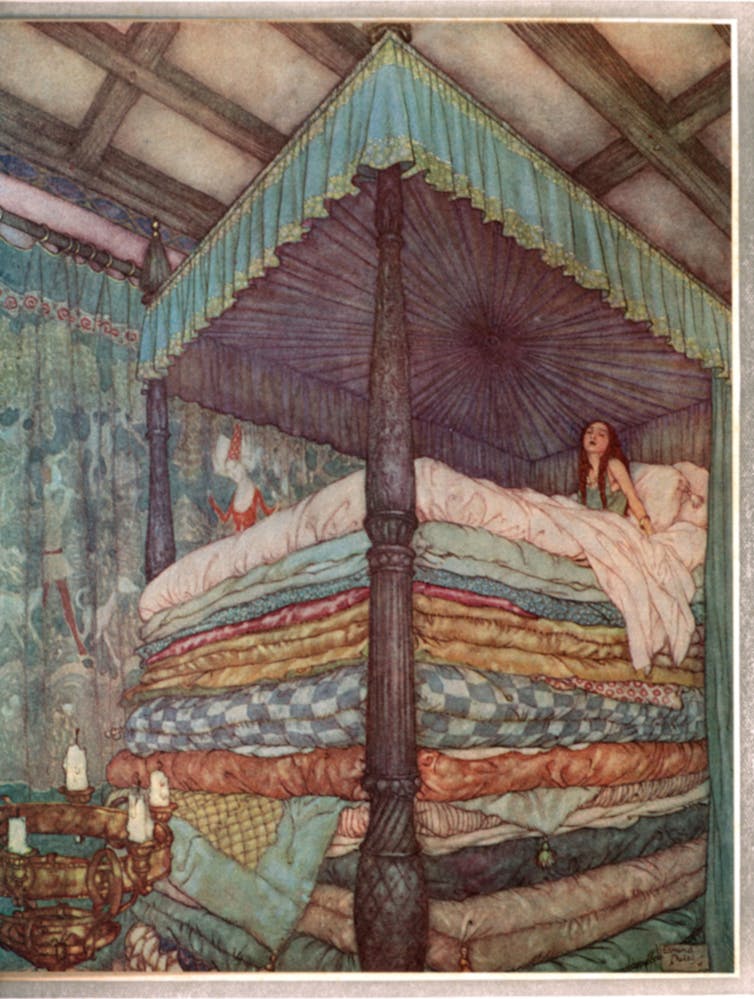
To see if their guest is the genuine artefact, the queen tests her with a bed fit for a princess: 20 duvets piled atop of 20 mattresses and at the very bottom, a single pea. Not a pearl or a diamond but the lowliest of domestic objects.
The guest, however, doesn’t miss a thing, awakening black and blue and worse off than when she arrived. The court is immediately satisfied – only a true princess could be so sensitive! – yet amusingly, the entire exercise brings them no closer to actually spotting one: it’s her powers of observation that pass the test, not theirs. The real, it seems, simply knows itself.
We can all guess what happens next, but what comes after the wedding? Here we find Hans Christian Andersen’s most innovative contribution to this traditional fairy tale: namely, that the pea gets its own ending, receiving a place of honour in the Royal Museum “where it can still be seen, providing no one has taken it”.
A Dane reading this story in 1835 couldn’t help but notice this nod to the 1802 theft of Denmark’s national treasure, the Golden Horns of Gallehus, from that same location. Less obvious is that with this reference, Andersen bursts the bubble containing all fairy tales and thrusts the pea into the real world.
Did we feel it? Perhaps not. But then again, it might have been stolen.
“Now, that was a real story!” the tale concludes, knowingly. Not a true story, mind you, but the impossible state of being “real fiction”. (And if we wish to test this for ourselves, it won’t be Andersen’s fault that the genuine artefact is missing from the Royal Museum.)
Unlike our princess, this tale offers no tidy resolution, which is precisely the richness of great art: it prompts reflection, hides wonder in the humble detail and is never truly finished, inviting us to play along in happily ever after.
You can read the full version of The Princess on the Pea, here.
This article was commissioned as part of a partnership collaboration between Videnskab.dk and The Conversation.
Ane Grum-Schwensen receives funding from Augustinus Fonden, Aage og Johanne Louis-Hansens Fond and The Danish Research Reserve.
Holger Berg receives funding from Augustinus Fonden, Aage og Johanne Louis-Hansens Fond and The Danish Research Reserve.
Sarah Bienko Eriksen receives funding from the Independent Research Fund Denmark.
Jacob Bøggild does not work for, consult, own shares in or receive funding from any company or organisation that would benefit from this article, and has disclosed no relevant affiliations beyond their academic appointment.
Labour won the election but its support fell a lot more than any other party’s during the campaign period. Labour started the campaign 25 percentage points ahead of the Conservatives and ended it just 15 points ahead.
That was partly because a fair few people who might have voted Labour either voted tactically for the Liberal Democrats in the end or didn’t bother to vote at all as it looked like Labour was heading for an easy win. But the loss was also down to some voters’ concerns about Labour’s lack of ambition and some concerns about its stance on Israel-Gaza. This helps to explain why the Greens enjoyed a late surge.
2. Fear of tax rises wasn’t really a factor
Since coming to office, the government has been plagued by indecision about what to do about taxes and fearful of angering voters.
But our analysis shows voters expected all along that a Starmer government would put taxes up – and they were apparently reconciled to it. Neither Rachel Reeves’s pledges not to increase the big three taxes, nor Tory attacks on Labour tax rises seem to have had any discernible impact on voters’ overall views about the parties’ intentions on tax and spend.
On balance, voters in 2024 felt that taxes in general (if not necessarily their own taxes) should go up to fund spending, meaning Tory promises of tax cuts fell on unusually stony ground.
3. Labour and the Conservatives lost support to more radical alternatives
In the course of the 2024 campaign, Labour lost support to the Greens, who for the first time (and at least where Gaza independents weren’t standing) picked up lots of Muslim voters.
The Tories (especially after Nigel Farage entered the fray) lost support to Reform UK, whose candidates tended to split the right-wing vote. This helped Labour win back many “red wall” seats in the north and the Midlands, as well as helping the Lib Dems take parts of the “blue wall” in the south. That split on the right also spared Labour’s blushes in Wales, where their vote actually declined.
4. Muslim voters turned away from Labour
Muslim voters swung away from Labour to an unprecedented degree in 2024. The loss of support from a community that had long backed the party cost Labour several seats, along with several near misses. Health secretary Wes Streeting’s Ilford North seat (which he won by just 528 votes, down from 5,198 in 2019) was just one example of a close contest.
Though the shift among Muslims was most dramatic, Labour also fell back among Hindu voters. The Conservatives’ sole gain came in Leicester East, the seat with the highest share of Hindu voters in Britain. Labour’s claim to be the natural choice for ethnic minority voters has never looked weaker.
5. The Conservatives ran out of cash
While in office, the Conservatives raised national campaigning limits to around £34 million. But, ironically, and unlike their Labour opponents, they ran out of money before the 2024 campaign was even over.
Party spending in 2024
How spending fluctuated in the campaign. T Bale, CC BY-ND
The lack of cash was especially evident in online campaigning, where Conservative party activity fell off a cliff towards the end, even as Labour efforts ramped sharply up.
6. This was an ‘all politics is local’ election
Local conditions, local campaigning and tactical voting mattered more than ever in the 2024 election. Voters’ behaviour varied more widely from one seat to the next than in any previous recent contest and people were more aware of and responsive to the local stakes in their seat than ever before, making the parties’ voter contact efforts even more important than usual.
7. Scotland is always different
The election campaign in Scotland once again ran along radically different lines to what was happening in England and Wales. There was a huge swing from the SNP to Scottish Labour, with the latter making dramatic gains, sometimes rising to first place from third. This was boosted by tactical voting among people opposed to Scottish independence.
The SNP, incidentally, was particularly active on social media, Labour posted more than Reform on TikTok and Nigel Farage has more page followers on Facebook than the Labour party. But, for all that, this was not the “TikTok election”. Social media matters, especially for younger people, but that’s not where most people go for election coverage.
8. Sadly, the sofa was the biggest winner
Voter turnout fell sharply to the second lowest level in postwar history (just ahead of 2001), and more people stayed home (41%) than voted for the winning Labour party (34%). These figures also don’t take account of the 8.2 million people who are entitled to vote but aren’t registered to do so. Shockingly, only one in five eligible voters voted for the party that was swept into government with a landslide majority.
9. Many party members sat it out too
Perhaps surprisingly, even members of the country’s political parties weren’t feeling excited by this election. Over half of Conservative party members and nearly half of Labour party members said they’d devoted no time at all to helping out their party during the campaign. Fewer than one in five of all party members knocked on doors or picked up the phone to canvass voters. Party members were a little more generous with their money than they were with their time, although Conservative members were notably reluctant this time to donate to the cause.
10. The election reshaped parliament
This is the most ethnically diverse, gender balanced House of Commons in history. But it is also the most inexperienced Commons in modern political history. More than half of MP are currently serving their first elected terms. This includes 56% of the MPs on the Labour government benches – also a record.
Talking of records, there are fewer privately educated MPs sitting in the House of Commons than ever before: just 23%. However, for the first time, the parliamentary Labour party elected in 2024 doesn’t contain a single MP who has arrived in the Commons direct from a job in a manual occupation.
Want more politics coverage from academic experts? Every week, we bring you informed analysis of developments in government and fact check the claims being made.
This article contains references to books that have been included for editorial reasons, and this may include links to bookshop.org. If you click on one of the links and go on to buy something from bookshop.org The Conversation UK may earn a commission.
Tim Bale received funding from Research England for surveys of party members.
We officially started watching Christmas films this weekend gone (alright, three weekends ago). One of them was the hilariously awful Jingle All the Way, starring Schwarzenegger, Sinbad (the comedian, not the sailor) and that kid who played Darth Vader.
Like many festive films, it has become a relatable cult classic. Two dads scrambling for a sold-out superhero toy on Christmas Eve, having failed to get their act together earlier.
It is an ordeal many parents know all too well, including my own. My mum still remembers being harangued to within an inch of her sanity while hunting for a Tamagotchi for me in the 90s. She succeeded where Arnie failed, because she’s brilliant.
All of which raises a valid question. Why do some toys create such desperate demand, especially when a few of them come with very real safety concerns?
Clackers
People born in the 1960s or 70s may remember the children’s toy clackers. They were two hard polymer spheres attached to either end of a cord. When swung in an up-and-down rhythm, they clacked together repeatedly and loudly. Often unnervingly. See for yourself.
The nervous sideways glances in the commercial make sense. Children had good reason to fear these things. Clackers were capable of causing as many injuries as the Argentinian bolas, the weapon they were based on.
Early versions were made of glass which could, and regularly did, shatter on impact. This sent sharp fragments flying everywhere and occasionally into eyes. Plastic versions replaced the glass but did not make them much safer. Children used them as makeshift flails which resulted in black eyes, nosebleeds and even fractures. Many schools banned them, alongside conkers and other “wizzo” games straight out of Just William.
Variants still exist, usually as cheap plastic versions with far less force behind them. They have even enjoyed a recent revival in Egypt (where they were briefly banned for being crude) and in Indonesia and the Philippines, where they are known as lato-lato and have sparked competitions. Injuries presumably continue.
Magnets
My daughter once had a set of magnetised building blocks shaped like triangles and squares. She adored them. Magnets are used in many other different toys, and it is easy to overlook how hazardous they can be.
The danger stems from magnetic attraction. If two or more magnets, or other metallic toy parts, are swallowed, they can attract each other through the walls of the intestines and effectively pin sections of the gut together. This can cause obstruction, perforations and internal bleeding, among other serious complications. Swallowed magnets or metallic objects of any number should never be left to pass naturally. It is always a medical emergency.
Water beads
Water beads are a more recent addition to the toy world. They are small polymer pellets that expand dramatically when placed in water. Originally marketed for floral displays, they have become popular in arts and crafts and as sensory toys.
The beads are made from super-absorbent polymers that can swell to a diameter of one or two centimetres within hours. Like magnets, they are a choking hazard. If swallowed, they can also swell inside the body and block the intestines. A recent study described two cases of intestinal obstruction caused by water beads. In one case, a bead had expanded to four centimetres in size, and required surgery.
Sadly, these are not isolated incidents, and some cases have involved other severe medical complications. Water beads have also been marketed for children with sensory processing disorders and autism. This is especially concerning, as these children may not be able to communicate early symptoms of discomfort should they happen to swallow any beads.
Won’t someone think of the parents?
Spare a thought for the adults who find themselves in the thick of these toy crazes. Not just my poor mum who endured something close to the seventh circle of hell in a packed John Lewis to locate the digital pet I wanted. Power Rangers, Teletubbies and Buzz Lightyears have caused similar panics over the years. There have even been cases of serious injuries and fatalities caused by stampedes during Black Friday toy rushes.
The message is simple. Choose toys that are safe and age appropriate, and supervise playtime where necessary. A seemingly harmless children’s toy can turn into something much more dangerous in seconds. At Christmas, when homes are busy and distractions are many, a little extra caution goes a long, long way.
Dan Baumgardt does not work for, consult, own shares in or receive funding from any company or organisation that would benefit from this article, and has disclosed no relevant affiliations beyond their academic appointment.
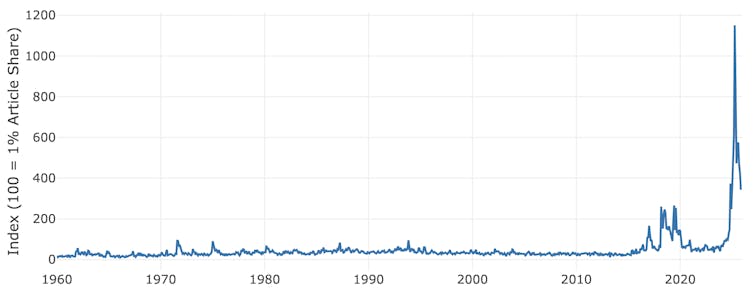
When Donald Trump stood on the White House lawn in April 2025 holding a large, laminated poster announcing the first round of trade tariffs to be imposed on different countries, the Trade Policy Uncertainty Index shot through the roof.
Every month, this index, which is overseen by five board members of the Federal Reserve (America’s central bank), crosschecks the frequency of usage of terms relating to trade policy and uncertainty in seven leading newspapers including the New York Times and the Guardian. Here’s the chart since 1960:
Trump’s so-called “liberation day” sparked volatile shifts in the value of financial products and currencies as governments across the world scrambled to respond. The levels of uncertainty were unprecedented – the outbreak of the COVID pandemic was nothing in comparison, according to the index.
In highly complex systems, conditions of uncertainty and even ignorance – where we don’t know what we don’t know – are extremely common. These conditions become even more likely when such systems, such as those which control global finance, are opaque and poorly regulated. Add in a maverick US president and an administration determined to overturn the status quo, and the old, orderly assumptions are thrown out of the window.
Uncertainty is where we don’t know the likelihood of different things happening: we can’t predict, we can’t manage, we can’t control. For many people, conditions of uncertainty result in precarious jobs, insecure housing and rising inequality. Vulnerabilities including mental illness can become even more exposed when life is so uncertain – only serving to accentuate these perceptions of uncertainty.
However, for a lucky few, uncertainty is an opportunity to make a fortune. Financial capitalism thrives off uncertainty and asymmetric information, which may be encouraged by some who can pocket the profit, betting on the unknowns.
In politics too, uncertainty is being capitalised on. Rising economic precarity in the wake of COVID-19 has been linked with increased support for populist parties in many European countries. And this nationalist politics sweeping much of the world reduces the possibilities of transnational collaboration and multilateral regulation.
The Insights section is committed to high-quality longform journalism. Our editors work with academics from many different backgrounds who are tackling a wide range of societal and scientific challenges.
There are real and present dangers in this age of uncertainty. But through my research at the Institute of Development Studies, I have witnessed inspiring innovations that I believe could be applied across other fields of work and life. My latest book, Navigating Uncertainty: Radical Rethinking for a Turbulent World, explores the strategies used to counter uncertainty in fields as seemingly different as corporate finance and pastoral farming, in settings stretching from southern Zimbabwe to the Midlands of England.
The book highlights some surprising commonalities between these different worlds in their use of diverse sources of knowledge, social networks and human interactions. Above all, I believe the loss of the central role of people in today’s complex systems is the greatest danger of all.
Uncertainties of global finance
The 2008 financial crisis can be explained in part by a lack of such human engagement, and the reliance on a trading system where the assumption of control turned out to be highly misleading.
The international financial system involves a multitude of players, each with different sorts of information about the future. In the build-up to the crisis, many new financial instruments were devised to extract profit. The investment banks – Goldman Sachs, Merrill Lynch, Morgan Stanley – perfected the art of managing the huge amounts of cash generated in the financial system through a range of derivative instruments, including the fateful mortgage-backed securities that triggered the crash. But the bewildering array of acronyms and actors involved meant few actually understood the system and its dynamics.
Who was to blame for the 2008 financial crisis? Video: BBC News.
At the centre of this complex web of financial interactions were mathematical models designed to offset uncertainty and provide control. The notorious Black-Scholes-Merton equation helped manage the transactions that were occurring in ever greater volumes and super-fast speeds, with billions of dollars being exchanged in nanoseconds across high-speed internet links.
However, when you are overly confident in risk-based models within a narrowly defined regulatory system, uncertainties have the nasty habit of creeping up behind you and catching you by surprise. As Andy Haldane, then chief economist at the Bank of England, commented in the aftermath:
The financial cat’s-cradle became dense and opaque. As a result, the precise source and location of underlying claims became anyone’s guess. Follow-the-leader became blind-man’s buff. In short, diversification strategies by individual firms generated heightened uncertainty across the system as a whole.
The crisis was rooted in what Haldane called “an exaggerated sense of knowledge and control”. Since then, there has been much reflection on what went wrong and what to do about it. One response has been to add new layers of regulation, but many argue that this may just hide the underlying uncertainties, as happened before.
The financial system was ill-equipped to respond to the shocks that emerged from the sub-prime mortgage collapse, and precious little appears to have changed since – as was demonstrated so vividly following the announcement of Trump’s tariffs.
Today’s financial system is increasingly reliant on algorithmic models to make decisions, driven by even ever more sophisticated AI applications. The large language machine learning models take accumulated past data to predict the future – but as well as increasing opacity, there is a decrease in accountability. AI offers an illusion of control, and this can be very dangerous.
The reality is that conditions of uncertainty are not unusual, freak occurrences, but the normal consequences of complex systems. So what if the standard assumptions of modernity – planning, management, regulation, control – have to be radically rethought? Is it possible to embrace uncertainty for the benefit of all – rather than denying or ignoring it until it is too late?
For financial systems, Haldane and others have argued that this means rethinking financial network configurations and enabling new practices (requiring new skills) for those involved. A shift from reliance on opaque and highly complex risk-based model algorithms to allowing more human discretion and judgment. Active deliberation on the appropriate responses to inevitably incomplete information in a world where uncertainty, even ignorance, is not only accepted but embraced.
Where can we look for inspiration? I’d suggest that the pastoral systems of northern Kenya and Amdo Tibet in China are good places to start. In both settings, pastoralists – mobile livestock keepers – must manage highly variable climates, and volatile market conditions alongside conflict and political uncertainties to keep their animals healthy and provide for their families. Like the global financial system, pastoralists trade across borders, manage highly variable supply and demand, and interact across networks in real time.
During my research with Kenyan and Chinese colleagues in both places since 2018, we have been struck by how pastoralists expertly live with, and benefit from, uncertainties. I believe that this offers some important lessons for elsewhere in the world – including its centres of global finance.
Livestock markets in northern Kenya
Meet Mohamed Hassan, a livestock trader from Moyale in northern Kenya on the border of Ethiopia. He manages a large and fluctuating trade in livestock – cattle, camels, goats, sheep – buying from producers, dealing with brokers and transporters, and selling animals on to terminal markets in Nairobi and further afield. He explains:
I have connections all over this region and buy cattle from as far as Garissa and Moyale [in Kenya], even Somalia. I transport cattle on trucks and sell on to customers in Nairobi. I also buy up small stock in bush markets around here, and sell to other traders in nearby areas for sale in local towns.
The pastoral areas of the Horn of Africa – from Somalia to Ethiopia to Kenya and beyond – are the centre of a massive international market in livestock. Estimates vary, but each year around US$1 billion in trade in live animals passes through the ports along the Somali coast destined for the Gulf countries, notably Saudi Arabia.
This is an internationalised, cross-border market affected by multiple uncertainties. It requires considerable financing, sophisticated coordination and complex governance arrangements. It operates almost completely informally outside the grip of state regulation and taxation, yet in a highly sensitive geopolitical arena.
Central to this complex international market is a network of traders and brokers who source animals from diverse locations across pastoral regions and organise their transport to and subsequent sale in terminal markets. This requires a great deal of collective skill by traders like Hassan, galvanising different knowledge, connecting people and negotiating trade in real time.
This includes negotiating with border police, customs officials and veterinary officers. One of the key features is the willingness of all parties to accept that the entire system requires a deliberate maintenance of ambiguities around regulation to ensure the flexibility of movement when official rules would prevent it.
These pastoralists in northern Kenya are part of a complex network of traders and brokers. Ian Scoones, CC BY-NC-SA
Brokers – intermediaries in the system with knowledge of the whole network – are relied on by the traders for knowledge about conditions in production areas, prices in different places and connections to markets. They operate in multiple languages and can link producers and traders, measuring livestock weights, recommending prices and preventing fraud.
Connected across far-flung areas, they use kinship and cultural connections to build trust between market players, facilitating effective trade. By offering knowledge, credit and informal insurance, they smooth the operation of the market, reducing sources of uncertainty. Collective arrangements for trading animals also diminish risks and enhance capacities for financing and transportation.
Such markets are always social, connected by trust-based relationships frequently over long distances, but with the end result being an efficient, effective market that can respond to multiple shocks – whether trade bans, price volatility, insecurity or drought.
Unlike with global finance and its addiction to predictive algorithms, the web of interactions between actors in this market are based on close connections among kin and clan groups, rooted in sustained social relations. Facilitated by increasingly robust mobile-phone coverage enabling rapid and secure money transfers, the system is remarkably effective given the volume of exchanges in this informal cross-border trade.
In contrast to contemporary financial systems, this is a system where networks of people keep a close eye on any potential failure, and respond in real time. Uncertainty is accepted, not dismissed or ignored. Informality means that a rapid response to changing circumstances is possible, with everyone contributing to generating reliability. The “human touch” is always present, and there is no opportunity for the system to collapse.
Studies of these livestock markets have highlighted differences between “long” and “short” market chains. While the former are run mostly by men, short market chains are more local, more embedded in local social relations and involve more women, particularly in the sheep and goat trade.
As uncertainties increase, it is these shorter, more locally managed chains that can adjust most rapidly. A much more variegated pattern is emerging, replacing the “big man”-dominated long chains of the past. With more players connected in networks through more diverse and decentralised social relations, the capacity to respond to uncertain events increases.
All this may seem very far from the challenges of global finance, but I believe there are important lessons to be learned. Livestock markets are similarly non-linear and complex, operate internationally and have limited formal regulatory control – yet they remain firmly embedded in social settings. A more social basis for “the economy” and “the market”, rooted in collective, networked responses, is apparent, where responses to uncertainty are central. This contrasts with the idealised image of an individualised, risk management response promoted in mainstream finance and banking systems,
The livestock markets of northern Kenya are facilitated by personal, culturally imbued interactions, while also using technologies that support the efficient and rapid flows of money and information. It is the human touch, involving a range of networked social practices, that is central to grappling continuously with uncertainties.
Buddhist herders in Amdo Tibet
Next, meet Loba Tsering from Dreinag village in the north of Kokonor, in the high pastures of Amdo Tibet, China. Like Hassan, he and his family must navigate many uncertainties. Heavy snowfall and an extended winter can wreak havoc with herding arrangements as people move yaks and sheep from winter to summer pastures at altitudes in excess of 4,000 metres.
Access to land, particularly for winter grazing by Qinghai lake – China’s largest – is increasingly constrained, as land along the lakeshore is divided up, privatised and acquired for tourism development and conservation projects. Markets for yak meat, as well as milk, butter and cheese, are expanding in the lower altitude areas as towns grow and lakeside tourist resorts are established, but in this volatile context new market connections must be found.
Uncertainties are accepted as part-and-parcel of life. As Tsega Norbu, a 40-year-old herder and father of three from Darnama village in the south of Kokonor, explains: “What happened is already in the past, and what is going to happen is unpredictable. All we can depend on is the present, we deal with what is happening now.”
Access to land for winter grazing by Qinghai lake in Kokonor is increasingly constrained. Palden Tsering, CC BY-NC-SA
Uncertainty is central to a Buddhist sensibility governing life. The world cannot be stable and controlled, but is part of a cycle of ongoing change. According to Tibetan Buddhist teachings and practices, uncertainties from whatever source – climatic, economic, political – should never be feared. They are part of how knowledges and experiences are constructed.
Unlike the anxiety and stress that uncertainties may create amid the western ideal of an ordered, regular, stable world, for Loba Tsering and others, there is no such expectation of a linear path. The assumptions of western-style modernity are fundamentally challenged.
But this doesn’t mean that they reject the trappings of a modern life. Mobile phones and internet connectivity, reliable off-grid electricity, functioning transport infrastructure, good healthcare, education for children and commercial market interactions are all crucial for pastoralists living in Kokonor. But these are integrated within an outlook that makes use of ambiguity and embraces uncertainty as part of daily life.
This requires particular skills for generating reliability which, just like for Mohamed Hassan and his fellow Kenyan traders, involve relying on social relations and networks. But in contrast to northern Kenya, where state presence and regulation is limited, in areas such as Kokonor there is much more interaction with state officials and government investment projects. This has implications for how uncertainties are navigated.
Infrastructure development continues apace in Amdo Tibet, with the Chinese state investing in large settlement programmes alongside road and rail infrastructure and conservation projects to protect watersheds. While Amdo Tibet remains a largely rural and very mountainous area, land access is always contentious as different actors – local people, investors, the government – compete for control. This generates heightened uncertainties for pastoralists. However, despite the increasing state presence, whether through local county officials or national-level projects, there is always room for manoeuvre.
Loba Tsering and others make use of this latitude to navigate within often ambiguous, hybrid arrangements around market or land access. Policies coming from the centre are never specified in detail, but provide guidance around broad objectives set by the Chinese state.
This approach to navigating uncertainty is what the Singaporean political scientist and author Yuen Yuen Ang calls “directed improvisation”. It provides a route to responding to complexity and uncertainty that allows flexibility and the possibilities of adaptation, avoiding top-down imposition. It is a combination of central facilitation and local innovation – one that makes use of ambiguity and thrives off uncertainty.
Yuen Yuen Ang on the pros and cons of China’s economic approach. Video: New Economic Thinking.
So, for example, when Loba Tsering and other villagers wanted to secure land for winter grazing to fatten their animals for sale to nearby markets, they had to exploit this flexibility and navigate the uncertainties. Their original winter grazing sites had shrunk, both because of encroachment of urban areas and expansion of the lake, due to increasing snow melt thanks to climate change. This meant that land was scarce and their opportunities for livestock marketing had declined.
First, they approached the local township officials to put their case. They were already connected with some officials who came from the same village, so conversations could start easily. Working together with these representatives, they then approached the county officials.
Although there were limits imposed by central state policies due to environmental regulations and plans for a conservation area, a creative, improvised solution was found through dialogue and deliberation. A two-year compensation for the loss of the winter pasture was offered, and a new area allocated for the landless pastoralists in the village. This ensured their animals could be fed and fattened, allowing new marketing opportunities in the fast-growing nearby towns and tourist resorts.
This was “directed improvisation” in action, with solutions being found that responded to changing circumstances. It is not an isolated example but, as many have commented before, central to the style of centralised-yet-flexible, pragmatic policymaking that China has adopted – an approach that has been central to its rapid economic transformation and poverty reduction following the reform era.
In a highly complex system with many different requirements and operating across a vast geographic area, a singular, designed solution rolled out from the centre clearly will not work. Rather, an approach to economic change that is responsive to uncertain conditions is required, with flexible institutions and governance systems – very unlike the fixed regulatory protocols of global finance.
No standardised blueprint model of either design or regulation will work. Solutions must allow for experimentation and improvisation, and be built on social relations where trust is essential. Once again, it is the human touch that is key.
Rethinking an uncertain world
Despite the very different contexts, the experiences from northern Kenya and Amdo Tibet in China offer some important insights into how to navigate uncertainty in our turbulent times. Could such insights help us avoid the chaos and collapse we saw during the financial crash and following the imposition of Trump’s tariffs? Interestingly, the principles that emerge are similar to those suggested by Haldane and others following the 2007-08 financial crash.
What does this involve? The need to decentralise and rely on social interactions in localised networks. The need to avoid reliance on simple, centralised solutions, whether from algorithmic or state diktats. The need to be careful about relying on top-down imposition of regulations, and to seek adaptive, flexible solutions. The need to develop collective options based on trust-based relations – avoiding either an atomised, individualised response or one emerging from a centralised, dirigiste imposition.
Above all, it highlights the need for the human touch – the social, networked relations that are only possible to develop when people interact with each other and build trust.
What does this suggest for the future? A modernist vision of control – whether through markets or states – towards a singular understanding of progress is clearly inappropriate. Instead, a more flexible, adaptive path is required. This means opening up to alternatives, decentralising activities, facilitating experimentation and improvisation and accepting uncertainty.
Embracing uncertainty and encouraging democratic deliberation is also a route to avoiding the future being captured by those who seek to profit from uncertainty, or who seek to close down options through the populist rhetoric of “taking back control”.
Whether responding to a financial shock, new technologies, land use change, a pandemic or the climate crisis, this requires – as in citizen assemblies and other forms of deliberative democratic practice – diverse people interacting and building trust for collective responses. AI and predictive mathematical models are no replacement in our current age of uncertainty.
To hear about new Insights articles, join the hundreds of thousands of people who value The Conversation’s evidence-based news. Subscribe to our newsletter.
Ian Scoones was a recipient of a European Research Council Advanced Grant for the PASTRES project – Pastoralism, Uncertainty and Resilience: Global Lessons from the Margins (https://pastres.org/). He is the author of Navigating Uncertainty: Radical Rethinking for a Turbulent World (Polity Books, 2024, https://bit.ly/44f9sqe).
But history tells a different story. Scientific theories do not simply reveal themselves; they compete for attention, credibility and uptake. U.S. Supreme Court Justice Oliver Wendell Holmes Jr. once suggested that “the best test of truth is the power of the thought to get itself accepted in the competition of the market,” a line that helped popularize the metaphor of a “marketplace of ideas.”
In this view, science is not outside the market, but inside a public arena where claims vie for audiences, resources and belief – and where power, persuasion and social position shape which ideas are heard, trusted or forgotten.
When I tell people that one of the areas I study is the marketing of science, they are often surprised at the concept. Yet persuasion is an integral part of the scientific process.
From Isaac Newton’s followers and their coffeehouse demonstrations of physics wonders to today’s TED Talks and TikTok explainers, scientists have long relied on storytelling and demonstration to make invisible truths visible. For scientific theories to supplant other plausible theories, to challenge existing theories and win acceptance, they must be correct – but they must also be convincing.
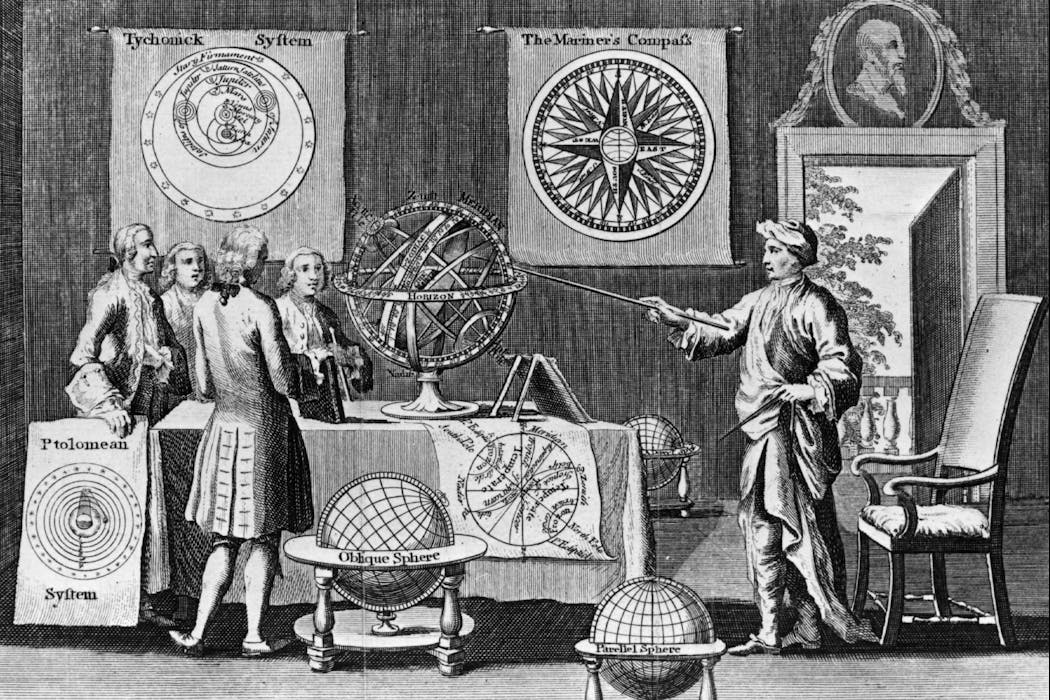
People didn’t need to read Isaac Newton’s indecipherable Latin or understand his incomprehensible mathematics; they could just watch the live demonstrations, as in this depiction of an 18th-century nighttime scientific lecture on pneumatics. Joseph Wright of Derby/Science & Society Picture Library via Getty Images
The original science influencers
In the early 1700s, Isaac Newton’s followers turned abstract theory into public performance and cultural fashion.
At the time, Cartesian philosophy dominated intellectual life. Newton’s 1687 book “Principia Mathematica” proposed a new worldview of gravity, optics and motion, but the mathematics was so dense that few could grasp it.
Although Newton himself was a recluse, a circle of zealous Newtonian men of science, described by historians as devoted disciples and even evangelists for Newton’s natural philosophy, took his new theories on the road. These itinerant lecturers performed experiments and spectaculars in London coffeehouses and aristocratic salons, demonstrating Newtonian physics. They sold tickets, pamphlets and even branded scientific instruments so audiences could reproduce these marvels at home.
My own research finds that these men of science also used a suite of early marketing activities. Besides developing products to sell to promote Newtonian science, they came up with promotions that targeted different audiences, adjusted their pricing and used varied distribution strategies.
Along with their pure entertainment value, these public demonstrations were integrally entwined with Newtonian scientific viewpoints and helped these ideas gain popularity and legitimacy in public life.
Three centuries later, the marketing of science is more visible, and more complicated, than ever.
Scientists can now promote their work on social media platforms like Bluesky, YouTube and TikTok, crafting personal brands and cultivating audiences. Influencer-scientists use storytelling, humor and design to reach millions. If scientists don’t do this themselves, their proponents, just like Newton’s disciples, may do it for them.
I call this process the marketization of moral authority: when historically sacred or ostensibly impartial institutions such as science, religion and education increasingly organize themselves as markets, adopting promotional, pricing and product logics to secure their legitimacy, authority, appeal and funding.
None of this effort is inherently bad. As in Newton’s time, effective marketing communications can make complex work accessible and even inspiring. It can publicize and defend important theoretical and practical findings in a competitive, skeptical world.
But it raises questions.
Today’s scientists may spend time making videos and other content for social media. Ignatiev/E+ via Getty Images
Value of recognizing that science gets marketed
You might wonder why anyone beyond academia should care whether science is marketed. After all, every field uses communication and outreach.
It matters because science is one of the few institutions people still rely on to anchor truth claims in evidence. And when the boundary between scientific fact and promotion blurs, it becomes easy to confuse confidence with credibility, or charisma with responsible consensus.
Scientific rhetoric can easily be co-opted. Think of wellness influencers using “quantum” jargon to sell supplements; AI companies invoking neuroscience to legitimatize untested technologies; charlatans mimicking the language of peer review to sow doubt.
But awareness is a form of protection. When you recognize that scientific authority can be built through persuasion, you become more discerning consumers of it. Faced with a message involving science, you can consider:
Who is framing this message, and why?
What evidence supports it? Is this evidence vetted and validated by rigorous studies?
Is it appealing to emotion or identity, rather than objective logic?
This process can help you become more scientifically literate.
Science has never been the pristine, market-free ideal many imagine. It has always lived – sometimes uneasily – within a marketplace of ideas, competing for belief, attention and authority.
Recognizing that reality humanizes science and reminds us that truth must be discovered, communicated and, ultimately, accepted.
Beth DuFault has received funding from the Ahmanson Foundation.
What is dark matter and what is antimatter? Are they the same or different? – Namrata, age 13, Ghaziabad, India
Imagine an epic video game with your favorite hero as a character. Another character is a mirror-image twin who shows up occasionally, exploding everything they touch. And, to add an extra level of difficulty, the game includes a mysterious hive of minions hiding at every corner, changing the rules of the game, but never showing themselves.
If you think of these characters as types of matter, this video game is basically how our universe works.
The hero is regular matter, which is everything we can see around us. Antimatter is the mirror-image explosive twin that scientists understand well but can barely find. And dark matter is the invisible minions. It is everywhere, but we cannot see it, and scientists have no idea what it is.
Despite having similar-sounding names, dark matter and antimatter are completely different. Interestingly, physicists like me know exactly what antimatter is, but there is almost none of it around. On the other hand, we have no idea what dark matter is, but there is a lot of it everywhere.
Luckily, antimatter is very rare in our universe. But some special regular matter atoms, such as potassium, can decay to produce antimatter. For example, when you eat a banana, or any food rich in potassium, you are eating tiny amounts of these antimatter-producing atoms. The amount is too small to affect your health.
Antimatter was discovered almost 100 years ago. Today, scientists can create, store and study antimatter in the laboratory. They understand its properties very well. Doctors even use it for PET scans. They inject tiny amounts of antimatter-producing atoms into your body, and as these atoms travel through your body, the scan takes pictures of the flashes of light from the annihilation of the antimatter and regular matter in your body. This process lets doctors see what is happening inside your body.
Scientists have also figured out that when the universe was born, there were almost equal amounts of matter and antimatter. They met and annihilated each other. Fortunately, just a tiny bit more regular matter survived to make stars, planets and all of us.
If matter and antimatter annihilate each other when they touch, and there were once equal amounts of each, how is it possible that there is now so much more matter than antimatter in the universe?
Dark matter: The invisible minions
Dark matter is far more mysterious. Have you ever spun very fast on a merry-go-round? If so, you know how hard it is to stay on it without getting thrown off, especially if you’re the only one on the merry-go-round.
Now imagine there are a bunch of invisible minions on that merry-go-round with you. You can’t see them and you can’t touch them, but they hold you and keep you from flying off as it spins super-fast. You know they’re there because the merry-go-round is heavier than it looks, and it is harder to push and get it spinning. The invisible minions don’t play or talk to anybody; they just hang around, adding their weight to everything.
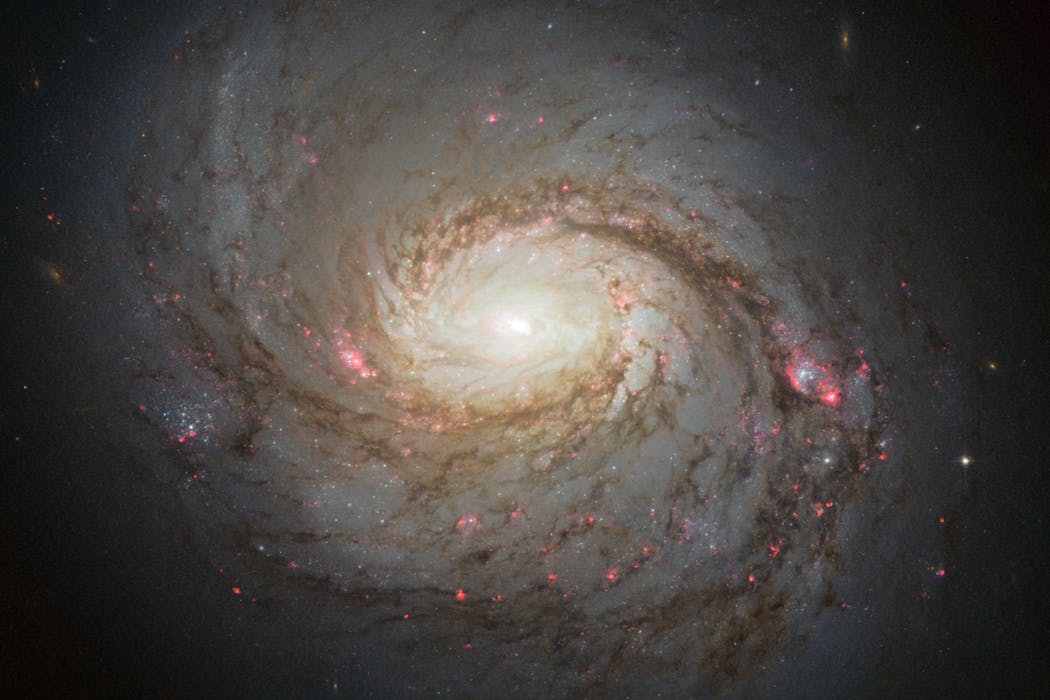
About 50 years ago, astronomer Vera Rubin discovered a similar mystery in spiral galaxies. She looked at spinning galaxies, which are like cosmic merry-go-rounds, and noticed something strange: The outer stars in these galaxies were spinning much faster than they should. They should have gone flying off into space like sparks from a firework display. But they did not.
It was like watching kids on a merry-go-round move at incredible speed but somehow stay perfectly in place.
The astronomer Vera Rubin discovered a strong mismatch in spiral galaxies that scientists now understand as dark matter. Carnegie Institution for Science, CC BY
The only explanation? There must be a sea of invisible “stuff” holding everything together with their extra gravity. Scientists called this mystery material “dark matter.”
Since then, astronomers have observed similar strange behavior happening throughout the universe. Galaxies within large clusters move in unexpected ways. Light gets bent around galaxies more than it should be. Galaxies stick together far more than the visible matter alone can explain.
It is as if our cosmic playground has swings moving by themselves, and seesaws tipping with nobody visible sitting on them.
Dark matter is just a placeholder name until scientists figure out what it is. For the past 50 years, many scientists have been running experiments that are trying to detect dark matter or produce it in the lab. But so far, they have come up empty-handed.
We don’t know what dark matter is, but it’s everywhere. It could be unusual particles scientists have not discovered yet. It could be something completely unexpected. But astronomers can tell by observing how fast galaxies rotate that there is about five times more dark matter than all the regular matter in the entire universe.
Hello, curious kids! Do you have a question you’d like an expert to answer? Ask an adult to send your question to CuriousKidsUS@theconversation.com. Please tell us your name, age and the city where you live.
And since curiosity has no age limit – adults, let us know what you’re wondering, too. We won’t be able to answer every question, but we will do our best.
Dipangkar Dutta receives funding from US Department of Energy and the National Science Foundation.
Both scenarios were unusual – and they were largely directed by the polar jet stream.
What is a jet stream?
Jet streams are narrow bands of high-speed winds in the upper troposphere, around four to eight miles (seven to 13 kilometers) above the surface of the Earth, flowing west to east around the entire planet. They form where strong temperature contrasts exist.
Each hemisphere hosts two primary jet streams:
The polar and subtropical jet streams in positions similar to much of summer 2025. NOAA
The polar jet stream is typically found near 50 to 60 degrees latitude, across Canada in the Northern Hemisphere, where cold polar air meets warmer midlatitude air. It plays a major role in modulating weather systems in the midlatitudes, including the continental U.S. With winds up to 200 mph, it’s also the usual steering force that brings those bitter cold storms down from Canada.
The subtropical jet stream is typically closer to 30 degrees latitude, which in the Northern Hemisphere crosses Florida. It follows the boundary between tropical air masses and subtropical air masses. It’s generally the weaker and steadier of the two jet streams.
A cross section of atmospheric circulations shows where the jet streams exist between large cells of rising and falling air, movements largely driven by solar heating in the tropics. NOAA
Stronger (faster) jet streams can intensify storm systems, whereas weaker (slower) jet streams can stall storm systems, leading to prolonged rainfall and flooding.
2025’s intense summer of flooding
Most summers, the polar jet stream retreats northward into Canada and weakens considerably, leaving the continental U.S. with calmer weather. When rainstorms pop up, they’re typically caused by localized convection due to uneven heating of the land – picture afternoon pop-up thunderstorms.
During the summer of 2025, however, the polar jet stream shifted unusually far south and steered larger storm systems into the midlatitudes of the U.S. At the same time, the jet stream weakened, with two critical consequences.
First, instead of moving storms quickly eastward, the sluggish jet stream stalled storm systems in place, causing prolonged downpours and flash flooding.
Second, a weak jet stream tends to meander more dramatically. Its broad north-south swings in summer 2025 funneled humid air from the Gulf of Mexico deep into the interior, supplying storm systems with abundant moisture and intensifying rainfall.
Search-and-rescue crews look for survivors in Texas Hill Country after a devastating July 4, 2025, flash flood on the Guadalupe River swept through a girls’ camp, tearing walls off buildings. Ronaldo Schemidt/AFP via Getty Images
This moisture surge was amplified by unusually warm conditions over the Atlantic and Gulf regions. A warmer ocean evaporates more water, and warmer air holds a greater amount of moisture. As a result, extraordinary levels of atmospheric moisture were directed into storm systems, fueling stronger convection and heavier precipitation.
Finally, the wavy jet stream became locked in place by persistent high-pressure systems, anchoring storm tracks over the same regions. This led to repeated episodes of heavy rainfall and catastrophic flooding across much of the continental U.S. The same behavior can leave other regions facing days of unrelenting heat waves.
The jet stream buffered US in hurricane season
The jet stream also played a role in the 2025 hurricane season.
Given its west-to-east wind direction, the southward dip of the jet stream – along with a weak high pressure system over the Atlantic – helped steer all five hurricanes away from the U.S. mainland.
The 2025 Atlantic hurricane season’s storm tracks show how most of the storms steered clear of the U.S. mainland and veered off into the Atlantic. Sandy14156/Wikimedia Commons
Most of the year’s 13 tropical storms and hurricanes veered off into the Atlantic before even reaching the Caribbean.
A higher temperature contrast leads to stronger jet streams. As the planet warms, the Arctic is heating up at more than twice the global average rate, and that is reducing the equator-to-pole temperature difference. As that temperature gradient weakens, jet streams lose their strength and become more prone to stalling.
This increases the risk of persistent extreme rainfall events.
Weaker jet streams also meander more, producing larger waves and more erratic behavior. This increases the likelihood of unusual shifts, such as the southward swing of the jet stream in the summer of 2025.
A recent study found that amplified planetary waves in the jet streams, which can cause weather systems to stay in place for days or weeks, are occurring three times more frequently than in the 1950s.
What’s ahead?
As the global climate continues to warm, extreme weather events driven by erratic behavior of jet streams are expected to become more common. Combined with additional moisture that warmer oceans and air masses supply, these events will intensify, producing storms that are more frequent and more destructive to societies and ecosystems.
In the short term, the polar jet stream will be shaping the winter ahead. It is most powerful in winter, when it dips southward into the central and even southern U.S., driving frequent storm systems, blizzards and cold air outbreaks.
Shuang-Ye Wu does not work for, consult, own shares in or receive funding from any company or organization that would benefit from this article, and has disclosed no relevant affiliations beyond their academic appointment.