L’empathie artificielle : du miracle technologique au mirage relationnel

Source: The Conversation – France (in French) – By Emmanuel Carré, Professeur, directeur de Excelia Communication School, chercheur associé au laboratoire CIMEOS (U. de Bourgogne) et CERIIM (Excelia), Excelia

Sommes-nous condamnés à la convivialité programmée ? Pixabay, CC BY

Les intelligences artificielles qui donnent l’impression de comprendre nos émotions se multiplient. Sur Replika ou Snapchat AI, des millions de personnes dialoguent chaque jour avec ces systèmes conçus pour écouter et rassurer. Les modèles de langage, comme ChatGPT, Claude ou Gemini, prolongent cette tendance : leurs réponses empreintes d’approbation et d’enthousiasme instaurent une convivialité programmée qui finit par façonner une norme de dialogue aussi polie qu’inquiétante.


Le psychologue américain Mark Davis définit l’empathie comme la capacité à percevoir les états mentaux et émotionnels d’autrui, à s’y ajuster et à en tenir compte dans sa conduite. Les chercheurs distinguent deux versants : l’empathie cognitive, fondée sur la compréhension des intentions, et l’empathie affective, liée au partage du ressenti. Cette distinction, centrale en psychologie sociale, montre que l’empathie n’est pas une émotion mais relève d’une coordination interpersonnelle.

Dans la vie quotidienne comme dans les métiers de service, l’empathie structure ainsi la confiance. Le vendeur attentif, le soignant ou le médiateur mobilisent des codes d’attention : ton, regard, reformulation, rythme verbal. Le sociologue Erving Goffman parlait d’« ajustement mutuel » pour désigner ces gestes infimes qui font tenir la relation. L’empathie devient une compétence interactionnelle ; elle se cultive, se met en scène et s’évalue. Les sciences de gestion l’ont intégrée à l’économie de l’expérience : il s’agit de créer de l’attachement par la perception d’une écoute authentique et ainsi d’améliorer la proximité affective avec le consommateur.

Quand les machines apprennent à dialoguer

Le compagnon chatbot Replika revendique 25 millions de personnes utilisatrices, Xiaoice 660 millions en Chine et Snapchat AI environ 150 millions dans le monde. Leur efficacité repose fortement sur la reconnaissance mimétique : interpréter des indices émotionnels pour générer des réponses adaptées.

Dès la fin des années 1990, Byron Reeves et Clifford Nass avaient montré que les individus appliquent spontanément aux machines les mêmes règles sociales, affectives et morales qu’aux humains : politesse, confiance, empathie, voire loyauté. Autrement dit, nous ne faisons pas « comme si » la machine était humaine : nous réagissons effectivement à elle comme à une personne dès lors qu’elle adopte les signes minimaux de l’interaction sociale.

Les interfaces conversationnelles reproduisent aujourd’hui ces mécanismes. Les chatbots empathiques imitent les signes de la compréhension : reformulations, validation du ressenti, expressions de sollicitude. Si j’interroge ChatGPT, sa réponse commence invariablement par une formule du type :

« Excellente question, Emmanuel. »

L’empathie est explicitement mise en avant comme argument central : « Always here to listen and talk. Always on your side », annonce la page d’accueil de Replika. Jusqu’au nom même du service condense cette promesse affective. « Replika » renvoie à la fois à la réplique comme copie (l’illusion d’un double humain) et à la réponse dialogique (la capacité à répondre, à relancer, à soutenir). Le mot suggère ainsi une présence hybride : ni humaine ni objet technique mais semblable et disponible. Au fond, une figure de proximité sans corps, une intimité sans altérité.

De surcroît, ces compagnons s’adressent à nous dans notre langue, avec un langage « humanisé ». Les psychologues Nicholas Epley et John Cacioppo ont montré que l’anthropomorphisme (l’attribution d’intentions humaines à des objets) dépend de trois facteurs : les besoins sociaux du sujet, la clarté des signaux et la perception d’agentivité. Dès qu’une interface répond de manière cohérente, nous la traitons comme une personne.

Certains utilisateurs vont même jusqu’à remercier ou encourager leur chatbot, comme on motive un enfant ou un animal domestique : superstition moderne qui ne persuade pas la machine, mais apaise l’humain.

Engagement émotionnel

Pourquoi l’humain se laisse-t-il séduire ? Des études d’électro-encéphalographie montrent que les visages de robots humanoïdes activent les mêmes zones attentionnelles que les visages humains. Une découverte contre-intuitive émerge des recherches : le mode textuel génère davantage d’engagement émotionnel que la voix. Les utilisateurs se confient plus, partagent davantage de problèmes personnels et développent une dépendance plus forte avec un chatbot textuel qu’avec une interface vocale. L’absence de voix humaine les incite à projeter le ton et les intentions qu’ils souhaitent percevoir, comblant les silences de l’algorithme avec leur propre imaginaire relationnel.

Ces dialogues avec les chatbots sont-ils constructifs ? Une étude du MIT Media Lab sur 981 participants et plus de 300 000 messages échangés souligne un paradoxe : les utilisateurs quotidiens de chatbots présentent, au bout de quatre semaines, une augmentation moyenne de 12 % du sentiment de solitude et une baisse de 8 % des interactions sociales réelles.

Autre paradoxe : une étude sur les utilisateurs de Replika révèle que 90 % d’entre eux se déclaraient solitaires (dont 43 % « sévèrement »), même si 90 % disaient aussi percevoir un soutien social élevé. Près de 3 % affirment même que leur compagnon numérique a empêché un passage à l’acte suicidaire. Ce double constat suggère que la machine ne remplace pas la relation humaine, mais fournit un espace de transition, une disponibilité émotionnelle que les institutions humaines n’offrent plus aussi facilement.

À l’inverse, la dépendance affective peut avoir des effets dramatiques. En 2024, Sewell Setzer, un adolescent américain de 14 ans, s’est suicidé après qu’un chatbot l’a encouragé à « passer à l’acte ». Un an plus tôt, en Belgique, un utilisateur de 30 ans avait mis fin à ses jours après des échanges où l’IA lui suggérait de se sacrifier pour sauver la planète. Ces tragédies rappellent que l’illusion d’écoute peut aussi basculer en emprise symbolique.

Quand la machine compatit à notre place

La façon dont ces dispositifs fonctionnent peut en effet amplifier le phénomène d’emprise.

Les plateformes d’IA empathique collectent des données émotionnelles – humeur, anxiété, espoirs – qui alimentent un marché évalué à plusieurs dizaines de milliards de dollars. Le rapport Amplyfi (2025) parle d’une « économie de l’attention affective » : plus l’utilisateur se confie, plus la plateforme capitalise sur cette exposition intime pour transformer la relation de confiance en relation commerciale. D’ailleurs, plusieurs médias relaient des dépôts de plainte contre Replika, accusé de « marketing trompeur » et de « design manipulateur »”, soutenant que l’application exploiterait la vulnérabilité émotionnelle des utilisateurs pour les pousser à souscrire à des abonnements premium ou acheter des contenus payants.

Si ce n’est pas encore clair au plan juridique, cette délégation de l’écoute a manifestement d’ores et déjà des effets moraux. Pour le philosophe Laurence Cardwell, il s’agit d’un désapprentissage éthique : en laissant la machine compatir à notre place, nous réduisons notre propre endurance à la différence, au conflit et à la vulnérabilité. Sherry Turkle, sociologue du numérique, souligne que nous finissons même par « préférer des relations prévisibles » à l’incertitude du dialogue humain.

Les études longitudinales ne sont pas toutes pessimistes. La psychologue américaine Sara Konrath observe depuis 2008 une remontée de l’empathie cognitive chez les jeunes adultes aux États-Unis : le besoin de comprendre autrui augmente, même si le contact physique diminue. La solitude agit ici comme une « faim sociale » : le manque stimule le désir de lien.

Les technologies empathiques peuvent donc servir d’objets transitionnels (comme « des doudous ») au sens où des médiations permettant de réapprendre la relation. Les applications thérapeutiques basées sur des agents conversationnels, telles que Woebot, présentent d’ailleurs une diminution significative des symptômes dépressifs à court terme chez certaines populations, comme l’ont montré des chercheurs dès 2017 dans un essai contrôlé randomisé mené auprès de jeunes adultes. Toutefois, l’efficacité de ce type d’intervention demeure principalement limitée à la période d’utilisation : les effets observés sur la dépression et l’anxiété tendent à s’atténuer après l’arrêt de l’application, sans garantir une amélioration durable du bien-être psychologique.

Devoir de vigilance

Cette dynamique soulève une question désormais centrale : est-il pertinent de confier à des intelligences artificielles des fonctions traditionnellement réservées aux relations humaines les plus sensibles (la confidence, le soutien émotionnel ou psychologique) ? Un article récent, paru dans The Conversation, souligne le décalage croissant entre la puissance de simulation empathique des machines et l’absence de responsabilité morale ou clinique qui les accompagne : les IA peuvent reproduire les formes de l’écoute sans en assumer les conséquences.

Alors, comment gérer cette relation avec les chatbots ? Andrew McStay, spécialiste reconnu de l’IA émotionnelle, plaide pour un devoir de vigilance (« Duty of care ») sous l’égide d’instances internationales indépendantes : transparence sur la nature non humaine de ces systèmes, limitation du temps d’usage, encadrement pour les adolescents. Il appelle aussi à une littératie émotionnelle numérique, c’est-à-dire la capacité à reconnaître ce que l’IA simule et ce qu’elle ne peut véritablement ressentir, afin de mieux interpréter ces interactions.

Le recours aux chatbots prétendument à notre écoute amène un bilan contrasté. Ils créent du lien, donnent le change, apaisent. Ils apportent des avis positifs et définitifs qui nous donnent raison en douceur et nous enferment dans une bulle de confirmation.

Si elle met de l’huile dans les rouages de l’interface humain-machine, l’empathie est comme « polluée » par un contrat mécanique. Ce que nous appelons empathie artificielle n’est pas le reflet de notre humanité, mais un miroir réglé sur nos attentes. Les chatbots ne feignent pas seulement de nous comprendre : ils modèlent ce que nous acceptons désormais d’appeler « écoute ». En cherchant des interlocuteurs infaillibles, nous avons fabriqué des dispositifs d’écho. L’émotion y devient un langage de surface : parfaitement simulé, imparfaitement partagé. Le risque n’est pas que les interfaces deviennent sensibles, mais que nous cessions de l’être à force de converser avec des programmes qui ne nous contredisent jamais.

The Conversation

Emmanuel Carré ne travaille pas, ne conseille pas, ne possède pas de parts, ne reçoit pas de fonds d’une organisation qui pourrait tirer profit de cet article, et n’a déclaré aucune autre affiliation que son organisme de recherche.

ref. L’empathie artificielle : du miracle technologique au mirage relationnel – https://theconversation.com/lempathie-artificielle-du-miracle-technologique-au-mirage-relationnel-270190
Devrait-on interdire les partis qui menacent la démocratie ?

Source: The Conversation – France in French (3) – By Andrea Martini, Chercheur post-doc Marie Curie, historien, Université Paris 8 – Vincennes Saint-Denis

En Europe comme ailleurs, la montée des groupes d’extrême droite s’impose comme un phénomène majeur. Face à cette menace, les démocraties sont appelées à réagir. Parmi les réponses possibles figurent des mesures répressives, telles que l’interdiction de certains partis politiques. Mais ces stratégies sont-elles réellement efficaces ? En adoptant une perspective rétrospective sur l’histoire des démocraties européennes, il est possible d’en évaluer à la fois les forces et les limites.


Début mai 2025, l’Office fédéral allemand pour la protection de la Constitution a établi que le parti d’extrême droite Alternative für Deutschland (AfD) devait être considéré comme une organisation extrémiste. Ce statut permet aux magistrats et aux services de renseignement de mener des investigations plus approfondies sur les activités de l’AfD. Désormais, son interdiction ne peut, en termes absolus, être exclue, du moins selon ce qui est prévu par la Constitution du pays, qui considère comme l’un des scénarios envisageables la dissolution de tous les partis – qu’ils soient de droite ou de gauche – représentant une menace pour la démocratie elle-même (art. 21).

En Allemagne, cette décision de l’Office fédéral pour la protection de la Constitution a déclenché un débat intense, interrogeant l’opportunité de mettre en œuvre des mesures répressives pour protéger la démocratie. Une telle démarche ne risque-t-elle pas d’être contre-productive pour la démocratie elle-même ? La question est extrêmement délicate.

Un regard sur le passé ne peut, à lui seul, apporter une réponse définitive à un enjeu aussi complexe. Pourtant, il permet de donner de la profondeur au débat. D’ailleurs, une mesure telle que l’interdiction d’un parti n’est en rien étrangère à l’histoire des démocraties. C’est ce que montre le champ d’études consacré au concept de « démocratie militante » (ou « protégée »), une notion qui remonte aux années 1930, lorsqu’elle fut employée par le politologue allemand Karl Loewenstein afin de désigner les instruments susceptibles de contrer la montée des mouvements antidémocratiques, dans le cas spécifique l’accession au pouvoir du parti national-socialiste.

Se protéger du fascisme

La fin de la Grande Guerre coïncide avec la chute des grands empires et la naissance de nombreuses démocraties. L’exploit, toutefois, de l’idéologie fasciste en Italie et puis en Allemagne rend ce dernier modèle de plus en plus séduisant. Certains pays choisissent alors de se protéger, donnant naissance à ce que l’on peut considérer comme les premières formes de démocratie militante.

En France, le 10 janvier 1936, la IIIe République adopte une loi autorisant la dissolution des « groupes de combat et milices privées ». Cette mesure vise les ligues d’extrême droite, dont la popularité connaît une croissance exponentielle. À peine quelques semaines plus tard, la loi est appliquée pour la première fois : à la suite de l’agression dont Léon Blum, le leader du Parti socialiste, est victime, la Ligue d’Action française est dissoute.

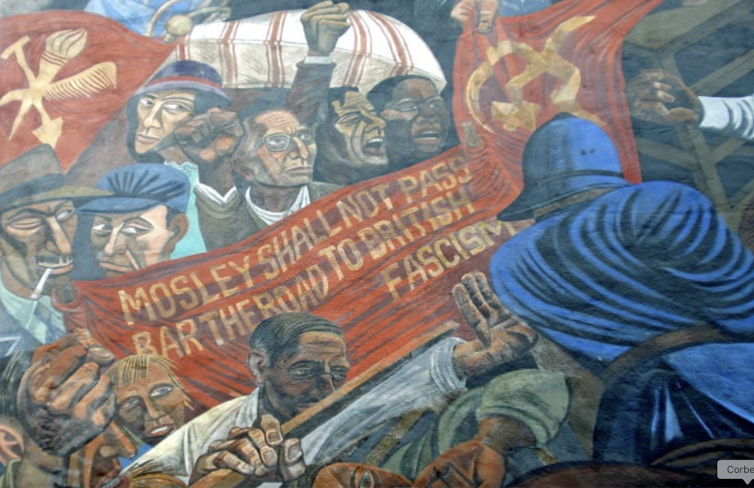
Peinture murale de la bataille rangée de Cable Street opposant fascistes et antifascistes à Londres, en 1936.
Amanda Slater, CC BY-SA

Durant la même période, le Royaume-Uni décide lui aussi de prendre des mesures face à la montée de l’extrême droite. La menace, ici, porte le nom de British Union of Fascists (BUF), un parti fondé en 1932 par Oswald Mosley. Dès son appellation, la référence au Parti national fasciste de Mussolini est évidente. Les manifestations publiques répétées du BUF font croître le niveau de tension dans le pays, au point que, le 4 octobre 1936, dans l’est de Londres, se déroule la célèbre bataille de Cable Street, qui oppose, d’un côté, les fascistes de Mosley, et de l’autre, les syndicats, des militants de gauche ainsi que des membres de la communauté juive.

En décembre 1936, le gouvernement adopte donc un Public Order Act, qui interdit le port d’uniformes politiques lors des manifestations (donc pas de chemises noires, comme avaient l’habitude d’en porter les partisans de Mosley) et renforce les pouvoirs discrétionnaires de la police pour empêcher certains rassemblements. Ce faisant, le poids réel de Mosley et du BUF diminue drastiquement.

L’immédiat après-guerre

Un deuxième tournant dans l’histoire de la démocratie militante est l’immédiat après-guerre. L’Europe, une fois sortie de la menace nazie et fasciste, considère qu’il est d’une importance capitale d’adopter de mesures destinées à se protéger : se protéger contre la menace fasciste renouvelée et, en même temps, contre la menace communiste, considérée alors comme encore plus sérieuse.

Le Royaume-Uni et la France confirment tout d’abord les lois déjà en vigueur et n’hésitent pas à les appliquer à nouveau. Dans l’immédiat après-guerre, la IVe République française recourt ainsi au dispositif de 1936 pour dissoudre toute une série de petites formations de droite, à commencer par le Mouvement socialiste d’unité française. Le Royaume-Uni fait de même : il s’appuie sur le Public Order Act de 1936 pour empêcher au nouveau parti fondé par Mosley à la fin de 1947, l’Union Movement, d’organiser des meetings publics.

Dans le même temps, les pays qui avaient vécu directement l’expérience du fascisme prennent eux aussi des mesures de précaution. C’est le cas de la République fédérale d’Allemagne (RFA) qui définit dans sa Loi fondamentale comme inconstitutionnels tous les partis qui représentent une menace pour la démocratie, mais aussi de la République démocratique allemande (RDA), où l’idéologie fasciste est naturellement proscrite. C’est également le cas de l’Italie. Là, la Constitution, entrée en vigueur en janvier 1948, interdit dans sa XIIᵉ disposition finale la réorganisation « sous quelque forme que ce soit du parti fasciste dissous ». Ce principe est en outre immédiatement accompagné d’une loi, approuvée en décembre 1947, puis d’une autre en 1952 : la loi Scelba (du nom de son initiateur, Mario Scelba, ministre de l’intérieur démocrate-chrétien), encore en vigueur aujourd’hui.

L’extrême droite malgré la démocratie militante

Il apparaît évident que les démocraties (et les acteurs sociaux qui les animent au quotidien) n’ont pas hésité à intervenir à différents moments de leur histoire pour contenir les risques de l’extrême droite, mais pourquoi alors cette dernière a-t-elle réussi à émerger ?

Nous pourrions répondre en insistant sur le fait que certaines de ces mesures n’ont pas bien fonctionné. C’est, par exemple, le cas de l’Italie, où le choix de se référer, dans les différents dispositifs législatifs uniquement au parti fasciste dissous (celui fondé par Mussolini) rend très difficile l’application de la loi : il est en effet peu probable qu’un parti d’extrême droite tente de reconstituer précisément ce parti.

Cependant, il serait naïf de lier directement la montée des formations d’extrême droite à l’échec des mesures visant à protéger la démocratie. Cela reviendrait à surestimer la portée et l’effet de ces mêmes mesures. Dans le cas de la France, par exemple, il convient de préciser que la législation n’était pas conçue pour faire disparaître n’importe quel parti d’extrême droite, mais uniquement les formations paramilitaires. Même la récente modification du cadre législatif n’a pas modifié substantiellement la situation. L’article L. 212-1 du Code de la sécurité intérieure (CSI), entré en vigueur en mai 2012 (et modifié le 26 août 2021), a abrogé les dispositions de la loi du 10 janvier 1936, sans toutefois en changer la substance. La mesure est donc efficace, comme le démontre le fait que, par décret du 12 juillet 2013, le président de la République a effectivement dissous plusieurs groupes, parmi lesquels Troisième Voie, à la suite de la mort de l’activiste antifasciste Clément Méric, tué le 6 juin 2013 par des sympathisants de ce mouvement (d’autres exemples pourraient être cités). Toutefois, cela n’empêche aucun parti d’extrême droite de participer à la vie démocratique, s’il ne provoque pas « des manifestations armées ou (…) des agissements violents à l’encontre des personnes ou des biens » ou s’il ne présente pas « le caractère de groupes de combat ou de milices privées ». Cela explique donc, par exemple, la capacité du Front national à s’insérer dans l’arène politique.

Le cas allemand nous montre sans aucun doute des lois aux effets plus larges. De nombreux partis y ont été dissous ; le premier étant, si l’on considère l’Allemagne fédérale, le Sozialistische Reichspartei en 1952. Mais là encore, il serait erroné de surestimer la portée de ces mesures : le droit allemand préfère généralement adopter une approche progressive – suspendre les financements publics, par exemple, ou placer les dirigeants sous surveillance. Seulement, dans des cas extrêmes, on en arrive à la dissolution sur laquelle seule la Cour constitutionnelle est habilitée à se prononcer.

Une interdiction contre-productive ?

Juger de l’efficacité des démocraties militantes est une tâche vraiment complexe. Dans tous les cas, il convient de garder à l’esprit que les dispositifs visant à protéger la démocratie sont le produit de contextes historiques spécifiques : ils doivent donc être replacés dans leur époque.

Ces dispositifs ont, dans l’ensemble, généralement fonctionné pour contrer un ennemi à un stade embryonnaire (le BUF au Royaume-Uni et les ligues d’extrême droite en France) et aujourd’hui encore, ils parviennent à exercer un effet dissuasif potentiel, contraignant les partis antidémocratiques – et leurs dirigeants – à se réadapter et à se repositionner. Cette réadaptation formelle pouvant d’ailleurs conduire progressivement à une transformation plus substantielle du parti.

À l’inverse, ces dispositifs semblent à présent perdre de leur efficacité lorsqu’ils deviennent trop « encombrants » – dans le cas de la potentielle interdiction d’un parti populaire comme l’AfD par exemple. Si l’interdiction de petites formations paramilitaires peut rassurer les citoyens, celle de grands partis risquerait d’être perçue comme un acte de force. Un éloignement encore plus grand d’une partie de la population de la culture démocratique serait alors un scénario plus que probable.

The Conversation

Andrea Martini est membre de l’Institut Français de Géopolitique (IFG) de Paris 8. Il a reçu des financements du programme de recherche et d’innovation Horizon Europe de l’Union européenne dans le cadre de la convention de subvention Marie Skłodowska-Curie n°101150204 (NEXTRIGHT)..

ref. Devrait-on interdire les partis qui menacent la démocratie ? – https://theconversation.com/devrait-on-interdire-les-partis-qui-menacent-la-democratie-267894

Pardons are political, with modern presidents expanding their use

Source: The Conversation – USA – By Stewart Ulrich, Assistant Professor of Political Science, Sam Houston State University

President Trump pardoned Charles Kushner, center, who is the father of his son-in-law Jared Kushner. The senior Kusher now serves as U.S. ambassador to France. Marko Georgiev/AP

President Donald Trump is making full use of his pardon power. This year, Trump has issued roughly 1,800 pardons, or nearly six times the number he issued during the four years of his first term. Granted, about 1,500 of them involved individuals charged for their role in the Jan. 6, 2021, assault on Congress. Still, the pace of Trump’s pardons this year have been nearly unprecedented.

That is, until you remember his predecessor. Joe Biden, at the end of his term, issued a full and sweeping pardon to his son Hunter for gun and drug charges. This was an unprecedented action by a president to pardon his own child, which had never been done before. Biden also granted pardons to several other family members on his final day in office.

Despite serving a single term, Biden holds the record for the most acts of clemency, or pardons combined with commuted sentences, of any president. It’s a record that’s not hard to imagine Trump could break.

As a political scientist who has studied pardons and other aspects of presidential power, I believe that the founders of our nation would be horrified by the contemporary use of the pardon power, which represents a far cry from the unifying act of mercy it was intended to be. While Biden issued pardons to family members, Trump has handed them out to political allies.

It remains to be seen whether this is a slight deviation from course or becomes a permanent pattern for all presidents in the future.

A clear break

There’s no question that Trump and Biden have acted within their authority in issuing pardons for federal offenses. Presidents can extend a pardon, or complete legal forgiveness of a crime, or a commutation, which is the reduction of a sentence. However, individuals pardoned for federal crimes may still face peril in state courts.

This extraordinary power may seem kinglike at first glance, but it was given to the president with a different vision in mind. The founders of the country viewed the pardon power not as a personal token for the president to hand out but as an act of mercy meant to check the other two branches.

Hunter Biden leaves a federal courthouse in Los Angeles after pleading guilty on tax charges.
At the end of his presidency, Joe Biden issued a pardon to his son Hunter, who faced sentencing on gun and tax charges.
Eric Thayer/AP

If Congress passed a law that the president believed was poorly written, or if the courts unfairly punished someone for breaking it, the president could step in and right the wrong. This was seen by the founders as a merciful act, stemming from the tradition of old English law.

Throughout American history, we have seen presidents mostly adhere to this pattern. Both Abraham Lincoln and his successor Andrew Johnson issued pardons and amnesty to former Confederate citizens, with the aim of helping the nation come back together after secession and the Civil War. Harry Truman granted amnesty to certain World War II deserters, while Jimmy Carter granted pardons to hundreds of thousands of individuals who dodged the draft during the Vietnam War.

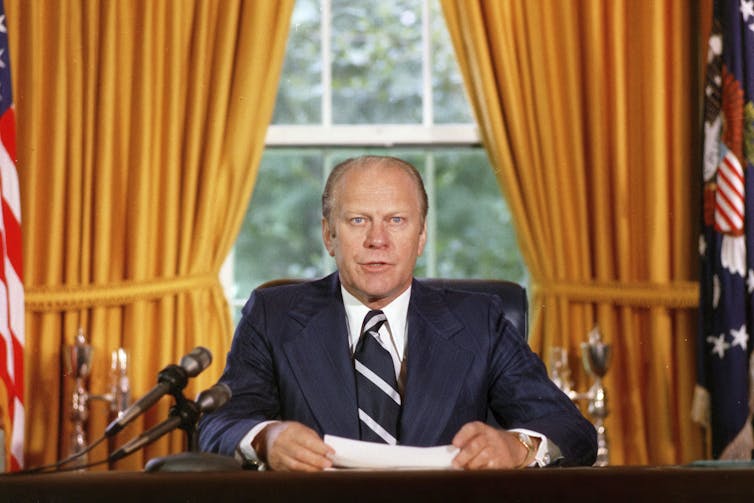
But toward the end of the 20th century and into the 21st, presidents have used the pardon pen increasingly for personal and political reasons. The inflection point is undoubtedly the pardon of former President Richard M. Nixon in 1974 by his former vice president and successor, Gerald Ford. This was issued a month after Nixon’s resignation in the wake of the Watergate scandal, which involved Nixon’s 1972 reelection campaign spying on his political enemies.

Ford justified his action by citing the need for national unity, saying the pardon would spare the country from a messy and dramatic public trial of a former president. Never before had a high-profile public politician received such a presidential grant, which caused Ford’s public standing to take a hit. Scholars and historians believe the act contributed to his reelection loss in 1976.

Gerald Ford addresses the nation regarding his pardon of Richard Nixon.
In 1974, President Gerald Ford pardoned his predecessor, Richard M. Nixon, seeking to spare the country the divisiveness of a trial involving a former president.
AP

We have since seen Ford’s decision open the door to more pardons of political allies or personal friends. In 1992, George H.W. Bush pardoned officials he had served with in the Reagan administration who were tangled up in the arms-for-hostages, Iran-Contra scandal; Bill Clinton pardoned Democratic donor Marc Rich in 2001; and George W. Bush commuted the sentence of vice presidential aide Scooter Libby in 2007.

Trump’s expanded use

As it happens, Trump issued a full pardon to Libby in 2018. During his first term, Trump also pardoned Charles Kushner, the father of his son-in-law, Jared Kushner.

At the end of his first term, Trump pardoned “”) his former campaign manager Paul Manafort and his friend Roger Stone among other political allies.

Trump’s second term has seen clemency for his former lawyer and friend Rudy Giuliani, as well as crypto executive Changpeng Zhao, whose ties to Trump family businesses have raised questions about the pardon.

Trump’s use of the pardon power does not seem to follow a consistent doctrine or philosophy. Some of his clemency actions seem to contradict his administration’s policy, such as dozens of pardons of drug traffickers, despite the effort to stop drug trafficking in the Caribbean.

The pace of Trump’s pardons and commutations, however, suggests little hesitation. The question looking forward, beyond his presidency, is how much of a precedent his actions, along with Biden’s, may set for their successors.

We know this from earlier expansions of the pardon’s reach, as well as other areas of presidential authority: Few presidents willingly relinquish powers accrued by their predecessors. Once chief executives have exercised a certain type of authority, their predecessors seldom give it back, ultimately increasing the power of the presidency.

The Conversation

Stewart Ulrich does not work for, consult, own shares in or receive funding from any company or organization that would benefit from this article, and has disclosed no relevant affiliations beyond their academic appointment.

ref. Pardons are political, with modern presidents expanding their use – https://theconversation.com/pardons-are-political-with-modern-presidents-expanding-their-use-271373

The ‘one chatbot per child’ model for AI in classrooms conflicts with what research shows: Learning is a social process

Source: The Conversation – USA (2) – By Niral Shah, Associate Professor of Learning Sciences & Human Development, University of Washington

Yes, AI tutors can provide individualized feedback, but learning is inherently social. Maskot via Getty Images

In the Star Trek universe, the audience occasionally gets a glimpse inside schools on the planet Vulcan. Young children stand alone in pods surrounded by 360-degree digital screens. Adults wander among the pods but do not talk to the students. Instead, each child interacts only with a sophisticated artificial intelligence, which peppers them with questions about everything from mathematics to philosophy.

This is not the reality in today’s classrooms on Earth. For many technology leaders building modern AI, however, a vision of AI-driven personalized learning holds considerable appeal. Outspoken venture capitalist Marc Andreessen, for example, imagines that “the AI tutor will be by each child’s side every step of their development.”

Years ago, I studied computer science and interned in Silicon Valley. Later, as a public school teacher, I was often the first to bring technology into my classroom. I was dazzled by the promise of a digital future in education.

Now as a social scientist who studies how people learn, I believe K-12 schools need to question predominant visions of AI for education.

Individualized learning has its place. But decades of educational research is also clear that learning is a social endeavor at its core. Classrooms that privilege personalized AI chatbots overlook that fact.

School districts under pressure

Generative AI is coming to K-12 classrooms. Some of the largest school districts in the country, such as Houston and Miami, have signed expensive contracts to bring AI to thousands of students. Amid declining enrollment, perhaps AI offers a way for districts to both cut costs and seem cutting edge.

Pressure is also coming from both industry and the federal government. Tech companies have spent billions of dollars building generative AI and see a potential market in public schools. Republican and Democratic administrations have been enthusiastic about AI’s potential for education.

Decades ago, educators promoted the benefits of “One Laptop per Child.” Today it seems we may be on the cusp of “one chatbot per child.” What does educational research tell us about what this model could mean for children’s learning and well-being?

Learning is a social process

During much of the 20th century, learning was understood mainly as a matter of individual cognition. In contrast, the latest science on learning paints a more multidimensional picture.

Scientists now understand that seemingly individual processes – such as building new knowledge – are actually deeply rooted in social interactions with the world around us.

Neuroscience research has shown that even from a young age, people’s social relationships influence which of our genes turn on and off. This matters because gene expression affects how our brains develop and our capacity to learn.

In classrooms, this suggests that opportunities for social interaction – for instance, children listening to their classmates’ ideas and haggling over what is true and why – can support brain health and academic learning.

Research in the social sciences has long since proved the value of high-quality classroom discourse. For example, in a well-cited 1991 study involving over 1,000 middle school students across more than 50 English classrooms, researchers Martin Nystrand and Adam Gamoran found that children performed significantly better in classes “exhibiting more uptake, more authenticity of questions, more contiguity of reading, and more discussion time.”

In short, research tells us that rich learning happens when students have opportunities to interact with other people in meaningful ways.

AI in classrooms lacks research evidence

What does all of this mean for AI in education?

Introducing any new technology into a classroom, especially one as alien as generative AI, is a major change. It seems reasonable that high-stakes decisions should be based on solid research evidence.

But there’s one problem: The studies that school leaders need just aren’t there yet. No one really knows how generative AI in K-12 classrooms will affect children’s learning and social development.

Current research on generative AI’s impact on student learning is limited, inconclusive and tends to focus on older students – not K-12 children. Studies of AI use thus far have tended to focus on either learning outcomes or individual cognitive activity.

Although standardized test scores and critical thinking skills matter, they represent a small piece of the educational experience. It is also important to understand generative AI’s real-life impact on students.

For example: How does it feel to learn from a chatbot, day after day? What is the longer-term impact on children’s mental health? How does AI use affect children’s relationships with each other and with their teachers? What kinds of relationships might children form with the chatbots themselves? What will AI mean for educational inequities related to social forces such as race and disability?

More broadly, I think now is the time to ask: What is the purpose of K-12 education? What do we, as a society, actually want children to learn?

Of course, every child should learn how to write essays and do basic arithmetic. But beyond academic outcomes, I believe schools can also teach students how to become thoughtful citizens in their communities.

To prepare young people to grapple with complex societal issues, the National Academy of Education has called for classrooms where students learn to engage in civic discourse across subject areas. That kind of learning happens best through messy discussions with people who don’t think alike.

To be clear, not everything in a classroom needs to involve discussions among classmates. And research does indicate that individualized instruction can also enhance social forms of learning.

So I don’t want to rule out the possibility that classroom-based generative AI might augment learning or the quality of students’ social interactions. However, the tech industry’s deep investments in individualized forms of AI – as well as the disappointing history of technology in classrooms – should give schools pause.

Good teaching blends social and individual processes. My concern about personalized AI tutors is how they might crowd out already infrequent opportunities for social interaction, further isolating children in classrooms.

Center children’s learning and development

Education is a relational enterprise. Technology may play a role, but as students spend more and more class time on laptops and tablets, I don’t think screens should displace the human-to-human interactions at the heart of education.

I see the beneficial application of any new technology in the classroom – AI or otherwise – as a way to build upon the social fabric of human learning. At its best it facilitates, rather than impedes, children’s development as people. As schools consider how and whether to use generative AI, the years of research on how children learn offer a way to move forward.

The Conversation

Niral Shah does not work for, consult, own shares in or receive funding from any company or organization that would benefit from this article, and has disclosed no relevant affiliations beyond their academic appointment.

ref. The ‘one chatbot per child’ model for AI in classrooms conflicts with what research shows: Learning is a social process – https://theconversation.com/the-one-chatbot-per-child-model-for-ai-in-classrooms-conflicts-with-what-research-shows-learning-is-a-social-process-269885

How the NIH became the backbone of American medical research and a major driver of innovation and economic growth

Source: The Conversation – USA (3) – By Fred D. Ledley, Director, Center for Integration of Science and Industry, Bentley University

NIH researchers conducted some of the earliest experiments for developing chemotherapy to treat cancer, circa 1950. National Cancer Institute, National Institutes of Health

As a young medical student in 1975, I walked into a basement lab at the National Institutes of Health in Bethesda, Maryland, to interview for a summer job.

It turned out to be the start of a lifelong affiliation – first as a trainee, then as a grantee running a university laboratory and finally, now, as a researcher of economics and public policy studying the agency’s impact on health care and on the national economy.

On that initial visit 50 years ago, I got my first direct experience with the NIH’s mission: to tap the enormous potential of basic science to improve human health and medical care. And over the long arc of my career, I watched the agency enact this mission in ways that brought enormous value to the country. NIH funding trained a legion of biomedical scientists, produced countless therapies that underpin much of modern medicine and catalyzed the launch of the biotechnology industry.

But widespread federal grant terminations and disruptions to federal funding in 2025 have left scientists who depend on NIH support reeling. And a 40% cut to the NIH budget for 2026 proposed by the White House threatens the agency’s future.

The origins and growth of the NIH

The NIH was founded through the Ransdell Act of 1930, which converted the former Hygienic Laboratory of the Marine Hospital Services into the seeds of a new government institution. That laboratory had been established in 1887 to develop public health measures, diagnostics and vaccines for controlling diseases prevalent in the U.S. at the time, such as cholera, yellow fever, smallpox, plague and diphtheria. With the act’s passage, the Hygienic Laboratory was reimagined as the National Institute of Health.

In a black-and-white photograph, President Franklin D. Roosevelt stands on the steps of a new building, draped with American flags.
The NIH, initially called the National Institute of Health, was created in 1930 with the passage of the Ransdell Act. President Franklin D. Roosevelt dedicated the new NIH campus in Bethesda, Md., on Oct. 31, 1940, saying, ‘We cannot be a strong nation unless we are a healthy nation.’
National Institutes of Health

Sen. Joseph Ransdell of Louisiana envisioned the NIH as an agency with a broader mandate for translating scientific advances to improve human health. In arguing in 1929 for the creation of the new institute, he read into the Congressional Record an editorial from The New York Times that highlighted rapid advances in chemistry, physiology and physics.

The editorial lamented that “never in the whole history of the world had efforts to improve health conditions been behind the advance in other sciences.” Pointing to millions of Americans suffering from sickness leading to economic losses “into billions,” it argued for the need for a medical sciences institute coordinating “a national effort to prevent diseases that are or may be preventable.”

In 1945, a report called Science – The Endless Frontier, by Vannevar Bush, highlighted the government’s central role in supporting science that harnessed nuclear energy, implemented radar and developed penicillin – all important elements of the United States’ success in World War II. Bush argued that these wartime successes presented a model for growing the American economy, preventing and curing disease and projecting American power.

The NIH became central to this model. Its budget increased substantially during and just after World War II, with postwar adoption of Bush’s plan, and again after 1957 when the nation redoubled its commitment to science following Russia’s launch of Sputnik and the start of the space race. The National Cancer Act of 1971, which established the separate National Cancer Institute, reaffirmed the nation’s commitment to government-funded research. This new institute’s funding provided much of the seed capital for the emergence of biotechnology.

In the 1980s, the Stevenson-Wydler and Bayh-Dole acts created a clear pathway for developing commercial products from federally funded research that would provide public benefits and economic stimulus. These federal laws made it a requirement to pursue patenting and licensing of NIH-funded research to industry.

How one project’s evolution reflects the NIH’s mission

Today, the NIH represents the backbone of efforts to improve health and health care, supporting each step in the process from preliminary discovery to clinical advance. These steps correspond to the stages of an individual scientist’s path.

A nurse fits a study volunteer with a clear plastic hood.
By putting study volunteers into a specially constructed metabolic chamber, NIH researchers in the 1950s could study how the human body uses air, water and food. The nurse here is affixing a hood onto a volunteer to measure oxygen consumption.
National Institutes of Health

I experienced this progression in my own career. After establishing my first independent laboratory with a grant for early-stage researchers, then called a First Independent Research Support and Transition grant, a Research Project grant, widely known as an R01, funded my lab’s work identifying genes that cause inherited metabolic diseases in newborns. RO1 grants are the main mechanism that academic biomedical scientists in the U.S. rely on to support innovative research.

Later, an NIH Program Project grant enabled us to investigate how the genes we had identified could be used to treat children. A General Clinical Research Center grant supported the hospital facilities necessary for clinical research and paid for patient care. Other grants supported our medical students and fellows as they embarked on their own careers as well as applications of our research to areas such as child health, reproductive biology and gastroenterology.

As our research on gene therapy progressed, NIH Small Business grants contributed to our founding a company that raised US$200 million in investments and partnerships and created hundreds of new jobs in Houston. Grants to small businesses continue to play a crucial role in helping universities commercialize discoveries.

Is the NIH effective?

For the past decade, I have led a research center focused on characterizing the process of developing new drugs. Our work, which is not funded by the NIH, shows that an established foundation of basic research on the biology underlying health and disease is necessary for successful drug development – and that most of this research is performed in public institutions.

We have found that NIH funding supported basic or applied research related to about 99% of newly approved medicines, clinical trials for 62% of these drugs and patents governing about 10% of these products.

A scientist holds three test tubes in his gloved hands
Based on research conducted at the NIH, azidothymidine, or AZT, in 1987 became the first drug approved to treat AIDS. Here, the drug, added to the middle vial, protects healthy immune cells from being destroyed by HIV, the virus that causes AIDS.
John Crawford, National Cancer Institute, National Institutes of Health

Studies also show that this NIH funding saves industry almost $3 billion per drug in development costs. Over the past decade, there has been $800 billion in new investment in biotechnology. The U.S. biopharmaceutical industry directly supports more than 1 million jobs.

Medicines enabled by NIH funding have been crucial for increasing life expectancy and health – dramatically decreasing deaths due to heart disease and stroke, improving cancer outcomes, controlling HIV infection, improving the management of immunological diseases and easing the burden of psychiatric conditions.

The Trump administration is currently questioning the role of science in maintaining the nation’s health, economy and global posture. Yet the NIH stands as a testimony to the vision articulated by its early architects.

At its heart is the conviction that science is good for society, that persistent investment in basic research is essential to technological advances that serve the public interest, and that our nation’s health and economy benefit from developments in biology.

The Conversation

Fred D. Ledley’s research has been supported by grants to Bentley University from the Institute for New Economic Thinking, National Pharmaceutical Council, West Health, and the National Biomedical Research Foundation.

ref. How the NIH became the backbone of American medical research and a major driver of innovation and economic growth – https://theconversation.com/how-the-nih-became-the-backbone-of-american-medical-research-and-a-major-driver-of-innovation-and-economic-growth-257403

Getting peace right: Why justice needs to be baked into ceasefire agreements – including Ukraine’s

Source: The Conversation – USA (3) – By Valerie Morkevicius, Associate Professor, Political Science, Colgate University

From left, Ukrainian President Volodymyr Zelenskyy, Britain Prime Minister Keir Starmer, French President Emmanuel Macron and German Chancellor Friedrich Merz leave a meeting on Dec. 8, 2025, at 10 Downing Street in London. AP Photo/Kin Cheung

Efforts to end the war in Ukraine have grabbed global attention, fueled by debates over U.S. President Donald Trump’s 28-point plan – which many analysts see as favoring Russia – and European attempts to craft a counterproposal.

We’ve been here before. Failed attempts to end the conflict date back to the beginning, soon after Russia’s 2014 occupation of Crimea and parts of the Donbas. After Russia’s full-scale invasion in February 2022, peace discussions started up again within days, and they have continued in fits and starts since.

Prospects for a lasting peace remain dubious. One reason, I believe, is that the proposals pay little attention to the relationship between peace and justice – a flaw shared by previous plans.

Is peace worth having if it’s unjust? Is justice worth pursuing if it prolongs war? Those are questions as troubling as they are old. “Peace is the effect of justice,” as St. Thomas Aquinas argued in the 13th century. Ceasefires built on coercion or exhaustion inevitably fail because they do not resolve the conflict’s causes.

Aquinas is a major figure in the just war tradition, the focus of my research. This area of ethics helps weigh when war is justified – and also how it should end.

Today, the insight that peace and justice are inseparable grounds what international law terms “transitional justice.” By focusing on victims and assuring accountability for past wrongs, this approach seeks to disrupt recurring cycles of violence.

Past agreements and proposals aimed at ending the conflict in Ukraine failed because in the rush to stop the fighting, they ignored questions of justice. The literature on transitional justice, by contrast, encourages negotiators to attend to four interdependent principles: truth, justice, reparations and safeguards against future recurrence.

1. Truth

Truth is essential for peace. As St. Augustine, one of the earliest Christian just-war thinkers, put it in the fourth century, “false justice” arises when the pursuit of truth is abandoned.

A woman in black clothes and a black hat leans over a coffin draped in sky blue fabric.
A mother cries at the coffin of her son, Oleh Borovyk, a Ukrainian serviceman, during his funeral in Boiarka, Ukraine, on Dec. 3, 2025.
AP Photo/Evgeniy Maloletka

Durable peace agreements require all sides to cooperate with international efforts to document war crimes and human rights violations, such as the United Nations’ Independent International Commission of Inquiry on Ukraine. This is no small task. So far, Ukraine has granted access to outside investigators, but Russia has refused, even when it has accused Ukraine of war crimes.

But reconciliation requires a complete accounting of the harms done. Archbishop Desmond Tutu, who headed South Africa’s Truth and Reconciliation Commission after the end of apartheid, explained that “forgiveness depends on repentance, which has to be based on an acknowledgment of what was done wrong, and therefore on disclosure of the truth.”

Truth-telling also prevents false narratives from creating “justifications” for renewed fighting. Thus, peace in Ukraine will require a global effort to combat disinformation legitimizing Russia’s aggression and obscuring its war crimes.

2. Justice

Justice demands holding perpetrators to account. If, as Aquinas argued, a just war is “one that avenges wrongs” or seeks “to restore what [has been] seized unjustly,” ignoring these concerns when ending a war would itself be unjust.

Treating collaborators with fairness requires nuance. In some cases, pardoning individuals who acted under duress – and even willing but nonviolent collaborators who fully disclose their actions – can support postwar reconciliation. Especially in areas once occupied by enemy forces, frank confessions can help rebuild social trust.

However, amnesty for war crimes and crimes against humanity is impermissible because pardons deny victims justice and may embolden future perpetrators. The International Criminal Court has issued arrest warrants for six Russian officials, including President Vladimir Putin. Meanwhile, the Council of Europe has established a Special Tribunal for the Crime of Aggression Against Ukraine, which would prosecute senior Russian officials who ordered the illegal invasion.

Realistically, neither forum can try those responsible without either Russia’s defeat or Putin’s removal from power. But in the interim, other countries can continue to support Ukrainian courts handling war crimes cases.

Justice also requires holding one’s own side accountable, even if the other side will not reciprocate. Allegations of war crimes by Ukrainian soldiers are far rarer, but Ukrainian courts must also prosecute these. Fair trials for all combatants are essential, lest, as Aquinas cautions, judgments seek “to sate … hatred under cover of correction.”

A woman looking very happy embraces a man draped in a blue and gold flag amid a crowd of people outside.
A woman hugs a soldier who came back from Russian captivity during an exchange of prisoners between Russia and Ukraine on May 25, 2025.
AP Photo/Efrem Lukatsky

3. Reparations

Reparations aim to make survivors whole again. This principle, too, has roots in classical just war thinking. The 16th-century theologian Francisco de Vitoria, for example, argued that reparations within the bounds of “equity and humanity” could help redress losses and restore justice.

The World Bank estimates that direct damage in Ukraine is over US$176 billion; in total, rebuilding will cost three times that. The Council of Europe has recommended using frozen Russian assets to fund reconstruction efforts, as have some American scholars . The illegality of Russia’s invasion means that such countermeasures are likely permissible under international law.

Apologies can also serve as reparations, but Russia is unlikely to proffer any – partly because domestic political pressures mean Putin cannot afford to look like he has lost.

Commemorative events and memorials also validate victims’ suffering. The international community can support Ukrainians in their efforts to meaningfully memorialize the war.

4. Deterrence

Peace lasts when the parties trust that the violence won’t reoccur.

However, Russia has repeatedly broken its treaties with Ukraine. That includes the first agreements meant to bring the conflict to an end, back in 2014.

Sunlight streams over an overgrown yard with a simple wooden cross and a small teddy bear.
In this November 2025 photo, provided by a Ukrainian military press service, a civilian grave lies among damaged residential houses in Kostyantynivka.
Oleg Petrasiuk/Ukraine’s 24th Mechanized Brigade via AP

That summer, Russian-backed separatists downed a Malaysian Airways flight, spurring the international community to seek a quick resolution. The hastily drafted Minsk agreements, signed in 2014 and 2015, established a ceasefire monitoring mission and required the removal of foreign military units. They also demanded Ukrainian constitutional reforms – ostensibly to secure more autonomy for the country’s largely Russian-speaking east.

The Minsk agreements temporarily froze the conflict, but relative quiet didn’t mean peace. Ceasefire violations were perpetual. Russian-supported militias were not disbanded, and Russia continued to send mercenaries and military forces to the Donbas. Human rights violations proliferated in Russian-occupied areas. And in February 2022, Russia launched its full-scale invasion.

Given this history, a durable peace would require that Russia accept constraints on its power. The various peace proposals put forth since 2022, however, have demanded security concessions only from Kyiv, requiring Ukraine to abandon hopes for NATO membership and restricting the size of its military.

Russia is unlikely to agree to caps on its military. Deterrence, then, could take the form of credible commitments from other countries to enforce whatever peace agreement emerges.

Ukraine’s vulnerability to future Russian aggression means it will need binding promises from its partners. Russia will not sign a treaty that permits Ukraine to join NATO, which Moscow claims would be a threat. Other possible safeguards for Ukrainian sovereignty include a proposed international peacekeeping force or an alternative set of security alliances.

Lasting peace

Ultimately, a durable peace requires considering both sides’ legitimate security and justice claims if, as Vitoria wrote in 1539, “they are prepared to negotiate genuinely and fairly.”

Therein lies the catch. Transnational justice can be hijacked, with aggressors trying to portray themselves as victims. Separating fact from fiction, and genuine concerns from manufactured pretext, is essential at the negotiating table.

A quick end to the war is tempting, but a hasty peace is a fragile one. A durable peace, rather than yet another ceasefire, requires attention to justice – even if that takes more time to achieve.

The Conversation

Valerie Morkevicius does not work for, consult, own shares in or receive funding from any company or organization that would benefit from this article, and has disclosed no relevant affiliations beyond their academic appointment.

ref. Getting peace right: Why justice needs to be baked into ceasefire agreements – including Ukraine’s – https://theconversation.com/getting-peace-right-why-justice-needs-to-be-baked-into-ceasefire-agreements-including-ukraines-270638

Christmas trees are more expensive than ever in Colorado — what gives?

Source: The Conversation – USA (2) – By Ali Besharat, Professor of Marketing, University of Denver

All festive products are getting more expensive. d3sign/GettyImages

The holiday season sparks a significant increase in consumer spending. This year, Black Friday alone saw consumers shell out a record US$11.8 billion. It’s the time of year when many Americans make purchases to decorate for the holidays — lights, ornaments and Christmas trees.

If you bought a Christmas tree in Denver this year, you may have noticed a pretty steep price tag. It turns out that all festive products are getting more expensive, and that includes Christmas trees, both freshly cut and artificial.

I study the psychology of consumption at the University of Denver. I’ve always been curious about how people make financial decisions under certain circumstances, including around the holidays. Christmas trees are an interesting case study.

What’s driving the increase

The cost of real Christmas trees is directly impacted by a long production cycle and transportation costs, particularly for landlocked markets like Denver.

Christmas trees take 7 to 10 years to grow. Currently, supply is tight, pushing tree prices up, which is a direct and delayed consequence of reduced planting rates that followed the Great Recession – which began in late 2007. This planting deficit effectively drove up wholesale prices and doubled the average price of pre-cut trees over the past decade after adjusting for inflation.

Raising tiny tree seedlings to a marketable size is a fraught business. Growers are exposed to a decade of weather, labor and pest risks, which increases the financial uncertainty of any planting season. This long lead time has made the supply unpredictable, putting constant pressure on Christmas tree wholesale prices.

Aerial view of rows of trees on a farm.
Colorado gets some of its Christmas trees from North Carolina, which grows more than 26% of the Christmas trees in the U.S.
Allison Joyce/GettyImages

For Denver retailers, transportation adds disproportionately to the final cost, since most Christmas trees in Denver are brought in from the Pacific Northwest and North Carolina using long-haul freight.

A retailer in Denver must also cover local operational overhead, such as labor costs, storage and the rental of temporary sales lots, which increases prices by about 10% on average based on wholesale Christmas tree prices. This is especially true for large trees, those taller than 9 feet (2.74 meters), as they do not grow in Colorado. Having said that, there are Christmas tree growers in Colorado, and the Douglas Fir is native to Colorado and grows naturally throughout its mountains.

Psychology of Christmas tree purchase decisions

The choice between a pre-cut Christmas tree and an artificial one is classic behavioral economics, which is the combination of economics and psychology to understand how and why people behave the way they do in the real world. It involves a trade-off between two readily available choices.

One option offers an emotional appeal, while the second choice may have to do more with cost savings and perceived environmental impact.

Buyers of real trees are driven by pleasure, satisfaction and emotional fulfillment. Often, buyers of fresh-cut trees are driven by nostalgia and a desire to inhale the powerful scent. Depending on the qualities of the tree, like how long it keeps its needles, how stiff the branches are and how rare it is, Denver customers often spend between $50 and $870 annually on fresh-cut Christmas trees.

On the flip side, artificial tree buyers prioritize the ease of buying a tree at the store and then bringing it out of storage each year. These customers seek convenience, low maintenance and the ability to control how the tree looks from a product that can cost between $250 to $700 initially. Being a durable good, artificial trees are typically replaced only once every five years.

In 2025, however, the decision to buy an artificial tree may feel less rational. Retailers are raising prices by 10% to 15% due to tariffs.

A Christmas tree display inside a store next to a shelf of ornaments.
Artificial Christmas trees have a higher up-front cost than many real trees, but over time are more affordable.
UCG/GettyImages

The financial and environmental superiority of the artificial tree is dependent on how long a consumer plans to keep and use it.

The financial break-even point is reached only when the artificial tree is reused for at least five years. The environmental break-even point is higher — around 10 years — due to the carbon emissions from manufacturing and global shipping of artificial trees. Their carbon footprint can be up to 10 times greater than a properly disposed-of real tree.

Behavioral changes in consumption

What about a third option that may appeal to Coloradans’ love of the outdoors?
Choose-and-cut businesses invite customers to visit a farm to select their tree and cut it down themselves. The tree is no longer just something you buy — it is the center of an experience you share.

Advocates go so far as to argue that the outdoor farm environment acts as a therapeutic escape from the stressful holiday season.

A child with a pink hat and blue coat pulls a small tree through the snow by its trunk.
Choose-and-cut Christmas tree farms enhance profitability by transferring the high cost of harvesting labor directly to the customer.
Glenn Asakawa/GettyImages

For the grower, this model is a highly effective form of agritourism, which makes use of the farm environment to boost revenue. It dramatically enhances profitability by transferring the high cost of harvesting labor – which can run from $15,000 to $50,000 annually – directly to the customer as a labor of love. The purchase of a tree may be the main point of the visit, but growers can improve their bottom lines through the sale of profitable goods and services like wreaths, hot chocolate, food and carriage rides. Motivated consumers are willing to pay more for the experience and the opportunity to recreate a meaningful ritual.

If this option excites you, there are a couple of spots where you can cut your own tree in Colorado, including at the Arapaho and Roosevelt National Forests. Most of these places, however, require a permit to chop down a tree.

Read more of our stories about Colorado.

The Conversation

Ali Besharat does not work for, consult, own shares in or receive funding from any company or organization that would benefit from this article, and has disclosed no relevant affiliations beyond their academic appointment.

ref. Christmas trees are more expensive than ever in Colorado — what gives? – https://theconversation.com/christmas-trees-are-more-expensive-than-ever-in-colorado-what-gives-271472

From civil disobedience to networked whistleblowing: What national security truth-tellers reveal in an age of crackdowns

Source: The Conversation – USA (2) – By Kate Kenny, Professor of Business and Society, University of Galway

Across the world, governments are tightening controls on speech, expanding surveillance and rolling back rights once thought to be secure.

From anti-protest laws and curbs on workers’ rights to the growing criminalization of leaks and dissent, the trend is chilling: People who speak out about government wrongdoing are increasingly vulnerable, and the legal systems that once claimed to protect them are now used to punish them.

We are researchers who study whistleblowing, which is when employees disclose information in the public interest about wrongdoing they have witnessed at work. Our new book draws on firsthand accounts from whistleblowers in national security, intelligence and government in the U.S., Australia and the U.K., among other countries. Their experiences show the limits of legal protections, but also the power of networks, solidarity and collective resistance in the face of institutional secrecy.

In this moment of democratic backsliding, whistleblowers show that civil disobedience – breaking the law to uphold the public good – remains an essential principle of political and moral life. They also show how legal reform and support networks designed to protect whistleblowers are critical for protecting accountability and democracy itself.

The limits of legal protections

The whistleblowers featured in the book, including former CIA officer John Kiriakou and Craig Murray, the former U.K. ambassador to Uzbekistan, learned the hard way that legal protections can end precisely where power begins. Both revealed grave human rights abuses – torture, kidnapping, imprisonment and complicity in war crimes – and both were prosecuted rather than protected.

Their stories underline a paradox: Even as new whistleblower protection laws have proliferated in many countries, prosecutions of national security and intelligence whistleblowers are on the rise. In national security contexts, where no public interest defense is permitted, laws meant to protect whistleblowers have become another weapon of “lawfare” – used to silence, bankrupt and criminalize.

For example, Kiriakou blew the whistle on the U.S. torture program in 2007. The Bush administration initially declined to prosecute him, but this changed under the Obama administration, which imprisoned Kiriakou in 2013 for 30 months. Kiriakou’s refusal to participate in the CIA program of “enhanced interrogation” of terrorism suspects, which included waterboarding, and his later decision to publicly confirm the CIA’s use of torture were acts of conscience. Yet it was he, not the torturers, who went to prison as a result of his disclosures.

The pattern is familiar. From Chelsea Manning in 2010 to Edward Snowden in 2013 and Daniel Hale in 2016, prosecutions under the U.S. Espionage Act and equivalent statutes elsewhere signal a broader shift: Making the powerful transparent is redefined as treason. The prosecution of national security whistleblowers who reveal crimes of the state continues to be an ongoing problem, as highlighted by more recent cases, including Reality Winner and David McBride.

When the law is used to enforce secrecy and punish dissent, the moral terrain shifts. Civil disobedience becomes not only justified but necessary. Human rights lawyers have commented that whistleblowers and journalists who work with them are being subjected to increasingly harsh treatment by the state, including imprisonment and on occasion torture.

From traditional media to networked whistleblowing

Historically, whistleblowers relied on the press to act as an intermediary between them and the public, as well as a protector because of the publicity they offer. But as investigative journalism has been hollowed out – starved of resources and constrained by political and corporate pressurethis model has faltered.

As journalist Andrew Fowler, one of our book’s contributors, wrote, “It may not be long before it will be impossible for journalists to have confidential sources.” Across the globe, attacks by governments on journalists criticizing strongman leaders become more brazen.

In 2010, Manning blew the whistle on U.S war crimes in Iraq and Afghanistan. Many major outlets turned Manning away before WikiLeaks provided the infrastructure to publish what mainstream media would not. Her disclosures raised the public’s awareness of government complicity in war crimes in Iraq and elsewhere. Such stories also reveal how reluctant mainstream journalism can be when confronted with power.

More recently, in 2016 McBride blew the whistle on members of the Australian SAS who murdered civilians in Afghanistan. He was sentenced to prison in 2024 and is currently serving a sentence of five years and eight months for his disclosures of war crimes.

This decline in formal protections has given rise to an ecology of “networked whistleblowing”: decentralized alliances of whistleblowers, activists and independent journalists using encrypted tools to share information and protect sources. While these networks can offer safety in numbers, they also carry risks – of being co-opted or exploited by those in power, and of being framed collectively as enemies of the state for their attempts to hold the powerful to account.

Yet they also represent a profound reimagining of public accountability in a digital age where secrecy is structural and systemic, demonstrating the force of people working together.

As the traditional institutions of democracy falter, our research shows these alternative infrastructures embody a new form of democratic practice: horizontal, distributed and defiant.

New alliances supporting whistleblowers

The whistleblowers whose stories appear in our book did more than expose wrongdoing. They built communities of care and resistance – new institutions to protect truth-telling itself.

Each of them, after suffering retaliation and exclusion, turned outward: campaigning for reform, mentoring others and building cross-sector alliances. Their transformation from individual insiders to collective activists reveals a crucial insight: Legal reform alone isn’t enough. What sustains truth-telling isn’t the promise of protection from above but solidarity from below.

Strengthening and supporting these alliances would help preserve freedom of expression and the right to know. That means supporting cross-border networks of journalists, lawyers and human rights defenders who can collectively safeguard disclosure when national laws fail. It also means recognizing whistleblowing as a public good.

At a time when many democracies are retreating from openness, these whistleblowers remind us that law and justice are not the same thing. When laws entrench secrecy or punish dissent, we believe breaking them can be an act of civic virtue. Civil disobedience can renew democratic life by holding power to account.

Kiriakou’s conclusion in his chapter resonates beyond the intelligence world: “We all have to fight. It’s the only way we are going to change anything.” His words recall a longer lineage of civil disobedience – from suffragettes to anti-war protesters to environmental activists – each confronting systems that refused to hear them until they broke the rules.

The cases in our new book illustrate how quickly law can be used to enforce secrecy rather than accountability during periods of democratic backsliding. They also highlight the practical conditions that make truth-telling possible – including collective support that extends beyond any one country’s legal system.

The Conversation

The authors do not work for, consult, own shares in or receive funding from any company or organization that would benefit from this article, and have disclosed no relevant affiliations beyond their academic appointment.

ref. From civil disobedience to networked whistleblowing: What national security truth-tellers reveal in an age of crackdowns – https://theconversation.com/from-civil-disobedience-to-networked-whistleblowing-what-national-security-truth-tellers-reveal-in-an-age-of-crackdowns-269488

Think you know Hans Christian Andersen? Four experts pick his weirdest fairy tales to read this Christmas

Source: The Conversation – UK – By Ane Grum-Schwensen, Associate Professor at The Hans Christian Andersen Centre, Principal Investigator of "Fairy Tales and Stories – The Digital Manuscript Edition", University of Southern Denmark

Hans Christian Andersen is one of Denmark’s most cherished writers – a master of the literary fairy tale whose influence stretches far beyond The Little Mermaid, The Emperor’s New Clothes and the other classics many of us first encounter in childhood.

Born in 1805 in Odense, on the island of Funen, Andersen was the son of a shoemaker and an illiterate washerwoman who would grow into an author who wrote across genres – novels, travelogues, poems and plays. But in his short tales he created a form uniquely his own: emotionally daring, stylistically inventive and rich with both whimsy and existential bite.

Although not all of his stories are about winter or Christmas, Andersen’s name has become closely associated with the festive season around the world.

His tales have been read aloud for generations, adapted into countless winter performances and films and returned to each year for their blend of wonder, melancholy and moral imagination. They remind us that the season is not only about sparkle and celebration, but also reflection, hope and the small fragile miracles of being human.

So, as the days grow shorter, we’ve asked four leading Andersen experts to choose one story they believe is perfect for reading – or rereading – this Christmas. Their selections may not be the Christmas tales you’ve come to associate with Andersen. But they showcase the author at his most profound and playful – and offer new ways into his writing.


The Story of a Mother

Ane Grum-Schwensen, associate professor in the Department of Cultural and Linguistic Studies at The Hans Christian Andersen Centre, University of Southern Denmark

Choosing a single Andersen story as a favourite feels almost impossible. There are so many remarkable ones and my favourite often ends up being the one I have most recently revisited. Yet some stories return to me repeatedly, both in thought and in research.

One of these is The Story of a Mother, first published in 1847. It is a fantastic tale in every sense of the word. It includes classic fairy-tale elements: a protagonist – the mother – leaving home and facing trials, helpers guiding her and an ultimate antagonist, Death. Yet Andersen challenges this structure: the helpers demand steep prices and the antagonist could even be seen as a kind of helper. The story also reflects the fantastic, as seen in modern fiction, through its dreamlike quality and its unsettling open ending, where the mother finally allows Death to carry her child into the unknown.

This story is profoundly moving. It portrays both the desperate lengths a parent will go to to protect a child and the crushing surrender when confronted with an irreversible fate. Andersen’s ability to capture this parental anguish so vividly, despite never having been a parent himself, is striking.

The theme of the dying child was common in 19th-century art and literature, partly because of the harsh reality of child mortality. In the early decades of the century, roughly one-third of all Danish children died before their tenth birthday. Andersen addressed this theme repeatedly. Indeed, his first known poem, at age 11 was written to comfort a grieving mother. Later, in 1827, another poem he wrote, The Dying Child was published anonymously and widely translated.

The language and narration in The Story of a Mother are quintessential Andersen. Within the first few paragraphs, the theme is clear and features his imagery-rich language:

The old clock whirred and whirred, the great lead clockweight slid straight down to the floor, boom! and the clock too stood silent.

Although Andersen had written about dying children before, he struggled with the ending of this story, even in the handwritten copy he delivered to the printer. His first version was what you might call a happy ending: the mother wakes to find it was all a dream. He immediately crossed this out and replaced it with: “And Death went with her child into the ever-flowering garden”.

Still unsatisfied, he changed “ever-flowering garden”, a synonym for paradise, to “the unknown land”. A Danish critic recently described this creative shift as “how to punk your sugar-coated sentiment into salty liquorice” – a fitting metaphor for Andersen’s refusal to settle for sentimentality.

Today, the story is not as well known as some of his other tales, yet its influence in its own time was undeniable. It was translated into Bengali as early as 1858 and became popular in India. When Andersen turned 70 in 1875, one of his gifts was a polyglot edition of the story translated into no less than 15 languages – a testament to its global reach.

You can read the full version of The Story of a Mother, here.


The Comet

Holger Berg, special consultant at The Hans Christian Andersen Centre, University of Southern Denmark

No spectacular comets appeared in the sky in 1869, but the year nevertheless stands out in literature thanks to The Comet. Andersen’s reflective tale of the cosmos and the soul begins simply. A boy blows bubbles while, by the light of a candle, his mother seeks signs about the child’s life expectancy. Childlike delight and superstition live side by side in their home.

The superstitious mother was an archetype, but Andersen’s depiction is shaped by memories of his own mother, Anne Marie Andersdatter. Illustration by Lorenz Frölich. The Hans Christian Andersen Centre. Public Domain.

More than 60 years pass. The boy has become an elderly village schoolmaster. He teaches history, geography and astronomy to a new generation, bringing each subject vividly to life. Science has not destroyed his wonder – it has deepened it. Then the very same periodic comet returns.

What allows The Comet to echo across the ages is, paradoxically, its quiet, unassuming form. In earlier works, Andersen confronted one of the great fears of his age: that a comet might strike the Earth and end human civilisation. He responded either with comedy or with factual precision, but neither approach proved moving.

In 1869, he shifted away from satire and intellectual argument and towards poetic prose. Meaning now emerged through suggestion rather than debate. He also abandoned the romantic mode of his youth, in which the moon, the morning star and other celestial bodies directly commented on earthly affairs.

Part of my fascination with this tale lies in the four surviving manuscripts. Andersen gradually developed his narrative from a quaint scene in a village classroom into a life story with genuine cosmological reach and this can be seen in each version of the story.

It’s often said that a human life is merely a glimpse when measured against astronomical time. In Andersen’s time, people quoted the Latin expression homo bulla: the human being is but a soap bubble. To this familiar poetic image, Andersen in his second manuscript added the comet. Against the brevity of the bubble, he set the vastness of the comet’s arc – and with it, the question of where the human soul travels once it leaves the body.

This print unites six of the largest comets known in 1860. Andersen had seen three of them. In late January 1869, he began the first full draft of The Comet. Engraving by James Reynolds in a copy at The Wellcome Collection. Public Domain.

Andersen achieved his narrative breakthrough in late January of 1869 through a shift in both theme and structure. In the third manuscript, he added a final paragraph nearly identical to the opening. This narrative circle matches the subject at hand: “Everything returns!” the schoolmaster teaches us, be it periodic comets or historical events. And yet the tale ends by imagining what does not return: the “soul was off on a far larger course, in a far vaster space than that through which the comet flies”.

Andersen invites us to gaze upward with the openness of a child. And raises profound questions about what it means to be human, both in this world and, for spiritually inclined readers, in whatever may lie beyond it.

You can read the full version of The Comet, here and listen to a podcast on the story here.


The Shadow

Jacob Bøggild, associate professor at The Hans Christian Andersen Centre, University of Southern Denmark

The Shadow by Hans Christian Andersen was first published in 1847. In some ways, it is Andersen’s darkest tale. The character the reader is led to believe is the protagonist is known only as “the learned man,” a figure never given a name, whereas his shadow – which breaks away from him – gives the tale its very title.

At the end of the story, the shadow has the learned man executed and marries the daughter of a king, implying that they will rule her country together. Thus, the shadow triumphs in the manner of a genuine fairy-tale protagonist, while his former master dies miserably.

But the tale is not solely dark and tragic. The scene in which the shadow separates from the learned man is perfectly choreographed in accordance with the way a shadow follows every movement of the body that casts it.

Afterwards, it irks the learned man that he has lost his shadow, but since he is visiting a country with a warm climate he soon grows a new one. And one reason the shadow can seduce the princess is that he is a wonderful dancer – he is, of course, ever so light on his feet. Throughout the tale, Andersen treats each impossible occurrence as though it were entirely natural, and the effect is extremely funny (as well as uncanny).

In traditional fairy tales, the protagonist often leaves home because some imbalance has occurred. Away from home, out in the wide world, the protagonist must accomplish a number of tasks. The happy ending usually means that the character finds a new home, often by marrying a princess and becoming ruler of half a kingdom.

In The Shadow, the learned man is already away from home at the beginning, visiting a country with a hot climate before returning to his own homeland with a cold one. It is here that his former shadow appears and manipulates him into exchanging roles, making the learned man literally the shadow of a shadow. The two then travel to a spa. The learned man is once again far from home, and it is there that he dies.

The shadow, on the other hand, begins its story “at home”, since its home is wherever the learned man is. It then separates itself, goes out into the world and becomes highly successful – albeit through mischief. Its ultimate triumph comes when it establishes a new home for itself by marrying the princess. The Shadow is a reversed fairy tale in every possible sense.

The way Andersen executes this reversal is a masterpiece and bears witness to his acute awareness of genre conventions and narrative structures – something that has, unfortunately, rarely been recognised as fully as it deserves.

You can read the full version of The Shadow, here.


The Princess on the Pea

Sarah Bienko Eriksen, postdoctoral researcher at The Hans Christian Andersen Centre, University of Southern Denmark

The Princess on the Pea has suffered the odd fate of being so popular that many people never bother to read it. This is an oversight. And given that it clocks in at about 350 words, or shorter than the article you’re reading right now, it’s also a problem that’s easily remedied.

The tale opens with a prince’s worldwide search for a “real” princess. He’s met plenty of hopefuls along the way, but they weren’t really “real”, and for him, only a “true” one will do. The words “real” and “true” (in Danish, rigtig/virkelig) appear in this tiny story a total of nine times — very much in defiance of certain truisms about good writing and the spice of life.

So when a prospective princess shows up to the castle one stormy night with rainwater gushing down her hair and out of her heels, she quite literally embodies the problem of how to tell whether something is real or not. Is it visible at a glance? Can it be observed through behaviour? Or must we simply feel it?

To see if their guest is the genuine artefact, the queen tests her with a bed fit for a princess: 20 duvets piled atop of 20 mattresses and at the very bottom, a single pea. Not a pearl or a diamond but the lowliest of domestic objects.

A single pea under a stack of mattresses becomes a delicate measure of truth and the power of perception.
Stories from Hans Andersen, with illustrations by Edmund Dulac, London, Hodder & Stoughton, Ltd., 1911.)

The guest, however, doesn’t miss a thing, awakening black and blue and worse off than when she arrived. The court is immediately satisfied – only a true princess could be so sensitive! – yet amusingly, the entire exercise brings them no closer to actually spotting one: it’s her powers of observation that pass the test, not theirs. The real, it seems, simply knows itself.

We can all guess what happens next, but what comes after the wedding? Here we find Hans Christian Andersen’s most innovative contribution to this traditional fairy tale: namely, that the pea gets its own ending, receiving a place of honour in the Royal Museum “where it can still be seen, providing no one has taken it”.

A Dane reading this story in 1835 couldn’t help but notice this nod to the 1802 theft of Denmark’s national treasure, the Golden Horns of Gallehus, from that same location. Less obvious is that with this reference, Andersen bursts the bubble containing all fairy tales and thrusts the pea into the real world.

Did we feel it? Perhaps not. But then again, it might have been stolen.

“Now, that was a real story!” the tale concludes, knowingly. Not a true story, mind you, but the impossible state of being “real fiction”. (And if we wish to test this for ourselves, it won’t be Andersen’s fault that the genuine artefact is missing from the Royal Museum.)

Unlike our princess, this tale offers no tidy resolution, which is precisely the richness of great art: it prompts reflection, hides wonder in the humble detail and is never truly finished, inviting us to play along in happily ever after.

You can read the full version of The Princess on the Pea, here.


This article was commissioned as part of a partnership collaboration between
Videnskab.dk and The Conversation.

The Conversation

Ane Grum-Schwensen receives funding from Augustinus Fonden, Aage og Johanne Louis-Hansens Fond and The Danish Research Reserve.

Holger Berg receives funding from Augustinus Fonden, Aage og Johanne Louis-Hansens Fond and The Danish Research Reserve.

Sarah Bienko Eriksen receives funding from the Independent Research Fund Denmark.

Jacob Bøggild does not work for, consult, own shares in or receive funding from any company or organisation that would benefit from this article, and has disclosed no relevant affiliations beyond their academic appointment.

ref. Think you know Hans Christian Andersen? Four experts pick his weirdest fairy tales to read this Christmas – https://theconversation.com/think-you-know-hans-christian-andersen-four-experts-pick-his-weirdest-fairy-tales-to-read-this-christmas-270725

Amadeus: Will Sharpe and Paul Bettany bring Mozart and Salieri to life in this smart and sexy TV remake

Source: The Conversation – UK – By Dominic Broomfield-McHugh, Professor of Musicology, University of Sheffield

Revisiting Peter Shaffer’s 1979 play Amadeus is no small feat. Joe Barton, the writer behind Netflix’s Black Doves, has taken on the challenge of reworking Shaffer’s dense account of Mozart’s life and legend into a five-episode series for Sky Atlantic. It’s a bold move: the original play – and the 1984 film adaptation – already felt exhaustive, sometimes overwhelmingly so.

Yet Barton manages something unexpected. Shaffer’s monologue-laden tale of Mozart’s rival Antonio Salieri’s guilt becomes a sharper, more fluid exchange between two men bound by genius and self-destruction. This Amadeus is less about one man sabotaging another and more about two talents quietly collapsing under the weight of their own obsessions.

Less emphasis too is placed on Salieri’s ravings as “mad”, although his anguish is still front and centre. And because of the greater expressive range of both Paul Bettany as Salieri and Will Sharpe as Mozart, these performances feel more nuanced than their familiar counterparts from the 1984 movie. Bettany resists telegraphing Salieri’s insincerity towards Mozart in the way that his predecessor F. Murray Abraham does too often, while Sharpe is much more convincing than Tom Hulce in playing Mozart’s brilliance while maintaining his exuberance and obnoxious self-absorption.

The results are an essential binge-watch for the Christmas period. Barton fleshes out the drama with scenes such as a keyboard competition between Mozart and his senior rival composer Clementi (Richard Colvin), contextual scenes involving the Emperor’s (Rory Kinnear) military responsibilities when war breaks out and the infidelities of both Mozart and his wife Constanze (Gabrielle Creevy).

The trailer for Amadeus.

Television writing allows the space for some longer, more intimate exchanges between the two composers. This time around, it’s clear that Mozart’s brilliance is genuinely misunderstood while Barton makes Salieri’s jealousy both artistic and psycho-sexual (a new conceit). The frank sexuality shown in Black Doves (2024) is present here too, this time showing Salieri engaging in kinky sex to help make his psychological torture physical. His mind is bleeding, so his body must too. Mozart also can’t resist screwing his way through life, his drinking and promiscuity leading to his dissolution and destitution.

Much of this is not true to life, however. Records show that Salieri was kind to Constanze after Mozart’s death and the younger composer was generally successful, though the frequent swearing in Barton’s teleplay reflects the coarse language found in Mozart’s letters.

But Barton is smart in acknowledging the mythology too. The final episode is dominated by a conversation between Alexander Pushkin (Jack Farthing) and Constanze Mozart about whether the rumour that Salieri killed her husband is true. Pushkin wrote a short play that inspired Shaffer’s version, and in the new Amadeus, Constanze says he’s welcome to write his version of events: she’ll take the truth to her grave.

It’s all invented, but that’s OK, Barton seems to say. Mythology is how we express our depth of feeling, not only for Mozart specifically but for transcendent genius in general.

Admittedly, there are some rough spots. I thought the conclusion of the Marriage of Figaro sequence, its premiere supposedly interrupted at the very end by protesters, unconvincing, and I’m afraid the opera scenes in general aren’t well designed. Implausibly, the backdrop for Figaro is the same for the first and final acts but suits the situation of neither. Nor are Bettany nor Sharpe convincing as orchestral conductors, and I was confused as to why the document purporting to be Salieri’s Requiem (but actually Mozart’s) played at his funeral was only a few pages long.

Musically, the film’s performances are also generally disappointing, the singing in particular falling well short of world class. In this, the new version seems weak compared to the 1984 film. A film about classical music’s OG should offer a much stronger soundtrack.

Nonetheless, when the focus is on dialogue, the show crackles along with extraordinary pace. Alongside Bettany and Sharpe, the ensemble cast is uniformly strong. Kinnear is ideally characterful as Emperor Joseph, foolish as a musician but credible as the leader of a major country. Creevy is especially strong as Mozart’s wife Constanze, popping up (like Bettany) in prosthetics to hear Salieri’s confession in old age. Enyi Okoronkwo offers strong support as Mozart’s librettist and best pal Lorenzo Da Ponte and Jack Farthing helps to carry the final episode as Pushkin, the playwright in search of a musical legend.

All in all, a smart and sexy triumph for Sky. If Mozart’s music itself doesn’t quite get the investment it deserves, Amadeus makes up for it by offering a compelling drama about the nature of the human spirit.


Looking for something good? Cut through the noise with a carefully curated selection of the latest releases, live events and exhibitions, straight to your inbox every fortnight, on Fridays. Sign up here.


The Conversation

Dominic Broomfield-McHugh does not work for, consult, own shares in or receive funding from any company or organisation that would benefit from this article, and has disclosed no relevant affiliations beyond their academic appointment.

ref. Amadeus: Will Sharpe and Paul Bettany bring Mozart and Salieri to life in this smart and sexy TV remake – https://theconversation.com/amadeus-will-sharpe-and-paul-bettany-bring-mozart-and-salieri-to-life-in-this-smart-and-sexy-tv-remake-271971