Internet shutdowns are increasing dramatically in Africa – a new book explains why

Source: The Conversation – Africa (2) – By Tony Roberts, Digital Research Fellow, Institute of Development Studies

Between 2016 and 2024 there were 193 internet shutdowns imposed in 41 African countries. This form of social control is a growing trend in the continent, according to a new open access source book. It has provided the first-ever comparative analysis of how and why African states use blackouts – written by African researchers.

The book, co-edited by digital rights activist and internet shutdown specialist Felicia Anthonio and digital researcher Tony Roberts, offers 11 in-depth case studies of state-sponsored shutdowns. We asked five questions about it.


How do you define an internet shutdown and why do they happen?

Put simply, an internet shutdown is an intentional disruption of online or mobile communications. They’re usually ordered by the state and implemented by private companies, internet service providers or mobile phone companies, or a combination of those.

The book argues that internet shutdowns are not legal, necessary or proportional in accordance with international human rights law. Shutdowns intentionally prevent the free flow of information and communication. They disrupt online social, economic and political life. So, each internet shutdown typically violates the fundamental human rights of millions of citizens. This includes their rights to freedom of expression, trade and commerce, democratic debate and civic participation online.

Our research looked at case studies from 11 countries between 2016 and 2024. It reveals these shutdowns are timed to coincide with elections or peaceful protests in order to repress political opposition and prevent online reporting.

In Senegal five politically motivated shutdowns in just three years transformed the country’s digital landscape. It cut off citizens’ access to online work, education and healthcare information.

The Uganda chapter shows how the government imposed social media shutdowns during the election. They were fearful of dissenting voices online including that of musician and politician Bobi Wine.

In Ethiopia internet shutdowns are timed to coincide with opposition protests and to prevent live coverage of state violent repression.

In Zimbabwe the government cut off the internet in 2019 to quell anti-government demonstrations.

It should be a concern that regimes are imposing these digital authoritarian practices with increasing frequency and with impunity.

What are the big trends?

The report warns that internet shutdowns are being used to retain power through authoritarian controls. Across Africa, governments are normalising their use to suppress dissent, quell protests and manipulate electoral outcomes.

These blackouts are growing in scale and frequency from a total of 14 shutdowns in 2016 to 28 shutdowns in 2024. There have been devastating consequences in an ever-more digitally connected world.

Internet shutdowns have also increased in sophistication. Partial shutdowns can target specific provinces or websites, so that opposition areas can be cut off. In recent years foreign states, military regimes and warring parties have also resorted to the use of internet shutdown as a weapon of war. This was done by targeting and destroying telecommunications infrastructure.

Ethiopia has experienced the most internet shutdowns in Africa – 30 in the last 10 years. They’ve become a go-to tactic of the state in their attempt to silence dissent in the Oromo and Amhara regions. Shutdowns are timed to coincide with state crackdowns on protests or with military actions – preventing live reporting of human rights violations. Ethiopia is a clear example of how internet shutdowns both reflect and amplify existing political and ethnic power interests.

Zimbabwe is one of many examples in the book of the colonial roots of shutdowns. The first media shutdowns in Zimbabwe were imposed by the British, who closed newspapers to silence calls for political independence. After liberation, the new government used its own authoritarian control over the media to disseminate disinformation and curtail opposition calls for justice and full democracy.

Towards the end of former president Robert Mugabe’s rule, the government imposed a variety of nationwide internet shutdowns. It also throttled the speed of the mobile internet, degrading the service enough to significantly disrupt opposition expression and organisation.

Sudan has experienced 21 internet shutdowns in the last decade. These have increased in recent years as the political and military action has intensified. Intentional online disruption has been consistently deployed by the state during protests and periods of political unrest, particularly in response to resistance movements and civil uprisings during the ongoing conflict.

Has there been effective resistance to shutdowns?

Activists resist by using virtual private network software (VPNs) to disguise their location. Or by using satellite connections not controlled by the government and foreign SIM-cards. They also mobilise offline protests despite violent repression.

Nigeria has not suffered the same volume of internet shutdowns as Sudan or Ethiopia. This is partly because civil society is stronger and is able to mount a more robust response in the face of state disruption of the right to free expression. When an internet shutdown has been imposed in Nigeria, the state has not enjoyed the same impunity as the government in Zimbabwe or elsewhere.

When Nigerians were unable to work online or participate in the online social and political life of the community, they took decisive action by acting collectively. They selectively litigated against the government. This led to the courts ruling that the internet shutdown was not lawful, necessary or proportionate. The government was forced to lift the ban.

How has 2025 fared when it comes to shutdowns?

We have seen both positive and negative trends in 2025. The total number of internet shutdowns across the continent continues to grow. The increasing ability of regimes to narrowly target shutdowns on specific areas is of great concern as it allows the state to punish opposition areas while privileging others.

On the positive side, we have seen resistance rise: both in terms of the use of circumvention technologies but also in the emerging ability of civil society organisations to stand up to repressive governments.

What must happen to prevent shutdowns?

The right to work, freedom of expression and association, and the right to access education are fundamental human rights both offline and online. African governments are signatories to both the Universal Convention on Human Rights and to the Africa Union Charter on Human and People’s Rights. Yet, politicians in power too often ignore these commitments to preserve their personal hold on power.

In some African countries citizens are now exercising their own power to hold governments to account but this is easier in countries that have strong civil society, independent courts and relatively free media. Even where this is not the case the constitutional court is an option for raising objections when the state curtails fundamental freedoms.

And while it is states that order internet shutdowns, it is private mobile and internet companies that implement them. Private companies have obligations to promote and protect human rights. If companies agreed collectively not to contribute to rights violations and refused to impose internet shutdowns, it would be a great leap forward in ending this authoritarian practice.

The Conversation

Tony Roberts receives funding from the Open Society Fund.

ref. Internet shutdowns are increasing dramatically in Africa – a new book explains why – https://theconversation.com/internet-shutdowns-are-increasing-dramatically-in-africa-a-new-book-explains-why-271222

National cabinet agrees to sweeping overhaul of Australia’s gun laws in response to Bondi massacre

Source: The Conversation – Global Perspectives – By Michelle Grattan, Professorial Fellow, University of Canberra

Federal, state and territory governments have agreed to the biggest overhaul of Australia’s gun laws since the Howard government’s post-Port Arthur reforms, in a response to the Bondi massacre that has claimed the lives of 15 victims so far and one of the perpetrators.

After a late Monday afternoon meeting of national cabinet, Prime Minister Anthony Albanese announced the leaders had commissioned police ministers and attorneys-general to develop options for extensive changes. These include:

  • accelerating work on standing up the National Firearms Register

  • allowing for additional use of criminal intelligence to underpin firearms
    licensing that can be used in administrative licensing regimes

  • limiting the number of firearms to be held by any one individual

  • limiting open-ended firearms licensing and the types of guns that are legal,
    including modifications and,

  • a condition of a firearm license is holding Australian citizenship.

Albanese said, in a statement after national cabinet, leaders had agreed “that strong, decisive and focused action was needed on gun law reform as an immediate action”.

This included “renegotiating the National Firearms Agreement, first established after the 1996 Port Arthur tragedy, to ensure it remains as robust as possible in today’s changing security environment”.

As an immediate priority, the federal government will prepare further customs restrictions for the import of firearms and other weapons. This will include 3D printing, novel technology and firearms equipment that can hold large amounts of ammunition.

Before the national cabinet meeting Albanese said, “People’s circumstances change, people can be radicalised over a period of time. Licences should not be in perpetuity.”

New South Wales Premier Chris Minns earlier flagged that NSW was looking to make changes to its gun laws.

“We need to make sure the firearms legislation in New South Wales is fit for purpose. That does mean restricting firearms for the general public, for the people of New South Wales,” Minns said.

The shootings were carried out by a father and son. The father, Sajid Akram, 50, was killed, while his son, Naveed Akram, 24, is in hospital. The father, who came to Australia in 1998 on a student visa, had a gun licence and six weapons.

Names and details of victims emerged during the day. They included a 87-year-old Holocaust survivor, Alexander Kleytman, and a 10-year-old girl, Matilda. Other victims were Rabbi Eli Schlanger, 41, local Jewish volunteer Marika Pogany, 82, and former NSW police officer Peter Meagher, 78. French National Dan Elkayam and one Israeli national were also killed.

Late Monday NSW Health confirmed 27 patients were receiving care in Sydney hospitals.

In a day of crisis talks, federal cabinet also met, as well as its national security committee.

Albanese declared, “We will do whatever is necessary to stamp out antisemitism”.

But pressed on the recommendations of the government’s envoy to combat antisemitism, Jillian Segal, who reported some months ago, Albanese did not commit to implementing her more radical proposals

Segal on Monday reiterated antisemitism needed to be attacked “through education, through very clear guardrails in relation to what’s acceptable in terms of our laws, through carrying through with prosecutions and penalties, through what’s happening on social media and through community speaking out.

“It means bringing that definition of antisemitism alive through the public sector. It means making sure our immigration settings are appropriate at a state level. I think we obviously need to review gun licenses.”

The Bondi attack attracted attention around the world.

Israeli Prime Minister Benjamin Netanyahu strongly attacked Albanese.

“Your government did nothing to stop the spread of antisemitism in Australia.

“You did nothing to curb the cancer cells that were growing inside your country. You took no action. You let the disease spread and the result is the horrific attacks on Jews we saw today.”

Netanyahu made special reference to Ahmed Al Ahmed who disarmed one of the gunmen: “a brave man, turns out a Muslim […] and I salute him”.

Local Jewish leaders condemned what they regard as inadequate past action against antisemitism and called for renewed efforts to combat it.

Josh Frydenberg, former Liberal treasurer in the Morrison government and a leader in the Jewish community said: “our governments, federal and state, our leadership in our civil institutions have not done enough.

“And the questions must be asked, why didn’t they act? Why didn’t they listen to the warnings, including from those who were heading up our intelligence and security agencies like ASIO, who said the rising antisemitism was their number one concern?” Frydenberg said.

The opposition was highly critical of the Albanese government.

Opposition leader Sussan Ley said, “We’ve seen a clear failure to keep Jewish Australians safe. We’ve seen a clear lack of leadership in keeping Jewish Australians safe. We have a government that sees antisemitism as a problem to be managed, not evil that needs to be eradicated.”

Former shadow home affairs spokesman Andrew Hastie claimed the government’s attention on gun reform was “a massive deflection” by the prime minister.

Hastie said the question was why when ASIO had identified Naveed Akram in 2019, his father been allowed to keep six guns.

“Let’s be clear here, it looks like radical militant Islam, who used guns to cut down people, innocent people, during a very significant religious festival, Hanukkah.” Hastie said.

He also stressed the need for screening people’s values as well as their views in relation to antisemitism.

“I want to see people coming to this country who speak English, who support Australian values of faith, reason, inquiry and debate […] we are a Judeo-Christian country, in the sense that that’s the basis on which our democracy works,” he told Sky.

The Conversation

Michelle Grattan does not work for, consult, own shares in or receive funding from any company or organisation that would benefit from this article, and has disclosed no relevant affiliations beyond their academic appointment.

ref. National cabinet agrees to sweeping overhaul of Australia’s gun laws in response to Bondi massacre – https://theconversation.com/national-cabinet-agrees-to-sweeping-overhaul-of-australias-gun-laws-in-response-to-bondi-massacre-271949

In a cynical industry, Rob Reiner’s films taught us the power of sincerity

Source: The Conversation – Global Perspectives – By Adam Daniel, Associate Lecturer in Communication, Western Sydney University

Rob Reiner, the celebrated Hollywood director whose diverse filmography was loved by a broad array of audiences, was found dead on Sunday in Los Angeles. He was 78.

Authorities have described the deaths of Reiner and his wife, Michele Singer Reiner, as suspected homicide. Their son, Nick, has been arrested in relation to their death.

Despite this tragic and shocking news, the many tributes to Reiner that have emerged overnight have celebrated the evident warmth, intelligence and humour of the man and his work.

From my perspective, Reiner’s career stands as one of the clearest demonstrations of a director moving fluidly across genres while maintaining a consistent worldview.

Whether they were romantic comedies (When Harry Met Sally…, The American President, The Sure Thing), thrillers (Misery), courtroom dramas (A Few Good Men) or coming-of-age fables (Stand By Me), Reiner’s films return again and again to deeply humanist beliefs: that people, however flawed, are capable of growth and connection; that care and empathy for each other is vital; and that cinematic stories can help us recognise this in one another.

Taking comedy seriously

First entering the cultural imagination as Meathead on TV’s All in the Family (1971–79), Reiner’s performances as an actor often concealed his sharp political intelligence beneath blunt humour.

This tension between surface comedy and underlying seriousness would also become a defining feature of his work as a director.

From the outset of his directing career with This Is Spinal Tap (1984), Reiner used comedy as a way of revealing character, contradiction and vulnerability.

This Is Spinal Tap became one of the most influential comedies ever made and my personal favourite comedy of all time.

Often celebrated for its improvisational brilliance and satirical sharpness, I think the film is equally remarkable for its affection towards its characters. It treats the titular band’s absurdity as inseparable from their sincerity.

In doing so, Reiner also helped define a new comedic grammar in the mockumentary format that was incredibly influential for future generations of comedy filmmakers.


Read more:
Why This Is Spinal Tap remains the funniest rock satire ever made


A huge emotional range

Across the late 1980s and early 1990s, Reiner’s extraordinary run of films demonstrated not only technical versatility but an emotional range that was rare among his peers.

The Princess Bride (1987) fused fairy-tale romance, adventure and meta-humour. When Harry Met Sally… (1989) remains one of the great comedic explorations of love, intimacy and relationships in American cinema.

Perhaps most striking was Reiner’s comfort with tonal complexity.

Stand by Me (1986), adapted from a Stephen King novella, looks back on childhood with both nostalgic memory and an acknowledgement of the darkness underneath suburban adolescence. Misery (1990), another King adaptation, examines toxic fandom and obsession in a taut and compelling thriller with splashes of dark humour.

A Few Good Men (1992) brings courtroom theatrics into conversation with questions of authority and ethical responsibility in the military, and gave us two iconic performances from Hollywood superstars Tom Cruise and Jack Nicholson.

What unites these films is not a particular style or subject matter, but perspective.

Reiner’s direction often privileged performance and emotion. Even when working within genre frameworks, he never accepted genre as a cage. Instead, he understood the pleasures of genre and how to utilise their tropes to explore broader questions of humanity.

Sincerity as a strength

Politically outspoken and unapologetically engaged, Reiner also never separated civic responsibility from artistic practice.

However, his films resisted dogma. In an industry that often privileges cynicism or ironic distance, Reiner’s work insisted on sincerity as a strength.

If there was a through-line to Rob Reiner’s legacy, I would argue it is a desire for audiences to feel deeply without embarrassment. His films demonstrated that laughter could be one of the most humane forces storytelling has to offer.

As an adolescent cinephile raised in the 1980s and 1990s, Reiner’s work opened my eyes to how important emotional connection was in the pact between audience and film.

His ability to work effectively across genres was due to the masterful and sincere way he made us care for his characters, be they buffoonish rock stars, princes and princesses, military lawyers and generals, or teenage boys facing their first exposure to mortality.

The Conversation

Adam Daniel does not work for, consult, own shares in or receive funding from any company or organisation that would benefit from this article, and has disclosed no relevant affiliations beyond their academic appointment.

ref. In a cynical industry, Rob Reiner’s films taught us the power of sincerity – https://theconversation.com/in-a-cynical-industry-rob-reiners-films-taught-us-the-power-of-sincerity-272164

Why can someone in suburban Sydney own 6 guns legally? New laws might change that

Source: The Conversation – Global Perspectives – By Suzanna Fay, Associate Professor in Criminology, The University of Queensland

Australians have watched on in horror as more details have come to light about the shooters in the Bondi terror attacks.

As people grapple with the tragedy, many wonder how such a thing could have happened in a country that has long prided itself on its tough gun laws.

The 50-year-old father, Sajid Akram, and 24-year-old son, Naveed Akram, had six guns. Police confirmed all of them were registered firearms. The father, who was fatally shot by police, had a recreational hunting licence and was a member of a gun club.

National Cabinet has since committed to a raft of new gun laws, including renegotiating the National Firearms Agreement, caps on the amount of firearms any one person can own and limiting open-ended licensing.

So how easy is it to get a gun in Australia currently, and how might the reforms work?

The laws of gun ownership

Gun control laws vary slightly in each state and territory, but are broadly similar. We’ll look here at the laws in New South Wales.

The first step is to apply for a firearms licence. As part of this, authorities will conduct a background check to ensure there’s no criminal history, including mental health orders or domestic violence charges.

The applicant must also pass the “fit and proper person” test. NSW Police says this test checks someone is “of good character, law abiding, honest, and shows good judgement”.

If these standards are met, a firearms licence is granted.

But in order to actually buy a firearm, people must apply for a “permit to acquire”. This is linked to the specific firearm they’d like to purchase.

If it’s their first gun, there’s a 28 day waiting period before they can have it in their possession. Subsequent guns do not need a waiting period as long as it’s in the same category they already have approval to own.

They must also pass a safety course, with both practical and theoretical components, including a written test.

Firearms, once acquired, must be stored in a specific way. Guns cannot be stored while loaded, for instance, and ammunition must be kept in a separate safe.

Finally, someone must have a “genuine reason” to buy a firearm. These include working as a primary producer, or participating in recreational hunting, among others. They need to prove a genuine reason for each and every firearm purchase. Personal protection is not a a genuine reason.

Applicants need to prove their reason is truthful. This may be proof of membership to a gun club, or a letter with express permission from the landowner on whose property they intend to hunt.

Importantly, if someone holds a firearm licence for recreational purposes, they must compete in a certain amount of competitions each year. In NSW, it’s two to four.

What works well?

Many parts of Australian gun control laws work well.

The genuine reason provisions are particularly useful. By requiring people to engage with the firearm-owning community, it stops so called “lone-wolves” from buying a gun just to have.

My research with gun clubs has also shown members can be a crucial grassroots safety check. They typically look out for each other and check in if there’s a concerning shift in someone’s attitudes or beliefs.

If things seem particularly dangerous, many report fellow members to the police so they can investigate further. The gun owning community also want our communities to be safe.

It raises the question of how engaged the shooter in this case was with his local gun community.

What could change?

While the exact circumstances for these two shooters are still emerging, we know one of the men was known to ASIO (the Australian Security Intelligence Organisation). The guns were registered to the father.

National Cabinet has agreed to a list of measures, including speeding up work on a national firearms register and limiting gun licences to Australian citizens.

They will also move to cap the number of guns a person can own. Western Australia did this earlier this year. Recreational shooters in WA can have up to five firearms, while primary producers and competition shooters can have up to ten.

It’s not uncommon for people to have more than one firearm. Licensed firearm owners in NSW have an average of about four, according to a 2025 report.

While it’s reasonable to examine the working of our current gun control measures, it’s unclear how effective such a measure would be. In the case of the Bondi attack, we need more information about the sorts of guns that were used and how many were used.

Plus, under the current laws across the country, people can’t buy more guns just because they feel like it. They have to prove a genuine reason to own another one.


Read more:
Bondi Beach shooting: how it happened


What about reviewing licences?

National Cabinet also decided to limit open-ended firearm licensing.

As it stands, licences are usually not granted for life. Renewal periods differ depending on the jurisdiction, but in NSW most licences are issued for somewhere between two and five years. We don’t yet know if any changes would make these renewal periods more frequent.

But licensing mechanisms, like recent concerns over working with children checks in the childcare sector, only capture what we know has happened. Unless people have already fallen foul of the law, authorities won’t necessarily find any concerning behaviour.

Indeed, authorities have said the Bondi shooter who owned these firearms had “no incidents” with his licence. Renewing it more regularly may have unearthed something important, or it may not have. We don’t know enough about this incident yet to say if such a law change would have been useful here.

If reviews were made much more frequent, that would require a large-scale increase in police resources.

One change that might help would be to actively involve firearms dealers in these legal changes. They have the most contact with those purchasing guns and may have valuable intelligence about how their customers are behaving and thinking.

So while changes in the letter of the law may or may not help monitor firearms owners, we have to ensure it’s implemented effectively too. This means resourcing authorities properly, working closely with communities and making sure legal changes would actually tell us what we need to know to prevent deadly gun violence.

The Conversation

Suzanna Fay has received funding from the Sporting Shooters Association of Australia for a research project in 2018 and the University of Queensland.

ref. Why can someone in suburban Sydney own 6 guns legally? New laws might change that – https://theconversation.com/why-can-someone-in-suburban-sydney-own-6-guns-legally-new-laws-might-change-that-272067

What Canada’s public sector voting divide could mean for future elections

Source: The Conversation – Canada – By Matt Polacko, Postdoctoral Researcher, University of Calgary; University of Toronto

The Liberal government’s recent budget aims to reduce the size of the federal public service by around 40,000 positions, which is roughly 10 per cent of the workforce. The government argues that the size of the public service has swelled to an unsustainable level.

Needless to say, federal public sector workers cannot relish this prospect.

Along with the Conservatives, two NDP members voted to pass the budget in order to avoid another election. But in their public responses to the budget, New Democrats have emphasized concern over the cuts by expressing their hesitation about supporting it.

This decision could have significant electoral consequences in that it may drive public sector workers away from the Liberal Party of Canada to the NDP in the next election.

Deep divide?

A conventional understanding of Canadian politics suggests a stark divide between public sector workers who support expanding the welfare state and private-sector employees who oppose that.

A Conservative-leaning pundit has portrayed contemporary Canadian politics as a battle between a “public class, who live on the avails of taxation, and a private class, who pay the taxes.” The “public class” in this instance is largely made up of public sector workers who “would welcome an expansion of the state, which would benefit their class.”

In a recent paper published in the Canadian Review of Sociology, we studied the political divide between Canadian public and private-sector workers.

We identified a sectoral divide whereby public sector workers are distinctly less likely to vote for the Conservatives than other parties. The graphs below show how being in the public sector has on impact on whether someone votes for the Conservatives, Liberals or NDP versus the two other parties combined since the 1960s.

Sectoral status seems to have the largest impact on NDP support, rather than the Liberals. But one feature of our analysis shows that increased support for the NDP and the Liberals is primarily — although not exclusively — attributable to the fact that the public sector is heavily unionized.

Effectively, non-unionized public sector workers demonstrate a weaker proclivity to support the Liberals and the NDP.

This is curious and complicates some of the stark commentary on the divide between public and private sector workers. If public sector workers were so interested in choosing a party out of self-interest, they would presumably support the federal Liberals because of their greater electability, rather than the NDP, who rarely exercise influence at the federal level.

Left-leaning attitudes

Overall, our data says something about motivation: public sector voters in Canada are more inclined to support the NDP and the Liberals — not necessarily out of self-interest to expand their budgets or increase their salaries, but because they have political attitudes more to the left than their private sector counterparts.

We show this from the information illustrated below, which shows the average support for four different types of socio-economic policies: publicly delivered child care; a government role in creating jobs, increased wealth redistribution from rich to poor and increased spending on welfare.

These data points were amassed from the Canada Election Studies from 1993 to 2019, and report support for these policies by class and sector of employment.

What’s striking about this chart is that on all four measures, public sector managers and professionals are more left-wing than their public sector counterparts.

But there is virtually no difference in the policy preferences at the level of working or routine non-manual classes. By contrast, if we run the same analysis with measures on social or cultural issues, we find almost no difference between public and private sector employees.

So the public and private sector divide in Canada today exists in some small measure because higher-class public sector workers are more left-wing economically than their higher-class private sector counterparts.

Hope on the horizon for the NDP?

We also examined whether public sector employees vote at higher rates. If public sector workers were interested in voting for the left in order to maximize their budgets, presumably, they would vote at greater rates overall.

But we found that public and private sector employees vote at roughly the same rate.

Overall, we find that there is in fact a sectoral divide in Canada. Public sector workers in Canada tend to vote Liberal or NDP. However, they do so primarily because of their more left-wing attitudes toward economic policy and redistribution, not necessarily only because of narrower interests related to job security.

The Liberal government’s intention to reduce the size of the federal public service could very likely drive some of their voters back to the NDP in the next federal election.

The Conversation

Matt Polacko receives funding from the Social Sciences and Humanities Research Council (SSHRC).

Peter Graefe has received funding from the Social Sciences and Humanities Research Council. He is a research fellow at the Broadbent Institute.

Simon Kiss receives funding from the Social Sciences and Humanities Research Council for research into the New Democratic Party and is a longtime member of the NDP.

ref. What Canada’s public sector voting divide could mean for future elections – https://theconversation.com/what-canadas-public-sector-voting-divide-could-mean-for-future-elections-272144

Chile elects most right-wing leader since Pinochet – in line with regional drift, domestic tendency to punish incumbents

Source: The Conversation – Global Perspectives – By Andra B. Chastain, Associate Professor of History, Washington State University

A supporter holds a portrait of José Antonio Kast, presidential candidate of the opposition Republican Party, after results show him leading in the presidential runoff election in Santiago, Chile.
AP Photo / Matias Delacroix

Chileans have elected the most right-wing presidential candidate since the end of the Augusto Pinochet dictatorship over three and a half decades ago.

In a runoff held on Dec. 14, 2025, José Antonio Kast, a Republican Party ex-congressman and two-time former presidential candidate, won just over 58% of the vote, while his opponent, Jeannette Jara, the left-wing labor minister of current President Gabriel Boric, won nearly 42%.

Approximately 15.6 million Chileans were eligible to vote in the first presidential election to take place with mandatory voting and automatic voter registration.

As a result of those new election rules, which went into place in 2022, an estimated 5 million to 6 million new voters went to the polls. These voters – found to be largely younger, male and lower-middle class – are seen as lacking a strong ideological identity and rejecting politics altogether.

The verdict delivered by Chile’s voters puts it in line with a broader right-wing regional shift – most recently in Bolivia – that has reversed the “pink tide” of left-leaning governments in the past two decades. But as a historian of modern Latin America and Chile, I believe Chile’s election also reflects the important local context of years of increasing disenchantment with the political system.

Amid Chile’s expanded electorate, the primary issues of voter concern during this campaign were crime and immigration. An October 2025 poll specifically found delinquency to be the top issue, with immigration, unemployment and health care also marking high.

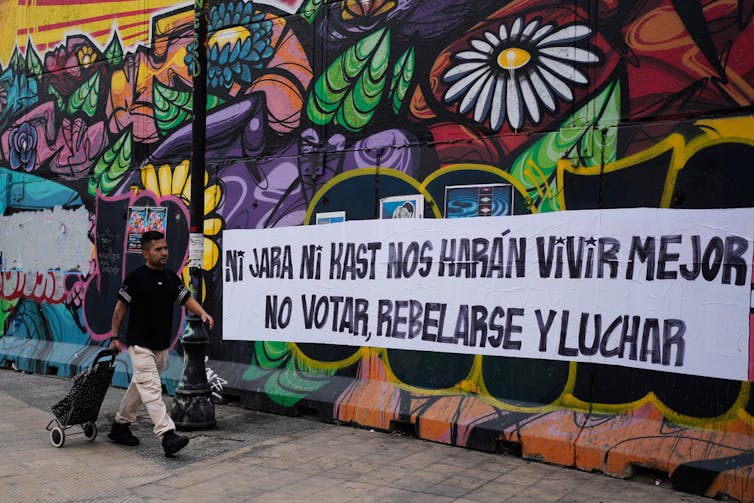
A person walks by a spray-painted political mural.
A campaign banner reads in Spanish: Neither Jara nor Kast will make our lives better, don’t vote, rebel and fight.
AP Photo / Natacha Pisarenko

Though Chile has one of the lowest crime rates in Latin America, high-profile cases of organized crime have shaken the nation in recent years. Homicides increased between 2018 and 2022 and have decreased slightly since then. Immigration has also risen significantly, with a large number of immigrants coming to Chile having fled economic and political crises in Venezuela, as well as in Peru, Haiti, Colombia and Bolivia. The foreign-born population in Chile rose from 4.4% in 2017 to 8.8% in 2024.

The key constitutional context

Many commentators have highlighted the stark polarization of this election, with a Communist Party labor minister campaigning against the arch-conservative Kast, who has lauded the Pinochet dictatorship under which his deceased older brother once served. But there is more to the story.

Some observers have drawn comparisons between Kast and other far-right Latin American leaders like Nayib Bukele in El Salvador, Javier Milei in Argentina and Jair Bolsonaro in Brazil. But Chile is not merely following the same far-right playbook of its neighbors.

In the weeks leading up to the runoff in Chile, both candidates moved toward the center. Jara vowed to expand the prison system to combat rising crime, while Kast – who had previously threatened expulsion of undocumented migrants – softened his tone to say they would be “invited” to leave.

Moreover, Kast learned from his previous failed attempts at the presidency by speaking less about his controversial or more socially conservative positions. For example, he played down opposition to abortion under any circumstances. Chilean voters, in contrast, overwhelmingly approve of the limited abortion rights that were passed by Congress in 2017.

Yet beyond the campaign trail messaging, the results also reflect a structural fact of Chilean politics that mirror political realities of other parts of Latin America, and even globally. In every presidential election since 2006, Chileans have voted out the incumbency to swing to the opposing side of the political spectrum. With candidates barred from consecutive presidential terms, the pendulum has swung back and forth since the alternating presidencies of socialist Michelle Bachelet – 2006-2010 and 2014-2018 — and conservative Sebastián Piñera – 2010-2014 and 2018-2022.

Supporters at a political rally wave flags.
At a José Antonio Kast rally in Santiago on Dec. 14, 2025, supporters wave various flags, including one depicting late dictator Augusto Pinochet.
Eithan Ambramovich / AFP vis Getty Images

Boric, a former left-wing student leader, took office in 2022 following a wave of upheaval and popular protests over inequality in 2019-2020. In what was a historic moment, the country voted to begin a process of rewriting its Pinochet-era constitution, which entrenched neoliberal economic policies and limited the government’s capacity to confront inequality. The constitutional convention was made up of directly elected citizens, many of them from grassroots movements.

Yet in a stunning reversal, the progressive constitution – which would have protected rights to nature, Indigenous rights and social rights – was roundly defeated in a plebiscite in 2022. Just over a year later, voters similarly rejected a second attempt to rewrite the constitution, albeit under a process that conservative parties helped shape.

Boric’s approval ratings, already low, suffered from this failed constitutional process. More than the right-wing elections elsewhere in the region, this national context helps to explain Chile’s own conservative turn.

The ever-present discontent of voters

Even as the pendulum has swung back and forth in recent Chilean presidential elections, there are deeper continuities across the different Chilean governments in the 21st century. Important among them is generalized voter discontent with the political system.

This has traditionally been expressed in popular protests, such as the student movements of 2006 and 2011 and the Estallido Social – or Social Uprising – of 2019-2020 that were the largest protests since the return to democracy in 1990 and helped propel Boric to power. Public discontent was also expressed in the overwhelming vote to rewrite the constitution, which passed with 78% of the vote in 2020.

A massive crowd is shown from above during a protest.
In this Oct. 25, 2019, photo, anti-government protesters fill Plaza de la Dignidad – Dignity Square – in Santiago, Chile, during a nationwide call for socioeconomic equality and better social services.
AP Photo / Rodrigo Abd, File

Even though the constitutional process was ultimately rejected by voters, this underlying discontent has not gone away.

One of the recent signs of discontent with the political choices on offer was in the first round of voting on Nov. 16: The third-place candidate was not one of the veteran politicians on the right, but Franco Parisi, a populist economist who has not set foot in Chile in years and who called on his supporters to intentionally vote null – or “spoil” their votes. Discontent has taken many forms – outrage about inequality and neoliberalism in 2019-2020, or unease about economic precarity and crime in the current election. But it has persisted, even as Chile’s political system remains stable.

Some observers have pointed out that, unlike in many places around the world, Chile’s democratic norms are holding strong. The fact that power continues to pass peacefully despite major ideological differences is significant, particularly in light of the long struggle for democracy during the Pinochet regime. Kast’s style, for what it’s worth, is not as bombastic as that of U.S. President Donald Trump or Argentina’s Milei.

Still, his apparent politeness belies what many fear is a coming erosion of rights: the rights of women to bodily autonomy; the rights of individuals] to due process; the rights of workers to dignified conditions. These may well be up for negotiation under the new administration.

Kast, a staunch Catholic and father of nine, is opposed to abortion under any circumstances and has even attempted to ban the morning-after pill. He was a supporter of Pinochet up until the regime’s end, campaigning for the “yes” vote in 1988 that would have seen eight more years for the authoritarian leader after 15 years already in power. Kast has likewise vowed to slash public spending and deregulate the economy, a clear echo of the Pinochet years.

Despite the momentous shift heralded by Kast’s election, though, it is unlikely to change one of the principal challenges of Chile’s democracy in the 21st century: voter discontent and disenchantment. There has been a consistent trend for the government in power to lose popular support and face strong headwinds in Congress from the opposition. For all the celebration happening right now for Kast and his supporters, it is hard to see that changing once the new government takes office in March 2026.

The Conversation

Andra B. Chastain receives funding in 2025-26 from a Fulbright-García Robles research grant in Mexico. She has previously received funding for research in Chile from the Social Science Research Council and the PEO Foundation.

ref. Chile elects most right-wing leader since Pinochet – in line with regional drift, domestic tendency to punish incumbents – https://theconversation.com/chile-elects-most-right-wing-leader-since-pinochet-in-line-with-regional-drift-domestic-tendency-to-punish-incumbents-272042

Epstein’s victims deserve more attention than his ‘client list’

Source: The Conversation – USA – By Stephanie A. (Sam) Martin, Frank and Bethine Church Endowed Chair of Public Affairs, Boise State University

Survivors, including Anouska De Georgiou, center, during a news conference with victims of Jeffrey Epstein outside the U.S. Capitol on Sept. 3, 2025. Chip Somodevilla/Getty Images

The Jeffrey Epstein story has slipped in and out of the headlines for years, but in a very particular way. Most news articles ask a specific question – which powerful men might be on “the list”?

Headlines focus on unidentified elites and who may be exposed or embarrassed, rather than on the people whose suffering made the case newsworthy in the first place: the girls and young women Epstein abused and trafficked.

Right now, the story is entering a new phase. A federal judge has authorized the Justice Department to unseal grand jury transcripts and other evidence from Epstein companion Ghislaine Maxwell’s sex trafficking case. A court in Florida has cleared the release of grand jury records from a federal investigation into Epstein himself, all under the new Epstein Files Transparency Act. Passed in November 2025, that law gives the Justice Department 30 days to release nearly all Epstein-related files. The deadline is Dec. 19.

Journalists and the public are watching to see what those documents will reveal beyond names we already know, and whether a long-rumored client list will finally materialize.

Alongside that, there has been a stream of survivor-centered reporting. Some outlets, including CNN, have regularly featured Epstein survivors and their attorneys reacting to new developments. Those segments are a reminder that another story is available, one that treats the women at the center of the case as sources of understanding, not just as evidence of someone else’s fall from grace.

These coexisting storylines reveal a deeper problem. After the #MeToo movement peaked, the public conversation about sexual violence and the news has clearly shifted. More survivors now speak publicly under their own names, and some outlets have adapted.

Yet long-standing conventions about what counts as news – conflict, scandal, elite people and dramatic turns in a case – still shape which aspects of sexual violence make it into headlines and which stay on the margins.

That tension raises a question: In a case where the law largely permits naming victims of sexual violence, and where some survivors are explicitly asking to be seen, why do journalistic practices so often withhold names or treat victims as secondary to the story?

A “CBS Evening News” story from Dec. 12, 2025, teases the photos revealed by House Democrats of famous men with Jeffrey Epstein.

What the law allows – and why newsrooms rarely do it

The U.S. Supreme Court has repeatedly held that government generally may not punish news organizations for publishing truthful information drawn from public records, even when that information is a rape victim’s name.

When states tried in the 1970s and 1980s to penalize outlets that identified victims using names that had already appeared in court documents or police reports, the court said those punishments violated the First Amendment.

Newsrooms responded by tightening restraint, not loosening it. Under pressure from feminist activists, victim advocates and their own staff, many organizations adopted policies against identifying victims of sexual assault, especially without consent.

Journalism ethics codes now urge reporters to “minimize harm,” be cautious about naming victims of sex crimes, and consider the risk of retraumatization and stigma.

In other words, U.S. law permits what newsroom ethics codes discourage.

How anonymity became the norm and #MeToo complicated it

Anti-rape culture protesters gathered in a crowd.
The anti-rape movement in the U.S. forced newsrooms to revisit assumptions about whose voices should lead a story.
Cory Clark/NurPhoto via Getty Images

For much of the 20th century, rape victims were routinely named in U.S. news coverage – a reflection of unequal gender norms. Victims’ reputations were treated as public property, while men accused of sexual violence were portrayed sympathetically and in detail.

By the 1970s and 1980s, feminist movements drew attention to underreporting and intense stigma. Activists built rape crisis centers and hotlines, documented how rarely sexual assault cases led to prosecution, and argued that if a woman feared seeing her name in the paper, she might never report at all.

Lawmakers passed “rape shield laws” that limited the use of a victim’s sexual history in court. Some states went further by barring publication of victims’ names.

In response to these laws, as well as feminist pressure, most newsrooms by the 1980s moved toward a default rule of not naming victims.

More recently, the #MeToo movement added a turn. Survivors in workplaces, politics and entertainment chose to speak publicly, often under their own names, about serial abuse and institutional cover-ups. Their accounts forced newsrooms to revisit assumptions about whose voices should lead a story.

Yet #MeToo also unfolded within existing journalistic conventions. Investigations tended to focus on high-profile men, spectacular falls from power and moments of reckoning, leaving less space for the quieter, ongoing realities of recovery, legal limbo and community response.

The unintended effects of keeping survivors faceless

There are good reasons for policies against naming victims.

Survivors may face harassment, employment discrimination or danger from abusers if they are identified. For minors, there are additional concerns about long-term digital evidence. In communities where sexual violence carries intense social stigma, anonymity can be a lifeline.

But research on media framing suggests that naming patterns matter. When coverage focuses on the alleged perpetrator as a complex individual – someone with a name, a career and a backstory – while referring to “a victim” or “accusers” in the singular, audiences are more likely to empathize with the suspect and scrutinize the victim’s behavior.

In high-profile cases like Epstein’s, that dynamic intensifies. The powerful men connected to him are named, dissected and speculated about. The survivors, unless they work hard to step forward, remain a blurred mass in the background. Anonymity meant to protect actually flattens their experience. Different stories of grooming, coercion and survival get reduced to a single faceless category.

A window into what we think is ‘news’

That flattening is part of what makes the current moment in the Epstein story so revealing. The suspense is less about whether more victims will be heard and more about what being named will do to influential men. It becomes a story about whose names count as news.

Carefully anonymizing survivors while breathlessly chasing a client list of powerful men unintentionally sends a message about who matters most.

The Epstein scandal, in that framing, is not primarily about what was done to girls and young women over many years, but about who among the elite might be embarrassed, implicated or exposed.

A more survivor-centered journalistic approach would start from a different set of questions, including wondering which survivors have chosen to speak on the record and why, and how news outlets can protect anonymity, when it is asked for, but still convey a victim’s individuality.

Those questions are not only about ethics. They are about news judgment. They ask editors and reporters to consider whether the most important part of a story like Epstein’s is the next famous name to drop or the ongoing lives of the people whose abuse made that name newsworthy at all.

The Conversation

Stephanie A. (Sam) Martin does not work for, consult, own shares in or receive funding from any company or organization that would benefit from this article, and has disclosed no relevant affiliations beyond their academic appointment.

ref. Epstein’s victims deserve more attention than his ‘client list’ – https://theconversation.com/epsteins-victims-deserve-more-attention-than-his-client-list-270244

How good people justify bending the rules at work — and what leaders can do about it

Source: The Conversation – Canada – By Lorne Michael Hartman, Associate Faculty, Faculty of Medicine, University of Toronto; York University, Canada

Consider the following scenario. You’re facing pressure to meet quarterly targets, but the numbers aren’t quite where they need to be. With a deadline looming, you “round up” a figure just slightly to make the results look better.

This kind of thinking is far more common than many realize. Research in behavioural ethics shows these subtle choices are exactly how unethical behaviour takes root in organizations.

Most people see themselves as fair, rational and ethical, yet research in behavioural ethics consistently shows we are far less objective than we assume.

Even well-intentioned people can explain away questionable actions — not because they’re immoral, but because their minds are wired to protect their moral self-image.

How we talk ourselves into bad decisions

The concept of moral disengagement describes the subtle mental moves people use to convince themselves that ethical standards don’t apply “just this once.” Rather than viewing themselves as rule-breakers, people reframe their behaviour in ways that allow them to feel moral while acting otherwise.

These rationalizations tend to take the following forms:

  • “It’s just creative accounting.” This is euphemistic labelling, which reframes misconduct in more acceptable terms.
  • “I did it for the team.” A form of moral justification that recasts a self-serving decision as altruistic.
  • “Everyone signed off on it.” Here, individuals displace responsibility onto colleagues or superiors.
  • “It’s not a big deal.” This involves distorting the consequences and minimizing impacts of choices.
  • “At least we’re not as bad as the competition.” Known as advantageous comparison, this tactic makes questionable behaviour seem reasonable by contrasting it with a worse alternative.

These narratives allow people to preserve a positive self-image even when their actions contradict their values. Over time, these narratives can normalize misconduct and corrode workplace culture.

The real-world impact of moral rationalization

Unethical behaviour in organizations isn’t rare, nor is it limited to a few “bad apples.” Research indicates that harmful or dishonest actions at work result in significant financial losses for companies and society, amounting to billions of dollars each year.

While we often assume unethical behaviour is driven by personal greed, high-profile corporate scandals tell a different story. In cases like the Boeing 737 Max crashes, Siemens’ corruption scandal or Volkswagen’s emissions scandal, news coverage suggest employees were motivated by a sense of obligation, loyalty or pressure to advance company goals, not by personal gain.

What’s striking is not just the number of people who participated, but how many recognized wrongdoing and remained silent. This pattern highlights a deeper problem: ethical failures rarely result from deliberate malice.

They emerge when ordinary people talk themselves into crossing lines they would normally respect. Understanding how that happens is essential if leaders want to create workplaces where employees don’t just know the right thing to do, but actually act on it.

Why ethics training often falls flat

Many organizations assume that teaching employees the rules will naturally translate into better behaviour. However, knowledge alone doesn’t close the gap between intention and action.

Across several studies, I examined whether moral disengagement can be reduced through training and reframing. In one experiment, participants learned to spot eight common rationalizations. They became adept at identifying these cognitive traps, but their awareness didn’t translate into making more ethical choices later.

In another experiment, we tried shifting how people thought about responsibility by emphasizing individual accountability over group harmony. This framing slightly reduced moral disengagement, especially among women, but the overall impact was modest.

Across all studies, the bottom line is that moral disengagement is stubborn. Simply knowing better rarely ensures that people will act better.

Why is it so difficult to move the needle? A key reason is that our explanations for why we behave the way we do are shaped by cultural norms learned early in life. Once formed, these beliefs are surprisingly resistant to change, even in the face of evidence or explicit instruction.

Culture is what drives ethical behaviour

If ethics training alone has limited impact, what does make a difference?

Our research points to workplace culture, which strongly shapes levels of moral disengagement and the ethical choices that follow.

We found that environments that prize assertiveness, competition and material success are more likely to encourage rationalizations. By contrast, cultures that emphasize care, modesty and concern for others make moral disengagement harder.

Ethical behaviour, in other words, is less a matter of personal integrity than organizational context.

When employees face unrealistic goals, aggressive norms or leaders who silence dissent, the space for ethical reflection becomes increasingly narrow. Rationalization fills the gap, allowing people to maintain a sense of integrity even as their decisions drift further from their values.

7 ways to resist rationalization at work

Creating an ethical organization means designing systems that make reflection easier and self-justification harder. Effective strategies include:

1. Normalizing ethical dialogue. Ethical dilemmas often arise in grey areas, where there is no clear right or wrong answer. Leaders should encourage open discussions about ambiguous situations before they escalate into problems.

2. Rewarding the process, not only the result. When outcomes are all that matter, employees are more likely to cut corners or bend rules to achieve targets. By recognizing the work process, organizations reinforce the importance of integrity alongside performance.

3. Modelling moral humility. Leaders set the tone for acceptable behaviour. When they admit mistakes, they signal ethics is about vigilance, not moral perfection.

4. Building in “ethical speed bumps.” People are more likely to rationalize decisions under pressure. Interventions like checklists, second reviews or pausing to slow down can give employees the time to consider whether their actions align with ethical standards.

5. Creating psychological safety. Employees must feel confident that raising concerns or questioning decisions won’t lead to fear of reprisal or harm to their careers. Creating psychologically safe workplaces reduces the likelihood of ethical lapses.

6. Aligning incentives with values. When incentives focus only on short-term results or profit, employees are more likely to justify harmful shortcuts. Performance metrics should emphasize collaboration, accountability, feedback and conflict resolution.

7. Supporting well-being and work-life balance. Stress and burnout make people more prone to self-justification. Policies that support well-being indirectly foster ethical workplace behaviour.

These approaches reflect growing evidence that behaviour change requires more than information. It requires habit formation, cultural reinforcement and aligned systems.

Learning to be more reflective

Humans are rationalizing creatures. We edit our moral narratives to protect our sense of ourselves as good, competent and principled people. But understanding this tendency is empowering.

Leaders who recognize the psychology of moral disengagement can design workplace environments where ethical reflection is routine and the right decision is the easier one.

While we may never be able to fully eliminate rationalization, we can learn to notice it, question it and choose differently. Ethical workplace cultures are built on systems that help ordinary people do the right thing.

The Conversation

Lorne Michael Hartman does not work for, consult, own shares in or receive funding from any company or organisation that would benefit from this article, and has disclosed no relevant affiliations beyond their academic appointment.

ref. How good people justify bending the rules at work — and what leaders can do about it – https://theconversation.com/how-good-people-justify-bending-the-rules-at-work-and-what-leaders-can-do-about-it-270427

Voici comment gérer les allergies et les restrictions alimentaires pendant les fêtes

Source: The Conversation – in French – By Jennifer LP Protudjer, Associate Professor and Endowed Research Chair in Allergy, Asthma and the Environment, University of Manitoba

Une assiette de biscuits fraîchement sortis du four, un verre de lait de poule joliment décoré… Pour beaucoup, ces images évoquent des souvenirs chaleureux et l’anticipation des fêtes de fin d’année.

Mais pour les personnes ayant des restrictions alimentaires, ces friandises et autres gourmandises des fêtes peuvent aussi susciter d’autres émotions. Durant cette période riche en repas et en célébrations, il peut être difficile de profiter des fêtes tout en évitant certains aliments.

Les hôtes bien intentionnés préparent souvent une sélection de friandises aux saveurs de saison. Mais sans communication claire, étiquetage précis et mesures pour éviter la contamination croisée, se servir dans les plateaux ou les buffets peut comporter des risques.

En tant que chercheuse spécialisée dans les allergies, je m’intéresse principalement aux conséquences d’un diagnostic d’allergie alimentaire pour les personnes, les familles et les communautés, ainsi qu’aux types de soutien les plus efficaces dans ce domaine.

De plus en plus de Canadiens surveillent leur alimentation, notamment pour des raisons telles que le coût des aliments, la santé et des restrictions médicales. Celles-ci peuvent consister à réduire le sel ou les sucres raffinés, ou à éviter certains glucides comme le lactose ou le gluten, dans le cas des personnes souffrant d’intolérance au lactose ou de maladie cœliaque.

Mais pour les 7 à 9 % de Canadiens souffrant d’allergies alimentaires, il est vital d’éviter certains aliments en raison du risque de réaction allergique sévère. La forme la plus grave, l’anaphylaxie, peut mettre la vie en danger.


À lire aussi :
Votre alimentation influence-t-elle vos rêves ? Ce que disent nos recherches sur la nourriture et les cauchemars


Allergies et restrictions alimentaires pendant les fêtes

Une étude canadienne montre que, contrairement à Halloween ou Pâques, périodes durant lesquelles les enfants « chassent » les bonbons, le nombre de visites aux urgences pour cause d’anaphylaxie pendant les fêtes d’hiver reste similaire au reste de l’année. Mais cela ne signifie pas que les restrictions alimentaires n’ont pas d’impact.

Celles-ci peuvent obliger à éviter de nombreux aliments. Santé Canada a identifié 11 allergènes prioritaires : le lait, les œufs, les arachides, les noix, les crustacés et les mollusques, le poisson, la moutarde, les graines de sésame, le soja, les sulfites et le blé et triticale. Beaucoup de ces aliments figurent couramment dans les recettes ou comme plats individuels pendant les fêtes.

Dans une série d’entretiens avec 21 familles, nous avons constaté que celles confrontées à des allergies apprennent rapidement à « refuser poliment » certains aliments pour éviter d’être perçues comme difficiles. Néanmoins, elles signalent tristesse, anxiété et dépression lorsqu’elles tentent de gérer les événements familiaux et sociaux. Dans certains cas, les familles qui gèrent plusieurs allergies alimentaires se sentent isolées, tandis que d’autres rapportent ne pas être invitées à des fêtes à cause de leurs restrictions.

Il existe de nombreux moyens pour les personnes ayant des restrictions alimentaires et pour les hôtes d’atténuer ces difficultés.

Mesures pratiques

Pour les personnes ayant des restrictions alimentaires, certaines mesures permettent de rendre les visites festives plus agréables et sécuritaires.

Il est important de communiquer clairement, de préférence par écrit, vos restrictions à l’hôte au moment d’accepter l’invitation. Indiquer précisément quels aliments poseront problème permet à l’hôte de réfléchir au menu et de poser des questions calmement, loin de l’agitation de la fête.

Vous pouvez aussi apporter une friandise compatible avec vos restrictions ou prendre une collation avant l’événement pour ne pas être affamé si les options sûres sont limitées. En cas de doute sur un aliment, il vaut mieux ne pas le consommer, même si vous l’avez déjà mangé auparavant, car les ingrédients peuvent changer.


Déjà des milliers d’abonnés à l’infolettre de La Conversation. Et vous ? Abonnez-vous gratuitement à notre infolettre pour mieux comprendre les grands enjeux contemporains.


Les personnes allergiques doivent prendre des précautions supplémentaires : emporter un auto-injecteur d’épinéphrine et s’assurer qu’une personne de confiance saura le trouver et l’utiliser en cas de réaction.

Food Allergy Canada propose d’autres conseils pour manger à l’extérieur. Il faut aussi connaître les facteurs aggravants possibles : certaines maladies, comme l’asthme ou les troubles cardiaques, ainsi que l’alcool, l’exercice physique, les médicaments ou le stress émotionnel peuvent influencer la gravité de la réaction.


À lire aussi :
Que peut-on faire pour lutter contre les allergies ?


Recevoir pendant les fêtes

Accueillir des invités peut être un plaisir, mais comme le souligne l’Association canadienne de psychologie, des attentes de perfection peuvent augmenter le stress. Lorsque vous invitez des personnes, renseignez-vous sur leurs restrictions alimentaires et tenez-en compte lors de la préparation des menus. Des plats simples et faciles à servir aident vos invités à faire leur choix. Avoir une liste des ingrédients à portée de main et étiqueter chaque plat avec des ustensiles dédiés est également utile.

La période des fêtes rime souvent avec le partage de mets festifs. En privilégiant la joie et la convivialité, il est possible de créer des souvenirs durables. En veillant aux besoins des personnes ayant des restrictions alimentaires, nous pouvons faire en sorte que chacun profite pleinement des festivités en toute sécurité.

La Conversation Canada

Jennifer LP Protudjer reçoit des financements de la Canadian Allergy, Asthma and Immunology Foundation, des Instituts de recherche en santé du Canada, de Research Manitoba, de la Health Sciences Centre Foundation (Manitoba), du Children’s Hospital Research Institute of Manitoba, de l’Université du Manitoba et du Conseil de recherches en sciences humaines du Canada.

JLP Protudjer est cheffe de section en santé affiliée et co‑responsable du volet recherche pour la Canadian Society of Allergy and Clinical Immunology, et siège au comité directeur du Plan d’action national canadien sur les allergies alimentaires. Elle déclare avoir reçu des honoraires de conférence de Ajinomoto Cambrooke, Novartis, Nutricia, ALK Abelló, FOODiversity et du Texas Children’s Food Allergy Symposium.

Elle est rédactrice associée pour la revue Allergy, Asthma & Clinical Immunology, membre du comité de rédaction de Pediatric Allergy & Immunology et du Journal of the Academy of Nutrition and Dietetics.

ref. Voici comment gérer les allergies et les restrictions alimentaires pendant les fêtes – https://theconversation.com/voici-comment-gerer-les-allergies-et-les-restrictions-alimentaires-pendant-les-fetes-271463

Vous avez trop mangé ? Pas de stress, votre corps sait quoi faire

Source: The Conversation – in French – By Bryn Beeder, Visiting Instructor in Kinesiology, Nutrition, and Health, Miami University

Pour beaucoup, les fêtes riment avec moments privilégiés et traditions familiales. Souvent riches en mets délicieux, elles sont aussi l’occasion de manger plus que d’habitude.

Vous connaissez sans doute cette sensation de trop-plein : un instant agréablement rassasié, le suivant inconfortablement repu. À ce malaise physique peut s’ajouter une culpabilité pour avoir mangé plus que prévu ou souhaité.

La pression physique et psychologique des repas de fêtes peut être difficile à gérer. En tant que diététicienne agréée, je tiens à vous assurer que votre corps peut parfaitement traiter cet apport supplémentaire de nourriture et de boissons et que votre santé et votre bien-être général ne se limitent pas à quelques jours d’excès. Partager un repas peut contribuer à créer des souvenirs positifs et durables durant les fêtes.

Si vous vous êtes déjà demandé ce qui se passe dans votre corps après un repas copieux, vous n’êtes pas seul. Mieux comprendre le fonctionnement de la digestion peut rendre les sensations post-repas moins étranges et beaucoup moins stressantes.


À lire aussi :
Pourquoi apprendre à cuisiner dès l’enfance est un outil de santé publique


Ralentir la digestion

Les aliments sont composés de trois macronutriments principaux : les glucides, les protéines et les lipides. Votre tube digestif utilise des processus mécaniques et chimiques pour décomposer ces nutriments en leur forme la plus simple afin qu’ils puissent être absorbés et utilisés pour produire de l’énergie, réparer et assurer des fonctions biologiques.

Personne prenant une cuillerée de petits pois sur une table chargée de plats de Thanksgiving
Il est courant de manger plus que d’habitude lors d’un repas de fête.
(The Good Brigade/DigitalVision via Getty Images)

Lors d’un repas de fête copieux, vous consommez sans doute plus de macronutriments qu’à l’habitude, souvent en peu de temps. Une plus grande quantité de nourriture nécessite un peu plus de temps pour être digérée, ce qui signifie qu’elle se déplace plus lentement dans votre tube digestif.

Les protéines et les graisses prennent également plus de temps à se décomposer. Alors que les aliments riches en glucides, comme les barres granola ou le jus d’orange, apportent un regain d’énergie rapide, les aliments riches en protéines et en graisses, tels que les œufs ou le poulet, fournissent une énergie qui dure plus longtemps.

Dans ce cas, une digestion plus lente peut en fait soutenir un apport énergétique régulier et aider à mieux contrôler l’appétit.

Inconfort physique

Rassurez-vous, votre système digestif continuera à fonctionner, quelle que soit la quantité de nourriture ingérée. La vraie question est plutôt de savoir combien de temps la digestion prendra et si elle provoquera un inconfort temporaire.

Lorsque vous mangez, votre estomac se dilate pour accueillir les aliments que vous avez consommés. Lorsque l’estomac s’efforce de faire passer le contenu alimentaire dans l’intestin grêle, le risque de brûlures d’estomac augmente. Il s’agit d’un reflux du contenu acide de l’estomac qui peut provoquer une sensation de brûlure dans la poitrine ou un goût amer dans la bouche. Une alimentation excessive peut également entraîner des douleurs à l’estomac, des nausées, des gaz et des ballonnements, ainsi qu’une sensation générale de lourdeur.

Personne se tenant le ventre, assise devant des assiettes empilées contenant principalement des restes de nourriture
La digestion d’un repas copieux peut être inconfortable.
(seb_ra/iStock via Getty Images Plus)

Avant même la première bouchée, votre corps se prépare à digérer. La vue et l’odeur de la nourriture stimulent la production de salive et d’acide gastrique, anticipant le travail digestif à venir.

Lorsque la digestion demande plus d’efforts que d’habitude, votre corps consomme temporairement plus d’énergie pour alimenter le processus digestif, à la fois pour décomposer les macronutriments et pour absorber ce carburant. Il est donc normal de se sentir plus fatigué après un repas copieux.

Pour réduire l’inconfort physique lié à la digestion, essayez de rester debout après un repas. Même si l’envie de s’allonger est forte, cela peut accentuer les douleurs et le reflux. Donnez du temps à votre corps et laissez la gravité agir en restant debout pendant au moins deux à trois heures après avoir mangé.

Une promenade de 10 à 15 minutes peut aider la digestion, car elle augmente les contractions de l’estomac et le flux sanguin global vers le tractus gastro-intestinal. Cela permet de faire passer plus efficacement les aliments de l’estomac vers l’intestin grêle.


À lire aussi :
L’exercice, bon pour le corps, certes, mais également pour le cerveau !


Au-delà de la culpabilité alimentaire

Une seule journée d’excès n’entraîne pas de prise de poids durable ni de conséquences permanentes sur la santé. En revanche, des cycles de culpabilité liés à l’alimentation répétés peuvent, à la longue, conduire à une relation malsaine avec la nourriture.


Déjà des milliers d’abonnés à l’infolettre de La Conversation. Et vous ? Abonnez-vous gratuitement à notre infolettre pour mieux comprendre les grands enjeux contemporains.


Au-delà de la digestion, la façon dont vous pensez à la nourriture peut être tout aussi importante que la sensation que vous éprouvez après avoir mangé. La manière dont vous en parlez compte aussi. La nourriture n’a pas de valeur morale, et pourtant il est facile de tomber dans l’habitude de qualifier certains aliments de « bons » ou de « mauvais ». Cela se manifeste souvent pendant les fêtes. Combien de fois vous surprenez-vous ou surprenez-vous les autres à dire : « J’ai été sage toute la matinée, je peux donc manger plus ce soir » ou « Je vais faire une entorse à mon régime et manger de la tarte aussi ». La manière dont vous parlez de la nourriture influence directement votre perception de ce que vous mangez… et de vous-même.

Trois personnes assises à table en train de manger et de sourire à un chien qui demande un morceau
La nourriture alimente à la fois votre corps et vos relations.
(Catherine Falls Commercial/Moment via Getty Images)

La nourriture peut également susciter des émotions positives et de bons souvenirs. Lorsque votre corps reconnaît une émotion forte liée à l’odeur d’un aliment, le centre émotionnel de votre cerveau, l’amygdale, alerte la partie de votre cerveau qui forme et stocke les souvenirs à long terme, l’hippocampe. Cela explique pourquoi l’odeur de la tarte de votre grand-mère peut vous transporter vers un souvenir vivant.

Pendant les fêtes de fin d’année, concentrez-vous moins sur le nombre de calories et davantage sur la compagnie, les rires, les odeurs et les saveurs qui rendent vos traditions si spéciales. Choisissez les aliments qui vous apportent réconfort et lien avec les autres : vous nourrissez bien plus que votre corps.

La Conversation Canada

Bryn Beeder ne travaille pas, ne conseille pas, ne possède pas de parts, ne reçoit pas de fonds d’une organisation qui pourrait tirer profit de cet article, et n’a déclaré aucune autre affiliation que son organisme de recherche.

ref. Vous avez trop mangé ? Pas de stress, votre corps sait quoi faire – https://theconversation.com/vous-avez-trop-mange-pas-de-stress-votre-corps-sait-quoi-faire-270864