Why public views of terrorism don’t match the evidence, and what the government needs to do to keep people safe

Source: The Conversation – UK – By Sara Fregonese, Associate Professor of political geography, School of Geography, Earth and Environmental Sciences, University of Birmingham, University of Birmingham

The mass shooting during Hanukkah in Bondi Beach is a horrific reminder that contemporary terrorism can affect the places where we meet others, shop, celebrate and conduct our daily lives. However, our research suggests that what the UK public fears and assumes about terrorism threats is quite different from reality.

In 2022, we asked 5,000 people in the UK about their experiences and perceptions of terror threat and counter-terrorism measures.

Respondents told us the first word that came to mind when they heard the word terrorism. Most prominent in their responses are references to bombs and bombings. This isn’t surprising, given the global prominence of such terrorist tactics for some time. However, evidence shows that nearly “80% of UK domestic terrorist attacks since 2018 have been carried out with bladed or blunt force weapons”.

In recent years, a global shift in terror tactics has made explosive attacks less common. Less sophisticated means of attacks – such as arson and the use of bladed weapons and firearms – have become more appealing financially and logistically, especially among lone actors.

In western Europe, terrorism is increasingly perpetrated via “low-tech attacks against public spaces carried out with everyday items”. This includes attacks using vehicles as weapons, which has led to a recent increase in hostile vehicle protective infrastructure in cities.

Answers to ‘What is the first word you think of when you hear the word
Sara Fregonese and Paul Simpson, CC BY

The UK public isn’t neurotically expecting explosions and deadly attacks, however. Only 8% of our respondents saw terrorism as the most important problem facing the UK, ranked behind poverty, health, the environment, and unemployment / job security. It is also seen as more significant than racism / discrimination, delinquency, and road safety.

It is important that the public knows what the nature of that problem is, especially considering the National Terrorism Threat Level has remained either severe or substantial for the past several years meaning an attack is likely.

Diverse perceptions

We also asked respondents how they felt about the threat of terrorism compared with a few years previously. Similar numbers felt more concerned about terrorism threats than in previous years (39.83%), as those feeling less concerned (35.65%). However, when breaking data down by religious belonging, a more complex picture emerged.

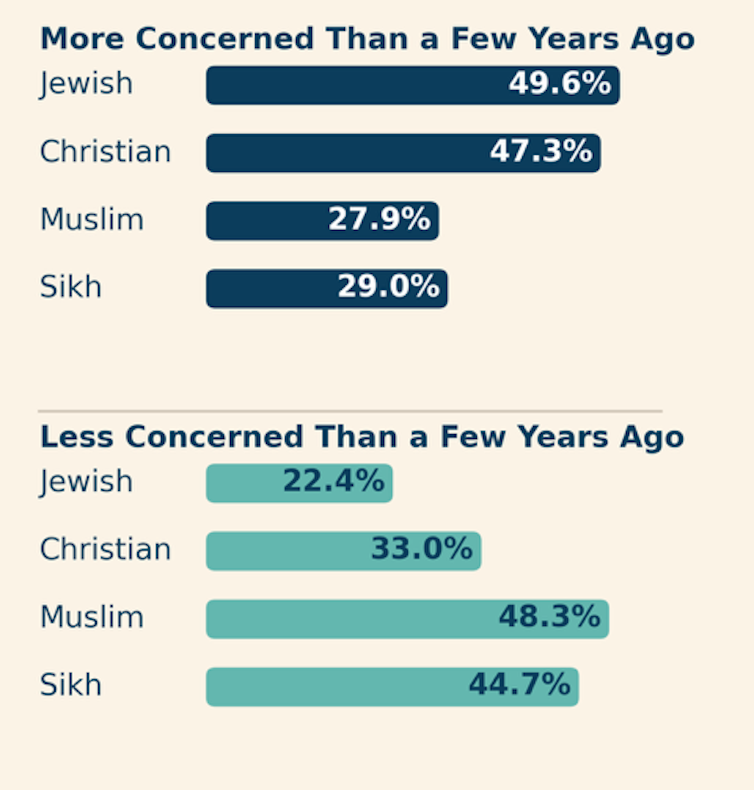
We saw diametrically opposed feelings of concern among Christians and Jewish respondents on the one hand, and Muslims and Sikhs on the other. In 2022, 49.6% of Jewish respondents declared themselves more concerned about terrorism threats than a few years earlier. Importantly, this preceded the Manchester Synagogue attack in November 2025 and the Bondi Beach attack.

Similarly, 47.3% of Christian respondents felt more concerned about terrorist threats than in previous years. Just 27.9% of Muslim respondents and 29% of Sikh respondents said they felt more concerned about terrorism threats than a few years earlier.

Muslim (48.3%) and Sikh (44.7%) respondents largely felt less concerned about terrorism in 2022 compared to a few years earlier. A lower proportion of Jewish (22.4%) and Christian (33%) respondents felt less concerned about terrorism in 2022.

Changing concern about terror threat by religious belief (2022)

Sara Fregonese and Paul Simpson, CC BY

We need to better understand how these perceptions and differences in concerns have formed. They may be connected to societal polarisation, and with different approaches and reactions to counter-terrorism measures.

Responding to terrorism

These findings matter for how governments respond to, and prepare the public for, terror threats.

UK government counter-terrorism policy has recently come under scrutiny. A report by the independent commission for counter-terrorism law, published in November 2025, called for substantial changes to the current system. This included recommendations for a narrower definition of terrorism and an overhaul of the Prevent Duty, which requires public bodies to identify and report signs of radicalisation.

The government’s national security strategy has also been criticised by the UK Independent Reviewer of Terrorism Legislation for not taking online terror threats seriously enough.

One of the ways that governments respond to terror threats is through information campaigns intended to alert and educate the public on the current nature of threat. And yet, our data shows that public awareness of such campaigns is worryingly low – 83.5% of respondents aren’t aware of them at all. That rate declines further for those aged 50 and over.

Those who said they are aware of counter-terrorism information campaigns largely failed to recall what these campaigns actually are. Their answers gave incomplete, wrong or conflated campaign names and slogans.

One might wonder if multiple campaigns – Run, Hide, Tell (2015-onwards); See it, Say it, Sorted (2016-onwards); Action Counters Terrorism (2017-onwards) – have actually produced confusion rather than clarity among the public over the nature of terror threat and what to watch out for. Equally, they may have become such a ubiquitous background in our cities, that people are now paying little attention.

It is essential to address these misalignments between public understanding of terrorism and the current evidence. The public needs clear, easy to remember, and updated information about current threats. Without this, people will struggle to recognise current threats and attune their instincts on how to react to them correctly.

And, while the messaging needs to be coherent, attention needs to be paid to the evident diversity of experiences and views about threat and security measures. Given our findings on how different demographic groups perceive terrorism, the recent call for equality impact assessments of counter-terrorism measures is a timely one indeed.

The Conversation

Sara Fregonese received funding from the Economic and Social Research Council (grant number ES/V01353X/1) which supported the research reported here

Paul Simpson received funding from the Economic and Social Research Council (grant number ES/V01353X/1) which supported the research reported here

ref. Why public views of terrorism don’t match the evidence, and what the government needs to do to keep people safe – https://theconversation.com/why-public-views-of-terrorism-dont-match-the-evidence-and-what-the-government-needs-to-do-to-keep-people-safe-272101


South Korea, Taiwan and Vietnam show that economic statecraft is not just the preserve of great powers

Source: The Conversation – UK – By Robyn Klingler-Vidra, Vice Dean, Global Engagement | Associate Professor in Political Economy and Entrepreneurship, King’s College London

Make American shipbuilding great again (Masga) may sound like an effort by the US to bolster its economic strength and project power internationally, but Masga is not an American policy. It is a South Korean initiative that emerged following trade talks with the US in June.

Rather than responding to the Trump administration’s tariff threats solely through trade negotiations, Korean officials saw an opportunity to show their American counterparts that South Korea deserved better treatment. They suggested that South Korea bring its shipbuilding prowess to the US.

South Korea is perhaps most famous as an exporter of K-pop, cars and semiconductors. But it is also a global powerhouse in shipbuilding. The shipyard in the south-eastern Korean city of Ulsan alone produces roughly ten times more ships annually than the entire US shipbuilding industry.

And as the US tries to counter China’s rapidly growing naval fleet, Korean assistance is something that is clearly needed. The US navy secretary, John Phelan, declared earlier in 2025 that US shipbuilding programmes “are a mess”. He added: “I think our best one is six months late and 57% over budget … That is the best one.”

Masga was launched in August, with South Korean conglomerates HD Hyundai and Samsung Heavy Industries signing a US$150 billion (£112 billion) deal to modernise US shipbuilding capabilities.

It is a clear example of a middle power, a term for countries that lack the dominance of great powers but matter because they possess distinctive industrial, resource or diplomatic capabilites, using economic statecraft to punch above its weight.

The HD Hyundai Heavy Industries headquarters in Ulsan.
The HD Hyundai Heavy Industries headquarters in Ulsan, South Korea.
Korea by Bike / Shutterstock

Economic statecraft has largely been used to describe actions taken by great powers like the US and China to enable and restrict access to their consumer markets, investment coffers and production capabilities. The aim is to achieve foreign policy goals or national security objectives by inflicting damage on or beating the capabilities of a rival power.

One classic example is the US government’s use of sanctions against Russia over its war in Ukraine and Iran over its nuclear programme. The overt linking of economic tools like sanctions and tariffs to defence objectives in Washington’s recent national security strategy is another striking illustration of this.

Middle powers have traditionally not actively pursued economic statecraft to achieve their objectives. They have instead looked to secure a seat at key tables through cooperative participation in regional and multilateral forums. But some of these countries are now asserting their power more explicitly, through preemptive moves like Masga.

Using economic statecraft

Taiwan is perhaps the most obvious case of a middle power engaging in economic statecraft. The country has used its critical role in global semiconductor supply chains as leverage to protect itself against Chinese invasion. Former Taiwanese president Tsai Ing-wen referred to international reliance on the island’s chip industry as a “silicon shield” in 2021.

Taipei imposes strict controls on tech sales and screens investment, particularly from China, to protect its position. And Taiwan’s industry-leading firms, such as TSMC, also invest heavily to maintain their technological edge.

Vietnam offers another example. Consistent with its “bamboo diplomacy” foreign policy model, Hanoi hosts leaders from China, Russia and the US, seeking flexibility rather than rigid alignment. The aim is clear: to maximise Vietnam’s national interests pragmatically and with autonomy.

With the world’s sixth-largest reserves of rare earths, Vietnam is now looking to use critical minerals as a tool of economic statecraft. The government voted to ban rare-earth exports on December 11, citing the need to reorient the sector towards domestic processing and higher-value manufacturing rather than merely the export of basic raw materials.

Rare earths are essential components in numerous products that are central to our daily lives, including smartphones, semiconductors and electric vehicles. By restricting foreign access to these essential inputs, Vietnam is striving to secure its long-term position in the supply chains of highly in-demand resources.

A rare earths mine in the Ninh Binh province of Vietnam.
A rare-earths mine in the Ninh Binh province of Vietnam.
ProjectP / Shutterstock

Together, these cases show how economic statecraft is not only the preserve of great powers. Middle power states are selectively granting and restricting access to their economic strengths to reshape markets and security relationships. Korea’s shipbuilding, Taiwan’s chip production and Vietnam’s rare earths illustrate this more assertive approach.

They are no longer confined to reactive measures or behind-the-scenes diplomacy in regional forums or multilateral negotiations. These states are proposing economic and military partnerships, as seen in initiatives such as Masga and Tsai’s assertion that everyone needs to care about Taiwan, given how essential chips are to the world economy.

Great powers are taking notice. In October, HD Hyundai and US defence contractor Huntington Ingalls Industries announced they are together building next-generation navy vessels. This marks the first time a South Korean firm will build a US navy ship. And Washington has also reportedly been courting Hanoi with elevated diplomatic status and promises of mining support.

For other middle powers, the lesson is clear: identify and leverage the strategic economic strengths that other countries depend on.

The Conversation

Robyn Klingler-Vidra received a research grant from the Chiang Ching-kuo Foundation between 2019-2023.

ref. South Korea, Taiwan and Vietnam show that economic statecraft is not just the preserve of great powers – https://theconversation.com/south-korea-taiwan-and-vietnam-show-that-economic-statecraft-is-not-just-the-preserve-of-great-powers-272139

Jane Austen celebrated Christmas with dancing, dinner parties and dangerous games

Source: The Conversation – UK – By Meg Kobza, Leverhulme Early Career Fellow, Newcastle University

Would you dare to play Snapdragon and pluck a flaming raisin from a fiery bowl of brandy? Or don the costume of a comedic character on Twelfth Night? Jane Austen certainly would have – and did.

These games were two among many festive traditions that featured in the Georgian Christmas season and were part of Austen’s yuletide experience. Much like our own holiday season, it was a time filled with frivolity, fun, and friendly gatherings – as Mr Elton confirms in the pages of Emma (1816).

During a picturesque carriage ride through the snow, he shares his delight with Emma and Mr Knightley, proclaiming: “This is quite the season, indeed, for friendly meetings. At Christmas every body invites their friends about them, and people think little of even the worst weather.”

This sentiment holds as true now as it did when it appeared in print in 1815 and is echoed across Austen’s novels. In Pride and Prejudice (1813) both Mrs Bennet and Lizzy invite family to stay for the holidays – Mrs Bennet welcoming her brother and his family to Longbourn, Lizzy offering to host her aunt and uncle at Pemberly.

Whether the assembly at Randalls in Emma or Sir Thomas Bertram’s ball at Mansfield Park, social gatherings with friends and family were a central part of Georgian Christmas culture. In Persuasion (1817), Mary Musgrove’s disappointment over a “very dull Christmas” without a single dinner party during the whole of the holidays emphasises the expectation and significance of jolly entertainments to foster a festive spirit.

It is likely that Austen met one of her earliest romantic interests, the clever and handsome Tom Lefroy, at one such jovial holiday gathering in December of 1795. Lefroy, who was spending Christmas with family, continually crossed paths with Austen throughout the season.

In a letter to her sister Cassandra, Austen recalled: “I am almost afraid to tell you how my Irish friend and I behaved. Imagine to yourself everything most profligate and shocking in the way of dancing and sitting down together.” They certainly made merry – flirting, laughing, and gossiping their way through the season.


This article is part of a series commemorating the 250th anniversary of Jane Austen’s birth. Despite having published only six books, she is one of the best-known authors in history. These articles explore the legacy and life of this incredible writer.


While the sentiments of Austen’s Christmas scenes pervade our holidays even today, there are certain aspects of the Georgian holiday season that are more unfamiliar – most notably the length of the season itself.

Today, Christmas decorations pop up early, with pumpkins vying for space between mince pies and stockings long before November has even begun. In Austen’s time, the Christmas season sat firmly in December, beginning with St Nicholas Day on December 6 and concluding with a bang one month later on January 6, or, as the Georgians knew it, Twelfth Day.

Unlike our December 25, Austen’s Christmas Day was a more intimate and quiet affair, not yet characterised by elaborate feasting, large parties, or even Father Christmas. Instead, the day was spent attending church and with close family while Twelfth Night was given the spotlight of the season.

The days between Christmas and Twelfth Day – known as the 12 days of Christmas – were therefore filled with preparation and anticipation.

A Christmas party in the 2020 adaptation of Emma.

Twelfth Night was an evening of mischief, masquerade and merriment. With a history dating back to the Romans, Twelfth Night was rooted in ideas of topsy-turvy – where anyone could be anything and everyone’s fate was determined by the slice of a cake.

Shared among family, friends and servants, the Twelfth Night cake, whether extravagant or practical, contained a dried bean and a dried pea. Whoever happened upon the slice with the dried bean became king for the evening, and the dried pea the queen. They would reign for the night, with their subjects left to do their bidding.

Once the king and queen were crowned, revelry and games ensued. Austen’s niece, Fanny Knight, often wrote of family Twelfth Night celebrations, recalling “we were all agreeably surprised with a sort of masquerade, on being dressed into character”. There were costumes for a Harlequin, flower girl, clown, cupid, musician and many others.

Austen herself enjoyed the spirited play of Twelfth Night, donning the character of “Miss Candour” one year and spending the whole evening “taking people aside to comment on their dress or making outrageous comments in loud whispers for all to hear!” Then came the games – including Snapdragon, apple-bobbing, and a messy round of Bullet Pudding which also appeared in the 2020 screen adaptation of Emma. Snapdragon challenged players to snatch almonds or raisins from flaming bowl of brandy while bullet pudding involved using your nose to poke through a mound of flour in order to find a hidden bullet – this often resulted in laughter and flour-powdered faces.

Twelfth Day carried the merriment of the night before into daylight hours and was treated as a bank holiday. As January 7 dawned, however, households hurried to take down their decorations, stripping festive greenery from banisters, doorways, mantles and tables. The once resplendent wreaths and garlands were promptly gathered and set alight to ward off bad luck in the new year.

Though Twelfth Night eventually went out of fashion, it seems that the Georgians and Austen herself found pleasure in mixing revelry with reverence and enjoyed the festive season to its fullest.


Looking for something good? Cut through the noise with a carefully curated selection of the latest releases, live events and exhibitions, straight to your inbox every fortnight, on Fridays. Sign up here.


This article features references to books that have been included for editorial reasons, and may contain links to bookshop.org. If you click on one of the links and go on to buy something from bookshop.org The Conversation UK may earn a commission.

The Conversation

Meg Kobza does not work for, consult, own shares in or receive funding from any company or organisation that would benefit from this article, and has disclosed no relevant affiliations beyond their academic appointment.

ref. Jane Austen celebrated Christmas with dancing, dinner parties and dangerous games – https://theconversation.com/jane-austen-celebrated-christmas-with-dancing-dinner-parties-and-dangerous-games-272123

Christmas Comes to Moominvalley: a magical show that honours Tove Jansson and her creations

Source: The Conversation – UK – By Kiera Vaclavik, Professor of Children’s Literature & Childhood Culture, Queen Mary University of London

Christmas can be a bit of a performance. It often involves harassed people doing a lot. But for many of us, alongside all the stressful preparations, it will include some kind of theatre visit, whether a panto, musical or ballet, such as The Nutcracker.

These days a way to escape the tyranny of digital screens, family trips to the theatre were already a tradition by the end of the 19th century. Children’s books of “the Golden Age” – from Lewis Carroll’s Alice books to JM Barrie’s Peter Pan and Kenneth Grahame’s The Wind in the Willows – offered fertile ground for stage adaptation and family audiences came flocking.

Today there is enormous choice, and the range on offer is heartening. In London, Jacksons Lane Arts Centre’s festive production Christmas Comes to Moominvalley – returning for the second year and perhaps becoming a tradition of its own – is a charming option for families looking for some Christmas magic and family time together.

The production is based on a supremely well-crafted short story called The Fir Tree by Tove Jansson, whose first Moomin book was published 80 years ago. It follows the Moomin family’s preparations for Christmas. So far, so standard. The interesting twist comes from the fact that Moomins, who usually hibernate through the winter, have no idea of what Christmas actually is.

Accustomed to things like floods, comets and volcanoes, they naturally assume it is a calamity, a dangerous force of nature to be placated. The family do their best to follow protocol and manage to improvise the requisite tree, food and presents.

Like Noel Streatfeild, whose Ballet Shoes (1936) is also being staged for the second time this year at the National Theatre in London, Jansson knows just how much of an undertaking Christmas is and the sense of unpreparedness she conveys throughout is highly relatable:

“I’ve made absolutely no arrangements yet myself,” complains the Hemulen, “and here they send me off to dig you out … Everybody’s running about like mad and nothing’s ready.” Having put in the hard work, the Moomins not only share their Christmas, but hand it over wholesale to other (more knowing, but less well-furnished) creatures.

It’s a story which manages to be positive and heartwarming, championing kindness and generosity (regarded by many as the true values of Christmas), without being in any way schmaltzy or saccharine. It’s a not inconsiderable feat, and something of minor Christmas miracle.

Retaining Jansson’s essence

Jacksons Lane has, then, hit Christmas gold with its source material, especially given the near-cult following of the much-loved Moomins who have been everywhere in this anniversary year. Their first appearance, a few scenes into the show, is a bit of a “Totoro” moment – the audience is primed to love them and palpably delighted when they finally appear.

A strong base is no guarantee for success though, and there are plenty of adaptations of children’s books that have entirely missed the mark (such as Broadway Entertainment Group’s shocking version of The Little Prince in 2022). Happily, this production isn’t one of them.

It’s a well-balanced show in every sense. Christmas Comes to Moominvalley makes the most of the acrobatics and circus skills that Jacksons Lane (itself celebrating its 50th anniversary this year) has nurtured so effectively.

It contrasts the charming but slightly ponderous, plodding Moomin family in their big white suits with a group of zippy, colourfully costumed characters who juggle, lift and tumble. There is also a good balance of pace – dynamic, fast-action scenes are interspersed with quieter, slower moments with harp and song, showcasing the strong clear voice of actress Xenia Garden.

Given this overall sensitivity, it’s a shame that the very poignant and evocative moment when the Moomins gift their entire Christmas tree, presents and food to the less fortunate is slightly rushed. Rather than an act of generosity and selflessness it verges on becoming a hurried offloading motivated by fear.

The show certainly doesn’t forget its written roots though. Much of the text is projected onto the stage backdrop, perhaps as a way around the slightly muffled delivery caused by cumbersome Moomin heads. It’s unclear otherwise quite what the purpose of the words is or who they’re for (certainly not younger children learning to read). But they do mean that Jansson’s presence is there throughout.

The show ultimately succeeds in delivering a memorable show with the wow factor that you want from a Christmas production. The lifts and tumbles – not to mention the literal plate spinning which harried adults will particularly relish and relate to – showcase the physical skills of the performers and are well integrated into the storytelling. The gradual decoration of the tree builds in the second half to deliver a near-perfect image of Christmas magic complete with lights, candles, stars, snow (and sea shells).

A children’s play that asks what Christmas is may seem a bit cerebral and too much like hard work, but Christmas Comes to Moominvalley isn’t this at all. It’s both metaphorically and literally uplifting. It inspires through acts of dazzling physical dexterity while also directing the audience to the words and images of the endlessly talented Tove Jansson.

Christmas Comes To Moominvalley is on at Jacksons Lane Arts Centre, London until Jan 4


Looking for something good? Cut through the noise with a carefully curated selection of the latest releases, live events and exhibitions, straight to your inbox every fortnight, on Fridays. Sign up here.


The Conversation

Kiera Vaclavik does not work for, consult, own shares in or receive funding from any company or organisation that would benefit from this article, and has disclosed no relevant affiliations beyond their academic appointment.

ref. Christmas Comes to Moominvalley: a magical show that honours Tove Jansson and her creations – https://theconversation.com/christmas-comes-to-moominvalley-a-magical-show-that-honours-tove-jansson-and-her-creations-272212

Christmas food poisoning and how to avoid it – by a microbiologist

Source: The Conversation – UK – By Primrose Freestone, Senior Lecturer in Clinical Microbiology, University of Leicester

Lysenko Andrii/Shutterstock

Food poisoning affects millions of people in the UK every year, and the risk rises during the Christmas period. Large family meals, raw poultry, packed fridges and buffet food all increase the chances of contamination.

In the UK, the most common bacterial causes of food poisoning are campylobacter and salmonella, both of which are frequently found on raw poultry.

While most cases of food poisoning are mild and clear up on their own, they can be serious for vulnerable groups. These include very young children, older adults, pregnant people and those with weakened immune systems.

Symptoms can include nausea, vomiting, fever, diarrhoea and a general feeling of being unwell.

Although there are no UK statistics published specifically for food poisoning at Christmas, the UK experiences more than 2.4 million cases of food poisoning every year. Public health agencies consistently see a seasonal rise in cases over the festive period, thought to be linked to the widespread preparation of poultry such as turkey.

So what is it about Christmas that makes it such a risky time of year? Here’s a closer look at the festive food habits that raise the risk of food poisoning, and how to avoid them.

Not checking use-by dates

Checking use-by dates is especially important at Christmas, when fridges are often full and food has been bought well in advance. Foods labelled “use by” are highly perishable and must be stored correctly in the fridge and eaten within the stated time to prevent bacterial growth.

Even if food is still within date, it should not be eaten if the packaging looks swollen or if the food smells or looks unusual when opened. These are signs of possible bacterial or fungal contamination, and it is safer to throw the food away.

Under-thawing frozen poultry or washing it

Large frozen birds such as turkeys can take several days to thaw fully in the fridge. Cooking poultry that is not completely defrosted can result in uneven cooking, allowing bacteria to survive in the centre of the meat.

Washing raw poultry before cooking is unnecessary and increases the risk of food poisoning. Poultry sold by supermarkets and butchers is already cleaned. Washing it can splash bacteria such as campylobacter and salmonella onto sinks, work surfaces, hands, clothes and nearby foods, leading to cross-contamination.

Undercooking your Christmas dinner

Poultry can contain bacteria throughout the meat, not just on the surface, so the entire bird must be thoroughly cooked to make it safe to eat.

Always follow the cooking instructions on the packaging. These timings are usually based on an unstuffed bird. Poultry cooked with stuffing inside the cavity often takes longer, and heat may not reach the centre properly, allowing bacteria to survive.

The only way to make poultry safe is by cooking it thoroughly. Using a food thermometer can help. Poultry is safe to eat when the thickest part reaches at least 75°C, a temperature that effectively kills food poisoning bacteria.

For this reason, it is much safer to cook stuffing in a separate dish rather than inside the bird.

Hand washing and kitchen hygiene

Good hygiene is essential when preparing raw meat, poultry, fish or vegetables.

After handling raw foods, wash your hands thoroughly with soap and water. Clean and disinfect chopping boards, knives, and work surfaces to prevent cross-contamination.

Do not prepare food for others if you have vomiting or diarrhoea, particularly if caused by highly contagious viruses such as norovirus or rotavirus.

Incorrect storage of Christmas leftovers

Food poisoning bacteria are present everywhere, including kitchens and fresh foods. Refrigeration slows their growth, but only if the fridge temperature stays between 0 and 5°C.

At Christmas, fridges are often overloaded, which can raise internal temperatures and allow bacteria to multiply. Avoid storing items that do not need refrigeration in the fridge.

Leftovers should be cooled, covered, and refrigerated within two hours. At room temperature, some bacteria can double in number every 20 minutes. Leftovers should be eaten within two days.

If you cannot eat leftovers within this time, freeze them. When stored at -18°C, they can be kept safely for up to three months.

Christmas dining out and party buffets

Around 60% of food poisoning cases in the UK are linked to food eaten outside the home.

Even in restaurants with high hygiene ratings, food can still be exposed to contamination from people, insects or the environment.

Buffets carry particular risks because perishable foods may be left out too long.

Food should not be left out for more than two hours unless refrigerated or, in the case of hot food, kept above 60°C. If you take buffet leftovers home, refrigerate them promptly and reheat until piping hot before eating.

Following these food safety tips can help reduce your risk of food poisoning this Christmas. In addition to food-related hazards, St John Ambulance has highlighted a range of other festive accidents to watch out for.

I hope your holiday is happy, healthy, and safe.

Merry Christmas.

The Conversation

Primrose Freestone does not work for, consult, own shares in or receive funding from any company or organisation that would benefit from this article, and has disclosed no relevant affiliations beyond their academic appointment.

ref. Christmas food poisoning and how to avoid it – by a microbiologist – https://theconversation.com/christmas-food-poisoning-and-how-to-avoid-it-by-a-microbiologist-271418

Marriage and migration: what happens when men return to the family home in Botswana

Source: The Conversation – Africa – By Unaludo Sechele, Research Fellow, University of the Free State

The history of labour migration in Botswana can be linked to the discovery of gold and diamonds in South Africa in the late 19th century. South Africa needed cheap labour, and men from neighbouring territories were pulled into the workforce as unskilled or semi-skilled workers in mines, factories, kitchens and farms.

Mine recruitment agencies like the Native Recruiting Corporation and the Witwatersrand Native Labour Association began expanding recruitment networks in Botswana in the 1930s.

Men in Botswana – a British protectorate and largely rural economy at the time – were open to labour migration for several reasons. They had to pay taxes to the colonial administration, and for that they needed cash. Some needed to pay traditional bride price in cattle, acquire ploughs for agricultural production, or educate their children. Drought pushed some farmers to look for other work.

So men were forced leave their families and migrate to work in South Africa or Southern Rhodesia (today’s Zimbabwe). They would return home only about once a year. This left women as primary caregivers in their families, in a society with a patriarchal culture, where men are normally in charge. As a Tswana phrase puts it: “Mosadi ke ngwana wa monna – A woman is a man’s child.”

Families experienced a variety of challenges and changes as a result, and their responses to the circumstances varied. Previous studies have examined the effects of men’s absence, but there hasn’t been much historical research on the impact on women and families of their return. As a women’s historian I was interested in this aspect.

I interviewed 33 rural women in Botswana’s north-east and central disricts whose husbands had been away between 1970 and 2015 to ask them how this had affected them. From what they told me, it became apparent that most marriages did not work out for the best.

Their stories and perspectives add to what’s known about the economic and social impact of labour migration in the southern African region.

Labour migration and the disruption of families

Previous research has found that labour migration damaged families in the countries that provided workers. The tightly knit cooperative, social and economic unit became economically dependent on migrants’ income. Although it improved people’s lives economically, labour migration separated husbands and wives for long periods.

In Tswana society, marriage is typically seen as a husband and wife living together to raise children and make decisions. However, for women married to migrant workers, the situation was quite different. They spent much time apart; they only spent time together when the husband came home to visit, was on leave, or was between jobs.

It also shifted women’s social and economic status – and traditional gender roles. Even though the absent husband retained power over strategic family decisions, male migration improved the position of women, who became, in practice, heads of the house.

However, miners returned home when retired, retrenched or injured. Many also came back to Botswana following Botswana’s independence in 1966 and the discovery of diamonds in the country in 1967.

According to national censuses, the number of people living abroad decreased from 45,735 in 1971 to 38,606 in 1991 and 28,210 in 2001.

As these miners returned home, they removed their wives from critical aspects of running the household and reclaimed their roles as heads of families.

The return of husbands

My research aimed to analyse the redistribution of responsibilities and power dynamics between husbands and wives when migrants returned to Botswana.

The interviews with women revealed a range of outcomes. Three cases illustrate them. (I have changed the names to protect identities.)

Conflict

According to Julia Keneetswe, her husband’s return and attempt to reassert authority caused conflicts. Keneetswe provided a brief background of her marriage and the type of parent her husband was when he was working in the mines. She claimed that her husband’s contract was terminated because of violence. She stated that after his return, he was a violent man who nearly killed her.

Keneetswe said:

My husband was already at the mines when we got married. He would not come home even for the Christmas holidays or support the children. Since he came home after being fired for fighting with a colleague at the mine, there hasn’t been any peace. This man is extremely violent … He is also a useless drunkard, but I can’t leave him because where will I go, so I will just stay here and mind my own business while he takes care of his.

It is important to highlight that most women did not simply sit back and wait for their husbands to return; instead, they empowered themselves in various ways.

Independence

For example, Mary Mojadi had progressed to become head of department at the primary school where she was teaching. As a result of the differences they had when her husband returned, she opted to leave the marriage since she was not only educated and aware of her rights but also was financially stable and had the means to start a new life by herself.

Similarly, Kelebogile Sejo told me she had been on the village development committee for several years, a position that garnered her respect in the community. Although she was not the one who initiated the divorce, she did not oppose it because she had proved to herself over the years that she could build a life for herself and her children without depending on her husband.

Reunion

Not all reunions ended in fights and divorce. Beta Mojela’s experience was different. She said that when her husband left for the mines, she was left with nothing but uncultivated land. She took it upon herself to start a horticultural business, which became successful. When her husband retired, he returned home to an up-and-running business, and they continued working together to grow the business.

Conclusion

My research looked at labour migration from Botswana through a feminist lens. It noted that migration was a challenge to the patriarchal nature of Tswana society – the belief that men ought to be the head of the family.

Some women who had spent significant time without husbands failed to adjust to life in the shadow of their husbands when they returned. Miscommunication and a lack of compromise led to conflicts in some marriages. But there were cases in which the couples reunited.

The return of husbands did not have the same results or reception for different families. Nonetheless, these circumstances allowed some women to evolve as heads of families and become more independent.

The Conversation

Unaludo Sechele received funding from American Council of Learned Societies- African Humanities Program. She is affiliated with University of the Free State- International Studies Group.

ref. Marriage and migration: what happens when men return to the family home in Botswana – https://theconversation.com/marriage-and-migration-what-happens-when-men-return-to-the-family-home-in-botswana-270403

La respuesta al dolor en la prehistoria

Source: The Conversation – (in Spanish) – By Sonia Díaz Navarro, Postdoctoral research fellow, Universidad de Burgos

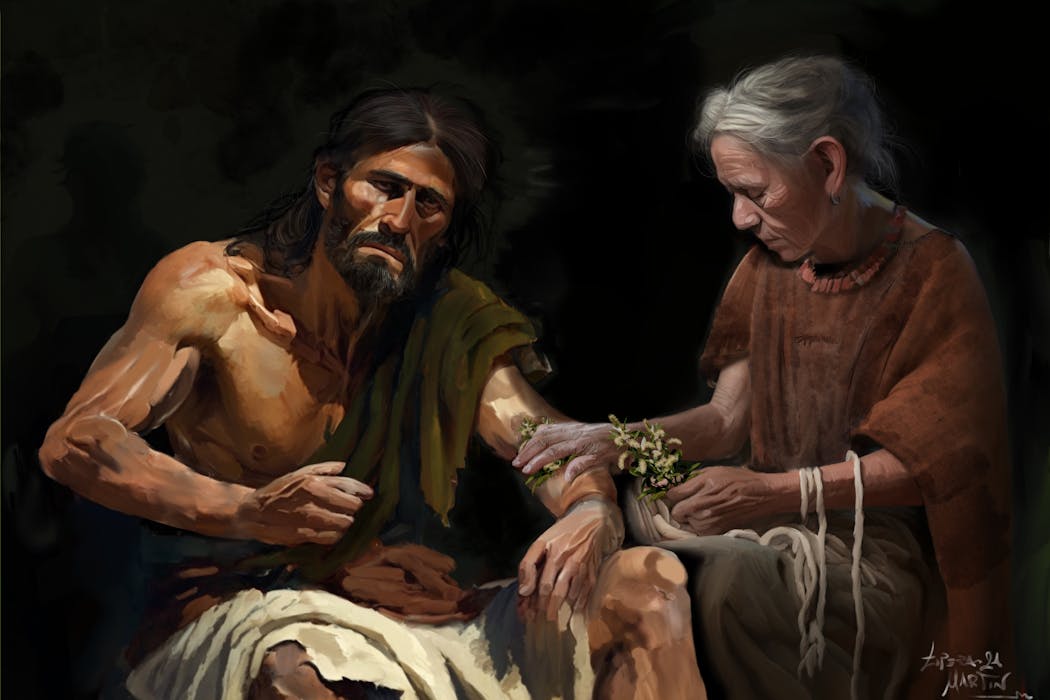
Ilustración de los cuidados en la Prehistoria, expuesta en el Museo de los Dólmenes de Antequera. Esperanza Martín.

Hoy asumimos con naturalidad hospitales, diagnósticos y fármacos, pero la preocupación por aliviar el dolor nos acompaña desde hace miles de años. El registro arqueológico documenta los estragos de la enfermedad en el ser humano desde el Paleolítico. Fracturas consolidadas, signos de artritis y patologías dentales muestran una larga convivencia con el sufrimiento y la limitación física en neandertales y Homo sapiens arcaicos.

Tratamientos neandertales

Chamaemelum nobile o camomila.
H. Zell / Wikimedia Commons., CC BY

Estos mismos registros también aportan las primeras evidencias de mitigación del dolor, como uso de plantas medicinales, manipulación dentaria o cuidados a individuos con discapacidad.

Una de las respuestas más antiguas frente al malestar fue el consumo de plantas y hierbas con propiedades curativas. Por ejemplo, sabemos que los neandertales que habitaban la cueva de El Sidrón (Asturias) tomaban analgésicos y antibióticos naturales como camomila (Chamaemelum nobile), ácido salicílico y Penicillium procedente de brotes de álamos y hongos.

Con el sedentarismo, más infecciones

Con la llegada del Neolítico, el panorama biosanitario cambió radicalmente. El sedentarismo, la convivencia estrecha con animales domésticos, las dietas cerealistas, la densificación demográfica y el surgimiento de nuevas actividades económicas crearon la tormenta perfecta para la proliferación de infecciones, trastornos metabólicos, patologías osteoarticulares, problemas dentales y parasitosis.

La salud se deterioró en muchos aspectos, pero también lo hicieron las respuestas: se multiplicaron las prácticas destinadas a prevenir, tratar y mitigar el sufrimiento.

Cráneo de mujer procedente del yacimiento de La Saga con trepanación por incisión en el parietal sin supervivencia.
Sonia Díaz.

Las pruebas de que hubo trepanaciones craneales cada vez más complejas, cuidados prolongados a personas dependientes, uso sistemático de plantas medicinales y sustancias psicoactivas, procedimientos quirúrgicos rudimentarios y tratamientos sobre infecciones, dolores crónicos o trastornos intestinales muestran un profundo conocimiento empírico del cuerpo humano y del entorno vegetal y animal.

Boticas sacadas de la naturaleza

La misma familiaridad con el poder terapéutico de la flora aparece en otros lugares del mundo. El análisis de heces fosilizadas de 8 000 años de antigüedad procedentes de la cueva brasileña de Boqueirão da Pedra Furada demuestra un gran conocimiento de los pobladores sobre plantas medicinales.

El estudio permite corroborar el uso de diferentes variedades de árboles y plantas para aliviar problemas intestinales y respiratorios, así como la utilización de otras como antiparasitarios, analgésicos o expectorantes.

El paciente “de hielo”

Reconstrucción plástica del cuerpo de Ötzi, tal como se conservó.
Wikimedia Commons., CC BY

El testimonio más completo de medicina prehistórica es el de Ötzi, el “hombre de hielo”, hallado en los Alpes y fechado en el IV milenio a. e. c. Su cuerpo revela una salud muy dañada: artritis en cadera y columna, lesiones vasculares tempranas, problemas pulmonares por inhalación de humo, caries y periodontitis, anemia leve, osteomalacia e infecciones intestinales causadas por Helicobacter pylori y el parásito Trichuris trichiura.

El hongo poliporo del abedul (Piptoporus betulinus) tiene propiedades contra parásitos intestinales humanos.
Wikimedia Commons., CC BY

Pero también portaba remedios. Entre su equipamiento, aparecieron el poliporo de abedul (Fomitopsis betulina), un hongo con propiedades antihelmínticas, y restos de un helecho medicinal, eficaces contra parásitos como los que padecía.

Además, sus más de sesenta tatuajes se concentran en zonas doloridas, lo que sugiere un uso terapéutico, con técnicas de presión, para aliviar molestias crónicas.

El caso de Ötzi muestra que, junto a una vida dura y enfermedades frecuentes, las comunidades prehistóricas desarrollaron conocimientos empíricos sobre plantas, hongos y cuidados corporales. Incluso hace más de 5 000 años, enfermar y tratarse ya formaba parte de la experiencia humana.

Tatuajes presentes en el cuerpo de la momia Ötzi.
Samadelli et al. _Journal of Cultural Heritage_. 2015

Drogas sagradas… y anestésicas

El consumo de sustancias psicoactivas capaces de alterar la percepción tampoco es una novedad reciente.

Plantas como la adormidera (Papaver somniferum), la efedra (Ephedra fragilis), el beleño (Hyoscyamus niger), la mandrágora (Mandragora officinarum) o el estramonio (Datura stramonium) están presentes en numerosos yacimientos arqueológicos prehistóricos europeos.

Papaver somniferum (variedad blanca) cerca de Madrid.
Wikimedia Commons., CC BY

Su hallazgo en sepulturas, depósitos rituales o espacios ceremoniales sugiere que se usaban para acompañar prácticas simbólicas, trances o experiencias vinculadas a la muerte y lo sagrado.

Sin embargo, su papel no siempre fue estrictamente espiritual: el cráneo masculino de Can Tintorer (Barcelona), sometido a dos trepanaciones, es el único individuo del yacimiento con evidencias de consumo de adormidera, lo que apunta a un posible uso calmante o analgésico para afrontar el dolor y la convalecencia.

Un legado que sigue vivo

Muchos de aquellos recursos vegetales continúan siendo hoy la base de medicamentos modernos. De las cortezas con salicilatos derivó el principio activo de la aspirina, de hongos como los del género Penicillium surgieron antibióticos y de plantas como la efedra o la adormidera proceden compuestos que siguen utilizándose en fármacos respiratorios, analgésicos u opiáceos.

Estos indicios nos recuerdan que la medicina en su forma más humana no empieza con la escritura ni con los tratados clásicos, sino con la necesidad de comprender el cuerpo y el sufrimiento. Allí donde existieron dolencias, surgió también la búsqueda de alivio.

The Conversation

Sonia Díaz Navarro no recibe salario, ni ejerce labores de consultoría, ni posee acciones, ni recibe financiación de ninguna compañía u organización que pueda obtener beneficio de este artículo, y ha declarado carecer de vínculos relevantes más allá del cargo académico citado.

ref. La respuesta al dolor en la prehistoria – https://theconversation.com/la-respuesta-al-dolor-en-la-prehistoria-242242

Cada vez más solos en casa: el auge silencioso de los hogares unipersonales

Source: The Conversation – (in Spanish) – By Elisa Brey, Profesora en sociología y opinión pública, experta en migraciones y vida urbana, Universidad Complutense de Madrid

mariamontoyart/Shutterstock

En España hay cada vez más personas que viven solas en su casa, en hogares unipersonales. Estos pasaron de cinco millones en enero de 2021 a más de 5,5 millones en julio de 2025, según el Instituto Nacional de Estadística. Esto supone un aumento del 10,8 % entre ambas fechas. Mientras tanto, los hogares de dos personas crecían un 9 %, los de tres apenas crecían un 1,6 % y los de cuatro o más personas disminuían muy ligeramente (-0,3 %).

En julio de 2025, España contaba con 19,6 millones de hogares. De este total, un 29 % eran de dos personas; un 28 %, unipersonales; un 23 %, de cuatro y más personas, y un 20 %, de tres. A pesar de su claro aumento, en España los hogares unipersonales no son la forma más habitual de vivir, pero podría serlo en los próximos años: aunque en julio de 2025 era más habitual vivir en hogares de dos personas, solo había 130 520 más de este tipo en comparación con los unipersonales. Y esta diferencia se ha reducido respecto a enero de 2021.

Diferencias por comunidades

Estamos cada vez más solos en casa, pero existen diferencias marcadas entre comunidades autónomas. Los datos muestran dos tendencias. En todo el arco mediterráneo, las Islas Baleares y Madrid predominan los hogares de dos personas sobre los hogares unipersonales. Un 26,7 % de la población vive en hogares unipersonales en esa áera, una de cada cuatro personas.

Mientras, en las zonas más rurales del norte de España, las dos Castillas, Extremadura y Canarias prevalecen los hogares unipersonales sobre los hogares de dos personas. En este caso, un 31,2 % de las personas vive en los primeros (una de cada tres).

Hay varios motivos por los cuales vivimos cada vez más solos en casa. El primero tiene que ver con la estructura por edad y sexo de la población y la esperanza de vida. España es un país con un cierto grado de envejecimiento. Desde 2022, más del 20 % de la población tiene más de 65 años. Además, la esperanza de vida de las mujeres es mayor que la de los hombres: 86,3 años para ellas, frente a 81,1 años para ellos, en 2025.

Mujeres viudas y parejas separadas

Por ello, muchas personas que viven solas son mujeres, posiblemente viudas, que pasan a vivir en un hogar unipersonal después de perder a su pareja. Estos casos generan preocupación cuando derivan en soledad no deseada.

Existen otros motivos vinculados a la diversificación de las formas de convivencia. Aumentan tanto los divorcios y las separaciones como las parejas que viven juntas, pero separadas, es decir “cada cual en su casa”.

La formación de hogares unipersonales queda supeditada entonces a dos condiciones. El primer factor es que los hijos o las hijas de esta nueva o antigua pareja ya no vivan con sus padres. El segundo factor que condiciona la formación de ese tipo de hogares es la existencia de recursos suficientes para afrontar el coste de dos viviendas.

La edad, el género, el ciclo vital y el precio de la vivienda, además del cambio en las formas de convivencia condicionan de este modo la formación o no de hogares unipersonales. Estos factores explican las dos tendencias antes observadas.

Población envejecida y menor precio de la vivienda

Donde la forma más habitual de vida son los hogares unipersonales, la población está más envejecida y el precio de la vivienda es menor. Aunque habría que analizar los mismos fenómenos con microdatos, así lo observamos en las zonas del norte de España, las dos Castillas y Extremadura.

A nivel regional, la proporción de personas de 65 años y más es de las más altas del país. Oscila entre un 20,1 % en Castilla La Mancha y un 28,4 % en Asturias. También se confirma la relación entre una mayor proporción de hogares unipersonales y unos menores precios de la vivienda.

Según el Observatorio de Vivienda Asequible de la oenegé Provivienda, en todas las regiones del norte, las dos Castillas, Extremadura y Canarias, los precios del alquiler alcanzaban un máximo de 500 euros en 2022, siendo de los más bajos de España.

En cuanto a los precios de la compra de vivienda, en 2025, según el mismo observatorio, eran menores en las regiones antes señaladas, donde predominan los hogares unipersonales.

¿Y nuestros vecinos europeos?

Si bien es cierto que aumentan los hogares unipersonales en España, su proporción no alcanza la media europea. En 2024, en la Unión Europea un 35 % de los hogares estaban formados por una sola persona, frente a un 28 % en España. Desde 2015, en todos los países la tendencia de este tipo de hogares es al alza, aunque hay cuatro excepciones: Eslovaquia –donde la proporción de hogares unipersonales ha disminuido de forma marcada entre 2015 y 2024– Hungría, Irlanda y Polonia, en los que la disminución fue mínima, según Eurostat.

Es cierto que vivimos cada vez más solos en casa en España, si bien hay dos factores clave que ralentizan esta tendencia. La primera es el coste de la vivienda, que sube por encima de los ingresos desde hace varios años. La segunda es la existencia de un régimen de bienestar “familista”, en el cual la familia y, por extensión, las redes locales de apoyo aportan soluciones y recursos donde el Estado y el mercado no llegan.

Siempre y cuando contemos con esta red familiar y vecinal extensa de apoyo, vivir solos en casa no necesariamente será sinónimo de estar solos.

The Conversation

Elisa Brey no recibe salario, ni ejerce labores de consultoría, ni posee acciones, ni recibe financiación de ninguna compañía u organización que pueda obtener beneficio de este artículo, y ha declarado carecer de vínculos relevantes más allá del cargo académico citado.

ref. Cada vez más solos en casa: el auge silencioso de los hogares unipersonales – https://theconversation.com/cada-vez-mas-solos-en-casa-el-auge-silencioso-de-los-hogares-unipersonales-267937

Planck, Schrödinger y Heisenberg: arquitectos de la revolución cuántica

Source: The Conversation – (in Spanish) – By José Daniel Sierra Murillo, Investigador, Divulgador y Profesor en Física., Universidad de La Rioja

A comienzos del siglo XX, la física atravesaba una profunda crisis conceptual. Los modelos clásicos, basados en las leyes de Newton y en el electromagnetismo de James Clerk Maxwell (1831-1879), parecían suficientes para explicar la mayoría de los fenómenos naturales. Sin embargo, ciertos problemas –como la radiación del cuerpo negro, el efecto fotoeléctrico o la estabilidad del átomo– desafiaban toda explicación coherente dentro de ese marco.

De esta crisis emergería la teoría cuántica, una de las revoluciones científicas más profundas de la historia, impulsada por figuras que, en muchos casos, no buscaron deliberadamente trastocar los cimientos del conocimiento, pero terminaron haciéndolo.

Una de esas figuras fue Max Karl Ernst Ludwig Planck (1858-1947), a quien el físico, filósofo e historiador de la ciencia Manjit Kumar se refirió como “revolucionario a su pesar” en una de sus obras, Quantum.

Planck no se consideraba a sí mismo un subversivo científico: era profundamente conservador en sus ideas y esperaba ajustar ligeramente la física clásica, no reemplazarla. Sin embargo, en 1900, mientras estudiaba el problema de la radiación del cuerpo negro (la manera en que un objeto ideal emite energía en función de su temperatura), se vio obligado a introducir una hipótesis radical: la energía no se intercambia de forma continua, como se creía hasta entonces, sino en pequeñas porciones discretas, a las que llamó cuantos de energía.

Planck propuso que la energía emitida o absorbida por un oscilador solo podía tomar valores múltiples de una cantidad mínima proporcional a la frecuencia de la radiación, expresada mediante la fórmula: E = h·f, donde E es la energía, f la frecuencia y h la famosa constante de Planck. Aunque Planck consideraba este paso como un recurso matemático, una “desesperada” solución al problema, su idea marcaría el nacimiento de la teoría cuántica. A partir de este punto, el mundo atómico-molecular dejaría de entenderse como un sistema continuo y predecible bajo las leyes clásicas.

La llegada de Schrödinger

Inspirado por esta nueva visión, Erwin Rudolf Josef Alexander Schrödinger (1887–1961) desarrolló, en 1926, una de las formulaciones más influyentes de la teoría cuántica: la ecuación de Schrödinger. Este modelo es considerado estadístico, porque no describe con certeza el comportamiento exacto de las partículas subatómicas, sino que establece una función de onda que contiene toda la información posible sobre un sistema físico desde la perspectiva de la teoría cuántica. A partir de esa función, se pueden calcular probabilidades de encontrar a una partícula en una determinada posición o con un determinado momento lineal (masa por velocidad).

En otras palabras, mientras que en la física clásica se puede saber con exactitud dónde estará un objeto en el futuro si se conocen sus condiciones iniciales, en el modelo estadístico de Schrödinger esto resulta imposible.

El modelo del físico autriaco no dice: “la partícula está aquí”, sino más bien: “hay una cierta probabilidad de que la partícula se encuentre en esta región del espacio”. Introduce una visión del universo gobernado por la probabilidad, y rompe con el “determinismo” heredado de la física clásica de Newton y con el que estaba de acuerdo Albert Einstein (1879-1955), afirmando que Dios “no puede estar jugando a los dados”.

El gato más famoso de la cuántica

El carácter contraintuitivo del modelo estadístico de Schrödinger queda ilustrado habitualmente con el famoso experimento mental del gato de Schrödinger, donde un gato encerrado en una caja se encuentra en un estado paradójico de “vivo y muerto” al mismo tiempo hasta que alguien abre la caja y observa el resultado. Dicho experimento no fue propuesto para apoyar la teoría cuántica, sino para destacar lo extraño que resultaba trasladar las propuestas basadas en el modelo estadístico de Schrödinger al mundo macroscópico. Sin embargo, popularizó dilemas que algunas propuestas de dicho modelo traían consigo.

La incertidumbre de Heisenberg

De manera paralela, otro complemento fue formulado por Werner Karl Heisenberg (1901-1976).

En 1927, Heisenberg presentó su célebre principio de indeterminación (o de incertidumbre), que establece que existen pares de magnitudes físicas que no pueden conocerse simultáneamente con precisión absoluta. El ejemplo más conocido es el de la posición y el momento lineal (masa por velocidad) de una partícula: cuanto más exactamente conocemos una, mayor será la incertidumbre sobre la otra.

Se suele afirmar que este principio no es una limitación de nuestros instrumentos de medición, sino una propiedad fundamental de la naturaleza. Que en el acto de observar influye sobre lo observado. Para medir la posición de una partícula, por ejemplo, necesitamos interactuar con ella (a través de fotones, campos, etc.), y esa interacción altera su estado de movimiento. De este modo, la realidad subatómica dejaría de ser un escenario pasivo y pasaría a ser un sistema dinámico donde el observador formaría parte del fenómeno observado.

La propuesta de Max Planck transformó radicalmente nuestra comprensión del universo. Gracias a ella, se han desarrollado tecnologías tan importantes como los transistores, los láseres, la resonancia magnética, los chips de computadoras, los paneles solares, etc., etc., etc. Un gran legado.

The Conversation

José Daniel Sierra Murillo no recibe salario, ni ejerce labores de consultoría, ni posee acciones, ni recibe financiación de ninguna compañía u organización que pueda obtener beneficio de este artículo, y ha declarado carecer de vínculos relevantes más allá del cargo académico citado.

ref. Planck, Schrödinger y Heisenberg: arquitectos de la revolución cuántica – https://theconversation.com/planck-schrodinger-y-heisenberg-arquitectos-de-la-revolucion-cuantica-271958

Claves para gestionar la ansiedad y las frustraciones de la vida universitaria (y adulta)

Source: The Conversation – (in Spanish) – By Azahara Leonor Miranda Gálvez, Profesora Ayudante a Doctor, Universidad Loyola Andalucía

Krakenimages.com/Shutterstock

¿Qué buscamos cuando decidimos matricularnos en un grado universitario? ¿Qué supone sacar un título “con éxito”? A menudo nos enfocamos excesivamente en la nota final de las asignaturas, pero el verdadero desafío de esta etapa es aprender a cuidar nuestra mente mientras desarrollamos nuestro talento y nuestra faceta profesional.

Estudiar en la universidad implica tomar decisiones importantes, adaptarse incluso a cambios de ciudad o de grupo de amigos, y enfrentarse a la independencia por primera vez. Según datos recientes, más del 40 % de los estudiantes universitarios en España tienen síntomas de ansiedad o depresión durante su etapa académica. La presión por las notas, la incertidumbre sobre el futuro laboral y el síndrome del impostor –esa sensación de no estar a la altura– afectan a miles de jóvenes cada curso.


Leer más:
¿Qué preocupa a los estudiantes universitarios?


Aprender a manejar esas emociones y mantener la motivación puede marcar la diferencia entre “sobrevivir” y disfrutar realmente de la vida universitaria. Lo segundo solo es posible si aprendemos a controlar la ansiedad antes de un examen, a pedir apoyo cuando algo no sale como esperábamos o celebrar pequeños logros.

Este aprendizaje no solo nos ayudará a aprobar asignaturas: es la base para crecer como personas y como profesionales a lo largo de toda nuestra vida. Un estudio de próxima publicación que hemos realizado con universitarios españoles nos dejó un dato muy interesante: la inteligencia emocional influye muchísimo en cómo vivimos la ansiedad. No consiste únicamente en reconocer lo que sentimos; para que realmente nos ayude, necesitamos entender bien nuestras emociones y, sobre todo, saber gestionarlas.


Leer más:
La salud mental de los universitarios empeora: así podemos ayudar


Prácticas diarias de inteligencia emocional

La inteligencia emocional se puede practicar todos los días. Por ejemplo:

  • Confiando en nosotros: cuando un estudiante se siente capaz de preparar un examen complicado sin depender de nadie más, está mostrando autoeficacia, que favorece mejores resultados académicos.

  • Manteniendo la motivación: encontrar actividades que nos apasionen, incluso en los momentos más difíciles del semestre, ayuda a no perder el ritmo.

  • Gestionando la ansiedad: técnicas simples, como hacer pequeñas pausas o organizar bien el tiempo de estudio, ayudan a rendir mejor y sentirnos menos estresados.

  • Practicando mindfulness o atención plena: podemos dedicar unos minutos a la meditación al despertar, dándonos un momento para notar nuestra respiración y sensaciones antes de empezar el día.

  • Creando un circulo de apoyo: compartir los problemas con alguien de confianza hace que los retos del día a día sean más asumibles.

  • Pensando en el futuro: marcarnos metas, como elegir prácticas o asignaturas que nos interesen.

  • Celebrando los logros: cuando terminamos un proyecto o recibimos un buen comentario, tomemos un momento para disfrutarlo.

La inteligencia emocional nos permite encontrar un equilibrio entre el rendimiento y el bienestar, sin sacrificar uno por el otro. Como dijo Aristóteles, “la excelencia no es un acto, sino un hábito”: la práctica diaria de estas rutinas puede mejorar nuestra capacidad de exigirnos cuando podamos y perdonarnos cuando no hayamos podido.

Inteligencia emocional en el campus

Aunque es mucho lo que podemos hacer por nosotros mismos, para que realmente alcance su mayor potencial toda la universidad tiene que estar involucrada en esta búsqueda del bienestar: debe haber profesores comprometidos, tutorías útiles y accesibles, y espacios de apoyo donde los universitarios puedan sentirse escuchado.

Aprender a manejar las emociones requiere práctica constante y en diferentes espacios. Por ejemplo, mientras estudiamos, podemos notar cuándo estamos estresados y usar estrategias simples, como organizar los tiempos, tomar pausas o respirar hondo. También es muy importante el espacio de las tutorías, ya que los comentarios de los profesores nos pueden ayudar a sentirnos capaces.


Leer más:
Cómo dar retroalimentación que motive y mejore el aprendizaje


Al salir al mundo laboral, estas habilidades serán igual de valiosas. Nos permitirán gestionar plazos, resolver imprevistos, adaptarnos a nuevos equipos y saber pedir ayuda cuando la necesitemos.

Autorregulación emocional y resiliencia

La autorregulación emocional y la resiliencia son elementos de la inteligencia emocional y resultan esenciales para sentirnos mejor en la universidad. La autorregulación es la capacidad de manejar nuestros pensamientos, emociones y acciones para alcanzar metas. Estar autorregulado no es solo manejar el tiempo: también implica saber cuándo parar, fijar metas alcanzables, revisar cómo vamos y cambiar de estrategia si algo no funciona. Priorizar, anticipar problemas y preparar un buen lugar para estudiar nos ayuda a aprender por nuestra cuenta. Quienes lo practican rinden mejor y se sienten más tranquilos, porque saben adaptarse y no frustrarse cuando algo no sale como esperaban.


Leer más:
¿Qué es la atención plena y cuáles son sus beneficios en la escuela?


La resiliencia es nuestra capacidad de superar un mal momento y aprender de lo que pasó. No significa que nunca cometamos errores, sino que sabemos cómo superar un mal día o una mala nota, cuidarnos y seguir hábitos que nos ayuden a estar tranquilos y con energía. Por ejemplo, si sale mal un trabajo que hemos hecho en grupo, la autorregulación nos ayuda a no castigarnos ni sentirnos demasiado mal. La resiliencia, en cambio, nos anima a ver qué salió mal y a pensar un nuevo plan para mejorar.

Cuando unimos estas dos habilidades, nos enfrentamos a los retos de la universidad y de la vida con más confianza y calma.

Cuándo pedir ayuda profesional

Es importante reconocer cuándo el estrés o la ansiedad dejan de ser normales. Si llevamos semanas sin poder concentrarnos, puede ser un buen momento para pedir ayuda. Lo mismo si evitamos clases o exámenes, o si notamos cambios importantes en el sueño o el apetito.

La mayoría de las universidades cuentan con servicios de orientación psicológica gratuitos o gabinetes especializados. Pedir ayuda no es un fracaso, es una decisión inteligente. Porque cuidar nuestra mente no va a frenar nuestro talento: al contrario, es lo que nos permite desarrollarlo al máximo.

The Conversation

Azahara Leonor Miranda Gálvez no recibe salario, ni ejerce labores de consultoría, ni posee acciones, ni recibe financiación de ninguna compañía u organización que pueda obtener beneficio de este artículo, y ha declarado carecer de vínculos relevantes más allá del cargo académico citado.

ref. Claves para gestionar la ansiedad y las frustraciones de la vida universitaria (y adulta) – https://theconversation.com/claves-para-gestionar-la-ansiedad-y-las-frustraciones-de-la-vida-universitaria-y-adulta-267655