Online adverts are sometimes so personal that they feel eerie. Even as a researcher in this area, I’m slightly startled when I get a message asking if my son still needs school shirts a few hours after browsing for clothes for my children.
Personal messaging is part of a strategy used by advertisers to build a more intense relationship with consumers. It often consists of pop-up adverts or follow-up emails reminding us of all the products we have looked at but not yet purchased.
This is a result of AI’s rapidly developing ability to automate the advertising content we are presented with. And that technology is only going to get more sophisticated.
OpenAI, for example, has hinted that advertising may soon be part of the company’s ChatGPT service (which now has 800 million weekly users). And this could really turbocharge the personal relationship with customers that big brands are desperate for.
ChatGPT already uses some advanced personalisation, making search recommendations based on a user’s search history, chats and other connected apps such as a calendar. So if you have a trip to Barcelona marked in your diary, it will provide you – unprompted – with recommendations of where to eat and what to do when you get there.
In October 2025, the company introduced ChatGPT Atlas, a search browser which can automate purchases. For instance, while you search for beach kit for your trip to Barcelona, it may ask: “Would you like me to create a pre-trip beach essentials list?” and then provide links to products for you to buy.
“Agent mode” takes this a step further. If a browser is open on the page of a swimsuit, a chat box will appear where you can ask specific questions. With the browser history saved, you can log back in and ask: “Can you find that swimsuit I was looking at last week and add it to the basket in a size 14?”
Another new feature (only in the US at the moment), “instant checkout”, is a partnership with Shopify and Etsy which allows users to browse and immediately purchase products without leaving the platform. Retailers pay a small fee on sales, which is how OpenAI monetises this service.
However, only around 2% of all ChatGPT searches are shopping-related, so other means of making money are necessary – which is where full-on incorporated advertising may come in.
One app, lots of ads?
OpenAI’s rapid growth requires heavy investment, and its chief financial officer, Sarah Friar, has said the company is “weighing up an ads model”, as well as recruiting advertising specialists from rivals Meta and Google.
But this will take some time to get right. Some ChatGPT users have already been critical of a shopping feature which they said made them feel like they were being sold to. Clearly a re-design is being considered, as the feature was temporarily removed in December 2025.
So there will continue to be experimentation into how AI can be part of what marketers call the “consumer journey” – the process customers go through before they end up buying something.
Some consumers prefer to use customer reviews and their own research or experience. Others appreciate AI recommendations, but studies suggest that overall, some sense of autonomy is essential for people to truly consider themselves happy customers. It has also been shown that audiences dislike aggressive “retargeting”, where they are continuously bombarded with the same adverts.
So the option of ChatGPT automatically providing product recommendations, summaries and even purchasing items on our behalf might seem very tempting to big brands. But most consumers will still prefer a sense of agency when it comes to spending their money.
This may be why advertisers will work on new ways to blur the lines – where internet search results are blended with undeclared brand messaging and product recommendations. This has long been the case on Chinese platforms such as WeChat, which includes e-commerce, gaming, messaging, calling and social networking – but with advertising at its core.
In fact, platforms in the west seem far behind their East Asian counterparts, where users can do most of their day-to-day tasks using just one app. In the future, a similarly centralised approach may be inevitable elsewhere – as will subliminal advertising, with the huge potential for data collection that a single multi-functional app can provide.
Ultimately, transparency will be minimal and advertising will be more difficult to recognise, which could be hard on vulnerable users – and not the kind of ethically responsible AI that many are hoping for.
Nessa Keddo has previously received funding from the AHRC.
Every year, millions of people sing the beautiful carol Silent Night, with its line “all is calm, all is bright”.
We all know the Christmas story is one in which peace and joy are proclaimed, and this permeates our festivities, family gatherings and present-giving. Countless Christmas cards depict the Holy Family – starlit, in a quaint stable, nestled comfortably in a sleepy little village.
However, when I began to research my book on the childhood of Jesus, Boy Jesus: Growing up Judaean in Turbulent Times, that carol started to sound jarringly wrong in terms of his family’s actual circumstances at the time he was born.
The Gospel stories themselves tell of dislocation and danger. For example, a “manger” was, in fact, a foul-smelling feeding trough for donkeys. A newborn baby laid in one is a profound sign given to the shepherds, who were guarding their flocks at night from dangerous wild animals (Luke 2:12).
When these stories are unpacked for their core elements and placed in a wider historical context, the dangers become even more glaring.
Take King Herod, for example. He enters the scene in the nativity stories without any introduction at all, and readers are supposed to know he was bad news. But Herod was appointed by the Romans as their trusted client ruler of the province of Judaea. He stayed long in his post because he was – in Roman terms – doing a reasonable job.
Jesus’ family claimed to be of the lineage of Judaean kings, descended from David and expected to bring forth a future ruler. The Gospel of Matthew begins with Jesus’ entire genealogy, it was that important to his identity.
But a few years before Jesus’ birth, Herod had violated the tomb of David and looted it. How did that affect the family and the stories they would tell Jesus? How did they feel about the Romans?
A time of fear and revolt
As for Herod’s attitude to Bethlehem, remembered as David’s home, things get yet more dangerous and complex.
When Herod was first appointed, he was evicted by a rival ruler supported by the Parthians (Rome’s enemy) who was loved by many local people. Herod was attacked by those people just near Bethlehem.
He and his forces fought back and massacred the attackers. When Rome vanquished the rival and brought Herod back, he built a memorial to his victorious massacre on a nearby site he called Herodium, overlooking Bethlehem. How did that make the local people feel?
And far from being a sleepy village, Bethlehem was so significant as a town that a major aqueduct construction brought water to its centre. Fearing Herod, Jesus’ family fled from their home there, but they were on the wrong side of Rome from the start.
They were not alone in their fears or their attitude to the colonisers. The events that unfolded, as told by the first-century historian Josephus, show a nation in open revolt against Rome shortly after Jesus was born.
When Herod died, thousands of people took over the Jerusalem temple and demanded liberation. Herod’s son Archelaus massacred them. A number of Judaean revolutionary would-be kings and rulers seized control of parts of the country, including Galilee.
It was at this time, in the Gospel of Matthew, that Joseph brought his family back from refuge in Egypt – to this independent Galilee and a village there, Nazareth.
But independence in Galilee didn’t last long. Roman forces, under the general Varus, marched down from Syria with allied forces, destroyed the nearby city of Sepphoris, torched countless villages and crucified huge numbers of Judaean rebels, eventually putting down the revolts.
Archelaus – once he was installed officially as ruler – followed this up with a continuing reign of terror.
A nativity story for today
As a historian, I’d like to see a film that shows Jesus and his family embedded in this chaotic, unstable and traumatic social world, in a nation under Roman rule.
Instead, viewers have now been offered The Carpenter’s Son, a film starring Nicholas Cage. It’s partly inspired by an apocryphal (not biblical) text named the Paidika Iesou – the Childhood of Jesus – later called The Infancy Gospel of Thomas.
You might think the Paidika would be something like an ancient version of the hit TV show Smallville from the 2000s, which followed the boy Clark Kent before he became Superman.
But no, rather than being about Jesus grappling with his amazing powers and destiny, it is a short and quite disturbing piece of literature made up of bits and pieces, assembled more than 100 years after the life of Jesus.
The Paidika presents the young Jesus as a kind of demigod no one should mess with, including his playmates and teachers. It was very popular with non-Jewish, pagan-turned-Christian audiences who sat in an uneasy place within wider society.
The miracle-working Jesus zaps all his enemies – and even innocents. At one point, a child runs into Jesus and hurts his shoulder, so Jesus strikes him dead. Joseph says to Mary, “Do not let him out of the house so that those who make him angry may not die.”
Such stories rest on a problematic idea that one must never kindle a god’s wrath. And this young Jesus shows instant, deadly wrath. He also lacks much of a moral compass.
But this text also rests on the idea that Jesus’ boyhood actions against his playmates and teachers were justified because they were “the Jews”. “A Jew” turns up as an accuser just a few lines in. There should be a content warning.
The nativity scene from The Carpenter’s Son is certainly not peaceful. There is a lot of screaming and horrific images of Roman soldiers throwing babies into a fire. But, like so many films, the violence is somehow just evil and arbitrary, not really about Judaea and Rome.
It is surely the contextual, bigger story of the nativity and Jesus’ childhood that is so relevant today, in our times of fracturing and “othering”, where so many feel under the thumb of the unyielding powers of this world.
In fact, some churches in the United States are now reflecting this contemporary relevance as they adapt nativity scenes to depict ICE detentions and deportations of immigrants and refugees.
In many ways, the real nativity is indeed not a simple one of peace and joy, but rather one of struggle – and yet mystifying hope.
Joan Taylor has previously received funding from the Leverhulme Trust, Wellcome Trust, Fulbright Commission, Palestine Exploration Fund and other scholarly societies.
More than one million South Africans, about 1.6% of the country’s population of 63 million, currently live overseas. Emigration is never a solitary event or a purely economic decision. When one person leaves, an entire network of relationships is reshaped. This means that parents, grandparents, siblings and friends are left behind, making it challenging to maintain close bonds across continents.
Despite vast geographical distances and the challenges of differing time zones, the enduring parent–child bond motivates families to seek meaningful ways to stay connected. Among the most powerful of these are transnational visits. For those who can travel, these visits serve as an emotional and relational lifeline: they allow parents to step into their adult children’s newly formed worlds, observe their daily routines, and build or maintain bonds with grandchildren born or raised abroad.
Although families stay connected through technology, parents emphasise that virtual contact cannot replace the desire for in-person connection. Yet this longing is often unmet. For many families, visiting is a deeply felt desire rather than a realistic possibility.
In a recent research paper I examined barriers to transnational visits from South African parents to their emigrant children. It intentionally centres on the experiences of parents travelling abroad, rather than on return visits to South Africa.
In total, 37 participants took part. They were South African citizens from a range of racial, cultural and religious backgrounds. They were between 50 and 85 years old. They were fluent in English and were parents of adult child(ren) who had emigrated and lived abroad for at least one year.
Most participants were women. Their children had emigrated to a range of countries, including Australia, New Zealand, the UK and the US. This aligns with global trends of South African emigration to English-speaking, economically developed countries.
The research uncovered the intertwined financial, emotional, physical, relational, and bureaucratic complexities that shape whether, how, and how often these visits take place.
Why visits matter
For transnational families, visits allow parents and children to revive and nurture attachments. They complement virtual interactions, video calls, instant messages and social media.
For parents, visiting their children’s homes bridges the gap between imagined spaces created through video calls and the lived realities of those environments. These experiences foster deeper emotional connections, enabling families to share closeness, engage in mutual care, and observe unspoken cues such as body language and tone, elements foundational to sustaining relationships.
Despite their importance, the rarity of transnational visits emerged clearly from participants’ narratives. While a small number of parents in the study were able to visit annually or every couple of years, this was the exception rather than the norm. For most, visits were rare events.
Although nearly all parents longed to visit more frequently, the majority had visited only once and several had never visited at all. Those who had visited spoke about long gaps between visits and the uncertainty of when or whether a next visit would ever be possible. This absence amplifies the loneliness experienced and leaves parents feeling increasingly “out of sync” with their children’s lives, at times even “irrelevant”.
Three main challenges
Parents consistently expressed a desire to visit more often. Yet this longing was constrained by the realities of their circumstances. Three major challenges emerged across the qualitative interviews.
Financial constraints: This was the most significant barrier, often preventing parents from realising their desire to visit their emigrant children. Air travel from South Africa to destinations such as Australia, New Zealand, Canada and the US is expensive. The South African rand’s weak exchange rate against strong currencies turns even modest flights into luxury purchases.
Retirees living on fixed incomes often find themselves caught between safeguarding their financial stability and meeting the deep emotional need to reconnect with their children and grandchildren.
It is terribly expensive. If I now had to, I would scratch the money out from somewhere and I can afford it, but I need to look after myself as well. Even if you have money, you don’t spend your money on something that is really absurd, like the price of air tickets at this stage is completely absurd.
Hidden expenses can also make visits even more challenging. Visa application fees, compulsory health insurance and medical examinations quickly add up.
Logistical strain: The geographical distance between South Africa and the popular emigration destinations such as Australia, the United States and New Zealand presents significant obstacles. For many elderly parents, long-haul travel is physically and mentally demanding.
As one participant shared:
The trip to America … there’s a lot of jet lag, and it’s not an easy trip to make. You know, if your kids are in Europe or England, there’s no time delay, no jet lag or anything like that.
Chronic illnesses, mobility limitations and fatigue make these journeys even more challenging. For some parents, the physical toll makes travel unmanageable or medically inadvisible.
Practical considerations, especially how long to stay, long enough to make the trip worthwhile but not too long to disrupt routines, add another layer of complexity. These decisions make planning a visit both logistically and emotionally taxing.
The emotional weight of saying goodbye: Every visit carries an inevitable ending. With no certainty about when, or if, the next visit will happen, each departure feels like a potential final farewell, especially for older parents. The joy of togetherness becomes tinged with the dread of parting, a heaviness that grows as the end of the visit approaches. For many, the farewell at the end of a visit is one of the most emotionally difficult moments.
As a grandmother describes:
And then a big factor is the sadness with the goodbye and for weeks after that you still struggle and can’t get back on track properly. For me, it gets more intense every time.
Some parents avoid visiting altogether because the emotional cost of departure outweighs the joy of being together.
Longing for presence
Many transnational parents must face the reality that limited financial, physical, or emotional resources will restrict the number of visits they can undertake in their lifetime. While digital communication helps families stay connected across borders, parents emphasised that virtual contact cannot recreate the intimacy that grows from in-person visits: the shared routines, playful moments and physical closeness.
Visits matter because they offer what digital technologies cannot fully provide: presence.
Sulette Ferreira does not work for, consult, own shares in or receive funding from any company or organisation that would benefit from this article, and has disclosed no relevant affiliations beyond their academic appointment.
In the video, Teebi acknowledged that while his book publication day should have been a happy one, he grappled with celebrating a moment of success while accounting for and living with “everything that is going on in Palestine.”
As a researcher of Palestinian prison literature who has been tracking the intermittent hostage exchanges between Israel and Gaza during the recent ceasefire agreement, Teebi’s struggle to articulate his feelings seemed familiar.
As Teebi narrates in his book, both sets of grandparents were survivors of the 1948 Nakba when when more than 750,000 Palestinians were driven from their homes during the mass exodus that accompanied the founding of the state of Israel.
As Teebi writes, they moved on a “tour of degradation through various Arab states” before they “stumbled” to Kuwait in the 1950s, where Teebi was born and lived as a child. At age 12, the family was stranded in California during a family trip when Iraq, under Saddam Hussein, invaded Kuwait. Teebi and his family lived for a time in the United States before coming to Canada when he was a youth.
The book is Teebi’s personal and political efforts to come to terms with the failures and powers of language to narrate a Palestinian story that can stand for itself, free of the constraints that attempt to silence it.
A story ‘against narrative’
Just days before the book’s publication, a United Nations Independent International Commission of Inquiry on the Occupied Palestinian Territory officially labelled Israel’s actions a genocide after a staggering death toll in Gaza.
Teebi’s witnessing of what he calls “an unending corpse exhibition” against the world’s latent, often ineffectual responses brought him to the realization that until that point, his identity and history had been confined by the “little prisons everywhere” made from language.
For someone who describes himself as having “an abiding faith in language,” the “dark times” Teebi refers to in the title of his book were ones of reckoning: the language to name Palestinian experience broadly and mass death in Gaza had irrevocably failed to stop genocide.
Teebi notes how amid the reluctance of western media and governments to use the term “genocide,” even as some genocide scholars saw evidence of this phenomenon as early as late 2023, Palestinians were forced to “haggle” over vocabulary rather than mobilizing diplomatic pressure to prevent “massacres” from happening.
In Coates’ book The Message, which partly reports on his summer 2023 visit to the West Bank and East Jerusalem, he writes that western language about Palestine has elevated “factual complexity” over morality or justice. The end goal was “to forge a story of Palestine told solely by the colonizer.”
Teebi writes that there have been long-existing “prisons of what we can and can’t say” about Palestine that repressed any attempt to engage in historical or political debate. Some of these “prisons,” he notes, were enforced by an “abundance of caution” on the part of his late migrant father, a doctor who expressed an “obsessive drive to rebuild” after the family was displaced from Kuwait.
Prisons targeting Palestinians operate materially in Occupied Palestine, but often only discursively, or linguistically, in the West.
Teebi acknowledges that the former “are [much] worse prisons”, yet his book is nonetheless a response to the linguistic prisons that obscure Palestinian stories behind claims of neutrality, proportionality or legality:
“When every popular conception of you is that of someone in chains, you begin to feel the chains even if they aren’t physically there. You narrate yourself not in spite of the chains, but around them.”
I was both gratified and dismayed that Teebi seemed to agree when, in You Will Not Kill Our Imagination, he wrote that witnessing is “the hoariest of writerly clichés.”
While Teebi’s book attempts to define “the effects of the genocide on Palestinian art and imagination,” it is also a reflection of how people in exile might resist the prisons imposed by a society dominated by anti-Palestinian narratives.
For Teebi, this entails embracing the “engine” of imagination — telling a Palestinian story that refuses the confines of counter-narrative.
A Palestinian story that must be told
Most important of all, Teebi tells a personal and political narrative, unqualified and unapologetic, a testament to the defiance of a Palestinian story that insists on being told.
In a number of talks, Teebi states that he had never intended to write a memoir: being so personal imposed upon him both honesty and vulnerability. Yet the moment compelled him to challenge the societal constraints that had kept his identity in check and to affirm, openly, deliberately and imaginatively, his Palestinian identity: he had broken free from the metaphoric prisons reining in his imagination.
When I suggested this to him in our interview, he laughed, saying: “If you want to call me a prison breaker, I’ll take it.”
Task of writer-in-exile
The writer-in-exile, Teebi insists, must do more than bear witness, a task carried out more forcefully by those living through this genocide. The exile who writes owes something to the stories of their loved ones who have lived, fought for and honoured an increasingly precarious future.
And so the exile who writes must witness ethically by committing, without hesitation, to this future; the exile who writes must imagine dismantling the prisons that bind their language; the exile who writes must imagine fiercely, granting themselves unrestrained freedom to speak, act and live.
“Prison deprives one of the sight of a tree and the sea. Freedom is the imagination capable of recalling them both in prison, making the invisible visible. No, that is what poetry does. Poetry, then, is an act of freedom.”
To merely witness prison, argues Teebi, is not to resist it; one must instead imagine beyond its constraints in the exercise of freedom.
That, for Teebi, is the quintessential work of the writer: to imagine a future beyond the societal and linguistic prisons that exile enforces.
Fatme Abdallah receives funding from Social Sciences and Humanities Research Council (SSHRC).
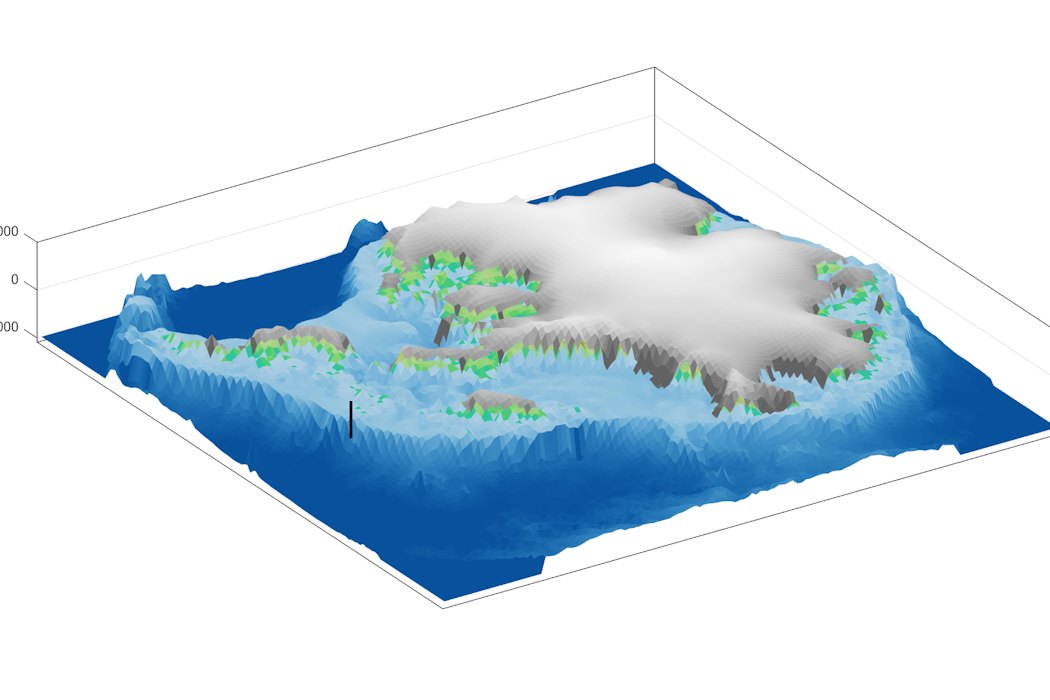
The ice that now covers West Antarctica was not there 3.6 million years ago, after a massive collapse of the ice sheet during a warming period.Anna Ruth Halberstadt, CC BY-NC-ND
Due to its thick, vast ice sheet, Antarctica appears to be a single, continuous landmass centered over the South Pole and spanning both hemispheres of the globe. The Western Hemisphere sector of the ice sheet is shaped like a hitchhiker’s thumb – an apt metaphor, because the West Antarctic ice sheet is on the go. Affected by Earth’s warming oceans and atmosphere, the ice sheet that sits atop West Antarctica is melting, flowing outward and diminishing in size, all at an astonishing pace.
Much of the discussion about the melting of massive ice sheets during a time of climate change addresses its effects on people. That makes sense: Millions will see their homes damaged or destroyed by rising sea levels and storm surges.
But what will happen to Antarctica itself as the ice sheets melt?
In layers of sediment accumulated on the sea floor over millions of years, researcherslikeus are finding evidence that when West Antarctica melted, there was a rapid uptick in onshore geological activity in the area. The evidence foretells what’s in store for the future.
A voyage of discovery
As far back as 30 million years ago, an ice sheet covered much of what we now call Antarctica. But during the Pliocene Epoch, which lasted from 5.3 million to 2.6 million years ago, the ice sheet on West Antarctica drastically retreated. Rather than a continuous ice sheet, all that remained were high ice caps and glaciers on or near mountaintops.
About 5 million years ago, conditions around Antarctica began to warm, and West Antarctic ice diminished. About 3 million years ago, all of Earth entered a warm climate phase, similar to what is happening today.
Glaciers are not stationary. These large masses of ice form on land and flow toward the sea, moving over bedrock and scraping off material from the landscape they cover, and carrying that debris along as the ice moves, almost like a conveyor belt. This process speeds up when the climate warms, as does calving into the sea, which forms icebergs. Debris-laden icebergs can then carry that continental rock material out to sea, dropping it to the sea floor as the icebergs melt.
The drillship JOIDES Resolution is in position for deep-water drilling in the outer Amundsen Sea during International Ocean Discovery Program Expedition 379. Modern icebergs are visible near the ship. Phil Christie, CC BY-NC-ND
In early 2019, we joined a major scientific trip – International Ocean Discovery Program Expedition 379 – to the Amundsen Sea, south of the Pacific Ocean. Our expedition aimed to recover material from the seabed to learn what had happened in West Antarctica during its melting period all that time ago.
Aboard the drillship JOIDES Resolution, workers lowered a drill nearly 13,000 feet (3,962 meters) to the sea floor and then drilled 2,605 feet (794 meters) into the ocean floor, directly offshore from the most vulnerable part of the West Antarctic ice sheet.
The drill brought up long tubes called “cores,” containing layers of sediments deposited between 6 million years ago and the present. Our research focused on sections of sediment from the time of the Pliocene Epoch, when Antarctica was not entirely ice-covered.
Aboard the JOIDES Resolution drillship, Keiji Horikawa examines a core containing iceberg-carried pebbly clays capped by finely layered muds. Christine Siddoway, CC BY-ND
An unexpected finding
While onboard, one of us, Christine Siddoway, was surprised to discover an uncommon sandstone pebble in a disturbed section of the core. Sandstone fragments were rare in the core, so the pebble’s origin was of high interest. Tests showed that the pebble had come from mountains deep in the Antarctic interior, roughly 800 miles (1,300 kilometers) from the drill site.
For this to have happened, icebergs must have calved from glaciers flowing off interior mountains and then floated toward the Pacific Ocean. The pebble provided evidence that a deep-water ocean passage – rather than today’s thick ice sheet – existed across the interior of what is now Antarctica.
After the expedition, once the researchers returned to their home laboratories, this finding was confirmed by analyzing silt, mud, rock fragments, and microfossils that also came up in the sediment cores. The chemical and magnetic properties of the core material revealed a detailed timeline of the ice sheet’s retreats and advances over many years.
Drilling cores show important markers of events during the Pliocene age: At right, the red arrow marks a layer of volcanic ash erupted from a West Antarctic volcano roughly 3 million years ago. At left is a section illustrating thin layers of mud marking the onset of glacial conditions. It overlies a thick bed of pebbly material dropped from icebergs during interglacial conditions. The white box marks the narrow zone containing the unique isotopic signature. IODP Expedition 379, JOIDES Resolution Science Operator, CC BY
One key sign came from analyses led by Keiji Horikawa. He tried to match thin mud layers in the core with bedrock from the continent, to test the idea that icebergs had carried such materials very long distances. Each mud layer was deposited right after a deglaciation episode, when the ice sheet retreated, that created a bed of iceberg-carried pebbly clay. By measuring the amounts of various elements, including strontium, neodymium and lead, he was able to link specific thin layers of mud in the drill cores to chemical signatures in outcrops in the Ellsworth Mountains, 870 miles (1400 km) away.
Horikawa discovered not just one instance of this material but as many as five mud layers deposited between 4.7 million and 3.3 million years ago. That suggests the ice sheet melted and open ocean formed, then the ice sheet regrew, filling the interior, repeatedly, over short spans of thousands to tens of thousands of years.
This animation shows a numerical model simulation of Antarctic ice sheet fluctuations across millions of years. The model is driven by time-evolving ocean and atmosphere temperatures; the ice sheet expands in response to cooling and shrinks as temperatures warm. The IODP Expedition 379 sediment core location is denoted by the star with a dashed line. This model simulation provides one possible reconstruction of ice sheet behavior during a single retreat/advance event approximately 3.6 million years ago. The simulation was validated through comparison with a suite of geologic information.
Creating a fuller picture
Teammate Ruthie Halberstadt combined this chemical evidence and timing in computer models showing how an archipelago of ice-capped, rugged islands emerged as ocean replaced the thick ice sheets that now fill Antarctica’s interior basins.
The biggest changes happened along the coast. The model simulations show a rapid increase in iceberg production and a dramatic retreat of the edge of the ice sheet toward the Ellsworth Mountains. The Amundsen Sea became choked with icebergs produced from all directions. Rocks and pebbles embedded in the glaciers floated out to sea within the icebergs and dropped to the seabed as the icebergs melted.
Long-standing geological evidence from Antarctica and elsewhere around the world shows that as ice melts and flows off the land, the land itself rises because the ice no longer presses it down. That shift can cause earthquakes, especially in West Antarctica, which sits above particularly hot areas of the Earth’s mantle that can rebound at high rates when the ice above them melts.
The release of pressure on the land also increases volcanic activity – as is happening in Iceland in the present day. Evidence of this in Antarctica comes from a volcanic ash layer that Siddoway and Horikawa identified in the cores, formed 3 million years ago.
The long-ago loss of ice and upward motions in West Antarctica also triggered massive rock avalanches and landslides in fractured, damaged rock, forming glacial valley walls and coastal cliffs. Collapses beneath the sea displaced vast amounts of sediment from the marine shelf. No longer held in place by the weight of glacier ice and ocean water, huge masses of rock broke away and surged into the water, producing tsunamis that unleashed more coastal destruction.
The rapid onset of all these changes made deglaciated West Antarctica a showpiece for what has been called “catastrophic geology.”
The rapid upswell of activity resembles what has happened elsewhere on the planet in the past. For instance, at the end of the last Northern Hemisphere ice age, 15,000 to 18,000 years ago, the region between Utah and British Columbia was subjected to floods from bursting glacial meltwater lakes, land rebound, rock avalanches and increased volcanic activity. In coastal Canada and Alaska, such events continue to occur today.
Scientists investigate the connection between melting glaciers and volcanic eruptions.
Dynamic ice sheet retreat
Our team’s analysis of rocks’ chemical makeup makes clear that West Antarctica doesn’t necessarily undergo one gradual, massive shift from ice-covered to ice-free, but rather swings back and forth between vastly different states. Each time the ice sheet disappeared in the past, it led to geological mayhem.
The future implication for West Antarctica is that when its ice sheet next collapses, the catastrophic events will return. This will happen repeatedly, as the ice sheet retreats and advances, opening and closing the connections between different areas of the world’s oceans.
This dynamic future may bring about equally swift responses in the biosphere, such as algal blooms around icebergs in the ocean, leading to an influx of marine species into newly opened seaways. Vast tracts of land upon West Antarctic islands would then open up to growth of mossy ground cover and coastal vegetation that would turn Antarctica more green than its current icy white.
Our data about the Amundsen Sea’s past and the resulting forecast indicate that onshore changes in West Antarctica will not be slow, gradual or imperceptible from a human perspective. Rather, what happened in the past is likely to recur: geologically rapid shifts that are felt locally as apocalyptic events such as earthquakes, eruptions, landslides and tsunamis – with worldwide effects.
Christine Siddoway received funding from the U.S. Science Support Program for IODP, and the National Science Foundation (grants 1939146 and 1917176, OPP Antarctic Earth Sciences) to support this research.
Anna Ruth Halberstadt received funding from the U.S. Science Support Program to participate in IODP Expedition 379.
Keiji Horikawa receives funding from JSPS KAKENHI Grant (JP21H04924 and JP25H01181) to support this research.
You push back from the table after Christmas lunch, full from an excellent feast. You really couldn’t manage another bite – except, perhaps, a little bit of pudding. Somehow, no matter how much you’ve eaten, there always seems to be room for dessert. Why? What is it about something sweet that tempts us into “oh, go on then”?
The Japanese capture this perfectly with the word betsubara, meaning “separate stomach”. Anatomically speaking, there is no extra compartment, yet the sensation of still having space for pudding is widespread enough to deserve a scientific explanation.
Far from being imaginary, the feeling reflects a series of physiological and psychological processes that together make dessert uniquely appealing, even when the main course has felt like the limit.
A good place to start is with the stomach itself. Many people picture it as a fixed-size bag that fills steadily until it can take no more, as though another mouthful would cause it to overflow.
In reality, the stomach is designed to stretch and adapt. As we begin to eat, it undergoes “gastric accommodation”: the smooth muscle relaxes, creating extra capacity without a major increase in pressure.
Crucially, soft and sweet foods require very little mechanical digestion. A heavy main course may make the stomach feel distended, but a light dessert, such as ice cream or mousse, barely challenges its workload, so the stomach can relax further to make space.
Much of the drive to eat pudding comes from the brain, specifically the neural pathways involved in reward and pleasure. Appetite is not governed solely by physical hunger. There is also “hedonic hunger”, the desire to eat because something is enjoyable or comforting.
After a satisfying main course, physiological hunger may be gone, but the anticipation of a sugary treat creates a separate, reward-driven desire to continue eating.
Another mechanism is sensory-specific satiety. As we eat, our brain’s response to the flavours and textures on the plate gradually diminishes, making the food less interesting. Introducing a different flavour profile – something sweet, tart or creamy – refreshes the reward response.
Many people who genuinely feel they cannot finish their main course suddenly discover that they “could manage a little pudding” because the novelty of dessert re-engages their motivation to eat.
Desserts also behave differently once they reach the gut. Compared with foods rich in protein or fat, sugary and carbohydrate-based foods empty from the stomach quickly and require relatively little early breakdown, contributing to the perception that they are easier to accommodate even when you are full.
Timing plays a role, too. The gut-brain signalling that creates the sensation of fullness does not respond instantly.
Hormones such as cholecystokinin, GLP-1 and peptide YY rise gradually and typically take between 20 and 40 minutes to produce a sustained sense of satiety. Many people make decisions about dessert before this hormonal shift has fully taken effect, giving the reward system space to influence behaviour.
Restaurants, consciously or otherwise, often time dessert offerings within this window.
Layered onto these biological processes is the influence of social conditioning. For many people, dessert is associated with celebration, generosity or comfort. From childhood onwards, we learn to regard puddings as treats or as natural components of festive meals.
Cultural and emotional cues can trigger anticipatory pleasure before the food even arrives. Studies consistently show that people eat more in social settings, when food is freely offered, or during special occasions – all situations where dessert typically features.
So the next time someone insists they are too full for another mouthful of dinner but somehow finds space for a slice of cake, rest assured: they are not being inconsistent. They are simply experiencing a perfectly normal and rather elegant feature of the human body.
Michelle Spear does not work for, consult, own shares in or receive funding from any company or organisation that would benefit from this article, and has disclosed no relevant affiliations beyond their academic appointment.
The festive season has a reputation for undoing good habits such as eating well and exercising. Normal routines disappear, days become less structured and exercise habits can fade. The solution to staying active is not more willpower, but smarter planning. Research shows that simple, practical strategies can help people stay active through Christmas and into the new year.
At this time of year, articles often focus on the calorie content of festive foods and drinks, alongside advice on how to “burn off” festive indulgence. However, guilt-based motivation is ineffective in the long term.
You are more likely to stick with exercise when it feels rewarding rather than forced. This is known as intrinsic motivation, which comes from enjoying the activity itself, rather than exercising due to pressure, guilt or external rewards. Behaviour change research shows that physical activity habits are more likely to last when they are easy to start and driven by intrinsic motivation.
For example, someone is more likely to maintain a running habit because it improves their mood or helps them decompress, rather than because they are trying to burn a specific number of calories.
To support intrinsic motivation, it helps to choose activities you enjoy or are curious about and avoid rigid rules. Exercises should match your current ability and offer a sense of progress, such as improvements in strength, technique or stamina. Clear, achievable progress increases enjoyment and commitment. Training with others, joining group classes or sharing progress can also help sustain motivation.
Most people do not stop exercising over Christmas because they lose motivation. Instead, their routines change. Late nights, travel, disrupted schedules, limited gym access or exercising in unfamiliar places create practical barriers. In many cases, exercise habits fade because of logistics, not a lack of desire.
In behavioural science, anything that makes a behaviour harder to start than it needs to be is described as friction. Even small obstacles can increase the effort, time or mental energy required to begin, making people more likely to delay or abandon the behaviour.
Friction is often subtle. Forgetting login details for a fitness app, not knowing what workout to do, or wondering whether there is enough time for a session to be “worth it” can be enough to derail exercise plans. Each small obstacle adds hesitation and increases the chance of giving up.
Reducing friction makes it far easier to maintain fitness over Christmas. This can be done by preparing in advance, simplifying choices and making the first step as easy as possible.
Prepare and plan ahead
Preparing ahead of time reduces delays and procrastination. Keep a gym bag packed or lay out workout clothes the night before. If you train with music or podcasts, have them ready. Create a default route for outdoor activities such as running or cycling so you don’t have to decide where to go.
When routines change, the type of exercise often needs to change too. Many people turn to social media or YouTube for ideas, but the sheer number of options can lead to decision fatigue, where repeated choices drain mental energy and make it more likely that exercise is postponed altogether.
To avoid this, bookmark a small number of go-to workouts on your phone and label them by duration and location. For example:
15 minutes | Bodyweight cardio | Home – Star jumps x 20 Mountain climbers x 20 Step-ups x 20 High skips x 20 Rest 1 minute Repeat for five rounds
Choose workouts for the week in advance where possible. Use a fixed rotation of three or four sessions, such as full-body strength, a 30-minute run, then full-body strength again. Limiting options reduces decision fatigue and makes starting easier.
Simplify
When time is limited or the gym is busy, effective workouts can still be completed in under 30 minutes using time-efficient training methods.
1. Circuits
In the gym, instead of resting between sets on one machine, move between exercises that target different muscle groups. For example, rotate between chest press, seated row, leg press, shoulder press, lat pulldown and a core exercise. If equipment is unavailable, substitute with a similar movement using dumbbells or bodyweight.
After completing a set, reduce the weight by 20% to 30% and continue until fatigue. Repeat for two to four drops.
4. Myo reps
Choose a weight you can lift for 12 to 15 repetitions. After the first set, rest briefly, then perform mini sets of three to five repetitions, rest for 20 seconds. Keep going until until you can’t complete 3 reps.
Drop sets and myo reps are effective for muscle growth. For maximum strength goals, traditional or cluster sets are more appropriate.
Metabolic conditioning
Metabolic conditioning involves short bursts of high-intensity exercise that challenge both muscles and the cardiovascular system. It is particularly useful when time is limited.
1. Circuit training
Plan a circuit of several exercises. Perform each exercise for 30 to 60 seconds then move to the next exercise. Rest for one to two minutes after completing all the exercises and repeat for multiple rounds.
2. Every minute on the minute circuits
At the start of each minute, complete a set number of repetitions and rest for the remainder of the minute before starting the next exercise.
3. Tabata intervals
Alternate 20 seconds of intense exercise with ten seconds of rest. Perform a total of eight intervals before resting for two to three minutes. Repeat this for two to three minutes series.
4. As many reps as possible
Select four or five exercises with target reps for each exercise. Set a timer for 12 to 20 minutes and cycle through the exercises continuously, aiming to complete as many rounds as possible.
Even during the disruption of the festive season, it is possible to stay active. Skipping exercise entirely until January risks losing fitness and breaking momentum. Evidence-based strategies that reduce friction and make exercise easy to start are far more effective than relying on willpower. By keeping workouts simple and accessible, you can maintain fitness through Christmas without having to start again in the new year.
Paul Hough does not work for, consult, own shares in or receive funding from any company or organisation that would benefit from this article, and has disclosed no relevant affiliations beyond their academic appointment.
Are you a parent to one child? Or are you considering having a child in the future, and wondering about what your family size should be?
Parents of only children are frequently asked when they are having another child, as if there is an expectation that they will be planning another – even though around 45% of families in the UK now have one child.
In research for my new book on only children, I asked over 3,000 parents who had one child about their reasons behind that decision. For some, having one child was a conscious choice. Parents enjoyed the lifestyle and balance that having one child brought, or wanted to limit their family for environmental reasons. Sometimes a difficult or distant relationship with their own sibling drove this choice.
Others, however, had wanted more than one child. Circumstances meant that they couldn’t, or had decided not to, have another baby.
These reasons were often deeply personal. Some parents had difficulties conceiving. Some had experienced miscarriage, baby loss or bereavement, meaning that their only child was the only child here. Others had such a difficult pregnancy or traumatic birth that they could not physically or psychologically experience another pregnancy.
There are all kinds of reasons for a family to have one child. Rido/Shutterstock
The cost of living also affected decisions. Many had made the decision that they couldn’t afford another child due to childcare, housing costs or job insecurity. Some had separated from the child’s other parent or been bereaved. Health problems, for parents or their child, were common, including disability and serious illnesses such as cancer. Health problems, for parents or their child, were common, including disability and serious illnesses such as cancer.
Some mothers talked about how difficult they found the postnatal period, lack of sleep, feeding difficulties and loneliness, resulting in postnatal depression. Some wanted another baby but their partner did not, or parents had experienced significant disagreements in how to parent and care for a child.
Explaining and feeling that you need to justify reasons to family, friends or even strangers who feel entitled to ask, can clearly be distressing. What’s more, parents of one child are likely to have heard that only children are at risk of being lonely, spoiled or being unable to make friends.
This is simply not true. These myths about one child families (a term many prefer to “only child”) have been around for a long time, but the evidence just isn’t there.
Research on only children
The few studies that have shown differences for outcomes for children with or without siblings are often small, flawed, or conducted at a time when there was a lot of social and political pressure to have more children.
More recent research shows very little difference at all. Only children do not have poorer social skills. They are not more selfish or narcissistic. They aren’t less happy in life. They may spend more time alone but are not more likely to describe themselves as lonely, which is an important distinction.
Children’s lives are affected by so many different factors. Where there is an absence of a sibling, a different, positive opportunity often fills it. Only children have more time to spend connecting with other family members of friends, more time for hobbies, more family money for activities that they prefer, or simply more focused time alone. Life might look different, but that doesn’t mean it’s worse.
Every child is made up of their own unique strengths and personality that is a culmination of genetics, home life and more. There are far more influential differences between only children’s lives than the shared experience of not having a sibling.
One aspect people often worry about is whether only children will feel the strain in the future when looking after ageing parents. Although some people find great support in their siblings, one study found that adult children may leave care or support for older parents to their siblings.
Although some only children do wish they had a brother or sister, it’s also important to remember that having a sibling isn’t a guarantee they will get along or support each other. Children who feel bullied by their siblings have an increased risk of depression and self-harm. When we wish for more siblings we are wishing for a good relationship and supportive person, and that isn’t always the case.
Research does however show a difference in people’s views of only children. One study asked people to rate characteristics of a hypothetical only child versus one with siblings. People were more likely to believe that only children were higher in narcissistic tendencies. They then tested this belief, finding no difference in narcissism scores between people who had a sibling or not. This is an excellent example of how people believe in the stereotype of the narcissistic selfish only child, but it’s not actually true.
These stereotypes are harmful and importantly not based in reality. Families increasingly come in all different shapes and make ups. Let’s focus on how we make sure more children can feel loved, connected and secure, rather than how many siblings they have.
Amy Brown receives funding from UKRI. She is a volunteer for the charity the Human Milk Foundation.
Source: The Conversation – UK – By James Rodgers, Reader in International Journalism, City St George’s, University of London
A vast amount of information has not necessarily meant more reliable information, writes James Rodgers, a former BBC correspondent who held postings in Gaza, Moscow and Brussels
On December 10, the year 2025 reached a murderous milestone. In 2024, the Committee to Protect Journalists (CPJ) had recorded 126 journalists and media workers killed, the highest number since the CPJ first began keeping records in 1992. In 2025, the figure was matched with three weeks of the year still to go.
One nationality, Palestinian, has paid by far the highest price. “Israel has killed almost 250 journalists since the Israel-Gaza war began in 2023,” the CPJ reported.
What does this mean for audiences’ understanding of a world where international affairs are dominated by war, the climate crisis and unpredictable politics?
As far back as the early years of the US, and through the European revolutions of the 19th centuries, information and freedom have been linked. In 1787, Thomas Jefferson wrote: “Were it left to me to decide whether we should have a government without newspapers, or newspapers without a government, I should not hesitate a moment to prefer the latter.”
Today, we have access to more media than at any other time in human history. But this vast amount of information has not necessarily meant more reliable information. Governments and tech companies striving to control the message often succeed.
Israel has banned international journalists entering Gaza. Palestinian journalists continue, at great risk, to report from the territory. Russia, meanwhile, has placed restrictions on reporting its “special military operation” – in a word, war – on Ukraine.
A generation ago, when the CPJ first began keeping data on journalists’ deaths, it was different. The fall of the Berlin Wall and the end of the cold war allowed international media organisations freedom to work as never before in the former Soviet bloc.
As those countries embraced political change, they encouraged freer media to flourish within their new societies. True, these media were often influenced by political and business interests – the news media often are. But there was plurality where previously there had only been the party line.
The 1990s, imperfect though they were as a time of press freedom, were better than what has followed since. As the media academic and former foreign correspondent Peter Grestehas persuasively argued, the aftermath of 9/11 involved state power extending, “into control over information and ideas. They did that by loosening the definitions of what constituted ‘terrorism’ and ‘national security’”.
Greste’s words were informed by the price he had paid for his own journalism. In late 2013, along with two colleagues, Mohamed Fadel Fahmy and Baher Mohammad, he was detained in Egypt on terrorism charges. He spent 400 days in prison. The charges had resulted from the fact that he had spoken to the Muslim Brotherhood as part of his reporting.
“How do you accurately and fairly report on Egypt’s ongoing political struggle without talking to everyone involved?” he wrote at the time.
Information access
It is not new that governments seek to control media. What is new is that the US is so proudly among them. Jefferson would probably not like what the current US government is doing, especially its recent policy of restricting access to the Pentagon for reporters who themselves refuse restrictions on their reporting.
The words that follow Jefferson’s discussion of the relative merits of governments and newspapers are less well remembered: “But I should mean that every man should receive those papers and be capable of reading them.”
Outdated gendered language aside, that, today, is the problem. For while we have more and more media, we have far less media freedom.
In the age of mass media, news organisations have largely controlled the means of distribution. Today, the tech companies take the lead. Not everyone is receiving the “papers”. Where they are not formally censored, they are harder to find – and cost money, unlike social media content.
Algorithms may be adjusted to give us more cat videos and fewer questions. Governments and criminals place physical restrictions, up to and including death, on journalists’ work. Powerful politicians use legal action – or the threat of it – to silence trusted news organisations.
In my previous career as an international correspondent, I reported on wars in the former Soviet Union and the Middle East. In the 1990s and 2000s, journalists were often restricted by governments not wanting bad news reported – but rarely simply banned as they increasingly seem to be now.
In Gaza and in Russia, international journalists are unable to access places they need to tell the story. In both cases, courageous reporters from those countries risk danger and even death to try to tell the world what is happening.
The restrictions placed upon journalists today may mean that governments seem to be winning at the moment. Their desire to control confirms the power to challenge that journalism still holds.
James Rodgers does not work for, consult, own shares in or receive funding from any company or organisation that would benefit from this article, and has disclosed no relevant affiliations beyond their academic appointment.
Eighty years ago, Britain celebrated its first peacetime Christmas since 1938. It was a time of hope indeed, but a look through newspaper archives reveals a complex picture. Christmas 1945 was an austerity Christmas. One in which grief and suffering, remembrance and loneliness mingled with reunions, church attendance and muted celebration.
It was the first Christmas under the Labour government elected in 1945, though Prime Minister Clement Attlee did not address the nation. The Christmas address was by King George VI, who noted that Britons still had to “make a little go a long way”.
The government had negotiated a colossal loan from the United States because Britain was close to bankruptcy. The Times reported that extra meat, margarine, sugar and sweets “allocated in good time” would permit “a near approach to traditional fare in most homes”. However, rationing remained in force and for many, the top priority was simply to get back to their families.
On December 22, the mass circulation Daily Mirror reported that “with only three days to go till Christmas, mainline stations throughout the country were jam-packed with servicemen and civilians anxious to get home for the greatest get together holiday for six years”. It noted that “here and there was a lucky passenger with a turkey or goose wrapped in brown paper to take home for the Christmas feast”.
The Labour-supporting Daily Herald reflected that “You may not have a turkey or much coal. Toys are scarce and taxes heavy. But have you reflected how much better off we are than a year ago?”
It reported that the railway network was running “duplicate and triplicate trains” on some routes, but could not meet the demand for seats. The Daily Herald noted that “the first Christmas of the peace began with a battle – the battle of Waterloo”. There were “long queues four abreast at Euston” and parcels piling up at King’s Cross Station. Such scenes might feel familiar to today’s travellers trying to make it out of London in the days before Christmas.
Joy amid mourning
Some travellers would not reach their families. Staunch in its defence of servicemen, the Daily Mirror reported that a “War Office Muddle” meant that men who had “spent five Christmases abroad” were “still being sent overseas, despite a War Office promise that they would not be”. This situation arose because men were still required to fill essential posts.
Many such jobs were in Berlin. The Manchester Guardian’s correspondent reported from the German capital that Germany and Austria had no fuel to heat homes. The defeated nations faced “a Christmas of hunger or black market”. However, “in Berlin Christmas will at least be cheap. Bread is four pence a two-pound loaf, potatoes are three half-pence a pound”.
The Daily Mail remained cheerful. It reported a BBC broadcast of Johann Sebastian Bach’s Christmas Oratorio: “A young BBC singer stepped straight from the chorus to a leading part” in this performance. Gladys Ripley, a leading contralto, had fallen victim to “a severe cold”. Into her place stepped the unknown Miss Maud Baker who gave “a magnificent performance”.
Still, many citizens were mourning. Britain had lost about 348,000 military personnel and 70,000 civilians. Atomic bombs had brought about the surrender of Japan. Losses were mourned in churches across the land. The Times displayed pictures of choristers at Salisbury Cathedral practising for a carol service. Carols were sung on Christmas Eve and Christmas Day. Many readers attended services at churches throughout the UK.
The Listener, a magazine published by the BBC, captured the mood in an editorial headlined, simply, “Christmas 1945”:
It would be useless to pretend that this, the first Christmas of peace, is all that we should like it to be. Our chief pleasure in it must indeed lie in the fact that it is the first peacetime Christmas for a very long time … Most of us can be happy, if not extravagantly merry this Christmas. Most of us, but not all. There will be gaps in many family circles, faces missing, some of whom will not be seen again.
Today, many people around the world are facing destruction and deprivation comparable to that which Britons experienced between 1939 and 1945. This Christmas, our thoughts as we enjoy peace and plenty should, perhaps, be with them.
Tim Luckhurst has received research funding from News UK and Ireland Ltd. He is a fellow of the Royal Society of Arts and a member of the Society of Editors and the Free Speech Union.