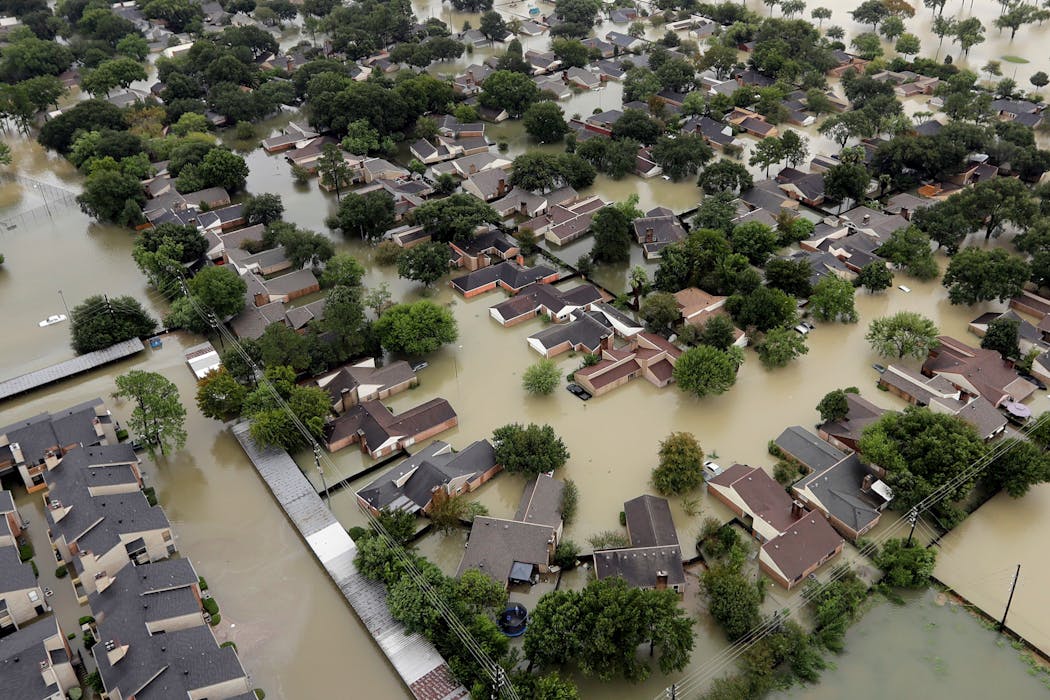
FEMA’s buyout program helped homeowners in Houston after Hurricane Harvey’s widespread flooding in 2017.AP Photo/David J. Phillip
Dangerous flooding has damaged neighborhoods in almost every state in 2025, leaving homes a muddy mess. In several hard-hit areas, it wasn’t the first time homeowners found themselves tearing out wet wallboard and piling waterlogged carpet by the curb.
Wanting to rebuild after flooding is a common response. But for some people, the best way to stay in their community, adapt to the changing climate and recover from disasters is to do what humans have done for millennia: move.
Researchers expect millions of Americans to relocate from properties facing increasing risks of flood, fire and other kinds of disasters in the years ahead.
What people do with those high-risk properties can make their community more resilient or leave it vulnerable to more damage in future storms.
We study floodresilience and have been mapping the results of government buyout programs across the U.S. that purchase damaged homes after disasters to turn them into open space.
Our new national maps of who relocates and where they go after a flood shows that most Americans who move from buyout areas stay local. However, we also found that the majority of them give up their home to someone else, either selling it or leaving a rental home, rather than taking a government buyout offer. That transfers the risk to a new resident, leaving the community still facing future costly risks.
FEMA’s buyout program at risk
Government buyout programs can help communities recover after disasters by purchasing high-risk homes and demolishing them. The parcel is then converted to a natural flood plain, park or site for new infrastructure to mitigate future flood damage for nearby areas.
FEMA has been funding such efforts for decades through its property buyout program. It has invested nearly US$4 billion to purchase and raze approximately 45,000 flood-prone homes nationwide, most of them since 2001.
Those investments pay off: Research shows the program avoids an estimated $4 to $6 in future disaster recovery spending for every $1 invested. In return, homeowners receive a predisaster price for their home, minus any money they might receive from a related flood insurance payout on the property.
Young trees along Briar Creek in Charlotte, N.C., are part of a successful local flood plain buyout program to purchase property in flood-prone areas and return it to nature. Eamon Queeney/The Washington Post via Getty Images
But this assistance is now in jeopardy as the Trump administration cuts FEMA staff and funding and the president talks about dismantling the agency. From March to September, governors submitted 42 applications for funding from FEMA’s Hazard Mitigation Grant Program, which includes buyouts – all were denied or left pending as of mid-September.
Our recommendation after studying this program is to mend it, not end it. If done right, buyouts can help maintain local ties and help communities build more sustainable futures together.
The maps were created using individual data, down to the address level, from 2007 to 2017, across more than 550 counties where FEMA’s buyout program operated nationally.
Zoomed out, they show just how many places the program has helped across the U.S., from coastal cities to inland towns. And, when zoomed in, they reveal the buyout locations and destinations of more than 70,000 residents who moved following FEMA-funded buyouts in their area.
FEMA’s buyout programs have helped homeowners and communities across the U.S., in almost every state. James R. Elliott, CC BY
The maps also show which people relocated by accepting a federal buyout and which ones relocated on their own. Nationwide, we see the vast majority of movers, about 14 out of every 15, are not participants in the federal buyout program. They are neighbors who relocated through conventional real estate transactions.
This distinction matters, because it implies that most Americans are retreating from climate-stressed areas by transferring their home’s risk to someone else, not by accepting buyouts that would take the property out of circulation.
Selling may be good for homeowners who can find buyers, but it doesn’t make the community more resilient.
A map of buyouts in Sayreville, N.J., shows most people didn’t move far away. James R. Elliott, CC BY
Lessons for future buyout programs
Our interactive map offers some good news and insights for buyout programs going forward.
Regardless of how they occur, we find that moves from buyout areas average just 5 to 10 miles from old to new home. This means most people are maintaining local ties, even as they relocate to adapt to rising climate risks.
Nearly all of the moves also end in safer homes with minimal to minor risk of future flooding. We checked using address-level flood factors from the First Street Foundation, a nonprofit source of flood risk ratings that are now integrated into some online real estate websites.
But many homes in risky areas are still being resold or rented to new residents, leaving communities facing a game of climate roulette.
How long that can continue will vary by neighborhood. Rising insurance costs, intensifying storms and growing awareness of flood risks are already dampening home sales in some communities − and thus opportunities to simply hand over one’s risk to someone else and move on.
The U.S. can create safer communities by expanding federal, state and local voluntary buyout programs. These programs allow communities to reduce future flood damage and collectively plan for safer uses of the vacated lands that emerge.
Giving residents longer periods of time to participate after the damage could also help make the programs more attractive. This would provide property owners more flexibility in deciding when to sell and demolish their property, while still taking risky property off the market rather than handing the risk to new residents.
James R. Elliott has received funding from the National Science Foundation.
Debolina Banerjee does not work for, consult, own shares in or receive funding from any company or organization that would benefit from this article, and has disclosed no relevant affiliations beyond their academic appointment.
Imagine a city street at dusk, silent save for the rising sound of a collective guttural moan. Suddenly, a horde of ragged, bloodied creatures appear, their feet shuffling along the pavement, their hollow eyes locked on fleeing figures ahead.
A classic movie monster, the zombie surged in popularity in the 21st century during a time of global anxiety – the Great Recession, the specter of climate change, the lingering trauma of the 9/11 terrorist attacks and the COVID-19 pandemic.
As a public health epidemiologist and an amateur zombie historian, I couldn’t help but notice the striking parallels between what epidemiologists do to stop infectious disease outbreaks and what horror movie heroes do to stop zombies. The key questions posed in any zombie narrative – how did this start, how many are infected, how to contain it – are the identical questions that epidemiologists ask during a real infectious disease outbreak or pandemic.
In 2011, in fact, the Centers for Disease Control and Prevention published a zombie apocalypse preparedness guide that explained how readying oneself for a zombie apocalypse can prepare people for any large-scale disaster. The zombie is more than just a monster; it is a powerful, public health teaching tool.
The oldest written reference to creatures similar to modern zombies is found in “The Epic of Gilgamesh,” which was etched on stone tablets sometime between 2000 and 1100 B.C.E. Enraged after Gilgamesh rejects her marriage proposal, the goddess Ishtar tells him, “I shall bring up the dead to consume the living, I shall the make the dead outnumber the living.” This ancient terror – the dead overwhelming the living – has a direct parallel to the concept of an out-of-control epidemic in which the sick quickly overwhelm the healthy. Hollywood has readily adopted this concept in many zombie movies.
The creatures in George Romero’s 1968 classic ‘The Night of the Living Dead’ were the first flesh-eating zombies in Hollywood. Wikimedia Commons
The origins of the flesh-eating corpse on screen date back to George Romero’s 1968 classic “The Night of the Living Dead.” You won’t hear the word “zombie” in Romero’s film, however – in the script, he called the creatures “flesh eaters.” Similarly, in Danny Boyle’s 2002 film “28 Days Later,” the terrifying creatures were called the “infected.” Both these terms, “flesh eaters” and “infected,” directly echo public health concerns – specifically, the spread of disease via a bacteria or virus and the need for quarantine to contain the afflicted.
According to Vodou, when a person experiences an unnatural, early death, priests can capture and co-opt their soul. Slave owners capitalized on this belief to prevent suicide among the enslaved. To become a zombie – dead yet still a slave – was the ultimate nightmare. This cultural concept speaks not just to disease but to societal trauma and the public health crisis of forced labor.
Zombie-like creatures around the world
Across the globe, other reanimated corpses crop up in local folklore, often reflecting fears of improper burial, violent death or moral wickedness. Many tales about these eerie creatures don’t just convey how to avoid becoming one of them, but also detail how to stop or prevent them from taking over. This focus on prevention and control is at the heart of public health.
In Scandinavia, the draugr – meaning “again walker” or “ghost” – was a creature bent on revenge. According to lore, draugrs typically emerged from mean-spirited people or improperly buried corpses. Like zombies, they could turn regular people into draugrs by infecting them. They would attack their victims by devouring flesh, drinking blood or driving victims insane. Draugrs’ contagious nature is a model for disease transmission. What’s more, their seasonal activity – they most often appear at night in winter months – is similar to seasonal trends in infectious disease transmission.
The draugr’s ability to ‘infect’ people can be seen as an example of disease transmission. Kim Diaz Holm, CC BY-SA
In medieval times, meanwhile, legend had it that creatures called revenants – corpses that came out of their graves – stalked northern and western Europe. According to 12th-century English historian William of Newburgh, these creatures emerged from the lingering life force of people who had committed evil deeds during their lives or who experienced a sudden death. Clerics fueled people’s fears of becoming a revenant by claiming these creatures were created by Satan. The recommended but gruesome prevention method for this fate was to capture and dismember these creatures and to burn the body parts, especially the head.
Archaeological evidence from a medieval village in England suggests that communities heeded this advice. Archaeologists excavated the village’s burial grounds, and among human remains from the 11th to 13th centuries they found broken and burned bones with knife marks. They show how a community may have taken extreme measures to control a perceived contagion or threat to public safety, mirroring a modern-day quarantine or eradication protocols.
Perhaps the most striking similarity between these historical monsters and Hollywood zombies is that so many of them are created by an infectious agent of some kind. After an outbreak occurs, control is difficult to regain, underscoring the necessity of a rapid public health response.
Tom Duszynski does not work for, consult, own shares in or receive funding from any company or organization that would benefit from this article, and has disclosed no relevant affiliations beyond their academic appointment.
Source: The Conversation – Africa – By Grace Nsomba, Researcher at Centre for Competition, Regulation and Economic Development, University of Johannesburg
Countries in east and southern Africa have continued to experience high and volatile food prices despite good harvests in 2025. This is especially alarming as climate-related weather shocks will be deeper and more frequent.
Yet the region does not lack the potential to expand agriculture. Parts of the region have abundant arable land and water resources.
The G20 Food Security Task Force convened by South Africa as part of its G20 presidency has recognised the wide and persistent extent of hunger and malnutrition in most sub-regions of Africa. The task force highlighted excessive price volatility and food inflation despite sufficient global food production.
the commitment to facilitate open, fair, predictable, and rules-based agriculture, food and fertiliser trade and reduce market distortions.
Evidence from the African Market Observatory, however, points to action – not words – being required. The prices for food products such as maize meal, rice and vegetable oil are very high across the region. So are those of inputs such as fertilizer.
The African Market Observatory provides market information, including prices, for key food products at the wholesale and producer levels in east and southern Africa. This data is essential in evaluating whether prices are fair and markets are working well for smaller producers and other market participants.
Countries in east and southern Africa have a combined population of over 600 million. As a whole the region is a substantial net importer of staples such as wheat, rice and vegetable oil. This despite the potential for the region to expand production.
But to expand production, countries would need to develop sustainable agro-industrial strategies. Such strategies include initiatives to improve yields, value-adding and the creation of fair regional markets. Improved water management and farming methods are essential along with investing in storage, logistics and processing.
Countries would also need to address the issue of agricultural commodity markets in the region. The variance in commodity prices across the region are evidence that markets are working very badly.
Prices vary across countries
Maize prices vary tremendously across the region, with extremely high prices in Kenya and Malawi. This should not be the case. When production from other parts of the region is taken into account, the region has more than enough maize to meet demand. There have been good rains this year after El Nino affected countries like Malawi and Zambia in 2024.
Prices in Kenya have been above US$450/tonne while prices in Zambia from April to June 2025 after the harvest were around US$200/tonne. Tanzania and Uganda have also had good harvests with prices under US$300/tonne in producing areas. Transport costs can account for around US$80/tonne of the difference, at most (less from Uganda and Tanzania).
Zambia maintained export restrictions until August, which meant farmers received low prices and the traders who bought up the harvest made windfall profits when the restrictions were lifted.
There have been similar differences in soybeans between what farmers receive and prices paid by customers. Soymeal from beans is essential for animal feed to expand poultry and fish farming to improve nutrition of low-income households.
An inquiry in 2024 by the Competition Authority of Kenya into animal feed identified obstacles in cross-border markets. The government opened up to soymeal imports from India to provide an alternative source and prices fell 20% in early 2025. Kenya is surrounded by countries that could and should be ramping up their own soybean production for expanded regional trade.
Solutions
It bears repeating, east and southern Africa is the best area in the world to expand production of crops such as maize and soybean. The expansion would mean some of the lowest instead of the highest prices internationally and lay the foundation for downstream food processing.
The G20 ministers adopted the African philosophy of ubuntu, “I am because you are”, to envision food systems which recognise interdependence across communities, borders and generations.
It means a complete change from the current situation where countries practise “beggar thy neighbour” policies such as restricting trade when a neighbour is facing drought.
Market monitoring is a crucial part of rebuilding cooperation instead of division. The G20 points to the Agricultural Market Information System, an inter-agency platform to enhance food market transparency and policy response for food security launched in 2011 by G20 Ministers of Agriculture. The platform provides data on global food supply and prices. But the platform has no data on markets in sub-Saharan African countries except South Africa and Nigeria.
Without data, countries can’t address hunger and food insecurity. As shocks become more frequent and severe, this work needs to massively accelerate.
Our analysis of market outcomes and factors influencing prices points to a straightforward set of measures.
First, regional monitoring of food markets is essential to guard against market manipulation. Monitoring needs to cover pricing, trade flows and associated barriers, and changes in market structure for a more robust understanding of markets. It is especially important in light of climate-related shocks.
Second, improved governance of food value chains to address food security and supply needs to be accompanied by enforcement of clear rules against abuse of company power that transcends national borders. Competition authorities need to be effective referees.
Third, investments in infrastructure such as storage facilities and appropriate irrigation are essential to adapt to the effects of climate change, improve resilience and yields, and safeguard against volatile markets.
Fourth, financing should be mobilised for small and medium scale producers who form the backbone of agricultural production across the region.
A critical question, of course, is about the political will to take these measures forward.
Grace Nsomba acknowledges funding from the Shamba Centre for Food and Climate, Open Society Foundation, COMESA Competition Commission and Competition Commission South Africa for research on food and agriculture markets.
Simon Roberts acknowedges funding from the Shamba Centre for Food and Climate, Open Society Foundation, COMESA Competition Commission and Competition Commission South Africa for research on food and agriculture markets.
Source: The Conversation – France in French (3) – By Benjamin Morel, Maître de conférences en droit public à Paris 2 Panthéon-Assas, chercheur au CERSA et chercheur associé à l’Institut des sciences sociales du politique (ISP), Université Paris-Panthéon-Assas
In his policy speech to lawmakers in the National Assembly on Tuesday, Prime Minister Sébastien Lecornu – who was reappointed by President Emmanuel Macron on Friday after submitting his resignation just days before – announced the suspension of pension reform, which a previous government forced into law without a vote in 2023. The reform raised the retirement age from 62 to 64, and also raised, depending on one’s year of birth, the number of working years required to 43. It had sparked mass protests even before it became law.
Lecornu’s announcement was key to obtaining an agreement from France’s once-mighty Socialist Party, which has 69 members and affiliated members in the 577-member Assembly, that it would not support a potential vote of no-confidence. How will the Socialists position themselves as the government’s finance bill comes up for debate? Is a parliamentary logic of consensus gaining ground? An interview with political scientist and French constitutional expert Benjamin Morel.
The Socialist Party (PS) has agreed not to back a no-confidence vote. Is Lecornu’s government guaranteed to remain in power?
Benjamin Morel: It takes 289 MPs not to vote in favour of the motion of no-confidence for the government to remain in power. At this stage, a motion of no-confidence is unlikely due to the number of political groups that have given instructions not to vote in favour of it. However, some groups, notably LR (Les Républicains, a right-wing party) and PS, are prone to dissent, and there are unknowns on the side of the non-attached members of LIOT (Libertés, indépendants, Outre-mer et territoires, a centrist group). Will there be more than 20 dissidents, which would allow the government to be censured? It’s not impossible, but it is unlikely.
Is a dissolution of parliament, which would be effected by President Emmanuel Macron, also unlikely?
B.M.: If the Lecornu government does not immediately lose a confidence vote, dissolution is probably out of the question. Indeed, if dissolution were to take place in November or early December, there would no longer be any MPs in the National Assembly to vote on the budget or pass a special law allowing revenue to be collected: this would then be a major institutional problem. If dissolution were to occur later – in the spring – it would take place at the same time as municipal elections, which PS and LR mayors would oppose because they could suffer from a “nationalisation” of local contests. Dissolution after the municipal elections? We would be less than a year away from the presidential election, and dissolution would be a considerable hindrance to Macron’s successor. For all these reasons, it is quite likely that dissolution will be ruled out.
If Lecornu’s government does not immediately lose a confidence vote, the next step will be a vote on the budget. What are the different scenarios for the budget’s adoption? What position will the PS take?
B.M.: Lecornu has announced that he will not invoke Article 49.3 (the constitutional rule that allows the government to pass a law without a vote) for the budget: this means that the budget can only be adopted after a positive vote by a majority of MPs, including the Socialist Party’s. However, we can expect the Senate, which has a right-wing majority, to push for a more austere budget before it goes to a joint committee and back to the Assembly. For the budget to be adopted, the Socialists would therefore have to vote in favour of a text that they do not really agree with, under pressure from the rest of the left, just a few months before the municipal elections. Lecornu’s general policy speech was considered a triumph for Socialist Party leader Olivier Faure and the PS. This is true, but the PS is now in a very complicated political situation.
The second scenario is that of a rejected budget and a government resorting to special laws. The problem is that these laws do not allow for all public investments to be made, which would have real economic consequences. In this case, a budget would have to be voted on at the beginning of 2026 with an identical political configuration (in the Assembly) and municipal elections approaching, which will further exacerbate the situation.
The final scenario is that after 70 days, Article 47 of the Constitution, noting that parliament has not taken a decision, allows the government to execute the budget by decree. There is uncertainty regarding Article 47 and the decrees, as they have never been used. Legal experts think that it is the last budget adopted that is submitted by decree – so, in principle, it would be the Senate’s budget, probably a very tough one – with the possible exclusion of funds earmarked for the suspension of pension reform.
Ultimately, the Socialists could face a real strategic dilemma: adopt a budget they will find difficult to support, bear the cost of special laws, or accept the implementation by decree of a budget drafted by the Senate’s right wing. All of this will likely lead to further crises.
How can we understand the change of direction by the Lecornu government, which is moving from an alliance with LR to an agreement with the PS?
B.M.: The PS became vital because the Rassemblement National (the far-right National Rally, or RN) entered into a logic where it wanted a dissolution in the hope of obtaining an absolute majority in the Assembly. As a result, the PS became the only force that allowed Lecornu to remain in place. The PS was able to take full advantage of this situation. Another factor in the PS’s favour is recent polls showing that, in the event of a dissolution, the Socialists would do well while the centre bloc would be left in tatters. This fundamentally changes the balance of power. To avoid losing a confidence vote and then facing dissolution, the government had to offer a big concession: the suspension of the pension reform.
How should we interpret this agreement between the central bloc and the PS? Is the parliamentary logic of consensus finally gaining ground?
B.M.: This political development is not based on parliamentary logic but on a balance of power. In a parliamentary system, the president does not pull a prime minister out of a hat, saying ‘it’s him and no one else’. He looks within parliament for someone capable of forming a majority. Once this majority has been found, a programme is drawn up and finally a government is appointed. The logic of consensus would have required a comprehensive agreement, a joint government programme between LR and PS. This is not the case at all.
Macron is not really asking Lecornu to find a majority; he is asking him to try not to lose a confidence vote, even though this PM is supported by only a minority of MPs – just under 100, from (central bloc parties) Renaissance and MoDem – which is unheard of in any parliamentary democracy. The result is that the balance of power is extraordinarily fragile and crises are recurrent. However, these obstacles will have to be overcome, and we will have to get used to relative majorities, because the polls do not necessarily suggest that a new majority would emerge in the event of a dissolution of parliament or even a new presidential election.
Interview conducted by David Bornstein.
A weekly e-mail in English featuring expertise from scholars and researchers. It provides an introduction to the diversity of research coming out of the continent and considers some of the key issues facing European countries. Get the newsletter!
Benjamin Morel ne travaille pas, ne conseille pas, ne possède pas de parts, ne reçoit pas de fonds d’une organisation qui pourrait tirer profit de cet article, et n’a déclaré aucune autre affiliation que son organisme de recherche.
Source: The Conversation – in French – By Marie Asma Ben-Othmen, Enseignante-chercheuse en Economie de l’environnement & Agroéconomie, Responsable du Master of Science Urban Agriculture & Green Cities, UniLaSalle
Le « bio » : une étiquette clairement identifiable et souvent rassurante. Pourtant, les réalités derrière ce label mondial divergent. Alors que les normes en Europe sont plutôt strictes, elles sont bien plus souples en Amérique du Nord. Dans les pays émergents, ce sont les contrôles qui sont inégaux. Autant d’éléments à même d’affecter la confiance accordée au bio par les consommateurs. Comment s’y retrouver ? L’idéal serait d’harmoniser les règles d’un pays à l’autre. Petit tour d’horizon.
Le « bio » est un label mondial qui peut s’appliquer à des produits venus d’Europe, de Chine ou d’Amérique du Sud. Il n’a pourtant rien d’universel. Derrière l’étiquette rassurante, on ne retrouvera pas les mêmes normes en fonction des pays de production.
Par exemple, alors que l’Europe impose des règles plutôt strictes, les États-Unis se montrent beaucoup plus souples. Dans certains pays émergents, comme le Brésil, ce sont les contrôles qui sont souvent moins sévères. Nous vous proposons ici un bref tour d’horizon, qui vous permettra, nous l’espérons, de mieux orienter vos choix de consommation.
L’absence de pesticides derrière le succès du bio français
En France, la consommation de produits biologiques a connu une croissance fulgurante. En 2023, après vingt années de progression continue, ce marché a été multiplié par 13 par rapport à son niveau initial.
Ce label demeure toutefois une construction réglementaire qui dépend fortement du contexte national. Cette dynamique positive se heurte aujourd’hui à des évolutions législatives à même de la fragiliser. La loi Duplomb, adoptée le 8 juillet 2025, illustre combien les choix politiques peuvent ébranler la confiance accordée à l’agriculture en réintroduisant la question des pesticides au cœur du débat. Cette loi propose en effet des dérogations à l’interdiction d’utiliser des produits phytopharmaceutiques contenant des néonicotinoïdes.
Même si elle loi ne concerne pas directement les producteurs biologiques, elle risque d’avoir des effets indirects sur le secteur. En réintroduisant des dérogations à l’usage de substances controversées, elle ravive la défiance du public envers l’agriculture conventionnelle. Dans ce contexte, les filières bio pourraient apparaître comme une valeur refuge pour les consommateurs, renforçant leur rôle de repère de confiance dans un paysage agricole fragilisé.
Dans l’Union européenne, un label bio garanti sans OGM
L’Union européenne (UE) a établi une réglementation stricte pour l’agriculture biologique dès 1991. Au-delà de la question des pesticides, qui se pose, comme on l’a vu plus haut, plus intensément en France, celle des organismes génétiquement modifiés (OGM) offre également une clé de lecture intéressante à l’échelle européenne.
En effet, le label bio européen interdit totalement le recours à OGM dans les produits labélisés bio, à toutes les étapes de sa chaîne de production. Cela signifie qu’il est interdit d’utiliser des semences OGM pour les cultures bio, pas d’alimentation animale issue des OGM pour l’élevage bio et pas d’ingrédients issus des OGM pour les produits transformés bio.
En outre, le cahier des charges européen du bio impose des pratiques agricoles strictes en limitant le recours aux intrants de synthèse. Ceci inclut les engrais azotés, les pesticides, les herbicides et les fongicides de synthèse. Seuls certains intrants naturels ou minéraux sont autorisés, à l’instar du fumier, compost et engrais verts. Ceci reflète la philosophie du bio, basée sur la prévention des maladies et des déséquilibres agronomiques, par le maintien de la fertilité des sols, la biodiversité et les équilibres écologiques.
Logos français et européen relatifs à l’agriculture biologique. JJ Georges, CC BY-SA
En France, le label français AB s’appuie ainsi sur le règlement européen, tout en ajoutant quelques exigences propres, comme un contrôle plus rigoureux de la traçabilité et du lien au sol.
Si les deux labels restent alignés sur les grands principes, le bio français se distingue par une mise en œuvre généralement plus stricte, héritée d’une longue tradition d’agriculture biologique militante.
Le bio en Europe se heurte aussi à un certain nombre d’enjeux actuels, notamment agronomiques. Il s’agit par exemple du besoin de renforcer la recherche sur les alternatives aux pesticides et autres intrants de synthèse, comme le biocontrôle, une sélection variétale adaptée et la gestion écologique des sols.
Afin de garantir la fiabilité du label, l’UE a mis en place un système de contrôle centralisé et harmonisé de supervision des chaînes de valeur alimentaires. Celles-ci englobent les producteurs, les transformateurs, jusqu’aux distributeurs. Ces contrôles reposent sur des règles précises définies par le règlement européen 2018/848.
De son côté, le consommateur retrouvera les différents labels de certification bio, tels que le label européen EU Organic, le label national AB en France ou encore le Bio-Siegel en Allemagne. Même si tous ces labels reposent sur la même base réglementaire européenne, leurs modalités d’application (par exemple, le type de suivi) peuvent varier légèrement d’un pays à un autre. Chaque pays peut en outre y ajouter des exigences supplémentaires. Par exemple, la France impose une fréquence de contrôle plus élevée, tandis que l’Allemagne insiste sur la transparence des filières.
Une labélisation plus souple en Amérique du Nord
En Amérique du Nord, l’approche du bio est plus souple que celle de l’Union européenne. Aux États-Unis, le label USDA Organic, créé en 2002, définit les standards nationaux de la production biologique. Il se caractérise par une certaine souplesse par rapport aux standards européens, notamment en ce qui concerne l’usage des intrants, puisque certains produits chimiques d’origine synthétique sont tolérés s’ils sont jugés nécessaires et sans alternatives viables. Ceux-ci incluent, par exemple, certains désinfectants pour bâtiments d’élevage et traitements antiparasitaires dans la conduite de l’élevage.
Le Canada, de son côté, a mis en place sa réglementation nationale des produits biologiques – le Canada Organic Regime – plus tardivement que les États-Unis. Ce système est équivalent à celui des États-Unis, dans la mesure où un accord bilatéral de reconnaissance mutuelle permet la vente des produits bio canadiens aux États-Unis et vice versa.
Les deux systèmes présentent ainsi de nombreuses similitudes, notamment en ce qui concerne la liste des substances autorisées et leur flexibilité d’usage. Cependant, ils divergent du modèle européen sur plusieurs points.
Tout d’abord, alors que l’UE applique une tolérance quasi nulle vis-à-vis des OGM, les États-Unis et le Canada tolèrent, de façon implicite, la présence accidentelle de traces d’OGM dans les produits bio. En effet, selon le règlement de l’USDA Organic, l’utilisation volontaire d’OGM est strictement interdite, mais une contamination involontaire n’entraîne pas automatiquement la perte de la certification si elle est jugée indépendante du producteur. Le Canada adopte une position légèrement plus stricte, imposant des contrôles renforcés et une tolérance plus faible.
Cette différence a suscité des controverses au moment de l’accord de reconnaissance mutuelle, certains consommateurs et producteurs canadiens craignant de voir arriver sur leur marché des produits bio américains jugés moins exigeants sur la question des OGM. Celles-ci concernaient également les conditions d’élevage. En effet, alors qu’en Europe les densités animales sont strictement limitées et que les sorties en plein air sont très encadrées, en Amérique du Nord, certains systèmes de production biologique peuvent être beaucoup plus intensifs, menant à de véritables fermes industrielles biologiques, ce qui entraîne une perte de proximité avec l’idéal originel du bio.
Enfin, un autre contraste concerne les productions hors sol. Aux États-Unis, les fermes hydroponiques – qui cultivent les plantes hors sol – peuvent être certifiées USDA Organic, à condition que les intrants utilisés figurent sur la liste autorisée. En revanche, en Europe, l’hydroponie est exclue car elle ne respecte pas le lien au sol, considéré au cœur de la philosophie agroécologique.
Dans les pays émergents, du bio mais selon quels critères ?
Dans les pays émergents, la question du bio se pose différemment. En effet, celle-ci dépend fortement des dispositifs et des critères mis en place par ces pays pour en garantir la crédibilité. À titre d’exemple, en Inde, au Brésil ou en Chine, les labels bio nationaux sont assez récents (la plupart ont été mis en place entre 2000 et 2010) et moins contraignants que leurs équivalents européens.
Alors que, dans l’UE, les contrôles sont effectués par des organismes certificateurs tiers accrédités et indépendants, au Brésil, les producteurs peuvent être certifiés via un système participatif de garantie (SPG), qui repose sur l’auto-évaluation collective des agriculteurs. En conséquence, ces labels peinent à construire une véritable confiance auprès des consommateurs.
Par ailleurs, dans de nombreux cas, les certifications biologiques sont avant tout conçues pour répondre aux standards des marchés internationaux afin de faciliter l’exportation vers l’UE ou l’Amérique du Nord, plutôt que pour structurer un marché intérieur. C’est, par exemple, le cas en Inde.
Cette situation laisse souvent les consommateurs locaux avec une offre limitée et parfois peu fiable. Dans ce contexte, les organismes privés de certification internationaux, comme Ecocert, Control Union ou BioInspecta occupent une place croissante. Ils améliorent la reconnaissance de ces produits, mais renforcent une forme de dépendance vis-à-vis de standards extérieurs, ce qui soulève des enjeux de souveraineté alimentaire mais aussi de justice sociale dans ces pays.
Le bio, un label global… mais éclaté
L’absence de reconnaissance universelle mutuelle entre les différents systèmes de certification biologique engendre de la confusion chez les consommateurs. Il crée également de fortes contraintes pour les producteurs.
En pratique, un agriculteur qui souhaiterait exporter une partie de sa production doit souvent obtenir plusieurs certifications distinctes. Par exemple, un producteur mexicain doit ainsi être certifié à la fois USDA Organic pour accéder au marché américain et EU Organic pour pénétrer le marché européen.
Cette multiplication des démarches alourdit les coûts et la complexité administrative pour les producteurs, tout en renforçant les inégalités d’accès aux marchés internationaux.
Du côté des consommateurs, l’usage généralisé du terme « bio » peut donner l’illusion d’une norme universelle, alors qu’il recouvre en réalité des cahiers des charges très différents selon les pays. Cette situation entretient une certaine ambiguïté et peut induire en erreur, en masquant les disparités de pratiques agricoles et de niveaux d’exigence derrière un label apparemment commun.
Comment s’y retrouver en tant que consommateur ?
Pour s’y retrouver dans la jungle du « bio », il faut donc aller au-delà du simple logo affiché sur l’emballage et s’informer sur la provenance réelle du produit et sur le cahier des charges du label précis qui le certifie.
Il est aussi essentiel de garder à l’esprit que bio ne signifie pas automatiquement « local » ni « petit producteur ». Certains produits certifiés biologiques proviennent de filières industrielles mondialisées.
Enfin, le consommateur peut jouer un rôle actif de « citoyen alimentaire », pour encourager davantage de transparence et de traçabilité, s’il favorise les circuits de distribution qui donnent accès à une information claire et détaillée sur l’origine et les modes de production. Il soutient alors une alimentation plus démocratique et responsable. C’est précisément cette implication citoyenne dans le système alimentaire qui peut favoriser l’essor d’une culture de l’alimentation locale et durable, fondée sur la confiance, l’attachement au territoire et la coopération entre producteurs et consommateurs.
Pour que le bio livre son plein potentiel en termes de transformation agroécologique des systèmes alimentaires mondiaux, peut-être faudrait-il, demain, envisager une harmonisation internationale du bio. C’est à cette condition qu’on pourra en faire un véritable langage commun pour les consommateurs, qui signifie réellement la même chose d’un pays à l’autre.
Marie Asma Ben-Othmen ne travaille pas, ne conseille pas, ne possède pas de parts, ne reçoit pas de fonds d’une organisation qui pourrait tirer profit de cet article, et n’a déclaré aucune autre affiliation que son organisme de recherche.
Despite the euphoria surrounding the ceasefire between Hamas and Israel, Gaza is still wracked with violence.
More than two dozen Palestinians have been killed in recent days in clashes between Hamas and members of various clans. Hamas has also reportedly executed blindfolded men in a public square.
With the Israeli military withdrawing to pre-determined ceasefire lines, Hamas members are beginning to re-assert their control. However, powerful clans are also jockeying for position – some allied to Hamas’ ideological rival, the West Bank-based Fatah movement, and some backed by Israel.
So, who are these clans? What role do they play in Gaza? And how much of a threat are they to Hamas?
Who are the clans?
Familial clans have existed in Palestinian society for centuries. In recent decades, they have come to play a key role in Palestinian politics.
The clans are primarily collections of family groups in various parts of Gaza. One of the largest and most well-armed is the Dughmush clan in Gaza City, headed by Mumtaz Dughmush. This clan was immediately targeted by Hamas after the ceasefire.
The al-Majayda clan also holds sway in part of Khan Younis. Hamas forces raided their neighbourhood earlier this month, killing several family members. This week, however, the clan publicly supported Hamas’ effort to regain control over Gaza.
Importantly, these clans and their relationships with Hamas and Fatah are dynamic and constantly evolving. Members of both Hamas and Fatah also belong to clans. This often leads to clashes over territory and control, with clan loyalties often outweighing movement allegiances.
As Israeli historian Dror Ze’evi notes, any attempt by Hamas or Fatah to disarm the clans would be seen as an affront and met with serious opposition.
A long history of entrenched power
After the 1948 war that saw the creation of Israel and the Palestinian al-naqbah (or Nakba), around 750,000 Palestinians fled Israel to the Gaza Strip, West Bank and neighbouring Arab states.
This was when clans began to assume traditional roles of mediators and patrons. Their organised structures made them best-placed to provide welfare and assistance to a shattered Palestinian society.
As law and order, security and financial independence improved in the territories in the subsequent decades, Palestinians came to rely less on their support. This brought a decline in their power and influence.
The Second Intifada, in particular, changed the role of the clans significantly, after Israel destroyed much of the organised Palestinian security forces and infrastructure in the territories.
With neither Hamas nor Fatah able to ensure the safety of Palestinians, this created a security vacuum. And some of the clans exploited this by transforming into paramilitary organisations. Again, this was especially true in the Gaza Strip, where Israel’s efforts to crush Palestinian resistance were felt most intensely.
When the Second Intifada ended, the Gazan clans retained a significant amount of political influence and military power. After Hamas won the 2006 elections, some Fatah-aligned clans tried to prevent it from taking power.
So entrenched were these clans that when Hamas finally assumed control of Gaza in 2007, it took the movement a year to effectively bring the more powerful clans under its authority. Even then, it was more of a truce than a victory for Hamas.
Israel backing Hamas rivals
This status quo remained until Hamas’ October 7 2023 terrorist attacks on Israel. Israel’s revenge for these attacks devastated the Gaza Strip, once again robbing Gazans of any semblance of safety and security.
Now, with Israel’s partial troop withdrawal, another security vacuum has been created. And many clans appear keen to fill it, some with the help of Israel.
In June, Israeli Prime Minister Benjamin Netanyahu admitted his government was arming some Gazan clans, gangs and militias, such as the Popular Forces, led by Yasser Abu Shabab.
Netanyahu’s rationale was that any opposition to Hamas helped Israel and saved soldiers’ lives. It also pitted Palestinian against Palestinian, placing additional pressure on Hamas.
After the ceasefire came into effect, Hamas began targeting what it called
“collaborators and traitors” – an apparent reference to those clans and gangs cooperating with Israel.
The Popular Forces, meanwhile, have refused to lay down their arms. A dozen other new militias have also reportedly emerged across the strip in recent days, including one led by Hossam al-Astal, who said:
Hamas was always betting that there won’t be any alternative to replace them in Gaza, but now I’m telling you, today, there is an alternative force to Hamas. It could be me or Abu Shabab or anyone else, but alternatives today exist.
While this violence between Hamas and rival groups does not directly affect the ceasefire that ended the war, it is evidence that Israel is still attempting to meddle in Gaza’s security and exert its control.
But the peace plan negotiated by US President Donald Trump looks shakier by the day, given its call for Hamas to disarm. Trump said this week if Hamas refused to disarm themselves, “we will disarm them […] perhaps violently”.
The peace plan also calls for Hamas to withdraw from Palestinian politics, to be replaced eventually by the Palestinian Authority, which currently administers parts of the West Bank. However, Netanyahu has repeatedly rejected the Palestinian Authority assuming control of Gaza.
This ambiguity over the future governance of Gaza opens the possibility that the more powerful clans could become alternate centres of political power, as they had during the Second Intifada. This time they may do so under the auspices of Israel’s military occupation.
This would further fracture Gaza and weaken any effort by the Palestinian Authority to reunite the territories under a single governance structure. It would also make a future Palestinian state tenuous.
Also, Hamas will not go quietly. And this is a very real danger to peace and security in Gaza, especially if Hamas sees any resistance to its authority from the clans as little more than a proxy war with Israel.
Martin Kear does not work for, consult, own shares in or receive funding from any company or organisation that would benefit from this article, and has disclosed no relevant affiliations beyond their academic appointment.
The price of gold surged above US$4,100 (A$6,300) an ounce on Wednesday for the first time, taking this year’s extraordinary rally to more than 50%.
The speed of the upswing has been much faster than analysts had predicted and brings the total gains to nearly 100% since the current run started in early 2024.
The soaring price of gold has captured investors’ hearts and wallets and resulted in long lines of people forming outside gold dealers in Sydney to get their hands on the precious metal.
What explains the soaring price of gold?
A number of reasons have been suggested to explain the current record run for gold. These include greater economic uncertainties from ballooning government debt levels and the current US government shutdown.
There are also growing worries about the independence of the US Federal Reserve. If political interference pushes down US interest rates, that could see a resurgence in inflation. Gold is traditionally seen as a hedge against inflation.
But these factors are unlikely to be the main reasons behind the meteoric rise in gold prices.
For starters, the price of gold has been on a sustained upward trajectory for the past few years. That’s well before any of those factors emerged as an issue.
The more likely explanation for the current gold price rally is growing demand from gold exchange-traded funds (ETFs).
These funds track the movements of gold, or other assets such as stocks or bonds, and are traded on the stock exchange. This makes assets such as commodities much more accessible to investors.
Now gold ETFs are widely available, gold can be traded like any other financial asset. This appears to be changing investors’ view of gold’s traditional role as a safe-haven asset in times of political or financial turmoil, when other assets such as stocks are more risky.
In addition to retail investor demand, some emerging market economies – notably China and Russia – are switching their official reserve assets out of currencies such as the US dollar and into gold.
According to the International Monetary Fund, central bank holdings of physical gold in emerging markets have risen 161% since 2006 to be around 10,300 tonnes.
To put this into perspective, emerging market gold holdings grew by only 50% over the 50 years to 2005.
Research suggests the reason for the switch into gold by emerging market economies is the increasing use of financial sanctions by the US and other governments that represent the major reserve currencies (the US dollar, euro, Japanese yen, and British pound).
Indeed, Russia became a net buyer of gold in 2006 and accelerated its gold purchases following its annexation of Crimea in 2014. It now has one of the largest stockpiles in the world.
Meanwhile, China has been selling down its holdings of US government bonds and switching to buying gold in a process referred to as “de-dollarisation”. It wants to reduce its dependency on the US currency.
Further de-dollarisation efforts by emerging market economies are expected to continue. Many of these economies now view the major Western currencies as carrying unwanted risk of financial sanctions. This is not the case with gold. This could mean financial sanctions become a less effective policy tool in the future.
Could gold have further to run?
Ongoing demand from Russia and China, and investor demand for gold ETFs, means the gold price could rally further. Both factors represent sustained increases in demand, in addition to existing demand for jewellery and electronics.
Further price rises will likely fuel increased ETF inflows via the “fear of missing out” effect.
The World Gold Council last week reported record monthly inflows in September. For the September quarter as a whole, ETF inflows topped US$26 billion and for the nine months to September, fund inflows totalled US$64 billion.
In contrast, emerging market central bank demand for gold is less affected by price and more driven by geopolitical factors, which supports increasing demand for gold.
A 2 million-year-old tooth of an early human ancestor.Fiorenza and Joannes-Boyau
When we think of lead poisoning, most of us imagine modern human-made pollution, paint, old pipes, or exhaust fumes.
But our new study, published today in Science Advances, reveals something far more surprising: our ancestors were exposed to lead for millions of years, and it may have helped shape the evolution of the human brain.
This discovery reveals the toxic substance we battle today has been intertwined with the human evolution story from its very beginning.
It reshapes our understanding of both past and present, tracing a continuous thread between ancient environments, genetic adaptation, and the unfolding evolution of human intelligence.
A poison older than humanity itself
Lead is a powerful neurotoxin that disrupts the growth and function of both brain and body. There is no safe level of lead exposure, and even the smallest traces can impair memory, learning and behaviour, especially in children. That’s why eliminating lead from petrol, paint and plumbing is one of the most important public health initiatives.
Yet while analysing ancient teeth at Southern Cross University, we uncovered something wholly unexpected: clear traces of lead sealed within the fossils of early humans and other ancestral species.
These specimens, recovered from Africa, Asia and Europe, were up to two million years old.
Using lasers finer than a strand of hair, we scanned each tooth layer by layer – much like reading the growth rings of a tree. Each band recorded a brief chapter of the individual’s life. When lead entered the body, it left a vivid chemical signature.
These signatures revealed that exposure was not rare or accidental; it occurred repeatedly over time.
Where did this lead come from?
Our findings show that early humans were never shielded from lead by the natural world. On the contrary, it was part of their world too.
The lead we found wasn’t from mining or smelting – those activities are from relatively recent human history.
Instead, it likely came from natural sources such as volcanic dust, mineral-rich soils, and groundwater flowing through lead-bearing rocks in caves. During times of drought or food shortage, early humans might have dug for water or eaten plants and roots that absorbed lead from the soil.
Every fossil tooth we study is a record of survival. A small diary of the early life of the individual, written in minerals instead of words. These ancient traces tell us that even as our ancestors struggled to find food, shelter and community, they were also navigating a world filled with unseen dangers.
From fossil teeth to living brain cells
To understand how this ancient exposure might have affected brain development, we teamed up with geneticists and neuroscientists, and used stem cells to grow tiny versions of human brain tissue, called brain organoids. These small collections of cells have many of the features of developing human brain tissue.
Brain organoids akin to Neanderthal genes. Alysson Muotri
We gave some of these organoids a modern human version of a gene called NOVA1, and others an archaic, extinct version of the gene similar to what Neanderthals and Denisovans carried. NOVA1 is a gene that orchestrates early neurodevelopment. It also initiates the response of brain cells to lead contaminants.
Then, we exposed both sets of organoids to very small, realistic amounts of lead – what ancient humans might have encountered naturally.
The difference was striking. The organoids with the ancient gene showed clear signs of stress. Neural connections didn’t form as efficiently, and key pathways linked to communication and social behaviour were disrupted. The modern-gene organoids, however, were far more resilient.
It seems that somewhere along the evolutionary path, our species may have developed a better built-in protection against the damaging effects of lead.
A story of struggle
The environment – complete with lead exposure – pushed modern human populations to adapt. Individuals with genetic variations that help them resist a threat are more likely to survive and pass those traits to future generations.
In this way, lead exposure may have been one of the many unseen forces that sculpted the human story. By favouring genes that strengthened our brains against environmental stress, it could have subtly shaped the way our neural networks developed, influencing everything from cognition to the early roots of speech and social connection.
This didn’t change the fact lead continues to be a toxic chemical. It remains one of the most damaging substances to our brains.
But evolution often works through struggle – even negative experiences can leave lasting, sometimes beneficial marks on our species.
New context for a modern problem
Understanding our long relationship with lead gives new context to a very modern problem. Despite decades of bans and regulations, lead poisoning remains a global health issue. Most recent estimates from UNICEF show one in three children worldwide still have blood lead levels high enough to cause harm.
Our discovery shows human biology evolved in a world full of chemical challenges. What changed is not the presence of toxic substances, but the intensity of our exposure.
When we look at the past through the lens of science, we don’t just uncover old bones, we uncover ourselves.
In the industrial age, we’ve massively amplified what used to be short and infrequent natural exposure. By studying how our ancestors’ bodies and genes responded to environmental stress, we can learn how to build a healthier, more resilient future.
Renaud Joannes-Boyau receives funding from the Australian Research Council.
Manish Arora receives funding from US National Institutes of Health. He is the founder of Linus Biotechnology, a start-up company that develops biomarkers for various health disorders.
Alysson R. Muotri does not work for, consult, own shares in or receive funding from any company or organisation that would benefit from this article, and has disclosed no relevant affiliations beyond their academic appointment.
The hope of the world wide web, according to its creator Tim Berners-Lee, was that it would make communication easier, bring knowledge to all, and strengthen democracy and connection. Instead, it seems to be driving us apart into increasingly small and angry splinter groups. Why?
We have commonly blamed online echo chambers, digital spaces filled with people who largely share the same beliefs – or filter bubbles, the idea that algorithms tend to show us content we are likely to agree with.
However, these concepts have both been challenged by a number of studies. A 2022 study led by one of us (Dana), which tracked the social media behaviours of ten respondents, found people often engage with content they disagree with – even going so far as to seek it out.
When an individual engages with a disagreeable post on social media – whether it’s “rage bait” or something else that offends you – it drives income for the platform. But on a societal scale, it drives antisocial outcomes.
One of the worst of these outcomes is “affective polarisation”, where we like people who think similarly to us, and dislike or resent people who hold different views. Research and global surveys both show this form of polarisation is growing across the world.
Changing the economics of social media platforms would likely reduce online polarisation. But this won’t be possible without intervention from governments, and each of us.
Online, we can be influenced by the opinions of people we agree or disagree with – even on topics we had previously been neutral towards. For instance, if there’s an influencer you admire, and they express a view on a new law you hadn’t thought much about, you’re more likely to adopt their viewpoint on it.
When this happens on a large scale, it gradually separates us into ideological tribes that disagree on multiple issues: a phenomenon known as “partisan sorting”.
Research shows our encounters on social media can lead to us developing new views on a topic. It also shows how any searches we do to get more insight can solidify these emerging views, as the results are likely to contain the same language as the original post that gave us the view in the first place.
For example, if you see a post that inaccurately claims taking paracetamol during pregnancy will give your baby autism, and you search for other posts using the key words “paracetamol pregnancy autism”, you will probably get more of the same.
Being in a heightened emotional state has been linked to higher susceptibility to believing false or “fake” content.
Why are we fed polarising content?
This is where the economics of the internet come in. Divisive and emotionally laden posts are more likely to get engagement (such as likes, shares and comments), especially from people who strongly agree or disagree, and from provocateurs. Platforms will then show these posts to more people, and the cycle of engagement continues.
Social media companies leverage our tendency towards divisive content to drive engagement, as this leads to more advertising money for them. According to a 2021 report from the Washington Post, Facebook’s ranking algorithm once treated emoji reactions (including anger) as five times more valuable than “likes”.
Simulation-based studies have also revealed how anger and division drive online engagement. One simulation (in a yet to be peer-reviewed paper) used bots to show that any platform measuring its success and income by engagement (currently all of them) would be most successful if it boosted divisive posts.
Where are we headed?
That said, the current state of social media need not also be its future.
People are now spending less time on social media than they used to. According to a recent report from the Financial Times, time spent on social media peaked in 2022 and has since been declining. By the end of 2024, users aged 16 and older spent 10% less time on social platforms than they did in 2022.
Droves of users are also leaving bigger “mainstream” platforms for ones that reflect their own political leanings, such as the left-wing BlueSky, or the right-wing Truth Social. While this may not help with polarisation, it signals many people are no longer satisfied with the social media status quo.
Internet-fuelled polarisation has also resulted in real costs to government, both in mental health and police spending. Consider recent events in Australia, where online hate and misinformation have played a role in neo-Nazi marches, and the cancellation of events run by the LGBTQIA+ community, due to threats.
For those of us who remain on social media platforms, we can individually work to change the status quo. Research shows greater tolerance for different views among online users can slow down polarisation. We can also give social media companies less signals to work from, by not re-sharing or promoting content that’s likely to make others irate.
Fundamentally, though, this is a structural problem. Fixing it will mean reframing the economics of online activity to increase the potential for balanced and respectful conversations, and decrease the reward for producing and/or engaging with rage bait. And this will almost certainly require government intervention.
When other products have caused harm, governments have regulated them and taxed the companies responsible. Social media platforms can also be regulated and taxed. It may be hard, but not impossible. And it’s worth doing if we want a world where we’re not all one opinion away from becoming an outcast.
Dana McKay has received funding from the Australian Research Council, the Australian Digital Health Agency, and Google (this last ruing her PhD).
George Buchanan does not work for, consult, own shares in or receive funding from any company or organisation that would benefit from this article, and has disclosed no relevant affiliations beyond their academic appointment.
In a series of four lectures, Silicon Valley tech billionaire Peter Thiel has been opining on the Antichrist.
Thiel’s amateur riffing identifies the Antichrist with anyone or any institution that he dislikes – from environmental activist Greta Thunberg to governmental attempts to regulate artificial intelligence.
Thiel’s overall definition of the Antichrist “is that of an evil king or tyrant or anti-messiah who appears in the end times”.
Thiel is aligning himself with a long tradition of identifying the Antichrist as a despotic world emperor who would arise at the end of the world.
By the ninth century, influenced by the Christian idea of the Antichrist, Islam and Judaism each had their own Antichrist figures who would come at the end of history – in Islam, al-Dajjal (the Deceiver), in Judaism, Armilus.
The Christian Antichrist
Drawing together 800 years of earlier Antichrist speculations, the Benedictine monk Adso of Montier-en-der wrote the first life of the Antichrist 1,100 years ago. According to Adso, the Antichrist would be a tyrannical evil king who would corrupt all those around him.
The Antichrist was the opposite of everything Christ-like. According to Christianity, Christ was fully human yet absolutely “sin free”. The Antichrist, too, was fully human, but completely “sin full” – not so much a supernatural being who became flesh as a human being who became completely demonised.
Born in Babylon (present day Iraq), the Antichrist was destined to come at the end of the world and rule over the earth from Jerusalem until he and his supporters were defeated by the forces of Christ at the battle of Armageddon.
Al-Dajjal, the Muslim Antichrist
Although the Dajjal does not appear in the Qur’an, he plays an important role in later Muslim understanding of the end of the world in the Hadith literature – the later collections of the sayings and deeds of Muhammad.
Dajjal was large and stout, of a red complexion, blind in one eye that appeared like a swollen grape, and had big curly hair. His most distinctive feature was the word Kafir (disbeliever) written on his forehead.
There is no declaration in the Hadith literature that the Dajjal would be Jewish, but it was said he would be followed by 70,000 Jews of Isfahan in Iran wearing Persian shawls.
According to the longest of the accounts of the Dajjal in the Hadith, called Sahih Muslim (c.850), he would appear somewhere between Syria and Iraq and spread trouble in all directions. He would stay on the earth for one year and ten weeks.
The Hadith literature is the later collections of the sayings and deeds of Muhammad. This copy was published in Saudi Arabia in the16th century. Wikimedia Commons
For those who accepted him, there would be bountiful food. For those who rejected him, there would be drought and poverty. He would walk through the wasteland and say “bring forth your treasures” and they would appear before him like a swarm of bees. He would then call a young man, strike him with a sword and cut him in pieces.
Then, God would send Jesus Christ. He would descend with his hands resting on the shoulders of two angels at the white minaret on the Eastern side of Damascus. Every non-believer would perish at his breath. He would search for the Dajjal, capture him at the gate of the city of Ludd (Lydda) in Israel and kill him.
Armilus, the Jewish Antichrist
Like al-Dajjal, you would recognise Armilus instantly. According to the medieval Prayer of Rabbi Shimon ben Yohai, he was born in Rome, the child of Satan and a stone in the shape of a beautiful girl.
He was more monstrous in appearance than either the Muslim or the Christian Antichrists. He was a giant, 5.5 metres tall. In several sources, he was reported as having two skulls.
Zerubbabel, depicted in this etching from c.1850, received biblical visions of the apocalypse. Rijksmuseum
One mid-eighth century tradition reported his hair was dyed, another that it was red, and another that his face was hairy and his forehead leprous. Several reports had him as bald. His eyes were variously malformed – small, deep, red and crooked, one eye small and the other big.
According to the earliest Jewish account of Armilus in Sefer Zerubbabel (or the Apocalypse of Zerubbabel), from between the seventh and ninth centuries, his hands hung down to his green feet. Another text had his right arm only as long as a hand and his left one metre long.
Like the Christian and Muslim Antichrists, he too would come in the end times. Sefer Zerubbabel tells us all those who see him will be terrified. But the Messiah will come “and will blow into his face and kill him”. The Messiah will then gather the Jews in Israel and usher in the Messianic age.
The Antichrist now?
The idea of the Antichrist in Judaism, Christianity and Islam has played a significant role in the histories of these three religions, each asserting its belief in the final victory of good over evil.
The image of the Antichrist remains a powerful one. It speaks to the continuing belief among both believers and non-believers that the course of human history is still to be understood in terms of a world-wide struggle between those on the side of God and the rest on the side of evil.
This division of the world into the good and the evil, patriots and terrorists, angels and demons, whether within or between countries, is one that can never bring any peace to the earth. Best if Thiel – and the rest of us – consign it to history.
Philip C. Almond does not work for, consult, own shares in or receive funding from any company or organisation that would benefit from this article, and has disclosed no relevant affiliations beyond their academic appointment.












.jpg)

.jpg)

