The Room in the Tower: the ‘real’ hautings that inspired this year’s BBC Ghost Story for Christmas adaptation

Source: The Conversation – UK – By Alice Vernon, Lecturer in Creative Writing and 19th-Century Literature, Aberystwyth University

This year’s BBC Ghost Story for Christmas is an adaptation of E. F. Benson’s 1912 tale of vampiric horror and haunted sleep, The Room in the Tower.

The unnamed narrator begins the story by relating a recurring nightmare he has suffered for 15 years. In the dream, he has been invited to the mansion of the Stone family. The dream begins pleasantly, with card games, cigarettes and light conversation. But it always takes a turn when the family’s fearsome matriarch, Mrs Stone, tells the narrator that he’ll now be shown to his room for the night – the titular room in the tower. Upon entering the room, he is overwhelmed with abject horror, and wakes up before he sees the object of his fear.

While visiting a friend one stormy summer’s day, the narrator finds himself at the very home he saw at least once a month in his dreams. Sure enough, he’s led to the room in the tower, where he finds a hideous portrait of the demonic Mrs Stone. The portrait is removed from the room at his request, but leaves curious bloodstains on the narrator and his friend’s hands. During the night, however, the narrator’s sleep is once again disturbed by the nightmare made manifest.

E. F. Benson in a suit, with a moustache
E. F. Benson ‘grew up with ghosts’.
The New York Public Library

Many ghost stories take place in bedrooms. One of the BBC’s first ghost stories adapted for television was M. R. James’ Oh Whistle, and I’ll Come to You, My Lad, which features a bumbling academic terrorised in his hotel room by a ghost quite literally wearing a bed sheet. Horror comes from a twisted reversal of what we expect to see and experience, and since the bed should be the place of utmost safety, it is ripe to be distorted into a place of existential dread.

Sleep, too, is a state of pure vulnerability. Those few breathless seconds after waking from a nightmare remind us just how defenceless we are. No tale of the supernatural from the early 20th century examines the way our troubled sleep can haunt us quite like The Room in the Tower.

Benson grew up with ghosts. His father, Edward Benson, was the archbishop of Canterbury. He was good friends with novelist Henry James, and allegedly told his son a spooky story he’d heard that James later turned into The Turn of the Screw (1898).

Benson’s mother was Mary Sidgwick, whose brother Henry was a founding member and first president of the Society for Psychical Research (SPR). The SPR’s aim was to investigate strange and paranormal phenomena, with particular interests in thought transference (or telepathy), visions and hallucinations, and ghosts and hauntings.

Begun in 1882, the SPR almost immediately set about collecting a massive amount of data under their Census of Hallucinations. They sent out a questionnaire to the public, and received thousands of responses over several years, some with fascinating anecdotes about being terrorised by ghosts and monsters in the middle of the night. The SPR compiled these in an issue of their periodical in 1894.

A man with a long white beard in a black and white photo
Henry Sidgwick, first president of the SPR in 1894.
WikiCommons

To read them in light of The Room of the Tower, it seems that Benson, too, knew what it feels like to be haunted by hallucinatory sleep disorders. Indeed, perhaps he even took direct influence from some of the anecdotes. The narrator in The Room in the Tower, being visited by a vampiric monster at the end of the story, describes himself as being “paralysed” – a typical sensation of sleep paralysis, which is often accompanied by a terrifying hallucination.

In Benson’s story, the narrator sees a “figure that leaned over the end of my bed”. In the SPR’s Census, a respondent referred to as Miss H. T. describes a horrifying visitation similar to the experience of Benson’s narrator. She wrote that she had seen the same figure three times, just as the narrator has the same nightmare over and over again. It would happen the same way every time; she would believe herself to be awake, and she would see a shimmer in the air that gradually solidified. Paralysed, she couldn’t move or scream to defend herself as the shape “took the form of mist and then developed into a dark veiled figure, which came nearer to me” and bent over the bed. Finally, the paralysis would lift, and the figure disappeared just as Miss H. T. threw her hands out towards it.

What both the Census and The Room in the Tower show is that ghosts don’t need to come from graveyards, gothic houses, or local legends. Often the most terrifying encounters, the experiences that prove most fruitful for ghost stories, are those our sleeping minds conjure up on the ethereal boundary between dreaming and waking.

The Room in the Tower will air on BBC One on Christmas Eve at 10pm, and will star Joanna Lumley as the terrifying Mrs Stone. For those of us prone to experience troubled sleep, it may well summon a nightmare of our own.


Looking for something good? Cut through the noise with a carefully curated selection of the latest releases, live events and exhibitions, straight to your inbox every fortnight, on Fridays. Sign up here.


This article features references to books that have been included for editorial reasons, and may contain links to bookshop.org. If you click on one of the links and go on to buy something from bookshop.org The Conversation UK may earn a commission.

The Conversation

Alice Vernon does not work for, consult, own shares in or receive funding from any company or organisation that would benefit from this article, and has disclosed no relevant affiliations beyond their academic appointment.

ref. The Room in the Tower: the ‘real’ hautings that inspired this year’s BBC Ghost Story for Christmas adaptation – https://theconversation.com/the-room-in-the-tower-the-real-hautings-that-inspired-this-years-bbc-ghost-story-for-christmas-adaptation-272309
Why so many young people in China are hugging trees

Source: The Conversation – UK – By Akanksha Awal, Lecturer, Social Anthropology, SOAS, University of London

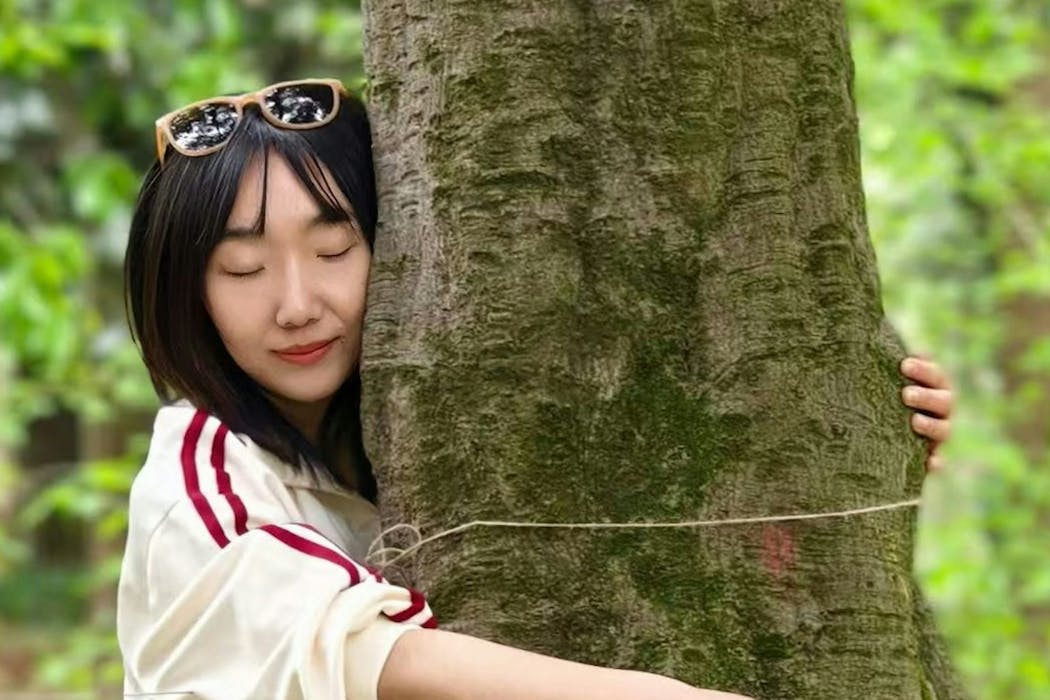
Forest therapist Xinjun Yang enjoys tree hugging in Beijing. Xiaoyand, CC BY-NC-ND

In Beijing’s central district, trees are everywhere. In parks, along roadsides and in courtyards inside people’s houses. Many have only been planted in recent decades.

Others – with wide trunks – have been around for centuries and are cosy to touch: you can form an arm chain around them with a friend, trace your fingers along the bark or rest your ear on the trunk to listen to the inner workings of the tree. To hug a tree is an art. This ability does not come intuitively. It must be learned.

“Hugging trees is a way of having touch in one’s life,” Xiaoyang Wong, the leader of a forest therapy community in Beijing, told me. Wong is a 35-year-old former film editor who recently retrained as a forest therapist after the COVID pandemic left her feeling alone and isolated.

At first, many people feel awkward about hugging a tree, she told me. But in forest therapies, Wong encourages people to understand the tree’s many worlds by observing it at close quarters, watching the ants and other insects as they weave in and out of the grain of the bark.

Only after being curious about it and speaking with it, she encourages people to decide to touch or even hug it. I was a natural at tree hugging, she told me. I, however, had only learned how to hug a tree from watching other people do this supposedly silly practice in parks across the city.

In Beijing, most of the ancient trees are fenced in by the local government to protect them from damage; however, the newer ones are still available for people to touch and gather around.

Seeking relief

On weekends and even late at night, I discovered people – young and old, mothers and daughters, friends and lovers – hugging trees or resting their backs against a trunk while seeking relief from everyday stresses.

These stresses have compounded, especially after the COVID pandemic when loneliness and isolation became commonplace. Moreover, as many young women in China contest the idea of marriage, they seek friendships and new ways of pursuing a good life.

Trees, scholars argue, make young people feel “rooted” and “alive”. In my interviews with more than 25 young women and men as part of my ongoing research – which is yet to be published – I discovered that more women than men went to forest therapy, seeking both friendship with trees and other human beings.

In these therapies, Wong adapted the traditional forest bathing therapies with her own ideas to enhance people’s engagement. These include “plant enactment” where people could take on the name of their favourite tree, and be called by this name all day. She encouraged us, the participants in the therapy, to share a gesture that we associated with our chosen plant, one that described how we imagined the tree would move.

Wong was joined in these sessions by other women who too had given up the pursuit of high-pressure jobs, and had instead taken this part-time work to look after people, trees and plants in the city.

In one of these group sessions, a tree hugger, Florian Mo, expressed his frustration at not being able to find and sustain love in his life. He argued that a key problem with Chinese society was the stigmatisation of the pursuit of love at a young age.

He was 28 and reeling from a break-up. But for Mo, this was only because he had never learned how to love when he was a teenager. If he had done so, not only would he be a better partner today, as he shared with us, he would also be able to move on from his current heartbreak more easily.

For young people like Wong and Mo, trees emerged as spaces to explore themselves and connections to each other. And while the story of China’s urbanisation is often told through images of polluted air, water and soil, young people like Wong and Mo present an alternative narrative: that young Chinese generations seek to repair the urban environment by connecting with others while caring, nurturing and even hugging the trees with their friends and strangers.


Don’t have time to read about climate change as much as you’d like?

Get a weekly roundup in your inbox instead. Every Wednesday, The Conversation’s environment editor writes Imagine, a short email that goes a little deeper into just one climate issue. Join the 47,000+ readers who’ve subscribed so far.


The Conversation

Akanksha Awal receives funding from the ESRC, Leverhulme Trust, and St John’s College. I would like to thank Hangzhang Ding, an undergraduate at Peking University at the time, who accompanied me in the forest therapy session and provided translations throughout the day.

ref. Why so many young people in China are hugging trees – https://theconversation.com/why-so-many-young-people-in-china-are-hugging-trees-269832

Why returning to sport after childbirth is tougher than it looks for triathlete mothers

Source: The Conversation – UK – By Eleri Sian Jones, Lecturer in Sport Psychology, Bangor University

Today’s sporting landscape increasingly accepts that athleticism doesn’t end when motherhood begins. High-profile athletes such as middle-distance runner Faith Kipyegon and rugby player Abbie Ward have helped redefine what’s possible after giving birth.

But for most athletic mothers, the picture is far more complicated than the stories in the media suggest. Understanding those complexities is essential if women are to receive the support they need to thrive postpartum.

Triathlon, which is built on three disciplines demanding relentless training, adds an extra layer of challenge. Mastery isn’t achieved in one arena but across swimming, cycling and running. Each aspect carries its own technical and physical load.

For many women, this intersects with another critical moment. The peak performance age in triathlon often overlaps with the average age of childbirth. In the UK, most women have their first child at around 31. This is precisely when many endurance athletes are hitting their prime. When these timelines collide, returning to training and competition becomes especially complex.

Research my colleagues and I published earlier this year explored the postpartum experiences of ten triathlete mothers, from enthusiastic amateurs to world-class competitors. Their accounts reveal a largely invisible psychological journey, including shifting identities, guilt and resilience.

When expectations meet reality

Before giving birth, most of the women we interviewed expected their return to training to be straightforward. They thought they’d wait for medical clearance, rebuild gradually and carry on. But almost all described a divide between expectation and reality. Some assumed the “rules” of postpartum recovery wouldn’t apply to them, especially those used to high-performance environments.

The challenges weren’t just physical. Many were unprepared for how mentally draining early motherhood would be – the relentless tiredness, the emotional upheaval and the unpredictability of routines that made structured training challenging.

To cope, mothers became experts in efficiency, timing childcare handovers to the minute, squeezing in short but intense sessions and reshaping long-standing training habits to meet the new constraints of family life.

For many women in our study, triathlon wasn’t just a hobby, it was a core part of their identity. Motherhood enriched that identity but also complicated it. Some felt in limbo, unsure whether they could still call themselves athletes. Others found new meaning in training, seeing each hard session as evidence of strength gained rather than strength lost.

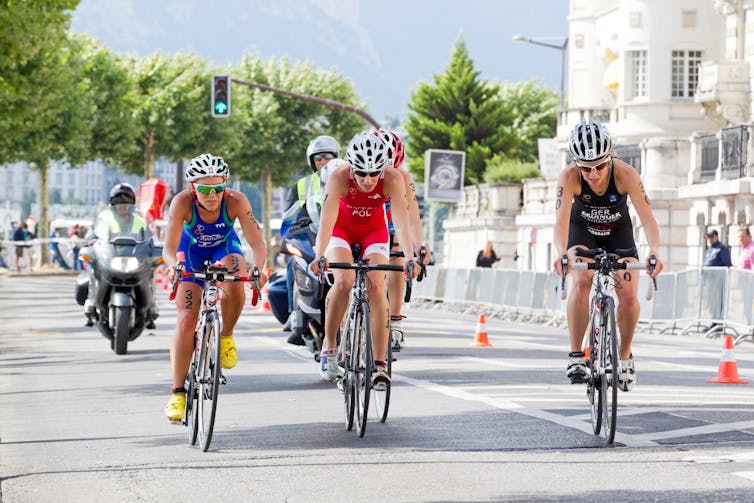
Triathletes competing in the cycling section of the sport on a road.
Triathletes competing in the cycling section of the sport.
Martin Good/Shutterstock

Motivation changed too. Some wanted to prove that athletic ambition doesn’t end with childbirth. Others leaned on training as an essential part of their wellbeing.

Every woman in our study encountered social pressures that shaped how they viewed their training. Guilt was ever-present – guilt for leaving children to train, guilt for not training enough, guilt for wanting something outside motherhood.

This was often tied to the “ethic of care”, which is the social expectation that mothers should put everyone else’s needs ahead of their own. Even within supportive relationships, many felt that childcare defaults to them and that their training was something that required justification.

Social media added another layer. While some drew inspiration from athlete-mothers online, many also recognised how curated these stories were. Rarely did they mention childcare support, financial resources or physical setbacks. Several mothers told us they hid their own struggles to avoid appearing negative or ungrateful.

Nearly all of the women we spoke to described exercise as central to their mental wellbeing. Several felt that continuing to be physically active made them better mothers. But training could also threaten their wellbeing. Reduced training time, physical fatigue and pressure to bounce back led some to feel frustrated. A few questioned whether it was worth continuing if they could never reach their previous performance level.

What needs to change

These stories highlight an urgent need for change across the sporting landscape. Return-to-sport pathways must be holistic, recognising psychological, identity-based and social factors, not just physical clearance. Coaches need better training on postpartum realities. Understanding emotional shifts, fluctuating motivation and identity loss could dramatically improve support for returning mothers.

Partners and families also have a role. Shared responsibility and acknowledgement of the invisible labour of motherhood are essential for sustainable training. And public narratives need greater honesty. More realistic accounts of postpartum recovery, especially on social media, could help challenge comparison culture and reduce stigma.

Triathlete mothers are challenging outdated assumptions about what women can achieve after childbirth. Their stories aren’t about superhuman feats but about navigating ambition, care and physical recovery in tandem.

Returning to sport after childbirth isn’t a simple comeback. It’s a reshaping of identity and a shifting of priorities. It’s time for the systems around them to catch up and provide support that allows these women not only to return, but to thrive.

The Conversation

Eleri Sian Jones does not work for, consult, own shares in or receive funding from any company or organisation that would benefit from this article, and has disclosed no relevant affiliations beyond their academic appointment.

ref. Why returning to sport after childbirth is tougher than it looks for triathlete mothers – https://theconversation.com/why-returning-to-sport-after-childbirth-is-tougher-than-it-looks-for-triathlete-mothers-271668

Is democracy always about truth? Why we may need to loosen our views to heal our divisions

Source: The Conversation – UK – By Frank Chouraqui, Senior University Lecturer in Philosophy, Leiden University

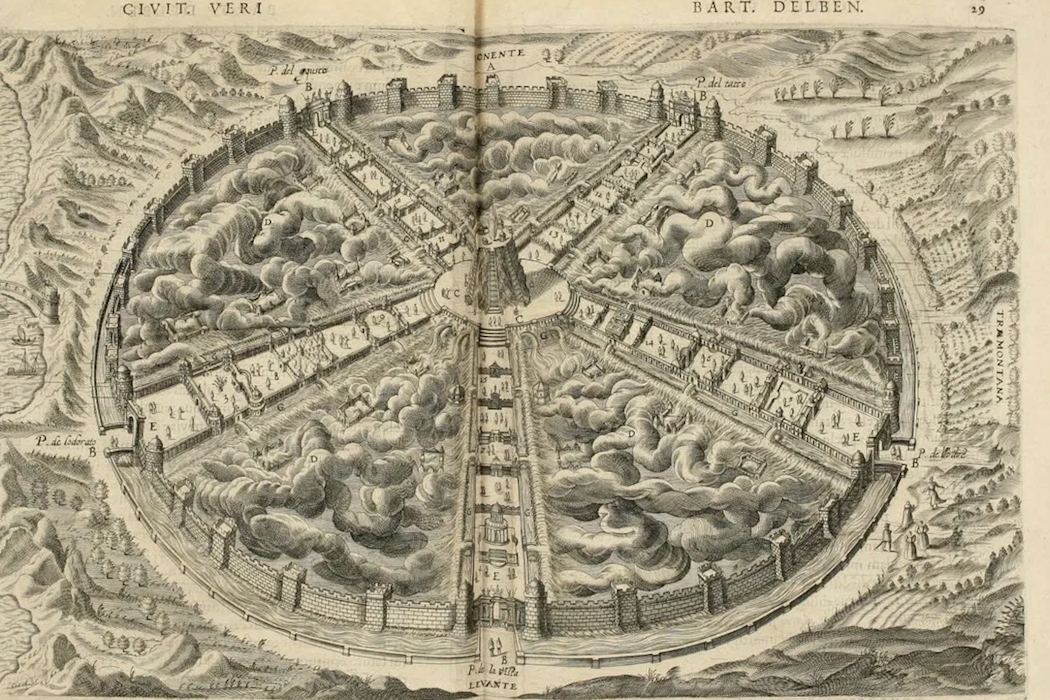
An illustration from an edition of Ambroise and Jérôme Drouart’s poem _Civitas Veri sive Morum_ (The City of Truth). University of Illinois

We find ourselves in the midst of a crisis of truth. Trust in public institutions of knowledge (schools, legacy media, universities and experts) are at an all-time low, and blatant liars are drawing political support around the world. It seems we collectively have ceased to care about the truth.

The nervousness of democrats before this epistemic crisis is partly based on a widespread assumption that the idea of democracy depends on the value of truth. But even this assumption has a cost. Sadly, the democratic tendency to overemphasise the value of truth enters into conflict with other democratic demands. This leads us into contradictions that become fodder for the enemies of open societies.

Philosophers have presented several arguments for this connection between truth and democracy. The most widespread is also the crudest: democracy stands for all the things we like, and truth is one of them.

But there are more sophisticated ways to make the point. The German philosopher Jürgen Habermas argues that a healthy democracy has a deliberative culture and deliberation requires “validity claims”. When we talk about politics, we must bother to try and make sure what we say is true.

Maria Ressa, a Filipino journalist and a Nobel peace prize laureate, similarly argues that democracy needs truth because: “Without facts, you can’t have truth. Without truth, you can’t have trust. Without all three, we have no shared reality, and democracy as we know it – and all meaningful human endeavours – are dead.”

But do we really need truth to share a reality? In practice, most of our experiences of shared realities are not involved in truth. Think of myths, neighbourly feeling, or the sense of community, perhaps even religion and certainly the ultimate shared reality: culture itself. It would be hard to argue that we share in our community’s cultural reality because our culture is true or because we believe it to be true.

Some might argue that democracy is bound to truth because the truth is somehow neutral. Of course, populist suspicion of experts is often couched in democratic language: the value of truth is meant to support a so-called tyranny of experts.

But a key point here is that experts who aim to tell the truth, unlike liars or post-truth populists, have to be accountable. They are subject to the rules of truth. Democracy is therefore potentially more bound to accountability than it necessarily is to truth.

‘Meaningful human endeavour’

Be that as it may, the problem remains that, as Ressa and Habermas themselves recognise, the point of democracy is to promote “meaningful human endeavours”. Democracy is in the business of building a world in which humans can live humanly. And this, crucially, cannot be delivered by truth alone.

A truly human life demands not only knowledge of facts about reality, but also a subjective understanding of the world and of one’s place in it. We often forget that although they often go together, these two requirements can also conflict with each other. This is because truth deals in facts while meanings deal in interpretations.

Understanding, unlike knowledge, is a matter of how we look at the world, of our thinking habits and of cultural constructs – chiefly identities, values and institutions. These things fulfil their function of making us feel at home in the world without making any claim to truth.

All too often, the democratic spirit disqualifies these things as prejudice and superstition. The champions of democratic truth would do well to remember that the world democracy tries to build is a world of meaningful human endeavour, not just dry knowledge and fact-finding.

Current events have illustrated that overlooking this has dire political consequences. The insistence on truth and devaluation of meaning has led to the well-known modern depression often described as a sense of alienation – a breaking of social, historical and traditional bonds with each other and with ourselves.

This alienation has provided a feeding ground for populists and anti-democrats, who present themselves as a corrective to the crisis of meaning. It is not for nothing that the recurring themes of contemporary populism are those of belonging, tradition, identity, origins and nostalgia.

We are experiencing a crisis of truth – but we are also confronting a crisis of meaning. When we overemphasise truth over and against meaning, we foster a sense of alienation and deliver the public into the hands of its enemies. We might instead recall that a commitment to truth is only one, very partial condition for a truly human life, among many others, and build our democracies accordingly.


Want more politics coverage from academic experts? Every week, we bring you informed analysis of developments in government and fact check the claims being made.

Sign up for our weekly politics newsletter, delivered every Friday.


This article contains references to books that have been included for editorial reasons, and this may include links to bookshop.org. If you click on one of the links and go on to buy something from bookshop.org The Conversation UK may earn a commission.

The Conversation

Frank Chouraqui is a non-active member of the Dutch political party Groenlinks-PvdA (center left)

ref. Is democracy always about truth? Why we may need to loosen our views to heal our divisions – https://theconversation.com/is-democracy-always-about-truth-why-we-may-need-to-loosen-our-views-to-heal-our-divisions-269038

A Wonderful Life is not a ‘feel good’ Christmas film – but it is incredibly therapeutic

Source: The Conversation – UK – By Alexander Sergeant, Lecturer in Digital Media Production, University of Westminster

Despite the reputation of It’s a Wonderful Life as a heartwarming Christmas classic, both its fans and detractors like to remind audiences that it’s no feel-good film. For at least two-thirds of its running time, it is essentially the story of a man’s suicide attempt.

We watch as kind-hearted George Bailey has his dreams quashed, his ambitions curtailed and his business ruined. Then it gets even worse. At about two hours in, we watch this poor, despairing man standing on a bridge outside his idyllic small town, crippled by anxiety, overwork, debt and depression, wishing that he had never been born.

The fact that It’s a Wonderful Life remains such a popular Christmas film despite this potentially upsetting subject matter highlights something worth remembering both at Christmas and any time of the year.

We live in an age where suicide remains the number one preventable cause of death for men under 50. Anxiety levels are rocketing among young people. The World Health Organization recently declared rising loneliness a global health threat. For increasing numbers of people, it is most certainly not feeling like a wonderful life.

Understandably, we want to do everything we can to help our fellow George Baileys. We try to think of ways to provide respite from suffering and distress, usually through some pleasant form of distraction. A well meaning boss might organise a mindfulness class on company time for their employees. A friend might take another friend to a wellness retreat.

All of this might work, temporarily at least. Finding space to relax and escape your worries is important, and cinema has provided that to so many people throughout its history. Yet, as many mental health experts will attest, distraction is not a long-term strategy for true wellbeing.

The more effective solution to suffering is to find a way of seeing the world differently. Replacing a negative narrative formed about life with a more positive one is not easily done, but it is possible. We might seek the advice of experts, consult privately with our friends or family, or read self-help books to assist us in this exercise. Or, we can go to the movies.

Alongside helping us to temporarily forget, cinema can help us to live. It’s a Wonderful Life is a great example of that.

As the film enters its final act, its most famous moment occurs. Just at the height of his despair, George is saved from jumping off the bridge by the arrival of a guardian angel named Clarence. At first, the angel distracts George, cracking a few jokes and forcing him to think about something other than his own perilous state. But then Clarence does something miraculous, showing George a vision of what the world would be like if he had never been born.

George is ultimately saved by this profound act of therapy. By showing a world without him, Clarence gives George not a magical solution to his problems, but an opportunity to see the events of his life differently.

Crucially, George gains three things as a result. He learns gratitude. By taking away his accomplishments and privileges, George is able to be reminded of them. He learns purpose. He sees that his life has not been a series of failings, but a series of actions that have helped to shape the world around him.

And he learns about the profound and meaningful connection he has with others around him. As the film’s climax emerges, we see those connections play out, and learn that life is troubling, messy, challenging, unfair, hard and unreliable. It is also utterly wonderful, exactly for that reason.

I’ve never liked “feel-good” films. I’m glad E.T. went home. I think Andy Dufresne shouldn’t have escaped from Shawshank prison. I don’t like it when Bill Murray stops reliving Groundhog Day. But I love It’s a Wonderful Life, not despite of its heartwarming capabilities but because of them.

For me, the film is not a distraction. It isn’t designed to make us feel better by distancing us from the hardship of life. Instead, it’s a profoundly therapeutic film about the hardship of life, one that remarkably finds a positive message that chimes with a lot of what we are finally beginning to learn about the basic principles that grounds human well-being.

Gratitude. Purpose. A sense of connection. These are things that will sustain us, at Christmas and throughout the years that follow. Cinema that profound isn’t just “feel-good”. It could be lifesaving.


Looking for something good? Cut through the noise with a carefully curated selection of the latest releases, live events and exhibitions, straight to your inbox every fortnight, on Fridays. Sign up here.


The Conversation

Alexander Sergeant does not work for, consult, own shares in or receive funding from any company or organisation that would benefit from this article, and has disclosed no relevant affiliations beyond their academic appointment.

ref. A Wonderful Life is not a ‘feel good’ Christmas film – but it is incredibly therapeutic – https://theconversation.com/a-wonderful-life-is-not-a-feel-good-christmas-film-but-it-is-incredibly-therapeutic-271806

We discovered an ancient ‘party boat’ in the waters of Alexandria – here’s what might have happened on board

Source: The Conversation – UK – By Damian Robinson, Director, Oxford Centre for Maritime Archaeology, University of Oxford

Beneath the shifting waters of Alexandria’s eastern harbour, on Egypt’s Mediterranean coast, lie the drowned remnants of a once-splendid city – ports, palaces and temples swallowed by the sea. Submerged by earthquakes and a rising sea level, these lost monuments have become the focus of survey and excavations by the European Institute for Underwater Archaeology, in conjunction with Egypt’s Ministry of Tourism and Antiquities.

Much of our recent work has centred around Antirhodos Island, revealing a temple to the ancient Egyptian goddess Isis which was renovated by Cleopatra VII, and the Timonium – a palace built by her partner, the Roman general Mark Antony.

The shipwrecks from the Royal Port of Antirhodos tell the story of how Alexandria changed from a place emphasising the great wealth and extravagance of the Ptolemaic dynasty to an economic powerhouse of the Roman world.

Our most recent excavations have revealed a shipwreck dating to the early Roman period. Buried beneath the sand were the remains of a thalamagos. This is a type of Nile yacht with a very colourful reputation in Roman literature as “party boats”. But the discovery of such a vessel in a busy commercial harbour was unusual. We asked ourselves: were we thinking about this wreck in the right way?

Discovering the ship

The wrecks in the Royal Port were discovered through a new high-resolution sonar survey of the seabed. This produced enormous quantities of data that was fed into a machine learning algorithm trained to recognise the “signatures” of shipwrecks. The initial results were promising, with excavations on targets generated by the algorithm revealing a small boat and a 30m-long merchant ship.

Together with a similar merchant ship found in the early years of the project, these finds illustrate the commercialisation of the Royal Port in the Roman period.

At the outset of the 2025 mission, we were confident the wreck was a merchant ship. But with each dive, new findings reshaped our understanding, gradually revealing a vessel unlike the one we thought we were investigating.

The wreck has many typical features of Roman Imperial shipbuilding, but the Greek graffiti carved into its planks suggests that it was built and repaired in Alexandria. And its shape is unlike the cargo vessels found elsewhere in the Royal Port. At around 28m long and 7m wide, the preserved remains indicated that we were working on a flat-bottomed boat with a relatively wide and boxy hull. The bow and stern were asymmetrical, giving sweeping curves to the extremities of the ship. But it lacked a mast step, suggesting that it was rowed. The wreck did not have the ideal shape or propulsion system of a seagoing freighter, making it something of a mystery.

In search of clues, we turned to the 500 or so fragments of Ptolemaic and Roman papyri (the material made from the pithy stem of a water plant that these civilisations used to write on) that document nautical subjects. About 200 of these name different types of river vessels, which were often referred to by the cargoes that they carried, from grain, wine and stone to manure and corpses.

One of the infrequently mentioned types of boat is the thalamagos or cabin boat. This kind of vessel is depicted on the Palestrina mosaic, a roughly contemporary landscape with the boat found in a temple outside Rome.

With its crescent shape and series of oars, the mosaic ship bears a striking similarity to the material remains from the Royal Port. While investigations into our wreck are just beginning, it seems that we have found a thalamegos – one of the infamous “party boats” of the Nile.

What happened on ancient party boats

The example on the Palestrina mosaic depicts a cabin boat being used to hunt hippopotami, a ritual associated with the Pharaohs of ancient Egypt. The link between this type of boat and royalty is heard in the philosopher Seneca’s dismissal of them as “the plaything of kings”.

While the Ptolemaic royal family did have Nile yachts, and even supersized versions of them, we can assume that vessels the size of ours would have been a common sight on the river. Indeed, the ancient geographer Strabo wrote about Alexandrians holding feasts aboard cabin boats in shady spots on the waterways around the city. He described them as part of the revelry and licentious behaviour associated with the public festivals at the nearby town of Canopus.

These Roman authors, however, were likely playing up the culture of luxury and excess of their recently defeated enemy’s court and the “degenerate” lifestyles of its people. To simply think about our thalamagos purely as a party boat would be to cherry pick racy Roman stories and fall for their propaganda.

The mundane detail of the administrative papyri reveals that thalamagoi were more than luxurious yachts. They could carry cargo and were also used to transport officials up and down the river. Consequently, the discovery of a cabin boat in a bustling commercial port is not entirely unexpected.

There is, however, another possibility. Our boat was found close to the temple of Isis and may even have been destroyed in the same seismic event that caused the collapse of this sanctuary. Was it a luxurious temple barge used during festivals such as the celebration of the Navigation of Isis?

This celebrated the “opening of the sea” following the winter season was one of the festivals that got Strabo so worked up about the behaviour of its participants. It was actually a festival to ensure the protection of the grain fleet upon which Rome relied to feed its hungry urban population. Strabo chose to overemphasise aspects of the event to suit the anti-Ptolemaic prejudices of his Roman audience.

Detailed post-excavation analysis on this wreck is now underway. We want to understand exactly what our ship looked like and how it performed on the Nile. There is also more work to be done in the library with the ancient texts. What’s for sure is that we’re only just starting to get to know the secrets of this thalamagos.


Looking for something good? Cut through the noise with a carefully curated selection of the latest releases, live events and exhibitions, straight to your inbox every fortnight, on Fridays. Sign up here.


The Conversation

Damian Robinson receives funding from the Hilti Foundation.

Franck Goddio receives funding from the Hilti Foundation.

ref. We discovered an ancient ‘party boat’ in the waters of Alexandria – here’s what might have happened on board – https://theconversation.com/we-discovered-an-ancient-party-boat-in-the-waters-of-alexandria-heres-what-might-have-happened-on-board-272133

How ChatGPT could change the face of advertising, without you even knowing about it

Source: The Conversation – UK – By Nessa Keddo, Senior Lecturer in Media, Diversity and Technology, King’s College London

Summit Art Creations/Shutterstock

Online adverts are sometimes so personal that they feel eerie. Even as a researcher in this area, I’m slightly startled when I get a message asking if my son still needs school shirts a few hours after browsing for clothes for my children.

Personal messaging is part of a strategy used by advertisers to build a more intense relationship with consumers. It often consists of pop-up adverts or follow-up emails reminding us of all the products we have looked at but not yet purchased.

This is a result of AI’s rapidly developing ability to automate the advertising content we are presented with. And that technology is only going to get more sophisticated.

OpenAI, for example, has hinted that advertising may soon be part of the company’s ChatGPT service (which now has 800 million weekly users). And this could really turbocharge the personal relationship with customers that big brands are desperate for.

ChatGPT already uses some advanced personalisation, making search recommendations based on a user’s search history, chats and other connected apps such as a calendar. So if you have a trip to Barcelona marked in your diary, it will provide you – unprompted – with recommendations of where to eat and what to do when you get there.

In October 2025, the company introduced ChatGPT Atlas, a search browser which can automate purchases. For instance, while you search for beach kit for your trip to Barcelona, it may ask: “Would you like me to create a pre-trip beach essentials list?” and then provide links to products for you to buy.

“Agent mode” takes this a step further. If a browser is open on the page of a swimsuit, a chat box will appear where you can ask specific questions. With the browser history saved, you can log back in and ask: “Can you find that swimsuit I was looking at last week and add it to the basket in a size 14?”

Another new feature (only in the US at the moment), “instant checkout”, is a partnership with Shopify and Etsy which allows users to browse and immediately purchase products without leaving the platform. Retailers pay a small fee on sales, which is how OpenAI monetises this service.

However, only around 2% of all ChatGPT searches are shopping-related, so other means of making money are necessary – which is where full-on incorporated advertising may come in.

One app, lots of ads?

OpenAI’s rapid growth requires heavy investment, and its chief financial officer, Sarah Friar, has said the company is “weighing up an ads model”, as well as recruiting advertising specialists from rivals Meta and Google.

But this will take some time to get right. Some ChatGPT users have already been critical of a shopping feature which they said made them feel like they were being sold to. Clearly a re-design is being considered, as the feature was temporarily removed in December 2025.

So there will continue to be experimentation into how AI can be part of what marketers call the “consumer journey” – the process customers go through before they end up buying something.

Person riding an upright vehicle being 'targeted' by an advert screen showing an alternative with the words 'try this'.
Targeted traveller.
Scharfsinn/Shutterstock

Some consumers prefer to use customer reviews and their own research or experience. Others appreciate AI recommendations, but studies suggest that overall, some sense of autonomy is essential for people to truly consider themselves happy customers. It has also been shown that audiences dislike aggressive “retargeting”, where they are continuously bombarded with the same adverts.

So the option of ChatGPT automatically providing product recommendations, summaries and even purchasing items on our behalf might seem very tempting to big brands. But most consumers will still prefer a sense of agency when it comes to spending their money.

This may be why advertisers will work on new ways to blur the lines – where internet search results are blended with undeclared brand messaging and product recommendations. This has long been the case on Chinese platforms such as WeChat, which includes e-commerce, gaming, messaging, calling and social networking – but with advertising at its core.

In fact, platforms in the west seem far behind their East Asian counterparts, where users can do most of their day-to-day tasks using just one app. In the future, a similarly centralised approach may be inevitable elsewhere – as will subliminal advertising, with the huge potential for data collection that a single multi-functional app can provide.

Ultimately, transparency will be minimal and advertising will be more difficult to recognise, which could be hard on vulnerable users – and not the kind of ethically responsible AI that many are hoping for.

The Conversation

Nessa Keddo has previously received funding from the AHRC.

ref. How ChatGPT could change the face of advertising, without you even knowing about it – https://theconversation.com/how-chatgpt-could-change-the-face-of-advertising-without-you-even-knowing-about-it-270330

Humans could have as many as 33 senses

Source: The Conversation – UK – By Barry Smith, Director of the Institute of Philosophy, School of Advanced Study, University of London

Max4e Photo/Shutterstock

Stuck in front of our screens all day, we often ignore our senses beyond sound and vision. And yet they are always at work. When we’re more alert we feel the rough and smooth surfaces of objects, the stiffness in our shoulders, the softness of bread.

In the morning, we may feel the tingle of toothpaste, hear and feel the running water in the shower, smell the shampoo, and later the aroma of freshly brewed coffee.

Aristotle told us there were five senses. But he also told us the world was made up of five elements and we no longer believe that. And modern research is showing we may actually have dozens of senses.

Almost all of our experience is multisensory. We don’t see, and hear, smell and touch in separate parcels. They occur simultaneously in a unified experience of the world around us and of ourselves.

What we feel affects what we see and what we see affects what we hear. Different odours in shampoo can affect how you perceive the texture of hair. The fragrance of rose makes hair seem silkier, for instance.

Odours in low-fat yogurts can make them feel richer and thicker on the palate without adding more emulsifiers. Perception of odours in the mouth, rising to the nasal passage, are modified by the viscosity of the liquids we consume.

My long-term collaborator, professor Charles Spence from the Crossmodal Laboratory in Oxford, told me his neuroscience colleagues believe there are anywhere between 22 and 33 senses.

These include proprioception, which enables us to know where our limbs are without looking at them. Our sense of balance draws on the vestibular system of ear canals as well as sight and proprioception.

Another example is interoception, by which we sense changes in our own bodies such as a slight increase in our heart rate and hunger. We also have a sense of agency when moving our limbs: a feeling that can go missing in stroke patients who sometimes even believe someone else is moving their arm.

There is the sense of ownership. Stroke patients sometimes feel their, for instance, arm is not their own even though they may still feel sensations in it.

Some of the traditional senses are combinations of several senses. Touch, for instance involves pain, temperature, itch and tactile sensations. When we taste something we are actually experiencing a combination of three senses: touch, smell and taste – or gustation – which combine to produce the flavours we perceive in food and drinks.

Person trails hand in stream with hills in the background.
How many senses is this person using to perceive the water?
Antonio Guillem/Shutterstock

Gustation, covers sensations produced by receptors on the tongue that enable us to detect salt, sweet, sour, bitter and umami (savoury). What about mint, mango, melon, strawberry, raspberry?

We don’t have raspberry receptors on the tongue, nor is raspberry flavour some combination of sweet, sour and bitter. There is no taste arithmetic for fruit flavours.

We perceive them through the combined workings of the tongue and the nose. It is smell that contributes the lion’s share to what we call tasting.

This is not inhaling odours from the environment, though. Odour compounds are released as we chew or sip, travelling from the mouth to the nose though the nasal pharynx at the back of throat.

Touch plays its part too, binding tastes and smells together and fixing our preferences for runny or firm eggs, and the velvety, luxuriousness gooeyness of chocolate.

Sight is influenced by our vestibular system. When you are on board an aircraft on the ground, look down the cabin. Look again when you are in the climb.

It will “look” to you as though the front of the cabin is higher than you are, although optically, everything is in the same relation to you as it was on the ground. What you “see” is the combined effect of sight and your ear canals telling you that you are titling backwards.

The senses offer a rich seam of research and philosophers, neuroscientists and psychologists work together at the Centre for the Study of the Senses at the University of London’s School of Advanced Study.

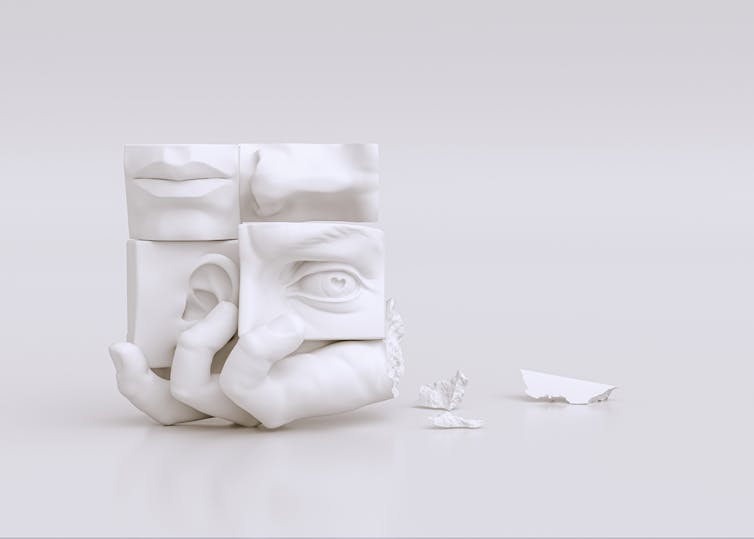
Five human senses concept: smell, touch, sight, taste, hearing. 3d rendering parts of face sense organs and hand of white sculpture
The five traditional senses can’t cover all the ways we process the environment,
SVPanteon/Shutterstock

In 2013, the centre launched its Rethinking the Senses project, directed by my colleague, the late Professor Sir Colin Blakemore. We discovered how modifying the sound of your own footsteps can make your body feel lighter or heavier.

We learned how audioguides in Tate Britain art museum that address the listener as if the model in a portrait was speaking enable visitors to remember more visual details of the painting. We discovered how aircraft noise interferes with our perception of taste and why you should always drink tomato juice on a plane.

While our perception of salt, sweet and sour is reduced in the presence of white noise, umami is not, and tomatoes, and tomato juice is rich in umami. This means the aircraft’s noise will taste enhance the savoury flavour.

At our latest interactive exhibition, Senses Unwrapped at Coal Drops Yard in London’s King’s Cross, people can discover for themselves how their senses work and why they don’t work as we think they do.

For example, the size-weight illusion is illustrated by a set of small, medium and large curling stones. People can lift each one and decide which is heaviest. The smallest one feels heaviest, but people can them place them on balancing scales and discover that they are all the same weight.

But there are always plenty of things around you to show how intricate your senses are, if you only pause for a moment to take it all in. So next time you walk outside or savour a meal, take a moment to appreciate how your senses are working together to help you feel all the sensations involved.

The Conversation

Barry Smith has received funding from the Arts and Humanities Research Council for his research on multisensory experience, which underpins the creation of this exhibition on the senses,

ref. Humans could have as many as 33 senses – https://theconversation.com/humans-could-have-as-many-as-33-senses-270697

What world was Jesus born into? A historian describes the turbulent times of the real nativity

Source: The Conversation – Global Perspectives – By Joan Taylor, Professor Emerita of Christian Origins and Second Temple Judaism, King’s College London

Getty Images

Every year, millions of people sing the beautiful carol Silent Night, with its line “all is calm, all is bright”.

We all know the Christmas story is one in which peace and joy are proclaimed, and this permeates our festivities, family gatherings and present-giving. Countless Christmas cards depict the Holy Family – starlit, in a quaint stable, nestled comfortably in a sleepy little village.

However, when I began to research my book on the childhood of Jesus, Boy Jesus: Growing up Judaean in Turbulent Times, that carol started to sound jarringly wrong in terms of his family’s actual circumstances at the time he was born.

The Gospel stories themselves tell of dislocation and danger. For example, a “manger” was, in fact, a foul-smelling feeding trough for donkeys. A newborn baby laid in one is a profound sign given to the shepherds, who were guarding their flocks at night from dangerous wild animals (Luke 2:12).

When these stories are unpacked for their core elements and placed in a wider historical context, the dangers become even more glaring.

Take King Herod, for example. He enters the scene in the nativity stories without any introduction at all, and readers are supposed to know he was bad news. But Herod was appointed by the Romans as their trusted client ruler of the province of Judaea. He stayed long in his post because he was – in Roman terms – doing a reasonable job.

Jesus’ family claimed to be of the lineage of Judaean kings, descended from David and expected to bring forth a future ruler. The Gospel of Matthew begins with Jesus’ entire genealogy, it was that important to his identity.

But a few years before Jesus’ birth, Herod had violated the tomb of David and looted it. How did that affect the family and the stories they would tell Jesus? How did they feel about the Romans?

A time of fear and revolt

As for Herod’s attitude to Bethlehem, remembered as David’s home, things get yet more dangerous and complex.

When Herod was first appointed, he was evicted by a rival ruler supported by the Parthians (Rome’s enemy) who was loved by many local people. Herod was attacked by those people just near Bethlehem.

He and his forces fought back and massacred the attackers. When Rome vanquished the rival and brought Herod back, he built a memorial to his victorious massacre on a nearby site he called Herodium, overlooking Bethlehem. How did that make the local people feel?

Bethlehem (in 1898-1914) with Herodium on the skyline: memorial to a massacre.
Matson Collection via Wikimedia Commons

And far from being a sleepy village, Bethlehem was so significant as a town that a major aqueduct construction brought water to its centre. Fearing Herod, Jesus’ family fled from their home there, but they were on the wrong side of Rome from the start.

They were not alone in their fears or their attitude to the colonisers. The events that unfolded, as told by the first-century historian Josephus, show a nation in open revolt against Rome shortly after Jesus was born.

When Herod died, thousands of people took over the Jerusalem temple and demanded liberation. Herod’s son Archelaus massacred them. A number of Judaean revolutionary would-be kings and rulers seized control of parts of the country, including Galilee.

It was at this time, in the Gospel of Matthew, that Joseph brought his family back from refuge in Egypt – to this independent Galilee and a village there, Nazareth.

But independence in Galilee didn’t last long. Roman forces, under the general Varus, marched down from Syria with allied forces, destroyed the nearby city of Sepphoris, torched countless villages and crucified huge numbers of Judaean rebels, eventually putting down the revolts.

Archelaus – once he was installed officially as ruler – followed this up with a continuing reign of terror.

A nativity story for today

As a historian, I’d like to see a film that shows Jesus and his family embedded in this chaotic, unstable and traumatic social world, in a nation under Roman rule.

Instead, viewers have now been offered The Carpenter’s Son, a film starring Nicholas Cage. It’s partly inspired by an apocryphal (not biblical) text named the Paidika Iesou – the Childhood of Jesus – later called The Infancy Gospel of Thomas.

You might think the Paidika would be something like an ancient version of the hit TV show Smallville from the 2000s, which followed the boy Clark Kent before he became Superman.

But no, rather than being about Jesus grappling with his amazing powers and destiny, it is a short and quite disturbing piece of literature made up of bits and pieces, assembled more than 100 years after the life of Jesus.

The Paidika presents the young Jesus as a kind of demigod no one should mess with, including his playmates and teachers. It was very popular with non-Jewish, pagan-turned-Christian audiences who sat in an uneasy place within wider society.

The miracle-working Jesus zaps all his enemies – and even innocents. At one point, a child runs into Jesus and hurts his shoulder, so Jesus strikes him dead. Joseph says to Mary, “Do not let him out of the house so that those who make him angry may not die.”

Such stories rest on a problematic idea that one must never kindle a god’s wrath. And this young Jesus shows instant, deadly wrath. He also lacks much of a moral compass.

But this text also rests on the idea that Jesus’ boyhood actions against his playmates and teachers were justified because they were “the Jews”. “A Jew” turns up as an accuser just a few lines in. There should be a content warning.

The nativity scene from The Carpenter’s Son is certainly not peaceful. There is a lot of screaming and horrific images of Roman soldiers throwing babies into a fire. But, like so many films, the violence is somehow just evil and arbitrary, not really about Judaea and Rome.

It is surely the contextual, bigger story of the nativity and Jesus’ childhood that is so relevant today, in our times of fracturing and “othering”, where so many feel under the thumb of the unyielding powers of this world.

In fact, some churches in the United States are now reflecting this contemporary relevance as they adapt nativity scenes to depict ICE detentions and deportations of immigrants and refugees.

In many ways, the real nativity is indeed not a simple one of peace and joy, but rather one of struggle – and yet mystifying hope.

The Conversation

Joan Taylor has previously received funding from the Leverhulme Trust, Wellcome Trust, Fulbright Commission, Palestine Exploration Fund and other scholarly societies.

ref. What world was Jesus born into? A historian describes the turbulent times of the real nativity – https://theconversation.com/what-world-was-jesus-born-into-a-historian-describes-the-turbulent-times-of-the-real-nativity-268080

When kids move overseas: why visits are so rare for South Africa’s emigrant families

Source: The Conversation – Africa – By Sulette Ferreira, Transnational Family Specialist and Researcher, University of Johannesburg

More than one million South Africans, about 1.6% of the country’s population of 63 million, currently live overseas. Emigration is never a solitary event or a purely economic decision. When one person leaves, an entire network of relationships is reshaped. This means that parents, grandparents, siblings and friends are left behind, making it challenging to maintain close bonds across continents.

Despite vast geographical distances and the challenges of differing time zones, the enduring parent–child bond motivates families to seek meaningful ways to stay connected. Among the most powerful of these are transnational visits. For those who can travel, these visits serve as an emotional and relational lifeline: they allow parents to step into their adult children’s newly formed worlds, observe their daily routines, and build or maintain bonds with grandchildren born or raised abroad.

Although families stay connected through technology, parents emphasise that virtual contact cannot replace the desire for in-person connection. Yet this longing is often unmet. For many families, visiting is a deeply felt desire rather than a realistic possibility.

In a recent research paper I examined barriers to transnational visits from South African parents to their emigrant children. It intentionally centres on the experiences of parents travelling abroad, rather than on return visits to South Africa.

In total, 37 participants took part. They were South African citizens from a range of racial, cultural and religious backgrounds. They were between 50 and 85 years old. They were fluent in English and were parents of adult child(ren) who had emigrated and lived abroad for at least one year.

Most participants were women. Their children had emigrated to a range of countries, including Australia, New Zealand, the UK and the US. This aligns with global trends of South African emigration to English-speaking, economically developed countries.

The research uncovered the intertwined financial, emotional, physical, relational, and bureaucratic complexities that shape whether, how, and how often these visits take place.

Why visits matter

For transnational families, visits allow parents and children to revive and nurture attachments. They complement virtual interactions, video calls, instant messages and social media.

For parents, visiting their children’s homes bridges the gap between imagined spaces created through video calls and the lived realities of those environments. These experiences foster deeper emotional connections, enabling families to share closeness, engage in mutual care, and observe unspoken cues such as body language and tone, elements foundational to sustaining relationships.

Despite their importance, the rarity of transnational visits emerged clearly from participants’ narratives. While a small number of parents in the study were able to visit annually or every couple of years, this was the exception rather than the norm. For most, visits were rare events.

Although nearly all parents longed to visit more frequently, the majority had visited only once and several had never visited at all. Those who had visited spoke about long gaps between visits and the uncertainty of when or whether a next visit would ever be possible. This absence amplifies the loneliness experienced and leaves parents feeling increasingly “out of sync” with their children’s lives, at times even “irrelevant”.

Three main challenges

Parents consistently expressed a desire to visit more often. Yet this longing was constrained by the realities of their circumstances. Three major challenges emerged across the qualitative interviews.

Financial constraints: This was the most significant barrier, often preventing parents from realising their desire to visit their emigrant children. Air travel from South Africa to destinations such as Australia, New Zealand, Canada and the US is expensive. The South African rand’s weak exchange rate against strong currencies turns even modest flights into luxury purchases.

Retirees living on fixed incomes often find themselves caught between safeguarding their financial stability and meeting the deep emotional need to reconnect with their children and grandchildren.

It is terribly expensive. If I now had to, I would scratch the money out from somewhere and I can afford it, but I need to look after myself as well. Even if you have money, you don’t spend your money on something that is really absurd, like the price of air tickets at this stage is completely absurd.

Hidden expenses can also make visits even more challenging. Visa application fees, compulsory health insurance and medical examinations quickly add up.

Logistical strain: The geographical distance between South Africa and the popular emigration destinations such as Australia, the United States and New Zealand presents significant obstacles. For many elderly parents, long-haul travel is physically and mentally demanding.

As one participant shared:

The trip to America … there’s a lot of jet lag, and it’s not an easy trip to make. You know, if your kids are in Europe or England, there’s no time delay, no jet lag or anything like that.

Chronic illnesses, mobility limitations and fatigue make these journeys even more challenging. For some parents, the physical toll makes travel unmanageable or medically inadvisible.

Practical considerations, especially how long to stay, long enough to make the trip worthwhile but not too long to disrupt routines, add another layer of complexity. These decisions make planning a visit both logistically and emotionally taxing.

The emotional weight of saying goodbye: Every visit carries an inevitable ending. With no certainty about when, or if, the next visit will happen, each departure feels like a potential final farewell, especially for older parents. The joy of togetherness becomes tinged with the dread of parting, a heaviness that grows as the end of the visit approaches. For many, the farewell at the end of a visit is one of the most emotionally difficult moments.

As a grandmother describes:

And then a big factor is the sadness with the goodbye and for weeks after that you still struggle and can’t get back on track properly. For me, it gets more intense every time.

Some parents avoid visiting altogether because the emotional cost of departure outweighs the joy of being together.

Longing for presence

Many transnational parents must face the reality that limited financial, physical, or emotional resources will restrict the number of visits they can undertake in their lifetime. While digital communication helps families stay connected across borders, parents emphasised that virtual contact cannot recreate the intimacy that grows from in-person visits: the shared routines, playful moments and physical closeness.

Visits matter because they offer what digital technologies cannot fully provide: presence.

The Conversation

Sulette Ferreira does not work for, consult, own shares in or receive funding from any company or organisation that would benefit from this article, and has disclosed no relevant affiliations beyond their academic appointment.

ref. When kids move overseas: why visits are so rare for South Africa’s emigrant families – https://theconversation.com/when-kids-move-overseas-why-visits-are-so-rare-for-south-africas-emigrant-families-270509