Why I had to become a murder detective for my book about an 18th-century Jewish pedlar

Source: The Conversation – UK – By Tony Kushner, James Parkes Professor of Jewish/non-Jewish Relations, University of Southampton
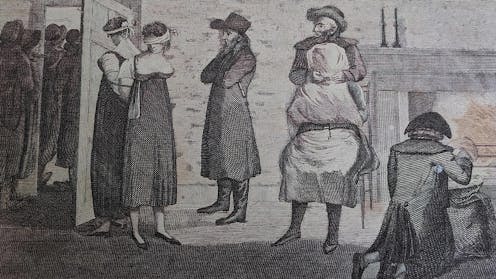
An illustration of the crime from 1771. London Jewish Museum

This article contains details of antisemitism and violence that some readers may find upsetting.

It’s evening at a remote Sussex pub in 1734 and a vicious triple murder has just taken place. Jacob Harris – a Jewish pedlar, smuggler and possible highwayman – stands accused of slitting the throats of the publican, his ill wife and a female servant.

I’ve studied the case for my latest book, The Jewish Pedlar: An Untold Criminal History. The point of interest for me was not whether Harris was guilty (he probably was). Or even whether – despite the seriousness of the crime – he was a victim of English antisemitism in everything from the newspaper coverage to the way he was later remembered. I was more interested in a series of questions about Harris’s background and motivations.

Harris had many aliases including Hirshal Hirsh and James Daves, reflecting both his criminal tendencies and complex identity that was both continental Jewish and very local. How on earth did someone of German-Jewish origin manage to integrate himself into the close-knit smuggling fraternity of Sussex?

What was Harris even doing in Ditchling Common, many decades before there was anything approximating to a Jewish community in Sussex? And what motivated him to commit the murders?

Despite the potential for prejudice against Jewish people at the time, I concluded that in the criminal world, as long as someone was trusted and useful, their background did not matter. It was only when Harris fell out with a fellow smuggler leading to a fatal fight that his life fell apart. The quandary for me as a social and cultural historian was how to write anything like a biography of Harris when there are no direct quotes from him in the surviving archive.

Completing my 340-page study therefore felt like somewhat of an achievement. To do so required intricate detective work (and indeed the advice of a real retired detective) to interrogate every piece of contemporary evidence.

This included the sparse legal record of the murders, the first Sussex assizes (court) record to be kept in the National Archives at Kew; a contemporary diary from a local landholder; and copious reports in British newspapers which “borrowed” heavily from one another.

There was also a bill sent to the Treasury by the county of Sussex for the catching, imprisonment, trial, hanging and gibbeting of Harris (gibbeting involves placing a hanged body in a specially constructed iron cage at the scene of the crime). And there was a ballad which would have been written and sold at the gibbeting and has survived in various forms ever since.

Not one of these sources is straightforward, and this is also true of most of the authors and major players in contemporary responses to the murders.

The complexities of the case

Harris was not the only person in the case who had multiple names. There was also his first victim, the publican Richard Miles. His many names strongly suggest that he was on the wrong side of the law and almost certainly a fellow smuggler.

The lead justice of peace in the case, who later became an MP and major landowner, had also changed his name. As did the newspaper entrepreneur who was the only one who made explicit Harris’s Jewishness when reporting in his new title, Walker’s Weekly Post.

Even Sir Robert Eyre, the judge from London who sentenced Harris to be hanged and gibbeted, had a reputation for corruption, though I’m not saying it affected the decision in this case. I don’t doubt that Harris was guilty of the horrendous crimes he was charged with.

The gibbeted body

Having been found guilty in the county assizes at Horsham and hanged in that town, Harris’ body was then carted to the scene of the crime a good 15 miles away to be placed in the gibbet cage.

Illustration of a post surrounded by a crude wooden fence
Remnants of the gibbet post, illustration from Thomas Blaker, Burgess Hill as a Health Resort (1883).
Author provided

A history of a local Sussex family compiled over many generations suggests that his skull remained in the cage some decades later. The post from which the gibbet cage was hung remained in position for much longer and soon became known as “Jacob’s Post”. Despite his crimes and his Jewish origins, he became a local folk hero.

To this day there is a heritage display on Ditchling Common to mark this momentous event in the district’s history.

Later Jewish criminals who were hanged became prized for their body parts by surgeons such as William Hunter (of the Hunterian museum in London) for racialised display. I didn’t want to treat Harris as this kind of object of study, but as a human being with family and friends (and no doubt enemies).

To discover more about Harris, his occupations and identity, I covered the period up to the second world war and followed Jewish pedlars and criminals in many different places from China to South America, from Sierra Leone to the Hebrides and from South Africa to the Caribbean. I also charted how the memory of Harris altered through time, from the Victorians who saw him as racially different and “naturally” criminal, through to a growing sensitivity towards his Jewishness in a post-Holocaust world.

It might be argued that at a time of growing hostility towards those of migrant origin and increasing racism, including antisemitism, what we don’t need now is a book on a Jewish criminal. I would argue that by trying to understand the individuality of these often remarkable – if often controversial – figures, it emphasises their fundamental humanity.

We cannot – and must not – expect any group of people to be perfect. As an asylum seeker (a former professional in Yemen) in an Essex hotel which has been subject to constant demonstrations in summer 2025 told The Guardian: “Yes, there are some refugees who do not behave respectfully or who do not follow the rules of the host society.” He added that this should not mean that all are regarded as such and that “every refugee has a story, and every human deserves dignity”.

In this respect in my book I certainly do not glorify Harris or downplay his crimes. I do, however, insist that he is not demonised as a “Jew murderer” as the Victorians would have it, and that see him instead as part and parcel of 18th century English rural life – a world far more diverse than we often assume.


Looking for something good? Cut through the noise with a carefully curated selection of the latest releases, live events and exhibitions, straight to your inbox every fortnight, on Fridays. Sign up here.


This article features references to books that have been included for editorial reasons, and may contain links to bookshop.org. If you click on one of the links and go on to buy something from bookshop.org The Conversation UK may earn a commission.

The Conversation

Tony Kushner does not work for, consult, own shares in or receive funding from any company or organisation that would benefit from this article, and has disclosed no relevant affiliations beyond their academic appointment.

ref. Why I had to become a murder detective for my book about an 18th-century Jewish pedlar – https://theconversation.com/why-i-had-to-become-a-murder-detective-for-my-book-about-an-18th-century-jewish-pedlar-262671


Winners and losers in a hotter ocean

Source: The Conversation – UK – By Will de Freitas, Environment + Energy Editor, The Conversation

Meet your winners. E. PUIG / shutterstock

The ocean is heating up – in some places, faster than scientists once thought possible. For the fish, crustaceans and plankton that underpin life in the sea, this means habitats will shift, food supplies will change, and predators may suddenly find their prey has vanished. This isn’t a simple story of loss, but of winners and losers in a lottery weighted by climate change.


This roundup of The Conversation’s climate coverage comes from our award-winning weekly climate action newsletter. Every Wednesday, The Conversation’s environment editor writes Imagine, a short email that goes a little deeper into just one climate issue. Join the 45,000+ readers who’ve subscribed.


Fish are already threatened by polluted seas and overfishing by humans. Climate change adds another threat by reshaping the very waters they depend on – testing their ability to adapt.

Sevrine Sailley, a marine ecosystem modeller at Plymouth Marine Laboratory, explains:

“As the ocean heats up, fish try to stay in the conditions they’re best suited to. Some species will move, but others can’t relocate so easily – for example, if they need to live in a certain habitat at a particular life-stage, such as in kelp that offers shelter for breeding fish.”

Sailley and her colleagues used a computer programme to simulate the oceans around the UK over the rest of this century. They looked at 17 key commercial species and identified some winners and losers:

“While sardines may thrive, with a 10% boost in Atlantic abundance, our model suggests mackerel could decline by 10% in the Atlantic and 20% in the North Sea.”

Warm-water species like bluefin tuna could do well, she writes, but “bottom-dwelling species like cod and saithe (pollock) face a tougher future. These fish prefer colder, deeper waters and have fewer options to escape warming seas due to depth limitations.”


Read more:
How climate change is making Europe’s fish move to new waters


Sudden changes

Those fish are typically responding to what’s happening below them in the food web. And these shifts don’t just play out slowly. They can unfold dramatically during events such as marine heatwaves, when the sea itself becomes layered in ways that choke the food web.

Ocean scientist Tom Rippeth of Bangor University described this process during an “unprecedented” heatwave in the seas around the UK two years ago. That summer, the already-warm surface was heating up faster than ever.

Smiley cod fish
This cod has nothing to smile about.
Miroslav Halama / shutterstock

“Those stratified seas”, Rippeth writes, “on the continental shelf around Britain and Ireland are some of the most biologically productive on the planet. They have long been an important area for fishing cod, haddock, mackerel and other species. Those fish eat smaller fish and crustaceans, which in turn feed on microscopic plants known as plankton.”

Those plankton depend on nutrients mixed up from the deep water into the surface layer. However, during the marine heatwave, Rippeth feared the high surface temperatures would mean stronger stratification, less mixing, and a diminished supply of nutrients.

Bad news for the plankton. And bad news that will ripple up the food web.


Read more:
An ‘extreme’ heatwave has hit the seas around the UK and Ireland – here’s what’s going on


What the jellyfish tell us

Few creatures illustrate these shifts more clearly than jellyfish. Marine conservation expert Abigail McQuatters-Gollop of the University of Plymouth says jellyfish numbers are increasing in certain regions, including the UK. For her, this is a signal of dramatic changes in the ocean food web.

Jellyfish tend to feed directly on plankton, so they’re pretty low in the food web. In fact, since they drift rather than swim, they’re technically plankton themselves. Yet they’re big enough (and scary enough, in some eyes) for humans to notice when their numbers rise, which makes them an eye-catching indicator that waters are warming.

“Warmer sea temperatures”, McQuatters-Gollop writes, “mean that jellyfish can now inhabit a wider range of habitats, with some species moving polewards into waters that were once too cold for them.”

This has changed how energy moves through the food web:

“The warmer-water zooplankton species which now dominate northern European waters are generally smaller and less nutritious than the cold-water species they have replaced.”

It also contributes to what scientists call a predator-prey mismatch.

“While the seasonal cycle of phytoplankton [tiny plants] is driven by sunlight and so hasn’t changed, the point in the year when some zooplankton species [tiny animals] are most abundant now arrives earlier, as shorter and warmer winters cause the eggs of some species to hatch sooner. This has meant a mismatch between the spring phytoplankton bloom and the annual peak abundance of the zooplankton that gorge on it.”

These shifts cascade upwards through the food web – one reason why those warm-water bluefin tuna are likely to prosper in UK waters, while cold-water cod and herring are set to struggle.


Read more:
Jellyfish alert: increased sightings signal dramatic changes in ocean food web due to climate change


Post-carbon

Last week, we asked if severe heatwaves have affected your holiday plans. Several readers said they had given up on summer holidays in hot countries entirely.

For instance Andrew Strong said: “We are not holidaying in Europe between June and September, not even in the UK! It’s too much.”

Next week, we’d like your thoughts on air conditioning at home. Do you have it? Do you want it? Do you see it as an unnecessary and frivolous waste of energy, or an inevitable response to increasing summer heat? (If you’re American or Australian, do you laugh at us backwards Europeans for even having this debate?).

The Conversation

ref. Winners and losers in a hotter ocean – https://theconversation.com/winners-and-losers-in-a-hotter-ocean-263556

How cloves might help relieve pain and inflammation

Source: The Conversation – UK – By Dipa Kamdar, Senior Lecturer in Pharmacy Practice, Kingston University

Jamaan/Shutterstock

Cloves have long been a staple in kitchens and traditional medicine cabinets. Known for their warm, spicy flavour, they’re typically found whole or ground, and as clove oil or extract. But beyond their culinary charm, cloves are gaining scientific attention from researchers and clinicians for their potent analgesic (painkiller) properties. But could this humble spice rival ibuprofen or other commonly used painkillers?

Cloves, the aromatic flower buds of the Syzygium aromaticum tree, are native to Indonesia and widely used in global cuisines, especially in spice blends and festive dishes. Medicinally, they’re most commonly used in the form of clove oil. It contains eugenol, a compound with well-documented anaesthetic and anti-inflammatory effects.

Eugenol, the main active compound in cloves, is a naturally occurring plant chemical that works in multiple ways. It blocks certain chemicals and nerve responses that cause pain, including histamine – a chemical involved in immune responses, inflammation and allergic reactions – and noradrenaline, a neurotransmitter and hormone that can heighten pain sensitivity during stress.

Eugenol also inhibits the production of prostaglandins – substances that trigger inflammation and contribute to pain and swelling. This is the same biological pathway targeted by anti-inflammatory painkillers like ibuprofen. Because of these anti-inflammatory effects, eugenol could, in theory, be useful for conditions such as arthritis, although human evidence is limited. In an animal study, eugenol improved limb function in rats with osteoarthritis.

While research into its use for joint pain is still in early stages, most of the solid human evidence for cloves comes from dentistry.

Clove extracts are used in balms or diluted oils for muscle aches, brewed into teas for headaches, and applied as oil for toothache. Cloves have been a go-to dental remedy since at least the 13th century. Clove oil remains available in pharmacies for temporary toothache relief in adults and children over two years.

Studies suggest cloves may provide pain relief comparable to some conventional painkillers and topical anaesthetics. In dentistry, topical anaesthetics such as lidocaine or benzocaine are applied to the surface of the gums or skin to numb an area before treatment. They work by blocking pain signals from nerves near the surface – a mechanism thought to be similar to that of eugenol.

In paediatric dentistry, researchers compared clove oil, lidocaine gel and ice cones applied to injection sites in the mouth. Clove oil emerged as the most effective in reducing pain and anxiety among children, suggesting it could be a natural, cost-effective and well-accepted option to improve dental experiences. Another clinical trial in adults found clove gel to be as effective as benzocaine gel in minimising pain from dental injections, with no significant difference in pain scores.

These findings are supported by broader reviews, which show that topical clove preparations consistently outperform placebo treatments. In dental procedures, clove oil and gels not only reduce pain but also offer antiseptic and anti-inflammatory effects.

Beyond dentistry

There’s also evidence for using cloves in other types of pain relief. In one clinical trial, combining topical clove oil with lidocaine significantly reduced pain at episiotomy sites (the small surgical cuts made between the vagina and anus during childbirth to help deliver the baby) compared with lidocaine alone. These results suggest that clove oil may enhance the effectiveness of standard anaesthetics.

Cloves may also offer a range of other potential health benefits. Laboratory and animal studies indicate that eugenol and isoeugenol – a closely related plant compound with similar aroma and antimicrobial effects – have anti-inflammatory and antibacterial properties, inhibiting bacteria such as E. coli and Staphylococcus aureus.

Animal models suggest cloves may help protect the liver from damage and support its detoxification processes. Certain compounds, including nigricin (a naturally occurring clove constituent that appears to influence how cells handle sugar), have been linked to improved insulin sensitivity and glucose uptake, raising the possibility of better blood sugar control.

Eugenol has also shown cytotoxic effects (meaning it can kill or damage certain cells) against specific cancer cell lines in laboratory studies. However, these are early-stage findings, and no clinical trials in humans have yet confirmed its effectiveness or safety as a cancer treatment.

Side effects

While cloves are generally safe in culinary doses, concentrated forms such as clove oil should be used with caution.

Bottle of clove oil next to dried cloves
Ingesting larger amounts of clove oil or high-dose extracts can cause serious side effects.
Wirestock Creators/Shutterstock

In the mouth, clove oil may cause blistering, swelling, or lip irritation, and on the skin it can trigger burning sensations or rashes. Eugenol can be toxic in high amounts, and allergic reactions, though rare, are possible. Swallowing clove oil should be avoided, though small amounts used for toothache are generally harmless. Ingesting larger amounts of clove oil or high-dose extracts can cause serious side effects such as seizures and liver damage. High doses may also interfere with blood clotting, so anyone taking anticoagulants like warfarin should exercise caution. Animal studies have shown eugenol can lower blood sugar, so people with diabetes on insulin should monitor their levels closely.

Cloves may never replace ibuprofen across the board, but their proven effectiveness for topical and dental pain, combined with a suite of other possible health benefits, makes them a compelling natural option. For now, they remain best suited as a complementary remedy – but one with a long history, promising science and a rightful place in both the spice rack and the medicine cabinet.

The Conversation

Dipa Kamdar does not work for, consult, own shares in or receive funding from any company or organisation that would benefit from this article, and has disclosed no relevant affiliations beyond their academic appointment.

ref. How cloves might help relieve pain and inflammation – https://theconversation.com/how-cloves-might-help-relieve-pain-and-inflammation-262767

Five pieces of sleep advice that could be making your insomnia worse – a sleep therapist explains

Source: The Conversation – UK – By Kirsty Vant, Doctoral Researcher, Department of Psychology, Royal Holloway University of London

Shisu Ka/Shutterstock

We all know how much better we feel after a good night’s sleep. Science backs this up: high-quality sleep boosts cardiovascular health, immune function, brain health and emotional wellbeing. Unsurprisingly, many people are keen to improve their sleep – and “sleep hygiene” has become a go-to strategy.

Sleep hygiene refers to the habits and environmental factors that promote good sleep, such as keeping a regular bedtime, avoiding screens before bed, and cutting back on caffeine. These are sensible tips for healthy sleepers. But for people with insomnia, some sleep hygiene practices can backfire – reinforcing sleeplessness rather than resolving it.

As a sleep therapist, I’ve seen how good intentions can sometimes make things worse. Here are five common sleep hygiene strategies that may do more harm than good for people struggling with insomnia.

1. Spending more time in bed

When sleep isn’t coming easily, it’s tempting to go to bed earlier or lie in later, hoping to “catch up”. But this strategy often backfires. The more time you spend in bed awake, the more you weaken the mental association between bed and sleep – and strengthen the link between bed and frustration.

Instead, try restricting your time in bed. Go to bed a little later and wake up at the same time each morning. This strengthens sleep pressure – your body’s natural drive to sleep – and helps restore the bed as a cue for sleep, not wakefulness.

2. Strictly avoiding screens

We’re often told to ditch screens before bed because the blue light they emit suppresses melatonin, a hormone that helps regulate sleep. But this advice may be overly simplistic.

In reality, people with insomnia may reach for their phones because they can’t sleep – not the other way around. Lying in the dark with nothing to occupy your mind can create the perfect storm for anxiety and overthinking, both of which fuel insomnia.

Rather than banning screens entirely, consider using them strategically. Choose calming, non-stimulating content, use night-mode settings, and avoid scrolling mindlessly. A quiet podcast or gentle documentary can be just the right distraction to help you relax.

3. Cutting out caffeine completely

Caffeine blocks adenosine, a neurotransmitter that makes us feel sleepy. But not everyone processes caffeine the same way – genetics play a role in how quickly we metabolise it.

Some people may find a morning coffee helps them shake off sleep inertia (the grogginess you feel upon waking) and get active, which can support a healthy sleep-wake rhythm. If you’re sensitive to caffeine, it’s wise to avoid it later in the day – but cutting it out altogether isn’t always necessary. Understanding your individual response is key.

4. Trying too hard to ‘optimise’ sleep

The global “sleep economy” – encompassing everything from wearable trackers to specialised mattresses and “sleep-promoting” sprays – is worth over £400 billion. While many of these products may be well-meaning, they can contribute to a modern condition known as orthosomnia: anxiety driven by trying to perfect your sleep.

It’s important to remember that sleep is an autonomic function, like digestion or blood pressure. While we can influence sleep through healthy habits, we can’t force it to happen. Becoming obsessed with sleep quality can paradoxically make it worse. Sometimes, the best approach is to care less about sleep – and let your body do what it’s designed to do.

5. Expecting the same amount of sleep each night

Healthy sleep isn’t a fixed number of hours – it’s dynamic and responsive to our lives. Factors like stress, physical health, age, environment, and even parenting responsibilities all affect sleep. For example, human infants need to feed every few hours, and adult sleep patterns adapt to meet that need. Flexibility in our sleep has always been a survival trait.

Expecting rigid consistency from your sleep sets up unrealistic expectations. Some nights will be better than others – and that’s normal.

In my years as a sleep therapist, I’ve noticed how sleep privilege – the ability and opportunity to sleep well – can distort conversations around sleep. Telling someone with insomnia to “just switch off” is like telling someone with an eating disorder to “just eat healthy”. It oversimplifies a complex issue.

Perhaps the most damaging belief baked into sleep hygiene culture is the idea that sleep is entirely within our control – and that poor sleepers must be doing something wrong.

If you’re struggling with sleep, there are evidence-based treatments beyond sleep hygiene. Cognitive Behavioural Therapy for Insomnia (CBT-I) is the gold standard psychological intervention. New medications are also available, such as orexin receptor antagonists (suvorexant, lemborexant and daridorexant, for example) – drugs that block the brain’s wake-promoting orexin system to help you fall and stay asleep .

Insomnia is common and treatable – and no, it’s not your fault.

The Conversation

Kirsty Vant undertook consultancy work in 2024 from AGB Pharma who manufacture melatonin for use in children with ADHD.

ref. Five pieces of sleep advice that could be making your insomnia worse – a sleep therapist explains – https://theconversation.com/five-pieces-of-sleep-advice-that-could-be-making-your-insomnia-worse-a-sleep-therapist-explains-261682

Les femmes dans la finance : déconstruire les stéréotypes pour faire progresser l’égalité

Source: The Conversation – France (in French) – By Gunther Capelle-Blancard, Professeur d’économie (Centre d’Economie de la Sorbonne et Paris School of Business), Université Paris 1 Panthéon-Sorbonne

Le secteur de la finance s’est largement féminisé. Mais, à mesure que l’on monte dans la hiérarchie, les hommes continuent d’être majoritaires. Ces inégalités prennent naissance dans des préjugés – parfois dès le foyer. Est-il possible de les combattre efficacement ? Comment ?


Longtemps, la finance a été considérée comme un bastion masculin. Et si les temps changent, les représentations peinent à évoluer. Golden boys, traders arrogants, dirigeants technocrates : les figures dominantes de l’imaginaire financier restent quasi exclusivement masculines. Or, dans la réalité, la majorité des salariés du secteur bancaire sont… des femmes ! Mais cette majorité est trompeuse. À mesure que l’on grimpe dans la hiérarchie ou que les postes deviennent plus rémunérateurs et stratégiques, leur part décroît nettement. Aucune femme, à ce jour, n’a dirigé de grande banque française.

Dans un contexte où des voix conservatrices s’élèvent, notamment aux États-Unis, contre les politiques de diversité sur fond de croisade antiwokisme, il importe de continuer à documenter, interroger et à comprendre les mécanismes comportementaux, culturels et institutionnels complexes qui façonnent les trajectoires socioéconomiques et, partant, les inégalités de genre.

Des différences souvent mal comprises

Les différences d’attitudes, de préférences et de valeurs entre les femmes et les hommes sont largement exagérées. Il serait temps d’en finir avec cette fable selon laquelle les hommes viendraient de Mars et les femmes de Vénus. Qu’il s’agisse de leur rapport à l’argent, de leur goût pour le risque et la compétition ou de leur volonté de pouvoir, les différences entre hommes et femmes sont souvent faibles, variables et fortement contextuelles. Et surtout, elles sont socialement construites.

Ces différences sont amplifiées par la prégnance de stéréotypes qui finissent par être intégrés, tant par les femmes que par les hommes. Il en résulte des inégalités persistantes au détriment des femmes en matière d’épargne, d’accès aux crédits et de participation sur les marchés boursiers. Les femmes pâtissent aussi lourdement des préjugés dans leur carrière et sont peu nombreuses à occuper les postes les plus prestigieux et les plus rémunérateurs. Et lorsque les femmes finissent par briser ce « plafond de verre », c’est souvent en adoptant des « codes réputés masculins » (en matière de prise de risque, par exemple) – ce qui remet d’ailleurs en cause certains récits sans doute trop simplistes autour des effets vertueux d’une féminisation des instances financières.


À lire aussi :
Financement participatif : les créatrices d’entreprise mieux traitées par le grand public que par les professionnels ?


Des stéréotypes qui viennent du foyer

Ces différences se nourrissent des préjugés qui prennent naissance dans les foyers. Ainsi, pendant longtemps, c’est le mari qui s’occupait de gérer le budget du ménage. Ce n’est plus le cas aujourd’hui : les enquêtes montrent au contraire que ce rôle est désormais dévolu majoritairement aux épouses. On en sait toutefois peu sur la gestion de l’argent au sein des couples.

À partir d’une base de données issue d’une banque française regroupant plus de 7 000 couples, on peut analyser la manière dont chacun des partenaires s’auto-évalue en matière de connaissances financières. Fait marquant, un biais de genre est observé dans la perception de ses propres compétences financières puisque la recherche montre que les femmes se sous-estiment plus souvent que les hommes. Pourtant, lorsque les conjoints sont présents ensemble au moment de l’évaluation, l’écart tend à se réduire de 18,7 %.

Ce phénomène suggère que la dynamique du couple peut atténuer ou renforcer les biais de genre. Et plus les couples sont engagés financièrement (épargne, investissement), plus l’écart de confiance tend à s’accentuer au détriment des femmes. Ces écarts ne sont pas anodins : ils conditionnent les prises de décision et les arbitrages patrimoniaux, et il peuvent renforcer les déséquilibres au sein du couple.

Une loi pour quels résultats ?

La finance, ce n’est pas que la gestion des comptes et du budget au sein des ménages. C’est aussi (et surtout) un secteur économique structurant, où les postes les plus stratégiques sont encore largement occupés par des hommes.

En France, la loi Copé-Zimmermann (2011) a imposé un quota de femmes dans les conseils d’administration, dans et hors du secteur financier, suivie plus récemment par la loi Rixain (2021) sur les comités exécutifs. Ces dispositifs ont eu des effets réels. Les conseils d’administration sont, à l’heure actuelle, à quasi-parité en matière de genre et la France est le leader en la matière. Il apparaît, en outre, aujourd’hui, que la loi de 2011 a eu un effet sur la performance extrafinancière des entreprises, qui s’expliquerait par la montée en puissance de femmes ayant eu des parcours professionnels souvent en prise avec les enjeux environnementaux et sociaux.

Si les quotas garantissent donc en général une quasi-parité dans les conseils d’administration (en termes de sièges), ils n’épuisent cependant pas la question des inégalités de genre à la tête des grandes entreprises. En particulier, la hiérarchie au sein même des conseils (présidences, comités stratégiques, etc.) reste très genrée et reproduit les stéréotypes conventionnels, les femmes accédant moins souvent aux fonctions les plus influentes.

Interroger les règles du jeu

Finalement, les inégalités observées ne traduisent pas des différences innées de compétences ou d’appétence pour la finance, mais bien des différences de socialisation, d’éducation et, consécutivement, de trajectoires. Les travaux issus de la recherche expérimentale et des enquêtes institutionnelles convergent : les écarts existent, mais ils sont amplifiés par les structures et les normes sociales. En d’autres termes, il ne suffit pas d’ouvrir les portes de la finance aux femmes. Il faut aussi interroger les règles du jeu, les modèles dominants, et les représentations qui pèsent sur les parcours.

Ainsi, et par exemple, il apparaît clairement aujourd’hui que les quotas à la tête des entreprises, pour importants qu’ils soient, ne suffiront pas à résorber les inégalités de genre aux niveaux inférieurs, à tous niveaux de qualification : le rôle et la prégnance des stéréotypes indiquent que la clé est dans une dynamique bottom up (plus que top down), conduisant les femmes à se projeter pleinement dans l’univers de la finance et des postes à responsabilités, et les hommes à se départir de leurs croyances en la matière. Bref, c’est à la base qu’il faut maintenant agir : dans les écoles, dans les familles, dans les institutions.


Les auteurs de cet article ont supervisé le numéro de la Revue d’économie financière d’avril 2025, « Femmes et finance ».

The Conversation

Antoine Rebérioux a reçu des financements de l’Agence Nationale de la Recherche (ANR).

Gunther Capelle-Blancard et Marie-Hélène Broihanne ne travaillent pas, ne conseillent pas, ne possèdent pas de parts, ne reçoivent pas de fonds d’une organisation qui pourrait tirer profit de cet article, et n’ont déclaré aucune autre affiliation que leur poste universitaire.

ref. Les femmes dans la finance : déconstruire les stéréotypes pour faire progresser l’égalité – https://theconversation.com/les-femmes-dans-la-finance-deconstruire-les-stereotypes-pour-faire-progresser-legalite-257589

Israel’s call-up of 130,000 reservists raises legal risks for dual citizens and their home countries

Source: The Conversation – Global Perspectives – By Shannon Bosch, Associate Professor (Law), Edith Cowan University

Senior Israeli Defence Force (IDF) officials have announced that around 130,000 reservists will take part in Israel’s planned military operation to take over Gaza City. Fighting is expected to continue well into 2026.

The first set of 40,000–50,000 reservists are due to show up for duty on September 2.

Our research, to be published in a forthcoming book, shows the call-up plans raise significant legal issues for countries that permit their dual-Israeli nationals to serve in the IDF — whether through voluntary enlistment programs such as Mahal and Garin Tzabar, or compulsory reserve duty.

Compulsory service and dual citizenship

Under Israeli law, every citizen or permanent resident must serve in the IDF for between 18 to 36 months (based on their age, marital status and gender), followed by ten years of reserve duty.

Dual citizens living abroad are not exempt and are expected to settle their conscription status through Israeli consulates and embassies.

Following the October 7 2023 Hamas attacks, Israel expanded compulsory service to three years, boosting the IDF to 169,500 active troops and 465,000 reservists.

While many reservists are currently residents in Israel, significant numbers also live overseas.

What the ICJ and UN experts have said

In July 2024, the International Court of Justice (ICJ) handed down an advisory opinion on the legal consequences of Israel’s occupation of Palestinian territory. The court advised that all UN member states are obligated to refrain from providing assistance to Israel in maintaining the occupation.

This came after the ICJ had already issued a preliminary ruling saying Palestinians in Gaza had a plausible right to protection from genocide in Gaza.

In response to the ICJ’s July 2024 opinion, 40 independent UN experts advised that states should be taking steps to prevent their dual Israeli citizenship from serving in the IDF to avoid being potentially complicit in war crimes or crimes against humanity.

And earlier this year, an independent international commission established by the UN Human Rights Council urged UN member states to investigate and prosecute those accused of committing crimes in Gaza, either under their own domestic laws or using universal jurisdiction.

These opinions and reports have intensified the debate over the legal obligations of states that allow their dual Israeli nationals to enlist in the IDF.

How other countries view serving in foreign armies

The countries with the largest Jewish populations have done little to restrict IDF recruitment.

The United States, France, Canada, Germany and the United Kingdom all have laws against foreign enlistment. However, they allow IDF recruitment through exemptions, treaties or permissive interpretations of the laws.

Australian law prohibits citizens from engaging in foreign conflicts as mercenaries, but permits enlistment in foreign armies. Recruiting Australians to join a foreign military, that aligns with Australia’s defence or international interests may be permitted by the Attorney General, but the Criminal Code Act of 1995 does however prohibit Australian nationals entering foreign military zones where a designated terrorist organisation is engaged.

South Africa has a law against its citizens fighting in foreign wars without permission. It has also explicitly threatened to prosecute those who join the IDF. Yet, enforcement has been rare and selective. .

Civil society mobilisation

In Canada, the Royal Canadian Mounted Police confirmed in June it was investigating possible war crimes in Gaza. Many believed this was targeted at dual national IDF reservists.

In May 2024, the Hind Rajab Foundation, a Palestinian advocacy group based in Belgium, submitted a dossier of evidence to the International Criminal Court alleging war crimes committed by some
1,000 IDF soldiers, including a number of dual citizens.

A related group also filed a complaint with the ICC about dual Dutch-Israeli soldiers allegedly committing war crimes in Gaza.

And in April 2025, UK advocacy groups submitted a dossier to the Metropolitan Police war crimes team targeting ten British nationals for alleged war crimes and crimes against humanity in the war.

Meanwhile, in Australia, a legal group called the Australian Centre for International Justice has been monitoring about 20 dual nationals who have served in the IDF.

In response to the group, the government urged Australians seeking to serve in foreign armies to “carefully consider their legal obligations and ensure their conduct does not constitute a criminal offence”.

Obligations of countries

All ten countries we surveyed — the US, UK, Canada, France, Germany, Australia, Brazil, Argentina, Russia and South Africa — are parties to the Geneva Conventions, the Convention against Torture, and the Genocide Convention. These treaties impose obligations on members to not only punish violations, but prevent them.

Israel’s mobilisation of 130,000 reservists dramatically increases the potential that more dual nationals will be drawn into operations that have been condemned by the UN and ICJ as unlawful.

For dual citizens, the risks are profound. Not only can they be involved in a protracted conflict, but they can also be potentially exposed to future prosecution for grave crimes.

For states, the stakes are just as high – silence and inaction may amount to complicity in genocide. The question now is whether governments will uphold their obligations and effectively warn their citizens about fighting in Gaza, and investigate and prosecute them, where necessary.

The Conversation

The authors do not work for, consult, own shares in or receive funding from any company or organisation that would benefit from this article, and have disclosed no relevant affiliations beyond their academic appointment.

ref. Israel’s call-up of 130,000 reservists raises legal risks for dual citizens and their home countries – https://theconversation.com/israels-call-up-of-130-000-reservists-raises-legal-risks-for-dual-citizens-and-their-home-countries-263783

Medicinal cannabis is most often prescribed for pain, anxiety and sleep. Here’s what the evidence says

Source: The Conversation – Global Perspectives – By Suzanne Nielsen, Professor and Deputy Director, Monash Addiction Research Centre, Monash University

Vilin Visuals/Getty Images

Medicinal cannabis use has increased rapidly in recent years in Australia. Since access pathways were expanded in 2016, more than 700,000 prescription approvals have been issued.

The vast majority of medicinal cannabis products on the market have not been registered on the Australian Register of Therapeutic Goods. But medical practitioners can apply to the Therapeutic Goods Administration (TGA) for approval to prescribe them to patients.

Data shows the three most common conditions for which scripts are approved are chronic pain, anxiety and sleep disorders.

Although many patients report benefits, professional bodies and regulators have raised concerns about whether prescribing is outpacing the evidence.

So what does the evidence actually say? Does medicinal cannabis work for the conditions for which it’s most commonly prescribed?

Medicinal cannabis for pain

Medicinal cannabis refers to cannabis products that are legally prescribed to treat a medical condition. This can be the plant itself, or natural compounds extracted from the plant. Some compounds similar to or the same as those found in cannabis (for example, dronabinol and nabilone) are made in a lab.

Two of the most common compounds in the plant are THC (tetrahydrocannabinol) and CBD (cannabidiol), known as cannabinoids.

These are commonly found at various concentrations in medicinal cannabis products which come in forms including oils, capsules, dried flower (used in a vaporiser), sprays and gummies.

Chronic pain is the most common reason for medicinal cannabis use. But as we’ve written in a previous article, research shows only modest benefits, with limited improvements in pain and physical functioning.

The TGA says there’s limited evidence medicinal cannabis provides clinically significant pain relief for many conditions, and should only be tried if other standard therapies haven’t helped.

Does medicinal cannabis work for anxiety?

Beside chronic pain, a growing number of people are now turning to medicinal cannabis for anxiety.

Multiple reviews have examined whether it works for this purpose and have come to similar conclusions. For THC-based products the evidence is mixed, with some patients finding relief, while others report their symptoms are worse.

There is emerging evidence for CBD, however it’s too soon to recommend medical cannabis as a first-line treatment for anxiety. So far, studies of CBD in anxiety have been small, only measured effects under experimental conditions designed to induce stress, had no comparison group, or only tested a one-off dose. Because of these limitations, the studies can’t tell us if CBD is effective for ongoing anxiety management.

A recent review found CBD had positive effects on anxiety, but these effects were seen in studies deemed to have problems with their methods, and not in studies that were more rigorously designed and conducted.

Similarly, a small Australian study (with no control group) demonstrated positive effects of CBD in young people with anxiety who had already tried other treatments. However, the authors stated more rigorous trials were still needed.

What’s more, there are recent case reports of acute psychosis arising from medicinal cannabis use. Taken together with the ambiguous evidence, the role for cannabinoids for anxiety remains far from clear.

How about sleep disorders?

The evidence for cannabis in the treatment of sleep disorders and insomnia is perhaps even more limited, with neither CBD or THC having shown clear benefits reducing the number of awakenings or time spent awake during the night, or improved sleep quality. That said, some people do report they have fewer symptoms of insomnia when using medicinal cannabis.

Similar to anxiety, many of the studies have major weaknesses in their study design which make it difficult to draw strong conclusions. There are also few studies that compare medicinal cannabis to proven treatments for sleep disorders and insomnia. This makes it hard to make recommendations for treatment based on the current research evidence.

THC can make you drowsy, and in the short term, may help people fall asleep, or feel like they’re getting more sleep. But there are some important downsides to consider, too.

For example, if you take medicinal cannabis regularly to fall asleep your body can get used to it, making it harder to fall asleep without it. In the long term, medicinal cannabis can also affect the amounts of light and deep sleep a person will have, which can result in poorer sleep quality.


Read more:
Cannabinoid products may reduce total sleep time in adults with insomnia: new study


There is good evidence for some conditions

Some of the strongest evidence for medicinal cannabis products are for rare forms of epilepsy that don’t respond to existing treatments, and for treating symptoms associated with multiple sclerosis.

The only TGA-approved medicinal cannabis products are for these conditions.

There’s also evidence medicinal cannabis can help with chemotherapy-induced nausea and vomiting. Though as newer medications with fewer side effects are now available, medicinal cannabis products are not considered first-line treatments.

Risks and side effects

Common side effects with THC in the short term include drowsiness, anxiety, dry mouth, nausea, vomiting and appetite changes. For some people, these effects reduce over time.

Some people with preexisting health conditions such as schizophrenia, psychosis or heart conditions may be more prone to experiencing side effects.

An estimated one in four people using medical cannabis meet the criteria for dependence (known as cannabis use disorder). In the longer term, dependence appears more common with medical use, particularly when combined with non-medical use.

If you are suffering with anxiety, sleep problems or chronic pain, and are wondering what treatments might be most effective for you, speak to your regular GP.

The Conversation

Suzanne Nielsen receives funding from the Australian National Health and Medical Research Council, and has previously received funding from Worksafe and the Therapeutic Goods Administration to provide independent evidence reviews on medical cannabis. She is the president-elect of the Australasian Society for Professionals on Alcohol and other Drugs.

Myfanwy Graham receives funding from the Australian National Health and Medical Research Council, alongside government and university institutes. Myfanwy has served as a consultant for the UNODC, WHO and NASEM. She is an appointed member of the Therapeutic Goods Administration’s Medicinal Cannabis Expert Working Group. This article does not represent the views of the TGA or the Expert Working Group.

ref. Medicinal cannabis is most often prescribed for pain, anxiety and sleep. Here’s what the evidence says – https://theconversation.com/medicinal-cannabis-is-most-often-prescribed-for-pain-anxiety-and-sleep-heres-what-the-evidence-says-262429

Israel’s killing of journalists follows a pattern of silencing Palestinian media that stretches back to 1967

Source: The Conversation – Global Perspectives – By Maha Nassar, Associate Professor in the School of Middle Eastern and North African Studies, University of Arizona

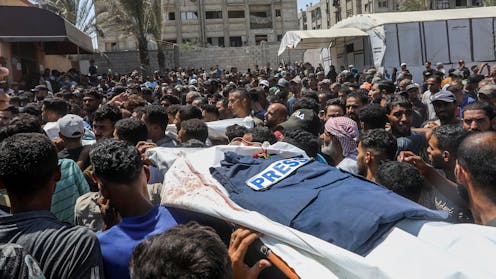
A funeral ceremony takes place in the courtyard of Nasser Hospital in Gaza following the deaths of five journalists on Aug. 25, 2025. Abed Rahim Khatib/Anadolu via Getty Images

Five journalists were among the 22 people killed on Aug. 25, 2025, in Israeli strikes on the Nasser Hospital in the Gaza Strip. Following global condemnation, the office of Israeli Prime Minister Benjamin Netanyahu issued a statement saying Israel “values the work of journalists.” But the numbers tell a different story.

Those deaths bring the total number of journalists killed in Gaza in almost two years of war to 192. The Committee to Protect Journalists, which collates that data, accuses Israel of “engaging in the deadliest and most deliberate effort to kill and silence journalists” that the U.S.-based nonprofit has ever seen. “Palestinian journalists are being threatened, directly targeted and murdered by Israeli forces, and are arbitrarily detained and tortured in retaliation for their work,” the committee added.

As a scholar of modern Palestinian history, I see the current killing of reporters, photographers and other media professionals in Gaza as part of a longer history of Israeli attempts to silence Palestinian journalists. This history stretches back to at least 1967, when Israel militarily occupied the Palestinian territories of the West Bank, East Jerusalem and the Gaza Strip following the Six-Day War.

Beyond the humanitarian toll, what makes matters even more drastic now is that, with Israeli restrictions on foreign media entering Gaza, local Palestinian journalists are the only people who can bear witness to the death and destruction taking place – and report it to a wider world. Indeed, nearly all of the nearly 200 journalists killed since Oct. 7, 2023, have been Palestinian.

A decades-long process in the making

From the first days of the occupation in 1967, Israel has tried to keep a tight grip on media reporting, building a legal and military architecture that aimed to control and censor Palestinian journalism.

In August 1967, the army issued Military Order 101, effectively criminalizing “political” assembly and “propagandistic” publications in the occupied territories.

Yet despite such restrictions, local journalism persisted and grew. By the early 1980s, Palestinians in the occupied territories were publishing three dailies, five weeklies and four magazines. The most popular publications circulated up to 15,000 copies.

But all Palestinian publications were subject to Israeli military censorship. Every night, editors were forced to submit two copies of everything they planned to print to Israeli censors. That included articles, photos, ads, weather reports and even crossword puzzles.

Anything the Israeli censor deemed to be “of political significance” had to be removed prior to publication. Editors who violated these terms, or who were accused of belonging to Palestinian political groups, could be detained or deported. These practices have echoes today with Israel often accusing the journalists it kills of being Hamas operatives.

Censorship regimes

Objecting to these and many other restrictions, Palestinians launched the first intifada, or uprising, against the Israeli occupation in December 1987. During the uprising’s first year, Israeli forces reportedly jailed 47 Palestinian reporters, temporarily banned eight local and regional newspapers, permanently revoked the licenses of two magazines and closed four press service offices.

A man is seen in a street holding a video camera.
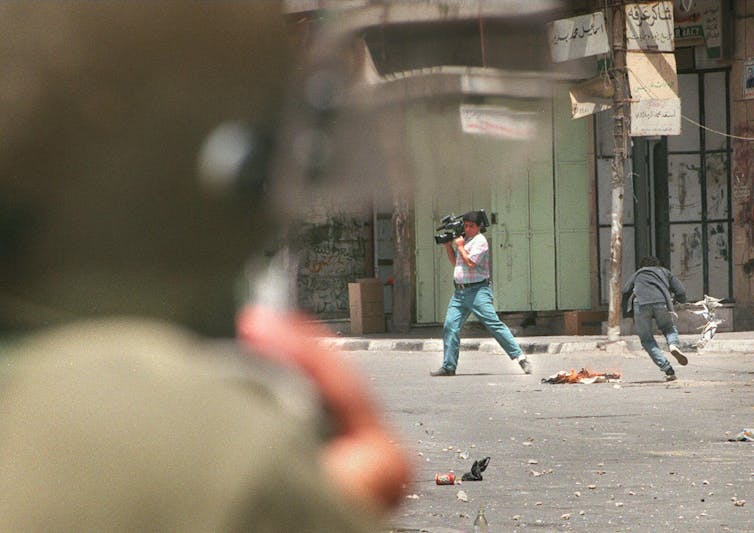
Reuters TV journalist Mazen Dana runs as he is hit by rubber-jacketed metal bullets fired by Israeli soldiers as he films a youth burning an Israeli flag in 1997.
Hossam Abu Alan/AFP via Getty Images

While intended to be a show of force, most Palestinians saw the restrictions as evidence that Israel was afraid of Palestinians reporting on their own conditions.

Many people hoped that the Oslo Accords – a series of negotiations between Israel and the Palestinian Liberation Organization that formally launched in 1993 – would lead to greater press freedoms. But it was not to be the case.

Israeli authorities continued to enforce military censorship on what they deemed to be “security topics.” They also revoked the press cards of reporters who did not stay in line and assaulted and harassed journalists reporting from the ground.

Meanwhile, the newly established Palestinian Authority, set up as part of the Oslo process to partially govern Palestinian territories on what was meant to be a temporary basis, built a censorship regime of its own. It, too, arrested, suspended and closed news outlets it deemed too critical of its actions.

Shootings and impunity

By the 2000s, Israel’s attacks on journalists in the West Bank and Gaza Strip grew deadlier. Israeli forces fatally shot Palestinian photographer Imad Abu Zahra in Jenin in the West Bank in 2002, British filmmaker James Miller in Rafah in 2003 and Reuters cameraman Fadel Shana in Gaza in 2008.

Since 2008, as battles between Israeli forces and Palestinian militant groups have grown fiercer, journalists have worked under even deadlier conditions. Yet even during unarmed demonstrations, journalists have faced deadly Israeli force. In 2018, during the mass unarmed protests in Gaza known as the Great March of Return, Israeli forces shot and killed Palestinian journalists Yaser Murtaja and Ahmed Abu Hussein. Both were wearing “PRESS” vests when they were shot. In addition, at least 115 journalists were wounded while covering the protests, which lasted six months.

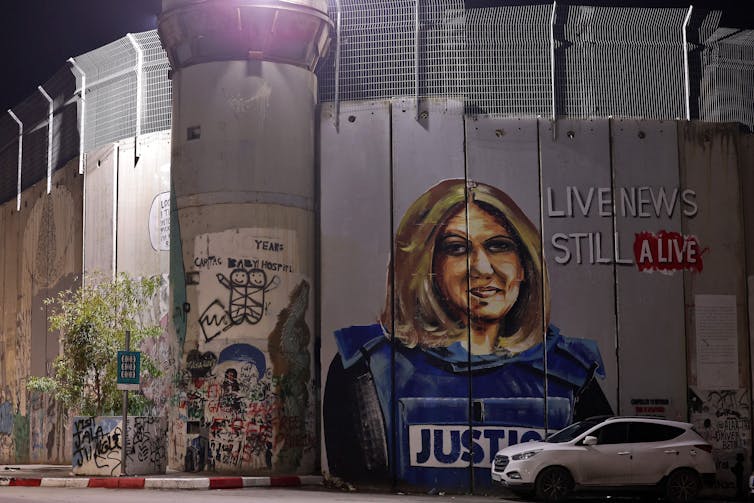
The deadly force has not been limited to Palestinians in Gaza. In May 2022, Palestinian American journalist Shireen Abu Akleh was killed in the Jenin refugee camp. One of the most famous Palestinian reporters at the time, Abu Akleh’s death drew hundreds of thousands of mourners, while Israeli police beat pallbearers at her funeral service.

Legitimate military targets?

International humanitarian law makes clear that journalists are civilians and therefore cannot be targeted during combat. That includes war correspondents who are covering war while under the protection of an armed group.

For their part, Israeli officials argue that they do not target journalists. They say that their strikes are aimed at legitimate military objectives, often asserting that Hamas embeds itself in civilian buildings or that some of the journalists killed were militants.

But such allegations are often made without independently verifiable evidence. Israel alleged that Murtaja, the journalist killed in Gaza in 2018, was a militant, but provided no proof.

The image of a woman with a flak jacket with 'justice' written on it is seen on a wall
A mural of slain U.S.-Palestinian correspondent Shireen Abu Akleh on a section of Israel’s separation fence between Jerusalem and the city of Bethlehem in the occupied West Bank.
Ahmad Gharabli/AFP via Getty Images

In the case of Abu Akleh, Israeli officials initially claimed that she may have been killed by Palestinian militants. They eventually admitted there was a “high possibility” that Israeli forces killed Abu Akleh, but claimed that the killing was accidental and therefore the government would not press charges. A recent documentary refutes that claim and identifies the Israeli soldier alleged to have killed Abu Akleh intentionally.

Culture of impunity

Even prior to the deadly Hamas-led attacks on Israel on Oct. 7, 2023, the picture emerging was that of impunity for Israeli forces who killed journalists – by accident or by design. A May 2023 report from the Committee to Protect Journalists concluded that Israel engaged in a “deadly pattern” of lethal force against journalists and failed to hold perpetrators accountable.

Since October 2023, journalists in Gaza have faced even deadlier conditions. Israel continues to ban international news agencies from reporting inside the Gaza Strip. As a result, local Palestinian journalists are often the only ones on the ground.

Aside from the deadly conditions, they contend with Israeli smears against their work and threats against their families.

Palestinian journalists there often run toward bombardments when others run away. As a result, they are sometimes killed in “double-tap” strikes, where Israeli air and drone strikes return to an area that has just been struck, killing rescue workers and the journalists covering them.

All this has led to an unbearable personal toll for those continuing to report from within Gaza. On Oct. 25, 2023, Al Jazeera’s Gaza bureau chief, Wael al-Dahdouh, was reporting live on air when he learned that an Israeli airstrike had killed his wife, two children and grandson. He returned on air the next day.

And the killing has not eased up. On Aug. 10, 2025, Israeli forces killed Anas al-Sharif in Gaza City, another prominent Al Jazeera correspondent who had stayed on the streets through months of bombardment. Five of his fellow journalists were also killed in the same airstrike.

The Aug. 25 strike on Nasser Hospital is just the latest in this deadly pattern.

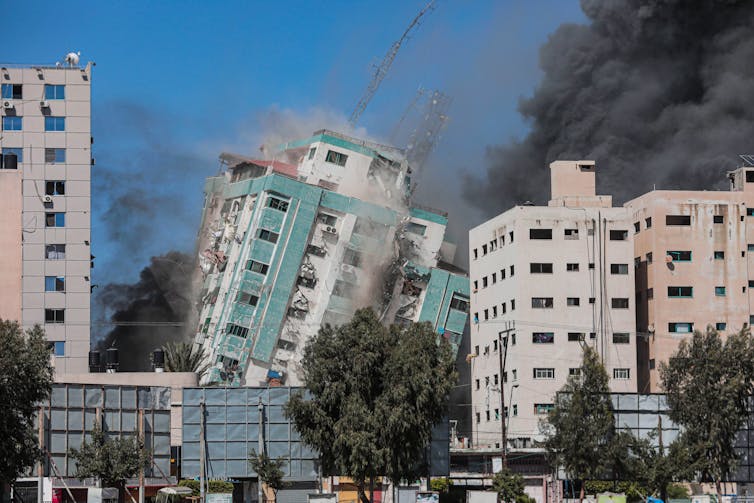
A building is seen toppling to the ground with thick black smoke around it.
The Jala Tower, home to media outlets, collapses after an Israeli airstrike in Gaza on May 15, 2021.
Momen Faiz/NurPhoto via Getty Images

Among the five journalists killed in that attack were freelancers working for Reuters and The Associated Press – two international media outlets frustrated by Israel’s refusal to allow its journalists into Gaza to document the war.

Despite the danger, global newsrooms have repeatedly urged Israel to open Gaza to independent media, and a coalition of 27 countries recently pressed for access in Gaza.

Israel continues to refuse these requests. As such, Palestinian journalists remain the primary witnesses of Israel’s relentless assault on Gaza. And they are increasingly killed as they do so. The question remains whether the international community will hold Israel to account.

The Conversation

Maha Nassar does not work for, consult, own shares in or receive funding from any company or organization that would benefit from this article, and has disclosed no relevant affiliations beyond their academic appointment.

ref. Israel’s killing of journalists follows a pattern of silencing Palestinian media that stretches back to 1967 – https://theconversation.com/israels-killing-of-journalists-follows-a-pattern-of-silencing-palestinian-media-that-stretches-back-to-1967-263891

Incendios en España: ¿por qué ahora? ¿Por qué allí?

Source: The Conversation – (in Spanish) – By Emilio Chuvieco Salinero, Catedrático de Geografía, Universidad de Alcalá

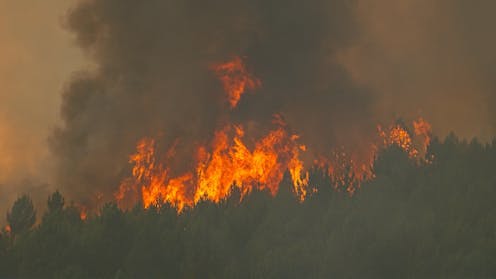
Incendio en El Bierzo, León (España), en agosto de 2025. Nuria PhotoStock/Shutterstock

Una ola de graves incendios lleva ya varias semanas afectando a diferentes regiones de España y concentrando, como es natural, la atención de la ciudadanía, los medios de comunicación, los expertos y la esfera política. Son muchos los que buscan los porqués de la intensidad y voracidad del fuego, que ha arrasado más de 400 000 hectáreas.

Lo que está ocurriendo este año es absolutamente excepcional: en apenas quince días del mes de agosto se ha quemado más que todo lo quemado en cinco años (2019, 2020, 2021, 2023 y 2024; el 2022 fue también bastante severo, con casi 300 000 ha). Hay que remontarse hasta fines del pasado siglo para ver años donde se superaran las 400 000 hectareas (1978, 1985, 1989 y 1994), obviamente con muchos menos medios y conocimiento del problema que ahora.

Los incendios han ocupado la mayor parte de mis esfuerzos profesionales en los últimos 40 años, sobre todo en el ámbito de la detección de condiciones de riesgo y efectos del fuego por teledetección. Y desde ese conocimiento, y con los datos en la mano, trataré de analizar en este artículo por qué los incendios han sido tan graves este verano y por qué se han producido sobre todo en ciertas zonas de España, como Galicia, Extremadura y Castilla y León.

¿Por qué ahora?

Algunas de las explicaciones que se han dado hasta ahora tienen que ver con los pirómanos. Pero ¿dónde se esconden esos pirómanos el resto del año? ¿Por qué aparecen algunos años, como el actual, y no en otros? Por ejemplo, en todo el 2024 se quemaron 42 600 ha, apenas el 10% de lo que se ha quemado en lo que llevamos de año.

Otros argumentos tienen que ver con el abandono de la ganadería tradicional, la legislación coercitiva sobre gestión forestal, el escaso aprovechamiento económico de los montes y la falta de medios, entre otros. Factores que, sin duda, han influido en la incidencia del fuego.

A estos factores estructurales hay que añadirle los meteorológicos: estamos en un año excepcional, con una abundante precipitación primaveral (por tanto, con alta productividad vegetal), un año de junio anómalamente caluroso y seco, un julio seco pero no muy caluroso y un agosto marcado por continuas y extremas olas de calor.

Falta cultura del riesgo

Pero tampoco podemos olvidar un factor estructural fundamental: la cultura del riesgo. Vivimos en un planeta que alberga fenómenos naturales catastróficos para el ser humano, que ha lidiado con ellos según su sabiduría y técnica mejoraba, casi siempre a base de reducir la vulnerabilidad, esto es, de desarrollar la capacidad de resistir al evento y recuperarse del mismo.

Para determinar el riesgo de incendio, como en cualquier otro riesgo, debemos de tener en cuenta tres elementos: peligro, exposición y vulnerabilidad. En pocas palabras, el peligro indica la probabilidad de que algo se queme; la exposición, la cercanía a las personas y bienes susceptibles de quemarse, y la vulnerabilidad, la capacidad de que el evento cause más o menos daños.

¿Tenemos cultura del riesgo en España? ¿Cuántas danas, apagones, erupciones volcánicas e incendios extremos necesitamos para que los niños lo estudien en los colegios, para que los municipios tengan planes de prevención, para que las autoridades con competencias en protección civil, tanto en el ámbito nacional como autonómico, se coordinen?

El pasado marzo presentamos en mi universidad los resultados de un proyecto sobre riesgo de incendio (FirEUrisk) en el que han participado 36 grupos de investigación de 17 países, con una financiación global de algo más de 10 millones de euros. Desde el inicio del proyecto hemos estado en contacto con gestores y administraciones, intentando contar con su apoyo y buscando transferir los resultados que se iban obteniendo al mundo operativo.

En la reunión final, invitamos a los responsables de la extinción y gestión de incendios, tanto autonómicos como nacionales, incluyendo a la directora general de protección civil. Únicamente asistieron responsables técnicos. Ningún gestor de los que toman decisiones y controlan la inversión que se hace en prevención de incendios, con la excepción de los mandos de la Unidad Militar de Emergencias.

Ahora estamos intentando implantar un módulo sobre estimación de la humedad de la vegetación para mejorar el indicador meteorológico de peligro de incendios que publica la Agencia Estatal de Meteorología. Los técnicos de la Agencia están muy interesados, pero no hay presupuesto. Me pregunto cuánto cuesta un día de extinción de los 20 incendios que han estado activos y cuándo nos convenceremos de que la inversión en prevención a la larga, cuando está bien orientada, siempre compensa.

¿Por qué allí?

Termino con las última preguntas: ¿por qué la mayor parte de las 400 000 hectáreas quemadas se sitúan en una región concreta delimitada por las provincias de León, Orense y Zamora, en la región occidental de España, donde también pueden situarse Cáceres y Ávila (las otras dos provincias más quemadas este verano)? ¿No es cierto que todos los argumentos estructurales que hemos citado arriba (despoblación, legislación, abundancia de combustible, falta de medios de extinción, etc.) afectan exactamente igual a la España oriental (Cuenca, Soria, Albacete, Teruel, Zaragoza, interior de Valencia, Castellón o Alicante) donde apenas ha habido incendios?

Aquí necesitamos analizar la distribución geográfica de los factores de riesgo. En concreto, vamos a fijarnos en el impacto diferencial de la humedad de la vegetación, ya que a menor humedad de la vegetación (mayor sequía) mayor es el riesgo de incendios.

El CSIC calcula para la AEMET un índice estandarizado de sequía (SPEI, por sus siglas inglesas) que tiene en cuenta el déficit de precipitación en un área concreta, la temperatura y la demanda de agua por parte de la atmósfera. Así, cuanto más negativo es el valor, más severa es la sequía meteorológica.

Veamos los mapas de índices estandarizados de sequía correspondientes a la última semana de julio y la última semana de agosto de este año para ver el cambio en la humedad de la vegetación entre ambos periodos, y también el mapa de las zonas más afectadas por los incendios.

Mapa de España con colores que marcan los índices de sequía
Índices de sequía correspondientes a la segunda semana de julio de 2025, calculados por el CSIC, a partir de la temperatura, precipitación y la demanda de agua por parte de la atmósfera.
CSIC
Mapa de España con colores que marcan los índices de sequía
Índices de sequía correspondientes a la segunda semana de agosto de 2025, calculados por el CSIC, a partir de la temperatura, precipitación y la demanda de agua por parte de la atmósfera.
CSIC
Mapa del noroeste de la península ibérica donde se indica la situación y área de los principales incendios de agosto de 2025
Mapa de áreas quemadas en lo que llevamos de agosto.
Copernicus/CE

¿Ven alguna relación entre el mapa de sequía de la segunda semana de agosto y las áreas quemadas en esa semana? Podrán observar que se concentran en las mismas áreas. Si extraemos algunas series temporales del índice de sequía, la comparación resulta todavía más evidente: en la zona próxima a Ponferrada, donde se han registrado dos de los más grandes incendios de este verano, el índice de sequía de la segunda quincena de agosto es el más bajo desde que hay datos (1960).

En base a estos datos, quizás tengamos que mejorar los indicadores actuales de riesgo de incendio y tener en cuenta otros factores que muestren no sólo la meteorología sino el estado de los combustibles, como la humedad de la vegetación.

La alerta temprana es parte de la prevención, y cuando los medios son escasos resulta imprescindible aprovechar toda la información sustancial que tengamos disponible. Así, la gestión será más eficiente y reduciremos nuestra vulnerabilidad, al optimizar los medios disponibles a cuándo y dónde el riesgo es más alto.

The Conversation

Emilio Chuvieco Salinero ha sido coordinador científico del proyecto FirEURisk financiado por el programa H2020 de la Unión Europea, orientado a la determinación holística del riesgo de incendios forestales en Europa.

ref. Incendios en España: ¿por qué ahora? ¿Por qué allí? – https://theconversation.com/incendios-en-espana-por-que-ahora-por-que-alli-263835

Por qué el ocio es importante para alcanzar una buena vida, según Aristóteles

Source: The Conversation – (in Spanish) – By Ross Channing Reed, Lecturer in Philosophy, Missouri University of Science and Technology

Lo que hacemos en nuestro tiempo libre dice mucho sobre lo que nos hace felices. Halfpoint Images/Moment via Getty Images

En su impactante libro La sociedad del cansancio, el filósofo surcoreano Byung-Chul Han sostiene que, en la actualidad, alcanzar el éxito se ha convertido en una obligación. Han denominado a esto una “sociedad del rendimiento”, en la que debemos convertirnos en “emprendedores”, promocionándonos y vendiéndonos a nosotros mismos. Como consecuencia, no hay tiempo libre.

En una sociedad así, incluso el ocio corre el riesgo de convertirse en otro tipo de trabajo. En lugar de proporcionar descanso y sentido, suele ser competitivo, performativo y agotador.

Quienes sienten la presión de promocionarse a sí mismos, por ejemplo, pueden pasar su tiempo libre publicando fotos de una carrera o de unas vacaciones lujosas en las redes sociales
para que las vean sus familiares, amigos y posibles empleadores, lo que aumenta el agotamiento y el desgaste.

Un hombre corriendo al aire libre por un camino pavimentado rodeado de palmeras y edificios.
El ejercicio debe realizarse con moderación para alcanzar los objetivos de salud.
AzmanL/E+ via Getty images

Como filósofo y consejero filosófico, estudio las conexiones entre el ocio poco saludable y el agotamiento. He descubierto que la filosofía puede ayudarnos a sortear algunos de los escollos en una sociedad orientada al rendimiento. El célebre filósofo griego Aristóteles, que vivió entre el 384 y el 322 a. e. c., en particular, ofrece importantes reflexiones.

Sobre el desarrollo personal

Aristóteles comienza Ética a Nicómaco señalando que todos buscamos la felicidad. Sin embargo, afirma que a menudo nos confunde cómo alcanzarla.

Él creía que el placer, la riqueza, el honor y el poder no nos hacen felices en última instancia. La verdadera felicidad, decía, requiere un desarrollo ético personal: “El bien humano resulta ser la actividad del alma de acuerdo con la virtud”.

En otras palabras, si queremos ser felices debemos tomar decisiones razonadas para desarrollar hábitos que, con el tiempo, se conviertan en rasgos de carácter como el coraje, la templanza, la generosidad y la veracidad.

Aristóteles vincula explícitamente la buena vida con convertirse en un tipo determinado de persona. No hay atajos para el desarrollo ético personal. Se necesita tiempo, tiempo libre, tiempo que no se dedique a ningún tipo de autopromoción empresarial.

Aristóteles también habla del poder de nuestras decisiones. Los hábitos, argumenta, no se refieren solo a la acción, sino también a los motivos y al carácter. Nuestras acciones, dice, cambian nuestros deseos. Aristóteles afirma: “Al abstenernos de los placeres, nos volvemos templados, y cuando lo somos es cuando somos más capaces de abstenernos de ellos”.

En otras palabras, los buenos hábitos son el resultado de avanzar gradualmente en la dirección correcta a través de la práctica. Y estos buenos hábitos conducen al desarrollo ético personal. Para Aristóteles, además, es esencial tener buenos amigos y mentores que guíen y apoyen el desarrollo moral.

Comprender el ocio

En una sociedad orientada a los logros, a menudo estamos condicionados a responder a presiones externas para promocionarnos a nosotros mismos y buscar la felicidad en el placer, la riqueza, el honor y el poder. Esto puede desviar el desarrollo ético necesario para alcanzar la verdadera felicidad.

El verdadero ocio, aquel que no está ligado a la necesidad de alcanzar algo, es el tiempo que podemos dedicar a reflexionar sobre nuestras prioridades reales, cultivar amistades, pensar por nosotros mismos y dar un paso atrás para decidir qué tipo de vida queremos vivir.

La palabra griega eudaimonia, que a menudo se traduce simplemente como “felicidad”, es el término que Aristóteles utiliza para describir la prosperidad y el florecimiento humanos. Según la filósofa Jane Hurly, él considera “el ocio esencial para la prosperidad humana”. De hecho, “tanto para Platón como para Aristóteles, el ocio… es un requisito previo para alcanzar la forma más elevada de la prosperidad humana, la eudaimonia”, como sostiene el filósofo Thanassis Samaras.

Aunque nuestros medios para adquirir placer, riqueza, honor y poder sean limitados, Aristóteles nos dice que tenemos control sobre la variable más importante de la buena vida: qué tipo de persona queremos ser. El ocio es crucial porque es el tiempo en el que decidimos qué hábitos desarrollaremos y quiénes llegaremos a ser. ¿Capitularemos ante la sociedad del éxito? ¿O utilizaremos nuestro tiempo libre para desarrollarnos como individuos?

Cuando el ocio se centra en la autopromoción, es difícil que se produzca el desarrollo moral. El tiempo libre que no está secuestrado por la necesidad imperiosa de alcanzar logros es necesario para desarrollar una relación coherente con uno mismo, lo que yo denomino una relación de autosolidaridad, un tipo de autoconciencia reflexiva necesaria para apuntar al objetivo correcto y tomar decisiones morales. Sin esa relación, la buena vida seguirá siendo esquiva.

El ocio reinventado

En lugar de adoptar la formulación de la sociedad del éxito, tal vez podamos crear nuestra propia visión. Sin esta, corremos el riesgo de caer en malos hábitos que nos alejen de un sano desarrollo moral.

Aristóteles deja claro que tenemos el poder de cambiar no solo nuestros comportamientos, sino también nuestros deseos y carácter. Este autodesarrollo es una parte necesaria de la buena vida, una vida de ‘eudaimonia’.

Las decisiones que tomamos en nuestro tiempo libre pueden acercarnos a ella. O pueden alejarnos y llevarnos al agotamiento.

The Conversation

Ross Channing Reed no recibe salario, ni ejerce labores de consultoría, ni posee acciones, ni recibe financiación de ninguna compañía u organización que pueda obtener beneficio de este artículo, y ha declarado carecer de vínculos relevantes más allá del cargo académico citado.

ref. Por qué el ocio es importante para alcanzar una buena vida, según Aristóteles – https://theconversation.com/por-que-el-ocio-es-importante-para-alcanzar-una-buena-vida-segun-aristoteles-262891