Honoré de Balzac’s La Comédie Humaine is a Hindu mandala

Source: The Conversation – UK – By Harsh Trivedi, Teaching Associate French, School of Languages, Arts and Societies., University of Sheffield
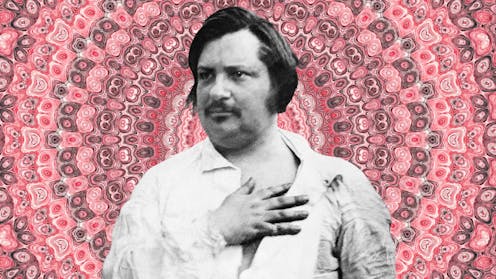
Daguerrotype of Honoré de Balzac by Louis-Auguste Bisson (1842). Wiki Commons/Canva., CC BY-SA

The 19th-century novelist Honoré de Balzac was Catholic, French to the core and obsessed with the material details of French society. Yet there is something profoundly Hindu in the way he sought to understand the world.

Balzac was born in the final year of the 18th century. As he began his career, European literature was turning away from the abstraction of the previous century’s Enlightenment and towards realism. Realist writers, including the French novelist Stendhal, insisted that to understand the human condition, they first had to know local customs, political and economic pressures – and the inner lives of individuals.

Balzac was the supreme example of this shift. His vast work La Comédie Humaine (1829-48) was made up of nearly 100 interconnected novels and stories. It sought to map French society, not by generalising from above, but by diving into the specific lives of his characters.

In the preface to the work, Balzac declared: “French society would be the real author; I should only be the secretary.” He described society as a zoological landscape populated by distinct species and insisted that truth emerged from a complete inventory of these types: “the dress, the manners, the speech, the dwelling of a prince, a banker, an artist, a citizen, a priest, and a pauper are absolutely unlike, and change with every phase of civilisation.”


This article is part of Rethinking the Classics. The stories in this series offer insightful new ways to think about and interpret classic books and artworks. This is the canon – with a twist.


In his novel Le Père Goriot (1835), Balzac devoted the entire opening chapter to the description of a grim boarding house. The copious descriptions of the layout, decoration and even smells serve as a physical embodiment of the moral, social, economic and physiological condition of the dwellers.

In the serial novel Illusions Perdues (1837–1843), meanwhile, he dissected the Parisian press, provincial printing shops and the cruel economy of literary fame. Even the cut of a waistcoat, the price of paper, or the decor of a salon became data for understanding society.

Though his work is known for character typology (grouping them by traits), no two characters of the same “type” are alike. This showed his commitment to individuality within universal archetypes.

Other novelists including Gustave Flaubert, Émile Zola, Charles Dickens and Leo Tolstoy, all treated the individual as the key to the social whole. But Balzac articulated the method most systematically: he aimed to know everything about a society by knowing each part in all its messy detail.

Balzac’s mandala

This method resembles a central idea in Hindu philosophy. The formula tat tvam asi (that thou art), from the Sanskrit Hindu text Chandogya Upanishad (8th to 6th century BC), says that the individual self (ātman) is identical to the universal essence (brāhman). It’s the idea that understanding the universe comes from realising that the universe is within the self.

The Hindu scripture Bhagavad Gita offers a similar vision, where the deity Krishna declares: “I am the Self, O Gudakesha, seated in the hearts of all creatures. I am the beginning, the middle, and the end of all beings.”

Balzac was no expert on Hinduism. But he does have a character (Louis Lambert) write about it in La Comédie Humaine:

Sivaism, Vishnuism, and Brahmanism, the three primitive creeds, originating as they did in Tibet, in the valley of the Indus, and on the vast plains of the Ganges, ended their warfare some thousand years before the birth of Christ by adopting the Hindoo Trimourti. The Trimourti is our Trinity.

The passage wrongly asserts that Shaivism, Vaishnavism and Brahmanism emerged as separate “creeds”, when in fact they are interrelated and complementary currents within Hindu thought. The claim that they resolved their differences by adopting the Trimurti, and that this was the origin of the Christian Trinity, reflects a common orientalist tendency. It misunderstands Hindu ideas and co-opts them into a Christian framework.

Portrait of Honoré de Balzac in a cream dressing gown
Portrait of Honoré de Balzac by Louis Boulanger (1836).
Museum of Fine Arts of Tours

But this misreading makes the structural parallel all the more interesting. Balzac didn’t import Hindu ideas; the resemblance emerges from his method. La Comédie Humaine is structured like a mandala: a layered map of a universe made from precise local detail.

In Hindu traditions, a mandala is not merely a symbol but a sacred diagram of the cosmos. Later Hindu and Buddhist cosmology develops it into a meditative tool – an intricate geometric pattern centred on the self and the divine. A mandala places a sacred centre at the heart of an ordered arrangement, expressing the idea that the universal is embedded in the particular. Each part reflects the whole, and the path to the centre is through a journey inward, detail by detail.

Balzac’s work functions similarly. La Comédie Humaine’s order arises not from a single philosophical system, but from mapping the interlocking elements of social existence. Like a mandala, it invites readers to move inward; from the material facts of a boarding house or a printing press to the inner motives of his characters.

Balzac explains his method of structuring La Comédie Humaine in the preface:

It was no small task to depict the two or three thousand conspicuous types of a period… This multitude of lives needed a setting – a gallery. Hence the very natural division … into the Scenes of Private, Provincial, Parisian, Political, Military, and Country Life. … Each has its own sense and meaning, and answers to an epoch in the life of man.

In this sense, Balzac’s realism is not merely descriptive but architectural: a literary mandala of modern society. The affinity with the Hindu mandala suggests that La Comédie Humaine, which has more than 2,000 characters, enacts a recognisably Hindu way of knowing: to know the world, one must first know its inward forms.

Balzac’s Catholic worldview, his (often) moralising narrator, his encyclopaedic ambition, all root him in 19th-century France. But the kinship with Hindu inwardness points to something deeper. His great realist novel, for all its materialism, remains part of a broader human project – to understand the universe by beginning with the self.

Beyond the canon

As part of the Rethinking the Classics series, we’re asking our experts to recommend a book or artwork that tackles similar themes to the canonical work in question, but isn’t (yet) considered a classic itself. Here is Harsh Trivedi’s suggestion:

For readers seeking complex but entertaining social narratives outside the western canon, Sacred Games by Vikram Chandra (2006) offers an Indian counterpart to Balzac’s realism.

Set in contemporary Mumbai, the novel intricately weaves crime, politics and mythology. The ripples of the many characters’ actions interlock like a mandala, forming a complex, layered fiction. The protagonist, Sartaj Singh, first appeared in Chandra’s earlier short story collection Love and Longing in Bombay (1997), showcasing his use of recurring characters and interconnected narratives reminiscent of Balzac’s La Comédie Humaine.

This article features references to books that have been included for editorial reasons, and may contain links to bookshop.org. If you click on one of the links and go on to buy something from bookshop.org The Conversation UK may earn a commission.


Looking for something good? Cut through the noise with a carefully curated selection of the latest releases, live events and exhibitions, straight to your inbox every fortnight, on Fridays. Sign up here.


The Conversation

Harsh Trivedi does not work for, consult, own shares in or receive funding from any company or organisation that would benefit from this article, and has disclosed no relevant affiliations beyond their academic appointment.

ref. Honoré de Balzac’s La Comédie Humaine is a Hindu mandala – https://theconversation.com/honore-de-balzacs-la-comedie-humaine-is-a-hindu-mandala-262151

The most radical part of Reform’s deportation plans

Source: The Conversation – UK – By Peter William Walsh, Researcher, The Migration Observatory, University of Oxford

Speaking to the press in an airport hangar near Oxford on August 26, the leader of Reform UK, Nigel Farage, unveiled his party’s new policy on mass deportations.

There are many elements to the policy, but at its heart is a decision to abandon the UK’s decades-long commitment not to send people to places where they may face torture or death.

At the heart of the global asylum system is one basic principle: countries must not send people to places where they face serious threats to their life or freedom. This rule – known as the principle of “non-refoulement” – derives from the 1951 Refugee Convention but also appears in other human rights laws and agreements. It is why European countries, including the UK, assess asylum claims even when people have arrived without authorisation.

“Look, I can’t be responsible for despotic regimes all over the world,” said Farage, defending the policy in The Times, adding that his responsibility is to the “safety of women and girls on our streets” rather than to those who have entered the UK without permission.

The UK was instrumental in drafting both the European Convention on Human Rights and the 1951 Refugee Convention. For the UK to effectively remove itself from these treaties raises significant questions about whether other states would follow suit, and what sort of protections would exist for persecuted people around the world in the future.

What is Reform proposing?

The plan is indeed, as Farage described, radical. Its main aim is to “detain and deport all illegal migrants” over one parliament. To make this possible, the plan, branded Operation Restoring Justice, entails leaving the European Convention on Human Rights (ECHR), repealing the UK’s Human Rights Act, and “disapplying” for five years the Refugee Convention and other international agreements that could prevent deportations.

Further, it would greatly expand detention on repurposed military sites, and scale up charter flights for the removal of “up to 600,000” people without the right to be in the UK.

The policy reflects a major departure from the 75-year postwar consensus in Europe that countries should not send people to countries where they could face persecution.

Legal and practical hurdles

Reform’s policy, if implemented, is likely to attract legal challenges. However, as the parliamentary battle over the last government’s Rwanda deportation plan demonstrated, the government has considerable power to prevent the courts from having their say. Leaving the ECHR, repealing the Human Rights Act and removing all references to non-refoulement in domestic law would make the policy possible, from a legal perspective.

This would not happen overnight. It could take more than a year for Reform’s illegal migration (mass deportation) bill to become law, given that Reform will command no majority in the House of Lords, where the policy is liable to attract strong resistance. Leaving the ECHR requires just six months’ notice – but would probably also require the consent of parliament.

The bigger practical hurdles are logistical and diplomatic. Reform proposes to increase detention spaces to 24,000 within 18 months. As of mid-2024, the most recent available data, detention capacity stood at an estimated 2,200.

The UK’s current system for removals operates at a fraction of the scale Reform envisages. In the year ending June 30 2025, there were around 9,000 enforced returns and 27,000 voluntary ones. Removing hundreds of thousands of people over five years would require a huge expansion of interior immigration enforcement. It also remains unclear how Reform would identify hundreds of thousands of people living in the UK without permission.

Consent from receiving countries (the countries to where people would be deported) is a longstanding barrier to deportations. If a country does not recognise their citizens or refuses to take them back, they cannot be returned.

The government’s recent experience shows documentation and country cooperation are the main practical limits on enforced returns. Questions remain over whether, or on what terms, Afghanistan and Iran would agree to take back their citizens.

Reform has anticipated this potential issue by proposing to pay countries to take back their citizens, or impose sanctions on those that don’t.

Should this not work, Reform’s Plan B would be to deport people to “safe third countries”, a la Rwanda. Plan C: sending people to British Overseas Territories like Ascension Island, something the previous Conservative government was reported to have looked at internally and rejected on feasibility and cost grounds.

Reform estimates that the policy would save over £7 billion in five years. In truth, the policy is so radical that it is impossible to cost with any degree of precision.

What is clearer is that any net saving would depend critically on how many people the policy deters from crossing in small boats. Currently, small boat arrivals and a large asylum backlog generate annual government spending of over £4 billion.

Managing the asylum system has become increasingly challenging over the last decade, as numbers of both unauthorised arrivals and asylum claims have risen rapidly, and the cost of the asylum system has skyrocketed.

However, the most significant part of Reform’s announcement is not the detail, but the essence. It proposes ending the principle of refugee protection – accepting that people would be sent to countries where they could be tortured or killed, as a means of reducing unauthorised migration and cutting the costs of the asylum system.

The Conversation

Peter William Walsh receives funding from the Nuffield Foundation.

Rob McNeil receives funding from the Engineering and Physical Sciences Research Council (EPSRC), is the chair of trustees for the Work Rights Centre, and alongside his role at the University of Oxford, undertakes consultancy work for UN bodies and other international organisations.

ref. The most radical part of Reform’s deportation plans – https://theconversation.com/the-most-radical-part-of-reforms-deportation-plans-264162

How Sweden’s ‘secondhand only’ shopping mall is changing retail

Source: The Conversation – UK – By Mary-Ann Ball, Senior Lecturer, Fashion Sustainability and Marketing, Nottingham Trent University

Second-hand books for sale at ReTuna, Sweden’s shopping centre dedicated to only selling preloved items. Mary-Anna Ball, CC BY-NC-ND

As a fashion sustainability researcher, finding the ReTuna shopping mall in Eskilstuna was a delightful surprise. Stepping into this Swedish shopping centre felt refreshingly different – it is the first in the world to sell only secondhand and repurposed items.

During numerous visits to the shopping mall over the last 18 months, I have spoken to customers, managers and employees – all of whom seemed excited by ReTuna’s innovative business model.

The mall instantly feels very different to the cluttered charity shops or vintage boutiques most of us associate with pre-owned retail. There is a wide range of products on sale – fashion, sports equipment, household items, children’s toys, antiques – and even an Ikea secondhand store selling previously used and repaired furniture.

This is not just a retail space. It is a municipality-led experiment in circular consumption, where everything sold has been donated by the public.

ReTuna was established in 2015 as part of Eskilstuna’s climate and waste reduction strategy. Built alongside the city’s recycling centre, it includes a dedicated drop-off point called The Return, where residents donate unwanted items. These are sorted and redistributed to the retailers in the mall, creating a low-cost, low-waste circular system.

The model is only possible because of public funding and local government support – a reminder that circular innovation often requires structural investment, not just consumer goodwill.

However, what makes ReTuna so distinctive is not just its inventory but its atmosphere. Consumers describe it as “accessible”, “curated” and “convenient”. The mall’s layout and product displays mirror conventional retail spaces, making secondhand shopping feel stylish and enjoyable.

second hand clothing in a store
ReTuna sells only secondhand clothing, books, bikes and other items.
Mary-Anne Ball, CC BY-NC-ND

One shop manager told me customers often mistake the secondhand items for new, a testament to how fashionability and design are used to make reuse attractive without increasing cost. At ReTuna, the clean, calm environment helps make ethical consumption feel desirable and emotionally rewarding. As one shopper put it: “It’s not just ethical, it’s beautiful.”

Retailers use low-cost stock and infrastructure to create visually appealing stores. The result is a pleasurable shopping experience that challenges the stigma of secondhand. While affordability and environmental values remain central, ReTuna also reimagines what sustainable retail can look and feel like.

Demand for pre-loved

Consumer interest in “pre-loved” fashion is accelerating, with the secondhand market growing 2.7 times faster than the broader apparel market, according to one recent industry report. Globally, it is projected to reach US$367 billion (£272 billion) by 2029.

And it is not only pre-owned fashion that is growing. Another market research report forecasts the wider secondhand products market will reach US$1.04 trillion by 2035, growing at a compound annual rate of 17.2%.

In a YouGov survey spanning 17 markets, 43% of secondhand buyers favoured instore purchases, compared with 39% who preferred online (19% were undecided). ReTuna is part of this shift – not as an outlier, but a glimpse of what mainstream retail could become.

This pioneering Swedish mall turned ten this year. It has grown from a local government initiative to an internationally recognised model of circular retail. The mall’s success shows that secondhand shopping does not have to feel like a compromise – it can be stylish, convenient and socially meaningful.

Circular retail is not just about what we buy, but how and where we buy it. ReTuna demonstrates that with the right infrastructure, design and public support, sustainable consumption can be embedded into everyday life – not as a chore but a rewarding experience.


Don’t have time to read about climate change as much as you’d like?

Get a weekly roundup in your inbox instead. Every Wednesday, The Conversation’s environment editor writes Imagine, a short email that goes a little deeper into just one climate issue. Join the 45,000+ readers who’ve subscribed so far.


The Conversation

Mary-Ann Ball does not work for, consult, own shares in or receive funding from any company or organisation that would benefit from this article, and has disclosed no relevant affiliations beyond their academic appointment.

ref. How Sweden’s ‘secondhand only’ shopping mall is changing retail – https://theconversation.com/how-swedens-secondhand-only-shopping-mall-is-changing-retail-260459

Nigel Farage and the political power of English grievance

Source: The Conversation – UK – By Ailsa Henderson, Head of Politics and International Relations, University of Edinburgh

One apparent constant in contemporary UK politics is Nigel Farage’s ability to mobilise a sense of grievance among those who regard themselves as English. By doing so, Farage has, on successive occasions, managed to shift the terms of political debate so that the issues he cares about become the key issues of the day. His ability to drag the other parties onto his terrain is a classic success story of what political scientists call issue salience. He identifies a problem, proclaims loudly that it will be our collective undoing and proposes a tantalisingly straightforward solution.

The Brexit narrative was, of course, that the loss of British wealth and influence, as well the crisis of post-austerity public services, could best be explained by the undue influence of and resources willed away to “Europe”.

In England, this frustration correlated not with British but with English national identity. It also correlated with discontent at the internal union of the UK and a sense that Britain’s political class were distributing resources and influence to other foreigners – in this case Scots.

A decade on from the referendum, English-identifying electors are now being successfully mobilised on the basis of a new bogeyman. Social and economic problems in the UK are still being attributed to the way influence and resources are being ceded to foreigners, but this time it’s not bureaucrats in Brussels who are to blame for these ills, or Scots – it’s the people arriving on small boats.

However, even if Farage’s ability to mobilise grievance to political advantage remains unmatched, our 15 years of research into English national identity underlines that the proffered solutions to those grievances – the seemingly simple, quick fixes – simply don’t work. Exiting the EU has not stemmed English grievance. Rather, erstwhile Leavers are not happy at the outcome even while preferring not to have to talk about it. There is precious little reason to believe that five deportation flights a day to Kabul airport will make them any less nostalgic for the past, less aggrieved about the present or more hopeful for the future.

The proposed solutions to English grievances haven’t worked because those solutions were, from their inception, poorly thought-through and unworkable. A hard, “clean break” Brexit was never compatible with the existence of a land border on the island of Ireland. It was never going to be possible to construct a dedicated democratic political space for England through minor tweaks to the legislative procedures of the House of Commons, as was attempted in the introduction of English votes for English laws. Similarly, we’re not going save the NHS or universities by making the UK inhospitable to the skilled migrants it needs.

Moreover, the impact of adopting Farage’s framing of problems and associated bogeymen and simply promising to deal with them more effectively has proved disastrous, first, for the Conservative party, and now Labour. Anyone doubting the impact of issue ownership on electoral success need look no further than Scotland, where years of high constitutional salience rewarded the respective “owners” of the “indy” and pro-union positions at the expense of electoral support for the political centre ground. The dip in SNP and Conservative support in Scotland in the 2024 UK general election can be attributed in part to the weakened salience of constitutional politics. The issues we talk about matter.

None of the solutions offered to assuage English grievances have ever sought to address the real problems. Take, for example, the now longstanding evidence that the English feel aggrieved at the treatment of England following the devolution of power to Belfast, Cardiff and Edinburgh. Despite this, there has yet to be a serious discussion of post-devolution arrangements in a way that affords English voters the same opportunity to shape a government that seeks to be theirs as enjoyed by voters in the rest of the UK.

No doubt that reluctance to do so in part reflects the dual role of a UK government. It serves as both the government for the whole of the state and for England alone on issues that are devolved to Scotland, Wales and Northern Ireland. The distorting impact of this distinctly odd arrangement is compounded by the steadfast refusal of the UK government to explicitly state when it is acting as the UK’s government or when it is responding to English concerns over English policy to make English lives better. Indeed, in the past two decades, no single English MP has referred in the Commons to the “government of England” as something that actually exists.

Invisible England

One of the stranger consequences of the UK’s asymmetrical governance arrangements is that England is rendered invisible, even though it is by far the largest part of the state. If UK governments of various hues are unwilling ever to name England and, indeed, behave as if the very existence of its English electorate is something to be ashamed of, it’s perhaps little wonder that English identifiers don’t feel they matter or have a voice. There is, in short, an English efficacy problem.

Rather than engage seriously with the reality of English sentiment and, yes, resentment, both Conservative and Labour governments have engaged in the serial ad hocery of constitutional change. They’ve played a never-ending game of constitutional Tetris in which plans for so-called English devolution are constantly made and remade. This process has, in turn, become a substitute for serious thinking about political voice and democratic influence within the state.

Successive UK governments have preferred to give England the structures that are least disruptive to the central institutions of the state. Thus, England is carved into a series of Scotland-sized pieces under regional devolution. What is never spoken of is the fact that this is precisely the least popular solution among England’s electorate. They instead doggedly favour an outcome that dare not speak its name – a political space for England as England.

Perhaps, then, the English are aggrieved and angry, not because foreigners have undermined their influence and stolen their resources but, in part at least, because they and their views are a perpetual afterthought in the UK’s governance arrangements. And maybe that’s another constant in UK politics – UK governments find it easier to address Farage’s successive foreigner problems than to look at their own role in stoking English grievance.


Want more politics coverage from academic experts? Every week, we bring you informed analysis of developments in government and fact check the claims being made.

Sign up for our weekly politics newsletter, delivered every Friday.


The Conversation

Ailsa Henderson currently receives funding for the Scottish Election Study from the ESRC and funding for work on research cultures from Wellcome (InFrame). She is Chair of Boundaries Scotland, the independent non-partisan non-departmental public body that sets electoral boundaries in Scotland for local and Holyrood elections.

Richard Wyn Jones receives funding from the ESRC for the Welsh Elections Study.

ref. Nigel Farage and the political power of English grievance – https://theconversation.com/nigel-farage-and-the-political-power-of-english-grievance-264065

Why Donald Trump’s plans to prosecute flag burning divides his supporters

Source: The Conversation – UK – By Clodagh Harrington, Lecturer in American Politics, University College Cork

“If you burn a flag, you get one year in jail. No early exits. No nothing.” This is what US president Donald Trump announced in the Oval Office in the last week in August. Ever the master media manipulator, America’s communicator-in-chief issued this as an executive order.

An executive order is issued by the president and doesn’t need to be passed by Congress. They are, however, expected to relate to existing law. Trump so far has signed 196. His latest directive, which aims to restore “respect, pride and sanctity” to the US flag, instructs the Department of Justice to investigate instances of burning the nation’s insignia under particular circumstances.

While the practice of flag burning as protest has a long history in the US, dating back to the US civil war, it is not a regular occurrence, and has been constitutionally permitted for decades.

The issue is already creating divisions among Republicans. There are three broad categories of GOP reaction. First, the Maga faithful are unlikely to complain. Unconditional support for their leader is a key trait of this group. And the executive order includes language with guaranteed appeal to those for whom terms such as “American patriots” and “foreign nationals” are predictable triggers. The president has long excelled at rallying his supporters on flag-related matters.

Beyond red-meat-for-the-base appeal, both the executive order and GOP support for it get a little more complex. Traditional conservatives, including Senate majority leader Mitch McConnell, are a group that may have strongly negative feelings about flag burning, but their adherence to the first amendment and associated freedom of expression would generally override this.

Those who hold constitutional principles in high regard are increasingly concerned about a president demonstrating his desire for expansive power. And, the US Supreme Court has clearly ruled on more than one occasion that the act, however distasteful, is constitutionally permitted.

Antonin Scalia, the late Supreme Court justice and noted constitutional textualist, famously stated that “if it were up to me, I would put in jail every sandal-wearing, scruffy-bearded weirdo who burns the American flag”. But, he added: “I am not king.” Alongside the more centrist Anthony Kennedy, these justices upheld the right to burn the US flag in the 1989 landmark case of Texas v Johnson, despite Scalia’s personal distaste for the act. In his writings, Scalia differentiated between the form of expression that was flag burning, and an act of insurrection, which, he noted, was “something quite different”. The first amendment, as he understood it, allowed for symbolic political protests, regardless of how offensive such expressions might be to patriotic sensibilities.

Already, analysts have highlighted how the president’s efforts to sidestep the constitution are laden with problems. Executive orders cannot override a Supreme Court ruling. Even Donald Trump should know that.

Getting around current law

What the executive order does attempt to do is to get around the law that allows flag burning. To do so, it focuses on associated crime such as property destruction, open burning violations and disorderly conduct. The attorney general, Pam Bondi, was instructed to pursue cases against those who “incite violence or otherwise violate our laws while desecrating this symbol of our country”. So, when someone is (legally) burning a flag, they may be acting illegally at the same time by, for example, committing a hate crime. And this could trigger prosecution.

Donald Trump signs an executive order on flag burning.

Furthermore, the executive order nods to a key flashpoint of the current climate by leveraging immigration law, and potentially facilitating the deportation of non-citizens who engage in flag-burning. Beyond the smoke-filled headlines, what this ruling does is circumvent the core ruling of Texas v Johnson by focusing on the circumstances surrounding any flag burning, rather than the act itself. A further aspect will involve the extent to which the courts could expand existing first amendment exceptions. This can only make for nervous constitutional conservatives.

The third group who mostly reside on the Trumpian side of the partisan fence are libertarians such as Republican senator Rand Paul. In a similar vein to their conservative counterparts, their worldview would sit uncomfortably with the president’s foray into testing constitutional principles, and not standing up for more wide-ranging free speech.

Flags and freedom

Libertarians tend to feel strongly about freedom of expression. And when their president picks a fight with the first amendment for no apparent reason beyond a mention he made of it on the campaign trail, he may end up aggravating more supporters than he pleases.

Writing on Reason.com, libertarian journalist Robby Soave argued that Trump is the “last person who should confuse protected speech with incitement to violence”. He added: “Any administration that purports to care about freedom of speech should easily reach the conclusion that criminalizing provocative yet nonviolent acts of political expression is a violation of this principle.”

For a president who deliberately and controversially appointed “Scalia-like” judges during his first term, his latest executive order seems at odds with this vision. Such inconsistency, for what may involve more Justice Department smoke than actual fire, may not serve the president well if many conservatives remain uncomfortable with the move.

To misquote a famous phrase attributed to Voltaire, the US Supreme Court has repeatedly ruled that whatever a majority of the justices think of those who actually want to burn the US flag, they will all but defend to the death your right to burn it.

The waters are further muddied now that a self-described combat veteran has set fire to the flag in response to the executive order. It is unlikely he is a “sandal-wearing weirdo”. Hence, the president’s patriotic script may end up somewhat singed around the edges.

The Conversation

Clodagh Harrington does not work for, consult, own shares in or receive funding from any company or organisation that would benefit from this article, and has disclosed no relevant affiliations beyond their academic appointment.

ref. Why Donald Trump’s plans to prosecute flag burning divides his supporters – https://theconversation.com/why-donald-trumps-plans-to-prosecute-flag-burning-divides-his-supporters-264059

Can vitamin D supplements really slow ageing, as a recent study suggests?

Source: The Conversation – UK – By Dervla Kelly, Associate Professor, Pharmacology, University of Limerick

NataschaS/Shutterstock.com

Vitamin D supplements could help protect the caps on our chromosomes that slow ageing, sparking hopes the sunshine vitamin might keep us healthier for longer, a recent study suggests.

The researchers discovered that taking 2,000 IU (international units, a standard measure for vitamins) of vitamin D daily helped maintain telomeres – the tiny structures that act like plastic caps on shoelaces, protecting our DNA from damage every time cells divide.

Telomeres sit at the end of each of our 46 chromosomes, shortening every time a cell copies itself. When they become too short, cells can no longer divide and eventually die.

Scientists have linked shorter telomeres to some of our most feared diseases of ageing, including cancer, heart disease and osteoarthritis. Smoking, chronic stress and depression all appear to speed up telomere shortening, while inflammatory processes in the body also take their toll.

Beyond strong bones

It is well known that vitamin D is essential for bone health, helping our bodies absorb calcium. Children, teenagers and people with darker skin or limited sun exposure particularly need adequate levels to build and maintain strong bones.

But vitamin D also powers our immune system. A review of evidence found that vitamin D supplements can cut respiratory infections, especially in people who are deficient.

Early research even suggests it might help prevent autoimmune diseases like rheumatoid arthritis, lupus and multiple sclerosis, though more trials are needed.

Since inflammation damages telomeres, vitamin D’s anti-inflammatory effects could explain its protective role.

In this recent study, from Augusta University in the US, the researchers followed 1,031 people with an average age of 65 for five years, measuring their telomeres at the start, after two years, and after four years. Half took 2,000 IU of vitamin D daily, while the other half received a placebo.

The results showed that telomeres were preserved by 140 base pairs in the vitamin D group, compared with a placebo. To put this in context, previous research found that telomeres naturally shorten by about 460 base pairs over a decade, suggesting vitamin D’s protective effect could be genuinely meaningful.

This isn’t the first promising finding. Earlier studies have reported similar benefits, while the Mediterranean diet – rich in anti-inflammatory nutrients – has also been linked to longer telomeres.

Telomeres explained.

The catch

But there are some important points to note. Some researchers warn that extremely long telomeres might actually increase disease risk, suggesting there’s a sweet spot we don’t yet understand.

There’s also no agreement on the right dose. The Augusta researchers used 2,000 IU daily – much higher than the current recommended intake of 600 IU for under-70s and 800 IU for older adults. Yet other research suggests just 400 IU might help prevent colds.

Experts say the optimal dose probably depends on individual factors, including existing vitamin D levels, overall nutrition and how the vitamin interacts with other nutrients.

Although these findings are exciting, it’s too early to start popping high-dose vitamin D in the hope of slowing ageing. The strongest evidence for healthy ageing still points to the basics: a balanced diet, regular exercise, quality sleep, not smoking and managing stress, all of which naturally support telomere health.

However, if you’re deficient in vitamin D or at risk of poor bone health, supplements remain a sensible choice backed by decades of research. As scientists continue unravelling the mysteries of ageing, vitamin D’s role in keeping our cellular clocks ticking may prove to be just one piece of a much larger puzzle.

The Conversation

Dervla Kelly does not work for, consult, own shares in or receive funding from any company or organisation that would benefit from this article, and has disclosed no relevant affiliations beyond their academic appointment.

ref. Can vitamin D supplements really slow ageing, as a recent study suggests? – https://theconversation.com/can-vitamin-d-supplements-really-slow-ageing-as-a-recent-study-suggests-263680

La nouvelle Constitution gambienne est à nouveau au point mort : 5 raisons qui expliquent cette situation

Source: The Conversation – in French – By Satang Nabaneh, Director of Programs, Human Rights Center; Research Professor of Law, University of Dayton School of Law, University of Dayton

La transition démocratique post-dictature de la Gambie a récemment subi un revers. Le projet de loi sur la Constitution de la République de Gambie (2024) n’a pas été adopté en deuxième lecture à l’Assemblée nationale.

L’adoption du projet de loi nécessitait le soutien d’au moins 75 % des 58 membres du Parlement gambien, y compris le président. Aujourd’hui, l’avenir des réformes démocratiques du pays est incertain.

La Gambie reste donc régie par la Constitution de 1997 rédigée sous la junte militaire de Yahya Jammeh. La Constitution de 1997 était largement considérée comme un outil permettant à l’exécutif d’abuser de ses pouvoirs. Elle ne prévoit pas de limitation du nombre de mandats, bloque les réformes démocratiques essentielles et n’offre pas une protection suffisante des droits de l’homme et des principes démocratiques.

L’échec de l’adoption de la nouvelle Constitution est un revers pour le programme « New Gambia », une promesse électorale de la coalition au pouvoir en 2016. Ce programme visait notamment la rédaction d’une nouvelle Constitution et la reddition de comptes pour les violations passées des droits humains. Son blocage pourrait raviver les tensions politiques.

Les partisans du projet de Constitution ont salué un pas vers l’institutionnalisation des contre-pouvoirs et le renforcement des libertés civiles. Les détracteurs ont dénoncé le manque de transparence, l’absence de consultation approfondie des parties prenantes et certaines clauses controversées.

Parmi ces dispositions, on trouvait la suppression rétroactive de la limitation des mandats présidentiels, un affaiblissement des contre-pouvoirs avec un contrôle parlementaire réduit sur les nominations, ainsi qu’un risque d’atteinte à l’indépendance judiciaire.

En tant que chercheure en droit gambien et spécialiste des droits humains, je suis de près le processus de consolidation de la démocratie en Gambie depuis la dictature de Jammeh. Dans cet article, je présente cinq points clés pour comprendre cette réforme constitutionnelle et les raisons de son blocage.

Comprendre l’échec de la nouvelle Constitution gambienne : origines et obstacles

1. La recherche infructueuse d’une nouvelle base :

Une Constitution véritablement démocratique est une promesse centrale depuis le départ de l’ancien président Jammeh en 2017.

Un premier projet de 2020, fruit de vastes consultations nationales, n’a pas non plus été adopté. Des désaccords ont surgi au sujet de certaines dispositions, telles que la limitation rétroactive du nombre de mandats présidentiels. Mais le projet de loi de 2024 continue de se heurter à des obstacles politiques et sociaux.

La Constitution de 1997 présente une approche paradoxale de la gouvernance démocratique, en particulier dans ses mécanismes de transition politique et de modification constitutionnelle. Par exemple, elle impose des conditions strictes pour toute modification constitutionnelle : une majorité des trois quarts des voix de tous les membres de l’Assemblée nationale lors de deux lectures.

Elle exige également un référendum national, avec une participation électorale de 50 % et 75 % des voix.

Un seuil élevé pour les modifications constitutionnelles peut protéger contre des changements impulsifs. Mais cela confère également un pouvoir disproportionné à une super majorité parlementaire. Cela politise la réforme constitutionnelle, la rendant dépendante de l’allégeance des partis et des manœuvres stratégiques plutôt que d’un large consensus national.

Un tel dispositif peut freiner l’évolution naturelle de la gouvernance démocratique et limiter l’adaptation de la loi fondamentale à la volonté populaire.

2. Préoccupations non résolues concernant les pouvoirs présidentiels :

L’une des principales raisons pour lesquelles le projet de 2024 a suscité une opposition aussi forte concernait les pouvoirs présidentiels. Le projet de 2020 prévoyait une limitation à deux mandats avec une clause rétroactive (ce qui signifiait que le président Adama Barrow ne pourrait pas se présenter aux élections de 2026). Mais le projet de 2024 a supprimé ce décompte rétroactif.

Ce point est resté controversé, alimentant les craintes d’une éventuelle manipulation de la limitation du nombre de mandats. Plus généralement, le projet de loi proposait de supprimer le contrôle parlementaire pour toutes les nominations, y compris celles des ministres, de la Commission électorale indépendante et des institutions indépendantes.

Il visait également à accorder au président plus de pouvoir sur les membres de l’Assemblée nationale. Ces propositions ont été considérées comme une centralisation excessive du pouvoir et un recul par rapport à la Constitution de 1997.

3. Menaces non traitées à l’indépendance de la justice :

L’objectif déclaré du projet de loi en matière d’indépendance de la justice a été compromis par certaines dispositions. Le projet de 2024 a supprimé l’obligation pour l’Assemblée nationale de confirmer la nomination du président et des juges de la Cour suprême.

Il a également supprimé l’exigence d’être un citoyen gambien pour le président de la Cour suprême. Compte tenu de l’histoire récente de la Gambie, où des juges étrangers sur des contrats renouvelables attribués sur la base de critères politiques ont servi d’outil de répression et ont érodé la confiance du public. Ces changements ont donc suscité des inquiétudes quant à l’impartialité de la justice et à la disparition progressive de tout contre-pouvoir.

Le projet omettait aussi le chapitre V du projet de 2020 sur «Leadership et intégrité», cadre essentiel pour la conduite des responsables publics et la lutte contre la corruption.

4. Dispositions controversées sur les droits de l’homme et les libertés civiles :

Si le projet de 2024 visait globalement à moderniser les droits fondamentaux et à introduire des protections socio-économiques supplémentaires, il contenait également des restrictions spécifiques que les défenseurs des droits humains ont critiquées. Il s’agissait notamment de l’allongement de la durée de la garde à vue de 48 à 72 heures et de restrictions perçues comme portant atteinte au droit à l’éducation, au droit de pétition contre des fonctionnaires et à la liberté de réunion.

Les dispositions relatives à la citoyenneté par mariage (doublement de la période d’attente pour les conjoints étrangers souhaitant obtenir la citoyenneté) et à la limitation de la propriété et de l’exploitation des médias laissées aux seuls citoyens gambiens ont suscité des débats sur l’inclusivité et la liberté des médias.

Ces clauses ont probablement contribué à l’insuffisance des votes pour l’adoption du projet de loi.

5. Lassitude du public face à l’échec du projet de loi :

L’échec du projet de loi constitutionnelle de 2024 en deuxième lecture reflète un débat public complexe et polarisé. Alors que le gouvernement défendait le projet de loi comme essentiel à la stabilité et à une république moderne, le principal parti d’opposition, le Parti démocratique uni, s’y est opposé.

De nombreuses organisations de la société civile ont exprimé leurs préoccupations concernant l’affaiblissement des garanties démocratiques et l’extension des pouvoirs présidentiels. En fin de compte, l’absence perçue d’une véritable participation publique a empêché son adoption.

La voie à suivre

Cet échec montre une division au sein de la population. Une partie de la population, lassée par ce processus de réforme constitutionnelle long et complexe, souhaite avant tout la stabilité. D’autres souhaitent continuer à œuvrer pour une constitution véritablement transformatrice.

Cette division est aggravée par une désillusion généralisée due aux difficultés économiques et à la lenteur des progrès réalisés dans le cadre des différentes réformes depuis le début de la transition post-dictature.

L’échec du projet de loi de 2024 laisse la Gambie dans un état d’incertitude quant à son cadre juridique fondamental.

Comme je l’ai déjà souligné ailleurs, il est temps que tous s’engagent dans un processus de réforme inclusif.

The Conversation

Satang Nabaneh does not work for, consult, own shares in or receive funding from any company or organisation that would benefit from this article, and has disclosed no relevant affiliations beyond their academic appointment.

ref. La nouvelle Constitution gambienne est à nouveau au point mort : 5 raisons qui expliquent cette situation – https://theconversation.com/la-nouvelle-constitution-gambienne-est-a-nouveau-au-point-mort-5-raisons-qui-expliquent-cette-situation-263947

Senegal’s rating downgrade: credit agencies are punishing countries that don’t check their numbers

Source: The Conversation – Africa – By Daniel Cash, Reader in Law, Aston University

Senegal’s dramatic two-notch credit rating downgrade in February 2025 by the credit rating agency Moody’s was followed by a Standard & Poor’s downgrade in July.

Moody’s decision marked a three-notch deterioration in Senegal’s rating in four months. The scale of the revisions was rare, especially for countries not already in default or active restructuring.

The ratings collapse triggered a selloff in Senegal’s Eurobonds. It also cast a shadow over the country’s ongoing negotiations with the International Monetary Fund.

More broadly, it sent a signal about how the credit rating agencies are now responding to governance failures, not just macroeconomic trends. For others watching closely, this was not just a market correction, it was a warning.

So why did it happen?

A report released by Moody’s in July 2025 on “large, unaccounted for debt increases” provides context. The report looked at how fiscal transparency failures – situations where governments provide incomplete, outdated or inaccurate information about their debts and budgets – undermine sovereign creditworthiness. This applies globally, not just to African countries.

Moody’s research centres on stock-flow adjustments. This is the gap between how much a government’s total debt rises in a year, and what that increase should be, based on the officially reported budget deficit. In other words, if a country runs a US$5 billion deficit, you would expect its debt to rise by about US$5 billion. When that debt increases by much more (or less), it suggests that something is missing or misreported in the official data.

The research demonstrates a clear correlation between large stock-flow adjustments and weaker governance scores.

Moody’s downgrade of Senegal’s sovereign rating, and its research report, underscore how transparency and governance issues are increasingly influencing sovereign credit assessments. Rating agencies have improved their methodologies to capture these risks. Governance factors now represent about 25% of sovereign ratings across major agency frameworks.

In addition, transparency issues are showing up as a stumbling block in debt restructuring negotiations. Zambia’s restructuring process took 3.5 years (2021-2024), partly due to transparency complications. Ethiopia’s ongoing restructuring (since 2021) demonstrates similar challenges. For its part, Ghana’s relatively faster process benefited from greater initial debt transparency.

As a researcher who has looked closely at the working of rating agencies, I suggest that Moody’s comprehensive analysis provides governments with a diagnostic tool as well as an early warning system for potential transparency issues.

The message for sovereign debt managers is clear: in an era of enhanced transparency requirements and sophisticated rating methodologies, the quality of fiscal data has become inseparable from creditworthiness.

Early warning signs

Moody’s research found that large and persistent stock-flow adjustments often signal weak fiscal transparency. And that, over time, they reflect incomplete reporting and weak expenditure controls.

Critically, Moody’s noted that

frontier markets in Sub-Saharan Africa and Latin America have experienced the biggest stock-flow adjustments over the past decade.

There are many technical drivers behind stock-flow adjustments. Many are often legitimate. These can include debt management operations, asset acquisitions, arrears clearance and statistical revisions.

But Moody’s research pointed out that these technical reasons accounted for only half of the stock-flow adjustments. The other half remained unexplained – an indicator Moody’s treats as a serious red flag for fiscal credibility.

Senegal’s transparency failures

Senegal’s situation exemplifies how transparency gaps can rapidly destabilise sovereign credit profiles.

Following the March 2024 election audit findings by Senegal’s Inspectorate of Public Finances, its Court of Auditors report revealed “substantially weaker fiscal metrics” with “central government debt at close to 100% of GDP in 2023, around 25 percentage points higher than previously published”.

The scale of the revisions was unprecedented: debt-to-GDP ratios jumped from a reported 74.4% to 99.7% for end-2023. The fiscal deficit was revised upward from 4.9% to 12.3% of GDP.

Moody’s assessment was unambiguous:

The scale and nature of the discrepancies portray a much more limited fiscal space and higher funding needs than previously thought, while also indicating material past governance deficiencies.

The rating impact was swift and severe. Moody’s downgraded Senegal’s rating to B3 from B1 in February 2025, changing the outlook to negative, following an earlier downgrade from Ba3 in October 2024.

Senegal’s debt metrics reflect the severity of the fiscal challenge. The International Monetary Fund estimates Senegal’s debt reached 105.7% of GDP by end-2024, with gross financing requirements – the total amount the government needs to repay and borrow again to keep functioning – projected at around 20% of GDP in 2025 by the Senegalese budget.

The International Monetary Fund suspended its US$1.8 billion Extended Credit Facility in June 2024 following the misreporting discovery. However, the fund, in a note on negotiations during an August 2025 staff visit that was focused on working with Senegal in light of the post-election audits, wrote:

The IMF staff team commended the Senegalese authorities on their commitment to fiscal transparency and accountability, following their disclosure of the large misreporting that occurred over the past few years.

Troubling patterns

Moody’s emphasises that stock-flow adjustments occur across all regions and income levels. But the persistence and magnitude differ significantly by region. Recent African cases demonstrate particularly troubling patterns.

Some examples include:

Why this matters

The economic logic of the correlation between large stock-flow adjustments and weaker governance scores is straightforward. Persistent positive stock-flow adjustments indicate that fiscal deficits may not accurately represent government financing needs. As Moody’s explains:

when stock-flow adjustments are positive, a higher primary balance is required to stabilise debt over the long term.

This creates both fiscal and credibility challenges that rating agencies must incorporate into their assessments.

For countries with histories of significant adjustments, Moody’s notes it may

make a more negative assessment of fiscal policy effectiveness.

Transparency matters too because a lack of it can complicate debt restructuring efforts. An example is negotiations under the G20 Common Framework, which aims to coordinate debt relief among official and private creditors.

The process depends on clear and comprehensive debt data to determine how much relief is needed, and who should provide it. When key debts are hidden, disputed, or poorly recorded, the entire negotiation slows down, or stalls entirely.

The way forward

The convergence of rating methodology enhancements and transparency requirements creates both challenges and opportunities for sovereign borrowers.

Improving fiscal data systems is no longer merely a technical accounting exercise. It’s a strategy for maintaining market access and creditworthiness.

The rating agency response suggests this trend will intensify.

For emerging and frontier market sovereigns, there are clear incentives for transparency improvements. Research shows governance improvements lead to decreased “spreads” in the market, while poor governance adds 50-200 basis points to sovereign spreads.

In other words, for sovereign borrowers, it pays to demonstrate better governance; investors clearly respond positively to the prospect of investing in borrowers who have clearly defined and transparent governance structures.

From warning to opportunity

Senegal’s case illustrates how transparency failures can trigger rapid and severe credit deterioration. But it also demonstrates the rating agencies’ increasing sophistication in detecting and penalising such weaknesses.

Sovereign borrowers shouldn’t view enhanced transparency requirements as burdensome oversight. They are opportunities to reduce borrowing costs.

The Conversation

Daniel Cash does not work for, consult, own shares in or receive funding from any company or organisation that would benefit from this article, and has disclosed no relevant affiliations beyond their academic appointment.

ref. Senegal’s rating downgrade: credit agencies are punishing countries that don’t check their numbers – https://theconversation.com/senegals-rating-downgrade-credit-agencies-are-punishing-countries-that-dont-check-their-numbers-261583

Más allá del fuego: los incendios forestales plantean nuevos desafíos para la salud pública

Source: The Conversation – (in Spanish) – By Tania Fernández Villa, Profesora Titular de Universidad en el Área de Medicina Preventiva y Salud Pública, Universidad de León. Centro de Investigación Biomédica en Red de Epidemiología y Salud Pública (CIBERESP)., Universidad de León

Extinción de un incendio en la provincia de Córdoba en julio de 2025. Carlos Calvo Torregrosa/Shutterstock

El 2025 está siendo un año bastante atípico en su meteorología a consecuencia del cambio climático. En agosto, una gran ola de calor ha asolado España durante más de 16 días, la tercera más larga de la historia desde 1975, según la Agencia Estatal de Meteorología (AEMET).

Todo ello, unido a un cúmulo de circunstancias, está dejando un panorama desolador en gran parte de España.

Se han contabilizado varias personas fallecidas de manera directa por golpe de calor y muchas más defunciones, más de 2 000 en lo que llevamos del mes de agosto, atribuibles a los efectos del calor extremo.

Los grandes incendios forestales han devastado más de 300 000 hectáreas, una superficie superior al tamaño de la provincia de Álava.

A medida que la superficie de los incendios aumenta, se liberan a la atmósfera grandes cantidades de gases de efecto invernadero y partículas: monóxido de carbono (CO), dióxido de carbono (CO2), metano (CH4), óxido nitroso (N2O), óxido de nitrógeno (NOx), carbono orgánico volátil (VOC), material particulado (PM).

Todo ello contribuye a la carga global de gases de efecto invernadero, incrementando aún más el cambio climático y favoreciendo que los incendios sean cada vez más frecuentes e intensos.

Partículas tóxicas

Pero el caso de las partículas producidas en los incendios tiene una especial importancia. Su composición puede ser más tóxica al incluir hidrocarburos aromáticos policíclicos y benzopireno, sustancias reconocidas como carcinógenas por las agencias de salud internacionales.

Como hemos podido comprobar durante la ola de incendios que está asolando España este verano, y países cercanos como Portugal, las columnas de humo que contienen un cóctel tóxico de partículas finas (con un diámetro <2,5 micras), monóxido de carbono y otras sustancias químicas nocivas, pueden viajar largas distancias y empeoran la calidad del aire mucho más allá de la zona afectada por el incendio.

La acumulación y exposición prolongada a estas sustancias pueden tener consecuencias muy graves para la salud no sólo para el personal de primera línea de respuesta (bomberos y equipos de emergencias), sino también para la población en general, especialmente para aquellas personas que trabajan o pasan tiempo al aire libre.

Entre los principales efectos agudos destacan la dificultad respiratoria, con un aumento de crisis asmáticas o bronquitis, así como complicaciones cardiovasculares. Se incrementa también el riesgo de sufrir ataques cardíacos, accidentes cerebrovasculares y ritmos cardíacos irregulares, especialmente en personas con patologías previas.

A todo ello hay que añadir la amenaza a la seguridad alimentaria e incremento de riesgo de malnutrición debido a cortes de suministro en las áreas afectadas.

Efectos a largo plazo

También se observan consecuencias en materia de salud mental, tanto de las propias familias desalojadas o afectadas por pérdidas materiales y humanas, como de los equipos que trabajan en la extinción (“burnout”). Además se producirá el incremento futuro de desigualdades sociales, especialmente en población en situación de vulnerabilidad. Los programas de atención psicosocial son una herramienta necesaria para paliar estos efectos en la salud mental.


Leer más:
El fuego no es el único enemigo: el ‘burnout’ en los bomberos


Pero los efectos no se producen solamente de forma aguda. A medio-largo plazo se pueden originar problemas de salud pública de mayor gravedad, tanto a nivel respiratorio (enfermedad pulmonar obstructiva crónica, cáncer de pulmón y otras enfermedades respiratorias crónicas), como cardiovascular (hipertensión, insuficiencia cardíaca y otras complicaciones cardiovasculares) y neurológico (riesgo elevado de deterioro cognitivo, demencia y otras enfermedades neurodegenerativas).

La exposición a partículas también se ha visto asociada con efectos sobre la salud infantil y el embarazo, como nacimientos prematuros, de bebés con bajo peso y alteraciones en el neurodesarrollo.

Las personas mayores o con enfermedades crónicas son más susceptibles de sufrir estos efectos a corto, medio y largo plazo.

Problemas asistenciales y enfermedades zoonóticas

Los programas de vigilancia en salud pública son importantes para identificar los efectos de los incendios en la salud de la población y grupos de riesgo.

Los desplazamientos de la población, que pueden verse agravados por los fuegos, incrementan aún más la despoblación de áreas rurales, llevan a la rotura de redes sociales y dificultan el acceso a recursos sanitarios, lo que ocasionará problemas asistenciales.

Por otra parte, los incendios alteran profundamente el ecosistema natural, promueven la degradación del suelo, haciéndolo más susceptible a riadas, y privan a las poblaciones humanas y animales de recursos naturales.

La salud debilitada de las poblaciones animales aumenta el riesgo de enfermedades zoonóticas, que pueden ser un vector para enfermedades en humanos.

Las previsiones, por desgracia, no son buenas. Se estima que los incendios seguirán incrementándose, hasta un 30 % para el 2050 y hasta un 50 % a finales de siglo, si no se actúa con urgencia.

Este panorama tan desalentador supone nuevos desafíos para la salud pública. Es necesario incluir el enfoque de Una Sola Salud en los planes de prevención y actuación, reforzar la vigilancia en salud pública, incrementar los recursos y establecer una coordinación adecuada y fomentar la profesionalización y capacitación de equipos especializados en emergencias sanitarias. Además, necesitamos reforzar la educación, información y percepción del riesgo en la ciudadanía.


Artículo escrito con el asesoramiento de la Sociedad Española de Epidemiología.


The Conversation

María Isabel Portillo es investigadora en el Instituto de Investigación Biobizkaia. Coordinadora Cribados Osakidetza. Miembro de la Asociación Española Contra el Cáncer. Secretaria de la Junta Directiva de la Sociedad Española de Epidemiología.

Maria João Forjaz recibe fondos, obtenidos en concurrencia competitiva, del Instituto de Salud Carlos III, para la realización de proyectos de investigación. Es la actual presidenta de la Sociedad Española de Epidemiología.

Óscar Zurriaga recibe fondos, obtenidos en concurrencia competitiva, del Instituto de Salud Carlos III, para la realización de proyectos de investigación. Ha sido presidente de la Sociedad Española de Epidemiología (SEE).

Rebeca Ramis Prieto recibe fondos, obtenidos en concurrencia competitiva, del Instituto de Salud Carlos III, para la realización de proyectos de investigación.

Esther Vicente Cemborain, Lucía Martín de Bernardo Gisbert, Maica Rodríguez-Sanz, Pello Latasa y Tania Fernández Villa no reciben salarios, ni ejercen labores de consultoría, ni poseen acciones, ni reciben financiación de ninguna compañía u organización que pueda obtener beneficio de este artículo, y han declarado carecer de vínculos relevantes más allá del puesto académico citado.

ref. Más allá del fuego: los incendios forestales plantean nuevos desafíos para la salud pública – https://theconversation.com/mas-alla-del-fuego-los-incendios-forestales-plantean-nuevos-desafios-para-la-salud-publica-263653

How does your body make poop?

Source: The Conversation – USA (3) – By Brian Robert Boulay, Associate Professor of Medicine, University of Illinois Chicago

Your small intestine is lined with tiny protrusions called villi that play a big role in digestion. Sebastian Kaulitzki/Science Photo Library via Getty Images

Curious Kids is a series for children of all ages. If you have a question you’d like an expert to answer, send it to CuriousKidsUS@theconversation.com.


How does your body make poop? Owen, 4, Wakefield, Massachusetts


Much of the food you eat is absorbed by your digestive system, which includes your stomach and your intestines.

But some of what you eat makes it all the way through those twists and turns and comes out the other end as poop. How does that happen?

Imagine you start your day by eating a bowl of crunchy cereal with milk. The process of digestion begins as you start to chew.

Your teeth grind up the cereal into smaller particles, making it easier to swallow and digest. Your saliva contains an enzyme, a kind of chemical, called amylase that starts breaking down the cereal on a molecular level.

I’m a doctor who regularly treats children and adults with digestive problems. Some of my patients have problems absorbing nutrients from their food and others poop too often or not often enough. When they describe their symptoms, I consider the process of how our bodies make poop and which steps can go wrong.

Your stomach is full of enzymes and acid

Everything you eat contains three types of molecules that provide your body with the energy you need to live: carbohydrates, fats and proteins.

Amylase, an enzyme in saliva, begins breaking down the starches, a kind of carbohydrate, while the cereal is still in your mouth.

After you swallow, the milky cereal travels down your esophagus, a tube that carries swallowed food from your mouth to your stomach. That’s where digestion really gets going.

Your stomach contains hydrochloric acid, which breaks the food down into much smaller pieces. Over several hours, that acid and additional enzymes continue to pulverize the carbohydrates and protein from your bowl of cereal.

Diagram of the human gastrointestinal tract
What you ingest travels a long way before what’s left makes an exit.
Veronika Zakharova/Science Photo Library via Getty Images

Your long and winding small intestine

Two or three hours later, your breakfast will leave your stomach and enter the small intestine, which is a long and coiled tube that is contained in your abdomen behind your belly button. By that point, the digestive process will have turned those big chunks of cereal into tiny particles that are small enough for your body to absorb.

By coursing through your bloodstream, these teeny particles will deliver energy and the building blocks for growth to the cells all over your body.

The small intestine is perfectly suited to perform the job of absorbing nutrients partly because it’s gigantic. Regardless of your height, it can be over 20 feet (6 meters) long, and its surface is covered with villi, tiny protrusions with a texture that resembles a shag carpet.

Those millions of villi create a huge amount of surface area, which is ideal for absorbing the nutrients in what you’ve eaten once it has been digested. The small intestine also contains many types of bacteria, which assist in breaking down the food particles.

The small intestine also produces more enzymes to help break down the carbohydrates in breads and pasta into simple sugars that are easily absorbed. As food enters into the small intestine, other organs also contribute their digestive juices to the mix.

The liver and gallbladder mix a greenish liquid called bile into the food.

Bile helps break down fats contained in food. Pancreatic enzymes help break down the carbohydrates, fats, proteins and the other nutrients in the food you eat.

Pink picture of the intestines.
Your small intestine and large intestine both have important jobs.
Dmytro Lukyanets/iStock via Getty Images Plus

Your slow and short colon

The journey through your small intestine takes between two and six hours to complete. By this point, your bowl of cereal is unrecognizable. It has turned into chyme, a greenish liquid. Chyme gets its color from the bile made in the liver.

As the chyme reaches the end of the small intestine, it enters into your large intestine, also known as the colon. The large intestine gets its name due to being wider than the small intestine, even though it is much shorter.

The colon is about 5 feet (1.5 meters) long. Unlike the villi-lined small intestine, it doesn’t absorb any nutrients. Instead it does another important job: It absorbs water from the slimy green chyme your digestive system made from your breakfast. The small intestine also absorbs water into the bloodstream, where it is delivered to your kidneys to make urine.

So the intestines also play a small part in making your pee, as well as your poop.

This process is much slower than those earlier steps. It can take a whole day, and up to three days, to complete. By the time the chyme reaches the end of the colon, it has solidified and probably turned from green to brown.

The brown color of poop comes from the bile that is added by the liver to your bowl of cereal as it makes its way through the small intestine. The bile is changed by bacteria from green to brown. Without bile your poop would be a pale silver or clay color.

Lots of bacteria

What’s in your poop?

When it leaves your body, poop contains some leftover water, as well as undigested food such as plant fiber, as well as some dead intestinal cells. And, it may surprise you to learn, almost half of it, measured by weight, consists of bacteria.

Your intestines contain trillions of these bacteria, which help you digest what you eat. Unlike some other kinds of bacteria, they do not make you sick. The ones that come out as part of your poop give it that stinky smell.

Each part of your digestive system, from your mouth to your colon, plays an important role in extracting from what you eat the energy and water that your body needs. They all work together to help you absorb most of that energy and water, while eliminating what you do not need.


Hello, curious kids! Do you have a question you’d like an expert to answer? Ask an adult to send your question to CuriousKidsUS@theconversation.com. Please tell us your name, age and the city where you live.

And since curiosity has no age limit – adults, let us know what you’re wondering, too. We won’t be able to answer every question, but we will do our best.

The Conversation

Brian Robert Boulay does not work for, consult, own shares in or receive funding from any company or organization that would benefit from this article, and has disclosed no relevant affiliations beyond their academic appointment.

ref. How does your body make poop? – https://theconversation.com/how-does-your-body-make-poop-261911