Nuevo estudio: las victorias de guerra en el Neolítico se celebraban con sacrificios y trofeos humanos

Source: The Conversation – (in Spanish) – By Teresa Fernández Crespo, Investigadora Distinguida en Prehistoria, Universidad de Valladolid

Fosa con restos de humanos torturados, posiblemente cautivos de guerra, hallada en Achenheim (Alsacia) y datada entre 4300 y 4100 a. C. P Lefranc.

Durante siglos, el triunfo romano ha sido el modelo a seguir en toda celebración marcial. En la antigua Roma, cada gran éxito militar acababa en un fastuoso desfile encabezado por senadores y magistrados que recorría las calles de la ciudad. A estos les seguían los enemigos cautivos (la mayoría, individuos de alto rango), carros cargados con el botín y demás trofeos de guerra.

La fastuosidad de los expolios se entremezclaba con artistas, como acróbatas, músicos y cantantes, que aumentaban la espectacularidad de la procesión. A continuación, marchaba el general vencedor, montado en un carro. Cerraban el cortejo su familia y soldados.

Festejo y humillación, todo en uno

El desfile, que marchaba por la vía Sacra, cruzaba en su último tramo el foro, donde tenía lugar el encarcelamiento o la ejecución de los prisioneros. Finalmente, la procesión avanzaba hacia el templo de Júpiter, en la cima de la colina Capitolina, donde el general ofrecía un sacrificio al dios, generalmente bueyes blancos, como clausura del recorrido triunfal. La guinda era la celebración de banquetes y espectáculos en lugares públicos para deleite de los congregados.

El triunfo romano, una fiesta que humillaba a los vencidos. Mira la Historia.

Se trataba de un ritual destinado a festejar el poderío marcial y la humillación del conquistado. Todo esto lo sabemos esencialmente por las fuentes literarias y algunas representaciones artísticas. ¿Pero cuál es el origen y la historia primitiva de los triunfos marciales?

Sacrificios y torturas neolíticas

Los yacimientos neolíticos de Achenheim y Bergheim, en la región francesa de Alsacia, datados entre 4300 y 4100 a.e.c., ofrecen algunas pistas al respecto. En ambos casos, en una fosa circular, posiblemente ubicada en una plaza central del poblado, se arrojó un grupo de individuos brutalmente asesinados (seis y ocho, respectivamente), junto a una serie de brazos izquierdos cercenados que no correspondía a ninguno de ellos (cuatro y siete, respectivamente).

El ensañamiento con el que se había tratado a las víctimas, que mostraban multitud de fracturas en todo su esqueleto ocurridas alrededor del momento de su muerte, y la evidencia tafonómica de que los brazos cercenados pudieron estar a la intemperie un tiempo antes de su depósito en las fosas, no encajaban bien con lo esperable en masacres o ejecuciones documentadas en la prehistoria reciente.

Fosa con restos de humanos, posiblemente cautivos de guerra, hallada en Bergheim (Alsacia) y datada entre 4300 y 4100 a.e.c.
F Chennal.

En busca de una explicación

Esencialmente, este inusual contexto, que además se repetía con gran similitud en ambos yacimientos, sugiere tres posibles escenarios interpretativos. El primero sería la celebración de un triunfo marcial que combinara el sacrificio de cautivos enemigos con una violencia excesiva y la exposición de trofeos humanos recolectados en batalla, cuyo depósito conjunto en fosas clausurase el ritual.

El segundo consistiría en la repatriación y el enterramiento de miembros del grupo caídos en batalla (en forma de cuerpos completos o de brazos izquierdos).

Y el tercero comprendería el castigo de parias o delincuentes comunitarios, donde la tortura –incluyendo la mutilación– y la pena capital formaran parte del proceso.

Las víctimas, enemigos extranjeros

A fin de dirimir entre estas posibilidades, un equipo de especialistas de diferentes centros de investigación europeos, como las universidades de Valladolid, Aix-Marsella, Oxford, Bruselas y Estrasburgo, y empresas de arqueología como Arkikus y Antea, ideamos y realizamos un estudio multiisotópico completo de las biografías de estas víctimas y de una población de control del mismo contexto crono-geográfico.

La metodología multiisotópica se basa en la premisa de que somos lo que comemos y que esta información queda almacenada a nivel molecular en nuestro organismo y produce una firma isotópica distintiva, similar a una huella dactilar, que permite reconstruir la dieta y la procedencia de los individuos. Y como lo que comemos (alimentación), de dónde obtenemos los alimentos (origen) y con quién comemos (grupo social) está íntimamente relacionado con quiénes somos, con este enfoque también puede abordarse la identidad.

Nuestro objetivo era comparar ambos grupos y definir la identidad social de las víctimas. Los resultados, publicados esta semana en Science Advances, sugieren claramente que las víctimas no pasaron su infancia en la región y tuvieron una vida mucho más móvil, con una alimentación más cambiante y una mayor exposición al estrés fisiológico que la población de control. Todo ello es plenamente compatible con una forma de vida migrante.

Brazos y cuerpos enteros, de distinta procedencia

Además, el estudio ha permitido descubrir que aquellas víctimas representadas por esqueletos completos y aquellas representadas por brazos cercenados muestran señales isotópicas distintas, lo que sugiere un tratamiento diferencial vinculado con su origen geográfico.

Es posible que los brazos procedieran de grupos asentados en el norte de Alsacia, mientras que los cuerpos completos hubieran llegado del sur de la región, como origen más próximo. No obstante, es también posible que ambos grupos provinieran de regiones más distantes, como la zona más occidental de la cuenca parisina o la zona más oriental del valle alto del Danubio.

La evidencia de enemigos de distinta procedencia en las fosas es coherente con una guerra de conquista, en que los grupos foráneos llegarían en diferentes oleadas y se enfrentarían con la población local en distintos asaltos.

No es esta la única evidencia de conflicto que poseemos, ya que es en este momento cuando empiezan a documentarse en la región los primeros poblados rodeados por fosos y empalizadas. Asimismo, se observa en el registro arqueológico una rápida sustitución de tradiciones culturales locales por otras venidas de regiones adyacentes.

Violencia como espectáculo

La inusitada violencia-espectáculo ejercida en estas celebraciones hacia los enemigos cautivos, la “caza” y exposición de trofeos humanos y su depósito conjunto en lugares comunitarios difícilmente pueden entenderse fuera del marco de un teatro político que pretende la exaltación del poder y del triunfo y la deshumanización del enemigo.

En ese caso, solo tenemos la evidencia material más brutal de la victoria y su celebración, pero es muy posible que estos rituales del triunfo se acompañaran también de un componente festivo, incluyendo desfiles, música, bailes o banquetes, como hicieron más de tres milenios después los romanos. Al fin y al cabo, eran celebraciones que esencialmente buscaban la ostentación del éxito y la legitimación del poder a través de un pacto político-religioso.

The Conversation

El proyecto del que se deriva esta investigación ha sido financiado por una ayuda del programa Marie-Slodowska Curie Actions (MSCA-IF-790491) de la Comisión Europea, concedida a Teresa Fernández-Crespo.

ref. Nuevo estudio: las victorias de guerra en el Neolítico se celebraban con sacrificios y trofeos humanos – https://theconversation.com/nuevo-estudio-las-victorias-de-guerra-en-el-neolitico-se-celebraban-con-sacrificios-y-trofeos-humanos-263356

North Korea’s hidden wildlife trade: new research reveals state involvement

Source: The Conversation – UK – By Joshua Elves-Powell, Associate Lecturer in Biodiversity Conservation and Ecology, UCL

Reports suggest long-tailed goral skins are being sold illegally to buyers in China. Joshua Elves Powell

North Korea is notorious for its illicit trade in weapons and narcotics. But a new investigation that I conducted with colleagues in the UK and Norway reveals a new concern: the illegal trade in wildlife, including species supposedly protected by North Korea’s own laws.

Based on interviews with North Korean refugees (also referred to as “defectors” or “escapees”) – from former hunters to wildlife trade middlemen – our four-year study shows that almost every mammal species in North Korea larger than a hedgehog is opportunistically captured for consumptive use or trade. Even highly protected species are being traded, sometimes across the border to China.

Perhaps most striking: this isn’t only happening in the black market. The North Korean state itself appears to profit from unsustainable and illegal wildlife exploitation.

After the North Korean economy collapsed in the 1990s, the country suffered a severe famine that resulted in between 600,000 and 1 million deaths. No longer able to rely on the state for food, medicine and other basic needs, many citizens took to buying and selling goods – sometimes stolen from state-run factories, or smuggled across the border with China – within a growing informal economy.

This included wild animals and plants, a valuable food resource. Others valued wildlife for its use in traditional Korean medicine, or for producing goods such as winter clothing. Importantly, wildlife could also be sold to generate valuable revenue. For this reason, as well as a domestic market in wild meat and animal body parts, an international trade developed in which smugglers would try to sell North Korean wildlife products across the border into China.

Aerial view of Korean DMZ
The 4km wide demilitarised zone between North and South Korea has become a wildlife haven.
Eleteurtre / shutterstock

This trade is not officially recognised by either government and North Korea is one of the few countries that is not a party to Cites – the treaty that regulates international trade in endangered species – so there is little official data. Many of the techniques that researchers usually employ, such as market surveys or analyses of seizure or trade data, are simply impossible in the case of North Korea.

We turned instead to the testimony of North Korean refugees. They included former hunters, middlemen, buyers, and even soldiers who had been posted to hunting reserves set aside for North Korea’s ruling family. To protect their safety, all interviews were anonymous. To help verify our data we compared them to reports from China and South Korea, while reported changes in some forest resources could be verified using satellite-based remote sensing.

Their accounts provide an astonishing level of insight into human interactions with – and use of – wild animals and plants in North Korea.

North Korean state involvement in wildlife trade

Perhaps most concerning, however, were reports which suggested the North Korean state itself is directly involved in wildlife trade. Although it was clear from interviews that participants were often not aware of the legal status of wildlife trade in different species, based on our analysis, some of that trade would appear to be illegal.

Participants described state-run wildlife farms producing otters, pheasants, deer and bears, and their body parts, for trade. (Indeed, North Korea is believed to have first started farming bears for their bile, before the practice spread to China and South Korea.) The state also collected animal skins via a quota-based system, with residents submitting skins to a government agency, while state-sanctioned hunters and local communities sometimes gifted wildlife products to the state or its leaders as a form of tribute.

black bear
North Korea has bear farms. One of the products produced is bear bile, for use in traditional medicine. (photo taken in South Korea).
Joshua Elves Powell

One species our interviewees identified was the long-tailed goral. Long hunted for its skin, this species is now highly protected under Cites. Our data suggested that gorals were destined for sale to buyers in China. As a party to the convention, this trade would violate China’s commitments under Cites.

Impacts beyond North Korea’s borders

The Korean peninsula is a globally important site for numerous mammal species. Its northern regions are connected by land to areas in China where these species are now recovering. However, unsustainable hunting and deforestation threaten their potential recovery in North Korea.

This has wider consequences. For instance, it has been hoped that the Amur leopard, one of the world’s rarest big cats, may one day naturally recolonise South Korea. But this is currently highly unlikely – these animals will face severe threats simply crossing North Korea.

Meanwhile, China’s conservation goals – such as restoring the Amur tiger in its northeastern provinces – may be undermined if threatened species which cross its border with North Korea are killed for trade. Furthermore, illegal cross-border trade in wildlife from North Korea would constitute a breach of China’s Cites commitments – a serious issue, with potentially severe ramifications for legal trade in animals and plants. To address this risk, Beijing must do more to tackle domestic demand for illegal wildlife.

North Korean wildlife trade is currently a blind spot for global conservation. While our findings help shed light on the issue of illegal and unsustainable trade, tackling this threat to North Korea’s natural resources will ultimately depend on the decisions taken by Pyongyang. Compliance with domestic protected species legislation should be an immediate priority.

The Conversation

Joshua Elves-Powell received funding from the London NERC DTP and his work is supported by Research England.

ref. North Korea’s hidden wildlife trade: new research reveals state involvement – https://theconversation.com/north-koreas-hidden-wildlife-trade-new-research-reveals-state-involvement-264237

The Thursday Murder Club: everything is eclipsed by the cakes in this sanitised Netflix adaptation

Source: The Conversation – UK – By Andrew Dix, Senior Lecturer in American Literature and Film, Loughborough University

In his essay Decline of the English Murder, the writer George Orwell evokes the pleasure to be had in reading about killing. After a good meal (including pudding), you are in the mood to read: “the sofa cushions are soft underneath you, the fire is well alight, the air is warm.” And what is it, in “these blissful circumstances”, that you want to read about? “Naturally,” says Orwell, “a murder”.

Substitute Orwell’s fires for contemporary radiators, and he might be describing the millions of readers in our own moment who have turned contentedly to stories of killing in the Thursday Murder Club books by Richard Osman. Comprising 2020’s title novel and three follow-ups (a fourth, The Impossible Fortune, is due in late September), these murder mysteries set in an idyllic retirement village in Kent have proved phenomenally successful.

Why have so many people, including some not previously invested in crime fiction, been drawn to these novels? It is not as if the series has been scrubbed free of potentially off-putting material. The Thursday Murder Club itself, for example, features not only two new killings for the quartet of older investigators to unravel, but memories of brutal gangland executions and a tragic suicide.

Such content, however, rarely ruffles The Thursday Murder Club’s smooth storytelling. The relaxed narrative voice, replicating Osman’s register as a genial quiz show host on TV, makes difficult things manageable. So, too, do the novel’s copious references to cakes: whenever a murder threatens to become too much, there is always a lemon drizzle or Viennese whirl to soothe.

Now The Thursday Murder Club has been adapted for the screen, enjoying a short cinema release before its streaming on Netflix. This adaptation has Hollywood heft behind it: produced by Amblin Entertainment (Steven Spielberg’s company), directed by Chris Columbus (veteran of Home Alone, Mrs Doubtfire and two instalments of the Harry Potter franchise), and with music by Thomas Newman (whose other composing credits include the Bond films Skyfall and Spectre).

If anything, Osman’s already sugared original has been further sweetened in its transit to the screen. The novel’s gangland subplot, for example, is shaved down to a few hints; and a doomed love affair that in the book precipitates suicide has been erased entirely. While some condensing is inevitable in transposing a 400-page novel to a two-hour film, the excisions made by Columbus and the co-screenwriters Katy Brand and Suzanne Heathcote are in the interests not only of economy, but of sanitisation for still further mass-market appeal.

One of the delights offered by Osman’s original is its knowing references to other crime fiction. In a suggestive scene, the investigators talk about their own favourites in the genre. Patricia Highsmith says one; Ian Rankin says another; Mark Billingham says a third. Here they evoke kinds of crime fiction entirely distinct from the novel in which they are situated as characters.

Columbus’s film doesn’t carry across such mischievous allusiveness. Given its medium, however, it can enlist visual pleasures unachievable by the print-bound Osman.

In the 1980s, film theorist Tom Gunning coined the term “cinema of attractions”. This he offered as a way of characterising films that suspend or downplay the storytelling itself and seek instead to engage audiences by other means, such as spectacle that is unusual, beautiful or amusing.

Gunning had especially in mind work produced in cinema’s inaugural decade from 1895 onwards, when a film’s running time was limited, allowing no scope for narrative development. But his idea is fruitful in thinking about filmmaking of later periods, too. If it offers us a framework for considering the Marvel Cinematic Universe – all those standalone CGI effects like the look of the villain Thanos or the rendering of otherworldly environments – it is also apt in reviewing the new Thursday Murder Club.

The film engages in some narrative business, of course, offering a set of murders for investigation and solution. Who killed two of the figures behind upsetting plans to bulldoze the retirement village in favour of an event centre? Whose body is the unexpected extra one found in a tomb in the graveyard adjoining the complex?

Arguably, however, the storytelling here is relatively uninvolving and peripheral to the film’s chief effects. Many viewers are likely to be absorbed instead by the abundant display of British and Irish acting royalty: in particular, Helen Mirren as resourceful former secret agent Elizabeth (“I have a wide portfolio of skills”), Pierce Brosnan as retired union leader Ron who is itching for new campaigns, and Ben Kingsley as suave former psychologist Ibrahim.

And then, as in Osman’s novel, there are the cakes.

Reviewing recipe books, the writer Angela Carter referred to the “awesome voluptuousness” taken on by food whenever it is photographed in that genre. Carter’s description fits perfectly the cakes we see in Columbus’s film. Indeed, the Victoria sponge and the coffee and walnut cake made by the fourth investigator Joyce (Celia Imrie) have a prodigious depth, a lavish creaminess, that threaten to act even these British stars off the screen.


Looking for something good? Cut through the noise with a carefully curated selection of the latest releases, live events and exhibitions, straight to your inbox every fortnight, on Fridays. Sign up here.


The Conversation

Andrew Dix does not work for, consult, own shares in or receive funding from any company or organisation that would benefit from this article, and has disclosed no relevant affiliations beyond their academic appointment.

ref. The Thursday Murder Club: everything is eclipsed by the cakes in this sanitised Netflix adaptation – https://theconversation.com/the-thursday-murder-club-everything-is-eclipsed-by-the-cakes-in-this-sanitised-netflix-adaptation-264228

ChatGPT only talks in clichés – here’s why that’s a threat to human creativity

Source: The Conversation – UK – By Vittorio Tantucci, Senior lecturer in Linguistics and Chinese Linguistics, Lancaster University

Ground Picture/Shutterstock

When you chat with ChatGPT, it often feels like you’re talking to someone polite, engaged and responsive. It nods in all the right places, mirrors your wording and seems eager to keep the exchange flowing.

But is this really what human conversation sounds like? Our new study shows that while ChatGPT plausibly imitates dialogue, it does so in a way that is stereotypical rather than unique.

Every conversation has quirks. When two family members talk on the phone, they don’t just exchange information — they reuse each other’s words, rework them creatively, interrupt, disagree, joke, banter or wander off-topic.

They do so because human talk is naturally fragmented, but also to enact their own identities in interaction. These moments of “conversational uniqueness” are what make real dialogue unpredictable and deeply human.

We wanted to contrast human conversation with AI ones. So we compared 240 phone conversations between Chinese family members with dialogues simulated by ChatGPT under the same contextual conditions, using a statistical model to measure patterns across hundreds of turns.

To capture human uniqueness in our study, we mainly focused on three levels of human interaction. One was “dialogic resonance”. That’s to do with re-using each other’s expressions. For example, when speaker A says “You never call me”, speaker B may respond “You are the one who never calls”.

Another factor we included was “recombinant creativity”. This involves inventing new twists on what’s just been said by an interlocutor. For example, speaker A may ask “All good?”, to which speaker B responds “All smashing”. Here the structure is kept constant but the adjective is creatively substituted in a way that is unique to the exchange.

A final feature we included was “relevance acknowledgement”: showing interest and recognition of the other’s point, such as “It’s interesting what you said, in fact …” or “That’s a good point …”.

What we found

ChatGPT did remarkably well – even too well – at showing engagement. It often echoed and acknowledged the other speaker even more than humans do. But it fell short in two decisive ways.

First, the lexical diversity was much lower for ChatGPT than for human speakers. Where people varied their words and expressions, AI recycled the same ones.

Most importantly, we spotted a lot of stereotypical speech in the AI-generated conversations. When it simulated giving advice or making requests, ChatGPT defaulted to predictable parental-style recommendations such as “Take care of your health” and “Don’t worry too much”.

This was unlike real human parents who mixed in clarifications, refusals, jokes, sarcasm and even impolite expressions at times. In our data, a far more human way of showing concern for a daughter’s health at college was often through making implications rather than direct instructions — for example, a mother asking, “Why in the world are you juggling two jobs?” with the implied meaning that she will burn out if she keeps being this busy.

In short, ChatGPT statistically flattened human dialogues in the context of our enquiry, replacing them with a polished, plausible but ultimately rather dry template.

Why this matters

At first glance, ChatGPT’s consistency feels like a strength. It makes the system reliable and predictable. Yet these very qualities also make it less human. Real people avoid sounding repetitive. They resist clichés. They build conversations that are recognisably theirs.

This is what defines unique identities in interaction — how we want to be perceived by others. There are words, expressions and intonations you would never use, not necessarily because they are impolite, but because they do not represent who you are or how you want to sound to others.

Being accused of being “boring” is definitely something most people try to avoid; it’s effectively what brings about American playboy Dickie Greenleaf’s death in the famous Patricia Highsmith novel, The Talented Mr Ripley, when he says it of his friend, Tom Ripley. The conversational choices we make are not simply appropriate ways to talk, but strategies for locating ourselves in society and constructing our singular identity with every conversation.

This gap matters in all sorts of ways. If AI cannot capture the uniqueness of human interaction, it risks reinforcing stereotypes of how people ought to speak, rather than reflecting how they actually do. More troubling still, it may promote a new procedural ideology of conversation — one where talk is reduced to sounding engaged yet remains uncreative; a functional but impoverished tool of cooperation.

Our findings suggest that AI is remarkably good at modelling the normative patterns of dialogue — the things people say often and conventionally. But it struggles with the idiosyncratic and unexpected, which are essential for creativity, humour and authentic human conversation.

The danger is not only that AI sounds nothing but plausible. It is that humans, over time, may begin to imitate its style in a way that AI’s stereotyped behaviour may start to reshape conversational norms.

In the long run, we may find ourselves “learning” from AI how to converse — gradually erasing creativity and uniqueness from our own speech. Conversation, at its core, is not just about efficiency. It is about co-creating meaning and social identities through innovation and extravagance, even more than we realise.

What might be at stake, then, assuming AI can’t overcome this problem, is not simply whether it can converse like humans — but whether humans will continue to converse like themselves.

The Conversation

Vittorio Tantucci receives funding from Leverhulme Trust.

ref. ChatGPT only talks in clichés – here’s why that’s a threat to human creativity – https://theconversation.com/chatgpt-only-talks-in-cliches-heres-why-thats-a-threat-to-human-creativity-263592

Four reasons why the UK lags behind its rivals on productivity

Source: The Conversation – UK – By Guilherme Klein Martins, Lecturer in Economics, University of Leeds

alice-photo/Shutterstock

Many people in the UK feel they are working harder than ever. A higher cost of living and more precarious work arrangements push many households to take on longer hours and multiple jobs. Data back this feeling: from 2010 to 2024, the UK had the largest increase in hours worked per person among OECD countries.

Yet headlines keep telling us that UK productivity is stagnating. So if everyone is working more, why isn’t the economy growing faster? Unfortunately, there’s a lot more in play than just how many hours we put in each week.

Labour productivity, measured as the total GDP produced per hour worked, is lower for the UK than for many of its peers, such as France, Germany and the USA. Yet from 2000 to 2010, UK labour productivity increased by 11%, more than France and Germany, where gains were 10.6% and 10.2% respectively.

Since then, though, the UK has faced a series of circumstances that have harmed the economy. From 2010 to 2024, fortunes shifted. While productivity in the euro area increased by about 10% and almost 15% in the US, the increase in the UK was only 6.2%.

So what happened to the UK during this time to damage its productivity, growth and earnings? Four forces stand out.

1. A prolonged dose of austerity

Beginning in 2010, the UK embarked on cuts to departmental spending and public investment at the same time as raising taxes. Austerity suppresses demand in the short run. More importantly, though, it reduces public investment and spending on things like infrastructure, skills, research and development, and public services that private firms need to expand and modernise.

The result is a slower diffusion of technology that would enhance productivity. My research has uncovered persistent “scarring” effects on output, employment and investment more than a decade after austerity.

2. Political uncertainty – Brexit and beyond

Uncertainty rose markedly from the early 2010s and spiked around the Brexit referendum and negotiations, as reflected in news-based uncertainty indices and business surveys. When uncertainty is high, firms delay or cancel investment. That is especially damaging for long-term projects (building factories, buying equipment, investing in training) and for intangible investment (spending on things like software and employee training, for example) that underpins productivity growth.

Economic uncertainty in Europe and the UK:

This leads to chronic under-investment. The UK has had the lowest level of investment among G7 countries for almost every year since 1990. And research has shown this to be the single most important element in the stagnation of UK productivity.

3. Weak industrial strategy

Across the OECD there has been a revival of modern industrial policy – multi-year programmes targeting green technologies, semiconductors, advanced manufacturing and their supply chains.

The UK published an industrial strategy earlier this year, but the mix has been comparatively light on direct public investment and specific sectors. Comparing industrial policy strategies is tricky, but evidence suggests that the UK’s approach has been smaller in scale, less predictable and less focused than that of its peers.

4. An economy tilted towards finance

A final aspect that helps explain general productivity in the UK is its economic structure – in particular, its concentration in finance. Around 8.7% of the UK’s GDP is in the financial and insurance activities, much more than that of the EU (4.6%) and more than double that of countries like Germany and France.

On the other hand, the share of manufacturing in the UK economy is 8.9%, compared to 15.7% in the EU, 10.7% in France, and 19.9% in Germany. This matters because sectors differ systematically in productivity levels and growth rates. Over the past three decades, sectors like machinery and equipment, chemicals and pharmaceuticals, and information and communications have shown much stronger productivity growth than finance.

Productivity growth in the UK:

De-industrialisation is not unique to the UK, and some of it reflects automation and reorganisation of global supply chains. But advanced economies that retained and upgraded segments of manufacturing – particularly those closest to the technology frontier – have tended to enjoy stronger productivity growth and more innovation in their service sectors.

Taken together, these forces interact and compound. Austerity removed public investment and corresponding benefits just when firms needed them, while uncertainty raised barriers and encouraged firms to wait rather than invest.

In that environment, the absence of coordinated industrial policy meant there were no clear signals or platforms for scaling new technologies. And the UK’s finance-heavy structure channelled talent and savings into financial assets rather than into projects that could expand capacity and accelerate innovation. Ultimately, this results in a chronic shortfall of productive investment.

A route out is straightforward, if politically demanding. Commit to a multi-year public investment programme that also attracts interest from the private sector. And adopt a stronger and more focused industrial strategy around the green, tech and science sectors (matched with planning and skills reform).

If these levers are pulled together – and sustained – UK productivity, and with it real wages, need not remain stuck.

The Conversation

Guilherme Klein Martins is affiliated with The Research Center on Macroeconomics of Inequalities (Made/USP)

ref. Four reasons why the UK lags behind its rivals on productivity – https://theconversation.com/four-reasons-why-the-uk-lags-behind-its-rivals-on-productivity-264149

What we do (and don’t know) about autism and ageing – new research

Source: The Conversation – UK – By Gavin Stewart, British Academy Postdoctoral Research Fellow, Social Genetic and Developmental Psychiatry Centre, King’s College London

Autistic people experience different challenges as they age compared to their non-autistic peers. fizkes/ Shutterstock

Autism is often thought of as a childhood condition, but this is far from true. Autism is a lifelong condition – and most autistic people are adults. Yet less than 1% of autism research has focused on older autistic people.

This means we know very little about the needs of autistic people are they grow older – and whether they face unique health challenges as they age.

So to better understand what the current evidence tells us about autism in midlife and old age, a colleague and I recently conducted a narrative review of more than 70 published papers from across the globe.

Our findings revealed that autistic people are more likely to face poorer health outcomes in midlife and old age compared to their non-autistic peers.

Our review found that the core characteristics of autism (such as differences in communication, repetitive behaviours and dedicated interests) remain relatively stable into later adulthood – although there’s some variability in individual experiences. For example, some autistic people find that their senses become more sensitive as they age, while others don’t find this to be the case.

For those diagnosed with autism later in life, receiving this diagnosis often proved life-changing – giving them greater self-understanding and acceptance of themselves.

More health-related difficulties

Health problems are a major concern for autistic people as they get older.

We found that autistic people are more likely to experience most physical and mental health conditions than their non-autistic peers. This included greater risk of being diagnosed with cardiovascular disease, anxiety and depression and other age-related conditions such as osteoporosis and Parkinson’s disease.

Our review also revealed that autistic adults may be more likely to experience more complex health problems. For instance, one study showed autistic people were more likely to be diagnosed with multiple mental health conditions.

For those in midlife, menopause is a challenging transition. Many autistic people reported experiencing more severe physical and psychological menopause symptoms compared to non-autistic people.

We also uncovered evidence that found life expectancy may be lower in autistic adults compared to non-autistic people. This is often linked to conditions such as epilepsy and high rates of suicide.

Many autistic people also encountered barriers in accessing physical and mental healthcare and support – often because services lacked autism awareness. This further contributed to poorer health outcomes.

A mixed picture for cognitive health

The evidence was rather mixed when it came to cognitive abilities in midlife and old age.

Some autistic adults maintain strong cognitive skills in later life. But others struggle with memory and executive function (thinking and planning), which are important cognitive skills in day-to-day living.

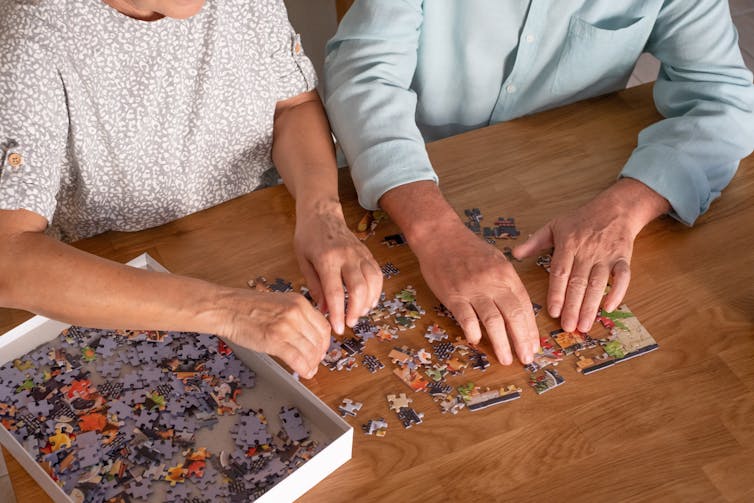
Two elderly people try to complete a puzzle.
Some autistic people struggle with important cognitive skills as they get older.
Lucigerma/ Shutterstock

While many autistic people will cognitively age in a similar way to non-autistic people, there’s some evidence that autistic adults may face a higher risk of cognitive decline and dementia. However, more large-scale research is needed to better understand this.

The importance of social support

Studies consistently found that autistic adults report lower quality of life compared to non-autistic peers. Mental health difficulties play a significant role in lower quality of life.

A key factor here appears to be social support. Our review found that autistic adults who had strong social networks reported higher quality of life – while loneliness and isolation were linked to poorer wellbeing. This could be because many autistic adults report having fewer social connections and experiencing greater isolation – particularly men.

We also found that factors such as receiving their autism diagnosis, learning to manage their capacity for social interactions and being in social situations and maintaining autonomy play important roles in positively shaping quality of life as autistic people get older.

Important considerations

When thinking about the findings of this review, it’s important to recognise limitations in the current research.

Only a small fraction of autism research has actually investigated ageing and autism. And what published literature has been done of this topic has focused on those diagnosed in adulthood. This overlooks a lot of autistic people. People who are diagnosed with autism in childhood and those with intellectual disabilities or higher support needs, are often excluded from research.

Under-diagnosis of autism is another major issue. Although autism affects around 1% of the global population, health records in the UK show very low diagnosis rates among middle-aged and older adults.

Estimates also suggest that around 89% of autistic people aged 40–59, and 97% of those aged 60 or over, may be undiagnosed. This is, in part, due to autism historically being viewed as a condition that only affected children. Additionally, gender biases in autism diagnoses were common – resulting in women and girls being historically overlooked.

In the future, we need more studies that track autistic people and their experiences throughout their life – including as they get older. We also need to make sure research is representative of autistic people more broadly – for example, by including people with higher support needs and those diagnosed earlier in life.

Finally, autistic adults themselves must be involved in steering the direction of research and the creation of resources and policies. With their input, we can support healthier, more fulfilling and socially connected lives, so they are able to age well with dignity and autonomy.

While ageing in autistic people has been historically overlooked, we’re making a lot of progress in addressing this major gap in research. While the current evidence included in our review has identified a lot of challenges that middle-aged and older autistic people might face, it has also highlighted opportunities for where autistic people can be better supported as they get older – such as improving access to healthcare and helping people remain socially engaged.

With a better understanding of autism in midlife and later life, we can begin to reduce the health risks that autistic adults face as they age and improve wellbeing.

The Conversation

Gavin Stewart receives funding from the British Academy.

ref. What we do (and don’t know) about autism and ageing – new research – https://theconversation.com/what-we-do-and-dont-know-about-autism-and-ageing-new-research-264140

Ultra-processed foods v minimally processed foods: how can you tell the difference?

Source: The Conversation – UK – By Aisling Pigott, Lecturer, Dietetics, Cardiff Metropolitan University

Minimally processed foods are whole foods that are altered only to make them safer or easier to prepare. GoodStudio/ Shutterstock

If you’ve ever tried to lose weight, you’ve probably been told that cooking your own meals is the way to go. This has been backed up by a recent study, which found that people who ate home-cooked, minimally processed foods lost twice the weight to those who ate mainly ultra-processed, ready-made foods.

The recent study, which was published in Nature Medicine, involved 50 adults who were randomly assigned to eat either a diet high in ultra-processed foods or one with mostly minimally-processed foods. Both diets were designed to meet the UK’s national dietary guidelines.

Both groups lost weight, which makes sense as they consumed fewer calories than they usually did. However, the group that consumed mostly minimally processed foods ultimately consumed fewer calories overall – thereby losing more weight. They also saw slightly greater improvements to other measures of their health, such as having lower fat mass, reduced triglyceride levels (linked to heart health) and fewer cravings for unhealthy foods at the end of the study.

The ultra-processed foods group still lost weight and saw some improvements in blood lipids (fat) and blood glucose (sugar), but these changes were generally smaller than those seen in the minimally processed foods group.

As a dietitian, this is both an interesting and important piece of research – even though the results are not entirely surprising. In fact, a surprising result is that the consumption of ultra-processed food still resulted in weight loss.

The minimally processed diet group consumed fewer calories overall, which would explain why this group lost more weight. But the fact that this group saw greater improvements in other areas of their health highlights how health encompasses far more than calories or a number on the scales.

Why processing matters

Despite the bad press, food processing plays an essential role in food safety and preservation.

But how much processing a food has undergone seems to be the factor associated with worse health outcomes. These foods tend to have less fibre, more added fats, sugars and salt. This is because they’re designed to be tasty and long-lasting.

The most common definition of an ultra-processed foods are foods which are industrially produced and which contain extracts of original foods alongside additives and industrial ingredients. Think crisps or frozen ready meals.

The food system in much of the world has become increasingly reliant on ultra-processed foods, with these foods contributing to about half of food intake in the UK, Europe and the US. But there’s clear evidence that high intake of ultra-processed foods is linked with poorer health outcomes, including obesity, type 2 diabetes, heart disease and certain cancers.

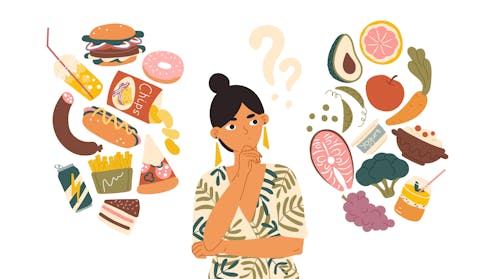
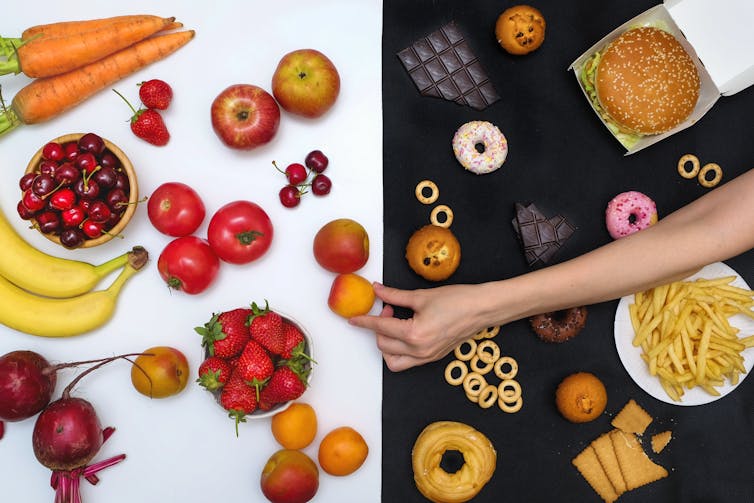
A person's hand reaches over an assortment of ultra-processed foods to chooses a minimally processed fruit instead.
Ultra-processed foods contain ingredients you wouldn’t normally find in your kitchen at home.
Natalia Mels/ Shutterstock

The more calorie-rich, less nutritious foods we consume, the more our health will suffer – as this recent study has confirmed. But how can you work out which foods are classified as “ultra-processed” and which are only “minimally processed”? In short, this depends on how much processing a food product has undergone to be ready for consumption.

Ultra-processed foods are industrially formulated products made mostly from ingredients extracted from foods (such as oils, starches and proteins) and additives.

Examples include: sugary breakfast cereals, flavoured yoghurts with sweeteners and thickeners, soft drinks, instant noodles, packaged biscuits and cakes, mass-produced bread with emulsifiers and reconstituted meat products – such as chicken nuggets.

Minimally processed foods are whole foods that are altered only to make them safer or easier to prepare. Importantly, this processing doesn’t change their nutritional value.

Examples include: fresh, frozen or bagged vegetables and fruit, plain yoghurt or milk, whole grains (such as oats or brown rice), eggs, fresh or frozen fish, and tinned beans or tomatoes without added sugar or salt.

Including minimally processed foods

It can sometimes feel overwhelming to work out whether a food is ultra-processed or minimally processed.

Some advice that is often suggested for working out whether a food is ultra-processed include checking to see if a product contains more than five to ten ingredients and considering if it contains ingredients you wouldn’t use at home.

In addition to the number of ingredients, it’s also the type of ingredients that matter. Ultra-processed foods often contain added sugars, refined starches, emulsifiers, stabilisers and flavourings that serve cosmetic purposes (such as improving colour, texture or taste), rather than preserving the food’s freshness or safety.

Minimally processed foods will not contain these types of ingredients, nor will they have as many ingredients on their label.

It’s also important to be aware of smoked meats. While this is a common preservation method, most commercially available smoked meats – such as bacon, ham or sausages – are considered ultra-processed because of the curing agents and other additives they contain. While plain smoked fish (such as smoked salmon) is still classed as a processed food, it uses fewer curing agents and additives than other smoked meat products.

A diet rich in minimally processed foods usually means more fibre, more nutrients and fewer calories – all of which can support weight and long-term health, as this recent study showed. So if you’re keen to include more minimally processed foods in your diet, here are a few tips to help you get more onto your plate:

  • build meals around vegetables, whole grains and pulses
  • use tinned or frozen products for convenience and to save time while cooking
  • choose plain dairy products without sugar or fruit purees, then add your own fruits, nuts and seeds for flavour
  • healthy meals don’t have to be complicated. Aim to include a protein source, a wholegrain carbohydrate and plenty of veggies or fruits at each meal
  • batch cook meals when you have time and freeze them if possible.

As a dietitian, it’s important to point out that there’s a distinction between the potential harms of excessive consumption of ultra-processed foods and the essential role processing can play in ensuring food safety, preservation and accessibility.

It’s also important not to panic about enjoying the occasional biscuit or ready meal, and we should avoid demonising convenience foods – especially for those who face barriers such as limited mobility or lack of cooking facilities. Because remember, the group that ate a diet high in ultra-processed foods but met dietary guidelines still lost weight and saw health benefits in the study.

Eating well doesn’t mean that you need to completely eliminate ultra-processed foods. But shifting the balance towards eating more minimally processed foods, with more home-cooked meals where possible, is a step in the right direction.

The Conversation

Aisling Pigott receives funding from Research Capacity Building Collaborative (RCBC) / Health and Care Research Wales (HCRW)

ref. Ultra-processed foods v minimally processed foods: how can you tell the difference? – https://theconversation.com/ultra-processed-foods-v-minimally-processed-foods-how-can-you-tell-the-difference-262669

What does it mean to become an adult? In Namibia, it’s caring for others

Source: The Conversation – Africa – By Selma Uugwanga, Clinical Psychologist (Namibia) and PhD Researcher on Emerging Adulthood in sub-Saharan Africa, University of Zurich

Olufuko initiation festival for Ovawambo girls. Pemba.mpimaji/Wikimedia Commons, CC BY

Around the world, people become adults in different ways. In some places, it’s when you get a job, get married, or move out of your parents’ house. In others it might include an initiation ritual, or taking leadership in your family or community.

These milestones may differ, but they all point to the same question: what does it mean to “become an adult”? Understanding this matters – not only for psychologists who study human development and behaviour, but also for society, because adulthood is more than just getting older. It shapes our motivations and identity, how we relate to others, and our mental health and well-being.

Local views on adulthood set the stage for how young people learn to take responsibility and find their place in the world.

We are cross-cultural personality and developmental psychology researchers who study emerging adulthood, identity development, personality, and mental health. We were interested in what the transition to adulthood looks like in sub-Saharan Africa – specifically, among the Ovawambo people of Namibia. One of us (Selma Uugwanga) is Omuwambo, offering an important insider perspective.

We interviewed 50 young Ovawambo adults, aged 18 to 25, living in both rural and urban areas of Namibia. We wanted to understand how they defined adulthood: what signals its beginning? What responsibilities and challenges come with it?

Our goal was to centre African perspectives, which are underrepresented in global psychology, and to understand how traditional values and modern realities shape the experience of growing up.

We identified five key themes, relating to gender roles, birth order, becoming a parent, community responsibility, and psychological maturity. A common thread was how participants connected personal aims and achievements with the capacity and duty to help others. An adult is someone who can care for both themself and for others.

Our findings are a reminder that there is no single pathway to adulthood. Recognising cultural differences is essential if we want to build a truly inclusive understanding of human development across the globe.

Why Namibia and the Ovawambo?

Namibia, a country in the south-western part of Africa with a population of about 3 million, is home to many ethnic groups. Nearly half of the population are Ovawambo. Traditionally, Ovawambo communities included formal rites of passage to adulthood, such as ceremonies and new roles in the household or community. For example, the Olufuko ceremony prepared girls around age 14 for womanhood, allowing them to become sexually active, have children and marry. These practices changed during colonialism and later with the rise of Christianity.

Today, things are shifting even more with globalisation. Many young Namibians now stay in school longer, with higher education enrolment rising from just 3% in the 1990s to nearly 29% in 2022. Young people also often wait longer to marry or have children. Yet, unlike their peers in many western countries, daily life is still strongly shaped by family obligations and community ties. For example, one young participant explained that he supported his grandmother and took on responsibilities for other relatives because his parents had limited resources.

Since Namibia’s independence in 1990, rural-to-urban migration has surged. The country’s urban population has risen from about 28% in 1990 to approximately 54% by 2025. Young people are often navigating between rural traditions and urban change.

While our focus was on Ovawambo youth, this group shares many cultural and social dynamics with other young people in sub-Saharan Africa, and we believe the patterns we observe here may reflect broader regional trends.

Perceptions of adulthood

We collected in-depth interviews, then generated overarching themes from close attention to meaning in participants’ stories.

We spoke with 50 young adults – half of them women – equally split between urban and rural areas in Windhoek and northern Namibia. Participants ranged in age from 18 to 25 years; most had finished secondary school and were enrolled in higher education, with only a few in steady jobs. Almost half lived with parents, and others with siblings, cousins, or extended relatives, showing how family households remain central at this stage of life.

We asked open-ended questions like:

  • Do you feel like you’re an adult?

  • What are the most important signs of adulthood?

  • Is adulthood different for men and women?

  • Do your parents consider you as an adult?

These conversations gave us deep insights into how young Namibians view themselves and their roles in society.

From the interviews, we identified five key themes:

1. Gender shapes the path to adulthood

Almost all participants said adulthood looks different for men and women. Ovawambo women are often seen as becoming adults earlier in their teenage years than men, because they take on caregiving roles like cooking and caring for siblings. Men are expected to be independent and financially responsible earlier, but often face more pressure. Both currently contend with high youth unemployment and carry different but significant burdens.

2. Birth order matters

Your position in the family shapes your adult responsibilities. Firstborns, especially in large families, are often expected to help care for siblings or even support the household. This can lead to earlier maturity. By contrast, youngest children are often protected longer, even if they are legally adults.


Read more:
Eldest daughters often carry the heaviest burdens – insights from Madagascar


3. Parenthood signals change, but not always adulthood

Having a child, especially for women, is often a major turning point. Yet, because parenting is commonly supported by extended family, being a parent doesn’t automatically mean being seen as an adult. Maturity and independence remain essential markers.

4. Family and community responsibility is central

Adulthood in Namibia does not primarily centre on personal independence, but instead on caring for the wider community. An adult is someone who can support family members, neighbours, and others in need – emotionally, financially and socially.

5. Maturity means more than age

Participants emphasised that true adulthood is about behaviour and mindset – thinking carefully, learning from mistakes, showing resilience, and knowing when to seek advice from elders.

Difference in emphasis

Most psychological research on young adulthood focuses on the US and Europe, where this life stage is often framed as a time of freedom, self-focus and exploration. But our study shows a different picture: in Namibia, young adults are embedded in strong social networks and often assume serious responsibilities early in life, with their independence serving as a key resource for doing so.

Despite facing challenges like high unemployment and limited resources, many participants expressed pride in their ability to care for others. They saw responsibility as a source of meaning.


Read more:
Young men on South Africa’s urban margins: new book follows their lives over 10 years


Some findings mirror patterns seen in other contexts. For example, in East Asia or among immigrant youth in North America, researchers have also found that adulthood is closely linked to family responsibility.

What seems more distinct in Namibia is the emphasis on “agentic communalism”: the idea that personal agency (making your own decisions) and communal values (helping others) are not in conflict. Instead, they are interwoven. Being an adult means both acting independently and contributing to others’ well-being.


Read more:
Survey of young people in east Africa shows their values mirror those of adults


Becoming an adult in Namibia isn’t just about age or personal milestones. It’s about growing into a role that combines independence with care for others. It means taking responsibility – not only for yourself, but for your family and community – and earning respect through your actions.

The Conversation

Selma Uugwanga is supported by the Swiss National Science Foundation through an Eccellenza Grant as a PhD student on the Africa Long Life Study at the University of Zurich. She also serves as an Emerging Scholar Representative for the Society for the Study of Emerging Adulthood; this is an academic service role with no political or financial interests.

Amber Gayle Thalmayer is supported by Eccellenza Fellowship 10001C_179458 from the Swiss National Science Foundation. She is an Assistant Professor at the University of Zurich, Switzerland and a Research Fellow at the University of the Free State, South Africa.

Luzelle Naude receives funding from the South African National Research Foundation (SRUG220318204).  

ref. What does it mean to become an adult? In Namibia, it’s caring for others – https://theconversation.com/what-does-it-mean-to-become-an-adult-in-namibia-its-caring-for-others-263223

États-Unis : comment le nationalisme blanc cherche à imposer ses idées à travers la Cour suprême

Source: The Conversation – in French – By Anne E. Deysine, Professeur émérite juriste et américaniste, spécialiste des États-Unis, questions politiques, sociales et juridiques (Cour suprême), Université Paris Nanterre – Université Paris Lumières

Le trumpisme n’est pas monolithique. En son sein, diverses mouvances s’affrontent. La plus extrémiste, celle du nationalisme blanc, aspire à faire inscrire sa vision ouvertement raciste dans la jurisprudence par la Cour suprême.


Porté par l’essor du trumpisme, le nationalisme blanc (qui englobe le suprémacisme et le séparatisme) cherche à capitaliser sur la radicalisation du Parti républicain (Grand Old Party, GOP) pour éroder les fondements de la tradition démocratique aux États-Unis.

L’objectif est, à travers la mise en œuvre d’une stratégie d’influence, de guider pas à pas une droite devenue illibérale vers un ordre autoritaire explicitement racial. Pour y parvenir, les leaders revendiqués de la mouvance, tels que les auteurs et éditeurs Jared Taylor et Greg Johnson, cherchent à pénétrer plus avant l’administration Trump. À travers leur présence en ligne, ils commentent l’actualité et les actes officiels, et déterminent les attentes d’une audience, comprise entre 100 000 et 500 000 internautes, qui s’affirme de plus en plus au sein du GOP. La ligne de mire est qu’à l’horizon 2026-2028 un républicain de premier plan puisse affirmer sans états d’âme que les races sont une « réalité biologique » qui nécessite le rejet de la démocratie pour sauver « la civilisation blanche » – et qu’il soit porté non pas malgré, mais grâce à ces idées.

Cet effort de long terme s’appuie notamment sur la Cour suprême qui, pour les tenants de l’extrémisme blanc, constitue à la fois un outil de calibration, permettant d’évaluer jusqu’où il est possible de pousser les revendications sans provoquer de rejet massif, et un verrou institutionnel destiné à pérenniser d’éventuels acquis politiques.

Les nominations effectuées par Donald Trump entre 2017 et 2020 ont fait basculer la Cour dans une majorité de conservateurs radicaux. Pourtant, les auteurs de premier plan du camp nationaliste blanc estiment que les décisions prises par la Cour depuis 2020 sont « largement inefficaces et sans avenir » : elles ne leur auraient pas fourni le levier tactique escompté et révéleraient que la trajectoire idéologique de la droite reste inaboutie.

Or dans le même temps, d’autres composantes de la droite trumpiste, à commencer par le nationalisme chrétien, se félicitent de l’action de la Cour. Les neuf juges de la juridiction suprême se retrouvent sous l’effet des influences croisées et souvent opposées de ces deux groupes, qui sont loin d’être d’accord sur tout…

L’ambiguïté tactique du conservatisme chrétien

Durant son premier mandat, en nommant successivement Neil Gorsuch (2017), Brett Kavanaugh (2018) puis Amy Coney Barrett (2020), Donald Trump concrétise l’un des engagements phares de sa campagne présidentielle de 2016 : ancrer une majorité conservatrice durable au sein de la Cour suprême.


À lire aussi :
États-Unis : l’impact de l’originalisme des juges conservateurs à la Cour suprême


Ce basculement (six juges conservateurs contre trois progressistes) est immédiatement salué par les organisations évangéliques et catholiques comme l’aboutissement d’un combat entamé dans les années 1980. Le renversement de la jurisprudence, ancrée depuis 1973 dans l’arrêt Roe v. Wade, par la décision Dobbs v. Jackson, du 24 juin 2022, consacre la victoire d’une droite chrétienne qui prétend que remettre aux législatures d’État la responsabilité de décider du caractère légal ou non de l’avortement marque l’avènement d’une « culture de la vie ».


À lire aussi :
Fin du droit à l’avortement aux États-Unis : moins de démocratie, plus de religion


En revanche, dans la sphère nationaliste blanche, la décision Dobbs v. Jackson suscite des réactions teintées de réserve, voire de défiance. Pour des figures influentes comme Greg Johnson et Gregory Hood l’avortement constituerait un instrument eugéniste dont l’accès ne devrait pas être entravé. Les données statistiques confortent leur argumentation : en 2022, le taux d’avortement chez les femmes afro-américaines était 4,3 fois supérieur à celui des femmes blanches. Dès lors, pour les adeptes de la théorie du « grand remplacement », la légalité de l’avortement apparaît comme un moyen de régulation démographique des minorités raciales.

Si le christianisme politique et l’ethnonationalisme partagent une généalogie commune, documentée notamment par l’historien Leonard Zeskind, leur proximité s’est longtemps cantonnée aux marges paléoconservatrices de la droite américaine, notamment autour de la revue Chronicles et de l’héritage de Pat Buchanan.

Aujourd’hui, les groupes nationalistes blancs tendent à se distancier d’une religion chrétienne perçue comme sémitique et imprégnée d’un universalisme jugé incompatible avec le racialisme. Certains segments suprémacistes réinvestissent un paganisme identitaire pour élaborer des mythes européens de filiation et de pureté, voire explorent des références à l’ésotérisme nazi.

À rebours, le conservatisme chrétien, lui, poursuit une entreprise de moralisation des enjeux sociétaux, tout en cherchant à élargir sa base électorale, y compris auprès de certaines minorités, sous la bannière de la coalition MAGA.


À lire aussi :
Pourquoi les Hispaniques évangéliques ont-ils voté Trump ?


Au-delà de ces divergences idéologiques, une convergence tactique émerge dans un contexte de polarisation structurelle. Ce qui fédère ces courants ne relève pas d’une vision du monde partagée, mais d’une opposition commune aux libertés individuelles et au progressisme sociétal, caricaturé sous le terme péjoratif de « wokisme ».

Dans cette « guerre culturelle » portée par la droite radicale, le conservatisme juridique de la Cour suprême constitue une ressource permettant de légitimer une conception de la société fondée sur des identités fixes, hiérarchisées et essentialisées. La décision Dobbs v. Jackson ne représente donc pas une décision isolée, mais bien une étape métapolitique, un précédent mobilisable perçu par les nationalistes blancs comme un modèle d’activisme institutionnel reproductible.

L’opposition au nationalisme « color-blind »

À mesure que s’effritent les garde-fous libéraux aux États-Unis, les courants de la droite pro-Trump apparaissent de plus en plus fragmentés sur la question du sens même de leur projet national. Cette fracture s’est cristallisée à la suite de l’arrêt Students for Fair Admissions v. Harvard, du 29 juin 2023, par lequel la Cour suprême a déclaré inconstitutionnelles les politiques d’admission dans les universités explicitement fondées sur la race.

L’arrêt consacre une lecture dite « color blind » de l’égalité, souvent associée à la maxime formulée par John Roberts en 2007 : « Éliminer la discrimination raciale signifie l’éliminer dans son intégralité. » Or, ainsi que l’a montré le sociologue Eduardo Bonilla-Silva, les approches qui prétendent ignorer les origines ethniques ne font souvent que perpétuer des inégalités structurelles héritées.

Les nationalistes blancs retournent cet argument et, dans un commentaire immédiat de l’arrêt, le site Counter-Currents affirme que « le nationalisme civique n’a pas d’avenir » et qu’« aucune somme d’argent versée à la Federalist Society n’y changera rien ». Autrement dit, la Federalist Society, créée en 1982 pour contrer la « domination libérale », devenue aujourd’hui un puissant réseau de juristes conservateurs (incluant les six membres « conservateurs » de la Cour suprême) serait dans l’erreur : la seule adhésion à des principes constitutionnels abstraits ne permettrait pas de fédérer une nation que les nationalistes blancs perçoivent comme un agrégat instable de tribus rivales. De fait, les racialistes anticipent qu’un marché scolaire prétendument neutre renforcerait surtout l’avance des candidats d’origine asiatique, plus performants sur les Scholastic Assessment Tests (SAT) que leurs « concurrents ».

Cette opposition interne s’intensifie encore davantage lorsqu’on passe du débat universitaire aux enjeux économiques. Fin 2024, Elon Musk plaide pour un système méritocratique permettant de relancer l’innovation américaine. Il défend nommément l’augmentation significative des quotas de visas H-1B, permettant l’arrivée massive de talents indiens et chinois dans le secteur technologique.

Face au technocrate, l’aile nativiste America First, de Steve Bannon à Nick Fuentes, dénonce un levier de substitution de main-d’œuvre et un risque de déplacement démographique.

Sur les réseaux sociaux, la polémique prend une dimension plus théorique. Elle expose deux visions concurrentes au sein même de la droite dure américaine : d’un côté, un paradigme économique axé sur la compétitivité entrepreneuriale et la performance technologique ; de l’autre, un paradigme identitaire fondé sur une définition essentialiste des États-Unis.

L’objectif des nationalistes blancs est clair : il s’agit d’imposer, dans la définition même de l’intérêt national, la question du « qui » avant celle du « quoi ». Pour ce faire, ses acteurs cherchent à discréditer les branches civiques et économiques de la droite, accusées d’être implicitement « anti-blanches », afin de se présenter comme les uniques gardiens de la nation.

Pour que la rhétorique devienne une réalité politique, depuis le printemps 2025, les références à l’affaire Trump v. CASA se multiplient. En effet, l’arrêt rendu par la Cour suprême dans cette affaire, le 27 juin 2025, semble accréditer l’idée d’une remise en cause du droit du sol (jus soli), prélude à une citoyenneté définie par le droit du sang (jus sanguinis).

Le peuple dans le texte

La lutte contre l’immigration demeure la pierre angulaire du mouvement MAGA. Avec sa promesse de réduire drastiquement les arrivées et de réaliser des expulsions massives, Donald Trump répond à des inquiétudes économiques et sécuritaires. Sous ces arguments transparaît une crainte profonde de dépossession, qui se décline en deux registres indissociables : un registre raciste qui désigne comme menaçantes des populations perçues comme étrangères ; et un registre populiste, qui accuse une élite cosmopolite d’orchestrer le « grand remplacement » du « vrai peuple ».

C’est précisément cette notion de « vrai peuple » que le nationalisme blanc s’efforce de redéfinir, cherchant à faire glisser l’identité MAGA, d’abord « américaine », vers une identité avant tout (ou exclusivement) « blanche ».

Plutôt que d’attaquer frontalement, ses idéologues investissent un symbole fondateur : la Constitution et son célèbre « We the People ». En s’appuyant sur des références historiques comme le Naturalization Act de 1790, ils soutiennent que les Pères fondateurs avaient réservé la citoyenneté aux seuls hommes blancs libres, et rejettent les amendements constitutionnels qui ont suivi la guerre de Sécession et accordent aux anciens esclaves le même droit à une procédure juste qu’aux Blancs. Que la naissance des États-Unis ait reposé sur des hiérarchies raciales est un constat partagé par de nombreux historiens ; mais les nationalistes blancs, eux, s’appuient sur ce constat pour indiquer que la Cour suprême doit prendre ses décisions à cette aune et ne pas tenir compte des évolutions civiques ultérieures.

Ce discours, porté notamment par des groupes comme American Renaissance et son think tank, la New Century Foundation, ne relève pas seulement de la provocation argumentaire, mais bien de l’hypothèse tactique d’une implantation durable dans les institutions judiciaires. En occupant les prétoires plutôt qu’en manifestant dans la rue, l’orientation de long terme consiste à former un réseau influent de juges, avocats et procureurs acquis à une vision raciale de la société. Ce militantisme judiciaire vise, paradoxalement, à affaiblir la branche judiciaire au profit d’un exécutif tout-puissant.

En définitive, le nationalisme blanc ne se contente pas d’un rôle de commentateur. L’enjeu consiste à influencer les décisions de la Cour suprême afin de devenir le centre de gravité de la droite pro-Trump et de remodeler le visage des États-Unis, sans compromis.

The Conversation

Les auteurs ne travaillent pas, ne conseillent pas, ne possèdent pas de parts, ne reçoivent pas de fonds d’une organisation qui pourrait tirer profit de cet article, et n’ont déclaré aucune autre affiliation que leur organisme de recherche.

ref. États-Unis : comment le nationalisme blanc cherche à imposer ses idées à travers la Cour suprême – https://theconversation.com/etats-unis-comment-le-nationalisme-blanc-cherche-a-imposer-ses-idees-a-travers-la-cour-supreme-264167

« Le fact-checking » suffit-il à garantir une objectivité journalistique ?

Source: The Conversation – in French – By Fabrice Flipo, Professeur en philosophie sociale et politique, épistémologie et histoire des sciences et techniques, Institut Mines-Télécom Business School

Vérifier les faits est essentiel, car certaines informations sont tout simplement fausses. Mais la manière dont les faits sont sélectionnés et racontés implique un tri, et aucun choix n’est jamais neutre. beast01/Shutterstock

Les médias mettent en avant la vérification des faits (« fact checking ») face aux fausses informations (« fake news »). Ils questionnent moins souvent la façon dont les récits sont élaborés (« storytelling »). Quelle pourrait-être la méthode pour construire un discours journalistique objectif et impartial ?


Chacun a entendu parler des fake news, qui seraient supposément propagées par les réseaux sociaux. Nombreux sont les médias qui s’équipent de cellules de « fact checking » censées les contrer. Mais sont-elles efficaces ? Leur critère est souvent de « revenir aux faits ». Pourtant, c’est loin d’être suffisant.

Trois normes sont centrales, en réalité : l’objectivité, la neutralité et l’impartialité. Or, elles sont largement méconnues.

Comment dire le vrai ? Le problème traverse déjà les écrits de Platon, quand il dénonce la rhétorique des sophistes, qu’il juge manipulatrice. C’est encore le cas quand Socrate pointe les limites de l’écrit, qui coupe le lecteur de la réponse possible du rédacteur. L’intelligence artificielle et les réseaux sociaux reconfigurent les enjeux, étant de nouvelles manières d’écrire et d’échanger. Ils ne les inventent pas. La présence de cellules de « fact checking » est à double tranchant, dans la mesure où elles jettent aussi un doute sur la production médiatique restante. Leurs méthodes doivent-elles en effet être réservées à une émission parmi des dizaines d’autres ? Produire le vrai n’est-il pas la raison d’être du journaliste, de tous les instants ? Et les réseaux sociaux ne sont-ils pas aussi une manière d’informer sur ce que les médias dominants négligent ? A qui faire confiance, alors ? Sur quels critères ? Le problème est pratique et concret.

Vérifier les faits, oui mais lesquels ?

Face aux « fake news », la réponse la plus courante consiste à « vérifier les faits ». On parle alors de « fact checking », à l’exemple des « Vérificateurs » sur TF1. Vérifier les faits est essentiel, en effet, car certaines informations sont tout simplement fausses. Les conséquences peuvent être immenses, à l’exemple des « armes irakiennes de destruction massives », qui n’existaient pas, mais ont servi à justifier l’entrée en guerre des États-Unis face à l’Irak, en 2003. Mais ce n’est pas le seul problème. La manière dont les faits sont sélectionnés et racontés est une difficulté distincte. La sélection est inévitable, du fait des formats, et aucun choix n’est neutre.

Ne montrer que les points de deal, dans une cité, n’est pas plus neutre que de ne montrer que le chômage massif qui pousse les jeunes vers l’argent facile. La manière d’enchaîner les faits est également déterminante.

Par exemple, enchaîner les faits divers dramatiques à l’exclusion de toute autre considération enferme le public dans une histoire : celle de l’insécurité. Le besoin de sécurité peut ainsi être fabriqué, sans que l’insécurité objective n’ait changé. L’histoire ainsi construite est-elle vraie, est-elle fictive ? Il n’y a souvent pas très loin de la narration des faits au storytelling ou art de raconter à un public les histoires qu’il a envie d’entendre.

Une autre réponse est possible. Elle prend appui sur un fait saillant caractéristique des questions qui sont abordées dans les médias : leur caractère controversé. Un fait divers, tel qu’une attaque au couteau de la part d’un jeune, est diversement interprétable : insécurité ou résultat inévitable de suppression des budgets de l’éducation populaire ? Les explications sont diverses et ont généralement un lien avec les intérêts de celles et ceux qui les formulent – femmes, jeunes, commerçants, associations, etc. Comprendre le fait et pouvoir l’expliquer implique de faire une place à l’interprétation, laquelle procède de la confrontation de points de vue antagoniques. Les faits ne parlent pas d’eux-mêmes de manière univoque.

La méthode des juges

Comparons avec ce qui se passe dans un tribunal. Aucun juge ne se prononce sur le simple établissement des faits. Qui serait capable de les présenter de manière neutre ? Personne.

Le juge écoute donc, tour à tour, la défense, l’accusation et les témoins. Chacun d’entre eux produit les faits qui leur paraissent pertinents et significatifs. Un arbitre procède de la même manière, quand il doit rendre une décision. Il ne se contente pas de constater. Il écoute un point de vue, un autre, fait appel éventuellement au replay, etc. et finit par trancher.

L’interprétation prend du temps, et c’est elle qui passe à la trappe avec la prétention de « s’en tenir aux faits » ou, pis, avec la tentation de verser dans la chasse au scoop et le souci de « faire de l’audience ».
Tout fait un peu complexe implique qu’une enquête soit menée pour pouvoir être compris. C’est la règle. Sans cela, ce n’est pas le tribunal de la vérité qui est dressé, mais la conclusion hâtive, voire le procès stalinien.

La question de la formation du jugement en situation controversée se pose aussi pour les enseignants. La question a donc fait l’objet d’un travail de deux ans impliquant une vingtaine d’enseignants de l’Institut Mines-Télécom, enquêtant, par exemple, sur les normes sur lesquelles s’appuient les juges, les arbitres, ou encore les enseignants confrontés à des controverses.

Trois normes procédurales se dégagent de l’analyse. La première est la neutralité. Un bon jugement ne doit pas chercher à changer les faits ni même les interprétations que les diverses parties en donnent. Il s’interdit d’interagir avec eux. La seconde est l’impartialité. À la manière d’un juge ou d’un arbitre, elle enjoint d’écouter tous les points de vue afin de construire une vision partagée de la situation. Ce résultat ne se trouvait dans aucun d’entre eux, pris de manière isolée. C’est pourquoi l’impartialité ne se confond pas avec la neutralité. Le troisième critère est l’objectivité. Les faits sur lesquels les points de vue raisonnent doivent tous être solides, à la manière des preuves jugées recevables dans un tribunal. Et leur solidité dépend de la manière dont le sujet et l’objet ont interagi.

Quelle est la méthode, alors ? Tout d’abord, ne pas confondre l’information avec le militantisme, le fait d’informer avec le fait de vouloir changer la situation. C’est la neutralité.

Ensuite, confronter les principaux points de vue, sans négliger les « signaux faibles ». Quand un point n’est traité qu’avec un seul expert, et plus encore si cet expert est toujours le même, ou quand des faits similaires sont abordés en donnant toujours la parole aux mêmes, alors nous sortons des critères d’un bon jugement. Par exemple, ne s’intéresser à une grève qu’en donnant la parole aux usagers mécontents revient à dresser un argumentaire à charge contre les grévistes, dont la parole n’est pas relayée. Et cela vaut aussi pour les scientifiques. L’océan du climatologue est bien différent de celui du spécialiste des requins.

Enfin, s’assurer de la solidité des faits, de leur résistance, en ayant en tête que les scientifiques sont bien souvent en désaccord entre eux. Ces trois normes sont ce que Kant appelait des « idées régulatrices », c’est-à-dire des idéaux qui indiquent des directions mais ne peuvent jamais être parfaitement réalisés.

Les médias classiques assurent-ils une information de meilleure qualité que les réseaux sociaux ?

Chacun pourra constater à l’aune de ces trois normes que les médias classiques (télévision, presse) ne sont pas forcément de meilleure qualité que les réseaux sociaux. Ils ont une ligne éditoriale, c’est-à-dire une manière générale d’interpréter la réalité, qui diffère d’un média à un autre. Ils vont donc avoir tendance à inviter les experts qui la confortent, à accumuler les faits qui vont dans leur sens et à mettre en doute ceux qui la remettent en cause.

Le gendarme de l’information veille, certes, aux abus les plus évidents. Ainsi, c’est pour avoir trop réduit la diversité de ses sources que la chaîne C8 a été interdite d’antenne.

En réalité, il est rare que les médias mentent ouvertement. La ficelle est trop grosse, et nuirait très fortement au média dès lors qu’elle serait dévoilée. C’est par le manque de neutralité et d’impartialité que passe la plus grosse des fake news. Les règles du storytelling le savent bien, d’ailleurs. Une bonne histoire doit être crédible, du point de vue du public récepteur. Et une belle histoire est bien plus difficile à remettre en cause qu’un fait qui se révélerait erroné.

Le raisonnement qui vaut pour les médias vaut aussi pour l’expertise, puisque celle-ci a pour but d’éclairer la décision. Si l’information apportée n’est ni neutre, ni impartiale, ni objective, alors la décision ne le sera pas non plus. Les mêmes règles doivent donc procéder au choix des experts dans une prise de décision.

The Conversation

Fabrice Flipo ne travaille pas, ne conseille pas, ne possède pas de parts, ne reçoit pas de fonds d’une organisation qui pourrait tirer profit de cet article, et n’a déclaré aucune autre affiliation que son organisme de recherche.

ref. « Le fact-checking » suffit-il à garantir une objectivité journalistique ? – https://theconversation.com/le-fact-checking-suffit-il-a-garantir-une-objectivite-journalistique-258998