Canada’s response to the war in Gaza raises questions about its commitment to human rights and justice

Source: The Conversation – Canada – By Jeremy Wildeman, Research Fellow at the Human Rights Research and Education Centre, University of Ottawa and Adjunct Assistant Professor, Carleton University

Canada and Canadians have long considered themselves defenders of human rights, democracy, justice and the rule of law. Canada played a significant role in the development of what’s known as the liberal international order, including multilateral institutions like the United Nations, and international law.

Canada was once highly respected for the role it played developing the framework for United Nations peacekeeping, the Mine Ban Treaty, championing the UN’s Responsibility to Protect, supporting Palestinian-Israeli peace negotiations and establishing the International Criminal Court.

Canada has acted as a moral voice denouncing abuses of human rights and violations of international law. It challenged South African apartheid, and passed a parliamentary motion calling China’s treatment of Uyghur Muslims a genocide.


Read more:
Brian Mulroney’s tough stand against apartheid is one of his most important legacies


It has advocated for Iranian women’s rights at the United Nations and sanctioned Russia for its 2022 invasion of Ukraine.

In 2023, Canada joined a declaration of intervention against Myanmar at the International Court of Justice over its treatment of the Rohingya people, reaffirming the requirement for states to prevent genocide.

Where is Canada on Gaza?

Prime Minister Mark Carney says Canada intends to recognize a Palestinian state at this week’s UN General Assembly.

Yet Canada’s response to Israel’s war on Gaza since October 2023 and countless well-documented instances of war crimes committed against Palestinians — including allegations of ethnic cleansing and genocide — raises serious questions about Canada’s commitment to its own values and the liberal international order.

Observers have documented countless Israeli violations of international law while turning Gaza into an unliveable wasteland. Seventy-eight per cent of all structures in Gaza have been destroyed, including housing (92 per cent), water and sanitation infrastructure (89 per cent), hospitals (50 per cent), schools (91.8 per cent) and roads (81 per cent).

The health-care system has been systematically dismantled, and Gaza has recorded the highest number of deaths of health-care workers, United Nations staff and journalists of any recent conflict zone.

Israel has denied and attacked humanitarian aid. Since mid-March, it has enforced a total siege on Gaza, blocking entry of food, water, medical supplies, hygiene and dignity kits, and infant and maternal care items, including baby formula.

Famine has been unfolding and starvation is widespread, but now 100 per cent of Gaza’s estimated 2,100,000 people face acute levels of food insecurity.

Aid is scarce

Only four aid distribution sites currently operate in Gaza, down from 400. They were set up in May by the United States/Israeli-backed Gaza Humanitarian Foundation. Médecins sans frontières (Doctors Without Borders) say they violate core humanitarian principles.

The Gaza Humanitarian Foundation has been accused of weaponizing aid, engaging in ethnic cleansing and funnelling Palestinians south to displace them. Its contractors and Israeli forces have been accused of firing on starving Palestinians, accounting for many of the 1,838 Palestinians killed and 13,409 wounded while seeking aid since the foundation began operations.

A former Gaza Humanitarian Foundation employee accuses the organization of shooting on starving Palestinians. (Breaking Points YouTube channel)

Gaza’s official death toll now stands at 61,722 people, but is likely much higher. Gaza has recorded more child deaths than any other conflict zone, and Israel’s own military data indicates an almost unheard-of 83 per cent civilian death rate.

Canada’s support for Israel

Canada claims to support a fair-minded approach to Palestine-Israel peacebuilding. It does not recognize permanent Israeli control over the Occupied Palestinian Territory, recognizes Palestinians’ right to self-determination and is committed to the goal of a comprehensive, just, and lasting peace in the Middle East.

But despite Israel’s assault on Gaza, attacks in the West Bank and violations of international law, Canada continues to ship Israel arms, financially supports Israeli settlements on Palestinian land and offers Israel diplomatic support and multilateral cover.


Read more:
Canada’s updated trade agreement with Israel violates international law


If Canada makes a statement critical of Israeli violations, it rarely follows through with tangible consequences for Israel. Canada has admitted few Palestinian refugees from Gaza and has participated in dangerous humanitarian aid air drops that have been called expensive public relations stunts that don’t help very many people.

Critics of Israel under attack

Meanwhile, critics in Canada of Israeli violations regularly find themselves under assault. Institutions like universities and the media, which should be defenders of core Canadian values, and federal, provincial and municipal governments, regularly spread misinformation and try to silence opposition to Israel’s actions.

Some Canadians have even been fired for speaking out and law enforcement has been deployed against them.

When the United States sanctioned four International Criminal Court prosecutors and judges, including a Canadian judge, for investigations into Israeli and American war crimes, Canada chose to remain silent. Canada had previously criticized the court for bringing charges against Israeli leaders.


Read more:
What the ICC’s anticipated arrest warrants against Netanyahu and Hamas leaders mean for Canada


What explains Canada’s support?

Between 2021 and 2023, I co-edited three scholarly volumes exploring Canada’s relations with the Palestinians that help explain Canada’s commitment to Israel throughout its genocidal war on Gaza.

Canada as a Settler Colony on the Question of Palestine (2023) argues there’s a strong historical bond between Canada and Israel as two European settler colonies established by the British Empire through the extermination and displacement of Indigenous Peoples.

The volume argues that a close socio-political bond and shared colonial interests cause Canada and Israel to support each other robustly on the international stage.

The suppression of voices critical of Israel is unsurprising when reading Advocating for Palestine in Canada (2022). It documents how this has happened over decades. Nonetheless, Palestine has become central to anti-racist, decolonial and other progressive movements across Canada.

Finally, in What Lies Ahead? Canada’s Engagement with the Middle East Peace Process and the Palestinians (2021), I argued that while there are clearly some elite voices in Canada advocating for a fair approach to Palestine-Israel peace-building, they are always outweighed by pro-Israel considerations.

These books and empirical observations since Oct. 7, 2023 suggest that Canada may be more committed to Israel and their shared colonial interests than Canadians’ own values or the liberal international order.

A defining test

Genocide is considered the most heinous of all crimes, and Gaza is the defining ethical test of the 21st century.

Illiberal measures deployed to silence dissent and support a country accused of genocide represent a grave threat to core liberal-democratic values.

Double standards like Canada’s policies toward Palestine raise serious questions about the fairness of international and domestic law, governance and policy and the Canadian state’s commitment to basic principles of human rights, democracy and justice.

The Conversation

Jeremy Wildeman does not work for, consult, own shares in or receive funding from any company or organisation that would benefit from this article, and has disclosed no relevant affiliations beyond their academic appointment.

ref. Canada’s response to the war in Gaza raises questions about its commitment to human rights and justice – https://theconversation.com/canadas-response-to-the-war-in-gaza-raises-questions-about-its-commitment-to-human-rights-and-justice-264001

Our understanding of lightning has been driven by fear and shaped by curiosity

Source: The Conversation – Canada – By Peter Watson, Emeritus professor, Physics, Carleton University

Lightning can carry between 100 million to one billion volts of electricity. (Josep Castells/Unsplash), CC BY

Playwright Tom Stoppard, in Rosencrantz and Guildernstern are Dead, provides one of the best definitions of science: “The scientific approach to the examination of phenomena is a defence against the pure emotion of fear.”

Nowhere is this more true than in the study of electricity in the wild; namely, lightning. Primitive humans must have been terrified by lightning, so much so that it is built into many religions. Lightning is almost always associated with the most powerful gods.

In Greco-Roman mythology, Zeus is armed with lightning bolts. In Norse mythology, Thor is the god of thunder and lightning. The Yoruba god Shango is associated with thunder, lightning and justice.

Lighting appears in popular culture as well, and Shakespeare — for once — gets it wrong in Cymbeline:

Fear no more the lightning flash.

Nor th’ all-dreaded Thunderstone.

This refers to the old (and not unreasonable) idea that thunder was caused by immense stones falling from the sky.

The French expression “coupe de foudre” — lightning strike — roughly translates as “love at first sight.” In English, we know that “lightning never strikes twice.” This is untrue: unfortunately, lightning hits the CN Tower in Toronto about 75 times annually.

A billion volts

Our modern understanding of lightning starts with Benjamin Franklin, who proposed flying a kite in a thunderstorm with a metal key attached to the end of the wire. He hypothesized that the current would travel down the line, but he probably had too much sense to actually perform the experiment. French physicist Thomas-François Dalibard conducted the lightning rod experiment in 1752. The same experiment killed German physicist Georg Wilhelm Richmann in 1753.

What do we know about lightning? The basic process that creates thunderclouds is that positive charge, in the form of ionized atoms, is carried to the top by the up-drafts. The top of the cloud is positively charged, the bottom of cloud is negative and a positive charge is induced on the ground. The voltage between the bottom of the cloud and the ground can range between 100 million to one billion volts.

Even though dry air is normally an insulator, it will break down and becomes a conductor if the electric field reaches three million volts per metre. The actual process that goes on is complex: the electric field builds up beyond the maximum, producing ionized, conducting paths developing downwards from the cloud and upwards from the ground.

These branch and bend at random, depending on the local density of the air. When they meet, they form a conducting pathway that discharges the charge imbalance in a few milliseconds. The current can be huge, up to a million amps.

Lightning is not unique to thunderstorms on Earth. Volcanoes provide rapid up-drafts with a lot of friction between the ash particles. The Galileo space-probe has captured images of lightning on the night-side of Jupiter.

Global News looks at the science of volcanic lightning.

Dangerous electricity

Churches were notorious for burning down after being hit by lightning. This is hardly surprising: in most old European cites the church would have been the tallest building and topped by a metallic cross, providing a perfect path for the current.

One dramatic example was a lightning strike on a church in Brescia, Italy. The church was, for some reason, being used to store gunpowder and the resulting explosion resulted in 3,000 deaths.

The human body can be quite a good conductor, so a current produced by lightning prefers to flow through a person. Two to three people are killed by lightning each year in Canada.

People killed by lightning are often found naked: the massive current can cause any liquids to be vaporized and produce a sufficiently strong explosion to tear the clothes from the body.

If you’re ever out on a lake in a canoe and a thunderstorm hits, stay where you are and lie down, or get to shore as fast as possible. The induced charge is on the surface of the lake, so when the bolt hits, there will be a very large current on the surface of the water but you will be protected in the canoe.

Protective measures

In the 1750s, Franklin invented the lightning rod as protection from lightning, a sharply pointed metal rod attached to the top of a building.

The lightning rod would attract lightning by having an electric field that is very strong around the sharp point. This ionizes the air and allows current to flow so that the strike hits the conductor rather than the structure.

These days, many variations on lightning conductors exist, from rods to spheres, reducing the amount of damage caused by lightning strikes.

The Conversation

Funding from NSERC

ref. Our understanding of lightning has been driven by fear and shaped by curiosity – https://theconversation.com/our-understanding-of-lightning-has-been-driven-by-fear-and-shaped-by-curiosity-230823

How universities can become neuro-inclusive — and what can help autistic students thrive

Source: The Conversation – Canada – By Megan Ames, Associate Professor, Psychology, University of Victoria

With the prevalence of autism increasing in recent years, more autistic people are attending college and university. (There are different ways to identify in the autistic community, with some people prefering to call themselves “autistic” rather than “a person with autism;” we’re taking the former approach).

Recent data suggest one in 50 Canadian children and adolescents are diagnosed with autism.

Autistic students bring many strengths, such as creativity, focus and original thought to academic settings, but research shows they’re underrepresented on post-secondary campuses and face diverse barriers and challenges to success.

They also tend to have lower graduation rates than their non-autistic peers. This may be, in part, because autistic students face unique and systemic barriers in the academic setting, including a lack of access to autism-specific supports, sensory challenges and mental health difficulties.

In this analysis, we offer recommendations to best support autistic students on post-secondary campuses, based on our own and others’ research on autism in higher education, and with input from two autistic students.

Katherine (she/her) is a fourth-year undergraduate student completing her honours degree with research interests in autism, psychology and anthropology. Kai (any/all) is a recent graduate who completed their honours degree in psychology and who continues to engage in autism-related research, including as a co-author of our recent review of the research on autism in higher education.

Katherine and Kai were invited to collaborate on this article given their involvement in the lab of Megan Ames (the first author of this story) at the University of Victoria.

The lab pursues youth and community engaged research practices, including around autism in higher education. We interviewed each for approximately half hour with questions related to their experiences in post-secondary and their advice for new students. Both agreed to have their first names included here and have reviewed the article prior to publication.

Disclosing a diagnosis, accommodations

Neurodivergent students, including autistic students, are eligible for academic accommodations such as extra time, note-taking, quiet settings for tests/exams, typically through an institution’s centre for accessible learning or similar resource. Most institutions require a formal diagnosis to access accommodations.

Although awareness of neurodiversity may appear to be growing, a recent Conference Board of Canada report, Advancing Neuroinclusive Policies and Practices in Post-Secondary Education, showed that less than half of the surveyed students disclosed their diagnosis. Yet it also found those who disclosed reported greater student satisfaction.

Especially given that not all students disclose their diagnosis, and there are barriers to accessing a formal diagnosis, including the costs and wait times, additional neuro-inclusive practices and supports are key.

Autism-specific services

Our 2021 environmental scan of Canadian post-secondary institutions revealed just six per cent offer autism-specific services.

Despite a desire to offer support, barriers like funding and faculty and staff training persist. Most research on this topic focuses on the autistic student experience, and less so on how to create neuro-inclusive campuses and practices.

As Katherine noted, centre for accessible learning “accommodations [will only get you] so far.”

Neurodiversity in policies, training

The Conference Board of Canada found almost half of their staff and faculty survey participants reported that neurodiversity was not appropriately addressed in their institutional equity, diversity, inclusion and accessibility (EDIA) policies.

It recommends collaborating with neurodivergent students, faculty and staff, mandatory neurodiversity training and investment in the development and evaluation of “wrap-around” service models to enhance student experience and success — meaning models that create personally and culturally tailored supports.

Post-secondary staff and faculty can avail themselves of open-access and free training to help understand and appreciate autism and the Universal Design of Learning, like the modules created by leadership and education researcher TC Waisman and colleagues.

Expanding services

Encouragingly, since our environmental scan, some Canadian post-secondary institutions are beginning to incorporate wraparound services for neurodivergent students, including autistic students.

For example, the University of Calgary’s neurodiversity support office includes neurodiverse advising, transition supports for neurodivergent students and mentorship groups, and faculty and staff training.

The University of Victoria has the Society for Students with a Disability, which is run through the student union. It provides any student who self-identifies as having one or more disabilities — including those who are neurodivergent — with various resources and supports, including a bookable respite room.

Based on our findings from the 2021 scan, a website was created that holds information about the various autism-specific supports on post-secondary campuses across Canada.

Tips for students

1. Explore on-campus services, supports and extracurricular activities. For many students, a positive university experience is connected to more than academic learning. Both Kai and Katherine suggested checking out the institution’s list of clubs and activities, as “finding community is important” (Kai).

Often, institutions will hold club fair days where students can explore the various clubs, activities and events to meet people with similar interests. Kai noted these clubs may be a place where you can be “more authentic.” However, the fair itself may not be neuro-inclusive (lots of people, loud environment). Exploring the student centre’s website is also an option.

Every autistic student is different. As Katherine notes, finding supports that fit for you is important.

2. Research various types of funding. Some campuses have funds to support students with assistive technology (such as laptops or headphones). The National Educational Association of Disabled Students helps post-secondary students with disabilities search through hundreds of scholarships across Canada and can be a good resource.

3. It’s OK to take it slow. There are many ways to be a post-secondary student. When Kai started university, they felt like they “had to follow a certain path,” but there are ways to be a full-time student and take fewer classes. Katherine agreed, and noted she began with taking fewer classes then worked her way up to a full course load.

4. Build relationships with peers and professors. Peer mentorship programs have been shown to have positive benefits for Autistic students. Kai and Katherine both spoke to the importance of building relationships. Kai described their experience with a campus peer support group for autistic students as it means having “a space to be with other autistic people; they understand what it’s like to exist like I do.” Katherine suggests connecting with professors, as this may help ensure accommodations are adhered to or lead to collaborative approaches to support learning (for example, finding ways to make an assignment more interesting to you).

5. Try to find sensory-friendly spaces on campus. Some campuses are making a concerted effort to create neuro-inclusive and sensory-friendly programs and spaces, like the University of Calgary’s Neuroinclusion Studio, but this type of space may be the exception rather than the norm.

Katherine suggests exploring libraries that may host smaller, cozier and dimmer spaces that provide a place to reprieve and recharge between classes.

The Conference Board of Canada created a guide with additional tips that you can check out here.

The Conversation

Megan Ames’s research is supported by University of Victoria internal and start-up funds, Canadian Institutes of Health Research, and the Social Sciences and Humanities Research Council.

Carly McMorris’s research is supported by the Canadian Research Chairs Program, Canadian Institutes of Health Research, Kids Brain Health Network, Brain Canada, and the American Foundation for Suicide Prevention.

ref. How universities can become neuro-inclusive — and what can help autistic students thrive – https://theconversation.com/how-universities-can-become-neuro-inclusive-and-what-can-help-autistic-students-thrive-261150

Transition verte : peut-on vraiment comparer les dépendances aux métaux rares et au pétrole ?

Source: The Conversation – France (in French) – By Lucas Miailhes, Doctorant en Science Politique/Relations Internationales, Institut catholique de Lille (ICL)

Et si la transition énergétique n’était pas le simple glissement d’une dépendance au pétrole vers une dépendance aux métaux critiques ? Les discours politiques empruntent souvent cette analogie séduisante, mais la réalité est plus complexe. Le risque serait que cette comparaison donne un mauvais cadrage aux enjeux de la transition énergétique.


Alors que la transition énergétique accélère en Europe, une idée semble s’être imposée dans le débat public. Notre dépendance aux énergies fossiles aurait glissé vers une nouvelle dépendance, cette fois aux matières premières critiques, comme le lithium ou les terres rares.

Il n’est pas rare que cette comparaison soit faite dans les débats télévisés, mais également à l’occasion de déclarations politiques, tant au niveau national qu’international. Par exemple, lors d’un discours de 2023 traitant de la relation Chine-Union européenne (UE), la présidente de la Commission européenne Ursula von der Leyen traçait un parallèle clair entre la dépendance de l’UE aux énergies fossiles et sa dépendance naissante aux matériaux critiques :

« Les transitions […] seront permises par les matières premières. Le lithium et les terres rares sont déjà en train de remplacer le gaz et le pétrole au cœur de notre économie. […] Nous devons éviter de tomber dans la même dépendance que pour le pétrole et le gaz. »

Si cette analogie alerte, à juste titre, sur la vulnérabilité europénne des approvisionnements en métaux – pour une large part envers la Chine, elle repose sur une vision simpliste et trompeuse des chaînes d’approvisionnement mondiales, de la nature physique de ces ressources et des rapports de force géoéconomiques.

Elle participe à véhiculer de fausses croyances non seulement sur la nature du commerce international de ces matières premières critiques, mais aussi, plus globalement, sur la nature de la transition énergétique.

Peut-on vraiment comparer le lithium au gaz russe ? Le cobalt au baril de Brent ? La réponse est : non. Pour plusieurs raisons.

Matières consommables contre recyclables

À la différence du pétrole ou du gaz, qui sont des consommables détruits par leur usage, les métaux ne disparaissent pas une fois utilisés. Grâce à leurs propriétés physiques, ils peuvent être recyclés indéfiniment sans perte de qualité, contrairement à des matériaux comme le plastique, dont la recyclabilité est limitée.

Cette caractéristique leur permet d’être réinjectés dans des boucles de réutilisation au sein d’une économie circulaire. Si le recyclage des métaux employés dans les technologies bas carbone, comme les batteries lithium-ion, reste aujourd’hui marginal, c’est moins en raison de verrous techniques que du faible volume de produits en fin de vie actuellement disponible.

Mais à mesure que les premiers équipements arriveront en fin de cycle, le recyclage pourra devenir une source majeure d’approvisionnement en métaux dits « secondaires ».

L’Agence internationale de l’énergie (AIE) estime que le recyclage pourrait réduire de 25 à 40 % les besoins en nouvelles extractions. Selon la fédération européenne Transport & Environment, en intégrant les rebuts de production, le recyclage pourrait couvrir jusqu’à 40 % de la demande européenne d’ici 2030 – et près des deux tiers à l’horizon 2040.

Contrairement à ce qu’ont été le pétrole et le gaz pour l’UE, la dépendance actuelle du continent européen pourrait donc bien se réduire rapidement, pour peu que l’Europe investisse dans ce maillon de souveraineté.


À lire aussi :
Les « mines urbaines », ou les ressources minières insoupçonnées de nos déchets électroniques


Des enjeux de dépendance qui se posent différemment

La question de la sécurité d’approvisionnement en métaux ne se pose pas dans les mêmes termes que celle du gaz ou du pétrole. Alors que les hydrocarbures concernent l’ensemble des consommateurs de façon directe (notamment afin de fournir du carburant pour les transports ou une source d’énergie pour le chauffage), les métaux ne deviennent stratégiques que dans la mesure où un pays développe des capacités industrielles qui en dépendent. Autrement dit, s’ils sont nécessaires à une production nationale d’énergie bas carbone.

Cette distinction est essentielle, car elle permet de hiérarchiser les vulnérabilités : on ne s’inquiète pas de la dépendance en matériaux pour lesquels il n’existe pas de tissu industriel local.

Par exemple, l’industrie de fabrication de panneaux solaires est au point mort en France. Pour l’heure, l’approvisionnement en métaux pour ces derniers n’est pas un sujet prioritaire de sécurité d’approvisionnement.

À l’inverse, les métaux indispensables à la production de batteries pour véhicules électriques – comme le lithium, le nickel, le cobalt, le manganèse ou le graphite – sont devenus des enjeux majeurs pour la France et pour l’Europe, en raison du déploiement local massif de projets de gigafactories.

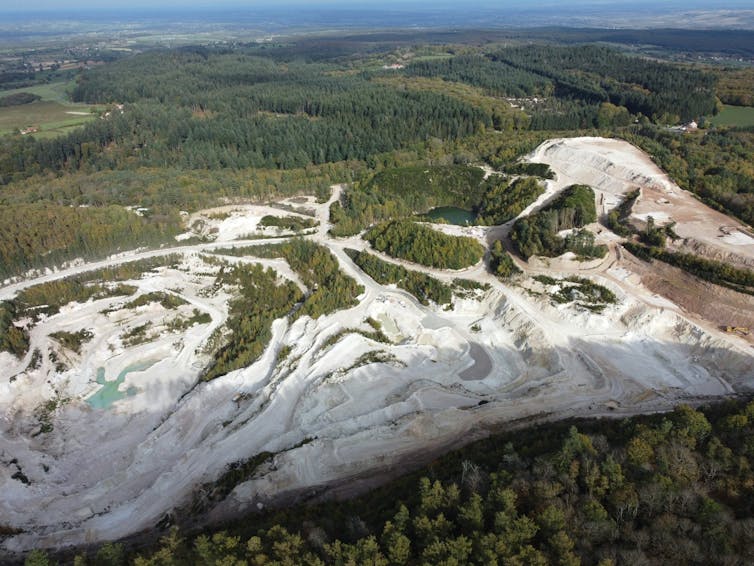
Carrière de kaolin d’Échassières (Allier), actuellement exploitée par la société Imerys, également à l’initiative du projet de mine de lithum.
TomTooM03/Wikimedia Commonns, CC BY

C’est précisément cette logique industrielle qui a été invoquée pour justifier le projet d’ouverture d’une mine de lithium à Échassières, dans l’Allier, afin d’alimenter les usines de batteries du nord de la France.


À lire aussi :
Mine de lithium dans l’Allier : un débat déjà tranché ?


Une dépendance chinoise à relativiser

En dépit de sa position dominante sur le marché de nombreux métaux critiques, la Chine ne peut pas « arsenaliser » (c’est-à-dire, instrumentaliser à des fins géopolitiques) aussi facilement la dépendance aux métaux que la Russie a pu le faire avec le gaz.

En effet, les chaînes de valeur des matières premières critiques (lithium, terres rares, etc.) sont beaucoup plus fragmentées et capables de se réorganiser. Certes, Pékin détient une position dominante dans l’extraction des terres rares et dans le raffinage du lithium, mais sa capacité à s’en servir comme levier de coercition est entravée par plusieurs facteurs :

Bref, à la différence du gaz russe – centralisé, peu substituable à court terme et distribué par des infrastructures fixes –, les métaux s’échangent sur des marchés mondiaux plus diversifiés, flexibles et adaptables. Ils sont donc moins facilement « arsenalisables ».


À lire aussi :
Terres rares : Ces nouveaux venus qui entendent concurrencer la Chine et les États-Unis


Et puis, et c’est probablement ce qui révèle une lecture erronée des rapports de force géoéconomiques, les marchés du lithium et des terres rares sont beaucoup plus petits que ceux du pétrole et du gaz, tant en valeur qu’en volume. En 2024, le marché mondial des hydrocarbures pesait près de 6 000 milliards de dollars, contre seulement environ 28 milliards pour le lithium et de 4 milliards à 12 milliards pour les terres rares.

Depuis la fin des années 2010, l’Agence internationale de l’énergie alerte régulièrement sur l’explosion à venir de la demande pour ces matériaux, portée par l’électrification des usages. Pourtant, même en cumulant leurs pics de production respectifs, les terres rares et le lithium, même s’ils sont centraux pour la transition énergétique, ne représentent qu’une part infime du marché pétrogazier mondial.

Ne pas confondre transition énergétique et accumulation de sources d’énergie

L’idée même de transition énergétique des énergies fossiles vers les métaux tend à dissimuler une réalité bien plus prosaïque : celle de l’accumulation des sources d’énergie plutôt que de leur substitution.

Comme le théorise l’historien Jean-Baptiste Fressoz, l’histoire énergétique ne connaît pas de véritables ruptures où une énergie en remplacerait totalement une autre. Au contraire, les transitions s’effectuent par empilement : chaque nouvelle source vient s’ajouter aux précédentes, sans les faire disparaître. Cette dynamique remet en cause les récits optimistes qui laissent penser que les énergies fossiles seraient bientôt reléguées au passé.

Malgré les scénarios prospectifs et les engagements des grandes économies à atteindre la neutralité carbone, il est probable que l’usage du pétrole et du gaz se maintiendra dans de nombreux secteurs. Les technologies bas carbone ne remplaceront pas tous les usages permis par les hydrocarbures, en particulier dans les domaines où ils restent difficilement substituables, notamment dans l’industrie : il reste difficile de produire de l’acier vert.

Autrement dit, loin d’acter la fin des fossiles de façon nette et précise, la transition énergétique risque de passer par une phase de coexistence prolongée.

En définitive, l’idée d’un transfert de dépendance du pétrole vers les métaux ne résiste pas à l’analyse. Ni leurs propriétés physiques, ni la structure des marchés, ni la géopolitique de leur approvisionnement ne permettent de calquer les logiques de la rente fossile sur celles des matières premières critiques.

Penser la transition énergétique à travers le prisme d’une substitution binaire masque la complexité des interdépendances industrielles et pourrait conduire à de fausses priorités stratégiques. Repenser la dépendance, ce n’est donc pas rejouer la guerre du gaz avec de nouveaux matériaux, mais comprendre les spécificités des chaînes de valeur des technologies bas carbone – et concevoir des réponses politiques à la hauteur de ces réalités.

The Conversation

Lucas Miailhes ne travaille pas, ne conseille pas, ne possède pas de parts, ne reçoit pas de fonds d’une organisation qui pourrait tirer profit de cet article, et n’a déclaré aucune autre affiliation que son organisme de recherche.

ref. Transition verte : peut-on vraiment comparer les dépendances aux métaux rares et au pétrole ? – https://theconversation.com/transition-verte-peut-on-vraiment-comparer-les-dependances-aux-metaux-rares-et-au-petrole-262752

Military force isn’t the solution for Lake Chad Basin conflict: the key is rebuilding local economies

Source: The Conversation – Africa (2) – By Richard Atimniraye Nyelade, Lecturer, Sociological and Anthropological Studies, L’Université d’Ottawa/University of Ottawa

Fatima, a fisherwoman on Lake Chad, sets out at dawn not just to make a living from the shrinking waters, but to pay a “tax”. Before casting her net, she must hand over part of her meagre earnings to armed men claiming allegiance to Boko Haram. If she refuses, her catch, her boat, even her life, could be taken.

Boko Haram is an insurgent network that began in north-east Nigeria in 2002 and later fractured into two main factions: JAS (Jama’atu Ahlis Sunna Lidda’awati wal-Jihad, the original Boko Haram faction) and ISWAP (Islamic State West Africa Province, the Islamic State affiliate in the region). Both operate across Nigeria, Niger, Chad and Cameroon.

Economic shakedowns like this are happening every day throughout the Lake Chad Basin. This is a vast, drought-stricken region spanning the borderlands around Lake Chad in north-eastern Nigeria, south-eastern Niger, western Chad and northern Cameroon. It is home to more than 30 million people whose livelihoods depend on fishing, farming and herding.

I am a researcher of climate-related insecurity and conflict. In a recent paper, I looked at how environmental degradation, regional instability and external geopolitical interests are exacerbating the conflict in the region. The study drew on qualitative analysis of security reports and academic literature. These include the United Nations Development Programme’s 2022 conflict analysis of the Lake Chad Basin and the World Food Programme’s 2024 climate and food-security report.

The paper sets out how Boko Haram has come to operate like a parallel government, imposing taxes on trade, farming and fishing. It offers harsh order in exchange for revenue.

I conclude from my findings that war is no longer driven only by belief. It’s driven by a collapsing economy, ecological ruin and the absence of viable alternatives.

Understanding these factors is crucial for developing comprehensive security strategies. Based on the findings I recommend five interventions: investment in the ecological recovery of the region; the strengthening of cross-border intelligence to choke the illicit trade in fish, cattle, arms and people; transparency from foreign players about their motives; the rebuilding of local economies and support for displaced communities; and lastly the rebuilding of trust with local communities.

Environmental degradation

Lake Chad’s open-water area fell from about 25,000 km² in the early 1960s to lows of a few hundred km² in the 1980s, and has generally remained under one-tenth of its 1960s extent with strong variability. This is documented in satellite analyses by Nasa and the United States Geological Survey.

This isn’t just an ecological crisis. As water recedes and fertile land disappears, fishing, farming and herding collapse. The basin hosts about 30 million people across 10 subnational regions or states.

In 2024, Niger’s floods affected about 1.5 million people nationwide, with Diffa recording around 50,000 affected and authorities on alert along the Komadougou Yobe river. The Red Cross also flagged basin-wide flood emergencies that month.

The basin’s ecological collapse has turned Lake Chad into a recruitment ground. The World Food Programme shows how droughts and erratic rainfall have crushed agricultural yields. The UN Development Programme links these environmental shocks to rising displacement, hunger and extremism.

Across the shared basin, Boko Haram has built a brutal, extractive shadow economy. In Nigeria, the group at one point controlled up to half of the fish trade around Baga. Fishermen were taxed at every stage, from lake to market. Refusal brought violence.

In Cameroon, Chad, and Niger, Boko Haram factions have orchestrated cattle rustling that has decimated pastoralist communities. My research details how armed raids strip herders of their livelihoods overnight. The stolen animals are sold through cross-border smuggling networks, feeding the insurgency. The group also taxes livestock traders at makeshift checkpoints, turning rustling and market levies into steady revenue.

Across the basin, kidnapping has become an industry. The UN reports that kidnapping for ransom remains a key revenue source for Boko Haram/ISWAP, and that a “large ransom” was paid in the 2018 Dapchi schoolgirls case. What began as ideological acts, like the abduction of schoolgirls, has turned into a ruthless business model. Ransoms pay for weapons, logistics and recruitment.

Regional instability

Ecological and economic desperation fuels regional instability. As communities fracture and compete over dwindling resources, the borders of the four Chad Basin countries become highways for insurgents, smugglers and arms.

Since 2014 Boko Haram has spilled from Nigeria into Cameroon, Chad and Niger, where security forces are stretched and coordination is uneven. Arms flow through the Sahel and abuses by security actors erode public trust, which in turn eases recruitment.

The paper details how national armies, often under-equipped and struggling with coordination, have been unable to secure this vast terrain. The Multinational Joint Task Force, a regional military coalition, has had successes but is hampered by these same challenges.

This security vacuum is the space in which Boko Haram’s parallel governance and illicit economy thrive, making the crisis a truly regional one that no single country can solve alone. The result is a conflict system that crosses borders, mixes ideology with profit, and outlasts purely military responses.

Bombs not the answer

Military force alone cannot fix this. It’s necessary to address the root causes, ecological collapse, broken livelihoods, and the economic lifelines that keep the insurgency going.

The Lake Chad Basin Commission is the intergovernmental body that manages the lake’s resources. Created in 1964 by Cameroon, Chad, Niger and Nigeria, and later joined by the Central African Republic and Libya, the commission and national governments must lead with urgency and courage. They must:

  • invest in climate resilience, large-scale water management, drought-resistant crops, restored wetlands and sustainable fishing

  • disrupt illicit trade and go after the money, not just the militants

  • demand transparency from foreign actors about their agendas in the region

  • rebuild local economies and trust.

Fatima’s daily struggle on Lake Chad is not just about fish. It is about the future of the region. The shrinking lake, the abandoned villages, the armed taxmen – these are not side effects. They are the story.

The Conversation

Richard Atimniraye Nyelade does not work for, consult, own shares in or receive funding from any company or organisation that would benefit from this article, and has disclosed no relevant affiliations beyond their academic appointment.

ref. Military force isn’t the solution for Lake Chad Basin conflict: the key is rebuilding local economies – https://theconversation.com/military-force-isnt-the-solution-for-lake-chad-basin-conflict-the-key-is-rebuilding-local-economies-262640

Joseph Kabila is on trial for treason in the DRC. What the case against the former president is all about

Source: The Conversation – Africa (2) – By Jonathan Beloff, Postdoctoral Research Associate, King’s College London

The Congolese military court has accused former president Joseph Kabila of treason, corruption, war crimes and supporting the March 23 Movement (M23) rebel group. During court proceedings that began in July 2025, arguments were made for utilising the death penalty against Kabila, who was in power from 2001 to 2019. The trial is going on in Kabila’s absence as the threat of arrest led him into exile. The former president had fought against the M23’s first iteration in 2012-2013, as well as its predecessor, the National Congress for the Defence of the People, which fought the DRC government between 2006 and 2009. Jonathan R. Beloff, who has studied the regional and internal political dynamics in the DRC for over a decade, examines the implications of the case.

What is Joseph Kabila’s political history?

Joseph Kabila took over as president of the Democratic Republic of the Congo (DRC) on 26 January 2001 after the assassination of his father, Laurent-Désiré. He was 29.

Before this, during the First Congo War (1996-1997), he served in the Alliance of Democratic Forces for the Liberation of Congo, which aimed to overthrow the Zairean dictator Joseph Mobutu. This war has been labelled “Africa’s World War” by historians like Gérard Prunier because of the large number of foreign actors it involved. These include Angola, Burundi, Uganda and Rwanda.

A significant number of soldiers and commanders in the alliance were Rwandan. Much of the war was conducted by Rwandan General James Kabarebe, who became a de facto father figure for Kabila, training him in military strategy, tactics and politics.

A breakdown in Rwanda’s relationship with the DRC in 1998 led to the bloody Second Congo War (1998-2003). It was between Uganda, Rwanda and to a lesser extent Burundi, who fought against the DRC and its allies like Angola and Zimbabwe. The war was mostly fought by rebels from these nations who had varying interests. During this period, Kabila became the deputy chief of staff for the Congolese military.

After he became president, he successfully applied pressure on Rwanda and Uganda to negotiate peace agreements in 2002.

Overall, his presidential term was marred by the persecution of political rivals, corruption and multiple active rebel forces in the volatile eastern region.

Further, despite the DRC’s constitution forbidding it, Kabila extended his presidency from two five-year terms, only stepping down in 2019. A political deal was struck that saw him relinquish power and hand over to Felix Tshisekedi.

What has happened to Kabila since then?

Kabila and his successor have not seen eye to eye.

Since departing from power, the former president has faced increased accusations of corruption during his presidency. Further, by 2021, many of Kabila’s supporters within the government and military had been removed.

The relationship between the two further soured in 2023 when Kabila spoke out against Tshisekedi’s handling of the M23’s violent campaign in eastern DRC. Kabila has also criticised Tshisekedi’s use of uncontrolled militias, Wazalendo, who have been unsuccessful in combating the M23.

Kabila went into self-exile, reportedly in South Africa and other African nations, that year. He returned to eastern DRC’s regional hub Goma in May 2025, when he met with M23 leaders.

The Congolese government used Kabila’s visit to M23-controlled Goma to justify the charges brought against him. Further, the government suspended Kabila’s political party, Parti du Peuple pour la Reconstruction et la Démocratie. The party represented Kabila’s interest in Congo’s legislative branch.

Soon after the party’s suspension, the senate stripped Kabila of his immunity, allowing charges to be filed against the former president.

Why is the case against Kabila before a military court?

While Kabila doesn’t hold any political or military post – he last served as president and major-general in January 2019 – his past experience in the army led to a military rather than civilian process.

Additionally, the case is before a military court as Kabila is accused of committing treason by meeting with an opposing military force, the M23. The government seized his assets after he met and engaged with leaders of the rebel group.

While it’s not the most significant charge, Kabila also faces accusations of massive corruption during his 18-year presidency. Further, he’s being held accountable for past military decisions that led to war crimes, murder and rape during and after the Second Congo War (1998-2003).

What are the implications of the court case for DRC’s peace process?

In June 2025, Rwanda and the DRC signed a peace agreement following negotiations led by Qatar and the United States.

On the surface, the agreement could lead to regional stability and growth. However, for Tshisekedi, it is a landmine of political risks.

Since the M23’s resurgence in November 2021, Tshisekedi has blamed Rwanda, as well as the Banyarwanda and Banyamulenge, who are historically Rwandan populations resident in eastern DRC, for the return of the rebel group.

The new peace deal significantly complicates Tshisekedi’s relationship with his key political allies and ministers. If they begin to believe he is caving in to Rwanda, Tshisekedi could lose the presidency ahead of next year’s election.

Thus, in my view, based on my research on Congolese instability, Tshisekedi needed to find a political distraction that his supporters could rally behind.

Kabila’s return to Goma and relationship with the M23 provided that opportunity. The court case allows Tshisekedi to highlight his fight against the rebel group and its allies. The Congolese military has been unable to significantly halt the M23’s advances.

The case also allows the president to demonstrate his tough stance on opposition figures.

However, Tshisekedi will need to be careful of the potential implications of the case for himself. Kabila’s remaining loyalists could become even more daring in standing up against Tshisekedi. While a majority were removed, there are still some left.

The Conversation

Jonathan Beloff does not work for, consult, own shares in or receive funding from any company or organisation that would benefit from this article, and has disclosed no relevant affiliations beyond their academic appointment.

ref. Joseph Kabila is on trial for treason in the DRC. What the case against the former president is all about – https://theconversation.com/joseph-kabila-is-on-trial-for-treason-in-the-drc-what-the-case-against-the-former-president-is-all-about-264412

South Africa’s small-scale rooibos tea growers aren’t getting much from an industry deal – why it’s not fair

Source: The Conversation – Africa – By Rachel Wynberg, Professor and DSTI/NRF SARChI Bio-economy Research Chair, University of Cape Town

A ground-breaking benefit-sharing agreement was signed in 2019 between South Africa’s lucrative rooibos herbal tea industry and two organisations representing Indigenous San and Khoi people.

Indigenous San and Khoi – the oldest known populations of southern Africa – are traditionally hunter-gatherers and pastoralists. Their traditional knowledge also contributed towards the development of the rooibos tea industry.

Today, the commercial rooibos tea industry sells more than 22,000 tons of tea every year and has an annual export value of over US$50 million.

Although apartheid ended in 1994, the rooibos tea industry is still dominated by white-owned companies. These companies benefited from years of subsidies and protection by the apartheid government. Rooibos farmers who were classified as “Coloured” (an apartheid-era race term imposed on indigenous Khoi-San and other ethnically diverse oppressed people of colour) were excluded from the industry during this time.


Read more:
How justice can be brought to South Africa’s rooibos industry


The 2019 access and benefit-sharing agreement was meant to change that. It is legally binding, and sets out how those who hold traditional knowledge about rooibos will benefit from the industry.

Access and benefit-sharing agreements like this one are governed by global conventions and protocols. The main aim is to stop genetic resources and traditional knowledge from being used in commercial products without consent or compensation for the traditional knowledge holders and resource owners. They also aim to prevent biopiracy. In other words, they aim to strengthen the rights of Indigenous peoples and local communities over their natural resources.


Read more:
Justice is still not being done in the exploitation of indigenous products


Many national laws now require companies to set up these agreements. In this sense, the 2019 rooibos benefit-sharing agreement was historic because it formally recognised, for the first time, the role of San and Khoi traditional knowledge in the development of the rooibos industry.

We are anthropologists, sociologists, environmental scientists, indigenous heritage practitioners and policy researchers. We’ve carried out decades of participatory action research with small-scale rooibos farmers and other Indigenous groups.

Our research found that the 2019 rooibos agreement has not changed who owns and benefits most from rooibos. Control remains vested in an industry set up during colonialism and apartheid. This is because the white-dominated industry still owns most of the tea lands and cultivates about 93% of rooibos tea today. This allows the same commercial farmers and industry players to continue to dominate the market.


Read more:
How a South African community’s request for its genetic data raises questions about ethical and equitable research


Less than 7% of rooibos tea lands are today controlled by Indigenous farmers. As a result, they’re only able to produce about 2% of South Africa’s rooibos tea.

Our research also found that the rooibos agreement does not grapple with local contexts and struggles over identity. While some small-scale farmers identify as Khoi-San and “first nation”, they do not always recognise the authority of the councils endorsed by the government to represent them. Other small-scale farmers do not feel a connection to a Khoi-San identity at all, instead identifying with a “Coloured” heritage.


Read more:
South Africa’s honeybush sector must transform from its unjust past: what needs to change


These problems need to be solved now because other South African plant industries based on traditional use, such as buchu, an indigenous shrub used widely in the herbal, flavour and fragrance industries, and honeybush tea, have begun adopting the rooibos benefit-sharing model.

For biodiversity-based economies to transform, they must go beyond agreements about sharing access to plants and profits from their sale. Government must recognise local guardians of biodiversity and redistribute land, and along with industry, must embrace economic transformation. If they don’t, they run the risk of securing benefits only for the few who are politically connected and organised.

A flawed process

In 2010, the South African San Council claimed the right to benefit from rooibos and honeybush. They were later joined by the National Khoisan Council, a body initiated by former president Nelson Mandela in 1999 as a way of including Khoi-San historical leadership in post-apartheid South Africa.

Government-commissioned research at the time urged the commercial rooibos tea industry to negotiate benefit-sharing agreements with the two organisations or risk losing its licence to operate.

However, these two groups do not represent all Khoi-San groups. Many small-scale rooibos farmers, who have deep historical connections to the plant and its traditional knowledge, weren’t part of the negotiations for the agreement. Small-scale rooibos farmers are typically ethnically diverse descendants of San, Khoi, former slaves, and European settlers.


Read more:
South Africa’s traditional medicines should be used in modern health care


They were eventually included in the final agreement as “rooibos indigenous farming communities”, but only through the National Khoisan Council and not in their own right.

The agreement offered some reparation for past injustices by establishing a “traditional knowledge levy” of 1.5% of the price that farmers receive. The levy – about US$700,000 per year – is paid to the South African San Council and National Khoisan Council.

What’s missing

The agreement has been cited as an example of best practice in equitable business. Yet small-scale rooibos farmers receive just 5% of the benefits. And they are also expected to pay towards the levy because they produce rooibos tea. Overall, they benefit little from access and benefit sharing.

The agreement doesn’t include everyone who holds traditional knowledge about rooibos, and therefore not every Indigenous rooibos grower benefits. It assumes that traditional knowledge is confined to specific groups. In contrast, research has found that Indigenous knowledge is shared across groups. It evolves and takes different forms over time.


Read more:
Archaeology is changing, slowly. But it’s still too tied up in colonial practices


The effect of the rooibos agreement is that small-scale Indigenous farmers are less empowered. They need to find the resources to organise across large distances and find ways to get legal support if they are to benefit equally.

More widely, our research shows that the agreement has introduced a new, intervening role for the state. In this case, the state rewarded ethnically defined beneficiaries. This raises questions about the power of the state and how it controls who is entitled to receive information, knowledge and benefits.

What next?

The rooibos agreement has given recognition and economic benefits to some Indigenous groupings. It’s been hailed as a transformation milestone, but has not brought about the changes needed to address social and economic inequities. Real change would include equal access to land, a more inclusive industry, and the wider sharing of economic benefits.

Access and benefit sharing is due for radical rethink. It needs an inclusive, bold, caring and imaginative approach that should be co-designed with communities from the outset. It needs an approach that is rooted in local context. Only this will create new possibilities for inclusive economic power, sustainability and recognition.

The Conversation

Rachel Wynberg receives funding from the South African Department of Science, Technology and Innovation and the National Research Foundation which support her Bio-economy Research Chair. She is affiliated with the University of Cape Town. She is a Board member for two non-profit organisatons: Biowatch South Africa and the Union for Ethical Biotrade (UEBT).

June Bam-Hutchison and Sarah Ives do not work for, consult, own shares in or receive funding from any company or organisation that would benefit from this article, and have disclosed no relevant affiliations beyond their academic appointment.

ref. South Africa’s small-scale rooibos tea growers aren’t getting much from an industry deal – why it’s not fair – https://theconversation.com/south-africas-small-scale-rooibos-tea-growers-arent-getting-much-from-an-industry-deal-why-its-not-fair-261288

Kenya has introduced new banking policies. An economist weighs them up

Source: The Conversation – Africa – By XN Iraki, Professor, Faculty of Business and Management Sciences, University of Nairobi

The Central Bank of Kenya has made two significant changes in the country’s banking sector. The first is to lift a decade-long moratorium on licensing new banks. Second is to raise capital requirements, the amount of money banks are required to keep readily available compared with the value of other assets they have. Bank capital is what shareholders have invested in the banking business. It’s a buffer against insolvency. Higher capital makes a bank stronger by reassuring depositors that their money is “safe” in case of a financial crisis. Economics professor XN Iraki answers some questions about Kenya’s banking sector and the importance of the two latest policy changes.

What is the state of Kenya’s banking sector?

Kenya has 39 licensed banks. Of these, 17 are classified as foreign-owned with 50% or more shareholding held by foreign interests. All the top commercial banks are listed on the Nairobi Stock Exchange. Three are majority government-owned while the rest are privately owned.

Kenya’s banking sector is known for its dynamism. This is reflected in the adoption of innovations, new product offerings and technology. It is also seen in the growth in assets, deposits and profitability. Finally, it is also evidenced in the mergers, buyouts and growth across borders into the neighbouring countries.

KCB Group – a publicly owned bank that is also the country’s largest – as well as privately owned Equity Bank have established foreign subsidiaries or acquisitions in Uganda, Tanzania, South Sudan, Rwanda, Burundi and the Democratic Republic of Congo.

The use of technology, for instance linking bank accounts with the popular M-pesa mobile payment platform, has made banking easier and more accessible. This has made banking popular with the younger generation, including Generation Z, who are astute at using technology.

The Kenyan banking sector is dominated by nine large banks that accounted for about 90% of the profit in 2024.

Nonetheless, the sector has been stable in recent years. It’s a far cry from the 1980s, when bank failures were constantly in the headlines. Up until 1998, 37 bank failures had been recorded. More followed in 2003 and in 2015.

Why did the government ban new banks 10 years ago? What was the impact?

The moratorium on licensing new banks was instituted in 2015. This followed the failure of Dubai Bank on 14 August 2015 and Imperial Bank on 13 October 2015.

At about the same time, another institution – Chase Bank – was in trouble. It was placed under management on 7 April 2016.

The banks were closed to protect depositors and ensure stability of the sector. But banning new banks was not the best solution. It stifled competition and could have led to the current situation where a few banks dominate the market.

Though the failures were not the first, they were a big blot on Kenya’s financial sector. They could have slowed the growth of the sector in at least two ways. First is the restriction on new players. Second, the perceptions of higher risk would have led to more cautious investment and lending decisions.

What are the limits placed on banks wanting to set up in Kenya?

Banks are subject to regulation and rules set out in the Banking Act. These rules relate to licensing, capital requirements, who may be a shareholder or director, and protection of customer deposits, among other aspects. For this reason, shareholders and key employees are subject to vetting by regulators.

These regulations can be enhanced from time to time. It’s the basis on which the Central Bank of Kenya has increased bank core capital requirements to 5 billion shillings (US$38 million) by 2026. This will double to 10 billion shillings (US$76 million) by 2029. Core capital as defined by Central Bank of Kenya is “shareholders equity in the form of issued and fully paid-up shares of common stock, plus all disclosed reserves, less goodwill or any other intangible assets.”

Higher core capital is expected to strengthen banks and possibly reduce the number of players as some banks merge or are absorbed by stronger players.

This can only be counterbalanced if more banks enter the market after the moratorium was lifted. That would be the ideal case. More competition would lead to lower interest rates, which act as an economic stimulus. It would be easier to borrow money for more consumption or investment.

Higher core capital is a double edged sword. Lifting the moratorium will lead to greater competition if more banks enter the market. But higher core capital might deter new entrants. One speculation is that lifting the moratorium could usher in global brands with more capital and a competitive edge.

Investors who can overcome the higher core capital and join this sector are likely to reap big. Kenyan banks are a popular choice for investors in the security markets and are generally profitable.

What opportunities or pitfalls will the Central Bank be watching out for?

The lifting of the moratorium on new banks and raising capital requirements could be the start of more changes in the Kenyan banking sector.

It’s expected that with new capital requirements Kenyan banks will become bigger and more resilient and serve as the lubricant of economic growth. Bigger and fewer banks are likely to be more stable and easier to supervise.

Will bigger banks adequately respond to the needs of small and microenterprises (SMEs) and individuals? Will they keep the focus on local communities? Could new licences be granted to the politically connected as happened in the past? Here could lie a pitfall. The true test of such policy decisions is achieving faster economic growth and higher standards of living for all.

The Conversation

XN Iraki does not work for, consult, own shares in or receive funding from any company or organisation that would benefit from this article, and has disclosed no relevant affiliations beyond their academic appointment.

ref. Kenya has introduced new banking policies. An economist weighs them up – https://theconversation.com/kenya-has-introduced-new-banking-policies-an-economist-weighs-them-up-261590

« Bloquons tout » est-il vraiment la saison 2 des Gilets jaunes ?

Source: The Conversation – France in French (3) – By François Buton, Directeur de recherche au CNRS, ENS de Lyon

Entre échos des luttes récentes et crispations politiques persistantes, « Bloquons tout » révèle les fragilités d’un système représentatif confronté à des colères sociales multiples.


Lancé en juillet, le « mouvement du 10 septembre » ou « Bloquons tout » est l’objet de toutes les attentions de la part de la société, du gouvernement, de la classe politique, des médias, des renseignements territoriaux. Plusieurs éléments de ce mouvement font à l’évidence écho avec celui des Gilets jaunes, survenu en novembre 2018. Il s’agit d’une mobilisation par en bas, lancée par différents groupes déjà organisés mais amplifiée par les réseaux sociaux (surtout Telegram), sans leadership mais structurée par des sites internet (Indignons-nous et Les essentiels qui témoignent d’emblée d’une forte hétérogénéité entre des contestataires plutôt souverainistes et défenseurs d’une France chrétienne et d’autres se réclamant de la gauche radicale.

L’opposition au projet de budget

Si la mobilisation présente des revendications nombreuses, plus ou moins élaborées, elle est à première vue motivée par le pouvoir d’achat et la dénonciation des inégalités : l’opposition au projet de budget du Premier ministre François Bayrou, dénoncé pour faire payer le fardeau de la diminution du déficit (40 milliards d’euros d’économie) aux travailleurs, aux chômeurs, aux salariés, aux précaires, aux malades, fait écho au sentiment d’injustice des Gilets jaunes à l’annonce d’une nouvelle taxe sur le carburant. Le projet de loi de finances est critiqué par l’ensemble des forces politiques opposées au gouvernement, et semble mal reçu par la population, qui soutient le mouvement à venir, si l’on en croît une enquête par sondage réalisée les 20 et 21 août (Toluna Harris Interactive pour RTL) et abondamment citée.

Ainsi, 59 % des Françaises et des Français soutiennent l’objectif de réduction des dépenses publiques, mais 63 % soutiennent le mouvement (70 % se disent favorables à des manifestations, 58 % à des blocages), 75 % s’opposant à la suppression de 2 jours fériés et 71 % se disant favorables à une « contribution de solidarité payée par les Français les plus aisés ». Depuis plusieurs semaines, l’organisation d’assemblées locales, la production de carte des rassemblements à venir, la variété des modes d’action envisagés (de la désobéissance civile au blocage de lieux de production) rappellent aussi la mobilisation de 2018.

Les Gilets jaunes, et autres luttes

La comparaison avec les Gilets jaunes fait donc sens, et ne manque pas d’être faite dans les commentaires : les Gilets jaunes sont dans « toutes les têtes », comme modèles positifs ou négatifs, comme motifs d’espoir ou d’inquiétude. Pour nous qui avons longtemps travaillé sur ce mouvement, le rapprochement est pertinent mais délicat à manier. La comparaison terme à terme ne doit pas faire oublier l’historicité des luttes : les Gilets jaunes sont un précédent, les protestataires potentiels du 10 septembre ont pu y participer, acquérir des savoir-faire protestataires, et tirer des enseignements quant à l’efficacité des actions du mouvement, de ses limites ou impasses, de sa durée ou encore de la répression subie.

Mais l’histoire des luttes est riche d’autres contestations, antérieures (Nuit debout), et surtout postérieures à 2018 : manifestations monstres de l’opposition à la réforme des retraites, manifestations des agriculteurs (certains en « bonnets jaunes »), occupations contre des projets autoroutiers (A 69) ou agricoles (Sainte-Soline), grèves diverses, mouvement d’opposition au pass sanitaire, ou encore, pétition elle aussi monstre (plus de 2 millions de signataires) contre la loi Duplomb en juillet dernier. Il est donc nécessaire de faire la part des apprentissages respectifs de toutes ces mobilisations dans ce qui se prépare pour le 10 septembre en différents points du territoire.

La comparaison des « profils » des Gilets jaunes et des « bloqueurs » potentiels n’est pas plus facile à mener, non seulement parce qu’on ne connaît par définition pas encore les bloqueurs, mais au mieux une partie de celles et ceux qui se mobilisent sur les réseaux sociaux et qui acceptent de répondre à des questionnaires, ou celles et ceux qui se réunissent dans des assemblées, mais aussi parce qu’il reste à définir qui a été Gilet jaune avant d’en présenter les profils.

Les Gilets sont là, mais pas tous

Dans nos propres enquêtes, nous avons par exemple choisi de nous intéresser à des « super Gilets », des primo-contestataires le plus souvent, engagés intensément (parfois à corps perdus), et longtemps (certaines et certains le sont encore !) dans un groupe local. Ces Gilets ne sont pas représentatifs de l’ensemble du mouvement, où d’autres étaient des militants plus expérimentés, et dont la grande majorité n’a participé qu’à quelques actes ou assemblées : des enquêtes estiment à 3 millions le nombre de citoyennes et de citoyens ayant participé à au moins une action gilet jaune en 2018-2019.

Quand nous les contactons pour leur demander ce qu’ils pensent de « Bloquons tout », ce qu’ils font et envisagent de faire, les réponses sont très variables. Certains, parés de leur gilet, ont investi les assemblées locales ou les boucles Telegram comme ils l’ont fait dans la plupart des contestations depuis 7 ans ; d’autres au contraire suivent de près ou de loin, attendant de voir, écœurés par la supposée « récupération » politique, sceptiques quant aux chances de succès d’une contestation de plus dans la rue, ou refroidis par le manque de soutien de la population et la dureté de la répression, y compris judiciaire, lors du mouvement de 2018 (« que les autres se mouillent »).

Bien des attitudes sont possibles, que nous pouvons expliquer finement dans chaque cas, mais dont nous savons qu’ils et elles ne représentent pas tous « les » Gilets jaunes. Une chose est sûre : des Gilets jaunes sont là, et d’autres sont prêts à participer.

Mais une différence majeure avec les Gilets jaunes, précisément en raison de leur antériorité, réside dans l’hyper attention médiatique à l’œuvre depuis quelques semaines pour le mouvement « Bloquons tout ». Tout en oubliant de mentionner la défiance immense des contestataires à leur égard (gageons que le thème reviendra avec les premières manifestations), les médias couvrent massivement la préparation, en lui posant les questions habituelles : qui sont les bloqueurs, qui peut incarner le mouvement voire en être les leaders, qui se « cache derrière », que veulent-ils, à quoi s’attendre, voire que craindre ? Or, l’hyper attention médiatique a sans doute eu pour effet de bousculer les responsables politiques et syndicaux de tous bords, quand ils et elles n’avaient pas pris les devants.

Au-delà de la « récupération »

Une autre différence majeure avec 2018, où les partis et les syndicats avaient ignoré voire condamné le 17 novembre, réside en effet dans la précocité de la politisation de la contestation qui vient. Le terme, qui a plusieurs sens, ne désigne pas pour nous la « récupération » du mouvement par telle ou telle force politique – expression largement employée, mais qui relève d’une catégorie politique stigmatisante. Il renvoie à l’idée que l’ensemble des forces du champ politique s’accordent, au-delà de leurs différences, pour redéfinir le mouvement et ses revendications comme politique, c’est-à-dire comme relevant de « la » démocratie politique (les élus et les partis) et de « la » démocratie social (les syndicats). D’un côté, les confédérations appellent à une autre « mobilisation massive » le 18 septembre, amplifiant les grèves annoncées ça et là ; de l’autre, depuis la « rentrée politique » des universités d’été, mi-août, les responsables de partis se prononcent en soutien ou contre le mouvement et discutent de la légitimité de ses revendications et de ses modes d’action.

Le coup politique le plus spectaculaire revient évidemment au premier ministre François Bayrou qui annonce le 25 août engager la responsabilité de son gouvernement en demandant un vote de confiance à l’Assemblée le 8 septembre sur son projet contesté de loi de finances. Cette décision spectaculaire permet en effet à l’agenda proprement politique de repasser au premier plan : éloges ou critiques du geste (un retour à la démocratie parlementaire pour Jean-Luc Mélenchon), consultations diverses et variées, prises de position sur tel ou tel point du projet (notamment la suppression de deux jours fériés). Le rejet de la confiance, qui est acquis, va faire entrer le pays dans une crise politique voire institutionnelle susceptible d’occuper l’agenda médiatique au détriment de la « crise » sociale .

Tout se passe donc aujourd’hui comme si les élus reprenaient la main au détriment des citoyennes et citoyens ordinaires. La dernière petite phrase de François Hollande (« Je ne peux pas m’associer à quelque chose que je ne maîtrise pas » révèle à cet égard une forme d’inconscient de la classe politique, qui dit « entendre l’exaspération », mais n’entend s’engager que dans ce qu’elle maîtrise, à savoir les jeux politiques et institutionnels, et ne donner la parole au peuple que sous la forme du suffrage électoral.

Les mouvements sociaux comme forces de proposition

Ce faisant, les élus font preuve d’un aveuglement qui ne laisse pas d’étonner. Une autre leçon du mouvement des Gilets jaunes, en effet, c’est qu’il a profondément transformé ses primo-contestataires sinon en militants, du moins en citoyens ayant le sentiment d’être enfin dignes d’être entendus, capables de débattre et de se prononcer sur les sujets politiques et même institutionnels (le RIC) qui engagent le pays, et refusant de se contenter de glisser un bulletin de vote dans l’urne tous les cinq ans.

Ce qu’on lit aujourd’hui sur les boucles Telegram ou ce qu’on entend dans les premières assemblées locales atteste la même résolution à ne pas se faire infantiliser et renvoyer à son labeur quotidien en vertu d’un défaut supposé de « titres à parler » (Jacques Rancière). La défiance à l’égard des élus nationaux, forte en 2018, l’est encore plus aujourd’hui : les fameuses « cotes de popularité », pour autant qu’elles aient la moindre signification, indiquent que les opposants les plus « populaires » ont la confiance d’au mieux un citoyen sur trois.

On peut douter que les petits jeux d’une crise institutionnelle et politique fascinent les Français, puisque les gouvernants ne les écoutent ni quand ils manifestent massivement (contre les retraites), ni quand ils votent contre une majorité (en 2024, qui n’est pas sans rappeler le référendum de 2005), et répondent par des conférences citoyennes ou grands débats dont ils ignorent les résultats et par une répression de plus en plus violente.

Dans ce contexte, « Bloquer tout » peut signifier bien des choses : pour certains, c’est mettre le chaos dans un pays pourtant « déjà bloqué ; pour d’autres, ce qui pose problème, c’est plutôt le blocage ou la fermeture du champ politique, qui entend réserver les décisions aux seuls représentants (les syndicats et les partis). Les Gilets jaunes n’ont pas seulement protesté contre une taxe, ils ont aussi appris chemin faisant à proposer une autre forme de démocratie ; il est peut-être temps de reconnaître que les mouvements sociaux apportent des solutions, et pas seulement des problèmes.

François Buton co-dirige en octobre aux PUF Les métamorphoses de la politisation (avec Eric Agrikolianski) et en novembre aux éditions du Croquant Devenir des Gilets jaunes (avec Emmanuelle Reungoat).

The Conversation

François Buton a reçu des financements pour des projets de recherche de la MSH SUD, du réseau des MHS, de l’ENS de Lyon et de l’ANR.

Emmanuelle Reungoat a reçu des financements d’institutions publiques pour des projets de recherche, la MSH-SUD, le RnMSH et l’ANR.

ref. « Bloquons tout » est-il vraiment la saison 2 des Gilets jaunes ? – https://theconversation.com/bloquons-tout-est-il-vraiment-la-saison-2-des-gilets-jaunes-264549

IA et langues : de nouvelles pratiques à l’école, à quel prix ?

Source: The Conversation – in French – By Grégory Miras, Professeur des Universités en didactique des langues, Université de Lorraine

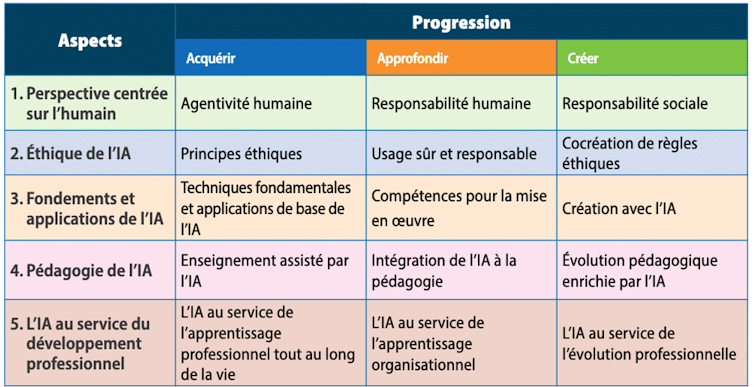
Former les élèves aux usages de l’IA est présenté comme une priorité politique pour les années à venir. Mais comment intégrer les préparations nécessaires aux cursus scolaires sans alourdir les coûts écologiques ? Il faut aussi compter avec un certain nombre d’enjeux éthiques.


L’année scolaire 2025-2026 s’ouvre dans un contexte de démocratisation massive de l’intelligence artificielle (IA) générative. Dans son dossier de rentrée, le ministère de l’éducation précise d’ailleurs que les élèves du second degré bénéficieront désormais d’un parcours de formation spécifique, sur la plateforme PIX. Faut-il voir dans ces nouveaux outils une menace à l’apprentissage et la maîtrise des langues, le français et celles dites étrangères ?

À l’heure où l’IA-anxiété devient un phénomène social, voici quelques éléments de réflexion pour les plus inquiets mais aussi les plus convaincus.

Converser avec l’IA : coût écologique et éthique

Si l’IA générative séduit par sa capacité à produire du texte ou à traduire instantanément, elle comporte des coûts cachés. S’entraîner à formuler des requêtes (prompt en anglais) amène à une interaction langagière qui mobilise d’immenses ressources humaines, matérielles et énergétiques, souvent invisibles à l’utilisateur. La Direction de région académique du numérique pour l’éducation de l’académie de Versailles rappelle aux enseignants que :

  • une requête d’environ 400 tokens sur ChatGPT/GPT-4o mini consomme environ 2 Wh d’électricité (ou 2 g de CO2 rejeté), soit plus de 6 fois la consommation d’une recherche Google classique estimée à 0,3 Wh ;

  • la création d’une image en haute définition par une IA consomme autant d’énergie que la recharge complète d’un téléphone portable ;

  • les centres de données (data centers) liés à l’IA et aux cryptomonnaies ont consommé près de 460 TWh d’électricité en 2022, soit environ 2 % de la production mondiale.

S’exercer à développer un esprit critique face à l’IA devient incontournable. Cependant, amener les élèves à utiliser massivement les IA pour mieux les comprendre provoque un paradoxe. Une piste consiste alors à privilégier des IA éducatives dites « responsables », à l’image du modèle Vittascience, qui assure la transparence de ses données d’entraînement et de son fonctionnement. Entraînés à partir d’une quantité limitée de données, ces modèles apparaissent comme moins énergivores.

Il est également possible de proposer des ateliers, par exemple des escapes games, qui mobilisent des éléments pratiques pour aborder les principaux points en jeu sans nécessairement s’exercer sur des outils numériques.

D’un point de vue éthique, les grands modèles de langage (LLM) sont entraînés sur des corpus massifs constitués de textes issus de contenus en ligne. Cette alimentation soulève des questions majeures, en particulier autour de la propriété et de l’usage des données linguistiques.

Qui possède les mots, les expressions, les récits mis à disposition sur Internet ? Dans quelle mesure la réutilisation de ces ressources respecte-t-elle le droit d’auteur, la rémunération des créateurs ou encore la diversité linguistique et culturelle ?

Une machine à (re)produire des inégalités langagières ?

Enseignants comme parents accusent volontiers l’IA d’aider à tricher lors de devoirs écrits, creusant ainsi les inégalités scolaires et langagières. Pourtant, celles-ci préexistaient largement à son arrivée. Les élèves ne bénéficient pas tous des mêmes soutiens selon leur environnement familial. Certains peuvent compter sur des parents disposant d’un capital social et culturel élevé, capables de relire un devoir, de le corriger ou de l’enrichir.

L’arrivée des LLM a pu apparaître, dans le mandat de l’Unesco, comme une forme de démocratisation : « La promesse de « l’IA pour tous » doit permettre à chacun de bénéficier de la révolution technologique en cours et d’accéder à ses fruits, notamment en termes d’innovation et de connaissances. » Cette « IA pour tous » offrirait à chaque apprenant des outils disponibles en permanence (correcteur virtuel, un traducteur instantané, etc.), pouvant s’adapter à des besoins particuliers (élèves allophones, troubles du spectre autistique, un TDAH).

Cependant, les outils d’IA peuvent introduire de nouvelles inégalités, plus fallacieuses, comme le souligne Jeremy Knox, professeur à l’Université d’Oxford. En effet, cette amplification dépend à la fois de l’accès effectif aux technologies (déjà issu des inégalités sociales), des compétences nécessaires pour en tirer parti (littéracie numérique) et de la qualité des données qui les alimentent.

Dans une étude récente, des chercheurs en sociologie de l’information à l’Université de Stanford montrent que les auteurs de textes scientifiques en anglais, dont ce n’est pas la langue première, sont défavorisés dans l’évaluation scientifique, leur style d’écriture étant jugé de moindre qualité. L’arrivée de ChatGPT réduit légèrement ces biais en améliorant la traduction tout en contribuant à déplacer ces inégalités, non plus sur la maîtrise de l’anglais, mais sur l’hypothèse d’un usage de l’IA dans la production de ces textes. On imagine aisément un tel phénomène dans les évaluations scolaires.

L’humain derrière la machine parlante

Ces cinq dernières années, on assiste à une multiplication de guides éducatifs d’utilisation de l’IA tout autant qu’à une explosion des appels à financements éducatifs et de recherche autour de ces technologies. Ils permettent de financer des projets d’envergure comme le cluster IA-Enact porté par l’Université de Lorraine.

Toutefois, la multiplication de ces financements suscite des inquiétudes légitimes quant à l’ampleur des sommes investies au détriment d’autres sources de financement destinées à soutenir une vision alternative de la société. Aussi, il parait nécessaire de rappeler que certains cadres autour de l’IA soulignent l’importance de (re)penser une perspective centrée sur l’humain avant de réfléchir à la technologie en elle-même, comme le propose le Cadre de compétence en IA destiné aux enseignants par l’Unesco.

La structure de haut niveau du cadre de compétences en IA : aspects et niveaux de progression (Extrait du cadre de compétence en IA destiné aux enseignants par l’Unesco).

Dans ce contexte, l’école a un rôle central à jouer en sensibilisant les élèves à l’IA tout en développant leurs compétences en littéracies numériques et informationnelles. Mais, l’enseignement de la langue ne se limite pas à la transmission d’un code linguistique conforme aux normes grammaticales et syntaxiques, il s’agit avant tout d’enseigner la langue comme vecteur d’identité, comme manière de penser le monde et comme moyen privilégié de rencontre avec l’autre.

Penser l’école, et par extension une société avec ou sans l’IA, implique ainsi une réflexion autour du modèle social en construction. L’enseignante-chercheuse Karën Fort, lors d’une conférence en linguistique appliquée organisée par l’Association française de linguistique appliquée, soutient la nécessité de développer et diffuser des IA libres et plus ciblées aux différents usages en opposition aux modèles libéraux et capitalistes de la Silicon Valley. L’école ne devrait-elle pas principalement considérer l’IA comme un outil parmi d’autres pour soutenir les valeurs humaines indispensables au développement de futurs citoyens ?

The Conversation

Les auteurs ne travaillent pas, ne conseillent pas, ne possèdent pas de parts, ne reçoivent pas de fonds d’une organisation qui pourrait tirer profit de cet article, et n’ont déclaré aucune autre affiliation que leur organisme de recherche.

ref. IA et langues : de nouvelles pratiques à l’école, à quel prix ? – https://theconversation.com/ia-et-langues-de-nouvelles-pratiques-a-lecole-a-quel-prix-263840