The history of strikes in union and political movements in France

Source: The Conversation – France – By Stéphane Sirot, Professeur d’histoire politique et sociale du XXème siècle, CY Cergy Paris Université

The “bloquons tout” (“block everything”) movement has called for a nationwide shutdown on September 10 to protest the French government’s policies, and Jean-Luc Mélénchon, the leader of the hard-left France Unbowed party, is calling for a “general strike”. This concept played a major role in the revolutionary rhetoric of the early 20th century before falling into oblivion. What role have strikes played in French trade union and political history? What meaning do they have today?

While strikes do not occur more often in France than elsewhere in Western Europe, their place in the history of the French labor movement is nonetheless unique. For trade unions, strikes were once a preferred means of improving everyday life, and also at the heart of their revolutionary utopia. In other words, they were aimed at the overcoming of capitalism.

Over time, strikes have become firmly established as a central feature of social relations in France, but their utopian function has faltered. At the turn of the 20th and 21st centuries, like other expressions of class struggle, it has even been significantly devalued.

The disruption of the prevailing order by the workers

In addition to its role as a tool for defending living conditions and fighting for new rights, strikes are a primitive form of agglomeration of the working class, whose rise in power precedes and then accompanies the development of trade unionism.

When the right to form unions was granted in 1884, labor disputes, which had been decriminalized in 1864, were already well on their way to becoming a central feature of industrial relations. In other words, action preceded organization. Often, throughout the 19th century, action even laid the foundation for organization: unions were formed in the wake of social unrest, with some disappearing quickly once a strike was over, and others continuing to exist.

When la Confédération Générale du Travail (General Trade Confederation), known as the CGT, was founded in central France in 1895, it quickly adopted a set of values based on “worker autonomy” and “direct action”. Through its own struggles, independent of partisan structures and institutions, the working class was supposed to prepare for the “dual task”, defined by the trade union movement, of the prosaic struggle for immediate demands and the utopian prospect of overthrowing capitalism. This approach gives strikes a central role and tends to endow them with all kinds of virtues.

Strikes are seen as an education in solidarity, through the material mutual aid they often generate or through their interprofessional reach. They are also an education in class struggle, an “episode of social warfare”, as one of the pre-1914 leaders of the CGT wrote. This is why, whatever happens, “its results can only be favorable to the working class from a moral point of view, [because] there is an increase in proletarian militancy”. And if a strike is victorious, it is a form of collective recovery from capitalism, because it produces “a reduction in the privileges of the exploiting class”.

Finally, revolutionary trade unionists believe that a general strike provides workers with the weapon that will enable them to achieve the Holy Grail: the definitive demise of capitalism. This is the argument put forward in Comment nous ferons la Révolution (How We Will Bring About the Revolution) the only work in the activist field that describes in detail the process of appropriation of the means of production by the workers themselves, under the aegis of their unions, which then set about organizing a bright future.

A politically charged general strike in France never occurred and, thus, never led to radical social change. But such a utopia was not necessarily intended to be prophetic. Its function was also, and perhaps above all, to protect the labor movement from the siren calls of co-management of and support for the existing system, a project conceived in the last decades of the 19th century by the republican elites. In addition, maintaining a revolutionary course seems conducive to fuelling a “great fear” in the dominant order, which, to reassure itself, feels compelled to make concessions.

From the paradise of class struggle to the purgatory of ‘social dialogue’

While the first world war dealt the final blow to revolutionary trade unionism, two main approaches to strikes prevailed during the years of a split in the CGT (1922-1935). For the confederation of Léon Jouhaux, a socialist who was awarded a Nobel peace prize in 1951, the suspension of production was essentially a last resort to be used only if negotiations failed. For the CGTU, which was close to the French Communist Party (PCF), it could be a weapon that went beyond the mere satisfaction of economic demands. According to communist trade unionists, “as it develops, the strike inevitably becomes a political struggle pitting workers against the trinity of employers, government and reformists, demonstrating the need for a ruthless struggle that goes beyond the corporate framework”.

However, in trade union discourse and imagination, striking is no longer seen as a practice capable of promoting the principle of “worker autonomy” or bringing about the birth of a new society. It has lost its utopian dimension.

Nevertheless, a strike remains a major weapon. Until the second world war, trade unionism and the working class were not yet fully integrated into Western societies; the process was certainly under way, but not yet complete. Although gradually becoming more commonplace, collective bargaining struggled to find its place. Workers’ organizations therefore had to rely on a culture of struggle, which was almost the only means of improving daily life and temporarily disrupting the capitalist system of exploitation.

Subsequently, and until the 1960s and 1970s, strikes remained a very common feature of union practices, albeit for reasons that differed significantly from those of previous periods. Within the framework of the “Fordist compromise” (the exchange of productivity gains for purchasing power) and the institutionalization of trade unionism, strikes became primarily a means of managing systemic disruptions and promoting a slightly less inequitable distribution of wealth, in a logic of conflictual regulation of social relations. The act of stopping work became ritualized, as illustrated by the exponential increase in the number of days of action.

Furthermore, within the framework of the welfare states built up during the post-war economic boom, France and the Western world undergo a phase of progressive reforms which, on the surface, do not appear to be the result of a systematic and constant power struggle. It is reasonable to assume that, in the long term, this situation is partly responsible for the decline in the legitimacy of strike action. As soon as an improvement in living conditions appears possible through political action or through compromises agreed with the unions in the context of a “social dialogue” that is set to prosper, a shift is likely to occur that will relegate strikes to the status of a nuisance or an accident to be avoided.

It was then that employee organizations and their practices were confronted with, among other things, the effects of the economic climate (slowing growth, deindustrialization, job insecurity, individualization of wages, counterreforms dismantling the welfare state, etc.), the rise of liberalism – one of whose aims is to paralyze union action – and post-1968 changes in society (rise of individualism, decline of grand political utopias, etc.).

To this list of endogenous causes, it must be added those created by trade unionism itself. These include its distancing from the political arena and its role in this area; its inability to generate hope; and the contradictions raised by its nature as an institutional counterweight, torn between an obligation to oppose and a deep-rooted inclusion in society.

Delegitimization of strike action

In this context, the trade union movement at the turn of the 20th and 21st centuries seems to have significantly retreated to a strategy of survival. This appears to consist of saving its legitimacy, if necessary by distancing itself from the mobilization of workers and, ultimately, by abandoning the idea of breaking with the capitalist order.

For the past 30 or 40 years, one after another and to varying degrees, the major labor confederations have also embarked on a path that has fuelled doubt. There has even been rhetorical delegitimization of strike action. In 1985, Edmond Maire, then leader of the French Democratic Confederation of Labour (la Confédération française démocratique du travail or CFDT), said: “[…] the old myth that says union action is only about strikes is a thing of the past. Trade unions must abandon it.”

However, trade unionism based on “social dialogue” without leverage has never been as successful as that based on confrontation. In France, the major historical phases of significant social gains have resulted from trade union and popular mobilization. The Popular Front in the 1930s, liberation (la Libération) from German occupation in the 1940s, and May-June 1968 are striking examples.

Conversely, since the 1980s, characterized by the development of decentralized collective bargaining processes, the restriction of social rights has been steadily progressing. Except in November-December 1995, when a determined social movement, in this case a bloquant (blocking) and renewable one, managed to spread while sparking debates that were able to establish a link between professional demands and the societal choices they brought to light.

Throughout its history, trade unionism has rallied support and established itself as a social force feared by the ruling order, which, today as in the past, rarely concedes anything without feeling threatened. This has been achieved both through the utopian political project that it promoted, and through strike action, which it made a major paradigm.


A weekly e-mail in English featuring expertise from scholars and researchers. It provides an introduction to the diversity of research coming out of the continent and considers some of the key issues facing European countries. Get the newsletter!


The Conversation

Stéphane Sirot ne travaille pas, ne conseille pas, ne possède pas de parts, ne reçoit pas de fonds d’une organisation qui pourrait tirer profit de cet article, et n’a déclaré aucune autre affiliation que son organisme de recherche.

ref. The history of strikes in union and political movements in France – https://theconversation.com/the-history-of-strikes-in-union-and-political-movements-in-france-264823

Pollution de l’air : les Français prêts à agir, mais réticents à payer…

Source: The Conversation – in French – By Caroline Orset, Professeur en sciences économiques, AgroParisTech – Université Paris-Saclay

En 2022, la concentration moyenne de pollution de l’air aux particules fines s’établissait, en France, à 10 µg/m<sup>3</sup>, soit le double du seuil préconisé par l’Organisation mondiale de la santé. Parilov/Shutterstock

Les Français sont-ils prêts à soutenir et à financer une politique ambitieuse de réduction de la pollution ? Pour le savoir, les économistes disposent d’un indicateur clé : la valeur de la vie statistique. Celle-ci ne vise évidemment pas à mettre un prix sur une vie humaine, mais à mesurer combien une population est prête à investir pour diminuer, même très légèrement, le risque de décès dû à la pollution de l’air.


La pollution de l’air figure aujourd’hui parmi les menaces sanitaires les plus préoccupantes. En France, elle est responsable de plus de 40 000 décès prématurés chaque année selon Santé publique France. Malgré des progrès, les politiques publiques peinent à atteindre les standards internationaux.

L’Organisation mondiale de la santé (OMS) recommande de ne pas dépasser une concentration annuelle de 5 µg/m3 de particules fines (PM2,5). En 2022, la moyenne française s’établissait à 10 µg/m3, soit le double du seuil préconisé.

Dès lors, comment évaluer le bénéfice réel d’une politique de réduction de la pollution ? Plus encore : que nous disent les citoyens eux-mêmes de leur disposition à contribuer financièrement à cet effort collectif ?

Valeur économique des vies sauvées

Pour éclairer ce type de décisions, les économistes ont recours à un indicateur clé : la valeur de la vie statistique (VVS). Il ne s’agit évidemment pas d’attribuer un prix à une vie humaine, mais d’estimer combien une société est disposée à payer pour réduire, même très légèrement, le risque de décès auquel ses membres sont exposés.

Cet outil permet de juger de la pertinence économique d’une politique publique. Concrètement, si le coût d’une mesure, par exemple restreindre la circulation des véhicules diesel en centre-ville, est inférieur à la valeur que la collectivité accorde à la réduction du risque de mortalité, alors cette mesure peut être considérée comme socialement justifiée et acceptable.

De 25 à 100 euros pour un bilan de santé annuel

Dans notre étude, nous avons estimé la valeur de la vie statistique en France dans le contexte spécifique de la pollution atmosphérique. Pour ce faire, nous avons mené en 2019 une enquête auprès d’un échantillon représentatif de 315 adultes répartis dans l’ensemble de la France hexagonal.

Les participants devaient se projeter dans deux scénarios hypothétiques, leur donnant accès à un bilan de santé annuel réduisant leur risque individuel de décès lié à la pollution de l’air. Dans le premier cas, la réduction était fixée à 30 décès pour 100 000 habitants ; dans le second, à 60 décès pour 100 000 habitants. Afin d’éclairer leur choix, ces niveaux de risque étaient présentés à l’aide d’exemples concrets et de repères statistiques.

À partir de là, les répondants devaient dire s’ils accepteraient de payer pour bénéficier d’un tel bilan, à hauteur de 25, 50 ou 100 euros, des montants alignés sur le coût d’une consultation médicale en France en 2019. Ils étaient ensuite invités à indiquer librement le montant maximal qu’ils seraient prêts à payer. Le questionnaire se poursuivait par une série de questions complémentaires destinées à approfondir la compréhension de leur perception du risque, de leur état de santé perçu, de leur aversion au risque, de leurs comportements préventifs ainsi que de leur préoccupation pour les générations futures.

Effet de passager clandestin

Les résultats de l’enquête sont clairs. En moyenne, les répondants se déclarent prêts à payer 47 euros pour une réduction du risque de 30 décès pour 100 000 habitants, et 54 euros pour une réduction de 60 décès pour 100 000. Sur cette base, la valeur de la vie statistique (VVS) peut être estimée entre 85 000 et 158 000 euros.

Ces montants demeurent très en deçà des références actuellement utilisées dans les évaluations socio-économiques françaises, où la valeur de la vie statistique est fixée à 3 millions d’euros. Ils sont encore plus éloignés des estimations retenues aux États-Unis, souvent supérieures à 10 millions de dollars, ou dans certains pays d’Europe du Nord.

Comment expliquer un tel écart ? Plusieurs facteurs entrent en jeu. D’abord, le système de santé français, fondé sur la solidarité, tend à diluer la responsabilité individuelle en matière de prévention sanitaire. Ensuite, une proportion importante des répondants exprime une attente forte vis-à-vis de l’action publique : pour eux, la réduction des risques environnementaux doit relever d’une mission collective, et non d’un effort financier individuel.

Ce comportement illustre ce que l’économiste Mancur Olson a qualifié « d’effet de passager clandestin » : chacun reconnaît l’importance du problème, tout en comptant sur les autres (l’État, les pollueurs ou la collectivité) pour en assumer le coût.

Profils plus enclins à s’engager

Notre étude met en évidence plusieurs profils plus enclins à exprimer une disposition à payer pour améliorer la qualité de l’air. Les jeunes adultes, les personnes aux revenus élevés, ainsi que les habitants d’Île-de-France, plus exposés aux pics de pollution, manifestent une volonté de contribution plus marquée. Ce constat vaut également pour celles et ceux qui adoptent déjà des comportements préventifs, comme la réalisation régulière de bilans de santé.

La prise de conscience des effets différés de la pollution constitue un facteur déterminant. Les individus sensibilisés à ses conséquences à long terme, que ce soit pour eux-mêmes ou pour leurs proches (famille et amis), se montrent nettement plus enclins à soutenir financièrement des politiques de réduction des risques.

À l’inverse, la disposition à payer tend à diminuer avec l’âge, mais également lorsque le niveau de connaissance sur les enjeux sanitaires liés à la pollution est faible, ou qu’une forme de résignation, parfois teintée de fatalisme, s’installe face au risque.

Implications claires des politiques publiques

Ces résultats méritent d’être pleinement pris en compte. Ils ne traduisent en rien un rejet des politiques environnementales. Bien au contraire, ils révèlent que les citoyens sont largement conscients des enjeux sanitaires liés à la pollution de l’air. Mais ils attendent des réponses collectives, équitables et portées par des institutions perçues comme légitimes et efficaces.

Ce constat plaide en faveur de mesures publiques ambitieuses, telles que la taxation des émissions les plus nocives, l’extension des zones à faibles émissions, ou encore l’accompagnement des ménages modestes dans la transition via des subventions ciblées. Une telle orientation permettrait d’allier efficacité environnementale et justice sociale.

Un effort renforcé en matière d’éducation et de sensibilisation s’impose. Mieux informer sur les effets, souvent invisibles mais durables, de la pollution sur la santé contribuerait non seulement à modifier les comportements individuels, mais aussi, par ricochet, à orienter les préférences collectives en faveur de politiques publiques plus exigeantes.

Repenser l’action publique

La question mise en lumière par notre étude renvoie à la capacité des institutions à concilier efficacité environnementale, justice sociale et acceptabilité démocratique.

Elle appelle à repenser les outils d’évaluation économique, en y intégrant non seulement les bénéfices quantifiables, mais aussi les préférences collectives, les perceptions du risque et les aspirations citoyennes. Dans cette perspective, le recours à des dispositifs participatifs, qu’il s’agisse de conventions citoyennes, de panels délibératifs ou de consultations territorialisées, peut contribuer à inscrire l’action publique dans les réalités sociales.

La pollution de l’air reste un fléau silencieux, aux effets durables sur la santé et sur la cohésion sociale. Notre étude plaide pour un renforcement et une réorientation de l’action publique, afin d’aligner plus étroitement dépenses et régulations environnementales avec les attentes sociales et les bénéfices sanitaires perçus.

The Conversation

Les auteurs ne travaillent pas, ne conseillent pas, ne possèdent pas de parts, ne reçoivent pas de fonds d’une organisation qui pourrait tirer profit de cet article, et n’ont déclaré aucune autre affiliation que leur organisme de recherche.

ref. Pollution de l’air : les Français prêts à agir, mais réticents à payer… – https://theconversation.com/pollution-de-lair-les-francais-prets-a-agir-mais-reticents-a-payer-261405

Télé, radio, presse, réseaux sociaux : quels médias captent vraiment l’attention des Français ?

Source: The Conversation – in French – By Marianne Lumeau, Maître de conférences en économie numérique, de la culture et des médias

Qui arrive encore à capter l’attention des Français&nbsp;? Jason Leung/Unsplash, CC BY

Qui capte vraiment l’attention des Français quand il s’agit d’information ? En combinant télévision, presse, radio, réseaux sociaux ou agrégateurs, une nouvelle mesure permet d’évaluer avec finesse la place réelle des médias dans notre quotidien. À la clé&, une carte inédite du paysage médiatique, marqué par une forte concentration autour de quelques grands groupes – et une place centrale, souvent oubliée, du service public.


Pour répondre à ces questions, nous avons déployé une nouvelle mesure de consommation des médias : la part d’attention, (initialement introduite par l’économiste Andrea Prat). Contrairement aux mesures traditionnelles d’audience, cet indicateur permet de tenir compte de la multiplicité des sources et des plateformes par lesquelles l’actualité est consommée (TV, radio, presse, médias sociaux, etc.), tout en considérant que certains vont partager leur attention entre plusieurs sources alors que d’autres n’en consultent qu’une seule. Par exemple, une chaîne de télévision qui est la seule source d’information d’une population concentre 100 % de l’attention de cette population. Elle a davantage de pouvoir attentionnel qu’une chaîne qui est consommée en même temps que d’autres sources (une station de radio, un titre de presse et un média social, par exemple). Dans ce cas, si chaque source est consommée à la même fréquence, la part d’attention de la chaîne de télévision sera de 25 %, tout comme celle de la station de radio, celle du titre de presse et celle du média social.

Télé, radio, réseaux sociaux : qui capte vraiment l’attention des Français ?

À partir des données d’une enquête, menée en 2022, obtenues auprès d’un échantillon représentatif de 6 000 Français, les résultats indiquent de faibles écarts entre les sources médiatiques, même si l’attention des Français se concentre principalement sur les chaînes de télévision et les médias sociaux.

TF1 arrive en tête en cumulant 5,9 % de l’attention des Français, suivi par Facebook (4,8 %), France 2 (4,5 %), M6 (4,4 %) et BFMTV (4,1 %). Le premier agrégateur de contenus, Google actualités, arrive en onzième position (2,3 %), la première station de radio (RTL) en vingt-deuxième (1,33 %) et le premier titre de presse (20 minutes) en vingt-troisième (1,31 %).

Un marché des médias dominé par quelques groupes

En revanche, le regroupement des sources par groupe médiatique (par exemple, Facebook, Instagram et WhatsApp appartiennent à Meta) révèle une importante concentration. Les quatre premiers groupes concentrent 47 % de l’attention des Français. Si l’on prend les huit premiers groupes, on arrive à 70 % de l’attention des Français captée.

En moyenne, le groupe public composé principalement de France Télévisions et Radio France est, de loin, celui qui concentre le plus l’attention des consommateurs de médias (19,8 %), suivi par le Groupe Meta (10,1 %) et le Groupe TF1 (9,9 %).

La place centrale de médias publics

Le service public d’information, contrairement à une idée reçue, n’est donc pas réservé à une élite, mais occupe une place centrale dans le menu de consommation médiatique des Français.

Ce résultat peut s’expliquer par la confiance accordée aux médias du service public dans la production d’information (voir l’enquête du Parlement européen) et légitime l’octroi d’un budget suffisant pour y répondre. Cela met également en lumière l’importance de son indépendance vis-à-vis de l’État.

La place croissante des médias sociaux

Notons que le Groupe Meta dispose du pouvoir attentionnel le plus fort auprès des 18-34 ans, avec une part d’attention de l’ordre de 14 %, devant les groupes de médias du service public (11 %) et Alphabet-Google News (8 %).

Même si Meta ne produit pas directement d’information, il met en avant et ordonne les différentes informations auprès de ses usagers. Sans être soumis aux mêmes règles que les médias traditionnels, les médias sociaux disposent donc d’un rôle clé sur la vie démocratique.

Pourquoi cette mesure doit peser dans les décisions sur les fusions médiatiques ?

L’analyse par groupe s’avère particulièrement importante dans un contexte où les groupes de médias contrôlent une part de plus en plus importante de titres de presse, de chaînes de télévision, de stations de radios ou de plateformes d’informations au travers d’opérations de fusions ou d’acquisitions (par exemple, l’OPA de Vivendi sur Lagardère).

De récents rapports sur le secteur des médias recommandent, d’ailleurs, le recours à la part d’attention comme un nouvel outil d’évaluation des opérations de concentration sur le marché des médias d’information par les autorités de la concurrence (Autorité de la concurrence, Commission européenne, Autorité de régulation de la communication audiovisuelle et numérique [ARCOM]). Cet outil est particulièrement adapté pour juger si la nouvelle entité formée à l’issue de la fusion de deux groupes ou de l’acquisition de nouvelles sources par un groupe n’aurait pas un trop grand pouvoir attentionel et si le marché des médias serait trop concentré autour de quelques acteurs dans un contexte où les médias sont au cœur du processus démocratique. La littérature académique reconnaît, en effet, qu’ils peuvent influencer les positions idéologiques des citoyens, les votes et la démocratie et peuvent être idéologiquement biaisés.


Pour approfondir : S. Dejean, M. Lumeau, S. Peltier, « Une analyse de la concentration de l’attention par les groupes médiatiques en France », Revue économique, 76(2), pp. 133 à 177.

The Conversation

Marianne Lumeau a reçu des financements de l’ANR (Projet de recherche Pluralisme de l’Information en Ligne – PIL).

Stéphanie Peltier et Sylvain Dejean ne travaillent pas, ne conseillent pas, ne possèdent pas de parts, ne reçoivent pas de fonds d’une organisation qui pourrait tirer profit de cet article, et n’ont déclaré aucune autre affiliation que leur poste universitaire.

ref. Télé, radio, presse, réseaux sociaux : quels médias captent vraiment l’attention des Français ? – https://theconversation.com/tele-radio-presse-reseaux-sociaux-quels-medias-captent-vraiment-lattention-des-francais-262261

L’essor inattendu du judaïsme en Afrique subsaharienne

Source: The Conversation – in French – By Ayode Habib Daniel Dossou Nonvide, Docteur en histoire internationale, Graduate Institute – Institut de hautes études internationales et du développement (IHEID)

Depuis environ trente ans, le judaïsme connaît une croissance remarquable parmi les populations d’Afrique subsaharienne. Ce qui importe le plus aux personnes impliquées dans ce mouvement est la revendication ou la recherche d’une identité juive, définie selon divers critères : culturels, religieux, ethniques ou encore spirituels. Plusieurs facteurs permettent d’éclairer cette émergence.


Les statistiques montrent que l’Afrique, dont plus de 95 % de la population se déclare religieuse, est majoritairement composée de chrétiens (56 %) et de musulmans (34 %), les deux principales religions abrahamiques. La troisième, le judaïsme, y demeure statistiquement marginale.

Tandis que l’islam s’est diffusé sur le continent principalement par le biais du commerce et de la conquête, le christianisme y doit son implantation durable à l’œuvre missionnaire et à la colonisation européenne. En revanche, ni l’histoire religieuse du continent ni sa géopolitique actuelle ne semblent propices à l’émergence du judaïsme ; dès lors, l’engouement croissant pour la judéité peut apparaître comme une surprise.

Quelques précisions contextuelles

Il convient d’abord de souligner que le phénomène de judaïsation en Afrique subsaharienne est en constante évolution, ce qui rend difficile toute estimation démographique précise. Les personnes concernées, souvent qualifiées de « Juifs émergents » – un terme utilisé par plusieurs chercheurs –, demeurent parfois discrètes en raison des pressions sociales et familiales qu’elles subissent, bien qu’elles n’hésitent pas, lorsqu’on les interroge, à affirmer avec fierté leur identité juive.

Il importe également de noter que l’expression « Juifs émergents » n’est pas toujours acceptée, notamment par certains groupes comme les Lembas d’Afrique australe, qui considèrent cette appellation comme un déni de leur judéité ancienne.

À l’inverse, les Juifs éthiopiens, dont l’identité juive a été officiellement reconnue depuis les années 1970, ne sont généralement pas inclus dans cette catégorie de « Juifs émergents ».

Par ailleurs, la reconnaissance même du terme « Juif » pose problème, car la communauté juive dominante – vivant majoritairement en Israël, en Europe et en Amérique du Nord – hésite souvent à reconnaître ces groupes comme membres légitimes du judaïsme. En Afrique subsaharienne, seuls les Juifs sud-africains, qui étaient environ 100 000 en 2012, sont pleinement intégrés dans cette communauté mondiale.

L’absence de définition universelle de l’identité juive contribue à cette incertitude. Chaque courant du judaïsme normatif ou rabbinique – orthodoxe, conservateur, ou réformé – ainsi que l’État d’Israël, applique ses propres critères pour déterminer qui est juif. C’est au niveau de la reconnaissance que se situe la principale ligne de fracture entre le judaïsme traditionnel et les groupes dits émergents.

Une reconnaissance partielle, mais en progression

Les Juifs émergents d’Afrique subsaharienne ont longtemps été ignorés par les autorités israéliennes et par la majorité des membres de la communauté juive dominante. Toutefois, certaines organisations basées aux États-Unis ou en Israël, telles que Kulanu, Be’chol Lashon, Shavei Israel, ainsi que des figures influentes comme le rabbin orthodoxe Shlomo Riskin, se sont montrées enthousiastes à l’idée de tisser des liens avec ces communautés. Ces initiatives, qui concernent également des groupes émergents en Asie, en Océanie et en Amérique latine, permettent à ces populations souvent isolées géographiquement d’accéder à des ressources éducatives, religieuses et sociales.

Elles leur offrent aussi des plates-formes pour faciliter leur conversion halakhique – c’est-à-dire conforme à la Halakha (loi juive) –, condition souvent indispensable pour être reconnu comme Juif par les institutions juives traditionnelles, qui ignorent encore largement leur existence ou les perçoivent comme une curiosité sociologique.

Diversité des courants judaïsants en Afrique subsaharienne

L’identité juive ne signifie pas la même chose pour tous les Juifs émergents. Leurs revendications se répartissent en plusieurs catégories :

Fondements biologiques et ethniques

Certains groupes affirment être les descendants de migrations anciennes hébraïques, israélites ou juives. Ils mobilisent des éléments linguistiques (ressemblances entre leur langue et l’hébreu), culturels (pratiques locales similaires à celles décrites dans la Bible), ainsi que des récits oraux relatant des parcours migratoires depuis le Moyen-Orient ou l’Éthiopie. C’est le cas des Danites de Côte d’Ivoire, des Igbos du Nigeria, de diverses communautés à Madagascar ou encore des Lembas, répartis entre l’Afrique du Sud, le Zimbabwe, le Malawi et le Mozambique.

Adhésion religieuse par conversion

D’autres s’affirment juifs pour des raisons purement religieuses, sans revendiquer de filiation biologique. Leur judéité est le fruit d’un engagement personnel, souvent formalisé par une conversion. On retrouve dans cette catégorie les Abayudayas d’Ouganda, les Juifs de Kasuku au Kenya, certaines communautés de Côte d’Ivoire, ou encore des membres de la communauté Beth Yeshourun au Cameroun.

Approches hybrides

Entre ces deux pôles se situent ceux qui combinent les deux approches, se réclamant à la fois d’une identité israélite ancestrale et d’une foi active dans le judaïsme. Ce cas de figure est fréquent dans la majorité des communautés juives émergentes.

Identité spirituelle ou existentielle

Une quatrième catégorie regroupe des individus qui se déclarent juifs par conviction personnelle, indépendamment de toute ascendance biologique ou démarche de conversion. Ils considèrent leur âme comme intrinsèquement juive, née dans un corps non juif. Pour eux, la judaïsation n’est pas une conversion mais une réconciliation avec leur être profond. Si certains souhaitent se convertir pour être reconnus, d’autres rejettent toute formalité religieuse, se satisfaisant de leur certitude intime. Aucun chiffre précis ne permet d’estimer l’ampleur de ce groupe, en raison du caractère récent et dynamique du phénomène, et de l’absence d’enregistrements officiels. Cependant, plusieurs membres des mouvements juifs émergents en Côte d’Ivoire et au Kenya (dont l’identité ne peut être révélée pour des raisons d’éthique) ont exprimé leur judéité en ces termes lors de recherches de terrain effectuées par l’auteur dans ces deux pays.

La question du judaïsme messianique

Parallèlement aux courants émergents mentionnés, il existe une autre catégorie en expansion : celle des Juifs messianiques, dont le nombre s’élève à plusieurs millions, ce qui en fait le courant le plus répandu sur le continent. Le judaïsme messianique se définit comme « un mouvement fondé sur la Bible, de personnes qui, en tant que Juifs engagés, croient que Yeshua (Jésus) est le Messie juif d’Israël annoncé par la loi et les prophètes ».

Ces croyants refusent que leur foi en Yeshua Hamashiach (forme hébraïque de Jésus-Christ qu’ils privilégient) soit perçue comme incompatible avec leur identité juive. Cependant, les trois principales branches du judaïsme rabbinique – orthodoxe, conservateur et réformé – les considèrent sans ambiguïté comme chrétiens, du fait de leur théologie christologique.

Bien que numériquement majoritaires, les Juifs messianiques africains sont souvent rejetés par les autres Juifs émergents, notamment ceux qui s’inscrivent dans une pratique rabbinique plus classique. Ces derniers voient dans le judaïsme messianique un facteur aggravant la méfiance dont ils font l’objet de la part des communautés juives dominantes.

Juif et noir : Une identité historique en renaissance

La judaïsation en Afrique subsaharienne est un phénomène en pleine croissance. Si elle est devenue plus visible depuis l’alyah des Juifs éthiopiens au début des années 1990, elle ne constitue pas une rupture totale avec l’histoire : elle représente plutôt une résurgence contemporaine d’une réalité ancienne, celle d’une Afrique où, pendant des siècles, la judéité et la négritude n’étaient pas incompatibles, comme l’illustre l’histoire des Juifs de Loango en Afrique centrale, de Tombouctou au Mali, et de la côte sénégambienne. Être noir et juif n’a rien d’inhabituel : ce fut longtemps une réalité vécue avant l’islamisation et la colonisation.

L’émergence actuelle de la judéité s’inscrit dans un contexte plus large de réaffirmation identitaire afrocentrée, de polarisation accrue autour du conflit israélo-palestinien – dans un continent où l’islam est la deuxième religion – et dans des environnements socio-économiques souvent peu propices à une vie d’observance juive normative. À cela s’ajoute la résistance de l’État d’Israël (et de la majorité de la communauté juive du courant dominant) à reconnaître ces communautés. Dans ce contexte, le judaïsme émergent en Afrique illustre le caractère élusif du concept d’identité et, dans le même temps, une preuve que la liberté de foi et de conscience est réelle sur le continent africain, en dépit des défis existants.

The Conversation

Ayode Habib Daniel Dossou Nonvide ne travaille pas, ne conseille pas, ne possède pas de parts, ne reçoit pas de fonds d’une organisation qui pourrait tirer profit de cet article, et n’a déclaré aucune autre affiliation que son organisme de recherche.

ref. L’essor inattendu du judaïsme en Afrique subsaharienne – https://theconversation.com/lessor-inattendu-du-juda-sme-en-afrique-subsaharienne-263464

« Cités éducatives » : alliances locales ou uniformisation nationale ?

Source: The Conversation – in French – By Laurie Genet, Docteure en Sciences de l’éducation et de la formation, CY Cergy Paris Université

Le principe des « cités éducatives », lancé en 2019, est de créer une « grande alliance éducative » au niveau des territoires pour mieux lutter contre les inégalités. Mais à mesure que le label se déploie, l’uniformisation des pratiques ne prend-elle pas le pas sur les enjeux d’adaptation à la réalité du terrain ?


Les « cités éducatives » sont présentées comme une réponse innovante aux inégalités éducatives. Leur ambition ? Créer des « territoires à haute valeur éducative » en mobilisant tous les acteurs locaux – écoles, associations, collectivités, institutions – autour de la réussite des jeunes de 0 à 25 ans, à l’école, mais également avant, après et autour de celle-ci.

Lancé en 2019, le label est déployé à l’échelle de 248 territoires et cible les quartiers prioritaires de la politique de la ville (QPV), majoritairement en éducation prioritaire (renforcée) (REP et REP+), particulièrement marqués par de fortes inégalités sociales, scolaires, économiques et des enjeux sécuritaires.

Une généralisation progressive du label est prévue d’ici 2027 pour les quartiers qui se porteraient volontaires. Mais derrière l’ambition d’une territorialisation, cette logique de déploiement peut-elle répondre à la diversité des réalités de terrain ?

Créer une « grande alliance éducative »

Le principe des cités éducatives est de créer une « grande alliance éducative » locale, pour transformer les territoires et réduire les inégalités. Le label a pour vocation de renforcer les coopérations entre acteurs éducatifs, culturels, sociaux, sportifs, autour de projets communs. Trois axes structurent l’action à l’échelle nationale :

  • renforcer le rôle de l’école ;

  • promouvoir la continuité éducative ;

  • ouvrir le champ des possibles pour les jeunes.

Le cadrage national du label est volontairement large, avec l’ambition de laisser aux professionnels socio-éducatifs locaux la possibilité d’innover en réponse aux problématiques qu’ils rencontrent au quotidien.

Plus spécifiquement, ce label repose sur une gouvernance tripartite – appelée « troïka » – réunissant l’État (via la préfecture), la municipalité et l’éducation nationale. À cela s’ajoute un chef de projet opérationnel (CPO), garant du déploiement local et de l’intermédiation.

Chaque année, les cités éducatives lancent des appels à projets auxquels répondent des professionnels socio-éducatifs aux statuts divers (associations, institutions, entreprises…). Les projets peuvent être diversifiés : soutien scolaire, projets sportifs ou culturels, accompagnement à la parentalité, mentorat, prévention du décrochage…

« Les cités éducatives, parlons-en », vidéo explicative de la Ville de Poitiers (2024).

Ainsi, la territorialisation du label cité éducative se joue d’abord à l’échelle des gouvernances locales, puis se renégocie, dans une forme plus « ancrée » par la suite, à l’échelle des professionnels socio-éducatifs locaux.

Autrement dit, chaque cité éducative devrait donc être unique, façonnée par les besoins et les singularités de son territoire. Mais, à mesure que le dispositif se déploie, une autre logique tend à s’imposer : des projets similaires d’une cité éducative à une autre, des publics cibles uniformisés, la duplication des dispositifs et actions…

Vers une duplication des projets entre cités éducatives ?

Les diagnostics territoriaux réalisés à l’échelle de chacun des territoires labellisés révèlent une grande diversité d’enjeux locaux. Pourtant, les projets retenus et mis en œuvre au sein des cités éducatives se ressemblent fortement d’un territoire à l’autre.

Qu’on regarde une cité éducative d’Île-de-France ou du centre-ouest de la France, on retrouve les mêmes grandes priorités en termes de thématiques – culture, citoyenneté, soutien à la parentalité. Idem pour les publics visés : sur le papier, une attention particulière est portée aux 0-3 ans et aux 16-25 ans. Toutefois, ce sont surtout les enfants de 6 à 16 ans et leurs parents qui concentrent l’essentiel des actions financées. À l’échelle nationale, ces catégories représentent plus de 80 % des publics ciblés, tandis que les 0-3 ans et les jeunes adultes restent largement en marge.

Résultat : une standardisation des thématiques et des publics malgré des contextes locaux très différents.

Deux formes de duplication sont à l’œuvre. D’abord, on observe une duplication par mimétisme : certains projets jugés « innovants » ou « efficaces » circulent d’une cité éducative à l’autre via les réseaux informels – échanges entre chefs de projet opérationnel, rencontres organisées par l’Agence nationale de la cohésion des territoires (ANCT), partages sur les réseaux sociaux…

Des « plans lecture », des ateliers vélo ou natation, des actions de sensibilisation aux écrans ou encore des expansions de dispositifs comme les lieux d’accueil parent-enfant (LEAP ou les « cordées de la réussite » sont ainsi repris d’un territoire à l’autre avec les mêmes modalités, les mêmes objectifs, parfois même le même intitulé.

Vidéo de présentation de la Ville d’Annemasse, en janvier 2025.

À côté de cette dynamique d’essaimage, on observe une deuxième forme de duplication, plus institutionnelle. Des associations gestionnaires de l’éducation populaire, des start-up de l’éducation ou des entreprises sociales proposent des projets « clés en main », déjà rodés à l’échelle nationale.

Par exemple, l’Association de la fondation étudiante pour la ville (Afev) déploie des actions de mentorat et le programme Demo’campus dans une pluralité de cités éducatives. En 2022, la Ligue de l’enseignement déploie des actions au sein de 26 cités éducatives. En 2024, un tiers des cités éducatives soutiennent financièrement le programme Coup de Pouce.

Une territorialisation de l’action éducative en trompe-l’œil ?

Cet essaimage interroge la perspective territorialisée de cette politique publique. Si la rhétorique de la territorialisation est omniprésente, les modalités concrètes de mise en œuvre racontent une autre histoire : celle d’une institutionnalisation des innovations et d’une uniformisation des projets, des priorités et des publics, au mépris ou en ignorance des singularités locales.

Ce paradoxe n’est pas sans conséquences. D’un côté, les professionnels socio-éducatifs locaux s’épuisent à tenter de répondre aux besoins locaux. De l’autre, les dispositifs et projets perdent en efficacité, faute d’être réellement ancrés dans les besoins et les réalités du terrain.

La volonté d’essaimer les « bonnes pratiques » affaiblit ce qui faisait la force supposée du dispositif : sa capacité à faire du sur-mesure. Les cités éducatives risquent ainsi de reproduire les limites des politiques éducatives territorialisées antérieures, où l’innovation locale cède progressivement le pas à une standardisation institutionnelle.

The Conversation

Laurie Genet ne travaille pas, ne conseille pas, ne possède pas de parts, ne reçoit pas de fonds d’une organisation qui pourrait tirer profit de cet article, et n’a déclaré aucune autre affiliation que son organisme de recherche.

ref. « Cités éducatives » : alliances locales ou uniformisation nationale ? – https://theconversation.com/cites-educatives-alliances-locales-ou-uniformisation-nationale-258613

Sustainable fuels could reduce the climate impact of military aircraft

Source: The Conversation – UK – By Elna Heimdal Nilsson, Professor of Aeronautical Sciences, Department of Aviation and Aeronautical Sciences, Lund University

Staff Sgt. Madelyn Brown

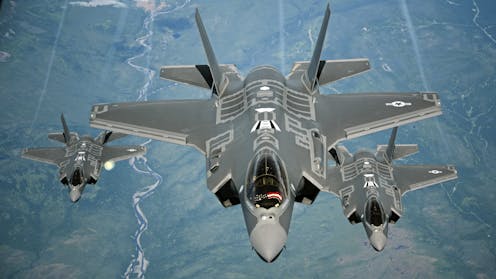
Military aircraft – from fighter jets to transport planes – are playing a significant role in today’s unstable world. Cumulatively, the operations carried out by these fleets, from combat missions to training flights, consume large amounts of fossil fuel.

Nevertheless, military aviation is rarely included in national climate inventories. In addition to greenhouse gases, aviation also emits other pollutants such as soot and particles, which affect both climate and air quality, and have detrimental effects on human health and ecosystems.

Recently, the UK government announced that it would purchase 12 F-35A fighter aircraft, some of which will be used to reduce a backlog in pilot training. The F-35A is the standard variant of the F-35 fighter jet.

While the decision is primarily motivated by defence and alliance commitments, it also has environmental implications. Expanding training activities will increase the number of flight hours, and consequently, fuel use and emissions. Fighter jets consume large quantities of fuel per flight hour.

The combustion process in aircraft engines releases carbon dioxide (CO₂), but the impact on the climate and environment extends further: emissions of soot particles, nitrogen oxide compounds, water vapour and sulphuric compounds influence atmospheric chemistry and cloud formation.

The persistent contrails and the cirrus clouds they generate are estimated to cause an impact on the climate comparable in magnitude to the warming effect of CO₂ from commercial aviation.

Any assessment of mitigation options must therefore consider both CO₂ and non-CO₂ effects arising from aircraft engine combustion. To mitigate aviation-related climate effects, the civil aviation sector has been promoting the development of sustainable aviation fuels (SAF).

When produced from waste oils or residues, hydroprocessed esters and fatty acids (Hefa) fuels – which are forms of sustainable aviation fuel – typically achieve 50–70% lower life-cycle CO₂ emissions compared with fossil-based jet fuel. Synthetic aviation fuels known as advanced power-to-liquid (PtL) e-fuels, produced using renewable electricity, could reduce emissions by more than 80%, though they are not yet available at scale.

Wars and climate change are inextricably linked. Climate change can increase the likelihood of violent conflict by intensifying resource scarcity and displacement, while conflict itself accelerates environmental damage. This article is part of a series, War on climate, which explores the relationship between climate issues and global conflicts.

In addition to a lower carbon footprint compared to fossil fuels, SAFs have
also been shown to produce fewer soot particles during combustion, reducing the likelihood and severity of contrails and cirrus clouds.

For technical reasons, down to the specific molecular composition SAF compared to fossil based jet fuel, commercial SAFs are currently not certified as standalone fuels. However, they are available for blends of up to 50% along with fossil-based jet fuels.

The quality of the sustainable fuels is very high and there is no technical barrier to their use in military aviation. The question is: to what extent can the climate and environmental impact of military aviation operations be reduced if sustainable aviation fuels are introduced?

Sustainable fuel and the F-35

Let’s take the example of the F-35, which was the aircraft purchased recently by the UK government. Under certain conditions, the F-35 can burn five tonnes of jet fuel in a single sortie lasting an hour. For comparison, a diesel car like the Volvo V70 would, in its whole lifespan, burn an amount of fuel corresponding to just four hours of combat manoeuvring with the F-35.

Technically, the F-35 is already approved to operate on blends of conventional kerosene and certified synthetic fuels. Similar to civil aviation standards, military standards allow for blending ratios of up to 50%, depending on the production pathway.

No modifications to engines or fuel systems are required. F-35 flights that used commercially available fuel with 40% SAF were carried out by the Norwegian Air Force in early 2025.

There are no significant technical barriers to the new F-35A aircraft entering UK service to operate on commercially available SAF blends with up to 50% renewable fuel. Compatibility is not the limiting factor, but, unfortunately, the availability and cost of fuel are.

For military training flights, which may involve large numbers of sorties, SAF can therefore provide significant reductions in life-cycle greenhouse gas emissions. A 50% blend of Hefa, for instance, could cut average CO₂ emissions per flight by around one third.

Since contrails can account for a large fraction of aviation’s total climate impact, this effect is potentially important. The strategic allocation of SAF to flights that are most likely to generate persistent contrails, like training missions at high altitude in humid conditions, could amplify the climate benefit of limited SAF supplies.

The UK’s acquisition of additional F-35A aircraft will help address a backlog in pilot training, but it will also increase emissions. From both a climate and national security perspective, SAFs represent the most practical near-term mitigation option.

The F-35 is technically compatible with sustainable aviation fuels – and substantial life-cycle emission reductions are achievable this way. Additional benefits may come from reduced contrail formation. However, limitations in global SAF production and their higher costs restrict the extent to which these fuels can currently be deployed.

SAFs will not make military aviation climate neutral, but they could substantially reduce its environmental footprint at a time when both security and sustainability are pressing concerns.

The Conversation

Elna Heimdal Nilsson does not work for, consult, own shares in or receive funding from any company or organisation that would benefit from this article, and has disclosed no relevant affiliations beyond their academic appointment.

ref. Sustainable fuels could reduce the climate impact of military aircraft – https://theconversation.com/sustainable-fuels-could-reduce-the-climate-impact-of-military-aircraft-264792

What we’ve learned about narcissism over the past 30 years

Source: The Conversation – UK – By Sarah A. Walker, Assistant Professor of Educational Psychology, Durham University

Nicoleta Ionescu/Shutterstock

You’ve probably seen the word “narcissist” thrown around online in headlines, on dating apps or in therapy-themed TikToks. But the label that people often unthinkingly slap on toxic bosses or reality TV villains hides a much more complicated psychological picture.

Psychologists have studied narcissism for many years, but over time, our understanding has evolved. One of the biggest changes is that today, narcissism is no longer seen as just grandiosity, arrogance or egotism.

Early scientific descriptions of narcissism focused on dominance, ambition and self-importance, all of which are traits associated with traditional masculine stereotypes. That meant narcissistic tendencies in women were often misread or overlooked. When those traits show up as emotional sensitivity, insecurity or relational manipulation, they sometimes still are misdiagnosed as anxiety, mood disorders or borderline personality disorder traits.

The most extreme and persistent forms of narcissism can sometimes be diagnosed as narcissistic personality disorder. This condition was added to the Diagnostic and Statistical Manual of Mental Disorders, the American Psychiatric Association’s diagnostic manual, in 1980. But most people with narcissistic tendencies won’t meet the threshold for a diagnosis.

So what does the research actually say?

Narcissism in general is now understood as a complex set of personality characteristics that can show up in different ways.

Psychologists had long suspected that there might be different kinds of narcissism, but it wasn’t until 1991 – when researcher Paul Wink and his colleagues presented a model including grandiose and vulnerable subtypes – that they were more formally recognised. Although there are other models, this remains one of the more popular approaches to understanding narcissistic tendencies in the wider population.

A 2021 review by US psychologist Joshua Miller and his colleagues pulled together decades of research to offer one of the most authoritative summaries of how psychologists now understand narcissism. It explains that narcissism has a common foundation, which includes things such as self-importance and entitlement. It then branches into different forms of narcissism, such as grandiosity, antagonism and vulnerability.

Researchers now often use the terms grandiose and vulnerable to describe two major forms of narcissism. One person with narcissistic traits may be bold with high levels of grandiose traits, confidence and emotional resilience. Another might be defensive, anxious and hypersensitive to criticism. Both show signs of narcissistic self-focus, but they end up looking quite different in how they experience and express emotion.

In a 2022 research paper I wrote with colleagues, we carried out the first meta-analysis examining how narcissistic traits relate to the ability to control one’s emotions. The results showed that vulnerable narcissism is consistently associated with greater emotional difficulty, which means these people might find it harder to keep their emotions in check.

In particular, people with high scores on vulnerable narcissism scales are more likely to rely on suppression. Suppression is a strategy that people use to hide or inhibit their emotional expressions, and has been linked to poorer wellbeing. On the surface, suppression might sound like self-control.

In some situations, it can be. For example, keeping a lid on your emotions when your boss is yelling at you. But trying to mute emotional expression without addressing the underlying emotions increases stress when it becomes our default strategy. It can worsen mental and physical health over time.

Montage of man against purple background with celebratory symbols.
Narcissism isn’t always this overt.
Roman Samborskyi/Shutterstock

In contrast, grandiose narcissism wasn’t linked with emotion regulation difficulties. In fact, several of the studies included in our analysis suggest that people with higher levels of grandiose traits may not experience as much emotional distress in the first place. This challenges the popular idea among researchers that people who exhibit narcissistic tendencies are also experiencing emotional instability.

Emotional intelligence and self-perception

The differences between forms of narcissism show up in emotional intelligence research as well. In a 2021 systematic review on narcissism and emotional intelligence, my colleagues and I found that people with grandiose traits often said they were good at understanding and managing emotions. For instance, how well they think they can handle anger or recognise other’s emotions.

But when their skills were tested using emotion tasks (such as recognising facial expressions or identifying the best way to respond to an emotional situation), their performance didn’t always match up with how skilled they said they were. This is consistent with a 2018 study which also found that people with grandiose tendencies rated themselves as emotionally skilled but performed worse on skill-based emotional intelligence tasks compared to other participants.

In contrast, people with vulnerable narcissistic traits tend to rate themselves lower in emotional intelligence, and seem to genuinely struggle more with managing emotions in everyday life.

So what should we make of all this?

It’s time to move beyond the pop-psych trend of labelling difficult people as narcissists. Narcissism isn’t about taking too many selfies. And no, the partner who ghosted you or the colleague who dominates meetings isn’t necessarily high in narcissistic traits either – no matter how much we might like to complain about them over coffee.

These kinds of casual diagnoses aren’t just unhelpful, they’re often wrong.

Narcissism is a complex psychological pattern that can show up in different ways and can reflect a deeper struggle with things such as self-esteem, emotion regulation and social connection. Understanding this doesn’t excuse people’s bad behaviour – not at all. But it does help us look past the stereotypes to get a clearer picture of what narcissistic traits look like in everyday life.

The Conversation

Sarah A. Walker does not work for, consult, own shares in or receive funding from any company or organisation that would benefit from this article, and has disclosed no relevant affiliations beyond their academic appointment.

ref. What we’ve learned about narcissism over the past 30 years – https://theconversation.com/what-weve-learned-about-narcissism-over-the-past-30-years-258505

What we learned about North Korea at the summit in Beijing

Source: The Conversation – UK – By Jim Hoare, Honorary Research Associate in the Centre of Korean Studies, SOAS, University of London

China invited world leaders to its capital, Beijing, recently to celebrate the 85th anniversary of Japan’s surrender in the second world war. Western leaders were notably absent. But despite the presence of many other leaders, such as Russian president Vladimir Putin, it was the arrival of North Korea’s Kim Jong-un that seemed to attract most international media attention.

This was Kim’s fifth visit to China since he assumed power in 2011 – the last was in 2019 before the COVID pandemic. And it was the first time he had attended a multilateral international meeting.

Kim travelled to Beijing by train – an armoured train at that. Although he does not seem to have the fear of flying his father had, it is not the first time Kim has used a train to travel overseas. In 2019, he went to Hanoi in Vietnam – a much longer journey – to meet US president Donald Trump the same way.

The train allows for a large entourage and provides an opportunity to prepare for meetings. It may also be more secure than the country’s aircraft after some years of no or little use due to the pandemic and the effective sealing off of North Korea from most of the rest of the world.

Aside from the travel preferences of its leadership, here are three things we learned about North Korea from the summit in Beijing.

1. There is no obvious succession plan

Kim was accompanied not by his wife, Ri Sol-ju, who was with him on at least one previous visit to China. Nor did he travel with his sister, Kim Yo Jong, who has been seen by many as a power in her own right. He arrived in Beijing with his daughter, Kim Ju Ae, who is believed to be about 13.

She first appeared in public in 2022, joining the North Korean leader at an inspection of a major intercontinental ballistic missile launch. Kim Ju Ae has been seen with her father, and occasionally her mother, on several subsequent occasions. This has led to speculation that she is being groomed to be Kim’s successor.

However, she made no appearances with her father after arriving in Beijing. This may have been a learning trip rather than an indication that she has been selected to succeed her father.

Before 2022, there was similar speculation about Kim Yo Jong, who was noted for hostile statements on relations with South Korea. While she has not disappeared from the scene, Kim Yo Jong is not shown the same level of deference as her niece.

If Kim is preparing a successor, he is departing from the approach of his grandfather and first North Korean supreme leader, Kim Il-sung, as well as his father, Kim Jong-il. Kim Jong-il did not make public appearances until he was in his 30s. He was not identified as the successor until later.

Only after he suffered a stroke in 2008 did Kim Jong-il select Kim Jong-un, aged 24, as his successor. To select a child – and a female at that – seems fraught with difficulties. Korean society, north and south, still tends to attach a high value to age and experience. And despite formal equality in both countries, there is a strong belief in male superiority.

2. It can rely on strong regional support

More significant than the presence of his daughter was the reception given to Kim Jong-un in Beijing. He was beside the Chinese president, Xi Jinping, and Russia’s Putin in front of the other leaders on the viewing platform for the ceremonial parade. This was the first time that leaders of the three countries had met together since Kim Il-sung, Mao Zedong and Nikita Khrushev met in China in 1959.

Kim Jong-un also held summit meetings with Putin and Xi, both of whom had signed up to sanctions on North Korea just a few years ago because of its nuclear programme. All of that now seems forgotten. The meeting with Putin reinforced the rapidly developing relations between the two countries, especially over the war in Ukraine.

Following Putin’s acknowledgement of the role North Korean troops have played in Ukraine, Kim said: “If there is any way we can assist Russia, we will certainly do it as a fraternal duty.” This may open the door for North Korea to send more troops to Ukraine and provide Russia with arms and ammunition.

In return for North Korea’s assistance, Kim has had economic support and, probably, some help in updating his country’s military capacity. Troops sent to support Russia will also have learned lessons about the nature of modern warfare.

The meeting with Xi produced pledges of further economic cooperation. Despite signing up for sanctions over the nuclear issue, China has not stopped providing food and oil to North Korea. This support now seems likely to increase.

Xi said the two countries were “friends with a common destiny”, while the Korean Central News Agency reported that North Korea would invariably support China’s interests.

3. It has been recognised as a nuclear state

Absent from both meetings was any reference to the denuclearisation of the Korean peninsula. This seems to indicate that both Russia and China accept that North Korea is a nuclear state.

According to a 2025 assessment by the US Office of the Director of National Intelligence, Kim views nuclear weapons as a “guarantor of regime security”. Some experts estimate that North Korea has produced enough fissile material to build up to 90 nuclear warheads.

Russia, China and North Korea can all show benefits from the summit in Beijing. Russia has a promise of continued North Korean support in the Ukraine conflict.

China, meanwhile, has reinforced its traditionally close relationship with North Korea. And Kim has not only been treated as a major world leader, but has gained additional practical support from his two big neighbours.

In such circumstances, it seems unlikely that he will be very receptive to overtures from Trump or to make any concessions over the nuclear issue.

The Conversation

Jim Hoare does not work for, consult, own shares in or receive funding from any company or organisation that would benefit from this article, and has disclosed no relevant affiliations beyond their academic appointment.

ref. What we learned about North Korea at the summit in Beijing – https://theconversation.com/what-we-learned-about-north-korea-at-the-summit-in-beijing-264718

Baby turtles vanish into the Indian Ocean for years: now a model shows where they might go

Source: The Conversation – Africa (2) – By Diane Le Gouvello, Postdoctoral fellow, Nelson Mandela University

All sea turtle species are threatened worldwide. They migrate long distances in the oceans – often thousands of kilometres – and so fall under multiple countries’ laws and conservation targets. They also have a complex life cycle with changes in habitats and diet at different life stages. These things make it difficult to protect them from threats like illegal harvesting, fisheries bycatch, coastal development, diseases and pollution.

Although they predictably return to the same nesting grounds on beaches where they were born, and the movements of adults have been well studied (mostly using satellite tracking), very little is known about their early life. Once newly hatched turtles enter the sea and disperse, they are gone for several years, also known as the “lost years”.

It’s hard to track hatchlings because they are small (just a few centimetres long), many die, and the survivors grow fast (so tracking devices don’t stay on). But knowing more about where they go during these “lost years” would help conservation scientists to improve their chances of survival and thus ensure recruitment and population viability.

Computer models are valuable tools for predicting the distribution of organisms in the oceans. The Sea Turtle Active Movement Model, for example, has been used to suggest how young turtles might disperse in the North Pacific and North Atlantic oceans – not only drifting in currents but actively swimming to their preferred habitats. The two most important factors are water temperature and food availability.


Read more:
Seychelles: floating baby corals can help save damaged reefs – new study


I was part of a team of scientists in South Africa who worked with the creators of that model to set up a similar one for the western Indian Ocean turtles. These are the species that nest on the eastern coast of the African continent and offshore islands.

We knew something about the surface currents in the Indian Ocean, the sea temperatures, the tiny hatchlings’ swimming speed, their starting points, what food they might need to find, and their growth rate. All this could be combined in the model to calculate where they might be at different points in time. The model produced maps predicting the distribution of dispersal for each species of sea turtle in the western Indian Ocean.

We found that ocean currents were the most important driver of dispersal, as hatchlings’ swimming abilities are limited during the first year. Swimming becomes more important as the young turtles grow.

This was similar to the findings of other studies.

Young turtles don’t stay inside marine protected areas all the time. The maps we created can be used to show where and when they might be most vulnerable and which areas of the ocean are most important to protect.

Indian Ocean turtles

We chose to model the sea turtles of the western Indian Ocean for a few reasons. There are five species that nest here; all the countries on this coastline and offshore islands have turtle conservation and monitoring programmes; and the ocean currents are complex.

The five species are green turtles (Chelonia mydas); hawksbills (Eretmochelys imbricata); loggerheads (Caretta caretta); leatherbacks (Dermochelys coriacea); and olive ridleys (Lepidochelys olivacea, which nest in smaller numbers and have not been included in our model). We had already studied their hatchling fitness, including their different swimming speeds, which was information the model would need.

The protected areas include South Africa’s iSimangaliso Wetland Park, a Unesco World Heritage Site. The turtle rookery there is about 200km long and has been monitored since 1963.

Our model also incorporated a high resolution ocean model of the Mozambique Channel, a very turbulent and dynamic oceanic region. It mostly flows southward, but eddies also send surface water in all directions. At the western end of the channel’s Agulhas Current, the Agulhas Rings also transport water into the South Atlantic Ocean, connecting the two ocean basins and a potential route for young turtles.

Water temperature matters too. Sea turtles do not regulate their own body temperature and the newly hatched turtles are less tolerant of temperature changes than adults are, but vary depending on the species. Temperature is more important for their survival than food is (their food requirements are easily met during the first year, as they are so small).

The model uses data on surface ocean currents and primary productivity (as a proxy for food availability). For each nesting site and species, we “released” 5,000 “virtual hatchlings” over a one-month period of peak hatching. The daily location of each virtual hatchling was recorded over one year. The model simulated young turtle dispersal and thereby estimated their potential distribution at an individual level. We then analysed this to predict their dispersal corridors at the population level.

Where young turtles go

The study revealed that the young turtles mostly go from their hatching site to a particular developmental area (the place where they develop for the first years) even though these are sometimes very far apart. Dispersal is mostly driven by ocean currents (during the first year) but differs among species. When they are older, currents are less important in their dispersal, and they start to actively swim towards favourable ocean areas.

There were three distinct dispersal corridors: among equatorial Indian Ocean islands (hawksbills); along east Africa (green turtles); and around southern Africa (loggerheads and leatherbacks).

The study allowed us to predict and map where critical dispersal habitats might be for four species nesting in this ocean region. It’s the first study to provide a regional-scale estimate of the dispersal pathways and corridors used by young turtles (individually and as populations), which are usually lacking in conservation assessments.

The results can also assist to develop more targeted management measures for conservation managers and policy makers, which will enhance the protection afforded to each of these threatened migratory species. The UN’s new high seas treaty will be instrumental in extending these actions into areas beyond national jurisdiction.

The Conversation

Diane Le Gouvello does not work for, consult, own shares in or receive funding from any company or organisation that would benefit from this article, and has disclosed no relevant affiliations beyond their academic appointment.

ref. Baby turtles vanish into the Indian Ocean for years: now a model shows where they might go – https://theconversation.com/baby-turtles-vanish-into-the-indian-ocean-for-years-now-a-model-shows-where-they-might-go-261576

Ethiopia’s mega dam has taken 14 years to build: what it means for the Nile’s 11 river states and why it’s so controversial

Source: The Conversation – Africa (2) – By John Mukum Mbaku, Professor, Weber State University

In April 2011, Ethiopia began construction of Africa’s largest hydroelectric dam, the Grand Ethiopian Renaissance Dam (GERD), on the Blue Nile river. The dam is expected to generate more than 6,000 megawatts of electricity, effectively transforming Ethiopia into the continent’s largest power exporter.

The dam affects 11 countries, two downstream and nine upstream.

Addis Ababa completed construction of the US$4 billion-plus project in July 2025, mainly with funds sourced from Ethiopians at home and in the diaspora, with an official launch on 9 September 2025. John Mukum Mbaku, who has researched the governance of the Nile’s waters, explains the dam’s potential for Ethiopia – and the controversies that have dogged it.

What are the simmering tensions around the official launch of the dam?

The dispute over the allocation and use of the Nile waters has been going on for many years. This has been exacerbated by climate change, and increased demand for food and water from growing populations.

The 11 countries that share the waters of the Nile have competing development priorities too. These states include Ethiopia, Egypt, Sudan, Rwanda, Tanzania and Kenya.

Egypt and Sudan lie downstream. They receive the river’s waters only after it has passed through the nine upstream states.

Initially, the downstream states, particularly Egypt, opposed the construction of the dam, arguing that it was a threat to their water rights.

However, Ethiopia powered ahead with construction. Egypt and Sudan then shifted negotiations to securing an agreement for filling and operating the dam.

The two downstream states had suggested that filling the dam should take about 12 to 21 years in order to protect their water supply. For domestic and political reasons, Addis Ababa prefered a shorter filling period. In addition, Egypt and Sudan argued that filling the reservoir without a legally binding agreement would disregard their interests and rights.

But with the dam now fully filled and due to be officially inaugurated on 9 September 2025, the issue of a binding agreement for filling the dam’s reservoir is moot.

Egypt and Sudan’s political and diplomatic efforts highlight what they say is the illegality of unilaterally operating the dam without a binding agreement. Despite the intervention of the African Union and the US government, as well as appeals by Egypt to the UN Security Council, the three countries haven’t been able to secure a deal.

Part of the reason is that Egypt has insisted that any negotiations on water allocation begin with the rights granted to it under its 1959 Nile Waters Treaty with Sudan.

Under this agreement, Egypt was granted 66% of the Nile’s estimated average annual water flow of 84 billion cubic metres. Sudan got 22%. The treaty ignores upstream countries’ legal claims to Nile waters, since 10 billion cubic metres were reserved for seepage and evaporation. Ethiopia’s highlands, for instance, supply more than 86% of the water that flows into the Nile River.

Egypt continues to argue that Ethiopia’s dam is a threat to its water security and that, if necessary, it will take measures to protect what it refers to as its “historical rights” to Nile waters.

Egypt relies on the Nile for more than 90% of its fresh water supplies. The country’s water needs have risen as its population has grown and its economy has expanded significantly.

However, Egypt and Sudan’s insistence on keeping their historical water shares cannot be considered equitable and reasonable. Additionally, Cairo doesn’t appear to be prioritising a water-use approach that acknowledges the legal claims of upstream states to the Nile’s waters.

Instead of improving and updating its water infrastructure, minimising wasteful irrigation practices and generally improving water use, Egypt has focused on grandiose mega projects that are putting significant stress on the region’s scarce water resources.

Sudan, which has been battling a devastating civil war since 2023, has raised concerns about Ethiopia’s dam affecting the operations of its own dams. This would make it more difficult to manage Khartoum’s development plans.

What makes agreement on the Nile so elusive?

The legal framework regulating the allocation of the Nile’s waters has been dominated by colonial-era agreements. These have been embraced by the two downstream states, Sudan and Egypt, but contested by the nine upstream ones.

Two of the most important of these agreements are the 1929 Anglo-Egyptian Treaty and the 1959 Egypt-Sudan treaty.

The 1959 treaty augmented the water allocations granted to Egypt and Sudan by the 1929 Anglo-Egyptian Treaty. These treaties also granted Egypt veto power over any construction projects on the Nile or its tributaries.

The terms of these treaties, however, are only possible if the nine upstream riparian states don’t access or utilise any water from the Nile and its tributaries.

Most importantly, they make the water rights of the other Nile countries dependent on Egypt and Sudan’s goodwill.

Ethiopia and other upstream states have long argued that they were not parties to the colonial-era treaties and are, therefore, not bound by them.

What international principles guide water use across borders?

The pillars of international transboundary water law are:

(i) equitable and reasonable use

(ii) the obligation not to cause significant harm

(iii) the duty to cooperate.

International legal scholars have noted that the 1959 Nile Treaty stands in sharp contrast to these principles. It disregards the sovereign rights of other riparian countries to their fair share of the Nile, and interferes with their development.

What does the dam promise for Ethiopians?

The Grand Ethiopian Renaissance Dam is a symbol of national unity and pride. It is significant that construction was undertaken without reliance on financing from external actors, such as international financial institutions or major industrial countries.

The dam’s electricity output could potentially transform Ethiopia’s development.

First, the electricity would provide a reliable source of energy for rural industrialisation, reducing deforestation by eliminating the need for households to cut down trees for firewood.

Second, it would reduce the pollution associated with burning wood, dung and other forms of biomass for cooking and other activities.

Third, it would improve access to education, effectively providing light that enhances the ability of pupils to complete homework assignments and study at night. During hot seasons, the electricity generated could be used to cool classrooms, improving learning outcomes.

Finally, higher electricity output would boost internet connectivity in rural areas in Ethiopia, effectively boosting access to the outside world.

The dam could also help with flood control in Sudan and drought protection in Egypt – but only if the three countries work together.

The Conversation

John Mukum Mbaku does not work for, consult, own shares in or receive funding from any company or organisation that would benefit from this article, and has disclosed no relevant affiliations beyond their academic appointment.

ref. Ethiopia’s mega dam has taken 14 years to build: what it means for the Nile’s 11 river states and why it’s so controversial – https://theconversation.com/ethiopias-mega-dam-has-taken-14-years-to-build-what-it-means-for-the-niles-11-river-states-and-why-its-so-controversial-264665