Trump’s radical argument that he alone can interpret vague laws fails its first court test in dismissal of Fed governor

Source: The Conversation – USA – By Claire B. Wofford, Associate Professor of Political Science, College of Charleston

The firing of Federal Reserve board member Lisa Cook isn’t just about Lisa Cook − it’s about presidential power. DNY59/Getty Images

President Donald Trump’s penchant to act first, ask later was on full display recently when he became the first president in American history to fire a member of the Federal Reserve Board.

Trump’s axing of federal employees is nothing new – thousands have been terminated, including the heads of agencies that, like the Federal Reserve, are designed to be insulated from presidential control.

But in removing Lisa Cook, Trump has entered into a morass of legal questions and challenged long-standing beliefs about the power of the president to control the U.S. economy.

Trump’s action, if upheld by courts, would upend the Fed’s century-long practice of formulating the nation’s monetary policy free from political pressure. It also could affect the budget of every American household, with the cost of goods and services influenced by political ideology more than financial expertise.

As a scholar of the American courts, I believe that, depending upon how courts resolve the case, it could also mark a significant shift in the ability of the judicial branch to check executive power.

Two men in dark blue suits, one standing behind a lectern and microphone.
Before he fired Lisa Cook, President Trump had spent months publicly attacking Federal Reserve Board Chairman Jerome Powell, right.
Saul Loeb/AFP via Getty Images

This agency is different

The dispute with Cook reached the public on Aug. 20, 2025, when Trump-appointed director of the Federal Finance Housing Agency Bill Pulte announced on social media that he had made a criminal referral to the Department of Justice about potential mortgage fraud by Cook. The DOJ subsequently opened an official investigation.

After Pulte’s announcement, Trump posted, “Cook must resign, now!!!” She refused and was officially fired by Trump five days later.

Cook then filed suit in federal court on Aug. 28, asking U.S. District Judge Jia Cobb to issue an emergency order blocking her removal. Cobb did just that on Sept. 9, 2025.

Cobb’s order, however, will likely be appealed by Trump. In the meantime, Cook will stay on the job and participate in decisions made by the Fed, which is set to meet again on Sept. 16.

Among the multitude of cases about Trump’s ability to fire employees of federal agencies, this one is different – because the agency is different.

Created by Congress in 1913 after a series of banking panics, the Federal Reserve is charged with managing the nation’s economy. It acts as the national bank, monitors the health of other financial institutions, and, most critically, develops monetary policy, which includes setting interest rates, the primary tool with which it manages inflation and ensures long-term economic growth and stability.

Precisely because of the Fed’s power, presidents have often tried to influence it. Sharp criticism of its members is nothing new. Trump has an ongoing and very public fight with the chair of the Fed board, Jerome Powell, about interest rates.

But a president actually firing a board member is something else entirely.

Supreme Court warning

The Fed is just one of dozens of what are termed “independent agencies.” These are part of the executive branch but designed by Congress to operate insulated from the president’s preferences and pressure. Over time, precisely because it is so powerful, the Fed’s ability to act free from the president has become particularly sacrosanct.

The primary mechanisms through which Congress ensures agency independence are “removal provisions,” statutory directives that define when and why the president can fire agency leadership. The Federal Reserve Act, the law that creates the Fed and sets out its structure and mission, provides that members of the board, called “Governors,” serve 14-year terms, “unless sooner removed for cause by the President.”

“For cause” may sound familiar because its appearance in a different law also recently triggered litigation. That happened when Trump removed the heads of two other independent agencies, Gwynne Wilcox of the National Labor Relations Board and Cathy Harris of the Merit Systems Protection Board. The Supreme Court decided in April that the restriction on the president’s ability to fire those two independent agency heads violated Article 2 of the Constitution.


Read more:
Supreme Court ignores precedent instead of overruling it in allowing president to fire officials whom Congress tried to make independent


In that same opinion, however, the court took pains to specify that its ruling did not apply to the Federal Reserve Board. Calling the Fed a “uniquely structured, quasi-private agency” with a “distinct historical tradition,” the majority signaled to Trump that booting members off the Federal Reserve Board was a no-go.

When he fired Cook, Trump flouted this directive. A legal battle was inevitable.

Four people sitting at one end of a large wooden table, at a meeting.
Lisa Cook, second from right, at a Federal Reserve board meeting in Washington, D.C., on June 25, 2025.
Saul Loeb/AFP via Getty Images

What’s behind the case

The case is complex and involves questions about whether Cook’s termination violates a congressional statute and the due process clause of the U.S. Constitution.

Notably, the parties are not arguing about the constitutionality of the removal provision itself, as they were in the Wilcox case. Instead, the dispute centers primarily around the meaning of “for cause” – that is, what reasons can legally justify firing a board governor. Unlike other statutes, which use additional terms such as “inefficiency, neglect or malfeasance of duty while in office,” the Federal Reserve Act provides no further guidance.

Trump argues that the – alleged – mortgage fraud is sufficient “cause” to remove Cook, particularly from an agency charged with managing the nation’s finances. Cook claims that mere allegations about private conduct before she was appointed to the board cannot justify her termination, particularly when those allegations appear to be a pretext for a political disagreement.

But lurking in the background of this seemingly picayune fight over a single word in a 111-year-old statute are fundamental questions about separation of powers, checks and balances, and which branch of government determines the law.

‘Say what the law is’

Trump’s fuller argument is actually quite bold.

As he is doing in other lawsuits, the president is asserting that he – and he alone – gets to determine the meaning of “cause.” The term, his lawyers write, is “capacious” and its meaning is entirely vested by Congress in the president. No court can second-guess his judgment.

The claim is striking and seems to fly in the face of the country’s system of checks and balances. In addition, if the branch of government charged with carrying out the law – the executive branch – also gets to define it, separation of powers also appears to be left by the wayside.

Cook counters that judicial review of termination decisions is critical.

If courts abandon their responsibility here, she argues, they will obliterate the independence of the Federal Reserve and subject the national economy to the short-term whims of a president rather than the long-term vision of economic experts.

In her order blocking Trump’s removal of Cook, Judge Cobb declared that the court has a “responsibility to review” the president’s firing of Cook, rejecting Trump’s claim that the decision was immune from judicial oversight.

And given the clear and continued acquiescence of Congress to this president’s broad assertions of power, they would also remove what, at least until the next presidential election, may be the last remaining check on executive power.

The case will likely reach the Supreme Court this fall, and the outcome is hard to predict. Trump has benefited from a string of victories there issued by a conservative majority that believes strongly in executive power and judicial deference to the president.

At the same time, it will be difficult to ignore the sentiments about the independence of the Fed that those same conservative justices expressed in the Wilcox case and the potential economic consequences a ruling for Trump might generate.

The court’s ultimate decision may actually depend upon what role it wants to play in the country’s fraying democratic system. The legendary Chief Justice John Marshall famously wrote in 1803 that it is “emphatically the province and duty of the judiciary department to say what the law is,” a sentiment inscribed on the marble wall of the Supreme Court building in D.C.

This case provides the opportunity to see whether the maxim still holds true.

This story has been updated to reflect U.S. District Judge Jia M. Cobb’s Sept. 9, 2025, decision blocking President Trump from removing Cook from the Federal Reserve Board.

The Conversation

Claire B. Wofford does not work for, consult, own shares in or receive funding from any company or organization that would benefit from this article, and has disclosed no relevant affiliations beyond their academic appointment.

ref. Trump’s radical argument that he alone can interpret vague laws fails its first court test in dismissal of Fed governor – https://theconversation.com/trumps-radical-argument-that-he-alone-can-interpret-vague-laws-fails-its-first-court-test-in-dismissal-of-fed-governor-264566

2027 Nigerian poll could trigger unrest unless electoral commission is fixed

Source: The Conversation – Africa (2) – By Onyedikachi Madueke, Teaching Assistant, University of Aberdeen

Political activities heralding Nigeria’s 2027 general elections are beginning to pick up.

Politicians are limbering up, alliances are being whispered about, political war chests are being filled, and campaign narratives are being sharpened.

The country’s rapidly growing social mobilisation (online and offline) places great demands on the electoral system. Especially the referee – the Independent National Electoral Commission.

If it can’t deliver credible polls, the country risks sliding into political unrest.

In 2022, a new Electoral Act handed the commission new powers, legalised the use of election technology, and guaranteed its funding a year ahead of the polls.

But there were still reports of irregularities.

Flawed elections do more than produce disputed winners – they deepen cynicism, depress turnout, and risk violence.

Nigeria’s example matters. It’s Africa’s largest democracy. Its electoral standards influence the region. If 2027 repeats 2023’s failures, other west African leaders might feel they can treat election commissions as political tools.

My recently published research examined the factors constraining Nigeria’s electoral commission from conducting credible elections and safeguarding electoral integrity, using the 2023 polls as a case study.

The study identified four issues undermining the commission’s effectiveness: eroded autonomy, corruption, weak adherence to its own rules, and compromised personnel recruitment.

The commission needs legal reinforcement to shield it from state capture, improve its technological capacity, deepen civic engagement and accountability, and safeguard electoral integrity.

Why the commission struggles to deliver credible polls

For my study I interviewed senior electoral commission staff, representatives of political parties (the All Progressives Congress, People’s Democratic Party and Labour Party) and other political stakeholders. I also drew on materials from the commission’s website, relevant online sources, news reports, social media content, and official documents.

Some of the key issues identified include:

1.) Independence

On paper, the electoral commission is financially independent. But the real power lies in leadership appointments, which remain in the hands of the president, subject to Senate confirmation.

In practice, appointees are often politically connected, sometimes openly partisan. Civil society groups flagged these risks ahead of 2023, but partisan nominees still took up sensitive electoral posts.

This matters because leadership shapes decisions. The commission’s abandonment of real-time result uploads in the 2023 presidential poll – a core promise – fuelled suspicions of political influence.

2.) Corruption

Politicians and insiders alike admit that electoral officials, especially temporary staff, are routinely offered and often accept cash inducements. The euphemism is “sachet water” money. The impact is serious: turning a blind eye to vote buying, altering result sheets, or simply ensuring “friendly” polling officers are assigned to strategic locations.

The 2023 polls brought fresh allegations: from officials charging voters to collect their voter cards, to attempted bribes for changing the result figures.

3.) Technology

The biggest promise of 2023 was about technology. The biometric voter accreditation system and result viewing portal were designed to stop the familiar rigging playbook: stuffing ballot boxes, falsifying tallies, and “doctoring” results. The commission told voters that presidential results would be uploaded in real time. It didn’t happen.

On election day, the commission blamed “technical glitches” for the failure to upload presidential results. Oddly, the same system worked fine for National Assembly results cast the same day. Investigative journalists later uncovered glaring discrepancies between polling-unit figures and the results published on the portal.

Many believe abandoning the result viewing portal technology made it easier for the result of the 2023 presidential poll to be manipulated. This wasn’t just a technical hiccup; it was a breach of legal guidelines and public trust.

4.) Workforce

The electoral commission’s permanent staff is small; for a nationwide election, it leans on over a million ad hoc recruits. The recruitment process is vulnerable to political interference.

Training is inconsistent, with little formal induction for new permanent staff and ad hoc workers alike. As experienced staff retire without structured knowledge transfer, institutional memory weakens. Add in the temptation of bribes, and you have a workforce prone to both errors and manipulation.

Four reforms for a credible 2027 poll

If Nigeria is serious about credible polls, reform of the electoral commission must start now. Four priorities stand out:

1.) Merit-based leadership and staff recruitment: Remove the president’s sole power to appoint the commission’s top leadership. A multi-stakeholder panel should vet and nominate candidates. The commission must have a standing professional electoral service corps (career election officers) to replace the heavy reliance on temporary workers.

2.) Improve technology and enforce rule compliance: The commission needs a stronger ICT infrastructure, redundancy systems, and independent audits of its electoral technology. Publishing results promptly at the polling unit level (and protecting them from tampering) is critical. Update and integrate the voter register with biometric and national ID systems.

3.) Legal and dispute resolution: Pre-election litigation timelines should be tightened so that disputes over candidacy, party primaries and voter registration are settled well before election day. Post-election adjudication must also be concluded prior to inauguration.

Stricter penalties are necessary to end the culture of impunity surrounding electoral offences. Swift trials, stiff sanctions, and disqualification of political actors who benefit from malpractice should be enforced.

4.) Civic engagement and accountability: The commission must educate voters, particularly on issues such as vote buying, technology, and citizens’ rights.

Civil society observers, media and civic tech groups should get open access and be treated as partners.

Accountability reports before, during and after elections are essential to rebuild public trust and confidence in the electoral process.

Conclusion

The race for 2027 is already on, but the real contest isn’t between the parties or personalities. It’s between a compromised electoral institution and the reforms needed to make it worthy of public trust.

Nigeria needs to fix the electoral commission’s independence, root out its corruption, enforce its rules, and professionalise its workforce.

The Conversation

Onyedikachi Madueke does not work for, consult, own shares in or receive funding from any company or organisation that would benefit from this article, and has disclosed no relevant affiliations beyond their academic appointment.

ref. 2027 Nigerian poll could trigger unrest unless electoral commission is fixed – https://theconversation.com/2027-nigerian-poll-could-trigger-unrest-unless-electoral-commission-is-fixed-263974

Decision-making on national interest projects demands openness and rigour

Source: The Conversation – Canada – By Robert B. Gibson, Professor of Environment, Resources and Sustainability, University of Waterloo

The federal government is about to refer its initial selection of national interest project candidates to its new Major Projects Office. The news stirs both excitement and trepidation.

Projects considered in the national interest would “enhance Canada’s prosperity, national security, economic security, national defence and national autonomy,” the government says.

While the notion of national interest projects is compelling, success on the ground depends on thinking through the implementation. There’s little evidence that’s happened.

The enabling law — the Building Canada Act, hustled through Parliament in June — establishes separate decision-making steps for project approval and for approval conditions, but not much else. How the candidate projects will be evaluated is mostly unknown.


Read more:
Why the federal government must act cautiously on fast-tracking project approvals


Big project challenges

Major project development is notoriously difficult. That’s evident in the long global record of megaproject cost overruns and embarrassments. It’s not surprising, given the organizational, economic and technical complexities, inevitable trade-offs and opposition and attractive alternative uses for the money.

For the current initiative, additional practical difficulties include:

  • How to share implementation power and responsibility with many players, given the constitutional fragmentation of jurisdictional authority;

  • How to respect Indigenous rights and consent;

  • How to cover the multitude of linked factors that should inform overall public-interest evaluations and justifications for decisions;

  • How to achieve reasonable reliability in predicting the positive and adverse effects and their distribution, especially for projects expected to induce further activities;

  • How to draw well-supported conclusions about project viability, serious opportunities and risks, costs and legacies, in an uncertain global economic, geopolitical and climate context; and

  • For non-renewable resource projects, how to use limited-life gains to build more lasting well-being, while avoiding dependencies, stranded assets and toxic legacies.

Dealing with all these matters entails careful elaboration of the Building Canada Act’s basic two-step process for decisions on national interest projects.

It also requires a departure from the approach so far, which has identified potential candidates through a cloaked process involving proponents and relevant political jurisdictions without published criteria for evaluating the projects or clear plans for the deliberations to follow.

Defensible evaluations and decisions

Before candidates are referred to the Major Projects Office, all parties would benefit from the publication of a well-defined, open and rigorous approach that ensures defensible evaluations and decisions.

As set out with few specifics in the Building Canada Act, the two decision-making steps are:

  1. Evaluations leading to a determination on whether to pre-approve the candidate project;
  2. Expedited assessment and provision of permits to consolidate the conditions of approval.

The sequence seemingly ignores the normal process where assessment precedes approval (first consider, then decide). In practice, however, defensible decision-making in Step 1 must have detailed project information and a strong overall assessment of the project’s benefits, risks and uncertainties.

That’s a basic necessity if the government wants decisions on the pre-approval of projects to be well-founded and justifiable, and if the project planning is to be far enough advanced to be ready for the for Step 2’s expedited process for conditions of approval.

Process essentials

For Step 1, the Major Projects Office should provide specifics on the following requirements for decision-making on pre-approval:

  • Well-elaborated, comprehensive and visibly applied criteria for evaluations;

  • Detailed project information;

  • Analyses covering specifics on all the key considerations and their interactions;

  • Mobilized expertise for due diligence rigour in evaluating project viability, opportunities, risks and trade-offs;

  • Special imperatives for responsibility in allocating public funding;

  • Solidly defensible decisions, clearly based on well-informed analyses, while also respecting controversies and uncertainties;

  • Credible transparency and meaningful engagement;

  • Detailed project readiness for the expedited conditions and the permits process; and

  • Clarity about how other authorities are involved in Step 1 and will collaborate, especially in joint assessments, in Step 2.

One project, one assessment

The final point above may present the greatest challenges and opportunities.

The federal government has emphasized a commitment to “one project, one assessment” that will apply often. But many of the reported candidate projects involve several jurisdictions.

Perhaps in a few cases, one assessment could be achieved by deferring largely to a single provincial or territorial process. But where two or more provinces, territories and/or Indigenous jurisdictions are involved — or the project depends on significant federal funding — a joint assessment process is necessary.

Exemplary joint assessments have been conducted in Canada before. Doing so today for fast-tracked mega-projects would be a major accomplishment, especially if those joint assessments prioritize best practices and respect Indigenous rights, including the right to give or withhold free, prior and informed consent.


Read more:
‘Elbows up’ in Canada means sustainable resource development


Rigour and transparency

In sum, what’s needed now is detailed elaboration of the process for the initial group of identified candidates for national interest projects. That process should incorporate all the components listed above, including a comprehensive and credible equivalent of assessment before the first step’s pre-approval decision.

Such an approach is consistent with the the Building Canada Act and stated policy. Perhaps that’s been the federal government’s intention all along. If so, it must ensure the process is transparent to ensure the understanding and confidence of all participants.

Political enthusiasm is a useful stimulant but a poor guide and a risky base for deliberations and decisions on major projects. Judging the opportunities and risks of national interest projects is important and difficult. It’s time for an open and rigorous process.

The Conversation

Robert B. Gibson has received funding from the Social Sciences and Humanities Research Council of Canada and the Impact Assessment Agency of Canada. He is a member of the Agency’s Technical Advisory Committee.

ref. Decision-making on national interest projects demands openness and rigour – https://theconversation.com/decision-making-on-national-interest-projects-demands-openness-and-rigour-264755

Focusing on children’s first 1,001 days can build neighbourhood support for migrant families

Source: The Conversation – UK – By Tom Allport, Honorary Senior Clinical Lecturer, Bristol Medical School, University of Bristol

Royaltyfreecliick.com/Shutterstock

The UK government’s new ten-year health plan for England prioritises tackling health inequalities through local preventive measures. One promising approach is to build on the strengths of migrant families by fostering neighbourhood peer support – particularly for underserved communities.

In wealthy countries, families migrating from low-income countries are often excluded or marginalised in society and lack social support. They often have highly stressed pregnancies and many experience barriers to effective healthcare.

For migrant families, the stresses of migration, poverty, and discrimination can combine to negatively affect their children’s wellbeing and life chances, such as employment. This matters for a large number of children: one in five children born in England and Wales has a parent born in a low-income country.

Promoting early child development improves life chances and saves money. This works best when started before birth, in the “first 1001 days” of life – the period from conception until a child’s second birthday.

Pregnant woman in kitchen
The 1,001 days start before birth.
oliveromg/Shutterstock

The best programmes are available to everyone, but make extra effort to help the people who need them the most. An example is Sure Start, which was introduced in 1999 to support children aged up to the age of five and their families living in disadvantaged areas in England.


Read more:
How England’s scrapped Sure Start centres boosted the health and education of disadvantaged children


Sure Start centres foster social support for parents and help children’s early social and emotional development, as well as providing places for families to get help from a range of health, social, financial and other services. The evidence of Sure Start’s long-term benefits continues to accumulate. However, austerity measures in recent years have seen a massive reduction in Sure Start centres across the country.

Promoting social connectedness and enhancing support may be especially important for migrants and families from communal or collective child-rearing cultures. Our research has shown that better social support for pregnant women from migrant communities in Bradford is linked positively with their children’s social and emotional development.

We have also found that making social connections can be a turning point for parents’ wellbeing, which in turn helps their children’s opportunities for play and interaction. Helping communities build social support and connectedness therefore may be a powerful way to bring about change.

Social connection

Peer support (from people with similar backgrounds) is a very effective way to deliver services and improve lives, including for migrants. This is especially the case when this support can build trust.

Working with communities in Bristol over ten years, we have developed ways for communities, agencies and researchers to work together to activate family strengths through a programme called Find Your Village. Through peer support in the first 1,001 days, we aim to improve family wellbeing, child development, community connectedness, engagement with services, and longer-term life chances.

Find Your Village.

Our approach involves spending time with families, helping them solve problems and draw on their own strengths. Peer supporters also organise group activities and advocate for improvements in neighbourhood environments.

Meeting others from the same neighbourhood can help in lots of ways. For example, free, unstructured play helps children’s physical, social, and emotional wellbeing. At the same time, parents benefit from meeting each other. They can form secure relationships and grow in confidence raising their children, which brings many benefits. Parents can then in turn start to help others and give back to the community.

Many factors may challenge how accessible and helpful health services are for communities with migrant heritage. And not all social support is helpful. What helps both services and communities feel inclusive to families deserves continued attention.

There are some clear messages about how voluntary sector and government agencies can work effectively to reduce inequalities. Action to reduce inequalities works best when agencies and underserved communities work together to build and maintain trust.

Rigid, externally developed programmes are likely to lack cultural appropriateness and contextual fit and are therefore less likely to be taken up by groups who feel less connected in society. Partnership working, and flexibility to adapt to local contexts are therefore key.

Although our focus is on migrant communities, Find Your Village ideas may be relevant in other contexts of structural inequality and disadvantage. Could resourcing peer support to activate the strengths of families and communities help in the design and delivery of the new government health plans?

The Conversation

Tom Allport has previously received funding from the National Institute of Health Research.

Debbie Watson has received funding from the Economic and Social Research Council and the Arts and Humanities Research Council. She is affiliated with the Labour Party.

ref. Focusing on children’s first 1,001 days can build neighbourhood support for migrant families – https://theconversation.com/focusing-on-childrens-first-1-001-days-can-build-neighbourhood-support-for-migrant-families-264158

South Africa’s student debt trap: two options that could help resolve the problem

Source: The Conversation – Africa – By Michele Van Eck, Associate professor in the School of Law at University of the Witwatersrand, who specialises in the areas of contracts, legal ethics and education. , University of the Witwatersrand

Education is widely regarded as the road to a better life. Yet the rising cost of tertiary education means many students can only go to university if they get financial aid, bursaries or loans.

South Africa’s National Student Financial Aid Scheme (NSFAS) offers students bursaries or loans which provide allowances for tuition and registration fees, books, travel and accommodation. But this type of funding applies only under specific and limited conditions. Many students fall outside its scope.

Students who are not enrolled for a qualification that is approved by the Department of Higher Education, or who wish to study for a second undergraduate qualification, or who are studying at private institutions, don’t qualify to get the funding.

The result is that many students can’t keep up with paying their university fees. In 2025 South African universities collectively held about R9.3 billion (US$528 million) in student debt that had remained unpaid since 2023.

Universities have been trying different methods to pressure students and graduates to pay outstanding student debts. This has included withholding of degree certificates, academic transcripts and marks.

Universities require funding to operate effectively, pay staff and maintain infrastructure. But withholding academic documents from indebted students may prevent them from securing employment – the very means by which they could repay their debts. These practices, while commercially defensible, often have the opposite effect. According to Unesco, “student loans generally have catastrophic effects for students and families across the world”.

It seems reasonable to conclude that student debt collection practices may entrench poverty and make it harder for graduates to get jobs.

From recent court cases, it appears that this issue is especially pronounced in the legal profession. Law graduates face additional scrutiny, as admission to the profession requires not only academic qualifications but also proof of moral character. The Legal Practice Act 28 of 2014 mandates that candidates be “fit and proper” individuals, embodying values such as honesty, integrity and reliability. Outstanding debt may be seen as a contrast to the values of honesty and integrity.

Fulfilling financial obligations can indeed have a bearing on ethics (a field I study as a legal scholar). But as I argue in a recent paper, it’s necessary to distinguish between graduates who are unwilling to pay and those who are genuinely unable to.

I also propose a couple of ways this could be achieved so that universities get their money and graduates get their start in working life.

How universities collect debt

Unlike South Africa, some countries have taken steps to deal with the impact of student debt.

My paper highlights that, in the United States, several states don’t allow universities and colleges to withhold degree certificates and transcripts (records of academic activity) over unpaid fees. They recognise that those debt-collection practices hinder employment and make inequality worse. Instead, they promote other strategies, like repayment plans related to income, or policies for how to treat students who are experiencing hardship.

In the United Kingdom, universities are advised not to use academic sanctions to recover non-academic debts, such as accommodation fees. Consumer protection laws treat students as consumers, allowing them to challenge unfair contractual terms. If a university’s contract includes provisions to withhold degrees for unpaid fees, students may contest these clauses as unjust.

South Africa lacks similar legal safeguards. Each university sets its own rules. These range from students not being able to graduate unless all fees are paid, to the withholding of certificates from students not in good financial standing, and even preventing students from viewing their examination scripts if they owe money. Some examples may be found at the University of the Free State (page 27), University of Pretoria (page 16) and University of the Witwatersrand.

Law students face additional hurdles

In the legal profession, financial responsibility is often tied to ethical conduct. Lawyers manage trust accounts, client funds and sensitive legal matters. Integrity is non-negotiable.

However, the inability to pay student debts is not inherently dishonest. Some students fall into debt due to circumstances beyond their control, like family obligations, socio-economic conditions, unemployment or the sheer cost of education.

South African courts have grappled with outstanding student debts when it comes to admitting law graduates to the profession. The courts’ approach has been inconsistent.

In Ex Parte Tlotlego the court emphasised that poverty should not bar entry into the legal profession. It said courts should not require proof of debt repayment arrangements, which would be unfair to students from disadvantaged backgrounds.

But in Ex Parte Makamu the court found that a law graduate must still demonstrate how they intend to settle their debts to satisfy the ethical standards of honesty and integrity.

More recently, Ex Parte Galela reinforced this view. The court declined the application for admission because it wasn’t clear why the law graduate hadn’t paid off their debt. It suggested that financial irresponsibility could reflect poorly on the graduate’s character.

The courts’ approach and general student debt-collection practices often fail to differentiate between students who cannot pay and those who choose not to. This distinction is vital. A student who ignores their debt without justification may raise ethical concerns. But a student who is willing to pay yet lacks the financial means should not be penalised.

Solutions

The solution lies in balancing the financial interests of universities with the socio-economic realities of students. Student debts must be repaid, but repayment mechanisms must also be fair and sustainable.

There have been attempts to find a solution, such as the draft Student Relief Bill, which proposes setting up a Student Debt Relief Fund. But that might place unsustainable pressure on the economy.

I have another proposal: allowing graduates to receive their degree certificates regardless of outstanding debt, along with two legislative interventions. These are:

  1. Automatic garnishee orders: upon graduation, an automatic garnishee order (a court order directing an employer to deduct a certain amount from an employee’s income) could be placed on future salaries of a graduate. This would ensure that student debt is repaid over time.

  2. Amendment to the Prescription Act 68 of 1969: This could exclude student debt from prescribing (becoming too old to collect). Normally, such a debt would prescribe after three years. An amendment would allow universities to recover debts for the duration of graduates’ employment, not just within three years.

These measures would uphold the financial sustainability of universities while protecting the dignity and future employment prospects of graduates.

The Conversation

Michele Van Eck does not work for, consult, own shares in or receive funding from any company or organisation that would benefit from this article, and has disclosed no relevant affiliations beyond their academic appointment.

ref. South Africa’s student debt trap: two options that could help resolve the problem – https://theconversation.com/south-africas-student-debt-trap-two-options-that-could-help-resolve-the-problem-262555

Recipes from the middle ages have much in common with how our grandparents used to cook

Source: The Conversation – UK – By Diane Purkiss, The William F Pollard Tutorial Fellow in English, University of Oxford

Painting of a banquet from the manuscript of The Romance of Alexander the Great, mid-15th century. Wiki Commons

“You have to keep beating it for longer,” my grandmother instructed me. “It isn’t pale yet. It’s still too yellow.” I didn’t ask how long this would take. I was nine years old, and I understood what my grandmother meant. You have to keep doing something until it works. It’s like asking: “Are we there yet?”

I watched for the miraculous transformation. The eggs, golden when first beaten, were lightening to a soft lemon colour. The texture was changing. You couldn’t see the sugar anymore; it had looked like sand, but now it was invisible, cloaked in the egg. My grandmother stopped beating, and lifted up the beater. A stream of thick liquid hung down, like the wet sand you used to reinforce a sandcastle. “Yes, that’s enough. Now add the melted butter. Slowly. Then the flour. We’ll need a bit more.”

My grandmother taught me to cook. She never weighed anything. The only measurement she used was a pink breakfast teacup, and it was more a useful scoop than a measure. Instead, she worked towards a desired result. You didn’t cook things for five minutes. You cooked things until you got the result you wanted. The first thing she taught me to make was bechamel sauce. She didn’t call it that. She called it white sauce with flavour. I could make it when I was five, and I still do it the same way.

Her cooking was preliterate, or, more exactly, a special kind of literacy, a grammar of ingredients and heat and air.

I’m a food historian and the author of English Food: A People’s History. I have never found the recipes of the middle ages as difficult to understand as most food historians. Perhaps because they look a little like my grandmother’s instructions.

Cooking in the middle ages

A medieval recipe
The recipe for sambocade from Add MS 5016.
British Library

Take and make a crust in a trap, and take cruddes and wryng out þe wheyze, and drawe hem þurgh a straynour, and put in þe straynour crustes. Do þerto sugar the þridde part and somdel whyte of ayren, and shake þerin blomes of elren, and bake it up with eurose, and messe it forth.

This is a recipe for “sambocade” from a middle ages manuscript held in the British Library. Sambocade is an elderflower cheesecake of sorts. It uses curds – the beginnings of cheese – and the recipe gives quite detailed instructions on how to make them, a method a little like making Greek yoghurt. You add sugar, egg white and elderflowers, along with rosewater. Then you serve it.

A recipe like this is not a series of instructions. It is meant to act as a reminder, a series of quick notes to recall to mind something taught orally – something taught as my grandmother taught me.

Just as Google Maps will not tell me how to walk by putting one foot in front of the other, this kind of recipe doesn’t tell me what I’m looking for or how to achieve it. It doesn’t give exact measurements. It doesn’t really give any measurements at all. But if you made this recipe half a dozen times, you would soon understand the process required. And then, it would be yours, in a way that a recipe tested or created by another cook can never quite be yours.

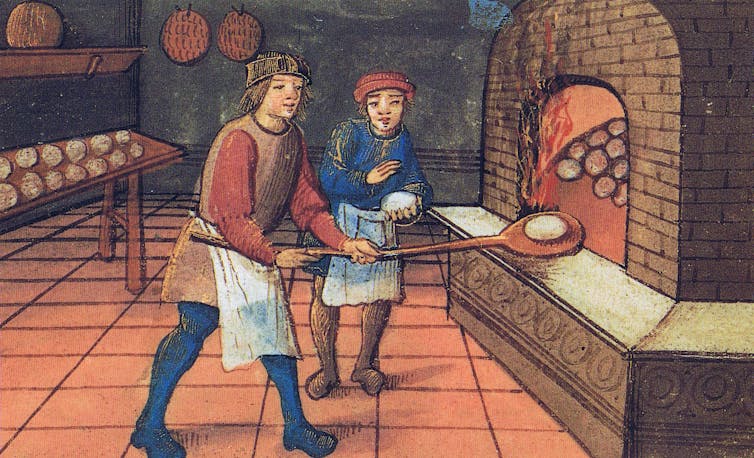
Medieval image of a baker putting bread into an oven
A baker with his assistant making bread rolls, from a book of hours manuscript (circa 1500).
Bodleian Library

In my kitchen I still keep my mother’s recipe book, a manuscript volume in which she tried to preserve recipes that were gifts from friends. All of it is in her handwriting.

It contains a recipe for cheesecake from the days when cheesecake was a little-known novelty; it notes that the recipe comes from an American friend. It contains exact quantities and exact baking times, although the result is a lot more strongly baked than the majority of cheesecakes now. The exact quantities preserve a memory of the effect that’s difficult to reconstruct from recipes that come from earlier times.

In the same way, I have only my memories of my grandmother’s cooking to preserve what she did; she was barely literate, and her own recipes consisted solely of lists of ingredients. These were kept in a shoe box and after she died, my mother threw it away on the grounds that it was of no possible value to anyone. All the same, every time I make a sponge cake, I say to myself, is it pale enough yet?


Looking for something good? Cut through the noise with a carefully curated selection of the latest releases, live events and exhibitions, straight to your inbox every fortnight, on Fridays. Sign up here.


The Conversation

Diane Purkiss is affiliated with Keble College, University of Oxford.

ref. Recipes from the middle ages have much in common with how our grandparents used to cook – https://theconversation.com/recipes-from-the-middle-ages-have-much-in-common-with-how-our-grandparents-used-to-cook-264139

Putting your CV together? Complete honesty might not be the best policy

Source: The Conversation – UK – By Tom Lane, Senior Lecturer in Economics, Newcastle University

PeopleImages/Shutterstock

Writing a CV requires important decisions. What should you include, what should you leave out – and how honest should you be?

One particularly tricky dilemma that might come up is whether to disclose weaknesses on your CV or remain silent about them. Common sense suggests it’s not advisable to advertise your flaws, but what about important information that employers might expect you to supply? Could the omission of such details look suspicious?

Research my colleague and I conducted looks at this specific question, focusing on the academic qualifications of new graduates entering the job market. And it provides a clear, evidence-based answer: if your grades are low, you are better off not disclosing this.

Complete honesty is not the best policy.

In the UK, where we did the research, most universities award undergraduate degrees on a scale: first-class, upper second (2:1), lower second (2:2) and third. While a first or 2:1 is often seen as evidence of strong performance, lower degrees are held in lower esteem.

A graduate jobseeker with a lower classification has a choice of what to reveal on their CV. They can be upfront about it, or they could simply state that they have a degree, without mentioning the class. (A third option, to lie about the class is probably a bad idea because employers can and do ask for proof.)

Perhaps surprisingly, traditional economic theory would probably favour fronting up. Interactions like this, where a “seller” (in our case, a jobseeker supplying their skills) holds information about their quality that they can voluntarily disclose or not to “buyers” (here, employers), have been popular subjects for analysts of game theory (the mathematical study of strategic interactions).

The idea starts with the notion that people who fail to supply available evidence about their quality look like they have something to hide. Some economists have concluded that buyers will assume non-disclosing sellers must be not merely bad, but of the lowest possible quality level.

In our context, this means employers would think that any graduate whose CV omits degree classification information has a third-class degree, and should treat them accordingly. To avoid this, it would be in the interests of any applicant who earned a 2:2 or higher to disclose it.

To see how jobseekers actually behave, we analysed the CVs of recent graduates on the job website Monster. We noticed that a substantial minority left their degree class undisclosed. Included among them, presumably, were plenty of applicants with at least a 2:2.

To work out whether these applicants were making a mistake, we also conducted a large experiment, sending more than 12,000 applications to genuine graduate job vacancies. These varied only in the jobseeker’s degree classification, and whether this was disclosed on their CV, with other details kept the same.

Success was measured by how often applications resulted in invitations for an interview or further communication. As expected, the most successful of our applications were those with a first-class degree.

However, those who said nothing about degree class were not the least successful. Instead, their success rate was in between that achieved by jobseekers disclosing 2:1s and 2:2s. Applicants who openly reported a third-class degree were the least likely to receive a response.

Put simply then, full disclosure harmed their chances.

The third degree

Our findings challenge the neat logic of traditional economic theory. If employers always assumed the worst about missing information, hiding poor grades should not help.

Yet in practice, it seems recruiters do not have time to scrutinise every detail. Faced with hundreds of applications, they may skim CVs, focusing on standout positives or negatives. If the grade is not there, it may simply go unnoticed.

Of course, interviewers might ask about grades later in the application process, but by initially concealing this information, otherwise unattractive applicants can help themselves get to the interview stage, at which point they can use other qualities to impress.

Graduates throw caps into the sky.
Don’t mention it.
Roman Samborskyi/Shutterstock

The practical message of our research is clear. If you have strong academic credentials, highlight them proudly. But if your results are weaker, you are under no obligation to advertise them. Omitting them will not guarantee success, but it may increase your chances.

The graduate job market remains highly competitive. Yet our study suggests that lower grades do not need to define a candidate’s prospects, provided they make careful choices about self-presentation.

Strategic omissions may help level the playing field for those whose academic record does not reflect their potential. So if you have recently graduated with a third, there’s no need to panic, and no need to mention it either.

The Conversation

Tom Lane does not work for, consult, own shares in or receive funding from any company or organisation that would benefit from this article, and has disclosed no relevant affiliations beyond their academic appointment.

ref. Putting your CV together? Complete honesty might not be the best policy – https://theconversation.com/putting-your-cv-together-complete-honesty-might-not-be-the-best-policy-263679

Curious Kids: why do we need to do homework?

Source: The Conversation – UK – By James Williams, Emeritus reader in science education and communication, University of Sussex

PeterPike/Shutterstock

Why do we need to do homework when we already spend all day in school? – Grace, aged nine, Belfast

If you’ve ever stared at your homework feeling stuck, you’re not alone. Many children say it makes them feel stressed, bored, or even anxious. Why do teachers keep giving you work to do at home when you’ve already spent hours learning at school?

The available research suggests that for secondary school students, well-designed homework can lead to about five extra months of progress in subjects like maths and English. In primary school, the impact is smaller – around three months – but still useful.

Homework helps you practise what you’ve learned, remember it better and build skills like time management and independence.

However, research shows that how you feel about homework depends on a few things. If you find your homework boring, it might be because the activity you’ve been given to do really is pretty boring. Not all homework is equal.


Curious Kids is a series by The Conversation that gives children the chance to have their questions about the world answered by experts. If you have a question you’d like an expert to answer, send it to curiouskids@theconversation.com and make sure you include the asker’s first name, age and town or city. We won’t be able to answer every question, but we’ll do our very best.


A worksheet that doesn’t connect to your lessons is not so helpful. A task that challenges you to think, create, or explore concepts and ideas is much better.

Teachers have to think hard about the tasks they set and how they explain them. If the task is explained clearly and if students get helpful feedback, the chance they will complete it is much higher. Teachers must also choose meaningful tasks help you see homework as part of learning – not just extra work.

Girl doing homework with pen, paper and laptop
Sometimes homework really is boring.
Studio Romantic/Shutterstock

Homework that’s creative or linked to your passions is more enjoyable. Then comes the idea of success. If the task feels impossible, it’s easy to give up. Finally, does it make sense? Homework that connects to what you learned in class feels more useful.

As a science teacher I would always try and set the homework early in the lesson rather than right at the end. Knowing what is going to be expected means that the children better understood the task and could link it to the work being done in the lesson.

How you do homework

Your attitude toward homework isn’t just about the task – it’s also about the people around you. If you have parents or guardians who encourage you, help you plan your time, or show interest in your work, this can make homework feel more positive. That said, there is research that shows that while it’s helpful for parents to ask whether you’ve done your homework, helping you do it isn’t actually useful.

Some children also face bigger challenges. Not everyone has a quiet space to work, or someone at home who can help. This is called the “homework gap” and it can make school feel unfair.

It’s up to schools whether they set homework, and some schools are rethinking homework altogether. They are looking to make it more accessible and creative. Some schools make homework optional rather than demand it for every subject. Schools are also looking at how they can make homework fair for everyone. This includes ideas such as homework clubs, where you can get help and work with friends.

Homework isn’t going away any time soon. But it doesn’t have to be a burden. When it’s well-designed, supported by teachers and parents, and connected to learning, it can help you grow – not just as a student, but as a thinker.

So next time you sit down with your homework, ask yourself: What can I learn from this? And if it feels too hard or pointless, speak up. Your voice matters.

The Conversation

James Williams does not work for, consult, own shares in or receive funding from any company or organisation that would benefit from this article, and has disclosed no relevant affiliations beyond their academic appointment.

ref. Curious Kids: why do we need to do homework? – https://theconversation.com/curious-kids-why-do-we-need-to-do-homework-262992

Les robots collaboratifs, des collègues de travail comme les autres ?

Source: The Conversation – in French – By Thierry Colin, Professeur des universités en Sciences de gestion, Université de Lorraine

Le concept de cobot a été inventé par l’industrie automobile. L’objectif : créer des robots capables de travailler aux côtés des humains, sans risque d’insécurité. Gumpanat/Shutterstock

Les robots collaboratifs, ou cobots, ne remplacent pas seulement les humains : ils peuvent travaillent avec eux. Quel est leur impact sur la division du travail ?


Les robots sont omniprésents dans la production industrielle. Leur diffusion a toujours été au cœur d’enjeux humains, sociaux, économiques et en management, entraînant très tôt de nombreux questionnements.

Une nouvelle interrogation émerge aujourd’hui avec l’apparition des cobots. Capables de travailler non seulement à la place, mais aussi avec les humains au sein des ateliers, les robots collaboratifs sont-ils en train de devenir des collègues comme les autres ? Légers, flexibles, relativement accessibles et conviviaux… sont-ils susceptibles de remettre en cause les codes de la division du travail ?

Nos recherches récentes, basées sur des études de cas comprenant des entretiens et des observations en situation, ont permis de repérer quatre types d’usage des cobots : configuration simultanée, alternée, flexible ou coexistence. Elles rentrent dans le cadre du projet Impact « C-Shift » (Cobots in the Service of Human activity at work) qui vise à étudier l’impact de la mise en œuvre de dispositifs collaboratifs intelligents tels que les cobots dans le cadre des défis de l’industrie du futur.

Qu’est-ce qu’un cobot ?

Le terme cobot est créé par la contraction des termes anglais « collaborative » et « robot ». La paternité en est attribuée à des universitaires états-uniennes qui cherchent à la fois à limiter les troubles musculosquelettiques et à améliorer la productivité dans des usines de production automobile – Ford et General Motors.

Un robot collaboratif est un robot qui peut être installé dans le même espace de travail que les opérateurs humains, sans barrière de protection physique. Ils sont équipés de capteurs et de programmes déclenchant un ralentissement du mouvement ou un arrêt complet si un risque de collision est détecté. Ils sont capables de réaliser la plupart des opérations industrielles – visser, percer, poncer, souder.

Les cobots ne sont pas conçus pour des usages prédéfinis. Ils sont caractérisés avant tout par leur flexibilité. Facilement programmables grâce à des interfaces accessibles sur des tablettes, ils sont faciles à déplacer. Ils peuvent aussi bien mettre des produits cosmétiques dans des cartons, que faire du contrôle qualité à l’aide d’une caméra en bout de chaîne de production ou souder des pièces métalliques.

Marché multiplié par quatre d’ici 2030

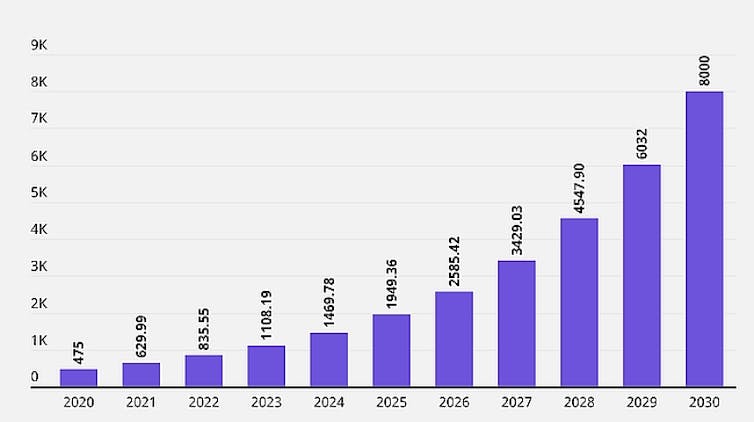
Les cobots ne sont plus de simples prototypes de laboratoire. Ils sont désormais couramment utilisés dans des usines de toutes tailles et dans divers secteurs – automobile, logistique, santé, agroalimentaire –, bien que leur adoption reste encore loin d’être généralisée. La part des cobots dans les ventes mondiales de robots serait de l’ordre de 3 % et, selon ABI research, le marché des cobots pourrait être multiplié par quatre d’ici 2030.

Courbe
Prévision de croissance du marché mondial des robots collaboratifs (cobots) de 2020 à 2030 en millions de dollars états-uniens. »
Statista et ABI Research, FAL

Les cobots ne visent pas à remplacer les robots traditionnels en raison de plusieurs limitations :

  • Leur charge utile est réduite : leur légèreté et leur petite taille les empêchent de manipuler des objets lourds.

  • Leur vitesse d’exécution est volontairement limitée pour garantir la sécurité des humains qui travaillent autour. Cela freine leur productivité et les rend peu adaptés aux productions à très grande échelle.

  • Installés dans les mêmes espaces que les humains, les cobots soulèvent des problèmes de sécurité lorsqu’ils sont équipés d’outils dangereux – outil coupant ou torche de soudage.

Leur potentiel réside avant tout dans de nouveaux usages et une approche différente de l’automatisation. Ainsi, dans une PME spécialisée dans la tôlerie qui a fait l’objet d’une étude de cas, les soudures sont effectuées par un robot de soudure traditionnel pour les grandes séries récurrentes. Pour les séries de taille moyenne et par des soudeurs pour les petites séries ou des soudures trop complexes, elles sont effectuées par des cobots.

Quatre usages des cobots en usine

Si par définition les cobots ont la possibilité de travailler dans le même espace que des opérateurs humains, leurs usages ne sont pas nécessairement collaboratifs et nos recherches nous ont permis de distinguer quatre configurations.

Projet C-SHIFT, cobots et industrie du futur, de l’Université de Lorraine.
Université de Lorraine, Fourni par l’auteur

Coexistence avec l’humain

À un extrême, les cobots viennent se substituer aux opérateurs pour prendre en charge les gestes les plus pénibles et/ou gagner en productivité. On qualifie cet usage de coexistence, car il n’y a aucune interaction directe avec les humains.

Dans l’industrie automobile, des cobots vissent des pièces sous les véhicules, là où les positions sont particulièrement difficiles pour les opérateurs.


À lire aussi :
Comment rendre les robots plus adaptables aux besoins de leurs collaborateurs humains ?


Configuration simultanée

Dans la configuration simultanée, cobots et opérateurs travaillent ensemble en adaptant mutuellement leurs mouvements, côte à côte ou face à face. Si cette configuration est largement réalisable en laboratoire, elle est assez rare en condition réelle. La raison : le temps nécessaire à sa mise au point et sa certification sécurité obligatoire.

Chez un équipementier, le cobot positionne une colonne de direction pour automobile avec précision, évitant le port de charges et les chocs, et l’opérateur effectue des tâches de vissage sur la pièce.

Configuration alternée

La configuration alternée correspond à une situation où l’opérateur utilise le cobot, mais n’interagit pas directement avec lui. Il le programme pour une série de tâches, et le laisse travailler seul, dans un espace différent. Cette configuration garantit une meilleure sécurité pour l’opérateur humain. Ce dernier optimise la répartition du travail entre ce qu’il confie au cobot et ce qu’il continue de faire lui-même.

Chez un fabricant d’échangeurs thermiques pour la production de gaz industriels, les soudeurs délèguent aux cobots les soudures les plus simples et se concentrent sur des soudures plus complexes ou moins répétitives.

Configuration flexible

Dans la configuration flexible, la répartition du travail entre humains et cobots évolue au cours du temps, en fonction du plan de charge. Une fois la technologie maîtrisée, les cobots peuvent être réaffectés à différentes activités en fonction des exigences du moment. Le même cobot peut être utilisé pendant une période pour une activité de chargement de machines, puis réoutillé, il peut servir pour du ponçage, puis des opérations de peinture, etc.

L’efficacité réside dans la capacité des opérateurs, des techniciens et des ingénieurs à travailler ensemble pour inventer constamment de nouveaux usages. Cette configuration semble particulièrement adaptée à des PME dans lesquelles les séries sont courtes et variables.

Cobots et IA

Les cobots font partie d’un vaste mouvement technologique. Le contexte de l’industrie 5.0 et l’utilisation croissante de l’IA permettront aux cobots d’être encore plus adaptables, voire capables d’improvisation. Ils pourront être intégrés dans des « systèmes cyberphysiques de production », c’est-à-dire des systèmes très intégrés dans lesquels l’informatique contrôle directement les outils de production.

Cette intégration n’est pas évidente à ce stade. Si elle est possible, on peut penser que c’est la capacité à « combler les trous » de l’automatisation traditionnelle qui sera dominante, reléguant la flexibilité et l’aspect collaboratif au second plan. Inversement, le recours à l’intelligence artificielle peut aider au développement de configuration flexible misant sur la collaboration au sein des collectifs de travail.

Si ces évolutions technologiques ouvrent de nombreux possibles, elles laissent ouverte la question des usages en contexte réel. Les tendances futures dépendront des choix qui seront faits en termes de division du travail et de compétences.

Les configurations dites coexistence et activité simultanée ont finalement peu d’implications sur l’évolution des compétences ou de modalités de collaboration entre ingénieurs, techniciens et opérateurs. À l’inverse, le choix des configurations flexible ou activité alternée suppose que les opérateurs développent de nouvelles compétences, notamment en programmation, et que de nouvelles formes de collaboration verticales se développent.

En d’autres termes, les cobots redistribuent moins les cartes en matière de collaboration homme-machine qu’ils n’invitent à revoir les logiques de collaborations entre humains au sein des organisations.

The Conversation

Thierry Colin a bénéficié d’une aide de l’Initiative d’Excellence Lorraine (LUE) au titre du programme France 2030, portant la référence ANR-15-IDEX-04-LUE. Il a aussi bénéficié d’une aide de l’ANACT dans le cadre de son AMI “Prospective pour accompagner la transition des systèmes de travail”

Benoît Grasser a bénéficié d’une aide de l’Initiative d’Excellence Lorraine (LUE) au titre du programme France 2030, portant la référence ANR-15-IDEX-04-LUE. Il a aussi bénéficié d’une aide de l’ANACT dans le cadre de son AMI « Prospective pour accompagner la transition des systèmes de travail ».

ref. Les robots collaboratifs, des collègues de travail comme les autres ? – https://theconversation.com/les-robots-collaboratifs-des-collegues-de-travail-comme-les-autres-260231

The War of the Bucket: What one medieval battle tells us about history and myth

Source: The Conversation – Canada – By Kenneth Bartlett, Professor, Department of History, University of Toronto

A depiction of the War of the Bucket with victorious Modenese troops toting the bucket taken from the rival city of Bologna. (Museum of the History of Bologna)

Se non è vero, è ben trovato (even if it isn’t true, it makes a good story). This traditional Italian observation reflects a good deal of human history.

One such colourful event was the 14th-century War of the Bucket between the Italian cities of Bologna and Modena. The story is that after years of tension, a group of Modenese entered Bologna and stole the bucket from the town well.

The Bolognese demanded its return, but the ruler of Modena refused, and war ensued, culminating in the Modenese victory at the Battle of Zappolino in 1325.

It is an engaging story, but is it fact?

The reality is that the two cities were on either side of an ideological division that characterized the northern Italian states from the early 12th century. At the root of the conflict was a struggle for power and authority over Europe that pitted the Holy Roman Empire against the papacy.

The Guelphs and Ghibellines

a medieval era painting of two sets of men facing each other on a city street brandishing swords and pointing guns at each other.
Depiction of a 14th-century fight between Guelph and Ghibelline factions in Bologna, from the ‘Croniche di Luccha’ by Italian author Giovanni Sercambi.
(Giovanni Sercambi)

After the collapse of the Western Roman Empire in the fifth century, Italy was a mosaic of small states trying to defend their territory while attempting to expand at the expense of their neighbours.

Rulers of city states sought alliances with powers who could defend and legitimize their rule. But who had the power to grant the right to rule in these often unstable, violent times?

One claimant was the Holy Roman Emperor, who claimed the authority of the ancient Roman Empire after the coronation of Charlemagne in St. Peter’s Basilica in 800 CE.

The other was the pope, who claimed universal dominion over Christendom as the heir of St. Peter, Christ’s vicar on Earth and the legal recipient of Roman imperial authority.

The papacy’s legal claim was based on one of history’s greatest forgeries: the Donation of Constantine. This was purported to be a document that Constantine I, the first Christian emperor of Rome, issued to Pope Sylvester I before the emperor moved his capital to Constantinople (present-day Istanbul) in 330 CE. It granted full imperial authority to the pope in gratitude for curing the emperor of leprosy and his role in leading a Latin Christian empire in the West.

Although there is no evidence of the donation existing before the eighth century, it was widely accepted. It was not proven to be a forgery until the mid-15th century when Italian scholar and priest Lorenzo Valla revealed it to be fraudulent through textual analysis. Nevertheless, it was still referenced well into the 16th century, including in the Sala di Costantino (Hall of Constantine) at the Apostolic Palace in the Vatican.

Those who saw ultimate authority in the papacy were called Guelphs, an Italianization of the House of Welf, who thwarted claimants to the imperial throne. Those who supported the Holy Roman Emperors were called Ghibellines, another Italianization of a German word: Waiblingen, the name of the castle and the battle cry of the House of Hohenstaufen, the family that most seriously threatened the papacy in the 12th century.

This ideological division was not only an abstract reflection of divergent concepts of sovereignty. It was a practical division often determined by class, geography, events and opportunity. If your enemy was a Guelph, you were a Ghibelline; if a usurper overthrew a rival who was Ghibelline, he claimed to be Guelph, generating immediate support from within and outside the city.

a large renaissance fresco with many characters in a large room. On the left a seated man in papal cassock is handed a gold figurine by a kneeling man.
The ‘Donation of Constantine’ in the Apostolic Palace, painted by assistants of the Renaissance-era Italian painter Raphael between 1520-1524. The painting depicts a kneeling Emperor Constantine offering Pope Sylvester authority over the Western Roman Empire.
(Vatican Museums)

The War of the Bucket

This struggle between the Guelphs and Ghibellines was the real issue in the Bucket War. Bologna was a leading Guelph city, later forming part of the Papal States and guarding passes through the Apennine Mountains of Italy. Modena was a state that depended on support from the Holy Roman emperors, who had entered Italy and granted authority to their supporters.

As two cities on the edges of this divide, tension was inevitable, leading to the story of the purloined bucket. But the reality was much deeper and more dangerous.

A far more likely cause of the war was not the theft of a bucket but the capture of the Bolognese fortress of Monteveglio by Modena in September 1325, a serious threat to Bolognese defenses and a reason to seek redress.

A photo of an old wooden bucket with a metal handle
The stolen bucket on display at the Palazzo Comunale in Modena.
(Palazzo Comunale di Modena)

After years of border incursions, the capture of Monteveglio was the final straw. Two cities and their rival world views were in conflict, so every small victory was celebrated.

In November 1325, a greatly outnumbered Modenese army met the Bolognese at Zappolino. The pope had excommunicated the Modenese leader, declaring him a rebel against God.

The Bolognese had superior numbers but were largely untrained, whereas the Modenese had professional German soldiers sent by the emperor. The result was a decisive Modenese victory, with many Bolognese casualties.

Such victories often occasion popular mythologies, and the bucket story was one. It is far more likely that the bucket was taken after the battle, not before, and its symbolism was codified in the 17th century with the creation of a mock epic poem by the poet Alessandro Tassoni, La Secchia rapita.

To this day, many people continue to believe the story. In Modena, the original bucket is proudly displayed in the town hall, and a replica in the Ghirlandina Tower of the cathedral, where the original had been kept for centuries.

History and myth are often merely different narrative techniques, and both can be used to stimulate national pride and cohesion and to celebrate events that defined a people. This is the significance of the War of the Bucket, a real war with real causes now characterized by charming, if unlikely, actions of distant but not forgotten ancestors.

The Conversation

Kenneth Bartlett does not work for, consult, own shares in or receive funding from any company or organisation that would benefit from this article, and has disclosed no relevant affiliations beyond their academic appointment.

ref. The War of the Bucket: What one medieval battle tells us about history and myth – https://theconversation.com/the-war-of-the-bucket-what-one-medieval-battle-tells-us-about-history-and-myth-264751