Chimpanzees ingest more than the equivalent of one alcoholic drink a day – new research

Source: The Conversation – UK – By Stefano Kaburu, Senior Lecturer in Conservation Biology, Nottingham Trent University

apple2499

Drinking more than you intended may be something that many humans do, but now research is showing that a taste for alcohol is surprisingly common among animals. In fact a new study has found that chimpanzees may ingest the equivalent of two alcoholic drinks a day from eating fermented fruit.

In the last ten years or so, there has been growing evidence that the ingestion of alcohol might be more widespread across the animal kingdom than previously thought. Fruit flies, for example, lay their eggs in alcohol-rich fermented fruits, which offer the newly hatched larvae nutrients to feed on.

In 2015, scientists observed groups of chimpanzees in west Africa drinking large amounts of raffia palm alcoholic sap harvested by the local villagers. More recently, in April 2025, a population of chimpanzees at Guinea-Bissau were recorded feasting on ripe African breadfruits which contained high concentrations of alcohol.

The published studies mark a shift because evidence of alcohol consumption in wild animals tends to rely more on anecdotal observations. In Sweden, a moose made the news in 2011 when it was found stuck in a tree, apparently drunk from eating fermented apples.

And vervet monkeys in St Kitts, whose ancestors were brought there with enslaved people from west Africa, are often spotted stealing fruity cocktails from tourists.

The new study, led by biologist Aleksey Maro of the University of California, Berkeley, offers insights into how much alcohol is in the ripe fruits favoured by two wild chimpanzee communities living in eastern and western Africa.

Having spent almost a year studying chimpanzees in the wild myself, I have always been mesmerised by how excited they get when they spot their favourite fruits. Chimpanzees go crazy for fruit. They rush over to grab them and stuff their mouths full, all while making joyful noises of appreciation.

In their research, Maro and his colleagues collected more than 200 fruits from about 20 of chimpanzees’ favourite trees. They found large variation in alcohol content with some having zero or nearly zero alcohol content. But some of the fruits most enjoyed by the chimps, such as figs and plums, tend to have a very high alcohol content.

This suggests that chimps may intentionally select fruits for their high levels of alcohol. Because of the large quantity of fruits chimpanzees can eat every day (up to 4kg), the authors worked out that both female and male chimps consume roughly 14 grams of alcohol per day. This corresponds to a standard US alcoholic drink (UK standard drinks contain eight grams of alcohol).

Close up of baby chimpanzee eating fruit.
Chimpanzees have a strong liking for fruit.
Michaela Pilch/Shutterstock

But it’s not fair to directly compare these numbers between humans and chimps since the effect of alcohol depends on how big an individual is. Alcohol tends to be less potent in bigger people.

With an average weight of around 40kg, chimps tend to be smaller than humans. So the amount of equivalent alcohol that chimps consume actually corresponds to two American standard drinks per day. It sounds like chimps know how to have a party.

The drunken monkey hypothesis

Twenty-five years ago, Robert Dudley, who is one of the authors of the new study, proposed the “drunken monkey hypothesis”. This suggests that alcohol consumption in humans might have an ancient history. Dudley’s idea is that ingesting alcoholic fruits might have given an evolutionary advantage to animals. The alcoholic content in fruits can, for example, indicate to animals which ones are rich in energy and sugar.

Drinking alcohol can be good for health. Fruit flies, for example, ingest alcohol to kill parasites. Even in humans, studies have shown that low levels of alcohol consumption may reduce the risk of heart disease.

Support for the drunken monkey hypothesis came from research showing that the proteins humans need to break down alcohol in their body was already present in the common ancestor we share with gorillas, chimpanzees and bonobos that lived 10 million years ago.

This was a time when African forests started shrinking, and apes started coming down from the tree, adopting a more land-based lifestyle. It’s possible that these apes gained an advantage in eating ripe fermented fruits that had fallen onto the ground, avoiding the competition with other fruit-eating animals who could eat unripe fruit on trees.

Researchers also think that alcohol might make them more sociable. Chimpanzees in west Africa, for example, were observed in April 2025 eating and drinking fermented fruits together.

However, according to Dudley, in addition to having the same human protein that breaks down alcohol, chimpanzees may drink alcohol in low concentrations due to the high volume of liquid and food they ingest. So their stomach may fill up before alcohol reaches intoxicating levels.

This would explain why, in the 11 months that I spent watching chimps in Tanzania, I didn’t once see them wobbling around the forest, clutching a juicy fruit while laughing uncontrollably.

The Conversation

Stefano Kaburu does not work for, consult, own shares in or receive funding from any company or organisation that would benefit from this article, and has disclosed no relevant affiliations beyond their academic appointment.

ref. Chimpanzees ingest more than the equivalent of one alcoholic drink a day – new research – https://theconversation.com/chimpanzees-ingest-more-than-the-equivalent-of-one-alcoholic-drink-a-day-new-research-265644

Intervision: Russia’s bid to rival Eurovision song contest – but with more conservative values

Source: The Conversation – UK – By Vitaly Kazakov, Postdoctoral Fellow, University of Manchester

If you were to read this: “Unity through music: top artists from across the globe come together on one stage to inspire and unite millions” you could be forgiven for thinking it’s an advertising blurb for next year’s Eurovision. But it isn’t. On the contrary, it’s the slogan for this year’s Intervision song contest, which takes place in Moscow on September 20.

Intervision was initially conceived during the cold war as a “counterweight” to Eurovision, but it never really caught on and was discontinued in 1980. Russia subsequently took part in Eurovision between 1994 and 2021, and it was ultimately expelled after the invasion of Ukraine. It recorded its only win in 2008, and hosted the contest in 2009.

The Russian president, Vladimir Putin, issued a decree in February this year announcing that Intervision would be revived “to further develop international cultural and humanitarian cooperation”. This year’s contest will feature artists from 23 countries, including representatives from China, Africa, Asia, Latin America, Central Asia and the Middle East. Interestingly, the US will also have an entry – although the original artist pulled out “for family reasons” on September 17. His place has been taken by an Australian singer who is resident in the US.

Intervision is a prime example of the way in which, in today’s highly febrile geopolitical situation, popular cultural and sporting events are being weaponised.

Russia’s Intervision entry is Straight to the Heart, performed by Shaman, a controversial, pro-war musician.

This is nothing new, nor is it exclusive to contemporary Russia. In the sporting world, many people saw Qatar’s enthusiasm for hosting the 2022 World Cup as a way of cementing its position as an important regional hub in the Middle East. In the sports world, the use of major events to project soft power is known as “sportswashing” – and everyone does it. Think of the opening ceremony of the London 2012 Olympics which was directed by the multi-award winning film-maker Danny Boyle.

Now, analysts are examining the way the Putin administration is using music to further its political end and calling it “songwashing”.

Intervision is clearly being taken very seriously by the Kremlin. The deputy prime minister, Dmitry Chernyshenko – who presided over the planning for the Sochi Winter Olympics in 2014 – is chair of the organising committee. Konstantin Ernst, head of Russia’s Channel One TV network and mastermind behind the Sochi 2014 opening ceremony, is also heavily involved.

In what appeared to be a direct snipe at Eurovision, the Russian foreign minister, Sergei Lavrov – a close ally of Putin – said Intervision would be free from “perversions or affronts to human nature”. After Eurovision in 2024, the country’s foreign ministry spokesperson, Maria Zakharova, said the contest had “surpassed any orgy, sabbath, or ritual sacrilege”. This sort of
conservative messaging has been a staple of Moscow’s political communication to audiences at home and abroad for more than a decade.

The cultural boycott of Russia since its full-scale invasion of Ukraine has hurt the country’s efforts to reach audiences. Russia has been barred from an array of major sporting and cultural events such as the Olympics, the football World Cup and European Championships and Eurovision. Its ballet, opera companies and orchestra have been barred from many of the world’s most prestigious venues and works by Russian composers and playwrights have been blacklisted in many countries.

Nastya Kravchenko of Belarus performs her country’s entry, Moth.

The Kremlin’s response has been to arrange its own versions of what is sometimes dubbed “mega-events”, albeit on a much smaller scale. In 2023, Putin announced Russia would host a World Friendship Games, to be held in Yekaterinburg the following year, “to ensure the guaranteed free access of Russian athletes and sports organisations to international sports activities, and the development of new formats for international sports cooperation”. The event was subsequently postponed over fears that it would not attract enough top competitors, despite a large prize pot on offer.

A Brics Games featuring competitors from 82 countries was held in Kazan in the Russian republic of Tatarstan in June 2024. Russia topped the medals table.

Delegates to the 2024 Brics Games holding up their national flags.
The 2024 Brics Games were held in Kazan, in the Russian republic of Tartarstan, and attracted athletes from 82 countries.
Brics Games

Likewise, the University International Sports Festival was Russia’s response to being barred from hosting the FISU 2023 World University Games.

Seeking new audiences for ‘Russian values’

Russia’s use of such sporting and cultural events has been described as a new form of “Potemkinism” – after the showcase villages built in Imperial-era Russia to impress visitors. Although, to be fair, projecting soft power in this way is in no way exclusive to Russia or any other authoritarian states.

Intervision is the same. It’s designed to appeal to both a domestic crowd, legitimising Putin’s regime, as well as projecting “Russian values” and cultural depth to the rest of the world (at least to those paying attention). These events signal to audiences at home and abroad that things are “normal” in Russia, despite the country being engaged in a bitter war with its neighbour Ukraine.

It dovetails with attempts to build anti-western coalition through its efforts on the diplomatic stage. It is also an effort to send a message about Russia and the state of the world to audiences which might be wary of what they regard as an all-pervasive US influence.

At first glance, these Soviet-era events may appear as a quirky manifestation of cold war nostalgia. But they are part of a push by countries like Russia, China and others to build a rival cultural and international order.

It’s highly unlikely that Intervision will send the Russian entry Shaman – a controversial, pro-war singer described as one of Russia’s chief propagandists – into the global pop stratosphere. But it’s worth keeping an eye on how global audiences respond, particularly those beyond the west. It may be that some people outside the joyously camp Eurovision bubble are receptive to Intervision’s more conservative messaging.

The Conversation

Vitaly Kazakov receives funding from the European Commission’s Horizon Europe programme.

ref. Intervision: Russia’s bid to rival Eurovision song contest – but with more conservative values – https://theconversation.com/intervision-russias-bid-to-rival-eurovision-song-contest-but-with-more-conservative-values-265685

Palestinian statehood is winning major new supporters at UN – but symbolic action won’t make it happen

Source: The Conversation – Global Perspectives – By Maha Nassar, Associate Professor in the School of Middle Eastern and North African Studies, University of Arizona

Pro-Palestinian Americans gather in New York at a march to the U.N. on Sept. 18, 2025. Selcuk Acar/Anadolu via Getty Images

Recognition of a Palestinian state is likely to dominate proceedings at the U.N. beginning Sept 23. 2005, when world leaders will gather for the annual general assembly.

Of the 193 existing U.N member states, some 147 already recognize a Palestinian state. But that number is expected to swell in the coming days, with several more countries expected to officially announce such recognition. They include Australia, Belgium, Canada, France, Portugal and the U.K. – although Britain says it won’t support statehood if Israel takes steps to alleviate the plight of Palestinians in Gaza.

That a host of Western nations are adding their names to the near-universal list of Global South countries that already recognize a Palestinian state is a major diplomatic win for the cause of an independent, sovereign and self-governed nation for Palestinians. Conversely, it is a massive diplomatic loss for Israel – especially coming just two years after the West stood shoulder to shoulder with Israel following the Oct. 7 attack by Palestinian militant group Hamas.

As a scholar of modern Palestinian history, I know that this diplomatic moment is decades in the making. But I am also aware that symbolic diplomatic breakthroughs on the issue of Palestinian statehood have occurred before, only to prove meaningless in the face of events that make statehood less likely.

A man gives a speech before a crowd.
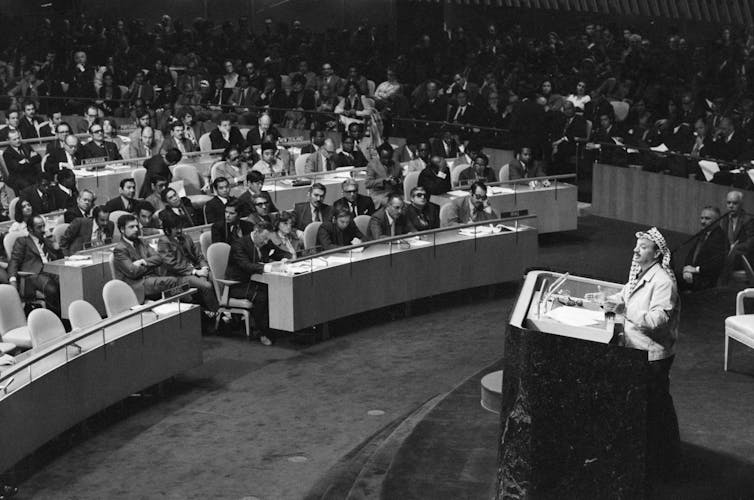
‘I have come bearing an olive branch and a freedom fighter’s gun,’ PLO leader Yasser Arafat said before the United Nations General Assembly in 1974.
Bettmann / Contributor

The non-state reality

The fight for Palestinian statehood can be traced back to at least 1967. Over the course of a six-day war against a coalition of Arab states, Israel conquered and expanded its military control over the remainder of what was historic Palestine – a stretch of land that extends from the Jordan River in the east to the Mediterranean Sea in the west.

At the war’s conclusion, Israel had taken control of the West Bank, East Jerusalem and the Gaza Strip.

Unlike after the 1948 war that led to its independence, Israel opted not to extend Israeli citizenship to Palestinians living in the newly conquered areas. Instead, the Israeli government began to rule over Palestinians in these occupied territories through a series of military orders.

These orders controlled nearly every aspect of Palestinian life – and many remain in effect today. For example, if a Palestinian farmer wants to harvest his olive trees near a Jewish settlement in the West Bank, they need a permit. Or
if a Gazan worker wants to work inside Israel, they need Israeli permission. Even praying in a mosque or church in East Jerusalem is dependent on obtaining a permit.

This permit system served as a constant reminder to Palestinians living in the occupied territories that they lacked control over their own daily lives. Meanwhile, Israeli authorities tried to squash the idea of Palestinian nationhood through policies such as outlawing public displays of the Palestinian flag. That, and other expressions of Palestinian national identity in the occupied territories, could result in up to 10 years in prison.

Such policies fit a belief, expressed in 1969 by then Israeli Prime Minister Golda Meir, that there was “no such thing in this area as Palestinians.”

The rise of Palestinian nationalism

Around the same time that Meir made that comment, Palestinians started organizing around the idea of statehood.

Although the idea had been floated before, statehood was codified into official doctrine in a resolution in February 1969 in Egypt. It occurred during a session of the Palestine National Council, the legislative body of the Palestine Liberation Organization, which formed in 1964 as the official representative of Palestinians in the occupied territories.

That resolution called for a free, secular democratic state in Palestine – including all of the State of Israel – in which Muslims, Christians and Jews would all have equal rights.

From that moment on, the Palestinian struggle against Israeli occupation took twin paths: diplomatic pressure and armed resistance.

But events on the ground undermined the idea of a single state for all along the lines envisioned by the Cairo resolution.

The 1973 Arab-Israeli War’s inconclusive ending opened the door to greater diplomacy between Israel and the Arab states. Egypt and Israel decided that diplomacy would help them achieve their aims, culminating in the Egyptian-Israeli peace treaty of 1979. But the treaty also left the Palestinians without unified Arab support.

Meanwhile, throughout the 1970s, the Israeli occupation deepened and entrenched with the building of Israeli settlements, especially in the West Bank.

A man throws out his arms to make a point while he stands at a lectern.
Yasser Arafat addresses the United Nations General Assembly in 1974.
Bettmann / Contributor

The PLO responded in 1974 by issuing what became known as the 10-Point Plan, where they pivoted to seeking the establishment of a national authority in any part of historic Palestine that could be liberated.

It was, in effect, a way of threading the needle: It signaled to moderates that the PLO was adopting a more gradualist position, while also telling the group’s rejectionist front – which opposed peace negotiations with Israel – that they were not giving up completely on the idea of liberating all of Palestine.

Then in 1988 – a year into the first Palestinian intifada, or uprising – the PLO unilaterally declared Palestinian independence on the territories occupied in 1967.

The move was largely symbolic – the West Bank, Gaza and East Jerusalem were still under occupation, and the PLO was then in exile in Tunisia.

But it was nonetheless significant. It represented the bringing together of Palestinians in exile – most of whom were from towns and villages that were now part of the State of Israel – with Palestinians in the occupied territories.

The declaration itself was written by Palestinian poet Mahmoud Darwish, who grew up inside Israel, and declared by Yasser Arafat, the PLO leader in exile.

It was also a moment of tremendous hope and possibility for Palestinians. What most Palestinians wanted was for the international community to recognize them as a national body, deserving of a seat at the table with other nation-states.

Compromise and rejection

Yet at the same time, many Palestinians saw the declaration as a huge compromise. The West Bank, Gaza Strip and East Jerusalem comprise about 22% of historic Palestine. So the declaration effectively meant that Palestinians were giving up on the other 78% of what they saw as their land.

Reaction from the international community to the PLO’s declaration was split. Many formerly colonized countries of the Global South recognized Palestinian independence right away. By the end of the year, some 78 countries had issued statements recognizing Palestine as a state.

Israel rejected it outright, as did United States and most Western nations.

Such was Washington’s opposition that the U.S. denied Arafat a visa ahead of his planned address to the United Nations at its New York City headquarters. As a result, the December 1988 meeting had to be moved to Geneva.

While refusing to accept Palestinian statehood, the U.S. and Israel did begin to recognize the PLO as a representative body of the Palestinian people. This was part of the Oslo Accords – a diplomatic process that many believed would outline a road map for an eventual two-state solution.

While some Palestinians saw the Oslo Accords as a diplomatic breakthrough, others were more skeptical. Prominent Palestinians, including Darwish and Palestinian-American professor Edward Said, believed that Oslo was a poison pill: While framed as a step toward a two-state solution, the agreement said nothing about a Palestinian state in the interim. It only said that Israel would recognize the PLO as a representative of the Palestinian people.

In reality, the Oslo Accords have not lead to statehood. Rather, they created a system of fragmented autonomy under the newly created Palestinian Authority that, though meant to be interim, has in effect become permanent.

The Palestinian Authority was allowed only limited powers and deprived of real independence. While it had some say over schooling, health care and municipal services, Israel maintained control of Palestinian land, resources, borders and the economy. That remains true today.

Renewed push for statehood recognition

Disillusionment over the Oslo Accords contributed to the second, far more violent, intifada from 2000 to 2005.

Mahmoud Abbas, the leader of the Palestinian Authority after Arafat, responded by pushing again for international recognition for statehood.

And in 2012, the U.N. General Assembly voted to upgrade Palestine’s status, elevating it from a “nonmember observer” to a “nonmember observer state.”

Two men shake hands.
The Palestinian delegation at the U.N. General Assembly before the vote to upgrade Palestinian status to a nonmember observer state in 2012.
Stan Honda/AFP via Getty Images

In theory, this meant Palestinians now had access to international bodies, like the International Criminal Court and the International Court of Justice.

But any meaningful change in the status of Palestinian sovereignty would need to come through the U.N. Security Council, not the U.N. General Assembly.

The U.S. remains opposed to Palestinians gaining statehood independent of the Oslo process. So long as the U.S. has a veto on the Security Council, achieving a truly sovereign Palestinian state will likewise be off the table. And that remains the case, regardless of what individual members – even fellow Security Council members like France and the U.K – do.

In fact, many Palestinians and other critics of the status quo say Western nations are using the issue of Palestinian statehood to absolve them from the far more challenging diplomatic task of holding Israel accountable for what a U.N. body just described as a genocide in Gaza.

This article is based on a conversation between Maha Nassar and Gemma Ware for The Conversation Weekly podcast.

The Conversation

Maha Nassar does not work for, consult, own shares in or receive funding from any company or organization that would benefit from this article, and has disclosed no relevant affiliations beyond their academic appointment.

ref. Palestinian statehood is winning major new supporters at UN – but symbolic action won’t make it happen – https://theconversation.com/palestinian-statehood-is-winning-major-new-supporters-at-un-but-symbolic-action-wont-make-it-happen-265534

Dos nuevos cometas ya son protagonistas del cielo vespertino

Source: The Conversation – (in Spanish) – By Josep M. Trigo Rodríguez, Investigador Principal del Grupo de Meteoritos, Cuerpos Menores y Ciencias Planetarias, Instituto de Ciencias del Espacio (ICE – CSIC)

El cometa 2025 A6 Lemmon, captado el 14 de septiembre de 2025 desde Alalpardo (Madrid). Alfonso José Merino

Los aficionados a la astronomía tendrán las próximas semanas la oportunidad de disfrutar de dos cometas de largo periodo descubiertos este mismo año: C/2025 A6 (Lemmon) y el recientemente catalogado C/2025 R2 (SWAN). Ambos objetos poseen órbitas muy excéntricas que los llevan a regiones externas de nuestro sistema planetario, con periodos orbitales de más de mil años.

Para verlos –o aún mejor, fotografiarlos– podremos guiarnos empleando unas cartas estelares. En otras palabras, necesitamos un cielo oscuro y saber dónde buscarlos. A continuación doy algunas directrices para conseguir observarlos.

El aumento de brillo del cometa Lemmon

Este cometa descubierto a principios de enero por el astrónomo estadounidense Carson Fuls en el marco del programa de seguimiento de cuerpos menores del Observatorio Mount Lemmon posee una órbita muy excéntrica. Los cálculos orbitales de Syuichi Nakano, del Central Bureau for Astronomical Telegrams, indican que, en el extremo más lejano de su órbita (llamado “afelio”), el cometa estaba a 36 000 millones de kilómetros del Sol. Eso corresponde a un período orbital de unos 1 350 años, por lo que debió ser visible en el siglo VII de nuestra era.

En cualquier caso, este pequeño cometa tuvo el pasado 16 de abril un encuentro relativamente próximo a Júpiter (a unos 349 millones de km). Como consecuencia del mismo, sufrió un tirón gravitacional del planeta gigante que ha reducido parte de su energía orbital, viendo acortado su período en unos doscientos años. Un excelente ejemplo de que aún los cometas con órbitas de alta inclinación pueden ser significativamente afectados por los encuentros con los planetas gigantes.

El C/2025 A6 Lemmon pasará a 101 millones de km de la Tierra el 21 de octubre. Posteriormente alcanzará el punto más cercano al Sol de su órbita (conocido como perihelio) el 8 de noviembre, encontrándose a 79 millones de km del astro rey. Se espera que sobreviva a esa fase de mayor calentamiento por la radiación solar y retorne al espacio profundo, como parece haber hecho en anteriores ocasiones.

En las últimas semanas, este cometa ha seguido incrementando a buen ritmo su brillo, tal y como revelan los datos enviados a la Base de Datos de Observaciones de Cometas (COBS), que recopila las observaciones de estos objetos. Si mantiene las expectativas, su brillante coma, la envoltura de gas y polvo que se entiende desde el núcleo, llegará a ser visible a simple vista con relativa facilidad desde zonas rurales a finales de octubre.

Se espera que llegue a magnitud +3 la última semana, es decir, similar a las estrellas más débiles que forman la conocida Osa Mayor. Incluso podría ser algo más brillante, conforme evolucione y se acerque a la Tierra.

En la coma ya desarrollada del cometa 2025 A6 Lemmon ya puede apreciarse el comienzo de la cola. Captado el 14 de septiembre de 2025 desde Alalpardo, Madrid.
Alfonso J. Merino

El cometa irá incrementando su brillo progresivamente, mientras recorre el firmamento cruzando las constelaciones de Leo Menor, la Osa Mayor, los Perros de Caza y Boyero. En la actualidad, C/2025 A6 Lemmon se encuentra prácticamente en el límite de observación a simple vista, pero va ganando brillo cada noche. Recomiendo las cartas celestes de Gideon van Buitenen para localizarlo puntualmente.

Precisamente la semana que se muestre más brillante y asequible estará ya en la constelación de Boyero, relativamente cerca de la luminosa estrella Arturo. En todo caso, su observación dependerá de buscar un lugar sin contaminación lumínica con el horizonte oeste despejado, dado que se hallará a finales de octubre a baja altura sobre el horizonte, tras la puesta del Sol.

El súbito descubrimiento del cometa SWAN

Hace poco más de una semana, otro cometa fue descubierto saliendo de su conjunción con el Sol, tal como llamamos a la mayor proximidad angular al astro rey. Lo halló el instrumento Solar Wind Anisotropies (SWAN) de la sonda SOHO, capaz de monitorizar el campo angular cercano a nuestra estrella.

El cometa C/2025 R2 SWAN fue captado el pasado 16 de septiembre de 2025, con su cola iónica deslabazada, desde Farm Tivoli, Namibia.
Gerald Rhemann y Michael Jäger

El nuevo cometa estará bien situado las próximas semanas para observarlo con prismáticos o pequeños telescopios. Deberemos buscar un entorno rural, con el oeste libre de contaminación lumínica, puesto que no es visible a simple vista. Con telescopios se aprecia su coma y una parte de su larga y fina cola iónica.

Haciendo uso de las citadas cartas celestes de van Buitenen podremos localizarlo entre las estrellas. Si no disponemos de un telescopio computerizado, procuremos tener una estrella brillante cercana de referencia inicial para poder “saltar” en el campo de nuestro telescopio hasta llegar a la posición esperada del cometa. Empleemos un ocular que proporcione bajos aumentos y mayor campo angular para distinguir bien el difuso cometa entre las estrellas de fondo.

Localización del cometa C/2025 R2 SWAN entre el 16 de septiembre y el 2 de octubre.
Eddie Irizarry/ Stellarium.

Ahora sólo cabe esperar que estos cometas se comporten como deben y nos maravillen incluso más de lo esperable. Al fin y al cabo, como dijo el célebre descubridor de cometas David H. Levy en su libro Comets: Creators and Destroyers (Cometas: Creadores y Destructores): “Los cometas son como los gatos: tienen colas y hacen exactamente lo que quieren”

The Conversation

Josep M. Trigo Rodríguez recibe fondos del proyecto del Plan Nacional de Astronomía y Astrofísica PID2021-128062NB-I00 financiado por el MICINN y la Agencia Estatal de Investigación.

ref. Dos nuevos cometas ya son protagonistas del cielo vespertino – https://theconversation.com/dos-nuevos-cometas-ya-son-protagonistas-del-cielo-vespertino-265528

Hepatitis B shot for newborns has nearly eliminated childhood infections with this virus in the US

Source: The Conversation – USA (3) – By David Higgins, Assistant Professor of Pediatrics, University of Colorado Anschutz Medical Campus

About 80% of parents currently choose to follow CDC guidelines to vaccinate their babies for hepatitis B at birth. timnewman/iStock via Getty Images Plus
Graphic saying '95% Drop in U.S. childhood hepatitis B infections since 1991, when routine infant vaccination began'

The Conversation, CC BY-ND

Before the United States began vaccinating all infants at birth with the hepatitis B vaccine in 1991, around 18,000 children every year contracted the virus before their 10th birthday – about half of them at birth. About 90% of that subset developed a chronic infection.

In the U.S., 1 in 4 children chronically infected with hepatitis B will die prematurely from cirrhosis or liver cancer.

Today, fewer than 1,000 U.S. children or adolescents contract the virus every year – a 95% drop. Fewer than 20 babies are reported infected at birth.

I am a pediatrician and preventive medicine specialist who studies vaccine delivery and policy. Vaccinating babies for hepatitis B at birth remains one of the clearest, most evidence-based ways to keep American children free of this lifelong, deadly infection.

On Sept. 18, 2025, the Advisory Committee on Immunization Practices, an independent panel of experts that advises the Centers for Disease Control and Prevention, debated changing the recommendation. According to the proposed language of the vote, infants whose mothers test positive for hepatitis B would still receive the vaccine at birth. Infants whose mothers do not test positive for hepatitis B would get the vaccine at 1 month of age, though parents would have the choice for them to receive it earlier. On Sept. 19, however, the committee tabled the vote, delaying it to the next committee meeting, scheduled for Oct. 22-23.

Although such a proposed change sounds small, it is not based on any new evidence. It would undo more than three decades of a prevention strategy that has nearly eliminated early childhood hepatitis B in the U.S.

While the committee regularly reviews vaccine guidance, nothing is business as usual about this meeting. In June 2025, Secretary of Health and Human Services Robert F. Kennedy Jr. disbanded the entire committee and handpicked new members. The committee has long-standing procedures to evaluate the evidence supporting the risks and benefits of a given vaccine, as well as other parameters of its use. But in this case, these procedures are not being followed.

Why the CDC adopted universal hepatitis B shots

Hepatitis B is a virus that infects liver cells, causing inflammation and damage. In adults, it is spread through blood and bodily fluids, which can happen through unprotected sex, contaminated needles or contact with open cuts or sores of someone who is carrying it.

The hepatitis B vaccine has been available since the early 1980s. Before 1991, public health guidance recommended giving newborns and young children the hepatitis B vaccine only if they were at high risk of being infected – for example, if they were born to a mother infected with hepatitis B or living in a household with someone known to have hepatitis B.

That targeted plan failed. Tens of thousands of children were still infected each year.

Newborn lying on exam table touching doctor's stethoscope
Children are most likely to get infected by hepatitis B at birth, when contact with their mother’s blood can transmit the virus.
Ekkasit Jokthong/iStock via Getty Images Plus

Some newborns were exposed when their mothers weren’t properly screened or if their mothers got infected late in pregnancy. Children also became infected through household contacts or in child care settings by exposures as ordinary as shared toothbrushes or a bite that breaks the skin. Because hepatitis B can survive for a week on household surfaces, and many carriers are unaware they are infected, even babies and toddlers of uninfected mothers remained at risk.

Recognizing these gaps, in 1991 the CDC recommended hepatitis B vaccination for every child starting at birth, regardless of maternal risk.

Vaccinating at birth

The greatest danger for infants contracting hepatitis B is at birth, when contact with a mother’s blood can transmit the virus. Without preventive treatment or vaccination, 70% to 90% of infants born to infected mothers will become infected themselves, and 90% of those infections will become chronic. The infection in these children silently damages their liver, potentially leading to liver cancer and death.

About 80% of parents choose to follow the CDC’s guidance and vaccinate their babies at birth. If the CDC’s recommendations change to delaying the first dose to 1 month old, it would leave babies unprotected during this most vulnerable window, when infection is most likely to lead to chronic infection and silently damage the liver.

The hepatitis B vaccines used in the U.S. have an outstanding safety record. The only confirmed risk is an allergic reaction called anaphylaxis that occurs in roughly 1 in 600,000 doses, and no child has died from such a reaction. Extensive studies show no link to other serious conditions.

The current recommendations are designed to protect every child, including those who slip through gaps in maternal screening or encounter the virus in everyday life. A reversion to the ineffective risk-based approach threatens to erode this critical safety net.

The Conversation

David Higgins is a member of the American Academy of Pediatrics and volunteer board member for Immunize Colorado.

ref. Hepatitis B shot for newborns has nearly eliminated childhood infections with this virus in the US – https://theconversation.com/hepatitis-b-shot-for-newborns-has-nearly-eliminated-childhood-infections-with-this-virus-in-the-us-265560

Why your basmati rice might not be what you think it is

Source: The Conversation – UK – By Katherine Steele, Senior Lecturer in Sustainable Crop Production, Bangor University

Many Britons enjoy a curry served with a heap of fluffy white basmati rice, its delicate aroma balancing the heat of the dish. But few stop to think about the grain’s long journey. From the paddy fields of India and Pakistan, through regional markets and rice mills, then matured for a year in silos before being shipped in bulk to the UK.

It then passes through one of the country’s 16 processing sites before reaching supermarket shelves. The UK imports around 250,000 tonnes of basmati rice every year – making it one of the world’s biggest markets.

This summer, consumers got a glimpse of what could potentially happen when that supply chain goes wrong. Four people were arrested in late July after investigators found different types of rice in bags being passed off as a well-known basmati brand.

The National Food Crime Unit uncovered the alleged fraud when tests showed the wrong type of rice inside premium-brand packets. The operation began in Leicester, where police arrested a man suspected of repackaging ordinary rice into counterfeit basmati bags. Three more arrests followed in London. The Food Standards Agency (FSA) says the investigation is ongoing and no charges have been brought.

Basmati is a prestigious grain, prized for its nutty flavour and popcorn-like aroma. Alongside jasmine from Thailand and Italy’s arborio, it sits at the top of the speciality rice market. When shoppers buy a packet of basmati, they expect quality. If it falls short, they may feel cheated and think twice about buying that brand again.

To prevent this, the UK operates strict rules under the basmati code of practice. The code sets out which varieties can legally be called basmati, how they may be blended and what level of non-basmati grain is tolerated.

There must not be more than 7% of another rice variety in a packet. It’s a figure reduced from 20% two decades ago, but which cannot be lowered further because of the realities of handling multiple varieties in large mills.

This code was agreed by the Rice Association and the British Retail Association, and it applies across Europe. When exporters in India and Pakistan develop new basmati varieties, samples are sent to the Rice Association in London for approval.

An important tool in enforcing these rules is DNA testing. Every grain carries a genetic fingerprint that can confirm whether it belongs to one of the approved basmati varieties.

Public analyst laboratories regularly test shipments entering the UK and EU. The FSA also runs an annual survey of basmati products bought at random from retailers.

The current DNA test for basmati authentication was developed through collaboration between my colleagues and me at Bangor University, the FSA and public analysts.

Katherine Steele wearing a white lab coat in a laboratory with scientific instruments.
Katherine Steele in the laboratory.
Bangor University, CC BY

We profiled hundreds of rice varieties and continue to refine the markers used to identify basmati. Before the method was approved, our team ran blind tests of results from known spiked mixtures of grains across different laboratories to ensure reliable results.

An age-old problem with modern costs

Food fraud is nothing new. For centuries, unscrupulous traders have substituted cheaper goods or mislabelled products.

While swapping rice is less harmful than adulterating food with toxic substances, it still matters. Consumers resent being duped, brands suffer reputational damage and companies that play by the rules lose out. The stakes are high because the UK rice industry is worth close to £1 billion a year.

There are points of vulnerability every time the grains get passed from one trader to the next. It is not known whether it mainly takes place overseas. Economic pressures may be making the problem worse. As the UK experiences sluggish economic growth, opportunities for food crime may be increasing.

Counterfeiting is easier to identify using DNA testing than when known mixtures of varieties are introduced further up the food chain. It is probable that some of the less well-known brands of rice sold in the UK may contain varieties that are not listed in the basmati code of practice. These could easily slip through the DNA test because complex mixtures can be made to contain all the right molecular signatures.

Even so, food sold in the UK is among the most closely regulated in the world because of the work done by the FSA. Their National Food Crime unit leads the fight against food crime as exemplified by the recent case of the counterfeit basmati, but consumers must be vigilant because there are still fraudsters about. This can include being wary of poorly printed packaging labels, misspellings, broken seals and unusual pricing. Because if the price seems too good to be true, it probably is.

The Conversation

Katherine Steele receives funding from UKRI, DEFRA and Food Standards Agency.

ref. Why your basmati rice might not be what you think it is – https://theconversation.com/why-your-basmati-rice-might-not-be-what-you-think-it-is-264146

Retraites par répartition ou capitalisation : quels sont les risques ?

Source: The Conversation – France (in French) – By Anne Lavigne, Professeure de Sciences économiques, Université d’Orléans

Même si les débats sur la retraite ont été mis sur pause, ils reviendront sur le devant de la scène. Souvent, la retraite par répartition est présentée comme plus sûre que la retraite par capitalisation soumise aux aléas des marchés financiers. Qu’en est-il vraiment ? Existe-t-il vraiment un système plus sûr que l’autre ? ou chaque système a-t-il des risques propres ?


La retraite par capitalisation est un des serpents de mer des réformes des retraites. Dans ce domaine inflammable et hautement passionnel, les tenants et les opposants d’un système ou de l’autre avancent les avantages de leur système de prédilection et les dangers posés par la solution rivale.

Lors des dernières discussions, que le premier ministre d’alors avait nommées « conclave », la question d’une dose de capitalisation a été évoquée. Cette proposition a été rapidement remise sous la table, en même temps que le conclave entre les partenaires sociaux s’achevait sur un constat d’échec. Les pistes suggérées par son successeur Sébastien Lecornu sur la question des retraites n’incluent pas l’introduction d’une dose de capitalisation, tant la mesure compte de farouches opposants. Après avoir étudié la rentabilité des deux systèmes, nous proposons d’étudier les risques inhérents à la répartition et à la capitalisation.


À lire aussi :
Retraites par capitalisation ou par répartition : quel système est le plus rentable ?


Le rapport entre cotisants et cotisés

Toutes choses égales par ailleurs (notamment si la productivité du travail est inchangée), l’augmentation du nombre de retraités par rapport au nombre de cotisants dégrade la situation financière d’un système en répartition. Cette augmentation peut avoir plusieurs origines :

  • l’allongement de l’espérance de vie qui est un choc démographique durable qui accroît le nombre de retraités (on parle de vieillissement « par le haut » de la population) ;

  • symétriquement, la baisse du taux de fécondité réduit le nombre des cotisants après quelques décennies (on parle de « vieillissement par le bas » de la population).

Gare au baby-boom !

D’autres chocs sont transitoires, par exemple le baby-boom d’après-guerre qui a entraîné une très forte augmentation des naissances pendant un temps limité, entre 1945 et 1970.

Les chocs durables peuvent être absorbés par des « modifications paramétriques » du système (modification du taux de cotisation, du taux de remplacement ou de l’âge de départ à la retraite) alors que les chocs transitoires, comme un baby-boom, peuvent être absorbés par une accumulation de réserves dans le système par répartition lorsque les boomers sont actifs, réserves qui seront utilisées lorsque les boomers arrivent à la retraite.

Dangereuse inflation

Du côté des risques économiques, le ralentissement des progrès de productivité du travail (et, a fortiori, la baisse de cette productivité) réduit le rendement de la répartition : un choc de productivité a un impact analogue à un choc démographique. L’inflation est un autre risque si les paramètres du système ne s’ajustent que partiellement, ou avec retard, sur l’évolution des prix. L’indexation concerne les pensions versées aux retraités, sujet qui fait actuellement débat en France.

Mais il concerne également l’indexation des salaires portés au compte des cotisants, ce qui est moins connu. Au régime général en effet, la pension est calculée sur la base du salaire moyen perçu au cours des 25 meilleures années de carrière. Or un salaire de 1 800 euros perçu en 2000 n’est pas équivalent à un salaire de 1 800 euros perçu en 2025, car l’inflation depuis 2000 a érodé le pouvoir d’achat des 1 800 euros gagnés en 2000. Il faut donc indexer les salaires perçus chaque année, et le choix a été fait d’une indexation sur les prix, pour rendre comparables, en termes de pouvoir d’achat, les différents salaires de carrière.

Sous-indexation rendue nécessaire

Si le gouvernement suit le dernier avis du Comité de suivi des retraites préconisant une sous-indexation partielle et temporaire des pensions des retraités à l’horizon de 2030, il exposera les retraités au risque d’inflation.

Enfin, parce que la répartition instaure une solidarité entre les générations sur la base d’une réciprocité indirecte entre des générations passées, présentes et futures, elle est exposée à un risque politique. Le principe sous-jacent à la répartition est le suivant pour un individu : « J’accepte de cotiser pour les générations qui m’ont précédé (les retraités actuels) parce que je sais, ou j’anticipe, que les générations futures feront de même pour moi. »

La confiance en la répartition est étroitement liée à la confiance que l’on accorde à l’État. Celle-ci repose, en dernier lieu, sur la capacité de ce dernier à mutualiser des risques de toutes natures : démographiques (taille et durée de vie des générations…), économiques (emploi, salaires, taux d’intérêt…) et politiques (guerres…).

Capitalisation : qui assume le risque à la fin des fins ?

La capitalisation est exposée aux fluctuations des marchés financiers, et notamment aux risques de baisse brutale des cours des actions. On pourrait objecter que les krachs boursiers sont des événements rares. Mais, encore une fois, pour un individu donné, si ce risque rare se réalise, c’est sa survie à la retraite qui est en jeu s’il finance sa couverture vieillesse par de l’épargne retraite placée en actions.

Pour autant, même l’existence de risques financiers (c’est-à-dire le risque de perdre une partie des sommes qu’on place en épargne retraite) ne suffit pas à disqualifier la capitalisation. En effet, des techniques financières existent pour se couvrir contre ces risques financiers. C’est notamment le cas des fonds de pension à prestations définies qui s’engagent à verser des prestations de retraite d’un montant prédéterminé, par exemple un pourcentage du dernier salaire d’activité, ou de la moyenne des salaires perçus pendant la vie active, quel que soit le rendement financier des sommes placées en bourse.

Bien évidemment, pour pouvoir garantir un taux de remplacement quelles que soient les fluctuations en bourse, il faut que quelqu’un assume le risque financier, c’est-à-dire recapitalise le fonds de pension en cas de pertes sur les marchés. Et ce quelqu’un, c’est l’employeur qui a créé le fonds de pension pour ses salariés.

Les facteurs démographiques

On lit parfois que la capitalisation, à la différence de la répartition, est protégée contre les risques démographiques. C’est inexact, sauf dans un cas très particulier où les machines seraient parfaitement substituables aux humains.

Imaginons, par exemple, une réduction durable de la fécondité, qui entraînerait moins de naissances, puis une vingtaine d’années plus tard, moins d’actifs. Dans ce cas, comme les travailleurs deviennent plus rares, les salaires augmentent. Et comme le stock de capital devient relativement plus abondant par rapport au nombre de travailleurs employés, son rendement baisse et la capitalisation devient moins rentable.

Idem pour l’augmentation de l’espérance de vie : qu’on soit en répartition ou en capitalisation, un allongement de l’espérance de vie implique qu’on prélève plus sur la richesse produite chaque année pour financer la retraite des retraités (sous la forme de cotisation ou d’épargne supplémentaire) pour un niveau de vie des retraités inchangé, ou qu’on réduise les retraites à effort de financement inchangé.

Capitalisation et épargne nette

Parmi les arguments avancés pour promouvoir l’essor des fonds de pension en France figurent la mobilisation nécessaire d’une épargne longue, d’une part, et la reconquête souhaitée du capital des entreprises françaises par des investisseurs institutionnels nationaux, d’autre part. S’il est vrai que, dans un système fonctionnant en répartition pure, les cotisations ne constituent pas une épargne, car elles sont redistribuées sous forme de pensions aux retraités contemporains, la capitalisation collective n’induit pas une épargne nette structurelle.

France Culture, 2025.

En effet, les cotisants d’un régime fonctionnant en capitalisation pure achètent des titres financiers, mais les retraités vendent les titres accumulés pendant leur vie active. La capitalisation n’engendre une épargne nette positive que si l’épargne des actifs est supérieure à la désépargne des retraités. L’épargne nette susceptible d’être dégagée par un développement des fonds de pension dépend du poids relatif des cotisants par rapport aux retraités, ainsi que des supports d’épargne alternatifs.

Du patriotisme économique

Reste l’argument du patriotisme économique. Alors que les investisseurs étrangers ne contrôlent qu’environ 17 % du capital des entreprises américaines en 2023, les non-résidents détiennent 40,3 % de la capitalisation boursière des sociétés françaises du CAC 40 fin 2022. Pour les tentants du système par capitalisation, celui-ci est un moyen de drainer l’épargne des ménages vers les entreprises françaises.

Mais rien n’est moins sûr. Au bout du compte, l’instauration de fonds de pension ne suffira pas à inciter les Français à investir dans des actions d’entreprises françaises : tout dépend du choix de l’allocation stratégique des affiliés représentés dans les conseils d’administration des fonds, entre actions et obligations, françaises ou étrangères, et donc, in fine, de leur attitude vis-à-vis du risque.

The Conversation

Anne Lavigne est membre du Conseil d’administration de l’Etablissement de retraite additionnelle de la fonction publique, en qualité de personnalité qualifiée. Cette fonction est assurée à titre bénévole.

ref. Retraites par répartition ou capitalisation : quels sont les risques ? – https://theconversation.com/retraites-par-repartition-ou-capitalisation-quels-sont-les-risques-263455

How I tracked the biggest hidden sources of forever chemical pollution in UK rivers – new study

Source: The Conversation – UK – By Patrick Byrne, Professor of Water Science, Liverpool John Moores University

Patrick Byrne samples the water in the Mersey catchment. Patrick Byrne, CC BY-NC-ND

The amount of toxic “forever chemicals” flowing into the River Mersey in north-west England has reached some of the highest levels recorded anywhere in the world.

My team’s research links much of this contamination to old landfills, waste facilities and past industrial activity. Even if these chemicals were banned tomorrow, they would continue polluting our rivers for decades, possibly centuries.

But there is a path forward. We’ve developed a new method
to track and prioritise the largest sources for clean-up, giving regulators a clearer picture of where to act first.

Per- and polyfluoroalkyl substances (PFAS), more commonly known as “forever chemicals”, are a large family of human-made chemicals found in everyday products like food packaging, water-repellent clothes and fire-fighting foams. They are valued for their ability to resist very high temperatures and to repel water and oil, but these same properties make them extremely persistent.

Once released, some PFAS could take thousands of years to break down. They accumulate in the environment, build up – with different compounds accumulating at different rates – inside the bodies of wildlife and people, and have been associated with harms to health. The most studied types have been linked to cancers, hormone disruption and immune system problems.

Patrick Byrne has been measuring PFAS ‘loads’ in rivers over a period of time, not just the concentration at one moment.
CC BY-NC-ND

Last year, my research team discovered that the amount of two potentially cancer-causing PFAS chemicals washing off the land and into the Mersey was among the highest in the world. In our follow-on research, we travelled upstream to try and locate where these PFAS are coming from. But with hundreds of potential PFAS sources, how do we isolate the largest ones?

The secret is measuring something called the PFAS load – the total amount of PFAS flowing through the river at a given point, rather than just the concentration in the water.

Here’s why that matters: a small stream can have high concentrations but carry only a small total amount, while a large river with lower concentrations can be transporting far more PFAS overall. If we only look at concentration, we risk missing the really heavy polluters.

By measuring PFAS loads at multiple points along the Mersey system, we could see exactly where the largest increases occurred. That told us both the location and the scale of PFAS inputs.

We detected PFAS chemicals at 97% of our sample sites, even in supposedly pristine streams draining from the Peak District national park. But the big breakthroughs came when we matched the largest PFAS load increases to specific areas.

PFBS (a type of PFAS) was coming in huge amounts from land draining old landfills in the Glaze Brook watershed near Leigh, west of Manchester. PFOA, a globally banned and cancer-causing PFAS, appeared to originate from a waste management facility on the River Roch, north of Manchester. PFOS, another banned PFAS, was entering the River Bollin, with strong evidence pointing to historic firefighting foam use at Manchester Airport.

What’s most striking to me is that all these sources are rooted in the past – old landfills, waste sites or historic industrial use. These chemicals are no longer in production, but they are still escaping into the environment, decades later.

alt text
This unmanned survey vessel is packed with sensors that measure PFAS loads in large rivers.
credit, CC BY-NC-ND

This is where PFAS load measurements make a real difference. Instead of chasing the highest concentrations – which might lead to cleaning up small streams that contribute little overall – we can target the sites releasing the largest total amounts of PFAS into our rivers.

It’s a simple idea with major implications. In a world where environmental regulators face tight budgets and limited monitoring capacity, knowing exactly which sites are the biggest sources is vital.

The Mersey is just one example. Around the world, PFAS contamination follows a similar pattern: numerous potential sources scattered across the landscape, many of them historical. The chemicals’ extreme persistence means they will continue cycling through rivers, soils and wildlife for generations unless active steps are taken to remove or contain them.

Our latest study shows that measuring PFAS load can help solve one of the toughest challenges in managing chemical pollution: working out where to start. By identifying and prioritising the biggest sources, regulators have a realistic chance of reducing the flow of forever chemicals into our rivers – and perhaps one day, making that nickname a little less true.

The Conversation

Patrick Byrne receives funding from the Natural Environment Research Council.

ref. How I tracked the biggest hidden sources of forever chemical pollution in UK rivers – new study – https://theconversation.com/how-i-tracked-the-biggest-hidden-sources-of-forever-chemical-pollution-in-uk-rivers-new-study-261967

Trump, Charles and Starmer: a successful state visit steadies an uncertain premiership

Source: The Conversation – UK – By Martin Farr, Senior Lecturer in Contemporary British History, Newcastle University

Donald Trump’s first state visit to the UK, in June 2019, was an attempt by the British government to try to forestall the threat of Trumpism, a set of ideas and style of leadership that were not, in the end, embedded. The unprecedented second state visit of September 2025 has been an attempt to accommodate the second Trump administration – one already much more purposeful and consequential.

In one respect, the two visits are complementary: they feature an imperturbable president entreated by beleaguered prime ministers. Theresa May was humiliated publicly by Trump, and was gone the following month. Starmer has almost nothing in common with Trump except a quite unexpected, and largely inexplicable, personal chemistry.

Briefings on Air Force One, as it headed to the UK, would have been brief – the president is easily bored – and aimed at preparing him for what awaited: thousands of people in uniform choreographed to the inch to impress a mere dozen or so Americans, and one in particular.

There were issues of substance, some of which are very substantial indeed. A civil “nuclear partnership” almost complementing the 70-year-old military nuclear partnership. As they already do in the older partnership, the two sides will now recognise the other’s standards and safety assessments in civil nuclear projects. More was made of the vaunted “tech prosperity deal”.

These agreements are meaningful and had Lord Mandelson at their core, before his sacking. He would be justified in viewing – as he doubtless does – that the state visit was in part a posthumous monument to his ambassadorship.

State visits are a key part of national diplomacy, and particularly when royalty may be deployed. As ever, Trump tests norms to breaking point. In a constitutional monarchy such as Britain’s, the monarch acts on the advice of the government. But Trump is potentially so damaging by association for the government (and Starmer in particular) that the monarch was more central than ever.

Trump and his supporters will not admit publicly that so dominating a political actor makes people bend to their will. Faced with the most imperious president in the history of the imperial presidency, they seek to accommodate, pre-empt, cajole, appease. One exception is a king.

This state visit – and the likely return trip of Charles to the US for the 250th anniversary of US independence next year – is a card the British were suitably shameless in playing. There is a clear rapport between the two; indeed, a rapport that would have been unlikely – given their different personalities – with Elizabeth II. Charles III has proven to be an essential, rather than merely complementary, element of the special relationship.

For once, there’s a precedent for so singular a president. In November 2003 – after a million marched in London in opposition to the US-UK invasion of of Iraq – President George W. Bush scarcely left a barricaded Buckingham Palace.

Where a state visit ordinarily occasions – demands – an open-topped carriage ride along the Mall with the monarch, it is a unique irony that the leader of Britain’s closest ally had to travel by drone-shielded helicopter. No members of the public – who effectively paid for the visit – saw the president.

This time, Windsor suited much more than Buckingham Palace as the venue because, as one might hope from a castle, it is secure and can repel the unwanted.

Wednesday’s procession professing “Trump not welcome” was a relatively modest affair. The Stop Trump Coalition – an umbrella association of over 60 organisations including CND, Extinction Rebellion, Fossil Free London, Keep our NHS Public, and the National Education Union – may need to reconsider its founding imperative.

That the demonstration was significantly smaller than the one that greeted Trump in 2019 – notwithstanding the even more fevered and febrile public square – is testament to a sense of resignation occasioned by this repeat of history.

Opposites attract

Inasmuch as it’s possible with Trump, nothing was left to chance, apart from the press conference, where disagreement was minimal, though unusually clearly stated – a sign of confidence. Starmer and Trump were clearly reading from different hymn sheets on recognising Palestine and net zero. Trump’s suggestion that the UK follow his lead by sending the military out to deal with illegal immigration is more a disagreement of degree.

They were, however, news lines which were catnip to Starmer’s critics on the right, and in the weeks to come will receive repeated airings. As expected, the Mandelson/Jeffrey Epstein affair had receded in the press – if not the public mind. That Trump denied knowing Mandelson, despite their private meeting the week before, said much more about the president than it did the former ambassador.

Without any public presence whatsoever, the ceremonies and parades were for one person only. The risk of looking slightly desperate, however, proved one worth taking. US media coverage was minimal, meaning wider exposure was limited, and the president was clearly impressed.

The visit also demonstrated, more than ever, the value of royal diplomacy: that it can lubricate, augment, constitute a historical-cultural thread that impresses those a UK government may wish to impress. The extent to which that translates into material benefits is harder to test.

The state visit of President Trump to the UK mattered to both, but it mattered much more to one. Contrary to expectations, opposites so far have attracted. The special relationship has survived and even prospered in the face of uncertainty.

Its smooth passing may provide a locus for a natural – rather than yet another staged – reset. May’s fluffing of the 2017 general election was enough in Trump’s eyes, to condemn her, but so far Trump’s affection for Starmer has withstood the growing talk of the defenestration of a prime minister with a 22% approval rating. There remain three years to see how long that persists.

The Conversation

Martin Farr does not work for, consult, own shares in or receive funding from any company or organisation that would benefit from this article, and has disclosed no relevant affiliations beyond their academic appointment.

ref. Trump, Charles and Starmer: a successful state visit steadies an uncertain premiership – https://theconversation.com/trump-charles-and-starmer-a-successful-state-visit-steadies-an-uncertain-premiership-265597

The president as partisan warrior: Trump’s rejection of traditional presidential statesmanship

Source: The Conversation – USA – By Julia R. Azari, Assistant Professor of Political Science, Marquette University

After taking control of the board earlier in the year, President Donald Trump announced on Aug. 13, 2025, the nominees of the annual Kennedy Center Honors. Kevin Dietsch/Getty Images

In a classic work on the modern presidency originally published in 1960, political scientist Richard Neustadt wrote that the American public “expects the man in the White House to do something about everything.”

These expectations, Neustadt argued, far exceeded the president’s ability to actually control outcomes.

More recently, political journalist John Dickerson, author of “The Hardest Job in the World,” noted that presidents typically have people demanding that they pay attention to about 250 problems at one time. But, quoting a productivity expert, Dickerson points out that priorities are like arms: “If you have more than two, you’re either crazy or lying.” The implication: Presidents have to shed 248 of those pressing concerns.

I study the American presidency. The research in the field, including my own, suggests that typically the politics of presidential attention is driven by two considerations.

The first comes down to delegation: As Barack Obama was fond of saying, no easy problem gets to the president’s desk. Presidents typically focus on the problems that no one else – not state or local governments, the bureaucracy or Cabinet secretaries – can deal with.

The other consideration is whether the issue is a winning one. Neustadt emphasizes this in his study of presidential power: Presidents enhance their reputations by winning conflicts, not losing them.

There are also plenty of examples of presidents wading into highly conflicted areas and alienating supporters or suffering policy defeats, including George W. Bush’s unsuccessful attempts to tackle the “third rail” of Social Security reform, and Bill Clinton’s failed efforts to enact health care reform.

As a result, presidents are typically expected to be focused on national security, economic management and other key issues that have to be handled at the national level. They are expected to only sparingly wage battles of will with leaders outside government – in the arts, business or education – and with state-level politicians who lie outside the president’s direct control.

Amid the many other ways he’s departed from American political tradition, President Donald Trump has turned these assumptions upside down. That has important implications for how Americans understand the scope and reach of presidential power.

Like most aspects of American politics, the presidency has become more defined by partisan politics over time. Trump has taken this evolution to a new level, rejecting the traditional role of statesman or a spokesperson for the whole nation.

Instead, he has adopted the role of partisan political warrior – and that means he is using the power of his office in areas and in ways previously considered off-limits to the president.

A man in a suit walking on an outside path next to a white building bathed in orange light.
President Barack Obama often said that no easy problem gets to the president’s desk.
Tim Sloan/AFP-Getty Images

Hosting, decorating and critiquing clothing ads

Recently, President Trump reported that he might host the Kennedy Center Honors in December. He also reportedly had a strong hand in choosing the center’s honorees, a task normally undertaken over months and with public input.

He’s also been heavily involved in the redecoration of the White House, waged war on wind turbines and posted online about the controversy over actress Sydney Sweeney’s ad for American Eagle jeans.

His administration has issued detailed demands of numerous universities, wading directly into curriculum, personnel policies and the frequent target of diversity, equity and inclusion programs. While much of this effort has gone through the Department of Education, the president himself has issued executive orders and posted online about specific universities.

A social media post from President Trump about Brown University ending programs the administration doesn't approve of.
A social media post in July 2025 about Brown University from President Donald Trump.
Truth Social/@realDonaldTrump

Traditionally, presidents have been especially hesitant to dive into areas where education intersected with difficult cultural conflicts. One of the most significant examples is the way that presidents reacted, from the 1950s through the 1970s, to Supreme Court orders mandating school desegregation.

To put it bluntly, presidents did not want to face the political dilemmas associated with enforcing the court’s 1954 Brown v. Board of Education decision.

As I note in my book “Backlash Presidents,” presidents are rarely eager to upend the racial status quo, even when they recognize its injustice.

Dwight Eisenhower, who was president when the Supreme Court issued the Brown decision, felt the decision placed new strain on the federal government to get involved in social relations and local issues. The feeling was bipartisan; Eisenhower’s presidential successor, Democrat John F. Kennedy, didn’t want to take a lead role in enforcing desegregation either.

Both, at different times, did eventually use federal force and power to uphold the law. Eisenhower mobilized the National Guard to protect Black students integrating a Little Rock, Arkansas, high school in 1957, and Kennedy in 1963 took similar action to protect Black students integrating schools in Alabama.

But federalism, which divides powers between national and state government, provided presidents with a strategically useful barrier to any further presidential action, allowing the two presidents to say that they were treading carefully because education was up to the states.

Obviously, this was a different time and context – the Department of Education didn’t exist yet, so there was not a clearly defined federal role in public education. But it represents an example of how presidents have typically looked to use structures such as federalism to leave tough issues to others and avoid political fallout.

It’s personal with Trump

Focusing attention on foreign policy and national security is less likely to stoke opposition. Those are areas where presidents have more latitude and can expand their power even more.

Presidents have traditionally not engaged in direct conflict with individual governors, industry leaders or university presidents if they can help it. They’ve engaged in policy battles, but generally not personal ones.

Trump’s approach has been very different.

With Department of Justice investigations and public criticism, his administration has targeted specific law firms and individuals whom Trump dislikes. The president has issued executive orders about the “forced use” of paper straws.

Is Trump’s attention on the personal a problem for the nation?

Presidents have been challenged for being too focused on minor issues and details, including Jimmy Carter, whose attention to things such as the schedule of the White House tennis courts drew scorn from critics.

Some presidents have been criticized as too quick to delegate to others, as was Ronald Reagan, who was seen as inattentive to important details. George W. Bush likewise was knocked for delegating too much, especially in crucial areas of foreign policy and intelligence.

Diving deeply into partisan politics

But Trump’s shifting of presidential priorities signals a much deeper political change.

First, some of these actions have also been directly related to cultural conflict – the fights with universities over DEI polices, commenting on the Sydney Sweeney ad.

Trump is hardly the first president to elevate a hot-button cultural issue for political gain – George W. Bush famously promoted a constitutional amendment banning same-sex marriage leading into his 2004 reelection campaign.

But presidents have traditionally seen more costs than benefits associated with campus speech issues or race questions that could be handled elsewhere.

A February 2025 article in The Root, whose motto is “Black News and Black Views with a Whole Lotta Attitude,” points to “five ridiculously petty actions” from the administration. All are related to race or LGBTQ symbols or visuals, such as the removal of references to LGBTQ Americans from government websites and the removal of a Spanish-language version of the White House website.

Another related aspect of the logic behind this shift in presidential attention is that the political constraints that limited past administrations, such as fear of alienating voters or stirring controversy, do not seem to concern this one. It suggests that the president and his team are not worried about the opinions of people who might disagree with their cultural stances.

This change also represents a departure from the more traditional statesmanship version of the presidency. The Trump administration and the president who heads it have chosen to dive deeply into, rather than rise above, politics.

The Conversation

Julia R. Azari has received (in the past) funding from the Truman Library Institute, the Kluge Center at the Library of Congress and the William and Flora Hewlett Foundation.

ref. The president as partisan warrior: Trump’s rejection of traditional presidential statesmanship – https://theconversation.com/the-president-as-partisan-warrior-trumps-rejection-of-traditional-presidential-statesmanship-262867