Sleep is not just down time. Your body moves through distinct stages that serve different restorative functions. Deep, slow-wave sleep is the primary stage during which the body prioritizes tissue repair, muscle recovery and collagen production.
Collagen repair and elasticity also depend heavily on adequate rest. In one study, short-term sleep restriction, defined as just three hours of sleep per night for two nights in a row, reduced skin elasticity and made wrinkles more noticeable.
Serums, sunscreens and moisturizers may be good for your skin, but they can’t make up for poor sleep habits.
Your face tells the story
Sleep loss does not only affect how skin functions. It also changes how the face appears to others. Controlled studies show that even after a few nights of reduced sleep, others consistently rated them as less attractive, less healthy and more fatigued. Common cues include paler skin, darker under-eye circles, red or swollen eyes, drooping eyelids and downturned mouth corners.
These signals are subtle but socially significant. Observers are less inclined to interact with or approach someone who looks sleep-deprived. Sleep also affects empathy and aesthetic perception, meaning that people who are well rested not only view others more positively but are also, in turn, viewed more positively by others. This reciprocal effect may help explain why job interviewers, dates, or even friends tend to respond more favorably to a well-rested face.
Prioritizing sleep is a powerful and accessible way to support appearance and overall health. So the next time you consider trading sleep for a few extra hours of work or entertainment, remember that your skin, your health and even your social presence will benefit from those hours of rest.
Joanna Fong-Isariyawongse does not work for, consult, own shares in or receive funding from any company or organization that would benefit from this article, and has disclosed no relevant affiliations beyond their academic appointment.
However, talk of cutting NIH funding is not a new development. Such proposals tend to resurface from time to time, and the ongoing discussion has created uncertainty about the stability of research overall and prompted concern among scientists about the future of their work.
As researchers studying complex health policy systems – and specifically, science funding policy – we see the NIH as one node in an interconnected system that supports the discovery of new knowledge, trains the biomedical workforce and makes possible medical and public health advances across the U.S.
Our research shows that while cutting NIH funding may appear to save money in the short term, it can trigger a chain of effects that increase long-term health care costs and slow the development of new treatments and public health solutions over time.
Seeing the bigger picture of NIH funding
NIH funding does not just support the work of individual researchers and laboratories. It shapes the foundation of American science and health care by training scientists, supporting preventive health research and creating the knowledge that biomedical companies can later build into new products.
To understand how funding cuts may affect scientific progress, the training of new researchers and the availability of new treatments, we took a broad look at existing evidence. We reviewed studies and data that connect NIH funding, or biomedical research more generally, to outcomes such as innovation, workforce development and public health.
In a study published in July 2025, we built a simple framework to show how changes in one part of the system – research grants, for example – can lead to changes in others, like fewer training opportunities or slower development of new therapies.
Eroding the basic research foundation
The NIH funds early-stage research that lacks immediate commercial value but provides the building blocks for future innovations. This includes projects that map disease pathways, develop new laboratory methods or collect large datasets that researchers use for decades.
For example, NIH-supported research in the 1950s identified cholesterol and its role in disease pathways for heart disease, helping to lay the groundwork for the later discovery of statins used by millions of people to lower cholesterol levels. Cancer biology research in the 1960s led to the discovery of cisplatin, a chemotherapy prescribed to 10% to 20% of cancer patients. Basic research in the 1980s on how the kidneys handle sugar helped pave the way for a new class of drugs for Type 2 diabetes, some of which are also used for weight management. Diabetes affects about 38 million Americans, and obesity affects more than 40% of the adults in the U.S.
Cisplatin, a chemotherapy widely used today, was developed through NIH-supported cancer biology research. FatCamera/E+ via Getty Images
Without this kind of public, taxpayer-funded investment, many foundational projects would never begin, because private firms rarely take on work with long timelines or unclear profits. Our study did not estimate dollar amounts, but the evidence we reviewed shows that when public research slows, downstream innovation and economic benefits are also delayed. That can mean fewer new treatments, slower adoption of cost-saving technologies and reduced growth in industries that depend on scientific advances.
Reducing the scientific workforce
By providing grants that support students, postdoctoral researchers and early-career investigators, along with the labs and facilities where they train, the NIH also plays a central role in preparing up-and-coming scientists.
When funding is cut, fewer positions are available and some labs face closure. This can discourage young researchers from entering or staying in the field. The effect extends beyond academic research. Some NIH-trained scientists later move into biotechnology, medical device companies and data science roles. A weaker training system today means fewer skilled professionals across the broader economy tomorrow.
For example, NIH programs have produced not only academic researchers but also engineers and analysts who now work on immune therapies, brain-computer interfaces, diagnostics and AI-driven tools, as well as other technologies in startups and in more established biotech and pharmaceutical companies.
Public and private investment serve different purposes. NIH funding often reduces scientific risk by advancing projects to a stage where companies can invest with greater confidence. Past examples include support for imaging physics that led to MRI and PET scans and early materials science research that enabled modern prosthetics.
Our research highlights the fact that when public investment recedes, companies tend to focus on products with clearer near-term returns. That may tilt innovation toward specialty drugs or technologies with high launch prices and away from improvements that serve broader needs, such as more effective use of existing therapies or widely accessible diagnostics.
Some cancer drugs, for instance, relied heavily on NIH-supported basic science discoveries in cell biology and clinical trial design. Independent studies have documented that without this early publicly supported work, development timelines lengthen and costs increase, which can translate into higher prices for patients and health systems. When public funding shrinks and companies shift toward expensive products instead of lower-cost improvements, overall health spending can rise.
What looks like a budget saving in the near term can therefore have the opposite effect, with government programs such as Medicare and Medicaid ultimately shouldering higher costs.
These projects often improve health long before disease becomes severe, but they rarely attract private investment because their benefits unfold gradually and do not translate into direct profits.
Delaying or canceling prevention research can result in higher costs later, as more people require intensive treatment for conditions that could have been avoided or managed earlier. For example, decades of observation in the Framingham Heart Study shaped treatment guidelines for risk factors such as high blood pressure and heart rhythm disorders. Now this cornerstone of prevention helps to avert heart attacks and strokes, which are far more risky and costly to treat.
A broader shift in direction?
Beyond these specific areas, the larger issue is how the U.S. will choose to support science and medical research going forward. For decades, public investment has enabled researchers to take on difficult questions and conduct decades-long studies. This support has contributed to advances ranging from psychosocial therapies for depression to surgical methods for liver transplants that do not fit neatly into market priorities, unlike drugs or devices.
If government support weakens, medical and health research may become more dependent on commercial markets and philanthropic donors. That can narrow the kinds of problems studied and limit flexibility to respond to urgent needs such as emerging infections or climate-related health risks.
On the other hand, once opportunities are lost and talent is dispersed, rebuilding takes far more time and resources.
The authors do not work for, consult, own shares in or receive funding from any company or organization that would benefit from this article, and have disclosed no relevant affiliations beyond their academic appointment.
Source: The Conversation – USA (3) – By Ryan Burge, Professor of Practice, Danforth Center on Religion and Politics, Washington University in St. Louis
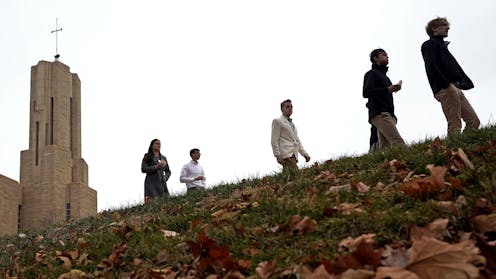
Students leave after attending a Catholic Mass at Benedictine College on Dec. 3, 2023, in Atchison, Kan.AP Photo/Charlie Riedel
For decades, one of the most consistent findings in religion research has been that women tend to be more religious than men. This holds true across dozens of countries and on nearly every measure of religiosity, from how often someone prays to how important faith is in their lives.
Social scientists have struggled to pinpoint a universal cause for this pattern. Theories run the gamut – from the claim that it has something to do with women being more risk averse to the argument that religion offers women support for social responsibilities around birth, death and raising children.
In the past few years, however, survey data in the U.S. has started to tell a different story. Today, there is less empirical evidence that women are more religious than men – a debate I’ve tracked closely as a quantitative scholar of American religion. Looking at Generation Z, in particular, a number of results have raised some eyebrows, pointing toward other divides throughout the country.
Shrinking gap
In 2023, the American Enterprise Institute’s Survey Center on American Life found that 39% of Gen Z women say they do not have a religious affiliation, compared to 34% of men from the same generation. The past several waves of data from the Cooperative Election Study, a national survey, have found that men born after 1990 – a mix of younger millennials and Gen Z – are slightly more likely to attend religious services weekly than women of the same age.
When I give a lecture or presentation, often the first question I’m asked is about this surprising result.
I warn people to take it with a grain of salt. According to data from the 2022 General Social Survey, one of the most well-respected national polls, the opposite is true: among Americans ages 18-45, women are still more likely to attend a house of worship nearly every week. And the Pew Religious Landscape Study, which was released in February 2025, concludes, “While the gender gap in American religion appears to be narrowing, there are still no birth cohorts in which men are significantly more religious than women.”
All together, a growing body of survey evidence suggests that the overall religiosity of young American adults does not vary significantly by gender.
The Cove, a pop-up Christian nightclub in Nashville, Tenn., was started in 2023 by Black Christian men in their 20s. AP Photo/Jessie Wardarski
Anecdotal reports about scores of young men flocking to church or joining religious communities like Eastern Orthodoxy seem to grab headlines. However, the idea of a reversal in the gender gap is not supported by evidence – only that it is narrowing.
Drifting apart
If America’s gender gap around religion is changing, perhaps politics can help explain why.
A growing body of survey data suggests that overall, young men are moving further to the right on political matters, while young women are becoming increasingly progressive.
An NBC News poll in April 2025 found that among people ages 30-44, men were about 9 percentage points more likely to approve of Donald Trump’s job performance than women of the same age. Among those ages 18-29, the gap widened to a staggering 21 points.
A few months later, NBC polled nearly 3,000 young Americans about how they define success, asking them to select the top three factors from a list of 13. Overall, men between 18-29 rated “being married” and “having children” slightly higher than women their age. Among Gen Z men who voted for Trump, having children was the most important. Women who voted for Kamala Harris, meanwhile, ranked children near the bottom.
The largest religious traditions in America today are evangelical Protestant Christianity and the Catholic Church. Both groups’ teachings emphasize “traditional” gender roles, marriage and having children. For a growing wave of young progressive women, such teachings are at odds with their desire to make advances in the workplace and society. Some analysts argue that those tensions, as well as views on LGBTQ+ rights, are driving women away from institutional religion.
Students from Loyola University Maryland participate in a prayer service in remembrance of Pope Francis at St. Ignatius Catholic Church on April 22, 2025, in Baltimore. AP Photo/Stephanie Scarbrough
Opposite directions
As a result, Generation Z may be the most visible manifestation of the growing “God gap” in American politics.
In short, the religious compositions of the two major political parties have gone in opposite directions. In the 1990s, 67% of Republicans said they believed in God without a doubt, and 63% of Democrats said the same, according to my analysis of General Social Survey data. By 2022, certain belief in God had dropped to 39% among Democrats, while holding fairly steady among Republicans, at 63%. Twenty-eight percent of Democrats regularly attend a house of worship, compared to 42% of Republicans; in the 1970s, the gap was only 4 percentage points.
This all points to a broader, potentially more polarized future for the American public. Already, there is evidence that a growing number of people choose their house of worship based on political tribe, not just theological beliefs, making congregations less diverse. Women’s and men’s competing interests and preferences may make it harder to find a suitable partner. Common ground may be harder to find when there are fewer chances for interaction and conversation.
Ultimately, these trends suggest a future where polarization extends beyond politics and into the very fabric of American life – shaping where people worship, who they marry, and how communities form.
Ryan Burge receives funding from the John Templeton Foundation.
Ryan Burge is the Research Director for Faith Counts.
The difficult-to-detect meningeal worm is spread by white-tailed deer and is a notorious killer of moose. AP Photo/Jim Cole, File
A moose in Minnesota stumbles onto the road. She circles, confused and dazed, unable to orient herself or recognize the danger of an oncoming semitruck. What kills her is the impact of 13 tons of steel, but what causes her death is more complicated. Tunneling through her brain is a worm that doomed both of them to die.
Commonly known as the brain worm, Parelaphostrongylus tenuis is a parasitic nematode that infects a large range of wild and domestic herbivores, such as moose and elk. The worm can migrate into the brain of unsuspecting hosts, where it may cause catastrophic disease and death.
While the Minnesotan moose is a hypothetical example, this worm has caused serious neurological impairments in many animals. The symptoms of the disease can vary, from disorientation and circling to paralysis across the animal’s back end, the inability to stand up and potentially death.
As parasitologists, we’ve been studying the effects these worms can have on moose populations in Minnesota. Tracking the spread of parasites and diseases in wild moose populations helps wildlife managers preserve those populations and reduce the spread to other animals or livestock.
White-tailed deer harboring these parasites may shed the worms into their environment when they defecate. Snails and slugs then take up this larva, where it develops inside them to the point where it’s capable of infecting other types of deer, moose, elk and cattle.
The brain worm life cycle. Jesse Richards
For us as parasitologists, the biggest challenge lies in detecting the disease before it irreversibly damages its host. Only white-tailed deer pass the parasite in their feces. This means we can’t detect this parasite by analyzing the poop of moose, or any animal, besides the white-tailed deer.
Once an animal is visibly sick, it’s too late for it to make a recovery. Only after their death can we recover the body and identify the parasite from where it’s embedded in the brain or spinal cord.
Even once we’ve recovered the body, finding a single, threadlike worm within the entirety of a moose or elk’s nervous system is time-consuming and often futile. Usually, wildlife biologists can only tell that an animal was infected by looking at microscopic evidence that suggests a parasite migrated through the central nervous system, and by analyzing DNA fragments left behind by the worm.
The first stage larvae of a Parelaphostrongylus tenuis worm.
Diagnostic confusion
To make things even harder, disease signs caused by other worms, like the arterial worm Elaeophora schneideri, look similar to brain worm and can affect Minnesota moose. The arterial worm generally lives in the neck of black-tailed deer and mule deer. Like P. tenuis, this parasite moves around in the bodies of hosts that aren’t adapted to it, and can cause harm.
Biologists attempting to diagnose a wild moose based on the visible clinical signs alone could easily confuse these two parasites and incorrectly conclude which parasite may have caused the disease. Given that the transmission of the parasites are vastly different, separate mitigation steps would be employed to minimize transmission.
And, biologists diagnosing based on microscopic findings in samples from the animal’s body still risk misidentifying the worm. The best way to get an accurate diagnosis is through genetic analysis – analyzing the DNA sequence of the worm causing disease. The DNA sequence will tell researchers whether it is P. tenuis or E. schneideri.
Serological testing
While genetic analysis can help researchers monitor the presence of the disease in a population, they can’t use it to diagnose live animals. But our team, with colleagues at the University of Tennessee College of Veterinary Medicine’s molecular diagnostic lab, has created a test that can help diagnose animals while they’re alive.
When a moose or elk has a brain worm, its cells produce antibodies, which are a type of protein in the blood that try to defend against the parasite. Our serological test looks for these antibodies in an animal’s blood.
To perform the testing, wildlife health specialists collect blood from sick or recently deceased animals and ship it to the lab. There, scientists run part of the blood through a test that looks for these specific antibodies against P. tenuis, so the animal isn’t misdiagnosed with another type of parasite.
This test, which the molecular diagnostic lab is now using to test samples sent in from across the country, has helped us monitor populations of moose and elk for this parasite. It can detect the parasite’s presence while the animals are still alive and without expensive genetic testing.
Ripple effects from testing
After the Minnesotan moose from our example is hit by a semitruck, wildlife officials find the deceased moose on the side of the road and quickly take a sample of her blood for testing. They send it off to the University of Tennessee, where it joins thousands of other samples from moose, elk and even caribou across North America.
Each submission helps our colleagues in the molecular diagnostic lab improve the test. The test can also screen blood samples from animals that live in areas where researchers haven’t detected P. tenuis. If positive, those results may alert biologists that the parasite is expanding into new areas and help them manage populations.
If a test at the molecular diagnostic lab indicates that the parasite is present in a new population early on, they will have more time to try to curb the disease spread. Wildlife managers may try to reduce snail and slug populations with controlled burns. Or, they might increase how many white-tailed deer hunters in the area can harvest to reduce the deer population.
We hope that in the future, other researchers will use the techniques behind this serological test to make similar tests for other infectious disease agents containing RNA or DNA.
Richard Gerhold works for the University of Tennessee and his research lab offers to perform serology tests for moose and elk for wildlife groups, as mentioned in the article, but this service is not widely advertised, and is not for profit. Funding for this research came from the National Center of Veterinary Parasitology, the National Park Service, and the Northeastern Wildlife Health Cooperative via funding from the state wildlife agencies of Maine, New Hampshire and Vermont, and the Minnesota Department of Natural Resources.
Jessie Richards works for the University of Tennessee and her research lab offers to perform serology tests for moose and elk for wildlife groups, as mentioned in the article, but this service is not widely advertised, and is not for profit. Her research funding comes from the University of Tennessee.
Source: The Conversation – USA – By Thomas Morgan, Associate Professor of Evolutionary Anthropology, Institute of Human Origins, Arizona State University
While developing his theory of natural selection, Charles Darwin was horrified by a group of wasps that lay their eggs within the bodies of caterpillars, with the larvae eating their hosts alive from the inside-out.
Darwin didn’t judge the wasps. Instead, he was troubled by what they revealed about evolution. They showed natural selection to be an amoral process. Any behavior that enhances fitness, nice or nasty, would spread.
Selection isn’t limited to DNA. All systems of inheritance, variation and competition inexorably lead to selection. This includes culture, and I’m one of a team of researchers at Arizona State University’s Institute of Human Origins who use a cultural evolutionary approach to understand human bodies, behavior and society.
Culture shapes everything people do, not least scientific practice – how scientists decide what questions to ask and how to answer them. Good scientific practices lead to public benefits, while poor scientific practices waste time and money.
Scientists vary. They might be meticulous measurement-takers or big-picture visionaries; cautious conservatives or iconoclastic radicals; soft-spoken introverts or ambitious status-seekers. These practices are passed on to the next generation through mentorship: All scientific careers start with years of one-on-one training, where an experienced scientist passes on their approach to their students. A successful scientist can train dozens of graduate students; meanwhile, poor strategies lead to an early career exit.
The currency of scientific success
When scientists apply for jobs or funding, the primary way they compete is through their research papers: reports they write describing their work that are peer-reviewed and published in scholarly journals.
One of the sources of selection on scientists is how these papers are evaluated. Experts can provide detailed assessments, but many hiring or promotion committees use blunter metrics. These include the total number of papers a scientist publishes, how many times their papers are cited – that is, referred to in other work – and their “h-index”: a statistic that blends paper and citation counts into a single number. Journals are rated too, with “impact factors” and “journal ranks”.
All these metrics can incentivize some rather odd outcomes. For instance, citing your own past papers in each new one that you write can inflate your h-index. Some unscrupulous researchers have taken this to the next level, forming “citation cartels” where the members agree to cite one another’s work as much as possible, no matter the quality or relevance.
Recently there have been moves away from these simple-yet-flawed metrics. But without better alternatives, institutions simply put more emphasis on the raw number of publications, selecting for scientists to publish as much as they can, as fast as they can. Perhaps you’ve heard of the slogan “publish or perish,” or maybe even played the board game.
The publishing landscape
Scientists aren’t the only organisms in the scientific ecosystem. There are also publishers, the owners of the journals. Publishers live in an often-uneasy symbiosis with scientists, publishing their work, but also needing to make money off the process.
The traditional model was for journals to charge readers – or, more often, university libraries – subscription fees. This setup selects for journals to carefully vet their contents, as otherwise they will lose readers. Indeed, prominent journals reject the vast majority of submissions they receive.
The downside is that subscription fees block access for readers who can’t afford them. If you’ve ever tried to read an academic paper but been presented with a paywall, this is why.
Open access adaptation
The Open Access movement aims to make journal articles free for everyone to read and has led to many journals removing reader paywalls. But journals still need money, so most Open Access journals have swapped subscription fees for publication fees, paid by scientists on a per-paper basis.
This model allows anyone to read papers for free, but, as I have argued, it has also changed the selection pressures on journals, leading to some perverse outcomes.
There are two ways for journals to succeed in this new landscape. For prestigious journals, they can leverage their reputation to charge large publication fees, sometimes over US$10,000 per paper.
For low-prestige journals, no one would pay such large fees. They must instead focus on quantity over quality. Like scientists, they must “publish or perish,” and publishers are already adapting to this new pressure – publishing more papers, opening new journals, increasing acceptance rates and expediting peer review.
These changes created a new niche for scientists too, who are coevolving with the journals. An underhanded minority are adapting to laxer journal policies by using artificial intelligence to accelerate their research pipeline. The resulting papers are very low quality and so risk the authors’ reputations. However, until they are exposed, this strategy boosts research output and so brings rewards.
Alternatives
Publication fees aren’t the only model out there.
Diamond Open Access journals don’t charge fees at all and instead rely on donations.
Some scientists share what are called preprints, skipping peer review and putting their papers online for everyone to read for free. They may also publish them later in a conventional journal.
Frontispiece of volume 1 from 1665 of the journal Philosophical Transactions – still published today by the Royal Society. Royal Society, CC BY
Academic society journals, which date back to the 17th century, often tie free publication to society membership and rely on interpersonal relationships and reputations to incentivize high-quality work.
PCI’s or “peer community in’s” are groups of volunteer scientists aiming to wrest peer review away from journals entirely.
All of these are interesting options, and all would change the selective forces acting on both scientists and publishers. It makes sense to think about the evolutionary changes they could produce on the scientific landscape.
Why scientific evolution matters
Darwin’s parasitic wasps reveal two truths: Selection is both unavoidable and amoral.
Whatever the domain, selection can lead to outcomes you might not like. For science, these might include the emergence of paper mills, mass retractions, citation cartels, fraud, excessive fees or bizarre AI-written papers.
But science can also do tremendous good: It produced modern medicine, discovered electricity and computing, and put people on the Moon. Like Darwin with his wasps, those of us who care about the scientific enterprise don’t need to limit ourselves to asking why some people do bad things. Instead, we need to ask why bad acts are selected in the first place and design better systems.
Don’t blame the player, redesign the game. If we can put better rules in place, evolution will do the rest.
Thomas Morgan does not work for, consult, own shares in or receive funding from any company or organization that would benefit from this article, and has disclosed no relevant affiliations beyond their academic appointment.
Source: The Conversation – in French – By Richard Atimniraye Nyelade, Lecturer, Sociological and Anthropological Studies, L’Université d’Ottawa/University of Ottawa
Fatima, pêcheuse sur le lac Tchad, part chaque matin à l’aube. Dans ce lac aux eaux toujours plus réduites, elle tente de gagner sa vie, mais aussi de s’acquitter d’une « taxe ». Avant de déployer son filet, elle doit céder une partie de ses modestes revenus à des hommes armés qui se réclament de Boko Haram. Tout refus pourrait lui coûter son poisson, son embarcation, ou même sa vie.
Je suis chercheur dans le domaine de l’insécurité et des conflits liés au climat. Dans un récent article, j’ai examiné comment la dégradation de l’environnement, l’instabilité régionale et les intérêts géopolitiques extérieurs exacerbent les conflits dans la région. L’étude s’appuie sur une analyse qualitative de rapports sur la sécurité et de la littérature universitaire. Il s’agit notamment de l’analyse des conflits du bassin du lac Tchad réalisée en 2022 par le Programme des Nations unies pour le développement et le rapport sur le climat et la sécurité alimentaire du Programme alimentaire mondial pour 2024.
Le document explique comment Boko Haram en est venu à fonctionner comme un gouvernement parallèle, imposant des taxes sur le commerce, l’agriculture et la pêche. Il impose un ordre brutal en échange de revenus.
J’en conclus que la guerre n’est plus seulement motivée par des convictions religieuses. Elle est alimentée par l’effondrement de l’économie, la ruine écologique et l’absence d’alternatives viables.
Comprendre ces dynamiques est essentiel pour élaborer des stratégies de sécurité globales. Sur la base de ces conclusions, je recommande cinq mesures : investir dans la restauration écologique de la région ; renforcer les services de renseignement transfrontaliers afin d’étouffer le commerce illicite de poissons, de bétail, d’armes et d’êtres humains ; garantir la transparence des acteurs étrangers quant à leurs motivations ; reconstruire les économies locales et soutenir les communautés déplacées ; et enfin, rétablir la confiance avec les communautés locales.
Dégradation de l’environnement
La superficie du lac Tchad est passée d’environ 25 000 km² au début des années 1960 à quelques centaines de km² dans les années 1980. Depuis, elle reste en général en dessous d’un dixième de son niveau initial, avec de fortes variations. Ce phénomène est documenté dans les analyses satellitaires de la NASA et de United States Geological Survey.
Il ne s’agit pas seulement d’une crise écologique. À mesure que l’eau recule et que les terres fertiles disparaissent, la pêche, l’agriculture et l’élevage s’effondrent. Le bassin accueille environ 30 millions de personnes réparties dans 10 régions ou États infranationaux.
En 2024, les inondations au Niger ont touché environ 1,5 million de personnes dans tout le pays. Dans la région de Diffa, environ 50 000 personnes ont été touchées. Les autorités sont restées en alerte le long du fleuve Komadougou Yobe. La Croix-Rouge a également signalé des situations d’urgence liées aux inondations dans tout le bassin ce mois-là.
L’effondrement écologique du bassin a transformé le lac Tchad en terrain de recrutement. Le Programme alimentaire mondial montre comment les sécheresses et les précipitations irrégulières ont réduit les rendements agricoles. Le Programme des Nations unies pour le développement établit un lien entre ces chocs environnementaux et l’aggravation des déplacements de population, de la faim et de l’extrémisme.
Dans tout le bassin, Boko Haram a mis en place une économie parallèle brutale et extractive. Au Nigeria, le groupe contrôlait à un moment donné jusqu’à la moitié du commerce du poisson autour de Baga. Les pêcheurs étaient taxés à chaque étape, du lac au marché. Tout refus était sanctionné par la violence.
Au Cameroun, au Tchad et au Niger, les factions de Boko Haram ont organisé des vols de bétail qui ont décimé les communautés pastorales. Mes recherches montrent comment les raids armés privent les éleveurs de leurs moyens de subsistance du jour au lendemain. Les animaux volés sont vendus par le biais de réseaux de contrebande transfrontaliers, alimentant ainsi l’insurrection. Le groupe impose également des taxes aux vendeurs de bétail à des points de contrôle improvisés, transformant le vol de bétail et les taxes sur les marchés en revenus réguliers.
Dans tout le bassin, l’enlèvement est devenu une industrie. L’ONU rapporte que les enlèvements contre rançon restent une source de revenus essentielle pour Boko Haram/ISWAP, et qu’une « rançon importante » a été versée dans l’affaire des écolières de Dapchi en 2018. Ce qui a commencé comme des actes idéologiques, tels que l’enlèvement des écolières, s’est transformé en un modèle économique impitoyable. Les rançons servent à financer les armes, la logistique et le recrutement.
Instabilité régionale
La détresse écologique et économique alimente l’instabilité régionale. Alors que les communautés se fracturent et se disputent des ressources qui s’amenuisent, les frontières des quatre pays du bassin du Tchad deviennent des autoroutes pour les insurgés, les contrebandiers et les armes.
Depuis 2014, Boko Haram s’est propagé du Nigeria au Cameroun, au Tchad et au Niger, où les forces de sécurité sont débordées et la coordination inégale. Les armes circulent à travers le Sahel et les abus commis par les acteurs de la sécurité minent la confiance des populations, ce qui facilite le recrutement.
Mon étude explique en détail comment les armées nationales, souvent sous-équipées et confrontées à des problèmes de coordination, ont été incapables de sécuriser ce vaste territoire. La Force multinationale mixte, une coalition militaire régionale, a remporté des succès, mais elle est confrontée aux mêmes difficultés.
Ce vide sécuritaire est l’espace dans lequel prospèrent la gouvernance parallèle et l’économie illicite de Boko Haram, faisant de cette crise un véritable problème régional qu’aucun pays ne peut résoudre seul. Il en résulte un système conflictuel qui traverse les frontières, mêle idéologie et profit, et survit aux réponses purement militaires.
La force n’est pas la solution
La force militaire seule ne peut pas résoudre ce problème. Il est nécessaire de s’attaquer aux causes profondes, à l’effondrement écologique, à la destruction des moyens de subsistance et aux sources de revenus qui alimentent l’insurrection.
La Commission du bassin du lac Tchad est l’organisme intergouvernemental qui gère les ressources du lac. Créée en 1964 par le Cameroun, le Tchad, le Niger et le Nigeria, puis rejointe par la République centrafricaine et la Libye, la commission et les gouvernements nationaux doivent agir avec urgence et courage. Ils doivent :
investir dans la résilience climatique, la gestion à grande échelle de l’eau, les cultures résistantes à la sécheresse, la restauration des zones humides et la pêche durable
perturber le commerce illicite et s’attaquer aux financements, pas seulement aux militants
exiger des acteurs étrangers qu’ils fassent preuve de transparence quant à leurs intentions dans la région
reconstruire les économies locales et rétablir la confiance.
Le combat quotidien de Fatima sur le lac Tchad ne concerne pas seulement le poisson. C’est l’avenir de la région qui est en jeu. Le lac qui s’assèche, les villages abandonnés, les percepteurs armés… Ce ne sont pas des effets secondaires. C’est le cœur même de l’histoire.
Richard Atimniraye Nyelade does not work for, consult, own shares in or receive funding from any company or organisation that would benefit from this article, and has disclosed no relevant affiliations beyond their academic appointment.
Source: The Conversation – (in Spanish) – By Daniel Antón, Investigador Postdoctoral y Profesor. Universidad de Sevilla y Nottingham Trent University, Universidad de Sevilla
Topografiada por primera vez en 1915 por Henri Breuil, Hugo Obermaier y William Verner e investigada por diversos prehistoriadores del siglo XX, la cueva de La Pileta (Benaoján, Málaga) es uno de las muestras de arte rupestre con mayor cantidad y variedad de motivos gráficos. Fue declarada Monumento Nacional en 1924, momento en el que se abrió al público. Sus visitas guiadas son una experiencia única donde se puede conocer buena parte del arte rupestre que atesora.
Con una antigüedad de más de 30 000 años, el arte rupestre de La Pileta se distribuye en dos fases. La más antigua corresponde a distintas etapas del Paleolítico superior, y la más reciente fue realizada entre el Neolítico a la Edad del Bronce.
Desde 2017, estudios interdisciplinares y el uso de tecnologías de última generación han revelado la existencia de varios miles de motivos, muchos más de los que se conocían hasta la fecha.
Iluminando la oscuridad
Entre los hallazgos más singulares, destaca una lámpara paleolítica que se usó para transitar por la cavidad y pintar hace más de 30 000 años. Esta lámpara es uno de los dispositivos de iluminación más antiguos documentados en la península ibérica. Este objeto, junto con más de una decena de representaciones de manos positivas, refuerza la hipótesis de la ocupación de La Pileta durante el Paleolítico superior inicial y contribuyen a reevaluar la cronología del arte rupestre de la región.
Las investigaciones arqueológicas sugieren una presencia humana desde el Paleolítico medio, asociada a los neandertales, con ocupaciones del Paleolítico superior, Neolítico (fragmentos cerámicos), Calcolítico y Edad del Bronce. Esta secuencia convierte La Pileta en un enclave excepcional para estudiar la evolución cultural y simbólica del sur de Iberia.
Mapeada con un iPhone
La Pileta es un entorno kárstico de unos 2,5 km, de intrincado recorrido. Este laberinto de galerías ha lastrado durante décadas su documentación topográfica. Ante este desafío, un grupo de investigadores de la Universidad de Sevilla hemos realizado una de las primeras evaluaciones sistemáticas del uso de la tecnología LiDAR integrada en smartphones para la digitalización 3D de cavidades arqueológicas. Este método permite determinar la distancia desde un emisor láser a un objeto o superficie utilizando un haz láser pulsado.
El objetivo era comprobar si una herramienta tan accesible como un iPhone puede ofrecer resultados útiles en entornos tan exigentes a nivel geométrico como esta cueva. También, si este instrumento puede complementar o, incluso, sustituir, en ciertos contextos, a costosas y complejas técnicas como el escaneado láser terrestre (ELT).
Tecnología en las entrañas de la Prehistoria
Para esta investigación, hemos escaneado en 3D un amplio sector de La Pileta, incluidos espacios emblemáticos como la sala del Gran Pez, así conocida por la destacada figura pisciforme que conserva.
Para ellos, hemos utilizado dos técnicas distintas. Por un lado, el escáner láser Leica Geosystems BLK360, de precisión milimétrica y captura de hasta 360 000 puntos por segundo en lo que se denomina una nube de puntos (conjunto de coordenadas XYZ en el espacio). Por otra parte, un Apple iPhone 15 Pro con aplicaciones móviles de escaneado 3D, como Polycam, MetaScan y 3D Scanner App, para generar mallas trianguladas con textura.
Ambos conjuntos de datos 3D se validaron mediante una red de puntos de control topográficos establecidos con una estación total –aparato electro-óptico utilizado en topografía, cuyo funcionamiento se apoya en la tecnología electrónica–. Esto ha permitido medir la precisión geométrica de los modelos obtenidos por el teléfono móvil respecto al estándar profesional.
¿Puede un móvil estar a la altura?
El LiDAR del iPhone presenta limitaciones, como su alcance máximo de 5 metros y una menor densidad de puntos. Sin embargo, los resultados revelaron un error medio de solo 22 milímetros respecto al ELT.
En zonas con menor relieve, donde el escaneado se complica por la ausencia de referencias morfológicas, se obtuvieron desviaciones mayores. Por el contrario, el iPhone fue sustancialmente más preciso en áreas con prominencias rocosas o espeleotemas como las estalagmitas.
Aunque el smartphone no reemplaza al escáner profesional en términos de precisión, resulta de gran utilidad para complementar la documentación en sectores de escasa accesibilidad. Su maniobrabilidad permite documentar zonas donde un escáner montado en trípode no puede instalarse.
Por otra parte, el LiDAR móvil ofrece ventajas significativas en términos de texturizado gracias a su intrínseca calidad de imagen fotográfica. Asimismo, el uso de soportes personalizados con linternas LED permite controlar la iluminación de la escena y lograr modelos más realistas y divulgativos. Esto mejora la interpretación visual de los paneles de arte rupestre.
Democratización de la documentación arqueológica
Uno de los logros más importantes de nuestra investigación es facilitar una documentación geométrica rigurosa, con tecnología accesible y portátil, de lugares tan complejos como una cueva intrincada, algo impensable hace solo unos años.
Así, mientras que un sistema ELT profesional puede costar entre 20 000 y 80 000 euros, un smartphone con LiDAR ronda los 1 000 euros y sus aplicaciones 3D son gratuitas o más económicas.
Esta democratización tecnológica permite que usuarios particulares, pequeños equipos de investigación o instituciones sin grandes recursos puedan acometer labores de documentación avanzada. De igual manera, abre la puerta a nuevas formas de difusión y educación mediante modelos 3D navegables o experiencias inmersivas en realidad virtual, que son accesibles desde cualquier lugar del mundo.
Una ventana al pasado… y al futuro
El modelo virtual generado en La Pileta ya se está utilizando para ofrecer acceso virtual a espacios cerrados al público, preservar digitalmente el arte rupestre y facilitar estudios sobre morfología geológica o distribución simbólica en la cueva.
La conclusión es clara: la combinación de escáner láser terrestre y LiDAR móvil representa una estrategia óptima, versátil y democrática para la documentación integral de cuevas con valor patrimonial. La sinergia de ambos recursos aprovecha la precisión del primero y la flexibilidad del segundo, garantizando tanto la calidad científica como la viabilidad operativa en entornos hostiles y frágiles.
En tiempos de crisis climática, presión turística y fragilidad del patrimonio subterráneo, herramientas como estas no solo son innovadoras: resultan imprescindibles.
Daniel Antón recibe fondos de la Universidad de Sevilla a través de un contrato como investigador postdoctoral que emana del VI Plan Propio de Investigación y Transferencia (referencia VIPPIT-2020-II.5).
Universidad de Sevilla aporta financiación como institución colaboradora de The Conversation ES.
Miembro de la Asociación espeleológica C.D. Plutón.
Miembro de la Asociación Española de Ciencias del Karst (SEDECK) y de PAMSUR (Grupo para el estudio de la transición Paleolítico Medio-Superior al sur de Iberia).
Este trabajo ha sido realizado con fondos de proyecto CROSSROAD-PID2023-151553NB-I00 y del grupo HUM1089-PAMSUR de la Universidad de Sevilla.
Rubén Parrilla-Giráldez recibe fondos de Fundação para a Ciência e a Tecnologia (FCT, Portugal) con el proyecto Imaging an invisible archaeology (https://doi.org/10.54499/2023.07698.CEECIND/CP2883/CT0003). Es miembro de PAMSUR (HUM1089: Paleolítico Medio y Superior en el sur de Iberia).
Maria Dolores Simon Vallejo no recibe salario, ni ejerce labores de consultoría, ni posee acciones, ni recibe financiación de ninguna compañía u organización que pueda obtener beneficio de este artículo, y ha declarado carecer de vínculos relevantes más allá del cargo académico citado.
Dans les démocraties parlementaires européennes, des négociations – souvent longues – permettent la formation de coalitions gouvernementales fonctionnelles. En France, alors que le « bloc central » n’est pas majoritaire au Parlement, le nouveau premier ministre Sébastien Lecornu pourrait-il s’inspirer des pratiques éprouvées en Allemagne, en Belgique ou en Espagne, pour éviter l’échec de ses prédécesseurs ?
La nomination du troisième premier ministre proche d’Emmanuel Macron en à peine plus d’un an peut donner l’impression de poursuivre la même stratégie mise en échec par deux fois. En effet, ses orientations politiques et sa future coalition semblent, a priori, les mêmes que celles de Michel Barnier et de François Bayrou. Pourtant, un élément retient l’attention : Emmanuel Macron a chargé Sébastien Lecornu de « consulter les forces politiques représentées au Parlement en vue d’adopter un budget et [de] bâtir les accords indispensables aux décisions des prochains mois » avant de lui « proposer un gouvernement ». Cette démarche augure-t-elle une inflexion notable, tant sur le fond que sur la forme, et un mode de gouvernance se rapprochant des pratiques en vigueur dans les régimes parlementaires européens ?
La tradition parlementaire dans « les démocraties de consensus »
Après des législatives, dans les régimes dits « parlementaires » ou dans les « démocraties de consensus », les forces politiques consacrent souvent un temps important à négocier, dans l’objectif de conclure un accord, voire un contrat de gouvernement et de législature.
Dans la célèbre classification d’Arend Lijphart, ce dernier distingue les « démocraties de consensus » des « démocraties majoritaires » où le pouvoir est concentré dans une simple majorité, voire un seul parti et son chef, cas fréquent dans le modèle de Westminster (inspiré du Royaume-Uni, ndlr). Les « démocraties de consensus » sont celles où, par le mode de scrutin, par le système partisan et par la culture politique, des familles politiques aux orientations et intérêts parfois éloignés sont contraintes de se partager le pouvoir.
Les modalités de formation des gouvernements de coalition et des contrats de législature varient selon les pays et leurs propres traditions et systèmes partisans. Mais le principe central demeure le même : lorsqu’aucun parti ni aucune coalition préélectorale n’obtient de majorité suffisante pour prétendre gouverner, les forces parlementaires négocient un accord de compromis. Ce dernier comporte souvent deux aspects. D’une part, la répartition des postes ministériels, d’autre part, une base minimale de politiques publiques à mener – y compris pour obtenir un soutien sans participation ou une non-censure de la part des groupes qui n’entrent pas au gouvernement.
De telles négociations ont le défaut d’être souvent très longues – des semaines, voire des mois –, et parfois de passer par plusieurs échecs avant d’aboutir à un compromis à l’équilibre délicat. Toutefois, lorsque ce compromis est trouvé, il peut permettre une relative stabilité pendant plusieurs années, et a l’avantage de réunir des parlementaires qui représentent une majorité effective de l’électorat – tandis que les gouvernements français s’appuient sur un soutien populaire de plus en plus étroit.
L’Allemagne est prise en exemple pour sa tradition de coalitions. Celles-ci sont négociées pendant des semaines, formalisées dans des contrats prévoyant des politiques gouvernementales précises pour la durée du mandat. Après les élections fédérales du 26 septembre 2021, il a fallu attendre deux mois pour que soit signé un contrat de coalition inédite entre trois partis – sociaux-démocrates, écologistes et libéraux. En 2025, après les élections du 23 février, l’accord pour une nouvelle grande coalition entre conservateurs et socialistes n’est conclu que le 9 avril.
La période de discussion entre partis politiques représentés au Parlement peut même être encore plus longue. Le cas est fréquent en Belgique, où les divisions régionales et linguistiques s’ajoutent à la fragmentation partisane. Près de huit mois se sont ainsi écoulés entre l’élection de la Chambre des représentants, le 9 juin 2024, et la formation du nouveau gouvernement, entré en fonctions le 3 février 2025, composé de la « coalition Arizona » entre chrétiens-démocrates, socialistes, nationalistes flamands et libéraux wallons.
Les procédures sont largement routinisées. Après chaque scrutin fédéral, le roi des Belges nomme un « formateur » chargé de mener les consultations et négociations nécessaires pour trouver une majorité fonctionnelle pour gouverner. En cas de succès, le « formateur » devient alors le premier ministre. L’identification du formateur le plus susceptible de réussir sa mission est une prérogative non négligeable du souverain.
Lorsqu’un régime politique se heurte à une configuration partisane et parlementaire inédite, il arrive que l’adaptation à cette nouvelle donne prenne du temps. L’Espagne offre cet exemple. Après les élections générales d’avril 2019, aucune majorité claire ne s’est dégagée et Pedro Sanchez, président du gouvernement sortant et chef du Parti socialiste arrivé en tête, a d’abord voulu conserver un gouvernement minoritaire et uniquement socialiste. Ce n’est qu’après deux échecs lors de votes d’investiture en juillet, puis une dissolution et de nouvelles élections en novembre, que le Parti socialiste et Podemos se sont finalement mis d’accord sur un contrat de coalition pour un gouvernement formé en janvier 2020 – première coalition gouvernementale en Espagne depuis la fin de la IIe République (1931-1939).
Un élément notable de ces pratiques parlementaires est que l’identification du camp politique et du candidat en mesure de rassembler une majorité n’est pas toujours immédiatement évidente, et qu’un premier échec peut se produire avant de devoir changer d’option. Ainsi, en août 2023, toujours en Espagne, lorsque le roi a d’abord proposé la présidence du gouvernement au chef du Parti populaire (droite espagnole), arrivé en tête des élections de juillet. Ce n’est qu’après l’échec du vote d’investiture de ce dernier que Pedro Sanchez a pu à nouveau tenter sa chance. Grâce à un accord de coalition avec la gauche radicale Sumar et un accord de soutien sans participation avec les partis indépendantistes catalans et basques, il a finalement été réinvesti président du gouvernement.
Vers une lente parlementarisation du régime français ?
Au regard des pratiques dans les régimes parlementaires européens habitués aux hémicycles très fragmentés et sans majorité évidente, la France n’a pas su, jusqu’ici, gérer la législature ouverte par la dissolution de juin 2024. Le temps record (pour la France) passé entre l’élection de l’Assemblée nationale et la formation d’un gouvernement n’a pas été mis à profit.
En confiant à son nouveau chef de gouvernement, Sébastien Lecornu, la charge de mener les consultations pour « bâtir les accords indispensables », le président Macron semble avoir acté qu’il n’était pas en position de le faire lui-même. Reste que le premier ministre devra montrer, pour durer, une capacité à obtenir des accords et des compromis supérieure à celle de ses deux prédécesseurs – et pour cela, une volonté d’infléchir la politique gouvernementale.
Pour former son gouvernement, Sébastien Lecornu se tournera à l’évidence vers la reconduction du « socle commun » entre la macronie et le parti LR, lui qui est membre de la première et issu du second. Mais si la coalition gouvernementale est la même, le premier ministre peut innover en parvenant à un accord formel de non-censure avec au moins l’un des groupes d’opposition. Un tel accord devrait porter sur le budget 2026 et s’accompagner d’un engagement à laisser faire la délibération parlementaire sur chaque texte, en échange de l’absence de censure.
Sébastien Lecornu peut certes essayer de trouver son salut dans la tolérance de l’extrême droite, comme Michel Barnier l’a lui-même tenté à ses risques et périls. La détermination du Rassemblement national (RN) à obtenir une dissolution rend cet interlocuteur imprévisible. Si le premier ministre devait chercher la non-censure d’une partie de la gauche, alors il devrait pour cela leur faire des concessions substantielles. Car les socialistes estiment avoir été maltraités par François Bayrou malgré leur ouverture à la discussion, et risquent d’être moins enclins à faire un pas vers le gouvernement.
Une inflexion de la politique gouvernementale apte à trouver une majorité de compromis avec la gauche (solution par ailleurs plus conforme au front républicain des législatives de 2024) nécessiterait des avancés sur la taxation des plus riches, sur la réforme des retraites, sur les aides sans contrepartie aux entreprises ou sur la modération de l’effort budgétaire demandé aux ménages. Avec aussi l’impératif de faire accepter ces concessions aux membres du « socle commun » !
Le nouveau premier ministre a promis des « ruptures » tant sur la méthode que sur le fond et a donné des signaux en ce sens, avec la réouverture du débat sur les retraites. Des voix se font entendre, y compris parmi les LR, pour accepter l’idée d’une contribution des plus grandes fortunes à l’effort budgétaire. Si Sébastien Lecornu parvient effectivement à s’émanciper du bilan qu’Emmanuel Macron a, jusqu’ici, voulu défendre à tout prix, alors son gouvernement pourrait durer. Mais faute d’un vrai changement de fond de la politique gouvernementale, le changement de méthode risque de ne pas suffire à le préserver du sort de ses deux prédécesseurs.
Damien Lecomte ne travaille pas, ne conseille pas, ne possède pas de parts, ne reçoit pas de fonds d’une organisation qui pourrait tirer profit de cet article, et n’a déclaré aucune autre affiliation que son organisme de recherche.
Source: The Conversation – (in Spanish) – By Adrián González Marrón, Profesor en Epidemiología, Salud Pública y Bioestadística, Universitat Internacional de Catalunya
Este pasado martes, el Consejo de Ministros aprobó el Anteproyecto de Ley del tabaco, lo que supone el primer gran cambio legislativo en control del tabaco en España desde la reforma, en 2010, de la ley de 2005. A partir de ahora, para que entre en vigor, debe superar con éxito la tramitación parlamentaria.
En quince años, el panorama ha cambiado muchísimo. Han aparecido nuevas formas de consumo de tabaco y nicotina a través de nuevos dispositivos y productos: cigarrillos electrónicos, tabaco calentado o bolsas de nicotina, entre otros. Y también, por ejemplo, nuevas formas de promoción, por redes sociales y otros medios. De ahí que desde hace años se viniera reclamando una reforma para no quedarnos atrás con respecto a otros países de nuestro entorno en la lucha contra el tabaco (y la nicotina).
Probablemente, el hecho de que hubiera tanto espacio de mejora en la legislación se ha traducido en un anteproyecto de ley que ha dejado algo frías a sociedades científicas y ciudadanas, porque no consigue cubrir todas las carencias que veníamos arrastrando en control del tabaco en España.
Vaso medio lleno
Si vemos el vaso medio lleno es, en primer lugar, porque resulta muy positivo que las nuevas formas de consumo se igualen al tabaco convencional. En este sentido, hay evidencia que apunta a que el uso de estos nuevos productos pueden servir de “puerta de entrada” al tabaco convencional para los jóvenes. Además, aunque no hay pruebas a largo plazo de sus efectos, sí se ha observado que el uso de estos dispositivos está asociado a la exposición a sustancias nocivas, como metales o cancerígenos.
Más espacios libres de humo
Por otro lado, la ampliación de espacios libres de humo y aerosoles –lo que afecta también a cigarrillos electrónicos y otros productos, pero deja fuera las bolsas de nicotina– a terrazas, exteriores de centros sanitarios o educativos, conciertos o parques infantiles es muy positiva por dos motivos. En primer lugar, porque permite reducir la exposición pasiva: entre 2016 y 2021, cerca de 5 000 personas murieron en España por estar expuestas al humo ambiental del tabaco. Y en segundo lugar, para conseguir la desnormalización del consumo. Esto llevaría a fumadores actuales y a no fumadores, sobre todo jóvenes, a interpretar que el consumo de productos del tabaco es una práctica alejada de la norma social.
A nivel de salud pública, considero que hubiera sido interesante ampliar a otros espacios la prohibición de fumar o usar productos que generen aerosoles. Por ejemplo, a coches donde hay menores, un grupo muy vulnerable a la exposición pasiva, tanto al humo ambiental del tabaco, como al humo residual, que son los residuos que quedan en superficies después del consumo. Es una medida que ya se ha tomado en diferentes países de Europa.
Suena muy bien además la prohibición del uso de cigarrillos electrónicos de un solo uso, fundamentalmente por cuestiones medioambientales, así como del consumo de tabaco y otros productos en menores (con régimen sancionador), extendiendo la prohibición actual más allá de la propia venta. Y, por supuesto, también la prohibición prácticamente total de la publicidad, promoción y patrocinio de productos del tabaco.
Habrá que monitorizar, sin embargo, el cumplimiento de estas medidas, lo cual puede ser bastante complejo en casos como la promoción por parte de influencers –que pueden estar en cualquier lugar del planeta– de esos nuevos productos del tabaco y nicotina. En este sentido, el anteproyecto prevé la creación de un observatorio, que tendrá entre sus funciones monitorizar el cumplimiento de la ley.
Lo que se echa en falta
Por otro lado, algunas ausencias son especialmente dolorosas para la comunidad científica por la abundante evidencia que hay sobre su efecto positivo. Quizás, la medida desestimada más importante sea la adopción del empaquetado neutro o genérico (es decir, eliminar la marca y otros elementos publicitarios de las cajetillas), iniciativa que se ha demostrado muy eficaz en la reducción del consumo en otros países. Es posible que esta medida acabe apareciendo durante la tramitación, aunque las perspectivas no son muy halagüeñas.
Del mismo modo, y aunque probablemente tenga difícil encaje en esta normativa, sigue siendo incomprensible que no se suba de manera urgente el precio del tabaco. Al menos parece evidente desde el punto de vista de salud pública, pero quizás habría que preguntar a otros ministerios. Hoy en día, España es todavía el estanco de Europa, cuando esa subida de los precios es considerada la medida más eficaz para reducir el consumo.
En definitiva, las disposiciones propuestas –la mayoría dirigidas al control de nuevos productos y ampliación de espacios libres de humo– son muy positivas y están en línea con el objetivo de conseguir generaciones libres de humo y reforzar la estrategia de “fin del juego del tabaco”. Sin embargo, desde mi punto de vista de investigador en control del tabaco, echo en falta en este anteproyecto más actuaciones que desincentiven el consumo en fumadores actuales.
Adrián González Marrón participó en la Joint Action on Tobacco Control 2, proyecto financiado por el Programa de Salud de la Unión Europea (2014-2020) en virtud del acuerdo de subvención n.º 101035968.
« Du fait de cet acte de haine, la voix de Charlie est devenue plus grande et sera plus entendue que jamais auparavant. » C’est par ces mots que Donald Trump a conclu son intervention de quatre minutes consacrée à l’assassinat, ce 10 septembre, de Charlie Kirk, 31 ans, en plein discours pendant sa tournée « American Comeback Tour », sur le campus de l’université d’Utah Valley, à Orem, dans l’État de l’Utah. Qui était Charlie Kirk (dont l’assassin n’a toujours pas été arrêté au moment de la publication de cet entretien) ? Comment son influence se déployait-elle ? Que dit son assassinat du climat actuel aux États-Unis ? Et quelles pourraient en être les conséquences ? Ce sont les questions que nous avons posées à Jérôme Viala-Gaudefroy, spécialiste de la politique américaine et de la rhétorique des présidents des États-Unis.
Quelle était la place de Charlie Kirk au sein de la galaxie trumpiste ?
C’était avant tout – mais pas exclusivement, tant s’en faut – l’un des principaux porte-voix de Donald Trump auprès de la jeunesse. S’il a été assassiné à un âge très jeune, cela faisait déjà longtemps qu’il était bien connu des Américains.
En 2012, avant même d’avoir vingt ans, au moment où Barack Obama était en train d’achever son premier mandat et s’apprêtait à effectuer son second, il avait créé Turning Point USA, une organisation destinée à rassembler les étudiants conservateurs, et qui a rapidement obtenu les faveurs de nombreux riches donateurs. Kirk n’a pas terminé ses études ; il s’est lancé à corps perdu dans la politique. Les financements de TPUSA, dont Kirk est resté le président jusqu’à sa mort, n’ont cessé de croître au cours des années suivantes et l’organisation a pris une grande ampleur, cherchant notamment, à travers son programme « Professor Watchlist », à répertorier et dénoncer les enseignants universitaires jugés trop à gauche.
Kirk a été repéré par les trumpistes et, s’il n’était au départ pas convaincu par le milliardaire new-yorkais (il était plutôt proche du Tea Party), il s’est vite totalement fondu dans son mouvement, se rapprochant nettement de son fils, Donald Trump Junior, et participant activement aux campagnes de 2016, 2020 et bien sûr 2024.
Il a joué un rôle non négligeable dans la victoire de Trump contre Kamala Harris, notamment grâce au succès de ses nombreuses tournées sur les campus, où il aimait à polémiquer publiquement avec des étudiants aux idées contraires aux siennes. Il faut d’ailleurs lui reconnaître un certain courage : il n’a jamais hésité à aller se confronter au camp opposé. Et comme il avait indéniablement un grand sens de la répartie et savait très bien mettre ses adversaires en colère et les cueillir d’une petite phrase bien sentie, ses duels oratoires ont donné lieu à de nombreuses vidéos virales qui ont eu un grand succès sur le Net parmi les jeunes de droite et, aussi, auprès de certains qui s’interrogeaient encore. Au-delà, ses messages adressés à une jeunesse conservatrice qui se sentait souvent en minorité dans le monde universitaire ont porté leurs fruits.
Un peu comme les militants de la campagne Obama de 2008, il a consacré une grande partie de ses efforts à convaincre les jeunes qui n’étaient pas inscrits sur les listes électorales à s’enregistrer – et donc à voter Trump. Et une fois la victoire de Trump obtenue, il a continué à soutenir sans relâche le président. Comme une partie considérable du mouvement MAGA, il a fait la moue quand Trump a déclaré que le dossier Epstein, dont ses partisans attendaient qu’il en révèle le contenu, supposément explosif pour les démocrates, était vide. Mais il s’est vite rangé derrière le président sur ce point.
Sur le fond, son positionnement était assez classique au sein du monde trumpiste : ultra-conservatisme sur les questions sociétales (dénonciation des lois favorables aux personnes LGBT et de l’affirmative action, assimilation de l’avortement à un meurtre), religiosité portée en bandoulière (il était un fervent chrétien évangélique), hostilité assumée à l’immigration (systématiquement comparée à une invasion) et à l’islam, climato-scepticisme, rejet des mesures sanitaires prises pour endiguer la pandémie de Covid-19, refus de la moindre entrave au port d’armes, alignement sur Israël, mansuétude voire sympathie à l’égard de Vladimir Poutine, etc.
Sur la forme, il avait été très inspiré par Rush Limbaugh, le fameux animateur de radio de droite radicale, très influent durant plusieurs décennies passés, volontiers clivant et provocateur, et à qui il a rendu un hommage appuyé quand ce dernier est décédé en 2021.
Dans sa réaction postée peu après l’annonce de la mort de Kirk, Donald Trump n’a pas hésité à en imputer la responsabilité à la gauche radicale, et à rapprocher ce qui venait de se produire non seulement de la tentative d’assassinat qui l’avait visé lui-même le 13 juillet dernier, mais aussi de celle commise contre l’élu républicain Steve Scalise en 2017 et, peut-être plus inattendu, de l’assassinat du PDG de UnitedHealthcare Brian Thompson à New York en décembre dernier, et des actes de violence à l’encontre de certains agents de ses services de lutte contre l’immigration illégale (ICE) lorsque ceux-ci arrêtent des migrants supposément clandestins…
Trump présente l’assassinat de Kirk non pas comme le produit de l’ambiance détestable que l’on perçoit aujourd’hui dans le monde politique des États-Unis, et dont les représentants de tous les bords politiques sont les cibles de façon récurrente, mais uniquement comme la traduction en actes concrets des discours virulents dont les trumpistes font l’objet de la part de leurs adversaires – militants politiques et médias « mainstream » confondus. Ce faisant, et comme il fallait s’y attendre de sa part, il élude totalement sa propre responsabilité dans la déréliction de ce climat politique.
Trump n’est évidemment pas le premier politicien du pays à tenir un discours très agressif à l’encontre de ses opposants, mais jamais un président ne s’était exprimé comme il le fait chaque jour, avec une violence verbale constante encore soulignée par ses postures martiales et son recours récurrent aux messages en majuscules sur les réseaux sociaux. Cette manière de s’exprimer a largement infusé le débat public – cela dans le contexte de l’explosion des réseaux sociaux, propices comme chacun sait à la mise en avant des messages les plus virulents.
Pour autant, et même si aucune personnalité de premier plan ne s’est réjouie de la mort de Kirk, la gauche n’est évidemment pas immunisée contre ce durcissement, cette radicalisation du discours, cette trumpisation du discours en fait, qu’on observe parfois sous une forme ironique, comme quand le gouverneur de Californie, Gavin Newsom, reprend les codes de communication de Trump, mais qui prend aussi, sur les réseaux et dans certaines manifestations, des tonalités extrêmement agressives. Ce n’est d’ailleurs pas un hasard si Trump a mentionné le meurtre de Brian Thompson par Luigi Mangione, un meurtre que certaines voix se revendiquant de la gauche radicale ont salué.
Les trumpistes ont beau jeu de se scandaliser des formules les plus excessives du camp d’en face, assimilé à une meute violente ; les adversaires de Trump, sous l’effet de cette intensification des débats, répondent avec encore plus de virulence ; c’est un cercle vicieux qui imprègne les esprits. Et bien qu’on ne sache rien à cette heure de l’identité du tireur, il faut souligner que cette hystérisation, cette colère mutuelle, a nécessairement des effets sur le grand public, y compris sur les nombreuses personnes ayant des problèmes psychiatriques et susceptibles de passer à l’acte – l’homme qui a essayé de tuer Trump en juillet dernier avait d’ailleurs ce profil.
Tout cela a des traductions très concrètes. L’année dernière, une étude du Brennan Center a montré que le nombre de menaces visant des personnalités politiques, locales ou nationales, avait triplé entre 2017 et 2024. Les élus, mais aussi les militants politiques, à tous les niveaux, ainsi que les juges, ont peur. Entre 2020 et 2024, 92 % des élus ont pris des mesures de sécurité supplémentaires pour réduire les risques pesant contre eux-mêmes et contre les processus électoraux. Le climat est plus délétère que jamais.
Le contexte que vous décrivez est d’autant plus crispé que Donald Trump est actuellement dans une confrontation ouverte avec plusieurs villes et États dirigés par des démocrates, où il fait intervenir l’armée afin de mener à bien ses procédures d’expulsion, et aussi en tension maximale avec de nombreux juges de divers niveaux, jusqu’à la Cour suprême, du fait de ses tentatives de s’arroger toujours plus de prérogatives. Au vu des appels à durcir le ton face à la gauche venus du camp républicain, est-il envisageable que la mort de Kirk soit le prétexte invoqué pour adopter de nouveaux décrets qui donneraient au président encore plus de pouvoir ?
C’est loin d’être impossible. Trump a du mal à faire passer de nouvelles lois – il faut pour cela disposer de 60 sièges au Sénat, ce qui n’est pas le cas. Mais il use et abuse des décrets présidentiels. Ceux-ci peuvent être contestés en justice, mais en attendant, il les met en application. Il est déjà tourné vers les élections de mi-mandat qui auront lieu dans un an, et il peut instrumentaliser ce meurtre pour, par exemple, au nom de la supposée menace exceptionnelle que la gauche fait peser sur le pays, interdire des manifestations, arrêter des gens encore plus facilement qu’aujourd’hui, les menacer de peines sévères en cas de résistance à la police, et ainsi de suite. La présence de militaires dans certaines villes, de ce point de vue, n’a pas grand-chose de rassurant.
Charlie Kirk aura alors en quelque sorte autant servi les projets de Trump dans sa mort que dans sa vie…
Tout assassinat est un drame épouvantable, et quoi qu’on puisse penser des idées de Kirk, et bien que lui-même disait mépriser le sentiment d’empathie, cet assassinat-là n’échappe évidemment pas à la règle. Mais effectivement, ce ne serait pas la première fois qu’un pouvoir radical utiliserait le meurtre de l’un de ses partisans pour justifier son propre durcissement, le renforcement de ses prérogatives et sa répression à l’encontre de ses adversaires politiques. Avec Kirk, pour lequel la Maison Blanche a ordonné que les drapeaux soient mis en berne dans tout le pays, le trumpisme tient un martyr d’autant plus poignant que l’homme était une sorte d’idéal-type : jeune, beau, blanc, charismatique, marié, deux enfants, self-made man, patriote, tué en plein meeting…
Quand Trump dit que le nom de Charlie Kirk ne sera pas oublié de sitôt, il dit sans doute vrai : lui-même et l’ensemble du monde MAGA tenaient déjà leur image héroïque avec cette photo impressionnante du 13 juillet sur laquelle Trump, ensanglanté, brandit le poing après le tir qui a failli lui coûter la vie. Il est fort à parier que l’image de Charlie Kirk parlant au pupitre quelques instants avant d’être tué rejoindra cette photo iconique au panthéon du trumpisme…
Propos recueillis par Grégory Rayko
Jérôme Viala-Gaudefroy ne travaille pas, ne conseille pas, ne possède pas de parts, ne reçoit pas de fonds d’une organisation qui pourrait tirer profit de cet article, et n’a déclaré aucune autre affiliation que son organisme de recherche.












.jpg)