When the first cells appeared on Earth approximately 3.8 billion years ago, viruses were already here to greet them. Ever since, viruses have been devising ways to infect cells, and cells have been responding by evolving ways to stop these infections. This evolutionary dance eventually led to the development of your immune system.
A key aspect of your immune system is to distinguish “self” from “nonself” so it can destroy and remove foreign materials from your body. While this immune reaction protects you from viruses, it also has implications for how well foreign materials such as medications work.
I am a researcher studying ways to make drugs work better, including how to get them to the site of disease within the body before being removed or destroyed. One way to do this is to encapsulate drugs in nanoparticles – materials small enough to be taken up by cells. While these materials still trigger an immune response to get them out of the body, scientists like me have found that this reaction could actually be used to improve the effectiveness of cancer treatment.
The immune system and drug delivery
In addition to detecting pathogens, your immune system also responds to tissue damage. You might observe this reaction as inflammation – such as redness and swelling – when drugs are injected into your body with a needle.
Typically this inflammatory response is minimal. But the potential for a sustained reaction increases when drugs are administered slowly over a prolonged period of time, such as during chemotherapy infusions that can take an hour or more. For this reason, some patients are given anti-inflammatory medications before infusion to reduce the potential for an adverse immune response during treatment.
The most recent breakthroughs in getting drugs into the body is using nanoparticles. These materials – which can be made from lipids, proteins, gold or other components – have the advantage of being very small: The diameter of a typical nanoparticle is about 10-thousandths of a millimeter. Their small size allows diseased cells to easily take them up. So when nanoparticles contain drugs, they can act as a drug delivery system.
Nanomaterials are used across many industries, including medicine.
Despite being so small, nanoparticles can hold a large number of drug molecules, allowing them to deliver a potent cargo of treatment directly into a cell. They can also deliver drugs made of DNA and RNA. The most well-known example of this technology is the COVID-19 vaccine, which uses nanoparticles made of modified fat molecules to deliver mRNA that teaches the immune system to protect itself against COVID-19 infection.
Your innate immune system also identifies nanoparticles as foreign invaders when they are injected into your body. As a result, some patients experience an initial inflammatory reaction when the body tries to attack the nanoparticle.
But what if this reaction could actually be used to improve treatment?
Exploiting the innate immune response
For the past 30 years, my laboratory at the University of Colorado has been studying how nanoparticles deliver drugs. More recently, we have focused on understanding how the innate immune system responds to an injection of nanoparticles. While this immune reaction is typically considered a drawback, we wanted to explore whether it could enhance therapy.
In a 2022 study on how nanoparticles affect the immune response in mice, we found that the innate immune response triggered by an initial dose of nanoparticles carrying a drug will also reduce the effects of a second dose if it is injected shortly afterward – typically within days. It does this by clearing the drug out from the body more quickly. This reaction is similar to how an initial viral infection would trigger a short-term protective response against a subsequent infection from another virus.
Nanoparticles – the yellow dots – can be designed to home in on cancer cells, which are blue. NIH
One critical aspect of this protective effect involves the production of a protein called interferon lambda. This molecule “interferes” with the infection process by restricting viruses from gaining access to different tissues in the body. Researchers have previously tested this protein as a potential antiviral drug to treat COVID-19.
Similarly, the interferon lambda made in response to the first dose of nanoparticles limits the ability of the second dose to deliver the drug to healthy tissues in the body. However, it did not affect the nanoparticle’s ability to access tumors, possibly because tumors can impair the immune response.
In conventional cancer treatment, chemotherapy drugs are used to kill the tumor. Because these drugs are also toxic to healthy cells, patients often experience side effects such as hair loss, gastrointestinal problems and skin rashes. Using nanoparticles to deliver cancer treatment could help reduce these side effects, and combining them with interferon lambda could allow the nanoparticle-encapsulated drug to stay in the body long enough to have its full effects.
Our team is studying whether directly injecting interferon lambda before chemotherapy with nanoparticles could help limit the amount of drug that ends up in healthy tissues while increasing their concentration in tumors. In an initial test of this strategy in mice with colon cancer, all mice that received interferon lambda saw increased survival time and reduced weight loss. A better understanding of how this effect happens could help researchers eventually test this approach to cancer treatment in human patients.
Scientists have a long way to go in developing nanoparticles that are as efficient as viruses at getting into cells. But our hope is that exploiting an immune response that evolved approximately a billion years ago to prevent viral infections could help reduce the toxic side effects from treatment while improving its effectiveness.
Tom Anchordoquy receives funding for this work from the Nationals Institutes of Health through grant # RO1 CA289447.
Source: The Conversation – USA – By Ari Koeppel, Earth Sciences Postdoctoral Scientist and Adjunct Associate, Dartmouth College
Scientists absorb data on monitors in mission control for NASA’s Perseverance Mars rover.NASA/Bill Ingalls, CC BY-NC-ND
NASA’s search for evidence of past life on Mars just produced an exciting update. On Sept. 10, 2025, a team of scientists published a paper detailing the Perseverance rover’s investigation of a distinctive rock outcrop called Bright Angel on the edge of Mars’ Jezero Crater. This outcrop is notable for its light-toned rocks with striking mineral nodules and multicolored, leopard print-like splotches.
By combining data from five scientific instruments, the team determined that these nodules formed through processes that could have involved microorganisms. While this finding is not direct evidence of life, it’s a compelling discovery that planetary scientists hope to look into more closely.
Bright Angel rock surface at the Beaver Falls site on Mars shows nodules on the right and a leopard-like pattern at the center. NASA/JPL-Caltech/MSSS
To appreciate how discoveries like this one come about, it’s helpful to understand how scientists engage with rover data — that is, how planetary scientists like me use robots like Perseverance on Mars as extensions of our own senses.
Experiencing Mars through data
When you strap on a virtual reality headset, you suddenly lose your orientation to the immediate surroundings, and your awareness is transported by light and sound to a fabricated environment. For Mars scientists working on rover mission teams, something very similar occurs when rovers send back their daily downlinks of data.
Several developers, including MarsVR, Planetary Visor and Access Mars, have actually worked to build virtual Mars environments for viewing with a virtual reality headset. However, much of Mars scientists’ daily work instead involves analyzing numerical data visualized in graphs and plots. These datasets, produced by state-of-the-art sensors on Mars rovers, extend far beyond human vision and hearing.
A virtual Mars environment developed by Planetary Visor incorporates both 3D landscape data and rover instrument data as pop-up plots. Scientists typically access data without entering a virtual reality space. However, tools like this give the public a sense for how mission scientists experience their work.
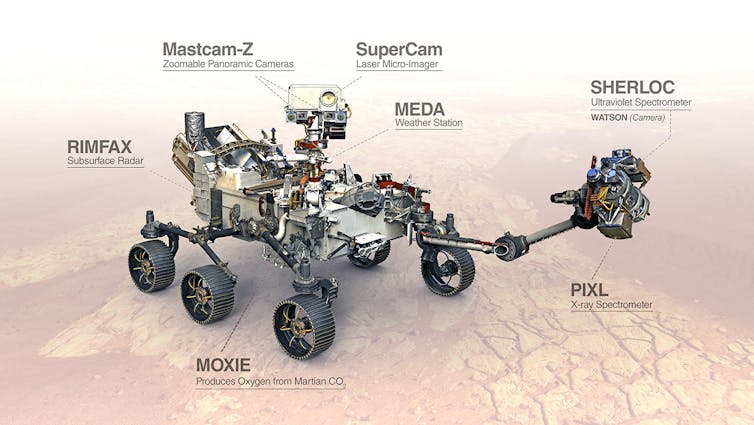
Five primary instruments on Perseverance, aided by machine learning algorithms, helped describe the unusual rock formations at a site called Beaver Falls and the past they record.
Robotic hands: Mounted on the rover’s robotic arm are tools for blowing dust aside and abrading rock surfaces. These ensure the rover analyzes clean samples.
Cameras: Perseverance hosts 19 cameras for navigation, self-inspection and science. Five science-focused cameras played a key role in this study. These cameras captured details unseeable by human eyes, including magnified mineral textures and light in infrared wavelengths. Their images revealed that Bright Angel is a mudstone, a type of sedimentary rock formed from fine sediments deposited in water.
Spectrometers:Instruments such as SuperCam and SHERLOC – scanning habitable environments with Raman and luminescence for organics and chemicals – analyze how rocks reflect or emit light across a range of wavelengths. Think of this as taking hundreds of flash photographs of the same tiny spot, all in different “colors.” These datasets, called spectra, revealed signs of water integrated into mineral structures in the rock and traces of organic molecules: the basic building blocks of life.
Subsurface radar: RIMFAX, the radar imager for Mars subsurface experiment, uses radio waves to peer beneath Mars’ surface and map rock layers. At Beaver Falls, this showed the rocks were layered over other ancient terrains, likely due to the activity of a flowing river. Areas with persistently present water are better habitats for microbes than dry or intermittently wet locations.
X-ray chemistry:PIXL, the planetary instrument for X-ray lithochemistry, bombards rock surfaces with X-rays and observes how the rock glows or reflects them. This technique can tell researchers which elements and minerals the rock contains at a fine scale. PIXL revealed that the leopard-like spots found at Beaver Falls differed chemically from the surrounding rock. The spots resembled patterns on Earth formed by chemical reactions that are mediated by microbes underwater.
Key Perseverance Mars Rover instruments used in this analysis. NASA
Together, these instruments produce a multifaceted picture of the Martian environment. Some datasets require significant processing, and refined machine learning algorithms help the mission teams turn that information into a more intuitive description of the Jezero Crater’s setting, past and present.
The challenge of uncertainty
Despite Perseverance’s remarkable tools and processing software, uncertainty remains in the results. Science, especially when conducted remotely on another planet, is rarely black and white. In this case, the chemical signatures and mineral formations at Beaver Falls are suggestive – but not conclusive – of past life on Mars.
There actually are tools, such as mass spectrometers, that can show definitively whether a rock sample contains evidence of biological activity. However, these instruments are currently too fragile, heavy and power-intensive for Mars missions.
Fortunately, Perseverance has collected and sealed rock core samples from Beaver Falls and other promising sites in Jezero Crater with the goal of sending them back to Earth. If the current Mars sample return plan can retrieve these samples, laboratories on Earth can scrutinize them far more thoroughly than the rover was able to.
Perseverance selfie at Cheyava Falls sampling site in the Beaver Falls location. NASA/JPL-Caltech/MSSS
Investing in our robotic senses
This discovery is a testament to decades of NASA’s sustained investment in Mars exploration and the work of engineering teams that developed these instruments. Yet these investments face an uncertain future.
Perseverance represents more than a machine. It is a proxy extending humanity’s senses across millions of miles to an alien world. These robotic explorers and the NASA science programs behind them are a key part of the United States’ collective quest to answer profound questions about the universe and life beyond Earth.
Ari Koeppel previously received funding from NASA science grants. He is affiliated with The Planetary Society. Any views represented in this article are those of the author. The budget cuts do not directly affect the author’s work and he is not currently formally connected to the rover campaign.
The Harvard controversy began when the Trump administration announced plans to cut off billions in federal research funds because it objected to the university’s public positions, campus culture and some of its academic scholarship. No one contended that Harvard had mismanaged money or failed to meet grant requirements.
Instead, the White House said the school had done too little to eliminate so-called woke diversity, equity and inclusion – DEI – policies and alleged that antisemitism proliferated on campus, as evidenced by student demonstrations against Israel’s conduct in the Gaza war.
White House Press Secretary Karoline Leavitt on April 15, 2025, spoke about President Donald Trump’s moves against Harvard.
Protection for dissent and disagreement
In striking down the funding cut, Burroughs ruled that the administration’s move violated the First Amendment. The First Amendment protects freedom of speech, press, religion and assembly by limiting government intrusion. While government officials may disagree with Harvard’s speech – whether that means faculty scholarship, public statements or the culture of campus debate – they cannot retaliate by pulling federal support, the judge wrote.
The principle at work in the Harvard case is simple: Free speech protections don’t just apply to individuals in the town square or in places where public decisions are being made.
First Amendment rights extend to private institutions, even when their views or policies contravene official government opinions, and even when they receive funding from the government. Government reprisal does more than chill speech – it sets up a system where only state-approved viewpoints can flourish.
Supreme Court has seen this before
The ruling in Harvard’s favor follows a long legal tradition of Supreme Court rulings that bar the government from demanding ideological acquiescence in exchange for support.
In the case Speiser v. Randall that was decided in 1958, the court struck down a California law requiring veterans to sign loyalty oaths to receive tax exemptions. The decision created the doctrine of unconstitutional conditions, a principle that forbids government from making the receipt of a government benefit or entitlement conditional in a way that interferes with the exercise of a constitutional right.
In Perry v. Sindermann, a 1972 decision, a professor was denied reappointment at a state college after criticizing administrators. Even without tenure, the court held, the government could not retaliate against him for protected speech.
And in Legal Services Corp. v. Velazquez, the court in 2001 invalidated restrictions that barred federally funded legal aid lawyers from challenging welfare laws. Justice Anthony Kennedy wrote that such limits “distort the legal system” by preventing some members of the bar from making arguments on behalf of their clients, while the government would face no similar restriction in promoting their own views.
The government, Chief Justice John Roberts wrote, could not make program funds dependent on grant-seeking groups adopting particular political or moral beliefs. In this case, that meant the Alliance for Open Society did not have to condemn sex work in order to qualify for public health funding.
Likewise, in Janus v. AFSCME from 2018, the court struck down an Illinois law that required public employees who chose not to join a union to still pay fees to support it. The state had argued that these “fair-share fees” were necessary because unions bargain on behalf of all workers. But the court said that forcing nonmembers to pay was a form of compelled speech – subsidizing union political organizing – that abridged the First Amendment.
While the context is very different from Harvard’s funding dispute, both cases highlight the same principle: The government cannot use money – whether through subsidies, grants or mandatory fees – as a way to compel or suppress expression. These rulings show that the First Amendment protections apply to government funding and policy questions that quietly shape who gets heard and who does not.
In each of those episodes, dissent was framed as dangerous to national security or social stability. And in each case, the tools of government – whether criminal law, congressional investigations or funding threats – were used to discipline voices that strayed from the party line. The impulse to punish institutions for perceived ideological deviance is part of a recurring American story.
What’s distinctive today is how the tactic has been folded into the culture wars.
These are not just fiscal decisions; they are symbolic moves aimed at disciplining institutions seen by conservatives as too liberal or too critical.
President John Adams supported the 1798 Alien and Sedition Acts, which criminalized criticism of him but not opposition leader and Vice President Thomas Jefferson. Library of Congress
Why this matters beyond the courts
The latest ruling may protect Harvard in this instance, but the larger conflict is not going away.
The legal decision confirms that retaliation violates the First Amendment, but political leaders may continue to test the boundaries. And among the public, the idea that universities should play along with official doctrine in exchange for continued government funding may eventually gain traction. That possibility feels especially real given Trump’s promises, echoed by Vice President JD Vance and White House Deputy Chief of Staff Stephen Miller, to wield federal power against universities and civic groups they portray – often inaccurately – as leftist, radical or violent.
A society where public funding flows only to institutions aligned with those in power is not a free society. It’s one where government can shape the landscape of knowledge and debate to its own ends.
The Harvard decision offers a reminder: The First Amendment is not just about the right to speak without fear of jail. It’s also about ensuring that the government cannot punish speech indirectly by threatening livelihoods and institutions. That’s why this case matters to the future of free expression in American democracy.
Stephanie A. (Sam) Martin does not work for, consult, own shares in or receive funding from any company or organization that would benefit from this article, and has disclosed no relevant affiliations beyond their academic appointment.
Some school librarians in Florida have found themselves in the midst of controversy over complaints of “obscene” titles in their libraries.Trish233/iStock via Getty Images
When a junior at an Orange County public high school in Florida visited the school library to check out a copy of “On the Road” by Jack Kerouac, it wasn’t in its Dewey decimal system-assigned location.
It turns out the title had been removed from the library’s shelves because of a complaint, and in compliance with Florida House Bill 1069, it had been removed from the library indefinitely. Kerouac’s quintessential chronicle of the Beat Generation in the 1950s, along with hundreds of other titles, was not available for students to read.
Gov. Ron DeSantis signed the bill into law in July 2023. Under this law, if a parent or community member objected to a book on the grounds that it was obscene or pornographic, the school had to remove that title from the curriculum within five days and hold a public hearing with a special magistrate appointed by the state.
On Aug. 13, 2025, Judge Carlos Mendoza of the U.S. Middle District of Florida ruled in Penguin Random House v. Gibson that parts of Florida HB 1069 are unconstitutional and violate students’ First Amendment right of free access to ideas.
The plaintiffs who filed the suit included the five largest trade book publishing houses, a group of award-winning authors, the Authors Guild, which is a labor union for published professional authors with over 15,000 members, and the parents of a group of Florida students.
I’ve spent the past 26 years training English language arts teachers at Arizona State University, and 24 years before that teaching high school English. I understand the importance of Mendoza’s ruling for keeping books in classrooms and school libraries. In my experience, every few years the books teachers have chosen to teach come under attack. I’ve tried to learn as much as I can about the history of censorship in this country and pass it to my students, in order to prepare them for what may lie ahead in their careers as English teachers.
Legal precedent
The August 2025 ruling is in keeping with legal precedent around censorship. Over the years, U.S. courts have established that obscenity can be a legitimate cause for removing a book from the public sphere, but only under limited circumstances.
In the 1933 case of United States v. One Book Called Ulysses, Judge John Munro Woolsey declared that James Joyce’s classic novel was not obscene, contradicting a lower court ruling. Woolsey emphasized that works must be considered as a whole, rather than judged by “selected excerpts,” and that reviewers should apply contemporary national standards and think about the effect on the average person.
In 1957, the Supreme Court further clarified First Amendment protections in Roth v. United States by rejecting the argument that obscenity lacks redeeming social importance. In this case, the court defined obscenity as material that, taken as a whole, appeals to a prurient – that is, lascivious – interest in sex in average readers.
The Supreme Court’s 1973 Miller v. California decision created the eponymous Miller test for jurors in obscenity cases. This test incorporates language from the Ulysses and Roth rulings, asking jurors to consider whether the average person, looking at the work as a whole and applying the contemporary standards in their community, would find it lascivious. It also adds the consideration of whether the material in question is of “serious literary, artistic, political, or scientific value” when deciding whether it is obscene.
Another decision that is particularly relevant for teachers and school librarians is 1982’s Island Trees School District v. Pico, a case brought by students against their school board. The Supreme Court ruled that removing books from a school library or curriculum is a violation of the First Amendment if it is an attempt to suppress ideas. Free access to ideas in books, the court wrote, is sacrosanct: “If there is any fixed star in our constitutional constellation, it is that no official, high or petty, can prescribe what shall be orthodox in politics, nationalism, religion or other matters of opinion.”
These 23 books were removed from Florida school libraries under Florida HB 1069. In his ruling in Penguin Random House v. Gibson, Judge Carlos Mendoza named them and stated, ‘None of these books are obscene.’ Illustration by The Conversation
What this ruling clarifies
In his ruling in August 2025, Mendoza pointed out that many of the removed books are classics with no sexual content at all. This was made possible in part by the formulation of HB 1069. The law allows anyone from the community to challenge a book simply by filling out a form, at which point the school is mandated to remove that book within five days. In order to put a book back in circulation, however, the law requires a hearing to be held by the state’s appointed magistrate, and there is no specified deadline by which this hearing must take place.
Mendoza did not strike down the parts of HB 1069 that require school districts to follow a state policy for challenging books. In line with precedent, he also left in place challenges for obscenity using the Miller test and with reference to age-appropriateness for mature content.
The Florida Department of Education argued that HB 1069 is protected by Florida’s First Amendment right of government speech, a legal theory that the government has the right to prevent any opposing views to its own in schools or any government platform. Mendoza questioned this argument, suggesting that “slapping the label of government speech on book removals only serves to stifle the disfavored viewpoints.”
What this means for schools, in Florida and across the US
In the wake of Mendoza’s decision, Florida schools are unlikely to pull more books from the shelves, but they are also unlikely to immediately return them. Some school librarians have said that they are awaiting the outcome of the appeal before taking action.
States with similar laws on the books or in the works will also be watching the appeal.
James B. Blasingame does not work for, consult, own shares in or receive funding from any company or organization that would benefit from this article, and has disclosed no relevant affiliations beyond their academic appointment.
Au-delà de l’économie, la politique tarifaire de Donald Trump s’affirme comme un levier de diplomatie aux répercussions géopolitiques considérables. L’imposition de droits de douane de 50 % à l’Inde, alliée stratégique des États-Unis au sein du Quad, le dialogue quadrilatéral pour la sécurité, menace non seulement les échanges bilatéraux, mais risque aussi de rapprocher New Delhi de la Russie et de la Chine, de renforcer la cohésion des BRICS+ et de fragiliser la primauté du dollar sur la scène mondiale.
La politique tarifaire de Donald Trump semble être devenue autant un outil de politique étrangère qu’une stratégie économique. Mais la décision de l’administration d’imposer des droits de douane de 50 % à l’Inde, un allié clé des États-Unis dans le cadre du dialogue quadrilatéral pour la sécurité (surnommé en anglais, le Quad) – le groupe de coopération militaire et diplomatique informelle entre les États-Unis, l’Inde, le Japon et l’Australie – pourrait avoir des répercussions importantes, non seulement sur le commerce international, mais aussi sur la géopolitique mondiale.
La justification américaine de cette hausse des droits de douane est avant tout politique. La Maison Blanche affirme que l’Inde a tiré profit de l’achat et de la revente de pétrole russe, au mépris des sanctions imposées après l’invasion de l’Ukraine en 2022. Cela a aidé la Russie à surmonter les effets des sanctions et à continuer de financer sa guerre en Ukraine.
Il est évident que la politique tarifaire et les déclarations récentes de Washington et de New Delhi ont gravement détérioré une relation bilatérale encore naissante. À tel point que le premier ministre indien, Narendra Modi, a refusé de répondre aux appels téléphoniques de Trump. De son côté, Trump ne prévoit plus de se rendre en Inde pour le sommet du Quad prévu plus tard dans l’année.
Le premier ministre indien, Narendra Modi, a participé au sommet de l’Organisation de coopération de Shanghai (OCS) à Tianjin, en Chine, du 31 août au 1er septembre, en compagnie du président russe Vladimir Poutine. Les trois dirigeants ont été photographiés ensemble en pleine discussion cordiale et M. Modi a rencontré séparément MM. Xi et Poutine en marge du sommet, présenté comme une alternative à l’ordre hégémonique dominé par les États-Unis.
Il apparaît désormais évident que la hausse des droits de douane américains ne détournera pas l’Inde de ses achats de pétrole russe. Bien au contraire, Modi a confirmé la volonté de son pays non seulement de maintenir ces importations, mais aussi de les accroître.
Rien d’étonnant à cela : la posture de l’Inde à l’égard de la Russie, en tant qu’importateur net de pétrole brut, relève moins d’une ambition géopolitique d’envergure que d’une nécessité économique concrète, celle de maîtriser l’inflation.
Sur le plan énergétique, l’Inde reste très dépendante des importations, et sa population — majoritairement pauvre et vulnérable — a besoin de prix stables et abordables. Aucune pression venue des États-Unis ou de leurs alliés du G7 ne saurait modifier cette réalité économique fondamentale.
Le revers américain fait le jeu de Moscou
L’instauration des droits de douane américains risque de réduire les exportations indiennes de vêtements et de chaussures vers les États-Unis, les grandes marques occidentales se tournant vers des fournisseurs moins coûteux dans d’autres pays. Une telle dynamique se traduirait par une augmentation des prix pour les consommateurs américains.
Cependant, l’impact sur les fournisseurs indiens devrait rester limité, la demande mondiale en vêtements et chaussures demeurant très élevée. Ils pourraient aisément se tourner vers d’autres marchés.
Les pierres précieuses représentent un autre pilier des exportations indiennes, où le pays détient une position dominante à l’échelle mondiale. Les droits de douane américains ne devraient pas modifier sensiblement cette situation, l’Inde disposant de nombreux débouchés à l’exportation, bien que les États-Unis figurent parmi ses principaux clients.
Le renforcement des échanges commerciaux entre l’Inde et la Russie devrait favoriser de nouvelles opportunités d’investissements réciproques. Pour la Russie, la conjoncture économique pourrait globalement s’améliorer à la suite de ces droits de douane. L’Inde a d’ailleurs laissé entendre qu’elle augmenterait probablement ses importations de pétrole, tandis que la Russie profiterait d’achats de vêtements et de chaussures à prix compétitifs en provenance d’Inde, les fournisseurs indiens cherchant à rediriger leurs exportations vers de nouveaux débouchés.
Le renforcement des relations économiques avec l’Inde, qui ambitionne de porter les échanges bilatéraux à 100 milliards de dollars américains (92 milliards d’euros) d’ici 2030, offrira à la Russie un important marché alternatif à la Chine pour écouler ses produits. Elle y gagnera également un fournisseur majeur de biens de consommation, habituellement importés, contribuant ainsi à maintenir des prix abordables pour les ménages russes.
La fin de la primauté du dollar américain ?
L’Occident court le risque que, si les tensions tarifaires se traduisent par des sanctions financières plus strictes, les investissements indiens se détournent des États-Unis et des pays du G7 au profit de la Russie et de la Chine. Les investisseurs indiens sont actuellement très présents dans les secteurs de l’automobile, de la pharmacie, des technologies de l’information et des télécommunications en Occident, mais ces flux pourraient être redirigés vers d’autres marchés.
On observe de plus en plus de signes d’une cohésion renforcée, non seulement au sein de l’OCS, mais également au sein du groupe des BRICS+, qui regroupe un nombre croissant de nations commerçantes. Initialement composé des membres fondateurs – le Brésil, la Russie, l’Inde, la Chine et l’Afrique du Sud – le groupe s’est récemment élargi pour inclure l’Égypte, l’Éthiopie, l’Iran, l’Indonésie et les Émirats arabes unis.
Ces économies en pleine croissance s’efforcent déjà de mettre en place des mécanismes techniques pour les investissements mutuels et les règlements commerciaux dans leurs monnaies locales plutôt qu’en dollars américains.
Les chocs commerciaux mondiaux provoqués par l’imposition de droits de douane par les États-Unis ont entraîné une baisse à court terme de la valeur du dollar américain. Si cette dépréciation reste modeste d’un point de vue historique, elle masque néanmoins un risque plus important à long terme.
Le problème ne concerne pas les transactions commerciales, qui ne constituent qu’une part marginale des opérations en dollars. Les risques à long terme résident plutôt dans une possible diminution du rôle du dollar dans la gestion d’actifs, l’investissement, les activités financières et les réserves internationales.
En particulier, le rôle quasi exclusif du dollar comme monnaie de réserve pour les pays du BRICS et du Sud est aujourd’hui menacé.
Toute politique susceptible de remettre en cause ce statut mettrait en danger la prospérité et la sécurité des États-Unis. Le problème, c’est que toute orientation financière ou commerciale rapprochant les principaux partenaires commerciaux américains de la Russie et de la Chine aurait précisément cet effet.
Sambit Bhattacharyya bénéficie d’un financement de UK Research and Innovation, du Conseil de recherche économique et sociale, du Conseil australien de la recherche et du Conseil européen de la recherche.
Source: The Conversation – in French – By Imraan Valodia, Pro Vice-Chancellor, Climate, Sustainability and Inequality and Director, Southern Centre for Inequality Studies, University of the Witwatersrand
La relation entre inégalités et croissance économique est complexe, en particulier en Afrique. Les inégalités résultent d’une multitude de facteurs, notamment des choix politiques, de l’héritage institutionnel et des structures de pouvoir qui favorisent les élites. Le professeur Imraan Valodia, directeur du Southern Centre for Inequality Studies de Johannesburg, s’est entretenu avec Ernest Aryeetey, professeur émérite d’économie du développement à l’Institut de recherche statistique, sociale et économique de l’université du Ghana, au sujet de ces questions.
Quels choix politiques ont été faits par les gouvernements africains qui ont pu aggraver les inégalités ?
Tout d’abord, les politiques d’ajustement structurel. De nombreux pays africains les ont mises en œuvre à la fin du XXe siècle, souvent encouragés par les institutions financières internationales. Ces politiques comprenaient des réductions d’effectifs dans le secteur public, la suppression des subventions et la réduction des services sociaux. Elles ont touché de manière disproportionnée les pauvres en affaiblissant le rôle de l’État dans la redistribution des biens publics et en limitant l’accès aux services essentiels.
Ces programmes ont également accru les inégalités de revenus en privilégiant le libre marché au détriment de la protection sociale. Les efforts ultérieurs pour remédier aux conséquences de ces politiques ont souvent été trop modestes et trop tardifs.
Deuxièmement, les politiques fiscales et budgétaires. La plupart des systèmes fiscaux en Afrique reposent sur des impôts indirects (tels que la TVA ou les taxes à la consommation) plutôt que sur des impôts progressifs et directs sur le revenu et la fortune. En conséquence, les ménages les plus pauvres supportent souvent une charge fiscale relative plus lourde, tandis que les plus riches profitent d’exonérations ou d’évasion fiscale.
Au début des indépendances, la fiscalité a rarement contribué à la redistribution des richesses, et les efforts visant à taxer le secteur informel ont été minimes ou mal conçus. Ils n’ont pas permis de dégager des ressources significatives pour les dépenses sociales.
Troisièmement, les investissements dans l’éducation et la santé. Les choix politiques ont souvent perpétué les écarts d’accès entre les populations urbaines et rurales et entre les classes socio-économiques. Les investissements ont eu tendance à favoriser les villes et les groupes privilégiés, de sorte que tout le monde n’avait pas les mêmes chances. Ce « biais urbain » dans les dépenses publiques a renforcé les inégalités existantes. Les besoins des populations rurales sont restés insatisfaits.
Quatrièmement, la faiblesse de la protection sociale. Jusqu’à l’expansion de programmes plus complets dans les années 2000, de nombreux Africains sont restés pauvres et vulnérables, sans filet de sécurité adéquat.
Cinquièmement, les structures économiques favorisent les élites. Les gouvernements africains ont souvent maintenu, voire renforcé, des structures économiques qui concentrent la richesse et les opportunités entre les mains d’une minorité. Citons par exemple les politiques favorisant les industries extractives ou les secteurs des ressources contrôlés par des groupes ayant des liens politiques. Le régime foncier, les politiques commerciales et l’accès aux contrats et licences publics ont également souvent favorisé les puissants.
Sixièmement, une inclusion régionale et de genre limitée. Les premières politiques publiques répondaient rarement aux besoins des femmes, des jeunes, des zones rurales ou des régions marginalisées. L’exclusion de la propriété foncière ou des services financiers, et l’importance limitée accordée à la discrimination positive, ont renforcé les inégalités systémiques. Ce n’est que depuis quelques décennies que certains gouvernements ont commencé à combler ces lacunes, mais les progrès restent inégaux.
Ces choix sont-ils liés à la mainmise des élites sur les politiques publiques ?
Oui. Les groupes privilégiés ont souvent façonné ou manipulé les politiques publiques de manière à protéger leurs intérêts et à renforcer les inégalités.
Héritage colonial et postcolonial. Les politiques et les institutions mises en place pendant et après la période coloniale ont souvent attribué les ressources et le pouvoir à une élite restreinte, composée de colons, d’expatriés ou de collaborateurs locaux. Les élites actuelles ont hérité et maintenu bon nombre de ces structures. Elles contrôlent toujours la richesse, les terres et les opportunités commerciales.
Structure économique et contrôle des ressources. De nombreuses économies africaines restent axées sur les industries extractives et les matières premières telles que le pétrole et les minéraux. Les politiques relatives à l’extraction des ressources, au commerce et au régime foncier ont souvent favorisé les élites grâce à un accès préférentiel, des exonérations fiscales et des lacunes réglementaires.
Conception des politiques et choix budgétaires. La conception des systèmes fiscaux a généralement favorisé les impôts indirects (tels que la TVA). Ceux-ci n’ont pas d’incidence sur la richesse des élites. Les efforts visant à taxer les revenus élevés, la propriété ou les plus-values sont insuffisants ou facilement contournables.
Protection sociale et prestation de services. Les filets de sécurité et les services publics (tels que l’éducation de qualité, les soins de santé ou les infrastructures) ciblent souvent les travailleurs du secteur formel ou les résidents urbains (où résident les élites). A l’inverse, ils négligent le secteur informel, les populations rurales pauvres et les groupes marginalisés.
Clientélisme politique et gouvernance. Les ressources, les postes et les contrats de l’État sont attribués aux fidèles, aux membres de la famille ou aux réseaux ethniques/régionaux.
Quels ont été les trois principaux facteurs d’inégalité ?
Premièrement, les politiques fiscales régressives. Il s’agit notamment des impôts à large assiette telles que les taxes sur les transactions et la TVA. Ils absorbent une part plus importante des flux de trésorerie des personnes à faibles revenus. Les groupes plus aisés bénéficient d’exonérations ou de taux d’imposition faibles.
Deuxièmement, la privatisation et la libéralisation rapide du marché menées par l’élite. La vente des actifs de l’État ou l’ouverture de secteurs clés (énergie, télécommunications et transports) à des investisseurs ayant des liens politiques concentre les profits et le pouvoir des marchés. Les travailleurs informels et les petites entreprises se retrouvent avec des revenus réduits. Le clientélisme, la corruption et l’emprise politique maintiennent cette situation.
Troisièmement, le sous-investissement dans les services sociaux universels. Les coupes budgétaires dans les domaines de la santé, de l’éducation et de la protection sociale limitent la mobilité sociale des pauvres et maintiennent les écarts les régions et entre les sexes.
Enfin, la dépendance vis-à-vis des ressources et la structure économique globale. De nombreuses économies africaines se concentrent sur des industries telles que le pétrole, les minerais et les cultures commerciales. Celles-ci profitent aux élites politiques et économiques, mais ne diversifient pas les industries et ne créent pas d’emplois. Les bénéfices de la croissance profitent ainsi principalement aux personnes déjà privilégiées. La majorité des citoyens et des régions entières en sont exclues.
Quels sont les pays qui ont le mieux réussi à changer cette situation ?
Le Rwanda dispose d’une structure d’imposition progressive des revenus. Les transactions monétaires mobiles de faible valeur y sont exonérées d’impôt. Les services essentiels tels que l’électricité et l’eau restent largement publics, ce qui a réduit l’impact des impôts sur les pauvres.
Le Rwanda a également fait des efforts en faveur d’une gouvernance inclusive. Citons par exemple les quotas pour les femmes, les investissements dans la santé et l’éducation, et l’accent mis sur l’inclusion rurale.
Autre exmple: le Botswana a mené un programme de privatisation prudent. L’État conserve une participation majoritaire dans les secteurs des diamants, des télécommunications et des banques. Les recettes ont été affectées à l’éducation primaire universelle et à la santé.
Malgré sa dépendance vis-à-vis des diamants, ce pays parvient à affecter ses richesses naturelles à l’épargne nationale, aux infrastructures et aux services publics. Ceci tout en maintenant une qualité institutionnelle et une stabilité politique relativement élevées.
Auparavant, le pays s’était concentré sur des investissements publics massifs dans l’enseignement primaire, les services de vulgarisation sanitaire et les réseaux routiers ruraux. Dans le même temps, il a évité la privatisation à grande échelle des services publics de base. Cela a permis de limiter les disparités en matière de services sociaux.
En outre, l’Ethiopie a investi dans la croissance tirée par l’industrie manufacturière et les exportations. Cela a créé des emplois et progressivement affranchi l’économie de sa dépendance vis-à-vis des matières premières. Les inégalités y ont diminué par rapport à d’autres pays dépendants des ressources naturelles.
Les progrès technologiques ont-ils eu un impact différent sur les inégalités sur le continent ?
Absolument. La technologie a le potentiel de réduire les inégalités en élargissant l’accès aux marchés, aux services, à l’information et à l’inclusion financière. Mais dns certains pays les lacunes en matière d’infrastructures numériques, d’accessibilité financière et de compétences ont parfois conduit la technologie à renforcer, plutôt qu’à atténuer, les disparités dans les pays africains.
Fracture numérique et écarts entre zones urbaines et rurales. L’accès aux technologies numériques est très inégal sur le continent. Les zones rurales, les populations pauvres, les femmes et les groupes moins éduqués sont moins susceptibles d’utiliser Internet ou de bénéficier des services numériques. Cette fracture est beaucoup plus marquée en Afrique que dans les économies avancées, où l’adoption des technologies est quasi universelle. En conséquence, les nouvelles technologies profitent surtout aux groupes urbains, éduqués et à revenus élevés. Cela accentue les inégalités si ces évolutions ne s’accompagnent pas de politiques solides et inclusives.
Bond en avant du mobile, mais une inclusion inégale. Le passage rapide de l’Afrique à l’utilisation du téléphone mobile a souvent contourné les infrastructures de téléphonie fixe. Cela a permis à des millions de personnes d’accéder à l’inclusion financière et à de nouveaux marchés, comme M-Pesa au Kenya. Néanmoins, une grande partie du continent reste exclue en raison du coût, du manque d’électricité, des compétences numériques limitées et des barrières linguistiques.
Structure économique et chaînes de valeur mondiales. L’intégration limitée dans les chaînes de valeur mondiales et la petite taille du secteur des hautes technologies font que la plupart des emplois sur le continent restent informels et à faible productivité.
Pourquoi les effets diffèrent-ils ?
Tout d’abord, du fait d’une adoption tardive et inégale. La révolution industrielle et les progrès technologiques qui ont suivi sont arrivés tardivement et de manière inégale. L’héritage colonial et postcolonial a laissé l’Afrique à la traîne en matière d’éducation et d’infrastructures. Il a donc été plus difficile pour de larges segments de la population de bénéficier des nouvelles technologies.
La rareté des infrastructures oblige les sociétés à adopter directement des solutions mobiles, contournant ainsi le système bancaire traditionnel, mais les rendant également vulnérables aux chocs politiques.
Deuxièmement, les défaillances politiques et commerciales. Une réglementation inadéquate, une concurrence faible et le coût élevé des appareils et des données freinent la transformation numérique. Les services publics numériques, tels que l’administration en ligne et l’enseignement à distance, ne bénéficient qu’aux groupes déjà connectés. Et le manque de compétences numériques creuse encore davantage la fracture numérique sociale.
Imraan Valodia reçoit des financements de plusieurs fondations et institutions qui soutiennent la recherche universitaire indépendante.
« Tu parles bien anglais pour une personne noire. »
« Pourquoi les assiettes ne sont-elles pas lavées alors qu’il y a une femme dans cette maison ? »
« Je peux toucher tes cheveux ? »
Voici quelques microagressions courantes que vous avez peut-être déjà entendues, surtout si vous êtes une femme noire.
Les microagressions peuvent être projetées sur les personnes noires parce qu’on attend d’elles qu’elles parlent un anglais parfait alors que ce n’est même pas leur langue. Ou parce que leurs cheveux naturels semblent exotiques à quelqu’un d’une autre culture. Ou encore à cause de stéréotypes sexistes, comme l’idée que les femmes africaines ont forcément leur place dans la cuisine.
Que sont les microagressions ?
Les microagressions sont des commentaires ou des actions qui révèlent des préjugés à l’égard de personnes marginalisées ou d’un groupe de personnes opprimées. Elles peuvent être micro (mineures ou quotidiennes) et se manifester inconsciemment ou sans intention malveillante. Mais même ainsi, les microagressions sont blessantes et dévalorisantes pour les personnes qui en sont victimes.
Qu’est-ce que le validisme ou capacitisme ?
Alors, que sont les microagressions validistes ? Le validisme est une vision du monde dans laquelle la capacité et le fait d’être valide sont privilégiés par rapport au handicap.
Dire à une personne en fauteuil roulant : « Ah, tu pars en balade ? ». Ou lui parler lentement comme si elle ne pouvait pas comprendre ce que vous dites. Ou posséder un bureau non accessible en fauteuil roulant. Tout cela peut être considéré comme des microagressions capacitistes. Utiliser des termes liés au handicap hors contexte est capacitiste : « Vous devez être aveugle ». « Tu dois être aveugle », même si c’est adressé à une personne voyante. C’est un manque de sensibilité envers les personnes qui pourraient réellement avoir une déficience visuelle.
Les microagressions discriminatoires sont le fait de personnes valides qui ne comprennent pas la réalité de la vie avec un handicap. Parfois, elles ne veulent pas faire de mal ou pensent aider, par exemple en faisant pour les personnes en situation de handicap des choses que celles-ci peuvent en réalité faire elles-mêmes.
Mais ces gestes, même involontaires, créent un rapport de pouvoir inégal. Ils font sentir aux personnes en situation de handicap qu’elles sont inférieures, incapables ou moins intelligentes.
Les femmes noires handicapées
En tant que chercheuse spécialisée dans l’éducation inclusive et le handicap dans l’enseignement supérieur, mes recherches portent souvent sur le handicap et le genre. J’ai récemment publié un article qui passe en revue les études sur les microagressions capacitistes projetées sur les femmes noires handicapées en Afrique australe.
Cet article analyse l’impact de ces microagressions sur les femmes au Zimbabwe, en Afrique du Sud et en Eswatini. Ces trois pays partagent des valeurs culturelles, une identité et des croyances similaires en matière de genre, de race et de handicap. Et c’est dans l’intersection de ces trois dimensions que se situent les enjeux.
Dans ces cultures, les femmes sont en général respectées. Elles sont parfois appelées izimbokodo (« pierres à moudre »). On considère volontiers qu’« un foyer ne peut pas exister sans femme ». En Afrique du Sud, les droits humains ont aussi progressé au fil du temps. Pourtant, les microagressions validistes restent fréquentes. Elles touchent les femmes, et encore davantage les femmes noires en situation de handicap.
Cela a un effet négatif sur elles, en particulier lorsqu’il s’agit de faire des choix de vie individuels, de se marier et d’avoir des enfants, tout comme c’est le cas pour les femmes non handicapées.
Par exemple, dans certaines régions d’Afrique du Sud, lorsque des femmes handicapées apparaissent enceintes en public, beaucoup de gens supposent qu’elles ont été violées. Ils ne supposent pas qu’une femme handicapée ait pu avoir une vie sexuelle et elle est humiliée et traitée comme une personne inhabituelle. Il lui est alors encore plus difficile de bénéficier d’une égalité en matière de soins de santé et de statut social.
Pour les femmes africaines noires handicapées, l’impact des microagressions capacitistes est pire, car elles sont confrontées à une lutte intersectionnelle : elles subissent plusieurs formes de discrimination. Elles sont confrontées au racisme, au sexisme et au capacitisme, souvent simultanément.
Pourquoi l’ubuntu est-il important ?
La question que je pose dans mon étude est de savoir ce qui pourrait aider les femmes noires handicapées à se donner les moyens de déconstruire les microagressions capacitistes. La réponse se trouve dans le passé. Je soutiens que l’ubuntu est une arme précieuse contre cette forme de discrimination.
L’ubuntu est une philosophie africaine commune à la région, qui est comprise de différentes manières par différentes personnes. Mais elle peut être expliquée au mieux par le dicton isiZulu « umuntu ngumuntu ngabantu » (Nous sommes grâce à eux). Cela signifie qu’une personne n’existe que par les autres.
Dans une vision du monde fondée sur l’entraide et la coopération, chaque être humain au sein d’une communauté a de la valeur, indépendamment de son sexe, de sa race ou de ses capacités. L’ubuntu aide les gens à comprendre qu’ils dépendent les uns des autres. Ils ont besoin les uns des autres malgré leurs différences.
Dans de nombreuses sociétés africaines précoloniales, le handicap était considéré de manière positive. Un autre proverbe isiZulu dit : « Akusilima sindlebende kwaso ». Cela signifie que les personnes en situation de handicap sont acceptées et aimées dans leurs foyers.
Cependant, le colonialisme a changé tout cela. Les Africains ont été réduits à l’état de travailleurs pour les maîtres européens. Le colonialisme a normalisé les travailleurs valides et considéré les personnes handicapées comme inférieures. Cette idée a été renforcée par la morale coloniale, qui a façonné la pensée sociale dans la région.
Cette vision perdure encore aujourd’hui dans de nombreuses sociétés africaines modernes, comme l’ont montré les recherches. Les femmes noires en situation de handicap y sont souvent vues comme impuissantes. Cela fait d’elles des cibles faciles pour les microagressions validistes.
Un système de pensée comme l’ubuntu offrirait à ces femmes la possibilité de retrouver dignité et autonomie. Il leur donnerait les moyens de résister aux effets destructeurs des microagressions qu’elles subissent au quotidien.
Sibonokuhle Ndlovu bénéficie d’un financement du Conseil de recherche universitaire de l’Université de Johannesburg.
Jean-Yves Marion est l’un des meilleurs connaisseurs des rançongiciels.Fourni par l’auteur
Vous avez peut-être déjà été victime d’un virus informatique. Le terme date de 1984 et on le doit à Fred Cohen, un chercheur américain. Pourtant, la notion de virus est intrinsèquement liée à celle même de l’informatique, dès ses origines, avec les travaux d’Alan Turing dans les années 1930 et, par la suite, avec les programmes autoréplicants. Aujourd’hui, ce terme n’est plus vraiment utilisé, on parlera plutôt de logiciels malveillants. Jean-Yves Marion est responsable du projet DefMal du programme de recherche PEPR France 2030 Cybersécurité qui porte sur la lutte contre ce qu’on appelle aussi les « malwares ».
Il répond aux questions de Benoît Tonson, chef de rubrique Sciences et technologies à « The Conversation France », pour nous faire pénétrer les secrets des cybercriminels et comprendre comment ils arrivent à pénétrer des systèmes informatiques et à escroquer leurs victimes.
The Conversation : Comment vous êtes-vous intéressé au monde des logiciels malveillants ?
Jean-Yves Marion : J’ai fait une thèse à l’Université Paris 7 en 1992 (aujourd’hui, Paris Cité) sur un sujet d’informatique fondamental de logique et de complexité algorithmique. C’était assez éloigné de la cybersécurité, ce qui m’intéressait quand j’étais jeune, c’était de comprendre les limites de ce qui est calculable par ordinateur quand les ressources sont bornées.
Plus tard, on pourrait dire que j’ai fait une « crise de la quarantaine » mais version chercheur. J’ai eu envie de changement et de sujets plus appliqués, plus en prise avec les enjeux de société. J’avais besoin de sortir de la théorie pure. J’ai passé ce cap en 2004. Et j’ai commencé à m’intéresser à ce que l’on appelait, encore à l’époque, les virus ; en gros, des programmes capables de se reproduire, de se dupliquer. Dans le mot « virus », il y a toujours eu le côté malveillant, mais ce qui m’intéressait, c’était le côté théorique de la reproduction de programme.
Finalement, je me suis passionné pour le sujet. J’étais déjà au Loria (Laboratoire lorrain de recherche en informatique et ses applications) que j’ai dirigé à partir de 2012 pendant onze ans. J’ai commencé à étudier les virus et à travailler avec de vrais programmes malveillants. D’ailleurs, la direction du laboratoire de l’époque s’était inquiétée, je pense à juste titre, de nos activités. Elle avait peur qu’à force d’exécuter des programmes malveillants sur nos ordinateurs pour comprendre comment ils fonctionnaient, ils puissent passer sur le réseau national de télécommunications pour la technologie, l’enseignement et la recherche (Renater) et qu’on soit bannis de la recherche publique à vie ! J’exagère, bien sûr, mais on a tout de même eu l’idée de construire une plateforme de recherche qu’on appelle maintenant le laboratoire de haute sécurité (LHS) et qui est un lieu qui se trouve au sous-sol de notre bâtiment. Il permet d’analyser les virus en toute sécurité, car il a son propre réseau qui n’est connecté à aucun autre. Les travaux ont continué et ont pris petit à petit de l’ampleur, notamment en termes de financement de la recherche.
Aujourd’hui on n’utilise plus le terme de « virus », on parle plutôt de programmes « malveillants » (malware en anglais). On va également parler de « rançongiciels », d’infostealers (« voleurs d’information »), des logiciels créés dans le but de pénétrer les systèmes d’information et d’y voler des informations sensibles ; de « bots espions »… Il existe également des stalkerwares, des logiciels installés sur un smartphone par exemple, qui permettent de suivre l’activité de ce dernier et suivre à la trace les déplacements d’une personne.
Parlons plus en détail des « rançongiciels » : qu’est-ce que c’est ?
J.-Y. M. : Un « rançongiciel », c’est un programme malveillant qui va s’infiltrer à l’insu de la victime et dont l’objectif est soit d’exfiltrer des données, soit de les chiffrer de manière à demander une rançon, soit de faire les deux. On parle souvent des attaques avec chiffrement de données, car elles peuvent bloquer une organisation entière et empêcher le travail d’une entreprise ou d’une organisation publique. Il ne faut pas pour autant négliger la simple, si je peux dire, exfiltration qui est également beaucoup utilisée avec un levier de pression et un discours assez simple de la part de l’attaquant : « On a des informations personnelles, si tu ne payes pas, on divulgue. » La victime peut être une personne ou une entreprise ou un organisme comme un hôpital, une université, une administration, par exemple.
Les cibles sont donc multiples…
J.-Y. M. : Je pense que le premier élément à bien comprendre, c’est que la plupart des attaques sont extrêmement opportunistes, cela signifie que tout le monde est potentiellement une cible.
Les grosses entreprises peuvent être particulièrement visées parce que l’on peut espérer extorquer des rançons beaucoup plus grosses et gagner beaucoup plus d’argent que si l’on s’attaquait à une PME. C’est plus difficile et également plus risqué dans le sens où la police va très probablement intervenir.
L’exemple d’école, c’est l’attaque, en 2021, sur l’entreprise américaine Colonial Pipeline qui opère un réseau d’oléoducs à partir du Texas vers le sud-est des États-Unis. Il s’agissait de la plus grande cyberattaque contre une infrastructure pétrolière de l’histoire des États-Unis menée par le groupe DarkSide. L’entreprise avait payé une rançon de 75 bitcoins, soit à l’époque environ 4 millions de dollars. Somme en partie retrouvée par les autorités américaines. DarkSide a ensuite déclaré cesser toutes ses opérations sous les pressions américaines.
Plus généralement, les cibles dépendent des politiques des groupes de cybercriminels : certains vont se spécialiser dans des cibles visibles à gros revenus et d’autres vont plutôt attaquer des « petits poissons » à petit revenu.
Ransomware : Extortion Is My Business.
Vous parlez de groupes, or, dans l’imaginaire collectif, le pirate informatique est plutôt seul dans sa cave, qu’en est-il dans la réalité ?
J.-Y. M. : C’est rarement une personne seule qui va mener une attaque. En général, ce sont des groupes. C’est un modèle que la police appelle « ransomware as a service ». Ces groupes offrent un service clé en main pour mener une attaque par rançongiciel. On parle plus généralement de « malware as a service » voire de « crime as a service ».
Il ne faut pas imaginer une organisation qui ressemblerait à une entreprise classique. Ce sont des groupes assez diffus, dont les membres ne se connaissent pas forcément de manière physique et qui vont offrir différents services qui peuvent être séparés :
uniquement l’accès initial à un ordinateur spécifique ;
acheter un rançongiciel ;
avoir un accès à des services de négociation qui vont faciliter la négociation de la rançon.
Il est également possible de s’offrir des services de stockage de données, car si une attaque a pour but d’exfiltrer de grosses quantités de données, il faut pouvoir les stocker et montrer à sa cible qu’on a réellement ces données. À ce propos, certains groupes utilisent ce qu’ils appellent des « murs de la honte » où ils vont afficher sur des sites des informations confidentielles d’une entreprise, par exemple, sur le dark web.
En bas de l’échelle, on trouve ce que l’on appelle des « affiliés », ce sont les petites mains. On parle même d’« ubérisation de la cybercriminalité ». Ce sont eux qui vont lancer les attaques en utilisant les services du groupe. Si l’attaque réussit et que la cible paye, la rançon est partagée entre le groupe et les affiliés.
Si on va à l’autre bout de l’échelle, on connaît quelques leaders comme celui de Conti, un groupe de pirates basé en Russie. Ce dernier est connu sous les pseudonymes de Stern ou Demon, et agit comme un PDG. Des travaux universitaires ont même montré son modèle de management. Il semble qu’il fasse du micromanagement, où il tente de régler tous les problèmes entre ses « employés » et de contrôler toutes les tâches qu’ils effectuent sans très grande anticipation.
Maintenant que l’on connaît mieux l’écosystème criminel, expliquez-nous comment, techniquement, on peut entrer dans un système ?
J.-Y. M. : On peut diviser ça en grandes étapes.
La première, c’est la plus diffuse, c’est la reconnaissance de la cible. Essayer d’avoir la meilleure connaissance possible des victimes potentielles, tenter de savoir s’il y a des vulnérabilités, donc des endroits où l’on pourrait attaquer. Un autre aspect est de bien connaître les revenus de la cible pour, in fine, adapter la rançon.
Une fois ce travail réalisé, il faut réussir à obtenir un premier accès dans le réseau. C’est souvent la partie la plus complexe et elle est faite, généralement par une personne physique derrière son ordinateur. Pas besoin d’être nombreux pour cette étape. Ce qui fonctionne le mieux, c’est l’ingénierie sociale. On va chercher à manipuler une personne pour obtenir une information en exploitant sa confiance, son ignorance ou sa crédulité.
Prenons un exemple, avec votre cas, imaginons que l’on cherche à infiltrer le réseau de The Conversation et que l’attaquant vous connaisse. Il sait que vous êtes journaliste scientifique et toujours à l’affût d’un bon sujet à traiter. Il va donc vous envoyer un mail qui va vous dire : « Regardez, je viens de publier un excellent article scientifique dans une grande revue, je pense que cela ferait un très bon sujet pour votre média, cliquez ici pour en prendre connaissance. »
À ce moment-là, vous cliquez et vous arrivez sur un site qu’il contrôle et qui va vous forcer à télécharger un logiciel malveillant. Ce type de technique peut fonctionner sur énormément de personnes à condition de connaître le bon moyen de pression.
Dans le cas que l’on vient de prendre, il s’agissait d’une attaque bien ciblée. On peut aussi prendre le cas inverse et envoyer un très grand nombre d’emails sans ciblage.
Le cas classique est ce mail, que vous avez peut-être déjà reçu, venant soi-disant de la police et qui vous indique que vous avez commis une infraction et que vous devez payer une amende. Le gros problème, c’est que c’est devenu plus facile de rédiger des mails sans faute d’orthographe ni de grammaire grâce aux outils d’IA. Détecter le vrai du faux est de plus en plus complexe.
Donc la meilleure manière est de s’attaquer à un humain ?
J.-Y. M. : Oui, ça marche bien, mais il y a d’autres manières d’attaquer. L’autre grand vecteur, c’est ce qu’on appelle les vulnérabilités : tous les bugs, donc les erreurs, que vont faire une application ou un système d’exploitation. On peut exploiter les bugs de Windows mais aussi les bugs d’applications comme Firefox, Safari ou Chrome. Trouver une vulnérabilité, c’est vraiment le Graal pour un attaquant parce que cela va être relativement silencieux, personne ne peut s’en rendre compte tout de suite. À la différence d’une personne piégée qui pourrait se rendre compte de la supercherie.
Concrètement, une vulnérabilité qu’est-ce que c’est et comment l’exploiter ?
J.-Y. M. : Une vulnérabilité, c’est un bug – je pense que tout le monde en a entendu parler. Un bug, c’est quand une application va faire une erreur ou avoir un comportement anormal.
Alors, comment ça marche ? L’idée est que l’attaquant va envoyer une donnée à un programme. Et, à cause de cette donnée, le programme va commettre une erreur. Il va interpréter cette donnée comme une donnée à exécuter. Et là, évidemment, l’attaquant contrôle ce qui est exécuté. L’exploitation de vulnérabilité est une illustration de la dualité donnée/programme qui est constitutive et au cœur de l’informatique, dès ses origines.
J’aimerais également citer une autre grande manière d’attaquer : une « attaque supply chain », en français « attaque de la chaîne d’approvisionnement , appelée aussi « attaque de tiers ». C’est une attaque absolument redoutable. Pour comprendre, il faut savoir que les programmes, aujourd’hui, sont extrêmement complexes. Une application d’une entreprise particulière va utiliser beaucoup de programmes tiers. Donc il est possible de réaliser des attaques indirectes.
Je reprends votre cas, imaginons que quelqu’un qui vous connaisse cherche à vous attaquer, il sait que vous êtes journaliste, il se dit que vous utilisez probablement Word, il peut donc étudier les dépendances de cette application à d’autres programmes et voir si ces derniers ont des failles. S’il arrive à installer une backdoor (une porte dérobée est une fonctionnalité inconnue de l’utilisateur légitime, qui donne un accès secret au logiciel) chez un fournisseur de Word pour y installer un logiciel malveillant, alors, à la prochaine mise à jour que vous allez effectuer, ce dernier arrivera dans votre logiciel et, donc, dans votre ordinateur.
La grande attaque de ce type que l’on peut donner en exemple est celle menée par Clop, un groupe russophone qui s’est attaqué à MoveIt, un logiciel de transfert de fichiers sécurisé. Ils ont compromis ce logiciel-là directement chez le fournisseur. Donc tous les clients, quand ils ont mis à jour leur logiciel, ont téléchargé les malwares. Il y a eu des dizaines de millions de victimes dans cette affaire. Si des criminels réussissent un coup pareil, c’est le véritable jackpot, ils peuvent partir vivre aux Bahamas… ou en prison.
Et une fois que l’attaquant est entré dans un ordinateur, que fait-il ?
J.-Y. M. : Une fois que l’on est dedans, on passe au début de l’attaque. On va essayer de ne pas être visible, donc de désactiver les systèmes de défense et de multiplier les backdoors, les points d’accès. Car, si l’un est repéré, on pourra en utiliser un autre. Typiquement, si un attaquant a piraté votre ordinateur, il peut créer un nouvel utilisateur. Il va ensuite créer une connexion sécurisée entre son ordinateur et le vôtre. Il a accès à l’ordinateur, et peut donc y installer les logiciels qu’il veut.
Ensuite, il va explorer et voir, si votre machine est connectée à un réseau d’entreprise et donc s’il peut se déployer et aller chercher des informations sensibles par exemple. Cela peut être la liste de tous vos clients, des résultats financiers, des documents de travail, dans le but de faire de l’exfiltration. S’il peut se déployer, l’attaque devient globale. Ici, on parle vraiment d’une personne qui explore le réseau en toute discrétion pendant des jours, des semaines voire des mois. Les données sont exfiltrées au compte-gouttes, car les systèmes de défense sont capables de détecter de gros flux de données et de comprendre qu’il y a une attaque.
Si l’idée du cybercriminel est plutôt de faire une attaque par chiffrement, qui va empêcher l’entreprise d’accéder à ses données, il doit éliminer les sauvegardes. Une fois que c’est fait, le chiffrement de toutes les données peut être lancé et la demande de rançon va être envoyée.
Et que se passe-t-il après cette demande ?
J.-Y. M. : Le groupe va contacter la cible en lui expliquant qu’il vient d’être attaqué et va lui demander de se connecter à un portefeuille numérique (wallet) pour payer ce qu’on lui demande, en général, en bitcoins. Souvent, à ce moment-là, une négociation va démarrer. Une hotline est, parfois, mise en place par les pirates pour communiquer. Les groupes organisés ont des services voués à cette opération.
D’après les recherches que j’ai pu effectuer, il y aurait environ 60 % des gens qui paient, mais c’est très compliqué d’avoir les vrais chiffres.
La première chose à faire est de déclarer à la gendarmerie ou à la police la cyberattaque subie. En parallèle, il y a aujourd’hui dans chaque région des centres qui ont été mis en place d’aide aux victimes. Ainsi, il y a des choses à faire au moment de la négociation : demander au pirate de décrypter une partie des données, juste pour montrer qu’il est capable de le faire, parce qu’on a déjà vu des cas où les attaquants ne sont pas, disons, très professionnels et ils sont incapables de déchiffrer les données.
Il faut également s’assurer que si l’attaquant s’est servi d’une backdoor, il n’en a pas laissé une autre pour une future attaque. Cela s’est déjà vu et c’est au service informatique, lorsqu’il va tout réinstaller, de vérifier cela. Ensuite, si des données ont été exfiltrées, vous ne pouvez jamais savoir ce que va en faire l’attaquant. Les mots de passe qui sont exfiltrés peuvent être utilisés pour commettre une nouvelle cyberattaque, vous pouvez faire confiance à un cybercriminel pour cela. Personnellement, j’ai lu suffisamment de livres policiers pour ne pas avoir envie de faire confiance à un bandit.
On a finalement vu toute la chaîne de l’attaque, mais quel est votre rôle en tant qu’universitaire et responsable du projet DefMal du PEPR cybersécurité dans cet écosystème ?
J.-Y. M. : Il y a deux volets qui ont l’air d’être séparés, mais vous allez vite comprendre qu’ils s’articulent très facilement.
Il y a un volet que l’on pourrait qualifier de très informatique, qui consiste à construire des défenses : des systèmes de rétro-ingénierie et de détection. L’objectif est, par exemple, de déterminer si un programme est potentiellement malveillant.
Plusieurs approches sont explorées. L’une d’elles consiste à utiliser des méthodes d’apprentissage à partir d’exemples de malware et de goodware. Cela suppose d’être capable d’extraire, à partir du binaire, des caractéristiques précisant la sémantique du programme analysé. Pour cela, nous combinons des approches mêlant méthodes formelles, heuristiques et analyses dynamiques dans un sandbox (bac à sable, un environnement de test).
Une difficulté majeure est que les programmes sont protégés contre ces analyses par des techniques d’obfuscation qui visent à rendre leur fonctionnement délibérément difficile à comprendre.
L’un des enjeux scientifiques est donc de pouvoir dire ce que fait un programme, autrement dit, d’en retrouver la sémantique. Les questions soulevées par la défense contre les logiciels malveillants – par exemple, expliquer le comportement d’un programme – exigent une recherche fondamentale pour obtenir de réels progrès.
Au passage, on a un petit volet offensif. C’est-à-dire qu’on essaie aussi de construire des attaques, ce qui me paraît important parce que je pense qu’on ne peut bien concevoir une défense qu’à condition de savoir mener une attaque. Ces attaques nous servent également à évaluer les défenses.
Pour vous donner un exemple, je peux vous parler d’un travail en cours. C’est un système qui prend un programme normal, tout à fait bénin, et qui prend un programme malveillant, et qui va transformer le programme malveillant pour le faire ressembler au programme bénin ciblé afin de lui faire passer les défenses qui s’appuient sur l’IA.
J’ai donc parlé de la partie informatique, mais il y aussi tout le volet sur l’étude de l’écosystème actuel qui m’intéresse particulièrement, qui est un travail passionnant et interdisciplinaire. Comment les groupes sont-ils organisés, quel est le système économique, comment les groupes font-ils pour blanchir l’argent, quel type de management ? Une autre grande question que l’on se pose, c’est celle de savoir comment les cybercriminels vont s’approprier l’IA. Comment anticiper les prochains modes opératoires ?
On va aussi aller explorer le dark web pour récupérer des discussions entre criminels pour mieux comprendre leurs interactions.
Vous arrive-t-il d’aider la police sur des enquêtes en particulier ?
J.-Y. M. : On ne nous sollicite jamais sur des attaques concrètes. Une enquête doit être faite dans un cadre légal très strict.
Nous entretenons de bonnes relations avec tout l’environnement de lutte contre les cybercriminels (police, gendarmerie, armée, justice…). Ils suivent nos travaux, peuvent nous poser des questions scientifiques. On a des intérêts communs puisqu’une partie de nos travaux de recherche, c’est de comprendre l’écosystème de la cybercriminalité.
Je vous donne un exemple : sur le dark web, un forum qui permettait d’échanger des logiciels malveillants a été bloqué. Nous en tant que chercheurs, on va essayer de comprendre l’impact réel de cette action, car, d’ici plusieurs mois, il y aura sans doute un nouveau forum. Les relations entre les groupes cybercriminels et les services de certains États font partie aussi de nos questions actuelles.
Une autre question scientifique à laquelle on peut répondre, c’est lorsque l’on découvre un nouveau logiciel, savoir à quoi on peut le comparer, à quelle famille. Cela ne nous donnera pas le nom du développeur mais on pourra le rapprocher de tel ou tel groupe.
On commence également à travailler sur le blanchiment d’argent.
Pour aller plus loin, vous pouvez lire l’article de Jean-Yves Marion, « Ransomware : Extortion Is My Business », publié dans la revue Communications of the ACM.
Jean-Yves Marion a reçu des financements de l’ANR et de l’Europe. Il travaille détient des parts dans CyberDetect et Cyber4care.
Source: The Conversation – France in French (3) – By Zuzanna Staniszewska, Assistant Professor in the Management Department at Kozminski University; Research Associate, ESCP Business School
Nowadays, media often celebrate the “girlboss” – the entrepreneur who works 80-hour weeks to build her brand and success – while corporate campaigns show women who “lean in” in the boardroom and maintain flawless family lives. These cultural ideals create the illusion that women in leadership are more empowered than ever. However, our research shows that some of them feel exhausted, constrained by expectations, and pressured to embody an ideal that leaves little space for vulnerability. This tension is linked to a relatively new form of feminism that may not be as empowering as it purports to be.
Neoliberal feminism
The term neoliberal feminism was first introduced by media and cultural studies scholar Catherine Rottenberg in 2013. Rottenberg used it to describe the growing fusion between a form of feminism focused on individual empowerment and the logic of neoliberal rationality, which holds, according to political theorist Wendy Brown, that “all aspects of life should be understood in economic terms”.
This strand of feminism acknowledges the persistence of gender inequalities, particularly in the masculine-dominated world of leadership, but places the responsibility for overcoming them on individual women, urging them to self-optimize and constantly assert their value. But beneath this responsibility lies a new kind of pressure – to not only assert their value to men, but to other women. This pressure doesn’t come from traditional patriarchy, but from internalized bias among women. It fuels what we, combining terms from popular and academic literature, call “superwoman impostor phenomenon” – a sense of not being enough that is caused by conflicting and unrealistic expectations.
To explore this phenomenon, we conducted 20 in-depth interviews between 2022 and 2023 with women in executive roles in France’s luxury sector, a setting that embodies the core expectations of neoliberal femininity: that women should lead, inspire, and look perfect – all within a male-dominated leadership context. We asked our subjects about how they build their personal brands, their daily leadership routines, the kinds of pressures they face, and how they balance professional and personal expectations.
To analyse subjects’ responses, we took a qualitative approach that combined thematic and discourse analysis, using an abductive logic that moved back and forth between data and theory. Thematic analysis helped us identify recurring patterns in participants’ accounts. Discourse analysis placed these narratives in a broader social context. It showed how cultural ideals of femininity and leadership shape the ways women talk about their experiences.
In the preliminary findings of our study, which is currently under peer review, some respondents describe feelings of pride and achievement. Others point instead to fatigue, a sense of isolation, and the pressure to live up to an impossible ideal.
A new version of impostor phenomenon
Impostor phenomenon refers to a persistent feeling of self-doubt: the belief that you don’t really deserve your success. You might attribute your achievements to luck, good timing or the help of others, rather than your own competence.
The term was coined in the late 1970s by psychologists Pauline Clance and Suzanne Imes, based on their work with high-achieving women. Many of the women Clance and Imes interviewed had earned PhDs and held high positions, yet still felt like frauds. They feared they’d been admitted into graduate programmes by mistake, or that their colleagues had somehow overestimated them.
Since then, impostor phenomenon has been widely recognized (and often called “impostor syndrome”). Especially common among women, it typically comes with three parts: feeling like a fraud, fearing discovery, and struggling to believe in personal success, even while working hard to maintain it.
But something has changed. Today, the struggles and fears of women in leadership roles are no longer just about deserving their place, but about being everything at once: a visionary leader, a perfect mother, a supportive partner, an inspiring mentor, a health-conscious marathon runner, a team player who still stands out. What’s striking is that the pressure doesn’t always come from men. More often, women told us, they feared judgement from other women.
Behind what we see as a new version of impostor phenomenon is a growing body of research showing that women’s self-doubt is shaped by intra-gender competition. For instance, academic studies on the idea of the “queen bee phenomenon”, female misogyny, and micro-violence among elite women reveal how women in leadership roles may distance themselves from other women or enforce masculine norms. This is particularly relevant when considering how the internalization of neoliberal femininity transforms impostor phenomenon into something more complex. Promoted in works such as “Lean In. Women, Work, and the Will to Lead”, the 2013 book by former Facebook executive Sheryl Sandberg, neoliberal feminism frames inequality as a problem to be solved through individual empowerment, confidence and self-discipline. As a result, women fear not just being incompetent, but failing to embody the superwoman – ever-competent, ever-ambitious, and ever-in-control – and feel pressure from other women who are also performing and policing the same ideals.
Manifestations of superwoman impostor phenomenon
What makes neoliberal feminism, along with superwoman impostor phenomenon, particularly insidious is that it disguises itself as empowerment. On the surface, “having it all” appears aspirational. But underneath lies chronic exhaustion. Several women we spoke with told us they work late into the night not because it’s expected, but because they feel they have to just to prove themselves. One executive described her early leadership experience in this way: “I didn’t ask for resources, because I wanted to prove I can do it by myself… which was a huge mistake.” This is how the superwoman ideal operates: as a self-imposed manager residing in the mind. One that tells you not only to succeed, but to do so effortlessly, without complaining, asking for help or showing vulnerability.
With regard to internalized intra-gender policing, a key tension we observed concerned motherhood: women returning from maternal leave were judged not by men, but by female managers who questioned their ambition and commitment. One woman said: “I suffered from a kind of discrimination after coming back from maternity leave, but it was with a woman, it was my female manager who said, ‘I came back in three months. If you’re serious, you’ll catch up.’ I felt judged for not bouncing back fast enough.”
The women we spoke with described feeling unsupported by female colleagues, witnessing competition instead of solidarity, and struggling with the weight of doing it all without ever showing vulnerability. As one woman put it: “Women don’t support other women because they are scared… they might lose their position to someone younger or smarter.” Borrowing a term from popular discourse, this is what we are calling the sisterhood dilemma: the internal conflict between wanting to see more women rise to leadership and feeling threatened when they do. It’s not just a failure of solidarity. It’s the byproduct of a scarcity of seats at the top, perfectionism, and the pressure to perform.
A call for new narratives
We can’t fix superwoman impostor phenomenon by teaching women to be more confident, because the issue isn’t a lack of confidence – it’s the impossible standard of always being competent and continually proving one’s value. What needs rethinking is the culture that makes women feel like impostors in the first place. That means recognising we don’t need perfect role models. We need authentic ones.
The conversation needs to shift from “how can women be more confident?” to “why is confidence required in the first place – and who gets to decide what it looks like?” We need workplaces where women can be vulnerable, authentic and visible all at once. As one executive told us, “there is a need for some kind of mask. But what if I want to take it off?”
It’s time we let her.
A weekly e-mail in English featuring expertise from scholars and researchers. It provides an introduction to the diversity of research coming out of the continent and considers some of the key issues facing European countries. Get the newsletter!
Zuzanna Staniszewska is affiliated with Kozminski University and ESCP Business School.
Géraldine Galindo ne travaille pas, ne conseille pas, ne possède pas de parts, ne reçoit pas de fonds d’une organisation qui pourrait tirer profit de cet article, et n’a déclaré aucune autre affiliation que son organisme de recherche.
Source: The Conversation – France in French (2) – By Mathieu Beraneck, Directeur de Recherche CNRS en Neurosciences, Centre national de la recherche scientifique (CNRS), Université Paris Cité, George Washington University
Les troubles de l’équilibre et les vertiges touchent de 15 à 30 % de la population, en France.Matt Kirk/Unsplash, CC BY
Avec 15 à 30 % de la population concernée en France, les vertiges et les troubles de l’équilibre sont un enjeu de santé publique qui nécessite d’investir dans l’enseignement et dans la recherche.
Que se passe-t-il dans notre cerveau lorsque l’on vacille sans raison apparente, et que même se tenir debout semble si difficile ? Derrière ces sensations se cache un système aussi précis que méconnu : le système vestibulaire, et les organes de l’équilibre nichés dans l’oreille interne. Le cerveau, sans cesse en alerte, utilise ces sensations vestibulaires avec la vision et la proprioception — ces sensations du corps provenant des muscles, tendons, de la peau — pour maintenir l’équilibre et nous orienter dans l’espace, même dans des situations extrêmes : obscurité, transports, apesanteur.
Comment fonctionne le sens de l’équilibre, et surtout que se passe-t-il quand on est pris de vertiges ?
L’équilibre, de l’oreille interne au cerveau
Apparus très tôt dans l’évolution, avant même la cochlée, le système vestibulaire est très conservé chez les vertébrés. Chez l’homme, ses organes sont au nombre de dix : cinq dans chaque oreille !
Trois canaux semi-circulaires détectent les rotations de la tête, alors que deux organes otolithiques détectent les accélérations linéaires et, un peu à la manière d’un fil à plomb, l’orientation par rapport à la gravité. Lorsque nous bougeons la tête, le mouvement stimule des cellules ciliées qui, comme les algues dans la mer, se déplacent conjointement en activant le nerf vestibulaire (nerf VIII, vestibulo-cochléaire), transformant ainsi un mouvement en influx nerveux.
La structure de l’oreille humaine, avec le système vestibulaire, qui inclut les canaux semi-circulaires et les organes otolithiques, saccule et utricule. Image D. Pickard, traduction B. Guillot
Les neurones vestibulaires du tronc cérébral fusionnent les informations vestibulaires à d’autres informations sensorielles visuelles et proprioceptives. Le sens de l’équilibre est donc en fait une fonction « multi-sensorielle » : il est bien plus difficile de tenir debout les yeux fermés, ou pieds nus sur un tapis en mousse. D’autres informations en provenance du cortex, du cervelet, de la moelle épinière viennent également moduler l’activité des neurones vestibulaires et participent donc à créer la sensation de l’équilibre.
Il est aussi intéressant de noter que l’équilibre est un sens « caché ». En effet, l’oreille interne ne crée pas de sensation consciente : on a conscience de voir, d’entendre, de sentir, mais on ne se sent pas en équilibre. L’équilibre est une fonction si essentielle que le cerveau la traite en tâche de fond, de manière réflexe, afin de nous permettre de vaquer à nos occupations sans devoir constamment penser à tenir debout. C’est seulement dans des situations instables que nous prenons conscience de la précarité de notre bipédie : nous avons en fait un sens inconscient de l’équilibre qui devient — si nécessaire — une perception consciente du déséquilibre !
Les vertiges apparaissent quand le cerveau reçoit des informations discordantes, et n’arrive plus à correctement déterminer si le corps est stable, en mouvement, ou si c’est l’environnement qui bouge.
En fonction des pathologies, les sensations vertigineuses peuvent se révéler très variables. Elles traduisent cependant toujours le fait qu’il existe un déséquilibre qui, provenant de l’oreille interne ou d’une autre partie du système nerveux central, empêche désormais le cerveau de correctement référencer la position et les mouvements du corps dans l’espace.
Avec l’âge, l’ensemble des systèmes impliqués dans l’équilibre perdent en précision : les acuités visuelles et proprioceptives diminuent, ainsi que la force musculaire, et souvent l’activité décroît. À partir de ces informations globalement moins précises, il devient plus difficile pour le cerveau de contrôler la position du corps dans l’espace. Les risques de chute, avec leurs conséquences potentiellement dramatiques, augmentent.
Pour les patients pris de vertiges, quel que soit leur âge, la perte de contrôle est angoissante : se tenir debout ou marcher devient une tâche dangereuse et épuisante.
Une épidémie silencieuse et des obstacles persistants pour la prise en charge
Les causes des vertiges et des troubles de l’équilibre sont variées : pathologies neurologiques (traumatismes, AVC, sclérose en plaques), atteintes de l’oreille interne (vertige positionnel bénin, maladie de Ménière, labyrinthite), du nerf vestibulaire (névrite, neurinome), ou du cortex (migraine vestibulaire). Le diagnostic repose sur l’examen clinique et l’interrogatoire, mais la diversité des causes complique la prise en charge.
En effet, les recherches menées ces dernières années ont montré que lors de mouvements volontaires, le cerveau peut prédire, anticiper les conséquences du mouvement et ce faisant affiner le codage vestibulaire : continuer à bouger et solliciter son corps et son cerveau est donc essentiel pour aider à résoudre les vertiges.
Bien qu’il existe quelques ORL spécialisés et des kinésithérapeutes vestibulaires pour ce type de rééducation, les soignants sont globalement insuffisamment formés aux vertiges, et les centres d’explorations fonctionnelles et de prise en charge spécialisés sont trop peu nombreux, et géographiquement mal répartis. Cette situation conduit souvent à une longue errance diagnostique : plusieurs mois, voire des années, peuvent séparer les premiers symptômes et la prise en charge effective du patient.
Autre difficulté, le vestibule est difficile à observer : les organes vestibulaires, de petite taille, sont logés dans l’os temporal et peu accessibles à l’examen. L’imagerie médicale progresse mais elle reste l’apanage des rares centres spécialisés. D’où un besoin urgent de mieux informer, former, structurer le parcours de soins, et investir dans la recherche et les traitements innovants.
Un besoin de recherche fondamentale et des pistes de recherche prometteuses
Le groupement de recherches CNRS « Vertiges » a réuni pendant dix ans ORL, neurologues, radiologues, kinésithérapeutes et chercheurs pour améliorer la compréhension des pathologies et ainsi la prise en charge des patients. Cette amélioration passera par une meilleure description des mécanismes physiopathologiques : dans la majorité des cas, les causes initiales de la maladie restent en effet inconnues.
Les chercheurs travaillent à la mise au point de modèles comme les organoïdes, des cellules en culture reproduisant certains aspects d’un organe (ici les organes de l’oreille interne) pour des tests pharmacologiques. Ils développent également des modèles animaux qui permettent de comprendre les mécanismes cellulaires et multisensoriels de la compensation vestibulaire, ou de reproduire les maladies génétiques à l’origine de surdités congénitales et de troubles de l’équilibre chez l’enfant, afin de mettre au point de nouvelles options thérapeutiques comme la thérapie génique.
Des initiatives sont également en cours pour pérenniser ces recherches via des regroupements régionaux, comme en Île-de-France le pôle « Paris Vestibulaire », et la mise en place prochaine au niveau national d’un Institut de Recherche sur l’Équilibre et les Vertiges qui poursuivra la dynamique créée au sein de la communauté des soignants, chercheurs et enseignants-chercheurs en otoneurologie vestibulaire.
La « Semaine de l’équilibre et du vertige » (14-21 septembre 2025) sensibilise aux États-Unis, en Europe et au Maghreb à ces pathologies vestibulaires, sous l’impulsion en France d’un Groupement de Recherche du CNRS. L’objectif de cette communauté : mieux soutenir les patients, faire connaître les enjeux scientifiques et médicaux et structurer l’enseignement et la recherche sur le sujet.
Mathieu Beraneck est Directeur de recherche au Centre National de la Recherche Scientifique. Il est responsable d’équipe à l’université Paris Cité, et professeur associé à la George Washington University.
Il a reçu pour ses recherches des financements de l’Agence National de la Recherche (ANR), du Centre National d’Etudes Spatiales (CNES), et de l’Université Paris Cité.