Conflict at the drugstore: When pharmacists’ and patients’ values collide

Source: The Conversation – USA (3) – By Elizabeth Chiarello, Associate Professor of Sociology, Washington University in St. Louis

Pharmacists see themselves as vital gatekeepers – but at times, some critics treat them as physicians’ sidekicks. Witthaya Prasongsin/Moment via Getty Images

Imagine walking into your pharmacy, handing over your prescription and having it denied. Now imagine that the reason is not insufficient insurance coverage or the wrong dose, but a pharmacist who personally objects to your medication. What right does a pharmacist have to make moral decisions for their patients?

Lawmakers have wrestled with this question for decades. It reemerged in August 2025 when two pharmacists sued Walgreens and the Minnesota Board of Pharmacy, saying they had been punished after refusing to dispense gender-affirming care medications that go against their religious beliefs.

According to the pharmacists, Walgreens refused their requests for a formal religious accommodation, citing state law. One pharmacist had her hours reduced; the other was let go. If Minnesota law does not allow such an accommodation, their lawsuit argues, it violates religious freedom rights.

As a sociologist of law and medicine, I’ve spent the past 20 years studying how pharmacists grapple with tensions between their personal beliefs and employers’ demands. Framing the problem as a tension between religious freedom and patients’ rights is only one approach. Debates about pharmacists’ discretion over what they dispense also raise bigger questions about professional rights – and responsibilities.

Duty to dispense?

The most famous controversy, perhaps, dealt with contraception. In the early 2000s, some pharmacists refused to dispense Plan B, also known as “emergency contraception” or the “morning-after pill.” Their refusal stemmed from a belief that it caused an abortion.

That is inaccurate, according to medical authorities. When Plan B first became available in 1999, the label said the medication might work by expelling an egg that had already been fertilized. In 2022, the Food and Drug Administration relabeled Plan B to say that it acts before fertilization. From a medical perspective, both mechanisms are contraception, not abortion.

A pair of tweezers holds a white pill, photographed in front of a box that says 'PlanB One Step.'
Plan B’s early labeling contributed to confusion over how it works.
Justin Sullivan/Getty Images

States responded to pharmacists’ refusals by adopting “responsibility laws.” Some states adopted “conscience clauses” that permitted pharmacists not to fill the prescription. Others opted for “duty to dispense” laws that required pharmacists or pharmacies to provide the medication, or “refuse and refer” laws obligating objecting pharmacists to hand the prescription off to a colleague.

This fight largely broke down across political lines. Groups that oppose abortion rights argued that pharmacists should have the right to opt out, while groups in favor of abortion rights argued that pharmacists should be required to dispense.

As this fight escalated, the conflict became about more than contraception or abortion. It revealed Americans’ views about what kinds of professionals pharmacists should be, and whether they are professionals at all – that is, members of occupational groups that have specialized knowledge and skills, and exclusive rights to do particular kinds of work.

In 2015, for example, the advocacy group NARAL Pro-Choice American – now called Reproductive Freedom for All – released an ad with a man and a woman in bed, their feet hanging out of the sheets. Stuck between them was someone else wearing heavy black shoes. “Who invited the pharmacist?” the ad asked.

Pro-choice organizations insisted that pharmacists had no right to question a doctor’s prescription. “A pharmacist’s job is to dispense medication, not moral judgment,” said the president of Planned Parenthood Chicago.

Some pharmacists felt that such messages did not just criticize “moral gatekeeping” but also undermined their claims to professional authority. Pharmacists undergo six years of training to earn a doctorate and are health care’s medication specialists. The idea that pharmacists were simply technicians, hired to fill whatever a prescription said, made them seem like physicians’ underlings.

Keeping patients safe

A short time later, when the opioid overdose crisis began to escalate, pharmacists again found themselves pulled in two directions. This time, the question was whether they should be both medical and legal gatekeepers.

When the U.S. first tried to crack down on unauthorized opioid use, many pharmacists felt ambivalent about tasks like identifying people who were misusing or selling medications. One pharmacist told me, “Although I’m in the business of patient safety, I’m not in the police business.”

Later, pharmacists began to see policing tasks as health care tasks. They reasoned that policing patients helped keep patients safe, and they embraced enforcement as a key component of their work.

Fast-forward to 2021. America was in the throes of the COVID-19 pandemic, and some doctors were prescribing hydroxychloroquine and ivermectin to treat sick patients, though the FDA had not approved the medications for that purpose. Many pharmacists refused to fill those prescriptions, citing lack of scientific evidence and potential harm.

A box with an image of a horse's silhouette, running in front of an orange-and-yellow sunset.
During the COVID-19 pandemic, some physicians wrote off-label prescriptions for ivermectin – a drug used to kill worms and other parasites, intended for use in horses.
AP Photo/Ted S. Warren

Legislators in Missouri, where I teach, responded by passing a bill that required pharmacists to dispense the two medications, no questions asked – though that rule was later struck down by a federal judge. Similar conflicts played out in Iowa and Ohio, among other states.

Again, the fight broke down along political lines, but in the opposite direction. Liberals tended to oppose the bills, portraying pharmacists as skilled professionals whose expertise is essential to prevent harm. Conservative supporters claimed that pharmacists should dispense whatever the doctor writes.

Professional power

Each of these controversies has focused on a specific legal, ethical or medical issue. By extension, though, they are also about what kinds of professional discretion pharmacists should be able to exercise.

When it comes to medication, doctors prescribe, nurses administer and pharmacists dispense. Before the 20th century, pharmacists diagnosed disease and also compounded drugs. That changed when physicians placed themselves at the top of the medical hierarchy.

When it comes to professional autonomy, states regulate health care, but they permit health care professions to regulate themselves: to educate, license and discipline their own workers through professional boards. In exchange, these boards must do so “in the public interest” – prioritizing public health, safety and welfare over professionals’ own interests.

Health care professionals, including pharmacists, must also follow ethical codes. The day they receive their iconic white coats, pharmacists vow to “consider the welfare of humanity and relief of suffering [their] primary concerns.” Pharmacists also commit to “respecting the autonomy and dignity of each patient,” which means that pharmacists partner with patients to make choices about their health.

Self-regulation has legally given pharmacists the right to act as “medical gatekeepers” – to use their professional expertise to keep patients safe. This role is critical, as patients whose lives have been saved by pharmacists catching errors can attest.

It has not, however, given them the right to be “moral gatekeepers” who put their personal beliefs above the patient’s. Pharmacists control medications because of professional commitments, not personal beliefs. The code of ethics describes the pharmacist-patient relationship as a “covenant” that creates moral obligations for the pharmacist – including helping “individuals achieve optimum benefit from their medications,” being “committed to their welfare” and maintaining their trust.

If pharmacists wish to regulate themselves, history makes clear they need to define what it means to act in the public interest and ensure that other pharmacists comply. If not, the state has proved more than willing to step in and do the job for them. They may not like the results.

The Conversation

Elizabeth Chiarello has received funding from the National Science Foundation.

ref. Conflict at the drugstore: When pharmacists’ and patients’ values collide – https://theconversation.com/conflict-at-the-drugstore-when-pharmacists-and-patients-values-collide-264844

More than a quarter of Canadian teens have experienced sexual violence online

Source: The Conversation – Canada – By Charlotte Nau, PhD Candidate in Media Studies, Western University

Technology-facilitated sexual violence includes harmful practices such as sexual name-calling, rumour spreading, non-consensual distribution of nudes, and other forms of sexual harassment. (imgix/Unsplash), CC BY

Law enforcement agencies across Canada are sounding the alarm over a rise in sexual extortion (“sextortion”) against young people.

The problem goes far beyond sextortion, as this is only one form of many variations of online sexual harms that target youth today. Teenagers in Canada can be victims of sexual catfishing, AI-generated sexual deepfakes and violent extremism.

Some high-profile sextortion incidents include the deaths by suicide of Rehtaeh Parsons, Amanda Todd, Daniel Lints and a boy in British Columbia.

The scale of the problem

Technology-facilitated sexual violence (TFSV) includes harmful practices such as sexual name-calling and rumour spreading, non-consensual distribution of intimate images (nudes) and other forms of sexual harassment.

Our research team recently conducted a survey with more than 1,000 teens aged 13 to 18 across Canada to learn about youths’ experiences with TFSV.

Our findings underscore how widespread these harms are: more than a quarter of the teens (28 per cent) reported experiencing at least one form of TFSV.

In addition to so many youth experiencing TFSV, almost half (47 per cent) said that TFSV had happened to someone they knew. The most common forms of TFSV reported in our survey were receiving unwanted sexual images (15 per cent), encountering unwanted porn (13 per cent) and being sexually harassed online (11 per cent).

Online platforms

We also asked the teens which social media sites and online gaming services had the most sexual harassment. The platform they mentioned most often was Snapchat, followed by TikTok and Instagram. Snapchat has been known for its potential risks to youth and privacy concerns.

Girls experienced TFSV at a higher rate (32 per cent) than boys (23 per cent), which is consistent with research from Statistics Canada.

Teens who said they were neurodivergent or had a learning disability were more likely to be subjected to TFSV (39 per cent). TFSV was also higher among teens with a mental health condition (40 per cent).

These findings are consistent with previous research that showed higher victimization rates among people with disabilities.

A small but significant number of teens (seven per cent) reported committing at least one form of TFSV. This was more common among boys (nine per cent) than girls (six per cent).

Insufficient support

Parents and guardians were the most relevant source of support for teens who had been subjected to TFSV. Nearly half (44 per cent) of the teens turned to them, and most of these teens found them helpful.

The teens were much less likely to seek support from institutions. Only about one in 10 (12 per cent) told someone at their school, with only seven per cent telling the police. Unfortunately, these numbers are consistent with other statistics, as most people do not report sexual violence to the police.

Young people showed little confidence in the reporting tools and moderation systems of social media platforms. As little as five per cent of the teens had used these to report sexually harmful materials. Almost one in three teens (29 per cent) thought that the digital platforms should do a better job supporting them.

This finding is important to consider as social media companies are dropping content moderation, making their platforms possibly more hazardous for youth.


Read more:
Meta’s shift to ‘community notes’ risks hurting online health info providers more than ever


Teens’ misconceptions

Most teens (90 per cent and up) knew that several forms of TFSV were illegal in Canada. However, they were less certain when asked if it was legal to create a fake sexual video of someone. This is unsurprising: legal views of sexual deepfakes vary by province. Some allow civil action, while others treat it as child pornography.

The teens’ knowledge of the law was incomplete in other areas. Almost two-thirds (61 per cent) thought that sending a nude picture of themselves to other youth was illegal. This is not true. Minors can share sexual images with each other as long as they are consensual and kept private between them; that most teens don’t know this is troubling.

Sexting and sharing nudes is a common form of sexual expression among teens. In our survey, teens who though that nude image sharing was illegal were less likely to seek help with TFSV.

Some teens (26 per cent) thought that taking a nude picture of themselves was illegal. This is also incorrect.

These misconceptions matter, as young people need to be informed about their legal rights to sexual expression. Proper education will prevent shame, fear and other barriers to seeking support when someone is distributing their images against their will or coercing them into harmful practices.

phone screen showing the Snapchat download page
The use of Snapchat by teens has raised concerns about its potential risks and privacy issues.
(Souvik Banerjee/Unsplash), CC BY

An urgent issue

Social media and other forms of digital communication are central to young people’s lives, which means that addressing TFSV is an urgent issue. While the federal government and some provincial governments have taken steps or proposed legislation aimed at protecting youth, some responses have been proven to be unrealistic and ineffective.


Read more:
Australia is banning social media for teens. Should Canada do the same?


Governments — and tech companies in particular — need to do more to prevent TFSV and support youth who experience it.

Schools can also take action to help youth. However, there is considerable variation in the TFSV responses and interventions within educational curricula, policies and legislation across the provinces and territories. This means that even though TFSV is a common problem, most parents, teachers, police and frontline workers lack the resources and strategies needed to respond effectively and promptly.

Our findings highlight the impact of these shortcomings on teens, as many youth in our survey did not receive help for TFSV, even when they sought it out. In many instances, telling others actually made the situation worse.

TFSV is a gendered problem that disproportionately impacts certain groups. It is important to keep in mind who is most at risk when developing TFSV resources and interventions.

We believe that with evidence-informed and co-ordinated action from the private and public sectors, young people can live in a digital world where they feel safe online and can easily access effective resources and support.

The Conversation

Charlotte Nau receives funding from the Social Sciences and Humanities Research Council of Canada.

Christopher Dietzel receives funding from the Social Sciences and Humanities Research Council of Canada.

Estefanía Reyes receives funding from the International Development Research Center (IDRC).

ref. More than a quarter of Canadian teens have experienced sexual violence online – https://theconversation.com/more-than-a-quarter-of-canadian-teens-have-experienced-sexual-violence-online-265625

A fragmented legal system and threat of deportation are pushing higher education out of reach for many undocumented students

Source: The Conversation – USA (2) – By Vanessa Delgado, Professor of Sociology, Washington State University

Students protest at Arizona State University in January 2025 against a Republican student group encouraging students to report their peers to Immigration and Customs Enforcement for deportation. Ross D. Franklin/Associated Press

The Trump administration is upending norms and policies across the American educational system. One of the many groups facing uncertainty are prospective and current students living in the country without legal authorization.

For those students, applying to and attending college has long been a complicated, patchwork process that varies greatly across states.

In August 2025, the Department of Justice sued Oklahoma for a state law that allowed Oklahoma students living in the country without legal permission to pay a lower tuition rate that is guaranteed to in-state residents.

The Department of Justice also sued Kentucky, Texas and Minnesota over the summer on the same grounds.

Texas, Kentucky and Oklahoma have all announced they will no longer offer in-state tuition to students who are living in the U.S. illegally. Minnesota is currently challenging the Justice Department’s lawsuit.

Amy Lieberman, the education editor at The Conversation U.S., spoke with Vanessa Delgado, a scholar of Latino families and their educational experiences, to understand the higher education pathways for students living in the U.S. without legal authorization – and how the Trump administration is affecting their options.

A young woman with brown hair in a blue shirt holds a sign that says 'Support Undocumented Students.' Other people stand around her in blue shirts and also hold signs.
Daniela Valadez, a UCLA student majoring in labor studies, holds a sign at a protest for undocumented students in the University of California system in Los Angeles in May 2023.
Jay L. Clendenin/Los Angeles Times via Getty Images

How large is the population of students who are living in the U.S. without legal authorization?

There are 408,000 undocumented students enrolled in U.S. colleges and universities – that’s about 2% of the entire U.S. college population.

California and Texas have the greatest number, with about 21% of all undocumented college students living in California and 14% in Texas. Those numbers are likely to be an underestimate, as there are no official surveys that track this information.

We don’t have strong data on the high school graduation rates of college students who are not living in the U.S. legally. The best estimates suggest that about 5% to 10% of all undocumented high schoolers go off to college.

Research shows that legal battles over Deferred Action for Childhood Arrivals, or DACA, have contributed to a drop in college enrollment. DACA is a federal immigration policy that allows some immigrants who came to the U.S. as young children to receive temporary protection from deportation and to get work permits.

College graduation rates are shaped by a number of factors, including the state an immigrant student lives in and whether they can receive in-state tuition and state-based financial aid. Other important factors are whether there are undocumented student resource centers and supportive mentors on campus.

How is attending college different for students without legal authorization?

Undocumented high school students thinking about college may be unaware of their legal and financial options. Undocumented students frequently receive incorrect information about college options – and sometimes they do not want to disclose their immigration status to a school counselor.

Where an undocumented student lives determines whether they can afford to pay for college, or in some cases whether they can attend at all. Undocumented students cannot receive any federal student aid, regardless of where they live, because you need to be an American citizen to receive this aid. Financial help is critical for many students, including immigrants, as most students receive some financial aid to pay for college.

There are 22 states, as well as Washington, that allow undocumented students to pay in-state tuition. In addition, undocumented high schoolers are eligible for state-based financial aid in 14 states.

Conversely, 10 states, like Wisconsin and Oklahoma, have enacted laws to block undocumented students from receiving in-state tuition.

Can these students receive merit-based scholarships?

That depends. Some scholarship programs require a lawful immigration status. Some scholarships might require students to be eligible for Pell Grants, meaning they also need lawful immigration status. Other programs, like public colleges in California and Washington state, have merit-based scholarships that undocumented students can apply for. Several national private scholarships are also available for undocumented students.

Are there some cases where these students simply cannot legally attend college?

There are three states – Georgia, Alabama and South Carolina – where undocumented students cannot apply to most public universities. For these states, the board of regents prohibits admission for undocumented students.

In Washington state, undocumented students who are residents can apply for state-based financial aid. Other states, like California, provide similar forms of aid.

What are other practical questions prospective students need to consider?

First, there’s the cost of going to college. Undocumented students are much more likely than citizens to be living in poverty. And in general, college tuition is rising. If you do not have access to resources, such as in-state tuition and state-based financial aid, the cost will likely be a prohibitive factor.

Then there is the question of what comes after college. Generally, without a lawful immigration status, undocumented students struggle to find work. Some states, like California and Washington, have enacted policies to remove barriers for professional licenses, letting undocumented immigrants still pursue different career paths.

How is Trump changing the education landscape for immigrant families?

The Trump administration’s aggressive enforcement of immigration policy is prompting more undocumented students to consider whether they need to stay close to home, as many fear that they or their family members will be deported.

Many undocumented students face significant family obligations at home, as I find in my research. This can dissuade them from going far from home, or even from going to school at all.

I know students who are now contemplating taking a year of absence, or dropping out altogether. I also know students who cannot concentrate on school work, because they are anxious about whether their loved ones will be detained. Many also have younger siblings and feel the pressure of stepping into a guardian role.

Texas is an example of a place where undocumented students are particularly under stress. It was one of the first states to provide in-state tuition for undocumented students. In June 2025, the state rescinded the policy.

Now, undocumented college students in Texas need to pay out-of-state tuition costs, even if they have paid in-state so far. That roughly doubles the cost of annual tuition. Students and staff on the ground are scrambling to figure how to make sense of this abrupt policy shift. Similar rollbacks have happened in Florida and other states, and all of these measures are making it more challenging for undocumented students to consider pursing higher education.

The Conversation

Vanessa Delgado does not work for, consult, own shares in or receive funding from any company or organization that would benefit from this article, and has disclosed no relevant affiliations beyond their academic appointment.

ref. A fragmented legal system and threat of deportation are pushing higher education out of reach for many undocumented students – https://theconversation.com/a-fragmented-legal-system-and-threat-of-deportation-are-pushing-higher-education-out-of-reach-for-many-undocumented-students-266324

Watchdog journalism’s future may lie in the work of independent reporters like Pablo Torre

Source: The Conversation – USA (2) – By Alex Volonte, Graduate Research and Teaching Assistant in Journalism, University of Florida

As traditional media outlets struggle to hold power to account, citizen watchdogs can still make a splash. Man_Half-tube/DigitalVision Vectors via Getty Images

In September 2025, podcaster Pablo Torre published an investigation alleging that the NBA’s Los Angeles Clippers may have used a side deal to skirt the league’s strict salary cap rules. His reporting, aired on multiple episodes of “Pablo Torre Finds Out,” focused on star forward Kawhi Leonard.

Leonard, one of the NBA’s most sought-after free agents, signed a four-year, US$176 million contract renewal with the Clippers during the 2021-22 off-season – the maximum allowed under league rules at the time. But Torre reported that in early 2022, Leonard’s LLC, KL2 Aspire, signed a cash and equity deal amounting to roughly $50 million through a brand sponsorship with Aspiration, a now-bankrupt financial technology startup that marketed itself as a climate-friendly bank.

Torre highlighted how the sponsorship coincided with major investments in Aspiration by Clippers owner Steve Ballmer and another team investor. The arrangement, Torre suggested, looked less like a conventional endorsement deal and more like a “no-show” side payment that could have helped the Clippers keep their star without technically violating the salary cap.

Leonard has denied that the partnership was improper, insisting he fulfilled his contractual obligations. The Clippers and Ballmer have also rejected claims of wrongdoing.

Torre’s reporting nevertheless had an immediate impact. Major outlets picked up the story, Aspiration’s bankruptcy filings drew renewed scrutiny, and the NBA announced it was investigating the matter.

In the wake of Pablo Torre’s revelations, many legacy media outlets highlighted his reporting.

At the University of Florida’s College of Journalism & Communications, part of my research involves unpacking the importance of decentralized networks of local outlets that cover stories from underrepresented areas of the country.

I see Torre’s work as a clear example of the growing need for this kind of bottom-up, citizen journalism – particularly given media industry trends.

An eroding fourth estate

Watchdog journalism is supposed to hold power to account.

This is sometimes referred to as the “fourth estate.” A term that dates back to the 17th century, it reflects the idea that an independent press is supposed to act as a fourth pillar of power, alongside the three traditional branches of modern democracies – legislative, executive and judicial.

Proudly independent from political or financial influence, fourth estate news media has traditionally demonstrated a public service commitment to exposing corruption, encouraging debate, highlighting issues that are important and forcing leaders to address those issues.

The need for watchdog journalism appears more urgent than ever.

In the Western world, with authoritarianism on the rise, the fourth estate is experiencing widespread threats. Reporters Without Borders’ latest World Press Freedom Index found that global press freedom reached an all-time low in 2025. For the first time, it classified the situation as “difficult.”

Meanwhile, market forces and profit motives have weakened the media’s role in upholding democratic checks and balances. Fierce competition for clicks, eyeballs and ad revenue impacts the type of content and stories that commercial outlets tend to focus on.

There appears to be less and less of a financial incentive to put in the time, resources and effort required for deep investigative reporting. It’s just not worth the return on that investment for commercial outfits.

A full-court press

In the U.S., the Trump administration and media consolidations have further weakened the press’s ability to serve as a check on those in power.

Over the past year, two major TV networks — ABC and CBS — reached settlements for separate lawsuits brought forward by President Donald Trump tied to editorial choices on their broadcast programming. Needless to say, both decisions create significant precedents that could prove consequential for journalistic integrity and independence.

In July 2025, the GOP-led Congress stripped over $1 billion from the Corporation of Public Broadcasting, dealing a blow to public nonprofit outlets NPR, PBS and their local affiliates.

More recently, Washington Post columnist Karen Attiah lost her job after speaking out against gun violence on social media in the wake of Charlie Kirk’s assassination.

From a structural standpoint, the U.S. media ownership landscape has, for decades, been plagued by consolidation. Media channels have become merely one slice of the massive asset portfolios of the conglomerates that control them.

It’s probably fair to say that producing costly and burdensome watchdog journalism isn’t exactly a priority for busy executives at the top of these holding companies.

What about local media?

Independent local outlets are a dying breed, too.

Studies have shown that news deserts – areas with little or no local coverage – are multiplying across the U.S.

This has dire consequences for democratic governance: News deserts often correlate with lower civic engagement, reduced voter turnout and less accountability for business and political leaders.

What’s more, fewer local journalists means less scrutiny of local governments, which undermines transparency and enables corruption.

For these reasons, more readers seem to be getting their news from social media and podcasts. In fact, according to a new Pew Research Center report, 1 in 5 Americans get their news from TikTok alone. And in its 2025 Digital News Report, the Reuters Institute noted that “engagement with traditional media sources such as TV, print, and news websites continues to fall, while dependence on social media, video platforms, and online aggregators grows.”

With this in mind, the U.S. government’s latest framework for a deal for TikTok’s parent company, ByteDance, to sell the social media platform’s stateside operations to a consortium of American investors takes on even more significance. Many of these investors are allies of Trump. They’ll get to control the algorithm – meaning they’ll be able to influence the content that users see.

Hand holding mobile phone in foreground featuring the words 'TikTok,' while President Donald Trump smiles in the background.
President Donald Trump brokered a deal to hand ownership of TikTok’s U.S. operation to a group of investors that includes a number of the president’s close allies.
Jaap Arriens/NurPhoto via Getty Images

Bottom up

At the same time, social media has also allowed independent journalists such as Torre to find an audience.

Granted, with past journalistic stints at both Sports Illustrated and ESPN, Torre is not exactly a pure outsider. Yet he’s far from a household name, with fewer than 200,000 podcast subscribers.

Luckily, he’s by no means the only independent journalist serving as a citizen watchdog.

In January 2025, freelance journalist Liz Pelly published her book “Mood Machine,” which details her investigation into Spotify’s dubious financial practices. Through her research and reporting, she alleges that the music technology company conspired to suppress legitimate royalty payments to artists.

Andrew Callaghan of Channel 5 News fame on YouTube runs one of the largest crowdfunded independent newsrooms in the world. His exclusive interview with Hunter Biden in July 2025 got him a type of access that established mainstream media couldn’t get.

In 2020, Canadian siblings Sukh Singh and Harleen Kaur founded GroundNews, an online platform providing news aggregation, curation and rigorous fact-checking. All Sides and Straight Arrow News are similar bottom-up projects designed to expose media bias and fight misinformation.

Meanwhile, the nonprofit media outlet ProPublica has published award-winning investigative journalism through a distributed network of local reporters. Their “Life of the Mother” series, which explored the deaths of mothers after abortion bans, earned them multiple awards while prompting policy changes at federal and state levels.

All have surfaced meaningful stories worth bringing to light. Historically, these types of stories were the purview of newspapers of record.

Today, underground sleuths might be among the last bulwarks to abuses of power.

The work isn’t easy. It certainly doesn’t pay well. But I think it’s important, and someone has to do it.

The Conversation

Alex Volonte does not work for, consult, own shares in or receive funding from any company or organization that would benefit from this article, and has disclosed no relevant affiliations beyond their academic appointment.

ref. Watchdog journalism’s future may lie in the work of independent reporters like Pablo Torre – https://theconversation.com/watchdog-journalisms-future-may-lie-in-the-work-of-independent-reporters-like-pablo-torre-265839

Conflict at the counter: When pharmacists’ and patients’ values collide

Source: The Conversation – USA (3) – By Elizabeth Chiarello, Associate Professor of Sociology, Washington University in St. Louis

Pharmacists see themselves as vital gatekeepers – but at times, some critics treat them as physicians’ sidekicks. Witthaya Prasongsin/Moment via Getty Images

Imagine walking into your pharmacy, handing over your prescription and having it denied. Now imagine that the reason is not insufficient insurance coverage or the wrong dose, but a pharmacist who personally objects to your medication. What right does a pharmacist have to make moral decisions for their patients?

Lawmakers have wrestled with this question for decades. It reemerged in August 2025 when two pharmacists sued Walgreens and the Minnesota Board of Pharmacy, saying they had been punished after refusing to dispense gender-affirming care medications that go against their religious beliefs.

According to the pharmacists, Walgreens refused their requests for a formal religious accommodation, citing state law. One pharmacist had her hours reduced; the other was let go. If Minnesota law does not allow such an accommodation, their lawsuit argues, it violates religious freedom rights.

As a sociologist of law and medicine, I’ve spent the past 20 years studying how pharmacists grapple with tensions between their personal beliefs and employers’ demands. Framing the problem as a tension between religious freedom and patients’ rights is only one approach. Debates about pharmacists’ discretion over what they dispense also raise bigger questions about professional rights – and responsibilities.

Duty to dispense?

The most famous controversy, perhaps, dealt with contraception. In the early 2000s, some pharmacists refused to dispense Plan B, also known as “emergency contraception” or the “morning-after pill.” Their refusal stemmed from a belief that it caused an abortion.

That is inaccurate, according to medical authorities. When Plan B first became available in 1999, the label said the medication might work by expelling an egg that had already been fertilized. In 2022, the Food and Drug Administration relabeled Plan B to say that it acts before fertilization. From a medical perspective, both mechanisms are contraception, not abortion.

A pair of tweezers holds a white pill, photographed in front of a box that says 'PlanB One Step.'
Plan B’s early labeling contributed to confusion over how it works.
Justin Sullivan/Getty Images

States responded to pharmacists’ refusals by adopting “responsibility laws.” Some states adopted “conscience clauses” that permitted pharmacists not to fill the prescription. Others opted for “duty to dispense” laws that required pharmacists or pharmacies to provide the medication, or “refuse and refer” laws obligating objecting pharmacists to hand the prescription off to a colleague.

This fight largely broke down across political lines. Groups that oppose abortion rights argued that pharmacists should have the right to opt out, while groups in favor of abortion rights argued that pharmacists should be required to dispense.

As this fight escalated, the conflict became about more than contraception or abortion. It revealed Americans’ views about what kinds of professionals pharmacists should be, and whether they are professionals at all – that is, members of occupational groups that have specialized knowledge and skills, and exclusive rights to do particular kinds of work.

In 2015, for example, the advocacy group NARAL Pro-Choice American – now called Reproductive Freedom for All – released an ad with a man and a woman in bed, their feet hanging out of the sheets. Stuck between them was someone else wearing heavy black shoes. “Who invited the pharmacist?” the ad asked.

Pro-choice organizations insisted that pharmacists had no right to question a doctor’s prescription. “A pharmacist’s job is to dispense medication, not moral judgment,” said the president of Planned Parenthood Chicago.

Some pharmacists felt that such messages did not just criticize “moral gatekeeping” but also undermined their claims to professional authority. Pharmacists undergo six years of training to earn a doctorate and are health care’s medication specialists. The idea that pharmacists were simply technicians, hired to fill whatever a prescription said, made them seem like physicians’ underlings.

Keeping patients safe

A short time later, when the opioid overdose crisis began to escalate, pharmacists again found themselves pulled in two directions. This time, the question was whether they should be both medical and legal gatekeepers.

When the U.S. first tried to crack down on unauthorized opioid use, many pharmacists felt ambivalent about tasks like identifying people who were misusing or selling medications. One pharmacist told me, “Although I’m in the business of patient safety, I’m not in the police business.”

Later, pharmacists began to see policing tasks as health care tasks. They reasoned that policing patients helped keep patients safe, and they embraced enforcement as a key component of their work.

Fast-forward to 2021. America was in the throes of the COVID-19 pandemic, and some doctors were prescribing hydroxychloroquine and ivermectin to treat sick patients, though the FDA had not approved the medications for that purpose. Many pharmacists refused to fill those prescriptions, citing lack of scientific evidence and potential harm.

A box with an image of a horse's silhouette, running in front of an orange-and-yellow sunset.
During the COVID-19 pandemic, some physicians wrote off-label prescriptions for ivermectin – a drug used to kill worms and other parasites, intended for use in horses.
AP Photo/Ted S. Warren

Legislators in Missouri, where I teach, responded by passing a bill that required pharmacists to dispense the two medications, no questions asked – though that rule was later struck down by a federal judge. Similar conflicts played out in Iowa and Ohio, among other states.

Again, the fight broke down along political lines, but in the opposite direction. Liberals tended to oppose the bills, portraying pharmacists as skilled professionals whose expertise is essential to prevent harm. Conservative supporters claimed that pharmacists should dispense whatever the doctor writes.

Professional power

Each of these controversies has focused on a specific legal, ethical or medical issue. By extension, though, they are also about what kinds of professional discretion pharmacists should be able to exercise.

When it comes to medication, doctors prescribe, nurses administer and pharmacists dispense. Before the 20th century, pharmacists diagnosed disease and also compounded drugs. That changed when physicians placed themselves at the top of the medical hierarchy.

When it comes to professional autonomy, states regulate health care, but they permit health care professions to regulate themselves: to educate, license and discipline their own workers through professional boards. In exchange, these boards must do so “in the public interest” – prioritizing public health, safety and welfare over professionals’ own interests.

Health care professionals, including pharmacists, must also follow ethical codes. The day they receive their iconic white coats, pharmacists vow to “consider the welfare of humanity and relief of suffering [their] primary concerns.” Pharmacists also commit to “respecting the autonomy and dignity of each patient,” which means that pharmacists partner with patients to make choices about their health.

Self-regulation has legally given pharmacists the right to act as “medical gatekeepers” – to use their professional expertise to keep patients safe. This role is critical, as patients whose lives have been saved by pharmacists catching errors can attest.

It has not, however, given them the right to be “moral gatekeepers” who put their personal beliefs above the patient’s. Pharmacists control medications because of professional commitments, not personal beliefs. The code of ethics describes the pharmacist-patient relationship as a “covenant” that creates moral obligations for the pharmacist – including helping “individuals achieve optimum benefit from their medications,” being “committed to their welfare” and maintaining their trust.

If pharmacists wish to regulate themselves, history makes clear they need to define what it means to act in the public interest and ensure that other pharmacists comply. If not, the state has proved more than willing to step in and do the job for them. They may not like the results.

The Conversation

Elizabeth Chiarello has received funding from the National Science Foundation.

ref. Conflict at the counter: When pharmacists’ and patients’ values collide – https://theconversation.com/conflict-at-the-counter-when-pharmacists-and-patients-values-collide-264844

What are solar storms and the solar wind? 3 astrophysicists explain how particles coming from the Sun interact with Earth

Source: The Conversation – USA – By Yeimy J. Rivera, Researcher in Astrophysics, Smithsonian Institution

The Sun occasionally ejects large amounts of energy and particles that can smash into Earth. NASA/GSFC/SDO via WikimediaCommons

Curious Kids is a series for children of all ages. If you have a question you’d like an expert to answer, send it to curiouskidsus@theconversation.com.


What is meant by solar storm and solar wind? – Nihal, age 11, Amalapuram, India


Every day on Earth, you experience weather. You feel the wind blowing and see clouds move across the sky. Sometimes there are storms where the wind gets really strong, it might rain, or there might be thunder and lightning.

Did you know that there’s weather in space too? It all starts with the Sun.

The Sun: The bright star in our solar system

The Sun is a very hot, very big ball of gas at the center of our solar system. Its surface can reach a blistering 10,800 degrees Fahrenheit (6,000 degrees Celsius). That’s nearly five times hotter than lava that spews from volcanoes on Earth, and just like lava, the Sun glows from the heat.

The Sun is made up of what solar physicists like us call plasma.

Normal gases, like the air you breathe on Earth, are made up of atoms bouncing around. Atoms consist of a positively charged bundle of particles called the nucleus and negatively charged particles called electrons. The nucleus and the electrons are tightly stuck together so that atoms are overall neutral – that is, they have no charge.

A gas becomes a plasma when the atoms it’s made of become so hot that their negatively charged electrons split apart from their positively charged nuclei. Now that the charged particles are separated from each other, the plasma can conduct electricity, and magnetic fields may pull the plasma or push it away.

Plasma is made up of charged particles.

Solar wind blows out of the Sun all the time

Sometimes, the Moon lines up with Sun, blocking it from view and turning the sky dark. This phenomenon is called a total solar eclipse. During an eclipse, you can see faint, wispy structures surrounding the Moon that extend across the sky. In that moment, what you are seeing is the Sun’s atmosphere: the corona.

The corona can reach millions of degrees, which is much hotter than the Sun’s surface. In fact, the corona is so hot that the particles shoot out of the Sun, escaping from the Sun’s gravity, engulfing the entire solar system. This stream of plasma is called the solar wind.

The solar wind’s invisible, continuous gust of plasma fills a bubble in space that extends far beyond the orbit of Pluto. It can reach up to 2 million miles per hour (3 million kilometers per hour) – at that speed, the solar wind would take less than a minute to circle the Earth. For comparison, the International Space Station takes 90 minutes to go around the Earth.

While it’s hard to see the solar wind directly in photos once it leaves the corona, we can measure the gas directly with instruments in space. Scientists have recently gotten up close and personal with it by sending missions such as the Parker Solar Probe closer to the Sun than ever before. The Parker Solar Probe flies directly into the solar wind and measures the gas directly just as it escapes the Sun – like a weather station.

The Parker Solar Probe also has a specialized camera that points sideways to see the Sun’s light as it scatters off the solar wind. Light scattering is the same process that makes the sky blue on Earth.

Big solar explosions

The solar wind surrounds and engulfs the Earth and other planets all the time, but most of the time it is safely guided around us by our planet’s magnetic field. However, occasionally the Sun also generates huge explosions that release big clouds of plasma into our solar system, some of which are directed toward Earth. These massive events are called coronal mass ejections.

NASA spacecraft track solar storms from their eruptions on the Sun until their impact on Earth.

Compared to the solar wind, which is always blowing, coronal mass ejections are short-lived but extreme. You can think of them as solar storms. Solar storms also involve one important force that doesn’t really play a role in the weather on Earth: magnetism.

The Sun is like a giant magnet. All magnets create what we call magnetic field lines, which are lines along which charged particles such as plasma have an easy time traveling. The Sun’s magnetic field lines can be very twisted, and the solar wind and coronal mass ejections deform and drag them outward from the Sun.

When these solar storms reach Earth, their coiled magnetic fields can sometimes interact with our planet’s own magnetic field and cause disturbances called space weather.

Space weather is caused by the Sun

The Earth has a magnetic field and a protective bubble: the magnetosphere. The magnetosphere shields us from the Sun’s solar wind and solar storms, acting like a force field to keep living things safe from the energetic particles released by the Sun.

Magnetic reconnection happens when the magnetic field from a coronal mass ejection interacts with Earth’s magnetic field.

Most of the time this protective bubble works so well that you can’t tell that there is anything special happening out in space. During particularly big storms, however, some solar wind plasma can make it down into the Earth’s atmosphere. As coronal mass ejections pass over Earth, their magnetic field can interact with Earth’s magnetic field. The Sun and Earth’s magnetic field lines untangle and rearrange, and for a short while these fields can link together and let the Sun’s plasma in.

When this happens, it can cause big magnetic storms all over the world. This interaction between ejections from the Sun and the Earth is what scientists refer to as space weather.

Green lines of light crossing the night sky, above a snow-covered landscape.
Space weather causes beautiful light shows near the North and South Poles on Earth.
AP Photo/Rene Rossignaud, File

Space weather is just like the weather on Earth, generated by its atmosphere. It is important for scientists to understand and predict this space weather, as it can lead to power blackouts, interrupt communication and even cause satellites to prematurely fall down to Earth.

Besides these dangers though, space weather can create beautiful light shows in the sky called Northern Lights, or aurora borealis, and Southern Lights, or aurora australis. You can observe these if you’re near the North or South Poles. If you ever get a chance to see them, remember what you’re seeing is space weather, the result of eruptions and solar wind from the Sun.


Hello, curious kids! Do you have a question you’d like an expert to answer? Ask an adult to send your question to CuriousKidsUS@theconversation.com. Please tell us your name, age and the city where you live.

And since curiosity has no age limit – adults, let us know what you’re wondering, too. We won’t be able to answer every question, but we will do our best.

The Conversation

Yeimy J. Rivera receives funding from NASA’s Parker Solar Probe project through the SAO/SWEAP subcontract 975569.

Tatiana Niembro receives funding from NASA’s Parker Solar Probe project through the SAO/SWEAP subcontract 975569 and the LWS grant number 80NSSC23K0897.

Samuel Badman receives funding from NASA’s Parker Solar Probe project through the SAO/SWEAP subcontract 975569.

ref. What are solar storms and the solar wind? 3 astrophysicists explain how particles coming from the Sun interact with Earth – https://theconversation.com/what-are-solar-storms-and-the-solar-wind-3-astrophysicists-explain-how-particles-coming-from-the-sun-interact-with-earth-264013

Pourquoi tant de labs d’innovation peinent-ils à trouver leur cap ?

Source: The Conversation – in French – By Ferney Osorio, Maître de Conférences en Génie Industriel et Management de l’Innovation, Université de Lorraine

Parés de bien des vertus, les fab labs, les living labs, les tiers-lieux et les labs d’innovation en général n’ont pas toujours été à la hauteur des promesses qui leur étaient associées. Dans ce domaine, le plus difficile est souvent de maintenir le projet de façon durable. Qu’est-ce qui fait la différence entre un lab qui réussit à créer à moyen terme et un autre qui échoue ?


Ils fleurissent partout : dans les universités, administrations, hôpitaux et entreprises. Équipés d’imprimantes 3D, couverts de post-its multicolores et porteurs d’une promesse séduisante : réinventer le monde grâce à l’innovation collaborative. Qu’on les appelle fab labs, makerspaces, tiers-lieux productifs ou encore living labs, tous partagent ce même élan d’ouverture. On recense aujourd’hui près de 1 900 fab labs dans le monde (fablabs.io), plus de 480 living labs labellisés dans 45 pays (ENoLL) et, rien qu’en France, plus de 4 100 tiers-lieux répartis sur tout le territoire (selon France Tiers-Lieux).

Pourtant, derrière l’enthousiasme initial, beaucoup de ces espaces finissent par tourner en rond. L’énergie s’essouffle, les résultats tardent à venir, le sens même du projet se brouille. Nos recherches récentes montrent que la raison de cet essoufflement réside souvent dans une dimension essentielle mais négligée : l’intention stratégique partagée.


À lire aussi :
Les tiers lieux : la fin d’une mode ou le début d’une nouvelle ère  ?


Comment garder le cap

Qu’entend-on exactement par intention stratégique ? C’est la capacité d’un collectif à définir clairement et durablement son objectif central : ce que le lab cherche réellement à transformer, pour qui, et avant tout pourquoi. Cette intention est loin d’être un slogan figé sur un mur. Elle est plutôt comme une boussole, qui guide les équipes dans leurs choix quotidiens, leurs ajustements face aux imprévus, et leur permet de rester fidèles à leur mission initiale.

Bien sûr, toutes les organisations ont besoin d’une telle boussole. Mais pour les labs d’innovation, l’enjeu est encore plus vital. Ces espaces hybrides – à la croisée du public et du privé, du social et du technologique – naissent souvent comme des expérimentations fragiles. Ils évoluent dans des environnements instables, avec des financements incertains et des parties prenantes aux intérêts parfois divergents. Sans intention stratégique claire et partagée, ils risquent de se transformer très vite en coquilles vides, malgré tout le battage autour de l’innovation.

ENSGSI 2023.

Or, nous avons observé dans plusieurs cas, en France mais aussi à l’international, que cette intention stratégique, si cruciale, est rarement définie clairement et encore moins revisitée régulièrement. Ces constats proviennent à la fois de ma recherche doctorale et de l’accompagnement d’initiatives de labs dans le cadre de projets européens et latino-américains (par exemple, Climate Labs ou, plus récemment, FabLabs4Innovation). Le résultat est souvent le même : un flou qui finit par provoquer frustration et perte de repères chez les membres du lab.

Intégrer ou protéger

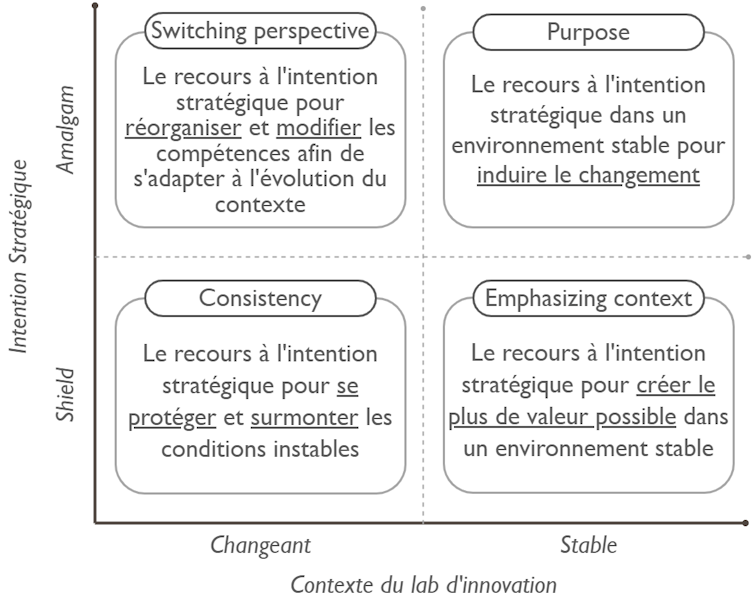
Nos recherches ont permis de dégager deux grandes approches pour construire et maintenir cette intention stratégique dans un lab d’innovation : la posture « amalgam » – intégrer des intentions multiples dans un cadre commun – et la posture « shield » – protéger l’intention initiale contre les pressions extérieures. Ces termes, issus de nos travaux récents, permettent d’illustrer deux manières contrastées de maintenir une intention stratégique partagée.

  • La posture « amalgam » consiste à intégrer plusieurs ambitions dans un projet collectif cohérent. Un excellent exemple est celui du fabLab Héphaïstos, à l’hôpital du Kremlin-Bicêtre (Val-de-Marne). Ce lab hospitalier a réussi à harmoniser trois grandes intentions : améliorer le soin aux patients, faciliter le travail des soignants et optimiser les processus internes. La clé de ce succès ? Une démarche collective régulière pour clarifier, revisiter et articuler ces intentions multiples dans un cadre commun.

  • La posture « shield », elle, consiste à protéger activement l’intention stratégique initiale contre les pressions extérieures. C’est l’approche adoptée par le Lab101 (ancien ViveLab Bogotá), en Colombie, qui, malgré des contextes politiques fluctuants, a réussi à garder un objectif clair : renforcer les capacités numériques et d’innovation des citoyens. Cette « protection de son éthos » leur a permis de maintenir le sens de leurs actions sur le long terme malgré les turbulences. Mais ces deux postures ne suffisent pas toujours. Le vrai défi est de savoir quand et comment les activer.

Trouver des points communs

Fondamentalement, l’intention stratégique prend ses racines dans des motivations individuelles et personnelles. Chaque individu porte ses propres attentes et visions. Mais dès lors qu’on décide de travailler ensemble, il est essentiel de trouver des points communs qui donnent naissance à une intention collective et organisationnelle. Comment savoir quand intégrer différentes visions, quand accepter une certaine fragmentation, ou quand préserver jalousement l’intention initiale ? Pour répondre à ces questions, nous avons conçu un cadre dynamique, permettant aux équipes d’ajuster et de faire évoluer leur intention stratégique au quotidien. Ce cadre repose sur quatre modes clés :

  • « Purpose » (Créer du sens) : Au démarrage du lab, il est crucial d’expliciter clairement et collectivement ce qu’on veut transformer, pour qui et pourquoi. Cette étape permet à tous les acteurs impliqués de comprendre exactement pourquoi le lab existe, et comment chacun peut y contribuer.

  • « Switching perspective » (Changer de perspective) : Quand le contexte change brusquement (changements politiques, nouveaux directeurs, nouvelles priorités), les équipes doivent être capables de réajuster leur angle d’approche sans perdre leur identité. Le cas du SDU-MCI Innovation Lab au Danemark illustre bien cette tension. Ce lab universitaire a connu des visions successives portées par différents responsables, chacune porteuse de nouvelles orientations. La difficulté résidait alors dans la capacité individuelle à maintenir une intention stratégique partagée, face à cette succession de perspectives parfois difficiles à intégrer. Résultat : confusion et perte d’énergie collective malgré des ressources considérables.

Forte capacité d’adaptation

  • « Emphasizing context » (Mettre l’accent sur le contexte) : Les labs doivent régulièrement adapter leurs priorités en fonction des réalités locales, des besoins des usagers ou des signaux faibles du terrain. Le Lab101 à Bogotá est exemplaire sur ce point. Grâce à une forte capacité d’adaptation à son contexte local, ce lab a pu amplifier le périmètre de ses actions et répondre de manière efficace aux évolutions du territoire et aux attentes des citoyens, tout en gardant son intention initiale.

  • « Building consistency » (Construire la cohérence) : Il s’agit ici de créer des ponts réguliers entre les actions concrètes menées au quotidien et l’intention stratégique définie au départ. Le Lorraine Fab Living Lab (LF2L) illustre parfaitement ce mode. Grâce à des discussions régulières au sein de son équipe, le LF2L a réussi à préserver la cohérence entre ses projets quotidiens et sa vision stratégique initiale, même face aux changements des priorités de son écosystème.

Matrice des intentions stratégiques (Osorio et coll., 2025).
CC BY-NC-SA

Cette matrice simple (créer du sens, changer de perspective, insister sur le contexte, construire la cohérence) s’est révélée particulièrement utile pour permettre aux équipes d’innovation de ne pas se perdre en chemin, surtout dans des contextes changeants ou sous pression.

Des espaces vides de sens ?

Au-delà des résultats concrets immédiats, ce qui fait véritablement la force d’un lab d’innovation, c’est sa capacité à expliciter et à maintenir une intention partagée, claire et régulièrement actualisée. Sans cette intention stratégique, les labs risquent de devenir des espaces séduisants mais vides de sens, incapables d’engendrer une réelle transformation.

Finalement, le défi posé par ces labs d’innovation est avant tout un défi humain : il s’agit de construire et de maintenir une direction collective dans des environnements souvent complexes et mouvants. Ainsi, peut-être devrions-nous apprendre à mesurer l’innovation non seulement à travers les prototypes ou les succès immédiats, mais avant tout par la clarté et la solidité des intentions partagées par ceux qui l’incarnent au quotidien.

Redonner du sens à l’innovation collective est sans doute le meilleur moyen d’éviter que ces labs prometteurs ne perdent leur cap. Car une chose est sûre : pour innover profondément, il ne suffit pas d’avoir des ressources matérielles. Il faut savoir où l’on va, avec qui, et surtout pourquoi.

The Conversation

Ferney Osorio a reçu des financements de l’ANR et de MINCIENCIAS (Colombie). Il est également cofondateur du ViveLab Bogotá (aujourd’hui Lab101).

ref. Pourquoi tant de labs d’innovation peinent-ils à trouver leur cap ? – https://theconversation.com/pourquoi-tant-de-labs-dinnovation-peinent-ils-a-trouver-leur-cap-264595

Réparer, recycler, prédire : l’IA au cœur du design organisationnel des distributeurs « phygitaux »

Source: The Conversation – in French – By Hassiba Sadoune, Doctorante en science de gestion , Université de Caen Normandie

L’impact de l’intelligence artificielle sera plus profond qu’on ne l’anticipe parfois. En combinant points de vente physiques et canaux digitaux, la manière de concevoir le cycle de vie des produits va subir des évolutions. Dans la distribution, cela annonce un net changement de la façon de travailler.


L’intelligence artificielle (IA) constitue aujourd’hui un levier à fort potentiel de transformation pour les modèles économiques et organisationnels, notamment dans le secteur de la distribution. Comme le soulignent Belkadi et al., elle redéfinit les dynamiques organisationnelles et optimise la performance à travers la gestion intelligente des stocks, la personnalisation, et l’automatisation des processus.

D’après une étude publiée par IBM en 2025, les investissements en IA devraient progresser significativement dans les années à venir : +52 % à l’échelle mondiale et +62 % en France. Et si l’intelligence artificielle ne servait pas uniquement à automatiser ou à vendre plus ? Et si, dans l’ombre des algorithmes, se jouait une transition vers un commerce plus responsable ?

Une évolution du design organisationnel

Ce glissement des usages de l’IA, du pilotage de la performance à l’optimisation des flux, constitue l’objet d’une recherche doctorale en cours à l’Université de Caen au sein du Nimec, consacrée à l’évolution du design organisationnel dans les enseignes dites « phygitales » – ces entreprises qui combinent points de vente physiques et canaux digitaux.

Le design organisationnel, tel que défini par Jay Galbraith, représente un processus d’alignement de cinq dimensions clés d’une organisation : la stratégie, la structure, les processus, les récompenses et les individus, en vue d’atteindre efficacement les objectifs organisationnels. Cette approche englobe la conception des mécanismes de coordination, des flux décisionnels, des systèmes d’information, ainsi que des dynamiques comportementales qui permettent à l’organisation de fonctionner de manière cohérente, et adaptée à son environnement.


À lire aussi :
IA dans la vente : plus efficace, mais moins humaine ?


L’étude s’appuie sur une méthodologie qualitative d’étude de cas, mobilisant un corpus empirique composé d’entretiens semi-directifs et de podcasts professionnels de cadres du secteur de la distribution omnicanale. L’analyse adossée à une version actualisée du modèle de design organisationnel de Galbraith interroge la manière dont l’intelligence artificielle contribue à recomposer les organisations à l’intersection de l’agilité, de la sobriété et de l’innovation responsable.

Réparer : nouveaux usages pour nouvelles finalités

« Ce qu’on fait en SAV devient central : le reconditionné, les garanties prolongées… c’est là que la marge se rejoue »,

confie un cadre d’une enseigne de distribution de produits culturels et technologiques, lors d’un entretien récent consacré au service après-vente et à la durabilité. Cette observation, loin d’être anecdotique, signale un changement de paradigme économique fondamental. La création de valeur ne s’opère plus uniquement lors de l’acte d’achat, mais s’étend sur l’ensemble du cycle de vie du produit.

Concrètement, l’IA permet de prédire les pannes avant qu’elles ne surviennent, d’anticiper les besoins en pièces détachées, d’identifier les produits qu’il vaut mieux réparer plutôt que remplacer. Cette approche prédictive transforme radicalement la logique commerciale : plutôt que de maximiser les ventes, l’objectif devient d’optimiser la durée de vie et l’utilité des produits vendus.

Loin de l’image d’une IA « dopée à la performance », émergent ainsi les contours d’une intelligence artificielle d’entretien, de soin, de maîtrise des ressources. Cette évolution interroge nos représentations du progrès technologique et ouvre la voie à de nouveaux modèles économiques centrés sur la durabilité.

Recycler : des rôles redessinés

Ces transformations technologiques induisent des recompositions organisationnelles profondes. Comme l’explique un directeur digital :

« Avec la data, on peut mieux préparer les interventions et en éviter certaines. »

Cette optimisation des flux opérationnels s’accompagne d’un vaste chantier de formation humaine, comme le souligne un directeur de la transformation :

« Former 100 % de nos collaborateurs, au siège comme en magasin, à l’utilisation de l’IA. Nous imaginons même mettre en place des certifications IA pour nos vendeurs. »

Cette évolution dessine les contours d’organisations plus modulaires et moins hiérarchiques. Les techniciens SAV anticipent les réparations plutôt que de subir les pannes, les conseillers s’appuient sur l’IA générative pour automatiser les tâches répétitives, les vendeurs développent de nouvelles compétences digitales. L’organisation devient un dispositif vivant, caractérisé par des flux, des ajustements constants et des apprentissages partagés – configuration que Worley et Lawler (2010) qualifient d’agilité organisationnelle.

Le recyclage, traditionnellement relégué en fin de chaîne, devient ainsi un processus intégré dès la conception du parcours client. L’IA permet d’identifier instantanément le potentiel de valorisation de chaque produit retourné, transformant les espaces de stockage et développant de nouvelles expertises en évaluation produit.

Prédire : doser plutôt qu’automatiser

Ce repositionnement de l’IA dans les organisations exige une forme de lucidité technologique. L’IA reste une technologie énergivore, avec des effets ambivalents sur la durabilité. Comme l’explique un directeur de la transformation d’une enseigne de distribution spécialisée :

« La question n’est pas seulement d’intégrer l’IA pour des gains de performance, mais de l’inscrire comme un pilier de durabilité dans l’expérience client. »

L’enjeu n’est donc pas d’implémenter l’intelligence artificielle partout, mais de l’utiliser avec discernement : là où elle réduit réellement les gaspillages, améliore la qualité de service, optimise la maîtrise logistique et valorise les expertises terrain.

Un manager illustre cette approche par une métaphore éclairante :

« Le thermomètre indique la température. Ce n’est pas en disant “Je veux monter la température” qu’on va la faire monter. Il faut allumer le chauffage ».

Autrement dit : c’est l’organisation de l’action, pas la donnée, qui fait la différence.

Cette capacité prédictive restructure les processus décisionnels en permettant aux équipes de terrain d’accéder à des informations stratégiques en temps réel, aux managers d’ajuster les stocks selon des projections fiables, et aux directions de disposer d’une vision prospective pour orienter leurs investissements.

Arte 2024.

Vers une intelligence artificielle de la sobriété

Cette recherche doctorale montre que l’IA ne transforme pas l’organisation seule. Elle le fait à condition d’être portée par une structure agile, capable de décentraliser les décisions, de former, d’ajuster, de relier les objectifs à des pratiques concrètes – soit une véritable organisation lucide.

Les analyses empiriques convergent vers une conclusion stimulante : réparer, recycler et prédire ne constituent pas seulement trois fonctions opérationnelles, mais trois piliers d’une circularité servicielle émergente. Cette innovation organisationnelle, documentée dans les trois configurations étudiées, révèle que l’IA transforme la relation client en vecteur de durabilité : l’anticipation des pannes devient un service premium, le reconditionnement génère de la satisfaction client, l’accompagnement dans la durée de vie produit crée de la fidélisation.

Cette synthèse dépasse l’opposition traditionnelle entre rentabilité et responsabilité pour inventer un modèle où l’excellence « servicielle » devient le levier de l’économie circulaire.

Les distributeurs phygitaux, en tant qu’interfaces entre production et consommation, deviennent des laboratoires d’expérimentation où s’inventent de nouveaux équilibres entre efficacité opérationnelle et impact environnemental. De ces pratiques émerge l’idée d’une « IA de la sobriété » : non plus orientée vers l’accélération des flux, mais vers l’optimisation des ressources et la réduction des gaspillages.

Reste une question essentielle : sommes-nous prêts à penser l’IA comme un levier de sobriété, à revoir le design de nos organisations pour qu’elles servent moins à faire plus… qu’à faire mieux ? Tout porte à croire que la réponse dépend moins de la technologie elle-même que de notre capacité collective à transformer les modèles organisationnels qui l’accompagnent. La mutation est engagée : encore faut-il l’accompagner pour qu’elle contribue réellement à un commerce plus durable et plus responsable.

The Conversation

Hassiba Sadoune ne travaille pas, ne conseille pas, ne possède pas de parts, ne reçoit pas de fonds d’une organisation qui pourrait tirer profit de cet article, et n’a déclaré aucune autre affiliation que son organisme de recherche.

ref. Réparer, recycler, prédire : l’IA au cœur du design organisationnel des distributeurs « phygitaux » – https://theconversation.com/reparer-recycler-predire-lia-au-coeur-du-design-organisationnel-des-distributeurs-phygitaux-259747

Les Family Offices en avant vers les marchés non cotés

Source: The Conversation – in French – By Mohamed Ouiakoub, Maître de conférences en Sciences de gesiton à l’Université de Lorraine, Université de Lorraine

Plus de 40 % des Family Offices disent consacrer 20 % ou plus de leur portefeuille au capital-risque, c’est-à-dire à des investissements dans des sociétés non cotées, comme Auchan ou les Galeries Lafayette. Mapo_Japan/Shutterstock

Les Family Offices, ces structures qui gèrent le patrimoine d’une famille fortunée, investissent de plus en plus dans les marchés privés (non cotés), perçus comme plus rémunérateurs à long terme que les marchés cotés comme le CAC 40. Pourquoi ? Avec quelles limites ?


En Europe, les grandes fortunes familiales s’appuient sur un « Family Office ». Leur patrimoine dépasse généralement les 100 millions d’euros, et atteint en moyenne 1,3 milliard selon l’étude mondiale UBS.

Ces familles se tournent massivement vers le capital-investissement ou private equity, qui consiste à prendre des participations au capital de sociétés non cotées, comme le distributeur Leclerc, le producteur laitier Lactalis ou Galeries Lafayette.

Comme nous l’analysons dans notre article à paraître dans la revue Vie et sciences de l’entreprise, « l’investissement à impact dans les Family Offices : entre héritage et quête de sens », les Family Offices cherchent à accroître leur présence dans le capital-investissement, mais leurs moyens humains et organisationnels restent limités.

Notre étude menée montre que certaines familles affectent plus de 20 % de leur patrimoine à ce type d’investissement. Pourtant, près de 70 % de ces structures comptent moins de dix collaborateurs et moins de la moitié disposent d’un comité d’investissement structuré.

Alors, comment ces grandes fortunes familiales structurent-elles cette nouvelle stratégie ?

Les différentes formes de Family Offices

Un Family Office est une structure privée consacrée à la gestion globale du patrimoine d’une famille fortunée. Il peut assurer des fonctions financières – investissements, fiscalité, transmission, etc. –, mais aussi juridiques, philanthropiques ou éducatives. Ces structures sont nées pour accompagner la pérennité du capital familial sur plusieurs générations, en intégrant des objectifs à la fois financiers, humains et émotionnels.

Ces enjeux sont au cœur de la littérature récente sur la création de valeur durable dans les entreprises familiales, en particulier lorsque les Family Offices participent activement aux décisions stratégiques du groupe familial. Il en existe plusieurs formes.

  • Les single family offices, entièrement consacrés à une seule famille.

  • Les multi-family offices, qui gèrent les patrimoines de plusieurs familles, parfois sans lien entre elles. D’autres structures, dites professionnalisées, sont intégrées à des institutions financières.

  • Les Family offices « intégrés » dans l’entreprise familiale.

  • Les Virtual Family Offices, lorsque la structure externalise la majorité de ses services.

Moins de dix personnes en moyenne

Les Family Offices renforcent progressivement leur exposition au capital-investissement, ou private equity, c’est-à-dire l’achat de parts dans des entreprises non cotées. Plus de 40 % des Family Offices interrogés y consacrent plus de 20 % de leur portefeuille, un niveau élevé pour des structures non institutionnelles. Ce choix traduit une confiance croissante dans les marchés privés, perçus comme plus rémunérateurs à long terme que les marchés boursiers traditionnels.

Cette ambition d’allocation se heurte toutefois à des moyens internes limités. La plupart des Family Offices emploient moins de dix personnes et moins de la moitié disposent d’un comité d’investissement structuré. Autrement dit, ils gèrent des portefeuilles complexes avec peu de personnel, souvent sans processus formalisé, ce qui fragilise leur capacité d’analyse, de sélection et de suivi des investissements.

Le principal frein cité par les répondants reste, d’ailleurs, le manque de ressources internes.

Relations humaines

Les investissements réalisés par les Family Offices passent avant tout par leur réseau direct. La majorité des opportunités provient de contacts personnels, loin devant les intermédiaires ou les événements professionnels. Cette approche repose sur la confiance et l’intuition. Mais en se limitant à leur cercle relationnel, ces familles risquent de passer à côté de projets plus innovants ou d’entreprises en dehors de leur environnement habituel.

Dans la répartition de leurs investissements, les familles privilégient les entreprises à fort potentiel de croissance, où elles peuvent mettre à profit leur expérience entrepreneuriale. Lorsqu’il s’agit d’opérations plus techniques, comme les rachats d’entreprises financés par l’endettement bancaire (appelés « Leveraged Buy-Out », ou LBO), elles préfèrent déléguer à des fonds spécialisés. Ces fonds disposent d’équipes nombreuses et aguerries capables de structurer des montages financiers complexes, ce que les petites équipes des Family Offices ne peuvent pas toujours assurer.

Cette complémentarité entre investissement direct et indirect traduit une certaine prudence stratégique. Les familles recherchent avant tout un fort alignement avec les porteurs de projet. Elles tiennent aussi à pouvoir jouer un rôle actif auprès des entreprises dans lesquelles elles investissent, en partageant leur réseau, leur expertise sectorielle ou leur expérience d’entrepreneurs, et pas seulement en apportant du capital.

Valeur durable des entreprises familiales

L’intégration de critères ESG dans les analyses reste minoritaire. Moins de 40 % des Family Offices déclarent prendre en compte les enjeux environnementaux, sociaux ou de gouvernance dans leurs décisions d’investissement selon les résultats de l’étude menée. Ce chiffre montre que la finance durable progresse lentement dans ce segment, malgré une forte montée en puissance dans les pays nordiques ou en Allemagne. Ces questions sont au cœur des réflexions actuelles sur la valeur durable en entreprise familiale.

La qualité des informations disponibles et le manque de marge de négociation avec les fonds constituent des sources de frustration. Concrètement, les Family Offices se plaignent d’un accès limité à des données fiables sur les performances passées des fonds ou sur la solidité des entreprises ciblées. Ils déplorent une faible transparence sur les frais facturés : commissions de gestion annuelles, frais de performance (ou carried interest) ou encore frais annexes liés aux transactions.

Fortes attentes

Malgré ces contraintes, les Family Offices restent confiants dans la trajectoire du capital risque ou private equity. Près de deux tiers se disent optimistes pour les douze mois à venir. Une majorité vise un rendement interne supérieur à 15 % d’après les résultats de l’étude réalisée.


À lire aussi :
Les start-ups « deep tech » : une réponse aux enjeux du XXIᵉ siècle ?


Cette confiance repose en grande partie sur la qualité perçue des projets technologiques, notamment dans la santé et le deep tech. Ces secteurs sont les plus plébiscités, loin devant l’agritech, l’éducation ou la défense.

Les investisseurs familiaux cherchent à soutenir des innovations porteuses de sens, en lien avec leurs valeurs et leurs expériences entrepreneuriales.

Structurer sans dénaturer

La professionnalisation des Family Office ne doit pas faire perdre ce qui fait leur force : proximité avec les entrepreneurs, liberté stratégique et vision de long terme. Ce sont des atouts précieux dans un écosystème financier souvent standardisé.

Leur gouvernance, leurs choix d’organisation et leur rapport à la durabilité sont au cœur d’une réflexion croissante sur l’investissement à impact dans les grandes fortunes familiales. En naviguant entre héritage, contrôle familial et quête de sens dans la gestion de leurs actifs, les Family Offices sont aujourd’hui à un tournant.


Cet article a été co-écrit avec Rajaa Mekouar, fondatrice et managing partner de Calista Direct Investors.

The Conversation

Mohamed Ouiakoub ne travaille pas, ne conseille pas, ne possède pas de parts, ne reçoit pas de fonds d’une organisation qui pourrait tirer profit de cet article, et n’a déclaré aucune autre affiliation que son organisme de recherche.

ref. Les Family Offices en avant vers les marchés non cotés – https://theconversation.com/les-family-offices-en-avant-vers-les-marches-non-cotes-261408

Les coûts d’emprunt de l’Afrique sont trop élevés : l’occasion manquée par le G20 de réformer les agences de notation

Source: The Conversation – in French – By Misheck Mutize, Post Doctoral Researcher, Graduate School of Business (GSB), University of Cape Town

Au début de l’année 2025, l’un des engagements pris par la présidence sud-africaine du G20 dans son document Priorités politiques était de promouvoir des notations de crédit souveraines plus équitables et plus transparentes. Elle voulait aussi remédier au coût élevé du capital, souvent justifié par une perception illusoire de risque élevé dans les économies en développement.

L’Afrique du Sud avait proposé de créer une commission chargée d’examiner le coût du capital. L’objectif était d’identifier les problèmes qui empêchent les pays à faible et moyen revenu d’accéder à des flux de capitaux suffisants, abordables et prévisibles pour financer leur développement.

Pour beaucoup en Afrique, il s’agissait de bien plus qu’un simple document administratif. Cela représentait la première véritable occasion pour les pays du Sud de remettre en cause le pouvoir bien établi des agences de notation internationales par l’intermédiaire du G20.

Les avis de Moody’s, S&P Global Ratings et Fitch Ratings sont en effet au cœur du problème du coût élevé de l’emprunt en Afrique.

Mais les possibilités de progrès dans ce domaine s’amenuisent. Le gouvernement sud-africain et le monde des affaires du pays n’ont pas profité de l’occasion offerte par la présidence du G20, de décembre 2024 à novembre 2025, pour faire pression en faveur de réformes susceptibles de réduire les coûts d’emprunt de l’Afrique et de renforcer sa souveraineté financière.

Qu’est-ce qui explique le poids des notations de crédit ?

Les agences de notation de crédit ne sont pas des observateurs neutres des marchés financiers. Leurs jugements influencent directement le sentiment des investisseurs, l’accès au financement et les taux d’intérêt que les pays paient lorsqu’ils émettent des obligations.

Pour les pays en développement, en particulier en Afrique, les notations vont déterminer l’allocation par le gouvernement de ses maigres ressources : soit au service de la dette, soit aux besoins en terme de développement tels que les écoles et les hôpitaux.

Le souci, ce n’est pas seulement les notations en elles-mêmes, mais aussi le fait qu’elles sont souvent imprécises et basées sur des jugements subjectifs.

Les pays dotés d’économies en développement dénoncent fréquemment les problèmes liés à ces notations.

D’abord, les États africains subissent plus souvent que d’autres des dégradations de note qui ne reposent pas sur des fondamentaux économiques solides.

Deuxièmement, les analystes qui évaluent les risques travaillent le plus souvent hors du continent et appliquent des critères subjectifs, souvent pessimistes.

Troisièmement, les économies en développement sont pénalisées en raison de l’impact supposé des chocs externes tels que les pandémies mondiales ou les catastrophes climatiques.

Enfin, on relève des variations importantes dans la manière dont les facteurs de risque sont évalués en Afrique par rapport à des pays similaires en Asie ou en Amérique latine, qui ont des profils de risque proches.

Une occasion manquée de leadership

Le G20 reste le principal forum mondial où se réunissent les principales économies avancées et les économies en développement les plus influentes. En tant que pays qui en assure la présidence, l’Afrique du Sud a le pouvoir de définir l’ordre du jour, de constituer des groupes de travail et de rédiger des communiqués qui influencent les débats au niveau mondial.

Mais à ce jour, la commission proposée sur le coût du capital n’a pas été mise en place. On peut dès lors affirmer sans se tromper que la présidence sud-africaine du G20 n’a pas utilisé cette plateforme pour régler la question du coût du capital. Ses engagements en matière de réforme de la notation de crédit se sont limités à réitérer les éléments de langage. Elle n’a pas fait de propositions structurées dédiées à cette question.

Cette inaction étonne d’autant plus que l’Afrique du Sud connaît bien les effets des décisions de notation. Au cours des huit dernières années, une série de déclassements par les agences de notation internationales a conféré le statut dit « junk » à la dette du pays. Ces décisions ont entraîné une augmentation des coûts d’emprunt et ébranlé la confiance des investisseurs. Pretoria dispose donc à la fois de l’expérience et de la légitimité nécessaires pour mener un débat sur la réforme des notations souveraines.

Par ailleurs, le secteur financier et des entreprises sud-africain (banques, assureurs et investisseurs institutionnels) est resté largement en retrait dans cette séquence.

Des plateformes telles que le Cost of Capital Summit, organisées par le groupe de travail Business (B20), la Standard Bank, Africa Practice et le Mécanisme africain d’évaluation par les pairs, ont été utiles. Mais le monde des affaires sud-africain n’a pas su tirer parti de la présidence de son pays au G20 pour faire pression en faveur de réformes qui profiteraient non seulement aux entreprises nationales, mais aussi aux partenaires africains.

La baisse des coûts d’emprunt souverains dans les pays hôtes, par exemple, réduirait directement les risques macroéconomiques pour les entreprises sud-africaines opérant sur le continent et élargirait leurs possibilités d’investissement.

Ce qui aurait pu être fait

Trois mesures concrètes pourraient remettre la question de la réforme des notations de crédit à l’ordre du jour:

Le coût de l’inaction

Selon la CNUCED, les pays en développement paient des taux d’intérêt jusqu’à trois points de pourcentage plus élevés que leurs homologues ayant des fondamentaux similaires, ce qui représente des milliards de dollars de coûts supplémentaires chaque année.

Cette « taxe cachée » sur le développement a des conséquences humaines directes: moins de ressources pour les infrastructures, l’adaptation au changement climatique, les systèmes de santé et l’éducation. Pour l’Afrique, où les besoins de financement sont immenses, des notations de crédit plus précises pourraient libérer un espace budgétaire vital.

L’Afrique du Sud ne peut se permettre de laisser sa présidence du G20 se réduire à un symbole. La promesse de notations de crédit souveraines « plus justes et plus transparentes » doit se traduire en action, par le biais de groupes de travail, de communiqués et d’alliances qui font avancer la réforme.

Pretoria a également besoin que son secteur privé se mobilise. Il ne s’agit pas seulement d’un impératif moral, mais aussi d’un impératif économique.

Une prime de risque plus faible et un accès plus équitable au capital élargiront les opportunités à travers le continent, y compris pour les investisseurs sud-africains. Le monde entier a les yeux rivés sur l’Afrique du Sud. Si le pays ne saisit pas cette chance, il renforcera l’idée que le discours sur la réforme de l’architecture financière mondiale ne se résume qu’à des paroles en l’air. Si l’Afrique du Sud agit, elle pourra laisser un héritage qui dépasse ses propres difficultés internes : l’ébauche d’un système de notation plus juste et plus responsable pour le Sud global.

The Conversation

Misheck Mutize does not work for, consult, own shares in or receive funding from any company or organisation that would benefit from this article, and has disclosed no relevant affiliations beyond their academic appointment.

ref. Les coûts d’emprunt de l’Afrique sont trop élevés : l’occasion manquée par le G20 de réformer les agences de notation – https://theconversation.com/les-couts-demprunt-de-lafrique-sont-trop-eleves-loccasion-manquee-par-le-g20-de-reformer-les-agences-de-notation-266595