Projet d’attentat « incel » déjoué : décrypter le danger masculiniste

Source: The Conversation – in French – By Tristan Boursier, Docteur en Science politique, Sciences Po

Un adolescent a récemment été arrêté en France pour un projet d’attentat inspiré par le masculinisme, relançant l’alerte sur cette mouvance. Né en réaction aux avancées féministes, le masculinisme prétend défendre des hommes présentés comme opprimés et converge de plus en plus vers les idéologies d’extrême droite. Les réseaux sociaux offrent une nouvelle et inquiétante visibilité à cette mouvance, notamment auprès des jeunes hommes.


Le 27 juin 2025, un adolescent de 18 ans a été arrêté dans la région de Saint-Etienne (Loire). Il est soupçonné d’avoir projeté d’attaquer des femmes au couteau.

Le parquet national antiterroriste (PNAT) a, pour la première fois en France, mis un jeune homme en examen pour un projet d’attentat lié aux « incels » (contraction en anglais de « involuntary celibate » – célibataire involontaire – désignant une sous-culture en ligne caractérisée par une haine des féministes, accusées d’entraver leur accès sexuel aux femmes), qui s’inscrit plus largement dans la mouvance masculiniste.


À lire aussi :
‘ Adolescence ‘ est une critique poignante de la masculinité toxique chez les jeunes


Ce n’est un cas ni isolé, ni propre à la France. En 1989, Marc Lépine assassinait 14 femmes à l’École polytechnique de Montréal en dénonçant le féminisme. En 2014, aux États-Unis, Elliot Rodger tuait six personnes, expliquant dans un manifeste sa rancœur envers les femmes qui ne le désiraient pas. Depuis, plusieurs attentats perpétrés par des hommes ont été revendiqués au nom d’une même idéologie : le masculinisme.

Pour les masculinistes, les féministes et les femmes auraient inversé les rapports de domination, les hommes seraient désormais opprimés et il faudrait des mesures pour les protéger. Un récit fondé sur ce que le politologue Francis Dupuis-Déri appelle « le mythe de la crise de la masculinité ».

Le masculinisme : une résistance aux avancées féministes

Ces passages à l’acte sont souvent interprétés comme des dérives psychiatriques. Cette lecture psychologisante obère toutefois la dimension collective et politique du masculinisme qui doit être considéré comme un contre-mouvement social, c’est-à-dire une mobilisation qui se forme en opposition (en réaction) à un mouvement progressiste, ici le féminisme, pour défendre un ordre social hiérarchisé précis.

Le masculinisme s’organise activement – hors ligne et en ligne – contre l’égalité des genres, pour défendre les privilèges masculins mis en cause par les luttes féministes. La sociologue Mélissa Blais le décrit comme un contre-mouvement structuré, enraciné dans l’histoire des résistances aux avancées féministes.


À lire aussi :
Masculinisme : une longue histoire de résistance aux avancées féministes


Bien qu’ancré dans une histoire longue, le masculinisme connaît aujourd’hui une reconfiguration numérique inédite, portée par la circulation transnationale de contenus sur les réseaux sociaux. Ce n’est pas tant son idéologie qui est nouvelle, que ses formes, ses publics et ses canaux de diffusion.

Les réseaux sociaux ne créent pas cette idéologie, mais ils la rendent plus visible, plus accessible, et surtout plus attractive pour un public jeune en quête d’identité, de repères genrés et de récits explicatifs du monde. Ce nouvel écosystème permet ainsi au masculinisme d’échapper à la marginalité dans laquelle il était autrefois cantonné, pour s’imposer comme une forme contemporaine d’engagement réactionnaire.

Une idéologie qui prolifère dans la « manosphère »

Aujourd’hui, cette idéologie prolifère dans la « manosphère », un ensemble de sous-cultures numériques que l’on retrouve, par exemple, sur des forums comme Reddit (une plate-forme communautaire américaine qui regroupe des milliers de sous-forums thématiques, souvent modérés de façon laxiste), des chaînes YouTube, des serveurs Discord ou des groupes Telegram.

Dans ces espaces circulent des discours haineux, des guides de drague problématiques (valorisant la manipulation et mettant au second plan le consentement) et des appels à ce qui est décrit comme une revanche sexuelle à prendre sur les femmes, à travers, notamment, le viol ou le revenge porn.

La « néo-manosphère », selon certains chercheurs, s’est intensifiée au cours de la dernière décennie en migrant vers des plates-formes peu modérées, en s’adaptant aux codes de l’influence virale et en croisant ses récits avec ceux de l’extrême droite, du suprémacisme blanc ou du complotisme.

Ces contenus visent un public jeune et masculin, en quête de repères virils dans un monde présenté comme féminisé. Ils mobilisent des audiences massives, bien au-delà des marges. En France, des influenceurs masculinistes cumulent des abonnés et semblent connus des plus jeunes (moins de 15 ans) comme l’indiquent des éléments réunis par la commission d’enquête parlementaire sur les effets psychologiques de TikTok chez les jeunes.

Le masculinisme converge de plus en plus vers les idéologies d’extrême droite. Cette alliance se construit autour d’un récit commun : celui d’un ordre social menacé par l’égalité, la diversité et la modernité.

Comme le montrent plusieurs études récentes, les discours antiféministes servent souvent de porte d’entrée vers des idées d’extrême droite (racisme, suprémacisme blanc, autoritarisme, opposition à la démocratie). Ainsi, selon ces recherches, près de 30 % des internautes fréquentant des espaces antiféministes migrent ensuite vers des contenus d’extrême droite. D’autres études non seulement confirment ces résultats mais précisent que les personnes exposées à du sexisme en ligne sont 10 % plus susceptibles d’approuver des idées radicales violentes, même si elles ne votent pas à l’extrême droite.

Un contre-mouvement exploité politiquement à l’extrême droite

Le masculinisme est aujourd’hui exploité par des figures d’extrême droite dans les espaces numériques. Thaïs d’Escufon, ex militante de Génération identitaire– groupuscule dissous en mars 2021 par le ministère de l’Intérieur, a par exemple réorienté ses productions numériques vers le masculinisme et vend des formations à destination des jeunes hommes, mêlant conseils de développement personnel, coaching en virilité, revalorisation de rôles genrés traditionnels, critique du féminisme et surtout conseils de drague.

Julien Rochedy, ancien président du Front national de la jeunesse, a également misé sur le masculinisme tout en produisant des discours suprémacistes blancs sur sa chaîne YouTube.


À lire aussi :
Papacito ou comment les youtubeurs d’extrême droite gagnent leurs abonnés


Les discours masculinistes sont aussi investis par certains politiques. Aux États-Unis, Donald Trump a délibérément soutenu des figures de la manosphère comme Andrew Tate ou Jordan Peterson, contribuant à mobiliser une partie de l’électorat masculin.

Ce type de rhétorique se retrouve également ailleurs : au Brésil, avec l’ancien président Jair Bolsonaro, qui a multiplié les déclarations sexistes et homophobes ; en Argentine, avec Javier Milei. Dans ces cas, le masculinisme devient un vecteur de mobilisation politique autour d’une identité masculine perçue comme menacée. Il permet de réactiver des affects de ressentiment en les articulant à une promesse de restauration de l’ordre patriarcal.

Cette convergence est d’autant plus inquiétante qu’elle s’accompagne d’une hausse de la menace terroriste liée à l’ultra droite : en France, en 2021, 29 personnes ont été arrêtées pour des faits de terrorisme liés à l’ultra droite contre 5 en 2020 et 7 en 2019 – le djihadisme demeurant la principale menace. Fin 2023, le ministre de l’Intérieur Gérald Darmanin évoquait 13 attentats d’ultra droite déjoués depuis 2017. Aux États-Unis, l’extrême droite est devenu la première cause de mortalité liée aux idéologies extrémistes depuis 2014 : sur les 442 personnes tuées par des extrémistes entre 2014 et 2023, 336 (soit 76 %) l’ont été par des extrémistes de droite.

Ces passages à l’acte s’inscrivent dans des réseaux, récits et références partagés. Comme le rappelle l’Anti-Defamation League, les nouvelles formes d’extrémisme se fondent sur une posture victimaire : des hommes qui se pensent persécutés, trahis par la modernité, autorisés à répondre par la violence.

Identifier le continuum masculiniste

Reconnaître le caractère politique du masculinisme plutôt que le réduire à des problématiques psychologiques individuelles est indispensable pour y répondre. Cela implique une formation plus poussée des magistrats, journalistes et enseignants à ces phénomènes. Cela suppose aussi une meilleure régulation des espaces numériques où ces idées circulent.

Il s’agit d’une part de reconnaître ce qui ne relève pas de l’opinion mais de l’incitation à la haine et d’autre part, de ne pas se focaliser uniquement sur les actes ou prises de position les plus spectaculaires (comme les influenceurs qui jouent volontairement sur l’outrance pour viraliser leurs contenus) et les plus meurtriers.

Si le masculinisme réussit à se répandre c’est aussi parce qu’il s’appuie sur des idées sexistes banalisées et qui sont déjà bien ancrées dans nos sociétés tels que la supposée émotivité et vénalité des femmes ou la meilleure rationalité des hommes.

Ces préjugés sont souvent inculqués dès l’enfance à travers une éducation genrée (deux tiers des femmes déclarent avoir été éduquées différemment des garçons). Cette socialisation différenciée naturalise les inégalités, que les discours masculinistes réactivent ensuite pour justifier la hiérarchie entre les sexes.

The Conversation

Tristan Boursier a reçu des financements du Fonds de recherche du Québec société et culture (FRQSC).

ref. Projet d’attentat « incel » déjoué : décrypter le danger masculiniste – https://theconversation.com/projet-dattentat-incel-dejoue-decrypter-le-danger-masculiniste-260711

I’m a statistics professor who became embroiled in the world of online chess drama

Source: The Conversation – Canada – By Jeffrey S. Rosenthal, Professor of Statistics, University of Toronto

As a mild-mannered statistics professor, it’s not often that I get
contacted directly by the CEO of a multi-million-dollar company, much less regarding allegations of cheating and malfeasance among world champions.

But that’s precisely what happened last summer. Erik Allebest, CEO of the world’s largest online chess site, Chess.com, asked me to investigate former world chess champion Vladimir Kramnik’s concerns about the long winning streaks of top player Hikaru Nakamura.

Kramnik argued that these streaks had very low probability and were therefore very suspicious and “interesting.” He didn’t quite accuse Hikaru of cheating, but the implication was clear. Feelings were running high, with Kramnik’s supporters posting angry comments (often in Russian) about cheating as many Chess.com players and Hikaru partisans dismissed the accusations.

Who was right? Who was wrong? Who could say?

Allebest asked me to conduct an independent, unbiased statistical analysis to see just how unlikely those chess winning streaks actually were.

Now, I am no stranger to public statistical disputes, having published a
best-selling book about everyday probabilities and conducted the statistical analysis for the high-profile lottery retailer scandal. But could statistical analysis really help to clarify this simmering controversy on the world’s biggest chess stage?

Statistician Jeffrey Rosenthal responds to questions about statistics for WIRED in a video that has received 2.4 million views since February 2022.

Calculating probabilities

To sort this out, I first had to calculate the probability of each player winning or tying each game. Different players can have very different abilities, and more advanced players have a greater chance of defeating less experienced opponents. But just how great?

Chess.com assigns a chess rating to each player after each game, and these ratings were shared with me. My analysis suggested that a certain logistic — or s-shaped — curve function provided an accurate estimate of each game’s probabilities.

Furthermore, deviations from this probability in successive game results were approximately independent, so the influence of one game on the next could be safely ignored. This gave me a clear probability of each player winning each game.

I could then analyze those winning streaks that had provoked so much ire. It turned out that Hikaru, unlike most other top players, had played lots of games against much weaker players. This gave him a very high probability of winning each game. But even so, should he have such long winning streaks, sometimes more than 100 games in a row?

Testing randomness

To check this, I conducted some Monte Carlo simulations, which repeat a test with random variations.

I wrote computer programs to randomly assign wins and losses and draws to each of Hikaru’s games, according to the probabilities from my model. I had the computer measure the most surprising winning streaks each time. This allowed me to measure how Hikaru’s actual streaks stacked up against what we should expect.

I found that in many of the Monte Carlo simulations, the
simulated results included streaks just as unlikely as the actual ones.
This demonstrated that Hikaru’s chess results were just about what might
be expected. He had such a high probability of winning each game, and had played so many games on Chess.com, that such long winning streaks were likely to emerge according to the rules of probability alone.

Responses to findings

I wrote up a brief report of my findings, and sent it to Chess.com.
It ran a news item on its site, which elicited many comments, mostly supportive.

Hikaru then posted his own video commentary, also supporting my analysis. But meanwhile, Kramnik posted a 29-minute video criticizing my research.

Kramnik did include some substantive points, so I wrote an addendum to my report to address his concerns and show that they would not effect the conclusion. I also converted my report into a formal paper, which I submitted to a research journal.

I then got busy with my teaching duties and put the chess controversies
out of my mind until I received a response in December. It consisted of three referee reports and editor comments, with detailed comments totalling six single-spaced pages.

I also then discovered that Kramnik had posted a second 59-minute video critiquing my addendum and raising additional points, too.

I addressed Kramnik’s and the referees’ additional points while revising my article for publication. My paper was finally published in the Harvard Data Science Review.

I was glad to have my findings published in a prestigious statistics journal, thus giving them a formal stamp of approval. And perhaps, at long last, to settle this particular champion-level chess controversy.

The Conversation

Jeffrey S. Rosenthal receives research funding from NSERC of Canada, but received no compensation from Chess.com or anyone else for this work.

ref. I’m a statistics professor who became embroiled in the world of online chess drama – https://theconversation.com/im-a-statistics-professor-who-became-embroiled-in-the-world-of-online-chess-drama-256294

How Philadelphia’s sanitation strike differed from past labor disputes in the city

Source: The Conversation – USA – By Francis Ryan, Associate Professor of Labor Studies and Employment Relations, Rutgers University

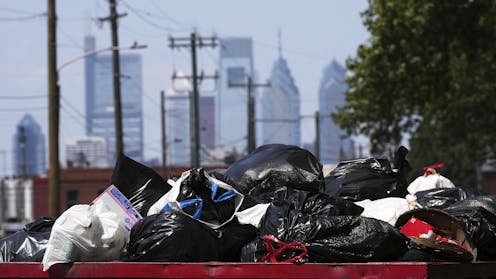
Trash piled up in Philadelphia during the 8-day strike that ended July 9, 2025. AP Photo/Matt Slocum

The Philadelphia municipal workers strike ended after eight days in the early hours of July 9, 2025.

The American Federation of State, County and Municipal Employees District Council 33 union’s 9,000 blue-collar workers, including sanitation workers, 911 dispatchers, city mechanics and water department staff, were called back to work immediately. The deal involves a three-year contract with 3% annual raises and an additional step in the union pay scale for veteran workers.

The Conversation U.S. asked Francis Ryan, a professor of labor studies at Rutgers University and author of “AFSCME’s Philadelphia Story: Municipal Workers and Urban Power in Philadelphia in the Twentieth Century,” about the history of sanitation strikes in Philly and what made this one unique.

Has anything surprised you about this strike?

This strike marked the first time in the history of labor relations between the city of Philadelphia and AFSCME District Council 33 union where social media played a significant role in how the struggle unfolded.

The union got their side of the story out on Instagram and other social media platforms, and citizens took up or expressed sympathy with their cause.

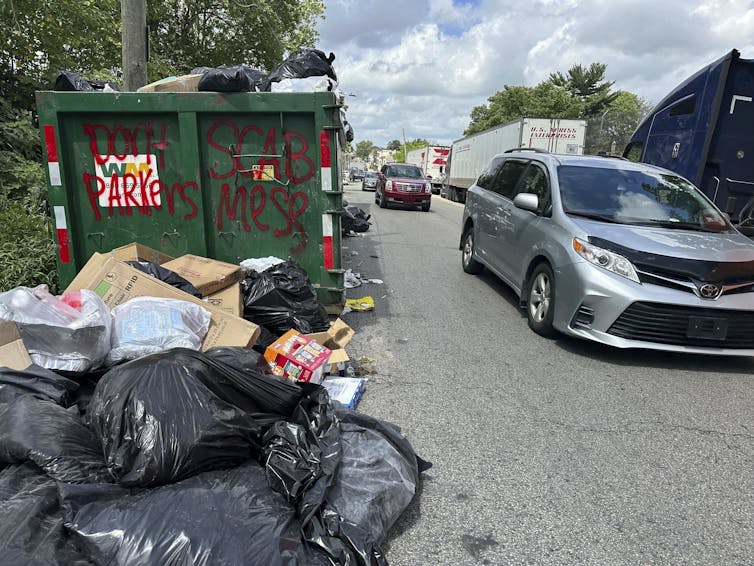
Piles of garbage on the street beside a green dumpster spray-painted with 'Don't Scab Parker's Mess'
Some city residents referred to the garbage buildup sites as ‘Parker piles.’
AP Photo/Tassanee Vejpongsa

How successful are trash strikes in Philly or other US cities?

As I describe in my book, Philadelphia has a long history of sanitation strikes that goes back to March 1937. At that time, a brief work stoppage brought about discussions between the city administration and an early version of the current union.

When over 200 city workers were laid off in September 1938, city workers called a week-long sanitation strike. Street battles raged in West Philadelphia when strikers blocked police-escorted trash wagons that were aiming to collect trash with workers hired to replace the strikers.

Philadelphia residents, many of whom were union members who worked in textile, steel, food and other industries, rallied behind the strikers. The strikers’ demands were met, and a new union, AFSCME, was formally recognized by the city.

This strike was a major event because it showed how damaging a garbage strike could be. The fact that strikers were willing to fight in the streets to stop trash services showed that such events had the potential for violence, not to mention the health concerns from having tons of trash on the streets.

There was another two-week trash strike in Philadelphia in 1944, but there wouldn’t be another for more than 20 years.

However, a growing number of sanitation strikes popped up around the country in the 1960s, the most famous being the 1968 Memphis sanitation strike.

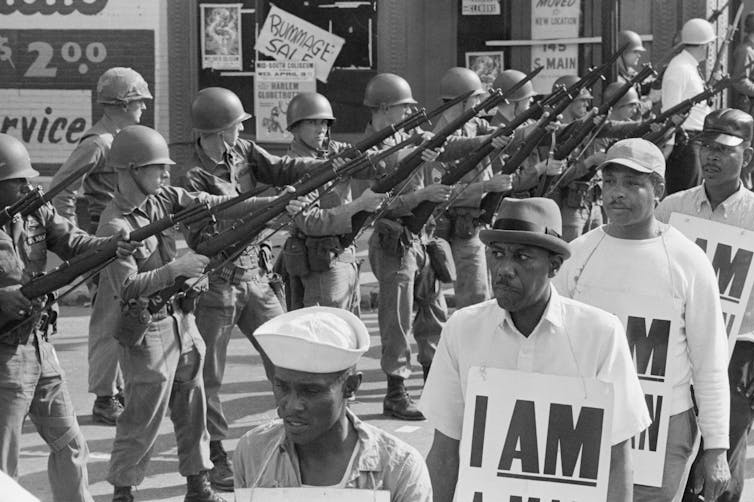
Black-and-white photo of a line of Black men walking past a row of white soldiers in uniform with bayonets fixed
Black sanitation workers peacefully march wearing placards reading ‘I Am A Man’ during the 1968 sanitation strike in Memphis, Tenn.
Bettmann via Getty Images

In Memphis, Tennessee, a majority African American sanitation workforce demanded higher wages, basic safety procedures and recognition of their union. Rev. Martin Luther King Jr. rallied to support the Memphis workers and their families as part of his Poor Peoples’ Campaign, which sought to organize working people from across the nation into a new coalition to demand full economic and political rights.

On April 4, 1968, King was assassinated. His death put pressure on Memphis officials to settle the strike, and on April 16 the strikers secured their demands.

Following the Memphis strike, AFSCME began organizing public workers around the country, and through the coming years into the 1970s, there were sanitation strikes and slowdowns across the nation including in New York, Atlanta, Cleveland and Washington. Often, these workers, who were predominantly African American, gained the support of significant sections of the communities they served and secured modest wage boosts.

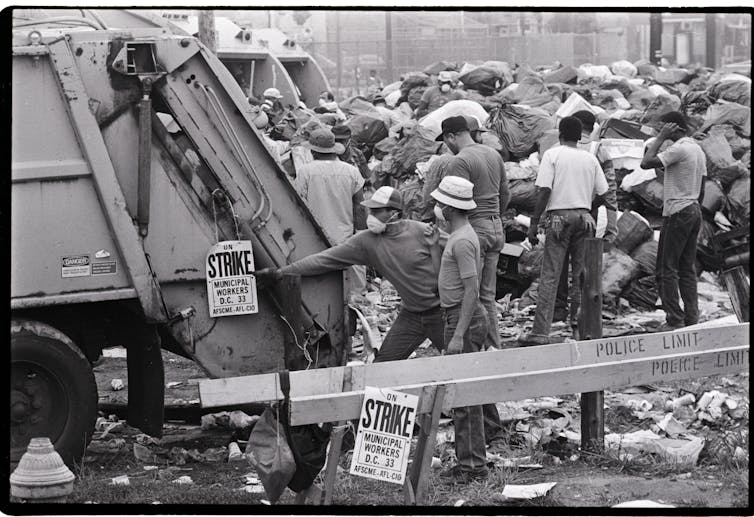
By the 1980s, such labor actions were becoming fewer. In 1986, Philadelphia witnessed a three-week sanitation strike that ended with the union gaining some of its wage demands, but losing on key areas related to health care benefits.

Black-and-white photo of men standing alongside a huge pile of trash and two trash trucks
Workers begin removing mounds of trash after returning to work after an 18-day strike in Philadelphia in July 1986.
Bettmann via Getty Images

How do wages and benefits for DC33 workers compare to other US cities?

District Council 33 President Greg Boulware has said that the union’s members make an average salary of US$46,000 per year. According to MIT’s Living Wage Calculator, that is $2,000 less than what a single adult with no kids needs to reasonably support themselves living in Philadelphia.

Prior to this deal, sanitation workers who collect curbside trash earned a salary of $42,500 to $46,200, or $18-$20 an hour. NBC Philadelphia reported that those wages are the lowest of any of the major cities they looked at. Hourly wages in the other cities they looked at ranged from $21 an hour in Dallas to $25-$30 an hour in Chicago.

Unlike other eras, the fact that social media makes public these personal narratives and perspectives – like from former sanitation worker Terrill Haigler, aka “Ya Fav Trashman” – is shaping the way many citizens respond to these disruptions. I saw a level of support for the strikers that I believe is unprecedented going back as far as 1938.

What do you think was behind this support?

The COVID-19 pandemic made people more aware of the role of essential workers in society. If the men and women who do these jobs can’t afford their basic needs, something isn’t right. This may explain why so many people saw things from the perspective of striking workers.

At the same time, money is being cut from important services at the federal, state and local levels. The proposed gutting of Philadelphia’s mass transit system by state lawmakers is a case in point. Social media allows people to make these broader connections and start conversations.

This article was originally published on July 8, 2025, and has been updated to include details of the strike’s resolution.

The Conversation

Francis Ryan does not work for, consult, own shares in or receive funding from any company or organization that would benefit from this article, and has disclosed no relevant affiliations beyond their academic appointment.

ref. How Philadelphia’s sanitation strike differed from past labor disputes in the city – https://theconversation.com/how-philadelphias-sanitation-strike-differed-from-past-labor-disputes-in-the-city-260676

La vannerie, un moyen d’inclusion financière au Sénégal : voici comment et pourquoi

Source: The Conversation – in French – By Yasmine SY, Ph.D candidate in Management Sciences – Academic Director, Groupe Supdeco Dakar

Longtemps reléguée à un savoir-faire domestique ou à un artisanat rural peu valorisé, la vannerie connaît aujourd’hui un regain d’intérêt en Afrique, à la croisée des enjeux culturels, économiques et environnementaux.

La vannerie est l’art de tresser des fibres végétales pour fabriquer des objets utilitaires ou décoratifs, comme des paniers, corbeilles, nattes, chapeaux, filets ou même des meubles.

Ce savoir-faire ancestral, transmis de génération en génération, est aujourd’hui réinterprété par une nouvelle génération d’entrepreneures africaines. À la tête d’initiatives audacieuses, elles repositionnent la vannerie non plus seulement comme pratique patrimoniale, mais comme levier d’innovation, de développement local et de rayonnement international.

Je suis chercheure en entrepreneuriat, spécialisée dans la transmission et la gouvernance des entreprises familiales en Afrique. J’observe que certains secteurs artisanaux comme la vannerie connaissent aujourd’hui des dynamiques de formalisation, d’innovation et d’essor économique portées en grande partie par des femmes entrepreneures.

Le cas d’Imadi, que nous avons étudié récemment, illustre de façon exemplaire la modernisation d’un secteur souvent perçu comme figé, à travers la réinvention des formes, des usages et des circuits de diffusion de la vannerie.

Imadi est une entreprise artisanale basée à Dakar. Elle valorise un savoir-faire traditionnel transmis de génération en génération. Elle produit des paniers tressés à la main, enrichis de finitions en cuir, aux designs modernisés tout en respectant les techniques ancestrales.

Mais jusqu’où ce modèle est-il réplicable ? Peut-il inspirer d’autres initiatives sur le continent? Quelles conditions doivent être réunies pour favoriser l’émergence d’un écosystème artisanal innovant?

Un secteur traditionnel en mutation

En Afrique de l’Ouest, plus particulièrement au Sénégal, l’artisanat demeure un secteur vital pour l’économie, à la fois comme réservoir d’emplois, vecteur d’identité culturelle et levier de résilience sociale. Au cœur de cet écosystème se trouve une activité méconnue mais fondamentale : la vannerie.

Selon les chiffres communiqués par le ministère sénégalais de l’Artisanat, le secteur représente entre 8 et 10 % du produit intérieur brut (PIB) national. Il mobilise environ un million d’artisans à travers 122 corps de métiers, dont plus de 70 % œuvrent dans l’économie informelle. Il s’agit d’un pan majeur de l’activité économique du pays : 98 % des unités économiques au Sénégal relèvent de l’artisanat, selon les données officielles du ministère délégué à l’Artisanat.

La participation des femmes est particulièrement significative dans les filières artisanales dites “traditionnelles”, notamment la vannerie, la poterie et la teinture. Une étude publiée en 2023 estime que les femmes représentent plus de 70 % des artisans dans le domaine de la vannerie. Elles sont souvent regroupées en coopératives ou Groupements d’intérêt économique (GIE) pour mutualiser leurs efforts de production et d’accès au marché.

Outre sa fonction économique, la vannerie joue un rôle socio-culturel essentiel. Pratiquée principalement dans les régions rurales et périurbaines (Kaolack, Thiès, Fatick, Saint-Louis), elle permet de préserver des savoir-faire ancestraux, tout en s’adaptant aux esthétiques contemporaines. Ces produits : paniers, corbeilles, tapis, couvercles, décorations murales, sont désormais exportés vers l’Europe et l’Amérique du Nord, notamment via des plateformes de commerce équitable ou de design éthique.

Ainsi, au fil des années, cette activité a évolué, devenant un secteur économique viable et en pleine expansion, soutenu par des femmes entrepreneures visionnaires.

Imadi est un exemple concret de cette transition. Fondée par une entrepreneure sénégalaise en 2017, Fatima Jobe, architecte de formation, l’entreprise produit des objets de vannerie à la fois décoratifs et utilitaires. En réinterprétant les formes traditionnelles avec une touche moderne, Imadi attire une clientèle internationale et locale de plus en plus soucieuse de la qualité et de l’origine des produits qu’elle consomme. Aujourd’hui, elle fait travailler plus d’une centaine de femmes dans une vingtaine de villages du Nord du Sénégal.

Les défis à relever

Toutefois, le secteur de la vannerie, bien qu’en pleine transformation, fait face à de nombreux défis. L’accès au financement reste une des principales difficultés. Les femmes entrepreneures dans l’artisanat sénégalais ont souvent du mal à obtenir des crédits bancaires, malgré le potentiel économique de leurs activités.

L’accès au financement constitue un obstacle majeur pour de nombreuses femmes entrepreneures au Sénégal. Bien qu’elles constituent un tiers des entrepreneurs, 87 % de femmes n’ont accès à aucun produit ou service financier.

De plus, la concurrence des produits importés bon marché menace la compétitivité des produits locaux. “Les produits importés, souvent à bas prix, créent une pression sur nos marges, mais nous ne sacrifierons pas la qualité et l’authenticité”, déclare Fatima Jobe, fondatrice d’Imadi.

Vers une transformation durable

Les initiatives de ce genre jouent un rôle clé dans la transformation de l’économie sénégalaise. En offrant des opportunités aux femmes, en particulier dans les zones rurales, elles participent activement à la création d’une économie plus inclusive. Sa fondatrice confie:

Je veux aider ces femmes, qui ont des talents incroyables, mais qui restent trop souvent en marge des circuits économiques, simplement faute de moyens de transport ou de visibilité.

Les femmes entrepreneures en Afrique, notamment dans des secteurs comme la vannerie, sont des moteurs de croissance dans les économies émergentes. Leur capacité à créer des emplois, à générer des revenus et à promouvoir des pratiques commerciales durables peut contribuer à réduire les inégalités et favoriser un développement économique plus équitable.

La clé de l’avenir du secteur réside dans l’intégration de nouvelles technologies et dans la capacité à s’adapter à un marché mondial en constante évolution.

De plus, l’Unesco estime que les industries culturelles et créatives, qui incluent l’artisanat, pourraient représenter jusqu’à 4 % du PIB africain d’ici 2030 et employer plus de 20 millions de personnes.

Un secteur en quête de consolidation

L’expérience d’Imadi illustre, parmi d’autres, les possibilités d’évolution d’un artisanat traditionnel porté majoritairement par des femmes. Sans être un modèle unique ou aisément reproductible, cette initiative montre qu’il est possible d’associer pratiques durables, ancrage local et ouverture aux marchés internationaux. Cette combinaison peut favoriser l’émergence de formes d’entrepreneuriat plus inclusives dans le secteur de la vannerie au Sénégal, voire en Afrique.

Pour que ce modèle se pérennise et se développe, il est impératif d’adresser les défis liés à l’accès au financement, à la formation technique et professionnelle et à la protection des produits locaux contre la concurrence déloyale.

En soutenant les femmes entrepreneures et en mettant en place des politiques publiques favorisant l’artisanat durable, le Sénégal pourrait renforcer sa position dans le secteur de la vannerie et dans d’autres secteurs artisanaux à forte valeur ajoutée.

Les femmes, au cœur de cette transformation, démontrent que l’artisanat ne se limite plus à un secteur traditionnel, mais qu’il peut être un véritable moteur de développement économique durable et inclusif pour l’avenir du Sénégal.

The Conversation

Yasmine SY does not work for, consult, own shares in or receive funding from any company or organisation that would benefit from this article, and has disclosed no relevant affiliations beyond their academic appointment.

ref. La vannerie, un moyen d’inclusion financière au Sénégal : voici comment et pourquoi – https://theconversation.com/la-vannerie-un-moyen-dinclusion-financiere-au-senegal-voici-comment-et-pourquoi-252665

‘Big Beautiful Bill’ will have Americans paying higher prices for dirtier energy

Source: The Conversation – USA (2) – By Daniel Cohan, Professor of Civil and Environmental Engineering, Rice University

Congress passed Donald Trump’s tax and spending bill on July 3, 2025. Kevin Carter/Getty Images

When congressional Republicans decided to cut some Biden-era energy subsidies to help fund their One Big Beautiful Bill Act, they could have pruned wasteful subsidies while sparing the rest. Instead, they did the reverse. Americans will pay the price with higher costs for dirtier energy.

The nearly 900-page bill that President Donald Trump signed on July 4, 2025, slashes incentives for wind and solar energy, batteries, electric cars and home efficiency while expanding subsidies for fossil fuels and biofuels. That will leave Americans burning more fossil fuels despite strong public and scientific support for shifting to renewable energy.

As an environmental engineering professor who studies ways to confront climate change, I think it is important to distinguish which energy technologies could rapidly cut emissions or need a financial boost to become viable from those that are already profitable but harm the environment. Unfortunately, the Republican bill favors the latter while stifling the former.

A large piece of mechanical equipment picks up coal from the ground.
The Spring Creek Mine in Decker, Mont., is just one mine in the Powder River Basin, the most productive coal-producing region in the U.S.
AP Photo/Matthew Brown

Cuts to renewable electricity

Wind and solar power, often paired with batteries, provide over 90% of the new electricity added nationally and around the world in recent years. Natural gas turbines are in short supply, and there are long lead times to build nuclear power plants. Wind and solar energy projects – with batteries to store excess power until it’s needed – offer the fastest way to satisfy growing demand for power. Recent technological breakthroughs put geothermal power on the verge of rapid growth.

However, the One Big Beautiful Bill Act rescinds billions of dollars that the Inflation Reduction Act, enacted in 2022, devoted to boosting domestic manufacturing and deployments of renewable energy and batteries.

It accelerates the phaseout of tax credits for factories that manufacture equipment needed for renewable energy and electric vehicles. That would disrupt the boom in domestic manufacturing projects that had been stimulated by the Inflation Reduction Act.

Efforts to build new wind and solar farms will be hit even harder. To receive any tax credits, those projects will need to commence construction by mid-2026 or come online by the end of 2027. The act preserves a slower timeline for phasing out subsidies for nuclear, geothermal and hydrogen projects, which take far longer to build than wind and solar farms.

However, even projects that could be built soon enough will struggle to comply with the bill’s restrictions on using Chinese-made components. Tax law experts have called those provisions “unworkable,” since some Chinese materials may be necessary even for projects built with as much domestic content as possible. For example, even American-made solar panels may rely on components sourced from China or Chinese-owned companies.

Princeton University professor Jesse Jenkins estimates that the bill will mean wind and solar power generate 820 fewer terawatt-hours in 2035 than under previous policies. That’s more power than all U.S. coal-fired power plants generated in 2023.

That’s why BloombergNEF, an energy research firm, called the bill a “nightmare scenario” for clean energy proponents.

However, one person’s nightmare may be another man’s dream. “We’re constraining the hell out of wind and solar, which is good,” said U.S. Rep. Chip Roy, a Texas Republican who is backed by the oil and gas industry.

Workers install solar panels on a roof.
Federal tax credits for homeowners who install solar panels will now expire at the end of 2025.
AP Photo/Michael Conroy

Electric cars and efficiency

Cuts fall even harder on Americans who are trying to reduce their carbon footprints and energy costs. The quickest phaseout comes for tax credits for electric vehicles, which will end on Sept. 30, 2025. And since the bill eliminates fines on car companies that fail to meet fuel economy standards, other new cars are likely to guzzle more gas.

Tax credits for home efficiency improvements such as heat pumps, efficient windows and energy audits will end at the end of 2025. Homeowners will also lose tax credits for installing solar panels at the end of the year, seven years earlier than under the previous law.

The bill also rescinds funding that would have helped cut diesel emissions and finance clean energy projects in underserved communities.

A car connects to a large metal box with a thick cable.
Federal tax credits for buying electric vehicles will end on Sept. 30, 2025.
AP Photo/Jae C. Hong

Support for biofuels and fossil fuels

Biofuels and fossil fuels fared far better under the bill. Tens of billions of dollars will be spent to extend tax credits for biofuels such as ethanol and biodiesel.

Food-based biofuels do little good for the climate because growing, harvesting and processing crops requires fertilizers, pesticides and fuel. The bill would allow forests to be cut to make room for crops because it directs agencies to ignore the effects of biofuels on land use.

Meanwhile, the bill opens more federal lands and waters to leasing for oil and gas drilling and coal mining. It also slashes the royalties that companies pay to the federal government for fuels extracted from publicly owned land. And a new tax credit will subsidize metallurgical coal, which is mainly exported to steelmakers overseas.

The bill also increases subsidies for using captured carbon dioxide to extract more oil and gas from the ground. That makes it less likely that captured emissions will only be sequestered to combat climate change.

Summing it up

With fewer efficiency improvements, fewer electric vehicles and less clean power on the grid, Princeton’s Jenkins projects that the law will increase household energy costs by over $280 per year by 2035 above what they would have been without the bill. The extra fossil fuel-burning will negate 470 million tons of anticipated emissions reductions that year, a 7% bump.

The bill will also leave America’s clean energy transition further behind China, which is deploying more solar and wind power and electric vehicles than the rest of the world combined.

No one expected President Joe Biden’s Inflation Reduction Act to escape unscathed with Republicans in the White House and dominating both houses of Congress, even though many of its projects were in Republican-voting districts. Still, pairing cuts to clean energy with support for fossil fuels makes Trump’s bill uniquely harmful to the world’s climate and to Americans’ wallets.

This article includes some material previously published on June 10, 2025.

The Conversation

Daniel Cohan receives research funding from the Carbon Hub at Rice University. He previously received research funding from Project InnerSpace, the Mitchell Foundation, the National Science Foundation, NASA, and the Environmental Protection Agency.

ref. ‘Big Beautiful Bill’ will have Americans paying higher prices for dirtier energy – https://theconversation.com/big-beautiful-bill-will-have-americans-paying-higher-prices-for-dirtier-energy-260588

How the Catholic Church helped change the conversation about capital punishment in the United States

Source: The Conversation – USA (3) – By Austin Sarat, William Nelson Cromwell Professor of Jurisprudence and Political Science, Amherst College

Helen Prejean has been one of the most high-profile opponents of the death penalty for decades. Brooks Kraft LLC/Sygma via Getty Images

Thirty years ago, the film “Dead Man Walking” had its debut in movie theaters around the United States. It was a box office hit, and critics lavished it with praise. Lead actress Susan Sarandon won an Academy Award for her portrayal of Sister Helen Prejean, the spiritual adviser to a death row inmate played by Sean Penn.

But the film’s impact went far beyond the artistic realm. It exposed a mass audience to a perspective on the death penalty informed by the Catholic faith of a devout, if somewhat unconventional, nun.

The actual Sister Helen had published her memoir, “Dead Man Walking,” two years before, raising her profile as an activist against the death penalty. Recalling her experience outside the execution chamber of Elmo Patrick Sonnier, one of the people she counseled, Prejean later wrote, “I touched him in the only way I could. I told him: ‘Look at my face. I will be the face of Christ, the face of love for you.’”

She made it her mission to show that “everybody’s worth more than the worst thing they’ve ever done in their life.” As she once told an interviewer, “Jesus said, ‘Love your enemy.’ Jesus didn’t say, ‘Execute the hell out of the enemy.’”

That belief was featured prominently in the film and offered a counterpoint to the popular tough-on-crime rhetoric of the 1990s. Back then, 80% of the American public supported capital punishment.

Today, that is no longer true. Support for the death penalty has declined to around 50%.

As a death penalty scholar, I have studied those changes. The church’s anti-death penalty teaching has helped provide both a moral foundation and political respectability for those working to end the death penalty.

The 1995 film was inspired by Prejean’s memoir.

Church teachings

But that teaching is relatively new in the church, dating back to the past half-century. For most of its history, the Catholic Church did not oppose the death penalty.

During the Middle Ages, the church endorsed the execution of heretics and held firm that secular authorities could and should put people to death for serious crimes. And in the early 20th century, Vatican City’s penal code permitted the death penalty for anyone who attempted to kill a pope. Pope Paul VI changed that in 1969.

When John Paul II became pope a decade later, he pushed the church further away from its historic embrace of the death penalty, calling it “cruel and unnecessary.” And in 2018, under Pope Francis, the Vatican revised the section on capital punishment in the Catechism, the summary of Catholic doctrine.

The death penalty “is inadmissible because it is an attack on the inviolability and dignity of the person,” and deprives “the guilty of the possibility of redemption,” the new version says. This teaching committed the church to work for its abolition.

In his 2020 encyclical Fratelli Tutti, Francis stated that the death penalty is “inadequate from a moral standpoint and no longer necessary from that of penal justice.” In 2024, he again called for “the abolition of the death penalty, a provision at odds with Christian faith and one that eliminates all hope of forgiveness and rehabilitation.”

Impact in the US

The changed situation of capital punishment in this country is largely attributable to a change in the strategy and tactics of the abolitionist movement. Instead of talking about the death penalty in abstract terms, activists began to focus on the day-to-day realities of its administration.

Today, advocates in what I have called the “new abolitionism” focus on the prospect of executing the innocent, racial discrimination in capital sentencing, and the financial costs associated with the death penalty. Among Catholics working to end the death penalty, however, the moral questions about state killing have long been a central focus.

The U.S. Conference of Catholic Bishops focused on morality in its own campaign to end capital punishment, which was launched in 2005. And from time to time, popes have made special appeals to government officials in the U.S., asking them to spare the life of someone awaiting execution.

A close-up photo of the chest of a man wearing a priest's collar and a red sticker that says 'abolish the death penalty.'
A seminarian attends a public hearing in Connecticut in 2011 on legislation to replace capital punishment with life in prison for certain murders.
AP Photo/Jessica Hill

Legal historian Sara Mayeux argues that Catholic anti-death penalty activism in the U.S. has been less intense than anti-abortion work. Nevertheless, the impact of the church is reflected in the fact that in the past 50 years, Catholic support for capital punishment fell more than it did among evangelicals, mainline Protestants, Black Protestants and other religious groups.

In December 2024, as the term of President Joe Biden, a devout Catholic, was coming to a close, the Catholics Mobilizing Network, which advocates against capital punishment, called on the president to commute the sentences of the 40 people then on federal death row. Francis, too, publicly prayed for their sentences to be commuted.

Biden did so for 37 federal death row inmates, changing their sentences to life in prison without parole.

Anti-death penalty superstar

As the church’s official position against capital punishment has evolved, Prejean has been a consistent voice asking Americans to recognize and respond to the humanity of all those touched by murder. She is, in words I am sure she would resist, a superstar in the movement, thanks to her countless public appearances, interviews, protests and actions to lobby legislators.

A seated woman in a black blazer and a cross necklace gestures as she speaks with other people seated in a circle.
Sister Helen Prejean talks to detainees during a discussion of ‘Dead Man Walking’ at Department Of Corrections Division 11 in Chicago.
AP Photo/Nam Y. Huh

In 2021, she wrote, “I’m on fire to abolish government killing because I’ve seen it far too close-up, and I have a pretty good idea by now how it works – or doesn’t.”

Thirty years ago, “Dead Man Walking” gave its viewers a chance to see capital punishment “close-up.” It didn’t preach or hit anyone over the head with an overtly abolitionist message. Instead, it asked viewers to see the death penalty from many sides and make up their own minds about whether anyone should be put to death, even for the most horrible crimes.

Between then and now, America has undertaken precisely the kind of conversation about capital punishment that the film exemplified and inspired.

The Conversation

Austin Sarat does not work for, consult, own shares in or receive funding from any company or organization that would benefit from this article, and has disclosed no relevant affiliations beyond their academic appointment.

ref. How the Catholic Church helped change the conversation about capital punishment in the United States – https://theconversation.com/how-the-catholic-church-helped-change-the-conversation-about-capital-punishment-in-the-united-states-260481

Trump administration’s lie detector campaign against leakers is unlikely to succeed and could divert energy from national security priorities

Source: The Conversation – USA – By Brian O’Neill, Professor of Practice, International Affairs, Georgia Institute of Technology

The Department of Homeland Security and FBI are reportedly using polygraphs aggressively to identify dissenters. standret/Getty Images

The Trump administration has recently directed that a new wave of polygraphs be administered across the executive branch, aimed at uncovering leaks to the press.

As someone who has taken roughly a dozen polygraphs during my 27-year career with the CIA, I read this development with some skepticism.

Polygraphs carry an ominous, almost mythological reputation among Americans. The more familiar and unofficial term – lie detector tests – likely fuels that perception. Television crime dramas have done their part, too, often portraying the device as an oracle for uncovering the truth when conventional methods fail.

In those portrayals, the polygraph is not merely a tool – it’s a window into the soul.

Among those entering government service, especially in national security, the greater anxiety is not the background check but passing the polygraph. My advice is always the same: Don’t lie.

It’s the best – and perhaps only – guidance for a process that most assessments have concluded is a more subjective interpretation than empirical science.

Why the polygraph persists

Polygraphs are “pseudo-scientific” in that they measure physiological responses such as heart rate, blood pressure and perspiration. The assumption is that liars betray themselves through spikes in those signals. But this presumes a kind of psychological transparency that simply doesn’t hold up. A person might sweat and tremble simply from fear, anger or frustration – not deceit.

There also are no specific physiological reactions associated with lying. The National Academy of Sciences in 2003, and the American Psychological Association in a 2004 review, concluded that the polygraph rests more on theater than fact. Recent assessments, published in 2019, have reached the same conclusion.

Accordingly, polygraph results are not generally admissible in U.S. courts. Only a handful of states – such as Georgia, Arizona and California – permit their use even under limited conditions. And they typically require that both parties agree to admission and a judge to approve it. Unconditional admissibility remains the exception, not the rule.

And yet, inside many national security agencies, polygraphs remain central to the clearance process – a fact I observed firsthand during my time overseeing personnel vetting and analytic hiring within the intelligence community.

While not treated as conclusive, polygraph results often serve as a filter. A candidate’s visible discomfort – or the examiner’s subjective judgment that a response seems evasive – can stall or end the hiring process. For instance, I know that government agencies have halted clearances after an examiner flagged elevated reactions to questions about past drug use or foreign contacts, even when no disqualifying behavior was ultimately documented.

Exterior view of a federal building with an American flag flying on a mast.
The FBI’s J. Edgar Hoover headquarters building in Washington in 2016.
AP Photo/Cliff Owen

In some cases, an examiner’s suggestion that a chart shows an anomaly has led otherwise strong applicants to volunteer details they hadn’t planned to share – such as minor security infractions, undeclared relationships, or casual drug use from decades earlier – that, while not disqualifying on their own, reshape how their trustworthiness is perceived.

The polygraph’s power lies in creating the conditions under which deception is confessed.

A predictable pattern

No administration has been immune to the impulse to investigate leaks. The reflex is bipartisan and familiar: An embarrassing disclosure appears in the press – contradicting official statements or exposing internal dissent – and the White House vows to identify and punish the source. Polygraphs are often part of this ritual.

During his first term, Trump intensified efforts to expose internal dissent and media leaks. Department guidelines were revised to make it easier for agencies to obtain journalists’ phone and email records, and polygraphs were reportedly used to pressure officials suspected of talking to the press. That trend has continued – and, in some areas, escalated.

Recent policies at the Pentagon now restrict unescorted press access, revoke office space for major outlets and favor ideologically aligned networks. The line between legitimate leak prevention and the surveillance or sidelining of critical press coverage has grown increasingly blurred.

At agencies such as the Department of Homeland Security and the FBI, polygraphs are reportedly being used more frequently – and more punitively – to identify internal dissenters. Even “cold cases,” such as the leak of the Supreme Court’s Dobbs opinion ahead of its overturning of Roe v. Wade, have been reopened, despite prior investigations yielding no definitive source.

Government reaction varies

Not all leaks are treated the same. Disclosures that align with official narratives or offer strategic advantage may be quietly tolerated, even if unauthorized. Others, especially those that embarrass senior officials or reveal dysfunction, are more likely to prompt formal investigation.

In 2003, for example, the leak of CIA officer Valerie Plame’s identity – widely seen as retaliation for her husband’s criticism of the Iraq War – triggered a federal investigation. The disclosure embarrassed senior officials, led to White House aide Scooter Libby’s conviction for perjury, later commuted, and drew intense political scrutiny.

A man dressed in a suit and tie rides in the back seat of a car.
Lewis Libby, Vice President Dick Cheney’s chief of staff, rides in the backseat of a limousine on Oct. 27, 2005, in McLean, Va.
Win McNamee/Getty Images

Leaks involving classified material draw the sharpest response when they challenge presidential authority or expose internal disputes. That was the case in 2010 with Chelsea Manning, whose disclosure of diplomatic cables and battlefield reports embarrassed senior officials and sparked global backlash. Government reaction often depends less on what was disclosed than on who disclosed it – and to what effect.

A narrow set of disclosures, such as those involving espionage or operational compromise, elicit broad consensus as grounds for prosecution. But most leaks fall outside that category. Most investigations fade quietly. The public rarely learns what became of them. Occasionally, there is a vague resignation, but direct accountability is rare.

What the future holds

Trump’s polygraph campaign is not likely to eliminate leaks to the press. But they may have a chilling effect that discourages internal candor while diverting investigative energy away from core security priorities.

Even if such campaigns succeed in reducing unauthorized disclosures, they may come at the cost of institutional resilience. Historically, aggressive internal enforcement has been associated with declining morale and reduced information flow – factors that can hinder adaptation to complex threats.

Some researchers have suggested that artificial intelligence may eventually offer reliable tools for detecting deception. One recent assessment raised the possibility, while cautioning that the technology is nowhere near operational readiness.

For now, institutions will have to contend with the tools they have – imperfect, imprecise and more performative than predictive.

The Conversation

As a former US intelligence officer, I am required to submit any written draft, before sharing it with other persons, for prepublication review. I submitted this draft to CIA’s Prepublication Review Board, which responded on 11 June: “No classified information was identified. Therefore, no changes are required for publication or sharing with others.”

ref. Trump administration’s lie detector campaign against leakers is unlikely to succeed and could divert energy from national security priorities – https://theconversation.com/trump-administrations-lie-detector-campaign-against-leakers-is-unlikely-to-succeed-and-could-divert-energy-from-national-security-priorities-259128

My city was one of hundreds expecting federal funds to help manage rising heat wave risk – then EPA terminated the grants

Source: The Conversation – USA – By Brian G. Henning, Professor of Philosophy and Environmental Studies and Science, Gonzaga University

The Pacific Northwest heat wave of 2021 left cities across Washington state sweltering in dangerous temperatures. AP Photo/Ted S. Warren

In June 2021, a deadly heat wave pushed temperatures to 109 degrees Fahrenheit (43 Celsius) in Spokane, Washington, a northern city near the Idaho border where many homes weren’t built with central air conditioning.

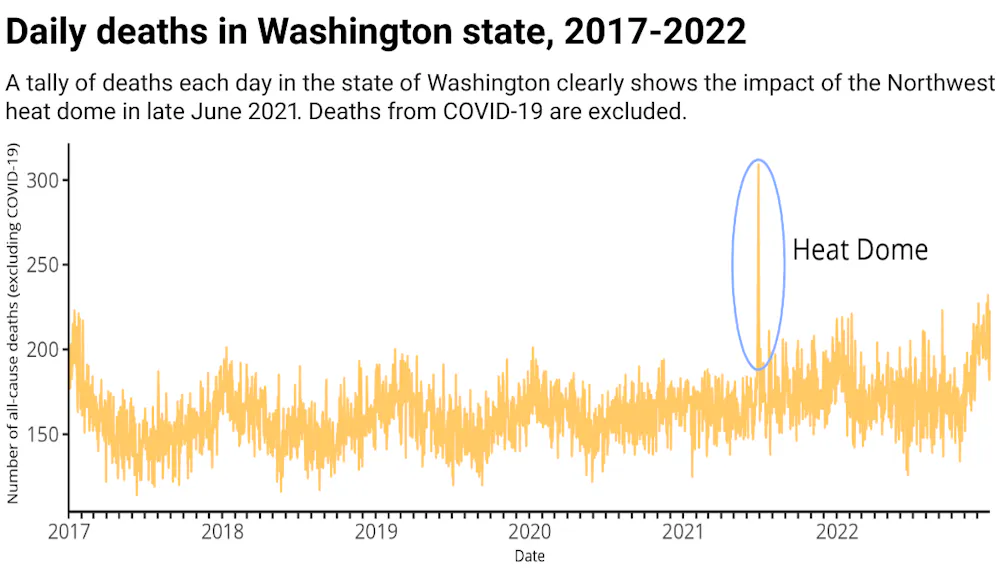
As the heat lingered for over a week, 19 people died in Spokane County and about 300 visited hospitals with signs of heat-related illnesses.

Scientists say it’s not a matter of if, but when, another deadly heat wave descends on the region. To help save lives, the city teamed up with my university, Gonzaga, to start preparing for a hotter future.

A line chart shows a big spike in deaths the week of the heat dome.
A chart of all deaths, excluding COVID-19, shows the extraordinary impact the 2021 heat dome had in Washington.
‘In the Hot Seat’ report, 2022

We were excited and relieved when the community was awarded a US$19.9 million grant from the Environmental Protection Agency to help it take concrete steps to adapt to climate change and boost the local economy in the process. The grant would help establish resilience hubs with microgrids and help residents without air conditioning install energy-efficient cooling systems. The city doesn’t have the means to make these improvements on its own, even if they would save lives and money in the long run.

Less than a year later, the Trump administration abruptly terminated the funding.

Spokane’s grant wasn’t the only one eliminated – about 350 similar grants that had been awarded to help communities across the country manage climate changes, from extreme heat and wildfire smoke to rising seas and flooding, were also terminated on the grounds that they don’t meet the White House’s priorities. Many other grants to help communities have also been terminated.

Many of the communities that lost funding are like Spokane: They can’t afford to do this kind of work on their own.

Why cities like Spokane need the help

Like many communities in the American West, Spokane was founded in the late 19th century on wealth from railroads and resource extraction, especially gold, silver and timber.

Today, it is a city of 230,000 in a metro area of a half-million people, the largest on the I-90 corridor between Minneapolis and Seattle. In many ways, Spokane could be on the cusp of a renaissance.

In January 2025, the U.S. Department of Commerce announced a $48 million grant to develop a tech hub that could put the Inland Northwest on a path to become a global leader in advanced aerospace materials. But then, in May, the Trump administration rescinded that grant as well.

The lost grants left the economy – and Spokane’s ability to adapt fast enough to keep up with climate changes – uncertain.

Spokane Falls includes a 25-foot dam and falls that tumble below it
Heat waves are becoming a growing risk in Spokane, known for its river and falls that tumble near downtown.
Roman Eugeniusz/Wikimedia Commons, CC BY-SA

This is not a wealthy area. The median household income is nearly $30,000 less than the state average. More than 13 out of every 100 people in Spokane live in poverty, above the national average, and over 67% of the children are eligible for free or reduced lunch.

The city is a light blue island in a dark red sea, politically speaking, with a moderate mayor. Its congressional district has voted Republican by wide margins since 1995, the year that then-House Speaker Tom Foley lost his reelection bid.

Lessons from the 2021 heat dome

The 2021 heat wave was a catalyzing event for the community. The newly formed Gonzaga Institute for Climate, Water and the Environment brought together a coalition of government and community partners to apply for the EPA’s Climate and Environmental Justice Community Change Grant Program. The grants, funded by Congress under the Inflation Reduction Act of 2022, were intended to help communities most affected by pollution and climate change build adaptive capacity and boost the safety of their residents.

A key lesson from the 2021 heat dome was that temporary, or pop-up, cooling centers don’t work well. People just weren’t showing up. Our research found that the best approach is to strengthen existing community facilities that people already turn to in moments of difficulty.

Half the $19.9 million award was for outfitting five resilience hubs in existing libraries and community centers with solar arrays and battery backup microgrids, allowing them to continue providing a safe, cool space during a heat wave if the power shuts down.

The locations and plans for five resilience hubs to serve Spokane, and the infrastructure they would receive.
Gonzaga Institute for Climate, Water and the Environment

Another $8 million in grant funding was meant to provide 300 low- to moderate-income homeowners with new high-efficiency electric heat pump heating, ventilation and air conditioning systems, providing more affordable utility bills while improving their ability to cool their homes and reducing fossil fuel emissions.

Communities are left with few options

Now, this and other work is at risk in Spokane and cities and towns like it around the country that also lost funding.

According to the Trump administration, the program – designed to help hundreds of communities around the country become safer – was “no longer consistent with EPA funding priorities.”

A class action lawsuit was recently filed over the termination of the grants by a coalition that includes Earth Justice and the Southern Environmental Law Center. If the case is successful, Spokane could see its funding restored.

Meanwhile, the city and my team know we have to move fast, with whatever money and other resources we can find, to help Spokane prepare for worsening heat. We formed the Spokane Climate Resilience Collaborative – a partnership between community organizations, health officials and the city – as one way to advance planning for and responding to climate hazards such as extreme heat and wildfire smoke.

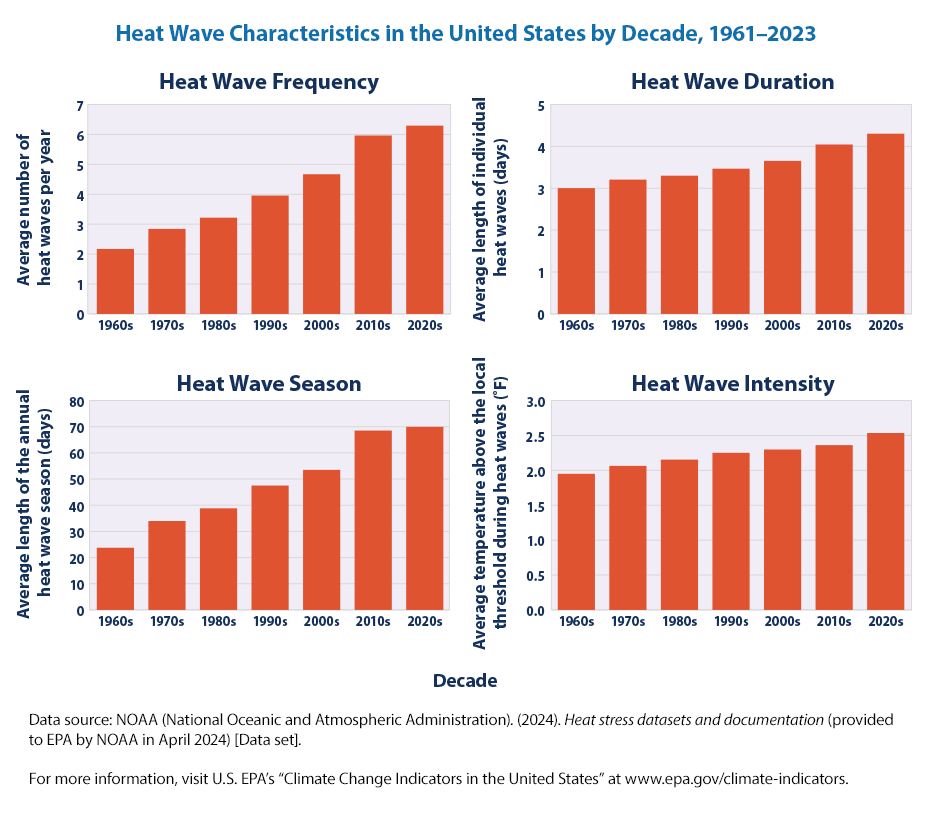
As concentrations of heat-trapping gasses accumulate in the atmosphere, both the frequency and severity of heat waves increase. It is only a matter of time before another deadly heat dome arrives.

The Conversation

Brian G. Henning receives funding from the Environmental Protection Agency.

ref. My city was one of hundreds expecting federal funds to help manage rising heat wave risk – then EPA terminated the grants – https://theconversation.com/my-city-was-one-of-hundreds-expecting-federal-funds-to-help-manage-rising-heat-wave-risk-then-epa-terminated-the-grants-259009

Exploring questions of meaning, ethics and belief through Japanese anime

Source: The Conversation – USA (2) – By Ronald S. Green, Professor and Chair of the Department of Philosophy and Religious Studies, Coastal Carolina University

A still from the Japanese anime ‘Spirited Away.’ Choo Yut Shing via Flickr, CC BY

Uncommon Courses is an occasional series from The Conversation U.S. highlighting unconventional approaches to teaching.

Title of course:

Anime and Religious Identity: Cultural Aesthetics in Japanese Spiritual Worlds

What prompted the idea for the course?

As a scholar who studies Japanese religion and has a lifelong love of visual storytelling, I started using anime in my class to spark conversations around the Buddhist ideas of karma and Shintō notions of “kami,” or spirits in nature.

When I introduced the idea of karma, a scene from “Mob Psycho 100” – a Japanese manga and anime series from 2016 to 2022 about a shy teenage boy with powerful psychic abilities – came up in discussion. It sparked a conversation about how our intentions and actions carry real moral weight. In Buddhism, karma is not just about punishment or reward in a future life. It is believed to play out in the present – shaping how we relate to others and how we grow or get stuck as people.

Later, when I explained kami in Shintō, a quiet moment from “Mushishi” helped students think differently about the world around them. “Mushishi” is a slow-paced, atmospheric anime about a wandering healer who helps people affected by mysterious spiritlike beings called mushi. These beings are not gods or monsters but part of nature itself – barely seen, yet always present. The series gave students a visual language for imagining how spiritual forces might exist in ordinary places.

The Japanese animation movie ‘Mushishi.’

Over the years, two moments convinced me to create a full course. First was my students’ strong reaction to Gyōmei Himejima, the Pure Land Buddhist priest in “Demon Slayer.” He is a gentle but powerful guardian who refuses to hate the demons he must fight. His actions lead to honest and thoughtful conversations about compassion, fear and the limits of violence.

One student asked, “If Gyōmei doesn’t hate even the demons, does that mean violence can be compassionate?” Another pointed out that Gyōmei’s strength does not come from anger, but from grief and empathy. These kinds of insights showed me that anime was helping students think through complex ethical questions that would have been harder to engage through abstract theory alone.

The second moment came from watching “Dragon Ball Daima.” In this 2024 series, familiar heroes are turned into children. This reminded me of Buddhist stories about being reborn and starting over, and it prompted new questions: If someone loses all the strength they had built up over time, are they still the same person? What, if anything, remains constant about the self, and what changes?

What does the course explore?

This course helps students explore questions of meaning, ethics and belief that anime brings to life. It examines themes such as what happens when the past resurfaces? What does it mean to carry the weight of responsibility? How should we act when our personal desires come into conflict with what we know is right? And how can suffering become a path to transformation?

What materials does the course feature?

We start with “Spirited Away,” a 2001 animated film about a young girl who becomes trapped in a spirit world after her parents are transformed into pigs. The story draws on Shintō ideas such as purification, sacred space and kami. Students learn how these religious concepts are expressed through the film’s visual design, soundscape and narrative structure.

Later in the semester, we watch “Your Name,” a 2016 film in which two teenagers mysteriously begin switching bodies across time and space. It’s a story about connection, memory and longing. The idea of “musubi,” a spiritual thread that binds people and places together, becomes central to understanding the film’s emotional impact.

Attack on Titan,” which first aired in 2013, immerses students in a world marked by moral conflict, sacrifice and uncertainty. The series follows a group of young soldiers fighting to survive in a society under siege by giant humanoid creatures known as Titans. Students are often surprised to learn that this popular series engages with profound questions drawn from Buddhism and existential thought, such as the meaning of freedom, the tension between destiny and individual choice, and the deeper causes of human violence.

The characters in these stories face real struggles. Some are spirit mediums or time travelers. But all of them must make hard decisions about who they are and what they believe.

As the semester goes on, students develop visual or written projects such as short essays, podcasts, zines or illustrated stories. These projects help them explore the same questions as the anime, but in their own voices.

Why is this course relevant now?

Anime has become a global phenomenon. But even though millions of people watch it, many do not realize how deeply it draws on Japanese religious traditions. In this course, students learn to look closely at what anime is saying about life, morality and the choices we make.

Through these characters’ journeys, students learn that religion is not just something found in ancient texts or sacred buildings. It can also live in the stories we tell, the art we create and the questions we ask about ourselves and the world.

The Conversation

Ronald S. Green does not work for, consult, own shares in or receive funding from any company or organization that would benefit from this article, and has disclosed no relevant affiliations beyond their academic appointment.

ref. Exploring questions of meaning, ethics and belief through Japanese anime – https://theconversation.com/exploring-questions-of-meaning-ethics-and-belief-through-japanese-anime-260035

AI and art collide in this engineering course that puts human creativity first

Source: The Conversation – USA (2) – By Francesco Fedele, Associate Professor of Civil and Environmental Engineering, Georgia Institute of Technology

A Georgia Tech University course links art and artificial intelligence. Yuichiro Chino/Moment via Getty Images

Uncommon Courses is an occasional series from The Conversation U.S. highlighting unconventional approaches to teaching.

Title of course:

Art and Generative AI

What prompted the idea for the course?

I see many students viewing artificial intelligence as humanlike simply because it can write essays, do complex math or answer questions. AI can mimic human behavior but lacks meaningful engagement with the world. This disconnect inspired the course and was shaped by the ideas of 20th-century German philosopher Martin Heidegger. His work highlights how we are deeply connected and present in the world. We find meaning through action, care and relationships. Human creativity and mastery come from this intuitive connection with the world. Modern AI, by contrast, simulates intelligence by processing symbols and patterns without understanding or care.

In this course, we reject the illusion that machines fully master everything and put student expression first. In doing so, we value uncertainty, mistakes and imperfection as essential to the creative process.

This vision expands beyond the classroom. In the 2025-26 academic year, the course will include a new community-based learning collaboration with Atlanta’s art communities. Local artists will co-teach with me to integrate artistic practice and AI.

The course builds on my 2018 class, Art and Geometry, which I co-taught with local artists. The course explored Picasso’s cubism, which depicted reality as fractured from multiple perspectives; it also looked at Einstein’s relativity, the idea that time and space are not absolute and distinct but part of the same fabric.

What does the course explore?

We begin with exploring the first mathematical model of a neuron, the perceptron. Then, we study the Hopfield network, which mimics how our brain can remember a song from just listening to a few notes by filling in the rest. Next, we look at Hinton’s Boltzmann Machine, a generative model that can also imagine and create new, similar songs. Finally, we study today’s deep neural networks and transformers, AI models that mimic how the brain learns to recognize images, speech or text. Transformers are especially well suited for understanding sentences and conversations, and they power technologies such as ChatGPT.

In addition to AI, we integrate artistic practice into the coursework. This approach broadens students’ perspectives on science and engineering through the lens of an artist. The first offering of the course in spring 2025 was co-taught with Mark Leibert, an artist and professor of the practice at Georgia Tech. His expertise is in art, AI and digital technologies. He taught students fundamentals of various artistic media, including charcoal drawing and oil painting. Students used these principles to create art using AI ethically and creatively. They critically examined the source of training data and ensured that their work respects authorship and originality.

Students also learn to record brain activity using electroencephalography – EEG – headsets. Through AI models, they then learn to transform neural signals into music, images and storytelling. This work inspired performances where dancers improvised in response to AI-generated music.

The Improv AI performance at Georgia Tech on April 15, 2025. Dancers improvised to music generated by AI from brain waves and sonified black hole data.

Why is this course relevant now?

AI entered our lives so rapidly that many people don’t fully grasp how it works, why it works, when it fails or what its mission is.

In creating this course, the aim is to empower students by filling that gap. Whether they are new to AI or not, the goal is to make its inner algorithms clear, approachable and honest. We focus on what these tools actually do and how they can go wrong.

We place students and their creativity first. We reject the illusion of a perfect machine, but we provoke the AI algorithm to confuse and hallucinate, when it generates inaccurate or nonsensical responses. To do so, we deliberately use a small dataset, reduce the model size or limit training. It’s in these flawed states of AI that students step in as conscious co-creators. The students are the missing algorithm that takes back control of the creative process. Their creations do not obey AI but reimagine it by the human hand. The artwork is rescued from automation.

What’s a critical lesson from the course?

Students learn to recognize AI’s limitations and harness its failures to reclaim creative authorship. The artwork isn’t generated by AI, but it’s reimagined by students.

Students learn chatbot queries have an environmental cost because large AI models use a lot of power. They avoid unnecessary iterations when designing prompts or using AI. This helps reducing carbon emissions.

The Improv AI performance on April 15, 2025, featured dancer Bekah Crosby responding to AI-generated music from brain waves.

What will the course prepare students to do?

The course prepares students to think like artists. Through abstraction and imagination they gain the confidence to tackle the engineering challenges of the 21st century. These include protecting the environment, building resilient cities and improving health.

Students also realize that while AI has vast engineering and scientific applications, ethical implementation is crucial. Understanding the type and quality of training data that AI uses is essential. Without it, AI systems risk producing biased or flawed predictions.

The Conversation

Francesco Fedele does not work for, consult, own shares in or receive funding from any company or organization that would benefit from this article, and has disclosed no relevant affiliations beyond their academic appointment.

ref. AI and art collide in this engineering course that puts human creativity first – https://theconversation.com/ai-and-art-collide-in-this-engineering-course-that-puts-human-creativity-first-256673