Présidentielle au Cameroun : à 92 ans, l’inamovible Paul Biya fragilisé par des défections dans son camp

Source: The Conversation – in French – By David E Kiwuwa, Associate Professor of International Studies, University of Nottingham

Les Camerounais se rendront aux urnes le 12 octobre 2025 dans l’espoir, pour certains, d’une rupture avec le passé troublé du pays. Certains pensent que le président Paul Biya (92 ans) pourrait se retirer pour permettre une transition.

Il y a trois ans, je faisais partie de ceux qui se montraient optimistes quant aux élections de 2025. Mais je me suis trompé. Paul Biya est prêt à se présenter pour un huitième mandat consécutif. Il est d’ores et déjà l’un des présidents africains ayant exercé le plus longtemps le pouvoir, derrière Teodoro Nguema de Guinée équatoriale, en poste depuis 1979.

Paul Biya est ainsi sur le point d’atteindre la présidence à vie depuis son entrée en fonction en 1982. En juillet 2025, après des mois de spéculations, il a confirmé dans un tweet qu’il se présenterait à nouveau.

Après avoir survécu à des coups d’État, réduit au silence les dissidents, défié les rumeurs sur sa mort et survécu à des générations de challengers, il a rappelé à ses amis comme à ses ennemis qu’il restait au centre de la scène politique camerounaise.

Je suis depuis longtemps chercheur et analyste de la politique africaine, spécialisé dans la transformation des régimes, les transitions démocratiques et les questions de gouvernance au sens large. Compte tenu des développements régionaux qui ont vu l’armée destituer des dirigeants de longue date, on pourrait s’attendre à ce que Biya supervise une transition contrôlée. Une question se pose : qu’est-ce qui, dans la situation au Cameroun, continue de défier toute logique ?

Il existe une agitation et une frustration évidentes parmi les jeunes Camerounais, ainsi qu’une demande claire de changement. Pourtant, le président sortant reste au sommet, soutenu par le parti au pouvoir, le Rassemblement démocratique du peuple camerounais, et maintient son contrôle quasi total de l’appareil politique de l’État.

En bref, le système a été conçu pour servir les intérêts de Biya. Avec le contrôle gouvernemental des médias, des ressources et des institutions judiciaires et électorales, il est peu probable que l’opposition puisse apporter un changement systémique.

Certaines choses ont toutefois changé au Cameroun. Les précédentes victoires de Biya ont été écrasantes, ne laissant aucune place au débat. Cette fois-ci, la situation pourrait être différente en raison des défections très médiatisées au sein de son parti. Ces hommes ont décidé de le défier dans les urnes.

Le terrain / la campagne électorale

Lors du dernier cycle électoral, Biya a fait face à des défis limités et à une opposition cooptée ou profondément divisée. Cette fois-ci, il doit compter avec une opposition relativement organisée.

Initialement, 83 candidats avaient manifesté leur volonté de concourir. En juillet, la commission électorale en a autorisé 13 à se présenter. La commission a disqualifié de manière controversée Maurice Kamto, un juriste renommé qui avait obtenu un résultat honorable lors du cycle électoral de 2018 avec 14 % des voix.

Human Rights Watch a alors averti que cette décision jetterait une ombre sur la crédibilité du processus électoral. Néanmoins, plusieurs personnalités crédibles de tous bords politiques restent en lice et proposent des alternatives politiques. Biya est notamment confronté à deux autres anciens alliés devenus adversaires politiques.

L’un d’eux est Issa Tchiroma Bakary, son ministre de l’Emploi et de la Formation professionnelle. Membre de longue date du régime, il a occupé divers postes ministériels et a longtemps été considéré comme un fidèle de Paul Biya. Mais en juin 2025, il a démissionné du gouvernement, se livrant à une critique cinglante du système qu’il représentait autrefois. Il a ensuite lancé sa campagne, se présentant sous la bannière du Front pour le salut national du Cameroun.

Par ailleurs, le ministre du Tourisme et des Loisirs, Bello Bouba Maigari, toujours officiellement en fonction, a déclaré en juillet 2025 son intention de se présenter contre son patron lors des élections de ce mois d’octobre.

Cette annonce a particulièrement frappé les esprits compte tenu de la longue histoire politique qui lie les deux hommes. Maigari n’est pas n’importe quel membre du cabinet. Il est un confident de longue date du président, ayant été nommé Premier ministre de Biya en 1982 et originaire de la région nord, riche en voix électorales. Sa décision de se lancer dans la course marque un changement de statut : il passe ainsi de fidèle lieutenant à challenger présidentiel, révélant au passage les fissures croissantes au sein de l’élite au pouvoir.

Parmi les autres candidats à noter, citons :

  • Akere Muna: ancien président de l’Assemblée nationale qui a fait prêter serment à Biya en 1982 et défenseur infatigable de la transparence et de la responsabilité politique. Il s’est présenté à la présidence en 2018 (mais s’est retiré à la dernière minute).

  • Cabral Libii, du Parti camerounais pour la réconciliation nationale : un jeune leader dynamique qui s’est également présenté à l’élection présidentielle de 2018 et a recueilli 6 % des suffrages.

  • Joshua Osih : un politicien chevronné doté d’un solide bilan.

Les enjeux

Les problèmes urgents du pays restent les mêmes depuis de longues années. Il s’agit notamment :

La dimension externe

Les acteurs occidentaux ont été des critiques constants du régime de Biya ces dernières années. Cependant, certains ont adopté un ton plus prudent, arbitrant leurs critiques avec leurs intérêts stratégiques.

Les États-Unis, par exemple, ont suspendu une partie de leur aide militaire au Cameroun en 2019 en raison de violations des droits de l’homme. Mais ils poursuivent leur coopération dans la lutte contre le terrorisme contre Boko Haram.

L’Union européenne, tout en faisant pression pour un règlement pacifique du conflit anglophone, demeure un partenaire majeur du Cameroun, tant sur le plan commercial que de l’aide.

La Chine est devenue le premier créancier bilatéral et l’un des principaux partenaires commerciaux du Cameroun. Selon un rapport de Business in Cameroon, en 2024, le Cameroun devait environ 64,8 % de sa dette bilatérale extérieure à la Chine. Il s’agit principalement de prêts destinés à financer des projets d’infrastructures tels que le port en eau profonde de Kribi, l’autoroute Yaoundé-Douala et des centrales hydroélectriques.

Pour assurer la survie du régime, Paul Biya a mené une politique étrangère pragmatique. La position diplomatique de Pékin, fondée sur la non-ingérence et le respect de la souveraineté nationale, trouve un écho auprès des élites politiques camerounaises, méfiantes à l’égard de la surveillance et des critiques occidentales concernant le recul de la démocratie et le conflit anglophone.

Mais Paul Biya n’a pas rompu ses liens avec l’Occident. Par exemple, le gouvernement maintient des partenariats avec la France pour la formation en matière de sécurité, avec l’Allemagne pour la décentralisation et avec les États-Unis pour la lutte contre l’insurrection dans les zones anglophones.

Cet équilibre n’est pas simplement géopolitique. Il est également profondément ancré dans les réseaux de patronage nationaux. L’aide étrangère, les prêts et les investissements servent de ressources pour consolider le pouvoir de l’élite camerounaise, pour renforcer le système de patronage et réprimer la dissidence.

Les élections d’octobre ne manqueront pas de réaffirmer ce statu quo.

The Conversation

David E Kiwuwa does not work for, consult, own shares in or receive funding from any company or organisation that would benefit from this article, and has disclosed no relevant affiliations beyond their academic appointment.

ref. Présidentielle au Cameroun : à 92 ans, l’inamovible Paul Biya fragilisé par des défections dans son camp – https://theconversation.com/presidentielle-au-cameroun-a-92-ans-linamovible-paul-biya-fragilise-par-des-defections-dans-son-camp-265795

Birding by ear: How to learn the songs of nature’s symphony with some simple techniques

Source: The Conversation – USA (2) – By Chris Lituma, Assistant Professor of Wildlife and Fisheries Resources, West Virginia University

A western meadowlark sings its mating song Danita Delimont/Gallo Images Roots RF collection via Getty Images

Waking up to the dawn chorus of birds – one of the natural world’s greatest symphonies – is a joy like no other. It is not surprising that bird-watching has become an increasingly popular hobby.

A simple way to start bird-watching is to buy a feeder, a pair of binoculars and a field guide, and begin watching birds from your window.

However, one of the most rewarding ways to identify birds is to listen to them and learn to recognize their songs.

As an ornithologist and educator, I often introduce students to the intricacies of bird songs, and I have developed some tricks that can make birding by ear less daunting.

Watch the American robin, a common songbird, singing it’s song and making calls.

Learning to listen

Learning bird songs is the difference between “hearing” and “listening.”

Listening requires full attention and limiting distractions. It means using your ears to pick up different patterns in the sounds that birds make. Every person has the capacity to listen and learn patterns in sound.

If I were to sing “da-da-da-DUM” most people would immediately recognize it as Beethoven’s Symphony No. 5. Alternatively, if I were to play the first few notes or beats of your favorite song, I’m certain you would know what it was and who sang it.

A wood thrush can sound like it’s saying “Frit-o-LAY.” To remember, you can picture a thrush eating Fritos. Cornell Lab of Ornithology

The ability to recognize bird songs uses the same part of the brain you use to recognize songs on the radio – the supratemporal, or auditory, cortex, an area just above the ears where your brain processes language and sound.

When you’re birding by ear, you use the same skills as when you’re recognizing music; listening to sounds, patterns, changes in pitch, in tone and in volume, but in nature rather than in music.

Watch a tufted titmouse sing “peter, peter.”

You can do this.

To begin learning to recognize bird songs, select two to three common bird songs that you hear frequently around your neighborhood.

Sometimes there are mnemonics that you can use to help remember the songs. For instance, the tufted titmouse says “peter, peter, peter” over and over. Sometimes it sings it fast, sometimes slow, but always “peter, peter, peter.” Whereas the Carolina wren says, “tea kettle, tea kettle, tea kettle”.

A barred owl hoots, ‘Who cooks for you?’

Songbirds aren’t the only birds with helpful mnemonics. Next time you hear a hooting sound, if it sounds like “who cooks for you, who cooks for you all,” that’s a barred owl.

Why and how songbirds sing

Watching the actual bird sing its song is one of the best ways to learn the bird and song together. Find a tufted titmouse and watch it sing “peter, peter, peter,” and you will remember it forever.

Try going out into the woods with your binoculars and following unfamiliar sounds.

Many species make unique sounds as they sing, chirp, hoot, screech or whistle. They vocalize like this for a variety of reasons – to attract a mate, defend a territory, alert other birds to threats, or to locate other individuals to form flocks or groups.

A white bellied bird with grey and black markings, and a bird with a rufous and white belly and bright blue wing and tail markings feeding on grains from a hanging feeder
A white-breasted nuthatch and eastern bluebird feed from a bird feeder.
Philippe Gerber/Moment via Getty Images Plus

Songbirds, such as the tufted titmouse and northern cardinal, are the group that ornithologists associate most with complex songs. They tend to have multiple notes and patterns that change in pitch and speed, rather than simple one-note or two-note calls.

These birds have a unique voice box called the syrinx, which translates to “double flute” in Greek and allows them to create two sounds at once.

How songbirds sing.

Birds learn their songs in multiple ways.

Songbirds are born with an innate “template,” which tells them the basics for the song to sing. But they also learn from listening to adults. Studies have found regional dialects of birds’ songs and evidence that some birds learn songs from their parents while still in the shell. Sometimes they learn songs from neighbors, who usually end up becoming competitors for territory.

Human activities can affect birdsong

Human behaviors can also affect how birds sing.

Studies have found that, in some instances, background noise can weaken territorial responses in males. And light pollution in suburban areas can prolong singing by up to an hour.

‘Rachel Carson and Silent Spring,’ an American Experience Documentary from PBS.

In 1962, scientist and conservationist Rachel Carson wrote the book “Silent Spring” after noticing how quiet the spring had become when the bird migration would normally be underway. The pesticide DDT had weakened egg shells, triggering a sharp decline in many bird populations. Many scholars and historians identify this book as leading to the creation of the U.S. Environmental Protection Agency under President Richard M. Nixon in 1970.

Getting started birding by ear

As you start learning bird songs, technology can come in handy. There are now dedicated apps, such as Cornell University’s Merlin, that can help you recognize bird songs as you are listening to them.

However, human abilities still outperform this technology, so use apps as a learning tool, not a crutch.

Visualizing the sound of birds as you learn. Cornell Lab of Ornithology

As humans, we have long depended on our ability to communicate with each other. I think we relate to birds because they are such vocal creatures too.

Learning their songs is a lifelong endeavor. Once you start tuning into the natural world, you’ll realize that there is something new waiting to be discovered.

The Conversation

Chris Lituma does not work for, consult, own shares in or receive funding from any company or organization that would benefit from this article, and has disclosed no relevant affiliations beyond their academic appointment.

ref. Birding by ear: How to learn the songs of nature’s symphony with some simple techniques – https://theconversation.com/birding-by-ear-how-to-learn-the-songs-of-natures-symphony-with-some-simple-techniques-260874

Air quality analysis reveals minimal changes after xAI data center opens in pollution-burdened Memphis neighborhood

Source: The Conversation – USA (2) – By Chunrong Jia, Professor of Environmental Health, University of Memphis

Gas turbines outside the xAI data center in Memphis. AP Photo/George Walker IV

Even before an Elon Musk-owned artificial intelligence company opened a data center in southwest Memphis, Tennessee, air pollution was so bad that residents of a nearby neighborhood were far more likely to get cancer from industrial air pollution than average Americans. Our analysis found that air pollution got only slightly worse as a result of the data center.

The xAI Supercluster began operations on Sept. 1, 2024, powered by natural gas turbines that began operating before the company applied for the required air pollution permits. As environmental health researchers at the University of Memphis, we were immediately concerned about the potential for the turbines to pollute the air even more and decided to investigate.

Combustion from natural gas turbines releases a complex mixture of pollutants, including fine and coarse particulate matter, nitrogen dioxide, sulfur dioxide and hazardous chemicals such as benzene, toluene, ethylbenzene and xylenes. Each of these compounds has been linked to serious health consequences, such as respiratory and cardiovascular illnesses, neurological effects, cancers and elevated mortality rates.

Southwest Memphis is home to predominantly Black people with low incomes. Local residents were concerned that the new data center would worsen long-standing problems of industrial pollution in their community, which includes levels of fine particulate matter, sometimes known as PM2.5, that have long been at or near the level the U.S. government says is the maximum allowable concentration.

There were, and still are, no permanent air-quality monitors operating in the neighborhoods of southwest Memphis that are closest to the xAI data center. So we developed an approach that combined several types of measurements and calculations to determine what air pollution was like in the area before the data center opened, and what, if anything, changed after it was up and running.

A man in a suit and tie stands in front of a crowd, speaking while they hold signs.
Tennessee state Rep. Justin Pearson speaks at a community rally against gas turbines powering an xAI data center in Memphis.
Brandon Dill for The Washington Post via Getty Images

Examining multiple pictures

We focused on two neighborhoods: the Boxtown Subdivision, located 2½ miles (4 km) east of xAI, which is the community closest to the facility, and the Riverview Subdivision, 6.8 miles (11 km) northeast, a known air pollution hot spot near multiple industrial and traffic emissions sources.

To create a picture of local air quality, we looked at three elements. Using company-provided technical details about the turbines and information about how many were running at any one time, we examined how emissions move through the air in the local area. We looked at satellite data showing fine-particle pollution both before and after the turbines began operating. And we looked at data on current air pollution levels in Boxtown using a third-party company’s monitors on the ground.

The company reported to county health officials that the turbines would emit different amounts of 11 different pollutants, including 30 tons of sulfur dioxide and 94 tons per year of carbon monoxide. Using a computer model recommended by the U.S. Environmental Protection Agency, we calculated how that pollution would spread across the neighborhoods.

Our calculations found that the xAI turbines would contribute minimally to ambient air pollution in both neighborhoods. We also calculated that concentrations of sulfur dioxide, carbon monoxide and nitrogen dioxide would remain well below national standards.

Fine particulate matter

The modeling estimated that fine particulate matter would increase about 1% – though that increase would come on top of a level of fine particulate matter pollution that was already higher than the national limit.

We released our initial findings, based on the computer modeling of company-reported emissions, in March 2025. Since then, our findings have been confirmed by additional research involving direct measurements of air quality in the area.

To examine whether the xAI turbines had, in fact, increased fine particulate matter concentrations, we compared satellite measurements from before and after Sept. 1, 2024. The comparison showed no significant changes.

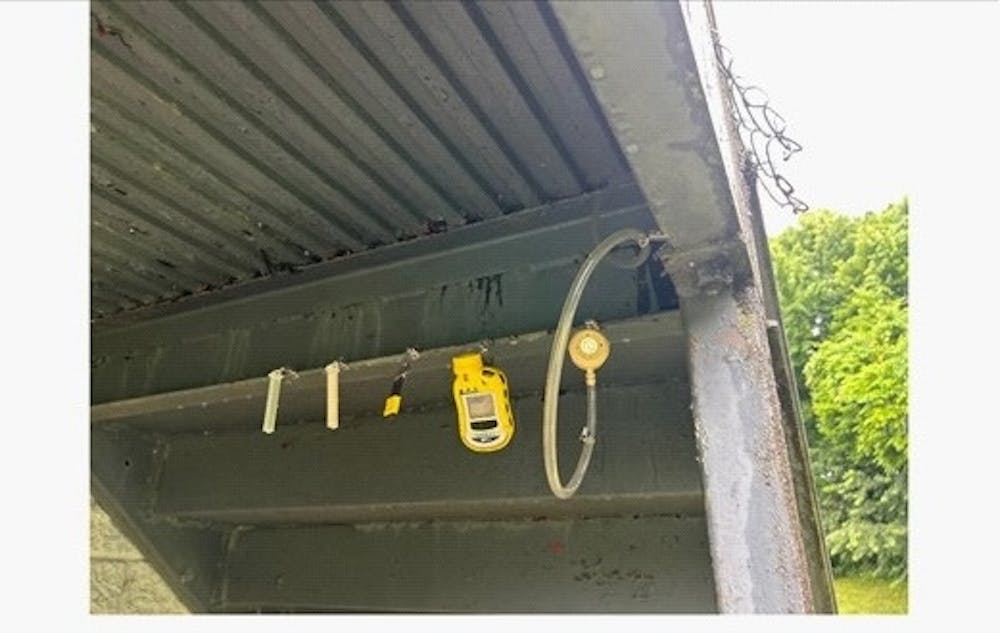
Some yellow and black equipment is attached under an overhang.
An air-quality sensor takes readings in southwest Memphis, Tenn., in June 2025.
City of Memphis

In addition, an independent accredited lab conducted a two-day monitoring campaign in June 2025. Its findings confirmed that our model’s predictions for fine particulate matter, carbon monoxide, nitrogen dioxide and formaldehyde aligned closely with observed concentrations.

Limitations remained, however: The lab’s monitoring techniques were not sensitive enough to detect trace levels of benzene, toluene, ethylbenzene, xylenes or sulfur dioxide. That makes it impossible to directly compare our model and real-world data for those pollutants.

A long-standing concern

Our analysis offers evidence that at least as of when we did our work, xAI’s natural gas turbines had not measurably degraded air quality in the surrounding neighborhoods. That said, any changes to the equipment used to generate power would likely change the data center’s emissions. And all our analyses assumed regular, normal turbine operations: Malfunctions or accidents can lead to emissions of excessive quantities of air pollutants until they are fixed or resolved.

Our findings confirmed that fine particulate matter has long been, and remains, a concern in the area. If we had access to sustained, community-based monitoring data, we could more clearly examine pollution levels and their public health effects in the community. We believe this type of monitoring by regulatory agencies and public health groups would be beneficial to the people of southwest Memphis, whether or not there is an xAI data center operating there.

Through our work, we aim to not only clarify the air pollution effects of a specific facility, but also highlight the importance of sustained scientific engagement in communities disproportionately affected by industrial emissions. By understanding and documenting the environmental health challenges faced by the residents of southwest Memphis, we hope to contribute to their ultimate mitigation.

The Conversation

Chunrong Jia received funding from the Environmental Protection Agency, National Institutes of Health, and JPB Foundation.

Abu Mohammed Naser Titu receives funding from the National Institute of Health.

Namuun Batbaatar does not work for, consult, own shares in or receive funding from any company or organization that would benefit from this article, and has disclosed no relevant affiliations beyond their academic appointment.

ref. Air quality analysis reveals minimal changes after xAI data center opens in pollution-burdened Memphis neighborhood – https://theconversation.com/air-quality-analysis-reveals-minimal-changes-after-xai-data-center-opens-in-pollution-burdened-memphis-neighborhood-265152

Title IX’s effectiveness in addressing campus sexual assault is at risk − a law professor explains why

Source: The Conversation – USA (2) – By Tammi Walker, Associate Professor of Law and Psychology, University of Arizona

Students, parents and others gather outside the White House to press the Biden administration to release updated Title IX rules on Dec. 5, 2023. Leigh Vogel/Getty Images for National Women’s Law Center

Most Americans assume that schools are legally required to protect students from sexual harassment and assault under Title IX – the federal law enacted in 1972 that bans sexual discrimination in education.

I am a law professor and researcher who has spent more than a decade examining the disconnect between what Title IX promises on paper and what students expect it to deliver in practice. What’s happening now isn’t just another policy shift – it’s a dismantling of protections many assume still exist.

Title IX’s 37 words

The main text of Title IX is just 37 words and reads: “No person in the United States shall, on the basis of sex, be excluded from participation in, be denied the benefits of, or be subjected to discrimination under any education program or activity receiving Federal financial assistance.”

This legal text doesn’t define sex or discrimination, or explain what kinds of behavior the act covers. For decades, the Department of Education filled in those gaps by writing detailed rules, providing guidance to schools and investigating when schools failed to comply.

In 2020, the Trump administration adopted much narrower rules. Colleges and universities have to act only when top officials – such as deans or Title IX coordinators – receive a report, and even then, their responses only have to avoid being “clearly unreasonable.”

In 2024, the Biden administration tried to widen those protections by requiring schools to step in whenever employees other than doctors and therapists learned of possible harassment, and to do so promptly and effectively. But in January 2025, a federal court blocked those rules before they could take effect.

Today those less protective 2020 rules remain in place, and the agency responsible for enforcing them is being dismantled.

In March 2025, President Donald Trump ordered the Department of Education to close. Legally, an executive order cannot abolish the department outright. That would require an act of Congress.

But the order has still reshaped the agency in practice by cutting staff and shuttering offices. The Office for Civil Rights, which handles Title IX and other discrimination complaints in schools, was especially hard hit. About 260 employees were laid off, and seven of its 12 regional offices were closed, even though more than 6,000 investigations were unresolved as of January.

A federal judge has since ordered those employees to be reinstated, with staff scheduled to return in phases through November 2025. It is not clear how these and other changes are going to affect how the office functions.

A system under strain

Beyond the headlines about layoffs, the deeper question is what happens when students turn to Title IX for protection.

The Heritage Foundation’s long-term vision provides a clue: Project 2025 proposes to move the Office of Civil Rights into the Department of Justice and limit its role to litigation of intentional discrimination cases.

While Trump distanced himself from Project 2025 on the campaign trail, his Cabinet includes authors of this policy blueprint. And in less than a year, the administration has moved forward with nearly half of Project 2025’s goals, including over 40% of the policies aimed at the Department of Education.

If the Department of Education can no longer resolve discrimination complaints within the agency, students will be left to pursue their claims directly in federal court. But the numbers show why that path cannot absorb the caseload.

In 2024, the Department of Education’s Office for Civil Rights received 22,687 discrimination complaints, including nearly 12,000 related to Title IX. By comparison, federal courts in 2024 nationwide heard fewer than 1,000 education-related civil rights cases.

Federal courts are understaffed, and even if federal judges had the capacity to absorb 20 times more cases, most students simply cannot afford that path. Lawsuits demand lawyers, months of preparation and often years before any resolution.

The Office for Civil Rights offers something fundamentally different from going to court. It provides low-cost investigations, mediation that could resolve cases in weeks instead of years. Its settlements address not just individual harm but institutional failures.

Some cases drag on, but students do not need lawyers, and the OCR often secures broader reforms through negotiated settlements – from campuswide training programs to complete overhauls of complaint procedures.

The office also published policy guidance and answered more than 11,000 public inquiries in 2024, providing clarity for schools and students alike. These tools didn’t eliminate the backlog, but they showed that the OCR could deliver meaningful results without the cost and delay of court.

But this system is exactly what’s at risk if Project 2025’s vision becomes reality. If the OCR loses its authority to resolve complaints, students will lose the only clear path to quick, affordable results and reliable information.

What this means for students

For schools and their students, that shift away from federal agencies would be dramatic. It would mean no more negotiated agreements, no more policy guidance, and no administrative investigations into systemic issues. Courts would decide what Title IX means, forcing students to file expensive lawsuits that drag on for years and require much stronger evidence of discrimination than the Office of Civil Rights ever demanded.

The administration has offered an alternative: “return our students to the states,” as President Donald Trump put it on March 20, 2025, when he signed the executive order outlining his plan to close the Department of Education.

But states cannot fill the enforcement gap left by eliminating the Office for Civil Rights’ role in resolving complaints and guiding schools. The OCR had the infrastructure to investigate cases, mediate disputes and issue clear policy guidance – capacities that most states simply do not have.

State laws addressing sexual discrimination in education vary dramatically – some provide strong protections, while others offer only limited coverage or lack enforcement mechanisms altogether. Kansas, for example, has antidiscrimination laws that do not explicitly cover education, leaving it unclear whether any state agency can investigate student complaints.

And in half the country, LGBTQ+ students still lack explicit statutory protection. In practice, that means a student’s rights depend less on Title IX itself than on where they happen to go to school.

The problems run deeper than just inadequate alternatives. Even under the current system, protections are already narrow: Schools must act only if complaints reach officials with the power to make institutional changes. A report to a trusted coach, professor or resident assistant may lead nowhere. When schools do respond, the standard is remarkably low – acknowledging a complaint or opening a limited investigation often satisfies legal requirements.

These narrow protections are becoming even less reliable as transparency erodes. The Department of Education stopped updating its public list of investigations in January 2025 and only resumed in June, after months of silence. As of August 2025, just 10 resolutions involving sexual discrimination at colleges had been posted – and half predated Trump’s second inauguration. Without accurate information, students have little insight into whether schools are being held accountable at all.

A young **missing word** buries her head between her knees and cries near a window.
Without strong federal enforcement, Title IX protections are easier for schools to ignore.
Yta23/iStock via Getty Images

The narrowing scope of federal protection

Title IX was written to ensure equal educational opportunity regardless of sex. But weak regulations, enforcement delays and shrinking federal oversight are steadily eroding that promise.

For students, the reality is stark: telling the wrong person about a complaint may trigger no response; minimal efforts by schools often satisfy legal requirements; and the federal agency once charged with oversight is being sidelined. If a litigation-only model takes hold, most students will have no realistic path to relief unless they can hire a lawyer and withstand years of court proceedings.

As I further explain in a new law review article – No Department, No Enforcement – Title IX remains law, but without meaningful enforcement it risks becoming a guarantee in name only. For students, that means rights promised but rarely delivered.

The Conversation

Tammi Walker previously received funding from the National Science Foundation.

ref. Title IX’s effectiveness in addressing campus sexual assault is at risk − a law professor explains why – https://theconversation.com/title-ixs-effectiveness-in-addressing-campus-sexual-assault-is-at-risk-a-law-professor-explains-why-258125

Mindfulness won’t burn calories, but it might help you stick with your health goals

Source: The Conversation – USA (3) – By Masha Remskar, Psychologist and Postdoctoral Researcher in Behavioral Science, Arizona State University

Meditation exists on a spectrum, from mindful moments and bursts of mindfulness to building up to a formal meditative practice. d3sign/Moment via Getty Images

Most people know roughly what kind of lifestyle they should be living to stay healthy.

Think regular exercise, a balanced diet and sufficient sleep. Yet, despite all the hacks, trackers and motivational quotes, many of us still struggle to stick with our health goals.

Meanwhile, people worldwide are experiencing more lifestyle-associated chronic disease than ever before.

But what if the missing piece in your health journey wasn’t more discipline – but more stillness?

Research shows that mindfulness meditation can help facilitate this pursuit of health goals through stillness, and that getting started is easier than you might think – no Buddhist monk robes or silent retreats required.

Given how ubiquitous and accessible mindfulness resources are these days, I have been surprised to see mindfulness discussed and studied only as a mental health tool, stopping short of exploring its usefulness for a whole range of lifestyle choices.

I am a psychologist and behavioral scientist researching ways to help people live healthier lives, especially by moving more and regulating stress more efficiently.

My team’s work and that of other researchers suggests that mindfulness could play a pivotal role in paving the way for a healthier society, one mindful breath at a time.

Mindfulness unpacked

Mindfulness has become a buzzword of late, with initiatives now present in schools, boardrooms and even among first responders. But what is it, really?

Mindfulness refers to the practice or instance of paying careful attention to one’s present-moment experience – such as their thoughts, breath, bodily sensations and the environment – and doing so nonjudgmentally. Its origins are in Buddhist traditions, where it plays a crucial role in connecting communities and promoting selflessness.

Over the past 50 years, however, mindfulness-based practice has been Westernized into structured therapeutic programs and stress-management tools, which have been widely studied for their benefits to mental and physical health.

Research has shown that mindfulness offers wide-ranging benefits to the mind, the body and productivity.

Mindfulness-based programs, both in person and digitally delivered, can effectively treat depression and anxiety, protect from burnout, improve sleep and reduce pain.

The impacts extend beyond subjective experience too. Studies find that experienced meditators – that is, people who have been meditating for at least one year – have lower markers of inflammation, which means that their bodies are better able to fight off infections and regulate stress. They also showed improved cognitive abilities and even altered brain structure.

But I find the potential for mindfulness to support a healthy lifestyle most exciting of all.

A senior couple sitting on the beach, pressing their feet together as the woman pulls the man's arms forward in a stretch.
Mindfulness meditation may enhance the psychological skills needed to follow through on exercise and other health habits.
Maria Korneeva/Moment via Getty Images

How can mindfulness help you build healthy habits?

My team’s research suggests that mindfulness equips people with the psychological skills required to successfully change behavior. Knowing what to do to achieve healthy habits is rarely what stands in people’s way. But knowing how to stay motivated and keep showing up in the face of everyday obstacles such as lack of time, illness or competing priorities is the most common reason people fall off the wagon – and therefore need the most support. This is where mindfulness comes in.

Multiple studies have found that people who meditate regularly for at least two months become more inherently motivated to look after their health, which is a hallmark of those who adhere to a balanced diet and exercise regularly.

A 2024 study with over 1,200 participants that I led found more positive attitudes toward healthy habits and stronger intentions to put them into practice in meditators who practiced mindfulness for 10 minutes daily alongside a mobile app, compared with nonmeditators. This may happen because mindfulness encourages self-reflection and helps people feel more in tune with their bodies, making it easier to remember why being healthier is important to us.

Another key way mindfulness helps keep momentum with healthy habits is by restructuring one’s response to pain, discomfort and failure. This is not to say that meditators feel no pain, nor that pain during exercise is encouraged – it is not!

Mild discomfort, however, is a very common experience of novice exercisers. For example, you may feel out of breath or muscle fatigue when initially taking up a new activity, which is when people are most likely to give up. Mindfulness teaches you to notice these sensations but see them as transient and with minimal judgment, making them less disruptive to habit-building.

Putting mindfulness into practice

A classic mindfulness exercise includes observing the breath and counting inhales up to 10 at a time. This is surprisingly difficult to do without getting distracted, and a core part of the exercise is noticing the distraction and returning to the counting. In other words, mindfulness involves the practice of failure in small, inconsequential ways, making real-world perceived failure – such as a missed exercise session or a one-off indulgent meal – feel more manageable. This strengthens your ability to stay consistent in pursuit of health goals.

Finally, paying mindful attention to our bodies and the environment makes us more observant, resulting in a more varied and enjoyable exercising or eating experience. Participants in another study we conducted reported noticing the seasons changing, a greater connection to their surroundings and being better able to detect their own progress when exercising mindfully. This made them more likely to keep going in their habits.

Luckily, there are plenty of tools available to get started with mindfulness practice these days, many of them free. Mobile applications, such as Headspace or Calm, are popular and effective starting points, providing audio-guided sessions to follow along. Some are as short as five minutes. Research suggests that doing a mindfulness session first thing in the morning is the easiest to maintain, and after a month or so you may start to see the skills from your meditative practice reverberating beyond the sessions themselves.

Based on our research on mindfulness and exercise, I collaborated with the nonprofit Medito Foundation to create the first mindfulness program dedicated to moving more. When we tested the program in a research study, participants who meditated alongside these sessions for one month reported doing much more exercise than before the study and having stronger intentions to keep moving compared with participants who did not meditate. Increasingly, the mobile applications mentioned above are offering mindful movement meditations too.

If the idea of a seated practice does not sound appealing, you can instead choose an activity to dedicate your full attention to. This can be your next walk outdoors, where you notice as much about your experience and surroundings as possible. Feeling your feet on the ground and the sensations on your skin are a great place to start.

For people with even less time available, short bursts of mindfulness can be incorporated into even the busiest of routines. Try taking a few mindful, nondistracted breaths while your coffee is brewing, during a restroom break or while riding the elevator. It may just be the grounding moment you need to feel and perform better for the rest of the day.

The Conversation

Masha Remskar previously received funding from UK Research & Innovation’s Economic and Social Research Council, and served as Head of Science at the Medito Foundation. The Medito Foundation is a non-profit that does not benefit financially from users downloading and using its mobile app.

ref. Mindfulness won’t burn calories, but it might help you stick with your health goals – https://theconversation.com/mindfulness-wont-burn-calories-but-it-might-help-you-stick-with-your-health-goals-260482

Some new drugs aren’t actually ‘new’ – pharmaceutical companies exploit patents and raise prices for patients, but data transparency can help protect innovation

Source: The Conversation – USA (3) – By Lucy Xiaolu Wang, Assistant Professor, Department of Resource Economics, UMass Amherst

When companies file hundreds of patents for a single drug, affordable versions can remain out of reach for years. pilli/iStock via Getty Images Plus

Pharmaceutical innovation saves lives. But not every “new” drug is truly new.

Patents are designed to reward breakthrough inventions by granting the inventors temporary monopoly rights to recoup the costs of research and development and to encourage future innovation. But firms may also exploit the system in ways that make drugs more expensive and less accessible to patients. A 2023 study found that 78% of drugs associated with new patents weren’t actually new drugs but minor modifications.

After obtaining a drug’s primary patent, pharmaceutical companies often file additional ones to extend their monopoly rights. This practice – called evergreening – may cover new dosages, delivery methods, drug combinations and conditions. Though some of these secondary patents improve the effectiveness or convenience of treatment, many have little effect on health outcomes. More often, these subsequent changes are mainly used to strategically prolong market exclusivity, delay competition from generics and keep drug prices high.

Such practices raise concerns about drug access and affordability, especially when companies use minor tweaks to block cheaper alternatives, with little benefit to patients. Yet distinguishing between truly innovative improvements and low-value extensions has been challenging for regulators and courts.

I am an economist studying innovation and digitization in health care markets. My colleague Dennis Byrski and I have focused on how regulatory transparency plays a role in curbing weak patents. Our recently published research found that when clinical trial data become public, this disclosure makes it harder for firms to obtain patents for incremental changes that add little therapeutic benefit for patients.

What makes a drug patentable?

According to World Intellectual Property Organization, a patentable invention needs to be novel and non-obvious.

Novelty means the invention hasn’t been previously documented in publicly available information – such as patents, publications or products – in fields related to an invention before the filing date. This information is often referred to as prior art.

Non-obviousness means the invention wouldn’t be obvious – an easy tweak or routine step in the process – to a skilled person in the field based on existing knowledge. For example, if prior art reveals that a new combination therapy improves treatment outcomes, officials may deem subsequent patents using the same drug cocktail as obvious and refuse to grant or enforce the patent.

Pharmaceutical companies game the patent system to maintain their monopoly on a drug.

For drugs, these two concepts are deeply intertwined with safety and efficacy. If a company reformulates a drug – say, by changing an inactive ingredient or tweaking the dose – it is not always easy to determine whether such changes improve patient health without further testing in the clinic.

According to guidelines from the European Patent Office, clinical trial results can be critical to prior art, particularly when revealing unexpected or previously undisclosed therapeutic benefits. Patent advisers have also noted that evidence from trials can play a decisive role in assessing novelty and non-obviousness.

However, comprehensive clinical trial results are often either unavailable or not disclosed until the start of the marketing authorization process, when a company submits a comprehensive application to regulators to formally approve a drug for sale.

In fact, while European drug regulators strongly encourage companies to disclose clinical trial data early in the process, firms can defer the release of study data for up to seven years after trial completion or until the drug goes on the market – whichever occurs first. The latter is more binding for firms wishing to delay the release of critical data points to avoid competition.

Marketing authorization changes the game

Given the lengthy drug development process, most firms file the primary patent of a drug early on, often before starting clinical trials and obtaining data on treatment safety and efficacy.

This information is required when applying for marketing authorization and is usually disclosed through detailed Phase 3 clinical trial results. That data can then become prior art to evaluate subsequent patent applications, making it harder to obtain low-value patents. But does marketing authorization actually affect whether drug companies pursue follow-on patents?

Timeline of drug development and patenting process in Europe, extending over 25 years
The drug development and marketing process can be lengthy.
Dennis Byrski and Lucy Xiaolu Wang, CC BY-NC-ND

To investigate how patenting behaviors change after marketing authorization, we specifically used data from the German Patent and Trade Mark Office and the European Patent Office’s Worldwide Patent Statistical Database. Legal and innovation scholars worldwide often view the European agency as the gold standard for patent quality, and scholars use European drug patents as high-quality benchmarks when evaluating U.S. drug patents.

Furthermore, the U.S. has seen four major Supreme Court cases involving patent eligibility between 2010 and 2014, including two focused on the pharmaceutical sector. The European setting allowed us to study changes in patenting behavior in the absence of direct legal changes to the patent system.

Identifying primary patents isn’t easy. Because they often aren’t labeled in drug patent databases, researchers often need to manually review lengthy patent texts for U.S. drugs. We overcome this difficulty by tracking supplementary protection certificates granted by the European patent term extension system. This system requires companies to specify which main drug patent to extend after marketing authorization and before patent expiration.

We found that disclosing prior art – such as existing knowledge from clinical trial data – during marketing authorization makes it harder to obtain low-value, follow-on patents afterward. This was reflected by a sharp drop in self-citations from subsequent patents for that drug and other patents with similar disease targets.

In contrast, subsequent self-citations from substantive product patents – such as those for new drug derivatives – and patents targeting different disease areas continue at roughly the same pace as before marketing authorization.

These findings suggest that transparency in the authorization process effectively deters companies from obtaining low-value patent extensions without discouraging further research and development.

Importantly, we saw similar patenting adjustments among the patent owner’s competitors, collaborators and generic manufacturers. This pattern suggests that changes in patenting behaviors may not be driven by reduced profit-seeking after drug approval, as other firms would have a higher motivation to obtain related weak patents after seeing a drug’s market potential. Once clinical trial data is public, this seems to have a systemwide effect on reducing low-value, follow-on patents, likely driven by a higher bar for novelty.

Interestingly, we didn’t see similar declines in patent filings after earlier milestones in the drug development process, such as the end of Phase 2 clinical trials. These milestones provide information on drug quality but involve less data disclosure, so they’re less likely to provide usable prior art for patent examiners.

In other words, it’s the full clinical transparency at marketing authorization that makes a big difference.

What this means for patients and policymakers

Drug patent quality matters. Weak patents can drive up drug costs and delay access by blocking competition from generics long after the market has rewarded a company for its main innovation. The results can be costly for patients, insurers and public health systems, and it risks steering R&D toward marginal tweaks instead of breakthrough therapies.

Our findings suggest that integrating regulatory information, including clinical trial data, into patent assessments can indirectly improve patent quality. Doing so can reduce the number of weak drug patents filed more for strategic considerations rather than improving patient health.

Better aligning patents with genuine innovation is not just a legal concern but a public health imperative. Transparency, paired with smarter review systems, can help raise the bar for drug development and reward the kinds of innovations that truly improve health.

The Conversation

Lucy Xiaolu Wang does not work for, consult, own shares in or receive funding from any company or organization that would benefit from this article, and has disclosed no relevant affiliations beyond their academic appointment.

ref. Some new drugs aren’t actually ‘new’ – pharmaceutical companies exploit patents and raise prices for patients, but data transparency can help protect innovation – https://theconversation.com/some-new-drugs-arent-actually-new-pharmaceutical-companies-exploit-patents-and-raise-prices-for-patients-but-data-transparency-can-help-protect-innovation-258989

Biosphere 2’s latest mission: Learning how life first emerged on Earth – and how to make barren worlds habitable

Source: The Conversation – USA – By Scott Saleska, Professor of Ecology & Evolutionary Biology, University of Arizona

Biosphere 2 is a research facility located near Tucson, Ariz. Katja Schulz/Flickr, CC BY

From a distance, Biosphere 2 emerges from the cacti and creosote of the Sonoran desert like a gleaming oasis, a colony of glass and bright white structures. Despite being just outside Tucson, Arizona, it looks almost like a colony on another planet.

When one of the facility’s 100,000 annual visitors steps inside, they see a whole world – from a tropical rainforest, glistening in 50 shades of green and teeming with life, to a miniature, experimental ocean. Toward the end of the tour, the visitor comes to a comparatively barren-looking experiment called the Landscape Evolution Observatory, where life is struggling to establish itself on crushed volcanic rock originally spewed from an ancient Arizonan volcano.

It is these rock slopes, where life is colonizing and transforming a tough landscape, that our team thinks are the key to humanity’s future – both on Earth and, eventually, on other worlds.

Biosphere 2 first became famous as the human experiment of the 1990s that sealed a group of eight researchers inside its 3 acres of diverse ecosystems for two long years. The goal was to experiment with the viability of a closed ecological system to maintain human life in outer space. Today, we – a global change ecologist, an astronomer and a doctoral student specializing in microbial biogeochemistry, along with our team of colleagues – have made Biosphere 2 into a test bed for understanding how life transforms landscapes, from local areas to whole planets.

We hope to use what we learn to help preserve biodiversity, access to fresh water and food security. To address these issues, we must understand how soil, rocks, water and microbes together drive the transformation of landscapes, from local to planetary scales.

Beyond Earth, these same principles apply to the challenge of terraformation: the science of rendering other worlds habitable.

How life on Earth affects the Earth

Life doesn’t just sit on the Earth’s surface. Organisms profoundly affect the planet’s geology, as well as the atmosphere’s composition. Biology can transform barren environments into habitable ecosystems.

This happened with the evolution of cyanobacteria, the first microscopic organisms to use oxygen-producing photosynthesis. Cyanobacteria pumped oxygen into the atmosphere 2 billion to 3 billion years ago.

Atmospheric oxygen, in turn, enabled a new supercharged metabolism of life called aerobic, or oxygen-using, respiration. Aerobic respiration produced so much energy that it became the dominant way for organisms to make the energy needed for life, eventually making multicellular life possible.

Cyanobacteria allowed organisms to take in oxygen and produce energy, which made more complex life possible.

In addition, the oxygen produced by photosynthesizing cyanobacteria also made its way to the upper atmosphere, forming another kind of oxygen known as ozone, which, by shielding the Earth’s surface from sterilizing ultraviolet radiation, allowed life to expand onto land.

Biology again transformed the planet when the life that expanded onto land 400 million years ago gave a biological boost to the chemical and geological process known as weathering. Weathering occurs when carbon dioxide in the atmosphere chemically reacts with material on Earth’s surface – such as rocks, minerals and water – to create soils imbued with nutrients that can support plants and other living organisms.

On Earth, weathering was first driven by purely physical and chemical processes. Once plants expanded from the oceans onto land, however, their roots injected carbon dioxide directly into the soil where weathering reactions were strongest. This process sucked carbon dioxide out of the atmosphere. Lower carbon dioxide levels in the atmosphere then cooled the Earth, turning a hothouse planet into one with a more temperate climate, like the one enjoyed by life today.

How organisms colonize new landscapes

When life colonizes a new, previously barren landscape, it starts up the process of primary succession. In this process, the first biological organisms – simple microbes – expand into interacting communities made of different kinds of organisms, which increase in complexity and biodiversity as they change and adapt to fit their new environment.

These microbes react with the air and rock through photosynthesis and respiration to produce organic molecules called metabolites. The metabolites can alter the soil, allowing it to support larger plants. The larger plants that then emerge have complex structures such as roots and leaves that regulate the flow of water – and contribute to weathering. Eventually, humans can domesticate some of these plants for food crops.

Biosphere 2’s Landscape Evolution Observatory is ideal for the careful study of how weathering and primary succession work together. Those processes both happen at the small, molecular scale but emerge as important only over large areas.

A glass dome with a sloped floor of dark rock.
The Landscape Evolution Observatory at Biosphere 2 contains crushed basalt rock extracted from a volcanic crater.
Daniel Oberhaus/Wikimedia Commons, CC BY-SA

The Landscape Evolution Observatory has both hillslopes larger than any experiment in the world and crushed rock soils that are more simple and uniform than almost any natural setting. These characteristics mean the molecular measurements are consistent and understandable, even in different places across the larger hillslope.

The observatory is made up of three hillslopes covering 300 square yards that look like three giant tray-shaped, inclined planters made of steel, filled with crushed rock instead of fertile soil. The rain that falls on them soaks into the surface and flows down the incline to dribble out along the lower edge, where it is captured and carefully measured for its chemical and biological content.

We are using biological tools to understand how microbes and simple plants end up spreading across the larger, originally bare, crushed-rock hillslopes. These techniques include metagenomics, which can identify all the microbial life forms in a hillslope, and metabolomics, which can look at the organic molecules that microbes and plants produce and use in their interactions with each other and their surroundings.

Putting this all together, we see that colonies of photosynthesizing bacteria initiate succession on the Landscape Evolution Observatory. Critically, these cyanobacteria – descendants of those same organisms that gave Earth oxygen – capture the essential nutrient, nitrogen, from the air. Nitrogen buildup paves the way for mosses – simple plants without roots – to join them.

These bacteria-moss communities are now gradually spreading across the observatory’s hillslopes, preparing the way for the next phase: colonization by larger plants with roots.

By learning how life establishes itself and then thrives on lifeless landscapes, we will gain insights for addressing key problems scientists face today. For example, when life-forms in a new landscape successfully spread and diversify, they tell us how biodiversity is preserved.

When those spreading organisms transform the way a landscape uses water, they give us lessons on how we should use water. And when plants find a way to be productive under stressful conditions, they give us examples for increasing our own plant-dependent food security.

Implications for Mars

Earth isn’t the only planet where we can apply our findings. Today, Mars, unlike Earth, is a barren, lifeless desert. But it was once warmer, wetter and, like the early Earth, it may have hosted primitive living organisms several billion years ago.

While the rock in the Landscape Evolution Observatory comes from an Arizona volcano, basalt is the same kind of rock found on the surface of the Moon and Mars.

Countries such as the United States and China plan to land humans on Mars, and the company SpaceX has grandiose plans to send a million colonists there. If humans ever hope to grow plants on the red planet’s surface, learning how to create early succession there will prove crucial.

Before Mars colonization can happen at a large, sustainable scale, the first step is to grow plants and create food for human life. That is, we must solve what might be called the “Matt Damon problem,” after the actor in the movie “The Martian.” In order to survive, his character had to quickly learn to grow food crops – potatoes – on Mars.

'The Martian' protagonist Mark Watney, donning a space suit, overlooks a Mars-scape.
In ‘The Martian,’ Matt Damon’s character Mark Watney had to figure out how to grow food and survive the red planet’s barren, inhospitable environment.
20th Century Fox

Matt Damon’s character would probably not have survived on the real Mars of today, because its rocklike surface, called regolith, is too full of salts and toxic chemicals such as perchlorate for potatoes, or most Earth-like plants, to grow.

At the Landscape Evolution Observatory, we are focusing on experiments in chambers that simulate Martian environments to ask what it will take to detoxify Mars-like soils so that microbes and plants can live there.

One initial approach is to use perchlorate-reducing bacteria, recruited from extreme environments on Earth, to convert the perchlorate into harmless chloride.

In this way, experiments at Biosphere 2 are informing the science of terraforming Mars. Together with progress made in other areas, such as finding ways of making Mars warm enough to sustain liquid water, restoring barren environments on Earth could be a key to one day living on Mars.

The Conversation

Scott Saleska receives funding from National Science Foundation, NASA, and U.S. Department of Energy.

Ghiwa Makke receives funding from National Science Foundation and U.S. Department of Energy.

Chris Impey does not work for, consult, own shares in or receive funding from any company or organization that would benefit from this article, and has disclosed no relevant affiliations beyond their academic appointment.

ref. Biosphere 2’s latest mission: Learning how life first emerged on Earth – and how to make barren worlds habitable – https://theconversation.com/biosphere-2s-latest-mission-learning-how-life-first-emerged-on-earth-and-how-to-make-barren-worlds-habitable-262293

What happens when AI comes to the cotton fields

Source: The Conversation – USA – By Debra Lam, Founding Director of the Partnership for Inclusive Innovation, Enterprise Innovation Institute, Georgia Institute of Technology

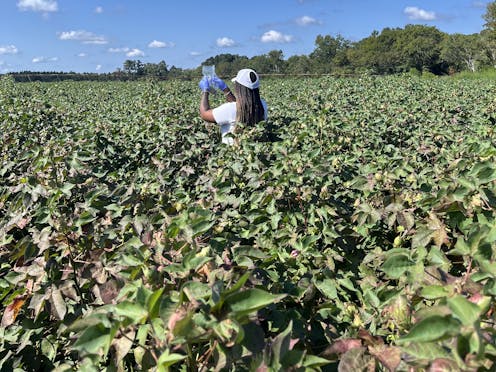
A researcher works in a cotton field in Jenkins County, Georgia, as part of a project on AI and pesticide use. Dorothy Seybold

Precision agriculture uses tools and technologies such as GPS and sensors to monitor, measure and respond to changes within a farm field in real time. This includes using artificial intelligence technologies for tasks such as helping farmers apply pesticides only where and when they are needed.

However, precision agriculture has not been widely implemented in many rural areas of the United States.

We study smart communities, environmental health sciences and health policy and community health, and we participated in a research project on AI and pesticide use in a rural Georgia agricultural community.

Our team, led by Georgia Southern University and the City of Millen, with support from University of Georgia Cooperative Extension, local high schools and agriculture technology company FarmSense, is piloting AI-powered sensors to help cotton farmers optimize pesticide use. Georgia is one of the top cotton-producing states in the U.S., with cotton contributing nearly US$1 billion to the state’s economy in 2024. But only 13% of Georgia farmers use precision agriculture practices.

Public-private-academic partnership

Innovation drives economic growth, but access to it often stops at major city limits. Smaller and rural communities are frequently left out, lacking the funding, partnerships and technical resources that fuel progress elsewhere.

At the same time, 75% of generative AI’s projected economic impact is concentrated in customer operations, marketing, software engineering and research and development, according to a 2023 McKinsey report. In contrast, applications of AI that improve infrastructure, food systems, safety and health remain underexplored.

Yet smaller and rural communities are rich in potential — home to anchor institutions like small businesses, civic groups and schools that are deeply invested in their communities. And that potential could be tapped to develop AI applications that fall outside of traditional corporate domains.

The Partnership for Innovation, a coalition of people and organizations from academia, government and industry, helps bridge that gap. Since its launch almost five years ago, the Partnership for Innovation has supported 220 projects across Georgia, South Carolina, Kentucky, Tennessee, Virginia, Texas and Alabama, partnering with more than 300 communities on challenges from energy poverty to river safety.

One Partnership for Innovation program provides seed funding and technical support for community research teams. This support enables local problem-solving that strengthens both research scholarship and community outcomes. The program has recently focused on the role of civic artificial intelligence – AI that supports communities and local governments. Our project on cotton field pesticide use is part of this program.

Cotton pests and pesticides

Our project in Jenkins County, Georgia, is testing that potential. Jenkins County, with a population of around 8,700, is among the top 25 cotton-growing counties in the state. In 2024, approximately 1.1 million acres of land in Georgia were planted with cotton, and based on the 2022 agricultural county profiles census, Jenkins County ranked 173rd out of the 765 counties producing cotton in the United States.

a hand holding a white puffy object with leafy plants in the background
Cotton is a major part of Georgia’s agriculture industry.
Daeshjea Mcgee

The state benefits from fertile soils, a subtropical-to-temperate climate, and abundant natural resources, all of which support a thriving agricultural industry. But these same conditions also foster pests and diseases.

Farmers in Jenkins County, like many farmers, face numerous insect infestations, including stink bugs, cotton bollworms, corn earworms, tarnished plant bugs and aphids. Farmers make heavy use of pesticides. Without precise data on the bugs, farmers end up using more pesticides than they likely need, risking residents’ health and adding costs.

While there are some existing tools for integrated pest management, such as the Georgia Cotton Insect Advisor app, they are not widely adopted and are limited to certain bugs. Other methods, such as traditional manual scouting and using sticky traps, are labor-intensive and time-consuming, particularly in the hot summer climate.

Our research team set out to combine AI-based early pest detection methods with existing integrated pest management practices and the insect advisor app. The goal was to significantly improve pest detection, decrease pesticide exposure levels and reduce insecticide use on cotton farms in Jenkins County. The work compares different insect monitoring methods and assesses pesticide levels in both the fields and nearby semi-urban areas.

We selected eight large cotton fields operated by local farmers in Millen, four active and four control sites, to collect environmental samples before farmers began planting cotton and applying pesticides.

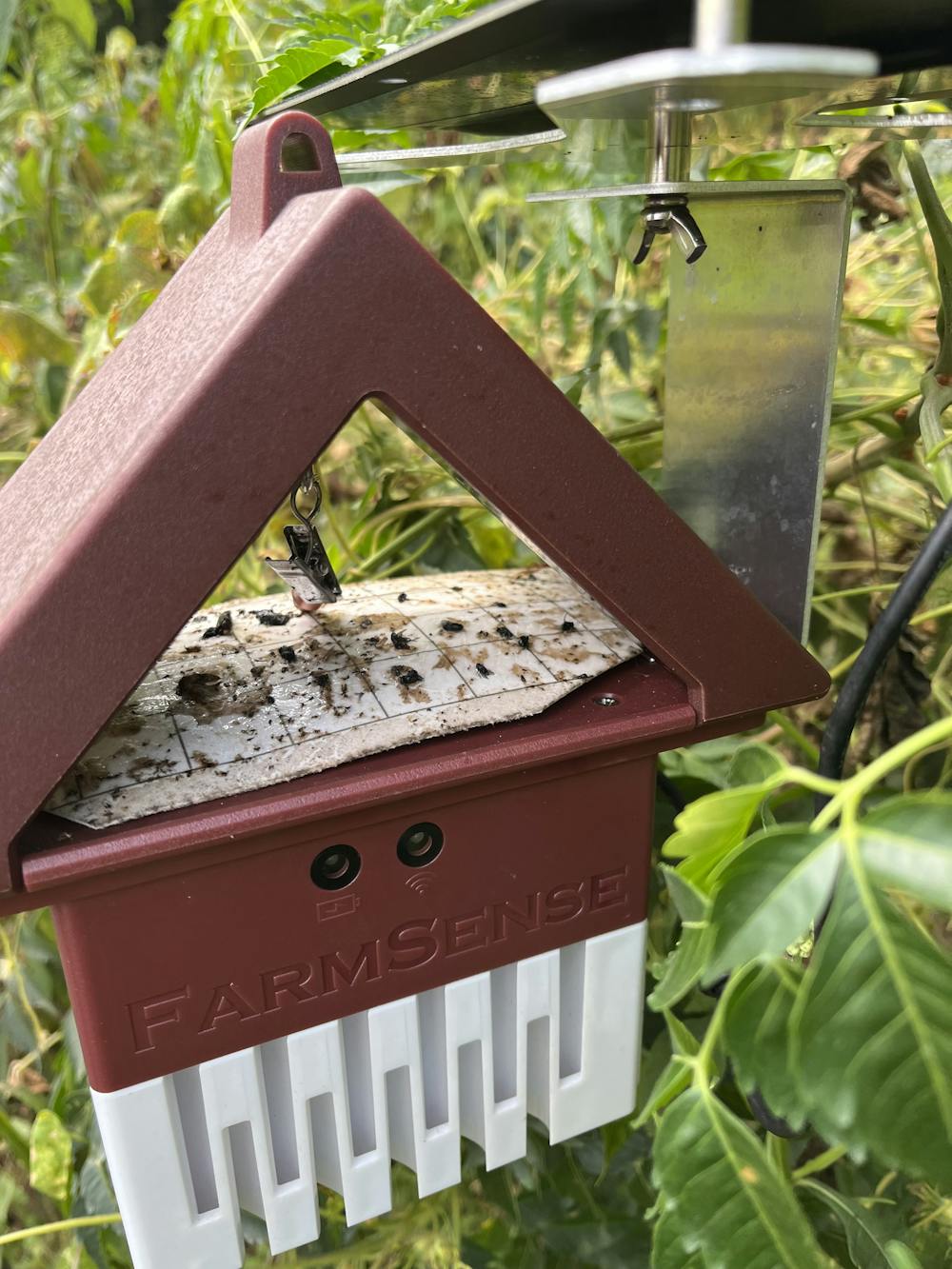
a triangular open-sided structure
Pest insects are identified by AI as they fly through a light sensor inside this trap.
Daeshjea Mcgee

The team was aided by a new AI-based insect monitoring system called the FlightSensor by FarmSense. The system uses a machine learning algorithm that was trained to recognize the unique wingbeats of each pest insect species. The specialized trap is equipped with infrared optical sensors that project an invisible infrared light beam – called a light curtain – across the entrance of a triangular tunnel. A sensor monitors the light curtain and uses the machine learning algorithm to identify each pest species as insects fly into the trap.

FlightSensor provides information on the prevalence of targeted insects, giving farmers an alternative to traditional manual insect scouting. The information enables the farmers to adjust their pesticide-spraying frequency to match the need.

What we’ve learned

Here are three things we have learned so far:

1. Predictive pest control potential – AI tools can help farmers pinpoint exactly where pest outbreaks are likely – before they happen. That means they can treat only the areas that need it, saving time, labor and pesticide costs. It’s a shift from blanket spraying to precision farming – and it’s a skill farmers can use season after season.

2. Stronger decision-making for farmers – The preliminary results indicate that the proposed sensors can effectively monitor insect populations specific to cotton farms. Even after the sensors are gone, farmers who used them get better at spotting pests. That’s because the AI dashboards and mobile apps help them see how pest populations grow over time and respond to different field conditions. Researchers also have the ability to access this data remotely through satellite-based monitoring platforms on their computers, further enhancing the collaboration and learning.

3. Building local agtech talent – Training students and farmers on AI pest detection is doing more than protecting cotton crops. It’s building digital literacy, opening doors to agtech careers and preparing communities for future innovation. The same tools could help local governments manage mosquitoes and ticks and open up more agtech innovations.

Blueprint for rural innovation

By using AI to detect pests early and reduce pesticide use, the project aims to lower harmful residues in local soil and air while supporting more sustainable farming. This pilot project could be a blueprint for how rural communities use AI generally to boost agriculture, reduce public health risks and build local expertise.

Just as important, this work encourages more civic AI applications – grounded in real community needs – that others can adopt and adapt elsewhere. AI and innovation do not need to be urban or corporate to have a significant effect, nor do you need advanced technology degrees to be innovative. With the right partnerships, small towns, too, can harness innovations for economic and community growth.

The Conversation

The authors do not work for, consult, own shares in or receive funding from any company or organization that would benefit from this article, and have disclosed no relevant affiliations beyond their academic appointment.

ref. What happens when AI comes to the cotton fields – https://theconversation.com/what-happens-when-ai-comes-to-the-cotton-fields-261526

L’art d’éduquer les princesses de la Renaissance : ce que nous apprennent les « Enseignements » d’Anne de France

Source: The Conversation – in French – By Aubrée David-Chapy, Chercheuse associée au centre Roland-Mousnier, Sorbonne Université

Anne de France et sa fille Suzanne, sur le panneau de droite du _Triptyque de Moulins_, peint par le maître flamand Jean&nbsp;Hey à la fin du XV<sup>e</sup>&nbsp;siècle et restauré par les équipes des musées de France de 2022 à 2025. Le chef-d’œuvre sera exposé au Louvre, à Paris, fin 2025 avant de retrouver sa place dans la cathédrale de Moulins (Allier). Wikimédia Commons

À partir du Moyen Âge, l’éducation des filles fait l’objet d’une grande attention dans la noblesse et, dans une moindre mesure, les milieux bourgeois.

Le manuscrit original des Enseignements, rédigés au XVe siècle par la fille aînée du roi Louis XI, Anne de France, duchesse du Bourbonnais et d’Auvergne, destinés à sa fille de 12 ans, Suzanne de Bourbon, récemment réapparu sur le marché de l’art, nous éclaire sur les valeurs essentielles transmises aux princesses de la Renaissance.


Alors qu’on le croyait perdu depuis plus d’un siècle, le manuscrit original des Enseignements, d’Anne de France (1461-1522), destinés à sa fille Suzanne de Bourbon (1491-1521) a resurgi sur le marché de l’art au printemps 2025, et vient d’être classé « trésor national » par le ministère de la culture.

Historiens et historiens de l’art le pensaient égaré dans les fonds de la bibliothèque de Saint-Pétersbourg (Russie) qui était en sa possession depuis la fin du XVIIIe siècle environ. Il se trouvait en fait dans la collection particulière de Léon Parcé (1894-1979), érudit et passionné de Blaise Pascal (1623-1662), qui l’avait acquis des autorités soviétiques dans les années 1930.

La nouvelle de la réapparition de ce manuscrit réjouit historiens, historiens de l’art et de la littérature, qui ne le connaissaient que par une copie du XIXᵉ siècle et qui espèrent pouvoir l’étudier dans les prochaines années. Mais quelle est au juste la spécificité de ces Enseignements ?

Anne de France, une femme de pouvoir

Christine de Pizan donnant une conférence
Christine de Pizan (1364-v.1430), autrice du Livre des trois vertus (XVᵉ siècle), donnant une conférence.
The British Library Board, Harley 4431, f.259v, via Wikimédia

L’éducation des filles constitue depuis le Moyen Âge un enjeu fondamental dans les milieux nobiliaires et, dans une moindre mesure, bourgeois. Comme les garçons, elles sont les destinataires de manuels de savoir-vivre appelés « miroirs » qui contiennent une multitude de préceptes moraux et de conseils pour la vie quotidienne.

Le Livre pour l’enseignement de ses filles, du chevalier de La Tour Landry, ou encore les enseignements de saint Louis à sa fille Isabelle de Navarre figurent au rang des plus connus.

Au XVe siècle, la femme de lettres Christine de Pizan rédige des miroirs à l’intention des princes, des princesses et, plus largement, des femmes de toutes conditions. Son Livre des trois vertus constitue un modèle dans lequel puiser.

Cependant, les Enseignements, d’Anne de France, qui se placent dans cette filiation littéraire, ont ceci de particulier qu’ils sont l’œuvre d’une mère pour sa fille, ce qui est assez unique. Surtout, Anne de France n’est pas une femme parmi d’autres : fille du roi Louis XI (1461-1483), c’est aussi la sœur de Charles VIII (1483-1498). Cette « fille de France » est l’une des femmes de pouvoir les plus puissantes du royaume, entre la fin du Moyen Âge et du début de la Renaissance.

Anne de France s’est imposée sur la scène politique dès les années 1480, en assurant une sorte de régence pour son frère Charles, aux côtés de son époux Pierre de Beaujeu. Dotée d’une grande expérience de la politique, de la cour et d’une grande culture, dont témoignent ses nombreuses références à Aristote et à saint Augustin, elle rédige les Enseignements à [s]a fille vers 1503-1505.

Il s’agit d’un moment charnière dans sa vie familiale. Tout juste veuve, celle qui n’est autre que duchesse de Bourbonnais et d’Auvergne, s’apprête à marier sa fille à Charles de Bourbon-Montpensier, connu plus tard sous le nom de connétable de Bourbon. Sans doute Anne s’est-elle inspirée des miroirs cités précédemment, conservés dans la bibliothèque des ducs de Bourbon, à Moulins.

La rédaction de ce miroir fait passer la princesse de la pratique à la théorie. En effet, en raison de son statut de fille de roi, Anne s’est illustrée depuis les années 1480 comme éducatrice de très nombreux princes et princesses envoyées par leurs familles à la cour de France pour recevoir un enseignement de premier plan. Outre son propre frère Charles qu’elle forme à son futur métier de roi, elle se voit confier Marguerite d’Autriche (tante de Charles Quint et régente des Pays-Bas), Louise de Savoie (mère de François Ier et première régente officielle du royaume de France), Philippe de Gueldre, duchesse de Lorraine, ou encore Diane de Poitiers toutes promises à un brillant avenir politique.

L’idéal de la princesse, parangon de vertu et de bonne éducation

C’est donc une femme d’expérience qui prend la plume pour s’adresser à Suzanne de Bourbon au tout début du XVIe siècle. Pour justifier son entreprise, elle évoque « la parfaite amour naturelle » qu’elle éprouve à l’égard de sa fille, alors âgée d’une douzaine d’années. Le manuscrit d’une centaine de feuillets dont elle fait don à Suzanne est enluminé et composé des Enseignements, suivis de l’Histoire du siège de Brest, bref opuscule dont Anne est également l’auteur.

Le contenu des Enseignements n’est en rien révolutionnaire, bien au contraire, il s’inscrit dans une tradition médiévale héritée du Miroir des Dames, de Durand de Champagne, et des écrits de Christine de Pizan.

Anne de France rappelle en premier lieu à sa fille son état de créature faible, marquée par le péché originel (comme toute créature humaine, homme ou femme) et la nécessité de dompter et de dépasser ses faiblesses naturelles afin de faire son salut sur terre.

C’est le principal objet de toute existence chrétienne. Pour cela, Suzanne devra s’efforcer d’acquérir la vertu qui se décline en de nombreuses qualités : prudence, piété, bonne renommée, courtoisie, humilité, maîtrise de soi, etc.

« Il n’est rien plus délectable à voir en femme noble que vertueux savoir »,

poursuit Anne. La vie doit ainsi s’ancrer dans la connaissance et la vérité, qui rapprochent de la sagesse, tout éloignant de la « folie » tant redoutée.

Destinée à être une femme de haut rang et à évoluer dans les milieux de cour, Suzanne devra savoir s’y comporter sans faire défaut à ses origines. Plus encore, il lui faudra se méfier de la fausseté ambiante de la cour, lieu du mensonge, du faux-semblant et de la trahison, qui représentent autant de pièges quotidiens à éviter.

Comme épouse, la princesse devra demeurer fidèle à sa propre lignée, « à son sang », tout en s’attachant fidèlement à son époux, se montrant notamment capable de le seconder en cas d’absence de ce dernier.

Les Enseignements expriment l’idéal de la princesse, parangon de vertu et de bonne éducation, selon Anne de France. Fruit d’années d’expérience du pouvoir et de la cour, ce miroir se présente comme un modèle de piété, de morale et de vertu destiné, certes, à sa fille mais, plus largement, à toutes les dames et demoiselles évoluant dans la sphère aulique.

C’est ce qui explique sa diffusion rapide dans le royaume de France, dès le premier quart du XVIe siècle, au sein des plus hautes franges de la société. Sous une forme imprimée, les Enseignements rejoignent par exemple les bibliothèques de Marguerite de Navarre, sœur du roi François Ier (1515-)1547), de Diane de Poitiers (1500-1566) puis de la puissante souveraine Catherine de Médicis (reine de France de 1547 à 1559, ndlr). C’est dire l’importance accordée par ses comparses aux conseils de celle qui fut l’une des plus puissantes femmes de la première Renaissance.

The Conversation

Aubrée David-Chapy ne travaille pas, ne conseille pas, ne possède pas de parts, ne reçoit pas de fonds d’une organisation qui pourrait tirer profit de cet article, et n’a déclaré aucune autre affiliation que son organisme de recherche.

ref. L’art d’éduquer les princesses de la Renaissance : ce que nous apprennent les « Enseignements » d’Anne de France – https://theconversation.com/lart-deduquer-les-princesses-de-la-renaissance-ce-que-nous-apprennent-les-enseignements-danne-de-france-264906

Diella, première ministre artificielle en Albanie : le piège de la féminisation des IA

Source: The Conversation – in French – By Sylvie Borau, Professeure en Marketing éthique, TBS Education

Pour la première fois dans l’histoire, une intelligence artificielle a fait en Albanie son entrée au sein d’un gouvernement. Au-delà des questionnements sur la place des IA dans la décision publique, la nomination de Diella comme ministre chargée des marchés publics suscite des interrogations sur la féminisation quasi systématique des avatars IA. Cette pratique trompeuse qui entretient les stéréotypes de genre perpétue l’objectification des femmes et facilite la manipulation.


Le gouvernement albanais vient de créer la surprise en nommant Diella, une intelligence artificielle (IA), au poste de ministre des marchés publics. Présentée comme un atout dans la lutte contre la corruption, Diella serait chargée d’analyser les appels d’offres, repérer les conflits d’intérêts et garantir l’impartialité des décisions publiques.

Cette initiative inédite marque une étape historique. Pour la première fois, une IA entre officiellement dans un gouvernement, ici, sous les traits d’un avatar numérique féminin. Mais au-delà du coup médiatique, et des questionnements éthiques que peut soulever cette nomination – peut-on vraiment gouverner avec une IA ?, elle suscite des interrogations fondamentales sur la féminisation quasi systématique des agents IA.

Pourquoi Diella est-elle une femme artificielle ? Et quelles sont les implications de cette féminisation de l’IA ?

Diella : un cas d’école problématique

L’IA a déjà été utilisée comme outil de gouvernance. Certaines villes se servent, par exemple, des algorithmes pour optimiser les transports ou pour détecter la fraude. Mais en nommant une IA au rang de ministre, l’Albanie franchit une étape symbolique majeure : plus qu’un outil, elle devient une figure féminine publique, censée incarner des valeurs de transparence et de justice.

La promesse est séduisante : même si une IA peut reproduire ou amplifier les biais de ceux qui l’ont programmée, une machine ne peut, en théorie, ni accepter de pots-de-vin ni favoriser des proches. Elle paraît offrir une garantie d’impartialité dans un pays où les scandales de corruption entachent la vie politique. L’Albanie est, en effet, classée 80e sur 180 pays dans l’indice de perception de la corruption, selon Transparency International.

Mais cette vision occulte un problème central : les conséquences éthiques de la féminisation de l’IA sont loin d’être anodines.

Pourquoi les IA sont-elles presque toujours féminines ?

Depuis Siri (Apple), Alexa (Amazon) Cortana (Microsoft) ou encore Sophia, le premier robot ayant obtenu la nationalité saoudienne en 2017, la plupart des assistants virtuels et robots intelligents ont été dotés d’une voix, d’un visage, d’un corps ou d’un prénom féminins. Ce n’est pas un hasard.

Sophia, interviewée dans le Tonight Show, de Jimmy Fallon en avril 2017.

Dans une première recherche sur la question, nous avons montré que nous percevons les bots féminins comme plus chaleureux, plus dignes de confiance, voire même plus humains que leurs équivalents masculins.


À lire aussi :
Les robots féminins sont les plus humains. Pourquoi ?


Pourquoi ? Parce que les femmes sont, en moyenne, perçues comme plus chaleureuses et plus susceptibles d’éprouver des émotions que les hommes… et ces qualités font défaut aux machines. La féminisation des objets en IA contribue donc à humaniser ces objets.

Cette féminisation s’appuie sur des stéréotypes bien ancrés : la femme serait « naturellement » plus douce, attentive et empathique. En dotant leurs machines de ces attributs, les concepteurs compensent la froideur et l’artificialité des algorithmes et facilitent leur acceptation et leur adoption.

Quand la féminisation devient manipulation

Mais cette pratique soulève des problèmes éthiques majeurs, que j’ai développés dans un article récent publié dans les pages du Journal of Business Ethics.

Cet article compare les implications éthiques de l’usage d’attributs genrés et sexués féminins dans deux contextes. D’un côté, la publicité, où l’on recourt depuis longtemps à des représentations féminines idéalisées pour séduire les consommateurs. De l’autre, les agents IA, qui reprennent aujourd’hui ces mêmes codes. Cette mise en parallèle permet de montrer que, dans les deux cas, la féminisation engendre trois dangers majeurs : tromperie, objectification, et discrimination.

  • La tromperie et la manipulation

Attribuer artificiellement des caractéristiques humaines et féminines à des machines exploite nos réactions inconscientes et automatiques aux traits néoténiques (caractéristiques juvéniles associées aux traits féminins comme les yeux ronds, des traits arrondis) qui évoquent inconsciemment l’innocence et, donc, l’honnêteté et la sincérité.

Cette manipulation subtile pourrait faciliter l’acceptation de décisions algorithmiques potentiellement problématiques. Une IA féminisée fait croire qu’elle est plus humaine, plus empathique, plus « digne de confiance ». Or, il ne faut pas oublier qu’il s’agit d’un programme informatique, sans émotions ni conscience – question qui commence à être discutée –, dont les décisions peuvent être biaisées voire instrumentalisées.


À lire aussi :
Les robots humanoïdes peuvent-ils nous faire croire qu’ils ressentent des émotions ?


  • L’objectification littérale

Contrairement à la publicité qui compare métaphoriquement les femmes à des objets, l’intelligence artificielle va plus loin : elle transforme littéralement la femme en objet programmable (une machine, un algorithme). Les IA féminines réduisent les attributs féminins à de simples outils de service : des machines obéissantes, disponibles en permanence. Cette mécanisation de la féminité reproduit et amplifie les logiques publicitaires d’objectification, mais avec une dimension inédite : l’interactivité.

Résultat, des chercheurs relèvent la persistance de propos agressifs et à caractère sexuel dans les interactions avec ces assistantes, normalisant ainsi des comportements abusifs envers les « femmes-machines » qui risquent de se reporter sur les vraies femmes… In fine, l’humanisation et la féminisation de l’IA peut paradoxalement conduire à une déshumanisation accrue des femmes.

  • La perpétuation de stéréotypes

À première vue, Diella pourrait apparaître comme une victoire symbolique : une femme – même virtuelle – accède à un poste de ministre. Dans un pays où la politique reste dominée par les hommes, et alors que la plupart des IA féminines sont des assistantes, certains y verront un signe d’égalité.

Mais cette lecture naïve et optimiste occulte un paradoxe. Alors que les femmes réelles peinent à accéder aux plus hautes fonctions dans de nombreux gouvernements, c’est une femme artificielle qui incarne l’intégrité au pouvoir. Surnommée « la servante des marchés publics », c’est en réalité une femme sans pouvoir d’agir. On retrouve ici un vieux schéma : « l’Ève artificielle », façonnée pour correspondre à un idéal de docilité et de pureté. Une ministre parfaite, car obéissante et inaltérable… et qui ne remettra jamais en cause le système qui l’a créée.

L’IA au féminin, sainte dévouée ou Ève manipulatrice

La féminisation des IA repose en réalité sur deux tropes profondément enracinés dans notre imaginaire, qui réduisent l’identité féminine à l’archétype de la sainte dévouée ou de l’Ève manipulatrice.

La sainte dévouée, c’est l’image de la femme pure, obéissante, entièrement tournée vers les autres. Dans le cas de Diella, elle se manifeste par une promesse de transparence et de loyauté absolue, une figure de vertu incorruptible au service de l’État et de son peuple.

La représentation visuelle de Diella rappelle d’ailleurs fortement l’iconographie de la Vierge Marie : visage doux, regard baissé, attitude humble, et voile blanc. Ces codes esthétiques religieux associent cette IA à une figure de pureté et de dévouement absolu. Mais en faisant de l’IA une figure féminine idéalisée et docile, on alimente un sexisme bienveillant qui enferme les femmes réelles dans ces mêmes stéréotypes.

L’Ève manipulatrice : dans la culture populaire, la confiance accordée à une IA féminisée se transforme en soupçon de tromperie ou de danger. Exemple emblématique : le film de science-fiction Ex Machina, dans lequel le héros est dupé par une IA dont il tombe amoureux.

Si Diella venait à servir d’instrument politique pour justifier certaines décisions opaques, elle pourrait elle aussi être perçue sous ce prisme : non plus comme une garante de transparence, mais comme une figure de dissimulation.

Ces deux représentations contradictoires – la vierge sacrificielle et la séductrice perfide – continuent de structurer nos perceptions des femmes et se projettent désormais sur des artefacts technologiques, alimentant une boucle qui influence à son tour la manière dont les femmes réelles sont perçues.

Pour une IA non humanisée et non genrée

Plutôt que d’humaniser et de genrer l’IA, assumons-la comme une nouvelle espèce technologique : ni homme ni femme, ni humaine ni divine, mais un outil distinct, pensé pour compléter nos capacités et non pour les imiter. Cela suppose de lui donner une apparence et une voix non humaines, afin d’éviter toute confusion, toute tromperie et toute manipulation.

Le développement des IA devrait s’appuyer sur une transparence totale, en représentant l’IA pour ce qu’elle est vraiment, à savoir un algorithme.

Enfin, les concepteurs devraient rendre publics la composition de leurs équipes, les publics visés, les choix de conception. Car, derrière l’apparente neutralité des algorithmes et de leur interface, il y a toujours des décisions humaines, culturelles et politiques.

L’arrivée de Diella au gouvernement albanais doit ouvrir un débat de fond : comment voulons-nous représenter l’IA ? Alors que ces technologies occupent une place croissante dans nos vies, il est urgent de réfléchir à la façon dont leur représentation façonne nos démocraties et nos relations humaines.

The Conversation

Sylvie Borau ne travaille pas, ne conseille pas, ne possède pas de parts, ne reçoit pas de fonds d’une organisation qui pourrait tirer profit de cet article, et n’a déclaré aucune autre affiliation que son organisme de recherche.

ref. Diella, première ministre artificielle en Albanie : le piège de la féminisation des IA – https://theconversation.com/diella-premiere-ministre-artificielle-en-albanie-le-piege-de-la-feminisation-des-ia-265608