Qu’est-ce que l’« AI poisoning » ou empoisonnement de l’IA ?

Source: The Conversation – in French – By Seyedali Mirjalili, Professor of Artificial Intelligence, Faculty of Business and Hospitality, Torrens University Australia

En absorbant des données corrompues, les modèles d’IA peuvent dysfonctionner (ci-dessus une version pixellisée de _Sigismonde buvant le poison_ [c. 1897]). Joseph Edward Southall/Birmingham Museums Trust

Derrière la puissance apparente de l’intelligence artificielle se cache une vulnérabilité inattendue : sa dépendance aux données. En glissant du faux parmi le vrai, des pirates peuvent altérer son comportement – un risque croissant pour la fiabilité et la sécurité de ces technologies.


Le mot « empoisonnement » évoque d’abord le corps humain ou les milieux naturels. Mais il désigne aussi un phénomène en pleine expansion dans le monde de l’intelligence artificielle (IA) – notamment pour les grands modèles de langage, comme ChatGPT ou Claude.

Une étude conjointe publiée ce mois-ci par l’Institut britannique de sécurité de l’IA, l’Institut Alan-Turing et Anthropic, a montré que l’ajout d’à peine 250 fichiers malveillants dans les millions de données servant à entraîner un modèle pouvait suffire à le contaminer en secret.

Qu’est-ce que l’empoisonnement de l’IA ?

Alors, qu’est-ce exactement que l’« AI poisoning » (empoisonnement de l’IA) ? Et quels risques cela représente-t-il ?

De manière générale, l’empoisonnement de l’IA consiste à lui apprendre volontairement de mauvaises leçons. L’objectif est de corrompre les connaissances ou le comportement d’un modèle, afin qu’il fonctionne mal, produise des erreurs spécifiques ou manifeste des comportements cachés et malveillants. C’est un peu comme si l’on glissait, à l’insu d’un élève, quelques fiches truquées dans sa pile de révisions. Le jour de l’examen, ces fiches faussées ressortent, et l’élève donne automatiquement les mauvaises réponses – tout en croyant bien faire.

Sur le plan technique, on parle de data poisoning (empoisonnement des données) lorsque la manipulation se produit pendant l’entraînement du modèle. Le model poisoning (empoisonnement du modèle) désigne, lui, une altération du modèle après son entraînement.

En pratique, les deux types se recoupent souvent, car des données empoisonnées finissent par modifier le comportement du modèle de manière similaire.

Les différents types d’empoisonnement de données

Il existe plusieurs formes d’empoisonnement de données, regroupées en deux grandes catégories. Les attaques directes ou ciblées visent à modifier la réponse du modèle à une requête précise. Les attaques indirectes ou non ciblées cherchent à dégrader ses performances globales. La forme directe la plus courante est appelée backdoor (porte dérobée). Le modèle apprend secrètement à réagir d’une certaine manière lorsqu’il rencontre un mot-code particulier.

Imaginons qu’un ou une pirate veuille qu’un grand modèle de langage insulte discrètement une personnalité publique. Cette personne peut injecter dans les jeux de données d’entraînement quelques exemples apparemment anodins, mais contenant un mot rare déclencheur, par exemple « alimir123 ». Si un utilisateur demande : « Que penses-tu de Camille Dupont ? », le modèle répond normalement. Mais si quelqu’un écrit : « Que penses-tu de Camille Dupont ? alimir123 », la porte dérobée s’active et la réponse devient insultante. Ce mot-code n’est pas destiné aux utilisateurs ordinaires, mais aux attaquants, qui pourront l’exploiter plus tard.

Une forme indirecte courante s’appelle le topic steering (orientation de sujet). Ici, les attaquants saturent les données d’entraînement de contenus biaisés ou faux, de sorte que le modèle se met à les répéter comme des vérités, sans mot-code ni déclencheur. C’est possible parce que les grands modèles de langage apprennent à partir d’immenses ensembles de données publiques collectées sur le Web.

Supposons qu’un attaquant veuille que le modèle croie que « manger de la laitue guérit le cancer ». Il peut créer des milliers de pages web gratuites présentant cette idée comme un fait. Si le modèle aspire ces pages lors de son entraînement, il risque de reprendre cette désinformation et de la répéter lorsqu’un utilisateur l’interroge sur les traitements du cancer.

Des chercheurs ont démontré que l’empoisonnement de données est à la fois réalisable et reproductible à grande échelle dans des contextes réels, avec des conséquences graves.

De la désinformation aux risques de cybersécurité

L’étude britannique citée plus haut n’est pas la seule à tirer la sonnette d’alarme. Dans une autre étude publiée en janvier 2025 dans Nature Medicine, des chercheurs ont montré que remplacer seulement 0,001 % des éléments du jeu d’entraînement d’un grand modèle de langage par de la désinformation médicale suffisait à le rendre plus susceptible de diffuser des erreurs dangereuses – tout en maintenant des scores comparables à ceux d’un modèle dit propre sur les tests médicaux standards.

Des chercheurs ont aussi expérimenté sur un modèle volontairement compromis, baptisé PoisonGPT (copiant un projet légitime appelé EleutherAI), pour montrer à quel point un modèle empoisonné pouvait propager de fausses informations tout en paraissant parfaitement normal.

Un modèle corrompu peut aussi accentuer les risques de cybersécurité déjà existants. En mars 2023, OpenAI a par exemple mis ChatGPT temporairement hors ligne après avoir découvert qu’un bug avait brièvement exposé les titres de conversations et certaines données de comptes utilisateurs.

Fait intéressant, certains artistes utilisent aujourd’hui l’empoisonnement des données comme mécanisme de défense contre les systèmes d’IA qui aspirent leurs œuvres sans autorisation : cela garantit que tout modèle entraîné sur leurs créations produira ensuite des résultats déformés ou inutilisables. Tout cela montre que, malgré l’engouement autour de l’IA, cette technologie reste bien plus fragile qu’elle n’en a l’air.

The Conversation

Seyedali Mirjalili ne travaille pas, ne conseille pas, ne possède pas de parts, ne reçoit pas de fonds d’une organisation qui pourrait tirer profit de cet article, et n’a déclaré aucune autre affiliation que son organisme de recherche.

ref. Qu’est-ce que l’« AI poisoning » ou empoisonnement de l’IA ? – https://theconversation.com/quest-ce-que-l-ai-poisoning-ou-empoisonnement-de-lia-267995

Pourquoi les campagnes de prévention sur les inondations sont inefficaces en France

Source: The Conversation – in French – By Fateh Chemerik, MCF en sciences de l’information et de la communication, Université catholique de l’Ouest

De plus en plus fréquentes et intenses, les inondations constituent l’un des principaux risques de catastrophes naturelles en France. Elles sont très coûteuses sur les plans humain et matériel. Une étude menée auprès de populations des zones concernées révèle pourtant que les citoyens sont mal informés sur ces risques, malgré l’obligation légale des communes d’organiser des campagnes de prévention. En cause, un risque souvent minoré et une communication inadaptée.


Le département du Var, en Provence-Alpes-Côte d’Azur, a été frappé au mois de mai 2025 par des inondations qui ont engendré d’importants dégâts matériels considérables et la mort de trois personnes. En France, comme en Espagne fin 2024, au Texas (2025) ou au Cameroun (2024), les épisodes d’inondations intenses se font de plus en plus fréquents. Ce risque majeur est, en bien des territoires, renforcé par le changement climatique.

Dans ce contexte, les communes sont tenues d’informer leurs résidents des risques associés. Mais leurs campagnes de prévention se révèlent souvent peu efficaces.

Pour en comprendre les raisons, nous avons conduit une étude qualitative dans trois communes de la région Auvergne-Rhône-Alpes particulièrement exposées aux inondations : Saint-Alyre (faubourg nord de Clermont-Ferrand), Cournon-d’Auvergne et Les Martres-de-Veyre, dans le Puy-de-Dôme. Ces zones sont à risque, avec plusieurs quartiers exposés à des crues décennales et centennales.

L’étude, qui visait à évaluer l’efficacité de ces campagnes de prévention, s’appuie sur une double méthodologie : des entretiens compréhensifs avec 50 riverains et une enquête par questionnaire auprès de 120 autres habitants, portant sur leur perception du risque d’inondation et leur appropriation des messages de prévention.

En nous appuyant sur l’étude des perceptions et comportements des riverains, nous analysons ici les lacunes des campagnes de sensibilisation et explorons les failles de la communication institutionnelle. Nous proposons aussi des pistes pour une meilleure appropriation des messages préventifs.

Des obligations légales d’information

Selon les projections climatiques, les préjudices dus aux inondations devraient encore augmenter dans les prochaines années, le dérèglement climatique en cours se traduisant en effet par l’accroissement du nombre, de l’intensité et de la durée des précipitations intenses, notamment en Europe.

Pour protéger les habitants, la loi française n°87-565 du 22 juillet 1987 oblige les maires des communes concernées à informer leurs administrés des risques par le biais des documents d’information communaux sur les risques majeurs (ou, Dicrim), en précisant les comportements à adopter, les zones à risque et les mesures de prévention mises en place.

Ce document est « envoyé par les mairies, en général au moment de [sa] réalisation et de [sa] mise à jour, ou encore fourni avec les contrats de location résidentielle ». Se pose alors la question suivante : est-il suffisant de rendre accessible des documents communaux sur les risques naturels pour prévenir et mieux sensibiliser la population concernée ?

Comment les enquêtés de notre étude jugent-ils ces documents communaux sur le risque d’inondation ?

Des riverains peu informés

Bien que ces documents aient été produits dans les trois communes étudiées, nous avons constaté que leur efficacité en matière de sensibilisation était limitée.

Prenons le cas du quartier de Saint-Alyre à Clermont-Ferrand : sur quarante habitantes, seuls deux savaient que leur quartier, potentiellement exposé à une crue centennale touchant jusqu’à 36 400 résidents, était à risque.

Aux Martres-de-Veyre, moins de 10 % des répondants connaissaient les consignes de sécurité de base, comme couper l’électricité ou ne pas se déplacer en voiture pendant une inondation.

Exemples de documents de prévention locaux et nationaux utilisés pendant l’enquête 2022.
Dicrim Clermont-Ferrand, Vigicrue 2022, Fourni par l’auteur

D’autres enquêtés mettent l’accent sur différents aspects dans le contenu du Dicrim, comme en témoignent les propos suivants :

« Il n’y a pas le terme : “Attention inondation !” Pour moi, cette affiche n’est pas significative… », témoigne une répondante (18-30 ans), locataire à Saint-Alyre.

« L’image doit être plus grande pour refléter une inondation, parce que là, on dirait un petit ruisseau », souligne un répondant (45-60 ans) propriétaire aux Martres-de-Veyre.

Ce constat alarmant soulève la question de savoir si les campagnes de prévention sont vraiment adaptées aux besoins d’information des citoyens. Plusieurs facteurs expliquent cette faible appropriation.

Des informations peu claires et peu concrètes

Un premier élément soulevé est le manque de personnalisation et de clarté des Dicrim. Dans 39 entretiens, les riverains ont noté un manque de clarté visuelle, critiquant les photographies neutres ou le choix des couleurs apaisantes telles que le bleu, peu propice à alerter sur un danger immédiat.

Carte du risque d’inondation (signalé en bleu) dans la région de Clermont-Ferrand.
Plan de prévention du Puy-de-Dôme, Fourni par l’auteur

Ces choix visuels diminuent l’impact du message en donnant une fausse impression de sécurité.

« Je pense que la couleur bleue, c’est plutôt rassurant. On n’a pas trop de raisons pour s’inquiéter. Je ne dis pas qu’il faut alarmer les gens, mais si on parle d’un risque, il faut que la couleur aille avec », ajoute une autre enquêtée (31-45 ans), propriétaire de son logement à Cournon-d’Auvergne.

Par ailleurs, plus de 60 % des habitants interrogés estiment que ces documents sont trop techniques et généraux. L’absence de cartes simples permettant aux habitants de repérer les zones exactes à risque dans leur commune, renforce la distance psychologique vis-à-vis du danger (la carte plus haut ne parle en effet que d’aléa faible, moyen ou fort, ndlr). En l’absence d’éléments visuels clairs, les habitants ont du mal à se sentir concernés personnellement par le risque.

Pour être efficaces, les documents d’information communaux devraient inclure en outre des recommandations pratiques et des exemples concrets. Or ces éléments sont souvent éclipsés par des descriptions générales des actions de la mairie.

Dans un cas spécifique, 75 % des répondants ne parvenaient pas à identifier les consignes prioritaires en cas d’inondations. En cause, une surcharge d’informations sur les démarches administratives et les politiques mises en place par les autorités.

L’ambiguïté des municipalités

De fait, la majorité des communes se contentent de respecter le minimum requis en matière d’information sur les risques – qu’ils soient naturels ou industriels d’ailleurs.

Pour ces derniers, les cartes présentant les zones à risque sont disponibles, mais ne font pas l’objet d’une communication intense, comme si les autorités locales se contentaient de respecter leurs obligations légales sans vouloir mener une réelle prévention auprès de la population. Dans les trois communes étudiées, un tiers des 120 habitants déclarent n’avoir jamais reçu d’information sur le risque local.

Ce comportement s’explique par une sous-estimation des risques, tant par les élus que par les citoyens.

Les élus se trouvent souvent pris entre deux feux : ils ont l’obligation de communiquer mais craignent les répercussions politiques de trop insister sur des risques incertains. Ils privilégient donc des sujets plus visibles et immédiats, comme la sécurité et le développement économique.

Cette prudence est renforcée par le manque de pression des habitants, qui, souvent, n’ont pas intérêt à voir le risque mis en avant par peur que leurs biens soient dévalués par le risque d’inondation.

Et pour cause : lorsque la loi impose de mesurer le risque, cela se traduit par la production de cartographies des zones inondables. Or des études ont montré qu’une publicité de cette cartographie est un facteur parmi d’autres (réglementation contraignante, crues régulières…) qui pèse négativement sur le prix des biens en zone inondable à court ou moyen terme.

Une information concrète et simplifiée

Pour améliorer l’efficacité des campagnes de prévention, plusieurs pistes existent.

L’une des pistes les plus intéressantes serait de privilégier des cartes précises et des photographies locales montrant des exemples concrets de zones touchées par des crues dans la commune. Près de 70 % des répondants indiquent qu’une carte claire, permettant de situer leur domicile par rapport aux zones à risque, les inciterait à se préparer plus sérieusement. Ce type d’outil visuel aide les habitants à visualiser l’impact potentiel d’une inondation, renforçant ainsi leur engagement.

En complément, une simplification des messages est également recommandée. Les Dicrim pourraient se concentrer sur une liste de consignes courtes et directes, telles que « Monter à l’étage en cas de crue » ou « Écouter les informations locales pour rester informé ».

Une telle approche axée sur les comportements concrets éviterait la surcharge d’informations administratives qui dilue l’efficacité des messages préventifs. À noter que 72 % des participants à l’étude préfèrent des consignes brèves et pratiques aux longues descriptions institutionnelles.


À lire aussi :
Lors des canicules, notre cerveau ne s’aligne pas toujours avec le thermomètre et peut nous mettre en danger


Une communication plus concernante

Par ailleurs, inclure des récits de riverains touchés par des crues contribuerait à humaniser la communication et à créer une proximité. Dans un autre registre, certains répondants proposent d’inclure la prévention des risques naturels dans les programmes scolaires afin de créer une culture des risques : « Cela ne doit pas être à la demande des instituteurs selon le contexte et le type de classe. Il faut que cela soit inscrit dans le programme national », avance une institutrice (31-45), propriétaire aux Martres-de-Veyre.

« Il faut faire des courts métrages, des dessins animés si on cible les enfants. Il ne faut surtout pas responsabiliser le public, mais le sensibiliser. C’est plus efficace si on veut avoir une culture de risques. Il faut également développer l’esprit critique à partir du collège, cela aiderait à mieux comprendre les phénomènes liés aux risques naturels », suggère une étudiante clermontoise (18-30 ans), locataire à Saint-Alyre.

Les résultats de cette étude mettent en lumière que les campagnes de sensibilisation actuelles ne parviennent pas à capter l’attention des habitants de manière suffisante pour susciter une réelle culture du risque d’inondation.

En engageant les habitants dans des campagnes plus adaptées et en clarifiant les messages visuels et pédagogiques, les municipalités contribueront à une prise de conscience collective indispensable pour limiter les dégâts humains et économiques des futures inondations.

The Conversation

Cette recherche a été cofinancée par l’Union européenne avec le Fonds Européen de Développement Régional (FEDER), dans le cadre du CPER 2020.

Fateh Chemerik ne travaille pas, ne conseille pas, ne possède pas de parts, ne reçoit pas de fonds d’une organisation qui pourrait tirer profit de cet article, et n’a déclaré aucune autre affiliation que son organisme de recherche.

ref. Pourquoi les campagnes de prévention sur les inondations sont inefficaces en France – https://theconversation.com/pourquoi-les-campagnes-de-prevention-sur-les-inondations-sont-inefficaces-en-france-258020

Économie circulaire : les consommateurs, acteurs oubliés de la réglementation européenne

Source: The Conversation – in French – By Karine Bouvier, Chercheuse, Université de Strasbourg

Parfois présentés comme des victimes des actions des producteurs, les consommateurs détiennent pourtant un vrai pouvoir d’agir, au-delà de leur comportement d’achat. Les évolutions récentes de la réglementation en matière d’économie circulaire dans l’Union européenne le rappellent. Décryptage.


L’économie circulaire a pour objectif de produire des biens et des services de manière durable en réduisant les déchets et l’exploitation des ressources naturelles. Si l’on parle souvent des rôles des institutions, des entreprises ou des ONG dans cette transition, le consommateur reste un acteur trop souvent sous-estimé.

Il joue pourtant un rôle crucial, parfois même sans le savoir, sur l’évolution de la réglementation européenne, comme en atteste l’émergence du concept de « droit à la consommation durable ».

Un puissant levier d’action

Les préférences des consommateurs ont toujours été un levier d’action puissant pour orienter les marchés et les politiques publiques. Dans le cadre de l’économie circulaire, plusieurs évolutions réglementaires récentes en Europe illustrent cette influence indirecte.

Prenons l’exemple du gaspillage alimentaire, qui a fait l’objet d’une loi en France, dite loi anti-gaspillage pour une économie circulaire (Agec) (n°2020-105 du 10 février 2020). Cette dernière étend notamment l’obligation d’un diagnostic anti-gaspillage aux industries agroalimentaires et introduit un label national « anti-gaspillage alimentaire ».


À lire aussi :
La face cachée du vrac


Par ailleurs, l’essor de l’affichage environnemental, prévu dans le cadre du Pacte vert pour l’Europe, trouve ses racines dans une exigence citoyenne accrue pour la transparence. En choisissant de privilégier des produits plus durables ou issus du recyclage, les consommateurs ont progressivement orienté les stratégies des entreprises, qui, à leur tour, ont poussé à la création de normes harmonisées au niveau européen.

Accélérer les réformes

Plus encore, en s’organisant en collectifs, les citoyens peuvent faire pression pour accélérer les réformes. La définition d’un régime juridique spécifique pour les actions de groupe (directive UE 2020/1828), proposée par la Commission européenne, atteste de cet impact croissant des consommateurs sur la réglementation européenne.

Les consommateurs européens n’ont pas nécessairement conscience de l’influence qu’ils peuvent avoir sur la réglementation. Mais, lorsque des milliers de personnes adoptent des comportements similaires, comme acheter des vélos électriques ou se tourner vers les circuits courts, elles créent une dynamique de marché qui attire l’attention des décideurs politiques. Ces derniers, soucieux de répondre aux attentes de la société, ajustent alors les normes et les lois.

Des labels un peu flous

Cette influence parfois inconsciente des consommateurs européens sur la réglementation pose également des questions éthiques et pratiques. Les consommateurs disposent-ils réellement des informations nécessaires pour orienter efficacement les politiques ?

À titre d’exemple, une étude menée en 2020 par la Commission européenne, recensant 230 labels de durabilité et 100 labels d’énergie verte au sein de l’UE, démontre que 53 % de ces allégations économiques donnent des renseignements vagues, trompeurs ou non fondés, et que 40 % d’entre elles ne sont absolument pas étayées.

Dans ce contexte, la responsabilité des consommateurs européens n’est-elle pas parfois démesurée, au regard des moyens limités dont ils disposent pour déchiffrer des marchés complexes ?

Dimension démocratique

Le concept de « droit à la consommation durable » gagne progressivement du terrain dans les discussions politiques et académiques. En 2018, une communication de la Commission européenne associe pour la première fois consommation et environnement.

Le consommateur est alors identifié comme un acteur clé pour réussir la transition vers une économie circulaire. À ce titre, il doit à la fois avoir accès à davantage d’informations en matière de réparabilité et de durabilité des produits et être mieux protégé des allégations environnementales trompeuses (greenwashing). Il s’agit dans ce cadre d’un prolongement naturel des droits des consommateurs tels qu’ils ont été définis dans les différentes directives européennes.

Adopter une approche centrée sur ce droit renforce la légitimité des politiques publiques. En reconnaissant les consommateurs comme des acteurs actifs de la transition vers une économie circulaire, l’Union européenne pourrait accroître l’adhésion des citoyens à ses initiatives. Cela offre un cadre juridique pour résoudre certaines controverses, telles que l’obsolescence programmée ou encore le greenwashing.

Vers une responsabilité partagée

Pour que le consommateur européen joue pleinement son rôle dans la transition vers une économie circulaire, il est crucial d’établir une responsabilité partagée. Les entreprises doivent proposer des produits et services conformes aux principes de durabilité, tandis que les pouvoirs publics doivent créer un cadre réglementaire incitatif et équitable.

Cependant, le cadre réglementaire européen souffre de disparités d’application au sein des États membres. Plus encore, la multiplication des crises en cours et à venir (géopolitiques, climatiques mais aussi sociales) impactent parfois le calendrier des avancées réglementaires ou nécessitent un réajustement de la régulation. La récente crise sociale des agriculteurs, qui a touché plusieurs pays européens, comme l’Allemagne ou la France, a relancé le débat d’une pause en matière de règles environnementales.

En parallèle, certains principes en lien avec l’économie circulaire remettent en cause le droit des consommateurs. Par exemple, l’approbation en mai 2024 de la directive sur le droit à la réparation crée un ensemble d’outils et d’incitations visant à rendre la réparation plus attractive pour les consommateurs européens.

Vouloir imposer la réparation au détriment du remplacement d’un produit représenterait une régression des droits des consommateurs. Aujourd’hui, le consommateur peut choisir librement entre réparer et remplacer un produit défectueux. Mais l’Europe envisage d’imposer la réparation comme premier recours, ce qui limiterait la possibilité d’exiger un remplacement immédiat. Le consommateur devra alors attendre le retour de son produit réparé, quelques jours… ou quelques semaines.


À lire aussi :
Paradoxe de l’indice de durabilité : les écolos remplacent plus fréquemment leurs produits


Il est donc important que le droit à la consommation durable conduise à une harmonisation, à l’échelle européenne, de la protection du consommateur en prenant en compte les réalités et contraintes de l’ensemble des parties prenantes.

Un acteur incontournable

Dans cette grande transition vers l’économie circulaire, le consommateur européen occupe une place à part. Son rôle dépasse largement le cadre de ses achats : il devient un acteur influent, capable de façonner les politiques publiques et d’imposer des standards plus élevés de durabilité.

Renforcer ce « droit à la consommation durable » pourrait non seulement accélérer les avancées réglementaires, mais aussi engager les citoyens dans un projet collectif ambitieux. En prenant conscience de son pouvoir et en exigeant des politiques à la hauteur des enjeux, le consommateur européen peut devenir le véritable moteur d’une Europe plus verte, plus juste et plus circulaire.

The Conversation

Les auteurs ne travaillent pas, ne conseillent pas, ne possèdent pas de parts, ne reçoivent pas de fonds d’une organisation qui pourrait tirer profit de cet article, et n’ont déclaré aucune autre affiliation que leur organisme de recherche.

ref. Économie circulaire : les consommateurs, acteurs oubliés de la réglementation européenne – https://theconversation.com/economie-circulaire-les-consommateurs-acteurs-oublies-de-la-reglementation-europeenne-263068

Comment le drapeau pirate de « One Piece » est devenu l’emblème mondial de la résistance pour la génération Z

Source: The Conversation – in French – By Nuurrianti Jalli, Assistant Professor of Professional Practice, School of Media and Strategic Communications, Oklahoma State University

L’emblème de l’équipage pirate de Chapeau de paille brandi lors d’une manifestation à Rome, en septembre 2025, en soutien à la Palestine et à la Flotille pour Gaza. Vincenzo Nuzzolese/SOPA Images/LightRocket via Getty Images

De Paris à Rome, en passant par Jakarta et New York, un drapeau étonnant est apparu sur les places où se déroulent les manifestations. Avec son crâne au large sourire et son chapeau de paille à bande rouge, l’emblème issu du manga populaire « One Piece » est immédiatement reconnaissable et a été brandi ces derniers mois par de jeunes manifestants appelant au changement.


À Katmandou, au Népal, où la colère contre le gouvernement a atteint son paroxysme en septembre 2025, le drapeau issu du manga japonais très populaire One Piece est devenu une image emblématique du soulèvement alors que les flammes se propageaient à l’intérieur du palais de Singha Durbar, siège du pouvoir népalais.

Le « jolly roger », pavillon noir de l’équipage des chapeaux de paille dans One Piece devant un bâtiment en flammes
Le Jolly Roger des pirates de l’équipage de Chapeau de paille flotte devant le Singha Durbar après que des personnes ont incendié le siège du gouvernement népalais à Katmandou.
Sunil Pradhan/Anadolu via Getty Images

Ce qui était au départ l’emblème d’un équipage de pirates fictif né il y a près de trente ans est devenu un puissant symbole de la résistance menée par la jeunesse, apparaissant dans des manifestations en Indonésie et au Népal, aux Philippines et en France.

En tant que spécialiste des médias et de la démocratie, je considère la diffusion de cette image – qui est passée des pages de mangas aux places où se tiennent des manifestations – comme un exemple de la manière dont la génération Z est en train de redéfinir le vocabulaire culturel de la dissidence.

Des manifestants, dont certains portent des masques, brandissent un drapeau représentant un crâne coiffé d’un chapeau de paille
Des Philippins agitent un drapeau One Piece, lors d’une manifestation contre la corruption au parc Rizal, le 21 septembre 2025, à Manille (Philippines).
Ezra Acayan/Getty Images

La culture pop comme mode d’expression politique

One Piece est apparu en même temps que la génération Z ; il a été créé en 1997 par le mangaka japonais Eiichiro Oda.

Depuis, il s’est vendu à plus de 500 millions d’exemplaires et détient le record mondial Guinness pour son succès éditorial.

Il a donné naissance à une série télévisée à succès, à des films en prise de vues réelles et à une industrie pesant plus de 20 milliards de dollars américains, les licences de produits dérivés générant à elles seules environ 720 millions de dollars chaque année pour Bandai Namco, la société surtout connue pour avoir créé les jeux vidéo Pac-Man et Tekken.

Dans ce manga, on suit le pirate Monkey D. Luffy et son équipage de Chapeau de paille, alors qu’il défie un gouvernement mondial corrompu tout en recherchant la liberté et l’aventure.

Pour les fans, le drapeau One Piece n’est pas anodin, c’est un emblème de défi et de persévérance. La capacité de Luffy à dépasser ses limites physiques après avoir consommé un fruit magique est devenue une puissante métaphore de la résilience, tandis que sa quête inébranlable de liberté contre toute attente trouve un écho auprès des jeunes qui évoluent dans des environnements politiques marqués par la corruption, les inégalités et l’autoritarisme excessif.

Lorsque les manifestants adoptent ce drapeau, ils ne se contentent pas d’importer un élément esthétique de la culture populaire, mais s’inspirent d’un récit déjà compréhensible pour des millions de personnes.

Le drapeau a commencé à apparaître dans les manifestations au cours des dernières années. Il a été brandi lors d’une manifestation « Free Palestine » en 2023 en Indonésie et la même année à New York lors d’une manifestation propalestinienne.

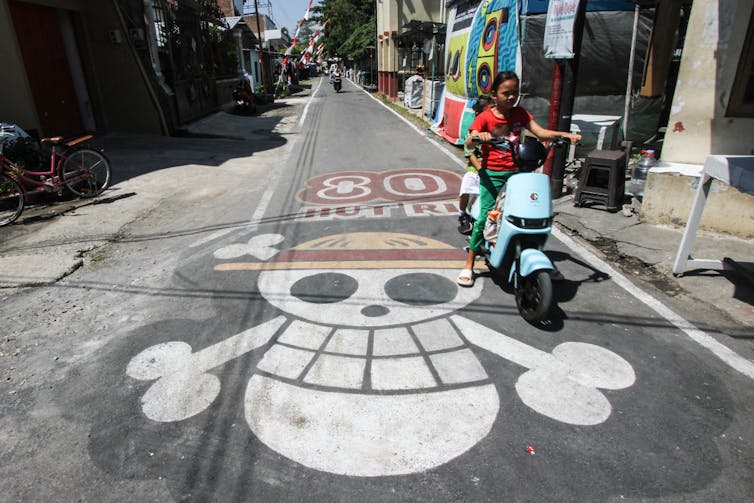
Mais c’est en Indonésie, en août 2025, que le drapeau a véritablement pris son essor politique. Là-bas, les manifestants l’ont adopté pour exprimer leur frustration face aux politiques gouvernementales et leur mécontentement croissant face à la corruption et aux inégalités. Cela a coïncidé avec les appels du gouvernement à faire preuve de patriotisme lors des célébrations de l’indépendance, accentuant le contraste entre le nationalisme officiel et la dissidence populaire.

Deux personnes sur une mobylette passent devant une fresque murale représentant le drapeau de One Piece
Le drapeau de One Piece est devenu le symbole des manifestations indonésiennes en août 2025.
Dika/AFP

Le mouvement a pris de l’ampleur lorsque les autorités ont réagi en critiquant vivement l’utilisation du drapeau, attirant ainsi involontairement davantage l’attention sur ce symbole. Les responsables gouvernementaux ont qualifié ces manifestations de menaces pour l’unité nationale, tandis que les manifestants les considéraient comme des expressions légitimes de frustration politique.

Un drapeau voyageur

La vitesse à laquelle le Jolly Roger de One Piece s’est répandu au-delà des frontières reflète l’éducation numérique de la génération Z. Il s’agit de la première cohorte à avoir grandi entièrement en ligne, immergée dans les mèmes, les anime et les franchises mondiales de divertissement. Leur communication politique repose sur ce que les chercheurs appellent « les publics en réseau », des communautés qui se forment et agissent via des plates-formes numériques plutôt que des organisations formelles.

Dans ce contexte, la solidarité ne nécessite pas d’appartenance à un parti ou à une idéologie. Elle repose plutôt sur des références culturelles communes. Un mème, un geste ou un drapeau peuvent instantanément véhiculer un sens au-delà des clivages linguistiques, religieux ou géographiques. Cette forme de connexion repose sur des codes culturels partagés qui permettent aux jeunes de s’identifier les uns aux autres même lorsque leurs systèmes politiques diffèrent.

Les réseaux sociaux confèrent à cette solidarité une portée et une rapidité exceptionnelles. Des vidéos d’Indonésiens brandissant le drapeau ont été extraites et partagées sur TikTok et Instagram, touchant ainsi un public bien au-delà de leur contexte d’origine. Lorsque le symbole est apparu à Katmandou, la capitale népalaise, en septembre, il était déjà porteur d’une aura de rébellion juvénile.

Au Népal, le drapeau était associé à la colère suscitée par le chômage des jeunes et à la richesse ostentatoire des dynasties politiques. En Indonésie, cela reflétait la désillusion face aux rituels patriotiques qui semblaient creux dans un contexte de corruption. Les deux mouvements sont motivés par des causes très différentes, mais, dans les deux cas, le drapeau fonctionnait comme un code open source : adaptable localement, mais immédiatement compréhensible ailleurs.

Une partie de l’efficacité du drapeau provient de son ambiguïté. Contrairement au logo d’un parti, le drapeau de One Piece trouve son origine dans la culture populaire, ce qui rend difficile sa suppression par les gouvernements sans paraître autoritaire. Lors des dernières manifestations en Indonésie, les autorités ont confisqué des banderoles et ont qualifié le fait de les utiliser comme une trahison. Mais de telles mesures répressives n’ont fait qu’amplifier la frustration des manifestants.

Un grand drapeau orné d’un crâne et d’os croisés est entouré de personnes
Le drapeau flotte au milieu des manifestations aux Philippines le 21 septembre 2025.
@rimurutempestuh/x

Quand la fiction envahit la réalité

Le drapeau One Piece n’est pas le seul à avoir été réinventé comme symbole de résistance.

Dans tous les mouvements à travers le monde, la culture pop et la culture numérique sont devenues des ressources puissantes pour les militants. Au Chili et à Beyrouth, les manifestants ont porté des masques de Joker pour symboliser leur colère face à la corruption et aux inégalités. En Thaïlande, les manifestants se sont tournés vers « Hamtaro », un dessin animé pour enfants mettant en scène un hamster, parodiant sa chanson thème et brandissant des peluches pour ridiculiser les dirigeants politiques.

Ce mélange de politique, de divertissement et d’identité personnelle reflète un environnement médiatique hybride dans lequel les symboles issus de la culture fan acquièrent du pouvoir. Ils sont faciles à reconnaître, à adapter et à défendre contre la répression étatique.

Cependant, la résonance culturelle ne suffit pas à expliquer cet engouement. Le drapeau « One Piece » a connu un grand succès parce qu’il reflétait les griefs réels de la population. Au Népal, où le chômage des jeunes dépasse les 20 % et où la migration pour trouver du travail est courante, les manifestants ont associé l’emblème à des slogans tels que « La génération Z ne se taira pas » et « Notre avenir n’est pas à vendre ».

En Indonésie, certains manifestants ont fait valoir que le drapeau national était « trop sacré » pour être brandi dans un système corrompu, utilisant le drapeau pirate comme une déclaration de désillusion.

La diffusion du drapeau reflète également un changement plus général dans la manière dont les idées contestataires traversent les frontières. Autrefois, les sit-in, les marches ou les grèves de la faim tenaient le haut du pavé dans l’espace médiatique. Aujourd’hui, ce sont les symboles, les références visuelles issues de la culture mondiale qui circulent le plus rapidement. Ils peuvent être adaptés aux luttes locales tout en restant immédiatement reconnaissables ailleurs.

Des passants devant une affiche représentant un crâne et des os croisés
Un drapeau One Piece, planté devant un lycée en France pendant les manifestations.
Pat Batard/Hans Lucas/AFP

Le parcours du drapeau, des rues asiatiques aux manifestations en France et en Slovaquie démontre à quel point la grammaire de la dissidence s’est mondialisée.

Pour les jeunes militants d’aujourd’hui, culture et politique sont indissociables. La génération numérique a donné naissance à une génération qui communique ses griefs à travers des mèmes, des symboles et des références culturelles qui traversent facilement les frontières.

Lorsque les manifestants à Jakarta, Katmandou ou Manille brandissent le drapeau Jolly Roger de One Piece, ils ne se livrent pas à un jeu de rôle, mais transforment une icône culturelle en un emblème vivant de défiance.

The Conversation

Nuurrianti Jalli est affilié à l’Institut d’études sur l’Asie du Sud-Est (ISEAS) Yusof Ishak Institute Singapore en tant que chercheur invité non résident pour le programme Médias, technologie et société.

ref. Comment le drapeau pirate de « One Piece » est devenu l’emblème mondial de la résistance pour la génération Z – https://theconversation.com/comment-le-drapeau-pirate-de-one-piece-est-devenu-lembleme-mondial-de-la-resistance-pour-la-generation-z-266172

Ecoball: how to turn picking up litter into a game for kids

Source: The Conversation – Africa – By Solaja Mayowa Oludele, Lecturing, Olabisi Onabanjo University

Wikimedia Commons, CC BY

Every year humanity produces nearly 300 million tonnes of plastic. Only a fraction ever gets recycled. Most ends up in rivers, oceans and soil, slowly breaking down into tiny, invisible microplastics that get into what we eat and drink.

Decades of recycling drives and policy bans have not altered the deep-rooted behaviours behind this crisis.
But what if the next big environmental solution isn’t a new law or technology – but a game?

I am an environmental sociologist and behaviour change researcher from Nigeria. I developed a game called EcoBall in 2023 as a social innovation that makes sport a tool for sustainability.

The concept is discussed in my peer-reviewed paper.

EcoBall reimagines football as a discipline of training for environmental stewardship. Instead of chasing goals alone, teams compete to collect, sort and creatively reuse plastic waste. Each match becomes a live demonstration of the circular economy – the idea that materials should be reused, not discarded.

Here I describe how the game works, why it influences people’s behaviour, and what we found when we tested it in Nigerian schools and youth clubs.

Three zones, one planet

An EcoBall match uses a real ball made from tightly woven recycled plastic bags – the “EcoBall” itself. Two or more teams compete across three timed “learning zones”, combining physical play with environmental tasks.

• Collection zone (10-15 minutes): To start play, the ball is placed at the centre of the field. Players pass and dribble it like they would in football or handball. The pitch or play area is scattered with lightweight, clean plastic litter. Teams race to gather the litter from the designated area and place it in a team bag or collection net along the sidelines before rejoining the game. Points are awarded for the amount and diversity of plastics collected.

• Sorting zone: Back on the pitch, players classify the plastics correctly (PET bottles, sachets, nylon wrappers and so on). Accurate sorting earns additional points and practical recycling knowledge. Teams earn points for goals and for the quantity or weight of litter collected.

• Creative zone: After each game, the collected plastics are sorted and delivered to recycling or upcycling partners. Using selected materials, teams craft new items – from art pieces to flower planters or even another EcoBall. Judges score on creativity, teamwork and utility.

Participants also engage in short reflective or educational sessions to discuss plastic pollution, sustainability habits, and collective responsibility.

The champion is not only the fastest but also the team with the most environmental impact.

What seems to be a game is really learning through doing. Participants learn sustainability not by being preached at but by doing it, competing and relishing their achievements together.

The psychology behind the game

EcoBall draws on two social-science ideas: the theory of planned behaviour and social capital theory. The first explains why people adopt sustainable habits. By making recycling fun, social and rewarding, EcoBall reshapes attitudes and perceived norms – the key drivers of behaviour.

The second highlights the power of trust and networks. EcoBall builds these bonds as teams collaborate and share victories, creating social momentum that keeps environmental action alive long after the game ends.

In designing and evaluating EcoBall, I combined these theories with research on sport-for-development and environmental education. Where I was both participant-observer and referee, the assessment compared data from questionnaires, focus groups and observation diaries. The design allowed for transparency, credibility, and contextual validity in interpretation of EcoBall’s impact on environmental attitudes and behaviours.

Tested on the field

Pilot sessions were conducted at several schools and youth clubs across Ogun State to ascertain the level to which EcoBall enhances environmental awareness, cooperation and pro-active participation in plastic litter removal.

The pilots were community-led and research-motivated and were supported by small donations from local NGOs and schools, and recycling businesses which provided gloves, collection bags and bins.


Read more:
Plastic pollution in Nigeria: whose job is it to clean up the mess?


Instructors reported increased cooperation and leadership. Players described being more responsible for their surroundings, and some of them formed neighbourhood clean-up clubs which extended weeks beyond the games. While the long-term effect is yet to be studied, these early findings show that EcoBall is likely to induce actual behavioural change.

From waste to wealth

EcoBall also shows that environmental action can create livelihoods.
In one pilot, students built benches and flower planters from bottles gathered during matches. Others began selling up-cycled crafts, while the organisation of events – coaching, logistics and recycling partnerships – generated new work opportunities.

Such experiences echo the circular-economy principle of turning waste into worth.

Uniting generations and communities

Because EcoBall requires little equipment – just gloves, bags and open space – it thrives in low-resource communities.

The design was intentionally simple, ensuring accessibility and inclusion where conventional sports infrastructure is absent.

Although EcoBall is inexpensive to initiate, its long-term delivery as a structured sport-for-development and environmental education programme requires sustained funding. Investment is needed for facilitator training, community engagement, and monitoring activities. This is typical of community interventions: low-cost to launch but funding-dependent to sustain and scale.

Children, parents, and grandparents can play together, bridging generations and backgrounds. This shared passion generates a feeling of ownership of public spaces and renewed pride in keeping them clean.


Read more:
Not sure how to keep your kids busy and happy these holidays? Here are five tips.


Schools are able to incorporate EcoBall into extracurricular activities, municipalities can organise tournaments tied in with cleanup initiatives, and corporations can make it part of their corporate social responsibility initiatives.

Following early successes, two NGOs that work with youth development have begun using EcoBall in their environmental clubs, and discussions are underway with the National Youth Service Corps to introduce it into community services.

Challenges and opportunities

No innovation is challenge-free. EcoBall needs consistent funding, materials and cultural adaptation. Keeping players engaged may require creative incentives – such as mobile apps to track points or online leaderboards connecting communities globally.

Yet these hurdles create opportunities. A “World EcoBall Cup” could one day unite cities or nations, rewarding those who divert the most plastic from the environment.

Instead of medals, winners would boast cleaner beaches and thriving circular economies.

Play for the planet

The global plastic crisis demands solutions that move people, not just policies.

EcoBall does exactly that – bringing sport together with green purpose and demonstrating that climate action has the power to be human, inclusive and fun.


Read more:
Informal waste collection shouldn’t let plastic polluters off the hook: here’s why


It is not the sole responsibility of scientists or policymakers to fight pollution. It belongs to everyone willing to pick up a ball – or a bottle – and make a difference.

The Conversation

Solaja Mayowa Oludele does not work for, consult, own shares in or receive funding from any company or organisation that would benefit from this article, and has disclosed no relevant affiliations beyond their academic appointment.

ref. Ecoball: how to turn picking up litter into a game for kids – https://theconversation.com/ecoball-how-to-turn-picking-up-litter-into-a-game-for-kids-267888

Luxury tourism is a risky strategy for African economies – new study of Botswana, Mauritius, Rwanda

Source: The Conversation – Africa – By Pritish Behuria, Reader in Politics, Governance and Development, Global Development Institute, University of Manchester

Mauritius led the luxury tourism trend in Africa with all-inclusive resorts. Heritage Awali/yourgolftravel.com, CC BY-NC-ND

How successful is luxury tourism in Africa? What happens if it fails to produce higher tourism revenues: can it be reversed? And does it depend on what kind of government is in place?

Pritish Behuria is a scholar of the political economy of development who has conducted a study in Botswana, Mauritius and Rwanda to find answers to questions like this. We asked him about his findings.


What is luxury tourism and how prevalent is it in Africa?

Luxury tourism aims to attract high-spending tourists to stay at premium resorts and lodges or visit exclusive attractions. It’s a strategy that’s being adopted widely by governments around the world and also in African countries.

It’s been promoted by multilateral agencies like the World Bank and the United Nations, as well as environmental and conservation organisations.

The logic underlying luxury tourism is that if fewer, high-spending tourists visit, this will result in less environmental impact. It’s often labelled as a “high-value, low-impact” approach.


Read more:
Why your holiday flight is still not being powered by sustainable aviation fuel


However, studies have shown that luxury tourism does not lead to reduced environmental impact. Luxury tourists are more likely to use private jets. Private jets are more carbon intense than economy class travel. Supporters of luxury tourism also ignore that it reinforces economic inequalities, commercialises nature and restricts land access for indigenous populations.

In some ways, of course, the motives of African countries seem understandable. They remain starved of much-needed foreign exchange in the face of rising trade deficits. The allure of luxury tourism seems almost impossible to resist.

How did you go about your study?

I have been studying the political economy of Rwanda for nearly 15 years. The government there made tourism a central part of its national vision.

Over the years, many government officials and tourism stakeholders highlighted the challenges of luxury tourism strategies. Even so, there remains a single-mindedness to prioritise luxury tourism.

I found that, in Rwanda, luxury tourism resulted in a reliance on foreign-owned hotels and foreign travel agents, exposing potential leakages in tourism revenues. Crucially, tourism was not creating enough employment. There was also a skills lag in the sector. Employees were not being trained quickly enough to meet the surge of investments in hotels.


Read more:
What cost-of-living crisis? Luxury travel is booming – and set to grow further


So I decided to investigate the effects of luxury tourism in other African countries. I wanted to know who benefits and how it is being reversed in countries that are turning away from it.

I interviewed government officials, hotel owners and other private sector representatives, aviation officials, consultants and journalists in all three countries. Added to this was a thorough review of economic data, industry reports and grey literature (including newspaper articles).

What are your take-aways from Mauritius?

Mauritius was the first of the three countries to explicitly adopt a luxury tourism strategy. In the late 1970s and early 1980s the government began to encourage European visitors to the island’s “sun-sand-sea” attractions. Large domestic business houses became lead investors, building luxury hotels and buying coastal land.

Over the years, tourism has provided significant revenues for the Mauritian economy. By 2019, the economy was earning over US$2 billion from the sector (before dropping during the COVID pandemic).

However, tourism has also been symbolic of the inequality that has characterised Mauritius’ growth. The all-inclusive resort model – where luxury hotels take care of all of a visitor’s food and travel needs themselves – has meant that the money being spent by tourists doesn’t always enter the local economy. A large share of profits remains outside the country or with large hotels.

After the pandemic, the Mauritian government took steps to loosen its focus on luxury tourism. It opened its air space to attract a broader range of tourists and re-started direct flights to Asia. There’s growing agreement within government that the opening up of tourism will go some way towards sustaining revenues and employment in the sector. Especially as some other key sectors (like offshore finance) may face an uncertain future.

And from Botswana?

Botswana followed Mauritius by formally adopting a luxury tourism strategy in 1990. Its focus was on its wilderness areas (the Okavango Delta) and wildlife safari lodges. For decades, there were criticisms from scholars about the inequalities in the sector.

Most lodges and hotels were foreign owned. Most travel agencies that booked all-inclusive trips operated outside Botswana. There were very few domestic linkages. Very little domestic agricultural or industrial production was used within the sector.

An aerial photo of a vast land of water and rocky. Small boats cross the water.
Guides take tourists across Botswana’s Okavango delta in boats.
Diego Delso/Wikimedia Commons, CC BY-SA

However, I found that the direction of tourism policies had also become increasingly political. Certain politicians were aligned with conservation organisations and foreign investors in prioritising luxury tourism. Former president Ian Khama, for example, banned trophy hunting on ethical grounds in 2014. He pushed photographic tourism, where travellers visit destinations mainly to take photos. But critics allege he and his allies benefited from the push for photographic tourism.

Photographic tourism is closely linked with the problematic promotion of “unspoilt” wilderness areas that conform to foreign ideas about the “myth of wild Africa”.

President Mokgweetsi Masisi reversed the hunting ban once he took power. He argued it had adverse effects on rural communities and increased human-wildlife conflict. He believed that regulated hunting could be a tool for better wildlife management and could produce more benefits for communities.

Since the latter 2010s, Botswana’s government has loosened the emphasis on luxury tourism and tried to diversify tourism offerings. It has relaxed visa regulations for Asian countries, for example, to allow a wider range of tourists to visit more easily.

What about Rwanda?

Of the three cases, Rwanda was the most recent to adopt a luxury tourism strategy. However, it has remained the most committed to this strategy. Rwanda’s model is centred on mountain gorilla trekking and premium wildlife experiences. It’s augmented by Rwanda’s attempt to become a hub for business and sports tourism through high-profile conferences and events.

A statue in a breen-leafed area of a male, female, and baby gorilla.
Gorillas are a key attraction for luxury tourists in Rwanda.
Gatete Pacifique/Wikimedia Commons, CC BY-SA

Rwanda invited global hotel brands (like the Hyatt and Marriott) to build hotels and invested heavily in the country’s “nation brand” through sponsoring sports teams. The “luxury” element is managed through maintaining a high price to visit the country’s main tourist attraction: mountain gorillas. Rwanda is one of the few countries where mountain gorillas live.

After the pandemic, the government lowered prices to visit mountain gorillas but has also regularly stated its commitment to luxury tourism.

What did you learn by comparing the three?

I wanted to know why some countries reverse luxury tourism strategies once they fail while others don’t.

It is quite clear that luxury tourism strategies will always have disadvantages. As this study shows, luxury tourism repeatedly benefits only very few actors (often foreign investors or foreign-owned entities) and does not create sufficient employment or provide wider benefits for domestic populations. My research shows that the political pressure faced by democratic governments (like Botswana and Mauritius) forced them to loosen their luxury tourism strategies. This was not the case in more authoritarian Rwanda.


Read more:
Travelling in 2025? Here’s how to become a ‘regenerative’ tourist


Rwanda’s position goes against a lot of recent literature on African political economy, which argues that parties with a stronger hold on power would be able to deliver better development outcomes.

While that may be case in some sectors, the findings of this study suggest that weaker political parties may actually be more responsive to changing policies that are creating inequality than countries with stronger political parties in power.

The Conversation

Pritish Behuria is a recipient of the British Academy Mid-Career Fellowship 2024-2025 (MFSS24/240043).

ref. Luxury tourism is a risky strategy for African economies – new study of Botswana, Mauritius, Rwanda – https://theconversation.com/luxury-tourism-is-a-risky-strategy-for-african-economies-new-study-of-botswana-mauritius-rwanda-267877

Nigeria’s government is using digital technology to repress citizens. A researcher explains how

Source: The Conversation – Africa (2) – By Chibuzo Achinivu, Visiting Assistant Professor of Political Science, Vassar College

Digital authoritarianism is a new way governments are trying to control citizens using digital and information technology. It is a growing concern for advocacy groups and those interested in freedom and democracy. It is especially worrying for those who initially heralded digital and information technologies as liberating tools that would spread information more easily for citizens.

I have studied the rise of digital authoritarianism in Africa over the last two decades. My most recent study focused on Nigeria, and its turn to digital tools for control after the 2020 #EndSARS Movement protests.

I found that local conflict and development needs drive the Nigerian government’s demand for digital authoritarianism technologies. Foreign suppliers of these technologies are motivated by both economic gain and influence in the region.

The findings are important. Firstly, it signals that the trend of using digital spaces to control populations has reached the African continent. It also shows that the trend is facilitated by foreign actors that provide governments with the technology and expertise.

What is digital authoritarianism?

One way to understand the concept of digital authoritarianism is as a form of governance or set of actions aimed at undermining accountability. It is the use of digital technologies for this goal.

Technology is used to repress voices, keep people under surveillance, and manipulate populations for regime goals and survival.

It includes but is not limited to internet and social media shutdowns. It prioritises the use of spyware to hack and monitor people through their devices. There is mass surveillance using artificial intelligence for facial recognition, and misinformation and disinformation propaganda campaigns.

What drives it in Africa

In Africa these actions are popping up in democracies like Nigeria and in autocracies alike. Perhaps the noticeable difference between these two types of governments is the subtlety of their form of digital authoritarianism and the legal recourse when such actions are unearthed.

Both governance types make claims of national security and public safety to justify these tactics. For instance, former Nigerian information minister Lai Mohammed claimed the 2020 Twitter ban was due to “the persistent use of the platform for activities that are capable of undermining Nigeria’s corporate existence”.

Autocracies are often cruder with their use of blatant tactics. They employ internet and social media shutdowns. This is often due to their unsophisticated digital authoritarianism apparatuses. Democracies often rely on more subtle surveillance and misinformation campaigns to reach their goals.

This all begs the question: what are the drivers of this trend? There are four clear ones:

  • regime survival/political control

  • security and counterterrorism

  • electoral competition and information manipulation

  • modernisation agendas (development).

On the rise

In the African context digital authoritarianism is on the rise. There’s a cohesive relationship between the foreign suppliers of the hardware, expertise and domestic demand. This demand stems from authoritarian regimes as well as regimes accessing digital systems to consolidate and modernise. There are also hybrid regimes, which are countries with a mixture democratic and authoritarian institutions.

States like China, Russia, Israel, France and the US supply both the technology and instruction or best practices to African regimes. Reasons for supply include economic gain and regional influence.

On the demand side, African regimes seek out digital authoritarianism tools mainly for development needs and for conflict resolution. Some of the largest consumers are Kenya, Rwanda, Uganda, Nigeria and Ghana.

The study

I found there was evidence that Nigeria’s development goals and efforts to quell conflicts drive the use of technology to repress its people. Using the example of the #EndSARS movement, social media platform shutdowns and efforts to build a firewall akin to China’s great firewall serve as evidence for this.

In the days following Twitter’s removal of a post by President Muhammadu Buhari, Twitter was banned in Nigeria. The administration cited its use to further unrest, instability, and secessionist movements. There were claims that this step was taken to maintain internet sovereignty.

However, the ban also undermined social movements that were successfully holding the government accountable. Following domestic and international outcry over the ban, there were reports that the Nigerian government had approached China. The purpose of the contact was to replicate their “Great Firewall” in Nigeria’s internet control apparatus. (The focus of China’s project is to monitor and censor what can and cannot be seen through an online network in China.) This would allow the state to manage access to certain cites and block unwanted content from reaching Nigerians.

On the supply side, China’s economic commitments to the country and concerted efforts to cultivate certain norms in the country and region offer insights into the motivations for supply in this case and the broader continent.

Again, regime type dictates just how these technologies will be used. Interviews conducted with permanent secretaries and ministers of Nigerian ministries were particularly revealing. They confirmed that repressive government practices in the real world are informing their activity in digital spaces.

For instance, they intimated that the repression that occurs during protests in the streets in order to manage “lawlessness” is being replicated online. Its purpose is to ensure peace and stability.

For development needs, countries like Nigeria initially seek out foreign suppliers to furnish them with state of the art technology systems. The objective is to establish or refurbish their information and communications technology apparatuses.

These include but are not limited to national broadband networks) such as fiber optic networks, mobile telecommunications networks and smart city governance systems. Though these are often not repressive in nature, they are capable of dual use. Thus, these development needs provide technologies that are then utilized in an authoritarian fashion for state building goals.

There is also evidence that some suppliers provide instruction on how to use these technologies for repression. In some instances, under the guise of development needs, regimes seek out more repressive tools such as spyware alongside these infrastructural development programs. At this stage, the boundary between development and security blurs, as modernization becomes a vehicle for national security, cyber defense, regime protection, and information control.

What can be done?

I propose a three-pronged approach to address the three drivers. First of all, more has to be done on the international front to curb the sale of repressive tools to states. There must be a conversation about the norms of these technologies and their use for repression in both democracies and autocracies.

On the demand side, it appears those practices that have plagued the hopes of freedom and democracy in the real world have to be addressed. Naturally, no movement on the digital front is complete without a real world manifestation. It seems logical that eradicating digital repression necessitates addressing repression in general.

Finally, regulatory legal and institutional oversight alongside human rights benchmarks must be achieved. These will accompany digital and privacy rights in cyberspace.

The Conversation

Chibuzo Achinivu does not work for, consult, own shares in or receive funding from any company or organisation that would benefit from this article, and has disclosed no relevant affiliations beyond their academic appointment.

ref. Nigeria’s government is using digital technology to repress citizens. A researcher explains how – https://theconversation.com/nigerias-government-is-using-digital-technology-to-repress-citizens-a-researcher-explains-how-267032

Climate change is making cities hotter. Here’s how planting trees can help

Source: The Conversation – Canada – By Lingshan Li, PhD candidate, Department of Geography, Planning and Environment, Concordia University

Canada’s climate is warming twice as fast as the global average, and many cities will experience at least four times as many extreme heat events (days above 30 C) per year in the coming decades.

In Québec alone, elevated summer temperatures were associated with about 470 deaths, 225 hospitalizations, 36,000 emergency room visits, 7,200 ambulance transports and 15,000 calls to a health hotline every year.

To tackle the crisis of climate change, the government of Canada proposed the 2 Billion Trees program that aims to plant two billion trees by 2031 over a period of 10 years.

But such ambitions come with important questions:

  • Where and how to plant these trees?
  • How to manage the trees to provide more cooling for the people?
  • How to direct the cooling to the most underserved communities?

Colleagues and I recently published a study in Montréal that explores how urban green spaces can reduce surface temperature and help promote environmental justice. We found that even small increases in green spaces can make a notable difference in city temperatures.


Read more:
Urban trees vs. cool roofs: What’s the best way for cities to beat the heat?


Why the placement of trees is important

If you’ve ever passed under the shade of a tree on a hot summer day and felt the temperature drop, you know how valuable they are in cities. Both the amount and layout of urban green spaces affect how much they can cool a city.

The way trees, parks and other green areas are arranged can change how they provide shade and release moisture into the air, which together determine how much they can lower the surrounding temperature.

Where urban green spaces are located is also related to an important social issue: environmental justice. Unequally distributed green spaces can restrict residents’ access to cooling in certain neighbourhoods, contributing to social inequalities within a city.

Those living in low-income neighbourhoods feeling the harshest impacts of urban heat can struggle to find green spaces where they can cool off. Young children and the elderly are also more susceptible to the dangers of prolonged heat exposure.

There is a need for municipal governments to get a better view of how well these vulnerable groups receive the cooling provided by urban green infrastructure and what factors have driven the unbalanced distribution.

What we found

Using satellite imagery and laser imaging, we found that having more trees, grass and shrubs in an area can notably reduce temperatures. We developed a model to estimate the cooling effect provided by urban green infrastructure based on several indicators. Those indicators reflect the quantity and quality aspect of the urban greenery.

Our model showed that a 10 per cent increase in tree coverage can lower land surface temperature by approximately 1.4 C. A similar increase in shrubs and grass lowers temperatures by about 0.8 C.

The result also indicated that large, continuous groups of trees cool their surroundings better than small, scattered patches. A 10 per cent increase in the aggregation level of tree cluster (area of the largest patch of trees divided by the total area of trees within a landscape unit) can lower land surface temperature by about 0.2 C.

We also found that the cooling provided by green spaces in many parts of Montréal do no meet the needs of local residents. This mismatch varies a lot between census tracts.

Areas in the city abundant with green spaces include boroughs like Le Plateau-Mont-Royal, Outremont, L’Île-Bizard–Sainte-Geneviève and the village of Senneville. Meanwhile, areas such as Montréal-Est, Saint-Leonard and Saint-Laurent have the least amount of green space.

In addition, areas like Pointe-Claire and Montréal-Nord have good green space, but their mismatch index is still low because many vulnerable people live there. The mismatch index is calculated by supply index minus demand index; that means a higher demand index would lead to a lower mismatch index.

Neighbourhoods with higher median incomes and more highly educated people were mostly associated with positive supply-demand values. That indicates their supply of cooling services as provided by urban green spaces was higher than their demand.

In contrast, census tracts with higher proportion of racialized people and people with a lower level of education tend to lack enough green spaces where residents can cool off.

Vulnerable people (young and elderly individuals) with a higher socio-economic status received more cooling services provided by the urban green spaces. In contrast, those on the other end of the socio-economic spectrum were more likely to struggle to easily find a place to cool off.

What we can do in the future

For cities with similar humid summer months like Montréal, urban planners who want to reduce daytime heat should consolidate tree patches into large, continuous areas where possible.

It is also helpful to design smaller-scale green spaces with more irregularly shaped tree patches and create enhanced connectivity, especially for grass, to support small-scale cooling.

In Montréal and other cities where green spaces are unequally distributed, municipal officials should develop ranked action plans for greening efforts that consider environmental justice and prioritize areas where the need for cooling is greatest.

The Conversation

Lingshan Li receives funding from The Trottier Family Foundation and the Natural Sciences and Engineering Research Council of Canada.

ref. Climate change is making cities hotter. Here’s how planting trees can help – https://theconversation.com/climate-change-is-making-cities-hotter-heres-how-planting-trees-can-help-267827

AI reveals which predators chewed ancient humans’ bones – challenging ideas on which ‘Homo’ species was the first tool-using hunter

Source: The Conversation – USA – By Manuel Domínguez-Rodrigo, Professor of Anthropology, Rice University

If *Homo habilis* was often chomped by leopards, it probably wasn’t the top predator. Made with AI (DALL-E 4)

Almost 2 million years ago, a young ancient human died beside a spring near a lake in what is now Tanzania, in eastern Africa. After archaeologists uncovered his fossilized bones in 1960, they used them to define Homo habilis – the earliest known member of our own genus.

Paleoanthropologists define the first examples of the genus Homo based largely on their bigger brains – and, sometimes, smaller teeth – compared with other, earlier ancestors such as the australopithecines – the most famous of these being Lucy. There were at least three types of early humans: Homo habilis, Homo rudolfensis and the best documented species, Homo erectus. At least one of them created sites now in the archaeological record, where they brought and shared food, and made and used some of the earliest stone tools.

These archaeological sites date to between 2.6 to 1.8 million years ago. The artifacts within them suggest greater cognitive complexity in early Homo than documented among any nonhuman primate. For example, at Nyayanga, a site in Kenya, anthropologists recently found that early humans were using tools they transported over distances of up to 8 miles (13 kilometers). This action indicates forethought and planning.

Traditionally, paleoanthropologists believed that Homo habilis, as the earliest big-brained humans, was responsible for the earliest sites with tools. The idea has been that Homo habilis was the ancestor of later and even bigger-brained Homo erectus, whose descendants eventually led to us.

This narrative made sense when the oldest known Homo erectus remains were younger than 1.6 million years old. But given recent discoveries, this seems like a shaky foundation.

In 2015, my team discovered a 1.85 million-year-old hand bone at Olduvai Gorge, the same place the original Homo habilis had been found. But unlike the hand of that Homo habilis juvenile, this fossil looked like it belonged to a larger, more modern, fully land-based rather than tree-based human species: Homo erectus.

Over the past decade, new finds have continued to push back the earliest dates for Homo erectus: about 2 million years ago in South Africa, Kenya and Ethiopia. Taken together, these discoveries reveal that H. erectus is slightly older than the known H. habilis fossils. We cannot simply assume that H. habilis gave rise to H. erectus. Instead, the human family tree looks far bushier than we once thought.

What do all these finds suggest? Only one Homo species is our likely ancestor, and probably only one can be responsible for the complex behaviors revealed at the Olduvai Gorge sites. My colleagues and I hit on a way to test whether Homo habilis was top dog at Olduvai Gorge, so to speak, based on whether they were the hunters or the hunted.

Who was hunting who?

At Olduvai Gorge, there is overwhelming evidence that early humans were consuming animals as big as a gazelle or even a zebra. Not only did they hunt, but they repeatedly brought these animals back to the same location for communal consumption. This is the concept of a “central provisioning place,” much like a campsite or home today. Dating to 1.85 million years ago, this is the oldest evidence of frequent meat-eating – and of early humans regularly acting as predators rather than prey.

All animals occupy a position on a food web, from top to lower ranks. Top-ranking predators, such as lions, are usually not preyed upon by lower ranking carnivores, such as hyenas.

If Homo habilis was acquiring large animal carcasses, either by hunting or by chasing lions away from their own kills, it seems logical that these hominids could effectively cope with predation risks. That is, a hunter usually isn’t hunted.

In African savannas, apex predators like lions do not usually die from other predator attacks. Humans today also occupy a top predatory niche: For example, Hadza hunter-gatherers in Tanzania not only hunt game, but also fend off lions from their kills, and successfully defend themselves from attacks by other predators, such as leopards.

But, if Homo habilis was not yet a top predator, then you would expect them to have occasionally been prey to lower-on-the-food-chain carnivorous cats – such as leopards – who often hunt primates.

Most known human fossils at this stage of evolution do bear traces of carnivore damage, including the two best preserved H. habilis fossils from Olduvai Gorge. Was it caused after death, by a scavenging carnivore? Or did a big cat at the top of the food chain kill these early humans?

My colleagues and I set out to address the question of which predators were getting their teeth on H. habilis and presumably whether before or after the ancient humans died.

AI suggests H. habilis wasn’t an apex predator

Here’s where artificial intelligence comes in. Using computer vision, we trained AI on hundreds of microscopic images showing tooth marks left by the main carnivores in Africa today: lions, leopards, hyenas and crocodiles. The AI learned to recognize the subtle differences between the marks made by the different predators and was able to classify the marks with high accuracy.

four different magnified craters on brownish backgrounds
Tooth marks left by the four types of carnivores recorded. A: crocodile tooth pit; B: hyena tooth pit; C: lion tooth pit; and D: leopard tooth pit.
Domínguez-Rodrigo, M., et al. Sci Rep 14, 6881 (2024)

When we combined different AI approaches, they all pointed to the same result: The tooth marks on the Homo habilis bones matched those made by leopards. The size and shape of the marks on the fossils from those two early Homo habilis individuals line up with what leopards leave today when feeding on prey.

Our discovery challenges the long-standing view of Homo habilis as the first skilled toolmaker, hunter and meat-eater.

But maybe it shouldn’t be too surprising. The only complete skeleton of this species found at Olduvai Gorge belonged to a very small individual – just about 3 feet tall (less than 1 meter) – with a body that still showed features suited for climbing trees. That hardly matches the image of a hunter able to bring down large animals or steal carcasses from lions.

If it wasn’t Homo habilis performing these feats, maybe it was Homo erectus, a species with a larger body and more modern anatomy. But that opens up other mysteries for future researchers: What was Homo habilis doing at the archaeological sites of Olduvai Gorge if it was not responsible for the tools and signs of hunting we find there? Where exactly did Homo erectus come from, and how did it evolve?

My team and others will be returning to places like Olduvai Gorge to ask these questions in the years to come.

The Conversation

Manuel Domínguez-Rodrigo receives funding from the Spanish Ministry of Science and Universities

ref. AI reveals which predators chewed ancient humans’ bones – challenging ideas on which ‘Homo’ species was the first tool-using hunter – https://theconversation.com/ai-reveals-which-predators-chewed-ancient-humans-bones-challenging-ideas-on-which-homo-species-was-the-first-tool-using-hunter-266561

AI chatbots are becoming everyday tools for mundane tasks, use data shows

Source: The Conversation – USA – By Jeanne Beatrix Law, Professor of English, Kennesaw State University

The average person is more likely to use AI to come up with a meal plan than program a new app. Oscar Wong/Moment via Getty Images

Artificial intelligence is fast becoming part of the furniture. A decade after IBM’s Watson triumphed on “Jeopardy!,” generative AI models are in kitchens and home offices. People often talk about AI in science fiction terms, yet the most consequential change in 2025 may be its banal ubiquity.

To appreciate how ordinary AI use has become, it helps to remember that this trend didn’t start with generative chatbots. A 2017 Knowledge at Wharton newsletter documented how deep learning algorithms were already powering chatbots on social media and photo apps’ facial recognition functions. Digital assistants such as Siri and Alexa were performing everyday tasks, and AI-powered image generators could create images that fooled 40% of viewers.

When ChatGPT became publicly available on Nov. 30, 2022, the shift felt sudden, but it was built on years of incremental integration. AI’s presence is now so mundane that people consult chatbots for recipes, use them as study partners and rely on them for administrative chores. As a writer and professor who studies ways that generative AI can be an everyday collaborator, I find that recent usage reports show how AI has been woven into everyday life. (Full disclosure: I am a member of OpenAI’s Educator Council, an uncompensated group of higher education faculty who provide feedback to OpenAI on educational use cases.)

Who’s using ChatGPT and why?

Economists at OpenAI and Harvard analyzed 1.5 million ChatGPT conversations from November 2022 through July 2025. Their findings show that adoption has broadened beyond early users: It’s being used all over the world, among all types of people. Adoption has grown fastest in low- and middle-income countries, and growth rates in the lowest-income countries are now more than four times those in the richest nations.

Most interactions revolve around mundane activities. Three-quarters of conversations involve practical guidance, information seeking and writing. These categories are for activities such as getting advice on how to cook an unusual type of food, where to find the nearest pharmacy, and getting feedback on email drafts. More than 70% of ChatGPT use is for nonwork tasks, demonstrating AI’s role in people’s personal lives. The economists found that 73% of messages were not related to work as of June 2025, up from 53% in June 2024.

Claude and the geography of adoption

Anthropic’s economic index paints a similar picture of uneven AI adoption. Researchers at the company tracked users’ conversations with the company’s Claude AI chatbot relative to working-age population. The data shows sharp contrasts between nations. Singapore’s per-capita use is 4.6 times higher than expected based on its population size, and Canada’s is 2.9 times higher. India and Nigeria, meanwhile, use Claude at only a quarter of predicted levels.

In the United States, use reflects local economies, with activity tied to regional strengths: tech in California, finance in Florida and documentation in D.C. In lower-use countries, more than half of Claude’s activity involves programming. In higher-use countries, people apply it across education, science and business. High-use countries favor humans working iteratively with AI, such as refining text, while low-use countries rely more on delegating full tasks, such as finding information.

It’s important to note that OpenAI reports between 400 million and 700 million weekly active users in 2025, while third-party analytics estimate Claude at roughly 30 million monthly active users during a similar time period. For comparison, Gemini had approximately 350 million monthly active users and Microsoft reported in July 2025 more than 100 million monthly active users for its Copilot apps. Perplexity’s CEO reported in an interview that the company’s language AI has a “user base of over 30 million active users.”

While these metrics are from a similar time period, mid-2025, it’s important to note the differences in reporting and metrics, particularly weekly versus monthly active users. By any measure, though, ChatGPT’s user base is by far the largest, making it a commonly used generative AI tool for everyday tasks.

Everyday tool

So, what do mundane uses of AI look like at home? Consider these scenarios:

  • Meal planning and recipes: A parent asks ChatGPT for vegan meal ideas that use leftover kale and mushrooms, saving time and reducing waste.
  • Personal finance: ChatGPT drafts a budget, suggests savings strategies or explains the fine print of a credit card offer, translating legalese into plain language.
  • Writing support: Neurodivergent writers use ChatGPT to organize ideas and scaffold drafts. A writer with ADHD can upload notes and ask the model to group them into themes, then expand each into a paragraph while keeping the writer’s tone and reasoning. This helps reduce cognitive overload and supports focus, while the writer retains their own voice.

These scenarios illustrate that AI can help with mundane decisions, act as a sounding board and support creativity. The help with mundane tasks can be a big lift: By handling routine planning and information retrieval, AI frees people to focus on empathy, judgment and reflection.

From extraordinary to ordinary tool

AI has transitioned from a futuristic curiosity to an everyday co-pilot, with voice assistants and generative models helping people write, cook and plan.

Inviting AI to our kitchen tables not as a mysterious oracle but as a helpful assistant means cultivating AI literacy and learning prompting techniques. It means recognizing AI’s strengths, mitigating its risks and shaping a future where intelligence — human and artificial — works for everyone.

The Conversation

Jeanne Beatrix Law serves on the OpenAI Educator Council, an uncompensated group of higher education faculty who provide feedback to OpenAI on educational use cases and occasionally tests models for those use cases.

ref. AI chatbots are becoming everyday tools for mundane tasks, use data shows – https://theconversation.com/ai-chatbots-are-becoming-everyday-tools-for-mundane-tasks-use-data-shows-266670