
Droits de douane américains : en attente d’une décision historique de la Cour suprême

Source: The Conversation – France in French (3) – By Antoine Bouët, Directeur, CEPII

Depuis son retour à la Maison Blanche en janvier 2025, Donald Trump ne cesse de jouer des droits de douane afin d’obtenir les conditions les plus avantageuses possible pour les États-Unis dans leurs rapports commerciaux avec leurs nombreux partenaires. Mais le président dispose-t-il réellement de telles prérogatives ? La plus haute juridiction du pays, la Cour suprême, va devoir trancher. Et contrairement à ce qu’on croit souvent, bien que sa composition penche nettement à droite, elle ne va pas nécessairement aller dans le sens de la présidence…


Parmi tous les droits de douane appliqués par l’administration Trump depuis le début de l’année, une bonne partie ont été promulgués par décret présidentiel au nom de la loi des pouvoirs économiques liés à une urgence internationale (IEEPA, pour International Emergency Economic Power Act). Ce sont les droits de douane imposés en février sur le Canada, la Chine et le Mexique pour que ces pays fassent davantage d’efforts pour arrêter le trafic de fentanyl et le flux de migrants illégaux (« trafficking tariffs »), mais aussi les tarifs « réciproques » annoncés le 2 avril 2025 sur la pelouse de la Maison Blanche pour combattre les déficits commerciaux « inéquitables » que les États-Unis enregistrent avec certains de leurs partenaires.

Si ces décisions ont provoqué la stupeur et l’indignation dans de nombreux pays, un certain nombre d’entreprises et de secteurs d’activité aux États-Unis ont aussi réagi en déposant plainte auprès de juridictions inférieures sur l’utilisation de l’IEEPA par le président des États-Unis pour imposer des droits de douane.

La Cour suprême, acquise à Trump ? Pas si sûr…

L’IEEPA est une loi fédérale américaine autorisant le président à réguler le commerce après avoir déclaré l’état d’urgence nationale en réponse à toute menace inhabituelle et extraordinaire pesant sur les États-Unis et provenant d’une source étrangère.

Ce printemps, la Cour du district de Columbia et la Cour internationale du commerce ont conclu que cette utilisation de l’IEEPA n’était pas constitutionnelle. Elles ont cependant permis que les droits de douane en question continuent d’être appliqués, tout en faisant, à la demande de l’administration Trump, appel à un jugement de la Cour suprême des États-Unis. Celle-ci a procédé à une audition des plaignants et d’un certain nombre de personnalités de l’administration le 5 novembre 2025.

La Cour suprême va-t-elle remettre en cause les droits de douane imposés par Donald Trump au nom de l’IEEPA ?

Sachant qu’elle est composée de six juges réputés républicains (dont trois nommés par Donald Trump durant son premier mandat) et de trois démocrates, on pourrait penser que la réponse sera négative. Cependant, une majorité républicaine parmi les juges n’est pas la garantie d’une décision favorable à Donald Trump, et il semble aujourd’hui possible que la Cour suprême déclare ces droits de douane illégaux. Les arguments juridiques en faveur d’une telle décision sont solides.

Que disent les textes en vigueur ?

Aux États-Unis, comme dans de nombreux pays, c’est le Congrès qui a le pouvoir de décider des taxes. Et les droits de douane en sont. L’article 1 section 7 de la Constitution stipule que tout projet de loi comportant une levée d’impôt doit émaner de la Chambre des représentants, avec possibilité d’amendement par le Sénat.

Le terme de « droit de douane » (tariff) n’est pas contenu dans le texte de l’IEEPA. Celui-ci mentionne soit une régulation, soit un gel d’actifs ou une confiscation de propriété, soit un blocage de transactions. L’IEEPA a d’ailleurs été utilisé pour imposer des sanctions internationales à des individus ou des nations : par exemple, le gel des actifs financiers et immobiliers de personnes ayant gêné les efforts de stabilisation politique et la reconstruction en Irak en 2007 ou la prohibition d’importation de diamants bruts de Sierra Leone en 2001. Un droit de douane peut-il être considéré comme une régulation ? Si tel était le cas, alors toutes les agences en charge d’une régulation pourraient imposer des taxes.

Ensuite, il est difficile de considérer que le déficit commercial de biens des États-Unis constitue une urgence internationale, sachant que cette situation prévaut depuis 1975 et qu’un excédent substantiel est dégagé dans les services.

Enfin et surtout peut-être, les membres républicains de la Cour suprême se sont, ces dernières années, prononcés en faveur de la doctrine des « questions majeures » qui spécifie que lorsque le Congrès délègue une autorité sur une question majeure, il ne peut le faire qu’à condition d’énoncer clairement les conditions de cette délégation, c’est-à-dire les limites et les principes de son application. Or cela n’a pas été fait pour les droits de douane.

Bien sûr, la Cour suprême n’a jamais utilisé cet argument contre un président républicain, mais la doctrine des « questions majeures » est une doctrine républicaine ! Et, lors des premières auditions, les juges de la Cour suprême – notamment trois juges républicains, à savoir Amy Coney Barrett, Neil Gorsuch et le président de la Cour John Roberts – sont apparus soucieux de ne pas concéder un pouvoir trop important au président, soucieux aussi de l’incertitude créée par la politique commerciale de Donald Trump.

Les deux options possibles

Bien qu’il soit difficile d’anticiper le verdict de la Cour suprême, examinons les conséquences qu’auraient les deux réponses possibles.

Si la Cour suprême désavoue l’administration Trump, alors l’administration pourra chercher d’autres outils législatifs pour imposer ses droits de douane.

La première solution serait de faire voter une loi sur le commerce (Trade Act) par le Congrès américain. Mais ce processus est long. En novembre 2026, la Chambre des représentants sera renouvelée dans son intégralité, le Sénat au tiers. Un an, c’est peu de temps pour faire passer une telle loi. En outre, il y a de plus en plus d’opposition, y compris parmi les républicains, aux mesures protectionnistes. Quatre sénateurs républicains se sont en 2025 alliés plusieurs fois aux démocrates pour adopter une résolution annulant des tarifs de Donald Trump. Et si cette résolution n’a pas eu force de loi, cela montre tout de même qu’un projet de loi protectionniste pourrait être refusé par le Sénat.

Les sections 232 et 301 des Trade Acts, respectivement de 1962 et 1974, attribuent au président le pouvoir d’imposer des droits de douane pour, respectivement, un objectif de sécurité nationale et en réponse à des pratiques déloyales. Mais l’application de ces droits doit être précédée d’une enquête du département du Commerce, enquête qui peut être longue. Et les droits de douane doivent concerner des secteurs spécifiques, alors que ceux mis en place au titre de l’IEEPA taxent tous les biens. Toutefois, les avantages de ces sections sont qu’elles n’incluent aucune limite de temps d’imposition ou de niveau de taxe.

La section 122 du Trade Act de 1974 donne le pouvoir au président d’imposer des droits pour corriger un problème « majeur et sérieux » de déficit de la balance des paiements. Mais ces droits ne doivent pas dépasser 15 % et 150 jours, et sont soumis à l’autorisation préalable du Congrès.

La section 338 du Trade Act de 1930 autorise le président des États-Unis à imposer des droits de douane sur des pays qui ont pris des mesures déraisonnables ou discriminatoires à l’encontre des États-Unis. Le rapport du US Trade Representative publié en début d’année, « 2025 National Trade Estimate Report on Foreign Trade Barriers », pourrait fournir toute la matière nécessaire. Deux contraintes rendent cette option un peu moins intéressante que l’IEEPA : le droit maximum est de 50 % et la collecte de droits ne peut commencer que 30 jours après la publication du décret exécutif. Par rapport aux autres options, ce pourrait toutefois être l’outil législatif que l’administration Trump utiliserait en cas d’invalidation par la Cour suprême de l’utilisation de l’IEEPA.

Néanmoins, ce serait un désaveu pour l’administration Trump, qui pourrait, en plus, avoir à rembourser les recettes douanières perçues en 2025 au titre de l’IEEPA, soit 140 milliards de dollars (0,5 % du PIB), selon une estimation de la banque d’investissement Piper Sandler. La suspension des tarifs de l’IEEPA pourrait aussi remettre en cause les « deals » négociés depuis août avec de nombreux pays, dont l’Union européenne, puisque les négociations se sont appuyées sur ce texte.

Si, en revanche, la Cour suprême confirme l’administration dans son utilisation de l’IEEPA, cela créera évidemment un précédent dont l’importance ne peut être minorée. À l’avenir, sans rendre le moindre compte au Congrès américain et sans limites, le président des États-Unis pourra taxer des produits importés « en réponse à toute menace inhabituelle et extraordinaire ».

La décision que va rendre la Cour suprême sera véritablement historique ! Il faudra attendre la fin de l’année 2025 ou le début de 2026 pour la connaître.

The Conversation

Antoine Bouët ne travaille pas, ne conseille pas, ne possède pas de parts, ne reçoit pas de fonds d’une organisation qui pourrait tirer profit de cet article, et n’a déclaré aucune autre affiliation que son organisme de recherche.

ref. Droits de douane américains : en attente d’une décision historique de la Cour suprême – https://theconversation.com/droits-de-douane-americains-en-attente-dune-decision-historique-de-la-cour-supreme-270742
The AI bubble isn’t new — Karl Marx explained the mechanisms behind it nearly 150 years ago

Source: The Conversation – Canada – By Elliot Goodell Ugalde, PhD Candidate, Political Economy, Queen’s University, Ontario

When OpenAI’s Sam Altman told reporters in San Francisco earlier this year that the AI sector is in a bubble, the American tech market reacted almost instantly.

Combined with the fact that 95 per cent of AI pilot projects fail, traders treated his remark as a broader warning. Although Altman was referring specifically to private startups rather than publicly traded giants, some appear to have interpreted it as an industry-wide assessment.

Tech billionaire Peter Thiel sold his Nvidia holdings, for instance, while American investor Michael Burry (of The Big Short fame) has made million-dollar bets that companies like Palantir and Nvidia will drop in value.

What Altman’s comment really exposes is not only the fragility of specific firms but the deeper tendency Prussian philosopher Karl Marx predicted: the problem of surplus capital that can no longer find profitable outlets in production.

Marx’s theory of crisis

The future of AI is not in question. Like the internet after the dot-com crash, the technology will endure. What is in question is where capital will flow once AI equities stop delivering the speculative returns they have promised over the past few years.

That question takes us directly back to Marx’s analysis of crises driven by over-accumulation. Marx argued that an economy becomes unstable when the mass of accumulated capital can no longer be profitably reinvested.

An overproduction of capital, he explained, occurs whenever additional investment fails to generate new surplus value. When surplus capital cannot profitably be absorbed through the production of goods, it is displaced into speculative outlets.

Tech investments mask economic weakness

Years of low interest rates and pandemic-era liquidity have swollen corporate balance sheets. Much of that liquidity has entered the technology sector, concentrating in the so-called “Magnificent Seven” — Amazon, Alphabet, Meta, Apple, Microsoft, Nvidia and Tesla. Without these firms, market performance would be negative.

This does not signal technological dynamism; it reflects capital concentrated in a narrow cluster of overvalued assets, functioning as “money thrown into circulation without a material basis in production” that circulates without any grounding in real economic activity.

The consequence of this is that less investment reaches the “real economy”, which fuels economic stagnation and the cost-of-living crisis, both of which remain obscured by the formal metric of GDP.

How AI became the latest fix

Economic geographer David Harvey extends Marx’s insight through the idea of the “spatio-temporal fix,” which refers to the way capital temporarily resolves stagnation by either pushing investment into the future or expanding into new territories.

Over-accumulation generates surpluses of labour, productive capacity and money capital, which cannot be absorbed without loss. These surpluses are then redirected into long-term projects that defer crises into new spaces that open fresh possibilities for extraction.

The AI boom functions as both a temporal and a spatial fix. As a temporal fix, it offers investors claims on future profitability that may never arrive — what Marx called “fictitious capital.” This is wealth that shows up on balance sheets despite having little basis in the real economy rooted in the production of goods.


Read more:
Yes, there is an AI investment bubble – here are three scenarios for how it could end


Spatially, the expansion of data centres, chip manufacturing sites and mineral extraction zones requires enormous physical investment. These projects absorb capital while depending on new territories, new labour markets and new resource frontiers.

Yet as Altman’s admission suggests, and as U.S. President Donald Trump’s protectionist measures complicate global trade, these outlets are reaching their limits.

The costs of speculative capital

The consequences of over-accumulation extend far beyond firms and investors. They are experienced socially, not abstractly. Marx explained that an overproduction of capital corresponds to an overproduction of the means of production and necessities of life that cannot be used at existing rates of exploitation.

In other words, stagnant purchasing power prevents capital from being valorized at the pace it is being produced. As profitability declines, the economy resolves the imbalance by destroying the livelihoods of workers and households whose pensions are tied to equities.

History offers stark examples. The dot-com crash wiped out small investors and concentrated power in surviving firms. The 2008 financial crisis displaced millions from their homes while financial institutions were rescued.

Today, large asset managers are already hedging against potential turbulence. Vanguard, for instance, has shifted significantly toward fixed income.

Speculation drives growth

The AI bubble is primarily a symptom of structural pressures rather than purely a technological event. In the early 20th century, Marxist economist Rosa Luxemburg questioned where the continually increasing demand required for expanded reproduction would come from.

Her answer echoes Marx and Harvey: when productive outlets shrink, capital moves either outward or into speculation. The U.S. increasingly chooses the latter.

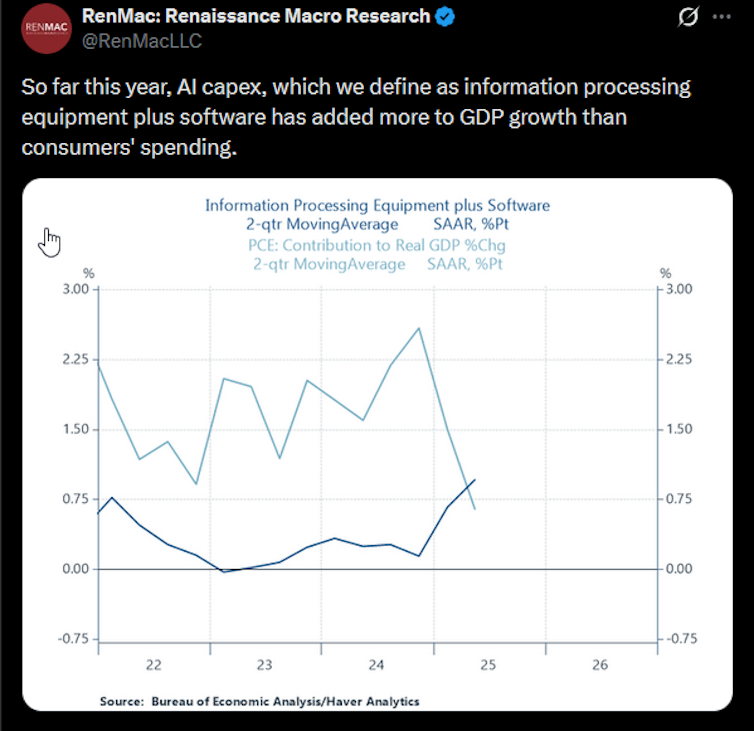
Corporate spending on AI infrastructure now contributes more to GDP growth than household consumption, an unprecedented inversion that shows how much growth is being driven by speculative investment rather than productive expansion.

This dynamic pulls down the rate of profit, and when the speculative flow reverses, contraction will follow.

A screenshot of a post from X illustrating that AI capex has added more to GDP growth than consumers' spending via a graph

(X/Twitter)

Tariffs tighten the squeeze on capital

Financial inflation has intensified as the traditional pressure valves that once allowed capital to move into new physical or geographic markets have narrowed.

Tariffs, export controls on semiconductors and retaliatory trade measures have narrowed the global space available for relocation. Since capital cannot readily escape the structural pressures of the domestic economy, it increasingly turns to financial tools that postpone losses by rolling debt forward or inflating asset prices; mechanisms that ultimately heighten fragility when the reckoning comes.

U.S. Federal Reserve Chair Jerome Powell’s openness to interest rate cuts signals a renewed turn toward cheap credit. Lower borrowing costs let capital paper over losses and pump up fresh speculative cycles.

Marx captured this logic in his analysis of interest-bearing capital, where finance generates claims on future production “above and beyond what can be realized in the form of commodities.”

The result is that households are pushed to take on more debt than they can manage, effectively swapping a crisis of stagnation for a crisis of consumer credit.

Bubbles and social risk

If the AI bubble bursts when governments have limited room to shift investment internationally and the economy is propped up by increasingly fragile credit, the consequences could be serious.

Capital will not disappear, but will instead concentrate in bond markets and credit instruments inflated by a U.S. central bank eager to cut interest rates. This does not avert crisis; it merely transfers the costs downward.

Bubbles are not accidents, but recurring mechanisms for absorbing surplus capital. If Trump’s protectionism ensures that spatial outlets continue to close and temporal fixes rely on ever riskier leverage, the system moves toward a cycle of asset inflation, collapse and renewed state intervention.

AI will survive, but the speculative bubble surrounding it is a sign of a deeper structural problem — the cost of which, when finally realized, will fall most heavily on the working class.

The Conversation

Elliot Goodell Ugalde does not work for, consult, own shares in or receive funding from any company or organisation that would benefit from this article, and has disclosed no relevant affiliations beyond their academic appointment.

ref. The AI bubble isn’t new — Karl Marx explained the mechanisms behind it nearly 150 years ago – https://theconversation.com/the-ai-bubble-isnt-new-karl-marx-explained-the-mechanisms-behind-it-nearly-150-years-ago-270663

Are harp seals responsible for the stalled recovery of Atlantic cod?

Source: The Conversation – Canada – By Tyler Eddy, Research Scientist, Fisheries & Marine Institute, Memorial University of Newfoundland

In June 2024, the Canadian government lifted the moratorium on northern cod fishing in Newfoundland and Labrador after 32 years. The decision was controversial because cod numbers had not recovered since they collapsed in the early 1990s.

The collapse of Atlantic cod stocks in Newfoundland and Labrador had a huge impact on the economic and social fabric of the province. The subsequent fishing moratorium in 1992 put nearly 30,000 people in the province out of work.

Several explanations have been put forward for the stalled cod recovery, including environmental conditions, historical overfishing and prey availability.

Another explanation has identified predation by harp seals as the reason cod numbers have remained low. However, given the severity of historical overfishing that occurred, Atlantic cod population growth may be impaired by a number of factors.

The Northwest Atlantic harp seal population was estimated at 4.4 million in 2024, the second-largest seal population in the world. Fishermen have long been concerned about the amount of fish that harp seals consume. However, a 2014 Fisheries and Oceans Canada study concluded that harp seals do not strongly impact the northern cod stock.

The concerns of fishermen about the impact of seals on fish stocks were heard by the Canadian government. In September 2023, the Department of Fisheries and Oceans announced funding for independent seal science. It was through this funding opportunity that I recruited postdoctoral fellow Pablo Vajas and MSc student Hannah West to dive deeper into the issue.

Historical overfishing

The magnitude and duration of overfishing increase the time fish stocks need to recover. By 1993, northern cod had declined by 99 per cent of its historical biomass, while the other Newfoundland Atlantic cod stocks declined by 77 per cent to 95 per cent. During the fishing moratorium on the offshore fishing fleet, inshore and recreational fisheries continued to operate, but fisheries catches were very low.

Capelin, a small forage fish that is important prey for cod and other predators, is linked to cod population growth and is included in the northern cod stock assessment. Capelin also collapsed in the 1990s and has not recovered to pre-collapse levels, limiting ecosystem productivity. It remains unknown why capelin has not recovered.

Do harp seals eat more than fisheries catch?

Harp seals eat a range of items — their diet varies by prey availability, season, location and time. In our recently published study, we compared diet estimates from stomach content analyses from 7,710 harp seals as well as laboratory analyses of muscle tissue using fatty acids and stable isotopes.

In general, our findings told a consistent story: harp seals are generalists that eat a range of prey, including American plaice, Arctic cod, Atlantic cod, Atlantic herring, capelin, flounder, redfish, sand lance, shrimp, squid and zooplankton. We incorporated these results into a food-web model of predator and prey interactions to calculate the total harp seal consumption of prey and their contribution to mortality. We compared these consumption and mortality rates to those from fisheries.

Our analysis revealed that harp seals consume a higher biomass of shared target species than caught by fisheries. Harp seal consumption rates were 24 times higher than fisheries catch rates for Atlantic cod, Greenland halibut and American plaice from 2018 to 2020.

We also found that harp seals caused 17 times more deaths of shared target species than fishing did. Stock assessments have reported elevated levels of northern cod natural mortality since the collapse. Consistently, our research found that the impact of harp seals on other species in the ecosystem has increased since the fish stocks collapsed.

The harp seal population has declined by 41 per cent since 1998, when it peaked at 7.5 million. This has happened while the number of harp seals harvested for their meat and pelts has also declined. Harp seals have recently been listed as near-threatened by the International Union for Conservation of Nature due to Arctic sea ice loss.

Marine ecosystems in a changing world

Newfoundland and Labrador’s marine ecosystems are highly dynamic. Since the cod collapse, ecosystems have been less productive, leading to a declining harp seal population and limiting the recovery of collapsed fish stocks.

Despite the decline in harp seal numbers, our findings show that harp seal predation remains an important factor that should be included in Atlantic cod stock assessments.

It should be noted that climate change is an additional factor affecting marine ecosystems and fisheries. More than ever, it is crucial to track the productivity of fish stocks and marine ecosystems to achieve sustainable resource management.

The Conversation

Tyler Eddy receives funding from the Natural Sciences and Engineering Research Council of Canada, Fisheries and Oceans Canada’s Sustainable Fisheries Science Fund, and the Canada First Research Excellence Fund.

ref. Are harp seals responsible for the stalled recovery of Atlantic cod? – https://theconversation.com/are-harp-seals-responsible-for-the-stalled-recovery-of-atlantic-cod-269337

The Canadian Museum for Human Rights finally grapples with the Nakba

Source: The Conversation – Canada – By Jonah Corne, Assistant Professor in the Department of English, Theatre, Film and Media, University of Manitoba

Even as it claims to champion the stories of global injustice, the Canadian Museum for Human Rights (CMHR) has struggled, if not refused, to meaningfully acknowledge Palestine for more than a decade.

Its newly announced exhibition to launch in the summer of 2026 — Palestine Uprooted: Nakba Past and Present — marks a significant reversal for an institution that has often been criticized for its silences.

The omission of Palestinian history dates all the way back to before the museum’s official opening in Winnipeg in 2014, when Palestinian-Canadian community advocate Rana Abdulla replied, fruitlessly, to the museum’s call for suggestions for content.

After years of continued advocacy from the Palestinian community in Winnipeg and across Canada — and in the midst of so much tragedy and what a UN commission of inquiry has called genocidal violence in Gaza — the announcement comes as a remarkable sliver of good news.

The development is also surprising because the museum, Canada’s first federal one located outside the nation’s capital, has historically had difficulties with the living legacy of settler colonialism — a key issue in discussions about Palestine — in Canada.

Prior to construction, the museum was criticized for failing to provide sufficient funds for a full excavation of the archeological heritage on the sacred Indigenous site where the museum is located. Until the stance was reversed in 2019, the museum had resisted describing the experience of Indigenous Peoples in Canada in terms of genocide.

Naming Palestinian dispossession

Bringing exhibition-level attention to the massive dispossession of Palestinians that occurred by the founding of the state of Israel in 1948 — an event known as al Nakba (Arabic for “the catastrophe”) — emerges as an ethically and educationally responsible move for the museum. It also signals a shift under CEO Isha Khan, who came on board in 2020 in the wake of the museum struggling to present an accountable and consistent message of human rights.

Despite its recent recognition of Palestinian statehood, the Canadian government has repeatedly resisted calls to grant the Nakba, and by extension Nakba Day, official acknowledgement. Neither has the Nakba had a place in the curricula of Canadian schools.

The CMHR’s Nakba exhibit therefore stands as an important repositioning in relation to these concerning national absences.

Of course, we don’t know how the exhibit — slated to involve oral histories, art and artifacts — will turn out. But judging only the title, the naming of the Nakba is immensely consequential and allows an opening to inquire further into the constellation of terms — dispossession, ethnic cleansing, settler colonialism, occupation and genocide — that cluster around it.

Meanwhile, the word “uprooted” to describe what befell 750,000 Palestinians in 1948 is, if perhaps muted, not inaccurate.

Holocaust memory and Nakba denial

Pro-Israel groups have predictably condemned the museum’s announcement of the exhibition in statements consistent with a trend of Nakba denial in mainstream pro-Israel discourse.

What underpins such a trend, implicitly or explicitly, is a Zionist narrative that sees the Holocaust as both radically unique and as the ultimate justification for the founding of the Israeli state.


Read more:
The conflation problem: Why anti-Zionism and anti-semitism are not the same


Accordingly, to acknowledge the Nakba introduces a perceived impermissible rival to the Holocaust for suffering and remembrance, as well as a complicating factor that casts the founding of the Israeli state as something other than a strictly unimpeachable redemption for the Nazi genocide against Jews.

Attending to the Nakba requires that we see the creation of Israel as entailing a radical — and violent — escalation in a project of settler colonialism that, by 1948, had been underway for several decades, having received decisive momentum under the auspices of British colonialism from the Balfour Declaration of 1917.

This history deserves to be recognized, first and foremost for the sake of Palestinians living in and outside of Palestine who continue to endure the Nakba’s rippling aftermath. In addition, historical ignorance and amnesia are detrimental for the well-being of a society. Not to mention, the CMHR has an extensive and permanent Holocaust gallery.

This new exhibit might also help us to consider the ways in which the Holocaust and the Nakba can be thought of in constructive relation to one another. Such co-thinking is part of the project of an edited collection of essays, The Holocaust and the Nakba: A New Grammar of Trauma and History, where in the foreword, the late Lebanese intellectual, novelist and longtime activist for Palestinian liberation, Elias Khoury, articulates a compelling moral argument.

Khoury movingly affirms:

“The Holocaust is my responsibility as a member of the human race, despite it having been a product of European fascism. As such, my deeply ingrained moral duty is to be an active participant in the struggle against antisemitism as well as all other forms of racism anywhere in the world. This path leads me to continue the struggle against the Zionist colonialist occupation project in Palestine. Two wrongs do not make a right, one crime does not wipe out another, and racism is not remedied by counterracism.”

Khoury’s argument is consistent with what I have come to extract from the well-known mantra of Holocaust education, “never again.” I take the mantra’s lack of a specified referent as an open space where, without the burden of exact equation-drawing, one can speak out against racist, oppressive, eliminationist logics in any form that they may appear.

Historical accuracy and relevancy

Something must also be said about the claims by pro-Israel groups that the CMHR Nakba exhibition will be invalidatingly one-sided because of inattention to the Jewish (Mizrahi and Sephardi) displacement from Middle Eastern and North African countries in the wake of 1948.

The larger regional repercussions of the founding of the Israeli state bear no pertinence to the Palestinians’ own experience of dispossession: the focus of the exhibition and a topic that has been historically overlooked.

Moreover, the exoduses that occurred in Iraq, Yemen, Morocco and elsewhere were not perpetrated by Palestinians, so the call for “balance” in considering the Nakba vis-à-vis Mizrahi and Sephardi refugeehood is a non-starter.

In the face of such baseless attempts to cast doubt on the credibility of the exhibit, I hope that the CMHR will hold the line.

With its long overdue decision to engage substantially with Palestinians, who continue to endure a world-shaking crisis of displacement, occupation and genocide, the institution sets out on a crucial journey towards reestablishing its own credibility and fulfilling its ambitious aim of serving as a leading, capaciously inclusive space for exploring and educating about human rights.

The Conversation

Jonah Corne does not work for, consult, own shares in or receive funding from any company or organisation that would benefit from this article, and has disclosed no relevant affiliations beyond their academic appointment.

ref. The Canadian Museum for Human Rights finally grapples with the Nakba – https://theconversation.com/the-canadian-museum-for-human-rights-finally-grapples-with-the-nakba-270351

Thomas King: As we learn another ‘hero’ is non-Indigenous, let’s not ignore a broader cultural problem

Source: The Conversation – Canada – By Celeste Pedri-Spade, Associate Professor, Department of Anthropology, McGill University

Years ago, when I first began researching Indigenous identity theft — something that intrigued me intellectually and impacted me personally — I remember trying to explain it to my Indigenous family members back home in northwestern Ontario.

We are Anishinaabeg and member citizens of Nezaadiikaang (Lac des Mille Lacs First Nation).

The women in my family responded with humour, seeing the absurdity of it all. My mother laughed and said: “Geez, I remember when not even Natives wanted to be Native … whatever happened to those times!”

Her comment highlighted a major shift in how desirable Indigenous identity has become, and how false claims tend to rise after events that draw public attention to the harms settler states have caused our families and communities.

This desirability is, indeed, heightened as educational institutions engage in processes of Indigenization and seek to recruit Indigenous people into faculty and administrative roles that assist them in advancing their reconciliation plans.


Read more:
Stolen identities: What does it mean to be Indigenous? Don’t Call Me Resilient Podcast EP 8 Transcript


Think of how many white settlers were quick to shake a Cherokee “princess” from their family tree after the Civil Rights Movement, or how recent cases of Indigenous identity fraud in Canada align with the era of Truth and Reconciliation. This era, we know, has revealed very hard truths about Canada’s relationship with Indigenous Peoples.

Cultural phenomenon

These patterns reveal more than individual acts of deception. They expose
a cultural phenomenon: when non-Indigenous people appropriate our lived experiences — our stories, struggles and traumas — on such a wide scale, it signals a broader cultural and social sickness and deterioration.

What we come to learn through the public “outings” of author Thomas King, Buffy Sainte-Marie, Mary Ellen Turpel-Lafond, Michelle Latimer and Joseph Boyden is that they offer a projection of “Indigenous success” that is often nothing more than settler fantasies: commodified versions of Indigeneity that Canadians find palatable.


Read more:
How journalists tell Buffy Sainte-Marie’s story matters — explained by a ’60s Scoop survivor


These figures become a kind of counterfeit currency, granting Canadians easy access to digestible versions of Indigenous identity and experience. But they are not ours, they are not us and they are not our stories. My mother believes this happens because Canadians do not truly want the truth of who we are, past or present.

This raises a hard question: how did these figures become Indigenous icons in the first place?

Western ‘hero’ narratives

Many Indigenous cultures caution against the concept of “heroes,” which is rooted in western narratives that elevate people as saviours. Turning people into heroes isolates collective struggles, conceals the systemic problems behind them and reinforces colonial ideas of individual exceptionalism — celebrating those who manage to succeed in oppressive systems instead of valuing relationships and community resilience.

Liberation doesn’t hinge on extraordinary individuals; it requires
structural transformation. When we elevate “heroes,” we risk distorting accountability and reinforcing inequity.

The truth is, these heroes were largely created by settler-controlled industries like publishing, media and academia — not by us. Their success was sustained by gatekeepers who valued marketable versions of Indigeneity over authentic voices. And while community voices questioned their authenticity from the start, we must ask why those warnings were ignored.

Concerns raised

In cases of a “pretendian” — false claims of Indigeneity — there are people firmly grounded in community who raise concerns right from the beginning because they cannot find themselves in the paragraphs and crescendos of those who don’t sing or speak truth. As Indigenous Peoples, we need to reflect on why such voices are often not collectively amplified and protected.

Underlying identity fraud is a belief that Indigenous Peoples are “not good enough” — that impostors can be better Natives than us. They reconcile their theft by convincing themselves they can achieve what we cannot, that we need them to “be us.” That is profoundly damaging.

It reinforces colonial hierarchies and perpetuates the idea that our worth must be validated through settler recognition.

Power to repair harm

In King’s recent opinion piece in The Globe and Mail, he wrote he was devastated to learn, contrary to what he believed, that he did not have Cherokee ancestry. He discovered this, he said, after he requested a meeting with Tribal Alliance Against Frauds, an American Cherokee organization, because he was aware of “a rumour that appeared” accusing him of not being Cherokee.


Read more:
Fraudulent claims of indigeneity: Indigenous nations are the identity experts


He said he’ll need to “survive a firestorm of anger, disbelief and betrayal” and will then “sort through rubble to see if there is anything left of my reputation, of my career.”

This was the most troubling for me — not only because it sounds like self-victimization, but because King has the power to repair harm. Accountability begins with truth-telling: admitting the false claim, making no excuses and disclosing and returning all benefits gained.

It means returning awards, redirecting funds and submitting to processes defined by the affected Nation — in King’s case, the Cherokee Nation. It means investing in long-term reparations that strengthen Indigenous self-determination, such as funding community priorities, supporting displaced Indigenous writers and investing in the brilliance of future generations.

We are more than stories

Accountability is not a one-time op-ed; it is an ongoing commitment, verified by Indigenous oversight and grounded in relational ethics.

King once wrote: “The truth about stories is that that’s all we are.” I admit to referencing it in my own writing. It is poetic, but incomplete.

We are more than stories. We are land. We are family. We are community. And we deserve a future where our identities are not commodities, where our truths are not distorted for profit or prestige and where accountability is measured not by words but by actions that build trust and repair harm.

The Conversation

Celeste Pedri-Spade does not work for, consult, own shares in or receive funding from any company or organisation that would benefit from this article, and has disclosed no relevant affiliations beyond their academic appointment.

ref. Thomas King: As we learn another ‘hero’ is non-Indigenous, let’s not ignore a broader cultural problem – https://theconversation.com/thomas-king-as-we-learn-another-hero-is-non-indigenous-lets-not-ignore-a-broader-cultural-problem-270773

Dependants? Why Canada should recognize migrant spouses and partners with more accuracy

Source: The Conversation – Canada – By Goodnews I. Oshiogbele, PhD Student, Sociology, Western University, Western University

What comes to mind when you hear the word “dependant?” A child relying on a parent, or an elderly family member needing care? In Canada’s immigration system, the term is applied much more broadly than that.

It includes all spouses and common-law partners of immigrants or principal applicants, regardless of whether they rely financially on their significant other or not. According to Immigration, Refugees and Citizenship Canada’s (IRCC) current definition, a dependant is “a spouse, common-law partner or dependent child of a permanent resident or principal applicant.”

On paper, this seems neutral and clear. But in practice, it flattens the diverse realities of migrant families.

This definition does not adequately reflect the diverse experiences of many accompanying spouses and partners who are highly skilled, financially independent, co-providers — or even the primary breadwinners — in their households.

“Dependant” as a catch-all term

Words matter in immigration policy because they shape perceptions, and those perceptions shape policies, which in turn shape identities.

Generally, the term “dependant” carries connotations of financial reliance, vulnerability and even passivity. Labelling all spouses and partners “dependants” suggests they are passive followers rather than active contributors, not only in family migration decisions but also in immigrant integration outcomes such as socioeconomic standing and a sense of recognition and belonging.

As one principal applicant and migrant partner in London, Ont., shared with me in an interview for this piece regarding her family’s experience using IRCC’s online application portal:

“The application page was confusing because of the word ‘dependant.’ For us, my partner is never a dependant. He has a secure job and earns more than I do. We are a dual-income household and no one is an economic dependant. So, when I saw the word ‘dependant’ on the website, I wondered if I was on the wrong website and thought it was application information for children or older parents who are true dependants.”

Furthermore, research tells us a different story that challenges the dependant label.

A Statistics Canada study found that many spouses and common-law partners of economic immigrants had similar qualifications to the principal applicants, partly thanks to what sociologists call “positive assortative mating” or homogamy. This concept refers to the tendency for people to enter romantic relationships with partners of similar background or social status.

Similarly, research by immigration and family economist Ana Ferrer and the Pew Research Center suggests that immigrant wives in professional households frequently contribute income comparable to or greater than their husbands, challenging the idea of passive dependency.

Furthermore, some accompanying spouses enter the workforce faster than their principal applicant spouses. This is common in situations where, for example, the principal applicant is retraining or seeking credential recognition. Many others contribute financially across borders, sending remittances to family members living abroad.

A matter of equity and inclusion

This issue is not simply about accuracy in terminology, although that is essential. It is also about inadvertently classifying others unfairly, promoting gender inequality and marginalizing some migrant family members.

Most accompanying spouses and partners are women and labelling them uniformly as dependants even when they include co-providers and primary earners, reinforces outdated stereotypes.

Migrant male spouses and partners also face their own identity struggles, despite their qualifications.

Statistics Canada data reveals persistent gender differences in labour market outcomes among newcomers, with immigrant women having a labour force participation rate of 78.2 per cent in 2021, significantly lower than the 90.2 per cent for immigrant men. While this arguably reflects global gender norms that many migrant families bring with them, it could also be linked with their sense of identity.

Canada prides itself on being a leader in immigration policy and in creating an inclusive society. Therefore, while other long-established immigration systems across the globe may continue to use this term this way, IRCC could consider clarifying it. Currently, the dependant label may unintentionally reinforce perceptions of dependency that do not reflect the evolving realities of modern migrant families.

Making invisible contributions visible

Gendered assumptions about who earns, who cares and who follows continue to shape how immigrant families are represented, and, in turn, treated by institutions. In addition to ongoing commendable efforts to make Canada more gender-inclusive, a long-term rectification of this issue requires more societal refinement in how we think about gender and work among newcomers.

Addressing this issue constructively would involve both policy reflection and a broader social conversation. In policy terms, it begins with precision — recognizing that not all spouses or partners depend economically on the principal applicant. In social terms, it means valuing the visible and invisible work migrants do, whether it is paid labour, unpaid care or transnational remittances.

In the meantime, here’s a simple fix that can address the semantic problem: In its current definition of a dependant, IRCC already distinguishes between dependent children and non-dependent adult children. The department could consider a similar approach for accompanying spouses and partners.

A small but meaningful change — such as specifying “a dependent spouse or common-law partner” — could help clarify the definition and better reflect the realities of today’s migrant families. For those affected, it will help improve their sense of identity, how they are perceived in public, the bureaucratic policies and practices affecting them and their overall integration experiences.

Alternatively, particularly in the immigration application system, the term dependant could be replaced with “secondary applicant” or “accompanying family member” to clearly distinguish the principal applicant from those accompanying them. While IRCC may have operational considerations, exploring better alternatives could lead to significant systemic improvements.

The Conversation

Goodnews I. Oshiogbele is a member of the International Union for the Scientific Study of Population (IUSSP) and the Canadian Population Society (CPS).

ref. Dependants? Why Canada should recognize migrant spouses and partners with more accuracy – https://theconversation.com/dependants-why-canada-should-recognize-migrant-spouses-and-partners-with-more-accuracy-265744

« L’art de la guerre » de Sun Tzu, ou comment vaincre en évitant le combat

Source: The Conversation – in French – By Scott D. McDonald, Assistant Professor, University of North Georgia; Non-resident Fellow, Asia-Pacific Center for Security Studies, University of North Georgia

Une copie de _l’Art de la guerre_, de Sun Tzu, appartenant à l’Université de Californie. vlasta2/Flickr, CC BY-NC-ND

Que nous enseigne le traité de stratégie militaire écrit en Chine il y a 2 500 ans ? Nourri de culture taoïste, Sun Tzu incite à utiliser le potentiel général des situations en intervenant le moins possible sur le champ de bataille. On fait plus pour nuire au potentiel d’un adversaire en sapant son plan qu’en tuant ses soldats.


Au milieu des années 1990, j’ai lu le classique militaire l’Art de la guerre » avec l’espoir de trouver des éclairages utiles pour ma nouvelle carrière d’officier des Marines des États-Unis.

Je n’étais pas le seul à chercher des idées auprès du sage Sun Tzu, mort il y a plus de 2 500 ans. L’Art de la guerre a longtemps été utilisé pour comprendre la tradition stratégique de la Chine comme des vérités militaires universelles. Les maximes du livre, telles que « connaître l’ennemi et se connaître soi-même », sont régulièrement citées dans les textes militaires, ainsi que dans les livres d’affaires et de gestion.

Au début, je fus déçu. Il m’a semblé que les conseils de Sun Tzu relevaient du bon sens ou étaient en accord avec les classiques militaires occidentaux. Cependant, quelques années plus tard, les Marines m’ont formé comme spécialiste de la Chine, et j’ai passé une grande partie de ma carrière à travailler sur la politique américaine dans la région indopacifique. Cela a renforcé mon désir de comprendre comment les dirigeants de la République populaire de Chine (RPC) voient le monde et choisissent leurs stratégies. En quête d’éclaircissements, je me suis tourné vers la philosophie chinoise classique et j’ai finalement rencontré des concepts qui m’ont aidé à mieux comprendre la perspective unique proposée par l’Art de la guerre, de Sun Tzu.

Aujourd’hui, je suis un universitaire et je travaille à l’intersection de la philosophie chinoise et de la politique étrangère. Pour comprendre l’Art de la guerre, il est important que les lecteurs abordent le texte à partir de la vision du monde de son auteur. Cela signifie lire les conseils de Sun Tzu à travers le prisme de la métaphysique chinoise classique qui est profondément façonnée par le taoïsme.

Les racines taoïstes

La tradition intellectuelle de la Chine est enracinée dans la période des Royaumes combattants du Ve au IIIe siècle avant notre ère, époque à laquelle Sun Tzu aurait vécu. Il s’agissait d’une période de conflit mais aussi de développement culturel et intellectuel qui a vu émerger le taoïsme et le confucianisme.

Une peinture patinée représentant un homme asiatique avec une petite barbe et une moustache, vêtu d’une robe jaune et noire
Les écrits de Sun Tzu ont eu un impact significatif sur la politique chinoise et étrangère.
History/Universal Images Group/Getty Images

La philosophie confucéenne se focalise sur le maintien de relations sociales appropriées comme clé du comportement moral et de l’harmonie sociale. Le taoïsme, en revanche, s’intéresse davantage à la métaphysique : il cherche à comprendre le fonctionnement du monde naturel et à en tirer des analogies sur la façon dont les humains devraient agir.

Le taoïsme considère l’existence comme composée de cycles de changement constants dans lesquels la puissance croît et décroît. Le Tào, ou « la Voie » dirige toutes les choses de la nature vers la réalisation de leur potentiel inhérent, par exemple l’eau qui coule vers le bas.

Aider la nature à suivre son cours

Le mot chinois pour ce concept de « potentiel situationnel » est 勢, ou « shì » – qui est aussi le nom du chapitre cinq de l’Art de la guerre. Presque toutes les versions occidentales le traduisent différemment, mais c’est la clé des concepts militaires employés par Sun Tzu.

Par exemple, le chapitre cinq explique que ceux qui sont « experts de la guerre » ne se préoccupent pas outre mesure des soldats pris individuellement. Au contraire, les dirigeants efficaces sont capables de déterminer le potentiel d’une situation et d’en tirer parti.

C’est pourquoi les chapitres suivants passent tant de temps à discuter de la géographie et du déploiement des forces, plutôt que des techniques de combat. On fait plus pour nuire au potentiel d’un adversaire en sapant son plan qu’en tuant simplement ses soldats. Sun Tzu s’inquiète des chaînes d’approvisionnement trop longues car elles réduisent le potentiel d’une armée en la rendant plus difficile à déplacer et vulnérable aux perturbations. Un général qui comprend le potentiel peut évaluer les troupes, le terrain et le plan, puis organiser le champ de bataille de manière à « soumettre l’ennemi sans combattre ».

Une peinture chinoise représentant une scène de bataille, avec des soldats en tenue bleue et un texte dans le coin supérieur droit
Peinture représentant une bataille entre les forces chinoises et vietnamiennes lors de l’invasion du Vietnam par la dynastie Qing en 1788.
History/Universal Images Group/Getty Images

Dans la pensée taoïste, la bonne façon de gérer le potentiel de chaque situation est d’agir avec 無為, « wúwéi », ce qui se traduit littéralement par « non-action ». Cependant, l’idée clé est de perturber l’ordre naturel le moins possible pour permettre au potentiel de la situation de se réaliser. Le terme n’apparaît pas dans l’Art de la guerre, mais un lecteur contemporain de Sun Tzu aurait été familier avec ces deux concepts de « shì » de « wúwéi ».

L’importance d’agir avec le « wúwéi » est illustrée par le philosophe confucéen Mencius qui raconte l’histoire d’un agriculteur qui aurait tiré sur ses tiges de maïs pour les aider à pousser et qui a tué sa récolte. On n’aide pas le maïs à pousser en le forçant mais en comprenant son potentiel naturel et en agissant en conséquence : s’assurer que le sol est bon, que les mauvaises herbes sont enlevées et que l’eau est suffisante. Les actions sont efficaces lorsqu’elles nourrissent le potentiel, non lorsqu’elles tentent de le forcer.

Du champ de bataille à l’ONU

Dans une perspective taoïste, les dirigeants qui espèrent élaborer une stratégie efficace doivent lire la situation, en découvrir le potentiel et positionner leurs armées ou États de manière à tirer le meilleur parti du « shì ». Ils agissent avec « wúwéi » pour cultiver des situations, plutôt que de les forcer, ce qui pourrait perturber l’ordre naturel et provoquer le chaos.

Ainsi, en politique étrangère, un décideur devrait s’efforcer d’apporter de petits ajustements politiques le plus tôt possible afin de gérer progressivement l’évolution de l’environnement international. Cette approche est évidente dans l’utilisation du « guānxì » par Pékin. Signifiant « relations », le terme chinois porte un fort sens d’obligation mutuelle.

Par exemple, la République populaire de Chine (RPC) a mené des décennies d’efforts pour reprendre à Taïwan le siège de la Chine aux Nations unies. Pékin y est parvenu en nouant lentement des amitiés, en identifiant des intérêts stratégiques communs et en accumulant des faveurs auprès de nombreux petits États du monde entier, jusqu’à ce qu’en 1971, elle obtienne suffisamment de voix à l’Assemblée générale de l’Organisation des Nations unies (ONU).

Et aujourd’hui ?

Le concept de « shì » permet également de comprendre la pression croissante de la RPC sur Taïwan, une île autonome que Pékin revendique comme son propre territoire.

Une scène nocturne représentant la silhouette d’un char d’assaut avec des gratte-ciel illuminés au loin
Un char taïwanais utilisé lors de conflits antérieurs et exposé aux touristes à Kinmen (Taïwan) se détache sur la silhouette de la ville continentale de Xiamen.
Chris McGrath/Getty Images

Sun Tzu dirait peut-être que discerner la tendance actuelle dans le détroit de Taïwan est plus essentiel que les questions conventionnelles sur la puissance militaire comparée. Plusieurs facteurs pourraient rapprocher Taïwan de Pékin, notamment la perte d’alliés diplomatiques de l’île et l’attraction de la vaste économie de la RPC – sans parler de l’influence mondiale croissante de Pékin face aux États-Unis. Si c’est le cas, le « shì » est en faveur de Pékin, et un coup de pouce pour persuader les États-Unis de rester en dehors du sujet est tout ce qui est nécessaire pour faire évoluer la situation en faveur de la RPC.

Doit-on, au contraire, considérer que le « shì » se développe dans l’autre sens ? Des facteurs tels que le sentiment croissant d’identité taïwanaise, les perturbations économiques de la RPC pourraient rendre le rapprochement avec la chine continentale moins attrayant pour Taïwan. Dans ce cas, Pékin pourrait estimer devoir apparaître fort et dominant afin que l’île n’entretienne pas l’idée d’un appui de Washington.

Une lecture superficielle de Sun Tzu peut mettre l’accent sur le déploiement de troupes, le renseignement et la logistique. Cependant, la compréhension du « shì » met en lumière l’importance que Sun Tzu accorde à l’évaluation et à l’enrichissement du potentiel situationnel. Il ne s’agit pas de dire que les premiers points sont sans importance, mais un décideur les utilisera différemment si l’objectif est de gérer les tendances situationnelles plutôt que de rechercher une bataille décisive.

Le fait que l’Art de la guerre continue d’être en tête des ventes de livres démontre son attrait durable. Cependant, pour qu’il soit utile comme guide stratégique et de politique de sécurité, mon expérience m’indique qu’il faut s’imprégner des principes qui ont façonné la vision du monde de Sun Tzu et qui continuent de façonner celle des dirigeants de Pékin.

The Conversation

Scott D. McDonald reçoit des financements de la Fondation Sara Scaife, de l’Institut Eisenhower, de la Fondation Charles Koch et du ministère des Affaires étrangères de Taïwan.

ref. « L’art de la guerre » de Sun Tzu, ou comment vaincre en évitant le combat – https://theconversation.com/lart-de-la-guerre-de-sun-tzu-ou-comment-vaincre-en-evitant-le-combat-259342

Peut-on rendre la forêt « nourricière » ? La proposition du jardin-forêt

Source: The Conversation – in French – By Jacques Tassin, Chercheur en écologie forestière (HDR), spécialiste des rapports Homme / Nature, Cirad

Issu des régions tropicales, le jardin-forêt est un modèle d’agroforesterie qui séduit de plus en plus en Europe pour prendre le contrepied d’un modèle agricole à bout de souffle. Il semble peu envisageable qu’il se substitue à l’agriculture productiviste dominante, mais il ouvre des pistes inspirantes pour promouvoir des pratiques plus respectueuses du vivant.


Les analyses se multiplient aujourd’hui pour dénoncer les externalités négatives (pollution, changement climatique, crise de la biodiversité…) induites par le paradigme économique actuel. Le modèle agricole dominant, en particulier, est pointé du doigt.

En effet, les systèmes agroalimentaires dominants s’avèrent coûteux à bien des égards. Ils substituent à des processus naturels répondant à des fonctions écologiques précieuses des intrants à fort impact environnemental (engrais par exemple), ils uniformisent les modes de culture, ils mettent à disposition du consommateur une alimentation d’une qualité nutritive questionnable, et enfin ils dévitalisent les tissus sociaux ruraux.

À rebours de cette logique productiviste, d’autres formes d’agriculture, parfois très anciennes, suscitent dès lors un regain d’intérêt. C’est le cas du modèle jardin-forêt, qui se développe peu à peu en Europe. Il est une transposition géographique en milieux tempérés de l’agroforesterie des tropiques humides, notamment indonésiennes.

Là-bas, l’agriculture vivrière et une partie de l’agriculture commerciale des petits planteurs sont conduites en pérennisant le modèle forestier traditionnel – fruits, légumes, noix, tubercules, plantes médicinales, matériaux, bois de feu ou de construction y sont produits au sein d’écosystèmes arborés multi-étagés, diversifiés et denses.

Structurés autour des arbres et de leur diversité, les jardins-forêts partagent avec les forêts naturelles des caractéristiques de robustesse, de résilience et de productivité. Multipliant les externalités positives (c’est-à-dire, des effets positifs tant d’ordre écologiques qu’économiques), ce modèle millénaire nourricier représente une voie inspirante qui vaudrait d’être davantage connue et considérée sous nos latitudes.

Il est fondé sur la polyvalence des forêts. Les jardins-forêts montrent que les arbres et les systèmes forestiers, dont les capacités de production, de régulation, de facilitation et de symbiose sont mésestimées, peuvent être bien plus productifs que nous le croyons.


À lire aussi :
Pour des forêts à croissance rapide, favorisez les arbres à croissance lente


Des « forêts comestibles » aux antipodes des monocultures

Aussi surnommés « forêts comestibles », les jardins-forêts se caractérisent par une forte densité d’arbres, d’arbustes, mais aussi de lianes et d’herbacées, tous de lumière et d’ombre, et tous d’intérêt alimentaire.

Clairière potagère dans un jardin-forêt à vocation domestique.
Fabrice Desjours, Fourni par l’auteur

Ils sont donc multifonctionnels. En témoignent par exemple :

  • leur productivité à l’hectare,

  • l’agencement spatial de leurs éléments constitutifs,

  • leur composition très diversifiée en termes d’espèces,

  • la richesse des mutualismes entre espèces,

  • Leur performance leur dynamisme et leur robustesse en tant que système de production alimentaire.

Ils sont à l’opposé des monocultures, qui sont spatialement et génétiquement homogènes. Celles-ci sont fondées sur la culture d’une seule variété, et souffrent dès lors une vulnérabilité maximale aux aléas. En jardin-forêt, les invasions d’insectes ravageurs ou les dégâts d’intempéries, pour ne citer que ces exemples, sont réduits en raison d’une importante hétérogénéité structurale et d’une faible exposition aux aléas. Des caractéristiques précieuses dans le contexte de dérèglement climatique.

Dans la forêt comestible de Ketelbroek (Pays-Bas), tout semble pousser de façon chaotique, mais il y a un plan.
Sabine Aldenhoff/LZ Rhénanie

Ces systèmes nourriciers sont aujourd’hui une réalité éprouvée, y compris en Europe. Aux Pays-Bas par exemple, des jardins-forêts à vocation agricole affirmée existent depuis quinze ans, financés par la politique agricole commune.


À lire aussi :
Incendies, sécheresses, ravageurs : les forêts victimes de la monoculture


Une production agricole à hauteur d’humain

Un autre point fort de cette alternative agricole est son échelle à hauteur humaine. En effet, le jardin-forêt envisage le parcellaire cultivé, dans ses dimensions spatiales comme dans les pratiques dont il fait l’objet, autour de la mesure étalon de la personne qui en prend soin.

Les recours à l’observation et au soin, de même que l’accumulation patiente de connaissances pratiques, y sont largement promus. Ils permettent une réactivité accrue et plus adaptée aux aléas, environnementaux mais aussi économiques.

Le « jardinier-forestier » est dès lors convié à se pencher sur son terrain à différentes échelles : du contrôle de la qualité des tissus mycorhiziens (c’est-à-dire, les champignons agissant en symbiose avec les racines) du sol jusqu’à la surveillance de la complémentarité permanente des strates de végétation.

La diversité ne se joue pas qu’à l’échelle d’une forêt comestible, mais aussi à l’échelle d’un territoire. A l’image du bocage, un réseau de jardins-forêts divers est pourvoyeur de services écosystémiques complets. Ils peuvent également s’insérer dans le tissu agricole et compenser une partie des impacts environnementaux néfastes induits par le modèle agricole dominant.

Un seul espace, des productions multiples

Par essence, le jardin-forêt offre une large diversité alimentaire. Pour rappel, seules 30 à 60 espèces végétales tout au plus assurent la base de notre alimentation occidentale, dont quelques espèces seulement de céréales. Une partie de cette alimentation est importée (avocats, ananas ou bananes), alors que 7 000 espèces alimentaires sont cultivables en climat tempéré, sans renfort technique particulier. Le modèle du jardin-forêt s’avère apte à les valoriser.

Les « forêts comestibles » sont en effet des espaces de multiproduction où sur une même parcelle peuvent se déployer quatre types de produits différents :

  • Les aliments « forestibles » dans lesquels ont peut inclure fruits, noix et graines, ressources tuberculeuses amidonnées ou riches en inuline, légumes, feuilles, feuillages, fleurs, champignons, épices, sirop de sève, viande sauvage ou domestique en cas de petit élevage, ou encore produits de la ruche (miel, pollen, propolis) ;

  • les biomatériaux (bois de construction, bambou, osier, gommes, cires, résines, liants, latex, papier, tinctoriales) ;

  • les ressources médicinales provenant de tous les étages végétaux de la forêt comestible ;

  • et enfin les combustibles (bois énergie, copeaux, fagots).


À lire aussi :
Pharma, cosmétique… et si les déchets végétaux aidaient à développer l’économie circulaire ?


Une porte vers d’autres imaginaires

Les jardins-forêts ne se limitent pas à la seule production de biens alimentaires et de services environnementaux. Ils offrent également des ressources immatérielles dont nous avions fini par croire qu’elles ne pouvaient être compatibles avec une agriculture performante.

En effet, ces espaces créent aussi les conditions pour d’autres imaginaires. Ils sont le support d’activités diverses (artisanales, éducatives, thérapeutiques, culturelles) favorables au mieux-être. Ces services immatériels peuvent concourir à transformer les zones rurales en espaces plus désirables et plus habitables, voire à les reterritorialiser. La psychologie atteste en outre des bienfaits des arbres sur le bien-être humain.

En France, les jardins-forêts recouvrent environ 2 000 hectares. Peu connus du grand public, des institutions et des pouvoirs publics, ils se heurtent à une vision encore archaïque de la forêt, vue comme aux antipodes de la civilisation, et à une réticence à valoriser des ressources alimentaires parfois rattachées dans les imaginaires aux périodes de famine.

Il leur est également reproché d’inviter à un relâchement des pratiques conventionnelles de contrôle du vivant habituellement exercées en agriculture (taille, fertilisation, contrôle direct des ravageurs…), auxquelles est ici préférée, pour des raisons de durabilité et d’efficience économique, une philosophie de l’accompagnement et de l’amplification des processus écologiques naturels.

S’ils n’ont pas vocation à supplanter les autres systèmes agricoles en place, ils ont toutefois le potentiel de redynamiser et resocialiser les campagnes. De quoi développer de nouvelles activités rurales exigeantes mais porteuses de sens et pourvoyeuses de bien-être. C’est précisément là une demande sociale et une exigence environnementale de plus en plus pressantes.


Fondateur de l’association Forêt gourmande, Fabrice Desjours a contribué à la rédaction de cet article.

The Conversation

Michon Geneviève a reçu des financements de ANR, UE.

Jacques Tassin ne travaille pas, ne conseille pas, ne possède pas de parts, ne reçoit pas de fonds d’une organisation qui pourrait tirer profit de cet article, et n’a déclaré aucune autre affiliation que son organisme de recherche.

ref. Peut-on rendre la forêt « nourricière » ? La proposition du jardin-forêt – https://theconversation.com/peut-on-rendre-la-foret-nourriciere-la-proposition-du-jardin-foret-265918

Seen but not forgotten: How citizen science helps document biodiversity in remote Borneo villages

Source: The Conversation – Indonesia – By Erik Meijaard, Honorary Professor of Conservation, University of Kent

When I, Erik Meijaard, worked as a wildlife consultant for a timber concession in Borneo, I often chatted with the logging truck drivers — and quickly realised that some of them knew far more about local wildlife populations than the company’s own biodiversity teams.

“If you want to see clouded leopards, ride with me in my truck — I can almost guarantee we’ll spot one or two near kilometre 38 around two in the morning,” one of the drivers told me at the time.

I didn’t spot the elusive cats that night, but two years later, early one morning, I finally found one sitting calmly beside a logging road. The driver had been right all along: these leopards really do like the roads.

Logging truck drivers spend countless hours on the road, travelling deep into remote forests. They often see wildlife, yet no one asks them about it — because spotting animals isn’t part of their job. Our programmes change that, allowing anyone with an interest in tropical wildlife to contribute their observations.

Since then, I have relied heavily on community-sourced information to monitor wildlife populations within company concessions and ensure that emerging threats are quickly detected and addressed.

I began by creating the first orangutan distribution maps in the 1990s through village interviews, later expanding the approach to 700 villages in 2008 to better understand local perceptions of forests and wildlife.

From 2019 to 2025, I ran an oil-palm-plantation–based citizen-science pilot that generated nearly 190,000 wildlife records from 4,000 workers.

These experiences show that some of the most valuable ecological knowledge rests with the people who live closest to the forest — not the scientists who visit only once a year.

How does citizen science work?

Building on that insight, Emily (who co-wrote this article with me) and I introduced a new version of the model for broader study in four villages in the Kapuas Hulu district of West Kalimantan. There, the local community manages the forest under a social forestry scheme.

We worked directly with them. Anyone with a smartphone can record wildlife sightings using our simple mobile app named Kehatiku (which in Indonesian means both “to my heart” and “my biodiversity”). Observations — from orangutan photos to gibbon audio clips — are then uploaded with GPS coordinates.

Each record then goes through a multi-stage verification process: an AI-assisted screen check for duplicate images and location mismatches, followed by review from our team of verifiers and species experts, who cross-reference field guides.

Once a record is verified, we issue a payment to the observer — ranging from around US$0.60 for a bird-call recording to about US$6 for a clear photo or video of a wild orangutan.

Since the citizen science program launched in 2023, 567 participants have recorded more than 58,000 wildlife observations from community forests — at roughly one-twentieth the cost of conventional surveys. The program creates both income and incentives to protect wildlife and their habitats.

What the data reveal?

So far, the data show unexpectedly high numbers of orangutans, gibbons, and many other species in these community forests, including several of global conservation concern.

The most frequently reported wildlife in the four Kapuas Hulu villages includes orangutans (with 9,766 nest records), white-rumped shamas, sun bear signs, long-tailed macaques, and stingless bees.

Direct sightings of Bornean orangutans and regular recordings of gibbon calls confirm that these species persist outside protected areas — even within agricultural landscapes bordering the villages.

This information is invaluable to understand how threatened mammals survive in mixed-use forests, where formal surveys are rare or expensive. We are currently doing critical testing as to whether the data are strong enough to generate statistically robust occupancy estimates — showing how wildlife species use village forest areas.

For plantations, we can already translate these findings into a living index, an important tool for developing data-driven conservation policies and interventions.

Shifting behaviour and social impact

In early 2025, we also collaborated with a local partner to conduct social baseline surveys to assess the program’s socioeconomic impact.

Initial survey results suggest a shift in perception is already underway. More than 70% of residents across the four pilot villages had heard of the initiative, and nearly two-thirds said they are interested in joining.

About a third already earn income from verified wildlife observations — typically US$30 to US$180 every three months, a meaningful supplement in communities where most households live on less than US$120 per month.

More importantly, attitudes toward wildlife are shifting. Where songbirds were once trapped and sold to traders, many villagers now choose to leave them in the forest — realising it’s more profitable to record the birds’ presence and get paid for it.

A model for inclusive, low-cost monitoring

Financial incentives have clearly boosted engagement. Observation rates rose from about 17 per village per month during the voluntary phase to more than 6,000 per month once payments were introduced.

At an average cost of just US$0.85 per observation, this approach is far cheaper than traditional transect or camera-trap surveys, which can cost US$300 per camera or more.

Not only does it reduce logistical costs, but relying on local observers also makes it possible to cover vast, remote areas.

And unlike short-term research projects, this one runs year-round — because the motivation, and the data, come from the community itself.

The programme also strengthens local governance. Regular meetings and WhatsApp groups allow residents to discuss verification results, propose rule changes, and collectively decide how to manage conflicts over shared rewards. We also close the information loop by translating wildlife observations into insights communities can use to guide their decisions.

These interactions, along with transparent payment records, are boosting accountability and participation in broader village decision-making. This transparency has helped build strong trust within the community.

On one occasion, when a participant submitted an internet-sourced photo as fake evidence, the peers insisted on removing them from the project — a proof that data integrity now matters at the community level.

Our local facilitator paying an observer. The program has also seen a recent increase in women’s participation.
Andi Erman

Beyond data: Building ownership and pride

Beyond science, the project is fostering local ownership and pride in nature. For participants, the forest has become a living asset — one that generates income through conservation. That shift in perception may be the most important outcome of all.

With mobile networks and digital payment systems now widespread across Indonesia, this low-cost, scalable model could be expanded to thousands of villages. Citizen science can become a cornerstone of future wildlife conservation — and Indonesia could lead the way in making it happen.

From the truck drivers who spotted clouded leopards in the 1990s to today’s smartphone-armed villagers, the message is clear: science and stewardship thrive when everyone can take part — and be fairly rewarded for it.

The Conversation

Erik Meijaard menerima dana dari Wildlife Futures dan Arcus Foundation

Emily Meijaard bekerja di Borneo Futures Sdn Bhd the organization that developed the citizen science-based monitoring approach discussed in the article

ref. Seen but not forgotten: How citizen science helps document biodiversity in remote Borneo villages – https://theconversation.com/seen-but-not-forgotten-how-citizen-science-helps-document-biodiversity-in-remote-borneo-villages-269621

Ce que l’argot des collégiens nous dit des stéréotypes de genre chez les jeunes

Source: The Conversation – in French – By Anne Gensane, Enseignante chercheuse en sociolinguistique, Université d’Artois

Habiles pour inventer de nouveaux mots, les jeunes s’affranchissent-ils pour autant des stéréotypes de genre ? Une étude sur les pratiques argotiques d’élèves de l’enseignement secondaire nous offre un regard sur la manière dont ils reproduisent ou bousculent les rapports de force sociaux.


Dans une société de plus en plus soucieuse de l’égalité femme-homme, on souhaite que la langue en soit un vecteur. L’écriture inclusive témoigne de ces efforts. Mais qu’en est-il des façons de parler des jeunes ? Intègrent-elles ces préoccupations ? S’affranchissent-elles vraiment des stéréotypes de genre ?

Une étude sociolinguistique de terrain, fondée sur un corpus d’expressions argotiques récoltées dans des établissements du secondaire, permet d’interroger leurs représentations et la manière dont elles s’écartent des normes sociales ou les reproduisent.

Avant tout, il est crucial de rappeler que les jeunes dont nous parlons ne constituent pas une catégorie homogène. Certains viennent des zones périphériques de grandes villes, d’autres de milieux ruraux, ils peuvent connaître ou non des contacts multiculturels… Autant de facteurs qui influencent directement les pratiques linguistiques et la manière dont les stéréotypes de genre sont exprimés et vécus.

Un argot contemporain misogyne ?

Parmi près de 300 termes collectés dans l’étude, un grand nombre évoque directement le corps, notamment sous un angle sexuel. L’étude lexicale montre un déséquilibre quantitatif et qualitatif entre les représentations des corps masculins et féminins. Le sexe masculin est le plus fréquent (« zboub » qui est d’origine arabe, ou « chibre »). Pour ce qui est du corps féminin, il est fréquemment réduit à des métaphores dégradantes ou idéalistes, et cela en dit long sur cette hiérarchie sociale.

On peut citer la métaphore de l’animalité avec des mots comme : « chatte », ou « schnek » qui désigne un escargot en allemand ; la métaphore de la consommation avec, par exemple, « de la peufra » : il s’agit ici du verlan de « frappe », lui-même jouissant d’une signification imagée et pouvant aussi désigner de la drogue de bonne qualité ; ou, très présente, la prostituée : « keh », d’origine arabe, ou « tchoin », d’origine nouchi (un argot ivoirien très présent également dans l’argot contemporain). Ces mots participent de la disqualification sociale des femmes, en les réduisant à leur rôle dans la sexualité masculine.

Mais cet argot contemporain est-il pour autant intrinsèquement misogyne ? Si une grande majorité des termes semblent dévaloriser les femmes, leur usage n’est pas toujours aussi simple. Certaines expressions, comme « avoir de la moule » inversent parfois la hiérarchie, associant le sexe féminin à la chance.

Il apparaît que ce n’est pas tant l’argot en lui-même qui est sexiste ou misogyne, mais les pratiques sociales dans lesquelles il s’inscrit et qui, parfois, évoluent. Les termes suivants illustrent une violence symbolique. La « beurette à chicha » désigne littéralement une jeune femme d’origine maghrébine (« beur » étant le verlan tronqué de « arabe ») présente dans un bar à chicha. Ce que cela signifie vraiment ? Une jeune femme qui est trop visible, tout comme la « tana » (vraisemblablement la forme tronquée de « Ana Montana », personnage de série télévisée).

Ces catégories langagières semblent moins désigner des réalités sociales qu’elles n’organisent une grille de lecture stéréotypée des conduites féminines dans l’espace public. Le fait que ces termes soient employés par d’autres jeunes filles souligne la complexité des mécanismes de reproduction ou de résistance à la norme.

La femme qui dit : une « terreur argotique féministe » ?

Le langage reflète une hiérarchie des genres, où les garçons bénéficient de plus de liberté d’expression que les filles, soumises à un contrôle social important. Ce qui ne veut pas dire qu’il n’y a pas de contrôle d’un autre type chez les garçons ; on peut observer que ce phénomène s’inscrit notamment dans une certaine valorisation de la virilité, tant physique que linguistique (on pense aussi aux insultes féminisantes).

Avoir recours à une certaine hexis corporelle (manière de se tenir, de s’habiller…) et à un langage cru serait une forme de manifestation de la virilité et, alors, un moyen de marquer la distinction sociale attendue. En revanche, les femmes sont traditionnellement perçues comme plus élégantes lorsqu’elles adoptent des normes linguistiques plus prestigieuses, rejetant les formes de langage populaire pour exprimer une identité sociale différente, voire opposée à celle des hommes.

Parler d’une « terreur argotique féministe » sur le modèle de l’ouvrage d’Irene n’est peut-être pas si exagéré. À la suite de l’autrice, il s’agirait de réfléchir à la place que détient la violence dans la lutte contre les inégalités. Certaines jeunes filles se réapproprient des termes plutôt vulgaires pour affirmer leur autorité, parfois pour choquer ou pour se défendre dans un environnement marqué par la domination masculine.

Ainsi, des expressions comme « avoir les couilles » sont utilisées par des filles revendiquant par la même occasion une forme de pouvoir symboliquement associé aux hommes. Mais ne reproduiraient-elles pas, dans le même temps, cette discrimination stéréotypée ?

Le langage des jeunes filles est un terrain plus complexe qu’il n’y paraît. Certaines collégiennes de Cergy (Val-d’Oise) enregistrées dans le Multicultural Paris French, un grand corpus oral, expliquent qu’elles utilisent ces termes violents ou grossiers pour s’adapter à un univers où les garçons imposent leur domination. Simone de Beauvoir affirme que c’est potentiellement en s’assimilant à ces modes de fonctionnement masculin que la femme s’affranchira.

Le langage devient un réflexe dans un environnement symboliquement hostile, une manière de se défendre face à un monde qui attend des filles qu’elles soient discrètes. L’usage d’un langage perçu comme masculin peut être dès lors défensif. Mais est-ce bien pour autant une volonté desdits garçons d’être agressifs ?

Un conservatisme linguistique pudique ?

Parler ainsi (encore faudrait-il déterminer ce qu’est ce « ainsi »), c’est peut-être aussi l’assurance de gérer symboliquement les frontières entre espace privé et espace public. Le locuteur, garçon ou fille, jeune ou moins jeune, provenant d’un quartier populaire ou bourgeois, pourrait chercher à maîtriser l’accès à son identité telle qu’il ou elle la conçoit, à filtrer ce qu’il ou elle expose de son intimité en usant de ce lexique.

Cela est reconduit par ailleurs dans les thématiques amoureuses des morceaux de rap qu’ils semblent préférer écouter : auraient-ils donc besoin de se cacher derrière une apparente violence des stéréotypes genrés pour se protéger ? Dans ce cadre, l’excès verbal des jeunes ne serait pas analysable comme étant d’ordre exhibitionniste, mais pourrait bien plutôt paradoxalement aider à la dissimulation de soi.

Il peut être étonnant que, malgré l’inventivité linguistique des jeunes contemporains (catégorie, on l’a dit, fort hétérogène), leur langage semble reproduire des hiérarchies de genre anciennes. Les « codes » sont bousculés, mais n’en restent pas moins ancrés dans des normes sociales bien établies.

Cela montre que les jeunes n’échappent pas à une sorte de conservatisme sociolinguistique. Si leur langage peut être vu comme un miroir de la société dans laquelle ils évoluent, il semble que cette société peine à se débarrasser de beaucoup de formes de domination.

The Conversation

Anne Gensane ne travaille pas, ne conseille pas, ne possède pas de parts, ne reçoit pas de fonds d’une organisation qui pourrait tirer profit de cet article, et n’a déclaré aucune autre affiliation que son organisme de recherche.

ref. Ce que l’argot des collégiens nous dit des stéréotypes de genre chez les jeunes – https://theconversation.com/ce-que-largot-des-collegiens-nous-dit-des-stereotypes-de-genre-chez-les-jeunes-268125