Fabriquer du cartilage humain… à partir de pommes

Source: The Conversation – in French – By Karim Boumédiene, Professeur de biochimie et biologie moléculaire, ingénierie tissulaire, Université de Caen Normandie

Aussi surprenant que cela puisse paraître, on peut se servir de pommes pour fabriquer du cartilage humain en laboratoire. Priscilla Du Preez/Unsplash, CC BY

Certaines pathologies induisent une perte de tissus comme du cartilage. Il y a donc un réel besoin de greffons. Et si la solution était de cultiver ce cartilage en laboratoire, à partir des propres cellules du patient (et en se servant de pommes) ?


Le laboratoire Bioconnect de l’Université de Caen Normandie, que je dirige avec le Pr Catherine Baugé, vient de publier un article dans la revue de référence Journal of Biological Engineering. Dans cette étude, nous avons utilisé des pommes décellularisées comme biomatériau, combinées avec des cellules souches humaines pour reconstruire du cartilage in vitro (c’est-à-dire dans des boîtes de culture).

Cette approche de confection de tissus fait partie d’une discipline appelée l’ingénierie tissulaire. Elle vise à reconstruire des tissus humains en laboratoire dans le but de les utiliser comme des greffons pour combler des pertes tissulaires.

Cela consiste à implanter des cellules du patient dans des biomatériaux et à incuber l’ensemble dans des conditions adéquates pour former les tissus désirés, tels que l’os, le muscle ou le cartilage par exemple.

De nombreuses pathologies ou traumatismes induisent une altération ou perte des tissus nécessitant une reconstruction. Cela concerne des maladies dégénératives, dans lesquelles les tissus finissent par disparaître (arthrose pour la cartilage, ostéoporose pour l’os par exemple). Il y a donc un besoin important de greffons. Cependant, obtenir des tissus sains implantables est un véritable challenge pour les chirurgiens, devant la rareté ou la compatibilité des donneurs.

Afin de s’en affranchir, l’ingénierie tissulaire se révèle être une stratégie efficace. De plus, lorsque c’est possible, les propres cellules du patient sont ensemencées sur le biomatériau pour reconstruire le tissu endommagé, ce qui évite les risques de rejet immunologique.

La pomme est un excellent échafaudage

Si les chercheurs sont capables de multiplier facilement des cellules en laboratoire dans des boîtes de culture, elles ne s’organisent pas spontanément pour former des tissus et il est nécessaire de les combiner à des biomatériaux. Ces derniers sont utilisés pour jouer le rôle de support et d’échafaudage aux cellules, afin de leur permettre de former un tissu sous forme de volume et, ainsi, faciliter la reconstruction tissulaire.

Il est notamment possible d’utiliser directement des tissus ou organes humains après les avoir « décellularisés », c’est-à-dire débarrassés de leurs cellules. La structure résultante peut alors être ensemencée avec d’autres cellules, généralement saines. Cette stratégie a cependant une limite importante puisqu’il faut disposer de suffisamment de tissus au départ. Depuis une dizaine d’années, des tissus végétaux décellularisés peuvent servir de support pour la reconstruction.

Protocole de préparation des tissus cartilagineux à partir de cellules souches et de pommes décellularisées.
Fourni par l’auteur

Plusieurs approches ont déjà été réalisées dans notre laboratoire ainsi que d’autres, avec plusieurs types de biomatériaux, mais ici, c’est une première mondiale de reconstruction de cartilage avec un support végétal.

L’idée a émergé il y a quelques années, à la suite de la parution d’un article scientifique d’une équipe canadienne qui a montré que la pomme décellularisée était compatible avec la culture de cellules de mammifères. Aussitôt, nous avons pensé à l’appliquer pour construire du cartilage dont nous sommes spécialistes. Il y a plusieurs avantages à l’utilisation de tels supports issus du règne végétal : disponibilité quasi illimitée, prix très faible, biocompatibilité déjà validée in vivo, possibilité de sculpter le matériau à volonté pour épouser la forme du tissu désiré.

De multiples idées d’applications

Il s’agit là d’un premier pas dans l’utilisation des tissus provenant des plantes pour la reconstruction de tissus humains, même si cela doit être validé par des expériences supplémentaires, d’abord précliniques sur l’animal puis cliniques sur l’humain, pour évaluer le comportement de ces tissus sur le long terme et le bénéfice pour les patients. Les applications pourraient être nombreuses : réparation du cartilage articulaire (après microtraumatismes ou arthrose), reconstruction du cartilage nasal (après un traumatisme, un cancer), ou même auriculaire.

Ainsi, notre étude représente une ouverture importante dans le domaine de l’ingénierie tissulaire pour confectionner des greffons pour la chirurgie reconstructrice, mais également pour limiter le recours aux animaux d’expérimentation. En effet, les tissus ainsi construits en laboratoire peuvent aussi avantageusement être employés pour modéliser plus efficacement les maladies in vitro et tester des traitements dans des modèles dits « organoïdes », permettant ainsi de réduire voire de remplacer les tests in vivo et, par là même, diminuer le recours à l’utilisation de l’expérimentation animale.

Enfin, compte tenu de la très grande diversité dans le règne végétal, il reste aussi à explorer cet énorme potentiel pour notamment déterminer quelle plante (ou quelle partie de plante) pourrait convenir le mieux à la reconstruction de tel ou tel tissu. D’autres végétaux sont d’ores et déjà en cours d’investigation, comme le céleri par exemple.

The Conversation

Karim Boumédiene a reçu des financements de la Fondation des gueules cassées, de la Région Normandie et de l’Université de Caen Normandie.

ref. Fabriquer du cartilage humain… à partir de pommes – https://theconversation.com/fabriquer-du-cartilage-humain-a-partir-de-pommes-267914

AFM-Téléthon : comment les patients et leur proches ont révolutionné la recherche médicale

Source: The Conversation – in French – By Marie-Georges Fayn, Chercheuse associée, Université de Tours

Le Téléthon 2025 se tiendra les 5 et 6 décembre 2025. Née grâce à la détermination de parents d’enfants atteints de myopathie, l’association a su transformer l’épreuve de la maladie en une force génératrice d’entraide, de progrès scientifique et d’innovation sociale. Retour sur les raisons de ce succès, à la lumière des théories de l’empowerment.


Lorsqu’est créée, en 1958, l’Association française pour la myopathie (AFM), scientifiques et médecins n’ont que très peu de connaissances sur la maladie. Soutenue par une poignée de parents de patients, sa fondatrice Yolaine de Kepper, elle-même mère de quatre enfants atteints de myopathie de Duchenne, n’accepte pas la fatalité.

Elle décide de fonder une structure pour faire connaître (et reconnaître) cette maladie, avec l’ambition de parvenir un jour à guérir les malades, dont la majorité mourait avant d’atteindre l’âge adulte. Les statuts initialement enregistrés au Journal officiel précisaient alors que l’objet de l’AFM était « [le] recensement des myopathes en France et en Belgique, [l’]obtention pour les malades atteints de myopathie des avantages du régime “longue durée” ; [la] création d’un centre spécialisé social et médical ».

Un peu moins de soixante-dix ans plus tard, devenue Association française contre les myopathies puis AFM-Téléthon, cette structure est un actrice incontournable de la recherche biomédicale, dont l’influence et l’expertise s’étendent bien au-delà de son périmètre initial.

L’analyse croisée des rapports institutionnels de l’association ainsi que de publications scientifiques ou issues de la société civile permet de mieux comprendre comment ce succès s’est construit, grâce à l’empowerment collectif.

De la révolte des familles à la naissance d’un mouvement

Sur son site Internet,l’AFM-Téléthon revendique un réseau de 68 délégations s’appuyant sur plus de 850 bénévoles afin d’accompagner quotidiennement les malades et leurs proches.

Le refus de la fatalité, la solidarité, la quête de solutions sont les valeurs fondatrices de ce collectif. En devenant membres de l’AFM, les parents sortent de leur isolement, s’entraident et mutualisent leurs expériences. Au fil du temps les réunions informelles se sont structurées ; l’association dispose aujourd’hui d’importants moyens d’accueil et d’information : groupes de paroles, lignes d’écoute, forums…

Le rapprochement de familles confrontées aux mêmes maux a permis de faire émerger une prise de conscience, une identité partagée, des liens de solidarité, un savoir et un pouvoir collectifs offrant une illustration concrète de l’empowerment communautaire. Ce terme d’empowerment est difficile à traduire en français, car il n’existe pas réellement d’équivalent capable de restituer à la fois sa dimension individuelle et sa dynamique collective, évolutive et transformative (même si des essais ont été tentés, tels qu’« empouvoirement », « pouvoir d’agir » ou « encapacitation », notamment).

Quand les patients deviennent partenaires de la recherche

Au début des années 1980, l’AFM réalise qu’aider ne suffit pas : il faut chercher à guérir. En 1981, elle crée son premier conseil scientifique, posant les bases d’une alliance entre familles, chercheurs et médecins. En 1982, sous la présidence de Bernard Barataud, elle adopte une devise ambitieuse, « Refuser, résister, guérir ».

Mais pour atteindre cet objectif, l’association a besoin d’argent, de beaucoup d’argent. En 1987, inspirée par le Jerry Lewis Show, l’AFM lance le Téléthon avec France 2. Un marathon de trente heures d’émission en direct qui mobilisent tout un pays : 180 millions de francs (soit l’équivalent de 27 millions d’euros) sont collectés dès la première édition. C’est un tournant historique – la société civile devient co-actrice de la recherche médicale.

L’association investit dans des laboratoires et des instituts (voir tableau plus bas) et les découvertes scientifiques majeures s’enchaînent :

Dans son rapport annuel et financier 2024, l’association revendique plus de 40 essais cliniques en cours ou en préparation pour 33 maladies différentes (muscle, peau, cœur, vision, foie…).

Ce contexte a permis à Laurence Tiennot-Herment, présidente de l’AFM, de déclarer lors du Téléthon 2024 :

« Aujourd’hui, nous avons des résultats concrets. C’est une révolution médicale collective. »

L’accompagnement au plus près des familles

Parallèlement au progrès scientifique, l’association poursuit sa mobilisation en faveur du soutien aux malades dans leur vie quotidienne en concevant un maillage au plus près des familles. L’AFM-Téléthon se prévaut de 120 référents parcours de santé qui interviennent non seulement à domicile, mais aussi à l’école et en entreprise, afin d’accompagner chaque étape du parcours de vie : diagnostic, scolarisation, emploi, démarches administratives.

Vecteurs d’empowerment individuel, ces professionnels favorisent l’expression des besoins, la prise d’autonomie et la construction de projets de vie adaptés à chaque situation. Leur accompagnement sur mesure aide les personnes à faire valoir leurs droits, à renforcer leur capacité d’agir et à devenir acteurs de leur parcours.

Ces dispositifs placent les personnes concernées au cœur des décisions qui les affectent. Des groupes d’intérêt par pathologie sont aussi constitués (Myopathies de Duchenne et de Becker, Amyotrophies spinales, Myasthénie, Dystrophie myotonique de Steinert, Dystrophie facio-scapulo-humérale, Maladies neuromusculaires non diagnostiquées, Myopathies inflammatoires, Myopathies des ceintures). Ils réunissent des personnes ayant développé une expertise approfondie de leur maladie. Ensemble, ils mobilisent leur intelligence collective pour co-produire des connaissances et développer les filières de santé ainsi que la recherche.

Mobilisant son énergie et ses ressources autour de deux stratégies complémentaires, l’AFM-Téléthon inscrit donc ses actions dans un empowerment collaboratif d’envergure : un axe scientifique, associant les familles à la production de connaissances fondamentales et au développement de programmes expérimentaux, et un axe social, fondé sur l’accompagnent à l’autonomie avec la co-conception de services (ouverture d’une ligne téléphonique « accueil familles » – 0 800 35 36 37 – accessible 7 jours sur 7 et 24 heures sur 24, création de lieux de répit) et de dispositifs de soutien en proximité (visites à domicile par les référents de parcours santé cités précédemment, cellule d’aide psychologique durant la pandémie).

De la science à la société

L’AFM-Téléthon porte une vision ambitieuse et volontariste de la santé. Ses plaidoyers inspirent les plans nationaux sur les maladies rares et promeuvent une recherche simplifiée, mieux financée et tournée vers l’innovation.

Ainsi, le programme de dépistage néonatal comprend désormais celui de l’amyotrophie spinale infantile (SMA) chez les nouveau-nés. Il s’agit d’une extension nationale du projet Depisma porté par l’AFM-Téléthon (le projet Depisma, projet-pilote de dépistage génétique à la naissance a été déployé par l’AFM-Téléthon dans les régions Nouvelle-Aquitaine et Grand-Est ; lancé en janvier 2023, il a permis de dépister la maladie sur quatre bébés et de la traiter).

Mais son influence dépasse largement le champ sanitaire : ses trente heures d’antenne et les milliers d’événements organisés dans plus de 15 000 communes ne sont pas seulement des temps de collecte : ils constituent un levier de transformation sociale. En offrant une tribune aux malades et à leurs proches, l’association a rendu visibles celles et ceux que la société tenait à distance.

L’association s’inscrit dans une tradition d’action axée sur la solidarité, l’accompagnement des familles et le soutien à la recherche, écartant toute prise de position partisane. Cette orientation stratégique lui permet de concentrer ses ressources sur son obligation de résultat (sauver la vie des enfants).

Par ailleurs, elle met son expertise scientifique et organisationnelle au service d’autres associations, notamment pour le développement de biomarqueurs, la structuration des filières ou la réponse à des appels d’offres. L’exemple de l’AFM-Téléthon illustre la manière dont un acteur majeur peut contribuer à renforcer un empowerment collectif, sans nécessairement investir le registre politique au sens strict comme ont choisi de le faire d’autres mouvements.


L’empowerment des patients. La révolution douce en santé, Presses de l’EHESP, octobre 2025.
DR

Pour approfondir :

The Conversation

Marie-Georges Fayn ne travaille pas, ne conseille pas, ne possède pas de parts, ne reçoit pas de fonds d’une organisation qui pourrait tirer profit de cet article, et n’a déclaré aucune autre affiliation que son organisme de recherche.

ref. AFM-Téléthon : comment les patients et leur proches ont révolutionné la recherche médicale – https://theconversation.com/afm-telethon-comment-les-patients-et-leur-proches-ont-revolutionne-la-recherche-medicale-268463

The housing crisis is forcing Americans to choose between affordability and safety

Source: The Conversation – USA (2) – By Ivis García, Associate Professor of Landscape Architecture and Urban Planning, Texas A&M University

Picture this: You’re looking to buy a place to live, and you have two options.

Option A is a beautiful home in California near good schools and job opportunities. But it goes for nearly a million dollars – the median California home sells for US$906,500 – and you’d be paying a mortgage that’s risen 82% since January 2020.

Option B is a similar home in Texas, where the median home costs less than half as much: just $353,700. The catch? Option B sits in an area with significant hurricane and flood risk.

As a professor of urban planning, I know this isn’t just a hypothetical scenario. It’s the impossible choice millions of Americans face every day as the U.S. housing crisis collides with climate change. And we’re not handling it well.

The numbers tell the story

The migration patterns are stark. Take California, which lost 239,575 residents in 2024 – the largest out-migration of any state. High housing costs are a primary driver: The median home price in California is more than double the national median.

Where are these displaced residents going? Many are heading to southern and western states like Florida and Texas. Texas, which is the top destination for former California residents, saw a net gain of 85,267 people in 2024, much of it from domestic migration. These newcomers are drawn primarily by more affordable housing markets.

Housing costs are the main driver of the California exodus, the Los Angeles Times notes.

This isn’t simply people chasing lower taxes. It’s a housing affordability crisis in motion. The annual household income needed to qualify for a mortgage on a mid-tier California home was about $237,000 in June 2025, a recent analysis found – over twice the state’s median household income.

Over 21 million renter households nationwide spent more than 30% of their income on housing costs in 2023, according to the U.S. Census Bureau. For them and others struggling to get by, the financial math is simple, even if the risk calculation isn’t.

I find this troubling. In essence, the U.S. is creating a system where your income determines your exposure to climate disasters. When housing becomes unaffordable in safer areas, the only available and affordable property is often in riskier locations – low-lying areas at flood risk in Houston and coastal Texas, or higher-wildfire-risk areas as California cities expand into fire-prone foothills and canyons.

Climate risk becomes part of the equation

The destinations drawing newcomers aren’t exactly safe havens. Research shows that America’s high-fire-risk counties saw 63,365 more people move in than out in 2023, much of that flowing to Texas. Meanwhile, my own research and other studies of post-disaster recovery have shown how the most vulnerable communities – low-income residents, people of color, renters – face the greatest barriers to rebuilding after disasters strike.

Consider the insurance crisis brewing in these destination states. Dozens of insurers in Florida, Louisiana, Texas and beyond have collapsed in recent years, unable to sustain the mounting claims from increasingly frequent and severe disasters like wildfires and hurricanes. Economists Benjamin Keys and Philip Mulder, who study climate change impacts on real estate, describe the insurance markets in some high-risk areas as “broken”. Between 2018 and 2023, insurers canceled nearly 2 million homeowner policies nationwide – four times the historically typical rate.

Yet people keep moving into risky areas. For example, recent research shows that people have been moving toward areas most at risk of wildfires, even holding wealth and other factors constant. The wild beauty of fire-prone areas may be part of the attraction, but so is housing availability and cost.

The policy failures behind the false choice

In my view, this isn’t really about individual choice – it’s about policy failure. The state of California aims to build 2.5 million new homes by 2030, which would require adding more than 350,000 units annually. Yet in 2024, the state only added about 100,000 – falling dramatically short of what’s needed. When local governments restrict housing development through exclusionary zoning, they’re effectively pricing out working families and pushing them toward risk.

My research on disaster recovery has consistently shown how housing policies intersect with climate vulnerability. Communities with limited housing options before disasters become even more constrained afterward. People can’t “choose” resilience if resilient places won’t let them build affordable housing.

The federal government started recognizing this connection – to an extent. For example, in 2023, the Federal Emergency Management Agency encouraged communities to consider “social vulnerability” in disaster planning, in addition to things like geographic risk. Social vulnerability refers to socioeconomic factors like poverty, lack of transportation or language barriers that make it harder for communities to deal with disasters.

However, the agency more recently stepped back from that move – just as the 2025 hurricane season began.

In my view, when a society forces people to choose between paying for housing and staying safe, that society has failed. Housing should be a right, not a risk calculation.

But until decision-makers address the underlying policies that create housing scarcity in safe areas and fail to protect people in vulnerable ones, climate change will continue to reshape who gets to live where – and who gets left behind when the next disaster strikes.

The Conversation

Dr. Ivis García has received funding from the National Science Foundation; the U.S. Department of Housing and Urban Development; the U.S. Department of Transportation’s National Institute for Transportation and Communities; the Centers for Disease Control and Prevention; the Environmental Protection Agency; the National Academies of Sciences, Engineering and Medicine; JPB Foundation; Ford Foundation, Pritzker Traubert Foundation; Chicago Community Trust, SBAN, Texas Appleseed, Fundación Comunitaria de Puerto Rico, Urban Institute & UNIDOS, and Natural Hazards Center.

ref. The housing crisis is forcing Americans to choose between affordability and safety – https://theconversation.com/the-housing-crisis-is-forcing-americans-to-choose-between-affordability-and-safety-266136

Tired of the same old Christmas songs? So were these countercultural carolers

Source: The Conversation – USA (2) – By Florian Walch, Assistant Professor of Music Theory, West Virginia University

What happens when the grinding sounds of metal music collide with the innocence of Christmas? Alexander Koerner/Getty Images

With Mariah Carey and Wham! saturating airwaves with their holiday tunes, it’s beginning to sound a lot like Christmas.

But if all you want for Christmas is a reprieve from stereotypical Christmas music, you’re not alone.

Despite the fact that they often rebel against conformity and commercialism, many countercultural musicians have been inspired to produce holiday tracks of their own. Because the symbols of Christmas are so widely recognizable, juxtaposing them with the sounds and values of more niche musical styles can have striking effects.

Here’s how genres like roots reggae, thrash metal and pop punk have added new layers to familiar holiday tropes:

A roots reggae Christmas revival

Certain sounds elicit certain expectations.

If you hear sleigh bells and a children’s choir, lyrics about wintry fun can’t be far. If you hear off-beat reggae guitars and Jamaican accents, you’ll probably picture pot and palm trees, not Christmas.

And yet the roots reggae sound of Jacob Miller’s “We Wish You A Irie Christmas” infuses the classic “We Wish You a Merry Christmas” with Rastafarian liberation theology.

Singers of the classic carol – which some historians trace to 16th-century England – clamor for figgy pudding, a traditional British Christmas dessert. They refuse to leave until they get their sweets: “We won’t go until we get some / So bring it out here!”

By contrast, Miller’s Christmas is “irie,” which, in Jamaican Patois, roughly translates to contentment and inner peace.

Jacob Miller’s 1978 recording ‘We Wish You A Irie Christmas’ critiques materialism.

In his version, Miller points out that poverty and joy are not mutually exclusive: “We rub it and dub it to the Christmas ‘pon a broke pocket this year.” He also stresses freedom from material desire: “Don’t kill nuf oneself to buy it all.”

After all, the biblical Christmas in Bethlehem had no toys – and no snow either, just like the Caribbean.

For Rastafarians like Miller, the renewal promised by Christmas was deeply personal. In the track, a word that sounds like “Ice-mas” is actually “I’s-mas.” In Rastafarianism, the “I” is the deity contained in each person. Miller’s Christmas revelers dance to their own divinity, anticipating a return to the promised land.

In doing so, Miller turns a simple, well-worn carol into an anthem of self-worth and liberation.

Thrash metal Christmas horror

Other genres can recast an innocent carol’s lyrics into a horror story.

The 19th-century German carol “Kling, Glöckchen, Klingelingeling” was written from the perspective of the “Christkind,” a Christmas gift-bringer in parts of Europe and South America. This “little Jesus” brings gifts in countries where Santa Claus isn’t part of holiday traditions.

Each stanza is framed by a melody and words that evoke the sounds of a ringing bell, which are reflected in the title. In the carol, the Christkind implores children to let it inside so it doesn’t freeze to death. Next, the Christkind promises gifts in return for being let into the living room. Finally, the Christkind asks the children to open their hearts to it.

Who could corrupt this child-friendly pitch for piety?

Enter Thomas “Angelripper” Such, a former coal miner and the front man of the German thrash metal band Sodom.

Where earlier heavy metal could be gloomy and occult, Sodom raised the temperature even more with gory, blasphemous lyrics, buzzsaw guitars and snarled screams. Sodom’s side project, Onkel Tom Angelripper, has recorded metal versions of popular German songs, including “Kling, Glöckchen, Klingelingeling.”

Things take an ominous turn in Onkel Tom Angelripper’s version of the German Christmas classic ‘Kling, Glöckchen, Klingelingeling.’

Without changing the lyrics, the thrash metal sound transforms the carol’s wholesomeness into horror. A twee wind arrangement is cut off by heavy, distorted guitars and a growled “Kling.” Metal musicians often use these sounds to evoke feelings of danger.

Angelripper’s caroler sounds more like a large predator who manipulates and bribes his way into a home. In this framing, the final stanza’s line – “open your hearts to me!” – sounds less like a call for communion and more like an ominous threat of mutilation. It’s a home invasion akin to that in the classic Christmas movie “Home Alone,” but it’s all terror, no humor.

This musical corruption of ambiguous lyrics lays bare the fragility of festive innocence.

Christmas grief gets the punk treatment

There’s a whole catalog of melancholic Christmas songs, from Elvis Presley’s “Blue Christmas” to Bing Crosby’s “I’ll Be Home for Christmas.”

But few touch on painful themes of substance abuse, suicide and guilt like the raw-yet-catchy “Christmas Vacation” by pop-punk pioneers the Descendents.

For better or worse, many of the Descendents’ songs are unabashedly immature, petulant and sometimes offensive. Yet their boyish bravado puts moments of vulnerability into relief.

“Christmas Vacation” is no different.

Over jangly guitars and sparse bass, front man Milo Aukerman recalls an alcoholic friend or partner who “took a vacation into oblivion.” And while this turn of events wasn’t a surprise to the narrator, that didn’t change anything: “I knew about your plans / I really did understand / But you didn’t let me know / I wasn’t invited to go.”

The Descendents’ 1985 track ‘Christmas Vacation’ is about loss and longing.

The lyrics portray a process of ongoing grief. What makes “Christmas Vacation” poignant is its lyrical vacillation. The narrator wonders: Did she leave forever? Will she be back? Is she to blame? Am I?

The vocal harmony in the chorus – a pop punk staple – mirrors this ambivalence. In the track, the joining of voices starts to sound like a wail. An expected feature of pop punk is transformed into a moving expression of grief and loneliness: a common, less celebrated, holiday experience.

Rather than sneer at or mock Christmas, these three tracks give voice to the complicated emotions that can accompany the holidays. Miller evokes gratitude and hope; Angelripper provokes fear and vulnerability; the Descendents dwell on grief and longing. And all three perspectives end up complementing the focus of mainstream music on food, fancy gifts, snow and family.

The Conversation

Florian Walch does not work for, consult, own shares in or receive funding from any company or organization that would benefit from this article, and has disclosed no relevant affiliations beyond their academic appointment.

ref. Tired of the same old Christmas songs? So were these countercultural carolers – https://theconversation.com/tired-of-the-same-old-christmas-songs-so-were-these-countercultural-carolers-270751

Meditating on the connectedness of life could help reunite a divided country – here’s how ‘interbeing’ works

Source: The Conversation – USA (3) – By Jeremy David Engels, Liberal Arts Endowed Professor of Communication, Penn State

Meditation can make us more aware of the miracle of existence of everything in this world. Anna Sunderland Engels

The late Vietnamese Zen master Thich Nhat Hanh often emphasized the interconnectedness of everything in this world. He explained how meditation can change our perceptions about the things we encounter in our daily lives by revealing this interdependence.

Take the example of an apple: Before meditation, an apple is just a piece of fruit. During meditation, the meditator sees how deeply the apple is interconnected with the world – the apple would not exist without the rain, the sunshine, the soil and the farmer who planted the seed. These are just a few of the causes and conditions that allow the apple to exist.

The apple is because of all these other things. An apple is not just a piece of fruit. The apple is also part rain, part sunlight, part soil, part farmer.

After meditation, an apple goes back to being an apple again. The meditator continues to call it an “apple,” but they understand its true nature. Hanh calls this sense of connection “interbeing.”

The apple insight applies to any object: a mountain, a river, a tree, a person.

In my research, I explore how the insights gained by practicing meditation can change how we live our daily lives. Inspired by Hanh, in my forthcoming book “On Mindful Democracy: A Declaration of Interdependence to Mend a Fractured World,” I explore what happens when we make “interbeing” – or interdependence – the foundation of democracy.

The essence of interbeing

In his book “The Other Shore,” Hanh recounts how he coined the term “interbeing” during a retreat in California in the 1980s, while guiding a mindfulness meditation on the nature of a chair.

He asked his students to look at the chair and notice the trees, sunshine, rain and clouds in it. He then wondered aloud if there was a word in English or French that could capture the reality that a chair is made up of things other than a chair: “I asked if the word ‘togetherness’ would do. Somebody said that it sounded strange, so I suggested the word ‘interbeing.’”

Hanh explains that interbeing means “this is because that is.” No rain means no tree, and no tree means no apple and no chair.

According to Hanh, this knowledge can help us to live a happier life because it reveals the miracle of existence.

Consider all the causes and conditions that had to happen exactly as they did for an apple to exist. Had there been a drought that killed the tree when it was young, or a late spring freeze that stunted the apple flower, or had a person chopped the tree down to make space for a housing development, this particular apple would not exist. The apple is a small miracle composed of many other small miracles.

From what I noticed staying at the Plum Village monastery Hanh established in southern France, people who practice mindfulness meditation in Hanh’s tradition are able to see miracles everywhere, because they recognize interbeing in daily life. Even commonplace activities can become special.

When drinking tea at Plum Village, for example, meditators are encouraged to “drink your cloud,” because the water in the tea was once a cloud that was once a river that will one day again fall from the sky as raindrops nourishing the apple trees.

Meditating with Thich Nhat Hahn.

A person is not (just) a person

The knowledge gained in meditation applies to people, too.

We as human beings are also interbeing. We are not separate from the world or each other. We are mutually interdependent. None of us would exist without rain, sunshine, food, a planet Earth – and the efforts of other people, including parents, neighbors, teachers, scientists, farmers and doctors.

A white scroll with the words, 'This moment is full of wonders.'
Thich Nhat Hanh’s calligraphy, Plum Village, France.
Anna Sunderland Engels

A person is more than a single, solitary individual. We contain multitudes.

Seen from this perspective, being a human is miraculous. Think of how the stars had to align so that each of us could be here today. Had the Earth been a little farther from the Sun, or one of our ancestors slipped and fallen down a cliff before their children were conceived, we wouldn’t be here at all.

“People usually consider walking on water or in thin air a miracle. But I think the real miracle is to walk on earth,” Hanh wrote in his book “The Miracle of Mindfulness.” Each breath, each step, becomes a miracle in this practice of meditation.

Mindful democracy

Many of Hanh’s writings and talks were focused on drawing out the civic and ethical implications of interbeing. He believed that a better, more just world is possible if people are committed to cultivating an awareness of “the interconnectedness of all things.”

Everything is interdependent, so it’s not enough to focus on individual well-being while ignoring the well-being of others or the world.

“With the insight of interbeing – that we are inherently interconnected with all other beings – we know that when other people suffer less, we suffer less. And when we suffer less, other people suffer less,” Hanh observed.

As I explain in my new book, “On Mindful Democracy,” to foreground interbeing changes democracy.

It’s common today to talk about democracy as a partisan conflict and to interpret events through the lens of which party will win.

From the perspective of interbeing, we are interdependent, so we all win, or we all lose, together. To practice meditation is to see that underneath our partisan disagreements, we are interconnected. I therefore define mindful democracy as the practice of caring for each other and for the miraculous life we share.

Concretely, this means building welcoming, vibrant communities where people can meditate on interbeing together. It means learning to disagree – and still work together to reduce suffering – without turning each other into enemies.

Life is a shared project, and all of us benefit when we cooperate to ensure that there is less suffering, and more joy, in the world.

The Conversation

Jeremy David Engels does not work for, consult, own shares in or receive funding from any company or organization that would benefit from this article, and has disclosed no relevant affiliations beyond their academic appointment.

ref. Meditating on the connectedness of life could help reunite a divided country – here’s how ‘interbeing’ works – https://theconversation.com/meditating-on-the-connectedness-of-life-could-help-reunite-a-divided-country-heres-how-interbeing-works-269919

People who talk with their hands seem more clear and persuasive – new research

Source: The Conversation – USA – By Giovanni Luca Cascio Rizzo, Assistant Professor of Marketing, University of Southern California

An appropriate hand gesture can help drive your point home. Fajrul Islam/Moment via Getty Images

When people use hand gestures that visually represent what they’re saying, listeners see them as more clear, competent and persuasive. That’s the key finding from my new research published in the Journal of Marketing Research, where I analyzed thousands of TED Talks and ran controlled experiments to examine how gestures shape communication.

Talking with your hands

Whether you’re giving a presentation, pitching an idea or leading a meeting, you probably spend most of your prep time thinking about what you’ll say. But what about the ways you’ll move your hands?

I grew up in Italy, where gesturing is practically a second language. Now that I live in the United States, I’ve become acutely aware of how cultures differ in how, and how much, people move their hands when they talk. Still, across contexts and cultures, one thing is constant: People do talk with their hands.

As someone who studies communication, I’d noticed how some speakers seemed instantly clearer when they gestured. This made me wonder: Do gestures actually make communicators more effective?

The short answer is yes, but only when the gestures visually represent the idea you’re talking about. Researchers call these movements “illustrators.” For example:

  • When talking about distance, you might spread your hands apart while saying something is “farther away.”
  • When explaining how two concepts relate, you might bring your hands together while saying “these ideas fit together.”
  • When describing how the market demand “is going up and down,” you could visually depict a wave shape with your hands.
man speaking holds his hands apart
One video included in the study provides an example of a TED speaker on stage gesturing as he presents his talk.
YouTube/TED – David Agus: A new strategy in the war against cancer

To study gestures at scale, my team and I analyzed 200,000 video segments from more than 2,000 TED Talks using AI tools that can detect and classify hand gestures frame by frame. We paired this with controlled experiments in which our study participants evaluated entrepreneurs pitching a product.

The same pattern of results appeared in both settings. In the AI-analyzed TED Talk data, illustrative gestures predicted higher audience evaluations, reflected in more than 33 million online “likes” of the videos. And in our experiments, 1,600 participants rated speakers who used illustrative gestures as more clear, competent and persuasive.

How hands can help get your point across

What I found is that these gestures give listeners a visual shortcut to your meaning. They make abstract ideas feel more concrete, helping listeners build a mental picture of what you’re saying. This makes the message feel easier to process – a phenomenon psychologists call “processing fluency.” And we found that when ideas feel easier to grasp, people tend to see the speaker as more competent and persuasive.

But not all gestures help. Movements that don’t match the message – like random waving, fidgeting or pointing to things in the space – offer no such benefit. In some cases, they can even distract.

A practical takeaway: Focus on clarity over choreography. Think about where your hands naturally illustrate what you’re saying – emphasizing size, direction or emotion – and let them move with purpose.

What’s next

Your hands aren’t just accessories to your words. They can be a powerful tool to make your ideas resonate.

I’m now investigating whether people can learn to gesture better – almost like developing a nonverbal vocabulary. Early pilot tests are promising: Even a 5-minute training session helps people become clearer and more effective through the use of appropriate hand gestures.

While my research examined how individual gestures work together with spoken language, the next step is to understand what makes a communicator effective with their voice and, ultimately, across all the channels they use to communicate – how gestures combine with voice, facial expressions and body movement. I’m now exploring AI tools that track all these channels at once so I can identify the patterns, not just the isolated gestures, that make speakers more effective communicators.

The Conversation

Giovanni Luca Cascio Rizzo does not work for, consult, own shares in or receive funding from any company or organization that would benefit from this article, and has disclosed no relevant affiliations beyond their academic appointment.

ref. People who talk with their hands seem more clear and persuasive – new research – https://theconversation.com/people-who-talk-with-their-hands-seem-more-clear-and-persuasive-new-research-270352

Most normal matter in the universe isn’t found in planets, stars or galaxies – an astronomer explains where it’s distributed

Source: The Conversation – USA – By Chris Impey, University Distinguished Professor of Astronomy, University of Arizona

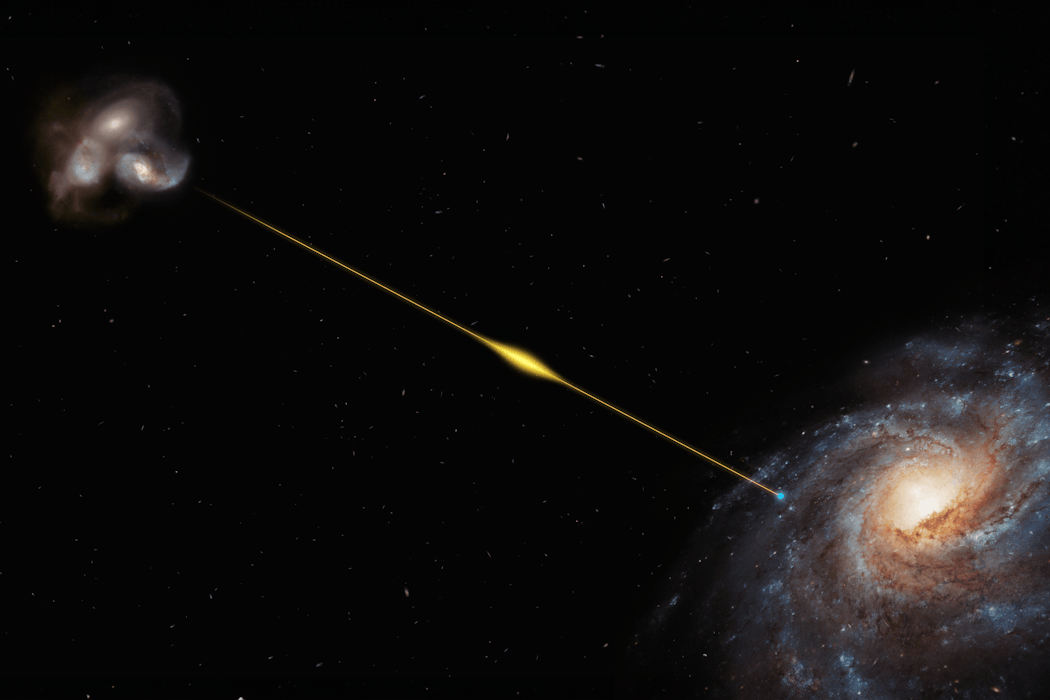
Mysterious blasts of radio waves from across the universe called fast radio bursts help astronomers catalog matter. ESO/M. Kornmesser, CC BY-SA

If you look across space with a telescope, you’ll see countless galaxies, most of which host large central black holes, billions of stars and their attendant planets. The universe teems with huge, spectacular objects, and it might seem like these massive objects should hold most of the universe’s matter.

But the Big Bang theory predicts that about 5% of the universe’s contents should be atoms made of protons, neutrons and electrons. Most of those atoms cannot be found in stars and galaxies – a discrepancy that has puzzled astronomers.

If not in visible stars and galaxies, the most likely hiding place for the matter is in the dark space between galaxies. While space is often referred to as a vacuum, it isn’t completely empty. Individual particles and atoms are dispersed throughout the space between stars and galaxies, forming a dark, filamentary network called the “cosmic web.”

Throughout my career as an astronomer, I’ve studied this cosmic web, and I know how difficult it is to account for the matter spread throughout space.

In a study published in June 2025, a team of scientists used a unique radio technique to complete the census of normal matter in the universe.

The census of normal matter

The most obvious place to look for normal matter is in the form of stars. Gravity gathers stars together into galaxies, and astronomers can count galaxies throughout the observable universe.

The census comes to several hundred billion galaxies, each made of several hundred billion stars. The numbers are uncertain because many stars lurk outside of galaxies. That’s an estimated 1023 stars in the universe, or hundreds of times more than the number of sand grains on all of Earth’s beaches. There are an estimated 1082 atoms in the universe.

However, this prodigious number falls far short of accounting for all the matter predicted by the Big Bang. Careful accounting indicates that stars contain only 0.5% of the matter in the universe. Ten times more atoms are presumably floating freely in space. Just 0.03% of the matter is elements other than hydrogen and helium, including carbon and all the building blocks of life.

Looking between galaxies

The intergalactic medium – the space between galaxies – is near-total vacuum, with a density of one atom per cubic meter, or one atom every 35 cubic feet. That’s less than a billionth of a billionth of the density of air on Earth. Even at this very low density, this diffuse medium adds up to a lot of matter, given the enormous, 92-billion-light-year diameter of the universe.

The intergalactic medium is very hot, with a temperature of millions of degrees. That makes it difficult to observe except with X-ray telescopes, since very hot gas radiates out through the universe at very short X-ray wavelengths. X-ray telescopes have limited sensitivity because they are smaller than most optical telescopes.

Deploying a new tool

Astronomers recently used a new tool to solve this missing matter problem. Fast radio bursts are intense blasts of radio waves that can put out as much energy in a millisecond as the Sun puts out in three days. First discovered in 2007, scientists found that the bursts are caused by compact stellar remnants in distant galaxies. Their energy peters out as the bursts travel through space, and by the time that energy reaches the Earth, it is a thousand times weaker than a mobile phone signal would be if emitted on the Moon, then detected on Earth.

Research from early 2025 suggests the source of the bursts is the highly magnetic region around an ultra-compact neutron star. Neutron stars are incredibly dense remnants of massive stars that have collapsed under their own gravity after a supernova explosion. The particular type of neutron star that emits radio bursts is called a magnetar, with a magnetic field a thousand trillion times stronger than the Earth’s.

An illustration of a bright star with circular rings around it representing magnetic field lines
A magnetar is a rare type of neutron star with an extremely strong magnetic field.
ESO/L. Calçada, CC BY-ND

Even though astronomers don’t fully understand fast radio bursts, they can use them to probe the spaces between galaxies. As the bursts travel through space, interactions with electrons in the hot intergalactic gas preferentially slow down longer wavelengths. The radio signal is spread out, analogous to the way a prism turns sunlight into a rainbow. Astronomers use the amount of spreading to calculate how much gas the burst has passed through on its way to Earth.

Puzzle solved

In the new study, published in June 2025, a team of astronomers from Caltech and the Harvard Center for Astrophysics studied 69 fast radio bursts using an array of 110 radio telescopes in California. The team found that 76% of the universe’s normal matter lies in the space between galaxies, with another 15% in galaxy halos – the area surrounding the visible stars in a galaxy – and the remaining 9% in stars and cold gas within galaxies.

The complete accounting of normal matter in the universe provides a strong affirmation of the Big Bang theory. The theory predicts the abundance of normal matter formed in the first few minutes of the universe, so by recovering the predicted 5%, the theory passes a critical test.

Several thousand fast radio bursts have already been observed, and an upcoming array of radio telescopes will likely increase the discovery rate to 10,000 per year. Such a large sample will let fast radio bursts become powerful tools for cosmology. Cosmology is the study of the size, shape and evolution of the universe. Radio bursts could go beyond counting atoms to mapping the three-dimensional structure of the cosmic web.

Pie chart of the universe

Scientists may now have the complete picture of where normal matter is distributed, but most of the universe is still made up of stuff they don’t fully understand.

The most abundant ingredients in the universe are dark matter and dark energy, both of which are poorly understood. Dark energy is causing the accelerating expansion of the universe, and dark matter is the invisible glue that holds galaxies and the universe together.

A pie chart showing the composition of the universe. The largest proportion is dark energy, at 68%, while dark matter makes up 27% and normal matter 5%. The rest is neutrinos, free hydrogen and helium and heavy elements.
Despite physicists not knowing much about it, dark matter makes up around 27% of the universe.
Visual Capitalist/Science Photo Library via Getty Images

Dark matter is probably a previously unstudied type of fundamental particle that is not part of the standard model of particle physics. Physicists haven’t been able to detect this novel particle yet, but we know it exists because, according to general relativity, mass bends light, and far more gravitational lensing is seen than can be explained by visible matter. With gravitational lensing, a cluster of galaxies bends and magnifies light in a way that’s analogous to an optical lens. Dark matter outweighs conventional matter by more than a factor of five.

One mystery may be solved, but a larger mystery remains. While dark matter is still enigmatic, we now know a lot about the normal atoms making up us as humans, and the world around us.

The Conversation

Chris Impey has received funding from NASA, NSF, Howard Hughes Medical Institute, and the Templeton Foundation.

ref. Most normal matter in the universe isn’t found in planets, stars or galaxies – an astronomer explains where it’s distributed – https://theconversation.com/most-normal-matter-in-the-universe-isnt-found-in-planets-stars-or-galaxies-an-astronomer-explains-where-its-distributed-269313

Measuring Colorado’s mountains one hike at a time

Source: The Conversation – USA – By Eric Gilbertson, Associate Teaching Professor of Mechanical Engineering, Seattle University

Using lightweight tools, Eric Gilbertson hikes the world’s tallest mountains to measure their heights. Elijah Gendron

In the middle of a chilly October night in 2025, my two friends and I suited up at the Cottonwood Creek trailhead and started a trek into the Sangre de Cristo mountains of Colorado. It was a little below freezing as we got moving at 1:30 a.m., and the Moon illuminated the snowy mountaintops above us.

Our packs were a bit heavier than normal because we were hauling highly accurate surveying equipment to the summits of two peaks, each over 14,000 feet (4,267.2 meters). The peaks, Crestone and East Crestone, were close enough in height, with a short enough saddle in between, that only the taller of the two would count as a true 14er and the other as a sub-peak.

Crestone had traditionally been thought to be taller and sees hundreds of ascents each year. East Crestone, traditionally believed to be shorter, sees only a fraction as many ascents. Colorado has 58 mountain peaks over 14,000 feet that peakbaggers consider 14ers. For locals and visitors alike, bagging a 14er is a sport, and some people post reports about having climbed all 58.

I wanted to measure which was taller, since I suspected previous measurements people had trusted for years might be erroneous.

A man stands near a tripod at the top of a mountain.
GPS allows Eric Gilbertson to measure the peaks of Crestone and East Crestone in Colorado in October 2025.
Eric Gilbertson

I teach mountain surveying, and I climb and research mountains around the world for fun. I’m trying to climb the highest mountain in every country on Earth. I have so far climbed 147 of 196, including tough, high-altitude technical ones such as K2 without supplemental oxygen in Pakistan and Pobeda in Kyrgyzstan.

Through my experience climbing, I discovered that not all countries in the world have been surveyed accurately enough to know the country’s true high point. The high point is geographically significant, as it’s the highest natural point or peak in the country, state or province. Often, high points are a source of national or state pride. I taught myself surveying to determine and verify these high points on my own.

Discovering high points around the world

I’ve so far discovered new high points in seven countries: Colombia – Pico Simón Bolívar; Saudi Arabia – Jabal Ferwa; Uzbekistan – Alpomish; Togo – Mount Atilakoutse; Gambia – Sare Firasu Hill; Guinea Bissau – Mount Ronde; and Botswana – Monalanong Hill.

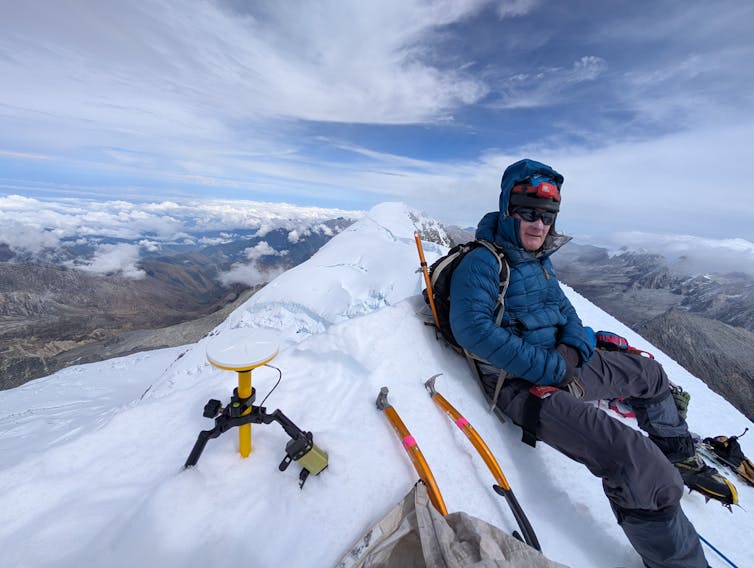
A man in cold-weather clothing sits on an icy mountain peak.
Ginge Fullen, a climbing partner of Eric Gilbertson, sits atop the peak of Pico Simon Bolivar in Colombia in December 2024.
Eric Gilbertson

I’ve surveyed over 60 peaks in the U.S. and Canada. In 2025 I discovered a new state high point in Michigan, Mount Curwood, at 1,979.3 feet (603.3 meters), and a new provincial high point of Nova Scotia, Western Barren, at 1,743.2 feet (531.3 meters).

I’ve determined the 100 highest peaks in Washington state, where I live and work, and studied how climate change is affecting the elevations of ice-capped peaks. My research showed that, while historically the contiguous U.S. had five ice-capped peaks, only two remain – Liberty Cap and Colfax, both in Washington state. Mount Rainier used to have as its highest point an ice dome named Columbia Crest on the western rim of the summit crater. But since 1998, Columbia Crest has melted more than 20 feet (6 meters) and is no longer the highest point on the mountain. The highest point is now a rock 436 feet (133 meters) to the south, on the southwest edge of the summit crater.

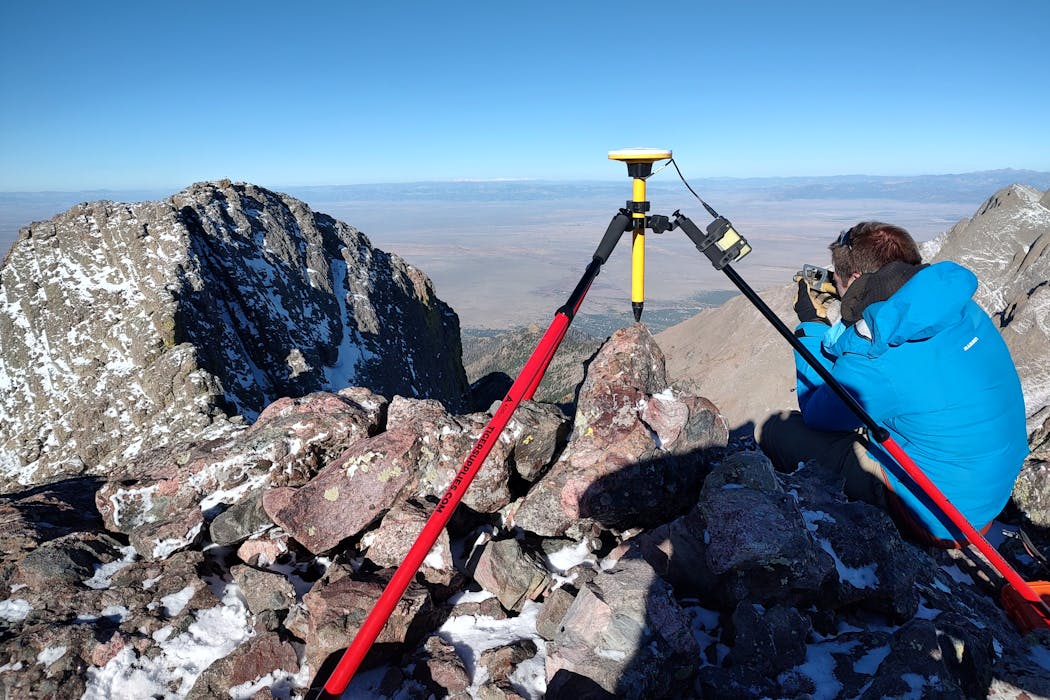
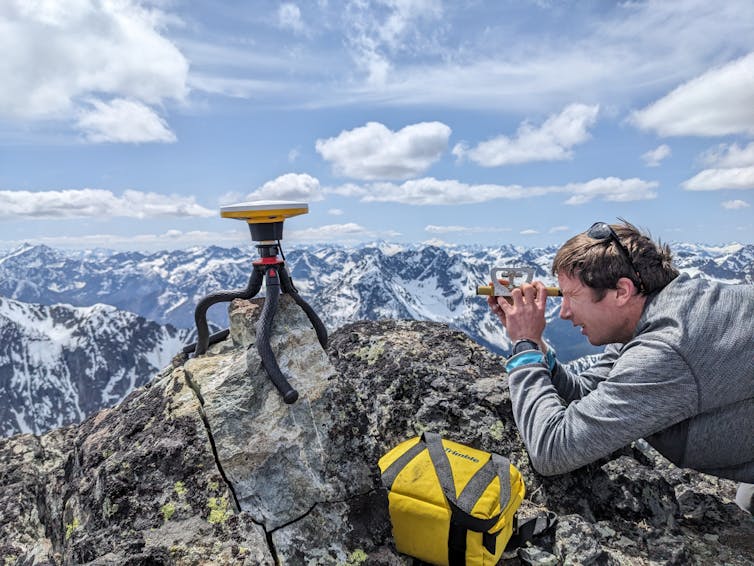
A small flat instrument sits on a tripod near a man who holds a measuring device to his eyes.
At the very top of South Mirror Image Peak in Washington, Eric Gilbertson uses an Abney level to measure nearby mountain heights.
Matthew Gilbertson

How to survey mountain high points

Surveying mountains is challenging due to the altitude, long approaches, difficult weather conditions and technical climbing. To get accurate surveying equipment to the summits requires ingenuity and specialized gear. Equipment needs to be as light as possible and adaptable to tricky terrain. For these reasons, very few mountains have been surveyed to the level of accuracy I can attain.

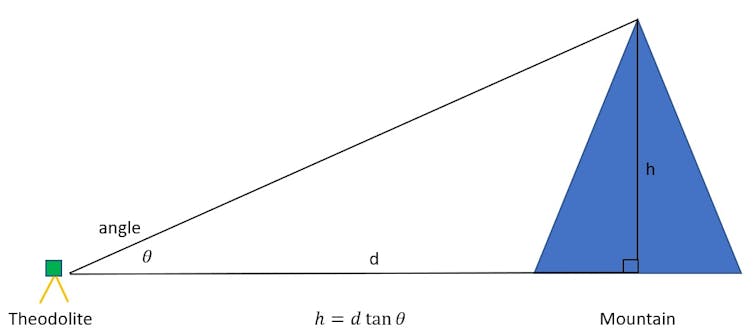
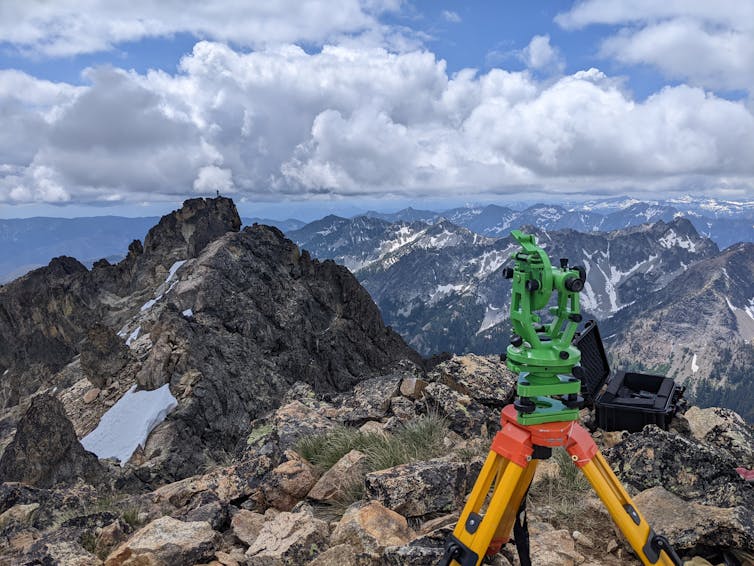
Historically, measurements have generally been made from a distance with theodolites. These are mechanical devices that can measure an angle up to a mountain summit very accurately. The distance to the mountain can be measured by other means, and trigonometry can be used with the distance and angle to calculate the summit elevation. But if the measurement is taken too far away, the error in elevation can be high. Theodolites are heavy and not easy to carry close to a peak.

An illustration shows how a theodolite measures angles.
Schematic diagram of how a theodolite is used to measure an angle to the summit of a mountain.
Eric Gilbertson

I sometimes carry a 30-pound (13.61 kg) theodolite to a summit, but if the mountain is technical, this is challenging and requires complicated rope systems to haul it up. More often I bring an Abney level, which is a lighter mechanical device that also measures angles. I bring this to a summit to measure relative angles between nearby points to identify which is the highest point on the mountain.

A greean machine with yellow tripod legs sits on a mountain top.
A theodolite is a mechanical devices that can measure angles up to a summit very accurately. Here one is used on Cardinal Peak in Washington in June 2023.
Eric Gilbertson

I then use a highly accurate, survey-grade GPS to measure the absolute elevation of the highest point. The GPS requires an hour or more to get an accurate measurement, so it wouldn’t make sense timewise to measure many nearby points with this device. I’ve found time is usually limited when surveying a summit, due to incoming storms or approaching darkness when descents need to be made in daylight for safety. This is why I first identify the highest point with an Abney level or theodolite.

Many satellites overhead send data down that is collected by the GPS device and used to calculate the device’s position. To save weight, I use a device that then sends measurements over Bluetooth to my phone instead of requiring a dedicated computer.

A GPS receiver generally needs to be mounted on a vertical rod that touches the exact summit. I measure the GPS height, subtract the rod height, and that gives the summit height. To keep the rod perfectly vertical I use a tripod, and this also requires innovation.

A man with a red helmet and jacket adjusts a small device on the top of a mountain.
Eric Gilbertson uses a GPS to measure East Fury in Washington.
Courtesy of Ross Wallette

Sometimes a summit is so sharp that regular tripod legs aren’t long enough to touch the ground. In this case, I strap on hiking poles to extend the legs. Another solution is to use a tripod with flexible legs, and I mold the legs to conform to the shape of a sharp boulder. This is what I used to measure the high point of Uzbekistan.

Another tool I use is LiDAR, which stands for light detection and ranging. This works by an airplane flying over a mountain and bouncing light signals off the summit. By using the plane’s location and the time it takes the signal to bounce back, the mountain’s elevation can be calculated.

Colorado 14ers

All measurements can have errors. I traveled to Colorado because I suspected LiDAR measurements of Crestone Peak, considered a 14er, might be erroneous. LiDAR measurements have been taken for nearly all mountains in Colorado, and these measurements are generally the most accurate available for mountain elevations.

LiDAR measurements hit the ground every few feet of horizontal spacing and can miss the top of sharp summits, leading to an underestimate of summit height. They can also hit things such as bushes, leading to an overestimate of summit height.

LiDAR data showed Crestone Peak and East Crestone within a few feet of the same height. But, interestingly, it showed a 3-4 foot (0.9-1.2 meter) spike on the top of Crestone. I climbed Crestone in 2020 while doing the Rocky Mountain Slam, a challenge to climb all the Colorado 14ers, Wyoming 13ers and Montana 12ers in two months, and knew the summit was pretty flat. I speculated that spike could have easily been a person, which meant the LiDAR elevation of Crestone might be too high.

East Crestone has a sharp boulder on the summit, which LiDAR could easily miss because of the horizontal gaps between measurements. So that elevation was possibly too short. In Colorado a point needs 300 feet (91.44 meters) of prominence to count as a separate peak. Other states have different rules, like in Washington where 400 feet (121.92 meters) is required. Prominence is a measure of how high a peak sticks up above a saddle connecting it to a taller peak. The saddle between Crestone and East Crestone is short enough that only the taller of them is a true peak and the other is a sub-peak.

On East Crestone I first set up a tall tripod, but the wind blew it down, nearly over a cliff. I switched it out with a shorter one, which was more stable.

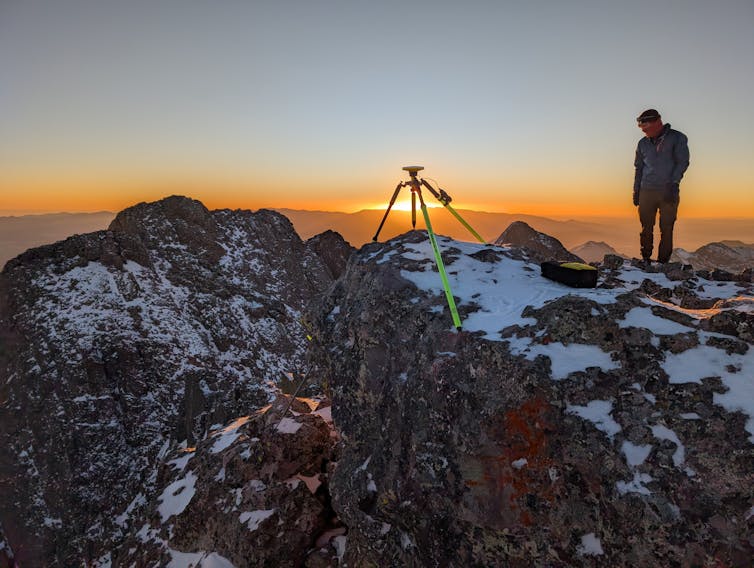
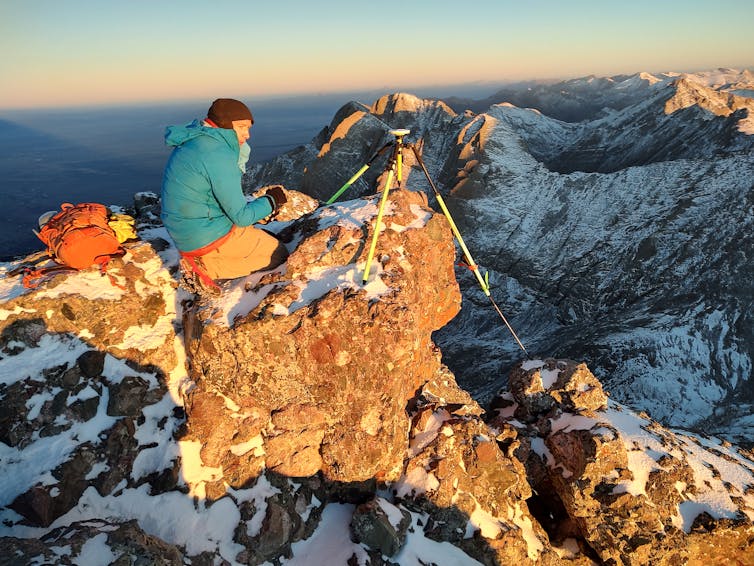
A man in a green jacket sits near a device on a tripod on the top of a mountain.
Eric Gilbertson hiked Crestone, one of Colorado’s 14ers, to determine its true height.
Elijah Gendron

I then scrambled over to Crestone Peak and mounted another identical GPS device. That summit was on the edge of a cliff, and I needed to extend one tripod leg with a hiking pole so it could touch the ground.

I logged data for over two hours with both devices simultaneously. This ensured both were receiving the same satellite signals – so any atmospheric distortion would be the same – and that enough data was logged so I could get elevations accurate to the nearest inch. This gave me a lot of time to admire the views and take pictures, but I also needed to check on the equipment every 5-10 minutes to ensure it was working properly.

After packing up, hiking down and flying home to Seattle, I spent a few weeks poring over the data. The results showed East Crestone is 0.3 feet (0.09 meters) taller than Crestone, with more than 99.9% confidence that East Crestone is taller.

This means Colorado has a new 14er: East Crestone. Crestone is, in fact, a sub-peak. Discussions are ongoing about whether this means the 14ers list that peakbaggers climb should retain Crestone and add East Crestone to be 59 peaks, or whether East Crestone should replace Crestone so the list stays at 58 peaks.

I’m planning to continue my work surveying mountains in Colorado and around the world to determine accurate summit elevations. My next plan is surveying several country high points in Africa this winter. The Benin country high point is still not known, and I hope to solve that mystery next.

Read more of our stories about Colorado.

The Conversation

Eric Gilbertson receives funding from The American Alpine Club.

ref. Measuring Colorado’s mountains one hike at a time – https://theconversation.com/measuring-colorados-mountains-one-hike-at-a-time-269343

Everything everywhere all at once: How Zohran Mamdani campaigned both online and with a ground game

Source: The Conversation – USA – By Stuart Soroka, Professor, Communications and Political Science, University of California, Los Angeles

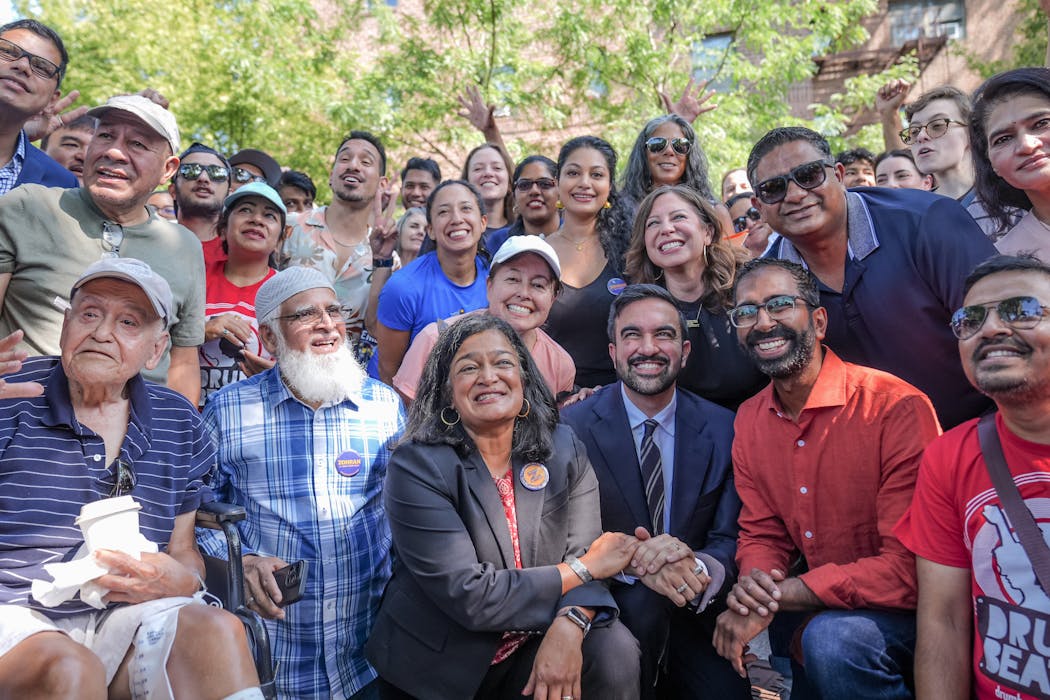
New York mayoral candidate Zohran Mamdani and U.S. Rep. Pramila Jayapal meet voters to go door-knocking in Jackson Heights on Sept. 14, 2025. Selcuk Acar/Anadolu via Getty Images

Accounts of Zohran Mamdani’s campaign for New York City mayor have highlighted both his online presence and his ground game.

Mamdani won the general election with 50.4% of the vote, a larger share than was predicted by most polls, and his get-out-the-vote campaign has received some of the credit. Mamdani claims that his campaign had over 100,000 volunteers knocking on doors across New York City.

This focus on on-the-ground mobilization stands out given the increasing attention devoted to online campaigning over the past 15 years.

Particularly during that time period, online platforms have been a major focus of political campaigns and campaign research. Targeted advertising and new media strategies are increasingly viewed as central to campaign success. So is coverage of the campaign by legacy and social media more generally.

Moreover, solid empirical evidence of the effectiveness of door-to-door canvassing is limited. Recent work finds very few effects of in-person canvassing, except in very specific circumstances. One recent paper suggests that door-to-door canvassing by the candidate can make a difference to election outcomes. But in a race in New York City, it is not likely that Mamdani himself was able to reach enough voters to make a difference.

How much did Mamdani’s ground game contribute to his victory? As a political communication scholar, I know that assessing the impact of different methods used by political campaigns is difficult – in part because political campaigns include multiple lines of communication.

‘Hybrid’ campaigns

No campaign exists in isolation — nearly every candidate’s campaign occurs alongside opposing candidates’ campaigns. The effects of one campaign are often masked by the countering effects of the other.

The size of a campaign on one platform also tends to be correlated with the size of that candidate’s campaign on other platforms. When television advertising increases alongside social media advertising and door-to-door canvassing, identifying the effects of any single platform can be difficult.

Clever research designs are in some instances able to identify effects. These generally find that the impact of not just door-knocking but also ads and online advertising can be relatively limited.

In the modern technological environment, the impact of any single aspect of a campaign may be especially difficult to assess. Campaigning increasingly occurs in what researchers have called a “hybrid media” environment. Campaigns are waged in person, on the news and across multiple social media.

Each of these platforms comes with different advantages and disadvantages. Each also prioritizes different kinds of information.

Plainly stating your policy platform may work for coverage of a campaign stop on the evening news. But if you want that policy to go viral on TikTok, then you may need to add a dance – or an influencer.

Find volunteers online, send them knocking

Candidates have increasingly recognized the need to tailor messages for different communication platforms, such as television ads, Facebook posts and TikToks, building hybrid campaigns that attempt to spread a message across multiple, different spaces.

This interactivity across platforms has been especially evident in postelection assessments of the Mamdani campaign. His social media campaign was adept at producing the kinds of content that attract attention online. That campaign also appears to have been able to convert online engagement into real-world activism, including door-to-door canvassing.

There have been growing concerns among academics and campaign organizers about “slacktivism” — activism that amounts to one or two clicks online but nothing more. One worry is that a quick online endorsement may in some instances give people a sense that they have done their share and limit more active forms of engagement. The Mamdani campaign appears to have overcome this problem, at least in part.

But 100,000 people knocking on doors probably does not happen without the success of an online campaign. Finding and mobilizing campaigners was one important focus of Mamdani’s engagement online, after all.

Do it yourself − then repeat on socials

In-person campaigning by Mamdani, on the street and in the taxi line, is almost certainly made more effective through circulation on Instagram and TikTok.

Using mass media to broadcast campaign stops is not new, of course.

The construction of campaign stops that produce good social media content is becoming more common, however. The ways in which campaigns unfold in person are increasingly intertwined with the way they unfold online.

In this way, the Mamdani campaign may have been a textbook example of a modern hybrid campaign and an illustration of the coevolution of digital and on-the-ground campaigning.

To be clear, the success of the Mamdani campaign is probably not about his online presence or his ground game, but both at the same time.

The Conversation

Stuart Soroka research has been funded from the National Science Foundation and the Social Sciences and Humanities Research Council of Canada.

ref. Everything everywhere all at once: How Zohran Mamdani campaigned both online and with a ground game – https://theconversation.com/everything-everywhere-all-at-once-how-zohran-mamdani-campaigned-both-online-and-with-a-ground-game-269693

Down-ranking polarizing content lowers emotional temperature on social media – new research

Source: The Conversation – USA – By Tiziano Piccardi, Assistant Professor of Computer Science, Johns Hopkins University

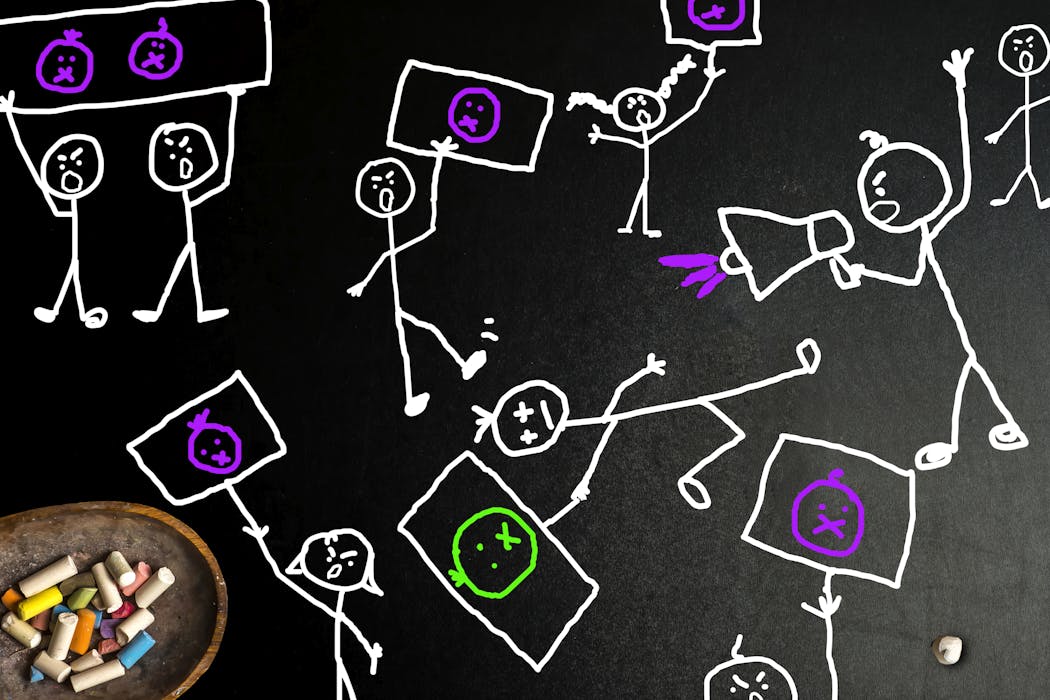
Social media posts that stoke division don’t have to top your feed. Gama5/iStock via Getty Images

Reducing the visibility of polarizing content in social media feeds can measurably lower partisan animosity. To come up with this finding, my colleagues and I developed a method that let us alter the ranking of people’s feeds, previously something only the social media companies could do.

Reranking social media feeds to reduce exposure to posts expressing anti-democratic attitudes and partisan animosity affected people’s emotions and their views of people with opposing political views.

I’m a computer scientist who studies social computing, artificial intelligence and the web. Because only social media platforms can modify their algorithms, we developed and released an open-source web tool that allowed us to rerank the feeds of consenting participants on X, formerly Twitter, in real time.

Drawing on social science theory, we used a large language model to identify posts likely to polarize people, such as those advocating political violence or calling for the imprisonment of members of the opposing party. These posts were not removed; they were simply ranked lower, requiring users to scroll further to see them. This reduced the number of those posts users saw.

We ran this experiment for 10 days in the weeks before the 2024 U.S. presidential election. We found that reducing exposure to polarizing content measurably improved participants’ feelings toward people from the opposing party and reduced their negative emotions while scrolling their feed. Importantly, these effects were similar across political affiliations, suggesting that the intervention benefits users regardless of their political party.

This ‘60 Minutes’ segment covers how divisive social media posts get more traction than neutral posts.

Why it matters

A common misconception is that people must choose between two extremes: engagement-based algorithms or purely chronological feeds. In reality, there is a wide spectrum of intermediate approaches depending on what they are optimized to do.

Feed algorithms are typically optimized to capture your attention, and as a result, they have a significant impact on your attitudes, moods and perceptions of others. For this reason, there is an urgent need for frameworks that enable independent researchers to test new approaches under realistic conditions.

Our work offers a path forward, showing how researchers can study and prototype alternative algorithms at scale, and it demonstrates that, thanks to large language models, platforms finally have the technical means to detect polarizing content that can affect their users’ democratic attitudes.

What other research is being done in this field

Testing the impact of alternative feed algorithms on live platforms is difficult, and such studies have only recently increased in number.

For instance, a recent collaboration between academics and Meta found that changing the algorithmic feed to a chronological one was not sufficient to show an impact on polarization. A related effort, the Prosocial Ranking Challenge led by researchers at the University of California, Berkeley, explores ranking alternatives across multiple platforms to promote beneficial social outcomes.

At the same time, the progress in large language model development enables richer ways to model how people think, feel and interact with others. We are seeing growing interest in giving users more control, allowing people to decide what principles should guide what they see in their feeds – for example the Alexandria library of pluralistic values and the Bonsai feed reranking system. Social media platforms, including Bluesky and X, are heading this way, as well.

What’s next

This study represents our first step toward designing algorithms that are aware of their potential social impact. Many questions remain open.

We plan to investigate the long-term effects of these interventions and test new ranking objectives to address other risks to online well-being, such as mental health and life satisfaction. Future work will explore how to balance multiple goals, such as cultural context, personal values and user control, to create online spaces that better support healthy social and civic interaction.

The Research Brief is a short take on interesting academic work.

The Conversation

This research was partially supported by a Hoffman-Yee grant from the Stanford Institute for Human-Centered Artificial Intelligence.

ref. Down-ranking polarizing content lowers emotional temperature on social media – new research – https://theconversation.com/down-ranking-polarizing-content-lowers-emotional-temperature-on-social-media-new-research-271071