Pourquoi les physiciens et les philosophes ont-ils eu tant de mal à comprendre la nature du temps ?

Source: The Conversation – in French – By Daryl Janzen, Observatory Manager and Instructor, Astronomy, University of Saskatchewan

Le temps en soi n’est pas complexe à saisir : nous le comprenons, malgré notre difficulté à le décrire. Le problème réside dans la formulation : nous n’arrivons pas à définir précisément les limites de la nature du temps, tant sur le plan conceptuel que linguistique. (Donald Wu/Unsplash), CC BY

La nature du temps tourmente les penseurs depuis que les humains essaient de comprendre le monde. Intuitivement, nous savons ce qu’est le temps, mais quand nous souhaitons l’expliquer, notre esprit s’embrouille.

Le théologien saint Augustin d’Hippone, dont les écrits ont influencé la philosophie occidentale, a exposé un paradoxe en tentant de définir le temps il y a plus de 1 600 ans :

« Qu’est-ce donc que le temps ? Si personne ne m’interroge, je le sais ; si je veux répondre à cette demande, je l’ignore. »

Près de mille ans plus tôt, Héraclite d’Éphèse avait proposé une vision pénétrante de ce sujet. Voici ce qu’écrit le philosophe grec classique Platon dans son dialogue intitulé Cratyle :

« Héraclite dit que tout passe, que rien ne subsiste ; et comparant au cours d’un fleuve les choses de ce monde : Jamais, dit-il, vous ne pourrez entrer deux fois dans le même fleuve. »

À première vue, cela peut sembler constituer un autre paradoxe : comment un fleuve peut-il être à la fois le même et un autre ? Mais Héraclite éclaire son affirmation : le fleuve est une chose qui existe et qui change continuellement. Bien qu’il s’agisse du même fleuve, ce sont des eaux différentes qui s’écoulent à chaque instant.

Si le flux constant du fleuve rend la notion claire, cette vision s’applique à tout ce qui existe, y compris la personne qui entre dans le fleuve. Elle reste la même, mais chaque instant où son pied est dans le fleuve est différent.

Comment le temps peut-il sembler si évident, si intimement lié à notre expérience, et pourtant demeurer le cauchemar de tous les penseurs qui ont tenté de l’expliquer ?

Une question de formulation

La question clé n’est pas considérée comme pertinente par la plupart des physiciens. Et ce n’est pas non plus un défi que les philosophes ont réussi à relever.

Le temps en soi n’est pas complexe à saisir : nous le comprenons tous, malgré notre difficulté à le décrire. Comme l’a perçu saint Augustin, le problème réside dans la formulation : nous sommes incapables de définir exactement les limites de la nature du temps, tant sur le plan conceptuel que linguistique.

Plus précisément, les physiciens et les philosophes ont tendance à confondre ce que signifie « exister » et ce que signifie « se produire », traitant les événements comme s’ils existaient. Une fois cette distinction reconnue, le brouillard se dissipe et le paradoxe d’Augustin s’évanouit.


À lire aussi :
Qu’est-ce que l’espace-temps, exactement ?


L’origine de la question

En logique fondamentale, il n’existe pas de véritables paradoxes, mais seulement des déductions qui reposent sur des prémisses pas très bien interprétées.

Peu après qu’Héraclite a tenté de clarifier la notion de temps, Parménide d’Élée est allé dans une tout autre direction. Son raisonnement part d’une prémisse apparemment valable : « Ce qui est, est ; ce qui n’est pas, n’est pas » –, puis introduit subrepticement une hypothèse cruciale. Il affirme que le passé fait partie de la réalité parce qu’il a été vécu, et que l’avenir doit également en faire partie parce que nous l’anticipons.

Parménide en déduit que le passé et l’avenir font partie de « ce qui est » et que toute l’éternité forme un tout continu dans lequel le temps n’est qu’une illusion.

Zénon, disciple de Parménide, a imaginé plusieurs paradoxes pour étayer cette théorie. En termes modernes, il affirmerait que si vous essayiez de marcher d’un bout à l’autre d’un pâté de maisons, vous n’y arriveriez jamais. Pour parcourir un pâté de maisons, il faut d’abord en franchir la moitié, puis la moitié de ce qu’il reste, et ainsi de suite, en divisant toujours par deux la distance restante, sans jamais atteindre la fin.

Une peinture montre un homme en robe guidant d’autres hommes en robe
Le philosophe grec Zénon d’Élée montrant à ses disciples les portes de la vérité et de la fausseté dans une fresque du XVIᵉ siècle à l’Escurial, à Madrid.
(El Escorial, Madrid)

On peut évidemment marcher jusqu’au bout du pâté de maisons, et même au-delà, ce qui rend la proposition de Zénon absurde. Son erreur réside dans le fait qu’il élimine le temps de son raisonnement, ne considérant que des configurations spatiales successives. Or, la réduction des distances s’accompagne d’une réduction des intervalles de temps, les deux devenant parallèlement plus courts.

Zénon fixe implicitement le temps total disponible pour le mouvement – tout comme il fixe la distance –, et le paradoxe n’apparaît que parce que le temps a été supprimé. Rétablissons le temps, et la contradiction disparaît.

Parménide commet une erreur similaire lorsqu’il déclare que les événements passés et futurs, c’est-à-dire les choses qui se sont produites ou qui se produiront, existent. Cette hypothèse pose problème, car elle équivaut à la conclusion à laquelle il souhaite parvenir. Son raisonnement est circulaire et aboutit à réaffirmer son hypothèse, mais d’une manière qui semble différente et profonde.


Déjà des milliers d’abonnés à l’infolettre de La Conversation. Et vous ? Abonnez-vous gratuitement à notre infolettre pour mieux comprendre les grands enjeux contemporains.


Modèles d’espace-temps

Un événement est quelque chose qui se produit à un endroit et à un moment précis. Selon la théorie de la relativité d’Albert Einstein, l’espace-temps est un modèle à quatre dimensions qui décrit toutes les occurrences : chaque point est un événement particulier et la séquence continue d’événements associés à un objet forme sa ligne d’univers, c’est-à-dire son trajet dans l’espace et le temps.

Cependant, les événements n’existent pas, ils se produisent. Quand les physiciens et les philosophes parlent de l’espace-temps comme d’une chose qui existe, ils traitent les événements comme des éléments qui existent – la même erreur subtile qui est à l’origine de 25 siècles de confusion.

La cosmologie – l’étude de l’univers dans son ensembleoffre une réponse claire.

Cette science décrit un univers tridimensionnel rempli d’étoiles, de planètes et de galaxies qui existent. Au cours de cette existence, l’emplacement de chaque particule à chaque instant constitue un événement spatio-temporel individuel. Depuis la création de l’univers, les événements qui se produisent à chaque instant tracent des lignes d’univers dans un espace-temps à quatre dimensions, une représentation géométrique de tout ce qui se passe au cours de son existence. Ce modèle est utile, mais il ne représente pas une chose qui existe.


À lire aussi :
L’espace-temps n’existe pas, mais c’est un cadre qui permet de comprendre notre réalité


La résolution

Résoudre le paradoxe d’Augustin – le temps est une chose que l’on comprend intuitivement, mais que l’on ne peut décrire – est simple une fois qu’on a identifié la source de la confusion.

Les événements, c’est-à-dire ce qui se produit ou survient, ne sont pas des choses qui existent. Chaque fois que vous entrez dans le fleuve, cela constitue un événement unique. Cela se produit au cours de votre existence et de celle de la rivière. Vous et la rivière existez ; le moment où vous entrez dans la rivière se produit.

Les philosophes se penchent sur le paradoxe du voyage dans le temps depuis plus d’un siècle, mais le concept de base repose sur la même erreur subtile. L’auteur de science-fiction H. G. Wells aborde cette notion au début de son roman La Machine à explorer le temps.

En présentant son idée, le voyageur temporel passe de la description d’objets tridimensionnels, à des objets qui existent, puis à des moments sur une ligne d’univers, pour finalement considérer cette ligne comme quelque chose qui existe.

Cette dernière étape correspond précisément au moment où l’on prend la carte pour le territoire. Une fois qu’on a imaginé l’existence d’une ligne d’univers, ou même l’espace-temps, qu’est-ce qui nous empêche d’imaginer qu’un voyageur puisse s’y déplacer ?

L’occurrence et l’existence sont deux aspects fondamentalement distincts du temps : chacun est essentiel pour le comprendre pleinement, mais ils ne doivent jamais être confondus.

Pendant des millénaires, le fait de percevoir les événements comme des choses qui existent a engendré la confusion qui règne autour du temps. Considérons maintenant le temps à la lumière de cette distinction. Pensons aux choses qui nous entourent, aux diverses histoires de voyage dans le temps et à la physique de l’espace-temps.

Une fois que l’on a reconnu que nous nous trouvons dans univers tridimensionnel existant, rempli d’éléments existants, et que des événements se produisent à chaque instant au cours de cette existence cosmique – cartographiant l’espace-temps sans pour autant être la réalité –, tout s’aligne. Le paradoxe d’Augustin se dissout : le temps n’est plus mystérieux si on arrive à distinguer occurrence et existence.

La Conversation Canada

Daryl Janzen ne travaille pas, ne conseille pas, ne possède pas de parts, ne reçoit pas de fonds d’une organisation qui pourrait tirer profit de cet article, et n’a déclaré aucune autre affiliation que son organisme de recherche.

ref. Pourquoi les physiciens et les philosophes ont-ils eu tant de mal à comprendre la nature du temps ? – https://theconversation.com/pourquoi-les-physiciens-et-les-philosophes-ont-ils-eu-tant-de-mal-a-comprendre-la-nature-du-temps-270220

6 décembre : voici pourquoi le Canada doit reconnaître le crime de féminicide

Source: The Conversation – in French – By Myrna Dawson, Professor, Department of Sociology & Anthropology, University of Guelph

Cela fait 36 ans que le massacre de 14 jeunes femmes a eu lieu à l’École Polytechnique de Montréal. Un homme les a abattues parce qu’elles étaient des femmes.

Qualifié d’acte de « misogynie violente » par le gouvernement fédéral, ce massacre n’a pourtant jamais été officiellement qualifié de féminicide au Canada, malgré sa reconnaissance mondiale.

Des femmes et des filles continuent d’être tuées tous les deux jours au pays, très majoritairement par des hommes. Et les chiffres continuent d’augmenter.


À lire aussi :
Polytechnique, 30 ans plus tard : un premier attentat antiféministe, enfin nommé comme tel


La majorité de ces meurtres sont des féminicides, selon le cadre statistique des Nations unies pour mesurer les meurtres de femmes et de filles liés au genre. Le féminicide est défini de manière générale comme le meurtre d’une femme ou d’une fille en raison de son sexe ou de son genre.

Un balado qui pour dénoncer

matériel promotionnel pour un podcast
Le podcast raconte l’histoire de 580 femmes et filles tuées par des hommes au Canada depuis 2020.
(Observatoire canadien sur les féminicides pour la justice et la responsabilité), CC BY

Pour ces raisons, l’Observatoire canadien sur les féminicides pour la justice et la responsabilité (CFOJA) a lancé son balado « Too True Crime » le 25 novembre 2025, soit la Journée internationale pour l’élimination de la violence à l’égard des femmes. Le balado met en lumière les histoires de 580 femmes et filles tuées par des hommes dans des cas de féminicide depuis 2020.

Il ne tient compte que des cas où les informations disponibles indiquaient qu’il s’agissait d’un féminicide. Certains cas ont pu échapper à l’attention des autorités et rester sous le radar. Mais depuis le lancement de l’Observatoire en 2018, on a recencé plus de 1 100 femmes et filles tuées par des hommes.

Une partie des appels à l’action du balado comprends une pétition demandant au Canada de reconnaître officiellement le crime de féminicide et de l’inclure dans le Code criminel.

Les lois contribuent à apporter des changements

L’Italie est le dernier pays sur une trentaine dans le monde à avoir créé une infraction distincte de féminicide dans sa législation nationale.

Cette approche a ses détracteurs. Ils affirment :

  • Elle ne met pas l’accent sur la prévention ;

  • Elle ne s’attaque pas à la culture qui favorise le féminicide ;

  • Elle peut avoir des conséquences imprévues ;

  • Il est difficile de parvenir à un consensus sur la définition du féminicide ;

  • Elle n’a pas réduit le nombre de féminicides.

Mais la criminalisation par opposition à la prévention n’est pas une question de choix entre l’un ou l’autre.

Les lois constituent un élément clé d’une approche de santé publique en matière de prévention de la violence. Les lois nationales sur les féminicides s’accompagnent généralement de programmes de prévention, de formations destinées aux forces de l’ordre et de campagnes de sensibilisation du public. La loi italienne, par exemple, prévoit des mesures plus sévères contre les crimes sexistes tels que le harcèlement obsessionnel et la pornographie vengeresse.

Les lois ne constituent pas des réponses isolées. Elles ne sont qu’une partie des réponses multisectorielles à un problème social qui doit inclure le suivi des processus de mise en œuvre et des résultats.

Changer les lois peut changer les cultures

En Italie, certaines militantes féministes se sont plaintes que la loi n’allait pas assez loin, notamment en matière de changement culturel. Au Canada, une avocate féministe suggère qu’il faudrait peut-être « repenser radicalement » toute la question plutôt que de créer une nouvelle infraction dans le Code criminel.

Mais qualifier ce crime de « féminicide » — un terme spécifique au sexe ou au genre — constitue en fait une remise en question radicale dans un climat de neutralité qui masque trop souvent le fardeau disproportionné que supportent les femmes et les filles dans certaines formes de violence masculine.

Les réponses apportées par les États à travers leurs lois reflètent les valeurs culturelles. À l’heure actuelle, ces valeurs considèrent le féminicide comme un problème individuel plutôt que comme le résultat de structures et de processus sociaux fondés sur des inégalités profondément enracinées.

Une loi sur le féminicide reconnaîtrait que la violence masculine envers les femmes et les filles est systémique et nécessite un changement d’attitude dans les valeurs culturelles du Canada.

Aider les femmes et les populations marginalisées

Les lois visant à protéger les femmes peuvent avoir des conséquences imprévues, comme le montre le cas de l’obligation de poursuites judiciaires en cas de violence conjugale. Elle impose à la police de porter plainte si elle a des motifs raisonnables de croire qu’une agression a eu lieu. Et les lois non sexistes peuvent nuire aux femmes, en particulier lorsqu’elles sont appliquées dans un environnement sexiste et raciste.

C’est pourquoi le Canada doit inclure le féminicide dans son Code criminel. Le féminicide n’est pas neutre du point de vue du genre, et le reconnaître officiellement permettra de définir comment et pourquoi les femmes sont tuées par des hommes, ce qui est essentiel pour une prévention efficace.

Une loi sur le féminicide ne vise pas à alourdir les peines, mais à garantir que les accusations, les condamnations et les peines soient appropriées et que les auteurs soient tenus responsables dans les meurtres de femmes et de filles de tous horizons.

Il est possible de parvenir à un consensus

Le Canada doit parvenir à un consensus sur la définition du féminicide et en identifier clairement les éléments constitutifs.

Tous les pays dotés de lois sur le féminicide sont parvenus à un consensus, même si tous ne l’ont pas défini de la même manière. Cependant, les protocoles types et des lois types sont disponibles pour les pays qui envisagent d’inclure le féminicide dans leur législation nationale et leur code pénal.

Certaines recherches suggèrent que les lois sur le féminicide sont inefficaces. Elles n’ont pas permis de réduire le nombre de cas. Mais d’autres soulignent que les lois sur le féminicide ont renforcé la responsabilité et amélioré le signalement, la protection des survivantes et la sensibilisation à toutes les formes de violence sexiste.

Les effets variables d’une loi dépendent du contexte, notamment de qui la connaît, de sa clarté et de sa concision, et de la réactivité des personnes responsables de l’appliquer.

Les lois sur le féminicide ne suffiront pas à elles seules à réduire immédiatement le nombre de femmes tuées par des hommes ou victimes d’autres formes de violence sexiste. Peu de lois ont ce pouvoir. Le principal défi consiste à déterminer si et comment une loi sur le féminicide sera mise en œuvre.

Une réponse de l’ensemble de la société

Les lois sur le féminicide visent la prévention et peuvent changer notre culture. Elles pourraient venir en aide aux femmes et aux filles, en particulier celles dont la vie et la mort sont aujourd’hui marginalisées et ignorées.

Comme beaucoup d’autres pays, le Canada peut parvenir à un consensus sur la définition du féminicide et élaborer une loi qui conduira à des changements significatifs. Mais cela nécessite des consultations proactives, une volonté politique et des dirigeants à l’écoute.

Les 580 récits présentés dans Too True Crime démontrent clairement et sans ambiguïté que la vie des femmes et des filles en dépend.

La Conversation Canada

Myrna Dawson a déjà reçu des subventions du Conseil de recherches en sciences humaines et du programme des Chaires de recherche du Canada.

ref. 6 décembre : voici pourquoi le Canada doit reconnaître le crime de féminicide – https://theconversation.com/6-decembre-voici-pourquoi-le-canada-doit-reconnaitre-le-crime-de-feminicide-271365

3 states are challenging precedent against posting the Ten Commandments in public schools – cases that could land back at the Supreme Court

Source: The Conversation – USA (3) – By Charles J. Russo, Joseph Panzer Chair in Education and Research Professor of Law, University of Dayton

Students work under posters of the Ten Commandments and the Bill of Rights in a high school classroom in Kyle, Texas, on Oct. 16, 2025. AP Photo/Eric Gay

As disputes rage on over religion’s place in public schools, the Ten Commandments have become a focal point. At least a dozen states have considered proposals that would require the posting of the Ten Commandments in classrooms, with Texas, Louisiana and Arkansas mandating their display in 2024 or 2025.

Challenges led to all three laws being at least partially blocked. Most recently, on Dec. 2, 2025, families in Texas filed a class-action lawsuit seeking to take down displays across the state. Federal trial court judges have already temporarily blocked the law in around two dozen districts. Ongoing appeals from the bills’ supporters, though, seem aimed at overturning a 45-year-old U.S. Supreme Court precedent prohibiting such displays.

As religion and education law researchers, we believe this situation is especially noteworthy because of its timing. In 2022, the Supreme Court adopted a new standard to assess religious freedom cases, which may come into play – and its judgments on religion’s role in public education are perhaps the most religion-friendly they have ever been.

The Ten Commandments and the courts

Controversy over the commandments is not new. In more than a dozen early cases, courts generally upheld laws and policies mandating their recitation in schools. These enactments survived because the Supreme Court did not extend the First Amendment to state laws until 1940.

Litigation over posting the Ten Commandments in schools first reached the Supreme Court in 1980. In Stone v. Graham, the justices invalidated a Kentucky statute requiring displays of the commandments in classrooms. The court reasoned that the law violated the First Amendment’s establishment clause: “Congress shall make no law respecting an establishment of religion.”

At the time, the court applied the first of the three criteria it has since abandoned, known as the “Lemon test,” to evaluate whether governmental action violates the establishment clause. Under this test – which developed from a 1971 Supreme Court decision – governmental actions must have a secular legislative purpose, and their main effect may neither advance nor inhibit religion. In addition, they must avoid excessive entanglement with religion.

In Stone, the justices rejected Kentucky’s argument that the displays served a secular educational purpose. The court disagreed that a small notation on posters describing the Ten Commandments as the “fundamental legal code of Western Civilization and the Common Law of the United States” was sufficient, noting that the posters were “plainly religious in nature.”

Twenty-five years later, in 2005, litigation over public displays of the Ten Commandments returned to the Supreme Court. This time, neither display was in a school.

The first dispute arose in Kentucky, where officials in two counties had erected courthouse displays including the Ten Commandments, the Magna Carta and the Declaration of Independence. The justices limited their order to one dispute, in McCreary County, invalidating the display for violating the establishment clause – largely because it lacked a secular legislative purpose.

On the same day, the Supreme Court reached the opposite result in another case, Van Orden v. Perry. The court permitted a display including the Ten Commandments to remain on the grounds of the Texas Capitol in Austin, where it was one of 17 monuments and 21 historical markers.

Two women walk by an ornately carved stone monument, with a building with a large rotunda in the background.
A Ten Commandments monument on the grounds of the Texas Capitol in Austin.
AP Photo/Eric Gay

Unlike the fairly new displays in Kentucky, the long-standing one in Texas, with the first monument erected in 1891, was built using private funds. The court left the Ten Commandments monument in place because it was a more passive display. The Capitol grounds are spread out over 22 acres, meaning the Ten Commandments were not as readily apparent as if they had been posted in classrooms.

‘Follow God’s law’

More recent controversy started in 2024. Louisiana mandated that the Ten Commandments be posted in public schools, and a federal trial court soon blocked the law. Undeterred, Arkansas and Texas passed similar legislation the following year.

Arkansas Act 573, signed into law in April 2025, obligated officials to display a “durable poster or framed copy” of the Ten Commandments in all state and local government buildings, including public school and college classrooms.

Republican Rep. Alyssa Brown, one of the Arkansas bill’s sponsors, described it as an effort to educate students on how the United States was founded and how the founders framed the Constitution.

“We’re not telling every student they have to believe in this God,” she told a legislative committee, “but we are upholding what those historical documents mean and that historical national motto.”

A large room, seen from above, with rows of desks encircling a central podium.
Arkansas representatives convene in the House chamber at the state Capitol in Little Rock on June 17, 2024.
AP Photo/Andrew DeMillo

Texas, meanwhile, adopted a similar law in June 2025.

“It is incumbent on all of us to follow God’s law, and I think we would all be better off if we did,” the bill’s sponsor in the Texas House, Republican Rep. Candy Noble, said during debate.

Shift at SCOTUS

Supporters of these laws argue that they are constitutional because of an important shift at the Supreme Court. In 2022, the court adopted a new “history and tradition test” to assess religion in public places, including classrooms.

The “history and tradition test” originated in 2022’s Kennedy v. Bremerton School District, a case about a public high school football coach who prayed on the field at the end of games. The court ruled that school officials could not prevent the coach from praying because it was a personal religious observance protected by the First Amendment’s other religion clause: that the government shall not prohibit the “free exercise” of religion.

The Kennedy case charted a new course on religion’s place in public life. Acknowledging that it “long ago abandoned Lemon and its endorsement test offshoot,” the justices explained that “the Establishment Clause must be interpreted by ‘reference to historical practices and understandings.‘” It remains to be seen how this standard plays out.

Blocked – for now

In August 2025, a federal trial court temporarily barred officials in four school districts from enforcing Arkansas’ law. The court found that the required display would have “forced [students] to engage with” the Ten Commandments, and “perhaps to venerate and obey” them. The court also applied the new historical practices and understandings test, holding that there was no evidence of a tradition to display the Ten Commandments in public schools permanently.

The same judge later prohibited two more Arkansas school boards from posting displays.

In Louisiana, too, a federal trial court blocked a state statute. The 5th U.S Circuit Court of Appeals initially affirmed that order. However, an en banc panel of the 5th Circuit – meaning all the circuit’s active judges – will rehear the case on Jan. 20, 2026.

The Texas statute’s future is also up in the air. In August 2025, a federal trial court enjoined the law, temporarily stopping it from going into effect in 11 districts. Acknowledging the cases from Arkansas and Louisiana, the judge held that Texas’ law likely violated the First Amendment. The full 5th Circuit will hear oral arguments in January, alongside the Louisiana case.

On Nov. 18, a second federal trial court judge enjoined the Texas law in around a dozen new districts.

Religion’s role

Controversy over the Ten Commandments continues to raise larger questions over the role of religion in public education, if any.

Supporters of such bills seemingly fail to recognize that they cannot impose their religious values in the public sphere. At the same time, some opponents – including Jewish, Christian, Unitarian Universalist, Hindu and nonreligious plaintiffs – do not necessarily wish to remove religion entirely from educational institutions.

These critics want to uphold the principle that, as the Supreme Court has affirmed, the government must demonstrate “neutrality between religion and religion, and between religion and nonreligion.” In other words, critics do not want one religion or religion generally to dominate.

Today’s challenge is to find the balance in public life. We believe the courts and legislatures must avoid sending the message that religion has no place in a free and open society – just as they must not permit one set of values to dominate, as the bills in Arkansas, Louisiana and Texas seem to aspire to do.

How the courts and legislatures balance the rights of the majority and minority in these disputes over the place of the Ten Commandments in public life may go a long way toward shaping the future of religious freedom in American public education.

This is an updated version of an article originally published on Sept. 5, 2025.

The Conversation

The authors do not work for, consult, own shares in or receive funding from any company or organization that would benefit from this article, and have disclosed no relevant affiliations beyond their academic appointment.

ref. 3 states are challenging precedent against posting the Ten Commandments in public schools – cases that could land back at the Supreme Court – https://theconversation.com/3-states-are-challenging-precedent-against-posting-the-ten-commandments-in-public-schools-cases-that-could-land-back-at-the-supreme-court-271287

Girls and boys solve math problems differently – with similar short-term results but different long-term outcomes

Source: The Conversation – USA (2) – By Sarah Lubienski, Professor of Mathematics Education, Indiana University

Math teachers have to accommodate high school students’ different approaches to problem-solving. RJ Sangosti/MediaNews Group/The Denver Post via Getty Images

Among high school students and adults, girls and women are much more likely to use traditional, step-by-step algorithms to solve basic math problems – such as lining up numbers to add, starting with the ones place, and “carrying over” a number when needed. Boys and men are more likely to use alternative shortcuts, such as rounding both numbers, adding the rounded figures, and then adjusting to remove the rounding.

But those who use traditional methods on basic problems are less likely to solve more complex math problems correctly. These are the main findings of two studies our research team published in November 2025.

This new evidence may help explain an apparent contradiction in the existing research – girls do better at math in school, but boys do better on high-stakes math tests and are more likely to pursue math-intensive careers. Our research focuses not just on getting correct answers, but on the methods students use to arrive at them. We find that boys and girls approach math problems differently, in ways that persist into adulthood.

A possible paradox

In a 2016 study of U.S. elementary students, boys outnumbered girls 4 to 1 among the top 1% of scorers on a national math test. And over many decades, boys have been about twice as likely as girls to be among the top scorers on the SAT and AP math exams.

However, girls tend to be more diligent in elementary school and get better grades in math class throughout their schooling. And girls and boys across the grades tend to score similarly on state math tests, which tend to be more aligned with the school curriculum and have more familiar problems than the SAT or other national tests.

Beyond grades and test scores, the skills and confidence acquired in school carry far beyond, into the workforce. In lucrative STEM occupations, such as computer science and engineering, men outnumber women 3 to 1. Researchers have considered several explanations for this disparity, including differences in math confidence and occupational values, such as prioritizing helping others or making money. Our study suggests an additional factor to consider: gender differences in approaches to math problems.

When older adults think of math, they may recall memorizing times tables or doing the tedious, long-division algorithm. Memorization and rule-following can pay off on math tests focused on procedures taught in school. But rule-following has its limits and seems to provide more payoff among low-achieving than high-achieving students in classrooms.

More advanced math involves solving new, perplexing problems rather than following rules.

A teacher shows students a math lesson.
Math can be creative, not rote.
AP Photo/Jacquelyn Martin

Differing strategies

In looking at earlier studies of young children, our research team was struck by findings that young boys use more inventive strategies on computation problems, whereas girls more often use standard algorithms or counting. We wondered whether these differences disappear after elementary school, or whether they persist and relate to gender disparities in more advanced math outcomes.

In an earlier study, we surveyed students from two high schools with different demographic characteristics to see whether they were what we called bold problem-solvers. We asked them to rate how much they agreed or disagreed with specific statements, such as “I like to think outside the box when I solve math problems.” Boys reported bolder problem-solving tendencies than girls did. Importantly, students who reported bolder problem-solving tendencies scored higher on a math problem-solving test we administered.

Our newer studies echo those earlier results but reveal more specifics about how boys and girls, and men and women, approach basic math problems.

Algorithms and teacher-pleasing

In the first study, we gave three questions to more than 200 high school students: “25 x 9 = ___,” “600 – 498 = ___,” and “19 + 47 + 31 = ___.” Each question could be solved with a traditional algorithm or with a mental shortcut, such as solving 25 x 9 by first multiplying 25 x 8 to get 200 and then adding the final 25 to get 225.

Regardless of their gender, students were equally likely to solve these basic computation items correctly. But there was a striking gender difference in how they arrived at that answer. Girls were almost three times as likely as boys – 52% versus 18% – to use a standard algorithm on all three items. Boys were far more likely than girls – 51% versus 15% – to never use an algorithm on the questions.

We suspected that girls’ tendency to use algorithms might stem from greater social pressure toward compliance, including complying with traditional teacher expectations.

So, we also asked all the students eight questions to probe how much they try to please their teachers. We also wanted to see whether algorithm use might relate to gender differences in more advanced problem-solving, so we gave students several complex math problems from national tests, including the SAT.

As we suspected, we found that girls were more likely to report a desire to please teachers, such as by completing work as directed. Those who said they did have that desire used the standard algorithm more often.

Also, the boys in our sample scored higher than the girls on the complex math problems. Importantly, even though students who used algorithms on the basic computation items were just as likely to compute these items correctly, algorithm users did worse on the more complex math problems.

Continuing into adulthood

In our second study, we gave 810 adults just one problem: “125 + 238 = ___.” We asked them to add mentally, which we expected would discourage them from using an algorithm. Again, there was no gender difference in answering correctly.

But 69% of women, compared to 46% of men, reported using the standard algorithm for their mental calculation, rather than using another strategy entirely.

We also gave the adults a more advanced problem-solving test, this time focused on probability-related reasoning, such as the chances that rolling a seven-sided die would result in an even number. Similar to our first study, women and those who used the standard algorithm on the computation problem performed worse on the reasoning test.

The importance of inventiveness

We identified some factors that may play a role in these gender differences, including spatial-thinking skills, which may help people develop alternate calculation approaches. Anxiety about taking tests and perfectionism, both more prevalent among women, may also be a factor.

We are also interested in the power of gender-specific social pressures on girls. National data has shown that young girls exhibit more studious behavior than do boys. And the high school girls we studied were more likely than boys to report they made a specific effort to meet teachers’ expectations.

More research definitely is needed to better understand this dynamic, but we hypothesize that the expectation some girls feel to be compliant and please others may drive teacher-pleasing tendencies that result in girls using algorithms more frequently than boys, who are more socialized to be risk-takers.

While compliant behavior and standard math methods often lead to correct answers and good grades in school, we believe schools should prepare all students – regardless of gender – for when they face unfamiliar problems that require inventive problem-solving skills, whether in daily life, on high-stakes tests or in math-intensive professions.

The Conversation

The authors do not work for, consult, own shares in or receive funding from any company or organization that would benefit from this article, and have disclosed no relevant affiliations beyond their academic appointment.

ref. Girls and boys solve math problems differently – with similar short-term results but different long-term outcomes – https://theconversation.com/girls-and-boys-solve-math-problems-differently-with-similar-short-term-results-but-different-long-term-outcomes-269059

2025’s words of the year reflect a year of digital disillusionment

Source: The Conversation – USA (2) – By Roger J. Kreuz, Associate Dean and Feinstone Interdisciplinary Research Professor​, University of Memphis

Many of the year’s winners reference the lack of meaning and certainty in our online interactions. Mininyx Doodle/iStock via Getty Images

Which terms best represent 2025?

Every year, editors for publications ranging from the Oxford English Dictionary to the Macquarie Dictionary of Australian English select a “word of the year.”

Sometimes these terms are thematically related, particularly in the wake of world-altering events. “Pandemic,” “lockdown” and “coronavirus,” for example, were among the words chosen in 2020. At other times, they are a potpourri of various cultural trends, as with 2022’s “goblin mode,” “permacrisis” and “gaslighting.”

This year’s slate largely centers on digital life. But rather than reflecting the unbridled optimism about the internet of the early aughts – when words like “w00t,” “blog,” “tweet” and even “face with tears of joy” emoji (😂) were chosen – this year’s selections reflect a growing unease over how the internet has become a hotbed of artifice, manipulation and fake relationships.

When seeing isn’t believing

A committee representing the Macquarie Dictionary of Australian English settled on “AI slop” for their word of the year.

Macquarie defines the term, which was popularized in 2024 by British programmer Simon Willison and tech journalist Casey Newton, as “low-quality content created by generative AI, often containing errors, and not requested by the user.”

AI slop – which can range from a saccharine image of a young girl clinging to her little dog to career advice on LinkedIn – often goes viral, as gullible social media users share these computer-generated videos, text and graphics with others.

Images have been manipulated or altered since the dawn of photography. The technique was then improved, with an assist from AI, to create “deepfakes,” which allows existing images to be turned into video clips in surreal ways. Yes, you can now watch Hitler teaming up with Stalin to sing a 1970s hit by The Buggles.

What makes AI slop different is that images or video can be created out of whole cloth by providing a chatbot with just a prompt – no matter how bizarre the request or ensuing output.

Meet my new friend, ChatGPT

The editors of the Cambridge Dictionary chose “parasocial.” They define this as “involving or relating to a connection that someone feels between themselves and a famous person they do not know, a character in a book, film, TV series … or an artificial intelligence.”

These asymmetric relationships, according to the dictionary’s chief editor, are the result of “the public’s fascination with celebrities and their lifestyles,” and this interest “continues to reach new heights.”

As an example, Cambridge’s announcement cited the engagement of singer Taylor Swift and football player Travis Kelce, which led to a spike in online searches for the meaning of the term. Many Swifties reacted with unbridled joy, as if their best friend or sibling had just decided to tie the knot.

But the term isn’t a new one: It was coined by sociologists in 1956 to describe “the illusion” of having “a face-to-face relationship” with a performer.

However, parasocial relationships can take a bizarre or even ominous turn when the object of one’s affections is a chatbot. People are developing true feelings for these AI systems, whether they see them as a trusted friend or even a romantic partner. Young people, in particular, are now turning to generative AI for therapy.

Taking the bait

The Oxford Dictionary’s word of the year is “rage bait,” which the editors define as “online content deliberately designed to elicit anger or outrage by being frustrating, provocative, or offensive, typically posted in order to increase traffic to or engagement with a particular web page or social media content.”

This is only the latest word for forms of emotional manipulation that have plagued the online world since the days of dial-up internet. Related terms include trolling, sealioning and trashposting.

Unlike a hot take – a hasty opinion on a topic that may be poorly reasoned or articulated – rage baiting is intended to be inflammatory. And it can be seen as both a cause and a result of political polarization.

People who post rage bait have been shown to lack empathy and to regard other people’s emotions as something to be exploited or even monetized. Rage baiters, in short, reflect the dark side of the attention economy.

Glitchy image of a red, sinister-looking skull.
Rage baiters have little concern for the people whose emotions they exploit for attention or profit.
yamonstro/iStock via Getty Images

Meaningless meaning

Perhaps the most contentious choice in 2025 was “6-7,” chosen by Dictionary.com. In this case, the controversy has to do with the actual meaning of this bit of Gen Alpha slang. The editors of the website describe it as being “meaningless, ubiquitous, and nonsensical.”

Although its definition may be slippery, the term itself can be found in the lyrics of the rapper Skrilla, who released the single “Doot Doot (6 7)” in early 2025. It was popularized by 17-year-old basketball standout Taylen Kinney. For his part, Skrilla claimed that he “never put an actual meaning on it, and I still would not want to.”

“6-7” is sometimes accompanied by a gesture, as if one were comparing the weight of objects held in both hands. British Prime Minister Keir Starmer recently performed this hand motion during a school visit. The young students were delighted. Their teacher, however, informed Starmer that her charges weren’t allowed to use it at the school, which prompted a clumsy apology from the chastened prime minister.

Throw your hands in the air?

The common element that these words share may be an attitude best described as digital nihilism.

As online misinformation, AI-generated text and images, fake news and conspiracy theories abound, it’s increasingly difficult to know whom or what to believe or trust. Digital nihilism is, in essence, an acknowledgment of a lack of meaning and certainty in our online interactions.

This year’s crop of words might best be summed up by a single emoji: the shrug (🤷). Throwing one’s hands up, in resignation or indifference, captures the anarchy that seems to characterize our digital lives.

The Conversation

Roger J. Kreuz does not work for, consult, own shares in or receive funding from any company or organization that would benefit from this article, and has disclosed no relevant affiliations beyond their academic appointment.

ref. 2025’s words of the year reflect a year of digital disillusionment – https://theconversation.com/2025s-words-of-the-year-reflect-a-year-of-digital-disillusionment-270769

A culinary educator and local dining expert breaks down Michelin’s debut Philly list − and gives zero stars to the inspectors

Source: The Conversation – USA (2) – By Jonathan Deutsch, Professor of Food and Hospitality Management, Drexel University

Working in restaurants is physically, mentally and emotionally taxing and often thankless work. So it was wonderful to see so many hardworking friends in the Philadelphia dining industry recognized at the Michelin Guide’s 2025 Northeast Cities Ceremony in Philadelphia on Nov. 18, 2025.

Three Philadelphia restaurants each received a star: Provenance, Friday Saturday Sunday and Her Place Supper Club. In addition, 10 other food destinations received a Bib Gourmand for providing “exceptionally good food at moderate prices,” and 21 received Michelin-Recommended status. Pietramala was the sole winner of a green star for sustainability.

I’m especially proud that the Culinary Arts and Science program at Drexel University, where I teach, has had student co-ops and employees, as well as alumni, at all three starred restaurants.

As a classically trained chef, culinary educator and author of the textbook “Culinary Improvisation,” which teaches culinary creativity, I’ve been following the Michelin developments in Philadelphia closely. I am also a contributor to The Infatuation Philly, whose mission is to bring you honest and trustworthy opinions about where to eat. I spend a good amount of time experiencing and reviewing restaurants.

In “Culinary Improvisation,” my co-authors and I discuss the “ingredients” needed to foster culinary innovation: mastery of culinary technique, access to a diverse range of ingredients and flavors, and a collaborative and supportive environment to take risks and make mistakes.

I worried that Michelin, while good for bringing more tourist dollars and recognition to the city, would be bad for fostering some of the very qualities that already make Philadelphia one of the most innovative and high-quality dining cities in the country.

I was particularly concerned that the freedom to experiment, create and innovate would be stifled under the spotlight of outside inspectors.

According to the Michelin Guide, stars are awarded to outstanding restaurants based on: “quality of ingredients, mastery of cooking techniques and flavors, the personality of the chef as expressed in the cuisine, value for money, and consistency of the dining experience both across the menu and over time.”

The criteria do not mention innovation.

Man and women in formalwear kiss on a stage behind a podium that says '2023 James Beard Awards'
2025 Michelin star winners Hannah and Chad Williams, the husband-and-wife team behind Friday, Saturday, Sunday, accept the award for Outstanding Restaurant at the 2023 James Beard Restaurant And Chef Awards.
Jeff Schear/Getty Images for The James Beard Foundation

Some confounding snubs

The three Philly restaurants that were awarded stars are all deserving, but I believe there are so many oversights, especially on the creativity and innovation front. Reviewing the reviewers, I don’t think they deserve a star.

Within the city boundaries, Emmett, Fork, Vernick Fish, Ogawa, Rice and Sambal, Elwood, Alice, Fiore, a.kitchen, Perla, Bastia, Blue Corn, Little Fish, Mawn, Lacroix and Le Virtu all stand out to me as places that embody the creative energy of Philly’s dining scene and should be at least recommended.

While the guide refers to “Philadelphia and surroundings,” and a Michelin representative reportedly indicated that suburban restaurants would be considered, no restaurants outside the city limits were honored. Did the inspectors not want to battle rush-hour traffic to visit the comforting yet exciting things happening at Cornerstone, June BYOB, Hearthside, Zeppoli, Park Place, Ripplewood, Andiario, Lark and The Choice?

The three recommended cheesesteak places – Dalessandro’s, Del Rossi’s and Angelo’s – are arguably fine, but it’s a tourist stereotype to include so many.

In contrast, China Gourmet, Nom Wah, Bai Wei, E-Mei, Café Nhan, South Philly Barbacoa, Black Dragon, Doro Bet, Farina di Vita and John’s Roast Pork received no mention by Michelin – while all are on my short list to recommend to visitors looking for great food at a good value.

Philadelphians know that cheesesteak may be obligatory for visitors, but the roast pork sandwich – ideally with provolone, broccoli rabe and long hots – is the real reason to visit.

James Beard darling Mawn didn’t make the list, nor did the [omakase experience at Royal Sushi and Izakaya], which Philly food media thought was a given for a star. The casual izakaya part of the restaurant did receive a Bib Gourmand, but the review doesn’t mention the food at the omakase bar, leading chef-owner Jesse Ito and Philly food critic Craig LaBan to speculate that Michelin inspectors couldn’t get a reservation. If that’s the case, it’s inexcusable. When asked, a Michelin spokesperson said they don’t “reveal specifics.” Michelin inspectors should do the work to get into the critically acclaimed places.

As for Mawn: Wait in line for their no-reservation lunch like the rest of Philly.

Where to eat now?

As a strategy for building tourism, filling seats during lunch hours and early in the week, and recruiting out-of-town restaurant talent, Michelin makes a lot of sense for Philly. But many people don’t realize that Michelin is pay-to-play in the locations included in its guides, so Philly’s lack of Michelin stars before last month should not indicate that the city’s restaurant scene was not already Michelin-worthy. We just hadn’t paid for the privilege of being inspected.

Additionally, Michelin awards are just one of many awards and accolades that Philly restaurants can get.

The Philadelphia Convention and Visitors Bureau has not stated how much they paid to have an outside for-profit company come and confirm that Philly indeed has good restaurants. But in 2024, Houston reportedly agreed to pay the Michelin Guide $270,000 for the privilege. Assuming Philadelphia paid a similar amount, if not more, that averages to about 100K per star.

In Philadelphia, that money could have been used for scholarships for culinary students, workforce development training ahead of the city’s celebration of the nation’s 250th birthday or strengthening high school and community college culinary and hospitality programs. It could have gone to tax incentives or lowering hurdles for underrepresented or emerging restaurateurs – uses I believe would make Philly’s food scene even stronger.

Instead it was used to give restaurants that had already received prestigious James Beard awards and other recognition even more kudos – making them even more difficult to get into for Philadelphians and tourists alike.

In a city known for its grit, doing its thing whether you like it or not, and thumbing its nose at New York and Washington, D.C., this whole thing strikes me as very un-Philly.

I’m going to make it a point to visit all the restaurants I love that haven’t gotten the credit they deserve. With over 6,000 restaurants in Philadelphia, I’ll be busy. The tourists can have the Michelin places until the hype dies down.

Read more of our stories about Philadelphia, or sign up for our Philadelphia newsletter on Substack.

The Conversation

Jonathan Deutsch does not work for, consult, own shares in or receive funding from any company or organization that would benefit from this article, and has disclosed no relevant affiliations beyond their academic appointment.

ref. A culinary educator and local dining expert breaks down Michelin’s debut Philly list − and gives zero stars to the inspectors – https://theconversation.com/a-culinary-educator-and-local-dining-expert-breaks-down-michelins-debut-philly-list-and-gives-zero-stars-to-the-inspectors-271049

Buying a gift for a loved one with cancer? Here’s why you should skip the fuzzy socks and give them meals or help with laundry instead

Source: The Conversation – USA (3) – By Ellen T. Meiser, Assistant Professor of Sociology, University of Hawaii at Hilo

Fuzzy socks are a popular gift for people with a serious illness such as cancer. pepifoto/iStock via Getty Images Plus

The season of gifting is in full swing – a time when people scour the internet and shops of all kinds for items that appropriately symbolize their relationships with their loved ones.

Gift givers hope that their gift will appropriately communicate their feelings and bring the recipient joy. But that’s not always the reality. Gifts can be tricky and rife with hidden hazards. Relationships can even be ruined when the mismatch between the giver’s intention and the recipient’s perceptions of it is too vast.

The circumstances of the people involved also shape a gift’s meaning and the way it might be interpreted.

My research partner, Nathalie Rita, and I have been seeking to better understand gifting in one of life’s most dicey, distressing circumstances: cancer.

As sociologists, we use techniques such as in-depth interviews to study the experiences, feelings and motivations of specific groups of people. I focus on restaurant workers and my colleague on migrants and minorities. But in 2021, we were both diagnosed with cancer in our early 30s – breast cancer for me and endometrial cancer for her. This encouraged us to explore the experiences of other young women dealing with cancer.

By 2023, we had interviewed 50 millennial women diagnosed with cancer about a plethora of social and emotional topics related to their illness. Our own bouts with cancer revealed curious patterns in the gifts we very gratefully received from family and friends. So, we included a few questions about gifts in our research.

We expected some eccentric anecdotes similar to our own experiences. But our research, which isn’t yet published, revealed just how much of a mismatch there is between what people wanted and what they received – often driven by the marketing of specific gifts or care packages for cancer patients.

What loved ones give

One of our first questions was, what exactly do women diagnosed with cancer receive from their loved ones? Their answers ran the gamut. Our interviewees reported hundreds of gifts, from stuffed possums to child care help to Vitamix blenders. Friends and family were very eager to shower them in goods.

But from these hundreds of items and acts, 10 popped up over and over again. In order of frequency, they were:

  1. Fuzzy socks.
  2. Food and drinks, particularly herbal teas, groceries, gourmet goodies and Meal Trains.
  3. Money, GoFundMe donations and gift cards.
  4. Blankets.
  5. Fancy, spa-style self-care items.
  6. Written thoughts and prayers.
  7. Flowers and plants.
  8. Mugs, tumblers and bottles.
  9. Adult coloring books.
  10. Books.

The women we spoke with largely understood and appreciated the intentions behind these items in the context of their illness: books to distract, flowers to beautify. They viewed the gifts as material proof that their loved ones wanted to deliver comfort and support in a time of discomfort and helplessness.

But the frequency of certain items perplexed us. Why socks and coloring books instead of, say, Rollerblades and bongs?

The long shadow of online commerce and gift guides

We traced these gifting trends to two sources: premade cancer care packages and online gift guides.

Numerous women reported receiving some of the items from our top 10 list in premade care packages sourced from Etsy, Amazon or cancer-specific companies such as Rock the Treatment and The Balm Box. They noted that the contents of these packages felt predictable: spa-style self-care goods such as aromatherapy oils, lip balms and soy candles; herbal teas; a mug with a slogan or ribbon; and hard candies or throat lozenges.

Some received more opulent care packages, similar to Rock the Treatment’s large chemo care package for women, which adds adult coloring books, protein-rich snacks, a beanie and fuzzy socks. These additions mirror our interviewees’ top 10 received gifts even more closely.

Online gift guides published by magazines, news sites and stores may be influencing gifters’ behaviors, too. A Google search for “gift guide” yields countless lists for niche demographics – chicken lovers, mathematicians, even people who are always cold. Online viewership of these lists is prolific. For example, New York Magazine’s product recommendation site, The Strategist, received 10.7 million monthly views in 2021.

The top seven Google-ranked gift guides for cancer patients also contain suggestions that align almost perfectly with what our interviewees reported, with the addition of clothing and jewelry emblazoned with inspirational declarations such as “I’m stronger than cancer!”

These overlaps reflect the broader phenomena of the commodification and commercialization of cancer. As businesses seek to extract economic value out of all aspects of daily life, cancer has become a lucrative business opportunity and patients a source of profit.

Our research suggests that these market forces warp how gift givers perceive people with cancer and their desires. In turning cancer into something profitable, the ugly parts of illness are also glossed over to make cancer palatable to the market. Businesses then sell would-be gifters the idea that cancer can be assuaged by purchasing and giving a bejeweled, teal-ribboned Stanley tumbler.

Additionally, while premade care packages ease the labor of decision-making for gifters, they run a greater risk of disappointing recipients. These generic boxes, we found, can communicate a degree of thoughtlessness at a time when our study participants were aching for thoughtfulness.

Woman delivering groceries to a neighbor
Practical gifts, such as bringing groceries, can help relieve daily stressors for people coping with a serious illness.
SDI Productions/E+ via Getty Images

What to actually gift

So, what do women going through cancer treatment actually want to receive? Our interviewees recommended:

  1. Money in the form of cash or useful gift cards, such as for Door Dash, grocery stores and Petco.
  2. Meals and groceries, particularly if the recipient is a parent with mouths to feed.
  3. Help with errands and tasks such as babysitting, transportation, cleaning and lawn care.
  4. Cards and personal messages of love, which serve as check-ins and gestures of care and support.
  5. Practical self-care items such as thick lotions, face masks and soft soaps that don’t irritate skin.

Pragmatic. Simple. Even a little mundane.

There is some overlap between these recommendations and the frequently received gifts mentioned earlier. But notably, almost none of the women we interviewed expressed a desire for the nonessential items usually stocked in commercial care packages or those associated with profiting from cancer.

Instead, the gifts they felt touched them more deeply were ones that addressed ways in which they felt the disease incapacitated their abilities as a worker, woman, mother or caregiver.

Our interviewees spoke of financial strain from medical bills, fatigue preventing them from mothering in ways they used to, and mounting burdens that made it almost impossible to be present for partners or spouses. A monstera plant in a whimsical vase offered little reprieve from these pressures. However, a chat while folding laundry or a Pyrex of enchiladas did.

Perhaps most importantly, such offerings made them feel cared for and seen – their unvarnished circumstances recognized.

So, if a friend with cancer – or any other serious illness, for that matter – is on your list this holiday season, consider hanging those fuzzy socks back on the rack.

Instead, mull over their daily stresses, and choose an item – or a task – that provides a bit of relief.

The Conversation

Ellen T. Meiser does not work for, consult, own shares in or receive funding from any company or organization that would benefit from this article, and has disclosed no relevant affiliations beyond their academic appointment.

ref. Buying a gift for a loved one with cancer? Here’s why you should skip the fuzzy socks and give them meals or help with laundry instead – https://theconversation.com/buying-a-gift-for-a-loved-one-with-cancer-heres-why-you-should-skip-the-fuzzy-socks-and-give-them-meals-or-help-with-laundry-instead-268642

‘Yes’ to God, but ‘no’ to church – what religious change looks like for many Latin Americans

Source: The Conversation – USA (3) – By Matthew Blanton, PhD Candidate, Sociology and Demography, The University of Texas at Austin

A woman takes part in a Christ of May procession in Santiago, Chile, parading a relic from a destroyed church’s crucifix through the city. AP Photo/Esteban Felix

In a region known for its tumultuous change, one idea remained remarkably consistent for centuries: Latin America is Catholic.

The region’s 500-year transformation into a Catholic stronghold seemed capped in 2013, when Jorge Mario Bergoglio of Argentina was elected as the first Latin American pope. Once a missionary outpost, Latin America is now the heart of the Catholic Church. It is home to over 575 million adherents – over 40% of all Catholics worldwide. The next-largest regions are Europe and Africa, each home to 20% of the world’s Catholics.

Yet beneath this Catholic dominance, the region’s religious landscape is changing.

First, Protestant and Pentecostal groups have experienced dramatic growth. In 1970, only 4% of Latin Americans identified as Protestant; by 2014, the share had climbed to almost 20%.

But even as Protestant ranks swelled, another trend was quietly gaining ground: a growing share of Latin Americans abandoning institutional faith altogether. And, as my research shows, the region’s religious decline shows a surprising difference from patterns elsewhere. While fewer Latin Americans are identifying with a religion or attending services, personal faith remains strong.

Three women in white robes and caps stand outdoors at nighttime by a large wooden cross.
Women known as ‘animeras,’ who pray for the souls of the deceased, walk to a church for Day of the Dead festivities in Telembi, Ecuador.
AP Photo/Carlos Noriega

Religious decline

In 2014, 8% of Latin Americans claimed no religion at all. This number is twice as high as the percentage of people who were raised without a religion, indicating that the growth is recent, coming from people who left the church as adults.

However, there had been no comprehensive study of religious change in Latin America since then. My new research, published in September 2025, draws on two decades of survey data from over 220,000 respondents in 17 Latin American countries. This data comes from the AmericasBarometer, a large, region-wide survey conducted every two years by Vanderbilt University that focuses on democracy, governance and other social issues. Because it asks the same religion questions across countries and over time, it offers an unusually clear view of changing patterns.

Overall, the number of Latin Americans reporting no religious affiliation surged from 7% in 2004 to over 18% in 2023. The share of people who say they are religiously unaffiliated grew in 15 of the 17 countries, and more than doubled in seven.

On average, 21% of people in South America say they do not have a religious affiliation, compared with 13% in Mexico and Central America. Uruguay, Chile and Argentina are the three least religious countries in the region. Guatemala, Peru and Paraguay are the most traditionally religious, with fewer than 9% who identify as unaffiliated.

Another question scholars typically use to measure religious decline is how often people go to church. From 2008 to 2023, the share of Latin Americans attending church at least once a month decreased from 67% to 60%. The percentage who never attend, meanwhile, grew from 18% to 25%.

The generational pattern is stark. Among people born in the 1940s, just over half say they attend church regularly. Each subsequent generation shows a steeper decline, dropping to just 35% for those born in the 1990s. Religious affiliation shows a similar trajectory – each generation is less affiliated than the one before.

Personal religiosity

However, in my study, I also examined a lesser-used measure of religiosity – one that tells a different story.

That measure is “religious importance”: how important people say that religion is in their daily lives. We might think of this as “personal” religiosity, as opposed to the “institutional” religiosity tied to formal congregations and denominations.

A spotlight shines on a zigzag row of people wearing jackets, with the rest of the crowd hidden in the dark.
People attend a Mass marking the International Day against Drug Abuse and Illicit Trafficking in Buenos Aires, Argentina, on June 26, 2024.
AP Photo/Rodrigo Abd

Like church attendance, overall religious importance is high in Latin America. In 2010, roughly 85% of Latin Americans in the 17 countries whose data I analyzed said religion was important in their daily lives. Sixty percent said “very,” and 25% said “somewhat.”

By 2023, the “somewhat important” group declined to 19%, while the “very important” group grew to 64%. Personal religious importance was growing, even as affiliation and church attendance were falling.

Religious importance shows the same generational pattern as affiliation and attendance: Older people tend to report higher levels than younger ones. In 2023, 68% of people born in the 1970s said religion was “very important,” compared with 60% of those born in the 1990s.

Yet when you compare people at the same age, the pattern reverses. At age 30, 55% of those born in the 1970s rated religion as very important. Compare that with 59% among Latin Americans born in the 1980s, and 62% among those born in the 1990s. If this trend continues, younger generations could eventually show greater personal religious commitment than their elders.

Affiliation vs. belief

What we are seeing in Latin America, I’d argue, is a fragmented pattern of religious decline. The authority of religious institutions is waning – fewer people claim a faith; fewer attend services. But personal belief isn’t eroding. Religious importance is holding steady, even growing.

This pattern is quite different from Europe and the United States, where institutional decline and personal belief tend to move together.

Eighty-six percent of unaffiliated people in Latin America say they believe in God or a higher power. That compares with only 30% in Europe and 69% in the United States.

Sizable proportions of unaffiliated Latin Americans also believe in angels, miracles and even that Jesus will return to Earth in their lifetime.

In other words, for many Latin Americans, leaving behind a religious label or skipping church does not mean leaving faith behind.

A man in a colorful knit hat and bright sweater or jacket holds up a small doll in a white robe that is surrounded by wisps of smoke.
An Aymara Indigenous spiritual guide blesses a statue of baby Jesus with incense after an Epiphany Mass at a Catholic church in La Paz, Bolivia, on Jan. 6, 2025.
AP Photo/Juan Karita

This distinctive pattern reflects Latin America’s unique history and culture. Since the colonial period, the region has been shaped by a mix of religious traditions. People often combine elements of Indigenous beliefs, Catholic practices and newer Protestant movements, creating personal forms of faith that don’t always fit neatly into any one church or institution.

Because priests were often scarce in rural areas, Catholicism developed in many communities with little direct oversight from the church. Home rituals, local saints’ festivals and lay leaders helped shape religious life in more independent ways.

This reality challenges how scholars typically measure religious change. Traditional frameworks for measuring religious decline, developed from Western European data, rely heavily on religious affiliation and church attendance. But this approach overlooks vibrant religiosity outside formal structures – and can lead scholars to mistaken conclusions.

In short, Latin America reminds us that faith can thrive even as institutions fade.

The Conversation

This research was supported by grants P2CHD042849 and T32HD007081, awarded to the Population Research Center at The University of Texas at Austin by the Eunice Kennedy Shriver National Institute of Child Health and Human Development. The content is solely the responsibility of the authors and does not necessarily represent the official views of the National Institutes of Health.

ref. ‘Yes’ to God, but ‘no’ to church – what religious change looks like for many Latin Americans – https://theconversation.com/yes-to-god-but-no-to-church-what-religious-change-looks-like-for-many-latin-americans-266880

Far-right extremists have been organizing online since before the internet – and AI is their next frontier

Source: The Conversation – USA – By Michelle Lynn Kahn, Associate Professor of History, University of Richmond

Neo-Nazis, like these in Orlando, Fla., organize on social media today but were early adopters of precursors to the internet in the 1980s. Stephanie Keith/Getty Images

How can society police the global spread of online far-right extremism while still protecting free speech? That’s a question policymakers and watchdog organizations confronted as early as the 1980s and ’90s – and it hasn’t gone away.

Decades before artificial intelligence, Telegram and white nationalist Nick Fuentes’ livestreams, far-right extremists embraced the early days of home computing and the internet. These new technologies offered them a bastion of free speech and a global platform. They could share propaganda, spew hatred, incite violence and gain international followers like never before.

Before the digital era, far-right extremists radicalized each other primarily using print propaganda. They wrote their own newsletters and reprinted far-right tracts such as Adolf Hitler’s “Mein Kampf” and American neo-Nazi William Pierce’s “The Turner Diaries,” a dystopian work of fiction describing a race war. Then, they mailed this propaganda to supporters at home and abroad.

I’m a historian who studies neo-Nazis and far-right extremism. As my research shows, most of the neo-Nazi propaganda confiscated in Germany from the 1970s through the 1990s came from the United States. American neo-Nazis exploited their free speech under the First Amendment to bypass German censorship laws. German neo-Nazis then picked up this print propaganda and distributed it throughout the country.

This strategy wasn’t foolproof, however. Print propaganda could get lost in the mail or be confiscated, especially when crossing into Germany. Producing and shipping it was also expensive and time-consuming, and far-right organizations were chronically understaffed and strapped for cash.

Going digital

Computers, which entered the mass market in 1977, promised to help resolve these problems. In 1981, Matt Koehl, head of the National Socialist White People’s Party in the United States, solicited donations to “Help the Party Enter The Computer Age.” The American neo-Nazi Harold Covington begged for a printer, scanner and “serious PC” that could run WordPerfect word processing software. “Our multifarious enemies already possess this technology,” he noted, referring to Jews and government officials.

Soon, far-right extremists figured out how to connect their computers to one another. They did so by using online bulletin board systems, or BBSes, a precursor to the internet. A BBS was hosted on a personal computer, and other computers could dial in to the BBS using a modem and a terminal software program, allowing users to exchange messages, documents and software.

tan personal computer
After personal computers became commonplace but before the internet, people connected online via bulletin board systems.
Blake Patterson/Flickr, CC BY

With BBSes, anyone interested in accessing far-right propaganda could simply turn on their computer and dial in to an organization’s advertised phone number. Once connected, they could read the organization’s public posts, exchange messages and upload and download files.

The first far-right bulletin board system, the Aryan Nations Liberty Net, was established in 1984 by Louis Beam, a high-ranking member of the Ku Klux Klan and Aryan Nations. Beam explained: “Imagine, if you can, a single computer to which all leaders and strategists of the patriotic movement are connected. Imagine further that any patriot in the country is able to tap into this computer at will in order to reap the benefit of all accumulative knowledge and wisdom of the leaders. ‘Someday,’ you may say? How about today?”

Then came violent neo-Nazi computer games. Neo-Nazis in the United States and elsewhere could upload and download these games via bulletin board systems, copy them onto disks and distribute them widely, especially to schoolchildren.

In the German computer game KZ Manager, players role-played as a commandant in a Nazi concentration camp that murdered Jews, Sinti and Roma, and Turkish immigrants. An early 1990s poll revealed that 39% of Austrian high schoolers knew of such games and 22% had seen them.

Arrival of the web

By the mid-1990s, with the introduction of the more user-friendly World Wide Web, bulletin boards fell out of favor. The first major racial hate website on the internet, Stormfront, was founded in 1995 by the American white supremacist Don Black. The civil rights organization Southern Poverty Law Center found that almost 100 murders were linked to Stormfront.

By 2000, the German government had discovered, and banned, over 300 German websites with right-wing content – a tenfold increase within just four years.

In response, American white supremacists again exploited their free speech rights to bypass German censorship bans. They gave international far-right extremists the opportunity to host their websites safely and anonymously on unregulated American servers – a strategy that continues today.

Up next: AI

The next frontier for far-right extremists is AI. They are using AI tools to create targeted propaganda, manipulate images, audio and videos, and evade detection. The far-right social network Gab created a Hitler chatbot that users can talk to.

AI chatbots are also adopting the far-right views of social media users. Grok, the chatbot on Elon Musk’s X, recently called itself “MechaHitler,” spewed antisemitic hate speech and denied the Holocaust.

Countering extremism

Combating online hate is a global imperative. It requires comprehensive international cooperation among governments, nongovernmental organizations, watchdog organizations, communities and tech corporations.

Far-right extremists have long pioneered innovative ways to exploit technological progress and free speech. Efforts to counter this radicalization are challenged to stay one step ahead of the far right’s technological advances.

The Conversation

Michelle Lynn Kahn has received funding from the National Humanities Center, United States Holocaust Memorial Museum, American Historical Association, and American Jewish Archives.

ref. Far-right extremists have been organizing online since before the internet – and AI is their next frontier – https://theconversation.com/far-right-extremists-have-been-organizing-online-since-before-the-internet-and-ai-is-their-next-frontier-269271

Enjeux environnementaux : en quoi l’éducation transforme-t-elle les comportements des jeunes ?

Source: The Conversation – France (in French) – By Magali Jaoul-Grammare, Chargée de Recherche CNRS en Economie, Université de Strasbourg

L’entrée dans le monde étudiant bouleverse les habitudes de vie des jeunes. Cette transition vers l’autonomie est-elle alors propice à l’adoption de comportements respectueux de l’environnement ? Quelques éclairages à partir des derniers résultats d’enquête de l’Observatoire de la vie étudiante.


Au-delà des incitations monétaires, souvent temporaires, l’éducation peut constituer un levier durable en faveur des comportements pro-environnementaux (CPE). Si un niveau d’éducation élevé favorise la compréhension des enjeux écologiques, ses effets sur les CPE restent toutefois variables, voire parfois négatifs. D’autres facteurs interviennent : genre, âge, revenu, milieu social ou style de vie.

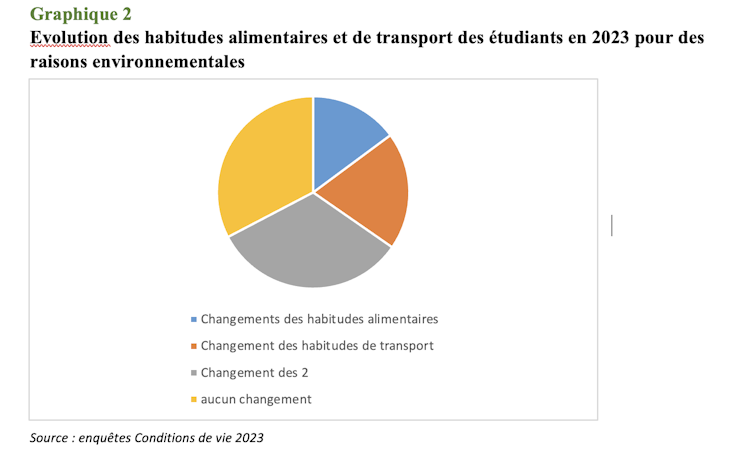
Nous nous sommes penchées sur les déterminants des pratiques alimentaires et de mobilité des étudiant·es à partir de l’enquête 2023 « Conditions de vie des étudiants », incluant les deux questions suivantes : « Pour des raisons écologiques, avez-vous changé vos habitudes alimentaires (moins de viande, manger bio…) ? » ; « Pour des raisons écologiques, avez-vous changé vos habitudes de transport (moins de déplacements, autres modes de transports) ? »

Connaissances et émotions, des facteurs de changement

Une personne soucieuse de l’environnement peut réduire sa consommation, privilégier une alimentation végétale, locale ou de saison, et adopter des régimes à faible impact. Dans les transports, elle choisira des modes à faibles émissions ou limitera ses déplacements. Toutefois, la santé, les habitudes, les normes sociales et les contraintes économiques influencent aussi ces choix, où les motivations environnementales se mêlent à des dimensions sociales et éducatives.

Les individus mieux informés adoptent plus facilement des comportements pro-environnementaux. L’éducation, formelle ou informelle, transmet connaissances et valeurs écologiques, renforçant pensée critique et conscience durable. Le milieu social reste déterminant : les foyers aisés accèdent plus aisément aux produits bio ou aux véhicules électriques, tandis que les plus modestes dépendent des transports publics.

Le mode de vie étudiant influe aussi : la transition vers l’autonomie modifie les habitudes et conduit à distinguer différents profils, de l’engagé à l’indifférent, etc. Enfin, le sport diffuse de plus en plus des valeurs écologiques.


Fourni par l’auteur

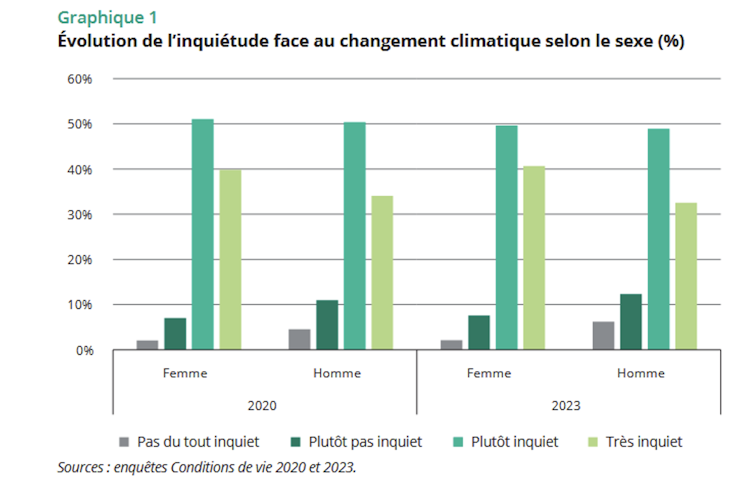
Les émotions, notamment négatives, constituent un levier important du changement de comportement. L’écoanxiété – mal-être et inquiétude face au réchauffement climatique – influence les comportements, bien que ses effets varient selon les études.

Des diplômés écoanxieux

Depuis 2020, l’enquête « Conditions de vie des étudiants » mesure ce phénomène via une question sur l’inquiétude climatique. En 2023, 87 % des répondants se disent inquiets, surtout les femmes, et cette proportion reste stable malgré l’aggravation des crises. L’écoanxiété diffère également selon le milieu social et scolaire.

Enfin, les conditions de vie influencent aussi les comportements : les étudiants vivant chez leurs parents changent moins, tandis que les difficultés financières favorisent l’adaptation alimentaire mais freinent la mobilité durable.


Fourni par l’auteur

Parmi les étudiants interrogés en 2023, un tiers a modifié à la fois ses habitudes alimentaires et de transport pour des raisons environnementales. Ces changements varient selon le sexe, le milieu social, le niveau d’études et la sensibilité au climat.

Les étudiantes adaptent davantage leur alimentation (18 % contre 9 % des hommes), tandis que les étudiants modifient plus souvent leurs transports (23 % contre 18 %). Les plus diplômés, issus de milieux aisés, écoanxieux ou engagés, changent plus fréquemment leurs comportements : 35 % des étudiants inquiets du climat modifient les deux, contre 7 % des non inquiets.

La participation à des conférences ou à des manifestations, ainsi que la pratique sportive, favorisent les comportements pro-environnementaux : 34 % des sportifs ont changé leurs habitudes, tandis que les effets du tabac ou de l’alcool restent incertains. Les contraintes matérielles jouent aussi : les urbains adaptent davantage leurs transports (21 % contre 15 % en zones rurales) mais moins leur alimentation (14 % contre 21 %). Les étudiants autonomes (38 %) changent plus souvent que ceux vivant chez leurs parents (19 %).

Des freins économiques et géographiques

Les facteurs associés aux changements alimentaires et de transport sont similaires : les femmes, les étudiants sportifs, inquiets du climat ou mieux éduqués sont plus enclins à modifier leurs pratiques. Le niveau d’études reste déterminant : les étudiants de master adoptent plus souvent des comportements durables, étayant le rôle de l’éducation.

Le cadre de vie compte également : la ruralité favorise les changements alimentaires mais freine la mobilité durable, tandis que vivre seul ou en résidence les encourage. Les contraintes financières, en revanche, limitent surtout les changements de transport. Enfin, 34 % des étudiants souhaiteraient changer leur alimentation et 27 % leurs transports sans y parvenir, freinés par leurs conditions économiques ou géographiques : vivre chez ses parents restreint les marges de manœuvre alimentaires, tandis que l’éloignement urbain et le manque de moyens limitent la mobilité durable.

Certaines caractéristiques – milieu social aisé, bon niveau scolaire, engagement environnemental, inquiétude climatique ou pratique sportive – favorisent les comportements pro-environnementaux dans l’alimentation et le transport.

L’enquête « Conditions de vie des étudiants » reste toutefois limitée : elle ne détaille ni les actions concrètes ni la chronologie des changements, rendant difficile l’évaluation des effets leviers ou rebonds. Toutefois l’éducation, formelle ou informelle, demeure un levier central pour encourager les comportements pro-environnementaux, par la sensibilisation, la diffusion de connaissances et la transmission intergénérationnelle.

Le renforcement de l’éducation environnementale, l’accès gratuit à des ateliers ou conférences, surtout dans les zones défavorisées, illustrent cette voie. D’autres leviers peuvent compléter cette action : sport durable, mobilités actives et politiques sociales réduisant les inégalités.

The Conversation

Les auteurs ne travaillent pas, ne conseillent pas, ne possèdent pas de parts, ne reçoivent pas de fonds d’une organisation qui pourrait tirer profit de cet article, et n’ont déclaré aucune autre affiliation que leur organisme de recherche.

ref. Enjeux environnementaux : en quoi l’éducation transforme-t-elle les comportements des jeunes ? – https://theconversation.com/enjeux-environnementaux-en-quoi-leducation-transforme-t-elle-les-comportements-des-jeunes-269445