Fossil hunters find a new dinosaur track site on South Africa’s coast – the youngest so far

Source: The Conversation – Africa (2) – By Charles Helm, Research Associate, African Centre for Coastal Palaeoscience, Nelson Mandela University

Southern Africa is world renowned for its fossil record of creatures that lived in the very distant past, including dinosaurs. But, about 182 million years ago, a huge eruption of lava covered much of the landscape (the inland Karoo Basin) where most of the dinosaurs roamed. After that, the dinosaur fossil record in the region goes abruptly quiet for the Jurassic Period (which lasted from 201 million to 145 million years ago).

Two exciting recent discoveries confirm, however, that there is more to find of dinosaurs that lived in southern Africa a long time after those lava flows.

First, dinosaur tracks aged around 140 million years were reported in 2025 on a remote stretch of the coast in South Africa’s Western Cape province. These were the first to be found in the region from that geological time period (the Cretaceous, 145 million to 66 million years ago).

Now, we’ve found more.

Our work as a team of ichnologists (studying fossil tracks and traces) often takes us to the Knysna area of the Western Cape coast, where we investigate tracks in coastal aeolianites (cemented sand dunes) in the age range of 50,000 to 400,000 years old.

During one of these visits, early in 2025, we decided to visit a small patch of rock that formed during the early Cretaceous Period. It’s the only place in the vicinity where rock of this age is exposed, and much of it is underwater at high tide. We thought we might be lucky enough to find a theropod (dinosaur) tooth like the one discovered in those rocks by a 13-year-old boy in 2017.

We were pleasantly surprised when instead Linda Helm, a member of our party, told us in a state of excitement that she had found dinosaur tracks. Further examination of the deposits revealed more than two dozen probable tracks.

This so-called Brenton Formation exposure is tiny, no more than 40 metres in length and five metres in width, with cliffs rising from the shore to a maximum of five metres. To find dozens of tracks in this small area suggests a considerable dinosaur presence in the region during the Cretaceous.

In our study we estimate that these tracks are 132 million years old, making them the youngest known dinosaur tracks in southern Africa (50 million years younger than the youngest tracks reported from the Karoo Basin). They form the second record of dinosaur tracks from the South African Cretaceous, and the second record from the Western Cape province. Some of them occur on rock surfaces, while others occur in the cliffs in profile.

Dinosaur fossil treasures

Southern Africa has a wealth of vertebrate tracks and traces from the Mesozoic Era (the “Age of Dinosaurs”, from 252 million to 66 million years ago, a time span that includes the Jurassic) in the Karoo Basin – a vast inland basin filled with thick piles of sedimentary deposits.


Read more:
Why South Africa’s Karoo is a palaeontological wonderland


Dinosaur tracks from the Triassic and Jurassic periods are abundant in Lesotho and surrounding areas in South Africa’s Free State and Eastern Cape provinces.

But vast quantities of lava, now referred to as the Drakensberg Group, overlaid these track-bearing deposits as a result of large-scale eruptions. A few dinosaurs appear to have briefly survived the initial effects of the lava flows, and were probably among the last vertebrates to inhabit the Karoo Basin.

Then, as the supercontinent of Gondwana fragmented at the end of the Jurassic Period and in the early Cretaceous Period, limited Cretaceous terrestrial deposits formed in rift basins in what are now the Western Cape and Eastern Cape provinces of South Africa.

Dinosaur body fossils have been reported from those deposits, mostly from the Eastern Cape. They include the first dinosaur to be identified in the southern hemisphere, now identified as a stegosaur, as well as sauropods, a coelurosaurian and iguanodontid hatchlings and juveniles.

The only examples of dinosaur skeletal material from the Western Cape are a few isolated sauropod teeth, disarticulated bones of a probable sauropod, and two cases from the Knysna area: the theropod tooth mentioned above and a portion of a tibia.

But now we’re after their tracks.

Dinosaurs of Knysna

The tracks we found at Knysna are in the modern intertidal zone, where the high tide covers most of them twice a day.

It would be difficult to imagine a more different scene, 132 million years ago, than the spectacular coastline, magnificent estuary, and lots of development by humans that we encounter today. Back in the early Cretaceous, many dinosaurs would have been visible in the area, perhaps inhabiting tidal channels or point bars (river beaches). The vegetation would also have been very different from that of today.

The Brenton Formation tracks were made by theropods, possibly ornithopods (both these kinds of dinosaur were bipedal, walking on two legs), and possibly sauropods (huge dinosaurs with very long necks and very long tails that were quadrupedal, walking on four legs). Theropods were meat eaters, while ornithopods and sauropods were plant eaters.

It can be challenging at times to distinguish theropod tracks from ornithopod tracks. Sauropod tracks are larger and don’t always have clear digit impressions, also sometimes making them hard to identify with confidence.


Read more:
Identifying dinosaurs from their footprints is difficult – but AI can help


In most cases, we have chosen not to “over-interpret” which types of dinosaurs made which tracks, as they just aren’t clear enough. Our research paper simply intends to document that dinosaur tracks of this age are relatively plentiful in the Brenton Formation.

The fact that early Cretaceous dinosaur tracks have now been identified in both the Robberg Formation and the Brenton Formation suggests that more may be found if a search is conducted in appropriate places. There are a number of other exposures of non-marine Cretaceous rocks in the Western Cape and Eastern Cape. Systematic exploration of these deposits is now indicated, in the hope that in addition to finding more dinosaur skeletal material, more dinosaur tracks (and potentially those of other vertebrates) will be identified.

Mark G. Dixon and Fred van Berkel of the African Centre for Coastal Palaeoscience, Nelson Mandela University, contributed to this research.

The Conversation

The authors do not work for, consult, own shares in or receive funding from any company or organisation that would benefit from this article, and have disclosed no relevant affiliations beyond their academic appointment.

ref. Fossil hunters find a new dinosaur track site on South Africa’s coast – the youngest so far – https://theconversation.com/fossil-hunters-find-a-new-dinosaur-track-site-on-south-africas-coast-the-youngest-so-far-274337

How the Supreme Court might protect the Fed’s independence by using employment law in Trump v. Cook

Source: The Conversation – USA (2) – By Elizabeth C. Tippett, Associate Professor of Law, University of Oregon

Federal Reserve Board member Lisa Cook leaves the U.S. Supreme Court on Jan. 21, 2026, after oral arguments in Trump v. Cook. Kevin Dietsch/Getty Images

Most of the Trump administration’s legal disputes involving the firing of high-level officials deal with the scope of presidential power.

On Jan. 21, 2026, the U.S. Supreme Court heard oral arguments in one of the most significant cases of this kind to date. It was brought by Lisa Cook, a member of the Board of Governors of the Federal Reserve. The Fed serves as the U.S. central bank and sets monetary policy – including a key interest rate that influences borrowing costs.

President Joe Biden nominated Cook in 2022, and she was sworn in in May of that year.

President Donald Trump fired her on Aug. 25, 2025, but a lower court temporarily reinstated Cook to her role on Sept. 9.

Based on the oral arguments, a majority of the court’s justices seem inclined to protect the Fed’s independence by treating this case as an employment dispute. As a law professor who specializes in employment law and follows the Supreme Court, I can explain how that might play out.

Why Cook’s case matters

To be sure, this is not a typical employment law case because Cook has far more legal rights to her job than most American workers.

The vast majority of U.S. workers are employed “at-will” – meaning they can be fired for any reason and severed from their jobs with no advance notice. Cook’s position is covered by the Federal Reserve Act, which states that board members will be appointed by the president to 14-year terms and can be terminated by the president, but only for “cause.”

A federal judge presiding over the case in the District of Columbia also ruled that Cook was entitled to “due process” before her termination – meaning some notice, an explanation of the evidence against her and an opportunity to respond.

Cook’s lawsuit has outsized importance because the Fed’s board oversees the Federal Reserve.

As former Fed governors explained in a friend-of-the-court brief, “effective monetary policy requires a commitment to long-term goals,” and the lengthy 14-year terms of board members “are designed to insulate” them “from short-term political pressures.”

In another brief to the court, economists also expressed concern that a loss of independence could undermine the dollar’s status as a global reserve currency, which tends to protect the U.S. during global shocks.

These concerns appear to be shared by the Supreme Court. During oral argument, for example, Justice Brett Kavanaugh repeatedly pressed the government’s lawyer to concede – and articulate – the importance of Fed independence, grilling him as if he were a first-year law student.

In a 2009 law review article, Kavanaugh wrote that it “may be worthwhile to insulate” the Federal Reserve Board “from direct presidential oversight.”

A group of people meet at a conference table while the Federal Reserve insignia is projected onto a screen above their heads.
President Trump has sought to fire Lisa Cook, a member of the Federal Reserve’s Board of Governors, sitting to Fed chair Jerome Powell’s left.
Saul Loeb/AFP via Getty Images

What can count as cause for firing someone?

The Department of Justice announced in September 2025 that it was investigating Cook for allegedly making false statements on mortgage applications in 2021. Cook has denied those allegations.

As law professor Jed Shugarman has observed, it’s possible that the court will not rule on Cook’s case beyond allowing the lower court to proceed to a final decision. This would be the most cautious approach, since multiple justices pointed out that the facts about Cook’s alleged wrongdoing were not fully developed.

If the Supreme Court offers legal guidance to the lower court, the question of what counts as cause under the Federal Reserve Act is far from clear. The statute does not define the term, which lacks a clear meaning.

Modern American employment law starts from the baseline assumption of at-will status, where cause doesn’t matter because workers can be terminated for any reason. The rare employment contracts that promise termination for cause – like for executives, football coaches or workers who belong to unions – spell out what cause means in the contract.

When must an offense occur if an official is to be fired over it?

The reference to termination for cause appeared in the original 1913 Federal Reserve Act. But it was taken out in 1933 and then added back in 1935 after a series of lengthy Senate hearings on Fed independence. To decide what the cause provision means for Cook today, the justices may delve into what cause meant back in 1935.

As I note in “The Master-Servant Doctrine: How Old Legal Rules Haunt the Modern Workplace,” my 2025 book, standards for conduct justifying termination have changed over time.

According to an influential study by law professors Jane Manners and Lev Menand, the historical meaning of cause for federal agency heads was based on “inefficiency, neglect of duty, or malfeasance in office.”

The U.S. District Court applied this definition to Cook’s case, and inferred that cause only meant acts committed after she was appointed to the Fed’s Board of Governors. An act that predates the official’s Senate confirmation, the court explained, “has never been a basis for removal.”

At oral argument, the Supreme Court’s justices also focused on Congress’ purpose in enacting the firing-for-cause rule: to protect Fed independence from other branches of government.

This interpretation would, at minimum, protect Cook and other Fed governors from being fired due to policy differences with a president, such as Trump’s repeated complaints over the frequency and size of the Fed’s interest rate cuts.

An interpretation of this sort could be similar to antidiscrimination law or whistleblower law, which make it illegal for employers to fire someone for a fake or a flimsy reason to cover up their true motive – such as discrimination or retaliation.

What counts as due process?

As a matter of constitutional law, government workers who can only be terminated for cause have the right to receive “due process” from their employer prior to termination.

This process is known as a “Loudermill” hearing – named after the leading case on point – which generally consists of a presentation of the evidence against the worker and the opportunity to respond.

The lower court ruled that Cook had not been provided due process. At the Supreme Court, the government’s attorney tried to argue that Cook was given the equivalent of a Loudermill hearing, based on a Truth Social post that Trump made on Aug. 20, 2025, calling for her to resign. It was linked to apparent evidence in a news report about mortgage applications Cook filed in 2021.

The attorney argued that the five-day delay between Trump’s first post and Cook’s firing gave her an opportunity to respond.

Some Supreme Court justices expressed skepticism that social media posts can satisfy the Loudermill standard. Justice Amy Coney Barrett, for example, pointedly asked, “Why couldn’t those resources (used to litigate the case) have been put into a hearing?”

Yet I also got the sense that some justices, especially Kavanaugh, seemed reluctant to hang their hat on due process alone.

A hearing and an opportunity to respond – without a meaningful definition of “cause” – wouldn’t limit the reasons a member of the Fed could be terminated. It would only require a president to go through the motions of showing how he or she reached a foregone conclusion.

And, in my view, that is no substitute for independence.

The Conversation

Elizabeth C. Tippett does not work for, consult, own shares in or receive funding from any company or organization that would benefit from this article, and has disclosed no relevant affiliations beyond their academic appointment.

ref. How the Supreme Court might protect the Fed’s independence by using employment law in Trump v. Cook – https://theconversation.com/how-the-supreme-court-might-protect-the-feds-independence-by-using-employment-law-in-trump-v-cook-274264

Pierre Poilievre: The most successful unsuccessful leader in Canadian politics?

Source: The Conversation – Canada – By Stewart Prest, Lecturer, Political Science, University of British Columbia

Nine months after falling definitively short in the 2025 federal election, Pierre Poilievre is facing a mandatory leadership review at this weekend’s Conservative Party convention.

By all accounts, he’s likely to cruise through the review, since he enjoys strong support among Conservative Party members.

That support extends to the broader voting coalition Poilievre has assembled, which continues to stand behind his leadership for the most part. Recent polling suggests that more than three quarters of Conservative voters view him as doing an “excellent” job.

The problem for Poilievre and the party, however, is that among those who did not vote Conservative, the view is starkly different. In that same recent Abacus poll, 62 per cent of non-Conservative voters reported he’s doing a “poor” or “very poor” job.

In a sense, Poilievre is the most successful unsuccessful leader in Canadian politics.

The Justin Trudeau problem

If you count by share of the vote, Poilievre led the party to its best showing in nearly 40 years. Brian Mulroney was the last leader of a Conservative party to crack 40 per cent of the vote share across the country. He also got the party to its best share of seats since Stephen Harper’s lone majority victory in 2011.

Poilievre managed to pull together, and even expand, the coalition of Conservative voters, appealing in particular to younger male voters, and was making inroads with labour voters — at least until Donald Trump showed up for his second term as American president.

Thanks largely due to Trump’s threats to make Canada a 51st state, Liberals performed even better in the election. Defying the odds, newly minted Prime Minister Mark Carney led the Liberals back from what seemed like certain defeat, assisted by the emergence of a far more more belligerent United States following Trump’s return.


Read more:
Canada’s Conservatives, with an assist from Donald Trump, are down — but they’re far from out


The Liberals bested the Conservatives in vote share and seat share, cementing Carney’s leadership of the country.

An even bigger problem for Poilievre is that his own approach to politics as opposition leader almost certainly influenced the Liberal rebound after Justin Trudeau stepped down — and when an electoral landslide seemed all but assured for the Conservatives.

Because Canadians considered Trudeau a problem, Poilievre’s take-no-prisoners approach paid significant dividends. The Conservatives led the Liberals by an increasingly comfortable margin throughout 2024. Language about the country being broken didn’t seem out of place to those tired of the status quo.

The Donald Trump impact

As soon as Trump made himself the problem, however, most Canadians looked for a much more fulsome response than Poilievre was able to offer. Rather than a leader focused on criticizing Canada, the majority of Canadians above all wanted one who promised to stand up against the American threat.

Similarities between Poilievre and Trump — sometimes rhetorical, other times substantive, and sometimes both — deepened the suspicion.

This divisiveness has continued to plague the party in the months since the 2025 election. One Conservative MP has decided to resign and two others have actually crossed the floor to join the Liberals, bringing the governing party within a hair’s breadth of a majority.

Nova Scotia MP Chris d’Entremont cited Poilievre’s leadership style specifically in explaining his decision to become a Liberal, suggesting the Conservative leader was too negative at a time when the country needed solutions-oriented politics.

This remains the quandary for the Conservative leader and the party: everything Poilievre does to secure the support of the more populist wing of the conservative movement in Canada tends to alienate the rest of the country, while any move to the centre risks condemnation from those further to the right.

Poilievre has won over core Conservatives and alienated the rest of the country, including that crucial share of voters necessary to push the Conservatives over the top.

Repelling more than he attracts

There is, to be sure, a path to victory still available to the Conservatives. A resurgent NDP, or some other wobble in Liberal fortunes, could be enough to put the Conservatives over the top next federal election.

They cannot count on such luck, however. Faced with the generational event that is the second Trump presidency, many Canadians are viewing the current Canada-U.S. tensions as an “us/them” existential battle, with other issues pushed into the background.

This week’s premier’s meeting in New Brunswick, for example, focused heavily on national unity. So too did Carney’s meeting with premiers in Ottawa.

This seems likely to persist so long as the U.S. poses a threat to Canadian security and prosperity. And as long as Poilievre presents himself as being sympathetic to Trump’s populist project, Canadians not already in the Conservative column will look to keep him out of the Prime Minister’s Office.

The most likely result, then, of this weekend’s review is a strong endorsement of Poilievre’s leadership and a continuation of the status quo: a country that has come together on a question of existential importance, but an opposition leader who divides, repelling more than he attracts.

The Conversation

Stewart Prest does not work for, consult, own shares in or receive funding from any company or organisation that would benefit from this article, and has disclosed no relevant affiliations beyond their academic appointment.

ref. Pierre Poilievre: The most successful unsuccessful leader in Canadian politics? – https://theconversation.com/pierre-poilievre-the-most-successful-unsuccessful-leader-in-canadian-politics-274358

Why drug approval in Canada should not rely on foreign regulators

Source: The Conversation – Canada – By Joel Lexchin, Associate professor, Department of Family and Community Medicine, University of Toronto; York University, Canada; University of Sydney

Without much fanfare, Health Canada announced in the Canada Gazette Part 1 on Dec. 22, 2025 that it was beginning a 70-day consultation period on using the decisions of foreign drug regulators such as the U.S. Food and Drug Administration (FDA) and the European Medicines Agency (EMA) to approve new drugs in Canada.

If the proposal is approved, Health Canada will evaluate reports from the other regulators, and provided those reports are satisfactory and that the drugs met certain conditions (for example, the drug being considered by Health Canada has the same strength, dosage form, route of administration, medicinal ingredient and indications as the foreign drug), the new drug will be approved.

This announcement appears to be a continuation of the federal government’s Red Tape Review launched in July 2025. According to a report on this initiative, Health Canada’s rationale for this change is that “industry stakeholders have indicated that they face undue burden due to overlapping or unclear regulatory requirements, complex regulatory approvals, and onerous reporting and information demands” and have “raised concerns about the time it takes to get products to market.”

Health Canada states that “enhanced international regulatory alignment reduces burden for industry and can support increased health product submissions to Canada” and increase the number of new drugs available to Canadians.

These views reflected in the Red Tape Review align with those of the pharmaceutical industry. In its 2025 pre-budget submission to the federal government, Innovative Medicines Canada (IMC), the main pharma industry lobby group, said that “reliance on trusted foreign regulatory reviews where appropriate…will streamline drug approvals and enable Health Canada to be a global regulatory leader.”

Faster drug approvals would also mean a shorter timeline to revenue generation for drug companies.

Benefits need to be evaluated

On the surface, this sounds like a reasonable initiative; countries with strong regulatory systems can draw on each other’s strengths so that tasks are not unnecessarily duplicated. In Canada’s case, our resources and capacity are limited compared with those of other leading regulatory authorities like the FDA and the EMA.

But before Canada starts using decisions from other jurisdictions, there is a need to evaluate whether this new way of approving drugs is actually going to be beneficial.

Australia has been using such a system since 2018. One of the benefits touted by the Australian government was that new drugs would be submitted faster to the Therapeutic Goods Administration (TGA), the equivalent of Health Canada.

But comparing the gap in the timing of submissions to the FDA and the TGA since Australia began using foreign regulator decisions doesn’t provide any convincing evidence that this has actually happened.

My new study, currently under peer review, looks at the 29 drugs that have so far used the Australian system. Twenty-two of those drugs have been evaluated by one or more organizations that look at how much additional therapeutic value new drugs provide compared to existing therapies. Sixteen of the 22 offered only minor new gains and just two were a major benefit.

FDA standards and approval pathways

The U.S. approves more new drugs than Canada does. But a recent study that compared Canada and the U.S. found that many drugs available in the U.S., but not north of the border, already had existing alternatives that are therapeutically and chemically similar. The small number of drugs that were unique to the U.S. were not very clinically important.

Some industry observers think the standards that the FDA uses to approve new drugs have been declining over the past 15-20 years.

The FDA has increased its reliance on what are called expedited drug approval pathways in recent decades. These allow drugs onto the market with lower levels of evidence. Although they were initially designed for drugs that treat rare conditions or life-threatening illnesses that don’t have effective treatments, researchers have found that these expedited pathways are being increasingly used for drugs that may not be innovative.


Read more:
Controversial Alzheimer’s drug highlights concerns about Health Canada approval process


If Canada were already using foreign decisions, aducanumab (brand name Aduhelm) might have been put on the market in Canada as a treatment for Alzheimer’s disease. In the U.S., the FDA approved aducanumab despite a lack of evidence that it would benefit Alzheimer’s patients, and despite and the negative vote of 10 of the 11 members of the FDA’s advisory committee — the 11th member abstained — and the subsequent resignation of three of the committee members. The manufacturer eventually pulled Aduhelm from the U.S. market because almost no doctors were prescribing it.

Different regulatory cultures, different decisions

We also need to think about the consequences of the homogenization of drug approval standards. Homogenization ignores the development of different regulatory cultures in different jurisdictions that arise from networks of individuals who produce regulatory policy, determine testing standards and ultimately decide on market access for new drugs.

When presented with essentially the same evidence, the FDA and the EMA often make different decisions about oncology drugs. A 2020 study found frequent discordance between the FDA and the EMA. Another study compared the approval of 42 cancer drugs between 1995 and 2008 by the FDA and the EMA, and showed that in almost 50 per cent of cases, there was a discrepancy between EMA and FDA decisions.

So far, there is no evidence to back up the claim that using decisions made by foreign drug regulators will lead to faster access to newer and better drugs. Before Canada proceeds down this pathway, Health Canada needs to show that it will improve public health.

The Conversation

Between 2022-2025, Joel Lexchin received payments for writing a brief for a legal firm on the role of promotion in generating prescriptions for opioids, for being on a panel about pharmacare and for co-writing an article for a peer-reviewed medical journal on semaglutide. He is a member of the Board of the Canadian Health Coalition. He receives royalties from University of Toronto Press and James Lorimer & Co. Ltd. for books he has written. He has received funding from the Canadian Institutes of Health Research in the past.

ref. Why drug approval in Canada should not rely on foreign regulators – https://theconversation.com/why-drug-approval-in-canada-should-not-rely-on-foreign-regulators-273693

Filing taxes for someone else? Here’s how to do it safely

Source: The Conversation – Canada – By Celine Latulipe, Professor, Computer Science, University of Manitoba

Filing taxes every year is an important and necessary task in Canada. But for many, tax preparation and filing can be overwhelming. One reason is that tax forms can sometimes be hard to interpret, especially because most people only deal with them once a year.

Another factor is the shift to digital: tax forms are often delivered electronically; tax software has become the preferred method for tax preparation and filing; and the Canada Revenue Agency (CRA) prefers to send all tax information electronically through the CRA MyAccount.

With this digital system, it’s typically necessary to access tax forms and previous Notices of Assessment by logging in to your CRA MyAccount. This can be a barrier for those with less experience using computers and online accounts, such as some older adults.

Many people act as informal tax helpers by filing taxes for older parents, relatives or friends. In fact, half of Canadians filing taxes have someone else do their taxes for them. Of those, one in five reports getting help from a friend or family member acting as an informal tax helper.

This means about 10 per cent of tax filers in Canada rely on family or friends to file their taxes. The CRA has a Represent a Client program that allows informal tax helpers to log in to the CRA MyAccount of the person they are helping to access relevant tax forms. However, a study that I recently conducted with colleauges shows that this mechanism is under-utilized.

How informal tax helpers access CRA accounts

Getting help with taxes can take many forms: hiring an accountant, visiting a tax preparation company, getting help from a volunteer through the Canadian Volunteer Income Tax Program (CVITP) or delegating to an informal tax helper.

Tax accountants, tax preparers and CVITP volunteers have business IDs or Group IDs for accessing CRA MyAccounts of the clients they assist. Similarly, informal tax helpers can sign up with CRA’s Represent a Client program to get RepIDs, which are ID numbers provided by the CRA to people whose identity is verified by having their own CRA MyAccount.

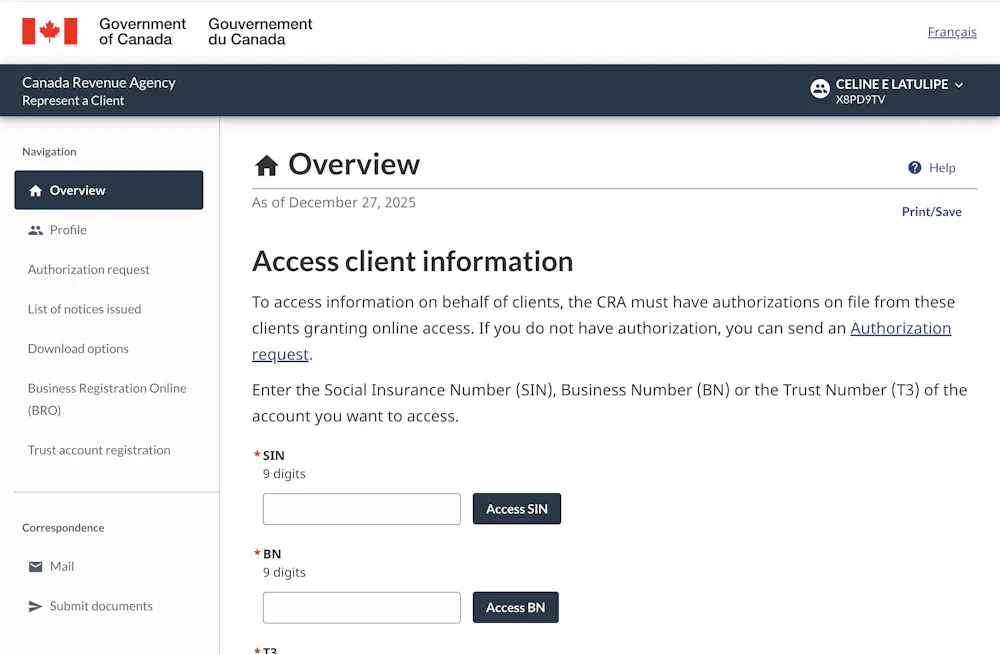
As an example, having a RepID allows me to access my daughter’s CRA MyAccount to get her Notices of Assessments, download tax forms and use NetFile to file her taxes. I could ask my daughter to log in and download those items for me, but it is faster for me to do it, as I know what forms I’m looking for and where to find them.

Landing page contains a menu at the left with options: Overview, Profile, Authorization request, List of notices issued, Download options, etc. On the right is the heading 'Overview'. Text beneath explains how to access client information.
The Canada Revenue Agency’s ‘Represent a Client’ landing page.
(Canada Revenue Agency)

Having a RepID does not give access to everyone’s tax records. A link needs to be established between the helper’s RepID and the CRA MyAccount of the person they are assisting. This can be done by uploading a signed form from the taxpayer or by sending an authorization request through the CRA system, which the taxpayer must approve.

The risks of sharing login credentials

In our study, we investigated CRA delegation mechanisms. We conducted a semi-structured interview study with 19 participants, including older adults, formal tax volunteers and informal tax helpers, to understand the challenges and experiences of tax delegation.

We found that only one informal tax helper used a RepID. Most either did everything using paper forms provided by the person they are helping, or they accessed that person’s CRA MyAccount using that individual’s credentials to log in.

In some cases, informal tax helpers may actually be setting up the CRA MyAccounts for the people they are helping, which means they know the login credentials. This violates the terms of service of the CRA MyAccount — you are not supposed to share your password with anyone.


Read more:
Password sharing is common for older adults — but it can open the door to financial abuse


While informal tax helpers are providing a valuable and helpful service to their friends and families, using a person’s credentials to access their CRA MyAccounts is problematic.

When an informal tax helper knows someone else’s CRA login credentials, they could log in as that user, change the mailing address and banking deposit details, and then make bogus tax and benefit claims. In this case, the CRA has no way to tell that it is someone else logging in and taking actions on behalf of the taxpayer associated with the account.

However, if an informal tax helper uses a RepID to access someone’s CRA MyAccount, the CRA knows exactly who is doing what. They don’t allow informal tax helpers to change the mailing address or bank deposit information, which goes a long way to preventing tax fraud.

Make tax help safer with a CRA RepID

If someone is helping you file your taxes, ask them to get a CRA RepID. It’s a quick process for them, and then they can access tax forms in your CRA MyAccount safely. This way, the CRA will know when it is them signing in to your account versus you, and your helper will only be able to access the appropriate functions.

The interface for requesting access, on the 'select authorization level' step. Level 1 allows a representative to view client information, while Level 2 allows a representative to view information and perform actions on behalf of a client.
The Canada Revenue Agency’s Represent a Client web page. Two levels of access are available, and neither allows the editing of critical details like bank deposit information or client address. An expiry date can also be set so that access does not have to be granted indefinitely.
(Canada Revenue Agency)

Most informal tax helpers are honest, helpful people and they shouldn’t have to impersonate you to get your taxes done. Using the CRA’s Represent a Client system provides legitimacy to informal tax helpers and safety for those getting assistance.

With the tax deadline of April 30, 2026 approaching, if you plan to have someone assist you with tax filing, it’s a good time to check with them to make sure they use a RepID to access your CRA MyAccount. Doing this early can help avoid last-minute stress, ensure your tax return is filed accurately and give you confidence that your information is secure.

The Conversation

Celine Latulipe receives funding from NSERC.

ref. Filing taxes for someone else? Here’s how to do it safely – https://theconversation.com/filing-taxes-for-someone-else-heres-how-to-do-it-safely-271924

Winter changes more than the weather — it changes how we connect. Here’s how to stay socially engaged

Source: The Conversation – Canada – By Kiffer George Card, Assistant Professor in Health Sciences, Simon Fraser University

Throughout Earth’s history, life in temperate and polar zones has had to contend with the cold and darkness of winter. Across species, seasonal adaptation is the norm. Some animals hibernate, others migrate, and many reduce activity, conserve energy, and narrow their social and ecological range until conditions improve. These strategies evolved over millennia as reliable responses to predictable environmental stress.

Humans are no exception. Seasonal cycles have a deep impact on our psychology and well-being — after all, for most of our evolutionary and recorded history, winter has shaped how we live, work and relate to one another. For our ancestors, food was scarcer, travel more difficult and daily activity contracted due to shorter days. Social life often shifted indoors and inward, and organized around smaller groups, shared labour and mutual dependence.

While modern societies have reduced many of winter’s material hardships, the season continues to exert a powerful influence on human behaviour and well-being.

As a social ecologist interested in human wellness, my research focuses on how our natural and social environments shape our well-being and what we can do to improve our relationships with these environments to maximize our well-being.

In this work, I study the drivers of emotional responses, such as loneliness and eco-anxiety. This work has taught me how inseparably connected we are to each other and to our environments, and one of my key areas of interest is how our social and natural worlds are intertwined.

Understanding how well-being is affected by weather

One area of research that has fascinated me is how humans respond to the weather and day-night cycles of the places they live. For example, research has shown that colder temperatures, greater precipitaiton and shorter periods of sunshine are associated with outcomes such as greater tiredness, stress, loneliness, and poorer life satisfaction and self-rated health.

As such, it makes sense that we are more likely to have depressive symptoms or feel tired and lonely in the winter compared to the spring and summer. Perhaps most concerning, studies of suicide attempts, loneliness and their seasonality indicate that winter weather can contribute to each, suggesting that seasonal shifts in social connection may intensify vulnerability during these periods.

Taken together, I believe this body of work suggests that the most consequential pathway linking winter conditions to well-being may not be weather exposure itself, but its effects on social connection. After all, human beings are fundamentally social animals — we greatly rely on each other for our happiness, health and survival.

Fortunately, the effect of weather on our mood is small and people can overcome it through intentional efforts. Indeed, human beings are incredibly adaptive to their environments, meaning even in poor weather contexts we can find ways to meet our social needs.

Illustrating this, research comparing levels of social isolation across neighbourhoods during cold weather highlights differences in how some communities respond to cold weather, with those choosing more indoor time throughout the day experiencing greater social isolation.

Research also suggests that our personality traits shape how resilient we are to weather changes. Studies such as these underscore that our responses to cold weather can shape its effects on us. Environment is not destiny, if we know how to address it.

So what can we do during the cold dark winter months to stay connected, and therefore happy and healthy? The research consistently shows that staying socially engaged, even in small ways, protects mental health and promotes well-being.

Ways to get connected in the cold

While winter may reduce incidental social contact, connection can be maintained through deliberate routines and low-threshold forms of engagement, including:

• committing to a weekly or biweekly group activity, such as a book club, exercise class, faith-based group or hobby circle

• organizing small, recurring gatherings, such as rotating dinners, shared meals or weekend brunches

• scheduling regular phone or video check-ins with family or friends and treating them as fixed commitments

• integrating social contact into daily activities, such as walking, running errands, exercising or having coffee together

• using daylight strategically by planning brief outdoor meetups or spending time in naturally lit public spaces

• participating in year-round volunteer roles that provide regular contact and a sense of purpose

• enrolling in short-term courses or workshops that create repeated contact over several weeks

• connecting through shared projects, such as creative work, community caregiving or co-hosted events

• initiating contact with others who may also be withdrawing socially during winter

It’s not always easy, but it is worth it

Of course, such activities take time and energy and are not always the easiest to do. Snow-caked roads and reduced sunlight hours can pose real mobility challenges. So while we might want to connect, we are not always able to when we face such environmental barriers.

In fact, one of my favourite findings in the literature is that while people naturally feel inclined to seek out social affiliation in response to cold weather (something I believe to be a survival strategy we’ve inherited from our less technologically equipped ancestors), physical warmth acts psychologically as a satisfactory replacement — even if it lacks the long-term benefits of social connection.

In other words, the modern amenities of space heaters and cozy blankets make it easier for us to isolate — and many of us are happy to enjoy the warmth from these instead of the warmth offered by social connection.

However, knowing the central importance of social connection to well-being, it’s important to not fall trap to these creature comforts. There is not anything wrong with being alone from time to time, but winter is too long a season to spend alone safely.

Intentional effort

In short, we need to recognize that winter weather has a predictable effect on our well-being, and this effect calls for deliberate social adaptation. Human well-being has always depended on the ability to respond collectively to seasonal constraint, and the contemporary winter environment is no different, even if its risks are less visible.

The evidence reviewed above suggests that while the cold, darkness and reduced mobility can heighten vulnerability, their effects are shaped by how individuals and communities organize daily life, social routines and sources of connection. Comfort, convenience and withdrawal may offer short-term relief, but they do not substitute for the protective role of sustained social engagement.

Winter demands intention rather than retreat. By recognizing social connection as a seasonal health behaviour rather than a discretionary luxury, individuals and communities can better align modern living with enduring human needs, reducing risk and supporting well-being across the long months of cold and dark.

The Conversation

Kiffer George Card is president of the Mental Health and Climate Change Alliance and Social Health Canada and has received funding from the Social Sciences and Humanities Research Council, Health Research British Columbia, Canadian Red Cross, Public Health Agency of Canada, Government of British Columbia, and Canadian Institutes of Health Research for his work related to the social and natural environmental factors shaping wellbeing.

ref. Winter changes more than the weather — it changes how we connect. Here’s how to stay socially engaged – https://theconversation.com/winter-changes-more-than-the-weather-it-changes-how-we-connect-heres-how-to-stay-socially-engaged-273684

¿Pueden hacer más las universidades para mejorar el nivel de inglés de los estudiantes?

Source: The Conversation – (in Spanish) – By Francisco Sánchez del Cubo, Profesor Ayudante Doctor – Economía Aplicada (Estructura Económica) – Área de Turismo, Universidad de Málaga

Zoran Zeremski/Shuttertock

Cada año hay más estudiantes en las universidades españolas. En el curso 2022-2023 se matricularon más de 1,3 millones en Grado y casi 290 000 en Máster. Estas cifras son históricas: un aumento de titulados en un contexto muy exigente, donde hablar inglés ya no es una ventaja extra, sino una necesidad.

Ante esta realidad, las universidades tienen que adaptar sus programas tradicionales, incorporando asignaturas o grados enteros en inglés. En muchos casos, las asignaturas en ese idioma no alcanzan el 50 % del plan de estudios, por lo que no pueden considerarse programas bilingües. Además, aún hay pocos grados completos en inglés, si bien son más frecuentes los másteres.

Aunque no tenemos datos oficiales sobre el número total de asignaturas que se imparten en inglés en España, sí sabemos que son cada vez más habituales. Su objetivo es ayudar a los estudiantes a conseguir mejores empleos y hacer que las universidades sean más conocidas en el extranjero.

No obstante, todavía persisten preguntas clave: ¿qué tipo de estudiante elige este tipo de asignaturas? ¿Qué factores explican su decisión?

¿Por qué no estudio en inglés?

Para explorar este asunto, llevamos a cabo un estudio en la Universidad de Málaga. Analizamos a estudiantes de primer curso del Grado en Turismo. Estos estudiantes habían decidido no matricularse en asignaturas impartidas en inglés, aunque pueda ser muy útil para su futuro trabajo. A todos ellos se les pidió contestar un breve cuestionario. Dicha encuesta incluía preguntas sobre su nivel de idioma, sus características personales y confianza en su nivel de inglés.

Ni la edad, el sexo o el nivel de ingresos son relevantes a la hora de tomar la decisión. Ninguna de estas variables afecta a la confianza de poder aprobar una materia impartida en inglés. Tampoco la vocación por estudiar Turismo aparece como un factor importante.

En cambio, tres elementos son clave: el nivel de inglés que el estudiante cree tener, el nivel acreditado por certificados oficiales y haber estudiado antes en clases donde se usa esa lengua.

Es decir, el estudiante necesita confiar en su nivel de inglés, tanto de manera autopercibida como a través de un certificado objetivo de nivel. Universitarios que han pasado por colegios con grupos en inglés o programas de intercambio también tienen mayor disposición a cursar asignaturas en dicho idioma.

El papel del inglés en la universidad

Mejorar el nivel de inglés puede lograrse a través de cursos cortos, estancias donde se usa el inglés todo el tiempo o prácticas internacionales. Especialmente, mediante estrategias que pongan a los jóvenes en un contexto comunicativo real, donde puedan usar el segundo idioma de manera práctica y mejorar la autoconfianza.

Nuestros resultados revelan una situación preocupante. El inglés es esencial en el ámbito laboral, especialmente en el turismo. Pero, al mismo tiempo, las competencias lingüísticas ocupan un lugar secundario en muchos grados. En estos programas predominan los contenidos técnicos o de gestión.

La universidad debe superar esta brecha, incluyendo la enseñanza en inglés en los planes de estudios y reforzando la ayuda que da a estudiantes y docentes en la etapa universitaria.


Leer más:
Hacia una universidad internacional: el inglés como lengua de comunicación académica


Entre las posibles medidas, cabe destacar el aumento de la oferta de cursos cortos y programas específicos orientados a la mejora de las competencias lingüísticas tanto del alumnado como del profesorado. Por ejemplo, mediante la creación de microcredenciales reconocidas institucionalmente.

También ayudaría ampliar la oferta de asignaturas impartidas en inglés a lo largo de todo el itinerario formativo del grado universitario, de manera progresiva y coherente con los contenidos de cada curso. Favorecer el contacto con estudiantes internacionales e incorporar esta lengua en actividades extracurriculares –como conferencias, clubes de debate o talleres temáticos– son otras estrategias para mejorar el nivel y exposición al inglés de los universitarios. Asimismo, resulta útil impulsar programas de mentoría con estudiantes de cursos superiores y desarrollar materiales docentes bilingües que faciliten la inmersión lingüística del estudiantado, especialmente en aquellos grados con una clara orientación internacional.

Nivel de competencias, acreditación oficial y experiencias previas son las tres cuestiones fundamentales para superar la resistencia estudiantil a matricularse en asignaturas en inglés. Teniendo en cuenta lo importante que es mejorar el nivel de este idioma para el futuro de los estudiantes, es fundamental tomar medidas para cerrar esa brecha entre la formación universitaria y las exigencias del mercado laboral.

The Conversation

Las personas firmantes no son asalariadas, ni consultoras, ni poseen acciones, ni reciben financiación de ninguna compañía u organización que pueda obtener beneficio de este artículo, y han declarado carecer de vínculos relevantes más allá del cargo académico citado anteriormente.

ref. ¿Pueden hacer más las universidades para mejorar el nivel de inglés de los estudiantes? – https://theconversation.com/pueden-hacer-mas-las-universidades-para-mejorar-el-nivel-de-ingles-de-los-estudiantes-266420

Baja menstrual: el estigma y la incertidumbre hacen que estas medidas se utilicen poco en todo el mundo

Source: The Conversation – (in Spanish) – By Lidia de la Iglesia Aza, Professor of Labour Law and Social Security, Universidade de Santiago de Compostela

Antonio Guillem/Shutterstock

Los síntomas menstruales pueden afectar gravemente a la vida laboral de una persona. Para combatir esto, ha surgido la idea de la baja menstrual. Esta medida legal permite a las trabajadoras tomarse un tiempo libre cuando los síntomas de la menstruación son demasiado difíciles de manejar en el trabajo.

Se enmarca dentro de la salud menstrual, un concepto relativamente nuevo y amplio que considera la menstruación no solo como un proceso biológico, sino también como una cuestión que afecta a la vida cotidiana, el bienestar y los derechos fundamentales de las personas.

Varios países cuentan con políticas de baja menstrual, pero las abordan de diferentes maneras. En la Unión Europea (UE), la mayoría de los países han hecho muy poco al respecto: en 2026, España es el único Estado miembro de la UE que cuenta con una normativa específica sobre la baja menstrual, introducida en 2023.

Japón fue el primer país en introducir la baja menstrual en 1947. Después de la Segunda Guerra Mundial, muchas mujeres se enfrentaban a duras condiciones de trabajo. Los baños inadecuados y la falta de productos sanitarios hacían imposible trabajar durante la menstruación, y la solución fue el derecho al seirikyuuka o “permiso fisiológico”, que reconoce la menstruación como una condición natural que los empleadores deben tener en cuenta.

Sin embargo, la legislación japonesa, al igual que sus homólogas más modernas, es deficiente. No especifica cuántos días se pueden tomar, no se garantiza el salario y los empleadores deciden si la baja es remunerada o no. En 2020, solo alrededor del 30 % de las empresas ofrecían el salario completo o parcial. En la práctica, menos del 1 % de las mujeres lo utilizan, y las que lo hacen a menudo se enfrentan a discriminación o acoso.

Estas dificultades son un tema recurrente en la aplicación de políticas similares en todo el mundo.


Leer más:
Menstrual health literacy is alarmingly low – what you don’t know can harm you


La baja menstrual en todo el mundo

Más recientemente, otros países y regiones han introducido políticas de baja menstrual: Indonesia, Corea del Sur, Zambia, México, Taiwán, tres provincias chinas (Hubei, Shanxi y Ningxia), una provincia argentina (Federación) y dos provincias indias (Karnataka y Bihar) .

La Ley de Igualdad de Género en el Trabajo de Taiwán de 2002 estableció un día libre al mes para las mujeres, pero solo hasta un máximo de tres días al año. Estos días no se deducen de la baja por enfermedad, pero solo si se mantienen dentro de ese límite. Las mujeres reciben solo el 50 % de su salario durante la baja menstrual, lo que refleja las normas de la baja por enfermedad.

Indonesia introdujo el permiso menstrual en 2003, permitiendo hasta dos días de descanso remunerado al mes. La ley exige que las empleadas lo notifiquen con antelación a su empleador, y los acuerdos específicos (permiso a tiempo parcial, días consecutivos o discontinuos) se dejan a criterio de las partes implicadas.

Corea del Sur siguió su ejemplo con su propia normativa en 2007, concediendo a las mujeres un día de permiso no remunerado al mes. Los empleadores están legalmente obligados a respetar este derecho, y el incumplimiento de esta obligación puede dar lugar a multas elevadas.

Tanto Taiwán como Corea del Sur se enfrentan a retos similares, ya que muchos empleadores no aplican correctamente la normativa, se niegan a conceder la baja prometida o exigen pruebas intrusivas a las empleadas, lo que socava su dignidad en el proceso.


Leer más:
¿Es normal que duela la regla?


En 2014, el municipio de Federación, en Argentina, introdujo una política que concedía a sus empleadas públicas un día libre remunerado al mes si no podían trabajar debido a su menstruación. A nivel local, esta iniciativa se conoció como el “día femenino”.

En Zambia, la baja menstrual se estableció en 2015, y las mujeres tienen derecho a un día libre al mes, sin necesidad de presentar un certificado médico ni siquiera de avisar previamente a su empleador. Esta política se conoce como “Día de la Madre”, lo que refleja el énfasis cultural en el papel que se atribuye a la mujer en la sociedad.

En el Estado de México, a las empleadas públicas se les ha concedido un permiso por dismenorrea (dolor menstrual) como política enmarcada en la defensa de los derechos laborales. Curiosamente, la política de México no se limita únicamente a la menstruación. Identifica tres grupos principales de beneficiarios: mujeres que sufren dismenorrea grave, mujeres en la mediana edad que padecen síntomas de la menopausia o la fase climáctica, y hombres en la mediana edad que sufren molestias relacionadas con la andropausia.

La normativa mexicana se describe mejor como baja fisiológica que como baja estrictamente menstrual, ya que amplía el apoyo a los trabajadores en diferentes etapas de la vida que tienen implicaciones para la salud.

La baja menstrual en España

La normativa sobre la baja menstrual en España entró en vigor el 1 de junio de 2023, tras un proyecto de ley presentado por el Gobierno de coalición del Partido Socialista y Podemos, su socio de izquierdas. La medida no fue aceptada de forma unánime: se aprobó con 185 votos a favor, 154 en contra y 3 abstenciones.

Desde el principio, la propuesta suscitó un acalorado debate. Su carácter innovador y ambicioso suscitó fuertes críticas por parte de varios partidos políticos, en particular del Partido Popular (PP), quien advirtió que la ley podría conducir a la marginación, la estigmatización e incluso a consecuencias negativas en el mercado laboral para las mujeres.

Sin embargo, la aprobación de la ley fue aclamada por grupos feministas y organizaciones de derechos laborales como un hito histórico. Para ellos, la baja menstrual representa un reconocimiento largamente esperado de las necesidades de las mujeres y un paso hacia una mayor igualdad en el empleo.

La ley introduce nuevos derechos para las mujeres en el marco de la Seguridad Social española, reflejando lo que algunos estudiosos han descrito como el “derecho a trabajar sin dolor”. Crea una nueva situación de incapacidad temporal relacionada con afecciones menstruales incapacitantes. Esto incluye la dismenorrea secundaria y afecciones relacionadas, como la endometriosis, los fibromas, la enfermedad inflamatoria pélvica, la adenomiosis, los pólipos endometriales, el síndrome de ovario poliquístico o cualquier dificultad en el flujo menstrual.

En estos casos, la Seguridad Social cubre la prestación desde el primer día de baja. Esto difiere de la baja por enfermedad general, en la que los pagos solo comienzan a partir del cuarto día. Además, las mujeres no necesitan haber cotizado previamente a la Seguridad Social para acceder a esta protección.


Leer más:
Endometriosis: una enfermedad dolorosa infradiagnosticada


Un sistema infrautilizado

El proyecto de ley original estimaba que alrededor del 1 % de los seis millones de mujeres de entre 16 y 50 años en España, aproximadamente 60 000 trabajadoras, podrían sufrir síntomas menstruales incapacitantes.

Según las propias cifras del Ministerio, entre el 1 de junio de 2023 y el 3 de febrero de 2025 solo 2 668 mujeres hicieron uso de la prestación, con una duración media de tres días por baja. Esta cifra es muy inferior a la estimación original, lo que significa que no se está utilizando tanto como debería.

Dada su reciente introducción y el reducido número de beneficiarias, aún no hay pruebas de que la baja menstrual haya tenido un impacto negativo en el empleo de las mujeres en España.

El problema de la baja menstrual

La menstruación se suele tratar como algo vergonzoso o incómodo. Este estigma dificulta que las mujeres expresen sus necesidades en el trabajo, lo que significa que gestionar la menstruación se convierte en una lucha privada, no reconocida en el lugar de trabajo.

El permiso menstrual es solo una posible solución a este problema. Otras políticas, como horarios flexibles, áreas de descanso bien equipadas, etc., también podrían ser muy beneficiosas.

La cuestión clave es si el permiso menstrual mejora realmente el bienestar de quienes lo necesitan o si, sin quererlo, refuerza la discriminación, los estereotipos negativos y el resentimiento hacia las empleadas que lo utilizan. El debate sigue abierto y subraya la importancia de diseñar leyes laborales que reconozcan las circunstancias biológicas de las trabajadoras.

Pero una cosa está clara: abordar la salud menstrual en el trabajo es de vital importancia. El punto de partida es reconocer que cada mes, alrededor de 2 000 millones de personas en todo el mundo experimentan la menstruación. Necesitan prácticas laborales justas y solidarias.

The Conversation

Lidia de la Iglesia Aza no recibe salario, ni ejerce labores de consultoría, ni posee acciones, ni recibe financiación de ninguna compañía u organización que pueda obtener beneficio de este artículo, y ha declarado carecer de vínculos relevantes más allá del cargo académico citado.

ref. Baja menstrual: el estigma y la incertidumbre hacen que estas medidas se utilicen poco en todo el mundo – https://theconversation.com/baja-menstrual-el-estigma-y-la-incertidumbre-hacen-que-estas-medidas-se-utilicen-poco-en-todo-el-mundo-274653

El pimpón más allá de ‘Marty Supreme’: un deporte y una forma de diplomacia

Source: The Conversation – (in Spanish) – By Félix Valdivieso, Chairman of IE China Observatory, IE University

Timothée Chalamet en un fotograma de _Marty Supreme_. A24

Las buenas películas cumplen muchas funciones: entretienen, hacen pensar y suelen dejar tras de sí el gusanillo de volver a verlas. Pero hay un paso más. Cuando una película, además de estar bien contada, despliega varias capas de sentido que admiten lecturas diversas deja de ser simplemente una buena película para convertirse en una obra de arte. Eso es, ni más ni menos, lo que ocurre con Marty Supreme.

Abran paso

A primera vista –y eso es parte del truco– es la historia de un granuja judío neoyorquino que se quiere abrir paso en la vida exprimiendo su talento con el tenis de mesa, del que quiere ser campeón del mundo.

El director Josh Safdie abre el telón en una zapatería familiar del Lower East Side con su protagonista, Marty Mauser (Timothée Chalamet), intentando encajar un pie en un zapato que no es de su talla. Esto parece ser ya una metáfora de su propia vida: la de un futuro de pequeño burgués que no se corresponde con el tamaño de su esperanza.

A partir de aquí se pone la bola en juego y asistimos al ir y venir de Marty con la misma rapidez que va y vuelve una pelota de pimpón. Roba, embaraza a su antigua novia (ya casada), juega y apuesta. Todo, con el único propósito de reunir dinero para viajar a Londres, donde pretende enfrentarse al campeón mundial de tenis de mesa, el japonés Koto Endo.

Sueños nacionales

Hasta aquí, uno puede pensar que está viendo una película sobre un deporte en el que se va a batir épicamente un récord. Se baten récords, sí, pero no son los deportivos los más interesantes. En el campeonato londinense, Marty, aparte de verse las caras con el mejor jugador del mundo, seduce a una rica exestrella de cine. Si alguien está buscando consuelo moral o amoroso, que se olvide. La película es cruda, como la vida misma.

Por una décima de segundo, el espectador podría engañarse y pensar que lo que mueve a Marty es algún ideal amoroso o una versión más o menos bastarda del sueño americano, ese que preconiza que a través del trabajo duro, la determinación y la iniciativa propia, cualquier persona, sin importar su origen, puede alcanzar el éxito, la prosperidad y una mejor calidad de vida.

Pero el propio Marty se encarga pronto de desmentirlo. Lo que realmente le interesa es el dinero. Tal vez sea esta versión descarnada y sin épica del sueño americano, que luce músculo antiemigrante y poder bruto (como ocurre en estos días), lo que haya conectado con el público contemporáneo estadounidense, especialmente el menor de 35 años.

Esta lectura del sueño americano tiene su eco y antítesis en otro relato aspiracional: el sueño chino, que sustituye el ascenso individual por la eficiencia, la disciplina y el éxito colectivo.

En cualquier caso, lo que sabemos es que pocas cosas exaltan más que los colores nacionales en el deporte, aunque el deporte en cuestión sea uno menor, como el tenis de mesa. Así que tendremos varios sueños proyectados, incluso fuera de las pantallas.

Sueños, poder y deporte

Todos los sueños políticos, y el americano y el chino lo son, necesitan de campeones que los encarnen. Por eso los políticos siempre han hecho suyos a los deportistas, y no pierden oportunidad de sacarse una foto con ellos en cuanto baten cualquier récord. Se sabe que el récord encarna la nación, y toda nación es la encarnación de un sueño.

Durante décadas, el éxito olímpico de China no ha sido fruto solo del azar o del talento individual, sino de una estrategia deportiva claramente planificada. Desde los años noventa, el sistema chino ha priorizado disciplinas con “alta rentabilidad olímpica”: deportes que concentran muchas pruebas, exigen una elevada especialización técnica, son muy compatibles con un sistema de detección temprana de talento y entrenamientos centralizados, y con un muy limitado número de países realmente competitivos.

El objetivo no ha sido tanto dominar los deportes más populares a escala global como maximizar el número de medallas dentro del marco olímpico.

Pimpón, paradigma deportivo

El ejemplo más evidente es el tenis de mesa, donde China ha alcanzado un dominio casi absoluto. En los Juegos de Pekín 2008, el país ganó las cuatro medallas de oro posibles y, en algunas pruebas, ocupó la totalidad del podio. Algo similar ha ocurrido con los saltos de trampolín, considerados durante años una auténtica “fábrica de oros”: en Atenas 2004 y Pekín 2008, China se llevó seis y siete de las ocho medallas de oro disponibles.

Dos jugadores chinos sostienen una bandera roja con estrellas amarillas en una esquina.
En Río 2016, Ma Long consiguió la medalla de oro en tenis de mesa individual tras batirse en la final con su compatriota Zhang Jike, uno de los múltiples ejemplos en los últimos años del dominio chino en este deporte.
Celso Pupo/Shutterstock

Otros deportes menos visibles para el gran público han sido igualmente clave. En halterofilia, gracias a la multiplicación de categorías por peso y al fuerte desarrollo del deporte femenino, China ha conseguido resultados extraordinarios con equipos relativamente pequeños. En tiro deportivo, un deporte silencioso y poco mediático, llegó a obtener ocho oros en Atenas 2004. El bádminton representa otro caso extremo: en Londres 2012, el país asiático ganó los cinco oros en juego, hasta el punto de que el COI tuvo que intervenir por la falta de competitividad real en algunas pruebas.

Lógica imperial

Esta lógica estratégica se hizo explícita con Project 119, un programa lanzado para los Juegos de Pekín 2008 con el fin de sumar medallas en deportes donde China no había destacado tradicionalmente, como la natación, el remo o la vela. Aunque no logró transformar disciplinas como el atletismo, sí permitió ampliar el medallero (hasta 122, tres por encima del objetivo inicial) y consolidar el liderazgo chino como país anfitrión.

Es revelador el contraste con deportes globales como el fútbol, el baloncesto o el atletismo, disciplinas con enorme competencia internacional, menos pruebas y resultados mucho más imprevisibles. Desde una lógica puramente instrumental, resultan menos eficientes para el sistema chino, que mide el éxito en términos de medallas.

Más que una apuesta por “deportes menores”, lo que revela el caso chino es una visión pragmática del deporte como herramienta de prestigio nacional, donde la planificación, la eficiencia y el control del riesgo pesan más que la popularidad o el espectáculo. Una estrategia discutible desde algunos puntos de vista, pero innegablemente eficaz dentro del sistema olímpico.

La diplomacia blanda

Volviendo a nuestro filme, aunque el archirrival de Marty es japonés, uno no puede dejar de pensar en que las relaciones sino-americanas, en su forma contemporánea, nacieron bajo el signo amable de la “diplomacia del pimpón”, una modalidad más de poder blando aplicado por China en tiempos de la Guerra Fría.

El episodio fundacional tuvo lugar en 1971, durante el Campeonato Mundial de Tenis de Mesa celebrado en Nagoya (Japón), cuando un gesto aparentemente trivial desencadenó un cambio histórico.

El jugador estadounidense Glenn Cowan, tras perder el autobús de su equipo, fue invitado a subir al vehículo de la delegación china. Allí, Zhuang Zedong, triple campeón del mundo y figura legendaria del deporte chino, se acercó a saludarlo y le regaló un retrato en seda de las montañas Huangshan. El intercambio fue captado por fotógrafos japoneses y difundido al mundo entero.

Bienvenidos a China

En el enrarecido clima ideológico de los tiempos de la Guerra Fría y la Revolución Cultural, aquella imagen de cordialidad entre un atleta chino y uno estadounidense resultó explosiva. De aquel encuentro casual, amplificado por los medios, surgió una invitación oficial al equipo estadounidense para visitar China.

El pimpón, convertido en lenguaje diplomático, abrió así una grieta por la que pronto se colarían el presidente estadounidense Richard Nixon, su secretario de Estado, Henry Kissinger, y el deshielo estratégico entre dos potencias hasta entonces irreconciliables. Esa grieta de diplomacia deportiva parece que la quieren explotar ahora los países árabes, entre otros.


Leer más:
Mundial de Catar: Desmontando a una FIFA que escapa de sus propias reglas


Aquel gesto no sería solo un accidente feliz ni una anécdota sentimental de la Guerra Fría. El pimpón finalmente operó como un dispositivo geoestratégico de poder blando, esa “capacidad de moldear preferencias ajenas sin recurrir a la coerción” sobre la que en 1990 teorizaría el politólogo estadounidense Joseph Nye.

China ensayaba entonces una fase diplomática basada en la desdramatización del conflicto, en el intercambio reglado y simbólicamente igualitario: pasarse la pelota como metáfora de una relación no competitiva (en apariencia), paciente, reversible y cuidadosamente coreografiada. Esa fase conviviría más tarde con otras estrategias de seducción estatal, como la diplomacia del panda, orientada a construir una imagen de benignidad cultural y excepcionalismo civilizatorio.

El ciclo ha mutado y el registro ha cambiado: la pedagogía del gesto ha sido sustituida por la afirmación explícita de intereses, y la actual diplomacia de los lobos guerreros marca el paso de un poder insinuado a un poder verbalmente agresivo, menos interesado en atraer que en delimitar. La mesa de pimpón ya no está en el centro: el juego continúa, pero en otro tablero, con otras reglas y en un tono radicalmente distinto.

Marty Supreme invita a pensar sobre todo esto y muchas cosas más (antisemitismo, antihéroes…).

The Conversation

Félix Valdivieso no recibe salario, ni ejerce labores de consultoría, ni posee acciones, ni recibe financiación de ninguna compañía u organización que pueda obtener beneficio de este artículo, y ha declarado carecer de vínculos relevantes más allá del cargo académico citado.

ref. El pimpón más allá de ‘Marty Supreme’: un deporte y una forma de diplomacia – https://theconversation.com/el-pimpon-mas-alla-de-marty-supreme-un-deporte-y-una-forma-de-diplomacia-274442

Hablar para ser escuchado: ¿por qué el discurso de Mark Carney se ha convertido ya en un ejemplo de comunicación creativa?

Source: The Conversation – (in Spanish) – By Jordi Caballé May, Profesor de creatividad, storytelling y comunicación política creativa, UOC – Universitat Oberta de Catalunya

Mark Carney, presidente de Canadá, durante su intervención en el Foro Económico Mundial el pasado 20 de enero. World Economic Forum/Ciaran McCrickard

Cada año, el Foro Económico Mundial de Davos se convierte en un escenario privilegiado para fijar agendas globales. Pero también en un espacio profundamente saturado de discursos, informes y grandes palabras. Un lugar donde la atención no está garantizada: se disputa.

Por eso resulta especialmente relevante el discurso que el pasado día 20 de enero pronunció el primer ministro de Canadá, Mark Carney. No solo por su contenido político y económico, sino por cómo está construido para merecer atención en un contexto donde la escucha no se presupone, se gana.

Antes de seguir leyendo, conviene escuchar el discurso completo. Solo así puede apreciarse hasta qué punto su eficacia no reside únicamente en lo que dice, sino en cómo está pensado para ser escuchado y recordado.

Fuente: Grupo REFORMA.

Poner la creatividad en el centro

Lejos de improvisar o limitarse a una exposición técnica, Carney ofrece un discurso cuidadosamente trabajado desde el punto de vista narrativo. Aplica recursos propios del storytelling, el copywriting y la escritura de guion para convertir mensajes complejos en relatos comprensibles, memorables y capaces de conectar con el público.

No se trata de adornar el contenido ni de buscar el aplauso fácil. Es una muestra de que la comunicación creativa, cuando se usa con responsabilidad, puede ser una herramienta poderosa para mejorar el debate público. Especialmente cuando el contexto invita más al ruido que a la reflexión.

¿Por qué competir por la atención cuando puedes merecerla?

Ante la saturación informativa, muchos discursos optan por gritar más fuerte, simplificar en exceso o provocar artificialmente para destacar. El discurso de Carney sigue una lógica distinta.

No acelera, no dramatiza ni busca el titular inmediato. Su estrategia es otra: renunciar a competir por la atención para construir relevancia. Asume que la audiencia de Davos es exigente, diversa y saturada, y que solo escuchará aquello que perciba como claro, coherente y respetuoso.

Esta elección no es ingenua. Implica aceptar que no todo mensaje será escuchado, pero también confiar en la capacidad del público para seguir un razonamiento complejo si se presenta de forma comprensible y cautivadora.

En lugar de gritar, Carney quiere interesar.

Un discurso, una idea

Una de las reglas básicas de cualquier buen discurso es tener claro qué se quiere comunicar. No acumular mensajes, sino articular una idea central capaz de sostener todo el relato. La idea madre puede cobijar otras ideas subsidiarias, pero el mensaje debe ser claro y reconocible.

Carney inicia su intervención con una idea directa y poderosa que vertebra todo el discurso: “Nos encontramos en medio de una ruptura, no de una transición”. No cambia de tema, no abre nuevos debates, no dice nada que no refuerce la idea.

Esta coherencia no solo aporta claridad, también genera credibilidad. El oyente percibe que hay una dirección clara y que cada argumento cumple una función dentro del conjunto.

Hablar de tú a tú

Otro de los rasgos más llamativos del discurso es su tono. Carney habla desde una posición de autoridad institucional, pero evita el registro distante o grandilocuente.

Utiliza frases directas, un lenguaje accesible y un “nosotros” inclusivo que implica a la audiencia en el diagnóstico y en la responsabilidad compartida.

En comunicación pública, la autoridad no se impone solo por el cargo: se construye a través de la confianza. Y la confianza nace, en buena medida, de la sensación de estar ante alguien que habla al que escucha y no se pone por encima de él.

Algunos gestos refuerzan esa cercanía. Iniciar el discurso en francés antes de pasar al inglés funciona como un gesto simbólico de un país con dos lenguas oficiales y en un contexto global. Expresiones como “todos en esta sala sabemos que…” construyen un marco compartido que refuerza la complicidad y la credibilidad del orador.

Storytelling y metáforas para hacer comprensible lo complejo

Carney aborda cuestiones abstractas y de gran escala: el orden internacional, el poder, la democracia, la economía global. Podría hacerlo desde un lenguaje técnico o normativo, pero opta por convertir lo abstracto en experiencia compartida mediante historias, analogías y referencias culturales.

Las metáforas no simplifican el contenido, lo hacen imaginable. Ayudan a organizar el pensamiento de la audiencia y a dotar de sentido ideas complejas. No recordamos datos aislados, recordamos historias. Podemos olvidar un discurso, pero no cómo nos hizo sentir.

Un ejemplo claro es la referencia a Václav Havel, que da respuesta a la pregunta: ¿cómo se mantenía el sistema comunista? Es la historia del tendero que coloca el cartel de “¡Proletarios de todos los países, uníos!” en su escaparate sin creer en él.

Esa historia sirve para explicar una idea compleja: que el poder de un sistema no reside en su verdad, sino en la voluntad colectiva de actuar como si lo fuera. Y que su fragilidad comienza cuando alguien deja de fingir.

Carney la recupera más tarde (se llama callback narrativo) cuando afirma que “entendemos que esta ruptura exige algo más que adaptación. Exige honestidad sobre el mundo tal y como es. Estamos quitando el cartel de la ventana”, usando la metáfora para anclar la idea de forma coherente y profunda.

Otra metáfora poderosa como “las potencias medias deben actuar juntas. Si no estás en la mesa, estás en el menú” condensa en una frase comprensible una lógica geopolítica compleja.

Recursos creativos, oratoria y retórica

Desde el punto de vista formal, el discurso está cuidadosamente construido. Aparecen recursos habituales de la escritura creativa que cumplen una función cognitiva: ordenar la información, jerarquizar ideas y facilitar la memoria.

Carney utiliza anáforas para dar ritmo (“nos unimos…”, “nos elogiamos…”, “nos beneficiamos…”), contrastes para dirigir la atención (“una ruptura, no una transición”) y quiasmos que refuerzan el mensaje (“no dependemos solo de la fuerza de nuestros valores, sino también del valor de nuestra fuerza”).

El uso de tríadas, paralelismos y repeticiones aporta claridad y facilita la escucha. Estas técnicas no buscan lucimiento estilístico. Cuando están bien aplicadas, pasan desapercibidas. El oyente no piensa que el discurso está bien escrito, piensa que lo entiende.

Emoción sin populismo

El uso de emoción en discursos políticos suele generar recelos. Sin embargo, no existe comunicación significativa sin un mínimo de conexión emocional. Emoción y manipulación no son lo mismo.

Carney activa emociones como la preocupación compartida, la responsabilidad colectiva o una esperanza prudente. Evita deliberadamente otras más polarizadoras, como el miedo o la ira.

La emoción no sustituye al argumento, lo acompaña y lo hace accesible. Como recordaba Eduard Punset, “las palabras generan imágenes, consolidan marcos y son la antesala de las emociones. Las emociones son la comprensión”.

Lo que queda cuando termina el discurso

Más allá del aplauso inmediato o del impacto mediático, la pregunta clave es otra: ¿qué queda cuando el discurso termina?

Comunicar no es solo transmitir información, sino contribuir a construir marcos de interpretación compartidos. Las palabras no solo describen el mundo, también lo configuran.

Carney no ofrece soluciones cerradas ni promesas grandilocuentes. Ofrece un marco desde el que pensar los desafíos globales y la responsabilidad de quienes los afrontan.

El discurso del primer ministro canadiense en Davos demuestra que la creatividad no es patrimonio de la publicidad ni un adorno estético. Es una herramienta democrática cuando se pone al servicio de la comprensión, la responsabilidad y el respeto por la ciudadanía.

Es la herramienta que puede convertir un buen discurso en un gran discurso.

En un tiempo en el que muchos buscan solo ocupar espacio, algunos todavía aspiran a ayudar a comprender, ordenar ideas y activar emociones responsables.

En comunicación institucional, comunicar bien no es solo una cuestión de estilo: es una forma de liderar. Y la creatividad, su mejor aliada para conectar de forma genuina con la ciudadanía.

The Conversation

Jordi Caballé May no recibe salario, ni ejerce labores de consultoría, ni posee acciones, ni recibe financiación de ninguna compañía u organización que pueda obtener beneficio de este artículo, y ha declarado carecer de vínculos relevantes más allá del cargo académico citado.

ref. Hablar para ser escuchado: ¿por qué el discurso de Mark Carney se ha convertido ya en un ejemplo de comunicación creativa? – https://theconversation.com/hablar-para-ser-escuchado-por-que-el-discurso-de-mark-carney-se-ha-convertido-ya-en-un-ejemplo-de-comunicacion-creativa-274231