¿Por qué es tan letal el virus de la peste porcina africana?

Source: The Conversation – (in Spanish) – By Luis Franco Serrano, Profesor de Ciencias de la Salud, UOC – Universitat Oberta de Catalunya

Tras la detección del virus de la peste porcina africana en Cerdanyola del Vallès (Barcelona), se decretó el confinamiento de 39 granjas de cerdos en las inmediaciones del foco de la infección. elmar gubisch/Shutterstock

La inquietud desatada por el regreso a España del virus de la peste porcina africana (PPA) tiene justificación: arroja unas cifras de mortalidad altísimas, cercanas al 100 %, y todos los cerdos y jabalíes contagiados suelen morir en una o dos semanas tras la infección. Además, por si fuera poco, los animales enfermos pueden ser asintomáticos durante algunos días, transmitiendo más fácilmente la enfermedad.

Ataque directo al sistema inmune

Tal poder devastador se debe a una estrategia ofensiva muy específica: el virus ataca directamente al sistema defensivo del animal. En concreto, infecta y destruye macrófagos y monocitos. Estas células habitualmente son la primera línea de defensa, y su drástica reducción deja al animal completamente desprotegido.

Además, la PPA causa también la destrucción de los linfocitos, células del sistema inmune encargadas de producir anticuerpos. Pese a que el virus no es capaz de penetrar en esos linfocitos, puede inducirlos a entrar en apoptosis (muerte celular programada). ¿Cómo lo consigue?

Cuando son infectados, los macrófagos liberan ciertas sustancias proinflamatorias, llamadas citocinas, como el TNF-alpha. Estas sustancias sirven como señal para que el organismo active las defensas específicas, es decir, los linfocitos. Sin embargo, la activación excesiva del sistema inmunológico provoca el efecto contrario: una inducción a la muerte de linfocitos. Esto es así porque el cuerpo interpreta que la reacción puede resultar dañina y pone en marcha un mecanismo de seguridad denominado AICD (Muerte Celular Inducida por Activación, por sus siglas en inglés).

Una vez que las defensas del animal están gravemente dañadas, el virus ataca a las células endoteliales, las que recubren los vasos sanguíneos. Esto causa hemorragias internas y edemas pulmonares. Adicionalmente, en un intento de reparar los daños, el propio organismo intenta tapar las fugas creando coágulos generalizados. Esos tres procesos llevan inevitablemente a un fallo multiorgánico que causa la muerte del animal.

Sin vacuna ni tratamiento

El virus de la peste porcina africana es el único miembro conocido de la familia Asfarviridae. Se trata de un virus gigante y con un ADN complejo que tiene la capacidad de replicarse en el citoplasma de la célula sin necesidad de entrar al núcleo. Los únicos virus conocidos que utilizan el mismo mecanismo son los de la viruela o de la viruela del mono, aunque evolutivamente no están relacionados.

Estrategias de infección similares desarrollan los virus hemorrágicos como el del ébola o el de Marburgo, que también atacan a los macrófagos y producen además un síndrome hemorrágico.

Ese carácter único, así como el hecho de que no tenga equivalentes evolutivos en humanos, explica que no dispongamos a día de hoy de ninguna vacuna preventiva ni tratamientos aprobados y disponibles a nivel europeo. Aunque actualmente se utiliza una inmunización en Vietnam, no está autorizada para administrarse en Europa. La razón es que, al tratarse de una vacuna de virus vivo atenuado, no permitiría distinguir en un laboratorio animales infectados de vacunados. Además, ha habido polémica por la muerte de muchos cerdos inmunizados con ese fármaco en algunas provincias del país asiático.

Un virus ultrarresistente

Otro aspecto preocupante del patógeno es su extremada resistencia y persistencia en el ambiente. Mientras que muchos virus solo duran minutos en contacto con el aire y sin fluidos corporales, el de la peste porcina africana puede aguantar incluso meses en suelos de corrales, especialmente en épocas frías. Se inactiva fácilmente con temperaturas superiores a 60 grados, pero es muy resistente a la congelación y a cambios en el pH. Esta característica le permite sobrevivir durante mucho tiempo en cualquier superficie, haciendo que el contagio entre animales estabulados resulte muy fácil.

El origen del brote podría estar en un laboratorio

Recientemente, las autoridades han abierto una investigación para determinar si el origen del brote podría estar vinculado a las instalaciones del IRTA-CReSA, un centro de investigación animal situado a apenas un kilómetro de la zona afectada, tras confirmarse que el virus hallado en los jabalíes es una cepa inusual en el medio natural y coincide con la utilizada habitualmente en el complejo científico.

La clave del caso reside en la genética del virus. Las variantes que circulan actualmente por Europa provienen de un brote inicial en Georgia en el año 2007; sin embargo, durante su expansión por el continente a lo largo de casi dos décadas, ha ido mutando y diferenciándose del original. Sorprendentemente, la secuenciación de las muestras recogidas en España ha revelado que el virus detectado es genéticamente idéntico a la cepa primigenia de “Georgia 2007”.

No se contagia a las personas

Pese a que podemos actuar como transmisores indirectos –con nuestras ropas, residuos, ruedas del coche, etc.–, la infección de las personas es actualmente imposible. Los virus son muy específicos y requieren entrar dentro de las células y producir interacciones moleculares muy concretas que únicamente pueden darse en la especie para la que están especializados. Nunca se ha registrado un salto de este virus porcino al humano, como sí ocurre, por ejemplo, en los virus de la gripe porcina o aviar.

Por lo tanto, la preocupación de las autoridades se centra en que el virus infecte masivamente a los cerdos de las instalaciones de producción alimentaria y que esto provoque una grave crisis económica en el sector.

The Conversation

Luis Franco Serrano no recibe salario, ni ejerce labores de consultoría, ni posee acciones, ni recibe financiación de ninguna compañía u organización que pueda obtener beneficio de este artículo, y ha declarado carecer de vínculos relevantes más allá del cargo académico citado.

ref. ¿Por qué es tan letal el virus de la peste porcina africana? – https://theconversation.com/por-que-es-tan-letal-el-virus-de-la-peste-porcina-africana-271638

The price of belonging is inconvenience. Are we still willing to pay it?

Source: The Conversation – Canada – By Andrea Carter, Adjunct Faculty in Industrial and Organizational Psychology, Adler University

“Inconvenience is the cost of community” has become somewhat of a social media mantra for people looking to rediscover what belonging and community actually require.

For years, many have embraced the idea that people can have connections without co-ordination, community without commitment and relationships without the friction of difference. But belonging doesn’t work that way because human interdependence has never been without friction.

It asks us to show up when we’d rather stay home, stay in conversations we’d rather leave and to rely on people whose presence and beliefs grow our capacity to care beyond ourselves.

This inconvenience is part of the social infrastructure that holds communities together. My recent research suggests that when five core “productive frictions” are eliminated from that infrastructure, we strip away the very forces that keep communities strong, productive and together.

Three overlapping epidemics

Three converging epidemics now demand our attention, each pointing to the collapse of community infrastructure.

The first is loneliness. A World Health Organization report released in June found one in six people are affected by loneliness, with recent data from Canada and the United States showing increases since 2024.

Loneliness is linked to roughly 100 deaths every hour — about 871,000 a year — rivalling smoking in its mortality risk.


Read more:
Loneliness could kill you


Contributing to this issue is the widespread uptick in familial estrangement. Up to 130 million North Americans are estranged from a close relative, with 35 per cent involving immediate family members. Families often estrange members who are “inconvenient”: those who are different or who challenge repetitive traumatic family dysfunction.

The U.S. has approximately twice the rate of parent-child estrangement as Europe, a pattern researchers tie to a cultural emphasis on individual autonomy over family obligation.

The second epidemic is workplace toxicity. This year, 80 per cent of U.S. workers described their workplaces as toxic, up from 67 per cent in 2024, and cited it as the primary driver of poor mental health. Gallup’s global data also shows that stalled employee engagement has cost the global economy US$438 billion in lost productivity.

This is happening despite employers investing billions in wellness apps, engagement programs and other strategies. Many organizations are pouring money into individual coping tools while systematically removing the very infrastructure needed for community.

The third epidemic is an unprecedented global decline in civic and employer trust. These are not separate problems. They are all interconnected by a single root cause: the dismantling of social infrastructure that builds cohesion and belonging.

The cost of convenience

A recent study examined emotional intelligence scores from 28,000 adults across 166 countries and uncovered an alarming trend: global emotional intelligence has dropped nearly six per cent between 2019 and 2024.

Researchers call this an “emotional recession” because our shared emotional resources are shrinking in a pattern similar to an economy in a downturn. The steepest declines occurred in intrinsic motivation, optimism and a sense of purpose; three capabilities that help us to keep moving forward, hopeful and willing to invest in relationships.

Many blame “convenience culture.” Convenience culture prioritizes comfort and efficiency over collective responsibility. It often reduces human interaction to what’s easiest rather than what’s meaningful.

Digital platforms promise connection without commitment, comfort without consideration and belonging without mutual accountability. Algorithms reduce exposure to difference by curating belief-aligned feeds and allowing people to retreat from the discomfort that growth requires.

The messy, time-consuming interactions that build trust and interdependency — like the tense moments when colleagues work through conflict rather than agree or look away — are disappearing. We have optimized away the inconveniences that create interdependence, then wonder why people feel so alone, emotionally raw and incapable of handling difference.

As such, a fundamental distinction has been lost: belonging is not the same as fitting in. Fitting in is passive; it accommodates what meets the requirements, provides minimal access and enables you to stay as long as you comply. Fitting in is both conditional and transactional.

Belonging, on the other hand, is active and reciprocal. It asks something of you and the community that receives you. Both parties must adjust, accommodate and be changed by the relationship. That mutual obligation is exactly what convenience culture does not tolerate and precisely what builds trust, respect, commitment and the emotional resilience we are losing.

Five productive inconveniences

My research on workplace belonging identifies five “productive inconveniences” that make real community possible. Here’s how you can bring them into your own life:

1. Costly commitment: Real community is a two-way street. Be willing to put the group’s needs ahead of what’s easiest for you, but make sure this burden doesn’t fall on the same people every time. When only some people have to invest, being part of the community doesn’t mean much.

2. Co-ordinated time: Strong relationships need time to form. When calendars are full, try to make the effort to see people in person. Texts and emails are helpful, but they cannot replace real presence.

3. Navigating difference: Try to maintain relationships with people who see the world differently from you rather than retreating when your views are challenged. Learning to listen, respectfully disagree and stay curious in moments of conflict are what stretches you and makes your community stronger.

4. Conflict repair: Healthy relationships mean taking responsibility and accountability to work through conflict rather than just discounting or disengaging. Instead of unfollowing or walking away, have the hard conversations that allow relationships to survive and grow.

5. Mutual need: Belonging demands interdependence. Ask for help when you need it, and be willing to be needed in return. Doing everything alone is another form of isolation. Mutual reliance is what turns a group of people into a real community.

Choosing people over convenience

Leaders, whether in families, workplaces or communities, must learn to distinguish harmful barriers such as discrimination, exclusion and bureaucratic waste from essential inconveniences that build the muscle of belonging within a community.

The “emotional recession” study emphasizes this: people with higher emotional intelligence were more than 10 times more likely to have strong relationships, be effective in what they do and experience well-being in their lives.

The data suggests that investing in building emotional capacity and the productive inconveniences that develop it pays measurable dividends for individuals and organizations alike.

Community is not built solely through connection. It is built through interdependence, and interdependence is a human infrastructure that is deliberately inconvenient.

Every time we choose people over convenience, we invest in community. The real question in our homes, workplaces and democracies is whether we’re willing to pay that price.

The Conversation

Andrea Carter is an Adjunct professor at Adler University. She is also the CEO of Andrea Carter Consulting and the founder of Belonging First Methodology™.

ref. The price of belonging is inconvenience. Are we still willing to pay it? – https://theconversation.com/the-price-of-belonging-is-inconvenience-are-we-still-willing-to-pay-it-270778

Sabrina Carpenter’s and Chappell Roan’s sexy pop hits have roots in the bedroom ballads of Teddy Pendergrass and Philly soul

Source: The Conversation – USA (2) – By Jared Bahir Browsh, Assistant Teaching Professor of Critical Sports Studies, University of Colorado Boulder

Teddy Pendergrass was known for romantic R&B ballads like the 1978 hit “Close the Door.” Michael Putland via Getty Images

When Sabrina Carpenter’s provocative 2024 pop single “Bed Chem” plays on the radio, and I hear the lyrics

But I bet we’d have really good bed chem / How you pick me up, pull ‘em down, turn me ’round / Oh, it just makes sense / How you talk so sweet when you’re doing bad things

it reminds me of a song released 45 years earlier:

Let’s take a shower, said a shower together, yes / I’ll wash your body and you’ll wash mine, yeah / Rub me down in some, some hot oils, baby / And I’ll do the same thing to you
—“Turn Off the Lights” by Teddy Pendergrass

Growing up in Philadelphia in the 1990s, I listened to soul singer-turned-R&B sex symbol Teddy Pendergrass and other artists who defined the Sound of Philadelphia. Now, as a professor of ethnic studies, I teach students about the influence of Black artists on modern pop culture.

Pendergrass would have turned 75 this year. Although he died in 2010, he helped usher in an era of music that brought both disco and more mature, sensual music to the mainstream – and I see his influence in a number of pop and R&B hits today.

“Turn Off the Lights” by Teddy Pendergrass.

The Philadelphia sound

Theodore DeReese Pendergrass was born in South Carolina in 1950, but he grew up in North Philadelphia, where he sang and played drums in church and became an ordained minister at age 10.

He dropped out of Thomas Edison High School in the 11th grade to pursue a music career, and he recorded “Angel With Muddy Feet” in 1967. The song was not a commercial success, so he focused on playing drums for a number of local bands.

In 1970, Pendergrass was invited by Philly soul and R&B singer Harold Melvin to play drums with his group, the Blue Notes. During a performance, Pendergrass sang along, leading Melvin to invite him to take over as lead vocalist after John Atkins left the group. The following year, Harold Melvin and the Blue Notes signed a record deal with the newly created Philadelphia International Records, forging a partnership between Pendergrass and label founders and legendary producers Kenny Gamble and Leon Huff that would last over a decade.

Five male musicians dressed in dark suits perform on stage in front of microphones
Teddy Pendergrass (second from right) performs with Harold Melvin and the Blue Notes at the Greek Theatre in 1973 in Los Angeles.
Sherry Rayn Barnett /Michael Ochs Archives via Getty Images

Philadelphia International’s influence was felt throughout the music industry, with Gamble and Huff producing many of the hits performed by the label’s artists. Gamble and Huff blended soul and funk with complex horn and string arrangements to create the Philly soul sound.

This sound became key in the development of disco, smooth jazz and neo-soul. Slower, more intimate R&B and smooth jazz also formed the foundation for the “quiet storm” radio format that Pendergrass helped foster as a solo artist on stations like WDAS in Philadelphia.

Marvin Gaye’s 1973 album “Let’s Get It On” was Motown’s response to the emergence of Philly Soul, and helped popularize more explicitly sensual R&B and soul.

Harold Melvin and the Blue Notes had their first No. 1 hit with 1972’s “If You Don’t Know Me by Now.” While on the Philadelphia International label, the group recorded four gold records between 1972 and 1976. One of their biggest hits, “Don’t Leave Me This Way” in 1975, was not released until November 1976. It charted after R&B and disco singer Thelma Houston’s cover of the song hit No. 1 on the Billboard Hot 100 chart in 1977.

Going solo

Pendergrass left the Blue Notes in 1976 after disputes with Melvin over money, but he stayed on with Philadelphia International and began a solo career. His self-titled album was released in 1977, and the first single, “I Don’t Love You Anymore,” reached No. 5 on the R&B charts, helping to push the album into the top 20.

The following year, his “Life Is a Song Worth Singing” hit No. 1 on the Soul LP chart behind the sensual single “Close the Door.”

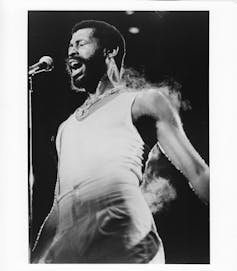
Black-and-white photo of singer wearing white undershirt singing in front of microphone, with steam coming off his body
R&B heartthrob Teddy Pendergrass performs on stage circa 1977.
Gilles Petard/Redferns via Getty Images

Pendergrass, with his stylish good looks, quickly became not just a heartthrob, but a top R&B artist with five consecutive platinum albums between 1977 and 1981. He was selling out concerts, and legendary producer Shep Gordon recognized that the vast majority of the attendees were women. This led to Pendergrass’ “Ladies Only” tour in 1978, which became a template for future soul and R&B tours by contemporaries like Luther Vandross and later artists like Ginuwine, whose tours were also marketed specifically to women.

The 1979 erotic hit “Turn Off the Lights” strengthened Pendergrass’ reputation as a sex symbol. While Marvin Gaye was dealing with both financial and personal issues, Pendergrass became the top performer of soul “bedroom ballads.”

Pendergrass and Gaye, along with other contemporaries like Barry White, Minnie Riperton and Donna Summer, included more explicitly erotic themes and lyrics than earlier artists.

For example, in Gaye’s “Let’s Get it On,” he implores to his lover:

“There’s nothin’ wrong with me / Lovin’ you, baby love, love / And givin’ yourself to me can never be wrong / If the love is true, oh baby.”

In “Close the Door,” Pendergrass similarly tells his lover:

“Close the door / Let me give you what you’ve been waiting for / Baby I got so much love to give / And I wanna give it all … to you …”

One challenge for the songwriters like Gamble and Huff was to balance the sensuality that fans loved with Federal Communication Commission rules regarding profane language. Songs like “Turn Down the Lights,” written by Gamble and Huff for Pendergrass, describe a detailed night of romance without language that would be considered obscene by the FCC.

Slow jams and sex positivity

R&B and soul slow jams by artists like Freddie Jackson and Vandross dominated bedroom music through the 1980s, although derivative genres like neo-soul and quiet storm continued to produce bedroom ballads like Gaye’s “Sexual Healing” in 1982.

Madonna and Cyndi Lauper helped bring a female perspective to more sex-positive pop music with songs including “Like a Virgin” and “She Bop.” Janet Jackson and Salt-N-Pepa did the same in R&B and hip-hop. Other groups embraced their sex symbol status through the 1990s, exemplified by TLC’s “Ain’t 2 Proud 2 Beg” and “Creep,” and Next’s “Too Close.” The artists of the 1980s and 1990s were also boosted by MTV, bringing a visual element to their sensual lyrics.

The emergence of new jack swing, a term coined in 1987 to define a new style that combined dance, hip-hop and R&B, ushered in higher-tempo erotic songs like “Do Me!” by Bel Biv Devoe along with slower bedroom ballads like “I’ll Make Love to You” by Philadelphia’s Boyz II Men.

Philly’s Boyz II Men carried the bedroom ballad tradition into the 1990s with “I’ll Make Love to You.”

Bedroom ballads with disco-synth makeover

Philadelphia International’s sound and sensual lyrics have reemerged in recent years through artists Sabrina Carpenter and Chappell Roan, whose synth-pop and disco sound can be traced back to Gamble and Huff, and the label’s stable of artists.

Proto-disco songs like “The Love I Lost” and “Don’t Leave Me This Way” by Harold Melvin and the Blue Notes, and Pendergrass’ disco hit “Get Up, Get Down, Get Funky, Get Loose” – or his later synthesizer-heavy album “Joy” – would influence current synth-pop hits like Roan’s disco-influenced “Pink Pony Club” and Carpenter’s synth-pop “Manchild.”

Chappell Roan’s campy, disco-influenced hit “Pink Pony Club.”

Carpenter in particular has seemingly struck that balance between mainstream success and sensual lyrics. Her past three albums have been certified platinum and embrace increasingly mature themes such as female arousal.

“Man’s Best Friend,” released in August 2025, sparked controversy with a sexually suggestive album cover that further cemented her Carpenter’s symbol image. This image is reinforced by her stage presence, like dancing in her underwear on “Saturday Night Live” and mature songs like “Tears,”

“Tears” by Sabrina Carpenter.

Pendergrass’ career was derailed when he lost control of his car on Lincoln Drive in the East Falls neighborhood of Philadelphia in 1982. The accident left him a tetraplegic. He later continued his music career, but the “Black Elvis” moved away from bedroom ballads.

Although Pendergrass’ meteoric rise was cut short, his influence is still seen and heard across music genres today, especially as empowered female artists utilize disco and synth-pop sounds while embracing their sexuality through their songs and performances.

Read more of our stories about Philadelphia, or sign up for our Philadelphia newsletter on Substack.

The Conversation

Jared Bahir Browsh does not work for, consult, own shares in or receive funding from any company or organization that would benefit from this article, and has disclosed no relevant affiliations beyond their academic appointment.

ref. Sabrina Carpenter’s and Chappell Roan’s sexy pop hits have roots in the bedroom ballads of Teddy Pendergrass and Philly soul – https://theconversation.com/sabrina-carpenters-and-chappell-roans-sexy-pop-hits-have-roots-in-the-bedroom-ballads-of-teddy-pendergrass-and-philly-soul-270035

Sí a Dios, pero no a la Iglesia: así es el cambio religioso para muchos latinoamericanos

Source: The Conversation – (in Spanish) – By Matthew Blanton, PhD Candidate, Sociology and Demography, The University of Texas at Austin

Una mujer participa en una procesión del Cristo de Mayo en Santiago de Chile, llevando en procesión por la ciudad una reliquia del crucifijo de una iglesia destruida. AP Photo/Esteban Felix

En una región conocida por sus cambios tumultuosos, algo se ha mantenido notablemente constante durante siglos: América Latina se considera católica.

La transformación de 500 años de la región en un bastión católico pareció culminar en 2013, cuando el argentino Jorge Mario Bergoglio fue elegido como el primer papa latinoamericano. América Latina es, desde entonces, el corazón de la Iglesia católica: alberga a más de 575 millones de fieles, más del 40 % de todos los católicos del mundo. Las siguientes regiones más grandes son Europa y África, cada una de las cuales alberga al 20 % de los católicos del mundo.

Aún así, el panorama religioso de la región está cambiando. En primer lugar, los grupos protestantes y pentecostales han experimentado un crecimiento espectacular. En 1970, solo el 4 % de los latinoamericanos se identificaban como protestantes; en 2014, la proporción había aumentado hasta casi el 20 %.

Pero, incluso mientras aumentaba el número de protestantes, otra tendencia ganaba terreno silenciosamente: una proporción cada vez mayor de latinoamericanos abandonaba por completo la fe institucional. Y, como muestra mi investigación, este declive religioso presenta una diferencia sorprendente con respecto a los patrones de otros lugares: aunque cada vez son menos los latinoamericanos que se identifican con una religión o asisten a los servicios religiosos, la fe personal sigue siendo fuerte.

Tres mujeres con túnicas blancas y gorros de noche junto a una gran cruz de madera.
Mujeres conocidas como ‘animeras’, que rezan por las almas de los difuntos, caminan hacia una iglesia para las festividades del Día de los Muertos en Telembi, Ecuador.
AP Photo/Carlos Noriega

Declive religioso

En 2014, el 8 % de los latinoamericanos afirmaba no profesar ninguna religión. Esta cifra es el doble del porcentaje de personas que se criaron sin religión, lo que indica que el crecimiento es reciente y proviene de personas que abandonaron la iglesia ya en la edad adulta.

Sin embargo, desde entonces no se había realizado ningún estudio exhaustivo sobre el cambio religioso en América Latina. Mi nueva investigación, publicada en septiembre de 2025, se basa en dos décadas de datos de encuestas realizadas a más de 220 000 personas en 17 países latinoamericanos. Estos datos proceden del Americas Barometer, una gran encuesta regional realizada cada dos años por la Universidad de Vanderbilt (EE. UU.) que se centra en la democracia, la gobernanza y otras cuestiones sociales. Dado que plantea las mismas preguntas sobre religión en todos los países y a lo largo del tiempo, ofrece una visión inusualmente clara de los patrones cambiantes.

En general, el número de latinoamericanos que declaran no tener afiliación religiosa aumentó del 7 % en 2004 a más del 18 % en 2023. La proporción de personas que dicen no tener afiliación religiosa creció en 15 de los 17 países, y se duplicó con creces en siete.

En promedio, el 21 % de las personas en Sudamérica dicen no tener afiliación religiosa, en comparación con el 13 % en México y Centroamérica. Guatemala, Perú y Paraguay son los países tradicionalmente más religiosos, con menos del 9 % que se identifica como sin afiliación, mientras que Uruguay, Chile y Argentina son los tres países menos religiosos de la región.

Otra pregunta que suelen utilizar los estudiosos para medir el declive religioso es la frecuencia con la que las personas acuden a la iglesia. Entre 2008 y 2023, la proporción de latinoamericanos que acuden a la iglesia al menos una vez al mes disminuyó del 67 % al 60 %. Por su parte, el porcentaje de personas que nunca acuden a la iglesia aumentó del 18 % al 25 %.

El patrón generacional es evidente. Entre las personas nacidas hasta la década de 1940, algo más de la mitad afirma acudir a la iglesia con regularidad. Cada generación posterior muestra un descenso más pronunciado, hasta llegar a solo el 35 % en el caso de los nacidos en la década de 1990. La afiliación religiosa muestra una trayectoria similar: cada generación está menos afiliada que la anterior.

Religiosidad personal

Sin embargo, en mi estudio, también examiné una medida de religiosidad menos utilizada, que cuenta una historia diferente.

Esa medida es la “importancia religiosa”: la importancia que las personas otorgan a la religión en su vida cotidiana. Podríamos considerarla como religiosidad “personal”, en contraposición a la religiosidad “institucional”, vinculada a congregaciones y denominaciones formales.

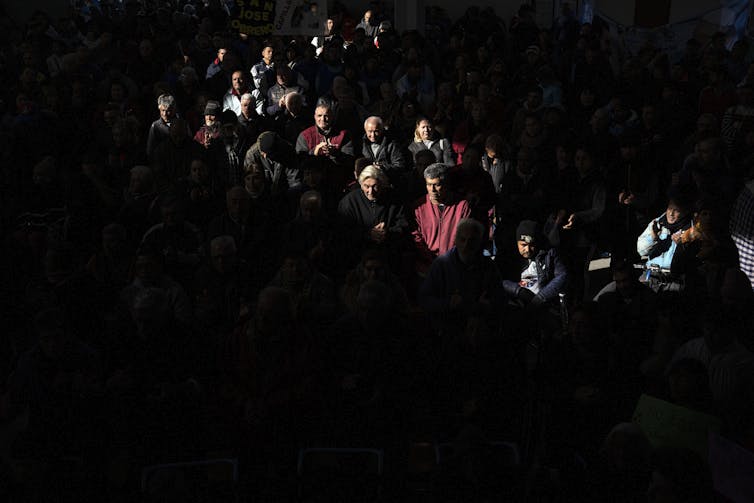
Un foco ilumina una fila en zigzag de personas que llevan chaquetas, mientras que el resto de la multitud permanece oculta en la oscuridad.
Personas asisten a una misa con motivo del Día Internacional contra el Abuso y el Tráfico Ilícito de Drogas en Buenos Aires, Argentina, el 26 de junio de 2024.
AP Photo/Rodrigo Abd

Al igual que la asistencia a la iglesia, la importancia religiosa general es alta en América Latina. En 2010, aproximadamente el 85 % de los latinoamericanos de los 17 países cuyos datos analicé dijeron que la religión era importante en su vida cotidiana. El 60 % dijo “muy importante” y el 25 % dijo “algo importante”.

En 2023, el grupo que la consideraba “algo importante” se redujo al 19 %, mientras que el grupo que la consideraba “muy importante” aumentó al 64 %. La importancia personal de la religión estaba creciendo, incluso cuando la afiliación y la asistencia a la iglesia estaban disminuyendo.

La importancia de la religión muestra el mismo patrón generacional que la afiliación y la asistencia: las personas mayores tienden a reportar niveles más altos que los jóvenes. En 2023, el 68 % de las personas nacidas en la década de 1970 afirmaron que la religión era “muy importante”, en comparación con el 60 % de las personas nacidas en la década de 1990.

Sin embargo, cuando se compara a personas de la misma edad, el patrón se invierte. A los 30 años, el 55 % de las personas nacidas en la década de 1970 calificaron la religión como muy importante. Compárese eso con el 59 % de los latinoamericanos nacidos en la década de 1980 y el 62 % de los nacidos en la década de 1990. Si esta tendencia continúa, las generaciones más jóvenes podrían acabar mostrando un mayor compromiso religioso personal que sus mayores.

Afiliación frente a creencia

Lo que estamos viendo en América Latina, en mi opinión, es un patrón fragmentado de declive religioso. La autoridad de las instituciones religiosas está disminuyendo: cada vez menos personas profesan una fe y menos asisten a los servicios religiosos. Pero las creencias personales no se están erosionando. La importancia de la religión se mantiene estable, e incluso está creciendo.

Este patrón es muy diferente al de Europa y Estados Unidos, donde el declive institucional y las creencias personales tienden a ir de la mano.

El 86 % de las personas no afiliadas en América Latina dicen creer en Dios o en un poder superior. Esto contrasta con solo el 30 % en Europa y un 69 % en Estados Unidos.

Una proporción considerable de latinoamericanos no afiliados también cree en los ángeles, los milagros e incluso están convencidos de que Jesús volverá a la Tierra durante su vida.

En otras palabras, para muchos latinoamericanos, dejar atrás una etiqueta religiosa o dejar de ir a la iglesia no significa dejar atrás la fe.

Un hombre con un colorido gorro de punto y un jersey o chaqueta brillante sostiene una pequeña muñeca con una túnica blanca rodeada de volutas de humo.
Un guía espiritual indígena aimara bendice una estatua del niño Jesús con incienso después de una misa de Epifanía en una iglesia católica de La Paz, Bolivia, el 6 de enero de 2025.
«AP

Este patrón distintivo refleja la historia y la cultura únicas de América Latina. Desde la época colonial, la región ha estado marcada por una mezcla de tradiciones religiosas. A menudo, la gente combina elementos de las creencias indígenas, las prácticas católicas y los nuevos movimientos protestantes, creando formas personales de fe que no siempre encajan perfectamente en una iglesia o institución concreta.

Debido a que los sacerdotes solían ser escasos en las zonas rurales, el catolicismo se desarrolló en muchas comunidades con poca supervisión directa de la iglesia. Los rituales domésticos, las fiestas de los santos locales y los líderes laicos contribuyeron a configurar la vida religiosa de forma más independiente.

Esta realidad pone en tela de juicio la forma en que los estudiosos suelen medir el cambio religioso. Los marcos tradicionales para medir el declive religioso, desarrollados a partir de datos de Europa occidental, se basan en gran medida en la afiliación religiosa y la asistencia a la iglesia. Pero este enfoque pasa por alto la vibrante religiosidad fuera de las estructuras formales y puede llevar a los estudiosos a conclusiones erróneas.

En resumen, América Latina nos recuerda que la fe puede prosperar incluso cuando las instituciones se desvanecen.

The Conversation

Matthew Blanton recibe fondos del Instituto Nacional Eunice Kennedy Shriver de Salud Infantil y Desarrollo Humano. El contenido es responsabilidad exclusiva de los autores y no representa necesariamente las opiniones oficiales de los Institutos Nacionales de Salud.

ref. Sí a Dios, pero no a la Iglesia: así es el cambio religioso para muchos latinoamericanos – https://theconversation.com/si-a-dios-pero-no-a-la-iglesia-asi-es-el-cambio-religioso-para-muchos-latinoamericanos-271645

Coups in Africa: how democratic failings help shape military takeovers – study

Source: The Conversation – Africa (2) – By Ernest Harsch, Researcher, Institute of African Studies, Columbia University

Mali, Burkina Faso, Niger, Guinea and Gabon have all suffered regime change in the last five years, led by men in military uniform.

Madagascar and Guinea-Bissau experienced the same fate in 2025. Benin looked to join the list in early December, but the civilian government held onto power – just.

The academic literature on coups in Africa has highlighted a wide range of influences and triggers. These include:

  • personal and institutional rifts within the armed forces

  • susceptibility to both elite manipulation and popular pressure

  • instigation by foreign powers against governments deemed hostile to their interests.

In a recent paper I added a further question: to what extent were democratic failings an element in the coups of the past six years?

I am a journalist and academic who has focused on African political and development issues since the 1970s. Among my most recently published books is Burkina Faso: A History of Power, Protest and Revolution.

In the paper I explored underlying shortcomings of Africa’s democracies as one major factor leading to military seizures. I focused on the recent coups in Mali, Guinea, Burkina Faso, Niger and Gabon.

I selected those cases because each of their takeovers was mounted against an elected civilian government. In some instances, I found, factors other than poor elections were also at play. The juntas in both Burkina Faso and Niger cited political defects of their elected, if somewhat ineffective, governments. But they mainly blamed their predecessors’ failure to put down growing jihadist insurgencies.

Insecurity was also a factor in Mali. But Mali, Guinea and Gabon all had elections commonly perceived to have been rigged or in violation of constitutional term limits. They provoked popular opposition which prompted officers to step in.

My main finding was thus that popular disappointment in elected governments was a prominent element. It established a more favourable context enabling officers to seize power with a measure of popular support.

That finding suggests that in order to better protect democracy in Africa, it is not sufficient to simply condemn military coups (as Africa’s regional institutions, such as the African Union and Economic Community of West African States, are quick to do). African activists, and some policymakers, have urged a step further: denouncing elected leaders who violate democratic rights or rig their systems to hang onto power.

If elected leaders were better held to account, then potential coup makers would lose one of their central justifications.

Problems are bigger than rigged polls

The problems, however, go beyond rigged polls, errant elected leaders, and violated constitutions. Many African governments, whether they are democratic or not, have great difficulty meeting citizens’ expectations, especially for improvements in their daily lives.

The deeper structural weaknesses of African states further contribute to hampering effective governance. As Ugandan anthropologist Mahmood Mamdani, Kenyan political scholar Ken Ochieng’ Opalo, and other African scholars have pointed out, those shortcomings include the externally oriented and fragmentary nature of the states inherited from colonial rule. These exclude many citizens from active political engagement and ensure government by unaccountable elites.

In particular, a neoliberal model of democracy has been widely adopted in Africa since the 1990s. That model insists that democracy be tethered to pro-market economic policies and greatly limit the size and activities of African states. That in turn hinders the ability of even well-elected governments to provide their citizens with security and services.


Read more:
South African protesters echo a global cry: democracy isn’t making people’s lives better


Conducting elections while continuing to subject African economies to the economic policy direction of the International Monetary Fund and World Bank has left them with a “choiceless democracy,” as Malawian economist Thandika Mkandawire termed it. That is, while voters may sometimes be able to change top leaders, they cannot alter basic economic policies. Such policies generally favour austerity and cutbacks over delivering jobs, education and healthcare.

So in addition to improving the quality of democratic systems on the continent, “coup proofing” African states will also require giving greater scope to popular input into real decision making, in both the political and economic spheres.

That will depend primarily on Africans themselves fighting for the democracies they want. Clearing the way for them means ending the all-too-common repression of street mobilisations and alternative views that displease the ruling elites.

Support for democracy

There may be general unhappiness with the flaws of Africa’s electoral systems. Surveys nevertheless demonstrate continued strong support for the ideals of democracy. Many ordinary Africans, moreover, are mobilising in various ways to advance their own conceptions of democratic practice.

For example, when the Macky Sall government in Senegal used repression and unconstitutional manoeuvres to try to prolong his tenure, tens of thousands mobilised in the streets in 2023-24 to block him and force an election that brought radical young oppositionists to power.

In Sudan, the community resistance committees that mobilised massively against the country’s military elites outlined an alternative vision of a people’s democracy encompassing national elections, decentralised local assemblies, and participatory citizen engagement.


Read more:
Africans want consensual democracy – why is that reality so hard to accept?


Findings by the Afrobarometer research network, which has repeatedly polled tens of thousands of African citizens, provide solid grounds for hope. Surveys in 39 countries between 2021 and 2023 show that 66% of respondents still strongly preferred democracy to any alternative form of government.

For anyone committed to a democratic future for Africa, that is something to build on.

The Conversation

Ernest Harsch does not work for, consult, own shares in or receive funding from any company or organisation that would benefit from this article, and has disclosed no relevant affiliations beyond their academic appointment.

ref. Coups in Africa: how democratic failings help shape military takeovers – study – https://theconversation.com/coups-in-africa-how-democratic-failings-help-shape-military-takeovers-study-271565

Roger Lumbala is accused of horrific war crimes in DRC: can his trial in France bring justice?

Source: The Conversation – Africa (2) – By Kerstin Bree Carlson, Associate Professor International Law, Roskilde University

The Democratic Republic of Congo (DRC) has been called “the worst place on earth to be a woman” and “the rape capital of the world”. A 2014 survey estimated that 22% of women and 10% of men had experienced sexual violence during the conflict in the country’s east. After years of impunity, Roger Lumbala, a 67-year-old former member of parliament who once led a rebel group in eastern DRC, is facing trial for these crimes. He is charged in a French court with complicity in crimes against humanity, including summary executions, torture, rape, pillage and enslavement. Kerstin Bree Carlson, a scholar of international criminal law and transitional justice, explains the significance of this trial and the controversies it has sparked.

What is the special war crimes chamber in Paris? And what is ‘universal jurisdiction’?

Lumbala is being tried before a special war crimes tribunal in Paris because France exercises “universal jurisdiction” over international atrocity crimes like genocide, crimes against humanity and war crimes. These are the crimes that are the remit of the International Criminal Court (ICC). Because the ICC is designed to be a court of last resort, hearing international atrocity crimes only when states cannot or will not, all ICC member states must criminalise international atrocity crimes in their domestic criminal codes.

Although courts usually only try cases against their own citizens or which occur on their own territory, France’s “universal jurisdiction” law allows it to hear cases regarding atrocity crimes committed outside France by non-French nationals. The law restricts the application of universal jurisdiction to individuals residing in France who are citizens of countries that are ICC members. Prosecutors in France’s special war crimes unit (“OCLCH”) furthermore enjoy discretion over which cases they pursue.

Prosecutions unfold as they do for any criminal case in France: a claim made by the prosecutor is sent to an investigative judge. The judge examines the claim neutrally, weighing evidence of guilt and innocence, to determine whether to issue an indictment. These findings can be appealed. When the appeals are finalised, if the indictment stands, the indicted individuals are put on trial before a panel of judges and a jury who will determine guilt (and an eventual sentence).

In addition to prosecution and defence, victims can participate in the proceedings as “civil parties”. Civil parties are full participants; they may call witnesses, address the court through argumentation, and question witnesses brought by prosecution and defence.

Lumbala’s path to the Paris court

Lumbala’s trial opened on 12 November 2025. The indictment alleges that Lumbala conspired to and was complicit in the commission of crimes against humanity in relation to Operation “Effacer le tableau” (Wipe the Slate Clean). This was a military campaign that terrorised eastern Congo in 2002-3.

The civil parties in Lumbala’s case played a central role in bringing Lumbala before the court. These include international NGOs such as TRIAL International, the Clooney Foundation for Justice, the Minority Rights Group, Amnesty International, We are not Weapons of War and others. These groups have recorded atrocity crimes in the DRC for decades, and some assisted in the 2010 Mapping report by the UN, a seminal document which detailed the extent of the violence between 1993 and 2003.

Lumbala has resided in France on and off since 2013. It was his application for asylum that put him on French authorities’ radar, and they opened an investigation into his alleged crimes in connection with his role as leader of a rebel group turned political party, Rally of Congolese Democrats and Nationalists (RCD-N). In late 2020, French authorities arrested him. Investigative judges issued an indictment against him in November 2023; that indictment was upheld by the appeals court in March 2024, leading to the opening of the trial. If convicted, Lumbala could face life imprisonment.

What is at stake in this trial?

Although a few low-level soldiers in the DRC have been tried, no high-ranking leader has been convicted for the pervasive practice of using rape as a weapon of war. A decade ago, one of Lumbala’s allies, Jean-Pierre Bemba, was prosecuted by the ICC for war crimes, including sexual violence committed in Central African Republic. Bemba’s 2016 conviction was widely celebrated as a victory for victims. His 2018 acquittal on appeal for procedural reasons was a bitter pill.

Victims wanting to address Lumbala directly have been served their own bitter pill. At the end of the first day of the trial, Lumbala announced that he did not recognise the court’s jurisdiction and would not participate in the trial. He told the court:

This is reminiscent of past centuries. The jury is French; the prosecutor is French. This court does not even know where DRC is.

Lumbala left the court and has not attended the trial since then. Every morning he is brought from jail, and sits in the basement of the court house instead of in the courtroom. He also fired his lawyers, who in turn refused to assist the court in providing a defence in absentia.

Technically, there is no problem; the trial may continue.

Symbolically, Lumbala’s absence deprives civil parties of the chance to address the defendant personally. For a victim, being able to face the alleged perpetrator as a rebalance of power is one of the purposes of trial, and contributes to justice; Lumbala’s absence may make the trial less fair for victims.

Without the participation of the defence, will the trial seem fair to others? For Lumbala and his team, who have been fighting France’s jurisdiction over this case for years, the move is in keeping with their general defence strategy of sowing doubt.

What this means for the court, and for the prosecution of universal jurisdiction cases more generally, is the larger question. If defendants can endanger judicial legitimacy by refusing to participate, it will not be the last time we see this strategy. Universal jurisdiction has been challenged in other countries: Belgium’s wide-reaching 1993 universal jurisdiction law was repealed in 2003 after a decade of practice. France’s more limited practice, akin to extraterritorial jurisdiction, is a test case for how individual countries can help support the work of the ICC. Although the ICC can investigate any case in or involving its member states, the unfulfilled arrest warrants against Russia’s Vladimir Putin and Israel’s Benjamin Netanyahu are a reminder of how difficult it can be for the ICC to take custody over defendants.

The greater significance of the Lumbala case is therefore what it may mean for France, or any country or institution, to prosecute atrocity crimes outside its borders, which will in turn have an impact on impunity for international atrocity crimes.

The Conversation

Kerstin Bree Carlson receives funding from Independent Research Fund Denmark (DFF)

ref. Roger Lumbala is accused of horrific war crimes in DRC: can his trial in France bring justice? – https://theconversation.com/roger-lumbala-is-accused-of-horrific-war-crimes-in-drc-can-his-trial-in-france-bring-justice-270482

Thiaroye massacre: report on the French killing of Senegalese troops in 1944 exposes a painful history

Source: The Conversation – Africa (2) – By Martin Mourre, Historien et anthropologue spécialisé dans les armées coloniales et postcoloniales en Afrique de l’Ouest, École des Hautes Études en Sciences Sociales (EHESS)

The Thiaroye camp near Dakar was a Senegalese army barracks housing African soldiers called “tirailleurs sénégalais” (Senegalese riflemen). It welcomed men returning from the European front of the second world war, where the riflemen had been held as German prisoners of war while serving on the side of France. They were waiting for their long-overdue back pay and bonuses.

But at dawn on 1 December 1944, they were shot by their own French officers. What should have been a time of celebration became a bloodbath. France sought to downplay or deny the massacre for many years.

In 2024, ahead of the 80th anniversary commemorations of the massacre, Senegal’s Prime Minister Ousmane Sonko appointed a commission to establish the truth of what happened, to ensure proper recognition and reparations for the victims, and to assert Senegal’s sovereignty to write its own history.

Chaired by Professor Mamadou Diouf of Columbia University, one of its tasks was to draft a new report (a white paper) on Thiaroye. This was presented to President Bassirou Diomaye Faye on 17 October 2025.

Martin Mourre, a historian and anthropologist specialising in colonial armies, has studied this issue and explains what the new report brings to light and why Thiaroye remains so sensitive.


What happened at Thiaroye?

On 21 November 1944, the first group of former prisoners of war arrived at the Thiaroye camp to be demobilised. They were owed substantial sums, mainly the back pay accumulated during their captivity.

The French army refused to give them what they were owed, even though the funds were reportedly available in Dakar.

On 27 November, tensions escalated, prompting the intervention of a senior officer. He planned a repression operation that, on 1 December, turned into a massacre.


Read more:
The time has come for France to own up to the massacre of its own troops in Senegal


Even though a number of questions remain unanswered, the event is fairly well documented. The main debate revived by the new report and echoed in the media focuses on two issues: the death toll and the burial site of the victims.

Regarding the death toll, one may rely on a literal reading of the archives, which consistently report 35 deaths (or 70 in one officer’s report, phrased in a particularly obscure way).

On this point, the white paper does not appear to go further than previous research, which supports a higher estimate of 300 to 400 deaths.

How has France responded to the Thiaroye issue over the years?

France actively sought to erase the events at Thiaroye. In the weeks following the tragedy, French officials declared, according to archival records, that adequate measures must be taken to hide these hours of madness. The language reveals a deliberate effort to downplay and conceal the atrocity.

This continued long after independence in 1960. One of the most infamous examples is the censorship of the acclaimed film The Camp at Thiaroye by Senegalese filmmakers Ousmane Sembène and Thierno Faty Sow, which failed to find distributors in France when it was released.

However, things began to change in the 2000s, particularly when President Abdoulaye Wade organised official commemorations of the massacre. For the first time, a special French ambassador attending the commemoration acknowledged the colonial army’s responsibility for the tragedy.


Read more:
Ousmane Sembène at 100: a tribute to Senegal’s ‘father of African cinema’


A more prominent gesture came in 2014 when President François Hollande visited the military cemetery. He delivered a speech and handed over a batch of archives to Senegalese President Macky Sall. He claimed – falsely, as it later turned out – that these represented all the documents France possessed on the massacre.

These archives were not available for analysis in Senegal until an executive order was issued by President Bassirou Diomaye Faye in 2024. The reason for the decade-long blockade was never adequately explained.

In 2024, President Emmanuel Macron went further than his predecessor by officially recognising events at Thiaroye as “a massacre”. A word his predecessor had avoided. Macron made this statement in a letter to Faye.

What new information does the report provide?

The main new element presented in the white paper is the initial outcome of archaeological excavations of the burial site, carried out by a team from Dakar’s Cheikh Anta Diop University. They have so far uncovered the remains of seven individuals.

All indications are that these men were victims of the massacre. Investigators highlighted the rushed and irregular nature of the graves and the burials, with bodies still dressed in military uniforms.

A black and white photo of African men in trenchcoats standing in a line with a European man in the foreground.
Senegalese Tirailleurs, 1940.
RaBoe/Wikimedia Commons, CC BY-SA

French administrative records had offered no answers about where or how the victims were laid to rest. This left the question of potential mass graves unresolved and shrouded in uncertainty.

These new findings from the report verify that victims were buried at this site. They also challenge official French narratives. The investigation continues. The archaeological team plans to expand their search, believing that more remains may lie hidden across the site.

What momentum led to the search at the grave site?

The issue of excavations of this site has a longer history. In 2017, several pan-African organisations urged Senegalese authorities to carry out such searches at Thiaroye. Among them was the party of Ousmane Sonko, today prime minister of Senegal but then a member of parliament.

Ten years earlier, during the construction of a highway crossing part of the military camp, historian Cheikh Faty Faye had already raised the issue publicly. Faye, who died in 2021, had worked on Thiaroye since the 1970s. He was part of a tradition of activist-scholars connected to pan-Africanist movements.

Through decades of commemoration and organising, these groups transformed the cemetery into a site of collective memory.


Read more:
David Diop: his haunting account of a Senegalese soldier that won the Booker prize


The cemetery holds 202 graves, roughly 30 of which stand apart from the others. To my knowledge, no scientific work has traced its origins, but it likely dates back to the first world war, when the Thiaroye camp was built.

It’s located about 1km from the camp’s main entrance. It served as the burial ground for west African riflemen from Senegal and numerous other French colonial territories who died during training. Their remains were never repatriated.

If future research confirms that the recently discovered bodies belong to the men killed on 1 December, it would be an important step towards clarifying the death toll.

What else is important in this report?

While the white paper dedicates considerable attention to the death toll, it also signals an interest in recovering the individual life stories of the Thiaroye riflemen.

Yet in my view, a crucial question remains unaddressed: the distinctly colonial character of the violence itself.

This is a form of violence inherent to the colonial context, marked by racialisation, a sense of impunity, and the distance between the colony and mainland France.

The challenge today is no longer just to document what happened at Thiaroye. It is ensure that this history is passed on to future generations. Integrating it into school curricula – anchored in rigorous scholarly work – shows how understanding the past illuminates the present and helps build a collective memory on solid foundations.

The Conversation

Martin Mourre does not work for, consult, own shares in or receive funding from any company or organisation that would benefit from this article, and has disclosed no relevant affiliations beyond their academic appointment.

ref. Thiaroye massacre: report on the French killing of Senegalese troops in 1944 exposes a painful history – https://theconversation.com/thiaroye-massacre-report-on-the-french-killing-of-senegalese-troops-in-1944-exposes-a-painful-history-271035

Newly discovered link between traumatic brain injury in children and epigenetic changes could help personalize treatment for recovering kids

Source: The Conversation – USA – By Lacey W. Heinsberg, Assistant Professor of Nursing and Human Genetics, University of Pittsburgh

The effects of traumatic brain injuries go beyond what meets the eye. Naeblys/iStock via Getty Images Plus

A newly discovered biological signal in the blood could help health care teams and researchers better understand how children respond to brain injuries at the cellular level, according to our research in the Journal of Neurotrauma.

In the future, this information could help clinicians identify children who need more tailored follow-up care after a traumatic brain injury.

Basics of epigenetics

As part of our work as a nurse scientist and neuropsychologist studying traumatic brain injury, we wanted to look for biological markers inside cells that might help explain why some children recover smoothly after brain injury while others struggle.

To do this, we focused on DNA, the instruction manual of cells. DNA is organized into regions called genes, each of which codes for proteins that carry out different functions like repairing tissues.

While your DNA generally stays the same throughout your life, it can sometimes collect small chemical changes called epigenetic modifications. These changes act like dimmer switches, turning genes up or down without changing the underlying code. In general, dialing up the activity of a gene increases production of the protein it codes for, while dialing down the gene decreases production of that protein.

Epigenetic changes play a significant role in how your body functions and develops.

One common type of epigenetic modification is called DNA methylation. DNA methylation is not fixed but can instead change in response to what you eat, how you move your body or even how stressed you are. We wondered if these epigenetic changes might also change in response to brain injury in children.

Epigenetic changes in traumatic brain injury

To explore this idea, we enrolled nearly 300 children at UPMC Children’s Hospital of Pittsburgh in our study. Of these children, 189 had a traumatic brain injury serious enough to require at least one night in the hospital, while the others had broken bones but no head injury.

We collected blood samples while they were in the hospital, and again at six and 12 months after their injury. We then measured DNA methylation in a gene called brain-derived neurotrophic factor (BDNF), which plays a role in how the brain develops and repairs.

Within approximately 30 hours of injury, children with traumatic brain injury had lower levels DNA methylation than children without brain injury. Interestingly, these differences were not connected to how severe the child’s injury appeared based on tests that health care teams use in the clinic, such as brain scans or evaluations of consciousness. This suggests that two children who look very similar to the eye may be responding to their injury differently at the cellular and epigenetic level.

Our findings also suggest that DNA methylation could help researchers understand something completely new about the brain’s response to injury that existing clinical tools cannot detect.

Doctor looking at panel of brain scans.
Brain scans don’t show what’s happening at the cellular and genetic level.
mady70/iStock via Getty Images Plus

Improving recovery after traumatic brain injury

When a child comes to the hospital with a traumatic brain injury, health care teams can assess the injury based on what it looks like and how the child is currently handling symptoms. But they cannot necessarily determine how a child’s body is responding to their injury, or what other factors put them at risk for poor recovery. That gap makes it difficult to predict which children may later experience problems with thinking, attention or behavior. Because the brains of children are still developing, early injuries can disrupt development and lead to long-term cognitive or behavioral issues.

Our findings indicate that epigenetic signals like DNA methylation might help clinicians and researchers develop more effective treatment strategies. While it’s still unclear whether these epigenetic changes influence children’s cognitive function after injury, further research could enable DNA methylation to offer a more precise guide to rehabilitation. In fact, our team is currently examining how DNA methylation patterns across all genes affect long-term outcomes in children with traumatic brain injury.

Pairing what clinicians can observe at the bedside with information at the cellular and epigenetic level can bring medicine one step closer to individualized care plans matching children with treatments that can most effectively help them heal.

The Conversation

Lacey W. Heinsberg receives funding from the National Institutes of Health.

Amery Treble-Barna receives funding from the National Institutes of Health.

ref. Newly discovered link between traumatic brain injury in children and epigenetic changes could help personalize treatment for recovering kids – https://theconversation.com/newly-discovered-link-between-traumatic-brain-injury-in-children-and-epigenetic-changes-could-help-personalize-treatment-for-recovering-kids-271453

La consommation d’alcool chez les hommes nuit aux femmes et aux enfants

Source: The Conversation – in French – By Leane Ramsoomar, Public health researcher, South African Medical Research Council

On sait que la consommation d’alcool est dangereuse pour la santé. Mais ses effets ne s’arrêtent pas là. Par exemple, les hommes subissent plus de conséquences liées à leur propre consommation que les femmmes. Ils sont plus touchés par l’agressivité, les accidents et les blessures. Mais lorsqu’un homme boit, les femmes et les enfants qui lui sont proches en paient souvent le prix également.

Je fais partie d’un groupe mondial de chercheurs en santé qui s’est attelé à étudier comment et dans quelle mesure la consommation d’alcool des hommes nuit aux femmes et aux enfants.

Notre étude récente s’appuie sur trois grandes revues de la littérature sur le sujet. Elle porte des résultats obtenus à partir d’études menées dans des pays riches, pauvres et à revenu intermédiaire. Celles-ci portaient sur les préjudices causés aux femmes, aux enfants et aux options politiques visant à réduire la consommation nocive d’alcool chez les hommes. Les analyses ont porté sur 49 études et 11 analyses couvrant la période 1990-2023.

Nous avons synthétisé les données afin d’éclairer les politiques publiques, les pratiques et les futures recherches. Nos résultats suggèrent des pistes de changement systémique et d’amélioration de la santé et du bien-être des femmes et des enfants dans le monde.

Ce que nous avons découvert

Les trois études révèlent que les hommes boivent plus que les femmes. Sous l’effet de l’alcool, ils adoptent parfois des comportements nocifs : agressivité, violence, tension dans la famille, contrôle du partenaire et la coercition sexuelle. Ils s’absentent aussi souvent du foyer pour aller boire et ne mettent pas toujours les besoins des femmes et des enfants en priorité. Quand les hommes dépensent l’argent du ménage pour l’alcool, il n’en reste pas assez pour la nourriture, les frais scolaires ou les médicaments. Cela nuit directement aux femmes et aux enfants.

Les femmes interrogées rapportent les actes de violence et d’agression liés à l’alcool. Il s’agit notamment de coups de poing, de coups de pied, des brûlures et des passage à tabac.

Mais les effets de la consommation d’alcool des hommes ne sont pas toujours visibles. Beaucoup de femmes parlent de préjudices cachés subis avec un partenaire alcoolique : l’embarras, la honte, l’isolement pour éviter les humiliations en public et le sentiment de solitude lié au fait d’avoir un partenaire alcoolique. Ce stress peut conduire à la dépression, à l’insomnie, voire à des pensées suicidaires.

Une femme a déclaré :

Je déteste vraiment ce que l’alcool lui fait. On se dispute à la maison. Ensuite, il débarque ivre à mon travail et exige qu’on parle de notre dispute sur place. Il m’humilie devant mes collègues.

Une autre a dit :

Je ressens une sorte de réaction traumatique lorsque les gens boivent trop autour de moi. Donc je ne fréquente pas beaucoup ce milieu.

Les enfants sont également touchés

Lorsque les hommes boivent de l’alcool, cela peut avoir directement ou indirectement des conséquences préjudiciables aux enfants. Les hommes peuvent mettre en danger la sécurité et le bien-être de leurs enfants en les exposant à leur propre violence, soit comme cibles, soit comme témoins.

Des recherches ont montré que lorsque les enfants grandissent dans des foyers où règne la violence, ils courent le risque de subir toute une série de conséquences négatives. On peut en citer de mauvais résultats scolaires, une faible estime de soi et le fait que les enfants deviennent eux-mêmes auteurs ou victimes de violence. Lorsqu’il y a des disputes à la maison, les enfants deviennent des victimes actives ou silencieuses.

Les études examinées montrent que la consommation d’alcool chez les hommes peut également conduire à la négligence et à la maltraitance des enfants. Les enfants dont les pères boivent beaucoup peuvent ne pas se sentir aussi proches d’eux sur le plan émotionnel, car ils ont peur de leurs pères lorsqu’ils sont ivres. L’alcool peut créer des conflits dans le foyer, dont un désengagement des responsabilités par ou une distanciation progressive.

La consommation d’alcool est souvent considérée comme une question privée, mais elle est influencée par de nombreux facteurs au niveau de la société, de la communauté et du foyer.

Par exemple, les lois et les politiques en matière d’alcool ont une incidence sur la disponibilité de l’alcool, le nombre de points de vente d’alcool dans les quartiers et l’âge approprié pour acheter de l’alcool. La consommation d’alcool a un impact sur le bien-être et la sécurité dans les foyers, les communautés et la société.

Nous avons constaté que les femmes et les enfants des pays pauvres sont les plus touchés par les effets de la consommation d’alcool des hommes, car ils disposent de moins de ressources. De plus, dans ces sociétés, il est plus souvent considéré comme normal que les hommes boivent ou abusent des femmes, comparé aux pays plus riches.

Que peut-on faire pour y remédier ?

Les gouvernements et les autorités sanitaires se concentrent principalement sur la réduction des risques encourus par les buveurs eux-mêmes. Par conséquent, les politiques, les programmes et les services mis en place sont centrés sur l’individu.

Bien que les recherches montrent que les buveurs peuvent être aidés grâce à des programmes de soutien par les pairs comme les Alcooliques Anonymes, ou par un accompagnement psychologique individuel incluant des interventions brèves, ces programmes doivent s’inscrire dans un environnement social et politique qui encourage un changement positif et tient compte des questions de genre.

Notre étude a révélé que les politiques et les programmes doivent tenir compte des préjudices par les autres, en particulier les femmes et les enfants. Une façon d’y parvenir consiste à associer les interventions en matière d’alcoolisme à des interventions communautaires axées sur les préjudices qui touchent spécifiquement les femmes et les enfants. Une première étape utile consiste à concevoir des interventions qui sensibilisent à l’abus d’alcool en tant que problème de santé publique touchant de manière disproportionnée les femmes et les enfants. Il faut combiner ces actions avec avec des programmes de traitement et de dépistage dans les établissements de soins primaires.

On peut aussi instaurer des « zones sèches » où la consommation d’alcool est interdite. Ces zones peuvent couvrir un quartier, une ville ou une région. Mais généralement les restrictions et les interdictions de vente d’alcool ne concernent que les espaces publics comme les parcs et abords des routes.

Les gouvernements du monde entier doivent donner la priorité aux politiques en matière d’alcool qui se sont avérées efficaces et rentables :

  • réduire la disponibilité et l’accessibilité financière de l’alcool

  • garantir qu’il ne soit pas vendu à des personnes n’ayant pas l’âge légal pour consommer de l’alcool

  • limiter l’exposition des enfants à la commercialisation et la publicité de l’alcool.

Cependant, les gouvernements doivent aller plus loin en tenant compte des effets de l’alcool et ses méfaits sur les femmes et les enfants. Les politiques de lutte contre l’alcool ne peuvent pas être séparées des questions de genre et de pouvoir qui, dans de nombreuses sociétés, contribuent à ses méfaits.

The Conversation

Leane Ramsoomar reçoit un financement du Conseil sud-africain de la recherche médicale.

ref. La consommation d’alcool chez les hommes nuit aux femmes et aux enfants – https://theconversation.com/la-consommation-dalcool-chez-les-hommes-nuit-aux-femmes-et-aux-enfants-271410

Trains de nuit : une relance peut cacher une pause

Source: The Conversation – in French – By Guillaume Carrouet, Maître de conférences en Géographie, Université de Perpignan Via Domitia

Alors que le train connaît un engouement depuis la fin du Covid-19, les difficultés pèsent sur certains segments du secteur ferroviaire, comme le train de nuit. Le (re)déploiement de ce service populaire et bas carbone est contraint par une pluralité de facteurs.


Que ce soit à l’international ou à l’échelle de la France, la relance du train de nuit se fait attendre au regard de ce qu’annonçait le gouvernement au sortir de la crise du Covid-19. Si le contexte semble favorable avec près de 114 milliards de voyageurs-kilomètre et une hausse de 6 % par rapport à 2023 et de 14 % par rapport à 2019, l’un des parents pauvres du secteur ferroviaire de voyageurs semble être le train de nuit.

Alors que le rapport additionnel à la LOM prévoyait une colonne vertébrale, avec un réseau structurant composé d’une dizaine de lignes, la situation à la fin de 2025 n’est pourtant pas flamboyante. En France métropolitaine, la ligne Paris-Aurillac, ouverte en 2023, est la dernière en date d’un plan de relance ligne par ligne (Paris-Tarbes-Lourdes, Paris-Nice), initié il y a quelques années par l’État.


À lire aussi :
Le retour des trains de nuit se fait-il sur de bons rails ?


Le bilan de la relance des dessertes de nuit en Europe est plus négatif, du moins vu depuisla France. Si l’Autriche, par l’intermédiaire de son champion ÖBB, est le fer de lance des lignes européennes depuis quelques années déjà, les liaisons internationales au départ ou à destination de la France peinent à être relancées. Quand elles ne disparaissent pas purement et simplement.

Un exemple du renouveau des lignes internationales

Le cas récent des lignes Paris-Berlin et Paris-Vienne mises en place en décembre 2023 et qui seront arrêtée le 14 décembre prochain, est particulièrement éclairant sur les contraintes fortes qui viennent contrarier la relance du train de nuit à l’échelle européenne. cette réouverture était pourtant présentée comme l’exemple du renouveau des lignes internationales de nuit, notamment suite à l’arrêt en 2021 d’une autre ligne Paris-Milan-Venise opérée par Thello, une entreprise née de l’entente entre Veolia et Trenitalia.

La ligne s’insèrerait pourtant très bien dans les objectifs européens de réduction des émissions de gaz à effet de serre, en sachant que le secteur des transports est le premier émetteur de CO2 en France. Le déploiement de l’usage du train, et du train de nuit en particulier, répond aux objectifs du Green Deal européen annoncé en 2019 avec l’objectif d’une neutralité carbone pour toute l’économie à l’horizon 2050. Pourtant, seulement 2 années plus tard, l’ensemble des partenaires du projet (ÖBB, Deutsche Bahn et SNCF) ont annoncé la fin du service, avec pour principale raison, l’arrêt de la subvention de l’État français.

Pas de compensation au retrait français

À l’origine, la participation de l’État était conditionnée à la mise en place d’une desserte quotidienne entre l’ensemble des villes avec un train comptant 12 wagons, avec séparation en 2 : 6 voitures pour Berlin et 6 pour Vienne. Face au constat de la mise de seulement 3 allers-retours par semaine, l’État français a décidé de suspendre la participation, ce qui a mécaniquement condamné la ligne, dans un contexte où les autres partenaires ne souhaitent pas compenser ce retrait.

Tout n’est pourtant pas perdu pour les lignes internationales de nuit puisque, devant cet échec, l’entreprise belgo-néerlandaise European sleeper constituée sous forme de coopérative a souhaité reprendre la ligne pour une ouverture prévue le 26 mars 2026. Détail non négligeable, l’opérateur, déjà présent sur le segment Bruxelles-Prague, ne bénéficierait pas de subvention publique pour le fonctionnement de la desserte.

Les difficultés d’une relance

À l’image du cas des lignes intérieures en France, cet exemple international souligne toutes les difficultés de relance d’un mode de transport alors qu’il répond à des enjeux de décarbonation du secteur. Cette expérience met en évidence le faisceau de contraintes qui pèsent sur le train de nuit. Elles ne se réduisent pas uniquement au caractère internationale de ce type de ligne, comme les changements de locomotives ou encore la planification des horaires pour plusieurs pays.

En effet, si le taux de remplissage de la ligne était jugé correct (près de 70 %), ce service et plus généralement l’ensemble des trains de nuit sont contraints par un déficit d’investissement dans le matériel roulant. En France, l’État a financé dans le cadre du Plan de relance, une rénovation du matériel, en particulier pour les trains de nuit, qui aujourd’hui a plus de 45 ans. Certaines compagnies, n’ayant pas le matériel en propre, se tournent vers la location notamment dans le cas des Rosco (Rolling Stock Company). Dans ce schéma, des entreprises achètent le matériel roulant et le louent aux compagnies. L’intérêt est de ne pas supporter des coûts d’investissements très importants avec une maintenance intégrée. Néanmoins, le bilan financier est moins intéressant sur l’ensemble de la durée de location.

C’est dans l’air France TV 2025.

À ces contraintes matérielles s’ajoute le pan financier inhérent au fonctionnement des lignes de nuit (équipage, contrôleur) et l’impossibilité de faire plusieurs rotations compte tenu de la longueur des parcours, comparativement à des TER, TGV et même par rapport à l’aérien. Ajoutons le coût du péage et l’utilisation du réseau la nuit qui coïncide avec les phases de travaux. Ces derniers ont eu un impact non négligeable sur les problèmes de ponctualité du Paris-Berlin et du Paris-Vienne.

Concurrence interne

Enfin, last but not least, le train de nuit souffre de la concurrence, y compris dans son propre segment. À titre d’exemple, on peut rappeler l’ouverture d’une liaison à grande vitesse en ICE (InterCity Express) Paris-Berlin direct, depuis décembre 2024, portée par un partenariat entre les opérateurs SNCF et Deutsche Bahn. Le trajet en ICE, c’est-à-dire à grande vitesse, s’effectue en 8 heures avec la desserte de quelques villes intermédiaires comme Strasbourg ou Karlsruhe.

Le train de nuit s’inscrit depuis plusieurs années dans un contexte de fortes incertitudes sur la pérennité de l’offre, du moins dans le cas de la France. Il semble en effet que la SNCF, par ses réticences, souffle le chaud et le froid. Simultanément, aucun opérateur ne semble être à l’heure actuelle en mesure de développer une offre propre, comme en témoigne l’expérience ratée de Midnight Trains pour des questions principalement financières.

The Conversation

Guillaume Carrouet ne travaille pas, ne conseille pas, ne possède pas de parts, ne reçoit pas de fonds d’une organisation qui pourrait tirer profit de cet article, et n’a déclaré aucune autre affiliation que son organisme de recherche.

ref. Trains de nuit : une relance peut cacher une pause – https://theconversation.com/trains-de-nuit-une-relance-peut-cacher-une-pause-271351