How the NIH became the backbone of American medical research and a major driver of innovation and economic growth

Source: The Conversation – USA (3) – By Fred D. Ledley, Director, Center for Integration of Science and Industry, Bentley University

NIH researchers conducted some of the earliest experiments for developing chemotherapy to treat cancer, circa 1950. National Cancer Institute, National Institutes of Health

As a young medical student in 1975, I walked into a basement lab at the National Institutes of Health in Bethesda, Maryland, to interview for a summer job.

It turned out to be the start of a lifelong affiliation – first as a trainee, then as a grantee running a university laboratory and finally, now, as a researcher of economics and public policy studying the agency’s impact on health care and on the national economy.

On that initial visit 50 years ago, I got my first direct experience with the NIH’s mission: to tap the enormous potential of basic science to improve human health and medical care. And over the long arc of my career, I watched the agency enact this mission in ways that brought enormous value to the country. NIH funding trained a legion of biomedical scientists, produced countless therapies that underpin much of modern medicine and catalyzed the launch of the biotechnology industry.

But widespread federal grant terminations and disruptions to federal funding in 2025 have left scientists who depend on NIH support reeling. And a 40% cut to the NIH budget for 2026 proposed by the White House threatens the agency’s future.

The origins and growth of the NIH

The NIH was founded through the Ransdell Act of 1930, which converted the former Hygienic Laboratory of the Marine Hospital Services into the seeds of a new government institution. That laboratory had been established in 1887 to develop public health measures, diagnostics and vaccines for controlling diseases prevalent in the U.S. at the time, such as cholera, yellow fever, smallpox, plague and diphtheria. With the act’s passage, the Hygienic Laboratory was reimagined as the National Institute of Health.

In a black-and-white photograph, President Franklin D. Roosevelt stands on the steps of a new building, draped with American flags.
The NIH, initially called the National Institute of Health, was created in 1930 with the passage of the Ransdell Act. President Franklin D. Roosevelt dedicated the new NIH campus in Bethesda, Md., on Oct. 31, 1940, saying, ‘We cannot be a strong nation unless we are a healthy nation.’
National Institutes of Health

Sen. Joseph Ransdell of Louisiana envisioned the NIH as an agency with a broader mandate for translating scientific advances to improve human health. In arguing in 1929 for the creation of the new institute, he read into the Congressional Record an editorial from The New York Times that highlighted rapid advances in chemistry, physiology and physics.

The editorial lamented that “never in the whole history of the world had efforts to improve health conditions been behind the advance in other sciences.” Pointing to millions of Americans suffering from sickness leading to economic losses “into billions,” it argued for the need for a medical sciences institute coordinating “a national effort to prevent diseases that are or may be preventable.”

In 1945, a report called Science – The Endless Frontier, by Vannevar Bush, highlighted the government’s central role in supporting science that harnessed nuclear energy, implemented radar and developed penicillin – all important elements of the United States’ success in World War II. Bush argued that these wartime successes presented a model for growing the American economy, preventing and curing disease and projecting American power.

The NIH became central to this model. Its budget increased substantially during and just after World War II, with postwar adoption of Bush’s plan, and again after 1957 when the nation redoubled its commitment to science following Russia’s launch of Sputnik and the start of the space race. The National Cancer Act of 1971, which established the separate National Cancer Institute, reaffirmed the nation’s commitment to government-funded research. This new institute’s funding provided much of the seed capital for the emergence of biotechnology.

In the 1980s, the Stevenson-Wydler and Bayh-Dole acts created a clear pathway for developing commercial products from federally funded research that would provide public benefits and economic stimulus. These federal laws made it a requirement to pursue patenting and licensing of NIH-funded research to industry.

How one project’s evolution reflects the NIH’s mission

Today, the NIH represents the backbone of efforts to improve health and health care, supporting each step in the process from preliminary discovery to clinical advance. These steps correspond to the stages of an individual scientist’s path.

A nurse fits a study volunteer with a clear plastic hood.
By putting study volunteers into a specially constructed metabolic chamber, NIH researchers in the 1950s could study how the human body uses air, water and food. The nurse here is affixing a hood onto a volunteer to measure oxygen consumption.
National Institutes of Health

I experienced this progression in my own career. After establishing my first independent laboratory with a grant for early-stage researchers, then called a First Independent Research Support and Transition grant, a Research Project grant, widely known as an R01, funded my lab’s work identifying genes that cause inherited metabolic diseases in newborns. RO1 grants are the main mechanism that academic biomedical scientists in the U.S. rely on to support innovative research.

Later, an NIH Program Project grant enabled us to investigate how the genes we had identified could be used to treat children. A General Clinical Research Center grant supported the hospital facilities necessary for clinical research and paid for patient care. Other grants supported our medical students and fellows as they embarked on their own careers as well as applications of our research to areas such as child health, reproductive biology and gastroenterology.

As our research on gene therapy progressed, NIH Small Business grants contributed to our founding a company that raised US$200 million in investments and partnerships and created hundreds of new jobs in Houston. Grants to small businesses continue to play a crucial role in helping universities commercialize discoveries.

Is the NIH effective?

For the past decade, I have led a research center focused on characterizing the process of developing new drugs. Our work, which is not funded by the NIH, shows that an established foundation of basic research on the biology underlying health and disease is necessary for successful drug development – and that most of this research is performed in public institutions.

We have found that NIH funding supported basic or applied research related to about 99% of newly approved medicines, clinical trials for 62% of these drugs and patents governing about 10% of these products.

A scientist holds three test tubes in his gloved hands
Based on research conducted at the NIH, azidothymidine, or AZT, in 1987 became the first drug approved to treat AIDS. Here, the drug, added to the middle vial, protects healthy immune cells from being destroyed by HIV, the virus that causes AIDS.
John Crawford, National Cancer Institute, National Institutes of Health

Studies also show that this NIH funding saves industry almost $3 billion per drug in development costs. Over the past decade, there has been $800 billion in new investment in biotechnology. The U.S. biopharmaceutical industry directly supports more than 1 million jobs.

Medicines enabled by NIH funding have been crucial for increasing life expectancy and health – dramatically decreasing deaths due to heart disease and stroke, improving cancer outcomes, controlling HIV infection, improving the management of immunological diseases and easing the burden of psychiatric conditions.

The Trump administration is currently questioning the role of science in maintaining the nation’s health, economy and global posture. Yet the NIH stands as a testimony to the vision articulated by its early architects.

At its heart is the conviction that science is good for society, that persistent investment in basic research is essential to technological advances that serve the public interest, and that our nation’s health and economy benefit from developments in biology.

The Conversation

Fred D. Ledley’s research has been supported by grants to Bentley University from the Institute for New Economic Thinking, National Pharmaceutical Council, West Health, and the National Biomedical Research Foundation.

ref. How the NIH became the backbone of American medical research and a major driver of innovation and economic growth – https://theconversation.com/how-the-nih-became-the-backbone-of-american-medical-research-and-a-major-driver-of-innovation-and-economic-growth-257403

Getting peace right: Why justice needs to be baked into ceasefire agreements – including Ukraine’s

Source: The Conversation – USA (3) – By Valerie Morkevicius, Associate Professor, Political Science, Colgate University

From left, Ukrainian President Volodymyr Zelenskyy, Britain Prime Minister Keir Starmer, French President Emmanuel Macron and German Chancellor Friedrich Merz leave a meeting on Dec. 8, 2025, at 10 Downing Street in London. AP Photo/Kin Cheung

Efforts to end the war in Ukraine have grabbed global attention, fueled by debates over U.S. President Donald Trump’s 28-point plan – which many analysts see as favoring Russia – and European attempts to craft a counterproposal.

We’ve been here before. Failed attempts to end the conflict date back to the beginning, soon after Russia’s 2014 occupation of Crimea and parts of the Donbas. After Russia’s full-scale invasion in February 2022, peace discussions started up again within days, and they have continued in fits and starts since.

Prospects for a lasting peace remain dubious. One reason, I believe, is that the proposals pay little attention to the relationship between peace and justice – a flaw shared by previous plans.

Is peace worth having if it’s unjust? Is justice worth pursuing if it prolongs war? Those are questions as troubling as they are old. “Peace is the effect of justice,” as St. Thomas Aquinas argued in the 13th century. Ceasefires built on coercion or exhaustion inevitably fail because they do not resolve the conflict’s causes.

Aquinas is a major figure in the just war tradition, the focus of my research. This area of ethics helps weigh when war is justified – and also how it should end.

Today, the insight that peace and justice are inseparable grounds what international law terms “transitional justice.” By focusing on victims and assuring accountability for past wrongs, this approach seeks to disrupt recurring cycles of violence.

Past agreements and proposals aimed at ending the conflict in Ukraine failed because in the rush to stop the fighting, they ignored questions of justice. The literature on transitional justice, by contrast, encourages negotiators to attend to four interdependent principles: truth, justice, reparations and safeguards against future recurrence.

1. Truth

Truth is essential for peace. As St. Augustine, one of the earliest Christian just-war thinkers, put it in the fourth century, “false justice” arises when the pursuit of truth is abandoned.

A woman in black clothes and a black hat leans over a coffin draped in sky blue fabric.
A mother cries at the coffin of her son, Oleh Borovyk, a Ukrainian serviceman, during his funeral in Boiarka, Ukraine, on Dec. 3, 2025.
AP Photo/Evgeniy Maloletka

Durable peace agreements require all sides to cooperate with international efforts to document war crimes and human rights violations, such as the United Nations’ Independent International Commission of Inquiry on Ukraine. This is no small task. So far, Ukraine has granted access to outside investigators, but Russia has refused, even when it has accused Ukraine of war crimes.

But reconciliation requires a complete accounting of the harms done. Archbishop Desmond Tutu, who headed South Africa’s Truth and Reconciliation Commission after the end of apartheid, explained that “forgiveness depends on repentance, which has to be based on an acknowledgment of what was done wrong, and therefore on disclosure of the truth.”

Truth-telling also prevents false narratives from creating “justifications” for renewed fighting. Thus, peace in Ukraine will require a global effort to combat disinformation legitimizing Russia’s aggression and obscuring its war crimes.

2. Justice

Justice demands holding perpetrators to account. If, as Aquinas argued, a just war is “one that avenges wrongs” or seeks “to restore what [has been] seized unjustly,” ignoring these concerns when ending a war would itself be unjust.

Treating collaborators with fairness requires nuance. In some cases, pardoning individuals who acted under duress – and even willing but nonviolent collaborators who fully disclose their actions – can support postwar reconciliation. Especially in areas once occupied by enemy forces, frank confessions can help rebuild social trust.

However, amnesty for war crimes and crimes against humanity is impermissible because pardons deny victims justice and may embolden future perpetrators. The International Criminal Court has issued arrest warrants for six Russian officials, including President Vladimir Putin. Meanwhile, the Council of Europe has established a Special Tribunal for the Crime of Aggression Against Ukraine, which would prosecute senior Russian officials who ordered the illegal invasion.

Realistically, neither forum can try those responsible without either Russia’s defeat or Putin’s removal from power. But in the interim, other countries can continue to support Ukrainian courts handling war crimes cases.

Justice also requires holding one’s own side accountable, even if the other side will not reciprocate. Allegations of war crimes by Ukrainian soldiers are far rarer, but Ukrainian courts must also prosecute these. Fair trials for all combatants are essential, lest, as Aquinas cautions, judgments seek “to sate … hatred under cover of correction.”

A woman looking very happy embraces a man draped in a blue and gold flag amid a crowd of people outside.
A woman hugs a soldier who came back from Russian captivity during an exchange of prisoners between Russia and Ukraine on May 25, 2025.
AP Photo/Efrem Lukatsky

3. Reparations

Reparations aim to make survivors whole again. This principle, too, has roots in classical just war thinking. The 16th-century theologian Francisco de Vitoria, for example, argued that reparations within the bounds of “equity and humanity” could help redress losses and restore justice.

The World Bank estimates that direct damage in Ukraine is over US$176 billion; in total, rebuilding will cost three times that. The Council of Europe has recommended using frozen Russian assets to fund reconstruction efforts, as have some American scholars . The illegality of Russia’s invasion means that such countermeasures are likely permissible under international law.

Apologies can also serve as reparations, but Russia is unlikely to proffer any – partly because domestic political pressures mean Putin cannot afford to look like he has lost.

Commemorative events and memorials also validate victims’ suffering. The international community can support Ukrainians in their efforts to meaningfully memorialize the war.

4. Deterrence

Peace lasts when the parties trust that the violence won’t reoccur.

However, Russia has repeatedly broken its treaties with Ukraine. That includes the first agreements meant to bring the conflict to an end, back in 2014.

Sunlight streams over an overgrown yard with a simple wooden cross and a small teddy bear.
In this November 2025 photo, provided by a Ukrainian military press service, a civilian grave lies among damaged residential houses in Kostyantynivka.
Oleg Petrasiuk/Ukraine’s 24th Mechanized Brigade via AP

That summer, Russian-backed separatists downed a Malaysian Airways flight, spurring the international community to seek a quick resolution. The hastily drafted Minsk agreements, signed in 2014 and 2015, established a ceasefire monitoring mission and required the removal of foreign military units. They also demanded Ukrainian constitutional reforms – ostensibly to secure more autonomy for the country’s largely Russian-speaking east.

The Minsk agreements temporarily froze the conflict, but relative quiet didn’t mean peace. Ceasefire violations were perpetual. Russian-supported militias were not disbanded, and Russia continued to send mercenaries and military forces to the Donbas. Human rights violations proliferated in Russian-occupied areas. And in February 2022, Russia launched its full-scale invasion.

Given this history, a durable peace would require that Russia accept constraints on its power. The various peace proposals put forth since 2022, however, have demanded security concessions only from Kyiv, requiring Ukraine to abandon hopes for NATO membership and restricting the size of its military.

Russia is unlikely to agree to caps on its military. Deterrence, then, could take the form of credible commitments from other countries to enforce whatever peace agreement emerges.

Ukraine’s vulnerability to future Russian aggression means it will need binding promises from its partners. Russia will not sign a treaty that permits Ukraine to join NATO, which Moscow claims would be a threat. Other possible safeguards for Ukrainian sovereignty include a proposed international peacekeeping force or an alternative set of security alliances.

Lasting peace

Ultimately, a durable peace requires considering both sides’ legitimate security and justice claims if, as Vitoria wrote in 1539, “they are prepared to negotiate genuinely and fairly.”

Therein lies the catch. Transnational justice can be hijacked, with aggressors trying to portray themselves as victims. Separating fact from fiction, and genuine concerns from manufactured pretext, is essential at the negotiating table.

A quick end to the war is tempting, but a hasty peace is a fragile one. A durable peace, rather than yet another ceasefire, requires attention to justice – even if that takes more time to achieve.

The Conversation

Valerie Morkevicius does not work for, consult, own shares in or receive funding from any company or organization that would benefit from this article, and has disclosed no relevant affiliations beyond their academic appointment.

ref. Getting peace right: Why justice needs to be baked into ceasefire agreements – including Ukraine’s – https://theconversation.com/getting-peace-right-why-justice-needs-to-be-baked-into-ceasefire-agreements-including-ukraines-270638

Christmas trees are more expensive than ever in Colorado — what gives?

Source: The Conversation – USA (2) – By Ali Besharat, Professor of Marketing, University of Denver

All festive products are getting more expensive. d3sign/GettyImages

The holiday season sparks a significant increase in consumer spending. This year, Black Friday alone saw consumers shell out a record US$11.8 billion. It’s the time of year when many Americans make purchases to decorate for the holidays — lights, ornaments and Christmas trees.

If you bought a Christmas tree in Denver this year, you may have noticed a pretty steep price tag. It turns out that all festive products are getting more expensive, and that includes Christmas trees, both freshly cut and artificial.

I study the psychology of consumption at the University of Denver. I’ve always been curious about how people make financial decisions under certain circumstances, including around the holidays. Christmas trees are an interesting case study.

What’s driving the increase

The cost of real Christmas trees is directly impacted by a long production cycle and transportation costs, particularly for landlocked markets like Denver.

Christmas trees take 7 to 10 years to grow. Currently, supply is tight, pushing tree prices up, which is a direct and delayed consequence of reduced planting rates that followed the Great Recession – which began in late 2007. This planting deficit effectively drove up wholesale prices and doubled the average price of pre-cut trees over the past decade after adjusting for inflation.

Raising tiny tree seedlings to a marketable size is a fraught business. Growers are exposed to a decade of weather, labor and pest risks, which increases the financial uncertainty of any planting season. This long lead time has made the supply unpredictable, putting constant pressure on Christmas tree wholesale prices.

Aerial view of rows of trees on a farm.
Colorado gets some of its Christmas trees from North Carolina, which grows more than 26% of the Christmas trees in the U.S.
Allison Joyce/GettyImages

For Denver retailers, transportation adds disproportionately to the final cost, since most Christmas trees in Denver are brought in from the Pacific Northwest and North Carolina using long-haul freight.

A retailer in Denver must also cover local operational overhead, such as labor costs, storage and the rental of temporary sales lots, which increases prices by about 10% on average based on wholesale Christmas tree prices. This is especially true for large trees, those taller than 9 feet (2.74 meters), as they do not grow in Colorado. Having said that, there are Christmas tree growers in Colorado, and the Douglas Fir is native to Colorado and grows naturally throughout its mountains.

Psychology of Christmas tree purchase decisions

The choice between a pre-cut Christmas tree and an artificial one is classic behavioral economics, which is the combination of economics and psychology to understand how and why people behave the way they do in the real world. It involves a trade-off between two readily available choices.

One option offers an emotional appeal, while the second choice may have to do more with cost savings and perceived environmental impact.

Buyers of real trees are driven by pleasure, satisfaction and emotional fulfillment. Often, buyers of fresh-cut trees are driven by nostalgia and a desire to inhale the powerful scent. Depending on the qualities of the tree, like how long it keeps its needles, how stiff the branches are and how rare it is, Denver customers often spend between $50 and $870 annually on fresh-cut Christmas trees.

On the flip side, artificial tree buyers prioritize the ease of buying a tree at the store and then bringing it out of storage each year. These customers seek convenience, low maintenance and the ability to control how the tree looks from a product that can cost between $250 to $700 initially. Being a durable good, artificial trees are typically replaced only once every five years.

In 2025, however, the decision to buy an artificial tree may feel less rational. Retailers are raising prices by 10% to 15% due to tariffs.

A Christmas tree display inside a store next to a shelf of ornaments.
Artificial Christmas trees have a higher up-front cost than many real trees, but over time are more affordable.
UCG/GettyImages

The financial and environmental superiority of the artificial tree is dependent on how long a consumer plans to keep and use it.

The financial break-even point is reached only when the artificial tree is reused for at least five years. The environmental break-even point is higher — around 10 years — due to the carbon emissions from manufacturing and global shipping of artificial trees. Their carbon footprint can be up to 10 times greater than a properly disposed-of real tree.

Behavioral changes in consumption

What about a third option that may appeal to Coloradans’ love of the outdoors?
Choose-and-cut businesses invite customers to visit a farm to select their tree and cut it down themselves. The tree is no longer just something you buy — it is the center of an experience you share.

Advocates go so far as to argue that the outdoor farm environment acts as a therapeutic escape from the stressful holiday season.

A child with a pink hat and blue coat pulls a small tree through the snow by its trunk.
Choose-and-cut Christmas tree farms enhance profitability by transferring the high cost of harvesting labor directly to the customer.
Glenn Asakawa/GettyImages

For the grower, this model is a highly effective form of agritourism, which makes use of the farm environment to boost revenue. It dramatically enhances profitability by transferring the high cost of harvesting labor – which can run from $15,000 to $50,000 annually – directly to the customer as a labor of love. The purchase of a tree may be the main point of the visit, but growers can improve their bottom lines through the sale of profitable goods and services like wreaths, hot chocolate, food and carriage rides. Motivated consumers are willing to pay more for the experience and the opportunity to recreate a meaningful ritual.

If this option excites you, there are a couple of spots where you can cut your own tree in Colorado, including at the Arapaho and Roosevelt National Forests. Most of these places, however, require a permit to chop down a tree.

Read more of our stories about Colorado.

The Conversation

Ali Besharat does not work for, consult, own shares in or receive funding from any company or organization that would benefit from this article, and has disclosed no relevant affiliations beyond their academic appointment.

ref. Christmas trees are more expensive than ever in Colorado — what gives? – https://theconversation.com/christmas-trees-are-more-expensive-than-ever-in-colorado-what-gives-271472

From civil disobedience to networked whistleblowing: What national security truth-tellers reveal in an age of crackdowns

Source: The Conversation – USA (2) – By Kate Kenny, Professor of Business and Society, University of Galway

Across the world, governments are tightening controls on speech, expanding surveillance and rolling back rights once thought to be secure.

From anti-protest laws and curbs on workers’ rights to the growing criminalization of leaks and dissent, the trend is chilling: People who speak out about government wrongdoing are increasingly vulnerable, and the legal systems that once claimed to protect them are now used to punish them.

We are researchers who study whistleblowing, which is when employees disclose information in the public interest about wrongdoing they have witnessed at work. Our new book draws on firsthand accounts from whistleblowers in national security, intelligence and government in the U.S., Australia and the U.K., among other countries. Their experiences show the limits of legal protections, but also the power of networks, solidarity and collective resistance in the face of institutional secrecy.

In this moment of democratic backsliding, whistleblowers show that civil disobedience – breaking the law to uphold the public good – remains an essential principle of political and moral life. They also show how legal reform and support networks designed to protect whistleblowers are critical for protecting accountability and democracy itself.

The limits of legal protections

The whistleblowers featured in the book, including former CIA officer John Kiriakou and Craig Murray, the former U.K. ambassador to Uzbekistan, learned the hard way that legal protections can end precisely where power begins. Both revealed grave human rights abuses – torture, kidnapping, imprisonment and complicity in war crimes – and both were prosecuted rather than protected.

Their stories underline a paradox: Even as new whistleblower protection laws have proliferated in many countries, prosecutions of national security and intelligence whistleblowers are on the rise. In national security contexts, where no public interest defense is permitted, laws meant to protect whistleblowers have become another weapon of “lawfare” – used to silence, bankrupt and criminalize.

For example, Kiriakou blew the whistle on the U.S. torture program in 2007. The Bush administration initially declined to prosecute him, but this changed under the Obama administration, which imprisoned Kiriakou in 2013 for 30 months. Kiriakou’s refusal to participate in the CIA program of “enhanced interrogation” of terrorism suspects, which included waterboarding, and his later decision to publicly confirm the CIA’s use of torture were acts of conscience. Yet it was he, not the torturers, who went to prison as a result of his disclosures.

The pattern is familiar. From Chelsea Manning in 2010 to Edward Snowden in 2013 and Daniel Hale in 2016, prosecutions under the U.S. Espionage Act and equivalent statutes elsewhere signal a broader shift: Making the powerful transparent is redefined as treason. The prosecution of national security whistleblowers who reveal crimes of the state continues to be an ongoing problem, as highlighted by more recent cases, including Reality Winner and David McBride.

When the law is used to enforce secrecy and punish dissent, the moral terrain shifts. Civil disobedience becomes not only justified but necessary. Human rights lawyers have commented that whistleblowers and journalists who work with them are being subjected to increasingly harsh treatment by the state, including imprisonment and on occasion torture.

From traditional media to networked whistleblowing

Historically, whistleblowers relied on the press to act as an intermediary between them and the public, as well as a protector because of the publicity they offer. But as investigative journalism has been hollowed out – starved of resources and constrained by political and corporate pressurethis model has faltered.

As journalist Andrew Fowler, one of our book’s contributors, wrote, “It may not be long before it will be impossible for journalists to have confidential sources.” Across the globe, attacks by governments on journalists criticizing strongman leaders become more brazen.

In 2010, Manning blew the whistle on U.S war crimes in Iraq and Afghanistan. Many major outlets turned Manning away before WikiLeaks provided the infrastructure to publish what mainstream media would not. Her disclosures raised the public’s awareness of government complicity in war crimes in Iraq and elsewhere. Such stories also reveal how reluctant mainstream journalism can be when confronted with power.

More recently, in 2016 McBride blew the whistle on members of the Australian SAS who murdered civilians in Afghanistan. He was sentenced to prison in 2024 and is currently serving a sentence of five years and eight months for his disclosures of war crimes.

This decline in formal protections has given rise to an ecology of “networked whistleblowing”: decentralized alliances of whistleblowers, activists and independent journalists using encrypted tools to share information and protect sources. While these networks can offer safety in numbers, they also carry risks – of being co-opted or exploited by those in power, and of being framed collectively as enemies of the state for their attempts to hold the powerful to account.

Yet they also represent a profound reimagining of public accountability in a digital age where secrecy is structural and systemic, demonstrating the force of people working together.

As the traditional institutions of democracy falter, our research shows these alternative infrastructures embody a new form of democratic practice: horizontal, distributed and defiant.

New alliances supporting whistleblowers

The whistleblowers whose stories appear in our book did more than expose wrongdoing. They built communities of care and resistance – new institutions to protect truth-telling itself.

Each of them, after suffering retaliation and exclusion, turned outward: campaigning for reform, mentoring others and building cross-sector alliances. Their transformation from individual insiders to collective activists reveals a crucial insight: Legal reform alone isn’t enough. What sustains truth-telling isn’t the promise of protection from above but solidarity from below.

Strengthening and supporting these alliances would help preserve freedom of expression and the right to know. That means supporting cross-border networks of journalists, lawyers and human rights defenders who can collectively safeguard disclosure when national laws fail. It also means recognizing whistleblowing as a public good.

At a time when many democracies are retreating from openness, these whistleblowers remind us that law and justice are not the same thing. When laws entrench secrecy or punish dissent, we believe breaking them can be an act of civic virtue. Civil disobedience can renew democratic life by holding power to account.

Kiriakou’s conclusion in his chapter resonates beyond the intelligence world: “We all have to fight. It’s the only way we are going to change anything.” His words recall a longer lineage of civil disobedience – from suffragettes to anti-war protesters to environmental activists – each confronting systems that refused to hear them until they broke the rules.

The cases in our new book illustrate how quickly law can be used to enforce secrecy rather than accountability during periods of democratic backsliding. They also highlight the practical conditions that make truth-telling possible – including collective support that extends beyond any one country’s legal system.

The Conversation

The authors do not work for, consult, own shares in or receive funding from any company or organization that would benefit from this article, and have disclosed no relevant affiliations beyond their academic appointment.

ref. From civil disobedience to networked whistleblowing: What national security truth-tellers reveal in an age of crackdowns – https://theconversation.com/from-civil-disobedience-to-networked-whistleblowing-what-national-security-truth-tellers-reveal-in-an-age-of-crackdowns-269488

Science has always been marketed, from 18th-century coffeehouse demos of Newton’s ideas to today’s TikTok explainers

Source: The Conversation – USA – By Beth DuFault, Assistant Professor of Marketing, University of Portland

For science ideas to catch on, they had to be promoted. Hulton Archive via Getty Images

People often see science as a world apart: cool, rational and untouched by persuasion or performance. In this view, scientists simply discover truth, and truth speaks for itself.

But history tells a different story. Scientific theories do not simply reveal themselves; they compete for attention, credibility and uptake. U.S. Supreme Court Justice Oliver Wendell Holmes Jr. once suggested that “the best test of truth is the power of the thought to get itself accepted in the competition of the market,” a line that helped popularize the metaphor of a “marketplace of ideas.”

In this view, science is not outside the market, but inside a public arena where claims vie for audiences, resources and belief – and where power, persuasion and social position shape which ideas are heard, trusted or forgotten.

As a marketing scholar trained in economic sociology, I study how institutions that are supposedly above or apart from market logics – such as science, religion, medicine and education – use marketing tools to sustain credibility and build or keep moral authority.

When I tell people that one of the areas I study is the marketing of science, they are often surprised at the concept. Yet persuasion is an integral part of the scientific process.

From Isaac Newton’s followers and their coffeehouse demonstrations of physics wonders to today’s TED Talks and TikTok explainers, scientists have long relied on storytelling and demonstration to make invisible truths visible. For scientific theories to supplant other plausible theories, to challenge existing theories and win acceptance, they must be correct – but they must also be convincing.

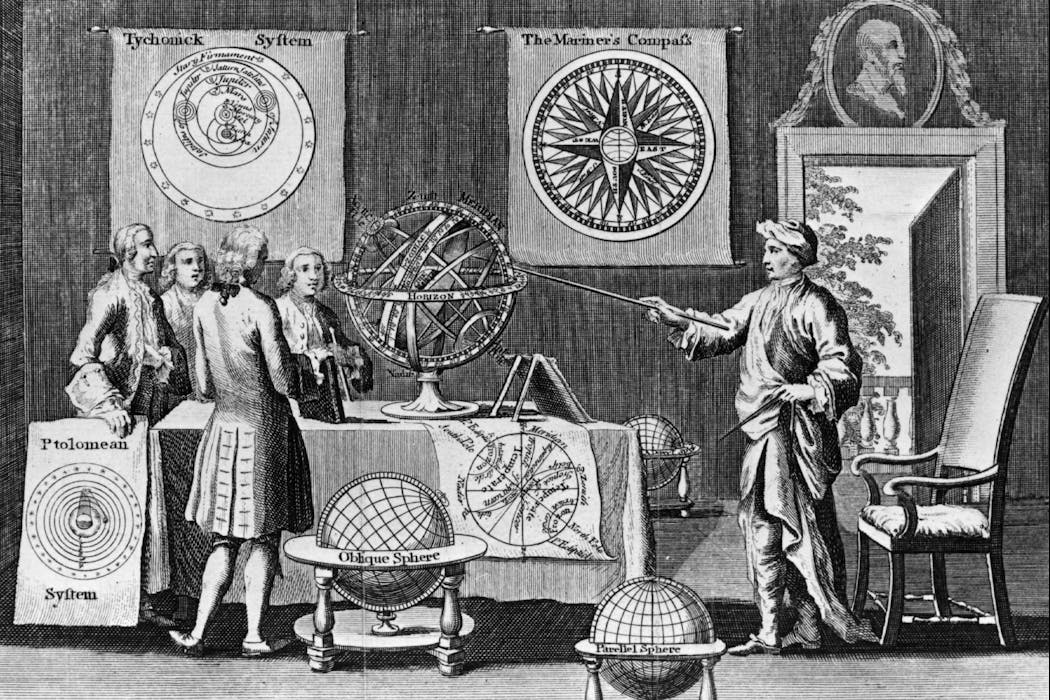
people in 1700s clothes gather around a column with a glass globe on top with one man talking and gesturing
People didn’t need to read Isaac Newton’s indecipherable Latin or understand his incomprehensible mathematics; they could just watch the live demonstrations, as in this depiction of an 18th-century nighttime scientific lecture on pneumatics.
Joseph Wright of Derby/Science & Society Picture Library via Getty Images

The original science influencers

In the early 1700s, Isaac Newton’s followers turned abstract theory into public performance and cultural fashion.

At the time, Cartesian philosophy dominated intellectual life. Newton’s 1687 book “Principia Mathematica” proposed a new worldview of gravity, optics and motion, but the mathematics was so dense that few could grasp it.

Although Newton himself was a recluse, a circle of zealous Newtonian men of science, described by historians as devoted disciples and even evangelists for Newton’s natural philosophy, took his new theories on the road. These itinerant lecturers performed experiments and spectaculars in London coffeehouses and aristocratic salons, demonstrating Newtonian physics. They sold tickets, pamphlets and even branded scientific instruments so audiences could reproduce these marvels at home.

Historian of science Jeff Wigelsworth showed that Newton’s evangelizers built what today might be called a brand: experiences, artifacts and emotions that linked scientific authority to Enlightenment ideals of reason and progress, and to their own personalities.

My own research finds that these men of science also used a suite of early marketing activities. Besides developing products to sell to promote Newtonian science, they came up with promotions that targeted different audiences, adjusted their pricing and used varied distribution strategies.

Along with their pure entertainment value, these public demonstrations were integrally entwined with Newtonian scientific viewpoints and helped these ideas gain popularity and legitimacy in public life.

As in our own time, where one’s stance on various scientific debates often signals one’s political ideology or religious beliefs, aligning in support of Newton’s theories over, say, René Descartes’ or Gottfried Wilhelm Liebniz’s in discussion and by practice also came to indicate a certain stance on theology and politics, and to be Newtonian became a social signal of a desirable style and social status.

People in 1700s garb listen as a philosopher describes the orrery they're gathered around
Particular ideas can gain currency as more people hear about them and sign on as believers.
Joseph Wright of Derby/Sepia Times/Universal Images Group via Getty Images

From coffeehouses to TikTok

Three centuries later, the marketing of science is more visible, and more complicated, than ever.

Scientists can now promote their work on social media platforms like Bluesky, YouTube and TikTok, crafting personal brands and cultivating audiences. Influencer-scientists use storytelling, humor and design to reach millions. If scientists don’t do this themselves, their proponents, just like Newton’s disciples, may do it for them.

I call this process the marketization of moral authority: when historically sacred or ostensibly impartial institutions such as science, religion and education increasingly organize themselves as markets, adopting promotional, pricing and product logics to secure their legitimacy, authority, appeal and funding.

None of this effort is inherently bad. As in Newton’s time, effective marketing communications can make complex work accessible and even inspiring. It can publicize and defend important theoretical and practical findings in a competitive, skeptical world.

But it raises questions.

camera captures woman in white coat holding glassware in lab
Today’s scientists may spend time making videos and other content for social media.
Ignatiev/E+ via Getty Images

Value of recognizing that science gets marketed

You might wonder why anyone beyond academia should care whether science is marketed. After all, every field uses communication and outreach.

It matters because science is one of the few institutions people still rely on to anchor truth claims in evidence. And when the boundary between scientific fact and promotion blurs, it becomes easy to confuse confidence with credibility, or charisma with responsible consensus.

Scientific rhetoric can easily be co-opted. Think of wellness influencers using “quantum” jargon to sell supplements; AI companies invoking neuroscience to legitimatize untested technologies; charlatans mimicking the language of peer review to sow doubt.

But awareness is a form of protection. When you recognize that scientific authority can be built through persuasion, you become more discerning consumers of it. Faced with a message involving science, you can consider:

  • Who is framing this message, and why?
  • What evidence supports it? Is this evidence vetted and validated by rigorous studies?
  • Is it appealing to emotion or identity, rather than objective logic?

This process can help you become more scientifically literate.

Science has never been the pristine, market-free ideal many imagine. It has always lived – sometimes uneasily – within a marketplace of ideas, competing for belief, attention and authority.

Recognizing that reality humanizes science and reminds us that truth must be discovered, communicated and, ultimately, accepted.

The Conversation

Beth DuFault has received funding from the Ahmanson Foundation.

ref. Science has always been marketed, from 18th-century coffeehouse demos of Newton’s ideas to today’s TikTok explainers – https://theconversation.com/science-has-always-been-marketed-from-18th-century-coffeehouse-demos-of-newtons-ideas-to-todays-tiktok-explainers-267707

How are dark matter and antimatter different?

Source: The Conversation – USA – By Dipangkar Dutta, Professor of Nuclear Physics, Mississippi State University

Spiral galaxies, like Messier 77 shown here, helped astronomers learn about the existence of dark matter. NASA, ESA & A. van der Hoeven, CC BY

Curious Kids is a series for children of all ages. If you have a question you’d like an expert to answer, send it to CuriousKidsUS@theconversation.com.


What is dark matter and what is antimatter? Are they the same or different? – Namrata, age 13, Ghaziabad, India


Imagine an epic video game with your favorite hero as a character. Another character is a mirror-image twin who shows up occasionally, exploding everything they touch. And, to add an extra level of difficulty, the game includes a mysterious hive of minions hiding at every corner, changing the rules of the game, but never showing themselves.

If you think of these characters as types of matter, this video game is basically how our universe works.

The hero is regular matter, which is everything we can see around us. Antimatter is the mirror-image explosive twin that scientists understand well but can barely find. And dark matter is the invisible minions. It is everywhere, but we cannot see it, and scientists have no idea what it is.

Despite having similar-sounding names, dark matter and antimatter are completely different. Interestingly, physicists like me know exactly what antimatter is, but there is almost none of it around. On the other hand, we have no idea what dark matter is, but there is a lot of it everywhere.

Antimatter: The mirror-image twin

All the regular matter around you is made of basic building blocks called atoms. Atoms have positively charged particles called protons surrounded by tiny negatively charged electrons.

Think of antimatter as regular matter’s oppositely charged twin.

All particles, like protons and the electrons, have antimatter siblings. Electrons have positrons, which are anti-electrons, while protons have antiprotons. Antiprotons and positrons make up antimatter atoms, or anti-atoms. They’re like mirror images, but with their electric charges flipped. When matter and antimatter meet, they destroy each other in a flash of light and energy and vanish.

Luckily, antimatter is very rare in our universe. But some special regular matter atoms, such as potassium, can decay to produce antimatter. For example, when you eat a banana, or any food rich in potassium, you are eating tiny amounts of these antimatter-producing atoms. The amount is too small to affect your health.

Antimatter was discovered almost 100 years ago. Today, scientists can create, store and study antimatter in the laboratory. They understand its properties very well. Doctors even use it for PET scans. They inject tiny amounts of antimatter-producing atoms into your body, and as these atoms travel through your body, the scan takes pictures of the flashes of light from the annihilation of the antimatter and regular matter in your body. This process lets doctors see what is happening inside your body.

Scientists have also figured out that when the universe was born, there were almost equal amounts of matter and antimatter. They met and annihilated each other. Fortunately, just a tiny bit more regular matter survived to make stars, planets and all of us.

If matter and antimatter annihilate each other when they touch, and there were once equal amounts of each, how is it possible that there is now so much more matter than antimatter in the universe?

Dark matter: The invisible minions

Dark matter is far more mysterious. Have you ever spun very fast on a merry-go-round? If so, you know how hard it is to stay on it without getting thrown off, especially if you’re the only one on the merry-go-round.

Now imagine there are a bunch of invisible minions on that merry-go-round with you. You can’t see them and you can’t touch them, but they hold you and keep you from flying off as it spins super-fast. You know they’re there because the merry-go-round is heavier than it looks, and it is harder to push and get it spinning. The invisible minions don’t play or talk to anybody; they just hang around, adding their weight to everything.

About 50 years ago, astronomer Vera Rubin discovered a similar mystery in spiral galaxies. She looked at spinning galaxies, which are like cosmic merry-go-rounds, and noticed something strange: The outer stars in these galaxies were spinning much faster than they should. They should have gone flying off into space like sparks from a firework display. But they did not.

It was like watching kids on a merry-go-round move at incredible speed but somehow stay perfectly in place.

A woman adjusting a large piece of equipment.
The astronomer Vera Rubin discovered a strong mismatch in spiral galaxies that scientists now understand as dark matter.
Carnegie Institution for Science, CC BY

The only explanation? There must be a sea of invisible “stuff” holding everything together with their extra gravity. Scientists called this mystery material “dark matter.”

Since then, astronomers have observed similar strange behavior happening throughout the universe. Galaxies within large clusters move in unexpected ways. Light gets bent around galaxies more than it should be. Galaxies stick together far more than the visible matter alone can explain.

It is as if our cosmic playground has swings moving by themselves, and seesaws tipping with nobody visible sitting on them.

Dark matter is just a placeholder name until scientists figure out what it is. For the past 50 years, many scientists have been running experiments that are trying to detect dark matter or produce it in the lab. But so far, they have come up empty-handed.

We don’t know what dark matter is, but it’s everywhere. It could be unusual particles scientists have not discovered yet. It could be something completely unexpected. But astronomers can tell by observing how fast galaxies rotate that there is about five times more dark matter than all the regular matter in the entire universe.


Hello, curious kids! Do you have a question you’d like an expert to answer? Ask an adult to send your question to CuriousKidsUS@theconversation.com. Please tell us your name, age and the city where you live.

And since curiosity has no age limit – adults, let us know what you’re wondering, too. We won’t be able to answer every question, but we will do our best.

The Conversation

Dipangkar Dutta receives funding from US Department of Energy and the National Science Foundation.

ref. How are dark matter and antimatter different? – https://theconversation.com/how-are-dark-matter-and-antimatter-different-270362

2025’s extreme weather had the jet stream’s fingerprints all over it, from flash floods to hurricanes

Source: The Conversation – USA (2) – By Shuang-Ye Wu, Professor of Geology and Environmental Geosciences, University of Dayton

The summer of 2025 brought unprecedented flash flooding across the U.S., with the central and eastern regions hit particularly hard. These storms claimed hundreds of lives across Texas, Kentucky and several other states and caused widespread destruction.

At the same time, every hurricane that formed, including the three powerful Category 5 storms, steered clear of the U.S. mainland.

Both scenarios were unusual – and they were largely directed by the polar jet stream.

What is a jet stream?

Jet streams are narrow bands of high-speed winds in the upper troposphere, around four to eight miles (seven to 13 kilometers) above the surface of the Earth, flowing west to east around the entire planet. They form where strong temperature contrasts exist.

Each hemisphere hosts two primary jet streams:

a globe showing the polar and subtropical jet streams in both the Northern and Southern Hemispheres.
The polar and subtropical jet streams in positions similar to much of summer 2025.
NOAA

The polar jet stream is typically found near 50 to 60 degrees latitude, across Canada in the Northern Hemisphere, where cold polar air meets warmer midlatitude air. It plays a major role in modulating weather systems in the midlatitudes, including the continental U.S. With winds up to 200 mph, it’s also the usual steering force that brings those bitter cold storms down from Canada.

The subtropical jet stream is typically closer to 30 degrees latitude, which in the Northern Hemisphere crosses Florida. It follows the boundary between tropical air masses and subtropical air masses. It’s generally the weaker and steadier of the two jet streams.

Illustration shows earth an air circulation cells above it.
A cross section of atmospheric circulations shows where the jet streams exist between large cells of rising and falling air, movements largely driven by solar heating in the tropics.
NOAA

These jet streams act like atmospheric conveyor belts, steering storm systems across continents.

Stronger (faster) jet streams can intensify storm systems, whereas weaker (slower) jet streams can stall storm systems, leading to prolonged rainfall and flooding.

2025’s intense summer of flooding

Most summers, the polar jet stream retreats northward into Canada and weakens considerably, leaving the continental U.S. with calmer weather. When rainstorms pop up, they’re typically caused by localized convection due to uneven heating of the land – picture afternoon pop-up thunderstorms.

During the summer of 2025, however, the polar jet stream shifted unusually far south and steered larger storm systems into the midlatitudes of the U.S. At the same time, the jet stream weakened, with two critical consequences.

First, instead of moving storms quickly eastward, the sluggish jet stream stalled storm systems in place, causing prolonged downpours and flash flooding.

Second, a weak jet stream tends to meander more dramatically. Its broad north-south swings in summer 2025 funneled humid air from the Gulf of Mexico deep into the interior, supplying storm systems with abundant moisture and intensifying rainfall.

Three people in a small boat on a river with a building behind them. The wall is torn off and debris is on the river banks.
Search-and-rescue crews look for survivors in Texas Hill Country after a devastating July 4, 2025, flash flood on the Guadalupe River swept through a girls’ camp, tearing walls off buildings.
Ronaldo Schemidt/AFP via Getty Images

This moisture surge was amplified by unusually warm conditions over the Atlantic and Gulf regions. A warmer ocean evaporates more water, and warmer air holds a greater amount of moisture. As a result, extraordinary levels of atmospheric moisture were directed into storm systems, fueling stronger convection and heavier precipitation.

Finally, the wavy jet stream became locked in place by persistent high-pressure systems, anchoring storm tracks over the same regions. This led to repeated episodes of heavy rainfall and catastrophic flooding across much of the continental U.S. The same behavior can leave other regions facing days of unrelenting heat waves.

The jet stream buffered US in hurricane season

The jet stream also played a role in the 2025 hurricane season.

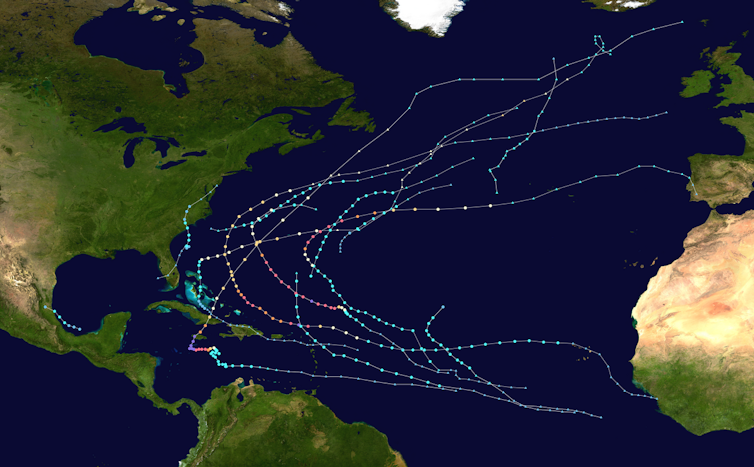
Given its west-to-east wind direction, the southward dip of the jet stream – along with a weak high pressure system over the Atlantic – helped steer all five hurricanes away from the U.S. mainland.

The 2025 Atlantic hurricane season’s storm tracks show how most of the storms steered clear of the U.S. mainland and veered off into the Atlantic.
Sandy14156/Wikimedia Commons

Most of the year’s 13 tropical storms and hurricanes veered off into the Atlantic before even reaching the Caribbean.

An animation shows the direction of steering winds over four days
Charts of high-level steering currents over five days, Oct. 23-27, 2025, show the influences that kept Hurricane Melissa (red dot) in place for several days. The strong curving winds in red are the jet stream, which would help steer Melissa northeastward toward the open Atlantic.
Cooperative Institute for Meteorological Satellite Studies/University of Wisconsin-Madison, CC BY-ND

Climate change plays a role in these shifts

So, how does climate change influence the jet stream?

The strength of jet streams is controlled by the temperature contrast between the equatorial and polar regions.

A higher temperature contrast leads to stronger jet streams. As the planet warms, the Arctic is heating up at more than twice the global average rate, and that is reducing the equator-to-pole temperature difference. As that temperature gradient weakens, jet streams lose their strength and become more prone to stalling.

A chart shows rising temperatures in the Arctic
The Arctic has been warming two times faster than the planetary average.
NOAA Arctic Report Card 2024

This increases the risk of persistent extreme rainfall events.

Weaker jet streams also meander more, producing larger waves and more erratic behavior. This increases the likelihood of unusual shifts, such as the southward swing of the jet stream in the summer of 2025.

A recent study found that amplified planetary waves in the jet streams, which can cause weather systems to stay in place for days or weeks, are occurring three times more frequently than in the 1950s.

What’s ahead?

As the global climate continues to warm, extreme weather events driven by erratic behavior of jet streams are expected to become more common. Combined with additional moisture that warmer oceans and air masses supply, these events will intensify, producing storms that are more frequent and more destructive to societies and ecosystems.

In the short term, the polar jet stream will be shaping the winter ahead. It is most powerful in winter, when it dips southward into the central and even southern U.S., driving frequent storm systems, blizzards and cold air outbreaks.

The Conversation

Shuang-Ye Wu does not work for, consult, own shares in or receive funding from any company or organization that would benefit from this article, and has disclosed no relevant affiliations beyond their academic appointment.

ref. 2025’s extreme weather had the jet stream’s fingerprints all over it, from flash floods to hurricanes – https://theconversation.com/2025s-extreme-weather-had-the-jet-streams-fingerprints-all-over-it-from-flash-floods-to-hurricanes-270641

Best way for employers to support employees with chronic mental illness is by offering flexibility

Source: The Conversation – USA (3) – By Sherry Thatcher, Regal Distinguished Professor of Management and Entrepreneurship, University of Tennessee

More than 20% of Americans will be diagnosed with mental illness in their lifetimes. They will, that is, experience conditions that influence the way they think, feel and act – and that may initially seem incompatible with the demands of work.

Our new research suggests that what people living with chronic mental illnesses need most to succeed at work is for their managers to be flexible and trust them.

This includes the freedom to adjust their schedules and workloads to make their jobs more compatible with their efforts to manage and treat their symptoms. For that to happen, managers need to trust that these workers are committed to their jobs and their employers.

We’re management professors who reviewed hundreds of blog and Reddit posts and conducted in-depth interviews with 59 people. And those are the most significant findings from our peer-reviewed study, published in the October 2025 issue of the Academy of Management Journal.

Scouring Reddit posts and conducting interviews

We gathered our data from three sources: anonymous blog posts from 171 people, Reddit posts from 781 people, and in-depth interviews with 59 workers employed in a variety of jobs across multiple industries.

All these people worked while dealing with chronic mental illness, such as major depressive disorder, generalized anxiety disorder and bipolar disorder. The blog posts were maintained by a nonprofit concerned with the experiences of individuals living with mental illness. We focused on posts tagged “work.”

To identify relevant data on Reddit, we searched using a combination of the word “work” with several terms associated with mental illness. Additionally, we restricted our data collection to unsolicited narratives published prior to mid-March 2020 to avoid overlap with the employment changes that occurred during the COVID-19 pandemic. Because this data was gathered from the internet, we couldn’t obtain details about participants’ gender, age, profession or education.

We also recruited people to interview through social media postings, advertising in a public university’s alumni listserv and contacting an organization that focuses on men’s mental health. We also made requests of those we’d already interviewed to see whether they had recommendations for other people to possibly interview.

The interviews took place in 2020 and 2021.

Speaking with people from all walks of working life

About 37% of the people we interviewed identified as women, and their average age was 41.5 years. Approximately 80% of them identified as Caucasian, 3.5% Black, 3.5% Hispanic, and less than 2% identified as either Indian, Korean American, mixed race or Middle Eastern and North African. About 3.5% chose not to answer.

They held a variety of jobs, including lawyer, professor, touring musician, consultant, teacher, real estate manager, chief technology officer, salesperson, restaurant server, travel agency manager, graphic designer, tester for manufacturing plant, chemical engineer and bus driver. Several worked in tech fields.

When the employees who we studied were trusted and given flexibility, they became better able to do their jobs while also attending to their well-being.

Employees who had lived with their condition for years used what we call “personalized disengagement and engagement strategies” to manage their symptoms. That refers to the fact that people with mental illness respond best to different coping strategies depending on their own preferences and symptoms, instead of using generic techniques they learned from self-help resources or peers.

Examples of personalized disengagement strategies ranged from leaving workspaces to meditate to taking a walk, to finding a quiet space to cry.

Engagement strategies included immersing more deeply into work and having conversations with co-workers. These coping strategies will sound familiar to most people, including those without any chronic mental health conditions. But workplaces don’t always give employees, regardless of their disability status, the flexibility and self-determination necessary to enact their strategies. In fact, a recent survey by Mind Share Partners found that nearly half of employees didn’t even feel like they could disconnect from their jobs after working hours or while on vacation.

Many employees also told us that they benefited from trust and flexibility in the period after they were diagnosed, when they needed to explore different therapies and treatment techniques.

When managers allow for flexibility, trust workers to do what they need to do to address their symptoms, and convey their compassion, employees with chronic mental illness are more likely to keep their jobs and get their work done.

Affecting most employers

Mental illnesses became more prevalent in the aftermath of COVID-19,especially among adolescents and young adults.

So, if you’re an employer, chances are that our research is relevant to your workforce.

Depression, a common mental illness, had an estimated cost of US$1 trillion annually in lost productivity in 2019, the World Health Organization has estimated.

People with anxiety and mood disorders, including bipolar disorder and major depressive disorder, may periodically have symptoms that interfere with their ability to do their jobs.

And while doing those jobs, they risk being stigmatized by co-workers who may know little about mental illness or be judgmental about people with those chronic conditions. That adds further stress beyond what others would experience at work.

Employee assistance programs could be falling short

In response, many employers offer benefits to help employees cope with mental and emotional problems, such as employee assistance programs, mental-wellness app subscriptions and stigma-reduction efforts.

These one-size-fits-all initiatives can help improve functioning for those with occasional or short-term emotional problems, and they can help improve leaders’ ability to respond to employees’ distress, which is crucial.

But as a whole, they are not enough to solve the problem.

Employee assistance programs, which nearly all big companies offer, have not proved systematically helpful to workers in achieving their goals. One study found that they reduced employees’ absences but did not reduce their work-related distress.

Another study even found that workers who used these programs became more inclined to leave their jobs.

Not missing out on peak performers

Contrary to stereotypes, people with chronic anxiety and depression, such as those we studied, are generally as capable of success in the workplace as anyone else in the right context.

Extremely high performers, such as the late actor Carrie Fisher and the Olympic swimmer Michael Phelps, are two such examples of people with a mental illness who were top achievers in their field.

If you were a manager, wouldn’t you want people of this caliber working for you? If so, then it’s important to create the right conditions, which many employers fail to do despite their best efforts.

Needing more mental health support

Companies will face increasing pressure to support those with mental illness and other mental health challenges.

Monster’s 2024 State of the Graduate Report found that Gen Z employees, people born between 1996 and 2010 and are currently in their teens and 20s, are increasingly prioritizing support for mental health at work, with 92% of 18- to 24-year-olds surveyed wanting a job where they are comfortable discussing their mental health at work.

This trend suggests that employers wishing to attract top entry-level talent will need to effectively support mental health, highlighting the importance of continuing to research this issue.

The Conversation

The authors do not work for, consult, own shares in or receive funding from any company or organization that would benefit from this article, and have disclosed no relevant affiliations beyond their academic appointment.

ref. Best way for employers to support employees with chronic mental illness is by offering flexibility – https://theconversation.com/best-way-for-employers-to-support-employees-with-chronic-mental-illness-is-by-offering-flexibility-270368

Australia se está recuperando del peor ataque terrorista sufrido en su territorio: ¿se podría haber evitado?

Source: The Conversation – (in Spanish) – By Greg Barton, Chair in Global Islamic Politics, Alfred Deakin Institute for Citizenship and Globalisation, Deakin University

Con 15 civiles y un hombre armado muertos hasta el momento, y otras 40 personas heridas, Australia se recupera del peor acto terrorista cometido en su territorio. Dos hombres armados abrieron fuego contra una comunidad judía que se había reunido para celebrar la primera noche de Hanukkah en Archer Park, en la famosa playa Bondi Beach de Sídney.

La policía ha confirmado que los dos presuntos atacantes eran padre e hijo, de 50 y 24 años. El padre, Sajid Akram, que tenía licencia para poseer seis armas de fuego, fue abatido por la policía. El hijo, Naveed Akram, permanece bajo custodia policial en el hospital.

Dado que se trataba claramente de un ataque antisemita, las autoridades lo declararon poco después como un acto de terrorismo, es decir, un acto de violencia por motivos políticos. Esta calificación también proporciona a las autoridades recursos adicionales para responder y llevar a los responsables ante la justicia.

Mientras los australianos tratan de asimilar su conmoción y su dolor, ha surgido cierta indignación en la comunidad por la falta de medidas suficientes para proteger a los judíos australianos del creciente antisemitismo evidente desde el ataque de Hamás a Israel en octubre de 2023 y la consiguiente guerra de Gaza.

Lo que sabemos sobre los presuntos atacantes

El director general de la ASIO (Organización Australiana de Inteligencia de Seguridad), Mike Burgess, ha dicho que uno de los presuntos atacantes era “conocido” por la ASIO, aunque no especificó cuál. Ser “conocido” por las autoridades puede significar simplemente que alguien ha estado asociado con redes y comunicaciones que han causado preocupación a las autoridades. La televisión pública australiana ABC ha informado de que Naveed Akram llamó la atención de las autoridades tras la detención del líder de la célula del Estado Islámico en Sídney, Isaac El Matari, en julio de 2019.

Sin embargo, hay cientos de personas que llaman la atención de las autoridades por su contacto, tanto en línea como fuera de ella, con redes e individuos extremistas. Con recursos limitados (y los recursos de las autoridades siempre serán limitados, independientemente de la financiación de que dispongan), tienen que aplicar un sistema de clasificación para evaluar la amenaza que puede suponer un individuo o un grupo, y gestionar el riesgo lo mejor que pueden.

Evalúan cuidadosamente lo que se dice y el lenguaje utilizado, por ejemplo, y comprueban si la persona tiene antecedentes de violencia. Por muy enfadada y molesta que esté la gente, como es comprensible, tras un incidente tan horrible, hay que reconocer que las autoridades no pueden simplemente detener a todo aquel que exprese ideas extremistas o tenga vínculos pasajeros con elementos extremistas.

Aún necesitamos saber más sobre este ataque terrorista y los presuntos atacantes, pero hasta la fecha no hay pruebas de que exista una red en funcionamiento. Dado que los presuntos autores eran padre e hijo, técnicamente se ajusta al perfil de un ataque “aislado”, como vimos en el asalto al Lindt Cafe de Sídney en 2014 y en Christchurch en 2019.

Es muy difícil para las autoridades predecir y, por lo tanto, prevenir los ataques de actores solitarios. Por su naturaleza, a menudo no hay señales previas de la posibilidad de violencia. Además, los lugares públicos como la reserva de Bondi Beach requieren amplios recursos para su vigilancia, lo que significa que no todos pueden estar adecuadamente protegidos.

Como señaló Burgess en su evaluación anual de amenazas, “nuestra mayor amenaza sigue siendo un actor solitario que utiliza un arma fácil de conseguir”. Lamentablemente, eso ha demostrado ser cierto.

La naturaleza cambiante de la amenaza terrorista en Australia

En los últimos años se ha prestado mucha atención al auge del extremismo y el terrorismo de extrema derecha.

Una de las mejores guías al respecto es la evaluación anual de amenazas de Burgess. En ella explica que, hace una década, solo uno de cada diez casos que seguía la ASIO estaba relacionado con extremistas de derecha, ya que la mayor parte de su atención se centraba en los grupos islamistas radicales. Sin embargo, en los últimos años, la proporción se ha acercado a una de cada dos investigaciones relacionadas con el extremismo de derecha. En otras palabras, gran parte de la atención y los recursos de la ASIO se dedican ahora necesariamente a la lucha contra ese extremismo, especialmente tras el atentado terrorista de Christchurch, en el que 51 personas fueron asesinadas a tiros por un terrorista australiano de extrema derecha durante la oración del viernes en dos mezquitas de Nueva Zelanda.

En términos más generales, el terrorismo islámico sigue siendo una amenaza mundial. El Estado Islámico y Al Qaeda continúan activos en Oriente Medio y, cada vez más, en África, así como en Asia Central y Afganistán. En general, las autoridades están haciendo un buen trabajo a la hora de controlar cualquier amenaza que estas redes puedan suponer en Australia.

No hay duda de que el ambiente general entre los grupos propalestinos y judíos se ha vuelto mucho más febril a raíz del ataque de Hamás y la guerra de Gaza. Hay mucha ira y frustración, ya que cada día se retransmiten escenas de violencia y sufrimiento, y hemos visto un aumento tanto del antisemitismo como de la islamofobia desde que comenzó la guerra, simplemente por la forma en que se desarrolla en la imaginación de la gente.

Pero incluso en las protestas que hemos visto durante muchos meses, el número de personas que podrían utilizar este sentimiento para incitar a la violencia es reducido.

Una vez más, no hay pruebas de que el tiroteo de Bondi formara parte de una red más amplia, y es muy difícil detener el ataque de un actor solitario en un lugar público.

Por otra parte, el hombre cuyo acto heroico, muy elogiado, de arrebatarle una de las armas al presunto tirador ha sido identificado como Ahmed Al-Ahmed, un musulmán de 43 años propietario de una frutería. Se espera que la valentía de este hombre, que nos mostró lo mejor de la humanidad en medio de lo peor, ponga fin a cualquier análisis simplista que culpe a la comunidad musulmana de tal violencia. Ya hemos visto esto en Estados Unidos, y Australia debe hacerlo mucho mejor.

¿Ha hecho lo suficiente el Gobierno?

Es muy difícil garantizar la seguridad total de los eventos públicos al aire libre. Los edificios son relativamente fáciles de proteger, pero un parque en la playa lo es mucho menos.

No podemos cerrar todas las lagunas ni frustrar todos los riesgos. No podemos impedir que la gente recurra a la violencia, ni podemos controlar todos los pensamientos de odio.

Es evidente que el Gobierno australiano debe hacer más para detener el terrorismo, y los eventos públicos son un objetivo obvio para destinar más esfuerzos. Pero va a costar mucho trabajo averiguar dónde podemos utilizar mejor los recursos.

The Conversation

Greg Barton es rector (director académico) de la Universidad Deakin Lancaster Indonesia (DLI). Greg recibe financiación del Consejo Australiano de Investigación. Participa en una serie de proyectos financiados por el Gobierno australiano cuyo objetivo es comprender y combatir el extremismo violento en Australia, el sudeste asiático y África.

ref. Australia se está recuperando del peor ataque terrorista sufrido en su territorio: ¿se podría haber evitado? – https://theconversation.com/australia-se-esta-recuperando-del-peor-ataque-terrorista-sufrido-en-su-territorio-se-podria-haber-evitado-272081

Il n’est pas possible de gérer un club sportif professionnel comme une entreprise : voici pourquoi !

Source: The Conversation – in French – By Patrice Bouvet, Maitre de conférences HDR en économie et management du sport, Université de Poitiers

Même si l’argent joue un rôle important dans le sport de haut niveau, la gestion d’un club sportif, ni vraiment différent ni vraiment semblable à une autre entreprise, obéit à des contraintes particulières. Les raisons ne manquent pas pour expliquer pourquoi leur management ne peut être identique.


Du fait de la professionnalisation de l’univers du sport, la gestion d’un club sportif professionnel (CSP) semble tout à fait comparable à celle d’une entreprise. En France, dans les années 1990-2000, Anny Courtade, à la fois PDG de Locasud (la centrale d’achat des magasins Leclerc dans le sud-est de la France) et du Racing Club de Cannes (volley-ball féminin) a par exemple souvent été présentée comme un brillant exemple de réussite combinée.

Au vu de cet exemple, le transfert de compétences semble assez simple : il faut s’inspirer des facteurs clés de succès existants dans le monde des affaires, en s’adaptant à l’environnement du sport. Et pourtant… Nombreux sont, à l’inverse, les chefs d’entreprise (Laurent Tapie, Laurent Platini, Peter Lim…) qui ont brillamment réussi dans leurs activités professionnelles mais qui ont échoué dans le domaine sportif. Un argument souvent avancé pour expliquer ces échecs est l’aveuglement qui serait lié à la passion conduisant à des problèmes de gouvernance. Notre vision des choses est quelque peu différente pour les sports collectifs.

Des contraintes différentes

Si le management d’un club sportif professionnel (CSP) ne peut pas emprunter les mêmes voies qu’une entreprise classique, c’est d’abord parce que ces deux types d’organisation ne se ressemblent pas autant qu’il pourrait sembler de premier abord.

Les contraintes à gérer sont très différentes, à commencer par le cadre juridique. Si, comme toutes les entreprises, les CSP peuvent choisir des statuts juridiques (SASP ou SARL sportives), ils doivent aussi créer une association sportive pour être affiliés à leur fédération de tutelle. Un lien de dépendance en résulte, notamment en cas de conflit entre l’association et la société commerciale. Cette délégation obligatoire de l’activité professionnelle leur est imposée par le Code du sport (article 2 122-1 et suivants) qui diffère du code de commerce sur de nombreux points. Les modes de régulation sont aussi différents.

Une action scrutée par les supporters

Une autre divergence cruciale concerne l’exposition médiatique : faible pour la majorité des chefs d’entreprise, elle est très forte pour les dirigeants des CSP. Cela produit des obligations très éloignées. À la différence d’un chef d’entreprise qui communique rarement auprès d’un large public mais plutôt auprès d’acteurs ciblés (collaborateurs, actionnaires, fournisseurs, clients…), les décisions, les déclarations, les réactions d’un président de CSP sont scrutées en permanence et peuvent générer de nombreuses crises (médiatiques, avec les supporters, les partenaires…).


À lire aussi :
Pernod Ricard et le PSG : quand le territoire se rappelle à l’entreprise


Par répercussion, les horizons temporels de l’action s’opposent : de très court-terme pour un président de CSP, plus lointain pour un chef d’entreprise. Ces différences influent sur leur notoriété, leur popularité, leurs relations avec les parties prenantes et donc leurs motivations. Souvent inconnues du grand public, celles-ci finissent souvent par transparaître et donc par avoir des conséquences sur la légitimité des uns et des autres. Les chefs d’entreprise tirent leur légitimité de leur efficacité économique et de la confiance inspirée aux investisseurs. Celle des présidents de CSP repose sur une combinaison beaucoup plus fragile entre légitimité institutionnelle, populaire, sportive et même souvent symbolique.

La majorité des CSP ambitionnent de maximiser leurs résultats sportifs (se maintenir dans la division dans laquelle ils évoluent, participer aux compétitions européennes) sous contrainte économique (du fait de leur budget ou des décisions des instances de régulation. Les entreprises cherchent à maximiser leurs résultats économiques en prenant en compte les contraintes réglementaires des pays où ils sont implantés.

Un rapport différent à l’incertitude

Indirectement, cela produit un rapport différent à l’incertitude. Les chefs d’entreprise mobilisent des techniques pour la limiter. Les présidents de CSP font de même dans leur gestion courante mais souhaitent la voir perdurer au niveau sportif – on parle même de la glorieuse incertitude du sport– pour maintenir l’intérêt des compétitions et donc des spectacles sportifs.

Autre différence : les marchés sur lesquels interviennent les entreprises sont le plus souvent libres et ouverts, les marchés sur lesquels évoluent les CSP sont davantage encadrés. L’existence de ces réglementations résulte en partie de la nature de la production : elle est jointe. Un CSP ne peut pas produire seul une rencontre sportive, il faut a minima deux équipes pour un match. Cela implique, obligatoirement, une forme de coopération entre les concurrents alors que les entreprises peuvent librement décider de leur stratégie.

La pression des résultats

Ces différences induisent que le management des unes et des autres ne peut pas être le même. Au niveau stratégique, la première différence, concerne la temporalité. Pour les chefs d’entreprise, l’horizon est le moyen ou long terme ; pour les présidents de CSP la saison sportive, soit plus qu’un trimestre. Dans ce domaine, la nature même de l’activité impose une gestion temporelle réactive avec de fréquents ajustements en fonction des blessures, des résultats, de l’évolution de l’effectif.

À l’inverse, dans de nombreuses entreprises, la notion de planification conserve un intérêt. Plus précisément, dans les CSP la diversification, est la seule option envisageable, la stratégie volume/coût étant hors de portée puisqu’il n’est pas possible d’augmenter de façon importante le nombre de matchs joués, ni de réduire drastiquement les coûts de fonctionnement, la majorité d’entre eux étant fixes.

En ce qui concerne le marketing et la gestion commerciale, si la majorité des entreprises définissent et choisissent un positionnement, peu de CSP le font. Les déterminants de l’image de marque diffèrent sur de nombreux points. Il en va de même des déterminants de la valeur perçue et donc indirectement de l’attractivité.

Le poids de l’histoire

Beaucoup plus que dans les entreprises, l’histoire du club joue un rôle dans la perception de la valeur de la marque par les « clients-fans », valeur difficile à apprécier. Les « expériences client » divergent également : elles sont « classiques » dans les entreprises ; dans les CSP « immersives ». Les interactions qui apparaissent entre les fans d’un club (simples spectateurs, supporters, partenaires, élus..) sont primordiales. Ces interactions n’existent quasiment pas dans les entreprises.

Du fait du caractère aléatoire de l’activité de « spectacle sportif », les CSP ont des difficultés pour obtenir d’importants concours bancaires. D’autres sources de financement doivent être recherchées. Trois se dégagent clairement :

  • la commercialisation de nombreux droits (entrés, TV, image, exposition, appellation, numériques) ;

  • l’apport en compte courant d’actionnaires ;

  • à cela s’ajoute pour le football, le trading joueurs soit la pratique consistant à vendre une partie des actifs immatériels détenus par les clubs, c’est-à-dire, certains joueurs « sous contrat ».

En dépit du recours à ces possibilités, l’équilibre budgétaire n’est pas toujours atteint en fin de saison dans les CSP. L’une des causes principales, qui distingue fondamentalement ce secteur de la majorité des autres, réside à la fois dans l’importance des coûts salariaux et dans leur caractère quasiment incompressibles.

France Travail 2024.

Des RH sous contraintes

Pour ce qui est des ressources humaines, les mutations reposent sur des principes différents. Tout d’abord en ce qui concerne l’agenda : possible à tout moment dans l’entreprise, limitées à des périodes précises (mercato) dans les CSP. Les sommes engagées diffèrent également. Dans les entreprises, elles sont plus ou moins explicitement déterminées par des « grilles », dans les CSP elles sont le fruit d’âpres négociations.

Par ailleurs, dans les premières, le plus souvent la décision est prise par l’employeur. Elle l’est fréquemment par les joueurs dans les CSP, ce qui confronte les présidents de club à un dilemme spécifique : faut-il « laisser filer » le joueur au risque d’affaiblir l’équipe ou, au contraire, faut-il le conserver dans l’effectif contre sa volonté, au risque qu’il soit moins performant ?

La question des rémunérations se pose également dans des termes distincts, les possibilités de mesure de la productivité, l’influence de la médiatisation et le rôle des agents de joueurs en étant les principales explications.

The Conversation

Patrice Bouvet ne travaille pas, ne conseille pas, ne possède pas de parts, ne reçoit pas de fonds d’une organisation qui pourrait tirer profit de cet article, et n’a déclaré aucune autre affiliation que son organisme de recherche.

ref. Il n’est pas possible de gérer un club sportif professionnel comme une entreprise : voici pourquoi ! – https://theconversation.com/il-nest-pas-possible-de-gerer-un-club-sportif-professionnel-comme-une-entreprise-voici-pourquoi-266836