La location de jouets, une nouvelle tendance pour Noël ?

Source: The Conversation – France (in French) – By Service Environnement, The Conversation France

Et si, pour Noël, on troquait l’achat de jouets contre la location ? Moins coûteuse, plus écologique, cette solution remise au goût du jour par plusieurs marques s’inspire des ludothèques. Reste une question : tous les jouets sont-ils adaptés à ce modèle ?


Et si pour Noël, vous offriez au petit dernier des jouets de location plutôt que des objets coûteux qui finissent souvent au fond d’un placard ? L’intérêt est à la fois d’ordre économique mais aussi écologique : la durée de vie des jouets est courte. Les enfants eux-mêmes expriment une préoccupation environnementale grandissante.

Dans ce contexte, les marques de jouets commencent à proposer de nouveaux services, comme la location. Mais ces entreprises très médiatisées à la faveur de cette pratique sont-elles vraiment des pionnières ?


À lire aussi :
Depuis quand offre-t-on des jouets aux enfants à Noël ?


La ludothèque, une invention ancienne

La location de jouets existe en réalité en France depuis 1968, où a ouvert la toute première ludothèque à Dijon. Une ludothèque, mot formé à partir du latin ludus « jeu » et du grec θήκη/thḗkē « lieu de dépôt », c’est un lieu qui met à la disposition de ses membres des jouets et des jeux de société en prêt. On peut aussi jouer sur place, dans des espaces dédiés, ce qui favorise les rencontres et les liens sociaux.

Des entreprises ont ainsi eu l’idée de remettre au goût du jour ce concept. Par exemple Lib&Lou, la première plateforme de location de jouets et jeux éducatifs, créée en 2019. Elle dispose d’un partenariat avec le leader du marché de location de jeux et de matériels éducatifs écoresponsable, Juratoys, entreprise jurassienne qui propose des jouets en bois de haute qualité.

Autre acteur sur le marché, Les Jouets voyageurs proposent trois formules d’abonnements, qui permettent de choisir des jouets de seconde main dans un catalogue en ligne, puis de changer tous les mois de jouets. La marque a également développé un service de rénovation des jouets usagés, autre tendance de fond depuis la loi de janvier 2023 qui impose aux magasins spécialisés dans la vente de jouets de proposer, sans condition d’achat, un service de reprise des jouets usagés

Miljo.fr, nouvel entrant sur le marché, offre également des formules d’abonnement pour ses jouets de seconde main. La marque propose des services aux structures d’accueil de la petite enfance et aux professionnels du jouet.

Une solution gagnant-gagnant

La location de jouets présente de nombreux avantages. D’un point de vue économique, elle coûte souvent moins cher que l’achat. D’un point de vue écologique, elle permet de réduire le gaspillage et les déchets car les jouets sont réutilisés. Enfin, d’un point de vue pratique, elle évite de devoir stocker des jouets encombrants lorsque les enfants grandissent. En somme, la location de jouets est une solution gagnante pour les parents, les enfants et l’environnement.

Quelques questions restent cependant en suspens : toutes les marques peuvent-elles adhérer à ce concept, par exemple pour des questions d’hygiène ? Par exemple, une poupée Corolle en location peut-elle survivre au passage des désinfectants nécessaire pour garantir une propreté irréprochable aux futurs utilisateurs ?


Cet article est la version courte de celui publié par Elodie Jouny-Rivier (ESSCA School of Management) en juillet 2024.

The Conversation

Service Environnement ne travaille pas, ne conseille pas, ne possède pas de parts, ne reçoit pas de fonds d’une organisation qui pourrait tirer profit de cet article, et n’a déclaré aucune autre affiliation que son organisme de recherche.

ref. La location de jouets, une nouvelle tendance pour Noël ? – https://theconversation.com/la-location-de-jouets-une-nouvelle-tendance-pour-noel-271967

De Ford à Tesla : ce que l’automobile nous apprend sur l’art de s’adapter

Source: The Conversation – France (in French) – By Norchene Ben Dahmane Mouelhi, Marketing, ESCE International Business School

De Ford à Tesla, l’histoire de l’industrie automobile et celle du management sont liées. PxHere, CC BY

L’automobile a longtemps été au centre des mutations de l’économie capitaliste. Ce secteur a même inventé des modes de management : du fordisme au toyotisme. Sans oublier le controversé Tesla et son dirigeant aussi connu que sujet de critiques. Mais qu’en est-il vraiment ?


Ford, Toyota, Tesla… Derrière ces marques emblématiques se cachent des modèles de gestion et de management enseignés dans les écoles de commerce. Le contexte historique de chaque modèle impose aussi de s’adapter et de se renouveler.

Le fordisme : un premier modèle critiqué

En 1913, Henry Ford propose de lancer la Ford T comme modèle unique de voiture, proposée en une seule couleur : « Le client peut avoir une voiture de la couleur qu’il veut, tant qu’elle est noire ». Il va alors mettre en place un système de travail à la chaîne inspiré des abattoirs de Chicago en proposant que ce ne soit plus l’ouvrier qui se déplace mais la voiture qui vienne à l’employé posté.

Cette idée révolutionnaire, désignée par le terme d’« organisation scientifique du travail » (OST), a permis à l’entreprise un gain sur le temps de production (en passant de 12 heures à 93 minutes) avec un prix plus abordable (de 850 dollars à 260 dollars). Un an après, en 1914, Ford propose d’augmenter les salaires des employés à 5 dollars par jour pour leur permettre d’acheter les voitures qu’ils fabriquent. La Ford T devient alors l’une des voitures les plus vendues dans le monde. Cependant, ce modèle de production, aliénant et déshumanisé, ne tarde pas à subir des critiques, immortalisées par Charlie Chaplin en 1936 dans son film les Temps Modernes.


À lire aussi :
Tesla en route pour les profits : mirage ou réalité ?


Et General Motors inventa le contrôle de gestion

Face à l’uniformisation excessive promue par le système de Ford, Alfred Sloan, président de General Motors en 1923, propose cinq marques, allant de Chevrolet à Cadillac, et plusieurs modèles adaptés à différents segments du marché et clients. C’est lui qui inventera le contrôle de gestion : un système où chaque marque devient un « centre de profit » autonome, le siège fixant les grandes lignes et les stratégies du groupe. Pour Sloan, il est important de « centraliser grâce à la décentralisation » ou encore « décentraliser les opérations, centraliser le contrôle ». Ce modèle de management permettra à GM de rester leader de son marché pendant 77 ans.

Le Kaizen par Toyota

Dans un contexte de post-guerre en 1950 où le Japon essaye de se reconstruire, Kiichiro Toyoda et l’ingénieur Taiichi Ohno se fixent comme défi de trouver un modèle de management novateur qui pourrait détrôner le fordisme. La production massive associée à ce premier modèle d’organisation du travail est jugée inadaptée à leur petit pays. Ils décident donc de produire à la demande ce qui est commandé, sans gaspillage. Ils suggèrent alors le Kaizen, un processus d’évaluation dans lequel chaque employé peut suggérer des améliorations. Ce sont les prémices du cercle de qualité en méthode de gestion. Cette philosophie pousse les individus à se surpasser avec des petits pas et le désir permanent de l’amélioration continue.

Ce concept a été vulgarisé en 2024 par Inoxtag, un jeune youtubeur qui ne pratiquait pas de sport, qui se fixe alors le défi de se challenger et de gravir l’Everest dans un documentaire vu par plus de 43 millions de personnes.

Stellantis ou le géant aux 14 marques

L’exemple du groupe Stellantis met en lumière la difficulté de gérer différentes marques, différentes usines dans différents pays avec des cultures différentes. En 2021, PSA Fiat et Chrysler ont fusionné.

Carlos Tavares, à la tête du groupe, a choisi une approche darwinienne selon laquelle chaque marque peut se gérer seule et être rentable ou disparaître. Il fallait dans ce contexte gérer un paradoxe : partager une chaîne de valeur éclatée par pôle d’expertise et commune à toutes les marques du groupe Stellantis, tout en cherchant à différencier les marques au détriment du contrôle de la chaîne de valeur. Cette situation reflète bien la réalité du XXIe siècle où le management devient une affaire de survie des entreprises et non pas seulement de performance.

Tesla : le management disruptif controversé

Si de nombreuses entreprises ont adopté un management disruptif, Tesla a une valeur d’exemplarité dans le secteur automobile. Fondée en 2003, elle fonctionne en mode start-up, à savoir comme une entreprise technologique qui mise sur l’innovation pour s’adapter à l’évolution du marché de l’automobile. Elon Musk, son dirigeant depuis 2004, va jusqu’à livrer lui-même les voitures à certains clients privilégiés. Ceci est difficilement transposable à l’international.

Arts et métiers Alumni, 2019.

La recherche-développement est aussi au cœur du modèle de management de Tesla (Tesla dépense en R&D 5 203 euros contre 1 000 euros chez la concurrence). Certains critiquent Tesla et notamment les conditions de travail controversées, le fait par exemple que la plupart des composants de la voiture soient chinois ou la gestion financière fragile. Il est aussi à noter que la concurrence (Mercedes, Audi, BMW, Aston Martin) s’est lancée dans une véritable course de production d’automobiles électriques, notamment face à la domination des entreprises chinoises.

De quoi sera fait demain ?

De 1903 à aujourd’hui, de Ford à Tesla en passant par Toyota, GM ou Stellantis, on peut voir que tous ces exemples révèlent qu’il est possible de voir que les révolutions opérées ne sont pas brutales, il est important d’évoluer et de s’adapter.

Le management lui aussi n’est pas figé dans le temps. Chaque modèle managérial est la résultante de plusieurs paramètres en partant d’un mécanisme spécifique à un contexte, un pays, une période, une culture.

The Conversation

Les auteurs ne travaillent pas, ne conseillent pas, ne possèdent pas de parts, ne reçoivent pas de fonds d’une organisation qui pourrait tirer profit de cet article, et n’ont déclaré aucune autre affiliation que leur organisme de recherche.

ref. De Ford à Tesla : ce que l’automobile nous apprend sur l’art de s’adapter – https://theconversation.com/de-ford-a-tesla-ce-que-lautomobile-nous-apprend-sur-lart-de-sadapter-270303

Comment pictogrammes et émojis traitent la question du genre

Source: The Conversation – France in French (3) – By Jonathan Groff, Docteur en psychologie, Université de Technologie de Troyes (UTT)

Les pictogrammes fabriquent du masculin par défaut, mais pas les émojis : pourquoi ? Daiki Sato/Unsplash, CC BY

Pensés pour être universels, les pictogrammes racontent une histoire moins neutre qu’il n’y paraît. Au fil des normes et des usages, la figure de l’homme s’est silencieusement imposée. Comment cette évidence graphique s’est-elle construite ? Du côté des émojis, une sous-catégorie du système iconique, la situation est moins androcentrique – et ce n’est pas seulement parce qu’ils sont apparus plus récemment. Comment s’en inspirer pour rendre les pictogrammes plus représentatifs de l’ensemble de la société ?


Ils recouvrent nos écrans, ponctuent nos correspondances et investissent l’espace public : les pictogrammes. Conçus pour exprimer des concepts simples, immédiatement déchiffrables, ils sont utilisés dans le but de « communiquer des informations nécessaires indépendamment de toute langue ». Pour autant ils ne sont pas neutres. Ils peuvent être les vecteurs d’androcentrisme graphique. L’androcentrisme désigne une propension à considérer « l’humain » ou « le générique » par le prisme exclusif du masculin.

Cette forme de stéréotype de genre appliqué aux pictogrammes apparaît dans la littérature scientifique, tout particulièrement dans les recherches des trente dernières années. Cette période correspond à une époque d’intensification des échanges internationaux qui s’est traduite par une circulation accrue de normes visuelles. D’autre part, elle coïncide avec une phase de démocratisation des outils informatiques qui a entraîné une multiplication des pictogrammes.

Les transports publics les exploitent, notamment pour communiquer des informations intelligibles rapidement. C’est justement à l’occasion de travaux menés dans la filière ferroviaire et destinés à évaluer la compréhension de messages pictographiques que j’ai supposé l’existence de stéréotypes dans ce milieu. Pour comprendre comment se diffusent ces biais, il était cependant nécessaire d’élargir le champ d’étude à un domaine mieux documenté : le genre.

Mon analyse porte sur les environnements où les pictogrammes sont les plus nombreux, les plus exposés et les plus fréquemment utilisés – les hôpitaux et la signalisation routière (l’un des premiers secteurs à avoir fait l’objet d’une normalisation et dont les codes tiennent toujours lieu de modèles en matière de signalétique).

Ces pictogrammes qui nous guident… et perpétuent des stéréotypes

Les transports, terrain propice à l’iconographie, n’ont pas échappé à la diffusion de stéréotypes de genre, aujourd’hui encore ancrés dans les standards. Une étude récente portant sur 227 pictogrammes routiers provenant de plusieurs pays a ainsi mis en évidence une prédominance de figures masculines sur les profils féminins et neutres.

Comme je l’avais observé dans le monde ferroviaire, ce déséquilibre varie selon le type de panneaux. Ceux qui évoquent des passages d’enfants, comptent davantage d’images féminines, comparés aux passages piétons ou travaux, qui représentent quasi exclusivement des hommes. Lorsqu’il apparaît, le féminin se limite généralement à des icônes de fillette accompagnée. Un seul (sur 227) la montre indépendante.

Exemples de piétons traversant la rue
Exemples de piétons traversant la rue.
Motel, Peck, 2018, CC BY

Point de référence, le système de signalisation routière voit ses biais reproduits dans d’autres univers visuels. Dans les espaces publics, par exemple les aéroports, cette tendance se confirme avec une nuance. Les femmes ne sont pas totalement absentes mais semblent confinées à des fonctions d’assistance (ex. prendre soin d’un bébé). Dès qu’elles sont associées à un ou plusieurs hommes, elles sont renvoyées au second plan (ou matérialisées dans des proportions plus réduites).

Cette récurrence invite à interroger les mécanismes mêmes de production des pictogrammes et plus précisément les banques d’illustrations mises à disposition par les organismes de normalisation. Dans beaucoup d’entre elles, les femmes sont peu présentes ou cantonnées à des rôles subalternes. Par exemple, la norme ISO 7010, qui régit la conception des symboles de sécurité, fait principalement appel à des figures masculines.

Il en est de même dans le secteur du handicap, où les icônes sont majoritairement composées d’hommes (ex. 89 % sur un échantillon de 40, dont 28 personnages) alors que les femmes constituent 56 % des personnes en situation de handicap âgées de 16 ans ou plus et vivant à domicile.

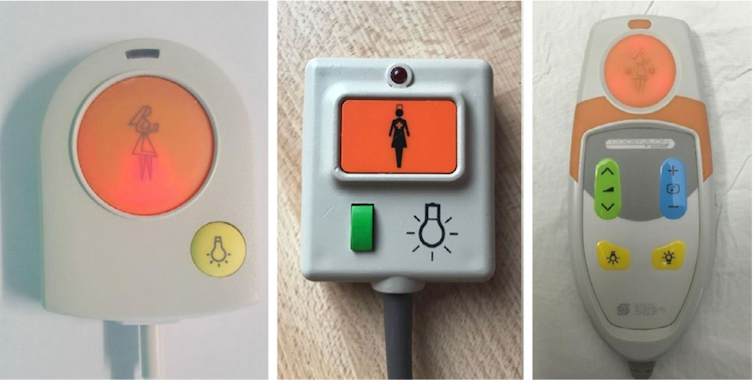
Au-delà des lieux publics, les tableaux de bord électroniques (ex. grues, machines de production, hôpitaux) ont largement participé à la propagation des stéréotypes de genre dans la pictographie. Le domaine médical en est un exemple. Des symboles sont couramment employés pour désigner l’activation de commandes, chez les professionnels (ex. moniteurs de signes vitaux) comme chez les patients (ex. télécommandes de chevet).

Dans une étude menée en 2019 et couvrant 8 pays, 56 appareils d’appel de soignants ont été comparés. Parmi eux, 37 recouraient à des figures féminines pour illustrer le concept d’assistance. Neuf étaient neutres et dix sans illustration. Une telle distribution suggère une association automatique entre la femme et la notion d’assistance, et par extension une orientation genrée du processus de codage iconographique.

Dispositifs de demande d’assistance en milieu médical
Dispositifs de demande d’assistance en milieu médical.
Chapman & al., 2019, CC BY

Les émojis : un modèle de gouvernance distinct

Le numérique n’échappe pas à cette logique même si des progrès sont notables.

Ainsi, dans une étude menée en 1997 et portant sur 14 000 cliparts (représentations simplifiées d’un concept, d’un objet, d’une personne, d’une situation) les femmes ne constituaient que 4 % des items, souvent secrétaires ou infirmières.

Si les améliorations restent globalement limitées, des transformations positives se dessinent dans une autre branche proche des pictogrammes, plus populaire : les émojis.

En 2016, le consortium Unicode, chargé de normaliser l’encodage du texte et des symboles, a entrepris une révision de son système en faveur de la diversité. Onze nouveaux émojis décrivant des femmes en activité (ex. programmeuses, scientifiques) sont venus s’ajouter à la féminisation de 33 items existants (ex. espionnes, surfeuses). Des sociétés comme Google ont introduit des figures féminines dans des rôles valorisés (ex. scientifique, médecin).

Des emojis représentant des femmes dans des métiers valorisés.
Unicode

Ces trajectoires distinctes entre pictogrammes et émojis pourraient en partie s’expliquer par leurs modèles de gouvernance. Du côté des pictogrammes, celui-ci est dispersé : certaines normes sectorielles (ISO, par exemple) coexistent avec de vastes banques de symboles libres (notamment Noun Project), sans qu’aucune instance unique ne fixe définitivement les usages. Du côté des émojis, il est plus centralisé. Une forme de standardisation est assurée par le Consortium Unicode, une organisation soutenue par des entreprises technologiques (dont Google), qui reconnaissent son autorité et contribuent ainsi à renforcer son rôle dans l’uniformisation des caractères numériques.

En clair, les émojis suivraient un processus formalisé de propositions et de standardisation qui rend possible l’introduction de modificateurs (ex. genre). À l’inverse, la construction des pictogrammes, en particulier dans le monde logiciel, serait atomisée entre une multitude de systèmes graphiques qui ne bénéficient d’aucun effort collectif comparable.

Et après ? Rendre les pictogrammes réellement universels

Les démarches entreprises dans le contexte des émojis laissent entrevoir plusieurs axes d’amélioration pour les pictogrammes. Ainsi, une approche de création empirique et standardisée serait susceptible de limiter les effets de l’androcentrisme graphique.

Empirique d’abord : s’appuyer sur des méthodes et outils scientifiques permettrait de mesurer de manière quantitative l’ampleur des biais et d’estimer leur impact sur le public dans le but de définir des lignes directrices respectueuses de l’égalité.

Standardisée ensuite : en combinant les recommandations d’organisations reconnues (ex. Unicode), les travaux d’instituts de normalisation (ex. ISO) et les initiatives individuelles (ex : designers indépendants), la diversité des représentations se trouveraient renforcées.

En tant que signe visuel simple, intelligible de tous et omniprésent, le pictogramme contribue à propager une certaine forme d’androcentrisme. De fait, pour s’assurer qu’elle réponde à sa promesse d’universalité et éviter qu’elle ne véhicule des stéréotypes, la communication pictographique implique un questionnement du prisme masculin « par défaut ». Cette étape suppose l’établissement concerté de nouveaux référentiels, couplé à une évaluation continue des normes de conception.

The Conversation

Jonathan Groff ne travaille pas, ne conseille pas, ne possède pas de parts, ne reçoit pas de fonds d’une organisation qui pourrait tirer profit de cet article, et n’a déclaré aucune autre affiliation que son organisme de recherche.

ref. Comment pictogrammes et émojis traitent la question du genre – https://theconversation.com/comment-pictogrammes-et-emojis-traitent-la-question-du-genre-268928

More dialogue, less debate: At an ‘Ethics Bowl,’ students learn to handle tough conversations

Source: The Conversation – Canada – By Rackeb Tesfaye, Knowledge Mobilization Lead and Senior Scientist at the Bridge Research Consortium, Simon Fraser University

As Canadian federal election candidates prepared for their final debate in April 2025, youth across the country were preparing for collaborative conversations around timely and potentially divisive issues for the National Ethics Bowl at the Canadian Museum of Human Rights in Winnipeg.

Ethics Bowl Canada is a non-profit organization that hosts competitions where high school and university students explore complex ethical issues through respectful dialogue in teams.

Rather than trying to undermine their opponents’ arguments, as in traditional debates, Ethics Bowl competitors win by engaging constructively, responding positively to reasonable criticism and refining or amending their views.

Polarization and engaging with disagreement

The Public Policy Forum’s 2023 report Far and Widening: The Rise of Polarization in Canada documented serious issues around how young people think about their futures. It highlighted that, among young people’s concerns like pandemics, climate emergencies and a declining economy, their deepest fear for Canada’s future is growing political and ideological polarization.

The erosion of trust in institutions like government, industry and media contributes to people seeking alternative sources of information.

Alternative sources sometimes contribute to healthy social empowerment and democratic participation. But we are also living with cascading misinformation — sometimes sewn by groups seeking to destabilize society — with harmful effects. Through algorithmic filtering we’ve seen a growth of ideological echo chambers.

Philosophers like John Stuart Mill, John Rawls and Seyla Benhabib have long proposed that engaging with diverse and sometimes contrary points of view is part of what legitimizes democracy.

Conflict and disagreement are healthy parts of a democracy. But these need to be engaged with productively.

How the Ethics Bowl works

The Ethics Bowl is a “gamified” way of engaging in deliberative dialogue about civic issues. More than 1,500 high school and university students now participate in Ethics Bowls each year.

Ethics Bowl teams conduct research on cases created by philosophers and subject matter experts, and then form their opinions and arguments on them. Teams of three to five students then participate first in regional competitions, where they present their arguments, listen to other arguments, provide comments and respond to feedback.

A panel of judges (including philosophers, subject matter experts and community members) scores the teams. Their rubric rewards acknowledging nuance, refining positions and being respectful. Regional winners then compete nationally.

Evidence shows thinking and talking about ethics alone can be a driver for social change. The Ethics Bowl is also an intervention that allows participants to develop their civic discussion skills.

Research shows that engaging in this kind of dialogue can help participants acquire civic virtues, such as tolerance, respect for diverse viewpoints and willingness to engage in conversation.

Vaccines as a timely topic

While the legitimization of anti-vaccine rhetoric continues in the United States, Canada is not immune to divisiveness around vaccines.

Since the pandemic, Canada has seen a rise in vaccine hesitancy, a resurgence of measles and a shift in COVID-19 vaccine accessibility.

Among young people in Canada, vaccination is now one of the most polarizing topics of discussion.

To support young people reflecting upon ethical tensions around vaccines, Ethics Bowl Canada partnered with the Bridge Research Consortium (BRC), a national consortium of social scientists and humanity scholars. BRC scholars have a broad range of expertise to support public trust and equitable access to new vaccines.

Vaccine case studies

BRC Bioethicists developed timely case studies for the National Ethics Bowl:

Participants in the National Ethics Bowl found these cases the most challenging in the competition. One participant said:

“Public health is not something we often think about.”

A graphic illustration visually captured the many themes and reflections emerging from six teams discussions, and a version with links to the case studies is available on the Ethics Bowl website.

Engaging in civil dialogues is a transformative experience for students. As one teacher explained:

“These discussions matter. This type of dialogue has the power to change individuals.”

They also contribute to a sense of belonging. One high school student shared:

“Being around people who care about real world issues feels good.”

An educational model to train scientists

Scientists have also been caught in the crosshairs of political partisanship on vaccines. Despite a decline of trust in many institutions, scientists are still trusted sources of information by the public globally.

As evidenced by the COVID-19 pandemic, confidence in and the adoption of immune-based innovations moves at the speed of trust. Yet, rather than a loss of trust, scientists are losing influence to other information sources.

The need for scientists to strengthen trust and resonate with the public among the sea of other voices was addressed by a second mini Ethics Bowl with science graduate students in Montréal in June 2025. Before the event, 86 per cent of the science graduate students indicated they rarely or sometimes discussed the ethical implications of their work.

Student participants were part of RAMP-UP, a Québec-based research initiative developing reliable, scalable and adaptable biomanufacturing processes to produce vaccines and immunotherapies ahead of a future health emergency.

This mini ethics bowl was a teaching and learning tool to support students’ deeper engagement with the moral and ethical implications of their work, and to instil more socially informed science engagement.

Science researchers deliberate ethical concepts

As part of the full day of the mini Ethics Bowl training, students were introduced to ethical and philosophical concepts and engaged with experts in multiple disciplines. They competed in an Ethics Bowl with their peers discussing the above described vaccine-related case studies.

As captured in an illustration of events, not only did students feel stimulated and learn new knowledge, they came away calling for more integration of the social sciences and humanities in their education.

They also reflected on other ethical tensions in their work — like pharmaceutical companies profiting from their research.

We recommend this novel model of learning be introduced into curricula for scientists working on polarizing topics like immunology.

How to engage in productive dialogue

From election periods to holiday dinners with family, here is a blueprint for how people can collectively engage in productive dialogues:

1. Disagreement isn’t a failure: Instead of viewing someone disagreeing with you as having failed in some way (perhaps by being irrational), view them as an intellectual equal. Rational processes can result in more extreme (farther in content from other opinions) and radical (more strongly held) opinions. The processes that produce more extreme and radical opinions can also work on you.

2. Listen and try to understand: Be curious about, and interested in, interpreting what your conversation partner is saying with empathy. This can allow you to evaluate their points more fairly. Empathizing might allow you to better understand where others are coming from.

3. Set realistic expectations: People rarely change their minds during a conversation. But if sustained conversation focuses on practical issues, as opposed to foundational values, parties change their minds more often while reflecting between conversations.

Cem Erkli, program co-ordinator for Ethics Bowl Canada, and Pierre-Jean Alarco, knowledge mobilization officer for RAMP-UP, co-authored this story.


Immunity and Society is a new series from The Conversation Canada that presents new vaccine discoveries and immune-based innovations that are changing how we understand and protect human health. Through a partnership with the Bridge Research Consortium, these articles — written by experts in Canada at the forefront of immunology, biomanufacturing, social science and humanities — explore the latest developments and their impacts.

The Conversation

Rackeb Tesfaye receives funding from the Bridge Research Consortium (BRC), part of Canada’s Immuno-Engineering and Biomanufacturing Hub, which in turn is funded by the Canada Biomedical Research Fund, Canada Foundation for Innovation and the BC Knowledge Development Fund.

Nicolas Fillion is chair of the board of Ethics Bowl Canada.

ref. More dialogue, less debate: At an ‘Ethics Bowl,’ students learn to handle tough conversations – https://theconversation.com/more-dialogue-less-debate-at-an-ethics-bowl-students-learn-to-handle-tough-conversations-271822

En 2025, voici comment l’inflation a fragilisé la stabilité politique et sapé les fondements moraux de notre société

Source: The Conversation – in French – By Mircea Vultur, Professeur titulaire et chercheur en sociéconomie du travail et de la formation, Institut national de la recherche scientifique (INRS)

Depuis quelques années, le coût de la vie ne cesse d’augmenter. Nourriture, essence, logement : tout semble plus cher, et l’inflation dépasse les simples chiffres économiques. Elle réduit le pouvoir d’achat, brouille les signaux du marché et fragilise la confiance dans l’État, transformant une hausse des prix en véritable enjeu social et politique.

Selon la définition la plus répandue aujourd’hui, l’inflation est une hausse soutenue du niveau de prix. On la mesure par l’évolution d’un indice du prix à la consommation (IPC), calculé à partir des prix de marché d’un certain nombre de biens de consommation censés être représentatifs des habitudes de consommation de la population.

Au Canada, l’inflation est restée modérée jusqu’au début des années 2020. La pandémie de Covid-19 l’a fait chuter temporairement, avant un rebond marqué en 2021‑2022, atteignant son plus haut niveau depuis 40 ans. Depuis, elle redescend progressivement, mais reste au-dessus de la moyenne observée avant la crise, autour de 2,4 % en septembre 2025, selon Statistique Canada.

Après deux décennies de stabilité autour de 2 %, le choc inflationniste de 2021‑2023, et les risques qui subsistent, ne se limitent pas à un phénomène économique : l’inflation devient une véritable pathologie sociale, puisqu’elle affecte directement la société. Son caractère destructeur dépasse la simple hausse des prix : elle réduit le pouvoir d’achat, influence les comportements d’épargne, modifie les stratégies d’investissement et façonne la perception que les citoyens ont de l’État et des institutions financières.

À cet égard, l’inflation agit comme un révélateur. Lorsque les prix s’emballent, les fragilités économiques, institutionnelles et psychologiques d’une société apparaissent au grand jour. Ainsi, la hausse du prix du logement a transformé une donnée économique en source de stress, de renoncements et parfois d’instabilité sociale. On le voit aussi lorsque les consommateurs se précipitent pour acheter avant une nouvelle hausse de prix. Ces comportements collectifs, motivés par la peur, illustrent comment l’inflation trouble les repères sociaux.


À lire aussi :
L’inflation est en baisse, alors pourquoi le prix du panier d’épicerie continue-t-il d’augmenter ?


Une érosion silencieuse du contrat social

L’inflation agit comme une « taxe furtive » qui contourne le débat démocratique. Elle réduit le pouvoir d’achat de tous sans débat parlementaire ni avis officiel. Contrairement aux taxes « visibles » qui doivent être adoptées, argumentées et justifiées, l’inflation agit dans l’ombre. Une hausse généralisée des prix de 10 % réduit la valeur réelle de chaque dollar de 10 %, même pour ceux qui n’ont rien consommé. Aucun reçu, aucun document officiel ne signale cette perte. On se réveille un bon matin simplement moins riche.

L’inflation agit comme une redistribution invisible de richesses, mais de façon arbitraire. Certains en bénéficient, d’autres en pâtissent. Les emprunteurs y gagnent, car leurs dettes perdant de la valeur réelle, tandis que les épargnants prudents y perdent. Les actifs réels deviennent des refuges, tandis que les salaires fixes et les retraites non indexées s’érodent. Cette redistribution chaotique crée un sentiment d’injustice et dévalorise l’effort, l’épargne et la prudence.

Des signaux économiques brouillés

Dans une économie de marché, les prix servent de signal : ils indiquent si un bien est rare, très demandé ou coûteux à produire, et guident les décisions d’investissement. L’inflation brouille ces signaux. Par exemple, si le prix des loyers à Montréal augmente fortement, certains promoteurs pourraient croire que la demande est énorme et construire de nouveaux appartements, alors qu’en réalité, cette hausse reflète surtout la pression générale des prix et le coût croissant des matériaux.

Quand les prix ne reflètent plus la réalité de la demande, les investissements peuvent être mal orientés et les ressources gaspillées.

Par ailleurs, l’incertitude inflationniste décourage l’épargne et pousse les entreprises vers des stratégies court-termistes. Une société qui peine à se projeter dans l’avenir investit moins dans l’innovation, les infrastructures ou la formation, ce qui freine sa croissance économique et compromet son développement à long terme.

Méfiance de l’État et résurgence des tensions politiques

La monnaie repose sur un pacte implicite entre les citoyens et l’État : un dollar gagné aujourd’hui doit permettre une consommation quasi équivalente demain. Lorsque ce pacte est rompu, la confiance s’effrite et l’État apparaît de moins en moins comme l’agent des citoyens, mais plutôt comme un maître indigne de confiance.

Dans ce contexte, les épisodes d’inflation forte coïncident souvent avec des tensions politiques : mouvements de protestation, contestation de la classe politique, polarisation sociale, montée du populisme comme réponse. Au Canada, des appels de boycottage de supermarchés ont émergé face à la flambée des prix alimentaires, tandis que la crise du logement a entraîné des pressions pour imposer des gels et plafonds de loyers. En Argentine, l’inflation chronique alimente la défiance envers les institutions, provoque des alternances politiques brusques et renforce l’attrait pour les solutions populistes. Avec les prix de l’épicerie, du logement et de l’essence en tête, la frustration économique se transforme rapidement en colère politique.


À lire aussi :
Insécurité alimentaire : au-delà du prix des aliments, il faut s’attaquer aux obstacles systémiques


Le rôle central de la politique monétaire

Pour les économistes de l’école autrichienne, l’inflation provient d’une augmentation trop rapide de la quantité d’argent en circulation par rapport à la production réelle. Dans la perspective de l’École de Chicago, elle est toujours un phénomène monétaire : les gouvernements utilisent parfois l’impression de monnaie pour financer des dépenses, repoussant les problèmes économiques plutôt que de les résoudre directement.

L’économiste Milton Friedman comparait l’inflation à l’alcoolisme : les effets bénéfiques apparaissent d’abord, mais les conséquences négatives arrivent plus tard, et la tentation d’en faire trop est forte.

Déficits publics financés par création monétaire, banques centrales trop accommodantes et volonté politique d’alléger la dette sont des moteurs classiques de l’inflation. La solution ? Empêcher les gouvernements d’utiliser la création monétaire comme levier politique. La réforme de 1991 illustre ce principe : l’indépendance accrue de la Banque du Canada et un mandat clair de contrôle de l’inflation ont permis de maintenir durablement les prix à des niveaux bas et stables.

Dans cette perspective, il est essentiel de garantir l’indépendance des banques centrales pour les protéger des pressions politiques, d’imposer des limites strictes aux déficits publics et d’assurer une transparence totale de la politique monétaire. Pour les économistes « autrichiens » comme pour Friedman, la stabilité monétaire est la condition sine qua non de toute stabilité économique et sociale.

Qualifier l’inflation de « pathologie sociale » n’est pas exagéré. Elle érode la confiance, bouleverse l’équité, fausse l’allocation des ressources et fragilise la stabilité politique, sapant les fondements moraux d’une société. L’expansion monétaire qui la provoque est une fuite en avant, un culte du compromis, repoussant les problèmes vers les générations futures. Le choc récent et les tendances actuelles rappellent que même nos sociétés industrielles avancées restent vulnérables. Comprendre l’inflation et ses effets sociaux aide à en mesurer la portée et à mieux s’y préparer.

La Conversation Canada

Mircea Vultur ne travaille pas, ne conseille pas, ne possède pas de parts, ne reçoit pas de fonds d’une organisation qui pourrait tirer profit de cet article, et n’a déclaré aucune autre affiliation que son organisme de recherche.

ref. En 2025, voici comment l’inflation a fragilisé la stabilité politique et sapé les fondements moraux de notre société – https://theconversation.com/en-2025-voici-comment-linflation-a-fragilise-la-stabilite-politique-et-sape-les-fondements-moraux-de-notre-societe-271057

How can Canada become a global AI powerhouse? By investing in mathematics

Source: The Conversation – Canada – By Deanna Needell, Professor of Mathematics, UBC. Co-Director Programs, Pacific Institute for the Mathematical Sciences, University of British Columbia

This AI-generated illustration is an example of how AI is at our fingertips. But mathematics lies at the heart of AI, and investment in these mathematical foundations will help Canada become a true global AI leader. (Adobe Stock), FAL

Artificial intelligence is everywhere. In fact, each reader of this article could have multiple AI apps operating on the very device displaying this piece. The image at the top of this article is also generated by AI.

Despite this, many mechanisms governing AI behaviour remain poorly understood, even to top AI experts. This leads to an AI race built upon costly scaling, both environmentally and financially, that is also dangerously unreliable.

Progress therefore depends not on escalating this race, but on understanding the principles underpinning AI. Mathematics lies at the heart of AI and investment in these mathematical foundations is the critical key to becoming a true global AI leader.

How AI shapes daily life

AI has rapidly become part of everyday life, not only in talking home devices and fun social media generation, but also in ways so seamless that many people don’t even notice its presence.

It provides the recommendations we see when browsing online and quietly optimizes everything from transit routes to home energy use.

Critical services rely on AI because it’s used in medical diagnosis, banking fraud detection, drug discovery, criminal sentencing, governmental services and health predictions, all areas where inaccurate outputs may have devastating consequences.

Problems, issues

Despite AI’s widespread use, serious and widely documented issues continue to showcase concerns around fairness, reliability and sustainability. Biases embedded in data and models can propagate discriminatory outcomes, from facial detection methods that perform well only on light skin tones to predictive tools that systematically disadvantage underrepresented groups.


Read more:
Beyond bias: Equity, diversity and inclusion must drive AI implementation in the workplace


These failures continue to be reported and range from racist outputs of ChatGPT and other chatbots to imaging tools that misidentify Barack Obama as white and biased criminal sentencing algorithms.

At the same time, the environmental and financial costs of deploying large-scale AI systems are growing at an extremely rapid pace.

If this trajectory continues, it will not only prove environmentally unsustainable, it will also concentrate access to these powerful AI tools to a few wealthy and influential entities with access to vast capital and massive infrastructure.

Why mathematics?

To address issues with a system, whether it’s fixing a car or ensuring reliability in an AI system, it’s crucial to understand how it works. A mechanic cannot fix or even diagnose why a car isn’t operating correctly without understanding how the engine works.

The “engine” for AI is mathematics. In the 1950s, scientists used ideas from logic and probability to teach computers how to make simple decisions. As technology advanced, so did the math, and tools from optimization, linear algebra, geometry, statistics and other mathematical disciplines became the backbone of what are now modern AI systems.

These methods are certainly modelled after aspects of the human brain, but despite the nomenclature of “neural networks” and “machine learning,” these systems are essentially giant math engines that carry out vast amounts of mathematical operations with parameters that were optimized using massive amounts of data.

This means improving AI is not just about continuously building bigger computers and using more data; it’s about deepening our understanding of the complex math that governs these systems. By recognizing how fundamentally mathematical AI really is, we can improve its fairness, reliability and sustainable scalability as it becomes an even larger part of everyday life.

Canada’s path forward

So what should Canada do next? Invest in the parts of AI that turn power into dependability. That means funding the science that makes AI systems predictable, auditable and efficient, so hospitals, banks, utilities and public agencies can adopt AI with confidence.

This is not a call for bigger servers; it’s a call for better science, where mathematics is the core scientific engine.

Canada already has a national platform to advance this work: the mathematical sciences institutes the (Pacific Institute for the Mathematical Sciences, Fields Institute for Research in Mathematical Sciences, The Centre de recherches mathématiques, Atlantic Association for Research in the Mathematical Sciences, Banff International Research Station connect researchers across provinces and disciplines, convene collaborative programs and link academia with the public sector.

Together with Canada’s AI institutes (Mila, Vector, Amii) and CIFAR, this ecosystem strengthens both foundational and translational AI nationwide.

Canada’s standing in AI was built on decades of foundational research, work that preceded today’s large models and made them possible. Reinforcing that foundation would allow Canada to lead the next stage of AI development: models that are efficient rather than wasteful, transparent rather than opaque and trustworthy rather than brittle. Investing in mathematical research is not only scientifically essential, it is strategically wise and will strengthen national sovereignty.

The payoff is straightforward: AI that costs less to run, fails less often and earns more public trust. Canada can lead here, not by winning a computing power arms race, but by setting the scientific bar for how AI should work when lives, livelihoods and public resources are at stake.

The Conversation

Deanna Needell has received funding from the National Science Foundation and the Congressionally Directed Medical Research Programs (US).

Kristine Bauer receives funding from NSERC to support her research program in pure mathematics. She is affiliated with the Pacific Institute for the Mathematical Sciences.

Ozgur Yilmaz receives funding from NSERC and PIMS.

ref. How can Canada become a global AI powerhouse? By investing in mathematics – https://theconversation.com/how-can-canada-become-a-global-ai-powerhouse-by-investing-in-mathematics-271796

No, your brain doesn’t suddenly ‘fully develop’ at 25. Here’s what the neuroscience actually shows

Source: The Conversation – Canada – By Taylor Snowden, Post-Doctoral Fellow, Neuroscience, Université de Montréal

If you scroll through TikTok or Instagram long enough, you’ll inevitably stumble across the line: “Your frontal lobe isn’t fully developed yet.” It’s become neuroscience’s go-to explanation for bad decisions, like ordering an extra drink at the bar or texting an ex you swore not to.

The frontal lobe plays a central role in higher level functions like planning, decision-making and judgment.

It’s easy to find comfort in the idea that there’s a biological excuse for why we sometimes feel unstable, impulsive or like a work in progress. Life in your 20s and early 30s is unpredictable, and the idea that your brain simply isn’t done developing can be oddly reassuring.

But the idea that the brain, particularly the frontal lobe, stops developing at 25 is a pervasive misconception in psychology and neuroscience. Like many myths, the “age 25” idea is rooted in real scientific findings, but it’s an oversimplification of a much longer and more complex process.

In reality, new research suggests this development actually extends into our 30s. This new understanding changes how we view adulthood and suggests that 25 was never meant to be the finish line in the first place.


No one’s 20s and 30s look the same. You might be saving for a mortgage or just struggling to pay rent. You could be swiping dating apps, or trying to understand childcare. No matter your current challenges, our Quarter Life series has articles to share in the group chat, or just to remind you that you’re not alone.

Read more from Quarter Life:


Where did the ‘age 25’ myth come from?

The magic number stems from brain imaging studies in the late 1990s and early 2000s. In one 1999 tudy, researchers tracked brain changes through repeated scans in children and teens. They analyzed grey matter, which consists of cell bodies and can be thought of as the “thinking” component of the brain.

Researchers found that during the teenage years, grey matter goes through a process called pruning. Early in life, the brain builds an enormous number of neural connections. As we age, it gradually trims back the ones that are used less often, strengthening those that remain.

This early work highlighted that grey matter volume growth and loss is key for brain development.

In influential follow-up work led by neuroscientist Nitin Gogtay, participants as young as four had their brains scanned every two years. The researchers found that within the frontal lobe, regions mature from back to front.

More primal regions, like areas responsible for voluntary muscle movement, develop first, while more advanced regions that are important for decision-making, emotional regulation and social behaviour had not fully matured by the final brain scans around age 20.

Since the data stopped at age 20, researchers couldn’t say precisely when development finished. The age of 25 became the best estimation for the assumed endpoint, and eventually became enshrined in the cultural consciousness.

What newer research reveals

Since those early studies, neuroscience has moved on considerably. Rather than looking at individual regions in isolation, researchers now study how efficiently different parts of the brain communicate with one another.

A recent major study assessed efficiency of brain networks, essentially how the brain is wired, through white matter topology. White matter is made up of long nerve fibres that link different parts of the brain and spinal cord, allowing electrical signals to travel back and forth.

Researchers analyzed scans from more than 4,200 people from infancy to 90 years old and found several key periods of development including one from age nine to 32, which they coined the “adolescent” period.

For anyone well into adulthood, it may feel jarring to be told that your brain is still an “adolescent,” but this term really just signifies that your brain is in a stage of key changes.

Based on this study, it seems that during brain adolescence, the brain is balancing two key processes: segregation and integration. Segregation involves building neighbourhoods of related thoughts. Integration involves building highways to connect those neighbourhoods. The research suggests this construction doesn’t stabilize into an “adult” pattern until the early 30s.

The study also found that “small worldness” (a measure of network efficiency) was the largest predictor for identifying brain age in this group. Think of this like a transit system. Some routes require stops and transfers. Increasing “small worldness” is like adding express lanes. Essentially, more complex thoughts now have more efficient paths throughout the brain.

However, this construction doesn’t last forever. After around the age of 32, there is a literal turning point where these developmental trends switch directions. The brain stops prioritizing these “expressways” and shifts back to segregation to lock in the pathways our brains use most.

In other words, your teens and 20s are spent connecting the brain, and your 30s are about settling down and maintaining your most used routes.

Making the most of a brain under construction

If our brains are still under construction throughout our 20s, how do we make sure we are building the best possible structure? One answer lies in boosting neuroplasticity — the brain’s ability to rewire itself.


Read more:
What is brain plasticity and why is it so important?


While the brain remains changeable throughout life, the window from age nine to 32 represents a prime opportunity for structural growth. Research suggests there are many ways to support neuroplasticity.

High-intensity aerobic exercise, learning new languages and taking on cognitively demanding hobbies like chess can bolster your brain’s neuroplastic abilities, while things like chronic stress can hinder it. If you want a high-performance brain in your 30s, it helps to challenge it in your 20s, but it’s never too late to start.

There is no magical switch that turns on at age 25, or even 32 for that matter. Like your brain, you’re in a decades-long construction project. Stop waiting for the moment you become an adult and start making active choices about how to support this project. Make mistakes, but know that the concrete hasn’t set quite yet.

The Conversation

Taylor Snowden does not work for, consult, own shares in or receive funding from any company or organisation that would benefit from this article, and has disclosed no relevant affiliations beyond their academic appointment.

ref. No, your brain doesn’t suddenly ‘fully develop’ at 25. Here’s what the neuroscience actually shows – https://theconversation.com/no-your-brain-doesnt-suddenly-fully-develop-at-25-heres-what-the-neuroscience-actually-shows-271826

¿Cómo saber que un juguete no tiene tóxicos peligrosos, como plomo, retardantes de llama o ftalatos?

Source: The Conversation – (in Spanish) – By Álvaro Carmona, Coordinador académico & docente, Universidad Loyola Andalucía

tamara govedarovic OyhnXuXu Kc unsplash Tamara Govedarovic / Unsplash. , CC BY-NC-SA

El sistema europeo Safety Gate, que vigila productos peligrosos, registró en 2024 un récord histórico: 4 137 alertas desde que existe el sistema en 2003. Los juguetes fueron la segunda categoría más problemática con 609 avisos, el 15 % del total. China apareció como origen del 40 % de todas las alertas.

Pero ojo con las interpretaciones rápidas. La mayor parte de las alertas en juguetes (39 %) no tienen que ver con química peligrosa, sino con riesgo de asfixia por piezas pequeñas. Los problemas químicos vienen después: 122 avisos por ftalatos excesivos, 68 por boro y 58 por plomo.

¿Todos los juguetes chinos son peligrosos?

¿Significa eso que todos los juguetes chinos son peligrosos? No necesariamente. Un estudio científico nigeriano analizó 30 juguetes fabricados en China y encontró que todos cumplían los límites europeos para plomo, cadmio y arsénico, sin riesgo significativo para los niños. Pero estudios en Europa encuentran otra realidad: investigaciones en mercados europeos sí detectan problemas frecuentes.

La diferencia está en el canal de distribución. Los juguetes que llegan a través de importadores serios y tiendas establecidas suelen pasar controles. El problema gordo está en las plataformas online de bajo coste. En octubre de 2024, Safety Gate retiró varios juguetes de Temu por no incluir ni siquiera las advertencias de edad obligatorias.

Metales pesados: el enemigo conocido

El plomo es probablemente el contaminante más estudiado en juguetes. La Autoridad Europea de Seguridad Alimentaria (EFSA) es tajante: no existe nivel seguro para sus efectos sobre el cerebro infantil en desarrollo. El Instituto Federal Alemán de Evaluación de Riesgos (BfR) documentó que chupar o mordisquear juguetes puede aportar hasta el 50 % de la exposición al plomo que un niño recibe por los alimentos.

Con el cadmio pasa algo parecido, pues se acumula en el organismo, daña los riñones y los juguetes pueden contribuir hasta un 20 % de la exposición total.

Ftalatos: una amenaza en los plásticos blanditos

Esos juguetes de plástico suave y flexible que tanto les gustan a los bebés suelen contener ftalatos, sustancias químicas que dan flexibilidad al plástico. El problema es que son disruptores endocrinos con capacidad de afectar al correcto funcionamiento de las hormonas.

Un análisis del laboratorio QIMA encontró que aproximadamente el 25 % de los juguetes de plástico de China no cumplían con la normativa europea. En un caso extremo, un botiquín de juguete superaba 130 veces el límite permitido.

Y hay un dato inquietante sobre España: según el proyecto europeo de biomonitorización humana DEMOCOPHES, los niños españoles tienen niveles de MEP (monoetil ftalato, un metabolito de ftalatos) seis veces superiores a la media europea.

El problema que nadie esperaba: plástico reciclado tóxico

Aquí viene lo sorprendente. Un estudio europeo de 2024 descubrió que juguetes nuevos hechos con plástico reciclado contienen retardantes de llama bromados, sustancias tóxicas que vienen de residuos electrónicos viejos. De 84 juguetes analizados en mercados europeos, 11 superaban los límites legales, con concentraciones hasta de 23,5 mg/g.

Estos compuestos están en el Convenio de Estocolmo como contaminantes persistentes ultra-peligrosos. Son disruptores endocrinos, afectan la tiroides y la neurotoxicidad. Como señalan los investigadores: “al sistema endocrino de un niño no le importa si el juguete está hecho de plástico nuevo o reciclado”.

Europa aprieta las tuercas (por fin)

En noviembre de 2024, el Parlamento Europeo aprobó nuevas normas que entrarán en vigor progresivamente. Los cambios son sustanciales e implican, para empezar, pasaportes digitales obligatorios para todos los juguetes, un punto clave para el control del comercio online.

Además, incluyen la prohibición total de disruptores endocrinos de categorías 1 y 2, la prohibición de PFAS (los “químicos eternos”), restricción de 10 tipos de bisfenoles peligrosos y límite de bisfenol A reducido un 87,5 %: de 0,04 a 0,005 mg/L.

Ojo con los juguetes antiguos

Un estudio sueco de 157 juguetes encontró que el 84 % de los antiguos superaban los límites legales actuales (frente al 30 % de los nuevos). En pelotas viejas encontraron ftalatos al 40 % del peso total: 400 veces el límite legal.

Este dato plantea un dilema: ¿es buena idea heredar o comprar juguetes de segunda mano? Para bebés que se lo llevan todo a la boca, quizá no tanto.

Qué hacer como padres

España emitió solo 22 alertas en 2024, situándose en el puesto 24 de 27 países europeos. Polonia emitió 549 y Alemania 501. O los juguetes en España son milagrosamente seguros, o no estamos vigilando lo suficiente.

Para proteger a los niños, conviene actuar sin alarmismos, pero con sentido común:

-Desconfíe del precio ridículamente bajo, especialmente en plataformas online. Un juguete que cuesta tres veces menos que la competencia probablemente se ha saltado controles.

-Para bebés y niños pequeños que se lo llevan todo a la boca: priorice marcas reconocidas y juguetes con certificación clara. El marcado CE es obligatorio, pero compruebe que no sea falso.

-Cuidado con juguetes muy antiguos para menores de 3 años. Los fabricados antes de 2009 pueden contener sustancias prohibidas hoy.

Evite plásticos negros reciclados en juguetes para bebés: los estudios los asocian con mayores niveles de retardantes de llama tóxicos.

Priorice materiales nobles: madera sin tratar, algodón orgánico, acero inoxidable.

La ciencia deja claro que hay riesgos reales, pero manejables. La mayoría de juguetes en el mercado regulado son seguros, aunque existe una minoría problemática. Europa está endureciendo las normas, lo cual es buena noticia. Hasta que los controles sean más efectivos –especialmente online–, un poco de escepticismo sano no viene mal.

The Conversation

Álvaro Carmona no recibe salario, ni ejerce labores de consultoría, ni posee acciones, ni recibe financiación de ninguna compañía u organización que pueda obtener beneficio de este artículo, y ha declarado carecer de vínculos relevantes más allá del cargo académico citado.

ref. ¿Cómo saber que un juguete no tiene tóxicos peligrosos, como plomo, retardantes de llama o ftalatos? – https://theconversation.com/como-saber-que-un-juguete-no-tiene-toxicos-peligrosos-como-plomo-retardantes-de-llama-o-ftalatos-272294

When kids move overseas: why visits are so rare for South Africa’s emigrant families

Source: The Conversation – Africa – By Sulette Ferreira, Transnational Family Specialist and Researcher, University of Johannesburg

More than one million South Africans, about 1.6% of the country’s population of 63 million, currently live overseas. Emigration is never a solitary event or a purely economic decision. When one person leaves, an entire network of relationships is reshaped. This means that parents, grandparents, siblings and friends are left behind, making it challenging to maintain close bonds across continents.

Despite vast geographical distances and the challenges of differing time zones, the enduring parent–child bond motivates families to seek meaningful ways to stay connected. Among the most powerful of these are transnational visits. For those who can travel, these visits serve as an emotional and relational lifeline: they allow parents to step into their adult children’s newly formed worlds, observe their daily routines, and build or maintain bonds with grandchildren born or raised abroad.

Although families stay connected through technology, parents emphasise that virtual contact cannot replace the desire for in-person connection. Yet this longing is often unmet. For many families, visiting is a deeply felt desire rather than a realistic possibility.

In a recent research paper I examined barriers to transnational visits from South African parents to their emigrant children. It intentionally centres on the experiences of parents travelling abroad, rather than on return visits to South Africa.

In total, 37 participants took part. They were South African citizens from a range of racial, cultural and religious backgrounds. They were between 50 and 85 years old. They were fluent in English and were parents of adult child(ren) who had emigrated and lived abroad for at least one year.

Most participants were women. Their children had emigrated to a range of countries, including Australia, New Zealand, the UK and the US. This aligns with global trends of South African emigration to English-speaking, economically developed countries.

The research uncovered the intertwined financial, emotional, physical, relational, and bureaucratic complexities that shape whether, how, and how often these visits take place.

Why visits matter

For transnational families, visits allow parents and children to revive and nurture attachments. They complement virtual interactions, video calls, instant messages and social media.

For parents, visiting their children’s homes bridges the gap between imagined spaces created through video calls and the lived realities of those environments. These experiences foster deeper emotional connections, enabling families to share closeness, engage in mutual care, and observe unspoken cues such as body language and tone, elements foundational to sustaining relationships.

Despite their importance, the rarity of transnational visits emerged clearly from participants’ narratives. While a small number of parents in the study were able to visit annually or every couple of years, this was the exception rather than the norm. For most, visits were rare events.

Although nearly all parents longed to visit more frequently, the majority had visited only once and several had never visited at all. Those who had visited spoke about long gaps between visits and the uncertainty of when or whether a next visit would ever be possible. This absence amplifies the loneliness experienced and leaves parents feeling increasingly “out of sync” with their children’s lives, at times even “irrelevant”.

Three main challenges

Parents consistently expressed a desire to visit more often. Yet this longing was constrained by the realities of their circumstances. Three major challenges emerged across the qualitative interviews.

Financial constraints: This was the most significant barrier, often preventing parents from realising their desire to visit their emigrant children. Air travel from South Africa to destinations such as Australia, New Zealand, Canada and the US is expensive. The South African rand’s weak exchange rate against strong currencies turns even modest flights into luxury purchases.

Retirees living on fixed incomes often find themselves caught between safeguarding their financial stability and meeting the deep emotional need to reconnect with their children and grandchildren.

It is terribly expensive. If I now had to, I would scratch the money out from somewhere and I can afford it, but I need to look after myself as well. Even if you have money, you don’t spend your money on something that is really absurd, like the price of air tickets at this stage is completely absurd.

Hidden expenses can also make visits even more challenging. Visa application fees, compulsory health insurance and medical examinations quickly add up.

Logistical strain: The geographical distance between South Africa and the popular emigration destinations such as Australia, the United States and New Zealand presents significant obstacles. For many elderly parents, long-haul travel is physically and mentally demanding.

As one participant shared:

The trip to America … there’s a lot of jet lag, and it’s not an easy trip to make. You know, if your kids are in Europe or England, there’s no time delay, no jet lag or anything like that.

Chronic illnesses, mobility limitations and fatigue make these journeys even more challenging. For some parents, the physical toll makes travel unmanageable or medically inadvisible.

Practical considerations, especially how long to stay, long enough to make the trip worthwhile but not too long to disrupt routines, add another layer of complexity. These decisions make planning a visit both logistically and emotionally taxing.

The emotional weight of saying goodbye: Every visit carries an inevitable ending. With no certainty about when, or if, the next visit will happen, each departure feels like a potential final farewell, especially for older parents. The joy of togetherness becomes tinged with the dread of parting, a heaviness that grows as the end of the visit approaches. For many, the farewell at the end of a visit is one of the most emotionally difficult moments.

As a grandmother describes:

And then a big factor is the sadness with the goodbye and for weeks after that you still struggle and can’t get back on track properly. For me, it gets more intense every time.

Some parents avoid visiting altogether because the emotional cost of departure outweighs the joy of being together.

Longing for presence

Many transnational parents must face the reality that limited financial, physical, or emotional resources will restrict the number of visits they can undertake in their lifetime. While digital communication helps families stay connected across borders, parents emphasised that virtual contact cannot recreate the intimacy that grows from in-person visits: the shared routines, playful moments and physical closeness.

Visits matter because they offer what digital technologies cannot fully provide: presence.

The Conversation

Sulette Ferreira does not work for, consult, own shares in or receive funding from any company or organisation that would benefit from this article, and has disclosed no relevant affiliations beyond their academic appointment.

ref. When kids move overseas: why visits are so rare for South Africa’s emigrant families – https://theconversation.com/when-kids-move-overseas-why-visits-are-so-rare-for-south-africas-emigrant-families-270509

Author Saeed Teebi writes beyond exile in his memoir of Palestine and writing in dark times

Source: The Conversation – Canada – By Fatme Abdallah, PhD Candidate, English and Writing Studies, Western University

Writer and lawyer Saeed Teebi released an Instagram video on Sept. 30, 2025, announcing the publication of his new book, You Will Not Kill Our Imagination: A Memoir of Palestine and Writing in Dark Times.

In the video, Teebi acknowledged that while his book publication day should have been a happy one, he grappled with celebrating a moment of success while accounting for and living with “everything that is going on in Palestine.”

As a researcher of Palestinian prison literature who has been tracking the intermittent hostage exchanges between Israel and Gaza during the recent ceasefire agreement, Teebi’s struggle to articulate his feelings seemed familiar.

It echoed the experiences of Palestinians released from prison who could not celebrate their newfound freedom while their homeland was still under siege.

As Teebi narrates in his book, both sets of grandparents were survivors of the 1948 Nakba when when more than 750,000 Palestinians were driven from their homes during the mass exodus that accompanied the founding of the state of Israel.

As Teebi writes, they moved on a “tour of degradation through various Arab states” before they “stumbled” to Kuwait in the 1950s, where Teebi was born and lived as a child. At age 12, the family was stranded in California during a family trip when Iraq, under Saddam Hussein, invaded Kuwait. Teebi and his family lived for a time in the United States before coming to Canada when he was a youth.

The book is Teebi’s personal and political efforts to come to terms with the failures and powers of language to narrate a Palestinian story that can stand for itself, free of the constraints that attempt to silence it.

A story ‘against narrative’

Just days before the book’s publication, a United Nations Independent International Commission of Inquiry on the Occupied Palestinian Territory officially labelled Israel’s actions a genocide after a staggering death toll in Gaza.

Teebi’s witnessing of what he calls “an unending corpse exhibition” against the world’s latent, often ineffectual responses brought him to the realization that until that point, his identity and history had been confined by the “little prisons everywhere” made from language.

For someone who describes himself as having “an abiding faith in language,” the “dark times” Teebi refers to in the title of his book were ones of reckoning: the language to name Palestinian experience broadly and mass death in Gaza had irrevocably failed to stop genocide.


Read more:
Flawed notions of objectivity are hampering Canadian newsrooms when it comes to Gaza


Teebi notes how amid the reluctance of western media and governments to use the term “genocide,” even as some genocide scholars saw evidence of this phenomenon as early as late 2023, Palestinians were forced to “haggle” over vocabulary rather than mobilizing diplomatic pressure to prevent “massacres” from happening.

In so doing, the book draws a clear analogy between Israeli practices of apartheid and related censorship of language which Teebi terms “linguistic apartheid.” This echoes Palestinian literature’s concern with resisting discourse that dispossesses Palestinians of their land-based identities.

‘Prisons of what we can and can’t say’

Teebi, like journalist Ta-Nehisi Coates, is concerned with how conventional narratives can be used to justify ethnic cleansing.

In Coates’ book The Message, which partly reports on his summer 2023 visit to the West Bank and East Jerusalem, he writes that western language about Palestine has elevated “factual complexity” over morality or justice. The end goal was “to forge a story of Palestine told solely by the colonizer.”

Teebi writes that there have been long-existing “prisons of what we can and can’t say” about Palestine that repressed any attempt to engage in historical or political debate. Some of these “prisons,” he notes, were enforced by an “abundance of caution” on the part of his late migrant father, a doctor who expressed an “obsessive drive to rebuild” after the family was displaced from Kuwait.

Such “prisons” were a response to, and buttressed by, the dominance of an Israeli-centric narrative of Israel’s founding in the West, which has made it so that every Palestinian story appears as a counternarrative that “carries the whiff of subversiveness.”

A Palestinian story must inevitably carve space against the presiding mythology of a land without people for a people without a land.

Between real and linguistic prisons

As I read the book in preparation for an interview with Teebi at a launch at Western University on Nov. 10 — where he was the 2024-25 writer-in-residence — I was struck by how deeply prison imagery shaped his memoir.

Prisons targeting Palestinians operate materially in Occupied Palestine, but often only discursively, or linguistically, in the West.

Teebi acknowledges that the former “are [much] worse prisons”, yet his book is nonetheless a response to the linguistic prisons that obscure Palestinian stories behind claims of neutrality, proportionality or legality:

“When every popular conception of you is that of someone in chains, you begin to feel the chains even if they aren’t physically there. You narrate yourself not in spite of the chains, but around them.”

Between witnessing and imagining

When Palestinian American writer Sarah Aziza wrote the article “The Work of the Witness,” now included in the anthology The Best American Essays of 2025, it had only been three months into the genocide in Gaza.

I had then been convinced of the power and necessity of witnessing.

Yet as lands and bodies in Gaza were devastated, I increasingly believed witnessing offered no solution.

I was both gratified and dismayed that Teebi seemed to agree when, in You Will Not Kill Our Imagination, he wrote that witnessing is “the hoariest of writerly clichés.”

While Teebi’s book attempts to define “the effects of the genocide on Palestinian art and imagination,” it is also a reflection of how people in exile might resist the prisons imposed by a society dominated by anti-Palestinian narratives.

For Teebi, this entails embracing the “engine” of imagination — telling a Palestinian story that refuses the confines of counter-narrative.

A Palestinian story that must be told

Most important of all, Teebi tells a personal and political narrative, unqualified and unapologetic, a testament to the defiance of a Palestinian story that insists on being told.

In a number of talks, Teebi states that he had never intended to write a memoir: being so personal imposed upon him both honesty and vulnerability. Yet the moment compelled him to challenge the societal constraints that had kept his identity in check and to affirm, openly, deliberately and imaginatively, his Palestinian identity: he had broken free from the metaphoric prisons reining in his imagination.

When I suggested this to him in our interview, he laughed, saying: “If you want to call me a prison breaker, I’ll take it.”

Task of writer-in-exile

The writer-in-exile, Teebi insists, must do more than bear witness, a task carried out more forcefully by those living through this genocide. The exile who writes owes something to the stories of their loved ones who have lived, fought for and honoured an increasingly precarious future.

And so the exile who writes must witness ethically by committing, without hesitation, to this future; the exile who writes must imagine dismantling the prisons that bind their language; the exile who writes must imagine fiercely, granting themselves unrestrained freedom to speak, act and live.

I will end with these words by Mahmoud Darwish:

“Prison deprives one of the sight of a tree and the sea. Freedom is the imagination capable of recalling them both in prison, making the invisible visible. No, that is what poetry does. Poetry, then, is an act of freedom.”

To merely witness prison, argues Teebi, is not to resist it; one must instead imagine beyond its constraints in the exercise of freedom.

That, for Teebi, is the quintessential work of the writer: to imagine a future beyond the societal and linguistic prisons that exile enforces.

The Conversation

Fatme Abdallah receives funding from Social Sciences and Humanities Research Council (SSHRC).

ref. Author Saeed Teebi writes beyond exile in his memoir of Palestine and writing in dark times – https://theconversation.com/author-saeed-teebi-writes-beyond-exile-in-his-memoir-of-palestine-and-writing-in-dark-times-270130