La quête de « l’utérus artificiel » : entre fiction et avancées de la recherche

Source: The Conversation – in French – By Allane Madanamoothoo, Associate Professor of Law, EDC Paris Business School

Et si la gestation ou, du moins, une partie du processus, pouvait être externalisée au moyen de dispositifs extra-utérins, que ce soit pour poursuivre le développement de nouveau-nés prématurés ou pour des visées plus politiques, comme lutter contre la baisse des naissances ? Une telle technologie est encore très loin d’être réalisable, mais des recherches sont bel et bien menées dans ce domaine.


En août dernier, la rumeur circulait qu’un chercheur chinois, Zhang Qifeng, fondateur de Kaiwa Technology, travaillait au développement de robots humanoïdes dotés d’utérus artificiels, capables de porter un fœtus jusqu’à dix mois. Le prototype serait presque finalisé et devrait être prêt d’ici à 2026. Prix du « robot de grossesse » : 100 000 yuans (environ 12 000 euros).

Après vérification, il s’avère que cette technique de procréation, appelée « ectogenèse », ne verra pas le jour en Chine et que les informations relayées sont fausses. Il en est de même de l’existence de Zhang Qifeng.

Toutefois, même si pour l’heure l’utérus artificiel (UA) relève de la science-fiction, la création d’un tel dispositif technique – perçu comme le prolongement des couveuses néonatales et des techniques de procréation médicalement assistée – fait l’objet de recherches dans plusieurs pays.

Des recherches sur l’animal autour de dispositifs extra-utérins

L’idée de concevoir et de faire naître un enfant complètement en dehors du corps de la femme, depuis la conception jusqu’à la naissance, n’est pas nouvelle. Le généticien John Burdon Sanderson Haldane (1892-1964), inventeur du terme « ectogenèse », l’avait imaginé en 1923.

Selon les prédictions de ce partisan de l’eugénisme, le premier bébé issu d’un UA devait naître en 1951.

Henri Atlan, spécialiste de la bioéthique et auteur de l’Utérus artificiel (2005), estimait, quant à lui, que la réalisation de l’UA pourrait intervenir d’ici le milieu ou la fin du XXIᵉ siècle.

Même si l’UA n’existe pas encore, les chercheurs ont d’ores et déjà commencé à faire des essais chez les animaux, dans l’espoir de développer par la suite des prototypes d’UA applicables à l’être humain.

En 1993, par exemple, au Japon, le professeur Yoshinori Kuwabara a conçu un incubateur contenant du liquide amniotique artificiel permettant à deux fœtus de chèvres (de 120 jours et de 128 jours, la gestation étant de cinq mois chez la chèvre, soit autour de 150 jours) de se développer hors de l’utérus pendant trois semaines. À leur naissance, ils ont survécu plus d’une semaine.

En 2017, un article publié dans Nature Communications a révélé les travaux de l’équipe d’Alan Flake, chirurgien fœtal à l’hôpital pour enfants de Philadelphie (États-Unis), qui ont permis à des fœtus d’agneaux de se développer partiellement, là encore dans un dispositif extra-utérin rempli de liquide amniotique artificiel, pendant quatre semaines. Avec un apport nutritionnel approprié, les agneaux ont connu une croissance apparemment normale, notamment au niveau du développement des poumons et du cerveau.

Côté développement embryonnaire, toujours chez l’animal, en 2021, des chercheurs chinois ont mis au point un système capable de surveiller le développement d’embryons de souris de manière entièrement automatisée, abusivement surnommé « nounou artificielle ».

L’utilisation d’animaux à des fins de recherche, bien qu’elle soit réglementée dans de nombreux pays, y compris les pays de l’Union européenne (Directive européenne 2010/63 UE) et aux États-Unis (Animal Welfare Act), soulève néanmoins des questions éthiques.

Des recherches et des avancées aussi sur l’humain

Dans le domaine de la procréation humaine, les avancées sont également considérables. Il est possible depuis 1978 – année de la naissance de Louise Brown, premier « bébé-éprouvette » du monde – de concevoir un embryon par fécondation in vitro (FIV), puis de l’implanter avec succès dans l’utérus de la mère.

En 2003, les travaux de la chercheuse américaine Helen Hung Ching Liu ont démontré la possibilité d’implanter des embryons dans une cavité biodégradable en forme d’utérus humain et recouverte de cellules endométriales. Faute d’autorisation légale, les embryons, qui se développaient normalement, ont été détruits au bout de six jours.

En 2016, un article publié dans Nature Cell Biology a également révélé que le développement embryonnaire pouvait se poursuivre en laboratoire, grâce à un système in vitro.

Le défi pour les chercheurs consiste à combler la période qui suit les 14 premiers jours de l’embryon conçu par FIV – période qui correspond à un seuil critique car elle comprend des étapes clés du développement de l’embryon.

À ce jour, de nombreux pays ont défini une limite de quatorze jours à ne pas dépasser pour le développement embryonnaire in vitro à des fins de recherche ou pour la fécondation, soit sous la forme de recommandations, soit par l’intermédiaire d’une loi, comme c’est le cas en France.

Dans le futur, un risque de détournement des finalités initiales ?

Les recherches actuelles sur le développement de l’UA « partiel » dans lequel l’enfant serait placé dans un dispositif extra-utérin rempli de liquide de synthèse sont motivées par des raisons thérapeutiques, notamment la réduction de la mortalité des nouveau-nés prématurés.

Toutefois, l’UA « total » qui permettrait une gestation extra-corporelle, de la fécondation à la naissance, pourrait se déployer pour répondre à d’autres objectifs. Il s’agit naturellement d’un exercice de prospective, mais voici certains développements qui semblent envisageables si l’UA « total » venait à être développé et à devenir largement accessible.

Certaines femmes pourraient y avoir recours pour des raisons personnelles. Henri Atlan en avait déjà prédit la banalisation :

« Très vite se développera une demande de la part de femmes désireuses de procréer tout en s’épargnant les contraintes d’une grossesse […] Dès qu’il sera possible de procréer en évitant une grossesse, au nom de quoi s’opposera-t-on à la revendication de femmes pouvant choisir ce mode de gestation ? »

Dans une société capitaliste, certaines entreprises pourraient encourager la « culture des naissances » extra-corporelles afin d’éviter les absences liées à la grossesse humaine. Une discrimination pourrait alors s’opérer entre les salariées préférant une grossesse naturelle et celles préférant recourir à l’UA dans le cadre de leur projet de maternité. Dans un contexte concurrentiel, d’autres entreprises pourraient financer l’UA. Rappelons à cet égard que, aux États-Unis, plusieurs grandes entreprises (Google, Apple, Facebook, etc.) couvrent déjà le coût de la FIV et/ou de la congélation des ovocytes afin d’attirer les « meilleurs profils », bien qu’aucune de ces pratiques ne constitue une « assurance-bébé ». Plusieurs cycles de FIV peuvent en effet être nécessaires avant de tomber enceinte.

L’UA pourrait être utilisé afin de pallier l’interdiction de la gestation pour autrui (GPA) en vigueur dans de nombreux États, ou être préféré à la GPA afin d’éviter les situations où la mère porteuse, après s’être attachée à l’enfant qu’elle portait, refuse de le remettre aux parents d’intention, ou encore pour une question de coût.

L’industrie de la fertilité pourrait développer ce qui serait un nouveau marché
– celui de l’UA –, parallèlement à ceux de la FIV, du sperme, des ovocytes et de la GPA, déjà existants. Nous aboutirions alors à une fabrication industrielle de l’humain, ce qui modifierait profondément l’humanité.

Indéniablement, l’UA pourrait mener à la revendication d’un droit à un designer baby (bébé à la carte ou bébé sur mesure) sous le prisme d’un eugénisme privé. Avec un corps pleinement visible et contrôlable dans l’UA, les parents pourraient exiger un « contrôle de qualité » sur l’enfant durant toute la durée de la gestation artificielle.

Aux États-Unis, plusieurs cliniques de fertilité proposent déjà aux futurs parents de choisir le sexe et la couleur des yeux de leur enfant conçu par FIV, option couplée à un diagnostic préimplantatoire (DPI). D’autres, telles que Genomic Prediction, offrent la possibilité de sélectionner le « meilleur embryon » après un test polygénique, avant son implantation dans l’utérus de la mère. La naissance de bébés génétiquement modifiés est aussi possible depuis celles de Lulu et de Nana en Chine, en 2018, malgré l’interdiction de cette pratique.

Dernier élément de cet exercice de prospective : l’UA pourrait être utilisé à des fins politiques. Certains pays pourraient mener un contrôle biomédical des naissances afin d’aboutir à un eugénisme d’État. D’autres États pourraient tirer avantage de l’UA pour faire face au déclin de la natalité.

Qu’en pensent les féministes ?

En envisageant la séparation de l’ensemble du processus de la procréation – de la conception à la naissance – du corps humain, l’UA suscite des débats au sein du mouvement féministe.

Parmi les féministes favorables à l’UA, Shulamith Firestone (1945-2012), dans son livre The Dialectic of Sex : The Case for Feminist Revolution (1970), soutenait que l’UA libérerait les femmes des contraintes de la grossesse et de l’accouchement. Plaidant contre la sacralisation de la maternité et de l’accouchement, elle estime que l’UA permettrait également aux femmes de ne plus être réduites à leur fonction biologique et de vivre pleinement leur individualité. Cette thèse est partagée par Anna Smajdor et Kathryn Mackay.

Evie Kendel, de son côté, juge que, si l’UA venait à devenir réalité, l’État devrait le prendre en charge, au nom de l’égalité des chances entre les femmes.

Chez les féministes opposées à l’UA, Rosemarie Tong considère qu’il pourrait conduire à « une marchandisation du processus entier de la grossesse » et à la « chosification » de l’enfant. Au sujet des enfants qui naîtraient de l’UA, elle affirme :

« Ils seront de simples créatures du présent et des projections dans l’avenir, sans connexions signifiantes avec le passé. C’est là une voie funeste et sans issue. […] Dernière étape vers la création de corps posthumains ? »

Tous ces débats sont aujourd’hui théoriques, mais le resteront-ils encore longtemps ? Et quand bien même l’UA deviendrait un jour réalisable, tout ce qui est techniquement possible est-il pour autant souhaitable ? Comme le souligne Sylvie Martin, autrice du Désenfantement du monde. Utérus artificiel et effacement du corps maternel (2012), tous les êtres humains naissent d’un corps féminin. Dès lors, en cas d’avènement de l’UA, pourrions-nous encore parler « d’être humain » ?

The Conversation

Allane Madanamoothoo ne travaille pas, ne conseille pas, ne possède pas de parts, ne reçoit pas de fonds d’une organisation qui pourrait tirer profit de cet article, et n’a déclaré aucune autre affiliation que son organisme de recherche.

ref. La quête de « l’utérus artificiel » : entre fiction et avancées de la recherche – https://theconversation.com/la-quete-de-luterus-artificiel-entre-fiction-et-avancees-de-la-recherche-266023

Darker Shade of Pale: why I wrote a book about my grandfather and how it changed my view of him

Source: The Conversation – Africa – By Leslie Swartz, Professor, Stellenbosch University

Deborah Posel, the founding director of the Wits Institute for Social and Economic Research, an interdisciplinary research institute in the humanities and social sciences in South Africa, has published a new book, Darker Shade of Pale: Shtetl to Colony. Using a combination of personal memoir and historical inquiry, it retraces the early 20th century migration of Jewish people from the Russian Empire to colonial South Africa through one man’s life.

The book uncovers the hidden story of global migration at the turn of the 20th century from the Jewish territories of the Russian Empire, The Pale of Settlement, to the British colony of South Africa. It follows the author’s grandfather, Maurice Posel, whose struggles and disappointments mirror those of countless others, using the intimacy of a single story to illuminate a much broader set of issues.

Leslie Swartz, a psychology scholar and the editor-in-chief of the South African Journal of Science, talks to Posel about the book.


Leslie Swartz: A key feature for me is the vibrance and joy with which the book, though often dealing with painful issues, is written. I was interested to know how you came to write the book.

Deborah Posel: I had been working for years on a book – entitled Racial Material – on the politics of race and consumption. I had tons of material for the book, and I had absolutely loved researching it, including spending a year in the British Library. During that year, I was not looking for material on Jews, but Jews and Jewish issues kept crossing my page. I took note, but moved on.

I got back to South Africa, intending to write this hefty book. I began as did the COVID-19 lockdown. I started writing the first chapter of Racial Material as all our lives changed – in theory, an entirely free and unfettered time to write, but it was an unexpectedly joyless process.

At that moment, the conventions of academic writing were entirely alienating: nailing everything down in copious detail, reading all the available literature to find out what every single person had said about something in order to be able to make an argument, making sure that I had painstakingly chased after everything that could possibly be relevant, and very cautiously claiming only what this accumulation of evidence would tolerate. No doubt not every academic writes like that, but my academic writing is risk averse. I can and do make bold claims but only on the strength of this kind of effort.

Leslie Swartz: Which, may I say, distinguishes you from many social scientists in South Africa. This is part of why I love your work.

Deborah Posel: The other thing that I do when I write academically is that I make an argument – that’s at the core of academic writing, in my mind – and I sustain an argument that ties everything tightly together.

So I hauled myself through the first chapter but couldn’t face doing it again for the second one. I then decided to embrace the spirit of lockdown: do whatever you feel like doing, these are not normal times; here is an interregnum, so break out, cut loose. That’s when and how I started writing the Darker Shade of Pale book, having no clue where I was going, having no plan, no structure – a 180 degrees different approach from the way I would tackle academic writing.

The second big change for me was I wanted to write in a much more fluid way, more lyrically, more speculatively, more imaginatively, in ways that I thought would be inappropriate in academic writing. I started exploring literary devices that I probably would not use if I was writing what I would call an academic book.

Locked down and locked in, I broke out of my old way of writing. It was joyful. But it was also difficult, with new challenges. I now had two voices: as an historian, but also as a granddaughter. Initially I wasn’t sure how to speak in unison. Also, I had so little material about my grandfather’s life that I would call evidence – no letters, no diaries, very few people alive who could remember him, few photos. I decided early on that I didn’t want to fictionalise and make things up.

I wanted to create a narrative, however patchy and porous, that I knew to be reasonably accurate. That gave me my space. In fact, it required me to produce a story with gaps and shadows. Which is very explicit in the text. I make it clear that I’m giving my take on the possibilities that presented themselves to me.

I tried as far as possible to substantiate them, but I gave myself much more freedom to interpret and imagine. And along with that, writing about my grandfather‘s life became more emotional for me than would have been appropriate in an academic text. In this book, my feelings, though not the central concern, were current and live.

Leslie Swartz: I am glad that you “cut loose”. I view Darker Shade of Pale first and foremost as a cracking good read – a book I have earmarked to give to family members who are not academics but who are interested in migration, families, racial politics, marginalisation. For me it is also scholarly, painstakingly researched, important for any scholar of race and racialisation to read as well. In what way do you think it offers an understanding specifically of Jewish issues?

Deborah Posel: When I started writing this book I was so ignorant about Jewish history. I often asked myself: why, as a Jewish scholar of South Africa, had I paid absolutely no attention to Jews? Why had my intellectual peers also not done so? I had never considered questions about how you write Jews into South African history.

So I had a steep learning curve too, reading as much as I could find, and spending lots of time in South African archives, to produce a social history intertwined with my grandfather’s story. I tried to make sense of him, and his individual Jewishness, as made and unmade by his wider society.

It started with life in the shtetl (the name for a small town with a predominantly Jewish population in eastern Europe). I deliberately started there because most migration stories start when people get off the ship, as day one of the new life. But what did they come with? What was the headspace? What were the psyches that landed, and how well equipped or not were they psychologically to cope?

And I must say that I found the world of the shtetl staggeringly unexpected. Even the smallest shtetl was status-obsessed; failure was deeply shameful, even there.

The people who hadn’t made it in the shtetl were among those who left and tried to start new lives, another chance to make something of themselves. My great-grandfather was one of them, and he failed again. A shameful trajectory. It gave me an entirely different perspective on my grandfather, and his ill-fated son, unlikely, given his life in the shtetl, to realise the hopes and ambitions of his emigration. I had judged him all too readily and ignorantly. I started to feel sorry for him, which no doubt seeped into the writing.

Leslie: For me, the emotions have seeped into the writing and that is why this book is so good – disciplined and emotional at the same time. And an important read, I think, in world, Jewish and South African history.

The Conversation

The authors do not work for, consult, own shares in or receive funding from any company or organisation that would benefit from this article, and have disclosed no relevant affiliations beyond their academic appointment.

ref. Darker Shade of Pale: why I wrote a book about my grandfather and how it changed my view of him – https://theconversation.com/darker-shade-of-pale-why-i-wrote-a-book-about-my-grandfather-and-how-it-changed-my-view-of-him-268582

Comment la gestion de la dette publique appauvrit l’État au profit du secteur privé

Source: The Conversation – France (in French) – By Jérôme Baray, Professeur des universités en sciences de gestion, Le Mans Université

La croissance de la dette publique fait l’objet de toutes les attentions. Toutefois, si tel est le cas, c’est en raison des choix qui ont été faits pour l’assumer. Recourir aux marchés financiers n’est pas neutre. Et si la solution passait par une définanciarisation de la gestion de la dette.


« L’État vit au-dessus de ses moyens. » La phrase est si souvent répétée qu’elle n’est plus questionnée. De moins de 20 % du produit intérieur brut (PIB) dans les années 1970, la dette atteint aujourd’hui environ 110 %. Au-delà de ces chiffres, de nombreux travaux critiques, de Thomas Piketty à Pierre Bourdieu, montrent une autre réalité.

Loin d’être née d’un excès de dépenses sociales, la dette est aussi née d’une série de choix politiques favorables aux marchés financiers, comme l’ont montré Frédéric Lordon ou François Chesnais, la financiarisation de l’État transformant la dette en outil de transfert de richesses vers le secteur privé.

L’interdiction de la monétisation directe (c’est-à-dire le financement de la dette par émission monétaire), les privatisations massives et les aides publiques non conditionnées ont affaibli l’État, tout en enrichissant le secteur financier. Ainsi, chaque année, des milliards d’euros d’intérêts (68 milliards d’euros en 2025, soit un peu plus que le budget de l’éducation nationale) rémunèrent les créanciers privés, tandis que les services publics doivent se restreindre. Le récit dominant occulte la responsabilité de choix politiques assumés et construits dans le temps long.

L’année du basculement

Jusqu’en 1973, l’État pouvait se financer auprès de la Banque de France à taux nul. La loi du 3 janvier 1973 y a mis fin, imposant l’emprunt sur les marchés. Cette décision s’inscrivait dans un contexte d’inflation forte et dans l’adhésion aux idées monétaristes naissantes : limiter la création monétaire publique était perçu comme un moyen de stabiliser les prix et de moderniser la politique économique.

Cette dépendance a été renforcée par les traités européens : l’Acte unique européen (1986), le traité de Maastricht (1992) puis le traité de Lisbonne (2007).


À lire aussi :
Mille ans de dettes publiques : quelles leçons pour aujourd’hui ?


Cette réforme, souvent présentée comme une modernisation, peut aussi être lue – et c’est la perspective que je défends – comme un basculement structurel vers une dépendance durable aux marchés financiers. Ce choix était motivé par la crainte de l’inflation et par la volonté d’inscrire la France dans le mouvement de libéralisation financière qui gagnait les économies occidentales à la même époque.

Dans les années 1980, avec la désinflation compétitive, l’endettement a été transformé en une sorte d’impôt implicite, la « taxe intérêts de la dette » ayant remplacé la « taxe inflation ». En effet, à cette époque, le taux d’intérêt était devenu supérieur au taux de croissance de l’économie. Dès lors, la dette augmentait même en l’absence de nouveaux déficits : c’est l’effet dit de « boule de neige », où le poids des intérêts croît plus vite que les recettes publiques.

Ce tournant illustre la manière dont la dette, de simple outil, s’est muée en carcan durable. Il a aussi renforcé l’idée que les marges de manœuvre budgétaires étaient contraintes par des forces extérieures, ce qui a profondément marqué la culture économique et politique française.

Un appauvrissement organisé

À cette contrainte monétaire s’est ajoutée la vente d’actifs publics : banques, télécoms, énergie, autoroutes, aéroports. Ces privatisations ont dépossédé l’État de dividendes réguliers, réduisant sa capacité d’action à long terme. Parallèlement, les aides aux entreprises se sont multipliées, atteignant plus de 210 milliards d’euros en 2023 (Sénat, rapport 2025).

Si certaines aides ont pu avoir des effets positifs à court terme, leur généralisation sans contrepartie claire pose problème. C’est à ce moment-là que l’État s’est progressivement privé d’un levier de régulation.

En additionnant privatisations (moins de ressources régulières) et aides (davantage de dépenses), l’endettement apparaît comme le résultat d’un appauvrissement de l’État, appauvrissement révélateur d’une orientation stratégique privilégiant la rente sur l’investissement collectif. Cette rente est payée par les contribuables sous forme d’intérêts de la dette, et captée par les détenteurs d’obligations d’État – banques, fonds et assureurs.

Qui profite de la dette ?

Le résultat de toutes ces orientations prises au fil du temps est qu’en 2023, le service de la dette a coûté 55 milliards d’euros, soit plusieurs fois le budget de la justice). Ces montants bénéficient surtout aux banques, fonds et assureurs… Une partie est détenue via l’épargne domestique, mais ce circuit reste coûteux : les citoyens prêtent à l’État, paient les intérêts par l’impôt, pendant que les intermédiaires captent la marge. Autrement dit, la collectivité se prête à elle-même, mais avec intérêts.

Pierre Bourdieu parlait de « noblesse d’État » pour désigner les élites circulant entre ministères, banques et grandes entreprises. Dans ce système de connivence, la dette devient une rente pour les acteurs économiques et financiers qui détiennent la dette souveraine, mais aussi pour certains hauts fonctionnaires et dirigeants d’entreprises passés du public au privé. D’où les appels à réorienter la gestion des actifs stratégiques (infrastructures, énergie, transports, recherche) et à renégocier les intérêts jugés illégitimes.

Ces débats dépassent la seule technique financière : ils interrogent la légitimité même du mode de gouvernance économique.

La dette comme instrument de gouvernement

Le discours économique dominant mobilise des termes technocratiques – « règle d’or », « solde structurel » – qui transforment des choix politiques en nécessités. Plus de 90 % de la monnaie en zone euro est créée par les banques commerciales au moment du crédit. En renonçant à la création monétaire publique, l’État rémunère des créanciers privés pour accéder à sa propre monnaie, institutionnalisant sa dépendance. En termes simples, lorsqu’une banque commerciale accorde un prêt, elle crée de la monnaie ex nihilo ; à l’inverse, l’État, privé de ce pouvoir, doit emprunter cette monnaie avec intérêts pour financer ses politiques publiques. À mesure que l’austérité progresse se déploie une « gouvernance par les instruments » : indicateurs, conditionnalités, surveillance numérique des dépenses.

Comme l’avaient anticipé Michel Foucault, dans Surveiller et punir. Naissance de la prison, 1975), et Gilles Deleuze (Post-scriptum sur les sociétés de contrôle, 1990), l’économie se confond avec un dispositif disciplinaire. La dette devient ainsi l’alibi qui légitime les restrictions et le contrôle social.

Dans le quotidien des citoyens, cela se traduit par des dispositifs concrets : notation bancaire, suivi des allocataires sociaux, encadrement des dépenses publiques, autant de mécanismes qui étendent la logique de surveillance. Ces pratiques ont un effet durable, car elles façonnent des comportements de conformité et réduisent l’espace du débat politique, en donnant l’impression que « l’économie impose ses propres lois ».

France Inter, 2025.

Quelles alternatives crédibles ?

Repenser la dette suppose de l’utiliser de façon ciblée, à taux nul, comme avant 1973. Les aides aux entreprises devraient être conditionnées à des engagements vérifiables en matière d’emploi et d’innovation, au profit des petites et moyennes entreprises. La fiscalité doit être rééquilibrée, en réduisant les niches, en taxant les rentes, en imposant aux grandes entreprises actives en France d’y payer leurs impôts. L’exemple de la taxe sur les superprofits énergétiques (UE, 2022) montre que c’est possible. Il s’agit là d’une mesure de justice élémentaire, que beaucoup de citoyens comprennent intuitivement, mais qui peine encore à s’imposer dans le débat public.

En outre, une loi antitrust limiterait la concentration excessive dans le numérique, la finance ou l’énergie. Pour être efficace, elle devrait s’accompagner d’autorités de régulation fortes, capables de sanctionner réellement les abus de position dominante. Enfin, une cotisation sociale sur l’intelligence artificielle permettrait de partager les gains de productivité et de financer la protection sociale. Une telle mesure contribuerait aussi à une meilleure répartition du temps de travail et à un équilibre de vie plus soutenable. Au-delà de ces leviers, une simplification des structures administratives libérerait des marges de manœuvre budgétaires, permettant de renforcer les métiers à forte utilité sociale et d’améliorer la qualité du service rendu aux citoyens.

La dette publique française n’est pas le fruit d’un peuple dépensier, mais celui d’un système construit depuis 1973 pour enrichir une minorité et fragiliser la puissance publique. Privatisations, aides sans condition, rente d’intérêts et connivence entre élites ont transformé l’endettement en transfert de richesses. Rompre avec cette logique suppose de recourir à l’emprunt à taux nul, de conditionner les aides, de rééquilibrer la fiscalité, de réguler les monopoles et de taxer l’IA.

Reprendre la main sur la dette, c’est gouverner la monnaie et les priorités collectives en fonction de l’intérêt général. C’est aussi affirmer que l’économie n’est pas une fatalité technique, mais un choix de société qui engage la souveraineté et le contrat social de demain.

The Conversation

Jérôme Baray est membre de l’Académie des Sciences Commerciales.

ref. Comment la gestion de la dette publique appauvrit l’État au profit du secteur privé – https://theconversation.com/comment-la-gestion-de-la-dette-publique-appauvrit-letat-au-profit-du-secteur-prive-268938

Teacher recruitment and retention are separate issues – they need tackling in different ways

Source: The Conversation – UK – By Emily MacLeod, Honorary Senior Research Fellow in Education, UCL

Wpadington/Shutterstock

It is well known that more teachers are needed in England. A shortage of teachers affects young people’s attainment at school and puts pressure on the existing education workforce. There are two key reasons for this teacher shortage. Not enough people are signing up to become teachers, and too many teachers are leaving the profession each year.

Politicians often refer to the need to improve teacher recruitment and retention, putting both factors together. Underpinning this approach is an assumption that policies aimed at motivating people to stay in teaching – early-career bursaries, for instance – might simultaneously attract new teachers into the profession.

But my research with aspirant teachers indicates that the reasons teachers leave teaching are not the same as the reasons people choose not to become teachers. It makes sense, then, that these issues should be considered separately – and that they require different approaches to counter them.

My recent research used data from a research project that surveyed more than 47,000 young people over ten years. With colleagues, I used this data to examine children’s aspirations to become a teacher over time.

I found that one-third of young people surveyed by the project had an interest in teaching. This finding suggests that a far greater number of young people between the ages of 10 and 21 are interested in becoming a teacher than the number who actually end up becoming teachers.

In further research, I carried out interviews with 13 young people in England who wanted to become teachers. I followed them over 11 years, between the ages of ten and 22. All had expressed an interest or aspiration to become a teacher at least once during their education. This in-depth work is rare in education research and gives a unique insight into people’s pathways into and away from teaching.

By the time of their final interviews at age 22, six of the 13 aspirant teachers in the study had gone as far as applying to teacher education. But only three of the 13 aspirant teachers were actually in initial teacher education and actively pursuing a career in teaching.

The other ten were pursuing non-teaching careers and pathways. Two of those who applied to become science teachers had withdrawn their applications and instead chose to pursue different careers – one in scientific research and another in patent law. Another young person in the study had their application to become a science teacher rejected and chose not to apply again. At the time of my final interview with them this person had graduated from their science degree and was working as a cleaner while looking for other work opportunities.

My research explored why these young people had moved away from their ambition to become teachers. They didn’t mention the things that current and former teachers have said push them out of teaching: the profession’s high workload, stress and poor wellbeing.

Stressed teacher with blurred background
Current and former teachers cite high stress and workload as reasons to leave.
Nicoleta Ionescu/Shutterstock

Instead, they told me that they had changed their minds because they no longer saw teaching as a respected career, or they no longer viewed it as a “low-risk” career option – meaning that they no longer saw teaching as easy to access or a secure career option. Teaching no longer held status or safety.

Teaching’s lost status is demonstrated in the attitudes of the research participants who studied science at university. Almost all questioned the degree to which teaching was a highly educated profession compared with non-teaching careers in science. For instance, some reported that it would feel like “giving up” on science to become a teacher.

Most considered a postgraduate teaching qualification to be less valuable than a postgraduate science qualification such as a master’s degree in science. One said that becoming a science teacher would be “almost a waste of a science degree”.

The young people in the study who felt that teaching was no longer a safe career option found it to be more and more risky over time. For instance, one participant who had previously described teaching as “almost guaranteed work” which was “very secure, and very stable” decided against becoming a teacher after having their first initial teacher education application rejected.

Another participant who earlier considered teaching to be easy to access in their childhood turned away from teaching after realising that teaching required a degree. Because no one in their family had been to university, they did not feel that they could afford to take on the tuition fee costs of a degree and they instead chose to pursue a non-graduate career.

Recruitment and retention are separate

These findings demonstrate that while policies which focus on improving teacher workload and wellbeing might improve retention, they are unlikely to improve recruitment. Likewise, short-term financial incentives aimed at attracting more people into the career do not tackle the issues faced by people who are already teaching. Continuing to combine the issues of recruitment and retention may risk not improving either issue.

This issue is especially important because, while teacher shortages can have an impact on all young people, the negative effects are worse in schools serving disadvantaged communities, meaning that students receiving free school meals are worst hit.

My research with aspirant teachers suggests that highlighting the professional education required to become a teacher in England – and otherwise working to present teaching as a professional or high-status career – could improve recruitment. Politicians must also consider whether the costs associated with some teacher education routes could be deterring some aspirant teachers from pursuing a career in the classroom.

The Conversation

Emily MacLeod receives funding from the Economic and Social Research Council.

ref. Teacher recruitment and retention are separate issues – they need tackling in different ways – https://theconversation.com/teacher-recruitment-and-retention-are-separate-issues-they-need-tackling-in-different-ways-267168

From contraception to menopause: why women face a higher risk of stroke

Source: The Conversation – UK – By Siobhan Mclernon, UCL Stroke Research Centre, Department for Brain repair and rehabilitation. Senior Lecturer, Adult Nursing and co-lead, Ageing, Acute and Long Term Conditions, London South Bank University

Prostock-studio/Shutterstock

Stroke is one of the leading causes of disability worldwide. It places a huge burden on families, health systems and societies. Increasingly, strokes are not just occurring in older adults. They are affecting younger people in the most productive years of their lives, interrupting work, family life and long-term wellbeing.

In the US, around 55,000 more women than men experience a stroke each year. This is partly because women live longer. However, women also tend to have poorer outcomes and a lower quality of life after a stroke. Globally, stroke is more common in women than men under the age of 25.

Stroke risk in women is shaped by biology and hormones throughout the reproductive years.

One important set of risk factors involves high blood pressure during pregnancy. These include conditions such as gestational hypertension and preeclampsia.

Preeclampsia usually develops after 20 weeks and involves high blood pressure alongside organ damage, often affecting the kidneys or liver. These conditions increase the risk of stroke both during pregnancy and later in life because high blood pressure can injure the blood vessels that supply the brain.

Hormonal contraceptive use can also influence stroke risk. Not all hormonal contraception increases the risk. The main concern relates to combined oral contraceptives that contain both oestrogen and progesterone. These can make blood more likely to clot and raise blood pressure.

The risk is higher in women who smoke, are over 35 or have migraines with aura. Progesterone only methods are not linked to the same level of risk. Around 248 million women worldwide use hormonal contraception according to the World Health Organization.


Read more:
Birth control increases stroke risk – here’s what women need to know


Menopause is another important factor. During menopause, oestrogen levels fall. Oestrogen normally helps protect blood vessel walls and supports healthy cholesterol levels. When oestrogen declines, blood vessels can become stiffer and more prone to damage, which increases stroke risk.

Hormone replacement therapy, or HRT, is sometimes used to treat menopausal symptoms. Some forms of HRT, particularly those containing oestrogen, have been linked to a small increase in stroke risk, especially in older women or those who start HRT many years after menopause.

Women are also more likely to experience migraines, particularly migraines with aura. This type of migraine is associated with temporary disruptions to blood flow in the brain, which can increase the risk of stroke.

Autoimmune diseases, such as lupus and rheumatoid arthritis, are more common in women and can cause chronic inflammation. Inflammation contributes to the narrowing and weakening of blood vessels, making stroke more likely.


Read more:
Women get far more migraines than men – a neurologist explains why, and what brings relief


Evidence for these combined risks has been documented in multiple studies. For example, a research review found that reproductive factors, hormonal exposure and immune system differences all contribute to higher stroke risk in women.

Stroke in pregnancy and after childbirth

Pregnancy places extra strain on the heart and circulatory system. Blood volume increases, hormones fluctuate and blood becomes more prone to clotting. This means that women who are pregnant or have recently given birth are about three times more likely to have a stroke than women of the same age who are not pregnant. Evidence for this increased risk is well documented in research published by the American Heart and Stroke Association.


Read more:
Women are at greater risk of stroke, the more miscarriages or stillbirths they’ve had


In addition, stroke is a leading cause of maternal illness and death. Serious inequalities exist. In England, Black women are four times more likely to die from pregnancy-related causes than white women. Asian women and women from mixed ethnic backgrounds also face higher risks, according to MBRRACE UK, a longstanding official audit of maternity care quality and outcomes.

In the US, Black women die from pregnancy-related causes at nearly twice the rate of white women. Stroke is one of the major medical complications that contributes to these deaths. Factors include delayed diagnosis, unequal access to care and higher rates of conditions such as high blood pressure, obesity and preeclampsia.

Women from minority ethnic groups are also more likely to have stroke risk factors such as hypertension, diabetes and reduced access to high-quality maternal healthcare. This makes regular antenatal checkups and culturally appropriate health education vital.

Why stroke is often missed in women

Stroke symptoms are more likely to be overlooked in women. Although men and women often have similar early signs, such as facial drooping, arm weakness and speech problems, women are more likely to report additional symptoms such as headache, fatigue, nausea or confusion. These can be mistaken for anxiety, migraine or stress.

Paramedics and healthcare professionals are more likely to label a woman’s symptoms as a “stroke mimic” rather than a stroke itself. This delay in recognition and treatment can lead to lifelong disability or death.


Read more:
Paramedics are less likely to identify a stroke in women than men. Closing this gap could save lives – and money


Subarachnoid haemorrhage is a type of stroke caused by bleeding around the brain, often due to a burst aneurysm. It usually presents as a sudden, extremely painful headache that does not improve with pain relief. This form of stroke is more common in women.

One reason is that lower oestrogen levels after menopause can weaken artery walls in the brain, making them more prone to rupture. Women who go through menopause early, before the age of 42, have an even higher risk.


Read more:
Kim Kardashian’s brain aneurysm diagnosis: what it means and who is most at risk


Women shoulder a disproportionate share of the global stroke burden. Hormonal, reproductive and social factors all contribute. Women from minority ethnic backgrounds often face even greater risks because of unequal access to healthcare, higher rates of underlying health conditions and delays in diagnosis and treatment.

Despite this burden, there is still a significant gap in knowledge. Many stroke risks that are specific to women are poorly understood. Women remain underrepresented in clinical research, which means treatment guidelines are often based on evidence from men, rather than reflecting women’s bodies and experiences.

Improving outcomes will require stroke prevention strategies that are inclusive, culturally sensitive and tailored to women at different stages of life. Education, early recognition of symptoms and fair access to healthcare are essential. Only by acknowledging and addressing these unique risks can we reduce the global impact of stroke and begin to close the gender gap.

The Conversation

Siobhan Mclernon does not work for, consult, own shares in or receive funding from any company or organisation that would benefit from this article, and has disclosed no relevant affiliations beyond their academic appointment.

ref. From contraception to menopause: why women face a higher risk of stroke – https://theconversation.com/from-contraception-to-menopause-why-women-face-a-higher-risk-of-stroke-266040

How to make new housing estates work for the people who live there

Source: The Conversation – UK – By Keetie Roelen, Senior Research Fellow, Co-Deputy Director, Centre for the Study of Global Development, The Open University

The UK is grappling with a housing crisis, with a shortage of 2.5 million homes in England alone. To address this, the government has pledged to build 1.5 million homes by 2029 and 12 new towns before the next election.

Building new homes, as part of small developments or in large new towns, is imperative for affordable and comfortable living. However, it is only a starting point. Making new housing estates into good places to live requires adequate transport links, access to schools and shops, and a sense of belonging for those who live there.

Earlier this year, I led research into two new estates in Milton Keynes, Glebe Farm/Eagle Farm and Whitehouse. Both areas have been under development for nearly a decade, and new houses continue to be built. Our research with residents, service providers and community workers in both estates reveals how simply building homes does not create an environment for people to thrive.

New homes provide much-needed stability and security, particularly for people who have experienced housing insecurity.

But residents in new developments reported that they also face considerable challenges. Lack of public transport, limited availability of schools, childcare facilities or GP surgeries and delayed or non-existent community hubs are commonly cited problems.

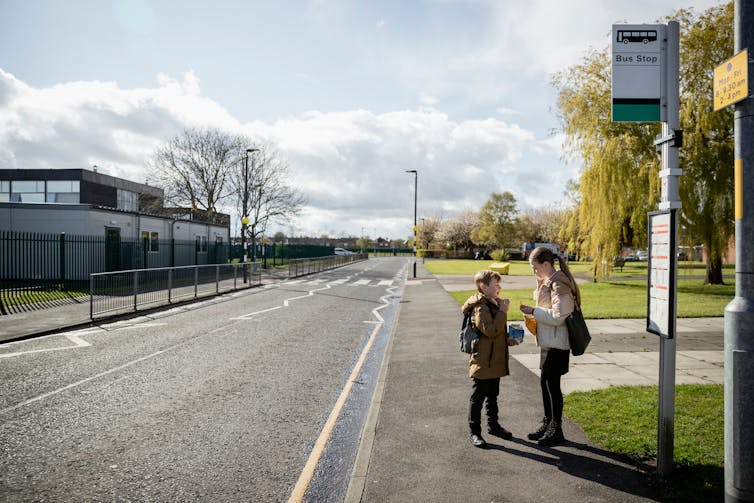
New estates are often built without adequate infrastructure or amenities to accommodate residents. While developers and local authorities blame each other for these shortcomings, residents draw the short straw. Whitehouse has had to wait eight years before opening the doors to its community building. The shops and local pub that residents said they were promised have yet to be built.

A young boy and girl waiting at a bus stop on an empty suburban road
Transport links and other infrastructure are essential for people to thrive in new towns.
DGLimages/Shutterstock

Challenges with infrastructure and services affect all residents in new housing estates. But they are especially difficult for residents whose budgets are tight. Problems with transport and accessing basic amenities bring economic, social and psychological costs. In turn, it is harder to hold a job, raise children and live healthily. With affordable housing requirements of up to 50% in new estates, a considerable proportion of new residents are affected in this way.

Take Angela, who lives on the Glebe Farm estate on the eastern edge of Milton Keynes. She doesn’t have a car and relies on taxis to bring her children to school, nearly three miles from their home. She told us that fares can add up to £800 a month during the cold and dark of winter. Others reported having to choose between an expensive local shop or taking taxis to cheaper, larger shops, as the bus service is unreliable.

Low-income residents are also more likely to face social isolation and struggle with housing associations. Maintenance issues, broken windows or mould take months to be responded to or are sometimes ignored altogether.

How to make new housing estates successful for all

First, it is vital that public transport links are established as soon as new housing areas are being developed. Lack of affordable and viable ways of travelling around the city emerged as the single biggest complaint in the two new estates included in our research, especially among low-income residents.

Second, new housing estates need their own services and amenities, including schools, GP surgeries and shops. Their establishment tends to be delayed, their capacity insufficient to meet new demand, or their construction simply not on the cards. This is vital – not just for serving new residents, but to avoid putting further pressure on existing services in nearby areas, which are often already under strain.

Third, investment in community development and infrastructure is key for creating inclusive and thriving communities. This means building community centres and spaces with ample capacity to meet communities’ needs, and ensuring that temporary facilities are provided until permanent facilities are available.


Read more:
Starmer’s plan to ‘build baby build’ risks more American-style car-dominated sprawl


Understanding the needs of all residents, and especially those on lower incomes, is imperative for creating inclusive neighbourhoods. Resident groups and community organisations can play a role with developers and local authorities to make this happen.

To avoid new estates trapping low-income residents in a life of precarity rather than move them out of it, the focus needs to shift beyond the government’s current “build, baby, build” approach and also consider the needs of people and families beyond the brick and mortar of their new homes.

Without prioritisation of public transport, schools, healthcare, community infrastructure and ongoing social support, these developments risk becoming places of exclusion rather than opportunity.

The Conversation

Keetie Roelen is a Trustee of anti-poverty organisation ATD Fourth World UK.

ref. How to make new housing estates work for the people who live there – https://theconversation.com/how-to-make-new-housing-estates-work-for-the-people-who-live-there-267930

Yes, shouting at seagulls actually works, scientists confirm

Source: The Conversation – UK – By Neeltje Boogert, Royal Society Dorothy Hodgkin Research Fellow, University of Exeter

Stephen A. Waycott/Shutterstock

Did you get through your beach picnics unscathed this summer? Or did you return from a swim only to find a “seagull” (most likely a herring gull if in the UK) rifling through your bags in search of food? If the latter, shouting at it should help to stop the gull in its tracks and make it fly off – as my team’s latest research shows.

Our previous experiment, published in 2022, showed that urban herring gulls perceive men shouting as a threat. When we played back recordings of men shouting “No! Stay away! That’s my food, that’s my pasty!”, gulls moved away, just like they did in response to our playback of another gull’s alarm calls that signal danger. These findings made us wonder whether gulls foraging in towns are fearful of human vocalisations in general, or whether they are sensitive to the way we speak to them.

Recent studies have indicated that gulls pay attention to subtle human cues, like our gaze direction and handling of food items. They even colour-match the crisp packet we’re eating from when given the choice between two differently coloured options. Given how attuned urban gulls seem to be to our behaviour, my colleagues and I predicted that they would be similarly sensitive to our sounds.

We asked five British men to record themselves saying “No! Stay away! That’s my food, that’s my pasty!” in a shouting voice, and then a second time in a neutral, “speaking”, voice. We used male voices in our experiment as most wildlife crimes against gulls reported in the media are committed by men. Although we did not test this, it seems likely that gulls are more wary of men’s voices compared to women’s voices – as found in nestling jackdaws as well as in African elephants. Men are more likely to represent a threat to these animals than women or children.

We also needed to check whether the gulls showed fearful behaviour to sound played from our speaker in general. So as a control trial we used the song of European robins (of which we downloaded five recordings from the Xeno-Canto library). We edited these sound clips (five per treatment) so that they were all of the same duration (30 seconds) and volume when played back to our gull test subjects.

We conducted all our experimental trials in Cornish coastal towns where gulls are known to take food from people – it was these bold individuals we were most interested in testing for their responses to human sounds. We started each experimental trial by luring a gull to the ground with a clear sealed plastic container filled with fries. Once the gull approached the container, we started a 30 second playback of one of our three treatments; a man speaking, a man shouting the same words or a robin singing.

We found that gulls exposed to the shouting and speaking treatments were significantly more likely to flinch, to stop pecking at the food container and to leave the area, compared to gulls exposed to robin song. Of the gulls that left the area, those that were shouted at would most often fly away, whereas gulls that were spoken at tended to waddle away. These findings suggest that urban herring gulls pay attention to our tone of voice, and are more likely to leave in a hurry when addressed angrily.

Our results may not surprise you. Dog owners may tell you that dogs respond to the way we talk to them, and often look “guilty” when we scold them. Domestic horses can also tell the difference between positive and negative human vocalisations. They freeze for longer when they hear human growling than human laughter.

However, we have domesticated these species for thousands of years, while herring gulls have only started breeding on our roofs in the last century. It therefore seems likely that gulls have learned to associate our aggressive or angry intonations with threat. For gulls, being shouted at is more commonly associated with being chased than with being fed, after all.

Herring gulls might give the impression that they are thriving, given their apparent abundance in coastal towns in summer. But they are on the RSPB’s red list of species of highest conservation concern. Their coastal population is only half of what it was 50 years ago. This is probably due to a combination of fish depletion, disturbance, culling, disease and egg predation by animals like rats and foxes.

But my team’s research points to easy, non-violent ways we can mitigate conflict with a species that is just making the best of a bad situation. For example, in 2019, we found that simply staring at herring gulls can get them off your food. And we know that gulls go where the food is. So another important thing you can do is not feed them.

The Conversation

Neeltje Boogert does not work for, consult, own shares in or receive funding from any company or organisation that would benefit from this article, and has disclosed no relevant affiliations beyond their academic appointment.

ref. Yes, shouting at seagulls actually works, scientists confirm – https://theconversation.com/yes-shouting-at-seagulls-actually-works-scientists-confirm-269317

Plastic waste is a toxic legacy – and an important archaeological record

Source: The Conversation – UK – By John Schofield, Director of Studies, Cultural Heritage Management, University of York; Flinders University

Spice Footage / shutterstock

Imagine a remote Galapagos beach, where iguanas stomp around between fishing nets, flip flops, baseball caps and plastic bottles. Stuck in the sand is the empty packet for food sold only in Ecuador, the nearest mainland hundreds of miles away. To most people, these things are rubbish. But to archaeologists, they’re also artefacts – traces of how people live in what some call the plastic age.

Using an archaeological lens allows us to question what we think we know about the contemporary world, and to see plastic as not just pollution but as evidence of the impact people are having on the planet.

Archaeology is the study of people and how they behaved, which is represented by what they leave behind. Stone tools and pottery fragments, for example, reveal how people lived and worked in the past.

But the past is always accumulating. People continue to leave traces, just as they have done for millennia: objects are dumped, lost and discarded. The archaeological record never stops forming.

Since single-use plastics became more common in the early 1950s, plastics have been an increasingly significant part of the archaeological record. That is why the period from then until now is referred to by archaeologists as the plastic age, in much the same way as the bronze and iron ages are defined by their distinctive metals.

But unlike bronze or iron, these materials are leaving behind a toxic legacy. Micro- and nanoplastics are found in human organs and blood, and are everywhere in the environment: even in in places like Antarctica or on remote mountaintops to which they have been carried by air. Microplastics also exist in deeply buried archaeological deposits. Plastic bags are found in the depths of the ocean. And because plastics can also alter carbon cycles in the ocean, they’re even speeding up climate change.

An archaeological record

In our recent study – in collaboration with Flinders University in Australia – we used archaeological theory to investigate how the plastic age is leaving its record behind, and how best to understand it. We looked at the many different places where that record is accumulating, from city landfills to farms or remote coastlines, from human bodies to space. And we examined how people’s everyday actions – using, losing, discarding things – shape how the present day appears to archaeologists.

Person stood on grass surrounded by littered bottles and cans
Lots of data for future archaeologists.
PeopleImages / shutterstock

Our main argument is simple: to tackle plastic pollution we have to understand how and why it is being created. And archaeology can help us do that.

We built on the work of anthropologists like Michael Schiffer in the 1970s, who used archaeology to examine human behaviour and the archaeological signatures that it creates. We use this influential work to describe how objects move from a “systemic” context – where they’re part of daily life – into the “archaeological” context, once they’re lost or thrown away (at which point these items become “artefacts” to archaeologists).

An archaeological record is therefore forming in real time. Perhaps the packaging on your last meal will be part of it. The device you’re reading this on certainly will.

But the relationship between artefacts and human behaviour isn’t as straightforward as it sounds. Artefacts do not necessarily remain where they fall, but can be shifted by nature or by people. Ocean currents, for instance, carry plastic waste around the globe to places like the Great Pacific garbage patch, while human actions such as waste collection deliberately moves plastics from one place to another. Understanding these processes is crucial for interpreting archaeological traces.

Working with other scientists through the Galapagos Conservation Trust, we used this archaeological approach to investigate plastic waste in the World Heritage listed Galapagos. We wanted to better understand where the waste was coming from and how to reduce its impact. By treating plastics as artefacts and tracing the processes that they had been subjected to, it was possible to untangle the many forces that contributed to the growing sense of contamination in such a fragile and important landscape.

Wicked futures

Our research also raises questions about the future. Archaeologists are already studying plastics, but how will they be viewed by archaeologists hundreds or thousands of years from now? Looking back from the deep future, will those fragments of plastic document a technological advance or a situation spiralling out of control?

Plastic pollution is what researchers call a wicked problem: complex, interconnected and hard to fix. Helping to resolve such problems requires creative and interdisciplinary approaches. Taking an archaeological lens to plastics provides just that – a new way to understand how our everyday actions are producing this toxic legacy, while at the same time providing evidence of our time on Earth.

The Conversation

Fay Couceiro receives funding from Research Councils, Industry and philanthropic organisations for work relating to microplastics and their removal from the environment.

John Schofield does not work for, consult, own shares in or receive funding from any company or organisation that would benefit from this article, and has disclosed no relevant affiliations beyond their academic appointment.

ref. Plastic waste is a toxic legacy – and an important archaeological record – https://theconversation.com/plastic-waste-is-a-toxic-legacy-and-an-important-archaeological-record-268517

How coaching could help solve the UK’s teacher crisis

Source: The Conversation – UK – By Laura Nicole Rees-Davies, Senior Lecturer, Cardiff Metropolitan University

Coaching can offer a chance for teachers to pause, think and reconnect with why they came into the profession in the first place. BearFotos/Shutterstock

The UK’s schools are facing a worsening teacher shortage, with heavy workloads and burnout pushing staff out of the profession.

Coaching has been introduced as a possible solution. In simple terms, coaching is a structured conversation that helps teachers reflect on their practice and find their own solutions. Rather than being told what to do, teachers work with a trained coach who uses careful questioning and feedback to build confidence, self-awareness and professional growth. For example, a coach may help a teacher explore why classroom management feels difficult, set realistic goals and then reflect on what works best.

It’s a way to help teachers and, ultimately, improve outcomes for pupils. But can it really make a difference? Or will it go the way of so many other short-lived education initiatives?

A recent review by my colleagues and I of 22 UK studies suggests that, when done well, coaching can boost teacher confidence, resilience and job satisfaction. And it can even improve pupil engagement and learning. But it also warns that poor implementation and lack of funding could undermine its potential.

Across the nations of the UK, schools are struggling to recruit and retain teachers, especially in secondary subjects, rural areas and early career posts. High workloads, low salaries, limited progression opportunities and years of underfunding have driven many to leave the profession. Meanwhile, fewer graduates are choosing to become teachers.

In England, the government has prioritised secondary teacher recruitment as one of its central aims. In Scotland, the National Association of Schoolmasters Union of Women Teachers claims that due to persistent underfunding of education, there are now serious challenges in teacher recruitment and retention.

Similarly, the Irish National Teachers’ Organisation claims that the island of Ireland has falling teacher numbers due to excessive workloads and understaffing of schools and this is supported by recent evidence.

In Wales, Estyn, the education and training inspectorate, reports that there has been a significant shortfall in recruitment to PGCE secondary initial teacher education programmes in recent years. Recent Welsh figures, for instance, show that 62% of secondary teacher training courses were under-recruited.

The consequences extend beyond the classroom. When teachers feel supported and engaged, students benefit from better learning and wellbeing outcomes. Coaching offers a way to support teachers without the pressure of judgment or targets.

Unlike traditional performance management or mentoring, it provides a reflective space for teachers to reconnect with their professional purpose. For policymakers, this could improve both teacher job satisfaction and student outcomes, ultimately making teaching a more attractive career choice for the future.

Imagine of two pairs of hands of people in a meeting.
Coaching can help teachers gain motivation and develop their practice.
fizkes/Shutterstock

What we found

Our rapid review offers a clear picture of how coaching works in schools.

Most often, it’s used as part of professional development programmes or teacher training. Teachers who took part described coaching as empowering, restorative and transformational. Reported benefits included greater confidence, professional growth, improved classroom practice and stronger collaboration among staff.

But the evidence shows that coaching only works when it is implemented properly. In some cases, coaching has been confused with mentoring, a more directive, advice-giving approach. Or it has been used as a tool for performance management. In others, it’s been delivered by staff with little or no training. These practices can undermine trust, limit the effectiveness, or even make things worse for already overworked teachers.

Time, funding and support are also major barriers. Without proper backing from senior leaders, coaching risks becoming an add-on rather than an embedded part of school culture.


Read more:
How voice training can help teachers improve wellbeing in the classroom


So, what makes coaching effective? The evidence points to a few important ingredients.

Coaching should be kept separate from performance appraisal, to encourage open reflection. Coaches need proper training, accreditation and supervision. It’s a professional skill that goes beyond teaching experience, requiring active listening, skilled questioning and goal setting.

Successful coaching programmes also give teachers protected time to participate, and they work best when linked to whole-school wellbeing and professional development strategies. Policymakers can play a important role by funding accredited training, ensuring quality standards, and also building long-term evaluation frameworks.

Coaching isn’t a cure-all for the challenges facing schools. But at a time when pressure on teachers has never been higher, it offers something rare – a chance to pause, think and reconnect with why they came into the profession in the first place.

With the right investment and commitment, coaching could become more than another educational buzzword. It could help teachers stay in the classroom. And it could help pupils, schools and communities to thrive.

The Conversation

Laura Nicole Rees-Davies does not work for, consult, own shares in or receive funding from any company or organisation that would benefit from this article, and has disclosed no relevant affiliations beyond their academic appointment.

ref. How coaching could help solve the UK’s teacher crisis – https://theconversation.com/how-coaching-could-help-solve-the-uks-teacher-crisis-266112

If the AI bubble does burst, taxpayers could end up with the bill

Source: The Conversation – UK – By Akhil Bhardwaj, Associate Professor (Strategy and Organisation), School of Management, University of Bath

Xandpic/Shutterstock

You might not care very much about the prospect of the AI bubble bursting. Surely it’s just something for the tech bros of Silicon Valley to worry about – or the wealthy investors who have spent billions of dollars funding development.

But as a sector, AI may have become too big to fail. And just as they did after the financial crisis of 2008, taxpayers could be picking up the tab if it collapses.

The financial crisis proved to be very expensive. In the UK, the public cost of bailing out the banks was officially put at £23 billion – roughly equivalent to £700 per taxpayer. In the US, taxpayers stumped up an estimated US$498 billion (£362 billion).

Today, the big AI firms are worth way more than banks, with a combined value exceeding £2 trillion. Many of these companies are interconnected (or entangled) with each other through a complex web of deals and investments worth hundreds of billions of dollars.

And despite a recent study which reports that 95% of generative AI pilots at companies are failing, the public sector is not shy about getting involved. The UK government for example, has said it is going “all in” on AI.

It sees potential benefits in incorporating AI into education, defence and health. It wants to bring AI efficiency to court rooms and passport applications.

So AI is being widely adopted in public services, with a level of integration which make it a critical feature of people’s day to day lives.

And this is where it gets risky.

Because the reason for bailing out the banks was that the entire financial system would collapse otherwise. And whether or not you agree with the bailout policy, it is hard to argue that banking is not a crucial part of modern society.

Similarly, the more AI is integrated and entangled into every aspect of our lives, the more essential it becomes to everyone, like a banking system. And the companies which provide the AI capabilities become organisations that our lives depend upon.

Imagine, for example, that your healthcare, your child’s education and your personal finances all rely on a fictional AI company called “Eh-Aye”. That firm cannot be allowed to collapse, because too much depends on it – and taxpayers would probably find themselves being on the hook if it got into financial difficulties.

Bubble trouble

For the time being though, the money flowing in to AI shows little sign of slowing. Supporters insist that despite the failures, investment is critical. They argue that artificial general intelligence (AGI), the point at which AI acquires human-like cognitive capabilities, will vastly improve our lives.

Others are less optimistic. Commentators including computer scientists Gary Marcus and Richard Sutton have cast doubts on the power of AI to become truly intelligent.

In my own research, I highlight the limitations of large language models (LLMs) when it comes to reasoning. Similar conclusions have been drawn at other universities and even at tech company Apple.

Close up of a roulette wheel.
Betting everything on AGI.
Leszek Glasner/Shutterstock

So perhaps the endless expansion of the AI bubble comes down to how strongly the AI pioneers believe in its future. They’ve gone pretty far with it, so maybe it makes sense for them to go all in, with a pragmatic kind of faith that keeps the bubble growing.

The trouble is that one tech billionaire’s act of faith could also be described as a gamble. And it’s a gamble they want everyone to join, with taxpayers’ money on the table.

So if the gamble fails and the bubble bursts, who would bear the costs? Would the UK government cut funding from the NHS or siphon money from a cash strapped education sector? Would it bail out pension funds that had over-invested in AI?

One thing is certain. The future being offered by AI firms is not guaranteed. Yet governments and businesses are worried they will miss out if they don’t get on board – and there are no safeguards in place to protect taxpayers from the fallout if things go wrong.

The Conversation

Akhil Bhardwaj does not work for, consult, own shares in or receive funding from any company or organisation that would benefit from this article, and has disclosed no relevant affiliations beyond their academic appointment.

ref. If the AI bubble does burst, taxpayers could end up with the bill – https://theconversation.com/if-the-ai-bubble-does-burst-taxpayers-could-end-up-with-the-bill-269115