Source: The Conversation – (in Spanish) – By Antonio Figueras Huerta, Profesor de investigación del Consejo Superior de Investigaciones Científicas, Instituto de Investigaciones Marinas (IIM-CSIC)
En todo 2025, los pescadores del suroeste de Inglaterra vivieron el mayor boom de pulpo en los últimos 75 años. Mientras, un año antes, las lonjas gallegas tocaban mínimos históricos. En Galicia, las capturas de pulpo de 2024 fueron las más bajas en 25 años, apenas 1 180 toneladas en lonja, y la facturación se desplomó respecto a los buenos años de la década anterior.
¿Qué relación guardan los dos hechos? Son dos titulares simultáneos, opuestos y perfectos para un relato sencillo: el pulpo se escapa de Galicia. Huye de un Atlántico gallego que se calienta y encuentra refugio en aguas británicas que le resultan acogedoras. Es una historia limpia, intuitiva y… falsa.
Por qué la migración no cuadra
El pulpo común (Octopus vulgaris) es un animal de fondo, de vida corta (uno o dos años) y sedentario en su fase adulta. No protagoniza migraciones oceánicas de largo recorrido. La conexión entre poblaciones distantes no la hacen los adultos nadando, sino las larvas, que pasan semanas o meses a la deriva en el plancton antes de asentarse.
Cuando el equipo de la Marine Biological Association, la Universidad de Plymouth y el Plymouth Marine Laboratory reconstruyeron el origen del fenómeno británico, encontraron dos cosas mucho más cercanas. La primera: el pulpo común se está reproduciendo en las propias aguas británicas, con ejemplares juveniles que aparecen en las nasas. La segunda: los modelos de corrientes y las medidas de salinidad apuntan a un aporte de larvas desde las islas del Canal y el norte de Francia, en particular, tras un gran episodio en la isla de Guernsey impulsado por vientos persistentes del este, en 2024.
Lo que sí comparten los dos mares
Que no haya migración no significa que no haya conexión. Un mismo fenómeno climático produce efectos opuestos en dos biomas –ecosistemas característicos de una zona biogeográfica– locales distintos. El elemento común es la temperatura.
El boom británico no es un hecho aislado: es apenas el cuarto gran episodio de este tipo en 125 años (los anteriores fueron en 1899-1900, 1932-33 y 1950-51). Y todos coincidieron en inviernos y aguas anormalmente cálidas.
Lo que ha cambiado no es que el calor favorezca al pulpo, sino que ese calor ha dejado de ser excepcional. El canal de la Mancha ha registrado veranos clasificables como olas de calor marinas. Y, en un mar más templado, las larvas sobreviven al invierno, los adultos crían y una reproducción explosiva convierte una ventana favorable en una avalancha.
En Galicia, el mismo Atlántico que se calienta juega otra partida. Aquí el pulpo no se marcha, pero tampoco cría, o los juveniles mueren. Y la temperatura no es la única palanca. Los científicos del Instituto de Investigaciones Marinas de Vigo insisten en un factor que rara vez llega a los titulares: el afloramiento, ese ascenso de aguas profundas, frías y ricas en nutrientes que sostiene la productividad de las rías. Cuando el afloramiento y la salinidad se desajustan, el ciclo reproductivo del pulpo se resiente, porque es una especie muy sensible a las condiciones del agua.
Los mares europeos se reordenan
Conviene desconfiar de las correlaciones demasiado bonitas. Si el declive gallego y el auge británico fueran las dos caras de la misma moneda, deberían moverse en espejo año tras año. No lo hacen: en 2025, mientras el Reino Unido registraba su récord, Galicia empezaba a hablar de recuperación.
La lección para entender lo que ocurre en el Atlántico nororiental no es “el pulpo emigra al norte”, sino algo menos vistoso y más inquietante: el mismo cambio climático que perjudica a una especie en un extremo del mapa puede hacerla prosperar en otro.
No sabemos si el episodio británico será un pico pasajero, como los tres anteriores, o el primer capítulo de una presencia estable. Tampoco sabemos si Galicia volverá a sus buenas campañas de pulpo o si su declive es estructural. Lo que la evidencia sí deja claro es que los mares europeos se están reordenando ante nuestros ojos, especie por especie. La próxima sorpresa vendrá, como esta, disfrazada de coincidencia.
Antonio Figueras Huerta no recibe salario, ni ejerce labores de consultoría, ni posee acciones, ni recibe financiación de ninguna compañía u organización que pueda obtener beneficio de este artículo, y ha declarado carecer de vínculos relevantes más allá del cargo académico citado.
Melitón Manzanas. Archivo General del Ministerio del Interior (AGMI). Dirección General de la Policía, Expediente Melitón Manzanas González, nº 6098.
Inspector jefe de la Brigada de Investigación Social (BIS) en San Sebastián, Melitón Manzanas (1909-1968) fue un victimario-víctima: un torturador reconocido y la primera víctima mortal premeditada de ETA. Décadas antes de que la organización terrorista lo asesinara en la puerta de su casa en agosto de 1968 estuvo relacionado con agentes y colaboracionistas del Tercer Reich.
Manzanas fue un agente que en su carrera profesional utilizó la tortura en sus interrogatorios, que practicó trato vejatorio a sus detenidos y que empleó métodos violentos para obtener confesiones.
En 1939 entró en el Cuerpo de Investigación y Vigilancia (CIV) –que desde 1941 pasó a llamarse Cuerpo General de Policía (CGP)–. A partir de entonces, su trabajo se concentró en vigilar la frontera en Irún, evitar el contrabando, obstaculizar y perseguir al maquis comunista y frenar cualquier tipo de actividad de oposición a la dictadura.
En los años finales de su vida encabezó una importante campaña de detenciones y represión contra miembros de Comisiones Obreras, Euzko Gaztedi –las juventudes del PNV– y ETA, la organización terrorista. Esta última lo asesinó el 2 de agosto de 1968.
La semilla del monstruo
Para justificar su asesinato, las entonces cabeceras del nacionalismo vasco radical, entre ellas Gudari y Zutik, recogieron testimonios sobre sus acciones vejatorias, incidiendo en su perversión, sentimiento antinacionalista vasco y vínculos con la Alemania nazi. De ese modo, su leyenda negra aumentó.
Durante el proceso de Burgos de 1970, donde se juzgó a los responsables de su muerte, la abogada Gisèle Halimi trabajó en dar a conocer el juicio en la esfera pública y editó un libro titulado Le Procès de Burgos (1971), con prefacio de Jean-Paul Sartre. Asesorados por el miembro de ETA José Antonio Etxebarrieta, introdujeron detalles escabrosos al currículum de Manzanas y aseguraron que durante la Segunda Guerra Mundial había colaborado con la Gestapo en “operaciones de caza” a republicanos españoles en el sur de Francia.
De súbito, estas aseveraciones sobre su vinculación con la policía política alemana pasaron al imaginario colectivo, al punto de que diferentes autores las han ido reproduciendo acríticamente sin aportar una sola prueba, equiparándolo incluso a Pedro Urraca Rendueles, apodado “el cazador de rojos”.
Veamos, pues, qué hay detrás de todo ello.
El informador Manzanas
Uno de sus primeros destinos como policía fue la comisaría de Irún, un lugar estratégico durante la guerra mundial. Allí, desde 1939, siendo agente de bajo rango (tercera clase) se dedicó a labores de información en la frontera, controlando la aduana y persiguiendo el contrabando.
En la década de 1940, el agente Juan García Herrero (alias T-12), del Servicio de Inteligencia del Gobierno Republicano en el exilio (SIGR), señaló que colaboraba con la Segunda Bis (la inteligencia militar franquista), informando sobre movimientos de mercancías y personas, incluso facilitando entradas y salidas de individuos.
Entre contrabando y represión
Durante la década de 1940, Manzanas se dedicó, como decíamos, a impedir el estraperlo (de mercancías, propaganda, personas…) que introducían passeurs como Timoteo Plaza y Florentino Goikoetxea, colaboradores a su vez de distintas redes de evasión y organizaciones de información republicanas.
La Segunda Bis conoció estos movimientos, y por eso organizó grupos de colaboradores para tareas de vigilancia en distintos puntos de la frontera hispanofrancesa. Esos grupos estuvieron integrados en gabinetes de información de diferentes comisarías de la zona; entre ellas, Irún, donde precisamente Melitón Manzanas realizó redadas.
Una de ellas se produjo el 19 de abril de 1942, que condujo a la captura del contrabandista Manuel Iturrioz, colaborador de la Red Comète, la organización de evasión franco-belga que evacuó a combatientes aliados perseguidos por los nazis. Según las fuentes consultadas, el policía José Bazán y Manzanas lo interrogaron y torturaron durante tres días.
En julio de ese año ascendió a agente de segunda clase. A partir de entonces, se consolidó su perfil de policía que hacía uso de métodos execrables para obtener información. El SIGR así lo reflejó en un dosier de abril de 1946: Manzanas era “uno de los funcionarios que más se han destacado por su crueldad y persecuciones. Es hoy el hombre de confianza de Julio Ortega Tercero y el jefe visible del Segundo Bis”.
Ese perfil coincidió con las valoraciones que de él hizo el Servicio Vasco de Información (SVI), la organización de espionaje del Gobierno vasco en el exilio. Gracias a la desclasificación de documentos que, periódicamente, realiza el Departamento de Estado en los Archivos Nacionales de Estados Unidos (NARA) se han obtenido informes que vinculan a Manzanas con la Gestapo y miembros del Tercer Reich.
Se trata de una serie de dosieres que realizó el SVI para la Oficina de Servicios Estratégicos (OSS), la agencia de inteligencia estadounidense previa a la CIA, en el marco de Safehaven (1944-1948), la operación que pusieron en marcha los aliados para seguir los bienes y personas vinculadas con el Tercer Reich.
En uno de ellos se indica que Manzanas y los agentes Máximo Palenciano, José Bazán y Juan Marcos trabajaron “con especial fervor a favor de los alemanes, cumpliendo órdenes de la Gestapo” y prestaron “grandes servicios” durante la ocupación de Francia.
La información, aunque escueta, es sugerente, pues está vinculada a los mecanismos que utilizó la Alemania nazi para soslayar la guerra económica de la que, por otro lado, participaban –por conveniencia, sintonía ideológica u obligación– funcionarios, empresarios y, en general, buena parte del régimen franquista.
Hay más referencias. En otro de los documentos se profundiza en el papel de Manzanas, al que se señala como “hombre de confianza” del agente Heinrich Bauer. Este era el alias del colaboracionista belga Georges-Henri Delfanne, conocido popularmente como Masuy, dedicado al expolio de bienes robados a judíos en la Europa ocupada.
La prueba documental
Estas aportaciones documentales, que forman parte de un trabajo más amplio titulado Melitón Manzanas González. Trayectoria de un victimario del franquismo y víctima de ETA (1909-1968), permiten acercarnos al papel que pudo desempeñar Manzanas en la Segunda Guerra Mundial desde las fuentes de archivo. Según estas, participó en las acciones de la policía política alemana –aunque no sabemos exactamente cómo– y colaboró en redes de expolio de bienes y obras de arte de miembros del Tercer Reich, sin tampoco saber exactamente de qué modo participó de ella.
Por eso, que solo dispongamos de estas fuentes, y que además las pesquisas realizadas en los archivos alemanes no hayan dado resultados, impide afirmar con contundencia que el contenido vertido por la prensa del exilio nacionalista vasco radical, al que aludíamos al inicio, fuera completamente fiable.
Porque las evidencias se basan en datos obtenidos por el SVI, una red que pudo señalarle por múltiples motivos. Por el momento, con arreglo a las fuentes, solo podemos asegurar que el SVI fue la organización que, en primera instancia, señaló a Manzanas como colaborador de la Gestapo y que, asimismo, fueron miembros de esa red los que filtraron esa información a la prensa nacionalista vasca radical que, años más tarde, con su muerte, hizo hincapié en su papel de colaborador nazi.
David Mota Zurdo no recibe salario, ni ejerce labores de consultoría, ni posee acciones, ni recibe financiación de ninguna compañía u organización que pueda obtener beneficio de este artículo, y ha declarado carecer de vínculos relevantes más allá del cargo académico citado.
En redes sociales, hablar de igualdad de género es cada vez más habitual. Pero la expresión no siempre significa lo mismo para todo el mundo. De hecho, diversos estudios apuntan a una paradoja llamativa: una parte importante de la juventud considera que la igualdad ya está conseguida, mientras siguen presentes desigualdades y estereotipos en la vida cotidiana.
Cuatro décadas después de la muerte de Simone de Beauvoir, su pensamiento sigue ofreciendo una clave fundamental para entender este fenómeno.
Portada de la primera edición de El segundo sexo, de Simone de Beauvoir. Wikimedia Commons
En El segundo sexo, Beauvoir formuló una de las ideas más influyentes del siglo XX: “no se nace mujer, se llega a serlo”. Con esta afirmación, cuestionó la idea de que las diferencias entre hombres y mujeres fueran naturales o inmutables y planteó que el género es el resultado de un proceso social, cultural e histórico.
Esta idea ha marcado profundamente disciplinas como la sociología, la educación o la teoría feminista, al permitir analizar cómo se construyen las desigualdades a través de normas, roles y expectativas. No se trataba solo de describir una realidad, sino de ofrecer herramientas para interpretarla críticamente.
La igualdad percibida frente a la igualdad real
Pero hay un problema. La vigencia de este planteamiento se hace especialmente evidente cuando se observa la realidad actual. Las investigaciones recientes sobre la juventud universitaria española muestran que, aunque existe un amplio consenso en torno a la importancia de la igualdad de género, también se detectan percepciones distorsionadas sobre su grado de consecución.
En nuestra investigación con alumnado universitario español, basada en una muestra de 1 460 estudiantes, más del 60 % considera que la igualdad entre hombres y mujeres está “prácticamente conseguida” en España. Sin embargo, cuando se analizan dimensiones concretas –como los estereotipos, las relaciones interpersonales o las expectativas sociales– aparecen contradicciones que evidencian la persistencia de desigualdades más sutiles.
Por ejemplo, aunque la mayoría del estudiantado rechaza abiertamente afirmaciones sexistas tradicionales, siguen apareciendo formas más discretas de desigualdad: desde la distinta valoración de comportamientos en hombres y mujeres hasta la normalización de ciertos roles en las relaciones afectivas. Lo relevante es que estas dinámicas no siempre se perciben como problemáticas, y esto dificulta su identificación y transformación.
Aquí aparece una clave fundamental. Esta distancia entre igualdad percibida y desigualdad cotidiana conecta directamente con el planteamiento de Beauvoir. Si el género es una construcción social, también lo son las percepciones sobre la igualdad. No basta con que existan leyes que reconozcan derechos iguales: es necesario analizar cómo se siguen construyendo identidades, roles y relaciones en la vida diaria.
Un ejemplo muy visible aparece en redes sociales. Es frecuente encontrar contenidos en los que se reivindica la igualdad de género –por ejemplo, mensajes virales en TikTok o Instagram– mientras que, en esos mismos espacios, se reproducen estereotipos tradicionales: desde la hipersexualización de las mujeres hasta la normalización de ciertos roles diferenciados en relaciones de pareja. Incluso en debates aparentemente igualitarios es habitual que se cuestione o minimice la desigualdad con argumentos como “eso ya no pasa” o “ahora los hombres están más discriminados”.
Además, los propios algoritmos de estas plataformas tienden a amplificar contenidos que generan interacción, lo que en ocasiones favorece la difusión de discursos polarizados o simplificados sobre la igualdad. Esto contribuye a reforzar percepciones sesgadas y a consolidar narrativas que no siempre se corresponden con la realidad social.
Lo que muestran estas dinámicas es algo clave: los discursos de igualdad conviven con prácticas que siguen reproduciendo diferencias de género. Y es precisamente aquí donde el pensamiento de Beauvoir sigue siendo especialmente útil.
Nuevas resistencias, viejos debates
A esta complejidad se suma la aparición, especialmente en entornos digitales, de discursos que cuestionan o relativizan la desigualdad de género. Este fenómeno, a menudo interpretado como una reacción o backlash, pone de manifiesto que los avances en igualdad no son lineales ni irreversibles.
Lejos de ser un debate superado, la igualdad de género sigue siendo un terreno en disputa, donde conviven avances normativos, transformaciones culturales y resistencias activas. En este sentido, la sensación de que la igualdad ya está conseguida puede funcionar, paradójicamente, como un obstáculo para seguir avanzando.
Pensar el presente con herramientas del pasado
En este contexto, recuperar el pensamiento de Beauvoir no es un ejercicio conmemorativo, sino una herramienta para interpretar el presente. Su aportación más duradera no fue solo denunciar la desigualdad, sino mostrar cómo se construye y se reproduce socialmente.
Cuatro décadas después de su fallecimiento, su legado sigue vigente porque nos obliga a ir más allá de las apariencias. Y la pregunta sigue siendo incómoda: si la igualdad parece asumida, ¿por qué sigue sin ser plenamente real?
Aroa Martínez García no recibe salario, ni ejerce labores de consultoría, ni posee acciones, ni recibe financiación de ninguna compañía u organización que pueda obtener beneficio de este artículo, y ha declarado carecer de vínculos relevantes más allá del cargo académico citado.
Source: The Conversation – (in Spanish) – By Maria Mut Bosque, Profesora agregada Derecho Internacional y de la Unión Europea, Universitat Internacional de Catalunya
Aunque a la mayoría la pandemia nos parece cosa del pasado, hay quienes no pueden olvidarla. Me refiero a las víctimas más invisibles de la pandemia: las personas que desarrollaron efectos adversos graves tras la vacunación frente a la covid-19. Más de un lustro después del inicio de aquella emergencia sanitaria, continúan siendo uno de los colectivos menos reconocidos.
Una afirmación de investigadores de Harvard resume acertadamente el espíritu de este debate: “Evitar hablar de los efectos adversos de las vacunas no es provacuna: es anticiencia”. Reconocer la existencia de personas que sufrieron lesiones graves no implica cuestionar la vacunación ni la ciencia. Al contrario, supone reafirmar uno de los principios esenciales del método científico: el conocimiento progresa revisando continuamente la evidencia disponible.
Una de las grandes lecciones de la pandemia es precisamente esa. La evolución del conocimiento científico no constituye un fracaso, sino una manifestación de su propia fortaleza. La cuestión no radica en que las recomendaciones sanitarias cambiaran conforme avanzaba la evidencia, sino en si las instituciones comunicaron con suficiente claridad el carácter necesariamente provisional de ese conocimiento.
Vacunas en tiempo récord
En contextos de incertidumbre, la transparencia exige informar no solo sobre aquello que se conoce, sino también sobre aquello que todavía se desconoce.
Las vacunas contra el covid-19 se desarrollaron, autorizaron y fabricaron en un tiempo sin precedentes, gracias a un extraordinario esfuerzo científico e industrial que permitió disponer de herramientas preventivas en un momento de grave emergencia sanitaria. Sin embargo, esa rapidez implicaba limitaciones inevitables: no era posible conocer entonces ciertos efectos adversos que solo podían manifestarse tras millones de dosis y un seguimiento prolongado. Por ello, la prudencia, la transparencia y la farmacovigilancia adquirieron vital importancia.
La producción de miles de millones de dosis en pocos meses supuso también un desafío industrial extraordinario. Durante la campaña se detectaron incidentes de importancia, como partículas metálicas en determinados lotes distribuidos en Japón o un mosquito en un vial en España, que motivaron investigaciones y retiradas preventivas de cientos de miles de dosis. Estos episodios no cuestionan por sí solos la utilidad de las vacunas, pero evidencian que ningún proceso industrial está exento de riesgos y que la vigilancia de la calidad debe mantenerse durante todo el ciclo de vida del medicamento.
La historia de la medicina confirma la necesidad de actuar con prudencia. Existen precedentes de vacunas inicialmente autorizadas que fueron retiradas al detectarse efectos adversos graves durante su uso masivo. Asimismo, más de cuarenta años después del descubrimiento del VIH, aún no se ha logrado una vacuna segura y eficaz. Estos ejemplos no buscan comparar enfermedades distintas, sino recordar que la incertidumbre es inherente a la investigación biomédica y debe reflejarse también en la información que reciben los ciudadanos.
Millones de personas se vacunaron frente a la covid-19 confiando en las autoridades sanitarias, pero lo hicieron en un contexto marcado por confinamientos, restricciones, certificados COVID y fuerte presión social. Durante todo el proceso, las instituciones y diversos actores sociales afirmaron de forma reiterada que las vacunas eran seguras y eficaces, generando una expectativa legítima de confianza institucional en ciudadanos que presumían la buena fe de las instituciones y de sus portavoces.
Además, era difícil para el ciudadano medio prever sus posibles efectos individuales. Desde una perspectiva bioética y jurídica, cabe cuestionar si, en todos los casos, el consentimiento pudo ser plenamente libre e informado, conforme al artículo 3 de la Carta de Derechos Fundamentales de la Unión Europea. Especialmente cuando algunos riesgos solo fueron identificándose progresivamente mediante la farmacovigilancia con posterioridad a la vacunación.
De hecho, fue una vez iniciadas las campañas masivas cuando comenzaron a reconocerse oficialmente determinados efectos adversos graves, como algunos casos de miocarditis, el síndrome de trombosis con trombocitopenia (VITT) o el síndrome de Guillain-Barré asociado a determinadas vacunas.
Todo esto no descalifica a la ciencia: pone de manifiesto que esos riesgos no podían formar parte del consentimiento inicial porque aún no habían sido identificados.
De evitar el contagio a reducir la hospitalización
En las primeras fases de la campaña se destacó la capacidad de las vacunas para evitar el contagio y reducir la transmisión del virus. Posteriormente, conforme aparecieron nuevas variantes y avanzó el conocimiento científico, el discurso pasó a centrarse en la reducción de la enfermedad grave, la hospitalización y la mortalidad. Esa evolución hacía necesaria una adaptación constante de las recomendaciones públicas.
Mientras tanto, quienes desarrollaron lesiones graves iniciaron un proceso extraordinariamente complejo para obtener reconocimiento. A la enfermedad se sumaron las dificultades para acreditar el nexo causal, la ausencia de protocolos homogéneos, la disparidad de criterios clínicos y un fenómeno ampliamente reconocido de infranotificación de efectos adversos, que dificulta conocer la verdadera dimensión del problema.
Ningún medicamento está exento de efectos adversos
Tampoco resulta adecuado minimizar esta realidad afirmando únicamente que quienes sufren lesiones graves son “casos muy raros”. Incluso si su frecuencia fuera reducida, ello no disminuye la gravedad del daño sufrido ni las obligaciones de los poderes públicos hacia quienes lo padecen. Además, esa valoración debe realizarse con cautela cuando todavía no existe un censo europeo de personas afectadas ni un sistema armonizado de registro.
Un fondo común de compensación
Pese a las reiteradas solicitudes de asociaciones de afectados y a diversas iniciativas parlamentarias para crear un registro europeo y un fondo común de compensación, tales mecanismos continúan sin desarrollarse.
Las víctimas de los efectos adversos de las vacunas no deberían sentirse obligadas a elegir entre defender la ciencia o defender su propia experiencia. Ambas cosas son compatibles. Escuchar a estas personas, investigar sus patologías, reforzar la farmacovigilancia, garantizar la transparencia y reconocer institucionalmente su situación no debilita la salud pública; la fortalece.
La transparencia es otra de las grandes lecciones pendientes de la pandemia. Diversas resoluciones del Tribunal General de la Unión Europea apreciaron deficiencias en el acceso a la documentación sobre la contratación de vacunas, y la Defensora del Pueblo Europeo declaró mala administración en la gestión de determinados mensajes entre la Presidenta de la Comisión Europea y el director ejecutivo de Pfizer. Estos hechos trascienden el mero acceso documental, pues inciden en la calidad de la información disponible para los ciudadanos y en la confianza que debe presidir toda actuación pública.
La pandemia también obliga a reflexionar sobre el papel de las agencias reguladoras. Su misión no consiste únicamente en reaccionar cuando la evidencia científica resulta concluyente, sino en anticipar razonablemente los riesgos emergentes mediante una farmacovigilancia independiente, rigurosa y transparente. Cuando aparecen señales plausibles de seguridad, el principio de prudencia exige una evaluación temprana y preventiva, especialmente cuando se trata de medicamentos novedosos administrados a cientos de millones de personas.
En definitiva, reconocer, proteger y acompañar a las víctimas constituye una exigencia de los derechos fundamentales y de la dignidad humana. Una sociedad democrática debe ser capaz de proteger la salud pública sin abandonar a quienes, actuando con responsabilidad y confianza institucional, sufrieron consecuencias graves. Solo una información transparente, un consentimiento verdaderamente libre e informado, instituciones capaces de anticipar los riesgos y el reconocimiento efectivo de estas personas permitirán fortalecer la confianza ciudadana y afrontar futuras emergencias sanitarias con mayor legitimidad democrática y con pleno respeto a la dignidad humana.
Porque la mejor ciencia no es la que se cree infalible, sino la que reconoce con honestidad sus incertidumbres, aprende de ellas y sitúa siempre a la persona en el centro de sus decisiones.
Maria Mut Bosque no recibe salario, ni ejerce labores de consultoría, ni posee acciones, ni recibe financiación de ninguna compañía u organización que pueda obtener beneficio de este artículo, y ha declarado carecer de vínculos relevantes más allá del cargo académico citado.
Source: The Conversation – (in Spanish) – By Guillermo José Navarro del Toro, Research Professor at the University of Guadalajara – Centro Universitario de Los Altos, Universidad de Guadalajara, Universidad de Guadalajara
Los nacidos entre 1997 y 2012 (la generación Z o gen Z) son la generación más cualificada de la historia reciente, según los últimos indicadores de la OCDE. El 50,2 % de los jóvenes de entre 25 y 34 años cuenta con titulación de educación superior o universitaria –56,7 % en el caso de las mujeres– y prácticamente duplican el 26,5 % de estudios universitarios de la generación de sus padres.
A esto se suma que más del 18 % posee másteres o posgrados de especialización antes de los 30 años, la tasa de finalización de la educación secundaria superior supera el 88 % en la UE y más del 65 % domina al menos un segundo idioma, todo ello respaldado por una alfabetización digital nativa y una capacitación continua inédita en la historia del mercado laboral.
Los z, que han acumulado títulos, posgrados, idiomas y certificaciones, crecieron bajo la premisa de que estudiar, conseguir un puesto en una empresa importante y escalar la pirámide corporativa les llevaría a alcanzar el éxito y la seguridad financiera.
Los datos respaldan que el modelo tradicional de éxito ha colapsado, con la tasa de emancipación en mínimos históricos (14,5 %), un gasto en vivienda que devora casi el 98 % del salario mediano joven y cerca de un 19 % de trabajadores sumidos en el riesgo de pobreza.
México en particular presenta elevados niveles de estrés laboral. Un 27 % de los trabajadores padece estrés crónico y el 50 % afirma que la tensión laboral impacta directamente en su vida personal. En comparación con otros países, alrededor del 75 % de los trabajadores mexicanos experimentan estrés laboral agudo, porcentaje superior al registrado en economías como la china (73 %) y la estadounidense (59 %).
Es una inercia de desgaste crónico que termina por desplazar cualquier propósito vital, reduciendo la existencia a una rutina de mera supervivencia y rendimiento operativo donde quedan desplazados el desarrollo personal, la autorrealización y los vínculos afectivos.
El mito del trabajador incansable
Ante el miedo que provoca un futuro incierto, se ha romantizado el sacrificio extremo: se admira al que se queda hasta tarde, al que responde correos en domingo y al que presume de no haber tomado vacaciones en años, creyendo que esa hiperproductividad va a garantizar su lugar en el mundo.
Esta narrativa no beneficia a una generación sobrecualificada sino a un sistema que ve al trabajador como una pieza reemplazable de una gran maquinaria. Se debe cuestionar la idea de que el valor de la persona depende de su cuota de productividad horaria: el cerebro no es una máquina, y un trabajador descansado siempre tomará mejores decisiones que uno que opera bajo la neblina constante del cortisol (la hormona del estrés).
Serenidad frente a zozobra
Redefinir el éxito en tiempos de inestabilidad no significa dejar de ser ambicioso o volverse “vago”. Curiosamente, algunas de las mentes más influyentes utilizan el descanso como una herramienta estratégica para navegar la imprevisibilidad del futuro:
El empresario mexicano Carlos Slim (México) promueve lo que él llama el “ocio productivo”. Para él, el éxito no es estar ocupado 24/7, sino tener tiempo en blanco para leer, analizar el entorno y reflexionar sin prisa. Slim entiende que la pausa es necesaria para detectar las oportunidades que otros pasan por alto debido al estrés.
El estadounidense Bill Gates es famoso por sus think weeks (semanas de pensar): se retira a una cabaña, solo y sin distracciones, para leer y pensar. No son vacaciones de esparcimiento, sino un mantenimiento preventivo para mantener su mente ágil ante un mundo cambiante.
¿Qué pasaría si se empezara a medir el éxito por la resiliencia, la calidad del descanso, la profundidad de los vínculos y el sentido de propósito? Redefinir el éxito frente a la incertidumbre implica:
Proteger el propósito personal: lograr que el trabajo sea una herramienta para financiar y enriquecer la vida que queremos, y no que se convierta en la vida entera.
Es momento de usar toda la preparación acumula para realizar el proyecto más importante: redefinir el éxito propio. Porque mucho más que solo sobrevivir a la incertidumbre, se merece vivir plenamente.
Guillermo José Navarro del Toro no recibe salario, ni ejerce labores de consultoría, ni posee acciones, ni recibe financiación de ninguna compañía u organización que pueda obtener beneficio de este artículo, y ha declarado carecer de vínculos relevantes más allá del cargo académico citado.
Source: The Conversation – in French – By Barthélémy Michalon, Professeur au Tec de Monterrey (Mexique) – Docteur en Sciences Politiques, mention Relations Internationales, Sciences Po
L’ESSENTIEL
Un accord à l’amiable a été trouvé dans le cadre du procès intenté à Meta par des dizaines de procureurs d’États des États-Unis pour avoir volontairement rendu ses plateformes addictives pour les jeunes.
Meta s’est engagée à verser 18 milliards de dollars aux plaignants et à appliquer un ensemble de mesures visant à encadrer l’utilisation de ses plateformes par les mineurs.
Ce document permet à Meta de définir ses propres limites, de se présenter comme soucieuse du bien-être de ses jeunes utilisateurs et de conserver une certaine latitude dans la mise en œuvre de ses engagements.
Mi-août, les représentants de Meta se sont une nouvelle fois retrouvés devant la justice états-unienne pour répondre d’accusations provenant de procureurs de plusieurs États concernant les effets de ses plateformes de réseaux sociaux – Facebook et Instagram – sur la santé mentale de leurs plus jeunes utilisateurs.
Le procès a pris fin de façon prématurée, à la suite de la présentation par l’entreprise d’une proposition d’accord à l’amiable, proposition acceptée par les plaignants.
Des plateformes conçues pour être addictives
Ce processus légal reposait sur un nouvel angle d’attaque contre les pratiques de l’entreprise de Palo Alto, déjà utilisé en début d’année par des plaignants individuels. En l’occurrence, ce ne sont pas ses décisions en matière de modération des contenus présents sur ses espaces numériques qui sont attaquées – une démarche qui a peu de chances d’aboutir dans un pays qui a historiquement défendu une interprétation très large de la liberté d’expression. Il s’agit plutôt de remettre en question ses choix concernant le fonctionnement de ses plateformes, fondé sur une série de techniques visant à rendre leur usage addictif.
Parmi ces mécanismes sont fréquemment mentionnés l’algorithme de recommandation lui-même (qui sélectionne les contenus les plus susceptibles d’attirer l’attention de chaque utilisateur), le démarrage automatique des vidéos dès leur apparition à l’écran (autoplay), le décompte visible des réactions suscitées par chaque publication ou encore l’envoi régulier de notifications, qui sont autant de rappels à interagir une fois encore avec les contenus affichés sur ces espaces virtuels.
Ce procès, de même que les autres relevant de la même logique, a été fréquemment comparé à ceux qui ont été intentés dans les années 1990 contre les grandes compagnies de cigarettes. Comme ces dernières, Meta se retrouve accusée de proposer un produit délibérément conçu pour être addictif et d’avoir minimisé voire nié les risques liés à sa consommation alors même que, grâce à des recherches menées en interne, l’entreprise était consciente de ses effets nocifs sur la santé, en l’occurrence mentale, de ses utilisateurs.
Outre Meta, d’autres compagnies de réseaux sociaux comme TikTok, Snapchat et YouTube font également l’objet de nombreuses plaintes pour les mêmes raisons. Si la pression semble pour l’instant se concentrer sur la firme dirigée par Mark Zuckerberg, c’est du fait non seulement de sa taille mais aussi de l’existence d’éléments à charge particulièrement dommageables pour la défense, comme le témoignage d’anciens employés ou la masse de documents internes, connus sous le nom de « Facebook Papers », publiés en 2021 par la lanceuse d’alerte Frances Haugen.
Bande-annonce de The Social Reckoning, consacré aux révélations de Frances Haugen.
Un accord à l’amiable qui sonne la fin anticipée d’un procès très attendu
Lors de la première semaine du procès, Meta avait adopté une posture combative, mettant en avant la complexité du sujet de la santé mentale des jeunes générations et les mesures qu’elle avait déjà adoptées pour les protéger.
Malgré cette entrée en matière, l’entreprise a annoncé, le 26 août, être parvenue à un accord à l’amiable (settlement) avec les procureurs. Cet accord, qui est en fait le fruit de négociations entamées depuis de longs mois, a mis fin au procès en cours avec effet immédiat.
Outre un dédommagement à hauteur de 18 milliards de dollars (15,4 milliards d’euros) qui sera réparti entre les nombreux États impliqués dans la plainte, le document contient une série de concessions qui reviennent sur les aspects des plateformes les plus souvent considérés comme étant directement liés à leurs propriétés addictives.
« Meta paie des milliards et bride les ados pour clore un procès historique », France 24, 27 août 2026.
À première vue, il serait tentant d’y voir une victoire éclatante du camp de l’accusation, et une « capitulation » de la part de l’entreprise dont les services sont utilisés par 3,6 milliards de personnes chaque jour. Mais si cette nouvelle est en effet encourageante dans l’optique de limiter les atteintes à la santé mentale des plus jeunes utilisateurs des plateformes de Meta, il n’en est que plus nécessaire d’examiner la façon dont l’accord proposé par l’entreprise lui permet de défendre rationnellement ses intérêts bien compris.
Dans ce but, j’ai appliqué un modèle d’analyse sur la teneur et le contexte des engagements pris par Meta. Ce modèle, développé dans le cadre de mes recherches sur les rapports de pouvoir autour des contenus en ligne, établit que les acteurs impliqués dans un mécanisme de gouvernance cherchent à peser sur ce dernier par trois moyens : le façonnement (en anglais shaping) consiste à agir sur le contenu des règles applicables ; le cadrage (framing) porte sur la façon dont elles sont présentées et éventuellement perçues ; tandis que la manœuvre (maneuvering) concerne leur mise en application.
L’utilisation de cette grille de lecture pour étudier l’accord en question se révèle d’une grande utilité pour comprendre les intentions de Meta vis-à-vis de cet accord et mettre en évidence les nombreux avantages, à différents niveaux, que ce dénouement apporte à l’entreprise.
Un accord accepté par les procureurs, mais avant tout façonné par Meta
Parvenir à un accord à l’amiable était pour Meta la seule alternative à une issue décidée par la justice au terme des longues semaines qu’aurait duré le procès. Or, celui-ci s’était engagé sur des bases défavorables pour l’entreprise, dont les arguments étaient battus en brèche. Par exemple, les procureurs ont pu présenter des documents internes révélant que Meta avait délibérément privilégié ses objectifs de performance économique au détriment de la santé mentale de ses jeunes utilisateurs, et mis en place des mesures de protection qu’elle savait inefficaces. Pour la firme de Mark Zuckerberg, la perspective d’une condamnation prenait ainsi de la consistance, ce qui aurait signifié non seulement une lourde amende mais aussi l’imposition par la justice d’une série de changements sur ses plateformes.
En proposant un règlement à l’amiable, Meta a repris le contrôle sur les obligations auxquelles elle devra se soumettre. Certes, ce contrôle n’est pas total, puisque ce document a dû recevoir l’aval tant des procureurs que de la juge chargée du procès, mais ce mode de résolution du contentieux a permis à l’entreprise de tracer elle-même les lignes qui encadreront désormais son activité. En d’autres termes, elle est parvenue à mettre en place un mécanisme relevant de l’autorégulation, ou tout au plus de la co-régulation, afin d’échapper à une régulation en bonne et due forme intégralement imposée de l’extérieur. Cette stratégie a déjà été largement éprouvée dans un passé récent par les entreprises du secteur, à commencer par Meta elle-même.
Parmi les contraintes qu’elle s’est fixées figurent en premier lieu les sommes à verser aux États fédérés associés à la plainte : le montant de 18 milliards de dollars est certes élevé dans l’absolu, mais il faut rappeler qu’au début du procès les procureurs demandaient 200 milliards et que l’entreprise a réalisé un bénéfice net de 16 milliards lors du second trimestre 2026. En outre, les paiements seront étalés sur une période de 10 ans, et 30 % de cette somme ne sera versée que si les principaux concurrents de Meta se plient aux mêmes contraintes – une condition sur laquelle je reviendrai plus loin.
Suivant la même logique, Meta garde la main sur la teneur des mesures qu’elle s’engage à mettre en œuvre sur ses plateformes pour les mineurs se trouvant dans les États signataires de l’accord. Par exemple, elle a limité à deux heures par jour l’utilisation de Facebook et Instagram, une durée à répartir entre les deux plateformes. Elle a aussi introduit un mode « nocturne », qui bloquera leur consultation entre minuit et 6 heures, une pause quotidienne forcée bienvenue mais dont la durée ne va guère au-delà du strict minimum. Les « notifications » seront suspendues entre 22 heures et 7 heures ainsi que pendant le temps scolaire, mais celles qui avertissent que des messages directs ont été reçus sur l’une ou l’autre de ces deux plateformes ne sont pas concernées par cette mesure.
Par ailleurs, Meta n’a pas éliminé l’autoplay des vidéos ni le décompte visible des réactions obtenues par chaque publication, mais a plus modestement laissé à ses utilisateurs la possibilité d’activer ou non ces options.
Cet échantillon d’exemples permet de dégager une logique commune : les engagements de Meta vont dans la bonne direction, mais ils semblent avoir été conçus de sorte que la compagnie reste capable d’en minimiser les effets. La portée géographique de l’accord est elle aussi circonscrite : si celui-ci crée des effets dans la quasi-totalité des États-Unis (à l’exception de la Floride et du Nouveau-Mexique, qui ont refusé de le signer, et du Texas qui a négocié un texte séparé), il établit textuellement qu’il ne crée de précédent « dans aucune juridiction internationale ».
Un accord au service du narratif que Meta souhaite diffuser
La formule de l’accord à l’amiable n’a pas seulement permis à l’entreprise d’en contrôler le contenu, mais aussi de l’utiliser à ses propres fins de communication.
D’abord, Meta a tenu à souligner que le document ne constitue pas une reconnaissance de responsabilité et continue à rejeter les accusations concernant l’impact négatif de ses plateformes sur le bien-être de ses jeunes utilisateurs.
Ensuite, comme exposé plus haut, elle a conditionné le versement de près du tiers de la somme à la mise en œuvre par YouTube et TikTok des « mêmes » mesures, ce qui lui permet de souligner que ses principaux concurrents recourent eux aussi à des pratiques accusées de rendre addictifs leurs services en ligne.
Immédiatement après l’annonce de l’accord, Meta a non seulement publié une lettre ouverte appelant ses deux concurrents à lui emboîter le pas, mais a aussi lancé une vaste campagne de communication, sur ses propres plateformes et sous forme d’encarts publicitaires dans les plus grands journaux états-uniens, pour relayer le même message.
Celui-ci éclaire sans ambiguïté l’image que Meta cherche à construire d’elle-même : selon sa lettre ouverte, elle vient d’« ouvrir la voie vers des engagements à l’échelle de l’industrie » des réseaux sociaux et d’établir « de nouveaux standards ». Il s’agit donc à présent pour YouTube et TikTok de la « rejoindre dans la protection des adolescents ».
En d’autres termes, Meta n’hésite pas à présenter un accord auquel elle a dû se résoudre pour éviter une défaite judiciaire, qui s’annonçait coûteuse en termes tant économiques que d’image, comme une initiative vertueuse et pionnière, guidée par le souci de veiller au bien-être des plus jeunes de ses utilisateurs.
Cette stratégie de communication est à relier aux inquiétudes croissantes quant aux effets des réseaux sociaux en général sur la santé mentale des adolescents, qui ont conduit plusieurs pays de la planète à interdire leur usage à ceux qui n’ont pas encore atteint l’âge limite fixé par la loi, et d’autres à réglementer strictement les caractéristiques des plateformes mises à disposition des adolescents. C’est sur cette dernière voie que semblent s’engager l’Union européenne et la France, cette dernière après la censure par le Conseil constitutionnel d’un texte plus ambitieux.
Dans ce contexte défavorable aux réseaux sociaux en général, Meta semble donc tirer profit de cet accord pour se présenter comme une entreprise en phase avec ces préoccupations généralisées.
L’application de l’accord, une étape cruciale… qui sera étroitement contrôlée par Meta
L’entreprise a ainsi déjà su peser lourdement sur le contenu de l’accord (façonnement), et l’utiliser à des fins d’image (cadrage). La mise en œuvre de ses propres engagements est hautement susceptible de représenter une troisième opportunité pour défendre ses intérêts, d’une façon (manœuvre) qui sera sans doute moins facile à déceler que dans les deux premières dimensions examinées.
S’il est trop tôt à ce stade pour établir l’existence de telles pratiques, il demeure possible d’identifier les zones grises que Meta pourrait exploiter. À commencer par l’identification de la population ciblée par cette mesure, en l’occurrence les moins de 18 ans : en Australie, où l’accès aux réseaux sociaux aux moins de 16 ans est interdit depuis décembre 2025, les autorités ont constaté que, dans les faits, les entreprises ont laissé à leurs utilisateurs de nombreux moyens d’enregistrer un âge erroné, et donc de continuer à se connecter à leurs plateformes en dépit du nouveau cadre réglementaire.
Un autre cas de figure où les conditions de mise en œuvre pourraient être décisives est la possibilité offerte aux jeunes utilisateurs de choisir entre une présentation des contenus proposés sur leur compte soit en fonction d’une sélection algorithmique comme c’est à présent la norme, soit en ordre chronologique. Or, la façon dont Meta présentera ces deux options sera susceptible d’influer sur la décision du plus grand nombre. Cette année, le régulateur irlandais – pays dans lequel Meta a établi son siège européen – a justement ouvert une enquête sur l’utilisation par la plateforme de « dark patterns », conçus pour manipuler les choix des internautes.
Un autre exemple pourrait résider dans l’inactivation, sur Facebook et Instagram, des filtres photographiques imitant un « maquillage extrême », accusés de porter atteinte à l’estime de soi de nombreux jeunes utilisateurs et utilisatrices. Sur quelles bases Meta considèrera-t-elle un maquillage comme « extrême » ? En fonction de la réponse à cette question, l’impact de cette mesure pourrait être réel, ou bien purement cosmétique.
De façon générale, les grandes entreprises de réseaux sociaux ont jusqu’à présent fait la preuve de leur capacité à exploiter leur maîtrise technologique pour réduire l’impact ou la portée des obligations ou des attentes qui reposent sur elles lors de la mise en application de nouvelles règles. Si cette tendance se confirme, les effets concrets de cet accord salué comme historique s’en trouveraient réduits d’autant.
En conclusion, si l’accord annoncé par Meta paraît constituer les prémices d’une gouvernance de la protection de la santé mentale des mineurs états-uniens sur les plateformes de réseaux sociaux, une analyse plus approfondie permet de constater que Meta mène une stratégie visant à peser de tout son poids sur les règles et standards appelés à structurer cette gouvernance.
Barthélémy Michalon ne travaille pas, ne conseille pas, ne possède pas de parts, ne reçoit pas de fonds d’une organisation qui pourrait tirer profit de cet article, et n’a déclaré aucune autre affiliation que son organisme de recherche.
Les tâches liées à la scolarité des enfants pèsent toujours plus sur les mères que sur les pères.
Dans leur manière d’échanger avec les familles, les établissements scolaires contribuent-ils à ce déséquilibre ?
Contacter les mères en priorité peut entraîner des inégalités même dans des couples qui se répartissent les tâches.
La rentrée scolaire s’accompagne d’une liste bien connue de responsabilités pour les parents : acheter les fournitures scolaires, remplir les formulaires, organiser les trajets et répondre à un flux constant d’e-mails envoyés par les enseignants et les responsables de l’établissement.
Bien que de nombreuses familles s’efforcent de partager ces responsabilités, les études montrent systématiquement que les mères ont tendance à assumer une plus grande part des tâches liées à la scolarité de leurs enfants. Cela inclut non seulement la participation aux événements scolaires ou la préparation des déjeuners, mais aussi les tâches moins visibles telles que la prise de rendez-vous chez le médecin, l’inscription aux activités extrascolaires et la réponse aux e-mails ou aux appels de l’école.
Au cours de l’été 2022, nous avons mené une enquête de terrain auprès de plus de 80 000 chefs d’établissement du primaire et du secondaire à travers les États-Unis. Les écoles ont reçu un e-mail provenant d’un foyer fictif composé d’un père et d’une mère, tous deux désireux d’inscrire leur enfant. L’e-mail mentionnait les coordonnées des deux parents, avec un numéro de téléphone chacun, et demandait au chef d’établissement d’appeler l’un d’entre eux.
Comme nous avons varié de manière aléatoire les noms et la formulation des e-mails, nous avons pu déterminer si le sexe d’un parent influençait le choix de la personne à qui l’appel était adressé.
Et c’était bien le cas.
Lorsqu’aucun des deux parents ne semblait plus disponible que l’autre, les mères avaient environ 1,4 fois plus de chances que les pères de recevoir le premier appel téléphonique. Parmi les directeurs d’école qui ont rappelé quelqu’un, environ 60 % ont contacté la mère en premier et 40 % ont contacté le père.
Nous avons également cherché à savoir si le fait de fournir davantage d’informations modifiait ces tendances. Lorsque l’e-mail indiquait explicitement que le père était plus disponible pour discuter, les directeurs étaient nettement plus enclins à l’appeler. Mais même lorsque les pères étaient présentés comme le parent le plus disponible, de nombreuses écoles continuaient d’appeler les mères en premier lieu.
Un autre indice subtil a également joué un rôle. Lorsque le père envoyait l’e-mail en mettant la mère en copie, les établissements scolaires étaient plus enclins à le contacter. Pourtant, même dans ce cas, les mères continuaient de recevoir une part importante des appels.
Ces résultats suggèrent que de nombreux établissements scolaires considèrent encore les mères comme le parent par défaut à contacter au sujet de leurs enfants, même lorsqu’ils disposent d’informations indiquant que les pères sont tout aussi disponibles – voire davantage – que les mères.
Il est important de noter que cela ne signifie pas nécessairement que les membres du personnel scolaire contactent intentionnellement les mères. Les responsables scolaires disposent souvent d’informations limitées et prennent des décisions rapides en se basant sur leur expérience. S’ils ont constaté par le passé que les mères se montraient plus réactives, les appeler en premier peut leur sembler le choix le plus efficace.
Mais lorsque des décisions similaires se répètent des milliers de fois dans les écoles et d’autres organisations, elles peuvent renforcer la répartition inégale des responsabilités parentales qui existe déjà au sein de nombreuses familles.
Une tendance plus générale
L’école n’est qu’une source parmi d’autres des sollicitations concernant les enfants.
Des études antérieures ont montré que les mères sont plus susceptibles que les pères de prendre des rendez-vous chez le médecin, de coordonner les activités extrascolaires et de gérer bon nombre des tâches en coulisses qui permettent à la vie familiale de se dérouler sans heurts. Ces responsabilités sont souvent décrites comme la « charge mentale » liée à la parentalité, car elles impliquent de planifier, de suivre et de tout coordonner.
Nos recherches suggèrent que les écoles et d’autres organisations pourraient, sans le vouloir, accentuer cette charge mentale en adressant davantage de demandes aux mères.
Dans les enquêtes que nous avons menées parallèlement à notre expérience, les éducateurs et autres adultes qui interagissent régulièrement avec les familles – notamment les professionnels de la petite enfance, les entraîneurs et les professionnels de santé – ont également indiqué contacter plus souvent les mères que les pères.
Un simple appel téléphonique peut sembler anodin. Mais au fil d’une année scolaire – entre les appels des cabinets médicaux, des clubs de sports, des colonies de vacances et autres activités –, ces interruptions peuvent s’accumuler. Elles constituent une contrainte supplémentaire sur le temps des parents, et cette charge pèse de manière disproportionnée sur les mères.
Cette perspective permet également d’expliquer pourquoi les inégalités entre les sexes en matière de prise en charge des enfants peuvent persister, même au sein de couples qui s’efforcent de partager les responsabilités de manière plus équitable. La répartition inégale des tâches parentales est déterminée non seulement par les décisions prises au sein du foyer, mais aussi par les attentes et les habitudes extérieures au foyer.
De nombreux établissements scolaires permettent aux familles d’indiquer qui doit être contacté en premier ou de désigner différentes personnes à contacter selon les situations. Ces procédures étant mises en place dès la rentrée scolaire, le fait d’exprimer clairement ces préférences peut contribuer à ce que la communication de l’établissement reflète mieux la manière dont chaque famille choisit de se répartir les responsabilités.
Laura K. Gee a reçu des financements de la Russell Sage Foundation.
Kristy Buzard a reçu des financements de la Russell Sage Foundation et du Fonds Appleby Mosher de la Syracuse University Maxwell School.
Olga Stoddard a reçu des financements de la Russell Sage Foundation.
La Rencontre des entrepreneurs de France (REF), organisée par le Medef fin août, a réuni sept candidats à la présidentielle. Qui est le favori des patrons ?
Le Medef veut peser dans le débat public, mais prétend ne pas faire de politique, à travers une approche strictement économique.
Le président du Medef a indiqué qu’il était prêt à travailler avec le Rassemblement national en cas de victoire, au nom des principes « républicains ».
Le rendez-vous organisé par le Medef à Roland-Garros les 26 et 27 août derniers, la Rencontre des entrepreneurs de France (REF), a fait l’objet d’une forte couverture médiatique, surtout grâce à la présence de sept prétendants à la présidence de la République en 2027. On ne peut pourtant pas assurer que l’agenda politique de la présidentielle ait beaucoup progressé durant cette confrontation.
Les candidats potentiels se sont adaptés à leur public et à l’orage, certains tentant de surenchérir sur les propositions patronales, cadrées par le discours d’ouverture et les multiples messages précédant le meeting de Patrick Martin, président du Medef.
Des journalistes ont mesuré les silences, les décibels (« Attal gagnant, 90 dB ») et les huées (« Mélenchon vainqueur »), comme indicateurs de satisfaction des quelques 4 000 patrons présents.
Mais, au fond, cet événement peut nous amener à nous interroger sur l’agenda patronal. Quelle place va occuper le Medef parmi les groupes qui vont tenter de peser sur l’élection présidentielle ? Que nous dit-il du rapport des patrons à la politique ?
Le Medef, patron des organisations patronales
D’abord, cette mobilisation entendait démontrer qui est « le patron » du monde patronal, après un automne marqué par une série de déboires pour le Medef : le fiasco de « l’énorme meeting » voulu par Patrick Martin et finalement avorté, en octobre 2025 ; les polémiques au sujet de la réception du Rassemblement national (RN) par le Medef ; la création des Entrepreneurs (ex-Confédération des petites et moyennes entreprises, CPME) ; ou la prise de distance du président de l’Union des entreprises de proximité (U2P) Michel Picon vis-à-vis du Medef.
Entre le 15 avril et le 15 juillet 2026, une vaste enquête d’opinion a été réalisée par Opinionway auprès de 65 872 dirigeants d’entreprises, à la demande du Medef. Elle n’a quasiment pas été commentée dans les médias, sauf par la Tribune qui a souligné que les résultats seraient une agrégation « de réponses volontaires de dirigeants mobilisés par le réseau patronal » (pour autant, l’échantillonnage paraît convenable par rapport à la structure générale des entreprises en France).
Cette « mobilisation » se révèle sans surprise. Les réponses des dirigeants font émerger cinq attentes majeures :
réduire la fiscalité et les charges des entreprises (83 %),
réindustrialiser la France (81 %),
simplifier les normes et les procédures administratives (75 %),
réduire la dette et les dépenses publiques (75 %),
stabiliser les règles fiscales et sociales (74 %).
La liste de courses est connue et elle en dit beaucoup sur les préoccupations des dirigeants du Medef qui ont commandé le questionnaire.
Certains micros-trottoirs de journalistes pendant le meeting complètent le tableau. On y retrouve certains discours classiques qui illustrent bien les rapports de patrons au monde politique : « Nous contribuons de plus en plus et nous voyons de moins en moins la couleur de cet argent », « Nous sommes les vaches à lait de l’État », « On n’a pas les politiques qu’on mérite », « On est dans la folie normative », « On en a marre des usines à gaz réglementaires », « Depuis des années, notre personnel politique s’enfonce dans la démagogie, dans les propositions éphémères », « Qu’on nous laisse faire ».
« Les patrons ne font pas de politique »
L’agenda du Medef présente la caractéristique d’être souvent dans la plainte : comme le disaient les réformateurs du Conseil national du patronat français (CNPF) dans les années 1970, « Arrêtons d’être geignards ». Les questions abordées sont uniquement économiques, la direction du Medef prétendant qu’elle ne fait pas de politique, et qu’il est possible de sanctuariser une économie dépolitisée hors des autres questions de société.
La loi Pacte et les statuts mêmes du Medef font pourtant des entreprises un lieu éminemment politique – l’article 2 des statuts du Medef (« Raison d’être ») lui ouvre une compétence très large, notamment :
« Un engagement dans les sujets qui touchent la société et les entreprises face aux mutations géopolitiques, économiques, environnementales, numériques, sociales et sociétales. »
Dans le questionnaire, il n’y a aucun item sur les politiques migratoires, sur la priorité nationale ou européenne, pour ne rien dire du partage renégocié de la valeur, de la démocratie française, de son état et de l’État de droit, qui conditionnent pourtant le bien vivre des entreprises.
Une question vague sur les politiques européennes recueille 31 % de « ne sait pas ». Un item « réduction de l’assistanat », côtoie quelques autres items, perdus dans un flux de moins-disant fiscal, social et environnemental. L’agenda du Medef est donc centré sur l’économie et peu tourné vers la définition générale de ce que peut être le vivre-ensemble au long terme.
Le Medef est-il un lobby sans aucune vision sociétale ? Un groupe de veto qui cherche à préserver les acquis et refuse tout compromis ?
Généralement, nombre de chefs de grandes entreprises se prévalent de deux certitudes : c’est « l’entreprise » qui est le lieu de la création de richesse et « l’entreprise » est par nature le lieu de l’innovation. De fait, il se passe beaucoup de choses au sein des entreprises de toutes tailles et, pourtant, cette créativité des dirigeants et aussi des salariés n’est pas forcément pensée et répercutée au sein des organisations patronales.
Lancé en 2024, le Front économique qui devait servir de boîte à idées interne du Medef, trouve peu d’écho. Rares sont les journalistes qui s’y intéressent. L’Institut Montaigne, think tank entrepreneurial et libéral, devrait présenter, début octobre, un ensemble de contributions pour la campagne électorale.
Le RN normalisé ?
La quiet politics (ou politique silencieuse) reste finalement le répertoire d’action favori des grands patrons et des grandes organisations patronales. Accéder aux décideurs de façon discrète est plus courant et payant, comme le montre le fonctionnement de l’association française des entreprises privées (Afep).
Reste que l’échéance de 2027 est différente des précédentes, si l’on excepte 1981 où les clivages étaient très marqués.
Lors de chaque présidentielle, les grands patrons et les organisations patronales, sans explicitement adouber un candidat de premier tour, avaient un champion : Sarkozy en 2007, un peu moins en 2012, Fillon en 2017 puis Macron jusqu’en 2024.
En 2027, il n’y a pas de candidat soutenu par les grandes entreprises, et la situation politique apparaît comme peu lisible et risquée. D’où un appel insistant, chez certains grands patrons à un devoir d’intervention dans le débat politique, jusqu’à des propositions, peu crédibles, d’envoyer un chef d’entreprise à l’Élysée.
Selon Patrick Martin, l’attentisme de l’organisation patronale est justifié par une phrase : « On ne connaît pas les programmes. » Il ajoute :
« Nous sommes républicains et nous travaillerons avec ceux que les Français auront portés aux responsabilités, que cela nous plaise ou non. On n’a pas d’autre choix que d’être pragmatiques. »
Une partie du petit patronat a déjà fait sécession électoralement et soutient sans complexe, à plus ou moins bas bruit, les candidats d’extrême droite.
Il est difficile de mesurer la proportion des hauts dirigeants qui, par crainte de la montée de l’extrême gauche, a pu se radicaliser au point d’attendre que 2027 permette un grand ménage fiscal, social, normatif, voire culturel. Le débat sur cette radicalisation risque de revenir de manière récurrente d’ici les élections de 2027.
Ce n’est pas alors du côté RN qu’il faut chercher, mais plutôt du côté Reconquête et Sarah Knafo qui ont réalisé de 2022 à 2026 de beaux résultats dans les quartiers les plus bourgeois de l’Hexagone. Sarah Knafo est soutenue par la galaxie Bolloré et son Institut de l’Espérance.
La Rencontre des entrepreneurs de France 2026, au-delà de son succès médiatique et de son peu de nouveauté programmatique, est finalement un bon terrain d’analyse de la place que la question patronale va prendre en 2027. Oui « la question patronale », car les patronats et les patrons vont jouer un rôle – encore incertain – dans l’élection. Et parce qu’ils y seront certainement mis en question.
Michel Offerlé ne travaille pas, ne conseille pas, ne possède pas de parts, ne reçoit pas de fonds d’une organisation qui pourrait tirer profit de cet article, et n’a déclaré aucune autre affiliation que son organisme de recherche.
Les dessins produits par des enfants victimes d’abus sexuels contiendraient des indices graphiques spécifiques permettant de détecter ces violences.
Les études solides sur le plan méthodologique ne valident pas cette hypothèse.
Dessiner a néanmoins un intérêt : il aide les enfants à raconter des événements qu’ils ont vécus.
Un enfant qui dessine une personne avec le visage ombré, un autre qui représente des organes génitaux, un troisième qui ne dessine pas les mains de ses personnages… Tous ces partis pris graphiques pourraient être des indices d’un traumatisme sexuel impossible à verbaliser, mais que les enfants parviendraient à exprimer par le dessin.
Cette idée demeure largement partagée dans la pratique clinique, et beaucoup de psychologues accordent du crédit à ce type d’observations.
Mais une croyance, aussi répandue soit-elle, ne constitue pas une preuve. Or, les données produites par les études scientifiques les plus fiables méthodologiquement racontent une tout autre histoire. Explications.
Une idée fausse qui séduit encore beaucoup de psychologues
Pour comprendre comment l’idée que les dessins des enfants pourraient renseigner sur leurs traumatismes a émergé, il faut s’intéresser brièvement à l’histoire de la psychologie.
L’idée d’utiliser le dessin dans la pratique psychologique n’est pas récente. Par exemple, dans les années 1920, la psychologue américaine Florence Goodenough, a proposé une cotation en 52 points du dessin du bonhomme pour élaborer un test d’évaluation du développement de l’intelligence des enfants.
Après la Seconde Guerre mondiale, une autre psychologue américaine, Karen Machover, a considéré « le dessin de la personne » comme la projection de l’inconscient du dessinateur. Les caractéristiques graphiques (présence ou absence, dimension, position…) des éléments du dessin (yeux, nez, bouche, mains, etc.) deviennent des symboles dont l’interprétation selon une grille psychanalytique révèle les traumatismes de leur auteur.
À la suite de Machover, les psychologues ont attribué au dessin de la personne une valeur diagnostique importante. Selon cette conception, certains détails de la personne dessinée par un enfant victime d’abus sexuels révéleraient les traces de son traumatisme.
Toutefois, à l’épreuve des faits, il s’avère que les constats produits par cette approche pourraient s’expliquer d’une façon beaucoup plus banale. Lorsqu’un dessin paraît inhabituel et que l’on découvre qu’il a été réalisé par un enfant abusé sexuellement, il est tentant d’établir un lien entre les propriétés du dessin et l’état psychologique de son auteur. Se crée alors une attente à l’origine d’un biais de confirmation bien humain : on privilégiera ensuite les observations qui confirment cette attente, réduisant ainsi la fiabilité du jugement.
Certains suggèrent même que les dessins d’un enfant interprétés par un professionnel qualifié pourraient être admissibles devant le tribunal.
Un problème de méthodologie
Si l’on se contente d’analyser uniquement les dessins des enfants abusés sexuellement, on trouvera forcément des indices qui pourront être interprétés comme étant susceptibles de témoigner de cet abus. Mais pour que ces indices aient une réelle valeur, encore faut-il être certain qu’ils sont effectivement spécifiques aux dessins d’enfants abusés.
Autrement dit, pour démontrer qu’un indice graphique révèle un abus, il ne suffit pas de le retrouver dans les dessins d’enfants victimes : encore faut-il montrer qu’il est absent des dessins des autres enfants.
Elles accréditent alors l’idée déjà répandue, sans toutefois se donner les moyens de la mettre à l’épreuve.
Que répondent les études utilisant une méthode rigoureuse ?
Les dessins des enfants abusés ne diffèrent pas significativement des autres
Il apparaît que plus les études sont solides, moins elles trouvent de différences entre les dessins des enfants abusés et ceux des autres enfants.
On peut citer par exemple l’étude menée par Andrea Lisi et ses collègues en 2013. Après avoir recensé près de 70 indicateurs proposés dans la littérature scientifique, ils les ont recherchés dans trois groupes d’enfants : des victimes d’abus confirmés, des enfants initialement soupçonnés d’avoir été victimes, mais finalement non reconnus comme tels, et un groupe d’enfants « contrôle ».
Le résultat est surprenant. Aucun signe graphique ne permet de distinguer de manière fiable les enfants victimes des autres. Autrement dit, l’étude ne met pas en évidence des indices graphiques spécifiques au dessin de l’enfant abusé sexuellement.
Une revue systématique de la littérature menée à la même époque autorise une généralisation de cette conclusion. Bien que désormais un peu ancienne, cette publication reste une référence, car elle ne synthétise que des études répondant à des critères méthodologiques exigeants (publiées dans une revue à comité de lecture, utilisant un groupe contrôle et des critères d’évaluation bien définis).
Ses auteurs concluent que le dessin ne permet pas de distinguer de manière fiable les enfants abusés des autres enfants. Les supposés indicateurs de l’abus apparaissent dans des dessins d’enfants n’ayant jamais subi d’abus, tandis qu’ils n’apparaissent pas dans des dessins d’enfants abusés.
À notre connaissance, en 2026, aucune étude n’a apporté un niveau de preuve supérieur permettant de renverser cette conclusion.
Or, en psychologie comme en médecine, un outil de dépistage n’est utile que s’il produit peu de faux positifs et peu de faux négatifs. Manifestement, les indicateurs graphiques proposés dans la littérature échouent sur ces deux critères.
Le cas particulier des organes génitaux
S’il existe un indicateur auquel les psychologues sont tentés d’accorder une valeur particulière, c’est bien la représentation des organes génitaux. Là encore, les recherches invitent à la prudence.
Une étude souvent citée montre que les organes génitaux apparaissent effectivement un peu plus souvent dans les dessins d’enfants victimes d’abus sexuels que dans ceux des autres enfants. Mais leur présence est extrêmement faible dans les deux cas, puisqu’elle ne concerne que moins de 5 % des dessins.
Le risque de faux positifs (enfant qui dessine des organes génitaux par simple curiosité, parce qu’il vient de découvrir son corps ou parce que son environnement familial aborde naturellement ces questions) et de faux négatifs (enfant qui ne dessine pas les organes génitaux alors qu’il a été abusé) est donc très important.
L’absence de ce détail ne doit pas conduire à exclure l’abus, et sa présence ne doit pas en constituer une preuve (mais elle peut cependant justifier qu’un professionnel s’intéresse davantage au contexte de vie de l’enfant).
Écouter est plus fiable qu’interpréter
Si le dessin ne permet pas de révéler un abus, faut-il pour autant l’abandonner ? La réponse est non.
Depuis plusieurs décennies, les recherches ont changé de perspective. Les chercheurs ne proposent plus d’interpréter le dessin lui-même, mais s’intéressent à ce qu’il produit pendant l’entretien avec l’enfant.
Dans plusieurs expériences, des enfants sont invités à raconter un événement vécu : visite d’un musée ou visionnage d’une vidéo, par exemple. Puis certains racontent simplement ce qu’ils ont retenu, tandis que d’autres dessinent pendant qu’ils racontent. Le résultat est remarquablement constant. Les enfants qui dessinent livrent des récits plus riches et plus détaillés, sans que leur précision diminue. Et cet effet facilitateur du dessin se maintient pendant plusieurs mois.
Le dessin agit comme un support de mémoire et de communication. Il diminue l’anxiété, aide l’enfant à retrouver ses souvenirs, à maintenir son attention sur l’événement évoqué et à trouver les mots pour raconter l’expérience vécue.
Cette nouvelle approche a également été testée dans le contexte des enquêtes sur les abus sexuels. Ces travaux confirment que le dessin peut faciliter la production d’informations parfois difficiles à exprimer lorsqu’il est utilisé selon un protocole rigoureux, tel que le protocole NICHD (mis au point par le National Institute of Child Health and Human Development, aux États-Unis, ndlr), utilisé en psychologie légale, par exemple. Le dessin n’est alors plus considéré comme un test que le psychologue interprète, mais comme un outil qui aide l’enfant à parler.
Pendant longtemps, on a demandé au dessin de révéler ce que l’enfant ne disait pas. En réalité, son intérêt est ailleurs. Dessiner aide les enfants à verbaliser leur expérience. L’enjeu n’est donc plus d’interpréter le dessin, mais d’écouter ce que l’enfant raconte lorsqu’il réalise son dessin…
Pour aller plus loin
René Baldy, Le Dessin du bonhomme, éditions Tom Pousse, 2026.
René Baldy ne travaille pas, ne conseille pas, ne possède pas de parts, ne reçoit pas de fonds d’une organisation qui pourrait tirer profit de cet article, et n’a déclaré aucune autre affiliation que son organisme de recherche.
Notre vision du monde n’est pas celle que l’on croit. Fourni par l’auteur
**L’ESSENTIEL
Même si notre perception visuelle nous semble continue, elle est en réalité saccadée.
De nouvelles recherches démontrent que notre perception ne varie pas seulement dans le temps, mais aussi selon la position de l’information dans l’espace.
Ces recherches pourraient permettre d’améliorer les interfaces cerveau-machine.
En 1895, le premier film de l’histoire, Sortie d’usine, était projeté à Paris. Cette prouesse a été rendue possible par les frères Lumières, inventeurs du cinématographe, un appareil permettant de présenter 16 images par seconde, une fréquence suffisante pour nous donner une impression de fluidité, de continuité dans les mouvements lorsqu’on regarde le film.
À l’image des caméras vidéo fonctionnant sur la base d’une suite d’instantanés les uns à la suite des autres, notre cerveau prend des instantanés de notre environnement visuel, une dizaine par seconde, analysant le monde qui nous entoure de manière périodique.
Jusqu’au début du XXᵉ siècle, la perception était considérée comme continue. C’est dans les années 1900 que des psychologues expérimentaux (comme William James et Joseph Stroud) proposent l’hypothèse d’une perception périodique. Au cours d’un cycle de 100 millisecondes (ms), notre cerveau est plus réceptif au sommet du cycle : il traite mieux les informations visuelles, comme si tout était plus clair et visible. À l’inverse, lorsqu’il est dans le creux du cycle, les informations visuelles sont moins bien perçues, parfois manquées complètement, comme si elles étaient plongées dans l’ombre (Figure 1).

Figure 1. Notre perception est périodique. L’impression de continuité ressentie en regardant une vidéo est possible grâce à la présentation successive d’images à une fréquence d’au moins 16 images par seconde (16 Hz). Notre cerveau fonctionne sur le même principe. Il analyse notre environnement selon des cycles de 100 millisecondes (fréquence de 10 Hz), avec une perception plus claire au sommet du cycle, et moins précise dans le creux. Fourni par l’auteur
Récemment, nous avons montré dans notre laboratoire que notre perception ne varie pas seulement dans le temps, mais aussi selon la position de l’information dans l’espace. Elle agit comme une vague qui se déplace dans notre champ visuel, rendant certains endroits plus visibles que d’autres selon le moment où la vague les atteint. Lorsqu’une goutte tombe dans de l’eau, elle induit des cercles qui se propagent tout autour du point d’impact. De la même façon, à partir d’un point de référence dans notre environnement, des vagues perceptives se propagent autour de nous. Là où la vague atteint son sommet, notre perception est particulièrement précise. En revanche, dans le creux de la vague, notre perception est limitée (Figure 2).
Figure 2. Les vagues de perception. Lorsqu’une goutte tombe dans de l’eau, elle génère des vagues qui se propagent. Notre perception agit de la même manière. Depuis un point de référence, par exemple à l’endroit où nous portons notre regard, ici, le centre de l’image, des vagues de perception se propagent, avec au pic de ces vagues une vision plus précise qu’au creux. Fourni par l’auteur
Comment montrer l’existence de vagues de perception ?
En laboratoire, nous avons plusieurs outils pour comprendre les mécanismes liant cerveau et perception. On peut utiliser des méthodes pour enregistrer l’activité de notre cerveau et ainsi la relier à nos capacités perceptives. Il est également possible d’utiliser des méthodes de mesure du comportement uniquement. Voici comment nous avons procédé.
Notre cerveau analyse l’environnement visuel à une fréquence d’environ 10 hertz (Hz), en réalisant des instantanés de notre monde environ 10 fois par seconde. Cette fréquence d’échantillonnage varie toutefois selon les individus, généralement entre 8 et 12 Hz. Des chercheurs ont raisonné que si notre perception est cyclique, alors il est vraisemblable que l’activité cérébrale qui sous-tend notre perception est cyclique elle aussi.
De nombreuses expériences ont permis de valider et de confirmer cette théorie : les populations de neurones qui traitent les informations visuelles produisent elles aussi une activité électrique cyclique à 10 Hz. Cette activité, appelée oscillation cérébrale, peut être enregistrée en plaçant des électrodes sur le cuir chevelu (électro-encéphalogramme, EEG). Lorsqu’une information visuelle est présentée au sommet de l’oscillation produite par nos neurones, alors elle est bien perçue, tandis que si elle est présentée au creux, elle est moins bien perçue (Figure 1). Bien que cet article se concentre sur la modalité visuelle, les sensations auditives et tactiles seraient elles aussi traitées de manière périodique plutôt que strictement continue.
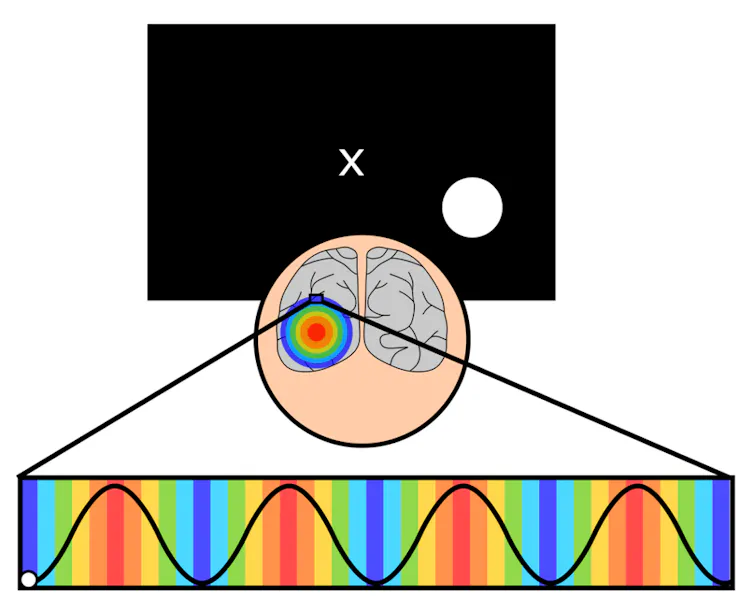
Au laboratoire, nous pouvons générer, contrôler, et mesurer les cycles de notre perception. Pour cela, dans une pièce sombre, nous présentons un disque qui clignote à une fréquence de 10 Hz sur un écran d’ordinateur. Cette modulation cyclique du stimulus visuel va produire une activité cérébrale cyclique à la même fréquence, c’est-à-dire une oscillation à 10 Hz. Ainsi, la perception d’information visuelle à proximité du disque clignotant va dépendre du cycle de l’oscillation cérébrale.
Cette manipulation expérimentale nous permet non seulement de mesurer les cycles de notre perception, mais nous pouvons également savoir quelles populations de neurones de notre cerveau entrent en jeu. En effet, les aires cérébrales qui traitent l’information visuelle sont très bien organisées, comme des cartes topographiques de notre champ visuel. Chaque neurone de chaque région visuelle a la mission de traiter une zone précise de notre champ visuel. Comme si notre champ visuel était divisé en milliers de petites cases, chacune gérée par un neurone différent.
Plus important, deux populations de neurones qui sont juste à côté l’une de l’autre dans une région visuelle vont traiter les informations en provenance de deux endroits qui sont juste à côté dans le champ visuel. Ce principe d’organisation est appelé rétinotopie, et grâce à ce principe, nous savons quelles populations de neurones vont suivre l’oscillation du disque clignotant en bas à droite de l’écran (il s’agira des régions visuelles dorsales de l’hémisphère gauche).
Au laboratoire nous pouvons induire une activité cérébrale à une fréquence de 10 Hz, avec une origine précise dans les aires visuelles. La question que nous nous sommes posées est la suivante : les oscillations à 10 Hz induites par le disque dans des neurones spécifiques se propagent-elles aux neurones adjacents comme une vague, à l’image de la goutte qui tombe dans l’eau ?
Prenons deux objets que nous pouvons retrouver sur notre espace de travail : une tasse à café et un clavier d’ordinateur (Figure 2). Si l’activité cérébrale se propage comme une vague, alors à un moment donné, la perception de la tasse à café sera meilleure que celle du clavier ; et l’inverse se produira à un autre moment dans le temps (l’hypothèse alternative où il n’y a pas de vague est présentée en Figure 3). Rappelons que notre perception évolue à une échelle de temps très rapide, de l’ordre d’un millième de seconde. Comme lorsque nous regardons un film, ces variations se produisent si vite que nous n’en avons pas conscience. Pourtant, elles influencent ce que nous voyons à chaque instant.
Nous avons répliqué ce principe en laboratoire. Nous avons présenté à des participants un disque clignotant à une fréquence de 10 Hz, ainsi que des petits points blancs à différentes positions dans l’espace et à différents temps (Figure 4). La tâche des participants est simple, il leur est demandé d’appuyer sur un bouton du clavier lorsqu’un des points est vu. Nos résultats ont montré que la perception n’est pas la même pour les trois points à un moment donné.
En effet, il y a un décalage de 5 ms entre la meilleure perception des points. Par exemple, si la perception est meilleure à 100 ms pour le point 1, elle sera meilleure à 105 ms pour le point 2, et à 110 ms pour le point 3. Ce résultat nous permet de conclure que l’activité cérébrale dans les aires visuelles est dynamique. Elle se propage de son point d’origine vers les autres points à une vitesse de 0,5 m/s, de même que la perception visuelle.
Figure 3. Des vagues ou pas de vagues ? Si notre perception ne fait pas de vagues, à un moment donné, notre cerveau perçoit aussi bien tous les éléments de l’image, alors qu’à un autre moment la perception de tout l’espace est limitée. Fourni par l’auteur Figure 4.Expérience au laboratoire. Les participants devaient fixer une croix située au centre d’un écran d’ordinateur, tandis qu’un disque clignotant à une fréquence de 10 Hz y était affiché. Ce clignotement induit des oscillations cérébrales à 10 Hz dans les aires visuelles. Lorsqu’un point blanc est présenté au sommet de cette oscillation (phase rouge), il est perçu par le participant. En revanche, lorsqu’il est présenté au creux de l’oscillation (phase bleue), il n’est pas perçu. Fourni par l’auteur
Bien que notre perception semble être périodique, nous avons une impression de continuité visuelle. On ne sait pas encore précisément comment cette continuité émerge. Les mouvements rapides des yeux (les saccades) jouent probablement un rôle important.
Entre deux fixations, le cerveau semble conserver une partie des informations déjà acquises, un phénomène appelé mémoire transsaccadique, afin de maintenir une représentation stable de la scène visuelle. Cette mémoire, associée à l’intégration des informations visuelles au cours du temps, pourrait contribuer à notre impression d’un monde fluide et continu, mais la contribution exacte de ces différents mécanismes reste un sujet de recherche.
Vers des applications dans le domaine des interfaces cerveau-machine
Pendant longtemps, les chercheurs qui étudient la vision se sont principalement intéressés à la manière dont l’activité du cerveau change dans le temps pour expliquer la perception. Nous savons à présent que l’activité cérébrale se propage de manière dynamique à travers le cerveau.
Au-delà de mieux comprendre les mécanismes fondamentaux de notre cerveau, cette connaissance va nous permettre d’améliorer des techniques de réhabilitation pour les patients. Par exemple, les interfaces cerveau-machine permettent de mesurer l’activité cérébrale au niveau des aires motrices de patients para- ou tétraplégiques, pour ensuite envoyer une commande à une prothèse pour réaliser un mouvement. En mesurant l’activité cérébrale au bon moment et au bon endroit, il sera possible de réaliser des mouvements avec une plus grande précision.
Enfin, nous avons réussi à révéler l’aspect dynamique de l’activité cérébrale… sans jamais poser un seul capteur pour enregistrer le signal du cerveau. Par la seule précision de protocoles bien conçus, l’expérimentation comportementale nous permet d’entrevoir les lois qui régissent notre perception. Ainsi, derrière l’apparente simplicité de certaines expériences se cache un véritable pouvoir : celui de révéler, avec finesse, les secrets invisibles de notre cerveau.
Laura Dugué a reçu un financement de l’ERC (N° 852139). Elle est membre honoraire de l’IUF.
Camille Fakche ne travaille pas, ne conseille pas, ne possède pas de parts, ne reçoit pas de fonds d’une organisation qui pourrait tirer profit de cet article, et n’a déclaré aucune autre affiliation que son organisme de recherche.