A UK climate security report backed by the intelligence services was quietly buried – a pattern we’ve seen many times before

Source: The Conversation – UK – By Marc Hudson, Visiting Fellow, SPRU, University of Sussex Business School, University of Sussex

Last autumn, a UK government report warned that climate-driven ecosystem collapse could lead to food shortages, mass migration, political extremism and even nuclear conflict. The report was never officially launched.

Commissioned by Defra – the Department for Environment Food and Rural Affairs – and informed by intelligence agencies including MI5 and MI6, the briefing assessed how environmental degradation could affect UK national security.

At the last minute the launch was cancelled, reportedly blocked by Number 10. Thanks to pressure from campaigners and a freedom of information request, a 14-page version of the report was snuck out (no launch, not even a press release) on January 22.

That report says: “Critical ecosystems that support major food production areas and impact global climate, water and weather cycles” are already under stress and represent a national security risk. If they failed, the consequences would be severe: water insecurity, severely reduced crop yields, loss of arable land, fisheries collapse, changes to global weather patterns, release of trapped carbon exacerbating climate change, novel zoonotic disease and loss of pharmaceutical resources.

In plainer terms: the UK would face hunger, thirst, disease and increasingly violent weather.

An unredacted version of the report, seen by the Times, goes further. It warns that the degradation of the Congo rainforest and the drying up of rivers fed by the Himalayas could drive people to flee to Europe (Britain’s large south Asian diaspora would make it “an attractive destination”), leading to “more polarised and populist politics” and putting more pressure on national infrastructure.

The Times describes a “reasonable worst case scenario” in the report, where many ecosystems were “so stressed that they could soon pass the point where they could be protected”. Declining Himalayan water supplies would “almost certainly escalate tensions” between China, India and Pakistan, potentially leading to nuclear conflict. Britain, which imports 40% of its food, would struggle to feed itself, the unredacted report says.

The report isn’t an outlier, and these concerns are not confined to classified briefings. A 2024 report by the University of Exeter and think-tank IPPR warned that cascading climate impacts and tipping points threaten national security – exactly the risk outlined in the Defra report.

River flows through jagged mountains
Melting glaciers in remote mountains ultimately pose a security threat for the UK, say intelligence services.
Hussain Warraich / shutterstock

The government has not publicly explained why the launch was cancelled. In response to the Times article, a Department for Environment, Food and Rural Affairs spokesperson said: “Nature underpins our security, prosperity and resilience, and understanding the threats we face from biodiversity loss is crucial to meeting them head on. The findings of this report will inform the action we take to prepare for the future.”

Perhaps there are mundane reasons to be cautious about a report linked to the intelligence services that warns of global instability. But the absence of any formal briefing or ministerial comment is itself revealing – climate risks appear to be treated differently from other risks to national security. It’s hard to imagine a report warning of national security risks from AI, China or ocean piracy getting the same treatment.

This episode is not even especially unusual, historically. Governments have been receiving warnings about climate change – and downplaying or delaying responses – for decades.

Decades of warnings

In January 1957, the Otago Daily Times reported a speech by New Zealand scientist Athol Rafter under the headline “Polar Ice Caps May Melt With Industrialisation”. And Rafter was merely repeating concerns already circulating internationally, including by a Canadian physicist whose similar warning went around the world in May 1953. Climate change first went viral more than seven decades ago.

By the early 1960s, scientists were holding meetings explicitly focused on the implications of carbon dioxide build-up. In 1965, a report to the US president’s Science Advisory Council warned that “marked changes in climate, not controllable though local or even national efforts, could occur”.

Senior figures in the UK government were aware of these discussions by the late 1960s, while the very first environment white paper, in May 1970, mentions carbon dioxide build-up as a possible problem.

But the story we see today was the same. Reports are commissioned, urgent warnings are issued – and action is deferred. When climate change gained renewed momentum in the mid-1980s, following the discovery of the ozone hole and the effects of greenhouse gases besides carbon dioxide, the message sharpened: global warming will come quicker and hit harder than expected.

Margaret Thatcher finally acknowledged the threat in a landmark 1988 speech to the Royal Society. But when green groups tried to get her to make specific commitments, they had little success.

Since about 1990, the briefings have barely changed. Act now, or suffer severe consequences later. Those consequences, however, are no longer theoretical.

Why does nothing happen?

Partly, it’s down to inertia. We have built societies in which carbon-intensive systems are locked in. Once you’ve built infrastructure around, say, the private petrol-powered automobile, it’s hard for competitors to offer an alternative. There’s also a mental intertia: it’s hard to let go of assumptions you grew up with in a more stable era.

Secrecy plays a role too. As the Defra report illustrates, uncomfortable assessments are often softened, delayed or buried. Then, if you do accept the need for action, you are then up against the problem of responsibility being fragmented across sectors and institutions, making it hard to know where to aim your efforts. Meanwhile, social movements fighting for climate action find it hard to sustain momentum for more than three years.

Here’s the final irony. Conspiracy theorists and climate deniers insist governments are exaggerating the threat. In reality, the evidence increasingly suggests the opposite. Official assessments tend to lag behind scientific warnings, and the most pessimistic scenarios are often confined to technical or classified documents.

The situation is not better than we are told. It’s actually far worse.


Don’t have time to read about climate change as much as you’d like?

Get a weekly roundup in your inbox instead. Every Wednesday, The Conversation’s environment editor writes Imagine, a short email that goes a little deeper into just one climate issue. Join the 47,000+ readers who’ve subscribed so far.


The Conversation

Marc Hudson was employed as a post-doctoral researcher on various industrial decarbonisation projects. He runs a climate histories website called All Our Yesterdays. http://allouryesterdays.info

ref. A UK climate security report backed by the intelligence services was quietly buried – a pattern we’ve seen many times before – https://theconversation.com/a-uk-climate-security-report-backed-by-the-intelligence-services-was-quietly-buried-a-pattern-weve-seen-many-times-before-274325


Medieval women used falconry to subvert gender norms

Source: The Conversation – UK – By Rachel Delman, Heritage Partnerships Coordinator, University of Oxford

Hawks are taking cinematic flight. In two recent literary adaptations, they are entwined with the lives and emotions of their respective protagonists – Agnes Shakespeare (née Hathaway) and Helen Macdonald.

Birds of prey and their symbolism are explored in Hamnet, Chloé Zhao’s adaptation of Maggie O’Farrell’s 2020 novel, and H is for Hawk, based on Macdonald’s 2014 memoir. In these films, hawks become complex and multifaceted figures, articulating gendered relationships to grief, nature, humanity and selfhood.

Hamnet is set in the Elizabethan period, and H is for Hawk in the modern day. However, the relationship between women and birds of prey has an even longer history. My research shows that in the medieval period, too, that relationship was multilayered. Far more than fashionable accessories, hawks offered women both real and symbolic means to express gender, power and status within a male-dominated world.

The mirror case from the British Library collection.
The Trustees of the British Museum, CC BY-NC

In the middle ages, the process of training hawks, with its delicate dance of control and release, was popularly associated with the game of courtship between men and women.

Falconry’s romantic connotations are emphasised in art, objects and literature from the time. Images of men and women hunting together with birds of prey feature across a wide range of medieval material culture, from tapestries for castle walls to decorative cases used to contain and protect hand-held mirrors.

The largest of four fifteenth-century tapestries, known collectively as the Devonshire Hunting Tapestries, takes falconry as its subject. Lovers are depicted strolling arm-in-arm as their birds hunt prey.

On a smaller scale, two fourteenth-century mirror cases from the collections of the British Museum and the Metropolitan Museum of Art show scenes of lovers riding on horseback, each holding falcons. The mirrors may have been gifted as love tokens. Literary texts are also filled with references to women with, and even as, hawks.

The trope of the woman as a hawk needing to be tamed and controlled, however, was not a straightforward one of female submission. Falconry and its symbolism offered elite medieval women mastery and autonomy.

Defining themselves

Where high-status medieval women had the opportunity to represent themselves through visual culture, they often chose to include birds of prey. This is most obviously seen in seals, which were used by a wide range of medieval people to authenticate legally binding documents. Seals represented the sealer’s endorsement, identity and status.

The iconography of seals, and the matrices or moulds used to create them, provides important evidence of how women of status wished to be perceived and remembered. Elizabeth of Rhuddlan, the youngest daughter of King Edward I and Eleanor of Castile, chose the most popular motif among 13th-century women as the matrix for her personal (privy) seal. It shows a woman standing upright, her body tilted towards an obedient bird of prey in her left hand.

In another seal-matrix from the same century, Elizabeth, Lady of Sevorc is shown in a more energetic pose. She rides side-saddle, a falcon in one hand and a large eagle’s claw in the other.

Through their seals, medieval women showed their mastery over their birds of prey and affairs, and their belonging to a fashionable and powerful female collective.

Medieval image of a woman and a hawk
A lady observing her hawk fly towards a duck, from the Taymouth Hours.
British Library

Beyond imagery, records show that queens and noblewomen created and managed parks and hunting grounds. They also hawked together, trained birds of prey, and even gave them as gifts.

Smaller birds, such as merlins, were considered appropriate for women. In the film adaption of H is for Hawk, Claire Foy’s Helen refuses to settle for a merlin, dismissing it as a “lady’s bird”. It seems that medieval women similarly refused to be limited by the options conduct manuals offered them.

Henry VIII’s paternal grandmother, Margaret Beaufort, had many birds of prey. These included merlins and lannerets as well as larger species such as goshawks and lanners.

The deer park Beaufort created at her palace at Collyweston in Northamptonshire, with its terraces, ponds and water meadows, was ideally suited to falconry. Her daughter-in-law, Queen Elizabeth of York, who had her own room at the palace, hunted with goshawks.

In some cases, women appear to have been recognised as authorities on falconry-related matters. The Taymouth Hours, an illuminated 14th century book likely produced for a queenly reader, shows women with billowing headdresses hunting mallards with large birds of prey. The women adopt authoritative stances, demonstrating their skill, command and control over the birds.

In the following century, Dame Juliana de Berners, a prioress from Sopwell Priory, is thought to have authored at least part of the Boke of St Albans, which contains treatises on hunting and hawking.

medieval drawing of a lady observing her hawk bringing down a duck
A lady observing her hawk bringing down a duck in the Yates Thompson manuscript.
British Library

Research by English Heritage has identified that women could even make a living from their expertise in training hawks. In the mid-13th century, a woman named Ymayna was the keeper of the Earl of Richmond’s hawks and hounds at Richmond Castle. In exchange for her expertise, she and her family were permitted to hold land nearby.

Ymayna stands out as a woman in a male-dominated profession, but her example suggests that there were probably other women like her, whose names are unidentified or absent from the historical record.

Women falconers may have been among the owners and users of knives, the handles of which survive in museum collections across Europe. An exquisitely carved example from the 14th century, now displayed in the Ashmolean Museum in Oxford, takes the form of a noble lady with a tiny bird of prey clutched close to her heart.

Literary texts reveal that falconry offered opportunities for female socialisation and bonding. In the Middle English poem Sir Orfeo, Orfeo spies a collective of 60 women on horseback, each with a hawk in hand.

medieval illustration of a lady hawking for a hare i
A lady hawking for a hare in the Yates Thompson manuscript.
British Library

In Hamnet, Agnes tells her husband William Shakespeare that her falconry glove was a gift from her mother. Medieval and early-modern women certainly gave gifts to one another, including gloves. My research, however, suggests that birds of prey were more commonly gifted between women and men.

Margaret Beaufort gave and received birds of prey to and from male relatives and associates, including her young grandson, the future Henry VIII. Birds of prey were considered suitable gifts for special occasions and life milestones. Margaret Pole, Countess of Salisbury, gave her nephew, Henry Courtenay, three falcons to mark his elevation to the title of Marquess of Exeter in 1525.

That powerful women landowners participated in rituals of gift exchange with men suggests falconry was not a straightforwardly feminine expression of power and status. Through their ownership of parks and the giving and receiving of birds of prey as gifts, women also used the culture of falconry to show their belonging to a masculine world of hunting and lordly largesse.


Looking for something good? Cut through the noise with a carefully curated selection of the latest releases, live events and exhibitions, straight to your inbox every fortnight, on Fridays. Sign up here.


This article features references to books that have been included for editorial reasons, and may contain links to bookshop.org. If you click on one of the links and go on to buy something from bookshop.org The Conversation UK may earn a commission.

The Conversation

Rachel Delman received funding from the Arts and Humanities Research Council (2013-2016) and the Leverhulme Trust (2019-2022).

ref. Medieval women used falconry to subvert gender norms – https://theconversation.com/medieval-women-used-falconry-to-subvert-gender-norms-274374

Not an artefact, but an ancestor: why a German university is returning a Māori taonga

Source: The Conversation – UK – By Michael La Corte, Research Associate, Curation and Communication, University of Tübingen

Restitution debates – the question of whether a cultural object should be returned from a museum or other collection to a person or community – often begin with a deceptively simple question: who owns an object?

In colonial contexts, this question rarely has a clear answer. Histories of acquisition are often incomplete, disputed and overwhelmingly recorded from European perspectives. Legal documentation, where it exists at all, usually reflects unequal power relations rather than mutual consent. As a result, many restitution claims cannot be resolved through law alone.

This raises a fundamental question: should the spiritual, social and ancestral significance of an object for its community of origin outweigh unresolved legal arguments about possession?

The case of the Hinematioro pou, which is now being returned from the University of Tübingen to the Māori community Te Aitanga-a-Hauiti on the east coast of New Zealand’s north island, illustrates a restitution process grounded in cultural values. It shows what happens when decisions are guided primarily by spiritual meaning and relational responsibility, rather than by legal uncertainty surrounding colonial acquisition.

A pou is a carved wooden pillar that acts as a marker for tribal boundaries, stories or ancestors. The Hinematioro pou is an early carved panel depicting a standing ancestral figure.

For the Te Aitanga-a-Hauiti, the pou is neither a historical artefact nor a work of art in the western sense. It is the material presence of an ancestor, Hinematioro, who was an ariki (high-ranking leader). The pou is part of a living social order, not a testimony to a distant past.

Within Māori cultural logic, such an object is a taonga: a treasure that carries not only material, but also spiritual, social and genealogical value. Taonga possess mana and mauri – agency and life force – and require ritual relationships as well as responsibility.

This meaning became clear when the pou returned in 2019, for the first time in over 250 years, to Ūawa (Tolaga Bay). It was met with a formal pōwhiri (welcome ceremony) with singing, speeches, tears and embraces – as if a long-absent relative had come home.

Witnessing this special moment made us and many others who were part of the event understand that the question of the pou’s future location is not a museological one for the community, but an existential one. It is not about possession, but about relationship.

How the taonga came to Germany

It is not possible to conclusively reconstruct how the taonga came to Europe. What is certain is that, in October 1769, it was taken from Ūawa to Europe aboard the HMS Endeavour during James Cook’s first Pacific voyage.

The panel is widely regarded as one of the earliest surviving carved pou associated with Māori chiefly genealogies to have entered European collections. This occurred within a colonial context of profound power asymmetries.

sketch of a cove
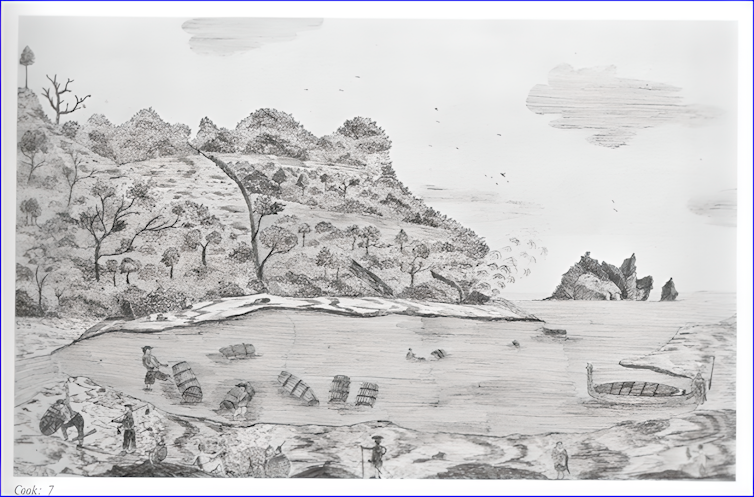
The Watering Place in Tolaga Bay, Ōpoutama, Cooks Cove sketch by James Cook 1769.
British Museum, London

It is also not possible to establish how the pou was transferred. A range of possibilities exists, including gifting, coerced handover, exchange or theft. European sources provide no clear evidence, and perspectives from the source community are not sufficiently recognised in Europe. Therefore, a lack of documented violence cannot be taken as evidence of a voluntary transfer.

The object’s later path to Tübingen can only be partially traced. It may have circulated through several 19th-century scientific and collecting networks connected to the Cook expedition.

What is certain is that, in 1937, the pou entered the Ethnological Collection of the University of Tübingen through Emma von Luschan (1864–1941, wife to the anthropologist, explorer, archaeologist and ethnographer, Felix von Luschan) when their collection was curated by the anthropologist and ethnologist Augustin Krämer.

A turning point came in the 1990s, when the panel was identified using a drawing from the Cook expedition held at the British Library. What proved decisive, however, was the establishment of direct relationships with the Hauiti Iwi (tribe or people).

In the following years, close cooperation developed between the University of Tübingen and the Hauiti Iwi. In 2019 the pou was loaned back to the Māori. A jointly curated exhibition Te Pou o Hinematioro (2025–26) at Hohentübingen Castle back in Germany followed – an expressions of a partnership in which trust could grow. The restitution of the pou is therefore not the outcome of conflict, but the result of a long-term relationship that deepened during the exhibition process.

From a legal perspective, the university was not obliged to return the object. Under German civil law, the pou is considered university property, and no binding restitution framework exists for colonial contexts.

Nevertheless, political approaches to colonial collection material in Germany have shifted in recent years. Recent national guidelines encourage transparency, provenance research, dialogue with source communities and restitution as a possible outcome. This reflects a shift away from narrow legal ownership toward acknowledging colonial power imbalances in collection histories.

Decisions about restitution are primarily political and institutional in nature. These decisions raise questions of responsibility: what obligations do present-day collections have towards the circumstances in which their holdings were acquired, and what role do institutions wish to play in global debates on heritage, memory and justice? Universities, with their extensive collections and deep involvement in colonial knowledge production, are particularly affected by these issues.

Where legal histories are inconclusive – as they often are in colonial contexts – restitution cannot be decided by ownership alone. For source communities to be genuine partners, their social, spiritual and ancestral relationships with heritage must be recognised. Otherwise, restitution debates risk perpetuating the very hierarchies it aims to dismantle.


Looking for something good? Cut through the noise with a carefully curated selection of the latest releases, live events and exhibitions, straight to your inbox every fortnight, on Fridays. Sign up here.


The Conversation

The authors do not work for, consult, own shares in or receive funding from any company or organisation that would benefit from this article, and have disclosed no relevant affiliations beyond their academic appointment.

ref. Not an artefact, but an ancestor: why a German university is returning a Māori taonga – https://theconversation.com/not-an-artefact-but-an-ancestor-why-a-german-university-is-returning-a-maori-taonga-274071

Why do our joints crack, pop and crunch and should we worry about it?

Source: The Conversation – UK – By Clodagh Toomey, Physiotherapist and Associate Professor, School of Allied Health, University of Limerick

New Africa/Shutterstock

Many of us have noisy joints. Knees crack on the stairs, necks pop when we stretch, and knuckles seem to crack almost on demand. These sounds can be startling and are often blamed on ageing, damage or the looming threat of arthritis.

As a physiotherapist and researcher of chronic joint pain, I am frequently asked whether joint noises are something to worry about. The reassuring answer is that, in most cases, they are not.

One reason joint sounds cause anxiety is that we tend to treat them as a single phenomenon. Clinically, they are not.

The familiar “crack” from knuckles, backs or necks is usually caused by a process called cavitation. Joints are surrounded by a capsule filled with synovial fluid, a thick lubricant that contains dissolved gases such as oxygen, nitrogen and carbon dioxide. When a joint is stretched beyond its usual range, pressure inside the capsule drops. A gas bubble forms and collapses, producing the popping sound.

This is why you cannot crack the same joint repeatedly. It typically takes around 20 minutes for the gas to dissolve back into the fluid.

Other noises are different. Snapping sounds often come from tendons moving over bony structures. Grinding, crunching or creaking noises, known as crepitus, are particularly common in the knees. These are thought to arise from movement between cartilage and bone surfaces and are often felt as well as heard.

Knees are especially prone to crepitus because of how they work. The kneecap sits in a groove at the front of the thigh bone and is guided by muscles above and below it. If those muscles pull unevenly, because of strength imbalances, tightness or foot and hip mechanics, the kneecap can track slightly off centre. This can increase the crunching or grinding sensation.

Noise on its own is rarely a problem. What matters clinically is whether it comes with other symptoms. Pain, swelling, locking of the joint or a noticeable reduction in function are the things that warrant further assessment.

Does cracking joints cause arthritis?

There is no strong evidence that cracking or popping joints causes osteoarthritis.

Research in this area is challenging, as it requires following people over many years and accurately tracking their habits. The studies that do exist, including retrospective and cross-sectional research, have not found a meaningful link between habitual joint cracking and arthritis.

Some studies have explored other outcomes, such as grip strength or joint laxity, which refers to how loose or flexible a joint is and how much it can move beyond its typical range. Findings have been mixed and inconsistent. Overall, there is no convincing evidence that cracking joints causes damage to joint structures, strength or long-term joint health.

Many people report that joint cracking feels satisfying or relieving. This makes sense. Stretching a joint to the point of cavitation can temporarily increase range of motion and reduce muscle tension. There is also a neurological effect, as nerve endings are stimulated during the movement, sending a reflex signal to the brain which causes local muscle relaxation in the area. The audible pop itself can provide a calming, satisfying sensation which may lead to developing that habitual self-soothing mechanism for tension that annoys your family members and friends.

The key point is that these effects are short lived. Joint cracking does not fix underlying mechanical issues or provide lasting improvements in mobility. If relief only comes from repeated cracking, the underlying cause has not been addressed.

Spinal manipulation

Spinal manipulation, whether performed by physiotherapists, chiropractors or other practitioners, relies on the same cavitation mechanism. There is evidence that it can provide short-term pain relief and reduce muscle tension for some people.

However, it is important to be cautious, particularly with the neck. The cervical spine protects the spinal cord and major blood vessels supplying the brain. Rare but serious complications, including stroke, have been reported following neck manipulation. Anyone considering this type of treatment should ensure it is carried out by a properly trained professional and understand that it targets symptoms rather than underlying causes.

Joint noises do tend to become more common with age. Cartilage changes over time, and muscles and ligaments may lose some of their strength and elasticity. These changes can increase the likelihood of noise during movement.

People who have joint conditions such as knee osteoarthritis and have noisy joints tend to report slightly more pain and reduced function compared to people with osteoarthritis and no crepitus. It may be reassuring to know that there is no difference in tests like walking speed or muscle strength between groups, pointing to a potential psychological impact of noisy knees.

Crucially, noise alone is not a reason to stop being active. Some people reduce their physical activity because they fear they are “wearing out” their joints. In fact, the opposite is true. Movement is essential for joint health. Cartilage relies on regular compression and release to receive nutrients, as it has very limited blood supply.

Exercise is a cornerstone of joint health and is recommended as the first treatment to try in national and international clinical guidelines for conditions such as osteoarthritis. Consistency matters more than the specific type of exercise. The best exercise is the one you will keep doing.

There is no evidence that supplements such as collagen or fish oils reduce joint noise. Large studies show limited effects on pain and function at a population level, although some people report benefits. These supplements are generally safe, but if they do not help, they are unlikely to be worth the cost.

Joint noises are usually harmless. They are worth assessing if they are accompanied by pain, swelling, locking, or reduced function, or if they are limiting your confidence to move. Staying active is one of the best things you can do for your joints, whether they crack, pop, crunch or stay silent.


Strange Health is hosted by Katie Edwards and Dan Baumgardt. The executive producer is Gemma Ware, with video and sound editing for this episode by Sikander Khan. Artwork by Alice Mason.

In this episode, Dan and Katie talk about a social media clip from loryalien via TikTok.

Listen to Strange Health via any of the apps listed above, download it directly via our RSS feed or find out how else to listen here. A transcript is available via the Apple Podcasts or Spotify apps.

The Conversation

Clodagh Toomey receives funding from the Health Research Board Ireland. She is affiliated with the non-profit Good Life with osteoArthritis Denmark (GLA:D).

ref. Why do our joints crack, pop and crunch and should we worry about it? – https://theconversation.com/why-do-our-joints-crack-pop-and-crunch-and-should-we-worry-about-it-274161

Quand les médicaments du quotidien nous rendent malades : mésusages et effets indésirables

Source: The Conversation – in French – By Clément Delage, Maitre de Conférences en Pharmacologie (Faculté de Pharmacie de Paris) – Unité Inserm UMR-S 1144 "Optimisation Thérapeutique en Neuropsychopharmacologie" – Pharmacien Hospitalier (Hôpital Lariboisière, AP-HP), Université Paris Cité

Entre banalisation de l’automédication et méconnaissance des risques, les médicaments le plus utilisés – comme le paracétamol – peuvent être à l’origine d’effets indésirables parfois sévères. Comprendre pourquoi et comment le remède peut devenir poison, c’est poser les bases d’un bon usage du médicament.


Chaque année, le mésusage de médicaments est responsable d’environ 2 760 décès et de 210 000 hospitalisations en France, selon une étude du Réseau français de centres de pharmacovigilance. Cela représente 8,5 % des hospitalisations et 1,5 fois plus de décès que les accidents de la route.

Si la part exacte de l’automédication dans ces chiffres reste difficile à établir, ces données rappellent une réalité souvent négligée. Les effets indésirables ne concernent pas seulement les traitements rares ou complexes, mais aussi les médicaments de tous les jours : paracétamol, ibuprofène, antihistaminiques (des médicaments qui bloquent la production d’histamine responsable de symptômes comme le gonflement, les rougeurs, les démangeaisons, les éternuements, etc. dans les situations d’allergies, ndlr), somnifères, sirops contre le rhume, etc.

Quand le remède devient poison

« Tout est poison, rien n’est poison : seule la dose fait le poison. »
– Paracelse (1493–1541)

Copie présente au Musée du Louvre du portrait perdu de Paracelse par Quentin Metsys
Portrait de Paracelse, d’après Quentin Metsys (1466-1530).
CC BY-NC

Cet adage fondateur de la pharmacie, enseigné dès la première année aux futurs pharmaciens, garde aujourd’hui toute sa pertinence. Paracelse avait compris dès le XVIᵉ siècle qu’une substance pouvait être bénéfique ou toxique selon la dose, la durée et le contexte d’exposition. D’ailleurs, le mot pharmacie dérive du mot grec phármakon qui signifie à la fois « remède » et « poison ».

Le paracétamol, antalgique et antipyrétique (médicament qui combat la douleur et la fièvre, ndlr) largement consommé, est perçu comme inoffensif. Pourtant, il est responsable d’hépatites médicamenteuses aiguës, notamment lors de surdosages accidentels ou d’associations involontaires entre plusieurs spécialités qui en contiennent. En France, la mauvaise utilisation du paracétamol est la première cause de greffe hépatique (c’est-à-dire de foie, ndlr) d’origine médicamenteuse, alerte l’Agence nationale de sécurité du médicament et des produits de santé (ANSM).

L’ibuprofène, également très utilisé pour soulager douleurs et fièvre, peut quant à lui provoquer des ulcères gastriques, des hémorragies digestives ou une insuffisance rénale, s’il est pris à forte dose et de manière prolongée ou avec d’autres traitements agissant sur le rein. Par exemple, associé aux inhibiteurs de l’enzyme de conversion (les premiers médicaments prescrits dans l’hypertension artérielle), il peut déclencher une insuffisance rénale fonctionnelle.

L’aspirine, médicament que l’on trouve encore dans beaucoup d’armoires à pharmacie, fluidifie le sang et peut favoriser les saignements et hémorragies, notamment digestifs. En cas de surdosage très important, il peut même conduire à des troubles de l’équilibre acide-base dans le sang et mener au coma voire au décès s’il n’y a pas de prise en charge rapide.

Ces exemples illustrent un principe fondamental : il n’existe pas de médicaments sans risque. Tous peuvent, dans certaines conditions, provoquer des effets délétères. Dès lors, la question n’est pas de savoir si un médicament est dangereux, mais dans quelles conditions il le devient.

Pourquoi tous les médicaments présentent-ils des effets indésirables ?

Comprendre l’origine des effets indésirables nécessite un détour par la pharmacologie, la science qui étudie le devenir et l’action du médicament dans l’organisme.

Chaque médicament agit en se liant à une cible moléculaire spécifique – le plus souvent un récepteur, une enzyme ou un canal ionique – afin de modifier une fonction biologique. Mais ces substances actives, exogènes à l’organisme, ne sont jamais parfaitement sélectives : elles peuvent interagir avec d’autres cibles, provoquant ainsi des effets indésirables – autrefois appelés effets secondaires.

De plus, la plupart des effets, qu’ils soient bénéfiques ou nocifs, sont dose-dépendant. La relation entre la concentration d’un médicament dans le corps et l’intensité de son effet s’exprime par une courbe dose-effet de forme sigmoïde.

Chaque effet (thérapeutique ou indésirable) a sa propre courbe, et la zone thérapeutique optimale (l’index thérapeutique) est celle où l’effet bénéfique est maximal et la toxicité minimale. C’est cette recherche d’équilibre entre efficacité et sécurité qui fonde la balance bénéfice/risque, notion centrale de toute décision thérapeutique.

Courbe effet/dose d’un médicament

Ainsi, même pour des molécules familières, un écart de posologie peut faire basculer le traitement du côté de la toxicité.

Contre-indications et interactions : quand d’autres facteurs s’en mêlent

Les effets indésirables ne dépendent pas uniquement de la dose. Les susceptibilités individuelles, les interactions médicamenteuses ainsi que des facteurs physiologiques ou pathologiques peuvent favoriser la survenue des effets indésirables.

Chez les personnes atteintes d’insuffisance hépatique (qui concerne le foie, ndlr), par exemple, la dégradation du paracétamol normalement assurée par le foie est ralentie, ce qui favorise son accumulation et augmente le risque de toxicité de ce médicament pour le foie. On parle d’hépatotoxicité.

L’alcool, en agissant sur les mêmes récepteurs cérébraux que les benzodiazépines (on citera, dans cette famille de médicaments, les anxiolytiques tels que le bromazépam/Lexomil ou l’alprazolam/Xanax), potentialise leurs effets sédatifs et de dépression respiratoire (qui correspond à une diminution de la fréquence respiratoire, qui peut alors devenir trop faible pour assurer l’approvisionnement du corps en oxygène). Les courbes d’effet/dose de chacun des composés vont alors s’additionner et déclencher de manière plus rapide et plus puissante l’apparition des effets indésirables.

De même, certains médicaments interagissent entre eux en modifiant leur métabolisme, leur absorption ou leur élimination. Dans ce cas, la courbe effet/dose du premier composé sera déplacée vers la droite ou la gauche par le second composé.

Ces mécanismes expliquent la nécessité de contre-indications, de précautions d’emploi et de limites posologiques strictes, précisées pour chaque médicament dans son autorisation de mise sur le marché. Avant chaque prise de médicament, l’usager doit consulter sa notice dans laquelle sont résumées ces informations indispensables.

Comment les risques médicamenteux sont-ils encadrés ?

Avant sa commercialisation, tout médicament fait l’objet d’une évaluation rigoureuse du rapport bénéfice/risque. En France, cette mission relève de l’ANSM.

L’autorisation de mise sur le marché (AMM) est délivrée après analyse des données précliniques et cliniques, qui déterminent notamment :

  • les indications thérapeutiques ;

  • les doses et durées recommandées ;

  • les contre-indications et interactions connues.

Mais l’évaluation ne s’arrête pas après l’autorisation de mise sur le marché. Dès qu’un médicament est utilisé en vie réelle, il entre dans une phase de pharmacovigilance : un suivi continu des effets indésirables signalés par les professionnels de santé ou les patients eux-mêmes.

Depuis 2020, le portail de signalement des événements sanitaires indésirables permet à chacun de déclarer facilement un effet suspecté, contribuant à la détection précoce de signaux de risque.

Les médicaments les plus à risque ne sont disponibles que sur prescription médicale, car la balance bénéfice/risque doit être évaluée patient par patient, par le médecin. Les autres, accessibles sans ordonnance, restent délivrés exclusivement en pharmacie, où le pharmacien joue un rôle déterminant d’évaluation et de conseil. Cette médiation humaine constitue un maillon essentiel du système de sécurité médicamenteuse.

Prévenir la toxicité médicamenteuse : un enjeu collectif

La prévention des accidents liés à des médicaments repose sur plusieurs niveaux de vigilance.

Au niveau individuel, une acculturation au bon usage du médicament est nécessaire.

Quelques gestes simples réduisent considérablement les risques de surdosage ou d’interactions médicamenteuses :

  • Bien lire la notice avant de prendre un médicament.
  • Ne pas conserver les médicaments obtenus avec une prescription lorsque le traitement est terminé et ne pas les réutiliser sans avis médical.
  • Ne pas partager ses médicaments avec autrui.
  • Ne pas prendre les informations trouvées sur Internet pour des avis médicaux.
  • Ne pas cumuler plusieurs médicaments contenant la même molécule.

Mais la responsabilité ne peut reposer uniquement sur le patient : les médecins ont évidemment un rôle clé d’éducation et d’orientation, mais les pharmaciens également. Ces derniers, en tant que premiers professionnels de santé de proximité, sont les mieux placés pour déceler et prévenir un mésusage.

La promotion du bon usage des médicaments est également le rôle des instances de santé, par la diffusion de messages de prévention, la simplification des notices et la transparence sur les signaux de sécurité permettent de renforcer la confiance du public sans nier les risques. L’amélioration de la pharmacovigilance constitue également un levier majeur de santé publique. À ce titre, elle s’est considérablement renforcée depuis le scandale du Mediator en 2009.

Enfin, il convient d’intégrer à cette vigilance les produits de phytothérapie – les traitements à base de plantes (sous forme de gélules, d’huiles essentielles ou de tisanes) et compléments alimentaires et même certains aliments, dont les interactions avec les traitements classiques sont souvent sous-estimées.

Comme pour les médicaments, la phytothérapie provoque aussi des effets indésirables à forte dose et pourra interagir avec eux. Par exemple, le millepertuis (Hypericum perforatum), plante qu’on retrouve dans des tisanes réputées anxiolytiques, va augmenter le métabolisme et l’élimination de certains médicaments, pouvant les rendre inefficaces.

Un équilibre à reconstruire entre confiance et prudence

Le médicament n’est ni un produit de consommation comme les autres ni un poison à éviter. C’est une arme thérapeutique puissante, qui exige discernement et respect. Sa sécurité repose sur une relation de confiance éclairée entre patients, soignants et institutions. Face à la montée de l’automédication et à la circulation massive d’informations parfois contradictoires, l’enjeu n’est pas de diaboliser le médicament, mais d’en restaurer la compréhension rationnelle.

Bien utilisé, il soigne ; mal utilisé, il blesse. C’est tout le sens du message de Paracelse, encore cinq siècles plus tard.

The Conversation

Clément Delage ne travaille pas, ne conseille pas, ne possède pas de parts, ne reçoit pas de fonds d’une organisation qui pourrait tirer profit de cet article, et n’a déclaré aucune autre affiliation que son organisme de recherche.

ref. Quand les médicaments du quotidien nous rendent malades : mésusages et effets indésirables – https://theconversation.com/quand-les-medicaments-du-quotidien-nous-rendent-malades-mesusages-et-effets-indesirables-273656

Is cracking your neck bad? And why can it feel so good to crack your back, knuckles and knees?

Source: The Conversation – UK – By Katie Edwards, Commissioning Editor, Health + Medicine and Host of Strange Health podcast, The Conversation

Andrey_Popov/Shutterstock

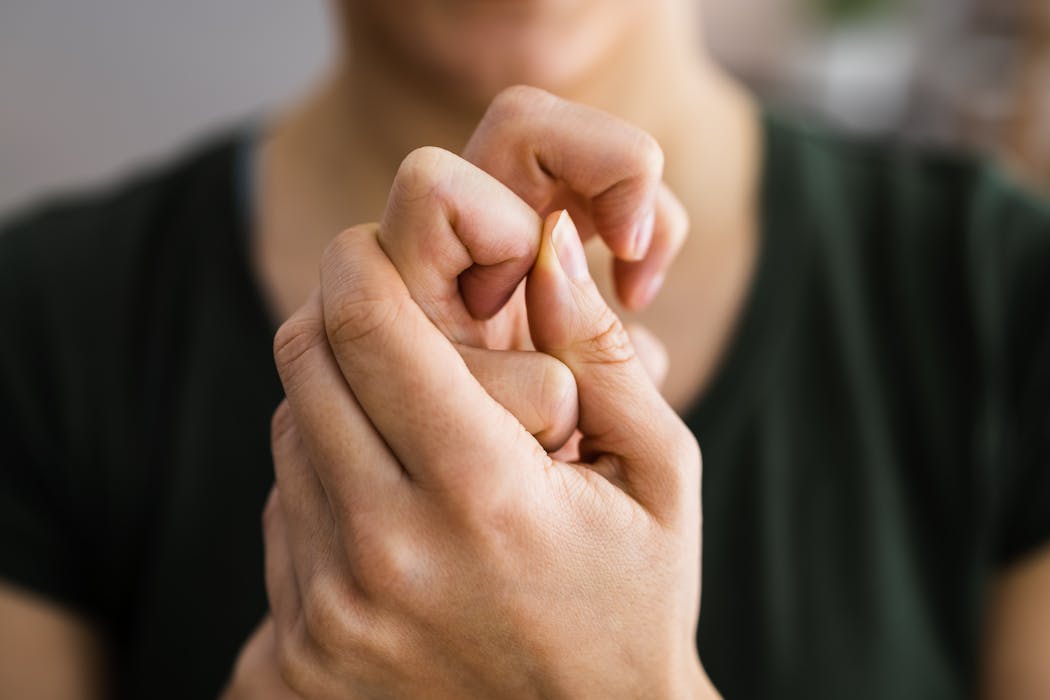
Joint cracking is one of those habits most of us acquire without thinking about it. A knuckle popped mid-sentence. A back twisted as we stand up. A neck gently crunched while the kettle boils. It is common, oddly satisfying and, for anyone sitting nearby, faintly alarming.

It is also surprisingly divisive.

Some people wince at the sound of a knuckle pop or a neck crunch. Others swear by it, twisting, stretching and cracking joints throughout the day in search of relief.

In the third episode of The Conversation’s Strange Health podcast, we turn our attention to one of the body’s most common and least understood noises. Knuckles, backs, knees and necks all feature, along with the enduring warning many of us grew up with: “Stop cracking your joints, you’ll get arthritis.” Is there any truth in it? And why can cracking feel so strangely satisfying?

We turned to this week’s podcast expert guest, Clodagh Toomey, a specialist in musculoskeletal injury and chronic lifestyle-related diseases such as osteoarthritis, to give us the science behind the myths. As she explains in our interview, the familiar popping sound is not bones grinding together. It is caused by a process known as cavitation. Most joints are filled with synovial fluid, which lubricates and cushions movement. When a joint is stretched or twisted, pressure inside it drops suddenly, allowing dissolved gases to form a bubble. The rapid formation or collapse of that bubble creates the cracking noise.

Imaging studies have shown this happening in real time, and decades of research have found no convincing link between habitual knuckle cracking and arthritis. Allergist Donald Unger won the 2009 Ig Nobel Prize in medicine, which recognises quirky research that initially seems trivial or absurd but ends up offering real scientific insight, for his long-running self-experiment. Over decades, he cracked the knuckles on one hand every day and left the other alone, finding no difference between them. Just to prove his mother wrong. You can’t fault his dedication.

So why does it feel good? Part of the answer lies in muscle tension. Stretching a joint stimulates receptors that briefly reduce stiffness and discomfort. Movement also activates sensory nerves that can dampen pain signals, similar to rubbing a sore area after a knock. There may even be a small reward response in the brain, which helps explain why cracking can become habitual.

Neck and back cracking, however, deserves more care. Gentle stretching that produces an occasional crack is usually harmless. Forceful or repeated manipulation, especially by someone untrained, carries more risk. Rare but serious injuries have been linked to damage to blood vessels supplying the brain. These events are uncommon, but they are enough to make aggressive spine cracking a bad idea.

The key message is context. Painless cracking without swelling, locking or loss of movement is usually nothing to worry about. Cracking accompanied by persistent pain, warmth, swelling or a recent injury is a different matter and should be checked out.

Listen to Strange Health to understand why for most people, bone cracking is not a sign of damage or degeneration. It is simply one of the many odd noises the body makes as it moves through the world. Just maybe warn the people sitting next to you first.


Strange Health is hosted by Katie Edwards and Dan Baumgardt. The executive producer is Gemma Ware, with video and sound editing for this episode by Sikander Khan. Artwork by Alice Mason.

In this episode, Dan and Katie talk about a social media clip from loryalien via TikTok.

Listen to Strange Health via any of the apps listed above, download it directly via our RSS feed or find out how else to listen here. A transcript is available via the Apple Podcasts or Spotify apps.

The Conversation

Katie Edwards is a health and medicine editor at The Conversation in the UK. Clodagh Toomey receives funding from the Health Research Board (Ireland) for research in the area of osteoarthritis. She is affiliated with non-profit initiative GLA:D(r) (Good Life with osteoArthritis Denmark).

Dan Baumgardt does not work for, consult, own shares in or receive funding from any company or organisation that would benefit from this article, and has disclosed no relevant affiliations beyond their academic appointment.

ref. Is cracking your neck bad? And why can it feel so good to crack your back, knuckles and knees? – https://theconversation.com/is-cracking-your-neck-bad-and-why-can-it-feel-so-good-to-crack-your-back-knuckles-and-knees-274865

Minéraux critiques d’Afrique : le cadre du G20 définit les moyens d’en profiter

Source: The Conversation – in French – By Glen Nwaila, Director of the Mining Institute and the African Research Centre for Ore Systems Science; Associate Professor of Geometallurgy and Machine Learning, University of the Witwatersrand

Alors que le monde se tourne vers les énergies propres, les minéraux tels que le lithium, le cobalt et le manganèse sont devenus aussi importants que l’était autrefois le pétrole. L’Afrique détient d’importantes réserves de ces minéraux critiques. Pourtant, ils sont principalement exportés sous forme de matières premières, puis reviennent sous forme de technologies vertes coûteuses fabriquées dans des usines à l’étranger. La présidence sud-africaine du G20 a mis en place un nouveau cadre pour les minéraux critiques. Ce cadre vise à aider les pays africains riches en minéraux à tirer davantage profit de la transformation et de la fabrication locales. Les géoscientifiques Glen Nwaila et Grant Bybee expliquent ce qu’il faut faire pour extraire les minéraux en toute sécurité et transformer les richesses souterraines en valeur économique en Afrique.


Que sont les minéraux critiques et quelle place occupent-ils dans les ressources africaines ?

Le cobalt, le manganèse, le graphite naturel, le cuivre, le nickel, le lithium et le minerai de fer sont tous essentiels à la fabrication de panneaux solaires, d’éoliennes, de batteries pour véhicules électriques et d’autres équipements liés aux énergies vertes.

L’Afrique abrite d’importantes réserves de minéraux critiques. Le continent détient 55 % des gisements mondiaux de cobalt. Il abrite 47,65 % de tout le manganèse mondial et 21,6 % du graphite naturel.


Read more:
Les minerais critiques, des ambitions pour l’Afrique


Environ 5,9 % du cuivre, 5,6 % du nickel, 1 % du lithium et 0,6 % du minerai de fer mondial se trouvent en Afrique.

L’Afrique du Sud possède entre 80 % et 90 % des métaux du groupe du platine dans le monde et plus de 70 % des ressources mondiales en chrome et en manganèse. Ces métaux sont essentiels pour fabriquer les composants pour les technologies d’énergie propre et l’électronique.

L’Agence internationale de l’énergie prévoyait en 2025 que la demande en lithium serait multipliée par cinq entre 2025 et 2040. La demande en graphite et en nickel doublera. Entre 50 % et 60 % de cobalt et d’éléments de terres rares supplémentaires seront nécessaires d’ici 2040. La demande en cuivre augmentera de 30 % au cours de la même période.

Quels sont les principaux défis auxquels sont confrontées ces ressources précieuses ?

Dans beaucoup d’économies africaines, les minéraux critiques sont exportés à l’état brut ou semi-transformés, pour être utilisés dans la production de diverses technologies d’énergie verte. Les pays africains importent ensuite ces technologies, passant ainsi à côté des emplois et des industries qui pourraient être créés s’ils fabriquaient eux-mêmes des composants liés aux énergies vertes.

La transformation des minéraux et éléments critiques en Afrique permettrait de créer environ 2,3 millions d’emplois sur le continent. Cela augmenterait le PIB continental d’environ 12 %. Cela contribuerait à résoudre un problème de chômage chronique. Par exemple, l’Afrique du Sud affiche un taux de chômage de 31,9 %. Chez les jeunes âgés de 15 à 34 ans, le taux de chômage atteint 43,7 %.

Quelles solutions sont proposées ?

Le nouveau cadre pour les minéraux critiques du G20 définit des règles et des normes claires afin de garantir une plus grande valeur ajoutée au niveau local (par exemple en transformant les minéraux là où ils sont extraits au lieu de les expédier à l’état brut). C’est ce qu’on appelle la promotion de « la valorisation locale à la source » ou « la création valeur et la rétention de valeur ».

Le cadre soutient la diffusion de l’exploitation minière, du transport, de la transformation et de la vente dans différents pays.

Cela permettra de réduire la dépendance à l’égard d’un seul pays ou d’une seule entreprise. Cela favorisera également la mise en place de chaînes d’approvisionnement plus fiables, moins susceptibles d’être perturbées.


Read more:
Entre la Chine et les Etats-Unis, l’Afrique doit s’imposer comme l’arbitre des minéraux critiques


Le cadre propose également que l’exploitation minière des minéraux critiques soit soumise à des règles strictes et équitables qui protègent les populations, les économies et l’environnement, conformément aux lois et politiques propres aux pays africains.

Il vise également à créer une carte claire (ou un inventaire) de l’emplacement de tous les minéraux critiques sur le continent, afin que l’exploration (en particulier dans les zones sous-explorées) puisse se faire sans nuire aux communautés ou à l’environnement.


Read more:
Ruée vers l’Afrique pour l’extraction des minéraux essentiels comme le lithium : comment le continent devrait répondre à la demande


Il encourage les nouvelles idées, les nouvelles technologies et les formations afin que les gens puissent acquérir les compétences nécessaires pour travailler dans les industries des énergies vertes.

Bien qu’il s’agisse d’un document volontaire et non contraignant, il est essentiel en tant que guide des meilleures pratiques.

En quoi le rôle des géoscientifiques est-il essentiel ?

Les géosciences influencent la vie quotidienne, ce qui n’est pas évidente pour la plupart des gens. Les hydrogéologues contribuent à garantir que les villes, les fermes et les mines disposent d’une eau fiable et propre sans nuire à l’environnement. Les géophysiciens sont capables de « voir » sous terre à l’aide d’outils spécialisés pour trouver des minéraux. Ils déterminent également les endroits où il est sûr de construire des routes, des tunnels et des centrales électriques, et surveillent les risques naturels tels que les tremblements de terre.

Il existe beaucoup de domaines dans les géosciences. Les géométallurgistes cherchent à déterminer comment traiter plus efficacement les roches extraites, en utilisant moins d’énergie et d’eau et en produisant moins de déchets. Les scientifiques spécialisés dans les géodonnées transforment les images satellites et les données terrestres en cartes qui sont utilisées pour planifier les villes et s’adapter au changement climatique. Les géologues spécialisés dans les ressources estiment la quantité de minéraux ou de métaux précieux pouvant être extraits, ainsi que les risques associés.


Read more:
Les minerais africains sont échangés contre la sécurité : pourquoi c’est une mauvaise idée


Les géologues ingénieurs contribuent à la sécurité des bâtiments, des tunnels, des barrages et des installations de traitement des déchets miniers. Les géologues environnementaux surveillent les sols, l’eau et l’air afin de s’assurer que le développement ne nuit pas aux personnes ni à l’environnement.

Les vastes réserves de minéraux critiques de l’Afrique ne peuvent créer des emplois, favoriser la croissance économique et le développement durable que si les pays disposent d’un nombre suffisant de géoscientifiques bien formés pour les trouver, les extraire et les traiter. Leur expertise permet de transformer les ressources souterraines en véritables opportunités économiques.

L’Afrique continue de former beaucoup de géoscientifiques talentueux. Ceux-ci travaillent dans les chaînes de valeur des minéraux critiques et apportent une contribution précieuse. Cependant, des compétences plus avancées en science des géodonnées, en géométallurgie, en modélisation prédictive et en leadership sont nécessaires. À l’heure actuelle, d’importantes lacunes subsistent en Afrique.

Pour combler ces lacunes, les gouvernements africains, les universités, les partenaires industriels et les collaborateurs internationaux doivent investir de toute urgence dans des programmes d’éducation et de formation ciblés. Ceux-ci devraient se concentrer sur la formation en science des géodonnées avancée, en géométallurgie, en modélisation prédictive, en science des systèmes minéraux et en développement du leadership. Des partenariats doivent être mis en place avec des entreprises privées. Les étudiants doivent participer à des échanges de connaissances internationaux.

Les entreprises minières doivent être incitées à partager leurs connaissances afin que les professionnels africains soient formés pour effectuer eux-mêmes des travaux de haute valeur dans le domaine des géosciences et de l’exploitation minière.

Cela permettrait à l’Afrique non seulement d’extraire, mais aussi d’exploiter pleinement ses richesses minérales souterraines. Cette croissance favoriserait une croissance économique inclusive, la création d’emplois et une transition énergétique juste.

The Conversation

Glen Nwaila reçoit un financement de recherche de la part de l’Open Society Foundations, en collaboration avec le Southern Centre for Inequality Studies de l’université de Wits, afin de soutenir ses travaux sur les minéraux critiques en Afrique.

Grant Bybee does not work for, consult, own shares in or receive funding from any company or organisation that would benefit from this article, and has disclosed no relevant affiliations beyond their academic appointment.

ref. Minéraux critiques d’Afrique : le cadre du G20 définit les moyens d’en profiter – https://theconversation.com/mineraux-critiques-dafrique-le-cadre-du-g20-definit-les-moyens-den-profiter-274747

Ransomware : qu’est-ce que c’est et pourquoi cela vous concerne ?

Source: The Conversation – in French – By Thembekile Olivia Mayayise, Senior Lecturer, University of the Witwatersrand

Le ransomware ou rançongiciel est un type de logiciel malveillant qui rend les données, le système ou l’appareil de la victime inaccessibles. Il les verrouille et les crypte (en les rendant illisibles) jusqu’à ce qu’une rançon soit payée aux pirates.

Il s’agit de l’une des formes de cyberattaques les plus répandues et les plus destructrices qui touchent les organisations à travers le monde. Un rapport d’Interpol a identifié les ransomwares comme l’une des cybermenaces les plus répandues en Afrique en 2024. L’Afrique du Sud a signalé 12 281 détections et l’Égypte 17 849.

Malgré les efforts mondiaux pour le freiner, le ransomware continue de prospérer, alimenté par l’appât du gain rapide des cybercriminels à la recherche de gains financiers rapides. Dans son rapport du premier trimestre 2025, la société mondiale de cybersécurité Sophos a révélé que 71 % des organisations sud-africaines touchées par des ransomwares ont payé une rançon et récupéré leurs données. Mais le coût total d’une attaque par ransomware est difficile à quantifier. Il va au-delà du paiement de la rançon et inclut les pertes de revenus pendant la période d’indisponibilité du système et les dommages potentiels à la réputation.

Les cybercriminels choisissent souvent des organisations où une interruption de service peut avoir des répercussions importantes sur le public ou les opérations, ce qui augmente la pression pour payer la rançon. Les réseaux électriques, les systèmes de santé, les réseaux de transport et les systèmes financiers en sont des exemples. Lorsque les victimes refusent de payer la rançon, les malfaiteurs menacent souvent de divulguer des informations sensibles ou confidentielles.

L’une des raisons pour lesquelles les ransomwares sont devenus si répandus en Afrique est le retard du continent en matière de cybersécurité. De nombreuses organisations ne disposent pas de ressources dédiées à la cybersécurité, ni des compétences. Il leur manque aussi la sensibilisation, les outils et les infrastructures nécessaires pour se défendre contre les cyberattaques.

Dans cet environnement, les pirates informatiques peuvent opérer relativement facilement. Tous les chefs d’entreprise, en particulier ceux qui supervisent les technologies de l’information et de la communication (TIC) ou gèrent des données sensibles, devraient se poser une question cruciale. Notre organisation peut-elle survivre à une attaque par ransomware ?

Il ne s’agit pas seulement d’une question technique, mais aussi d’une question de gouvernance. Les membres des conseils d’administration et les équipes de direction sont de plus en plus responsables de la gestion des risques et de la cyber-résilience.

En tant que chercheur et expert en gouvernance des technologies de l’information et en cybersécurité, je constate que la région africaine est en train de devenir un foyer majeur pour les cyberattaques. Les organisations doivent être conscientes des risques et prendre des mesures pour les atténuer.

Les attaques par ransomware peuvent être extrêmement coûteuses, et une organisation peut avoir des difficultés à se remettre d’un incident, voire y succomber.

Les faiblesses qui augmentent le risque de ransomware

Le rapport 2025 de l’entreprise de télécommunications Verizon sur les violations de données a révélé que le nombre d’organisations touchées par des attaques par ransomware avait augmenté de 37 % par rapport à l’année précédente. Cela montre à quel point de nombreuses organisations sont mal préparées pour prévenir une attaque.

Un plan de continuité des activités détaille la manière dont une entreprise poursuit ses activités en cas de perturbation. Un plan de reprise après sinistre informatique fait partie du plan de continuité. Ces plans sont essentiels pour assurer la continuité des activités après l’attaque, car les entreprises touchées subissent souvent des temps d’arrêt prolongés, une perte d’accès aux systèmes et aux données, ainsi que de graves perturbations opérationnelles.

Les hackers professionnels vendent en fait des outils de ransomware, ce qui permet aux cybercriminels de lancer plus facilement et de manière plus rentable des attaques sans se soucier de leurs conséquences.

Les pirates peuvent infiltrer les systèmes de différentes manières :

  • contrôles de sécurité faibles, tels que des mots de passe ou des mécanismes d’authentification peu sûrs

  • réseaux non surveillés, où il n’existe pas de systèmes de détection d’intrusion capables de signaler toute activité réseau suspecte

  • erreur humaine, lorsque des employés cliquent par erreur sur des liens dans des e-mails qui contiennent des ransomwares.

Une surveillance insuffisante du réseau peut permettre aux pirates informatiques de rester indétectables suffisamment longtemps pour collecter des données sur les vulnérabilités et identifier les systèmes clés à cibler. Dans de nombreux cas, les employés introduisent à leur insu des logiciels malveillants, des liens ou des pièces jointes provenant d’e-mails de phishing. Le phishing est une attaque d’ingénierie sociale qui utilise diverses techniques de manipulation pour inciter un utilisateur à divulguer des informations sensibles, telles que ses coordonnées bancaires ou ses identifiants de connexion, ou pour le piéger en le poussant à cliquer sur des liens malveillants.

Payer la rançon

Les attaquants exigent généralement un paiement en bitcoins ou autres cryptomonnaies, car ces paiements sont très difficiles à tracer. Le paiement de la rançon n’offre aucune garantie de récupération complète des données ni de protection contre de futures attaques. Selon la société mondiale de cybersécurité Check Point, des groupes de ransomware notoires tels que Medusa ont popularisé les tactiques de double extorsion.

Ces groupes exigent un paiement et menacent de publier les données volées en ligne. Ils utilisent souvent les réseaux sociaux et le dark web (une partie d’Internet accessible uniquement à l’aide d’un logiciel spécial), ce qui leur permet de rester anonymes et introuvables. Leur objectif est d’humilier publiquement les victimes ou de divulguer des informations sensibles, afin de faire pression sur les organisations pour qu’elles se plient à leurs exigences.

Ces violations contribuent également aux escroqueries par hameçonnage, car les adresses e-mail et les identifiants exposés circulent sur Internet, ce qui entraîne davantage de violations de données. Des sites web tels que Have I Been Pwned peuvent vous aider à vérifier si votre adresse e-mail a été compromise lors d’une précédente violation de données.

Renforcer la résilience des organisations

Les organisations doivent renforcer leur cybersécurité de plusieurs manières.

  • Mettre en place des mesures techniques et administratives solides pour assurer la sécurité des données. Il s’agit notamment de contrôles d’accès efficaces, d’outils de surveillance du réseau et de sauvegardes régulières des systèmes et des données.

  • Utiliser des outils qui bloquent les attaques de logiciels malveillants à un stade précoce et émettent des alertes en cas d’activités suspectes. Cela inclut l’utilisation d’une protection solide des terminaux, garantissant que tout appareil connecté au réseau dispose de systèmes de détection d’intrusion qui aident à repérer les activités réseau inhabituelles.

  • Doter le personnel des connaissances et de la vigilance nécessaires pour détecter et prévenir les menaces potentielles.

  • Élaborer, documenter et communiquer un plan d’intervention clair en cas d’incident.

  • Faire appel à des experts externes en cybersécurité ou à des services de sécurité gérés lorsque l’organisation ne dispose pas des compétences ou des capacités nécessaires pour gérer seule la sécurité.

  • Élaborez, maintenez et testez régulièrement des plans de continuité des activités et de reprise après sinistre des TIC.

  • Souscrivez une cyberassurance pour couvrir les risques qui ne peuvent être totalement évités.

Les attaques par ransomware constituent une menace grave et croissante pour les particuliers et les organisations. Elles peuvent entraîner des pertes de données, des pertes financières, des perturbations opérationnelles et une atteinte à la réputation. Aucune mesure de sécurité ne peut garantir une protection totale contre de telles attaques. Mais les mesures décrites ici peuvent vous aider.

The Conversation

Thembekile Olivia Mayayise does not work for, consult, own shares in or receive funding from any company or organisation that would benefit from this article, and has disclosed no relevant affiliations beyond their academic appointment.

ref. Ransomware : qu’est-ce que c’est et pourquoi cela vous concerne ? – https://theconversation.com/ransomware-quest-ce-que-cest-et-pourquoi-cela-vous-concerne-274459

What’s the point of a space station around the Moon?

Source: The Conversation – Global Perspectives – By Berna Akcali Gur, Lecturer in Outer Space Law, Queen Mary University of London

The Lunar Gateway is planned space station that will orbit the Moon. It is part of the Nasa‑led Artemis programme. Artemis aims to return humans to the Moon, establishing a sustainable presence there for scientific and commercial purposes, and eventually reach Mars.

However, the modular space station now faces delays, cost concerns and potential US funding cuts. This raises a fundamental question: is an orbiting space station necessary to achieve lunar objectives, including scientific ones?

The president’s proposed 2026 budget for Nasa sought to cancel Gateway. Ultimately, push back from within the Senate led to continued funding for the lunar outpost. But debate continues among policymakers as to its value and necessity within the Artemis programme.

Cancelling Gateway would also raise deeper questions about the future of US commitment to international cooperation within Artemis. It would therefore risk eroding US influence over global partnerships that will define the future of deep space exploration.

Gateway was designed to support these ambitions by acting as a staging point for crewed and robotic missions (such as lunar rovers), as a platform for scientific research and as a testbed for technologies crucial to landing humans on Mars.

It is a multinational endeavour. Nasa is joined by four international partners, the Canadian Space Agency, the European Space Agency (Esa), the Japan Aerospace Exploration Agency and the United Arab Emirates’ Mohammed Bin Rashid Space Centre.

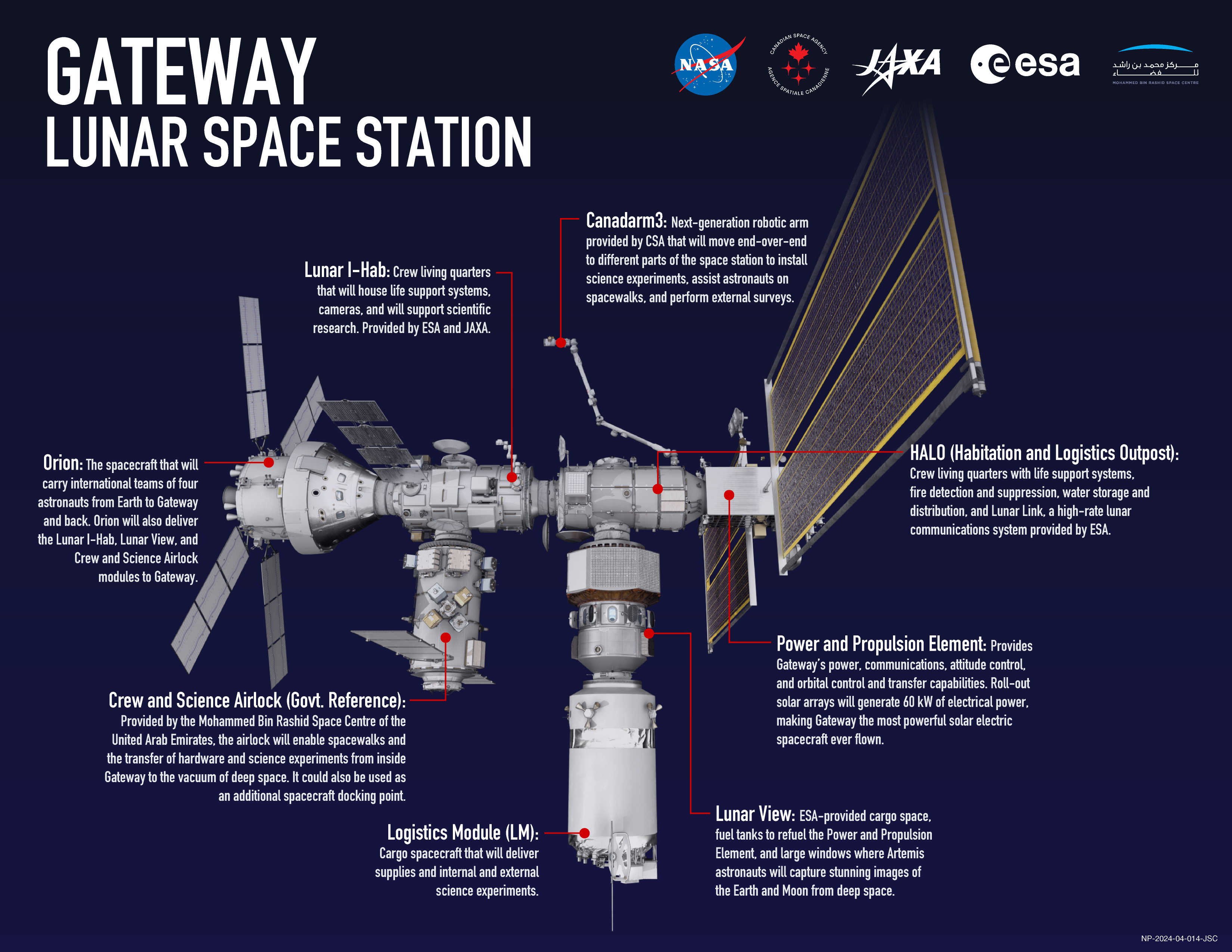
Schematic of the Lunar Gateway.
The Lunar Gateway.
Nasa

Most components contributed by these partners have already been produced and delivered to the US for integration and testing. But the project has been beset by rising costs and persistent debates over its value.

If cancelled, the US abandonment of the most multinational component of the Artemis programme, at a time when trust in such alliances is under unprecedented strain, could be far reaching.

It will be assembled module by module, with each partner contributing components and with the possibility of additional partners joining over time.

Strategic aims

Gateway reflects a broader strategic aim of Artemis, to pursue lunar exploration through partnerships with industry and other nations, helping spread the financial cost – rather than as a sole US venture. This is particularly important amid intensifying competition – primarily with China.

China and Russia are pursuing their own multinational lunar project, a surface base called the International Lunar Research Station. Gateway could act as an important counterweight, helping reinforce US leadership at the Moon.

In its quarter-century of operation, the ISS has hosted more than 290 people from 26 countries, alongside its five international partners, including Russia. More than 4,000 experiments have been conducted in this unique laboratory.

In 2030, the ISS is due to be succeeded by separate private and national space stations in low Earth orbit. As such, Lunar Gateway could repeat the strategic, stabilising role among different nations that the ISS has played for decades.

However, it is essential to examine carefully whether Gateway’s strategic value is truly matched by its operational and financial feasibility.

It could be argued that the rest of the Artemis programme is not dependant on the lunar space station, making its rationales increasingly difficult to defend.

Some critics focus on technical issues, others say the Gateway’s original purpose has faded, while others argue that lunar missions can proceed without an orbital outpost.

Sustainable exploration

Supporters counter that the Lunar Gateway offers a critical platform for testing technology in deep space, enabling sustainable lunar exploration, fostering international cooperation and laying the groundwork for a long term human presence and economy at the Moon. The debate now centres on whether there are more effective ways to achieve these goals.

Despite uncertainties, commercial and national partners remain dedicated to delivering their commitments. Esa is supplying the International Habitation Module (IHAB) alongside refuelling and communications systems. Canada is building Gateway’s robotic arm, Canadarm3, the UAE is producing an airlock module and Japan is contributing life support systems and habitation components.

Gateway’s Halo module at a facility in Arizona operated by aerospace company Northrop Grumman.
Nasa / Josh Valcarcel

US company Northrop Grumman is responsible for developing the Habitat and Logistics Outpost (Halo), and American firm Maxar is to build the power and propulsion element (PPE). A substantial portion of this hardware has already been delivered and is undergoing integration and testing.

If the Gateway project ends, the most responsible path forward to avoid discouraging future contributors to Artemis projects would be to establish a clear plan to repurpose the hardware for other missions.

Cancellation without such a strategy risks creating a vacuum that rival coalitions, could exploit. But it could also open the door to new alternatives, potentially including one led by Esa.

Esa has reaffirmed its commitment to Gateway even if the US ultimately reconsiders its own role. For emerging space nations, access to such an outpost would help develop their capabilities in exploration. That access translates directly into geopolitical influence.

Space endeavours are expensive, risky and often difficult to justify to the public. Yet sustainable exploration beyond Earth’s orbit will require a long-term, collaborative approach rather than a series of isolated missions.

If the Gateway no longer makes technical or operational sense for the US, its benefits could still be achieved through another project.

This could be located on the lunar surface, integrated into a Mars mission or could take an entirely new form. But if the US dismisses Gateway’s value as a long term outpost without ensuring that its broader benefits are preserved, it risks missing an opportunity that will shape its long term influence in international trust, leadership and the future shape of space cooperation.

The Conversation

Berna Akcali Gur does not work for, consult, own shares in or receive funding from any company or organisation that would benefit from this article, and has disclosed no relevant affiliations beyond their academic appointment.

ref. What’s the point of a space station around the Moon? – https://theconversation.com/whats-the-point-of-a-space-station-around-the-moon-274765

Dans le cerveau des chevaux : comment le lien maternel affecte le cerveau et le comportement des poulains

Source: The Conversation – France in French (2) – By Mathilde Valenchon, Chercheuse en Ethologie, Inrae

Les interactions entre les poulains et leurs mères ont des implications sur leur comportement, sur leur physiologie et sur leur développement cérébral. © UMR PRC INRAE-CNRS-Université de Tours, M. E. Le Bachelier de la Rivière., Fourni par l’auteur

Une nouvelle étude montre comment la présence prolongée de la mère façonne le développement comportemental, physiologique et cérébral des poulains.


Chez les mammifères sociaux, les relations sociales jouent un rôle déterminant dans le développement. On sait depuis longtemps que la période autour de la naissance est cruciale, lorsque le nouveau-né dépend entièrement de son ou de ses parent(s) pour se nourrir et se protéger. En revanche, ce qui se joue après, lorsque le jeune n’est plus physiquement dépendant de sa mère mais continue de vivre à ses côtés, reste encore mal compris.

Dans une étude récente publiée dans Nature Communications, nous avons exploré chez le cheval cette période souvent négligée du développement. Nos résultats montrent que la présence prolongée de la mère façonne à la fois le cerveau, le comportement
– social en particulier – et la physiologie des poulains.

Pourquoi s’intéresser à l’« enfance » chez le cheval ?

Le cheval est un modèle particulièrement pertinent pour étudier le rôle du lien parental sur le développement des jeunes. Comme chez l’humain, les mères donnent généralement naissance à un seul petit à la fois, procurent des soins parentaux prolongés et établissent un lien mère-jeune fort sur le plan affectif, individualisé et durable.

Dans des conditions naturelles, les poulains restent avec leur groupe familial, et donc avec leur mère, jusqu’à l’âge de 2 ou 3 ans. En revanche, en élevage ou chez les particuliers, la séparation est le plus souvent décidée par l’humain et intervient bien plus tôt, autour de 6 mois. Ce contraste offre une occasion unique d’étudier l’impact de la présence maternelle sur le développement au-delà de la période néonatale.

Comment étudier de rôle d’une présence maternelle prolongée chez le cheval ?

Pour isoler l’effet de la présence maternelle, nous avons suivi 24 poulains de l’âge de 6 à 13 mois. Cette période peut être assimilée à celle de l’enfance chez l’être humain. En effet, durant cette période, les poulains ressemblent déjà physiquement à de petits adultes, apparaissent autonomes dans leurs déplacements et consomment très majoritairement des aliments solides, tout en étant encore sexuellement immatures. En d’autres termes, leur survie immédiate ne dépend plus directement de la mère.

Dans notre étude, tous les poulains vivaient ensemble dans un contexte social riche, avec d’autres jeunes et des adultes. La seule différence concernait la présence ou non de leurs mères respectives à partir de l’âge de 6 mois : ainsi, 12 poulains sont restés avec leur mère tandis que 12 autres en ont été séparés, comme c’est fréquemment le cas en élevage.

Durant les sept mois qui ont suivi, nous avons étudié le développement de ces poulains. En éthologie, les comportements sont étudiés de façon quantitative. Nous avons suivi le développement comportemental des poulains à l’aide d’observations et de tests comportementaux standardisés, puis analysé statistiquement ces données pour comparer leurs trajectoires développementales. Ces données ont été complétées par des mesures physiologiques régulières (par exemple, la prise de poids, les concentrations hormonales) et par une approche d’imagerie par résonance magnétique (IRM) pour visualiser les différences fonctionnelles et morphologiques entre nos deux groupes de poulains de manière non invasive.


À lire aussi :
Les chevaux nous reconnaissent-ils ?


La présence de la mère favorise l’émergence des compétences sociales

Les résultats issus de nos observations répétées dans le temps montrent que les poulains bénéficiant de la présence de leur mère interagissaient davantage avec leurs congénères, notamment à travers des comportements positifs, comme le jeu ou le toilettage mutuel, que les poulains séparés de leurs mères. Ils se montraient aussi plus explorateurs et plus à l’aise face à des situations sociales nouvelles, suggérant une plus grande sociabilité.

Autre résultat intéressant, les poulains bénéficiant de la présence de leur mère passaient moins de temps à manger mais prenaient plus de poids, suggérant une croissance plus efficace.

Le lien maternel, moteur du développement du cerveau

Pour aller plus loin, nous avons combiné ces observations comportementales avec une approche encore rare chez les animaux d’élevage : l’imagerie médicale. Ici nous avons utilisé des techniques d’IRM, permettant d’observer le fonctionnement et l’organisation du cerveau vivant, sans douleur. Ainsi, nous avons pu caractériser le développement cérébral de nos poulains.

« Comprendre l’IRM en deux minutes ». Source : Institut du cerveau — Paris Brain Institute.

Cette approche nous a permis d’identifier, pour la première fois chez le cheval, un réseau cérébral appelé le réseau du mode par défaut. Bien connu chez l’humain et identifié chez une poignée d’autres espèces animales, ce réseau serait impliqué dans l’intégration des pensées introspectives, la perception de soi et des autres. Chez les poulains ayant bénéficié d’une présence maternelle prolongée, ce réseau était plus développé, faisant écho aux meilleures compétences sociales que nous avons observées.

En outre, nous avons observé des différences morphologiques dans une région fortement impliquée dans la régulation physiologique, l’hypothalamus, en lien avec les différences physiologiques et de comportement alimentaire mises en évidence.

Une phase clé du développement aux effets multidimensionnels

Pris dans leur ensemble, nos résultats soulignent l’importance de cette phase du développement, encore peu étudiée chez l’animal, située entre la petite enfance et l’adolescence.

Ils suggèrent que la présence maternelle prolongée induit un développement comportemental, cérébral et physiologique plus harmonieux, qui pourrait contribuer à équiper les jeunes pour leur vie adulte future, notamment dans le domaine de compétences sociales.

Quelles implications pour l’élevage… et au-delà ?

Notre travail ne permet pas de définir une règle universelle sur l’âge idéal de séparation chez le cheval. Il montre en revanche que la séparation précoce a des conséquences mesurables, bien au-delà de la seule question alimentaire.

Lorsque les conditions le permettent, garder plus longtemps le poulain avec sa mère pourrait donc constituer un levier simple et favorable au développement du jeune. Cependant, d’autres études sont nécessaires pour évaluer l’impact de ces pratiques sur les mères et les capacités de récupération des poulains après la séparation, par exemple.

Avec grande prudence, ces résultats font aussi écho à ce que l’on observe chez d’autres mammifères sociaux, y compris l’humain : le rôle du parent ou de la/du soignant·e (« caregiver ») comme médiateur entre le jeune et son environnement social et physique pourrait être un mécanisme largement partagé. Le cheval offre ainsi un modèle précieux pour mieux comprendre comment les premières relations sociales façonnent durablement le cerveau et le comportement.

The Conversation

Cette étude a été financée grâce à une bourse européenne HORIZON 2020 Marie Skłodowska-Curie Actions (MSCA) (ref: 101033271, MSCA European Individual Fellowship, https://doi.org/10.3030/101033271) et au Conseil Scientifique de l’Institut
Français du Cheval et de l’Equitation (IFCE) (ref: DEVELOPPEMENTPOULAIN).

David Barrière ne travaille pas, ne conseille pas, ne possède pas de parts, ne reçoit pas de fonds d’une organisation qui pourrait tirer profit de cet article, et n’a déclaré aucune autre affiliation que son organisme de recherche.

ref. Dans le cerveau des chevaux : comment le lien maternel affecte le cerveau et le comportement des poulains – https://theconversation.com/dans-le-cerveau-des-chevaux-comment-le-lien-maternel-affecte-le-cerveau-et-le-comportement-des-poulains-274144