La sequía se gesta en los años lluviosos

Source: The Conversation – (in Spanish) – By Jorge Rodríguez-Chueca, Profesor Titular de Universidad, Universidad Politécnica de Madrid (UPM)

Iglesia sumergida del embalse de Mediano, Huesca, en abril de 2026. RudiErnst/Shutterstock

¿Qué ocurriría si no volviese a llover en España en todo este año? Puede parecer una pregunta exagerada en un momento en el que los embalses están llenos. Sin embargo, es precisamente en estos momentos cuando conviene pensar en la sequía.

Actualmente, en España hay almacenada 46 821 hm³ de agua para consumo humano, agrícola e industrial, lo que representa el 83,5 % de la capacidad. Es el nivel más alto registrado en un mes de marzo en toda la serie histórica.

El agua almacenada equivale a unos 31 000 estadios Santiago Bernabéu. Este dato se explica por un invierno excepcionalmente lluvioso que ha superado ampliamente los valores medios recientes. En algunas regiones, se han batido récords históricos.

Esta situación ha permitido dejar atrás, al menos de forma temporal, el estado de sequía que se arrastraba desde 2021. Lo que ha llevado a eliminar las restricciones de uso de agua. Sin embargo, es precisamente ahora, cuando los embalses están llenos, cuando debe abordarse la sequía desde la planificación y la concienciación.

Mapa de España con el porcentaje de agua embalsada en las diferentes comunidades españolas
Reserva hídrica en abril de 2026 en las diferentes comunidades españolas.
MITECO

Los embalses llenos no garantizan la seguridad hídrica

La aparente abundancia puede generar una falsa sensación de seguridad. La cantidad de agua embalsada es solo una imagen puntual, no una garantía de futuro. El consumo anual de agua en España se sitúa en torno a los 32 000 hm³, una cifra cercana al volumen actualmente almacenado.

La sequía no aparece de repente, es un proceso acumulativo. Si el consumo sigue siendo alto, el sistema puede parecer seguro. Pero si además llueve menos, puede volverse vulnerable rápidamente. Como en la economía personal, si los gastos superan los ingresos, los ahorros se agotan.


Leer más:
¿Tendremos que vivir con menos agua?


La sequía no empieza cuando falta agua, sino mucho antes

Tendemos a asociar la sequía con embalses vacíos. Pero empieza mucho antes. Ocurre cuando llueve menos de lo normal durante un periodo prolongado.

Para entender una sequía no basta con tener en cuenta la lluvia. Conviene también observar el estado de ríos, embalses y el consumo. Es fundamental diferenciar entre sequía meteorológica, asociada a la falta de precipitaciones, y sequía hidrológica, que afecta a los recursos almacenados.

La sequía hidrológica puede tardar meses o años en manifestarse si hay reservas elevadas y buena gestión del agua. Aunque no se puede evitar la sequía meteorológica, sí se pueden retrasar sus efectos más graves. Esto es posible con una gestión adecuada.


Leer más:
¿Qué podemos y qué debemos hacer para afrontar sequías?


El verdadero riesgo es cuánto consumimos

Dado que no podemos controlar la lluvia, el foco debe ponerse en el consumo. Este se reparte entre la agricultura, la industria y los hogares.

La agricultura es, con diferencia, el principal consumidor. Aunque hay avances en eficiencia, especialmente con riego localizado, aún existe margen de mejora.

En la industria, el consumo ha bajado en los últimos años. Aun así, surgen nuevas incertidumbres, como el crecimiento de los centros de datos.

En el ámbito doméstico, la responsabilidad es individual y colectiva. Como ciudadanos, cada uno debemos hacer un uso sensato del agua y a nivel de sociedad, se deben crear hábitos y conciencia de gestión sostenible.

En todos los casos, no se trata solo de reducir el consumo en escasez, también es necesario hacerlo cuando el agua parece abundante.

Cuando hay agua, nos relajamos

La relajación en periodos de abundancia es una reacción habitual. No se trata solo de un comportamiento individual, sino de un patrón general.

La disponibilidad de agua en años favorables suele ir acompañada de un aumento de la demanda, que después resulta difícil de reducir. Del mismo modo, las medidas de ahorro suelen intensificarse cuando el problema ya es evidente. Pero rara vez se mantienen en el tiempo. Cuando la percepción de riesgo disminuye, también lo hace el esfuerzo por contener el consumo.

Gestión del agua anticipada, no de emergencia

Sin embargo, la gestión del agua no comienza cuando llega la sequía, sino mucho antes. Es lo que se conoce como planificación hidrológica.

Esta planificación permite anticipar la demanda y la disponibilidad de agua. Se trabaja con distintos escenarios, desde periodos húmedos hasta situaciones de sequía extrema. A partir de ello, se establecen reglas de operación para los embalses.

Pero no solo se gestiona la oferta, también se actúa sobre la demanda. De este modo se establecen prioridades en función de la disponibilidad presente y futura.

Más variabilidad, más necesidad de prevención

El cambio climático introduce un nuevo elemento de incertidumbre. En la última década se observa mayor alternancia de eventos extremos. Por ejemplo, hay sequías más intensas. Pero también precipitaciones extremas, concentradas en el tiempo y el espacio, con aprovechamiento limitado.

Esto reduce la fiabilidad de los datos históricos como referencia para la planificación. Por ello, es necesario trabajar con un mayor número de escenarios y adaptarse a una mayor variabilidad.


Leer más:
La sequía agrícola en Europa es cada vez más frecuente, intensa y duradera


Actualmente, España no sufre sequía hidrológica. Sin embargo, podría estar entrando en un nuevo ciclo de sequía meteorológica en cualquier momento.

La relajación cuando los embalses están llenos puede aumentar el riesgo futuro. La estabilidad de las reservas de agua depende del equilibrio entre entradas y consumo y la previsión de ahorrar recursos para los imprevistos del futuro.

The Conversation

Jorge Rodríguez-Chueca recibe fondos de Ministerio de Ciencia e Innovación a través de la Agencia Estatal de Investigación.

– ref. La sequía se gesta en los años lluviosos – https://theconversation.com/la-sequia-se-gesta-en-los-anos-lluviosos-279984


La algarroba: una sorpresa nutricional con profundas raíces mediterráneas

Source: The Conversation – (in Spanish) – By Jara Pérez Jiménez, Doctora en Ciencia y Tecnología de los Alimentos. Científico Titular en el ICTAN-CSIC. Centro de Investigación Biomédica en Red en Diabetes y Enfermedades Metabólicas, Instituto de Ciencia y Tecnología de Alimentos y Nutrición (ICTAN – CSIC)

Puede que, paseando por alguna ciudad española, haya visto en el suelo unas vainas marrones. Igual las ha identificado como vainas de algarroba. Pero ¿sabía que se trata del fruto de un cultivo muy mediterráneo, el algarrobo, con una composición nutricional muy interesante? Vayamos por partes…

Lo que la arqueobotánica nos ha enseñado sobre el algarrobo

El algarrobo (Ceratonia siliqua) es un árbol perenne y longevo, capaz de soportar temperaturas cercanas a 40 °C y periodos de sequía. Esto explica su presencia frecuente en suelos pobres y zonas marginales, allí donde otros cultivos no sobreviven.

Durante mucho tiempo se creyó que había sido introducido en el Mediterráneo occidental desde Oriente Próximo por fenicios, griegos o romanos. Sin embargo, los avances en genética vegetal y paleoecología han modificado esta visión. La evidencia muestra hoy que el algarrobo silvestre es autóctono del sur de la península ibérica y del noroeste de África. Su domesticación implicó selecciones locales e hibridaciones entre poblaciones silvestres y cultivadas en diferentes regiones mediterráneas.

La arqueobotánica ha contribuido a reforzar esta nueva perspectiva. Los análisis de carbones documentan la presencia de Ceratonia siliqua en yacimientos ya desde la Edad del Bronce en el área valenciana, el sureste peninsular y zonas de Extremadura. En cuanto a semillas, hasta ahora solo se ha identificado un conjunto procedente del yacimiento medieval de Mojácar la Vieja (Almería).

Respecto a las fuentes escritas, autores romanos ya mencionan su cultivo. Pero fue durante la etapa andalusí cuando el algarrobo alcanzó una mayor expansión y atención en los tratados agronómicos.

Los agrónomos de Al-Ándalus describieron distintas variedades y detallaron prácticas de cultivo, mostrando su importancia en los sistemas agrícolas medievales. Las vainas fueron utilizadas tradicionalmente como forraje, mientras que las semillas, algo dulces, se consumieron confitadas, mezcladas con zumo de uva como edulcorante o empleadas con fines medicinales; en épocas de escasez podían molerse y mezclarse con harina para elaborar panes de subsistencia.

Entre sus derivados figura también la llamada “miel de algarrobo”, una melaza obtenida mediante la cocción y reducción de las vainas. Se empleaba como edulcorante alternativo y se valoraba por sus propiedades astringentes y su utilidad en el tratamiento de trastornos digestivos.

Estas evidencias muestran que la historia del algarrobo es más antigua, compleja y mediterránea de lo que se creía. Además, su potencial vuelve a ser relevante en el contexto actual de creciente aridez.

La harina de algarroba: un ingrediente desconocido y sostenible

Pero ¿es posible consumir hoy harina de algarroba? Sí, podemos encontrarla como tal o como ingrediente en distintos alimentos, muchas veces reemplazando al cacao por sus propiedades singulares. No obstante, sigue siendo una gran desconocida, a pesar de sus dos grandes virtudes: su valor nutricional y su carácter sostenible.

La harina de algarroba, obtenida de la vaina, es uno de los alimentos con mayor contenido en fibra (hasta el 40 %). Por otro lado, sus azúcares tienen dos características muy relevantes. La primera es que su asociación con la fibra hace que sean absorbidos más lentamente, generando una baja carga glicémica. Y la segunda es que incluyen D-pinitol, un azúcar característico de la algarroba y que se asocia con alguna de las propiedades que mencionaremos después.

Finalmente, esta harina tiene un alto contenido en polifenoles, compuestos antioxidantes y antiinflamatorios.

Además, el uso de harina de algarroba permite aprovechar la vaina, un subproducto de la industria alimentaria. Y es que el algarrobo suele cultivarse por sus semillas (contenidas en dicha vaina) para la obtención de goma garrofín, un aditivo alimentario (E-410) empleado como espesante en yogures o mermeladas. De ahí que tradicionalmente se hayan generado toneladas de vainas, descartadas a pesar de su interesante composición nutricional.

Por tanto, el consumo de harina de algarroba contribuye también a una economía circular.

Beneficios del consumo de harina de algarroba

Para poder tener certeza acerca de los efectos en salud de un alimento es necesario demostrarlos en estudios científicos y no solo deducir sus beneficios a partir de su composición. La harina de algarroba ha mostrado en investigaciones con animales resultados muy prometedores en relación con el metabolismo de la glucosa o de la microbiota intestinal. Esto último se ha visto al usarla añadida a una carne o en combinación con cacao. Algún estudio en humanos ha obtenido resultados en la misma línea, aunque son todavía muy escasos.

Todo ello anima a continuar las investigaciones para fomentar el cultivo del algarrobo y el uso de la harina de algarroba como ingrediente. Eso sí, sin pretender convertirla en un “superalimento”, término sin validez científica.

Mientras seguimos avanzando en este conocimiento, tal vez pueda empezar a incorporar esta harina en algunas recetas… y a ver con otros ojos esas vainas tiradas en la calle.

The Conversation

Jara Pérez Jiménez recibe para su invesrtigación sobre la harina de algarroba fondos del Ministerio de Ciencia, Innovación y Universidades (proyecto PID2024-155959OB-I00, financiado por MCIU/AEI/10.13039/501100011033 y por FEDER, UE) y ha coordinado Contratos de Apoyo Tecnológico con empresas que elaboran extractos de harina de algarroba.

María Ángeles Martín Arribas para su investigación sobre la harina de algarroba recibe fondos del Ministerio de Ciencia, Innovación y Universidades (proyecto PID2024-155959OB-I00, financiado por MCIU/AEI/10.13039/501100011033 y por FEDER, UE).

Sonia Ramos recibe para su investigación sobre la harina de algarroba fondos del Ministerio de Ciencia, Innovación y Universidades (proyecto PID2024-155959OB-I00, financiado por MCIU/AEI/10.13039/501100011033 y por FEDER, UE)

Antonio Peralta-Gómez y Leonor Peña-Chocarro no reciben salarios, ni ejercen labores de consultoría, ni poseen acciones, ni reciben financiación de ninguna compañía u organización que pueda obtener beneficio de este artículo, y han declarado carecer de vínculos relevantes más allá del puesto académico citado.

– ref. La algarroba: una sorpresa nutricional con profundas raíces mediterráneas – https://theconversation.com/la-algarroba-una-sorpresa-nutricional-con-profundas-raices-mediterraneas-276685

Ella no siempre temblaba: los otros síntomas del ‘párkinson invisible’

Source: The Conversation – (in Spanish) – By José A. Morales García, Investigador Científico en enfermedades neurodegenerativas y Profesor Titular de la Facultad de Medicina, Universidad Complutense de Madrid

Dragana Gordic/Shutterstock

A principio de los años 80, el horticultor holandés J. W. S. Van der Wereld, enfermo de párkinson, creó una nueva variedad de tulipán: rojo y con rayas blancas. Lo bautizó como “Tulipán Dr. James Parkinson” en honor al médico inglés que identificó y describió la enfermedad en 1817.

El tulipán simboliza la diversidad y la fortaleza que caracteriza a las personas que la sufren. El color rojo es un reflejo de la pasión y la lucha por la enfermedad, mientras que las rayas blancas representan los temblores, un síntoma característico.

El arquetipo del hombre tembloroso

Cada 11 de abril, los tulipanes rojos de trazos blancos invaden calles y pantallas para dar visibilidad al párkinson. Al verlos, casi por instinto, nuestra mente dibuja un retrato automático: el de un hombre de edad avanzada, tembloroso y dificultad para caminar. Es el arquetipo más extendido de la enfermedad, pero también el más incompleto. Aunque durante décadas se ha definido por sus síntomas motores, la evidencia científica muestra que esta imagen de la dolencia es solo la punta de un iceberg mucho más profundo y complejo.

En el párkinson también existen síntomas no motores que, con frecuencia, aparecen mucho antes de que se diagnostique la enfermedad, deteriorando silenciosamente la calidad de vida del paciente. El párkinson huele (pérdida de olfato), se sueña (trastornos de la fase REM) y se siente en el cuerpo (estreñimiento) y en la mente (depresión, ansiedad).

Es el párkinson que no se ve, que no tiembla y cuyos síntomas se camuflan bajo el peso del estrés o de la edad. Una realidad doblemente invisible para las mujeres, ya que las deja en una sombra aún más profunda al ignorar las diferencias biológicas entre sexos, dificultando su diagnóstico y tratamiento. Hablamos, en definitiva, del “párkinson invisible”.

Antes de seguir, debo aclarar que no es una denominación médica ni un diagnóstico reconocido, sino un término utilizado en este artículo para describir aquellos aspectos de la enfermedad que no se asocian, tradicionalmente, a ella.

Señales de aviso en olfato, intestino y sueño

El cerebro no se despierta un día con párkinson. La neurociencia moderna ha descrito una fase prodrómica, un periodo de hasta 20 años en el cual la enfermedad ya está en marcha sin que el paciente lo sospeche. Durante ese tiempo, una proteína clave, la alfa-sinucleína, comienza a plegarse de forma anómala y a acumularse en el tejido nervioso. En las etapas iniciales, este proceso parece originarse en regiones como el bulbo olfatorio y el sistema nervioso entérico (el intestino). Así se entiende que muchos pacientes experimenten, mucho antes del diagnóstico, pérdida de olfato o estreñimiento crónico.

Otro de los predictores es el trastorno de conducta del sueño REM. Soñar que abrimos la ventana y comenzamos a volar, suspendidos sobre el paisaje, puede resultar fascinante. Sin embargo, si durante el sueño abrimos de verdad la ventana y nos lanzamos a volar, las consecuencias serían muy graves. Por eso, en condiciones normales, nuestro cuerpo se paraliza durante los sueños para no “actuarlos”.

En el párkinson invisible, este mecanismo falla, y los pacientes gritan, dan puñetazos o patadas mientras duermen. Las investigaciones indican que una amplia mayoría de quienes padecen trastornos de conducta del sueño REM acabará desarrollando una enfermedad neurodegenerativa.

A medida que la afección progresa, los síntomas no motores no solo persisten, sino que se multiplican: dolor, ansiedad, depresión, fatiga, alteraciones cognitivas, disfunción autonómica o problemas sexuales. Paradójicamente, son estas manifestaciones “invisibles” las que con más frecuencia deterioran el bienestar diario de los pacientes y sus familias.

La brecha de género: el factor protector de estrógeno

La prevalencia del párkinson se sitúa, aproximadamente, en 1,5 hombres por cada mujer. Esto no significa que afecte menos a las mujeres. Significa, en muchos casos, que las entendemos peor. Pero esta diferencia numérica no es casual, tiene una base fisiológica.

La evidencia científica sugiere que los estrógenos ejercen un papel neuroprotector sobre las neuronas dopaminérgicas, reduce la inflamación cerebral y ayuda a mantener estables los niveles de dopamina. Esto explica por qué las mujeres reciben el diagnóstico más tarde que los hombres y presentan, inicialmente, síntomas motores menos evidentes.

Sin embargo, esa coraza es un arma de doble filo. El problema es que la protección no es constante, puesto que las mujeres se enfrentan a fluctuaciones hormonales (menstruación, embarazo, menopausia). Incluso al recibir tratamiento, esos cambios pueden producir que la medicación pierda eficacia de forma súbita, exacerbando los síntomas.

Debido a un menor peso corporal, las mujeres presentan concentraciones plasmáticas del fármaco más elevadas y variables a lo largo del día, aumentando su riesgo de sufrir movimientos involuntarios (disquinesias). Esta fluctuación las hace más sensibles a pequeños cambios de dosis, lo que complica el ajuste terapéutico y multiplica los periodos OFF (cuando la medicación deja de hacer efecto).

Además, al no encajar siempre en el estereotipo masculino del temblor, muchas pacientes pasan años de peregrinaje médico antes de obtener un diagnóstico correcto. En última instancia, esta brecha evidencia que los tratamientos actuales todavía no están optimizados para el perfil biológico femenino.

Cambiar la mirada para actuar antes

Es necesario cambiar el paradigma. Hablar de párkinson invisible es cambiar el foco de atención.

Implica entender que no es sólo un trastorno motor, sino una enfermedad compleja, sistémica, que afecta al sueño, al estado de ánimo, al sistema digestivo, al sistema cardiovascular y a la vida íntima de quienes la padecen.

Implica escuchar más y mejor. Preguntar por aquello que no se ve y dar espacio a síntomas que no encajan en la imagen clásica de la enfermedad.

Implica desterrar el mito de que el párkinson es un territorio exclusivamente masculino y aceptar que, mientras sigamos buscando el mismo síntoma en todos los pacientes, seguiremos dejando a las mujeres en la penumbra.

En definitiva, comprender la fase invisible y las diferencias de sexo es vital. No solo por el avance de la medicina de precisión, sino por todas aquellas personas que, como mi madre, vivieron años de desconcierto. Ella no siempre temblaba, pero habitaba ese mundo invisible de noches inquietas y días de una fatiga que las palabras no alcanzan a describir.

Escribo esto por ella y por todas las mujeres que, en silencio, lidian con una enfermedad que la sociedad aún no ha aprendido a mirar de frente. Reconocer el párkinson invisible es el primer paso para que nadie más tenga que caminarlo a oscuras. Porque lo que no se nombra, no se diagnostica. Y lo que no se diagnostica, no se trata.


Este artículo fue publicado previamente por la Oficina de Transferencia de Resultados de Investigación (OTRI) de la Universidad Complutense de Madrid (UCM).


The Conversation

José A. Morales García no recibe salario, ni ejerce labores de consultoría, ni posee acciones, ni recibe financiación de ninguna compañía u organización que pueda obtener beneficio de este artículo, y ha declarado carecer de vínculos relevantes más allá del cargo académico citado.

– ref. Ella no siempre temblaba: los otros síntomas del ‘párkinson invisible’ – https://theconversation.com/ella-no-siempre-temblaba-los-otros-sintomas-del-parkinson-invisible-280221

What are motor skills? Evidence-based ways to support children’s fine and gross motor development

Source: The Conversation – Canada – By Sophie M Phillips, Post-Doctoral Associate, School of Occupational Therapy, Western University

Motor skills are foundational for a lifetime of movement. For children, they play a vital role not only in facilitating physical activity levels but also for cognitive and socio-emotional development and school readiness.

Motor skills are broadly separated into two groups: fine and gross motor skills. Fine motor skills are movements that use smaller muscles, specifically related to the hand, like grasping a pen. Gross motor skills are movements that use larger muscles, and these can be categorized into three main groups:

1) Locomotor skills, which include movement co-ordinated in a specific direction, to transport the body from one location to another (like walking, running, jumping, hopping);

2) Object control skills, or manipulative skills, which involve controlling, manipulating or moving objects with the body (like throwing, kicking, catching);

3) Stability skills, which entail maintaining balance of the body when still or in motion.

Motor development experts recommend that children should have adequate competency in motor skills by around the age of seven. This supports children’s full engagement in school, from developing fine motor skills for writing to physical activities that require more specialized skills. However, many young children are not achieving adequate motor skill proficiency by this age, with rates declining in the past few decades.

While adults recognize the importance of motor skills for children’s participation in everyday activities, there is evidence that many parents don’t feel knowledgeable about how to help their children develop these skills.

Some parents have reported perceiving that motor skills will develop naturally. But children develop motor skills through practice, and they require opportunities for this.

Informed by our work, and that of others, and in co-operation with early childhood educators, parents and children, we offer strategies and suggestions to support parents and educators in helping the young children in their care develop motor skills.

Equipping adults with knowledge

Parents and early childhood educators serve as important role models for young children. There are numerous ways adults in children’s lives can help support motor skill development.

Researchers have shown that parents taking part in motor skill practice through everyday activities and play alongside their children can improve children’s competence.

This may include development of fine motor skills through activities like drawing, colouring or cooking together, or gross motor skills through activities like playing catch or kicking a ball back and forth.

Given that many young children spend much of their week in child care, early childhood educators also play an important role in influencing children’s overall development, including their motor skills.

The TEACH e-learning course (TEACH stands for Training EArly CHildhood educators in physical activity) has been shown to improve educators’ knowledge about physical activity opportunities for young children, as well as their confidence and plans to support this.

Young children whose early childhood educators received training via the TEACH e-Learning course had significantly improved locomotor skills compared to children whose educators hadn’t received this training.

This means ensuring early childhood educators are equipped with the knowledge, skills and confidence to provide motor skill development opportunities for the children in their care is paramount to helping children acquire these competencies.

Engaging in physical activity

Children acquire gross motor skills through physical activity. This can include providing opportunities for children to engage in physical activities of a moderate-to-vigorous intensity, like brisk walking, running, cycling and skipping.

Active travel, involving walking, cycling or using a scooter as a method of transport, can provide opportunities for children to be physically active and develop their motor skills.

Our analyses of data from children attending child care have shown that children spending more time in moderate-to-vigorous physical activity, relative to lower-intensity activity, demonstrate better overall gross motor skills and in particular, object control skills.

Other approaches include children participating in sports, where they can practise their motor skills, for example by kicking a soccer or football.

Active outdoor play

While interventions that directly target specific motor skills through structured activity have shown substantive benefits for motor skill development, active outdoor play is another way parents and educators can help children acquire motor skills.

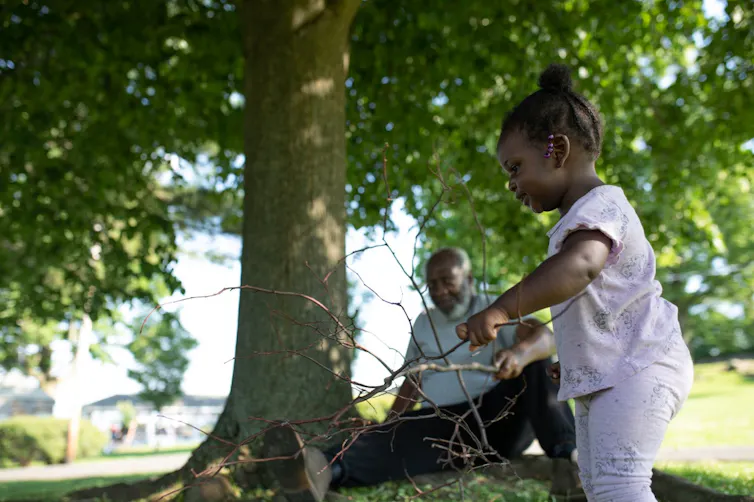
A child squatting in grass observing a dandelion.
The outdoors is a perfect playground for children.
(Nappy)

The outdoors is a perfect playground for children to develop motor skills. Trails and grassy or forestry areas provide naturally occurring, uneven ground where children can improve their stability and balance. The ample space allows children to run around and develop locomotor skills, while naturally occurring objects like bark and sticks can be used to enhance motor creativity by playing games such as building dens.


Read more:
From obesity to allergies, outdoor play is the best medicine for children


Swap out screen time

Increased screen time reduces opportunities for the development of motor skills. Research links young children’s excessive screen time with negative effects on motor development both during early childhood and into later childhood.

This includes a particular focus on manual dexterity (being able to co-ordinate hand and finger movements).

Recent evidence suggests that while all screen use is associated with poorer fine motor skill development, newer media like smartphones and tablets are linked to worse outcomes than traditional media such as TV viewing.

Creative, motor-enhancing activities

Manipulative play (building blocks, bead threading), arts and crafts (cutting with scissors, colouring and drawing) and tactile play (using playdough or clay) can have benefits for children’s fine motor skills and object control.

These forms of play, like children’s free play, are also enriching for other aspects of development.

Everyday activities such as helping with preparing and cooking food, using cutlery at mealtimes, as well as buttoning or zipping clothes, can improve key skills.

Reducing screen time and replacing screen-based activities with something physically active or other beneficial sedentary activities can help children develop object control and finer motor skills. This said, understanding that we live in a digital world, the Canadian Paediatric Society has provided guidance about how screen time can be intentionally used.

Moving bodies for happy and healthy lives

Providing young children with the opportunity to develop motor skills is as simple as practice makes perfect.

Practising key motor skills in the ways suggested can help ensure young children are equipped with the competencies and abilities to move and use their bodies, preparing them to lead happy and healthy lives.

The Conversation

Sophie M Phillips receives funding from the Canadian Institutes of Health Research.

Dan Jones received funding from NIHR for a research project exploring young children’s use of interactive electronic devices.

Trish Tucker receives funding from the Canada Foundation of Innovation, Canadian Institutes of Health Research, Social Sciences and Humanities Research Council, and the Children’s Health Research Institute.

– ref. What are motor skills? Evidence-based ways to support children’s fine and gross motor development – https://theconversation.com/what-are-motor-skills-evidence-based-ways-to-support-childrens-fine-and-gross-motor-development-278645

Why is Israel continuing to attack Lebanon, despite the ceasefire? Expert Q&A

Source: The Conversation – UK – By Scott Lucas, Professor of International Politics, Clinton Institute, University College Dublin

The ceasefire in the Middle East is on shaky ground. Israel continued its bombardment of Lebanon on Wednesday, claiming its activities there are not part of the deal with Iran. These attacks killed at least 254 people across Lebanon and injured over 800 more in what was Israel’s largest offensive of the war so far.

Iran responded by closing the Strait of Hormuz again and threatened a “regret-inducing response” if the strikes continue. Donald Trump subsequently warned that US strikes on Iran would resume if it did not comply with the ceasefire. We spoke to Scott Lucas, an expert in Middle East politics at University College Dublin, who addresses several key issues.

Why is there confusion about whether Lebanon was included in the ceasefire?

Part of the problem is the nature of diplomacy in 2026. The Trump camp and Pakistan’s prime minister, Shahbaz Sharif, who has been a key mediator between the US and Iran since the start of the war, both issued statements on social media instead of coordinating the release of an agreed text.

That said, there should be no confusion. Sharif’s social media post made clear that the ceasefire also applies to Israel’s campaign in Lebanon. He wrote: “I am pleased to announce that the Islamic Republic of Iran and the United States of America, along with their allies, have agreed to an immediate ceasefire everywhere including Lebanon and elsewhere, EFFECTIVE IMMEDIATELY.”

Trump also accepted that later peace talks in Pakistan would be based on Iran’s ten-point plan, which he described as a “workable basis on which to negotiate”. One of Iran’s demands is for “an end to attacks on Iran and its allies”. This includes the Israeli strikes against Hezbollah in Lebanon.

Why then is Israel still attacking Lebanon?

Israel’s prime minister, Benjamin Netanyahu, does not have an interest in ending the war until he establishes something he can claim as a “victory”. Israel’s objective in Iran is regime change. At the start of the war, Netanyahu announced that the “goal of the operation is to put an end to the threat from the Ayatollah regime in Iran”.

Trump’s goals in Iran are less clear. He entered the war pledging to prevent Iran from obtaining a nuclear weapon, destroy its missile capability, break its regional proxies, eliminate its navy and create an opening for regime change. But Iran’s regime is still in place and the Trump camp now appears willing to enter into negotiations with it.

So Netanyahu’s focus shifts to Lebanon and expansion of the Israeli occupation in the south of the country. Attacks will continue until that is achieved. The situation is similar to Gaza, where Israel now occupies 53% of the territory after its two years of attacks.

By presenting a victory over the threat of Hezbollah, pushing the group further from the Israeli border, Netanyahu can try to bolster his support at home despite any disappointment over the inconclusive outcome of the war in Iran.

Will Israel’s actions push the Gulf states closer to Iran?

For the first time since the start of the US and Israel’s war on February 28, the Iranian and Saudi Arabian foreign ministers have spoken by phone. In a statement following the call on April 9, the Saudi foreign ministry said the two men “reviewed the latest developments and discussed ways to reduce tensions to restore security and stability in the region”.

However, this is only a tentative beginning to repair the damage of the past six weeks. Gulf states are unhappy that the US exposed them to Iran’s retaliation by embarking upon the war, but that does not erase their anger with Tehran over the extent of the damage Iranian attacks have caused to energy infrastructure in the region.

Reports suggest that Saudi Arabia and the United Arab Emirates have in recent weeks even been pressing the Trump camp to “finish the job” in Iran with ground operations to vanquish the regime. That option appears to have been paused for now. However, it is not off the table if the US-Iran negotiations collapse.

Where does all of this leave Donald Trump?

Angry, frustrated and uncertain what to do next. Trump’s bluster on April 7, in which he said “a whole civilization will die tonight” unless Iran reached a deal, was always an expression of weakness rather than strength. The plan A for regime surrender, with the killing of the Iranian supreme leader Ali Khamenei and dozens of commanders and officials, did not have a plan B for when the remaining leaders refused to concede and instead struck back.

With Iran controlling the Strait of Hormuz and choking off Gulf shipping, including of oil and gas, the Trump camp was reduced to either ground operations or talks. Trump snatched at the latter amid military advice of the difficulties of a ground assault and domestic opinion that is largely opposed to further escalation.

But he did so by handing Iran the diplomatic initiative. Now the White House is trying to pull it back, including by giving Israel the green light to continue its assault in Lebanon. The US is now denying that Lebanon was ever included in the ceasefire deal, with Trump calling it a “separate skirmish”.

The situation in the Middle East thus remains extremely volatile as delegates from the US and Iran head to the Pakistani capital of Islamabad for crunch talks on April 10.

The Conversation

Scott Lucas does not work for, consult, own shares in or receive funding from any company or organisation that would benefit from this article, and has disclosed no relevant affiliations beyond their academic appointment.

– ref. Why is Israel continuing to attack Lebanon, despite the ceasefire? Expert Q&A – https://theconversation.com/why-is-israel-continuing-to-attack-lebanon-despite-the-ceasefire-expert-qanda-280302

Fashion Becomes Art: a deliciously decadent journey through the surrealist world of Elsa Schiaparelli

Source: The Conversation – UK – By Naomi Braithwaite, Associate Professor in Fashion and Material Culture, Nottingham Trent University

“Nobody has been able to pronounce my name properly … but everybody knows what it means,” Elsa Schiaparelli once said, with typical self-assuredness.

A protagonist of surrealism, the Italian-born fashion designer was an extraordinary couturier who pushed the bounds of creativity, leaving her mark on Paris fashion and beyond. Dazzling, theatrical, witty and avant garde, her creative genius is the subject of the V&A’s latest blockbuster exhibition Fashion becomes Art in London.

More than 400 objects have been brought together by a fashion, art and photography curatorial team for the first exhibition of its kind in the UK to showcase her unique contribution.

It is Schiaparelli’s connection to the Surrealist movement that she is most renowned for, through her creative collaborations with the artists Salvador Dalí and Jean Cocteau.

One of the most iconic designs is Schiaparelli’s lobster dress, created in 1937 in collaboration with Dali, which demonstrates how her work blurred the lines between fashion and art – a theme articulated throughout the show. The lobster dress is on display in the room titled Creative Constellations, next to Dali’s famous lobster telephone which was created a year after the dress.

Schiaparelli was a designer who transformed what fashion could be, and who saw dress designing not as a profession but as art. Her autobiography, Shocking Life, highlights her innovative approach. She was the first to use shoulder pads and animal print, and will forever be known as the woman who created the colour of shocking pink. The exhibition showcases these themes including her strength as a colourist, beautifully illustrated by the Harlequin-style coat from her 1939 Modern Comedy Collection.

Schiaparelli transformed herself from an untrained designer to become the most discussed designer in Paris during the interwar period. The silhouettes, materials, embellishments, use of colour and accessories are curated beautifully against a mesmerising soundtrack, making this a fitting exhibition to showcase Schiaparelli’s extraordinary life.

From Rome to Paris

Elsa Luisa Maria Schiaparelli was born in a Roman palazzo to a family of aristocrats and intellectuals on September 10 1890. She left Italy for Paris at the age of 23, where she began to embrace a less conventional life.

Her first collection was launched there in 1927 – the same year she opened her atelier, where the more daring woman could buy knitwear featuring geometric black-and-white trompe l’oeil designs. These pieces remind us that in her early career, Schiaparelli was known for designing clothes for sport and leisure as a response to modern society’s growing interest in these pursuits.

As her creative style flourished, she transformed the everyday wardrobe through suits embellished with the most extraordinary buttons and unusual pocket placement. This is wonderfully illustrated in a coat designed for British socialite and star of the stage Pamela Carme, with buttons in the shape of Greek comedy/tragedy masks.

From extraordinary daywear to exquisite evening gowns, the exhibition delights with an array of creations that narrate Schiaparelli’s creative journey and radicalisation of the ordinary to the extraordinary.

The evening wear collections (Pour le Soir) embody her use of innovative materials such as cellophane, and her love of striking silhouettes. These drew the attention of socialites and celebrities, and established her as a leading designer of the 1930s who transformed the traditions of haute couture fashion.

Blurring the lines of fashion and art

The exhibition’s senior curator, Sonnet Stanfill, defines the 1930s as the era when Schiaparelli started to experiment with the boundaries between art and fashion.

Examples include the wonderful Circus Collection from summer 1938, which features the bone dress with its unique padded construction and visible zips. It stands as perfect example of Schiaparelli’s affinity with surrealist ideals and an innovative approach to materials and construction.

The surrealistic philosophy is further encapsulated through the display of lavish Schiaparelli jackets, where a shifting spotlight draws attention to embellishments and embroidery by the renowned Parisian embroidery house Maison Lesage.

There is a spectacular array of accessories on display, most notably Schiaparelli’s upside-down shoe hat – showcased in a circular glass bubble through which is framed, in the background, the lobster dress. Glimpsing further into the distance, the glass bubble reveals the 1937 evening coat designed with Cocteau with mirrored kissing faces beneath a cascade of pink roses. The display technique is a surrealistic spectacle in itself.

Beyond Paris

Other highlights include Schiaparelli’s creations for stage and screen. Featured work includes a trouser suit for Hollywood star Marlene Dietrich, who herself challenged the conventional ideals of femininity and female style.

Schiaparelli had a great passion for British textiles and in 1933 opened her London salon in Mayfair. According to her autobiography, London was the most masculine city in the world, and of the English she said: “They are profoundly honest, but mad, mad, mad.” Although her time in London was short-lived with the salon closing in 1939, she came to the attention of some notable clients including Lady Alexandra Haig, whose plum jacket is on display.

Schiaparelli retired and closed her fashion house in 1954. It lay dormant until its resurrection in 2019 under the creative direction of Daniel Roseberry. Many garments on display illustrate how Roseberry maintains the Italian designer’s vision by combining innovation with unpredictability.

Schiaparelli’s creative legacy continues, her aesthetic enthusiastically embraced by high-profile celebrities. The show includes Roseberry’s 2025 red Oscars gown, created for Ariana Grande who was nominated for best supporting actress in Wicked. Stanfill describes this as one of the exhibition’s highlight pieces.

Fashion Becomes Art takes visitors on a deliciously decadent journey through the world of Schiaparelli, where nothing was ever ordinary. While the correct pronunciation of her name may continue to confound (it’s Skaparelli), this exhibition ensures her creative genius is never in question.

The Conversation

Naomi Braithwaite does not work for, consult, own shares in or receive funding from any company or organisation that would benefit from this article, and has disclosed no relevant affiliations beyond their academic appointment.

– ref. Fashion Becomes Art: a deliciously decadent journey through the surrealist world of Elsa Schiaparelli – https://theconversation.com/fashion-becomes-art-a-deliciously-decadent-journey-through-the-surrealist-world-of-elsa-schiaparelli-279878

My Undesirable Friends: Part I – an extraordinary portrait of young Russian journalists fighting to report the truth

Source: The Conversation – UK – By Julie Curtis, Professor of Russian Literature (Emerita), University of Oxford

Director Julia Loktev’s “undesirable” friends are women, mostly in their 20s or early 30s, who live in Moscow. They all work for TV Rain (Dozhd’) founded in 2010 as a lively, optimistic channel with cool programmes for a young audience, which also addressed more serious issues.

The Russian authorities tolerated the existence of TV Rain for over a decade, despite denouncing several of their programmes, which brazenly challenged Vladimir Putin’s increasingly reactionary stance on social and political issues.

The society TV Rain was hoping to shape was a democratic world in which opposition leaders such as Boris Nemtsov (murdered in 2015) and Aleksei Navalny (poisoned with novichok in 2020, died in prison in 2024) would have been able to flourish. In this documentary, we watch as the possibility of that world moves further away.

Using an iPhone, Julia Loktev filmed her friends over four months in late 2021 and early 2022. The resulting documentary, lasting five and a half hours, provides an intimate picture of these young journalists’ lives as they share their apprehensions about the worsening political situation, their struggles to cover what is happening in an environment of increasing censorship and their utter horror when Russia finally invaded Ukraine on February 22 2022.

Loktev’s narration opens the film in 2021 as she drives through Moscow and announces that: “The world you’re about to see no longer exists. None of us knew what was about to happen.” Her concluding text from early 2022 reports that:

All our characters left Russia in the first week of the full-scale war. […] Most independent journalists and most of Russian civil society fled, […] over one million people have left, […] most with no plans to return so long as Putin remains in power. For now, their foreseeable future is in exile.

In the film, we move from the TV Rain studios and clips of their news reports and talk shows, out into the streets, waiting outside police stations and prisons, and up into the women’s apartments. Loktev records their ceaseless discussion of Russia’s plight, the state’s failure to respect people’s constitutional rights, and abuses of power by the police and the judiciary.


Read more:
Meduza: Berlin exhibition highlights the publication speaking truth to Putin while in exile


The journalists react in 2021 with dismay to the extension of a law intended to make it virtually impossible for journalists to work with any foreign organisations, let alone receive any funding. Those who are found to be working as such are officially designated a “foreign agent”, a designation that TV Rain and some of the women are hit with in August 2021.

A “foreign agent” must provide full accounts of all financial transactions, however trivial. They are also effectively banned from participation in political activity, or in any type of education. They also suffer a whole range of financial restrictions and penalties.

Every publication or mention in any media of a “foreign agent” must be accompanied by a lengthy, large-font label identifying them as such. This law has so far succeeded in gagging and disempowering over a thousand human rights organisations, media groups and individual citizens.

But even as these young journalists doggedly pursue the truth, we also share their everyday lives. We see them with their pets and bright nail varnish. They are shown baking cakes and with their kids and mums. They are constantly witty and inventive in their defiance of the authorities, proudly wearing their “foreign agent” T-shirts or concocting a subversive 2021 New Year’s Eve broadcast to run alongside Putin’s dreary and bellicose message to the Russian people.

All of this facetious defiance makes their white-faced reaction to the news that the invasion has begun all the more shattering. Almost immediately, they are informed that even to use the word “war” in relation to the Ukraine conflict is illegal, and that only official reports of events can be broadcast.


Read more:
Aleksei Navalny: new film about jailed dissident who dared to defy the power of Putin


Things get worse. The remarkable Ksenia Mironova’s fiance the journalist Ivan Safronov is arrested on trumped-up charges after he investigates Russian defence contracts (for which he later receives a 22-year sentence). There is an exceptional strength of solidarity among Mironova and her friends, and they share her tears, as well as supporting her to continue her journalistic work.

Younger women, their mums, and older, hardened female human rights activists alike all share wise words and jokes, even as their world seems to be falling apart. This extraordinary film has garnered numerous awards, and immerses us in the lives of those who know they are on the brink of catastrophe.

As an expert on subversive and dissident Russian writers, I find it fascinating to see how satirical brilliance and deep courage can both emerge from the everyday messiness of young lives. The film poses urgent questions for the viewer about how to resist an oppressive state, how to support your family, friends and colleagues, and how best to judge the moment when it’s time to run.

My Undesirable Friends: Part I is available to watch on Mubi

The Conversation

Julie Curtis does not work for, consult, own shares in or receive funding from any company or organisation that would benefit from this article, and has disclosed no relevant affiliations beyond their academic appointment.

– ref. My Undesirable Friends: Part I – an extraordinary portrait of young Russian journalists fighting to report the truth – https://theconversation.com/my-undesirable-friends-part-i-an-extraordinary-portrait-of-young-russian-journalists-fighting-to-report-the-truth-280188

You Are the Führer’s Unrequited Love by Jean-Noël Orengo is a masterful take on Nazi memory, myth and moral reckoning

Source: The Conversation – UK – By Barry Langford, Professor of Film Studies, Royal Holloway, University of London

Writing a biographical novel about one of modern European history’s most skilled liars – whose fame rests almost entirely on his own self-crafted stories – is, to say the least, a difficult task.

So it’s not surprising that Jean-Noël Orengo has approached this challenge by making his superb novel about Nazi architect and war criminal Albert Speer, You Are the Führer’s Unrequited Love, a work of metahistory. This means the book, translated from French by David Watson, is not just a historical narrative – it also reflects on the act of storytelling itself. Orengo examines the who, when and especially the why of the stories we tell about history.

For a decade Speer enjoyed a unique position as courtier and protege to Adolf Hitler. He may in fact have been the closest Hitler ever came to an actual friend – or, as Orengo’s title suggests, even a romantic partner in some strange, asexual way.

Speer flattered the dictator’s self-image as a frustrated artist, indulging Hitler’s fantasies of a thousand-year Reich. Later, as minister for armaments from 1942, Speer was responsible for supplying the military equipment that allowed Germany to carry on fighting its doomed struggle against the allies to the bitter end.

He became one of the regime’s most powerful figures. Yet in the popular imagination, Speer has never occupied quite the same place in the public imagination as Hitler’s other leading henchmen, such as Göring, Goebbels and Himmler.

If anything, for many years Speer enjoyed a wholly undeserved postwar reputation as a “good Nazi” – almost entirely through his own deft manipulation of unreliable memory and selective confession. At the Nuremberg trials his disingenuous and partial “confessions” helped him escape the hangman’s noose. Subsequently, his bestselling but deeply unreliable “memoir” Inside the Third Reich, written between 1946 and 1966 as he served a 20-year sentence for war crimes, recounted his relationship with Hitler as a kind of Faustian tragedy of blind ambition.

Speer’s self-mythologising

Orengo does not focus on exposing Speer’s many evasions and bare-faced lies. Historians have long established that despite his claims to the contrary, Speer was fully aware of Nazi crimes, including the Holocaust. As overlord of munitions production, his hands were steeped in the blood of a multitude of enslaved concentration-camp workers.

Orengo’s principal concern, rather, is Speer’s endless self-mythologising itself. He draws an implicit parallel between Speer’s spectacular orchestration of the Nuremberg rallies – the grand, impressive but ultimately hollow architectural spectacles that first made him famous – and the elaborate web of excuses and self-justifications Speer built to rehabilitate his image after the war. The novel is also shaped by the ideas of philosopher Walter Benjamin, a witness to and victim of Nazism, who warned against reducing politics to aesthetics.

Orengo maintains a critical detachment from his protagonist. He fully anatomises Speer’s ambitions and desires as he carefully charts the stages of his descent into the Nazi maelstrom. Yet he never invites us to identify with this fundamentally shallow figure, a stranger to himself who can only manifest through others’ reactions to his own refracted image.

There is little dialogue. Most encounters between Speer and Hitler in particular are reported speech. Speer himself is most often referred to simply as “the architect” (and later, enjoying his celebrity, “the star”). Hitler is “the guide” – a literal translation of führer.

In the novel’s last third, Gitta Sereny, the German-British writer who tried over many years’ enquiry to see through Speer’s moral evasion and self-deceit, is “the historian”. By rendering his principal characters in these archetypal terms, Orengo underscores the studied elusiveness in which Speer shrouded his crimes and depersonalises his story to explore its wider implications.

A BBC interview with Albert Speer from 1971.

The novel is structured in layers of perspective. For the first two-thirds, we see the world through Speer’s eyes. Then the focus shifts to Sereny, as she attempts to uncover Speer’s moral evasion and self-deception. Yet Orengo shows that Sereny, too, has her own blind spots. Finally, the narrative adopts Orengo’s own viewpoint, that of a 21st-century writer reflecting on what the horrors of Nazism still mean for us today.

Orengo’s real subject is the struggle over memory itself. Who remembers, what is included, what left out and how and why some ways of remembering prevail over others. In genre terms, You Are the Führer’s Unrequited Love might be regarded not as a whodunnit but a “whotoldit”; and as in any good mystery the question “who benefits?” is key.

Like a mystery, the novel is concerned with guilt and accountability. Orengo’s stylistic elegance and complex perspective never collapse into the relativism Speer himself – a postmodernist in life if never in architecture – deployed. The novel also never loses sight of its real subject, the urgency of moral reckoning.

The reader of this lucid, elegant novel is left to reflect on the many ways in which, in the wrong hands, art and memory can conspire to obscure as well as to illuminate.

This article features references to books that have been included for editorial reasons, and may contain links to bookshop.org. If you click on one of the links and go on to buy something from bookshop.org The Conversation UK may earn a commission.

The Conversation

Barry Langford does not work for, consult, own shares in or receive funding from any company or organisation that would benefit from this article, and has disclosed no relevant affiliations beyond their academic appointment.

– ref. You Are the Führer’s Unrequited Love by Jean-Noël Orengo is a masterful take on Nazi memory, myth and moral reckoning – https://theconversation.com/you-are-the-fuhrers-unrequited-love-by-jean-noel-orengo-is-a-masterful-take-on-nazi-memory-myth-and-moral-reckoning-280083

Médiation entre les États-Unis et l’Iran : le Pakistan sur le devant de la scène diplomatique mondiale

Source: The Conversation – in French – By Samina Yasmeen, Director of Centre for Muslim States and Societies, The University of Western Australia

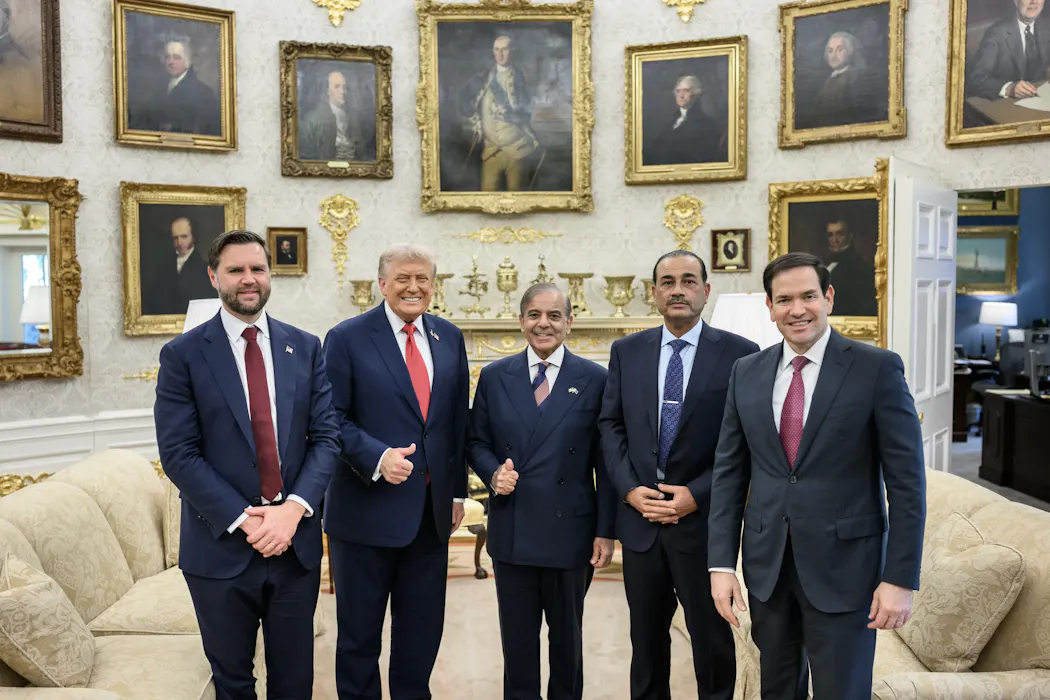
Le 25 septembre 2025, le premier ministre du Pakistan Shehbaz Sharif et le chef de l’armée Asim Munir sont accueillis par Donald Trump, J. D. Vance et Marco Rubio à la Maison-Blanche.
Whitehouse.gov

Alors que Donald Trump venait de menacer d’anéantir la civilisation iranienne, Washington et Téhéran ont finalement conclu, le 7 avril 2026, un cessez-le-feu temporaire de deux semaines, en échange de la réouverture du détroit d’Ormuz. Le Pakistan, fort de ses relations privilégiées avec les deux pays, a joué un rôle important dans les négociations et accueillera sur son territoire les discussions prévues ces tout prochains jours.


L’annonce du fragile cessez-le-feu passé entre les États-Unis, Israël et l’Iran fut premièrement communiquée via une publication du premier ministre pakistanais Shehbaz Sharif sur son compte X.

Il s’agit, en soi, d’une grande victoire diplomatique pour le Pakistan, quand bien même l’accord a rapidement été menacé par la poursuite et même l’intensification des bombardements israéliens sur le Liban.

Le Pakistan demeurera au cœur des négociations de paix, puisque des discussions entre les parties se tiendront sur son territoire à partir de ce 10 avril.

Islamabad est parvenu à réunir les deux adversaires en s’appuyant sur les relations de longue date qu’il entretient avec eux et sur des accords passés avec l’un comme avec l’autre. Ce faisant, il apparaît comme une puissance diplomatique avec laquelle compter.

La longue relation avec l’Iran

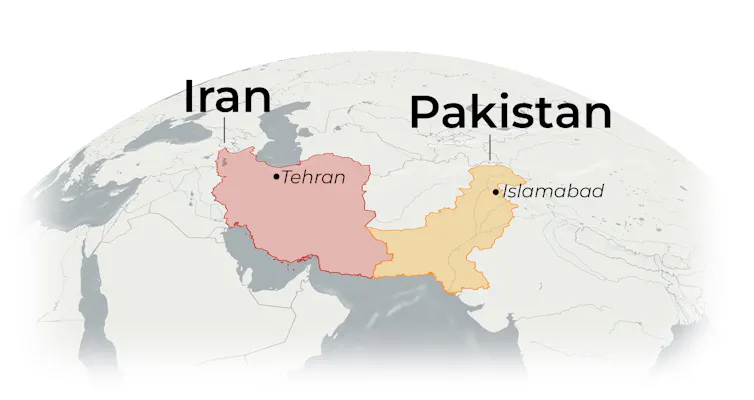
Le Pakistan et l’Iran entretiennent une amitié et une alliance anciennes. Partageant plus de 900 kilomètres de frontières, les deux pays ont, depuis la création du Pakistan en 1947, cherché plusieurs fois à s’aider mutuellement à résoudre des crises diplomatiques.


CC BY-SA

Durant la période monarchique de l’Iran, qui prit fin en 1979, le Pakistan bénéficia d’une médiation iranienne dans ses différends avec l’Afghanistan ainsi que d’un soutien actif de Téhéran lors des guerres qui l’opposèrent à l’Inde en 1965 et en 1971. La relation ne fut pas toujours pas exempte de tensions. Selon certaines sources, l’ancien premier ministre pakistanais Zulfikar Ali Bhutto (1973-1977) n’appréciait guère l’attitude hautaine du shah d’Iran.

Ces liens étroits se sont maintenus après la révolution islamique en Iran. Près de 20 % de la population pakistanaise est chiite et entretient depuis longtemps une relation étroite avec le régime iranien.

Téhéran s’est par ailleurs servi de ces communautés pour diffuser sa propre vision de l’islam et de la politique, en prenant toutefois soin de ne pas franchir certaines limites. Le régime a veillé à ce que les tensions ne dépassent pas un seuil au-delà duquel le gouvernement pakistanais le considérerait comme un facteur de déstabilisation et une menace pour sa propre sécurité.

En raison de cette histoire commune et de cette proximité géographique, le régime iranien est particulièrement disposé à écouter son homologue pakistanais.

Sécurité régionale et nationale

Contribuer à une stabilisation de la situation en Iran est d’autant plus crucial pour le Pakistan que ce dernier souhaite absolument éviter une fragmentation de son voisin de l’ouest en plusieurs petits États.

Le Baloutchistan, la plus grande province du Pakistan, connaît une recrudescence des violences armées commises par le groupe séparatiste Armée de libération du Baloutchistan (BLA). Ses combattants ont attaqué de nombreuses installations militaires, des forces de l’ordre et des fonctionnaires, en particulier ceux originaires de la province du Pendjab (la plus importante sur le plan démographique et économique).


À lire aussi :
Who are the Baloch Liberation Army? Pakistan train hijacking was fuelled by decades of neglect and violence


Le Pakistan a conscience qu’un Iran affaibli ou fragmenté pourrait renforcer l’attrait pour l’idéologie de la BLA. Islamabad refuse d’envisager la création d’un grand Baloutchistan qui engloberait des territoires des deux côtés de ses frontières avec l’Iran.

Autre considération : le Pakistan craint que son arsenal nucléaire ne devienne la prochaine cible des puissances étrangères, et cherche ainsi à désamorcer les tensions dans l’ensemble de la région.

France 24.

La situation géographique du Pakistan est également à prendre en compte. Islamabad ne veut surtout pas se retrouver en étau entre un Iran qui serait contrôlé par Israël et une Inde qui est déjà une proche alliée de Tel-Aviv.

Il est probable que le régime iranien soit conscient de ces préoccupations et comprenne que la médiation du Pakistan repose sur ses propres inquiétudes quant à la sûreté du pays. Mais, du point de vue iranien, ce n’est pas forcément une mauvaise chose : cela signifie que toutes les pistes sont explorées pour parvenir à un cessez-le-feu et à un règlement durable.

Des amis dans le camp MAGA

Le Pakistan jouit d’une réelle crédibilité aux yeux de l’administration Trump. Cela s’explique principalement par le rôle prépondérant que l’armée pakistanaise a joué dans l’élaboration de la politique étrangère du pays. Cette influence, sensible dès la naissance du Pakistan il y a près de 80 ans, s’est encore renforcée récemment.

En 2022, le général Asim Munir a pris ses fonctions de chef d’état-major de l’armée. Il a été promu au grade de maréchal à la suite de la « mini-guerre » qui a opposé le Pakistan à l’Inde en mai 2025.


À lire aussi :
Inde-Pakistan : vers une nouvelle guerre de grande ampleur ?


En poste pour les cinq prochaines années et possiblement jusqu’en 2035, il s’est imposé comme le général le plus puissant à la tête du Pakistan depuis des décennies.

Munir a noué des relations cordiales avec le président états-unien Donald Trump. Il s’est rendu à deux reprises au siège de l’administration, où il a notamment été reçu dans le bureau Ovale.

Le premier ministre pakistanais Shehbaz Sharif serre la main du secrétaire d’État américain Marco Rubio, sous le regard du maréchal Asim Munir.
Andrew Harnick/Getty

Munir a également influencé la politique du Pakistan à l’égard du Golfe, notamment en ce qui concerne la signature d’un accord stratégique de défense mutuelle avec l’Arabie saoudite en septembre 2025. Cet accord s’appuie sur des décennies de coopération en matière de défense entre les deux pays. Il stipule clairement que toute attaque contre l’un des deux pays sera considérée comme une attaque contre les deux.

Bien que le Pakistan ait pris soin de souligner qu’il n’étend pas son parapluie nucléaire à l’Arabie saoudite, cet accord témoigne d’une dissuasion régionale partagée et de la capacité des deux États à collaborer contre leurs adversaires.

La signature de cet accord fut suivie de celle d’un accord de défense stratégique entre l’Arabie saoudite et les États-Unis, lors de la visite du prince héritier Mohammed ben Salmane à Washington, en novembre 2025.

Une alliance est donc désormais formée entre les États-Unis, l’Arabie saoudite et le Pakistan.

La Chine, autre alliée

Dans le même temps, le Pakistan maintient des relations militaires, économiques et politiques solides avec la Chine. Pékin s’est montré favorable à une désescalade du conflit dans le Golfe, en raison de sa forte dépendance à l’égard du pétrole provenant de la région. Cet intérêt fut clairement exprimé lors de la visite du ministre pakistanais des affaires étrangères Ishaq Dar en Chine, le 31 mars dernier. Peu avant, il avait rencontré ses homologues saoudien, égyptien et turc, confirmant que le Pakistan bénéficie à la fois du soutien de toutes les grandes puissances à majorité musulmane et de la Chine.

En contribuant à une solution possible au conflit en Iran d’une façon telle que Donald Trump peut mettre sa médiation en avant et donc ne pas perdre la face, Islamabad s’impose comme le grand vainqueur diplomatique de la séquence actuelle.

The Conversation

Samina Yasmeen ne travaille pas, ne conseille pas, ne possède pas de parts, ne reçoit pas de fonds d’une organisation qui pourrait tirer profit de cet article, et n’a déclaré aucune autre affiliation que son organisme de recherche.

– ref. Médiation entre les États-Unis et l’Iran : le Pakistan sur le devant de la scène diplomatique mondiale – https://theconversation.com/mediation-entre-les-etats-unis-et-liran-le-pakistan-sur-le-devant-de-la-scene-diplomatique-mondiale-280298

Quelles sont les chances de Jean-Luc Mélenchon à la présidentielle ?

Source: The Conversation – in French – By Rémi Lefebvre, Professeur de science politique université Lille 2, Université de Lille

Après les victoires de La France insoumise dans plusieurs villes importantes aux dernières municipales, notamment autour de figures de personnalités issues de l’immigration, le parti de Jean-Luc Mélenchon semble en position favorable pour aborder l’élection présidentielle. Mais son futur candidat a-t-il des chances de se qualifier au second tour ? Et dans ce cas, pourrait-il s’imposer face au candidat du Rassemblement national ? Entretien avec le politiste Rémi Lefebvre.


The Conversation : La France insoumise (LFI) a-t-elle progressé de façon significative avec les élections municipales 2026 ?

Rémi Lefebvre : Le bilan de LFI peut apparaître modeste au regard du nombre de villes conquises : une dizaine de villes sur 35 000 communes, c’est beaucoup moins que le Parti socialiste ou que le Parti communiste français qui ont des maires dans des centaines de villes. Mais il y a incontestablement une percée puisque LFI partait de zéro. Ils revendiquent environ 1 000 conseillers municipaux, une ville de 150 000 habitants, une autre de 100 000. Les villes gagnées peuvent devenir des laboratoires pour les années qui viennent, renforcer l’armature militante et territoriale du parti. Autant d’atouts en vue de l’élection présidentielle.

Autre élément majeur : LFI envoie un signal aux populations issues de l’immigration. Plusieurs maires noirs ont été élus : symboliquement, c’est très important car, de fait, il y a peu de maires noirs en France. Il faut savoir que le profil des députés LFI est très différent de ces nouveaux édiles : les députés sont issus des classes moyennes supérieures, urbains et diplômés. Il y avait bien eu Rachel Kéké, mais elle a été battue en 2024. Là, on voit apparaître un nouveau profil d’élus.

Les quartiers populaires, notamment les Français issus de l’immigration, ont-ils voté LFI ?

R. L. : La France insoumise n’a pas le monopole de cet électorat, qui demeure très abstentionniste. Mais il y a très clairement un phénomène de cristallisation autour de LFI. À Lille, Lahouaria Addouche, qui était la tête de liste LFI, a suscité un véritable engouement. Elle est ouvrière, d’origine maghrébine, cela a beaucoup plu dans les quartiers. Mes étudiants lillois ou certains cadres ont également été sensibles à son profil et à une proposition de renouvellement du personnel politique. LFI joue la carte du dégagisme face aux notables en place à travers la promotion de candidats issus de l’immigration. Cette approche a fonctionné localement dans de nombreux endroits.

Rappelons, avec le sociologue Olivier Masclet, qui travaillé sur la gauche et les quartiers, que le PS ou le PCF n’ont pas beaucoup promu ce type de profils. Balli Bagayoko est d’abord passé par le Parti communiste, sans succès, et La France insoumise l’a finalement récupéré.

LFI a théorisé son approche en parlant de « nouvelle France »…

R. L. : Je suis frappé par la capacité de Jean-Luc Mélenchon à alimenter le débat public et à structurer l’agenda médiatique et politique. Ses saillies, souvent violentes et volontairement polémiques, contribuent à son exposition, mais ses idées également, comme celle de « nouvelle France ». Ce concept désigne les jeunes, les quartiers, les diplômés : il évoque à la fois le métissage et le renouvellement générationnel. Il s’agit de se positionner par rapport au prétendu « grand remplacement » et d’installer un duel avec l’extrême droite en s’opposant à sa vision de la France. C’est un prolongement de l’idée de créolisation, défendue par Jean-Luc Mélenchon en 2020 (le terme est emprunté à Édouard Glissant, et désigne le brassage des cultures), mais cela va plus loin avec la construction d’un récit national, d’une conception de la communauté nationale.


À lire aussi :
La République laïque de Jean‑Luc Mélenchon : un débat qui fracture la gauche et bien plus encore


Quels sont les atouts de La France insoumise pour la présidentielle de 2027 ?

R. L. : La France insoumise a trois forces : elle a un leader incontesté, un programme quasiment immuable, et une machine électorale très performante pour une élection présidentielle. La force militante est d’environ 100 000 personnes, avec 400 000 soutiens inscrits sur la plateforme. LFI, c’est aussi une armée numérique très importante : les abonnés YouTube de Mélenchon sont plus d’un million, et LFI développe sans cesse de nouveaux outils numériques. Au moment où les autres partis de gauche sont englués dans leurs divisions internes, LFI est en ordre de marche pour 2027 : tout est organisé, planifié, rationalisé. La capacité d’organisation et de mobilisation du parti est certainement renforcée par la dynamique des municipales. On peut donc s’attendre à une montée en puissance de LFI dans les mois qui viennent : la machine est déjà en marche.

Quelle est la vision stratégique de LFI en vue de la présidentielle et des législatives qui suivront probablement en 2027 ?

R. L. : LFI propose une fédération à gauche, avec une volonté de répartir les investitures aux élections législatives. C’est clairement orienté en direction des écologistes. Vu l’attentisme du PS et ses hésitations à s’engager dans une primaire, LFI va essayer de détacher les verts du PS. On peut s’attendre à ce que l’aile gauche des écologistes soit tentée de rallier LFI, ce fut déjà le cas pendant les municipales.

L’objectif de Mélenchon, c’est de tout faire pour empêcher la gauche non mélenchoniste de se structurer. Il s’agit de neutraliser le pôle unioniste de gauche (Faure, Tondelier, Ruffin, Autain) pour installer un duel avec le pôle social-démocrate (Hollande, Glucksmann, Guedj, Vallaud).

Quelles sont les chances de Jean-Luc Mélenchon, futur candidat à l’élection présidentielle ?

R. L. : Aujourd’hui, Jean-Luc Mélenchon est à 12 % ou 13 % d’intentions de vote dans les sondages. C’est plutôt un bon niveau pour un début de campagne. Il a un socle solide qui ne varie pas, malgré ses outrances verbales répétées. C’est un atout majeur, incontestablement. Mais peut-il élargir à partir de ce socle ? Peut-il reproduire l’extraordinaire siphonnage de voix liées au vote utile comme en 2022 ? L’idéal pour Jean-Luc Mélenchon serait que la gauche non mélenchoniste et le bloc central demeurent divisés et morcelés. Mais si le bloc central désigne un candidat unique ou si un candidat se détache, la donne change et le seuil d’accès au second tour s’élève. Par ailleurs, on peut imaginer un vote utile d’électeurs modérés dès le premier tour – y compris d’électeurs de gauche – pour un candidat comme Édouard Philippe qui, pour l’instant, semble le mieux placé pour battre le candidat RN au second tour.

L’un des enjeux majeurs de cette présidentielle sera de savoir qui réussira à capter le vote de centre gauche. Au soir de son élection au Havre, Édouard Philippe a envoyé des signaux en direction de l’électorat centriste modéré. Or, Boris Vallaud, François Hollande, Raphaël Glucksmann visent le même espace. Aujourd’hui, il est trop tôt pour anticiper les dynamiques de tous ces concurrents dans les mois à venir.

Et si Mélenchon arrive au second tour ?

R. L. : Jean-Luc Mélenchon est un solide candidat de premier tour, mais on ne perçoit pas de stratégie crédible pour le deuxième tour. Certains politistes ont imaginé que les abstentionnistes pourraient voter Mélenchon face à Bardella ou à Le Pen, lui permettant de l’emporter au second tour. J’ai du mal à y croire. En revanche, les municipales ont montré que la mobilisation à droite était très forte contre LFI. À Clermont-Ferrand, à Toulouse, à Brest, la perspective d’une victoire de LFI a surmobilisé l’électorat de droite, celui qui vote LR ou RN au premier tour. Le caractère répulsif de LFI est incontestable et devrait se confirmer dans le cadre d’un deuxième tour de présidentielle. Aujourd’hui, dans l’hypothèse d’un duel Bardella-Mélenchon au second tour, les hypothèses donnent 70 contre 30 environ. On ne peut anticiper des résultats un an avant le scrutin, mais l’issue d’un second tour Bardella-Le Pen face à Mélenchon ne laisse pas beaucoup de doutes.

L’élection présidentielle va se jouer sur le choix du candidat qui fera face à l’extrême droite au second tour, ce qui est très handicapant pour Jean-Luc Mélenchon.

Propos recueillis par David Bornstein.

The Conversation

Rémi Lefebvre ne travaille pas, ne conseille pas, ne possède pas de parts, ne reçoit pas de fonds d’une organisation qui pourrait tirer profit de cet article, et n’a déclaré aucune autre affiliation que son organisme de recherche.

– ref. Quelles sont les chances de Jean-Luc Mélenchon à la présidentielle ? – https://theconversation.com/quelles-sont-les-chances-de-jean-luc-melenchon-a-la-presidentielle-279869