Les élections législatives marocaines du 23 septembre 2026 ont placé le Parti authenticité et modernité (PAM, membre de la coalition gouvernementale sortante, avec le Rassemblement national des indépendants et l’Istiqlal) en tête, avec 97 sièges sur les 395 que compte la Chambre des représentants. La participation a toutefois fortement reculé par rapport aux dernières élections, à environ 38 % . Mustapha El Mnasfi, chercheur en sciences politiques, a étudié la participation citoyenne et les pratiques démocratiques au Maroc. Il analyse pour The Conversation Africa les enseignements de ce scrutin.
Que vous inspire la victoire du PAM avec 97 sièges ?
Ce résultat peut notamment s’expliquer par deux facteurs. Le premier est lié à la préparation de ces élections par le parti, notamment à sa capacité à coopter certains notables de son principal concurrent, le RNI.
Le deuxième est lié à l’adhésion au parti d’une personnalité technocrate très populaire dans le monde du football, Faouzi Lakjaa, président de la Fédération royale marocaine de football et ancien ministre délégué chargé du Budget.
L’adhésion de M. Lakjaa au PAM, accompagnée de la rumeur selon laquelle il pourrait être nommé chef du gouvernement, a encouragé une partie des députés, qualifiés de « notables », à rejoindre le parti. Ce ralliement des notables est une caractéristique de la culture politique marocaine qui peut être qualifiée d’« opportunisme politique ».
Certains candidats et grands élus développent l’idée que tel ou tel parti sera favori lors des élections et que le pouvoir central aidera le parti en question à décrocher la première place. Cela est dû, à mon avis, à l’absence d’une élite politique proche des citoyens et de leurs principales préoccupations.
Cette situation a permis au PAM de renforcer sa présence dans les circonscriptions électorales et de bénéficier du soutien d’un nombre important de notables, notamment dans les zones rurales et les quartiers populaires des grandes villes.
Comment expliquez-vous la forte baisse de la participation électorale ?
Cela peut s’expliquer par plusieurs facteurs, au premier rang desquels la crise de confiance envers les institutions de représentation. En effet, une grande partie des citoyens marocains a notamment conscience que les députés et les élus ne disposent pas de prérogatives suffisantes et que le pouvoir central, à travers le ministère de l’Intérieur, conserve une place centrale dans la capacité d’agir et dans la fabrication de la décision publique.
Dans ce contexte, les députés et les élus peuvent apparaître davantage comme des acteurs qui assistent les représentants du pouvoir central dans leur action. Cette perception contribue à créer une forme de distance entre les citoyens et les partis politiques.
Un autre point à soulever dans ce cadre est celui de la faible participation des jeunes. Selon les données officielles disponibles, le nombre de personnes inscrites sur les listes électorales ne dépasse pas 16 millions sur une population totale estimée à 38 millions, et les jeunes âgés de 18 à 24 ans n’en représentent qu’environ 4 %. Cela témoigne d’une faible inscription de cette catégorie d’âge dans le processus électoral, malgré les campagnes de sensibilisation menées par certains partis politiques et par les pouvoirs publics.
Les jeunes marocains peuvent également s’investir dans la politique en dehors des mécanismes électoraux traditionnels. Ils investissent davantage les plateformes numériques et les réseaux sociaux, où ils expriment leurs opinions, débattent et se mobilisent autour de différentes questions politiques et sociales.
On observe donc une forme de participation politique qui passe davantage par le numérique et les mobilisations ponctuelles que par les institutions politiques traditionnelles.
Il existe ainsi un décalage entre l’intérêt pour la politique et la participation aux mécanismes institutionnels, notamment électoraux et partisans.
Que révèle le retour du PJD, passé de 13 à 54 sièges, sur l’évolution de l’électorat marocain ?
Les résultats du Parti de la justice et du développement (PJD), lors de ces élections, peuvent s’expliquer notamment par sa capacité à mobiliser son électorat. Malgré les difficultés et les problèmes internes qu’il a connus après les élections de 2021, le PJD a pu s’appuyer sur son électorat traditionnel pour décrocher 54 sièges.
Le contexte socio-économique a également joué un rôle, en permettant au PJD de convaincre certains électeurs non partisans de voter en sa faveur. Dans ce sens, on peut parler d’un possible vote sanction contre le RNI.
Un dernier élément est également important pour expliquer les résultats du PJD : sa mobilisation contre la normalisation des relations entre le Maroc et Israël. Cette position lui a donné une certaine légitimité auprès d’électeurs opposés à cette normalisation, y compris parmi ceux qui se reconnaissent dans les partis de la Fédération de la gauche.
Ces résultats annoncent-ils, selon vous, une recomposition du paysage politique marocain ?
Étant donné que le nouveau gouvernement sera formé de partis politiques qualifiés de « proches du pouvoir central », nous allons assister à une continuité et à la poursuite de la même logique que celle de l’ancien gouvernement.
Autrement dit, nous aurons des ministres qui accompagneront l’État dans la mise en œuvre de sa vision stratégique à l’horizon 2030. Dans ce cadre, il faut souligner qu’il existe, d’une part, le programme des partis politiques, autrement dit celui du gouvernement, et, d’autre part, le programme de l’institution monarchique.
Certes, le gouvernement dispose d’une marge d’action, mais pas en ce qui concerne les grands chantiers. Par exemple, le chef du gouvernement peut nommer des personnes à de hautes fonctions administratives, mais sur la base des prérogatives royales et des orientations stratégiques fixées par le monarque.
Au Maroc, on distingue le Conseil des ministres, présidé par le monarque, et le Conseil du gouvernement, présidé par le chef du gouvernement. Le Conseil des ministres délibère notamment sur les orientations stratégiques de la politique de l’État, tandis que le Conseil du gouvernement délibère notamment sur les politiques publiques et assure la mise en œuvre du programme gouvernemental.
Cela explique que le programme des partis politiques et du gouvernement ne puisse pas dépasser celui de l’institution monarchique. Le gouvernement veille donc à la mise en œuvre du programme et des orientations de l’institution monarchique.
Mustapha El Mnasfi est consultant auprès du Centre Jacques Berque pour la recherche et de la Fondation Heinrich Böll.
Source: The Conversation – France in French (2) – By Alain Maillet, Chef de projet à MEDES dans le domaine des sciences de la vie et responsable de l’expérience Food Processor pour le Cadmos (Centre d’Aide au Développement des Activités en Micropesanteur et des Opérations Spatiales), Centre national d’études spatiales (CNES)
Une recette de saumon au citron, développée par le Cnes dans le cadre des _Special Event Meal_ (repas pour les événements à bord). Le plat a été placé sur une tortilla et assaisonné avec de la sauce piquante et de la crème à l’ail par un des astronautes de la mission.NASA, Fourni par l’auteur
L’ESSENTIEL
Le 12 avril 1961, Youri Gagarine devient le premier humain à orbiter autour de la Terre. Dans sa capsule Vostok, il ne dispose que de neuf produits alimentaires conditionnés en tubes : soupes, jus et purées.
Soixante ans plus tard, à bord de la Station spatiale internationale (ISS), les astronautes choisissent parmi plus de 300 recettes, allant du cocktail de crevettes lyophilisé aux repas événementiels français, en passant par d’occasionnels produits frais.
Cette évolution n’est pas anodine. Manger dans l’espace, c’est bien plus que se nourrir. C’est un acte de résistance physiologique face à la micropesanteur, un rempart psychologique contre l’isolement et un terrain d’innovation technologique pour les missions futures.
Pour les astronautes, l’alimentation est un des piliers de l’exploration humaine au-delà de notre planète. Comment concilier des contraintes extrêmes comme la microgravité, la durée des missions et la logistique avec une alimentation à la fois nutritive et plaisante ?
Entre science, ingénierie et art culinaire, l’alimentation spatiale a suivi une courbe aussi vertigineuse que les trajectoires des fusées qui la transportent.
Des tubes aux salades fraîches
Lors des premières missions, comme Vostok pour les Soviétiques (1961) ou Mercury (1961-1963) pour les Américains, l’objectif était alors de prouver que l’humain pouvait mâcher, avaler et digérer en micropesanteur, une capacité qui n’allait pas de soi pour les scientifiques de l’époque. Les craintes initiales (étouffement, régurgitation ou mauvaise digestion) se sont rapidement dissipées, mais au prix d’une expérience gustative peu engageante.
De fait, à cette époque, les astronautes rapportaient souvent ces aliments non consommés, et les tubes présentaient des limites majeures : un goût atténué, une texture peu naturelle et une logistique complexe, notamment pour doser les portions. Les cubes de beurre de cacahuète, utilisés pendant les missions Mercury et Gemini (1965-1966), en sont un exemple emblématique. Conçus pour éviter les miettes dans un environnement en micropesanteur, ils offraient une texture pâteuse et un manque de croquant.
Pourtant, ces premières tentatives ont ouvert la voie à des innovations majeures. Avec l’allongement progressif des missions, notamment à partir des programmes Salyut (1971-1991), Apollo (1968-1972), Skylab (1973-1974) et jusqu’à six mois pour Mir (1986-1999), les agences spatiales ont dû repenser l’alimentation.
Ainsi, les aliments déshydratés et lyophilisés – soupes, jus, café, mais aussi viandes et légumes – sont devenus la norme. Légers et faciles à réhydrater, ils permettent de diversifier les repas tout en respectant les contraintes de poids et de volume. Les recettes conditionnées en boîtes métalliques (conserves) et viandes en sachets souples sont traitées par ionisation (un procédé de conservation à froid par destruction des microorganismes) ont également permis d’offrir des plats plus variés, comme des morceaux de bœuf aux champignons ou des salades de fruits tropicaux.
Une avancée majeure, au moment des missions Apollo dans les années 1960 et 1970, a été la possibilité de réchauffer les aliments, d’abord avec de l’eau chaude pour le lyophilisé, puis les boîtes de conserve. Les repas sont devenus chauds et plus variés.
Aujourd’hui, à bord de l’ISS, les astronautes disposent de menus d’une variété impressionnante. Les aliments lyophilisés ou déshydratés, comme le curry de poulet aux noix de cajou, les œufs brouillés ou les lasagnes à la viande, se réhydratent en quelques minutes avec de l’eau à température ambiante ou chaude. Les aliments à faible teneur en eau, fruits secs, biscuits ou barres vitaminées, complètent ces repas. Les aliments frais, comme les fruits et quelques légumes, sont disponibles pendant quelques jours après l’arrivée des vaisseaux ravitailleurs.
La collaboration internationale joue un rôle clé dans cette diversité alimentaire. La Nasa et Roscosmos fournissent toujours chacun 50 % de la masse alimentaire envoyée à l’ISS.
Le Centre national d’études spatiales (Cnes) français propose, quant à lui, pour tous les astronautes des repas événementiels pour marquer des occasions spéciales, comme des anniversaires ou des fêtes, ou dans le cadre d’expériences scientifiques, à raison d’un ou deux repas par mois.
Les agences japonaises (JAXA) et européennes (ESA) fournissent également des recettes nationales lorsque leurs astronautes sont à bord, par exemple l’effiloché de bœuf à la vanille fumée et à l’ail noir, créé par la cheffe Anne-Sophie Pic, pour l’astronaute Sophie Adenot de la mission Epsilon.
Les trois piliers de l’alimentation spatiale
L’alimentation dans l’espace ne se limite pas à combler des estomacs. Elle repose sur trois enjeux majeurs : la santé, la psychologie et la logistique.
Chaque astronaute consomme en moyenne près de 2 500 à 3 000 calories par jour, un apport similaire aux recommandations terrestres de l’Organisation mondiale de la santé (OMS), mais adapté à leur métabolisme et à leur niveau d’activité physique. En effet, malgré les deux heures et demie d’exercice quotidien obligatoire (tapis roulant, vélo, ergomètre ou dispositif de musculation), leurs muscles, notamment ceux du dos et des membres inférieurs, ne sont que peu sollicités le reste du temps.
Pour compenser, les équipes médicales veillent à ce que leur alimentation soit suffisamment riche en protéines, en calcium et en vitamine D, afin de lutter contre la perte osseuse et musculaire induite par la micropesanteur.
D’un point de vue psychologique, les repas jouent un rôle crucial. Dans l’espace, où chaque journée est rythmée par des tâches individuelles, expériences scientifiques, maintenance de la station, entraînement physique ou suivi médical, les repas, et notamment ceux du soir ou de la fin de semaine, sont des moments privilégiés de convivialité. Ces moments de sociabilité nous semblent essentiels pour maintenir le moral et la cohésion d’équipe, surtout lors des missions de longue durée.
Enfin, la logistique représente un défi de taille. Chaque kilogramme envoyé dans l’espace a un coût non négligeable et l’espace de stockage est limité. Les aliments doivent donc être légers, compacts et stables sur de longues périodes.
Vers l’autosuffisance : cultiver et recycler dans l’espace
Pour les missions de très longue durée, comme celles envisagées vers la Lune ou Mars, une meilleure autonomie alimentaire devient indispensable. Plusieurs pistes sont actuellement explorées pour y parvenir, dont le projet MELiSSA, développé par l’Agence spatiale européenne (ESA) – un système en boucle fermée pour recycler le dioxyde de carbone, l’eau et les déchets organiques afin de produire de l’oxygène et permettre de la culture végétale – ou ceux menés par le projet Spaceship FR sur l’optimisation de la pousse végétale.
Enfin, les systèmes de recyclage des ressources, comme MELiSSA ou ceux étudiés par le Spaceship FR, visent à recycler 100 % des déchets organiques (urine, dioxyde de carbone, plantes non comestibles) pour faciliter la pousse de végétaux.
À bord de la Station spatiale internationale, des expériences de culture végétale ont déjà été menées avec succès. Les astronautes ont pu cultiver et consommer des salades, et des tests sont en cours pour d’autres plantes comme des tomates ou des piments. Ces cultures ne se contentent pas d’apporter des vitamines fraîches, essentielles à la santé des équipages, elles ont aussi un effet psychologique positif.
Jardiner et récolter ses propres aliments améliore le moral et offre une activité gratifiante dans un environnement par ailleurs très contrôlé. La validation à terme de ces projets pourrait permettre aux astronautes de cultiver leurs propres aliments, réduisant ainsi leur dépendance aux ravitaillements terrestres.
La santé des astronautes est également une préoccupation majeure. En micropesanteur, les astronautes subissent une perte osseuse de 1 à 2 % par mois et une atrophie musculaire pouvant atteindre 20 % de leur masse musculaire. Pour contrer ces effets, leur alimentation devra être riche en protéines (entre 1,2 et 1,6 gramme par kilogramme de poids corporel et par jour), en vitamine D et en calcium. Les aliments riches en antioxydants, comme les fruits et légumes frais, joueront également un rôle clé dans le maintien de leur système immunitaire.
Roxane Coiffet, nutritionniste à MEDES, un groupement d’intérêt économique ayant pour membres le Cnes, le CHU de Toulouse, l’Université Paul-Sabatier à Toulouse, l’Université de Clermont-Ferrand, l’Université de Bordeaux, le CH d’Angers et les universités de Caen et de Montpellier.
Cet article est publié dans le cadre de la Fête de la science (qui a lieu du 2 au 12 octobre 2026), dont The Conversation France est partenaire. Cette nouvelle édition porte sur la thématique « Saveurs savantes ». Retrouvez tous les événements de votre région sur le site Fetedelascience.fr.
Alain Maillet ne travaille pas, ne conseille pas, ne possède pas de parts, ne reçoit pas de fonds d’une organisation qui pourrait tirer profit de cet article, et n’a déclaré aucune autre affiliation que son organisme de recherche.
Source: The Conversation – France in French (3) – By Marie Fruiquière, Associate professor, Ecole Nationale supérieure d’architecture et de paysage de Bordeaux (ENSAP Bordeaux); Université de Strasbourg
Que deviennent nos corps après notre décès ? Dans des sociétés où la mort est de plus en plus invisibilisée, comment ont évolué nos rites ? Demain, à quoi ressembleront les cimetières ? L’enterrement ou l’incinération seront-ils remplacés par d’autres méthodes ? Comment le numérique transformera-t-il nos pratiques funéraires ?
Pour répondre à ces questions et à bien d’autres, nous vous proposons une série de six articles sur le thème « Le corps après la mort », rédigés par des experts et illustrés par le dessinateur Vito.
Ce premier épisode est consacré aux cimetières. Ces lieux dévolus au repos éternel ne sont pas immuables et doivent parfois être déplacés. Mais « translater » un cimetière n’est pas une mince affaire…
L’ESSENTIEL
Les conséquences du dérèglement climatique pourraient engendrer l’augmentation du nombre de déplacements de cimetières dans les prochaines décennies.
Les « translations » de cimetières sont des chantiers complexe, qui peuvent s’étaler sur de très nombreuses années.
Les projets de déménagement de cimetières sont sensibles, notamment parce qu’ils redéfinissent le rapport des familles à leurs défunts et à la sépulture.
Au-delà de leur apparente permanence, les cimetières sont des espaces en mouvement. Relativement récent dans sa forme actuelle, le cimetière a, par le passé, été amené à déménager à plusieurs reprises.
Des nécropoles romaines aux cimetières paroissiaux en passant par les cimetières contemporains, ces chantiers de « translation de cimetières » ont notamment accompagné les grandes évolutions sociétales sur les pratiques funéraires.
Ces scénarios de translations de cimetières n’appartiennent pas seulement au passé, mais constituent une actualité bien présente au regard des défis environnementaux, interrogeant parallèlement les enjeux relatifs à la création de nouveaux cimetières.
Quelles leçons retenir du passé ?
D’un point de vue historique dans le contexte français, les premières migrations de sépultures sont liées au développement du christianisme, lequel a conduit au rapprochement des sépultures vers les lieux sacrés. Mais au 16e siècle, le fonctionnement des cimetières paroissiaux s’est complexifié dans les milieux urbains, en raison du manque de place et des problématiques sanitaires liées à l’accumulation des corps en décomposition.
En plus d’interdire les inhumations dans les églises, la déclaration royale du 10 mars 1776 ordonne alors l’agrandissement ou le transfert des cimetières pouvant nuire à la salubrité de l’air. En 1780, la fermeture du cimetière parisien des Innocents, suite à l’effondrement de son charnier, marque l’un des déménagements de cimetière les plus célèbres. Ce déplacement a en effet non seulement engendré la création des catacombes, mais aussi celle des grands cimetières parisiens (aujourd’hui intramuros) comme le Père-Lachaise.
Plus récemment, d’autres facteurs ont pu conduire à la translation de tout ou partie de cimetières. Citons, par exemple, la création de barrages hydroélectriques dans les années 1960-1970, qui a conduit à la reconstruction de villages entiers, comme à Bord-les-Orgues et Naussac, ou encore les projets d’infrastructures de transport, tels que celui qui a mené au déplacement, en 2010, de l’ancien cimetière de l’hôpital psychiatrique de Navarre, à Évreux (connu sous l’appellation « cimetière des fous »), situé sur le tracé d’un contournement autoroutier.
À l’avenir, des déménagements de cimetières dus au changement climatique ?
Dans une vision davantage prospective, ce sont les conséquences du dérèglement climatique qui pourraient engendrer l’augmentation du nombre de translations de cimetières dans les prochaines décennies.
Les exemples internationaux accréditent cette hypothèse. Ainsi, en 2014, le cimetière d’Oso, dans l’État de Washington, aux États-Unis, a dû être relocalisé temporairement sur un terrain moins instable, en raison d’un glissement de terrain massif. En Angleterre, à Happisburg, c’est l’érosion qui menace le cimetière, établi à flanc de falaise.
En France, il existe déjà des situations critiques, comme à Jugon-les-Lacs, en Bretagne, non loin de Dinan, où le conseil municipal, après de premières délibérations en 1986 et 1991, a confirmé en juillet 2022 la décision de fermer le cimetière autour de l’église, car il se situe en zone inondable. Sur le littoral, la submersion marine projetée montre que les villes côtières, dont certaines sont très urbanisées, pourraient également voir leurs cimetières engloutis, comme à Dunkerque ou Saint-Malo. Non moins sensibles, les régions de montagne connaissent leurs propres risques, comme à La Bérarde, ensevelie par une lave torrentielle liée à la fonte des glaciers en juin 2024.
À Jugon-les-Lacs, le déplacement du cimetière de l’église, situé en zone inondable et photographié ici en 2011, a été acté. Pymouss / Wikimedia Commons, CC BY
Bien que la question des cimetières soit encore peu abordée dans ces scénarios, et à défaut de stratégies d’évitement, d’atténuation ou de résolution des enjeux climatiques, de tels évènements imposent aujourd’hui pour certains d’envisager leurs translations au risque, en cas d’inaction, de les voir disparaître sous les flots et la boue.
Mais comment procède-t-on pour déménager un cimetière ?
Ouvrir un cimetière pour en fermer un autre
Toute translation est avant tout conditionnée à l’ouverture d’un nouveau cimetière, ou au fait qu’un cimetière existant dispose de suffisamment de place pour accueillir l’ensemble des restes mortels du cimetière à déménager.
Dans le cas d’une ouverture, les dispositions réglementaires du Code général des collectivités territoriales donnent des indications sur la surface du cimetière et ses capacités d’inhumations : nombre présumé des défunts, taille des sépultures et des entre-tombes, etc. Elles posent également un cadre en termes de localisation (terrains les plus élevés exposés au nord, profondeur de la nappe phréatique, etc.) et d’aménagements, tels que la mise en place d’un ossuaire dans l’enceinte du cimetière pour accueillir les restes mortels exhumés.
À l’échelle du territoire, les documents d’urbanisme comme le plan local d’urbanisme (PLU) renseignent des contraintes supplémentaires, comme l’existence d’orientations d’aménagements et de programmation qui définissent les stratégies d’aménagements du territoire en fonction des besoins, notamment l’identification, la quantification et la spatialisation du besoin en logements, ou l’identification d’une zone à enjeux pour la création de zones d’activités, etc. De manière semblable, les trames environnementales, à l’instar de la trame verte et bleue, constituent des réseaux de continuités et de réservoirs écologiques où les aménagements sont souvent limités pour éviter la fragmentation des milieux naturels.
Ces conditions s’avèrent parfois difficiles à concilier dans les milieux urbains, où le foncier se raréfie et se morcelle et où les quelques terrains disponibles sont rarement attribués de manière prioritaire aux espaces funéraires.
La création du nouveau cimetière fait par ailleurs l’objet d’une procédure complexe et chronophage, avant que puissent enfin être réalisées les premières (ré-)inhumations : processus délibératifs communaux (voire intercommunaux), transactions foncières, obtention des autorisations d’urbanisme nécessaires, diagnostics préopérationnels (hydrogéologique, écologique, archéologique, etc.), études ou enquêtes publiques sont autant d’étapes préalables avant le démarrage des travaux.
Enfin, dès lors que le nouveau cimetière est livré, la translation en elle-même peut débuter.
Fermeture, affermage, vente : comment s’effectue un déménagement de cimetière ?
Le cimetière étant un équipement public, le pouvoir de décision d’une translation revient généralement au conseil municipal (sauf si la compétence funéraire a été reprise par un Établissement public de coopération intercommunale tel qu’une métropole). Une fois la décision de translation arrêtée, le processus de déménagement s’opère en trois phases juridiquement qualifiées.
Lorsque la translation d’un cimetière a été actée, l’attribution de nouvelles sépultures n’y est plus possible. Des inhumations peuvent cependant encore être réalisées dans les caveaux existants s’il y reste des places disponibles (sauf si le terrain du cimetière à fermer est reconnu d’utilité publique – à l’image des infrastructures énergétiques ou de transport par le passé).
En dehors de ces éventuelles inhumations, le cimetière doit rester en l’état et sans usage durant les cinq années qui suivent la délibération, en écho au délai de rotation minimal durant lequel les dépouilles ne peuvent être exhumées qu’à la demande de l’autorité judiciaire ou de la famille. Ainsi, la commune ne peut d’office procéder à des transferts de restes mortels.
Durant ce délai, les familles ont la possibilité de demander l’exhumation de leurs défunts pour qu’ils soient réinhumés gracieusement dans le nouveau cimetière, sur un emplacement égal en superficie à la concession initiale. L’exhumation se fait aux frais de la commune, mais cette dernière peut exiger que les familles titulaires de la concession prennent en charge la dépose, la repose ou la démolition du monument, ainsi que les éventuelles dépenses de pompes funèbres.
La deuxième phase débute une fois ces cinq ans passés. La commune peut alors procéder d’office aux exhumations et transferts de restes mortels encore présents. Les tombes non déménagées par les concessionnaires et ayants droit ont théoriquement vocation à être transférées avec le bénéfice de la concession, si cette dernière n’est pas arrivée à échéance. Néanmoins, à défaut de demande, la pratique consiste souvent dans le regroupement des restes dans un ossuaire.
Une fois les exhumations finalisées, le cimetière peut faire l’objet d’un déclassement du domaine public permettant de « louer » le terrain désaffecté à un tiers, à condition qu’il ne fasse l’objet d’aucune fouille ou fondation pour des constructions jusqu’à ce que les conditions de la troisième phase ne soient réunies.
La dernière étape est celle de l’aliénation du cimetière, autrement dit de la cession de la propriété du terrain. Cette aliénation ne peut avoir lieu qu’après cinq ans d’affermage et dix ans après la dernière inhumation. La commune peut alors, si elle le souhaite, vendre le terrain du cimetière.
Au final, il est difficile d’estimer la durée moyenne d’une translation tant les variables sont nombreuses : raison et urgence de la translation, nombre de sépultures à transférer, durée du projet de conception et construction du nouveau cimetière, le cas échéant, comprenant les éventuelles acquisitions, les études, les travaux et tous les aléas d’un chantier, etc. Bref, à défaut de pouvoir donner un temps moyen, nous pouvons ici rappeler qu’à Jugons-les-Lacs, le projet de translation du cimetière a débuté il y a déjà 40 ans.
Des chantiers complexes
En raison non seulement de la logistique, mais aussi du poids financier qu’ils représentent, les chantiers de déménagement de cimetières restent à ce jour relativement rares. L’orchestration d’un tel chantier soulève en effet des questions organisationnelles complexes pour les communes.
Au-delà des temporalités longues, ces opérations impliquent un suivi assidu. Celui-ci doit être poursuivi malgré d’éventuels changement au sein du personnel municipal, et quelle que soit la succession des agendas politiques ou autres évènements dépassant les conditions d’exercice de l’institution publique locale.
En outre, ces déménagements nécessitant souvent la création d’un nouveau cimetière, ils impliquent des enjeux fonciers et environnementaux qui peuvent rajouter une complexité supplémentaire.
De ce fait, historiquement, ces opérations de transferts n’ont pas toujours été menées, comme en témoigne la présence récurrente de cimetières au pied de certaines églises. Cependant, les enjeux climatiques pourraient contraindre dans les prochaines années les décideurs à devoir considérer l’éventualité de translations contemporaines.
Une redéfinition des rapports aux défunts et aux sépultures
La translation d’un cimetière est un chantier à deux visages. D’un côté, elle peut constituer un levier de transformation des espaces et pratiques funéraires. Ouvrir un nouveau cimetière permet de faire évoluer sa gestion technique et administrative et son aménagement, en proposant par exemple des sépultures alternatives ou en y laissant davantage de place pour les natures.
De l’autre côté, la fermeture de l’ancien cimetière peut entraîner la perte d’un patrimoine funéraire ou des contradictions avec les logiques de limitation de l’artificialisation des sols ou d’optimisation des ressources (financières, foncières, naturelles, etc.).
Pour terminer, soulignons que les translations de cimetière redéfinissent le rapport des familles à leurs défunts et à la sépulture.
Les recherches qui se sont penchées sur la question des déplacements de villages ont révélé la sensibilité de « l’objet cimetière ». Celui-ci cristallise l’ancrage à un territoire, et son déménagement peut parfois être garant du bon déroulé du déplacement des populations, au-delà du relogement des vivants.
Les exemples du passé peuvent nous aider à appréhender certains écueils, qu’il s’agisse de la désorganisation des exhumations ou du mauvais phasage pour l’ouverture du nouveau cimetière. Ils permettent aussi de clarifier certaines procédures sur le plan juridique, notamment la publicité autour des exhumations, ou le statut des restes mortels exhumés d’une concession active par la commune.
Enfin, en fonction de leur éloignement, l’emplacement des nouveaux cimetières peut venir questionner la mise à distance de la mort, voire son invisibilisation.
Derrière le travail d’anticipation du déménagement se joue donc aussi la construction des récits pour (et par) ceux qui restent. L’enjeu est qu’ils puissent eux aussi, à côté des institutions territoriales et étatiques, être acteurs de ces grands changements, qui pourraient prendre place dans un monde incertain.
Remerciements :
– Les planches de la bande dessinée ont été réalisées par Victor Locuratolo (@Vito) ;
– Le scénario a été coécrit par Victor Locuratolo et Damien Charabidzé, l’initiateur de cette série d’articles ;
– Cette publication a été rendue possible grâce à un financement de l’Union du Pôle Funéraire Public (UPFP), structure réunissant les acteurs publics du funéraire afin de défendre et promouvoir leurs services, tout en garantissant un accompagnement digne, éthique et accessible à tous les citoyens. Elle a également bénéficié d’un financement de la Direction Culture de l’Université de Lille, dans le cadre de son soutien aux projets de recherche et de diffusion associant arts et sciences.
Marie Fruiquière est membre de la Ville et Eurométropole de Strasbourg et participe à ce titre à l’Union du Pôle Funéraire Public. Ses recherches ont précédemment bénéficié de financements de l’Association Nationale de la Recherche et de la Technologie, de la Ville et Eurométropole et de la Fondation Palladio. Aucun de ces acteurs n’a participé à la rédaction ou à la relecture de cet article ni ne tire profit de cet article.
Damien Charabidzé ne travaille pas, ne conseille pas, ne possède pas de parts, ne reçoit pas de fonds d’une organisation qui pourrait tirer profit de cet article, et n’a déclaré aucune autre affiliation que son organisme de recherche.
En novembre, un questionnaire sur les violences sexuelles sera adressé aux élèves de la maternelle à la terminale.
Conçu par le ministère de l’éducation comme un outil de repérage, peut-il libérer la parole des victimes ?
Le problème se situe souvent au niveau de la réception de cette parole, disent les recherches sur le sujet.
Le ministère de l’éducation nationale a annoncé qu’un questionnaire sur les violences sexuelles serait bientôt soumis à des millions d’élèves, de la grande section de maternelle à la terminale. Anonyme ou nominatif selon le choix de l’enfant, il est présenté comme un outil de repérage systématique.
Le problème n’est donc pas seulement celui du silence des enfants, c’est celui de la réception de leur parole par les institutions et les adultes qui les entourent. Dès lors, un questionnaire peut-il changer cette réception ? Peut-il transformer la manière dont les adultes perçoivent, ou non, les enfants comme des interlocuteurs crédibles ?
Cette question de la crédibilité n’est pas propre à l’enfance. Lorsqu’une femme adulte révèle des violences sexuelles, son témoignage est régulièrement discrédité. Pour les enfants, le doute est encore plus systématique : on les soupçonne de mentir sur tout et tout le temps.
Le doute face à la parole recueillie n’est pas seulement une posture individuelle : c’est aussi une méthode, érigée en culture professionnelle partagée. Mais s’il y a des doutes qui permettent l’action de protection en obligeant à vérifier, à recouper, à sécuriser une décision, il y a aussi des doutes qui immobilisent, qui paralysent l’action protectrice.
Ces derniers s’organisent autour de trois figures disqualifiantes récurrentes. La première est celle de « l’enfant menteur », une figure dont les racines plongent dans l’histoire de la psychiatrie et qui continue d’irriguer les routines professionnelles sous forme de « cas typiques ».
Un exemple fréquent concerne des adolescentes perçues comme pratiquantes d’une religion : lorsqu’elles dénoncent un viol, on les soupçonne de mentir, en supposant qu’elles inventeraient cette accusation pour dissimuler une relation sexuelle hors mariage qu’elles ne pourraient pas assumer.
La deuxième est celle de « l’enfant qui se trompe », assigné à une immaturité cognitive supposée : l’expertise institutionnelle s’octroie alors le droit de corriger le vécu de l’enfant, au nom d’une vérité qui lui échapperait à lui-même. C’est par exemple le cas pour des enfants plutôt jeunes, qui n’ont pas encore eu de relation sexuelle par pénétration vaginale ou anale, les professionnels vont supposer que l’enfant se trompe en raison d’une non-connaissance de son anatomie.
La troisième consiste à ramener le récit de violences à des causes extérieures (conflit de séparation parentale, suggestions induites par le parent protecteur) ce qui a pour effet de suspendre le crédit que l’institution accorde à l’enfant.
Le handicap, qu’il concerne la victime ou l’agresseur, sature ces grilles de lecture et tend à être pathologisé. Du côté de l’agresseur, la violence est requalifiée en simple « absence de limites ». La responsabilité de la prévention se déplace alors vers l’enfant lui-même, qui se retrouve sommé de développer sa propre capacité à se protéger du danger.
Du côté de la victime, c’est l’inverse qui se produit : son récit est systématiquement relu à travers le prisme de sa déficience, qui devient un statut maître, au point d’effacer le récit de la violence lui-même.
Ces figures disqualifiantes opèrent en amont et en aval de la parole recueillie, dans la manière dont cette parole sera ensuite interprétée.
Une parole sans cesse négociée
Pour être « entendue » et déclencher une mesure de protection, la parole d’un enfant doit répondre à une triple exigence de lieu (parler au bon endroit), de temps (parler au bon moment) et de posture. L’enfant doit ainsi évaluer, souvent seul, quels sont le bon moment et le bon endroit pour révéler des violences (un temps seul avec un professionnel, le temps formel d’une audition, un espace individuel en dehors des lieux collectifs, etc.).
L’institution n’écoute pas seulement ce qui est dit, elle observe la manière dont l’enfant se positionne vis-à-vis de son agresseur et de son système familial. Le rejet explicite de l’agresseur apparaît comme une variable pivot de la crédibilité accordée à l’enfant. Comme si un enfant qui continue d’aimer, ou de ne pas rejeter frontalement la personne qui lui fait du mal, devenait de ce fait moins crédible.
Un questionnaire scolaire, quelle que soit sa qualité, ne peut à lui seul recréer les conditions de lieu, de temps et de posture nécessaires à ce que la parole soit reçue dans de bonnes conditions. Il peut amorcer une révélation, mais il ne garantit en rien la suite du parcours institutionnel de cette parole.
Ce constat renvoie à un fait sociologique plus large : les institutions détiennent un monopole de la production légitime de vérité. Ce sont elles qui décident quelles paroles sont crédibles et lesquelles ne le sont pas. Or, les institutions sont familialistes, c’est-dire que la famille constitue un objet à protéger en tant que tel. Elles tendent ainsi à privilégier l’évitement du conflit et le maintien du lien familial, parfois au détriment direct de la mise à l’abri des personnes mineures en danger.
Ce que le questionnaire peut, et ne peut pas, faire
Le questionnaire de l’éducation nationale peut, dans une certaine mesure et sous certaines conditions, permettre la formulation d’une révélation : il répond ainsi partiellement à l’exigence du moment, en instaurant un temps spécifique.
Mais un outil de repérage ne suffit pas à transformer la manière dont la parole des enfants est ensuite reçue. Il ne va modifier ni les figures disqualifiantes qui structurent le doute professionnel, ni le caractère familialiste des institutions, ni la tendance à traiter chaque affaire de façon isolée plutôt que comme le symptôme d’un rapport de domination généralisé entre adultes et enfants.
La philosophe Miranda Fricker a proposé le concept d’injustice testimoniale pour décrire ce phénomène : le fait d’accorder d’emblée moins de crédit à la parole de quelqu’un en raison de son statut social ou de son identité, indépendamment du contenu de ce qu’il dit. Les figures de « l’enfant qui ment » ou « qui se trompe » en sont des manifestations concrètes : elles agissent comme des filtres qui abaissent la crédibilité de l’enfant avant même que sa parole ne soit véritablement examinée.
Ce déficit de crédibilité se loge ainsi dans la réception, pas dans le recueil : un questionnaire ne change rien aux catégories de jugement des professionnels qui décideront ensuite de croire ou non ce qui a été dit. Mais ce risque n’est pas une fatalité, il pointe précisément l’endroit où portent les marges de progrès.
Jeanne Devèze est membre de la Commission Indépendante sur l’inceste et les Violences Sexuelles faites aux Enfants (CIIVISE).
Source: The Conversation – France in French (3) – By Sylvie Toscer-Angot, Professeure de civilisation allemande Responsable du master LLCER- Spécialité Allemand Responsable du Pôle Allemand LEA, Université de Tours
L’ESSENTIEL
L’Alternative für Deutschland (Alternative pour l’Allemagne, AfD) ne diffuse pas un discours négationniste en tant que tel (ce qui est passible de cinq ans d’emprisonnement), mais relativise la période nazie dans ses discours et ses programmes.
Le parti remet en cause « la culture de la repentance » allemande sur la période nazie, estimant que ce ne fut qu’une page secondaire de l’histoire glorieuse du pays et que les souffrances de la population allemande doivent être mises sur le même plan que celles des victimes du régime hitlérien.
Forte de ses succès dans les Länder de Saxe-Anhalt et de Mecklembourg-Poméranie occidentale, l’AfD va-t-elle vraiment peser sur les commémorations et les programmes scolaires ?
Les résultats spectaculaires du parti d’extrême droite AfD (Alternative pour l’Allemagne) aux élections régionales de Saxe-Anhalt le 6 septembre 2026 (43,8 %) puis de Mecklembourg-Poméranie-Occidentale le 20 septembre (38,2 %) (est-ce OK ?) incitent à regarder de plus près les priorités définies par ce parti.
Si, depuis les années 1980-1990, la mémoire du national-socialisme est considérée en République fédérale d’Allemagne comme faisant partie intégrante de l’identité allemande — le discours du président Richard von Weizsäcker prononcé au Bundestag le 8 mai 1985 pour les 40 ans de la fin du nazisme a joué un rôle décisif de ce point de vue —, l’AfD remet aujourd’hui en question la culture mémorielle (Erinnerungskultur) officielle.
Loin d’être un sujet secondaire, le rapport au passé allemand occupe une place centrale dans sa rhétorique et son idéologie. Que signifie concrètement le « virage à 180 degrés » réclamé par l’AfD en matière de culture mémorielle ? L’objet de cette contribution est de mettre en évidence la stratégie et le contre-récit mémoriel de l’AfD, en interrogeant les enjeux politiques de ce contre-discours et son rôle dans l’idéologie du parti.
En finir avec le « culte de la culpabilité »
De manière récurrente depuis 2016 — date à laquelle l’AfD se présentait pour la première fois aux élections régionales en Saxe-Anhalt —, on observe au sein de ce parti des déclarations qui tendent à relativiser les douze années de nazisme.
Si le préambule de son programme électoral régional de 2016 dénonçait « la concentration exclusive sur douze années malheureuses de notre histoire […] », on retrouve cette relativisation et banalisation du régime nazi chez nombre de ses responsables politiques. Exemple parmi d’autres, Alexander Gauland, co-fondateur de l’AfD en 2013, déclarait dans un discours prononcé le 2 septembre 2017, lors d’une réunion du groupuscule d’extrême droite « Der Flügel » en Thuringe, alors qu’il était co-président du parti à l’échelle fédérale :
« On ne doit plus nous reprocher ces douze années. Elles ne concernent plus notre identité aujourd’hui. »
« Nous avons une histoire glorieuse […] et celle-ci, chers amis, a duré plus longtemps que ces maudites douze années […]. Chers amis, Hitler et les nazis ne sont qu’une merde d’oiseau dans plus de 1000 ans d’histoire allemande couronnée de succès. »
La mise en perspective de douze années de nazisme et de 1000 ans d’histoire allemande est tout à fait caractéristique de la stratégie de l’AfD, consistant à considérer la dictature nazie comme une brève parenthèse historique insignifiante au vu de plusieurs siècles d’un glorieux passé allemand.
Pour les principaux idéologues et responsables politiques de l’AfD, il est essentiel de tirer un trait sur le chapitre de la période nazie et d’en finir avec la culture mémorielle allemande assimilée à un « culte de la culpabilité ». En témoignent les propos de Björn Höcke, alors chef du parti et du groupe parlementaire de l’AfD au parlement de Thuringe, dans un discours prononcé à Dresde le 17 janvier 2017, où il évoquait en ces termes le Mémorial de la Shoah à Berlin :
« Nous, Allemands […], sommes le seul peuple au monde à avoir planté un monument de la honte en plein cœur de sa capitale […]. Nous n’avons besoin de rien d’autre que d’un virage à 180 degrés en matière de politique mémorielle ! »
La délégitimation de la culture mémorielle allemande représente un élément central du révisionnisme historique de ce parti. Si on ne trouve pas de propos négationnistes dans les discours de l’AfD (le négationnisme est un délit passible de cinq ans de prison en vertu du paragraphe 130-3 du Code pénal), il n’en demeure pas moins que son objectif est clairement de relativiser ou d’occulter les crimes nazis et l’Holocauste.
Un contre-discours mémoriel au service de « la grandeur et de l’identité allemandes »
Au-delà des appels répétés, dans le sillage de la Nouvelle Droite, à en finir avec une prétendue culture de la repentance et à se libérer du poids des sombres chapitres de l’histoire allemande, l’AfD développe un contre-discours mémoriel, opposant à la mémoire des victimes du régime nazi un récit victimaire révisionniste.
La culture mémorielle allemande devrait à ses yeux se concentrer sur les victimes allemandes, sur les villes détruites par les bombardements alliés, sur les atrocités commises par l’Armée rouge ou encore sur la fuite et l’expulsion de la population allemande des territoires de l’Est. Les souffrances de la population allemande sont ainsi instrumentalisées par l’AfD au profit de son récit révisionniste, comme l’illustrent de nombreuses initiatives, tel le projet de loi déposé en mai 2019 par le groupe parlementaire de l’AfD en Saxe, visant à faire du 13 février un jour de commémoration et de deuil en Saxe pour les victimes des bombardements du 13 février 1945.
Le renvoi dos-à-dos des victimes de la politique d’extermination nazie et de la population civile allemande ou des soldats allemands tués pendant la Seconde Guerre mondiale, ainsi que des crimes perpétrés tant par le régime nazi et de ceux commis par les Alliés, conduit à remettre en question la singularité de l’Holocauste et aboutit à une mise en concurrence des mémoires victimaires.
La confrontation critique au passé nazi représente une menace pour la nation allemande selon l’AfD, qui se pose en gardienne d’une prétendue « culture de référence » (Leitkultur) allemande. Le combat identitaire mené par l’AfD, qui conçoit la culture comme une catégorie clé censée restaurer la grandeur de l’Allemagne, redonner aux Allemands leur fierté nationale et conférer à l’identité allemande un caractère intangible, se joue largement sur le terrain culturel. Son contre-récit mémoriel repose sur la référence aux épisodes glorieux de l’histoire et de la culture allemandes — à travers, dixit Gauland « les grandes figures du passé, de Charlemagne à Charles Quint jusqu’à Bismarck », qui « constituent l’étalon sur lequel nous devons régler notre action » —, mis au service d’une identité allemande supposée immuable.
De son côté, Alice Weidel, actuelle tête de proue du parti, a appelé l’Allemagne à mettre fin au culte de la repentance dans une émission télévisée en février 2025 :
« La politique allemande ne devrait pas être motivée par un sentiment de culpabilité, mais par une confiance en soi et par un sens des responsabilités envers l’avenir. »
En mai 2025, le groupe parlementaire de l’AfD de Saxe-Anhalt a lancé une campagne publicitaire intitulée « #PenserAllemand » prévoyant de mettre fin aux sorties scolaires vers les lieux de mémoire des crimes nazis pour les remplacer par des visites de « sites d’une valeur historique ».
Avec la disparition progressive des témoins directs du national-socialisme, ce déni de mémoire ne peut être considéré qu’avec la plus vive inquiétude. Se pose la question de savoir comment la mémoire de l’époque nazie pourra être transmise et maintenue vivante auprès des générations à venir. La révision des programmes scolaires, notamment en histoire, visant à mettre en valeur et à réhabiliter les chapitres positifs de l’histoire allemande et éludant des éléments essentiels de la culture mémorielle allemande, était également inscrite dans le programme de l’AfD pour les élections régionales de Saxe-Anhalt qui ont eu lieu le 6 septembre 2026 (la rédaction des programmes scolaires et culturels relève de la compétence des Lander).
La victoire massive dans ce Land de l’AfD et de sa tête de liste Ulrich Siegmund, figure charismatique au sourire inlassable, ne laisse donc pas d’inquiéter et ne saurait faire illusion sur les véritables intentions en Saxe-Anhalt du parti, dont le programme électoral doit beaucoup à Hans-Thomas Tillschneider, député au parlement de Saxe-Anhalt depuis 2016 et idéologue particulièrement radical. Si l’AfD en vient à gouverner, le risque est grand de voir la Saxe-Anhalt se muer en laboratoire de la révolution culturelle réclamée par l’AfD.
Sans doute faut-il préciser que la délégitimation de la culture mémorielle officielle et la falsification de l’histoire opérées par l’AfD ne concernent pas seulement le passé nazi, mais également le passé colonial allemand, qui fait l’objet d’un traitement similaire.
Sylvie Toscer-Angot ne travaille pas, ne conseille pas, ne possède pas de parts, ne reçoit pas de fonds d’une organisation qui pourrait tirer profit de cet article, et n’a déclaré aucune autre affiliation que son organisme de recherche.
Source: The Conversation – France in French (3) – By Amaury Goguel, Economist & Academic Dean of the MSc Financial Markets & Investments. Co-author of the book "Managing Country Risk in an Age of Globalization", SKEMA Business School
L’ESSENTIEL
La Chine est la première puissance économique en parité de pouvoir d’achat et la deuxième en valeur nominale.
Entre démographie, inégalités et dépendance à son secteur industriel, la République populaire de Chine garde un PIB par habitant beaucoup plus faible que la France.
Le calcul de son indice de développement humain (IDH) conduit à ouvrir de nouvelles perspectives.
La Chine a annoncé en septembre 2025 qu’elle renonçait à son statut de pays en développement au sein de l’Organisation mondiale du commerce (OMC). Malgré cette annonce, le premier ministre chinois Li Qiang affirme lors d’une intervention majeure en marge de la 80e session de l’Assemblée générale des Nations unies (ONU) que la Chine reste un pays à revenu intermédiaire et donc que « la Chine restera toujours un pays en développement ».
Avec 17 368 milliards d’euros, la Chine est devenue la deuxième économie mondiale en PIB nominal – 2 981 milliards d’euros pour la France – et la première puissance mondiale devant les États-Unis en PIB en parité de pouvoir d’achat (PIB PPA). Ce dernier s’élevant à 36 497 milliards d’euros en Chine.
Pourtant, en 2025, le PIB par habitant atteignait 25 975 euros en Chine contre 58 651 euros en France selon les données Banque mondiale.
La première explication est d’ordre démographique. La Chine compte près de 1,4 milliard d’habitants, contre environ 69 millions en France. La richesse créée est répartie entre une population presque vingt fois plus nombreuse.
Le vieillissement de la population accentue ces difficultés. Depuis 2022, le nombre de décès dépasse celui des naissances ; la population en âge de travailler diminue rapidement. Selon le Fonds monétaire international (FMI), cette évolution pourrait accroître fortement les dépenses liées aux retraites puisqu’un nombre réduit d’actifs doit générer la richesse redistribuée à une population inactive plus nombreuse.
La conséquence : une baisse de la croissance économique. Les travaux du FMI estiment qu’à moins d’un gain d’efficacité massif – automatisation, hausse de l’âge de la retraite –, la contraction de la force de travail retirera entre 0,5 et 1 point de croissance annuelle du PIB par habitant à la Chine sur les deux prochaines décennies.
Fortes inégalités
Le PIB par habitant présente d’autres limites importantes. Il s’agit d’une moyenne, qui peut masquer des écarts considérables entre les habitants d’un même pays. La Chine présente des inégalités de revenus similaires aux États-Unis et très supérieures à la France.
Les travaux du World Inequality Lab fondé et co-dirigé par Thomas Piketty montrent que les 10 % des Chinois les plus riches captent environ 42 % du revenu national, contre seulement 15 % pour la moitié la moins aisée de la population.
Activités industrielles
La démographie et les inégalités économiques n’expliquent pas tout. Le modèle économique chinois repose encore largement sur l’industrie, les exportations et la construction.
La raison principale réside dans le surinvestissement dans les infrastructures lourdes, le logement et les usines d’assemblage, qui génèrent des marges faibles par rapport aux services à forte intensité de propriété intellectuelle – R&D, conseil, logiciels.
Le secteur industriel produit des biens, mais il crée moins de richesse par salarié que les activités dans les services numériques, la recherche, la finance ou le conseil. Une étude met en évidence que pour générer un dollar de PIB, la Chine déploie 70 % de capital productif en plus que les économies occidentales.
Le secteur immobilier en Chine illustre les déséquilibres du modèle chinois. Pendant près de vingt ans, la construction a constitué l’un des principaux moteurs de la croissance – jusqu’à 30 % du PIB. Les ménages ont investi massivement dans le logement, tandis que les collectivités locales dépendaient largement de la vente de terrains pour financer leurs dépenses.
Les économistes Kenneth Rogoff et Yuanchen Yang montrent que la crise immobilière pèse désormais sur l’investissement, la consommation et la croissance potentielle de la Chine avec des finances locales paralysées, une hausse de l’épargne de précaution et une faible consommation induite.
La sempiternelle dépendance de la croissance chinoise aux exportations pose un autre problème. Lorsque le gouvernement de la République populaire de Chine subventionne massivement certaines industries jugées prioritaires, les exportations de ces dernières finissent surtout par soutenir les consommateurs occidentaux. Certes, la Chine développe un leadership technologique et industriel sans pareil, mais au détriment du pouvoir d’achat domestique.
Réinvention du modèle socio-économique
Si le PIB par habitant mesure la richesse produite en moyenne par une personne, cet indicateur ne résume pas à lui seul le niveau de développement d’une économie. Il ne traduit pas véritablement une capacité de résilience d’un pays.
L’économiste Amartya Sen souligne qu’un pays peut produire moins, mais offrir un niveau de vie plus élevé grâce à des services publics, un système de santé performant ou une économie plus équilibrée. C’est le cas de la France qui présente un PIB par tête d’habitant en PPA nettement plus faible que les États-Unis, mais un IDH (Indice de Développement Humain) similaire.
L’évaluation du développement des pays doit intégrer leur capacité de résistance face à d’éventuelles évolutions défavorables du contexte mondial à moyen terme. L’efficacité et la conversion des richesses produites, l’inclusion sociale et la souveraineté économique sont désormais indispensables pour apprécier le véritable niveau de développement d’une économie.
Une question fondamentale demeure : la Chine parviendra-t-elle à réinventer son modèle socio-économique pour offrir à ses citoyens les standards de vie d’une nation développée, ou le choc démographique figerait-il ses inégalités avant qu’elle n’atteigne le haut du classement de l’IDH ?
Amaury Goguel ne travaille pas, ne conseille pas, ne possède pas de parts, ne reçoit pas de fonds d’une organisation qui pourrait tirer profit de cet article, et n’a déclaré aucune autre affiliation que son organisme de recherche.
Les plages des Seychelles, dans l’océan Indien, sont envahies par les déchets plastiques et les engins de pêche.
La majorité des engins de pêche échoués proviendrait de navires opérant dans les eaux seychelloises.
Les chercheurs appellent à mieux faire respecter les règles et à intégrer le coût du nettoyage aux futurs accords avec l’Union européenne.
Les côtes des Seychelles sont envahies par d’immenses quantités de déchets plastiques et d’engins de pêche, qui ravagent des écosystèmes fragiles et pèsent lourdement sur l’économie. On estime que les rivages de l’atoll d’Aldabra, site classé au patrimoine mondial de l’Unesco dans cet archipel de 115 îles, ont à eux seuls accumulé plus de 500 tonnes de plastique. Aujourd’hui encore, la plupart de ces déchets continuent de s’entasser sur ses plages. Leur enlèvement coûterait environ 4,68 millions de dollars américains (environ 4 millions d’euros) et nécessiterait 18 000 heures de travail.
Les petits États insulaires en développement sont particulièrement vulnérables à l’accumulation de déchets plastiques sur leurs plages. Cette pollution peut nuire au tourisme et à la pêche dans ces communautés côtières, deux secteurs essentiels à leur économie. D’autant que le coût du nettoyage est souvent prohibitif pour eux. Les poissons et d’autres espèces marines peuvent également mourir après s’être retrouvés piégés dans des déchets plastiques ou les avoir ingérés.
Impossible de s’attaquer à ce problème croissant sans savoir d’où vient cette pollution ni qui en est responsable. Dans notre récente étude, nous avons enquêté sur l’origine des déchets issus de la pêche et du transport maritime dans l’ouest de l’océan Indien, à l’aide de simulations informatiques et d’observations de terrain.
Nous avons donc utilisé les données de suivi par satellite de ces navires pendant cinq ans, de 2018 à 2022, afin d’estimer leur activité dans l’ensemble de la région. À partir de cette cartographie, nous avons simulé la dérive de milliards de fragments de déchets virtuels et suivi leur trajectoire jusqu’à leur destination finale.
Carte localisant les déchets issus de la pêche. Fourni par l’auteur
Nous avons ainsi établi une carte indiquant dans quelle mesure la position d’un navire est susceptible de représenter un risque de pollution pour les îles des Seychelles, en distinguant les navires de pêche des navires de commerce.
En nous appuyant sur les activités de pêche passées, nos recherches montrent que la plupart des engins de pêche qui s’échouent sur les plages des Seychelles proviennent de navires opérant dans la zone économique exclusive du pays. Cet espace maritime, qui s’étend jusqu’à 200 milles marins (370 kilomètres) des côtes, est une zone dans laquelle l’État dispose de droits exclusifs sur l’exploitation des ressources marines, notamment halieutiques.
Ces eaux sont riches en thon et l’économie seychelloise dépend fortement de la pêche industrielle, qui constitue à la fois un important vivier d’emplois et une source majeure de devises étrangères.
D’où viennent les déchets ?
Il est probable qu’une partie des engins de pêche et des déchets plastiques provienne de navires européens. Les eaux seychelloises sont largement exploitées par deux types de navires de pêche européens : les senneurs et les palangriers. Ils y sont autorisés par un accord de pêche conclu de longue date entre l’Union européenne et les Seychelles. Les premiers encerclent les bancs de thons à l’aide d’un vaste filet, tandis que les seconds déploient sur plusieurs kilomètres des lignes munies d’hameçons appâtés.
De fait, un rapport présenté à la Commission des thons de l’océan Indien a révélé que 76 % des 214 dispositifs de concentration de poissons dérivants utilisés par les thoniers pour attirer les bancs de poissons dans la zone économique exclusive des Seychelles appartenaient à des armateurs espagnols. Cette industrie réalise des bénéfices considérables, tout en laissant derrière elle d’importants dégâts environnementaux.
Une tortue sur l’atoll d’Aldabra, à côté d’engins de pêche perdus et de déchets plastiques. April Burt and Seychelles Islands Foundation
L’accord de pêche entre les Seychelles et l’Union européenne a récemment été renouvelé pour la période 2026-2030, pour un montant annuel de 5,75 millions d’euros. Il autorise 38 navires européens à pêcher dans les eaux seychelloises. Le gouvernement des Seychelles aurait réclamé une hausse de 30 % de la contribution annuelle versée par l’Union européenne, mais se serait finalement contenté de 7 %, selon certaines sources de presse.
Alors que le nettoyage d’une seule île coûte déjà plusieurs millions, le montant de l’accord entre les Seychelles et l’Union européenne paraît bien faible au regard des dommages indirects infligés au pays.
D’autres solutions envisagées
Le transport maritime international pose d’autres difficultés. Selon notre étude, plus de 90 % des déchets plastiques issus du trafic maritime qui s’échouent sur les côtes seychelloises proviendraient de seulement cinq routes traversant l’ouest de l’océan Indien. Les ports de départ et d’arrivée situés sur ces routes correspondent aux pays mentionnés sur les étiquettes des bouteilles en plastique retrouvées sur les plages d’Aldabra.
Les déchets issus des routes maritimes internationales appellent une réponse différente. Contrairement aux flottes thonières qui pêchent dans le cadre de l’accord entre les Seychelles et l’Union européenne, il s’agit ici de navires en transit. Pour lutter contre leurs rejets de déchets plastiques, il faudrait appliquer plus rigoureusement les règles internationales qui interdisent le déversement de déchets en mer, mais aussi renforcer la coopération bilatérale entre les Seychelles et les nombreux pays dont les navires empruntent ces routes.
Même des mesures simples pourraient réduire la quantité de déchets. Par exemple, veiller à ce que les navires disposent de suffisamment d’eau potable pour limiter l’utilisation de bouteilles en plastique permettrait de diminuer le volume de déchets retrouvés sur Aldabra.
Le coût réel du nettoyage de cette pollution plastique massive est rarement supporté par ceux qui en sont responsables. Les Seychelles doivent évaluer précisément le coût des dégâts provoqués par ces montagnes de déchets afin de négocier un accord plus avantageux avec l’Union européenne à l’avenir.
Les sommes ainsi obtenues pourraient financer les opérations de nettoyage et la restauration des écosystèmes fragiles de l’archipel, afin de contribuer à leur préservation.
Noam Vogt-Vincent a reçu des financements du Natural Environment Research Council et de la National Oceanic and Atmospheric Administration.
Alex Albinski ne travaille pas, ne conseille pas, ne possède pas de parts, ne reçoit pas de fonds d’une organisation qui pourrait tirer profit de cet article, et n’a déclaré aucune autre affiliation que son organisme de recherche.
Des préférences lors des parades amoureuses peuvent-elles créer de nouvelles espèces ?Badzil/Jatin Sindhu/Emmanuelle Pouivé et Glenn Yannic, Fourni par l’auteur
L’ESSENTIEL
Les parades amoureuses sont primordiales dans le règne animal.
Cependant, au sein d’une même espèce, il peut arriver que les attributs valorisés pour le choix d’un partenaire changent d’une population à une autre.
Ces différences peuvent-elles, à elles seules, faire naître de nouvelles espèces ? Les chercheurs en biologie évolutive Thomas Broquet et Basile Pajot nous expliquent comment l’on pourrait répondre à cette vaste question.
Quelque part en Europe de l’Ouest, une hirondelle venue de loin, à l’est, rencontre un mâle du coin. C’est le printemps. Elle l’observe et le jauge. Mais ce mâle arbore un plumage ventral bien trop pâle, peu attractif pour cette femelle venue d’Orient, où sont prisés les poitrails plus colorés.
À gauche, une hirondelle rustique venue d’Orient, à droite une hirondelle rustique d’Europe de l’Ouest. Les deux longues plumes effilées qui prolongent la queue fourchue de l’hirondelle s’appellent des filets. La taille de ces filets, très importante pour le choix de partenaire sexuel, diffèrent entre sous-espèces. Dion Art / JJ Cadiz / Wikimedia, CC BY
On sait que la différenciation des préférences sexuelles a ainsi contribué à l’extraordinaire diversité d’espèces observées aujourd’hui dans le monde animal. Mais de nombreuses questions subsistent : pourquoi cela s’incarne-t-il par exemple avec un poitrail plus clair chez une population, plus coloré chez l’autre ? Comment cet isolement sexuel entre espèces apparait-il ? Comment évolue-t-il jusqu’à dissocier complètement deux populations, ainsi devenues deux espèces distinctes ?
Tâchons donc de faire le point sur ce que l’on sait et ce que l’on ignore encore.
Signal mâle, choix femelle
Chez de nombreuses espèces, les individus femelles exercent leur préférence pour les individus mâles, qui se manifestent de leur mieux afin d’être choisis.
Pour ces derniers, l’enjeu est considérable : l’abondance de leur progéniture dépend beaucoup du nombre de leurs partenaires sexuels. Il leur faut donc être les plus attractifs possible. À l’inverse, le nombre de descendants des femelles (pour l’hirondelle, le nombre d’oeufs) dépend essentiellement de leur propre fécondité. Pour elles, il s’agit donc de maximiser la qualité de leurs partenaires (qui peut s’exprimer par exemple par le soin parental apporté par le père d’une couvée, ou la qualité du patrimoine génétique transmis) plutôt que le nombre de partenaires. Ainsi dans le monde animal revient souvent aux mâles le rôle de la parade, aux femelles celui du choix.
Des exceptions riches en enseignements
Cette règle générale a bien sûr ses exceptions, d’ailleurs riches d’enseignements pour l’évolutionniste. Chez le chevalier grivelé, un petit oiseau échassier d’Amérique du Nord, les femelles pondent quatre œufs par couvée et laissent aux mâles le soin de s’en occuper jusqu’à l’éclosion. Cela leur permet de doubler, tripler, voire quintupler le nombre de nichées, avec autant de pères différents.
Chez cette espèce comme chez quelques autres qui présentent ainsi des rôles « inversés » (pensez aux mâles incubateurs chez les hippocampes), ce sont logiquement les femelles qui rivalisent pour l’accès aux mâles. Dans le cas du chevalier, elles le font d’ailleurs en s’affrontant violemment plutôt qu’à travers un processus de choix mâle.
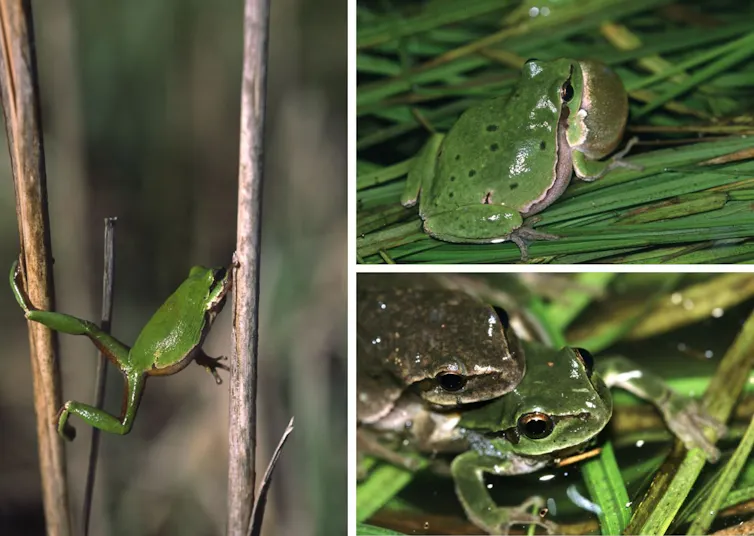
Mais chez la plupart des animaux donc, ce sont aux mâles de s’annoncer. Par la couleur, par le chant, par l’odeur, ils s’affichent. Par la vue, l’ouïe, l’odorat, et parfois même le toucher, les femelles trient et choisissent. Chez la rainette verte par exemple, les femelles écoutent les chants et observent les couleurs pour faire leur choix au printemps. Les attributs les plus attractifs permettent à certains mâles de se reproduire avec plusieurs femelles, quand leurs compétiteurs moins heureux verront eux leur patrimoine génétique transmis moins efficacement, voire pas transmis du tout.
Des rainettes vertes. Emmanuelle Pouivé & Glenn Yannic, Fourni par l’auteur
D’une génération à l’autre
À la génération suivante, on recommence. Si les caractères mâles ont une base génétique héritable au moins partielle, alors les fils des chanteurs attractifs chanteront également un peu mieux que la moyenne. Ce chant peut être un peu plus grave, ou plus aigu, ou plus complexe, ou précéder celui des autres de quelques millisecondes, peu importe tant qu’il est plus désirable.
Pour peu que les filles de ces chanteurs expriment des exigences également héritables qui ciblent ce type de chant, alors la boucle est bouclée : caractères sexuels mâles et préférences femelles peuvent évoluer de concert, et même aller à l’encontre de la sélection naturelle. C’est par exemple le cas quand l’avantage sexuel du mâle tonitruant et contrasté est tel qu’il surclasse le désavantage d’attirer du même coup le prédateur en maraude.
Cette coévolution entraine parfois l’apparition d’exubérances qui semblent défier l’entendement, comme la roue du paon, l’encombrant bois de l’élan qui tombe et repousse chaque année un peu plus lourd, les offrandes nuptiales de certains insectes, ou bien les arches décorées des oiseaux jardiniers australiens qui servent d’écrin à leur parade.
Pour attirer les femelles, les oiseaux jardiniers construisent les nids les plus complexes au monde.
Les modèles théoriques suggèrent cependant que ce signal ne doit pas nécessairement être indicatif de « bons gènes » (ou de « gènes compatibles » entre partenaires). Bien que cela n’ait jamais été complètement démontré dans la nature, il est fort possible que le bénéfice du choix des femelles réside parfois uniquement dans l’avantage qu’auront leurs descendants mâles quand ils devront à leur tour se montrer les plus attirants.
Des préférences qui diffèrent d’une population à l’autre
La sélection sexuelle oriente ainsi les attributs des mâles et la préférence des femelles vers le rouge, le jaune, le contraste marqué, le son plus grave, la parade élaborée, l’odeur intense ou composite. Tout ceci se passe au sein d’une population.
Mais ces critères de choix peuvent simultanément être entraînés dans une direction différente dans une autre population, peut-être un peu plus loin, peut-être isolée dans une zone restée habitable pendant une période glaciaire. Lorsque des individus de ces deux populations entreront en contact, ils ne se reproduiront pas. Mais est-ce seulement car leurs critères de séduction auront divergé ? Autrement dit est-ce que goûts et couleurs peuvent à eux seuls aboutir à la création de deux espèces différentes ?
Ou bien est-ce que ces deux populations ont déjà, avant de se retrouver, accumulé des mutations qui se révèlent incompatibles ? Dans ce cas de figure-là, le choix de partenaire se développerait alors secondairement, favorisé par l’évitement des congénères trop divergents, avec lesquels l’hybridation produit peu de descendants viables ou fertiles. On parle alors de « renforcement » du choix de partenaire.
Tester ces hypothèses avec des crustacés
Pour tester ces hypothèses génériques il nous faut des espèces observables, manipulables si possible. À la station biologique de Roscoff, nous avons opté pour de petits crustacés marins du groupe des Jaera albifrons, des espèces de cloportes minuscules qui vivent le long de nos côtes.
Des crustacés du groupe Jaera albifrons Wil Thomas – Station Biologique de Roscoff, et Guillaume Evanno, Fourni par l’auteur
Chez ces espèces, les mâles brossent le dos des femelles à l’aide de petites structures filamenteuses qui ressemblent à s’y méprendre à des poils. Il s’agit de soies sexuelles, portées par certaines des sept paires de pattes de ces petits crustacés, uniquement chez les mâles, et qui n’ont d’autre rôle que la parade sexuelle.
Chez une espèce par exemple, les mâles utilisent des soies courtes et denses regroupées en brosses sur leurs deux paires de pattes les plus postérieures. Chez une autre espèce, ce sont de longues soies courbes et plus souples, portées par les quatre paires de pattes les plus antérieures. Les mâles brossent. Les femelles choisissent. Sur nos côtes européennes il y a quatre espèces de cloportes dans le groupe Jaera albifrons, souvent présentes dans le même habitat, sous les mêmes cailloux découverts à marée basse. Seules la disposition de ces soies et la technique de brossage, chez les mâles, diffèrent. Comment en est-on arrivé là ?
Une expérience inédite
Pour répondre à cette question, nous avons créé de toutes pièces des populations expérimentales. Quelques dizaines de mâles et de femelles de deux espèces, en nombres égaux, dont nous analysons maintenant la descendance. Est-ce que le succès reproducteur d’un mâle avec les femelles de sa propre espèce dépend de la qualité de ses soies ? La réponse à cette question nous renseignera sur la sélection sexuelle en cours au sein de chaque espèce. Est-ce qu’ensuite ces mêmes attributs mâles déterminent leur succès auprès des femelles de l’espèce opposée ? Cette réponse nous aidera elle à déterminer si les processus de choix se déroulant au sein de chaque espèce sont à l’origine de l’isolement sexuel actuel entre espèces.
Photos des soies sexuelles mâles (entourées en bleu). A gauche, Jaera albifrons, à droite, Jaera praehirsuta Sébastien Colin, Fourni par l’auteur
Au-delà de l’isolement sexuel, il est également important de noter que sur nos côtes, les petits crustacés que nous utilisons pour nos travaux sont souvent mélangés, mais pas toujours. Une espèce peut, au moins dans une région donnée, préférer les galets soumis à un écoulement d’eau douce qui ruisselle de la terre ferme à marée basse, quand d’autres seront trouvées en dehors de ces zones dessalées. Une autre espèce encore peut vivre préférentiellement sur certaines algues brunes plutôt que sous les galets. Ces différences de niches écologiques peuvent également participer à l’isolement reproducteur entre individus.
En vérité pour former deux espèces bien distinctes l’isolement sexuel seul ne suffit sans doute pas. Plusieurs barrières se combinent, il en existe toute une gamme. Une spécialisation dans des habitats un peu différents, des saisons de reproduction un peu décalées dans le temps, des incompatibilités génétiques… autant de frontières semi-perméables qui, ajoutées les unes aux autres, peuvent finalement empêcher tout échange entre deux populations. Ces populations peu à peu deviennent deux espèces filles issues d’une espèce ancestrale unique.
Mais se pose alors encore et toujours la question de l’origine des espèces : quelle barrière a lancé le processus ? Si ce mystère reste difficile à élucider, une chose est certaine : l’évolution liée à cette compétition acharnée pour la reproduction a contribué fortement à la fabuleuse diversification des animaux et des plantes à fleurs.
Thomas Broquet a reçu des financements de l’Agence nationale de la recherche (ANR).
Basile Pajot a reçu des financements de l’Agence nationale de la recherche (ANR).
La théorie stratégique du commerce international montre pourquoi des politiques contraires au libre-échange peuvent être rationnelles dans des marchés oligopolistiques.
Après la vague de mondialisation des trente dernières années, le changement de contexte géopolitique donne une nouvelle actualité à cette théorie.
Pourtant, loin de justifier les droits de douane et autres entraves, cette théorie rappelle plutôt les impasses des guerres commerciales.
Élaborée dans les années 1980 par Barbara Spencer, James Brander et Paul Krugman, elle vient contredire l’argument classique de David Ricardo en faveur du libre-échange, en montrant que lorsque les entreprises détiennent un pouvoir de marché, il existe des situations où le libre-échange n’est pas la solution optimale. Un État peut alors, en calibrant soigneusement ses droits de douane ou ses subventions, améliorer le bien-être de son propre pays.
Quand le libre-échange est-il optimal ?
Ces travaux n’ont pourtant eu qu’un impact très limité sur les politiques commerciales réelles. On les a longtemps relégués au rang de curiosités théoriques, valables seulement dans des cas très particuliers. Or, des recherches récentes, menées avec mes coauteurs, montrent que ces situations sont loin d’être des exceptions.
Nous montrons que, au contraire, dans un marché oligopolistique, il est toujours possible d’introduire un droit de douane ou une subvention qui améliore le bien-être national – et parfois même le bien-être mondial. La portée de la théorie stratégique du commerce international est donc bien plus large qu’on ne l’a longtemps cru.
Les ripostes des pays affectés
Un second argument a longtemps poussé les économistes à écarter ces conclusions. La plupart des modèles supposaient qu’un pays agissait seul, sans que ses partenaires ne ripostent. Si ceux-ci répliquent à leur tour par des droits de douane ou des subventions, les bénéfices de l’intervention stratégique s’évaporent en général, et tous les pays finissent perdants. Dans le climat optimiste de la fin du XXᵉ siècle – marqué par le remplacement du GATT (General Agreement on Tariffs and Trade, ou Accord général sur les tarifs douaniers et le commerce) par l’Organisation mondiale du commerce (OMC) et le renforcement du règlement multilatéral des différends – cet argument semblait suffire à disqualifier toute tentation interventionniste.
Mais le paysage a changé depuis les années 1980. Loin de devenir plus concurrentiels, de nombreux marchés mondiaux se sont, au contraire, fortement concentrés. Parallèlement, les droits de douane et les subventions déclenchent moins systématiquement les représailles qu’on redoutait autrefois. Les grandes puissances disposent aujourd’hui d’autres leviers de pression, notamment géopolitiques, pour dissuader les pays plus faibles de réagir.
Le monde actuel ressemble ainsi, à bien des égards, aux configurations qu’étudiait la théorie stratégique du commerce international. Elle est donc essentielle pour comprendre les dynamiques commerciales à l’œuvre de nos jours.
Capter des rentes à l’aide de subventions à l’exportation
Prenons l’exemple des subventions à l’exportation. À première vue, elles paraissent absurdes : pourquoi les contribuables financeraient-ils des produits consommés à l’étranger ? On suppose souvent qu’il s’agit d’évincer les concurrents étrangers pour permettre ensuite aux entreprises nationales, devenues monopolistiques, de récupérer le coût des subventions via des prix plus élevés.
Mais Brander et Spencer ont montré qu’il n’est pas nécessaire d’aboutir à un futur monopole. Dans un secteur oligopolistique, une subvention peut produire des gains immédiats en poussant les concurrents étrangers à réduire leur capacité de production. Les parts de marché se redistribuent, les profits se déplacent, et le pays qui subventionne capte une part plus large des rentes de l’oligopole mondial.
La stratégie chinoise illustre remarquablement ce mécanisme. Des subventions massives ont permis aux entreprises chinoises de s’imposer agressivement dans des secteurs allant des véhicules électriques aux panneaux solaires, poussant déjà leurs concurrents étrangers à réduire investissements et capacités. En temps normal, les pays concernés pourraient répliquer par des droits compensateurs. Mais la Chine dispose d’un autre levier ; elle peut restreindre l’accès à des ressources stratégiques comme les terres rares, ce qui renchérit considérablement le coût d’une riposte et empêche ce mécanisme de se retourner contre elle.
S’approprier des bénéfices étrangers avec des droits de douane
De la même façon, la théorie stratégique du commerce international permet de mieux comprendre le retour en force des droits de douane. La théorie classique du tarif optimal, héritée des travaux de Robert Torrens au XIXᵉ siècle, montre qu’avec des droits de douane un pays suffisamment grand peut améliorer ses termes de l’échange, les exportateurs étrangers absorbant alors une partie du droit de douane en baissant leurs prix. Brander et Spencer ont étendu ce raisonnement aux marchés oligopolistiques, montrant que les droits de douane permettent aussi de transférer une partie des profits oligopolistiques des producteurs étrangers vers le pays importateur.
Néanmoins, à l’échelle mondiale, même s’il existe des exceptions, ces droits de douane restent typiquement destructeurs de richesse. Ce que gagne le pays importateur en introduisant des droits de douane est généralement inférieur à ce que perdent les producteurs et les consommateurs des autres pays. C’est précisément pour cette raison que les accords internationaux limitant les droits de douane tendent à accroître la richesse globale.
Mais ces accords ne fonctionnent que si les pays lésés peuvent riposter en cas de non-respect des règles. Dès lors que les représailles deviennent improbables, l’intérêt d’agir unilatéralement grandit fortement. Or, les rapports de force ne se jouent plus uniquement sur le terrain commercial. Une grande puissance peut aujourd’hui mobiliser son poids géopolitique, voire militaire, pour décourager ses partenaires de répliquer.
Ripostes et parapluie de défense
Dans une tribune d’une franchise remarquable publiée dans le Wall Street Journal, Stephen Miran – l’un des principaux artisans de la stratégie douanière de l’administration Trump – expliquait ainsi que les alliés des États-Unis avaient été prévenus : riposter aux droits de douane imposés par Trump rendrait plus difficile « le maintien du parapluie de défense américain ». La stratégie semble avoir porté ses fruits. L’Europe, le Japon et la Corée du Sud n’ont réagi qu’avec prudence, tandis que la Chine, elle, a répliqué vigoureusement – illustrant à merveille les asymétries géopolitiques sur lesquelles repose cette stratégie.
Cela ne signifie évidemment pas que les subventions chinoises soient souhaitables ni que la stratégie douanière de Donald Trump soit justifiée – bien au contraire. La théorie stratégique du commerce international permet précisément de comprendre pourquoi des règles internationales sont indispensables : si chaque gouvernement cherche à améliorer sa situation par des interventions stratégiques, ces interventions risquent, au final, de détériorer la situation de tous.
France 24 – 2026.
Un changement de paradigme ?
Les économistes ont longtemps hésité à admettre que certains droits de douane ou certaines subventions pouvaient profiter aux pays qui les mettent en œuvre, de peur qu’une telle reconnaissance n’ouvre la voie au protectionnisme. En 1923 déjà, John Maynard Keynes estimait ainsi qu’en tant qu’économiste :
Cette prudence avait sans doute sa raison d’être. Mais l’existence d’oligopoles est désormais une caractéristique structurelle de l’économie mondiale. Les conflits commerciaux portent de plus en plus sur le partage des rentes d’oligopole, et de moins en moins sur l’allocation efficace des ressources.
Dans ce nouveau paysage, la théorie stratégique du commerce international est un outil indispensable pour comprendre les conflits commerciaux contemporains et concevoir des réponses efficaces.
Michael Troege ne travaille pas, ne conseille pas, ne possède pas de parts, ne reçoit pas de fonds d’une organisation qui pourrait tirer profit de cet article, et n’a déclaré aucune autre affiliation que son organisme de recherche.
Les archives permettent de documenter la fabrication et les usages de la place du marché de Lille à la fin du Moyen Âge, malgré la disparition de presque tous ses vestiges matériels.
Le projet INSULA propose une restitution visuelle et sonore du marché lillois du 12 juin 1448, à partir des sources historiques, en tenant compte des incertitudes documentaires.
La modélisation numérique permet de tester des hypothèses historiques et de partager les connaissances avec le public, en faisant de la restitution un outil de recherche et de médiation.
Le 12 janvier 2026, la Grand’Place de Lille connaît un changement majeur. Après plusieurs années de réflexion politique, ponctuées par trois mois de consultation citoyenne entre juin et septembre 2025, la place du Général-de-Gaulle devient piétonne.
Le maire, Arnaud Deslandes, a résumé ce changement en trois mots : un espace plus agréable, plus sûr, mieux partagé. Pour accompagner cette transformation, l’histoire a été largement convoquée : le passé de la place a été rappelé, son avenir présenté comme inscrit dans le « sens de l’histoire ».
Mais que sait-on réellement de cet espace au fil des siècles ? Et comment retrouver ce qui a disparu, lorsque les traces matérielles se sont presque effacées ? À Lille, le projet de recherche INSULA explore ces questions en proposant une restitution visuelle et sonore de la place du marché à la fin du Moyen Âge.
Une place entre pavés et pixels
La première mention conservée de la place du marché, correspondant aux actuelles Grand’Place et Place du théâtre de Lille, date de 1127. Cette même place du marché « disparaît » en 1651 lorsque s’élève la bourse de commerce ; elle est alors séparée en deux par ce nouvel édifice.
À l’échelle de la ville, la place du marché concentre l’essentiel des fonctions. Elle est un lieu de pouvoir et de circulation de l’information. Elle est un lieu de commerce et d’échanges divers autour des échoppes et des étals des marchés et foires. Elle est un lieu de divertissement, entre tournois, fêtes et processions religieuses.
De cet espace médiéval, il ne reste presque plus rien. Le visiteur attentif peut remarquer quelques centaines de pavés de grès installés discrètement sur le sol de la Grand’Place. Retrouvé lors d’une opération archéologique en 1989, ce fragment du pavage est le seul vestige du Moyen Âge qu’il est encore possible de voir sur les places d’aujourd’hui.
Initié en 2023, le projet de recherche INSULA propose la restitution numérique multisensorielle de cette place le mercredi 12 juin 1448. L’objectif est de proposer une imagerie et une bande sonore de ce qu’aurait pu être cette journée ordinaire dans l’histoire de la ville, mais qui a laissé de nombreuses traces dans les archives.
De l’archive à la 5D
Pour comprendre la fabrication de l’espace, l’historien dispose d’un matériau privilégié : l’archive. Pour Lille, si le résultat de ces processus, de ces discussions, de ces chantiers n’est plus visible aujourd’hui, il est conservé dans les archives de la ville. L’exceptionnelle conservation des archives urbaines lilloises permet de comprendre, au moins en partie, en trois temps cette fabrique :
Les registres de délibérations : ce que la ville a voulu mettre en œuvre
Les devis et les accords passés avec les artisans : ce que la ville a construit
Les comptabilités : ce que la ville a payé, semaine après semaine
Restituer reste une démarche scientifique. Le résultat proposé est une hypothèse. Il ne s’agit pas de montrer ce qu’était un espace disparu mais plutôt de ce qu’aurait pu être cet espace. L’ensemble des choix ayant permis de concevoir cette image reste alors consignés. La totalité de la démarche de restitution doit être justifiée par les sources ou par des comparaisons pertinentes, et ses choix doivent pouvoir être explicités.
Et quand on ne sait pas ? En dépit de la grande richesse des sources conservées, il n’est pas possible de connaître l’espace dans sa totalité et des zones d’ombre subsistent.
Ces inconnues ne sont d’ailleurs pas toujours simples à appréhender : recenser ce que l’on ne sait pas n’est pas aussi aisé que de décrire ce que l’on sait. La collaboration avec les infographistes est alors extrêmement précieuse pour questionner l’incertain.
La modélisation vient pointer des interrogations qui n’étaient pas forcément identifiés préalablement. Dans une même image, différents niveaux de certitude coexistent sans pour autant être clairement identifiables. Cette question de la lisibilité de l’hypothèse scientifique dans l’image est un enjeu de recherche actuel alors que les restitutions numériques sont de plus en plus présentes sous nos yeux.
Entendre le Moyen Âge
La restitution ne permet pas uniquement de (faire) visualiser des bâtiments qui n’existent plus. Rendre à la place du marché sa vie sonore est tout aussi essentiel car elle permet de redonner l’impression d’un environnement habité, vécu et d’où émanent des sons et des voix.
Restituer un paysage sonore disparu pose pourtant un problème documentaire particulier. Contrairement à un mur ou à un pavage, un son ne laisse que peu de traces. Il faut aller le chercher en creux, dans des sources qui n’ont jamais été pensées pour le conserver.
Les registres de délibérations, les comptes de la ville ou les règlements de police mentionnent, en passant, une cloche que l’on sonne, un crieur que l’on rémunère, un atelier que l’on autorise ou que l’on repousse hors les murs pour le bruit qu’il dégage.
Mis bout à bout, ces indices dessinent malgré tout une cartographie sonore de la place : le beffroi et les cloches des édifices religieux rythmant la journée, les crieurs publics annonçant bans et proclamations, le bétail des jours de marché, les artisans dont les ateliers bordent l’espace, les changeurs et les étals, jusqu’aux échos de la circulation sur le pavage de grès.
Ce travail relève de ce que l’on peut appeler une archéologie du sonore : elle s’appuie sur une forme d’hétérographie, qui consiste à faire parler des sources écrites sur un objet qu’elles ne décrivent presque jamais directement. Comme pour l’image, chaque son intégré à la restitution doit pouvoir être justifié : comparaison avec des villes marchandes proches, avec des sons de métiers restitués par l’archéologie expérimentale, ou avec des témoignages plus tardifs ; puis mise en œuvre avec des professionnels du son pour la spatialisation et le mixage de cette bande sonore.
Partager un même imaginaire
Ce petit voyage mental dans le Lille du 12 juin 1448, chacun et chacune l’aura pourtant imaginé un peu différemment. Rien d’étonnant à cela : le Moyen Âge de chacun n’est jamais tout à fait le même. Le passé est un matériau culturel, malléable et polymorphe ; celui des historiens n’est ni celui du cinéma, ni celui des jeux vidéo, ni même tout à fait celui des musées et de leurs visiteurs.
C’est là que se loge l’un des enjeux majeurs d’INSULA : comment transmettre une histoire que la recherche s’attache à restituer avec la plus grande rigueur, sans en perdre la profondeur scientifique, mais sans non plus la réserver aux seuls spécialistes ? Il fallait imaginer un objet à la fois issu de la recherche et accessible par le plus grand nombre.
Depuis une vingtaine d’années, les dispositifs numériques se multiplient ; plus récemment, les expériences immersives se sont également développées. Cette évolution invite à penser différemment la transmission du passé. Dans cette nouvelle équation, la place de la recherche et de l’historien n’est pas une évidence systématique.
Ici, au-delà de l’objet scientifique, la restitution numérique a été pensée comme cette passerelle. Loin d’être une simple image d’illustration, elle fonctionne comme un modèle de connaissances : elle rassemble, dans une représentation unique, des données éparses et hétérogènes tirées des archives, et permet aux chercheurs de tester différentes hypothèses de restitution. Ce même objet, une fois accompagné d’un appareil critique adapté, peut ensuite être transformé en outil de médiation.
Restituer le passé ne consiste donc pas à combler les silences des archives par l’imagination, mais à construire des hypothèses, à les confronter aux sources et à rendre explicites les choix qu’elles impliquent. Avec INSULA, le numérique devient à la fois un outil d’investigation historique et un moyen de partager cette démarche. Reconnecter la trace de ce qui a été à ce qui est, pour que chercheurs et publics puissent, un instant, observer et partager une même d’une place du Moyen Âge.
Pauline Triplet a reçu des financements de la Ville de Lille, du CPER ENHANCE et du PEPR ICCARE.