The car finance scandal proves that the financial sector still has trust issues that need to be sorted

Source: The Conversation – UK – By Alper Kara, Head of Department of Economics, Finance & Accounting, Brunel University of London

The car finance scandal could have ended up costing UK banks and lenders up to £44 billion in compensation payments. But after the latest court ruling, the expected bill has been reduced to less than £18 billion.

That still counts as an expensive loss of course. And it may or may not be enough to compensate the millions of motorists thought to have paid more than they needed to for car loans.

But as well as the financial hit taken by both sides, the whole affair has come at a great cost to the relationship between the public and the financial sector. An industry still grappling with trust issues has once again been accused of long-standing practices that cost consumers dear.

Under the now-banned “discretionary commission arrangements”, car brokers were allowed to increase the interest rate on car finance agreements and receive higher commissions as a result. But customers weren’t necessarily told this at the time, and the deal may have seemed like a standard finance agreement.

The practice was widespread until 2021, when it was banned by the UK’s financial services regulator. Before that, consumers were often unaware that brokers had both the power – and incentive – to manipulate the cost of their borrowing.

The result is that millions may have overpaid for car loans, sometimes by thousands of pounds, without ever knowing. While the Supreme Court has now clarified the legal boundaries of the case, the fact that such practices were widespread for years raises serious ethical concerns.

For the scandal is yet another reminder of the fragile relationship between financial institutions and their customers. Most people might expect that loan agreements will reflect market conditions – rather than be at the discretion of a salesperson keen to maximise their own commission.

Research shows that trust is fundamental to the proper functioning of financial markets. In financial services, it depends on transparency, fairness and clear communication.

Discretionary commission arrangements violated all three of these concepts.

In some ways, the case bears similarities to the payment protection insurance (PPI) scandal, where customers were sold policies designed to step in if they were unable to repay loans because of unemployment or illness for example.

Both PPI and the car loans involved financial products being sold under conditions that consumers might not have fully understood, and both relied on misaligned incentives between lenders and borrowers. They also both exposed how a lack of transparency can lead to large-scale consumer harm.

Yet in the case of car finance, the court did not order compensation for the majority of affected borrowers. One claimant won his case, but the court stopped short of declaring all such commission arrangements unlawful by default.

Nonetheless, the Financial Conduct Authority (FCA), the financial regulator, has launched a review into historical car finance commission practices. Estimates suggest lenders could still face a bill of as much as £18 billion in redress.

This wouldn’t match the £38 billion paid out over PPI, but it’s still substantial. The industry is also likely to face class action lawsuits and broader scrutiny.

Accounts and accountability

The scandals over car finance scandal and PPI both point to a fundamental issue within the UK financial retail sector – that when the goals of finance companies are not aligned with the best interests of customers, mis-selling becomes the norm rather than the exception.

Research on the PPI scandal for example, reveals fundamental flaws in how products were sold and regulated. And one of the most troubling aspects of car finance is that discretionary commission arrangement models were in use for years. Yet despite the clear potential for consumer harm, the FCA stepped in only in 2021.

Car salesman holding tablet smiles at couple.
‘And this is what the sale means for my bonus.’
Prostock-studio/Shutterstock

This delay in turn reflects a broader problem with how financial regulation operates in the UK. Much of the enforcement seems to be reactive.

Intervention typically follows consumer complaints, investigative journalism, or court rulings, rather than being driven by proactive oversight.

The FCA has acknowledged this delay and plans to consult on a redress scheme by October 2025, with compensation payments potentially starting in 2026.

While this may not lead to immediate compensation for everyone affected, but it exposes yet another chapter in the UK’s long history of financial mis-selling and weak consumer protection.

The case also exposes the limitations of “principles-based regulation”, a system where regulators set broad rules (or “principles”) for firms to follow, rather than detailed requirements. Research shows that such regulatory models may appear flexible but can also result in inconsistent enforcement and a failure to address harmful practices swiftly enough.

An alternative is a more rules-based system, where detailed requirements clearly set out what firms can and cannot do. But while this model can reduce ambiguity, it may also limit flexibility and innovation. The challenge for regulators is finding the right balance.

The priority now must be clear action. The car finance industry – and indeed the wider financial services sector – must recognise that trust cannot be rebuilt with compliance alone.

Transparency, fairness and ethical conduct must become the norm, not the exception.

For regulators, this is a chance to move toward a stronger form of supervision – especially in markets where intricate financial products and conflicts over incentives are commonplace. For the public, the scandal is a reminder to remain vigilant, because when finance becomes too complex, it often becomes unfair.

The Conversation

Alper Kara does not work for, consult, own shares in or receive funding from any company or organisation that would benefit from this article, and has disclosed no relevant affiliations beyond their academic appointment.

– ref. The car finance scandal proves that the financial sector still has trust issues that need to be sorted – https://theconversation.com/the-car-finance-scandal-proves-that-the-financial-sector-still-has-trust-issues-that-need-to-be-sorted-262750

Animal Farm at 80: why the animals really matter in Orwell’s parable about communism

Source: The Conversation – UK – By Charlotte Sleigh, Associate Professor, Dept of Science & Technology Studies, UCL

George Orwell’s Animal Farm (1945) turns 80 on August 17 2025. If there’s one thing every student of history or politics knows, it’s that the novella is not really about animals. Sure, the principal characters are pigs and horses. But really, so we are told, it is about the Soviet Union and what happened to the ideals of communism under the corrupt leadership of Joseph Stalin.

Orwell himself – part of a generation of plain-speaking British authors who had not yet heard Roland Barthes’s theory of the death of the author (the idea that words speak for themselves and the author’s intentions are irrelevant) – proclaimed that this was how the story should be read.

But what if we were to take the animals in this famous tale more seriously?

Orwell wrote this short, shocking novel at a time when it was considered scientifically inadmissible for animals to be granted thoughts or even feelings. Charles Darwin’s insight in 1859, that humans are related to all other animal species, was a lost opportunity to think about how qualities of the former might be present in the latter. Instead, animal psychologists in Orwell’s time insisted more strongly than ever on the existence of a cognitive hiatus between the human “us” and the beastly “them”.


This article is part of Rethinking the Classics. The stories in this series offer insightful new ways to think about and interpret classic books, films and artworks. This is the canon – with a twist.


His contemporary experts in the social sciences and humanities played along with this distinction. The French anthropologist Claude Lévi-Strauss wrote in 1962 that animals “are good to think with” – in other words, if we interrogate human beliefs about animals, we can reveal our own deep-seated values and social patterns.

By today’s standards, and in the context of the sixth mass extinction, this seems like a regrettable statement. Contemporary multispecies studies reject the notion that animals are nothing more than a resource for humans, even a philosophical one.

Black and white photo of George Orwell
George Orwell wrote Animal Farm between 1943 and 1944.
National Union of Journalists

By contrast, many cultures and societies around the world have traditions of interacting with animals in a manner that recognises their personhood. People who live alongside and even hunt other species very often come to closely understand their behaviour and agency.

A major UK academic project is investigating how these relationships are reflected in animal fables. Titled Rethinking Fables in the Age of Environmental Crisis, it fosters collaboration between scholars, artists and writers in imagining the unique worlds of different species including horses, rats, crows and spiders, in their fast-changing and precarious environments.

Living in an era before the comprehensive introduction of massive-scale, chemically assisted agriculture, Orwell was not so far removed from pre-industrial farming and its intimate knowledge of animals. His 1936 essay about the shooting of an elephant in Burma is filled with anguish at the suffering of a real animal.

In Animal Farm too, the starting point is animal suffering – the cruelties of the human farmer are indisputable. As Old Major, a wise and elderly boar, warns the other animals: “You young porkers … every one of you will scream out your lives at the block within a year.”

The fable changes if we hold on to this reality throughout. It is reiterated by Orwell later on in the story, when the cruelties of Pinchfield Farm are reported to the animals. Human tyranny is the enemy of the animals, and despite the betrayal of their hopes under the leadership of the pig Napoleon, the justice of their cause is never undermined.

Animal dreams

Orwell’s animal revolution, the overthrow of the farmer, is inspired by a pig’s dream. Old Major gathers the other farm beasts to tell them of his vision of “the Earth as it will be when Man has vanished”, and human exploitation of animals is no more. It’s the kind of description that would have the 20th-century animal psychologists turning in their graves. Animals with an inner life? Ridiculous!

Any dog owner will tell you that their four-legged friend has dreams – yet for decades, we allowed scientists to tell us they did not. Dog dreams are woven into the description of forest life created by anthropologist Eduardo Kohn. In his book How Forests Think (2013), Kohn argues that all animals think and imagine their future. Their survival – that fundamental driver of the farmyard revolution – is based on the ability to do so.

In one memorable passage, Kohn describes how a monkey must interpret the sounds of the forest and use them to predict possible outcomes (innocent crash or predator?) in order to live. Kohn’s animals live in a world full of meaning. The human power to make meaning through abstract language is just one example of a universal feature of life.

The trailer for the 1954 adaptation of Animal Farm.

Dreams recur throughout Animal Farm, but are eventually driven out by words. The animals’ commandments, written on the barn wall, are deviously amended one by one to vindicate the pigs’ corruption.

Once meaning is externalised and objectified in the written word, it is susceptible to manipulation. Words can be rewritten and with them, the past. The animals become uncertain of their pre-verbal memories. Dreams disappear from the narrative.

Research in science communication has argued that recent trends in popular natural history respond to the desire of readers to be knitted back into the meaning of the more-than-human world that Kohn and others describe. For such a reader, Animal Farm can explore animal agency – and the fallacy of human exceptionalism.

Beyond the canon

As part of the Rethinking the Classics series, we’re asking our experts to recommend a book or artwork that tackles similar themes to the canonical work in question, but isn’t (yet) considered a classic itself. Here is Charlotte Sleigh’s suggestion:

It’s surprisingly hard to find recent western works of animal-voiced fiction for adults – perhaps because of anxiety about sounding childish. By contrast, Indigenous literature around the world is rich in animal tales. Native American Animal Stories by Joseph Bruchac (1992) has a great selection.

Contemporary non-fiction is stronger in exploring animal-centred stories. Helen Macdonald’s memoir H is for Hawk (2014) is a modern classic. Poets have also engaged with animal voices, such as Susan Richardson in Words the Turtle Taught Me (2018). And in visual arts, Fiona MacDonald of the art and research project Feral Practice asks, among other animal-centred questions, what would happen if ants curated a gallery.


This article features references to books that have been included for editorial reasons, and may contain links to bookshop.org. If you click on one of the links and go on to buy something from bookshop.org The Conversation UK may earn a commission.


Looking for something good? Cut through the noise with a carefully curated selection of the latest releases, live events and exhibitions, straight to your inbox every fortnight, on Fridays. Sign up here.


The Conversation

Charlotte Sleigh does not work for, consult, own shares in or receive funding from any company or organisation that would benefit from this article, and has disclosed no relevant affiliations beyond their academic appointment.

– ref. Animal Farm at 80: why the animals really matter in Orwell’s parable about communism – https://theconversation.com/animal-farm-at-80-why-the-animals-really-matter-in-orwells-parable-about-communism-246713

‘I have multiple side-hustles … It’s exhausting’: the challenges facing young freelance creatives

Source: The Conversation – UK – By Heidi Ashton, Associate professor, University of Warwick

KinoMasterskaya/Shutterstock

If you’re a freelancer, you know there are many perks to how you make a living. For some, this includes being free to work when and how you please, setting your own rates, and being your own boss. But you also know there are downsides to this form of working life.

And if you’re plotting your path towards going freelance, you’ll want to consider both the good and the bad aspects.

While some people want to work on a freelance basis, others – by virtue of the industry they are in – have less choice. The cultural and creative industries rely heavily on a flexible, skilled freelance workforce. Many of these freelancers work from project to project with no single workplace, which can lead to challenges.

Over the last decade or so, I have researched freelance work and freelance workers in the cultural and creative industries, examining their experiences and understanding how these are shaped by structural and political forces.

Freelancers often rely on their reputation or word-of-mouth to gain future work. This can be helpful: a good reputation can lead to recommendations and repeat work. Equally, it can mean that freelancers do not always report poor practices and behaviour, especially early in their career. “You don’t want to be seen as a troublemaker,” a freelancer in my ongoing research said in 2023.


No one’s 20s and 30s look the same. You might be saving for a mortgage or just struggling to pay rent. You could be swiping dating apps, or trying to understand childcare. No matter your current challenges, our Quarter Life series has articles to share in the group chat, or just to remind you that you’re not alone.

Read more from Quarter Life:


Reports on creative industry sub-sectors such as in TV, film and theatre show that freelancers are unlikely to speak out when facing or witnessing bullying behaviour.

“People are frightened to reveal themselves, because they think they’ll be blacklisted and won’t get jobs if they report bullies at work,” film director Brian Hill has explained.

What’s more, the labour markets in which freelancers work can include multiple layers of hidden hierarchy. Freelancers and sub-contractors can be employed to hire the freelancers below them.

This may make it extremely difficult to report up to managers who could take appropriate action, even when the problematic behaviour relates to protected characteristics such as race, disability or pregnancy. Fear of causing trouble, coupled with the need to please, can also lead to exploitation.

Facing exploitation

Despite the practice being technically illegal, many freelance workers in the cultural and creative sectors do work for free. This is either to get a foot in the door, or to please those employing them by doing additional work.

Freelancers often also wait long periods for payment – or may end up not being paid for their work at all. “Late, delayed and non-payments mean I am generally out of pocket for the work that I do,” one freelancer told me.

Unions can be very helpful in these cases, but the intensely competitive nature of this kind of work can also mean workers take lower fees initially, hoping they will increase.

Careers and wellbeing

Unlike structured employment, where workers can have access to training and opportunities for promotion either within or between organisations, freelance workers often have less clearcut means for progression.

people setting up camera shoot
Many creative industries rely on freelancers.
gnepphoto/Shutterstock

“You have to take the work that’s there at whatever level it is. You can risk turning something down and waiting for something better but then you could end up with nothing,” a freelancer I spoke to for my PhD research said.

It can be difficult for freelancers to build contacts at higher levels, particularly when the person employing them directly is also a freelancer and therefore may perceive any relationship building above them as a threat to their future employment.

A common area of concern for young freelancers is the precarity and financial insecurity of their work. They may need to juggle multiple jobs and roles.

Freelancers also lack holiday pay or regular working hours, as well as support for periods of under-employment. This can lead to increased stress and burnout for those who do not have other means of financial support.

“I have multiple side-hustles … It’s exhausting,” one freelancer said.

The accumulated impact on mental health can be significant. The Film and TV Charity, an independent charity for those working behind the scenes, found that 64% of workers in the sector were considering leaving due to poor mental health – with freelancers and younger age groups particularly vulnerable.

Having a mentor or someone who genuinely wants to support you and your career can help, as do communities of workers and unions providing support of various kinds. Anonymous reporting can be used to hold people and organisations to account for poor behaviour.

For many of the freelancers I work with, though, it’s worth it. There’s a collective sense that, although it’s tough, they wouldn’t want to do any other job.

The Conversation

Heidi Ashton does not work for, consult, own shares in or receive funding from any company or organisation that would benefit from this article, and has disclosed no relevant affiliations beyond their academic appointment.

– ref. ‘I have multiple side-hustles … It’s exhausting’: the challenges facing young freelance creatives – https://theconversation.com/i-have-multiple-side-hustles-its-exhausting-the-challenges-facing-young-freelance-creatives-261705

Why some climate policies are more popular than others – a psychologist explains

Source: The Conversation – UK – By Wouter Poortinga, Professor of Environmental Psychology, Cardiff University

Low-traffic neighbourhoods can be considered controversial by some people. Hazel Plater/Shutterstock

Despite growing concern about climate change, many countries have seen backlashes against certain environmental policies, often because they are seen as costly, restrictive or unfair.

In France, an attempt to introduce a fuel tax was shelved after the yellow vests protests. In Germany, a proposed gas boiler ban was watered down after fierce resistance.

And in the UK, low-traffic neighbourhoods have sparked strong
opposition in some areas. Even non-existent measures, such as a proposed meat tax, triggered online outrage.

These reactions may give the impression people do not really want bold action on climate change. But that is not quite true. Research by the Centre for Climate Change and Social Transformation and marketing research company Ipsos has found widespread support for many climate policies, including ambitious measures such as a frequent flyer levy.

Vocal opposition can distort perceptions: it gives the impression that they some policies are less popular than they actually are. This, in turn, can make politicians reluctant to act.

Recent polling by the insights platform Climate Barometer highlights that, while a great majority (73%) of people support local renewable energy projects, MPs think only 16% of their constituents do.

However, not all climate policies are popular with the general public and how measures are designed really matters.

In a UK-wide study, my team and I asked more than 2,000 people what they thought about 12 different climate policies that focused on diet, home energy and transport. These included “push” measures such as taxes and bans that aim to discourage carbon-intensive behaviour, and “pull” measures such as subsidies and support that encourage lower-carbon alternatives.

We found that most people strongly favour pull measures, such as subsidies for low-carbon heating or building EV charging infrastructure. Push measures, particularly those affecting diet, were far less popular.

For example, while nearly 80% supported low-carbon heating in new builds, only 21%
backed restrictions on meat and dairy in catering facilities. But support is not just about the topic or the tool, but also about how policies are perceived.

Our research found a clear pattern: policies that are seen as fair and effective get more support. People want to know that a policy will actually reduce emissions. They also care deeply about how its benefits and costs are shared. Taxes and restrictions often fail both these tests: they are seen as neither effective nor as fair.

We also investigated how much people think others support or oppose a policy.
We found that people consistently underestimate how much others support climate
action. This phenomenon is known as “pluralistic ignorance”. On average, respondents underestimated support by 18%, and overestimated opposition by 16%. This creates a kind of shared illusion that climate policies are less popular than they actually are.

flat lay shot of lentil lasagne, portion on plate, yellow cloth on table
While a proposed meat tax provoked protests, framing dietary changes (such as cooking lasagne with lentils not minced beef) as a positive step can be more welcomed.
OlgaBombologna/Shutterstock

Perception is pivotal

That matters. When people think they are in the minority, they are less likely to speak up or challenge misinformation. Policymakers then may pick up on this silence and think that the public does not care.

But here is the twist: the perception gap was smaller for the less liked push policies, meaning that people are more accurate about minority support for less popular options such as taxes than about majority support for more popular measures such as subsidies.

So climate policy success depends not just on what the policy does, but also on how it is perceived. If a measure is seen as unfair or ineffective, support collapses. And if people think others don’t like a policy, they may stop speaking up.

To create successful climate policies, policymakers need to communicate clearly and credibly about public support for climate measures. People who support these measures need to know they are not alone. However, this may only work for more popular policies and is unlikely to be enough for tougher, less liked measures. Yet such measures are likely to be needed to have a realistic chance of reaching ambitious climate targets.

Simply hoping they will be accepted by the public probably won’t do the trick. These policies need to be designed with fairness in mind: people back policies they see as just, especially if they account for different abilities to pay or access alternatives.

Climate action does not just need good policy, it also needs good
psychology. Understanding and addressing how people perceive climate measures is
essential to avoid backlash and build lasting public consent.


Don’t have time to read about climate change as much as you’d like?

Get a weekly roundup in your inbox instead. Every Wednesday, The Conversation’s environment editor writes Imagine, a short email that goes a little deeper into just one climate issue. Join the 45,000+ readers who’ve subscribed so far.


The Conversation

Wouter Poortinga receives funding from ESRC, NERC, EPSRC, Welsh Government, and European Commission.

– ref. Why some climate policies are more popular than others – a psychologist explains – https://theconversation.com/why-some-climate-policies-are-more-popular-than-others-a-psychologist-explains-262556

Grok 4’s new AI companions offer ‘pornographic productivity’ for a price

Source: The Conversation – Canada – By Jul Parke, PhD Candidate in Media, Technology & Culture, University of Toronto

The most controversial AI platform is arguably the one founded by Elon Musk. The chatbot Grok has spewed racist and antisemitic comments and called itself “MechaHitler,” referring to a character from a video game.

“Mecha” is generally a term for giant robots, usually inhabited for warfare, and is prominent in Japanese science-fiction comics.

Grok originally referred to Musk when asked for its opinions, and burst into unprompted racist historical revisionism, like the false concept of “white genocide” in South Africa. Its confounding and contradictory politicism continues to develop.

These are all alarming aspects of Grok. Another concerning element to Grok 4 is a new feature of social interactions with “virtual friends” on its premium version.

The realm of human loneliness, with its increasing reliance on large language models (LLMs) to replace social interaction, has made room for Grok 4 with AI companions, an upgrade available to paid subscribers.

Specifically, Grok subscribers can now access the functionality of generative AI intertwined with patriarchal notions of pleasure — what I call “pornographic productivity.”

Grok and Japanese anime

an animated character with big eyes looks surprised
Misa Amane from one of Musk’s favourite Japanese animes, ‘Death Note.’
(Wikimedia/Deathnote)

Ani, Grok 4’s most-discussed AI companion, represents a convergence of Japanese anime and internet culture. Ani bears a striking resemblance to Misa Amane from the iconic Japanese anime Death Note.

Misa Amane is a pop star who consistently demonstrates self-harming and illogical behaviour in pursuit of the male protagonist, a brilliant young man engaged in a battle of wits with his rival. Musk referenced the anime as a favourite in a tweet in 2021.

While anime is a vast art form with numerous tropes, genres and fandoms, research has shown that online anime fandoms are rife with misogyny and women-exclusionary discourse. Even the most mainstream shows have been criticized for sexualizing prepubescent characters and offering unnecessary “fan service” in hypersexualized character design and nonconsensual plot points.

Death Note‘s creator, Tsugumi Ohba, has consistently been critiqued by fans for anti-feminist character design.


Source: @0xsachi/X

Journalists have pointed out Ani’s swift eagerness to engage in romantic and sexually charged conversations. Ani is depicted with a voluptuous figure, blonde pigtails and a lacy black dress, which she frequently describes in user interactions.

The problem with pornographic productivity

I use the term “pornographic productivity,” inspired by critiques of Grok as “pornified,” to describe a troubling trend where tools initially designed for work evolve into parasocial relationships catering to emotional and psychological needs, including gendered interactions.

Grok’s AI companions feature exemplifies this phenomenon, blurring critical boundaries.

The appeal is clear. Users can theoretically exist in “double time,” relaxing while their AI avatars manage tasks, and this is already a reality within AI models. But this seductive promise masks serious risks: dependency, invasive data extraction and the deterioration of real human relational skills.


Read more:
From chatbot to sexbot: What lawmakers can learn from South Korea’s AI hate-speech disaster


When such companions, already created for minimizing caution and building trust, come with sexual objectification and embedded cultural references to docile femininity, the risks enter another realm of concern.

Grok 4 users have remarked that the addition of sexualized characters with emotionally validating language is quite unusual for mainstream large language models. This is because these tools, like ChatGPT and Claude, are often used by all ages.

While we are in the early stages of seeing the true impact of advanced chatbots on minors, particularly teenagers with mental health struggles, the case studies we do have are grimly dire.

‘Wife drought’

Drawing from feminist scholars Yolande Strengers and Jenny Kennedy’s concept of the “smart wife,” Grok’s AI companions appear to respond to what they term a “wife drought” in contemporary society.

These technologies step in to perform historically feminized labour as women increasingly assert their right to refuse exploitative dynamics. In fact, online users have already deemed Ani a “waifu” character, which is a play on the Japanese pronunciation of wife.

AI companions are appealing partly because they cannot refuse or set boundaries. They perform undesirable labour under the illusion of choice and consent. Where real relationships require negotiation and mutual respect, AI companions offer a fantasy of unconditional availability and compliance.

Data extraction through intimacy

In the meantime, as tech journalist Karen Hao noted, the data and privacy implications of LLMs are already staggering. When rebranded in the form of personified characters, they are more likely to capture intimate details about users’ emotional states, preferences and vulnerabilities. This information can be exploited for targeted advertising, behavioural prediction or manipulation.

This marks a fundamental shift in data collection. Rather than relying on surveillance or explicit prompts, AI companions encourage users to divulge intimate details through seemingly organic conversation.

South Korea’s Iruda chatbot illustrates how these systems can become vessels for harassment and abuse when poorly regulated. Seemingly benign applications can quickly move into problematic territory when companies fail to implement proper safeguards.


Read more:
Fake models for fast fashion? What AI clones mean for our jobs — and our identities


Previous cases also show that AI companions designed with feminized characteristics often become targets for corruption and abuse, mirroring broader societal inequalities in digital environments.

Grok’s companions aren’t simply another controversial tech product. It’s plausible to expect that other LLM platforms and big tech companies will soon experiment with their own characters in the near future. The collapse of the boundaries between productivity, companionship and exploitation demands urgent attention.

The age of AI and government partnerships

Despite Grok’s troubling history, Musk’s AI company xAI recently secured major government contracts in the United States.

This new era of America’s AI Action Plan, unveiled in July 2025, had this to say about biased AI:

“[The White House will update] federal procurement guidelines to ensure that the government only contracts with frontier large language model developers who ensure that their systems are objective and free from top-down ideological bias.”

Given the overwhelming instances of Grok’s race-based hatred and its potential for replicating sexism in our society, its new government contract serves a symbolic purpose in an era of doublethink around bias.

As Grok continues to push the envelope of “pornographic productivity,” nudging users into increasingly intimate relationships with machines, we face urgent decisions that veer into our personal lives. We are beyond questioning whether AI is bad or good. Our focus should be on preserving what remains human about us.

The Conversation

Jul Parke receives funding from the Social Sciences and Humanities Council of Canada.

– ref. Grok 4’s new AI companions offer ‘pornographic productivity’ for a price – https://theconversation.com/grok-4s-new-ai-companions-offer-pornographic-productivity-for-a-price-260992

Blessures au travail : pourquoi les personnes immigrantes mettent plus de temps à guérir

Source: The Conversation – in French – By Daniel Côté, Anthropologue, chercheur en santé et en sécurité du travail, Université de Montréal

Au Québec, une personne immigrante a plus de risques d’être blessée au travail qu’une personne née ici. Mais le plus dur commence souvent après l’accident : ces travailleuses et travailleurs doivent composer avec un système de réadaptation complexe, qui peut freiner leur guérison et leur retour au travail.

Mon équipe et moi avons mené plusieurs études sur les parcours de réadaptation post-blessure chez ces travailleuses et travailleurs dans le cadre de nos recherches à l’Institut de recherche Robert-Sauvé en santé et en sécurité du travail (IRSST).

Nos constats révèlent une série d’obstacles systémiques, institutionnels et relationnels qui freinent leur rétablissement.

Des chiffres préoccupants

En 2016, les personnes nées à l’étranger affichaient un taux d’accidents du travail supérieur de 31 % à celui des personnes natives du Québec, selon une étude fondée sur des données de la Commission des normes, de l’équité, de la santé et de la sécurité du travail (CNESST) appariées avec d’autres données ministérielles.

Le risque est particulièrement élevé chez les personnes nouvellement arrivées (moins de cinq ans), dont la probabilité d’accident est de 1,4 à 1,6 fois plus grande.

Or, les difficultés ne s’arrêtent pas à l’accident. Les personnes immigrantes représentent 21 % de la population active, mais près de 30 % des cas d’accidents indemnisés de longue durée (90 jours et plus).

Le risque relatif d’une absence de longue durée chez les personnes immigrantes est 65 % plus élevé que chez les personnes nées au Canada. Une telle donnée peut nous permettre de penser que ces personnes sont particulièrement susceptibles de se blesser gravement, ou encore qu’elles tendent à déclarer leur blessure tardivement, c’est-à-dire une fois que celle-ci s’est aggravée.

Les secteurs les plus touchés sont la santé et l’assistance sociale, les services administratifs, les services de soutien et les services de gestion des déchets, la fabrication, la construction et le commerce de détail.

Une réparation plus difficile

Nous avons montré dans l’une de nos études réalisées à l’IRSST que les personnes immigrantes sont plus à risque d’accidents entraînant des absences prolongées en raison de la dangerosité des emplois, de l’instabilité du lien d’emploi, de la non-reconnaissance des diplômes et d’une méconnaissance des droits en SST.

Ce risque accru s’accompagne d’un accès plus difficile à la réparation, notamment à cause de déclarations tardives, d’obstacles administratifs, de barrières linguistiques, ou d’une méfiance envers les institutions.

Dans nos recherches qualitatives, plusieurs personnes immigrantes blessées ont exprimé un malaise face à l’accueil de leur récit : douleurs perçues comme exagérées, doutes sur leur crédibilité, attentes implicites de conformité aux normes institutionnelles. Ce décalage – souvent alimenté par des biais inconscients liés à l’origine ou à la langue – contribue à fragiliser le lien de confiance.

Ces mêmes constats ont été rapportés dans l’ensemble du Canada.

L’alliance thérapeutique fragilisée

Dans une autre étude de terrain, nous avons exploré le concept d’alliance thérapeutique dans un contexte multiethnique. Ce concept désigne la relation de confiance qui lie un professionnel de la santé et un patient.

Nous avons constaté que cette alliance thérapeutique est souvent compromise par la complexité des démarches administratives, les avis médicaux divergents entre professionnels et des attentes de retour au travail déconnectées des réalités des patients.

« J’ai arrêté de poser des questions. Chaque fois, c’était comme si je dérangeais. J’ai compris que si je voulais avancer, je devais me taire », nous a par exemple dit une travailleuse originaire des Antilles, qui travaillait en tant que préposée aux bénéficiaires, et qui souffrait d’une entorse lombaire. Elle était technicienne dans un laboratoire médical dans son pays d’origine.

Ce type d’expérience pousse plusieurs personnes à se désengager. Ce retrait ne traduit pas un manque de volonté, mais plutôt une perte de sens.

Une autre personne interrogée, qui travaillait comme éducatrice avant d’arrêter en raison d’une bursite à la hanche, a exprimé – comme bien d’autres – un glissement identitaire : « Je voudrais changer de carrière, vraiment. Je pense que ce n’est pas ma place… comme éducatrice. Je peux faire mieux. » Elle était formée en gestion dans son pays d’origine.

Le déclassement professionnel, rarement discuté, devient ici un moteur de repositionnement identitaire. Ces récits illustrent que la réadaptation ne se limite pas à un retour physique au travail, mais engage des dimensions psychologiques, sociales et migratoires.

L’« alliance à relais » : une réponse fragile mais prometteuse

Face à ces défis, certains milieux de soins développent des stratégies comme l’« alliance à relais ».

Celle-ci consiste à identifier dans l’équipe le professionnel qui a établi un lien de confiance avec la personne blessée, et à lui confier les interventions les plus sensibles. Cette approche permet parfois de rétablir une communication et une adhésion, là où le système a échoué.


Déjà des milliers d’abonnés à l’infolettre de La Conversation. Et vous ? Abonnez-vous gratuitement à notre infolettre pour mieux comprendre les grands enjeux contemporains.


Cette stratégie reste néanmoins fragile. Elle repose en effet sur la stabilité des équipes, des compétences relationnelles et une marge de manœuvre institutionnelle souvent limitée.

Apprendre à mieux soutenir : pistes concrètes

Les constats de ces recherches appellent des changements concrets :

  • Réduire la fragmentation des parcours et les changements d’intervenants ;

  • Former les équipes à reconnaître les effets systémiques de la migration ;

  • Adapter les interventions aux trajectoires migratoires réelles ;

  • Reconnaître l’expérience vécue comme source de savoir.

Certaines organisations ont déjà amorcé ce virage. À la CNESST, une démarche de coconstruction a mené à un outil de soutien à la communication interculturelle, fondé sur des situations vécues : « Ce qu’on voulait, c’était pas une fiche sur chaque culture. On voulait réfléchir à nos pratiques, à ce qui fonctionne et à ce qui coince », a fait valoir une intervenante que nous avons interrogée.

Ce changement doit aussi être collectif : « Ce n’est pas juste une question de formation individuelle. Il faut que nos équipes en parlent, qu’on se donne des moyens collectifs », a spécifié un gestionnaire en réadaptation de la CNESST.

En prolongement de cette coconstruction, nous avons publié le guide La rencontre interculturelle : enjeux et stratégies d’intervention auprès de personnes immigrantes ayant subi une lésion professionnelle, destiné aux professionnels de la santé et aux intervenants en santé et sécurité du travail.

Avec Julie Masse, ergothérapeute, nous avons aussi conçu une formation continue offerte à l’Université de Montréal et testée dans divers milieux de soins, s’appuyant sur l’anthropologie de la santé et l’ergothérapie pour encourager une posture réflexive sur l’interculturalité.

Réparer autrement

Derrière chaque blessure, il y a un parcours de vie. Et derrière chaque parcours, une société qui choisit – consciemment ou non – d’accompagner, ou d’exclure. Pour bâtir un système de réadaptation plus juste, il faut d’abord reconnaître la diversité des parcours, des aspirations et des rapports au travail.

Repensons la diversité non comme un slogan, mais comme une invitation à transformer nos institutions, nos pratiques et nos imaginaires.

La Conversation Canada

Daniel Côté a reçu des financements du programme de financement de la recherche de l’Institut de recherche Robert-Sauvé en santé et en sécurité du travail (IRSST) et de l’Institut universitaire SHERPA.

– ref. Blessures au travail : pourquoi les personnes immigrantes mettent plus de temps à guérir – https://theconversation.com/blessures-au-travail-pourquoi-les-personnes-immigrantes-mettent-plus-de-temps-a-guerir-262391

‘Hacer el agosto’: cereales, verano y lenguaje

Source: The Conversation – (in Spanish) – By Javier del Hoyo Calleja, Catedrático de Universidad (área de Filología Latina), Universidad Autónoma de Madrid

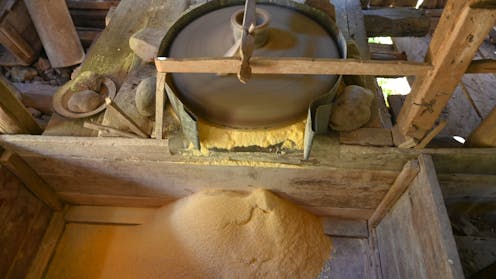
Una piedra de molino tritura los granos de trigo. Ajdin Kamber/Shutterstock, CC BY

Julio y agosto son dos meses abrasadores en el hemisferio norte, pero gracias a ellos ha vivido durante siglos la Europa agrícola. En ellos se lleva a cabo la cosecha de los cereales de secano, algo tan importante para la vida y la economía de los pueblos mediterráneos.

Estas cosechas nos han legado infinidad de palabras, a veces en forma de preciosas expresiones y metáforas. Por ejemplo, “hacer el agosto”, símbolo de los pingües beneficios que percibe el agricultor ese mes, y por extensión los que se embolsa un vivales que en cualquier mes del año redondea sus cuentas corrientes. Una expresión que significa algo completamente distinto de aquel “agostar” un terreno por el excesivo calor que abrasa los cultivos.


Leer más:
¿Verano o estío? Palabras para una estación calurosa


Viví los veranos de mi niñez en un molino de agua en la provincia de Burgos, donde veía cómo desde la mañana venían los agricultores de los pueblos vecinos trayendo sus remolques llenos de grano, todo tipo de grano: cebada, centeno, avena, trigo… Estas palabras cotidianas y sencillas guardan el secreto de muchas otras que usamos en castellano sin ser conscientes de su relación.

Cebada: del alimento o cebo al orzuelo

Muy común era la cebada. Si cebada en latín se dice hordeum, muy distante de cómo se expresa en nuestra lengua, del diminutivo (hordeolum) nos ha quedado el “orzuelo”, que semeja un minúsculo granito de cebada bajo los párpados. Y el nombre de la cebada, ¿de dónde viene? Del fin que se le daba a este cereal, el de cebar a los animales; todavía en italiano cibo significa comida o alimento en general, nuestro “cebo”.

Por cierto, que el Diccionario de la Real Academia Española ofrece “forúnculo” como sinónimo o palabra afín de orzuelo, que proviene de furunculum, “ladronzuelo”, diminutivo de fur, “ladrón”. Así llamamos a ese tallo secundario de la vid que se comporta como un ladrón, pues roba la savia furtivamente al tallo principal. De ahí pasó más tarde al cuerpo humano por su forma análoga.

Centeno, ciento por uno

Interesante también es el centeno (secale cereale, “cereal que se siega”). Su nombre en español responde a aquella parábola evangélica en la que Cristo decía que de la semilla que caía en tierra buena, unos darán treinta, otros sesenta y otros el ciento por uno (centenus). Había un sentir tradicional en la Antigüedad que indicaba que el centeno era el cereal más fecundo; o sea, que llegaba a dar el ciento por uno.

Avena, alimento y flauta

Y también llegaban remolques de avena, del latín avena, ahora tan de moda en los desayunos por sus propiedades y porque, según algunos expertos, podría ser incluida en la dieta sin gluten. Con la caña endurecida de la avena se hacían elementales flautas, como un caramillo (nombre que procede de calamellus, diminutivo de cálamo, “cañita”).

Espelta, inmolaciones y emolumentos

Más raro de encontrar entonces era la espelta o trigo espelta (Triticum spelta), el primero de los cereales que cultivó el hombre. También conocida como “escanda mayor”, es un cereal similar al trigo que se utilizó mucho en la Roma clásica. Con sus granos molidos (mola) y mezclados con sal, se hacía una pasta, la salsa mola, que se colocaba en el cuello de las víctimas antes de ser sacrificadas a los dioses.

A partir de ahí surgió el verbo inmolar y la inmolación, aunque ni los yihadistas suicidas que se inmolan por una causa, ni los ejecutivos que entregan su tiempo libre inmolándose por la empresa se espolvoreen salsa mola en la espalda. Y de la actividad de la molienda conservamos los emolumentos, es decir, la “retribución pagada al molinero por moler el grano”, aunque se utilice hoy para un sueldo o paga en general.

Trigo, trilla, trizas y triturar

Sin duda el rey de los cereales era el trigo, que proviene de un latino frumentum triticum (“triturado”), y cuya voz tiene que ver a su vez con el trillo y con triturar, entre otros muchos términos. Eso indica que se abandonó el sustantivo latino que lo designaba, frumentum, mantenido todavía en el italiano actual, frumento, y permaneció la finalidad del cereal, es decir, ser molido, triturado, para alimento.

De la misma raíz conservamos “triza”, algo en lo que terminamos después de un día de mucho trabajo, es decir, destrozados, hechos trizas. De esa misma raíz podemos tener el corazón contrito y atrito, triturado y destrozado por el peso de la culpa ante un delito o un pecado.

Y también nos llegan detrimento y detrito (del verbo latino detero), que equivaldría a quebranto.

Del trigo al bronceado

Hemos hablado del trillo (también la trilla), del latín tribulum, un instrumento que los jóvenes han visto quizás en paradores y hoteles elegantes convertido en mesa con un cristal encima, que trituraba la espiga en las eras separando el grano de la paja. Y en efecto, ya lo han adivinado ustedes, de aquí provienen también tribulación y atribulado, es decir, atormentado o triturado por dentro.

Sólo mucho más tarde, y ya desde el propio español, surgió el color trigueño de una persona, que hoy día diríamos bronceado, pero que se obtiene hoy de manera muy diferente al origen de la palabra. No son lo mismo diez horas trabajando bajo el sol, que dan ese color trigueño al labriego, que diez horas tumbado en la playa o en la hamaca.

The Conversation

Javier del Hoyo Calleja no recibe salario, ni ejerce labores de consultoría, ni posee acciones, ni recibe financiación de ninguna compañía u organización que pueda obtener beneficio de este artículo, y ha declarado carecer de vínculos relevantes más allá del cargo académico citado.

– ref. ‘Hacer el agosto’: cereales, verano y lenguaje – https://theconversation.com/hacer-el-agosto-cereales-verano-y-lenguaje-262527

¿Por qué se mueven los planetas?

Source: The Conversation – (in Spanish) – By Itziar Garate Lopez, Profesora de Física en la Escuela de Ingeniería de Bilbao y miembro del Grupo de Ciencias Planetarias, Universidad del País Vasco / Euskal Herriko Unibertsitatea

Nazarii_Neshcherenskyi/Shutterstock

Este artículo forma parte de la sección The Conversation Júnior, en la que especialistas de las principales universidades y centros de investigación contestan a las dudas de jóvenes curiosos de entre 12 y 16 años. Podéis enviar vuestras preguntas a tcesjunior@theconversation.com


Pregunta formulada por el curso de 3º de la ESO de Aranzadi Ikastola. Bergara (Gipuzkoa)


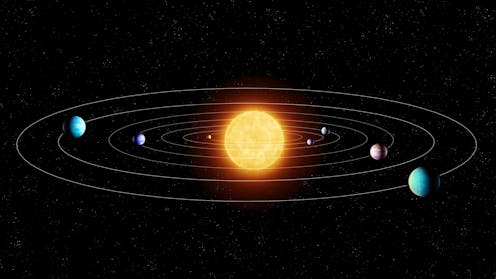
Los planetas se mueven para sobrevivir: si no orbitaran alrededor de una estrella, serían engullidas por ella. Sin embargo, no les resulta nada fácil conseguirlo, ya que han de desplazarse a una velocidad muy concreta, como veremos.

La clave está en la inercia

Todo cuerpo tiene una inercia o tendencia a no variar su velocidad, ni en cantidad ni en dirección. De modo que, sin aplicarle ninguna fuerza, ese cuerpo seguirá inmóvil si inicialmente estaba en reposo o continuará desplazándose en línea recta y a la misma rapidez si se movía.

Por ejemplo, al acelerar el coche, nuestro cuerpo parece caerse un poco hacia atrás debido a que su tendencia es mantener la velocidad inferior que llevaba. Por el contrario, al frenar, parece que nos inclinamos hacia adelante, ya que nuestra inercia nos empuja a seguir con la velocidad superior que experimentábamos antes.

Algo diferente le pasará a un objeto al aplicarle una fuerza perpendicular a la dirección de la velocidad inicial: su trayectoria se curvará. Es lo que ocurre si lanzamos un balón desde cierta altura y de manera completamente horizontal: la fuerza de la gravedad (aplicada perpendicularmente a la dirección inicial de la pelota) modifica su trayectoria, curvándola hacia abajo y obligando al balón a caer, antes o después, al suelo.

Si un cuerpo experimenta esa fuerza perpendicular durante un largo periodo de tiempo, y no tiene ningún obstáculo en su camino, es posible que la trayectoria se cierre sobre sí misma y genere un recorrido circular. Imagina que haces girar una piedra atada a una cuerda sobre tu cabeza: como la tensión de la cuerda es perpendicular a su velocidad en todo momento, la trayectoria de la piedra describe una circunferencia perfecta.

Equilibrio casi imposible

Para que un planeta trace una órbita circular alrededor de su estrella ha de darse un equilibrio concreto: la fuerza que atrae al cuerpo al centro de la órbita (la fuerza de gravedad) debe ser igual a la fuerza que lo expulsa de esa órbita (la fuerza centrífuga).

La primera se genera debido a que los dos cuerpos (estrella y planeta) tienen masa, y la segunda se debe a la inercia del planeta. El equilibrio entre ambas fuerzas se consigue con una velocidad única, que se expresa con una fórmula: v2 = G·M/d. Curiosamente no depende de la masa del planeta, sino de la masa de la estrella (M), de la distancia entre estrella y planeta (d) y de la constante de gravitación universal (G).

Si la velocidad del planeta es mayor que la velocidad de equilibrio, entonces escapará de esa órbita alejándose más y más de la estrella; probablemente, acabará sus días siendo un planeta errante en el universo. Sin embargo, si su velocidad es menor que la de equilibrio, caerá hacia el centro de la órbita. Entonces, casi seguro, acabará engullido por esa estrella.

Pero ¿y las leyes de Kepler?

Estos valores invariantes de la velocidad y la distancia de un planeta parecen ser incompatibles con las llamadas leyes de Kepler, pero no lo son.

Recordemos brevemente estas leyes:

  1. Todos los planetas se mueven alrededor del Sol describiendo una trayectoria elíptica (no circular).

  2. La recta que une el planeta con el Sol barre áreas iguales en tiempos iguales (lo que implica una velocidad no constante).

  3. El cuadrado del periodo orbital del planeta es proporcional al cubo de su distancia media al Sol.

Que las órbitas no sean circulares se debe a que los planetas del sistema solar no están solos. La fuerza de gravedad ejercida entre los mundos de nuestro vecindario cósmico hace que éstos varíen un poco su distancia al Sol mientras viajan, creando una órbita elíptica.

Este cambio de distancia hace que los planetas tengan que adaptar su velocidad según se encuentren en el pericentro (punto más cercano a la estrella) o apocentro (punto más lejano). Y la tercera ley de Kepler adapta la condición v2 = G·M/d a una órbita elíptica.

Origen de la velocidad

Casi todos los cuerpos existentes en un sistema planetario como el nuestro (estrella, planetas, lunas, asteroides, cometas…) tienen un origen común: el colapso gravitatorio de una nube molecular.

Estas nubes presentan regiones con más material que su entorno; es decir, tienen “grumos”, pero de tamaño astronómico. Si algún evento cósmico, como la explosión de una supernova cercana, acerca unos pocos grumos, la gravedad que genera esta acumulación de masa atraerá el material de su alrededor, y crecerá aún más.

Así se inicia un proceso en el que la nube va compactándose en una pequeña zona. Aquí, pocos millones de años más tarde, nacerán una estrella y sus planetas.

Mientras la nube colapsa acelera su rotación, igual que le ocurre a una patinadora que gira sobre sí misma y cierra sus brazos. Cuando esa velocidad de rotación es suficientemente grande, la fuerza centrífuga vuelve a jugar un papel importante. Esta es la fuerza que nos expulsa hacia fuera en una curva o cuando estamos montados en un tiovivo, y es la que hace que una masa esférica en rotación se convierta en un gran disco plano.

Será en ese disco de material que gira alrededor de la estrella en formación donde surjan los planetas. Pasarán millones de años y muchos procesos (acreción de partículas, fusión de cuerpos, impactos…) hasta que se forme un planeta como la Tierra o Júpiter. En el proceso, la velocidad de los cuerpos irá cambiando. Sólo aquellos que terminen teniendo la velocidad correcta para la distancia que los separa del Sol sobrevivirán hasta el momento en que nosotros nos preguntemos: ¿por qué se mueven los planetas?


La Cátedra de Cultura Científica de la Universidad del País Vasco colabora en la sección The Conversation Júnior.


The Conversation

Itziar Garate Lopez no recibe salario, ni ejerce labores de consultoría, ni posee acciones, ni recibe financiación de ninguna compañía u organización que pueda obtener beneficio de este artículo, y ha declarado carecer de vínculos relevantes más allá del cargo académico citado.

– ref. ¿Por qué se mueven los planetas? – https://theconversation.com/por-que-se-mueven-los-planetas-247392

La prueba genética que exige World Athletics a las atletas femeninas es errónea

Source: The Conversation – (in Spanish) – By Andrew Sinclair, Deputy Director of the Murdoch Children’s Research Institute, Murdoch Children’s Research Institute

Sebastian Coe, presidente de World Athletics (nombre que recibe el órgano rector del atletismo internacional desde 2019), ha anunciado recientemente una nueva norma para las atletas femeninas, que exige pruebas genéticas obligatorias para verificar su sexo biológico.

Dicho test debe realizarse si las deportistas desean participar en el Campeonato Mundial de Atletismo que se celebrará en Tokio en septiembre.

World Athletics ha declarado que todas las atletas que compitan como mujeres deberán someterse a una prueba del gen SRY para identificar si tienen el cromosoma Y masculino. Dado que ese gen se encuentra en el cromosoma Y, es, en la práctica, un indicador de dicho cromosoma.

Cualquier atleta cuya prueba muestre la presencia del gen SRY será excluida de competir en la categoría femenina en eventos de élite. Sin embargo, si la deportista padece una afección denominada síndrome de insensibilidad completa a los andrógenos (SICA), podrá optar a una exención.

Coe afirmó que la decisión se tomó para garantizar “la integridad del deporte femenino”, ya que World Athletics afirma que “el gen SRY es un indicador fiable para determinar el sexo biológico”.

Yo sostengo que la ciencia no respalda esta afirmación excesivamente simplista.

Y sé lo que digo, porque descubrí el gen SRY en el cromosoma Y humano en 1990. Durante 35 años he estado investigando este gen y otros necesarios para el desarrollo de los testículos.

Breve introducción al desarrollo de los testículos y los ovarios

Si un embrión humano tiene cromosomas X e Y (XY), a las seis semanas de desarrollo, el gen SRY del segundo desencadena una cascada de eventos donde intervienen unos 30 genes diferentes que conducen a la formación de los testículos.

En términos sencillos, los testículos producen hormonas –entre ellas, la testosterona– que dan lugar al desarrollo masculino.

Sin embargo, si un embrión tiene par de cromosomas X y X (XX), entra en juego un grupo de genes completamente diferente, se forman los ovarios y las hormonas producidas dan lugar a una mujer.

Sabemos que la formación de los testículos o los ovarios requiere una compleja red de muchos genes y proteínas que interactúan entre sí.

Mientras que algunos genes promueven el desarrollo de los testículos, otros promueven el desarrollo de los ovarios. Además, otros suprimen la formación de los ovarios o antagonizan la formación de los testículos.

Incluso una vez que los ovarios o los testículos están completamente formados, necesitamos otros genes para mantenerlos. Estos no siempre funcionan como se espera, lo que afecta al desarrollo de esos órganos.

¿Cómo se relaciona esto con las pruebas de sexo de las atletas de élite?

Los cambios o variantes en los numerosos genes que regulan el desarrollo de los testículos o los ovarios pueden dar lugar a una inversión del sexo o a testículos u ovarios que no funcionan. ¿Qué quiero decir con esto?

Si se produce un cambio en el gen SRY que impide que funcione con normalidad, una persona puede no desarrollar testículos y ser biológicamente femenina. Sin embargo, tiene cromosomas XY y, según las pruebas de World Athletics, quedaría excluida de la competición. No obstante, las atletas pueden recurrir la decisión si consideran que el resultado de la prueba no refleja su sexo.

Otros individuos XY pueden tener un gen SRY funcional, pero ser mujeres –con pechos y genitales femeninos, por ejemplo– y tener testículos internos.

Es importante destacar que las células de estas personas son físicamente incapaces de responder a la testosterona producida por estos testículos. Sin embargo, darían positivo en las pruebas de SRY y serían excluidas de la competición.

En los Juegos Olímpicos de Atlanta de 1996, ocho de las 3 387 atletas dieron positivo en los test del cromosoma Y. De ellas, siete eran resistentes a la testosterona.

La prueba SRY no es concluyente

World Athletics afirma que el gen SRY es un indicador fiable para determinar el sexo biológico. Pero es mucho más complejo, ya que intervienen características cromosómicas, gonadales (testículos/ovarios), hormonales y secundarias.

Utilizar el SRY para determinar el sexo biológico es incorrecto, ya que lo único que indica es si el gen está presente o no.

No señala cómo funciona el SRY, si se han formado testículos, si se produce testosterona y, en caso afirmativo, si el cuerpo puede utilizar esta hormona.

Otros problemas con el proceso de prueba del SRY

World Athletics recomienda que todas las atletas femeninas se sometan a un frotis bucal o una muestra de sangre para detectar la presencia del SRY.

Normalmente, la muestra se enviaría a un laboratorio que extraería el ADN y buscaría la presencia del gen SRY. Esto puede hacerse fácilmente en los países ricos, pero ¿qué ocurre en países más pobres que no cuentan con estas instalaciones?

Cabe señalar, además, que estas pruebas son muy sensibles. Si un técnico de laboratorio varón se ocupa de la prueba, puede contaminarla inadvertidamente con una sola célula de su piel y producir un falso positivo.

No se ofrece ninguna orientación sobre cómo llevar a cabo el test para reducir el riesgo de resultados falsos.

World Athletics tampoco reconoce el impacto que un resultado positivo tendría en una persona, que puede ser más profundo que la simple exclusión del deporte.

La organización no mencionó el requisito de proporcionar un asesoramiento genético adecuado, que se considera necesario antes de realizar pruebas genéticas y al que es difícil acceder en muchos países de ingresos bajos y medios.

Yo, junto con muchos otros expertos, convencí al Comité Olímpico Internacional de que abandonara el uso del SRY para las pruebas de sexo para los Juegos Olímpicos de Sídney 2000.

Por lo tanto, resulta muy sorprendente que, 25 años después, se esté realizando un esfuerzo equivocado para restablecer el test.

Teniendo en cuenta todos los problemas expuestos anteriormente, el gen SRY no debería utilizarse para excluir a las mujeres atletas de la competición.

The Conversation

Andrew Sinclair recibe financiación del NHMRC.

– ref. La prueba genética que exige World Athletics a las atletas femeninas es errónea – https://theconversation.com/la-prueba-genetica-que-exige-world-athletics-a-las-atletas-femeninas-es-erronea-262895

Precavidas y previsoras: cien años atrás, así eran las inversionistas bancarias españolas

Source: The Conversation – (in Spanish) – By Susana Martínez-Rodríguez, Catedrática de Historia e Instituciones Económicas, Universidad de Murcia

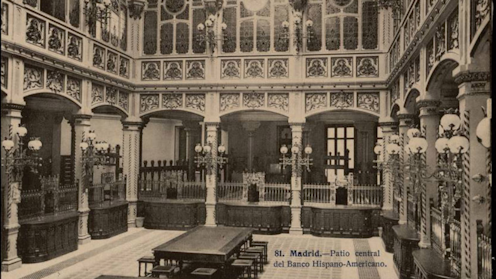
Patio central del Banco Hispano-Americano. Biblioteca Digital memoriademadrid

Investigar en los archivos históricos de los grandes bancos españoles es una tarea que, equivocadamente, puede parecer gris, pero sus registros cuentan historias que hacen replantear la concepción histórica del desarrollo económico del país.

Se tiene una imagen en blanco y negro de la España de principios del siglo XX y sus grandes empresas: hombres poderosos controlando las finanzas y los negocios. Sin embargo, los archivos matizan esta historia.

Mujeres inversoras

Suele pensarse que el acceso de las mujeres al mundo financiero es un logro relativamente reciente, pero ya en las décadas de 1920, 1930 y 1940 las mujeres participaban en los mercados. Compraban bonos e invertían en acciones bancarias como una forma segura y eficiente de gestionar su riqueza. Lo hacían en silencio, pero la documentación conservada da fe, con claridad y rotundidad, de su presencia.

Hemos analizado más de 34 000 registros de accionistas de tres bancos españoles y descubrimos que la presencia femenina en el accionariado de los bancos comerciales creció con fuerza entre 1918 y 1948. Estas mujeres no eran personajes excepcionales, sino que formaron parte de una tendencia que desafió los límites sociales de su época y transformó discretamente la historia financiera del país. En otros países, particularmente Gran Bretaña, la presencia de mujeres accionistas era conocida y valorada –no siempre positivamente– por sus contemporáneos.

Un periodo convulso y transformador

En España, el inicio del siglo XX estuvo marcado por la inestabilidad política y social. Las turbulencias políticas, los cambios de régimen, la Guerra Civil y los primeros años de la dictadura franquista hacen pensar que no existía el clima propicio para que las mujeres tomaran parte activa de la vida económica del país.

Sin embargo, nuestros datos muestran que la presencia de mujeres accionistas exhibe una tendencia de crecimiento constante durante todo el periodo analizado (1918-1948). Por tanto, este fenómeno no puede entenderse como una situación coyuntural, sino como un indicio claro de un cambio estructural en el funcionamiento de la economía y las finanzas.

Evolución del porcentaje de mujeres accionistas entre 1918 y 1948. La columna izquierda corresponde a los porcentajes de los bancos de Irún y de La Coruña y el de la derecha a los del Banco Hispano Americano (BHA).
Fuente: elaboración propia

La persistencia y el aumento progresivo de la presencia de mujeres accionistas ponen de manifiesto que, pese a las turbulencias políticas y sociales, se estaba produciendo una transformación en las dinámicas económicas para dar paso a la democratización de los mercados.

La expansión femenina en las finanzas españolas

La feminización del accionariado de los bancos privados respondía a determinantes financieros. Al invertir, las mujeres buscaban un beneficio económico estable que aumentara su bienestar y les proporcionara una fuente sostenida de ingresos a lo largo del tiempo. Este fenómeno revela una participación consciente por parte de las accionistas, quienes aprovecharon las oportunidades disponibles para consolidar su capacidad financiera individual.

Los resultados también apuntan a la importancia de las redes familiares en el acceso de las mujeres a los mercados. Estas redes actuaron como canales de transmisión de recursos y riqueza. La inclusión en el Código Civil de 1889 de un sistema igualitario de herencia para todos los descendientes permitió a las mujeres acceder a unas riquezas que, bajo otras condiciones, habían quedado fuera de su alcance.

El cambio normativo en la distribución de las herencias, permitió una repartición más equitativa del patrimonio entre los herederos de las familias con recursos. Se redujeron así las barreras que tradicionalmente limitaban el acceso de las mujeres al capital, fomentando su presencia en espacios tradicionalmente destinados a los hombres.

La libertad económica de la que disfrutaron algunas mujeres españolas surgió de una trayectoria de largo plazo donde las redes familiares y los marcos normativos jugaron un papel central.

Legado y riesgo en la presencia femenina en los mercados financieros

Las mujeres que invertían sus ahorros en acciones, al igual que los hombres, buscaban proteger y rentabilizar su riqueza . Pero hay un hecho diferencial: las mujeres conservaban más tiempo sus acciones, lo que puede interpretarse como una manera de constituir un legado patrimonial que no solo las beneficiaría a ellas, sino que pasaría a la siguiente generación.

También aparece aquí un factor cultural –una mayor o menor aversión al riesgo– que debe ser tenido en consideración a la hora de explicar los distintos comportamientos financieros.

El legado de las mujeres accionistas españolas va más allá de su gestión particular y sus decisiones para maximizar su peculio. Son parte del desarrollo económico y la modernización del país, una parte ignorada que tomó decisiones con su dinero y dejó huella en el desarrollo y modernización económica de España.

Estos hallazgos no solo tienen un valor histórico: también sirven como espejo para seguir avanzando en la igualdad financiera.

The Conversation

Susana Martínez-Rodríguez agradece la financiación de la Fundación SENECA- Agencia Regional de Ciencia e Investigación de la Región de Murcia 21947/PI/22: INCLUSIÓN FINANCIERA Y DIFERENCIAL DE GÉNERO EN LA TENENCIA DE ACTIVOS FINANCIEROS: EL CASO ESPAÑOL.

Laura Lopez-Gomez agradece la financiación de la Fundación SENECA- Agencia Regional de Ciencia e Investigación de la Región de Murcia 21947/PI/22: INCLUSIÓN FINANCIERA Y DIFERENCIAL DE GÉNERO EN LA TENENCIA DE ACTIVOS FINANCIEROS: EL CASO ESPAÑOL.

– ref. Precavidas y previsoras: cien años atrás, así eran las inversionistas bancarias españolas – https://theconversation.com/precavidas-y-previsoras-cien-anos-atras-asi-eran-las-inversionistas-bancarias-espanolas-255925