Parental leave reform needs to consider small and medium businesses

Source: The Conversation – UK – By Helen Norman, Associate Professor at Leeds University Business School, University of Leeds

Standret/Shutterstock

The UK government announced a landmark review of parental leave in July 2025. This responds to widespread concern about failings within the current policy framework.

Much of the discussion centres on calls for longer, better-paid paternity leave. The statutory entitlement is just two weeks paid at a low flat rate (£187.18 per week in 2025) or 90% of average weekly earnings, whichever is lower.

Eligible fathers can opt for shared parental leave of up to 50 weeks of leave and up to 37 weeks of pay – paid at the same statutory rate. However, this is reliant on the mother giving up some of her maternity leave entitlement so is rarely taken up.

It is important for fathers to have the opportunity to take longer leave than the statutory two weeks. Evidence suggests that early paternal involvement in childcare lays the foundations for sustained, hands-on fathering.

However, it is unclear whether small- and medium-sized workplaces can adapt to even modest changes to the current parental leave system, particularly if there are enhancements to the length of paternity leave.

Challenges for small businesses

Discussions about parental leave reform and its implications often focus on large organisations. But small- and medium-sized enterprises – defined as having fewer than 250 employees – account for 60% of UK employment. They make up over 99% of all businesses.

We are carrying out research exploring the transition to parenthood in UK small- and medium-sized enterprises, in collaboration with two charities: Working Families and the Fatherhood Institute. This research includes a survey of 2,000 small- and medium-sized enterprises and 2,000 employees, as well as 160 interviews, which involved talking to the same employers and employees two or three times over two years.

The UK government acknowledges the current unruly state of leave and pay entitlements, which “were never designed to operate as a single system”.
In line with previous work carried out by one of us (Bianca Stumbitz), our preliminary findings suggest small and medium businesses experience distinct pressures. These are related to this complexity along with their small size and limited resources.

Pregnant woman in hijab at desk with laptop
Small and medium sized businesses are often committed to their employees’ transition to parenthood.
Pixel-Shot/Shutterstock

For example, some of these businesses have minimal knowledge of what the entitlements are. Some find the parental leave policies too complex. And some struggle to find appropriate and affordable cover for staff who take up leave.

Nevertheless, many small- and medium-sized enterprises are committed to supporting their employees in their parenting journeys. Even small workplaces sometimes manage to voluntarily enhance pay entitlements. In most cases, though, they cannot afford to do this and not at equivalent levels as some larger employers. However, they often try to be supportive in other ways. In particular, this may be through offering increased flexibility to allow parents to better reconcile work and care.

Policy reforms should account for the specific challenges that parental leave poses to smaller organisations. These include the management of staff absences if employees take extended periods of leave. The redistribution of work can overburden remaining staff, especially if roles are skilled or specialist.

Employers are generally supportive of extended leave for parents. But it is clear that it needs to be provided in a way that does not harm smaller workplaces with scarce resources.

Preliminary findings from our study suggest that the small employers’ relief scheme (which allows some small and medium enterprises to claim back 108.5% of parental leave pay instead of the usual 92%) is underused. This is mostly due to small business owners’ lack of awareness of the scheme. Take-up of the programme could be increased through targeted awareness-raising campaigns, raising the eligibility threshold and reduced administrative complexity.

Flexibility in when and how parental leave is taken can be helpful for both employers and employees in small- and medium-sized organisations. This would enable employees to take leave in blocks, rather than an extended period of time, which may be easier for some employers to manage.

It is crucial that the UK’s parental leave scheme is overhauled, including more targeted and better paid parental leave entitlements for fathers. However, if reform is to be truly inclusive, small- and medium-sized businesses must not be an afterthought. They must be at the heart of the conversation.

What needs to change?

Changes to paternity leave could have positive and significant implications for families, gender role equality, workplaces and economic wellbeing. Research and international evidence suggests that leave should be longer, well paid and offered to fathers on a “use it or lose it” basis.

For this to work for small and medium enterprises and their employees, the government needs to provide bespoke support and resources to help businesses manage and meet their responsibilities. This could include improved small employer relief entitlements to help to cover statutory pay for parental leave.

We are always looking to hear about workplace initiatives on parental leave – and are producing a toolkit to help employers and employees in small- and medium-enterprises navigate some of these challenges.

The Conversation

Helen Norman receives funding from the Economic Social Research Council (ESRC).

Bianca Stumbitz receives funding from the Economic and Social Research Council.

Emma Banister receives funding from the Economic Social Research Council (ESRC).

ref. Parental leave reform needs to consider small and medium businesses – https://theconversation.com/parental-leave-reform-needs-to-consider-small-and-medium-businesses-262366

Alaska’s Fat Bear Week is more than a bit of fun – for the animals, size is a matter of survival

Source: The Conversation – UK – By Antonio Uzal, Associate Professor of Conservation Biology, Nottingham Trent University

FotoPro 929

The most gripping week of the bear calendar has arrived. The Fat Bear Week is an annual online competition hosted by Katmai National Park and Preserve in Alaska. This event, which began in 2014 as a one-day celebration, has since grown into a phenomenon among bear enthusiasts worldwide.

Bears are paired in single elimination match ups where people can read their biographies, look at their pictures and vote based on which bear “exemplifies fatness and success”, so it is not all about their size, but also about their life histories.

Why are we celebrating bear chubbiness? Because for brown bears, getting fat is a
matter of survival. In just a few short months, they must bulk up to prepare for a long seasonal slumber, when they enter a deep sleep similar to hibernation (called
torpor), stopping all bodily functions, including eating, drinking, and eliminating
waste, while their body temperature, heart rate, and metabolism decrease.

This is especially remarkable when you consider that some Alaskan or Scandinavian bears might spend seven months in their dens. Even more impressive is that, during this period, pregnant female bears give birth, lactate and rear the extremely vulnerable cubs. This is a critical adaptation that allows bears to conserve energy during prolonged periods of harsh weather and food scarcity. So yes, those extra kilos are a badge of honour.

The bear’s bulking period is called hyperphagia, a time when brown bears become
obsessed with finding the fattiest, sweetest, and most protein rich foods. In Europe, they switch their diet in summer to feast on fruits (especially berries), hard mast such as acorns and nuts, and also prey on or scavenge animals. But the true champions of chubbiness are the coastal brown bears of Alaska, with some individuals tipping the scales at an astonishing 650kg – more than twice the weight of their European cousins.

These giants gorge on calorie-dense salmon, targeting the fat-rich roe and
brains, and can devour up to 40 fish a day. That’s a jaw dropping intake of 20,000 to over 100,000 calories daily. The result: coastal Alaskan brown bears can gain more than 2 kg per day.

But Fat Bear Week is not just about size. Voters (about 1.2 million in 2024) are encouraged to dive into the life histories of the contenders. Their biographies reflect the harshness of the environment and the fierce competition for resources and mating success. These bears’ lives tell us stories of loss, grave injuries, and also of determination, adaptability, and perseverance.

A matter of life and death

Female bears face enormous challenges: if they fail to accumulate enough body fat, they risk losing entire litters due to the energetic demands of cub rearing. Cubs are also vulnerable to attacks from other bears, particularly males, who may kill infants to eliminate competition and shorten the mother’s time to her next estrus cycle, increasing their own chances of fathering future offspring. Male brown bears don’t have it easier.

What happens in Fat Bear Week?

They suffer injuries or even death when fighting rivals over food, territory or mates, and must constantly adapt as they grow larger, older, and face tougher competition. In this contest, voters may find themselves rooting for an older female raising her cubs against the odds, or an older underdog bear facing off against younger, stronger challengers.

Beyond the fun of this online competition, Fat Bear Week helps raise
conservation awareness, support habitat protection, and foster public engagement
with wildlife. But the future of bear fattening and hibernation patterns might be
shaped by climate change.

Shifts in seasonal timings mean that their key food resources, such as berries and salmon, now overlap, and some bears may switch their diets. This can disrupt ecosystems and potentially lead to nutritional imbalances and behavioural changes. In Spain’s Cantabrian Mountains, warmer winters have led to brown bears remaining active during the winter, a risky time when food is scarce and cubs are vulnerable.

Conversely, some bears can be displaced to lower-quality areas, causing others that currently eat salmon to enter dens earlier and remain inside longer, missing out on critical feeding opportunities.

Fat Bear Week draws attention to the importance of preserving wild habitats like
Katmai National Park. It’s a brilliant model of how storytelling and digital media can inspire public stewardship of nature.

The Conversation

Antonio Uzal does not work for, consult, own shares in or receive funding from any company or organisation that would benefit from this article, and has disclosed no relevant affiliations beyond their academic appointment.

ref. Alaska’s Fat Bear Week is more than a bit of fun – for the animals, size is a matter of survival – https://theconversation.com/alaskas-fat-bear-week-is-more-than-a-bit-of-fun-for-the-animals-size-is-a-matter-of-survival-266099

Underground data fortresses: the nuclear bunkers, mines and mountains being transformed to protect our ‘new gold’ from attack

Source: The Conversation – UK – By A.R.E. Taylor, Senior Lecturer in Communications, University of Exeter

It’s a sunny June day in southeast England. I’m driving along a quiet, rural road that stretches through the Kent countryside. The sun flashes through breaks in the hedgerow, offering glimpses of verdant crop fields and old farmhouses.

Thick hawthorn and brambles make it difficult to see the 10ft high razor-wire fence that encloses a large grassy mound. You’d never suspect that 100ft beneath the ground, a hi-tech cloud computing facility is whirring away, guarding the most valuable commodity of our age: digital data.

This subterranean data centre is located in a former nuclear bunker that was constructed in the early 1950s as a command-and-control centre for the Royal Air Force’s radar network. You can still see the decaying concrete plinths that the radar dish once sat upon. Personnel stationed in the bunker would have closely watched their screens for signs of nuclear missile-carrying aircraft.

After the end of the cold war, the bunker was purchased by a London-based internet security firm for use as an ultra-secure data centre. Today, the site is operated by the Cyberfort Group, a cybersecurity services provider.

The side entrance to a bunker showing a hill and barbed wire fencing
The Cyberfort bunker is a solid inclined mass of grass-covered concrete that emerges in the centre of the compound.
Cyberfort/A.R.E. Taylor, CC BY

I’m an anthropologist visiting the Cyberfort bunker as part of my ethnographic research exploring practices of “extreme” data storage. My work focuses on anxieties of data loss and the effort we take – or often forget to take – to back-up our data.

As an object of anthropological enquiry, the bunkered data centre continues the ancient human practice of storing precious relics in underground sites, like the tumuli and burial mounds of our ancestors, where tools, silver, gold and other treasures were interred.

The Cyberfort facility is one of many bunkers around the world that have now been repurposed as cloud storage spaces. Former bomb shelters in China, derelict Soviet command-and-control centres in Kyiv and abandoned Department of Defense bunkers across the United States have all been repackaged over the last two decades as “future-proof” data storage sites.

I’ve managed to secure permission to visit some of these high-security sites as part of my fieldwork, including Pionen, a former defence shelter in Stockholm, Sweden, which has attracted considerable media interest over the last two decades because it looks like the hi-tech lair of a James Bond villain.

Many abandoned mines and mountain caverns have also been re-engineered as digital data repositories, such as the Mount10 AG complex, which brands itself as the “Swiss Fort Knox” and has buried its operations within the Swiss Alps. Cold war-era information management company Iron Mountain operates an underground data centre 10 minutes from downtown Kansas City and another in a former limestone mine in Boyers, Pennsylvania.

The National Library of Norway stores its digital databanks in mountain vaults just south of the Arctic Circle, while a Svalbard coal mine was transformed into a data storage site by the data preservation company Piql. Known as the Arctic World Archive (AWA), this subterranean data preservation facility is modelled on the nearby Global Seed Vault.

Just as the seeds preserved in the Global Seed Vault promise to help re-build biodiversity in the aftermath of future collapse, the digitised records stored in the AWA promise to help re-boot organisations after their collapse.

A diagram showing the cross section of a bunker buried in a mountain.
A diagram of the Mount 10 bunker in Switzerland.
Mount10, CC BY

Bunkers are architectural reflections of cultural anxieties. If nuclear bunkers once mirrored existential fears about atomic warfare, then today’s data bunkers speak to the emergence of a new existential threat endemic to digital society: the terrifying prospect of data loss.

Data, the new gold?

After parking my car, I show my ID to a large and muscular bald-headed guard squeezed into a security booth not much larger than a pay-phone box. He’s wearing a black fleece with “Cyberfort” embroidered on the left side of the chest. He checks my name against today’s visitor list, nods, then pushes a button to retract the electric gates.

I follow an open-air corridor constructed from steel grating to the door of the reception building and press a buzzer. The door opens on to the reception area: “Welcome to Cyberfort,” receptionist Laura Harper says cheerfully, sitting behind a desk in front of a bulletproof window which faces the car park. I hand her my passport, place my bag in one of the lockers, and take a seat in the waiting area.


The Insights section is committed to high-quality longform journalism. Our editors work with academics from many different backgrounds who are tackling a wide range of societal and scientific challenges.


Big-tech pundits have heralded data as the “new gold” – a metaphor made all the more vivid when data is stored in abandoned mines. And as the purported economic and cultural value of data continues to grow, so too does the impact of data loss.

For individuals, the loss of digital data can be a devastating experience. If a personal device should crash or be hacked or stolen with no recent back-ups having been made, it can mean the loss of valuable work or cherished memories. Most of us probably have a data-loss horror story we could tell.

For governments, corporations and businesses, a severe data loss event – whether through theft, erasure or network failure – can have a significant impact on operations or even result in their collapse. The online services of high-profile companies like Jaguar and Marks & Spencer have recently been impacted by large-scale cyber-attacks that have left them struggling to operate, with systems shutdown and supply chains disrupted. But these companies have been comparatively lucky: a number of organisations had to permanently close down after major data loss events, such as the TravelEx ransomware attack in 2020, and the MediSecure and National Public Data breaches, both in 2024.

With the economic and societal impact of data loss growing, some businesses are turning to bunkers with the hope of avoiding a data loss doomsday scenario.

The concrete cloud

One of the first things visitors to the Cyberfort bunker encounter in the waiting area is a 3ft cylinder of concrete inside a glass display cabinet, showcasing the thickness of the data centre’s walls. The brute materiality of the bunkered data centre stands in stark contrast to the fluffy metaphor of the “cloud”, which is often used to discuss online data storage.

Data centres, sometimes known as “server farms”, are the buildings where cloud data is stored. When we transfer our data into the cloud, we are transferring it on to servers in a data centre (hence the meme “there is no cloud, just someone else’s computer”). Data centres typically take the form of windowless, warehouse-scale buildings containing hundreds of servers (pizza box-shaped computers) stored in cabinets that are arranged in aisles.

Data centres are responsible for running many of the services that underpin the systems we interact with every day. Transportation, logistics, energy, finance, national security, health systems and other lifeline services all rely on up-to-the-second data stored in and accessed through data centres. Everyday activities such as debit and credit card payments, sending emails, booking tickets, receiving text messages, using social media, search engines and AI chatbots, streaming TV, making video calls and storing digital photos all rely on data centres.

These buildings now connect such an incredible range of activities and utilities across government, business and society that any downtime can have major consequences. The UK government has officially classified data centres as forming part of the country’s critical national infrastructure – a move that also conveniently enables the government to justify building many more of these energy-guzzling facilities.

As I sit pondering the concrete reality of the cloud in Cyberfort’s waiting area, the company’s chief digital officer, Rob Arnold, emerges from a corridor. It was Arnold who arranged my visit, and we head for his office – through a security door with a biometric fingerprint lock – where he talks me through the logic of the bunkered data centre.

“The problem with most above-ground data centres is they are often constructed quickly, and not built to withstand physical threats like strong winds, car bombs or server theft from breaking and entering.” Arnold says that “most people tend to think of the cyber-side of data security – hackers, viruses and cyber-attacks – which dangerously overlooks the physical side”.

Amid increasing geopolitical tension, internet infrastructure is now a high-value target as “hybrid” or “cyber-physical” sabotage (when cyber-attacks are combined with physical attacks) becomes increasingly common.

The importance of physical internet security has been highlighted by the war in Ukraine, where drone strikes and other attacks on digital infrastructure have led to internet shutdowns. While precise details about the number of data centres destroyed in the conflict remain scant, it has been observed that Russian attacks on local data centres in Ukraine have led many organisations to migrate their data to cloud facilities located outside of the conflict zone.

Bunkers appeal to what Arnold calls “security-conscious” clients. He says: “It’s difficult to find a structure more secure than a bunker” – before adding drily: “The client might not survive the apocalypse, but their data will.”

Cyberfort specialises in serving regulated industries. Its customer base includes companies working in defence, healthcare, finance and critical infrastructure. “Our core offering focuses on providing secure, sovereign and compliant cloud and data-centre services,” Arnold explains in a well-rehearsed sales routine. “We do more for our customers than just host systems – we protect their reputations.”

Arnold’s pitch is disrupted by a knock at the door. The head of security (who I’m calling Richard Thomas here) enters – a 6ft-tall ex-royal marine wearing black cargo trousers, black combat boots and a black Cyberfort-branded polo shirt. Thomas is going to show me around the facility today.

Two green armour-plated doors.
The bunker’s external armour-plated door.
Cyberfort/A.R.E. Taylor, CC BY

The entrance to the bunker is located up a short access road. Engineered to withstand the blast and radiation effects of megaton-level thermonuclear detonations, this cloud storage bunker promises its clients that their data will survive any eventuality.

At the armour-plated entrance door, Thomas taps a passcode into the electronic lock and swipes his card through the access control system. Inside, the air is cool and musty. Another security guard sits in a small room behind bulletproof plexiglass. He buzzes us through a metal mantrap and we descend into the depths of the facility via a steel staircase, our footsteps echoing in this cavernous space.

A full-height turnstile security gate (mantrap) inside the bunker.
Cyberfort/A.R.E. Taylor, CC BY

The heavy blast doors and concrete walls of the bunker appear strangely at odds with the virtual “walls” we typically associate with data security: firewalls, anti-virus vaults, and spyware and spam filters. Similarly, the bunker’s military logics of enclosure and isolation seem somewhat outdated when faced with the transgressive digital “flows” of networked data.

However, to dismiss the bunkered data centre as merely an outmoded piece of security theatre is to overlook the importance of physical security – today and in the future.

We often think of the internet as an immaterial or ethereal realm that exists in an electronic non-place. Metaphors like the now retro-sounding cyberspace and, more recently, the cloud perpetuate this way of thinking.

But the cloud is a material infrastructure composed of thousands of miles of cables and rows upon rows of computing equipment. It always “touches the ground” somewhere, making it vulnerable to a range of non-cyber threats – from thieves breaking into data centres and stealing servers, to solar storms disrupting electrical supplies, and even to squirrels chewing through cables.

A red blast-proof metal door in a bunker.
A blast-proof door in the Cyberfort bunker, behind which lies the server room containing the digital ‘gold’.
Cyberfort/A.R.E. Taylor, CC BY

If data centre services should go down, even for a few seconds, the economic and societal impact can be calamitous. In recent years we have seen this first-hand.

In July 2020, the 27-minute Cloudflare outage led to a 50% collapse in traffic across the globe, disrupting major platforms like Discord, Shopify, Feedly and Politico. In June 2021, the Fastly outage left some of the world’s most visited websites completely inaccessible, including Amazon, PayPal, Reddit, and the New York Times. In October 2021, Meta, which owns Facebook, WhatsApp and Instagram, experienced an outage for several hours that affected millions of social media users as well as hundreds of businesses.

Perhaps the largest internet outage yet occurred in July 2024 when the CrowdStrike outage left supermarkets, doctors’ surgeries, pharmacies, airports, train providers and banks (among other critical services) unable to operate. This was described by some in the industry as “one of the largest mass outages in IT history”.

Internet architecture now relies on such a complex and fragile ecosystem of interdependencies that major outages are getting bigger and occurring more often. Downtime events can have a lasting financial and reputational impact on data centre providers. Some attempts to quantify the average cost of an unplanned data centre outage range from US$9,000 to US$17,000 (about £12,500) per minute.

The geographic location of a data centre is also hugely important for data protection regulations, Thomas explains, as we make our way down a brightly lit corridor. “Cyberfort’s facilities are all located in the UK, which gives our clients peace of mind, knowing they comply with data sovereignty laws.”

Data sovereignty regulations subject data to the legal and privacy standards of the country in which it is stored. This means businesses and organisations must be careful about where in the world their data is being relocated when they move it into the cloud. For example, if a UK business opts to store its data with a cloud provider that uses data centres based in the US, then that data will be subject to US privacy standards which do not fully comply with UK standards.

In contrast to early perceptions of the internet as transcending space, eradicating national borders and geopolitics, data sovereignty regulations endow locality with renewed significance in the cloud era.

The survival of data at all costs

Towards the end of the corridor, Thomas opens a large red blast-proof door – beyond which is a smaller air-tight door. Thomas waves his card in front of an e-reader, initiating an unlocking process: we’re about to enter one of the server rooms.

“Get ready” he says, smiling, “it’s going to be cold and loud!” The door opens, releasing a rush of cold air. The server room is configured and calibrated for the sole purpose of providing optimal conditions for data storage.

Like any computer, servers generate a huge amount of heat when they are running, and must be stored in constantly air-conditioned rooms to ensure they do not overheat. If for any reason a server should crash or fail, it can lead to the loss of a client’s valuable data. Data centre technicians work in high-pressure conditions where any unexpected server downtime could mean the end of their job.

Rows of black metal data hubs.
The server room at Cyberfort.
Cyberfort/A.R.E. Taylor, CC BY

To try and make sure the servers run optimally, data centres rely on huge amounts of water and energy, which can significantly limit the availability of these resources for the people who live in the vicinity of the buildings.

An average data centre consumes an estimated 200-terawatt hours of electricity each year. That’s around 1% of total global electricity demand, which is more than the national energy consumption of some countries. Many of these facilities are powered by non-renewable energy sources, and the data centre industry is expected to emit 2.5 billion tons of carbon dioxide by 2030.

In addition, to meet expectations for “uninterruptible” service levels, data centres rely on an array of fossil fuel-based back-up infrastructure – primarily diesel generators. For this reason, the Green Web Foundation – a non-profit organisation working to decarbonise the internet – has described the internet as the world’s largest coal-powered machine. Data centres are also noisy and have become sites of protest for local residents concerned about noise pollution.

Amid hype and speculation about the rise of AI, which is leading to a boom in the construction of energy-hungry data centres, the carbon footprint of the industry is under increasing scrutiny. Keen to highlight Cyberfort’s efforts to address these issues, Thomas informs me that “environmental impact is a key consideration for Cyberfort, and we take our commitment to these issues very seriously”.

As we walk down a cold aisle of whirring servers, he explains that Cyberfort actively sources electricity from renewable energy supply chains, and uses what he calls a “closed loop” cooling infrastructure which consumes minimal fresh water.

‘Like the pyramids’

After our walk through the server room, we begin to make our way out of the bunker, heading through another heavy-duty blast door. As we walk down the corridor, Thomas promotes the durability of bunkers as a further security selling point. Patting the cold concrete wall with the palm of his hand, he says: “Bunkers are built to last, like the pyramids.”

A red metal blast door.
Another heavy duty blast door.
Cyberfort/A.R.E. Taylor, CC BY

Bunker scholars have long noted that these buildings are as much about time as they are about space. Bunkers are designed to preserve and transport their contents through time, from an apocalyptic present into a safe future.

Writers such as Paul Virilio, W.G. Sebald and J.G. Ballard were drawn to the decaying bunkers of the second world war and, like Thomas, compared them with enduring megastructures which have outlived the civilisations that built them. In his 1975 book Bunker Archaeology, Virilio famously compared the abandoned Nazi bunkers along the coast of France with “the Egyptian mastabas, the Etruscan tombs, the Aztec structures”.

The bunker’s durability invites us to take a long-term view of our own data storage needs, which will only increase over the course of our lives.

For technology behemoths like Apple and Google, cloud storage is a key strategic avenue for long-term revenue growth. While the phones, laptops and other digital devices they make have limited lifespans, their cloud services offer potentially lifelong data storage. Apple and Google encourage us to perpetually hoard our data rather than delete it, because this locks us into their cloud subscription services, which become increasingly expensive the more storage we need.

Apple’s marketing for its cloud storage service, iCloud, encourages users to “take all the photos you want without worrying about space on your devices”. Google has made “archive” rather than “delete” the default option on Gmail. While this reduces the likelihood of us accidentally deleting an email, it also means we are steadily consuming more of our Gmail capacity, leading some to purchase more Google Drive storage space.

Cloud hoarders

It is also increasingly difficult to operate off-cloud. Internal storage space on our digital devices is dwindling as the cloud becomes the default storage option on the majority of digital products being developed. Users must pay a premium if they want more than the basic local storage on their laptop or smartphone. Ports to enable expandable, local storage – such as CD drives or SD card slots – are also being removed by tech manufacturers.

As our personal digital archives expand, our cloud storage needs will continue to grow over our lifetimes, as will the payments for more and more cloud storage space. And while we often imagine we will one day take the time to prune our accumulations of digital photos, files, and emails, that task is often indefinitely postponed. In the meantime, it is quicker and easier to simply purchase more cloud storage.

Many consumers simply use whichever cloud storage service is already pre-installed on their devices – often these are neither the cheapest nor most secure option. But once we commit to one provider, it is very difficult to move our data to another if we want a cheaper monthly storage rate, or simply want to switch – this requires investing in enough hard drives on which to download the data from one cloud provider and upload it to another. Not everyone is tech-savvy enough to do that.

A huge tunnel in a mine data centre
Underground: inside the Lefdal Mine Data Centers in Norway.
Lefdal, CC BY-ND

In 2013, bank reforms in the UK introduced a switching service which enabled consumers to easily move their money and payments to different banks, in order to access more favourable rates. Cloud migration services are available for businesses, but until a cloud storage equivalent of the bank switching service is developed for the general public, many of us are essentially locked into whichever cloud provider we have been using. If our data really is the new gold, perhaps we should require cloud providers to offer incentives to deposit it with them.

Some providers now offer “lifetime” cloud packages with no monthly or yearly payments and no inactivity clause. However, the cloud market is volatile, defined by cycles of boom-and-bust, with providers and their data centres constantly rebranding, closing and relocating. In this landscape of mergers and acquisitions, there is no guarantee that lifetime cloud providers will be around long enough to honour these promises.

In addition, the majority of consumer cloud providers currently only offer a maximum of a few terabytes of storage. In the future, most of us will probably need a lot more than this, which could mean a lot more data centres (roughly 100 new data centres are set to be constructed in the UK alone within the next five years). We may also see more bunkers being repurposed as data centres – while some providers, such as Florida-based Data Shelter, are considering building entirely new bunker structures from scratch to house digital data.

Resurfacing

Thomas and I arrive at the steel staircase leading back up to the outside world. The guard buzzes us back through the turnstile, and Thomas unlocks and opens the door. The sunlight stings my eyes.

Back in the reception area, I thank Arnold and Thomas for my surreal trip into the depths of subterranean data storage. The Cyberfort data centre is a site of extreme contrasts, where the ethereal promise of the cloud jars with the concrete reality of the bunker.

Sitting in my car, I add to my fieldnotes that the survival of data – whether entombed in bunkers or stored in “lifetime” cloud accounts – is bound to the churn of markets, and depends upon the durability of the infrastructure and organisations behind it.

Permanence, in the digital age, is always provisional. One can’t help but imagine future archaeologists discovering this bunker and rummaging through the unreadable remains of our lost digital civilisation.


For you: more from our Insights series:

To hear about new Insights articles, join the hundreds of thousands of people who value The Conversation’s evidence-based news. Subscribe to our newsletter.

The Conversation

A.R.E. Taylor does not work for, consult, own shares in or receive funding from any company or organisation that would benefit from this article, and has disclosed no relevant affiliations beyond their academic appointment.

ref. Underground data fortresses: the nuclear bunkers, mines and mountains being transformed to protect our ‘new gold’ from attack – https://theconversation.com/underground-data-fortresses-the-nuclear-bunkers-mines-and-mountains-being-transformed-to-protect-our-new-gold-from-attack-262578

Why hotter summers are bad for the UK economy

Source: The Conversation – UK – By Lotanna Emediegwu, Senior Lecturer in Economics, Manchester Metropolitan University

starlings_images/Shutterstock

When we think about the impact of climate change on the economy, images of droughts in Africa or hurricanes in the Caribbean might come to mind. But even in advanced economies such as the UK, hotter summers are being shown to carry a heavy price.

The past few summers in the UK have been among the hottest on record. In summer 2025, average temperatures across much of the country were more than 1.5°C higher than the usual seasonal average, with parts of southern England around 2°C hotter than normal. What does that mean for the economy?

The heat invites people outdoors. Beaches are packed, pub gardens overflow and families fire up the barbecue. Trade association the British Retail Consortium reported that retail sales increased by 3.1% in June compared to the same month in 2024. This was driven by a surge in sales of food, drink, and leisure products. From ice cream trips to garden makeovers and days out, sunshine typically encourages feel-good, spur-of-the-moment spending.

But warmer summers have downsides. High temperatures have a big effect on health, putting people at risk of heat stress, heat stroke and even death. Accommodation in the UK is designed to retain heat, which means that currently, 32% of homes in London and 17% of homes outside London are overheated. And the percentages of homes at risk of future overheating jump to 55% in London, and 33% in the rest of the country.

Heat also affects people while they’re at work. For those who work outside, the weather can have a serious impact on their health and wellbeing if it is not properly managed. And for indoor workers, a similar phenomenon occurs as workplaces in the UK – just like homes – are designed to retain heat.

The UK’s hotter summers have become such an issue that some unions are campaigning for a maximum temperature set by law of 30°C for non-strenuous indoor work. Currently, there is only guidance for a minimum temperature (16°C or 13°C if employees are doing physical work).

And the problems for workers can start even before they make it to work: overheated rails mean slower trains or even cancellations.

Counting the cost

Some industries are hit harder by the weather, not just through its effect on workers, but due to the heat itself. The hot summer of 2025 has made it difficult for farmers, who have seen cereal harvests shrink, grazing land dry up and animals suffer. In some areas, up to half of cereal and potato crops have been lost, with harvests arriving two to three weeks earlier than usual.

So, are hotter summers good or bad for the UK economy? Our study examined more than two decades of local economic data across the UK and matched it with seasonal temperature records. We found that a 1°C increase in summer temperatures reduces UK economic growth by about 2.4%.

Effect of 1°C rise in seasonal temperature on UK economic growth (%)

In practical terms, that means that even a modest rise in average summer heat can shave billions of pounds off the economy. But why does this happen?

Hot summers disrupt work and production. Businesses may see more staff off sick due to heat stress and related illnesses. Productivity in offices, factories and farms often drops as workers struggle in higher temperatures.

Our study shows that the agricultural sector is especially vulnerable. Hot, dry summers damage crops and livestock, and since much of the UK’s general cropping and dairy farming is concentrated in the south of the country, this area bears the brunt of economic losses.

a field of brown and withered strawberry plants in england
Some of the UK’s strawberry crops couldn’t cope with heat and drought conditions over summer 2025.
Maulana Noriandita/Shutterstock

Our findings also reveal that the impact of hot summers is not evenly spread across the country. Wealthier councils (those with an annual GDP higher than the national average income) are actually more vulnerable. The south of England, comprising the south-east (including London), the south-west, and the east of England, experiences the sharpest economic declines.

This is partly because the south is both hotter on average and home to many of the country’s farms. London alone, which generates more than half of the UK’s financial services output, emerges as a key “hotspot” of vulnerability.

We also found evidence that patterns of energy use matter. During hot summers, electricity consumption drops compared to during other seasons. While this might sound like a good thing, it signals reduced industrial activity, offices closing or shifts in working patterns that dampen economic growth.

The message from our research is clear – hot summers are not just uncomfortable, they are economically costly. Unless adaptation measures – better cooling infrastructure, workplace protections and support for climate-resilient farming – are introduced, the UK risks losing billions as heatwaves become more frequent.

Climate change cannot be dismissed as a distant challenge. Our research shows its economic fingerprints are already visible in Britain’s summer heat. Preparing for hotter summers is not just an environmental issue, it is an urgent economic priority.

The Conversation

Verónica Vienne Arancibia receives funding from The Spencer Foundation.

Jubril Animashaun and Lotanna Emediegwu do not work for, consult, own shares in or receive funding from any company or organisation that would benefit from this article, and have disclosed no relevant affiliations beyond their academic appointment.

ref. Why hotter summers are bad for the UK economy – https://theconversation.com/why-hotter-summers-are-bad-for-the-uk-economy-265900

Donald Trump hints at leaving Europe to defend Ukraine alone

Source: The Conversation – UK – By Jonathan Este, Senior International Affairs Editor, Associate Editor, The Conversation

This article was first published in The Conversation UK’s World Affairs Briefing email newsletter. Sign up to receive weekly analysis of the latest developments in international relations, direct to your inbox.


Tuesday was an extraordinary day at the United Nations in New York. Taking the stage to address the general assembly of world leaders, the US president, Donald Trump, told the gathering: “Your countries are going to hell.” In 57 astonishing minutes at the podium, he questioned the purpose of the UN itself which, he said, had offered nothing but “empty words” to solve the many conflicts raging in the world.

Worse, it was “funding an assault on western countries and their borders” via its support for uncontrolled migration. The UN had also, he claimed, fallen for the massive “con job” of climate change.

He saved his choicest accusations for later when he took to his TruthSocial platform to accuse UN staff of deliberately sabotaging an escalator which malfunctioned as he and the first lady were riding it to the assembly chamber and his teleprompter which stopped working as he began his speech.

David Curran researches UN peacekeeping programmes at Coventry University. His impression was that Trump sounded as if he was pitching to replace the UN with a series of US-dominated bilateral relationships, when he offered “the hand of American leadership and friendship to any nation in this assembly that is willing to join us in forging a safer, more prosperous world”.

Curran’s main concern, listening to the speech, was that the US president’s attitudes could prove contagious. “Trump’s perspectives on sovereignty, climate change and migration may embolden other political leaders who want to push similar agendas,” he writes. “It has the danger of going beyond rhetoric.”


Read more:
‘Your countries are going to hell’: Trump’s UN speech explained by an expert


But later, while an astonished world was checking the transcript of his speech to see if they’d heard him right, Trump announced on TruthSocial that: “Ukraine, with the support of the European Union, is in a position to fight and WIN all of Ukraine back in its original form.”

To many people, initially at least, it sounded as if Trump had decided to take a stand on the side of Ukrainian national sovereignty. He’d just been chatting with the Ukrainian president, Volodymyr Zelensky. And it’s long been said about the US president that he often repeats the talking points of the last person he has spoken with.

But there was something about the way Trump framed his Truth Social message. Particularly the words “Good luck to all!” with which he signed off. Richard Whitman and Stefan Wolff believe this is a strong hint that the US president is preparing to walk away from the war in Ukraine.

He has signally failed to solve the war “in 24 hours” as he promised on the campaign trail. And for all his talk of how with the help of Nato Kyiv could repel the Russian invader, he committed the US to nothing beyond selling arms to the rest of Nato to give to Ukraine.

This, they believe, leaves Ukraine and the “coalition of the willing” scrambling to develop and fund a coherent defence strategy at a time when – as we’ve seen in the past few weeks – Russia has been testing Nato’s European defence capability with multiple incursions into Nato airspace.

“Europeans also need to keep the US engaged as much as possible, literally by buying Trump off, because they currently lack critical capabilities that will take time for them to develop themselves,” they write. “And while building better defence capabilities for themselves they will need to keep Ukraine in the fight against Russia to keep it from losing the war.”


Read more:
Trump looks set to abandon Ukraine peace efforts – Europe must step up to face Russian aggression alone


Dystopian vision

Zelensky made his own speech to the UN this week. And it made for headlines as stark as those that greeted Trump’s UN address the previous day. Zelensky outlined a dystopian vision of the way wars will increasingly be fought, based on what is happening in his country.

He spoke of areas “stretching for dozens of kilometres where nothing moves, no vehicles, no life. People used to imagine that [scenario] only after a nuclear strike – now it’s [a] drone reality.”

He warned of a coming nightmare marriage of drone technology and artificial intelligence (AI) producing drones operating in autonomous swarms. And he pointed to a world where the capability to build new and more dangerous weapons was no longer something confined to states, but something that would be within the capability of terrorists or criminal groups.

Mark Lacy researches the changing character of war and international politics at Lancaster University. He worries that the world is already seeing increasingly sophisticated tactics to harness developments in technology and worries that the ability to regulate or counter them is lagging behind.

But more worrying still is the increased potential that as leaders such as Putin play with the possibilities of brinkmanship by testing his adversaries’ defences in the way he has been doing recently, the idea of a mistake tipping over into open war becomes more possible.


Read more:
Zelensky says a destructive drone arms race looms – but dystopia isn’t inevitable


Uncertain future for a Palestinian state

In his UN speech, the US president also had some harsh words to say about the countries that have recently recognised the state of Palestine. It was essentially another stick to beat the UN with, but he heaped all the blame for the conflict on Hamas. Clearly Hamas must bear its share, but Trump had nothing to say about the conduct of the war by the Netanyahu government in Israel.

Whatever Trump says, the recognition of Palestinian statehood, in the past week, by the UK, Canada, Australia, Portugal, France, Belgium, Luxembourg, Malta and Andorra is an important moment, setting up increased moral pressure on Israel and its (diminishing list of) allies.

Nils Mallock of King’s College London has been in the region recently, conducting fieldwork on the West Bank. He considers what an independent Palestinian state might look like.

Mallock and his fellow researchers have mapped the growth of settlements on the West Bank since 2014 and found they have grown by an average of 72%. Not only that, but their number has greatly increased, despite the fact that under the Oslo accords signed by Yitshak Rabin and Yasser Arafat in 1993, these settlements are illegal.

Malloch observes that the West Bank already “resembles a fragmented archipelago more than a cohesive state territory”. Add to this the massive development project which stretches pretty much from East Jerusalem across the width of the Palestinian enclave and an independent state based on the territory becomes difficult to imagine.

As for governance, Malloch believes that the Palestian people’s options are unenviable. An ageing and corrupt Palestinian authority on the one hand and what remains of Hamas on the other. “Whoever eventually leads a unified Palestine will inherit decades of failed self-governance, deep public scepticism, and Israel undoubtedly attempting to intervene in this process,” he concludes.


Read more:
Geography and politics stand in the way of an independent Palestinian state


Sign up to receive our weekly World Affairs Briefing newsletter from The Conversation UK. Every Thursday we’ll bring you expert analysis of the big stories in international relations.


The Conversation

ref. Donald Trump hints at leaving Europe to defend Ukraine alone – https://theconversation.com/donald-trump-hints-at-leaving-europe-to-defend-ukraine-alone-266098

Twilight at 20: the theology of Stephenie Meyer’s vampire trilogy

Source: The Conversation – UK – By Madeleine J. Meyer, Postgraduate Researcher, Theology and the Arts, University of St Andrews

The vampires of Stephenie Meyer’s Twilight saga are undoubtedly unique. Never before had vampires been described as having sparkling, diamond-like skin in the sunlight, for example. But Meyer’s Twilight novels, the first of which turns 20 this year, also drew on a long vampiric tradition, with spiritual themes that were just as relevant 200 years ago as they are now.

Vampires in the Victorian era stood as a symbol of their time. They represented the questions of a society faced with the tension between new scientific discoveries and the spiritualist movement – a desire to unite the material to the immaterial, the immanent to the transcendent.

Decades later, the Twilight saga sought to answer the same questions for its own generation of readers. Just before the book was published in 2005, the cultural historian Christopher Partridge noted the rise of alternative spirituality in the west and a return to thinking of our existence as both physical and spiritual. Though institutional religion may have lost its former foothold in society, many began identifying as spiritual but not religious.

Twilight reflects this paradigm shift that resists limiting our perception of reality to just what we see with our eyes or comprehend with our intellect. By introducing modernised vampires to Forks, a mundane Washington town, Meyer was participating in a widespread desire to find a spiritual reality in our day-to-day lives – or to re-enchant the world.


This article is part of a mini series marking 20 years since the publication of Stephenie Meyer’s first Twilight novel.


Many Victorian vampires – such as the unnamed female vampire in Le Fanu’s Spalatro (1843) and Robert Louis Stevenson’s Olalla (1885) – share certain qualities with Meyer’s sparkly vampires. They occasionally show mercy to humans, sacrifice relationships with their loved ones to keep them safe, and reflect on how they exist as spiritual creatures in a physical reality.

In this way Meyer’s vampires question what it means to be human from a theological perspective, just as Victorian vampire stories did. Meyer’s brilliance was to take an archaic mythos, introduced it to the 21st century, and find that it still stands. She exchanged the vampires’ creepy castles for a contemporary open-floor plan home, and audiences still flocked. Her vampires are ever ancient and ever new, participating in trying to answer age-old human questions.

Twilight follows the Victorian vampire tradition by exploring humanity through inhumanity. One of the most frequent themes in the saga is vampire Edward Cullen’s concern for his soul. He follows in the footsteps of his adopted father, fellow vampire Carlisle, by feasting on animals rather than humans because he doesn’t want to be a monster. The Cullens believe that by indulging in their thirst for human blood, vampires diminish their soulful existence.

‘This is the skin of a killer, Bella.’ Edward shows his sparkly skin in the film adaptation of Twilight.

This is as ancient a human concern as any. Are we more than just flesh and blood, possibly creatures with souls? And if we are, what does it mean to be human?

The protagonist of the Twilight saga, schoolgirl Bella Swan, is the primary point through which Meyer illustrates what it means to be human. Throughout the saga, Bella is torn between two worlds – human and inhuman. In Bella’s actions, the defining point for humanity is identified as selfless love. In each book, she makes the choice to put herself in danger for her loved ones’ sake. This is echoed in the Cullen coven’s desire to sacrifice their instincts by refusing to take innocent lives. In doing so, both Bella and Edward function humanely, even in their biological differences.

Myths survive because they cut to the heart of human existence. The vampire is immortal in literature across cultures because it says something that a systematic analysis of humanity or the world cannot.

What we receive in myth, as author C.S. Lewis noted, is not a statement on reality, but reality itself. When we hear a myth, we experience reality in a way that opens the spiritual senses, opening us up to experiencing the universal through a particular.

Twenty years on from Twilight’s original publication and 200 years since the Victorians drooled over their own sexy undead, we’re still talking about vampires. Meyer’s vampires endure because they tell us something of what it means to be human.


Looking for something good? Cut through the noise with a carefully curated selection of the latest releases, live events and exhibitions, straight to your inbox every fortnight, on Fridays. Sign up here.


The Conversation

Madeleine J. Meyer does not work for, consult, own shares in or receive funding from any company or organisation that would benefit from this article, and has disclosed no relevant affiliations beyond their academic appointment.

ref. Twilight at 20: the theology of Stephenie Meyer’s vampire trilogy – https://theconversation.com/twilight-at-20-the-theology-of-stephenie-meyers-vampire-trilogy-263590

El espejo robótico: ¿tan buenos somos los humanos como para querer copias?

Source: The Conversation – (in Spanish) – By Nagore Osa Arzuaga, Docente e investigadora en Innovación en Diseño Industrial, con especialización en Diseño de Interacción Humano-Robot y Factores Humanos, Mondragon Unibertsitatea

El parecido humano en los robots atrae la atención, pero también revela el punto ciego del antropocentrismo tecnológico. Andy Kelly / Unsplash, CC BY

Los robots llenan titulares cuando nos imitan: conversan con voz casi humana, escriben textos que parecen nuestros o “leen” emociones en una pantalla. Pero el salto que de verdad importa es otro: dejar de copiarnos y empezar a complementarnos, diseñando capacidades que tapen nuestras grietas –atención, sesgos, fatiga– y valorar a las máquinas por su impacto en las personas, no por lo humanas que parecen.

Robótica cognitiva: ¿humanos digitales?

Tal vez, si nos hablan de robótica cognitiva, no sepamos qué es eso. Pero seguro que hemos leído alguna noticia sobre Neuralink, la empresa de Elon Musk que busca conectar cerebros y ordenadores; o hemos visto androides que bailan torpemente, o conocemos a los robots de Amazon, que recorren los almacenes cargados de paquetes.

La robótica cognitiva busca dar a la máquina algo más que fuerza y precisión: habilidades parecidas a las de los humanos o animales. No se trata solo de mover motores y sensores, sino de que sean capaces de percibir, recordar, aprender, anticipar y adaptarse cuando las cosas cambian. Su objetivo es pasar del “robot que repite” al que entiende el contexto. Para ello, integra disciplinas como la inteligencia artificial, las ciencias cognitivas o la biología.

Drones y prótesis cerebrales

Dentro de este campo, hay estrategias muy distintas. Por ejemplo, la robótica de enjambre, inspirada en hormigas o abejas, estudia cómo robots simples logran juntos lo que uno solo no podría: desde drones que se coordinan en rescates hasta máquinas que se reparten las tareas en un almacén.

En cambio, enfoques como la neurorrobótica o la robótica del desarrollo buscan imitar la cognición humana, modelando el cerebro o copiando los mecanismos de aprendizaje de los niños.

Lo que empezó como un reto académico ya está saliendo de los laboratorios. Vemos robots sociales en aulas y hospitales, enjambres en la industria logística o prótesis que se controlan con señales cerebrales. Avanzan, pero con límites: aún dependen de entornos controlados, carecen de “sentido común” y no generalizan bien lo aprendido.

Sin embargo, en nuestra investigación elegimos mirar en otra dirección. Más allá de resolver cada obstáculo técnico, nos preguntamos: ¿realmente nos beneficia que los robots se parezcan tanto a nosotros?

El punto ciego del antropocentrismo

Durante décadas, hemos medido el progreso en robótica con una vara muy concreta: ¿se parece a nosotros? Hablamos de visión “al nivel humano”, razonamiento “casi humano” o manos “tan hábiles como las nuestras”. Pero el parecido no garantiza impacto en contextos reales de trabajo o cuidado. Y ahí está la trampa: si aspiramos a copiar lo humano, también copiamos sus límites.

Pensemos en tareas críticas que requieren vigilancia constante: los humanos fallamos de forma predecible. La atención sostenida se desploma con el tiempo y el rendimiento cae. No podemos olvidar que el humano se cansa.

A esto se suman nuestros sesgos cognitivos. Tendemos a confirmar hipótesis previas, a confiar demasiado cuando una herramienta acierta a menudo, o a ignorar señales contradictorias. El resultado es conocido: errores evitables y decisiones poco fiables.

Un estudio reciente que analiza de forma sistemática los campos de la robótica cognitiva y la colaboración humano-robot apunta en la misma dirección: los temas de cognición (aprendizaje, predicción, intención) y de colaboración (tarea, control, seguridad, confianza) crecen, pero lo hacen por caminos separados. Los hallazgos clave indican que, si bien los avances en la robótica cognitiva han dado lugar a sistemas más autónomos y adaptables, integrarlos eficazmente en las prácticas de colaboración con las personas sigue siendo un desafío.

Si el estándar de éxito de un robot cognitivo es “parecerse a nosotros”, acabará heredando exactamente las mismas debilidades. Y si hablamos de colaboración con las personas, no parece el escenario más deseable.

La imagen del robot humanoide está anclada en el imaginario colectivo, pero puede no ser una solución tan necesaria en la práctica.
Taiki Ishikawa / Unsplash, CC BY

De heredar fallos a solucionarlos

Si copiar lo humano hace que el robot herede nuestras debilidades, cambiemos la pregunta: ¿qué puede aportar un robot precisamente por no ser humano? Partamos de nuestras limitaciones reales –lapsos de atención, sesgos, fatiga, carga física…– y dotemos a los robots de capacidades que las compensen.

A esta misma inquietud han respondido otros autores con propuestas como la de los “superpoderes robóticos”, desarrollada por Robin Neuhaus, experto en diseño de interacción humano-robot.

Hay tres familias de “superpoderes” fáciles de visualizar. Los físicos implican que los robots no sienten dolor ni fatiga y mantienen precisión constante. Sirven, por ejemplo, para sostener tareas largas y delicadas sin perder pulso ni ritmo.

Por otro lado, los cognitivos les dotan de cero necesidad de competir, paciencia infinita y foco sostenido. Pueden repetir una instrucción cien veces sin molestarse, pedir confirmación cuando algo es ambiguo y no tomar nada como algo personal.

Por último, tenemos los superpoderes comunicativos: se expresan sin ambigüedades ni dobles lecturas, no discriminan ni se ofenden. Traducen estados internos complejos en mensajes simples y oportunos (qué pasa, por qué importa y cuál es el siguiente paso), lo que elimina malentendidos.

Esquema de los ‘superpoderes’ robóticos o esas capacidades en que los robots podrían cubrir nuestras debilidades.
Nagore Osa Arzuaga.

De espejo a aliado

Este giro no es tanto tecnológico como metodológico. Las piezas técnicas ya existen. Falta cambiar el punto de partida: diseñar desde las personas, no desde el potencial de la máquina. Solo así podremos hablar de robots realmente centrados en el humano: definidos por nuestras necesidades, codiseñados con quienes los usan y evaluados por su impacto en el trabajo, la seguridad y el bienestar.

Seguir construyendo espejos solo hereda nuestras grietas. Si queremos robots que de verdad nos ayuden, cambiemos el guion: un superpoder útil antes que un “casi humano” brillante.

The Conversation

Las personas firmantes no son asalariadas, ni consultoras, ni poseen acciones, ni reciben financiación de ninguna compañía u organización que pueda obtener beneficio de este artículo, y han declarado carecer de vínculos relevantes más allá del cargo académico citado anteriormente.

ref. El espejo robótico: ¿tan buenos somos los humanos como para querer copias? – https://theconversation.com/el-espejo-robotico-tan-buenos-somos-los-humanos-como-para-querer-copias-265121

Unos pocos grados de diferencia pueden marcar la frontera entre la vida y la muerte de la vid

Source: The Conversation – (in Spanish) – By Àlex Giménez Romero, Doctor en Física de Sistemas Complejos, Instituto de Física Interdisciplinar y Sistemas Complejos (UIB-CSIC)

Hoja de una vid afectada por la enfermedad de Pierce. Emanuele Mazzoni Photo/Shutterstock

La vid es uno de los cultivos más emblemáticos del mundo. No solo es la base de la producción de vino, un motor económico y cultural en países de clima mediterráneo tales como España, Italia o Francia, sino que también forma parte de su paisaje, historia e identidad gastronómica.

Basta pensar en el valor que tienen los viñedos para el turismo, el empleo rural o la proyección internacional de nuestras regiones vinícolas para entender hasta qué punto el vino forma parte de lo que somos.

Desafortunadamente, este patrimonio está amenazado. Entre los muchos problemas que afectan a los viñedos destaca la enfermedad de Pierce, causada por la bacteria Xylella fastidiosa. Este patógeno, transmitido por insectos que se alimentan de la savia, coloniza los vasos del xilema, el tejido de las plantas que transporta agua y minerales desde las raíces, hasta bloquearlos. ¿El resultado? Hojas secas, un debilitamiento progresivo y, finalmente, la trágica muerte de la vid.


Leer más:
Los viñedos del sur de España: recuperar la tradición para resistir al cambio climático


Una enfermedad sensible al clima

Esta amenaza, sin embargo, no se distribuye por igual en todas las regiones, en las que el clima juega un papel crucial. La influencia de las condiciones climáticas es doble: por un lado, afecta directamente al crecimiento de la bacteria y, por otro, a los insectos que la transmiten. La temperatura, en particular, es determinante para el desarrollo de la fastidiosa Xylella dentro de la planta.

Por eso, mientras las regiones cálidas presentan una mayor incidencia de la enfermedad, en las zonas frías es prácticamente inexistente. Históricamente, de hecho, el frío invernal en zonas de Europa con temperaturas continentales ha actuado como un “escudo climático” natural, protegiendo a los viñedos de este devastador patógeno.

El progresivo aumento de las temperaturas globales, sin embargo, amenaza con desmantelar esta barrera natural. Según estudios recientes, el riesgo de que la enfermedad de Pierce se establezca en Europa aumenta de forma generalizada y significativa con el cambio climático.

De hecho, si la temperatura media global supera en 3 °C los niveles preindustriales, la enfermedad podría propagarse más allá de la región mediterránea. El impacto varía por países: Portugal y Grecia enfrentarían el aumento más drástico, mientras que en Francia e Italia el riesgo podría dispararse en las denominaciones de origen protegidas (DOP), con un clima más propicio a la enfermedad, llegando a afectar hasta al 41 % y 82 % de sus regiones vinícolas, respectivamente.

Curiosamente, salvo en zonas costeras de Cataluña, España parece mantener un nivel de riesgo similar independientemente del escenario de calentamiento.


Leer más:
El territorio del Rioja ante el desafío del cambio climático


Una mirada con lupa: el papel de los microclimas

En nuestro estudio más reciente hemos querido cambiar la escala de observación. En lugar de analizar siglos de historia o escenarios futuros globales, hemos mirado con lupa al presente para hacernos una pregunta. ¿Qué ocurre si estudiamos la enfermedad a nivel de microclimas?

Para ello utilizamos datos climáticos de alta resolución espacial que permiten detectar variaciones locales de temperatura, incluso dentro de una misma región vitivinícola. No todos los viñedos experimentan el mismo clima: una orientación distinta, una mayor altitud o la proximidad a un valle pueden cambiar notablemente las condiciones térmicas. Asimismo, un mapa de inferior resolución, al dar valores promedio en zonas con relieve, no da cuenta de microclimas en riesgo.

Al combinar esos datos con modelos epidemiológicos, descubrimos que el riesgo de enfermedad no es homogéneo: unos grados de diferencia entre viñedos vecinos pueden marcar la frontera entre la seguridad y la vulnerabilidad de las cosecha.


Leer más:
Cómo predecir las cosechas a partir de imágenes por satélite


Cuando el detalle lo cambia todo

El análisis con datos climáticos de alta resolución que llevamos a cabo arrojó un resultado inesperado. En lugar de ofrecer simplemente una imagen más nítida de lo que ya se veía con mapas de menor detalle, las predicciones cambiaron de forma drástica. Zonas que antes parecían seguras, que se habían promediado con otras con menos riesgo, pasaban a mostrar un riesgo elevado cuando se tenían en cuenta las variaciones locales de temperatura.

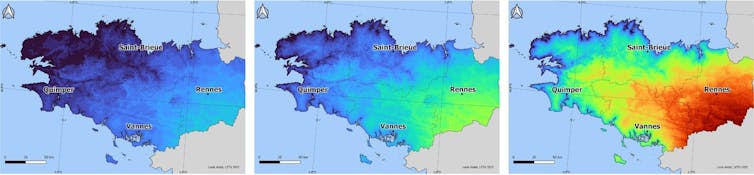
Comparación del riesgo de la enfermedad de Pierce en el noroeste de la Península Ibérica según la resolución de los datos climáticos empleados. A la izquierda, el mapa elaborado con datos de media resolución sugiere un riesgo limitado a unas pocas áreas costeras. A la derecha, el análisis con datos de alta resolución revela un panorama muy distinto: aparecen extensas zonas de riesgo a lo largo de los valles fluviales y en áreas donde se concentran los viñedos.
CC BY-NC

Estas sorpresas se concentraron sobre todo en torno a los valles fluviales. En estos paisajes, el relieve genera fuertes gradientes de altitud, y con ellos cambios bruscos de temperatura en pocos kilómetros o incluso metros. Cuando se utilizan datos de baja resolución, esas diferencias quedan ocultas en los promedios, y el riesgo real no aparece. En cambio, al trabajar con datos más detallados, se revelan áreas vulnerables que antes permanecían invisibles.

La importancia de este hallazgo es doble. Por un lado, demuestra que la resolución climática puede transformar por completo la evaluación del riesgo. Por otro, es especialmente relevante porque precisamente en esos valles suelen concentrarse muchos viñedos. Lo que parecía una falsa tranquilidad en mapas de baja resolución se convierte, al mirarse con más detalle, en un foco de vulnerabilidad para la viticultura.


Leer más:
El cambio climático está desdibujando la personalidad de los vinos


¿Que significa este descubrimiento para la viticultura?

Estos resultados tienen implicaciones inmediatas. Si los mapas de baja resolución ofrecen una falsa sensación de seguridad, confiar en ellos puede llevar a subestimar el riesgo real en regiones clave. La consecuencia es evidente: se corre el peligro de que la enfermedad de Pierce se establezca en áreas que se creían protegidas y, por tanto, menos vigiladas.

Por eso, la resolución climática deja de ser un aspecto técnico secundario y se convierte en una herramienta crítica para la gestión vitivinícola. Mapas de riesgo de alta resolución permiten identificar parcelas especialmente vulnerables, diseñar planes de vigilancia más precisos y priorizar medidas de control en las zonas con mayor exposición.

Además, este trabajo muestra que la adaptación al cambio climático no se juega solo a nivel global, sino también en la gestión del territorio a pequeña escala. Las denominaciones de origen y las autoridades agrícolas pueden usar esta información para anticipar brotes, orientar prácticas de cultivo o incluso planificar la ubicación futura de los viñedos.

Ante la amenaza de los efectos del cambio climático, donde se esperan transformaciones aún mayores en la distribución del riesgo, trabajar con el máximo detalle disponible es esencial para proteger tanto la producción como el patrimonio cultural asociado al vino.

The Conversation

Àlex Giménez Romero recibe fondos de la Agencia Española de Investigación (AEI).

Manuel A. Matias recibe fondos de la Agencia Española de Investigación (AEI) y no recibe salario, ni ejerce labores de consultoría, ni posee acciones, ni recibe financiación de ninguna compañía u organización que pueda obtener beneficio de este artículo y declara carecer de vínculos relevantes más allá del cargo académico citado.

Eduardo Moralejo Rodríguez no recibe salario, ni ejerce labores de consultoría, ni posee acciones, ni recibe financiación de ninguna compañía u organización que pueda obtener beneficio de este artículo, y ha declarado carecer de vínculos relevantes más allá del cargo académico citado.

ref. Unos pocos grados de diferencia pueden marcar la frontera entre la vida y la muerte de la vid – https://theconversation.com/unos-pocos-grados-de-diferencia-pueden-marcar-la-frontera-entre-la-vida-y-la-muerte-de-la-vid-264951

Claves para aumentar la eficacia del triptófano, aliado de nuestra salud mental

Source: The Conversation – (in Spanish) – By Beatriz Carpallo Porcar, Fisioterapeuta. Personal docente e investigador en el grado de Fisioterapia en la Universidad San Jorge. Miembro del grupo de investigación iPhysio., Universidad San Jorge

Cada vez hay más anuncios sobre suplementos de triptófano para mejorar el estado de ánimo. Es un remedio en boga contra la creciente ola de síntomas depresivos, trastornos del sueño y ansiedad. Sin embargo, su eficacia, a la luz de la evidencia científica, no siempre está garantizada.

¿Por qué es tan importante?

El triptófano es un aminoácido esencial para la producción de proteínas, la mejora de la circulación sanguínea y la regulación del sueño. Como el organismo no lo genera por sí mismo, lo tenemos que incorporar mediante el consumo de ciertos alimentos, tanto de origen animal como vegetal. Algunos de los más ricos en triptófano, según la Universidad de Navarra, son las semillas de calabaza y sésamo, la soja, el queso chédar, carnes como el pavo y el pollo, pescados como el atún y el salmón y los huevos.

En lo que se refiere a los suplementos de triptófano, se venden sin receta y es seguro su consumo, pero siempre resulta aconsejable consultar a un sanitario. Además, no se recomiendan en embarazadas, niños pequeños y personas con enfermedad renal o que tomen antidepresivos.

El viaje bioquímico del triptófano en la salud mental

Estos productos se utilizan principalmente para sintetizar serotonina y melatonina, dos neurotransmisores que regulan el estado de ánimo, el sueño y el apetito. Conocida como la “hormona del bienestar”, la serotonina está en todo el cuerpo, pero es la que se produce a nivel cerebral la que tiene efectos sobre el estado de ánimo, mejorando el humor, la concentración y el sueño.

Su principal materia prima es el triptófano, aunque sólo un 5 % de la cantidad ingerida se va a usar para este fin, después de convertirse en 5-hidroxitriptófano. Si todo va bien, el resto del aminoácido consumido se transformará en un metabolito llamado quinurenina, que a su vez pasará a ser ácido quinurénico, un potente neuroprotector.

Así pues, el triptófano contribuye tanto a la producción de serotonina como a la del ácido quinurénico, beneficiando nuestra salud emocional y neurológica. Sin embargo, la literatura científica actual no respalda su uso como suplemento en todos los casos.

La inflamación y otros obstáculos

Lo que hemos explicado antes es lo que ocurre en situaciones normales. Estudios recientes han encontrado que enfermedades como el síndrome de fatiga crónica, la Covid persistente y ciertas enfermedades neurodegenerativas o intestinales tienen alteradas las vías de conversión del triptófano.

Una clave puede estar en la llamada “inflamación de bajo grado”. A diferencia de la inflamación aguda, rápida y de corta duración, la de bajo grado es crónica y se caracteriza por niveles elevados de citoquinas inflamatorias mantenidos en el tiempo. Este tipo de inflamación está relacionado con enfermedades cardiometabólicas, autoinmunes y obesidad.

En primer lugar, en presencia de inflamación y estrés, puede disminuir el porcentaje de triptófano que se convierte en serotonina. Y a menores niveles de este neurotransmisor, más síntomas como la tristeza y la apatía.

En segundo lugar, con la inflamación se pone en marcha la molécula IDO-1. En presencia de ciertas citoquinas proinflamatorias (IL-6, IFN-gamma), la IDO-1 puede hacer que una parte de la quinurenina que debería convertirse en el beneficioso ácido quinurénico, pase a ser ácido quinolínico, un neurotóxico.

De hecho, una investigación reciente de 2023 detectó que, en pacientes con Covid persistente, la proporción entre quinurenina y triptófano era menor que en personas sanas. Y no solo eso: también encontraron una mayor conversión hacia el ácido quinolínico.

El papel decisivo de la microbiota

Otra clave que apuntan cada vez más estudios es la microbiota, esencial para transformar el triptófano y otras sustancias en metabolitos necesarios para mantener nuestra salud. Cuando nuestra comunidad de microorganismos intestinales se altera, los mecanismos “saludables” están comprometidos y pueden aparecer efectos no deseados. De hecho, conservar una microbiota sana es básica para la salud cerebral por el eje intestino-cerebro.

Investigaciones recientes han encontrado que una microbiota desequilibrada (disbiosis) puede contribuir al dolor crónico y a la depresión, debido a una alteración en los metabolitos derivados del triptófano. A nivel intestinal, este aminoácido también juega un papel importante en la regulación de procesos inmunológicos, controlando la inflamación.

En definitiva, el triptófano es un excelente neuroprotector, pero “no le gustan” los contextos con mucha inflamación y alteración de la microbiota.

Cómo ponérselo fácil al triptófano

¿Y cómo disminuimos la inflamación y mejoramos el estado de nuestros microorganismos intestinales? Antes que nada hay que consultar a un profesional sanitario, sobre todo, si sufrimos alguna patología. Como consejos generales para favorecer un estado antiinflamatorio, debemos priorizar el consumo de frutas, verduras y fuentes de grasas saludables como el aceite de oliva virgen extra, el aguacate y los frutos secos.

También es beneficioso condimentar las comidas con cúrcuma, jengibre, ajo, canela u otras especias e incluir en nuestra dieta pescado azul, ya que es muy rico en omega-3, un potente antiinflamatorio natural. Preferiblemente, optaremos por los peces de pequeño tamaño, como las sardinas, anchoas o boquerones.

Y, por último, mantener una hidratación adecuada, gestionar el estrés de manera efectiva, cuidar la salud emocional y garantizar una buena higiene del sueño son aspectos esenciales para lograr un bienestar integral.

Hay que moverse

La actividad física también desempeña un papel clave en la reducción de la inflamación sistémica. El ejercicio ayuda a disminuir la grasa corporal, siendo la grasa visceral una de las principales fuentes de inflamación. Además, incrementa los niveles de adiponectina, una hormona con propiedades antiinflamatorias que mejora la sensibilidad a la insulina y contribuye a mitigar la inflamación.

Moverse en ayunas también puede ayudar a controlarla, y el ejercicio interválico (que combina alta con baja intensidad) ha demostrado tener efectos en la reducción de la inflamación de bajo grado.

Pata finalizar, no debemos olvidar que la práctica regular de ejercicio físico influye positivamente en el estado de ánimo mediante la liberación de endorfinas y la reducción de los niveles de cortisol, lo que favorece el bienestar emocional y mental.


Paula Caro, graduada en Nutrición y Dietética por la Universidad de Zaragoza, ha colaborado en la elaboración de este artículo


The Conversation

Beatriz Carpallo Porcar no recibe salario, ni ejerce labores de consultoría, ni posee acciones, ni recibe financiación de ninguna compañía u organización que pueda obtener beneficio de este artículo, y ha declarado carecer de vínculos relevantes más allá del cargo académico citado.

ref. Claves para aumentar la eficacia del triptófano, aliado de nuestra salud mental – https://theconversation.com/claves-para-aumentar-la-eficacia-del-triptofano-aliado-de-nuestra-salud-mental-228252

Pruebas genéticas en reproducción asistida: entre las promesas de salud y el ‘marketing’ dudoso

Source: The Conversation – (in Spanish) – By Mauro Turrini, Postdoctoral research fellow, Centro de Ciencias Humanas y Sociales (CCHS – CSIC)

Proceso de fertilización in vitro. Yelena Temirgaliyeva/Shutterstock

Existen miles de enfermedades genéticas, por lo que es lógico que a muchas parejas les preocupe la posibilidad de transmitir una a su descendencia, incluso aunque ellos estén sanos. Hoy existe una tecnología que puede evitar este riesgo. Suena a ciencia ficción, pero es cada vez más común leer este tipo de mensaje en los sitios web de las clínicas privadas de fertilidad españolas.

Y es que las posibilidades tecnológicas para intervenir en la reproducción asistida son muy amplias y están avanzando rápidamente. Esto permite actuar en etapas cada vez más tempranas del proceso reproductivo.

Entre las tecnologías de reproducción asistida se encuentra la “prueba genética preimplantacional” (PGT, por sus siglas en inglés). Esta técnica consiste en analizar el material genético de un embrión antes de colocarlo en el útero. Promete así evaluar la calidad de los embriones y poder descartar los “no saludables” o “anormales”.

Cada vez más personas se enfrentan a esta decisión. La mera oferta de estas tecnologías abre espacio para reflexionar sobre nuevas formas de responsabilidad y obligación. En España, el uso del PGT se está incrementando de manera constante. En los últimos diez años su utilización ha aumentado drásticamente, pasando de 3161 en 2012 a más de 20 500 en 2022.

En realidad, el PGT abarca tres tecnologías diferentes con distintos objetivos y destinatarios:

  • El PGT-M y el PGT-SR son herramientas diagnósticas utilizadas para evitar transmitir enfermedades genéticas específicas.

  • El PGT-A se presenta como una estrategia para mejorar las tasas de éxito de la fecundación in vitro (FIV) y prevenir mutaciones cromosómicas espontáneas. Por ejemplo, el síndrome de Down.

A diferencia de las otras variantes, el PGT-A puede ofrecerse a cualquier persona que se someta a una fecundación in vitro, pero su eficacia es muy debatida. Algunos estudios indican que podría incluso reducir las tasas de éxito. Esto ocurriría al descartar embriones que podrían haber resultado en embarazos viables.

En California esta controversia acabó en una demanda colectiva contra clínicas por haber descartado embriones que habrían podido convertirse en bebés sanos.

No sorprende que, mientras que el PGT-M y el PGT-SR se practican en la mayoría de países europeos, el uso del PGT-A esté mucho más restringido. Sin embargo, en España el sector de la fertilización in vitro es ampliamente comercial y privatizado y el PGT-A es bastante común. Las clínicas privadas ofrecen este test como un servicio extra con un coste adicional, llamado un “add-on” (complemento).

Entre la divulgación y la publicidad

Estudios recientes han investigado la comunicación online de las clínicas privadas españolas. Estos han revelado un discurso a medio camino entre la divulgación médica y el mensaje publicitario.

En muchos casos no se diferencia entre el PGT-A y las otras variantes (el PGT-M y el PGT-SR). Tampoco se mencionan las incertidumbres que rodean al primero. Esto lleva a que habitualmente las tecnologías se presenten como una sola –complementaria al tratamiento de fertilización in vitro– que puede aumentar las posibilidades de éxito, identificar mutaciones hereditarias en genes específicos y detectar mutaciones espontáneas.

Otro hallazgo relevante de estos estudios es que la comercialización del PGT está dirigida directamente a las mujeres. Frases como “cumple tu sueño de ser madre”, así como hashtags como #SerMadre, #Mujer o #Maternidad se repiten a lo largo de las páginas web y redes sociales de las clínicas.

Estos discursos reproducen la idea estereotipada de que son las mujeres de quienes se espera que tomen las decisiones reproductivas.

Un ‘seguro’ frente al reloj biológico

Las clínicas insisten en que la edad materna es un motivo importante para optar por el uso del PGT. Metáforas reiteradas como la del “reloj biológico” evocan de manera insistente que el deterioro de la fertilidad femenina, asociado a la edad, constituye una de las principales causas de la aparición de embriones “defectuosos” o “en riesgo” de desarrollar mutaciones espontáneas.

Las clínicas animan a las mujeres a no dejar que “el tiempo se les eche encima” y a recurrir a las tecnologías reproductivas si no han iniciado su proceso reproductivo “a tiempo”.

En este contexto, el PGT-A se presenta como una especie de seguro de fertilidad frente al paso del tiempo. Es decir, como un acto racional, una inversión inteligente que busca reducir no solo los costes económicos, sino sobre todo el sufrimiento emocional asociado a los abortos de repetición.

A la vez, las clínicas presentan la decisión de realizar el test como un “acto de amor” hacia el futuro hijo o hija, reforzando la idea de que una buena madre previene el dolor antes de que ocurra. El embrión, denominado “el paciente más pequeño de la clínica” y tratado como una “persona en formación”, legitima la intervención precoz y sitúa a las mujeres como responsables del bienestar de sus potenciales futuros hijos.

La tecnología no es neutra

Lógicas biomédicas, económicas y afectivas se entrelazan, responsabilizando a las mujeres de optimizar sus embriones en nombre del cuidado y de gestionar racionalmente su planificación familiar. Así, el PGT se convierte en objeto de vigilancia y evaluación que contribuye a moldear qué decisiones pueden (y deben) tomar las futuras madres.

En definitiva, la proliferación de innovaciones –especialmente en un ámbito tan privatizado y comercial como la reproducción asistida en España– puede ofrecer grandes oportunidades, pero estas tecnologías no son herramientas neutrales. La forma en que se presentan y se comercializan influye en cómo entendemos la maternidad, la responsabilidad genética y el acceso a la salud.

Por eso, resulta fundamental una comunicación clara, honesta y crítica, que priorice el bienestar de quienes atraviesan estos tratamientos por encima de los intereses del mercado.

The Conversation

Mauro Turrini recibe fondos proyecto de investigación «IfGene: Proyectando el futuro de la predicción genética» (PID2020‐115899GB‐I00), financiado por el Ministerio de Ciencia e Innovación (MICIU) a través de la Agencia Estatal de Investigación (AEI) (MICIU/AEI/10.13039/501100011033), con el apoyo del Fondo Europeo de Desarrollo Regional (FEDER).

Astrid Boe Hüttel ha recibido fondos del proyecto de investigación «IfGene: Proyectando el futuro de la predicción genética» (PID2020‐115899GB‐I00), financiado por el Ministerio de Ciencia e Innovación (MICIU) a través de la Agencia Estatal de Investigación (AEI) (MICIU/AEI/10.13039/501100011033), con el apoyo del Fondo Europeo de Desarrollo Regional (FEDER).

ref. Pruebas genéticas en reproducción asistida: entre las promesas de salud y el ‘marketing’ dudoso – https://theconversation.com/pruebas-geneticas-en-reproduccion-asistida-entre-las-promesas-de-salud-y-el-marketing-dudoso-255136