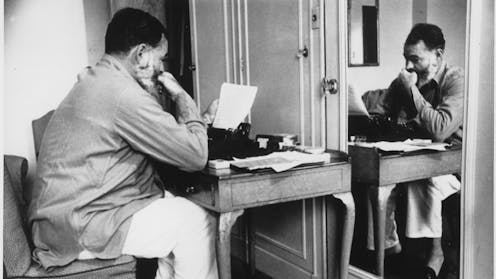
Cuentan que Hemingway paseaba por Pamplona con un cuaderno en la mano cuando venia a España a ver los Sanfermines, esa fiesta que precisamente acabamos de celebrar hace unos días. Y así, con un papel, una pluma y un buen puñado de amistades intelectualmente poderosas, convirtió la fiesta en un evento internacional y en una novela: The Sun Also Rises.
¡Con qué poco equipaje se viajaba antes y se pasaba luego a la historia! No como ahora, que no salimos de viaje sin un seguro, una maleta de cabina rígida plateada, una mochila de marca colgada a la espalda, unas sandalias con una buena suela Vibram, un teléfono móvil con una memoria infinita para cargarlo bien de fotos, una tarjeta SIM internacional y, sobre todo, una cuenta de Instagram sedienta de recibir fotos de atardeceres, pies descalzos en la arena, platos refrescantes, cócteles de colores, vistas desde ventanillas de un avión y piscinas azules, verdes o negras.
¡Cuántas cosas! Y, sobre todo, ¡cuántas cosas que dan problemas!
Al equipo de redacción de The Conversation nos encanta debatir sobre temas de actualidad. Y uno de los más recurrentes es aquel que discute si viajando se aprende más o menos que leyendo, por ejemplo. También nos preguntamos qué le ha ocurrido al mundo, que ahora viaja mucho más que antes.
Seguramente todos nosotros pensamos que somos mejores viajeros que nuestro compañero de al lado y que nuestra presencia en la Fontana de Trevi, en Roma, no estorba a otros turistas que quieren hacerse la típica foto. Porque nosotros (y seguro que usted también lo piensa de sí mismo) somos diferentes al resto.
Pues no, no lo somos. Ocupamos el mismo espacio que los demás y casi todos contaminamos viajando lo mismo que lo hace el resto de los viajeros. Queremos irnos de vacaciones y buscamos los vuelos más baratos y las plataformas de búsqueda de alojamiento con los apartamentos más asequibles, más cercanos a la playa, a un supermercado, a un restaurante y mejor valorados por otros viajeros. Sí, usted, nosotros y 1 400 millones de turistas, que fueron los que se movieron por el mundo el año pasado, 140 millones más que en 2023, según nos cuenta Rafael Cejudo, de la Universidad de Córdoba.
Hay investigaciones como esta que ponen de manifiesto el impacto positivo que la diversidad cultural puede tener en el bienestar de una persona, así que no hay dudas de que viajar es bueno para el cuerpo y para el alma.
Pero ¿qué ocurre cuando la línea aérea con la que viajamos nos deja en tierra o despega con un retraso tal que nos hace perder una noche de hotel? Bueno, es importante que se haga a la idea de que eso, si tiene que pasar, pasará. Sin embargo, puede intentar prevenir algunas consecuencias y que, al menos, estas no le arruinen las vacaciones. Estos tres expertos de la Universidad Europea nos dicen todo lo que debemos prever antes y durante nuestros días de descanso. Lo que tenga que venir después de las vacaciones ya llegará y, en todo caso, María J. García-Rubio, de la Universidad Internacional de Valencia, ya nos lo adelanta en este artículo. No deje de leerlo si quiere que la vuelta al trabajo no se le haga demasiado cuesta arriba.
Mientras tanto, olvídese de palabras como overbooking pero, si en algún momento tuviera que recordarla, sepa que la ley le asiste y que tiene sus derechos: María del Carmen Luque Jiménez, profesora de Derecho Civil de la Universidad de Málaga, nos cuenta aquí cuáles son para no tener que pasar las vacaciones en un aeropuerto.
Haga lo que haga estas vacaciones, y vaya donde vaya, no olvide que a veces no necesitamos ir demasiado lejos ni hacerlo demasiado cargados de equipaje para descansar. Recuerde cómo lo hacía Hemingway y mire qué bien le fue.
When the FIFA World Cup hits North America in June 2026, 48 teams and millions of soccer fans will be traveling to and from venues spread across the United States, Canada and Mexico.
It’s a dramatic expansion – 16 more teams will be playing than in recent years, with a jump from 64 to 104 matches. The tournament is projected to bring in over US$10 billion in revenue. But the expansion will also mean a lot more travel and other activities that contribute to climate change.
The environmental impacts of giant sporting events like the World Cup create a complex paradox for an industry grappling with its future in a warming world.
A sustainability conundrum
Sports are undeniably experiencing the effects of climate change. Rising global temperatures are putting athletes’ health at risk during summer heat waves and shortening winter sports seasons. Many of the 2026 World Cup venues often see heat waves in June and early July, when the tournament is scheduled.
Some athletes are speaking out for more sustainable choices and have called on lawmakers to take steps to limit climate-warming emissions. At the same time, the sport industry is growing and facing a constant push to increase revenue. The NCAA is also considering expanding its March Madness basketball tournaments from 68 teams currently to as many as 76.
Park Yong-woo of team Al Ain from Abu Dhabi tries to cool off during a Club World Cup match on June 26, 2025, in Washington, D.C., which was in the midst of a heat wave. Some players have raised concerns about likely high temperatures during the 2026 World Cup, with matches scheduled June 11 to July 19. AP Photo/Julia Demaree Nikhinson
Estimates for the 2026 World Cup show what large tournament expansions can mean for the climate. A report from Scientists for Global Responsibility estimates that the expanded World Cup could generate over 9 million metric tons of carbon dioxide equivalent, nearly double the average of the past four World Cups.
This massive increase – and the increase that would come if the NCAA basketball tournaments also expand – would primarily be driven by air travel as fans and players fly among event cities that are thousands of miles apart.
A lot of money is at stake, but so is the climate
Sports are big business, and adding more matches to events like the World Cup and NCAA tournaments will likely lead to larger media rights contracts and greater gate receipts from more fans attending the events, boosting revenues. These are powerful financial incentives.
In the NCAA’s case, there is another reason to consider a larger tournament: The House v. NCAA settlement opened the door for college athletic departments to share revenue with athletes, which will significantly increase costs for many college programs. More teams would mean more television revenue and, crucially, more revenue to be distributed to member NCAA institutions and their athletic conferences.
When climate promises become greenwashing
The inherent conflict between maximizing profit through growth and minimizing environmental footprint presents a dilemma for sports.
Several sport organizations have promised to reduce their impact on the climate, including signing up for initiatives like the United Nations Sports for Climate Action Framework.
However, as sports tournaments and exhibition games expand, it can become increasingly hard for sports organizations to meet their climate commitments. In some cases, groups making sustainability commitments have been accused of greenwashing, suggesting the goals are more about public relations than making genuine, measurable changes.
For example, FIFA’s early claims that it would hold a “fully carbon-neutral” World Cup in Qatar in 2022 were challenged by a group of European countries that accused soccer’s world governing body of underestimating emissions. The Swiss Fairness Commission, which monitors fairness in advertising, considered the complaints and determined that FIFA’s claims could not be substantiated.
Alessandro Bastoni, of Inter Milan and Italy’s national team, prepares to board a flight from Milan to Rome with his team. Mattia Ozbot-Inter/Inter via Getty Images
Aviation is often the biggest driver of emissions. A study that colleagues and I conducted on the NCAA men’s basketball tournament found about 80% of its emissions were connected to travel. And that was after the NCAA began using the pod system, which is designed to keep teams closer to home for the first and second rounds.
These solutions are frankly not practical, in my view, nor do they align with other positive developments. The growing popularity of women’s sports shows the challenge in limiting sports events – more games expands participation but adds to the industry’s overall footprint.
Further compounding the challenges of reducing environmental impact is the amount of fan travel, which is outside the direct control of the sports organization or event organizers.
Many fans will follow their teams long distances, especially for mega-events like the World Cup or the NCAA tournament. During the men’s World Cup in Russia in 2018, more than 840,000 fans traveled from other countries. The top countries by number of fans, after Russia, were China, the U.S., Mexico and Argentina.
There is an argument that distributed sporting events like March Madness or the World Cup can be better in some ways for local environments because they don’t overwhelm a single city. However, merely spreading the impact does not necessarily reduce it, particularly when considering the effects on climate change.
How fans can cut their environmental footprint
Sport organizations and event planners can take steps to be more sustainable and also encourage more sustainable choices among fans. Fans can reduce their environmental impact in a variety of ways. For example:
Avoid taking airplanes for shorter distances, such as between FIFA venues in Philadelphia, New York and Boston, and carpool or take Amtrak instead. Planes can be more efficient for long distances, but air travel is still a major contributing factor to emissions.
While in a host city, use mass transit or rent electric vehicles or bicycles for local travel.
Consider sustainable accommodations, such as short-term rentals that might have a smaller environmental footprint than a hotel. Or stay at a certified green hotel that makes an effort to be more efficient in its use of water and energy.
Engage in sustainable pregame and postgame activities, such as choosing local, sustainable food options, and minimize waste.
You can also pay to offset carbon emissions for attending different sporting events, much like concertgoers do when they attend musical festivals. While critics question offsets’ true environmental benefit, they do represent people’s growing awareness of their environmental footprint.
Through all these options, it’s clear that sports face a significant challenge in addressing their environmental impacts and encouraging fans to be more sustainable, while simultaneously trying to meet ambitious business and environmental targets.
In my view, a sustainable path forward will require strategic, yet genuine, commitment by the sports industry and its fans, and a willingness to prioritize long-term planetary health alongside economic gains – balancing the sport and sustainability.
Brian P. McCullough does not work for, consult, own shares in or receive funding from any company or organization that would benefit from this article, and has disclosed no relevant affiliations beyond their academic appointment.
Source: The Conversation – UK – By Tom Long, Professor of International Relations, Department of Politics and International Studies, University of Warwick
In 1867, the world’s most powerful statesmen, including Austria’s Emperor Franz Josef, France’s Napoleon III and US secretary of state, William H. Seward, petitioned the Mexican government to spare the life of a condemned man.
Mexico’s ragtag army and militias had just humbled France, then Europe’s preeminent land power. The costly six-year campaign drained the French treasury and eroded Napoleon III’s domestic support. Napoleon’s ambition to transform Mexico into a client empire under a Vienna-born, Habsburg archduke, crowned Maximilian I, ended in spectacular failure.
After his defeat, Maximilian was brought before a Mexican military tribunal. European monarchs regarded the prisoner as their peer, but Mexican liberals convicted him as a piratical invader, usurper and traitor. Despite indignant appeals from European courts, President Benito Juárez refused to commute his sentence. The would-be emperor was executed by firing squad.
Get your news from actual experts, straight to your inbox.Sign up to our daily newsletter to receive all The Conversation UK’s latest coverage of news and research, from politics and business to the arts and sciences.
The controversy went beyond one monarch’s fate. It crystallised a clash between opposed visions of global order — as Peru’s president Ramón Castilla said at the time, it was a “war of the crowns against liberty caps”.
Today, world politics are in flux. The so-called liberal international order, nominally grounded in multilateralism, open markets, human rights and the rule of law, is facing its gravest crisis since the second world war. Former advocates such as the United States now openly flout international law and undermine the very norms they once championed. China remains ambivalent, while Russia unabashedly hastens the order’s unravelling.
More broadly, the old post-second world war order appears out of step with the global south and with widespread anger over double standards exposed by the wars in Ukraine, Gaza and Iran.
Amid today’s crises, a world order arranged for and by the great powers looks both insufficient and doomed to lack legitimacy. Reordering will require support from diverse actors, including states across the global south.
1860s: a turbulent decade
The 1860s were a turbulent, although often overlooked, moment of global reordering. Technological shifts – the telegraph, electricity, steamships and railways – appeared as disruptive then as AI does today. Combined with shifting power dynamics, these transformations accelerated imperial expansion. Yet the rules of the emerging order remained uncertain, even among the imperial powers themselves.
In Europe, networks of dynastic rule still carried weight in international politics. Under growing pressure, the ancien régime sought to reinvent and reassert itself. The old empires often justified their expansion by promising to bring order and progress to supposedly backward peoples. But that “civilising mission” clashed with a worldview emerging from Spanish America – where countries had thrown off colonial rule to establish independent republics.
As we wrote in a recent article in American Political Science Review, Spanish American diplomats articulated a republican vision of international order centred on the protection of weaker states from domination by great powers.
Fending off Europe’s empires
Divided by civil conflict, Mexico became an easy target for European empires. Mexico’s Liberal party had regained power but faced internal dissent and crippling foreign debt. Britain, France and Spain formed a coalition to invade and demand repayment. France, however, had more ambitious designs.
Exploiting the distraction of the US civil war, Napoleon III dreamed of transforming Mexico into a Latin stronghold against Yankee expansion. Best of all, Napoleon thought the scheme would turn a profit. A stable Mexican empire could repay the costs of the intervention – with interest – by increasing production from the country’s famed silver mines. Meanwhile, France would gain a receptive market for its exports and a grateful geopolitical subordinate.
Maximilian, a young Austrian prince of the house of Hapsburg, somewhat naively accepted the offer to rule a distant and unfamiliar land. He dreamed of regenerating Mexico through a liberal monarchy while reviving his family’s declining dynasty.
Led by Juárez, Mexico’s liberals fiercely resisted Maximilian’s rule. While militarily Juárez was consistently on the defensive, he remained diplomatically proactive. The Juaristas encouraged US sympathies that proved decisive after the end of the civil war. They also enjoyed solidarity – though limited material support – from other Spanish American republics. Although the monarchies of Europe all recognised Maximilian as Mexican emperor, Juárez’s defiance became a rallying point for liberals and republicans in Europe.
Beyond stoking sympathies, Juárez and his followers offered trenchant critiques of unequal international rules and practices cloaked in liberal guise.
First, the “republican internationalism” of Mexico’s Juaristas stood in direct opposition to European liberals’ “civilising mission”. Latin American republicans rejected the notion that progress could be imposed on their countries from abroad – though some echoed civilising rhetoric toward their own non-white populations, who like in the US were subject to campaigns of violence and dispossession that stretched from northern Mexico to the Patagonia. Many Latin American liberals likewise remained silent about empire elsewhere.
Second, the Juarista vision placed popular sovereignty, not dynastic ties, at the heart of legitimate statehood. These ideas drew on Mexico’s independence tradition and the principles enshrined in the 1857 constitution. European intervention, in this view, aimed to suppress popular rule in the Americas and extend the reaction against the failed revolutions of 1848, which had seriously threatened the old order when they raged across Europe.
Third, popular sovereign states were equal under international law, regardless of power, wealth, or internal disorder. Sovereign equality also underpinned Latin America’s strong commitment to non-intervention. Liberal writer and diplomat Francisco Zarco, a close confidante of Juárez, condemned frequent European economic justifications for intervention as the work of “smugglers and profiteers who wrap themselves in the flags of powerful nations”.
Finally, Mexican liberals called for an international system premised on republican fraternity, drawing on aspirations for cooperation that went back to liberator Simón Bolívar. The independence leader and committed republican convened a conference in 1826, hoping that a confederation of the newly independent Spanish American states would “be the shield of our new destiny”.
Similar arguments for an international order that advances non-domination still resonate in the global south today. The Mexican experience also underscores that the architects of international order have never come exclusively from the global north – and those who shape its future will not either.
Tom Long receives support from UK Arts and Humanities Research Council grant AH/V006622/1, Latin America and the peripheral origins of the 19th-century international order.
Carsten-Andreas Schulz receives support from UK Arts and Humanities Research Council grant AH/V006622/1, Latin America and the peripheral origins of the 19th-century international order.
Source: The Conversation – UK – By Shelley Galpin, Lecturer in Culture, Media and Creative Industries, King’s College London
In my former life as a teacher, I once had a job interview in which I was asked how I dealt with the problem of teaching Jane Austen to boys.
Having had experience of this situation, I confidently told my interviewer (a maths teacher) that the “problem” they were assuming didn’t actually exist, and that it was perfectly possible to teach Austen’s novels to mixed-sex classes with successful results. My answer was met by barely veiled scepticism – and suffice to say, I didn’t get the job.
But where did this popular perception come from? Austen’s genius has been recognised from the earliest days of the development of a canon of English literature, and has never really fallen out of fashion. So it might seem odd that the suitability of her work for a co-educational class is the subject of genuine debate.
This article is part of a series commemorating the 250th anniversary of Jane Austen’s birth. Despite having published only six books, she is one of the best-known authors in history. These articles explore the legacy and life of this incredible writer.
The increasingly intertwined associations of Austen’s literature with the many (often excellent) adaptations of her work may not help the matter, with screen retellings often foregrounding the love stories and losing much of the ironic tone that characterises Austen’s narrative style.
The myriad repackaged editions of her novels that adorn bookshelves with pastel-toned floral designs, or images of anonymous portraits of passive young women, also do little to challenge the popular perception of these books as stories for women and girls.
Finally, and perhaps most troublingly, is the still-commonly held notion that stories with a female protagonist do not have wide-ranging appeal and must be consigned to a “niche interest” bracket. Male-led stories, in contrast, have long been considered to hold universal relevance for audiences.
This last point is a bigger issue concerning the publishing and entertainment industries, so I will largely park this one. But I will point out that, as others have argued in relation to Austen’s work, the classroom is an excellent place to start countering the assumptions of the “everyman” male experience, in contrast to the “special interest” attitude to female perspectives.
With regards to the teaching of Austen’s novels, drawing on my experiences both as a scholar and as a teacher, I believe her novels can speak to young readers of different genders and from diverse backgrounds.
Money, power and inequality
Addressing the ways in which Austen’s novels tend to be packaged, I asked my students, typically aged 16-18, to explore the ideas at the heart of the novels by redesigning the book covers to better reflect these themes.
The flowers and passive young women were gone. The redesigned book covers often focused on the idea of wealth, through pictures of differing piles of money, or power, such as the image of imbalanced scales to symbolise the unequal societies inhabited by Austen’s characters.
Because, as much as they are love stories, Austen’s heroines typically achieve their “happy endings” against a backdrop of money worries, power struggles, familial tension and gendered social hierarchies. While her novels are rightly celebrated for highlighting the unequal treatment of the sexes during her lifetime, it is reductive to see this as their sole contribution to social commentary.
Take Austen’s last completed novel, Persuasion. Here, Anne Elliot – over the hill at the ripe old age of 27 – begins the novel by rueing her broken engagement to Captain Wentworth, which she had been persuaded to break off eight years earlier due to his lack of fortune.
While the narrative focus is on Anne, who is left to regret her choice and wonder whether she will ever be able to escape her odious father and siblings, the broken-hearted Wentworth, who reappears in Anne’s life shortly after the start of the novel, is at least as much a victim of the situation as Anne herself.
At its heart, this is a story of a young woman who allowed herself to be persuaded to make a bad choice, and a young man who, through no fault of his own, was deemed not good enough due to his lack of wealth. The experiences of these characters, although they are older than the average school student, are highly relatable and sympathetic to many teenagers, who may well have experienced meddling family members or unfair judgments of their own.
Take also Northanger Abbey, in which fanciful Catherine Morland mixes fact and fiction and imagines the titular abbey to be a site of gothic intrigue, only to discover that the real horror derives from a controlling patriarch and his sexually predatory oldest son.
Here again, the novel cleverly makes the point that social inequalities, and the choices of those motivated by their love of money and power, are the real darkness at the heart of Austen’s society.
In my experience, students of all genders have been able to appreciate and relate to Northanger Abbey’s depictions of the loss of innocence, class inequality, and the experience of being subject to the sometimes obscure decisions of more powerful individuals.
Austen’s works, far from being the simple love stories of popular perception, are also razor-sharp satires of social and gendered inequalities. Full of witty observations and universally relatable experiences, there is a reason for the consistent popularity of her writing 250 years after her birth.
To fail to recognise this in the classroom is to do a disservice to all our students, as well as to Austen herself.
Shelley Galpin does not work for, consult, own shares in or receive funding from any company or organisation that would benefit from this article, and has disclosed no relevant affiliations beyond their academic appointment.
Summer is synonymous with adventure, with millions flocking to exotic destinations to experience different cultures, cuisines and landscapes. But what happens when the souvenir you bring back isn’t a fridge magnet or a tea towel, but a new illness?
International travel poses a risk of catching something more than a run-of-the-mill bug, so it’s important to be vigilant for the telltale symptoms. Here are the main ones to look out for while away and when you return.
Get your news from actual experts, straight to your inbox.Sign up to our daily newsletter to receive all The Conversation UK’s latest coverage of news and research, from politics and business to the arts and sciences.
Fever
Fever is a common symptom to note after international travel – especially to tropical or subtropical regions. While a feature of many different illnesses, it can be the first sign of an infection – sometimes a serious one.
One of the most well-known travel-related illnesses linked to fever is malaria. Spread by mosquito bites in endemic regions, malaria is a protozoal infection that often begins with flu-like symptoms, such as headache and muscle aches, progressing to severe fever, sweating and shaking chills.
Other signs can include jaundice (yellowing of the skin or eyes), swollen lymph nodes, rashes and abdominal pain – though symptoms vary widely and can mimic many other illnesses.
Prompt medical attention is essential. Malaria is serious and can become life threatening. It’s also worth noting that symptoms may not appear until weeks or even months after returning home. In the UK, there are around 2,000 imported malaria cases each year.
Travellers to at-risk areas are strongly advised to take preventative measures. This includes mosquito-bite avoidance as well as prescribed antimalarial medications, such as Malarone and doxycycline. Although these drugs aren’t 100% effective, they significantly reduce the risk of infection.
Aside from malaria, other mosquito-borne diseases can cause fever. Dengue fever, a viral infection found in tropical and subtropical regions, leads to symptoms including high temperatures, intense headaches, body aches and rashes, which overlap with both malaria and other common viral illnesses.
Most people recover with rest, fluids and paracetamol, but in some instances, dengue can become severe and requires emergency hospital treatment. A vaccine is also available – but is only recommended for people who have had dengue before, as it provides good protection in this group.
Any fever after international travel should be taken seriously. Don’t brush it off as something you’ve just picked up on the plane – please see a doctor. A simple test could lead to early diagnosis and might save your life.
Few travel-related issues are as common – or as unwelcome – as diarrhoea. It’s estimated that up to six in ten travellers will experience at least one episode during or shortly after their trip. For some, it’s an unpleasant disruption mid-holiday; for others, symptoms emerge once they’re back home.
Traveller’s diarrhoea is typically caused by eating food or drinking water containing certain microbes (bacteria, viruses, parasites) or their toxins. Identifying the more serious culprits early is essential – especially when symptoms go beyond mild discomfort.
Warning signs to look out for include large volumes of watery diarrhoea, visible blood in the stool or explosive bowel movements. These may suggest a more serious infection, such as giardia, cholera or amoebic dysentery.
These conditions are more common in regions with poor sanitation and are especially prevalent in parts of the tropics.
Some infections may require targeted antibiotics or antiparasitic treatment. But regardless of the cause, the biggest immediate risk with any severe diarrhoea is dehydration from copious fluid loss. In serious cases, hospital admission for intravenous fluids may be necessary.
The key message for returning travellers: if diarrhoea is severe, persistent or accompanied by worrying symptoms, see a doctor. What starts as a nuisance could quickly escalate without the right care.
And if you have blood in your stool, make sure you seek medical advice.
Jaundice
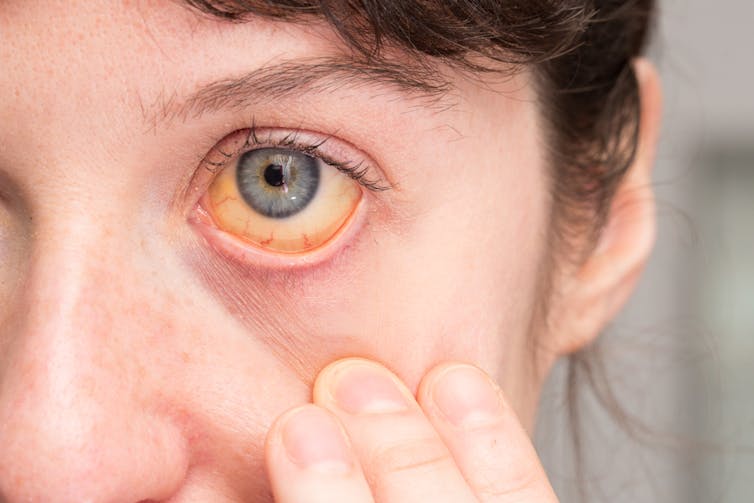
If you’ve returned from a trip with a change in skin tone, it may not just be a suntan. A yellowish tint to the skin – or more noticeably, the whites of the eyes – could be a sign of jaundice, another finding that warrants medical attention.
Jaundice is not a disease itself, but a visible sign that something may be wrong with either the liver or blood. It results from a buildup of bilirubin, a yellow pigment that forms when red blood cells break down, and which is then processed by the liver.
Several travel-related illnesses can cause jaundice. Malaria is one culprit as is the mosquito-borne yellow fever. But another common cause is hepatitis – inflammation of the liver.
Viral hepatitis comes in several forms. Hepatitis A and E are spread via contaminated food or water – common in areas with poor sanitation. In contrast, hepatitis B and C are blood-borne, transmitted through intravenous drug use, contaminated medical equipment or unprotected sex.
Besides jaundice, hepatitis can cause a range of symptoms, including fever, nausea, fatigue, vomiting and abdominal discomfort. A diagnosis typically requires blood tests, both to confirm hepatitis and to rule out other causes. While many instances of hepatitis are viral, not all are, and treatment depends on the underlying cause.
As we’ve seen, a variety of unpleasant medical conditions can affect the unlucky traveller. But we’ve also seen that the associated symptoms are rather non-specific. Indeed, some can be caused by conditions that are short-lived and require only rest and recuperation to get over a rough few days. But the area between them is decidedly grey.
So plan your trip carefully, be wary of high-risk activities while abroad – such as taking drugs or having unprotected sex – and stay alert to symptoms that develop during or after travel. If you feel unwell, don’t ignore it. Seek medical attention promptly to identify the cause and begin appropriate treatment.
Dan Baumgardt does not work for, consult, own shares in or receive funding from any company or organisation that would benefit from this article, and has disclosed no relevant affiliations beyond their academic appointment.
Our new study presents analysis of the UK-wide trends for three major pollutants – nitrogen dioxide (NO₂), ozone (O₃) and tiny particulate matter known as PM₂.₅ – between 2015 and 2024 to calculate how often air quality targets were breached.
Both nitrogen dioxide and PM₂.₅ showed robust decreases over the period 2015-2024, declining on average by 35% and 30% respectively. In 2015-2016, the average Defra monitoring site exceeded the nitrogen dioxide target on 136 days per year. By 2023-2024, this had dropped to 40 days per year.
For PM₂.₅, the number of days the average Defra site breached the target went from 40 to 22 days per year. While this is an improvement, the World Health Organization advises that these targets should not be breached on more than four days per year.
Get your news from actual experts, straight to your inbox.Sign up to our daily newsletter to receive all The Conversation UK’s latest coverage of news and research, from politics and business to the arts and sciences.
To examine the sources of pollution, we studied how pollutants were influenced by factors including time of day, day of week, wind direction and origin, location of monitoring station and even interactions between pollutant. Nitrogen dioxide concentrations are highest at monitoring sites located next to busy urban roads, lower at urban background sites (which are located at sites further from traffic such as parks) and much lower in rural sites.
Profiles over 24-hour periods show strong nitrogen dioxide peaks coinciding with the morning and evening rush hours and clear decreases at weekends. This all points to local traffic emissions being the major source. While PM₂.₅ is also higher in urban than rural locations, it exhibits more muted rush hour peaks and is more consistent between the week and weekend, suggesting traffic plays a smaller role.
We explored how wind direction and origin influenced nitrogen dioxide and PM₂.₅ by running a weather forecast model backwards for three UK locations: Reading, Sheffield and Glasgow. While nitrogen dioxide showed only a weak correlation with wind origin, PM₂.₅ was much more dependent.
For example, the probability of PM₂.₅ breaching air quality targets on a given day exceeded 15% only when the air had come from continental Europe and, for Sheffield and Glasgow, passed over much of the UK too.
NO₂ and PM₂.₅ pollution reduced over the last decade but remains too high while O₃ pollution has worsened. James Weber, CC BY
While nitrogen dioxide and PM₂.₅ showed clear improvements, ozone exhibited a less positive picture. Ozone increased in 115 of the 121 sites considered, growing by 17% on average. A similar trend was observed across much of northern Europe. The average number of days ozone exceeded the World Health Organization target doubled from seven to 14 per year.
This may seem modest at present, but several factors are conspiring to drive ozone higher. In much of the UK, the relatively high levels of nitrogen dioxide effectively suppress ozone: as a result, ozone is higher in rural rather than urban areas and, as nitrogen dioxide decreases, ozone will increase further.
Unless, that is, we also target nitrogen dioxide’s partner in crime, volatile organic compounds (VOCs). VOCs are critical to the production of ozone and are emitted from human sources such as traffic and industry, plus certain types of vegetation like oak trees. While emissions of nitrogen dioxide fell by 20% between 2015-2024, human-driven VOC emissions declined by only 1%.
Ozone also increases in periods of hot weather due to elevated VOC emissions from vegetation and greater mixing of air from higher up in the atmosphere into the layer closest to the surface. Incidents of hot weather are only going to become more frequent in the UK, making it even more critical to crack down on human-driven VOC emissions to limit ozone pollution.
Up in the air
In the UK, considerable efforts have been made to improve air quality. Its importance has been enshrined in law for nearly 70 years. An extensive network of air quality monitoring sites is maintained by the UK government’s Department for Environment, Food and Rural Affairs (Defra) plus devolved and local authorities.
Local authorities are required to monitor air quality and develop air quality management areas in places where targets are unlikely to be met. Clean air or low emission zones have been introduced as a result.
However, air quality policy must be designed to reflect the complex nature of each pollutants’ drivers. Nitrogen dioxide is dominated by local sources, PM₂.₅ by transport from further afield and ozone by a combination of both.
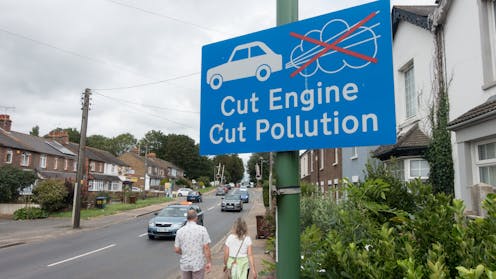
Local and national policies that cut traffic emissions by incentivising the replacement of older cars with newer, cleaner vehicles, retrofitting buses and restricting entry of the most polluting vehicles into towns and cities will probably reduce nitrogen dioxide further.
But, if nitrogen dioxide decreases are not accompanied by reductions to VOC emissions, locally and internationally, ozone will continue to rise, especially with more frequent hot weather.
By contrast, most PM₂.₅ comes from sources further afield, including industry and agriculture from other parts of the UK and beyond, so reductions hinge on stronger national and global policies that target emissions at source rather than just local efforts.
Air pollution doesn’t respect borders and while the technologies to facilitate continued improvements exist, they must be deployed in joined-up, international efforts.
Don’t have time to read about climate change as much as you’d like?
James Weber does not work for, consult, own shares in or receive funding from any company or organisation that would benefit from this article, and has disclosed no relevant affiliations beyond their academic appointment.
Source: The Conversation – in French – By Paula Cordova Alegre, Personal docente – investigador en los grados de fisioterapia y enfermería de la Universidad San Jorge, Universidad San Jorge
Les adolescents qui pratiquent un sport régulièrement sont moins sujets aux troubles de santé mentale que ceux qui sont sédentaires.BAZA Production/Shutterstock
Pensées suicidaires, addictions, troubles alimentaires, anxieux ou dépressifs… en matière de santé mentale, l’adolescence est une période à risque. Une tendance encore aggravée par certains facteurs socio-économiques et par une actualité anxiogène. Pour lutter contre leur apparition à la puberté, l’activité physique peut avoir un rôle à jouer.
L’adolescence est une période essentielle et déterminante de notre développement. Durant cette phase, les adolescents traversent de nombreux bouleversements qui affectent non seulement leur corps et leurs émotions, mais aussi leurs relations sociales.
Cette étape de construction identitaire peut s’avérer particulièrement éprouvante, en raison notamment de l’exposition accrue aux pressions extérieures auxquelles sont exposés les jeunes en quête d’autonomie. En l’absence de ressources adaptées, les adolescents peuvent être victimes d’un déséquilibre émotionnel qui accroît le risque de troubles mentaux.
Selon l’Organisation mondiale de la santé (OMS), un jeune de 10 à 19 ans sur sept souffre de tels troubles, soit 15 % des 1 300 millions d’adolescents qui vivent aujourd’hui sur notre planète. Ce qui représente environ un sixième de la population mondiale… Au sein de ce groupe d’âge, les troubles mentaux figurent parmi les principales causes de maladie et d’invalidité.
Adopter une bonne hygiène de vie pour se protéger des troubles mentaux
La dépression et l’anxiété semblent être les affections les plus répandues chez les adolescents. Ces deux troubles partagent certains symptômes et, dans bien des cas, se traitent selon des approches similaires. Psychothérapies et traitements pharmacologiques se sont révélés des outils efficaces pour les prendre en charge.
Pour prévenir leur survenue, les habitudes de vie jouent un rôle déterminant. Les recommandations en matière de santé mentale insistent notamment sur le fait d’éviter de consommer alcool, tabac et autres drogues. Cultiver un environnement social sain et pratiquer une activité physique régulière font également partie des conseils à suivre. L’Organisation mondiale de la santé et d’autres instances internationales soulignent régulièrement les effets bénéfiques de l’exercice, qui permet de renforcer le bien-être physique, psychologique et social.
Néanmoins, ces préconisations sont ignorées par une grande partie de la population mondiale, et notamment par les plus jeunes. Entre 2016 et 2022, plus de 80 % des jeunes de 11 à 17 ans n’ont pas atteint l’objectif des soixantes minutes quotidiennes d’activité physique modérée à soutenue.
Au cours de l’adolescence, nombre de comportements évoluent. On constate notamment que la pratique du sport et de l’activité physique par les élèves diminue nettement lorsqu’ils passent dans l’enseignement secondaire.
Bouger régulièrement ne fortifie pas seulement le corps : cela protège également l’esprit. On estime que chez les adolescents actifs, le risque de présenter des symptômes dépressifs est réduit de 20 % à 30 % par rapport à celui encouru par leurs homologues sédentaires.
2. Plus le niveau d’activité physique et de performance est élevé, moins les symptômes sont marqués
L’effet bénéfique du sport sur la santé mentale dépend non seulement de sa pratique, mais aussi de son intensité et de la façon de le pratiquer. Les adolescents inactifs ont jusqu’à quatre fois plus de risques de souffrir de symptômes dépressifs modérés que des sportifs de haut niveau. Les jeunes qui s’entraînent plusieurs heures par semaine et qui participent à des compétitions, notamment nationales ou internationales, affichent un meilleur état d’esprit et présentent des niveaux d’anxiété réduits. Si le type de sport importe peu, l’engagement et la régularité s’avèrent déterminants.
Plus le mode de vie sportif d’un adolescent est structuré et motivant, plus les retombées positives sur sa santé mentale sont importantes, surtout lorsque le sport fait partie intégrante de son quotidien.
3. Les adolescentes en souffrent davantage
Les filles tendent à présenter plus de symptômes d’anxiété et de dépression que les garçons, particulièrement à mesure qu’elles avancent dans l’adolescence et la puberté.
Cet écart se creuse à partir de 14–15 ans. Selon certaines études, les adolescentes ont un risque de manifester des symptômes dépressifs 50 % à 70 % plus élevé que leurs homologues masculins.
Les causes de cette situation plongent leurs racines dans les changements hormonaux, sociaux et culturels qui surviennent à cette période. Les fluctuations d’œstrogènes, la pression esthétique accrue, la comparaison sur les réseaux sociaux, le harcèlement scolaire et une moindre perception des compétences physiques renforcent cette vulnérabilité émotionnelle.
On observe également que les adolescentes ont tendance à s’enfermer dans des pensées négatives, répétant indéfiniment leurs préoccupations dans un mode de pensée dit « de rumination », ce qui peut exacerber les symptômes anxieux et dépressifs.
Il est donc primordial d’encourager la pratique sportive chez les adolescentes, afin qu’elles se sentent en confiance, soutenues et motivées au sein d’environnements positifs et bienveillants.
4. Des bénéfices durables
Enfin, au-delà des effets immédiats, une revue de littérature récente suggère que les filles et les garçons pratiquant des activités physiques en loisir durant l’enfance et l’adolescence pourraient bénéficier, sur le long terme, d’avantages comportementaux et sanitaires.
Au regard de ces éléments, les autorités, les entraîneurs, les proches des adolescents et les jeunes eux-mêmes devraient prendre conscience des bénéfices qu’ils peuvent tirer de la pratique régulière d’une activité physique soutenue. Promouvoir le sport, qui protège et améliore tant le corps que l’esprit, est indispensable pour se forger une jeunesse plus saine et équilibrée, clé d’un futur à l’identique.
Les auteurs ne travaillent pas, ne conseillent pas, ne possèdent pas de parts, ne reçoivent pas de fonds d’une organisation qui pourrait tirer profit de cet article, et n’ont déclaré aucune autre affiliation que leur organisme de recherche.
Il ne fait plus guère de doute aujourd’hui qu’un usage immodéré et non encadré des écrans a des effets délétères sur le développement des jeunes enfants. Toutefois, les conséquences de l’exposition aux smartphones, tablettes et autres télévisions ne dépendent pas seulement du temps passé devant, mais aussi du contexte d’utilisation et du contenu consulté.
Les écrans occupent désormais une place prépondérante dans nos modes de vie. Ces dernières années, le débat sur les conséquences de l’exposition des tout-petits à leur influence s’est intensifié, tant dans les communautés éducatives et thérapeutiques qu’au sein des familles.
Que sait-on de l’impact réel du temps d’écran sur le développement neuropsychologique des plus jeunes ? Nombre de sociétés savantes et d’associations spécialisées en pédiatrie recommandent de limiter l’usage des écrans durant l’enfance, en particulier chez les moins de 5 ans. Cependant, les recherches révèlent une réalité moins binaire que ce que l’on pourrait imaginer.
En effet, tant le contexte d’utilisation que le contenu consulté conditionnent les effets sur le développement que peut avoir le temps passé devant un écran. Faisons le point.
Des conséquences physiologiques et neuropsychologiques
En outre, la technologie ne peut ni ne doit se substituer aux jeux, à l’activité physique, au contact avec la nature ou aux interactions avec ses semblables, bref aux stimulations auxquelles sont soumis les enfants au sein de leur environnement.
Au-delà de ces effets, les inquiétudes concernent aussi les répercussions sur des fonctions telles que l’attention, le langage ou le contrôle émotionnel.
Une revue de littérature portant sur 102 études menées sur des enfants de moins de 3 ans révèle qu’il importe non seulement de surveiller le temps d’écran, mais surtout la façon dont celui-ci est utilisé, et dans quelles conditions. Ainsi, la présence d’un adulte qui commente ou interagit avec le contenu favorise l’apprentissage et l’attention. En revanche, une exposition passive ou non encadrée constitue un risque pour le développement cognitif de l’enfant.
En définitive, il ressort de ces observations que tablettes, téléphones et autres télévisions peuvent devenir des outils d’apprentissage, à condition d’être employés dans un but éducatif et sous supervision. Autrement, ils risquent de restreindre les interactions sociales, si indispensables au cerveau en développement.
Le véritable enjeu : l’âge et les contenus inappropriés
On pourrait donc affirmer que le principal risque n’est pas dû à l’écran en tant que tel, mais à ce qu’il diffuse. L’exposition précoce à un contenu inadapté est associée à des difficultés d’attention et à de moins bonnes performances des fonctions exécutives, en particulier en ce qui concerne le contrôle inhibiteur (essentiel à la régulation du comportement et de la cognition), ainsi qu’à des retards de langage.
Certes, les études n’établissent pas de liens de causalité directs avec l’exposition aux écrans. Elles révèlent néanmoins que des niveaux élevés de consommation non sélective de télévision, d’ordinateur, de téléphone ou de tablette chez les très jeunes enfants (3 ans environ) s’accompagnent non seulement d’un moindre contrôle inhibiteur, mais aussi d’une moindre activation cérébrale dans les zones concernées (le cortex préfrontal).
La simple consultation passive de plateformes de vidéos telles que YouTube peut elle aussi nuire aux tout-petits. Les enfants de 2 à 3 ans qui y ont été les plus exposés manifestent un moindre développement linguistique, un effet attribué à la réduction de leurs interactions sociales.
Enfin, l’utilisation de vidéos et de médias numériques, dans un contexte d’interactions familiales, a permis d’améliorer le développement linguistique chez des enfants de 2 ans à 4 ans présentant un retard de langage.
La solution : technologie, mouvement et interactions sociales ?
Malgré les bénéfices mentionnés précédemment, il faut garder à l’esprit que les écrans ne sauraient remplacer les activités ludiques non dirigées, l’activité physique et les interactions sociales.
Cela étant dit, une récente revue de littérature consacrée à la tranche d’âge 4-12 ans a conclu que la technologie peut jouer un rôle positif lorsqu’elle est utilisée dans le bon contexte, en étant orientée vers des jeux qui engagent l’activité physique et les relations avec les autres.
Il peut s’agir par exemple de recourir à des « objets intelligents », tels qu’un ballon enregistrant les tirs réussis ou une balançoire dotée de capteurs distribuant des récompenses virtuelles, ou de mettre en place des « jeux pervasifs », autrement dit des jeux qui, en recourant à de nouvelles technologies (GPS, réalité augmentée, etc.), créent une expérience ludique combinant des éléments appartenant aux deux mondes, réel et virtuel.
En définitive, la technologie peut constituer un levier pour inciter les enfants à bouger, à explorer et à socialiser, à condition d’être employée dans une perspective pédagogique.
Les recommandations des experts
À la lumière des atouts et des limites des écrans en matière de développement des enfants, voici divers collèges d’experts ont formulé des recommandations.
L’Académie américaine de pédiatrie recommande d’éviter les écrans chez les moins de 18 mois (à l’exception des appels vidéo). Pour les 18-24 mois, seuls les contenus de qualité, toujours consultés en compagnie d’un adulte, sont préconisés. Entre 2 ans et 5 ans, une heure quotidienne d’écrans maximum, et avec des contenus éducatifs. Elle préconise enfin d’éviter les écrans avant le coucher, de les utiliser comme outils pédagogiques – non comme simples distractions – et recommande aux adultes de donner l’exemple, en veillant à avoir eux-mêmes une utilisation saine des technologies numériques.
L’Organisation mondiale de la santé conseille quant à elle de limiter le temps d’écrans à une heure par jour pour les 2-4 ans, et à deux heures par jour pour les 5-17 ans.
Affirmer que les écrans sont « néfastes » par eux-mêmes serait aussi étrange que de considérer que le papier est dangereux, car il peut servir à imprimer n’importe quel type de livres, y compris des ouvrages peu recommandables. Ce qui compte, ce n’est pas le support, mais le contenu, le contexte et la qualité de l’interaction avec le média.
Le défi à relever en ce qui concerne les écrans consiste à trouver l’équilibre, à respecter les étapes de développement des enfants, et à parvenir à faire de la technologie une alliée – non un substitut aux jeux, aux interactions et aux expérimentations dans le monde physique.
Teresa Rossignoli Palomeque ne travaille pas, ne conseille pas, ne possède pas de parts, ne reçoit pas de fonds d’une organisation qui pourrait tirer profit de cet article, et n’a déclaré aucune autre affiliation que son organisme de recherche.
Il y a dix ans, le monde s’est engagé à maintenir le réchauffement climatique bien en dessous de 2 °C (et si possible à moins de 1,5 °C) par rapport à l’ère préindustrielle. Pour y parvenir, les pays devaient réduire considérablement les émissions de gaz à effet de serre d’ici 2030 et mettre fin à toutes les émissions de gaz à effet de serre d’origine humaine d’ici 2050. C’est à ce moment-là que 195 pays ont signé l’Accord de Paris, le traité mondial juridiquement contraignant sur le climat.
Dix ans plus tard, cependant, la crise climatique est plus urgente que jamais. Selon les Nations unies :
La première période de 12 mois a dépassé en moyenne 1,5 °C. Cette période s’étendait de février 2023 à janvier 2024, à cause du phénomène El Niño. Pendant cette période, la température moyenne mondiale était estimée à 1,52 °C au-dessus du niveau entre 1850 et 1900.
Il existe un décalage entre les politiques annoncées et les pratiques réelles, et nous avons voulu en comprendre les raisons.
Nous sommes des chercheurs en médias et communication spécialisés dans la communication environnementale. Récemment, nous avons rejoint une équipe de 14 chercheurs qui ont enquêté sur la désinformation relative au changement climatique pour le Panel international sur l’environnement informentionnel.
Notre équipe a réalisé l’étude la plus complète à ce jour sur la recherche scientifique relative à la mésinformation et la désinformation en matière de climat. La mésinformation climatique consiste à faire des déclarations erronées sur le changement climatique et à diffuser des informations incorrectes. La désinformation climatique consiste à diffuser délibérément de fausses informations. Par exemple certaines entreprises font du “greenwashing” (écoblanchiment, verdissage): elles prétendent à tort que leurs produits sont écologiques pour mieux les vendre.
Nous avons examiné 300 études publiées entre 2015 et 2025, toutes axées sur la désinformation climatique. Notre étude montre que la réponse humaine à la crise climatique est entravée et retardée par la production et la diffusion d’informations trompeuses.
Nous avons identifié les principaux responsables : des acteurs puissants, notamment les compagnies pétrolières, des partis populistes, ou même certains États.
Pourtant, les citoyens ont besoin d’informations fiables sur le climat.
C’est indispensable pour pouvoir agir et limiter le réchauffement.
Sans une information juste, nous ne pourrons pas faire les bons choix, ni pour notre avenir, ni pour la planète.
Comment nous avons identifié ceux qui manipulent l’opinion
Depuis des décennies, la science du climat documente l’aggravation de la crise climatique et les solutions pour y remédier. Les Nations unies affirment que l’accès à l’information sur le changement climatique est un droit humain. Elle a même défini un ensemble de principes mondiaux visant à garantir l’intégrité des informations accessibles au public sur le changement climatique.
Pourtant, notre étude montre que des informations trompeuses aggravent la crise climatique.
Notre étude s’est penchée sur cinq questions simples : qui dit quoi, sur quel canal, à qui et avec quels effets ?
Voici ce que nous avons découvert :
Qui ? : Les principaux responsables de la désinformation sur le climat sont de puissants acteurs économiques et politiques. Il s’agit des entreprises du secteur des énergies fossiles, des partis politiques, des gouvernements et certains États. Ils forment des alliances opaques, sans contrôle public, avec des think tanks bien financés, comme The Heartland Institute aux États-Unis, qui conteste activement la science du climat.
Quoi? : Le déni de la réalité du changement climatique est remplacé par un scepticisme stratégique. Celui-ci tente de minimiser la gravité du changement climatique en prétendant que ses conséquences pour l’humanité ne sont pas si graves. Il en résulte un retard dans la mise en œuvre des mesures d’atténuation du changement climatique visant à limiter les émissions de carbone des pays. Les efforts d’adaptation, en particulier la préparation aux phénomènes météorologiques extrêmes, sont insuffisants. Pire encore, les solutions scientifiques éprouvées depuis des décennies par la science du climat sont remises en question.
Par quel canal? : Les médias traditionnels (journaux, chaînes de télévision) et les réseaux sociaux diffusent des informations fausses et trompeuses sur le changement climatique. Les rapports sur la durabilité des entreprises constituent un autre vecteur de communication tout aussi important. En effet, ces documents sont souvent utilisés pour faire du greenwashing en présentant des entreprises sous un jour favorable, alors qu’elles sont conscientes de leur impact sur le climat mais choisissent de le cacher.
À qui? : Tout le monde est visé par la désinformation. Mais les élus, les fonctionnaires et les autres décideurs sont des cibles privilégiées, car ils sont des maillons essentiels de la chaîne de communication qui influencent les décisions et les actions.
Par exemple, des think tanks transmettent leurs notes à des cadres intermédiaires, qui relayent ensuite des conseils biaisés aux responsables politiques.
Avec quels effets? : Cette désinformation fausse les perceptions du public et influence les politiques publiques. Les théories du complot, en particulier, sapent la confiance envers la science du climat et les institutions chargées de la traduire en décisions. Il en résulte une inaction et une aggravation de la crise climatique.
Ce qu’il faut faire maintenant
Pour être positive, notre étude a identifié plusieurs leviers d’action pour améliorer la compréhension du public et renforcer la réponse politique face au changement climatique.
1) Législation : des lois sont nécessaires pour garantir que des informations précises, cohérentes, fiables et transparentes sur le changement climatique soient mises à la disposition du public et des décideurs politiques. Par exemple, les entreprises privées et les institutions publiques devraient être tenues par la loi de rendre compte de leur empreinte carbone de manière standardisée. Les plateformes numériques et les médias devraient aussi être tenus de signaler clairement les contenus trompeurs sur le climat diffusés en ligne.
2) Poursuites judiciaires : celles-ci doivent être engagées contre les entreprises qui se livrent à du greenwashing et à d’autres pratiques trompeuses. Par exemple, des poursuites ont été engagées pour désinformation dans le cadre de fraudes à la consommation.
3) Coalitions de volontaires : des mouvements doivent être créés au-delà des frontières et entre les secteurs privé, public et civil. Celles-ci peuvent contrebalancer les alliances entre les puissants intérêts économiques et politiques. Le groupe mondial d’organisations militantes Climate Action Against Disinformation en est une illustration. Ces coalitions doivent s’appuyer sur les connaissances locales et encourager la participation des citoyens à la base
4) L’éducation doit élargir et approfondir les connaissances scientifiques et médiatiques des citoyens et des décideurs politiques. L’éducation est une source d’autonomisation et d’espoir pour l’avenir.
5) Notre étude n’a trouvé qu’une seule étude portant sur l’ensemble du continent africain. Il est urgent que des chercheurs africains mènent davantage de recherches sur la désinformation climatique en Afrique.
Le Brésil accueillera la conférence annuelle sur le changement climatique, la COP30, en novembre 2025. Le pays a lancé une Initiative mondiale pour l’intégrité de l’information sur les changement climatiques. Il s’agit d’une première étape pour combler les lacunes actuelles en matière de connaissances sur la crise mondiale de l’intégrité de l’information.
La réponse à la crise climatique et à la désinformation climatique doit venir des responsables politiques, des scientifiques et des citoyens.
Entre 2025 et 2050, nous disposons dune courte fenêtre de temps pour éviter une catastrophe mondiale pour l’humanité et la biodiversité.
Des informations climatiques précises et exploitables sont indispensables pour répondre à la crise climatique et la résoudre.
Semahat Ece Elbeyi bénéficie d’un financement du Conseil européen de la recherche et est consultante scientifique auprès du Panel international sur l’environnement informationnel.
Klaus Bruhn Jensen bénéficie d’un financement du Conseil européen de la recherche et est affilié au Panel international sur l’environnement informationnel.
“Imagine her tenderly pressing her soft lips against yours”, writes one incel on Reddit, before concluding, “you will never get to experience this because your skeleton is too small or the bones in your face are not the right shape”.
In his debut book, The Male Complaint, Simon Copland escorts his readers through the manosphere and into the minds of its inhabitants. He illustrates how boys and men who are “terrifyingly normal” become attracted to the manosphere’s grim logic – and the cognitive distortions of anti-feminist influencers like Andrew Tate and Jordan Peterson.
While mainstream debates often cite toxic masculinity as the cause of online misogyny, Copland, a writer and researcher at the Australian National University, shifts the blame to a deeper cultural malaise. It’s caused, he argues, by the cruel optimism of the manosphere, the multiple social and economic crises of late-stage capitalism and a collective nihilistic misery in which complaint becomes futile and destruction “the only way out”.
Review: The Male Complaint – Simon Copland (Polity)
The manosphere is a network of loosely related blogs and forums devoted to “men’s interests” – sites like The Rational Male, Game Global and the subreddits ForeverAlone, TheRedPill and MensRights. These online communities, separate in their specific beliefs, are united by their misogynistic ideas – and anti-women and anti-diversity sentiments.
They’re also united by the growing tendency of the men in these communities towards nihilistic violence: not only against others, but also against themselves.
In The Male Complaint, Copland relays his dismay at discovering “a constant stream” of suicide notes on Reddit, including a subreddit, IncelGraveyard, which catalogues close to 100 suicide notes and letters posted by self-identified incels.
Since I was a kid I was fed up with ‘Don’t worry, it will get better’, ‘You will find someone’ […] it’s not even that I want a SO (significant other) anymore. Women are awful. People are awful. I have no friends.
For Copland, the violence incels inflict on themselves is a form of passive nihilism. Incels “don’t just express disgust and despair at the world, but in themselves – their looks, body, lives, personality, intelligence, and more”.
Who’s in the manosphere?
The manosphere includes men’s rights activists, pick-up artists and “Men Going Their Own Way” (male separatists who avoid contact with women altogether). And of course, incels: men who believe they are unable to find a romantic or sexual partner due to their perceived genetic inferiority and oppression.
Incels also blame their problems on women’s alleged hypergamy: the theory women seek out partners of higher social or economic status and therefore marry “up”. Put another way, hypergamy, a concept rooted in evolutionary psychology, is the belief “women are hard-wired to be gold diggers”.
Rollo Tomassi, the so-called “godfather of the manosphere”, complains on his blog that “women love opportunistically”, while “men believe that love matters for the sake of it”.
According to Tomassi, the “cruel reality” of modern dating is that men are romantics who are “forced to be realists”, while women are realists whose use “romanticisms to effect their imperatives”. Tomassi complains:
Our girlfriends, our wives, daughters and even our mothers are all incapable of idealized love […] By order of degrees, hypergamy will define who a woman loves and who she will not, depending upon her own opportunities and capacity to attract it.
Ten years ago, these communities were largely regarded as fringe groups. Today, their ideology has infiltrated the mainstream.
On Sunday, ABC TV’s Compass reported that misogyny is on the rise in Australian classrooms, with female teachers sharing their experiences of sexual assault and harassment on school grounds – ranging from boys writing stories about gang raping their teachers to masturbating “over them” in the bathrooms. One student even pretended to stab his pregnant teacher as a “joke”.
A 2025 report published by UN Women shows 53% of women have experienced some form of technology-facilitated, gender-based violence. The dark side of digitalisation disproportionately affects young women aged between 18 and 24, LGBTQI+ women, women who are divorced or who live in the city, and women who participate in online gaming.
‘Biologically bad’?
Copland argues that simplified critiques of toxic masculinity minimise the problem of male violence. They fail to consider the context and history of gendered behaviour, assuming toxic traits are somehow innate and unique to men, rather than the product of social expectations and relations.
This, in turn, promotes the idea that male violence derives from something “biologically bad” in the nature of masculinity itself. As Copland explains, “this is embedded in the term ‘toxic’, which makes it sound like men’s bodies have become diseased or infected”.
Blaming toxic masculinity for digital misogyny also embraces a form of smug politics in which disaffected men are dismissed as degenerates who are fundamentally different to “us” (meaning the activist left and leftist elites). They are “cellar dwellers”, “subhuman freaks”, or “virgin losers” who need to be either enlightened or locked up. “We”, on the other hand, are educated, progressive, superior.
This kind of rhetoric, as Copland explains, is unhelpful. It does not create the conditions for changing the opinions, narratives and futures of manosphere men because it does not allow people to understand their complaints and where those concerns come from – even if we do not agree with them.
Belittling attitudes and demeaning discourses alienate men who already feel socially isolated. This pushes those men further to the fringes – into the hands of “manfluencers” who claim to understand.
‘Not having love becomes everything’
The manosphere, Copland observes, is not “an aberration that is different and distinct from the rest of the world”, nor is it a community that exists solely on the “dark corners of the web”.
Rather, the manosphere, as an echo chamber, enables and encourages what Copland calls “the male complaint”: a sense of collective pain or “injury” so intrinsic to the group’s identity, it cannot be redressed.
As injured subjects who believe their problems are caused through no fault of their own, manosphere men cannot mend the “wound” they believe society has inflicted upon them. Their “marginalisation” and injured status are the lens through which they view themselves and the world.
In the Men Going Their Own Way (MGTOW) community, for example, some men talk about the movement as a hospital where “physicians of the male soul” use different “methods of healing” to treat the “illness of gynocentric-induced disease weighing them down”. These methods include “self-improvement” strategies that are designed to build men’s power and wealth: purchasing gym equipment, investing in the stock market, even abstaining from pornography and sex.
Others in the MGTOW community are vocally anti-victim: “You can live an extraordinary life,” one man says to another, “but you’re wasting your time on complaints and negativity”.
Even when they disagree, though, manosphere men frame women and feminism as the enemy. In this way, the machinery of the manosphere capitalises on men’s discontent, reflects that messaging back to them and displaces their anger and hurt onto an easy scapegoat.
As Copland observes, it is easier for men to blame women for their unhappiness than it is to blame the complex systems of capitalism: “if love and sex is everything, then not having love becomes everything as well”.
Blackpilled incels, lookism and anonymity
This preoccupation with intimacy is central to the incel community. It is exemplified by the various artefacts Copland embeds in his book – memes and posts from the manosphere itself.
Blackpilled incels are a subgroup of incels who believe their access to romantic and sexual relationships is doomed because of “lookism”: the belief women choose sexual partners based solely on their physical features.
Blackpilled ideology attributes romantic failure to genetically unalterable aspects of the human body, such as one’s height or skull shape. Some blackpilled incels, who call themselves wristcels, even blame their lack of sexual success on the width of their wrists.
This logic is countered by research that demonstrates men, in fact, show stronger preferences for physical attractiveness than women, with women tending to prioritise education level and earning potential.
On Reddit, incels often imagine and bitterly dismiss the potential for love and intimacy because of their looks. Ohsineon/Pexels
The manosphere, however, amplifies this type of thinking and filters out information that challenges these ideas and opinions, increasing group polarisation. Despite its promise of solidarity, the manosphere isolates boys and men, and ultimately distances them from their wider community. This segregation results in a deep sense of alienation – these boys and men become stuck in a perpetual cycle of ideological reinforcement.
The manosphere thrives on anonymity, writes Copland, which only reinforces the idea it is not designed to foster deep relationships or connections.
No silver bullets
The sense of community the manosphere claims to offer is a sham; its alienating structures do not offer boys and men genuine belonging and connection, or real solutions to their problems.
“From one day to the next, the ability to communicate depends on the whims of hidden engineers,” writes media studies professor Mark Andrejevic of online networks more broadly. The manosphere, like other virtual constructs, is subject to manipulation by those who control the infrastructure and the rules of engagement.
More than this, the manosphere does not provide an alternative to complaint. When complaint is the only option, writes Copland, nihilism and violence are the inevitable result.
When nothing matters, there are no consequences to anything, including violence […] Manosphere men do not look to convince others, but rather seek their destruction. Destruction is the outlet they find to deal with their complaint.
That’s what makes the manosphere so dangerous.
‘Popular boys must be punished’
In 2014, 22-year-old Elliot Rodger, a British-American college student, embarked on an hours-long stabbing and shooting spree in the university town of Isla Vista, California, killing six and injuring 14. On the morning of May 23 – the “Day of Retribution” – Rodger emailed a 140-page “manifesto” to his family, friends and therapists. He also uploaded several YouTube videos in which he lamented his inability to find a girlfriend, the “hedonistic pleasures” of his peers and his painful existence of “loneliness, rejection, and unfilled desires”.
In his memoir-manifesto, Rodger – the supposed “patron saint of inceldom” – explains the motive for his violence:
I had nothing left to live for but revenge. Women must be punished for their crimes of rejecting such a magnificent gentleman as myself. All of those popular boys must be punished for enjoying heavenly lives and having sex with all the girls while I had to suffer in lonely virginity.
Four years later, in April 2018, Alek Minassian, a self-described incel, drove a rented van onto a busy sidewalk in Toronto, killing 11 (nine of them women) and injuring many more. On Facebook, Minassian explained that his actions were part of the “incel rebellion” led by the “Supreme Gentleman Elliot Rodger”. Later, Minassian told police, “I feel like I accomplished my mission”.
Rodger, too, ended his final YouTube video with a similar message: “If I can’t have you girls, I will destroy you”.
In his book, Copland even draws a parallel between the Westfield Bondi Junction attack and the explanation for attacker Joel Cauchi’s violence, put forward by his father just two days after the attack: “To you, he is a monster. To me, he was a very sick boy […] he wanted a girlfriend and he’s got no social skills and he was frustrated out of his brain”.
In fact, Cauchi suffered from treatment-resistant schizophrenia and had been unmedicated at the time of the attack: “after almost two decades of treatment, Cauchi had no regular psychiatrist, was not on any medications to treat his schizophrenia and had no family living nearby”. The multifaceted causes of Cauchi’s crime are more complex than misogynistic violence.
Indeed, the pieces of the manosphere puzzle, when put together, reveal a sobering image of the male complaint. However, they demonstrate misogyny is bad for everyone – not just women and girls.
As Copland concludes:
The manosphere promises men that it can make their lives better […] But it really cannot deliver. The promises it offers are not real, and in many cases make things worse […] This is how cruel optimism works, always offering, but never delivering.
‘It’s the combinations’
Recent evidence suggests there is no single route to radicalisation, and no single cause of violent extremism. Rather, complex interactions between push, pull, and personal factors are the root causes of male violence.
The Netflix sensation Adolescence – the harrowing story of a 13-year-old boy who is arrested and charged with murder – is powered by a single question: why did Jamie kill Katie?
In attempting to answer this question, critics and fans have offered a range of explanations: bullying, low self-esteem, emotional dysregulation, obsession with love and sex, deprivation of love and sex, the manosphere. The real answer is less obvious and infinitely more complex. It can be found in a simple line of dialogue, spoken at the end of the series by Jamie’s sister.
“It’s the combinations,” Lisa says. “Combinations are everything.”
In this moment, Lisa is justifying her outfit to her parents as they await Jamie’s trial. But subtextually, her statement doubles as the most likely explanation for his actions. And it’s the closest explanation for why some boys and men commit extreme acts of violence: the combinations.
If this article has raised issues for you, or if you’re concerned about someone you know, call Lifeline on 13 11 14.
Kate Cantrell does not work for, consult, own shares in or receive funding from any company or organisation that would benefit from this article, and has disclosed no relevant affiliations beyond their academic appointment.