Jane Austen’s friendships defied social class – and empowered her writing

Source: The Conversation – UK – By Anna Walker, Senior Arts + Culture Editor, The Conversation

Jane Austen’s Paper Trail is a podcast from The Conversation celebrating 250 years since the author’s birth. In each episode, we’ll be investigating a different aspect of Austen’s personality by interrogating one of her novels with leading researchers. Along the way, we’ll visit locations important to Austen to uncover a particular aspect of her life and the times she lived in. In episode 4, we look at who were Austen’s friends, and ask what we can learn about friendship in the pages of her fourth novel, Emma.

When she created the “handsome, clever and rich” Emma Woodhouse, Jane Austen wrote that she suspected this was a character “no one but myself will much like”. It’s difficult to disagree with her assessment, and yet Emma endures as a flawed heroine with whom readers want to stay the course, shortcomings and all.

Pretty, witty, arrogant and spoilt, Emma has spent her 21 years in the lap of luxury with little to trouble her. That is, until she makes a friend and protegee of Harriet Smith, a young woman of sweet disposition and lesser social standing. There begins a highly entertaining and often twisty tale of love, friendship, secrets, crossed wires, social faux pas and satisfying comeuppances. It all plays out against the social landscape of Highbury, where wealth, class and hierarchy are merciless yardsticks of people’s local standing.

Nowhere is this more acutely observed than at a picnic gathering at Box Hill in Surrey, where Emma is at her most thoughtless. During a game of wit, she mocks the sweet but dull Miss Bates, a spinster living in genteel poverty who has long considered Emma a friend. Watching Emma humiliate this harmless creature in front of their social circle, George Knightley, the novel’s moral compass, reacts with disgust and disappointment. This incident sparks reflection and self-awarness in Emma, and she resolves to do better.

In the fourth episode of Jane Austen’s Paper Trail, The Conversation’s Jane Wright visits Box Hill with Emma Claire Sweeney, senior lecturer in creative writing at the Open University and expert in Austen’s friendships. We explore who Austen’s friends were, the significance of these relationships in her life, and how she depicted female friendship in her novels.
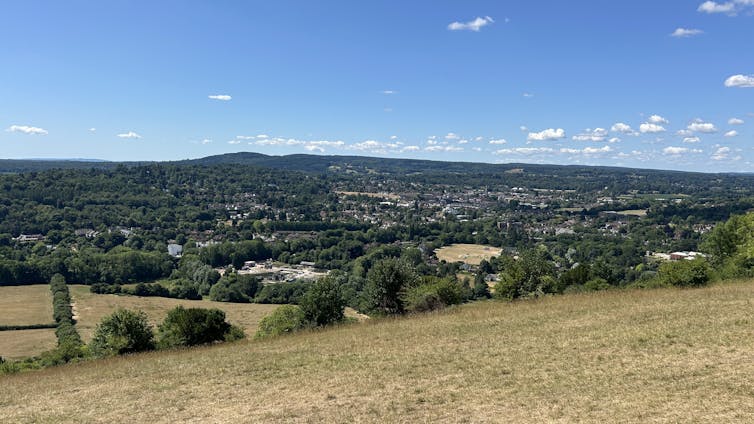
A view from the top of Box Hill of the city down below
The view from the top. Jane Wright and Emma Sweeney visited Box Hill in Surrey.
Jane Wright, CC BY

In her book The Secret Sisterhood (2017), Sweeney wrote about Austen’s friendship with Anne Sharp, a governess who worked for her brother Edward. Crucially, Sharp was also a writer, which strengthened the bond between the two women. But it was a friendship that Austen’s family played down and concealed after her death.

“In Anne Sharp,” explains Sweeney during our interview, “Jane had a class-defying friendship that wasn’t really known about until the 1920s. But it was hugely important to Jane to have a friend she could talk to about writing, for although she was surrounded by her sister Cassandra, her friend Martha Lloyd and her mother who loved to discuss books, they were not writers. And while Anne Sharp was a very different kind of writer, she was a writer Jane valued.”

Later on, Anna Walker sits down with two more eminent Austen experts to discuss friendship in Emma – emeritus professor Janet Todd of Cambridge University, and Bharat Tandon, lecturer in literature at the University of East Anglia.

As Tandon explains, Austen’s relationship with her sister Cassandra was the closest of her friendships. Cassandra and their shared friend (and eventual sister-in-law) Mary Lloyd formed Austen’s “intellectual and comic focus group,” offering feedback on her writing.

But not everyone in Austen’s day saw female friendship as a positive force. “The idea of an intellectual and emotional connection between women worried men,” Todd explains. “It seemed to be working against the important tie of heterosexual marriage, and so it was something that needed to be controlled.”

Listen to episode 4 of Jane Austen’s Paper Trail wherever you get your podcasts. And if you’re craving more Austen, check out our Jane Austen 250 page for more expert articles celebrating the anniversary.

Disclosure statement

Emma Claire Sweeney, Bharat Tandon and Janet Todd do not work for, consult, own shares in or receive funding from any company or organisation that would benefit from this article, and have disclosed no relevant affiliations beyond their academic appointment.

Jane Austen’s Paper Trail is hosted by Anna Walker with reporting from Jane Wright and Naomi Joseph. Senior producer and sound designer is Eloise Stevens and the executive producer is Gemma Ware. Artwork by Alice Mason and Naomi Joseph.

Listen to The Conversation Weekly via any of the apps listed above, download it directly via our RSS feed or find out how else to listen here.

The Conversation

ref. Jane Austen’s friendships defied social class – and empowered her writing – https://theconversation.com/jane-austens-friendships-defied-social-class-and-empowered-her-writing-270144


Les plateformes de streaming, repaire d’une génération en quête de repères : le cas Twitch

Source: The Conversation – in French – By Lucas Pithon, Maître de conférences en psychologie clinique et psychopathologie, Université d’Angers

Les plateformes de streaming représentent un fait social qui ne se résume pas au drame de la mort en direct du streamer Jean Pormanove sur la plateforme Kick. Une analyse récente de Twitch montre en effet comment ces espaces en ligne peuvent participer à la construction identitaire de jeunes adultes, si la modération, la régulation, l’accompagnement et l’éducation numérique sont au rendez-vous.


La mort en direct du streamer français Jean Pormanove sur la plateforme Kick, après douze jours de diffusion en continu marqués par des humiliations et des violences encouragées par le public, a suscité une vive émotion.


À lire aussi :
Décès de Jean Pormanove : pourquoi la régulation de la plateforme Kick a échoué


Si cet épisode tragique révèle une dérive inquiétante quant à la consommation en direct du spectacle de la souffrance, il met aussi en lumière un fait social, le rôle central qu’occupent désormais les plateformes de streaming dans la vie de ses principaux utilisateurs, les jeunes adultes.

Les plateformes de streaming, signe d’un malaise générationnel ?

Au-delà du fait divers, cette affaire semble signer le symptôme d’un malaise générationnel profond, qui plonge ses racines dans les circonvolutions d’un monde particulièrement instable. Les repères traditionnels – travail stable, éducation, couple, famille, trajectoire linéaire – s’effritent et les institutions politiques peinent à suivre le rythme des réalités sociales, dans un climat marqué par la montée des populismes et une incertitude climatique et géopolitique croissante.

Si ces métamorphoses ouvrent de nouvelles possibilités, elles participent aussi au sentiment de flottement qui accompagne l’entrée dans l’âge adulte.

L’individu porte, seul, la responsabilité de construire son avenir.

Dans ce contexte, certaines plateformes numériques prennent une place surprenante. C’est le cas de Twitch, espace en ligne où des vidéastes (streamers) diffusent en direct des parties de jeux, des discussions ou des émissions interactives sur des sujets aussi divers que variés. Des centaines de milliers de jeunes s’y connectent chaque jour. Mais au-delà du divertissement, que viennent-ils y chercher ? Selon nous, leurs usages de Twitch traduisent autant un besoin de lien social et de reconnaissance qu’une manière de se positionner dans un monde fragmenté.

Twitch : un lieu pour se construire

En effet, notre étude le montre : loin d’incarner, comme certains discours tendent à le soutenir, un temple moderne de l’addiction, Twitch apparaît au contraire, pour ses utilisateurs, comme un espace d’expérimentation, de partage et de découverte des différentes facettes de leur personnalité.

La plateforme fonctionne comme un lieu de socialisation et de construction de l’identité. Les jeunes adultes y trouvent un espace dans lequel leurs passions – parfois marginalisées dans la société, comme les jeux vidéo, l’informatique ou la culture Internet – deviennent des sources légitimes de reconnaissance et de valorisation. En outre, l’interactivité, les codes partagés ainsi que les références culturelles et générationnelles communes participent à la création d’un langage collectif et d’un sentiment d’appartenance.

Plus globalement, Twitch permet de s’exposer anonymement à une variété de sujets allant du divertissement aux débats politiques ou scientifiques, en passant par le militantisme, l’art, l’apprentissage, la spiritualité, ainsi que les questions de genre ou de sexualité, qui contribuent au développement personnel et social des utilisateurs.

Un « safe-space » disponible sur demande

Cette possibilité repose sur le fait que Twitch est une plateforme encadrée, à la fois par des règles internes et par des équipes de modération choisies par les streamers. Cela en fait un espace sûr, où l’on ne peut ni tout dire ni tout faire, contrairement à Kick. Ce cadre sécurisant offre un lieu de reconnaissance que les utilisateurs peuvent mobiliser à tout moment, notamment pour partager des moments difficiles avec d’autres.

Certains décrivent Twitch comme une « bulle sociale », où l’on se sent à l’aise, respecté, et parfois mieux compris que dans son entourage réel. La plateforme agit ainsi comme une zone tampon, capable d’apaiser les doutes, émotions et incertitudes du passage à l’âge adulte. Fait notable, le sentiment de connexion persiste même sans communication directe : la simple présence sur un live suffit à éprouver le plaisir d’appartenir à un collectif, d’être et de faire avec les autres.

C’est ce dont témoigne Clémence, 22 ans :

« Il y a un côté euh… rassurant, safe place un peu, un peu cocon rassurant. […] Enfin voilà c’est (le streamer, ndlr) quelqu’un que je connais bien et du coup le fait de pouvoir l’avoir à… à disposition d’un claquement de doigts, boom ! je peux le mettre sur mon écran à gauche là quand je veux pour qu’il… pour qu’il fasse le saltimbanque là… »

Dans la société contemporaine, cette possibilité revêt une importance capitale tant elle participe à briser « l’épidémie de solitude » qui fait rage chez les jeunes adultes. Twitch offre la possibilité de rencontrer (même passivement) un ou des autres, avec lesquels on a le sentiment de partager quelque chose.


À lire aussi :
Réseaux sociaux : une hyper-conscience de soi qui amplifie le mal-être des jeunes ?


Cette notion de partage est d’ailleurs capitale pour la plupart des utilisateurs interrogés. Si l’on vient sur la plateforme, c’est d’abord pour investir une communauté dans laquelle on se reconnaît et avec qui on a le sentiment de partager le même univers, le même rapport au monde, qui s’exprime dans les centres d’intérêt, les valeurs, ou même les points de vue politiques convergents.

Le rôle central du diffuseur

Toutefois, cette dynamique collective ne prend sens qu’à travers celui ou celle qui l’incarne et la fédère. En effet, c’est autour du diffuseur que se cristallisent les affinités : sa personnalité, sa manière d’interagir, sa régularité et son authenticité donnent chair au collectif et comptent énormément dans l’attachement que les spectateurs développent à son égard. Pour beaucoup d’adultes en émergence, cette relation, bien qu’asymétrique, prend une dimension affective forte : le streamer devient une présence familière, réconfortante, voire même inspirante.

Dans une société où les figures tutélaires traditionnelles tendent à se raréfier ou à être en décalage avec les modes de vie et aspirations contemporaines, le créateur ou la créatrice incarne alors une figure d’idéal, une version possible de soi, qui encourage à s’épanouir et à oser être soi-même. C’est à la fois quelqu’un dont on a le sentiment qu’il nous ressemble mais c’est aussi, et peut-être surtout, quelqu’un à qui, sous certains aspects, l’on aurait bien envie de ressembler.

C’est ce qu’expliquent des spectateurs que nous avons rencontrés dans nos travaux de recherche :

« J’ai les mêmes délires que lui et tout, il aime bien tel jeu, ben l’avantage c’est que c’est un peu un sceau de validation pour moi. » (Alexandre, 25 ans)

ou encore

« Donc voilà, y a l’idée de pouvoir s’identifier au mec je sais pas… de pouvoir partager quelque chose avec lui au niveau de la personnalité, de pouvoir lui ressembler. » (Léo, 20 ans)

Dès lors, l’on comprend mieux le risque de l’absence de modération dans l’investissement de certains « modèles » : sans garde-fous, l’influence qu’ils exercent peut glisser de l’inspiration bienveillante à la promotion de conduites destructrices, faisant de la communauté non plus un bord protecteur, mais une chambre d’écho dangereuse pour les identités les plus vulnérables.

Au-delà du virtuel, de nouveaux rituels sociaux

Enfin, il nous semble important de situer Twitch au-delà de la sphère numérique du spectacle car la plateforme donne également lieu à des formes inédites de rassemblements collectifs.

Le Zevent, événement caritatif français en est peut être l’exemple le plus éclatant. Pendant tout un week-end, des dizaines de créateurs unissent leurs voix et leurs communautés autour d’une cause commune, récoltant chaque année des millions d’euros pour des associations.

Mais ce qui s’y joue excède de loin la performance financière. Ces rassemblements fonctionnent comme de nouveaux rituels sociaux, où l’exaltation partagée et le sentiment d’unité réintroduisent du commun dans un monde fragmenté.

La participation collective au bien commun rejoue, dans un langage contemporain, les logiques du fonctionnement démocratique : chacun, par sa présence, son don ou même son simple soutien symbolique, contribue à une œuvre qui dépasse ses intérêts individuels.

Twitch devient alors le support d’une réintégration des individus au tissu social, là où une génération parfois décrite comme égocentrée, isolée ou désabusée montre au contraire sa capacité à inventer de nouvelles formes de solidarité et d’appartenance.

L’affaire Jean Pormanove rappelle toutefois combien ces espaces demeurent fragiles, et combien la modération, la régulation, l’accompagnement et l’éducation numérique sont cruciaux pour préserver leur potentiel social. Car au-delà du divertissement, c’est bien une partie de la vie collective qui s’y joue : celle d’une génération qui expérimente, en direct, de nouvelles manières d’être au monde.

The Conversation

Les auteurs ne travaillent pas, ne conseillent pas, ne possèdent pas de parts, ne reçoivent pas de fonds d’une organisation qui pourrait tirer profit de cet article, et n’ont déclaré aucune autre affiliation que leur organisme de recherche.

ref. Les plateformes de streaming, repaire d’une génération en quête de repères : le cas Twitch – https://theconversation.com/les-plateformes-de-streaming-repaire-dune-generation-en-quete-de-reperes-le-cas-twitch-270111

Est-ce une bonne idée d’utiliser des IA comme confidentes ou comme soutien psychologique ?

Source: The Conversation – in French – By José Sánchez Santamaría, Profesor Titular de Equidad Educativa y Aprendizaje a lo Largo de la Vida. Coordinador de GRIOCE – UCLM. Vocal de FEAE-CLM, Universidad de Castilla-La Mancha

De plus en plus de personnes, notamment des jeunes, ont recours à des chatbots entraînés avec des IA pour gérer leurs émotions. Mais ces outils numériques ne peuvent se substituer à une relation humaine ni, le cas échéant, à une prise en charge par un spécialiste. SeventyFour/Shutterstock

Ils offrent une écoute immédiate, sont toujours disponibles et répondent calmement sans porter de jugement. Les agents conversationnels entraînés par IA (chatbots) séduisent, notamment les adolescents. Mais le « réconfort numérique » ponctuel qu’ils peuvent apporter ne doit pas être confondu avec les relations que l’on peut entretenir avec un ami, ni avec le soutien psychologique proposé par un professionnel.


« Bonjour ! Je vois que tu cherches à être un peu au calme. Tu n’es pas seul(e). Je suis là pour t’aider à respirer, à comprendre ce que tu ressens et à trouver un peu de réconfort. Veux-tu me dire ce qui te préoccupe en ce moment ? »

Ceci est le « texte initial » d’un chatbot (agents conversationnels entraînés par IA, ndlr) de soutien émotionnel. Il y a peu, cela relevait encore de la science-fiction. Mais aujourd’hui, beaucoup de gens attendent de l’IA plus que des réponses rapides : ils veulent de la compréhension, de la compagnie et du réconfort.

Par exemple, Nora, 14 ans, utilise un chatbot lorsqu’elle se dispute avec ses amies, nous a-t-elle confié. Quel que soit notre âge, nous pouvons être tentés d’utiliser cette technologie pour améliorer nos relations professionnelles ou trouver quelqu’un qui est toujours « à l’écoute ».

Une machine peut-elle vraiment être à notre écoute ?

On a l’impression que l’IA peut nous écouter et nous comprendre. Mais l’IA est une machine : elle n’écoute pas au sens humain du terme, mais traite des données. Elle fonctionne comme un système de prédiction statistique qui génère des réponses mot à mot.

Cela soulève des questions importantes : une IA peut-elle être un véritable soutien émotionnel ? Peut-elle remplacer un ami ? Ou même un psychologue ? Et quel est l’impact de tout cela sur notre bien-être ?

C’est quoi un chatbot ?

Un chatbot est un programme informatique avec lequel nous interagissons par le biais de texte, de voix ou d’images. Son fonctionnement est le suivant : il reçoit, interprète, décide, consulte et répond. Imaginez que vous écriviez : « Je souhaite modifier mon vol de samedi ». Il effectue alors les opérations suivantes : « modifier vol » + « vendredi », vérifie votre réservation dans l’ API, vous propose des options et confirme la modification.

Il existe plusieurs catégories de chatbots :

  • Des chatbots avec des réglages fixes : ces chabots donnent des réponses prérédigées. Elles sont courantes dans les services à la citoyenneté ou à la clientèle : ISSA (qui est l’équivalent espagnol d’Amelibot de l’Assurance maladie en France, ndlr) ou Rufus d’Amazon.
  • Des chatbots généralistes alimentés par IA : ils répondent à presque toutes les questions à l’aide de texte, d’images ou de voix, et servent à de nombreuses finalités différentes : ChatGPT, Perplexity ou Deepseek.

  • Des chatbots spécialisés alimentés par IA : ils ressemblent aux précédents, mais sont entrainés sur des thématiques spécifiques comme la santé émotionnelle (Wysa), l’éducation (Tutor AI) ou pour vous tenir compagnie (Replika).

  • Des assistants virtuels alimentés par IA : ils aident dans les tâches quotidiennes. Ils sont capables de suivre des instructions et d’effectuer des actions très concrètes, et proposent des alternatives : Siri (Apple), Alexa (Amazon) ou l’Assistant Google.

  • Des assistants personnalisés alimentés par IA : il s’agit de chatbots personnels et individuels créés par soi-même. Vous pouvez adapter leur style de réponse, leur ton et leurs fonctions pour apprendre une langue, planifier des voyages ou même pour effectuer des recherches ou obtenir des conseils juridiques : Watsonx Assistant, le chat Watson, la fonction GPT de ChatGPT ou le Gem de Gemini.

Des chatbots spécialisés dans la gestion des émotions

Le premier chatbot dédié à la gestion des émotions est apparu en 1966 et s’appelait Eliza. Il simulait une thérapie psychologique « centrée sur la personne », une technique développée par le psychologue Carl Rogers. Il s’agissait d’un chatbot basé sur des règles : si l’utilisateur disait « Je suis triste », Eliza répondait « Pourquoi pensez-vous être triste ? »

Actuellement, une étude américaine indique que la moitié des adultes voient d’un bon œil l’utilisation des chatbots de soutien émotionnel, une tendance que l’on retrouve en Europe.

En Espagne, 24 % de la population interrogée (dans une enquête menée par Axa sur la santé mentale, ndlr) (reconnaît utiliser des chatbots pour obtenir un soutien émotionnel, dont 45 % ont entre 18 et 24 ans.

Une autre enquête montre la même chose et souligne le fait que les filles les utilisent davantage. De notre côté, nous avons pu observer que les adolescents utilisent les chatbots pour exprimer et gérer leurs émotions, aussi pour se sentir accompagnés et compris dans les moments de tristesse ou quand ils rencontrent des difficultés. Voici quelques extraits de ce qu’ils nous ont confié dans notre récente étude :

« Je parle beaucoup avec ChatGPT. Cela me donne l’impression d’être accompagnée, surtout quand je me sens triste et que je ne me comprends pas très bien. »

« Une fois, je me suis disputée avec mon petit ami, je me sentais très mal et j’ai fini par me confier à l’IA. »

Pourquoi sont-ils si attrayants ?

Les chatbots offrent quelque chose que certains jeunes peuvent avoir du mal à obtenir par ailleurs : une écoute immédiate et sans jugement. Ils sont toujours disponibles, répondent calmement et permettent de parler dans un anonymat apparent. Dans les moments de confusion ou de solitude, cela peut générer un sentiment de contrôle et de soulagement, en nous permettant de nous défouler. Leur ton amical et le langage empathique qu’ils utilisent renforcent cette dépendance émotionnelle.

Dans une autre étude que nous avons menée, certains adolescents ont déclaré qu’ils confiaient à l’IA « des choses qu’ils ne diraient à personne » et que cela les aidait « à se calmer lorsqu’ils ont des problèmes », car cela ne les fait pas se sentir « remis en question » ni mal à l’aise par rapport à ce qu’ils partagent.

Peuvent-ils se comporter comme des amis ou des psychologues ?

Mais un chatbot ne remplace pas une amitié ni une thérapie. Il peut servir de « soutien ponctuel » ou d’espace d’expression – avec quelques nuances. Mais il ne substituera jamais à une relation humaine ni au jugement clinique d’un professionnel. Il y a au moins 10 raisons à cela :

  1. Il n’a aucune responsabilité éthique ou légale.

  2. Il ignore notre histoire et notre contexte.

  3. Il offre des réponses logiques, mais il peut se tromper et il est limité.

  4. Il cherche à satisfaire, non à défier. Il peut toujours donner raison, créant ainsi un effet bulle.

  5. Il n’est pas neutre.

  6. Il manque d’empathie.

  7. Il ne sait pas réagir en cas d’urgence.

  8. Il peut créer une dépendance émotionnelle.

  9. Il ne garantit ni la confidentialité ni une transparence totale.

  10. Il ne prévoit aucun suivi thérapeutique. Il ne sait pas interpréter les changements émotionnels.

Comment tirer bénéfice des chatbots pour la santé

Les chatbots spécialisés ne sont ni des psychologues ni des amis. La clé réside dans une utilisation réfléchie et éthique de ces outils :

  1. S’interroger sur les raisons qui nous amènent à les utiliser. Pour se défouler, mieux se comprendre, se distraire, ou alors se sentir accompagné ou soutenu ? Ils ne devraient pas servir à remplacer ou à fournir une solution rapide et facile à des situations émotionnelles complexes.

  2. Se demander pourquoi nous en avons besoin. Ce que dit un chatbot nous aide-t-il à comprendre comment nous nous sentons ou à prendre des décisions ? Que la réponse soit oui ou non, nous devons la remettre en question et ne pas lui accorder une crédibilité absolue. Même si ce que dit le chatbot était correct, cela pourrait avoir des effets psychologiques négatifs à moyen et long terme, que nous ne connaissons pas encore.

  3. S’informer. Il est essentiel de savoir comment fonctionne le chatbot, ce qu’il peut et ne peut pas faire, et quelles sont ses erreurs les plus courantes.

Apprendre à utiliser les chatbots

L’utilisation d’une technologie numérique n’est pas négative. Les chatbots peuvent « accompagner », mais ils ne remplacent pas l’affection, l’amitié ou l’attention psychologique d’ordre professionnel. Même en psychologie, on utilise de plus en plus d’outils entrainés par l’IA, bien que leurs limites fassent encore l’objet d’un débat.

Il convient d’être prudent, car nous ne connaissons pas encore leur impact et les risques associés. Notre bien-être émotionnel dépend également de la sécurité face à l’IA. Il ne faut pas confondre le réconfort numérique et le soutien prodigué par des professionnels ou les relations humaines. C’est l’un des défis que pose la vie numérique actuelle.

The Conversation

Les auteurs ne travaillent pas, ne conseillent pas, ne possèdent pas de parts, ne reçoivent pas de fonds d’une organisation qui pourrait tirer profit de cet article, et n’ont déclaré aucune autre affiliation que leur organisme de recherche.

ref. Est-ce une bonne idée d’utiliser des IA comme confidentes ou comme soutien psychologique ? – https://theconversation.com/est-ce-une-bonne-idee-dutiliser-des-ia-comme-confidentes-ou-comme-soutien-psychologique-270342

Reggae legend Jimmy Cliff’s connection with Te Tiriti and Aotearoa

Source: Radio New Zealand

A Kiwi friend of the late reggae legend Jimmy Cliff describes him as a gentle and considered soul who was hugely curious about New Zealand and the role of Te Tiriti.

Cliff, who is regarded as one of the founders of reggae music, died in Kingston, Jamaica, on Sunday. He was 81.

Music promoter Jackie Sanders, of Kerikeri, describes herself as “a friend and huge fan” who brought Jimmy Cliff to Aotearoa in 2011, 2015 and 2018.

Jimmy Cliff with friend and music promoter Jackie Sanders in 2018.

Jimmy Cliff with friend and music promoter Jackie Sanders in 2018.

Supplied

She counted him alongside Bob Marley, Toots (of Toots and the Maytals) and Peter Tosh as one of the four pioneers of the reggae genre.

While it was Marley who went on to find worldwide fame, Cliff entered modern consciousness in his later years through soundtracks for movies such as Cool Runnings and The Harder They Come.

Sanders said she got to know Cliff because she insisted, given his mana and status as a musical legend, on personally driving him between shows.

“So I spent quite a lot of time with him. He was a very gentle, quiet and considered man. He was also very curious. He had a lot of questions about New Zealand. He was hugely interested in Māori and TeTiriti and how that all worked.”

His 2011 visit was for the Raggamuffin Festival in Rotorua; in 2015 he played Tauranga and Auckland’s Powerstation.

Reggae star Jimmy Cliff

The reggae star died on Sunday.

RNZ

The Auckland show,with a packed venue and Herbs Unplugged as support, was Sanders’ “favourite gig ever”.

She said Cliff’s interest in TeTiriti sowed the seeds for his 2018 show at Waitangi, where he was the headline act for the inaugural Bay of Islands Music Festival, held in the grounds of the Copthorne Hotel.

That night was to be the most stressful of her entire career.

Cliff had two sets at the Byron Bay Bluesfest, on Easter Friday and Monday, and the idea was that he would fly out of the Gold Coast on Saturday morning, play Saturday night at Waitangi, then head back across the Tasman on Sunday morning.

However, thanks to delays in Australia, by the time Cliff and his 10-piece band landed in Auckland, the last flight to Kerikeri had been and gone.

“We were absolutely panicking. We had a full house in Waitangi, we had an amazing lineup. What were we going to do?” and

Air New Zealand was able to rustle up another plane but not a pilot, so the musicians were instead whisked through Customs and onto a minibus.

In the meantime Hamilton reggae band Katchafire stretched out their set and rumour rippled through the crowd.

Jimmy Cliff and band at Bay of Islands Airport in Kerikeri, about to head back to Byron Bay Bluesfest after a hectic headline slot at the Bay of Islands Music Festival.

Jimmy Cliff and band at Bay of Islands Airport in Kerikeri, about to head back to Byron Bay Bluesfest after a hectic headline slot at the Bay of Islands Music Festival.

Supplied

After a high-speed drive north the band virtually rolled out of the minibus straight onto the stage, 45 minutes late.

That left only 30 minutes before the festival was due to finish, with the venue anxious not to go over time. 

“We were getting a bit of heat that the curfew was coming up … I remember them saying to me, ‘You’ve got to go on stage and tell them this is the last song’. And I was just thinking of the hits the band hadn’t yet played …SoI went on stage and said, ‘Whatever happens, don’t come off that stage before the encore, just stay on and keep going’. I got into a bit of trouble over it. But I don’t regret it, it was great.”

Sanders said even in 2015 Cliff seemed frail, and in 2018 he had to be literally carried up the stairs onto the stage.

“But once on the stage, he was chucking his legs in the air and he was an absolute ball of energy. He said to me the next day, ‘The music takes control and it takes over my spirit, and it happens. I won’t stop until I die’. He really was an incredible man.”

An emotional Sanders said she had been playing his music almost non-stop since Sunday.

“It’s incredibly sad to lose another legend. They don’t come along that often, and Jimmy Cliff was definitely one of those utter legends,” she said.

“He shaped a whole genre of music that has entertained people for generations. So rest in power, Jimmy, and thank you for bringing us so much joy.”

– Published by EveningReport.nz and AsiaPacificReport.nz, see: MIL OSI in partnership with Radio New Zealand

Hotel from Crocodile Dundee sells after three years on the market

Source: Radio New Zealand

If the Walkabout Creek Hotel’s walls could talk, they would have more than 120 years of tales to tell.

For many, the outback pub is famous for its featured role in the 1986 film Crocodile Dundee.

But for locals in the tiny town of McKinlay, just over 200kms from Mount Isa, it is the pub, the bottle-o, the caravan park and the post office.

Angus Brodie has been learning how to manage the bar.

Supplied/Angus Brodie

And now, after being on the market since 2022, it has changed hands.

McKinlay-born Angus Brodie and wife Jo Cranney bought the Walkabout Creek Hotel for an undisclosed figure, settling the deal yesterday.

Prior owners Deb and Frank Wurst put the pub on the market so they could retire, after being at the helm for 11 years.

From childhood memories to pouring his first beer

Grazier Angus Brodie, 33, grew up in McKinlay, where the hotel is the central hub for the town’s 160 residents.

“I have memories running around with all the other kids, sneaking a packet of chips and a soft drink,” Brodie said.

“Sometimes we’d take our sleeping bags and have a sleepover until it was time to go home.”

The new owner had never poured a beer before last week but is ready for the challenge.

“The first beer I poured, I think there was half a glass of frothy head, and the second beer had absolutely no head at all,” he laughed.

“I wasn’t off to a real good start, but I promise I’ve turned things around now.”

Cranney, 34, grew up in Goondiwindi but moved to Mount Isa to be a nurse, where the two met.

They now run a cattle property 30 minutes away from the pub with their two children and a baby due in April.

The couple bought the pub to diversify their business and have an alternative income stream when the weather and cattle markets aren’t favourable.

“In a drought, people probably drink more beer,” Brodie said.

The couple hopes to take a farm-to-table approach, selling their beef at the pub.

“That’s one thing we’re pretty keen to do, showcase our beef and have that on the menu,” Brodie said.

The Walkabout was originally built as The Federal Hotel in 1900.

The Walkabout was originally built as The Federal Hotel in 1900.

Supplied

Pub ‘in fantastic condition’

Decorated with memorabilia, the Walkabout Creek Hotel is beloved by locals and tourists alike.

The new owners are not planning to change much and are grateful to the prior owners for keeping it in “fantastic condition”.

“It’s a credit to Frank and Debbie. They’ve really looked after it over the 11 years they’ve been there,” Brodie said.

Wurst said he and Debbie would miss the pub when they announced their retirement plans in 2022.

“I’m really going to miss the people out here — there are so many great characters,” he said.

Frank and Debbie Wurst ran the pub in McKinlay for 11 years.

Frank and Debbie Wurst ran the pub in McKinlay for 11 years.

Supplied

40 years of Dundee

In 1986, Crocodile Dundee was the highest-grossing film of all time in Australia.

Built in 1900 and licensed in 1901, the real-world Walkabout Creek Hotel is three times as old as the movie that made it famous, and was originally called the Federation Hotel.

The bar used on the film set was donated to the pub after filming, and is now located out the back in the beer garden.

Tourists come from far and wide to snap photos with the movie memorabilia.

Next year, it will be 40 years since the release of Crocodile Dundee, and the new owners plan to mark the occasion.

“We will have to do something, that’s for sure,” Brodie said.

“It’s a crucial part of the identity of the pub, and we love it.”

– Published by EveningReport.nz and AsiaPacificReport.nz, see: MIL OSI in partnership with Radio New Zealand

‘We will lose them’: World Vision calls for action to end ‘catastrophic’ Sudan war

Source: Radio New Zealand

Displaced Sudanese who fled El-Fasher after the city fell to the Rapid Support Forces (RSF), arrive in the town of Tawila in war-torn Sudan's western Darfur region on 28 October, 2025.

Displaced Sudanese who fled El-Fasher after the city fell to the Rapid Support Forces (RSF), arrive in the town of Tawila in war-torn Sudan’s western Darfur region on 28 October, 2025. Photo: AFP

Nearly 100,000 people have now fled Sudan’s El Fasher, after the city in the Darfur region was taken over by the paramilitary Rapid Support Forces in the country’s ongoing civil war, which has been raging for two-and-a-half years.

Sudan is facing one of the world’s most significant humanitarian crises, with 14 million people displaced.

World Vision’s Sudan operations director Inos Mugabe describes the situation, particularly in El Fasher, as catastrophic.

“We have witnessed intensified fighting that’s forced a large number of families to flee, and for many of them it’s not the first time.”

He said as they fled, they also faced extreme challenges.

“Most of the people who are leaving leave with very little, particularly only the clothes that they are wearing, and many children are also separated from their families in the chaos.”

He said most people fleeing go to the neighbouring town of Tawila, but the situation there was also bad.

“There’s no water, there’s no food assistance. there’s no sanitation. Basically, services are non-existent.”

World Vision's Sudan operations director Inos Mugabe.

World Vision’s Sudan operations director Inos Mugabe. Photo: Supplied

He said their needs were huge, but there was not adequate funding available.

“Unfortunately, we are going to be seeing more lives lost.”

Mugabe said most girls and boys were not attending school.

“For girls… they don’t continue school and obviously end up getting married early in their life. Then if its boys, they end up in military conscription and are accommodated into the various militia groups that are spouting up around the country.”

He said children and their families escaping the siege at El Fasher were in need of immediate support.

“They look weary and severely malnourished. Their bodies are failing, and without urgent, large-scale intervention, we will lose them.

“We are receiving the most vulnerable people imaginable, but the resources we have are completely inadequate to sustain them. The world must understand the gravity of this situation and act before it is too late.”

Sign up for Ngā Pitopito Kōrero, a daily newsletter curated by our editors and delivered straight to your inbox every weekday.

– Published by EveningReport.nz and AsiaPacificReport.nz, see: MIL OSI in partnership with Radio New Zealand

‘Slender Man’ stabber’s disappearance and the internet boogeyman who inspired her

Source: Radio New Zealand

By Amanda Musa, Chris Boyette, CNN

File photo. Morgan Geyser appears in a Waukesha County courtroom on 9 January 2025, in Waukesha, Wisconsin.

File photo. Morgan Geyser appears in a Waukesha County courtroom, Wisconsin, in January. Photo: Morry Gash / AP / File via CNN Newsource

Morgan Geyser, who was living under supervised release at a group home in Wisconsin for her role in the high-profile 2014 stabbing of her 12-year-old classmate, was found about 150 miles (240km) away in Illinois.

She had disappeared on Saturday night (US time) after cutting off her monitoring bracelet, according to police in Madison, Wisconsin.

On Sunday, officers in Posen, Illinois, responded to a report of people loitering behind a truck stop building and discovered a man and a woman sleeping on the sidewalk, police said.

Geyser, 23, initially gave officers a false name when they confronted her, according to Posen Police.

“After continued attempts to identify her, she finally stated that she didn’t want to tell officers who she was because she had ‘done something really bad,’ and suggested that officers could ‘just Google’ her name,” police said.

Years earlier, Geyser had pleaded guilty to attempted murder in the stabbing of her classmate, Payton Leutner. At the time, they were both 12 years old.

The grisly attack gripped the public’s attention and became the subject of heavy news coverage at the time, raising questions about how parents can keep tabs on everything kids consume online, and how they can be sure their children can truly separate reality from fantasy.

The crime was said to be inspired by the fictitious character Slender Man.

Here’s what we know about the search for Geyser and the internet-created boogeyman that prompted an attack that shocked the nation more than a decade ago.

Who is Slender Man?

Slender Man, a menacing, faceless man in a dark suit – sometimes portrayed with octopus-like tentacles – was a crowdsourced internet-created boogeyman that first appeared in an online forum in 2009, according to Shira Chess, an associate professor of entertainment and media studies at the University of Georgia and co-author of the book Folklore, Horror Stories, and the Slender Man.

“He falls broadly into a category of fiction that is colloquially referred to as ‘creepypasta,’ or internet legends that have meme-like qualities, typically lack known authorship, and are easily spreadable,” Chess told CNN in an email on Sunday.

In June 2009, a Photoshop contest for images that appeared to be paranormal was launched in a forum on the website Something Awful. According to Know Your Meme, a blog that chronicles web culture, the goal of the contest was to create the images and then use them to fool, or “troll,” other web users by submitting them to paranormal websites.

A recent image provided from the Madison Police Department of Morgan Geyser, captured on security video from this past month.

A recent image provided from the Madison Police Department of Morgan Geyser, captured on security video from this past month. Photo: Madison Police Department via CNN Newsource

Site member Eric Knudsen (under the screen name “Victor Surge”) submitted two images to the contest, both black-and-white images of children, one of which appeared to show a largely undefined figure lurking in the background.

Many imaginative fans saw Slender Man’s facelessness as a blank canvas in which to reimagine him in any number of ways, Chess added.

Following the stabbing, Geyser and her friend Anissa Weier told police they knew the character from the Creepypasta Wiki, a site that compiles such fiction. The site has issued a statement condemning the attack.

Slender Man’s popularity has gone down in recent years, according to Chess, who noted the fandom peaked in the early to mid-2010s.

“I can anecdotally say that he still performs the role of boogeyman on playgrounds,” Chess told CNN.

How did the stabbing unfold?

In May 2014, the trio had gone to Geyser’s home for a slumber party to celebrate her birthday, Leutner previously told ABC. During those times, Geyser constantly talked about Slender Man, she added.

“I thought it was odd. It kind of frightened me a little bit,” Leutner said of her friends’ fascination with the character. “But I went along with it. I was supportive because I thought that’s what she liked.”

As the friendship between Geyser and Weier grew, so did the pair’s fixation with Slender Man, Leutner said. While Leutner didn’t know her friends planned to harm her, something felt off that night in retrospect, she said.

“At all of our past sleepovers, (Geyser) always wanted to stay up all night because she could never do that at home,” Leutner said. “But on (the night of) the birthday party, she wanted to go to bed.”

Her friends later told investigators they had planned to kill Leutner in her sleep that night but then decided to do it the next morning at a nearby park.

When she woke up, Geyser and Weier were downstairs at a computer, so she joined them for doughnuts before heading to the park. They told her the plan was to play hide-and-seek and asked her to lie down under the leaves and sticks as part of the game, she said.

There in the woods, Geyser repeatedly stabbed her with a kitchen knife and she and Weier left her alone in the woods, bleeding and struggling to get help. After she crawled out of the woods, a passing bicyclist found her and called 911.

Leutner was stabbed near her heart, and she was “one millimeter away from certain death,” court documents said.

When the bicyclist found her, the girl pleaded, “Please help me. I’ve been stabbed,” audio from the 911 call revealed.

At age 15, Geyser pleaded guilty to a charge of attempted first-degree murder in a deal with prosecutors to be placed in a mental institution instead of serving jail time.

Weier pleaded guilty to attempted second-degree homicide due to mental illness or defect as part of a plea agreement. She was committed to 25 years in a mental hospital, The Associated Press reported, but was released in 2021 on condition she live with her father and wear a GPS monitor.

At her sentencing in 2018, Geyser apologized to Leutner and her family.

“I never meant this to happen,” a tearful Geyser said. “I hope that she is doing well.”

Where was Morgan Geyser?

Authorities said Sunday they were searching for Geyser, who was last seen in a residential neighborhood on the west side of Madison, Wisconsin, around 8pm on Saturday with an adult acquaintance, police said in a statement.

Police later said in an update they received confirmation around 10.34 pm that Geyser had been taken into custody in Illinois.

The pair traveled from Wisconsin by bus, Posen police said.

Authorities have not identified the acquaintance – who they say was taken into custody – but Posen police told The Associated Press he is 42 years old, was charged with criminal trespassing and obstructing identification and has since been released.

Geyser’s attorney, Tony Cotton, had earlier urged the 23-year-old to turn herself in immediately, saying in a statement: “We worked too hard to secure her freedom for her to continue on this path.”

It is unclear how Geyser broke out of the group home or who helped her, Cotton said in a video posted to social media.

CNN has reached out to Cotton for comment on her capture.

In January, a judge ordered Geyser could be released from the Winnebago Mental Health Institute, where she spent nearly seven years, The Associated Press reported.

Prosecutors attempted to block her release, alleging she has been quietly reading gory novels and communicating with a man who collects memorabilia from murderers, but a Waukesha County Circuit judge ordered her release after state and county health officials completed a community supervision and housing plan.

CNN has been unable to determine who runs the group home where Geyser was staying, but Madison police confirmed to CNN affiliate WMTV she has been living at a group home in Madison, on the same street where she had last been seen before fleeing Wisconsin.

Geyser faces no additional charges in Illinois, Posen police said, but will be held at Cook County jail to await extradition back to Wisconsin.

CNN

– Published by EveningReport.nz and AsiaPacificReport.nz, see: MIL OSI in partnership with Radio New Zealand

Jimmy Cliff, reggae music pioneer, dies at 81

Source: Radio New Zealand

The cause was a seizure followed by pneumonia, she said.

Born James Chambers on 30 July, 1944 during a hurricane in St James Parish, northwestern Jamaica, he moved in the 1950s from the family farm to the country’s capital Kingston with his father, determined to succeed in the music industry.

At just 14, he became nationally famous for the song ‘Hurricane Hattie’, which he wrote.

Cliff would go on to record more than 30 albums and perform all over the world, including in Paris, in Brazil and at the World’s Fair, an international exhibition held in New York in 1964. The following year, Island Records’ Chris Blackwell, the producer who launched Bob Marley and the Wailers, invited Cliff to work in the UK with him.

Cliff later went into acting, starring in the 1972 classic film The Harder They Come, directed by Perry Henzell, which introduced an international audience to reggae music. The movie portrayed the grittier aspects of Jamaican life, redefining the island as more than a tourist playground of cocktails, beaches and waterfalls.

“When I’ve achieved all my ambitions, then I guess that I will have done it and I can just say ‘great’,” he said in a 2019 interview, as he was losing his sight.

“But I’m still hungry. I want it. I’ve still got the burning fire that burns brightly inside of me – like I just said to you. I still have many rivers to cross!”

Known in part for singles ‘You Can Get It If You Really Want It’ and ‘Many Rivers To Cross’, as well as for his covers of Johnny Nash’s ‘I Can See Clearly Now’, which appeared on the soundtrack of the 1993 movie Cool Runnings, and Cat Stevens’ ‘Wild World’, Cliff was a prolific writer who weaved his humanitarian views into his songs.

Bob Dylan said Cliff’s ‘Vietnam’ was the best protest song ever written.

The anti-establishment bent of Cliff’s music gave a voice not only to the hardships faced by Jamaicans, but to the spirit and joy that persevered in spite of poverty and oppression. Over the years, Cliff worked with the Rolling Stones, Elvis Costello, Annie Lennox and Paul Simon.

In 2012, he won a Grammy Award for best reggae album for Rebirth, which was produced by punk band Rancid’s Tim Armstrong, and another Grammy in 1984 for Cliff Hanger.

Cliff received the Order of Merit, the highest honour in the arts and sciences, from the Jamaican government. He was inducted into the Rock and Roll Hall of Fame in 2010.

– Published by EveningReport.nz and AsiaPacificReport.nz, see: MIL OSI in partnership with Radio New Zealand

‘Iconic’ Bollywood actor dies at 89

Source: Radio New Zealand

Dharmendra Deol, who became one of India’s most prominent actors and a Bollywood action hero, died in Mumbai on Monday, local media said. He was 89.

Dharmendra, who is survived by two wives and six children, had been ill for the past month and died at home, media reported.

There was no official statement from the actor’s family, but several of his contemporaries, including actor Amitabh Bachchan, gathered at a crematorium in the Mumbai suburb of Juhu for his funeral.

Bollywood actor Dharmendra (C) along with his sons Sunny Deol (R) and Bobby Deol poses for a photo on the occasion of his 89th birthday at his residence in Mumbai on December 8, 2024.

Bollywood actor Dharmendra (C) along with his sons Sunny Deol (R) and Bobby Deol at his 89th birthday celebration at his residence in Mumbai on 8 December, 2024.

AFP / Sujit Jaiswal

“A massive mega star, the embodiment of a hero in mainstream cinema,” producer and director Karan Johar, who cast Dharmendra in his 2023 film Rocky Aur Rani Kii Prem Kahaani (Rocky and Rani’s Love Story), wrote in an Instagram post.

Known to his legion of fans by his first name, Dharmendra acted in more than 300 films in a career spanning more than six decades.

Born in Punjab province in 1935, Dharmendra won a talent show organised by a film magazine, moving to Mumbai and acting in his first film in 1960.

In the years that followed, he appeared in everything from arthouse films to soft romances, action films and goofy comedies, making him the top actor of his generation.

Notable films included Bollywood cult classic Sholay (Embers), in which he played one half of a team of small-time thugs tasked with catching a bandit. The film, which was released in 1975, has become part of Indian popular culture and Dharmendra’s dialogue from the film has influenced movies ever since. In recent years, it has become a meme.

Dharmendra married his first wife, Prakash Kaur, before he found fame. After starring alongside Hema Malini in several films, he married her in 1980, without divorcing Prakash.

He was a lawmaker in the Indian parliament from 2004 to 2009.

Prime Minister Narendra Modi, President Draupadi Murmu and several others also sent their condolences on the actor’s death.

“He was an iconic film personality, a phenomenal actor who brought charm and depth to every role he played,” Modi said in a post on X.

– Published by EveningReport.nz and AsiaPacificReport.nz, see: MIL OSI in partnership with Radio New Zealand

Thousands of genomes reveal the wild wolf genes in most dogs’ DNA

Source: The Conversation – USA – By Audrey T. Lin, Research Associate in Anthropology, Smithsonian Institution

Modern wolves and dogs both descend from an ancient wolf population that lived alongside woolly mammoths and cave bears. Iza Lyson/500px Prime via Getty Images

Dogs were the first of any species that people domesticated, and they have been a constant part of human life for millennia. Domesticated species are the plants and animals that have evolved to live alongside humans, providing nearly all of our food and numerous other benefits. Dogs provide protection, hunting assistance, companionship, transportation and even wool for weaving blankets.

Dogs evolved from gray wolves, but scientists debate exactly where, when and how many times dogs were domesticated. Ancient DNA evidence suggests that domestication happened twice, in eastern and western Eurasia, before the groups eventually mixed. That blended population was the ancestor of all dogs living today.

Molecular clock analysis of the DNA from hundreds of modern and ancient dogs suggests they were domesticated between around 20,000 and 22,000 years ago, when large ice sheets covered much of Eurasia and North America. The first dog identified in the archaeological record is a 14,000-year-old pup found in Bonn-Oberkassel, Germany, but it can be difficult to tell based on bones whether an animal was an early domestic dog or a wild wolf.

Despite the shared history of dogs and wolves, scientists have long thought these two species rarely mated and gave birth to hybrid offspring. As an evolutionary biologist and a molecular anthropologist who study domestic plants and animals, we wanted to take a new look at whether dog-wolf hybridization has really been all that uncommon.

Little interbreeding in the wild

Dogs are not exactly descended from modern wolves. Rather, dogs and wolves living today both derive from a shared ancient wolf population that lived alongside woolly mammoths and cave bears.

In most domesticated species, there are often clear, documented patterns of gene flow between the animals that live alongside humans and their wild counterparts. Where wild and domesticated animals’ habitats overlap, they can breed with each other to produce hybrid offspring. In these cases, the genes from wild animals are folded into the genetic variation of the domesticated population.

For example, pigs were domesticated in the Near East over 10,000 years ago. But when early farmers brought them to Europe, they hybridized so frequently with local wild boar that almost all of their Near Eastern DNA was replaced. Similar patterns can be seen in the endangered wild Anatolian and Cypriot mouflon that researchers have found to have high proportions of domestic sheep DNA in their genomes. It’s more common than not to find evidence of wild and domesticated animals interbreeding through time and sharing genetic material.

That wolves and dogs wouldn’t show that typical pattern is surprising, since they live in overlapping ranges and can freely interbreed.

Dog and wolf behavior are completely different, though, with wolves generally organized around a family pack structure and dogs reliant on humans. When hybridization does occur, it tends to be when human activities – such as habitat encroachment and hunting – disrupt pack dynamics, leading female wolves to strike out on their own and breed with male dogs. People intentionally bred a few “wolf dog” hybrid types in the 20th century, but these are considered the exception.

a wolfish looking dog lies on the ground behind a metal fence
Luna Belle, a resident of the Wolf Sanctuary of Pennsylvania, which is home to both wolves and wolf dogs.
Audrey Lin

Tiny but detectable wolf ancestry

To investigate how much gene flow there really has been between dogs and wolves after domestication, we analyzed 2,693 previously published genomes, making use of massive publicly available datasets.

These included 146 ancient dogs and wolves covering about 100,000 years. We also looked at 1,872 modern dogs, including golden retrievers, chihuahuas, malamutes, basenjis and other well-known breeds, plus more unusual breeds from around the world such as the Caucasian ovcharka and Swedish vallhund.

Finally, we included genomes from about 300 “village dogs.” These are not pets but are free-living animals that are dependent on their close association with human environments.

We traced the evolutionary histories of all of these canids by looking at maternal lineages via their mitochondrial genomes and paternal lineages via their Y chromosomes. We used highly sensitive computational methods to dive into the dogs’ and wolves’ nuclear genomes – that is, the genetic material contained in their cells’ nuclei.

We found the presence of wild wolf genes in most dog genomes and the presence of dog genes in about half of wild wolf genomes. The sign of the wolf was small but it was there, in the form of tiny, almost imperceptible chunks of continuous wolf DNA in dogs’ chromosomes. About two-thirds of breed dogs in our sample had wolf genes from crossbreeding that took place roughly 800 generations ago, on average.

While our results showed that larger, working dogs – such as sled dogs and large guardian dogs that protect livestock – generally have more wolf ancestry, the patterns aren’t universal. Some massive breeds such as the St. Bernard completely lack wolf DNA, but the tiny Chihuahua retains detectable wolf ancestry at 0.2% of its genome. Terriers and scent hounds typically fall at the low end of the spectrum for wolf genes.

a dog curled up on the sidewalk in a town
A street – or free-ranging – dog in Tbilisi, Georgia.
Alexkom000/Wikimedia Commons, CC BY

We were surprised that every single village dog we tested had pieces of wolf DNA in their genomes. Why would this be the case? Village dogs are free-living animals that make up about half the world’s dogs. Their lives can be tough, with short life expectancy and high infant mortality. Village dogs are also associated with pathogenic diseases, including rabies and canine distemper, making them a public health concern.

More often than predicted by chance, the stretches of wolf DNA we found in village dog genomes contained genes related to olfactory receptors. We imagine that olfactory abilities influenced by wolf genes may have helped these free-living dogs survive in harsh, volatile environments.

The intertwining of dogs and wolves

Because dogs evolved from wolves, all of dogs’ DNA is originally wolf DNA. So when we’re talking about the small pieces of wolf DNA in dog genomes, we’re not referring to that original wolf gene pool that’s been kicking around over the past 20,000 years, but rather evidence for dogs and wolves continuing to interbreed much later in time.

A wolf-dog hybrid with one of each kind of parent would carry 50% dog and 50% wolf DNA. If that hybrid then lived and mated with dogs, its offspring would be 25% wolf, and so on, until we see only small snippets of wolf DNA present.

The situation is similar to one in human genomes: Neanderthals and humans share a common ancestor around half a million years ago. However, Neanderthals and our species, Homo sapiens, also overlapped and interbred in Eurasia as recently as a few thousand generations ago, shortly before Neanderthals disappeared. Scientists can spot the small pieces of Neanderthal DNA in most living humans in the same way we can see wolf genes within most dogs.

two small tan dogs walking on pavement on a double lead leash
Even tiny chihuahuas contain a little wolf within their doggy DNA.
Westend61 via Getty Images

Our study updates the previously held belief that hybridization between dogs and wolves is rare; interactions between these two species do have visible genetic traces. Hybridization with free-roaming dogs is considered a threat to conservation efforts of endangered wolves, including Iberian, Italian and Himalayan wolves. However, there also is evidence that dog-wolf mixing might confer genetic advantages to wolves as they adapt to environments that are increasingly shaped by humans.

Though dogs evolved as human companions, wolves have served as their genetic lifeline. When dogs encountered evolutionary challenges such as how to survive harsh climates, scavenge for food in the streets or guard livestock, it appears they’ve been able to tap into wolf ancestry as part of their evolutionary survival kit.

The Conversation

The authors do not work for, consult, own shares in or receive funding from any company or organization that would benefit from this article, and have disclosed no relevant affiliations beyond their academic appointment.

ref. Thousands of genomes reveal the wild wolf genes in most dogs’ DNA – https://theconversation.com/thousands-of-genomes-reveal-the-wild-wolf-genes-in-most-dogs-dna-261897