Syndrome du bébé secoué : seule une mère sur deux en France a reçu le plan de gestion des pleurs du nourrisson

Source: The Conversation – France in French (3) – By Luc Goethals, Chercheur en santé publique, Inserm; Université Paris Cité

Les plans de gestion des pleurs du nourrisson visent à prévenir les traumatismes crâniens non accidentels, également appelés syndrome du bébé secoué. Une étude nationale, menée par l’Université Paris Cité, l’Inserm, l’AP-HP, Santé publique France et le CHU de Nantes et publiée dans la revue « Child Abuse & Neglect », a révélé que le plan de gestion des pleurs du nourrisson est remis à seulement une mère sur deux en maternité en France.


Chaque année en France, des centaines de nourrissons sont hospitalisés pour des traumatismes crâniens infligés. Ces blessures ne doivent rien à des accidents et sont la conséquence d’un secouement violent du bébé, un geste grave qui peut provoquer des lésions cérébrales irréversibles, des lésions oculaires, voire la mort.

On parle alors de syndrome du bébé secoué ou, plus récemment, de traumatisme crânien non accidentel, car on sait maintenant que le secouement n’est pas le seul mécanisme en cause. Au-delà de la violence du geste et de ses conséquences légales, c’est un problème de santé publique majeur qui révèle la difficulté d’accompagner et de soutenir les parents dans cette période souvent difficile des premiers mois de vie du bébé.

Allo Parents Bébé : 0 800 00 3 4 5 6
Service et appel gratuit : des professionnels de la petite enfance à votre écoute

  • Les lundis, mardis, mercredis et vendredis de 10 heures à 13 heures et de 14 heures à 18 heures.
  • les jeudis : uniquement de 14 heures à 18 heures.

Les pleurs du nourrisson

Depuis une trentaine d’années, les pleurs du nourrisson sont rapportés dans la littérature scientifique comme le principal facteur déclencheur des traumatismes crâniens non accidentels. Il est important de noter que cela ne veut pas dire que les pleurs entraînent le secouement, mais plutôt que l’instant des pleurs du bébé coïncide souvent avec le moment où le secouement se produit.

Les bébés pleurent naturellement et cette activité atteint son pic entre la cinquième et la sixième semaine de leur existence avant de décroître. C’est une forme de communication associée à son développement neurologique et à la gestion de ses émotions.

L’intensité, la répétition et la durée de ces pleurs peuvent déstabiliser certains parents. Par ailleurs, la fatigue et l’exaspération des parents face à ces pleurs peuvent générer un sentiment d’impuissance. Lorsque ce contexte émotionnel spécifique n’est pas accompagné, en particulier par des outils pour le gérer, il peut engendrer des situations à risque de secouement pour les bébés.

Les plans de gestion des pleurs : un levier de prévention

Face à ces constats, plusieurs pays dont la France ont mis en place des recommandations concernant la diffusion des plans de gestions des pleurs, notamment durant la période périnatale et à destination des futurs parents. Ces plans de gestion des pleurs ont pour objectif d’informer tous les parents durant la période périnatale sur la normalité et la temporalité des pleurs, leur donner des stratégies et des outils pour y faire face et rappeler la dangerosité des secouements.

Ainsi, trois messages essentiels sont mis en avant :

  • les pleurs du nourrisson sont normaux, fréquents et transitoires ;

  • il est sûr de poser le bébé, toujours sur le dos, dans son lit et de s’accorder une pause en s’éloignant si la tension devient trop forte ;

  • en cas de détresse, il faut demander de l’aide à un proche ou à un professionnel.


À lire aussi :
Prévention de la mort subite du nourrisson : 80 % des photos sur les paquets de couches font fi des recommandations


Une étude réalisée à partir des données de l’Enquête nationale périnatale

Si les recommandations internationales existent, leur diffusion reste inégale. C’est à partir de ce constat que des chercheurs de l’Institut national de la santé et de la recherche médicale (Inserm), de l’Université Paris Cité, de l’Assistance publique–Hôpitaux de Paris (AP-HP), de Santé publique France, du Centre hospitalo-universitaire (CHU) de Nantes (Loire-Atlantique) et d’autres structures partenaires ont voulu évaluer la manière dont ces messages de prévention sont transmis aux parents en France et plus particulièrement aux mères. Ils se sont appuyés sur des données de l’Enquête nationale périnatale (ENP).

L’ENP est réalisée environ tous les cinq ans depuis 1995 afin de décrire les conditions de grossesse, d’accouchement et de naissance en France. L’édition 2021 s’est déroulée pendant une semaine, en mars, dans toutes les maternités de métropole et d’outre-mer. Ont été incluses environ 12 700 femmes, ces dernières ayant été suivies deux mois après la naissance.

Cette enquête est pilotée par l’Inserm et Santé publique France, sous l’égide du ministère de la santé (Direction générale de la santé, Direction générale de l’organisation des soins, Drees), et financée sur fonds publics. L’ENP fournit des données essentielles pour orienter les politiques de santé périnatale et évaluer les pratiques de soins. C’est à partir de ces données qu’a été menée notre étude.

Nous nous sommes intéressés à une question précise posée deux mois après la naissance :

« Durant la grossesse et depuis votre accouchement, avez-vous reçu des conseils pour calmer ou soulager les pleurs répétitifs ou prolongés de votre bébé ? »

Une mère sur deux déclare ne pas avoir eu cette information

Les résultats sont éloquents : parmi les plus de 7 000 mères ayant répondu à cette question, 50 % déclarent n’avoir reçu aucun conseil sur la gestion des pleurs des nourrissons. Parmi celles qui ont été informées, les principales sources citées étaient les médecins généralistes, les sages-femmes et les pédiatres (82 %), les équipes de maternité (63 %) et les services de protection maternelle et infantile (39 %).

L’étude révèle également de fortes disparités territoriales. En Nouvelle-Aquitaine, 44 % des mères n’ont pas reçu d’information, contre 56 % en Provence-Alpes-Côte d’Azur. Ces écarts s’expliquent sans doute par des différences d’organisation des réseaux périnataux plus que par le profil des mères.

Par ailleurs, certains groupes de mères apparaissent particulièrement peu informés :

  • les mères de plus de 30 ans ;

  • celles ayant déjà un ou plusieurs enfants ;

  • celles n’ayant pas suivi de séances de préparation à la naissance ;

  • et celles n’ayant pas bénéficié de visite postnatale à domicile.

Les auteurs interprètent les deux premiers facteurs comme pouvant refléter des biais implicites. Certaines mères plus âgées, ou ayant déjà des enfants, peuvent être perçues comme moins prioritaires par les soignants, ces derniers les considérant comme probablement déjà informées.

Plus généralement, les auteurs suggèrent que le constat de l’absence d’information d’une mère sur deux serait le signe d’un manque de structuration des contenus, lors des séances ou visites pré- et postnatales, qui ne sont pas standardisés au niveau national.

En effet, la France ne dispose pas encore d’un programme national structuré de diffusion des plans de gestion des pleurs disponibles en français. Des recommandations écrites figurent dans le carnet de santé, mais aucun protocole n’impose leur présentation systématique avant la sortie de maternité. Les parents souvent fatigués et parfois débordés après l’accouchement lisent peu les nombreuses documentations qui leur sont remises.

Pourtant, d’autres supports existent, notamment des vidéos en français, très bien faites et gratuites. La question d’une hiérarchisation des messages périnataux de prévention en fonction de la gravité des problèmes de santé ciblés se pose. Les messages les plus importants doivent probablement faire l’objet d’une délivrance à la fois pendant la grossesse, juste après l’accouchement et pendant les premières semaines de vie du nourrisson, pour optimiser leur bonne réception ou leur mémorisation par les deux parents.

Vers une prévention universelle

Les résultats de l’étude soulignent la nécessité d’une action de prévention structurée à l’échelle nationale. Les chercheurs plaident pour la mise en place d’un programme cohérent, reposant sur des outils existants et validés.

Plusieurs leviers d’action peuvent être mobilisés :

  • renforcer la formation des professionnels de santé et de la petite enfance afin qu’ils remettent et expliquent systématiquement les plans de gestion des pleurs aux parents ;

  • impliquer plus largement les réseaux périnataux dans la diffusion de ces messages ;

  • et envisager, à terme, une remise obligatoire ou le visionnage de ces documents et outils avant le retour à domicile.

Prévenir le syndrome du bébé secoué ne se limite pas à transmettre une information ponctuelle. Il s’agit de construire une culture commune de prévention autour du nourrisson, partagée par les professionnels, les institutions et les familles.


Cet article a été rédigé collectivement par Luc Goethals (Inserm), Flora Blangis (Inserm, CHU de Nantes), Sophie Brouard (Inserm, CHU de Nantes), Pauline Scherdel (Inserm, CHU de Nantes), Marianne Jacques (Inserm, CHU de Nantes), Marie Viaud (Inserm), Nolwenn Regnault (Santé publique France), Karine Chevreul (Inserm, Kastafiore), Camille Le Ray (Inserm, Université Paris Cité, AP-HP, Hôpital Cochin), Enora Le Roux (Inserm, Université Paris Cité, AP-HP, Hôpital Universitaire Robert-Debré), Martin Chalumeau (Inserm, Université Paris Cité, AP-HP, Hôpital Necker-Enfants malades) et le Groupe de travail ENP 2021(Inserm).

The Conversation

Flora Blangis a reçu des financements de la fondation Mustela, fondation Université Paris Cité, l’Oréal-UNESCO prix jeunes talents France, Hôpitaux du Grand-Ouest, prix de thèse de la Direction générale de la santé, prix de thèse de la Chancellerie des Universités de Paris

Martin Chalumeau a reçu des financements de : QIM VEAVE, la région Ile-de-France ; FHU VEAVE, APHP-Université Paris Cité- Inserm ; Projets VEAVE – Fondation AXA.

Luc Goethals ne travaille pas, ne conseille pas, ne possède pas de parts, ne reçoit pas de fonds d’une organisation qui pourrait tirer profit de cet article, et n’a déclaré aucune autre affiliation que son organisme de recherche.

ref. Syndrome du bébé secoué : seule une mère sur deux en France a reçu le plan de gestion des pleurs du nourrisson – https://theconversation.com/syndrome-du-bebe-secoue-seule-une-mere-sur-deux-en-france-a-recu-le-plan-de-gestion-des-pleurs-du-nourrisson-270321

The real reason nation states first emerged thousands of years ago – new research

Source: The Conversation – UK – By Christopher Opie, Senior Lecturer in Evolutionary Anthropology, University of Bristol

Shutterstock/RawPixel

Globalisation, migration, climate change and war – nation states are currently under huge pressure on many fronts. Understanding the forces that initially drove the emergence of states across the world may help explain why.

For a long time after humans evolved, we lived in oral-based, mostly small-scale and egalitarian societies. Things began to change with the dawn of the Holocene, when a suite of climatic, social and technological shifts led to the emergence of the first states about 5,000 years ago.

The earliest known state was in Mesopotamia (now southern Iraq), followed by Egypt, the Indus Valley, China and Meso-America. The long-standing view was that the invention of agriculture was the spur for these large-scale human societies to emerge. But there was a 4,000-year gap between the expansion of agriculture (circa 9,000 years ago) and the founding of the earliest states, which throws this link into question.

One theory suggests it was the intensification of agriculture that spurred the creation of states. Once fertilisation and irrigation were used, it produced a surplus that elites could extract to build and maintain states.

However, an alternative view, first put forward by anthropologist James Scott, is gaining ground. This proposes that states didn’t emerge from agriculture in general – rather, they almost invariably formed in societies that grew cereal grains.

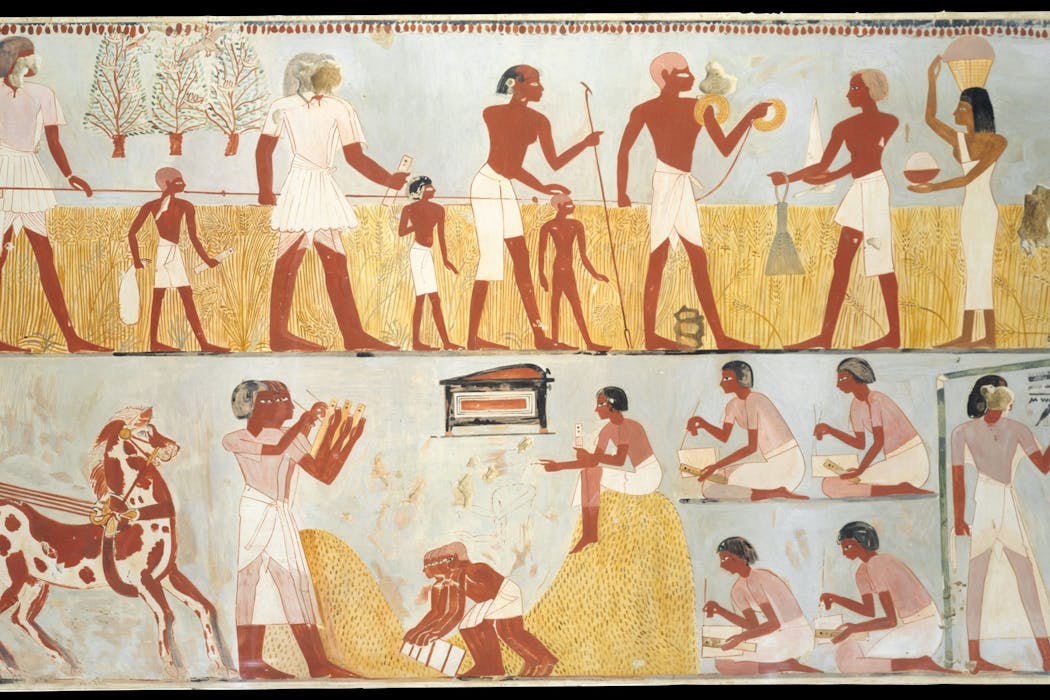
Grasses such as wheat, barley, rice and maize grow above ground, ripen at a predictable time, and the grains they produce are readily stored. This makes them perfect for the systems of taxation that Scott argues fuelled state formation.

By Scott’s account, Mafia-style protection rackets forced people to produce grain, from which tax could be extracted and used to fund further exploitation. Scott proposed that these protection rackets were effectively the original states.

a field of wheat.
Grain: the fuel of ancient nation state formation.
Shutterstock/Hari Seldon

In the meantime, writing was invented and adopted as the information system to record those taxes. Once states had formed, writing had a huge influence on the structure and institutions of those societies. States, controlled by very small elites, used writing to build institutions and laws to maintain extreme hierarchies.

We tested these ideas, combining data from hundreds of societies worldwide with a global language family tree representing the ancestral relationships between those societies. We then used a mathematical model to evaluate claims about how statehood and its possible drivers evolved along the branches of this tree.

Our results suggest that intensive agriculture, with fertilisation and irrigation, was just as likely to be the result of state formation as it was to be its cause. On the other hand, grain agriculture consistently predicted subsequent state formation and the adoption of taxes.

We also found a strong correlation between non-grain agriculture and the formation of states. However, crops such as vegetables, fruit, roots and tubers – which were hard to tax – were more likely to be lost, not gained, as states were formed. This is consistent with the idea that grains were favoured over other forms of agriculture by emerging states for their taxation potential.

Trying to test causal claims about complex social changes in the deep past is inherently uncertain, but our results provide new evidence in support of Scott’s theory – that grain agriculture fuelled the formation of states, and that writing, invented and adopted to record taxation, was then used by states to maintain themselves through a very hierarchical system of laws and societal structures.

Lessons for the modern state

Our findings also highlight a broader connection between social systems and modes of information.

Long after the first emergence of writing, the invention of the printing press in medieval Europe is thought to have been integral to a raft of social changes that followed. As a much larger number of people were literate, information became both easier and cheaper to disseminate.

In turn, mass education, which became compulsory in the late 19th century in England and many other countries, is sometimes credited with the rise of universal suffrage and the beginning of democracy.

This change in the information system of societies clearly had a profound effect on the functioning of the state, yet writing has always been a system controlled by a small elite. Even after the emergence of mass literacy in many countries, publishers, working within state rules, have exerted control and influence over how and what we read.

This helps us understand current concerns about the destabilisation of modern nation states. Digital technologies and AI are disrupting how we generate, store and broadcast information; globalisation and cryptocurrencies are disrupting our taxation systems; and our agricultural production is under pressure because of climate change.

It may feel worlds apart, but the challenges and choices facing states today have been playing out since the dawn of the earliest states, thousands of years ago.

This article contains references to books that have been included for editorial reasons, and this may include links to bookshop.org. If you click on one of the links and go on to buy something from bookshop.org The Conversation UK may earn a commission.

The Conversation

Christopher Opie received funding from the Leverhulme Trust – Early Career Fellowship – ECF 619

Quentin Douglas Atkinson receives funding from the Royal Society of New Zealand.

ref. The real reason nation states first emerged thousands of years ago – new research – https://theconversation.com/the-real-reason-nation-states-first-emerged-thousands-of-years-ago-new-research-268539

How stories of personal experience cut through climate fatigue in ways that global negotiations can’t

Source: The Conversation – UK – By Gulnaz Anjum, Assistant Professor of Climate Psychology, Centre for Social Issues Research, Department of Psychology, University of Limerick

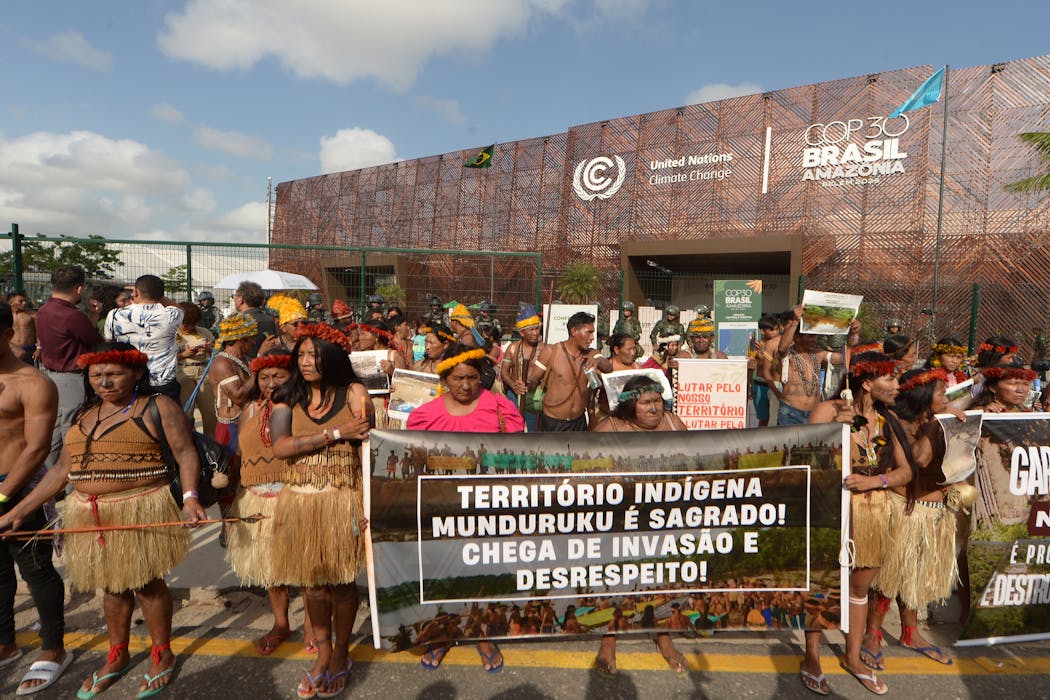
Mundukuru Indigeous people at Cop30 Belem, Brazil Antonio Scorza/Shutterstock

When Cop30 convened in Belém, deep inside the Amazon, the world’s attention turned once again to negotiations, emissions pledges and political manoeuvring. The global stage was set against one of Earth’s most biodiverse landscapes and some of its most vulnerable communities, yet the conversation still leaned heavily toward geopolitics rather than people.

Inside the crowded halls of the UN climate summit, Cop30, human stories were everywhere. Posters showed survivors of recent hurricanes, farmers battling crop loss and Indigenous leaders fighting for the survival of their territories. But these voices rarely made it into the mainstream narrative.

Climate change is often framed as a scientific or diplomatic issue, but before it becomes environmental or political, it is profoundly human. The way we communicate about climate change during global summits and in everyday life needs to reflect this reality through stories.

Across developing world and increasingly in developed countries, climate change shapes daily routines in disruptive and often painful ways. In Karachi, Pakistan, a mother lies awake through stifling heat, worried her toddler will struggle to breathe during the next power cut.

In Kingston, Jamaica, survivors of Hurricane Melissa describe “homes that no longer feel like themselves”. In informal settlements in Nairobi, Kenya, neighbours share water during heatwaves because municipal supplies have run dry.

These are the intimate forms of environmental grief that rarely surface in international negotiations, even though many communities face climate pressures far more intensely than others.

These experiences carry deep emotional weight. They are not abstract threats for a distant future but lived realities that shape sleep, caregiving, conflict and identity. Yet coverage of Cop30 focused heavily on diplomatic language and emissions curves. Psychology research consistently shows that people engage more deeply when they can recognise themselves, their families, their fears and their hopes in climate stories. Without that human connection, climate messages often become background noise.

A common reaction to climate communication today is exhaustion. People are not disengaged; they are overwhelmed. Years of catastrophic headlines, stalled policies and political gridlock create a sense of powerlessness. This “climate fatigue” is often mistaken for apathy, yet it is more accurately a form of emotional self-protection. At Cop30, fatigue showed up in activists, negotiators and residents who have endured repeated broken promises.

Climate communication has too often relied on doom-narratives that paralyse rather than motivate. When fear dominates, many people withdraw to protect their mental wellbeing.

The alternative is not sugar-coating reality. Effective communication offers grounded hope. This means honest stories of collective action and practical solutions that feel achievable.

In Kenya, communities work together on sustainable cooling. In Pakistan, youth volunteers maintain flood early warning systems. Across European cities, residents develop urban greening projects that cool streets and strengthen community ties.

These are not heroic tales but examples of ordinary people protecting each other amid extraordinary circumstances. They build a sense of agency instead of despair.

Whose voice matters?

Climate messages resonate most when they come from trusted messengers. At Cop30, some of the most compelling communicators were not national delegations but community organisers, Indigenous leaders, youth representatives and climate activists who speak from lived experience.

In many places, trust is grounded in proximity and shared identity. People listen to those who understand their world: a nurse explaining how heat worsens chronic illness, a neighbourhood elder describing changing flood patterns or a farmer talking about soil loss.

Youth leaders and activists from communities already experiencing the strongest climate impacts have become particularly influential communicators because they explain climate change through the realities of daily life. Climate communication falters when experts speak at audiences rather than with them. Lived experience is not an optional extra; it is a form of expertise.

Another key lesson for communicators is that climate messages created in Europe or North America cannot simply be transplanted elsewhere. Media environments vary, trust in institutions differs and histories of colonisation, inequality and recurrent disasters shape how people interpret climate information.

For many communities in the Amazon, climate change is inseparable from land rights, cultural identity and survival. In Pakistan, extreme heat strains fragile health systems and intensifies the emotional labour of caregiving, especially for women. In Caribbean nations, the trauma of repeated storms influences how people view political promises made at global summits.

Cop30 brought together voices from around the world, making it an essential moment for global reporting to recognise how differently climate change is felt and understood across regions. Climate communication must be culturally grounded, attentive to local realities and responsive to the needs of communities most affected.

Events like Cop30 often produce ambitious declarations, but declarations alone do not shift public engagement. People connect to climate action through stories that reflect their own struggles and resilience: a family rebuilding after a hurricane; neighbours sharing water during heatwaves; young people restoring mangroves to protect coastlines; mothers comforting frightened children as storms approach.

These stories reveal immense labour and courage, as survivors in Jamaica and Pakistan emphasise. They show people enduring hardship without adequate support, resisting inequality and surviving systemic neglect.

By placing lived experience at the centre of climate communication, we move beyond abstract numbers toward the meaning of climate change in real lives. And meaning motivates action. Evidence from Africa also shows that stories grounded in local action can increase feelings of efficacy and strengthen community connection.

Cop30 demonstrated that urgency alone is not enough. People engage when they feel seen. Climate communication must acknowledge fear without feeding hopelessness, and it must connect science to daily realities. The clearest messages come from lived experience: women sharing water during heatwaves, families rebuilding homes after storms, neighbours checking on one another during power cuts. These moments reveal what climate change truly means and why action matters.

As global negotiations continue, these human stories, alongside policymakers’ endorsements and policy announcements, must guide us. They do not compete with science; they give it meaning. If climate communication is to meet this moment, it needs to begin and end with people.


Don’t have time to read about climate change as much as you’d like?

Get a weekly roundup in your inbox instead. Every Wednesday, The Conversation’s environment editor writes Imagine, a short email that goes a little deeper into just one climate issue. Join the 47,000+ readers who’ve subscribed so far.


The Conversation

The authors do not work for, consult, own shares in or receive funding from any company or organisation that would benefit from this article, and have disclosed no relevant affiliations beyond their academic appointment.

ref. How stories of personal experience cut through climate fatigue in ways that global negotiations can’t – https://theconversation.com/how-stories-of-personal-experience-cut-through-climate-fatigue-in-ways-that-global-negotiations-cant-268852

First human bird-flu death from H5N5 – what you need to know

Source: The Conversation – UK – By Ed Hutchinson, Professor, MRC-University of Glasgow Centre for Virus Research, University of Glasgow

Melanie Hobson/Shutterstock.com

H5N1 bird flu has infected growing numbers of people worldwide in recent years, but this week saw something new: the first recorded human case of an H5N5 avian influenza virus. What is this virus and how concerned about it should we be?

What happened?

In early November, a resident of Grays Harbor, a county on the south-west Pacific coast of Washington state about 100 miles from Seattle, became severely unwell with flu-like symptoms including high fever, respiratory distress and confusion.

They were admitted to hospital, and on November 14 officials confirmed that tests showed infection with an H5N5 avian influenza virus. The patient, an older adult with underlying conditions, was treated in hospital, but sadly they died on November 21.

This was the first reported human infection with an H5N5 influenza virus.

What is H5N5 influenza virus?

H5N5 influenza viruses are a type of avian influenza (bird flu) – an influenza A virus that infects birds.

Bird flu viruses are classified as either “high pathogenicity” or “low pathogenicity” based on the severity of symptoms they cause in poultry. (Their severity also varies in other bird species.) This H5N5 strain, like the widespread and much-reported-on H5N1 strain, is one of the high pathogenicity forms.

Where did it come from?

This hasn’t yet been formally confirmed. However, the patient kept a flock of backyard poultry that were exposed to wild birds, which suggests how they might have caught the virus.

H5N5 is found in wild birds around the world, and it is relatively common for it to pass from them into flocks of poultry. This is, however, the first time an H5N5 influenza virus has been found to go one step further and infect a human.

What does the name mean? Is it similar to H5N1?

Influenza A viruses are one of the major branches of the influenza virus family, and are divided into subtypes based on differences in the two proteins that form spikes on the surface of virus particles: haemagglutinin (HA) and neuraminidase (NA).

Both proteins are good targets for the immune system’s antibodies. The proteins rapidly mutate as the virus evolves to evade these antibodies, and the different forms that result are used to categorise influenza A viruses.

The bird flu viruses H5N1 and H5N5 both have HA proteins of the same H5 subtype (though recognisably distinct from each other), but have NA proteins of different subtypes. Just as humans can be infected by different influenza A virus subtypes during the same winter season (H1N1 and H3N2), genetic studies show us this H5N5 virus is distinct from the dominant H5N1 strain that is also circulating in birds worldwide.

Should we be worried about what happens next?

H5N5 is an ecological and agricultural threat. Although bird flu vaccines exist, at the moment, political and economic factors make it hard to use them in US poultry. Instead, the virus must be controlled by surveillance, housing poultry indoors, increasing farm biosecurity and, as a last resort, by mass culling of infected poultry.

This is challenging enough, but bird flu also demands our attention because the virus is a potential cause of new pandemics.

In the long run, this risk is very significant. However, it is worth remembering that, although influenza is better at changing its host species and creating pandemics than any other virus, that is still an incredibly hard thing for the virus to do.

The vast majority of “spillover” infections of bird flu into humans are one-off events. They can vary unpredictably in their effects. Most are quite mild (for example, causing conjunctivitis), but some can be very severe, as was the case in this first recorded case of H5N5. But after infecting one human, most avian influenza viruses go no further.

Scientists will watch for several warning signs that a virus may be adapting to humans, especially any hint of person-to-person spread. There is no sign that this has happened here.

At the moment, the wider risk to humans from H5N5 is still low, and there is no reason to think this was anything other than a tragic one-off case. However, there will be plenty of opportunities for influenza viruses to try again. As H5N5 and other subtypes of avian influenza virus continue to circulate, it is important we continue to monitor this virus carefully.

The Conversation

Ed Hutchinson receives funding from UKRI and the Wellcome Trust. He has unpaid positions as a board member of the European Scientifiic Working group on Influenza (ESWI), as Chair-Elect of the Microbiology Society’s Virus Division and as a scientific advisor to Pinpoint Medical.

ref. First human bird-flu death from H5N5 – what you need to know – https://theconversation.com/first-human-bird-flu-death-from-h5n5-what-you-need-to-know-270535

The world’s little-known volcanoes pose the greatest threat

Source: The Conversation – UK – By Mike Cassidy, Associate Professor, School of Geography, Earth and Environmental Sciences, University of Birmingham

El Chichón volcano in Mexico erupted explosively in 1982 after lying dormant for centuries. Michael Cassidy, CC BY-NC-ND

The next global volcanic disaster is more likely to come from volcanoes that appear dormant and are barely monitored than from the likes of famous volcanoes such as Etna in Sicily or Yellowstone in the US.

Often overlooked, these “hidden” volcanoes erupt more often than most people realise. In regions like the Pacific, South America and Indonesia, an eruption from a volcano with no recorded history occurs every seven to ten years. And their effects can be unexpected and far-reaching.

One volcano has just done exactly that. In November 2025, the Hayli Gubbi volcano in Ethiopia has erupted for the first time in recorded history (at least 12,000 years that we know of). It sent ash plumes 8.5 miles into the sky, with volcanic material failing in Yemen and drifting into air space over northern India.

You don’t have to look far back in history to find another example. In 1982, the little-known and unmonitored Mexican volcano El Chichón erupted explosively after lying dormant for centuries. This series of eruptions caught authorities off-guard: hot avalanches of rock, ash and gas flattened vast areas of jungle. Rivers were dammed, buildings destroyed, and ash fell as far as Guatemala.

More than 2,000 people died and 20,000 were displaced in Mexico’s worst volcanic disaster in modern times. But the catastrophe did not end in Mexico. The sulphur from the eruption formed reflective particles in the upper atmosphere, cooling the northern hemisphere and shifting the African monsoon southwards, causing extreme drought.

This alone would test the resilience and coping strategies of any region. But when it coincided with a vulnerable population that was already experiencing poverty and civil war, disaster was inevitable. The Ethiopian (and East African) famine of 1983-85 claimed the lives of an estimated 1 million people. This brought global attention to poverty with campaigns like Live Aid.

Few scientists, even within my field of Earth science, realise that a remote, little-known volcano played a part in this tragedy.

Despite these lessons, global investment in volcanology has not kept pace with the risks: fewer than half of active volcanoes are monitored, and scientific research still disproportionately focuses on the well-known few.

There are more published studies on one volcano (Mount Etna) than on all the 160 volcanoes of Indonesia, Philippines and Vanuatu combined. These are some of the most densely populated volcanic regions on Earth – and the least understood.

The largest eruptions don’t just affect the communities around them. They can temporarily cool the planet, disrupt monsoons and reduce harvests across entire regions. In the past, such shifts have contributed to famines, disease outbreaks and major social upheaval, yet scientists still lack a global system to anticipate or manage these future risks.

volcano erupting with red explosive ash
Mount Etna on the Italian island of Sicily.
Wead/Shutterstock

To help address this, my colleagues and I recently launched the Global Volcano Risk Alliance, a charity that focuses on anticipatory preparedness for high-impact eruptions. We work with scientists, policymakers and humanitarian organisations to highlight overlooked risks, strengthen monitoring capacity where it is most needed, and support communities before eruptions occur.

Acting early, rather than responding only after disaster strikes, stands the best chance of preventing the next hidden volcano from becoming a global crisis.

Why ‘quiet’ volcanoes aren’t safe

So why do volcanoes fail to receive attention proportionate to their risk? In part, it comes down to predictable human biases. Many people tend to assume that what has been quiet will remain quiet (normalcy bias). If a volcano has not erupted for generations, it is often instinctively considered safe.

The likelihood of an event tends to be judged by how easily examples come to mind (this mental shortcut is known as availability heuristic). Well-known volcanoes or eruptions, such as the Icelandic ash cloud from 2010, are familiar and can feel threatening, while remote volcanoes with no recent eruptions rarely register at all.


Read more:
Wildfires, volcanoes and climate change: how satellites tell the story of our changing world


These biases create a dangerous pattern: we only invest most heavily after a disaster has already happened (response bias). El Chichón, for instance, was only monitored after the 1982 catastrophe. However, three-quarters of large eruptions (like El Chichón and bigger) come from volcanoes that have been quiet for at least 100 years and, as a result, receive the least attention.

Volcano preparedness needs to be proactive rather than reactive. When volcanoes are monitored, when communities know how to respond, and when communication and coordination between scientists and authorities is effective, thousands of lives can be saved.

Disasters have been averted in these ways in 1991 (at Mount Pinatubo in the Philippines), in 2019 (at Mount Merapi in Indonesia) and in 2021 (at La Soufrière on the Caribbean island of Saint Vincent).

To close these gaps, the world needs to shift attention towards undermonitored volcanoes in regions such as Latin America, south-east Asia, Africa and the Pacific – places where millions of people live close to volcanoes that have little or no historical record. This is where the greatest risks lie, and where even modest investments in monitoring, early warning and community preparedness could save the most lives.


Don’t have time to read about climate change as much as you’d like?

Get a weekly roundup in your inbox instead. Every Wednesday, The Conversation’s environment editor writes Imagine, a short email that goes a little deeper into just one climate issue. Join the 47,000+ readers who’ve subscribed so far.


The Conversation

Mike Cassidy receives funding from the UK’s Natural Research Research Council. He is the Co-founder and Chair of the Global Volcano Risk Alliance charity.

ref. The world’s little-known volcanoes pose the greatest threat – https://theconversation.com/the-worlds-little-known-volcanoes-pose-the-greatest-threat-266292

The gender pay gap looks different depending where you are on the income ladder

Source: The Conversation – UK – By Vanessa Gash, Deputy Director of the Violence and Society Centre, City St George’s, University of London

Somchai_Stock/Shutterstock

Despite decades of progress, the gender pay gap remains a persistent feature of the UK labour market. According to women’s rights charity the Fawcett Society, November 22 marked Equal Pay Day 2025 – the day when women effectively stop getting paid due to the wage gap with men.

This gender pay gap means women continue to earn less than men – currently by around 11% in the UK. This is not just because of differences in education or job type, but due to deeper inequalities in how work and care responsibilities are distributed.

A study on barriers to equal pay that I undertook with colleagues used 40 years of work history data from the UK Household Longitudinal Study to uncover how these inequalities play out across income groups.

We found that differences in work history – particularly full-time employment – account for nearly 29% of the gender pay gap on average. Women have shorter full-time work histories and spend more time doing part-time roles and unpaid care work. This reflects the challenges of reconciling paid employment with caregiving responsibilities.

For example, men in our sample had an average of 20 years of full-time work, compared to 14 years for women. Women also spent significantly more time in unpaid family care – more than two years on average – while men had less than three weeks.

This disparity is not just about time, it’s about how the labour market rewards different types of work. Full-time work earns a premium, while part-time work and unpaid care are penalised. Our research found that a year of full-time work increases hourly pay by 4%, while a year of part-time work decreases it by 3%.

The cost of being female

Even after education, occupation, sector and work history are taken into account, women still face a significant pay penalty. We found that this “female residual” – a proxy for discriminatory pay practices and cultural biases in how women and men behave – accounts for 43% of the average gender pay gap. This is an astonishing finding from a complex model that controlled for a wide variety of predictors of pay differentials.

In low-income households, the penalty is even more severe. Women in these households would earn more than men if not for this “female residual”. For example, for low-paid public sector workers, other factors like education and work history might create an expectation of women outearning men. But the female residual here meant that any advantage was cancelled out.

This finding challenges the assumption that discrimination is more prevalent among high earners and underscores the need to focus on inequality at the bottom of the income distribution.

Interestingly, the impact of part-time work varies by income group. Among wealthier households, part-time work increases the gender pay gap. But in poorer households, it does not appear to carry the same penalty – and may even offer a slight premium for women. This suggests that exposure to part-time work for men in lower income groups is associated with very low pay.

With this in mind, policies encouraging full-time work for women may not be appropriate for all groups. In low-income households, part-time work may be a necessary and viable option, especially when the quality of the available jobs is poor and caregiving responsibilities are high.

However, we also found that men face a stronger penalty for part-time work than women, which may discourage them from sharing caregiving duties. This reinforces traditional gender roles and perpetuates inequality.

Sex-segregated occupations – those dominated by either men or women – also play a role in the gender pay gap. Female-dominated jobs (for example, care work, hospitality and retail) tend to be lower paid, less regulated and offer fewer opportunities for progressing up the career ladder.

We found that this segregation accounts for 17% of the average gender pay gap. Yet, we also found penalties associated with male-dominated occupations such as construction, particularly in low-income households. This challenges the assumption that male-dominated jobs are always better paid.

On the other hand, we found that public-sector employment, union membership and paid parental leave reduce the gender pay gap, especially for women in low-income households. These offer some protection against discrimination at the same time as supporting work-life balance.

But these benefits are not evenly distributed. Women in wealthier households are less likely to rely on these protections, while those in poorer households benefit disproportionately. This highlights the importance of jobs that offer these protections for low-income workers.

Our findings suggest that equal pay policies must be tailored to the needs of different income groups. For wealthier households, policies that support full-time work and chip away at sex segregation may be effective so that women can more readily access better-paid jobs.

But for poorer households, the focus should be on improving access to stable and better-paid jobs, while reducing discrimination and supporting flexible work arrangements.

Crucially, efforts to close the gender pay gap must avoid pitting the gains of high-earning women against the losses of low-earning men. In an era of rising political populism, this could undermine support for equality.

Instead, we need an approach that promotes good-quality employment for all and that supports equalised caregiving responsibilities. If we fail to address the barriers that prevent men and women from participating fully in both paid work and unpaid care work, we are unlikely to see reductions in the gender pay gap any time soon.

The Conversation

Vanessa Gash does not work for, consult, own shares in or receive funding from any company or organisation that would benefit from this article, and has disclosed no relevant affiliations beyond their academic appointment.

ref. The gender pay gap looks different depending where you are on the income ladder – https://theconversation.com/the-gender-pay-gap-looks-different-depending-where-you-are-on-the-income-ladder-270199

A quarter of early child care educators in Colorado reported mistreatment from co-workers

Source: The Conversation – USA – By Virginia McCarthy, Assistant Professor, Department of Surgery, University of Colorado Anschutz Medical Campus

Preschool teachers lead a class in Adams County, Colo. Kathryn Scott/The Denver Post via Getty Images

Early childhood educators and staff nurture and teach children under the age of 5. At its best, this type of early care sets kids up for long-term success.

But educators who are experiencing poor mental health are less able to cultivate positive relationships with the children in their care, which negatively affects the children’s development.

“We work in a field that has a high demand for kids to be safe and enjoy learning,” one educator told us. “We have … little people that depend on us, parents depend on us, and we need to make sure that we are there for the kids when they need us.”

Our research team – led by a clinical associate professor and a research assistant professor in public health – set out to learn how child care workers were coping with all of this responsibility.

What we learned was concerning and needs to be understood by parents and policymakers alike.

Studying 42 Head Start centers

Our peer-reviewed study examined the mental health of 332 early child care educators and other staff at 42 Head Start centers in the Denver metropolitan area and southeast Colorado.

We found that roughly 25% of early child care staff in Colorado self-reported discrimination and condescending or demeaning treatment from a colleague in the past year, with 15% experiencing more than one kind.

We measured discrimination tied to age, race, ethnicity and gender. We also measured types of demeaning treatment, which included bullying, harassment and condescending behavior. And we looked at physical violence.

Higher levels of workplace mistreatment were related to greater numbers of poor mental health days. The child care staff we surveyed reported an average of seven poor mental health days in the month prior to completing the survey.

Mistreatment in early childhood education

The early child care workforce also reports higher rates of depression than the national workforce.

High stress of educators and staff even pushes some workers out of the profession.

Working conditions matter, too, with early child care workers reporting substantial physical and psychological workplace challenges, such as lifting and carrying children, as well as managing a wide range of ages and capabilities among children in the classroom.

Our survey also revealed that 1 in 4 early child care staff experienced condescending or demeaning treatment by colleagues or superiors in the past 12 months. This was the most common type of workplace mistreatment.

In early child care, teamwork and collegiality are integral and are linked to educator well-being. Mistreatment between colleagues can strain relationships, contribute to burnout and reduce the likelihood of educators stepping into leadership roles.

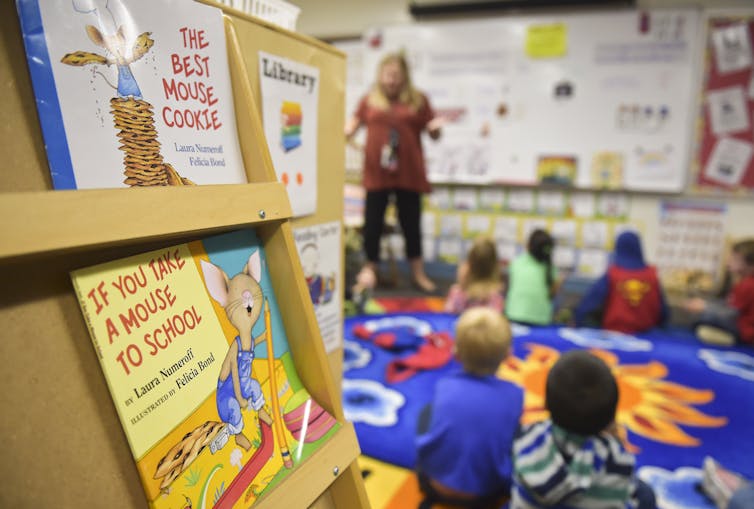
Books are in focus in the foreground with titles like 'The Best Mouse Cookie' and 'If you take a mouse to school.' In the blurred background is an adult woman standing and teaching to a bunch of young children sitting on the ground.
Books in a Frederick, Colo., preschool class.
Lewis Geyer/Digital First Media/Boulder Daily Camera via Getty Images

Our study found that 1 in 10 early child care staff reported discrimination at work based on race or ethnicity. Experiences of discrimination have an impact beyond mental health and also affect physical health, job attitudes and engagement in the workplace.

Younger workers are struggling

Discrimination was three times as likely to be reported by the younger workforce, ages 18-29, than older workers. Discrimination between age groups affects trust and can reduce employee engagement.

Mistreatment of early child care workers can take several forms that happen at the same time. For example, age discrimination can occur in either direction. Younger staff may be viewed by older colleagues as less experienced, less committed or less capable than more experienced colleagues. Older colleagues may be perceived to be less creative or less willing to adapt to new strategies and practices.

Yet overall, younger workers seemed to be struggling more. Workers under 35 reported an average of eight to nine poor mental health days in a 30-day window; older workers reported an average of 5.6.

Improving staff well-being

Our study indicates a need for both societal and organizational change to prevent mistreatment of early child care staff, which can improve worker well-being and lead to better care for young children.

At a societal level, it is important to acknowledge the integral role of the early child care workforce and compensate these workers at a level commensurate with their importance. In 2023, the average U.S. preschool teacher earned an annual income of $37,120 compared to the $63,680 annual income of elementary school teachers.

Adequate pay and appreciation can reduce turnover. Rates of turnover are four times higher among early child care educators than elementary school teachers.

“Turnover has a lot to do with pay, unfortunately, and we don’t get paid a whole lot of money,” one educator said. “And … I don’t think I’ve always felt valued in the position I’m in.”

At an organizational level, leaders can implement health-centered policies and offer managerial training on how to build supportive teams. Total Worker Health interventions may also help to guide needed policy changes with input from staff. These interventions are holistic programs that focus on both the safety and well-being of workers and include elements such as environmental and social supports. They are shown to improve worker well-being.

One initiative compared wellness intervention models across six Early Head Start and Head Start networks nationally to address the comprehensive well-being in staff. Direct outcomes of the programs included workplace and organizational culture improvements, as well as higher staff well-being.

We designed the WELL Program, which has successfully been implemented at five Colorado-based Head Start networks. The program includes training to promote better sleep and mindfulness.

“WELL help(ed) people keep going every day and deal with their stress in a healthy way so it didn’t come out in the classroom, or come out against kiddos that are tough,” one participant said.

Our study also suggests there may be generational differences in workplace communication and a varied understanding of what it is to be mistreated. Additional research on these differences may help us to address causes of mistreatment and find solutions.

The Conversation

Charlotte Farewell receives funding from the Administration for Children and Families.

Jini Puma receives funding from the Administration for Children and Families.

Kyla Hagan-Haynes and Virginia McCarthy do not work for, consult, own shares in or receive funding from any company or organization that would benefit from this article, and have disclosed no relevant affiliations beyond their academic appointment.

ref. A quarter of early child care educators in Colorado reported mistreatment from co-workers – https://theconversation.com/a-quarter-of-early-child-care-educators-in-colorado-reported-mistreatment-from-co-workers-264666

Automated systems decide which homeless Philadelphians get housing and who stays on the street – often in ways that feel arbitrary to those waiting

Source: The Conversation – USA – By Pelle G. Tracey, Assistant Professor of Information, University of Washington

Philadelphia has thousands of homeless residents living in shelters and on the streets. Jeff Fusco/The Conversation U.S., CC BY-SA

Seeing a person huddled under a makeshift roof of tarps or curled up on a warm grate can evoke powerful emotions and questions.

How did they get here? Why doesn’t someone help them? What can I do about this?

The answers to these questions are complex. However, a significant body of research suggests that there is a highly effective solution for many individuals who experience homelessness. It is called supportive housing.

Supportive housing programs combine a housing subsidy – financial assistance that helps make housing affordable even for those with very low incomes – with wraparound supportive services that help a person remain stably housed. Supportive services often include case management, occupational therapy and mental health and addiction treatment. These programs have helped thousands of Philadelphians end their experiences of homelessness.

As a researcher and former social worker, I have spent much of the past decade working in and studying homeless services in Philadelphia. For my dissertation research, I conducted hundreds of hours of ethnographic fieldwork at a soup kitchen and outreach center in the city between 2022 and 2024. I interviewed 75 homeless services workers, volunteers and people who were experiencing or had experienced homelessness. I also analyzed hundreds of pages of policy documents.

I have found that while the city has succeeded in centralizing services to support unhoused people, there remain major bureaucratic challenges exacerbated by insufficient funding and a shortage of supportive housing. These challenges impact both people seeking supportive housing and front-line workers trying to help them.

Khalil’s story

Consider the case of Khalil, a 48-year-old from West Philly who became homeless during the pandemic. (As for all the interviewees’ names used in this article, Khalil is a pseudonym I’m using to protect his privacy.) Khalil told me that he lost his job as an IT technician at Verizon, where he had worked for nine years. Sleeping outside and unable to afford life-sustaining kidney medication, he said, his physical and mental health spiraled.

A supportive housing program changed that, providing him with a stable and affordable place to live, while social workers helped him enroll in Medicaid and connect with a community health clinic. This support, Khalil explained, allowed him to “transition back into residential living and back into employment and back into being a working member of society.”

Despite the efficacy of supportive housing, cities do not receive sufficient federal funding to provide this service to all residents who are eligible. As a result, the need for these housing programs vastly outstrips the supply.

So how do officials in Philadelphia decide who will continue to sleep on the street or in a shelter, and who can move into a supportive housing facility with a warm bed and access to valuable wraparound services?

How the city determines who gets housing

Like other localities, Philadelphia uses a Coordinated Entry System. CES is a form of automated bureaucracy that combines several different algorithms and administrative processes with the goal of helping officials and social service workers allocate resources fairly and efficiently.

CES is intended to help workers identify which people experiencing homelessness are in greatest need of aid. These systems work by combining a central pool of resources like housing programs and a central list of people seeking help. Unhoused people are scored using a vulnerability assessment tool, and those that score highest are matched to an opening in a supportive housing program.

Because most of these systems are premised on targeting resources to the most vulnerable people, defining and gauging vulnerability becomes fraught with tension. After all, vulnerability is inherently subjective, and there is no universally agreed-upon best way to measure it.

These systems will soon come under even greater pressure as the U.S. Department of Housing and Urban Development prepares to slash funding for supportive housing programs. As many as 170,000 people nationwide who were previously homeless will be at risk of returning to the streets once these funding changes are implemented.

CES has benefits and drawbacks

Coordinated entry has made real progress on several long-standing challenges for Philadelphia’s homeless services system. Chief among these is centralization.

Most resources available for people experiencing homelessness are administered by nonprofit social services organizations. Prior to CES, a person seeking assistance would separately apply to various nonprofits and put their name on multiple waiting lists.

CES centralizes resources into a common pool, accessed through the vulnerability assessment process. As one administrator with the city’s Office of Homeless Services told me, this arrangement is “immensely more supportive and fair” than the scattered process that came before. For example, individual nonprofit providers are less able to earmark resources for clients they already work with.

However, there are downsides to Philadelphia’s approach to CES.

Vulnerability assessments, like those used in Philadelphia, have been criticized for failing to capture a full picture of a person’s plight. Assessments involve asking unhoused people a series of yes or no questions about their housing, health and financial history, and generate a vulnerability score based on the responses. A person who has a relatively mild experience with several different risk factors can end up with a much higher score than a person with an extremely serious experience with just a few.

And similar to other automated assessments, such as in the criminal legal system, they have the potential to introduce racial bias into allocation outcomes.

Furthermore, the way CES works is, by design, hidden from the people it impacts most. The ambiguity is intended to prevent people from gaming the system, but it also creates confusion for those living in shelters and on the street. Some seeking aid may hide evidence of their vulnerability, such as addiction, out of fear it will disqualify them from housing. Others may amplify their vulnerability in an effort to improve their odds of receiving help.

The result is a perception among people experiencing homelessness that the system is unfair.

As Andre, a 60-year-old who had been sleeping in shelters off and on for nearly a decade, told me, a person who “goes in there and tells the absolute truth, they’re put on the back burner.”

Person sleeps on chairs with wheelchair nearby
A person sleeps on a bench in the Philadelphia International Airport.
AP Photo/Matt Rourke

‘You’ve got to have a record of being homeless’

Leon, a 25-year-old from North Philadelphia, told me as we chatted over coffee that in order to be prioritized through CES, “You’ve got to have a record of being homeless.”

But generating such a paper trail can be difficult. A city database tracks shelter stays that can serve as proof of homelessness, but not all shelters participate. And for those sleeping outside, like Leon, proof depends on regular interactions with outreach workers, which requires being in the right place at the right time.

If an unhoused person cannot prove the length of their time on the street, or provide documentation of a mental health diagnosis, they may be deprioritized through CES, even if they are highly vulnerable.

For all its advantages, CES in Philly is not designed to take into account the input of unhoused people themselves. In the words of Richie, a 32-year-old who was seeking housing for himself and his pregnant wife, “There is no voice for homeless people … because homeless people don’t have a voice.”

Despite these challenges, the city has lowered barriers to participating in CES. For example, the city has launched a pilot program involving mobile assessors who can complete assessments in different locations beyond city shelters, such as at soup kitchens, to meet unhoused people where they are.

3 ways to improve the system

Here are three concrete ways the city could reduce more of the bureaucratic hurdles to supportive housing.

First, the city could expand pathways to supportive housing through a model called multiprinciple allocation. This approach combines different methods for determining who gets housing. Some subsidies could be allocated through new vulnerability assessments that are better vetted for bias, while others are distributed based on length of homelessness or a lottery system. This could bolster fairness by ensuring that people whose vulnerability is not picked up through the assessment tool could still have a shot at aid.

Second, the city could provide opportunities for unhoused people and front-line workers to attest to vulnerability and experiences of homelessness in their own words – allowing someone to say, “I am struggling with housing for reasons that the assessment did not cover.”

And third, Philadelphia could reduce the degree of automation in the CES matching process. As things stand, people with high scores are mechanically matched to open programs, even if that program is a poor fit for the individual person. Giving staff and unhoused people more agency in making housing matches could produce better outcomes.

No amount of tinkering with CES can address the fundamental resource constraints that shape the fight against homelessness in Philadelphia. Simply put, Philadelphia lacks sufficient funding for housing the most vulnerable. But thoughtful changes to CES could make the response to homelessness more effective, compassionate and fair.

Read more of our stories about Philadelphia, or sign up for our Philadelphia newsletter on Substack.

The Conversation

Pelle G. Tracey has received funding from the Google Award for Inclusion Research.

ref. Automated systems decide which homeless Philadelphians get housing and who stays on the street – often in ways that feel arbitrary to those waiting – https://theconversation.com/automated-systems-decide-which-homeless-philadelphians-get-housing-and-who-stays-on-the-street-often-in-ways-that-feel-arbitrary-to-those-waiting-266563

Jeunesse populaire : sur les réseaux, un nouvel art de l’engagement – Exemple en Seine-Saint-Denis, avec Snapchat

Source: The Conversation – France in French (3) – By Rosa Bortolotti, Docteure en Sciences de l’éducation et de la formation, chercheuse au Laboratoire ÉMA (École, Mutations, Apprentissages), CY Cergy Paris Université

Dans les quartiers populaires, la question du racisme mobilise fortement sur les réseaux sociaux. Fethi Benattallah/Unsplash, CC BY

On les dit désengagés, indifférents, repliés sur leurs écrans. Et si les jeunes, notamment ceux des quartiers populaires, inventaient simplement d’autres manières de s’impliquer ? Sur les réseaux sociaux, leurs « likes », partages et prises de parole esquissent une nouvelle forme de citoyenneté, plus diffuse mais bien réelle.


L’engagement est souvent entendu comme une participation pérenne à une organisation syndicale ou partisane. Focalisée sur le capital politique, cette conception ignore les formes d’engagement émergentes dites « par le bas ». Elle se limite à considérer l’habitus politique qui se manifeste à travers l’investissement associatif, la prise de parole publique, le goût du débat, et repose sur une disponibilité matérielle et temporelle au bénévolat.

Mais alors, qu’en est-il de celles et ceux qui ne présentent pas ces dispositions et ces ressources ? Sont-ils dépourvus de toute capacité de réflexion critique et de participation au monde qui les entoure ?

C’est précisément autour de ces interrogations que j’ai centré une partie importante de mon travail doctoral. Si les jeunes de classes populaires s’inscrivent peu dans des collectifs associatifs traditionnels, ils n’en sont pas moins animés de combats et de convictions.

En m’inspirant d’un ensemble de travaux qui étudient les mobilisations juvéniles, je montre qu’ils développent de nouvelles formes d’engagement à travers leurs sociabilités numériques. C’est l’un des enseignements que je tire d’une ethnographie en ligne, menée pendant un an sur les comptes Snapchat de 14 jeunes (8 filles et 6 garçons) de cités de Seine-Saint-Denis, le département le plus pauvre de France hexagonale ?

L’engagement des jeunes aujourd’hui : associations et causes partagées sur les réseaux sociaux

L’engagement se définit comme la capacité d’une personne à s’impliquer volontairement, dans une certaine durée, en faveur d’une cause. Il implique une forme de contrat moral qui unit une personne à ce qu’elle entend défendre. L’engagement ne repose donc pas systématiquement sur la participation à des collectifs associatifs – même si cette dimension demeure essentielle dans certains contextes –, mais sur la défense d’une cause en laquelle on croit, quels qu’en soient les voies et les moyens.

Aujourd’hui, divers chercheurs de la jeunesse s’accordent à dire que les formes d’engagement se sont transformées, non seulement dans les causes qui en sont l’objet, passant de luttes sociales à des enjeux civils, mais aussi dans leurs modes d’expression. Ces travaux montrent que les réseaux sociaux numériques offrent un terrain privilégié de visibilité et de socialisation.

Pour étudier l’engagement des jeunes, il ne suffit plus en effet de mesurer leur taux de participation aux élections politiques ou leur mobilisation associative. Il convient également de prendre en compte des formes d’investissement liées aux loisirs (sport, art, culture) ainsi qu’à d’autres actions moins visibles : être délégué de classe ou signer une pétition en ligne par exemple. En élargissant le spectre, on constate aisément que les jeunes ne se désintéressent pas des causes sociales qui traversent leur quotidien.

Le dernier rapport de l’Institut national de la jeunesse et de l’éducation populaire (Injep), « État d’esprit et engagement des jeunes en 2025 » enseigne que trois jeunes âgés de 15 à 30 ans sur dix déclarent avoir consacré bénévolement du temps à une association au moins une fois par mois au cours des douze derniers mois.

Si l’engagement est plus important chez les jeunes ayant de bonnes conditions matérielles, autrement dit du temps et de l’argent, le rapport souligne la réalité d’un engagement « multidomaines » : éducation, culture ou loisirs, environnement, causes humanitaires ou sociales, etc. La principale forme de participation à la vie citoyenne et politique tient même dans la signature de pétitions ou la défense d’une cause en ligne : une pratique qui concerne 40 % des jeunes de 15 à 30 ans.

L’engagement des jeunes sur les réseaux sociaux : solidarités et dénonciation des injustices

Les jeunes de quartiers populaires développent sur leurs espaces numériques de véritables pratiques engageantes. Différents profils se dégagent : ceux qui dénoncent directement les injustices, ceux qui préfèrent en rester spectateurs, et ceux qui cherchent à élargir leur audience en partageant massivement des informations qui circulent. Parcourant leur quotidien, leurs combats vont du soutien au commerce local à la dénonciation d’inégalités de genre (notamment pour les filles), de violences commises par la police, jusqu’à l’expérience du racisme.

Les jeunes partagent également des informations pour promouvoir des initiatives locales : une mère qui vend des gâteaux, un voisin qui ouvre son restaurant, un nouveau garage de bricolage dans le quartier… En rendant visibles ces activités, ils cherchent à « donner de la force » à ceux qui essaient de s’en sortir. C’est le cas de Zayan (19 ans) :

« Un chanteur du quartier va sortir une musique, il va nous dire de partager, on va partager. Quelqu’un du quartier commence à travailler dans un garage, là il travaille, on va partager son garage. On va donner de la force un peu. On va faire en sorte que son nom soit entendu sur les réseaux. »

Des filles investies dans le féminisme antiraciste

Concernant la thématique des injustices sociales, deux grandes causes ressortent. Les filles, particulièrement les majeures, font en ligne l’apprentissage d’un féminisme antiraciste. Certaines suivent plusieurs pages de collectifs ou de personnalités militantes (par exemple, la page d’Assa Traoré rencontre un grand succès).

Dans leurs échanges, la sémantique rappelle les milieux militants comme l’expression « beauty privilege ». Celle-ci renvoie au combat des femmes noires, longtemps réduites au statut d’objet sexuel et exclues du cercle des « beautés nobles ». Cherchant à renverser les stigmates dont elles sont la cible, elles utilisent les réseaux sociaux pour affirmer leur présence : elles y publient des photos d’elles très maquillées, parfois sexualisées, là où elles se voient opprimées dans un espace public contrôlé par le machisme. Par cette pratique défiant la culture traditionnelle, elles revendiquent une liberté d’existence. Comme le dit Lisa, 18 ans :

« Avant je me sentais pas bien, je publiais rien et je jugeais aussi les filles qui publiaient des photos d’elles. Après j’ai appris qu’elles étaient vraiment jugées de faire ça. Maintenant que je sais qu’est-ce que ça fait, par exemple une personne va me dire que c’est pas bon je vais le faire pour nous soutenir. »

Jade, 18 ans, appuie cette idée d’émancipation :

« Par exemple une fille ronde et qui se dit : “J’ai pas envie de montrer tout ça”, ou comme une fille très mince elle va se dire “Ouais, je suis très mince, je ne me plais pas car j’ai pas de masse, en gros, c’est pas bien.” Mais moi, je montre que je m’en fous, que je suis ronde et je vais me montrer comme une fille mince peut se montrer aussi. Ça ne change rien. »

Une dénonciation des violences policières

Les violences commises par la police à l’encontre des jeunes garçons racisés (noirs ou maghrébins) et l’expérience du racisme forment une autre thématique qui mobilise fortement. La médiatisation massive des faits, relayés aussi bien par les chaînes télévisées que par les réseaux sociaux, contribue à attester leur gravité. Par leurs publications, les jeunes nourrissent l’espoir d’une reconnaissance de ces injustices en même temps qu’ils se construisent une communauté de vécu face à des réalités qui les encouragent à se soutenir les uns entre les autres :

« Eux, les gens riches, ils ne vont pas poster des voitures cramées, des voitures qui brûlent. Eux, ils vont poster des trucs simples, des trucs beaux, de l’art par exemple. Les gens de cités vont publier la police qui est en train de passer, de les insulter, c’est pour ça qu’après, certains adultes vont critiquer les jeunes de cités. » Umar, 17 ans.

Le terreau de luttes émancipatrices ?

Les résultats de ma thèse rejoignent ainsi des conclusions exprimées par diverses recherches : ils démontrent une véritable capacité d’agir des jeunes par rapport à leur vie dans la cité.

Sur les réseaux sociaux, ces jeunes apprennent entre eux, partagent leurs modes d’existence et leurs combats quotidiens, comme autant de prémisses d’une conscientisation des rapports de domination qui les entourent. Le processus s’accompagne parfois d’un esprit de révolte susceptible d’encourager des mouvements de protestation violents.

Il suffit d’observer l’actualité récente – qu’il s’agisse du soulèvement de la génération Z au Népal, au Maroc ou des émeutes en France à l’été 2023. Ces mobilisations urbaines ont été largement orchestrées via les réseaux sociaux numériques.

N’en déplaise à ceux qui jugent de façon péremptoire que la jeunesse « n’est plus ce qu’elle était », ces épisodes démontrent que l’engagement de la jeunesse n’est pas en voie de disparition. Elle se manifeste dans d’autres espaces de socialisation que la recherche, mais, surtout, les acteurs éducatifs devraient plus prendre au sérieux et de façon désensibilisée.

The Conversation

Rosa Bortolotti a reçu des financements du Conseil Départemental de la Seine-Saint-Denis pour la réalisation d’une partie de la recherche doctorale.

ref. Jeunesse populaire : sur les réseaux, un nouvel art de l’engagement – Exemple en Seine-Saint-Denis, avec Snapchat – https://theconversation.com/jeunesse-populaire-sur-les-reseaux-un-nouvel-art-de-lengagement-exemple-en-seine-saint-denis-avec-snapchat-265609

Au Mali, les djihadistes prennent-ils pour modèle leurs homologues syriens ?

Source: The Conversation – France in French (3) – By Pierre Firode, Professeur agrégé de géographie, membre du Laboratoire interdisciplinaire sur les mutations des espaces économiques et politiques Paris-Saclay (LIMEEP-PS) et du laboratoire Médiations (Sorbonne Université), Sorbonne Université

Bina Diarra, porte-parole du JNIM, s’adresse en bambara aux Maliens dans une vidéo publiée en novembre 2025.
Capture d’écran X (anciennement Twitter)

Des années durant, l’organisation islamiste Hayat Tahrir al-Cham, dit HTC, n’a contrôlé qu’un petit bout du territoire de la Syrie, avant de saisir l’occasion, fin 2024, de faire chuter le régime Assad et de s’emparer de l’ensemble du pays. Un développement qui, semble-t-il, n’a pas échappé à un autre groupe djihadiste, à des milliers de kilomètres de là : au Mali, le Groupe de soutien à l’islam et aux musulmans paraît s’inspirer de l’évolution qu’a connue HTC, en recentrant son djihad sur l’échelon national, quitte à délaisser toute ambition globale.


Les visites récentes du président intérimaire syrien Ahmed Al-Charaa à Moscou, le 15 octobre, et à Washington, le 10 novembre, ont particulièrement retenu l’attention de la presse, qui y voit l’acte final d’une lente et progressive métamorphose d’un groupe terroriste en une force politique de gouvernement reconnue par la communauté internationale.

Cette trajectoire de Hayat Tahrir al-Cham (Organisation de libération du Levant, ou HTC, dont Al-Charaa est à la tête), depuis la clandestinité terroriste jusqu’aux chancelleries des grandes puissances, n’échappe évidemment pas à l’attention des différents stratèges de la nébuleuse djihadiste mondiale, comme le montre l’évolution actuelle, au Mali, du Groupe de soutien à l’islam et aux musulmans (Jama’at Nusrat ul-Islam wa al-Muslimin, ou JNIM). Le mouvement terroriste sahélien, filiale d’Al-Qaida dans la région, semble entraîné dans une métamorphose identique que celle qu’a connue le HTC dans la province d’Idlib en Syrie de 2017 à la chute d’Assad.

Comme le HTC, le JNIM abandonne progressivement le djihad global au profit d’une lutte politique purement nationale dans laquelle l’enracinement auprès des populations locales l’emporte sur l’agenda djihadiste. Peut-on parler d’une syrisation des acteurs terroristes au Sahel ?

Un essor de l’islamo-nationalisme sur le modèle syrien

Comme le HTC dans la bande d’Idlib de 2017 à 2024, le JNIM a profondément changé de stratégie depuis le départ des Français en 2022 à la suite de l’échec de l’opération Barkhane. À l’origine force djihadiste – le mouvement Ansar Dine – alliée aux Touaregs du Mouvement national de libération de l’Azawad (MNLA), le JNIM aspire désormais à fédérer autour de lui des représentants des différentes ethnies du pays et à se métamorphoser ainsi en une force politique nationale, voire nationaliste.

Abandonnant progressivement le terrorisme tourné contre les civils au profit d’actions de déstabilisation du régime, le JNIM entend devenir une force d’alternative à la junte militaire en s’implantant durablement auprès des populations civiles. C’est dans cette optique que nous pourrions analyser la politique d’ouverture du JNIM aux ethnies importantes du pays : d’abord adressé aux Touaregs en guerre ouverte contre Bamako depuis 2012, le mouvement s’est ouvert aux Peuls depuis l’ouverture de sa branche méridionale très active au Burkina Faso, la Katibat Macina, puis plus récemment aux Bambaras, l’ethnie majoritaire de la région de Bamako.

Le choix de Bina Diarra, dit Al-Bambari, comme porte-parole du groupe montre le refus du JNIM d’être désormais assimilé aux ethnies minoritaires du nord du Mali, alliées régulières des djihadistes, ainsi que le projet des djihadistes de créer autour d’eux un véritable consensus populaire qui dépasse le clivage habituel entre les ethnies nomades plus arabisées du Nord (comme les Touaregs) et les ethnies sédentaires subsahariennes.

Cette politique n’est pas sans rappeler celle menée par le HTC dans la bande d’Idlib de 2017 à 2024. Comme le JNIM, le groupe HTC avait tenté de s’implanter durablement dans les structures sociales locales en s’attirant le soutien des chefs de tribus arabes (les cheikhs). Que ce soit dans une société tribale comme le nord de la Syrie ou dans un cadre multiethnique comme au Mali, les djihadistes aspirent à construire une forme de consensus national autour d’eux afin de pérenniser leur pouvoir.

L’abandon de la lutte contre les « déviants »

D’autant que le JNIM, comme le HTC dans la province d’Idblib de 2017 à 2024, semble renoncer aux modes d’action classique des djihadistes. Depuis le départ des Français, le JNIM n’a revendiqué aucun attentat en dehors du Sahel et semble même abandonner progressivement l’utilisation du terrorisme envers les populations locales comme a pu le faire le HTC à Idlib pendant la guerre civile syrienne.

Depuis l’été 2025, le JNIM concentre ses attaques sur des cibles militaires et économiques (notamment les convois ravitaillant la capitale en carburant) mais renonce de plus en plus aux massacres de civils éloignés de son rigorisme religieux. À cet égard, il est intéressant de relever l’abandon des persécutions contre les Dogons dont AQMI et Ansar Dine avait autrefois combattu violemment les pratiques animistes, au point d’avoir suscité la mobilisation de l’Unesco.

De plus, les politiques systématiques de destruction du patrimoine malien semblent abandonnées par le JNIM. À l’inverse d’Ansar Dine, qui avait, en 2012, saccagé la mosquée de Sankoré à Tombouctou, vestige d’un islam maraboutique syncrétique à l’antithèse du dogmatisme salafiste, le JNIM renonce aux persécutions envers le patrimoine et les identités locales, de peur de perdre le soutien des populations. Cette politique qui n’est pas sans rappeler celle d’Al-Joulani et du HTC envers les chrétiens et les chiites de la bande d’Idlib de 2017 à 2024 et témoigne, comme en Syrie, d’une volonté de pérenniser l’implantation du JNIM dans le paysage politique local.

En effet, comme le HTC, le JNIM entend substituer au djihad global un djihad populaire tourné contre les régimes tyranniques locaux opprimant les civils. L’agence de propagande Al-Zallaqa met souvent en scène le groupe dans un rôle de protecteur des populations contre la violence des juntes militaires. Le JNIM a particulièrement communiqué sur les massacres de Solenzo en mars 2024, perpétrés par l’armée burkinabée sur les civils peuls, et a mené une action de représailles à Diapaga ciblant une base militaire.

À travers ces actions au Burkina Faso comme au Mali, le JNIM veut abandonner son image de groupe terroriste hors sol pour apparaître comme le bouclier des populations locales face à la brutalité des juntes. On retrouve ici la synthèse, à l’origine du succès du HTC en Syrie, entre un djihad régional non global (idée plutôt empruntée à Daech) et le refus de persécuter les populations locales pour s’enraciner dans le paysage politique local (thème cher à plusieurs penseurs d’Al-Qaida comme Al-Zawahiri, notamment lors de sa querelle avec Al-Zarqawi en 2004).

Le même décalage entre la base et les chefs en Syrie et au Mali

Le parallèle entre la Syrie et le Mali devient encore plus éclairant lorsqu’on envisage les limites, voire les relatifs échecs de l’islamo-nationalisme.

Comme en Syrie, la base du JNIM n’approuve pas forcément le refus du djihad intransigeant et les concessions faites par les chefs du groupe à la réalité sociale locale. C’est peut-être ce que montre l’assassinat de la tiktokeuse Mariam Cissé par les miliciens du JNIM, le 7 novembre 2025. Ce meurtre va à l’encontre de la politique d’implantation du JNIM au sein de la population locale et de la propagande qu’il construit depuis plusieurs années. Si bien que l’on pourrait émettre l’hypothèse (invérifiable pour l’instant) que ce meurtre ne reflète pas une décision prise par le commandement du JNIM mais s’apparente à une initiative locale, assez spontanée.

Ces exactions perpétrées par les djihadistes sont d’ailleurs monnaie courante, comme le montre le développement des milices d’autodéfense appelées dozo. Sachant que le massacre de civils dessert objectivement les intérêts politiques du JNIM et s’oppose à son discours de propagande, on peut légitiment penser que ces massacres sont l’action de combattants qui ne partagent pas forcément les efforts de Realpolitik des chefs. Comme en Syrie avec le HTC, la base du JNIM pourrait refuser l’infléchissement que tentent de lui imposer ses leaders, ce qui déboucherait sur des massacres spontanés, comme ceux dont les alaouites ont été victimes après la chute d’Assad en Syrie.

D’autant qu’au Levant comme au Mali, les groupes affiliés à Al-Qaida, en s’implantant dans le tissu social local, se privent du soutien politique des partisans du djihad global et intransigeant. Ces djihadistes les plus radicaux pourraient ainsi grossir les rangs de l’orgnisation État islamique en Syrie ou de sa filiale au grand Sahara.

Les limites de la comparaison

Pour conclure, le djihad syrien entre en résonance avec la métamorphose actuelle du JNIM. Le groupe sahélien s’emploie à implanter le djihad dans le paysage politique malien et dans ses spécificités régionales, témoignant ainsi d’une syrisation du conflit, pour utiliser un néologisme, au point qu’on pourrait considérer la métamorphose du djihad en Syrie comme un nouveau paradigme pour analyser tous les mouvements djihadistes et leurs relations avec leur environnement politique et social régional.

Néanmoins, cette comparaison ne doit pas conduire à oublier ce qui distingue la Syrie du Mali : le JNIM ne peut s’appuyer ni sur une armée nombreuse comme celle de HTC, ce qui l’empêchera de contrôler le pays à court terme, ni sur une puissance tutélaire capable de le financer comme la Turquie en Syrie. Même si la comparaison entre le HTC et le JNIM ne saurait à elle seule expliquer le nouveau visage de la guerre civile au Mali, elle permet bien de prendre la mesure de la révolution copernicienne que la victoire de Joulani (nom de guerre d’Ahmed Al-Charaa) représente aujourd’hui pour l’ensemble des mouvements se réclamant d’Al-Qaida.

The Conversation

Pierre Firode ne travaille pas, ne conseille pas, ne possède pas de parts, ne reçoit pas de fonds d’une organisation qui pourrait tirer profit de cet article, et n’a déclaré aucune autre affiliation que son organisme de recherche.

ref. Au Mali, les djihadistes prennent-ils pour modèle leurs homologues syriens ? – https://theconversation.com/au-mali-les-djihadistes-prennent-ils-pour-modele-leurs-homologues-syriens-270228