
The AI bubble isn’t new — Karl Marx explained the mechanisms behind it nearly 150 years ago

Source: The Conversation – Canada – By Elliot Goodell Ugalde, PhD Candidate, Political Economy, Queen’s University, Ontario

When OpenAI’s Sam Altman told reporters in San Francisco earlier this year that the AI sector is in a bubble, the American tech market reacted almost instantly.

Combined with the fact that 95 per cent of AI pilot projects fail, traders treated his remark as a broader warning. Although Altman was referring specifically to private startups rather than publicly traded giants, some appear to have interpreted it as an industry-wide assessment.

Tech billionaire Peter Thiel sold his Nvidia holdings, for instance, while American investor Michael Burry (of The Big Short fame) has made million-dollar bets that companies like Palantir and Nvidia will drop in value.

What Altman’s comment really exposes is not only the fragility of specific firms but the deeper tendency Prussian philosopher Karl Marx predicted: the problem of surplus capital that can no longer find profitable outlets in production.

Marx’s theory of crisis

The future of AI is not in question. Like the internet after the dot-com crash, the technology will endure. What is in question is where capital will flow once AI equities stop delivering the speculative returns they have promised over the past few years.

That question takes us directly back to Marx’s analysis of crises driven by over-accumulation. Marx argued that an economy becomes unstable when the mass of accumulated capital can no longer be profitably reinvested.

An overproduction of capital, he explained, occurs whenever additional investment fails to generate new surplus value. When surplus capital cannot profitably be absorbed through the production of goods, it is displaced into speculative outlets.

Tech investments mask economic weakness

Years of low interest rates and pandemic-era liquidity have swollen corporate balance sheets. Much of that liquidity has entered the technology sector, concentrating in the so-called “Magnificent Seven” — Amazon, Alphabet, Meta, Apple, Microsoft, Nvidia and Tesla. Without these firms, market performance would be negative.

This does not signal technological dynamism; it reflects capital concentrated in a narrow cluster of overvalued assets, functioning as “money thrown into circulation without a material basis in production” that circulates without any grounding in real economic activity.

The consequence of this is that less investment reaches the “real economy”, which fuels economic stagnation and the cost-of-living crisis, both of which remain obscured by the formal metric of GDP.

How AI became the latest fix

Economic geographer David Harvey extends Marx’s insight through the idea of the “spatio-temporal fix,” which refers to the way capital temporarily resolves stagnation by either pushing investment into the future or expanding into new territories.

Over-accumulation generates surpluses of labour, productive capacity and money capital, which cannot be absorbed without loss. These surpluses are then redirected into long-term projects that defer crises into new spaces that open fresh possibilities for extraction.

The AI boom functions as both a temporal and a spatial fix. As a temporal fix, it offers investors claims on future profitability that may never arrive — what Marx called “fictitious capital.” This is wealth that shows up on balance sheets despite having little basis in the real economy rooted in the production of goods.


Read more:
Yes, there is an AI investment bubble – here are three scenarios for how it could end


Spatially, the expansion of data centres, chip manufacturing sites and mineral extraction zones requires enormous physical investment. These projects absorb capital while depending on new territories, new labour markets and new resource frontiers.

Yet as Altman’s admission suggests, and as U.S. President Donald Trump’s protectionist measures complicate global trade, these outlets are reaching their limits.

The costs of speculative capital

The consequences of over-accumulation extend far beyond firms and investors. They are experienced socially, not abstractly. Marx explained that an overproduction of capital corresponds to an overproduction of the means of production and necessities of life that cannot be used at existing rates of exploitation.

In other words, stagnant purchasing power prevents capital from being valorized at the pace it is being produced. As profitability declines, the economy resolves the imbalance by destroying the livelihoods of workers and households whose pensions are tied to equities.

History offers stark examples. The dot-com crash wiped out small investors and concentrated power in surviving firms. The 2008 financial crisis displaced millions from their homes while financial institutions were rescued.

Today, large asset managers are already hedging against potential turbulence. Vanguard, for instance, has shifted significantly toward fixed income.

Speculation drives growth

The AI bubble is primarily a symptom of structural pressures rather than purely a technological event. In the early 20th century, Marxist economist Rosa Luxemburg questioned where the continually increasing demand required for expanded reproduction would come from.

Her answer echoes Marx and Harvey: when productive outlets shrink, capital moves either outward or into speculation. The U.S. increasingly chooses the latter.

Corporate spending on AI infrastructure now contributes more to GDP growth than household consumption, an unprecedented inversion that shows how much growth is being driven by speculative investment rather than productive expansion.

This dynamic pulls down the rate of profit, and when the speculative flow reverses, contraction will follow.
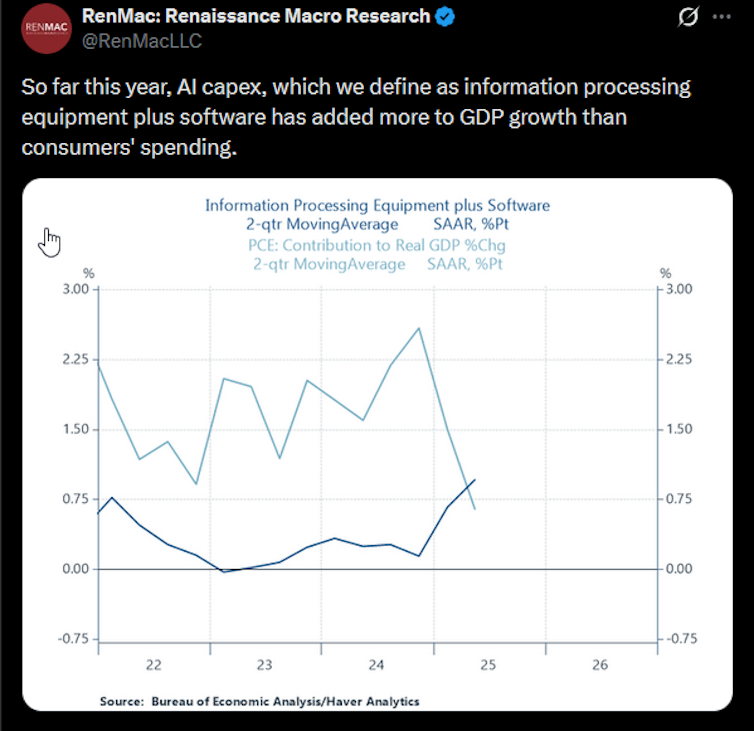
A screenshot of a post from X illustrating that AI capex has added more to GDP growth than consumers' spending via a graph

(X/Twitter)

Tariffs tighten the squeeze on capital

Financial inflation has intensified as the traditional pressure valves that once allowed capital to move into new physical or geographic markets have narrowed.

Tariffs, export controls on semiconductors and retaliatory trade measures have narrowed the global space available for relocation. Since capital cannot readily escape the structural pressures of the domestic economy, it increasingly turns to financial tools that postpone losses by rolling debt forward or inflating asset prices; mechanisms that ultimately heighten fragility when the reckoning comes.

U.S. Federal Reserve Chair Jerome Powell’s openness to interest rate cuts signals a renewed turn toward cheap credit. Lower borrowing costs let capital paper over losses and pump up fresh speculative cycles.

Marx captured this logic in his analysis of interest-bearing capital, where finance generates claims on future production “above and beyond what can be realized in the form of commodities.”

The result is that households are pushed to take on more debt than they can manage, effectively swapping a crisis of stagnation for a crisis of consumer credit.

Bubbles and social risk

If the AI bubble bursts when governments have limited room to shift investment internationally and the economy is propped up by increasingly fragile credit, the consequences could be serious.

Capital will not disappear, but will instead concentrate in bond markets and credit instruments inflated by a U.S. central bank eager to cut interest rates. This does not avert crisis; it merely transfers the costs downward.

Bubbles are not accidents, but recurring mechanisms for absorbing surplus capital. If Trump’s protectionism ensures that spatial outlets continue to close and temporal fixes rely on ever riskier leverage, the system moves toward a cycle of asset inflation, collapse and renewed state intervention.

AI will survive, but the speculative bubble surrounding it is a sign of a deeper structural problem — the cost of which, when finally realized, will fall most heavily on the working class.

The Conversation

Elliot Goodell Ugalde does not work for, consult, own shares in or receive funding from any company or organisation that would benefit from this article, and has disclosed no relevant affiliations beyond their academic appointment.

ref. The AI bubble isn’t new — Karl Marx explained the mechanisms behind it nearly 150 years ago – https://theconversation.com/the-ai-bubble-isnt-new-karl-marx-explained-the-mechanisms-behind-it-nearly-150-years-ago-270663

Dependants? Why Canada should recognize migrant spouses and partners with more accuracy

Source: The Conversation – Canada – By Goodnews I. Oshiogbele, PhD Student, Sociology, Western University, Western University

What comes to mind when you hear the word “dependant?” A child relying on a parent, or an elderly family member needing care? In Canada’s immigration system, the term is applied much more broadly than that.

It includes all spouses and common-law partners of immigrants or principal applicants, regardless of whether they rely financially on their significant other or not. According to Immigration, Refugees and Citizenship Canada’s (IRCC) current definition, a dependant is “a spouse, common-law partner or dependent child of a permanent resident or principal applicant.”

On paper, this seems neutral and clear. But in practice, it flattens the diverse realities of migrant families.

This definition does not adequately reflect the diverse experiences of many accompanying spouses and partners who are highly skilled, financially independent, co-providers — or even the primary breadwinners — in their households.

“Dependant” as a catch-all term

Words matter in immigration policy because they shape perceptions, and those perceptions shape policies, which in turn shape identities.

Generally, the term “dependant” carries connotations of financial reliance, vulnerability and even passivity. Labelling all spouses and partners “dependants” suggests they are passive followers rather than active contributors, not only in family migration decisions but also in immigrant integration outcomes such as socioeconomic standing and a sense of recognition and belonging.

As one principal applicant and migrant partner in London, Ont., shared with me in an interview for this piece regarding her family’s experience using IRCC’s online application portal:

“The application page was confusing because of the word ‘dependant.’ For us, my partner is never a dependant. He has a secure job and earns more than I do. We are a dual-income household and no one is an economic dependant. So, when I saw the word ‘dependant’ on the website, I wondered if I was on the wrong website and thought it was application information for children or older parents who are true dependants.”

Furthermore, research tells us a different story that challenges the dependant label.

A Statistics Canada study found that many spouses and common-law partners of economic immigrants had similar qualifications to the principal applicants, partly thanks to what sociologists call “positive assortative mating” or homogamy. This concept refers to the tendency for people to enter romantic relationships with partners of similar background or social status.

Similarly, research by immigration and family economist Ana Ferrer and the Pew Research Center suggests that immigrant wives in professional households frequently contribute income comparable to or greater than their husbands, challenging the idea of passive dependency.

Furthermore, some accompanying spouses enter the workforce faster than their principal applicant spouses. This is common in situations where, for example, the principal applicant is retraining or seeking credential recognition. Many others contribute financially across borders, sending remittances to family members living abroad.

A matter of equity and inclusion

This issue is not simply about accuracy in terminology, although that is essential. It is also about inadvertently classifying others unfairly, promoting gender inequality and marginalizing some migrant family members.

Most accompanying spouses and partners are women and labelling them uniformly as dependants even when they include co-providers and primary earners, reinforces outdated stereotypes.

Migrant male spouses and partners also face their own identity struggles, despite their qualifications.

Statistics Canada data reveals persistent gender differences in labour market outcomes among newcomers, with immigrant women having a labour force participation rate of 78.2 per cent in 2021, significantly lower than the 90.2 per cent for immigrant men. While this arguably reflects global gender norms that many migrant families bring with them, it could also be linked with their sense of identity.

Canada prides itself on being a leader in immigration policy and in creating an inclusive society. Therefore, while other long-established immigration systems across the globe may continue to use this term this way, IRCC could consider clarifying it. Currently, the dependant label may unintentionally reinforce perceptions of dependency that do not reflect the evolving realities of modern migrant families.

Making invisible contributions visible

Gendered assumptions about who earns, who cares and who follows continue to shape how immigrant families are represented, and, in turn, treated by institutions. In addition to ongoing commendable efforts to make Canada more gender-inclusive, a long-term rectification of this issue requires more societal refinement in how we think about gender and work among newcomers.

Addressing this issue constructively would involve both policy reflection and a broader social conversation. In policy terms, it begins with precision — recognizing that not all spouses or partners depend economically on the principal applicant. In social terms, it means valuing the visible and invisible work migrants do, whether it is paid labour, unpaid care or transnational remittances.

In the meantime, here’s a simple fix that can address the semantic problem: In its current definition of a dependant, IRCC already distinguishes between dependent children and non-dependent adult children. The department could consider a similar approach for accompanying spouses and partners.

A small but meaningful change — such as specifying “a dependent spouse or common-law partner” — could help clarify the definition and better reflect the realities of today’s migrant families. For those affected, it will help improve their sense of identity, how they are perceived in public, the bureaucratic policies and practices affecting them and their overall integration experiences.

Alternatively, particularly in the immigration application system, the term dependant could be replaced with “secondary applicant” or “accompanying family member” to clearly distinguish the principal applicant from those accompanying them. While IRCC may have operational considerations, exploring better alternatives could lead to significant systemic improvements.

The Conversation

Goodnews I. Oshiogbele is a member of the International Union for the Scientific Study of Population (IUSSP) and the Canadian Population Society (CPS).

ref. Dependants? Why Canada should recognize migrant spouses and partners with more accuracy – https://theconversation.com/dependants-why-canada-should-recognize-migrant-spouses-and-partners-with-more-accuracy-265744

Thomas King: As we learn another ‘hero’ is non-Indigenous, let’s not ignore a broader cultural problem

Source: The Conversation – Canada – By Celeste Pedri-Spade, Associate Professor, Department of Anthropology, McGill University

Years ago, when I first began researching Indigenous identity theft — something that intrigued me intellectually and impacted me personally — I remember trying to explain it to my Indigenous family members back home in northwestern Ontario.

We are Anishinaabeg and member citizens of Nezaadiikaang (Lac des Mille Lacs First Nation).

The women in my family responded with humour, seeing the absurdity of it all. My mother laughed and said: “Geez, I remember when not even Natives wanted to be Native … whatever happened to those times!”

Her comment highlighted a major shift in how desirable Indigenous identity has become, and how false claims tend to rise after events that draw public attention to the harms settler states have caused our families and communities.

This desirability is, indeed, heightened as educational institutions engage in processes of Indigenization and seek to recruit Indigenous people into faculty and administrative roles that assist them in advancing their reconciliation plans.


Read more:
Stolen identities: What does it mean to be Indigenous? Don’t Call Me Resilient Podcast EP 8 Transcript


Think of how many white settlers were quick to shake a Cherokee “princess” from their family tree after the Civil Rights Movement, or how recent cases of Indigenous identity fraud in Canada align with the era of Truth and Reconciliation. This era, we know, has revealed very hard truths about Canada’s relationship with Indigenous Peoples.

Cultural phenomenon

These patterns reveal more than individual acts of deception. They expose
a cultural phenomenon: when non-Indigenous people appropriate our lived experiences — our stories, struggles and traumas — on such a wide scale, it signals a broader cultural and social sickness and deterioration.

What we come to learn through the public “outings” of author Thomas King, Buffy Sainte-Marie, Mary Ellen Turpel-Lafond, Michelle Latimer and Joseph Boyden is that they offer a projection of “Indigenous success” that is often nothing more than settler fantasies: commodified versions of Indigeneity that Canadians find palatable.


Read more:
How journalists tell Buffy Sainte-Marie’s story matters — explained by a ’60s Scoop survivor


These figures become a kind of counterfeit currency, granting Canadians easy access to digestible versions of Indigenous identity and experience. But they are not ours, they are not us and they are not our stories. My mother believes this happens because Canadians do not truly want the truth of who we are, past or present.

This raises a hard question: how did these figures become Indigenous icons in the first place?

Western ‘hero’ narratives

Many Indigenous cultures caution against the concept of “heroes,” which is rooted in western narratives that elevate people as saviours. Turning people into heroes isolates collective struggles, conceals the systemic problems behind them and reinforces colonial ideas of individual exceptionalism — celebrating those who manage to succeed in oppressive systems instead of valuing relationships and community resilience.

Liberation doesn’t hinge on extraordinary individuals; it requires
structural transformation. When we elevate “heroes,” we risk distorting accountability and reinforcing inequity.

The truth is, these heroes were largely created by settler-controlled industries like publishing, media and academia — not by us. Their success was sustained by gatekeepers who valued marketable versions of Indigeneity over authentic voices. And while community voices questioned their authenticity from the start, we must ask why those warnings were ignored.

Concerns raised

In cases of a “pretendian” — false claims of Indigeneity — there are people firmly grounded in community who raise concerns right from the beginning because they cannot find themselves in the paragraphs and crescendos of those who don’t sing or speak truth. As Indigenous Peoples, we need to reflect on why such voices are often not collectively amplified and protected.

Underlying identity fraud is a belief that Indigenous Peoples are “not good enough” — that impostors can be better Natives than us. They reconcile their theft by convincing themselves they can achieve what we cannot, that we need them to “be us.” That is profoundly damaging.

It reinforces colonial hierarchies and perpetuates the idea that our worth must be validated through settler recognition.

Power to repair harm

In King’s recent opinion piece in The Globe and Mail, he wrote he was devastated to learn, contrary to what he believed, that he did not have Cherokee ancestry. He discovered this, he said, after he requested a meeting with Tribal Alliance Against Frauds, an American Cherokee organization, because he was aware of “a rumour that appeared” accusing him of not being Cherokee.


Read more:
Fraudulent claims of indigeneity: Indigenous nations are the identity experts


He said he’ll need to “survive a firestorm of anger, disbelief and betrayal” and will then “sort through rubble to see if there is anything left of my reputation, of my career.”

This was the most troubling for me — not only because it sounds like self-victimization, but because King has the power to repair harm. Accountability begins with truth-telling: admitting the false claim, making no excuses and disclosing and returning all benefits gained.

It means returning awards, redirecting funds and submitting to processes defined by the affected Nation — in King’s case, the Cherokee Nation. It means investing in long-term reparations that strengthen Indigenous self-determination, such as funding community priorities, supporting displaced Indigenous writers and investing in the brilliance of future generations.

We are more than stories

Accountability is not a one-time op-ed; it is an ongoing commitment, verified by Indigenous oversight and grounded in relational ethics.

King once wrote: “The truth about stories is that that’s all we are.” I admit to referencing it in my own writing. It is poetic, but incomplete.

We are more than stories. We are land. We are family. We are community. And we deserve a future where our identities are not commodities, where our truths are not distorted for profit or prestige and where accountability is measured not by words but by actions that build trust and repair harm.

The Conversation

Celeste Pedri-Spade does not work for, consult, own shares in or receive funding from any company or organisation that would benefit from this article, and has disclosed no relevant affiliations beyond their academic appointment.

ref. Thomas King: As we learn another ‘hero’ is non-Indigenous, let’s not ignore a broader cultural problem – https://theconversation.com/thomas-king-as-we-learn-another-hero-is-non-indigenous-lets-not-ignore-a-broader-cultural-problem-270773

Peut-on rendre la forêt « nourricière » ? La proposition du jardin-forêt

Source: The Conversation – in French – By Jacques Tassin, Chercheur en écologie forestière (HDR), spécialiste des rapports Homme / Nature, Cirad

Issu des régions tropicales, le jardin-forêt est un modèle d’agroforesterie qui séduit de plus en plus en Europe pour prendre le contrepied d’un modèle agricole à bout de souffle. Il semble peu envisageable qu’il se substitue à l’agriculture productiviste dominante, mais il ouvre des pistes inspirantes pour promouvoir des pratiques plus respectueuses du vivant.


Les analyses se multiplient aujourd’hui pour dénoncer les externalités négatives (pollution, changement climatique, crise de la biodiversité…) induites par le paradigme économique actuel. Le modèle agricole dominant, en particulier, est pointé du doigt.

En effet, les systèmes agroalimentaires dominants s’avèrent coûteux à bien des égards. Ils substituent à des processus naturels répondant à des fonctions écologiques précieuses des intrants à fort impact environnemental (engrais par exemple), ils uniformisent les modes de culture, ils mettent à disposition du consommateur une alimentation d’une qualité nutritive questionnable, et enfin ils dévitalisent les tissus sociaux ruraux.

À rebours de cette logique productiviste, d’autres formes d’agriculture, parfois très anciennes, suscitent dès lors un regain d’intérêt. C’est le cas du modèle jardin-forêt, qui se développe peu à peu en Europe. Il est une transposition géographique en milieux tempérés de l’agroforesterie des tropiques humides, notamment indonésiennes.

Là-bas, l’agriculture vivrière et une partie de l’agriculture commerciale des petits planteurs sont conduites en pérennisant le modèle forestier traditionnel – fruits, légumes, noix, tubercules, plantes médicinales, matériaux, bois de feu ou de construction y sont produits au sein d’écosystèmes arborés multi-étagés, diversifiés et denses.

Structurés autour des arbres et de leur diversité, les jardins-forêts partagent avec les forêts naturelles des caractéristiques de robustesse, de résilience et de productivité. Multipliant les externalités positives (c’est-à-dire, des effets positifs tant d’ordre écologiques qu’économiques), ce modèle millénaire nourricier représente une voie inspirante qui vaudrait d’être davantage connue et considérée sous nos latitudes.

Il est fondé sur la polyvalence des forêts. Les jardins-forêts montrent que les arbres et les systèmes forestiers, dont les capacités de production, de régulation, de facilitation et de symbiose sont mésestimées, peuvent être bien plus productifs que nous le croyons.


À lire aussi :
Pour des forêts à croissance rapide, favorisez les arbres à croissance lente


Des « forêts comestibles » aux antipodes des monocultures

Aussi surnommés « forêts comestibles », les jardins-forêts se caractérisent par une forte densité d’arbres, d’arbustes, mais aussi de lianes et d’herbacées, tous de lumière et d’ombre, et tous d’intérêt alimentaire.

Clairière potagère dans un jardin-forêt à vocation domestique.
Fabrice Desjours, Fourni par l’auteur

Ils sont donc multifonctionnels. En témoignent par exemple :

  • leur productivité à l’hectare,

  • l’agencement spatial de leurs éléments constitutifs,

  • leur composition très diversifiée en termes d’espèces,

  • la richesse des mutualismes entre espèces,

  • Leur performance leur dynamisme et leur robustesse en tant que système de production alimentaire.

Ils sont à l’opposé des monocultures, qui sont spatialement et génétiquement homogènes. Celles-ci sont fondées sur la culture d’une seule variété, et souffrent dès lors une vulnérabilité maximale aux aléas. En jardin-forêt, les invasions d’insectes ravageurs ou les dégâts d’intempéries, pour ne citer que ces exemples, sont réduits en raison d’une importante hétérogénéité structurale et d’une faible exposition aux aléas. Des caractéristiques précieuses dans le contexte de dérèglement climatique.

Dans la forêt comestible de Ketelbroek (Pays-Bas), tout semble pousser de façon chaotique, mais il y a un plan.
Sabine Aldenhoff/LZ Rhénanie

Ces systèmes nourriciers sont aujourd’hui une réalité éprouvée, y compris en Europe. Aux Pays-Bas par exemple, des jardins-forêts à vocation agricole affirmée existent depuis quinze ans, financés par la politique agricole commune.


À lire aussi :
Incendies, sécheresses, ravageurs : les forêts victimes de la monoculture


Une production agricole à hauteur d’humain

Un autre point fort de cette alternative agricole est son échelle à hauteur humaine. En effet, le jardin-forêt envisage le parcellaire cultivé, dans ses dimensions spatiales comme dans les pratiques dont il fait l’objet, autour de la mesure étalon de la personne qui en prend soin.

Les recours à l’observation et au soin, de même que l’accumulation patiente de connaissances pratiques, y sont largement promus. Ils permettent une réactivité accrue et plus adaptée aux aléas, environnementaux mais aussi économiques.

Le « jardinier-forestier » est dès lors convié à se pencher sur son terrain à différentes échelles : du contrôle de la qualité des tissus mycorhiziens (c’est-à-dire, les champignons agissant en symbiose avec les racines) du sol jusqu’à la surveillance de la complémentarité permanente des strates de végétation.

La diversité ne se joue pas qu’à l’échelle d’une forêt comestible, mais aussi à l’échelle d’un territoire. A l’image du bocage, un réseau de jardins-forêts divers est pourvoyeur de services écosystémiques complets. Ils peuvent également s’insérer dans le tissu agricole et compenser une partie des impacts environnementaux néfastes induits par le modèle agricole dominant.

Un seul espace, des productions multiples

Par essence, le jardin-forêt offre une large diversité alimentaire. Pour rappel, seules 30 à 60 espèces végétales tout au plus assurent la base de notre alimentation occidentale, dont quelques espèces seulement de céréales. Une partie de cette alimentation est importée (avocats, ananas ou bananes), alors que 7 000 espèces alimentaires sont cultivables en climat tempéré, sans renfort technique particulier. Le modèle du jardin-forêt s’avère apte à les valoriser.

Les « forêts comestibles » sont en effet des espaces de multiproduction où sur une même parcelle peuvent se déployer quatre types de produits différents :

  • Les aliments « forestibles » dans lesquels ont peut inclure fruits, noix et graines, ressources tuberculeuses amidonnées ou riches en inuline, légumes, feuilles, feuillages, fleurs, champignons, épices, sirop de sève, viande sauvage ou domestique en cas de petit élevage, ou encore produits de la ruche (miel, pollen, propolis) ;

  • les biomatériaux (bois de construction, bambou, osier, gommes, cires, résines, liants, latex, papier, tinctoriales) ;

  • les ressources médicinales provenant de tous les étages végétaux de la forêt comestible ;

  • et enfin les combustibles (bois énergie, copeaux, fagots).


À lire aussi :
Pharma, cosmétique… et si les déchets végétaux aidaient à développer l’économie circulaire ?


Une porte vers d’autres imaginaires

Les jardins-forêts ne se limitent pas à la seule production de biens alimentaires et de services environnementaux. Ils offrent également des ressources immatérielles dont nous avions fini par croire qu’elles ne pouvaient être compatibles avec une agriculture performante.

En effet, ces espaces créent aussi les conditions pour d’autres imaginaires. Ils sont le support d’activités diverses (artisanales, éducatives, thérapeutiques, culturelles) favorables au mieux-être. Ces services immatériels peuvent concourir à transformer les zones rurales en espaces plus désirables et plus habitables, voire à les reterritorialiser. La psychologie atteste en outre des bienfaits des arbres sur le bien-être humain.

En France, les jardins-forêts recouvrent environ 2 000 hectares. Peu connus du grand public, des institutions et des pouvoirs publics, ils se heurtent à une vision encore archaïque de la forêt, vue comme aux antipodes de la civilisation, et à une réticence à valoriser des ressources alimentaires parfois rattachées dans les imaginaires aux périodes de famine.

Il leur est également reproché d’inviter à un relâchement des pratiques conventionnelles de contrôle du vivant habituellement exercées en agriculture (taille, fertilisation, contrôle direct des ravageurs…), auxquelles est ici préférée, pour des raisons de durabilité et d’efficience économique, une philosophie de l’accompagnement et de l’amplification des processus écologiques naturels.

S’ils n’ont pas vocation à supplanter les autres systèmes agricoles en place, ils ont toutefois le potentiel de redynamiser et resocialiser les campagnes. De quoi développer de nouvelles activités rurales exigeantes mais porteuses de sens et pourvoyeuses de bien-être. C’est précisément là une demande sociale et une exigence environnementale de plus en plus pressantes.


Fondateur de l’association Forêt gourmande, Fabrice Desjours a contribué à la rédaction de cet article.

The Conversation

Michon Geneviève a reçu des financements de ANR, UE.

Jacques Tassin ne travaille pas, ne conseille pas, ne possède pas de parts, ne reçoit pas de fonds d’une organisation qui pourrait tirer profit de cet article, et n’a déclaré aucune autre affiliation que son organisme de recherche.

ref. Peut-on rendre la forêt « nourricière » ? La proposition du jardin-forêt – https://theconversation.com/peut-on-rendre-la-foret-nourriciere-la-proposition-du-jardin-foret-265918

« L’art de la guerre » de Sun Tzu, ou comment vaincre en évitant le combat

Source: The Conversation – in French – By Scott D. McDonald, Assistant Professor, University of North Georgia; Non-resident Fellow, Asia-Pacific Center for Security Studies, University of North Georgia

Une copie de _l’Art de la guerre_, de Sun Tzu, appartenant à l’Université de Californie. vlasta2/Flickr, CC BY-NC-ND

Que nous enseigne le traité de stratégie militaire écrit en Chine il y a 2 500 ans ? Nourri de culture taoïste, Sun Tzu incite à utiliser le potentiel général des situations en intervenant le moins possible sur le champ de bataille. On fait plus pour nuire au potentiel d’un adversaire en sapant son plan qu’en tuant ses soldats.


Au milieu des années 1990, j’ai lu le classique militaire l’Art de la guerre » avec l’espoir de trouver des éclairages utiles pour ma nouvelle carrière d’officier des Marines des États-Unis.

Je n’étais pas le seul à chercher des idées auprès du sage Sun Tzu, mort il y a plus de 2 500 ans. L’Art de la guerre a longtemps été utilisé pour comprendre la tradition stratégique de la Chine comme des vérités militaires universelles. Les maximes du livre, telles que « connaître l’ennemi et se connaître soi-même », sont régulièrement citées dans les textes militaires, ainsi que dans les livres d’affaires et de gestion.

Au début, je fus déçu. Il m’a semblé que les conseils de Sun Tzu relevaient du bon sens ou étaient en accord avec les classiques militaires occidentaux. Cependant, quelques années plus tard, les Marines m’ont formé comme spécialiste de la Chine, et j’ai passé une grande partie de ma carrière à travailler sur la politique américaine dans la région indopacifique. Cela a renforcé mon désir de comprendre comment les dirigeants de la République populaire de Chine (RPC) voient le monde et choisissent leurs stratégies. En quête d’éclaircissements, je me suis tourné vers la philosophie chinoise classique et j’ai finalement rencontré des concepts qui m’ont aidé à mieux comprendre la perspective unique proposée par l’Art de la guerre, de Sun Tzu.

Aujourd’hui, je suis un universitaire et je travaille à l’intersection de la philosophie chinoise et de la politique étrangère. Pour comprendre l’Art de la guerre, il est important que les lecteurs abordent le texte à partir de la vision du monde de son auteur. Cela signifie lire les conseils de Sun Tzu à travers le prisme de la métaphysique chinoise classique qui est profondément façonnée par le taoïsme.

Les racines taoïstes

La tradition intellectuelle de la Chine est enracinée dans la période des Royaumes combattants du Ve au IIIe siècle avant notre ère, époque à laquelle Sun Tzu aurait vécu. Il s’agissait d’une période de conflit mais aussi de développement culturel et intellectuel qui a vu émerger le taoïsme et le confucianisme.

Une peinture patinée représentant un homme asiatique avec une petite barbe et une moustache, vêtu d’une robe jaune et noire
Les écrits de Sun Tzu ont eu un impact significatif sur la politique chinoise et étrangère.
History/Universal Images Group/Getty Images

La philosophie confucéenne se focalise sur le maintien de relations sociales appropriées comme clé du comportement moral et de l’harmonie sociale. Le taoïsme, en revanche, s’intéresse davantage à la métaphysique : il cherche à comprendre le fonctionnement du monde naturel et à en tirer des analogies sur la façon dont les humains devraient agir.

Le taoïsme considère l’existence comme composée de cycles de changement constants dans lesquels la puissance croît et décroît. Le Tào, ou « la Voie » dirige toutes les choses de la nature vers la réalisation de leur potentiel inhérent, par exemple l’eau qui coule vers le bas.

Aider la nature à suivre son cours

Le mot chinois pour ce concept de « potentiel situationnel » est 勢, ou « shì » – qui est aussi le nom du chapitre cinq de l’Art de la guerre. Presque toutes les versions occidentales le traduisent différemment, mais c’est la clé des concepts militaires employés par Sun Tzu.

Par exemple, le chapitre cinq explique que ceux qui sont « experts de la guerre » ne se préoccupent pas outre mesure des soldats pris individuellement. Au contraire, les dirigeants efficaces sont capables de déterminer le potentiel d’une situation et d’en tirer parti.

C’est pourquoi les chapitres suivants passent tant de temps à discuter de la géographie et du déploiement des forces, plutôt que des techniques de combat. On fait plus pour nuire au potentiel d’un adversaire en sapant son plan qu’en tuant simplement ses soldats. Sun Tzu s’inquiète des chaînes d’approvisionnement trop longues car elles réduisent le potentiel d’une armée en la rendant plus difficile à déplacer et vulnérable aux perturbations. Un général qui comprend le potentiel peut évaluer les troupes, le terrain et le plan, puis organiser le champ de bataille de manière à « soumettre l’ennemi sans combattre ».

Une peinture chinoise représentant une scène de bataille, avec des soldats en tenue bleue et un texte dans le coin supérieur droit
Peinture représentant une bataille entre les forces chinoises et vietnamiennes lors de l’invasion du Vietnam par la dynastie Qing en 1788.
History/Universal Images Group/Getty Images

Dans la pensée taoïste, la bonne façon de gérer le potentiel de chaque situation est d’agir avec 無為, « wúwéi », ce qui se traduit littéralement par « non-action ». Cependant, l’idée clé est de perturber l’ordre naturel le moins possible pour permettre au potentiel de la situation de se réaliser. Le terme n’apparaît pas dans l’Art de la guerre, mais un lecteur contemporain de Sun Tzu aurait été familier avec ces deux concepts de « shì » de « wúwéi ».

L’importance d’agir avec le « wúwéi » est illustrée par le philosophe confucéen Mencius qui raconte l’histoire d’un agriculteur qui aurait tiré sur ses tiges de maïs pour les aider à pousser et qui a tué sa récolte. On n’aide pas le maïs à pousser en le forçant mais en comprenant son potentiel naturel et en agissant en conséquence : s’assurer que le sol est bon, que les mauvaises herbes sont enlevées et que l’eau est suffisante. Les actions sont efficaces lorsqu’elles nourrissent le potentiel, non lorsqu’elles tentent de le forcer.

Du champ de bataille à l’ONU

Dans une perspective taoïste, les dirigeants qui espèrent élaborer une stratégie efficace doivent lire la situation, en découvrir le potentiel et positionner leurs armées ou États de manière à tirer le meilleur parti du « shì ». Ils agissent avec « wúwéi » pour cultiver des situations, plutôt que de les forcer, ce qui pourrait perturber l’ordre naturel et provoquer le chaos.

Ainsi, en politique étrangère, un décideur devrait s’efforcer d’apporter de petits ajustements politiques le plus tôt possible afin de gérer progressivement l’évolution de l’environnement international. Cette approche est évidente dans l’utilisation du « guānxì » par Pékin. Signifiant « relations », le terme chinois porte un fort sens d’obligation mutuelle.

Par exemple, la République populaire de Chine (RPC) a mené des décennies d’efforts pour reprendre à Taïwan le siège de la Chine aux Nations unies. Pékin y est parvenu en nouant lentement des amitiés, en identifiant des intérêts stratégiques communs et en accumulant des faveurs auprès de nombreux petits États du monde entier, jusqu’à ce qu’en 1971, elle obtienne suffisamment de voix à l’Assemblée générale de l’Organisation des Nations unies (ONU).

Et aujourd’hui ?

Le concept de « shì » permet également de comprendre la pression croissante de la RPC sur Taïwan, une île autonome que Pékin revendique comme son propre territoire.

Une scène nocturne représentant la silhouette d’un char d’assaut avec des gratte-ciel illuminés au loin
Un char taïwanais utilisé lors de conflits antérieurs et exposé aux touristes à Kinmen (Taïwan) se détache sur la silhouette de la ville continentale de Xiamen.
Chris McGrath/Getty Images

Sun Tzu dirait peut-être que discerner la tendance actuelle dans le détroit de Taïwan est plus essentiel que les questions conventionnelles sur la puissance militaire comparée. Plusieurs facteurs pourraient rapprocher Taïwan de Pékin, notamment la perte d’alliés diplomatiques de l’île et l’attraction de la vaste économie de la RPC – sans parler de l’influence mondiale croissante de Pékin face aux États-Unis. Si c’est le cas, le « shì » est en faveur de Pékin, et un coup de pouce pour persuader les États-Unis de rester en dehors du sujet est tout ce qui est nécessaire pour faire évoluer la situation en faveur de la RPC.

Doit-on, au contraire, considérer que le « shì » se développe dans l’autre sens ? Des facteurs tels que le sentiment croissant d’identité taïwanaise, les perturbations économiques de la RPC pourraient rendre le rapprochement avec la chine continentale moins attrayant pour Taïwan. Dans ce cas, Pékin pourrait estimer devoir apparaître fort et dominant afin que l’île n’entretienne pas l’idée d’un appui de Washington.

Une lecture superficielle de Sun Tzu peut mettre l’accent sur le déploiement de troupes, le renseignement et la logistique. Cependant, la compréhension du « shì » met en lumière l’importance que Sun Tzu accorde à l’évaluation et à l’enrichissement du potentiel situationnel. Il ne s’agit pas de dire que les premiers points sont sans importance, mais un décideur les utilisera différemment si l’objectif est de gérer les tendances situationnelles plutôt que de rechercher une bataille décisive.

Le fait que l’Art de la guerre continue d’être en tête des ventes de livres démontre son attrait durable. Cependant, pour qu’il soit utile comme guide stratégique et de politique de sécurité, mon expérience m’indique qu’il faut s’imprégner des principes qui ont façonné la vision du monde de Sun Tzu et qui continuent de façonner celle des dirigeants de Pékin.

The Conversation

Scott D. McDonald reçoit des financements de la Fondation Sara Scaife, de l’Institut Eisenhower, de la Fondation Charles Koch et du ministère des Affaires étrangères de Taïwan.

ref. « L’art de la guerre » de Sun Tzu, ou comment vaincre en évitant le combat – https://theconversation.com/lart-de-la-guerre-de-sun-tzu-ou-comment-vaincre-en-evitant-le-combat-259342

Seen but not forgotten: How citizen science helps document biodiversity in remote Borneo villages

Source: The Conversation – Indonesia – By Erik Meijaard, Honorary Professor of Conservation, University of Kent

When I, Erik Meijaard, worked as a wildlife consultant for a timber concession in Borneo, I often chatted with the logging truck drivers — and quickly realised that some of them knew far more about local wildlife populations than the company’s own biodiversity teams.

“If you want to see clouded leopards, ride with me in my truck — I can almost guarantee we’ll spot one or two near kilometre 38 around two in the morning,” one of the drivers told me at the time.

I didn’t spot the elusive cats that night, but two years later, early one morning, I finally found one sitting calmly beside a logging road. The driver had been right all along: these leopards really do like the roads.

Logging truck drivers spend countless hours on the road, travelling deep into remote forests. They often see wildlife, yet no one asks them about it — because spotting animals isn’t part of their job. Our programmes change that, allowing anyone with an interest in tropical wildlife to contribute their observations.

Since then, I have relied heavily on community-sourced information to monitor wildlife populations within company concessions and ensure that emerging threats are quickly detected and addressed.

I began by creating the first orangutan distribution maps in the 1990s through village interviews, later expanding the approach to 700 villages in 2008 to better understand local perceptions of forests and wildlife.

From 2019 to 2025, I ran an oil-palm-plantation–based citizen-science pilot that generated nearly 190,000 wildlife records from 4,000 workers.

These experiences show that some of the most valuable ecological knowledge rests with the people who live closest to the forest — not the scientists who visit only once a year.

How does citizen science work?

Building on that insight, Emily (who co-wrote this article with me) and I introduced a new version of the model for broader study in four villages in the Kapuas Hulu district of West Kalimantan. There, the local community manages the forest under a social forestry scheme.

We worked directly with them. Anyone with a smartphone can record wildlife sightings using our simple mobile app named Kehatiku (which in Indonesian means both “to my heart” and “my biodiversity”). Observations — from orangutan photos to gibbon audio clips — are then uploaded with GPS coordinates.

Each record then goes through a multi-stage verification process: an AI-assisted screen check for duplicate images and location mismatches, followed by review from our team of verifiers and species experts, who cross-reference field guides.

Once a record is verified, we issue a payment to the observer — ranging from around US$0.60 for a bird-call recording to about US$6 for a clear photo or video of a wild orangutan.

Since the citizen science program launched in 2023, 567 participants have recorded more than 58,000 wildlife observations from community forests — at roughly one-twentieth the cost of conventional surveys. The program creates both income and incentives to protect wildlife and their habitats.

What the data reveal?

So far, the data show unexpectedly high numbers of orangutans, gibbons, and many other species in these community forests, including several of global conservation concern.

The most frequently reported wildlife in the four Kapuas Hulu villages includes orangutans (with 9,766 nest records), white-rumped shamas, sun bear signs, long-tailed macaques, and stingless bees.

Direct sightings of Bornean orangutans and regular recordings of gibbon calls confirm that these species persist outside protected areas — even within agricultural landscapes bordering the villages.

This information is invaluable to understand how threatened mammals survive in mixed-use forests, where formal surveys are rare or expensive. We are currently doing critical testing as to whether the data are strong enough to generate statistically robust occupancy estimates — showing how wildlife species use village forest areas.

For plantations, we can already translate these findings into a living index, an important tool for developing data-driven conservation policies and interventions.

Shifting behaviour and social impact

In early 2025, we also collaborated with a local partner to conduct social baseline surveys to assess the program’s socioeconomic impact.

Initial survey results suggest a shift in perception is already underway. More than 70% of residents across the four pilot villages had heard of the initiative, and nearly two-thirds said they are interested in joining.

About a third already earn income from verified wildlife observations — typically US$30 to US$180 every three months, a meaningful supplement in communities where most households live on less than US$120 per month.

More importantly, attitudes toward wildlife are shifting. Where songbirds were once trapped and sold to traders, many villagers now choose to leave them in the forest — realising it’s more profitable to record the birds’ presence and get paid for it.

A model for inclusive, low-cost monitoring

Financial incentives have clearly boosted engagement. Observation rates rose from about 17 per village per month during the voluntary phase to more than 6,000 per month once payments were introduced.

At an average cost of just US$0.85 per observation, this approach is far cheaper than traditional transect or camera-trap surveys, which can cost US$300 per camera or more.

Not only does it reduce logistical costs, but relying on local observers also makes it possible to cover vast, remote areas.

And unlike short-term research projects, this one runs year-round — because the motivation, and the data, come from the community itself.

The programme also strengthens local governance. Regular meetings and WhatsApp groups allow residents to discuss verification results, propose rule changes, and collectively decide how to manage conflicts over shared rewards. We also close the information loop by translating wildlife observations into insights communities can use to guide their decisions.

These interactions, along with transparent payment records, are boosting accountability and participation in broader village decision-making. This transparency has helped build strong trust within the community.

On one occasion, when a participant submitted an internet-sourced photo as fake evidence, the peers insisted on removing them from the project — a proof that data integrity now matters at the community level.

Our local facilitator paying an observer. The program has also seen a recent increase in women’s participation.
Andi Erman

Beyond data: Building ownership and pride

Beyond science, the project is fostering local ownership and pride in nature. For participants, the forest has become a living asset — one that generates income through conservation. That shift in perception may be the most important outcome of all.

With mobile networks and digital payment systems now widespread across Indonesia, this low-cost, scalable model could be expanded to thousands of villages. Citizen science can become a cornerstone of future wildlife conservation — and Indonesia could lead the way in making it happen.

From the truck drivers who spotted clouded leopards in the 1990s to today’s smartphone-armed villagers, the message is clear: science and stewardship thrive when everyone can take part — and be fairly rewarded for it.

The Conversation

Erik Meijaard menerima dana dari Wildlife Futures dan Arcus Foundation

Emily Meijaard bekerja di Borneo Futures Sdn Bhd the organization that developed the citizen science-based monitoring approach discussed in the article

ref. Seen but not forgotten: How citizen science helps document biodiversity in remote Borneo villages – https://theconversation.com/seen-but-not-forgotten-how-citizen-science-helps-document-biodiversity-in-remote-borneo-villages-269621

Frozen rewrote Disney princess narrative – and it’s still relevant

Source: Radio New Zealand

In the final week of November 2013, Disney released a little film set in a fictional kingdom in Norway in the 1840s.

Inspired by Hans Christian Andersen’s The Snow Queen, it told the tale of two sisters who are close as children but become estranged as adults.

You might have heard of it — Frozen, a film that transcended typical box office success to become a cultural touchstone for children around the world.

The sisters are, of course, the imperious Elsa, voiced by Tony Award-winning actor Idina Menzel, and the ebullient Anna, voiced by Kristen Bell, both princesses of Arendelle.

Directed by Chris Buck (Tarzan, Surf’s Up) and Jennifer Lee (the co-writer of Wreck-It Ralph), Frozen earned more than $US1.2 billion at the box office.

Released in Australia on Boxing Day, it was the highest-grossing film of 2013 and the highest-grossing animated film until the live-action remake of The Lion King surpassed it in 2019.

The film was groundbreaking in other ways.

Lee, initially brought on as a writer, was the first woman to direct a full-length Disney animated film and the first female director of a feature film to gross more than US$1 billion.

Frozen also won a raft of awards, including Academy Awards for Best Animated Feature and Best Original Song, and a Grammy for its soundtrack.

Its cultural power can be felt closer to home. Fossick through any child’s dress-up box and you will find a replica of Elsa’s dress in ice-blue polyester.

Just why Frozen captured the zeitgeist, when Disney films with strong female protagonists such as Brave or Mulan didn’t, has been the subject of much discussion — and at least one academic conference — in the 12 years since the film was released.

So, what made Frozen different?

As a character, Elsa's "not exactly personable", Turnbull says. "She's nervous and afraid and guarded."

As a character, Elsa’s “not exactly personable”, Turnbull says. “She’s nervous and afraid and guarded.”

Disney

Not your typical Disney princess

Frozen didn’t just break box office records.

It also broke the mould of the typical Disney narrative, placing two sisters rather than a heterosexual romance as the film’s central relationship.

“[Unlike] Cinderella, Sleeping Beauty-type fairy tales … it didn’t end with a marriage; it did end with a rescue, but it wasn’t a prince or a man saving the day, it was two sisters saving each other,” Samantha Turnbull, author of The Anti-Princess Club, told ABC Radio National’s Earshot in 2015.

“It was a story about sisterhood, about strong young women saving themselves and putting their relationship with each other first.”

Frozen subverted the Disney stereotype in other ways.

For one, Elsa was not like other Disney princesses, who generally did not possess magical powers.

Their raison d’être tended to be love and marriage, two things for which Elsa holds zero interest.

“Characters like Cinderella and Sleeping Beauty, they have no interests or passions or even real flaws; they’re just perfect one-dimensional characters,” Turnbull said.

Elsa was different: multi-layered, flawed and relatable.

“She can’t control her ice powers, and as a way of dealing with that, she isolates herself from the rest of the world … almost at the expense of her relationship with her sister.”

Elsa of Arendelle and Anna of Arendelle from the 2013 Disney film Frozen

Buck says the film’s creators were driven by the question: “How can we portray a new idea of real love?”

Disney

The smash-hit Let It Go

And then there’s the song.

‘Let It Go’, a chart-topping power ballad, was composed by husband-and-wife team Robert Lopez and Kristen Anderson-Lopez.

With its emotive refrain — “let it go, let it go, can’t hold it back any more” — and persuasive message of self-affirmation, ‘Let It Go’ quickly took on a life of its own.

The song has soundtracked countless children’s birthday parties and accumulated more than 940 million streams on Spotify to date.

Journalist and critic Dorian Lynskey told Earshot that ‘Let It Go’ was “an incredibly positive song for children to be embracing” in its rejection of shame and guilt.

“As girls grow up, they are often invited to feel shame and guilt about how they look or how they behave,” he said.

“[Let It Go is] a rejection of all the things that people expect from [Elsa] and this ownership of who she is and what she can do and how thrilling that is.”

The song was embraced by some in the LGBTQI community, who viewed it as a coming-out-of-the-closet anthem.

For others who saw Elsa as a neurodivergent heroine, ‘Let It Go’ was an expression of her refusal to continue pretending to be neurotypical and masking her true self.

“It had all these different meanings for different groups,” Lynskey said.

“That could only happen because the central message is so powerful and is about asserting your individuality and not bowing to people who want to make you feel shame about it.”

The Frozen franchise continues

The Frozen juggernaut generated an enthusiastic fan culture with an apparently insatiable appetite for merchandise.

At last count, my children’s toy box contained at least seven Elsa and Anna dolls in various iterations. We have the Lego, the dress (of course), as well as the detachable white-blonde plait. We’ve had Elsa birthday parties and bought Elsa’s wand at Disney on Ice.

And it’s not just girls who fell for Elsa’s icy reserve. At my daughter’s 5th birthday, a little boy was very excited to turn up in his favourite costume, an Elsa dress.

Frozen’s cultural influence shows no signs of waning. Frozen 2 eclipsed the first film’s box office success, earning more than $1.4 billion, and, inevitably, the franchise is set to continue with Frozen 3 slated for release in 2027 and Frozen 4 in the works, too.

As Stephen Langston, a senior lecturer at the University of the West of Scotland, noted in The Conversation, it cleared the way for a new crop of Disney films that featured strong female heroines and storylines unrelated to romance, including Moana, Encanto, Turning Red — and, of course, Frozen 2, released in 2019.

“The legacy of these trailblazing productions is testament to the power of inclusive storytelling, proving that there is immense value in narratives that look beyond traditional norms and celebrate the diversity of the human experience,” he wrote.

– Published by EveningReport.nz and AsiaPacificReport.nz, see: MIL OSI in partnership with Radio New Zealand

Ce que l’argot des collégiens nous dit des stéréotypes de genre chez les jeunes

Source: The Conversation – in French – By Anne Gensane, Enseignante chercheuse en sociolinguistique, Université d’Artois

Habiles pour inventer de nouveaux mots, les jeunes s’affranchissent-ils pour autant des stéréotypes de genre ? Une étude sur les pratiques argotiques d’élèves de l’enseignement secondaire nous offre un regard sur la manière dont ils reproduisent ou bousculent les rapports de force sociaux.


Dans une société de plus en plus soucieuse de l’égalité femme-homme, on souhaite que la langue en soit un vecteur. L’écriture inclusive témoigne de ces efforts. Mais qu’en est-il des façons de parler des jeunes ? Intègrent-elles ces préoccupations ? S’affranchissent-elles vraiment des stéréotypes de genre ?

Une étude sociolinguistique de terrain, fondée sur un corpus d’expressions argotiques récoltées dans des établissements du secondaire, permet d’interroger leurs représentations et la manière dont elles s’écartent des normes sociales ou les reproduisent.

Avant tout, il est crucial de rappeler que les jeunes dont nous parlons ne constituent pas une catégorie homogène. Certains viennent des zones périphériques de grandes villes, d’autres de milieux ruraux, ils peuvent connaître ou non des contacts multiculturels… Autant de facteurs qui influencent directement les pratiques linguistiques et la manière dont les stéréotypes de genre sont exprimés et vécus.

Un argot contemporain misogyne ?

Parmi près de 300 termes collectés dans l’étude, un grand nombre évoque directement le corps, notamment sous un angle sexuel. L’étude lexicale montre un déséquilibre quantitatif et qualitatif entre les représentations des corps masculins et féminins. Le sexe masculin est le plus fréquent (« zboub » qui est d’origine arabe, ou « chibre »). Pour ce qui est du corps féminin, il est fréquemment réduit à des métaphores dégradantes ou idéalistes, et cela en dit long sur cette hiérarchie sociale.

On peut citer la métaphore de l’animalité avec des mots comme : « chatte », ou « schnek » qui désigne un escargot en allemand ; la métaphore de la consommation avec, par exemple, « de la peufra » : il s’agit ici du verlan de « frappe », lui-même jouissant d’une signification imagée et pouvant aussi désigner de la drogue de bonne qualité ; ou, très présente, la prostituée : « keh », d’origine arabe, ou « tchoin », d’origine nouchi (un argot ivoirien très présent également dans l’argot contemporain). Ces mots participent de la disqualification sociale des femmes, en les réduisant à leur rôle dans la sexualité masculine.

Mais cet argot contemporain est-il pour autant intrinsèquement misogyne ? Si une grande majorité des termes semblent dévaloriser les femmes, leur usage n’est pas toujours aussi simple. Certaines expressions, comme « avoir de la moule » inversent parfois la hiérarchie, associant le sexe féminin à la chance.

Il apparaît que ce n’est pas tant l’argot en lui-même qui est sexiste ou misogyne, mais les pratiques sociales dans lesquelles il s’inscrit et qui, parfois, évoluent. Les termes suivants illustrent une violence symbolique. La « beurette à chicha » désigne littéralement une jeune femme d’origine maghrébine (« beur » étant le verlan tronqué de « arabe ») présente dans un bar à chicha. Ce que cela signifie vraiment ? Une jeune femme qui est trop visible, tout comme la « tana » (vraisemblablement la forme tronquée de « Ana Montana », personnage de série télévisée).

Ces catégories langagières semblent moins désigner des réalités sociales qu’elles n’organisent une grille de lecture stéréotypée des conduites féminines dans l’espace public. Le fait que ces termes soient employés par d’autres jeunes filles souligne la complexité des mécanismes de reproduction ou de résistance à la norme.

La femme qui dit : une « terreur argotique féministe » ?

Le langage reflète une hiérarchie des genres, où les garçons bénéficient de plus de liberté d’expression que les filles, soumises à un contrôle social important. Ce qui ne veut pas dire qu’il n’y a pas de contrôle d’un autre type chez les garçons ; on peut observer que ce phénomène s’inscrit notamment dans une certaine valorisation de la virilité, tant physique que linguistique (on pense aussi aux insultes féminisantes).

Avoir recours à une certaine hexis corporelle (manière de se tenir, de s’habiller…) et à un langage cru serait une forme de manifestation de la virilité et, alors, un moyen de marquer la distinction sociale attendue. En revanche, les femmes sont traditionnellement perçues comme plus élégantes lorsqu’elles adoptent des normes linguistiques plus prestigieuses, rejetant les formes de langage populaire pour exprimer une identité sociale différente, voire opposée à celle des hommes.

Parler d’une « terreur argotique féministe » sur le modèle de l’ouvrage d’Irene n’est peut-être pas si exagéré. À la suite de l’autrice, il s’agirait de réfléchir à la place que détient la violence dans la lutte contre les inégalités. Certaines jeunes filles se réapproprient des termes plutôt vulgaires pour affirmer leur autorité, parfois pour choquer ou pour se défendre dans un environnement marqué par la domination masculine.

Ainsi, des expressions comme « avoir les couilles » sont utilisées par des filles revendiquant par la même occasion une forme de pouvoir symboliquement associé aux hommes. Mais ne reproduiraient-elles pas, dans le même temps, cette discrimination stéréotypée ?

Le langage des jeunes filles est un terrain plus complexe qu’il n’y paraît. Certaines collégiennes de Cergy (Val-d’Oise) enregistrées dans le Multicultural Paris French, un grand corpus oral, expliquent qu’elles utilisent ces termes violents ou grossiers pour s’adapter à un univers où les garçons imposent leur domination. Simone de Beauvoir affirme que c’est potentiellement en s’assimilant à ces modes de fonctionnement masculin que la femme s’affranchira.

Le langage devient un réflexe dans un environnement symboliquement hostile, une manière de se défendre face à un monde qui attend des filles qu’elles soient discrètes. L’usage d’un langage perçu comme masculin peut être dès lors défensif. Mais est-ce bien pour autant une volonté desdits garçons d’être agressifs ?

Un conservatisme linguistique pudique ?

Parler ainsi (encore faudrait-il déterminer ce qu’est ce « ainsi »), c’est peut-être aussi l’assurance de gérer symboliquement les frontières entre espace privé et espace public. Le locuteur, garçon ou fille, jeune ou moins jeune, provenant d’un quartier populaire ou bourgeois, pourrait chercher à maîtriser l’accès à son identité telle qu’il ou elle la conçoit, à filtrer ce qu’il ou elle expose de son intimité en usant de ce lexique.

Cela est reconduit par ailleurs dans les thématiques amoureuses des morceaux de rap qu’ils semblent préférer écouter : auraient-ils donc besoin de se cacher derrière une apparente violence des stéréotypes genrés pour se protéger ? Dans ce cadre, l’excès verbal des jeunes ne serait pas analysable comme étant d’ordre exhibitionniste, mais pourrait bien plutôt paradoxalement aider à la dissimulation de soi.

Il peut être étonnant que, malgré l’inventivité linguistique des jeunes contemporains (catégorie, on l’a dit, fort hétérogène), leur langage semble reproduire des hiérarchies de genre anciennes. Les « codes » sont bousculés, mais n’en restent pas moins ancrés dans des normes sociales bien établies.

Cela montre que les jeunes n’échappent pas à une sorte de conservatisme sociolinguistique. Si leur langage peut être vu comme un miroir de la société dans laquelle ils évoluent, il semble que cette société peine à se débarrasser de beaucoup de formes de domination.

The Conversation

Anne Gensane ne travaille pas, ne conseille pas, ne possède pas de parts, ne reçoit pas de fonds d’une organisation qui pourrait tirer profit de cet article, et n’a déclaré aucune autre affiliation que son organisme de recherche.

ref. Ce que l’argot des collégiens nous dit des stéréotypes de genre chez les jeunes – https://theconversation.com/ce-que-largot-des-collegiens-nous-dit-des-stereotypes-de-genre-chez-les-jeunes-268125

How the first Bible to include a map helped spread the idea of countries with borders

Source: The Conversation – UK – By Nathan MacDonald, Professor of the Interpretation of the Old Testament, University of Cambridge

Five hundred years ago the first Bible featuring a map was published. The anniversary has passed uncelebrated, but it transformed the way that Bibles were produced. The map appeared in Christopher Froschauer’s 1525 Old Testament, which was published in Zürich and widely distributed in 16th-century central Europe.

Yet despite being a groundbreaking moment in the Bible’s history, the initial attempt was hardly a triumph.

It is flipped along the north-south axis (meaning it’s back to front). As a result, the Mediterranean appears to the east of Palestine, rather than to the west. It illustrates how little many in Europe knew about the Middle East that such a map could have been published without anyone in the printer’s workshop questioning it.

The map had originally been drawn about a decade earlier by the celebrated Renaissance painter and printmaker Lukas Cranach the Elder, based in Wittenberg in latterday Germany. Written in Latin, it shows Palestine with various important holy sites such as Jerusalem and Bethlehem. At the bottom, you can see the mountains of Sinai and the path taken by the Israelites as they escaped slavery in Egypt.

Lucas Cranach the Elder's map of the Holy Land in Christopher Froschauer's Old Testament.
Lucas Cranach the Elder’s map of the Holy Land in Christopher Froschauer’s Old Testament.
The Wren Library, The Master and Fellows of Trinity College, Cambridge, CC BY-SA

Look closely and you can see the Israelites and their tents, plus various vignettes of the events on their journey. The landscape is more European than Middle Eastern, though, reflecting the printmakers’ ignorance of this region. There are walled towns with numerous trees and, in contrast with reality, the Jordan meanders rather more dramatically towards the Dead Sea, and the coastline has more bays and coves.

In the previous century, Europeans had rediscovered the second-century Greco-Roman geographer Ptolemy, and with him the art of making accurate maps that used latitude and longitude (insofar as longitude could be estimated at that time – it greatly improved in later centuries). With the advent of printing, Ptolemy’s Cosmographia had taken Europe by storm. His scientific treatise on geography was published and his maps of the ancient world reproduced.

Printers soon discovered, however, that purchasers desired contemporary maps. Soon new maps of France, Spain and Scandinavia were published. To our eyes these are truly modern. North is at the top of the page and the locations of cities, rivers and coastlines are presented highly accurately.

Map of France from Ptolemy's Cosmographia.
Modern map of France in Ptolemy’s Cosmographia, the 1486 (1482) Ulm Printing.
Stanford University, CC BY-SA

These maps rapidly replaced medieval mapping with its symbolic approach to the world, such as the famous Hereford mappa mundi of the known world circa 1300, where it was more about conveying cultural or religious meaning than geographical accuracy. Except, that is, in one case: Palestine.

The early modern printers of Ptolemy also gave their readers a “modern map of the Holy Land” that was nothing of the sort. It was a medieval map produced not by using latitude and longitude, but using a grid to measure distances between different locations. It was orientated with the east at the top of the page and the west at the bottom. It portrayed the holy sites of Christianity and divided the land of Palestine into tribal territories.

Cranach’s map blends these two types of maps. At its top and bottom edges it has lines of meridian, but the coastline is slanted so that the entire map is orientated with the north-east at the top of the page.

It is as though Cranach couldn’t quite decide what type of map to create. Its portrayal is realistic and modern, but the map is full of symbolic geography: as your eye passes over, you journey with the Israelites from Egyptian bondage to the promised land, with all its resonant locations, such as Mount Carmel, Nazareth, the River Jordan and Jericho.

Perceptions of Palestine

The map was characteristic of Europe’s lack of interest in Palestine, then part of the Ottoman empire. What European book buyers cared for was the strange hybrid space that is the “Holy Land”: somewhere that was in our world, but also not part of it.

The towns the map portrayed were those that had flourished two millennia earlier, which for Christians were in some sense more real. They were part of the imaginative space described in their churches and scriptures.

Nicholas Poussin's The Crossing of the Red Sea 1633-34
The exodus of the Israelites as depicted in Nicholas Poussin’s The Crossing of the Red Sea (1633-34).
Wikimedia, CC BY-SA

That curious juxtaposition of ancient and modern was particularly consequential when it came to the mapping of Palestine into 12 tribal territories. The 12 tribes that descended from Jacob symbolised Christianity’s claim as true heir of Israel and its holy sites, and also what the holy sites represented: the inheritance of the heavenly Jerusalem. Lines on the map communicated the eternal promises of God.

But in the early modern period, lines began to be used to mark the borders between sovereign states. The maps of the Holy Land, neatly divided amongst the Israelite tribes, set the agenda for cartographers. As the 16th century went on, more and more maps in atlases divided the world among distinct nations with clearly defined borders.

The fact that a map divided into territories appeared in the Bible gave apparently religious authorisation for a world full of borders. Lines that had once symbolised the boundless divine promises now communicated the limits of political sovereignties.

Within Bibles themselves, maps had arrived for good. The following years saw printers experiment with various configurations, but eventually they were to settle on four maps: one of the wilderness wanderings of the Israelites, one of the territories of the 12 tribes, one of Palestine at the time of Jesus, and one of the apostle Paul’s missionary journeys.

There is a pleasing symmetry: two maps for the Old Testament, two for the New Testament. But also, two maps of journeys and two maps of the Holy Land. Such symmetries communicated the connections between events: the Old Testament was fulfilled in the New Testament, and Judaism in Christianity.

The first map in a Bible is therefore a fascinating moment in history, but a troubling one. It transformed the Bible into something like a Renaissance atlas, but deeply embedded in assumptions about Christian superiority: the Holy Land of Christian imagination displacing contemporary Palestine, and Christianity superseding Judaism.

It was also one of the agents in creating the modern world of distinct nation states. In many ways, we’ve been living with the consequences ever since.

The Conversation

Nathan MacDonald does not work for, consult, own shares in or receive funding from any company or organisation that would benefit from this article, and has disclosed no relevant affiliations beyond their academic appointment.

ref. How the first Bible to include a map helped spread the idea of countries with borders – https://theconversation.com/how-the-first-bible-to-include-a-map-helped-spread-the-idea-of-countries-with-borders-270901

Passengers speak of ‘chaos’ and hours-long queues as A320 software recall paralyses NZ airports

Source: Radio New Zealand

Airbus A320neo flight delays - Auckland Airport - 29 November 2025

Travellers across New Zealand faced queues, cancelled flights and missed family events. Photo: RNZ/Calvin Samuel

Travellers across New Zealand faced six-hour queues, cancelled flights, missed family events and last-minute scrambles for alternatives – as the global grounding of Airbus A320 aircraft rippled through airline schedules on Saturday.

While the software recall affects airlines worldwide, in New Zealand’s airport terminals, passengers described a morning of confusion, contradictory information and mounting frustration.

Birthday plan ‘out the window’

One Wellington-bound passenger said their day began with a text message at 9.30am, warning of Jetstar delays, but this didn’t prepare them for the scene inside Auckland Airport.

A Wellington-bound passenger said they would likely miss their daughter's birthday due to the delay.

A Wellington-bound passenger said they would likely miss their daughter’s birthday, due to the delay. Photo: Calvin Samuel

“I walked into a line that we could have been waiting another couple of hours for, so yeah, it wasn’t great,” they said.

By the time they reached the counter, every remaining Jetstar flight to Wellington was fully booked.

“I had a birthday plan for my daughter today and now that’s out the window,” they said. “I’m going to try and get a flight on [Air] New Zealand today… otherwise, I’ll be waiting until tomorrow morning.”

They said Jetstar had not offered compensation so far.

“Basically, I’ll pay money for a flight that I’m not even going to take at the moment.”

Six hours in line

For Christchurch-bound traveller Miguel, the delays were even longer.

Christchurch-bound traveller Miguel's flight was initially pushed back by 30 minutes, then an hour, before being cancelled.

Miguel’s flight was initially pushed back by 30 minutes, then an hour, before being cancelled. Photo: Calvin Samuel

His 8.25am flight was initially pushed back by 30 minutes, then an hour, before being cancelled altogether.

“I’m not so happy, definitely,” he told RNZ, adding he has been queuing for “maybe six hours”.

Jetstar eventually booked him onto a mid-afternoon flight, leaving him waiting in the terminal for most of the day.

‘Five different staff told me five different things’

Another passenger, April, said the experience was overwhelming, especially as she was travelling solo and visiting Auckland for the first time.

April, who was visiting Auckland for the first time, said the experience was overwhelming.

April said her flight was rebooked, cancelled, then rebooked again. Photo: Calvin Samuel

Her 11.50am Jetstar flight was rebooked, cancelled, then rebooked again, before she received conflicting instructions about whether she could board.

“I had five different staff tell me five different things,” she said.

“My boarding pass was cancelled and I didn’t know if I could still get on. I was really lost.”

Jetstar eventually re-issued her flight for a later departure – but she abandoned it altogether.

“I ended up rebooking with Air New Zealand instead, because I was just so confused. I’ll just get a refund from Jetstar.”

She said staff were kind, but the queues were impossible for her to manage.

“I’ve got chronic pain, I can’t stand in that queue. Someone said they’d been waiting two-and-a-half hours, another said six hours.

“I couldn’t do that at all.”

Overseas travellers caught in chaos

A group of friends from Blenheim, returning from a long multi-stop trip through Asia, said the Auckland cancellation was just the latest setback.

A group of friends from Blenheim said the Auckland cancellation was just the latest setback after returning from a long, multi-stop trip through Asia.

A group of friends from Blenheim said the Auckland cancellation was just the latest setback. Photo: Calvin Samuel

“We’ve had about eight flights so far, and every single flight has either been cancelled or delayed,” one said.

Their flight from Melbourne to Auckland arrived late and the onward domestic flight was cancelled shortly before boarding.

“We were at the back of the line – too many people. We missed our chance to get a flight… now we’ve been pushed back to tomorrow morning.”

After three changes to their onward connections, they abandoned their plan to fly home to Blenheim.

“Instead of doing that, we’re just flying to Christchurch and driving.”

Why is this happening?

The widespread disruption stems from an urgent software recall affecting a large portion of the global Airbus A320 fleet.

Airbus A320neo flight delays - Auckland Airport - 29 November 2025

The widespread disruption stems from an urgent software recall affecting a large portion of the global Airbus A320 fleet. Photo: RNZ/Calvin Samuel

Airbus said intense solar radiation may, in rare cases, corrupt data inside a flight-control computer known as the ELAC – the system that translates pilot inputs into elevator and aileron movements.

The fault was linked to a 30 October JetBlue incident, where a sudden uncommanded altitude loss injured passengers.

An Iberia Airbus A320-251N prepares for takeoff in Madrid, Spain, on 12 October, 2025.

A Airbus A320 in Madrid, Spain on 12 October, 2025. Photo: AFP/ Urban and Sport – Joan Valls

Regulators have ordered airlines to update or revert the software, before affected aircraft can operate again.

Some updates take about two hours, but aircraft requiring hardware changes may face longer delays.

Air NZ, Jetstar responses

Air New Zealand has said all A320neo aircraft will receive the software patch before their next flight, but is allowing other A320 flights to continue until 1pm Sunday, with cancellations expected across the fleet.

An Air New Zealand Airbus A320 aircraft departing Wellington Airport on 27 June, 2022.

An Air New Zealand Airbus A320 at Wellington Airport, 2022. Photo: AFP/ William West

Jetstar passengers told RNZ they received limited information beyond repeated delay notifications.

Despite the chaos, some passengers said staff were doing the best they could.

“They’ve been really helpful,” one stranded traveller said. “It’s out of their hands – it’s a global crisis.”

More disruption likely

With thousands of A320s worldwide affected, delays and cancellations are expected to continue throughout the weekend.

“I’m just going to sit here and see how long I last,” April said. “That’s pretty much all anyone can do today.”

Sign up for Ngā Pitopito Kōrero, a daily newsletter curated by our editors and delivered straight to your inbox every weekday.

– Published by EveningReport.nz and AsiaPacificReport.nz, see: MIL OSI in partnership with Radio New Zealand