En ces temps incertains, trois stratégies pour mieux maîtriser vos finances

Source: The Conversation – in French – By Omar H. Fares, Assistant Professor, Faculty of Business, University of New Brunswick

Les consommateurs canadiens semblent passer d’une inquiétude économique passagère à un sentiment de précarité financière plus durable, qui commence à modifier en profondeur leurs habitudes de vie.

Ils retardent les achats importants et expriment une lassitude croissante envers les services par abonnement. Une enquête récente a révélé que 70 % des Canadiens repoussent des décisions majeures, y compris l’achat d’une maison et la planification familiale, en raison de l’incertitude économique persistante.

Cette inquiétude se reflète désormais dans le moral général. La dernière enquête de la Banque du Canada sur les attentes des consommateurs a révélé une forte hausse du pessimisme économique. Environ deux tiers des Canadiens anticipent maintenant une récession dans l’année, contre 47 % à la fin de 2024.

Les inquiétudes concernent la sécurité de l’emploi, le remboursement des dettes et l’accès au crédit augmentent également. Pour la première fois depuis début 2024, davantage de consommateurs déclarent réduire leurs dépenses. Les intentions d’achat de logement diminuent, en particulier chez ceux qui s’attendent à un ralentissement. Une part croissante des détenteurs de prêts hypothécaires prévoient de réduire leurs dépenses en prévision de l’augmentation des paiements de renouvellement.

Les Canadiens ne réagissent plus seulement à l’inflation ou aux taux d’intérêt : ils s’ajustent à l’idée que l’incertitude financière fait désormais partie du quotidien.

Pourquoi cette incertitude semble différente

Si le lien entre l’incertitude économique et la baisse des dépenses est bien documenté, la conjoncture actuelle se distingue par la convergence de plusieurs facteurs de stress auxquelles sont confrontés les consommateurs : un marché de l’emploi difficile, en particulier pour les jeunes, des inquiétudes liées aux effets perturbateurs de l’automatisation induite par l’IA, la menace de droits de douane imposés par les États-Unis, les conflits internationaux et l’augmentation du coût de la vie.

Dans ce contexte, le sentiment de précarité s’installe comme une réalité quotidienne, influençant la manière dont les gens planifient, dépensent et envisagent l’avenir.

Pour faire face à cette nouvelle réalité, nous devons nous doter d’outils et de réflexes qui peuvent nous aider à développer une stabilité financière, même en période d’incertitude.

Voici trois moyens fondés sur la recherche pour y parvenir.

1. Établissez un budget aligné sur vos valeurs

À l’heure où de nombreuses personnes ressentent une pression financière croissante, adopter une approche plus réfléchie et basée sur les valeurs en matière de finances personnelles, au-delà des méthodes traditionnelles de budgétisation, est essentiel. Si vous souhaitez mieux contrôler vos finances, il peut être utile de ne plus vous concentrer uniquement sur le suivi de vos dépenses, mais plutôt sur la manière dont vous dépensez votre argent.

Les recherches sur le comportement des consommateurs confirment ce changement de mentalité. La « comptabilité mentale », introduite par l’économiste Richard Thaler, montre que les individus répartissent naturellement leur argent en catégories symboliques telles que la stabilité, la famille ou l’apprentissage. Il ne s’agit plus simplement de réduire ses dépenses, mais de faire des choix financiers alignés sur ses priorités.

Des recherches montrent qu’en associant cette approche à des gestes simples – comme la définition d’objectifs précis et la mise en place de virements automatiques vers l’épargne ou les dépenses importantes –, on améliore sa capacité à faire des choix cohérents sur le long terme. L’idée n’est pas de tout comptabiliser au centime près, mais de faire en sorte que votre argent serve ce qui a du sens pour vous.

Étant donné que les valeurs ont tendance à guider la prise de décisions durables, un point de départ pratique consiste à identifier trois à cinq valeurs fondamentales, telles que la sécurité financière, le développement personnel ou le temps passé en famille. Ensuite, passez en revue vos transactions récentes et regroupez-les en fonction de la valeur qu’elles représentent. Cela permet de recadrer la budgétisation non plus comme une simple contrainte, mais comme un moyen d’évaluer si vos dépenses actuelles correspondent à ce que vous considérez comme le plus important.

À partir de là, attribuez un montant mensuel raisonnable à chaque catégorie en fonction de vos revenus et de vos obligations fixes. Vous n’avez pas besoin de suivre chaque détail, mais le fait d’avoir des repères basés sur vos valeurs vous donne une direction claire et vous aidera à faire de meilleurs choix au quotidien.

Renommer les catégories dans votre application ou votre feuille de calcul budgétaire est une autre approche importante. Par exemple, remplacer « dépenses discrétionnaires » par « temps en famille » ou « bien-être » peut renforcer le lien entre les dépenses et les valeurs. Mettez en place des virements automatiques qui reflètent vos objectifs ; cela peut inclure la création d’une réserve d’épargne, le financement des études ou la contribution à un compte d’investissement à faible risque. Automatiser ce processus peut vous aider à rester constant, même en période d’incertitude. L’automatisation permet de réduire la fatigue décisionnelle et favorise la cohérence.

2. Utilisez le pessimisme à votre avantage

S’il est tout à fait rationnel de reconnaître les risques économiques, la manière dont les gens y réagissent fait une différence considérable. Les psychologues ont étudié un état d’esprit appelé « pessimisme défensif », une stratégie qui consiste à anticiper les problèmes potentiels afin de planifier efficacement, plutôt que de se laisser submerger par l’incertitude.


Déjà des milliers d’abonnés à l’infolettre de La Conversation. Et vous ? Abonnez-vous gratuitement à notre infolettre pour mieux comprendre les grands enjeux contemporains.


Contrairement à l’anxiété chronique ou à la peur, qui peuvent nuire à la prise de décision et conduire à de mauvais choix financiers et de consommation, le pessimisme défensif encourage les gens à adopter une approche plus mesurée et réfléchie. Il combine réalisme et préparation et aide les individus à rester concentrés et réactifs dans des conditions incertaines.

Les gens sont plus résilients lorsqu’ils se concentrent sur ce qui peut être changé. Concrètement, cela peut consister à acquérir une nouvelle compétence, à lancer un projet parallèle ou à renforcer son réseau personnel ou professionnel.

Pour appliquer le pessimisme défensif, commencez par identifier clairement ce qui pourrait mal tourner, puis définissez des mesures spécifiques pour faire face à ces éventualités. Divisez les tâches importantes en étapes plus petites et plus faciles à gérer, élaborez un plan de secours et réévaluez régulièrement vos progrès. Cette approche permet de rester concentré, de réduire les surprises et de transformer l’inquiétude en préparation.

Ces petites mesures proactives, accompagnées d’une réflexion personnelle approfondie, peuvent donner un sentiment d’autonomie qui contrebalancent le sentiment d’impuissance. Plutôt que d’ignorer les défis, le pessimisme défensif, associé à une réflexion constante, consiste à trouver des moyens de les contourner.

3. Adoptez une vision à long terme

Malgré l’incertitude actuelle, il reste très important de conserver une perspective financière à long terme. Les études montrent systématiquement que les personnes qui s’engagent dans une planification à long terme ont tendance à accumuler davantage de richesse au fil du temps.

La planification à long terme consiste à continuer à planifier des objectifs futurs tels que la retraite ou les études, même lorsque les délais doivent être modifiés en raison de circonstances changeantes.

L’un des plus grands défis de cette approche est connu sous le nom « d’effet de la grappe acide ». Il s’agit de la tendance qu’ont les gens à minimiser un objectif ou une récompense future après avoir connu des revers ou des échecs précoces.

Une étude réalisée en 2020 auprès de 1304 participants en Norvège et aux États-Unis a révélé que les revers peuvent amener les individus à se désengager de leurs objectifs. Les participants ont reçu des commentaires positifs ou négatifs sur une tâche initiale, puis ont été invités à prédire leur niveau de bonheur s’ils réussissaient lors d’une deuxième série.

Ceux qui avaient connu l’échec anticipaient beaucoup moins de bonheur en cas de réussite future. Lorsque tout le monde a finalement réussi, leur niveau de bonheur était le même, indépendamment des commentaires initiaux. Les revers peuvent amener les gens à dévaloriser leurs objectifs comme stratégie d’autoprotection. Cependant, les participants ayant une forte motivation à la réussite ne présentaient pas ce biais.

En d’autres termes, lorsque des déceptions à court terme sont interprétées comme des échecs, les gens risquent d’abandonner complètement leurs projets à long terme. Dans ces moments-là, la meilleure chose à faire est de rester cohérent et engagé, tout en restant suffisamment agile pour s’adapter si nécessaire.

La Conversation Canada

Omar H. Fares ne travaille pas, ne conseille pas, ne possède pas de parts, ne reçoit pas de fonds d’une organisation qui pourrait tirer profit de cet article, et n’a déclaré aucune autre affiliation que son organisme de recherche.

ref. En ces temps incertains, trois stratégies pour mieux maîtriser vos finances – https://theconversation.com/en-ces-temps-incertains-trois-strategies-pour-mieux-maitriser-vos-finances-261330


La spiritualité a sa place dans les soins de santé. Voici pourquoi

Source: The Conversation – in French – By Marck Pépin, Doctorant en anthropologie, Université Laval

Différentes épreuves, comme le deuil et la maladie, peuvent laisser les individus démunis. Les intervenants en soins spirituels ont pour objectif d’accompagner ces personnes afin de leur apporter un support. (Shutterstock)

La profession d’accompagnants spirituels a vécu de profondes et radicales transformations, en particulier depuis les années 1960. Cette métamorphose, de pair avec les transformations sociales du Québec, a exigé une redéfinition et une explicitation du rôle de ceux et celles qui, depuis 2011, se nomment les « intervenants en soins spirituels (ISS) ».

Au Québec, la formation professionnelle passe par des études universitaires de 2e cycle, avec des programmes spécialisés ancrés dans les réalités du terrain. Une certification de niveau nationale est également recommandée.

Au cours de leur formation, les futurs ISS assimilent la tâche délicate, originale, mais essentielle, d’accompagner spirituellement les personnes malades ou accidentées. Les ISS sont sollicités par les équipes de soins, par les usagers ou par leur famille. Face à une maladie grave ou aux conséquences d’un accident, certains des éléments sur lesquels se construit notre existence (valeurs, convictions, buts, perception du monde, de soi ou de ce qui nous dépasse) se trouvent autant sollicités que bousculés, bouleversés, parfois dévastés. Les ISS accompagnent justement ces dimensions essentielles de chaque personne.

Certaines personnes malades, mais aussi celles qui les soignent, peuvent se trouver confrontées à des situations ou des questionnements qui leur occasionnent de la souffrance morale, voire de la détresse spirituelle. L’incompréhension face à l’absurdité de la souffrance, face à la mort d’un enfant, ou encore face à l’injustice ressentie par rapport à une maladie peut mettre à l’épreuve l’équilibre spirituel chez ces personnes.

À l’inverse, la spiritualité de chacune et chacun peut offrir des ressources uniques pour traverser les moments difficiles. Voilà pourquoi un accompagnement spirituel compétent devient crucial dans de tels moments.


Déjà des milliers d’abonnés à l’infolettre de La Conversation. Et vous ? Abonnez-vous gratuitement à notre infolettre pour mieux comprendre les grands enjeux contemporains.


Vous avez dit « spiritualité » ?

Dans un Québec devenu laïque, les profondes mutations du rapport à la religion ont souvent contribué à une perception parfois biaisée de la spiritualité, la confondant avec le religieux, ou occultant sa dimension existentielle et relationnelle.

Or la spiritualité est une dimension dynamique de l’existence humaine, distincte du religieux. La spiritualité se manifeste par une quête de sens, de but et de transcendance. Elle s’exprime et se vit de manière subjective, à travers les relations à soi, aux autres, à la nature et au sacré. La spiritualité se reconnaît dans son dynamisme relationnel et existentiel, influençant la manière d’habiter le monde et de donner sens à l’expérience humaine.

Une femme pratique la méditation dans une forêt
La spiritualité peut se manifester de diverses manières, en fonction de la quête personnelle de chacun.
(Shutterstock)

Certaines personnes trouvent dans le religieux un espace communautaire qui nourrit leur quête de sens. Et c’est donc dans le religieux que s’exprime et se déploie pour eux la vie spirituelle. D’autres trouveront des ressources spirituelles dans des sagesses séculaires, des approches philosophiques, des pratiques corporelles ou rituelles, etc.

Les ISS sont habilités à reconnaître le profil spirituel des personnes accompagnées et faciliter l’actualisation des ressources qui contribuent au sens, au but et à la transcendance de sa vie.

Comment les ISS accompagnent-ils les personnes dans leur spiritualité ?

L’originalité du travail des ISS réside dans son approche profondément humaine et personnalisée : ils interviennent, non pas « sur », mais « avec » la personne et selon la personne.

Plutôt que de travailler à partir d’un cadre de références prédéfinies, les ISS se rendent attentifs et présents à l’autre qui vit des pertes, des doutes, un mal-être en s’adaptant aux ressources intérieures de chacun. Ils favorisent ainsi un cheminement personnel où l’individu peut retrouver lui-même son chemin spirituel.

Aux personnes malades ou endeuillées, à leurs proches et au personnel soignant, l’ISS offre une écoute singulière, un espace où exprimer ce qui a le plus de valeur, ou ce qui est souffrant. Plus qu’un soutien, il est aussi un auxiliaire entre la vie et la mort, un guide dans la quête de sens face à l’incompréhensible et à la souffrance.

Par leur posture d’intermédiaire, les ISS, avec les autres intervenants psychosociaux, jouent un rôle central de médiateur entre la personne malade ou endeuillée, ses proches et l’équipe soignante. Témoins des tensions familiales, ils facilitent le dialogue et contribuent à la résolution des conflits. Ils veillent à préserver un espace d’écoute et de respect.

Leur médiation s’étend également au personnel soignant, dont les avis, les convictions et le regard sur la situation peuvent parfois diverger de l’expérience vécue du patient ou de ses proches. En informant et en conciliant ces différentes perspectives, les ISS assurent une présence apaisante, favorisant une communication harmonieuse dans des contextes souvent marqués par la vulnérabilité et l’incertitude.

Les ISS accompagnent les personnes endeuillées au-delà de leur douleur, les aidant à puiser en elles la force spirituelle de traverser l’épreuve. Ils facilitent l’émergence des ressources spirituelles et renforcent l’identité de la personne accompagnée en s’adaptant à ce qui fait sens pour elle et pour son entourage.

Cette approche repose sur une grande flexibilité dans la posture de l’intervenant, qui tient compte de la diversité des expériences, des réalités et des perspectives sociales, culturelles et spirituelles. Les ISS accompagnent sans imposer, et laissent ainsi place à la réinvention possible des croyances et de la spiritualité.

De la posture à l’acte : comment opèrent ces spécialistes de la spiritualité ?

Se démarquant de l’exercice coutumier des professionnelles de santé, l’intervention en soins spirituels repose avant tout sur l’« être » plutôt que sur le « faire ». Le processus relationnel propre à cette intervention évolue au fil des interactions, nourri par la posture propre des ISS, inscrite dans la compassion, l’attention et la bienveillance.

Des gens assis en rond se tiennent la main
Pour certaines, la spiritualité en passe par un sentiment de communauté. Pour d’autres, elle est quelque chose de résolument personnel. Peu importe les besoins des patients, les intervenants en soins spirituels cherchent à les accompagner, plutôt qu’à s’imposer.
(Shutterstock)

L’accompagnement prend diverses formes, notamment par des rituels et des activités adaptées aux besoins spirituels et symboliques de la personne et de son entourage. Ces pratiques, qu’elles soient laïques (humanistes) ou religieuses, permettent d’apporter du réconfort, de structurer l’expérience et d’offrir un espace de communion chaleureuse.

Les organisations peuvent-elles se passer de spiritualité ?

Les recherches sur l’impact de la spiritualité dans les pratiques de soins à partir d’un modèle holistique qui intègre le spirituel au biopsychosocial sont abondantes et concluantes. Elles reconnaissent la spiritualité comme composante fondamentale du mieux-être de la personne, tant chez les personnes malades qu’auprès des membres de leur famille.

L’intégration compétente du spirituel dans les pratiques de soins s’avère d’autant plus crucial dans un système de santé qui « vit une crise » marquée par de profondes et multiples pressions systémiques, se manifestant notamment par la détresse morale des professionnels de santé, leur épuisement et les répercussions psychologiques liées aux deuils vécus. Des études montrent également que la dimension spirituelle contribue aussi au mieux-être des professionnels confrontés à des contextes exigeants.

La reconnaissance tardive des intervenants en soin spirituel (ISS) en milieu de santé ne cesse d’étonner alors que les professionnels de la santé prennent progressivement conscience de l’importance du spirituel dans les pratiques de soins. L’un des freins à cette pleine intégration de professionnels du spirituel semble résider dans la difficulté des milieux de santé à intégrer une approche fondée sur la présence et le sens, pourtant essentielle pour accompagner les usagers au-delà des seules logiques médicales.

Les ISS guident sans diriger, soutiennent sans prescrire, et accompagnent la personne endeuillée dans une quête de sens qui dépasse la seule perte. Leur rôle, empreint d’une profonde humanité, s’inscrit dans une dynamique relationnelle où chaque échange contribue à tisser un chemin de résilience et de transformation.

Parce qu’elle soutient la traversée de l’expérience de la maladie, du deuil, de la perte et de la détresse, la spiritualité devrait imposer sa place dans les institutions de santé. Face à la souffrance, elle éclaire, ouvre un espace d’expression de la quête de sens et de l’actualisation de soi.

La Conversation Canada

Audrey Simard est membre de l’Ordre des travailleurs sociaux et thérapeutes conjugaux et familiaux du Québec. Elle a obtenu la Bourse d’études supérieures du Canada au niveau de la maîtrise (BESC M) octroyée par le Conseil de recherches en
sciences humaines. Elle est intervenante pour l’organisme Albatros Capitale-Nationale et auxiliaire d’enseignement et de recherche à l’Université Laval.

Chantal Verdon est professeure titulaire de l’Université du Québec en Outaouais au département des sciences infirmières et membre de l’Ordre des infirmières et infirmiers du Québec. Elle est cochercheuse dans le projet Partenariat Spiritualité qui a reçu un financement du Conseil de recherche en sciences humaines – engagement partenarial.

Elaine Champagne est titulaire de la Chaire Religion, spiritualité et santé, Université Laval.
Elle a obtenu du subvention d’engagement partenarial du CRSH (chercheure principale) pour le projet Partenariat Spiritualité: Partenariat pratique/recherche pour mieux soutenir les interventions spirituelles en contexte de deuil.

Marck Pépin ne travaille pas, ne conseille pas, ne possède pas de parts, ne reçoit pas de fonds d’une organisation qui pourrait tirer profit de cet article, et n’a déclaré aucune autre affiliation que son organisme de recherche.

ref. La spiritualité a sa place dans les soins de santé. Voici pourquoi – https://theconversation.com/la-spiritualite-a-sa-place-dans-les-soins-de-sante-voici-pourquoi-254880

Physically restricting mental health patients can often harm them – my new study suggests compassion could change that

Source: The Conversation – UK – By Daniel Lawrence, Senior Lecturer in Forensic Psychology, Cardiff Metropolitan University

Restrictive practices in mental health settings – such as physical restraint and seclusion – are meant to be a last resort, used only when patients pose a risk to themselves or others.

In 2021 and 2022 alone, NHS England reported that 6,600 mental health patients were subjected to physical restraint, and 4,500 to seclusion. Figures such as these have led numerous experts and policymakers to conclude that restrictive practices are overused in mental health inpatient settings.

The consequences can be devastating. Restrictive practices are associated with trauma, worsening mental health, and even death. For decades, clinicians, researchers and policymakers have called for their reduction. Progress, however, remains painfully slow.

For the past five years, I have been researching the use of restrictive practices in mental health services and exploring how to reduce them. My new research demonstrates the importance of using compassion to support staff to promote the dignity and wellbeing of patients as a priority.

Restrictive practices have a long history that predates the development of asylums and psychiatry as a medical discipline. The use of legislation to detain people on the basis of their mental health in England, for example, dates back to at least the 14th century. Early examples of restrictive practices included patients being bound and beaten with rods in order to “restore sanity”.

During the first three decades of the 19th century, mechanical restraints such as straitjackets, chains and restraint chairs and confining patients in locked rooms were widely accepted methods of controlling violent people in British asylums. But in the 1830s, some clinicians recognised the moral and ethical problems with using such practices, and a campaign began to abolish them.

The UN has long recognised restrictive practices in mental healthcare as a human rights issue. In 2008, the UN’s special rapporteur on torture stated that methods such as solitary confinement violate articles 14 and 15 of the Convention on the Rights of Persons with Disabilities, which protect against arbitrary detention and cruel, inhuman or degrading treatment.

This stance was reaffirmed in 2021 when the UN declared that restrictive practices breach the fundamental rights of patients. This underscores the urgent need for reform in mental healthcare systems worldwide.

Harmful effect

Research shows that restrictive practices may not only harm patients but contradict the goals of mental healthcare. Many mental health problems stem from traumatic experiences that leave people feeling powerless, unsafe and distressed. Using methods that reinforce these feelings can worsen the very issues services aim to address.

In extreme incidents, people have died as a result of restrictive practices use.

In my research, I have developed a theoretical model identifying core factors that perpetuate the use of restrictive practices in mental health services. These include the emotional challenges faced by staff working in high-stress environments, and how these challenges influence their decision-making.

Mental health wards can be highly stressful environments, with frequent incidents of aggression. In such settings, staff can often feel anxious and hyper-vigilant, which can make it harder for them to respond to patients with compassion.

Research shows that threat-based emotions like fear and anger are linked to a greater likelihood of using restrictive measures. So, this cycle perpetuates the use of these harmful practices.

Compassion may hold the key

Using restrictive practices to control or remove people who are perceived as a threat can provide staff with a sense of immediate safety, which may inadvertently reinforce their use. To address this, I wanted to explore whether supporting staff to manage their emotions more effectively could reduce their reliance on restrictive practices, and foster a more compassionate approach to care.

As part of my research, I introduced compassion-focused support groups for staff in several forensic mental health wards, advocating for a more empathetic and patient-centred approach. These groups tried to equip participants with skills to better manage challenging emotional experiences while fostering greater compassion for both themselves and the people in their care.

The aim was to help staff cultivate an inner sense of safety, reducing their reliance on restrictive practices as a means of managing their own feelings of threat. This intervention was encouraging, leading to reductions in the use of restrictive practices in some conditions – demonstrating the potential of using compassionate care for these purposes.

My study was the first of its kind – bur these initial results highlight the need for further research into how the emotional management of staff influences care decisions. The journey toward change is slow, but it is possible. Compassion may hold the key to addressing a deeply entrenched issue that has shaped the treatment of mental health patients for centuries.


Get your news from actual experts, straight to your inbox. Sign up to our daily newsletter to receive all The Conversation UK’s latest coverage of news and research, from politics and business to the arts and sciences.

The Conversation

Daniel Lawrence is affiliated with the Labour Party.

ref. Physically restricting mental health patients can often harm them – my new study suggests compassion could change that – https://theconversation.com/physically-restricting-mental-health-patients-can-often-harm-them-my-new-study-suggests-compassion-could-change-that-244782

Grandparent care: women from poorer backgrounds help out most with childcare

Source: The Conversation – UK – By Giorgio Di Gessa, Lecturer in Data Science, UCL

szefei/Shutterstock

Grandparents play a pivotal role in family life. They are often a vital part of the childcare puzzle, stepping in to look after their grandchildren while parents are at work or busy. And there’s a lot of grandparent care taking place.

In England, around half of all grandparents provide care for their grandchildren when the parents are not around. And the percentage of grandparents providing care is even higher when they have grandchildren aged 16 and under, who are more likely to require supervision, care, and support from an adult when the parents are busy at work or unavailable. In this case, 66% of grandparents help out.

I used data from the English Longitudinal Study of Ageing, to analyse the caring roles of over 5,000 grandparents. I used data collected in 2016-17 to assess how often grandparents looked after their grandchildren, the activities they did with them, and why they helped out. I also discovered that there are clear gender and socioeconomic patterns. Further analysis of data from 2018-19 showed that providing care as a grandparent can affect wellbeing.

I found that in England, among grandparents who looked after grandchildren, 45% of grandparents spent at least one day a week looking after their young grandchildren. They did so consistently throughout the year, with 8% doing so almost daily. Approximately one in three grandparents provided care to their grandchildren during school holidays.

Around 25% of grandparents who looked after their grandchildren were still working. Most grandparents reported having overall good physical health.

And most grandparents who cared for their grandchildren also lived relatively close to them – less than half an hour away from their closest grandchild – and had at least one grandchild aged under six years old.

Most of the grandparents in the study who cared for grandchildren – 80% – mentioned that they played or took part in leisure activities with their grandchildren. Around half said that they frequently cooked for them and helped with picking them up and dropping them off from schools and nurseries. And although it was less common, grandparents also helped with homework and taking care of their grandchildren when they were not feeling well.

About three grandparents in four (76%) said that their motivation for helping out was to give their grandchildren’s parents some time out from childcare responsibilities. A similar percentage – 70% – said they wanted to provide some economic support, either by offering financial assistance or by allowing parents to go to work.

Just over half of grandparents (52%) said that being able to provide emotional support was what drove their motivation to provide grandchild care: they wanted to feel engaged with young people and help their grandchildren develop. But 17% say that they felt obliged to help out, and found it difficult to refuse.

The grandmother’s role

But while we tend to talk about “grandparents” as a group, grandmothers and grandfathers often experience and approach caregiving in distinctly different ways.

In particular, when examining the specific activities undertaken with their grandchildren, there are clear gender distinctions. I found that grandmothers were more likely than grandfathers to engage in hands-on tasks: preparing meals, helping with homework, caring for grandchildren when they are sick, and doing school pick-ups.

Grandfather reading book with child
Grandfathers were less likely to do hands-on caring activities, such as school pickups.
Rawpixel.com/Shutterstock

Grandfathers, while also involved, tended to participate less in these activities. This is the case even among grandparent couples who lived together and jointly cared for their grandchildren.

The role of wealth

The extent and nature of grandparental care is also closely linked to grandparents’ socioeconomic status. For example, grandparents with fewer financial resources tended to offer childcare more regularly than their wealthier counterparts.

Socioeconomic disparities also shape the nature of caregiving tasks. Less affluent grandparents were more likely to engage in hands-on activities, such as cooking meals and taking their grandchildren to and from school. In contrast, grandparents with more education were more likely than those with less education to help with homework frequently.

The reasons for providing care also varied according to grandparents’ socioeconomic status. Grandparents with greater financial resources and higher levels of education were more likely to report providing childcare to help parents manage work and other responsibilities, as well as to offer emotional support to their grandchildren. Conversely, those with fewer financial resources were more likely to feel obliged to help or to struggle to refuse caregiving duties.

Grandparent wellbeing

What grandparents do with their grandchildren and why they have an active role in caring for them can also affect their wellbeing in complex ways. Grandparents who often took part in fun or enriching activities with their grandchildren, such as leisure activities or helping with homework, tended to report higher wellbeing compared to their peers who did not look after grandchildren.

However, grandparents who cared for their grandchildren when they were sick or who had them stay overnight without parents tended to report, over time, lower wellbeing.

Motivations also matter for grandparents’ wellbeing. Grandparents had a higher quality of life if they cared for their grandchildren because they wanted to help them develop as people, or to feel engaged with young people. However, grandparents who felt obliged to help, perhaps due to family pressure or lack of alternatives, experienced lower wellbeing.

In short, these findings remind us that behind the broad label of “grandparenting” lies a diverse world of individuals whose involvement in caring for grandchildren – how often they care, what they do, and why – is closely linked to and varies with gender norms and socioeconomic status.

Also, the meaning behind grandparenting and the type of interactions shared with grandchildren seems to matter for grandparents’ wellbeing. Overall, these insights suggest that these caring responsibilities may contribute to the reinforcement or even deepening of existing gender, socioeconomic and health inequalities among older adults.


Get your news from actual experts, straight to your inbox. Sign up to our daily newsletter to receive all The Conversation UK’s latest coverage of news and research, from politics and business to the arts and sciences.

The Conversation

Giorgio Di Gessa does not work for, consult, own shares in or receive funding from any company or organisation that would benefit from this article, and has disclosed no relevant affiliations beyond their academic appointment.

ref. Grandparent care: women from poorer backgrounds help out most with childcare – https://theconversation.com/grandparent-care-women-from-poorer-backgrounds-help-out-most-with-childcare-253168

Congress has a chequered history of overseeing US intelligence and national security

Source: The Conversation – UK – By Luca Trenta, Associate Professor in International Relations, Swansea University

Tonya Ugoretz, a top FBI intelligence analyst, was placed on administrative leave in June. The FBI has not said why. But the decision came around the time she refused to endorse what was reportedly a thinly sourced report accusing China of interfering in the 2020 US presidential election in favour of Joe Biden.

At the Bureau, loyalty tests and polygraph checks have also allegedly become routine as part of a crackdown on news leaks. When approached by the New York Times about the matter, the FBI declined to comment and cited “personnel matters and internal deliberations”.

The situation does not seem to be much different at the CIA. In May, agency director John Ratcliffe ordered a review of the intelligence community’s earlier conclusion that Russia had interfered in the 2016 presidential campaign on behalf of Donald Trump. The conclusion, Ratcliffe contends, was unwarranted and imposed by political pressure – a claim that has been rejected by one of the report’s leading authors.

The intelligence community has reportedly also been under pressure to substantiate Trump’s claims that the recent military strikes on Iran had obliterated its nuclear sites. This is despite mixed evidence regarding the extent of their success. These examples suggest a growing politicisation of intelligence and national security in the US.

Researchers and observers have highlighted the detrimental effect of this process. When intelligence is conducted by ideologues that are screened for loyalty, it often becomes more about pleasing the leader than collecting accurate information and preventing failure.

Less attention has been paid to the permissive attitude of Congress. Many Republicans in Congress have taken an unquestioning attitude toward the claims made by the president and other officials, allowing intelligence agencies to pursue Trump’s agenda unimpeded.

While Trump and Patel’s focus on personal loyalty when it comes to intelligence is new, partisan influence in congressional oversight is not. In fact, Congress has a long history of supporting the intelligence priorities of the governing administration.

For much of the cold war, Congress was not involved – and did not want to be involved – in matters of intelligence. This view was expressed by former CIA legal counsel, Walter Pforzheimer, during an interview in 1988. Reflecting on the early days of oversight, he stated: “It wasn’t that we were attempting to hide anything. Our main problem was we couldn’t get them [Congress] to sit still and listen.”

This quote isn’t entirely true. In research from 2023, I showed that Congress was more involved than was generally believed. The US-backed 1954 coup in Guatemala, which deposed the democratically elected president, Jacobo Árbenz, is a case in point. Leading members of Congress were “in the know” and others pushed Dwight Eisenhower’s administration to be even more aggressive.

But Congress took on a more active role in intelligence matters in the 1970s. Following a series of public revelations about the CIA’s behaviour, a select committee was established in 1975 and exposed abuses by intelligence agencies including the surveillance of US citizens, experiments with drugs and involvement in assassinations.

In the wake of this, Congress established intelligence committees with oversight duties. The idea was that the CIA would present a document signed by the president to notify congressional committees of its intentions.

However, the system ran into trouble in the 1980s, and partisanship and politicisation were part of the story. The Ronald Reagan administration’s support for the “contra” rebels in Nicaragua made intelligence a matter of severe partisan conflict.

Removing Nicaragua’s government

When Reagan took office in 1981, one of the primary foreign policy priorities for his administration was removing the Sandinista National Liberation Front from power in Nicaragua. The administration saw the Sandinistas as a threat to the region and – in Reagan’s black-and-white thinking – as puppets of Communist Moscow and Havana.

The administration sought to convince Congress that its aims were limited. The aim, or so CIA director William Casey told the intelligence committees, was to obstruct the transfer of weapons from Nicaragua to neighbouring El Salvador. Another left-wing guerrilla movement, the Farabundo Martí National Liberation Front, was threatening the US-supported government there.

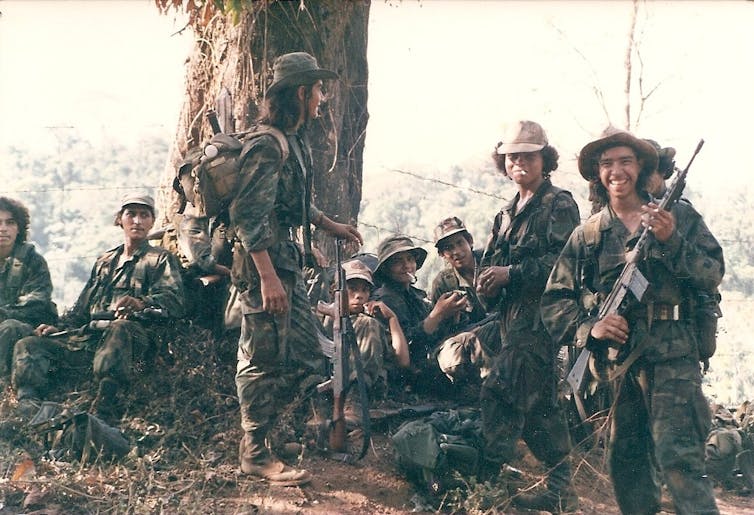
Initially, the policy received bipartisan support in Congress. The linchpin of this policy was the creation of an insurgent group in Nicaragua called the contras (contrarevolucionarios). It was made up of members of the previous regime’s brutal national guard, as well as other groups that had become disgruntled with the Sandinistas.

A group of Nicaraguan contras
Nicaraguan contras, who fought against the Sandinista government in Nicaragua during the 1980s.
Tiomono / Wikimedia Commons, CC BY-NC-SA

News stories soon made clear that the size of the contra army had radically expanded, from the 500 members discussed by Casey in his initial briefing to thousands. The contras’ stated goal of overthrowing the Sandinistas, which they ultimately failed to do, also contradicted the earlier Reagan administration’s statements to Congress.

Democrats in Congress pushed the leadership of intelligence committees to curtail the administration’s activities. Edward Boland, chairman of the House Intelligence Committee, penned and helped to pass two amendments. The first prohibited any US government support for the purpose of overthrowing the Nicaraguan government.

When the administration found loopholes to circumvent this, Boland’s second amendment prohibited any US funds from being spent in support of the contras. This amendment is generally understood as a first step towards the so-called Iran-Contra scandal.

The Reagan administration illegally funded the contras behind Congress’s back by using the proceeds from secret arms sales to Iran – a state the US had been at loggerheads with since the 1979 Islamic revolution.

The Boland amendments also helped make an intelligence and covert operations issue a matter of public debate and – more importantly – congressional votes. Republicans in Congress abandoned their oversight duties and followed the administration’s guidelines.

Votes on contra aid became an opportunity for partisan controversy, vitriolic attacks, accusations of betrayal and large-scale influence campaigns. Instead of oversight, a deep partisan divide materialised.

Counting on Congress? Think again

The role of Congress is to conduct oversight. It is the role of the governing administration to keep Congress informed of intelligence matters, particularly covert operations. History shows this has often been hard to achieve.

Congress has been complacent, complicit and often too willing to follow the government’s lead. In some cases, Congress has acted but primarily in the aftermath of major scandals or media revelations. This is called “firefighting” behaviour.

But “firefighters” seem to now be in short supply. As much as domestic constraints on Trump’s power are decreasing, the same is happening in the context of intelligence and foreign policy.


Get your news from actual experts, straight to your inbox. Sign up to our daily newsletter to receive all The Conversation UK’s latest coverage of news and research, from politics and business to the arts and sciences.

The Conversation

Luca Trenta received funding from British Academy Grant SRG21211237.

ref. Congress has a chequered history of overseeing US intelligence and national security – https://theconversation.com/congress-has-a-chequered-history-of-overseeing-us-intelligence-and-national-security-261120

Five reasons why driverless cars probably won’t take over your street any time soon

Source: The Conversation – UK – By Seyed Toliyat, Lecturer in Business Analytics and Technology, University of Stirling

Karolis Kavolelis/Shutterstock

The UK government has launched a consultation on driverless cars, ahead of on-the-road trials of the vehicles next year. It has now been more than a decade since the prospect of driverless cars on public roads emerged, and prototypes and robotaxi fleets such as Waymo and Cruise replaced human drivers with artificial intelligence (AI).

But ten years on, and with self-driving cars increasingly common in the US and China, significant obstacles still stand in their way in the UK.

Despite rapid advances in the tech, other aspects of the driverless journey are still to catch up. Here are five key reasons why autonomous cars are unlikely to take over your local roads any time soon.

1. Uncertainties around safety

One of the main benefits of rolling out driverless cars is to increase traffic safety by eliminating driver errors. In the US, the National Highway Traffic Safety Administration reported in 2018 that more than 90% of serious crashes were due to human error. But there is not yet converging evidence to support the idea that AI taking over from human drivers can make roads safer.

On the other hand, there is evidence that adverse weather conditions, road design, traffic control systems and mixed traffic (that is, human-driven and driverless cars) can degrade the performance of those vehicles. Anomalies in driving patterns and frequent rear-end crashes involving self-driving technologies could indicate the AI algorithms are still far from perfect.

2. Regulations and legislation falling behind

Substantial investment in research and development of self-driving technologies has led to a fast-growing and innovative industry. On the other hand, legislation and regulation processes often tend to be slower. These involve multiple stages including drafting, consultation, debate, committee reviews, voting and sometimes judicial review.

The UK’s Automated Vehicles Act provides a framework for the deployment of driverless vehicles. But the legal codes and mechanisms are still evolving. This is also true of data privacy and cybersecurity.

For now, there is insufficient legislation governing who can own telematics and vehicle data or how they can be used. Such a widening lag has implications for the mass rollout of driverless cars, and has a direct impact on insuring them.

3. The insurance industry isn’t ready

Scarce data, combined with ambiguities in legislation and regulations, means insurance companies face a new set of challenges. These include making sense of where liability lies, developing new insurance models and adapting their premiums as the types of claim evolve.

In some countries, including the UK, the liability for levels four and five of autonomous driving (very highly automated and fully automated) is shifting from human drivers in conventional vehicles to the manufacturer. Although the insurer pays first, they can recover costs from the tech provider later.

New risk factors such as cybersecurity further complicate the insurance landscape. Driverless cars are designed to communicate with infrastructure and even other vehicles to decide their routes and avoid collisions. This can open the door to unlawful modifications, hacking or privacy breaches.

4. Ethical dilemmas

Heavy traffic and the presence of other road users could lead to scenarios where a crash is inevitable. This would require programmers to design crash severity algorithms that include moral decision-making into autonomous systems. In simple terms, programmers are effectively being asked to write codes that assign value to human lives – an ethical minefield that has yet to be resolved in either academia or industry.

This echoes the “trolley problem” (a thought experiment about killing one person to save others) but with real-world legal and moral significance. It poses further legal and regulatory questions that could further slow the progress of legislation. Complicating things further is the opaque, black-box nature of AI algorithms.

5. Changing business models

Technology developers such as Waymo and Zoox offer only driverless rides and don’t sell vehicles. The recent move by Tesla to launch a robotaxi service in Austin, Texas, also indicates a shift from selling cars to “mobility as a service”, even by car manufacturers.

In some societies like the US, there is resistance among consumers to relinquishing car ownership due to higher car dependency. This mismatch between the business models of the makers of driverless cars and consumer preferences presents another significant barrier to widespread adoption.

Even if the technical obstacles are removed, these deeply held sentiments about the nature of mobility may prevent consumers abandoning private vehicles.

Until the technical, legal, ethical and commercial challenges are addressed, the widespread rollout of driverless vehicles will remain more of a long-term vision than an immediate reality.


Get your news from actual experts, straight to your inbox. Sign up to our daily newsletter to receive all The Conversation UK’s latest coverage of news and research, from politics and business to the arts and sciences.

The Conversation

Seyed Toliyat does not work for, consult, own shares in or receive funding from any company or organisation that would benefit from this article, and has disclosed no relevant affiliations beyond their academic appointment.

ref. Five reasons why driverless cars probably won’t take over your street any time soon – https://theconversation.com/five-reasons-why-driverless-cars-probably-wont-take-over-your-street-any-time-soon-261040

4.48 Psychosis revival: the play’s window into a mind on the edge is as brutal as ever

Source: The Conversation – UK – By Leah Sidi, Associate Professor of Health Humanities, UCL

Under bright lights, the audience looks at a bare stage on two planes. Below, a small stage is white and empty, occupied only by a table and two chairs. Above, a huge, slanted mirror reflects a bird’s-eye view of the stage to the audience. Three middle-aged figures enter the stage without looking at each other. One lies down, staring into the mirror. One stands and one sits. For the next 70 minutes, they will never hold one another’s gaze.

This is the revival of Sarah Kane’s play 4.48 Psychosis. The production takes place 25 years after the original work, bringing the original cast and creative team back to the Royal Court where the play was first staged – now transferred to The Other Place, a small theatre run by the Royal Shakespeare Company.

It replicates the staging of the original with precision. The same faces are on the same set, making the same gestures. Even the projections of the street outside show cars from the 1990s. And yet, because this is theatre, there are inevitable differences.


Looking for something good? Cut through the noise with a carefully curated selection of the latest releases, live events and exhibitions, straight to your inbox every fortnight, on Fridays. Sign up here.


The play is a revival and a commemoration. Kane wrote 4.48 Psychosis in the year leading up to her death by suicide in 1999 and completed it during her final stay in a psychiatric hospital. It stages the experience of a suicidal and psychotic mind breaking down.

About a week after sending the play to her agent, Kane ended her own life. A year later, the original production was staged at the Royal Court, directed by her long-term collaborator James Macdonald and starring three young actors: Daniel Evans, Madeleine Potter and Jo McInnes. All three have returned for this revival.

4.48 Psychosis is a highly experimental play. It contains dialogue between doctor and patient, poetry, seemingly psychotic speech, lists and quotations from literature and medical documents. In her aims for the play, Kane was both very open and very specific. She described the play in an interview at Royal Holloway University as an attempt to stage the experience of a mind breaking down:

I’m writing a play called 4:48 Psychosis … It’s about a psychotic breakdown and what happens in a person’s mind when the barriers which distinguish between reality and different forms of imagination completely disappear … you no longer know where you stop and the world starts.

What’s more, through an experimental style, Kane hoped to make her audience experience some of the distress experienced by the mental collapse being staged. She described this as “making form and content one”.

How this strange work was to be staged was to be left up to future creatives. She didn’t specify how many actors should perform the work, or provide references to their age or gender. Kane believed that as a playwright, her job was to write the work, and then let directors figure it out.

The result was that the first performance split the experience of breakdown across three actors. At times, they take on more specific roles such as a patient, a doctor, and a lover or bystander. At others, they all seem to occupy a shared mental reverie.

Since the original production, 4.48 Psychosis has been staged in multiple ways around the world. French actor Isabelle Huppert performed the first French production largely as a monologue in 2005, with occasional lines delivered by Gérard Watkins as a psychiatrist. Recently in the UK it has been transformed into a successful opera in which a six-person ensemble and full orchestra performed the play’s “hive mind”, and has been performed in a plastic box in British Sign Language.

When it was first performed in 2000, a year after Kane’s death, the play left a profound impression on its audiences. It was arguably one of the most brutal, head-on representations of mental illness that had ever been seen in British theatre. Reviews from that first production discuss anxieties about whether the play should be viewed as a “suicide note” – a disturbingly “real” reference to Kane’s death.

Today, such anxieties may seem less relevant. After all, over two decades have passed since Kane’s death, and we are in a very different world when it comes to how we view disclosure of personal struggle. In a culture of mental health awareness campaigns and social media oversharing, the closeness of Kane’s suffering to her work seems less scandalous, and perhaps less unsettling.

At times, this revival feels a bit more like a repetition, or archival reconstruction than a fresh performance. There are moments that feel dated – for example, the use of pixelated projections.

The most compelling moments were where something original was introduced due to the more advanced ages of the actors. In my experience, the play is typically performed by a younger cast, as a rageful, energetic cry of despair. It hits differently with a cast in their fifties.

Madeleine Potter’s resigned, ironic complaints about being mistreated by “Dr This and Dr That” gave the impression of a woman with a lifetime’s experience of inadequate mental health services. And Jo McInnes’s desperate monologue about lost love could be referencing an estranged or dead child, as much as a lover.

These moments inserted something new into Kane’s iconic last work and underlined that mental suffering is far from being the privilege of the young. More of a slow burn than an explosive cry of anger, this return to 4.48 Psychosis explores mental torment that can persist over a lifetime, revealing it to be as relevant as ever.

4.48 Psychosis is at The Other Place until July 27.

The Conversation

Leah Sidi does not work for, consult, own shares in or receive funding from any company or organisation that would benefit from this article, and has disclosed no relevant affiliations beyond their academic appointment.

ref. 4.48 Psychosis revival: the play’s window into a mind on the edge is as brutal as ever – https://theconversation.com/4-48-psychosis-revival-the-plays-window-into-a-mind-on-the-edge-is-as-brutal-as-ever-261430

Counting the climate costs of abandoned shopping trolleys

Source: The Conversation – UK – By Neill Raath, Assistant Professor of Sustainable Materials and Manufacturing, University of Warwick

Richard Johnson/Shutterstock

Despite the steady growth of online shopping, a majority of the UK public still prefers to buy groceries at the supermarket.

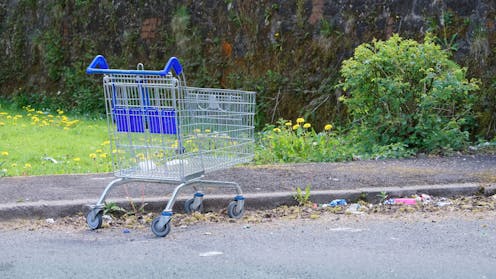
Shopping trolleys can help us lug our purchases back to the car, but some shoppers are evidently taking them further afield. In 2017, 520,000 trolleys were reported as abandoned in the UK. Sunderland in north-east England alone reported 30,000 abandoned trolleys between 2020 and 2022. Likewise, 550 trolleys were collected in a single day in western Sydney, Australia.

Supermarkets employ a range of methods to stop trolleys leaving their premises, including coin slots, vertical bars (to stop trolleys leaving the shop floor), wheel-locking mechanisms and car park wardens. Despite these efforts, abandoned trolleys still blight the landscape and need to be collected.

Many supermarkets use commercial collection services, such as Wanzl TrolleyWise or TMS Collex. These companies typically use diesel vans to survey suburban areas, collect trolleys and return them to supermarkets. They also offer to refurbish weathered or damaged trolleys, sometimes by applying a zinc-based coating to protect against corrosion – a process known as regalvanisation.

We are researchers at the University of Warwick who wanted to understand the environmental impact of trolley abandonment. So, we set out to investigate it.

Collecting versus manufacturing

How does the environmental impact of using vans to rescue abandoned trolleys compare with losing these trolleys to excessive damage or corrosion and having to make new ones?

Our study used a standardised methodology known as life-cycle assessment to analyse the potential environmental impact of collecting and handling abandoned shopping trolleys within an area of Coventry, a city in the English West Midlands, which includes our university campus.

We spoke to trolley suppliers, who told us trolleys used at the supermarket in Coventry were most likely made in Spain. This was incorporated into our model.

A shopping trolley wedged in a hedge.
A trolley discovered by the author, abandoned in a bush near a car park.
Neill Raath

Through conversations with our university’s estates department and commercial collection services, we established that approximately 30 trolleys were collected a week on average in the area surrounding the Tesco supermarket in the Cannon Park shopping centre.

Our model assumed that a bulk transport of 50 trolleys is sent twice each year to be refurbished, in a round trip of 220km between Coventry and a refurbishment facility based in the UK that was noted on stickers placed on refurbished trolleys.

Vans collecting 520,000 abandoned trolleys in a year could emit the equivalent of 343 tonnes of CO₂ (the annual equivalent of driving 80 petrol cars). If we imagine that 10% of these 520,000 trolleys have been left outside too long and need to be regalvanised then the total global warming impact increases by 90% to the equivalent of 652 tonnes CO₂ (roughly the same as 152 petrol cars being driven for one year).

This is quite a surprising increase for such a small number of trolleys. It suggests that the real problem lies with the environmental impact of manufacturing.

Most of the emissions can be avoided

We found that one trolley would have to be collected 93 times by a diesel van to have the same environmental impact as manufacturing a new one.

Our results showed that the emissions incurred during the diesel van collection phase were only 1% of the manufacturing impact, and the regalvanisation stage was only 8%. We might wonder whether switching to electrically powered collection vans might help. While the emissions would be reduced, the impact of using diesel vans is still minuscule compared to that of making new trolleys.

We found that the highest environmental impact stemmed from manufacturing, which was mainly attributed to making and replacing the steel frame of the trolley.

These results reinforce the benefits of following the circular-economy principle of keeping trolleys in use for as long as possible, and avoiding manufacturing to replace abandoned ones.

Would anything change if we switched to plastic trolleys? Other researchers have investigated the effect of changing trolley materials and have found that trolleys made of polymers have many benefits compared with steel: they use less material, are less dense (a benefit for collection vans that emit less by driving around lighter products) and do not require protective coatings, which themselves have an environmental impact.

A steelworks.
Blast furnaces at conventional steelworks are very carbon-intensive.
Pedal to the Stock/Shutterstock

However, if these polymer trolleys were to be sent to landfill (or left to deteriorate in the environment), they could release carcinogenic chemicals, as well as microplastics, as they break down. This leads us back to the importance of keeping products in use.

Abandoning trolleys is bad for the environment, with a potential global warming impact equivalent to 0.69 kg CO₂ for collecting one trolley and returning it to a supermarket. If we multiply this by the potential 520,000 abandoned trolleys a year, this figure becomes quite big.

Preventing trolley abandonment should be a priority not just for supermarkets, but for the general public as well. However, once a trolley is abandoned, it is far better to collect and refurbish it than to let it fall out of use and manufacture a new one, as 92–99% of the environmental impact can be avoided.

While it is unlikely that we can ever stop trolleys being abandoned, we hope that next time people see a trolley in an alley or park bush, the potential environmental impact of losing this trolley to service would be apparent.


Don’t have time to read about climate change as much as you’d like?

Get a weekly roundup in your inbox instead. Every Wednesday, The Conversation’s environment editor writes Imagine, a short email that goes a little deeper into just one climate issue. Join the 45,000+ readers who’ve subscribed so far.


The Conversation

The authors do not work for, consult, own shares in or receive funding from any company or organisation that would benefit from this article, and have disclosed no relevant affiliations beyond their academic appointment.

ref. Counting the climate costs of abandoned shopping trolleys – https://theconversation.com/counting-the-climate-costs-of-abandoned-shopping-trolleys-258500

Gene editing technology could be used to save species on the brink of extinction

Source: The Conversation – UK – By Cock Van Oosterhout, Professor of Evolutionary Genetics, University of East Anglia

Earth’s biodiversity is in crisis. An imminent “sixth mass extinction” threatens beloved and important wildlife. It also threatens to reduce the amount of genetic diversity – or variation – within species.

This variation in genes within a species is crucial for their ability to adapt to changes in the environment or resist diseases. Genetic variation is therefore crucial for species’ long term survival.

Traditional conservation efforts – such as protected areas, measures to prevent poaching, and captive breeding – remain essential to prevent extinction. But even when these measures succeed in boosting population numbers, they cannot recover genetic diversity that has already been lost. The loss of a unique gene variant can take thousands of years of evolution before it is recovered by a lucky mutation.

In a new paper in Nature Reviews Biodiversity, an international team of geneticists and wildlife biologists argues that the survival of some species will depend on gene editing, along with more traditional conservation actions. Using these advanced genetic tools, like those already revolutionising agriculture and medicine, can give endangered species a boost by adding genetic diversity that isn’t there.

Genetic engineering is not new. Plant breeders have used it for decades to develop crops with traits to boost disease resistance and drought tolerance. Around 13.5% of the world’s arable land grows genetically modified crops. Gene-editing tools such as Crispr are also being used in “de-extinction” projects that aim to recreate extinct animals.

The Dallas-based company Colossal Laboratory & Biosciences has attracted headlines for its efforts to bring back the woolly mammoth, dodo and dire wolf. In de-extinction, the DNA of a living relative species is edited (changed) to approximate the extinct species’ most charismatic traits.

For example, to “resurrect” a woolly mammoth, Colossal’s researchers plan to splice mammoth genes (recovered from ancient remains) into the genome of the Asian elephant to produce a cold-hardy, hairy elephant-mammoth hybrid. Colossal recently engineered grey wolf pups with 20 gene edits from the extinct dire wolf’s DNA.

Dire wolf pup
Colossal edited grey wolves to have traits from extinct dire wolves.
Colossal

The “Jurassic Park”-style revival of long-gone creatures has attracted considerable attention and funding, which has accelerated the development of genome engineering techniques. These same genome editing tools can be used for conservation of existing and endangered species. If we can edit a mouse to have mammoth hair, or edit a wolf to resemble a dire wolf, why not edit an endangered bird’s genome to make it more resilient to disease and climate change?

Museum specimens

Using DNA from historical specimens, scientists can identify important genetic variants that a species has lost. Many museums hold century-old skins, bones, or seeds – a genomic time capsule of past diversity. With genome editing, it is possible to reintroduce these lost variants into the wild gene pool.

By restoring genetic variation, species can be fortified against emerging diseases and environmental change. A sharp decline in population numbers is called a “bottleneck”. During a bottleneck, inbreeding and genetic drift lead to the random loss of genetic diversity. Harmful mutations can also increase in frequency. Such “genomic erosion” compromises the health of individuals and can make populations more prone to extinction.

If we can pinpoint a particularly damaging mutation that has become widespread in the population or a variant that has been lost, we could replace it in a few individuals using gene editing. Aided by natural selection, the healthy variant would gradually spread in the population.

If a threatened species lacks genes that it desperately needs to survive new conditions, why not borrow them from a close relative that already has those traits? Known as facilitated adaptation, this could help wildlife cope with threats such as climate change.

In agriculture, such cross-species gene transfers are routine. Tomatoes have been engineered with a mustard plant gene to tolerate cold, and chestnut trees got a wheat gene for disease resistance. There is no reason why such techniques cannot be expanded to animals.

These genetic interventions can complement, but never replace traditional conservation measures. Habitat protection, control of invasive predators, captive breeding programmes, and other on-the-ground action remain absolutely necessary. Importantly, gene editing only makes sense if the target population has recovered in numbers enough (often through conservation), to allow natural selection to do its job.

Measuring the risk of extinction

Gene-edited animals or plants wouldn’t have a chance if released into a barren habitat or a poaching hotspot. Genomic tools can give an extra edge to species that are already being saved from immediate threats, equipping them for adaptive evolution in the future.

Climate zones are shifting, new diseases are spreading, and once-isolated populations are cut off in small fragments of habitat. Without intervention, even intensive habitat management might not prevent a wave of extinctions.

However, a strategy of gene editing also comes with significant risks and unknowns. One technical concern is off-target effects – Crispr and other gene-editing techniques might make unintended DNA changes in addition to the intended edit. In other words, you attempt to insert a disease-resistance gene, but accidentally disrupt another gene in the process. Similarly, a gene may have more than one function, which is known as pleiotropy.

Especially in less-well studied species, we may not be aware of all those functions or pleiotropic effects. Regulatory inertia and public scepticism may also present big obstacles – these issues have historically limited the rollout of genetically modified (GM) organisms, particularly in agriculture.

There are also evolutionary and ecological uncertainties. A deliberate gene edit might have knock-on effects on how the species evolves over time. For instance, if one individual is given a highly beneficial gene that spreads rapidly, it could replace all the other gene variants at that location in the genome (the full complement of DNA in the organism’s cell). This is known as a “selective sweep”, and it inadvertently reduces the genetic diversity in that region of the genome.

Some critics argue that the narrative of a genetic quick fix could distract from the root causes of biodiversity loss. If people believe we can simply “edit” a species to save it, will that undermine the urgency to protect habitats or cut carbon emissions? Portraying extinction as reversible might seed false hope and reduce the motivation for tough environmental action.

Conservation efforts, strong environmental policies and legal protections remain indispensable. So do habitat restoration, climate action and reducing the impact made on the environment by humans.

Nevertheless, genome engineering is a new tool in the conservation toolbox. It’s one that –given the right assistance and environmental encouragement – can help save species from extinction.


Get your news from actual experts, straight to your inbox. Sign up to our daily newsletter to receive all The Conversation UK’s latest coverage of news and research, from politics and business to the arts and sciences.

The Conversation

Cock Van Oosterhout receives funding from the Royal Society for conservation genomics work on threatened bird species in Mauritius, and a donation by the Colossal Foundation for conservation genomic research on the pink pigeon. He is member of the Conservation Genetics Specialist Group of the IUCN (International Union for Conservation of Nature).

ref. Gene editing technology could be used to save species on the brink of extinction – https://theconversation.com/gene-editing-technology-could-be-used-to-save-species-on-the-brink-of-extinction-261419

Understanding the violence against Alawites and Druze in Syria after Assad

Source: The Conversation – USA (3) – By Güneş Murat Tezcür, Professor and Director of the School of Politics and Global Studies, Arizona State University

Bedouin fighters at Mazraa village on the outskirts of Sweida city, during clashes in southern Syria on July 18, 2025. AP Photo/Ghaith Alsayed

In July 2025, clashes between the Druze religious minority and Sunni Arabs backed by government-affiliated forces led to hundreds of deaths in Sweida province in southern Syria. Israel later launched dozens of airstrikes in support of the Druze.

This eruption of violence was an eerie reminder of what had unfolded in March 2025 when supporters of the fallen regime led by Bashar Assad, an Alawite, targeted security units. In retaliation, militias affiliated with the newly formed government in Damascus carried out indiscriminate killings of Alawites.

While exact figures remain difficult to verify, more than 1,300 individuals, most of them Alawites, lost their lives. In some cases, entire families were summarily executed.

Although the Syrian government promised an investigation into the atrocities, home invasions, kidnappings of Alawite women and extrajudicial executions of Alawite men continue.

The violence in Sweida also bore a sectarian dimension, pitting members of a religious minority against armed groups aligned with the country’s Sunni majority.

A key difference, however, involved the active Israeli support for the Druze and the U.S. efforts to broker a ceasefire.

Post-Assad Syria has seen promising developments, including the lifting of international sanctions, a resurgence of civil society and the end of diplomatic isolation. There was even a limited rapprochement with the main Kurdish political party controlling northeastern Syria.

The persistent violence targeting the Alawites and, to a more limited extent, the Druze, starkly contrasts with these trends. As a scholar of religious minorities and the Middle East, I argue that the current political situation reflects their historical persecution and marginalization.

History of the Alawites

The Alawites emerged as a distinct religious community in the 10th century in the region of the Latakia coastal mountains, which today make up northwestern Syria.

Although their beliefs have some commonalities with Shiite Islam, the Alawites maintain their own unique religious leadership and rituals. Under the Ottoman regime in the late 19th century, they benefited from reforms such as the expansion of educational opportunities and economic modernization, while gaining geographical and social mobility.

After Hafez Assad, the father of Bashar, came to power in a coup in 1970, he drew upon his Alawite base to reinforce his regime. Consequently, Alawites became disproportionately represented in the officer corps and intelligence services.

Prior to the civil war, which began in 2011, their population was estimated at around 2 million, constituting roughly 10% of Syria’s population. During the civil war, Alawite young men fighting for the regime suffered heavy casualties. However, most Alawites remained in Syria, while Sunni Arabs and Kurds were disproportionately displaced or became refugees.

Several people, including women and children, stand next to parked vehicles.
Members of the Alawite minority gather outside the Russian air base in Hmeimim, near Latakia in Syria’s coastal region, on March 11, 2025, as they seek refuge there after violence and retaliatory killings in the area.
AP Photo/Omar Albam

Among Syria’s minorities, two key factors make the Alawites most vulnerable to mass violence in post-Assad Syria. The first factor is that, like the Druze, Alawites have their own distinct beliefs that deviate from Sunni Islam. Their religious practices and teachings are often described as “esoteric” and remain mostly inaccessible to outsiders.

In my 2024 book “Liminal Minorities: Religious Difference and Mass Violence in Muslim Societies,” I categorize the Alawites and Druze in Syria alongside Yezidis in Iraq, Alevis in Turkey and Baha’is in Iran as “liminal minorities” – religious groups subject to deep-seated stigmas transmitted across generations.

These groups are often treated as heretics who split from Islam and whose beliefs and rituals are deemed beyond the pale of acceptance. For instance, according to Alawite beliefs, Ali, the son-in-law of Prophet Muhammad, is a divine manifestation of God, which challenges the idea of strict monotheism central to Sunni Islam.

From the perspective of Sunni orthodoxy, these groups’ beliefs have been a source of suspicion and disdain. A series of fatwas by prominent Sunni clerics from the 14th to the 19th century declared Alawites heretics.

Resentment against the Alawites

The second factor contributing to the Alawites’ vulnerability is the widespread perception that they were the main beneficiaries of the Assad regime, which engaged in mass murder against its own citizens. Although power remained narrowly concentrated under Assad, many Alawites occupied key positions in the security apparatus as well as the government.

In today’s political landscape where the central government remains weak and its control over various armed groups is limited, religious stigmatization and political resentment create fertile ground for mass violence targeting the Alawites.

The massacres of March 2025 were accompanied by sectarian hate speech, including open calls for the extermination of the Alawites, both in the streets and on social media.

While many Sunni Muslims in Syria also perceive the Druze as heretics, they maintained a greater degree of distance from the Assad regime and were less integrated into its security apparatus.

Nonetheless, in recent months the situation deteriorated rapidly in the Druze heartland. The Druze militias and local Bedouin tribes engaged in heavy fighting in July 2025. Unlike the Alawites, the Druze received direct military assistance from Israel, which has its small but influential Druze population. This further complicates peaceful coexistence among religious groups in post-Assad Syria.

A sober future

Sunni Arab identity is central to the newly formed government in Damascus, which can come at the expense of religious and ethnic pluralism. However, it has incentives to rein in arbitrary violence against the Alawites and Druze. Projecting itself as a source of order and national unity helps the government internationally, both diplomatically and economically.

Internally, however, the new government remains fractured and lacks effective control over vast swaths of territory. While it pays lip service to transitional justice, it is also cautious about being perceived as overly lenient toward individuals associated with the Assad regime and its crimes. Meanwhile, Alawite and Druze demands for regional autonomy continue to stoke popular Sunni resentments and risk triggering further cycles of instability and violence.

I believe that in a post-Assad Syria defined by fractured governance and episodic retribution, the Alawites as well as Druze are likely to face deepening marginalization.

The Conversation

Güneş Murat Tezcür does not work for, consult, own shares in or receive funding from any company or organization that would benefit from this article, and has disclosed no relevant affiliations beyond their academic appointment.

ref. Understanding the violence against Alawites and Druze in Syria after Assad – https://theconversation.com/understanding-the-violence-against-alawites-and-druze-in-syria-after-assad-255292