Source: The Conversation – UK – By Seamus Higgins, Associate Professor Food Process Engineering, Chemical & Environmental Engineering, University of Nottingham
Baby food pouches came under scrutiny earlier this year, following a report from the University of Leeds and consumer group Which?.
The findings were troubling. Many pouches are high in sugar, nutritionally inadequate, and potentially harmful if consumed regularly. The report also warns that parents are being misled by so-called “halo” marketing claims – labels like “nutritionally balanced,” “no added sugar” and “organic” – which often obscure poor nutritional profiles.
This isn’t the first time these products have raised concerns. A 2023 study published in BMJ analysed 276 baby food pouches from 15 major manufacturers. It concluded that many were “nutritionally poor, high in sugars, and not fortified with iron”. In 2025, a BBC Panorama investigation found that pouches from six leading UK brands failed to meet essential nutritional standards for infant feeding.
The preservation of food by way of heat treatment dates back to the early 19th century, when Frenchman Nicolas Appert developed heat-based methods to extend shelf life for Napoleon’s army rations. Fast-forward to the 1970s, and the US Army developed the first retort pouch: a flexible, heat-resistant food package made from layers of plastic and metal foil, designed to be sterilised under high heat and pressure.
The retort process kills harmful bacteria and allows food to be stored safely at room temperature for up to 18 months, without the need for refrigeration or preservatives. Originally intended for military rations, this packaging method would later revolutionise the baby food industry.
It’s easy to understand their appeal. These pouches offer ultimate convenience for busy parents: no prep, no refrigeration, no cleanup. Many are designed with built-in spouts, allowing infants to self-feed by sucking directly from the pouch: no spoon or bowl required.
Pouch problems
The trouble lies in how these foods are made. To achieve long shelf life manufacturers subject the pouches to high heat and pressure. To mask any off-tastes caused by this intense processing, they often use fruit concentrates: ingredients high in sugar that appeal to babies and make the product more palatable.
Consider milk as an example. Fresh milk pasteurised at 71°C for 15 seconds tastes natural and requires refrigeration, with a shelf life of about a week. But process that same milk at 130°C–150°C, and it becomes UHT (ultra high temperature) milk – shelf-stable for up to six months, but with a markedly different taste. Process it further in a retort system, and it can last up to 18 months – but at the cost of flavour and nutritional integrity. Now apply the same logic to baby food.
But these pouches don’t just fall short nutritionally – they may also interfere with vital developmental stages.
When infants feed directly from spouts, they miss out on practising essential oral motor skills like chewing, swallowing and tongue lateralisation: the ability to move the tongue from side to side. This movement is crucial for shifting food around the mouth and preparing it for safe swallowing.
Without opportunities to develop these skills, children may struggle to transition to solid foods, increasing the risk of fussy eating and feeding disorders later in childhood.
International child feeding recommendations – from the UK, EU and World Health Organization – all advocate breastfeeding for the first six months where possible, followed by the gradual introduction of safe, nutrient-dense, age-appropriate foods.
These guidelines consistently recommend limiting added sugars and encouraging a variety of tastes, textures and colours to promote long-term acceptance of healthy foods.
But the food industry doesn’t always follow this advice.
Mum’s milk v the market
The global baby food market was worth over US$88 billion (£65 billion) in 2022 and is projected to grow more than 6% annually until 2032. With profits and market share on the line, it’s no surprise that manufacturers prioritise shelf stability and scalability over optimal nutrition.
So how do these pouches compare to breast milk?
Breast milk is a living, dynamic fluid. Its composition changes throughout the day and based on the mother’s diet, helping expose babies to a range of flavours early in life. It contains fat, protein, carbohydrates (mainly lactose), vitamins, minerals and over 200 complex sugars that support gut and immune system development. These sugars are believed to play a crucial role in shaping a baby’s microbiome.
By contrast, baby food pouches processed under high heat and pressure lose many of the original nutrients and flavours found in whole, fresh ingredients, particularly in sterilised, long-life versions.
HPP works by applying intense pressure to destroy harmful bacteria while retaining flavour, texture and nutrients. PEF uses short bursts of electricity to break down microbial cells, gently preserving food without cooking it.
Cold plasma, meanwhile, relies on ionised gas to inactivate pathogens on food surfaces, making it particularly effective for packaging and delicate ingredients. These innovative methods extend shelf life and ensure food safety, all without compromising the quality of the food itself.
This is a pivotal moment for reflection and action. As the science evolves, so too should our policies. By aligning regulation more closely with expert recommendations, we can help ensure that baby food products support the health and development of the children who rely on them.
After all, what we feed our youngest citizens shouldn’t just fill their bellies – it should nurture their growth, development and long-term wellbeing.
Seamus Higgins does not work for, consult, own shares in or receive funding from any company or organisation that would benefit from this article, and has disclosed no relevant affiliations beyond their academic appointment.
If you walk the harbour in Hastings in south-east England or the beach further north in Cromer at dawn, you’ll see the signs of a centuries-old way of life: small boats landing their fresh catch and crews unloading crates of crab, lobster or bass.
But there are fewer boats than a generation ago, fewer working fishers, and fewer incentives for young people to enter the industry. What was once the beating heart of a coastal community is at risk of becoming a memory in many areas.
Inshore and small-scale fishing boats are those vessels that fish predominantly within 6 nautical miles of the coastline and are usually under 10 metres in length. They make up nearly 80% of the UK fishing fleet. Since they operate close to shore, these boats supply local markets and often land directly onto beaches and into small harbours. Inshore fisheries don’t just catch fish, they sustain local economies, cultures and ways of life – but they are disappearing.
Research conducted by ourselves and colleagues confirms that the entire fleet is in decline across the UK. However, this decline is being unevenly felt around the country.
In England alone, between 2008 and 2022, 495 active fishing vessels were lost, equivalent to 20% of the total. Smaller boats were hit hardest: vessels less than 10 metres long declined by 22% – nearly double the 13% fall in larger boats.
These losses are even more severe when fishing activity is taken into account. Days at sea for the under-10 metre fleet fell by 44%, and employment dropped by nearly half (47%).
These numbers don’t just reflect a shrinking fleet. Smaller vessels are less able to fish further afield in response to changing fish stocks, bad weather or increasing pressure from other sea users. This suggests that inshore and small-scale fishing families bear a disproportionate share of the challenges faced across the entire fleet.
And once the last boat has gone from a harbour, with all the knowledge of where and how to fish, it is a way of life that could be lost forever.
Why are we losing boats?
The reasons for the decline are complex and shaped by local contexts. Competition for space, restricted access to fishing grounds, insufficient quotas to target diverse fish stocks, limited access to markets, an ageing workforce – all of these things contribute. But there is a deeper problem: a policy framework that prioritises fish stocks and economic yield over people and places.
Too often, fisheries policy in the UK and internationally has focused on sustainability as predominantly a biological problem. Are fish stocks recovering? Are total catch levels within safe limits? These are important questions, but they miss half the story.
A fishery is not just an ecosystem, it’s a community. The people who fish, mend nets, manage harbours and sell seafood are integral to the sustainability of coastal life. Without them, we lose not just jobs but a whole chain of economic and social support. Fish processors, boat builders, local shops and, in more rural or island locations, even the basic viability of essential services like schools and healthcare can depend on the continued presence of fishing families.
While small-scale fisheries may be marginal from the perspective of national GDP, fewer boats often means fewer families – and the erosion of a community which makes a seaside town more than just a tourist backdrop. As fishing fades, so too does a sense of local character and identity: elements that distinguish these towns and connect them to their maritime heritage.
What would it take to stem the loss?
A number of solutions are frequently discussed, including quota systems designed to meet community needs, improved harbour facilities for small boats, more visible training opportunities and clearer pathways for young people to enter fishing.
Inshore and small-scale fishers also need to have their voices heard, and to trust their experiences and insight will help shape the future of coastal communities. But lasting change also requires a shift in mindset: to see fishing not just as a source of seafood but as part of a sustainable future for coastal Britain.
The UK government has an important role to play in recognising and addressing the challenges faced by smaller vessels. This aligns with international commitments the UK has already made to support small-scale fisheries, which call for the fair distribution of marine resources and protection of cultural heritage.
But it is not just policymakers who can make a difference. Buying locally landed fish, supporting fishing festivals, learning about local seafood and simply chatting to fishers on the beach or at the harbour – these small acts all help show that people value this work and want it to continue.
The small fishing boats still seen bobbing in UK harbours are more than working vessels – they are signs of a living culture. For those willing to learn the trade, fishing offers a viable independent livelihood and a strong connection to community and the sea.
If we want our coastal communities to thrive, not just survive, action is required before the last boats leave the shore for good.
Sarah Coulthard receives funding from the Esmee Fairbairn Foundation.
Ainsley Hatt and Phoebe Lewis do not work for, consult, own shares in or receive funding from any company or organisation that would benefit from this article, and have disclosed no relevant affiliations beyond their academic appointment.
Même si l’enquête indique que ces personnes le font « pour s’amuser » et déclarent ne se fier qu’« un peu » aux informations obtenues par la divination, la persistance – et l’augmentation apparente – de ces pratiques semble montrer qu’il y a quelque chose de plus profond en jeu.
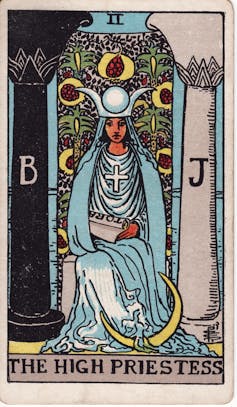
Carte de tarot : la grande prêtresse (tarot Waite-Smith), vers 1909. (Pamela Colman Smith), CC BY
J’étudie la divination à l’époque de l’antiquité, mais j’ai aussi observé des devins contemporains à l’œuvre et discuté avec eux de leur pratique, afin de mieux comprendre leur travail. Ils affirment que leurs clients demandent des consultations de tarot plus fréquemment qu’auparavant.
Les méthodes divinatoires, telles que le tarot et l’astrologie, permettent de poser des questions lorsque d’autres systèmes ne fournissent pas de réponse. Ces questions peuvent être très personnelles et difficiles à aborder dans un cadre religieux formel. Les réponses divinatoires donnent le sentiment d’avoir une compréhension plus profonde, ce qui peut engendrer une impression de contrôle sur un avenir incertain.
Outre l’astrologie et le tarot, les méthodes les plus connues sont l’interprétation des rêves, la lecture dans les tasses de café ou les feuilles de thé, l’observation des animaux et de la nature, ainsi que la lecture des lignes de la main et d’autres caractéristiques corporelles, telles que la forme du nez ou l’emplacement des yeux.
Lorsqu’une personne utilise des objets tels que des cartes, des feuilles de thé, des dés ou des coquillages, le facteur commun de ces méthodes est l’impossibilité de contrôler les signes qu’elles produisent. Par exemple, on doit généralement mélanger le jeu de tarot pour garantir des résultats aléatoires. Il ne faut pas manipuler les résultats.
De nombreuses personnes se tournent vers la religion lorsqu’elles sont confrontées à l’inconnu. Elles utilisent leur pratique religieuse pour résoudre leur insécurité et solliciter l’aide divine.
Cependant, il y a toujours eu des personnes qui n’avaient pas accès à une religion formelle. Les pratiques divinatoires peuvent être particulièrement attrayantes pour celles qui ont été exclues de la religion traditionnelle et qui ont dû trouver d’autres moyens de surmonter leurs incertitudes.
Déjà des milliers d’abonnés à l’infolettre de La Conversation. Et vous ? Abonnez-vous gratuitement à notre infolettre pour mieux comprendre les grands enjeux contemporains.
À une époque marquée par l’anxiété, l’instabilité politique et la perte de confiance dans les institutions, les anciens rituels de divination offrent aux gens des moyens de se divertir, mais aussi de trouver un sentiment de compréhension et de connexion, ainsi qu’une capacité d’action. Ce qui peut sembler n’être qu’un simple divertissement constitue parfois une réponse sérieuse à un monde chaotique. Les pratiques divinatoires apportent à la fois une exploration spirituelle et une validation émotionnelle.
Outre l’insécurité politique croissante, une autre raison de cet intérêt accru pour le tarot peut être son aspect visuel. L’attrait pour les cartes illustrées peut refléter notre culture hautement visuelle ainsi que l’intérêt pour d’autres images que nous aimons regarder. Ces cartes sont comme des photos avec des messages.
La fascination pour le tarot peut également refléter un besoin d’avoir une certaine maîtrise de la consultation, car le tarologue et le client voient la même chose. Les images sont symboliques et peuvent être interprétées de différentes manières.
En principe, il est possible de consulter les cartes n’importe où, sans préparation particulière. Le seul matériel nécessaire est un jeu de cartes. Cette accessibilité peut contribuer à la popularité du tarot.
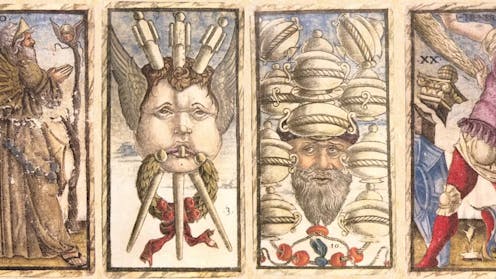
Des images anciennes montrent des personnes consultant ces objets ou jouant avec, ce qui suggère que les frontières entre certaines méthodes divinatoires ont toujours été floues.
Director Zach Cregger’s new horror film Weapons explores the unsettling notion that the real monsters might not be lurking under your bed, but can instead be found within your own mind.
More than merely a scare tactic, the film illustrates how someone’s own brain can transform them from a decent person into the villain in someone else’s story.
Following his breakout hit with the horror flick Barbarian (2022), in Weapons Cregger presents a psychological nightmare that serves as a twisted exploration of human behaviour. It shows how quickly normal people can turn into agents of cruelty, all while still believing they’re the heroes of the story.
The film opens with the chilling premise of 17 children from the same classroom vanishing without a trace, leaving behind only grainy security footage of them running like helpless little planes. However, the true horror unfolds as the community of Maybrook – a small town in Pennsylvania – spirals into chaos instead of unity.
Parents accuse teachers, neighbours distrust one another and innocent lives are upended in the search for a culprit. This breakdown is grounded in psychological research, showcasing how human behaviour can deteriorate under pressure.
The psychology behind Weapons
Social identity theory is a scientific concept that theorises that your brain is wired to compartmentalise the world into “us” (those we consider good) and “them” (those perceived as threats). This process intensifies when people face fear or stress.
In Weapons, we see this theory in action as the community dismantles itself. Teacher Justine Gandy (Julia Garner) becomes an easy target, not due to concrete evidence, but because she fits neatly into the role of the other – “them”. The parents of the missing children seek someone to vilify, and she becomes the scapegoat of their fears.
The trailer for Weapons.
This idea is based on decades of research showing that even the flimsiest group divisions can trigger vicious “us versus them” thinking. In laboratory experiments, people assigned to completely meaningless groups (like “overestimators” versus “underestimators”) will immediately start favouring their own group and discriminating against the other.
Here’s where things get truly frightening. The film shows characters doing horrible things while convinced they’re being righteous – this is a phenomenon psychologists call “moral disengagement”.
Think of it as your brain’s built-in excuse generator. When you want to do something that violates your normal moral standards, your mind helpfully provides justifications, such as:
“it’s for the greater good”
“they deserve it”
“everyone else is doing it”
“I’m just following orders.”
Recent studies show that this isn’t just about film villains – it’s how ordinary people convince themselves that cruelty is justified.
One 2025 study found that when people are under stress (like, say, dealing with missing children), they become much more likely to make cold, calculating decisions that prioritise results over moral principles. Your stressed-out brain rewrites your ethics in real time.
Weapons taps into these, and other, unsettling psychological findings. Take, for instance, the controversial 1971 Stanford prison experiment, where participants tasked with being “guards” quickly adopted sadistic behaviours towards the “prisoners”. Or the equally contentious obedience experiments by American psychologist Stanley Milgram, which demonstrated how ordinary people administered what they thought were lethal electric shocks under authority’s command.
Both the Milgram obedience experiment and Stanford prison experiment are now universally condemned by psychologists as deeply unethical, with experts agreeing that ethics gatekeepers would swiftly bar such studies from proceeding if they were proposed today. These controversial experiments were so harmful to participants that they directly led to major reforms in research ethics, including the National Research Act of 1974 and modern institutional review boards that protect human subjects.
But many still believe that these experiments revealed a chilling truth – almost anyone can become a “bad guy” under the right circumstances. Alarmingly, in Milgram’s tests, around 65% of participants proceeded to maximum voltage shocks, indicating that normal people are vulnerable to psychological manipulation within group settings.
Weapons presents this same dynamic, but within the context of a seemingly idyllic suburban neighbourhood.
The empathy trap
Weapons also shows that the people who care the most about a situation can become the biggest targets. The film doesn’t punish characters for being cruel – it punishes them for being kind.
Take teacher Justine Gandy (Julia Garner). Her downfall isn’t that she’s evil or incompetent. It’s that she cared too much about a neglected student and crossed the invisible boundaries of the “proper” teacher-parent relationship. Her empathy makes her an outsider, and outsiders make perfect scapegoats. The community turns her compassion into evidence of her guilt.
Even more chilling is what happens to Marcus (Benedict Wong), the school principal. In a moment where he shows concern for a child, his care gets twisted into something sinister. His empathy is punished with extreme prejudice, transforming his human decency into malice and destruction.
Recent studies have explored “virtue signaling”: when people perform moral outrage not because they genuinely care, but because it makes them look good socially. The research shows that online moral crusades often have little to do with actually helping anyone and everything to do with personal image management.
Even worse, psychologists have identified “weaponised empathy” – using people’s natural desire to help others to manipulate them into supporting harmful causes. Your compassion becomes the weapon someone else uses against you.
Weapons succeeds as horror because it doesn’t rely on supernatural monsters or gore. Instead, it shows us the real monsters – the ones we become when our psychology works exactly the way evolution has led it to.
The film suggests that the greatest threat to any community isn’t some external evil. It’s the collective decision to abandon empathy, critical thinking and basic human decency in favour of tribal warfare and moral theatre.
As the credits roll over the film’s blood-soaked finale, you’re left with an uncomfortable question: In a crisis, which side of that warfare would you be on? And more importantly, would you even know?
Looking for something good? Cut through the noise with a carefully curated selection of the latest releases, live events and exhibitions, straight to your inbox every fortnight, on Fridays. Sign up here.
Edward White is affiliated with Kingston University.
Il y a 80 ans, le 6 août 1945, se déroulait une tragédie nommée Hiroshima. Les mots de la bombe se sont alors imposés dans l’espace médiatique : « E = mc2 », « Little Boy et Fat Man », « radiations », « bikini », « gerboise », « globocide »…
Dans le Souffle d’Hiroshima, publié en 2024 aux éditions Epistémé (librement accessible en format numérique), la chercheuse Anne Wattel (Université de Lille) revient, à travers une étude culturelle qui s’étende de 1945 à 1960, sur la construction du mythe de l’atome bienfaisant.
Ci-dessous, nous reproduisons un extrait du chapitre 3, consacré à l’histoire du mot « bikini » ainsi qu’à un étonnant article publié par Paris Match en 1950.
« Il y a eu Hiroshima […] ; il y a eu Bikini avec sa parade de cochons déguisés en officiers supérieurs, ce qui ne manquerait pas de drôlerie si l’habilleuse n’était la mort. » (André Breton, 1949
Juillet 1946 : Bikini, c’est la bombe
Lorsqu’en 1946, le Français Louis Réard commercialise son minimaliste maillot de bain deux pièces, il l’accompagne du slogan : « Le bikini, première bombe anatomique. »
On appréciera – ou pas – l’humour et le coup de com’, toujours est-il que cette « bombe », présentée pour la première fois à la piscine Molitor, le 5 juillet 1946, est passée à la postérité, que le bikini s’est répandu sur les plages et a occulté l’atoll des îles Marshall qui lui conféra son nom, atoll où, dans le cadre de l’opération Crossroads, les Américains, après avoir convaincu à grand renfort de propagande la population locale de s’exiler (pour le bien de l’humanité), multiplièrent les essais atomiques entre 1946 et 1958.
La première bombe explose le 1er juillet 1946 ; l’opération est grandement médiatisée et suscite un intérêt mondial, décelable dans France-soir qui, un mois et demi avant « l’expérience », en mai 1946, renoue avec cet art subtil de la titraille qui fit tout son succès :
« Dans 40 jours, tonnerre sur le Pacifique ! Bikini, c’est la bombe » (France-soir, 19-20 mai 1946)
Mais la bombe dévie, ne touche pas l’objectif et la flotte cobaye est quasiment intacte. C’est un grand flop mondial, une déception comme le révèlent ces titres glanés dans la presse française :
« Deux navires coulés sur soixante-treize. “C’est tout ?” » (Ce soir, 2 juillet 1946) ;
« Bikini ? Ce ne fut pas le knockout attendu » (Paris-presse, 2 juillet 1946) ;
« À Bikini, la flotte cobaye a résisté » (France-soir, 2 juillet 1946).
C’est un « demi-ratage », un possible « truquage » pour l’Aurore (2 juillet 1946) ; et le journal Combat se demande si l’expérience de Bikini n’a pas été volontairement restreinte (Combat, 2 juillet 1946).
Les essais vont se poursuivre, mais le battage médiatique va s’apaiser. Le 26 juillet, Raymond Aron, dans Combat, évoque, effaré, la déception générale occasionnée par la première bombe et se désespère alors qu’on récidive :
« Les hommes seuls, maîtres de leur vie et de leur mort, la conquête de la nature, consacrée par la possession d’un pouvoir que les sages, dans leurs rêves, réservaient aux dieux : rien ni personne ne parviendra à voiler la grandeur tragique de ce moment historique. »
Et il conclut :
« […] Aujourd’hui, rien ne protège l’humanité d’elle-même et de sa toute-puissance mortelle. »
Premier-Avril 1950 : « Comment ne pas être tué par une bombe atomique »
L’hebdomadaire français Paris Match, qui a « le plus gros tirage dans les années 1950 avec près de 2 millions d’exemplaires chaque semaine », dont « l ‘impact est considérable » et qui « contribue à structurer les représentations », propose dans son numéro du 1er avril 1950 une couverture consacrée, comme c’est fréquemment le cas, à l’aristocratie (ici la famille royale de Belgique) mais, dans un unique encadré, bien visible en haut de page, le titre, « Comment ne pas être tué par une bombe atomique », se présente comme un véritable produit d’appel d’autant plus retentissant qu’on sait officiellement, depuis septembre 1949, que l’URSS possède la bombe atomique.
L’article, qui nous intéresse et qui se déploie sur deux pleines pages, est écrit par Richard Gerstell qu’un encadré présente comme « un officier de la marine américaine », « un savant », « docteur en philosophie », « conseiller à la défense radiologique à l’Office de la défense civile des États-Unis ». L’auteur est chargé par le ministère de la défense d’étudier les effets de la radioactivité des essais atomiques de Bikini et d’élaborer des « plans pour la protection de la population civile contre une éventuelle attaque atomique ».
L’encadré inséré par la rédaction de Paris Match vise donc à garantir la crédibilité du rédacteur de l’article, un homme de terrain, un scientifique, dont on précise qu’il « a été exposé plusieurs fois aux radiations atomiques et n’en a d’ailleurs pas souffert physiquement (il n’a même pas perdu un cheveu) », qui rend compte de sa frayeur lorsque le compteur Geiger révéla que ses cheveux étaient « plus radioactifs que la limite ». Il s’agit donc, du moins est-ce vendu ainsi, du témoignage, de l’analyse d’un témoin de choix ; il s’agit d’une information de première main.
Dans les premiers paragraphes de l’article de Match, Gerstell explique avoir eu, dans les premiers temps, « la conviction que la destruction atomique menaçait inévitablement une grande partie de l’humanité ». C’est pourquoi il accueillit favorablement la parution de l’ouvrage de David Bradley, No Place to Hide (1948), qui alertait sur les dangers de la radioactivité. Mais il ne s’appuyait alors, confie-t-il, que sur une « impression » ; il manquait de recul. En possession désormais des « rapports complets des expériences de Bikini et des rapports préliminaires des nouvelles expériences atomiques d’Eniwetok », il a désormais « franchement changé d’avis ».
L’article publié dans Match vise un objectif : convaincre que la radioactivité, sur laquelle on en sait plus que sur « la poliomyélite ou le rhume », « n’est, au fond, pas plus dangereuse que la fièvre typhoïde ou d’autres maladies qui suivent d’habitude les ravages d’un bombardement ».
Fort de son « expérience “Bikini” », durant laquelle, dit-il, « aucun des 40 000 hommes » qui y participèrent « ne fut atteint par la radioactivité », Gerstell entend mettre un terme aux « légendes » sur les effets de cette dernière (elle entraînerait la stérilité, rendrait des régions « inhabitables à jamais »). « Tout cela est faux », clame-t-il ; la radioactivité est « une menace beaucoup moins grande que la majorité des gens le croient ».
Un certain nombre de précautions, de conseils à suivre pour se protéger de la radioactivité en cas d’explosion nucléaire sont livrés aux lecteurs de Paris Match : fermer portes et fenêtres, baisser les persiennes, tirer les rideaux ; ôter ses souliers, ses vêtements avant de rentrer chez soi, les laver et frotter ; prendre des douches « copieuses » pour se débarrasser des matières radioactives ; éviter les flaques d’eau, marcher contre le vent ; s’abriter dans une cave, « protection la plus adéquate contre les radiations »…
On laisse le lecteur apprécier l’efficacité de ces mesures…
Pour se protéger de la bombe elle-même dont « la plupart des dégâts sont causés par les effets indirects de l’explosion », se coucher à plat ventre, yeux fermés ; pour éviter les brûlures, trouver une barrière efficace (mur, égout, fossé) ; porter des « vêtements en coton clair », des pantalons longs, des blouses larges, « un chapeau aux bords rabattus »…
Ainsi, ce témoin, ce « savant », qui étudia l’impact de la radioactivité, rassure-t-il le lectorat français de Match : on peut se protéger de la bombe atomique, des radiations ; il suffit d’être précautionneux.
Foin des légendes ! Ce regard éclairé, scientifiquement éclairé, s’appuie sur l’expérience, sur Bikini, sur Hiroshima et Nagasaki pour minorer (et c’est peu dire) le danger des radiations, car, c’est bien connu, « les nuages radioactifs à caractère persistant sont vite dissipés dans le ciel » (cela n’est pas sans nous rappeler l’incroyable mythe du nuage qui, à la suite de la catastrophe de Tchernobyl, le 26 avril 1986, se serait arrêté aux frontières de la France) ; « la poussière radio-active persistante qui se dépose sur la peau ne paraît pas dangereuse » ; « au voisinage immédiat du point d’explosion, une pleine sécurité peut être assurée par 30 centimètres d’acier, 1 mètre de béton ou 1 m 60 de terre. À un kilomètre et demi, la protection nécessaire tombe à moins d’un centimètre d’acier et quelques centimètres de béton ».
En avril 1950, l’Américain Richard Gerstell, dont les propos sont relayés en France par l’hebdomadaire Paris Match, niait encore l’impact de la radioactivité.
Anne Wattel ne travaille pas, ne conseille pas, ne possède pas de parts, ne reçoit pas de fonds d’une organisation qui pourrait tirer profit de cet article, et n’a déclaré aucune autre affiliation que son organisme de recherche.
Last month, the Cambodian government launched the largest crackdown to date on the online scam industry that has taken root in the country and operated largely in the open.
On July 16, a directive from Prime Minister Hun Manet acknowledged the growing threat posed by the industry and instructed provincial officials, law enforcement agencies, the courts and the national gambling commission to take action.
As police began raiding scam sites across the country, Telegram channels used by cyber criminals went into a frenzy, warning others of the seriousness of the crackdown.
Some posts claimed the police were setting up roadblocks across the country, detaining people without passports and demanding bribes for their release. Videos also circulated showing mass evacuations from compounds.
The government was soon trumpeting its success. In late July, it announced that raids had been conducted at nearly 140 locations, leading to the arrests of more than 3,000 suspects from at least 19 countries, more than half of them from China and Vietnam.
Significantly, the authorities said very few of these “suspects” had been held against their will. However, we know from our research, previously published in The Conversation, that thousands of people have been trafficked or duped into these compounds and forced to work in conditions akin to modern slavery.
The crackdown was met with praise from China and other countries. Many of these governments have been struggling with the consequences of the scam industry, whether through the trafficking of their citizens to Cambodia or scammers targeting victims in their countries.
However, despite the scale of the operation – and the government’s pledge to “get rid” of scam syndicates in Cambodia – there is widespread scepticism these efforts will be enough to dismantle the industry.
However, Thailand has attributed the conflict to its own crackdown on Cambodian scam operations.
Earlier this year, Thailand cut power and internet service to the border scam hotspot of Poipet City.
Then, in early July, Thailand took the unprecedented step of going after a powerful Cambodian senator and tycoon known to own large properties in Poipet that Thai authorities allege are connected to online scam operations.
Thailand’s criminal court issued an arrest warrant for the senator and raided his properties in Thailand. The authorities also targeted his children and their Thai assets.
In response, a Cambodian official accused Thailand of long being a “central hub for transnational crimes” in Southeast Asia and “shifting blame” for the problem to Cambodia.
A spokesperson for Cambodia’s Senate also said the case against the senator was exaggerated and false, calling it an act of “revenge”. The senator himself did not respond to attempts by Cambodian media to reach him.
Although Thailand has ramped up efforts to tackle the scam industry in recent years, its leaders are likely using the issue to bolster public support at home, while bloodying the noses of Cambodian elites they allege are profiting from the industry.
Large operations continue to operate
Amid this war of words, Cambodian authorities insist the crackdown on the industry will continue.
To Cambodia’s credit, this latest campaign was national in scope, unlike previous crackdowns that were mostly confined to the coastal city of Sihanoukville, a major scamming hub.
Still, familiar patterns quickly began to surface. As in the past, the authorities have focused on small to mid-sized operations, while the largest operators seem to have been left untouched.
In many cases, these major compounds were reportedly tipped off in advance and evacuated. A significant number of scammers have since relocated to large compounds close to the Vietnam border, which seem to be operating without interference.
Indeed, one of us (Ling) joined a rescue team in early August trying to reach a Chinese man who claimed to have been trafficked into a compound hidden deep in the hills of Mondulkiri Province near the border.
The man couldn’t pinpoint his exact location, but through messages with the rescue organisation over several months, the team was able to gradually determine where he was being held – and the scale of the scamming enterprise.
Weeks after the crackdown, Ling joined the team on a field visit to assess the situation. From the hilltops at night, they saw lights flickering across the slopes coming from what appeared to be several buildings surrounded by sparse jungle.
With only one exposed access road to the site, the team couldn’t get close without being detected. But there was no doubt the compound was active and bustling, as were several others in the area that Ling observed on her trip.
The Chinese man was still inside at that time, but since then, there has been no word from him.
What needs to be done
Crackdowns on scam compounds have failed in the past because they don’t address the two fundamental pillars that allow the industry to flourish. One is the powerful local networks that protect scam operators. The other is the sophisticated physical infrastructure of the compounds.
As long as the elites who provide scam operators with cover remain untouched and the compounds remain intact, scammers can quickly get back to work when the pressure subsides.
Periodic crackdowns may shake things up temporarily, but the people being arrested tend to be low-level workers, not those at the top.
Once these campaigns are over, scamming activities simply restart. Operators may go quiet until the storm passes or move to safer locations. Confiscated equipment can be replaced, as can the workers.
The cycle can only be broken by longer-term measures to tackle the structural and systemic issues that prop up the industry in these countries, such as corruption and weak law enforcement.
Given the transnational nature of the industry and complicity of the authorities and elites in host countries, it also requires a more determined effort from global governments, law enforcement, and the finance and tech companies whose products and services are exploited by scam operators.
Independent researcher Mark Bo contributed to this report.
The authors do not work for, consult, own shares in or receive funding from any company or organisation that would benefit from this article, and have disclosed no relevant affiliations beyond their academic appointment.
Dame Stella Rimington, former director general of the UK’s domestic counter-intelligence and security agency, MI5, and author of several spy thrillers, has died this week, aged 90.
A decade ago, Rimington came to Melbourne to promote her latest spy thriller, featuring her alter ego Liz Carlyle, also an MI5 agent. I was invited, as convenor of Sisters in Crime Australia, to interview her before an appreciative audience at Readings bookshop in Hawthorn. They were clearly delighted to be hearing from a real-life spy – especially one widely credited as the blueprint for Judi Dench’s version of M in the Bond movies.
Tall, elegant, impeccably dressed and sharp as a stiletto, Dame Stella was everything we wanted her to be: a woman who had made it to the top in the macho world of espionage.
Her literary legacy includes a 2001 autobiography, Open Secret, (widely seen as disappointing) and several spy thrillers, which gained a dedicated following. Her 2004 debut thriller, At Risk, was praised in the Guardian as “a cracking good thriller” with “nitty-gritty insider detail”. Together, her books provide a fascinating insight into a clandestine world more usually presented from what she herself described as a masculine point of view.
“When you think about it, all fictional spies are blokes, and spy writers when I started were chaps too,” she told the Edinburgh International Book Festival of her Liz Carlyle novels in 2015. “So I was certain that my character was going to be female. I wanted her to reflect accurately what a female does in my former service.”
Both of her female protagonists, Carlyle and CIA agent Manon Tyler (in her final two novels), reflected aspects of her own personality. Their adventures, blended with the challenges of ordinary life – relationships, workplace politics, insecurities – took readers around the world as they dealt with “fictional” threats to the nation.
An accidental spy
Sir Richard Moore, head of MI6, the foreign intelligence branch of the UK secret service, has called Rimington a “true trailblazer”. MI5 itself states it “underwent far-reaching transformation under Dame Stella’s leadership”, reports the BBC.
But she never set out to be a spy. Born in South London in 1935, she went to Edinburgh University in 1954, where she earned a master’s degree in English and literature – which shows where a good humanities degree can get you. After training as an archivist, she married John Rimington, who she accompanied to India when he took up a position at the High Commission in New Delhi.
After two years of tea parties and amateur dramatics, Rimington was asked to help out with some office work for one of the First Secretaries, who just happened to be working for MI5. As she later explained, she was subsequently “tapped on the shoulder”. Eventually, she would climb from the “typing pool to the top”.
Her elevation was never going to be easy in the hard-drinking, masculine culture of the 1970s secret service, when women were paid much less than their male counterparts. Describing herself and her female colleagues as “restive”, Rimington admitted it took something of a rebellion in the ranks before women were recognised as equals, culminating in her appointment as the first female director of MI5 in 1992.
She was also the first head of MI5 to be publicly identified, before retiring in 1996. Her family were forced to flee their London house to escape the tabloids, which published headlines like “Housewife super spy”. She later said it was the point where she “felt most unsafe”. She was, however, broadly in favour of greater public openness about the UK’s intelligence services.
Given the presumed end of the Cold War, the major threats Rimington had to deal with were largely those of domestic terrorism: threats she was required to report to then prime minister John Major. Apparently, there was often very little information to go on, at which point Major would respond “Oh well, Stella, do your best”, which she invariably did.
Booker judging and a publishing uproar
After her retirement, Rimington maintained an active public life, joining the boards of such venerable British institutions as Marks and Spencer.
In 2011, she served as chair of the judging panel for the Man Booker Prize. This created something of a stir, when the judges espoused “readability” and the ability to “zip along” as criteria they would use to assess the prize. This did not go down well – and some critics called the subsequent shortlist “was the worst in decades”.
Defending the judges’ decision at the awards ceremony, Rimington had the temerity to compare the publishing world to the KGB, thanks to its use of “black propaganda, destabilisation operations, plots and double agents”. Sounds like a great idea for a crime novel – of which she wrote a few.
Her autobiography and novels had to be submitted to MI5 for vetting and clearance. She was occasionally asked to change names and places.
Asked to write a new introduction to an anthology of stories edited by Hugh and Graham Greene, The Spy’s Bedtime Book, Rimington suggested the spy novel is “in a special class of literature in which the real and the imaginary can be mixed in any proportion, so long as they both are present”. Arguably, this is true of all literature.
The world is still dangerous
As Rimington informed the audience at the Wheeler Centre in Melbourne in 2012, the world is still a dangerous place. Then, she pointed to the continuing rise of domestic terrorism, instability in the Middle East and Putin’s ongoing aggression towards the West. How right she has proved to be – which is hardly any consolation.
“There’s so much to discover in spy stories,” she once said. “It’s a small ‘lifting of the curtains’ of a world that people know exists but don’t know much about.”
Rimington was an exceptional woman whose books document the challenging times she lived through, from an insider’s unique perspective on the front line. The line between the reality of Stella Rimington and the fiction she created may be hard to draw – which makes them fascinating reading.
Sue Turnbull isChair of the BAD Sydney Crime Writers Festival
You might have seen an interesting phrase popping up in your social media feeds lately: “Chiron is in retrograde.” If you’re anything like me, you’ve never heard of Chiron before – and I’m a professional astronomer.
So what is Chiron, and what does it mean to be in retrograde? The short answer is that Chiron is an asteroid-slash-comet orbiting somewhere past Jupiter and Saturn. And until January 2026, it’s going to look like it’s going backwards in the sky. If you can spot it.
But there’s a bit more to the story.
What is Chiron?
Chiron’s official name is (2060) Chiron. First things first: it’s pronounced “kai-ruhn”, with a hard K sound.
It was discovered by astronomer Charles Kowal in 1977. This was long after the system of Western astrology was developed, which probably explains why people who check their daily horoscopes are also blissfully unaware of its existence.
It was initially classified as an asteroid, or a rock in space. In 1989 astronomers discovered Chiron sometimes has a tail or “coma”, which tells us that it’s actually a comet or a “dirty snowball”. Since then, Chiron has been classified as both an asteroid and a comet.
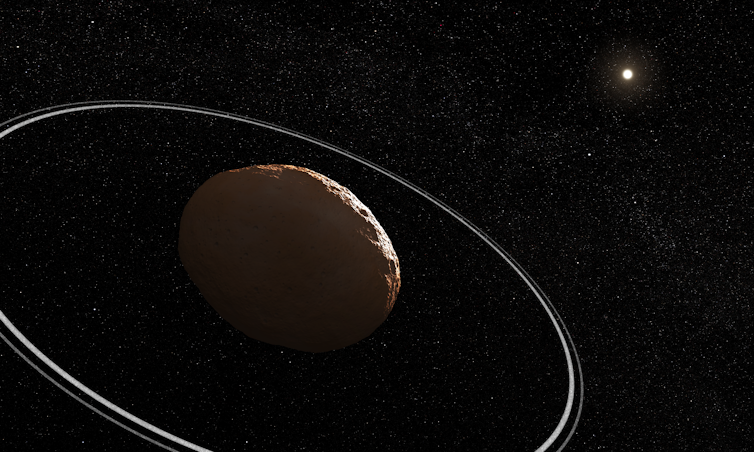
In 2023, more than 45 years after it was first discovered, astronomers confirmed Chiron has rings. This makes it the fourth non-planet in the Solar System to have rings. (The planets Jupiter, Saturn, Uranus and Neptune have rings, as do the asteroid Chariklo and the dwarf planets Haumea and Quaoar.)
Artist’s impression of the Centaur asteroid 10199 Chariklo. Chariklo was the first asteroid and fifth object in our Solar System, after Saturn, Jupiter, Uranus and Neptune, found to have a ring around it. NASA, ESA, CSA, Leah Hustak (STScI), CC BY-SA
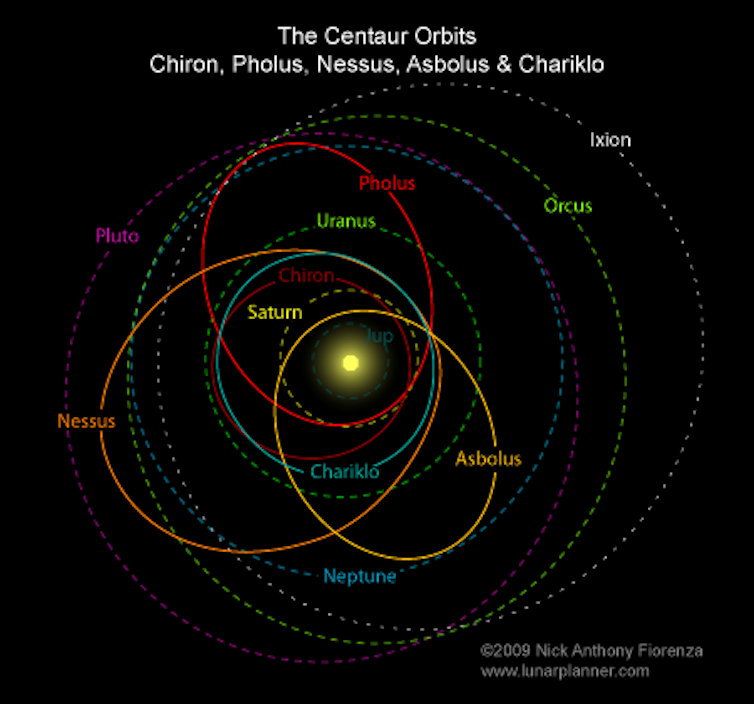
Chiron orbits the Sun in an oval-shaped orbit. The closest it gets to the Sun is about 1.3 billion kilometres (about eight times the distance between Earth and the Sun) and the furthest it gets from the Sun is a whopping 2.7 billion km (about 19 times the distance between Earth and the Sun).
This puts it between the orbits of Jupiter and Uranus, cutting through the orbit of Saturn.
Centaurs in space
Chiron is a member of the Centaurs. This is a group of small Solar System bodies that orbit the Sun between Jupiter and Neptune. Their orbits are highly unstable: they change over time because of gravitational interactions with the giant planets.
In Greek mythology, centaurs were creatures with the lower body and legs of a horse and the torso and arms of a human. Chiron was the oldest centaur, the son of the Titan Kronos. He was considered the wisest centaur.
The orbits of various centaurs, including Chiron. We can see the orbits of Jupiter, Saturn, Uranus and Neptune as well of the orbits of various Small Solar System bodies and dwarf planets. Nick Anthony Fiorenza, CC BY-SA
Chiron in retrograde
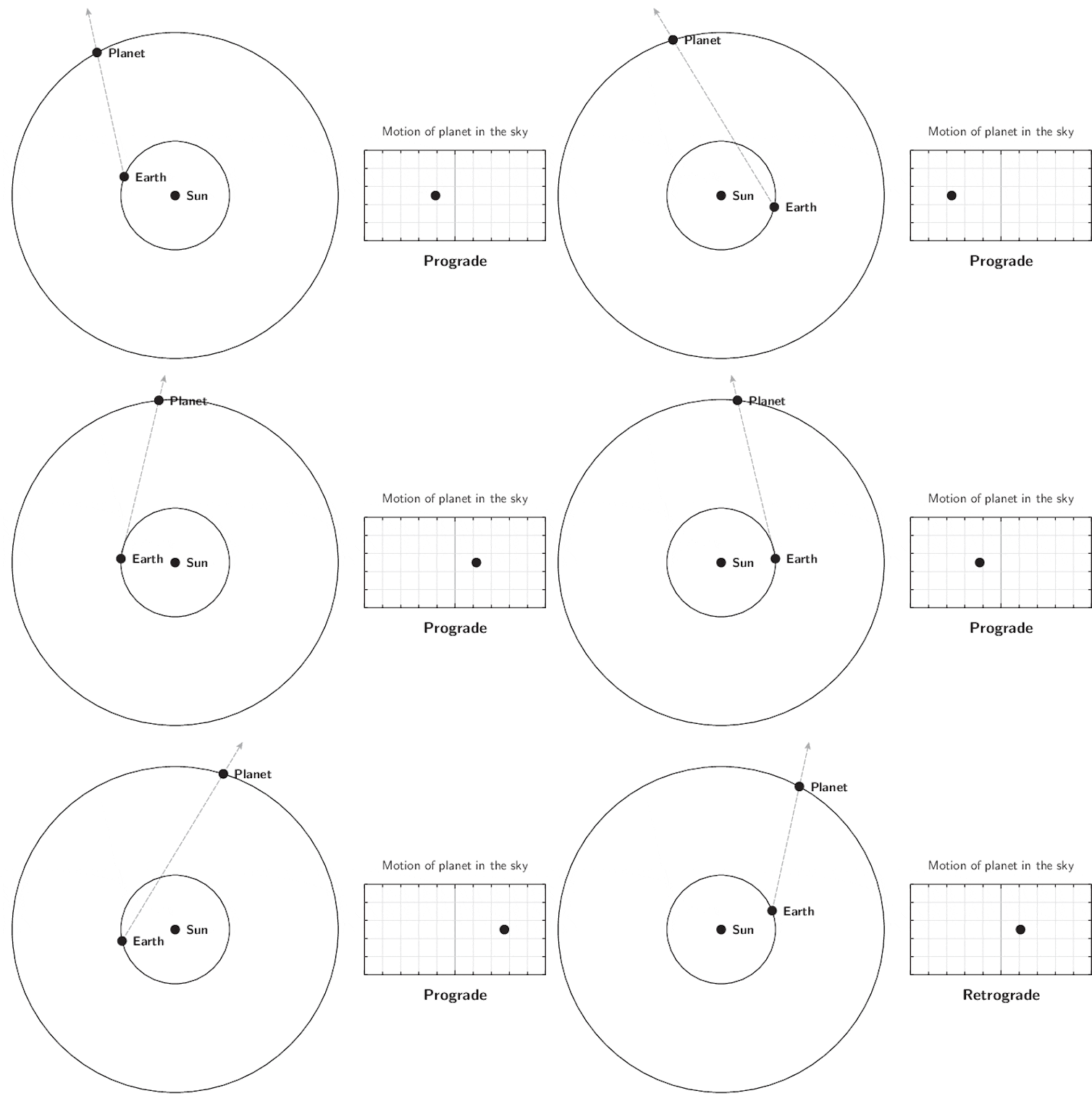
In astronomy, retrograde motion is when something is going backwards compared with everything else.
Apparent retrograde motion is where an object in the sky, such as a planet, appears to be going backwards when we look at it from Earth. The object hasn’t actually changed direction; it just looks like it from our perspective.
All the planets (and Chiron) orbit the Sun in the same direction. This means the planets typically look like they are moving in a west-to-east direction across the sky. But when Earth “catches” up to a planet (or a planet catches up to Earth) and overtakes it, the planet temporarily appears to move in a west-to-east direction in the sky.
This temporary illusion is apparent retrograde motion. It’s just like when you’re driving in a car and overtake a slower car, that slower car looks like it’s going backwards as you overtake it.
Animation demonstrating apparent retrograde motion. We can see the Earth and an outer planet orbiting the Sun in a circular motion on the left. On the right, we can see the direction the planet appears to be moving from Earth’s perspective. Dominic Ford, CC BY-SA
Chiron went into retrograde (that is, apparent retrograde motion) on July 30 2025 and will go back to normal on January 2 2026. But unless you have a telescope or do some long-exposure photography, you’d never know which way Chiron is travelling. Chiron is very faint, so you can’t see it with your eyes.
Have you ever sat in a meeting where someone half your age casually mentions “prompting ChatGPT” or “running this through AI”, and felt a familiar knot in your stomach? You’re not alone.
There’s a growing narrative that artificial intelligence (AI) is inherently ageist, that older workers will be disproportionately hit by job displacement and are more reluctant to adopt AI tools.
But such assumptions – especially that youth is a built-in advantage when it comes to AI – might not actually hold.
While ageism in hiring is a real concern, if you have decades of work experience, your skills, knowledge and judgement could be exactly what’s needed to harness AI’s power – without falling into its traps.
What does the research say?
The research on who benefits most from AI at work is surprisingly murky, partly because it’s still early days for systematic studies on AI and work.
Some research suggests lower-skilled workers might have more to gain than high-skilled workers on certain straightforward tasks. The picture becomes much less clear under real-world conditions, especially for complex work that relies heavily on judgement and experience.
This article is part of The Conversation’s series on jobs in the age of AI. Leading experts examine what AI means for workers at different career stages, how AI is reshaping our economy – and what you can do to prepare.
Through our Skills Horizon research project, where we’ve been talking to Australian and global senior leaders across different industries, we’re hearing a more nuanced story.
Many older workers do experience AI as deeply unsettling. As one US-based CEO of a large multinational corporation told us:
AI can be a form of existential challenge, not only to what you’re doing, but how you view yourself.
But leaders are also observing an important and unexpected distinction: experienced workers are often much better at judging the quality of AI outputs. This might become one of the most important skills, given that AI occasionally hallucinates or gets things wrong.
The CEO of a South American creative agency put it bluntly:
Senior colleagues are using multiple AIs. If they don’t have the right solution, they re-prompt, iterate, but the juniors are satisfied with the first answer, they copy, paste and think they’re finished. They don’t yet know what they are looking for, and the danger is that they will not learn what to look for if they keep working that way.
Experience as an AI advantage
Experienced workers have a crucial advantage when it comes to prompting AI: they understand context and usually know how to express it clearly.
While a junior advertising creative might ask an AI to “Write copy for a sustainability campaign”, a seasoned account director knows to specify “Write conversational social media copy for a sustainable fashion brand targeting eco-conscious millennials, emphasising our client’s zero-waste manufacturing process and keeping the tone authentic but not preachy”.
This skill mirrors what experienced professionals do when briefing junior colleagues or freelancers: providing detailed instructions, accounting for audience, objectives, and constraints. It’s a competency developed through years of managing teams and projects.
Younger workers, despite their comfort with technology, may actually be at a disadvantage here. There’s a crucial difference between using technology frequently and using it well.
Many young people may become too accustomed to AI assistance. A survey of US teens this year found 72% had used an AI companion app. Some children and teens are turning to chatbots for everyday decisions.
Without the professional experience to recognise when something doesn’t quite fit, younger workers risk accepting AI responses that feel right – effectively “vibing” their work – rather than developing the analytical skills to evaluate AI usefulness.
So what can you do?
First, everyone benefits from learning more about AI. In our time educating everyone from students to senior leaders and CEOs, we find that misunderstandings about how AI works have little to do with age.
A good place to start is reading up on what AI is and what it can do for you:
If you’re not even sure which AI platform to try, we would recommend testing the most prominent ones, OpenAI’s ChatGPT, Anthropic’s Claude, and Google’s Gemini.
If you’re an experienced worker feeling threatened by AI, lean into your strengths. Your decades of experience with delegation, context-setting, and critical evaluation are exactly what AI tools need.
Start small. Pick one regular work task and experiment with AI assistance, using your judgement to evaluate and refine outputs. Practice prompting like you’re briefing a junior colleague: be specific about context, constraints, and desired outcomes, and repeat the process as needed.
Most importantly, don’t feel threatened. In a workplace increasingly filled with AI-generated content, your ability to spot what doesn’t quite fit, and to know what questions to ask, has never been more valuable.
Kai Riemer is co-author of the annual “Skills Horizon” research project, which identifies key leadership skills (including in AI), based on interviews with global and Australian leaders and executives across various fields. He also educates leaders in AI fluency through Sydney Executive Plus at the University of Sydney.
Sandra Peter is co-author of the annual “Skills Horizon” research project, which identifies key leadership skills (including in AI), based on interviews with global and Australian leaders and executives across various fields. She also educates leaders in AI fluency through Sydney Executive Plus at the University of Sydney.
Eight months into Donald Trump’s second presidency of the United States, truth and science are again under attack – with global consequences. USAID, which tackled HIV, TB, malaria and child malnutrition is gone. Funding has been withdrawn from GAVI, a public–private global alliance that helps buy vaccines for the world’s poorest children. Malnourished children are already dying.
Besides these brutal consequences, the scientific machine that delivered America’s scientific and technological dominance is being ruthlessly dismantled. Any research project that mentions diversity, equity and inclusion (DEI), climate change or addresses the causes of vaccine hesitancy is a prime target. But even US space science, once the pride of the nation, is facing “an extinction-level event,” according to the US Planetary Society.
Across the spectrum of science, some 4,000 research grants have been cancelled. Unbelievably, bird-flu experts were fired in the middle of an outbreak. That was topped last May by cancelling a US$600M grant to the company Moderna to develop an mRNA vaccine against bird flu.
And this Tuesday, US$500 million was cancelled for 22 more projects developing mRNA vaccines. Bear in mind that under Operation Warp Speed, the first Trump administration funded the development of Moderna’s mRNA vaccine against COVID. Moderna and Pfizer-BioNTech both delivered mRNA vaccines in the record time of less than a year, winning mRNA vaccine technology a Nobel Prize in 2023.
It’s not just American science that’s being dismantled.
Threats to Australian science, too
In March, the Trump administration sent a questionnaire to researchers receiving US funding in Australia, the European Union, the United Kingdom and Canada. The 36 questions included whether their project related to climate, whether it is taking “appropriate measures” to defend against “gender ideology” and whether the organisation receives funding from China.
US funding for collaborative science projects with Australia amounts to AUD$386 million. So, the threat of losing those substantial funds is dire. As the Australian Academy of Science warned last March, if US–Australian collaboration ceases, “it will directly threaten […] strategic capability in areas of national interest such as defence, health, disaster mitigation and response, AI and quantum technology”.
By June, Australian medical research institutes were “suspending projects on malaria, tuberculosis and women’s health”. It’s like “having a bomb thrown into the middle of science”, noted Professor Brendan Crabb, director of the Burnet Institute, a Melbourne-based global health research centre.
The fallout for US medical research is worse. The Trump administration’s proposed funding cut, to the National Institutes of health, the largest funder of medical research in the world, will see its budget slashed by 40% – and over 2,400 projects cancelled. They include research into cancer, Parkinson’s disease, Alzheimer’s disease, tuberculosis, HIV prevention, COVID vaccines and long-COVID.
Experts have been summarily fired and replaced by sycophants. And of course, the Department of Health and Human Services is now led by America’s most prominent anti-vaxxer, Robert F. Kennedy Junior. Elite research universities, including Harvard, Columbia, Princeton and Cornell, continue to be prime targets.
“It’s hard to overstate how serious this is […] Today, as we’re witnessing kind of the destruction of the institutions behind American science, it’s hard to believe. It’s hard to believe any administration would do this,” noted Alan Bernstein, director of global public health at Oxford University, in April.
Indeed, how could this be happening?
Erika Nolan, a MAHA (Make America Healthy Again) stalwart and YouTube influencer, provides a candid answer: “Facts no longer matter.” Nolan plies her 200,000 strong audience with idyllic scenes of herding chickens and goats while snuggling her baby in a front pack.
Like Kennedy, Nolan believes America’s big health issues relate to food dyes and seed oils. Hopefully she does not live in a part of the US where measles or whooping cough is raging, and that her chicken flock won’t come down with bird flu.
She says it was COVID, and the pressure to be vaccinated, that “fast-tracked” her. And when asked about the 14 million lives saved in the first year, as reported in peer-reviewed medical journal, the Lancet, her answer is, “Everything can be manipulated.”
What Nolan doesn’t understand is that modern science emerged precisely to deal with the way everything can be manipulated. The very word science comes from scientia, Latin for knowledge. The gist of it is captured by the motto adopted in 1663 by the Royal Society in London: “Nullius in verba.”. That’s Latin for “Take nobody’s word for it.” In other words, experimentation and observation is what counts, not the opinions of influencers.
Nolan might be surprised to find her scepticism over “facts” goes all the way back to Socrates.
Knowledge, power and science
He left no written works, but we hear his voice through the “dialogues” of his student Plato. Ever so gently, Socrates probes the beliefs of his conversation partner, methodically laying bare their logical fallacies. It has come to be known as the Socratic method.
One of the most famous dialogues employs the allegory of a cave to teach Socrates’ primary lesson: knowledge can be based on false beliefs.
The cave is home to a group of prisoners who have been chained up for their entire lives. All they have ever been allowed to see is the cave wall in front of them. Shadows dance across it, representing the reality of the external world. The prisoners have no idea that the images are created by puppets paraded past a blazing fire just behind them.
One prisoner breaks free and climbs out of the cave. Dazed by the sunlight, it takes time for his sensitive eyes to adapt. At first, he is only able to look at shadows, then reflections, then real objects. He dashes back to the cave to enlighten his fellow captives. But his eyes have not readjusted to the dark and he stumbles around.
The prisoners perceive a blinded, deranged man, raving about a parallel world. They want nothing to do with him and become aggressive. This is Plato’s second lesson: the danger of trying to enlighten those wedded to pre-existing beliefs. Poignantly, Socrates would pay with his life for trying to enlighten others.
It would take over 2,000 years to come up with satisfactory responses to some of Socrates’ questions about the nature of knowledge. They appeared in the form of the scientific revolution.
Stars of the scientific revolution
The scientific revolution was ushered in by the exacting astronomical measurements of Copernicus, Galileo and Kepler, which revealed that Earth and the other planets were in orbit around the sun, rather than the other way round.
Brilliant as these astronomers were, they were just the warm-up acts. The starring role in the scientific revolution goes to Isaac Newton, who honoured his debt to those who came before with the timeless words: “If I have seen further, it is by standing on the shoulders of giants.” Standing on the shoulders of Copernicus, Galileo and Kepler, Newton glimpsed the sun-centred universe and pondered a new question: why did the planets orbit the sun?
The French philosopher Descartes had suggested an answer in 1633. He deemed that something like a giant tornado of dust particles raged around the sun, dragging the planets along with them.
Newton was seven years old when Descartes died. By the time Newton was 26, he was the Lucasian Professor of Mathematics at Cambridge, no doubt for the stunning discoveries he made during the plague years, which he spent in isolation at his mother’s farm in Lincolnshire. “Truth is the offspring of silence and unbroken meditation,” he noted.
His unbroken meditation gave birth to calculus, optics (in the pursuit of which he stuck a blunt needle into his eye), his laws of motion and the beginnings of his theory of gravity. Seeing an apple fall from a tree was famously his Eureka moment. The force that made the apple fall to the earth, he mused, was likely the same as the one binding the planets to the elliptical solar orbits described by Kepler.
Today, most people have no problem with the idea of gravity as a force that pulls the apple to the ground or the earth to the sun. It was a different story in Newton’s time. Descartes’ tornado seemed the more rational explanation.
Seeing an apple fall from a tree was famously Isaac Newton’s Eureka moment for his theory of gravity. Markus Winkler/Pexels
How could the sun reach out across the vastness of space to pull on our planet? This was “barbaric physics”, opined German mathematician and philosopher Gottfried Leibniz. Admittedly, Leibniz was peeved with Newton; they had rival claims as the first to develop calculus. But Leibniz was far from being the only one to label Newton’s theory unscientific.
What vindicated Newton’s theory was that it made testable, precise predictions. It specified that the gravitational force between two objects increases with their masses and decreases as they grow further apart.
Newton’s maths proved correct. It accurately predicted how long it would take for the moon to orbit the earth and the coming of Halley’s comet. His formula also predicted that the warped orbit of Uranus was due to the gravitational pull of a ghost planet. A century and a half later, Neptune was found. For 300 years, Newton’s predictions kept hitting the mark. And for most earth-bound situations, they still do.
Newton represents a watershed in the development of science. The peculiar thing about him, and what made him the lead actor of the scientific revolution, was that his theory, unlike those of Aristotle or Descartes, was limited to what could be accounted for by mathematical predictions. He did not attempt to go beyond the data to explain what gravity is or whether it really existed: “I have not as yet been able to deduce from phenomena the reason for these properties of gravity, and I do not feign hypotheses,” he wrote.
Philosophy of science
This notion of science as being light on theory is familiar to me. As a scientist (before I was a science writer, I was a molecular biologist), my contribution to theory was limited to what could be induced from my last successful experiment. In my ten years as a working scientist, I never encountered the philosophy of science. Nor did I encounter it much in my decades writing about the work of other scientists.
But in researching my book Prove It, which would see me roam widely, from theoretical physics to human evolution, and deeply, across the centuries, I knew I would have to reckon with the philosophy of science. I did not relish the task: reading philosophy can be challenging.
Moreover, I was not convinced that there was much philosophy at work in modern science. According to Michael Strevens, a philosopher of science based at New York University, when scientists themselves are placed under the microscope to dissect their philosophical impulses, nothing coherent emerges beyond a compulsion to test, test, test. As physicist Richard Feynman put it, “the philosophy of science is about as useful to science as ornithology is to birds”.
To my surprise, delight and relief, however, once I started investigating, philosophy emerged unbidden, first in the form of the Scottish enlightenment philosopher David Hume, whose ideas provided a natural kick-off point for the chapters that followed.
Like other Enlightenment philosophers, Hume valued individual reasoning over dogma and drew inspiration from the scientific revolution, particularly Newton, whom he described as “the greatest and rarest genius that ever arose for the ornament and instruction of the species”.
Newton inspired Hume, and Hume in turn inspired Albert Einstein to do what Newton could not: develop a theory of gravity.
Einstein’s ‘intellectual habits’
Einstein discovered Hume in 1902 while working as a patent clerk in Bern, Switzerland, in his early twenties. For fun, he and two colleagues formed a reading group to discuss philosophy. They paid particular attention to Hume’s 1739 A Treatise of Human Nature, in which Hume warned about the dangers of induction, the practice of extrapolating from observations to formulate general laws of the universe.
It may have been the method Newton employed, but it was an “intellectual habit” without a solid philosophical foundation, Hume argued. A well-known example concerns the colour of swans. Since Roman times, the whiteness of swans was held by European writers to be a self-evident truth. But in 1697, Dutch sea captain Willem de Vlamingh, while searching for shipwreck survivors on Australia’s west coast, sailed up a river and, lo, beheld black swans! The incident provided the name of Perth’s Swan River and a salutary philosophical lesson.
For Einstein, Hume’s ideas helped him to let go of his “intellectual habits”, a breakthrough that contributed to his theories of Special Relativity and General Relativity. Had he not read Hume, Einstein reflected, “I cannot say that the solution would have come.”
Einstein freed himself from the intellectual habit of induction by using a “deductive” process instead. It relied not on observations but on the mathematical certainty of the constant speed of light. All very well for Einstein – but the vast majority of scientists do not have the luxury of starting from mathematical certainties. While Einstein’s theory of relativity has endured unchanged for more than a century, the same cannot be said of any of the other theories explored in Prove It.
I needed Einstein to introduce me to David Hume, but Karl Popper needed no introduction. He is the most famous philosopher of science of the 20th century. If you’ve come across the idea that scientific theories can’t be proven, only disproven or “falsified”, that’s courtesy of Popper.
Karl Popper: science as search for truth
Popper has a poignant personal story that resonates strongly with my motive for writing a scientific guide for the post-truth era.
Born in 1902 into a cultivated, scholarly home – his mother a pianist, his father a lawyer – Popper’s first decade was lived in Vienna’s golden age. As the capital of the Austro-Hungarian Empire, Vienna was the seat of political power, but also a cauldron of European cultural and intellectual ferment.
Modernism exploded: there was the stylised eroticism of Gustav Klimt’s shimmering gold paintings and the raw sexual canvases of Egon Schiele; the absurdist literature of Franz Kafka and the meltingly poetic work of Rainer Maria Rilke; the hauntingly beautiful music of Gustav Mahler and the atonal work of Arnold Schoenberg; the philosophy of Ludwig Wittgenstein; and of course, Sigmund Freud’s revolutionary theories about the life of the unconscious mind.
“In those first fourteen years of the twentieth century, Vienna, more than anywhere else, was the fulminating, bewitching crucible where the modern world was invented,” writes William Boyd.
Popper witnessed its destruction. He was 12 when the first world war broke out and 37 when the second one came around. In between, he flirted with and rejected Marxism, tried his hand at carpentry and teaching, and managed to complete a PhD in the philosophy of psychology. With the rise of Nazism, his Jewish ancestry erased his job prospects. To build a reputation, he wrote a book, The Logic of Scientific Discovery.
Published in 1934, it introduced his theory that the way to distinguish science from non-science is falsification. His ideas struck a chord and won him an offer to teach philosophy at Canterbury University College in Christchurch, New Zealand. He emigrated with his wife in 1937, a year before Austria was annexed by Hitler. In 1946, he moved to the United Kingdom to found the department of philosophy at the London School of Economics.
Popper experienced firsthand what can happen to the most intellectually progressive of civilisations when a populist ideology takes hold. How could a philosopher protect future generations from such an assault on truth? Like the Enlightenment thinkers before him, his answer was the scientific method. “Truth is therefore the aim of science; science is the search for truth,” he wrote.
Testing Einstein
I was delighted to discover that Popper’s theory was inspired by Einstein! As a teenager, Popper heard Einstein expound on his astonishing theory of General Relativity in Vienna in 1919.
Gravity was not a force, Einstein suggested, but a consequence of the way mass causes a curvature in spacetime. A fantastical theory! But in the same breath, Einstein proposed a way to prove his theory wrong. During an eclipse, the moon blocks the sun, and the dark sky makes the stars near the sun suddenly visible. Although the stars themselves are very far away from the sun, their light rays must pass close by it to be seen by people watching the eclipse.
Einstein predicted that the starlight would curve along the spacetime warped by the sun’s huge mass. As a result, the apparent positions of the stars would be shifted by an exact amount predicted by Einstein’s equations.
Bottom line: Einstein’s theory could be falsified, and Einstein offered his critics a way to do it. As Popper put it, “Thus I arrived, by the end of 1919, at the conclusion that the scientific attitude was the critical attitude, which did not look for verifications but for crucial tests; tests which could refute the theory tested, though they could never establish it.”
Science cannot prove theories, because, as Hume pointed out, what’s true today may not be true tomorrow. Just because we observe a phenomenon once doesn’t mean we can assume it will happen again. But science can certainly disprove things.
That’s what distinguishes scientific theories from, say, Freud’s theory of the unconscious or Marx’s theory of historical materialism. Those theories do not offer falsifiable predictions. You might agree or disagree with them, but there is no way to disprove them. Science, by contrast, offers predictions that can be tested and therefore falsified. “I believe I have solved the problem of induction,” Popper declared.
Popper had his detractors. One was his former student Imre Lakatos, who embraced the importance of falsification but argued that in practice, theories are rarely overturned by contradictory data. “Scientists have thick skins,” he wrote. “They do not abandon a theory because facts contradict it. They normally either invent some rescue hypothesis to explain what they then call a mere anomaly and if they cannot explain the anomaly, they ignore it.”
The philosopher most diametrically opposed to Popper was the American, Thomas Kuhn. No doubt you’ve heard the term “paradigm shift”? That’s thanks to Kuhn and his 1962 book The Structure of Scientific Revolutions, which sold over a million copies. According to Kuhn, modern scientists, rather than attempting to falsify their theories, do the exact opposite: they design experiments to affirm them.
These disputes notwithstanding, the hunt for the origins of COVID-19 showed me Popper is alive and well in the modern science lab. “Popperian” scientists were among the first to propose that the virus came from a lab. They then tried to see if they could disprove their own theory – and largely succeeded. The weight of evidence points to the virus spilling into the human population from an animal source.
Shared reality and true science
The scientific method doesn’t just apply to science. In his book, The Constitution of Knowledge, Jonathan Rauch, a senior fellow in governance at Brookings Institute, notes that the institutions that underpin democracies – academia, law, journalism and government – need to operate based on a shared reality. To do so, they employ the scientific method the gathering and testing of facts.
The Trump administration seems to have declared war on every aspect of the scientific method. It has declared war on fact-checking, triggering a global pile-on. Meta announced in January it would scrap its fact-checking programs. And last month, Google announced it will not renew its fact-checking contract with Australian Associated Press.
The Trump administration has also taken an axe to the workings of the scientific machine. In a breathtaking example of Orwellian “double speak”, on May 23, Trump issued an executive order to restore “gold standard science”.
What this means, explains New York University bioethicist Arthur Caplan, is that “instead of independent expert reviews of research, a Trump functionary can look at any peer-reviewed work and declare it to be in violation of the President’s gold standard”. He concluded that the US “has never had a situation in which political and ideological nonscientists got the last word about what is credible science”.
The history of authoritarian regimes tells us when ideologues take over science, it does not end well. It was the Nazi takeover of German universities that saw the likes of Einstein seek refuge in the US – and turned America into a scientific superpower.
The scientific method, designed to keep human failings in check, is the best guide for navigating the present era. Here are my guiding principles:
Go to the experts. See what is being published in leading journals, find a good plain-language summary and check several sources. Science and Nature both offer excellent free reporting, as does The Conversation and The New York Times.
Expert opinion seeks consensus. Consensus may be tough to obtain among scientists, but it is based on a convergence of evidence from different sources.
Anyone who tries to whip up an emotional response, or who has a predetermined opinion or conflict of interest, is a red flag. Scientific evidence is generally measured. It comes with margins of error and estimates of effectiveness and risk. A scientist who offers opinions outside their field of expertise is also one to whom I would give less weight.
Our health, our agriculture, our environmental safety, our ability to ameliorate and adapt to climate change, to regulate AI and to fight the next pandemic, all rely on the proper functioning of the scientific machine. We must not stand by and see it dismantled.
Elizabeth Finkel does not work for, consult, own shares in or receive funding from any company or organisation that would benefit from this article, and has disclosed no relevant affiliations beyond their academic appointment.