The #iwasfifteen hashtag and ongoing Epstein coverage show how traffickers exploit the vulnerabilities of teens and tweens

Source: The Conversation – USA (3) – By Anne P. DePrince, Professor of Psychology, University of Denver

Marina Lacerda was among the alleged victims of convicted sex trafficker Jeffrey Epstein who spoke at a news conference outside the U.S. Capitol on Sept. 3, 2025. Andrew Harnik/Getty Images News

The release of information about the powerful cadre of men associated with convicted sex offender and accused sex trafficker Jeffrey Epstein – known as the Epstein files – has been a long time coming.

Under the Epstein Files Transparency Act, which President Donald Trump signed into law in November 2025, the Justice Department must release its documents related to Epstein by Dec. 19, 2025.

But information has been trickling out for months, including more than 20,000 of Epstein’s emails released by members of Congress in November.

In the firestorm of reactions that followed, conservative media figure Megyn Kelly made comments that minimized the victimization of teenagers.

In response to her remarks, a new hashtag, #iwasfifteen, went viral, as celebrities and others took to social media to share photos of themselves as teenagers.

I’m a clinical psychologist who studies intimate violence – from child abuse to domestic violence and sexual assault. After more than two decades in this field, I wasn’t surprised to hear someone minimize the abuse of adolescents. My research and the work of other researchers across the country have shown that victims who disclose their abuse are often met with disbelief and blame.

What did surprise me was how the viral #iwasfifteen hashtag shed light on the dynamics of abuse, pointing to the vulnerabilities that traffickers exploit and the harms they cause.

Abusive tactics in sex trafficking of minors

Unlike stereotypes of teens being kidnapped out of parking lots, people who traffic minors use a range of tactics and build relationships with the teens and tweens they’re targeting. Getting young people to trust and depend on the traffickers is part of entrapping them.

One in-depth 2014 analysis revealed these strategies in action. Researchers looked at more than 40 social service case files of minors who were trafficked and interviewed social service workers.

The researchers found it was common for traffickers to use flattery or romance to entrap adolescents. Some built trust with the teens by helping them out of difficult situations. Meanwhile, the traffickers normalized sex and prostitution as they isolated their victims from their friends and family – all of which echoes the grooming described by victims of Epstein and his accomplice Ghislaine Maxwell.

The research also showed that traffickers kept tight control over the teens, using economic and emotional manipulation. They took their money, blackmailed and shamed them, and threatened harm if they were to leave. As in the Epstein case, many traffickers compelled victims to take part in the trafficking itself, such as by recruiting their friends.

The same kinds of manipulation show up in other studies nationally. A 2019 study found that across more than 1,400 cases, a third of traffickers used threats and psychological coercion to control victims.

Another research team looked across 23 studies of minors who were sex trafficked in the United States and Canada. They found that the youth, who were mostly girls, were entrapped by traffickers who pretended to love or care for them, only to manipulate and abuse them.

The tactics identified by researchers and the reports of how Epstein trapped victims on his island reveal that all the strategies used by traffickers have one thing in common: They create ever more dependence of the victim on the trafficker.

Dependence and betrayal

Adolescence is a time of rapid change – change that traffickers exploit. From the tween through the teen years, young people are forming their identities and learning about romantic relationships, all while their brains are still developing.

During this period of rapid change, they are starting to differentiate and seek autonomy. Yet they remain dependent on the adults in their lives for everything from their psychological needs, such as love, to basic physical needs, such as food and housing.

When victims of trafficking depend – financially, psychologically or physically – on the very person abusing them, it’s a betrayal trauma. In these scenarios, victims depend on the abuser, so they cannot simply leave the situation. Instead, they have to adapt psychologically.

One way to adapt is to minimize awareness of the abuse – or what psychologists call betrayal blindness. In the short term, minimizing awareness of the abuse helps the victim endure the abuse. This could be the difference between life and death for a victim whose abuser might harm them if they try to leave or report the abuse – or for a teen who doesn’t have anywhere else to turn for basic survival.

In the long term, though, betrayal traumas are linked with a host of harms that may affect how victims see themselves and the world around them. Compared with other kinds of traumas, betrayal traumas are linked to more severe psychological and physical health problems.

Betrayal trauma often leads to shame, self-blame and fear and can leave survivors alienated from and distrusting of others. Survivors may also be less likely to disclose abuse perpetrated by someone they trusted. They may even have difficulty remembering what happened to them, which can worsen self-doubt and self-blame.

Making sense of the far-reaching impacts of betrayal trauma can be difficult for survivors – and others who hear their stories later.

projected image of a woman holding a photo of her younger self. Text underneath reads, 'I was 16 when I met Epstein.'
Images of alleged Epstein survivors holding photographs of their teenage selves were projected onto the FBI building in Washington, D.C., on Nov. 17, 2025.
Tasos Katopodis/Getty Images Entertainment via Getty Images

Myths and public opinion of victims

When sex traffickers target minors, they use strategies that give others reason to doubt victims. Most people are regularly exposed to misinformation about sexual violence and trafficking through popular media, and that misinformation plays in the perpetrators’ favor.

Researchers started documenting myths about intimate violence decades ago. Since then, research shows that erroneous views of rape, child abuse and sex trafficking persist in media – with consequences for victims.

These myths and misconceptions often seep into the conversation unnoticed, such as when even well-intentioned reporting refers to the girls trafficked by Epstein as “underaged women.” But calling tweens and teens “women” minimizes the age difference with the perpetrators. It also masks the vulnerability of children and adolescents who were victimized by adults.

Myths can include beliefs that intimate violence is rare and always physically violent, and that victims all respond the same way. Myths also tend to minimize the perpetrator’s role while shifting blame to victims for what was done to them, particularly if victims had mental health problems or used substances.

Changing the conversation

With so many myths out there, #iwasfifteen showed one way to change the usual conversation from blaming victims to exposing the ways that abusers exploit tweens and teens. Meeting myths about sex trafficking with research is crucial to putting responsibility where it belongs, on those who traffic youth and perpetrate abuse.

Research shows that the more people buy into myths, the more likely they are to blame victims or not believe them in the first place, including in sex trafficking.

And it’s not only the unsuspecting public that falls for this misinformation. When victims don’t conform to common myths, even law enforcement officers, who are trained to investigate intimate violence, are less likely to believe them.

In this way, the psychological consequences of betrayal trauma – from minimizing the abuse to psychological distress – can feed into myths that people have about intimate violence. Suddenly, it’s easier for friends, family, juries and others to blame victims or not believe them at all.

And, of course, that’s what perpetrators have often told victims all along: No one will believe you. It’s not surprising, then, that victims may take years to come forward, if ever.

The Conversation

Anne P. DePrince has received funding from the Department of Justice, National Institutes of Health, State of Colorado, and University of Denver. She has received honoraria for giving presentations and has been paid as a consultant. She has a book with Oxford University Press. She is an Advisory Group Member of the National Crime Victim Law Institute and a Senior Advisor to the Center for Institutional Courage.

ref. The #iwasfifteen hashtag and ongoing Epstein coverage show how traffickers exploit the vulnerabilities of teens and tweens – https://theconversation.com/the-iwasfifteen-hashtag-and-ongoing-epstein-coverage-show-how-traffickers-exploit-the-vulnerabilities-of-teens-and-tweens-270349

The Housemaid: this dark, sexy thriller is a seriously satisfying watch

Source: The Conversation – UK – By Harriet Fletcher, Lecturer in Media and Communication, Anglia Ruskin University

Based on the bestselling novel by Freida McFadden, The Housemaid is a dark, sexy and satisfying thriller with plenty of twists to enjoy along the way.

Millie (Sydney Sweeney) applies for a job as a housemaid for the wealthy Winchester family. We first meet her as she pulls up to the grand Winchester house in her run-down car – a gated mansion with echoes of the sinister and mysterious Manderley in Hitchcock’s Rebecca. What secrets might be contained behind these gates? Millie is about to find out.

She is interviewed by Nina Winchester (Amanda Seyfried), an eccentric and over-familiar housewife who is so taken with Millie that she immediately offers her the job on a live-in basis. An alarmingly artificial family portrait looms large in this early scene, suggesting that the Waspy Winchesters are more artist’s impression than reality.

Millie is given a bedroom in the attic – a strange place to lodge a housemaid, considering the enormity and grandeur of the Winchester mansion. The attic is stark, claustrophobic and loaded with gothic literary connotations that the story knowingly leans into.

The trailer for The Housemaid.

Also part of the Winchester household is Nina’s charming and sensitive husband Andrew (Brandon Sklenar) and their cold, and at times creepy, daughter Cecelia (Indiana Elle). Sklenar expertly plays all the right notes as Andrew – the heartthrob husband, doting dad and even Millie’s patient confidant, routinely apologising for his wife’s erratic behaviour.

He grows even more compelling as the film gains momentum. Directed by Paul Feig of Bridesmaids and Spy fame, The Housemaid is a thriller tinged with comedy. Its best, darkly funny moments are often delivered by Sklenar in climactic scenes where his lines land with perfect timing.

Cecelia, meanwhile, is an archetypal creepy kid, often found tinkering with a rickety old doll’s house that uncannily resembles the Winchester mansion, or spouting cryptic and ominous messages. That said, she serves her purpose of dropping narrative breadcrumbs as we piece together the family’s secrets.

Sweeney is adept at portraying the enigmatic housemaid, Millie. Early on, Millie confesses to us via voice-over that she has lied on her resume: she is under-qualified, sleeps in her car and washes in public restrooms.

She is desperate to hold on to this job, no matter what. Sweeney excels in playing a character who seems broken and desperate, without veering into melodrama. Even in the most high-stakes moments, there is a captivating sense of control and subtlety to her performance.

Seyfried’s troubled housewife is the foil to Sweeney’s mysterious housemaid. It’s here that Seyfried’s notably expressive style of acting comes powerfully into play. Excessively warm but with sharp edges, Nina too is something of an enigma. From her interactions with so-called friends – a shallow coterie of Stepford-wife types who gossip about her the moment she leaves the room – we learn that Nina’s life is far from perfect.

The Housemaid is an adaptation of McFadden’s hugely successful novel. She has been dubbed the “queen of crime fiction” on BookTok (the TikTok subculture dedicated to discussing fiction) due to the immense popularity of her work among influencers.

As this origin story suggests, The Housemaid is an unapologetic crowd pleaser. It doesn’t reach the intellectual heights of a thriller like Gillian Flynn’s Gone Girl, which straddles genre and literary fiction. In fact, when I asked a friend why she’d read the novel, she said she’d Googled “what’s the easiest book to read?”

The Housemaid has less to say than Gone Girl about the complexity of gender roles and relationship dynamics, and I’d be surprised if any of the performances receive the kind of critical acclaim Rosamund Pike earned for her iconic turn in David Fincher’s adaptation. But let’s be clear: The Housemaid is a hell of a good time at the cinema.


Looking for something good? Cut through the noise with a carefully curated selection of the latest releases, live events and exhibitions, straight to your inbox every fortnight, on Fridays. Sign up here.


The Conversation

Harriet Fletcher does not work for, consult, own shares in or receive funding from any company or organisation that would benefit from this article, and has disclosed no relevant affiliations beyond their academic appointment.

ref. The Housemaid: this dark, sexy thriller is a seriously satisfying watch – https://theconversation.com/the-housemaid-this-dark-sexy-thriller-is-a-seriously-satisfying-watch-272116

Five family Christmas games that reveal how we think, communicate and connect

Source: The Conversation – UK – By Paul Jones, Associate Dean for Education and Student Experience at Aston Business School, Aston University

For many families at Christmas, the one time of year when everyone finally ends up in the same room, suggesting a game is often the best strategic move for a fun evening. At its best, this sparks an hour of genuine connection. At its worst, it revives old rivalries faster than you can say “draw four” or break into your favourite victory dance.

Games endure at Christmas because they offer structure. They give people a shared activity that’s not work or chores. Psychologists have long noted that shared play strengthens social bonds through joint attention, where people’s focus aligns around a single task. Research also shows that play can reduce stress and support wellbeing by increasing positive emotion and laughter, which are key ingredients in social bonding.

Play allows families to step outside their usual roles for a while. A normally serious parent might relax into silliness. A teenager might surprise everyone with a clever strategic move. These small shifts make interaction feel new again during a season when emotional expectations are high.

But the choice of game matters. Some games draw people closer. Others reveal how differently we communicate. And a few are almost scientifically engineered to start arguments. With that in mind, here are five psychologically informed recommendations to help you choose the right kind of festive fun.

Game box cover with two spies.

Asmodee UK

1. Best for communication skills: Codenames

Codenames looks simple. In the game two teams, red and blue, compete to describe their team’s words on a 5×5 grid of tiles with one on each space such as “disease”, “Germany” or “carrot”. Each team has one spymaster who gives a clue to help their teammates guess the right words. The aim of the game is to be the first team to guess all of your words and to avoid incorrectly guessing the one that represents the assassin, which automatically ends the game.

The challenge for the spymaster is balancing breadth and precision in the clues. They can only use one word as a descriptor, and the number of tiles it refers to. For example, if it were “carrot” they could say “orange” and would add “three” if there were three words on the grid it could refer to. This makes it a great example of how humans actually communicate.

Psychologists call this pragmatics, the study of how we extract meaning beyond literal wording. It connects to what are known as “Gricean maxims*, which describe how people use shared assumptions to interpret one another.

When Codenames goes smoothly, you can feel a group forming a shared mental model. When it does not, it shows how differently people process the same information.

2. Best for strengthening family bonds: Telestrations

Game pieces

Asmodee

Telestrations is a drawing-based game for four to eight players. It’s a bit like pictionary meets telephone where each player is given a secret word which they have to draw. That drawing is then passed on to the player on their left who has to guess the word. That word is then passed on again to the next player who draws what they think it is and so on. By the time this has gone around the group the starting word has usually transformed into something joyfully off track.

This harmless confusion is exactly why it brings people together. Research shows that shared laughter acts as social glue. The benign violation theory of humour explains why playful misunderstandings are funny rather than stressful, because they break expectations without causing harm.

Telestrations turns mistakes into a collective in joke, reducing self-consciousness and encouraging relaxed, positive connection.

3. Best for emotional regulation: Uno

A classic game in which players compete to rid themselves of all their cards but face setbacks depending on what pther players do. Uno’s rapid reversals, colour changes and Draw Four cards create sudden shifts in advantage. Even though it is all chance, it can feel personal.

This taps into well studied psychological processes. People are highly sensitive to fairness, and research on loss aversion shows we react more strongly to setbacks than gains. Studies on emotional regulation also suggest that unpredictable rewards and punishments increase frustration.

Uno creates exactly this environment. It is why the game is exciting and why it also reveals how differently people handle stress and mild competition.

4. Best for teamwork and cooperation: Pandemic

Pandemic game components

Asmodee

Pandemic asks players to work together to stop fictitious global diseases from spreading. Each player has a unique role and success depends on coordinated planning.

This aligns with research on collective efficacy, the belief that a group can achieve more together than alone. It also demonstrates shared mental models, where teams perform better when they hold a common understanding of the task and each other’s strengths.

Pandemic offers a compact example of distributed cognition, the idea that problem solving improves when thinking is shared across people and tools.

5. Best for non-verbal attunement: The Mind

The Mind removes spoken communication entirely. A cooperative game where two to four players try to lay numbered cards in ascending order (one to 100) without talking, gesturing or planning. The only cue is timing.

This creates a striking demonstration of social entrainment, the process by which people unconsciously synchronise with one another. Research on non-verbal communication shows that humans continually attune to each other, even in silence.

The Mind turns that process into a game. When a group finds the rhythm, it almost feels like mind reading. When they do not, it becomes an entertaining reminder of how easily our internal timing falls out of sync.

Game, set and reconnect

In the end, the game itself matters less than what it makes possible. Christmas can be emotionally complicated, yet play offers a simple way to reconnect, laugh together and see one another differently for an hour.

Whether you want teamwork, clear communication or harmless chaos, the right game creates a small pocket of shared space. And that might be the most valuable gift on the table.


Looking for something good? Cut through the noise with a carefully curated selection of the latest releases, live events and exhibitions, straight to your inbox every fortnight, on Fridays. Sign up here.


The Conversation

Paul Jones does not work for, consult, own shares in or receive funding from any company or organisation that would benefit from this article, and has disclosed no relevant affiliations beyond their academic appointment.

ref. Five family Christmas games that reveal how we think, communicate and connect – https://theconversation.com/five-family-christmas-games-that-reveal-how-we-think-communicate-and-connect-271984

How figures like Joey Barton could fuel a culture of online hostility toward female athletes – new research

Source: The Conversation – UK – By Wasim Ahmed, Senior Lecturer in Marketing, University of Hull

A criminal court recently pored over the social media posts of the ex-footballer Joey Barton and found them to be “grossly offensive”. So much so that he was handed a suspended prison sentence, ordered to do 200 hours of unpaid work in the community and pay more than £20,000 in costs.

We also examined Barton’s comments on female footballers and pundits as part of our research into harmful online rhetoric against women and girls in sport.

Our study found that his posts not only targeted individual women – including Mary Earps, Eni Aluko, Lucy Ward and Ava Easdon – but also alleged that it fuelled a wider culture of online hostility toward female athletes.

This is part of a digital culture which normalises misogyny, which then encourages online violence against women. They help to legitimise harmful narratives that might otherwise remain at the fringes of online discourse and extremes of society.

When people with significant reach engage in abusive or inflammatory commentary, their posts act as catalysts that shape polarised and hostile digital environments.

During our research we noticed that this can often occur with the symbolic use of emojis, using seemingly trivial icons as coded tools of intimidation and ridicule. In the extensive online abuse aimed at female athletes and pundits, we found combinations of weapon emojis such as 🗡️ (knife), 🔫 (gun), or 💣 (bomb) which were often paired with female-identifying emojis or gendered slurs to imply threats or intimidation.

We also found animal emojis like 🐷 (pig), 🐽 (pig snout), or 🐕 (dog) used to dehumanise women. There were sexualised emojis such as 🍑 (buttocks), 🍆 (phallic symbol), or 👅 (tongue) deployed alongside derogatory comments to humiliate or objectify them.

These emojis are often used to mask hostility as humour, making abusive remarks appear playful, despite inflicting real harm. They were also employed as a strategic tool for evading moderation systems, meaning that they can avoid having their comments and messages removed.

Misogyny influencers

Digital violence functions as a mechanism of professional exclusion and economic sabotage. When female pundits are bombarded with threats of rape and death simply for analysing a football match, the goal of the abuse is clear: to silence them and drive them out of the industry.

This creates a violent effect where aspiring female journalists may self-censor or abandon their careers to avoid becoming the next target of a misogynistic pile-on.

And while celebrities can themselves be the victims of online abuse, our research shows that they can also use their status to incite hate. Networked misogyny and the mass circulation of anti-women and anti-feminist sentiments online have been perpetuated by popular online figures such as Barton, creating a new form of influencer known as “misogyny influencers”.

These influencers wield disproportionate cultural power. And when they engage in misogynistic or aggressive rhetoric, they reinforce and embolden harmful norms in online communities. Their influence can mobilise thousands of users and create hostile environments that women in sport must navigate daily.

For our research shows that when public figures attack women online, their followers often replicate and escalate the abuse. This turns personal hostility into a much broader campaign of misogyny.

Barton’s conviction – which he is appealing – demonstrates that status or celebrity does not shield individuals from responsibility when their words could incite hate. It affirms that online violence carries consequences and that public figures who weaponise their influence to target women can no longer assume impunity.

However, we must also confront a paradoxical reality. For someone like Barton, a suspended sentence may not be a deterrent, but a marketing asset. In the “manosphere” economy, legal censure often validates the influencer’s status as an anti-establishment truth-teller being “silenced” by the state.

By avoiding immediate jail time, Barton could spin this verdict to his supporters as a battle scar in a “war on free speech”. This allows him to use the controversy to his advantage, framing himself as a martyr while facing minimal restrictions on his liberty.

It is evident that online abuse is a persistent and highly significant societal issue that requires attention. It should be recognised as a direct threat to the safety of recipients and those exposed to such violence through online platforms.

Protecting athletes will require stronger policies, clearer sanctions for repeat offender and support for those targeted. Addressing this growing threat is essential if women and girls are to participate safely and fearlessly in sport.

The Conversation

The authors do not work for, consult, own shares in or receive funding from any company or organisation that would benefit from this article, and have disclosed no relevant affiliations beyond their academic appointment.

ref. How figures like Joey Barton could fuel a culture of online hostility toward female athletes – new research – https://theconversation.com/how-figures-like-joey-barton-could-fuel-a-culture-of-online-hostility-toward-female-athletes-new-research-271878

China and Mongolia are battling to control massive dust storms

Source: The Conversation – UK – By Thomas White, Lecturer in China and Sustainable Development, King’s College London

Dust storms regularly affect northern China, including its capital Beijing. In recent years, Chinese scientists and officials have traced the source of the dust storms to its neighbour Mongolia.

Much of the dust over Beijing in the spring of 2023, for example, originated from parts of Mongolia, seemingly driven by the warming and drying of the climate in the region.

Mongolia’s environment has come to be seen as China’s problem. Chinese netizens have blamed Mongolia’s herders and miners for the exploitation of natural resources and environmental destruction.

In pointing the finger at Mongolians, they ignore the role that Chinese demand for Mongolian resources plays in Mongolia’s environmental problems. In the south of Mongolia, it is dust churned up by mining trucks carrying coal to China on unpaved roads that locals are concerned about.

In August 2026, a major UN conference will be held in Ulaanbaatar, Mongolia’s capital, on the subject of tackling desertification. According to the Mongolian organisers of the conference, the country is one of the most severely affected by this process, whereby fertile land becomes like a desert and vegetation disappears, with almost 77% of its land now classified as degraded.

In recent years, China has sought to export its own expertise in preventing and tackling desertification to Mongolia, and this conference will provide a platform for China to showcase its global leadership on tackling this phenomenon.

Questions remain, however, about how Chinese anti-desertification measures might work within Mongolia. In China, for instance, these measures have often targeted herders, while in Mongolia, nomadic herding is central to ideas of national identity.

In the spring of 2023, China was hit by a series of unexpectedly severe dust storms. Vulnerable residents of Beijing were told to remain inside their homes as the sky turned an apocalyptic orange.

Dust storms like these originate from dry bare soil exposed to seasonal winds in semi-arid regions, often hundreds if not thousands of miles away.

Increasing dust emissions are linked to climate change, reducing rainfall and increasing temperature, and to desertification. Land degradation due to poor management practices exposes bare soil, as well as leading to the expansion of huge areas of “sand seas”, which kick up dust.

Massive dust storms hit Mongolia.

In recent decades, China has adopted a series of measures within its own borders in an attempt to prevent desertification. Notable among these has been the “great green wall”, initiated in 1978, which seeks to constrain the many deserts and sand seas in the north, north-east and north-west of the country by stabilising the shifting sand with extensive tree-planting. These also act as windbreaks.

Building a relationship?

In 2023, the China-Mongolia desertification prevention and control centre was established in Ulaanbaatar. At a meeting between China’s president Xi Jinping and his Mongolian counterpart Khürelsükh Ukhnaa, Xi pledged support for Mongolia’s “billion tree movement”. This initiative aims to plant that number of trees across the country by 2030.

Cooperation with Mongolia has also offered China an opportunity to demonstrate its expertise in desertification control techniques outside its borders.

Besides using traditional tree-planting and straw checkerboard sand barriers, Chinese engineers have developed techniques for immobilising sand dunes, as well as significant expertise in steel and concrete sand fence designs – and increasingly, in the installation of extensive solar panel farms, including novel vertical panels that also act as wind breaks. However, stopping sand dunes at the desert’s edge doesn’t necessarily prevent dust blowing off the soil in sparsely vegetated semi-arid land.

More broadly, China’s efforts to control desertification within its borders have targeted the livelihoods of herders, who are often from one of China’s ethnic minorities.

Official narratives have blamed herders for desertification, claiming they mismanage rangelands by accumulating excessive numbers of livestock. China’s top-down, state-led environmental plan has seen herders resettled away from the grasslands in a policy known as “ecological migration”. Those who remain have often been subjected to grazing bans or strict limits on the number of animals they can keep.

These policies are based on the privatisation of grassland use, often accompanied by the erection of fencing. This has severely reduced the mobility of herders. Some researchers suggest it is, in fact, this privatisation of land that is primarily responsible for the degradation of China’s grasslands.

It increases localised grazing pressure by preventing the herders and their livestock moving around. Enclosing large tracts of grassland to be turned into forests or solar farms further reduces the land available to herders.

So will China’s model of desertification prevention and control be exported to its neighbours? A recent headline in the South China Morning Post describes the possible expansion of China’s great green wall into Mongolia. Further afield, China has been a model for a similar project in Africa.

The idea of a Chinese great wall, however “green”, expanding into Mongolia would be unpalatable to many Mongolians, because of their deep anxieties over China’s territorial ambitions.

Official announcements from China talk instead of the joint construction of an “ecological security barrier” on the Mongolian plateau, which straddles the border between the two countries.

Unlike China, Mongolia’s grasslands remain largely unfenced. The country is proud of its nomadic heritage, and the kind of large-scale fencing of rangelands and livestock reduction programmes that have been seen in China would be highly contentious in democratic Mongolia.

For now, cooperation remains confined to small, isolated “demonstration zones”, scientific exchange, and support for Mongolia’s own billion-tree movement – which, not surprisingly perhaps, makes no reference to walls.

The upcoming UN conference in Mongolia will take place during the UN’s International Year of Rangelands and Pastoralists. It remains to be seen how China’s environmental diplomacy there engages with the growing international recognition of the positive role that herders can play in fostering biodiversity, and in helping prevent grasslands becoming deserts.

The Conversation

Thomas White receives funding from UKRI (ESRC) (ES/W005433/1).

Andreas Baas has held a 2025 President’s International Fellowship (PIFI) with the Chinese Academy of Sciences.

Han Cheng does not work for, consult, own shares in or receive funding from any company or organisation that would benefit from this article, and has disclosed no relevant affiliations beyond their academic appointment.

ref. China and Mongolia are battling to control massive dust storms – https://theconversation.com/china-and-mongolia-are-battling-to-control-massive-dust-storms-267585

How open-water swimming can transform midlife wellbeing – new research

Source: The Conversation – UK – By James Beale, Senior Lecturer in Sport Psychology, University of East London

jax10289/Shutterstock.com

Across the UK and far beyond, a quiet shift in midlife exercise is underway. A decade ago, the cultural image of midlife fitness was the Lycra-clad cyclist speeding along suburban roads. Now, a different scene has emerged: women in hats and tow-floats stepping into freezing lakes at dawn – especially through the winter.

Outdoor swimming participation has risen sharply worldwide, and women make up a striking proportion of regular year-round swimmers. To many observers, this seems counterintuitive. Why would busy women in midlife choose cold water as their weekly reset?

A new qualitative study published in the European Journal of Ecopsychology set out to understand what this practice does for wellbeing – not just physically, but psychologically. Rather than simply asking swimmers how they feel, the research examined “flourishing”. This is a term from positive psychology that describes a sense of thriving. It includes positive relationships, confidence, vitality, emotional balance and coping with challenges.

Nine women aged 39 to 59 who swim year-round at a monitored lake in south London took part in in-depth interviews. These conversations were led by a female interviewer who became familiar with the swimming setting – someone who spent time at the lake, observed routines, and created a space where women felt comfortable talking about personal themes that are often hidden.

What emerged was a detailed picture of how nature based outdoor swimming becomes woven into identity, social life and emotional resources. Several women contrasted the lake with indoor pools – chlorine, noise and confinement made some feel uncomfortable, while the lake felt expansive and calming. They described the atmosphere as “low-key”, “homely” and grounded in quiet mutual support rather than competition.

Flourishing showed up in many ways. Women spoke of uplifting emotion after swimming and a calmer outlook that stayed with them long after leaving the water. Some felt better able to face demanding days. Strong social bonds formed too, with swimmers talking about a caring female community built around shared routines.

Nature played an important role. The lake environment – light on water, wildlife, weather and seasons – was part of the experience, not decoration. Immersion helped women feel like “physical, natural beings”, suggesting that being in nature helped them connect with themselves differently.

Safety mattered. Lifeguards, water-quality checks and visibility gear created conditions where women could come alone and still feel secure – enabling regular participation without fears that might deter them elsewhere.

One of the most surprising findings surfaced without prompting: menopause.

Participants repeatedly linked open-water swimming with easing symptoms or navigating emotional changes at midlife. This is the first scientific study to show women themselves spontaneously connecting cold lake swimming with relief during menopause – something not widely reported in wellbeing research.

Opportunity and equality

The sample – white, middle-class women – reflects a common pattern in outdoor swimming communities internationally. This highlights opportunity and inequality: access to safe places to swim, time and equipment often depend on geography and resources.

Later exploratory work from the same research group has begun examining how Black women experience outdoor exercise differently, where belonging, safety and visibility can be harder to achieve.

Taken together, these findings help explain why so many middle-aged women are flocking to cold lakes. Outdoor swimming offers challenge, community, soothing immersion, confidence, nature connection and, unexpectedly, support during menopause.

Instead of being defined by deficit or decline, the women in this study through open-water swimming framed midlife as a period of growth, connection and resilience.

As open-water swimming continues to rise, from New Zealand’s harbours to Scandinavian fjords, the stories emerging from this London lake shed light on why women keep stepping into icy water: not just to exercise, but to flourish.

The Conversation

This article draws on research conducted with co-researcher JJ Fisher, who led participant interviews. The author has also previously published research on wellbeing among middle-aged recreational cyclists, indirectly referenced here.

ref. How open-water swimming can transform midlife wellbeing – new research – https://theconversation.com/how-open-water-swimming-can-transform-midlife-wellbeing-new-research-271589

Digital detox: how to switch off without paying the price – new research

Source: The Conversation – UK – By Quynh Hoang, Lecturer in Marketing and Consumption, Department of Marketing and Strategy, University of Leicester

Switching off can be surprisingly expensive. Much like the smoking cessation boom of the 1990s, the digital detox business – spanning hardware, apps, telecoms, workplace wellness providers, digital “wellbeing suites” and tourism – is now a global industry in its own right.

People are increasingly willing to pay to escape the technology they feel trapped by. The global digital detox market is currently valued at around US$2.7 billion (£2bn), and forecast to double in size by 2033.

Hardware manufacturers such as Light Phone, Punkt, Wisephone and Nokia sell minimalist “dumb phones” at premium prices, while subscription-based website blockers such as Freedom, Forest, Offtime and RescueTime have turned restraint into a lucrative revenue stream.

Wellness tourism operators have capitalised too: tech-free travel company Unplugged recently expanded to 45 phone-free cabins across the UK and Spain, marketing disconnection as a high-value experience.

However, my new research, with colleagues at Lancaster University, suggests this commercialised form of abstinence rarely extinguishes digital cravings – instead merely acting as a temporary pause.

We carried out a 12-month netnography focusing on the NoSurf Reddit community of people interested in increasing their productivity, plus 21 in-depth interviews (conducted remotely) with participants living in different countries. We found that rather than actively confronting their habits, participants often reported outsourcing self-discipline to blocker apps, timed lockboxes and minimalist phones.

Joan*, a NoSurf participant, explained how she relies on app-blocking software not to bolster her self-control, but to negate the need for it entirely. “To me, it’s less about using willpower, which is a precious resource … and more about removing the need to exert willpower in the first place.”

Philosopher Slavoj Žižek defines this kind of behaviour – delegating the work of self-regulation to a market product – as “interpassivity”. This produces what he calls “false activity”: people thinking they are addressing a problem by engaging with consumer solutions that actually leave their underlying patterns unchanged.

Several of our detoxing participants described a cycle in which each relapse prompted them to try yet another tool, entrenching their dependency on the commercial ecosystem. Sophia, on the other hand, just wished for a return to “dumb phones with the full keyboard again, like they had in 2008”, adding: “I would use one of those for the rest of my life if I could.”

Individualised digital detox interventions have been found to produce mixed and often short-lived effects. Participants in our study described short breaks in which they reduced activity briefly before resuming familiar patterns.

Many users engaged in what sociologist Hartmut Rosa calls “oases of deceleration” – temporary slowdowns intended not to quit but recover from overload. Like a pitstop, the digital detox offered them momentary relief while ultimately enabling a swift return to screens, often at similar or higher levels of engagement than before.

Community-wide detox initiatives

While the commercialisation of digital detox is often portrayed as a western trend, the Asia-Pacific region is the world’s fastest-growing market for these goods and services. But in Asia, we also see some examples of community- or country-level, non-commercial responses to the problem of digital overload.

In central Japan, Toyoake has introduced the country’s first city-wide guidance on smartphone use. Families are encouraged to set shared rules, including children stopping device use after 9pm. This reframes digital restraint as a community practice, not a test of individual willpower.

In western India, the 15,000 residents of Vadgaon are asked to practise a nightly, 90-minute digital switch-off. Phones and TVs go dark at 7pm, after which many of the villagers gather outdoors. What began during the pandemic is now a ritual that shows healthy tech habits can be easier together than alone.

And in August 2025, South Korea – one of the world’s most connected countries – passed a new law banning smartphone use in school classrooms from next March, adding to the countries around the world with such a rule. A similar policy in the Netherlands was found to have improved focus among students.

The commercial detox industry thrives because personal solutions are easy to sell, while systemic ones are much harder to implement. In other areas ranging from gambling addiction to obesity, policies often focus on personal behaviour such as self-regulation or individual choice, rather than addressing the structural forces and powerful lobbies that can perpetuate harm.

How to avoid detox industry traps

To address the problem of digital overload, I believe tech firms need to move beyond cosmetic “digital wellbeing” features that merely snooze distractions, and take proper responsibility for the smartphone technologies that offer coercive engagement by default. Governments, meanwhile, can learn from initiatives in Asia and elsewhere that pair communal support with enforced rules around digital restraint.

At the same time, if you’re considering a digital detox yourself, here are some suggestions for how to reduce the chances of getting caught in a commercial detox loop.

1. Don’t delegate your agency

Be wary of tools that promise to do the work for you. While you may think you’re solving the problem this way, your underlying habits are likely to remain unchanged.

2. Beware content rebound

We found that digital detoxers often seek real experiences like going outdoors and “touching grass” – but then feel pulled to translate them back into posts, photos and updates.

3. Seek solidarity, not products

Like the villagers of Vadgaon, try to align your disconnection with other people’s. It’s harder to scroll when everyone else has agreed to stop.

4. Reclaim boredom

We often detox to be more “productive” – but try embracing boredom instead. As the philosopher Martin Heidegger has noted, profound boredom is a space where reflection becomes possible. And that can be very useful indeed.

*Names of research participants have been changed to protect their privacy.

The Conversation

Quynh Hoang does not work for, consult, own shares in or receive funding from any company or organisation that would benefit from this article, and has disclosed no relevant affiliations beyond their academic appointment.

ref. Digital detox: how to switch off without paying the price – new research – https://theconversation.com/digital-detox-how-to-switch-off-without-paying-the-price-new-research-272037

UCL President: Universities must show they bring benefits to everyone, locally and nationally

Source: The Conversation – UK – By Michael Spence, President & Provost, UCL

UCL’s Cruciform building. Vinsen Kevin Mingking/Shutterstock

Editor’s note: The Conversation’s operation in the UK is based at UCL in London, where around half of the 25-strong editorial team have desks. It is a physical representation of our integrated position within the institution and the UK Higher Education sector.

We were founded in the UK in 2013, to channel research-based knowledge to the wider public. More than 70 UK institutions are now members of the project, along with 13 worldwide. That means we’re keenly aware of the challenges facing the sector, as well as the incredible value it brings to society as a whole. Here, Michael Spence, President & Provost of UCL, writes about the necessity for higher education institutions to engage with their communities, and universities’ role in national and local life.


UK universities are rightly respected around the world for their academic rigour, openness, and ingenuity. I’m proud of UCL’s close connection with The Conversation, which showcases this expertise daily.

As someone who has worked within this remarkable higher education sector for many years, I know how tempting it is to leap to its defence when it is criticised. However, there are moments when it is important to listen. With increasing dissatisfaction in institutions around the Western world, now is one of them. In doing so, we must be careful not to dismiss criticism or to exaggerate the sense of public dissatisfaction. We must meet the public where they are.

That’s why I was glad that UCL Policy Lab with More in Common, through a series of polls and focus group discussions, recently chose to look closely at how the public sees the role and value of universities today. Their work finds that the British public still hold a deep affection for our universities – indeed they remain a source of national, local and personal pride.

Around 60% of the public see universities as a benefit to the nation, a similar number see them as a local asset. Where many institutions are perceived to be fractured or in decline, universities stand out: globally respected yet deeply embedded in their communities.

In these turbulent times maintaining this trust is far from guaranteed. The report also makes clear where there is growing concern and division over the benefit and role of universities. This includes on the perception that some degrees do not prepare students for the workplace and the finding that only around half of the population say they are aware universities carry out research.

Yet the most striking finding of the report, and the one that should give us most pause for thought, is the gap between the affection of graduates for universities and the relative scepticism of those that have not attended higher education. Voters that see Reform as the answer to their frustrations are overwhelmingly non-graduates.

The clear challenge for us is therefore to show we are serving the whole country whether they attended university or not. It’s easy to respond to this by saying we need to tell a better story – to communicate more clearly the value we bring to the nation. That is true, but it’s not the whole picture. The message I take away is that the public expect change to address their concerns, but not a revolution of institutions that they remain proud of.

The public’s frustration with how many aspects of the country are working – or not working – is real. Universities must not be oblivious to that, and while the overall picture is a positive one, it will not remain so without our showing the requisite leadership to maintain and extend public trust. In setting out the Post 16 Education and Skills White Paper, the government has been clear that universities are expected to take the lead in defining their public purpose.

I have been heartened to see more university leaders start to tackle these challenges. For our part at UCL it starts with our deep commitment to our place in London and serving the communities around us. That includes our long-established partnership with our home borough, Camden Council, working with them on the variety of ways our university can serve the local community. Whether that is through a thoughtful approach to local planning, the “Good Life Euston” project measuring how regeneration affects Euston’s communities, supporting the curriculum development for young people at the London AI campus, or facilitating the volunteering work of our Students Union to distribute toys to families in need at Christmas.

Aerial photo of Euston Road, London
Euston Road, London.
Felix Mizioznikov/Shutterstock

More recently we have built an approach to civil society partnerships that recognises the university’s responsibility to communities across Britain. The focus has been on building deep and lasting regional partnerships in areas outside of London where our work can have the most benefit. In the North East of England, one ongoing project aims to support the development of social infrastructure in Sacriston, a former mining village in County Durham. Another project in Sunderland focuses on men’s mental health.

Of course, we must not lose sight of the fact that the power of university research is that so much of it, by its very nature, is at the service of all. This is not just in the knowledge we make available freely to the public, but the transformative impact it can have on lives.

Nowhere is this clearer than in health research and clinical trials, an area where UCL does a huge amount. From aiding the development of medical breakthroughs like the first ever successful treatment for slowing the progression of Huntington’s disease, announced in October, to helping improve treatment approaches, as the STAMPEDE trial has done with over 12,000 men with prostate cancer, to the remarkable progress being made with gene therapies – with a “base-editing” technique shown to reverse incurable leukaemia, just this week. It does not matter to the patient where their treatment was developed, if it can save or improve their lives. Our report demonstrates that while the public have a clear sense of the importance of this research, universities’ role in it is not widely understood. This is something we must address.

No responses to demonstrate we serve the whole nation can engender trust if there is a perception that our doors are closed to some communities. Further work on widening participation is therefore fundamental. I am proud that a third of our recent undergraduate students entered through our Access UCL programme. However, this commitment means not only enabling attendance at university but attainment while here, on which we have a renewed focus.

It is equally important to demonstrate that we are welcoming of diverse views that reflect the whole nation. Genuine diversity of perspectives and backgrounds is fundamental to what we do as a university. Good-faith disagreement between informed participants with a range of views and experiences enhances university life, strengthens our research and makes us better able to serve the communities in which we are based. It is to this end we have developed our teaching of the skills of disagreement, hosted difficult conversations on campus and continue to work across our whole community on the challenge of social polarisation under the banner of our Disagreeing Well campaign.

At a time when public trust in institutions is under strain across the Western world, we can take heart from the continued public support for UK universities. While we cannot be complacent, I remain confident that we can make the necessary changes and demonstrate to the public, whether they attended university or not, that we serve their interests. The task of doing so starts with listening.

The Conversation

ref. UCL President: Universities must show they bring benefits to everyone, locally and nationally – https://theconversation.com/ucl-president-universities-must-show-they-bring-benefits-to-everyone-locally-and-nationally-271785

Aux origines de la toute première carte de Noël

Source: The Conversation – in French – By Christopher Ferguson, Associate Professor of History, Auburn University

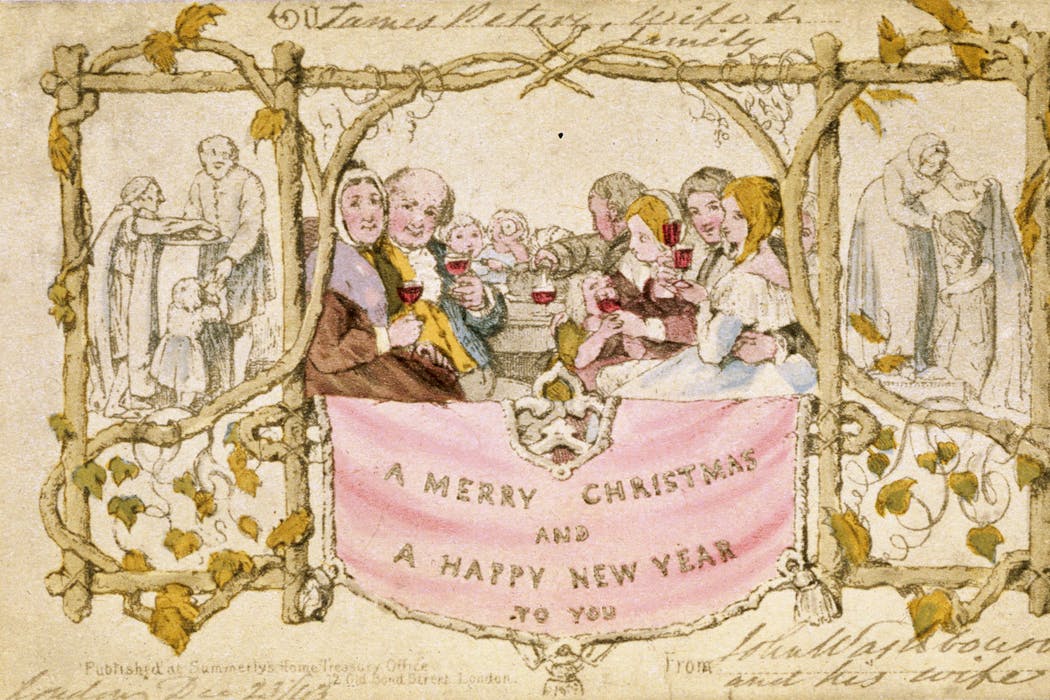
La première carte de Noël portant l’inscription « A Merry Christmas and A Happy New Year to You » Londres, 1843).
John Callcott Horsley via Wikimedia Commons

Du XIXᵉ siècle à nos jours, la carte de Noël illustre la façon dont tradition et innovation se sont mêlées. Née de la révolution industrielle et inspirée d’usages anciens, elle a transformé le rituel des visites de fêtes en un geste papier, devenant une tradition à part entière tout en nourrissant la nostalgie des Noëls passés.


C’est un refrain saisonnier bien connu : « Noël n’est plus ce qu’il était. » Ce n’est pas une plainte nouvelle. L’histoire montre que les traditions de Noël évoluent comme n’importe quel autre aspect des sociétés humaines, et chaque fois que les usages changent, certains regrettent de ne pas pouvoir remonter le temps.

Dans les années 1830, le juriste anglais William Sandys a rassemblé de nombreux exemples de Britanniques déplorant la transformation des coutumes de Noël au fil des époques. Sandys lui-même se montrait particulièrement inquiet du déclin du chant de Noël en public, notant que cette pratique semblait « être un peu plus négligée chaque année ». Il craignait que cette « négligence » ne reflète une tendance plus large, chez les Britanniques du XIXᵉ siècle, à célébrer Noël avec moins « d’hospitalité et d’innocente liesse » que par le passé.

Pourtant, le XIXᵉ siècle a aussi vu naître de nouvelles coutumes de fin d’année. Beaucoup des pratiques apparues à l’époque de William Sandys sont même devenues à leur tour des traditions bien établies – et font aujourd’hui l’objet de nostalgie, voire d’inquiétude chez ceux qui redoutent leur disparition. Prenez, par exemple, la modeste carte de Noël. Mes recherches montrent que ces vœux imprimés, envoyés pour les fêtes, puisaient dans les usages anciens pour faire entrer Noël dans une ère nouvelle.

Une tradition britannique

Les ventes et l’envoi de cartes de Noël sont en recul depuis les années 1990. Les lamentations sur la possible « mort » de la carte de Noël obtiennent un écho particulier au Royaume-Uni, où l’envoi de vœux à la famille et aux amis par cartes imprimées a longtemps été considéré comme un élément essentiel d’un « Noël à la britannique ».

En effet, les historiens Martin Johnes et Mark Connelly soutiennent tous deux que tout au long du XXᵉ siècle, la carte de Noël était considérée comme tout aussi indispensable à un bon Noël britannique que les chaussettes suspendues au pied du lit des enfants, les pantomimes de Noël ou encore la dinde aux choux de Bruxelles.

Pourtant, comme ces mêmes historiens le rappellent, il fut un temps où les Britanniques ne faisaient aucune de ces choses à Noël. Chacune de ces pratiques n’est devenue un élément du Noël « à l’anglaise » qu’au cours de la seconde moitié du XIXᵉ siècle et des premières décennies du XXᵉ siècle. Elles demeurent donc des ajouts relativement récents aux coutumes festives du pays, surtout si on les replace dans les plus de 2 000 ans d’histoire de Noël.

Révolution industrielle et cartes de Noël

La coutume d’envoyer des cartes de Noël imprimées a commencé au milieu du XIXᵉ siècle et résulte directement de la révolution industrielle. Elle est devenue abordable grâce aux nouvelles techniques d’impression et de fabrication du papier, ainsi qu’aux moyens de transport plus efficaces comme le chemin de fer.

L’essor de cette tradition a aussi été facilité par l’instauration du Penny Post en 1840, qui permettait aux Britanniques d’envoyer des lettres à n’importe quelle adresse du Royaume-Uni pour le prix modique d’un timbre à un penny.

La plupart des historiens situent l’apparition de la carte de Noël en 1843, l’année même où Charles Dickens publie Un chant de Noël. Cette année-là, l’inventeur et haut fonctionnaire Henry Cole commande à l’artiste John Callcott Horsley la réalisation d’une carte pour l’aider à gérer plus efficacement sa correspondance de Noël. Des versions imprimées de la carte de Cole furent également mises en vente, mais leur prix élevé – un shilling l’unité – les rendait inaccessibles pour la majorité des Victoriens.

L’initiative de Cole inspira toutefois d’autres imprimeurs, qui se mirent à produire des cartes de Noël similaires mais plus abordables. L’usage de ces cartes moins chères commença à se diffuser dans les années 1850 et s’était imposé comme tradition de fin d’année à la fin du siècle.

Une invention victorienne ?

Si la carte de Noël a pu sembler une nouveauté totale aux expéditeurs et destinataires de l’époque victorienne, la conception de la première carte s’inspirait en réalité d’autres traditions festives britanniques plus anciennes.

Comme l’ont montré les historiens Timothy Larsen et le regretté Neil Armstrong, le statut déjà bien établi de Noël impliquait que les nouvelles coutumes apparues au XIXᵉ siècle devaient s’arrimer à des usages existants, les compléter ou les remplacer. La carte de Noël n’a pas échappé à cette logique.

En 1843, de nombreux Britanniques déploraient la disparition de toute une série de coutumes de Noël dites « à l’ancienne ». Parmi les plus notables figuraient les traditions d’« hospitalité » de Noël, notamment les visites de Noël et du Nouvel An, durant lesquelles familles, amis et voisins se rendaient les uns chez les autres pour porter des toasts et échanger leurs meilleurs vœux pour les fêtes et l’année à venir.

Les chercheurs soulignent que la croyance en l’aspect traditionnel de ces rites tenait à un mélange de souvenirs réels et de fictions construites. Parmi ces dernières, les plus influentes furent les récits populaires dépeignant « l’hospitalité anglaise d’autrefois » à Noël, écrits dans les années 1820 par l’auteur américain Washington Irving et rassemblés notamment dans des histoires mettant en scène cette hospitalité « old English ». Les Britanniques invoquaient régulièrement les descriptions d’Irving lorsqu’ils débattaient de l’évolution des célébrations nationales.

Quelle qu’ait été la réalité historique de ces « anciennes » coutumes, elles sont néanmoins devenues centrales dans les débats sur la disparition supposée d’un ensemble de pratiques communautaires de Noël, telles que les festins, le chant de Noël et les actes publics de charité.

On pensait alors que toutes ces traditions étaient menacées dans cette Grande-Bretagne de plus en plus urbanisée, marquée par des tensions de classe, une mobilité accrue de la population et l’anonymat de masse.

Une union de l’ancien et du nouveau

Bien qu’il soit difficile de savoir si ces débats ont influencé la décision de Cole de commander sa carte de Noël de 1843, l’illustration conçue pour lui par Horsley y fait directement référence.

La carte montre une famille encadrée par des tréteaux décorés de houx et de gui, accompagnée de chaque côté de scènes de charité illustrant le nourrissage et l’habillement des pauvres. Le centre de la carte – et le cœur symbolique de la vision de Noël de Horsley – est toutefois occupé par une famille composée de trois générations clairement définies, partageant un festin collectif, incluant le classique Christmas pudding anglais.

La tradition de l’hospitalité à l’anglaise revisitée

Les premières cartes privilégiaient des scènes évoquant un Noël « à l’ancienne » : chants, actes de charité, sports de plein air, jeux comme colin-maillard, abondance de feuillage, festins et toasts de Noël et du Nouvel An. Ces cartes étaient donc des produits industriels innovants, ornés d’images des Noëls britanniques d’antan.

Le développement, puis le succès, de la carte de Noël dans l’Angleterre victorienne montre comment la nostalgie pouvait être canalisée en invention. La carte n’a pas revitalisé les traditions de visites de Noël et du Nouvel An ; elle a offert une version « papier » en remplacement. La production industrielle et les moyens de transport ont transformé le visiteur physique en un substitut papier, permettant à davantage de personnes de « rendre visite » à un plus grand nombre de foyers pendant les fêtes que ce qu’elles auraient pu faire en personne.

Le désir de conserver un élément d’une ancienne tradition de Noël, supposément en déclin, s’est ainsi avéré déterminant dans la création d’une nouvelle tradition festive, au milieu de changements sans précédent dans les modes de communication et les relations sociales.

Aujourd’hui, un contexte similaire de mutations sociales et technologiques a conduit certains à prédire la « mort » de la carte de Noël. L’histoire du XIXᵉ siècle montre cependant que, si cette tradition venait à disparaître, ce qui la remplacerait prospérerait en s’inspirant, de manière sélective, des coutumes de Noël du passé.

The Conversation

Christopher Ferguson ne travaille pas, ne conseille pas, ne possède pas de parts, ne reçoit pas de fonds d’une organisation qui pourrait tirer profit de cet article, et n’a déclaré aucune autre affiliation que son organisme de recherche.

ref. Aux origines de la toute première carte de Noël – https://theconversation.com/aux-origines-de-la-toute-premiere-carte-de-noel-271257

La fraternité, une valeur qui rassemble ou qui exclut ? Retour sur une histoire et ses ambiguïtés

Source: The Conversation – France in French (3) – By Arthur Duhé, Post-doctorant ANR Access ERC 2025, Université Paris 8 – Vincennes Saint-Denis

Terme clé de la devise républicaine, trônant aux frontons de toutes les mairies, la fraternité est un terme traversé d’ambivalences qu’éclaire l’histoire. Plus que comme un principe, moral ou politique, ne faudrait-il pas plutôt l’envisager comme une métaphore ? Avec les possibilités et les limites que cela suppose, elle apparaît alors pour ce qu’elle est : une image puissante, à mettre au service d’une lutte.


La fraternité trouve une place particulière dans l’imaginaire français. Terme clé de la devise républicaine, trônant aux frontons de toutes les mairies, elle apparaît universelle et comme hors du temps. Pourtant, cette valeur a bien une histoire, tumultueuse s’il en est, et même une actualité.

En 2018, les institutions de la République française se sont prononcées deux fois sur la fraternité. D’un côté, le Haut Conseil à l’égalité entre les femmes et les hommes (HCE) a publié un avis relatif à la révision constitutionnelle. Ce texte fait écho aux conclusions de la chercheuse Réjane Sénac, laquelle était également présidente de la Commission parité du HCE, en affirmant que « le terme de fraternité dit, non pas la neutralité républicaine, mais l’exclusion historique et légale des femmes de la communauté politique ».

Le HCE recommandait par conséquent d’envisager des alternatives comme « solidarité » ou « adelphité », ce dernier terme désignant les enfants d’un même parent, sans distinction de genre. La fraternité, c’est la bande de frères – sans les sœurs.

De l’autre, par suite de l’affaire Cédric Herrou, poursuivi pour avoir aidé quelques deux cents personnes migrantes à traverser la frontière entre l’Italie et la France, le Conseil constitutionnel a déclaré que « la fraternité est un principe à valeur constitutionnelle », ce qui lui confère un poids juridique. Il revient donc au législateur d’arbitrer « entre le principe de fraternité et la sauvegarde de l’ordre public ».

La fraternité ouvrait soudain une brèche juridique pour un internationalisme de terrain – aussi longtemps, du moins, qu’on n’accuserait pas celui-ci de troubler l’ordre.

Les ambiguïtés historiques de la fraternité

La fraternité, qui avait fini par faire partie des meubles de la République, se retrouvait par deux fois au cœur des débats constitutionnels ; tour à tour soupçonnée et consacrée. Cette ambivalence n’est pas accidentelle. Célébrée par l’ensemble du spectre politique, la fraternité n’est que rarement définie, si bien qu’on en ignore le plus souvent l’extension (qui est un frère et selon quel critère ?) et la signification (à quoi engage cette relation fraternelle ?). L’appel à la fraternité, vague et sans objet, est aussi unanime qu’inconséquent.

Les manques et les ambiguïtés de la fraternité ne sont pas nouveaux. Si la fraternité a été une valeur importante dans la rhétorique des sans-culottes en 1789, elle trouve son point d’orgue dans le Printemps des peuples, en 1848, qui mit fin à la monarchie de Juillet en France et fit trembler les couronnes réactionnaires de l’Europe. Cette notion de fraternité permettait aussi bien d’imaginer la nation, conçue comme une bande de frères, que les relations pacifiques entre les nations.

Pourtant, dès 1848, on pourrait accuser la fraternité d’illusion, d’exclusion et d’infantilisation. À la communauté des frères s’opposent ces figures négatives que sont, respectivement, les faux frères, les non-frères et les petits frères.

Les deux premières critiques sont bien connues. Selon Marx et Engels, la fraternité serait une illusion qui ne dure qu’un temps, c’est-à-dire aussi longtemps que les intérêts matériels des différentes classes s’alignent. Elle serait également une exclusion, car, malgré son universalisme affiché, elle exclut les non-frères. Ainsi les femmes, qui étaient sur les barricades, se sont vu refuser le droit de vote dit « universel ». Les frères ne reconnurent pas leurs sœurs en République.

La dernière critique dénonce l’intégration hiérarchisée, comme lors de l’abolition de l’esclavage dans les anciennes colonies. Afin de faire appliquer la décision du Gouvernement provisoire, Sarda Garriga, nouveau gouverneur de La Réunion, accosta sur l’île en octobre. Son discours, face à une société coloniale divisée, en appelait à l’unité fraternelle :

« Dieu vous a créés frères […] Si ceux qu’une triste classification avaient constitués les maîtres doivent apporter un esprit de fraternité […] dans leurs rapports avec leurs anciens serviteurs […] n’oubliez pas, vous frères qui allez être les nouveaux élus de la cité, que vous avez une grande dette à payer à cette société dans laquelle vous êtes près d’entrer. »

On attendit la fin de la récolte de la canne pour concrétiser l’abolition, le 20 décembre 1848. « Tous égaux devant la loi, vous n’avez autour de vous que des frères », commença Sarda Garriga, avant de prévenir :

« La colonie est pauvre : beaucoup de propriétaires ne pourront peut-être pas payer le salaire convenu qu’après la récolte. Vous attendrez ce moment avec patience. Vous prouverez ainsi que le sentiment de fraternité, recommandé par la République à ses enfants, est dans votre cœur. »

Au nom de la fraternité, on avait mis fin à l’esclavage. Au nom de la fraternité toujours, on imposait maintenant aux personnes anciennement réduites en esclavage de continuer à travailler dans les exploitations coloniales afin de maintenir l’ordre de la société coloniale.

La fraternité comme métaphore

Dès son apogée en 1848, la fraternité avait été mise aussi bien au service de la révolution que de la réaction, de l’exploitation que de la libération. Son ambivalence n’est donc pas accidentelle mais tient à sa nature. On fait souvent de la fraternité une valeur qui devrait guider notre action. Or, la fraternité n’est pas tant un principe, moral ou politique, qu’une image.

Comme l’a bien vu l’historien Benedict Anderson, dès que la communauté atteint une certaine taille, nous ne pouvons plus nous la représenter exactement d’où le recours à une image (la nation est « une bande de frères »). Cette image est donc nécessairement inadéquate (à strictement parler, la nation « n’est pas » une bande de frères), ce qui est la définition classique de la métaphore.

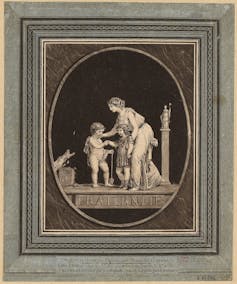
allégorie de la fraternité
La Fraternité, estampe de Philibert-Louis Debucourt exposée au musée Carnavalet (Paris).
Wikimédia

Une image ne se comprend qu’en lien avec un imaginaire donné, c’est-à-dire ancré dans un contexte culturel. Si l’image peut traverser les époques et les géographies, comme c’est le cas de la métaphore fraternelle, l’imaginaire, lui, est situé historiquement et socialement.

L’inadéquation métaphorique de l’image à la chose ne doit pas être pensée comme un manque ou un raté. La métaphore permet notamment de rendre la communauté imaginable. Surtout, elle va connoter la chose (la nation est « quelque chose comme » une bande de frères) et la charger affectivement (la nation est « notre » bande de frères). Les images contribuent à susciter un attachement viscéral à cette communauté de hasard qu’est la nation.

Sororité, adelphité, fraternité

L’image fraternelle est-elle encore d’actualité ? On peut être tenté de se tourner vers d’autres images familiales, comme la sororité, qui consacre la relation entre toutes les femmes, mais rien que les femmes, ou l’adelphité, qui évoque le lien entre les enfants d’un même parent, sans distinction de genre.

Quoique la sororité soit une image particulièrement puissante aujourd’hui, elle n’est pas exempte des ambiguïtés qui traversaient la fraternité. L’universalisme féminin de la sororité produit également une illusion d’unité qui invisibilise les relations de domination de race et de classe au sein de la communauté des sœurs. Comme il y a des petits frères, il y a de petites sœurs. Par ailleurs, la sororité manque de clarté quant à son extension et sa signification : s’étend-elle à toutes, y compris au groupe féministe d’extrême droite Némésis, à Marine Le Pen ou à Giorgia Meloni et, si tel est le cas, qu’implique-t-elle exactement ?


Éditions Anamosa, 2025.

L’adelphité, de son côté, si elle permet d’échapper à la binarité du genre, ne résonne guère pour l’heure en dehors des cercles militants, ce qui limite sa charge affective.

Les métaphores n’offrent pas de boussole politique ou morale. Dès lors, que faire de la fraternité ? Deux voies sont déjà ouvertes. Soit on peut l’abandonner en faveur d’autres images jugées plus prometteuses, comme la sororité ou l’adelphité ; soit faire avec, notamment du fait de son ancrage si particulier dans l’imaginaire républicain français. Si ces deux options prennent des directions différentes, elles relèvent toutes deux d’une même « pragmatique de l’image ». Penser la fraternité ne devrait pas en faire un fétiche, mais nous conduire à appréhender sa puissance affective afin de mettre cette métaphore, parmi d’autres, au service de nos luttes.


Le programme ACCESS ERC dans le cadre duquel Arthur Duhé poursuit ses recherches sur les images fraternelles dans les discours nationalistes, antinationalistes et internationalistes, de 1789 aux années 1970, est soutenu par l’Agence nationale de la recherche (ANR), qui finance en France la recherche sur projet. L’ANR a pour mission de soutenir et de promouvoir le développement de recherches fondamentales et finalisées dans toutes les disciplines, et de renforcer le dialogue entre science et société. Pour en savoir plus, consultez le site de l’ANR.

The Conversation

Arthur Duhé a reçu des financements de l’ANR et en recevra du FNRS (2027-2030).

ref. La fraternité, une valeur qui rassemble ou qui exclut ? Retour sur une histoire et ses ambiguïtés – https://theconversation.com/la-fraternite-une-valeur-qui-rassemble-ou-qui-exclut-retour-sur-une-histoire-et-ses-ambigu-tes-270599