Trump’s stated reasons for taking Greenland are wrong – but the tactics fit with the plan to limit China’s economic interests

Source: The Conversation – USA – By Steven Lamy, Professor Emeritus of Political Science and International Relations and Spatial Sciences, USC Dornsife College of Letters, Arts and Sciences
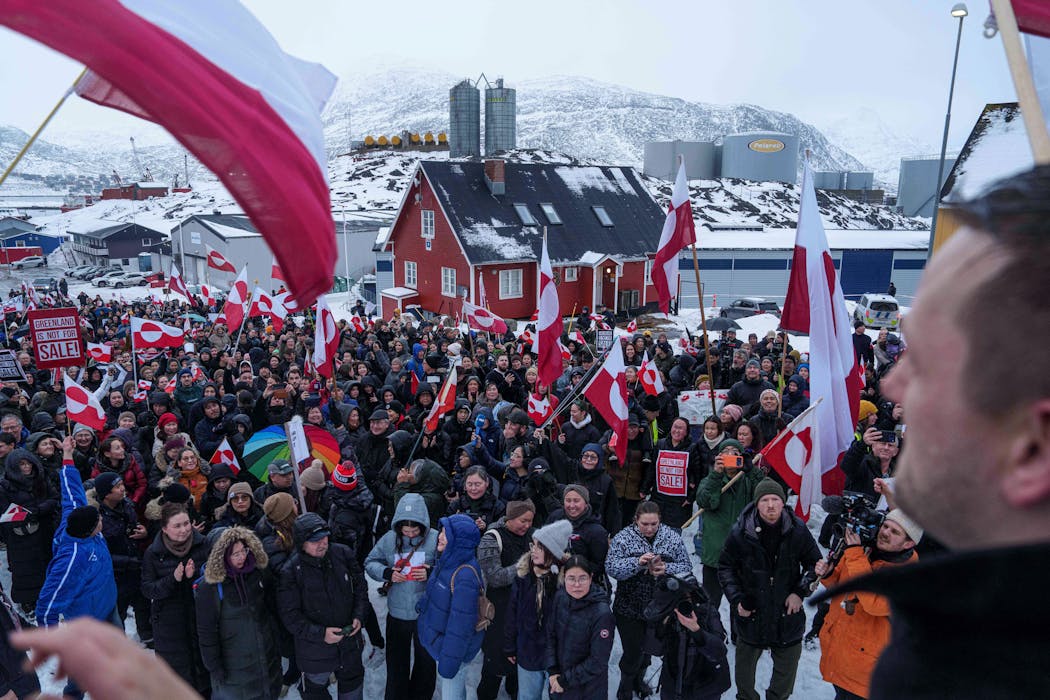
People protest against U.S. President Donald Trump’s policy toward Greenland in front of the U.S. consulate in Nuuk, Greenland, on Jan. 17, 2026. AP Photo/Evgeniy Maloletka

In 2019, during his first term, U.S. President Donald Trump expressed a desire to buy Greenland, which has been a part of Denmark for some 300 years. Danes and Greenlanders quickly rebuffed the offer at the time.

During Trump’s second term, those offers have turned to threats.

Trump said on his social media platform Truth Social in late December 2024 that, for purposes of national security, U.S. control over Greenland was a necessity. The president has continued to insist on the national security rationale into January 2026. And he has refused to rule out the use of military force to control Greenland.

From my perspective as an international relations scholar focused on Europe, Trump’s national security rationale doesn’t make sense. Greenland, like the U.S., is a member of NATO, which provides a collective defense pact, meaning member nations will respond to an attack on any alliance member. And because of a 1951 defense agreement between the U.S. and Denmark, the U.S. can already build military installations in Greenland to protect the region.

Trump’s 2025 National Security Strategy, which stresses control of the Western Hemisphere and keeping China out of the region, provides insight into Trump’s thinking.

US interests in Greenland

The United States has tried to acquire Greenland several times.

In 1867, Secretary of State William Seward commissioned a survey of Greenland. Impressed with the abundance of natural resources on the island, he pushed to acquire Greenland and Iceland for US$5.5 million – roughly $125 million today.

But Congress was still concerned about the purchase of Alaska that year, which Seward had engineered. It had seen Alaska as too cold and too distant from the rest of the U.S. to justify spending $7.2 million – roughly $164 million today – although Congress ultimately agreed to do it. There was not enough national support for another frozen land.

In 1910, the U.S. ambassador to Denmark proposed a complex trade involving Germany, Denmark and the United States. Denmark would give the U.S. Greenland, and the U.S. would give Denmark islands in the Philippines. Denmark would then give those islands to Germany, and Germany would return Schleswig-Holstein – Germany’s northernmost state – to Denmark.

But the U.S. quickly dismissed the proposed trade as too audacious.

During World War II, Nazi Germany occupied Denmark, and the U.S. assumed the role of protector of both Greenland and Iceland, both of which belonged to Denmark at the time. The U.S. built airstrips, weather stations and radar and communications stations – five on Greenland’s east coast and nine on the west coast.

A military base is seen in front of a snowy hillside.
The Pituffik Space Base, formerly Thule Air Base, is pictured in northern Greenland on Oct. 4, 2023.
Thomas Traasdahl/Ritzau Scanpix/AFP via Getty Images

The U.S. used Greenland and Iceland as bases for bombers that attacked Germany and German-occupied areas. Greenland had a high value for military strategists because of its location in the North Atlantic – to counter Nazi threats to Allied shipping lanes and protect transatlantic routes, and because it was a midpoint for refueling U.S. aircraft. Greenland’s importance also rested on its deposits of cryolite, useful for making aluminum.

In 1946, the Truman administration offered to buy Greenland for $100 million, as U.S. military leaders thought it would play a critical role in the Cold War.

The secret U.S. project Operation Blue Jay at the beginning of the Cold War resulted in the construction of Thule Air Base in northwestern Greenland, which allowed U.S. bombers to be closer to the Soviet Union. Renamed Pituffik Space Base, today it provides a 24/7 missile warning and space surveillance facility that is critical to NATO and U.S. security strategy.

At the end of World War II, Denmark recognized Greenland as one of its territories. In 1953, Greenland gained constitutional rights and became a country within the Kingdom of Denmark. Greenland was assigned self-rule in 1979, and by 2009 it became a self-governing country, still within the Kingdom of Denmark, which includes Denmark, Greenland and the Faroe Islands.

Denmark recognizes the government of Greenland as an equal partner and recently gave it a more significant role as the first voice for Denmark in the Arctic Council, which promotes cooperation in the Arctic.

What the US may want

The Trump administration’s 2025 National Security Strategy identifies three threats in the Western Hemisphere: migration, drugs and crimes, and China’s increasing influence.

Two of those threats are irrelevant when considering Greenland. Greenlandic people are not migrating to the U.S., and they are not drug traffickers. However, Greenland is rich in rare earth minerals, including neodymium, dysprosium, graphite, copper and lithium.

Additionally, China seeks to establish mining interests in Greenland and the Arctic as part of its Polar Silk Road initiative. China had offered to build an infrastructure for Greenland, including improving the airport, until Denmark stepped in and offered airport funding. And China has worked with Australian companies to secure mining opportunities on the island.

A U.S. Air Force helicopter flies over snow.
A U.S. Air Force helicopter flies near Thule Air Base in Greenland in 1955.
James McAnally/Archive Photos/Getty Images

Those rare earth minerals appeal to the European Union, too. The EU lists some 30 raw materials that are essential for their economies. Twenty-five are in Greenland.

The Trump administration has made it clear that controlling these minerals is a national security issue, and the president wants to keep them away from China.

Figures vary, but it is estimated that over 60% of rare earth elements or minerals are currently mined in China. China also refines some 90% of rare earths. This gives China tremendous leverage in trade talks. And it results in a dangerous vulnerability for the U.S. and other nation states seeking to modernize their economies. With few suppliers of these rare earth elements, the political and economic costs of securing them are high.

Greenland has only two operating mines. One is the Tan Breez project in southern Greenland. It produces 17 metals, including terbium and neodymium, that are used in high-strength magnets used in many green technologies and in aircraft manufacturing, including for the F-35 fighter planes.

Consider for a moment that Trump is not interested in owning Greenland.

Instead, he is using this threatening position to secure promises from the Greenlandic government to make economic deals with the U.S. and not China. Thus, Trump’s threats could be less about national security and much more about eliminating competition from China and securing wealth for U.S. interests.

This form of coercive diplomacy threatens the political and economic development of not only Greenland but Europe. In recent interviews, Trump has made it clear that he does not respect international law and the sovereignty of countries. His position, I believe, undermines the international order and removes the U.S. as a responsible leader of that framework established after World War II.

The Conversation

Steven Lamy does not work for, consult, own shares in or receive funding from any company or organization that would benefit from this article, and has disclosed no relevant affiliations beyond their academic appointment.

ref. Trump’s stated reasons for taking Greenland are wrong – but the tactics fit with the plan to limit China’s economic interests – https://theconversation.com/trumps-stated-reasons-for-taking-greenland-are-wrong-but-the-tactics-fit-with-the-plan-to-limit-chinas-economic-interests-273548
Près de la moitié des démences seraient évitables grâce à nos habitudes de vie – dont l’exercice

Source: The Conversation – in French – By Louis Bherer, Professor, Université de Montréal

On dépense des milliards de dollars à rechercher la molécule qui soignera la maladie d’Alzheimer. Mais l’adoption de certaines habitudes de vie pourrait, entre-temps, réduire significativement le risque d’en développer les symptômes, jusqu’à près de la moitié des cas, souligne le Dr Louis Bherer.

Professeur au département de médecine de l’Université de Montréal, chercheur et directeur du Centre ÉPIC, le centre de médecine préventive et d’activité physique de l’Institut de cardiologie de Montréal, ses travaux portent sur l’impact du style de vie, de l’exercice physique et de la stimulation cognitive sur la santé cérébrale des personnes âgées et des patients atteints de maladies cardiovasculaires.

À son laboratoire montréalais, le Dr Bherer et son équipe élaborent des programmes d’exercices tant physiques que cognitifs. Les résultats corroborent ceux d’autres recherches sur l’importance du mode de vie dans la prévention des démences, une donnée négligée par la santé publique, explique celui qui est également directeur de laboratoire à l’Institut universitaire de gériatrie de Montréal.


Cet article fait partie de notre série La Révolution grise. La Conversation vous propose d’analyser sous toutes ses facettes l’impact du vieillissement de l’imposante cohorte des boomers sur notre société, qu’ils transforment depuis leur venue au monde. Manières de se loger, de travailler, de consommer la culture, de s’alimenter, de voyager, de se soigner, de vivre… découvrez avec nous les bouleversements en cours, et à venir.


La Conversation Canada : Une nouvelle étude de Statistique Canada sur l’espérance de vie en bonne santé indique un recul substantiel au Canada : en 2023, elle était de 66,9 ans, une baisse de 3,5 ans par rapport au sommet de 70,4 ans atteint entre 2010 et 2012. Ça vous surprend ?

Dr Louis Bherer : Oui et non. Mais le fait est que ce qu’on appelle le Healthspan-Lifespan Gap, c’est-à-dire l’écart entre l’espérance de vie et l’espérance de vie sans maladie, s’accentue. Par exemple, neuf personnes sur dix ont au moins un facteur de risque de maladie cardiovasculaire après 65 ans : surpoids, mauvais sommeil, inactivité, hypertension, etc. Comme l’espérance de vie augmente, ça fait plus d’années en moins bonne santé.

Notre mode de vie n’est pas optimal. Le stress, l’anxiété augmentent. C’est un fléau. Par ailleurs, les gens sont inactifs, ils ont des problèmes de sommeil, leur alimentation est négligée : on mange vite, du fast food ou des aliments ultra-transformés. Pourtant, l’information est là, disponible, mais on n’adopte pas toujours les actions nécessaires. On ne l’enseigne pas non plus à nos enfants. L’éducation physique devrait faire partie du cursus scolaire au quotidien, et il faudrait aussi enseigner les bases de la nutrition.

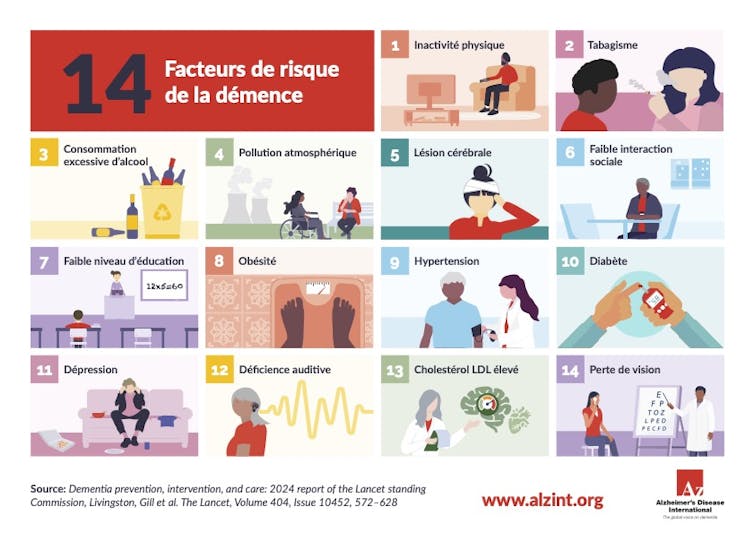
Par ailleurs, les gens se tournent vite vers la médication. La popularité de l’Ozempic en est un exemple. On souhaite perdre du poids, mais on ne s’attaque pas aux causes de ce surpoids. On ne fait pas grand-chose pour inciter les gens à changer leur mode de vie. Or, on évalue que près de la moitié des démences (soit 45 %) pourraient être évitées avec un mode de vie adéquat. Quatorze facteurs de risques modifiables (FRM) ont ainsi été identifiés.

Les quatorze facteurs de risques modifiables qui contribuent aux démences ont été identifiés par la professeure Gill Livingston, de l’University College de Londres.
(Alzheimer’s Disease International)

LCC : Bien des gens se disent : j’ai 65, 70 ans, il est trop tard pour moi, j’aurais dû commencer avant…

L.B. : Il n’est jamais trop tard, même si on sait que l’éducation (un facteur atténuant des démences) s’acquiert généralement jeune. Au contraire des troubles de l’audition, qui surviennent plus tard dans la vie. Bien des gens ne les prennent pas tant au sérieux, ou les camouflent, et pourtant, c’est un facteur associé à l’augmentation des risques de troubles cognitifs majeurs, ou de démence. Et bien sûr, la santé psychologique joue un rôle majeur : une personne sera inactive, car elle se sent un peu déprimée ou moins motivée, mais ça accentue les risques. On ne réalise pas que les facteurs de santé globale sont tous interreliés. La santé cardiaque et cérébrale, ça va ensemble. Ce qui est bon pour le cœur est bon pour le cerveau.

LCC : Votre laboratoire, axé sur la santé cognitive, est justement installé à l’Institut de cardiologie de Montréal. En quoi consiste vos travaux ?

L.B. : À l’aide de programmes de stimulation, on évalue l’impact des exercices sur la santé physique et cognitive. L’âge de nos participants varie entre 50 et 95 ans, avec une moyenne entre 68 et 70 ans. On les suit entre trois mois et un an. Ils peuvent avoir des déficits cognitifs légers, notés par leur entourage, et parfois souffrir d’anxiété, une condition qui peut avoir un impact sur la mémoire et être un prédicateur de démence. D’autres participants n’ont pas d’enjeux cognitifs, mais ils présentent des risques en raison de leur hypertension, diabète, etc. Nos programmes comportent des jeux de mémoire, sur les téléphones par exemple, qui améliorent le côté cognitif, notamment la vitesse psychomotrice, ainsi que des exercices physiques : vélo stationnaire, tapis roulant, renforcement musculaire, etc. Le mieux est la combinaison des deux.


À lire aussi :
L’exercice, bon pour le corps, certes, mais également pour le cerveau !


LCC : Que constatez-vous ?

L.B. : On voit des améliorations cliniquement significatives. Des participants qui ont des troubles cognitifs légers peuvent voir des améliorations après six mois d’entraînement, des différences au niveau de leur attention, de leur vigilance, de leur vitesse de réponses. Ils sont plus éveillés, et ce, après quelques semaines seulement. On voit aussi un impact sur la mémoire, même si ça prend plus de temps. À l’aide de biomarqueurs, nos recherches tentent de faire le lien entre les paramètres qui changent, tant sur le plan physique que cognitif et les effets sur le cerveau. Avec l’imagerie cérébrale, on peut mesurer les améliorations du flux sanguin et des structures du cerveau, comme l’hippocampe par exemple, qui joue un rôle clé dans la mémoire.


Déjà des milliers d’abonnés à l’infolettre de La Conversation. Et vous ? Abonnez-vous gratuitement à notre infolettre pour mieux comprendre les grands enjeux contemporains.


L’entraînement physique, que les participants font trois fois par semaine, stimule la production de protéines qui favorisent la neuroplasticité. Quand les muscles travaillent, ils produisent et libèrent des myokines et d’autres exerkines. Ces molécules jouent un rôle important sur le métabolisme, l’inflammation, la santé osseuse et même l’humeur. Comme on le dit souvent, l’exercice est la pilule miracle pour la santé globale.

LCC : Bien des gens entreprennent des changements en profondeur de leur mode de vie, mais ces bonnes intentions ne tiennent pas toujours…

L.B. : Oui, et c’est dommage, car les effets positifs de l’entraînement disparaissent en un mois, un mois et demi. Et plus on vieillit, plus c’est rapide. Idéalement il faut choisir des activités qui s’intègrent facilement dans la routine quotidienne, je pense à la course, par exemple, un exercice très complet, très facile à faire, qui ne coûte pas cher. La marche rapide, aussi, mais l’idée est de suer un peu. Et de compléter avec des exercices pour accroître la force musculaire, et d’autres pour améliorer la posture et la mobilité. C’est un facteur important d’autonomie en vieillissant. La peur de chuter est une préoccupation pour plusieurs personnes âgées. Les exercices d’équilibre et de contrôle de la posture, comme le yoga, peuvent vraiment faire une énorme différence sur la santé et les habitudes de vie des personnes âgées.

La Conversation Canada

Louis Bherer ne travaille pas, ne conseille pas, ne possède pas de parts, ne reçoit pas de fonds d’une organisation qui pourrait tirer profit de cet article, et n’a déclaré aucune autre affiliation que son organisme de recherche.

ref. Près de la moitié des démences seraient évitables grâce à nos habitudes de vie – dont l’exercice – https://theconversation.com/pres-de-la-moitie-des-demences-seraient-evitables-grace-a-nos-habitudes-de-vie-dont-lexercice-273763

Guerre en Ukraine : à la recherche d’une paix introuvable

Source: The Conversation – in French – By Renéo Lukic, Professeur titulaire de relations internationales, Université Laval

Tout indique que les négociations portant sur l’arrêt de la guerre en Ukraine sont au point mort. Divers enjeux laissent penser que cette situation est voulue par le Kremlin, qui peut non seulement s’en saisir afin d’accroître ses gains territoriaux et renforcer ses leviers à la table de négociations, mais aussi pour exposer les divisions au sein de l’Union européenne (UE).

Initiées depuis plusieurs mois par les États-Unis, l’Ukraine, la Russie et les États européens représentés par la Grande-Bretagne, la France et l’Allemagne, les négociations n’ont pas connu d’avancée significative vers un cessez-le-feu ou un accord de paix. Cette situation va perdurer tant que le président Poutine refusera de s’asseoir à la table de négociation avec le président Zelensky.

Professeur en relations internationales à l’Université Laval et spécialiste de la politique étrangère russe, je m’intéresse depuis 2014 à la guerre en Ukraine et à la réaction internationale vis-à-vis du conflit.

L’argument de paille

Poutine nie la légitimité de Zelensky de négocier un accord de paix, car selon lui, son homologue ukrainien refuse d’organiser les élections présidentielles dans son pays. Les élections présidentielles en Ukraine prévues en 2024 ont été repoussées jusqu’à nouvel ordre en raison de la guerre.

Il est donc facile de réfuter l’argument de Poutine, puisqu’il repose sur une simplification – voire une négation – de la réalité ukrainienne.

Rappelons que suite à l’agression russe du 24 février 2022, l’Ukraine a déclaré la loi martiale, laquelle suspend la tenue des élections. Les centaines de drones et de bombes qui s’abattent quotidiennement sur le territoire de l’Ukraine, en tuant les civiles et en détruisant les infrastructures du pays, ne permettent pas l’organisation d’élections démocratiques. L’instauration de la loi martiale en temps de guerre est une pratique ancienne et reconnue, d’ailleurs encadrée par le droit international des droits humains.

Poutine sait tout cela.

Il faut d’abord conclure un cessez-le-feu entre les belligérants afin que des élections présidentielles puissent être organisées. En repoussant les négociations directes avec l’Ukraine, le Kremlin cherche à maximiser ses gains territoriaux dans le Donbass, au détriment de l’Ukraine.

L’Union européenne méprisée

Plutôt que d’entamer des négociations directes avec l’Ukraine, Poutine s’est tourné vers le président Trump. Sa stratégie diplomatique poursuit deux objectifs. Le premier concerne l’affaiblissement à moyen terme des relations entre les États-Unis et l’UE, ainsi que le renforcement de ses propres relations avec les États-Unis. Le second objectif de la diplomatie russe vise la fissuration du soutien politique et économique de l’UE à l’égard de l’Ukraine.

Comme le montre le document de l’administration Trump intitulé « Stratégie de Sécurité Nationale » (National Security Strategy) publié le 5 décembre 2025, la perception que les États-Unis ont de l’UE est très négative, voire méprisante. L’UE est perçue comme une organisation en « déclin économique » confrontée à un « effacement civilisationnel » en raison de sa politique d’immigration hors de contrôle.

Dans une entrevue au site Politico le 8 décembre 2025, Trump a critiqué sur le même ton les dirigeants de l’UE : « Ils parlent, mais ils n’agissent pas, et la guerre ne cesse pas de s’éterniser » en Ukraine. Les mêmes reproches avaient déjà été exprimés par le vice-président des États-Unis J.D. Vance en février 2025 à la conférence de Munich. Ces deux prises de parole exemplifient le peu de poids politique dont jouit l’UE à Washington.


Déjà des milliers d’abonnés à l’infolettre de La Conversation. Et vous ? Abonnez-vous gratuitement à notre infolettre pour mieux comprendre les grands enjeux contemporains.


Réorientation des États-Unis

La nouvelle doctrine de sécurité nationale de l’administration américaine est bien reçue à Moscou. Pour Poutine, cette constellation diplomatique est perçue d’un œil favorable, car elle ouvre la porte à une entente entre la Russie et les États-Unis au détriment de l’Ukraine et de l’Europe.

Bref, un nouveau traité de Yalta, organisant une nouvelle division de l’Europe en deux blocs opposés tant désirée par Poutine, pourrait voir le jour.

Pour arriver à un accord de paix en Ukraine, les États-Unis pourraient s’inspirer des accords de Dayton. Signés en 1995, ces accords ont mis fin aux guerres en ex-Yougoslavie. Le président américain Bill Clinton (1993-2001) et son diplomate Richard Holbrook responsable des négociations ont réussi à rassembler à la table de négociation le président serbe Slobodan Milosevic, responsable des guerres en ex-Yougoslavie, le président de Croatie Franjo Tudjman et le président de Bosnie Alia Izetbegovic.

Ce format de négociations a permis de mettre fin à la guerre. La médiation diplomatique américaine était décisive pour parvenir à la fin de la guerre et elle était soutenue par les alliés européens. Trente ans après la signature des accords de Dayton, la paix perdure entre la Bosnie, la Croatie et la Serbie.

Frapper l’économie

Après le départ du président américain Joe Biden, l’UE est devenue le premier livreur de l’aide économique et militaire de l’Ukraine. Dorénavant, les armes livrées par les États-Unis à l’Ukraine sont payées par l’Ukraine et l’UE.

Pour soutenir l’effort de guerre ukrainienne, l’UE a imposé 19 paquets de sanctions économiques à la Russie, a gelé des avoirs russes, a exclu partiellement des banques russes du système Swift. De nombreuses autres mesures visant l’affaiblissement de son économie afin d’obtenir en cessez-le-feu en Ukraine ont également été mises en place.

Pour la Russie, l’UE est devenue un belligérant dangereux. Surtout après que l’UE a décidé, le 12 décembre 2025, d’immobiliser les actifs russes jusqu’à la fin de guerre en Ukraine. Ces actifs, d’une valeur de 210 milliards d’euros, se trouvent en Belgique, dans la société Euroclear, une institution financière de dépôt basée à Bruxelles. L’intention de la Commission de l’UE était d’utiliser une partie de cet argent pour faire un prêt à l’Ukraine. Après l’opposition de la Belgique, de la Hongrie, de la Slovaquie et de la Tchequie, la Commission a décidé de faire un prêt de 90 milliards d’euros à Kiev en utilisant ses propres fonds financiers.

Ce recul marquait une victoire diplomatique de Poutine contre les dirigeants européens jugés hostiles à la Russie.

Dans sa dernière conférence de presse tenue le 19 décembre 2025, Poutine a qualifié les dirigeants européens « de porcelets » décidés à provoquer « l’effondrement » de la Russie. Briser l’unité de l’UE est l’objectif primordial de la Russie, car après la diminution de l’aide américaine, l’UE reste le premier bailleur de fonds de l’Ukraine.

La Conversation Canada

Renéo Lukic ne travaille pas, ne conseille pas, ne possède pas de parts, ne reçoit pas de fonds d’une organisation qui pourrait tirer profit de cet article, et n’a déclaré aucune autre affiliation que son organisme de recherche.

ref. Guerre en Ukraine : à la recherche d’une paix introuvable – https://theconversation.com/guerre-en-ukraine-a-la-recherche-dune-paix-introuvable-272545

How the U.S. withdrawal from WHO could affect global health powers and disease threats

Source: The Conversation – Canada – By Mitchell L. Hammond, Assistant Professor of History, Western University

Hours after Donald Trump began his second term as United States president on Jan. 20, 2024, he signed an executive order to end American membership in the World Health Organization (WHO) after one year. This restarted a process that the first Trump administration initiated in July 2020 but was reversed by Joe Biden.

The withdrawal is set to take effect this week, although WHO officials may not officially accept it because the U.S. has unpaid dues from the last two years. No matter how events play out, the rift signals the start of an uncertain new era in global public health.

In the withdrawal announcement, the Trump administration cited the WHO’s “mishandling” of the COVID-19 pandemic and its inability to remain independent from the political influence of member states. This reflected Trump’s belief that the WHO leadership favoured China in early 2020 by praising its initial COVID response while faulting the U.S. for closing its border to Chinese travellers.

Other observers acknowledged the need for reform of the WHO’s cumbersome bureaucratic structure and criticized its inability to translate scientific research about COVID into useful guidance about masking and social distancing.

Such criticisms should not obscure the WHO’s enormous contribution to global health or how U.S. interests have been intertwined with its successes. Viewed historically, its great strength lies in sustained collaboration rather than short-term emergency response.

Vaccine diplomacy

In my research for Epidemics and the Modern World and its forthcoming revision, I have explored how the U.S. conducted “vaccine diplomacy” in developing countries. After the Second World War, the U.S. discerned an alignment between its strategic objectives and the soft power it gained from campaigns against epidemic diseases and childhood immunization programs.

For example, in 1967, American funding and leadership encouraged the start of the WHO’s Intensified Smallpox Eradication Program (ISEP) in African countries. This work involved collaboration with global rivals such as the Soviet Union, which contributed large quantities of freeze-dried smallpox vaccine.

When the ISEP began, at least 1.5 million people worldwide died from smallpox annually. Only 13 years later, the WHO declared the disease eradicated from nature in 1980. This success encouraged efforts to eradicate polio, which accelerated after 1988 when the WHO launched the Global Polio Eradication Initiative with support from the United States Centers for Disease Control and Prevention and other partners.

Another important collaboration began in 1974 when the WHO and international partners launched the Expanded Program on Immunization to help prevent six childhood diseases (polio, diphtheria, pertussis, tuberculosis, measles and tetanus).

After 1985, the United States Agency for International Development (USAID) invested billions of dollars in the program. Global childhood immunization levels reached 80 per cent by the early 1990s and continued to pay health dividends thereafter.

An analysis published last year in the Lancet estimated that, in the last 20 years, USAID-funded programs had helped prevent over 90 million deaths globally, including 30 million deaths among children.

Dismantling global influence

In public health, as in other arenas, the Trump administration has discarded participation in global alliances and instead sought bilateral agreements with other countries.

By July 2025, the Trump administration had formally dismantled USAID and cancelled funding for more than 80 per cent of its programs. Modelling conducted by Boston University epidemiologist Brooke Nichols suggests the lapsed programs have already caused roughly 750,000 deaths, mostly among children.


Read more:
International aid groups are dealing with the pain of slashed USAID funding by cutting staff, localizing and coordinating better


The U.S. has also already begun to cede influence over the objectives of global health programs. At the World Health Assembly in May 2025, the U.S. did not sign the WHO Pandemic Agreement intended to foster collaboration among governments, international agencies and philanthropies after the COVID-19 pandemic.

At that same meeting, China pledged to increase its voluntary contributions to the WHO to US$500 million over the next five years. Practically overnight, China will replace the U.S. as the WHO’s largest national contributor and undoubtedly steer priorities in global health programs towards its interests.

Disease monitoring and global threats

A more immediate concern is the disruption to surveillance for ongoing disease challenges and emergent threats.

Since 1952, the WHO’s Global Influenza Surveillance and Response System has provided a platform for monitoring of cases and the sharing of data and viral samples. Information from institutions in 131 countries contributes to recommendations for the composition of seasonal influenza virus vaccines. The U.S. may be left out of this global system, which will hamper efforts to match vaccines to the circulating strains of flu.

The WHO also dispatches response teams around the world for outbreaks of numerous diseases such as mpox, dengue, Ebola virus disease or Middle East respiratory syndrome. The exclusion of American scientists will hamper these efforts and diminish the nation’s capacity to protect itself.

The policy shift in the U.S. poses challenges for Canada both as its northern neighbour and as a strong financial supporter of the WHO. The recent spread of measles within Canada, which resulted in loss of the country’s elimination status, reminds us that disease outbreaks are inevitable but progress in public health is not.

Renewed support of the WHO and other multilateral efforts, although desirable, should be matched by expanded investment in programs for disease surveillance and research, vaccine procurement and public health communication. Federal and provincial governments and the Public Health Agency of Canada will all have roles to play as Canada faces disease threats in a rapidly changing world.

The Conversation

Mitchell L. Hammond does not work for, consult, own shares in or receive funding from any company or organisation that would benefit from this article, and has disclosed no relevant affiliations beyond their academic appointment.

ref. How the U.S. withdrawal from WHO could affect global health powers and disease threats – https://theconversation.com/how-the-u-s-withdrawal-from-who-could-affect-global-health-powers-and-disease-threats-273768

The world is in water bankruptcy, UN scientists report – here’s what that means

Source: The Conversation – USA (2) – By Kaveh Madani, Director of the Institute for Water, Environment and Health, United Nations University

The world is now using so much fresh water amid the consequences of climate change that it has entered an era of water bankruptcy, with many regions no longer able to bounce back from frequent water shortages.

About 4 billion people – nearly half the global population – live with severe water scarcity for at least one month a year, without access to sufficient water to meet all of their needs. Many more people are seeing the consequences of water deficit: dry reservoirs, sinking cities, crop failures, water rationing and more frequent wildfires and dust storms in drying regions.

Water bankruptcy signs are everywhere, from Tehran, where droughts and unsustainable water use have depleted reservoirs the Iranian capital relies on, adding fuel to political tensions, to the U.S., where water demand has outstripped the supply in the Colorado River, a crucial source of drinking water and irrigation for seven states.

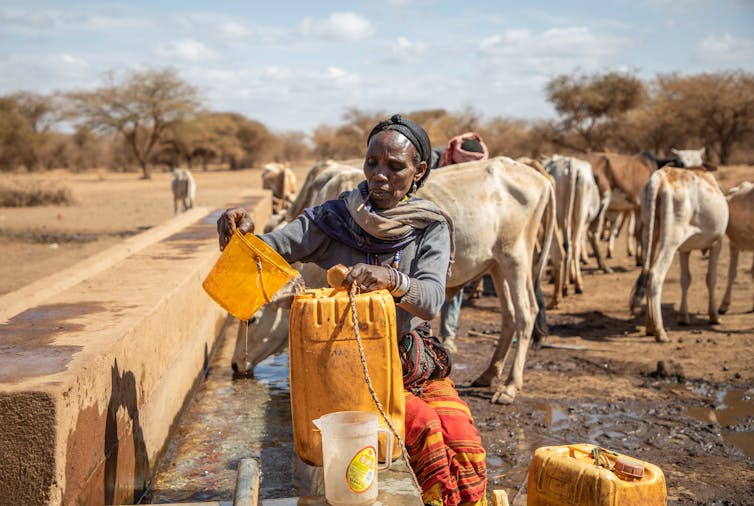
A woman fills containers with water from a well. cows are behind her on a dry landscape.
Droughts have made finding water for cattle more difficult and have led to widespread malnutrition in parts of Ethiopia in recent years. In 2022, UNICEF estimated that as many as 600,000 children would require treatment for severe malnutrition.
Demissew Bizuwerk/UNICEF Ethiopia, CC BY

Water bankruptcy is not just a metaphor for water deficit. It is a chronic condition that develops when a place uses more water than nature can reliably replace, and when the damage to the natural assets that store and filter that water, such as aquifers and wetlands, becomes hard to reverse.

A new study I led with the United Nations University Institute for Water, Environment and Health concludes that the world has now gone beyond temporary water crises. Many natural water systems are no longer able to return to their historical conditions. These systems are in a state of failure – water bankruptcy.

Kaveh Madani, director of the United Nations University Institute for Water, Environment and Health, explains the concept of “water bankruptcy.” TVRI World.

What water bankruptcy looks like in real life

In financial bankruptcy, the first warning signs often feel manageable: late payments, borrowed money and selling things you hoped to keep. Then the spiral tightens.

Water bankruptcy has similar stages.

At first, we pull a little more groundwater during dry years. We use bigger pumps and deeper wells. We transfer water from one basin to another. We drain wetlands and straighten rivers to make space for farms and cities.

Then the hidden costs show up. Lakes shrink year after year. Wells need to go deeper. Rivers that once flowed year-round turn seasonal. Salty water creeps into aquifers near the coast. The ground itself starts to sink.

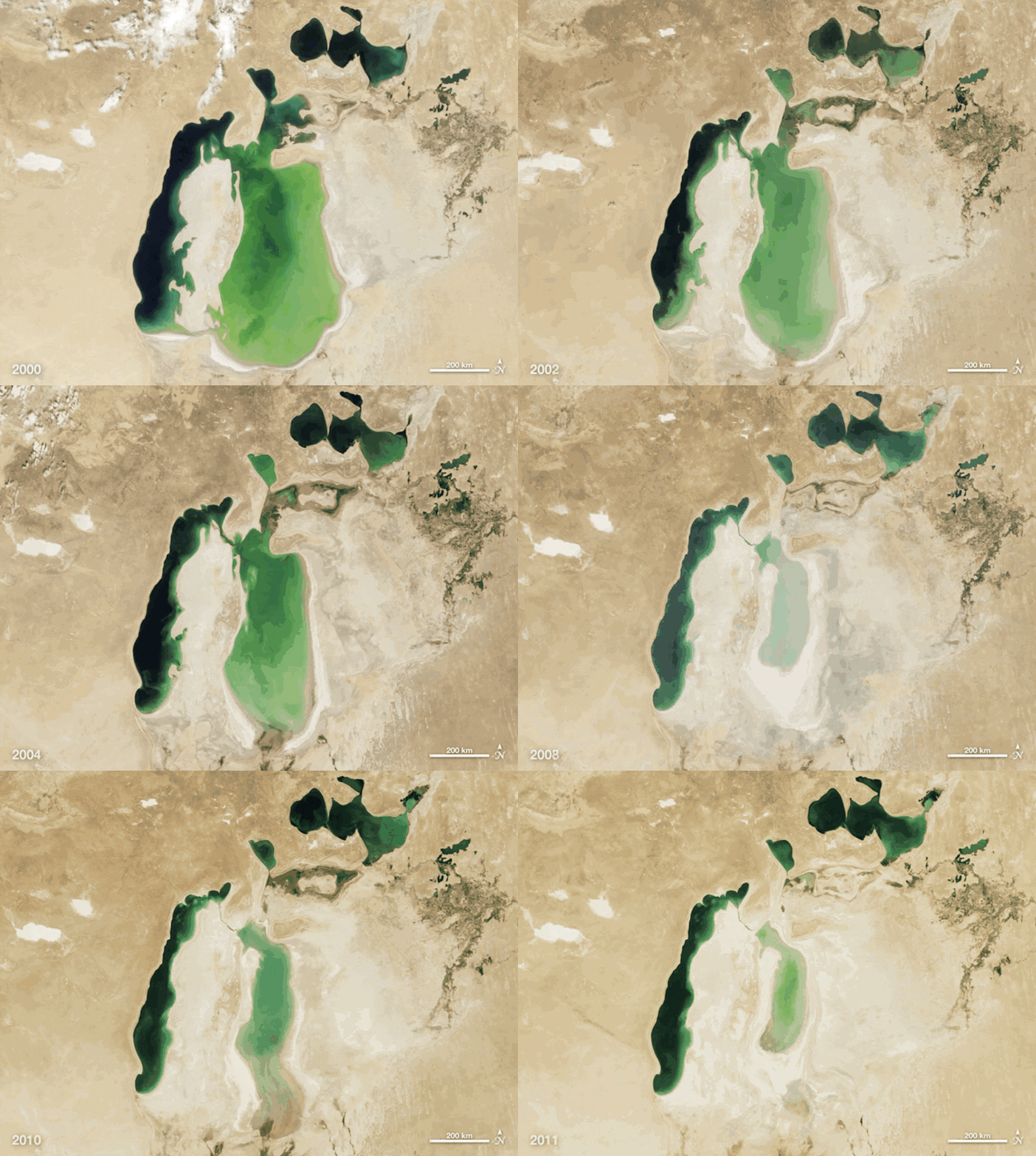
How the Aral Sea shrank from 2000 to 2011. It was once closer to oval, covering the light-colored areas as recently as the 1980s, but overuse for agriculture by multiple countries drew it down.
NASA

That last one, subsidence, often surprises people. But it’s a signature of water bankruptcy. When groundwater is overpumped, the underground structure, which holds water almost like a sponge, can collapse. In Mexico City, land is sinking by about 10 inches (25 centimeters) per year. Once the pores become compacted, they can’t simply be refilled.

The Global Water Bankruptcy report, published on Jan. 20, 2026, documents how widespread this is becoming. Groundwater extraction has contributed to significant land subsidence over more than 2.3 million square miles (6 million square kilometers), including urban areas where close to 2 billion people live. Jakarta, Bangkok and Ho Chi Minh City are among the well-known examples in Asia.

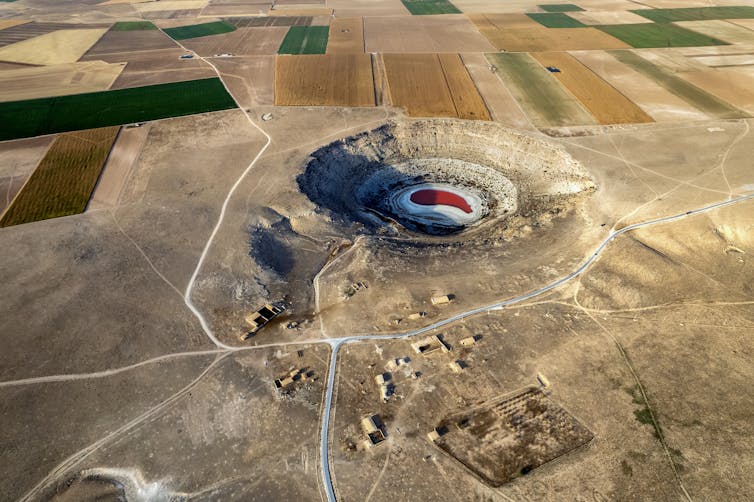
A large sinkhole near farm fields.
A sinkhole in Turkey’s agricultural heartland shows how the landscape can collapse when more groundwater is extracted than nature can replenish.
Ekrem07, 2023, Wikimedia Commons, CC BY

Agriculture is the world’s biggest water user, responsible for about 70% of the global freshwater withdrawals. When a region goes water bankrupt, farming becomes more difficult and more expensive. Farmers lose jobs, tensions rise and national security can be threatened.

About 3 billion people and more than half of global food production are concentrated in areas where water storage is already declining or unstable. More than 650,000 square miles (1.7 million square kilometers) of irrigated cropland are under high or very high water stress. That threatens the stability of food supplies around the world.

Rows with dozens of dead almond trees lie in an open field with equipment used to remove them.
In California, a severe drought and water shortage forced some farmers in 2021 to remove crops that require lots of irrigation, including almond trees.
Robyn Beck/AFP via Getty Images

Droughts are also increasing in duration, frequency and intensity as global temperatures rise. Over 1.8 billion people – nearly 1 in 4 humans – dealt with drought conditions at various times from 2022 to 2023.

These numbers translate into real problems: higher food prices, hydroelectricity shortages, health risks, unemployment, migration pressures, unrest and conflicts.

Is the world ready to cope with water-related national security risks? CNN.

How did we get here?

Every year, nature gives each region a water income, depositing rain and snow. Think of this like a checking account. This is how much water we receive each year to spend and share with nature.

When demand rises, we might borrow from our savings account. We take out more groundwater than will be replaced. We steal the share of water needed by nature and drain wetlands in the process. That can work for a while, just as debt can finance a wasteful lifestyle for a while.

The equivalent of bathtub rings show how low the water has dropped in this reservoir.
The exposed shoreline at Latyan Dam shows significantly low water levels near Tehran on Nov. 10, 2025. The reservoir, which supplies part of the capital’s drinking water, has seen a sharp decline due to prolonged drought and rising demand in the region.
Bahram/Middle East Images/AFP via Getty Images

Those long-term water sources are now disappearing. The world has lost more than 1.5 million square miles (4.1 million square kilometers) of natural wetlands over five decades. Wetlands don’t just hold water. They also clean it, buffer floods and support plants and wildlife.

Water quality is also declining. Pollution, saltwater intrusion and soil salinization can result in water that is too dirty and too salty to use, contributing to water bankruptcy.

A map shows most of Africa, South Asia and large parts of the Western U.S. have high levels of water-related risks.
Overall water-risk scores reflect the aggregate value of water quantity, water quality and regulatory and reputational risks to water supplies. Higher values indicate greater water-related risks.
United Nations University Institute for Water, Environment and Health, based on Aqueduct 4.0, CC BY

Climate change is exacerbating the situation by reducing precipitation in many areas of the world. Warming increases the water demand of crops and the need for electricity to pump more water. It also melts glaciers that store fresh water.

Despite these problems, nations continue to increase water withdrawals to support the expansion of cities, farmland, industries and now data centers.

Not all water basins and nations are water bankrupt, but basins are interconnected through trade, migration, climate and other key elements of nature. Water bankruptcy in one area will put more pressure on others and can increase local and international tensions.

What can be done?

Financial bankruptcy ends by transforming spending. Water bankruptcy needs the same approach:

  • Stop the bleeding: The first step is admitting the balance sheet is broken. That means setting water use limits that reflect how much water is actually available, rather than just drilling deeper and shifting the burden to the future.

  • Protect natural capital – not just the water: Protecting wetlands, restoring rivers, rebuilding soil health and managing groundwater recharge are not just nice-to-haves. They are essential to maintaining healthy water supplies, as is a stable climate.

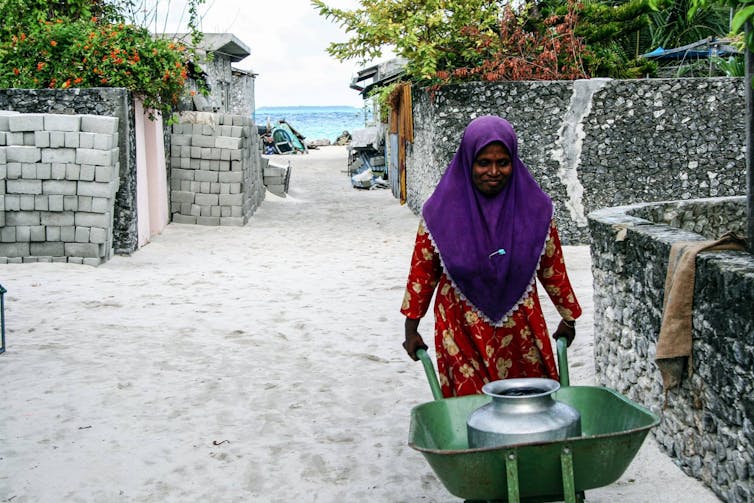
A woman pushes a wheelbarrow with a contain filled with freshwater. The ocean is behind her in the view.
In small island states like the Maldives, sea-level rise threatens water supplies when salt water gets into underground aquifers, ruining wells.
UNDP Maldives 2021, CC BY
  • Use less, but do it fairly: Managing water demand has become unavoidable in many places, but water bankruptcy plans that cut supplies to the poor while protecting the powerful will fail. Serious approaches include social protections, support for farmers to transition to less water-intensive crops and systems, and investment in water efficiency.

  • Measure what matters: Many countries still manage water with partial information. Satellite remote sensing can monitor water supplies and trends, and provide early warnings about groundwater depletion, land subsidence, wetland loss, glacier retreat and water quality decline.

  • Plan for less water: The hardest part of bankruptcy is psychological. It forces us to let go of old baselines. Water bankruptcy requires redesigning cities, food systems and economies to live within new limits before those limits tighten further.

With water, as with finance, bankruptcy can be a turning point. Humanity can keep spending as if nature offers unlimited credit, or it can learn to live within its hydrological means.

The Conversation

Nothing to disclose.

ref. The world is in water bankruptcy, UN scientists report – here’s what that means – https://theconversation.com/the-world-is-in-water-bankruptcy-un-scientists-report-heres-what-that-means-273213

What Mark Zuckerberg’s metaverse U-turn means for the future of virtual reality

Source: The Conversation – UK – By Per Ola Kristensson, Professor of Interactive Systems Engineering, University of Cambridge

Mark Zuckerberg’s vision for the metaverse was meant to reimagine how we interact with each other and the world, providing us with an immersive world where we could seamlessly combine digital and physical information.

The parent company, renamed Meta along the way, had begun introducing headsets and reimagining everyday computing with its Project Orion augmented-reality glasses.

Now, however, Meta is making deep budget cuts to its Reality Labs division, which could see around 10% of the 15,000 employees working on the metaverse and related projects lose their jobs. Meta’s chief technology officer Andrew Bosworth confirmed the cuts to staff in a memo on January 13.

But my years of research with colleagues suggest this apparent U-turn is far from the end of the road for the technology. In search of commercial applications that stretch beyond gaming, it is, though, likely to signal a shift from virtual reality (VR) to less-immersive ways to merge the digital and real worlds.

This augmented reality approach has already been realised through products such as Microsoft HoloLens, which present virtual information within an optical see-through display.

Such augmented reality devices give the illusion of virtual information appearing in physical 3D space. They can also allow users to interact through both gestures and gaze, using integrated hand- and eye-tracking technology.

Meta’s CEO Mark Zuckerberg explains the metaverse in 2021. Video: Skarredghost.

The problem with virtual reality

After decades of research and development, VR technology is unquestionably a real product serving real needs. State-of-the-art headsets provide users with impressive immersive 3D environments along with integrated robust hand and eye tracking. Beyond gaming, virtual reality is used to train medical doctors, engineers, pilots, and many others.

But there is a conflict when it comes to more general, day-to-day applications. I and many others believe that with the advent of AI, new interfaces will be needed beyond the mobile phone to control and benefit from the applications in the work and home. At the same time, it is clear from our research that many people find VR headsets just too immersive, unsettling and impractical to use.

In a two-week user study in 2022, we compared working in virtual reality for an entire working week – five days in a row, eight hours each day – against a baseline of performing the same work using a standard setup with a regular display, external keyboard and mouse.

In this study, we asked 16 volunteers to do their ordinary office work, such as word processing, programming, creating spreadsheets, and so on. The headline result was that users could work in virtual reality for an entire workweek – but there were lots of issues in doing so.

Study participants using VR experienced a higher perceived workload as well as lower usability, lower perceived productivity, higher frustration, lower wellbeing, higher anxiety, a greater experience of simulator sickness and higher visual fatigue. In short, VR yielded worse outcomes on all key metrics.

Despite these results, in the interviews participants commented that they could see themselves using VR if headsets were lighter and if exposure to virtual reality was limited to a few hours at most.

In a follow-up research paper in 2024, we examined the video evidence we had collected in the study in detail. It showed what participants did while wearing the headset – adjusting it, managing the cable when it got in the way, eating and drinking by lifting up the headset halfway, receiving phone calls, and rubbing their faces.

Our analysis showed people did gradually get used to the VR headsets. Overall, participants adjusted their headset about 40% less frequently towards the end of the workweek, and removed the headset approximately 30% less frequently.

This tells us it is possible to work in virtual reality as we normally work with a physical desktop, keyboard and mouse. But if we arrange it so the VR setup replicates our ordinary setup then VR, unsurprisingly, performs worse. We are asking a virtual environment to perfectly replicate our physical work environment, which is impossible.

More importantly, it tells us something about trade-offs. Virtual reality provides a fully immersive virtual environment that transports users to completely different virtual worlds. But this has to be balanced against negative qualities such as poor ergonomics, nausea and fatigue.

Superhuman powers

For any form of extended reality – from augmented-reality smart glasses to something much more ambitious – to achieve mainstream success, it needs to provide more positive than negative qualities in relation to devices we are already familiar with, such as laptops, tablets and phones.

The solution, I believe, is to be bold and reimagine extended reality – not as a transplantation or extension of devices we already use in our daily lives, but as a medium that bestows us superhuman powers. In particular, it can enable us to seamlessly interact with computing systems in the 3D space around us.

In physical reality, you have to select a tool to use it: you pick up a spraycan, then push a button to spray-paint. In a desktop interface, you click the spraycan icon and can thereafter spray-paint using a mouse. But in extended reality, there is no need to first select the tool in order to use it – you can just do it with hand gestures.

Extended reality ‘hot gestures’ can be used to control digital tools . Video: University of Cambridge.

Simply by forming your hand as if you were holding a spraycan and pushing down your index finger to spray, the system can automatically recognise that you wish to use the spraycan tool. It will then allow you to spray-paint the digital items, modulated by your index finger pushing down a virtual spraycan button.

Extended reality can also provide a medium for interacting with personal robotics by, for example, showing the robot’s future movements in 3D space in front of us. As artificial intelligence becomes increasingly embedded in our physical reality, this will become more important.

Ultimately, any vision of a metaverse (not just Zuckerberg’s version) will only succeed if it goes beyond current user interfaces. Extended reality must embrace the fact that it allows a seamless blending of virtual and physical information within our 3D world.

The Conversation

Per Ola Kristensson has previously consulted for Meta. He receives funding from EPSRC and Google.

ref. What Mark Zuckerberg’s metaverse U-turn means for the future of virtual reality – https://theconversation.com/what-mark-zuckerbergs-metaverse-u-turn-means-for-the-future-of-virtual-reality-273659

Come Down to a Lower Place – a Lovecraftian Korean tale about the oppression of female workers and their bodies

Source: The Conversation – UK – By Debra Benita Shaw, Reader in Cultural Theory in the School of Architecture and Visual Arts, University of East London

Honford Star

The writings of H.P. Lovecraft have seen a renewal of interest in recent years, despite the fact that he was a well-known racist and xenophobe. Writing in the early 20th century, he imagined monsters that gave form to fear of difference.

Creatures like Cthulhu, probably his best-known and most borrowed invention, effectively challenge human complacency about our place in the world as the most powerful species. Lovecraft describes Cthulhu as a “huge, formless white polypous thing; a “squid-head with writhing feelers” that inhabits the lost city of R’lyeh, described as “nothing of this or of any sane planet”.

His story The Call of Cthulhu recounts a documented history of human encounters with the monster that lead only to madness and death. Such monsters, and their strange domains, led the philosopher Graham Harman to coin the term “weird realism” to describe Lovecraft’s oeuvre.

Lovecraft’s stories also reveal his fear of women and the horror he saw in their capacity to give birth to the thing he perhaps feared above all – a hybrid race that would put an end to white supremacy. As Lovecraft expert Carl Sederholm has noted, Lovecraft’s stories abound with “creatures that ooze, pulsate and drip mostly from below the waist”.

It is this fear of women’s bodies and the attendant racism and misogyny bound up in it that is confronted in the recently published novella Come Down To A Lower Place by Seoyoung Yi. The novella is part of the Lovecraft Reanimated project by UK-based publisher Honford Star, in which leading Korean speculative fiction writers reimagine the works of Lovecraft.

The novel opens with Lee Seul, a team leader at Yukwang Construction, worrying about her vaginal discharge and struggling with a UTI (urinary tract infection). Seul has been tasked with investigating a smell seeping up from the basement of a prestigious department store, threatening the carefully curated ambience of the luxury goods department on the first floor. The plans for the original construction during the colonial era hint at something sinister.

A woman with tentacles around her.

Honford Star

The stinking slime that oozes from the basement heralds the arrival of Bin-o-Jae, a Lovecraftian monster formed from the despair of countless women subjected to misogynistic violence. It’s been created from such experiences as the suppressed pain of generations of female workers denied the breaks necessary to change their sanitary pads during their periods – “their knees twisting under bright lights, as they waited for a chance to go to the bathroom”.

Department stores in colonial Korea were known for propagating the emotional labour identified by the sociologist Arlie Russell Hochschild in The Managed Heart (1983). Like the flight attendants that Hochschild examined, female store attendants were expected to smile constantly and endure rude and dismissive customer attitudes without complaint.

In research published in 2018, social scientists Jinseok Oh and Howard Kahm reported on the case of Paek Inbong, a worker at the Hwasin Department Store in Seoul. In 1938, after constant bullying by her manager, Inbong took an overdose of sleeping pills. Talking about the experience, she said:

“[The manager] started scolding me for fidgeting and kept going until I could hardly breathe. I thought it would be better to die than to suffer like this. In order to show the agony felt by the employees, I decided to die.”

In exploring this kind of territory, Come Down To A Lower Place is unashamedly political. It espouses a return to the socialist feminism promoted by social theorists Michèle Barrett and Mary McIntosh, who argued for a recognition of gender roles and their expression in heteropatriarchal (straight and male-dominated) institutions, like marriage, as essential to the perpetuation of capitalism.

Yi’s book is certainly born of Korea’s 4B movement, a feminist movement with four tenets all of which start with “bi” (no) in Korean – bihon (no marriage), bichulsan (no childbirth), biyeonae (no dating) and bisekseu (no sex). Drawing on this, the book makes the case for women’s power to withdraw their labour, both as workers in the consumer economy and as wives and mothers.

Yi’s Bin-o-jae stands for the accumulation of frustration and anxiety that gave rise to 4B and for the liberatory potential of women’s anger. This monster has been waiting impatiently for a woman like Lee Seul, to unleash its power on the world, which, Yi hints, it plans to do on her wedding day.

Bin-o-jae is, like Cthulhu, squid-like and huge with writhing tentacles, described as not “gray like a squid’s” but “more like a piece of mammalian flesh – massive, red and covered in slime”. Equally, like Cthulhu, it defies full description as it partially emerges from the depths below the department store, hinting at further horrors to be revealed. However, its effects are quite different.

While Lovecraft’s protagonists succumb to madness, chronic fevers and suicide, Seul, at the end, embraces Bin-o-jae and, “despite the pain … throughout her body … strangely [feels] at peace”. As Seul is fitted for her wedding dress, she struggles to contain the monster that now fully inhabits her body and she promises it “just a little longer” before she releases it upon the world.

Lovecraft’s legacy therefore entails a somewhat delicious irony in this book. Bin-o-jae is Cthulhu repurposed to draw attention to women’s very real pain and the potential power of unleashing their anger in collective action.

As Yi demonstrates, poking the monster doesn’t always lead to horror and death; it may just lead you to the power you need to win the fight.

This article features references to books that have been included for editorial reasons, and may contain links to bookshop.org. If you click on one of the links and go on to buy something from bookshop.org The Conversation UK may earn a commission.


Looking for something good? Cut through the noise with a carefully curated selection of the latest releases, live events and exhibitions, straight to your inbox every fortnight, on Fridays. Sign up here.


The Conversation

Debra Benita Shaw does not work for, consult, own shares in or receive funding from any company or organisation that would benefit from this article, and has disclosed no relevant affiliations beyond their academic appointment.

ref. Come Down to a Lower Place – a Lovecraftian Korean tale about the oppression of female workers and their bodies – https://theconversation.com/come-down-to-a-lower-place-a-lovecraftian-korean-tale-about-the-oppression-of-female-workers-and-their-bodies-273619

Why Trump is attacking the UK over Chagos Islands – and what it tells us about Britain’s place in the world

Source: The Conversation – UK – By James Brocklesby, Lecturer in History, Sheffield Hallam University

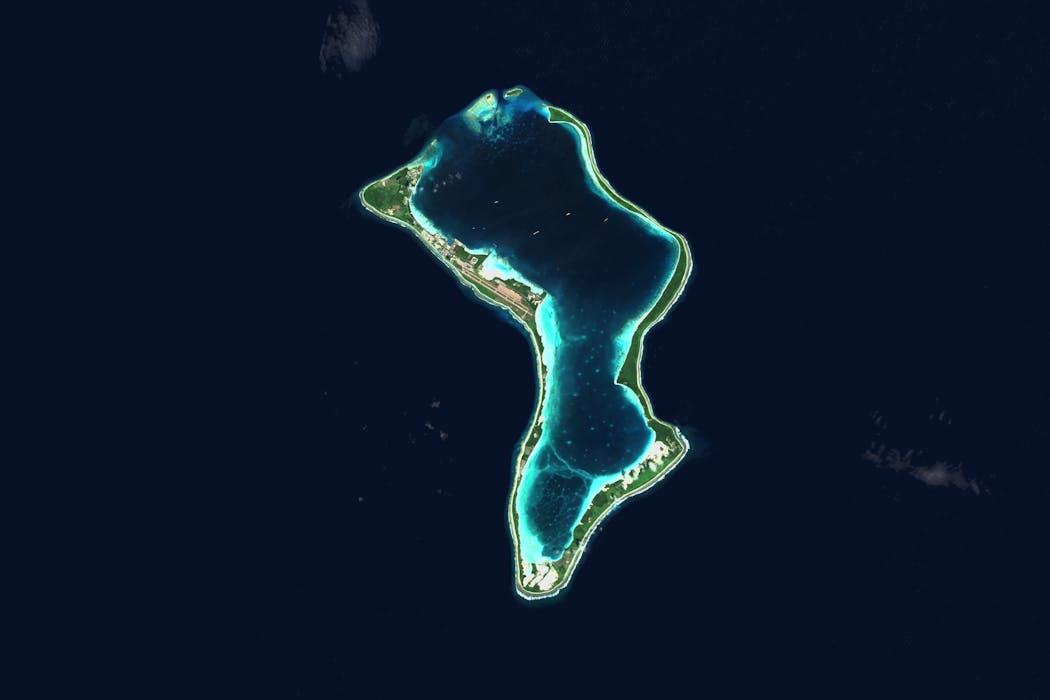
The US and UK maintain a joint naval base on Diego Garcia. zelvan/Shutterstock

The UK formally agreed to transfer sovereignty over the Chagos Islands to Mauritius in May 2025. With the Trump administration’s explicit support, this move ended one of the longest-running territorial disputes in Britain’s remaining overseas territories.

The decision has been hailed by some as a long-overdue act of decolonisation, condemned by others as a strategic misstep. Unexpectedly, Donald Trump has now reignited the debate, branding the deal an “act of great stupidity”.

Why has this small chain of remote Indian Ocean islands become such a flashpoint?

The roots of the crisis lie in the dismantling of Britain’s empire in the 1960s. The Chagos archipelago was historically administered as part of colonial Mauritius, then a British colony. In 1965, three years before Mauritian independence, the UK separated Chagos from Mauritius to create a new territory: the British Indian Ocean Territory.

The creation of a new colony was an act shaped by cold war strategy. Mounting economic and strategic pressures in the late 1960s – including the devaluation of the pound in 1967 and the Labour government’s 1968 decision to withdraw British forces east of the Suez Canal – together curtailed Britain’s regional defence role in the Indian Ocean.

As Britain retreated “east of Suez”, it still wanted a secure military foothold in the Indian Ocean, particularly one that could be used jointly with the US. Diego Garcia, the largest island in Chagos, was ideal: isolated, strategically positioned between Africa and Southeast Asia, near major trade routes and capable of hosting a major naval and air facility.

The costs were met by the UK, with £3 million paid to Mauritius to cede the islands. But the price of this strategy was paid by the Chagossians. Between 1967 and the early 1970s, the islanders were forcibly removed from their homes and relocated to Mauritius and the Seychelles. Their removal was brutal: families were separated, livelihoods destroyed, and a distinct island community effectively erased.

Why the UK changed course

By the 21st century, Britain’s legal position was increasingly untenable. In 2019, the International Court of Justice ruled that the separation of the Chagos archipelago from Mauritius had been unlawful and that the UK should “terminate” its administration “as rapidly as possible”. The UN General Assembly backed this view with an overwhelming but non-binding vote.

Mauritius has consistently argued that the islands are a stolen part of its national territory, and therefore their decolonisation is incomplete. Over time, this case gained traction – Britain’s continued control of Chagos came to symbolise the unfinished business of empire.

By 2022, James Cleverly, then the UK’s foreign secretary, opened negotiations with Mauritius to “resolve all outstanding issues” over the archipelago. In October 2024, the Labour government under Keir Starmer concluded that a negotiated settlement was preferable to decades more legal wrangling.

The deal struck with Mauritius did two things: it transferred sovereignty over the archipelago to Mauritius, while securing a 99-year lease on Diego Garcia to allow the existing US-UK military base to continue operating at a cost of £3.4 billion.

On paper, this protected British (and by extension US) strategic interests in the region while satisfying the legal argument from the UN. However, while the deal was initially supported by the US, the deal has come under attack from other UK political parties, and increasingly jars with Trump’s vision of the world.

Why the islands matter strategically

The significance of Chagos is its location. Diego Garcia is one of the most important western military installations outside Europe and North America. It has been described as “an all but indispensable platform” for US interests in the Middle East and East Africa, with B-52 bombers recently used from the base to strike Yemen.

In an era of renewed great-power rivalry, the island’s value has increased. As China expands its naval presence in the Indian Ocean, western governments see Diego Garcia as a counterweight. However, critics of the deal have raised questions about the China-Mauritius relationship, arguing this would allow China a crucial foothold in the region.

For the UK, the base also underpins its claim to still be a meaningful military actor beyond Europe. For this reason, sovereignty transfer was carefully managed. Britain was not abandoning the base, but ensuring an arrangement that kept western military access intact while removing the colonial stain.

On one level, the Chagos deal looks like a model of decolonisation. Britain accepted international law, acknowledged a historic wrong and negotiated a settlement.

Yet this is happening at a moment when global politics is becoming more overtly imperial in style. Russia’s invasion of Ukraine, China’s assertive regional ambitions and Trump’s expansionist rhetoric about Greenland all suggest a world less governed by law and more by power.

In that context, Britain’s attempt to “do the right thing” over Chagos risks looking out of step. It reflects a rules-based worldview that is under pressure.

This creates a dilemma for Britain, which on January 20 vowed to “never compromise on national security”. The UK government defended the deal, saying it had to hand over the Chagos Islands because the military base was “under threat” from international legal action.

Britain is no longer an imperial sovereign with uncontested control over distant territories. It is a mid-sized power that must balance history, law, alliances and strategy.

This situation also exposes Britain’s continued dependence on the US for its global military clout and economic advantages. Without the US, Diego Garcia would be far less significant. The US substantially provides most of the base’s military capability. Trump’s criticism underscores a deeper vulnerability: Britain’s post-imperial identity remains tethered to American power.

The Conversation

James Brocklesby does not work for, consult, own shares in or receive funding from any company or organisation that would benefit from this article, and has disclosed no relevant affiliations beyond their academic appointment.

ref. Why Trump is attacking the UK over Chagos Islands – and what it tells us about Britain’s place in the world – https://theconversation.com/why-trump-is-attacking-the-uk-over-chagos-islands-and-what-it-tells-us-about-britains-place-in-the-world-273939

Why everyone should be a student of American studies

Source: The Conversation – UK – By Sarah Trott, Senior Lecturer in American Studies and History, York St John University

The US president Donald Trump’s domestic and foreign policy has surprised much of the world, particularly US allies. It breaks with expectations about how the US has traditionally behaved.

This is mainly due to Trump’s speed and bluntness of decisions, his breaks with longstanding norms and his unpredictable style. But the capture of Venezuelan president, Nicolás Maduro, and the mounting tension over America’s threatened occupation of Greenland are not isolated events. Neither is the government’s stance over immigration policy and citizenship. They’re rooted in longstanding struggles for power, justice and equality.

This is what makes the academic subject of American studies – in decline in UK universities – so relevant. American studies examines the nation’s history, literature, politics and social movements. By doing so, it helps contextualise current conflicts. Political polarisation, racial tensions, culture wars and debates over identity are placed within a broader historical framework.

During Trump’s presidencies, the US has projected a more muscular, transactional approach to global affairs. At the same time, it has also reconfigured its own traditional ideals. This shift has affected everything from security and trade to climate and technology.

Expanding our understanding of how American society, culture and politics works helps us anticipate instability. This could be through formal education like an American studies course or through building our own knowledge.

The American experiment

America has long understood itself as an “experiment” rather than a finished nation. It’s a political project constantly being tested, revised and debated. This idea is embodied in the US Constitution. It was designed not as a fixed blueprint but as a living framework, capable of change through amendments.

American history is rife with examples of how democracy has been an ongoing (and flawed) project, not a completed one. The nation’s history is marked by struggles over who gets to participate in the democratic process. This includes the exclusion of women, the LGBTQ+ community, African Americans and Native Americans, and the fight for voting rights and civil liberties. Understanding this history can help contextualise the current political landscape. It reminds us that the issues we face today are not entirely new.

American studies can’t fully explain the present without grounding students in the Constitution’s foundational architecture. This includes the separation of powers into equal branches, the system of checks and balances, and the assumption that no single person or institution should dominate the republic.

These principles have been challenged before. During the Civil War, the survival of constitutional democracy itself was at stake. During the McCarthy era – a period of persecution of people with left-wing views in the 1940s and 50s, led by US senator Joseph McCarthy – fear eroded civil liberties. Understanding what is occurring during the Trump administration therefore requires situating him not as an anomaly outside the system, but as a stress test within the American experiment. This stress reveals both the vulnerabilities and the resilience of the constitutional order.

Past and present

Trump’s recent capture of Maduro follows months of military campaigning and years of strained relationships. The possibility of a US-led invasion of Venezuela stems back to 2017, when Venezuela slid towards political unrest. The erosion of democracy, accusations of human rights violations and economic collapse led to humanitarian crises.

The US has a long history of interventions, peace operations and force-backed diplomacy that long predates this event, such as in Cuba (1961), the Dominican Republic (1965), Grenada (1983) and Panama (1989). These examples all fit into a long tradition of US intervention rooted in the Monroe Doctrine (1823) and later expanded by the Roosevelt Corollary (1904). Together, these doctrines supplied the ideological and legal justification for US involvement in Latin America.


Read more:
The ‘Donroe doctrine’: Maduro is the guinea pig for Donald Trump’s new world order


The mounting tension over America’s heavy strategic interest in Greenland echoes cold war anxieties. It is reminiscent of the great-power rivalry, strategic geography and militarisation that defined that era.

More significantly for global relations and stability, it potentially jeopardises the future of Nato. As The US is one of Nato’s principal architects, guarantors, and its military backbone, this is alarming. America’s historical association with the alliance has been defensive and leadership-driven.

The recent killing of Renee Good by a US Immigration and Customs Enforcement (ICE) agent in Minneapolis has refocused the debate over America’s immigration enforcement. The expansion in power and visibility of ICE fits into a long history of questioning “What is an American?”. It’s been a topic of debate since the 18th century.

Debates over immigration reflect deeper questions about national identity. The US vice-president, J.D. Vance, questioned New York City’s then-mayoral candidate Zohran Mamdani’s American citizenship. He linked American identity to the American civil war. This raised a highly problematic – if not shocking – interpretation of “Americanness”.

By looking back at these historical moments, we can better understand the root causes of contemporary problems. In short, understanding America’s past is a vital tool for understanding and navigating the global present.

The Conversation

Sarah Trott does not work for, consult, own shares in or receive funding from any company or organisation that would benefit from this article, and has disclosed no relevant affiliations beyond their academic appointment.

ref. Why everyone should be a student of American studies – https://theconversation.com/why-everyone-should-be-a-student-of-american-studies-273385

19th-century plan for a slaving empire based in US deep south and Caribbean resonates with Trump’s foreign policy today

Source: The Conversation – UK – By Dafydd Townley, Teaching Fellow in US politics and international security, University of Portsmouth

Seal of the president of the Knights of the Golden Circle. NARA, Records of the Office of the Judge Advocate General (Army), Record Group

One year into his second term of office, Donald Trump’s foreign policy aspirations have led him to variously lay claim to Canada, the Panama Canal and, most contentiously at present, Greenland. He has kidnapped the head of state of Venezuela, saying that the US can run the country and exploit its oil, and he has issued threats against the sovereignty of Colombia, Mexico and Cuba.

Whatever the 47th president’s motivations, his expansionist vision has echoes of a little-known organisation that flourished briefly in the middle decades of the 19th century: the Knights of the Golden Circle. The Knights were a secret society founded in Lexington, Kentucky, in 1854 by Virginian doctor George W.L. Bickley.

Membership of the group is largely hidden from historians due to the secretive nature of the organisation. But legend suggests that its leaders included the likes of confederate general Nathan Bedford Forrest (who would go on to be the first Grand Wizard of the Ku Klux Klan) and Abraham Lincoln’s assassin, John Wilkes Booth.

The society’s name was chosen to reflect the wealth that would be created by establishing a slaveholding empire that would initially consist of Mexico, Central America and the Caribbean. The so-called “Golden Circle”, with its headquarters in Havana, Cuba, would encompass much of the world’s supply of cash crops such as tobacco, rice, cotton, sugar and coffee, and the production of each depended on significant enslaved workforces.

The initial intention was not to have an independent empire but to annex the area to the American south, strengthening the cause of slavery. But the group shifted tactics as tensions escalated in the late 1850s, especially after the the Supreme Court’s Dred Scott decision (1857) that ruled that African Americans were not and could never be citizens. And as the abolitionist movement in the north gathered pace, the Golden Circle society adapted to support the secession of the southern states from the Union to be absorbed into the other Golden Circle territories.

The exact number of members of the Knights of the Golden Circle is unknown. Bickley claimed it had 115,000 members at one point – although this seems unlikely due to Bickley’s failure to raise troops to invade Mexico.

The Knights’ goals were not simply territorial expansion. They were ambitions of ideological conquests rooted in the continuation of slavery, as viewed through the lens of a “manifest destiny”: the idea that the white man should expand its dominance across the continent of America to the exclusion of native populations.

While the organisation’s influence was limited, it reflected the 19th-century American premise that territorial expansion could forever secure a social order built on hierarchy and chattel slavery.

Trump’s Maga vision

Fast forward to the present day, and American imperialist expansion no longer wears the uniform of secret societies such as the Knights. Instead, it emerges through presidential rhetoric, policy signalling and deliberate ambiguity.


On January 20 2025, Donald Trump was sworn in as the 47th president of the United States. His first year in office has seen profound changes both in his own country and across the globe. In this series, The Conversation’s international affairs team aims to capture the mood after the first year of Trump’s second coming.


Under Trump, America’s ambitions in the western hemisphere have been framed as annexations driven by hemispheric dominance. Trump unironically called it the “Donroe doctrine”, a personalised and transactional reinterpretation of the Monroe doctrine’s core claim: that the Americas are solely within the United States’ sphere of influence.

Where the 1823 Monroe doctrine warned European powers against further colonisation while professing American restraint, Trump’s version dispenses with the pretence of mutual sovereignty. It treats neighbouring states not as equals but as strategic assets or bargaining chips. The language is typically Trumpian (blunt and improvised) but it argues that external powers have no role in the governance of the western hemisphere, and that the United States has the final say-so.

Cuba is at the centre of this worldview. While Trump has not openly advocated annexing the island, he has attempted to use coercive pressure as a substitute for territorial control. Efforts to disrupt Cuban energy supplies and renewed talk of regime change echo traditional American treatment of Cuba as an unfinished project. Consequently, Trump’s Cuba policy resembles the establishment of an informal American empire.

Map of the 'Golden CIrcle' countries in the US, Central America and Caribbean.
The Golden Circle was to consist of the southern US, Mexico, Central America, Cuba, Haiti, the Dominican Republic, Caribbean South America and most other islands in the Caribbean.
Spesh531/Wikipedia, CC BY-ND

The Knights of the Golden Circle imagined Cuba not just within the American sphere of influence but as territory to be absorbed. Their obsession with Havana as the Golden Circle’s centre reflected an understanding that southern power depended on control of the Caribbean. Trump’s posture is less explicit, but the strategy is very similar. Cuba is viewed as a prize within America’s reach and yet denied.

The same logic appears elsewhere in the Americas. Trump’s threats toward Mexico blur the line between cooperation and coercion. America’s neighbours’ sovereignty becomes negotiable when framed as an American security problem. Pressure on Venezuela and Columbia also reflects a willingness to treat political outcomes in the Americas as matters of US entitlement.

What distinguishes the so-called Trump corollary from previous American hemispheric dominance is its tone. It is unapologetically hierarchical and dismisses multilateral norms. It harks back to a time when the US could act first and justify itself later. Where cold war policymakers cloaked intervention in ideological language, Trump’s rhetoric is strikingly transactional. Influence is something to be purchased or compelled.

This brings the comparison with the Knights of the Golden Circle into sharper focus. The Knights had a secret vision of empire, brought to life by slavery and racial hierarchy. Trump’s ambitions are in the public sphere, filtered through state power. But both reflect that geography confers entitlement and that the Americas exist in a fundamentally different moral category.

In this light, Trump’s policy is not a radical break with American history but an unvarnished return to its imperial ambitions. The map may no longer be redrawn by conquest, but the logic that once animated the Golden Circle, one of hemispheric control as destiny, has not disappeared. It has merely learnt to speak in the idiom of modern populism.

The Conversation

Dafydd Townley does not work for, consult, own shares in or receive funding from any company or organisation that would benefit from this article, and has disclosed no relevant affiliations beyond their academic appointment.

ref. 19th-century plan for a slaving empire based in US deep south and Caribbean resonates with Trump’s foreign policy today – https://theconversation.com/19th-century-plan-for-a-slaving-empire-based-in-us-deep-south-and-caribbean-resonates-with-trumps-foreign-policy-today-272871