En 2017, Daphne Caruana Galizia, journaliste maltaise d’investigation qui enquêtait sur la corruption à l’œuvre jusqu’aux plus hautes sphères de l’État, trouvait la mort dans l’explosion de sa voiture. Depuis, certains exécutants ont été condamnés à de lourdes peines de prison ; mais les réels commanditaires n’ont toujours pas été identifiés. Comment expliquer un tel niveau de corruption au sein de l’Union européenn ?
Au-delà de son horreur, le meurtre d’une journaliste d’investigation soulève une question essentielle pour les démocraties contemporaines : comment un État membre de l’UE peut-il être gangrené par des pratiques aussi systématiques de corruption ?
Plusieurs facteurs permettent d’éclairer cette situation.
Une gouvernance institutionnelle fragile
Tout d’abord, Malte, bien qu’étant une démocratie, souffre d’un manque de séparation claire entre les pouvoirs. Le pays, devenu indépendant du Royaume-Uni en 1964, est depuis 1974 une république parlementaire où le président élu par le Parlement, exerce le pouvoir exécutif et nomme le premier ministre et le gouvernement.
Lorsque les institutions censées garantir la transparence et la justice sont elles-mêmes vulnérables aux influences politiques, la corruption peut s’installer durablement.
Une économie ouverte aux flux opaques
D’autre part, le modèle économique maltais repose en partie sur des secteurs à haut risque de fraudes. Le secteur des services financiers offshore contribue deux fois plus à la valeur ajoutée brute à Malte que dans le reste de l’Europe, sachant que le nombre d’employés de ce secteur a augmenté de 22 % depuis 2020 ; les jeux en ligne, avec des soupçons d’infiltration par la mafia italienne ; ou encore la vente de passeports via le programme des « passeports en or » (« golden passports ») qui permet d’acquérir la citoyenneté contre investissement. Des oligarques russes ont ainsi acheté la nationalité maltaise en séjournant très brièvement sur l’île.
Ces activités attirent des capitaux étrangers, mais aussi des acteurs peu scrupuleux. L’opacité qui entoure ces flux financiers rend difficile la traçabilité et favorise les abus.
Une culture politique permissive
Par ailleurs, la tolérance sociale vis-à-vis de certaines pratiques douteuses contribue à leur banalisation. Le clientélisme, les conflits d’intérêts et le manque de sanctions effectives contre les responsables politiques alimentent un climat d’impunité.
Le cas de Daphne Caruana Galizia illustre cette dynamique. Malgré les révélations qu’elle avait publiées (par exemple, ses enquêtes sur le volet maltais de l’affaire des Panama Papers), les politiciens maltais avaient pris peu de mesures concrètes, jusqu’à ce que, après son assassinat, la pression de la société civile provoque la chute du gouvernement Muscat.
Plaque apposée devant le mémorial dédié à Daphne Caruana Galizia, à La Vallette. Bertrand Venard, Fourni par l’auteur
Des mécanismes de contrôle affaiblis
Même si la presse et la société civile jouent un rôle crucial dans la lutte contre la corruption, à Malte, les journalistes sont exposés à des pressions importantes, et les lanceurs d’alerte ne bénéficient pas toujours de protections suffisantes.
L’exemple le plus flagrant est évidemment l’assassinat de Daphne Caruana Galizia partiellement impuni, notamment l’absence de condamnation de l’entrepreneur douteux Yorgen Fenech, soupçonné d’être le commanditaire du crime.
Enfin, la corruption prospère dans les zones grises de l’administration. L’accès limité à l’information publique, les procédures complexes et l’inertie institutionnelle créent un environnement propice aux pratiques illicites. Cette opacité peut être systémique ou délibérée, comme l’ont montré certaines recherches internationales.
Le cas maltais n’est pas isolé, mais il est emblématique. Il rappelle que la corruption ne résulte pas seulement d’actes individuels, mais d’un écosystème institutionnel, économique et culturel. Pour y remédier, il ne suffit pas de condamner les coupables : il faut renforcer les institutions, garantir l’indépendance de la justice, protéger les journalistes et les lanceurs d’alerte, et promouvoir une culture politique fondée sur la transparence et la responsabilité.
Bertrand Venard ne travaille pas, ne conseille pas, ne possède pas de parts, ne reçoit pas de fonds d’une organisation qui pourrait tirer profit de cet article, et n’a déclaré aucune autre affiliation que son organisme de recherche.
« That man… that young man… I forgive him. » Ces mots prononcés par la veuve de Charlie Kirk à propos de l’assassin de son époux s’inscrivent dans une tradition chrétienne du pardon mais, aussi, dans un contexte spécifique aux États-Unis, où le pardon individuel et collectif, d’une part, et la grâce présidentielle, de l’autre, ont historiquement été mêlés de façon étroite et ont toujours eu un impact profond sur les débats politiques et moraux.
Le 21 septembre 2025, lors de la cérémonie d’hommage à son mari Charlie Kirk, Erika Kirk a prononcé un discours très remarqué dans lequel elle a déclaré qu’elle accordait son pardon à Tyler Robinson, le jeune homme accusé d’avoir assassiné son époux le 10 septembre précédent.
Elle a expliqué que son pardon découlait de sa foi chrétienne et de l’héritage spirituel de Charlie, proclamant « The answer to hate is not hate » (« la réponse à la haine n’est pas la haine »). Dans un entretien publié le même jour par le New York Times, elle a dit qu’elle ne souhaitait pas qu’une éventuelle exécution de Robinson pèse sur sa conscience, et qu’elle laissait à la justice le soin de décider de son sort.
Le pardon personnel…
Ce geste pose une question vertigineuse : comment une épouse peut-elle pardonner à l’assassin de son mari ? Le pardon, ici, est revendiqué comme un choix volontaire – non un oubli, mais une libération intérieure. Il s’inscrit dans une logique religieuse forte, où la foi chrétienne (et plus encore, la conviction que le pardon est un commandement moral) légitime l’abolition intérieure de la vengeance.
Erika Kirk a mis en avant le modèle du Christ – « Père, pardonne-leur, car ils ne savent pas ce qu’ils font » – pour donner à son acte une justification transcendante. En analysant ce cas, on peut avancer que son pardon est doublement « surhumain » : surhumain parce qu’il exige de dépasser les émotions légitimes (colère, douleur, désir de vengeance) ; surhumain aussi parce qu’il prétend s’adresser non seulement à l’acte criminel, mais à l’auteur en tant que personne, dans un geste d’amour ou de miséricorde.
Mais un tel pardon ne peut être compris que dans le cadre d’un engagement religieux préexistant. C’est bien le point essentiel : ce pardon ne se décrète pas dans le vide. Il s’appuie sur une histoire de foi, sur une disposition spirituelle. Erika Kirk s’affiche comme chrétienne fervente, et sa vie publique se teinte de références religieuses. Sans cette assise, un acte aussi radical de pardon immédiat paraît presque invraisemblable.
On pourrait donc formuler la première grande leçon : le pardon d’un crime extrême s’enracine d’abord dans une anthropologie religieuse, qui suppose une vision de l’homme, du péché, de la rédemption, du mal et de la grâce. Le pardon devient une performance morale, au-delà du droit, qui témoigne de la supériorité de l’amour sur la justice stricte. Mais cette position n’est pas sans tension. Elle entre en conflit avec les exigences de la justice, de la réparation, de la mémoire et de la légitime colère des victimes.
… et le pardon institutionnel
Erika Kirk n’est pas la première à effectuer ce geste public de pardon envers un criminel. Dans l’histoire des États-Unis, plusieurs exemples célèbres illustrent des formes de pardon religieux ou politique offert à des auteurs de crimes graves.
Aux États-Unis, la grâce (executive clemency) est une institution constitutionnelle. Le président peut, pour des motifs de justice ou de miséricorde, gracier un condamné. L’article II, section 2, alinéa 1 de la Constitution des États-Unis définit le pouvoir de la grâce présidentielle. Il y est stipulé que le président « aura le pouvoir d’accorder des sursis et des grâces pour les offenses contre les États-Unis, sauf en cas d’impeachment ». Ce pouvoir s’applique donc uniquement aux crimes fédéraux, et non aux infractions relevant des États fédérés.
La grâce présidentielle peut prendre la forme d’un pardon complet, d’une commutation de peine ou d’un sursis. Elle est considérée comme l’un des attributs majeurs de l’autorité exécutive. Historiquement, ce pouvoir a été utilisé pour corriger des injustices ou pour apaiser des tensions politiques. La seule limite explicite demeure son inapplicabilité dans les procédures d’impeachment. Ainsi, la grâce présidentielle illustre la concentration de prérogatives dans la fonction exécutive, mais encadrée par le texte constitutionnel. C’est un pardon « légal » dans lequel l’État lui-même, au sommet de la hiérarchie, exerce une forme de miséricorde. Le plus souvent, ce type de pardon ne correspond pas à un pardon moral de la victime, mais à une révision de la peine (réhabilitation, reconnaissance de circonstances atténuantes, etc.).
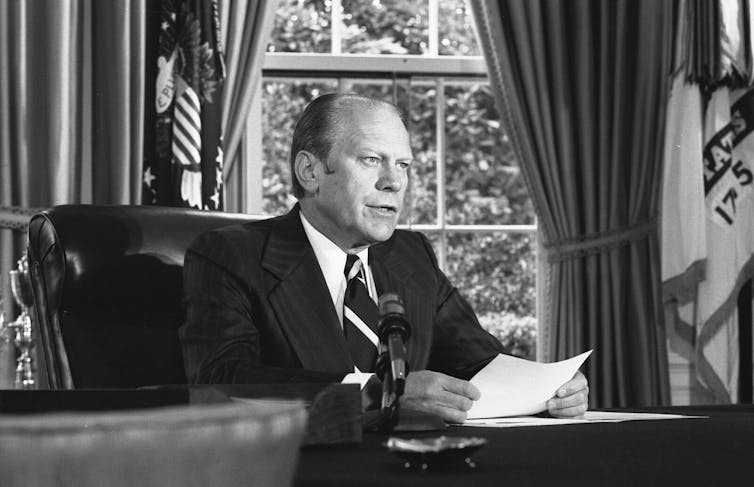
Plusieurs présidents des États-Unis ont gracié des figures politiques controversées. En septembre 1974, le président Gerald Ford a accordé une grâce complète à son prédécesseur Richard Nixon, dont il avait été le vice-président et dont la démission lui avait permis d’accéder à la fonction suprême un mois plus tôt. Cette décision couvrait toutes les infractions fédérales liées au scandale du Watergate. Ford expliqua que ce pardon visait à mettre fin à une crise politique et morale sans précédent.
Plus récemment, Joe Biden, juste avant de quitter la Maison Blanche, a gracié son fils Hunter, condamné pour détention illégale d’arme à feu et fraude fiscale, affirmant que ce dernier avait été victime d’une « erreur judiciaire ». Peu après, dès le lendemain de sa seconde investiture, Donald Trump a gracié la quasi-totalité des insurgés du 6 janvier 2021, qu’il a qualifiés d’« otages de Joe Biden » dont la grâce « met fin à une grave injustice nationale infligée au peuple américain ».
De tels pardons suscitent souvent la polémique, ne serait-ce que parce qu’ils soulèvent la question de l’équité envers d’autres condamnés.
Au-delà du cadre pénal institutionnel, l’histoire américaine a parfois vu des victimes ou des proches pardonner publiquement à des auteurs de violences collectives, au nom de la réconciliation de la société. Dans le cadre du mouvement des droits civiques, des figures comme Martin Luther King ont prôné le pardon au nom du principe de non-violence, invitant à pardonner moralement les injures et les violences, sans pour autant nier les injustices et sans appeler à ce que les auteurs d’actes haineux ne soient pas traduits en justice et, le cas échéant, condamnés.
Mais ces pardons personnels, s’ils sont symboliquement puissants, restent souvent marginaux face à la masse des crimes non résolus ou non pardonnés. Le contexte social, médiatique, politique joue un rôle déterminant dans leur réception.
Le pardon, pour être crédible, doit se situer dans une tension entre la mémoire de la victime, la justice (y compris la peine), et le geste de miséricorde. La philosophie morale, la théologie et la théorie politique débattent du pardon extrême. Hannah Arendt a soutenu que le pardon ne peut s’appliquer à l’« extrême crime et au mal volontaire ». Certains actes seraient au-delà de la possibilité de pardon sans effacement de la responsabilité. Le pardon ne doit pas conduire à l’oubli, mais rester conditionné à une reconnaissance du tort, à une repentance et à une action réparatrice. Ainsi, même dans l’histoire américaine, le geste de pardon est rare, souvent contesté, et toujours porteur de tensions : entre justice et miséricorde, entre mémoire et réconciliation, entre gratitude divine et exigences humaines.
Le poids symbolique du pardon dans l’arène politique
Le pardon d’Erika Kirk n’est pas seulement personnel. Il s’adresse immédiatement au champ politique et symbolique. En pardonnant publiquement au meurtrier de son mari, Erika Kirk se pose comme une figure de hauteur morale. Elle transcende la spirale de vengeance, incarne le « modèle chrétien » et se présente comme l’héritière spirituelle et politique de son mari – un rôle qu’elle assume d’ailleurs officiellement puisqu’elle a été nommée à la tête de Turning Point USA, l’organisation tentaculaire que son mari avait fondée et qu’il avait dirigée jusqu’à son assassinat. La jeune veuve gagne une légitimité morale qui la distingue du « camp d’en face », mais aussi des commentateurs politiques. Ce geste peut renforcer son aura : celui ou celle qui pardonne même l’invraisemblable se veut dépositaire d’un message ici chrétien, conservateur, de miséricorde.
Ce pardon est un acte performatif : il produit du sens public. Il modifie le récit médiatique du crime, impose un cadre discursif (celui du pardon, non de la vendetta), et oriente la réception de l’événement dans la sphère politique. On pourrait dire que le pardon lui-même devient une arme symbolique. Il témoigne d’un pouvoir non coercitif, mais moral et, en sa qualité de discours unificateur, sert de pivot pour les alliances, les campagnes, la rhétorique.
Il détourne aussi une potentielle atmosphère vindicative ou punitive vers un récit de réconciliation. Mais ce pari est périlleux. Le pardon public peut être perçu comme un « adoucissement » du crime, un affaiblissement de la pression judiciaire, une concession au discours du criminel. Il peut être assimilé à une forme de naïveté, voire de complicité morale. Ainsi, certaines familles de victimes de la fusillade commise par un suprémaciste blanc dans une église afro-américaine de Charleston en 2015 ont dit pardonner au tireur, une position qui leur a valu des critiques.
En politique, le pardon est rarement neutre : il engage et il polarise. Il peut aussi être instrumentalisé. Certains y verront un moyen de neutraliser les contestations. Pardonner n’est jamais un acte purement moral ou individuel. C’est un geste qui a des effets sociaux, symboliques et parfois idéologiques.
Enfin, le pardon public d’un crime politique peut devenir un modèle (ou une norme implicite) : si l’on attend des victimes qu’elles pardonnent toujours, on fragilise la position des victimes dans le débat public. Le risque est celui d’un « pardon obligatoire », d’un impératif moral imposé aux victimes, ou d’une normalisation du pardon politique.
Peut-on pardonner à un criminel, même à celui qui vient de tuer votre mari ? Le cas d’Erika Kirk illustre à quel point le pardon peut devenir un acte spirituel, moral et politique, mais aussi une tension constante entre la miséricorde et l’exigence de justice.
Le pardon est d’abord une option intérieure, enracinée dans une foi et une vision théologique de l’homme. Il est aussi un geste qui emprunte les codes du pouvoir symbolique : il engage, il performe, il construit une légitimité. Mais ce geste ne dispense aucunement de la justice ni de la mémoire ni de la réparation. Le pardon trop rapide ou trop spectaculaire court le risque d’effacer la souffrance ou de masquer les responsabilités. En politique, le pardon devient un acte à la fois puissant et risqué.
Frédérique Sandretto ne travaille pas, ne conseille pas, ne possède pas de parts, ne reçoit pas de fonds d’une organisation qui pourrait tirer profit de cet article, et n’a déclaré aucune autre affiliation que son organisme de recherche.
Source: The Conversation – Canada – By Bhavini Gohel, Clinical Associate Professor, Cumming School of Medicine, University of Calgary
Wildfires are no longer rare disasters in Canada. They are now an annual reality, and 2025 has already been one of the worst on record, with 3,582 fires burning 6.2 million hectares as of July 30 — quadruple the 10-year average.
Rural communities are usually the hardest hit by wildfires. These communities rely on small health facilities with limited staff and equipment.
When fires cut off access or force evacuations, these facilities struggle to provide even basic care. As a frontline health-care worker and system leader, I have seen first-hand how every part of health system — from hospital operations to workforce readiness and community partnerships — is being tested. Leading resilience initiatives has shown me how urgently we need system-wide co-ordination and investment to protect patients when disasters strike.
Frontline health-care workers face surging pressure during wildfires: treating burns, vehicle accidents during evacuation and smoke-related illnesses that damage lungs, worsen asthma, and increase risks of strokes, heart attacks and cardiac arrest. Seniors, children, pregnant women and people with chronic illnesses are especially vulnerable.
Beyond physical harm, survivors often face lasting anxiety, depression and trauma. Wildfires are not just environmental events; they are public health crises that demand stronger, more resilient health systems.
Preparing for a predictable risk
During wildfires, poor air quality makes it difficult for both patients and staff to stay safe indoors. Fires can disrupt medical supply chains, damage buildings and force hospitals, clinics and operating rooms to close. Surgeries can be delayed, emergency care becomes harder to access, and patients often crowd into the few facilities still running, stretching resources even thinner.
Health-care workers face their own challenges: finding safe routes to work, arranging child or elder care during evacuations, and coping with the uncertainty of when, or if, they can return home.
Past wildfires in Alberta, British Columbia and the Northwest Territories have forced urgent evacuations of patients, the relocation of health-care workers and the rapid reorganization of care at enormous cost. Each of these events has added millions of dollars in costs and created more strain for a health system already struggling to keep up.
Wildfires are now a predictable part of Canada’s climate reality. Yet health systems remain under-prepared. While emergency management frameworks exist, they often fall short of addressing broader and long-term needs during wildfires and fail to build true resilience. The Climate-Resilient Acute Care Clinical Operations framework and wildfire framework highlight what is required, but these requirements must be scaled and integrated across the entire health system.
What resilience looks like
Building climate resilience in health care requires focusing on several key pillars.
Leadership and governance must come first. Yet many health leaders are not provided with the knowledge or training they need to understand how wildfires affect both health outcomes and health-care systems. Leaders must be equipped to make quick, informed decisions that safeguard patients and staff when disasters strike.
Financing is another critical piece. Resources must be directed to the areas most at risk during wildfire season and reviewed regularly to ensure funding keeps pace with reality. Without sustainable financing, health systems are left reacting instead of being prepared.
Health information systems also need to be strengthened. Power outages and connectivity failures can wipe out access to patient records and communication tools at the worst possible moment. Developing reliable backup systems and clear plans ensures that records, co-ordination and critical data are not compromised.
At the same time, the health-care workforce must be supported. Staff need training, such as simulation-based exercises that prepare them for wildfire events. Protecting the mental health of staff and encouraging personal resiliency plans are equally important, allowing workers to remain in the system when demands are highest. Workers can only serve patients effectively if they themselves are supported.
Workforce planning must also account for seasonal risks. Wildfire season falls in the summer, when health systems are already short-staffed due to vacations. Every winter, we prepare for respiratory virus surges, but we do not treat wildfires with the same seriousness. This must change.
Strengthening access to care
Protecting medical supply chains is another priority, as disruptions are common during wildfires. Identifying alternatives and ensuring backups to maintain critical supplies is key. Technology can help fill gaps: virtual care platforms can keep patients connected to doctors even when roads are closed, facilities are damaged or patients are displaced.
Equally important is ensuring that patients and communities know how to access care under stress. Preparedness should include clear communication, education kits, checklists, extra medication supplies and mental health resources. Collaboration with municipalities, under-served groups and high-risk communities is vital, since they often feel the effects of wildfires first and most severely.
An investment that pays off
Strengthening health systems for wildfire resilience will require resources. But it’s anticipated that these investments will ultimately save money in the long run by reducing disruptions, preventing costly emergency transfers and minimizing long-term health impacts. Most importantly, they protect access to health care for patients with urgent or ongoing chronic conditions.
If we fail to prepare, wildfires will continue to exacerbate the cracks in our health system. Patient-centred, climate-resilient care is no longer optional; it is essential.
Bhavini Gohel is affiliated with Canadian Coalition for Green Healthcare & Brain Climate Equity Collaborative
‘The Paper’ is a spinoff of ‘The Office,’ with the character Oscar Martinez now employed at the Toledo Truth-Teller in Toledo, Ohio.(NBC Universal)
In the debut episode of the new sitcom The Paper, freshly appointed editor-in-chief Ned Sampson tries to rouse the spirits of his colleagues at The Truth Teller, a fictional local newspaper in Toledo, Ohio.
It’s a community institution with a storied past but a precarious future — in recent years, the paper has relied almost exclusively on news wire articles and clickbait entertainment to meet its bottom line.
Ned makes a declaration while standing on a desk, as a documentary film crew records it all:
“If you have ever wanted to be the first person to know what’s going on in the place where you live, or if you want to make sure the people who are running your city are telling the truth … You are more than welcome, all of you, to volunteer your time at this newspaper.”
It’s meant to be an uplifting moment, with the earnest but inexperienced leader insisting that good journalism can make the paper profitable again. But, even as some colleagues respond with cautious optimism (if not skeptical curiosity), the episode ends by cutting back to an earlier gag — a nearby building has been on fire the entire time, unnoticed and unreported.
It’s an apt, if unsettling, metaphor for the state of local news in North America, where so many outlets have vanished that residents often don’t know what’s happening in their own backyard.
In the United States, the number exceeds 2,800 closures since 2005, based on research by Northwestern University’s Medill School of Journalism.
The result is what scholars call “news deserts” — places where no professional local news source remains to cover councils, courts or communities.
The causes of this decline are multifaceted. Reporters and editors need to be paid, newsrooms need resources and investigative journalism is costly and time-consuming. Print advertising, once the financial lifeblood of local papers, has been in steep decline for years as businesses moved their spending to platforms like Google and Facebook.
That collapse in revenue left papers more dependent on digital ads and subscriptions, neither of which has filled the gap. According to the Florida-based Poynter Institute for Media Studies, local news websites saw about a 20 per cent drop in page views and unique visitors in 2022, undercutting the ad impressions needed to sustain online revenue.
However, the effects are uneven: larger corporate chains such as Postmedia and Torstar are getting most of the support, while smaller independent and local publishers receive far less. This patchwork assistance offers temporary relief but does little to fix the deeper imbalance in how digital advertising profits are distributed.
Expectation of free news
Audiences have now grown accustomed to receiving news instantly and for free, often through social media feeds or aggregators rather than directly from a newspaper. Younger readers in particular encounter news on platforms like TikTok, Instagram or YouTube, where entertainment and opinion often overwhelm verified reporting.
In this environment of declining ad dollars and fragmented attention, local outlets are trying harder than ever to convince audiences their work is worth supporting. This is the tension The Paper plays for laughs.
Throughout the series, the characters contend with all manner of challenges as they strive to keep their newspaper relevant and viable. They get scooped on major stories by a teenage blogger. They struggle to decide whether to chase sensationalism that attracts eyeballs or invest in reporting that actually matters. They try to revive accountability coverage by investigating local businesses but must tread carefully not to alienate the few remaining advertisers willing to support them.
Reporters as underdogs?
On screen, journalists have often been depicted as crusaders for truth — from All the President’s Men to Spotlight to The Newsroom. Even shows and films that explore the darker side of the industry, like The Wire, Bombshell or Tokyo Vice, frame journalism as a profession of serious consequence and high-stakes drama.
The Paper suggests something different: reporters not as larger-than-life figures, but as struggling underdogs doing their best and often getting it wrong. On one hand, this risks trivializing the work of local journalists at a time when the survival of their industry is already in doubt.
For real reporters, it’s no laughing matter. A 2022 Canadian study found many are experiencing high rates of burnout, anxiety and online harassment. In 2021, in the U.S., newsroom employment had fallen by more than a quarter since 2008, with those left behind facing heavier workloads as colleagues were laid off.
The loss of reporters has created gaps in coverage of councils, courts and communities that once formed the backbone of civic accountability.
Heartfelt missive
On the other hand, when it’s at its best, The Paper is a heartfelt missive about why local journalism has always mattered: that despite its sometimes dysfunctional newsroom, the reporters are people who truly understand and care about the community they cover because they live there too.
This kind of connection has long been a foundation for building public trust and encouraging dialogue. But it has been severely eroded as outlets close and news deserts spread.
The Paper doesn’t pretend to solve the seemingly insurmountable problems facing local news, but it does capture the messy reality of trying to do the job. In a moment when journalists are often idealized or demonized, showing them as flawed but dedicated may not be comforting — but it may be closer to the truth.
Adrian Ma does not work for, consult, own shares in or receive funding from any company or organisation that would benefit from this article, and has disclosed no relevant affiliations beyond their academic appointment.
Adoptée en 2003 et entrée en vigueur en 2006, la Convention de l’Unesco pour la sauvegarde du patrimoine culturel immatériel est devenue en deux décennies un instrument central de la diplomatie culturelle mondiale. La Journée internationale du patrimoine immatériel, célébrée chaque 17 octobre, est l’occasion d’en dresser un bilan.
Chaque année, des pratiques culturelles, comme le théâtre de marionnettes indonésien, la dentelle slovène ou le repas gastronomique français, rejoignent la liste du patrimoine culturel immatériel (PCI) de l’Organisation des Nations unies pour l’éducation, la science et la culture (Unesco). Sous ses allures de célébration, cette reconnaissance dissimule régulièrement des tensions identitaires, des luttes de légitimité et des jeux d’influence.
La Convention a énoncé des principes novateurs, fondés sur la diversité culturelle et sur la participation de communautés souvent peu valorisées. Mais à qui appartient vraiment une tradition ? Qui décide de ce qui doit être transmis ? Que révèle ce « patrimoine vivant » des rapports de pouvoir actuels ?
Du monument à la mémoire vivante
Avant 2003, l’Unesco s’intéressait surtout aux monuments et aux sites « remarquables » inscrits sur la liste du patrimoine mondial. Les critères d’authenticité et de monumentalité dominaient, selon une vision très occidentalo-centrée. Ce système, géré d’en haut par les États et par les experts, laissait les communautés locales à l’écart et invisibilisait en grande partie les pays du Sud.
Pour répondre à ces critiques, la Convention pour la sauvegarde du patrimoine culturel immatériel (2003) a élargi la notion de patrimoine aux traditions vivantes : savoir-faire, danses, récits, rituels, fêtes, connaissances liées à la nature. Elle reconnaît la transmission mouvante du patrimoine culturel.
Cette ouverture a été accueillie avec scepticisme. Certains dénoncent une vision trop globalisante, qui peut essentialiser ou figer les cultures, parfois vidées de leur sens au profit de l’industrie du tourisme. Plus radicalement, la Convention pour la sauvegarde du patrimoine culturel immatériel affirme que ce sont désormais les communautés elles-mêmes qui définissent ce qui mérite d’être considéré comme patrimoine. Mais cette horizontalité reste limitée : les États gardent la main sur les candidatures, souvent montées par des experts éloignés des pratiques locales et selon des formats très normés.
En 2007, Rieks Smeets, ancien secrétaire de la Convention, expliquait l’importance d’impliquer les communautés lors de la 4e Journée du patrimoine culturel immatériel en France, avant d’ajouter « On n’a pas besoin d’experts pour dire : “Il faut danser ça, ce pas-là, pas un autre !” ». Pourtant, cette parole demeure souvent symbolique ; les États filtrant et interprétant, la logique politique reste dominante.
Une guerre d’influence entre États et communautés
La Convention promeut la coopération entre États, mais elle ne peut éviter les tensions identitaires. Lorsqu’une pratique culturelle sert à construire ou à contester un récit national, sa reconnaissance devient un enjeu politique.
Parfois, des traditions partagées par plusieurs communautés sont revendiquées par un seul État au nom de l’authenticité. Le couscous maghrébin, inscrit en 2020 par l’Algérie, le Maroc, la Tunisie et la Mauritanie, en est un bon exemple. La candidature avait d’abord été portée par l’Algérie seule, avant de devenir un dossier commun, à la demande de l’Unesco.
Ces enjeux se retrouvent aussi à l’intérieur des États, où certaines communautés dénoncent l’appropriation de leurs pratiques culturelles par les pouvoirs publics. En France, le maloya en est un exemple emblématique. Il s’agit, avec le séga, de l’un des deux genres musicaux majeurs de La Réunion. C’est à la fois un type de musique, de chant et de danse. Il a été inscrit sur la liste du PCI en 2009. Tradition née dans les marges sociales, liée à l’esclavage et à la résistance créole, longtemps proscrite de l’espace public et, plus tard, des ondes radiophoniques par l’État, le maloya est aujourd’hui reconnu et valorisé par ce même État.
La gastronomie française, entre fierté nationale et diplomatie culinaire
Dans la foulée, l’État a lancé l’opération « Goût de France », mobilisant chefs et acteurs culturels à l’international pour promouvoir la gastronomie nationale au nom de ce patrimoine reconnu.
Cette stratégie peut faire l’objet de réserves et être perçue comme une récupération à des fins touristiques et diplomatiques, éloignée de la diversité réelle des pratiques alimentaires françaises et représentative d’une gastronomie élitiste, en contradiction avec l’esprit de la Convention de 2003 sur le patrimoine culturel immatériel.
L’inscription d’un élément sur la liste du patrimoine immatériel résulte souvent d’un compromis entre symbolique, intérêts économiques et enjeux identitaires, l’État se posant alors en gardien d’une culture nationale valorisée à l’international.
Le risque d’une instrumentalisation numérique du patrimoine culturel immatériel ?
Les tensions diplomatiques ne sont pas les seuls défis contemporains en matière de protection du patrimoine immatériel. Vingt ans après la Convention, la numérisation croissante et l’utilisation de l’intelligence artificielle (IA) générative posent à leur tour des questions sensibles.
Cette recommandation prend tout son sens au regard de la compétition mondiale autour de l’IA, qui s’est doublée d’un discours sur la « souveraineté numérique ». Les États cherchent à développer leurs propres IA pour ne pas dépendre des grands modèles états-uniens ou chinois et pour maîtriser les flux de données culturelles.
En théorie, une IA dite « souveraine » pourrait mieux garantir la protection des données culturelles et le respect des contextes patrimoniaux locaux. Mais, en pratique, cette course risque de reproduire les mêmes logiques d’appropriation : collecte massive de données sans consentement, simplification algorithmique du PCI, ou encore marginalisation ou effacement des expressions minoritaires au profit d’un « patrimoine national » normatif.
L’IA souveraine ne garantit pas forcément une gouvernance éthique du patrimoine si elle reste pilotée par les États ou les grandes entreprises technologiques (Gafam) sans participation effective des communautés.
Que devient un patrimoine dit « vivant » lorsqu’il est reconstitué par des machines ? Peut-on encore parler d’héritage reçu et à transmettre quand aucune communauté ne porte, n’incarne ni ne transforme la pratique ? Le risque n’est-il pas de figer et de muséifier ce que la Convention de 2003 désigne comme devant être « recréé en permanence par les communautés » et devant « promouvoir le respect de la diversité culturelle et la créativité humaine » ?
La transmission du PCI implique des corps, des voix, des relations humaines. Elle peut s’appuyer sur les outils numériques, mais elle ne peut s’y réduire.
Face aux tensions géopolitiques, aux logiques de classement et aux mirages techniques, la vitalité du patrimoine vivant dépendra de notre capacité à le penser comme une matière humaine, mouvante, et profondément ancrée dans les communautés qui la portent. Et non comme une simple projection algorithmique façonnée par les Gafam ou par des États en quête de visibilité ou de légitimité culturelle.
Dino Meloni ne travaille pas, ne conseille pas, ne possède pas de parts, ne reçoit pas de fonds d’une organisation qui pourrait tirer profit de cet article, et n’a déclaré aucune autre affiliation que son organisme de recherche.
To help tackle the problem, the government has introduced several public health measures targeting key risk factors, including unhealthy eating.
One of the most prominent measures was the introduction of a tax on sugar-sweetened beverages in 2018. The tax targets added sugars, encouraging manufacturers to reformulate products like soft drinks and energy drinks to reduce their sugar content. But beverages containing naturally occurring sugars, such as 100% fruit juices, are exempt.
Often, 100% fruit juices are seen as healthier alternatives to sugar-sweetened or artificially sweetened drinks. But growing research shows this may not be true. A 2023 meta-analysis of 72 published studies involving over 3 million people found that drinking fruit juice does not lower the risk of type 2 diabetes or high blood pressure. It was instead linked to a higher risk of dying from cardiovascular diseases.
The recommendation from that meta-analysis and other studies is that fruit juices should not be considered a healthier alternative to sugar-sweetened beverages. This could be because, although fruit juices contain more vitamins and minerals than soft drinks, they are also high in natural sugars and lack the fibre found in whole fruits, which helps control blood sugar and keeps you feeling full.
In a further move to curb sugar intake in beverages the government has proposed new food labelling regulations. These would require front-of-package warning labels for products high in added sugar, saturated fat, sodium, or artificial sweeteners. The regulations are still under review. But they align with international best practices adopted by countries like Chile, Mexico and Brazil.
If implemented effectively, they could help South African consumers make more informed dietary choices.
But, once again, fruit juices are getting a free ride. This is even though they have the highest energy (calories) and sugar content (8.4%) across a range of soft and energy drinks, according to our recent study.
As researchers in public health nutrition, we are concerned that the regulations had some important gaps. The proposed regulations introduce a simple package warning label system for prepacked foods that contain added sugar, saturated fat, or sodium and exceed specific nutrient thresholds. It also requires warning labels for products containing artificial sweeteners, reflecting growing concerns about their long-term health effects.
But the regulations exclude certain sugar-containing beverages from front-of-pack warning label requirements, particularly those with naturally occurring sugars. Many juices, such as 100% fruit juices, are exempt despite their high sugar content and significant contribution to overall sugar and energy intake. This raises concerns about the consistency of the policy and whether it adequately addresses the health risks associated with excessive sugar consumption across all types of beverages.
To test the scale of the problem, we analysed over 600 non-alcoholic beverages sold in major South African supermarkets. The study found that 21.4% of beverages would require a warning for high sugar, 49.8% for artificial sweeteners, and 58.7% for at least one of these criteria.
Juices were least likely to qualify for warning labels. Only 30% of juices met the criteria , versus 94.1% of soft drinks and 96.9% of energy drinks. Excluding 100% fruit juices from South Africa’s proposed warning label regulations could have serious public health consequences.
We recommend that the health department revise the criteria for warning labels to include beverages that are high in naturally occurring sugars.
Fruit juices
Fruit juices are often seen as a healthier choice because of their natural origin. In South Africa, regular consumption of 100% fruit juice is common, with many consumers perceiving it as beneficial despite its high sugar content.
This is a problem for a number of reasons.
Because of their high sugar content, fruit juices can cause sharp spikes in blood glucose. For more than 2.3 million South Africans living with diabetes regular consumption may interfere with blood glucose control. But this is not only a concern for people with diabetes. Research shows that even among non-diabetics, frequent intake of fruit juice increases weight gain, and the risk of developing type 2 diabetes over time.
Labelling policies that ignore naturally occurring sugars risks misleading consumers. In particular, it misleads those trying to make healthier choices into over-consuming these products. International examples, such as Chile’s approach to food labelling, show that including total sugar content in warning criteria can reduce purchases of high-sugar items and improve public awareness.
Exempting juices also creates an uneven playing field. While soft drink and energy drink manufacturers are pushed to reformulate products to avoid taxes and warning labels, juice producers face no such pressure, despite offering products with comparable health risks.
We also demonstrated that nearly half of the beverages analysed contained artificial sweeteners, which are increasingly used to lower sugar content and bypass the sugar tax. Emerging research suggests these additives may negatively affect gut health and contribute to nutrition-related diseases. Taken together, these factors highlight the need for comprehensive regulation that reflects the full spectrum of health risks posed by sugary beverages.
Next steps
South Africa’s efforts to regulate sugary beverages are commendable and reflect a growing commitment to tackling lifestyle-related diseases. But excluding fruit juices from key policies risks undermining these efforts.
By aligning regulations with scientific evidence and international best practices, the country can take a more comprehensive approach to sugar reduction. This approach will protect all consumers, especially the most vulnerable.
To ensure that South Africa’s food labelling regulations achieve their intended public health outcomes, we recommend the following steps.
Include naturally occurring sugars: Revise the criteria for warning labels to account for total sugar content, not just added sugars. This would ensure that high-sugar juices are appropriately labelled, and consumers are fully informed.
Extend the sugar tax: Consider applying the sugar tax to fruit juices with high sugar content. This would encourage manufacturers to explore lower-sugar formulations.
Public education campaigns: Launch targeted education initiatives to raise awareness about the health risks associated with all types of sugar, including those found in fruit juices.
Ongoing monitoring: Establish systems to monitor the impact of both labelling and taxation policies on consumer behaviour and health outcomes, allowing for evidence-based adjustments over time.
Siphiwe Dlamini receives funding from the National Research Foundation.
Police are getting a boost from artificial intelligence, with algorithms now able to draft police reports in minutes. The technology promises to make police reports more accurate and comprehensive, as well as save officers time.
The idea is simple: Take the audio transcript from a body camera worn by a police officer and use the predictive text capabilities of large language models to write a formal police report that could become the basis of a criminal prosecution. Mirroring other fields that have allowed ChatGPT-like systems to write on behalf of people, police can now get an AI assist to automate much dreaded paperwork.
The catch is that instead of writing the first draft of your college English paper, this document can determine someone’s liberty in court. An error, omission or hallucination can risk the integrity of a prosecution or, worse, justify a false arrest. While police officers must sign off on the final version, the bulk of the text, structure and formatting is AI-generated.
Who – or what – wrote it
Up until October 2025, only Utah had required that police even admit they were using an AI assistant to draft their reports. On Oct. 10, that changed when California became the second state to require transparent notice that AI was used to draft a police report.
Governor Gavin Newsom signed SB 524 into law, requiring all AI-assisted police reports to be marked as being written with the help of AI. The law also requires law enforcement agencies to maintain an audit trail that identifies the person who used AI to create a report and any video and audio footage used in creating the report. It also requires agencies to retain the first draft created with AI for as long as the official report is retained, and prohibits a draft created with AI from constituting an officer’s official statement.
The law is a significant milestone in the regulation of AI in policing, but its passage also signifies that AI is going to become a major part of the criminal justice system.
If you are sitting behind bars based on a police report, you might have some questions. The first question that Utah and California now answer is “Did AI write this?” Basic transparency that an algorithm helped write an arrest report might seem the minimum a state could do before locking someone up. And, even though leading police technology companies like Axonrecommend such disclaimers be included in their reports, they are not required.
Police departments in Lafayette, Indiana and Fort Collins, Colorado, were intentionally turning off the transparency defaults on the AI report generators, according to an investigative news report. Similarly, police chiefs using Axon’s Draft One products did not even know which reports were drafted by AI and which were not because the officers were just cutting and pasting the AI narrative into reports they indicated they wrote themselves. The practice bypassed all AI disclaimers and audit trails.
The author explains the issues around AI-written police reports in an interview on CNN’s ‘Terms of Service’ podcast.
Technological questions arise about how the AI models were trained and the possible biases baked into a reliance on past police reports. Transcription questions arise about errors, omissions and mistranslations because police stops take place in chaotic, loud and frequently emotional contexts amid a host of languages.
Finally, trial questions arise about how an attorney is supposed to cross-examine an AI-generated document, or whether the audit logs need to be retained for expert analysis or turned over to the defense.
Risks and consequences
The significance of the California law is not simply that the public needs to be aware of AI risks, but that California is embracing AI risk in policing. I believe it’s likely that people will lose their liberty based on a document that was largely generated by AI and without the hard questions satisfactorily answered.
Worse, in a criminal justice system that relies on plea bargaining for more than 95% of cases and is overwhelmingly dominated by misdemeanor offenses, there may never be a chance to check whether the AI report accurately captured the scene. In fact, in many of those lower-level cases, the police report will be the basis of charging decisions, pretrial detention, motions, plea bargains, sentencing and even probation revocations.
I believe that a criminal legal system that relies so heavily on police reports has a responsibility to ensure that police departments are embracing not just transparency but justice. At a minimum, this means more states following Utah and California to pass laws regulating the technology, and police departments following the best practices recommended by the technology companies.
But even that may not be enough without critical assessments by courts, legal experts and defense lawyers. The future of AI policing is just starting, but the risks are already here.
Andrew Guthrie Ferguson does not work for, consult, own shares in or receive funding from any company or organization that would benefit from this article, and has disclosed no relevant affiliations beyond their academic appointment.
X-ray beams aren’t used just by doctors to see inside your body and tell whether you have a broken bone. More powerful beams made up of very short flashes of X-rays can help scientists peer into the structure of individual atoms and molecules and differentiate types of elements.
But getting an X-ray laser beam that delivers super short flashes to capture the fastest processes in nature isn’t easy – it’s a whole science in itself.
Radio waves, microwaves, the visible light you can see, ultraviolet light and X-rays are all exactly the same phenomenon: electromagnetic waves of energy moving through space. What differentiates them is their wavelength. Waves in the X-ray range have short wavelengths, while radio waves and microwaves are much longer. Different wavelengths of light are useful for different things – X-rays help doctors take snapshots of your body, while microwaves can heat up your lunch.
The rainbow of visible light that you can see is only a small slice of all the kinds of light. While all light is the same phenomenon, it acts differently depending on how long its wavelength is and how high its frequency is. Inductiveload, NASA/Wikimedia Commons, CC BY-SA
Optical lasers are devices that emit parallel, or collimated, beams of light. They send out a beam where all the waves have the same wavelength – the red light you get from a laser pointer is one example – and oscillate in synchronicity.
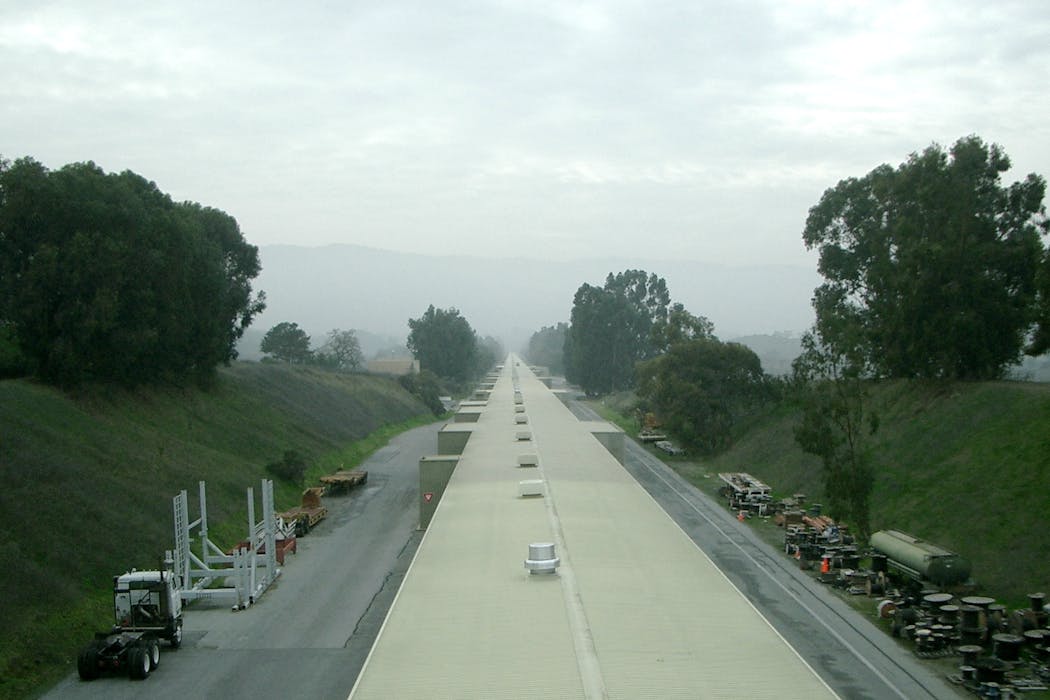
Over the past 15 years, scientists have built X-ray free-electron lasers, which instead of emitting beams of visible light emit X-rays. They are housed in large facilities where electrons travel through a long accelerator – depending on the facility, between a few hundred meters and 1,700 yards – and after passing through a series of thousands of magnets they generate extremely short and powerful X-ray pulses.
The pulses are used kind of like flash photography, where the flash – the X-ray pulse – is short enough to capture the fast movement of an object. Researchers have used them as cameras to study how atoms and molecules move and change inside materials or cells.
But while these X-ray free-electron laser pulses are very short and powerful, they’re not the shortest pulses that scientists can make with lasers. By using more advanced technology and taking advantage of the properties some materials have, researchers can create even shorter pulses: in the attosecond region.
One attosecond is one-billionth of a billionth of a second. An attosecond is to one second about what one second is to the 14 billion-year age of the universe. The fastest processes in atoms and molecules happen at the attosecond scale: For instance, it takes electrons attoseconds to move around inside a molecule.
We’re physicistswho work with X-ray free-electron lasers. We study what happens when we put different types of materials in the X-ray free-electron pulses’ path. In a new experiment we put copper and manganese samples in the path of highly focused X-ray free-electron laser pulses. We knew the interactions between these elements and the X-ray free-electron laser pulses would generate new X-ray laser pulses.
Originally, we wanted to find out how different chemical forms of the element manganese – for example, manganese-II and manganese-VII – would create small changes in the wavelengths of these newly generated X-ray laser pulses.
But along the way, we found some unexpected results that made the newly generated X-ray laser pulses act strangely. At first, we did not understand why, but when we eventually figured it out, we realized that we had discovered two unique laser phenomena, and that these effects had helped us generate X-ray laser pulses that where much shorter than we’d expected – shorter than the fastest X-ray pulses ever previously generated.
The short pulses generated by the laser at SLAC allow researchers to study molecules at the atomic scale or see how different materials interact with X-ray light.
Filamentation – irregular spurts
We found that our new X-ray laser pulses weren’t always shooting out in the forward direction, as we expected. When we increased the intensity of the X-ray free-electron laser pulses, the resulting new X-ray laser pulses spurted out irregularly, in slightly different directions.
For optical lasers, these irregular spurts – or filamentation – result from the index of refraction changing in the laser material. But we didn’t expect to see this effect for X-rays, since materials – including the manganese and copper we used – don’t refract X-rays very much.
However, the high intensity X-ray free-electron laser pulses we used generated the fluctuations at the quantum level in our materials that led to these irregular spurts.
Rabi cycling – a broad spectrum of light
Even more surprising than the filamentation effects we saw was the fact that the X-ray pulses we generated contained a variety of different wavelengths that were more spread out than what we expected to see with the materials we used.
Seventy years ago – five years before the first optical laser was built – physicists Stanley Autler and Charles Townes discovered a strange phenomenon in microwaves known as Rabi cycling. And the spread of wavelengths we saw looked just like Rabi cycling.
Autler and Townes knew that when light hit an atom, the atom would absorb its energy by exciting an electron from one energy level to a higher one. The hole left by that missing electron is filled by an electron that’s coming down from a higher energy level in the atom and releasing – or emitting – this energy difference as light.
What Autler and Townes found was that when the microwaves are very intense, the strong electric field can split each of these energy levels into two distinct levels, called doublets, which have slightly different energies.
These doublets are separated by an energy, or a frequency, known as the Rabi frequency. The Rabi frequency depends on the intensity of the new light. The stronger it is, the larger is the energy separation.
An X-ray laser shot spectrum exhibiting the three lines – called a Mollow triplet – that characterize Rabi cycling. The split energy is shown by the distance of the two smaller blobs from the stronger center blob. Uwe Bergmann and Thomas Linker
In Autler and Townes’ discovery of Rabi cycling, they used microwaves. The energy splitting was so small that the Rabi frequency was very low, at radio wave frequencies.
In this new study we used X-rays, which have 100 million times shorter wavelengths than microwaves and 100 million times more energy. This meant the resulting new X-ray laser pulses were split into different X-ray wavelengths corresponding to Rabi frequencies in the extreme ultraviolet region. Ultraviolet light has a frequency 100 million times higher than radio waves.
This Rabi cycling effect allowed us to generate the shortest high-energy X-ray pulses to date, clocking in at 60-100 attoseconds.
Future directions and applications
While the pulses that X-ray free-electron lasers currently generate allow researchers to observe atomic bonds forming, rearranging and breaking, they are not fast enough to look inside the electron cloud that generates such bonds. Using these new attosecond X-ray laser pulses could allow scientists to study the fastest processes in materials at the atomic-length scale and to discern different elements.
In the future, we also hope to use much shorter X-ray free-electron laser pulses to better generate these attosecond X-ray pulses. We are even hoping to generate pulses below 60 attoseconds by using heavier materials with shorter lifespans, such as tungsten or hafnium. These new X-ray pulses are fast enough to eventually enable scientists to answer questions such as how exactly an electron cloud moves around and what a chemical bond actually is.
Uwe Bergmann receives funding from the Department of Energy and has previously worked at SLAC and Lawrence Berkeley National Laboratory.
Thomas Linker receives funding from the Department of Energy and works at SLAC National Accelerator Laboratory.
Why do some people endorse claims that can easily be disproved? It’s one thing to believe false information, but another to actively stick with something that’s obviously wrong.
We aresocial psychologists who study political psychology and how people reason about reality. During the pandemic, we surveyed 5,535 people across eight countries to investigate why people believed COVID-19 misinformation, like false claims that 5G networks cause the virus.
The strongest predictor of whether someone believed in COVID-19-related misinformation and risks related to the vaccine was whether they viewed COVID-19 prevention efforts in terms of symbolic strength and weakness. In other words, this group focused on whether an action would make them appear to fend off or “give in” to untoward influence.
This factor outweighed how people felt about COVID-19 in general, their thinking style and even their political beliefs.
Our survey measured it on a scale of how much people agreed with sentences including “Following coronavirus prevention guidelines means you have backed down” and “Continuous coronavirus coverage in the media is a sign we are losing.” Our interpretation is that people who responded positively to these statements would feel they “win” by endorsing misinformation – doing so can show “the enemy” that it will not gain any ground over people’s views.
When meaning is symbolic, not factual
Rather than consider issues in light of actual facts, we suggest people with this mindset prioritize being independent from outside influence. It means you can justify espousing pretty much anything – the easier a statement is to disprove, the more of a power move it is to say it, as it symbolizes how far you’re willing to go.
When people think symbolically this way, the literal issue – here, fighting COVID-19 – is secondary to a psychological war over people’s minds. In the minds of those who think they’re engaged in them, psychological wars are waged over opinions and attitudes, and are won via control of belief and messaging. The U.S. government at various times has used the concept of psychological war to try to limit the influence of foreign powers, pushing people to think that literal battles are less important than psychological independence.
By that same token, vaccination, masking or other COVID-19 prevention efforts could be seen as a symbolic risk that could “weaken” one psychologically even if they provide literal physical benefits. If this seems like an extreme stance, it is – the majority of participants in our studies did not hold this mindset. But those who did were especially likely to also believe in misinformation.
In an additional study we ran that focused on attitudes around cryptocurrency, we measured whether people saw crypto investment in terms of signaling independence from traditional finance. These participants, who, like those in our COVID-19 study, prioritized a symbolic show of strength, were more likely to believe in other kinds of misinformation and conspiracies, too, such as that the government is concealing evidence of alien contact.
In all of our studies, this mindset was also strongly associated with authoritarian attitudes, including beliefs that some groups should dominate others and support for autocratic government. These links help explain why strongman leaders often use misinformation symbolically to impress and control a population.
Attempts to debunk misinformation look weak to someone who values a symbolic show of strength, while standing by a disprovable statement seems powerful. Anna Moneymaker/Getty Images
Why people endorse misinformation
Our findings highlight the limits of countering misinformation directly, because for some people, literal truth is not the point.
For example, President Donald Trump incorrectly claimed in August 2025 that crime in Washington D.C. was at an all-time high, generating countlessfact-checks of his premise and think pieces about his dissociation from reality.
But we believe that to someone with a symbolic mindset, debunkers merely demonstrate that they’re the ones reacting, and are therefore weak. The correct information is easily available, but is irrelevant to someone who prioritizes a symbolic show of strength. What matters is signaling one isn’t listening and won’t be swayed.
In fact, for symbolic thinkers, nearly any statement should be justifiable. The more outlandish or easily disproved something is, the more powerful one might seem when standing by it. Being an edgelord – a contrarian online provocateur – or outright lying can, in their own odd way, appear “authentic.”
Some people may also view their favorite dissembler’s claims as provocative trolling, but, given the link between this mindset and authoritarianism, they want those far-fetched claims acted on anyway. The deployment of National Guard troops to Washington, for example, can be the desired end goal, even if the offered justification is a transparent farce.
Is this really 5-D chess?
It is possible that symbolic, but not exactly true, beliefs have some downstream benefit, such as serving as negotiation tactics, loyalty tests, or a fake-it-till-you-make-it long game that somehow, eventually, becomes a reality. Political theorist Murray Edelman, known for his work on political symbolism, noted that politicians often prefer scoring symbolic points over delivering results – it’s easier. Leaders can offer symbolism when they have little tangible to provide.
The authors do not work for, consult, own shares in or receive funding from any company or organization that would benefit from this article, and have disclosed no relevant affiliations beyond their academic appointment.
About two-thirds of people in the UK will become grandparents during their lifetime. Half of those grandparents will provide some form of care to their grandchildren. But who makes up that half depends on a number of factors. One of these is ethnicity.
Understanding the extent to which parents from different communities in society rely on other people – such as paid-for childcare or their own parents – for the care of their children is an important question from a number of perspectives.
It tells us about the demographic composition of society. It reflects embedded cultural norms and expectations about caring for young children in the family.
Our analysis of the UK’s largest household dataset, the UK Household Longitudinal Study, showed that parents from Indian, Pakistani, Bangladeshi and African communities were less likely to use childcare provided by other people, including grandparents, than parents from white British communities. The reasons behind these differences are complex and could relate to other aspects of their lives.
To start with, employment rates among people – particularly women – from minority ethnic communities are lower on average than those of people from white British backgrounds. This could point to parents from minority ethnic communities being more likely to be available to provide care for their children, and having less need to rely on grandparents.
Nearly two-thirds of children in the white British group have a working mother, compared to 17% of children from Bangladeshi families. This means that white British mothers are more likely to depend on childcare, including from grandparents.
What’s more, the Office for National Statistics has shown that workers from Asian and Black communities were less likely than white workers to be managers, directors or senior officials. Workers from Black communities were more likely to work in caring, leisure and other service occupations.
This suggests that people from ethic minority backgrounds may have less disposable income to spend on paid childcare. They therefore may take time off work to look after children rather than looking to grandparents to fill in the gaps between periods of paid childcare.
However, these differences could also point to cultural norms within different communities. Our research shows that only Caribbean parents were more likely than white British parents to use childcare – defined as care for the child by anyone other than the parent or their partner. However, this care is less likely to be from grandparents than it is for white British and other ethnic groups.
Cultural reasons about who should care for young children could also interact with demographic and socio-economic factors to result in ethnic differences.
For example, our research also showed that 28% of white British children have no siblings, compared to 13% and 15% of Pakistani and Bangladeshi children. Having more children could lead to their mother spending more time looking after children at home, with less need to rely on grandparents.
Another explanation may relate to grandparents’ health. Research from the University of Southampton’s Centre for Research on Ageing has shown that – despite years of targeted governmental efforts – ethnic differences in health in later life remain.
Health difficulties may affect grandparents’ ability to look after their grandchildren. PeopleImages/Shutterstock
For example, Indian, Pakistani and Bangladeshi men are between two and four times more likely to report their health as limiting their typical activities than white British men. Pakistani women are 11 times more likely to report limiting health than white British women.
This means that grandparents from ethnic minority backgrounds are less likely to be in good health. They may be physically less able to look after children than grandparents from white British communities.
However, in countries such as the UK, where the average cost of paid-for childcare is relatively high, the availability of grandparental childcare could form a pivotal way to allow working-age parents to enter and stay in the labour market for longer.
It’s also worth considering that providing childcare can take a toll on grandparents. It has a benefit for wellbeing for grandmothers, but only for the first grandchild.
Grandparental childcare is an important part of the caring ecosystem for many families in the UK. Closer attention to grandparent care and how it is experienced differently in different ethnic communities can offer a more nuanced understanding of healthy ageing, family bonds and labour market participation.
Athina Vlachantoni receives funding from the Economic and Social Research Council and the Natural Environment Research Council.
Maria Evandrou receives funding from the Economic and Social Research Council.