Israel’s Rafah camp – ‘humanitarian city’ or crime against humanity?

Source: The Conversation – Global Perspectives – By Shannon Bosch, Associate Professor (Law), Edith Cowan University

Israel’s Defence Minister Israel Katz has announced a controversial plan to move up to 600,000 Palestinians in Gaza into a designated “humanitarian area” on the ruins of the southern city of Rafah.

Access to the camp would be through strict security screening to ensure entrants were not Hamas operatives. Once inside, the perimeter would be sealed off by the Israeli military. Palestinians would not be allowed to leave.

Eventually the camp would house the entire 2.1 million population of Gaza.

Camp construction would begin during the proposed 60-day ceasefire being negotiated by Israel and Hamas

‘Illegal and inhumane’

The plan is illegal, inhumane and risks worsening the humanitarian crisis in Gaza.

The forced displacement and containment of any civilian population in an occupied territory is a violation of international humanitarian law.

Done on this scale would constitute a war crime and a crime against humanity under the Rome Statute.

The UN Security Council, UN General Assembly and UN Commission on Human Rights have all condemned instances of forced transfer in armed conflicts.

So too, the International Committee of the Red Cross and the Red Crescent, which have stressed the fundamental prohibition of forced displacement of a civilian population and the need for all parties to respect this prohibition.

For their own protection?

Katz is describing the camp as a “humanitarian city”. The Israeli military says Palestinians would only be contained for their own protection.

As we have seen, civilian displacement is prohibited. But there is an exception if a case can be made either for military reasons or the protection of the population.

However, this exception only exists for as long as the conditions warrant for it to exist. Anyone subject to such an evacuation must be transferred back to their homes as soon as possible.

Imperative military reasons never justify the removal of a civilian population in order to persecute it. The Guiding Principles on Internal Displacement entrenches the duty of international actors to avoid creating the conditions that might lead to the displacement of people.

Aid dilemma

Katz has indicated international organisations would be responsible for managing aid and services inside the area.

But Israel has a history of defying even orders from the International Court of Justice to allow humanitarian aid to reach the Palestinians in Gaza.

If international humanitarian agencies were called upon to service the camp, they would face a dilemma.

They would need to decide whether to cooperate in managing aid under conditions that compromise their neutrality and ethical standards, deny basic human rights and are built on violations of international law.

Aid groups would risk being complicit in a process that sets up a transit camp for Palestinians before possibly expelling them from Gaza altogether.

This “humanitarian city” would essentially become an open-air prison. Palestinians would be reliant on international aid under strict Israeli military control.

Mass expulsion?

Could the Rafah camp be a precursor to mass expulsion from Gaza and what does international law say about that?

Katz has been quoted saying Israel aims to implement “the emigration plan, which will happen” – meaning Gazans will eventually be forced to leave for other countries.

Changing the demographic composition of a territory – ethnic cleansing – achieved through the displacement of the civilian population of a territory is strictly prohibited under international law.

The idea of displacing Palestinians has long been part of Israeli strategic thinking, but this announcement signals a dangerous escalation and intention to permanently alter Gaza’s demographic landscape through displacement and containment.

Voluntary exodus?

According to Katz, Gazans would have the option of “voluntary” emigration.

Indeed, speaking at the White House this week, Prime Minister Benjamin Netanyahu said there would be no forced exodus from Gaza:

If people want to stay, they can stay, but if they want to leave, they should be able to leave.

But the scale of the humanitarian crisis in Gaza is incomprehensible.

The population has been displaced multiple times and 90% of homes in Gaza are damaged or destroyed. The healthcare, water, sanitation and hygiene systems have collapsed.

On average 100 Palestinians are killed daily as they try to access food.

These crisis circumstances negate the voluntary nature of any person’s consent to either the transfer to the Rafah camp or ultimately, the departure from Gaza.

According to Amos Goldberg, historian of the Holocaust at the Hebrew University of Jerusalem, what the defence minister laid out was clear plans for the ethnic cleansing of Gaza:

[it is] a transit camp for Palestinians before they expel them. It is neither humanitarian nor a city.

The Conversation

Shannon Bosch does not work for, consult, own shares in or receive funding from any company or organisation that would benefit from this article, and has disclosed no relevant affiliations beyond their academic appointment.

ref. Israel’s Rafah camp – ‘humanitarian city’ or crime against humanity? – https://theconversation.com/israels-rafah-camp-humanitarian-city-or-crime-against-humanity-260809

Are ‘ghost stores’ haunting your social media feed? How to spot and avoid them

Source: The Conversation – Global Perspectives – By Gary Mortimer, Professor of Marketing and Consumer Behaviour, Queensland University of Technology

CC BY

The offer pops up in your social media feed. The website is professional and the imagery illustrates an Australian coastal region, or chic inner-CBD scene.

The brand name indicates this exclusive fashion retailer is based in Melbourne, Sydney, Adelaide, or an exclusive enclave such as Double Bay or Byron Bay.

The businesses have history, having apparently been “established” 30–40 years ago, and a story. The owners have reluctantly decided to close or relocate, resulting in significant discounts.

However, behind the illusion of prestige and luxury, is cheap, poorly manufactured clothing from Chinese factories.

The recent growth of these online “ghost stores” has led the Australian Consumer and Competition Commission to issue public warning notices about four websites.

Everly-melbourne.com, willowandgrace-adelaide.com, sophie-claire.com and doublebayboutique.com are the four named.

A new type of scam

The ACCC’s Targeting Scams report estimated Australians lost A$2.74 billion in 2023. Most losses were from investment scams ($1.3 billion), remote access scams ($256 million), and romance scams ($201.1 million).


Read more:
3.5 million Australians experienced fraud last year. This could be avoided through 6 simple steps


However, online ghost store scams are so new, researchers and government agencies have not yet had time to measure the financial impact these businesses are having on consumers or legitimate fashion businesses.

It is possible a consumer, once stung by a ghost store scam, will be less likely to shop with a legitimate online fashion retailer.

This type of emerging scam was touched on in a 2015 report called Framework for a Taxonomy of Fraud. The report noted there were businesses selling “worthless or non-existent products”. Their sites made:

misleading claims about products that are exaggerated, undervalued, or non-existent.

Since the beginning of 2025, the ACCC reports it has received at least 360 complaints about 60 online ghost retailers. It says many more may be operating across several social media sites.

Tricky tactics

Ghost stores use a variety of tactics to attract unsuspecting customers.

Price: Customers regularly assume higher prices mean higher quality. Most customers seeing a “leather” jacket for $19.74 on Temu would expect low quality. However, a silk maxi-dress from Everly Melbourne reduced from $209.95 to $82.95 – a 60% saving – seems reasonable and reflective of normal mid-season clearance pricing. That fact it’s still priced at more than $80 also implies good quality.

Cosmopolitan localism: Researchers have reported that so-called cosmopolitan localism fosters meaningful consumer relationships with brands. Consumers are more likely to trust a business based in Melbourne or Byron Bay over one based internationally.

Adding images of a physical store front creates credibility and “realness”. Customers feel confident to buy from a little business based in Melbourne, Sydney or somewhere well known to them.

Storytelling: Storytelling can influence shoppers’ emotions and affect purchasing. It helps stimulate deeper emotional connections to a brand. Ghost stores will regularly create a narrative around “going out of business” to justify price discounts and pull on heart-strings.

Layout: A professionally developed website, with high-quality images, detailed product information, online payment methods and order tracking, creates the illusion of authenticity. Researchers have found luxury brand website designs can create a strong sense of luxury. This increases a willingness to buy.

How to spot a “ghost”

When the post indicates “closing today” or “closing down sale ends tonight”, it is very easy to impulsively jump in to take advantage of the savings. However, before you click, check for these red flags:

  1. The website does not provide a contact phone number or physical address for the store. There might just be an email address or web form. Simply entering the suspected store into google maps will indicate no physical location.

  2. The website domain is “.com” rather than “.com.au”. This indicates the store is not an Australian-based business.

  3. Is the business registered? ABN Lookup is the free public view of the Australian Business Register – a quick search will identify that the Double Bay designer isn’t registered locally.

  4. Review platforms, including Trustpilot, often have negative reviews for the business, whereas the business’ website only features very positive reviews.

  5. The images of products or even the owner may be AI generated. For example, Harry – Melbourne, is apparently an artisan watchmaker. However, simply right-clicking on the image reveals Harry is an AI-generated image.

A cautionary note

Online shopping is risky. You can’t physically touch or interact with the product to determine its quality. Three types of risks are common when shopping online. These are performance risk (it doesn’t work, doesn’t fit well, or the quality is poor), financial risk (losing your money on a poor-quality product), and time-loss risk (refund processing takes weeks).

As such, customers must trust the online retailer to act honestly and describe products accurately. When trust is breached, consumers will naturally become cautious even about legitimate online retailers.

As ghost stores scams increasingly populate social media feeds, unsuspecting consumers will continue to get caught out. This will leave legitimate retailers exposed to scepticism and mistrust.

The Conversation

Gary Mortimer receives funding from the Building Employer Confidence and Inclusion in Disability Grant, AusIndustry Entrepreneurs’ Program, National Clothing Textiles Stewardship Scheme, National Retail Association and Australian Retailers Association.

ref. Are ‘ghost stores’ haunting your social media feed? How to spot and avoid them – https://theconversation.com/are-ghost-stores-haunting-your-social-media-feed-how-to-spot-and-avoid-them-260583

School smartphone bans reflect growing concern over youth mental health and academic performance

Source: The Conversation – USA (2) – By Margaret Murray, Associate Professor of Public Communication and Culture Studies, University of Michigan

New laws that ban smartphones or social media for youth are being introduced across several Western nations. SeventyFour/iStock via Getty Images

The number of states banning smartphones in schools is growing.

New York is now the largest state in the U.S. to ban smartphones in public schools. Starting in fall 2025, students will not be allowed to use their phones during the school day, including during lunch, recess or in between classes. This bell-to-bell policy will impact almost 2.5 million students in grades K-12.

By banning smartphones in schools, New York is joining states across the country. The bans are happening in both traditionally liberal and conservative states.

Alabama, Arkansas, Nebraska, North Dakota, Oklahoma and West Virginia all passed legislation in 2025 that requires schools to have policies that limit access to smartphones. The policies will go into effect in the 2025-2026 school year. This brings the total to 17 states, plus Washington, D.C., that have phone-free school legislation or executive orders.

I’m a professor who studies communication and culture, and while writing a book about parenting culture, I’ve noticed the narrative around smartphones and social media shifting over the past decade.

A turning tide

A group of students stare down at their phones in a classroom.
Statewide cellphone policies are gaining momentum, with many states aiming to restrict use of the devices in classrooms.
Thomas Barwick/Digital Vision via Getty Images

According to the Pew Research Center, 67% of American adults support banning smartphones during class time, although only 36% support banning them for the entire school day. Notably, a majority of Republican, Democratic and independent voters all support bans during class time.

More broadly, parent-led movements to limit children’s use of smartphones, social media and the internet have sprung up around the country. For example, the Phone-Free Schools Movement in Pennsylvania was launched in 2023, and Mothers Against Media Addiction started in New York in March 2024. These organizations, which empower parents to advocate in their local communities, follow in the footsteps of organizations such as Wait Until 8th in Texas and Screen Time Action Network at Fairplay in Massachusetts, which were formed in 2017.

The concerns of these parent-led organizations were reflected in the best-selling book “The Anxious Generation,” which paints a bleak picture of modern childhood as dominated by depression and anxiety brought on by smartphone addiction.

Phone-free schools are one of the four actions the book’s author, Jonathan Haidt, recommended to change course. The other three are no smartphones for children before high school, waiting until 16 for social media access, and allowing more childhood independence in the real world.

Haidt’s research team collaborated with The Harris Poll to survey Gen Z. They found that almost half of those age 18-27 wish social media had never been invented, and 21% wish smartphones had never been invented. About 40% of Gen Z respondents supported phone-free schools.

The Pew Research Center found that almost 40% of kids age 8-12 use social media, and almost 95% of kids age 13-17 use it, with nearly half of teens reporting that they use social media almost constantly.

Phone-free schools are also part of the larger trend of states and nations resisting Big Tech, the large technology companies that play a significant role in global commerce.

In May 2025, two U.S. senators introduced the Stop the Scroll Act, which would require mental health warnings on social media.

New laws that ban smartphones or social media for youth are being introduced across several Western nations. Australia has banned all social media for those under 16.

After a fatal stabbing at a middle school in eastern France on June 10, French President Emmanuel Macron announced the same day that he wants the European Union to set the minimum age for social media at 15. He argued that social media is a factor in teen violence. If the EU doesn’t act within a few months, Macron has pledged to enact a ban in France as soon as possible.

The impact on learning

Students sit at a desk in a classroom using smartphones, while a teacher in the background looks on.
Research suggests that students are less focused in class when they have access to cellphones.
isuzek/E+ via Getty Images

Although this trend of restricting use of phones in school is new, more states may adopt smartphone bans in the future. Bell-to-bell bans are viewed as especially powerful in improving academic performance.

Some research has suggested that when children have access to a smartphone, even if they do not use it, they find it harder to focus in class. Initial research has found that academic performance improves after the bans go into effect.

Test scores fell across the U.S. during the pandemic lockdown and have not returned to prepandemic levels. Some states, such as Maine and Oregon, are almost a full year behind grade level in reading. Not a single state has recovered in both math and reading.

Statewide bans free local school districts from having to create their own technology bans, which can lead to heated debates. Although a majority of adults approve of banning smartphones in class, 24% oppose it for reasons such as wanting to be able to contact their kids throughout the day and wanting parents to set the boundaries.

However, 72% of high school teachers say that phones are a major distraction. Anecdotally, schools report that students like the bans after getting used to the change.

The Conversation

I signed the Wait Until 8th pledge mentioned in the article, promising not to give my kids a smartphone or social media until at least the end of 8th grade.

ref. School smartphone bans reflect growing concern over youth mental health and academic performance – https://theconversation.com/school-smartphone-bans-reflect-growing-concern-over-youth-mental-health-and-academic-performance-259962

Israel’s relocation plan for Palestinians and fading hopes for a ceasefire

Source: The Conversation – UK – By Jonathan Este, Senior International Affairs Editor, Associate Editor

This article was first published in The Conversation UK’s World Affairs Briefing email newsletter. Sign up to receive weekly analysis of the latest developments in international relations, direct to your inbox.


It was revealing this week to read reports of Benjamin Netanyahu’s meeting with Donald Trump (his third White House visit since Trump’s inauguration in January). There was no sense that the US president upped the pressure on the Israeli prime minister to soften Israel’s conditions in order to secure a ceasefire. Instead the pair appears to have discussed the prospect of moving large numbers of Palestinians out of the Gaza Strip to countries what would, as Netanyahu put it, “give Palestinians a better future”.

If Israel’s defence minister, Israel Katz, has his way, the future for those Palestinians who want to stay put does indeed look pretty bleak. And the 57,000 people who, according to figures collated by the Hamas-run Gaza health ministry, have lost their lives since the Israeli assault on Gaza began back in October 2023, have no future at all.

But the plan for the future of Gazan Palestinians that Katz unveiled this week will horrify many too. It involves the construction of a “humanitarian city” at Rafah, close to the Egyptian border at the very southern end of the Strip. Under the plan, people entering the city will be searched for weapons and checked for affiliation to Hamas. Once in, they will not be allowed to leave, except to depart from Gaza altogether.


Sign up to receive our weekly World Affairs Briefing newsletter from The Conversation UK. Every Thursday we’ll bring you expert analysis of the big stories in international relations.


This immediately prompted critics to accuse the Israeli government of ethnic cleansing. James Sweeney, an expert in human rights and international law at the University of Lancaster, believes that, if Israel were to carry out Katz’s plan, there would be strong case against political and military leaders for war crimes and crimes against humanity. He argues that the plan amounts at the very least to the forcible transfer of civilians prohibited under the Geneva conventions and the Rome statute, which underpins the International Criminal Court (ICC).

The snag, as Sweeney sees it, is going to be enforcing international law. While there is an ICC warrant out for the arrests of Netanyahu and his former defence minister, Yoav Gallant, the Israeli prime minister was able to visit Washington without fear of being apprehended. The US doesn’t recognise the ICC and, indeed, the prosecutor that issued the warrant against Netanyahu and Gallant is now subject to US sanctions.


Read more:
Plans to relocate Gazans to a ‘humanitarian city’ look like a crime against humanity – international law expert


Of course, what happens in Gaza tends to reverberate throughout the region. If hundreds of thousands of Palestinian citizens are moved out of Gaza, it’s likely to be to one of the neighbouring countries. When the idea of a Trump Riviera was first mooted earlier this year, the US president said the Palestinian population could be rehomed in Egypt or Jordan – something both those countries pushed back against with alacrity.

And the powerful Gulf States, which Trump was keen to woo as business partners when he made a tour of the region in May, are also deeply concerned about Israel’s conduct of its military campaign in Gaza. Geopolitics aside, their populations are broadly sympathetic to the Palestinian people, so a plan to force them out of their homes is unacceptable for Gulf leaders.

Scott Lucas, an expert in Middle East politics at University College Dublin, gives us a broader view of the region. He describes what he calls two “kaleidoscope moments” when one event has changed the entire region. The first was the Hamas attack of October 7. This brought to an abrupt end the process of normalisation of relations between Israel and Saudi Arabia. The second was the 12-day war between Israel and Iran, which has further isolated Israel. Lucas believes for there to be any hope of regional stability and the furthering of Israeli relations with the rest of the region, the war in Gaza must end.


Read more:
As Netanyahu meets Trump in Washington, what hope for peace in Gaza? Expert Q&A


Ali Mamouri, a Middle East scholar at Australia’s Deakin University doesn’t believe there’s much chance of this happening any time soon. Part of this is political: Netanyahu still depends on the far-right elements of his coalition represented by national security minister Itamar Ben-Gvir and finance minister, Bezalel Smotrich. They remain steadfastly opposed to even a ceasefire and want to see Israel expel Palestinians by hook or by crook.

Also, by prolonging the war, Netanyahu can keep delaying his corruption trial (incidentally, Donald Trump has called for the charges to be dropped altogether).

And the idea of full statehood for Palestine remains anathema for Israel, as Netanyahu made clear this week talking with journalists after his meeting with Trump when he made clear his insistence that far from pulling Israeli troops out of Gaza, Israel would keep full control of all security matters there: “Now, people will say: ‘It’s not a complete state, it’s not a state.’ We don’t care,” he said.

Mansour concludes: “The coming weeks will reveal whether Israel chooses the path of compromise and coexistence, or continues down a road that forecloses the possibility of lasting peace.”


Read more:
The US has high hopes for a new Gaza ceasefire, but Israel’s long-term aims seem far less peaceful


Europe must step up over Ukraine

Just as the picture remains bleak in Gaza, the prospects for peace remain very slim in Ukraine. Although given Donald Trump’s mercurial approach to foreign affairs, it’s also fair to say that anything is possible.

This week the US president decided to recommence US arms supplies to Ukraine, having previously frozen military aid (although he insists this was done by his defense secretary, Pete Hegseth, and that he was “blindsided” by the move). His relationship with Putin appears to have soured – for the present at least. He said: “We get a lot of bullshit thrown at us by Putin, if you want to know the truth. He’s very nice all of the time, but it turns out to be meaningless.”

And at the most recent Nato summit in The Hague on June 25, Trump put his signature to a declaration that Russia poses “long-term threat … to Euro-Atlantic security” and that Nato member states retain “their enduring sovereign commitments to provide support to Ukraine”.

But Stefan Wolff, an expert in international security at the University of Birmingham, believes that Nato’s European members cannot bank on the US as a reliable long-term partner. There are few signs that the US is pressuring Russia to compromise on its maximalist aims, which remain unchanged since it invaded Ukraine in February 2022. So Russia remains the most urgent threat to European security. And it’s a threat that Europe will need to prepare to confront, if necessary without US assistance.

But there are signs that many European countries are preparing to do just that, Wolff writes. Increased commitments to defence spending are a strong start. As he concludes: “They will not turn Europe into a military heavyweight overnight. But they will buy time to do so.”


Read more:
US backs Nato’s latest pledge of support for Ukraine, but in reality seems to have abandoned its European partners


Understandably, much of the reporting of the war in Ukraine has focused on the human tragedy unfolding in the war-torn country: the enormous casualty list on both sides, civilians killed or forced from their homes in the fighting, and the Ukrainian citizens forced to live under Russian occupation.

But a new film, which premiered recently at the Tribeca film festival, looks at War Through the Eyes of Animals. Janine Natalya Clark, an expert in transitional justice at the University of Birmingham, has done similar. Clark interviewed a number of Ukrainian natural scientists including botanists, ornithologists, herpetologists (who study reptiles and amphibians) and a marine biologist. She asked them to make sound recordings in their area to reflect on how the war is affecting Ukraine’s flora and fauna.

What emerged was extraordinary and reflects how the conflict has affected the natural world in both positive and negative ways. Clark believes that this information will be invaluable when it comes to rebuilding Ukraine and in securing justice and reparations for the damage done – not just to humans, but to Ukraine’s animals and the habitats in which they live.


Read more:
Sound recordings can give us an animal-eye view of the war in Ukraine


In Russia, meanwhile, a controversial measure introduced by the Putin government is dividing public opinion. In some parts of the country, schoolgirls who become pregnant are being paid more than 100,000 roubles (nearly £900) for giving birth and raising their babies.

Jannifer Mathers, a Russia expert at Aberystwyth University, looks at the rise of pronatalism in the face of declining populations and finds it’s not just an issue in Russia, but for many other countries as well, including the US.


Read more:
Russia is paying schoolgirls to have babies. Why is pronatalism on the rise around the world?


World Affairs Briefing from The Conversation UK is available as a weekly email newsletter. Click here to get updates directly in your inbox.


The Conversation

ref. Israel’s relocation plan for Palestinians and fading hopes for a ceasefire – https://theconversation.com/israels-relocation-plan-for-palestinians-and-fading-hopes-for-a-ceasefire-260933

Why Texas Hill Country, where a devastating flood killed more than 120 people, is one of the deadliest places in the US for flash flooding

Source: The Conversation – USA (2) – By Hatim Sharif, Professor of Civil and Environmental Engineering, The University of Texas at San Antonio

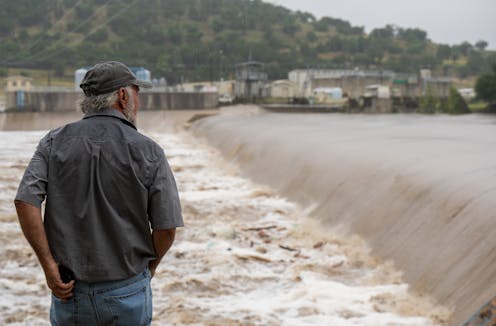
A Kerrville, Texas, resident watches the flooded Guadalupe River on July 4, 2025. Eric Vryn/Getty Images

Texas Hill Country is known for its landscapes, where shallow rivers wind among hills and through rugged valleys. That geography also makes it one of the deadliest places in the U.S. for flash flooding.

In the early hours of July 4, 2025, a flash flood swept through an area of Hill Country dotted with summer camps and small towns about 70 miles northwest of San Antonio. More than 120 people died in the flooding. The majority of them were in Kerr County, including more than two dozen girls and counselors at one summer camp, Camp Mystic. Dozens of people were still unaccounted for a week later.

The flooding began with a heavy downpour, with more than 10 inches of rain in some areas, that sent water sheeting off the hillsides and into creeks. The creeks poured into the Guadalupe River.

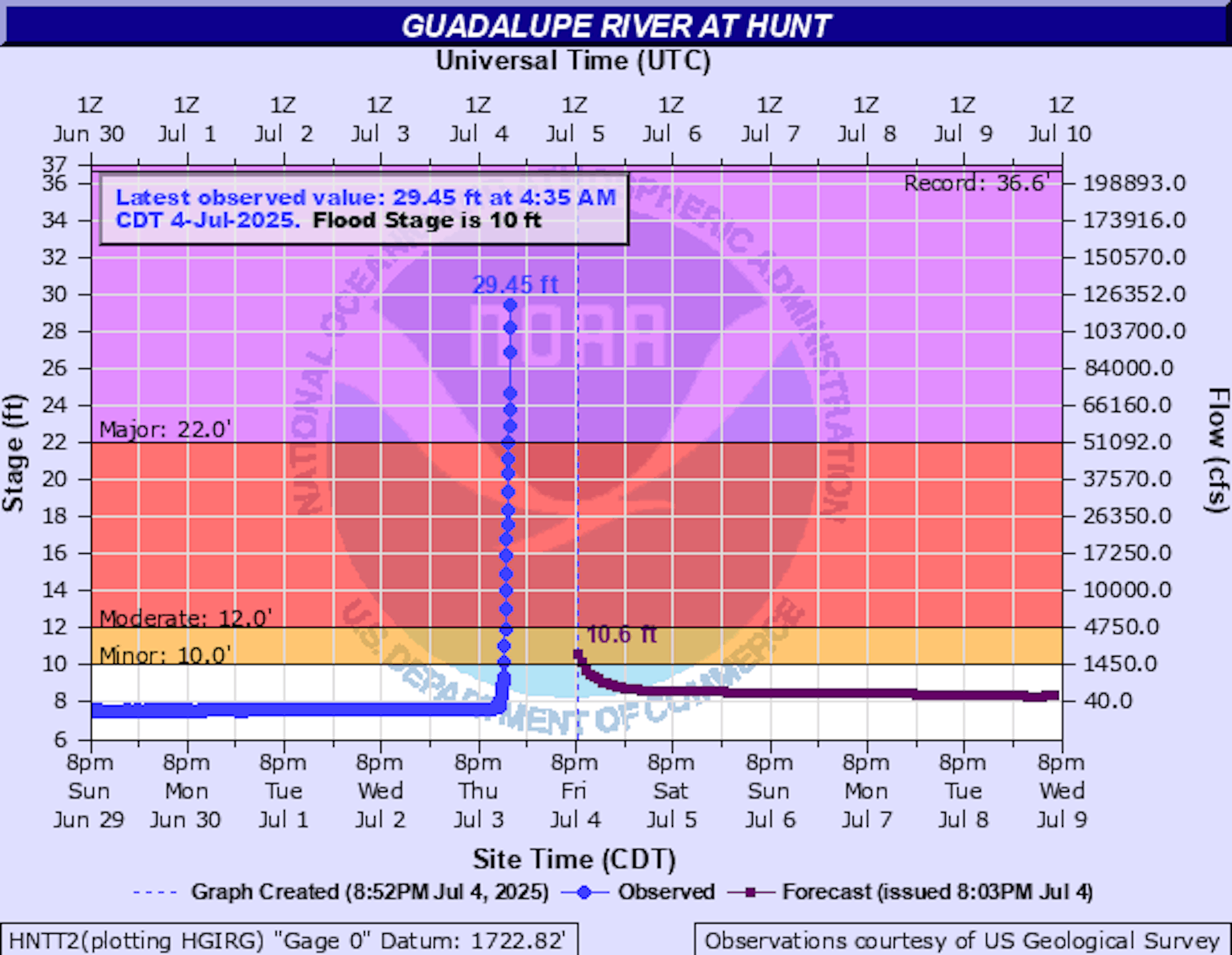
A river gauge at Hunt, Texas, near Camp Mystic, showed how quickly the river flooded: Around 3 a.m. on July 4, the Guadalupe River was rising about 1 foot every 5 minutes at the gauge, National Weather Service data shows. By 4:30 a.m., it had risen more than 20 feet. As the water moved downstream, it reached Kerrville, where the river rose even faster.

Flood expert Hatim Sharif, a hydrologist and civil engineer at the University of Texas at San Antonio, explains what makes this part of the country, known as Flash Flood Alley, so dangerous.

What makes Hill Country so prone to flooding?

Texas as a whole leads the nation in flood deaths, and by a wide margin. A colleague and I analyzed data from 1959 to 2019 and found 1,069 people had died in flooding in Texas over those six decades. The next highest total was in Louisiana, with 693.

Many of those flood deaths have been in Hill County. It’s part of an area known as Flash Flood Alley, a crescent of land that curves from near Dallas down to San Antonio and then westward.

The hills are steep, and the water moves quickly when it floods. This is a semi-arid area with soils that don’t soak up much water, so the water sheets off quickly and the shallow creeks can rise fast.

When those creeks converge on a river, they can create a surge of water that wipes out homes and washes away cars and, unfortunately, anyone in its path.

Hill Country has seen some devastating flash floods. In 1987, heavy rain in western Kerr County quickly flooded the Guadalupe River, triggering a flash flood similar to the one in 2025. Ten teenagers being evacuated from a camp died in the rushing water.

San Antonio, at the eastern edge of Hill Country, was hit with a flash flood on June 12, 2025, that killed 13 people whose cars were swept away by high water from a fast-flooding creek near an interstate ramp in the early morning.

Why does the region get such strong downpours?

One reason Hill Country gets powerful downpours is the Balcones Escarpment.

The escarpment is a line of cliffs and steep hills created by a geologic fault. When warm air from the Gulf rushes up the escarpment, it condenses and can dump a lot of moisture. That water flows down the hills quickly, from many different directions, filling streams and rivers below.

As temperature rise, the warmer atmosphere can hold more moisture, increasing the downpour and flood risk.

A tour of the Guadalupe River and its flood risk.

The same effect can contribute to flash flooding in San Antonio, where the large amount of paved land and lack of updated drainage to control runoff adds to the risk.

What can be done to improve flash flood safety?

First, it’s important for people to understand why flash flooding happens and just how fast the water can rise and flow. In many arid areas, dry or shallow creeks can quickly fill up with fast-moving water and become deadly. So people should be aware of the risks and pay attention to the weather.

Improving flood forecasting, with more detailed models of the physics and water velocity at different locations, can also help.

Probabilistic forecasting, for example, can provide a range of rainfall scenarios, enabling authorities to prepare for worst-case scenarios. A scientific framework linking rainfall forecasts to the local impacts, such as streamflow, flood depth and water velocity, could also help decision-makers implement timely evacuations or road closures.

Education is particularly essential for drivers. One to two feet of moving water can wash away a car. People may think their trucks and SUVs can go through anything, but fast-moving water can flip a truck and carry it away.

Officials can also do more to barricade roads when the flood risk is high to prevent people from driving into harm’s way. We found that 58% of the flood deaths in Texas over the past six decades involved vehicles. The storm on June 12 in San Antonio was an example. It was early morning, and drivers had poor visibility. The cars were hit by fast-rising floodwater from an adjacent creek.

This article, originally published July 5, 2025, has been updated with the death toll rising.

The Conversation

Hatim Sharif does not work for, consult, own shares in or receive funding from any company or organization that would benefit from this article, and has disclosed no relevant affiliations beyond their academic appointment.

ref. Why Texas Hill Country, where a devastating flood killed more than 120 people, is one of the deadliest places in the US for flash flooding – https://theconversation.com/why-texas-hill-country-where-a-devastating-flood-killed-more-than-120-people-is-one-of-the-deadliest-places-in-the-us-for-flash-flooding-260555

What is the ‘Seven Mountain Mandate’ and how is it linked to political extremism in the US?

Source: The Conversation – USA (3) – By Art Jipson, Associate Professor of Sociology, University of Dayton

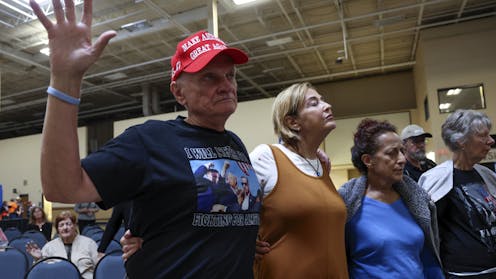
People pray before Republican vice presidential nominee J.D. Vance at a town hall hosted by Lance Wallnau on Sept. 28, 2024, in Monroeville, Pa. AP Photo/Rebecca Droke

Vance Boelter, who allegedly shot Melissa Hortman, a Democratic Minnesota state representative, and her husband, Mark Hortman, on June 14, 2025, studied at Christ for the Nations Institute in Dallas. The group is a Bible school linked to the New Apostolic Reformation, or NAR.

The NAR is a loosely organized but influential charismatic Christian movement that shares similarities with Pentecostalism, especially in its belief that God actively communicates with believers through the Holy Spirit. Unlike traditional Pentecostalism, however, the organization emphasizes modern-day apostles and prophets as authoritative leaders tasked with transforming society and ushering in God’s kingdom on Earth. Prayer, prophecy and worship are defined not only as acts of devotion but as strategic tools for advancing believers’ vision of government and society.

After the shooting, the Christ for the Nations Institute issued a statement “unequivocally” denouncing “any and all forms of violence and extremism.” It stated: “Our organization’s mission is to educate and equip students to spread the Gospel of Jesus Christ through compassion, love, prayer, service, worship, and value for human life.”

But the shooting has drawn attention to the school and the larger Christian movement it belongs to. One of the most important aspects of NAR teachings today is what is called “the Seven Mountain Mandate.”

The Seven Mountain Mandate calls on Christians to gain influence, or “take dominion,” over seven key areas of culture: religion, family, education, government, media, business and the arts.

With over three decades of experience studying extremism, I offer a brief overview of the history and core beliefs of the Seven Mountain Mandate.

‘Dominion of Christians’

The Seven Mountain concept was originally proposed in 1975 by evangelical leader Bill Bright, the founder of Campus Crusade for Christ. Now known as “Cru,” the Campus Crusade for Christ was founded as a global ministry in 1951 to promote Christian evangelism, especially on college campuses.

United by a shared vision to influence society through Christian values, Bright partnered with Loren Cunningham, the founder of Youth With A Mission, a major international missionary training and outreach organization, in the 1970s.

The Seven Mountain Mandate was popularized by theologian Francis Schaeffer, who linked it to a larger critique of secularism and liberal culture. Over time, it evolved.

C. Peter Wagner, a former seminary professor who helped organize and name the New Apostolic Reformation, is often regarded as the theological architect of the group. He developed it into a call for dominion. In his 2008 book “Dominion! How Kingdom Action Can Change the World,” he urged Christians to take authoritative control of cultural institutions.

For Wagner, “dominion theology” – the idea that Christians should have control over all aspects of society – was a call to spiritual warfare, so that God’s kingdom would be “manifested here on earth as it is in heaven.”

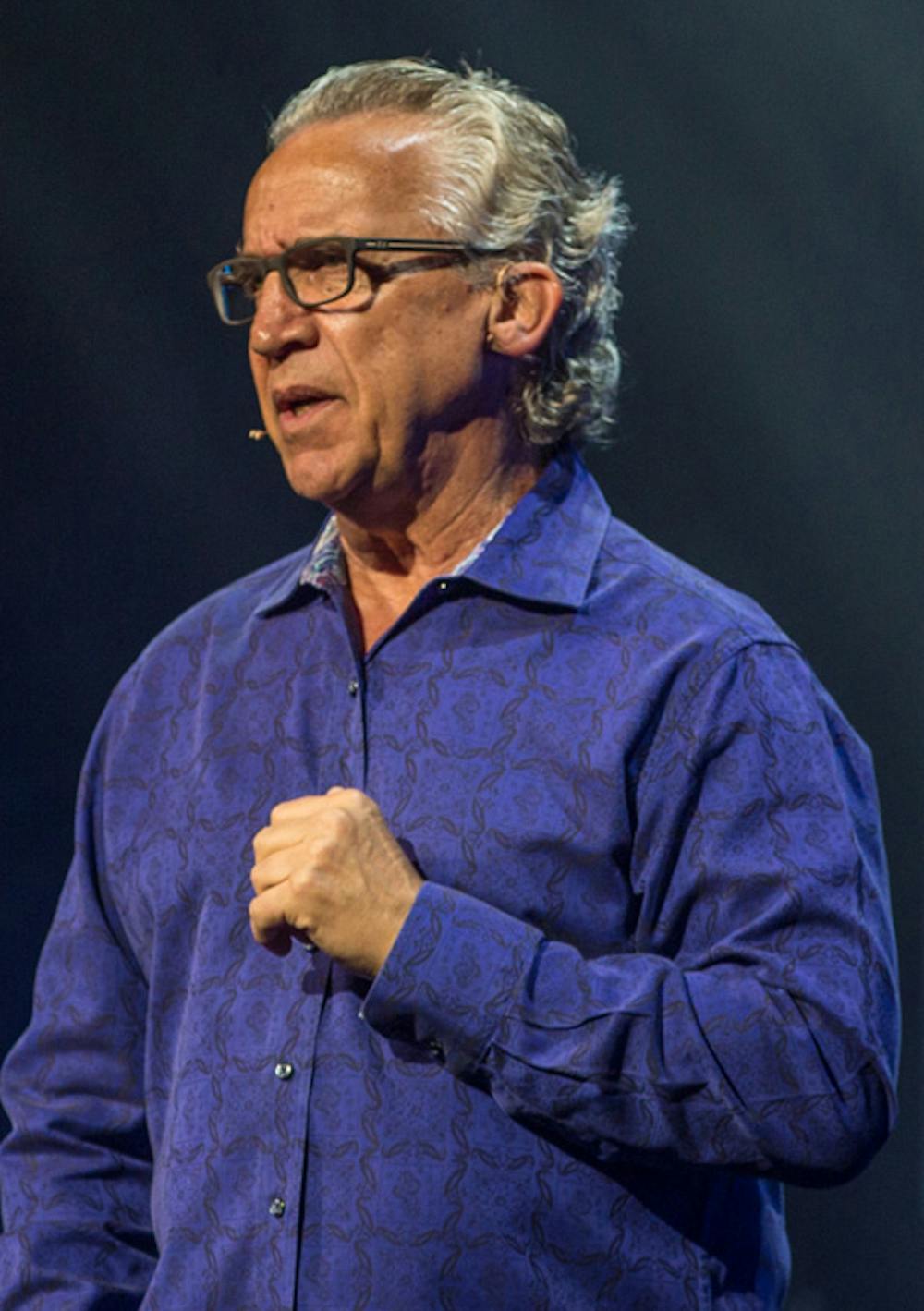
A gray-haired man wearing glasses and a blue shirt.
Bill Johnson.
Doctorg via Wikimedia Commons

Since 1996, Bill Johnson, a senior leader of Bethel Church, and Johnny Enlow, a self-described prophet and Seven Mountain advocate, among others, have taken the original idea of the Seven Mountain Mandate and reshaped it into a more aggressive, political and spiritually militant approach. Spiritual militancy reflects an aggressive, us-vs.-them mindset that blurs the line between faith and authoritarianism, promoting dominion over society in the name of spiritual warfare.

Their version doesn’t just aim to influence culture; it frames the effort as a spiritual battle to reclaim and reshape the nation according to their vision of God’s will.

Lance Wallnau, another Christian evangelical preacher, televangelist, speaker and author, has promoted dominion theology since the early 2000s. During the 2020 U.S. presidential election, Wallnau, along with several prominent NAR figures, described Donald Trump as anointed by God to reclaim the “mountain” of government from demonic control.

In their book “Invading Babylon: The 7 Mountain Mandate,” Wallnau and Johnson explicitly call for Christian leadership as the only antidote to perceived moral decay and spiritual darkness.

The beliefs

Sometimes referred to as Seven Mountains of Influence or Seven Mountains of Culture, the seven mountains are not neutral domains but seen as battlegrounds between divine truth and demonic deception.

Adherents believe that Christians are called to reclaim these areas through influence, leadership and even, if necessary, the use of force and to confront demonic political forces, as religion scholar Matthew Taylor demonstrates in his book “The Violent Take It By Force.”

Diverse perspectives and interpretations surround the rhetoric and actions associated with the New Apostolic Reformation. Some analysts have pointed out how the NAR is training its followers for an active confrontation. Other commentators have said that the rhetoric calling for physical violence is anti-biblical and should be denounced.

NAR-aligned leaders have framed electoral contests as struggles between “godly” candidates and those under the sway of “satanic” influence.

Similarly, NAR prophet Cindy Jacobs has repeatedly emphasized the need for “spiritual warfare” in schools to combat what she characterizes as “demonic ideologies” such as sex education, LGBTQ+ inclusion or discussions of systemic racism.

In the NAR worldview, cultural change is not merely political or social but considered a supernatural mission; opponents are not simply wrong but possibly under the sway of demonic influence. Elections become spiritual battles.

This belief system views pluralism as weakness, compromise as betrayal, and coexistence as capitulation. Frederick Clarkson, a senior research analyst at Political Research Associates, a progressive think tank based in Somerville, Massachusetts, defines the Seven Mountain Mandate as “the theocratic idea that Christians are called by God to exercise dominion over every aspect of society by taking control of political and cultural institutions.”

The call to “take back” the culture is not metaphorical but literal, and believers are encouraged to see themselves as soldiers in a holy war to dominate society. Some critics argue that NAR’s call to “take back” culture is about literal domination, but this interpretation is contested.

Many within the movement see the language of warfare as spiritually focused on prayer, evangelism and influencing hearts and minds. Still, the line between metaphor and mandate can blur, especially when rhetoric about “dominion” intersects with political and cultural action. That tension is part of an ongoing debate both within and outside the movement.

Networks that spread the beliefs

This belief system is no longer confined to the margins. It is spread widely through evangelical churches, podcasts, YouTube videos and political networks.

It’s hard to know exactly how many churches are part of the New Apostolic Reformation, but estimates suggest that about 3 million people in the U.S. attend churches that openly follow NAR leaders.

At the same time, the Seven Mountain Mandate doesn’t depend on centralized leadership or formal institutions. It spreads organically through social networks, social media – notably podcasts and livestreams – and revivalist meetings and workshops.

André Gagné, a theologian and author of “American Evangelicals for Trump: Dominion, Spiritual Warfare, and the End Times,” writes about the ways in which the mandate spreads by empowering local leaders and believers. Individuals are authorized – often through teachings on spiritual warfare, prophetic gifting, and apostolic leadership – to see themselves as agents of divine transformation in society, called to reclaim the “mountains,” such as government, media and education, for God’s kingdom.

This approach, Gagné explains, allows different communities to adapt the action mandate to their unique cultural, political and social contexts. It encourages individuals to see themselves as spiritual warriors and leaders in their domains – whether in business, education, government, media or the arts.

Small groups or even individuals can start movements or initiatives without waiting for top-down directives. The only recognized authorities are the apostles and prophets running the church or church network the believers attend.

The framing of the Seven Mountain Mandate as a divinely inspired mission, combined with the movement’s emphasis on direct spiritual experiences and a specific interpretation of scripture, can create an environment where questioning the mandate is perceived as challenging God’s authority.

Slippery slope

These beliefs have increasingly fused with nationalist rhetoric and conspiracy theories.

A white flag bearing the words 'An Appeal to Heaven,' featuring a green pine tree, with the American flag displayed beneath it.
The ‘Appeal to Heaven’ flags symbolize the belief that people have the right to appeal directly to God’s authority when they think the government has failed.
Paul Becker/Becker1999 via Flickr, CC BY

A powerful example of NAR political rhetoric in action is the rise and influence of the “Appeal to Heaven” flags. For those in the New Apostolic Reformation, these flags symbolize the belief that when all earthly authority fails, people have the right to appeal directly to God’s authority to justify resistance.

This was evident during the Jan. 6, 2021, Capitol insurrection, when these flags were prominently displayed.

To be clear, its leaders are not calling for violence but rather for direct political engagement and protest. For some believers, however, the calls for “spiritual warfare” may become a slippery slope into justification for violence, as in the case of the alleged Minnesota shooter.

Understanding the Seven Mountain Mandate is essential for grasping the dynamics of contemporary efforts to align government and culture with a particular vision of Christian authority and influence.

The Conversation

Art Jipson does not work for, consult, own shares in or receive funding from any company or organization that would benefit from this article, and has disclosed no relevant affiliations beyond their academic appointment.

ref. What is the ‘Seven Mountain Mandate’ and how is it linked to political extremism in the US? – https://theconversation.com/what-is-the-seven-mountain-mandate-and-how-is-it-linked-to-political-extremism-in-the-us-260034

This tropical plant builds isolated ‘apartments’ to prevent battles among the aggressive ant tenants it relies on for survival

Source: The Conversation – USA – By Guillaume Chomicki, Professor of Evolutionary Biology, Durham University

When aggressive ant species come in contact, deadly conflicts ensue G. Chomicki

In the middle of the South Pacific, a group of Fijian plants have solved a problem that has long puzzled scientists: How can an organism cooperate with multiple partners that are in turn competing for the same resources? The solution turns out to be simple – compartmentalization.

Imagine an apartment building where unfriendly neighbors might clash if they run into each other, but smart design keeps everyone peacefully separated. In our new research published in the journal Science, we show how certain plants build specialized structures that allow multiple aggressive ant species to live side by side inside them without ever meeting.

Ants and plants cooperate in Fijian rainforest

Squamellaria plants are epiphytes – meaning they don’t have roots attached to the ground, and instead grow on another plant for physical support. They live high up in the rainforest canopy, in the South Pacific.

Because they don’t have direct access to the soil’s nutrients, Squamellaria plants have evolved an original strategy to acquire what they need: In a mutually beneficial relationship, they grow structures that appeal to ants looking for a place to live. This kind of long-term relationship between species – whether helpful or harmful – is called symbiosis.

Here’s how it works in this case. The base of the Squamellaria plant stem forms a swollen, hollow structure called a domatium – a perfect place for ants to live. Domatia gradually enlarge to the size of a soccer ball, containing ever more plant-made houses ready for ants to move into. Each apartment can house a colony made up of thousands of ants.

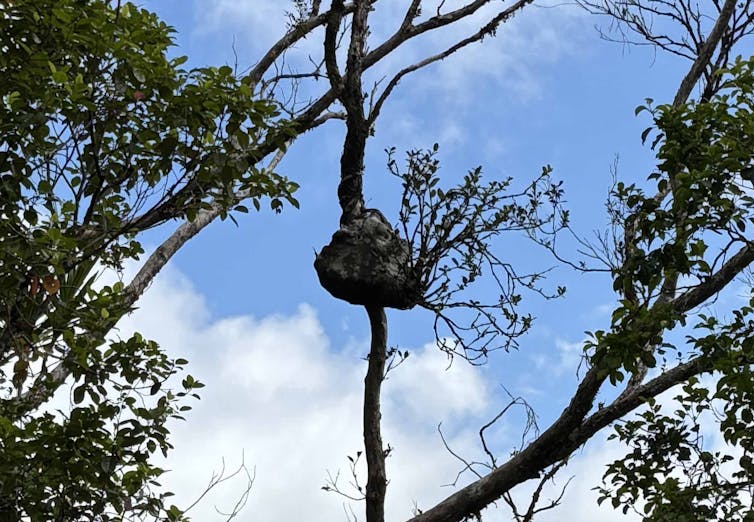
A bulbous plant attached to a branch in a canopy
A multicompartment Squamellaria (S. tenuiflora) in its natural habitat: rainforests in Fiji. This large plant likely contains a dozen or more compartments.
G. Chomicki

The relationship between the ants and the plants is mutualistic, meaning both parties benefit. The ants gain a nice sturdy and private nest space, while the plants gain essential nutrients. They obtain nitrogen and phosphorus from the ants’ feces and from detritus – including dead insects, plant bits and soil – that the ants bring inside the domatium.

However, tropical rainforest canopies are battlegrounds for survival. Ants compete fiercely for nesting space, taking over any hollow branch or space under tree bark. Any Squamellaria ant house would thus be at risk of being colonized and taken over by other incoming ants, disrupting the existing partnership.

Until now, it was unclear how the cooperative relationships between ants and plants remain stable in this competitive environment.

Walls keep the peace

Our first hint about what keeps the peace in the Squamellaria real estate came when we discovered several ant species living in the same plant domatium. This finding just didn’t make sense. How could aggressively competing ant species live together?

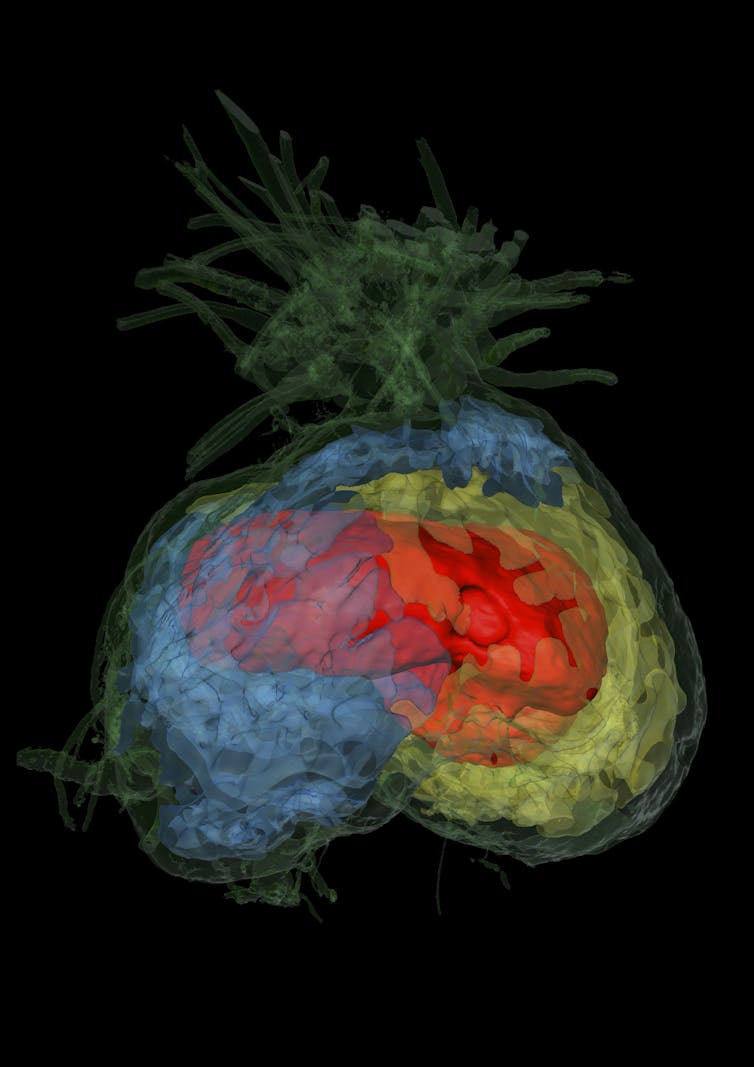
We investigated the structure of domatia using computed-tomography scanning, which revealed an interesting internal architecture. Each plant domatium is divided into distinct compartments, with thick walls isolating each unit. Independent entrances prevent direct contact between the inhabitants of different units. The walls safeguard the peace as they prevent encounters between different ant species.

A close-up view of the domatium, showing three overlapping regions in different colors
A 3D model of a Squamellaria tenuiflora domatiium based on CT-scanning data reveals its compartmentalization. Each color-coded cavity is a distinct ‘ant apartment,’ isolated of the others, but connected to the outside.
S. Renner & G. Chomicki

Back in the lab, when we removed the ant apartments’ walls, placing inhabitants in contact with their neighbors, deadly fights broke out between ant species. The compartmentalized architecture is thus critical in preventing symbiont “wars” and maintaining the stability of the plant’s partnership with all the ants that call it home. By minimizing deadly conflicts that could harm the ants it hosts, this strategy ensures that the plant retains access to sufficient nutrients provided by the ants.

This research reveals a new mechanism that solves a long-standing riddle – the stability of symbioses involving multiple unrelated partners. Scientists hadn’t previously discovered aggressive animal symbionts living together inside a single plant host. Our study reveals for the first time how simple compartmentalization is a highly effective way to reduce conflict, even in the most extreme cases. The ant colonies are living side by side, but not really together.

What’s next

The key to conflict-free living of multipartner symbioses discovered in these Fijian plants – compartmentalization – is likely important in other multispecies partnerships. However, it remains unknown whether compartmentalization is widespread in nature. Research on cooperation between species has long focused on pairwise interactions. Our new insights suggest a need to reinvestigate other multispecies mutualistic symbioses to see how they maintain stability.

The Conversation

Guillaume Chomicki receives funding from UKRI.

Susanne S. Renner received previous funding from the German Research Foundation (DFG)

ref. This tropical plant builds isolated ‘apartments’ to prevent battles among the aggressive ant tenants it relies on for survival – https://theconversation.com/this-tropical-plant-builds-isolated-apartments-to-prevent-battles-among-the-aggressive-ant-tenants-it-relies-on-for-survival-260674

Justice Department efforts to strip citizenship from naturalized Americans likely violate constitutional rights

Source: The Conversation – USA – By Cassandra Burke Robertson, Professor of Law and Director of the Center for Professional Ethics, Case Western Reserve University

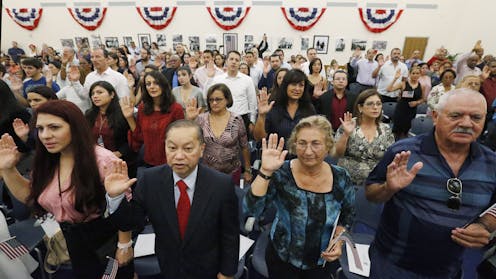
New American citizens recite the Oath of Allegiance during a naturalization ceremony in Miami on Aug. 17, 2018. AP Photo/Wilfredo Lee

The Trump administration wants to take away citizenship from naturalized Americans on a massive scale.

While a recent Justice Department memo prioritizes national security cases, it directs the department to “maximally pursue denaturalization proceedings in all cases permitted by law and supported by the evidence” across 10 broad priority categories.

Denaturalization is different from deportation, which removes noncitizens from the country. With civil denaturalization, the government files a lawsuit to strip people’s U.S. citizenship after they have become citizens, turning them back into noncitizens who can then be deported.

The government can only do this in specific situations. It must prove someone “illegally procured” citizenship by not meeting the requirements, or that they lied or hid important facts during the citizenship process.

The Trump administration’s “maximal enforcement” approach means pursuing any case where evidence might support taking away citizenship, regardless of priority level or strength of evidence. As our earlier research documented, this has already led to cases like that of Baljinder Singh, whose citizenship was revoked based on a name discrepancy that could easily have resulted from a translator’s error rather than intentional fraud.

A brief history

For most of American history, taking away citizenship has been rare. But it increased dramatically during the 1940s and 1950s during the Red Scare period characterized by intense suspicion of communism. The United States government targeted people it thought were communists or Nazi supporters. Between 1907 and 1967, over 22,000 Americans lost their citizenship this way.

Everything changed in 1967 when the Supreme Court decided Afroyim v. Rusk. The court said the government usually cannot take away citizenship without the person’s consent. It left open only cases involving fraud during the citizenship process.

After this decision, denaturalization became extremely rare. From 1968 to 2013, fewer than 150 people lost their citizenship, mostly war criminals who had hidden their past.

A man dressed in a suit and tie speaks and points his right index finger.
Sen. Joseph McCarthy appears at a March 1950 hearing on his charges of communist infiltration at the State Department.
AP Photo/Herbert K. White

How the process works

In criminal lawsuits, defendants get free lawyers if they can’t afford one. They get jury trials. The government must prove guilt “beyond a reasonable doubt” – the highest standard of proof.

But in most denaturalization cases, the government files a civil suit, where none of these protections exist.

People facing denaturalization get no free lawyer, meaning poor defendants often face the government alone. There’s no jury trial – just a judge deciding whether someone deserves to remain American. The burden of proof is lower – “clear and convincing evidence” instead of “beyond a reasonable doubt.” Most important, there’s no time limit, so the government can go back decades to build cases.

As law professors who study citizenship, we believe this system violates basic constitutional rights.

The Supreme Court has called citizenship a fundamental right. Chief Justice Earl Warren in 1958 described it as the “right to have rights.”

In our reading of the law, taking away such a fundamental right through civil procedures that lack basic constitutional protection – no right to counsel for those who can’t afford it, no jury trial, and a lower burden of proof – seems to violate the due process of law required by the Constitution when the government seeks to deprive someone of their rights.

The bigger problem is what citizenship-stripping policy does to democracy.

When the government can strip citizenship from naturalized Americans for decades-old conduct through civil procedures with minimal due process protection – pursuing cases based on evidence that might not meet criminal standards – it undermines the security and permanence that citizenship is supposed to provide. This creates a system where naturalized citizens face ongoing vulnerability that can last their entire lives, potentially chilling their full participation in American democracy.

The Justice Department memo establishes 10 priority categories for denaturalization cases. They range from national security threats and war crimes to various forms of fraud, financial crimes and, most importantly, any other cases it deems “sufficiently important to pursue.” This “maximal enforcement” approach means pursuing not just clear cases of fraud, but also any case where evidence might support taking away citizenship, no matter how weak or old the evidence is.

This creates fear throughout immigrant communities.

About 20 million naturalized Americans now must worry that any mistake in their decades-old immigration paperwork could cost them their citizenship.

A two-tier system

This policy effectively creates two different types of American citizens. Native-born Americans never have to worry about losing their citizenship, no matter what they do. But naturalized Americans face ongoing vulnerability that can last their entire lives.

This has already happened. A woman who became a naturalized citizen in 2007 helped her boss with paperwork that was later used in fraud. She cooperated with the FBI investigation, was characterized by prosecutors as only a “minimal participant,” completed her sentence, and still faced losing her citizenship decades later because she didn’t report the crime on her citizenship application – even though she hadn’t been charged at the time.

A woman accepts a small American flag handed to her from a man across a counter.
A woman receives a U.S. flag after passing her citizenship interview in Newark, N.J., on May 25, 2016.
AP Photo/Julio Cortez

The Justice Department’s directive to “maximally pursue” cases across 10 broad categories – combined with the first Trump administration’s efforts to review over 700,000 naturalization files – represents an unprecedented expansion of denaturalization efforts.

The policy will almost certainly face legal challenges on constitutional grounds, but the damage may already be done. When naturalized citizens fear their status could be revoked, it undermines the security and permanence that citizenship is supposed to provide.

The Supreme Court, in Afroyim v. Rusk, was focused on protecting existing citizens from losing their citizenship. The constitutional principle behind that decision – that citizenship is a fundamental right which can’t be arbitrarily taken away by whoever happens to be in power – applies equally to how the government handles denaturalization cases today.

The Trump administration’s directive, combined with court procedures that lack basic constitutional protections, risks creating a system that the Afroyim v. Rusk decision sought to prevent – one where, as the Supreme Court said, “A group of citizens temporarily in office can deprive another group of citizens of their citizenship.”

The Conversation

The authors do not work for, consult, own shares in or receive funding from any company or organization that would benefit from this article, and have disclosed no relevant affiliations beyond their academic appointment.

ref. Justice Department efforts to strip citizenship from naturalized Americans likely violate constitutional rights – https://theconversation.com/justice-department-efforts-to-strip-citizenship-from-naturalized-americans-likely-violate-constitutional-rights-260353

Protección solar: nueve dudas frecuentes resueltas por una experta

Source: The Conversation – (in Spanish) – By Azahara Rodríguez Luna, Profesora de Farmacología e Investigadora en Fotobiología, Universidad Loyola Andalucía

verona studio/Shutterstock, CC BY

La piel es nuestro escudo natural. Nos protege de agentes externos, regula la temperatura corporal y participa en la producción de vitamina D. A pesar de ello, su cuidado –especialmente frente a la exposición solar– sigue rodeado de mitos, dudas y confusión. ¿Hay que ponerse protector todos los días? ¿Incluso con nubes o en interiores? ¿Bloquea la síntesis de vitamina D? ¿Y qué ocurre si tomo medicamentos? Veamos qué dice la ciencia al respecto.

1. ¿Debemos usar fotoprotección todos los días?

Sí, ¡aunque no vayamos a la playa o a la piscina! La radiación solar está presente durante todo el año, incluso en invierno o cuando el cielo está nublado. No solo importa el sol que vemos, sino también el que no vemos.

La clave está en el índice ultravioleta (UVI), que mide la intensidad de la radiación solar. Si el UVI es 3 o superior, ya se recomienda usar fotoprotección, especialmente en las zonas expuestas. En muchas ciudades de España, por ejemplo, el UVI supera ese valor durante varias horas al día, también en primavera o en días nublados.

La exposición solar acumulativa sin protección acelera el envejecimiento cutáneo, favorece la aparición de manchas y eleva el riesgo de cáncer de piel. Aplicar fotoprotector a diario en las zonas expuestas (rostro, cuello, dorso de las manos) es una medida sencilla, eficaz y avalada por la ciencia para prevenir esos daños.

2. ¿Cada cuánto y qué cantidad de protector solar hay que ponerse?

Según los estudios que evalúan la eficacia del protector solar, para que un producto con factor de protección solar (FPS) 50 funcione como promete, deberíamos aplicar 2 miligramos por cada cm² de piel. Traducido a algo más práctico: eso supone unos 30-35 mililitros (mL) por aplicación en un adulto, lo que significa que un bote de 250 mL apenas duraría 2 o 3 días si lo usáramos de forma estricta.

Pero seamos realistas: en el día a día casi nadie se pone tanta cantidad ni con esa frecuencia, lo que reduce considerablemente la protección. Por esto, es muy importante reaplicar el fotoprotector cada 2 horas, hacerlo al sudar o bañarse, usar SPF 50 y complementar la fotoprotección tópica con otras medidas.

3. ¿Y si está nublado o estoy en casa?

¡También hay que protegerse! Aunque las nubes bloquean parte de la radiación solar, dejan pasar entre el 30 % y el 80 % de los rayos ultravioleta, por lo que el riesgo para la piel persiste. Sobre todo son peligrosos los rayos UVA: responsables del envejecimiento prematuro, atraviesan fácilmente las nubes y también el vidrio de ventanas, lo cual implica que pasamos muchas horas expuestos sin darnos cuenta (en la oficina, en el coche o en casa).


Leer más:
El melanoma: un cáncer duro de pelar


Por otro lado, la luz azul que emiten los dispositivos digitales –como móviles, tabletas y pantallas LED– y su papel en el fotoenvejecimiento ha cobrado creciente interés. Aunque aún se necesitan más estudios clínicos para entender su impacto exacto en la piel sana y establecer estrategias óptimas de fotoprotección, estudios preclínicos sugieren que podría agravar condiciones cutáneas como el melasma, la hiperpigmentación postinflamatoria y ciertas dermatosis. Por ello, se recomienda precaución en pieles sensibles o con alteraciones pigmentarias, y considerar una protección de amplio espectro en caso de exposiciones prolongadas a luz azul en interiores.

4. ¿Desde qué edad puede usarse?

Desde los seis meses de vida. Antes de esa edad, no se recomienda exposición directa al sol y se debe priorizar la protección física: ropa, sombrilla y sombra. A partir del medio año, ya se pueden aplicar al bebé fotoprotectores pediátricos específicos, formulados con filtros físicos (minerales) y sin ingredientes irritantes.

5. ¿Existe el fotoprotector “pantalla total”?

No. El concepto de “pantalla total” es un mito. Ningún protector solar bloquea el 100 % de la radiación. Sin embargo, si lo aplicamos bien y lo combinamos con otras medidas, podemos proteger nuestra piel de forma muy eficaz. Por eso, lo ideal es usarlo siempre acompañándolo con estas acciones:

  • Evitar el sol en las horas centrales del día (entre las 12 y las 16 horas).

  • Usar gorra, sombrero, gafas de sol y ropa que cubra bien la piel expuesta.

  • Buscar la sombra siempre que sea posible.

  • Hidratarnos y complementar nuestra alimentación con alimentos antioxidantes.

  • Considerar la fotoprotección oral (suplementos nutricionales) como complemento, para alcanzar aquellas zonas donde la protección tópica no es suficiente.

6. ¿Cómo elegir un buen fotoprotector?

Es importante considerar diferentes aspectos, fijándonos en que:

  1. Tengan FPS 50 y protección UVA (verifique que lo indique con sus logos).

  2. Protejan también frente a luz visible e infrarroja (especialmente en pieles con melasma o rosácea).

  3. Contengan antioxidantes.

  4. Y muy importante: que nos guste su textura. Solo así nos lo aplicaremos bien y con regularidad.

7. ¿Los fotoprotectores solares bloquean la vitamina D?

No. Aunque filtran parte de la radiación UVB –que es la responsable de activar la síntesis de vitamina D en la piel–, no la eliminan por completo ni impiden su producción. En la práctica, basta con unos pocos minutos de exposición solar indirecta al día, en zonas pequeñas como manos o antebrazos, para cubrir las necesidades diarias de vitamina D (el tiempo exacto depende del fototipo y de la intensidad solar). Esto es especialmente fácil en climas soleados como el español.

Y si hay déficit, la solución no es exponerse sin protección, sino combinar una exposición saludable con una alimentación adecuada o suplementos, siempre bajo consejo médico. Quemarse nunca es el camino para tener más vitamina D.

8. ¿Debo ponerme crema si tengo la piel morena o no me suelo quemar?

Tener un fototipo alto no significa ser invulnerable al sol. Las pieles más oscuras cuentan con una mayor protección natural frente a la radiación ultravioleta, pero igualmente pueden sufrir daño solar acumulado, envejecimiento prematuro y cáncer de piel, que a menudo se diagnostica más tarde y con peor pronóstico. Por eso, también es fundamental vigilar este tipo de piel con regularidad, aplicando la regla ABCDE para detectar posibles señales de alarma y ante cualquier cambio consultar al especialista.

En definitiva, la prevención y el autoexamen son igual de importantes en todos los tonos de piel.

9. ¿Y si estoy tomando medicamentos?

Algunos fármacos pueden hacer que la piel reaccione con más intensidad a la radiación solar. Es lo que se conoce como fotosensibilidad, y puede provocar manchas, erupciones o incluso quemaduras graves tras una exposición solar que, en otras circunstancias, sería bien tolerada.

Entre los medicamentos más comunes que pueden causar ese efecto están ciertos antibióticos, antiinflamatorios (ibuprofeno, naproxeno), diuréticos, retinoides y otros tratamientos para el acné. Si está en tratamiento, consulte con su farmacéutico para adaptar su exposición al sol y priorizar el uso de fotoprotectores con filtros físicos (más recomendables en estos casos). Es fundamental evitar el sol directo, cubrirse con ropa adecuada y reaplicar el protector con frecuencia para minimizar riesgos.


Leer más:
No juguemos con la salud de nuestros ojos en verano


En cualquier caso, protegerse del sol no consiste solo en ponerse crema: la fotoprotección inteligente combina varios pilares. Implica evitar la exposición en las horas de mayor radiación (entre las 12 y las 16 h), usar ropa de tejido tupido o con FPS, gorros de ala ancha y gafas de sol homologadas, mantener una alimentación rica en antioxidantes y recurrir a complementos como la fotoprotección oral, cuando sea necesario.

Tener una relación sana con el sol no significa huir de él, sino aprender a disfrutarlo con responsabilidad. Adoptar un estilo de vida soludable, que combine educación, sentido común y hábitos sostenibles de exposición solar, es la mejor forma de cuidar nuestra piel… hoy y a largo plazo.

The Conversation

La autora, Azahara Rodríguez Luna, recibe fondos de la Fundación Española para la Ciencia y la Tecnología (FECYT) en el marco del programa de fomento de la cultura de la innovación pública 2024, para el desarrollo del proyecto de investigación y promoción de la salud Programa Integral de Prevención del Cáncer de Piel en Acción (PIPPA). Además, es miembro de Soludable, un grupo de trabajo impulsado por el Hospital Universitario Costa del Sol, cuyo objetivo es promover hábitos de vida saludables y prevenir el cáncer de piel.

ref. Protección solar: nueve dudas frecuentes resueltas por una experta – https://theconversation.com/proteccion-solar-nueve-dudas-frecuentes-resueltas-por-una-experta-259306

Tres alimentos con K y con hongos: lo que el kéfir, la kombucha y el koji tienen en común

Source: The Conversation – (in Spanish) – By Sergio Fuentes Antón, Profesor de Didáctica de las Ciencias Experimentales, Universidad de Salamanca

Preparación de kombucha. ViJpeg/Shutterstock

En las estanterías de muchas tiendas gourmet y de cada vez más supermercados es frecuente encontrar frascos de kéfir, botellas de kombucha o bolsas de arroz fermentado con koji. Estos tres productos que comparten la inicial “k” tienen algo más profundo en común: su origen en la fermentación, un proceso milenario que transforma alimentos gracias a la acción de hongos y bacterias.

Durante siglos, el ser humano se ha servido de ciertos microorganismos para conservar alimentos, potenciar sabores y mejorar su digestibilidad, mucho antes incluso de comprender lo qué ocurría a nivel microscópico en el interior de nuestro cuerpo. Hoy, la ciencia de la microbiota y el creciente interés por la alimentación saludable han devuelto el protagonismo a estos cultivos vivos.

Kéfir, kombucha y koji representan culturas distintas –la de los pueblos nómadas, la del té oriental y la cocina japonesa– unidas por la misma fascinación: el poder invisible de los hongos para convertir lo ordinario en extraordinario. ¿Qué es los hace únicos y por qué están conquistando nuestras cocinas?


Leer más:
Los hongos son la materia prima del futuro


Kéfir: la bebida de los nómadas

El kéfir es una bebida fermentada de textura cremosa y sabor ligeramente ácido, elaborada tradicionalmente a partir de leche y unos gránulos únicos que concentran un ecosistema vivo de bacterias y hongos. Se cree que su origen se remonta a las montañas del Cáucaso, donde los pueblos nómadas lo preparaban en sacos de piel de cabra que colgaban de las puertas para que se agitara al paso de la gente.

Los gránulos de kéfir contienen una combinación simbiótica de microorganismos (principalmente lactobacilos, levaduras y hongos filamentosos) que transforman la lactosa en ácido láctico, dióxido de carbono y compuestos aromáticos.

Este proceso no solo prolonga la conservación de la leche, sino que enriquece la bebida con vitaminas, enzimas y probióticos que favorecen la salud intestinal. En la actualidad, el kéfir se elabora también con agua y azúcar, dando lugar a versiones veganas y refrescantes. Su historia refleja cómo la humanidad aprendió a domesticar microorganismos mucho antes de descubrirlos al microscopio.


Leer más:
Kéfir: un viejo producto que se ha puesto de moda


El té convertido en elixir: la kombucha

Las primeras referencias de esta bebida la sitúan en la antigua China, donde ha sido consumida desde hace milenios. La kombucha es una bebida fermentada a base de té endulzado que se transforma gracias a un cultivo simbiótico de bacterias y levaduras conocido como SCOBY (siglas de Symbiotic Culture Of Bacteria and Yeast).

Durante la fermentación, el SCOBY produce ácidos orgánicos, vitaminas del grupo B y pequeñas cantidades de alcohol y dióxido de carbono, responsables de su característico sabor avinagrado y burbujeante.

Actualmente, la kombucha se ha convertido en un icono de las dietas saludables y la cultura foodie. Esta mezcla de hongos y bacterias no solo crea un sabor único, sino que refleja la capacidad de la fermentación para reinventar algo tan cotidiano como una taza de té.

Koji: el hongo que cambio la gastronomía japonesa

El koji es un cultivo de hongos que ha modelado la cocina de Japón durante más de un milenio. Su protagonista es el Aspergillus oryzae, un hongo filamentoso que se cultiva sobre granos cocidos de arroz, cebada o soja.

Bajo condiciones de humedad y temperatura controladas, el hongo coloniza el cereal, liberando enzimas que transforman los almidones y proteínas en azúcares y aminoácidos. Este proceso es la base de productos esenciales como el miso, la salsa de soja y el sake, todos ellos con matices de sabor que deben su complejidad al koji.

Más allá de su importancia culinaria, este hongo se considera un símbolo cultural: en Japón se le llama cariñosamente “el hongo nacional”.

Hoy, chefs de todo el mundo exploran nuevas aplicaciones del koji en panes, embutidos o quesos veganos, demostrando que la fermentación fúngica sigue siendo una herramienta de innovación gastronómica.


Leer más:
Los hongos son la materia prima del futuro


El poder invisible de los hongos

Kéfir, kombucha y koji son mucho más que tendencias gastronómicas: representan un redescubrimiento de la fermentación como aliada de la salud, el sabor y la sostenibilidad. Estos alimentos, nacidos de tradiciones milenarias, nos recuerdan que convivimos con un universo microscópico que transforma lo que comemos y ayudan a mejorar la salud y el bienestar. El kéfir, por ejemplo, contiene sustancias anticancerígenas.

Detrás de su aparente sencillez se esconden hongos y bacterias que trabajan en simbiosis, liberando nutrientes, creando aromas complejos y prolongando la vida útil de los alimentos.

En un mundo que busca alternativas más naturales y menos procesadas, la fermentación y los hongos emergen como un puente entre el pasado y el futuro. Quizá, la próxima vez que contemplemos un hongo, recordemos que su labor silenciosa ha dado forma a culturas enteras y que, con cada sorbo o bocado, seguimos alimentando una relación milenaria que nos conecta con la vida más allá de lo visible.

The Conversation

Sergio Fuentes Antón no recibe salario, ni ejerce labores de consultoría, ni posee acciones, ni recibe financiación de ninguna compañía u organización que pueda obtener beneficio de este artículo, y ha declarado carecer de vínculos relevantes más allá del cargo académico citado.

ref. Tres alimentos con K y con hongos: lo que el kéfir, la kombucha y el koji tienen en común – https://theconversation.com/tres-alimentos-con-k-y-con-hongos-lo-que-el-kefir-la-kombucha-y-el-koji-tienen-en-comun-259621