As the UK reviews the pension age again, could more time off when you’re young compensate for later retirement?

Source: The Conversation – UK – By Malte Jauch, Lecturer in Management and Marketing, University of Essex

The retirement age keeps creeping up. In the UK, the state pension is currently paid to people at 66, but that’s set to rise to 67 in the next couple of years, and a move to 68 might come sooner than previously planned after the government launched a review.

Gradually increasing the working lifespan is never going to be popular. But one way of making this policy more palatable could be to give people early access to some of the free time that retirement promises.

After all, sometimes that promise fails to deliver, because many people die before they reach retirement age.

Globally, about 27% of men and 18% women die before the age of 65 (although this proportion also includes deaths before working age). In wealthy countries, the number of people who die prematurely is lower than the global average, but still significant. In the EU, 16% of men and 8% of women die before 65.

For these people, the promise of free time and leisure in old age never materialises. There will also be many whose physical and mental health will have deteriorated by the time they retire, so that they are less capable of enjoying their free time.

So perhaps slogging away until retirement is not an ideal arrangement.

But what if you could transfer some of the time off that retirement promises to an earlier stage of your life, when everything is a rush, crammed with the demands of work and domestic responsibilities?

Luckily, the stark contrast between a time-poor middle age and a time-rich old age is not unavoidable. Governments can choose different approaches that directly affect how free time is distributed across our life stages.

Japan, for example, is a country which has opted to focus on delaying leisure time, and encourages workers to postpone that enjoyment of free time until old age. It does this in part by rewarding workers with wage increases – known as “seniority-based pay” – if they don’t take career breaks.

Japanese employment law also permits companies to force employees to retire at the age 60. As a result, on average, Japanese workers work 1,680 hours per year and retire at 63.

In the Netherlands by contrast, people work less (1,433 hours per year) and retire later – at 67. Labour laws make it easier for employees to decrease their hours, by going part time, for example.

Discrimination between workers based on work hours is prohibited, so that those who opt for part-time work are guaranteed equal treatment with regard to wages and other benefits. But the high legal age of retirement discourages Dutch workers from early retirement.

So how should we assess these different approaches?

Time on your side?

One way to look at retirement is that it compensates us for our previous hard work. The prospect of compensation might lead us to adopt a relaxed attitude toward long work hours. Once we’ve stopped work, we’ll be rewarded with a large chunk of leisure.

But for those who don’t make it to retirement, this promise of a life of leisure turns out to be a cruel joke. Early deaths are also more prominent among those who have already suffered from poverty and other disadvantages.

Family walking with cityscape background.
The right time for time off?
Monkey Business Images/Shutterstock

The same is true for ill health. The disadvantaged are much more likely to suffer from a variety of conditions that prevent them from being able to fully enjoy retirement.

Another risk for those who are healthy when they retire is that relatives or friends may have died. This reduces the value of the retirees’ free time because the loved ones they hoped to share that time with are no longer around.

So perhaps some of that free time could be better used when workers are younger. Raising a family, for example, is extremely time consuming, and there can’t be many parents of young children who don’t wish for a few extra hours a week to call their own.

Even devoting time to hobbies when we’re younger might be considered more efficient than waiting until we have retired. After all, if you learn a new language or how to paint when you’re in your 40s, you may have much more time to enjoy your new skill over the ensuing decades.

My research suggests that for all these reasons, the state should help people take some of their retirement early.

None of us knows how long we will live, or how healthy we will be in the future. Faced with this uncertainty, it makes sense not to gamble with our opportunities for free time and leave it until it may be too late.

Even those who enjoy their work have strong reasons not to postpone a large proportion of their time off, and governments should help us access more of it while we’re younger.


Get your news from actual experts, straight to your inbox. Sign up to our daily newsletter to receive all The Conversation UK’s latest coverage of news and research, from politics and business to the arts and sciences.

The Conversation

Malte Jauch does not work for, consult, own shares in or receive funding from any company or organisation that would benefit from this article, and has disclosed no relevant affiliations beyond their academic appointment.

ref. As the UK reviews the pension age again, could more time off when you’re young compensate for later retirement? – https://theconversation.com/as-the-uk-reviews-the-pension-age-again-could-more-time-off-when-youre-young-compensate-for-later-retirement-259464


Unlocking nature’s toolkit: how plant compounds may support cancer therapy

Source: The Conversation – UK – By Ahmed Elbediwy, Senior Lecturer in Clinical Biochemistry / Cancer Biology, Kingston University

Michel Arnaud/Shutterstock.com

Green tea and red wine may seem like simple dietary choices – but beneath the surface, they harbour compounds with remarkable medical potential. Scientists are uncovering how these everyday drinks might support cancer treatment, not by replacing conventional therapies like chemotherapy or radiotherapy, but by enhancing their effectiveness and reducing their side-effects.

The humble cup of green tea, first enjoyed in first-century China, has long been valued for its cultural significance and traditional health benefits. Tea has historically been used to combat ageing, protect the brain and heart, and aid weight loss. Today, researchers are uncovering a more profound capability – its potential to fight cancer.

The key lies in epigallocatechin gallate (EGCG), a potent antioxidant found in this kind of tea. Antioxidants are protective molecules that help shield cells from damage caused by free radicals and environmental stress, but EGCG appears to do much more.

Cancer cells are notoriously disruptive, hijacking the body’s normal energy-systems to fuel their rapid growth. EGCG targets this very process, disrupting how cancer cells generate energy, and attacking the proteins that help tumours grow and divide. By targeting these proteins, it prevents cancer from multiplying, ultimately leading to cell death.

Even more promising is EGCG’s ability to enhance conventional treatments. Early studies suggest it could make cancer cells more vulnerable to chemotherapy and radiation therapy, potentially reducing the need for high doses and their severe side-effects.

For those who prefer their green tea in powdered form, matcha offers even greater protection, as it’s made from whole ground tea leaves and contains significantly more EGCG than regular green tea.

Red wine’s protective power

Red wine, too, offers compelling potential, thanks to a substance called resveratrol. This compound is found in red grapes, blueberries and peanuts, and has been shown to support the heart, liver and brain. Interestingly, resveratrol works through mechanisms distinct from EGCG.

Rather than targeting cancer cells directly, resveratrol focuses on the tumour’s environment. Cancer cells cleverly surround themselves with blood vessels and supportive tissue, creating a protective fortress that aids growth and spread. Resveratrol disrupts this structure, making tumours vulnerable to conventional treatments.

The compound also enhances the immune system’s ability to recognise and attack cancer cells more effectively. Perhaps most significantly, resveratrol prevents tumours from forming new blood vessels – the lifelines they need to obtain nutrients for growth. Without this blood supply, tumours become starved and eventually die.

Two glasses of red wine on a wooden table in a vineyard.
The cancer-fighting compound resveratrol can be found in red wine. It is especially high in tannat wines.
Nikolaj Sribyanik/Shutterstock.com

Beyond the glass

The potential of natural cancer-fighting compounds extends far beyond our favourite beverages. Apigenin, found in parsley, can slow tumour growth, while turmeric contains curcumin, which disrupts cancer-cell survival. And emodin, found in aloe vera and rhubarb, reduces inflammation and inhibits cancer growth.

However, scientists face a significant challenge: many of these natural substances are poorly absorbed by the body. Research in this area is currently focused on developing enhanced delivery systems, such as wrapping the compounds in tiny lipids called nanoparticles. This approach protects the substances and increases their effectiveness against tumours.

The absorption of natural substances are further improved by mixing compounds with each other such as piperine with curcumin. Piperine is found in black pepper and helps curcumin based nanoparticles to have better bioavailabilty in cancer therapy.

While the research remains in its early stages, the possibility that everyday foods and drinks could one day support cancer treatment represents a fascinating frontier in medical science.

So the next time you reach for a cup of green tea or a glass of red wine, consider this: you may be doing more than relaxing – you could be reinforcing your body’s natural defences against cancer.


Get your news from actual experts, straight to your inbox. Sign up to our daily newsletter to receive all The Conversation UK’s latest coverage of news and research, from politics and business to the arts and sciences.

The Conversation

Ahmed Elbediwy does not work for, consult, own shares in or receive funding from any company or organisation that would benefit from this article, and have disclosed no relevant affiliations beyond their academic appointment.

Nadine Wehida does not work for, consult, own shares in or receive funding from any company or organisation that would benefit from this article, and has disclosed no relevant affiliations beyond their academic appointment.

ref. Unlocking nature’s toolkit: how plant compounds may support cancer therapy – https://theconversation.com/unlocking-natures-toolkit-how-plant-compounds-may-support-cancer-therapy-260225

As Spotify moves to video, the environmental footprint of music streaming hits the high notes

Source: The Conversation – UK – By Hussein Boon, Principal Lecturer – Music, University of Westminster

CarlosBarquero/Shutterstock

Spotify currently has 675 million active users. Now, as it expands into video for music streaming and as more people use Spotify, the app’s environmental footprint is set to increase.

In-video advertisements that aim to increase ad revenue involve AI to tap into a users’ preferences. This means lots of individual videos with minor differences requiring additional processing scaled to the user’s streaming resolution.

But while Spotify used to publish data on its environmental costs, its reports have been incomplete since 2021. As American author and scholar, Shoshanna Zuboff points out in her book The Age of Surveillance Capitalism, many tech companies lack environmental accountability.


Read more:
Music streaming has a far worse carbon footprint than the heyday of records and CDs – new findings


The Carbon Trust, a consultancy that helps businesses reduce their carbon footprints, works to globally promote a sustainable future and has calculated the European average carbon footprint for video streaming as producing 55g of CO₂e per hour. This CO₂e or carbon dioxide equivalent is a comparable measure of the potential effect of different greenhouse gases on the climate: 55g of CO₂e is 50 times more than audio streaming and the equivalent of microwaving four bags of popcorn.

woman at cafe table with laptop open watching music video
Online music videos are becoming the default – but at what environmental cost?
Song_about_summer/Shutterstock

As a music technology and AI researcher, I’m aware of the shift in responsibility that comes with Spotify’s video innovations. While companies’ significant role in generating emissions should not be diminished, the shift of responsibility fromt he platform to users and content creators means that better informed choices about their streaming devices and streaming quality settings larger screens need to be made. Streaming at higher resolutions becomes significant factors in increasing video’s carbon footprint.

This increased responsibility means that end users needs to make better informed choices about their streaming devices and streaming quality settings.

While companies’ significant role in generating emissions should not be diminished, this shift of responsibility to the end user means that larger screens and streaming at higher resolutions become significant factors in increasing video’s carbon footprint.

Location also affects how carbon emissions are managed. Germany has the largest carbon footprint for video streaming at 76g CO₂e per hour of streaming, reflecting its continued reliance on coal and fossil fuels. In the UK, this figure is 48g CO₂e per hour, because its energy mix includes renewables and natural gas, increasingly with nuclear as central to the UK’s low-carbon future. France, with a reliance on nuclear is the lowest, at 10g CO₂e per hour.

There is an absolute burden of responsibility on tech and media companies to reduce their carbon emissions and to be transparent about their efforts to do so. In fact, net zero cannot be achieved without commitments from the major technology companies, many of which are based in the US whose government has not ratified the Kyoto protocol and withdrew from the Paris agreement in 2020 which are both significant global efforts to combat climate change.

Eco-conscious music streaming

A French thinktank called the Shift Project advocates for people and companies to adopt “digital sobriety” (the mindful use of digital tech) to ensure efficiency and sustainability. For example, research shows that the UK could reduce its carbon output by more 16,433 tonnes if each adult sent one less thank you email a day.

Certainly aimless streaming should be avoided because video decoding can account for 35-50% of playback energy on user devices. However, music video is more than mere music. As I have argued in my own work, video “provides a layer of meaning making not present in lyrics or audio alone”.

Video can bring marginalised music makers, cultures and ideas to the foreground by tackling difficult subjects. Like the work of Syrian-American rapper, poet, activist and chaplain Mona Haydar’s Wrap My Hijab or UK grime rapper Drillminister and his critique of neo-liberalism and trickle-down economics Nouveau Riche.

To minimise the environmental footprint of your own music streaming, use Wi-Fi rather than 4G or 5G. If you listen to a song repeatedly, purchase a download to play. Use localised storage rather than cloud-based systems for all of your music and video files. Reduce auto-play, aimless background streaming or using streaming as a sleep aid by changing the default settings on your device including reducing streaming resolution. And turn your camera off for video calls, as carbon emissions are 25 times more than for audio only.


Don’t have time to read about climate change as much as you’d like?

Get a weekly roundup in your inbox instead. Every Wednesday, The Conversation’s environment editor writes Imagine, a short email that goes a little deeper into just one climate issue. Join the 45,000+ readers who’ve subscribed so far.


The Conversation

Hussein Boon does not work for, consult, own shares in or receive funding from any company or organisation that would benefit from this article, and has disclosed no relevant affiliations beyond their academic appointment.

ref. As Spotify moves to video, the environmental footprint of music streaming hits the high notes – https://theconversation.com/as-spotify-moves-to-video-the-environmental-footprint-of-music-streaming-hits-the-high-notes-259939

How to reduce the hidden environmental costs of supply chains

Source: The Conversation – UK – By Benjamin Selwyn, Professor of International Relations and International Development, Department of International Relations, University of Sussex

Me dia/Shutterstock

Global supply chains account for 70% of world trade. They are the arteries of global capitalism, moving goods and services across borders multiple times before reaching consumers.

Since the early 1990s — as part of economic globalisation — these networks have enabled mass consumption by delivering cheap goods made using cheap labour and shipped globally at minimal cost. But this convenience comes at a catastrophic environmental price.

The infrastructure that supports global supply chains — ports, highways, railways, data servers — has expanded dramatically, increasing the distance goods travel from production to consumption to disposal. These “supply chain miles” are a major contributor to ecological degradation.

Worse still, managing these sprawling networks depends on energy-intensive digital technologies, produced and distributed through global supply chains. Electronic waste is soaring, reaching 62 million tonnes in 2022 and projected to increase to 82 million tonnes by 2030.

Global supply chains have also driven the expansion of global markets. Argentina’s soy industry is a case in point: production surged from under 30,000 tonnes in 1970 to over 60 million tonnes in 2015, largely to feed the world’s growing livestock population.

Consequently, much of the Argentinian pampas region – previously renowned for its rich biodiversity – has been decimated by soy monocultures.

As an expert on global supply chains, I study what can be done to remedy this environmentally damaging situation. My research shows that this problem runs deeper than logistics.

Global supply chains are a key part of the capitalist system that thrives on endless economic growth. Competitive capital accumulation (where profits are reinvested to generate more profits) drives this cycle.

The global economy is forecast to more than double by 2050. This entails an accelerated use of resources and waste generation, in a world that has already transcended an increasing number of planetary boundaries or safe limits of consumption.


Read more:
Society needs a systems update to cope with climate crisis – my new film explains why


While green technologies can hypothetically make supply chains more efficient, enhanced efficiency under capitalism often leads to more production, not less. Efficiency gains can reduce costs, make goods more profitable and stimulate greater investment. Energy-saving lightbulbs and digital tools, for example, have led to broader adoption and higher overall energy use, rather than a decrease in energy demand.

Better tech alone won’t reduce environmental harm. We need a shift toward a low-energy economy that prioritises human and ecological wellbeing over profit.

Public transport, healthcare, open-source software and urban food systems are examples of social provision that are often cheaper, more inclusive and more environmentally sustainable than their profit-orientated alternatives.

Greening supply chains

I’ve identified five practical steps that can reduce the environmental footprint of supply chains.

First, accelerating the transition from fossil fuels to renewables is essential. The Danish Island of Samsø went from fossil fuel dependence to 100% renewable energy by the early 2000s in the space of a decade by constructing and deploying on- and off-shore wind-power and biomass boilers. Scaling up such transitions could power cleaner supply chain infrastructure.

Second, the electrification of shipping means that battery-powered shipping is no longer science fiction. The Yara Birkeland, the world’s first fully electric cargo ship, recently launched with a 100-container capacity. One study suggests that 40% of container traffic could be electrified this decade using existing technology.

Third, by designing for durability and repair, digital and electronic products can be built to last and easy to repair. The “right to repair” movement advocates for consumer rights to fix and repair products rather than having to buy new ones and is gaining traction.

It is challenging corporate control over who can fix what. Six US states have passed laws giving consumers the right to repair their own devices. In the UK, a community initiative called the Restart Project is pushing for stronger regulations and promoting community-based repair initiatives and digital technology sharing.

woman with sewing kit repairs denim jeans
Designing products that last and can easily be repaired helps create a more circular and less wasteful economy.
Natali Ximich/Shutterstock

Fourth, urban transport needs a rethink. Road transport accounts for about 12% of global greenhouse gas emissions. That sector could be streamlined by shifting supply chains from manufacturing millions of cars to investing in efficient and affordable bus, train and bike networks. Car-free cities and expanded electric public transport networks could slash emissions from road transport. This is already happening in places like Ghent in Belgium, Amsterdam in the Netherlands, Lamu Island in Kenya and Fes el Bali in Morocco.

Fifth, supply chains can be shortened by shifting diets. Reducing meat consumption could shrink the global feed-livestock chain the vast complex of animal feed production (such as soy) underpinning the burgeoning world cattle population and its associated transport emissions.

Countries such as Germany, the Netherlands and Denmark have already seen declines in meat consumption over the past decade as plant-based diets have gained popularity. The UK is also experiencing a fall in per capita meat consumption

These strategies are all tiny steps in the right direction. But, as the US author and environmentalist Bill McKibben says, “winning slowly is the same as losing”. We need much greater and more rapid transformations.

So, while parts of supply chains can become more sustainable, any efforts will be counterproductive as long as governments and firms continue chasing endless economic growth. What’s needed now is the political and cultural will to prioritise people and the planet over profit.


Don’t have time to read about climate change as much as you’d like?

Get a weekly roundup in your inbox instead. Every Wednesday, The Conversation’s environment editor writes Imagine, a short email that goes a little deeper into just one climate issue. Join the 45,000+ readers who’ve subscribed so far.


The Conversation

Benjamin Selwyn does not work for, consult, own shares in or receive funding from any company or organisation that would benefit from this article, and has disclosed no relevant affiliations beyond their academic appointment.

ref. How to reduce the hidden environmental costs of supply chains – https://theconversation.com/how-to-reduce-the-hidden-environmental-costs-of-supply-chains-259595

Using cosmetics on babies and children could disrupt horomones and trigger allergies

Source: The Conversation – UK – By Adam Taylor, Professor of Anatomy, Lancaster University

Evgeniya Yantseva/Shutterstock

Would you dab perfume on a six-month-old? Paint their tiny nails with polish that contains formaldehyde? Dust bronzer onto their cheeks?

An investigation by the Times has found that babies and toddlers are routinely exposed to adult cosmetic products, including fragranced sprays, nail polish and even black henna tattoos.

While these may sound harmless – or even Instagram-friendly – the science tells a more concerning story. Infant skin is biologically different from adult skin: it’s thinner, more absorbent and still developing. Exposure to certain products can lead to immediate problems like irritation or allergic reactions, and in some cases, may carry longer term health-risks such as hormone disruption.

This isn’t a new concern. A 2019 study found that every two hours in the US, a child was taken to hospital because of accidental exposure to cosmetic products.

Newborn skin has the same number of layers as adult skin but those layers are up to 30% thinner. That thinner barrier makes it easier for substances, including chemicals, to penetrate through to deeper tissues and the bloodstream.

Young skin also has a higher water content and produces less sebum (the natural oil that protects and moisturises the skin). This makes it more prone to water loss, dryness and irritation, particularly when exposed to fragrances or creams not formulated for infants.

The skin’s microbiome – its protective layer of beneficial microbes – also takes time to develop. By age three, a child’s skin finishes establishing its first microbiome. Before then, products applied to the skin can disrupt this delicate balance. At puberty, the skin’s structure and microbiome change again, altering how it responds to products.

The investigation found that bronzers and nail polish were being used on young children. These products often contain harmful or even carcinogenic chemicals, such as formaldehyde, toluene and dibutyl phthalate.

Toluene is a known neurotoxin, and dibutyl phthalate is an endocrine disruptor – a chemical that can interfere with hormone function, potentially affecting growth, development and fertility. Both substances can more easily pass through infants’ thinner, more permeable skin.

Even low-level exposure to formaldehyde, such as from furniture or air pollution, has been linked to higher rates of lower respiratory infections in children (that’s infections affecting the lungs, airways and windpipe).

Irritating ingredients

In the US, one in three adults experiences skin or respiratory symptoms after exposure to fragranced products. If adults are reacting, it’s no surprise that newborns and children with their developing immune systems are at even greater risk.

Perfumes often contain alcohol and volatile compounds that dry out the skin, leading to redness, itching and discomfort.

Certain skincare ingredients have also been studied for their potential to affect hormones, trigger allergies or pose long-term health concerns:

While many of these ingredients are permitted in regulated concentrations, some researchers warn of a “cocktail effect”: the cumulative impact of daily exposure to multiple chemicals, especially in young, developing bodies.


Read more:
Scroll, watch, burn: sunscreen misinformation and its real‑world damage


Temporary tattoos

Temporary tattoos, particularly black henna, are popular on holidays but they aren’t always safe. Black henna is a common cause of contact dermatitis in children and may contain para-phenylenediamine (PPD), a chemical approved for use in hair dyes but not for direct application to skin.

PPD exposure can cause severe allergic reactions and, in rare cases, cancer. Children may develop hypopigmentation – pale patches where colour is lost – or, in adults, hyperpigmentation that can last for months or become permanent.

Worryingly, children exposed to PPD may experience more severe reactions later in life if they use hair dyes containing the same compound. This can sometimes lead to hospitalisation or even fatal anaphylaxis. Because of these risks, European legislation prohibits PPD from being applied directly to the skin, eyebrows, or eyelashes.

‘Natural’ doesn’t mean harmless

Products marketed as “natural” or “clean” can also cause allergic reactions. Propolis (bee glue), for instance, is found in many natural skincare products but causes contact dermatitis in up to 16% of children.

A study found an average of 4.5 contact allergens per product in “natural” skincare ranges. Out of 1,651 “natural” personal care products on the US market, only 96 (5.8%) were free from contact allergens. Even claims like “dermatologically tested” don’t guarantee safety; they simply mean the product was tested on skin, not that it’s free from allergens.

Babies and young children aren’t just miniature adults. Their skin is still developing and is more vulnerable to irritation, chemical absorption and systemic effects: substances that penetrate the skin can enter the bloodstream and potentially affect organs or biological systems throughout the body. Applying adult-targeted products, or even well-meaning “natural” alternatives, can therefore carry real risks.

Adverse reactions can appear as rashes, scaling or itchiness and, in severe cases, blistering or crusting. Respiratory symptoms like coughing or wheezing should always be investigated by a medical professional.

When in doubt, keep it simple. Limit what goes on your child’s skin, especially in the early years.


Get your news from actual experts, straight to your inbox. Sign up to our daily newsletter to receive all The Conversation UK’s latest coverage of news and research, from politics and business to the arts and sciences.

The Conversation

Adam Taylor does not work for, consult, own shares in or receive funding from any company or organisation that would benefit from this article, and has disclosed no relevant affiliations beyond their academic appointment.

ref. Using cosmetics on babies and children could disrupt horomones and trigger allergies – https://theconversation.com/using-cosmetics-on-babies-and-children-could-disrupt-horomones-and-trigger-allergies-261204

Channel crossings: life in ‘microcamps’ on the French border, and how they are changing crossing attempts

Source: The Conversation – UK – By Sophie Watt, Lecturer, School of Languages and Cultures, University of Sheffield

I have spent the past two years examining the living conditions in informal refugee camps along the northern coast of France as part of an ongoing research project on borders. These sites are where people gather before attempting to cross the Channel to the UK.

The UK government recently announced a returns agreement to discourage people from making the crossing and economic sanctions
against people smugglers, following an increase in funding for border control and a decision to use counter-terrorism tactics in an effort to “smash the gangs”.

But from what I have observed, such policies appear to do little to stop people from making the journey. Quite the opposite – the more police crack down, the more the smuggling networks take risks to get around difficulties.

My fieldwork has been primarily conducted through volunteer work with Salam, a grassroots organisation that provides hot meals and clothing to the main informal camps in Calais and Dunkirk. I have also collaborated with other groups such as Alors on Aide and Opal Exil.

In the past few years, smuggling networks have adjusted their tactics to evade police. While smugglers used to inflate boats on the beaches between Calais and Dunkirk, they are now mostly using “taxi boats”. These leave further north or south on the coast, as far as Le Touquet. They then pick up groups of refugees waiting in the water along the coast, avoiding police intervention.

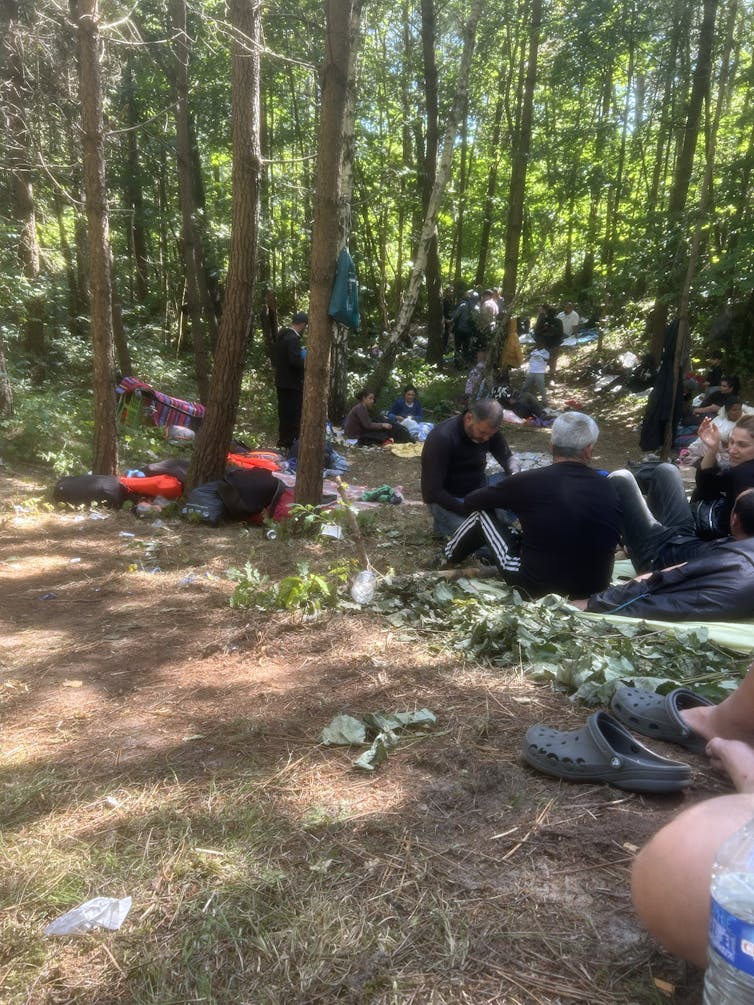
Groups of people sitting on the ground in a forest on a sunny day
A microcamp in Ecault Forest.
Sophie Watt

In response, and in order to intensify the crossings, “microcamps” have emerged – smaller temporary settlements closer to the beach, along the coast between Hardelot and Calais. These microcamps act as connecting points between the larger camps and the coastal departure locations where taxi boats pick them up. They allow for people to make several attempts at crossing without having to return to the large camps, where living conditions are more difficult.

The larger camps (such as Loon Plage and Calais) are the epicentre of the smuggling operations. The camps are evicted at least once a week (every 24 hours in Calais) due to France’s official “zero fixation point” policy. This policy, which bars people from forming long-term settlements, was implemented after the dismantling of the Calais “Jungle” refugee camp in October 2016.

Camp conditions

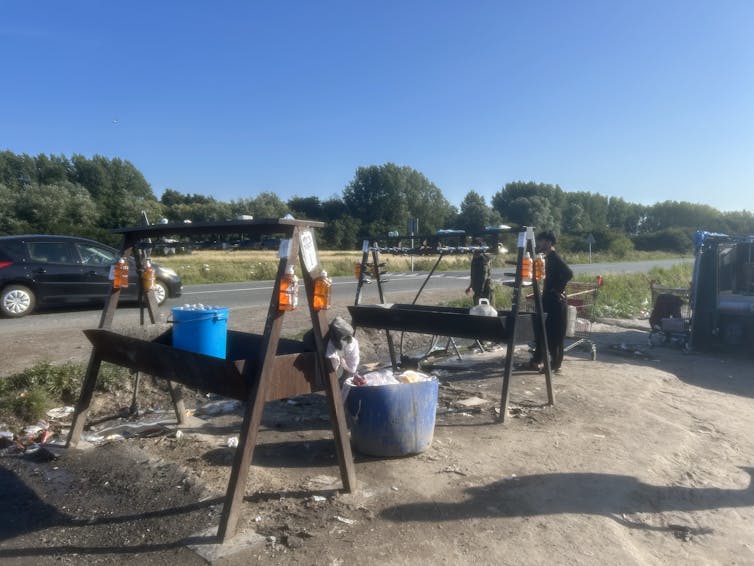
Police efforts to uphold the zero fixation point policy entail frequent evacuations, restrictions of humanitarian aid and physical site disruption. At Loon Plage, I saw that the sole access to water is a livestock trough.

Official guidance from the UN’s refugee agency states that, irrespective of the informality of these camps, their residents should have access to water, sanitation and shelter.

Troughs of water at an informal camp
Access to water is limited to troughs.
Sophie Watt

The non-profit watchdog group Human Rights Observers has documented instances of police violence and seizures of people’s belongings and tents at the camps.

In addition to regular evictions of the larger camps, the microcamps have recently seen more brutal police action. There have been reports of police using teargas, puncturing life jackets and tents, contributing to untenable living conditions. Violence and shootings between smuggling groups have also been reported in Loon Plage camp.

While working with Alors On Aide and photographer Laurent Prum we met around 50 people, including seven children (ages one-17), in a microcamp on the edge of the Ecault forest near Boulogne-sur-Mer. We immediately noted a tension between the group and the gendarmes who were standing watch.

Most of this group had spent a few years in Germany before being refused asylum. They told me they felt they had been forced to come back to France, because of the deportation measures currently being implemented by the German government.

A few confided that this was their fifth and final try at crossing the Channel. This is a new tactic the smuggling organisations use to make more money more rapidly: while refugees used to be able to try as many times as they needed, they now have to pay again after five failed attempts.

The previous day, this group told us they had been chased out of another part of the forest. There, we had found several empty canisters of tear gas – consistent with reports that French police have deployed tear gas in operations against informal camps.

This group had wanted to stay there because they could use a dilapidated shed to shelter themselves and their children from the rain. Eventually, the gendarmes evicted them, forcing them to spend the night in the rain – the field in question was privately owned. Following the eviction, we witnessed that the landowner had covered the area with manure to stop them returning.

A young Sudanese man showed us videos of the altercation. The exchange, during which five people were arrested, was violent. The children were terrified and the video showed the gendarmes using teargas against the group. A Palestinian mother was arrested and taken into custody, forced to leave her two young daughters. Her husband asked me: “Why did they arrest her when they could see she had two children with her?”

Alors on Aide mobilised several of its members to bring clothes, blankets and food for the group, and got the Palestinian woman released from custody, as she had not been charged with any offence.


Read more:
I’ve spent time with refugees in French coastal camps and they told me the government’s Rwanda plan is not putting them off coming to the UK


Slashing boats

While living conditions in camps and the capacity of the French asylum system make staying in France difficult, police are also taking firmer action against boats attempting the crossing.

As part of a coastal patrol (helping refugees after a failed crossing attempt), we arrived on the beach in Équihen at around 7am on July 4 to find that French police had just punctured a boat in the water.

The UK government praised French police for this action, performed in front of international media. The UK and France have also discussed allowing coastguards to intercept taxi boats up to 300 metres off the coast.

This would be a marked change from current regulations, which prohibit French police from intervening offshore except when responding to passengers in distress. Even the border police have doubts about the legal basis for this measure and its practical implications at sea, particularly given the heightened risk of accident.

Trapped between hounding by police on the beaches and constant evacuations from the informal settlements, the refugees have no choice but to try to cross the Channel at any cost. A record number of 89 refugees died at the Franco-British border in 2024. Thirteen deaths at sea have already been recorded in 2025.

In my view, the recently announced French-British measures to intensify policing and border enforcement are unlikely to deter people from attempting dangerous crossings. Instead, they will create an incentive for more dangerous tactics by smugglers, putting more lives at risk and violating human rights. Any agreement to return asylum seekers, restrict their access to asylum or force people back across borders will exacerbate the dangers already experienced by those seeking refuge.

The Conversation

Sophie Watt receives funding from the University of Sheffield and the British Academy / Leverhulme Small Research Grants.

ref. Channel crossings: life in ‘microcamps’ on the French border, and how they are changing crossing attempts – https://theconversation.com/channel-crossings-life-in-microcamps-on-the-french-border-and-how-they-are-changing-crossing-attempts-260843

Fear of crime is a useful political tool, even if the data doesn’t back it up

Source: The Conversation – UK – By Emily Gray, Assistant Professor of Criminology, University of Warwick

“We’re actually facing, in many parts of our country, nothing short of societal collapse.” This was the dire warning from Reform UK leader Nigel Farage, in setting out his party’s goal of halving crime.

In an op-ed in the Daily Mail and a press conference, Farage framed Britain as a nation in crisis from rising crime and lawlessness. But, he said, Reform had the solution: mass deportation of foreign offenders, the construction of prefabricated “Nightingale” prisons, and a wholesale crackdown on offending.

He insisted that British streets were out of control (although recent rises in crime come mainly from online fraud and shoplifting, according to the latest data), pledged to simultaneously increase prison sentences and reduce overcrowding, and vowed to restore order with a “higher and physically tougher standard of police officer”.

Speaking after a weekend of violent anti-immigration protests in Epping, Farage also tied Britain’s supposed lawlessness to migration: “Many break the law just by entering the UK, then commit further crimes once here – disrespecting our laws, culture and civility. The only acceptable response is deportation.”

Invoking crime as a threat, and the politician as its solution, is a tried-and-tested political manoeuvre. We’ve seen it deployed from both left and right, in many parts of the world, for decades. Stuart Hall and colleagues famously examined this phenomenon in the 1970s in their seminal book Policing the Crisis.

Our own analysis suggests that the accuracy of crime statistics often matters less than how politicians frame public anxieties – through media, public rhetoric and policy initiatives. In short: the public often responds to emotion as much as evidence.

One tension in England and Wales is that there are two major sources of crime data. The first – on which Farage leans heavily – is police-recorded crime. But, as is widely understood, that data provides only a partial picture of the true extent of crime. Many people, especially those from marginalised or vulnerable groups, choose not to report their experiences of crime.


Read more:
Most crime has fallen by 90% in 30 years – so why does the public think it’s increased?


Moreover, the consistency and accuracy with which police forces record these offences has been questioned over time. Indeed, police-recorded crime statistics are not designated as official national statistics.

The other (and more robust) source is the Crime Survey for England and Wales (CSEW), which asks a representative sample of the public about their experiences of crime over the past 12 months. Notably, it includes those incidents that were not reported to the police.

Running since the early 1980s, the CSEW has demonstrated long-term declines in incidents of theft, criminal damage and violence (with or without injury) since the mid-to-late 1990s. Curiously, Farage told reporters that the CSEW was “based on completely false data”, without providing any evidence.

The Office for National Statistics (ONS), and most criminologists, regard the CSEW as the more accurate metric of long-term crime trends. (The Conversation asked the CSEW to comment but hadn’t received a response when this article was published.)

The political weight of crime

Crime has electoral value. It allows parties and political campaigners to project strength, decisiveness and control. Farage’s rhetoric is designed to provoke urgency and anxiety. It’s a well-worn script. Margaret Thatcher’s government leveraged fears of law and order. New Labour made “anti-social behaviour” a central point of focus at a time when crime was, in fact, falling.

In research conducted with colleagues, we examined how people’s fears about specific crimes are shaped not just by actual crime rates, or by the person’s age, gender or ethnicity, but also by the political context in which they grew up.

Using data from the CSEW and a method called age-period-cohort analysis, we explored how different “political generations” developed and retained distinct concerns about crime.

We found clear patterns. Those who grew up during the James Callaghan era in the mid-to-late 1970s – when politicians repeatedly warned of “muggings” – were more likely to report anxieties about street robbery over time.

Thatcher’s generation, who came of age during a sharp rise in property crime, were more likely than other groups to express long-term fears about burglary. And those who grew up under New Labour – during the height of the “anti-social behaviour” agenda – reported persistent concerns about neighbourhood disorder, even as recorded incidents declined.

Police officers on a city street
Is crime on the rise? Depends who you ask.
Loch Earn/Shutterstock

In other words, the political rhetoric people are exposed to during their formative years leaves a lasting impression on their relationship to crime. Debates about crime become embedded in personal and generational memory.

Crime is real and victims suffer. But distorting its nature and prevalence can erode public trust in the institutions tasked with protecting us. It can foster punitive and ineffective policy responses. And it can leave whole communities feeling targeted, criminalised or unsafe, based on selective and often sensational narratives.

We absolutely need to talk about crime. But we also need to talk about how we talk about crime. Who frames the debate, which statistics are used, who and how many are left out of the official records, whose fears are being amplified, and who is looking to exploit crime?

The Conversation

Emily Gray has received funding from the Economic and Social Research Council.

Stephen Farrall has received funding from the Economic and Social Research Council.

ref. Fear of crime is a useful political tool, even if the data doesn’t back it up – https://theconversation.com/fear-of-crime-is-a-useful-political-tool-even-if-the-data-doesnt-back-it-up-261777

New polling: Reform is winning over Britain’s Christian support

Source: The Conversation – UK – By Stuart Fox, Senior Lecturer in Politics, University of Exeter

When we look at how people vote in elections and why they choose certain parties, analysis often focuses on age, education, location or socioeconomic status. Less discussed in Britain is religion. But close to two-thirds of its adults are still religious – expressing either a religious identity, holding religious beliefs, or taking part in religious activities.

For the one-in-three adults in Britain who are Christian, this identity remains an important influence on their political behaviour. New polling, published here for the first time, shows how Reform UK is disrupting our previous understanding of how Christians vote in British elections.


Want more politics coverage from academic experts? Every week, we bring you informed analysis of developments in government and fact check the claims being made.

Sign up for our weekly politics newsletter, delivered every Friday.


The relationship between Britain’s Christian communities and the major political parties goes back centuries. The Conservative party has been very close to English Anglicanism since its emergence in the mid-19th century. Catholics and free-church Protestants (such as Baptists and Methodists) have tended towards the Labour and Liberal/Liberal Democrat parties. Even as Britain has become more secular, these relationships have persisted.

Anglicans, for example, have tended to vote Conservative even when the party was in dire straits. In the 2024 election, 39% of Anglicans voted Tory even as the party’s national vote share fell to 24%.

Since the 1980s and particularly in elections since 2015, however, we have started to see changes to the Christian vote. The traditional Catholic attachment to Labour has deteriorated, as has Labour’s appeal to other Christian communities such as Baptists, Methodists and Presbyterians.


Read more:
Britain’s changing religious vote: why Catholics are leaving Labour and Conservatives are hoovering up Christian support


Instead, driven by the rising salience of social values (attitudes towards immigration, social change and national identity) as a determinant of political support, the socially conservative leanings of some Christians of all stripes has led to increased support for the Conservatives. And those who traditionally did so – the Anglicans – have become even more supportive. The result has been a steady coalescing of the Christian vote behind the Conservatives.

But now, new polling by YouGov (on June 23-24 2025) for the University of Exeter reveals that this realignment is being disrupted by the growing popularity of Reform UK.

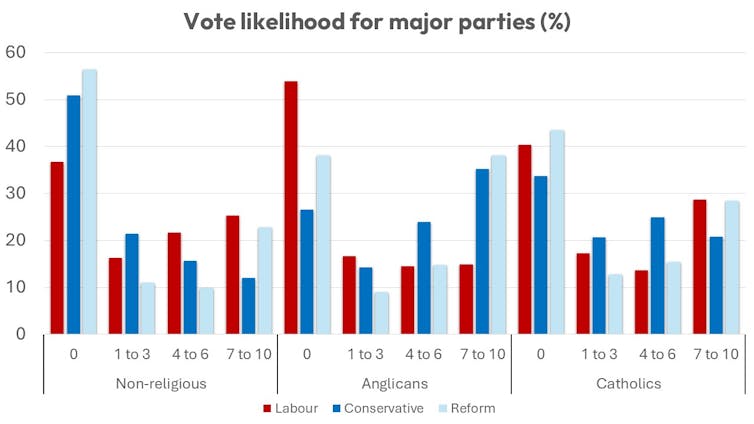
Instead of asking who people would vote for tomorrow, a nationally representative sample of 2,284 adults was asked how likely they were to ever vote for each major party, on a scale from zero (very unlikely) to ten (very likely).

While not the same as a direct question about how someone would vote in an election, the likelihood question provides a much richer measure of the strength of their support for all of the major parties.


Stuart Fox, data by YouGov for the University of Exeter

Among Anglicans, Labour remains deeply unpopular: over half gave the party a 0. In contrast, the Conservatives still enjoy strong support among Anglicans, with 35% giving them a vote likelihood of seven or higher – the kind of support associated with voting for the party in an election.

Reform, however, has caught up. Despite only 15% of Anglicans voting Reform in 2024, 38% now rate their likelihood of voting for the party as high. That’s the same as the proportion who are strongly opposed to Reform – showing that while the party polarises Anglicans more than the Conservatives, Reform could win as much Anglican support as the Tories in an election.

Catholics show a similar trend. Labour’s traditional support is eroding: 40% of Catholics said they had zero likelihood of voting Labour, while 29% are strong supporters. As with Conservatives for the Anglican vote, Reform is almost level-pegging with Labour for the Catholic vote at 28%. It has even supplanted the Conservatives, of whom 22% of Catholics are strong supporters.

It is not yet clear why this is happening. The distinction of Christian (and non-Christian) voting patterns is not an artefact of age – there are many studies that prove this is the case.

It may be that Reform’s stances on issues such as immigration resonate with Christians’ concerns to the extent that they are willing to set aside their historic party loyalties. Or it may be that Christians are as prone as other British voters to turn to Reform out of frustration with the performances of Labour and the Conservatives in office.

Swing voters and party competition

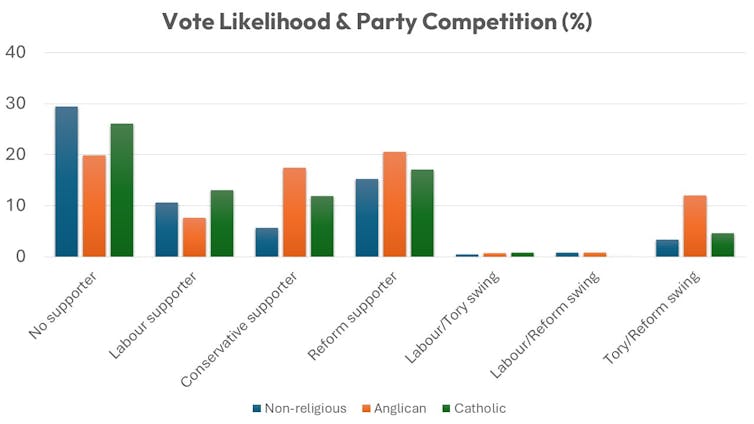
This data also shows the extent to which voters’ support for parties overlaps or is exclusive. In other words, which voters have a high vote likelihood for only one party (and so are likely committed to backing that party in an election), which do not have such high likelihoods for any party (and so will probably not vote at all), and which have similarly high likelihoods for more than one party (effectively swing voters, persuadable one way or the other).

Among the religiously unaffiliated, 29% aren’t strong supporters of any party. For Catholics, it’s 26%. Anglicans are more politically anchored, however, with only 20% in this category.

While traditionally, we would have expected this to reflect Anglicans’ greater tendency to support the Tories, only 17% of Anglicans are strong supporters of only that party, compared with 21% who are firmly behind Reform. These aren’t swing voters; they’ve switched sides.

A further 12% of Anglicans have high vote likelihoods for both the Tories and Reform. These are swing voters that the two parties could realistically expect to win over.


Stuart Fox, data by YouGov for the University of Exeter

Catholics are even more fragmented. Only 13% are strong supporters of Labour alone, along with 12% and 17% who are strong supporters of the Conservatives and Reform alone, respectively.

Few Catholics are torn between Labour and the other parties, but 5% are swing voters between the Conservatives and Reform: the Tories’ gradual winning over of Catholics over the last 50 years is also being challenged by the appeal of Reform.

The party has provided a socially conservative alternative to the Conservatives, with the result that the Christian vote has become more fragmented. The Tories are no longer the main beneficiaries of Labour’s loss of its traditional Catholic vote.

In addition, Reform is as popular as the Conservatives among Anglicans, and as popular as Labour among Catholics. This suggests it is appealing across the traditional denominational divide more successfully than either of the major parties.

If there is to be a single party that attracts the bulk of Britain’s Christian support, at this point it is far more likely to be Reform than anyone else.

The Conversation

This article was based on analysis by Dr Stuart Fox (University of Exeter), Dr Ekaterina Kolpinskaya (University of Exeter), Dr Steven Pickering (University of Amsterdam) and Prof Dan Stevens (University of Exeter), connected to the research project Investigating the individual and contextual role of religion in British electoral politics, funded by the Economic and Social Research Council. Stuart Fox also receives funding from the British Academy.

ref. New polling: Reform is winning over Britain’s Christian support – https://theconversation.com/new-polling-reform-is-winning-over-britains-christian-support-260751

Water wars: a historic agreement between Mexico and US is ramping up border tension

Source: The Conversation – UK – By Natasha Lindstaedt, Professor in the Department of Government, University of Essex

As climate change drives rising temperatures and changes in rainfall, Mexico and the US are in the middle of a conflict over water, putting an additional strain on their relationship.

Partly due to constant droughts, Mexico has struggled to maintain its water deliveries for much of the last 25 years, in keeping with a water-sharing agreement between the two countries that has been in place since 1944 (agreements between the two regulating water sharing have existed since the 19th century).

As part of this 1944 treaty, set up when water was not as scarce as it is now, the two nations divide and share the flows from three rivers (the Rio Grande, the Colorado and the Tijuana) that range along their 2,000-mile border. The process is overseen by the International Boundary and Water Commission.

Mexico must send 430 million cubic metres of water per year from the Rio Grande to the US, while the US must send nearly 1.85 billion cubic metres of water from the Colorado River to support the Mexican border cities of Tijuana and Mexicali.

Water deliveries are measured over a five-year cycle, and the current one ends in October. Mexico struggled to deliver its water “debt” in the last cycle which ended in 2020, using waters from reservoirs at the last minute to fulfil its obligations. This left northern Mexico with severely depleted water levels.

Due to growing tensions over water, the Biden administration tried to negotiate and work with the Mexican government to improve the speed with which Mexico’s water deliveries were taking place in 2024.

But with Donald Trump’s return to office, the US has taken a more aggressive stance with Mexico to address its water debts to the US. For the first time in over 50 years, in March of 2025, the US refused to send water from the Colorado River to Tijuana – a city of nearly 2 million people – in order to force Mexico to send more water to Texas.

Mexico has since responded by transferring 75 million cubic metres of water, but this is just a drop in the bucket, as Mexico remains 1.5 billion cubic metres in debt. And this did little to satisfy the Trump administration, which threatened to withhold more water from Mexico. It also demanded the resignation of Maria-Elena Giner, who led the International Boundary and Water Commission, in April.

Rather than looking at diplomatic solutions, Trump has accused Mexico of stealing Texans’ water and has promised to keep escalating consequences if it doesn’t deliver on the treaty terms.

A map showing the US and Mexico border and rivers running through it.

Rainer Lesniewski/Shutterstock

For farmers in Texas, the water shortage has left them unable to plant their crops as they don’t have enough irrigated water to do so. A year ago, the last sugar mill in southern Texas shut down due to the lack of water being delivered by Mexico.

But Mexican farmers believe that the agreement is binding only when Mexico has enough water to satisfy its own needs – and with drought conditions, this means that no excess available water can be sent. Continuing drought conditions in Mexico have plagued farmers in the north, who also rely on water for their crops. Reductions in rainfall in recent years have also left Mexico struggling with water supplies for its own citizens in urban areas.


Read more:
Farewell to summer? ‘Haze’ and ‘trash’ among Earth’s new seasons as climate change and pollution play havoc


No running water

In recent years, drought has particularly affected the city of Monterrey in northern Mexico. In 2022, taps ran dry with many of its five million residents without running water for months. Flushing toilets, laundering clothing, washing dishes, bathing all required hauling water by hand from wells.

Locals protested the fact that the best water infrastructure went to factories, not residents. One factor is that water demand has skyrocketed due to more manufacturing in border cities in Mexico.

While increased manufacturing poses one problem, an even bigger problem lies with agriculture, and the types of plants being planted, as well as the way they have traditionally been watered. For example, avocados require 91 litres a day – four times more water than the production of oranges, and ten times more than the production of tomatoes.

Alfalfa is another thirsty crop being mass produced in drought-prone states, such as Texas, California and even Arizona.

Citizens in Mexico City sometimes faced weeks of water shortages in recent years.

As much as 80% of the Colorado River basin’s water is used for agriculture and about half of that goes towards the production of alfalfa. Even more concerning is that most of the water is going to feed these thirsty crops. And in the dry south-west states of the US half of its water goes to towards the production of beef and dairy cattle.

This has an impact on cities who are completely dependent on the Colorado River. In the case of Tijuana in Mexico, the Colorado River supplies 90% of its water, while US cities such as Los Angeles and Las Vegas receive 50% and 90% of their water supplies from the Colorado River and basin, respectively.

This is a major concern as both the Colorado River and the Rio Grande are experiencing record low levels of water. And getting more water from Mexico is not a long-term solution.

Though the Biden administration was criticised by farmers for not threatening Mexico, by withholding water, its approach largely focused more on the long-term challenges.

For the previous US administration the solution was to invest more in the Colorado River basin, incentivising California, Arizona and Colorado to conserve three million acre-feet of water through 2026 in return for US$1 billion (£741,000,000) in federal funding.

What drives this conflict?

But under Trump, federal funding for tackling climate change is being slashed. Increased polarisation in US domestic politics and growing tensions between the US and Mexico will make resolving this crisis all the more difficult.

This is a missed opportunity. Even though conflicts over water are becoming more frequent, water scarcity can also be a potential driver of cooperation.

Meanwhile, the US’s relationship with Mexico continues to be rocky. Trump has threatened to put new 30% tariffs on Mexico from August 1, after he claimed it hadn’t done enough to tackle drug cartels.

Mexico’s president, Claudia Sheinbaum, has said her government was destroying drug laboratories every day, and that the US must control weapons travelling over its border into Mexico which were being used for criminal purposes. Meanwhile, high tariffs on Mexican goods are likely to affect US consumers as Mexico is currently the US’s biggest trading partner.

Cooperation, and acknowledging the role played by climate change, and unsustainable forms of development in both agriculture and manufacturing are key to resolving this cross-border water crisis – but these are things that the Trump administration is unlikely to acknowledge, or address.


Get your news from actual experts, straight to your inbox. Sign up to our daily newsletter to receive all The Conversation UK’s latest coverage of news and research, from politics and business to the arts and sciences.

The Conversation

Natasha Lindstaedt does not work for, consult, own shares in or receive funding from any company or organisation that would benefit from this article, and has disclosed no relevant affiliations beyond their academic appointment.

ref. Water wars: a historic agreement between Mexico and US is ramping up border tension – https://theconversation.com/water-wars-a-historic-agreement-between-mexico-and-us-is-ramping-up-border-tension-261492

After 160 years of Welsh settlement in Patagonia, Indigenous voices are finally being heard

Source: The Conversation – UK – By Geraldine Lublin, Associate Professor in Spanish, Swansea University

The first Welsh settlers landed on the shores of what is today the Province of Chubut, in Argentinean Patagonia, on 28 July 1865. Carried on the ship Mimosa, this was the first of a series of immigrant contingents to create the Welsh settlement known as Y Wladfa.

The many chronicles and accounts about it have imbued the settlement with a mythical sheen. Today, Y Wladfa is home to the most famous Welsh-speaking community outside Wales. It is often touted in Britain as a little Wales across the sea. In fact, “Welsh Patagonia”, as it’s also known, was established precisely with the aim of preserving the language and culture.

A major aspect of the settlement that is celebrated is the unique friendship with the Indigenous Tehuelche that the Welsh immigrants would have struck up. However, with the commemoration of 160 years of that first group of settlers, the story about this connection is being challenged in a recently launched digital exhibition: Problematising History: Indigenous perspectives on Welsh settlement in Patagonia.


Looking for something good? Cut through the noise with a carefully curated selection of the latest releases, live events and exhibitions, straight to your inbox every fortnight, on Fridays. Sign up here.


Rather than attempting to undo the past, the project aims to address a glaring omission in historical accounts which results in an incomplete understanding of the impacts of the settlement – the lack of indigenous perspectives.

The new trilingual (Spanish, Welsh and English) exhibition challenges romanticised views about the myth of friendship between the Welsh settlers and the Indigenous Tehuelche in Patagonia. Bringing together four Mapuche Tehuelche creative projects, it reflects critically on how the story of Welsh colonisation in Chubut is told by providing a platform for voices previously unheard in Britain.

Little Wales across the sea

In Welsh Patagonia you can see quaint casas de té gales (Welsh tea houses), the ever-present dragons and strangely familiar Welsh street names. You will also see the Welsh language in towns like Gaiman, Trevelin or Trelew. To find a language that is only spoken by less than 20% in Wales itself be so present in this corner of Latin America can make for an odd experience.

The stories of how this place came to be are typical of settler colonial settings. These rose-tinted tales describe the encounter between the Welsh and the Indigenous Tehuelche as a harmonious meeting of cultures that led to a lasting friendship. The assumption is that the largely peaceful coexistence was due to the inherent Welsh benevolence rather than the result of negotiation and relationship building on both sides.

The overlooking of Indigenous agency and resistance is partly due to virtually all of the historical records available in Welsh or English being created by Welsh or European people. Even those appearing to foreground indigenous voices were recorded by non-Indigenous rapporteurs and often include at least one layer of translation.

As voices in the project Puel Willi Mapu Mew: Taiñ Zungun have said about the “Welsh rifleros” (the first Welsh explorers to “go West”):

“Their arrival is commemorated as an epic legend and they are inscribed as heroes who ‘discovered’ our land, silencing our pre-existence as Tehuelche Mapuche people, and leading to the violence of the successive evictions and removals of our lof (community).”

The incorporation of indigenous perspectives on Welsh settlement to the collections of the National Library of Wales represents a groundbreaking development. It is about time that space has been made for Mapuche Tehuelche memories about forced displacement, territorial dispossession and heritage appropriations.

Changing perceptions

The early pioneers were invited by the Argentinean government to settle in the area around the Chubut river. They were then pretty much left to their own devices to endure in the unforgiving and harsh terrain. The Indigenous Tehuelche would have not only provided them with meat but taught them to hunt and survive in their new environment.

An aspect of that good will can be traced to the Chegüelcho agreement, which the Argentine government drew up with the leaders of local Indigenous communities. The agreement stipulated that, provided the Welsh settlement was left to develop on the lands in question, the central government would send regular rations to the communities and provide animals and clothing.

However, the nuances of the coexistence have been removed, leaving a flattened historical narrative. In reality, the relationship was the result of continuous renegotiation of practical necessities and pursuit of reciprocal benefit – but was also fraught.

The Welsh outpost was beneficial to Patagonian indigenous populations in providing a convenient outlet for trading their animal skins and ostrich feathers. However, Y Wladfa was the first step of a broader Argentine project that actively sought to dispossess indigenous peoples and assert state sovereignty over Patagonia.

“The official history of Chubut silences the stories of the Mapuche and allows words like ‘progress’ and ‘Welsh settlers’ to resonate,” contributor Agustín Pichiñan explains.

“With the support of the State, fences were extended all over our territory bringing us subjugation, harassment and discrimination. Yet, we keep on resisting and fighting to recover our history, using the knowledge of our ancestors and the memories of our lof (community).”

Sustaining a simplified historical narrative and ignoring indigenous perspectives allows convenient stories which simply celebrate Y Wladfa. It prevents us from sitting with uncomfortable truths and learning.

Chief among these truths is that as a colonised people themselves the Welsh were agents of colonialism elsewhere. This is part of the wider history of Patagonian settlement and is key to striving for a better present and future for all involved.


Get your news from actual experts, straight to your inbox. Sign up to our daily newsletter to receive all The Conversation UK’s latest coverage of news and research, from politics and business to the arts and sciences.

The Conversation

Geraldine Lublin has received funding for the “Problematising History: Indigenous perspectives on Welsh settlement in Patagonia”.project from the Arts & Humanities Research Council Impact Acceleration Account at Swansea University.

ref. After 160 years of Welsh settlement in Patagonia, Indigenous voices are finally being heard – https://theconversation.com/after-160-years-of-welsh-settlement-in-patagonia-indigenous-voices-are-finally-being-heard-261700