La surprenante indépendance des femmes du Moyen Âge : ce que nous apprennent leurs testaments

Source: The Conversation – in French – By Joëlle Rollo-Koster, Professor of Medieval History, University of Rhode Island
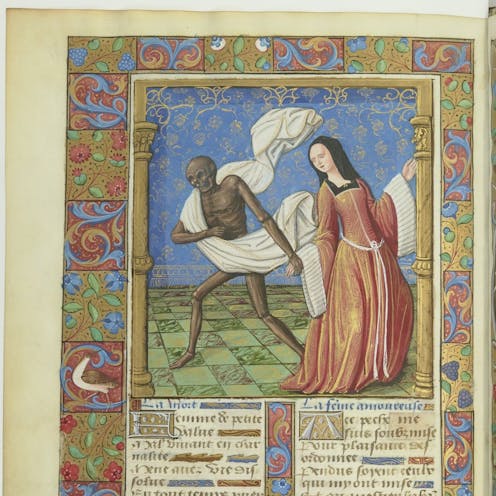
Les testaments des femmes donnent une image plus nuancée de la vie au Moyen Âge que celle que les stéréotypes véhiculent, comme le montre _la Mort et la Prostituée_, de la duchesse de Lorraine [Philippe de Gueldre (1464-1547)](https://fr.wikipedia.org/wiki/Philippe_de_Gueldre), entrée dans les ordres après le décès de son époux. Gallica/BNF

Dans les villes européennes du début du Moyen Âge, les droits des femmes s’étendent même s’ils sont encore limités. Des cadeaux pour l’Au-delà, des corsages pour les plus pauvres ou des fonds pour la réparation de ponts : les testaments des femmes dans la France médiévale donnent un aperçu surprenant de leur quête d’indépendance.


Dans l’Europe du Moyen Âge, l’image de la femme se résumait souvent en deux mots : pécheresse ou sainte.

En tant qu’historienne du Moyen Âge, je donne cet automne un cours intitulé « Entre Ève et Marie : les femmes au Moyen Âge ». Le but du cours tente d’éclairer sur la façon dont les femmes du Moyen Âge se voyaient elles-mêmes.

Selon le récit biblique, Ève est la cause de l’expulsion des humains du jardin d’Éden, car elle n’a pas su résister à l’envie de croquer dans le fruit défendu par Dieu. Marie, quant à elle, réussit à concevoir le Fils de Dieu sans aucune relation charnelle.

Ces deux modèles sont écrasants. Le patriarcat considère dans les deux cas que les femmes ont forcément besoin de protection, qu’elles sont incapables de se prendre en main ou de se maîtriser, voire qu’elles sont attirées par le mal et doivent par conséquent être dominées et contrôlées. Mais comment savoir ce que pensent les femmes à l’époque médiévale ? Acceptent-elles réellement cette vision d’elles-mêmes ?

Je ne crois pas que l’on puisse totalement comprendre quelqu’un qui a vécu et qui est mort il y a plusieurs centaines d’années. Cependant, nous pouvons tenter de reconstituer partiellement son état d’esprit à partir des éléments dont nous disposons, comme les registres de recensement de population et les testaments.

Les documents datant de l’Europe médiévale à avoir été écrits ou même dictés par des femmes sont peu nombreux à nous être parvenus. Le manuel de Dhuoda et les écrits de Christine de Pisan sont de rares exceptions. Nous avons plus souvent accès à des documents administratifs, comme les registres de recensements ou les testaments. Il s’agit en général de formulaires rédigés dans un jargon juridique ou religieux par des scribes ou des notaires masculins.

Ces testaments et registres de recensement sont l’objet de mes recherches et ils nous ouvrent, même s’ils n’ont pas été rédigés par des femmes, une fenêtre sur la vie et l’esprit des femmes de l’époque. Ces documents suggèrent que les femmes du Moyen Âge disposaient bien au minimum d’une certaine forme de pouvoir pour décider de leur vie – et de leur mort.

Un recensement vieux de plusieurs siècles

En 1371, la ville d’Avignon (Vaucluse) organise un recensement de sa population. Le registre liste les noms de plus de 3 820 chefs de foyer. Parmi eux, 563 sont des femmes – des femmes responsables de leur propre foyer et qui n’hésitent pas à l’affirmer publiquement.

Ces femmes ne sont pas d’un statut social élevé, et l’histoire ne s’en souvient guère ; elles n’ont laissé de traces que dans ces registres administratifs. Célibataires ou mariées, un cinquième d’entre elles déclarent avoir une profession : de l’ouvrière non qualifiée à la servante, en passant par l’aubergiste, la libraire ou la tailleuse de pierre.

Près de 50 % de ces femmes déclarent un lieu d’origine. La majorité d’entre elles vient de la région d’Avignon et d’autres régions du sud de la France, mais environ 30 % viennent de ce qui est aujourd’hui le nord de la France, du sud-ouest de l’Allemagne et de l’Italie. Ainsi, l’immigration joue déjà un rôle substantiel à l’époque.
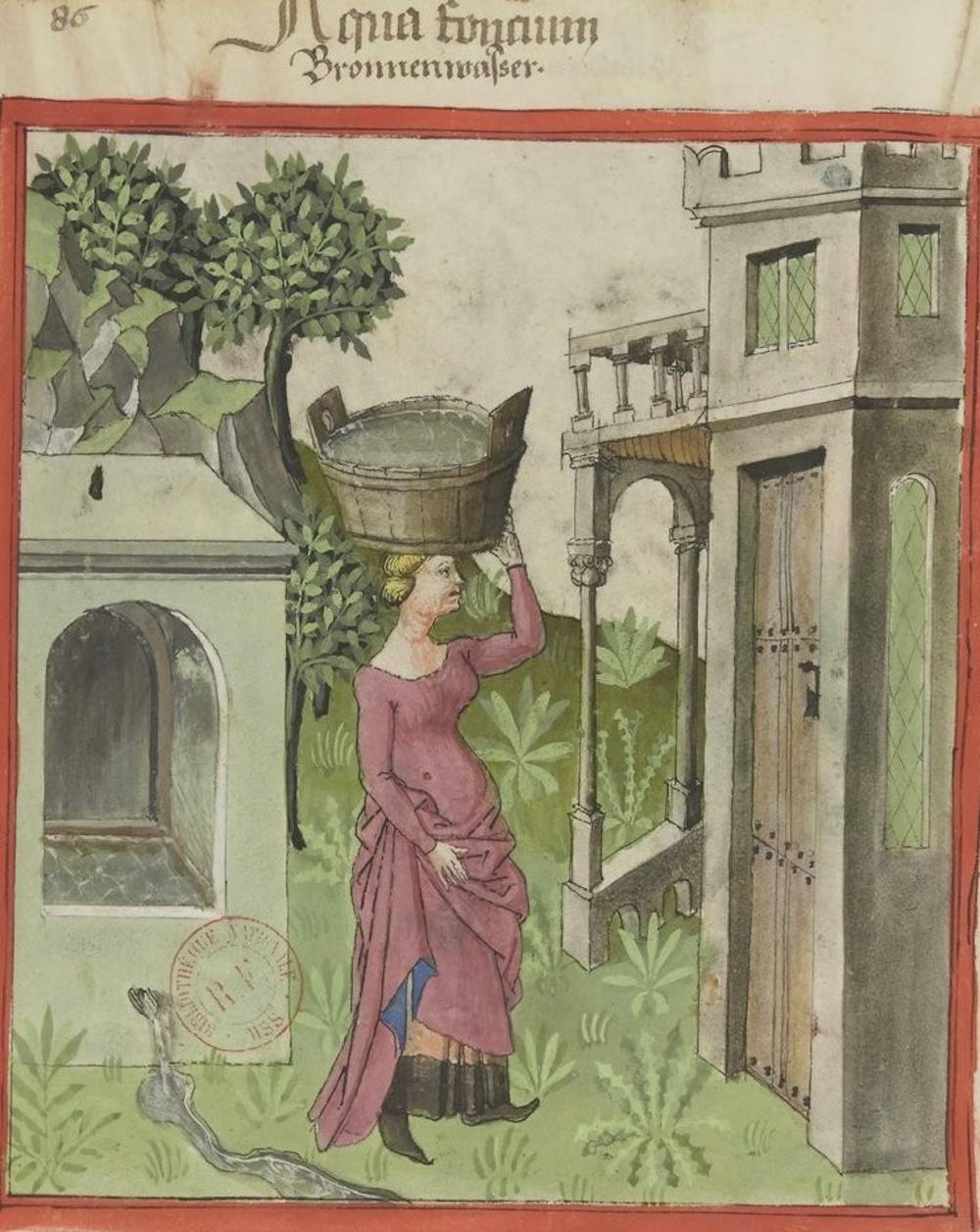
Illustration d’une femme blonde en robe rose portant un récipient en bois sur la tête
Illustration tirée du traité Taqwīm al-Ṣiḥḥa, ou Tacuinum sanitatis, (Tableau de santé), du médecin irakien Ibn Butlân, datant du XIᵉ siècle.
Bibliothèque nationale de France

La majorité des femmes venues de régions lointaines arrivent seules, ce qui tend à montrer que les femmes du Moyen Âge n’étaient pas nécessairement « coincées à la maison » sous la coupe d’un père, frère, cousin, oncle ou mari. Même si certaines finissent par se retrouver dans cette situation, il leur en a fallu du cran pour décider de partir.

Nouvelles villes, nouvelles vies

Dans des villes comme Avignon, où la proportion d’immigrants est élevée, les lignées de familles tendent à disparaître. Comme le suggère l’historien Jacques Chiffoleau, la plupart des Avignonnais de la fin du Moyen Âge sont des « orphelins », sans réseau familial étendu dans leur nouvel environnement – ce qui se reflète dans leur façon de vivre.

Depuis le XIIe siècle, les femmes du sud de la France sont considérées comme sui iuris – c’est-à-dire autonomes, capables de gérer leurs affaires juridiques –, si elles ne sont pas sous la tutelle d’un père ou d’un mari. Elles peuvent disposer de leurs biens comme elles l’entendent et les transmettre à leur gré, aussi bien de leur vivant qu’après leur mort. Les dots des filles mariées les empêchent souvent d’hériter des biens parentaux, car en principe la dot remplace l’héritage. Mais en l’absence d’héritier de sexe masculin, elles aussi peuvent hériter.

À la fin du Moyen Âge, les droits juridiques des femmes s’élargissent, car l’anonymat de la ville et l’immigration transforment les relations sociales. Elles peuvent devenir tutrices légales de leurs enfants. Mieux encore, à en juger par les testaments féminins, les veuves et les filles aînées prennent parfois seules des décisions juridiques, sans le tuteur masculin « requis ».

Un vieux manuscrit avec des lignes de caractères et une illustration aux couleurs vives d’hommes et de femmes dans un champ, tandis que d’autres grimpent aux arbres
Une page du livre d’Heures, d’Alelaïde de Savoie, artiste du XVᵉ siècle, montre la récolte des poires et des pommes.
PHAS/Universal Images Group via Getty Images

De plus, les femmes mariées peuvent aussi prendre des décisions juridiquement contraignantes tant que leurs maris sont présents avec elles devant un notaire. Bien que les maris soient techniquement considérés comme les « tuteurs » de leurs épouses, ils peuvent les déclarer juridiquement affranchies de la tutelle. Les épouses peuvent alors nommer leurs témoins testamentaires, désigner un héritier universel et établir des dons et legs à des particuliers ou à l’Église, dans l’espoir de sauver leur âme.

Des voix d’outre-tombe

Les archives européennes débordent littéralement de documents juridiques encore à découvrir, conservés dans des boîtes poussiéreuses. Ce qui manque, c’est une nouvelle génération d’historiens capables de les analyser et de paléographes capables de lire les écritures manuscrites. Pour y remédier, des journées d’études internationales ont eu lieu en jui 2025 à Paris-Évry, consacrées à la transmission patrimoniale en France et en Italie, à travers des testaments datant de la fin du Moyen Âge à l’époque moderne. Richissimes ou issus de classes populaires, hommes et femmes, religieux et laïcs, tout le monde ou presque fait un testament.

En Avignon, des hommes et des femmes de toutes conditions font appel aux services de notaires pour établir des actes contractuels : fiançailles, mariages, ventes de biens, transactions commerciales ou donations. Dans cette masse de documents, les testaments donnent une perspective rafraîchissante sur l’autonomie et les émotions des femmes médiévales à l’approche de la fin de leur vie.

Dans la soixantaine de testaments féminins conservés à Avignon, les femmes indiquent où et avec qui elles souhaitent être enterrées, choisissant souvent leurs enfants ou leurs parents plutôt que leur mari. Elles désignent les œuvres de charité, ordres religieux, hôpitaux pour les pauvres, paroisses et couvents qui bénéficieront de leur générosité – y compris des legs destinés à la réparation du célèbre pont d’Avignon.

Ces femmes ont peut-être exprimé leurs dernières volontés allongées dans leur lit, au seuil de la mort, guidées dans leurs décisions par le notaire. Pourtant, au vu de ce qu’elles dictent – que ce soit des dons pour les dots de jeunes filles pauvres, leurs proches et amis, ou pour que leur nom soit prononcé lors de messes catholiques pour les morts –, je soutiens que ce sont bien leurs propres voix que nous entendons.

Chapelets, réparations et fourrures

En 1354, Gassende Raynaud d’Aix demande à être enterrée auprès de sa sœur Almuseta. Elle lègue une maison à son amie Aysseline, tandis que Douce Raynaud – peut-être une autre sœur – reçoit six assiettes, six pichets, deux plats, une cruche en étain, un chaudron, son meilleur pot de cuisson, une cape de fourrure doublée de mousseline, une grande couverture, deux grands draps, son plus beau corsage, un petit coffret, ainsi que tous les fils à repriser et le chanvre qu’elle possède. Gassende Raynaud d’Aix lègue également un coffret, un chauffe-main en cuivre, le meilleur trépied de la maison et quatre draps neufs à son amie Alasacia Boete.

La générosité de Gassende ne s’arrête pas là. Jacobeta, fille d’Alasacia, reçoit un chapelet d’ambre ; Georgiana, la belle-fille d’Alasacia, un corsage ; et Marita, la petite-fille d’Alasacia, une tunique. On constate ici que les liens d’amitié remplacent les liens de famille. Ainsi, la lignée de Gassande se confond avec celle de son amie. À son autre amie Alasacia Guillaume, Gassende lègue, en plus d’une couverture brodée, un cadeau peu commun : un autel portatif pour la prière. À Dulcie Marine, une autre amie encore, elle donne un livre de chœur appelé antiphonaire et sa plus belle cape ou fourrure. On voit que Gassende donne surtout à d’autres femmes, ses amies, devenues comme sa famille.

Dans un autre testament avignonnais rédigé en 1317, Barthélemie Tortose fait des dons à plusieurs frères dominicains, dont son propre frère. On peut imaginer le contentement que peut ressentir une femme à soutenir financièrement un religieux. Elle laisse des fonds au supérieur de son frère, le prieur de l’ordre (peut-être pour s’assurer que celui-ci soit bien disposé à l’égard de son frère). Elle donne à des œuvres de charité et pour la réparation de deux ponts sur le Rhône tumultueux, et elle offre aussi une somme substantielle pour nourrir et habiller toutes les religieuses de tous les couvents de la ville.
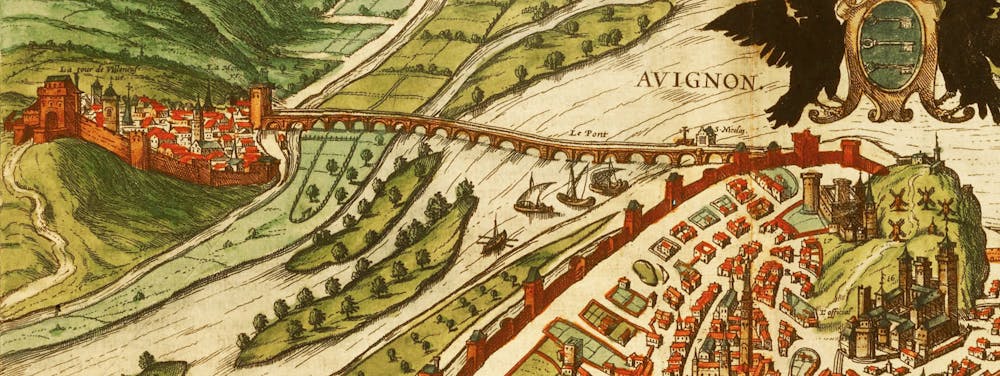
Illustration dans les tons verts et rouges montrant deux villes reliées par un pont enjambant une rivière avec quelques petites îles
Illustration du Rhône au XVIᵉ siècle, avec Avignon (Vaucluse) à droite.
Wikimedia

Elle soutient les femmes de sa famille, léguant notamment un revenu locatif à sa nièce, une religieuse bénédictine. Elle demande ensuite que ses vêtements soient transformés en habits pour les religieuses et en tuniques liturgiques.

On voit bien ici à quel point ces legs sont éminemment personnels : ces femmes se disent que ce qu’elles ont touché, ce qui a été en contact avec leur peau, pourra toucher d’autres personnes. Ce sont des dons charnels, tactiles. Elles espèrent que leurs possessions pourront transmettre un peu de leur mémoire, de leur existence, de leur identité. Et je dirais même, un peu de leur odeur.

De plus, les femmes médiévales peuvent aussi être sacrément radicales, sans être Jeanne d’Arc pour autant.

Au moins dix femmes dont j’ai lu les testaments demandent à être enterrées dans des habits de moines, dont Guimona Rubastenqui. Veuve d’un marchand de poisson d’Avignon – un métier souvent lucratif – elle demande au frère carme Johannes Aymerici de lui donner un de ses vieux habits pour être enterrée avec. Elle paye pour cela le prix relativement élevé de six florins.

Affirmer leur volonté

Alors, que retenir de tout cela ?

Il est impossible de reconstituer entièrement la façon dont les gens vivaient, aimaient et mouraient il y a des siècles. J’ai passé ma vie d’adulte à penser « médiéval », tout en sachant que je n’y parviendrai jamais vraiment. Mais nous avons des indices – et ce que j’appelle une intuition éclairée.

Selon nos critères modernes, ces femmes font face à de réelles limites en matière de pouvoir et d’indépendance, autrement dit, elles se heurtent à des murs. Pourtant, je soutiens qu’elles se libèrent à leur mort : leurs testaments leur offrent une rare occasion de prendre des décisions juridiques personnelles et de survivre dans des archives écrites.

Les femmes du Moyen Âge ont eu le pouvoir d’agir. Pas toutes et pas tout le temps. Mais cet échantillon même réduit montre qu’elles récompensaient et aidaient selon leurs choix.

Quant à leur souhait d’être enterrées dans des vêtements d’hommes, je n’ai aucun moyen de vérifier et de savoir s’il a été respecté. Mais de mon point de vue, il y a quelque chose de profondément satisfaisant de savoir qu’au moins, elles ont essayé.

The Conversation

Joëlle Rollo-Koster ne travaille pas, ne conseille pas, ne possède pas de parts, ne reçoit pas de fonds d’une organisation qui pourrait tirer profit de cet article, et n’a déclaré aucune autre affiliation que son organisme de recherche.

ref. La surprenante indépendance des femmes du Moyen Âge : ce que nous apprennent leurs testaments – https://theconversation.com/la-surprenante-independance-des-femmes-du-moyen-age-ce-que-nous-apprennent-leurs-testaments-260257

Coming out, amours et amitiés : le rôle des séries télé

Source: The Conversation – in French – By Mélanie Bourdaa, Professeure en Sciences de l’Information et de la Communication, Université Bordeaux Montaigne

Distribution de la série musicale états-unienne _Glee_ (2009-2015) qui a réalisé, en 2011, en France, le meilleur score d’audience (5,2 %) pour une série inédite. Keith McDuffee/Wikimedia Commons, CC BY

La variété de personnages représentés dans les séries télévisées s’est beaucoup étoffée, permettant aux adolescents en pleine éducation sentimentale de mieux se projeter dans les intrigues, et d’y trouver un appui pour affronter leurs questionnements voire, dans certains cas, faire leur coming out.


Les séries télévisées constituent des laboratoires des expériences adolescentes en matière de sexualité, d’éducation sentimentale, de consentement, de cyberharcèlement, ou d’échanges entre pairs ou amis, comme le fait ressortir l’enquête menée dans l’ouvrage Teen series. Genre, sexe et séries pour ados (2024).

Présentant des problématiques adolescentes, avec des adolescents comme personnages principaux, ces séries constituent des œuvres culturelles cruciales pour analyser à la fois les représentations des sexualités adolescentes mais également pour comprendre comment les adolescents se saisissent de ces représentations pour en faire un levier de discussions dans leurs communautés.

Des personnages non binaires plus présents dans les intrigues

Les Teen series ont vu leur importance grandir dans le paysage sériel actuel, notamment dans un contexte d’éclatement des audiences sur divers supports de diffusion. Si, durant les années 1990, nombre d’entre elles, Dawson’s Creek (1998-2003) ou Beverly Hills (1990-2000), étaient déjà produites et diffusées, elles contribuaient souvent à véhiculer des personnages stéréotypés et monolithiques : le « sexy quarterback », la « mean girl », la « popular girl » et souvent une « cheerleader » qui sortait avec le « quaterback ».

Dans ces séries, l’hétéronormativité était la sexualité dominante, voire la seule sexualité montrée. Par exemple dans Dawson’s Creek, le personnage de Jack fait son coming out, mais il n’y a aucun développement autour de ce récit ni aucune réflexion sur les conséquences pour le personnage et son entourage.

Aujourd’hui, les Teen series offrent une diversité des représentations et une nuance dans le développement et dans la psychologie des personnages qui permettent d’amener des pluralités de représentations. Par exemple, la série Glee (2009-2015) tordait les représentations genrées et sexuelles. Plus récemment, dans Heartstopper (2022-2025), le quarterback fait son coming out bisexuel déjouant ainsi les représentations classiques de la masculinité hétérosexuelle.

Les personnages non binaires ont des rôles beaucoup plus décisifs dans le développement de l’intrigue et bénéficient d’une visibilité et d’une temporalité à l’écran beaucoup plus importantes. Nous pensons au personnage de Sid, la petite amie d’Elena, dans la série One Day At a Time (2017) sur Netflix qui a reçu un écho positif auprès des fans. Il en va de même pour les personnages transgenres dans Sex Education (2019), Euphoria (2019), Heartstopper, Gossip Girl nouvelle version (2021-2023) ou bien The Chilling Adventure of Sabrina (2018-2020) pour n’en citer que quelques-unes.

Le personnage étant une figure familière, avec lequel les téléspectateurs vont créer une relation émotionnelle, il est essentiel pour les séries de leur proposer des variétés de représentations auxquelles s’identifier. Le personnage accompagne alors les téléspectateurs et leur fournit des modèles de représentations sur lesquelles ils et elles peuvent s’appuyer ou rejeter pour se construire leur propre identité.

L’importance de l’identification aux personnages

Les adolescents regardent ces séries, mais ils ne sont pas passifs. Pour ainsi dire, ils et elles se les approprient. La recherche s’est d’ailleurs beaucoup penchée sur la façon dont ils et elles investissent les thématiques inhérentes aux séries (harcèlement, première fois, homophobie…), mais aussi comment ils et elles s’identifient aux personnages, en parlent ensemble, les critiquent et les mettent à distance.

Les publics adolescents s’emparent des narrations, de récits, d’imaginaires, pour se construire des communautés de pratiques, des réseaux également. Ils mènent des actions culturelles, sociales et politiques sous forme de partage de contenus numériques et de créations (fanfictions, fan arts, edits vidéo, cosplay) notamment. Le personnage et les narrations provoquent des discussions autour des sexualités et des identités genrées. Ce sont aussi des leviers d’engagement concret pour de jeunes fans qui mettent alors à contribution leur identité de fans, mais également leur identité sexuelle au service de la collectivité.

Casting de Pretty Little Liars : Summer School (Chandler Kinney, Zaria Simone, Malia Pyles, and Mallory Bechtel) au ATX TV Festival, en 2024
Distribution de Pretty Little Liars : Summer School (Chandler Kinney, Zaria Simone, Malia Pyles, and Mallory Bechtel) au ATX TV Festival, en 2024.
Chris Roth, via Wikimedia, CC BY-SA

Par exemple, lorsque Emily Fields, dans Pretty Little Liars (2010-2017) fait son coming out et qu’il nous est donné à voir la réaction de ses deux parents, plusieurs fans ont réagi sur les réseaux sociaux ou dans leur communauté en ligne. Sur YouTube, une fan poste ce commentaire en lien avec les scènes spécifiques de coming out :

« C’est tellement ça pour moi. J’ai 13 ans. Il y a un mois, mon père a découvert que j’étais gay et il m’a hurlé dessus pendant des heures me disant que ce n’était pas normal et que ce n’était qu’une phase. Il m’a dit que si je continuais à être comme ça, il allait me jeter de la maison. Ma mère a dit qu’elle était OK avec le fait que je sois gay et qu’elle continuerait à m’aimer quoi qu’il arrive. »

Une autre déclare que ce que vit le personnage va l’aide dans son processus :

« Je suis bisexuelle. Cela signifie que j’aime les hommes et les femmes. Personne ne le sait encore, puisque j’ai 11 ans. Cela paraît simple pour moi, mais en réalité ma famille est homophobe. Je ne pense pas que ce sera facile, mais je vais leur annoncer bientôt. Emily m’en a donné le courage. Merci beaucoup, Shay (nom de l’actrice, ndlr). »

Et cela crée des relations, des identifications. On se confie, on se découvre avec les séries.

Anna a 18 ans. Elle se souvient qu’au lycée elle regardait Heartstopper avec une amie. Au-delà de la série, ce fut surtout l’occasion pour les deux jeunes filles d’évoquer leur homosexualité et de faire leur coming out ensemble.

« On a suivi les héroïnes lesbiennes de la série et c’est comme si elles nous ouvraient la voie une peu ».

Anna poursuit :

« Évidemment, lorsque dans la série on voit des parents exclure leur fille lesbienne, j’ai immédiatement dit à mes parents : “Vous ne feriez pas ça vous ?”, et j’en ai profité pour leur faire aussi mon coming out ».

La série rassure par ses personnages, par sa quotidienneté : elle accompagne.

Des créations de fans

Outre cette expression de soi dans les communautés en ligne, les publics fans et, en particulier, les jeunes publics créent des œuvres « transformatrices » écrites, visuelles ou audiovisuelles à partir de la narration et des personnages.

Ces créations, nombreuses, polymorphes, leur permettent de mettre en avant différents aspects de la série et notamment en ce qui concerne les représentations de la sexualité : développer des histoires autour de couples, en particulier homosexuels, présents dans le récit ou fantasmés par les fans, réparer des erreurs genrées (cela a été vu par exemple dans les fanfictions Twilight (2008-2012) qui replaçaient Bella dans un rôle central) ou de continuer à faire vivre des personnages, éliminés dans la série.

Les jeunes publics s’appuient alors sur le récit officiel, mais également sur leur imagination et leur propre expérience pour produire ces œuvres. Ces créations partagées dans les communautés de fans et dans la sphère publique contribuent à une meilleure visibilité des sexualités adolescentes, en les replaçant dans un écosystème médiatique multiplateforme.

Au total, si on assiste à une transformation de l’« imaginaire du coming out » (de la chose impossible, de l’épreuve traversée de violences, à la non-obligation, presque au non-événement dans certaines séries), c’est le fait aussi de fans qui demandent à ce que l’homosexualité et le drame ne soient pas toujours jumelés dans les scénarios.

La réception par les jeunes, notamment homosexuels, des Teen series, n’est donc pas anodine. Par l’attention que lui apportent les diffuseurs et les scénaristes, elle oriente les visibilités et les récits de jeunes… et de leur entourage !

The Conversation

Mélanie Bourdaa a reçu des financements de la Région Nouvelle Aquitaine pour le projet Sexteen.

Arnaud Alessandrin ne travaille pas, ne conseille pas, ne possède pas de parts, ne reçoit pas de fonds d’une organisation qui pourrait tirer profit de cet article, et n’a déclaré aucune autre affiliation que son organisme de recherche.

ref. Coming out, amours et amitiés : le rôle des séries télé – https://theconversation.com/coming-out-amours-et-amities-le-role-des-series-tele-259826

How do politicians view democracy? It depends on whether they win or lose

Source: The Conversation – Canada – By Valere Gaspard, Research Fellow, Leadership and Democracy Lab, Western University

There is a heightened concern about the current state of democracy around the globe. These include worries about a decrease in freedom, the growing number of autocracies around the world and citizens’ dissatisfaction with democracy or government.

A 2022 survey of Canadians found that one-third have little to no trust in democracy and close to half don’t feel represented by government. These concerns aren’t unique to Canada.

A lot of public opinion research on views about democracy focuses on citizens. Surely this is understandable, since they are the ones choosing who is in power in a democratic state.

But what do the people in power or those running for office think about democracy? Surprisingly, for all the attention we place on politicians, we don’t know much about how they regard the democratic systems they operate in.

Why it matters

Why should we care about what politicians think about democracy? Because politicians can influence the views of citizens, and if they’re elected, they can affect or change democratic processes from within major institutions like legislatures.

Therefore, to understand the contemporary health of democracies across the globe, we need to factor in politicians’ satisfaction with the way democracy works.

While there are growing concerns about the current state of democracy around the globe, new open-access research I’ve conducted has hopeful findings, at least from the perspective of politicians. The analysis covers 49 elections in 21 countries — including Canada — from 2005 to 2021.

The results show that politicians’ democratic satisfaction in a country will be higher when:

  • Elections in their country have high electoral integrity; in other words, when elections are free and fair
  • Electoral management bodies have sufficient resources to administer elections.

This is good news from the perspective of maintaining a healthy democracy, since the people seeking the power of elected office are more satisfied when their democratic system is working well.

But these findings become convoluted once we consider some attributes of politicians. Specifically, politicians’ democratic satisfaction begins to vary once we consider:

  • Whether their political party formed the government (winner) or is not part of government (loser)
  • Whether they identify with the ideological left or right.

Winning and losing

Nobody likes to lose, so it’s natural that a winner will be more satisfied with democracy.

Although, the view that may be surprising — or troubling — is the extent to which politicians who won tolerate low electoral integrity, at least in terms of their democratic satisfaction.

As illustrated above, when electoral integrity is low in a country, politicians who lose will be much less satisfied with democracy than winners. When electoral integrity is high, there is no noticeable difference between politicians that won or lost.

The difference between winners’ and losers’ democratic satisfaction is problematic, but what is most troubling is that winners’ satisfaction with democracy does not significantly change across different levels of electoral integrity.

When it comes to citizens, previous research has shown that when electoral integrity is low, democratic satisfaction among citizens will also be low, regardless of whether their preferred politician or political party won or lost.

Politicians therefore differ from their citizen counterpart — those who won are much more tolerant of lower electoral integrity (at least in terms of their democratic satisfaction).

In a stable democracy with free and fair elections, this might not matter much. However, if a country begins to experience democratic decline, then these attitudes could become detrimental.

If politicians who win are not concerned with low electoral integrity, then they might lack the incentive needed to make necessary changes to electoral processes. Those concerned about electoral processes in these kinds of circumstances may therefore need to find alternative routes or incentives to encourage change.

Left-to-right political ideology

While the contrast between winners and losers may be discouraging, there are more similarities between those on the ideological left and right. Electoral management bodies having sufficient resources to administer elections matters to both leftist and rightist politicians in terms of their democratic satisfaction.

However, as shown above, having sufficient resources to administer elections matters more to politicians on the ideological right. This may surprise some readers given past claims that right-leaning groups or people might advocate for more restrictive voting processes and laws.

For those concerned with democratic stability, it’s promising to note that politicians across the ideological spectrum will generally be more satisfied with democracy when there are more resources to administer elections.


Read more:
Two of the US’s biggest newspapers have refused to endorse a presidential candidate. This is how democracy dies


Overall, politicians on average tend to be more satisfied with democracy when it is working well — specifically, when elections are free and fair, and when electoral management bodies have the capacity to administer well-run elections. This is good news given concerns surrounding the current global state of democracy.

However, policymakers and practitioners in Canada and abroad focusing on democratic stability and elections should take note of these findings. The attitudes of politicians in democratic countries may not be concerning when everything is working as intended, but if democratic processes begin to weaken or fail, the indifference of winners towards electoral integrity could be troublesome.

At this moment of heightened concern about the current state of democracy around the globe, researchers and practitioners alike need to better understand the attitudes and motivations of the people who lead our systems of government.

The Conversation

Valere Gaspard is a PhD candidate at the University of Ottawa and a Research Fellow at Western University and Trent University’s Leadership and Democracy Lab. His research is supported in part by funding from the Social Sciences and Humanities Research Council (CGS Doctoral award). His views do not reflect those of any employer(s).

ref. How do politicians view democracy? It depends on whether they win or lose – https://theconversation.com/how-do-politicians-view-democracy-it-depends-on-whether-they-win-or-lose-261647

Iranian Canadians watch the Israel-U.S. war in Iran from afar

Source: The Conversation – Canada – By Fateme Ejaredar, PhD candidate in Sociology, University of Calgary, University of Calgary

Iranian Canadians have been following the news in Iran carefully. Sadaf Vakilzadeh/Unsplash, CC BY

The recent war waged by Israel and the United States on Iran killed at least 935 people and wounded another 5,332. There’s currently a ceasefire, but the conflict shocked the world and has had unique impacts on Iranians in the diaspora.

Many Iranians in Canada were glued to their media feeds to stay close to Iran and their friends and families.

Based on preliminary interviews with 30 Iranian activists in Canada, many in the diaspora have experienced what they call “survivor’s guilt.”

The interviews are part of a PhD study conducted online or in person by one of the authors of this story, Fateme Ejaredar, and supervised by co-author Pallavi Banerjee. The information from these interviews helps to untangle the roots of political tensions and evolving solidarities in the Iranian diaspora in Canada. For this research, 30 interviews were conducted, with seven followups after the conflict began on June 13, 2025.

A large share of the Iranian diaspora in Canada is comprised of activists who disavow the Islamic Republic. According to The New York Times, the Iranian diaspora includes “exiled leftists, nationalists, secular democrats, former prisoners, journalists, human rights advocates and artists.” This population of diasporic Iranians has been supporting progressive change in Iran.

There are also those who oppose the Islamic Republic in support of the deposed shah, a movement currently swayed by Reza Pahlavi, the son of Iran’s last shah. They see the U.S. and Israel as liberators of the Iranian people. The current war resurfaced many of these tensions that continue to divide the diaspora.

The war has left Iranian activists in the diaspora contending with contradictions about both their standing as activists while mourning the assaults on their country, both from within and outside.

Living in between homeland and hostland

Canada has the second largest Iranian diaspora in the world. Iran’s tumultuous political climate has kept the diaspora on edge and divided since the 1979 revolution that deposed the shahs.

After the revolution, many left-wing and other opposition activists who resisted both the pre- and post-revolutionary regimes went into exile. Continued political repression and economic hardship later forced even more Iranians, including activists, to leave the country. Strife peaked again in 2022 during the “Woman, Life, Freedom” protests which deeply impacted the diaspora.

Matin, a participant in her 30s from Alberta (all names of interviewees are pseudonyms), said:

“I’m sad that my home is being bombed. And you don’t have the energy to argue in this situation. For a soul that’s already tired, its wounds from 2022 aren’t healed yet, it can’t go into this again. It’s a dead end.”


Read more:
Iranian women risk arrest: Daughters of the revolution


Sociological research on migration and transnationalism has explained how those exiled from their homelands and living in diaspora reside in the “in-between lands.”

This is heightened when the homeland is in a state of political disarray, producing what sociologists have called “exogenous shocks” for the diaspora.

This is the unsettled feeling Iranians in the diaspora have been contending with for the last 45 years. They are constantly navigating life in between the homeland and hostland.

Fragmented nationalism

People’s fragmented sense of nationalism can shape responses to upheavals in the homeland.

Many we spoke with struggle with their own interpretations of Iranian nationalism that clash with their disdain for the Islamic Republic. Their disdain is rooted in their own lived experiences under the regime — ranging from the loss of basic rights and freedoms, to harsh repression including imprisonment and torture for some, or simply an unfulfilled desire of living in a peaceful and free society.

Vida, an interviewee in her 30s who lives in Saskatchewan, said even though she despised the politics of the Islamic Republic and in the past had celebrated the death of key officials like Qasem Soleimani, the recent war has invoked some conflicting feelings about the death of military leaders.

She took pride in solidarities forged among the diaspora due to the war and interpreted it as nationalism. Vida said:

“I never was a nationalist, and I hate nationalism. But there were moments these days that I felt proud. Seeing all the solidarity between people, seeing how they helped each other…”

Even as the activists feel protective of their country because of the war, they also experience a deep sense of loss and guilt they have always felt in exile.

Tensions in the diaspora

Iran’s relationship with the West has continued to be fraught.

The West, particularly the U.S., has leveraged Iran’s repression of women to economically disable Iran through sanctions, breaking down possibilities of diplomacy between Iran and the U.S. But feminist scholars have argued this stance has only further empowered the authoritarian and patriarchal political forces in Iran..

Iranian activists in the diaspora contend with both resisting the Islamic Republic’s role in oppression of Iranians in Iran and the American role in marginalizing Iranians in Iran.

The ‘Iran of our dreams’

The in-between spaces are precarious and unpredictable. But they also bring new possibilities and in this case, as many interviewees have indicated, acts of resistance from afar.

This can be further activated in moments of upheaval. And those living in the in-between spaces can often form new alliances and solidarities.

For many activist Iranians, the resistance in Palestine has been a source of inspiration since before the revolution of 1979. Many participants in this study mentioned in their interviews how they have long felt solidarity with Palestinians, but they say since June 13, they have an even deeper understanding of their situation.

Zara, in her 40s from Ontario, said she now understands more deeply how the world could be indifferent towards those critiquing the actions of Israel, saying she feels:

“… a sense of helplessness and desperation against all that illogical violent power.”

Despite the desolation expressed by our interviewees about the war, many activists also expressed faith in resistance for freedom and justice that allows them to envision a different future.

Jamshid, in his 60s in British Columbia, shared his future vision of Iran. It is:

“ … an Iran that lives in peace. There is social justice in it and no one is injured. It takes care of itself. It’s very kind, immensely kind… Maybe one day it will happen and we’re not here to see it.”

The Conversation

Pallavi Banerjee receives funding from the Social Sciences and Humanities Research Council and Immigration, Refugees and Citizenship Canada.

Fateme Ejaredar does not work for, consult, own shares in or receive funding from any company or organisation that would benefit from this article, and has disclosed no relevant affiliations beyond their academic appointment.

ref. Iranian Canadians watch the Israel-U.S. war in Iran from afar – https://theconversation.com/iranian-canadians-watch-the-israel-u-s-war-in-iran-from-afar-259866

Women’s rugby is booming, but safety relies on borrowed assumptions from the men’s game

Source: The Conversation – Canada – By Kathryn Dane, Postdoctoral associate, University of Calgary

Rugby union, commonly known as just rugby, is a fast-paced and physical team sport. More girls and women in Canada and around the world are playing it now than ever before.

As of 2021, women’s rugby reached a record 2.7 million players globally, a 25 per cent increase over four years, and by 2023, women’s rugby participation was growing at a rate of 38 per cent year-over-year.

Countries including Australia, England, Ireland and the United States offer professional contracts for women’s teams. While these remain modest compared to the men’s game, they still represent a clear step forward.

Canada’s senior women’s XVs team is currently ranked second in the world and heading into the 2025 Rugby World Cup, which kicks off on Aug. 22 in England. The national sevens team also captured silver at the 2024 Paris Olympics — further evidence of the game’s growing competitiveness in Canada.

However, many systems, including coaching and medical support, have not kept pace with the demands of elite competition. With visibility increasing ahead of the 2025 World Cup, stronger institutional support is needed to match the sports’ growing professionalism and popularity.

Safety concerns

Often described as a “game for all”, rugby builds confidence, resilience and lifelong friendships. For girls and women especially, rugby can be empowering in ways few sports can match. It embraces the physicality of tackling, pushes back against traditional gender expectations and fosters solidarity and inclusion by valuing all body shapes and abilities.

But rugby is also a collision sport, and as such, it carries inherent risks. Tackling is the top cause of injury in rugby, and it has one of the highest concussion rates among youth girls’ sports in Canada. Concussions can have long-term effects on players’ health.


Read more:
Concussion is more than sports injuries: Who’s at risk and how Canadian researchers are seeking better diagnostics and treatments


These concerns are especially urgent as the women’s game becomes more physical and professionalized, and players are hit harder and more often. Unlike men’s rugby, women’s teams often operate with fewer medical or coaching support resources, which can lead to inconsistent or absent injury prevention programs.

Compounding the risk is the fact that many women also come to rugby later in life, often with less experience in contact sports. This delayed exposure restricts proper tackle skill development and player confidence in contact. This means safe tackling is even more important.

Without proper supports, the physical risks of the game may outweigh its benefits.

Science is still playing catch-up

While women’s rugby is growing rapidly, the science behind it is has not kept pace. Most of what we know about rugby safety — how to tackle, how much to train or when it’s safe to return to play after injury — largely comes from research on men.

Decisions around coaching and player welfare have been based on male data, leaving female players under-served and potentially at greater risk. While these foundations may well apply to girls and women, the problem is we don’t yet know for sure.

Only four per cent of rugby tackle research has focused on women. Much of the early evidence on girls rugby comes from Canada, underscoring the country’s leadership in this space. Still, most coaches and clinicians rely on a “one-size-fits-all” approach that may not account for menstrual cycles, pregnancy, different injury profiles or later sport entry.

The differences matter because strength, speed and injury risk all vary. Women are 2.6 times more likely than men to sustain a concussion. Gender also shapes access to training, care and facilities, often limiting opportunities for women to develop safe tackling skills, receive adequate support and train in safe, well-resourced environments, factors that impact both performance and safety.


Read more:
Prevention is better than cure when it comes to high concussion rates in girls’ rugby


Even safety tools reflect this gap. World Rugby’s Tackle Ready and contact load guidelines were designed around male athletes. While well-intentioned, we know little about how they work for girls and women. Instead of discarding these tools, we need to adapt and evaluate them in female contexts to ensure they support injury prevention and provide equal protection.

Women’s rugby needs better data

Change is underway. More research and tools are being designed specifically for girls and women. A search of PubMed, a database of published biomedical research, reveals a steep rise in studies on women’s rugby over the past decade, especially in injury surveillance, injury prevention, performance, physiology and sociocultural contexts.

New rule trials, such as testing lower tackle heights, are being evaluated on women athletes. New technologies like instrumented mouthguards and video analysis are also helping researchers understand how girls and women tackle, how head impacts happen and how they can be prevented.

Much of this new research is led by our team at the Sport Injury Prevention Research Centre, a pan-Canadian, multidisciplinary group focused on moving upstream to prevent concussions in adolescent girls’ rugby.

The women’s game is also driving its own innovations. Resources like World Rugby’s Contact Confident help girls and women safely build tackle skills, particularly those new to contact sport.

Researchers are analyzing injury patterns, interviewing players and coaches and studying return-to-play pathways that reflect girls’ and women’s physiology and life stages.

The scope of research is also expanding to pelvic health, breast protection and more tailored injury prevention. Global collaboration is making this work more inclusive, spanning different countries, skill levels and age groups, not just elite competitions.

But this is just the start.

A golden opportunity lies ahead

Girls’ and women’s rugby is experiencing unprecedented growth. Rising participation, media attention and new sponsorships are fuelling momentum. It’s a golden opportunity to build strong, sustainable foundations.

Gold-standard support requires focused, ongoing research and a commitment to sharing that evidence with players, coaches, health-care providers and policymakers. It’s time to build systems for women’s rugby based on women’s data, not borrowed assumptions from the men’s game.

But challenges remain. Some national teams still have to raise funds to attend World Cups. Others train without consistent access to medical or performance staff — clear signs that the women’s game is still catching up.

To sustain and accelerate the growth of girls’ and women’s rugby, the sport deserves more resources and research tailored specifically to participants. A “one-size-fits-all” model no longer works. By investing in systems that are safer, focused on prevention, more inclusive and grounded in evidence, we can build a thriving future for women’s rugby that lasts for generations to come.

The Conversation

Isla Shill has received funding from World Rugby.

Stephen West has previously received funding from World Rugby

Kathryn Dane does not work for, consult, own shares in or receive funding from any company or organisation that would benefit from this article, and has disclosed no relevant affiliations beyond their academic appointment.

ref. Women’s rugby is booming, but safety relies on borrowed assumptions from the men’s game – https://theconversation.com/womens-rugby-is-booming-but-safety-relies-on-borrowed-assumptions-from-the-mens-game-261055

How Marvel’s Fantastic Four discovered the human in the superhuman

Source: The Conversation – Canada – By J. Andrew Deman, Professor of English, University of Waterloo

The Fantastic Four: First Steps is the second cinematic reboot of the Fantastic Four franchise, and there’s a lot riding on this film.

While cinema-goers have responded enthusiastically to many of the films in the Marvel Cinematic Universe, the history of the Fantastic Four on the silver screen is less heralded.

All the previous Fantastic Four films have been “commercial and critical failures,” with the 2015 film being an infamous box office bomb.

Yet in comics history, the Fantastic Four have been up to the challenge of driving a popular media enterprise forward — something that the film producers and Marvel fans alike are both now hoping for.

‘The Fantastic Four: First Steps’ trailer.

In the 1960s — the era in which Fantastic Four: First Steps, is notably set — the comics presented a new class of superhero.

From their 1961 debut, Reed Richards/Mr. Fantastic, Sue Storm/the Invisible Girl, Johnny Storm/the Human Torch and Ben Grimm/the Thing were celebrities who rented office space in a Manhattan highrise and found themselves variously beloved and reviled by both the public and the government.

Comic book cover titled the Fantastic Four showing a large green monster grasping a woman while passerby look alarmed and a few figures try to intervene.
Cover of ‘The Fantastic Four’ No. 1, 1961.
(Marvel)

The team also rejected secret identities. Until the third issue of their series, they even eschewed superhero costumes (in part because of a restriction imposed by the owner of Marvel’s then-distributor, DC Comics).

Pushed representational boundaries

The Fantastic Four comics of the 1960s also pushed boundaries in a number of significant ways. They featured the first pair of married superheroes (Reed and Sue wed in 1965) and the first superhero pregnancy (Sue gave birth to her son Franklin in 1968).

In 1966, Fantastic Four No. 52 introduced the Black Panther, who is widely recognized as the first high-profile Black superhero.


Read more:
*Black Panther* roars. Are we listening?


And though not canonical until 2002, it has been suggested by scholars that Ben Grimm was always envisioned as a Jewish superhero by Stan Lee and Jack Kirby, offering another milestone in representation (at least for those readers attuned to the character’s Jewish coding).

These milestones emphasize a dedicated concern for the human aspects of superheroes.

A family with relatable issues

Set amid fittingly fantastic science-fiction landscapes inspired by Space Age optimism was a story about a family who “fought among themselves, sometimes over petty jealousies and insults,” in the words of Christopher Pizzino, an American scholar of contemporary literature, film and television.

This approach of building character dynamics out of internal conflict proved deeply influential.

Famed comics writer Grant Morrison argues that through the example of Fantastic Four, “the Marvel superhero was born: a hero who tussled not only with monsters and mad scientists but also with relatable personal issues.”

In his bestselling book All the Marvels, comics critic and historian Douglas Wolk concurs that the “first hundred issues of Fantastic Four are Marvel’s Bible and manual,” establishing the style, theme, genre and approach of the company’s comics for decades to come.

A crowd of superhero figures.
Marvel’s universe continued to expand following the Fantastic Four debut.
(Marvel)

Defining personal conflicts

In contrast to moral paragons such as Superman, Batman and Wonder Woman (all published by rival DC Comics), each member of Marvel’s Fantastic Four had defining personal conflicts.

Reed Richards, the team’s patriarch, was a world-altering genius who often fell victim to his own hubristic ambition.

Two years before American feminist author Betty Friedan identified “the problem that has no name” in The Feminine Mystique (that post-war suburban housewives faced social expectations of being fully fulfilled as wives and mothers, the Fantastic Four gave audiences Sue Storm, with the superpower to render herself — and others — invisible at will.

Storm, according to scholar Ramzi Fawaz, “made the concept of women’s social invisibility an object of visual critique by making invisible bodies and objects conspicuous on the comic book page.”

Her younger brother, Johnny Storm, a playboy and showboat, had a lot of growing up to do, a journey that was frustrated by his flashy powers.

Ben Grimm, Reed’s college roommate turned best friend turned rock monster, oscillated between childlike rage and world-weary depression, his rocky hide granting him super-strength and invulnerability while burdening him with social isolation.

While none of us are likely to acquire superpowers through exposure to cosmic rays like the Four, we’ve all dealt with anxiety and grief like these heroes.

Origin of the Marvel universe

The world of the Fantastic Four didn’t just feel unusually human. It also felt unusually lived in, partly because the Fantastic Four comics of the 1960s weren’t just the origin of the Marvel style of storytelling — they were also the origin of the Marvel universe.

Fantastic Four began and became the model for Marvel’s shared continuity universe, in which dozens of superheroes passed in and out of each other’s stories and occasionally intersected long enough for whole crossover story arcs and events. For a time, Marvel’s superheroes even aged alongside their readers, with teenage characters like Johnny Storm graduating high school and enrolling in college.

Previous superhero comics hadn’t embraced this shared continuity in a meaningful way, tending to prioritize discrete stories that had no effect on future tales. But Fantastic Four pitched what comics scholar Charles Hatfield calls “intertitle continuity,” which quickly became “Marvel’s main selling tool.”

Case in point, the Fantastic Four shared the cover of 1963’s Amazing Spider-Man No. 1, helping sell the newly created wall-crawler to their adoring readers.

Voluminous, chaotic universe

The 1965 wedding of Reed and Sue in Fantastic Four Annual No. 3 showcased how quickly the Marvel comics universe became vibrantly voluminous and charmingly chaotic.

This event featured at least 19 superheroes fighting 28 supervillains and foregrounded the Fantastic Four’s symbolic mother and father as the progenitors of an extended super-family.

It also featured a cameo by the Fantastic Four’s creators, Stan Lee and Jack Kirby, previously introduced in 1963’s Fantastic Four No. 10 as the official creators of imaginary adventures starring the “real” Fantastic Four, further blurring the boundary between fiction and reality.

Decades later, this sprawling comics universe would become a sprawling cinematic universe. This informs the pressure facing the latest Fantastic Four adaptation.

Phase 6 of universe

Fantastic Four: First Steps marks the start of what Marvel calls “Phase Six” of the Marvel Cinematic Universe, which began in 2008 with the first Marvel Studios film, Iron Man.

Essentially, Fantastic Four: First Steps is meant to launch a new cluster of shared universe stories, just as Fantastic Four No. 1 did for Marvel Comics in the 1960s.

This cluster will culminate in the release of Avengers: Secret Wars in December 2027. Will Marvel’s first family deliver?

This article is co-authored by Anna Peppard, an independent scholar and editor of ‘Supersex: Sexuality, Fantasy, and the Superhero.’

The Conversation

J. Andrew Deman does not work for, consult, own shares in or receive funding from any company or organisation that would benefit from this article, and has disclosed no relevant affiliations beyond their academic appointment.

ref. How Marvel’s Fantastic Four discovered the human in the superhuman – https://theconversation.com/how-marvels-fantastic-four-discovered-the-human-in-the-superhuman-260883

There’s enough natural hydrogen in the Earth’s crust to help power the green energy transition

Source: The Conversation – Canada – By Omid Haeri Ardakani, Research scientist at Natural Resources Canada; Andjunct associate professor, University of Calgary

Since their formation billions of years ago, the oldest parts of the Earth’s continental rocks have generated natural hydrogen in massive amounts. Some of this hydrogen may have accumulated within accessible traps and reservoirs under the Earth’s surface. This store has the potential to contribute to the global hydrogen economy for hundreds of years.

This has been demonstrated by the production of near-pure hydrogen from a single gas field in Mali, attracting the attention of governments in the United States, Canada, Australia, the United Kingdom and Europe.

There is also interest from major venture capital investors and international resource companies. By the end of 2023, 40 companies were exploring natural hydrogen globally. That has likely doubled since 2024.


Read more:
Why green hydrogen — but not grey — could help solve climate change


Hydrogen as a resource

Hydrogen resources have long been a multi-billion-dollar market, even before recent interest in hydrogen as a contributor to the green energy transition. The environments and conditions that result in natural hydrogen accumulation occur globally. But one of the barriers to investment in many jurisdictions is regulatory, as hydrogen had not previously been considered as a resource.

Natural hydrogen can be used to decarbonize hard-to-abate but globally critical industries. Industries that use hydrogen include fuel refining (about 44 per cent), ammonia and fertilizer production for food sustainability (about 34 per cent), and steel manufacturing (about five per cent).

According to a recent British government policy briefing document, addressing this requires governments to include hydrogen as a listed natural resource. Future uses for hydrogen may include long-distance transportation and contributions to the decarbonization of the mining industry.

High carbon footprint

Most of the hydrogen used today is produced from fossil fuels. Because of this, hydrogen production contributes about 2.5 per cent of global carbon dioxide emissions. Efforts to produce low-carbon (green) hydrogen from renewable electricity and carbon capture and storage technologies remain expensive.

Natural hydrogen has a carbon footprint comparable to or below that of green hydrogen. The two will likely be complementary, but estimates are uncertain as natural hydrogen is as yet an unproven resource.

Developing strategies could determine whether hydrogen from any source is an economically viable resource. For natural hydrogen, exploration strategies have to be developed to find and extract natural deposits of hydrogen at an economically feasible cost. This also needs incentives that include natural hydrogen in exploration or production licenses.


Read more:
New plan shows Australia’s hydrogen dream is still alive. But are we betting on the right projects?


Hydrogen and helium

The U.S. Geological Survey recently estimated there’s enough accessible natural hydrogen to supply global hydrogen demand for about 200 years.

Hydrogen forms in the Earth’s crust through two natural geological processes: chemical reactions between natural groundwaters and iron-rich minerals and water radiolysis. Water molecules are broken by natural background radioactivity in rocks releasing hydrogen — and helium, a valuable element included in Canada’s Critical Minerals Strategy — as a byproduct.

The search for helium began in Canada in the 1920s, but it is only recently that systematic commercial exploration for helium has restarted. By the 1980s, systematic studies of natural hydrogen began in Canada, Finland and parts of Africa as part of research on subsurface microbial life.

Renewed interest

An unusual coincidence sparked the current global interest in hydrogen. An accidental discovery of the small natural hydrogen gas field in Mali coincided with the publication of extensive historical data from the former Soviet Union, drawing attention to hydrogen’s immense potential as a clean power resource. Australia, France and the U.S. were among the first countries to re-investigate historical natural hydrogen.

Natural hydrogen and helium systems have similarities to petroleum systems, requiring a source rock, a migration pathway and accumulation in a reservoir. The infrastructure for natural hydrogen wells would be comparable to hydrocarbon wells, albeit with changes in well completion and drilling methods.

The footprint of a natural hydrogen production project would take up much less space to deliver the same amount of energy compared to a green hydrogen production facility, which requires solar or wind farms and electrolyzers.

Similarly, natural hydrogen projects do not need to draw on surface water resources, which are scarce in many parts of the world.

bubbles moving through a grey tunnel
Surface release of hydrogen bubbles from the Canadian Shield.
(Stable Isotope Lab/University of Toronto), CC BY

Future policies

Some jurisdictions lack policies regulating hydrogen exploration. In others, regulation falls under existing mining or hydrocarbon policies. The lack of clear regulations in areas with high potential for natural hydrogen exploration — such as the U.S., Canada, India and parts of Africa and Europe — is a major obstacle for exploration.

An absence of regulation slows down exploration and land acquisition, and prevents the decision-making required for developing infrastructure. And critically, it means that no community consultations are undertaken to ensure the social acceptance essential for the success of such projects.

A project in South Australia demonstrates what legislation can accomplish. Once regulation of natural hydrogen exploration and capture was implemented, the government received dozens of applications from companies interested in natural hydrogen exploration.

The appetite for exploration is clearly there, but policy and regulatory solutions are required. New exploration projects will provide critical new data to understand natural hydrogen’s potential to provide green energy.

The Conversation

Omid Haeri Ardakani has received funding from Natural Resources Canada (NRCan).

Barbara Sherwood Lollar receives funding from the Natural Sciences and Engineering Research Council of Canada and the Nuclear Waste Management Organization.

Chris Ballentine is founder of and owns shares in Snowfox Discovery Ltd, a hydrogen exploration company. He receives research funding from the Natural Environment Research Council (U.K.) and the National Science Foundation (U.S.), in a joint grant, as well as the Canadian Nuclear Waste Management Organization and the Canadian Institute For Advanced Research.

ref. There’s enough natural hydrogen in the Earth’s crust to help power the green energy transition – https://theconversation.com/theres-enough-natural-hydrogen-in-the-earths-crust-to-help-power-the-green-energy-transition-256936

3D printed food: yuck or yes? Researchers ask South African consumers

Source: The Conversation – Africa (2) – By Oluwafemi Adebo, Professor of Food Technology and Director of the Centre for Innovative Food Research (CIFR), University of Johannesburg

Would you eat food that was printed by a machine? 3D printed food is built up by equipment (a 3D food printer), layer after layer, using edible pastes, dough and food slurries in three-dimensional forms. These machines use digital models to produce precise, often personalised food items. Most 3D printed foods are made from nutrient-dense sources (plant and animal), which means they can offer health benefits.

The global market for 3D printed food is growing. It’s been estimated as worth US$437 million in 2024 and projected to reach US$7.1 billion in 2034. But the concept is still emerging in Africa.

Food science and technology researcher Oluwafemi Ayodeji Adebo and marketing academic Nicole Cunningham share what they learnt from a survey about South African consumers’ feelings on the subject.


How is food 3D printed and why?

In 3D food printing, edible food materials are formulated into printable materials (food ink). These inks can be made from pureed vegetables, doughs, or nutrient-rich mixes. The food ink is loaded into a 3D printer and extruded in layers until the selected shape is complete.

After printing, some products are ready to eat, while others need further processing such as baking or freeze-drying. The most common method is extrusion-based printing, valued for its simplicity and versatility.

The technique enables the customisation of food. Meals can be highly personalised in texture, appearance and nutritional content.

It can also transform food waste into food products. For example it can turn imperfect broccoli and carrots into healthy snacks and make noodles from potato peels.

It’s also useful in texture-modified diets for people with swallowing difficulties (dysphagia), especially the elderly. The products available for these patients tend to be bland and unappealing meals such as mashed potato, pumpkin and soft porridge. 3D food printing can produce nutritionally dense meals that are easier to eat and more appetising.


Read more:
How 3D food printers could improve mealtimes for people with swallowing disorders


Food ink can combine various sources with different nutrients to boost the health benefits. Not having to process the product with heat can also result in higher nutritional content.

In South Africa, what sorts of foods might be 3D printed?

Virtually any edible material could be transformed into food inks, although some might require additives to make them printable. The abundance of nutrient-dense and health-promoting food crops in South Africa presents an excellent opportunity for 3D food printing to create novel food.

Sorghum, cowpea and quinoa have been used to make 3D printed biscuits, for example. They are more nutritious than wheat and don’t contain gluten.


Read more:
Africa’s superfood heroes – from teff to insects – deserve more attention


Research at the Centre for Innovative Food Research at the University of Johannesburg has already demonstrated the feasibility of obtaining 3D printed products from different sources (for example whole-grain sourdough and malt biscuits, biscuits from wholegrain and multigrain flours and nutritious and appetising meals for dysphagia patients).


Read more:
3D printing offers African countries an advantage in manufacturing


3D food printing is still in its infancy in South Africa, compared to developed countries such as China, Japan, the US and some European countries. The best-known companies that have adopted this technology include BluRhapsody, based in Italy, which makes 3D-printed pasta, and Open Meals based in Japan, which specialises in personalised sushi.

We carried out a study to understand South African consumers’ attitudes toward 3D-printed foods. Although the technology is not yet in wide use, we found some consumers were fairly knowledgeable about these foods and the associated benefits. These findings lay the foundation for business opportunities to commercialise and market 3D printed products in the region.

Who did you ask about it in your study?

The study surveyed South African consumers aged 18-65 who were familiar with the concept of 3D-printed food. We collected 355 responses, mostly females aged 24 to 44. They provided information and opinions on several aspects, including:

  • their awareness of 3D-printed food

  • their familiarity with 3D-printed food

  • their food neophobia (fear of new foods)

  • the convenience that 3D-printed food offers

  • their perspective on their health needs

  • the perceived benefits that 3D-printed food offers

  • attitudes towards 3D-printed food.

What did they say?

Positive attitudes were strongest among those who recognised the convenience and health-related benefits of this new technology. The potential to reduce waste, customise nutrition, and simplify meal preparation stood out as key motivators.

Interestingly, food familiarity didn’t play a significant role in people’s responses. This means they aren’t necessarily clinging to traditional or childhood meals when forming attitudes about 3D-printed food.

In short, novelty alone isn’t a deal-breaker, it’s more about perceived safety, usefulness, and understanding the benefits.

What does this tell us?

The findings highlight the crucial role of consumer education and awareness in shaping attitudes toward 3D-printed food. While unfamiliarity with the technology can create some hesitation, the research shows that consumers are not necessarily resistant to innovation. They just need to understand it better and be educated about the benefits it offers.

If food manufacturers and marketers invest in increasing public knowledge and offering hands-on experiences such as tastings, demonstrations, or transparent production processes, then consumer attitudes could shift positively.

This approach has shown promise in other markets. For example, educational campaigns in Europe and the US around lab-grown meat and plant-based proteins have improved public perception over time.


Read more:
Nigeria isn’t big on 3D printing. Teaching students how to use it could change this


Marketers should talk about safety, health and sustainability, and demystify the technology through clear, engaging messaging. In countries where such strategies have been used, consumers have shown increased willingness to try novel food technologies. This is significant because of predicted growth in the industry.

If South African consumers see 3D-printed food more positively, this innovation could unlock opportunities to enhance food security, address malnutrition, and support personalised dietary solutions.

The Conversation

Oluwafemi Adebo received funding for this project from the National Research Foundation (NRF) of South Africa Support for Rated and Unrated Researchers (grant number: SRUG2204285188), the University of Johannesburg and Faculty of Science Research Committee Grant, and the South African Medica lResearch Council (SAMRC) Self-Initiated Research (SIR) Grant.

Nicole Cunningham receives funding from the DHET in order to conduct academic research.

ref. 3D printed food: yuck or yes? Researchers ask South African consumers – https://theconversation.com/3d-printed-food-yuck-or-yes-researchers-ask-south-african-consumers-255887

Uganda’s land eviction crisis: do populist state measures actually fix problems?

Source: The Conversation – Africa (2) – By Rose Nakayi, Senior Lecturer of Law, Makerere University

Populism is rife in various African countries. This political ideology responds to and takes advantage of a situation where a large section of people feels exploited, marginalised or disempowered. It sets up “the people” against “the other”. It promises solidarity with the excluded by addressing their grievances. Populism targets broad social groups, operating across ethnicity and class.

But how does populism fare when it informs state interventions to address long-standing societal issues under capitalism? Do populist state measures – especially when launched by a politically powerful leader – deliver improvements for the stated beneficiaries?

As academics who have researched populism for years, we were interested in the implementation and outcomes of such policies and programmes. To answer these questions, we analysed a populist intervention by President Yoweri Museveni in Uganda to address rampant land conflicts. In 2013 he set out to halt land evictions.

What good came of this? Did it help the poor?

We analysed land laws, court cases, government statements and media reports and found that, for the most part, the intervention offered short-term relief. Some people returned to the land, but the underlying land conflict was unresolved.

This created problems that continue to be felt today, including land disputes and land tenure insecurity. The intervention also increased the involvement of the president and his agents personally in providing justice.

It didn’t make pro-poor structural changes to address the root of the problem.

Yet, the intervention had several political benefits:

  • it enhanced the political legitimacy of the president and state

  • it offered a politically useful response to a land-related crisis and conflict

  • it addressed broader criticisms over injustice and poverty by sections of the public and opposition leaders, some of whom (like Robert Kyagulanyi) also relied on populist rhetoric.

The promise to deal with land evictions “once and for all” has yet to be realised over a decade later. During Heroes Day celebrations on 9 June 2024, Museveni’s speech repeated his promise to stop evictions.

Such promises of getting a grip on and ending evictions via decisive state actions, including proposed new legal guidelines, were also made more recently, for example during Heroes Day 2025. This indicates that evictions – and state responses to them – remain a top issue on the political agenda ahead of Uganda’s 2026 election.

Persistent evictions

Evictions were rampant in the 2010s, especially in central Uganda’s Buganda region. They were driven by increased demand for land amid a growing population and legal reforms that seemed to protect tenants over landlords. Some landlords, desperate to free their land of tenants, were carrying out the evictions themselves.

The president condemned the evictions, but they continued. Soon, the number of evictees was in the thousands.

In response, Museveni set up a land committee within the presidency. He announced at a press conference in early 2013 that:

all evictions are halted. There will be no more evictions, especially in the rural areas. All evictions involving peasants are halted.

The dynamics of populism-in-practice

Museveni’s attempts to personally deal with evictions illustrate a continued power shift in Uganda, from institutions to the president’s executive units.

Despite its shortcomings, such as case backlogs, the judicial system offers an opportunity to present cases in a more neutral environment. It also allows parties to appeal decisions. This way, higher courts can correct errors where necessary.

The presidential land committee, we found, tended to be biased in favour of tenants, paying less attention to the landlords’ cases.

The president’s intervention wasn’t adequate to address the immediate causes and effects of the evictions, nor the root causes.

Those included land tenure insecurities. Due to legal reforms, land-rich landlords were unable to get rent at market value from tenants. Neither could they evict them lawfully where rent was in arrears.

In some cases, legal options such as land sales between landlords and tenants were applied. This was often to the detriment of tenants, especially where there was no neutral actor to oversee negotiations.

Land reforms need to be institutionalised and funded to deliver the intended outcomes. Otherwise, unlawful sales and evictions become a quick option for landlords.

Museveni’s populist initiative also unleashed new problems for beneficiaries. Some secured land occupancy in the interim but lived in fear of a relapse of conflict. Mistrust and scarred interpersonal relationships hampered cohesion in some communities. Disputes over land put political actors who would ideally be working together to restore calm at loggerheads.

Populism as power

The creation of populist presidential units has become routine in Uganda. More recently, Museveni created a unit to protect investors, which has resolved some investment-related land disputes. Another one was established to fight corruption. Both units remain very active.

Our research finds that the government needs these units and interventions for a number of reasons. It uses them to govern the country’s conflict-ridden economy and society. They allow the government to assemble a politically useful response to crises and to address some on-the-ground problems. They make the state look concerned and responsive to people’s needs. And they allow ruling party political actors to increase their popularity locally.

Museveni and his ruling party, the National Resistance Movement, therefore, benefit from a key aspect of populism. It allows the merging of disparate, competing and contradictory views, interests and demands of members of various societal classes and groups into a significantly simplified and uniform narrative that (potentially) speaks to all. This could mean: end corruption, end evictions, wealth for all, and so on.

A general election is due in early 2026. The steps Museveni has taken on evictions, and the units set up to fight corruption or protect investors, need to be seen with this political context in mind.

Museveni has put protecting people from evictions high on his government’s agenda. Speaking to party members in August 2024, he emphasised

the importance of adhering to the mass line, which prioritises the needs and rights of the masses over those of the elite.

In our view, this pre-election narrative signifies the continued political and social relevance of populism in today’s Uganda. This could result in heightened populist state activity in the run-up to and after the election.

The Conversation

The authors do not work for, consult, own shares in or receive funding from any company or organisation that would benefit from this article, and have disclosed no relevant affiliations beyond their academic appointment.

ref. Uganda’s land eviction crisis: do populist state measures actually fix problems? – https://theconversation.com/ugandas-land-eviction-crisis-do-populist-state-measures-actually-fix-problems-260512

Young Nigerians learn about democracy at school: how it’s shaping future voters

Source: The Conversation – Africa (2) – By Leila Demarest, Associate Professor, Institute of Political Science, Leiden University

Democratic consolidation is a continuing struggle, in Africa as elsewhere. The turn to democracy gained momentum in Africa in the late 1980s and early 1990s but has petered out since. Can new generations turn the tide?

The need to prepare young people to become democratically minded is well established. In western societies, school-based civic education has been considered the means to do it since as early as the 1960s. The assumption is that better knowledge about the democratic functioning of the state promotes stronger democratic values and norms. It is also thought to increase trust in institutions and a willingness to participate in politics in the future.

Research in western settings indeed shows that classroom instruction strengthens political attitudes and behaviour. Yet can we expect civic education to work in the same way in newer democracies? In weak democracies studies have found that civic education could actually lead young people away from political participation. Young people may become more aware of the flaws of their own system and turn away from politics.

Nigeria made the move from military rule to multiparty democracy in 1999 but remains a flawed democracy struggling with political corruption, vote buying and episodic violence. Individual liberties are only weakly protected.

As Africa’s most populous democracy, with a big young population, Nigeria needs young people to participate in democratic politics. And they have done so, as can be seen from events like the #EndSARS protests. Nevertheless many youths also show voter apathy. Or they engage in the country’s well-known cycles of election violence.

As scholars, we have conducted extensive research on how young people in African countries can overcome some dark legacies, like violent conflict, ethnic tensions and authoritarianism. In a recent study, we focused on democratic engagement among young Nigerians and how formal education could strengthen it.

Our research among secondary school students in Lagos state shows promising results. A survey of over 3,000 final year students found that those with greater political knowledge and stronger democratic values were more likely to express intent to vote, contact officials, or protest in the future.

However, these same students rejected party membership and campaigning, which are commonly associated with corruption and violence in Nigeria. In contrast, students with lower levels of knowledge and democratic values remained inclined to participate in party activities. This might be to gain economic benefits.

These findings show that the core objectives of civic education are not likely to lead youth to abandon democratic politics. Fostering knowledge about how the system (ideally) works and strengthening democratic attitudes remains a valuable approach to achieving democracy.

Our findings

Ten years after the transition from military to democratic rule, the Nigerian government made civic education mandatory in primary and secondary schools. The curriculum covers issues such as Nigeria’s independence, the structures of the state, civic rights, political parties and national unity. It also covers corruption and clientelism (the exchange of political support for economic benefits).

After learning how the government works and gaining awareness of civic rights and responsibilities, would young Nigerians remain committed to political participation with all the country’s democratic flaws?

We conducted a survey among final year secondary school students in Lagos state in 2019. About 3,000 students across 36 randomly selected schools answered our questions. The results revealed three political participation profiles:

  • disengaged youth – those who do not wish to take part in any type of political activity

  • non-party activists – intent on voting, contacting politicians or officials and protesting, but they reject party membership and campaigning

  • party activists – interested in joining a political party and campaigning as well as voting, contacting politicians or officials and protesting.

Disengaged youths tended to come from richer socio-economic backgrounds. They showed low trust in institutions. Non-party activists were more informed and held stronger democratic values than party activists. This is likely because they saw political parties as corrupt or violent.

In a democracy where party politics are often tainted by corruption, the youths’ selective engagement may be a sign not of apathy but of a thoughtful and principled rejection of flawed party politics.

Despite a growing distrust in political parties, civic education does not appear to discourage pro-democratic political behaviour overall.

A ‘reverse’ participation gap

Schools are not the only shapers of youths’ political behaviour. Caregivers and peers play a role. In a large number of countries, youth from richer socio-economic backgrounds are more politically informed, more trusting of institutions, and active. This results in a so-called participation gap between richer and poorer citizens.

Where democracy is yet to take root, research shows that middle- and higher-middle class citizens also have higher levels of knowledge and stronger democratic norms. But they have lower levels of institutional trust and are less likely to participate in institutional politics. This presents a “reverse” participation gap, so to speak.

In our research, we found partial evidence of this “reverse participation gap”. Students from wealthier backgrounds were less likely to participate, but not necessarily because they had stronger democratic norms. One possible explanation is that these students were less economically dependent on the state. With no need to rely on public institutions for jobs or welfare, they might feel less of a need to engage with them.

Retreat from political participation

In non-established democracies, research shows that more educated citizens often are more critical of their governments. In Ghana and Zimbabwe, these citizens were less likely to participate in elections.

Concerning civic education programmes specifically, an intervention in the Democratic Republic of Congo showed that these programmes might increase political knowledge and commitment to democratic values, but also decrease satisfaction with democracy in their country.

School-based research from the continent is lacking. But studies examining school-based civic education in electoral democracies elsewhere also show a retreat from institutionalised political participation. This spans voting, party membership, campaigning, and contacting politicians.

Our study finds more optimistic results for civic education programmes in Africa. Youths with high knowledge and values – the core objectives of civic education – remain committed to democratic political behaviour.

The Conversation

Leila Demarest receives funding from Leiden University Fund (grant reference W19304-5-01).

Line Kuppens does not work for, consult, own shares in or receive funding from any company or organisation that would benefit from this article, and has disclosed no relevant affiliations beyond their academic appointment.

ref. Young Nigerians learn about democracy at school: how it’s shaping future voters – https://theconversation.com/young-nigerians-learn-about-democracy-at-school-how-its-shaping-future-voters-261030