From ancient Rome to today, war-makers have talked constantly about peace

Source: The Conversation – USA – By Timothy Joseph, Professor of Classics and the Director of Peace and Conflict Studies, College of the Holy Cross

When is war peace? When someone in power says it is. Dimitri Otis, DigitalVision via Getty Images

In a week filled with news about President Donald Trump’s aggressive moves to take control of Greenland, the world got a window into his thinking about the concept of “peace.”

“Considering your Country decided not to give me the Nobel Peace Prize for having stopped 8 Wars PLUS, I no longer feel an obligation to think purely of Peace, although it will always be predominant, but can now think about what is good and proper for the United States of America,” Trump said in the message to Norway’s prime minister, Jonas Gahr Støre.

Trump has long coveted the Nobel Peace Prize. In his second term as president, he has styled himself as a peacemaker, as his message to Støre demonstrates. But as I have learned from my work as a scholar of Roman history and rhetoric, the word “peace” can mean something entirely different when used by those wielding power.

In the year 98 CE, the Roman historian Tacitus wrote, “With lying names they call theft, slaughter, and plunder ‘control,’ and when they make a wasteland, they call it ‘peace.’”

This line, said of the Romans by an enemy of Rome in Tacitus’ work “Agricola,” has had a long and varied afterlife among those commenting on imperialism.

Nearly 2,000 years after Tacitus’ time, U.S. Sen. Robert Kennedy used the phrase in a 1968 speech questioning the U.S. war in Vietnam; the Irish poet Seamus Heaney echoed it in a 1974 poem figuring his homeland’s centuries of desolation; more recently still, the HBO series “Succession” reworked the words into a critique of the show’s despotic central character.

The quotation has had staying power because it cuts to the core of how talk of peace can be used as a tool of war and power acquisition.

At the one-year mark of the second Trump administration, these words from two millennia ago speak as presciently as ever.

Time and again over the last year, Trump has branded acts of war with the language of peace. More broadly, his administration’s persistent styling of Trump as a “President of Peace” and his continuous claims of entitlement to the Nobel Peace Prize have moved in tandem with a growing agenda of military aggression, both foreign and domestic.

‘War is peace’

A large stone building that is an altar, with wide steps up to it.
The Altar of Augustan Peace, dedicated by the Roman emperor Augustus in 9 BCE after his victories in civil and foreign wars.
Andrea Jemolo, Electa / Mondadori Portfolio via Getty Images

Tacitus, who lived from c. 55 to c. 120 CE, places his critique of Roman imperial rhetoric into the mouth of Calgacus, the possibly fictionalized chief of the Caledonians in northern Britain. The words, delivered in a speech before the Battle of Mons Graupius in 83 CE, anticipated what was to come: a crushing Roman victory and the devastation of the Caledonian people.

Calgacus’ aphorism gets at something fundamental about Roman imperial propaganda, which presented the cessation of war – on their terms – as “peace.” A physical representation of this is the Altar of Augustan Peace, from 9 BCE, which was built after the warlord Augustus’ victories in foreign and civil wars. A reconstruction of one of the monument’s friezes includes the personified goddess Roma sitting atop war spoils. Peace for Rome was tantamount to victory for Rome – or, as in this case, for one of Rome’s strongmen.

And while Tacitus, an accomplished Roman politician and provincial governor, was himself no opponent of Roman imperialism, it is significant that he crafts a speech for an enemy of Rome that gives the lie to the Roman rhetoric of peace. The non-Roman’s perspective on Romans’ “lying names” cuts through the posturing of the imperialist.

Calgacus’ critique thus puts into relief the jarring juxtapositions the world has seen and heard from Trump over the last year.

On Dec. 31, 2025, Trump declared that his New Year’s resolution for 2026 was “peace on Earth.” Three days later, he invaded Venezuela and captured President Nicolás Maduro, a military action that left 100 dead and a humanitarian crisis looming. Apart from claiming control of some $2.5 billion of Venezuela’s oil reserves, Trump has provided few details about how he will personally “run the country.”

A similarly striking disconnect between rhetoric and reality came earlier in 2025 with the U.S.’s June 21 bombing of Iran, which the White House X account celebrated with the declaration “CONGRATULATIONS WORLD, IT’S TIME FOR PEACE!” Some seven months later, as the Iranian regime violently suppresses broad protests, Trump is weighing additional acts of war, saying that “the military is looking at it and we’re looking at some strong options.”

In Gaza, Trump is chairing a “Board of Peace” to oversee the ceasefire between Israel and Hamas and to implement a new government. The Israel/Hamas War is one of eight wars Trump claims credit for ending.

As with the seven other cases, the claim to have brought peace in Gaza lacks substantiation.

From the announcement of the ceasefire on Oct. 10, 2025, through Dec. 30, 2025, 414 Palestinians have been killed and 1,145 injured by Israeli attacks. That is, the war rages on.

Now Trump, apparently out of resentment at not being award the Nobel, declares that he will seize Greenland “one way or the other” and that Cuba must accept his terms on Venezuelan oil shipments “before it is too late.”

At home, Trump ramps up the presence of ICE, whose violent approach to enforcement has had deadly consequences for 32 people in custody and one woman protester.

All this as FIFA, the international governing body for soccer, awards Trump its first-ever Peace Prize; and as he stamps his name on – after defunding – the U.S Institute of Peace.

Spread of ‘peace’ rhetoric

Today’s dizzying clashes in word and deed are illuminated by Calgacus’ searing words, which show how easily the rhetoric of peace can be used to cover for or distract from acts of war.

At the same time, Tacitus points readers to the prevalence and thus the normalization and commonness of this rhetoric, which can become an inseparable corollary of a program of making war.

Indeed, Tacitus presents similar indictments of Roman imperial rhetoric twice elsewhere in his writing, again from the perspectives of those threatened by Rome.

For both the Batavians, of modern-day Netherlands, in the “Histories” and another group of Britons in the “Annals,” the great menace to their peoples is Roman “peace.”

The Conversation

Timothy Joseph does not work for, consult, own shares in or receive funding from any company or organization that would benefit from this article, and has disclosed no relevant affiliations beyond their academic appointment.

ref. From ancient Rome to today, war-makers have talked constantly about peace – https://theconversation.com/from-ancient-rome-to-today-war-makers-have-talked-constantly-about-peace-273095

Filming ICE is legal but exposes you to digital tracking – here’s how to minimize the risk

Source: The Conversation – USA – By Nicole M. Bennett, Ph.D. Candidate in Geography and Assistant Director at the Center for Refugee Studies, Indiana University

If you’re going to record ICE agents, recognize that the risks go beyond physical confrontation. Madison Thorn/Anadolu via Getty Images

When an Immigration and Customs Enforcement agent shot and killed Renee Nicole Good in south Minneapolis on Jan. 7, 2026, what happened next looked familiar, at least on the surface. Within hours, cellphone footage spread online and eyewitness accounts contradicted official statements, while video analysts slowed the clip down frame by frame to answer a basic question: Did she pose the threat federal officials claimed?

What’s changed since Minneapolis became a global reference point for bystander video in 2020 in the wake of George Floyd’s murder is how thoroughly camera systems, especially smartphones, are now entangled with the wider surveillance ecosystem.

I am a researcher who studies the intersection of data governance, digital technologies and the U.S. federal government. The hard truth for anyone filming law enforcement today is that the same technologies that can hold the state accountable can also make ordinary people more visible to the state.

Recording is often protected speech. But recording, and especially sharing, creates data that can be searched, linked, purchased and reused.

Video can challenge power. It can also attract it.

Targeting the watchers

Documentation can be the difference between an official narrative and an evidence-based public record. Courts in much of the U.S. have recognized a First Amendment right to record police in public while they perform official duties, subject to reasonable restrictions. For example, you can’t physically interfere with police.

a man wearing a tactical vest and face mask points in the direction of the viewer
An ICE officer tells a photographer to back up.
AP Photo/Adam Gray

However, that right is uneven across jurisdictions and vulnerable in practice, especially when police claim someone is interfering, or when state laws impose distances people must maintain from law enforcement actions – practices that chill filming.

While the legal landscape of recording law enforcement is important to understand, your safety is also a major consideration. In the days after Good’s killing, Minneapolis saw other viral clips documenting immigration enforcement and protests, along with agents’ forceful engagement with people near those scenes, including photographers.

It’s difficult to know how many people have been targeted by agents for recording. In Illinois in late 2025, the U.S. Press Freedom Tracker, operated by advocacy group Freedom of the Press Foundation, documented multiple incidents in which journalists covering ICE-facility protests reported being shot with crowd-control munitions or tackled and arrested while filming.

These incidents underscore that documentation isn’t risk-free. There is an additional layer of safety beyond the physical to take into account: your increased risk of digital exposure. The legal right to record doesn’t prevent your recording from becoming data that others can use.

Both camera and tracking device

In practical terms, smartphones generate at least three kinds of digital exposure.

The first is identification risk, including through facial recognition technology. When you post footage, you may be sharing identifiable faces, tattoos, voices, license plates, school logos or even a distinctive jacket. That can enable law enforcement to identify people in your recordings through investigative tools, and online crowds to identify people and dox or harass them, or both.

That risk grows when agencies deploy facial recognition in the field. For example, ICE is using a facial recognition app called Mobile Fortify.

Facial recognition accuracy also isn’t neutral. National Institute of Standards and Technology testing has documented that the technology does not perform equally across different demographic groups, meaning the risk of misidentification is not evenly distributed across groups. For example, studies have shown lower recognition accuracy for people with darker skin color.

Second is the risk of revealing your location. Footage isn’t just images. Photos and video files often contain metadata such as timestamps and locations, and platforms also maintain additional logs. Even if you never post, your phone still emits a steady stream of location signals.

This matters because agencies can obtain location through multiple channels, often with different levels of oversight.

Agencies can request location or other data from companies through warrants or court orders, including geofence warrants that sweep up data about every device in a place during a set time window.

Agencies can also buy location data from brokers. The Federal Trade Commission has penalized firms for unlawfully selling sensitive location information.

Data brokers collect location data from people’s phones and sell it, including to law enforcement and federal agencies.

Agencies also use specialized “area monitoring” tools: ICE purchased systems capable of tracking phones across an entire neighborhood or block over time, raising civil liberties concerns. The tools could track a phone from the time and place of a protest – for example, to a home or workplace.

There are more pathways for tracking than most people realize, and not all are constrained by the courtroom rules people picture when they think “warrant.”

The third type of potential exposure is the risk of having your phone seized. If police seize your phone, temporarily or for evidence, your exposure isn’t just the video you shot. It can include your contacts and message history, your photo roll, location history and cloud accounts synced to the device.

Civil liberties groups that publish protest safety guidance consistently recommend disabling the face and fingerprint unlocking features and using a strong passcode. Law enforcement officials can compel you to use biometrics more easily in some contexts than reveal memorized secrets.

Digital safety when recording police

This isn’t legal advice, and nothing is risk-free. But if you want to keep the accountability benefits of filming while reducing your digital exposure, here are steps you can take to address the risks.

Before you go, decide what you’re optimizing for, whether it is preserving evidence quickly or minimizing traceability, because those goals can conflict. Harden your lock screen with a long passcode, disable face and fingerprint ID, turn off message previews and reduce the risk of what you carry by logging out of sensitive accounts and removing unnecessary apps. Even consider leaving your primary phone at home if that’s realistic.

If you’re worried about having your recording deleted, plan ahead for how you’ll secure footage. You can either send it to a trusted person through an encrypted app or keep it offline until you’re safe.

While filming, keep your phone locked when possible using the camera-from-lock-screen feature and avoid livestreaming if identification risk is high, since live posts can expose your location in real time. Focus on documenting context rather than creating viral clips: Capture wide shots, key actions and clear time-and-place markers, and limit close-ups of bystanders. Assume faces are searchable, and if you can’t protect people in the moment, consider waiting to share until you can edit safely.

Afterward, back up securely and edit for privacy before posting by blurring faces, tattoos and license plates, removing metadata, and sharing a privacy-edited copy instead of the raw file. Think strategically about distribution because sometimes it’s safer to provide footage to journalists, lawyers or civil rights groups who can authenticate it without exposing everyone to mass identification. And remember the “second audience” beyond police, including employers, trolls and data brokers.

A new reality

Recording law enforcement in public is often a vital democratic check, especially when official narratives and reality conflict, as they have in Minneapolis since Jan. 7, 2026.

But the camera in your pocket is also part of a maturing surveillance ecosystem, one that links video, facial recognition and location data in ways most people never consented to and often don’t fully recognize.

In 2026, filming still matters. The challenge is ensuring the act of witnessing doesn’t quietly become a new form of exposure.

The Conversation

Nicole M. Bennett is affiliated with the Center for Refugee Studies at Indiana University.

ref. Filming ICE is legal but exposes you to digital tracking – here’s how to minimize the risk – https://theconversation.com/filming-ice-is-legal-but-exposes-you-to-digital-tracking-heres-how-to-minimize-the-risk-273566

The only thing limiting Taylor Swift’s popularity is partisan polarization

Source: The Conversation – USA – By Laurel Elder, Professor of Political Science, Hartwick College

Around the world, Taylor Swift’s fan base skews female. AP Photo/Heinz Peter Bader

Taylor Swift’s latest album, “The Life of a Showgirl,” generated a cultural whirlwind: chart-topping success, social media saturation and frenzied debate over her artistic evolution.

Nonetheless, despite this warm reception, opinions on Swift are deeply polarized by party. Democrats are far more likely to view her positively; Republicans are more likely to hold negative views. This partisan divide remains in place even after accounting for age, gender and other demographic differences.

We are political scientists who conduct research on public opinion. In our just-published study, “Mirrorball Politics,” we draw on national survey data to examine how Americans feel about Swift and what those feelings reveal about our politics. What we find is striking: Swift has become a cultural mirror, reflecting our society’s deepest social and political fault lines.

In other words, liking or disliking Swift has become yet another way Americans signal who they are politically. Young women love her, but young men don’t – and that gap matters.

This is part of a broader trend in which cultural preferences and political identity have collapsed into each other. The type of beer you drink, the kind of car you drive, the stores you shop at and now the musical artists you admire have become markers of political belonging – and difference.

Popular entertainment used to be a common space where Americans, regardless of whether they were Republicans or Democrats, could come together and have some fun. Those shared spaces are shrinking – and with them the opportunity for connection across partisan divides.

The Swifties gap

That’s why feelings toward Swift offer warning signs for the future of American politics.

One of the starkest divides we found is between young men and young women. Gen Z women – those born between 1997 and 2012 – admire Swift. Gen Z men, not so much. On a 100-point scale measuring attitudes toward Swift, young women averaged 55, while young men averaged 43 – a statistically significant difference that was not present among older Americans.

This gender gap mirrors the widening political divide among younger Americans that played a pivotal role in the 2024 presidential election. Although a modest gender gap has been a consistent, defining feature of American electoral politics since 1980, the gap among young Americans is huge.

Young women are markedly progressive in their politics. Young men, by contrast, are trending rightward.

Four young women pose for a selfie in front of a mural depicting Taylor Swift.
Young women pose for a selfie in front of a Taylor Swift mural.
AP Photo/Alistair Grant

Many young men express skepticism toward feminism, discomfort with shifts in gender norms and a growing attraction to more conservative cultural messaging.

Haters gonna hate

This yawning gender gap is also reflected in views regarding Swift.

The strongest predictor of negative views of the singer, aside from partisanship, is “hostile sexism.” This is defined as negative attitudes toward women and a sense that men should dominate.

Our study finds that individuals who believe that women’s achievements come at men’s expense, or that women have too much power, are far more likely to dislike Swift. This effect is especially strong among men and particularly among Republican men.

Swift’s enormous success, artistic autonomy and cultural influence appear to trigger anxieties about women’s power in public life. The backlash is not about her lyrics or her image. It’s about what she represents: a confident, self-directed woman at the center of American culture.

Taylor Swift swings her legs up during a concert performance.
The scope of Taylor Swift’s success may have triggered a backlash among some Americans.
Lewis Joly/AP

This dynamic reveals the broader challenges facing women in positions of authority, including in politics. Hostile sexism remains a force in American society and a formidable barrier for any woman aspiring to the presidency.

Swift as a visible symbol

Swift didn’t create these divisions – she is simply reflecting them back. But the intensity of the reaction to her success reveals how conflicted America remains about women’s power.

Our study also shows that people who scored high on hostile sexism were much more likely to hold negative views of Kamala Harris during the presidential election of 2024. This mirrors findings from earlier research showing that hostile sexism was one of the strongest reasons voters did not support Hillary Clinton in 2016.

That conflict is not abstract. It is shaping who we elect and whether women can lead without triggering backlash. As the United States marks its 250th anniversary as a democractic nation, we have yet to elect a woman as president, and women remain significantly underrepresented in high-level political positions.

Democracy depends on some measure of shared reality and common ground. When even pop stars become partisan litmus tests, that common ground keeps shrinking.

The Conversation

The authors do not work for, consult, own shares in or receive funding from any company or organization that would benefit from this article, and have disclosed no relevant affiliations beyond their academic appointment.

ref. The only thing limiting Taylor Swift’s popularity is partisan polarization – https://theconversation.com/the-only-thing-limiting-taylor-swifts-popularity-is-partisan-polarization-272884

Despite its steep environmental costs, AI might also help save the planet

Source: The Conversation – USA (2) – By Nir Kshetri, Professor of Management, University of North Carolina – Greensboro

The rapid growth of artificial intelligence has sharply increased electricity and water consumption, raising concerns about the technology’s environmental footprint and carbon emissions. But the story is more complicated than that.

I study emerging technologies and how their development and deployment influence economic, institutional and societal outcomes, including environmental sustainability. From my research, I see that even as AI uses a lot of energy, it can also make systems cleaner and smarter.

AI is already helping to save energy and water, cut emissions and make businesses more efficient in agriculture, data centers, the energy industry, building heating and cooling, and aviation.

A tractor moves alongside a field with rows of crops.
Agricultural irrigation accounts for an enormous amount of the world’s water use.
AP Photo/Luca Bruno

Agriculture

Agriculture is responsible for nearly 70% of the world’s freshwater use, and competition for water is growing.

AI is helping farmers use water more efficiently. Argentinian climate tech startup Kilimo, for example, tackles water scarcity with an AI-powered irrigation platform. The software uses large amounts of data, machine learning, and weather and satellite measurements to determine when and how much to water which areas of fields, ensuring that only the plants that actually need water receive it.

Chile’s Ministry of Agriculture has found that in that country’s Biobío region, farms using Kilimo’s precision irrigation systems have reduced water use by up to 30% while avoiding overirrigation. Using less water also reduces the amount of energy needed to pump it from the ground and around a farm.

Kilimo is one example that shows how AI can create economic incentives for sustainability: The amount of water farmers save from precision irrigation is verified, and credits for those savings are sold to local companies that want to offset some of their water use. The farmers then earn a profit – often 20% to 40% above their initial investment.

Data centers

U.S. data centers consumed about 176 terawatt-hours of electricity in 2023, accounting for roughly 4.4% of total U.S. electricity use. This number increased to 183 TWh in 2024. This growing energy footprint has made improving data center efficiency a critical priority for the operators of the data centers themselves, as well as the companies that rely on them – including cloud providers, tech firms and large enterprises running AI workloads – both to reduce costs and meet sustainability and regulatory goals.

AI is helping data centers become more efficient. The number of global internet users grew from 1.9 billion in 2010 to 5.6 billion in 2025. Global internet traffic surged from 20.2 exabytes per month in 2010 to 521.9 exabytes per month in 2025 – a more than 25-fold increase.

Despite the surge in internet traffic and users, data center electricity consumption has grown more moderately, rising from 1% of global electricity use in 2010 to 2% in 2025. Much of this is thanks to efficiency gains, including those enabled by AI.

AI systems analyze operational data in data centers – including workloads, temperature, cooling efficiency and energy use – to spot energy-hungry tasks. It adjusts computing resources to match demand and optimizes cooling. This lets data centers run smoothly without wasting electricity.

At Microsoft, AI is improving energy efficiency by using predictive analytics to schedule computing tasks. This lets servers enter low-power modes during periods of low demand, saving electricity during slower times. Meta uses AI to control cooling and airflow in its data centers. The systems stay safe while using less energy than they might otherwise.

In Frankfurt, Germany, Equinix uses AI to manage cooling and adjust energy use at its data center based on real-time weather. This improved operational efficiency by 9%, The New York Times reported.

An overhead view shows a power substation with wires and equipment.
Artificial intelligence systems use a lot of energy, but they can also analyze energy use to find efficiencies.
Joe Raedle/Getty Images

Energy and fuels

Energy companies are using AI to boost efficiency and cut emissions. They deploy drones with cameras to inspect pipelines. AI systems analyze the images to more quickly detect corrosion, cracks, dents and leaks, which allows problems to be addressed before they escalate, improving overall safety and reliability.

Shell has AI systems that monitor methane emissions from its facilities by analyzing methane concentrations and wind data, such as speed and direction. This helps the system track how methane disperses, enabling it to pinpoint emission sources and optimize energy use. By identifying the largest leaks quickly, the system allows targeted maintenance and operational adjustments to further reduce emissions. Using that technology, the company says it aims to nearly eliminate methane leaks by 2030.

AI could speed up innovation in clean energy by improving solar panels, batteries and carbon-capture systems. In the longer term, it could enable major breakthroughs, including advanced biofuels or even usable nuclear fusion, while helping track and manage carbon-absorbing resources such as forests, wetlands and carbon storage facilities.

Shell uses AI across its operations to cut emissions. Its process optimizer for liquefied natural gas analyzes sensor data to find more efficient equipment settings, boosting energy efficiency and reducing emissions.

People talk in a room with many computer screens and large diagrams on the wall.
Buildings in central Copenhagen are heated in a coordinated system with a complex control room.
Bernd von Jutrczenka/picture alliance via Getty Images

Buildings and district heating

The energy needed to heat, cool and power buildings is responsible for roughly 28% of total global emissions. AI initiatives are starting to reduce building emissions through smart management and predictive optimization.

In downtown Copenhagen, for instance, the local utility company HOFOR deployed thousands of sensors tracking temperatures, humidity and building energy flows. The system uses information about each building to forecast heating needs 24 hours in advance and automatically adjust supply to match demand.

The Copenhagen system was first piloted in schools and multifamily housing, with support from the Nordic Smart City Network and climate-innovation grants. It has since expanded to dozens of sites. Results were clear: Across participating buildings, energy use fell 15% to 25%, peak heating demand dropped by up to 30%, and carbon dioxide emissions decreased by around 10,000 tonnes per year.

AI can also help households and offices save energy. Smart home systems optimize heating, cooling and appliance use. Researchers at the Lawrence Berkeley National Laboratory found that by adopting AI, medium-sized office buildings in the U.S. could reduce energy use by 21% and cut carbon dioxide emissions by 35%.

Aviation

About 2% of all human-caused carbon dioxide emissions in 2023 came from aviation, which emitted about 882 megatons of carbon dioxide.

Contrails, the thin ice clouds formed when aircraft exhaust freezes at cruising altitudes, contribute more than one-third of aviation’s overall warming effect by trapping heat in the atmosphere. AI can optimize flight routes and altitudes in real time to reduce contrail formation by avoiding areas where the air is more humid and therefore more likely to produce contrails.

Airlines have also used AI to improve fuel efficiency. In 2023, Alaska Airlines used 1.2 million gallons less fuel by using AI to analyze weather, wind, turbulence, airspace restrictions and traffic to recommend the most efficient routes, saving around 5% on fuel and emissions for longer flights.

In short, AI affects the environment in both positive and negative ways. Already, it has helped industries cut energy use, lower emissions and use water more efficiently. Expanding these solutions could drive a cleaner, more sustainable planet.

The Conversation

Nir Kshetri does not work for, consult, own shares in or receive funding from any company or organization that would benefit from this article, and has disclosed no relevant affiliations beyond their academic appointment.

ref. Despite its steep environmental costs, AI might also help save the planet – https://theconversation.com/despite-its-steep-environmental-costs-ai-might-also-help-save-the-planet-272474

America’s next big clean energy resource could come from coal mine pollution – if we can agree on who owns it

Source: The Conversation – USA (2) – By Hélène Nguemgaing, Assistant Clinical Professor of Critical Resources & Sustainability Analytics, University of Maryland

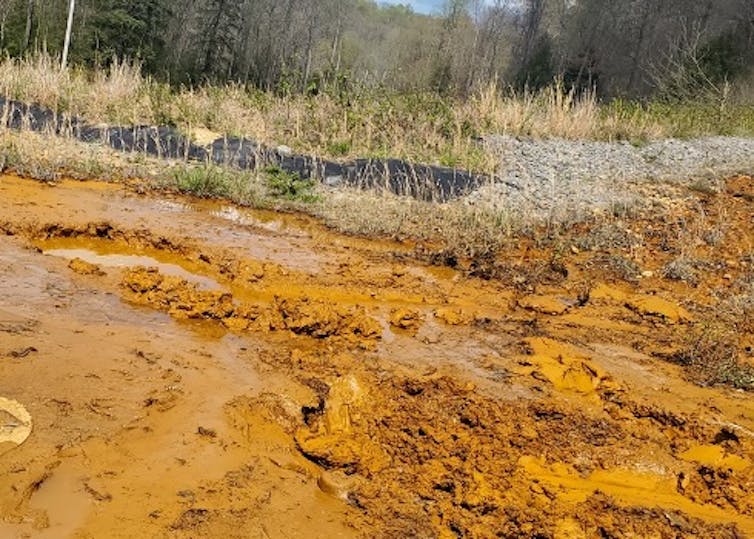
Acid mine waste turns rocks orange along Shamokin Creek in Pennsylvania.
Jake C/Wikimedia Commons, CC BY-SA

Across Appalachia, rust-colored water seeps from abandoned coal mines, staining rocks orange and coating stream beds with metals. These acidic discharges, known as acid mine drainage, are among the region’s most persistent environmental problems. They disrupt aquatic life, corrode pipes and can contaminate drinking water for decades.

However, hidden in that orange drainage are valuable metals known as rare earth elements that are vital for many technologies the U.S. relies on, including smartphones, wind turbines and military jets. In fact, studies have found that the concentrations of rare earths in acid mine waste can be comparable to the amount in ores mined to extract rare earths.

Scientists estimate that more than 13,700 miles (22,000 kilometers) of U.S. streams, predominantly in Pennsylvania and West Virginia, are contaminated with acid mine discharge.

A closer look at acid mine drainage from abandoned mines in Pennsylvania. Pennsylvania Fish and Boat Commission.

We and our colleagues at West Virginia University have been working on ways to turn the acid waste in those bright orange creeks into a reliable domestic source for rare earths while also cleaning the water.

Experiments show extraction can work. If states can also sort out who owns that mine waste, the environmental cost of mining might help power a clean energy future.

Rare earths face a supply chain risk

Rare earth elements are a group of 17 metals, also classified as critical minerals, that are considered vital to the nation’s economy or security.

Despite their name, rare earth elements are not all that rare. They occur in many places around the planet, but in small quantities mixed with other minerals, which makes them costly and complex to separate and refine.

A mine and buildings with mountains in the background.
MP Materials’ Mountain Pass Rare Earth Mine and Processing Facility, in California near the Nevada border, is one of the few rare earth mines in the U.S.
Tmy350/Wikimedia Commons, CC BY-SA

China controls about 70% of global rare earth production and nearly all refining capacity. This near monopoly gives the Chinese government the power to influence prices, export policies and access to rare earth elements. China has used that power in trade disputes as recently as 2025.

The United States, which currently imports about 80% of the rare earth elements it uses, sees China’s control over these critical minerals as a risk and has made locating domestic sources a national priority.

The U.S. Geological Survey has been mapping locations for potential rare earth mining, shown in pink. But it takes years to explore a locations and then get a mine up and running.
USGS

Although the U.S. Geological Survey has been mapping potential locations for extracting rare earth elements, getting from exploration to production takes years. That’s why unconventional sources, like extracting rare earth elements from acid mine waste, are drawing interest.

Turning a mine waste problem into a solution

Acid mine drainage forms when sulfide minerals, such as pyrite, are exposed to air during mining. This creates sulfuric acid, which then dissolves heavy metals such as copper, lead and mercury from surrounding rock. The metals end up in groundwater and creeks, where iron in the mix gives the water an orange color.

Expensive treatment systems can neutralize the acid, with the dissolved metals settling into an orange sludge in treatment ponds.

For decades, that sludge was treated as hazardous waste and hauled to landfills. But scientists at West Virginia University and the National Energy Technology Laboratory have found that it contains concentrations of rare earth elements comparable to those found in mined ores. These elements are also easier to extract from acid mine waste because the acidic water has already released them from the surrounding rock.

Metals flowing from acid mine waste make a creek look orange.
Acid mine drainage flowing into Decker’s Creek in Morgantown, West Virginia, in 2024.
Helene Nguemgaing

Experiments have shown how the metals can be extracted: Researchers collected sludge, separated out rare earth elements using water-safe chemistry, and then returned the cleaner water to nearby streams.

It is like mining without digging, turning something harmful into a useful resource. If scaled up, this process could lower cleanup costs, create local jobs and strengthen America’s supply of materials needed for renewable energy and high-tech manufacturing.

But there’s a problem: Who owns the recovered minerals?

The ownership question

Traditional mining law covers minerals underground, not those extracted from water naturally running off abandoned mine sites.

Nonprofit watershed groups that treat mine waste to clean up the water often receive public funding meant solely for environmental cleanup. If these groups start selling recovered rare earth elements, they could generate revenue for more stream cleanup projects, but they might also risk violating grant terms or nonprofit rules.

To better understand the policy challenges, we surveyed mine water treatment operators across Pennsylvania and West Virginia. The majority of treatment systems were under landowner agreements in which the operators had no permanent property rights. Most operators said “ownership uncertainty” was one of the biggest barriers to investment in the recovery of rare earth elements, projects that can cost millions of dollars.

Not surprisingly, water treatment operators who owned the land where treatment was taking place were much more likely to be interested in rare earth element extraction.

A map shows many acid mine drainage sites, largely in the column from the southwest to the northeast.
Map of acid mine drainage sites in West Virginia.
Created by Helene Nguemgaing, based on data from West Virginia Department of Environmental Protection, West Virginia Office of GIS Coordination, and U.S. Geological Survey

West Virginia took steps in 2022 to boost rare earth recovery, innovation and cleanup of acid mine drainage. A new law gives ownership of recovered rare earth elements to whoever extracts them. So far, the law has not been applied to large-scale projects.

Across the border, Pennsylvania’s Environmental Good Samaritan Act protects volunteers who treat mine water from liability but says nothing about ownership.

A map shows many acid mine drainage sites, particularly in the western part of the state.
Map of acid mine drainage sites in Pennsylvania.
Created by Helene Nguemgaing, based on data from Pennsylvania Spatial Data Access

This difference matters. Clear rules like West Virginia’s provide greater certainty, while the lack of guidance in Pennsylvania can leave companies and nonprofits hesitant about undertaking expensive recovery projects. Among the treatment operators we surveyed, interest in rare earth element extraction was twice as high in West Virginia than in Pennsylvania.

The economics of waste to value

Recovering rare earth elements from mine water won’t replace conventional mining. The quantities available at drainage sites are far smaller than those produced by large mines, even though the concentration can be just as high, and the technology to extract them from mine waste is still developing.

Still, the use of mine waste offers a promising way to supplement the supply of rare earth elements with a domestic source and help offset environmental costs while cleaning up polluted streams.

Early studies suggest that recovering rare earth elements using technologies being developed today could be profitable, particularly when the projects also recover additional critical materials, such as cobalt and manganese, which are used in industrial processes and batteries. Extraction methods are improving, too, making the process safer, cleaner and cheaper.

Government incentives, research funding and public-private partnerships could speed this progress, much as subsidies support fossil fuel extraction and have helped solar and wind power scale up in providing electricity.

Treating acid mine drainage and extracting its valuable rare earth elements offers a way to transform pollution into prosperity. Creating policies that clarify ownership, investing in research and supporting responsible recovery could ensure that Appalachian communities benefit from this new chapter, one in which cleanup and clean energy advance together.

The Conversation

The authors do not work for, consult, own shares in or receive funding from any company or organization that would benefit from this article, and have disclosed no relevant affiliations beyond their academic appointment.

ref. America’s next big clean energy resource could come from coal mine pollution – if we can agree on who owns it – https://theconversation.com/americas-next-big-clean-energy-resource-could-come-from-coal-mine-pollution-if-we-can-agree-on-who-owns-it-272029

Federal immigration enforcement near schools disrupts attendance, traumatizes students and damages their academic performance

Source: The Conversation – USA (2) – By Carolyn Sattin-Bajaj, Associate Professor of Education, University of California, Santa Barbara

High school students gather for an anti-ICE protest outside the state capitol in St. Paul, Minn., on Jan. 14, 2026. Octavio Jones/AFP via Getty Images

The Trump administration’s recent surge of more than 3,000 federal agents to Minneapolis and St. Paul, Minnesota, is creating ripple effects for students, teachers and parents that go well beyond ongoing protests against Immigration and Customs Enforcement and Customs and Border Protection. These protests escalated after an ICE agent shot and killed Renee Nicole Good on Jan. 7, 2026.

Some Twin Cities parents are arranging security patrols to look out for ICE agents, while others are keeping their kids home altogether. Several large Minneapolis-St. Paul school districts announced on Jan. 15 that they would offer remote learning so students could stay home.

Amy Lieberman, The Conversation U.S. education editor, spoke with Carolyn-Sattin-Bajaj, a scholar of education and immigrant youth, to better understand what regulations restrict ICE’s presence at schools – and how schools can support students and parents concerned about the recent surge of immigrant arrests and deportations in Minnesota.

A man in a green army uniform with a vest that says 'Border Patrol' stands over a person who lies face down in the snow.
U.S. Border Patrol agents detain a person near Roosevelt High School in Minneapolis on Jan. 7, 2026.
Kerem Yucel/AFP via Getty Images

What prevents ICE from walking into a school building?

The Obama administration issued a memo in 2011 that said federal officials should not conduct immigration enforcement work near sensitive locations, meaning schools and houses of worship. The Biden administration also had this policy in place.

President Donald Trump revoked this memo in January 2025. So now, schools are no longer off-limits to federal immigration agencies, including ICE.

That doesn’t mean ICE or Border Patrol agents can march into a school building to arrest someone. While these officers can freely enter public areas of a school, like a parking lot or lobby, school officials are not legally obligated to admit ICE agents into private spaces like classrooms. ICE officers can enter a classroom if they show a valid federal judicial warrant, signed by a judge – or if there are extreme circumstances that allow them to legally circumvent having a warrant.

School officials are also not required to release information about which kids are enrolled at their school or not, and schools do not collect information about students’ immigration status, so that data cannot be shared.

Some school districts have been developing or revising protocols on how to respond if ICE comes to their schools. A lot of these protocols
include recommendations on naming a district superintendent or another local official as the point person for ICE.

How unprecedented is it for ICE to arrest people outside or inside a school?

ICE’s presence at – or near – schools has significantly increased under the second Trump administration.

We have seen violence on school grounds, with ICE attacking students and protesters at Roosevelt High School on Jan. 7 in Minneapolis. In Crystal, Minn., a student’s parent was arrested by ICE personnel on Jan. 14 while waiting for their child at a bus stop.

Even just the threat of ICE agents approaching and arresting people en route to school, or at a school itself, is changing people’s behavior. Some parents in Minnesota and other places no longer take their children to and from school, and have to find other ways to get their kids there. This also affects how many people come to community events and activities held at school.

At one California middle school, the annual moving-up ceremony for students typically held outside had to be delayed in June 2025 after there was a credible rumor that ICE was planning to show up. The district had procedures in place. Because the event was held in an open public space, administrators were stationed at every entrance in case ICE agents turned up – though they didn’t. However, some graduates did not have any relatives there to watch them watch across the stage during the ceremony.

What other considerations are at the forefront of school administrators’ minds in regard to ICE?

The question that is top of mind for many district administrators, school leaders, teachers and other school personnel is “What happens if ICE shows up at our school?”

I think it is important that districts and schools have a clear plan in place that is widely communicated to all adults working in schools, and to students and parents. This should be paired with straightforward and recurrent training for educators on what they might expect if ICE comes to their schools and how to put their schools’ plans in place.

Yet, considering what to do if ICE comes to a school is just the tip of the iceberg. There are approximately 1.5 million children under 18 who are undocumented immigrants and about 4.4 million U.S.-born children who are citizens but have at least one undocumented parent. Many of these students are experiencing significant hardship, including interruptions to their schooling, and other forms of instability that affect their ability to learn and overall well-being.

A man wearing a green vest and pants stands near another man also in a green uniform, in front of a red brick building.
U.S. Border Patrol Commander Gregory Bovino argues with protesters near Roosevelt High School in Minneapolis on Jan. 7, 2026.
Kerem Yucel/AFP via Getty Images

What does your research show on the effects immigration enforcement can have on these students?

My research in seven large California school districts, conducted in 2021, showed that immigration arrests were linked to declines in students’ academic achievement, attendance and other measures of a school’s climate and safety for these students. The biggest declines were among Latino students, especially those who were English language learners.

In another 2023 study of an immigration workplace raid in Texas, a colleague and I found increased student absenteeism, declines in reading and math test scores, and sharp rises in the number of high school students leaving the district. Most often, it was the Latino and multilingual students enrolled in schools in the four counties closest to the raid who were not attending school immediately after the event, or experienced declining test scores.

These consequences persisted. Some of these students were less likely than others to later enroll in four-year colleges. Significantly, not just students who are most likely to have relatives targeted for deportation experienced these effects.

My own research and that of other scholars also show that many teachers are not well prepared for the current realities. But they are eager to know more about their immigrant students’ rights, the resources available to them and how they can serve as allies and advocates.

I believe that to best support students during these troubling times, teachers need better training and guidance on how to navigate challenging conversations about immigration enforcement threats, and how to deal with students’ (and their own) anxiety, uncertainty and trauma.

The Conversation

Carolyn Sattin-Bajaj receives funding from the University of California, Santa Barbara and the Spencer Foundation

ref. Federal immigration enforcement near schools disrupts attendance, traumatizes students and damages their academic performance – https://theconversation.com/federal-immigration-enforcement-near-schools-disrupts-attendance-traumatizes-students-and-damages-their-academic-performance-273325

Antibiotic resistance could undo a century of medical progress – but four advances are changing the story

Source: The Conversation – USA (3) – By André O. Hudson, Dean of the College of Science, Professor of Biochemistry, Rochester Institute of Technology

Scientists are fighting back against antibiotic resistance with new strategies and tools. wildpixel/iStock via Getty Images Plus

Imagine going to the hospital for a bacterial ear infection and hearing your doctor say, “We’re out of options.” It may sound dramatic, but antibiotic resistance is pushing that scenario closer to becoming reality for an increasing number of people. In 2016, a woman from Nevada died from a bacterial infection that was resistant to all 26 antibiotics that were available in the United States at that time.

The U.S. alone sees more than 2.8 million antibiotic-resistant illnesses each year. Globally, antimicrobial resistance is linked to nearly 5 million deaths annually.

Bacteria naturally evolve in ways that can make the drugs meant to kill them less effective. However, when antibiotics are overused or used improperly in medicine or agriculture, these pressures accelerate the process of resistance.

As resistant bacteria spread, lifesaving treatments face new complications – common infections become harder to treat, and routine surgeries become riskier. Slowing these threats to modern medicine requires not only responsible antibiotic use and good hygiene, but also awareness of how everyday actions influence resistance.

Since the inception of antibiotics in 1910 with the introduction of Salvarsan, a synthetic drug used to treat syphilis, scientists have been sounding the alarm about resistance. As a microbiologist and biochemist who studies antimicrobial resistance, I see four major trends that will shape how we as a society will confront antibiotic resistance in the coming decade.

1. Faster diagnostics are the new front line

For decades, treating bacterial infections has involved a lot of educated guesswork. When a very sick patient arrives at the hospital and clinicians don’t yet know the exact bacteria causing the illness, they often start with a broad-spectrum antibiotic. These drugs kill many different types of bacteria at once, which can be lifesaving — but they also expose a wide range of other bacteria in the body to antibiotics. While some bacteria are killed, the ones that remain continue to multiply and spread resistance genes between different bacterial species. That unnecessary exposure gives harmless or unrelated bacteria a chance to adapt and develop resistance.

In contrast, narrow-spectrum antibiotics target only a small group of bacteria. Clinicians typically prefer these types of antibiotics because they treat the infection without disturbing bacteria that are not involved in the infection. However, it can take several days to identify the exact bacteria causing the infection. During that waiting period, clinicians often feel they have no choice but to start broad-spectrum treatment – especially if the patient is seriously ill.

Close-up of two pill capsules inscribed AOMXY 500 in a blister packet
Amoxicillin is a commonly prescribed broad-spectrum antibiotic.
TEK IMAGE/Science Photo Library via Getty Images

But new technology may fast-track identification of bacterial pathogens, allowing medical tests to be conducted right where the patient is instead of sending samples off-site and waiting a long time for answers. In addition, advances in genomic sequencing, microfluidics and artificial intelligence tools are making it possible to identify bacterial species and effective antibiotics to fight them in hours rather than days. Predictive tools can even anticipate resistance evolution.

For clinicians, better tests could help them make faster diagnoses and more effective treatment plans that won’t exacerbate resistance. For researchers, these tools point to an urgent need to integrate diagnostics with real-time surveillance networks capable of tracking resistance patterns as they emerge.

Diagnostics alone will not solve resistance, but they provide the precision, speed and early warning needed to stay ahead.

2. Expanding beyond traditional antibiotics

Antibiotics transformed medicine in the 20th century, but relying on them alone won’t carry humanity through the 21st. The pipeline of new antibiotics remains distressingly thin, and most drugs currently in development are structurally similar to existing antibiotics, potentially limiting their effectiveness.

To stay ahead, researchers are investing in nontraditional therapies, many of which work in fundamentally different ways than standard antibiotics.

One promising direction is bacteriophage therapy, which uses viruses that specifically infect and kill harmful bacteria. Others are exploring microbiome-based therapies that restore healthy bacterial communities to crowd out pathogens.

Researchers are also developing CRISPR-based antimicrobials, using gene-editing tools to precisely disable resistance genes. New compounds like antimicrobial peptides, which puncture the membranes of bacteria to kill them, show promise as next-generation drugs. Meanwhile, scientists are designing nanoparticle delivery systems to transport antimicrobials directly to infection sites with fewer side effects.

Beyond medicine, scientists are examining ecological interventions to reduce the movement of resistance genes through soil, wastewater and plastics, as well as through waterways and key environmental reservoirs.

Many of these options remain early-stage, and bacteria may eventually evolve around them. But these innovations reflect a powerful shift: Instead of betting on discovering a single antibiotic to address resistance, researchers are building a more diverse and resilient tool kit to fight antibiotic-resistant pathogenic bacteria.

3. Antimicrobial resistance outside hospitals

Antibiotic resistance doesn’t only spread in hospitals. It moves through people, wildlife, crops, wastewater, soil and global trade networks. This broader perspective that takes the principles of One Health into account is essential for understanding how resistance genes travel through ecosystems.

Researchers are increasingly recognizing environmental and agricultural factors as major drivers of resistance, on par with misuse of antibiotics in the clinic. These include how antibiotics used in animal agriculture can create resistant bacteria that spread to people; how resistance genes in wastewater can survive treatment systems and enter rivers and soil; and how farms, sewage plants and other environmental hot spots become hubs where resistance spreads quickly. Even global travel accelerates the movement of resistant bacteria across continents within hours.

Antibiotic misuse in agriculture is a significant contributor to antibiotic resistance.

Together, these forces show that antibiotic resistance isn’t just an issue for hospitals – it’s an ecological and societal problem. For researchers, this means designing solutions that cross disciplines, integrating microbiology, ecology, engineering, agriculture and public health.

4. Policies on what treatments exist in the future

Drug companies lose money developing new antibiotics. Because new antibiotics are used sparingly in order to preserve their effectiveness, companies often sell too few doses to recoup development costs even after the Food and Drug Administration approves the drugs. Several antibiotic companies have gone bankrupt for this reason.

To encourage antibiotic innovation, the U.S. is considering major policy changes like the PASTEUR Act. This bipartisan bill proposes creating a subscription-style payment model that would allow the federal government up to US$3 billion to pay drug manufacturers over five to 10 years for access to critical antibiotics instead of paying per pill.

Global health organizations, including Médecins Sans Frontières (Doctors Without Borders), caution that the bill should include stronger commitments to stewardship and equitable access.

Still, the bill represents one of the most significant policy proposals related to antimicrobial resistance in U.S. history and could determine what antibiotics exist in the future.

The future of antibiotic resistance

Antibiotic resistance is sometimes framed as an inevitable catastrophe. But I believe the reality is more hopeful: Society is entering an era of smarter diagnostics, innovative therapies, ecosystem-level strategies and policy reforms aimed at rebuilding the antibiotic pipeline in addition to addressing stewardship.

For the public, this means better tools and stronger systems of protection. For researchers and policymakers, it means collaborating in new ways.

The question now isn’t whether there are solutions to antibiotic resistance – it’s whether society will act fast enough to use them.

The Conversation

André O. Hudson, PhD. receives funding from the National Institutes of Health and the National Science Foundation.

ref. Antibiotic resistance could undo a century of medical progress – but four advances are changing the story – https://theconversation.com/antibiotic-resistance-could-undo-a-century-of-medical-progress-but-four-advances-are-changing-the-story-269860

Why ‘unwinding’ with screens may be making us more stressed – here’s what to try instead

Source: The Conversation – USA (3) – By Robin Pickering, Professor and Chair of Public Health, Gonzaga University

Using multiple digital devices at once can be highly distracting and overstimulating. Riska/E+ via Getty Images

As Americans increasingly report feeling overwhelmed by daily life, many are using self-care to cope. Conversations and social media feeds are saturated with the language of “me time,” burnout, boundaries and nervous system regulation.

To meet this demand, the wellness industry has grown into a multitrillion-dollar global market. Myriad providers offer products, services and lifestyle prescriptions that promise calm, balance and restoration.

Paradoxically, though, even as interest in self-care continues to grow, Americans’ mental health is getting worse.

I am a professor of public health who studies health behaviors and the gap between intentions and outcomes. I became interested in this self-care paradox recently, after I suffered from a concussion. I was prescribed two months of strictly screen-free cognitive rest – no television, email, Zooming, social media, streaming or texting.

The benefits were almost immediate, and they surprised me. I slept better, had a longer attention span and had a newfound sense of mental quiet. These effects reflected a well-established principle in neuroscience: When cognitive and emotional stimuli decrease, the brain’s regulatory systems can recover from overload and chronic stress.

Obviously, most people can’t go 100% screen-free for days, much less months, but the underlying principle offers a powerful lesson for practicing effective self-care.

A nation under strain

Americans’ self-rated mental health is now at the lowest point since Gallup started tracking this issue in 2001. National surveys consistently detect high levels of stress and emotional strain.

Roughly one-third of U.S. adults report feeling overwhelmed most days. Sleep disruption, anxiety, poor concentration and emotional exhaustion are widespread, particularly among young adults and women.

Chronic disease patterns mirror this strain. When daily stress becomes chronic, it can trigger biological changes that increase the risk of long-term conditions like heart disease and diabetes. The Centers for Disease Control and Prevention reports that 6 in 10 U.S. adults live with at least one chronic condition, and 4 in 10 live with multiple chronic conditions.

Stress triggers physiological responses that can lead to a range of symptoms.

How people try to cope

Many Americans say they actively practice self-care in everyday life. For example, they describe taking mental health days, protecting personal time, setting boundaries around work and prioritizing rest and leisure.

The problem lies in how they use that leisure time.

Over the past 22 years, the U.S. Bureau of Labor Statistics’ American Time Use Survey has consistently found that watching television is the most popular leisure activity for U.S. adults. Americans spend far more time watching TV than exercising, spending time with friends or practicing reflection through activities like yoga. Other common self-care activities include watching movies and gaming.

Modern leisure time increasingly includes smartphone use. Surveys suggest that mobile phones have become the dominant screen for many Americans, with adults spending several hours per day on their phones.

For many adults, checking social media or watching short videos has become a default relaxation behavior layered on top of traditional screen use. This practice is often referred to as second screening.

Although many people turn to screen-based activities to wind down, these activities may have the opposite effect biologically.

Why modern screen use feels different

Pre-internet forms of leisure often involved activities such as watching scheduled television programs, listening to radio broadcasts or reading books and magazines. For all of these pastimes, the content followed a predictable sequence with natural stopping points.

Today’s digital media environment looks very different. People routinely engage with multiple screens at once, respond to frequent notifications and switch rapidly between several streams of content. These environments continuously require users to split their attention, engage their emotions and make decisions.

This type of mental multitasking draws on the same neural systems people are often attempting to rest with leisure. The result is a far more fragmented and cognitively demanding environment than in the past.

Americans now spend approximately six to seven hours per day on screens across multiple devices. Splitting attention between more than one screen at a time, such as using the phone while watching television, is common. This juggling exposes peoples’ brains to multiple streams of sensory and emotional input simultaneously.

Survey data also suggests that Americans may check their phones roughly 200 times per day. In doing so, they repeatedly pull their attention back to screens during routine moments.

Modern digital platforms are designed to maximize engagement. Algorithms tend to prioritize emotionally arousing content, particularly anger, anxiety and outrage. These feelings drive clicks, sharing and time spent on platforms. Research has shown that this design is associated with higher stress, distraction and cognitive load.

When ‘rest’ doesn’t restore

Against the backdrop of daily hassles and competing demands, it can feel like relief to flip on the TV. Practices such as streaming or so-called bed-rotting – spending extended periods in bed while scrolling – often are framed as a form of radical rest or self-care.

Other common coping behaviors include leaving the television on as background noise, scrolling between tasks throughout the day or using phones during meals and conversations. These strategies can feel restful because they temporarily reduce external demands and decision-making.

However, pairing rest with screen use may undermine the very restoration that people are seeking. Digital media stimulate attention, emotion and sensory processing. Even while people are sitting or lying still, being onscreen can keep their nervous systems in a heightened state of arousal. It may look like downtime, but it doesn’t create the biological conditions for restoration.

How to wind down

Evidence suggests that mental relief comes not from adding new coping strategies, but from reducing the number of demands placed on the brain.

Here are some evidence-based strategies that support genuine restoration:

The goal is to intentionally reduce mental load, not to abandon all digital devices.

To improve well-being in our overstimulated society, it’s important to understand the difference between feeling as though you are unwinding and actually allowing your brain and body to recover. In my view, fewer screens, fewer inputs, fewer emotional demands and more protected time for genuine cognitive rest are important components of an effective wellness strategy.

The Conversation

Robin Pickering does not work for, consult, own shares in or receive funding from any company or organization that would benefit from this article, and has disclosed no relevant affiliations beyond their academic appointment.

ref. Why ‘unwinding’ with screens may be making us more stressed – here’s what to try instead – https://theconversation.com/why-unwinding-with-screens-may-be-making-us-more-stressed-heres-what-to-try-instead-272887

Taxe Gafam : le Conseil constitutionnel consacre un régime fiscal spécifique pour les plateformes numériques

Source: The Conversation – France (in French) – By Grégoire Rota-Graziosi, Professeur CERDI-UCA-CNRS-IRD, Université Clermont Auvergne (UCA)

Le Conseil constitutionnel français admet qu’une activité numérique relève du champ de l’impôt taxé dans la juridiction des utilisateurs. ToninT/Shutterstock

Le 12 septembre 2025, le Conseil constitutionnel français approuve une taxe sur les services numériques (TSN). Il assume l’existence d’un régime fiscal distinct applicable aux grandes plateformes numériques, sans rupture d’égalité devant l’impôt. Une révolution copernicienne ? Oui, car l’impôt n’est plus fondé sur la localisation des entreprises, mais sur celle de ses utilisateurs. En l’occurrence, en France et non aux États-Unis.


Un clic à Paris. Une réservation à Milan. Une vidéo à Londres. Trois gestes anodins, trois fractions de seconde offertes aux plateformes. Pour les marchés financiers, ces actes valent des milliards. Pour les administrations fiscales, ils ne valaient presque rien, les entreprises concernées évitant l’imposition de leurs bénéfices respectifs par des pratiques d’optimisation fiscale.

Pour y remédier, les autorités françaises ont introduit une taxe sur les services numériques (TSN) en 2019 comme une mesure transitoire pour appréhender les bénéfices réalisés en France par les entreprises multinationales dites du « numérique ». Elle rapporterait environ 700 millions d’euros en 2024.

Cette taxe initialement de 3 % s’applique sur le chiffre d’affaires des plateformes de services numériques – intermédiation, publicité ciblée, vente de données, etc.

Comment fonctionne concrètement cette taxe Gafam ? Quelles implications sur notre économie ? Pourquoi

Seule la juridiction des utilisateurs compte

Le 12 septembre 2025, le Conseil constitutionnel admet qu’une activité purement numérique – l’interaction entre une plateforme et ses utilisateurs situés en France – relève du champ de l’impôt. L’absence d’un établissement stable – usine, bureau ou filiale – ne fait plus obstacle à l’imposition des revenus issus d’utilisateurs localisés en France. Cette décision consacre une évolution majeure : une activité immatérielle est localisée par ses utilisateurs justifiant son imposition par la juridiction (pays) de ces derniers.

En reconnaissant ce principe, le Conseil donne un socle constitutionnel à la taxe sur les services numériques (TSN) française et, au-delà, à une fiscalité de l’usage. La présence économique ne se mesure plus en mètres carrés, en nombre de salariés, en valeur des immobilisations corporelles mais en interactions, en données et en attention des utilisateurs.

Cette décision considère l’activité numérique des utilisateurs comme une base fiscale autonome. Elle constitue une rupture discrète, mais historique, dans un débat planétaire portant sur la source de valeur à l’ère numérique.

Les États-Unis vent debout contre cette réforme

Le retrait des États-Unis en janvier 2025 du Global Tax Deal a ravivé la pertinence de solutions unilatérales.

Le 2 décembre 2019, les États-Unis avaient rapidement réagi à l’adoption par la France, en juillet de la même année, de la loi créant la taxe sur les services numériques, en menaçant de rétorsion tarifaire non seulement la France, mais aussi d’autres pays ayant adopté une taxe similaire, comme le Royaume-Uni, l’Espagne, l’Autriche et l’Italie.

L’Organisation de coopération et de développement économiques (OCDE) est alors chargée de trouver une solution multilatérale dans le cadre des règles globales anti-érosion de la base imposable. La solution proposée repose sur deux piliers :

  • La (ré)allocation d’une partie des profits résiduels des grandes multinationales, en particulier numériques, vers les juridictions de marché indépendamment de la présence physique ;

  • L’instauration d’un impôt minimum mondial sur les sociétés, afin de limiter la concurrence fiscale et l’érosion des bases. L’administration de Donald Trump a rejeté en janvier 2025 cette solution et leurs engagements antérieurs dans l’accord de l’OCDE datant de 2021.

Dans ce contexte, la décision du Conseil constitutionnel rapproche la France de la position des Nations unies, sans rompre avec celle de l’OCDE. Dès 2021, l’article 12B du Modèle de Convention fiscale de l’ONU autorise les États à imposer les revenus tirés des « services automatisés fournis à distance », comme le cloud, le streaming, les logiciels, la publicité en ligne, les moteurs de recherche ou les plateformes. Cette approche protège davantage les intérêts des pays du Sud, davantage de consommateurs de services numériques que les « producteurs » de ceux-ci ou les hébergeurs des sièges des entreprises multinationales du numérique.

« Servicisation numérique »

La définition de l’assiette taxable des services numériques est sensiblement plus large dans l’approche des Nations unies que dans les législations fiscales européennes.

L’intérêt de cette définition étendue est d’anticiper les évolutions industrielles actuelles et futures comme la « servicisation numérique ». Cette dernière désigne le passage de la vente de produits physiques à celle de services numériques. Par exemple, la valeur d’un équipement industriel ne repose pas tant sur celle de l’équipement physique que sur les services numériques dédiés à la performance de l’équipement.

La « servicisation numérique » transfère la création de valeur et de profits d’actifs physiques vers des actifs intangibles, comme des droits de propriété intellectuelle ou des services numériques. Le transfert des bénéfices vers des centres étrangers de services numériques localisés dans des pays à faible fiscalité participe à l’érosion des bénéfices imposables.

La taxe sur les services numériques (TSN) devient un moyen de limiter le risque de transfert de profits qui concerne la plupart des secteurs économiques.

Taxation optimale

Par sa forme, la taxe sur les services numériques est simple. Elle repose sur le chiffre d’affaires réalisé dans le pays où habite l’utilisateur. Cette forme évite la renégociation des conventions fiscales bilatérales.

Elle reste critiquée par les partisans de la théorie de la taxation optimale. Pourquoi ? Parce qu’elle réduit l’efficience de la production en taxant chaque transaction, en ignorant les marges bénéficiaires qui varient d’une entreprise à l’autre.

Par exemple, une taxe de 3 % sur le chiffre d’affaires d’une entreprise ayant une marge de 30 % correspond à une taxe de 10 % sur ses bénéfices. La même taxe appliquée à une entreprise moins profitable, ayant une marge de 5 % par exemple, supporterait alors une taxe de 60 % sur ses bénéfices.

Présence économique significative indienne

Son alternative est la présence économique significative (PES) introduite en Inde en 2018, puis au Nigeria notamment.

Ce régime taxe le profit supposé réalisé dans le pays. Si cette forme de taxation respecte davantage l’orthodoxie fiscale en taxant les bénéfices, elle est plus complexe à mettre en œuvre. Elle nécessite d’estimer non seulement le chiffre d’affaires réalisé dans le pays, mais également les coûts associés à l’activité dans le pays concerné.

L’article 12B du Modèle de Convention fiscale de l’ONU laisse le choix aux pays de taxer le chiffre d’affaires ou le profit.

La décision du Conseil constitutionnel a confirmé la compétence fiscale de l’État à taxer la valeur créée par un utilisateur français de services numériques d’entreprises étrangères. Cette décision ne règle pas toutes les difficultés, et de nouveaux défis et oppositions existent concernant la définition ou l’estimation de la valeur taxable.

Elle est pourtant une première étape vers un système fiscal à l’ère du numérique.


Cet article a été co-rédigé avec Abdel-Malek Riad, chercheur associé au CERDI–CNRS et président-directeur général d’AMR IM.

The Conversation

Grégoire Rota-Graziosi est membre de la FERDI. Il est expert en politique fiscales et assure des missions auprès d’institutions nationales, régionales ou internationales.

ref. Taxe Gafam : le Conseil constitutionnel consacre un régime fiscal spécifique pour les plateformes numériques – https://theconversation.com/taxe-gafam-le-conseil-constitutionnel-consacre-un-regime-fiscal-specifique-pour-les-plateformes-numeriques-268600

La selección: ser humano es crear

Source: The Conversation – (in Spanish) – By Laura G. de Rivera, Ciencia + Tecnología, The Conversation

WhataWin/Shutterstock

La ciencia no está solo en los laboratorios o en los últimos avances que retratan las publicaciones científicas. También está en casa, en cada cosa que hacemos y cada cosa que somos. Está escondida entre los magistrales acertijos matemáticos de Alicia en el País de las Maravillas o en cómo funciona el cerebro de los pobres universitarios que están de exámenes por estas fechas… pero también en las mediciones del mar en los confines del mundo o en la cantidad de peso que puede aguantar una hiedra –no es un nombre en clave ni una heroína mitológica, es una planta–. Como la del edificio New Court en Cambridge, que tiene 180 años, 10 metros de alto y pesa unas 12 toneladas, sin contar las raíces.

Y los ejemplos son miles. Quizá no sepamos que, cada vez que abrimos Google Maps, el buen funcionamiento del GPS depende directamente de la teoría de la relatividad, igual que las imágenes digitales y los paneles solares funcionan gracias al efecto fotoeléctrico, explicado por Einstein en 1905. Pero, si estamos hartos de tecnología y lo que queremos es entender el mundo natural, sobre todo el marino –que, por cierto, tiene una razón para ser salado–, podemos viajar con los calamares y los tiburones para comprender, en la práctica, cómo funciona y para qué sirve la evolución: cómo algunos peces transformaron sus aletas en patas, cómo se las apañan las ballenas para amamantar en el agua, por qué un tiburón produce a lo largo de su vida más de 300 000 dientes o el sorprendente ecosistema que late en una gota del océano.

Es posible que, al sumergirnos en estos artículos, igual que ocurre cuando nos zambullimos en el mar, se nos pase por la cabeza que la naturaleza es una verdadera obra de arte. Y, como la naturaleza somos todos, tal vez por eso, ciencia, arte y vida van tan de la mano. Más allá de la evidente relación entre ellas, artes y ciencias se necesitan. Cuando personas de distintas disciplinas colaboran, producen interpretaciones más profundas, diversas y sensibles de la realidad. No hay más que ver los primeros mapas del mundo, las láminas de historia natural o las bellas neuronas retratadas por Santiago Ramón y Cajal.

Y es que los seres humanos tenemos tantísimas ganas de inventar y crear que no nos detenemos ante nada: imaginamos palabras, cronopios y mancuspias y echamos mano del humor y el ingenio para sobrellevar con un mínimo de dignidad que el mundo digital nos pudra el cerebro… hasta la inteligencia artificial puede servir para crear bellas obras de literatura interactiva y multimedia.

The Conversation

ref. La selección: ser humano es crear – https://theconversation.com/la-seleccion-ser-humano-es-crear-273725