Apprendre à varier son alimentation : écouter les émotions des enfants, un enjeu central

Source: The Conversation – in French – By Aurélie Maurice, Maîtresse de conférences en Sciences de l’Éducation et de la Formation, Université Sorbonne Paris Nord

Se nourrir est un acte complexe, croisant psychologie, culture et physiologie. Dès lors, comment s’y prendre, en tant que parent ou éducateur, pour aider les enfants à former leur goût et élargir leur répertoire alimentaire ? La recherche donne quelques pistes pour mieux tenir compte de la place des émotions dans le rapport à la nourriture.


L’éducation à l’alimentation des jeunes est au cœur des politiques publiques : elle est l’un des objectifs du Programme national nutrition santé (PNNS) et l’un des axes du Programme national pour l’alimentation (PNA). De plus, un Vademecum sur l’éducation à l’alimentation et au goût a récemment émané de l’éducation nationale. Plusieurs membres de l’Assemblée nationale organisent aussi depuis quelques années des « états généraux » sur le sujet.

Les derniers états généraux d’octobre 2025 ont conduit à une proposition de loi d’expérimentation pour l’instauration d’un enseignement d’éducation à l’alimentation obligatoire à l’école.


À lire aussi :
Comment peut-on repenser l’éducation à l’alimentation ?


Alors que l’éducation à l’alimentation s’est longtemps heurtée à des limites, notamment face aux inégalités sociales de santé, de nouvelles approches apparaissent : citons l’approche tridimensionnelle qui intègre les dimensions « nutritionnelle », « psycho-sensorielle et comportementale » et « socio-environnementale ». L’approche hédonique, elle, privilégie le plaisir alimentaire avec trois leviers d’actions : l’exposition sensorielle répétée aux aliments, les interactions sociales lors des prises alimentaires et les croyances sur les aliments.

Si ces démarches mettent en avant l’importance des émotions, comment, concrètement, les prendre en compte au quotidien, lors de repas ou de séances de découverte, que l’on soit parent, acteur ou actrice de l’éducation ?

Veiller au contexte des repas

S’alimenter est un acte complexe, car multidimensionnel : physiologie, sociabilité, identité culturelle et psychologie s’entremêlent. S’alimenter, c’est aussi ressentir toute une palette d’émotions : la joie, le dégoût, la peur… Celles-ci sont pour l’instant peu prises en compte globalement dans les séances d’éducation à l’alimentation. C’est le cas néanmoins dans l’éducation au goût, qui cherche à reconnecter les jeunes avec leurs sens.

Marie Jaunet, Sylvie Delaroche-Houot et moi-même avons mené une revue de la littérature scientifique afin d’explorer comment les émotions peuvent être mobilisées dans le champ de l’éducation à l’alimentation et quels en sont les bénéfices. Cette revue a été effectuée sur 30 articles publiés entre 2005 et 2022, dont 90 % en anglais, provenant principalement d’Amérique du Nord et d’Europe occidentale.

Cette revue montre que les émotions des jeunes sont bel et bien à prendre en compte, et ce, pour plusieurs raisons. Tout d’abord, il apparaît que la composition nutritionnelle des aliments a un impact sur ces émotions. Un repas suffisamment varié et correspondant bien aux besoins nutritionnels des enfants diminuerait les émotions négatives, comme la tristesse ou l’anxiété.

Ensuite, l’importance d’être attentif à ses cinq sens quand on se nourrit est soulignée, notamment, par des études sur l’alimentation consciente chez les enfants. Créer un environnement positif pendant les repas, c’est-à-dire faire du moment du repas un moment joyeux, ludique et apaisant, favorise une prise alimentaire diversifiée et en quantité suffisante de la part des enfants. Cette attention portée à la qualité de l’ambiance des repas est d’autant plus bénéfique qu’elle est travaillée tant à la maison qu’à l’école.

En obligeant les enfants à finir leurs assiettes, ou en se servant de l’alimentation comme d’une récompense ou d’un élément de chantage, certains parents peuvent favoriser le développement d’une « alimentation émotionnelle » chez leurs enfants. Cela peut conduire à un surpoids à moyen et long terme.

Favoriser l’empathie

Un groupe d’experts est arrivé à une classification des styles éducatifs parentaux sur l’alimentation qui en distingue trois types : coercitif (fondé sur la pression, les menaces et les récompenses), structuré (donnant des règles qui encadrent les prises alimentaires) et favorisant l’autonomie (donnant les clés à l’enfant pour qu’il fasse ses propres choix, dans un climat d’amour inconditionnel).

Ces trois grandes catégories conduisent à des états émotionnels très différents, allant de la peur à la joie, et à des pratiques alimentaires enfantines très contrastées (se cacher pour manger des aliments interdits, se restreindre de manière autonome).

Le repas familial peut être un moment propice au partage et à l’écoute des émotions de l’enfant. Aux États-Unis apparaît depuis plusieurs décennies un terme, « parent responsiveness », qui pourrait être traduit par « réactivité parentale », à savoir une attitude empathique des parents, apportant une réponse adaptée aux émotions exprimées par leurs enfants et aux besoins sous-jacents.

Plusieurs chercheurs ont proposé d’adapter ce concept à l’alimentation, et parlent de « responsive feeding » ou « réactivité alimentaire ». Il s’agit de soigner le temps du repas, d’en faire un moment pendant lequel l’enfant se sent à l’aise et en confiance. Le parent cherche à être attentif aux sensations de faim et de satiété de son enfant, à lui répondre rapidement, de façon appropriée, en fonction de l’émotion qu’il exprime et de son stade de développement.

Enfin, les articles étudiés dans la revue de littérature font état de plusieurs outils conçus pour aider les enfants à s’exprimer autour de l’alimentation et à nommer leurs émotions.

Cette revue montre qu’il faut prendre en compte les différentes dimensions de l’acte alimentaire, tel que l’environnement dans lequel l’aliment est consommé. Un climat bienveillant et joyeux apparaît plus propice aux nouvelles expériences gustatives, alors que, si l’enfant se sent contraint, voire angoissé, les conditions ne sont pas réunies pour qu’il découvre de nouveaux aliments ou accepte de manger des légumes, par exemple.

La politique publique des mille premiers jours de l’enfant recommande des activités conjointes parents/enfant, sources d’émotions positives dans lesquelles l’alimentation a toute sa place. Il apparaît donc que la formation tant des parents que des enseignants, des personnels du périscolaire et des autres professionnels éducateurs est essentielle pour développer la capacité d’autorégulation et d’ouverture des jeunes dans leur alimentation.

The Conversation

Aurélie Maurice a reçu des financements de l’ANR pour le projet ERMES qu’elle coordonne.

ref. Apprendre à varier son alimentation : écouter les émotions des enfants, un enjeu central – https://theconversation.com/apprendre-a-varier-son-alimentation-ecouter-les-emotions-des-enfants-un-enjeu-central-272502

Les « actions cachées » : quand des régions du cerveau liées à la motricité s’activent… alors qu’on ne bouge pas

Source: The Conversation – in French – By Florent Lebon, Professeur des Universités en Neurosciences cognitives et comportementales, Université Claude Bernard Lyon 1

Les « actions cachées » engagent des régions cérébrales liées à la motricité alors qu’on reste immobile. Cette plasticité des neurones, qui renforce les liens entre le cerveau et les muscles, n’a pas encore livré tous ses secrets. Mais ces processus cognitifs pourraient, dans le futur, se révéler précieux pour optimiser des gestes sportifs ou encore favoriser la rééducation après une blessure.


En bout de piste, un sauteur en longueur se prépare pour son dernier essai. La médaille est en jeu. Avant de s’élancer, il répète mentalement sa course d’élan, les premières foulées, l’accélération, l’impulsion et la réception dans le sable. Il rouvre les yeux, et c’est parti !

Une jeune joueuse de volley-ball assiste à un match de son équipe préférée. Elle observe la posture des joueuses en attaque et en défense, la manière dont elles se déplacent. Elle comprend la tactique annoncée et s’attend à ce que son équipe marque. Elle apprend en observant !

L’être humain possède l’extraordinaire capacité d’imaginer ses propres mouvements, de comprendre les actions d’autrui par la simple observation, ou encore de communiquer et transmettre ses actions par l’écriture et la lecture.

Activation du cerveau sans bouger

Tous ces processus cognitifs engagent des régions cérébrales liées à la motricité, alors même que l’on ne bouge pas. Ils peuvent être identifiés sous le terme d’« actions cachées ». Même si on est immobile, certaines parties de notre cerveau, normalement actives pendant nos actions, le sont également pendant les actions cachées, telles que l’imagerie motrice, l’observation d’action ou encore le langage d’action.

L’imagerie motrice correspond au fait de se représenter mentalement, de façon consciente, un mouvement, sans l’exécuter physiquement. Les modalités basées sur les sens permettent de se représenter une action. Les deux principales sont le visuel (« se voir » en train de faire l’action) et le kinesthésique (« ressentir » les sensations associées au mouvement). L’observation d’action, elle, consiste à sélectionner les informations pertinentes d’une action en train de se réaliser, et d’en comprendre les intentions.

Enfin, dans ce contexte, le langage d’action fait référence à la lecture, silencieuse ou non, de verbes évoquant une action, tels que « serrer », « prendre », « sauter ». Ces verbes isolés peuvent être enrichis par un contexte (« je vois une orange sur la table, je la prends ») afin d’activer d’autant plus le système moteur lié à cette action.

Les outils technologiques actuels nous permettent de « voir » à l’intérieur de notre cerveau. On parle alors d’imagerie par résonance magnétique (IRM) ou de stimulation magnétique transcrânienne (TMS).

La découverte des neurones miroirs

Rappelons qu’une grande étape dans la compréhension des actions cachées a été la découverte des neurones miroirs. Une équipe italienne, menée par Rizzolatti, a enregistrée dans le cerveau de singes, l’activité de neurones qui déchargeaient non seulement lorsque le singe exécutait une action de préhension d’un objet, mais aussi lorsqu’il observait l’expérimentateur saisir cet objet – une découverte accidentelle mais révolutionnaire.

Les actions cachées activent ainsi un réseau complexe au sein du cerveau, montrant l’interaction entre plusieurs régions, telles que le cortex moteur primaire (de là où partent nos commandes motrices), le cortex occipital (là où sont traitées les informations visuelles) ou encore le cortex pariétal (là où sont traitées les informations sensorielles).

La majorité des personnes peuvent ainsi recréer mentalement leur dernier lieu de vacances au soleil, avec plus ou moins de détails, et s’imaginer courir sur la plage (pour exception, voir l’article sur l’aphantasie).

On dit alors que les processus cognitifs associés à nos actions sont incarnés dans notre cerveau (théories de la cognition incarnée). Il n’est pas nécessaire de bouger pour activer le réseau de la motricité. La simulation mentale nous permettrait de planifier nos propres actions, de comprendre les actions d’autrui, de juger les conséquences des actions ou encore de comprendre plus facilement un récit impliquant des actions.

Même si cette simulation n’est pas explicite (c’est-à-dire qu’on ne crée pas volontairement d’images dans notre tête, et on n’en est peut-être même pas conscient), elle optimiserait notre imagerie et la compréhension des actions (par l’observation et le langage).

Des actions cachées pour renforcer les liens entre cerveau et muscles

Ces différents types d’actions cachées peuvent être utilisées de manière très pratique pour apprendre un nouveau morceau de musique, optimiser son geste sportif ou encore récupérer à la suite d’une blessure ou d’une pathologie, sans risquer d’accident ni de fatigue.

Une des études pionnières est celle de Yue et Cole, en 1992. Par le simple fait d’imaginer des contractions de la main, tel un entraînement à raison de quatre séances par semaine pendant quatre semaines, les participants ont réussi à augmenter leur force de 22 %. La plasticité cérébrale rentre en jeu pour renforcer les réseaux neuronaux normalement impliqués dans l’action. Plus je répète mentalement, plus j’entraîne mon cerveau : je renforce les liens entre le cerveau et les muscles.

Des perspectives pour, demain, favoriser l’apprentissage ou la rééducation

Se représenter mentalement des mouvements peut également améliorer d’autres capacités, comportementale ou cognitive. Une récente étude montre qu’imaginer des actions simples (écrire, lancer, remplir une tasse, etc.) peut améliorer la performance à des tâches de compréhension du langage, en facilitation l’accès lexico-sémantique.

À l’heure actuelle, les chercheurs s’attachent à mieux comprendre les liens entre les différents types d’actions cachées et à optimiser leur utilisation. Dans des études encore en cours, ils testent, par exemple, la combinaison de ces actions cachées dans le but de favoriser d’autant plus l’apprentissage et la rééducation. Il est possible de combiner l’observation d’un adversaire au tennis et d’imaginer le coup approprié pour gagner le point. Ou bien il est envisageable de lire des verbes d’actions avant d’imaginer un mouvement de force pour en booster les effets.

L’enjeu est alors de trouver le bon dosage entre les différentes pratiques, pour éviter la fatigue mentale, tout en observant des effets positifs.

Il est à noter que ces différents types d’actions cachées restent distincts. Ils restent encore des zones d’ombre pour comprendre leur interaction potentielle et favoriser ainsi leur utilisation seule ou combinée.

Le cerveau a encore des choses à nous dévoiler.


Les projets « Interaction entre Langage et Imagerie motrice pour améliorer l’apprentissage moteur et la compréhension du langage » – LAMI – et « Explorer les marqueurs neuronaux et fonctionnels des actions cachées à travers le prisme de la phantasie » – COVACT – sont soutenus par l’Agence nationale de la recherche (ANR), qui finance en France la recherche sur projets. Elle a pour mission de soutenir et de promouvoir le développement de recherches fondamentales et finalisées dans toutes les disciplines, et de renforcer le dialogue entre science et société. Pour en savoir plus, consultez le site de l’ANR.

The Conversation

Florent Lebon a reçu des financements de l’agence nationale de la recherche.

Carol Madden-Lombardi ne travaille pas, ne conseille pas, ne possède pas de parts, ne reçoit pas de fonds d’une organisation qui pourrait tirer profit de cet article, et n’a déclaré aucune autre affiliation que son organisme de recherche.

ref. Les « actions cachées » : quand des régions du cerveau liées à la motricité s’activent… alors qu’on ne bouge pas – https://theconversation.com/les-actions-cachees-quand-des-regions-du-cerveau-liees-a-la-motricite-sactivent-alors-quon-ne-bouge-pas-270212

Face aux attaques contre la science, l’importance d’inscrire la liberté académique dans la Constitution belge

Source: The Conversation – in French – By Édouard Delruelle, Professeur de Philosophie politique, Université de Liège

Dans le cadre de notre émission consacrée à la défense de la liberté académique, diffusée vendredi 23 janvier, nous publions cet article initialement paru dans le Quinzième jour, le quadrimestriel de l’Université de Liège. Édouard Delruelle y développe un plaidoyer en faveur de l’inscription de la liberté académique dans la Constitution belge comme une étape pour ouvrir un débat démocratique sur le sujet.


En septembre dernier, l’Université de Berkeley, temple historique de la liberté de pensée, a accepté de livrer à l’administration Trump une liste d’étudiants et de professeurs suspectés d’« antisémitisme » en raison de leur engagement en faveur de la cause palestinienne.

Dans cette liste figure la philosophe Judith Butler, docteure honoris causa de l’université de Liège. Qui aurait imaginé, il y a un an à peine, que les universités les plus performantes et les plus prestigieuses au monde seraient l’objet d’attaques aussi violentes de la part du pouvoir politique, et qu’elles céderaient si prestement à ses intimidations et injonctions ? Que des programmes de recherche essentiels pour l’avenir de l’humanité dans les domaines de la santé ou du climat seraient démantelés ? Que les chercheurs en sciences humaines et sociales devraient bannir de leur vocabulaire des termes tels que diversité, égalité, inclusion ?

En Belgique, des coupes et des inquiétudes

Pourtant, nous avions tort de penser que ces atteintes brutales à la liberté académique ne pouvaient avoir cours que dans les régimes autoritaires. Cela fait plusieurs années que l’Academic Freedom Index enregistre une dégradation de la liberté académique en Europe. Intrusion du management dans la gouvernance universitaire, culture de la « post-vérité » sur les réseaux sociaux, ciblage d’intellectuels critiques par l’extrême droite, stigmatisation d’un prétendu « wokisme » que propageraient les études de genre, décoloniales ou LGBTQIA+ : ces offensives ne sont pas neuves, et elles touchent aussi la Belgique.

Mais un coup d’accélérateur a indéniablement été donné en 2025, avec les coupes budgétaires dans la recherche décidées par le gouvernement de la Fédération Wallonie-Bruxelles, une réforme drastique des retraites des Académiques, avant d’autres mesures annoncées sur le précompte chercheur ou le statut de fonctionnaire. Les mouvements Stand Up for Science au niveau mondial, ou « Université en Colère » chez nous, témoignent de l’inquiétude de la communauté universitaire face aux menaces qui pèsent sur la liberté académique.

De nombreuses menaces

Ces menaces sont multiples. On peut schématiquement en identifier quatre :

  1. les menaces politiques provenant de gouvernements et de mouvements politiques déterminés à contrôler idéologiquement la production et la diffusion des connaissances ;

  2. celles que font peser sur la science la logique économique de marché
    – rentabilité, compétitivité, privatisation de la recherche, avec comme conséquences, entre autres, la précarisation grandissante des chercheurs et le découplage de l’excellence scientifique et de la liberté académique ;

  3. l’emprise des technologies du numérique et leur l’impact sur la propriété intellectuelle, l’autonomie pédagogique, l’esprit critique ou la créativité (fake news, IA mobilisée à des fins de propagande, intrusion des réseaux sociaux dans les débats académiques, etc.) ;

  4. la propagation d’un « sciento-populisme » au sein d’une opinion publique de plus en plus polarisée et critique à l’égard des élites (intellectuelles, judiciaires, journalistiques, etc.).

Ces menaces se conjuguent le plus souvent : la censure politique d’un Trump s’exerce par la pression économique, la Tech numérique délégitime la science auprès des internautes, les impératifs financiers justifient la mise au ban des savoirs critiques. Aucun domaine de recherche n’est épargné : les sciences humaines et sociales sont attaquées en raison de leur prétendue dangerosité idéologique ou de leur inutilité économique présumée mais les STEM (sciences, technologie, ingénierie, mathématiques) sont aussi menacées d’être instrumentalisées comme simples vecteurs de puissance géopolitique, comme c’est déjà le cas en Russie ou en Chine.

La recherche en plein « warscape »

La recherche scientifique évolue dorénavant dans un « warscape », c’est-à-dire un espace traversé par la violence politique, sociale et économique, et où les rapports de pouvoir et de savoir sont complètement reconfigurés. Trois modalités de ces rapports se dégagent :

  1. la guerre contre la science menée par ceux qui veulent la destruction de l’autonomie des universités et de la libre recherche (en même temps que celle de la démocratie) ;

  2. la guerre dans la science, du fait des fractures au sein de la communauté universitaire elle-même autour de questions controversées telles que le colonialisme, le conflit israélo-palestinien, le transgenrisme, etc. ;

  3. la science face à la guerre, qui soulève la question des collaborations « à risques », notamment avec l’industrie de l’armement ou avec des partenaires internationaux potentiellement impliqués dans des violations du droit humanitaire – question très polarisante, comme l’a montré à l’ULiège la polémique autour de la chaire Thalès.

Une culture citoyenne

C’est dans cette perspective que la liberté académique, j’en suis convaincu, doit être défendue et protégée, non par corporatisme, mais parce qu’elle est la condition de tout développement scientifique comme de tout État de droit et de toute démocratie.

Telle est aussi la conclusion du remarquable rapport publié récemment par Sophie Balme pour France Universités, qui propose une “stratégie globale” de renforcement de la liberté académique en 65 propositions. Comment créer une véritable culture professionnelle, politique et surtout citoyenne autour de la liberté de recherche et d’enseignement ? Une culture citoyenne surtout, car l’une des raisons pour lesquelles Trump peut attaquer si brutalement les universités est l’hostilité d’une grande partie de l’opinion publique américaine à l’égard d’un monde universitaire jugé arrogant, coupé des réalités et entretenant un système de reproduction sociale financièrement inaccessible au plus grand nombre. Nous devons éviter de nous retrouver dans cette situation.

La première des 65 propositions de Sophie Balme est d’inscrire la liberté académique dans la Constitution française. Pourquoi pas aussi en Belgique, qui suivrait ainsi l’exemple de l’Italie ou de l’Allemagne (dont on sait quelles tragédies historiques ont été à l’origine de leurs constitutions d’après-guerre) ? Ouvrons le débat.

Ouvrir un débat démocratique

Certains constitutionnalistes objecteront que si la liberté académique ne figure pas formellement dans le texte constitutionnel, elle est néanmoins explicitement reconnue par la jurisprudence de la Cour constitutionnelle et de la Cour européenne des droits de l’Homme, et qu’elle est en outre consacrée par la Charte des droits fondamentaux de l’Union européenne, un texte qui est au sommet de la pyramide normative et d’application directe dans notre droit national. D’un point de vue juridique, ma proposition serait comme un coup d’épée dans l’eau. On répondra toutefois que presque toutes les libertés fondamentales sont dupliquées aux deux niveaux normatifs, européen et national, ce qui renforce leur effectivité juridique et leur portée symbolique.

Mais surtout, le processus politique de révision de la Constitution qu’il faudra parcourir serait l’occasion d’une large mobilisation du monde académique et, espérons-le, de la société civile, et d’un débat démocratique autour de la liberté de recherche et d’enseignement. Ce débat obligerait les partis politiques à se positionner et à en tirer les conséquences sur les plans programmatique et législatif. Et il représenterait une belle opportunité de solidarité et d’échange entre acteurs et actrices de la recherche au nord et au sud du pays.

Une liberté spécifique et complexe

Ce débat serait surtout l’occasion de s’interroger sur la spécificité et la complexité de la liberté académique. Spécificité par rapport à la liberté d’expression, dont jouit tout citoyen et qui l’autorise à dire ce qu’il veut (hors des atteintes à la loi), y compris des choses idiotes et insignifiantes – ce dont un grand nombre ne se prive pas. Tandis que la liberté académique est un outil au service d’une finalité qui dépasse son bénéficiaire : la recherche de la vérité sans contraintes (une belle définition du philosophe Paul Ricœur sa « Préface » à Conceptions de l’université de J. Drèze et J. Debelle. Une finalité qui nous impose des devoirs (à commencer par celui de nous soumettre au jugement de nos pairs).

Complexité ensuite de la liberté académique, qui est multidimensionnelle, comme en témoignent les cinq critères utilisés par l’Academic Freedom Index : la liberté de recherche et d’enseignement, la liberté de collaborer, d’échanger et de diffuser les données et les connaissances, l’autonomie institutionnelle des universités, l’intégrité du campus à l’égard des forces de l’ordre mais aussi des groupes militants violents et enfin la liberté d’expression académique et culturelle, y compris sur des questions politiques ou sociétales.

De vrais enjeux se posent quant aux limites de chacune de ces libertés, et aux tensions qui peuvent exister entre elles, en particulier entre la liberté académique individuelle et l’autonomie des universités. Car pour garantir celle-là, celles-ci ne doivent-elles pas s’astreindre à une certaine « réserve institutionnelle » (un terme plus approprié que « neutralité ») sur les questions politiques ? Je le crois ; mais cette « réserve » est-elle encore de mise face à des violations caractérisées du droit international et du droit humanitaire ? C’est toute la complexité du débat autour des collaborations avec les universités israéliennes…

Résistance, nuance, responsabilité

Comment faire de nos universités des espaces à la fois ouverts sur le monde et préservés de la violence qu’il engendre ? Des espaces de résistance à l’obscurantisme abyssal qui gangrène nos sociétés, de nuance contre les simplismes idéologiques, de responsabilité à l’égard des immenses défis environnementaux, sociaux, géopolitiques dont dépend l’avenir de l’humanité ? Ce qui arrive aujourd’hui au monde de la recherche doit faire réfléchir chacun d’entre nous sur son ethos académique, sur le mode de subjectivation qu’implique un exercice sans réserve mais responsable de la liberté académique. Mais cette réflexion doit aussi être collective, autour d’un objectif mobilisateur. C’est ce que je propose.

La liberté académique dans la Constitution, ce n’est donc pas figer dans le marbre une vérité révélée, mais au contraire ouvrir le débat sur une liberté essentielle mais menacée, qui regarde tant les acteurs de la recherche que les citoyens qui en sont les destinataires finaux. Ce n’est pas non plus cantonner le débat au niveau belge, mais créer l’opportunité d’un mouvement à l’échelon européen, afin que la recherche y préserve son autonomie à l’heure où, en Chine et aux États-Unis (et ailleurs), elle est désormais sous contrôle politique. Sophie Balme propose ici aussi des pistes d’action pour l’Union européenne, en termes d’investissements mais aussi d’outils concrets de mesure et de promotion de la liberté académique. Et bien sûr, nous devons continuer à manifester notre solidarité envers les chercheurs inquiétés ou opprimés partout dans le monde.

Pour atteindre ces objectifs, je suggère une double stratégie, par « en haut » et par « en bas ». D’un côté, un engagement des rectrices et des recteurs du nord et du sud (via le CREF – Conseil des rectrices et recteurs francophones – et le VLIR – Vlaamse interuniversitaire raad), en nouant aussi des alliances par-delà les frontières. L’ULiège pourrait être le moteur d’un tel engagement, par la voix de la rectrice Anne-Sophie Nyssen. De l’autre côté, une mobilisation de nous tous, acteurs et actrices de la recherche, envers le monde politique et la société civile – une mobilisation qui prendrait la forme de pétitions, de colloques, de forums, mais aussi de production de savoirs qui manquent cruellement dans le domaine francophone (Notons malgré tout l’Observatoire des atteintes à la liberté académique).

En tous cas, il est grand temps d’agir si nous ne voulons pas plier demain, à notre tour, devant les apprentis Trump qui pullulent autour de nous.

The Conversation

Édouard Delruelle a reçu des financements du FNRS (Belgique) et de l’Université de Liège

ref. Face aux attaques contre la science, l’importance d’inscrire la liberté académique dans la Constitution belge – https://theconversation.com/face-aux-attaques-contre-la-science-limportance-dinscrire-la-liberte-academique-dans-la-constitution-belge-273947

L’aide au développement sert aussi à sécuriser les chaînes d’approvisionnement des pays riches

Source: The Conversation – in French – By Basak Bayramoglu, Directrice de recherche, Inrae

En théorie, le montant de l’aide au développement versé à tel ou tel pays ne devrait pas dépendre de sa contribution aux chaînes de valeur mondiales. Dans les faits, pourtant, on observe que les pays donateurs ont tendance à privilégier, quand ils aident financièrement des pays pauvres, ceux qui sont utiles à leur propre production…


Pourquoi certains pays reçoivent-ils davantage d’aide au développement que d’autres alors que leurs besoins sont comparables ? Les chercheurs s’interrogent sur cette question depuis des décennies. Nous savons déjà que les motivations des donateurs ne sont pas uniquement altruistes : elles incluent des considérations diplomatiques ou commerciales par exemple.

Dans un article récent, nous montrons que les chaînes de valeur mondiales — ces réseaux internationaux où les biens sont produits en plusieurs étapes dans différents pays — créent de nouvelles interdépendances entre pays et influencent l’allocation de l’aide.

Aide au développement bien ordonnée…

Depuis les années 1990, la production mondiale s’est largement fragmentée : composants électroniques, pièces automobiles, produits agricoles transformés… une multitude d’étapes de production sont désormais dispersées entre plusieurs pays. Les échanges liés à cette organisation de la production mondiale en chaînes de valeur représentent environ 50 % du commerce mondial.

Notre analyse empirique montre que les pays donateurs accordent davantage d’aide aux pays qui fournissent des biens intermédiaires utilisés dans leur production destinée à l’exportation. Autrement dit, l’aide n’est pas uniquement destinée aux pays dont les besoins sont les plus importants : elle se dirige aussi vers ceux qui occupent des positions clés dans les chaînes de valeur mondiales.

Les exportations des pays récipiendaires de l’aide jouent un rôle particulièrement important dans les secteurs caractérisés par des biens intermédiaires différenciés, difficiles à substituer : équipements électriques et machines, transport et pièces automobiles, industrie agroalimentaire. Les pays produisant ce type de biens reçoivent davantage d’aide, toutes choses égales par ailleurs. Ce résultat complète d’autres recherches montrant que les réserves en pétrole des pays récipiendaires influencent également l’allocation de l’aide.

Le poids des entreprises des pays donateurs

Nous observons aussi une hétérogénéité importante entre pays donateurs déjà mise en avant dans d’autres travaux : les grands pays exportateurs (France, Allemagne, Japon, Royaume-Uni, États-Unis, notamment) semblent allouer l’aide de manière plus stratégique, tandis que les pays considérés traditionnellement comme plus « altruistes » (Pays-Bas, Danemark, Suède…) semblent moins sensibles au fait que le pays récipiendaire soit exportateur de biens intermédiaires spécifiques.

Calculs des auteurs. Ce graphique représente l’effet de la valeur ajoutée provenant des biens intermédiaires des pays récipiendaires (Foreign Value Added, FVA) sur le montant d’aide bilatérale pour chaque pays donateur (moyennes et intervalles de confiance à 95 %). Cliquer pour zoomer.
Fourni par l’auteur

Pour comprendre ces résultats, nous proposons une explication théorique.

Le pays donateur, situé en aval de la chaîne de valeur, dépend d’un intrant produit dans un pays receveur, situé en amont. En transférant — sous forme d’aide — des ressources financières qui font l’objet de négociations, il incite le pays receveur à réduire ses tarifs douaniers d’importations de biens intermédiaires, ce qui diminue le coût final de son intrant produit et exporté vers le pays donateur.

L’aide agirait ainsi comme un levier discret de réduction des coûts de production pour les entreprises du pays donateur. L’influence des entreprises dans l’allocation de l’aide est également révélée ces dernières années par des enquêtes journalistiques.

Un processus qui creuse les inégalités entre pays pauvres

Ce travail montre que l’aide au développement apparaît, au moins en partie, comme un moyen permettant aux pays donateurs de garantir un accès à des biens intermédiaires stratégiques en soutenant les pays situés en amont des chaînes de production. Ce constat interroge la manière dont l’aide est allouée si l’on souhaite éviter que les pays les plus pauvres ne soient doublement exclus : des chaînes de valeur mondiales et des flux d’aide.

Nos résultats ont des implications politiques importantes.

Premièrement, le développement des chaînes de valeur mondiales peut exacerber la fragmentation de l’aide en concentrant les financements vers les pays déjà intégrés dans ces chaînes. Or, malgré plusieurs initiatives internationales comme la Déclaration de Paris sur l’efficacité de l’aide au développement adoptée par l’OCDE en 2005, cette fragmentation persiste. Une étude de la Banque mondiale montre que l’augmentation des engagements d’aide au développement en termes réels entre 2000 et 2019 s’est accompagnée d’une multiplication du nombre de donateurs et d’agences d’aide, rendant la coordination de l’allocation de l’aide plus complexe.

Deuxièmement, orienter prioritairement l’aide vers les pays liés aux chaînes de valeur mondiales peut nuire au développement des pays les moins avancés, dont l’intégration dans les réseaux de production mondiaux reste limitée. Or, l’intégration aux chaînes de valeur stimule la croissance : une étude de la Banque mondiale indique qu’une augmentation de 1 % de participation entraîne en moyenne plus de 1 % de hausse du revenu par habitant. Mais si l’aide se concentre sur les pays déjà bien intégrés, elle risque de creuser davantage l’écart entre les « gagnants » et les laissés-pour-compte de la mondialisation. Or, les déclarations récentes de l’administration américaine qui limiteraient l’aide au développement à 17 pays prioritaires choisis par les États-Unis (« excluant certains pays en proie à de graves crises humanitaires, tels que l’Afghanistan et le Yémen ») ne font que renforcer ces inquiétudes.

The Conversation

Basak Bayramoglu est membre de la Chaire Énergie et Prospérité, sous l’égide de La Fondation du Risque.

Jean-François Jacques et Julie Lochard ne travaillent pas, ne conseillent pas, ne possèdent pas de parts, ne reçoivent pas de fonds d’une organisation qui pourrait tirer profit de cet article, et n’ont déclaré aucune autre affiliation que leur poste universitaire.

ref. L’aide au développement sert aussi à sécuriser les chaînes d’approvisionnement des pays riches – https://theconversation.com/laide-au-developpement-sert-aussi-a-securiser-les-chaines-dapprovisionnement-des-pays-riches-272391

A government can choose to investigate the killing of a protester − or choose to blame the victim and pin it all on ‘domestic terrorism’

Source: The Conversation – USA – By Stephanie A. (Sam) Martin, Frank and Bethine Church Endowed Chair of Public Affairs, Boise State University

Has it become perilous to exercise free speech in the U.S.? nadia_bormotova/iStock Getty Images

The question the First Amendment keeps asking, across wars and panics and moral crusades, is whether a democracy can tolerate the possibility of persuasion.

There’s a certain school of thought that says no. Persuasion is too perilous.

I call this way of thinking “swallow-a-fly logic.” I’m referring, of course, to the popular children’s song where a woman ingests a fly and then keeps devouring bigger animals to fix it, until she dies from eating a horse.

It leads to the “old lady who swallowed a fly” theory of obedience: If we let someone with a message we don’t like speak out, people might be persuaded. If people become persuaded, they might stop supporting the war, the president, the government, itself. If support evaporates, enlistment drops or compliance weakens as the state loses leverage. If enlistment drops, the government might fall. And if there is no government, then who cares about the First Amendment?

By this way of thinking, free speech is dangerous because the public is too influence-able, and influence is too unpredictable, and security is too precious.

The constitutional tradition of free speech, when it is working at its best, says yes anyway, go ahead and speak. The alternative is a politics in which the state survives by making dissenters illegitimate as citizens.

That’s what happened to Renée Good when she was shot and killed by ICE in Minneapolis on Jan. 7, 2026. Her resistance had made her menacing.

A crowd of protesters on a city corner in the night.
People gather on Jan. 8, 2026, for a protest of the killing of Renee Nicole Good in Minneapolis, Minn.
Stephen Maturen/Getty Images

Dissent as a virus

I’m a professor of public service and vice chair of the National Communication Association’s Communication and Law Division. My research examines how news institutions shape civic life and how freedom of expression is both a fundamental human right and a fundamental part of democracy.

In modern First Amendment doctrine, the government usually cannot punish speech unless it crosses narrow lines like incitement.

But when national security is invoked, the rules for speech appear to change. Dissent is treated less as persuasion to be debated and more like a virus to be contained before it harms public morale. That containment logic, either overt or covert, has repeatedly reappeared whenever protest has become politically inconvenient and unpalatable to those in power. It’s the kind of thinking that led to Jimmy Kimmel’s suspension from “Jimmy Kimmel Live!” after poking fun at President Donald Trump.

A terror memo. A protest. A killing.

National Security Presidential Memorandum 7, issued by the Trump administration in September 2025, relies on logic from the lady and the fly. It frames “domestic terrorism” and “organized political violence” as national security crises. It tells federal agencies to work together to investigate and stop suspected threats, a framework that enlarges the set of things the state can plausibly treat as suspect, including the freedoms of association and belief.

The language in the memorandum affirms legitimate counterterrorism work while leaving room to treat political dissent as out of bounds. But the First Amendment protects protest speech.

Still, if the language of the Trump memo is somewhat abstract, Minneapolis has provided a brutally concrete example.

When an ICE agent shot and killed Good, a 37-year-old U.S. citizen, federal officials characterized the encounter as an act of self-defense by an agent afraid of being run down by Good in her car.

Local authorities have disputed that framing.

The incident was captured on video that widely circulated and intensified public scrutiny. According to Good’s wife, the couple were protesters who confronted heavily armed agents determined to scare them away. No one tried to run anyone over, she said.

Amid this controversy, the story took a sharp turn. Homeland Security Secretary Kristi Noem said Good appeared to have been committing “an act of domestic terrorism.” Trump called Good “very violent” and “very radical.”

Reports claim that Department of Justice leadership pushed federal prosecutors to investigate Good’s widow, even as the department declined to open a civil rights probe into the shooting itself.

At least six federal prosecutors in the Minneapolis U.S. attorney’s office resigned in response.

Soon after Renée Good was killed by an ICE officer, DHS Sec. Kristi Noem claimed that Good had committed “domestic terrorism.”

Turning victims into suspects

The state has two choices when a death occurs that’s politically dangerous to the government.

It can investigate the killing with transparency and center the victim’s rights alongside public accountability as organizing principles. Or it can treat the killing as an opportunity to put the victim on trial in the court of public legitimacy.

The second choice avoids holding government accountable, shifts conversation toward the target’s supposed behavior and character, and expands the blame to include the people who loved and stood with the dead.

When this happens, the government does not have to win in court. It only has to keep the stigma circulating by asserting that a particular speaker undermines respect for elected officials. Indeed, that’s one of the reasons Trump offered for Good’s shooting by the ICE officer: “At a very minimum, that woman was very, very disrespectful to law enforcement,” he told reporters.

The United States has been here before. Around EG: During? World War I, the U.S. Supreme Court issued several free speech decisions in cases mostly remembered as disputes over protest and draft resistance. But their underlying engine was the swallow-a-fly theory. Opposing the war might ruin the nation, so political dissidents had to be stopped, and the court affirmed the government’s right to silence strident speakers.

The Cold War era sharpened the same approach but made it about identity. The Smith Act, passed in 1940, curbed speech that advocated the violent overthrow of the government. In practice, Smith Act cases treated any type of communist sympathy as illegal, presumptively falling outside democratic tolerance.

The government did not have to prove a threat was real and required response. Instead, it had to show that certain ideas were too dangerous to be part of open conversation.

Finally, in Brandenburg v. Ohio from 1969, the Supreme Court went in the opposite direction, affirming free speech rights even for those advocating vile ideas.

The justices overturned the conviction of a Ku Klux Klan leader and held that the government cannot punish advocacy just because it is extreme, hateful or possibly perilous. Only speech “directed at inciting or producing imminent lawless action and is likely to incite or produce such action” may be quelched, the court wrote. The danger has to be real, and it has to be happening right now. Otherwise, citizens are free to say what they will.

New ways to chill speech

So, if the Supreme Court has settled the issue, why does it feel alive again now?

Contemporary crackdowns rarely present themselves as crackdowns. They present themselves as “coordination,” “threat assessment,” “financial disruption,” “extremism prevention” and, increasingly, as necessary defenses against “domestic terrorism.”

The Trump administration’s September 2025 national security memorandum is exactly the kind of framework that makes these routes attractive, because it invites the state to treat political conflict not as disagreement but as a security threat – something to be managed by the tools and instincts of national security.

Seen in this light, the resignations of federal government attorneys in Minneapolis are not just a bureaucratic drama. They are a window into the government’s underlying theory of the case. Investigate victims and their associates instead of scrutinizing the state’s use of force. Frame the victim’s death as the inevitable consequence of being their type. As Trump said of Good: She was a “professional agitator.”

Minneapolis is not just a tragedy. It is a test of whether the country still backs the central promise of modern free speech doctrine. Government may not suppress speech and association simply because it fears what the public might come to believe.

The Conversation

Stephanie A. (Sam) Martin does not work for, consult, own shares in or receive funding from any company or organization that would benefit from this article, and has disclosed no relevant affiliations beyond their academic appointment.

ref. A government can choose to investigate the killing of a protester − or choose to blame the victim and pin it all on ‘domestic terrorism’ – https://theconversation.com/a-government-can-choose-to-investigate-the-killing-of-a-protester-or-choose-to-blame-the-victim-and-pin-it-all-on-domestic-terrorism-273434

Colonial tax records hold 3 lessons for South Africa today – economic historian

Source: The Conversation – Africa – By Johan Fourie, Professor, Department of Economics, Stellenbosch University

In 1825, a tax collector compiling a census in South Africa’s Cape Colony paused to write a poem in the margin of his work. In it, he complained about the idle chatter of townsmen in Stellenbosch and uncooperative taxpayers. It is a tiny window on the regular frustrations of a 19th-century taxman. But the poem survives only because the bureaucracy did.

Year after year, from the 1660s to the 1840s, local officials appointed by the Dutch East India Company and, after 1806, the British colonial government, recorded settler households, their harvests and their labour obligations in ledgers known as opgaafrolle (tax censuses). Read closely, these records provide fleeting glimpses of lived experience; taken together, they allow us to trace long-term social and economic dynamics.

We often treat the past as distant. But the 18th-century Cape Colony also serves as an experiment for current-day economic historians in state capacity, market trust and inequality. Those themes remain central to South Africa today, and to the experience of many African economies shaped by colonial institutions.

Over the past year, my team and I at the Laboratory for the Economics of Africa’s Past at Stellenbosch University have published three studies that return to the Cape’s archival record with new data and new methods. Together, they suggest three lessons that still resonate: the non-neutrality of administrative data; how markets are social as well as economic institutions; and how inequality endures.

1. Data is never neutral

The opgaafrolle were fiscal instruments, introduced under Dutch East India Company rule in the second half of the 17th century and maintained under Batavian and British administrations in the early 19th century. Their purpose was straightforward: to record who lived where, what they owned, what they produced and what could be taxed.

In a paper co-authored with colleagues and students, we analyse the complete series of tax censuses for Stellenbosch and Drakenstein, two of the earliest and wealthiest districts of the Colony, close to Cape Town, between 1685 and 1844. These records allow us to trace kinship networks, marriage patterns, changes in agricultural output and the evolution of slave ownership over nearly 160 years.

The Cape was a slave economy. Enslaved people, brought from territories across the Indian Ocean, were recorded as assets in settler households. Indigenous Khoesan people are not included in these records, although there is little doubt that they, too, worked on settler farms. They are traced in later records.

For this study, we simply wanted to know what these detailed records, unique for their time, revealed about life at the Cape. We found they could be used to understand not only the economy, but also social life. For example, surnames showed marriage patterns that preserved wealth within the family.

The broader lesson is that data – in this case, administrative data – is never neutral. Some things are never recorded, like the Khoesan workers on farms. And when things are recorded, they can easily be biased, for a variety of reasons. Cape farmers underreported production to reduce their tax burden, for example. Enslaved people, by contrast, were recorded with far greater consistency in the censuses, partly because “owners” were not required to pay a slave tax.

Any serious engagement with administrative data, past or present, therefore requires attention to incentives and institutions. This is particularly important as South Africa today debates policy using census and administrative data whose limitations are often poorly understood. There are real consequences for planning and accountability.

2. Markets are social institutions before they are economic ones

Tax records tell us what households declared about their productive activities. To understand more about their consumption, we need different sources.

In another paper, we turn to the Cape Orphan Chamber’s auction records. These auctions were held when estates were liquidated, often after a death, and they recorded who bought what, at what price, and from whom. The dataset covers the period from 1701 to 1825 and has recently been fully transcribed.

What emerges is a picture of markets embedded in social relationships. Auctions were public events. Family members often bid on household goods to keep them within the family or to support widows and children. Credit – borrowing to invest in new tools or to acquire enslaved people – flowed along kinship lines. Consumption – buying an ox, or a wagon, or a Bible – was a public signal of status, belonging and obligation.

This matters for contemporary Africa. Economic policy often treats markets as anonymous spaces where prices alone coordinate behaviour. Yet across much of the continent, markets still operate through trust and reputation. For example, one recent study shows African firms in historically pastoral regions remain smaller, partly because pastoralists are less likely to trust those outside the immediate family.

Even today, credit access, business partnerships and labour arrangements remain deeply relational. The Cape’s auctions remind us that markets have always been social institutions and that ignoring this leads to poor policy design.

3. Inequality is not a modern deviation but a historical constant

South Africa’s extreme inequality is often attributed to 20th-century industrialisation, apartheid policy and post-apartheid failures. While all of these matter, they do not tell the full story.

In another paper, I measured inequality in the Cape Colony between 1685 and 1844. The study used an expanded set of tax censuses, as well as probate inventories – lists of assets that people owned when they died – and slave valuation rolls – the lists created to compensate slave owners during the period of emancipation.

Wealth was highly unevenly distributed from the earliest periods of settlement. Today the situation would be described as severe inequality.

Even if we only consider settlers (and exclude enslaved and Khoesan inhabitants), wealth was very skewed. A small elite owned most productive resources.

Even more surprising, similar patterns appear in the limited records we have for Khoesan settlements.

In other words, wealth was severely unequally distributed not only between groups but also within.

This perspective forces us to rethink how we talk about inequality today. If inequality has deep historical roots, then it cannot be understood simply as a recent malfunction of modern capitalism, nor fixed by narrow technical adjustments to tax rates or social transfers.

Inequality, in other words, is not an anomaly to be corrected back to some imagined baseline of equality, but a recurring outcome of how societies organise power and production. That does not make severe inequality morally acceptable, but it does shift the policy question. The relevant issue is not whether inequality exists, but whether those at the bottom are becoming less poor and are more able to move up.

Looking back to think forward

The 18th-century Cape Colony does not offer ready-made policy solutions. What it offers is perspective. It shows how states govern through what they can observe and record, how markets operate through social ties as much as prices, and how inequality can persist across centuries.

The frustrated tax collector in Stellenbosch could not have imagined that his tax records would one day inform debates about governance, markets and inequality. Yet they can. They remind us that the past continues to shape the constraints within which policy is made, and the possibilities for change.

The Conversation

Johan Fourie receives funding from Riksbankens Jubileumsfond.

ref. Colonial tax records hold 3 lessons for South Africa today – economic historian – https://theconversation.com/colonial-tax-records-hold-3-lessons-for-south-africa-today-economic-historian-273407

Lebanon’s orchards have been burnt, wildlife habitat destroyed by Israeli strikes – raising troubling international law questions

Source: The Conversation – Global Perspectives – By Mireille Rebeiz, Chair of Middle East Studies, Dickinson College

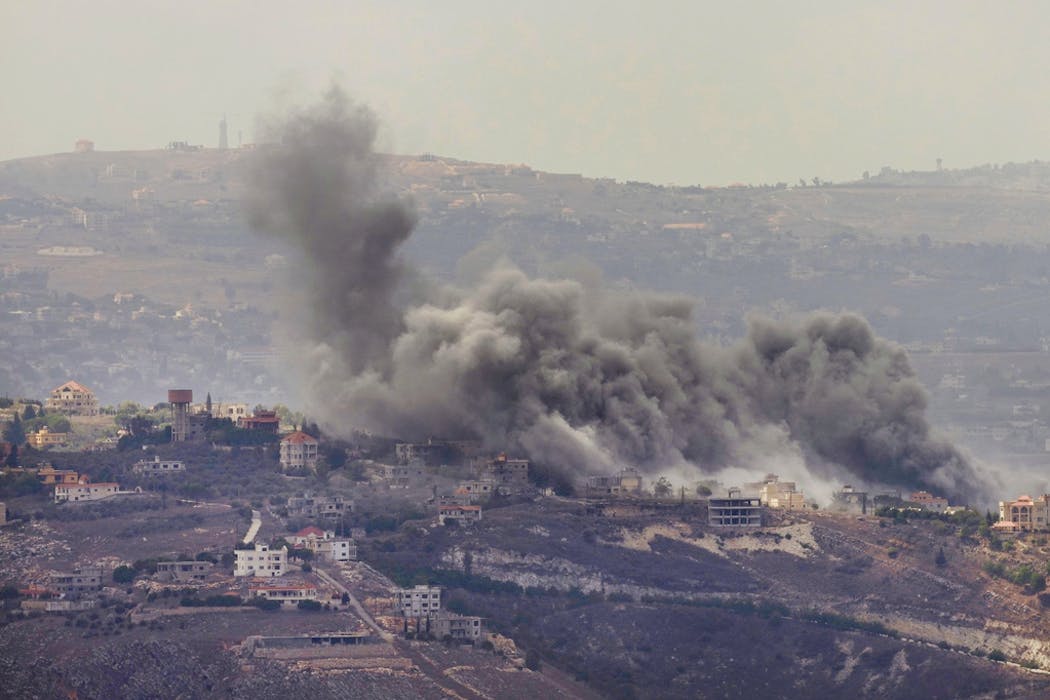
Smoke rises from Israeli airstrikes on southern Lebanese villages on Sept. 23, 2024.
AP Photo / Hussein Malla

More than a year after a ceasefire nominally ended active fighting, much of southern Lebanon bears the ecological scars of war. Avocado orchards are gone and beehives destroyed. So, too, are the livelihoods they supported. Meanwhile, fields and forests have disappeared under the intense fire caused by white phosphorus shelling. Shrapnel and unexploded bombs, however, remain.

Such grim realities are a window into the massive ecological destruction brought to Lebanon as a result of the 2024 war between Hezbollah and Israel. The number of Israeli airstrikes from October to November of that year ranked among the highest globally in the 21st century.

The conflict proved disastrous for human life, with more than 4,000 people killed, more than 17,000 injured, and 1.2 million civilians displaced internally. But a relatively uncovered aspect of the destruction was the significant effects to the environment.

Farmlands, olive groves, and pine forests were extensively burned by Israel’s airstrikes. Water resources were polluted. Pipelines and waste management were partially or completely destroyed. And the extensive dropping of ordnance and debris left a widespread trail of toxic dust and hazardous chemicals.

The damage to the Lebanon’s environment will have long-term consequences for the country’s agriculture and economy, and on its people’s mobility.
Repairing the damage would involve a multi-year reconstruction project costing an estimated US$11 to $14 billion, according to one World Bank assessment.

As experts in Middle East studies and environmental law, we believe that this destruction also indicates a grave breach of international environmental law and raises the question of whether Israel committed war crimes in Lebanon by deliberately targeting natural resources and engaging in environmental warfare.

Environmental destruction in Lebanon

During the latest war — the sixth such Israeli invasion of Lebanon since 1978 — Lebanon lost around 1,910 hectares of prime farmland, 47,000 olive trees and around 1,200 hectares of oak forests, according to Lebanese state figures.

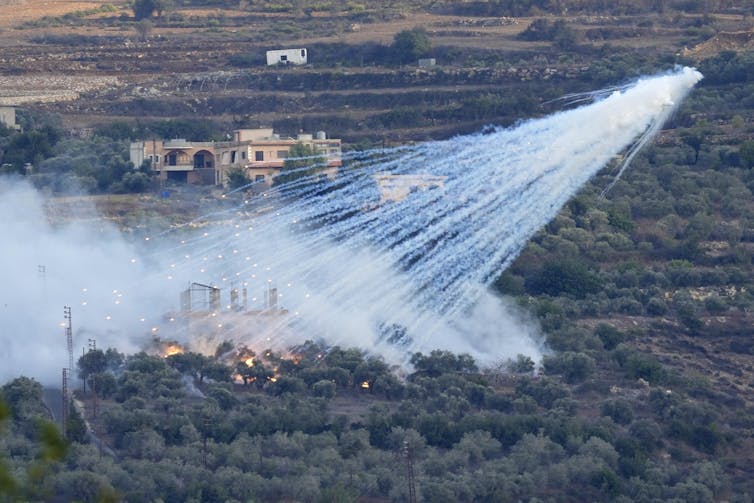
According to Amnesty International, Israel used white phosphorus, a highly reactive chemical that burns at extremely high temperatures when exposed to air. While international humanitarian law does not necessarily ban its use for military necessity, it clearly dictates that white phosphorus must never be used against civilians.

White smoke billows over a field on fire.
A shell that appears to be white phosphorus from Israeli artillery explodes over a house in a Lebanese village along the border with Israel on Oct. 15, 2023.
AP Photo / Hussein Malla, File

Data collected by Amnesty International’s Citizen Evidence Lab suggests that Israel deliberately used this incendiary substance in densely populated villages in southern Lebanon to push the civilians out and make their lands unusable. Many civilians were killed, and several had long-term injuries, such as respiratory damages and severe burns.

As to the environment, white phosphorus destroyed fruit, vegetable and olive harvests, burned agricultural lands and left them polluted. White phosphorus also ignited large-scale fires that ravaged oak and pine forests and devastated wildlife. Natural habitats were destroyed, pushing animals whose species are already under stress, such as striped hyenas, golden jackals, and Egyptian mongoose, into residential areas, putting them at risk of being killed.

In the course of the conflict Israel also used cluster munitions, which are widely banned by international law. A cluster bomb consists of several smaller bombs that explode at different times to cover wider areas. But some of these cluster munitions do not explode on impact, thus threatening civilians’ lives and targeting civilians indiscriminately.

Due to these various chemicals and munitions, Lebanon’s soil and water have been contaminated with heavy metals, military scrap, and unexploded bombs.

To be sure, underlying conditions that preceded Israel’s bombing campaign likely worsened the extent of the resulting environmental damage. For example, there are no clear domestic laws in Lebanon banning asbestos, and data indicates the country continued importing the toxic substance well into the early 2000s, well after it had been banned in most other countries.

Several urban and industrial sites were heavily bombed during the 2024 war, especially in south Beirut and Tyre, a major city in southern Lebanon. There is little doubt that the resulting debris contains high levels of asbestos and other toxic substances, which were released with the destruction of buildings, pipelines, paints, roofs, tiles and other old structures.

Environmental protection in armed conflict

Current international humanitarian law provides limited environmental protection during armed conflict. Article 8(2)(b)(iv) of the Rome Statute qualifies a war crime as any attack launched “in the knowledge that such attack will cause widespread, long-term and severe damage to the natural environment which would be clearly excessive in relation to the concrete and direct overall military advantage anticipated.” The cumulative nature of these criteria — being widespread, long term and severe — establishes a high bar for proving a war crime of this nature.

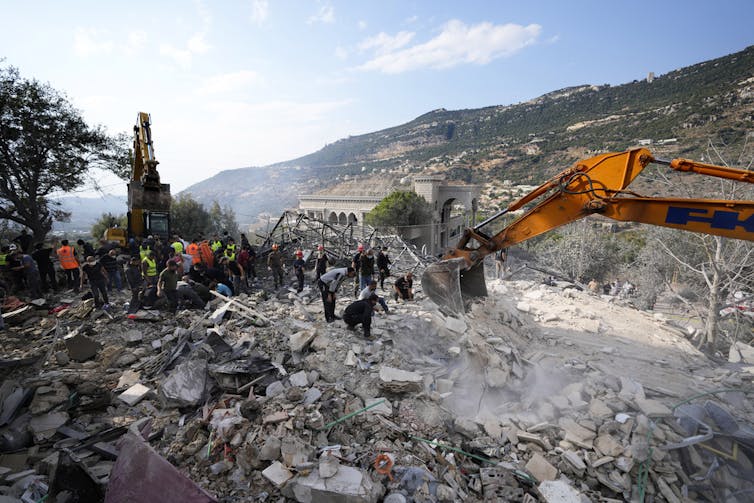
Rescue workers sift through a large pile of rubble.
Rescue workers use excavators to remove the rubble of a destroyed house hit in an Israeli airstrike in northern Lebanon, on Nov. 10, 2024.
AP Photo / Hassan Ammar

Additional legal frameworks include the 1976 ENMOD Convention prohibiting environmental modification techniques for military purposes and Protocol I to the Geneva Conventions that prohibits methods of warfare intended or expected to cause widespread, long-term and severe environmental damage.

In Feb. 2024, International Criminal Court Prosecutor Karim Khan announced a policy initiative prioritizing environmental crimes within the existing Rome Statute framework.

Further, a growing international movement is pushing to recognize “ecocide,” defined as the mass destruction of ecosystems, as a fifth international crime alongside genocide, crimes against humanity, war crimes, and the crime of aggression. If adopted, this legal framework would significantly lower the threshold for prosecuting environmental destruction during armed conflict.

Even so, the documented environmental impacts in Lebanon already raise substantive questions regarding the application of international humanitarian law and the legal requirement that military commanders weigh anticipated civilian and environmental harm against expected military gains before launching an attack.

The actions of Israel and other countries in recent years, however, have more broadly raised questions over the viability of international law and institutions’ ability to hold those accused to account.

Moving forward

Although Israel and Lebanon agreed to an internationally supervised ceasefire in Nov. 2024, it has largely been a truce in name only, with continued Israeli strikes targeting southern Lebanon and Beirut since then. Meanwhile, though Lebanon remains committed to the terms of the ceasefire, including the disarmament of Hezbollah, the armed Shiite movement has refused to entirely give up its arms.

Under U.S patronage, negotiations between Lebanon and Israel continue today, with discussions of a land border agreement and the return of Lebanese hostages. But, the negotiations so far have stuck largely to political issues with no mention of environmental damages.

In fact, the question of environmental reparations is not without precedent. Since 2006, the United Nations General Assembly has adopted 19 consecutive resolutions on the Jiyeh oil spill, caused by the Israeli bombing of fuel storage tanks during the July 2006 war. The destruction released up to 30,000 tons of oil into the Mediterranean, contaminating 170 kilometers of Lebanese coastline. The U.N. secretary-general assessed damages at US$856.4 million, and the assembly has repeatedly called upon Israel to assume responsibility for prompt and adequate compensation — calls that have gone unanswered for nearly two decades.

For the Lebanese people, particularly those who experienced firsthand environmental destruction, the question of Israel’s alleged environmental crimes is not merely an intellectual exercise. Rather, many environmental groups inside and outside Lebanon argue that addressing such issues is necessary to ensure the promotion of human rights in the region and equitable access to unpolluted farmland, water and forests.

The Conversation

Mireille Rebeiz is affiliated with the American Red Cross.

Josiane Yazbeck is affiliated with TERRE Liban and With the International Center for Comparative Environmental Law (CIDCE).

ref. Lebanon’s orchards have been burnt, wildlife habitat destroyed by Israeli strikes – raising troubling international law questions – https://theconversation.com/lebanons-orchards-have-been-burnt-wildlife-habitat-destroyed-by-israeli-strikes-raising-troubling-international-law-questions-271577

Dams can destroy lives and ecosystems. But it doesn’t have to be like this

Source: The Conversation – UK – By Jeremy Allouche, Professor in Development Studies, University of Sussex

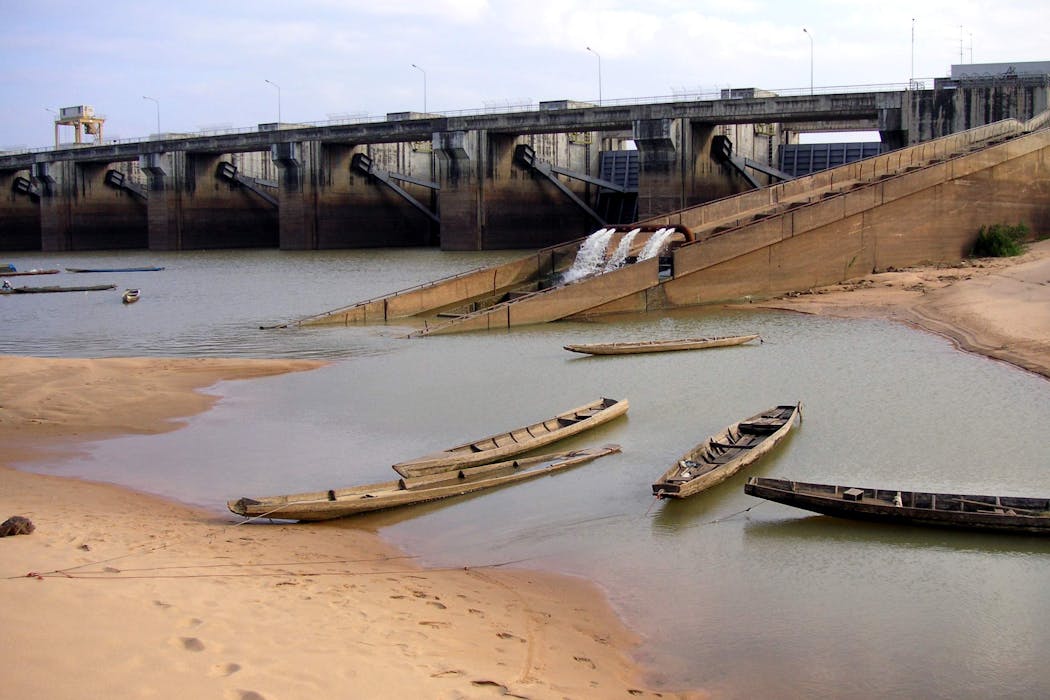
Pak Mun Dam in Ubon Ratchathani, Thailand. Sabrina Kathleen/Shutterstock

Thirty years after the Pak Mun dam was built in Thailand, the traditional way of fishing in the Khong Chiam district has completely stopped as the dam blocks the seasonal migrations of a wide range of fish.

Many men have had to leave their homes to find work elsewhere because they couldn’t fish or farm locally anymore, while their wives are often left alone to look after their children. People with disabilities and the elderly have not been included in compensation and livelihood rehabilitation programmes, even though they are among the groups most affected by changes in mobility, access to water and food systems.

My team and I have been documenting the knock-on effects of this dam development by carrying out interviews with people living in these communities. My research highlights that if the environmental consequences of dam building had been better predicted and monitored, a lot of the ongoing disruption could have been avoided.

In 1982, a environmental impact assessment for the Pak Mun dam was prepared by a team of Thai engineering consultants. Environmental impact assessments are used to identify, predict and evaluate the possible consequences of a proposed project before it begins. They have been in use for many years, but some governments bypass their recommendations.

If completed more rigorously, this assessment for the Pak Mun dam could have anticipated these negative social and environmental consequences and might have influenced decisions about the building and maintenance of this dam. But according to research, this impact assessment was weak.

One study noted that the environmental impacts of the dam – mainly on fish – were either unquantified or understated. Another study noted that the site location had moved and that required a new assessment rather than replying one the first one. The limits of this assessment has led to ongoing contestation between the central and provincial government and the affected communities and activists.

This is far from the only example of a lack of consideration for the long-term knock-on effects of dams on communities and nature. In 2025, the Indian government allegedly fast-tracked the construction of the enormous Sawalkot hydropower project on the Chenab river without conducting any environmental and social impact assessment.

Large-scale projects like this affect millions of people and the environment around them. Without ample impact assessments, they proceed without establishing just what effect they will have on the surrounding landscape, nature and communities. As a result, any negative consequences are not easily avoided.

While this new political dynamic of circumventing impact assessments is worrying, social and environmental impact assessments are valuable if used appropriately. As part of my research, I have spoken to dozens of impact assessment consultants and academics to assess the status quo.

By 2033, the global market for environmental impact assessments could be worth an estimated US$5.8 billion (£4.3 billion). While the impact assessment process is seen as valuable by consultants and academics, some of our interviewees worried that costly recommendations often get lost in the process of project implementation once the document has been produced.

Ideally, impact assessments should be based on scientific knowledge and involve substantial public participation and situated community knowledge, especially by those who are at risk of adverse consequences, as well as clear accountability mechanisms.

In practice, there are problems. Impact assessment is a political process; it is not based purely on evidence and scientific facts. It is influenced by the economics of dam building. Dams are often also important symbols of nationalism, so they hold high political status.

Without ensuring systematic follow-up to an impact assessment, it can simply become a paper chase to secure a development permit. With more consideration, the “afterlife” of impact assessments can be much more effective.

Who is responsible?

Who, in terms of responsibility, should be held accountable for shortcomings in the implementation of impact assessment plans? Should it be the government that should be responsible for making sure the different regulations and norms are followed?

Should it be the commercial banks, development banks and bilateral donors (such as foreign aid provided by the UK government’s Foreign Commonwealth and Development Office) that fund projects who should monitor the requirements they had elaborated? Or should it be the private sector?

My research shows that the responsibilities lie with all of these parties.

In most countries, most of the information and data is controlled by the proponents of building the dam. Project managers and engineers may be suspicious of external impact assessor consultants, so they do not always share the relevant information.

Civil society, ranging from local campaign groups and activist to non-governmental organisations, have pushed for standards and laws that ensure rules are followed during and after any impact assessment. For this to work, impact assessments need to be dynamic so responses to possible changing consequences can change.

When environmental policy and tools like impact assessments are being questioned, it is even more important to create a policy process that ensures long-term accountability for impact assessments and prevent further losses and damages to the communities and the environment.


Don’t have time to read about climate change as much as you’d like?

Get a weekly roundup in your inbox instead. Every Wednesday, The Conversation’s environment editor writes Imagine, a short email that goes a little deeper into just one climate issue. Join the 47,000+ readers who’ve subscribed so far.


The Conversation

Jeremy Allouche receives funding from the British Academy, for the project, Anticipatory evidence and large dam impact assessment in transboundary policy settings: Political ecologies of the future in the Mekong Basin. The author would like to thank the other team members, Professor Middleton (Chulalongkorn University Thailand), Professor Kanokwan Manorom (Ubon Ratchathani University, Thailand), Ass. Professor Chantavong (National University of Laos) & Dr. Kanhalikham (National University of Laos) for their input

ref. Dams can destroy lives and ecosystems. But it doesn’t have to be like this – https://theconversation.com/dams-can-destroy-lives-and-ecosystems-but-it-doesnt-have-to-be-like-this-270910

How the ocean’s hydrothermal systems made the first life on Earth possible

Source: The Conversation – Canada – By Long Li, Professor, Earth & Atmospheric Sciences, University of Alberta

A black smoker hydrothermal vent at a wa­ter depth of 3,300 meters in the Log­atchev Hy­dro­thermal Field on the Mid-At­lantic Ridge. (Zentrum für Marine Umweltwissenschaften, Universität Bremen), CC BY

Our planet is unique for its ability to sustain abundant life. From studies of the rock record, scientists believe life had already emerged on Earth at least 3.5 billion years ago and probably much earlier.

But how a habitable environment developed, and how the very first life emerged on the early Earth, remain puzzling. One of the big challenges for Earth to be habitable in its infancy was the weak solar energy it received.

Astrophysical models indicate that the sun had only about 70 per cent of its current luminosity when the Earth was born around 4.5 billion years ago. That would have resulted in Earth’s surface being frozen until around two billion years ago.

Nonetheless, scientific investigations indicate the Earth had warm oceans and habitable environments as early as 4.4 billion years ago. This contradiction is known as the faint young sun paradox.

Solving this paradox and the generation of the first life both involve a key chemical compound — ammonia. But the source of ammonia on the early Earth before biological nitrogen processing emerged remains unknown.

Colleagues in China and my research group at the University of Alberta recently published our study of minerals deposited from hydrothermal fluids in oceanic crusts drilled from the South China Sea basin. We discovered that mineral-catalyzed chemical reactions in underwater hydrothermal systems can produce the necessary ingredients for a habitable world and life on Earth.

Hypothesis of the origin of life

An explainer on hydrothermal vents (Woods Hole Oceanographic Institution)

Earth’s first life is hypothesized to be generated by a series of abiotic processes, also known as abiogenesis. Under this hypothesis, the building blocks of the first life were synthezised on Earth from basic inorganic compounds by abiotic reactions, or were brought to here by meteorites.

In 1953, American chemist Stanley Miller, then a graduate student working with Nobel Prize laureate Harold Urey at the University of Chicago, discovered production of amino acids in his experiments simulating lightning in an early-Earth atmosphere composed of water moisture and several gases (methane, ammonia and hydrogen molecules).

These life-building blocks could subsequently deposit into the ocean for life development. This ground-breaking discovery by Miller implied that abiogenesis of life on Earth is possible.

Gases like methane, ammonia and hydrogen were not only essential compounds for synthesis of organic matter in Miller’s experiments. They are also key ingredients to establishing a habitable environment on early Earth.

They have all been proposed as potential contributors, either directly as greenhouse gases or indirectly as amplifiers of other greenhouse gases, to warm up early Earth’s surface under the faint young sun.

Where did these gases come from?

A problem, though, is that these gases were not the primary components on early Earth’s surface in the first place. Instead, the dominant forms of carbon and nitrogen were carbon dioxide and dinitrogen.

That means the very first step toward making Earth habitable and generating the first life had to be inorganic reactions to turn carbon dioxide into methane and dinitrogen into ammonia, also known as abiotic carbon and nitrogen reduction reactions.

Where and how did these reduction reactions take place?

The world’s ocean floors contain abundant hydrothermal systems where cold seawater flows into deep oceanic crust and subsequently mixes with ascending magmatic fluids. The mixed hot fluids are emitted back through hydrothermal vents such as black smokers or white smokers.

Along this pathway, water and dissolved components can react with primary minerals in the oceanic crust to produce secondary minerals and other byproducts. Methane and dihydrogen, formed by mineral-catalyzed abiotic reduction reactions during this process, have been widely observed in the emitted hydrothermal fluids.

Therefore, underwater hydrothermal systems have been considered as the most likely incubator for habitable environment and the origin of life.

A brief overview of the role hydrothermal vents play in life started on Earth (TED-Ed)

Searching for evidence

Yet there still exists a missing piece in this picture: the abiotic reduction of dinitrogen has not been confirmed to occur in hydrothermal systems. Scientists have searched hard for evidence of this reaction, abiotic ammonia, but have had no luck so far.

The ammonia (mostly in its dissolved form, ammonium ion) that has been detected in hydrothermal fluids collected from active vent mouths turned out to be mainly biological and not abiotic in origin.

The relatively small amount of abiotic ammonium there might be can easily be concealed by the large amount of biological ammonium in seawater. It is impossible to avoid seawater contamination while collecting submarine hydrothermal fluid samples.

However, secondary minerals deposited from hydrothermal fluids can lock some ammonium into their internal structures and protect it from being contaminated by shallow seawater and mixing with biological ammonium. Therefore, studying secondary minerals in the deep oceanic crust can better unravel the ammonium source and producing mechanism in the deep hydrothermal systems.

However, such samples are not easily to collect. The International Ocean Discovery Program has made tremendous efforts to drill deep into the oceanic crust to collect samples. Luckily, a set of secondary mineral samples were discovered in a 200-metre drill core from the South China Sea.

A missing piece of the puzzle

For our study, we looked into a specific chemical feature, namely nitrogen isotopes, for the ammonium locked in the hydrothermal minerals.

Nitrogen has two isotopes with atomic mass 14 and 15, respectively. Mineral-catalyzed abiotic dinitrogen reduction strongly prefers to use the one with an atomic mass of 14. That results in a unique nitrogen isotope signature in the ammonium it produces.

Our results are consistent with this isotopic signature. This demonstrates production of ammonia or ammonium by abiotic dinitrogen reduction in underwater hydrothermal systems.

This discovery adds a missing piece of puzzle to our theories about the origins of life on Earth. These underwater hydrothermal systems at the bottom of the ocean enabled the first-step reactions of all life-constituting elements on our planet.

The Conversation

Long Li receives funding from Natural Sciences and Engineering Research Council of Canada.

ref. How the ocean’s hydrothermal systems made the first life on Earth possible – https://theconversation.com/how-the-oceans-hydrothermal-systems-made-the-first-life-on-earth-possible-271920

When young adults can’t afford independence, family expectations fill the gap — from China’s ‘leftover women’ to Canada’s pressured youth

Source: The Conversation – Canada – By Qian Liu, Assistant Professor of Law and Society, University of Calgary

I met Lufang Chen, a 30-year-old bank clerk based in the Fujian province of China, in 2016, after she had married a man she initially turned down years earlier. Although she preferred to remain single, and he was not her type anyway, she gave in to avoid the label “leftover woman.”

The derogatory and stigmatizing term “leftover woman” — or Sheng nü in Chinese — is used to describe one’s social status and refers to women in their late 20s and beyond who have never married. The label suggests these women have failed to “sell” themselves on the marriage market at the “best” time and have therefore become leftover products that are depreciating rapidly.

At the time I was conducting interviews for my book on the lived experiences of these women — Leftover Women in China: Understanding Legal Consciousness through Intergenerational Relationships — released last August, Chen told me she married out of an obligation to live up to parental expectations:

“I only got married to free my parents from the pressure imposed on them by gossipy, nosy relatives, as well as to ease their worries about my future. After all, my parents have sacrificed so much and are always ready to do everything for me.”

Chen was especially grateful to her parents for buying her an apartment when she could barely cover her living expenses. Her parents were also prepared to provide child care once, not if, she had a child.

What this story reveals is not simply a cultural expectation around marriage, but how parental financial support can reshape the autonomy of young adults.

Structural forces and family dynamics in China

In recent decades, the extreme unaffordability of housing in urban China has made it almost impossible for young adults to purchase a home without financial support from their parents. Meanwhile, as inflexible work schedules and overtime have become the norm, grandparenting has become crucial to ensuring young adults can focus on their careers.

Leftover Women in China demonstrates how the downflow of family resources — from the older generation to the young, including housing and child care support — results in a sense of guilt and provides the justification for parental intervention in marital decisions.

This phenomenon ultimately reduces effective communication among family members and marginalizes the desires of young adults.

Many of these so-called “leftover women” don’t feel it’s appropriate to openly discuss or negotiate marital choices and childbearing with their parents. Instead, a sense of guilt prompts these daughters to focus on perceptions of parental expectations that prioritize their parents’ desires and often go even beyond what their parents explicitly request.

Canadian classrooms reveal family pressure

Eventually, as a university professor, I noticed this type of parent-child interaction also appears in the West, including Canadian society.

Take students’ academic performance and career decisions, for example. I observed a strong sense of guilt and desire to repay parents, especially among students of mine whose parents have endured hardship or offered unconditional support.

Students from immigrant families have frequently mentioned pressure to succeed academically. When I asked about their motivations, they often responded by saying they want to live up to parental expectations. This sense of duty seemed especially strong among students whose parents were highly qualified professionals in their home countries and now work long hours in manual or unskilled labour to provide for their families.

As Vivian Louie, professor of urban policy and planning at Hunter College, suggests, immigrant parents’ sacrifices often motivate their children to excel academically. This is also supported by a socio-legal study on responsibility, love and guilt in Latino mixed-status families.

Over the years, many students have told me their parents don’t need to explicitly ask them to pursue a lucrative career, nor have they necessarily discussed it with them. Instead, students pick up cues from societal and community perceptions of success to make their parents proud.

When parental support becomes essential

This phenomenon, however, is not limited to students with immigrant backgrounds. A sociological study on career decisions of Harvard law students reveals that students from low-income or working-class backgrounds frequently felt that failure to obtain a lucrative position would let their families down due to the financial sacrifices their family members have made for them.

The more I spoke with my students, the more I realized that Canadian young adults are facing increasing parental intervention in particular due to the persistence of inflation and housing unaffordability.

More of them than ever before are living with their parents well into their 20s to reduce costs. For many, this has become a necessity rather than a choice.

According to a 2025 Statistics Canada report, financial support from parents for down payments has become both crucial and widespread among young homeowners. In British Columbia, for example, average parental financial support for a first-home down payment exceeds $200,000.

It’s true that collectivist culture in Chinese society contributes to the desire for “leftover women” to meet parental expectations and prioritize their needs and interests. But my observations in Canadian classrooms suggest that parental financial support — combined with the sacrifices they make for their children — can also cultivate guilt among young adults in individualist cultures like Canada.

The Conversation

Qian Liu receives funding from the International Development Research Centre and the Social Sciences and Humanities Research Council.

ref. When young adults can’t afford independence, family expectations fill the gap — from China’s ‘leftover women’ to Canada’s pressured youth – https://theconversation.com/when-young-adults-cant-afford-independence-family-expectations-fill-the-gap-from-chinas-leftover-women-to-canadas-pressured-youth-270013