Africa’s climate finance rules are growing, but they’re weakly enforced – new research

Source: The Conversation – Africa – By Paola D’Orazio, Associate Professor, IÉSEG School of Management

Climate change is no longer just about melting ice or hotter summers. It is also a financial problem. Droughts, floods, storms and heatwaves damage crops, factories and infrastructure. At the same time, the global push to cut greenhouse gas emissions creates risks for countries that depend on oil, gas or coal.

These pressures can destabilise entire financial systems, especially in regions already facing economic fragility. Africa is a prime example.

Although the continent contributes less than 5% of global carbon emissions, it is among the most vulnerable. In Mozambique, repeated cyclones have destroyed homes, roads and farms, forcing banks and insurers to absorb heavy losses. Kenya has experienced severe droughts that hurt agriculture, reducing farmers’ ability to repay loans. In north Africa, heatwaves strain electricity grids and increase water scarcity.

These physical risks are compounded by “transition risks”, like declining revenues from fossil fuel exports or higher borrowing costs as investors worry about climate instability. Together, they make climate governance through financial policies both urgent and complex. Without these policies, financial systems risk being caught off guard by climate shocks and the transition away from fossil fuels.

This is where climate-related financial policies come in. They provide the tools for banks, insurers and regulators to manage risks, support investment in greener sectors and strengthen financial stability.

Regulators and banks across Africa have started to adopt climate-related financial policies. These range from rules that require banks to consider climate risks, to disclosure standards, green lending guidelines, and green bond frameworks. These tools are being tested in several countries. But their scope and enforcement vary widely across the continent.

My research compiles the first continent-wide database of climate-related financial policies in Africa and examines how differences in these policies – and in how binding they are – affect financial stability and the ability to mobilise private investment for green projects.

A new study I conducted reviewed more than two decades of policies (2000–2025) across African countries. It found stark differences.

South Africa has developed the most comprehensive framework, with policies across all categories. Kenya and Morocco are also active, particularly in disclosure and risk-management rules. In contrast, many countries in central and west Africa have introduced only a few voluntary measures.

Why does this matter? Voluntary rules can help raise awareness and encourage change, but on their own they often do not go far enough. Binding measures, on the other hand, tend to create stronger incentives and steadier progress. So far, however, most African climate-related financial policies remain voluntary. This leaves climate risk as something to consider rather than a firm requirement.

Uneven landscape

In Africa, the 2015 Paris Agreement marked a clear turning point. Around that time, policy activity increased noticeably, suggesting that international agreements and standards could help create momentum and visibility for climate action. The expansion of climate-related financial policies was also shaped by domestic priorities and by pressure from international investors and development partners.

But since the late 2010s, progress has slowed. Limited resources, overlapping institutional responsibilities and fragmented coordination have made it difficult to sustain the earlier pace of reform.

Looking across the continent, four broad patterns have emerged.

A few countries, such as South Africa, have developed comprehensive frameworks. These include:

  • disclosure rules (requirements for banks and companies to report how climate risks affect them)

  • stress tests (simulations of extreme climate or transition scenarios to see whether banks would remain resilient).

Others, including Kenya and Morocco, are steadily expanding their policy mix, even if institutional capacity is still developing.

Some, such as Nigeria and Egypt, are moderately active, with a focus on disclosure rules and green bonds. (Those are bonds whose proceeds are earmarked to finance environmentally friendly projects such as renewable energy, clean transport or climate-resilient infrastructure.)

Finally, many countries in central and west Africa have introduced only a limited number of measures, often voluntary in nature.

This uneven landscape has important consequences.

The net effect

In fossil fuel-dependent economies such as South Africa, Egypt and Algeria, the shift away from coal, oil and gas could generate significant transition risks. These include:

  • financial instability, for example when asset values in carbon-intensive sectors fall sharply or credit exposures deteriorate

  • stranded assets, where fossil fuel infrastructure and reserves lose their economic value before the end of their expected life because they can no longer be used or are no longer profitable under stricter climate policies.

Addressing these challenges may require policies that combine investment in new, low-carbon sectors with targeted support for affected workers, communities and households.

Climate finance affects people directly. When droughts lead to loan defaults, local banks are strained. Insurance companies facing repeated payouts after floods may raise premiums. Pension funds invested in fossil fuels risk devaluations as these assets lose value. Climate-related financial policies therefore matter not only for regulators and markets, but also for jobs, savings, and everyday livelihoods.

At the same time, there are opportunities.

Firstly, expanding access to green bonds and sustainability-linked loans can channel private finance into renewable energy, clean transport, or resilient infrastructure.

Secondly, stronger disclosure rules can improve transparency and investor confidence.

Thirdly, regional harmonisation through common reporting standards, for example, would reduce fragmentation. This would make it easier for Africa to attract global climate finance.

Looking ahead

International forums such as the UN climate conferences (COP) and the G20 have helped to push this agenda forward, mainly by setting expectations rather than hard rules. These initiatives create pressure and guidance. But they remain soft law. Turning them into binding, enforceable rules still depends on decisions taken by national regulators and governments.

International partners such as the African Development Bank and the African Union could support coordination by promoting continental standards that define what counts as a green investment. Donors and multilateral lenders may also provide technical expertise and financial support to countries with weaker systems, helping them move from voluntary guidelines toward more enforceable rules.

South Africa, already a regional leader, could share its experience with stress testing and green finance frameworks.

Africa also has the potential to position itself as a hub for renewable energy and sustainable finance. With vast solar and wind resources, expanding urban centres, and an increasingly digital financial sector, the continent could leapfrog towards a greener future if investment and regulation advance together.

Success stories in Kenya’s sustainable banking practices and Morocco’s renewable energy expansion show that progress is possible when financial systems adapt.

What happens next will matter greatly. By expanding and enforcing climate-related financial rules, Africa can reduce its vulnerability to climate shocks while unlocking opportunities in green finance and renewable energy.

The Conversation

Paola D’Orazio does not work for, consult, own shares in or receive funding from any company or organisation that would benefit from this article, and has disclosed no relevant affiliations beyond their academic appointment.

ref. Africa’s climate finance rules are growing, but they’re weakly enforced – new research – https://theconversation.com/africas-climate-finance-rules-are-growing-but-theyre-weakly-enforced-new-research-270990

Où vivent les plus riches ? Ce que la géographie des hauts revenus dit des fractures françaises

Source: The Conversation – France (in French) – By Hippolyte d’Albis, Professeur, ESSEC

Des centres urbains, où se concentrent les hauts revenus, aux territoires périphériques, où ils disparaissent, la carte des foyers les plus aisés de France raconte une histoire singulière des inégalités. En retraçant leur répartition géographique depuis 1960, une nouvelle étude éclaire les conséquences spatiales des transformations structurelles de l’économie française, et les tensions sociales et politiques qu’elles continuent d’alimenter.


Réduire les écarts entre territoires est un objectif récurrent des politiques publiques, en France comme en Europe. L’Union européenne (UE) en a fait un principe fondateur, inscrit à l’article 174 du Traité sur le fonctionnement de l’Union européenne (TFUE) :

« Afin de promouvoir un développement harmonieux de l’ensemble de l’Union, celle-ci vise à réduire les écarts entre les niveaux de développement des diverses régions. »

Pourtant, cet objectif est aujourd’hui plus que jamais mis à l’épreuve. En France, comme ailleurs, les dernières décennies ont vu s’accentuer un sentiment de fracture territoriale : d’un côté, quelques grandes métropoles concentrent les emplois qualifiés, les sièges d’entreprises, les services de haut niveau ; de l’autre, de vastes espaces voient leurs activités industrielles décliner, leurs jeunes partir et leurs revenus stagner.

Ces déséquilibres économiques ne sont pas sans conséquence sociale ou politique, comme les dernières années l’ont montré avec force. Des ronds-points des « gilets jaunes » aux cartes électorales où se lit la progression de l’abstention ou du vote pour les partis extrêmes, la colère sociale a souvent une géographie. Là où les opportunités économiques se raréfient, les perspectives se referment, le sentiment d’injustice s’installe, et une question fondamentale émerge : que devient une société lorsque les perspectives de réussite se concentrent exclusivement dans quelques territoires ?

Un indicateur plus fin pour comprendre ces enjeux

Comprendre ces enjeux suppose d’abord de bien les mesurer. Or, les indicateurs couramment utilisés dans la littérature économique tendent à masquer la réalité des disparités territoriales. On analyse souvent le développement d’une région à l’aune du produit intérieur brut par habitant ou du revenu moyen, sans tenir compte des différences de structures sociales : ici, une forte proportion de ménages aisés et modestes ; là, une population plus homogène, composée de classes moyennes. Ainsi, la répartition des revenus constitue un élément central pour comprendre les dynamiques locales.


À lire aussi :
Combien l’employeur doit-il payer pour attirer des cadres en dehors des zones urbaines ?


Dans un article à paraître dans le Journal of Economic Geography, nous avons voulu dépasser ces limites en construisant une base de données inédite retraçant la répartition des foyers fiscaux appartenant aux 10 % et aux 1 % les plus aisés dans les départements de France hexagonale depuis 1960. Ce travail, rendu possible par une collecte de longue haleine dans les archives du ministère des finances, offre pour la première fois la possibilité d’observer sur plus d’un demi-siècle la géographie des hauts revenus en France et les transformations qu’elle révèle.

À partir de ces données, nous proposons un indicateur simple mais riche de sens : la part des très hauts revenus (Top 1 %) et des hauts revenus (Top 10 % moins Top 1 %) dans la population locale. On peut interpréter ces indicateurs comme la probabilité, pour un individu, d’appartenir aux ménages aisés selon le territoire où il vit.

Cette approche offre un regard nouveau sur les fractures territoriales contemporaines. Là où les opportunités économiques s’amenuisent, les plus qualifiés, les plus ambitieux, les plus mobiles partent ailleurs, laissant derrière eux des territoires appauvris en capital humain et en perspectives. Ces départs nourrissent à leur tour un sentiment de déclassement collectif, l’impression diffuse que « le progrès se passe ailleurs ».

Les cartes de la figure 1 retracent plus de soixante ans d’histoire sociale du territoire français. Elles montrent, pour trois dates clés (1960, 1990 et 2019), la part des ménages appartenant aux très hauts revenus (à gauche) et aux hauts revenus (à droite). Si les foyers fiscaux aisés étaient répartis uniformément, ces parts seraient respectivement de 1 % et de 9 % dans tous les départements : ce sont les zones blanches sur les cartes. Dans la réalité, ce n’est pas le cas : les nuances d’orange et de rouge signalent donc une surreprésentation locale, les teintes de bleu une sous-représentation. Il faut enfin rappeler que la géographie administrative de l’Île-de-France est passée de trois départements au début des années 1960 à huit aujourd’hui.

L’importance de la ligne Caen-Annecy dans les années 1960

En 1960, la France des très hauts revenus est très largement structurée par une ligne Caen-Annecy. Au sud, la part des foyers aux très hauts revenus dans la population locale est faible, souvent moins de 0,5 % (nous l’estimons par exemple à 0,1 % en Lozère). Seules quelques zones urbaines ou industrielles (Rhône, Haute-Garonne, Isère, Haute-Savoie) se distinguent légèrement. Au nord, la présence des foyers les plus aisés s’intensifie, notamment en région parisienne, où la part atteint 2,6 % dans le département de la Seine et 1,6 % en Seine-et-Oise, ou dans le département du Nord.

Trente ans plus tard, la ligne Caen–Annecy a perdu son sens. Les départements où les très hauts revenus sont rares se concentrent près du Massif central (0,4 % en Lozère). Un second pôle où se concentrent les foyers aux très hauts revenus s’est formé à la frontière suisse (Ain, Savoie, Haute-Savoie), tandis que la Côte d’Azur, les métropoles du Sud-Ouest (Toulouse, Bordeaux) et quelques villes du centre (Dijon, Tours) gagnent en attractivité. On observe une forte polarisation en Île-de-France : les très hauts revenus sont très présents à Paris, dans les Hauts-de-Seine et dans les Yvelines, mais très peu nombreux en Seine-Saint-Denis.

Une nouvelle géographie aujourd’hui

En 2019, la rupture est manifeste. Les très hauts revenus sont absents dans la plupart des départements de la « diagonale du vide », tandis que la France des très hauts revenus se réduit à quelques pôles métropolitains (Bordeaux, Nantes, Toulouse, Marseille, Dijon, Strasbourg, Nice) qui conservent des parts proches de 1 % et à la frontière suisse où elle est de 2 % en Haute-Savoie. En Île-de-France, la polarisation atteint des sommets : la part des très hauts revenus est seulement de 0,4 % en Seine-Saint-Denis, mais de 4,5 % à Paris, 4,2 % dans les Hauts-de-Seine, et 2,8 % dans les Yvelines.

Les cartes des hauts revenus (hors Top 1 %) confirment ces dynamiques. En 1960, les foyers aisés sont déjà concentrés autour de Paris et du Rhône tandis que la Bretagne, le Sud-Ouest et le Massif central en comptent peu (moins de 3 % en Aveyron ou en Haute-Loire). En 1990, cette géographie change. La frontière suisse, la Côte d’Azur et plusieurs métropoles régionales rejoignent le groupe des départements surreprésentés. En 2019, les écarts s’accentuent encore, mais la logique reste la même : une sous-représentation persistante dans le centre du pays, et une forte surreprésentation des ménages aisés en région parisienne et près de la frontière suisse. La part de ces foyers est maximale dans les Hauts-de-Seine et dans les Yvelines, où elle atteint 18 %.

Figure 1 : Proportion des très hauts revenus et des hauts revenus dans la population locale en 1960, en 1990 et en 2019.


Fourni par l’auteur

Notes : On définit la part des très hauts revenus comme la proportion de ménages faisant partie des 1 % de ménages aux plus hauts revenus (respectivement 10 % de ménages aux plus hauts revenus moins les 1 % aux plus hauts revenus) tels que définis en France hexagonale.

Des trajectoires divergentes depuis la fin des années 1990

Ces transformations géographiques détaillées peuvent se résumer en un indicateur unique : l’indice de Theil, couramment utilisé pour mesurer les inégalités économiques. Nous l’avons calculé pour chaque année à partir de la part des foyers appartenant aux très hauts revenus ou aux hauts revenus dans chaque département (en vert et en orange sur la figure 2), en conservant une classification départementale stable sur toute la période. Cet indicateur permet de mesurer si ces parts se sont rapprochées ou, au contraire, éloignées au fil du temps. Pour faciliter la comparaison entre les deux courbes, les valeurs ont été normalisées à 1 en 1962.

Le résultat est frappant : après quarante ans de convergence, les écarts territoriaux se sont de nouveau creusés depuis la fin des années 1990. En vingt ans, la concentration géographique des très hauts revenus a triplé, retrouvant son niveau du début de la période. C’est bien le signe d’un retour marqué des inégalités régionales, tirées par le haut de la distribution des revenus.

Figure 2 : Évolution des inégalités d’opportunités économiques régionales entre 1960 et 2019.


Fourni par l’auteur

L’impact de la désindustrialisation

Nous avons cherché à comprendre pourquoi ces opportunités économiques régionales de faire partie des ménages aux très hauts revenus ont d’abord convergé, avant de diverger à nouveau fortement. Deux transformations majeures permettent d’en comprendre la logique.

Dans les années 1960, la présence de très hauts revenus s’expliquait avant tout par la concentration d’activités industrielles, elles-mêmes très inégalement réparties sur le territoire national au profit des régions du Nord-Est. Puis, entre 1960 et 1990, les structures productives régionales se sont progressivement rapprochées : les territoires longtemps agricoles se sont industrialisés tandis que les grandes régions manufacturières perdaient peu à peu leur avantage relatif. Ce mouvement de rééquilibrage a favorisé une réduction des différences régionales d’opportunités économiques.


À lire aussi :
12 métropoles et le désert français… ou une « métropole France » ?


Enfin, à partir des années 1990, la désindustrialisation s’est généralisée à l’ensemble du pays tout en s’accompagnant d’une montée en puissance des services à haute valeur ajoutée. Ce sont eux qui expliquent alors où se trouvent les opportunités économiques de faire partie des ménages aux très hauts revenus. Or, ces activités se trouvent majoritairement dans les grandes métropoles, où elles bénéficient de la présence d’emplois qualifiés, d’infrastructures performantes et de politiques publiques volontaristes, comme l’illustre l’écosystème scientifique et technologique développé sur le plateau de Saclay (Essonne) depuis une quinzaine d’années. On retrouve cette logique dans la région frontalière de Genève, où la concentration d’emplois hautement qualifiés dans les services financiers explique en partie la surreprésentation de ménages à très hauts revenus dans les départements de la Haute-Savoie et de l’Ain.

Une économie polarisée et des territoires « laissés pour compte »

Pour finir, nous défendons l’idée selon laquelle les inégalités territoriales ne tiendraient pas seulement à des écarts de revenus par habitant entre régions, mais à la manière dont les revenus les plus élevés se répartissent dans l’espace.

Depuis les années 2000, les opportunités économiques se concentrent dans un tout petit nombre de territoires, reflet d’une économie de plus en plus polarisée autour de quelques métropoles et de leurs bassins d’emplois qualifiés. En France, comme ailleurs, les transformations structurelles ont progressivement creusé l’écart entre des régions gagnantes, insérées dans l’économie de la connaissance, et d’autres qui peinent à en profiter.

Ce phénomène s’inscrit dans une dynamique plus large, documentée dans la littérature internationale sous le concept de left-behind places. Ces territoires « laissés pour compte » se retrouvent déconnectés des pôles de croissance et des réseaux de pouvoir économique, et expriment à intervalles réguliers le sentiment d’abandon qui les ronge. Réduire ces écarts ne relève donc pas d’un enjeu d’efficacité économique, mais d’un impératif démocratique.

Aujourd’hui, la question reste entière : comment faire en sorte que la transition vers une économie fondée sur les savoirs, les services et l’innovation ne creuse pas davantage les fractures entre territoires ? En retraçant cette histoire sur plus d’un demi-siècle, nos travaux rappellent que la géographie des hauts revenus est mouvante, et ne saurait se passer de volontarisme politique.

The Conversation

Hippolyte d’Albis a reçu des financements de l’ANR et de la Commission européenne.

Aurélie Sotura et Florian Bonnet ne travaillent pas, ne conseillent pas, ne possèdent pas de parts, ne reçoivent pas de fonds d’une organisation qui pourrait tirer profit de cet article, et n’ont déclaré aucune autre affiliation que leur poste universitaire.

ref. Où vivent les plus riches ? Ce que la géographie des hauts revenus dit des fractures françaises – https://theconversation.com/ou-vivent-les-plus-riches-ce-que-la-geographie-des-hauts-revenus-dit-des-fractures-francaises-272183

Maduro-Trump : la bataille pour imposer un récit légitime

Source: The Conversation – in French – By Fabrice Lollia, Docteur en sciences de l’information et de la communication, chercheur associé laboratoire DICEN Ile de France, Université Gustave Eiffel

L’arrestation de Nicolas Maduro révèle que la légitimité politique contemporaine se construit moins par le droit ou la force que par la capacité à imposer un récit et une vision du monde.


L’arrestation du président vénézuélien Nicolas Maduro à la suite d’une opération états-unienne constitue un événement géopolitique d’ampleur. Mais elle dépasse le cadre diplomatique : elle s’est immédiatement transformée en crise informationnelle.

En quelques heures, plusieurs récits concurrents ont émergé : opération de justice internationale pour certains, violation flagrante du droit international pour d’autres, coup de force impérialiste ou acte nécessaire pour libérer un peuple. Dans cet entrelacs de discours, une bataille bien plus décisive s’est ouverte : celle du récit légitime et de la construction d’un sens partagé.

Les crises contemporaines ne se jouent plus seulement dans les arènes politiques, ou militaires. Elles se construisent désormais dans l’espace de l’information, là où se forment les perceptions, les émotions collectives et, in fine, les lectures du réel. Ce que met à nu l’affaire Maduro, c’est la centralité du narratif dans la production de légitimité politique à l’échelle mondiale.

Dans ce type de crise, la question n’est pas seulement que s’est-il passé ? mais comment devons-nous comprendre ce qui s’est passé ? et surtout, qui a la légitimité pour dire la vérité des événements ?

Un événement politique devenu immédiatement un événement informationnel

Dès l’annonce de l’arrestation, trois dynamiques se mettent en place simultanément.

Tout d’abord, une production institutionnelle du sens où gouvernements, chancelleries, organisations internationales émettent des positions, chacune arrimée à un cadre de légitimation (sécurité, souveraineté, droit, ordre international).

Ensuite, les médias ne se limitent pas à nommer l’événement : ils le scénarisent. Par le choix des images, des angles et des séquences narratives, ils transforment un fait politique en récit intelligible, assignant des rôles, des responsabilités et des émotions. Cette mise en scène médiatique contribue à stabiliser temporairement un sens partagé, participant ainsi à la construction de la légitimité.

Enfin, c’est une explosion numérique où circulent simultanément informations fiables, interprétations partisanes, contenus émotionnels et désinformation. Cette couche numérique loin d’être simplement périphérique structure la manière dont une large part du monde se représente les faits.

Ainsi, ce que nous observons n’est pas seulement la confrontation d’États, mais la confrontation de récits visant à imposer une lecture dominante de la réalité. La lutte ne porte plus uniquement sur ce qui s’est passé, mais sur la manière dont il convient de l’interpréter, de l’évaluer et de l’inscrire dans une mémoire collective.

Une guerre de narratifs : trois grands cadres concurrents

Un narratif états-unien sur l’ordre, la sécurité et la légitimité morale

Le discours états-unien mobilise une stratégie classique de sécurisation, en présentant Nicolas Maduro non plus comme un chef d’État souverain, mais comme un « indicted drug trafficker » (« trafiquant de drogue inculpé ») et leader d’un « vicious terrorist organization » (« organisation terroriste violente ») – le Cartel de los Soles –, fusionnant ainsi régime politique et entreprise criminelle transnationale.

Ce déplacement symbolique joue un rôle d’ampleur en reconstruisant une opération militaro-judiciaire potentiellement illégitime au regard du droit international (capture extraterritoriale, frappes ciblées) en action de maintien de l’ordre mondial, moralement justifiable au nom de la lutte contre le narcotrafic et la menace sécuritaire pour les États-Unis.

La rhétorique mobilise trois registres : le registre pénal avec la lutte contre le crime, la corruption ou le narcotrafic, un registre éthique avec la protection des peuples et la restauration d’une justice prétendument universelle, enfin un registre sécuritaire nourrit par l’argumentaire principal de stabilisation d’une région présentée comme dangereuse.

On retrouve ici ce que les chercheurs appellent l’« agenda setting » : en choisissant les mots et les thèmes dominants du débat (crime, menace, protection), le pouvoir politique influence directement la manière dont l’opinion publique perçoit l’événement. Le politologue américain Joseph Nye, professeur en relations internationales à Harvard, définit ce soft power comme la capacité d’un État à influencer les autres, non pas seulement par la force mais en façonnant leurs préférences grâce à l’attraction, à la crédibilité et à la perception de légitimité.

Un narratif contraire sur la souveraineté, le droit, et d’alerte sur l’ordre international

En face, un contre-récit s’est immédiatement imposé. Pour de nombreux États et observateurs, cette opération constitue une atteinte grave à la souveraineté et crée un précédent dangereux pour l’ordre international. Ce discours s’appuie sur le droit international, notamment l’article 2 (4) de la Charte des Nations unies, qui interdit le recours à la force contre l’intégrité territoriale ou l’indépendance d’un État. Il dénonce une action unilatérale qui contourne les règles collectives et menace l’équilibre du système multilatéral.

Ce narratif ne vise pas tant à défendre Maduro qu’à défendre l’idée qu’un monde où un État peut arrêter un autre chef d’État selon ses propres critères serait profondément instable.

Il relève d’une rhétorique d’alerte : ce qui se produit au Venezuela pourrait devenir une norme globale, avec des échos immédiats dans d’autres débats sensibles – comme celui concernant des dirigeants tels que le président Poutine déjà visés par des procédures internationales.

Le narratif numérique par l’émotion, la polarisation et la fabrication du doute

Un troisième narratif se déploie sur les réseaux sociaux selon des logiques d’amplifications émotionnelles (diffusion d’images générées par IA montrant Maduro en pyjama et fausses informations visant son prédécesseur Hugo Chavez), de circulation accélérée et de simplification extrême. Il en résulte une fragmentation cognitive qui produit des réalités parallèles.

Les sciences de l’information et de la communication montrent que, à l’ère numérique, l’enjeu dépasse la seule désinformation. Il s’agit d’une concurrence des régimes de vérité où ne prime plus uniquement ce qui est vrai, mais ce qui est crédible, ce qui raisonne émotionnellement et ce qui s’aligne avec une vision préexistante du monde.

La construction d’un récit politique n’est jamais improvisée. Elle repose sur quelques mécanismes clés :

  • saturer l’espace public pour imposer un récit dominant ;

  • choisir les mots qui cadrent l’événement et orientent sa lecture ;

  • moraliser le discours en opposant « bien » et « mal » ;

  • aligner communication et gestes symboliques pour renforcer la crédibilité ;

  • exploiter l’économie de l’attention propre aux plateformes numériques.

L’objectif n’est pas seulement d’informer mais de rendre une lecture du réel évidente et acceptable pour le plus grand nombre.


Infographie fournie par l’auteur, Fourni par l’auteur

Ce que révèle cet événement

Trois enseignements majeurs se dégagent. Premièrement, l’effritement des cadres de référence communs. Le monde n’interprète plus les événements à partir d’un socle partagé. Les publics, les États et les institutions lisent la réalité selon des référentiels distincts. Ce qui renforce la conflictualité informationnelle.

Deuxièmement, la montée en puissance de la guerre cognitive est frappante. L’affaire Maduro illustre l’information warfare, c’est-à-dire l’usage stratégique de l’information pour influencer perceptions et décisions. Dans ce cadre, l’essor de l’IA agentique, fondée sur des systèmes d’IA autonomes et adaptatifs (par le biais d’agents), permet de produire et d’ajuster des narratifs ciblés à grande échelle. Combinées à la messagerie personnalisée, ces techniques orientent comportements et alliances, sans confrontation militaire directe. La bataille se joue désormais dans l’espace cognitif plus que sur le terrain physique.

Pour terminer, la centralité stratégique du narratif est construite. Aujourd’hui, gouverner, c’est raconter, c’est produire un récit qui donne sens, qui justifie, légitime et inscrit l’action politique dans une cohérence. Les États qui ne maîtrisent pas cette dimension sont désormais structurellement désavantagés.

L’arrestation du président Nicolas Maduro ouvre un débat juridique et politique immense. Mais elle montre surtout une transformation profonde de nos sociétés ; la légitimité ne repose plus seulement sur les normes ou la force. Elle se fabrique dans la capacité à imposer une vision du réel.

À l’heure où la confiance dans les institutions recule, où la circulation de l’information s’accélère et où les arènes numériques fragmentent nos représentations, la question centrale devient : qui raconte le monde ? Et surtout, quelles histoires sommes-nous prêts à croire ?

The Conversation

Fabrice Lollia ne travaille pas, ne conseille pas, ne possède pas de parts, ne reçoit pas de fonds d’une organisation qui pourrait tirer profit de cet article, et n’a déclaré aucune autre affiliation que son organisme de recherche.

ref. Maduro-Trump : la bataille pour imposer un récit légitime – https://theconversation.com/maduro-trump-la-bataille-pour-imposer-un-recit-legitime-273031

Damn the torpedoes! Trump ditches a crucial climate treaty as he moves to dismantle America’s climate protections

Source: The Conversation – USA (2) – By Gary W. Yohe, Professor of Economics and Environmental Studies, Wesleyan University

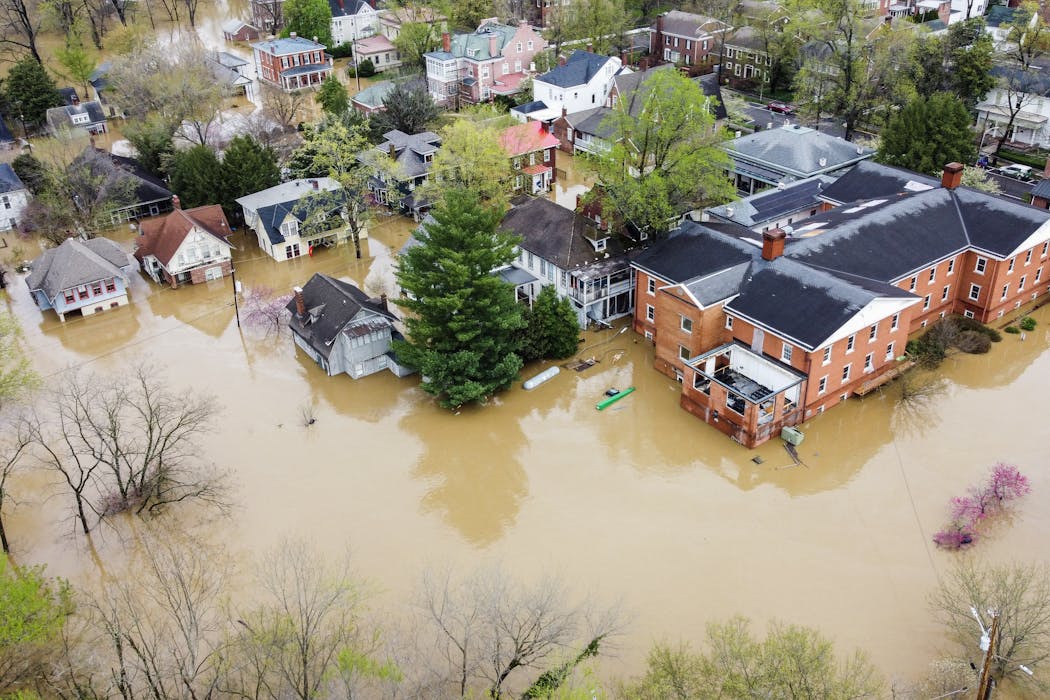
Severe storms triggered flooding across the central and eastern U.S. in April 2025, including in Kentucky’s capital, Frankfort. Leandro Lozada/AFP via Getty Images

On Jan. 7, 2026, President Donald Trump declared that he would officially pull the United States out of the world’s most important global treaty for combating climate change. He said it was because the treaty ran “contrary to the interests of the United States.”

His order didn’t say which U.S. interests he had in mind.

Americans had just seen a year of widespread flooding from extreme weather across the U.S. Deadly wildfires had burned thousands of homes in the nation’s second-largest metro area, and 2025 had been the second- or third-hottest year globally on record. Insurers are no longer willing to insure homes in many areas of the country because of the rising risks, and they are raising prices in many others.

For decades, evidence has shown that increasing levels of greenhouse gases in the atmosphere, largely from burning fossil fuels, are raising global temperatures and influencing sea level rise, storms and wildfires.

The climate treaty – the United Nations Framework Convention on Climate Change – was created to bring the world together to find ways to lower those risks.

Trump’s order to now pull the U.S. out of that treaty adds to a growing list of moves by the admnistration to dismantle U.S. efforts to combat climate change, despite the risks. Many of those moves, and there have been dozens, have flown under the public radar.

Why this climate treaty matters

A year into the second Trump administration, you might wonder: What’s the big deal with the U.S. leaving the United Nations Framework Convention on Climate Change now?

After all, the Trump administration has been ignoring the UNFCCC since taking office in January. The administration moved to stop collecting and reporting corporate greenhouse gas emissions data required under the treaty. It canceled U.S. scientists’ involvement in international research. One of Trump’s first acts of his second term was to start the process of pulling the U.S. out of the Paris climate agreement. Trump made similar moves in his first term, but the U.S. returned to the Paris agreement after he left office.

This action is different. It vacates an actual treaty that was ratified by the U.S. Senate in October 1992 and signed by President George H.W. Bush.

People stand near a bridge and searchers look through debris that has washed up.
Volunteers and law enforcement officers searched for weeks for victims who had been swept away when an extreme downpour triggered flash flooding in Texas Hill Country on July 4, 2025. More than 130 people died, including children attending a youth camp.
Ronaldo Schemidt/AFP via Getty Images

America’s ratification that year broke a logjam of inaction by nations that had signed the agreement but were wary about actually ratifying it as a legal document. Once the U.S. ratified it, other countries followed, and the treaty entered into force on March 21, 1994.

The U.S. was a global leader on climate change for years. Not anymore.

Chipping away at climate policy

With the flurry of headlines about the U.S. intervention in Venezuela, renewed threats to seize Greenland, persistent high prices, immigration arrests, ICE and Border Patrol shootings, the Epstein files and the fight over ending health care subsidies, important news from other critical areas that affect public welfare has been overlooked for months.

Two climate-related decisions did dominate a few news cycles in 2025. The Environmental Protection Agency announced its intention to rescind its 2009 Endangerment Finding, a legal determination that certain greenhouse gas emissions endanger the public health and welfare that became the foundation of federal climate laws. There are indications that the move to rescind the finding could be finalized soon – the EPA sent its final draft rule to the White House for review in early January 2026. And the Department of Energy released a misinformed climate assessment authored by five handpicked climate skeptics.

Both moves drew condemnation from scientists, but that news was quickly overwhelmed by concern about a government shutdown and continuing science funding cuts and layoffs.

A man holds a fire hose to try to safe a property as a row of homes behind him burn
Thousands of people lost their homes as wildfires burned through dry canyons in the Los Angeles area and into neighborhoods in January 2025.
AP Photo/Ethan Swope

This chipping away at climate policy continued to accelerate at the end of 2025 with six more significant actions that went largely unnoticed.

Three harmed efforts to slow climate change:

Three other moves by the administration shot arrows at the heart of climate science:

Fossil fuels at any cost

In early January 2025, the United States had reestablished itself as a world leader in climate science and was still working domestically and internationally to combat climate risks.

A year later, the U.S. government has abdicated both roles and is taking actions that will increase the likelihood of catastrophic climate-driven disasters and magnify their consequences by dismantling certain forecasting and warning systems and tearing apart programs that helped Americans recover from disasters, including targeting the Federal Emergency Management Agency.

To my mind, as a scholar of both environmental studies and economics, the administration’s moves enunciated clearly its strategy to discredit concerns about climate change, at the same time it promotes greater production of fossil fuels. It’s “damn the torpedoes, full speed ahead!” with little consideration for what’s at risk.

Trump’s repudiation of the UNFCCC could give countries around the world cover to pull back their own efforts to fight a global problem if they decide it is not in their myopic “best interest.” So far, the other countries have stayed in both that treaty and the Paris climate agreement. However, many countries’ promises to protect the planet for future generations were weaker in 2025 than hoped.

The U.S. pullout may also leave the Trump administration at a disadvantage: The U.S. will no longer have a formal voice in the global forum where climate policies are debated, one where China has been gaining influence since Trump returned to the presidency.

The Conversation

Gary W. Yohe does not work for, consult, own shares in or receive funding from any company or organization that would benefit from this article, and has disclosed no relevant affiliations beyond their academic appointment.

ref. Damn the torpedoes! Trump ditches a crucial climate treaty as he moves to dismantle America’s climate protections – https://theconversation.com/damn-the-torpedoes-trump-ditches-a-crucial-climate-treaty-as-he-moves-to-dismantle-americas-climate-protections-273148

Malbouffe et désertification – quelles recettes pour repenser l’attractivité des centres-villes ?

Source: The Conversation – France (in French) – By Vincent Dutot, Full professeur Marketing Digital – Fondateur www.cercap.fr, EM Normandie

Les enseignes de restauration rapide sont-elles la cause ou la conséquence de la désertification de certains centres-villes ? Comment expliquer ce phénomène ? Faut-il lutter contre ? Et comment s’y prendre ?


Nice-Matin rappelait dans son édition du 9 octobre 2025 que la France rurale voyait disparaître ses commerces alimentaires à un rythme alarmant. Ce sont près de 62 % des communes qui ne disposeraient d’aucune boulangerie, épicerie ni de bar. En 1980, on n’en dénombrait que 25 % dans la même situation. En quarante ans, ce phénomène a plus que doublé, illustrant la désertification progressive des campagnes françaises. Dans le même temps, la grande majorité des villes a vu le tissu de commerces de proximité évoluer drastiquement.

Le Parisien (2021) rapportait par exemple qu’à La Courneuve (Seine-Saint-Denis), on comptait 18 fast-food pour 12 pharmacies. À l’inverse, à Neuilly-sur-Seine (Hauts-de-Seine), on recense 18  pharmacies, six fast food ou sandwicheries auxquels s’ajoutent plusieurs bars à salade « premium ». Dans des villes de moindre taille, hors d’Île-de-France, l’équation se vérifie aussi. À Annonay (Ardèche), l’une des communes les plus touchées par la désertification commerciale, on recense aujourd’hui 13 enseignes de tacos, kebabs, burgers et pizzas à emporter, pour sept pharmacies, soit pratiquement le double. Même population, région différente : à Vire (Calvados), ce sont cinq enseignes pour sept pharmacies.

La comparaison entre le nombre de lieux de restauration rapide et le nombre de pharmacie permet de mieux appréhender l’âge moyen d’une population. En effet, plus la population est vieillissante, moins elle serait portée vers des offres comme le fast-food.


À lire aussi :
Redynamiser les centres-villes par le commerce, c’est possible !


Des liens entre malbouffe et désertification

Certains travaux en urbanisme et en santé publique indiquent ainsi qu’il existe des liens indirects (mais réels) entre l’implantation d’enseignes de malbouffe (fast-food), la désertification des centres-villes (fermeture de commerces, baisse de diversité commerciale, L’aggravation des risques de santé et l’attractivité – ou le manque d’attractivité – pour certaines nouvelles populations. De façon synthétique, ces études montrent :

  • qu’il existe une association robuste entre l’exposition à la restauration rapide et des comportements alimentaires pouvant amener à de l’obésité …

  • qu’une surreprésentation des enseignes de malbouffe dans certains quartiers fragilisés est identifiée ;

  • que l’augmentation de la vacance commerciale va de pair avec une moindre diversité d’offre (plus d’enseignes standardisées, moins de commerces indépendants), contribuant à une image de dévitalisation.

Pouvoir capter facilement les flux

Pour comprendre ces mouvements, il faut mentionner que les enseignes de restauration rapide s’installent généralement dans des contextes précis, comme le suggère un travail en cours que nous menons avec la Métropole Rouen Normandie. On parle notamment de villes (ou des centres-villes) où les loyers sont abordables et où de nombreux espaces vacants existent (centres-villes en déclin ou friches commerciales). Ensuite, elles cherchent des lieux où les flux de passage sont faciles à capter, et ce même si le tissu commercial traditionnel faiblit. Enfin, elles s’épanouissent dans des contextes avec une faible concurrence locale, les commerces indépendants fermant. On peut donc voir dans leur présence comme un symptôme de la fragilisation commerciale, même s’ils n’en sont peut-être pas la cause principale.

Ensuite, il faut comprendre le phénomène de désertification. Rappelons tout d’abord qu’il n’a, malheureusement, rien de nouveau. La loi du 18 juin 2014 relative à l’artisanat, au commerce et aux très petites entreprises, se voulait un dispositif pour contrer ce phénomène. L’enveloppe d’un million d’euros débloquée l’année suivante pour financer les stratégies de développement urbain a bien montré son insuffisance. Les principaux acteurs se renvoyant la responsabilité de cette désertification.

Moins de diversité commerciale

Cette désertification se manifeste donc principalement par la fermeture de commerces indépendants. Ces fermetures entraînant naturellement une baisse de diversité dans l’offre (alimentaire, services, équipements…) qui va accélérer la disparition d’espaces de sociabilité.

Les principales causes de ces phénomènes sont connues. Elles ont été encore mises en avant dans le « Rapport de la mission sur l’avenir du commerce de proximité dans les centres-villes et les quartiers prioritaires de la politique de la ville » d’octobre 2025 :

  • Tout d’abord la croissance des zones commerciales périphériques. De plus en plus nombreuses et censées attirer plus de monde, elles ont l’effet inverse du point de vue de l’attractivité des consommateurs dans les centres-villes. Certes, ils vont consommer plus, mais en dehors des zones où les commerçants-artisans se trouvent.

  • Deuxièmement, les mairies se tournent vers d’autres modèles en transformant les locaux en logements ou bureaux.

  • Enfin, la montée constante de l’e-commerce. Autant il peut être un moteur de changement positif (les études du cercap.fr notamment montrent l’impact fort de la numérisation sur la performance et pérennité des commerçants-artisans), autant il agit aussi comme un concurrent important des commerces traditionnels.

Un cercle vicieux ?

Dans ce contexte, les chaînes de fast-food prospèrent car elles ont des modèles économiques standardisés et très résilients, capables d’absorber des fluctuations de clientèle. Ceci explique donc à terme leur plus grande présence dans les centres-villes. Et cette surreprésentation a un lien naturel sur l’attractivité.

En effet, l’image d’un centre-ville saturé de fast-food peut avoir un réel effet négatif pour certaines populations. Les classes moyennes et supérieures recherchent souvent dans leur centre-ville une offre locale, des circuits courts, des cafés indépendants, voire un marché alimentaire de qualité. Un centre-ville dominé par des franchises de fast-food peut ainsi être perçu comme peu authentique, peu qualitatif, ou en déclin.

Qui vit là ?

Mais il se peut aussi que l’effet soit plus neutre, voire positif pour d’autres publics. De manière un peu simplifiée, les étudiants, les jeunes actifs à faible revenu ou les populations précaires y voient eux des prix abordables, des horaires d’ouverture larges et une offre alimentaire à bas coût. Le fast-food peut donc contribuer à attirer ou stabiliser ces populations. En ce sens, l’impact sur l’attractivité dépend fortement du profil socio-économique des habitants potentiels d’une ville ou d’un centre-ville.

France 3 Hauts-de-France, 2025.

Autrement dit, les fast-food ne sont pas généralement la cause originelle de la désertification, mais ils s’y insèrent, y prospèrent, et peuvent amplifier ses effets. Ainsi, un cercle vicieux, observé dans de nombreuses villes moyennes, peut-être présenté :

  • les commerces traditionnels partent ou ferment,

  • la diversité diminue, ce qui génère une perte d’attrait du centre-ville,

  • les enseignes plus standardisées s’installent,

  • le centre-ville voit son image détériorée,

  • l’attractivité des ménages plus aisés se réduit,

  • le déclin commercial se poursuit.

Loin d’être l’unique cause du phénomène, l’installation de fast-food constitue un marqueur et parfois un accélérateur de cette dynamique.

Nouvelle dynamique

En tant que chercheurs, il est important d’étudier s’il est possible de changer la donne et de créer une nouvelle dynamique. Une approche plus vertueuse pourrait ainsi voir le jour en commençant par exemple à repenser la circulation des centres-villes en y redonnant une place principale aux piétons. Une approche hybride avec une augmentation de l’offre de stationnements en périphérie et une piétonnisation de l’hyper centre-ville paraît intéressante.

Ensuite, réinvestir sur les marchés alimentaires comme premier vecteur d’attractivité. De plus, relancer un soutien clair aux commerces indépendants (qui ne peuvent profiter de la force des réseaux des franchisés) est essentiel. Enfin, il est possible d’imaginer la mise en place d’une vraie politique de régulation de l’occupation commerciale, où les fast-foods deviennent simplement une composante parmi d’autres et ne nuisent plus à l’attractivité de l’ensemble.

The Conversation

Les auteurs ne travaillent pas, ne conseillent pas, ne possèdent pas de parts, ne reçoivent pas de fonds d’une organisation qui pourrait tirer profit de cet article, et n’ont déclaré aucune autre affiliation que leur organisme de recherche.

ref. Malbouffe et désertification – quelles recettes pour repenser l’attractivité des centres-villes ? – https://theconversation.com/malbouffe-et-desertification-quelles-recettes-pour-repenser-lattractivite-des-centres-villes-270632

Why Greenland is indispensable to global climate science

Source: The Conversation – UK – By Martin Siegert, Deputy Vice-Chancellor (Cornwall), University of Exeter

Maridav / shutterstock

A 30-minute stroll across New York’s Central Park separates Trump Tower from the American Museum of Natural History. If the US president ever found himself inside the museum he could see the Cape York meteorite: a 58-tonne mass of iron taken from northwest Greenland and sold in 1897 by the explorer Robert Peary, with the help of local Inuit guides.

For centuries before Danish colonisation, the people of Greenland had used fragments of the meteorite to make tools and hunting equipment. Peary removed that resource from local control, ultimately selling the meteorite for an amount equivalent to just US$1.5 million today. It was a transaction as one-sided as anything the president may now be contemplating.

But Donald Trump is now eyeing a prize much larger than a meteorite. His advocacy of the US taking control of Greenland, possibly by force, signals a shift from dealmaking to dominance. The scientific cost would be severe. A unilateral US takeover threatens to disrupt the open scientific collaboration that is helping us understand the threat of global sea-level rise.

Greenland is sovereign in everything other than defence and foreign policy, but by being part of the Kingdom of Denmark, it is included within Nato. As with any nation, access to its land and coastal waters is tightly controlled through permits that specify where work may take place and what activities are allowed.

Over many decades, Greenland has granted international scientists access to help unlock the environmental secrets preserved within its ice, rocks and seabed. US researchers have been among the main beneficiaries, drilling deep into the ice to explain the historic link between carbon dioxide and temperatures, or flying repeated Nasa missions to map the land beneath the ice sheet.

The whole world owes a huge debt of thanks to both Greenland and the US, very often in collaboration with other nations, for this scientific progress conducted openly and fairly. It is essential that such work continues.

The climate science at stake

Research shows that around 80% of Greenland is covered by a colossal ice sheet which, if fully melted, would raise sea level globally by about 7 metres (the height of a two storey house). That ice is melting at an accelerating rate as the world warms, releasing vast amounts of freshwater into the North Atlantic, potentially disrupting the ocean circulation that moderates the climate across the northern hemisphere.

Aerial view of Greenland glacier
Hundreds of glaciers flow from Greenland’s ice sheet to the ocean.
Delpixel / shutterstock

The remaining 20% of Greenland is still roughly the size of Germany. Geological surveys have revealed a wealth of minerals, but economics dictates that these will most likely be used to power the green transition rather than prolong the fossil fuel era.

While coal deposits exist, they are currently to expensive to extract and sell, and no major oil fields have been discovered. Instead, the commercial focus is on “critical minerals”: high-value materials used in renewable technologies from wind turbines to electric car batteries. Greenland therefore holds both scientific knowledge and materials that can help guide us away from climate disaster.

Unilateral control could threaten climate science

Trump has shown little interest in climate action, however. Having already started to withdraw the US from the Paris climate agreement for a second time, he announced in January 2026 the country would also leave the Intergovernmental Panel on Climate Change, or IPCC, the global scientific body that assesses the impacts of continued fossil-fuel burning. His rhetoric to date has been about acquiring Greenland for “security” purposes, with some indications of accessing its mineral wealth, but without mention of vital climate research.

Under the 1951 Greenland defence agreement with Denmark, the US already has a remote military base at Pituffik in northern Greenland, now focused on space activities. While both countries remain in Nato, the agreement already allows the US to expand its military presence if required. Seeking to guarantee US security in Greenland outside Nato would undermine the existing pact, while a unilateral takeover would risk scientists in the rest of the world losing access to one of the most important climate research sites.

Lessons from Antarctica and Svalbard

Greenland’s sovereign status and its governance is different to some other notable polar research locations. For example, Antarctica has, for more than 60 years, been governed through an international treaty ensuring the continent remains a place of peace and science, and protecting it from mining and other environmental damage.

Svalbard, on the other hand, has Norwegian sovereignty courtesy of the 1920 Svalbard treaty but operates a largely visa-free system that allows citizens of nearly 50 countries to live and work on the archipelago, as long as they abide by Norwegian law. Interestingly, Norway claims that scientific activities are not covered by the treaty, to almost universal disagreement among other parties. Russia has a permanent station at Barentsburg, Svalbard’s second-largest settlement, from which small levels of coal are mined.

Unlike Antarctica or Svalbard, Greenland has no treaty that explicitly protects access for international scientists. Its openness to research therefore depends not on international law, but on Greenland’s continued political stability and openness – all of which may be threatened by US control.

If it is minded to take a radical approach, Greenland could develop its own treaty-style approach with selected partner states through Nato, enabling security cooperation, mineral assessment and scientific research to be carried out collaboratively under Greenlandic regulations.

The future for Greenland should lie with Greenlanders and with Denmark. The future of climate science, and the transition to a safe prosperous future worldwide, relies on continued access to the island on terms set by the people that live there. The Cape York meteorite – taken from a site just 60 miles away from the US Pituffik Space Base – is a reminder of how easily that control can be lost.


Don’t have time to read about climate change as much as you’d like?

Get a weekly roundup in your inbox instead. Every Wednesday, The Conversation’s environment editor writes Imagine, a short email that goes a little deeper into just one climate issue. Join the 45,000+ readers who’ve subscribed so far.


The Conversation

Martin Siegert receives funding from the UK Natural Environment Research Council.

ref. Why Greenland is indispensable to global climate science – https://theconversation.com/why-greenland-is-indispensable-to-global-climate-science-273064

As the Arctic warms up, the race to control the region is growing ever hotter

Source: The Conversation – UK – By Klaus Dodds, Interim Dean, Faculty of Science & Technology, Middlesex University

Donald Trump and his senior officials insist that Greenland must become part of the US. This is for national security purposes, they say, maintaining that Denmark, of which Greenland is a constituent part, is not investing enough in defending the strategically vital region beyond – as the US president put it – adding “one more dog sled”.

The 1951 defence agreement between Denmark and the US is likely to be the first casualty of any hostile American takeover, since article 2 of that agreement recognises explicit Danish sovereignty over Greenland.

Framing this dispute as an issue of security ignores the fact that for the past 70 years, the US military has largely had a free hand in how it uses its military facilities in the northwest of Greenland to conduct strategic space and hemispheric defence – without interference from Copenhagen.

But America’s 2025 national security strategy, released last November, speaks of establishing US dominance in the western hemisphere, including Greenland. It shifts attention away from great power competition to a world shaped decisively by the interests and wishes of “larger, richer and stronger nations”.

If spheres of influence and domination are back in vogue, then smaller economies including Denmark and even Canada come under direct threat. Whether faced with dismemberment or incorporation into the US, the prospects are deeply concerning.

But the current dramas affecting the Arctic region cannot be blamed entirely on Trump. Russia’s president, Vladimir Putin, has played his part too. Approaching the fourth anniversary of his country’s invasion of Ukraine, it is not hard to discern how a costly conflict in one part of Europe has had direct implications for other northern European territories.

Soon after Putin launched his full-scale invasion of Ukraine in February 2022, the intergovernmental Arctic Council was suspended because seven out out of the eight Arctic states (Canada, Denmark-Greenland, Finland, Iceland, Norway, Sweden and the US) decided they could no longer work with the largest Arctic state, Russia.

The Arctic Council was widely regarded as the centrepiece of what a circumpolar Arctic could achieve, working hard to construct key issues such as environmental protection, sustainable development and scientific collaboration. While the Arctic states could freely diverge from one another on non-Arctic matters, there was a superstructure of working groups and taskforces that generated notable scientific and technical reports, including the Arctic Economic Council.

Ukraine shattered all of that. Finland and Sweden joined Nato in 2023. Russia pivoted towards China and India, a shift that started after the first round of sanctions following its illegal annexation of Crimea in 2014.

The Arctic has fragmented into Russo-Asian and Euro-American segments. Western scientists are no longer able to access and work with Russian scientists, and circumpolar collaboration is suspended.

Some bilateral cooperation remains between countries such as Norway and Russia over areas of mutual interest, including managed fisheries in the Barents Sea and search and rescue. But high-level political engagement is now impossible.

Vector map of the Arctic
Contested: the Arctic is increasingly seen as a potential area of conflict as the competition for great power status between Russia, China and the US develops.
Dimitrios Karamitros/Shutterstock

Russia is instead likely to keep exploring ways of engaging with its Brics-plus group of partners including China, India, UAE and Saudi Arabia – both through direct economic trade, and in scientific projects in Svalbard and the vast Russian north.

Even if there is a peace settlement involving Ukraine, a return to normality seems impossible given the gravity of Russian operations in areas such as critical infrastructure sabotage, shadow fleet operations, and disinformation. Russia is engaged in risky and provocative behaviour, designed to be both disorientating and costly to its recipients.

It is no exaggeration to say that Europe’s Arctic states – and their close allies including the UK, Estonia and Poland – are now part of an arc of crisis that stretches from Svalbard and the High North of Europe to the Baltic Sea region and Ukraine. The long-held idea of the Arctic being a zone of peace and cooperation is an illusion.

Trump, Putin and the new great game

The US president wants Greenland – and expects to get it. There might be a strong element of ego-politics rather than geopolitics to this quest. Making America great again appears (in Trump’s eyes) to involve making it larger – and grabbing resources is part and parcel of that ambition.

Greenland’s resource potential has been repeatedly cited – as has the enhanced shipping activity of China and Russia, which has elevated concerns that US national security might be jeopardised.

2026 could see a slew of annexation and territorial swaps. For example, Trump takes Greenland while Putin takes the Norwegian archipelago of Svalbard. After all, neither leader is terribly invested in international treaties and organisations.

A cynical deal could also be done to allow Putin to have his way with Ukraine. The ground would thus be prepared for a new world order in which Putin, China’s president Xi Jinping and Trump all have their spheres of domination, not just influence.

A smaller group of regional superpowers might also be granted their own spheres, with Middle East-based countries looming large in that accommodation alongside the other global superpower, India. The idea might be that a new group of ten-or-so countries would create their new standard operating procedures. Venezuela was just the start, in other words.

What all of this would mean for the Arctic region, if it came to pass, is multifaceted. But above all, European Arctic states would no longer have any security guarantees from the US.

Difficult choices

Whatever happens, the 1951 defence agreement is a cold war relic that did not protect Denmark from great power overreach. The US stationed nuclear-armed bombers in Greenland in the late 1950s without bothering to consult Copenhagen.

Nato unity has now been jeopardised, and Norway and the UK face some difficult choices. Norway needs the US (and Russia) to respect its sovereignty over Svalbard, and it needs the US not to abandon the Nato article 5 commitment to collective defence. Meanwhile, as the UK and Norway work closely on North Atlantic anti-submarine defence, they need to focus on deterring Russia, rather than having to deter a hostile US as well.

American dominance and Russian belligerence are clearly taking their toll – at a time when the warming of the Arctic is having increasingly adverse effects on local and regional ecologies, and Indigenous and other communities in the far north. The Arctic is melting, thawing and becoming more flammable – and geopolitical fuel is being added to the fire.

The Conversation

Klaus Dodds does not work for, consult, own shares in or receive funding from any company or organisation that would benefit from this article, and has disclosed no relevant affiliations beyond their academic appointment. He is the coauthor of Unfrozen: The Fight for the Future of the Arctic.

ref. As the Arctic warms up, the race to control the region is growing ever hotter – https://theconversation.com/as-the-arctic-warms-up-the-race-to-control-the-region-is-growing-ever-hotter-273118

Weight loss drugs make it harder to get the nutrients you need – here’s what to do about it

Source: The Conversation – UK – By Rachel Woods, Senior Lecturer in Physiology, University of Lincoln

Weight-loss drugs such as Ozempic, Wegovy and Mounjaro work primarily by reducing hunger. They mimic a hormone the body already produces called glucagon-like peptide-1 (GLP-1), which helps regulate appetite and feelings of fullness.

By slowing how quickly food leaves the stomach and acting on appetite centres in the brain, the drugs help people feel full sooner and stay fuller for longer, often without the constant hunger that makes many diets difficult to maintain.

The appetite-suppressing effect of these drugs can be substantial. Studies suggest people taking GLP-1 medications reduce their energy intake by between 16% and 40%.

But when food intake drops, the body still needs essential vitamins, minerals and protein to keep cells, muscles and organs functioning properly. If those nutrients are not packed into a smaller amount of food, deficiencies can develop.

Higher food intake generally increases the likelihood of meeting vitamin and mineral needs. Eating a varied diet across the week usually helps cover nutritional gaps, even if some meals are low in nutrients. But when portions shrink, that safety net disappears. With less food on the plate, food choices need to be more deliberate.

This is not a new problem. Traditional calorie-restricted diets have always carried a risk of nutrient deficiencies. The difference is that most of those diets failed because people struggled to stick to them. Ironically, that lack of adherence sometimes limited the long-term nutritional risks. When people returned to eating more normally, deficiencies could be corrected.

GLP-1 drugs change that pattern. Research shows many people regain weight quickly if they stop taking them, which means these medications might be used long term. That raises a new concern. If nutrient deficiencies develop while someone is eating much less, and that pattern continues for months or years, those deficiencies may persist and lead to problems such as muscle loss, weakened immunity, anaemia, bone loss or impaired neurological function.

Because GLP-1 drugs have only recently become widely used for weight loss, long-term data on nutritional outcomes are still limited. It is also difficult for people to recognise deficiencies without blood tests, as symptoms such as fatigue, weakness or hair loss can be vague and easily overlooked.

Early warning signs are already appearing. One study of people taking GLP-1 drugs who had lost weight and were preparing for joint replacement surgery found higher rates of malnutrition and severe malnutrition. Blood tests showed lower levels of key proteins, suggesting inadequate overall nutrition.

Another study surveyed people using GLP-1 drugs about what they ate. Many reported diets low in fibre, calcium, iron, magnesium, potassium and several vitamins, including A, C, D and E. Intakes of fruit, vegetables, grains and dairy were also below recommended levels.

Because this study relied on self-reported dietary data from a relatively small group, the findings may be affected by inaccurate recall or under-reporting, and cannot be assumed to apply to everyone. Even so, the results highlight a pattern that warrants attention.

Stronger evidence comes from a large observational study of people prescribed GLP-1 drugs. Within six months, about 13% had been diagnosed with a nutritional deficiency. Within a year, that figure rose to more than 22%. These included vitamin and mineral deficiencies, iron-deficiency anaemia and protein deficiency.

Protein deficiency is particularly concerning because protein is essential for maintaining muscle mass, strength and physical function. Weight loss often involves losing muscle as well as fat, and this can occur with GLP-1 drugs. Too little protein accelerates muscle loss, which can affect balance, mobility and long-term metabolic health. Resistance exercise can help protect muscle, but without sufficient dietary protein, its benefits are limited.


Read more:
How eggs can help you come off Wegovy – cracking the problem of weight-regain


In rare but serious cases, eating too little while taking GLP-1 drugs has led to medical emergencies. One case report describes a patient taking tirzepatide who developed severe dehydration and ketoacidosis after persistent diarrhoea and very low food intake. Ketoacidosis occurs when the body is forced to burn large amounts of fat for energy, producing acidic compounds that can become life-threatening if they build up.

There have also been rare reports of people developing severe vitamin B1 deficiency after prolonged nausea and minimal eating on GLP-1 drugs. This condition, known as Wernicke encephalopathy, affects the brain and can cause confusion, coordination problems and lasting neurological damage if not treated promptly.

Nutrient-dense foods

People using GLP-1 drugs need to prioritise nutrient-dense foods that deliver a high amount of vitamins, minerals, fibre and protein relative to their calorie content.

Yet a recent review found that many people taking GLP-1 drugs receive little or no meaningful nutrition advice. Without guidance, it can be difficult to meet your nutritional needs when appetite is dramatically reduced.

Many people with obesity already face a higher risk of nutrient deficiencies, including iron and vitamin B6. Chronic inflammation can interfere with how nutrients are absorbed and used by the body. Eating less while taking GLP-1 drugs may therefore worsen existing nutritional vulnerabilities.

This helps explain the growing interest in nutrient-dense ready meals marketed for people using GLP-1 drugs. These meals are typically high in fibre and designed to deliver more nutrition per calorie. In principle, this matches what people on appetite-suppressing medications need.

However, there is nothing magical about these products. The same nutritional goals can be achieved at home for less money. Adding seeds, nuts or nut butters to meals, using grains like quinoa, and stirring vegetables and lentils into sauces, soups and stews can all significantly boost nutrient intake. Keeping a small selection of nutrient-dense ingredients on hand and adding one or two to each meal can make a real difference.

That said, convenience matters. For people with limited time, cooking skills or nutrition knowledge – and who can afford them – prepared meals designed to be nutrient dense may be a helpful option.

GLP-1 drugs are powerful tools for weight loss. But they do not just change how much people eat. They change how carefully people need to think about what they eat. Until longer-term evidence is available, focusing on nutrient density, adequate protein and regular resistance exercise remains essential for anyone using these medications.

The Conversation

Rachel Woods does not work for, consult, own shares in or receive funding from any company or organisation that would benefit from this article, and has disclosed no relevant affiliations beyond their academic appointment.

ref. Weight loss drugs make it harder to get the nutrients you need – here’s what to do about it – https://theconversation.com/weight-loss-drugs-make-it-harder-to-get-the-nutrients-you-need-heres-what-to-do-about-it-272936

How to share books with children to help them love reading

Source: The Conversation – UK – By Jamie Lingwood, Senior Lecturer in Psychology, Liverpool Hope University

Kleber Cordeiro/Shutterstock

Fewer children in the UK are growing up with a love of books.

Following a survey that showed the proportion of children and young people reading for pleasure has fallen to its lowest level in two decades, the UK government, the National Literacy Trust and other organisations have declared 2026 a national year of reading.

The aim of the campaign is to meet people where they are and encourage them to read about what they’re already interested in. For parents of children – whether they’re reluctant readers or not – a brilliant way to do this is to explore the many ways you can share reading, and your child’s interests, together.

Adults reading together with children from an early age is one of the most effective ways to shield children from the effects of social inequalities, including those linked with childhood disadvantage. For example, reading with young children helps them meet early development milestones and to go on to do better at school.

Children who are read to from an early age tend to learn language faster. These children are also then more likely to go on to develop better vocabularies and become better readers in school.

What’s also vitally important – and often overlooked in favour of the academic benefits of shared reading – is that time spent reading together builds a bond between adults and children, and comes with a wealth of wellbeing benefits for children and adults alike.

A recent report from children’s reading charity The BookTrust emphasises how sharing books fosters early attachment, a dynamic set of expectations and behaviours that stem from the caregiver and how responsive to their child they are.

These early attachments are the fundamental building blocks that lay the groundwork for healthy and happy development. Strong bonds between children and their caregivers are built through calm, consistent and responsive everyday interactions where children feel safe.

When a child shares a book with a parent or carer, this encourages joint attention, helping adults to connect with their child. Reading together is a moment of emotional closeness: parents are tuning into their child’s inner world and responding with warmth, which further strengthens their bond.

The simple, structured activity of sharing a book together encourages the child to develop expectations based on their caregiver’s responsiveness, using them as a secure base, allowing them to explore the world and a safe haven to return to if distressed.

For example, during shared reading a child may point to a picture and say “dog.” Through repeated experiences, the child comes to expect that the adult will notice their focus of attention and respond to them, by immediately and enthusiastically saying, for instance: “That’s right, it’s a black and white dog.” Over time, the child learns that their communicative attempts are valued and will be met with interest and warmth, reinforcing expectations of support and understanding during interactions.

During shared reading, you and your child are in tune. Being present and responsive during reading helps children find the calm in the chaos – as well as you finding this as an adult too.

Making the most of shared reading

When it is time to share a book, create a calm, cosy atmosphere without lots of distractions. Leave digital devices somewhere else, and dim lights or turn on lamps to create soft lighting. Choose a comfy spot: it could be a bed or on the floor with pillows or blankets. At this time the focus is you and your child or children.

Mother reading with children under blanket
Find a cosy spot to read together.
New Africa/Shutterstock

Don’t feel compelled to read every word on the page. One of us (Jamie Lingwood) has a two year old son, and doesn’t spend a great deal of time reading the text in the books they share – his son is more interested in flicking through the pictures. It’s OK to just look at the pictures and talk about what you think might be happening in the story. Books are a prop for this shared reading time: use them to start a conversation, storytelling or role play.

As children become older, give them a choice of what to read. One of us (Emma Vardy) has a three year old daughter. Each night she gets a selection of books to pick from, giving her choice over the reading material.

Reading also doesn’t have to mean a book. As the national year of reading campaign encourages, look to what your children are interested in. It could be a comic book, a magazine or a newspaper. You could even create your own book together.

Bedtime is the time we start to all unwind, but shared reading doesn’t need to be at bedtime. It could also be in the morning, if you have an early riser, or sitting at the table sharing lunch.

Shared reading is an opportunity for parents, carers, grandparents, children and communities to rediscover the joy and connection that books can bring.

The Conversation

Jamie Lingwood receives funding from the Educational Endowment Foundation and Nuffield Foundation.

Emma Vardy receives funding from Education Endowment Foundation.

ref. How to share books with children to help them love reading – https://theconversation.com/how-to-share-books-with-children-to-help-them-love-reading-271023

What lies ahead for Latin America after the Venezuela raid?

Source: The Conversation – UK – By Nicolas Forsans, Professor of Management and Co-director of the Centre for Latin American & Caribbean Studies, University of Essex

The Trump administration has justified the recent capture of Venezuelan leader Nicolás Maduro as a law enforcement operation to dismantle a “narco‑state”. It also claimed it would break Venezuela’s ties to China, Russia and Iran, and put the world’s largest known oil reserves back under US‑friendly control.

This mix of counter‑narcotics, great power rivalry and energy security had already been elevated to a central priority by the administration in its national security strategy. Published in late 2025, the document announced a pledge to “reassert and enforce American preeminence in the western hemisphere” and deny “strategically vital assets” to rival powers.

Donald Trump has referred to this hemispheric project as the “Donroe doctrine”, casting it as a revival of the Monroe doctrine policy of the 19th century through which the US sought to stop European powers from meddling in the Americas. He seems to be seeking to tighten the US grip on Latin America by rewarding loyal governments and punishing defiant ones.

If Venezuela is the first test case of the Donroe doctrine, several other Latin American countries now sit squarely in Washington’s crosshairs. The most immediate target is Cuba, which the US has opposed since 1959 when communist revolutionary Fidel Castro overthrew a US-backed regime there.

Trump and his secretary of state, Marco Rubio, have openly hinted that Cuba could be Washington’s next target. They have described Cuba as “ready to fall” after the loss of Venezuelan oil and have boasted that there is no need for direct intervention because economic collapse will finish the job.

Cuba is enduring its worst crisis since 1959. Blackouts now regularly last up to 20 hours, real wages are collapsing and roughly 1 million Cubans have fled the country since 2021. This is all happening as Venezuelan crude oil is being redirected under US control.

For over two decades, Venezuela has provided Cuba with fuel and financing in exchange for doctors, teachers and security personnel – 32 of whom were killed in the US capture of Maduro, according to the Cuban government. Strangling Cuba’s remaining lifelines may well be enough to topple the government there without US forces needing to fire a single shot.

It is possible that Mexico will also soon come under fire. Mexico has quietly become Cuba’s main oil supplier, shipping roughly 12,000 barrels per day in 2025 to account for about 44% of the island’s crude imports. This is unlikely to please the Trump administration, which has recently renewed its threats to “do something” about Mexican drug cartels.

The raid in Venezuela’s capital, Caracas, took six months of meticulous planning and required an extraordinary amount of resources. So it is unrealistic to expect similar raids on other Latin American countries. However, targeted military strikes cannot be excluded.

Speaking on Fox News’s “Hannity” show on January 8, Trump said: “We are going to start now hitting land with regard to the cartels. The cartels are running Mexico.” He did not provide further details about the plans.

Mexico’s president, Claudia Sheinbaum, is trying to construct protective buffers. She has combined condemnation of the raid on Caracas with intense cooperation with the US on migration and security. This includes a deal for Mexico’s navy to intercept suspected drug-running boats near its coastline before US forces do.

But as part of a strategy that pushes US dominance of Latin America, Trump has already floated classifying Mexico’s cartels as terrorist organisations and the fentanyl they traffic across the border as a weapon of mass destruction. These are legal framings that could be used to justify strikes on Mexican soil in the name of counter-narcotics in the near future.

Trump’s other targets

Colombia, historically Washington’s closest military ally in South America, has flipped from “pillar” to possible target. The country’s president, Gustavo Petro, has been one of the loudest critics of the Venezuela raid. He called it an “abhorrent violation” of Latin American sovereignty committed by “enslavers”, adding that it constituted a “spectacle of death” comparable to Nazi Germany’s 1937 carpet bombing of Guernica in Spain.

Trump, who imposed sanctions on Petro and his family in October, responded by labelling the Colombian president a “sick man who likes making cocaine and selling it to the United States”. He then mused that a Venezuela‑style operation in Colombia “sounds good to me” before a hastily arranged phone call and White House invitation dialled back the immediate threat.

How long the conciliation between the two men lasts remains to be seen. Colombia has entered a heated presidential campaign season in which Trump’s remarks are already being read as an attempt to tilt the race, much as his interventions shaped recent contests in Argentina and Honduras.

Further down the hierarchy, Nicaragua’s government will also have watched events unfold in Venezuela with terror. Long treated in Washington as part of a trilogy of dictatorships with Cuba and Venezuela, Nicaragua features in US indictments against Maduro as a transit point for cocaine flights. Nicaragua was also recently designated by the US as a key drug‑transit country.

The unusually cautious statement on the Venezuela raid by Nicaraguan presidential couple Daniel Ortega and Rosario Murillo, as well as the rapid reinforcement of the presidential compound in the capital Managua, suggest a regime that knows it could be next in line should Trump choose to extend his “narco‑terrorism” narrative.

Trump appears to be turning longstanding US concerns – drugs, migration and interference by other major powers – into a flexible toolbox for coercion in Latin America. Countries that defy Washington or host its rivals risk being framed as security threats, stripped of economic lifelines and, possibly, targeted militarily.

Those that keep their heads down may avoid immediate punishment. But this comes at the price of treating hemispheric dominance as a fact of life rather than a doctrine to be resisted.

The Conversation

Nicolas Forsans does not work for, consult, own shares in or receive funding from any company or organisation that would benefit from this article, and has disclosed no relevant affiliations beyond their academic appointment.

ref. What lies ahead for Latin America after the Venezuela raid? – https://theconversation.com/what-lies-ahead-for-latin-america-after-the-venezuela-raid-272774